Home Blog Page 256

Five Questions With Dan Gavere

PROVING THE SKEPTICS WRONG. | PHOTO: JENNIFER GULIZIA

A former world freestyle kayak champ, Dan Gavere put SUP on the radar of whitewater enthusiasts in 2012 after attempting the first standup huck of Oregon’s iconic Celestial Falls. Now, when he’s not creating instructional SUP films, competing on the river, or in Thailand gear testing for Starboard, Gavere has a packed schedule that includes hosting some of the biggest whitewater SUP events, including the recent Payette River Games.

WHY SUP RIVERS?

It’s fun, easy to get started and challenging to master. You can climb back on and keep going, which makes learning a lot more fun compared to having to learn how to roll a kayak. The higher center of gravity makes it more challenging, and also more dynamic and rewarding when you nail your line on class II and III runs. The home run you mastered years ago be- comes completely new.

WHO PADDLES OVER A WATERFALL?

I loved dropping water- falls during my years as a kayaker, so it was natural for me to try it on a SUP. Any drop feels five feet higher and more exciting. Just like in a kayak, I try to be aware in those brief moments of free- fall, where there is nothing less than pure focus and enjoyment. Landing is the tricky part.

WHAT’S DIFFERENT ABOUT SUP?

Standing on a board is different from kayaking because it allows you to move around and use it as a walking and jibbing bounce board. It’s easier for re-running rapids, performing rock transition tricks, and carrying out cool little maneuvers like the one I’ve been working on lately called the river ollie, or jump boof.

PROVING THE SKEPTICS WRONG. | PHOTO: JENNIFER GULIZIA

WHEN DID YOU MAKE THE MOVE?

I first transitioned from my kayak to kiteboarding because I was starting to get really bad back pain. Kiteboarding was easier on my back. But I was tired of get- ting skunked on windless days during my kite sessions and needed to get my excitement in when the wind didn’t blow. I wanted to get back to the river.

WHERE IS WHITEWATER SUP HEADED?

I know there’s a lot of skepticism amongst kayakers, but the sport is growing. More people are trying it and it’s brought new people to the river who never kayaked and exposed them to the lifestyle. Most skeptics haven’t tried it. They just need to feel that paddle and board connection. You have tons of leverage and power with the long shaft, and you can set up your lines way easier because of your elevated viewpoint.


Screen_Shot_2015-07-07_at_3.09.09_PM.png

This article first appeared in the Fall 2015 issue of Rapid Magazine.

Subscribe to Paddling Magazine and get 25 years of digital magazine archives including our legacy titles: Rapid, Adventure Kayak and Canoeroots.

Arctic Kayaker Jon Turk Reveals The Lessons He Learned From A Life On Ice

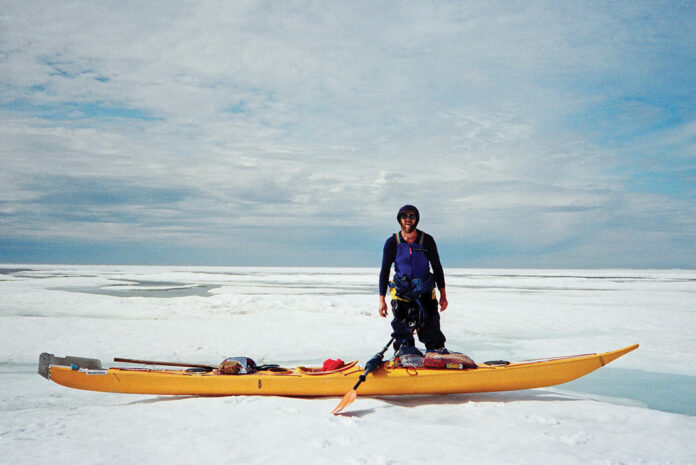
“I LOVE BEING OUT THERE FOR LONG PERIODS OF TIME. IT’S A DIFFERENT SCALE OF CHALLENGE.”| PHOTO: HENRY GEORGI

“What do you do when a polar bear charges you? We found yelling colorful language was more effective than gentle talking,” Arctic kayaker Jon Turk explained after a 104-day circumnavigation of Canada’s Ellesmere Island in 2011. “The right tone could communicate, ‘You’re bad. We’re just as bad.’”

After a second white bear over-lingered near Turk and expedition partner Erik Boomer’s tent, Jon texted his wife: “Bears scare us. We scare bears. Wind scares us. We do not scare wind.” Along with gale force headwinds, unstable ice and breaching 2,000-pound walrus were a constant threat.

Completing the 1,485-mile odyssey around the world’s tenth-largest landmass was a crowning achievement in a life of pushing limits in cold and remote climates, primarily by sea kayak. Yet two days after completion, normally a time of recovery and reward, Turk’s life was threatened again. Sudden onset renal failure triggered a descent into metabolic shock, fatal without immediate treatment. The trauma coincided with three days of bad weather, delaying his evacuation to Ottawa. Once in hospital, his deadly spiral stabilized.

The journey brought wider renown to a lifetime of exploration, yet prior to Ellesmere, Turk, 69, was relatively unknown. His obscure, analog adventures unfold over months and years, well beyond today’s digital attention spans. He doesn’t use GoPro or Twitter; his no-frills website is efficient but basic. Red Bull isn’t knocking at his door to back his projects, but Turk has never confused outdoor adventure for a marketing stunt.

The real distinguishing factor for Turk, the core of his wonderful anachronism, is that small-craft exploration is not an end in itself, but a means to develop and test explanations for unanswered questions in human history. How do Arctic peoples relate to their Asian forebears? How did the earliest migrations to North America happen, what beliefs motivated them and what tools or vessels helped them traverse incredible distances?

“It’s boring to just recite details from the trip,” says Turk. “I’m more interested in what grand journeys like Ellesmere, and the massive migrations undertaken by our ancestors, can teach us. What wisdom do they impart, and why have humans undertaken such journeys throughout history?”

Against the current tide of photogenic free climbers, big wave surfers and kayakers dropping 200-foot waterfalls, Turk echoes an older tradition of scholar-explorers who sought answers in the wild, beyond the reach of laboratories and scientific debate.

Raised in rural Connecticut, Turk earned a PhD in organic chemistry in 1971 from the University of Colorado. The same year, he co-authored the first environmental science textbook in the U.S., triggering a movement that led to the adoption of environmental studies curricula across North American schools. After a decade immersed in academia, mounting frustration with the conventions of career and consumer society prompted Turk’s decision to leave the laboratory for a life of adventure.

Turk’s maritime exploration began in 1979 with a solo paddling effort around Cape Horn in Patagonia. A harsh initiation that ended prematurely when waves pinned him against coastal cliffs—shattering his kayak and separating his shoulder—Turk followed this with an unsuccessful attempt at the Northwest Passage.

Recounted in Cold Oceans (1998), a series of arresting vignettes from his early adventures—many ending in desperation and failure—Turk’s 1988 expedition from Ellesmere’s Grise Fiord to Greenland was his first major success. The episodes collected in the pages of Cold Oceans are about pushing limits and trespassing into danger, each a sum of risks taken and consequences reaped, a portrait of determination from someone in so deep he has everything to lose.

In a two-part journey beginning in 1999 and finishing in late 2000, Turk kayaked 3,000 miles from the northern tip of Hokkaido, Japan, along Siberia’s Kuril Islands and Kamchatka Peninsula to the 65th parallel, finally crossing to Alaska’s St. Lawrence Island in the Bering Strait. It was his first major scientific expedition, aimed at testing the possibility of early human migration from modern day Japan to the Aleutian Islands.

In the Wake of the Jomon (2005), explores this thesis of ancient maritime migration as an alternative to the land bridge theory, the long accepted account of a gradual, ambulatory crossing of the Bering Strait when sea levels were much lower. Could a small band of early mariners have paddled dugout canoes over the horizon in an inspired pursuit of errant whale pods or a cosmic imperative, like Moses and the Red Sea? Turk retraced their likely itinerary, meeting indigenous Koryak communities along the way, descendants of the Jomon.

“If I could understand why the Jomon migrated across the Arctic,” muses Turk, “I might also understand why the first Stone Age adventurer hollowed out a log and charged into the surf, the notion being that a love of adventure helped transform bipedal primates into human beings.”

“TRADITIONAL PEOPLE USE THE BEST MATERIALS THEY CAN FIND. SO DO I. I HAVE NO CRITICISM OF REVIVALISTS. I’M JUST NOT THE KIND OF GUY TO MAKE A WALRUS SKIN KAYAK.” | PHOTOS: JON TURK

Appreciating Turk’s marriage of science and adventure requires a look back at the figures who emerged after exploration’s Heroic Age in the early twentieth century.

With the exhaustion of terra incognita and historical firsts, a new breed of explorer appeared, pioneered by Knud Rasmussen’s five-year dogsled across Greenland, Arctic Canada and Alaska into Siberia. Rasmussen suspected, and in time demonstrated, that the scattered pockets of Inuit peoples across the sub-polar region were ethnographically one, despite their mutual isolation. The English publication of Across Arctic America (1927) unearthed a rich new vein for exploration, potentially limitless because it was not defined by geography or historical firsts.

In the tropics, Thor Heyerdahl’s Kon-Tiki (1948) and Colin Turnbull’s The Forest People (1961) ignited popular imagination using expedition-based research on similarly remote, pre-modern populations in Polynesia and Central Africa. Like Rasmussen, both defied sensible thinking to remap our understanding of human place, early migration and the unique, near-forgotten worldviews involved. That their theories were later dismissed did not diminish their stature as visionaries or impugn their expeditionary approach to science.

As controversial as these adventurers were in their day, Turk’s written work has met similar criticism.

“Anthropologists got worked up, mostly because I’m not from their field, so my claims and research were dismissed as spurious,” Turk recalls. “I was misquoted and maligned in journal reviews. But that was eight years ago when there was very little evidence to support a marine migration theory.” Since then, numerous scientific papers have pursued the same thesis.

His proposal that migration was sometimes conducted out of a “spirit of adventure,” rather than out of pragmatic interests, also rocked a few boats. “In retrospect, I think it’s one of those arguments that you can get worked up about,” Turk admits, “but when you look at it closely, definitions break down. I believe we are a romantic species, even when we are being pragmatic; even if that sounds contradictory.”

PHOTO: JON TURK

Decades of maritime and terrestrial exploration—kayaking, skiing, trekking and dogsledding—in the Arctic and subarctic regions of North America, Greenland and Siberia saw Turk’s life become intertwined with rare individuals met along the way, from Canadian Inuit to Russian Koryak. Two years after the Jomon expedition, Turk returned to Kamchatka to pursue questions that would lead to The Raven’s Gift (2010).

The book recounts his relationship with an elderly Koryak shaman whose rituals mend a broken pelvis Turk sustained in an avalanche years before. The customary quarantine between observer and narrative subject is ignored, as Turk allows happenstance, unlikely Samaritans and bitter setbacks to enrich his immersion in the shamanism of the empty tundra. The result is a stark departure from the classic exploration account, with its emphasis on victory or defeat.

“We all fail in life,” he explains. “You aim big, you fail bigger. Every failure teaches us something. In wilderness adventure, if you don’t know when to back down from danger, you’ll die. So you always need to be ready to back away—and that isn’t failure. Success is ultimately what you learn from a mission and what you enjoyed while doing it.”

With The Raven’s Gift, Turk once again polarized readers. “Some people get hung up on whether the magic and healing I undergo are believable,” he confesses. “Things do happen in this world, within and beyond human consciousness, which defy scientific logic.”

“I guess my message, or the main thing I’ve learned from living with traditional peoples, is to approach the world in a softer way: to live with less, in order for human existence to be sustainable on the planet. They take only what they need. We take and use way more than we need; the consequences are obvious.”

An increasingly rare breed of scientist, adventurer and writer rolled into one, Turk’s literary achievements are among the gems of expedition literature. Couching theories of magic medicine and early marine migration within grand kayak adventures, they become gripping narratives.

Informed by the Ellesmere odyssey, Turk is at work on a new book. It promises more of his inimitable blending of adventure and inquiry. Rather than inflaming scientists and anthropologists, “this time I’m trying to write something that connects with a wider audience—urban, rural, regardless of politics,” he says.

The new book will explore “how people reclaim control over immediate threats and risks, whether they’re hunter-gatherers in the Amazon, or citizens of the South Bronx,” he says. Turk will be spending time in both places to complete his research.

“Our individual impact on the way the world is evolving may be infinitesimally small, but we are still responsible for how we react to this evolution,” he continues. “I want readers to see what people share in these two jungles, to see that sanity at the personal level is still within our control.”

The book recounts the early Polynesian islanders who felled towering tropical hardwoods with stone tools, fashioned them into 60-foot double-hulled catamarans, and sailed 2,000 miles across the ocean to find the impossibly slim sliver of Hawaii. Returning to Polynesia, they initiated a trade route between the two outposts.

“If we look directly at this ancestral past, certain strengths emerge that we share,” Turk says. But he acknowledges that we’ve stepped away from this mode of knowledge—“The self-reliance to learn from direct encounters with nature and with others.”

So how are the feats and beliefs of our ancestors relevant to modern society? What wisdom does Turk distill from his intrepid kayak journeys and explorations into historical origins and spiritual understanding?

“Let your relationship with the world and your environment be your primary teacher.”

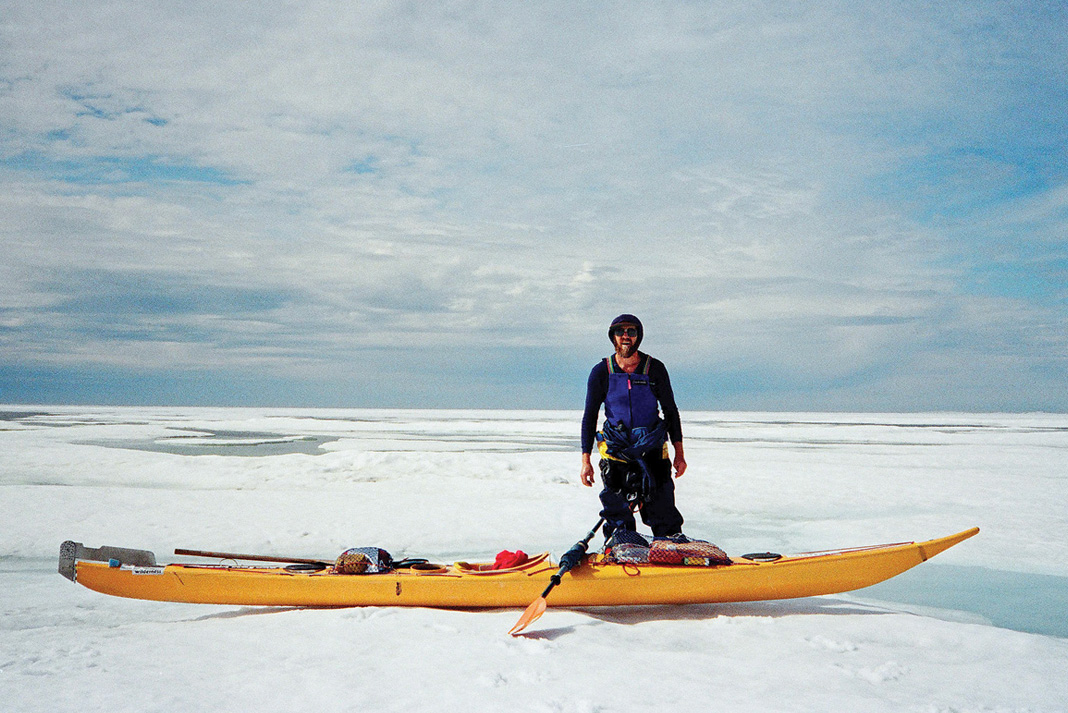
“I LOVE BEING OUT THERE FOR LONG PERIODS OF TIME. IT’S A DIFFERENT SCALE OF CHALLENGE.”| PHOTO: HENRY GEORGI

Listening To Spirits

A low, flat-topped, improbably purple island rises out of the middle of the river. You would have to be blind, deaf and insensitive not to know that this is a place of power in the landscape. As a First Nations elder from the Crow Nation once said: “If people stay somewhere long enough— even white people—the spirits will begin to speak to them. It’s the power of the spirits coming from the land.”

We drift lazily to the downstream side of the island to find a large eddy and join together, our little flotilla of Innova inflatable kayaks bumping softly into one another. The mystery is here, as I knew it would be, tactile and palpable before us— an eroded cutbank full of caribou bones amid the fireweed. I look at the familiar faces in our little tribe: my wife, Nina; younger daughter, Noey; her boyfriend, Glenn; and my older daughter’s husband, Deryl.

We scamper up the 10-foot-high bank, walk across the small plateau, and find a collection of long-abandoned circular homes made with closely interwoven caribou antlers—the remnants of families not so different from my own. Families who had once hunted the giant herds that migrated across the river at this wide, shallow ford.

I have kayaked in the Arctic all my life, charging hard and hungry over tumultuous seas and dangerous, shifting icepack. At the end of my Ellesmere circumnavigation—on the medevac aircraft, racing time against death—I told myself, “I’m done. Finished. Sixty-five years old; too old for this harsh environment. I quit.”

Later, lying in the hospital bed, I recalled sites I had visited during my travels: ancient stone igloos, food caches and bleached kayak ribs lying, half buried, on the beach. I thought about our ancestors who had raised families on this barren tundra and hunted these frozen seas, stealthily moving across the ice with only a rock tied on the end of a long stick, pursuing two-ton, saber-toothed walrus and Nanook, the fearsome polar bear.

I am proud of my expeditions. But there has been a sterility to these endeavors—two men alone in the vastness, racing toward a self-defined goal. So, in my late sixties, I’ve decided to turn a page and approach the Arctic from a different perspective. Now, I am back in the land that I love, but this time moving more slowly, with the people whom I love—my family.

You don’t have to GO BIG to have a meaningful experience in the Arctic. After basking in the sunshine and the flowers, we float onward, toward the ocean. There are rapids to run downstream, fish to catch, mushrooms and berries to pick and grizzly bears to startle us. This is a gift and a legacy I can continue to enjoy and can leave for my people—“The power of the spirits coming from the land.”


Screen_Shot_2015-06-15_at_3.44.39_PM.pngThis article first appeared in the Early Summer 2015 issue of Adventure Kayak magazine. 

Subscribe to Paddling Magazine and get 25 years of digital magazine archives including our legacy titles: Rapid, Adventure Kayak and Canoeroots.

The Everglades: Florida’s Labyrinthine Paradise For Paddlers

Trip: The Everglades | Photo: Constance Mier

Located on the extreme southern end of the Florida peninsula, Everglades National Park is a unique combination of fresh- water marshes, coastal prairies and mangrove swamps. During the summer, the heat and mosquitoes are intolerable, but in the drier and more temperate winter months, the park is a popular paddling and camping destination.

In the Everglades, the water and sky dominate as canoeists navigate across open gulf waters and around coastal mangrove islands, or paddle through endless dark narrow creeks. You can lose yourself in the beauty of the Everglades, but consult a map often as there are few distinct landmarks.

For campers, the national park offers unique chickees, elevated wooden platforms built on the water for tenting. Enjoy the solitude of being surrounded by water as you listen to the night noises of the remote wilderness. Sandy beach camping—complete with amazing sunsets—is also available. For the bold, there are ground sites in the dense backcountry forest, located where homesteaders lived decades ago and where the remnants of their farms remain.

TRIPS

If you have a half-day paddle out of the Flamingo Visitors Center into Florida Bay. Head east along the shoreline toward Snake Bight and watch hundreds of wading birds on the large mud flats during low tide. If you’re lucky, you may see an American flamingo or two. Bring fishing gear.

If you have a day paddle the outgoing tide from Gulf Coast Visitors Center to the gulf through Sandfly Pass. Have lunch on an island beach and catch the incoming tide on Indian Key Pass. Watch dolphins feeding in shallow waters, osprey in their nests, mullet jumping out of the water, and flocks of white pelicans soaring above.

If you have a weekend get a camping permit and launch from the Gulf Coast Visitors Center. Paddle across Chokoloskee and spend a night on one of the beach island campsites, such as Pavilion Key. Explore the beach and view the fiddler and horseshoe crabs and watch pelicans dive offshore as the sun sets over the open water.

If you have a week take a trip that includes chickee, ground site and beach camping. Begin and end your trip on the southern end near Flamingo Visitors Center or on the northern end at Gulf Coast Visitors Center. In a week’s time, you can truly experience the diversity of the Everglades, from open gulf waters to intimate mangrove creeks.

Trip: The Everglades | Photo: Constance Mier

STATS

Average winter high: High 77 degrees Fahrenheit, Low 53 degrees Fahrenheit

Rain fall: 60 inches per year; rainy season is May to September

Wildlife: Alligator, crocodile, dolphin, manatee, horseshoe crab, great blue heron, osprey, white pelican, flamingo

Campsites: Select between ground sites, beach sites and elevated camping platforms, known as chickees.

Outfitters: Join a day trip or rent your own boat at Everglades Area Tours (www.evergladesareatours.com) or Everglades Adventures (www.evergladesadventures.com)

Diversion: The 15-mile Shark Valley paved trail overlooks the Everglades, providing a bird’s eye view of the park. Roadside attractions include boat rides and alligator farms.

Best eats: Havana Café on Chokoloskee Island. Try one of their Cuban sandwiches and a café con leche.

Must-have: Bug repellent, sun screen, map and tide schedule.

Constance Mier is a nature photographer who is inspired by her canoe explorations of the Everglades. Living in Miami, Florida, she can easily access the national park and spend days at a time exploring. Her photographs offer a glimpse of this beautiful wilderness area as seen from a canoe. 


Screen_Shot_2015-07-07_at_2.59.13_PM.png

This article first appeared in the Fall 2015 issue of Canoeroots Magazine.
Subscribe to Paddling Magazine and get 25 years of digital magazine archives including our legacy titles: Rapid, Adventure Kayak and Canoeroots.

Werner’s New Odachi Paddle

Werner Odachi

New for this season is the Werner Odachi paddle, a blade designed specifically for whitewater racing. 

A nod to the growth of the race scene at home and internationally, Werner is providing paddlers with a new tool to tackle downriver and creek races. The Odachi takes its name from the calvary sword of the samuri, a long blade with a specific purpose. “We’re excited to bring our bomber reliability to such a super specific paddle,” says marketing manager Danny Mongno. The Odachi isn’t meant to be an all-around paddle, and is a blade with a specific purpose, Mongno adds.

The Odachi’s blade to shaft offset enables a significantly more powerful forward stroke, while its long blade length (49 centimeters) provides great leverage. The symmetrical blade shape provides more surface area, and allows for a higher angle stroke. Werner has optimized materials and manufacturing techniques to obtain lower weight, remain strong and provide flex, says Mongno.

Offered in a one-piece design, the straight shaft retails for $350 while the bent shaft retails for $450. Weight is between 30 and 35 ounces. 

The Rapid team look forward to getting our hands on one to test! 

Learn more about the Odachi here

Would You Rather

TURNING OUR IDEAS ABOUT GROWTH UPSIDE DOWN. | PHOTO: ROBERT FAUBERT

When the Whitewater Rodeo World Championships was first held on the Ottawa River it was 1997. Jewel was topping Billboard pop charts. The Titanic was sinking and smashing box office records. My buddies at the rafting company went to the River Club as Dirk Diggler and the cast from Boogie Nights. And the Perception Arc and Spark (Google them) were hot boats on the Ottawa River.

The very best paddlers were just paddlers. Nobody considered themselves athletes, or even if they did, nobody else did. Training was catching rides along the way while waiting for commercial raft trips. The best paddlers logged river days, not training sessions. The ’97 Worlds showed the world that the left side of Horseshoe at the bottom of McCoys on the Ottawa was no longer a God forsaken, ass whopping beatdown of a lifetime that one avoids at all costs. It was a place to side surf, spin, pirouette and figure out cartwheels. Even shorter kayaks with flatter bottoms and slicier ends were on the way. And they were the future growth of the sport. At least that’s what we all believed at the time.

As rodeo evolved into freestyle, winning competitions became the way of selling boats. While companies and their designers—who in most cases were competitors themselves—put more emphasis on the hottest new tricks, most paddlers continued to run rivers from top to bottom.

The athletes tired of hole moves and transitioned to bigger and faster waves. Kayaks got shorter, fatter and bouncier. Freestyle kayaks became so specialized they started to suck for paddling down rivers. The tricks for which they were designed were beyond most boat-buying weekend paddlers. Whitewater kayaks sales peaked around 2003.

TURNING OUR IDEAS ABOUT GROWTH UPSIDE DOWN. | PHOTO: ROBERT FAUBERT

In our Fall 2015 issue, we had Conor Mihell’s feature on the upcoming 2015 World Freestyle Kayak Championships, which are back on the Ottawa River for the third and maybe the last time. If you don’t believe whitewater freestyle and its long road to the Olympics is the future growth of our sport, then you’re probably in the camp that feels the future of whitewater looks friendlier, like class II.  You’ll enjoy our shootout of the four best multi-day river running kayaks, also found in our Fall 2015 issue.

While none of the brands included were willing to go on record and offer hard sales numbers, each confirmed they are excited about the growth they are seeing in crossover sales and are consequently building their catalogs with more crossover models.

What’s old is cool again.

We’ve come a long way in understanding how hull shape and subtle variations improve performance. The last time we were excited about 10-foot-long kayaks we were using Tevas wedged in as hip pads. We now get the very best outfitting, plus dry storage and the built-in floatation and convenience of a stern bulkhead and hatch. What’s even better is that almost 20 years later we get all this at virtually the same price.

When it comes to predicting the future of whitewater I’ve given up asking enthusiasts and those of us in the industry. Instead I like to play the game Would You Rather. I play with friends and family and complete strangers I meet on the trail and chairlift. I choose people I know who ride mountain bikes or ski, and other prime candidates to someday wander into a paddling shop. I ask them, “Would you rather spend the afternoon dropping into a wave called Garburator or spend a couple weeks exploring the Grand Canyon?”

If they don’t immediately choose the canyon, they ask why the wave is called Garburator.

Then they choose the canyon.

Scott MacGregor is the founder and publisher of Rapid


Screen_Shot_2015-07-07_at_3.09.09_PM.png

This article first appeared in the Fall 2015 issue of Rapid Magazine.

Subscribe to Paddling Magazine and get 25 years of digital magazine archives including our legacy titles: Rapid, Adventure Kayak and Canoeroots.

7 Reasons Why Paddling Makes You A Better Person

“IF IN DOUBT, PADDLE OUT.”  NAT YOUNG PHOTO: RYAN CREARY | Photo: Ryan Creary

You’ll be happier: Spending time in nature makes us feel more alive—and that’s a good thing. Numerous studies have linked exposure to nature with increased energy and a heightened sense of wellbeing. “Nature is fuel for the soul,” reports University of Rochester psychology professor Richard Ryan. “Often when we feel depleted we reach for a cup of coffee, but research suggests a better way to get energized is to connect with nature.”

You’ll make do with less: When you have to carry your possessions with you, you’re forced to bring less. It’s freeing to discover how little you need to survive and what can be achieved with the bare minimum. Leave digital distractions, consumerism and vanity at home—a PFD, canoe and paddle is the price of admission to adventure. Bring a backpack carrying shelter and food to extend your exploration for days. You’ll discover the things that really matter—and I’ll bet it’s not watching HBO on a big screen.

You’ll disconnect to reconnect: Sometimes paradise is just a paddle stroke away. Literally and figuratively, pull away from the shore and feel lighter, breathe easier. You don’t need to go on an epic expedition to forget your troubles (though it helps)—on the water, deadlines don’t seem so pressing and day-to-day concerns don’t seem so heavy. A small boat on a big body of water has a way of putting things into their proper perspective.

Photo: Ryan Creary
Seven Reasons Why Paddling Makes You a Better Person

You’ll be thankful: Indoor plumbing never seemed as miraculous as after returning from a two-week wilderness trip at the height of bug season. Climate control? Covered areas larger than 36 square feet? Drinking water on demand? Hot water on demand? And it’s not just the modern conveniences back home you’ll find a new appreciation for—as anyone who’s ever been reduced to tears of gratitude by a simple hot cuppa on dry land after a grueling day understands.

[ Discover the best canoeing gear of the year in the Paddling Buyer’s Guide ] 

You’ll work as a team: Tandem canoeing requires a certain amount of skillful communication— there’s a reason some call the canoe
 a divorce boat. Yet, four arms 
are better than two, especially
 when working in tandem. Canoe 
tripping allows for practicing interpersonal skills, like leadership 
and teamwork. And you’ll get 
better at clearly expressing yourself after your partner repeatedly directs you into the wrong eddy. (“Which rock are you talking about?!”) Healthy group dynamics are their own reward—nothing beats the camaraderie created by a happy, functioning team. Best friends forever.

You’ll push your limits: There will be heat, and there will be cold, there
 will be rain and wind—there will be miles, and maybe sore muscles. Equipment may break down and require ingenuity to fix. Conditions could deteriorate and force you to draw on years of experience to manage. Boundaries will be pushed, and comfort zones expanded. It’s in these places that we learn most about ourselves and grow.

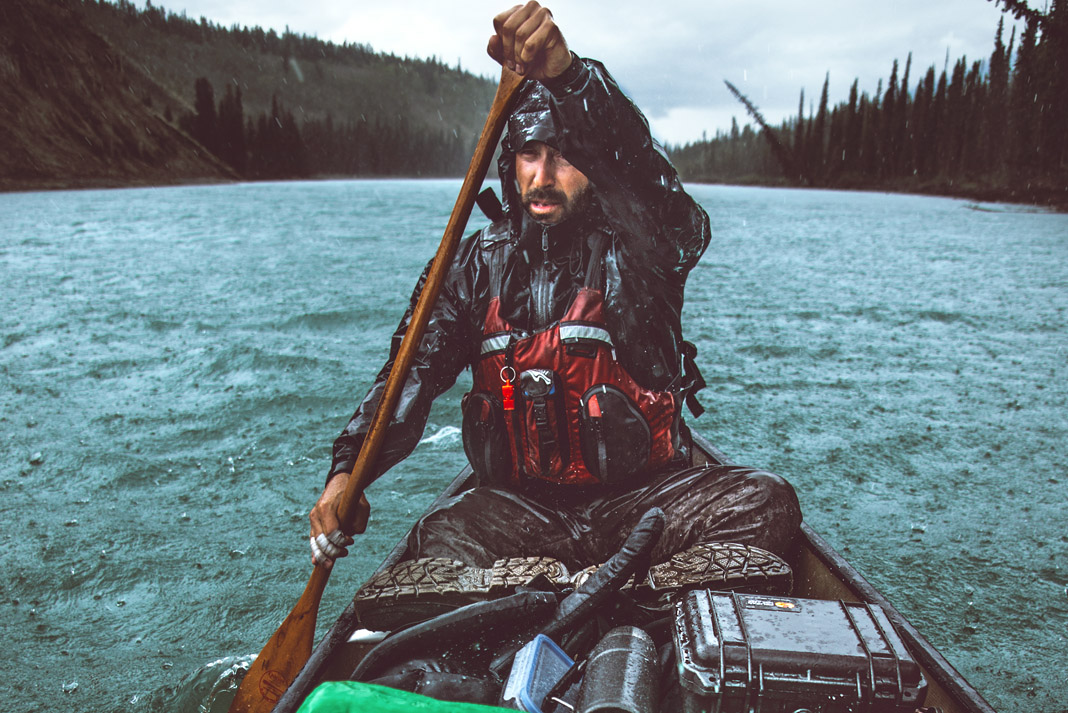
You’ll learn acceptance: Sometimes, that storm will continue unabated for days—and there’s not a damn thing you can do about it. Get used to it.


Screen_Shot_2015-07-07_at_2.59.13_PM.png

This article first appeared in the Fall 2015 issue of Canoeroots Magazine.
Subscribe to Paddling Magazine and get 25 years of digital magazine archives including our legacy titles: Rapid, Adventure Kayak and Canoeroots.

Where Are They Now: Filmmakers Steve Weileman & Ken Campbell

Photo: Steve Weileman
Where Are They Now: Filmmakers Steve Weileman & Ken Campbell

In celebration of the 10th anniversary of the Reel Paddling Film Festival, we checked back with a few filmmakers whose films we’ve featured over the past ten years. You can find more stories on past filmmakers in the pages of our Early Summer issue to catch up with them and find out what they’ve been up to since their films embarked on our annual world tour. 

The Film: The Roadless Coast

Conceived around the idea that kayaks are the ideal craft to access remote beaches affected by tsunami debris, Ikkatsu—a Japanese word meaning “united as one”—brings together cultures on both sides of the Pacific, united by a single problem: plastics pollution in our oceans. Time-lapse beach surveys don’t make for edge-of-your-seat viewing, but the film—and the team’s mission—is engaging on a different level. 42 minutes, 2013; ikkatsuproject.org.

The Filmmakers: Steve Weileman & Ken Campbell
Tacoma, Washington

Washington paddlers Steve Weileman and Ken Campbell started the Ikkatsu Project in 2012 with the simple idea of taking a sea kayak trip along the Olympic Peninsula, hunting for debris from the tsunami that struck Japan in March 2011.

The friends knew they wanted this expedition to be more meaningful than a simple adventure. “I’d spent so many years becoming a good kayaker, I started asking ‘now what?'” recalls Campbell, a longtime guide and sea kayaking author. “What else could I do with these skills I’d learned?”

Partnering with advisors at the National Oceanic and Atmospheric Association (NOAA), they conducted beach surveys en route and shared their data with the scientific community.

Ikkatsu: The Roadless Coast, the film Weileman and Campbell shot on that trip, blossomed into a wide-reaching and award-winning documentary, and Ikkatsu developed into something far greater than a single expedition. As Campbell explains, “The project progressed from being a one-time vacation idea to a full-time vocation.”

Realizing the problem consisted of much more than the remains of one tragic event, the pair began researching marine debris in general, conducting surveys that could be used to coordinate future cleanup efforts. Their mission: raise awareness through print, films and data-gathering expeditions about the plastics pollution inundating ocean shorelines around the world.

In 2013, searching for a new project that would benefit from their location and skill set, Weileman reached out to Adventurers and Scientists for Conservation (ASC), a nonprofit organization that connects outdoor adventurers with scientists in need of field data.

A few emails later and Weileman and Campbell were coordinating with the Marine Environmental Research Institute to collect water samples for a global microplastics study. With another partnership in place with Oikonos, a nonprofit that researches plastic ingestion by sea birds, the pair headed to Alaska to conduct surveys on the remote, paddle-access-only beaches of Cook Inlet and volcanic Augustine Island. Once again, they filmed their journey for Ikkatsu: The Secrets of Augustine (2014).

Even on these isolated beaches, marine debris was everywhere. “Until you actually get down and count it, it kind of blends into the scenery,” says Campbell. “It’s a sobering thought, that every piece of plastic that has ever been made is still in existence.”

Campbell’s latest film and a book of the same name, Message in a Plastic Bottle, both released this spring, document his recent 150-mile paddle through Puget Sound in a kayak built out of discarded plastic bottles. Paddling a floating garbage patch turned out to be a great icebreaker for starting environmental conversations, he says.

For both men, Ikkatsu has opened the door to their own understanding of conservation issues, and how to more effectively communicate these to other concerned citizens. Along with their films and website, they also give presentations in schools to engage students in the discussion.

This summer will once again find their focus close to home. Campbell is completing a couple shorter trips in the Puget Sound area and he’s hoping Weileman will be able to steal time away from his new job as an IT systems engineer to lend his skills behind the camera.  Looking ahead, and further afield, they’d like to investigate other aspects of ocean health. Top of Campbell’s list: travelling to Newfoundland to make a film about the effects of global overfishing from the persecptive of the island’s inshore fishermen.

It would be a fitting project for the Ikkatsu co-founder, who paddled around Newfoundland in 2001 and whose father—a chemist for the Department of Fisheries and Oceans—once moved the family to Newfoundland to study mercury levels in tuna, perhaps planting the seed for his son’s fascination with ocean ecology.

For Weileman, the films’ cinematographer, their reception has been especially rewarding. “I knew we were on the right track when, after a screening of The Roadless Coast, college students would come up and want to volunteer for the next project.”


Screen_Shot_2015-06-15_at_3.44.39_PM.pngThis article first appeared in the Early Summer 2015 issue of Adventure Kayak magazine. 

Subscribe to Paddling Magazine and get 25 years of digital magazine archives including our legacy titles: Rapid, Adventure Kayak and Canoeroots.

Skills: Soup Up Your Ride

Photo: Ontario Tourism
Two sea kayakers make adjustments in the cockpits of their sea kayakers.

So you’ve found your dream kayak, but a few details still need tweaking. There are countless ways to personalize your kayak—some some fast and easy, some more involved and complex. As you start playing with drills and epoxy, just don’t forget basic requirements like flotation and water-tightness. If in doubt, consult an expert before you do anything drastic. Here are 12 ways, some practical, some purely hedonistic, to soup up your ride.

Keel strip

There’s a reason you’ll see a keel strip on many experienced paddlers’ kayaks—it’s simple yet effective. This extra layer of fibreglass or plastic tape will help protect your boat and let you focus on playing hard.

Customized seat

Paddling is infinitely better with the right seat. If your seat isn’t working for you (e.g. your legs go numb quickly), try small modifications like high density foam under your bottom or install a different seat. Keep in mind that a well-formed yet simple seat can be more comfortable than an overly padded bulky seat which may limit your movement and can hinder good paddling posture.

Custom padding

A well-fitting boat is essential for more advanced strokes and maneuvers that require edging, good boat control and full body engagement. If you find that your boat is a bit too wide or loose, add foam blocks or wedges (handcarved or purchased) to ensure that your hips make contact with the boat.

{loadposition PBG_AK_Midcontent}

Heel pads

If you often paddle barefoot, make your life more comfy by adding a thin layer of high density foam to the bottom of the boat where your heels rest. Make your own or purchase a set.

Underdeck bungees

Keep your deck and cockpit clutter free. Rig up a storage system under your deck for items you want out of the way, but easily accessible, like pumps and flares.

Bulkhead

If you’re up for some major boat renovations, you can move your front bulkhead back to allow for more dry storage space. Unless you are very capable with boat repairs, it’s best to leave this in expert hands, or request this modification when you first order your boat.

Paddle park

Add some spare bungee and a clip within easy reach on your deck, and voila, you have a place to park your paddle!

Beads

Hand-carved beads are traditionally part of the deck rigging on many Greenland boats. This small and easy modification allows you to more easily stick your paddle (or harpoon) under the deck rigging or makes it easier to grab a hold of your boat during self-rescues.

Reflective tape

Trim your boat and paddle with reflective tape for added visibility during night paddles and foggy conditions. If you’re really into sticking stuff on your boat, there are lots of decals and designs out there to give your boat some added flair.

Cup holder

Rig up a cup holder on your deck, it’s the ultimate extra for caffeine-loving paddlers.

{loadposition PTG_AK_Midcontent}

Results: The Worlds at Garb

Re-watch the final rounds here. Photos: Scott MacGregor

The last two days of competition provided high tension and excitement – and also doled out crushing heartbreak and triumph to some of the world’s best freestyle athletes, proving that on Garburator, anything can happen.

In Men’s OC1 Finals, more impressive aerial moves were laid down, and the crowd was exuberant as the men took to the wave. Andy Hill (CAN) claimed the first gold medal of the day after an incredible third ride, where he landed a flashback, blunts, and a massive pistol flip, earning him 281.67 points. Coming in almost 100 points behind Hill was Dane Jackson (USA) with 190 points, and Brad McMillan (USA) claimed bronze with a 70 point ride, pushing former champion Jordan Poffenberger (USA) into fourth place and off the podium.

In Junior Women’s finals, Sage Donnelly (USA) dominated the competition, posting a best score of 588.33—a score that would have topped the podium in Senior Women’s K1 division. Coming in second was teammate Darby McAdams with 203.33, followed closely by Sophie McPeak (GBR) with 71.67.


Junior Women's champion, Sage Donnelly, celebrates after her first place finish on Garburator at the ICF World Freestyle Kayak Championships.

Junior Women’s champion, Sage Donnelly, celebrates after her first place finish on Garburator at the ICF World Freestyle Kayak Championships.

Junior Men’s K1 saw some high scoring rides with a heavy presence from Great Britain. Topping the podium was Hugo Anthony (GBR) with an impressive 781.67, followed by Alec Vorhees (USA) with 676.67, and clinching the bronze medal was Scott Hugo (GBR) with 593.33.

Competition for women’s K1 semi-final was intense

The Men’s C1 division saw Dane Jackson on top of his game, throwing an impressive 863.33 points on the board in his third run, securing the top spot. In second place was Seth Chapelle (USA) with 565 points and in third was 20-year old Zach Zwanenburg (CAN) with 528.33 points. Poffenberger (USA) was again pushed out of the running for a medal in this category, posting a best score of 505 points.

Women’s K1 semi-final was easily one of the exciting and stressful rounds of the entire competition, with early favourite Adriene Levknecht (USA) flushing on both of her rides, which pushed her into 9th place and out of the running for finals. Emily Ward (GBR) topped the podium with a 320 point score. Going into the top five after her were Emily Jackson (USA), Claire O’Hara (GBR), Hitomi Takaku (JPN) and Katya Kulkova (RUS). The competition was tough on Saturday as the top five women took to the wave, but Jackson’s experience with competition paid off, and she took the top spot with a score of 448.33. 

The top five women's K1 finishers at the ICF World Freestyle Kayak Championships. From left to right: Hitomi Takaku, Emily Jackson, Claire O'Hara, Katya Kulkova, and Emily Ward.

The top five women’s K1 finishers at the ICF World Freestyle Kayak Championships. From left to right: Hitomi Takaku, Emily Jackson, Claire O’Hara, Katya Kulkova, and Emily Ward. 


Very close scores at the ICF World Freestyle Kayak Championships

In Men’s quarter finals on Friday, the field was cut from 20 to 10, and later that day the same group of men were culled from 10 to the top 5. Scores were incredibly close, with the top five posting scores between 1100 and 1500 points. In the end, moving onto Saturday’s final were Dane Jackson (USA), Nick Troutman (CAN), Bren Orton (GBR), Joaquim Fontane Maso (SPN) and Mathieu Dumoulin (FRA). The final proved to be a nail biter, with early favourite Orton flushing on one of his rides, and posting a highest score of 876.67 points, which wasn’t enough to break into the top three. Troutman had the hometown crowd’s attention, but struggled to post high scoring rides on his first two rides before coming back with a vengeance for the bronze medal, posting a score of 1170 before losing his paddle in the foam pile and hand paddling downstream. In the end, brother-in-law Dane Jackson added to his medal collection with a gold medal ride with an incredible 1653.33 points, followed by Dumoulin with 1420 points.

Matt Hamilton announcing live with Dane Jackson, the Men's K1 winner of the ICF World Freestyle Kayak Championships.

Matt Hamilton announcing live with Dane Jackson, the Men’s K1 winner of the ICF World Freestyle Kayak Championships. 

This year’s world freestyle event was one for the books, with plenty of drama, great weather and perfect water levels. The event truly captured the spirit of the paddling community as a whole—coming together to celebrate life, whitewater and paddling with friends from around the world. Truly, a world-class event on a world-class feature, accompanied by an epic after party.

More Photos

Emily Jackson, K1 Women's top place finisher on Garb at the ICF World Freestyle Kayak Championships.

Emily Jackson, K1 Women’s top place finisher on Garb at the ICF World Freestyle Kayak Championships.


Anthony Hugo, the winner of the Junior Men's Finals, selfies on the shore of the Ottawa River at Garb during the ICF World Freestyle Kaak Championship.

Anthony Hugo, the winner of the Junior Men’s Finals, selfies on the shore of the Ottawa River at Garb during the ICF World Freestyle Kayak Championship.

Dane Jackson celebrates with Zachery Zwanenburg and Seth Chapelle following a top three finish in the C1 division at the ICF World Freestyle Kayak Championships.

Dane Jackson celebrates with Zachery Zwanenburg and Seth Chapelle following a top three finish in the C1 division at the ICF World Freestyle Kayak Championships. 

Anthony Hugo, winner of the Junior Men's divison, on Garb at the ICF World Freestyle Kayak Championship.

Anthony Hugo, winner of the Junior Men’s divison, on Garb at the ICF World Freestyle Kayak Championship. 

The scene at the Lorne on the Ottawa River at the ICF World Freestyle Kayak Championships.

The scene at the Lorne on the Ottawa River at the ICF World Freestyle Kayak Championships. 

Nick_Troutman_and_Mom.jpg

Nick Troutman, who placed third in Men’s K1, celebrates a podium finish his mom, an avid supporter and volunteer, at the ICF World Freestyle Kayak Championship.


5 Easy Weekend Loops

Destinations: 5 Easy Weekend Loops | Photo courtesy Ontario Tourism

SATURNA ISLAND

This gem in British Columbia’s idyllic southern Gulf Islands boasts spectacularly eroded sandstone cliffs, nimble-footed feral goats, seal haul-outs and the longest stretch of untouched coastline in Gulf Islands National Park Reserve. Make the 35-kilometer circumnavigation in two days and camp at one of the five national park sites on tiny, neighboring Cabbage Island. pc.gc.ca/gulf

SPARKS LAKE

The best time to wind your way around this 370-acre lake in central Oregon’s Deschutes National Forest is early summer, when snow still caps the surrounding 10,000-foot summits, and meltwater keeps the lake at a perfect level for exploring its many wildflower- filled cracks and crannies. Head south from the launch area to find curious volcanic islets, wilderness campsites and trout-filled waters. fs.usda.gov/deschutes

FATHOM FIVE

This National Marine Conservation Area lies at the tip of Ontario’s Bruce Peninsula, where the sparkling green waters of Georgian Bay meet the depths of Lake Huron. Cross 6.5 kilometers from Tobermory village to Flowerpot Island, then circle around it (6.5 kilometers) to see the historic lightstation and twin limestone sea stacks that give the island its name. Spend the night at a paddle-in campsite in Beachy Cove. pc.gc.ca/fathomfive

Destinations: 5 Easy Weekend Loops | Photo courtesy Ontario Tourism

TEN THOUSAND ISLANDS

Southeast of Marco Island, Florida’s Rookery Bay is embroidered with a seemingly infinite number of keys, islets and mangrove channels, making it quite possible to tour this national wildlife refuge and never take the same route twice. For a relaxing weekend in this watery maze, travel inside the islands from Goodland to Cape Romano campsite (seven miles), then return via Kice Island’s Gulf side (10 miles). paradisecoastblueway.com

ANTELOPE ISLAND

Save a tour around Lake Powell’s largest island for September, when fewer powerboats means less competition for prime beach campsites and calmer waters through the steep-walled Antelope Narrows. Launch at Antelope Point just south of the Arizona/ Utah state line and enjoy views of towering Castle Rock on this 18-mile circumnavigation. Don’t miss a side trip into the swirling sandstone splendor of Antelope slot canyon. nps.gov/glca


Screen_Shot_2015-06-15_at_3.44.39_PM.pngThis article first appeared in the Early Summer 2015 issue of Adventure Kayak magazine. 

Subscribe to Paddling Magazine and get 25 years of digital magazine archives including our legacy titles: Rapid, Adventure Kayak and Canoeroots.