The Grand Canyon is a quintessential American National Park with layers of red rock sandstone, dramatic vistas from both rims, and of course, world-class whitewater paddling. This dramatic section of the Colorado River is a bucket-list paddle for many adventure lovers, but what does the trip actually look like from inside the canyon?
From the first unsupported sea kayakers to tackle the Grand Canyon to epic carnage, check out the best Grand Canyon whitewater videos on the internet:
Grand Canyon by Sea Kayak
More than ten years after four Canadian sea kayakers and an open canoeist paddled the Grand Canyon in what many claim was the first unsupported group of sea kayakers to tackle the canyon, the video has finally been released in 2025 on YouTube!
In addition to the historic sea kayak descent, James Manke is likely the first to paddle the river with a traditional Greenland paddle. The initial descent took place late December 2012 to early January 2013.
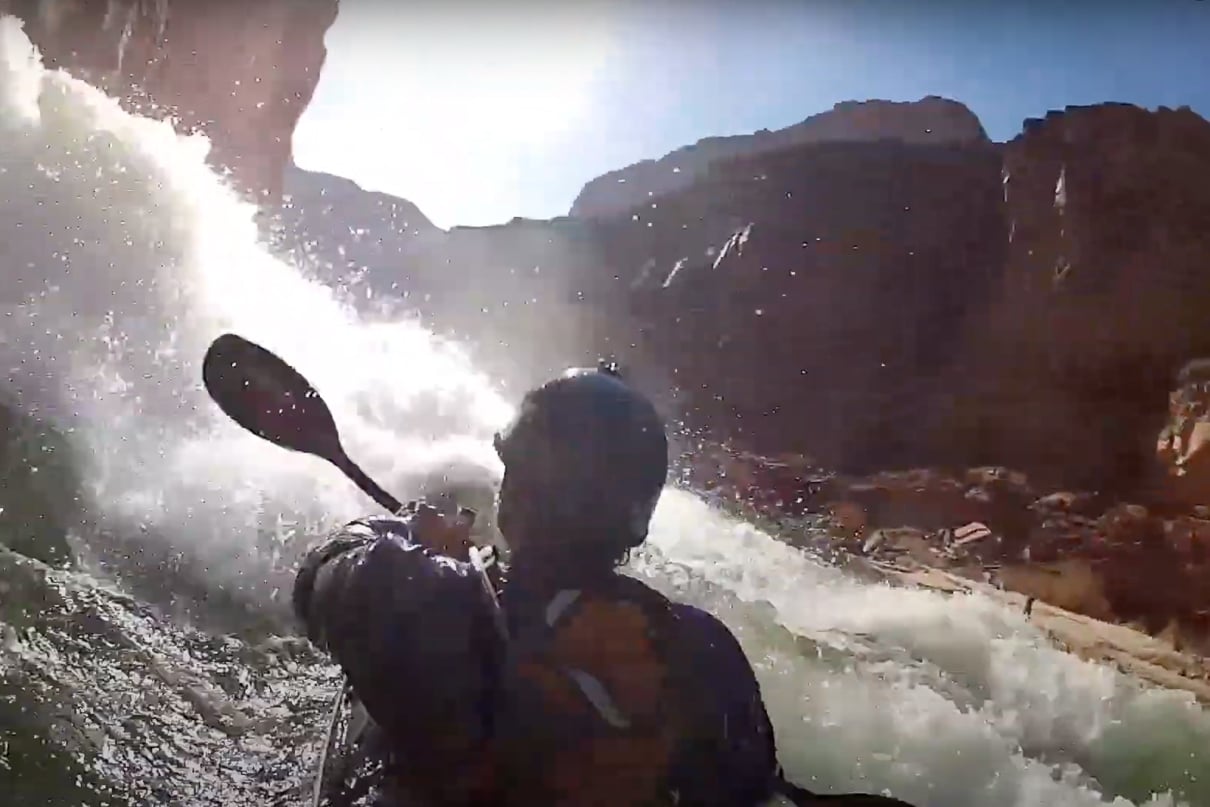
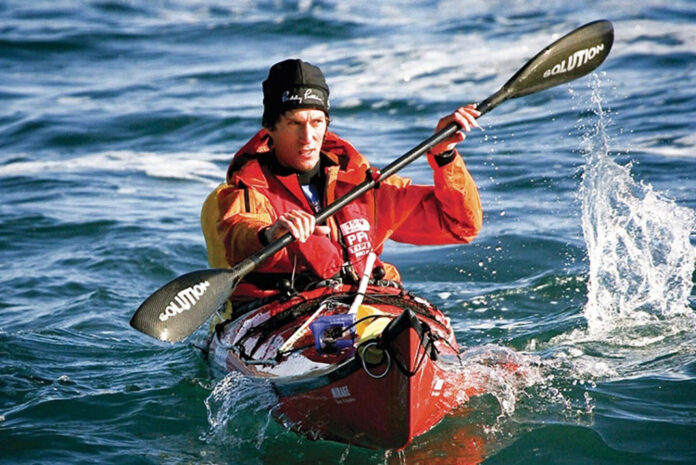
A sea kayaker descends into the rapids of the Grand Canyon. Feature Image: James Manke | YouTube
Also a key part of the trip was expedition paddler Jamie Sharp, who kayaked the Grand Canyon in a tandem sea kayak in a later journey.
Hance Rapids carnage
“Hance Rapid is a Class 8. The biggest we’d seen yet on the expedition,” wrote Randolph Hencken on YouTube.
Differing from the standard International Scale of River Difficulty (ISRD) most commonly used as a rapid classification system, the Grand Canyon has its own rating system ranging from 1 to 10. In the Grand Canyon’s rating system, a Class 10 roughly corresponds to a class IV+ on the ISRD.
“This video shows Sherwood “Woody” pointing at the pour-over moments before I ejected myself into the waters,” continued Hencken. “It shows Maria in the background running the rapid properly while coaching Woody what to do in the absence of his pilot.”
The only thing better than a video showing the beauty of the Grand Canyon and clean lines is a video showing some fun, casualty-free carnage.
“Not an instructional video, enjoy the carnage,” wrote Nate Taylor on YouTube about his curfuffle at Horn Creek, a Class 8, found around the 5:56 mark in the video.
The scene begins in a very relatable moment when a friend asks Taylor if he’s ready.
“Not really,” Taylor replies.
Who among us hasn’t been there at some point? Commenters note that Taylor is hard on himself, the rapids were run well, and offer words of encouragement.
Kayaking all the major rapids on the Grand Canyon
Rafting videos tend to be shot from a higher vantage point than a kayak, flatting out the rapids on the screen so YouTuber Life of Spud set out to make a video showing every rapid in the Grand Canyon from the perspective of a kayaker.
This is easily one of the best videos to watch to gauge the size of the rapids on the Colorado River in the Grand Canyon.
If you were to drop a pin in the center of Curry County, Oregon, along the border of the Rogue River-Siskiyou National Forest, you would be able to reach five waterways designated as U.S. Wild and Scenic Rivers within 40 miles of each other—the Rogue, Illinois, Chetco, Smith, and Elk rivers. It’s the highest concentration of any one county within the contiguous United States. It says as much for the quality of the rivers on the South Coast of Oregon as it does of the mountains that cut such dramatic relief to produce them.
Rivers runners have heard of the whitewater runs of the Lower Rogue River Gorge, Illinois, Upper Chetco, the Smith River on the California border, and probably less so of the Elk River. What’s easy to forget though is that none of these rivers, or any other in this corner of the state, ends with its whitewater. As they continue toward the Pacific they slow, meandering beneath gorge walls and along forested corridors before opening into fertile estuaries swaying with the tides. The lower reaches of Oregon’s coastal rivers are not only equally remarkable to their interior whitewater gorges—the rewards are also accessible to all abilities, have multiple trip length options, and are located near some of Oregon’s most eclectic coastal towns.
Here are three of the best ways you can visit the rivers of the South Coast with a paddlecraft of your own or along with an outfitter.
3 river destinations on the South Coast of Oregon
Lower Rogue River. | Photo: South Coast Tours
The Rogue River’s Copper Canyon
The 35-mile stretch of the Rogue River from Grave Creek to Foster Bar is one of the most renowned multi-day river trips in the country. But it’s far from the only way to relish in the majesty of the Lower Rogue River Gorge. Beginning in Agness, Oregon at the confluence with the also wild Illinois, the Rogue enters a 13-mile section called Copper Canyon, a lesser talked about but equally scenic section. After Agness, the national forest road moves away from the gorge and won’t return again until the takeout at Quasatana Campground.
Copper Canyon requires no lottery permit, works well as a day trip, and has no sizeable whitewater rapids. The water temperature is also relatively mild in summer. These attributes make Copper Canyon a moving water section of the Rogue anyone can launch on with a kayak, paddleboard, or canoe. So lean back and admire the temperate rainforest of Oregon’s coastal mountains.
How to paddle it
If you have your own equipment, set shuttle from Quasatana Campground up to the Agness Bar Access. South Coast Tours also provides guided kayak trips down the section. Going with an outfitter brings the added benefits of lunch and a knowledgeable guide to point out the history, geology and wildlife of Copper Canyon.
Worth the stop
The closest major hub to the Lower Rogue is the coastal town of Gold Beach. Once you hit Highway 101 head south. In town, near the corner of 3rd and Stewart Street is the Old Agness Store. The red barn-style shop will be hard to miss. The Old Agness Store was formerly upstream in Agness. If you’re wondering, it wasn’t carried here by the river. Owners Steve and Michele decided to make Gold Beach home and adopted the red barn storefront. Grab a post-river mortadella and provolone sandwich, pulled roasted chicken, or an Olympia Provisions bratwurst. Or skip straight to a treat with one of their housemade brownies warmed with a scoop of ice cream.
Typical scenery on the Chetco River. | Photo: Oregon Coast Visitors Association
The mesmerizing Lower Chetco
Just five miles north of the California border, the Chetco River empties from its headwaters in the Kalmiopsis Wilderness into the Pacific at the port town of Brookings. The 55-mile Chetco is known for having some of the most outstanding water quality on the Oregon Coast.
In its lower reaches, paddlers glide along boulder-strewn, forested river banks. Looking downward you can peer deep through the brilliant-blue, clear water at passing rock bars below. Right up to its mouth, the water quality remains superb, and impossible to take your eyes from. The birds cruising over the estuary searching for a meal agree—few waterways rival the Chetco’s quality.
How to Paddle It
South Coast Tours offers three-mile kayak trips on the lowest section of the Chetco as an out-and-back from the harbor upstream. Expect to see pelicans gulping down fish, kingfishers fluttering overhead, and sea lions catching some sun. The trip is less than two hours, offering a remarkable initiation to paddling the Oregon Coast.
Worth the stop
Celebrate a day on the Chetco with a visit to the river’s namesake brewery. Chetco Brewing Company’s tap room is less than a mile from the river’s edge as the pelican flies. They have a robust offering of decadent porters and stouts among their diverse tap list with something for every palette. The tap room is an expansive open-hanger garage with casual seating that feels like you’re hanging out at a friend’s place. They also have regular musical acts, and a savory Reuben offered at their on-site food truck.
The Northwest Pacific estuary—where evergreens and swaying marsh grasses meet. | Photo: Oregon Coast Visitors Association
The long tidal run up the Coquille River estuary
The Coquille isn’t designated as Wild and Scenic, but it showcases the diverse opportunities of paddling along the South Coast with remarkable natural and cultural sites. The Coquille is just north of Curry County, entering the Pacific at the town of Bandon. What makes the Coquille stand out is the tidal influence stretching 30 miles upstream, second in the state to only the mighty Columbia. This means paddlers seeking a scenic trip up can let the tide do most of the work traveling both directions. The mazing estuary is a mix of swaying marsh grasses, migrating birds, 19th- and 20th-century industrial history, and the millennia-spanning culture of the local Coquille Tribe.
From the Old Town Bandon waterfront, you could travel tens of miles up the Coquille, but a popular option is a seven-mile trip upstream to the top of mile-long Randolph Island. At the start you’re likely to spot the Coquille lighthouse and sandy beaches along the north bank. Once you’ve entered the mazeways of the Bandon Marsh U.S. Fish and Wildlife National Reserve, keep your eyes out for not only migrating birds but remnants of mills, fish processing plants, and more remarkably, the historic fishing weirs of the Coquille Tribe which have been dated to be as much as 3,000 years old. At Randolph Island, take the mile-long channel up the north side, then rejoin the Coquille. When the tide turns, ride the outgoing back to Bandon.
Understanding the tides and wind forecasts will be key to this trip. If you’re uncertain, South Coast Tours has guided options for groups of three or more.
Worth the stop
It’s recommended most summer trips up the Coquille get a morning start when winds are down. Fortunately, the Bandon Coffee Cafe is just a few blocks from the boat ramp in Old Town. They open at 6 a.m., ready with steaming coffee, fresh croissants and satisfying slices of quiche.
We can only speculate what may have happened to McAuley. | Feature photo: courtesy Vicki McAuley
The storm blew relentlessly, transforming the southern ocean into a heaving sea of mercury. An endless procession of waves appeared on one horizon and vanished on the other, their tops blown sideways into a stinging spray by the howling wind. Amidst the tyranny of the ocean Andrew McAuley’s touring kayak struggled to hold its own.
Inside the kayak, McAuley fought his own battle to stay calm. One night at the end of January, 2007, two-thirds through a 1,600-kilometre (1,000-mile) open ocean crossing between the east coast of Tasmania and New Zealand’s South Island, McAuley entered the 28th hour locked up in his kayak as the storm raged.
Many days later, with the nightmare storm behind him, the seas relatively calm, and the mountaintops of New Zealand’s southern Alps close enough to see on the horizon, McAuley disappeared. His family, friends and the worldwide paddling community were left with a mystery. Why did such an experienced paddler, so close to the finish of such a difficult journey, allow himself to be caught off guard? What could have happened?
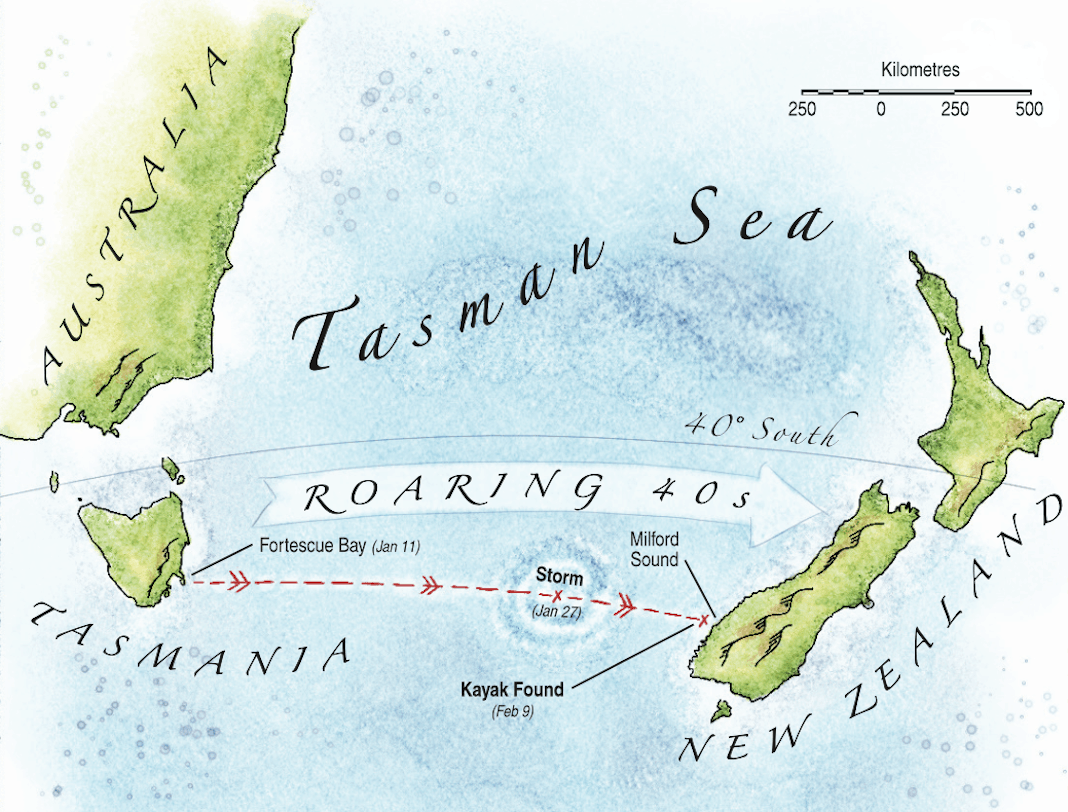
From here to there. | Map by Robert Biron
Andrew McAuley disappears on sea kayak trip
McAuley made no false pretences about what motivated him to cross the Tasman sea alone in a conventional touring kayak. It was an adventure for adventure’s sake, a response to a deeply felt inner voice. He told ABC radio before the journey:
“I guess I’m really drawn to a journey like this—it’s a real personal challenge. There’s a great deal of satisfaction in coming up with an adventure that’s unlikely and improbable.”
The crossing was not a frivolous notion; only two previous attempts had been made, both by New Zealander Paul Caffyn, both unsuccessful.
McAuley spent nearly 10 years preparing for the trip, paddling a series of impressive kayaking expeditions. He completed three crossings from Australia to Tasmania via the notorious Bass Strait, as well as a solo, seven-day traverse of Australia’s treacherous Gulf of Carpentaria, earning him Australian Geographic’s 2005 Adventurer of the Year Award. On the surface, McAuley, a 39-year-old IT consultant from suburban Sydney, seemed an unlikely candidate for the award. Scratch deeper, however, and you would find a determined and diversified adventurer. Prior to catching the kayaking bug on a late-1990s trip in the Chilean fjords, McAuley devoted his considerable energies to mountaineering, making first ascents in Pakistan, Patagonia and Australia.
McAuley was not without his critics. Tasmanian police and Australia’s search and rescue service cautioned against the trip. Said an AusSAR spokesperson: “We had strongly advised against the trip to start with because we believed it was inherently dangerous.” Authorities went so far as to test McAuley’s equipment, capsizing his kayak and assessing its self-righting properties; they ultimately concluded that the boat was seaworthy.
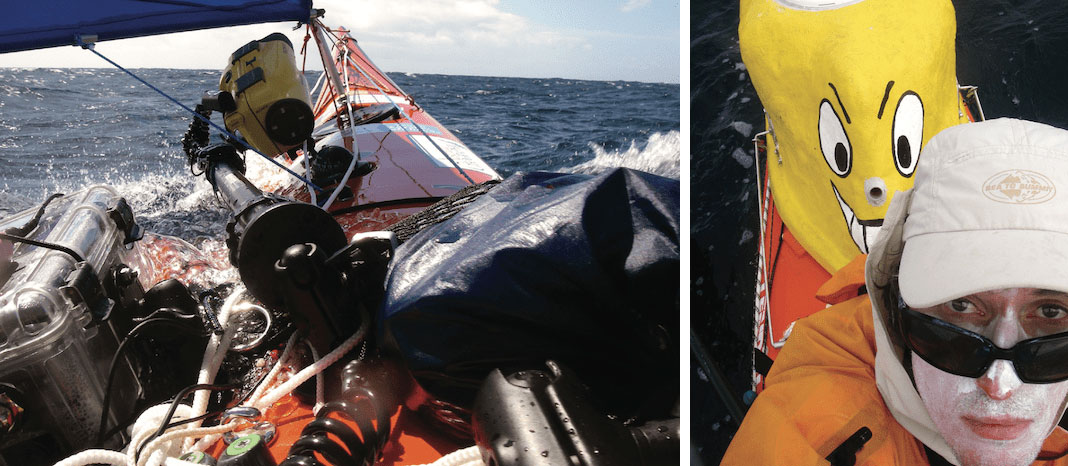
The vessel was a standard touring kayak, a 19-foot Mirage, modified for sleeping inside the cockpit. A yellow fibreglass canopy carried on the back deck—whimsically painted with a cartoon face and nicknamed “Casper”—could be clamped down onto the cockpit for sleeping, providing self-righting capability and protection from the roughest storms. A yacht ventilator atop the canopy breathed when upright and kept water out when submerged.
The fact that McAuley was permitted on the water at all speaks volumes of his preparedness. Paul Caffyn’s late-’80s attempt was summarily prohibited before his kayak even touched Australian waters. Well aware of his critics, McAuley told the Sydney Morning Herald, “When you do [a trip like this], you are exposing yourself to criticism. I take risks, but they are calculated risks, and I want to be beyond criticism.”
McAuley’s January departure from Tasmania was his second attempt. He set out in December but turned back after just 48 hours when he found his sleeping arrangement to be too cold. “Responsible adventure is character-building and good for people, but I felt that to continue on this occasion was not on,” McAuley wrote on his blog. “Without wanting to sound too melodramatic…making the right decisions in situations like this can save your life.” After some modifications, he launched a second time.
The journey’s end, in photos recovered from Andrew McAuley’s found kayak. | Photos: Courtesy Vicky McAuley
McAuley’s chilling last words
Andrew McAuley’s entire route travelled below the 40th parallel, the heart of the Roaring Forties feared by sailors for its treacherous weather and unforgiving storms. Two-thirds into his voyage, McAuley endured a 40-knot gale that knocked out his spare satellite phone and tracking beacon. The conditions were possibly the worst experienced in the region since the storm that decimated the 1998 Sydney to Hobart regatta, sinking five yachts and killing six crewmen.
Enclosed in the cockpit as the kayak plunged nine metres (30 feet) between waves, McAuley had already endured two stomach-churning barrel rolls. The sea anchor he deployed at the approach of the storm kept the kayak’s bow into the weather most of the time, but in seas this large, even this was not always effective. For a third time, the kayak slid up the face of a monstrous wave, perched perilously on edge, then inverted and slowly righted once more.
He survived the storm and travelled several hundred more kilometres to within sight of his destination. On Thursday, February 8, with only 120 kilometres (100 miles) to go, he sent a triumphant text message to his wife, Vicki, and 3-year-old son, Finlay, who were already waiting in New Zealand: “See you 9 a.m. Sunday!” The weather forecast promised a benign end to a harrowing journey.
Vicki and Finlay gathered with friends and family in Milford Sound to celebrate. The legendary sea kayaker Paul Caffyn would be there in person to congratulate the man who accomplished what he’d failed to do. Caffyn told ABC radio, “We were planning to paddle out…and wait there until Andrew came in…with a bottle of whisky and ginger beer.”
At 7 p.m. on Friday, February 9, New Zealand Coast Guard received a scrambled, unintelligible radio call. McAuley’s family suspected the radio message was a hoax, or perhaps an attempt by Andrew to make his nightly check-in by radio now that his sat phone batteries were dead. A small search was launched, but nobody really believed McAuley could be in trouble.
We can only speculate what may have happened to McAuley. | Feature photo: courtesy Vicki McAuley
By Saturday morning, analysis of the radio message deciphered some chilling words. Among them: “help” and “sinking.” A full-scale search began. Planes combed 25,000 square kilometres of wind-tossed ocean. On Saturday night, Rescue Coordination Centre New Zealand found McAuley’s upturned kayak in near-perfect condition just 54 kilometres (34 miles) offshore of Milford Sound. It was missing only the cockpit canopy. The paddle, satellite phone, GPS, and emergency position-indicating radio beacon (EPIRB)—not activated—were all in working order inside the kayak.
On Monday, February 12, after three days of waiting and hoping to find McAuley alive, the search was called off.
Speculation on Andrew McAuley’s fate
Paul Hewitson of Mirage Kayaks, the boat’s designer and builder, inspected the kayak and some of the retrieved video footage. His best guess about what happened: McAuley capsized while the cockpit cover was not in place and was unable to get back in his kayak. Then, somehow, paddler and kayak became separated.
McAuley had reported capsizing twice before and described the re-entry procedure as “gnarly,” complicated by the cockpit cover, video camera and other gear mounted on the deck. He hoped not to capsize again.An oversized cockpit and lack of a standard seat made it impossible to roll. Removing the seat was a necessary modification for sleeping and for accessing gear. Andrew sat on a beanbag, which doubled as a pillow, and retrieved gear in the rear compartment by lying down and rolling onto his stomach, using strings to pull his gear forward through a hatch in the bulkhead.
Hewitson guessed that McAuley was probably getting tired and, with the mountains in sight, would be eager to reach land. He may have pushed too hard. When a small cold front came through, he possibly didn’t think it necessary to put on his drysuit—which he’d planned to put on anytime there was rough weather—and would have been reluctant to trade making the miles for holing up beneath the canopy. Sadly, disaster has a proven habit of striking those who have almost reached safety—nearly all mountaineering tragedies occur on the return from the peak, when muscles burn and concentration is narrowly focused on the goal.
After the capsize, McAuley may have unscrewed the rear hatch to access his VHF radio and drysuit. Perhaps while struggling into the drysuit, he got separated from his kayak and, with it, the EPIRB. Some have wondered why he didn’t trigger the EPIRB right away.
“Andrew thinks the same as I do on this subject,” writes Tasmanian kayaker Laurie Ford on his website. “[The EPIRB] is a last resort. It is far better (if possible) to make contact by phone or radio and let people know the exact situation—rather than the huge panic and search that an EPIRB generates. Having said that, I’m quite sure that he would have intended to set it off (as I would) once he was in the drysuit. It was the separation from the kayak that brought him undone.”
Unfortunately, McAuley had overlooked the critical detail of attaching the EPIRB to himself, not the boat. Ford also speculates that if McAuley had carried a strobe light, he might have been spotted by rescuers on the first night of the search.
In his final days, McAuley conceded he may have miscalculated and pushed the boundaries too far. A self-portrait taken near the end of his journey bears scant resemblance to the confident, athletic face that appears in other photographs. His eyes are wild, cheeks drawn under a ghostly sheen of zinc oxide. At a memorial service held under grey skies at Sydney’s Macquarie Lighthouse, on a high cliff overlooking the Tasman, 400 friends, family and members of the kayaking and mountaineering communities listened to a haunting message recovered from McAuley’s kayak where he admitted, “I may have bitten off more than I can chew.”
“This really is extreme,” he said. “It’s full on. I really could die.”
But if Andrew McAuley had his doubts, his family does not. In the face of the inevitable public criticism about the perceived selfishness or stupidity of extreme adventuring, Vicki McAuley stresses that it was Andrew’s drive to explore his limits that made him who he was. On his website she posted a quote from André Gide that sums up the spirit of adventure so integral to Andrew’s life and the sport he loved: “Man cannot discover new oceans unless he has the courage to lose sight of the shore.”
Editor’s note:
Nearly 18 years after Andrew McAuley’s disappearance, his story remains relevant and captivating to readers, both making rounds on the internet and in risk management discussions. Since McAuley’s near-crossing of the Tasman Sea, there have been several successful crossings of the Tasman including Justin Jones and James Castrission in 2008, Scott Davidson in 2018 and Richard Barnes in 2023. McAuley’s wife, Vicki, went on to write Solo about McAuley’s journey and disappearance in both her words and his, pulled from his journals. Vicky emphasizes that McAuley ultimately accomplished his goal of crossing the Tasman Sea with Milford Sound within sight at the time of his disappearance; whether or not he reached shore is a technicality. The kayak he used in the crossing is on display at the Australian National Maritime Museum.
In September 2007 Andrew McAuley was posthumously awarded the National Geographic Adventurer of the Year Award. His son, Finlay, is now in his early 20s.
We can only speculate what may have happened to McAuley. | Feature photo: courtesy Vicki McAuley
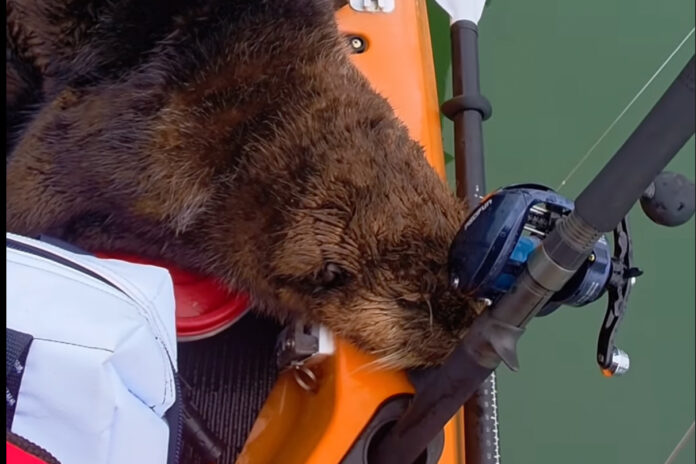
While out on a mission to catch fish, kayaker Kyle Borkes picked up a marine mammal hitchhiker. On a cloudy British Columbia day, a sea otter crawled on to Borkes’ kayak and took a nap; an incredible and adorable encounter caught on film.
Sea otter hitchhikes on kayak on Vancouver Island
Kyle Borkes of KC Kayak Fishing, a husband and wife duo based in Nanaimo, British Columbia, encountered the sea otter after wrapping up fishing for the day when the critter hopped up into his kayak!
“You’re not staying here forever,” Borkes warned the sea otter in the video. Not intimidated by Borkes’ warning, the otter proceeded to gnaw on some rods and reels, and shred the foam of the camera booms.
“That’s like 400 bucks. That you’re eating,” Borkes tried to explain to the sea otter. Unbothered and not to be reasoned with, the otter took a nap.
“You’re a menace,” Borkes told the other, naming him Dennis. Eventually as Borkes made his way to shore, the otter washed off the back of the kayak and swam back out to sea, bringing an end to one of the cutest filmed wildlife encounters in British Columbia.
Sea otters in British Columbia
While the framing of the video makes it initially appear that Dennis the sea otter was brought out to sea from shore, the caption of the video assures viewers that was not the case: Dennis hopped onto Borkes’ kayak while he was still paddling and after he had finished fishing.
The caption also noted that sea otters and all marine mammals should be avoided when paddling, but when a marine mammal decides it would like to investigate you that can be a challenge. Borkes explained that he tried for 20 minutes to get the otter out of his kayak before opting to head back to shore.
“Don’t harass the wildlife? What if the wildlife is harassing me?” one commenter joked.
According to Discover Vancouver Island, there are about 5000 sea otters in British Columbia, most often seen in kelp beds. Sea otters are larger than their cousins river otters, and are distinct in their short tails and fluffy fur as well as size. Additionally, sea otters are rarely seen on land.
Marine wildlife is protected in British Columbia by the Species at Risk Act, and Marine Mammal Regulations under the Fisheries Act; it is against the law to disturb a marine mammal.
In this incredible video Zack Mutton, a world champion in extreme freestyle kayaking, makes the 92-foot drop down Abiqua Falls in Oregon to the cheers of paddlers below.
The New Zealander is one of few to run the iconic falls, a feat previously accomplished by Dane Jackson several times as well as the first successful descent by Jesse Coombs who sustained a collapsed lung in the descent.
Behind the viral video of the Abiqua Falls send
The incredible footage of Mutton’s descent of Abiqua Falls might appear to be shot with skilled dronework, but videographer Steve Donovan uses a different method. Instead of a drone, Donovan shot the waterfall descent footage on an FPoleV camera pole with an Insta360 camera attached to the end.
Extreme Kayaker Zach Mutton plunges over the nearly 100-ft Abiqua Falls in Oregon. Steven Donovan | CP24 YouTube
The FPoleV camera pole was created by Donovan himself in order to create smooth action footage using cameras like GoPros and 360 cameras–small cameras designed for high-intensity action sports with lots of motion. The setup was inspired by traditional boom shots, in which a camera is mounted to a crane for smooth movements, but adapted and slimmed down to meet the challenges of capturing action sports like whitewater kayaking.
Donovan’s FPoleV camera pole extends up to 24-feet, making it possible to extend a camera over a paddler and follow them smoothly as they make the plunge into the pool below. The method lent to a new perspective on Mutton’s epic drop of Abiqua Falls, beyond the usual paddler point-of-view GoPro footage or footage shot from cameramen on the sidelines.
It's rare for a shark to attack a kayak, but it's still a good idea to take precautions.
A handful of well-publicized shark encounters in the waters off some of our favorite coasts have left sea kayakers watching their dorsals. Headline stories like Great White Shark Menaces Kayakers suggest “a disturbing trend” of increasing attack frequency in paddling hotspots like Southern California and Australia’s Surf Coast.
Reality is a lot less sensational. According to statistics from a six-year period analyzed by the University of Florida’s International Shark Attack File, beach attendance and shark attacks increased in nearly exact parallel. The so-called trend likely reflects the increasing number of paddlers on the water rather than a rise in aggressive behavior among shark populations.
Still, there’s undeniable drama in such reports. Witness expedition paddler Sean Morley’s terrifying pursuit—“it was like a cat with a mouse”—by a suspected blue shark on his solo crossing in SoCal’s Channel Islands. Or the great white, also in California, that chomped local distance paddler Duane Strosaker’s wooden kayak and held it in its jaws for a few seconds before “gently letting go.”
Shark facts & precautions you can take
Encounters vs. attacks
Victoria Scott, a marine biologist, experienced shark diver and Director of Education with the Canadian Shark Conservation Society, says “shark encounter” is a more precise way to describe these marine muggings. “Sharks are incredibly effective hunters. If one was to attack a sea kayaker there is no doubt the shark would win every time,” she says.
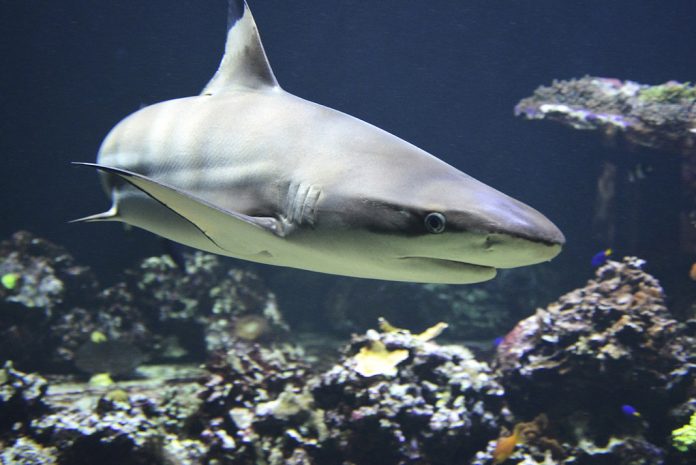
The two most common culprits in shark attacks and encounters—great whites and tigers—hunt from below. To these sharks, a sea kayaker on the surface may look like a seal or sea lion. Scott says sharks will usually investigate before deciding to attack. This is where the bumping and sometimes nibbling come in. Sharks use their mouths to determine if something is potentially edible. Kayaks, and even humans, are usually discarded as not tasty.
Strosaker’s encounter was a classic example of this bite and test behavior. “There wasn’t a hard impact… its mouth wrapped halfway around the hull. It seemed relaxed,” Strosaker recalls.
Do sharks attack kayaks?
Though they are rare, true shark attacks on kayaks do happen. According to the Global Shark Attack File, 21 have been recorded since the early 1900s. The only fatalities in that period were Malibu, California, paddlers Tamara McAllister and Roy Stoddard, who may have paddled into an area where sharks were feeding and been confused with prey.
Practice these precautions to stay shark-safe: Avoid blood in the water and slicks from fishing boats. Keep away from cloudy river mouths and suspect waters at dusk and dawn—prime hunting times. To avoid being mistaken for a meal, stay away from large groups of fish, seals or sea lions.
If you do see a shark, don’t try to paddle away. Your splashing paddle could make you look like an injured seal and attract more attention. If a shark is becoming aggressive, a sharp rap on the snout with your paddle may deter it.
“The very remote possibility of a shark encounter should not outweigh the adventure and beauty of paddling on the ocean,” Scott summarizes. “If you are investigated by one of these animals, paddle away with the knowledge that you have experienced something very special.”
Editor’s Note and 2025 Update:
While rare, shark attacks on kayakers have occurred but more often to kayak fishermen than sea kayakers. In 2024, kayak angler Ryan Howell was attacked by a great white shark that left bite marks on his kayak twice in the same day. In 2025, kayak angler Matt Wells was followed by a large shark who appeared to play with his rudder for a terrifyingly long time before disappearing into the deep.
After the incident, Wells went on to explain in an interview that he didn’t think the shark was hunting him at all, rather just curious and learning about a foreign object—Wells’ kayak—by observing. In the moment, Wells took care to paddle calmly away from the shark and not panic so as not to imitate prey.
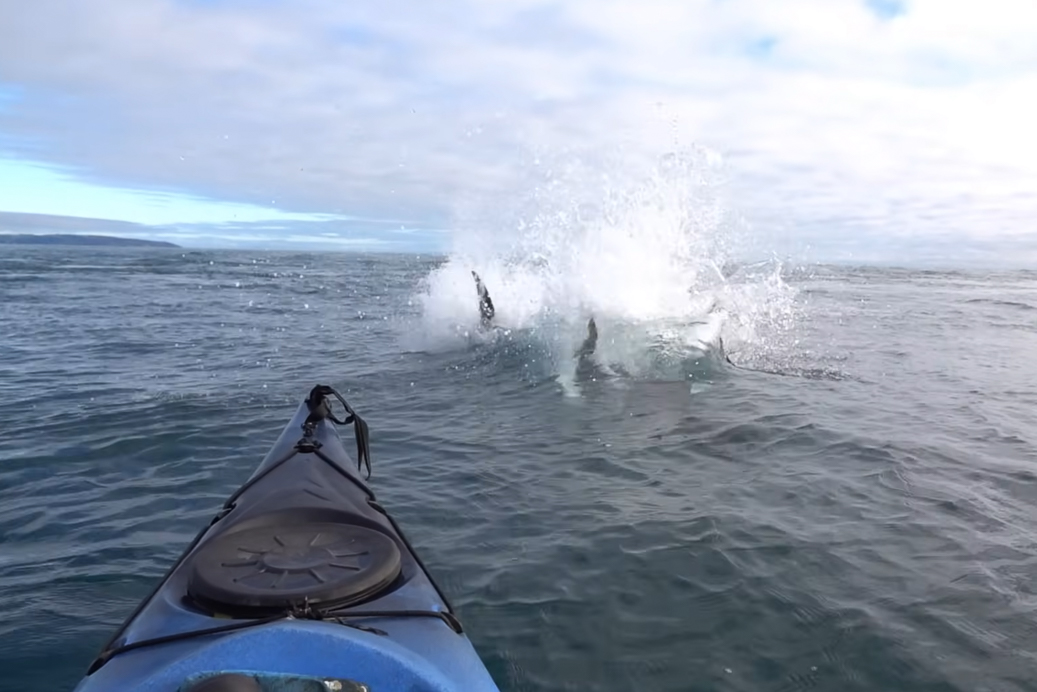
Also in 2025 off the coast of Chilean California a packrafter found himself briefly engulfed by a humpback whale. Humpback whales primarily eat krill or small schools of fish such as capelin or herring– kayaker is most definitely not on the menu. Nonetheless, this fluke encounter goes to show that regardless of predator status, kayaking on the ocean runs the risk of encountering residents of said ocean up close and personal.
Feature Image: North Island Kayak / Tobin Sparling
Created In Partnership With Paddle BC
Along with its coastal temperate rainforests and rugged Rockies, British Columbia is known for iconic wildlife such as bears, whales and eagles. The vast coastal waters are ideal for spotting marine life like orcas, sea otters, and humpback whales, while inland also is home to unique species, from the tiny blue-tailed skink to the majestic grizzly.
And wildlife isn’t all B.C. has to offer. With its wild Pacific coast, countless interior lakes, and epic rivers, the landscape is also a dream destination for many paddlers. Combine adventure and the wild kingdom and you have the trip of a lifetime.
Whether you prefer sea kayak expeditions along the misty coast, sunny afternoons on your paddleboard, or adrenaline-filled rafting and whitewater kayaking, each of these flavors of paddling bring you opportunities for unique wildlife viewing in B.C. What’s more, Paddling offers a low-impact way for viewers to travel and observe many of the species that make up the province’s incredible biodiversity.
Viewing eagles along the Kitimat River. | Photo: Dave Heath
6 wildlife viewing destinations in British Columbia
Salmon on the Harrison. | Photo: Graham Osborne
Spot Eagles and Salmon in the Harrison River
Every year, the massive Fraser watershed is traveled by thousands of spawning salmon, who in turn attract an astonishing concentration of bald eagles in search of a buffet.
The Harrison is home to five Pacific salmon species: coho, Chinook (king), chum, sockeye, and pink. The fish also have a profound impact on the entire ecosystem around them—for example, marine-derived nitrogen has been found in the lush coastal rainforest all along salmon rivers, brought there by bears, wolves, and other scavengers who come to feast on the plentiful fish.
Viewing tips
Paddling the Harrison during the autumn salmon run offers photography opportunities and an unforgettable perspective into the almost mystic life journey of the salmon. The river offers options for calm, accessible kayaking, and is just a two hour drive east of Vancouver. There are options on the Harrsion to paddle self-guided or guided through outfitters including Harrison Eco Tours.
While climate change, overfishing, and other challenges have impacted the numbers of returning salmon, conservation efforts and programs such as salmon hatcheries seek to support this keystone species. Paddlers can do their part to avoid disturbing salmon by using established launching and landing sites. This reduces impact on shallow water and river banks.
View eagles from a distance and do not approach if they have food – these birds need to conserve their energy for the approaching winter months.
Wild horses of the Nemiah Valley. | Photo: Nemiah Valley Lodge
Wonder at Wild Horses in the Nemiah Valley
Paddleboard, canoe or kayak the crystalline waters of Chilko Lake—a wilderness gem where visitors stand the chance to spot grizzlies, wolves, cougars, and remarkable Chilcotin wild horses. These tough, majestic animals gallop in the footsteps of their ancestors. Horses first evolved in North America 4 million years ago, and lived there for millennia until the most recent ice age. With the reintroduction of horses by Hernan Cortez in 1519, horses quickly spread across North America again and became an integral part of life for many indigenous nations.
Today, as in the past, horses are honored by the Tsilhqot’in as sacred beings, and play an important cultural and spiritual role. While wild horses remain a powerful symbol of freedom and wilderness for many, few places in the world offer sanctuary like the Tsilhqot’in Plateau around Chilko Lake.
At 80 kilometers in length and 1172 meters of elevation, Chilko Lake is the highest-elevation freshwater lake in Canada. Indigenous-owned and operated Nemiah Valley Lodge offers an unparalleled home base for exploring the area. The Tsilhqot’in Decision, a landmark Supreme Court ruling in 2014, was preceded by a 25-year court battle and awarded the Tsilhqot’in Nation rights and title to their 1,900-square-kilometers traditional territory. This ruling was a first in Canada and maintains the Tsilhqot’in Nation’s right to live, fish, hunt, forage, and raise wild horses as part of their culture.
Photo: Endless Adventure
Encounter Prehistoric Sturgeon on the Columbia River
Imagine peacefully paddling down the shallows on a sunny summer day, and encountering an armor-plated prehistoric creature the same size—or bigger—than your paddleboard! If you feel ready for a walk on the wild side, grab your board and go for a float on the Columbia River to search for sturgeon.
These mysterious, bottom-feeding fish have long fascinated researchers, and also proved irresistible to caviar hunters, who almost drove this species to extinction in some areas. The largest white sturgeon ever on record was measured at 6.1m (20ft) with a maximum record weight of 630kg (1,390 lb). However, rest assured, you are more likely to encounter smaller sturgeon who are a mere, cuddly two meters in size. Fortunately for paddlers, despite their large size and Jurassic-era design, sturgeon are peace-loving and prefer snacking on fish rather than hominids or paddleboards.
Viewing tips
The best time for sturgeon spotting is May and June, when their feeding ramps up with warmer water temperatures. Go with a guided tour, or rent a raft, kayaks, or paddleboard from Endless Adventure. And If close encounters with prehistoric megafauna aren’t exciting enough for you, get your adrenaline fix by joining one of their rafting trips on the Class III rapids of the nearby Slocan River.
Photo: Spirit of the West Adventures
Find Your Inner Spirit Bear in the Great Bear Rain Forest
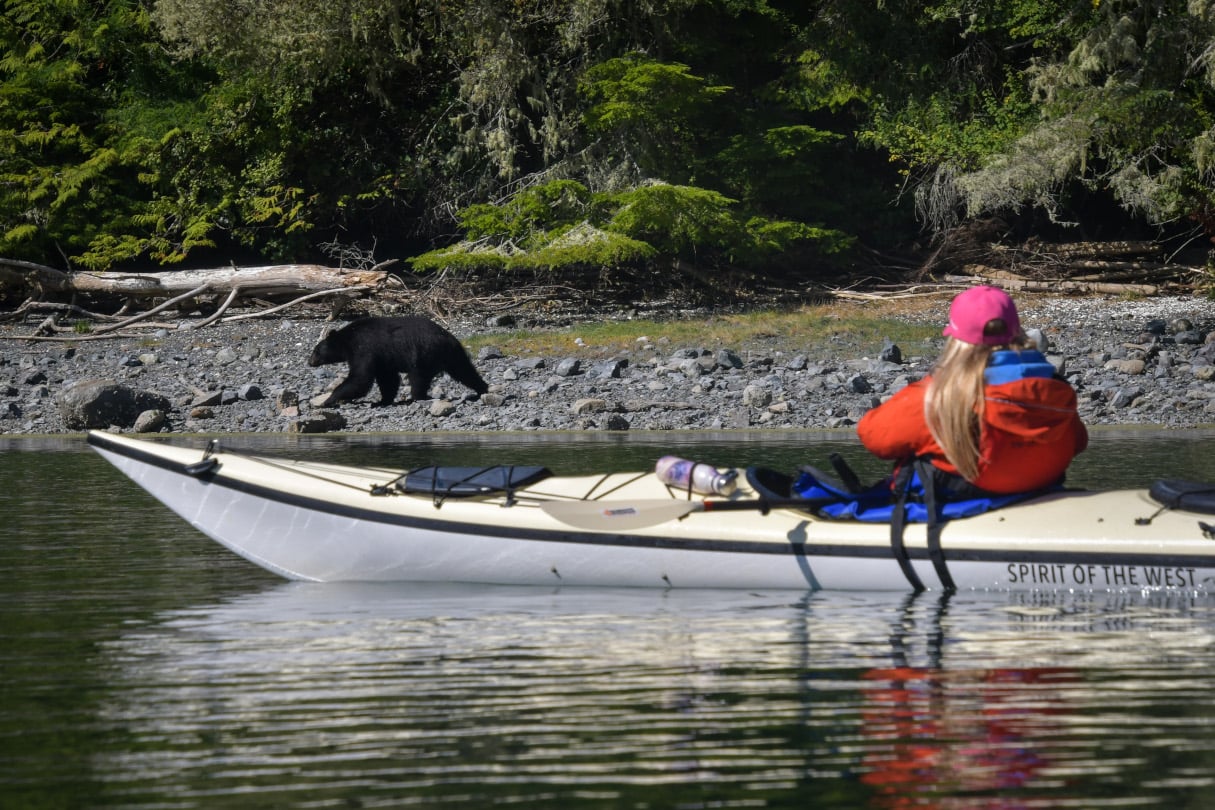
Covering over six million hectares and a seemingly endless coastline, the Great Bear Rainforest is part of the largest temperate rainforest in the world. The rainforest is famous for its spirit bears. Also known as Kermode bears, they are a white or cream-colored subspecies of the black bear. Spirit bears carry a gene that prevents melanin from being produced, and this gives them an advantage: white bears are harder for salmon to see through the water, and thus spirit bears are more successful at hunting than their darker counterparts.
According to Gitga’at and Kitasoo/Xai’Xais First Nations, spirit bears are a symbol of wisdom, peace, and harmony. Paddling past towering ancient cedars and Sitka spruce with an eye out for these creatures, you too may feel a sense of wisdom, peace, and harmony in the Great Bear Rainforest.
Viewing tips
The outer coasts of Great Bear Rainforest are pounded by the Pacific swells and have challenging, exposed paddling conditions, while the inner channels and sheltered bays can offer calmer wildlife viewing. Big tidal interchanges create exciting currents and ever-changing landscapes; sometimes without even leaving your campsite.
Experienced kayakers may choose to do self-guided journeys; however, for many people a guided trip is the ideal way to explore this remote part of the coast. Spirit of the West Adventures and other outfitters offer a variety of guided experiences.
As with all wildlife—maintain a respectful distance, secure all potential attractants in your campsite, and never approach a bear.
Sea otters of Haida Gwaii. | Photo: Paddle BC
See The Big Six in the Serengeti of B.C.
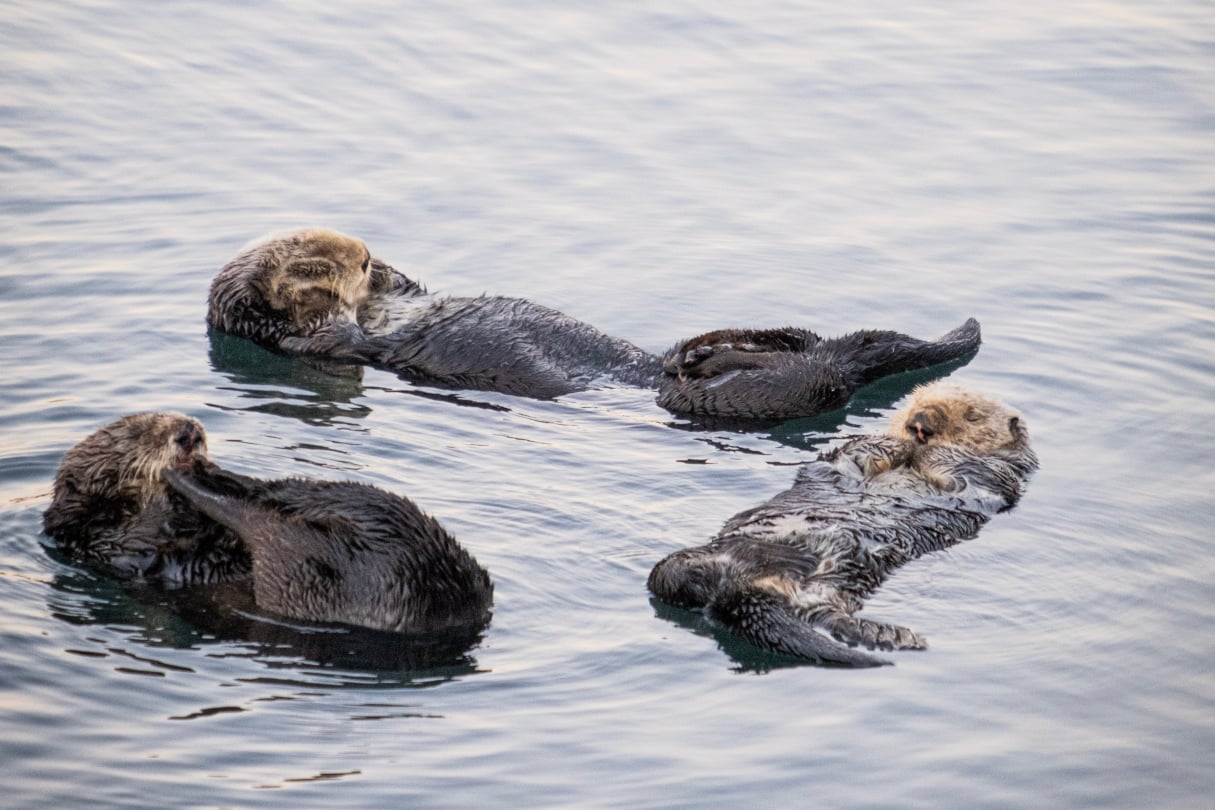
Technically, B.C. doesn’t have a Serengeti, or an official Big Six of wildlife. However, for anyone willing to travel far and put in a solid effort, Haida Gwaii is an unparalleled destination to see bears, sea otters, seals, orcas, deer, eagles, humpback, grey whales, and more. A glowing green jewel surrounded by stormy seas, the archipelago more than 50 kilometers from the nearest Canadian coast is a bucket list destination for travelers willing to make the long trek by airplane or 10-hour ferry ride.
While much of North America was crushed under kilometers of ice during the last ice age, Haida Gwaii remained unscathed. After dodging the ice age with its biodiversity intact, the incredible efforts of the Haida and conservationists further protected the remote islands from logging and exploitation, culminating in the creation of Gwaii Haanas National Park.
Many paddlers choose to explore the east coast of Moresby Island with outfitters such as Kingfisher Wilderness Adventures – Sea Kayaking Tours. Experienced, well-prepared paddlers may consider doing a self-guided expedition.
While wildlife encounters are likely in many places in Haida Gwaii, Burnaby Narrows (also known as Dolomite Narrows) offers an incredible array of intertidal biodiversity, and often there are extraordinarily large, well-fed black bears foraging along the shoreline.
Feature Image: North Island Kayak / Tobin Sparling
Whale Watching on Vancouver Island
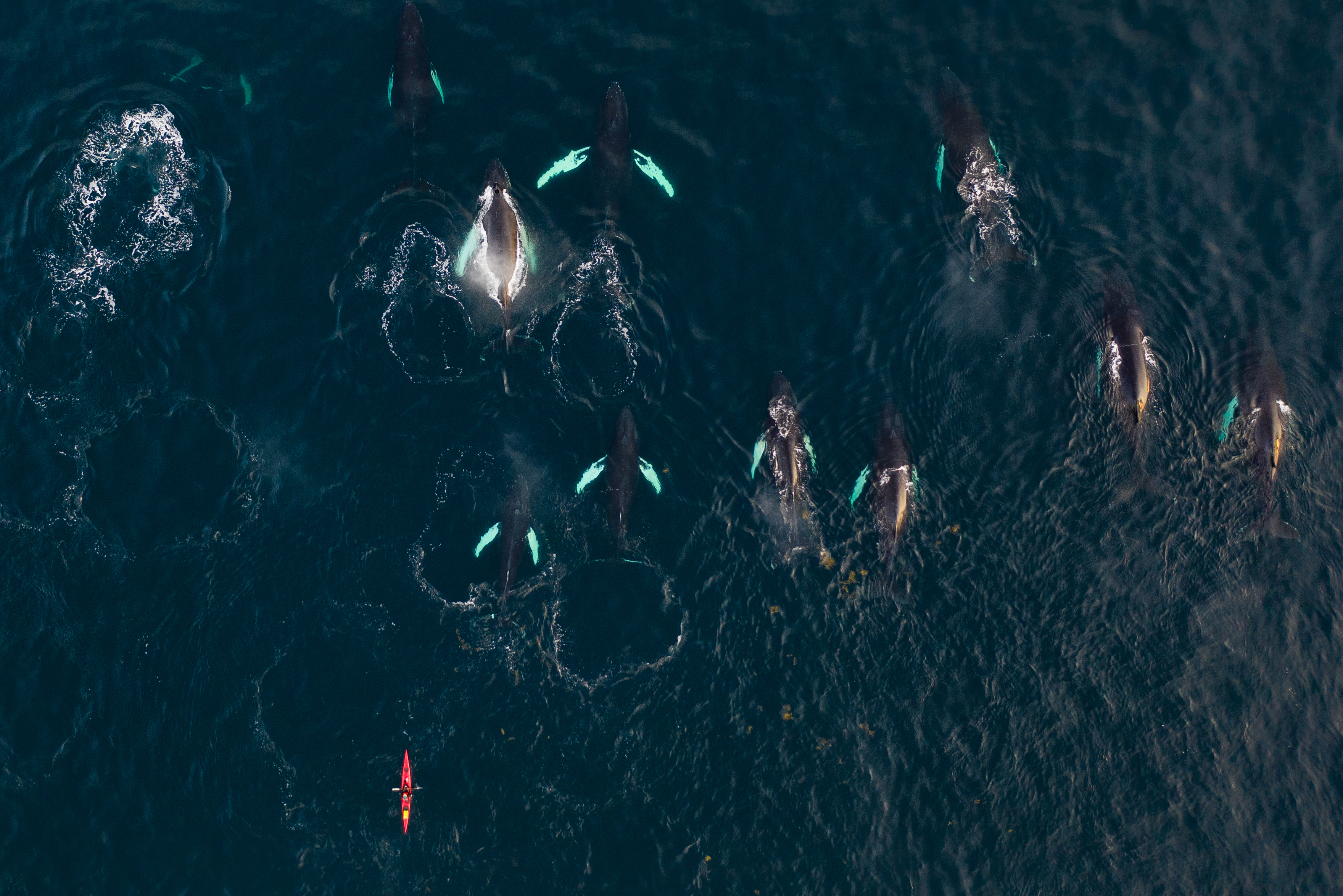
With an intricate coastline and countless archipelagos, Vancouver Island is a whale watcher’s dream. The beloved and endangered southern resident orcas can be found in the Straight of Georgia and the Salish Sea. Meanwhile, paddlers are most likely to spot transient orcas in the Johnstone Straight, Queen Charlotte Straight, and along the rugged west coast of Vancouver Island. And humpback whales and grey whales are other sightings fortunate paddlers are likely to encounter.
Viewing tips
Depending on your preferred flavor of paddling, there are numerous options available on Vancouver Island.
In the right conditions, the more sheltered Southern Gulf Islands can be accessible by canoe or paddleboard as well as sea kayak, and offer a great place to develop camping and expedition skills. Gulf Island Kayaking on Galiano Islands offers guided tours and rentals, as well as a learn-to-kayak camp program.
For travelers wishing to go further afield, Telegraph Cove has numerous outfitters such as North Island Kayak. Famous for its whale-watching opportunities, Telegraph Cove makes a scenic, historical starting point for exploring the Broughton Archipelago and Johnston Straight by sea kayak.
Learn more about wildlife viewing in B.C., as well as outfitters, lodging, and travel experiences at Paddle BC.
Get inspired, and get paddling. | Photo: Advanced Elements
It seems just about every activity out there has its own set of inspirational quotes, clever catch-phrases and quips nowadays. The world of paddlesports is no exception. Enjoy our list of 101 of the best paddling, canoeing, kayaking, river, lake, ocean and adventure quotes to make you laugh, ponder and inspire you to get outdoors and seek your next great paddling journey!
Paddling quotes from expedition kayakers and canoeists
“Happiness is being in the midst of an adventure, when past and future are irrelevant and there is only now.” – Frank Wolf, adventurer and filmmaker
“The greatest advice I ever got was “stay seated for the entire performance,” and that was from Australian veteran paddler Crocodile Winky (David Winkworth).” –Paul Caffyn, expedition kayaker
“Do it because it’s fun and because you love it.” – Nouria Newman, professional whitewater kayaker
“The greatest advice I ever got was to travel slowly because when you travel by kayak, canoe or dogsled, the land speaks to you and that was from Leeroy, a Dene Elder who lives on Great Bear Lake.” – Dave Freeman, expedition canoeist
“Happiness is when the polar bear that just ripped a hole in your tent decides not to eat you.” – Jon Turk, expedition kayaker and author
“You can teach a nice person how to camp and paddle, but you can’t teach a skilled jerk to be nice.” – Cliff Jacobson, author and expedition canoeist
“It’s possible to make an 85-kilometer crossing with no information about the currents if you do as much research as possible, trust your instincts and are prepared to paddle until you get there.” – Justine Curgenven, expedition sea kayaker and filmmaker
When we’re not kayaking, we’re dreaming about kayaking! | Image: Maddy Marquardt
“The hardest part about making your dream trip happen is mustering up the courage to take the first steps. The second hardest thing is to stop making more trips—I haven’t figured that out.” – Mike Ranta, expedition canoeist and paddle maker
“Whether flatwater or class VI, your passion will keep you paddling and positive for the rest of your life.” – Ben Stookesberry, professional whitewater kayaker and film producer
“Man cannot discover new oceans unless he has the courage to lose sight of the shore.” – André Gide; a quote shared by Vicki McAuley on her husband Andrew McAuley‘s website after the expedition kayaker disappeared.
Kayaking Quotes
“I’d rather be kayaking.” – Author unknown
“Kayaking is my therapy.” – Author unknown
“Yes, I do have a retirement plan. I plan on kayaking.” -Author unknown
“I kayak to burn off the crazy.” – Author unknown
“The two best reasons to buy a kayak rather than just renting are sunsets and sunrises.” – Thomas P. Jones
“Money can’t buy you happiness, but it can buy you a kayak and that’s kind of the same thing.” – Author unknown
“Stress is caused by not enough kayaking.” – Author unknown
“Kayaking is a way of life.” – Author unknown
“Learn to kayak because zombies can’t swim.” – Author unknown
“Kayaking is the answer. Who cares what the question is.” -Author unknown
“Kayaking is not just a hobby. It’s a post-apocalyptic survival skill.” -Author unknown
“Never mess with a kayaker. We know places where no one will find you.” – Author unknown
“You know you’re a kayaker when you can’t go over a bridge without checking to see how much water is under it.” – Author unknown
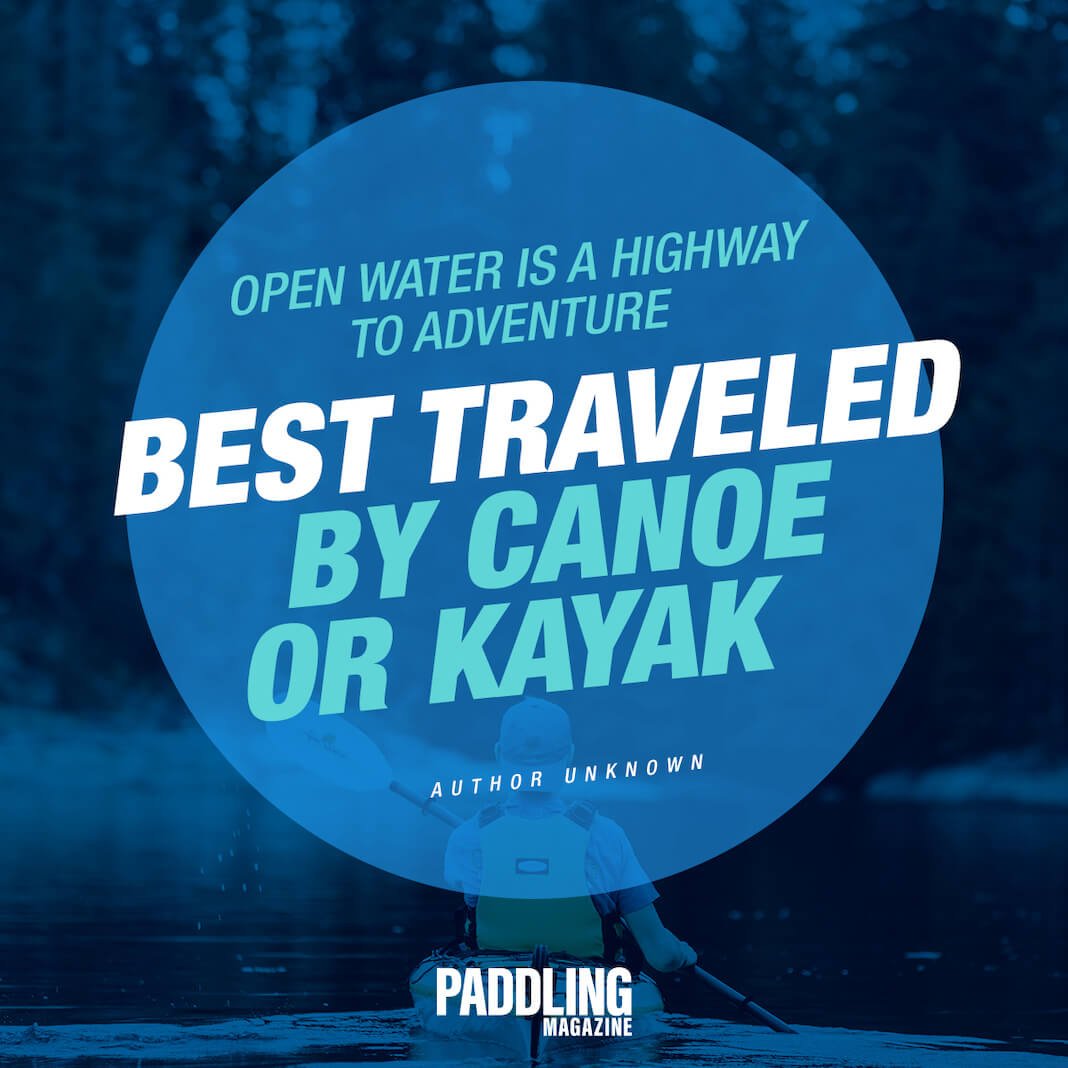
“Open water is a highway to adventure, best traveled by canoe or kayak.” – Author unknown
“Your kayak doesn’t have an expiration date.” – Author unknown
Canoe quotes
“Everyone must believe in something. I believe I’ll go canoeing.” -Henry David Thoreau
“There is magic in the feel of a paddle and the movement of a canoe, a magic compounded of distance, adventure, solitude and peace.” -Sigurd F. Olson
“If there’s a place, canoe there.” – Brent Kelly
“Paddling a canoe is a source of enrichment and inner renewal.” -Pierre Trudeau
“Never trust a person whose feet are dry and who is paddling a canoe.” – Author unknown
“About the best reason I can think of for owning a canoe is that it can take me into wilderness. And what, you may ask, is so great about wilderness? The silence, for one thing.” – Robert Kimber
“Love many, trust few, but always paddle your own canoe.” -American proverb
“I’ve always thought that you should concentrate on paddling your own canoe.” – John Dos Passos
“Anyone who says they like portaging is either a liar or crazy.” – Bill Mason
“A canoe does not know who is king. When it turns over, everyone gets wet.” – Malagasy proverb
“Voyage upon life’s sea, to yourself be true, and whatever your lot may be, paddle your own canoe.” – Sarah Bolton
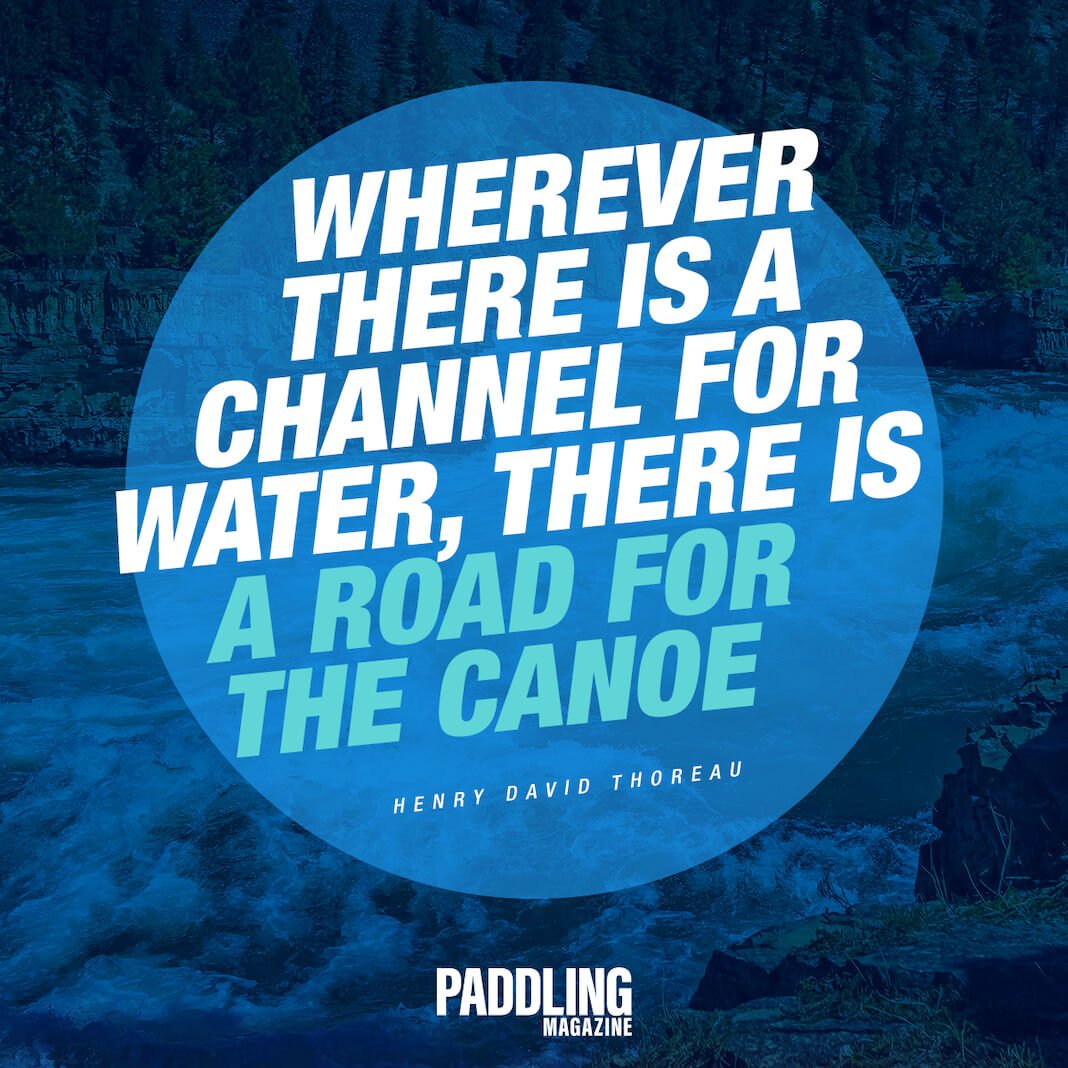
“Wherever there is a channel for water, there is a road for the canoe.” – Henry David Thoreau
“Canoeing is a feeling you can’t explain.” – Author unknown
“When a man is part of his canoe, he is part of all that canoes have ever known.” – Sigurd F. Olson
“A day without canoeing probably wouldn’t kill me, but why risk it?” – Author unknown
“Although we are in different boats, you in your boat and we in our canoe, we share the same river of life.” – Oren Lyons
“The way of a canoe is the way of the wilderness, and of a freedom almost forgotten.” – Sigurd F. Olson
“With one foot in the canoe and one foot on shore, you are sure to fall into the river.” – Tuscarora proverb
“…portaging is like hitting yourself on the head with a hammer: it feels so good when you stop.” – Bill Mason
Get inspired, and get paddling. | Photo: Advanced Elements
“What sets a canoeing expedition apart is that it purifies you more rapidly and inescapably than any other. Travel a thousand miles by train and you are a brute; pedal 500 on a bicycle and you remain basically a bourgeois; paddle a hundred in a canoe and you are already a child of nature.” – Pierre Trudeau
“First rule of canoeing: never lose the paddle.” – Author unknown
“The goal of a wilderness canoe trip should be to collect enough of the wilderness experience to last the whole year… A full cup is the only way that the winter can be endured.” – Greg Went
Paddling Quotes
“There is nothing—absolutely nothing—half so much worth doing as simply messing about in boats.” – Kenneth Grahame
“If in doubt, paddle out.” – Nat Young
“The path of the paddle can be a means of getting things back to their original perspective.” – Bill Mason
“The storms come and go, the waves crash overhead, the big fish eat the little fish, and I keep on paddling.” – George R. R. Martin
“Paddle faster. I hear banjos!” – Author unknown
“Life’s a river. Grab a paddle.” – Author unknown
“It is not down in any map; true places never are.” – Herman Melville
“Born to paddle, forced to work.” – Author unknown
“You feel mighty free and easy and comfortable on a raft.” – Mark Twain
River, ocean, and lake quotes
“Time is like a river. You cannot touch the same water twice, because the flow that has passed will never pass again. Enjoy every moment of your life.” – Author unknown
“The first river you paddle runs through you the rest of your life. It bubbles up in pools and eddies to remind you who you are.” -Lynn Culbreath Noel
“Rivers know this: there is no hurry. We shall get there some day.” -A.A. Milne
“The rivers flow not past but through us.” – John Muir
“A rough day at sea is better than any day at the office.” – Author unknown
“A lake carries you into recesses of feeling otherwise impenetrable.” -William Wordsworth
“You can’t be unhappy in the middle of a big, beautiful river.” – Jim Harrison
“The rivers flow not past, but through us, thrilling, tingling, vibrating every fiber and cell of the substance of our bodies, making them glide and sing.” – John Muir
“The songs of the river ends not at her banks, but in the hearts of those who have loved her.” – Buffalo Joe
“A man of wisdom delights in water.” – Confucius
“Swift or smooth, broad as the Hudson or narrow enough to scrape your gunwales, every river is a world of its own, unique in pattern and personality. Each mile on a river will take you farther from home than a hundred miles on a road.” – Bob Marshall
“A day spent on the water is never a waste of time.” – Author unknown
“A day on the river restores the soul.” – Author unknown
“A river seems a magic thing. A magic, moving, living part of the very earth itself.” – Laura Gilpin
“Rivers are roads which move, and which carry us whither we desire to go.” – Blaise Pascal
“So lovely was the loneliness of a wild lake.” – Edgar Allan Poe
“Rivers have what man most respects and longs for in his own life and thought—a capacity for renewal and replenishment, continual energy, creativity, cleansing.” – John M. Kauffmann
“Listen—the river is calling.” – Author unknown
“Life is better at the lake.” – Author unknown
“There is no rushing a river. When you go there, you go at the pace of the water and that pace ties you into a flow that is older than life on this planet. Acceptance of that pace, even for a day, changes us, reminds us of other rhythms beyond the sound of our own heartbeats.” – Jeff Rennicke
“A river is more than an amenity, it is a treasure.” – Oliver Wendell Holmes Jr.
“The river delights to lift us free, if only we dare let go.” – Richard Bach
“Life is like a river. The way of life is to flow with the current. To turn against it takes effort, but the current will carry you if you let it. Float with joy and ease.” – Author unknown
“No man ever steps in the same river twice, for it’s not the same river and he’s not the same man.” – Heraclitus
“Don’t try to steer the river.” – Deepak Chopra
“A lake is the landscape’s most beautiful and expressive feature. It is Earth’s eye; looking into which the beholder measures the depth of his own nature.” – Henry David Thoreau
“Rivers are places that renew our spirit, connect us with our past, and link us directly with the flow and rhythm of the natural world.” – Ted Turner
Life, water, and adventure quotes
“Blessed are the curious for they shall have adventures.” – Lovelle Drachman
“Go where you feel most alive.” – Author unknown
“Life is simple—just add water.” – Author unknown
“It is life, I think, to watch the water. A man can learn so many things.” – Nicholas Sparks
“We must take adventures to know where we truly belong.” -Author unknown
“Life is good. Full stream ahead.” – Author unknown
“Sometimes you just need an adventure to cleanse the bitter taste of life from your soul.” – Author unknown
“One way to get the most out of life is to look upon it as an adventure.” – William Feather
“I have an insane calling to be where I’m not.” – Author unknown
“The journey not the arrival matters.” – T.S. Eliot
“Happiness is finally leaving the shore.” – Author unknown
“If there is magic on this planet, it is contained in water.” – Loren Eiseley
“There needs to be balance or you will sink.” – Author unknown
“Around every bend there’s a great surprise… you just have to look for it.” – Author unknown
“Some beautiful waters can’t be explored without getting lost.” -Author unknown
“The ocean inspires, the sunset calms and the salty air heals.” -Author unknown
“Life was meant for good friends and great adventure.” – Author unknown
“I learned that the richness of life is found in adventure… It develops self-reliance and independence. Life then teems with excitement. There is stagnation only in security.” – William Orville Douglas
Many of these paddling quotes can apply to our experiences on and out of the water at some point in time or another. Which is your favorite paddling quote from the list above? Is there one you found particularly inspiring?
If you’re looking to buy your first kayak but don’t know where to start, look no further! The best place for you to purchase a kayak will depend on your paddling goals and budget.
From big box stores to specialty retailers and the used market, there are plenty of places to buy kayaks. Here are some tips to help you get started with purchasing your first kayak:
Wear A Life Jacket
Everyone, even strong swimmers, needs to wear a life jacket at all times when on the water. It is extremely difficult to put a life jacket on once you fall into the water. Even a light wind can blow any paddlecraft away from you, faster than you can swim.
Always wear a USCG-approved Level 70 or Type III life jacket designed for paddling.
Best places to shop for a kayak
Where to buy kayaks near me
If you’re wondering where to buy a kayak locally you’re on the right track to finding the right boat for you. Not only does buying local support the regional economy, it also saves on your travel expenses (put that money towards a cool paddling trip!) and, most importantly, allows you to get first hand experience with kayak options before you buy.
Purchasing your first kayak is the first step to unlocking new adventures on the water. | Photo: Andy Seaberg
There are three general places to buy kayaks locally. Big box department stores, including Walmart, TSC, and Costco, sell entry-level recreational kayaks from brands like Pelican and Sun Dolphin at discount prices. They offer a great selection of basic kayaks, however these models are often low on performance and comfort and best for casual use. What’s more, sales associates at these outlets often have no experience in kayaking.
Big box outdoors stores like Bass Pro, Cabela’s and Dick’s Sporting Goods are a bit of a step up, selling recreational kayaks (and often fishing kayaks) from brands like Old Town, Perception and Ascend that offer more refined comfort and paddling performance at a higher price. Still, these are kayaks designed for use on sheltered water; those wishing to progress their skills in kayaking will “grow out” of these boats quickly.
Finally, paddlesports specialty stores and outdoor chains like REI and MEC offer higher-end day touring and sea kayaks from brands like Wilderness Systems, Current Designs and Boreal Design. The kayak prices at these stores are much higher but the kayaks they sell are a better investment for those looking to make a stronger commitment to paddling. Specialty stores provide a more comprehensive shopping experience with trained and knowledgeable staff and the option to “try before you buy,” all critical advantages if you want to take paddling seriously.
Should I buy a kayak?
A kayak can open up so many adventure opportunities, from a new perspective on your local lakes and rivers to longer overnight trips and whitewater kayaking. A kayak is also a financial investment, so you want to make sure that before you buy a kayak, you decide what kind of kayak you want, and whether buying instead of renting makes sense for you.
If you’re only looking to kayak a few times a year while on vacation, it may make sense for you to rent a kayak from local outfitters only when you need to kayak. However if you plan on paddling more than a few times a year and have the storage space for a kayak, it likely makes sense to invest in a kayak of your own.
Our online Paddling Buyer’s Guide is a great place to start your research. This comprehensive digital resource will guide you to the right style of kayak for your needs and relevant brands. From there, you can pinpoint the best places to buy a kayak for your application. Searching the relevant brands online also helps you find local places to buy a kayak.
Education: Get Some!
Take a paddling safety course from the American Canoe Association (ACA), your local paddling shop or outfitter, or other reputable source.
Take a boating safety course from the U.S. Coast Guard Auxiliary, U.S. Power Squadrons® or your own state’s boating agency.
Take on-the-water skills training.
Where to buy a kayak online
Buying a kayak online can be risky, but convenient. Buying online eliminates the option of inspecting a new kayak, sitting in it and trying it out before you make a purchase. This scraps the critical benefits of “trying a kayak on for size” to make sure a boat feels comfortable for your body and—in the case of higher end kayaks—assessing its performance on the water with a test paddle.
However, if you live in a more remote location buying online might be your best option in terms of gaining access to a larger selection of options. Most big box department stores, including Walmart and Costco, sell a wide array of entry-level recreational and fishing kayaks online. The choices are often vast and the prices are quite affordable if you’re looking for a kayak for casual use on calm water, and plan to paddle close to shore.
Big box outdoors stores like Dick’s Sporting Goods, Cabela’s and Bass Pro also offer online sales, and sell more refined recreational kayaks with better performance and comfort features. Finally, some paddlesports specialty retailers will also offer online or phone-order sales and assist with arranging delivery of your new day touring or sea kayak.
Buying online also gives you the option of tracking down a particular kayak brand and model that you are interested in, a definite asset for more experienced paddlers who know what they’re looking for. Regardless of your level of expertise, our online Paddling Buyer’s Guide will help you narrow down the choices of kayaks that are best for you and find the online retailers to complete your purchase.
Where to buy used kayaks
Wondering where to buy a used kayak? There are an abundance of used kayaks available if you know where to look. Searching “where to buy used kayaks near me” or “where to buy used kayaks online” will undoubtedly turn up listings on Facebook Marketplace, which is a great option to find bargains on second-hand kayaks.
Consider checking out a Facebook group like Kayak Classifieds to check out what’s on the used market near you.
Another way to secure a good used kayak is to contact outfitters at the end of the season and inquire about purchasing a used kayak from their rental fleet. Some retailers will also sell used kayaks—both former rentals and on commission.
Once you’ve found a used kayak you like be sure to do a detailed inspection and take it out for a test paddle before buying. We’ve assembled a how-to guide on steps to take in making a wise used kayak purchase.
A recreational kayak at a put-in on a small lake in Northern Michigan. | Photo: Maddy Marquardt
Where to buy a cheap kayak
Many first-time, casual padders wonder where to buy cheap kayaks. If you’re looking for rock-bottom prices you’re best to start shopping for a kayak at a big box department store, such as Canadian Tire, Walmart or Costco, which sell many kayaks for under $500. These retailers specialize in cheap, entry-level recreational kayaks and fishing kayaks that will get you out on the water (albeit calm, sheltered water, and only for those who will stick to paddling close to shore) without breaking the bank.
Another way to find budget-friendly kayaks is to shop used on Facebook Marketplace, Craigslist, or through outfitters at the end of the paddling season. Often by purchasing used you can find kayaks at a fraction of the cost and often with cosmetic damage only. As mentioned above, it’s best to do research beforehand on how to spot damage before purchasing.
If you’re looking for a mid-range kayak visit your favorite big box outdoor store, such as Bass Pro, SAIL or Dick’s Sporting Goods, if you want a little more performance and you’re willing to spend between $500 and $1,500 on a recreational or fishing kayak. These outlets sell kayaks with a bit more performance and comfort features for those who wish to take paddling semi-seriously. Once again, it’s important to bear in mind that kayaks sold in these types of stores are meant for use on calm and sheltered water where the response to a capsize would be swimming to shore.
Stay Clear Of All Other Vessels
Know the “Rules of the Road” Navigation Rules that govern all boat traffic and stay out of the way of all other vessels.
Never assume that power boaters can see you. Avoid high-traffic areas whenever possible. Proceed with caution when you can’t avoid paddling near boats. Dress for visibility.
Where to buy a sea kayak or touring kayak
Specialty paddlesports stores are the best spot to buy a serious kayak for open water use. Yes, you’ll spend more money—but that’s the tradeoff in investing in a kayak that will allow you to develop your paddling skills and venture into more challenging conditions on large lakes and ocean coastlines.
Day touring and sea kayaks also have important safety features that allow you to venture further offshore and perform self- and assisted rescues in the event of a capsize. The other huge benefit of buying at a specialty store is the expert advice you’ll receive from staff in choosing the right kayak for your needs.
Paddlers in performance sea kayaks off the coast of Isle Royale National Park. | Photo: Maddy Marquardt
What type of kayak should I buy?
Big box department stores sell recreational kayaks for casual paddlers, families, kids and kayak anglers. Here you’ll find cheap, short, low-performance kayaks at outlets like Walmart and Costco, including inflatable kayaks that are easy to store in between use and sit-on-top kayaks that offer easy entry and exit on the water.
Meanwhile, big box outdoor stores like Bass Pro and Cabela’s offer better quality recreational kayaks and fishing kayaks, perfect if you want something a little more comfortable and refined but wish to paddle on sheltered, calm water. You may also find a limited selection of day touring kayaks in these locations, including models that are suitable for overnight kayak camping trips in sheltered locations.
If you want a high-performance sea kayak, shop at a paddlesports or outdoors specialty retailers like The Complete Paddler, Rutabaga, Alder Creek or MEC. These locations sell kayaks for dedicated paddlers who wish to invest in the sport and have a desire to develop their skills, venture into more advanced conditions and embark on multi-day kayak trips.
Finally, you’ll find good and bad examples of every type of kayak on the used market—with plenty of recreational kayaks for casual use listed on buy and sell platforms like Facebook Marketplace and Craigslist. Search outdoor-specific used gear forums such as MEC Gear Swap for used sea kayaks. Outfitters often sell rental day touring and sea kayaks at the end of the paddling season in August and September.
Feature Image: Rakonczay arrives in Antigua after crossing the Atlantic Ocean. Gabor Rakonczay | Facebook.
After 75 days and 10 hours at sea, Gabor Rakonczay completed a crossing of the Atlantic Ocean from La Palma, The Canary Islands to Antigua, covering approximately 3183 miles (5123 km) on March 8, 2025.
The one key difference in canoeing across an ocean versus kayaking
In 2012 Rakonczay was the first person to cross the Atlantic ocean by canoe, an adventure that he has now repeated in 2025, but Rakonczay’s canoe looks wildly different from what comes to mind when most paddlers think of a canoe.
Rakonczay undertook these ocean trips in a vessel more similar to the ocean-going custom kayaks used by expedition kayakers such as Cyril Derremaux, or the late Aleksander Doba than a traditional open-topped canoe. Rather than a traditional “canoe” as a watercraft, it’s Rakonczay’s use of the single-bladed canoe paddle instead of the double-bladed kayak paddle that qualifies his crossing as a canoe rather than kayak crossing.
This recent Atlantic crossing by Rakonczay was concurrent with Derremaux’s most recent Atlantic crossing. The pair kept in touch throughout their respective journeys, and despite their difference in paddle choice their routes and ocean-going paddlecrafts were similar.
Rakonczay’s previous ocean crossings and attempts
In addition to two successful canoe crossings of the Atlantic, Rakonczay holds two Guinness World Records as well as a number of other awards and records.
Rakonczay twice has attempted to cross the Atlantic by standup paddleboard, in January 2020 and January 2021. According to a report by ExplorersWeb, Rakonczay’s 2020 attempt was thwarted due to water in the hull after three days, forcing him to turn back. Rakonczay’s 2021 attempt required a more dramatic rescue. In aiming to have a set up as close to a traditional standup paddleboard as possible, Rakonczay did not have a cabin to sleep in on paddleboard. Instead, Rakonczay planned to sleep tied to the deck of the craft covered in a waterproof sheet.
Unfortunately, sleep proved very challenging and by day four Rakonczay began to hallucinate due to sleep deprivation before making the decision to call for rescue, hypothermic and in an emergency lifeboat.
After completing this most recent successful canoe crossing of the Atlantic, Rakonczay wrote on Facebook that the high-risk extreme sports era of his life is closed, though he intends to continue ultra running and other adventures.
Feature Image: Rakonczay arrives in Antigua after crossing the Atlantic Ocean. Gabor Rakonczay | Facebook.