Would you use the Bodi-Paddle for training in the off season? Designed for individuals to paddle across water without a kayak or canoe, this double-blade design provides a fun way to exercise in water and offers a new training option for participants in paddling sports.
Bodi-Paddle’s website reads: Bodi-Paddle allows people to paddle themselves across water without a boat by moving the paddles, floating and kicking. There is a central flotation and buoyancy device in the middle. The design features a wristband that users wear to attach the device to an arm. Approximately 70 inches long with detachable paddles for a convenient length of 36 inches and comes in a mesh nylon bag for convenient storage.
The dream began in late February 2007, when I picked up a book at an Inuit art shop. Already having a passion for canoeing and remote rivers, the epic journeys in Ernie Lyall’s An Arctic Man hijacked my thoughts.
It was years later that my brother and I finally set out on a five-week expedition on one of the most remote rivers in the world—the Kuujjua, a river that was located near many of Lyall’s adventures during his 65 years living with the Inuit people.
We wanted to experience a small part of what that life was like during Lyall’s time before climate change permanently changes the North. Well-versed in the history of exploration and hardship in the area, little did we know that we’d soon face an adventure of similar proportions to An Arctic Man.
The Kuujjua’s trout-choked waters flow west from the interior of Victoria Island and pour into the Beaufort Sea. After completing 220 river miles, our plan was to paddle 70 miles on the tempestuous ocean, finishing at the community of Ulukhaktok, NWT.
Thick lake ice remained despite a mid-July fly-in date. Low river levels meant starting our journey by dragging our heavily loaded, collapsible canoe for 18 miles—two full two days. We dragged until we wore holes in the bottom of our boat and our Achilles burned…
Kayakers have made something practical and made it aesthetic.
Most paddlers justify learning to roll for safety, but those who are crazy about traditional kayaking have taken something practical and made it aesthetic. Rolling for the sake of rolling: with your hands behind your head, with no paddle, with a brick in one hand. Arms locked straitjacket-style.
One of the most prominent get-togethers for traditional enthusiasts is the South Sound Traditional Inuit Kayak Symposium (SSTIKS) in Hood Canal, Washington. Here you will find the who’s who of traditional kayaking, from well-known kayak builders like Brian Schulz (stern paddler and builder of the skin-on-frame double in this image) to world-class athletes like Greenland na- tive Maligiaq Padilla and rolling champion Helen Wilson (bow paddler).
Many of the Greenland competition rolls are difficult and take years of training to accomplish. Not surprisingly, mastering the timing and coordination to roll a tandem kayak is exponentially harder. Here, Wilson and Schulz are performing a relatively easy standard layback roll. Although their timing is slightly off for this particular roll, they went on to nail several incredibly difficult rolls in the still waters of Hood Canal.
My photography draws from the natural world and people’s interactions with it. Light inspires me—the way it shapes dimension and tells stories. On this day, the clouds were low and thinning as they drifted across the sound, casting soft directional light and creating contrast in the scene. When fog began rolling in, most people put away their cameras to keep them safe and dry. Instead, I reached for my mine. I love the way the mist gives so much atmosphere and depth to a two-dimensional photograph. With the climatic conditions just right, I shot with a wide-angle lens to capture both the paddlers and the environment that dwarfs them.
The magic of this image is that it represents the basic spirit of kayaking—the athleticism of the paddlers, serenity of place and connection to water and sky.
This article first appeared in the Summer 2014 issue of Adventure Kayak Magazine. Subscribe to Paddling Magazine and get 25 years of digital magazine archives including our legacy titles: Rapid, Adventure Kayak and Canoeroots.
"The lightest polymer composite recreational paddle available in the global marketplace."
Check out the new H2O Paddles ECO-REC, a 28oz paddle with push pin ferrule system for only $119, and a 30oz model with their Fast Ferrule system for $149.
The new ultra-lightweight ECO-REC paddle is “the lightest polymer composite recreational paddle available in the global marketplace,” says an H2O Paddles press release. “This paddle is a direct result of our commitment to be the best, we value the voice of our customers and our new ECO-REC is the culmination of that input to create a class leading paddle”, says Shillion Mongru, H2O Sales and Marketing Manager, from the press release.
“H2O Paddles is a global supplier of High Performance Kayak and Canoe Paddles. With over 10 years of manufacturing experience, H2O has created industry leading designs such as its Crystal X blades, Super Tour Nanotechnology paddle and ergo grip Whitewater paddles. H2O holds patents and is patent pending on numerous signature design elements.
Located in Toronto Canada, H2O is a subsidiary of Dynaplas Ltd., a global high precision plastics supplier with ‘black box’ design, product validation and testing capabilities, in-house tooling facilities and injection molding machines ranging from 12t – 500t.”
What's In the Canadian Canoe Museum | Photo: Virginia Marshall
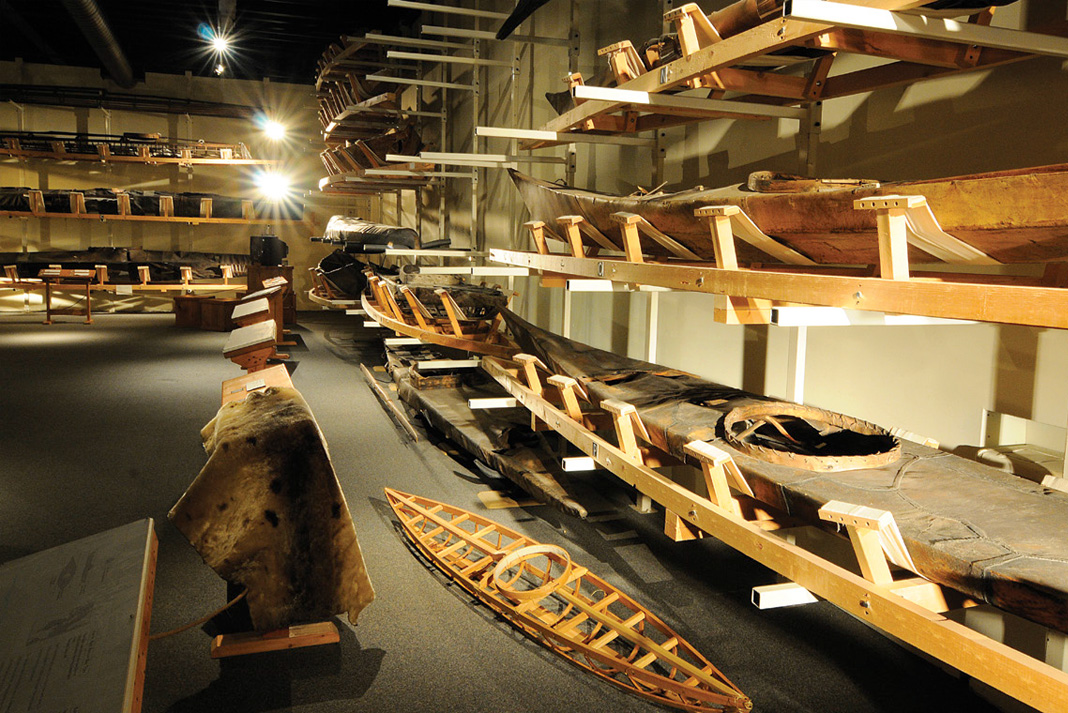
“It’s astonishing just how sophisticated these kayak designs are,” says Canadian Canoe Museum curator Jeremy Ward, gesturing to a wall of elegant Greenland kayaks. “If you look at the influences of these very traditional forms on contemporary touring kayaks, you can see all of the design hallmarks.” The narrow beam, low volume and hard chines that today allow efficient touring and rolling, were originally designed to make the Greenland kayak the ultimate hunting craft. “If you’re hunting narwhal, beluga or seal with a harpoon, to get close enough you need a long, narrow, fast kayak, which is inherently unstable,” explains Ward. “One hand throws the harpoon while the other holds the paddle out to the side to stabilize the kayak.”
Across the room, a display of baidarka from the Western Arctic and Aleutian Islands further illustrates how hunting habits influence kayak design. “Baidarka is not an Aleutian word, it’s Russian,” says Ward. “During the Russian fur trading period, baidarka were used to access the kelp beds and hunt sea otter. This is a very rare three-person baidarka from the late 19th century that may have had a Russian agent overseeing the hunt in the middle cockpit with a paddler at either end.”
The gunwale of this circa 1930s East Hudson Bay kayak frame is composed of several pieces of smaller wood joined together, illustrating the resourcefulness
of early builders and their clever use of available materials. “Working above the treeline, assembling pieces of driftwood into a kayak frame is a tough job,” explains Ward. “You’d be accumulating wood over a long time to get enough to put together a framework.”
[ View the largest selection of boats and gear in the Paddling Buyer’s Guide ]
The skins of ringed seals, like this one, were preferred for covering the kayak frame. The cleaned skins were stitched together along waterproof, overlapping seams using braided sinew or, in more recent times, scavenged materials such as dental floss or sewing thread. Once the skins were joined into a sheet, it was stretched tightly around the kayak and sewn along the top.
What’s In the Canadian Canoe Museum | Photo: Virginia Marshall
“We had an Inuk visitor from Greenland who was an avid competitive kayaker, and he said ‘You need to take the skins off of these boats,’” Ward recalls. “When you look at the frame stringers, you can actually see the hull is being compressed by the shrinking of the skin over time. From a traditional user’s point of view, the skin was something that would get worn out or rot, and you would just remove and replace it. But for us to remove the skin is to take away the female contribution to the hull. Typically the framework was made by men, and the skins were sewn together in a stitching party by women. It’s a real community effort to make one boat.”
Along with ever-changing displays, the museum offers hands-on programming for visitors. This model kayak frame is one of five kits created by museum staff for school programs. “We based the design on a Copper Inuit kayak and used mortise and tenon joints and artificial sinew lashing so the kit can be assembled and taken apart many times,” explains Ward.
This article first appeared in the Summer 2014 issue of Adventure Kayak Magazine. Subscribe to Paddling Magazine and get 25 years of digital magazine archives including our legacy titles: Rapid, Adventure Kayak and Canoeroots.
Avalon Peninsula- Exploring Newfoundland’s Eastern Eden| PHOTO: LEE GILBERT
Lee Gilbert escaped a landlocked life in the city to return to his birthplace on Newfoundland’s Avalon Peninsula, where he now pursues a quieter pace and his passion for paddling, writing and photography.
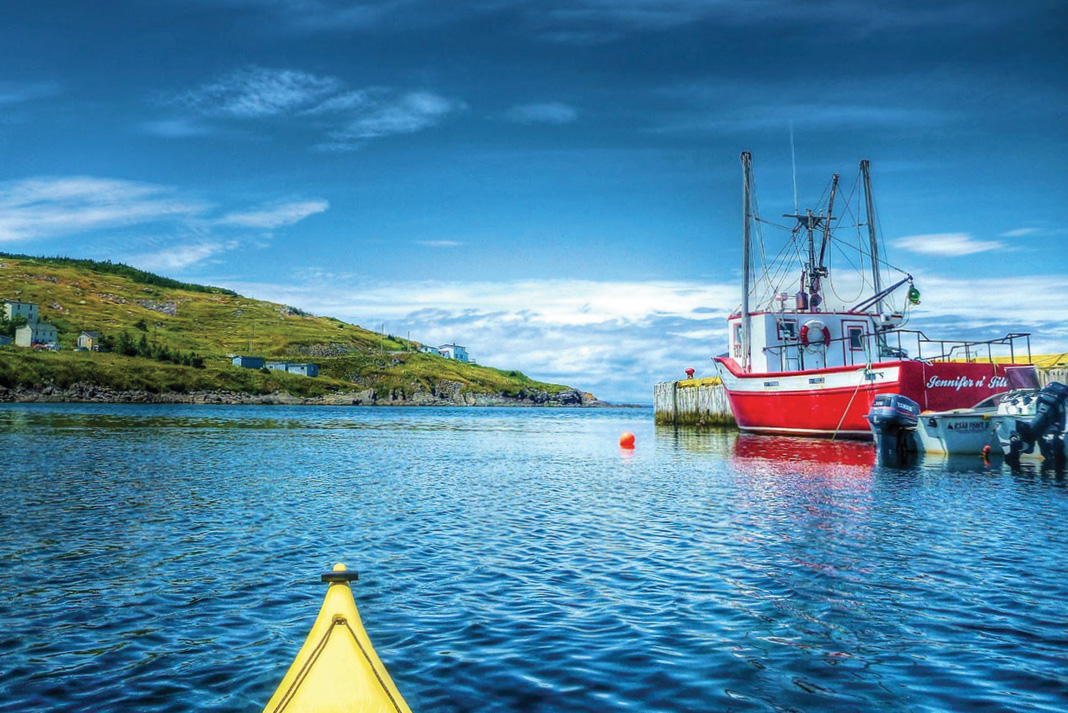
THE ROCK. Home to the most easterly shore in North America, isolated from the rest of the continent by frigid seas and a quirky, half-hour-ahead time zone all its own. Newfoundland is a place where one never knows what secrets the next cove holds, and a bastion for the childlike wonder those discoveries instill.
The waters around the Avalon are nearly 20 degrees Fahrenheit colder than the same latitudes in the Pacific. The culprit is the Labrador Current, described by Newfoundland artist Christopher Pratt as “a relentless flood of molten ice, the bloodstream of our near sub-Arctic climate.” I’ve learned to embrace the unsettled weather. Briny bays where the sea has humbled me with four-meter waves and howling gales; tranquil open ocean and brilliant sunshine; the quiet of solo paddling in a thick fog.
I’ve come to expect the sublime: close encounters with icebergs and whales, hidden caves tucked behind waterfalls, bedding down in the same forgotten coves as two-millennia-old Paleo-Eskimo peoples. Between the quaint coastal villages lie some of the last vestiges of true freedom in a prodigiously encroaching civilized world.
TRIPS
If you have a half-day enjoy the sea stacks, arches and pristine pebble beaches of sheltered Aquaforte Harbour, paddling east from the community wharf in Aquaforte to where Spout River Falls tumbles into the ocean.
If you have a day and the forecast is calm, launch from Winterton and head 10 kilometers north to Hant’s Harbour along the uninhabited outer coast of Trinity Bay, gaping up at 460-foot cliffs.
If you have a weekend tour historic Conception Bay from the shipwrecks of Avondale to the archaeology site at Cupids. En route, explore towering lighthouses, dramatic headlands, quiet coves and a 19th-century copper mine.
If you have a week paddle from Hopeall to Sunnyside in Trinity Bay. Untouched coastline and wild beauty mingle with resettled towns and colorful fishing communities with equally colorful names, like Dildo and Spread Eagle.
Avalon Peninsula- Exploring Newfoundland’s Eastern Eden| PHOTO: LEE GILBERT
STATS
POPULATION DENSITY
17 per square mile (outside St. John’s)
AVERAGE SUMMER HIGH
66°F (August)
WILDLIFE
Whale, porpoise, sea otter, seal, moose, caribou, fox, coyote, bald eagle, puffin and other seabirds.
CAMPSITES
Cobblestone, grass meadow, free-camping on any flat spot along the shore.
EXPOSURE
Easterlies draw 2,000 miles of fetch from Ireland. Also watch for gusting offshore katabatic winds.
DIVERSION
Build a traditional Newfoundland punt or dory at Winterton’s Wooden Boat Museum.
BEST EATS
Mussels, uni, sea trout, seasonal codfish caught at camp.
OUTFITTERS
The Outfitters—rentals and sales in St. John’s; day trips, multi-day tours, instruction in Bay Bulls; www.theoutfitters.nf.ca.
MUST-HAVE
Drysuit and good judgment
This article first appeared in the Summer 2014 issue of Adventure Kayak Magazine. Subscribe to Paddling Magazine and get 25 years of digital magazine archives including our legacy titles: Rapid, Adventure Kayak and Canoeroots.
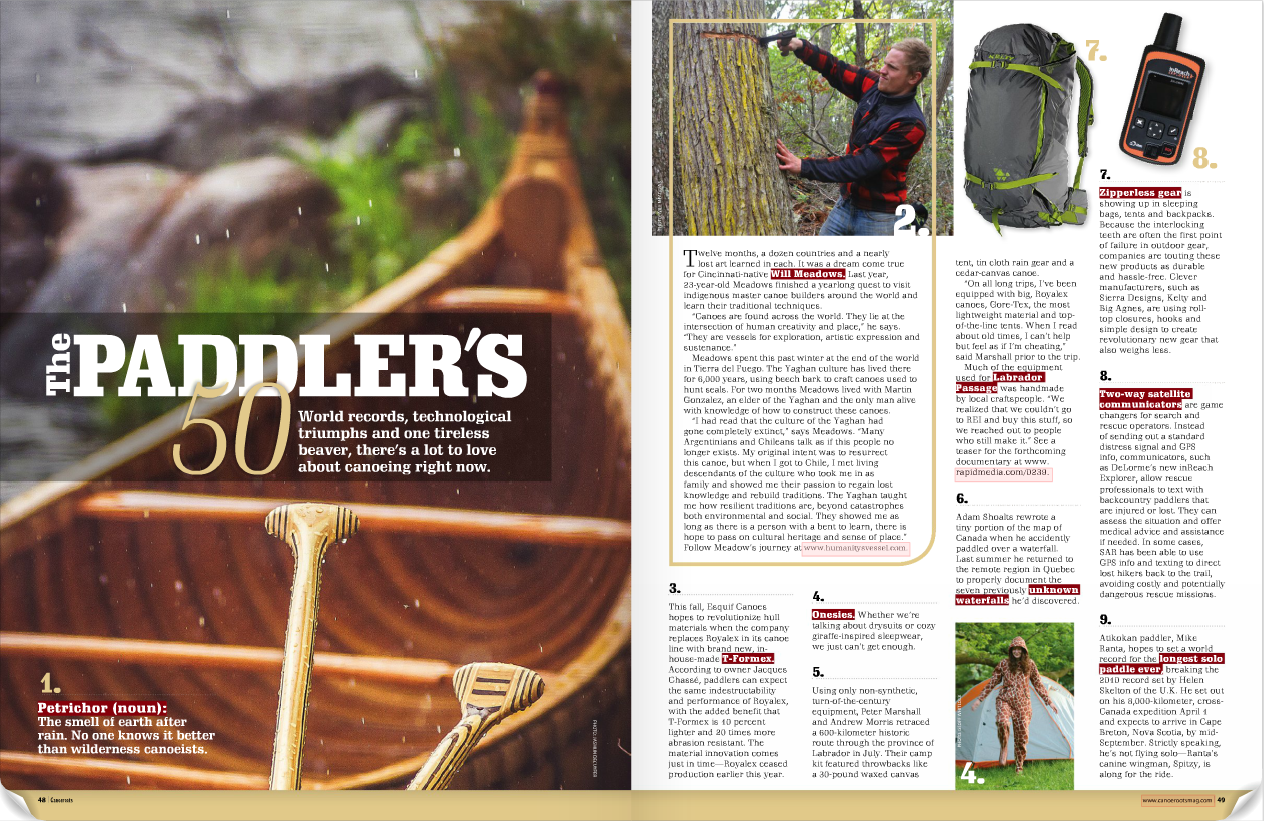
Twelve months, a dozen countries and a nearly lost art learned in each. It was a dream come true for Cincinnati-native WILL MEADOWS. Last year, 23-year-old Meadows finished a yearlong quest to visit indigenous master builders around the world and learn their traditional canoe making techniques.
“Canoes are found across the world. They lie at the intersection of human creativity and place,” he says. “They are vessels for exploration, artistic expression and sustenance.”
Meadows spent this past winter at the end of the world in Tierra del Fuego. There the Yaghan culture has lived for 6000 years, utilizing the bark of beech to craft canoes to hunt seals. Meadows lived with Martin Gonzalez, an elder of the Yaghan and the only man alive with knowledge of how to construct these canoes, for two months.
“I had read that the culture of the Yaghan had gone completely extinct,” says Meadows. “Many Argentinians and Chileans talk as if this people no longer exists. My original intent was to resurrect this canoe but when I got to Chile, I met living descendants of the culture who took me in as family and showed me their passion to regain lost knowledge and rebuild traditions. The Yaghan taught me how resilient traditions are, beyond catastrophes both environmental and social. They showed me as long as there is a person with a bent to learn, there is hope to pass on cultural heritage and sense of place.” Follow his journey at www.humanitysvessel.com…
Discover 49 more of the coolest people, gear and innovations in canoeing this year in the digital edition of Canoeroots and Family Camping, Summer/Fall 2014, on our free iPad/iPhone/iPod Touch App or Android App or read it on your desktop here.
Living on a quiet British Columbia highway, 25 kilometers south of Golden, Columbia Wetlands Adventures owner Mark Teasedale wanted to do something unique to help advertise his business, and draw attention to the wetlands he loves. He does not recall exactly when the idea of building the WORLD’S BIGGEST PADDLE took root, but once Teasedale gets an idea, it usually takes off in a big way.
“I started wondering how big the world’s biggest canoe paddle was,” he explains, “so I started doing some research. I found nothing, so I decided to set the bar pretty high and try to build it as big as possible.”
With a 60-foot cedar pole shaft and blade composed of over 800 laminated veneers, the nearly six-ton paddle prompted the Guinness Book of World Records to create a whole new category. Teasedale is waiting for final confirmation on the record, expected soon after Guinness staffers scour the globe for competition….
Discover 49 more of the coolest things in canoeing this year in the digital edition of Canoeroots and Family Camping, Summer/Fall 2014, on our free iPad/iPhone/iPod Touch App or Android App or read it on your desktop here.
Aleksander “Olek” Doba is enjoying a rather unusual retirement. The former mechanical engineer from Police, Poland, paddled from Africa to Brazil in 2011 and completed his second trans-Atlantic kayak crossing—7,716 miles from Portugal to Florida—earlier this year in his custom-built kayak, Olo. Even after 167 grueling days at sea, however, the cheerful Doba says he feels much younger than his 67 years. Since retiring, he says, “my big problem is not filling my free time, it’s choosing my next challenge.
Who paddles alone across the Atlantic?
Before my expeditions, I test-paddled with different kayakers. I set high standards. Unfortunately, I would usually end up being a babysitter and I wouldn’t have a partner. Partners support each other and that I didn’t find. I’m not a loner, but I had a choice: either go alone or not at all.
What do you say to people who claim Olo is not a “real” sea kayak?
I went to the shipyard in Szcezecin, Poland, with a sketch illustrating the special kayak I imagined would be suitable for crossing the Atlantic. We designed and built Olo to cross the ocean between continents, which no one had done before. Only three other kayakers in history have crossed the Atlantic, and they hopped from island to island. What is a ‘real’ sea kayak? The definition I know is a boat powered by a person in sitting position, facing the direction of movement, using a double-bladed paddle held freely in the hands. Olo meets all of these criteria.
When did you discover kayaking?
I caught the kayak touring bug on my first trip on the Drava River in 1980. When Poland lifted a ban on kayaking in the open sea, I became one of the country’s sea kayaking pioneers. I have more than 60,000 miles under my belt: 80 days around the Baltic Sea in 1999; 3,380 miles to the Arctic Circle from Poland in 2000; circumnavigating Lake Baikal in 2009. I do not paddle back and forth in a small body of water to collect miles. I am looking for new rivers, lakes and seas, so understandably that has meant going further and harder.
Where did you encounter your greatest challenges on the Atlantic?
On the first expedition, I faced more than 50 tropical storms, but otherwise it was pretty quiet. The second crossing was more than twice as long and much more difficult. I lost communication for 47 days. I was plagued by strong winds that trapped me for 40 nights in the Bermuda Triangle. A storm broke the kayak’s rudder and forced me to change course for Bermuda to make repairs. The saltwater, heat and humidity made my skin itchy and irritated my eyes. I wore as little clothing as possible to have less washing and drying, but I constantly felt that things were wet and unpleasant to the touch.
Why is retirement the perfect time for bold expeditions?
I worked nearly my entire professional life at the Police Chemical Plant. Due to the long period of work in harmful conditions, I could retire at the age of 60. I didn’t plan what I would do for my retirement. I never imagined I would be in the condition and good health to be able to implement such ambitious trips. Is there an optimal age for trans-Atlantic expeditions? I started paddling when I was 34. Could I have left for this expedition then, when I felt that I had enough experience? No, the father of young children going on risky expeditions – that is irresponsible and unfair. It’s still difficult for my wife and loved ones, but for me, now is the best time for such escapades.
Doba’s answers translated from Polish by Piotr Chmielinski.
This article first appeared in the Summer 2014 issue of Adventure Kayak Magazine. Subscribe to Paddling Magazine and get 25 years of digital magazine archives including our legacy titles: Rapid, Adventure Kayak and Canoeroots.
Here’s Kevin’s first in a series of videos on his family canoe trip around Killarney Provincial Park in Ontario, Canada. The trip started at the town docks of Killarney and looped the borders of the park in a clockwise direction: Killarney Bay-Fraser Bay → Baie Fine → McGregor Bay → Nellie Lake → Van Winkle Lake → Great Mountain Lake → David Lake → Silver Peak → Carlyle Lake → George Lake.




 Read the rest of this story in the October digital edition of PADDLING Magazine, on our free




 Discover 49 more of the coolest people, gear and innovations in canoeing this year in the digital edition of Canoeroots and Family Camping, Summer/Fall 2014, on our free





