Home Blog Page 28

Pelican Seeks Insolvency Protection

Pelican kayak on the water.
Pelican, founded in 1968, is one of the largest kayak manufacturers in the world. Feature Image: Pelican

On February 28, 2025, Pelican International Inc filed a Notice of Intention to Make Proposal (NOI) under the Bankruptcy and Insolvency Act (BIA) in Canada, citing challenges in the post-COVID economy including U.S. tariffs, significant shifts in market demand, supply chain disruptions, and rising costs. In a company-issued statement, Pelican emphasized that this filing does not signal bankruptcy or closure but is instead a “proactive decision to seek protection under the BIA.”

Pelican declined further comment.

Insolvency refers to the state of being unable to meet debt obligations; insolvency does not necessarily lead to bankruptcy.

With US-Canada tariff disputes, Quebec-based Pelican seeks insolvency protection

Pelican stated the goal of initiating the BIA process is to allow the company time and a legal framework to adjust its finances for long-term stability. Pelican retains full control over its operations and daily affairs, according to the statement.

The filing comes after increasing uncertainty surrounding global trade policies, with fluctuating tariffs and trade disputes involving the U.S., Canada, Mexico and China. The market instabilities, combined with lingering supply chain disruptions following COVID-19, where paddlesports inventory peaked as demand began to drop, have contributed to financial pressures for manufacturers worldwide.

Currently, Pelican’s U.S. subsidiaries are not subject to the NOI proceedings, but Pelican noted it is evaluating whether to seek similar protection for US subsidiaries in the future.

In the statement, Pelican stated that it will not reduce its operations, and will “communicate any relevant updates directly with employees” regarding any positions eliminated as part of the restructuring process.

“We are committed to keeping all stakeholders informed throughout this process,” concluded the statement.

News comes after a recent push to expand

Initially founded in 1968 with a staff of 10 people, today Pelican’s portfolio includes Wilderness Systems, Dagger, Perception, Advanced Elements, Boardworks, Mad River Canoe, and GSI Outdoors.

In 1970, Pelican was purchased by Gérard Élie. In the years following, the first Pelican pedal boats, canoes, snowmobiles, sleds, and motor boats were produced using thermoformed plastic, a process where plastic is heated then formed into a mold popular in kayaks as a compromise between heavy polyethylene kayaks and lightweight composite kayaks.

Pelican kayak on the water.
Pelican, founded in 1968, is one of the largest kayak manufacturers in the world. Feature Image: Pelican

In 1995, Pelican International Inc was acquired by Christian and Antoine Élie who had managed the company since 1979. Since 2001, Pelican’s head office has been located in Quebec, Canada.

Pelican has aggressively expanded in recent years. In 2019, Pelican acquired Confluence Outdoors Inc; in 2021 Pelican acquired Advanced Elements Inc, and in 2022 Pelican acquired GSI LCC.

How To Transport A Paddleboard

Persons using cam strap to show how to transport a paddleboard.
John Thomson strapping down a paddleboard. | Feature Photo: Paddling Magazine Staff

There are few things as peaceful in life as standup paddling down a crystal-clear river that meanders through a quiet forest or floating out on a calm bay. But for many learning to standup paddleboard, there are few things as stressful as figuring out how to load a paddleboard onto the car’s roof racks, and keep it secure on the highway to reach the water.

The act of transporting a paddleboard can be perplexing. But there’s a method that works for every board and every vehicle, and even whether you have roof racks or not. Once you learn the steps, it will soon be a quicker and easier process than you thought.

In this article, we’ll go over a few of the methods you can use to get your SUP to the put-in, as well as some helpful tips for keeping your board, vehicle and other vehicles on the road safe.

Paddleboard on roof rack facing down.
Paddleboard on roof rack with deck facing down. | Photo: Paddling Magazine Staff

How to transport a paddleboard on your car

Steps for using a roof rack

The great thing about paddleboarding is that, regardless of the length of board, most models are lightweight builds that can be lifted onto a car without the help of a second person. There are some exceptions—such as heavier plastic boards—but the vast majority of paddleboards can be loaded solo. Regardless of which roof rack (or lack of) your car might have, the loading process is generally the same.

  1. Make sure the crossbars or pads are in place and the vehicle is clear and ready to have the board put on top. This will avoid you having to lay your board down in your driveway or trying to find a clear piece of grass for it.
  2. The board can point with either the nose or tail forward. When you lift the paddleboard to place it on the racks you generally want it to lay with the standing deck face-down on the racks. Placing the board with the deck facing down lets air pass across the hull with little resistance, and keeps the bottom from getting damaged from over tightening on a roof rack without padding.
Tossing cam strap over board.
Once you pass the strap inside the rack pass the cam strap over the board. | Photo: Paddling Magazine Staff
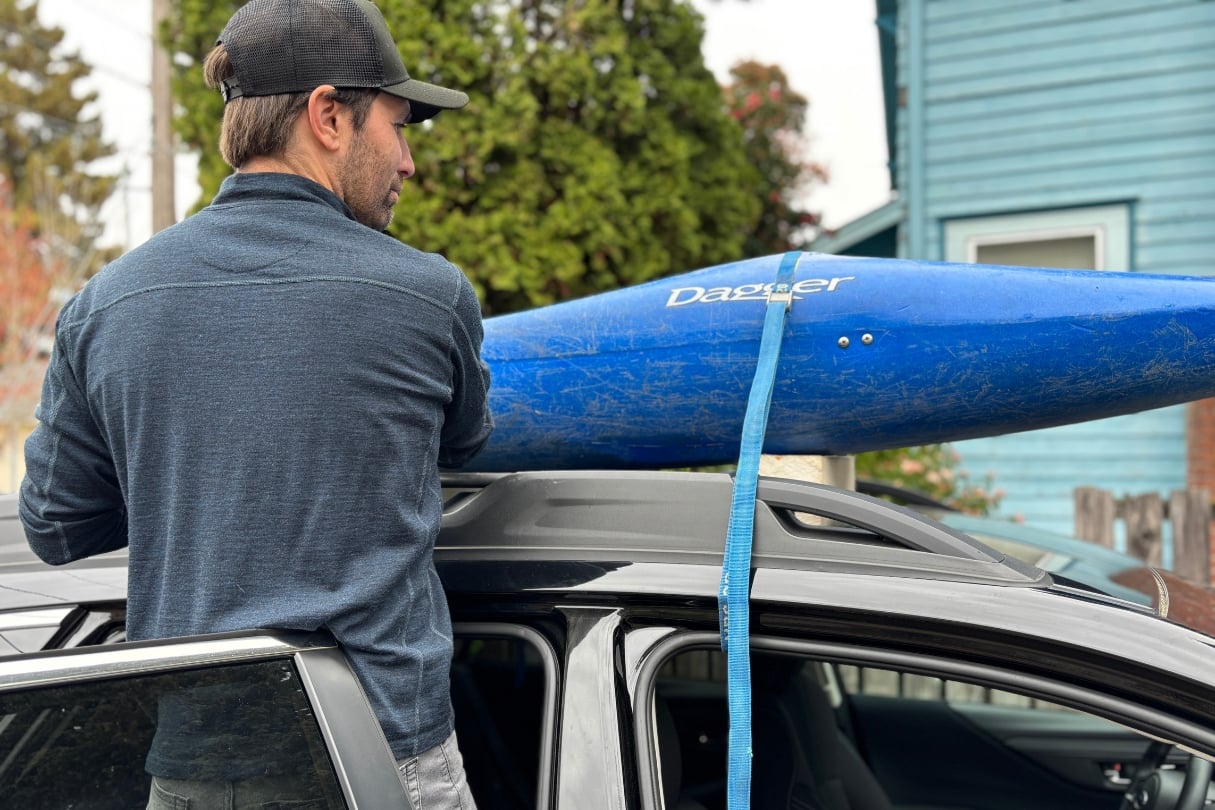
  1. Pass a cam strap around the inside of each rack at one end, then gently pass or toss the buckle end of each strap over the board.
  2. Pass the buckle end underneath the crossbar at the other side, then bring the buckle back over the board to meet the free end.
  1. Insert the free end into the teeth of the cam strap. Cinch down the strap until the board is firmly secured. Wiggle the board. If it shifts easily cinch down some more. Avoid over tightening which could damage your board.
  2. Tuck the excess strap either under the taut strap or wrap it around a free space on the roof rack.
Tightening cam strap over paddleboard.
Tightening the cam straps to secure board. | Photo: Paddling Magazine Staff

Additional tips

  • It’s best to place some form of board padding on your crossbars to protect your board from damage that can be cause from cinching the board down.
  • If you use a long standup paddleboard that extends beyond the back of your vehicle, then it’s best to attach a small red flag to make it clear to drivers following you.

How to transport a paddleboard without a roof rack

Many sedans and hatchbacks don’t come with roof racks or rails. Soft rack systems or foam blocks are relatively inexpensive and have protective padding to secure your paddleboard. They sit on the roof and are combined with straps that run through the interior of the vehicle to keep the paddleboard in place.

  1. With the blocks in place the paddleboard on top as mentioned in the steps for using a roof rack.
  2. Open your car doors to pass and end of the strap through the vehicle then over the board to meet the other end of the strap as if you’ve made a circle.
  3. Tighten the straps before closing the doors, cinching them so the board stays in place if you give it a wiggle.

Keep in mind that the straps will be causing a small gap between the seal of the door and the door frame, so if you’re driving in rain, water will likely permeate the straps and drip into your interior.

How to transport a paddleboard in a truck

Trucks are great for transporting things that fit into the pickup bed, but with most paddleboards ranging from 10 to 14 feet, mounting them is a little more complicated.

Assuming the truck doesn’t have a rack system built in (in which case mounting the board is the same as with any vehicle with a rack), you’ll need to have the board hanging off the back.

  1. Close the tailgate and set the board as far into the pickup bed as it will reach.
  2. Put some sort of padding over the tailgate.
  3. Then at one of the tie-down mounts in the bed or on the side rails of the truck, pass a strap or rope through and over the boards to the other side to secure them.

As mentioned above, if the board hangs past the tailgate by more than a couple of feet, a red or orange marker is highly recommended, and might be required by law.

Other considerations

Understanding the parts of a roof rack

In order to figure out how you’re going to mount your board, it’s important to understand the terminology.

  • There’s the roof itself, which is the easy one.
  • Then there are rails, which some cars have from the factory and which your rack system will attach to.
  • The feet, tower or leg is the blocky component that both attaches to the vehicle and the crossbar.
  • The crossbars are the board or pipe shaped lengths of the roof rack you mount your paddleboard onto.

Think of it like this: the paddleboard sits on a board rack or crossbar cushions, which sit on the crossbars, which sit on the rail or which are mounted to feet which are attached to the car.

Can you put an inflatable SUP on a roof rack?

One of the most appealing things about inflatable paddleboards is the fact that they fold down to fit into a (large) backpack. That means loading a board into a vehicle takes about as long as throwing a bag into the truck or hatch of a car. Of course, the tradeoff is allowing 10 minutes of preparation time before and after your paddle to inflate and deflate the board.

The question that often comes up for people using their inflatable boards on a regular basis is whether or not they can be transported on the roof of a car while inflated. The good news is that quality inflatable standup paddleboards today are surprisingly rigid, which means even 12-foot, 6-inch or 14-foot boards can be transported without folding in half like a poorly tied-down mattress.

Keep in mind that you are still transporting an air-filled vessel, meaning something hitting it could result in a puncture. That being said, something hitting your inflatable with enough force to cause a hole would also cause significant damage to a hard board.

Transporting two paddleboards

Unless you have extremely wide crossbars, carrying two boards will mean stacking them on top of each other to turn your vehicle into a double paddleboard rack.

To do this, load the first board onto the bars as suggested above, typically with the fin at the back of the vehicle. Next, put some padding on top of the first board so the two paddleboards aren’t directly touching each other. Pool noodles or plumbing insulation works great for this because they don’t create much of a gap between the two boards. Offset the boards so the top board sits just in front of the fin of the bottom board.

Understanding how to tie down two paddleboards isn’t much different from one board. Just strap the two paddleboards to the vehicle as suggested above with the straps going all the way over the top of the two boards. Longer straps might be required.

If you have a particularly tall vehicle like an SUV, be cautious entering garages or parking structures. Know how tall the total setup is and pay attention to height restrictions.

Paddleboard in bag on roof rack of vehicle
Using a bag will ensure your paddleboard isn’t damaged by the sun. | Photo by: MarekPhotoDesign.com – stock.adobe.com

To bag or not to bag

Other than inflatable boards, it’s extremely rare for paddleboards to be sold with a bag included. Depending on the length of board and the style of bag, bags can cost as much as $300. But is it a worthwhile investment?

A major concern with transporting paddleboards on the roof of the car is the impact of a hot sun. While the vehicle is in motion, the board is being constantly cooled by the wind, but if you’re leaving your board on a car all day at the office in order to hit the water as soon as the work day is done, the hot sun can be damaging. High-quality paddleboard bags have thermal protection to keep the sun rays at bay. An added benefit is protecting your board from rocks and road debris that might fly up and hit it while driving.

Most bags are not water-tight, so expect there might be some water in the bag if you’re driving in a heavy rain. It’s recommended that you leave the zipper open slightly at the back to allow the water to drain out. Keeping the zippers at the back rather than the front is also important because the wind will push the zippers open if they’re at the front of the bag. Paddleboard bags also keep boards protected in garages and sheds, but it’s always a good idea to let the board and bag dry off before storing it away.

Locked and loaded

Another big concern with leaving paddleboards on the roof is how to secure them. Unlike canoes or kayaks, which have easy places to run cable locks through, the simplicity of paddleboards means there are few options for locking them on the roof. Locking tie-down straps aren’t inexpensive, but they’re a must anytime you’re leaving a board on the roof unattended. They have metal-reinforced straps and key-locks on the closure, which should be enough to deter thieves looking for a quick slash and grab.


John Thomson shows how to strap down a paddleboard for transport. | Feature Photo: Paddling Magazine Staff

Best Camping Gear For Paddlers In Summer 2025

MSR Switch Stove at Canoecopia 2025. Feature Image: Joe Potoczak.

It’s time to dust off your paddles, dig out your maps and charts and start planning your summer 2025 paddling adventures! In the spirit of summer adventures, the Paddling Magazine team headed out to Canoecopia in Madison, Wisconsin, in search of the best new camping gear for paddlers.

Here’s what we found:

Nocs Provisions

These waterproof binoculars from Nocs Provisions come in a variety of sizes and colors, making them the perfect addition to your camping gear collection. While the standard size fits nicely in the clamshell of some PFDs/lifejackets both the Field and Pro issue are perfect for wildlife watching on your paddling and camping trips this summer.

Nocs provisions binoculars at Canoecopia 2025.
Nocs provisions binoculars at Canoecopia 2025. Image: Joe Potoczak.

Beyond the binocular setup, Nocs are also easy to pair with your phone camera with their smartphone adapter to photograph all the critters you spot while paddling. Time to level up your iNaturalist game! In addition to wildlife watching, a good pair of binoculars can be helpful for scouting routes and lines, and observing real time conditions on the water from a distance.

Wintergreen Trail Cap

Located at the edge of the popular Boundary Waters Canoe Area Wilderness, Wintergreen Northern Wear has a legacy in producing some of the best winter gear on the market. Now, they’re diving into summer camping gear for paddlers as well!

Wintergreen's new Trail Cap at Canoecopia 2025. Image: Joe Potoczak.
Wintergreen’s new Trail Cap at Canoecopia 2025. Image: Joe Potoczak.

The Wintergreen Trail Cap is made with a buoyant rim, breathable mesh back, and 3-ply Supplex nylon with DWR (Durable Water Repellent) and collapsible to pack easily into a canoe pack.

NRS Campfire Shirt

What’s a camping trip without your favorite flannel? The new NRS Campfire Flannel with UPF 50+ sun protection is ideal for those chilly early season trips with late nights around the campfire and early mornings with a coffee in hand.

With a pocket on the chest and the NRS logo doubling as a spot to stash your sunglasses, the campfire flannel is a timeless classic for your paddling trips.

Therm-A-Rest Boost Sleeping Bag and NeoLoft Sleeping Pad

New in spring 2025, Therm-A-Rest is shaking up sleep systems with the thick new NeoLoft sleeping pad and the new Boost sleeping bag featuring armholes and a centre zipper allowing you to customize the shape of the sleeping bag to your comfort level and the surroundings.

Therm-A-Rest's new sleeping bag and pad at Canoecopia 2025, some of the best new camping gear of the year. Image: Joe Potoczak.
Therm-A-Rest’s new sleeping bag and pad at Canoecopia 2025. Image: Joe Potoczak.

The NeoLoft sleeping pad comes in at one pound 9 ounces (0.71 kg) in the regular size, with an R-value of 4.7. Packed, the NeoLoft is slightly larger than a one litre Nalgene. The Boost sleeping bag features 650-fill RDS-certified hydrophobic down and is two pounds two ounces (0.95 kg) in the size regular.

MSR Switch Stove System

New in Spring 2025, the MSR Switch Stove System makes it possible to switch between the quick-boiling switch pot and a pan by flipping out supports on the side of the stove, making the stove compatible with a variety of pots and pans.

MSR Switch Stove at Canoecopia 2025. Feature Image: Joe Potoczak.

The complete MSR Switch Stove System weights 13.8 oz (392 g). The versatility of the Switch Stove makes it easily some of the best new camping gear in 2025.

Agawa Boreal24 Saw

Ideal for clearing brush or cutting logs for a campfire, the Agawa Boreal24 folding bow saw is designed with packability in mind. The Agawa Boreal24 opens smoothly and is one connected assembly, cutting out the need to fumble for or potentially lose parts.

Whether out on a canoe trip or clearing out your local portage or put-in after a windstorm, the Agawa Boreal24 is a handy addition to your 2025 camping gear kit.

MHO Adventures Dried Eggs

Everyone has heard of dehydrated full meals, but have you considered building out your trip pantry in dehydrated bulk? For example, pack a container of dehydrated eggs from MHO Adventures in lieu of packing out whole eggs to save space, weight, and have fresh food for longer.

The Best Places To Go Kayaking In Chicago

Group kayaking on the Chicago River
Group kayaking on the Chicago River. | Feature Photo: Joshua Mellin / Urban Kayaks

Chicago is famous for many things—astonishing skyscrapers, Art Deco architecture, the blues, Al Capone, Michael Jordan and the Bulls, Navy Pier—but kayaking isn’t generally one of them.

Ask a local about must-have Chicago experiences, however, and they might recommend a sunset tour up the city’s central artery, the Chicago River; or an afternoon in the surf when the wind is blowing over Lake Michigan.

Heading up the Chicago River from the lake, paddlers are immediately engulfed by the city. A chasm of glass and limestone towers a thousand feet above the river—it’s a landscape every bit as dramatic and improbable as the Grand Canyon.

“This is the paddle we do when people come to visit,” confirm Chicago locals Alec and Sharon Bloyd-Peshkin, founders of Have Kayaks Will Travel. “It’s just spectacular, especially in the fall or in the evening with the sun setting behind the city.”

Bridges lifted on Chicago waterfront.
An iconic scene, the lifted bridges of Chicago. Photo: Joshua Mellin

The Best Places to go kayaking In Chicago

For a guided kayak trip

Kayak Chicago

For a memorable, half-day kayaking or paddleboard tour, join Kayak Chicago. From their location just off North Avenue, tours lead through what they call the “Wild Mile” around Goose Island before leading into the canyon of the city skyline. Kayak Chicago also has evening tours under the city lights for an unforgettable way to experience the city on a spring or summer night.

Have Kayaks Will Travel

Have Kayaks Will Travel offers informative, small-group tours, including a Devil in the White City trip based on the Erik Larson page-turner. “We paddle kayaks or canoes in the area the book is set in, on Chicago’s south side,” says Sharon, “exploring what happened here during the 1893 World’s Fair.”

Group in kayaks below city skyline at sunset.
Sunset tour below the city skyline with Urban Kayaks. | Photo: Joshua Mellin

Urban Kayaks

Founded by two brothers, Urban Kayaks provides kayak tours and rentals at two locations: the Riverwalk on the Chicago River and at the Monroe Harbor on the Lake Michigan lakefront. The Riverwalk location launches kayakers in a spot instantly surrounded beneath the city’s stunning skyscrapers. The Monroe Harbor offers a lakefront launch for kayak and paddleboard tours and rentals with expansive 360-degree views of the skyline and Lake Michigan.

Wateriders

Since 1997, Wateriders has been leading kayaking tours of Chicago. Their East Bank location puts paddlers near Wolf Point and the confluence of the three branches of the Chicago River for a most impressive view of the city. They also have some fascinating kayak tours including history and architecture, and ghost and gangster paddles. For those seeking the under appreciated natural side of Chicago, Wateriders Bridgeport tour offers a contrast to skyscrapers, where you’ll glide past blue heron and painted turtles.

To paddle the Chicago River like a local

“Put-in on the Chicago River just west of Chinatown and head north, turning east on the Main Branch right through the heart of the city,” says Sharon.

She suggests launching from the dock at kayaker-friendly Lawrence’s Fisheries and making the four-mile trip to the lock at the river mouth. Fried seafood fans can follow up with a plate (or paper bag) of Lawrence’s famously crispy fish and shrimp.

To kayak and dine

Start as above from Lawrence’s Fisheries on the Chicago River, but proceed through the lock when you reach the lake. Paddle out to the end of Navy Pier, admiring its century-old amusement park, Crystal Gardens and phenomenal skyline views. Head south on Lake Michigan alongside the city’s world-renowned waterfront park system. Landing is permitted at select beaches during summer; pull ashore at 12th Street Beach (eight miles one-way) and grab a bite at tasty Del Campo Tacos.

The Chicago Riverwalk
Stroll or paddle the Riverwalk. | Photo: Ranvestel Photographic

If you’re Craving waves on Lake Michigan

“Look at Google Maps and you’ll see why Montrose Beach gets the most amazing reflective waves,” says Alec. He also recommends Rainbow Beach for excellent surfing when the wind is north or east, with maximum fetch out of the northeast. “Both of these beaches have a fishhook shape that catches the northeast waves really well.” Launch at the north end of Montrose, by Wilson Park.

Kayak Rentals in Chicago

Many of these tour operators and even city parks also provide kayak rentals and a convenient launch site to get you on the water around Chicago without a guide or boat of your own.

Paddling the Chicago River Water Trail Safely

The Chicago River provides one of the most incredible urban waterscapes for kayaking and paddleboarding in the U.S. However, kayakers, paddleboarders and other recreational users need to be aware the river corridor, especially at the city center, is an active waterway they will be sharing with motorized traffic.

The city has a free online guide to help safe recreation on the river. The guide provides an understanding of the traffic levels paddlers can expect and guidance to have a safe experience. The info page also includes a link to a Chicago River Water Trail Map, which includes access points throughout the city for both human-powered and motorized watercraft.

Considering the weather when paddling in the city

It isn’t called the “Windy City” for nothing. Whenever you are planning to paddle in Chicago, you want to know what conditions will look like throughout the course of your outing. This means wind, and even the waves it can produce in exposed water like Lake Michigan. You should also check water and air temperatures to dress for kayaking accordingly.

Lightning storms are another factor to take into account in the late spring and summer months when conditions can change rapidly and lightning poses a danger to anyone on the water. Be sure to check not only the current weather and water conditions, but what the forecast looks like in the hours ahead when you plan to enjoy your trip.


Feature Photo: Joshua Mellin

9 Ideas to Make Paddling Easier in 2025

The Wenonah Minnesota II in superlight at Canoecopia 2025. Feature Image: Joe Potoczak.

Paddlesports are for people who understand that hard work equals big reward. On the other side of the brutal, ankle-twister portage is a campsite at the base of a waterfall. The ten-mile open water crossing comes with the reward of a quiet island at the end of the earth, and the work of carrying, transporting, and cleaning your boat and gear comes with a lifetime of memories and experiences.

Whether you’re just looking to get into the sport or a long time padder, here are nine products and innovative new ideas from Canoecopia 2025 to make the logistics and actuality of getting out on the water easier this summer:

Aqua bound Tetra

New in 2025, the Aqua Bound Tetra is a low-angle ultralight paddle designed for kayakers looking to cover long miles. The full foam core makes for a lightweight and buoyant blade while the Lam-Lok technology protects the blade of the paddle, making the paddle a long-term investment.

Ultralight Kayak Paddle the Aquabound Tetra
Close up of the new Aqua Bound Tetra. Photo: Maddy Marquardt

Move over ultralight backpacking: ultralight paddling is making waves, and no, you don’t need to cut your toothbrush in half.

Lekker Gull Surfski

Sleek and fast, the traditional surfski is great for fitness fanatics and paddlers looking to cover long distances, but hard to keep upright for beginners. The Lekker Gull makes the surfski friendly for beginners at 14 feet long, 23.4 inches wide, and 50 pounds.

Lekker Gull beginner-friendly surfski
Lekker Gull Surfski at Canoecopia 2025. Image: Joe Potoczak

According to Lekker, the Gull has both the stability that a beginner needs to get into surfski paddling, while also enough speed to be playful in rough conditions for more experienced paddlers.

Malone Microsport Off-Road Base Trailer with 78” Load Bars

One big hurdle to getting out on the water is getting heavy boats up on the roof of your car. The obvious solution is lighter boats, but another solution especially appealing to those of us with multiple boats is the trailer.

Malone Trailer Canoecopia 2025
Malone Microsport Off-Road Base Trailer with 78” Load Bars at Canoecopia 2025. Image: Joe Potoczak.

A good trailer ready for off-road travel can make it possible to transport multiple boats to rugged put-ins all without having to lift a heavy boat up over your head.

Hornbeck Packboats

Canoe tripping is surely one of the best ways to experience the wilderness— the quiet campsites and sunsets over the water, the sounds of beavers and moose in the mornings, the 400-rod portages. Canoe tripping is often easiest to accomplish with friends, but the Hornbeck Packboat brings a new, lightweight and solo-paddler friendly element to canoe tripping.

Developed in the Adirondacks, the Packboat is ultralight and ultra-minimalist, designed for simple and barebones wilderness travel. How light you might ask? Some pack boats are as light as 15-pounds!

Suspenz EZ-Stow Stern Cart

Can’t opt for a lighter boat? No problem! The Suspenz EZ-Stow Stern Cart is designed to help you tackle those longer would-be carries with ease and can be the perfect solution to making the logistics of kayak and canoe transport easier for you.

Suspenz kayak cart at Canoecopia 2025
Suspenz kayak cart at Canoecopia 2025. Image: Joe Potoczak

The Suspenz EZ-Stow Stern Cart fits within a hatch of most recreational and touring kayak hatches and weighs less than four pounds. Perhaps the most intriguing part of this Suspenz cart is that most boats will be suspended on a strap while in transport rather than strapped up against the hardware of the cart itself, protecting your boat from damage in the long-run.

Wenonah Superlite Canoe

The SuperLite construction brings the Minnesota II performance long-distance canoe down to less than 37 pounds, more than 15 percent lighter than the standard Ultralight Aramid construction.

The Wenonah Minnesota II in superlight at Canoecopia 2025. Feature Image: Joe Potoczak.

The goal of the SuperLite Aramid construction is to take the Wenonah canoe down to its lightest possible weight without sacrificing any of the features Wenonah is known for, such as bucket seats and foot braces for a good connection to the canoe while paddling, or the sliding front seat to adjust the trim of the canoe real-time in on the water.

Esquif T-Formex Lite Pocket Canyon

Following the trend of lighter boats, Esquif has launched T-Formex Lite construction which optimizes where T-Formex is used on each model of canoe to maximize weight reduction and better suit each unique canoe line to its paddlers needs.

Esquif's Pocket Canoe in T-Formex Lite. Image: Joe Potoczak
Esquif’s Pocket Canoe in T-Formex Lite. Image: Joe Potoczak

In 2025, the classic Pocket Canyon will be available in T-Formex Lite. This playful tandem canoe is ideal for shorter whitewater trips, designed to be the perfect boat for paddlers looking for something to tackle day trips and weekends in the wilderness alike. The new T-Formex Lite construction on the Pocket Canyon will

Hurricane Santee 116 Sport

This new lightweight recreational kayak from Hurricane is designed for stability, speed and style weighing just 39 pounds. Perhaps the best part of the Santee 116 Sport is the sealed bullheads at both the bow and stern of a kayak— often lacking from recreational kayaks— that means even if you were to capsize the boat, the pockets of air at either end would prevent the boat from sinking.

Hurricane Santee 116 Sport at Canoecopia 2025. Image: Joe Potoczak

The safety feature provided by bulkheads will for sure make paddling easier in the 2025 season!

Let Someone Else Do the Work- Guided Trips with MHO Adventures

The ultimate hack to make your paddling adventures easier in 2025? Let someone else do the heavy lifting, planning, and cooking. Book an all-inclusive guided wilderness canoe trip with MHO Adventures and focus on the best parts of paddling trips while someone else takes care of the logistics.

MHO Adventures offers guided trips throughout Northern Ontario and beyond. Check out the Art in the Heart of the Wild paddling trip in Temagami, head out on a family adventure on the Noire River, or head out on a 19-day guided expedition on the Missinaibi.

The Secret To Making Your Dream Long Paddle Trip Actually Happen

Weather approaches on Lake Superior as Simes kayaks around the largest freshwater lake in the world by surface area.
Weather approaches on Lake Superior as Simes kayaks around the largest freshwater lake in the world by surface area. Feature Image: Constance Simes | @authentic_imperfection

In 2022, Constance Simes circumnavigated Lake Superior solo, a roughly 1,200-mile (1930 km) journey around the largest freshwater lake in the world by surface area in 57 days. She wants you to know that with enough patience and practice, a big paddle trip might be in your future too.

Lake Superior circumnavigator shares that your dream kayak trip might be closer than you realize

Whether you prefer long days in a canoe, quality time with the double-bladed paddle, or ripping down whitewater deep in a canyon, many paddlers spend the winter dreaming about their next long paddle. Odds are, you’ve spent more time dreaming up trips than you have actually out paddling. While many dream about quitting the real world and paddling for a few months, few actually do.

With finding time off work, organizing logistics, funding a long trip, and hundreds of small but seemingly insurmountable barriers to your next big paddle trip, a long-haul paddle often seems more a dream than a reality.

Conny Simes circumnavigates Lake Superior Solo
A bluebird day on Lake Superior during Simes’ solo Lake Superior circumnavigation. Constance Simes | @authentic_imperfection

Simes, who paddled around Lake Superior from June 22 to August 17, 2022, thinks that long trip might be more feasible than a lot of people realize. While a circumnavigation or thru-paddle might be a long-term goal, Simes emphasized that just because a goal is challenging doesn’t mean it’s out of reach.

“It is possible,” shared Simes. “I know that it’s hard to take time off but if you do it accordingly with proper preparation and understanding of your skills and the lake, I think most people can honestly do it.”

Simes added that while this isn’t to say that anyone should just hop in a boat with no paddling experience, the biggest part of planning and executing your dream long paddle trip is being honest with yourself about your goals.

“No one’s path is always straightforward. Things might come up and take you away from it a little bit, and you’ll find a way to make it work still,” shared Simes.

Weather approaches on Lake Superior as Simes kayaks around the largest freshwater lake in the world by surface area.
Weather approaches on Lake Superior as Simes kayaks around the largest freshwater lake in the world by surface area. Feature Image: Constance Simes | @authentic_imperfection

Simes added that one of the reasons she’s sharing her circumnavigation story is to bring some awareness to how invisible chronic illness can affect big goals like circumnavigations and long paddle trips.

“Invisible chronic illness, that has definitely made my paddling career veer in different ways than I thought it would,” explained Simes. Prior to her Lake Superior circumnavigation, Simes worked several years as a sea kayak guide on Lake Superior and in New Zealand, and took her L4 ACA Skills Assessment in preparation for the trip.

Highlights and lowlights of a kayaking 1200 miles around Lake Superior

Simes’s solo circumnavigation wasn’t without its challenges, but they weren’t the challenges you might expect from a long paddle trip. While there were certainly days with wind, waves, and inclement weather, Simes didn’t feel lonely most of the trip, and shared that one of the hardest parts of the paddle was reacclimatizing to the world outside of the wilderness.

“I didn’t get lonely. Halfway through when I was waiting for my resupply package up in Marathon, the most northeast spot, I was just having the most amazing time trying these silly bushcraft things,” shared Simes. “I didn’t see anyone for three days. I loved it.”
Where on the Canadian North Shore Simes didn’t see anything manmade for days at a time, heading back south down the Minnesota shoreline she saw increasing houses as she neared her finish, and start point, at Little Sand Bay in Wisconsin.

Beautiful campsite on Lake Superior taken on Constance Simes circumnavigation of Lake Superior by kayak
An ideal campsite on Lake Superior. Constance Simes | @authentic_imperfection

“I struggled a little on the North Shore,” Simes shared, referring to the portion of Lake Superior coming into Minnesota from Canada where, fairly suddenly, you go from Canadian wilderness to increasingly developed shorelines and vacation homes. “Going from those remote islands down to Minnesota, and there’s nothing wrong with the Minnesota North Shore, but it just is very shocking… I was really far from shore because I just wanted to be away from it.”

Simes also shared that unexpectedly, one of the hardest parts of her trip came after the trip had ended.

A cramped campsite along Lake Superior from Constance Simes' Lake Superior sea kayak expedition.
A less than ideal campsite. Constance Simes | @authentic_imperfection

“Maybe it’s the solo aspect but I definitely had some post expedition blues after which I didn’t know was a thing until I started listening to other people’s expedition stories,” said Simes. “Why I am feeling this way, why can’t I sleep in my little cabin with no running water, but I have to sleep in my tent? It was a couple weeks of sleeping in my hammock, sleeping in my tent.”

Overall, Simes paddled nearly 1200 miles around Lake Superior in 57 days.

“I don’t think you ever really know you’re ready,” said Simes, adding that you have to ask yourself what the worst that you could get into would be, and if you can handle that. “I didn’t know I could handle days alone, but you adapt.”


Simes will be speaking at the 2025 Canoecopia event in Madison, Wisconsin at 4:30 pm on Friday, March 7 to share about her journey on Lake Superior.

Cyril Derreumaux Kayaks Across Atlantic Ocean

Cyril Derrumaux prepares to launch for Atlantic Crossing December 19, 2024
Cyril Derrumaux arriving in in Hilo, Hawaii, September 2022 after crossing the Mid-Pacific. | Feature Photo: Tom Gomes

On December 23, 2024 Cyril Derreumaux, ocean expedition paddler, departed from La Restinga, The Canary Islands to cross the Atlantic Ocean by kayak. Derreumaux completed his journey across the Atlantic March 4, 2025, reaching the island of Martinique in the late afternoon.

View Cyril’s Live Tracker.

Derremaux crosses Atlantic Ocean by kayak

Derreumaux is no stranger to big ocean crossings, having completed his first solo ocean crossing, 2,761 miles from California to Hawaii, in just over 91 one days. Between this expedition, his current expedition, and a 2016 team rowing crossing from California to Hawaii, Derreumaux has spent over 200 days on the open ocean.

“The next two days are going to be big,” Derreumaux shared via his live tracker on March 2, 2025, adding that the final two days of this expedition would be high mileage and long days to make as much progress as possible.

“Today I saw a flock [of] about 70 birds working together to get flying fish. All day. I don’t know why they always stay in front of me about 200 m away. Never behind or on the side. It’s like they’re taking my boat as a reference point. It was National Geographic. Amazing,” Derreumaux wrote.

The draw of the open ocean crossing

It’s easy to wonder what exactly the draw of a big ocean crossing might be for a paddler. For many, even most, half of the joy of ocean paddling is exploring the coastline and the crossings are more something to be endured to get to the meat of the trip.

To embark on the journey where the point itself is a crossing, where that crossing is of an entire ocean, sleeping in your kayak and paddling for over 70 days losing sight of land completely might seem a strange undertaking. But much like the coastal paddler finds beauty along the coast, Derreumaux finds the open ocean to have more beauty than perhaps meets the eye.

Cyril Derremaux's live tracker from the first few days of his Atlantic Ocean crossing from the Canary Islands to Martinique.
Cyril Derreumaux’s live tracker from the first few days of his Atlantic Ocean crossing, featuring a photo of a Dorada fish. Cyril Derreumaux, Tracker-Map.

In the first few days of his trip, Derreumaux shared the ocean with dolphins, flying fish, petrels, false killer whales, and even an orange crab out at sea on day five. Derreumaux glimpsed green sea turtles and felt a strange bump on his kayak on day six, then was greeted by a shark on day seven. On day 17, he spotted a marlin and a mini-tornado; in the following days tuna, a tanker and a cruise boat. A variety of sea birds kept him company throughout.

On Day 41, Derreumaux caught a wave and clocked 11 knots in his 800 pound kayak. Near the halfway point, he found flying fish on the deck of his kayak.

On day 64 as he neared the end of his journey, Derreumaux wrote: “One of the dangers of getting closer and closer to land is to let go over your routine. Maybe do two hours more of paddling to get closer, maybe skip the nap. Experience showed me that keeping to the routine is best and prevents from stupid injury. It worked for 60 days, let’s keep it for the next 10 days.”

In total, Derreumaux’s Atlantic crossing took 71 days, 14 hours, and 57 minutes and was completely human-powered, solo, and unsupported. Derreumaux will finish ahead of his initial calculations, which estimated 80-90 days on the water.

Cyril Derrumaux prepares to launch for Atlantic Crossing December 19, 2024
Cyril Derrumaux arriving in in Hilo, Hawaii, September 2022 after crossing the Mid-Pacific. | Feature Photo: Tom Gomes


Five Innovations That Could Change Paddlesports Forever

purple Swift Canoe boat with Forged Carbon material innovation
Feature photo: Paddling Magazine staff

Once you filter out the PR spin, it can feel as if the technology of paddling is standing still. After all, many of the materials and methods we’ve used to produce boats, paddles and apparel have changed little in decades. That is, until recently. Whether due to fallout from supply chain woes, rising materials costs or legislation (see Bracing For The Coming PFAS Ban), the last couple of years have seen some exciting advances in paddlesports manufacturing. Here are just a few of the innovations we’re watching.

Five innovations that could change paddlesports forever

model displays Shapewave tape welding internal drop-stiching
Photo: Courtesy Shapewave

Shapewave | Tape Welding

From the chatter around trade show happy hours, you’d think a visionary SUP bro invented drop-stitch inflatables about a dozen years ago (was it Laird?). In fact, the high-pressure inflatable process dates all the way back to the 1950s, when Goodyear designed an inflatable airplane for the Pentagon. Their interest in drop stitching was the same as 21st-century paddleboarders—producing an inflatable that can hold a specific shape rather than puff up like a balloon—and it worked. Drop-stitch inflatables do indeed hold their shape, and that shape is flat.

Dutch startup Shapewave is looking to shift the one-shape-fits-all paradigm with a new manufacturing process that could reimagine what we think is possible with inflatables. In place of the inner threads used in drop-stitch fabrics, Shapewave uses lengths of tape welded between the sheets of material, each of which can vary in length, attachment point and angle, allowing for complex shapes and curves. The secret sauce is Shapewave’s CAD-to-weld software, which creates a roadmap for their robotic Wavemaker01 welding machine. Translation: the closest thing we’ve seen yet to matching the rails of a hardboard.

Aqua Bound Aerial Carbon paddle with Lamlok technology
Image: Courtesy Aqua Bound

Aqua Bound | Lam-Lok

Aqua Bound has long been known for its value-minded paddle designs. The Aerial series throws everything you think you know about the brand out with the river water, with an innovation that could revolutionize composite paddle blade design. Aqua Bound’s new Lam-Lok process wraps five meters of aramid stitching around the perimeter of each paddle blade, creating a durable mechanical bond between the composite layers. The idea is to prevent the painful-to-watch delamination of composite blades subjected to rocky rivers and shorelines. To measure the effectiveness of the armor stitching, Aqua Bound used a machine to test how much force it would take to rip apart two layers of fiberglass. Sheets of fiberglass bonded by resin separated under a mere 18 pounds of force. The Lam-Lok stitched fabric, laid out in the same manner as the Aerial blade, took 500 pounds to buckle.

purple Swift Canoe boat with Forged Carbon material innovation
Feature photo: Paddling Magazine staff

Swift Canoe | Forged Carbon

Forged carbon debuted around 2010, when Lamborghini unveiled the show-stopping layup on a concept car at a Paris auto show. A decade and a change later, Swift Canoe & Kayak has brought the stylish space-age material to the grungy paddling scene.

The carbon fiber we’ve long used in paddling products is a woven fabric, laid up in a predetermined pattern. Forged carbon combines resin with shards of carbon under pressure to form a pattern completely unique from one inch to the next. Swift uses forged carbon as an outer laminate on their boats, combining an out-of-this-world finish with the strength of carbon fiber. Using a proprietary application method they can work out unique patterns and densities. Adding forged carbon marks a $1,500 USD upgrade to Swift’s Carbon Fusion layups. When it comes to moving away from the same old, same old, forged carbon brings a beautifully crafted dose of avant-garde to the paddling scene.

Esquif Huron 17 with T-Formex Lite material innovation
Image: Courtesy Esquif

Esquif | T-Formex Lite

From the moment we lost our dearly departed Royalex, Esquif set out to create an equally indestructible alternative. The company’s T-Formex material, made of sandwiched foam and vinyl laminate sheets, has proven itself a worthy successor but Esquif never intended to stop there. With the unveiling of their latest canoe, the Huron 17, Esquif introduced us to their next material evolution, T-Formex Lite.

T-Formex is tough, but with that durability comes weight. T-Formex Lite provides a lighter alternative by varying the thickness and composition of the laminate sheets. That means optimizing the sheets for each model of canoe, using less material in some places and adding more where reinforcement is needed. T-Formex Lite will not be as stiff and durable as full-on T-Formex, but still promises to provide the reliable toughness the Esquif brand is built on. The weight-shaving difference is substantial. For example, an Esquif Canyon in T-Formex weighs 75 pounds while the same canoe in T-Formex Lite is almost 15 pounds lighter.

top-down view of Melker Rodloga, made of renewable cork
Image: Courtesy Melker

Melker of Sweden | Cork Kayak

Every corner of the outdoor industry is wedded to petroleum products, and paddlesports is no exception. Whether plastic or composite, the boats we paddle start as a good-sized glob of oil. One manufacturer looking to change that is Melker of Sweden. Pelle Stafshede founded the company in 2015 with the goal of producing environmentally sustainable kayaks, which means moving away from the fossil-based polymers we’ve used since sealskin and driftwood went out of style.

Melker’s latest kayak design, the Värmdö, meets that ambitious goal thanks to a composite layup of cork and flax. Cork is a regenerative product, made from the bark of cork oaks, and it turns out it’s buoyant, lightweight, relatively impermeable and surprisingly durable. The toughness of resin-infused cork won’t shock anyone who’s shopped for flooring in the last decade, but kayaks? High-performance touring kayaks made from sheets of cork sandwiched between layers of flax may take a little getting used to, but Stafshede believes it’s just the sort of innovation paddling needs to kick its petrochemical addiction.

cover of Paddling Business 2024This article was first published in the 2024 issue of Paddling Business. Subscribe to Paddling Magazine’s print and digital editions, or browse the archives.

Feature photo: Paddling Magazine staff


Best Dry Bags For 2026

Photo: Washington Bernards

Whether you’re a canoeist, kayaker or paddleboarder, headed out for a multi-day trip or an afternoon jaunt, keeping your belongings dry is of the utmost importance. It’s not just a matter of having dry socks to change into, or keeping your new phone from sinking to the bottom of the lake either. It’s also a matter of safety.

Conditions can change fast out there and anything can happen. Having a dry change of clothes, food, sleeping bag or even just an extra layer in a multitude of situations can make all the difference.

We tested dry bags in a variety of sizes and styles, at a range of price points, to see how they held up during a variety of watery adventures. The dry bag market has grown into a crowded field, and the favorites we’ve selected here represent just a portion of worthwhile bags available today. See our picks for the best dry bags below.

Best dry bags: Our top picks


Best roll-top dry bags

Skog Å Kust Drysåk 10L

The Skog Å Kust Drysåk 10L is a low-cost roll-top dry bag.
Photo: Skog Å Kust

$26.95 USD | skogakust.com

Buy from:

SKOG Å KUST AMAZON

Why we love it

This budget-friendly 10-liter dry bag from Skog Å Kust is fashionable and functional. Made of a thick PVC with a classic roll-top design, it protects gear against splashes and brief dunkings. Most suited to carrying snacks and small essentials during relaxed outings, and comfortably carried via the trendy crossbody strap. Available in 13 eye-catching colors and prints, it’s no surprise this Drysåk got oodles of compliments from passing paddlers.

Reasons to buy
  •  Budget-friendly and reliable
  •  Unique color options
  •  Front zip pocket to keep items handy
  •  Clip-on detachable sling
  •  Great size for day trips
Consider another if
  •  You prefer a lighter, more pliable material
  •  Seeking a PVC alternative

Bottom line

With unique color patterns the Skog Å Kust Drysåk not only holds extra layers and lunch, it also adds a touch of personality on the deck of your paddleboard.


SealLine Discovery View Dry Bag 10L

SealLine Discovery View Dry Bag 10L
Photo: Washington Bernards

$39.95 USD | cascadedesigns.com

Buy from:

SEALLINE AMAZON REI SCHEELS

Why we love it

You know the feeling of peeking into every dry bag before finally finding the item you’re looking for? Stop that with easy identification thanks to Discovery View’s transparent polyurethane body. An innovative purge valve vents trapped air, allowing this dry bag to compress further after being sealed—perfect for tight packing jobs and bulky items like sleeping bags or clothes. The urethane is more reliably waterproof than waterproof-breathable fabrics and, at 9.7 ounces, it weighs a bit more too. Colored bottoms help distinguish between bags. Also available in five-, 20- and 30-liter sizes.

Reasons to buy
  •  Translucent bag lets you see what’s inside before digging around
  •  PurgeAir valves lets you compress bag after rolling
  •  Color-coded bottoms help organize trip packing
Consider another if
  •  You don’t want your belongings visible
  •  You prefer the traditional construction of PVC bags

Bottom line

Never unpack your whole dry bag again in search of a headlamp or car keys thanks to the transparent polyurethane construction of the SealLine Discovery dry bag.


The Osprey UltraLight 20 Dry Sack is a basic roll-top dry bag that works well for camping, kayaking, paddleboarding and hiking trips.
Image: Osprey

Osprey Ultralight Dry Sack 20L

$28.00 USD | osprey.com

Buy from:

OSPREY AMAZON

Why we love it

This stuff sack lives up to its name and weighs an impressively airy 1.6 ounces. The thin material of the Osprey Ultralight requires the protection of an outer pack, but don’t make the mistake of assuming it’s delicate—it’s been my go-to for tripping clothes for more than five years. Short of submersion, its water-repelling fabric and roll-top design offer the protection dry stuff needs. A flat-bottomed rectangular design makes packing it within a larger waterproof backpack easy.

Reasons to buy
  •  Lightweight and crushes down to stow away when empty
  •  One bag to use for on the water and on the trail
Consider another if
  •  You need a heavy duty construction

Bottom line

Osprey is a big name in the backpacking realm, and their Ultralight Dry Sack is the choice for the multi-sport paddler who needs one dry bag whether they are spending the day kayaking a river or seeking an organization solution on their thru-hike.

Best duffel dry bags

NRS Expedition DriDuffel 35L

The NRS Expedition DriDuffel 35L is a duffel-style waterproof bag. It features a should strap and has enough room to store personal gear for a day or overnight trip.
Photo: Joe Potoczak

$289.95 USD | nrs.com

Buy from:

NRS REI

Why we love it

The Expedition DriDuffel is a 12- by 20-inch fully submersible duffel-style dry bag from NRS built for multiday river trips. We love this burly bag’s easy-access wide mouth, and its waterproof TRU Zip zipper and heavy-duty TPU-coated nylon keep gear bone dry. Integrated webbing chains offer multiple attachment points, and the shoulder strap and dual haul handles offer easy-carry options. Also available in 12-, 70- and 105-liter options.

Reasons to buy
  •  Toothless zipper provides a submersible seal
  •  TPU-coated nylon offers heavy duty PVC alternative
  •  Wide opening makes gear easier to find than a roll-top
  •  Shape and exterior webbing allows for secure storage on river trips
Consider another if
  •  You prefer a roll-top or seam seal style opening
  •  Need a backpack style dry bag for portages or travel
  •  Budget-friendly outweighs performance in priorities

Bottom line

The easy to access duffel-style of the Expedition DriDuffel will quickly make it your go to bag on river trips.


Watershed Ocoee

Watershed Ocoee
Photo: Watershed

$159.00 USD | drybags.com

Buy from:

WATERSHED

Why we love it

The stout 10.5-liter Ocoee is the soft-sided dry bag of choice for camera gear on Paddling Magazine editorial trips. It fits tidily behind the seat of the kayak, inside a hatch, or under the seat of an oar rig. This impenetrable design lives up to its claim of being a 100-percent waterproof and submersible bag thanks to its ZipDry seal, which looks like a giant Ziploc seam running across its top. The big mouth on this bag makes accessing contents easy, plus it’s easy to open and close—once you know the secret. The Ocoee has the added option of a purge valve, and bag specific padded liner and internal dividers to protect your gear further. This bomber construction is surprisingly lightweight at just over a pound. It also features burly lash-down points and a comfortable handle for toting around. Worth the investment for avid paddlers.

Reasons to buy
  •  Small size fits well in kayaks or as a personal dry bag on river trips
  •  Carry handle and multiple lash points
  •  Combination of ZipDry seam and roll-top
  •  Options for padded liner and internal dividers
Consider another if
  •  You prefer a zipper-style closure or roll-top alone
  •  Need a backpack style dry bag for portages and travel
  •  Budget-friendly outweighs performance in priorities

Bottom line

Watershed’s duffels have long been the dry bags kayakers have trusted to keep expensive camera gear safe.


Best dry bag backpacks

Yeti Panga 28L

The Yeti Panga 28L is a waterproof dry backpack with a sealed zipper closure.
Photo: Yeti

$300.00 USD | yeti.com

Buy from:

YETI AMAZON SCHEELS

Why we love it

Bombproof durability meets designer backpack. The submersible Panga 28 waterproof backpack from Yeti is an airtight fortress, as suited for wet and rough adventures as it is for a travel carry-on. We’d feel comfortable putting camera equipment or a laptop in the Panga and setting off in a monsoon. Interior storage pockets help keep small items organized. The waist belt and chest straps are a nice touch. The Panga is not a cooler, but for the price it would be cooler if it was.

Reasons to buy
  •  Submersible IPX7 waterproof backpack
  •  Familiar toothed zipper
  •  Padded backrest and shoulder straps
  •  Puncture and abrasion-resistant nylon and TPU-laminated outer construction
  •  Interior compartments for organization
Consider another if
  •  You need your bag moldable to storage spaces
  •  You need a more budget-minded bag

Bottom line

The Yeti Panga backpack doesn’t mess around. If you need a bag tough enough to handle going from carry-on, to thrown on a paddleboard or boat, then hiked up a trail, the bag Panga is the tool for the job.


Mustang Survival 22L Highwater

Mustang Survival 22L Highwater
Photo: Mustang Survival

$119.99 USD | mustangsurvival.com

Buy from:

MUSTANG SURVIVAL BACKCOUNTRY

Why we love it

This lightweight waterproof backpack from Mustang Survival features roll-top closure, PVC-free ripstop nylon shell and three quick-access exterior drop-in mesh pockets with key clip. Daytrippers will appreciate the foam padded shoulder straps with adjustable sternum closure. The Highwater is the perfect size bag for a change of clothes, lunch and small essentials, and when not in use it packs almost flat.

Reasons to buy
  •  Budget friendly waterproof backpack
  •  Day trip backpack
  •  Roll-top closure
  •  Exterior pocket to place a layer or loose gear during portages
  •  Ripstop nylon PVC-alternative
Consider another if
  •  A heavy duty construction is top priority
  •  You prefer the functionality of a zipper opening

Bottom line

The 22-liter Highwater is a budget-minded waterproof backpack. It works well for day trips when you want to throw a bag on your back to hike your paddleboard or canoe to the water.


Advanced Elements Blast 22

Advanced Elements Blast 22
Photo: Advanced Elements

$107.99 USD | advancedelements.com

Buy from:

ADVANCED ELEMENTS

Why we love it

With waterproof welded seam construction, a large top opening and an ultra-cushy ventilated back panel, the Blast 22 from Advanced Elements is a rugged, no-frills choice for anywhere-anytime day trips. We’d use this as a versatile day bag, side hike companion and for commuting across town. A water-resistant front zip pocket offers easy access to essentials.

Reasons to buy
  •  Padded, vented back panel
  •  Wide-mouth roll-top closure
  •  Budget-friendly price tag for a waterproof backpack
Consider another if
  •  Heavy-duty construction is a top priority
  •  You prefer a zippered closure

Bottom line

The Blast 22-liter fulfills the essential need of a dry backpack with its simple roll-top closure. Thanks to its no frills design the price tag stays low while keeping your layers dry whether you use it for a canoe trip or morning bike commute.


Dry bag buying advice

Dry bags are available in a number of styles and constructions and which you choose depends largely on how much room you need and the type of watercraft you’ll be storing it on whether it’s a kayak, paddleboard, raft, canoe or otherwise. For example a waterproof backpack is great for travel and you can tie it into your raft or strap to the deck of your paddleboard, however it may be impossible to fit in the hatch of a sit-inside kayak. For a kayak, smaller roll-top bags may be a better choice to slide into hatches, in which case you may pick up a few for modular storage.

Choosing a style

Roll-top dry bag

These are the standard cube storage system of paddling. The opening is at the top, just like a stuffsack. They have an elongated shape and come in a variety of sizes to keep everything from a few personal items for a day trip to big enough to hold all your belongings for weeks rafting the Grand Canyon.

Dry bag backpack/rucksack

Some dry bags are built like backpacks—with either a zipper or a roll-top closure system and shoulder straps to carry the bag. These are useful when packing lots of gear that will need to be portaged around rapids or from one lake to another. Instead of lugging around a heavy duffel, you can simply load the dry bag on your back with ease.

Duffel dry bag

Duffel dry bags are useful for longer multi-day trips where you will be living out of the dry bag. When spending two or more weeks on a river, lake or ocean, it is nice to be able to open your dry bag and have everything clearly laid out in front of you. With a duffel closure system, it is easy to organize and find things in your dry bag.

Choosing a dry bag closure

Roll-top dry bag

Roll-top dry bags are the most common closure system for dry bags. They ensure a water-tight seal by rolling the top of the dry bag over itself several times, then buckling either end together. Simple, effective, and often the cheapest dry bag option.

Zipper-style dry bags

While all dry bags are technically “dry,” I highly recommend using a zip-top dry bag for your phone or camera. Zipper closures leave a smaller chance of error when closing the dry bag, thus ensuring a better chance of keeping everything completely dry. Smaller zipper dry bags are nice to use as kayak dry bags. They fit on your lap and provide easy access to anything you need to keep handy while paddling.

Deciding which dry bag sizes to have

5L to 15L

These smaller sizes are commonly used for day trips to carry snacks, phones, cameras and layers. They are also often carried in a kayaker’s lap on a multi-day trip to hold things that will be needed throughout the day.

16L to 30L

Dry bags in this size range are commonly stowed in the stern of a kayak, or used as a smaller gear bag attached to a SUP or raft. This is a good size for storing a sleeping bag and sleeping pad.

30L to 50L

The mid-range sizes of dry bags are good for single-night trips, or for various gear needs on a raft or SUP. These sizes won’t fit in a kayak, but are perfect for other open-topped crafts. Often coming with backpack straps, they are easy to portage and move around.

50L to 110L

Best for multi-day rafting trips, as they will not fit on a SUP or in a kayak. These dry bag sizes are perfect for carrying each crew member’s personal gear for a multi-day expedition.

Best dry bag brands

How we tested the best dry bags on this list

Over the course of river expeditions, long-distance tours, and reporting trips we’ve packed along a wide variety of dry bags to see which hold up to the rigors and abuse of paddling. On expeditions and extended trips, a dry bag failure is catastrophic. To make our best of list, these dry bags had to be above all else reliable. Beyond this, it’s the little details, like how much easier they make life when you are exhausted or in the middle of a storm, that make the waterproof bags we’ve chosen stand out.

Brooke Hess
Brooke Hess

Why trust us

A big wave freestyle kayaker, Brooke Hess is from Missoula, Montana, and a member of the U.S. National Freestyle Kayak Team. She has completed a 1,000-mile source-to-sea journey of the Salmon River to the Pacific Ocean.

Paddling Magazine editor-in-chief Kaydi Pyette

Kaydi is the editor-in-chief of Paddling Magazine. She has a Bachelor in Journalism from Toronto Metropolitan University. If she’s not traversing Lake Superior by sea kayak or cold-plunging in Lake Ontario she’s poring over a map dreaming up her next paddling adventure.


Total combined volume of the dry bags featured here is 337.5 liters. Have they been filled with A) the entire contents of the editor’s linen closet, plus the pillows off her bed? Or B) four winter parkas, 11 sweaters, three sleeping bags and a small dog bed? The answer is C) All of the above. | Feature photo: Kaydi Pyette


Do Paddlers Need To Get Burned?

A huge wave barrels at Great Lakes Paddler Tim Gallaway
A wave barrels at the bow of Gallaway's kayak. Tim Gallaway | YouTube

The Maine Island Trail snakes 375 miles along coastal inlets and islands on the Atlantic, from Portland up north toward the border with Canada. For paddler and coach Tim Gallaway, a Great Lakes local, the Maine Island Trail posed a major adjustment: tides.

Gallaway is an ACA instructor and Greenland rolling coach. His longest solo expedition was an 860-mile solo expedition from Sault Ste. Marie, Ontario to Quebec City. In 2018, he headed to Greenland to compete in the National Qajaq Championships. In 2021, Gallaway tackled a sea kayak expedition of the South Shore of Lake Superior, and in 2023 a backcountry canoe expedition in Missinabi Provincial Park. In summer 2024, Gallaway, a traditionally freshwater paddler, found himself out on the ocean for a three-week trek on the Maine Island Trail.

Challenging but forgiving: the key to growing skills

On the Great Lakes paddlers are primarily at the mercy of the wind. Out on the ocean in places like the Maine Island Trail paddlers at the mercy of the tides as well. The northern end of the Maine Island Trail approaches the edge of the Bay of Fundy, which sports the largest tidal range in the world with a maximum of 63 feet (16 meters).

“How the trip flowed with the tide was a big learning experience for me. There was very rarely a time that there wasn’t a current I could notice,” shared Gallaway.

While the Maine Island Trail never approaches the extremes of the Bay of Fundy, Gallaway reported working with a roughly 12-foot (3.6 meter) tidal range near Portland, and about a 14-foot (4.3 meter) tidal range the farther north he travelled, and up to an estimated 4-5 knot current on occasion.

Many coastal guidebooks are designed for yachts and sailboats, with shoals and dangers to larger boats marked, but with little thought given to the coastal paddler. Gallaway recommends paddlers headed out somewhere unfamiliar research beyond a google search and guidebooks.

“Find locals; I think that’s the real trick with everything. Talk to fishermen, talk to boaters, talk to sailors,” shared Gallaway. “The thing for learning an area… is to try and find a place that is challenging but also forgiving.”

Do paddlers need to get burned? Or is there a better way to learn?

Finding that sweet spot where the forgiving challenge lies— the surf break with a soft landing, the sea kayaking route with exposed conditions but ample bail out options— is often easier said than done, especially if you don’t know what you’re looking for, or what you’re looking at.

“I think the big thing with judgment is learning how to observe and learning what to look for. We always talk about the Dunning-Kruger effect: you don’t know what you don’t know,” explained Gallaway.

The Dunning-Kruger Effect is a cognitive bias that occurs when a person’s lack of knowledge or skill in a certain field leads to them overestimating their skill within their field. Put simply, we are ignorant of our own ignorance. For Gallaway, teaching good judgement begins on land.

A huge wave barrels at Great Lakes Paddler Tim Gallaway
A wave barrels at the bow of Gallaway’s kayak. Feature Image: Tim Gallaway | YouTube

“If I’m coaching someone I like to start off standing on the shore talking about what we can see. If you understand your environment it’s a lot easier to make good judgement calls,” Gallaway shared. “If you don’t know what you’re looking at… that’s how you can get into trouble.”

For paddlers, over estimating your own skill can be extremely consequential, and the easiest way over the beginner’s hubris hump is often getting tumbled and humbled— ideally, that happens somewhere with a soft landing.

“There’s ways that you can push people and get them not burnt, but singed in a controlled environment,” shared Gallaway. “But I don’t think anything really beats getting worked while you’re alone. If you’re with people you always have a safety net. If you’re alone it gets awfully scary very quickly.”

A brush with hands-on learning

Gallaway knows a thing or two about learning risk management through hands-on experience. In chilly, early May 2010, Gallaway paddled from Grand Marais, Michigan towards Sault Ste. Marie on the South Shore of Lake Superior.

“After three days of paddling into the wind I got out to Whitefish Point…I got around the point and started pushing south, and didn’t really think about the weather too much. It was an east wind that was building across the bay,” explained Gallaway. “All those waves were funneling up against that hard edge of the point straight in. I’d been paddling for a while, I was exhausted, I was getting kind of cold, and I drifted too close to shore. I had a wave break over my head, just totally dunk me… [I] lost my water bottle off the deck, and I basically got washed into shore.”

From here, Gallaway paddled between the breaking surf and the shore for a little, an area with few people, and few places to land and camp. Before long, Gallaway found what he was looking for: a friendly person who waved at him. He made contact, paddled in and borrowed a phone. A friend of his came and picked him up while the people he’d met fed him and let him dry out.

“I didn’t have it in my head that stopping at Whitefish Point was an option. I could’ve waited for a day and been fine, or if I’d gotten stuck out at Whitefish Point I could’ve just called and had someone pick me up, but I would have done it kind of in a dignified manner… instead of walking up like a drowned rat.”

On the Maine Island Trail, Gallaway defines his own trip

More than fifteen years and several coaching certifications later, Gallaway’s trips look a little different now. On the fourth day of his trip on the Maine Island Trail, Gallaway found himself camped on an island up a river listening to a foreboding weather forecast. The forecast called for thunderstorms overnight followed by big swell and wind out of the south. Taken with the six-mile exposed approach to the pinnacle headland, the tide, and that the headland and approach itself would be exposed to the south winds and swell off the open Atlantic, conditions for rounding the point were far from ideal.

Gallaway sat and asked himself if it was really important to his trip that he round that headland.

“The answer came pretty quick and it was no. The whole idea of this trip is to explore the shoreline. I don’t have any need to prove to myself to get around it,” said Gallaway. “So I called for help.”

Gallaway called up the crew at Maine Kayak and asked if they’d run a shuttle for him across the point. The owner picked him up and essentially portaged Gallaway to the other side.

“I had a great day. I got to meet some paddlers. I got to see some areas I wouldn’t have seen otherwise,” Gallaway shared. “It was a great experience because the point of the trip wasn’t to face the biggest conditions the Atlantic can give. The whole idea was to paddle.”

Tim Gallaway after a Greenland hand roll
Gallaway smilies after a Greenland roll. Tim Gallaway | YouTube

What are we working on today?

Many a paddler has fallen prey to the idea that a successful paddle means toughing it out through the gnarliest conditions. It can be hard to move past the idea that there is some sort of shame in waiting it out on land and glory in “sending it”, not realizing that often the mark of an experienced paddler is not just knowing when to paddle, but more importantly when not to.

“We need to do things for ourselves, that’s really what it comes down to,” shared Gallaway. “Not everyone wants to race. Not everyone wants to roll a dozen different ways. That’s kind of the wonder of the sport. We can go out and take photos of birds; we can go out fishing. We can go out and expedition for days at a time— none of that’s wrong, it’s just different.”

In a sport where it often seems like the peak of paddling is fastest known times and big ocean crossings, first descents and sufferfests, how can we as paddlers help each other define our own goals?

For Gallaway, it starts with him standing in the water next to his students and a simple question:

“What are we working on today?”


Gallaway will be speaking at the 2025 Canoecopia event in Madison, Wisconsin at 2:30 pm on Saturday, March 8 to share about solo kayaking the Maine Island Trail.