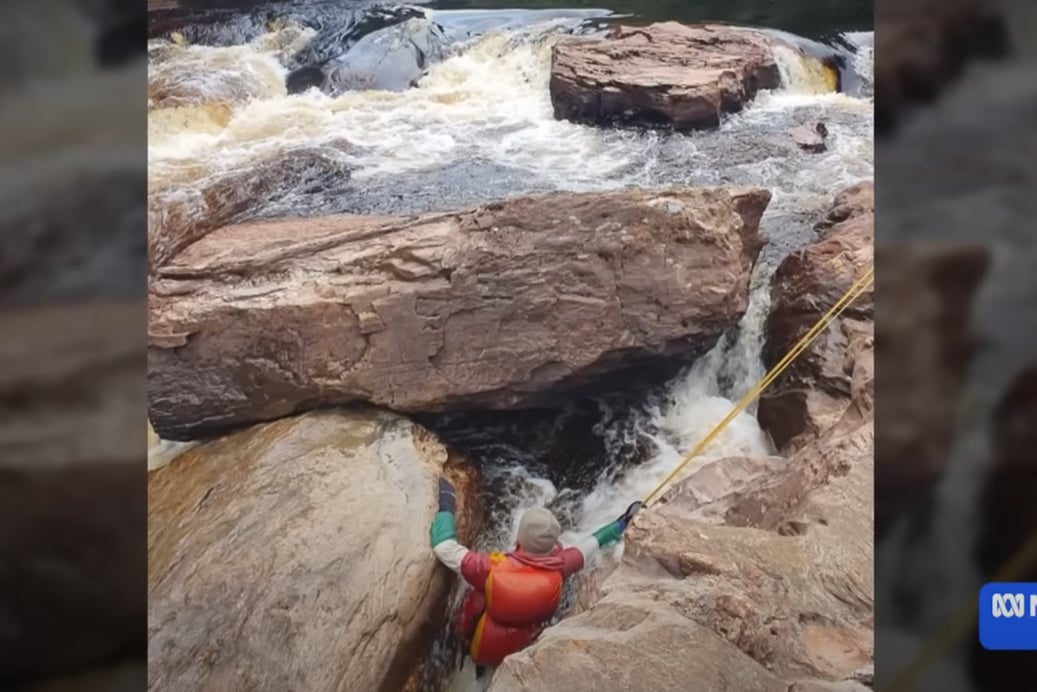
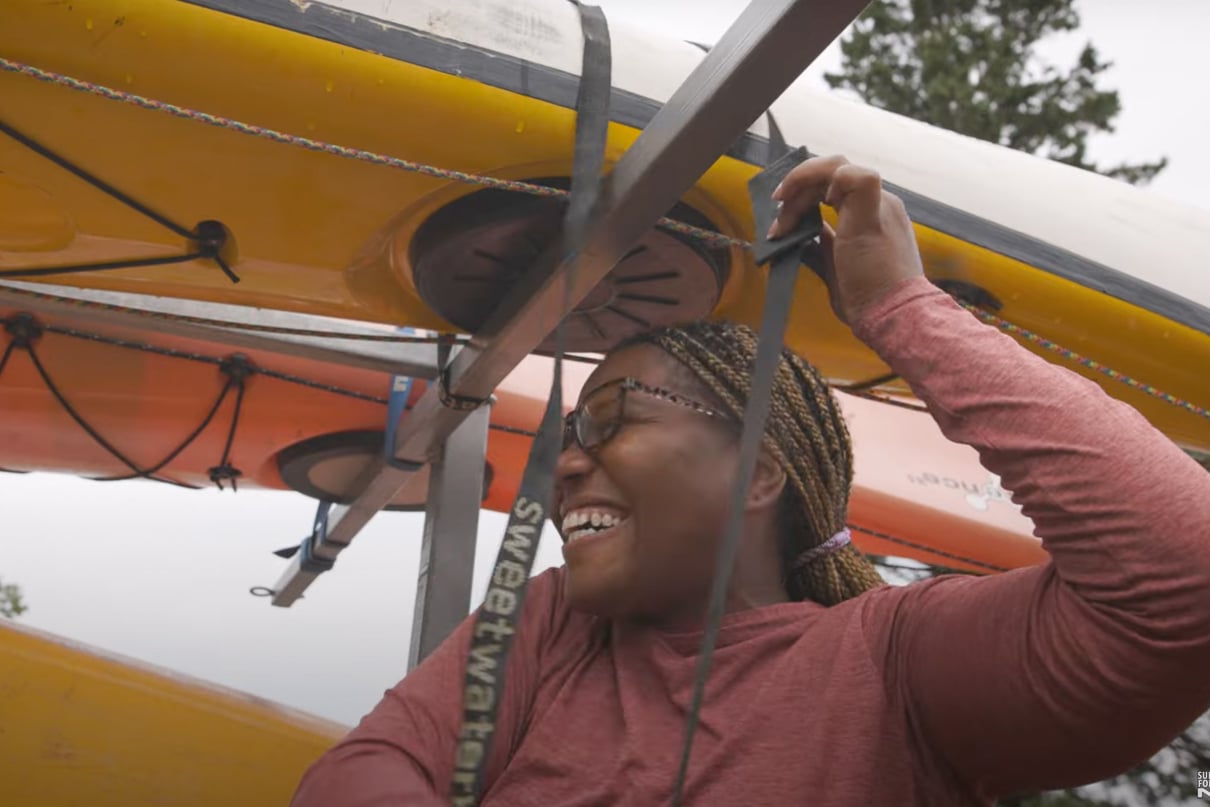
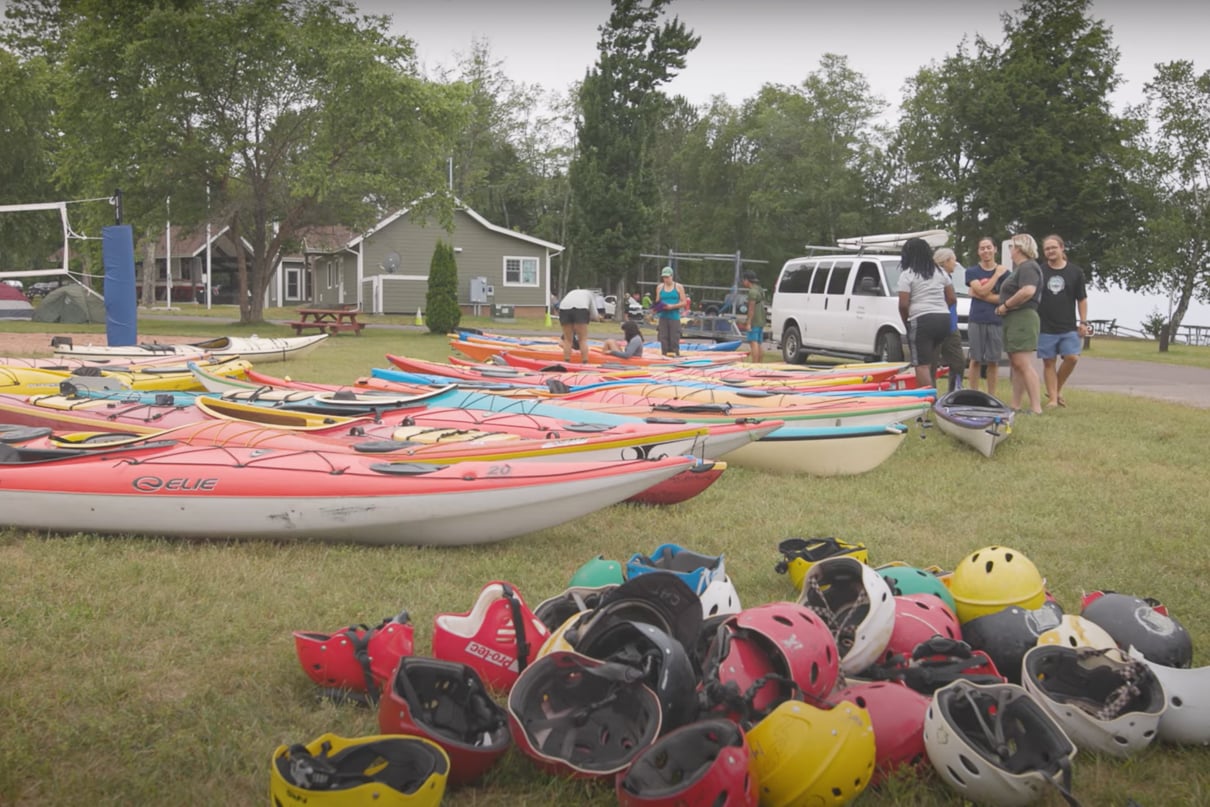
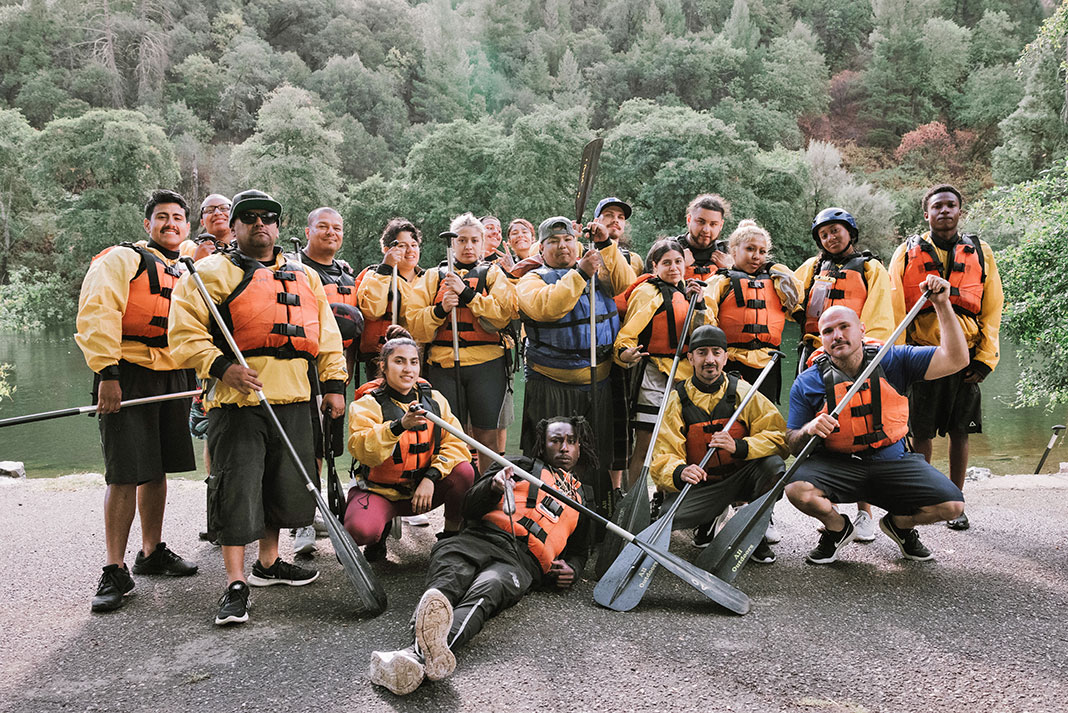
At the 2024 PTC Colab, paddlesports industry leaders gather for a photo. Feature Image: PTC Colab 2024
The Paddlesports Trade Coalition (PTC) has announced that its second annual Colab industry event will take place September 8-10, 2025, and return to Riversport OKC in Oklahoma City. PTC executive director Jeff Turner shared details about the announcement in a webinar on March 19, 2025. The organization also unveiled a plan to launch an annual, industry-wide Go Paddle Day on June 14.
2025 PTC Colab returns to foster industry collaboration
The first Colab was held in September 2024. It was hosted by the newly formed PTC, which brought together paddlesports industry members to share ideas, educate and engage in industry-wide collaboration. The 2024 event saw approximately 150 attendees.
At the 2024 PTC Colab, paddlesports industry leaders gather for a photo. Feature Image: PTC Colab 2024
The agenda for the 2025 event again aims to balance meetings and discussions as well as opportunities to get out on the water and enjoy the new products on display. General sessions are to include retailer and brand collaboration, boater safety initiatives, direct-to-consumer impacts and management and technology and industry data. Breakout sessions will focus on consumer engagement, industry certifications and strategies for Go Paddle Day.
Go Paddle Day launches on June 14
Go Paddle Day is a unified push to get lapsed paddlers back on the water. Stig Larsen, CEO of Level Six, was at a trade show in Strasburg listening to a speaker talk about dwindling participation in paddlesports when he was struck with a point the speaker touched on.
“We’re so focused on trying to get new paddlers that we’ve also kind of missed out on lapsed paddlers,” shared Larsen, adding that he himself could be considered a lapsed paddler. “I paddle, but I’m not paddling as much as I used to.”
Rekindling love of paddling may be just as important to industry health as reaching potential new paddlers, and the hope is the lapsed paddler will bring someone new to paddling with them. This idea is at the heart of the new Go Paddle Day initiative.
While Go Paddle Day is a PTC initiative, it is designed for everyone in the industry to give people a reason to get outside and paddle across North America, with an aim to put paddlesports in front of as many people as possible. The goal is to keep the day an easy event to execute, and harness the power of social media to coordinate getting people out on the water on the same day.
Larsen went on to explain that the event will be an “aggregation of resources from the best businesses and minds in the industry to get as many people on the water in paddlecraft as possible… We need more butts in boats.”
The next PTC Webinar is scheduled for April 23, 2025.
Lesford Duncan on Ebeneezer Creek, Georgia. | Feature photo: Andrea White
I’ve always found my deepest joy outdoors. As a kid I enjoyed riding my bike, visiting parks, and camping with my church group. In high school one of my close friends organized a backpacking trip over the holidays, and I remember how excited he was when he came back to school and told us about it. When I asked him why he didn’t invite me, I’ll never forget his response—and he said this very genuinely—“I didn’t think Black people backpacked.”
That set me off on a journey of questioning what it means for a race of people not to be engaged in a particular outdoor activity. “Black people don’t…” messages came not only from my white friends, but also from Black friends and family—stereotypes rooted in both real and perceived notions of belonging and safety in the outdoor community. That I now kayak through remote wilderness, climb some of the world’s biggest mountains, and lead a foundation that promotes outdoor participation is a point of irony my high school friend and I laugh about today.
The future of diversity in paddlesports
I paddled for the first time on Lake Wauburg when I was an undergraduate at the University of Florida, and I remember an alligator brushing underneath my kayak. That was a hell of an introduction to paddling, but I was in love with it and have been paddling ever since.
At first, I didn’t consider myself part of a paddling community. It was just something I did on my own, renting kayaks in places I visited. Having a community to regularly paddle and build skills with would have benefited me, but I didn’t know about local clubs or groups like the American Canoe Association—not to mention, paddling wasn’t something I saw a lot of people that looked like me doing.
Lesford Duncan on Ebeneezer Creek, Georgia. | Feature photo: Andrea White
In the paddling community we put a lot of emphasis on safety, and for most of us that means technical knowledge of appropriate gear and watercraft, water and weather conditions, and how to conduct rescues as needed. But for folks who look like me, there are other dimensions of safety to consider, for example the risk of racial profiling, harassment and violence in the places we go to paddle. Recently I went on a paddle trip and one of the local shops was decorated in political propaganda and Confederate flags, and the shop owner even made it a point to say to one of the attendees that “this is Trump country,” not as an indicator of support for a political candidate, but to check them—to say they didn’t belong there. Racism is a very real and prevalent concern that I hear from Black friends who paddle, and is a barrier to many even entering the sport.
Some physical risks in paddlesports are also correlated to race. According to the CDC and other studies, Black people are seven times more likely to drown than their white counterparts—and no, it’s not because our bones are denser, as a P.E. teacher once told me. It dates back to redlining and segregated access to public pools and opportunities for swimming. Why is this relevant today? Well, if your parents can’t swim, you are statistically less likely to know how to swim or be exposed to opportunities to swim. So those systemic barriers from decades ago still have compounded effects today.
Pushing paddlesports forward
I’m heartened by organizations genuinely invested in the work of making our sport more accessible and equitable—those working actively to engage underrepresented and historically excluded groups, and support leadership from within those communities. I had the chance recently to experience efforts like these first-hand as I took part in the 2023 Beaver Crew program, which is part of Georgia River Network’s very intentional push to increase diversity in paddlesport instruction.
“It could be as simple as the music you play or the food you serve, but it should also consider the safety and educational needs of the folks you’re bringing in.”
—Lesford Duncan
Beaver Crew provides first-class instructor training to diverse leaders, with scholarship support provided by Georgia Power and other funders. The cohort I joined in 2023 included seven African American participants, and we all earned ACA Level 1 or Level 2 certifications. Since then, classes have added more than two dozen qualified instructors. Many are leaders in Black-led groups and organizations like Middle Georgia Kayakers, West Atlanta Watershed Alliance and Outdoor Afro, a national organization that cultivates Black joy in the outdoors. They will go on to teach thousands the basics of paddling and safety and cultivate the community I wished I had when I first started paddling all those years ago in Florida. The Beaver Crew program was a powerful opportunity for me personally, and is absolutely a model that can be scaled and replicated across the country.
Mainstream organizations can do a lot to facilitate diversity and inclusion, but it has to go beyond simply inviting people of color into existing and traditional spaces. True inclusion means thinking critically about your programming and who its designed for; thinking about your current staff, board and membership and who’s missing; thinking about your culture and who is it most welcoming to. Considerations like where you hold your events and trips, how you conduct outreach or develop partnerships, the progression of your curriculum, or even what type of food is served or music is played may help to expand and diversify your audience. Most importantly, building genuine relationships beyond your own identity groups goes a long way.
Our country is becoming more diverse, so there’s a business case for outfitters and retailers to embrace a broader participant base. The Census Bureau projects that racial and ethnic minority populations will collectively become the majority by 2045. Part of the work we do at the Outdoor Foundation in advancing outdoor access and equity is publish research on outdoor participation trends in collaboration with the Outdoor Industry Association.
Our recent 2024 Outdoor Participation Trends Report not only shows significant growth in overall outdoor participation but increases in diversity as well, with people of color over-representing among new outdoor participants. For example, African Americans are 12.4 percent of the U.S. population, while 15.6 percent of new outdoor participants are Black. We’ve seen similar gains among Latino, Asian-Pacific Islander and LGBTQ+ participants. That’s credit to the work of pioneering groups like Latino Outdoors and Outdoor Afro that have been working to cultivate affinity spaces for people of color in the outdoors. It’s also credit to organizations like those that are a part of the Outdoor Foundation’s national Thrive Outside Initiative who are working to address systemic barriers to outdoor access and increase youth outdoor programming.
We still have a way to go, but we’re making progress. We’ve reached a point in time where groups that have historically been excluded are engaging with and creating their own community in the outdoors. And that makes me very optimistic for the future of outdoor recreation.
People of color powering new participation
The Outdoor Foundation’s 2024 Outdoor Participation Trends Report shows a significant increase in outdoor participation, including in paddlesports:
Outdoor participation grew 4.1 percent to a record 175.8 million participants, or 57.3 percent of all Americans aged six and older.
While whitewater, recreational and sea/touring kayaking have seen growth in participation, they have lower percentages of “core” or very frequent participants.
More people of color are participating in outdoor recreation.
Lesford Duncan, MPH, is Executive Director of the Outdoor Foundation, an ACA Level 2 Kayak Instructor, and proud Beaver Crew alumnus.
This article was first published in the 2024 issue of Paddling Business. Subscribe to Paddling Magazine’s print and digital editions, or browse the archives.
Lesford Duncan on Ebeneezer Creek, Georgia. | Feature photo: Andrea White
The trade-off for the convenience and easy portability of an inflatable SUP is the small hassle of inflation. Sure, you can inflate your board by hand—but it only takes the first time pumping away for what feels like an eternity to start considering the sweat-free approach if you go electric.
With a good hand pump, it takes about 10 minutes of labor to inflate a standup paddleboard. In the same amount of time, you can set the PSI on an electric pump, plug it in and prep the rest of your gear for the water. When you come back—tada—your board will be fully inflated. Another bonus to an electric pump is when blowing up more than one board in an outing—it saves your arms for paddling and keeps your heart rate below 180 bpm. Once you’ve used an electric pump, we bet you’ll find it’s hard to go back to the manual method.
Paddleboarders want three things in an electric pump—reliability, ease of use and speed. The three high-pressure pumps featured below offer all that in compact packages, and promise to get you on the water faster than ever before.
Dress For Immersion, Not Air Temperature
Your body loses heat much faster when immersed in cold water than it does when dry.
Avoid cotton clothing like t-shirts and jeans; they retain water and accelerate cooling when wet. Synthetic fabrics, or wool, are generally a better choice. If the water is very cold (60° fahrenheit or less), you should wear a wetsuit or drysuit.
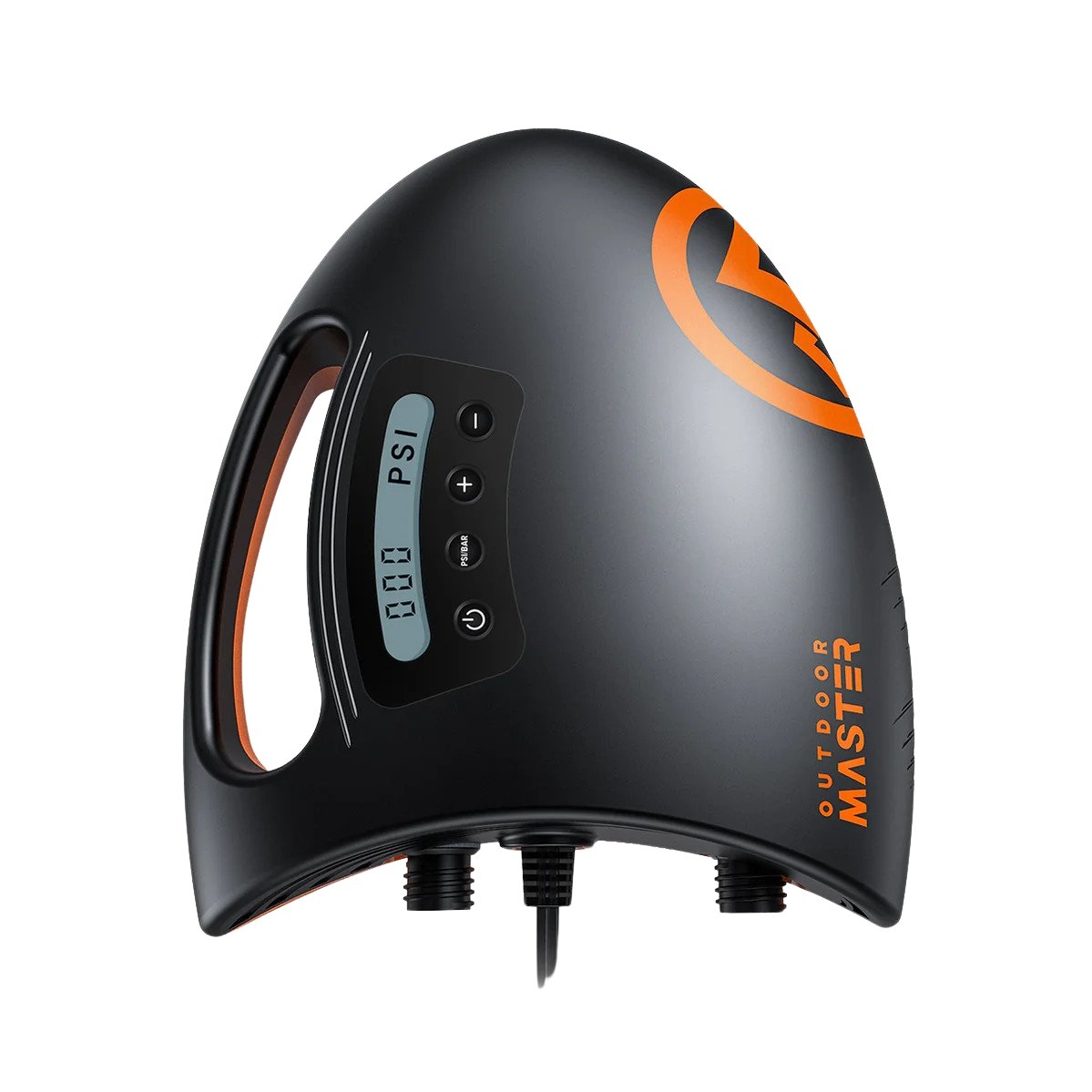
Outdoor Master’s original Shark SUP pump launched in 2019 through a $30,000 Indiegogo campaign. Since the initial success, the brand has introduced multiple updates to the Shark lineup, with the Shark II being one of the most popular electric paddleboard pumps out there.
As with our other picks for electric pumps capable of reaching high PSI, the Shark II has dual stages. The first stage pumps your board to 1 PSI to fill out the shape—this is around where a raft or inflatable kayak would stop. It then reaches up to 20 PSI in the second stage for the high-pressure rigidity desired for a SUP. Just set the pressure on the digital LCD display, and the auto-function turns the pump off once reaching the target pressure.
The Shark is powered by a 12-volt cable plugging directly into the cigarette lighter or accessory adapter in your vehicle. The Shark II features an active cooling system and can inflate three to four boards in a row without needing a break to cool off.
Reasons to buy
Proven design with fan following
Dual stage for high pressure reaching up to 20 PSI
Active cooling system
Can inflate 3-4 boards in a row without needed a break
Budget-friendly for its class
Consider another if
You would prefer a rechargeable battery-operated pump
You need a longer cord to reach the accessory plug in your vehicle
Bottom line
The Shark II electric SUP pump is a widely-loved choice for inflating your board to maximum pressure and the brand has set the benchmark for this piece of gear.
Stay Clear Of All Other Vessels
Know the “Rules of the Road” Navigation Rules that govern all boat traffic and stay out of the way of all other vessels.
Never assume that power boaters can see you. Avoid high-traffic areas whenever possible. Proceed with caution when you can’t avoid paddling near boats. Dress for visibility.
Best plug-in or rechargeable electric paddleboard pump combo
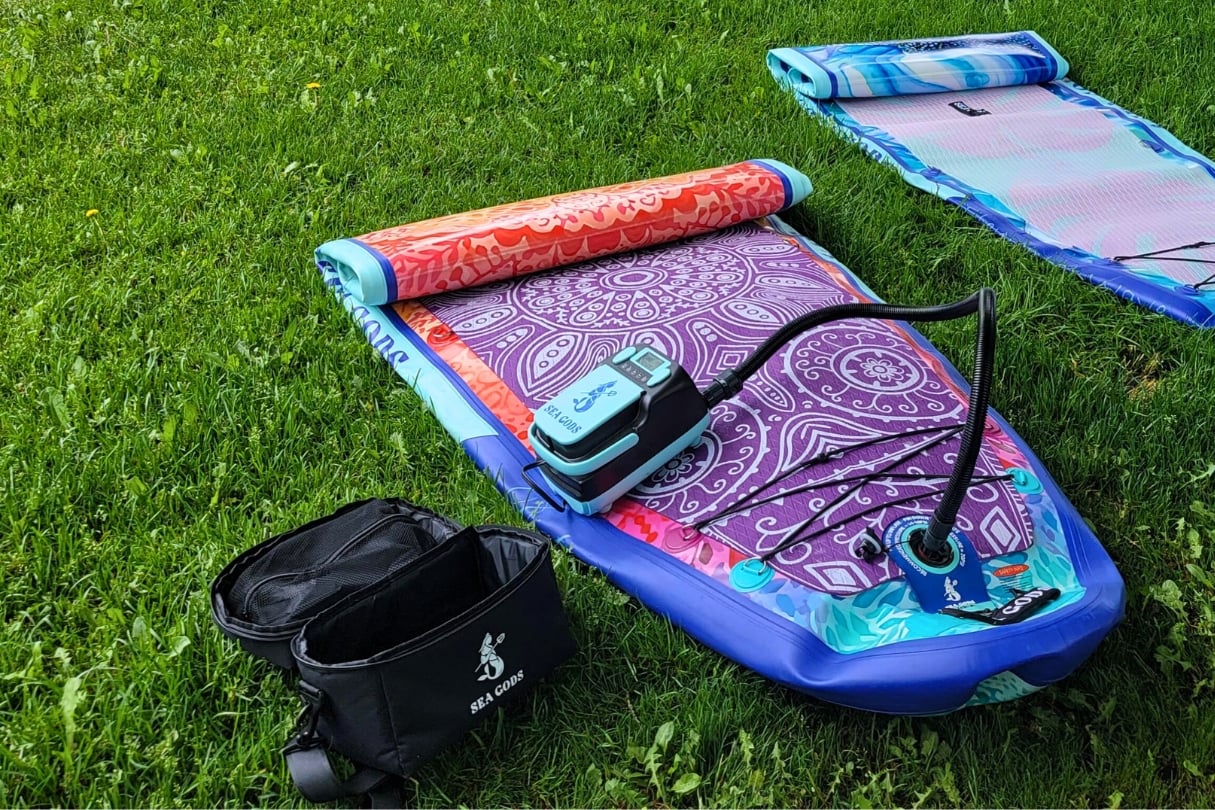
No need to fear whether your 12V cord is long enough to reach your board with the Sea Gods rechargeable paddleboard pump. The built-in battery takes away the need to run your vehicle, and yet it is still capable of inflating a board to 16 PSI in the same time as its plugged-in competition.
The battery capacity of the Sea Gods pump is enough to get between two to four boards inflated depending on board size and pressure you are trying to achieve. If you need more power, the Sea Gods pump also has a tucked-away 12V cord.
The Sea Gods team tested a variety of setups before deciding on this to be their finished pump. Cutting off the pump at a max of 16 PSI was also a conscious choice to avoid a design that would be obnoxiously loud. Sea Gods co-founder Mandy Johnson also shared that she found higher PSI electric pumps tend to burn out components, get hot to the touch, and, risk blowing vehicle fuses. The battery pack of this rechargeable pump will get you to the PSI most paddlers will be happy with, and there’s always the barrel pump for a top-off.
Reasons to buy
Rechargeable battery pack doesn’t require vehicle battery to operate
12V DC cable keeps you inflating beyond internal battery
Consider another if
You prefer a dedicated 12V corded pump
You want an electric pump that goes higher than 16 PSI
Bottom line
The Sea Gods rechargeable pump offers the best of both worlds, letting you cut the cord and inflate your board anywhere.
Best battery-powered SUP pump
Swonder Seawolf S20Li 9000 mAh Rechargeable SUP Pump
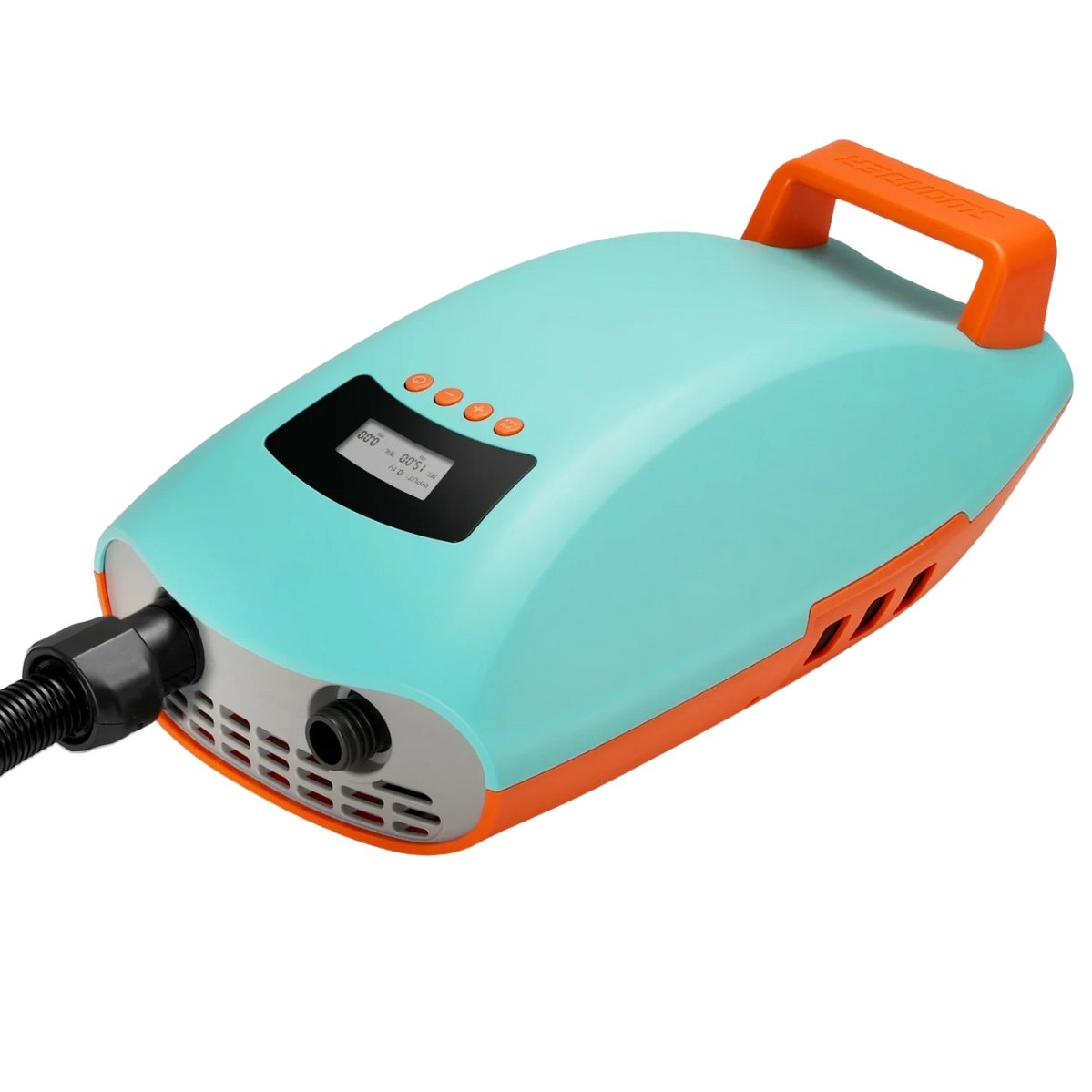
Cut the cord all together with the Swonder Seawolf S20Li 9000 mAh Rechargeable SUP Pump. The Seawolf is powered solely by a capable lithium-ion battery, letting you inflate your paddleboard wherever you please. So go ahead and pass the parking lot crowd, keeping your SUP in the travel bag right to the water’s edge. The battery holds a capacity of 9000 milliamp hours (mAh) to inflate a stack of boards for the whole family or your flotilla of friends. Swonder claims you could inflate 12 boards on a single charge, though the more likely application is that you and a partner could put in a workweek’s worth of days on the lake without having to remember to plug it into a wall for a recharge.
The Swonder Seawolf can reach 20 PSI, and, with its dual-cylinder motor, it can impressively inflate a board within about the same time, if not faster than the best plug-in models. The active cooling system helps the Swonder pump inflate up to 8 boards in a row, and the auto shutoff saves your battery once the board has reached your desired PSI.
Reasons to buy
Lithium-ion battery requires no plug-in power source for inflation
9000 mAh capacity can inflate up to 12 boards on a full charge
Max inflation to 20 PSI
Dual-cylinder motor for speedy inflation
Consider another if
A plug-in powered pump is preferred
Looking for a lower-cost electric pump
Bottom line
The Swonder Seawolf rechargeable SUP pump does not only make for an adequate battery-powered option, it exceeds the capability of most electric pumps on the market.
Electric paddleboard pump buying advice
When looking for an electric pump to blow up a SUP, one of the first questions people ask is: Why would you need to pay $100 or more when there are electric pumps available at most outdoor stores for cheap?
Low-cost air pumps are intended for inflating air mattresses or rafts and water floats. They only have a single stage of inflation for a high flow of air at a low pressure which may reach 1 or a few PSI. This is far short of the high pressure of 10 to 20 PSI needed for well-made inflatable paddleboards. This means you’d still have to pump up the board by hand with a barrel pump for the majority of the effort.
A proper electric SUP pump has a second stage, where the outflow of air switches to low flow at high pressure. This is what sets these pumps apart from a common outdoor-goods air pump. The best available can reach 15 to 20 PSI, requiring little if any extra effort with a hand pump—though you should generally keep one stored with your board incase a top off is needed or you have a power issue.
How we chose the best electric SUP pumps
We consider several factors when choosing the electric SUP pumps. From ensuring we judge the pump according to its intended purpose to making sure you’re actually able to buy it, here are the things we consider when picking the gear in each category:
Purpose. Comparing apples to apples.
Performance. How well does it do its job?
Features. Sometimes we’re all about bells and whistles, sometimes not.
Real-world testing. We put them to the test on the water.
Price. Is it affordable for its class? Does its performance justify its cost?
Sales. Best-selling models are best-sellers for a reason.
Availability. It won’t be good if you can’t buy it.
Designer and brand interviews. We ask the people who made it why.
On the afternoon of Tuesday, March 17, Avery Bryan and Eva Aponte were attempting to return to Cedar Key from Atsena Otie Key when the teens drifted nearly 14 nautical miles off course. Swept off their route by strong winds and the tides, the pair and their shared an inflatable paddleboard for 15 hours overnight before they were found and rescued at 8 a.m. on March 18 by local volunteers.
When a casual paddleboard adventure turns life or death for two teens in Cedar Key
The teens encountered 6-foot (2-meter) seas, gusting winds, and water temperatures as low as the high 30s Fahrenheit overnight according to estimates by Lieutenant Scott Tummond of the Levy County Sheriff’s Office shared with TODAY. Another estimate put the air temperature at 45 degrees Fahrenheit (7 Celsius).
Three times throughout their night at sea, the teens spotted a helicopter flying overhead with a spotlight, though it was unable to locate them. As the teens were blown into shore near Turtle Creek throughout the night, he sharp oyster shells made it hard for the girls to walk their paddleboard and themselves into the path of the searchlight, Bryan and Aptone shared with rescuers.
The teens were found near Turtle Creek when good Samaritan local fisherman spotted their paddleboard on shore and the teens waved for help.
Teen girls are rescued near Cedar Key, Florida after a night at sea. Feature Image: ABC7 | YouTube
“Both girls were immediately treated by an amazing rescue team for dehydration and hypothermia,” Levy County Sheriff Bobby McCallum shared on Facebook while thanking first responders and volunteers.
“The number of boats on the water from a law enforcement agency’s point of view is just astounding add to that triple or quadruple the amount of volunteers we had out there,” shared Tummond. “That’s what made this a happy ending.”
Both teens were released from the hospital on March 21.
Surviving a night at sea on a paddle board
The teens likely owe their survival to staying with their paddleboard and sticking together throughout the night. Additionally, the teens informed their guardians of their paddling plans. When they didn’t return, help was called and the search began.
What started as a casual paddle quickly escalated to a life or death situation for Bryan & Aponte, who didn’t make the half-mile return trip to the Cedar Key pier from Atsena Otie Key, likely due to offshore winds and tides. Offshore winds blow from the land out to sea, and can pose a threat to the unsuspecting paddler. With offshore winds the water may appear calm and sheltered nearshore, but as soon as you leave the protection of the lee, or “wind shadow” of land, those winds can push a paddler out to sea. The farther from shore you’re pushed, the larger the waves and worse the conditions.
While the teens’ choices on the water ultimately led to their survival, a few key factors could have made their night at sea more comfortable, staved off hypothermia, and led to a quicker rescue.
Where the teens were dressed in t-shirts, dressing for the water temperature rather than the air temperature can increase chances of survival and delay hypothermia onset. This can include wearing a wetsuit or drysuit when out paddling. Additionally the teens were treated for dehydration. Packing food, water, and emergency clothing to cover a longer period of time than you expect to be paddling can help you stay healthy and comfortable, even when waiting for help to arrive.
Throughout the night, the teens were unable to signal their location to the search helicopters above. It’s important to carry more than one reliable way to signal for help in an emergency. In this situation, even a cell phone stored in a secure drybag could be used via search light reflecting on the screen to signal for help to passing boats or a helicopter overhead.
What to pack for a paddleboarding day trip
What you pack for your paddling trips can make a huge difference in your comfort or even survival. What to wear and pack for paddleboarding is similar to what kayakers wear and pack. For a paddleboard day trip it’s important to bring…
A PFD (life jacket), worn on your body rather than strapped to your boat or board
A wetsuit or drysuit depending on water temperature
A SUP leash and paddle
Multiple ways to signal for help (cell phone, signal mirror, InReach, flare, ect)
If coastal paddling, a VHF radio
Food and water
Emergency layers or a space blanket stored in a dry bag
Chicago is not often considered synonymous with adventure. While the city has climbing gyms, the Lake Michigan waterfront, rivers and parks, adventure near Chicago tends to be easiest accessed by those with a car, outdoor gear, and previous experience in the outdoors.
This Chicago-based nonprofits is looking to address the adventure gap in the city.
Chicago Adventure Therapy (CAT) works to utilize blue and green spaces healing power in and around Chicago, focusing on different marginalized and underrepresented communities. Zorbari Nwidor, current Executive Director of CAT and recently highlighted in NRS Film LEADing the Way with Zorbari Nwidor & Chicago Adventure Therapy, shared a little of her path to CAT:
How Zorbari Nwidor went from first encountering a kayak in a gym to Executive Director of Chicago Adventure Therapy
“It is a reclamation in the outdoors– reclaiming it for fun, for love, for healing,” shared Zorbari Nwidor about the experiences offered by CAT.
Nwidor first encountered a kayak in a high school gymnasium. As an eighth grader, Nwidor met Andrea Knepper, founder of CAT and then Executive Director at a high school and college career fair.
Nwidor felt a pull to the maps and charts, the radios and of course, the kayaks on the floor and she was hooked. In 2009 Nwidor went on her first trip with CAT.
Nwidor unloads sea kayaks for the Apostle Islands Chicago Adventure Therapy trip. NRS | YouTube
“My first camping trip with CAT was what really got me connected with the organization and love of nature. My family came here as refugees, so my first three years of life was in a tent at a refugee camp,” shared Nwidor. “Then to camp with CAT for the first time since then and to have a different experience… being able to recreate and be happy with people around me and see stars and notice all those pieces instead of survival…it really changed a lot for me.
Even as Nwidor went on to college in Washington D.C. as a premedical student, she continued to come back every summer to work for CAT. When the time came to make a career decision, she chose to go full-time with CAT.
“That’s where I was happy. I was noticing that I’d be at the clinic and yes, I’m helping people and we’re providing that kind of medical care, but it wasn’t holistic,” shared Nwidor. “I’d be looking forward to the days that I have programming with CAT and checking my emails for any program plans and things like that to prep myself for it.”
Now, in 2025, Nwidor has taken over as the Executive Director of CAT.
Black People Outside on Chicago Adventure Therapy and the adventure gap in Chicago
Chevy Linear and Kameron Staton run the Black People Outside social media and nonprofit with similar goals to Chicago Adventure Therapy: shrink the Chicago adventure gap.
Boats and gear prepped for launch on the Chicago Adventure Therapy Apostle Islands sea kayak trip. Feature Image: NRS | YouTube
Linear and Staton were connected with the CAT team through the climbing world. From here, they were invited to join CAT on a sea kayaking trip in the Apostle Islands, designed to get participants in sea kayaks out on Lake Superior and build confidence in a boat. While both Linear and Staton had some experience on the water, they had never been sea kayaking before.
“I really just admire the leadership in general. They’re really organized and they take things very seriously, but they still want to have fun, and it’s just a very close knit, very organized group,” Linear shared about CAT.
Similarly to CAT, Black People Outside both as a social media page and a nonprofit works to help people in Chicago who don’t have easy access to the outdoors get outside.
“It started off with just us documenting what we are, just ushering ourselves into the outdoorsy space, camping, hiking, climbing, water activities, winter stuff, sports,” shared Stanton. “And then from there we just showcased areas, particularly around Chicagoland.”
Black People Outside quickly sprang outside of the confines of the internet and into the real world. Soon, others began to reach out to Linear and Stanton and ask if they could come and join them on hikes and outdoor adventures. Before long, Linear and Stanton began to host events and meetups.
Inside the Chicago adventure gap and barriers to outdoor adventure
“There’s an adventure gap in Chicago,” shared Linear. “A lot of people don’t even live within five minutes of a park, and transportation is a barrier. So to get to the great outdoors in Chicago, you’d have to have a car.”
Linear also explained that even with a car, many people don’t have any equipment, even down to a good pair of shoes to go for a walk in the woods. But there are solutions. Linear shared that carpooling, Amtrak, and parks that can be reached via buses are all ways to get closer to green spaces and the outdoors.
Across the board, Linear, Staton and Nwidor all agreed that there are more parks and waterways in Chicago for recreation than many people realize.
“Chicago has so many green spaces and blue spaces. You would be so surprised,” shared Nwidor. “I mean, with not just the Chicago River… on the lake itself, there are so many launch points from different neighborhoods. It’s beautiful.”
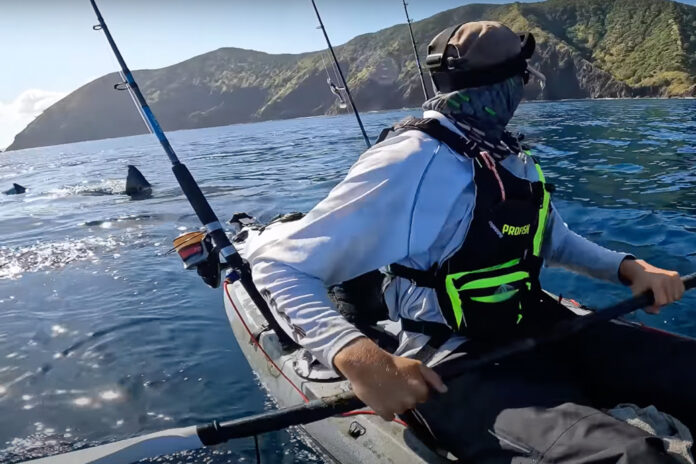
Kayak Angler Matt Wells is followed by a shark in New Zealand. Feature Image: Matt Wells | YouTube
Who hasn’t been out paddling when struck but the eerie feeling that something big is below them? Whether you paddle small lakes and rivers or the big blue, there is something about what lies beneath that can fill you with unease.
For these kayakers, any unease was justified. Check out three of the wildest kayaker encounters with really big fish on the internet:
KAYAKER: The magical moment this kayaker is surrounded by leaping bluefin tuna
On a sunny morning on the shores of Devon, England, kayaker Rupert Kirkwood found himself surrounded by a school of leaping bluefin tuna.
The bluefin tuna were feeding on garfish, leaping through the air around Kirkwood while his son, a wildlife filmmaker caught it all on camera. Can you imagine paddling with these massive torpedo-like fish flying through the air around you?
Overall, we’re calling this magical moment a win for the kayaker!
BIG FISH: This packrafter in Patagonian Chile was briefly swallowed by a whale
While a whale is technically a mammal and not a fish, ending up in the mouth of a whale rising from the depths is the stuff of paddling nightmares.
19-year-old Adrian Simancas was engulfed by a humpback whale while packrafting in Patagonian Chile. Simancas was only in the mouth of the whale for a few moments, making for one of the wildest kayaker vs “big fish” moments on the internet. This terrifying moment is definitely a win for the whale.
DRAW: Kayaker “hunted” by Great White Shark
While kayak fishing on the New Zealand coast, 19-year-old Matt Wells found himself in for a bigger fish than he bargained for when a massive emerged from the depths to inspect his rudder. In the viral video, the shark followed Wells for a while before returning to the depths and Wells made it safely to shore.
While the shark could’ve easily ruined Wells’ day, we’re calling this a draw thanks to Well’s positive attitude about the encounter.
“I think he was just giving me a fright and having a bit of fun,” Wells told newscasters in an interview about the shark.
Regardless of how and where you plan to paddle, price is often a determining factor in purchasing a kayak. It’s a common question when people are considering getting into the sport: “So, how much does a kayak cost?” As with other queries, kayak prices vary with the style and—most importantly—construction and features. What you might really be seeking to learn though is how low of a price is reasonable for a boat you can depend on to float or carry you on a voyage of your wildest aspirations.
This article breaks down the simple question into numerous categories to serve as a guide for selecting the right boat for your budget.
The Skylark is one of Eddyline’s best-selling recreational kayaks. | Photo: Eddyline
The average cost of a kayak
Kayaking is a sport in which you truly get what you pay for. Take for example recreational and sit-on-top kayaks intended for calmer waters.
You can find a plastic kayak at everyday box stores like Walmart or Dick’s Sporting Goods for less than $500 USD.
At a large outdoor retailer such as REI a recreational kayak can go for between $500 and $1,200 USD.
Meanwhile, at a paddling specialty store, recreational kayaks and a higher-performing next level called day-touring kayaks are as low in cost as around $500 and range up to almost $2,000.
The entry-level recreational kayaks sold at a box store are the lowest cost, however they are also limited in features, outfitting, and construction in a way that affects their performance, comfort and scope of intended use. You’ll find basic outfitting, including rudimentary molded seats and less comfortable back support, reflecting the fact that these kayaks are meant for shorter outings on the water.
Recreational kayaks sold at places like REI are often in the $500 to $1,200 range. These models are also meant for use on calm sheltered water, however, they also tend to be the basic models offered by brands who produce higher-performance kayaks. This means the company is able to incorporate some of their well-developed outfitting, features, and design technology into these base models—which means greater comfort and performance for you.
Many paddling specialty stores also carry the lower-cost entry-level kayaks offered by the top brands at prices as low as around $500. And in contrast, they also carry the brand’s more premium kayaks for recreational and day-touring use which can cost up to $2,000. The best recreational and day-touring kayaks can be made of lighter-weight plastics, have outfitting of a similar grade as you would find in a touring kayak, and include cherished built-in features for both paddler use and safety. At a paddling store, you can see firsthand the difference between a range of low-cost to high-performance kayaks and decide what will work best for you.
Prices by type of kayak
The price of a decent kayak also varies by type of kayak. Here’s an overview of what to expect.
Recreational kayak cost
As mentioned before, sit-on-top and sit-inside recreational kayaks have a large price range, dictated by where you shop for your kayak. Kayaks at Walmart or Costco can run as little as $200. Meanwhile, the popular Wilderness Systems Pungo 125, a recreational kayak with upgraded comfort and safety features, retails for $1,219. At the higher end of the range, Eddyline’s best-selling Skylark retails for $1,749.
A day-touring kayak between 12 to 15 feet long is the ideal choice for someone who wants a kayak with more performance and glide than a recreational kayak. The price of a day touring kayak increases significantly with material and lightness in weight. For example, a plastic day touring kayak price may be $1,200. On the other hand, a top-of-the-line composite day touring kayak (constructed of fiberglass or ultralight aramid or carbon fiber) can cost over $3,000.
The most capable touring kayaks, also often called sea kayaks, cost between $1,500 and $5,000, depending on construction (rotomolded plastic is cheapest). These kayaks are sold at specialty paddlesports stores and they’re aimed at overnight and expedition kayakers, and fitness paddlers. At this price, you are purchasing a kayak that’s been carefully designed for performance, safety and comfort.
This category is defined by kayaks that are capable of paddling long distances efficiently; include critical safety features like bulkheads and smaller cockpits for use in open and exposed water; and feature comfortable seats and thoughtfully arranged outfitting, such as ergonomic seats and thigh braces that promote comfort and paddling efficiency.
Price increases substantially with high-tech, lightweight materials. At the upper end of this price category you’ll find space-age materials like fiberglass, aramid and carbon fiber composites.
Touring kayaks offer more performance than recreational kayaks and can vary in cost depending on materials and size. | Photo: Delta Kayaks
Whitewater kayak cost
You may think that the smaller overall dimensions of a whitewater boat would mean this type of kayak is cheaper than all the rest. However, the typical price for a new whitewater kayak is about $1,000 to $1,700. They are often about the same price as a day touring kayak. At this price you’re getting a brand new whitewater kayak with comfortable outfitting and a capable design made for navigating or playing in rapids.
Like downhill skis or mountain bikes, whitewater kayak designs are tweaked more often than other categories—meaning that it’s possible to find great deals on the used market, especially in regions with strong whitewater communities, such as the Ottawa Valley, Pacific Northwest or the U.S. Southeast.
For top picks and expert reviews, check out Paddling Magazine’s guide to the best whitewater kayaks.
Fishing kayak cost
There’s huge variability in fishing kayak prices depending on where you buy the kayak and the accessories and features it has. For example, a cheap sit-on-top fishing kayak can be purchased for under $500.
But if you want to invest in a top-of-the-line fishing kayak with features as advanced as a pedal drive or motor, expect to invest $2,000 to $6,000.
Tandem kayak cost
The cost of a two-person, or tandem kayak, varies considerably by type and construction. You can purchase a two-person recreational kayak for well under $1,000 (two-person inflatable kayaks can even run under $500); in contrast, a high-end composite tandem sea kayak retails for nearly $6,000.
Inflatable kayak cost
Inflatable kayaks are generally some of the most affordable options. The lowest cost inflatable kayaks are similar to entry-level recreational kayaks. The price of the Sea Eagle 370 for example is under $500. Inflatables are also an affordable option for youth and novice paddlers looking to enjoy whitewater. The Aire Tributary Spud retails for $539, which is less than half the price of a new hardshell whitewater kayak.
Inflatable kayaks are available at an affordable cost and work well for a variety of paddling types. | Photo: Sea Eagle
Folding kayak cost
Folding kayaks have gained popularity in recent years with an increasing number of options. The price of a folding kayak varies depending on construction and size. The simplicity of a boat like the Oru Lake comes with a low price tag at $500 on par with other recreational kayaks. A more complex folding kayak such as the Trak 2.0 costs just under $4,000. It is seaworthy boat built for expeditions with a capability reflected in a cost similar to touring kayaks built of composite materials.
The price of a used kayak often mirrors the price of a similar new one. In general, a “good deal” for a used kayak is about half of its retail price. However this metric varies from model to model, and especially between the different categories of kayak (e.g., recreational versus sea kayak).
Age is the biggest influence of used kayak cost. Several variables go along with age: an older kayak will have seen harder use (or longer storage)—its hull may be damaged by impact, abrasion or UV radiation; and older kayaks often feature less refined comfort features, such as basic (uncomfortable) seats and outfitting.
It’s fair to say that a cheap, box store kayak that’s in decent shape and sold on the used market shouldn’t cost more than half of its retail price. However, some specialty sea kayaks, including high-performance, British-made touring kayaks, are harder to come by and hence demand higher prices—even if they’ve been used.
It’s critical to do your research and know the retail price of the boat you are considering. It’s just as important to inspect a used kayak for damage that may compromise its paddling efficiency, safety and comfort and therefore decrease its value.
How much to spend on a kayak
Ultimately, the question you’re trying to answer is how much is reasonable to spend on a kayak. The goal of this article is to have hopefully shown how this comes down to a combination of paddling aspirations and, of course, budget. Saving a few bucks and buying one of the cheapest kayaks is fine if you plan to paddle casually, making short outings on sheltered water. However, your skills will quickly exceed the capacity of such a boat if you plan to paddle more seriously—and you’ll be frustrated with a basic, inefficient and uncomfortable design that no longer feels like a bargain.
Weight is another major consideration: A lighter kayak is a wise (albeit more expensive) investment if your paddling reality requires you to transport your kayak to and from the water. Retail prices for new kayaks will always be inflated compared to used. One compromise solution, especially if you live in an area with a robust paddling community, is to search the used market for the kayak of your dreams. You may find a gem that meets all your needs for a fraction of the retail price.
If you are out shopping for a new kayak, the costs shared earlier are a fair expectation. Are there super cheap options where you get your groceries? Sure, but it’s a common misunderstanding that low-cost kayaks aren’t available at outdoor stores or paddling shops. And, circling back to how we started the conversation, when buying new in this sport, you do get what you pay for.
As the owner of a specialty kayak retailer, AQ Outdoors, my team and I are often the first information source for many people who are considering kayaking for the first time. When we chat with people, one of the most common discussion points is how to get in and out of a kayak.
For those of us who have kayaked before this may seem to be a trivial question, but it is one that causes concern for many potential paddlers. It’s an awkward skill to learn, yet it is essential. There are many different scenarios for entering and exiting recreational and touring kayaks. You could be on a rocky beach, a dock or a sandy beach. The technique we have chosen to share here is simple, it works well for sit-on-top or sit-inside kayaks, and it can easily be adapted to most locations.
How to get in and out of a kayak
1. Carry kayak to the water
Carry your kayak to the water’s edge or utilize a kayak cart if that is appropriate.
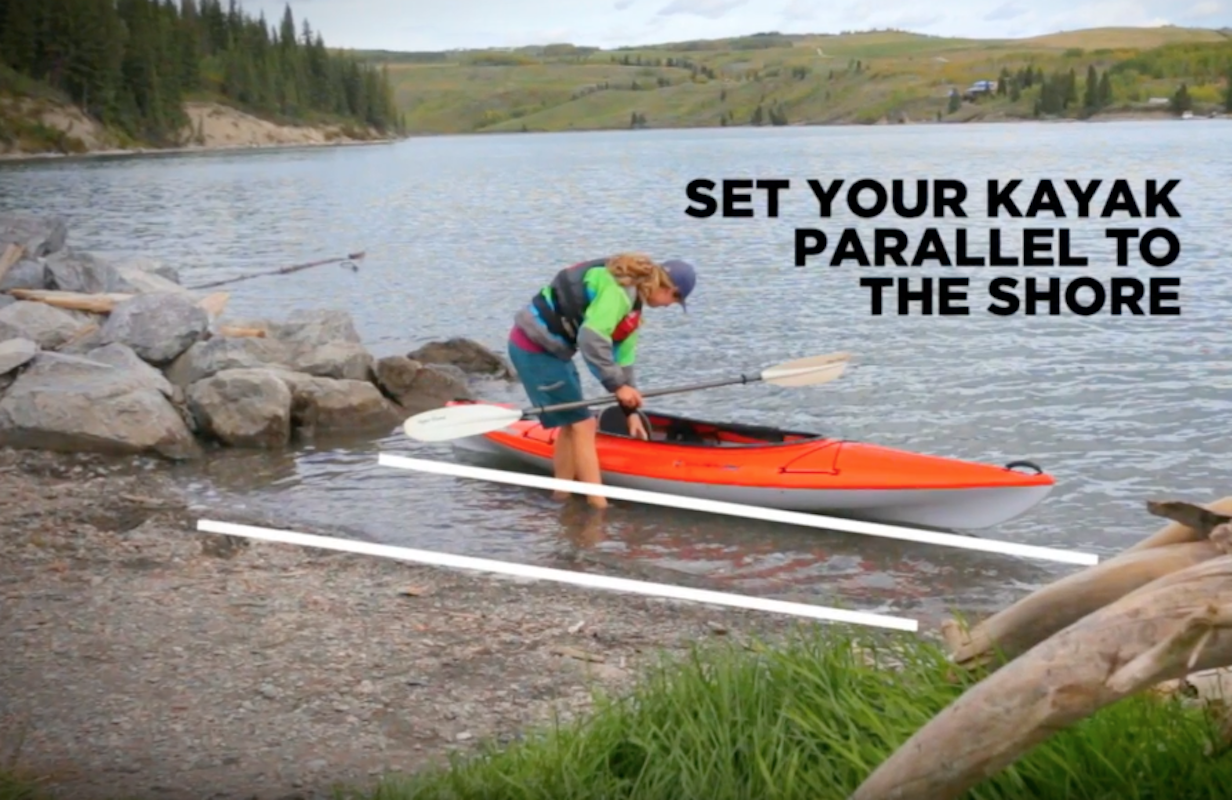
2. Place boat parallel to shore
Place your kayak in the water parallel to the shore and just deep enough to float.
Photo: Simon Coward / AQ Outdoors
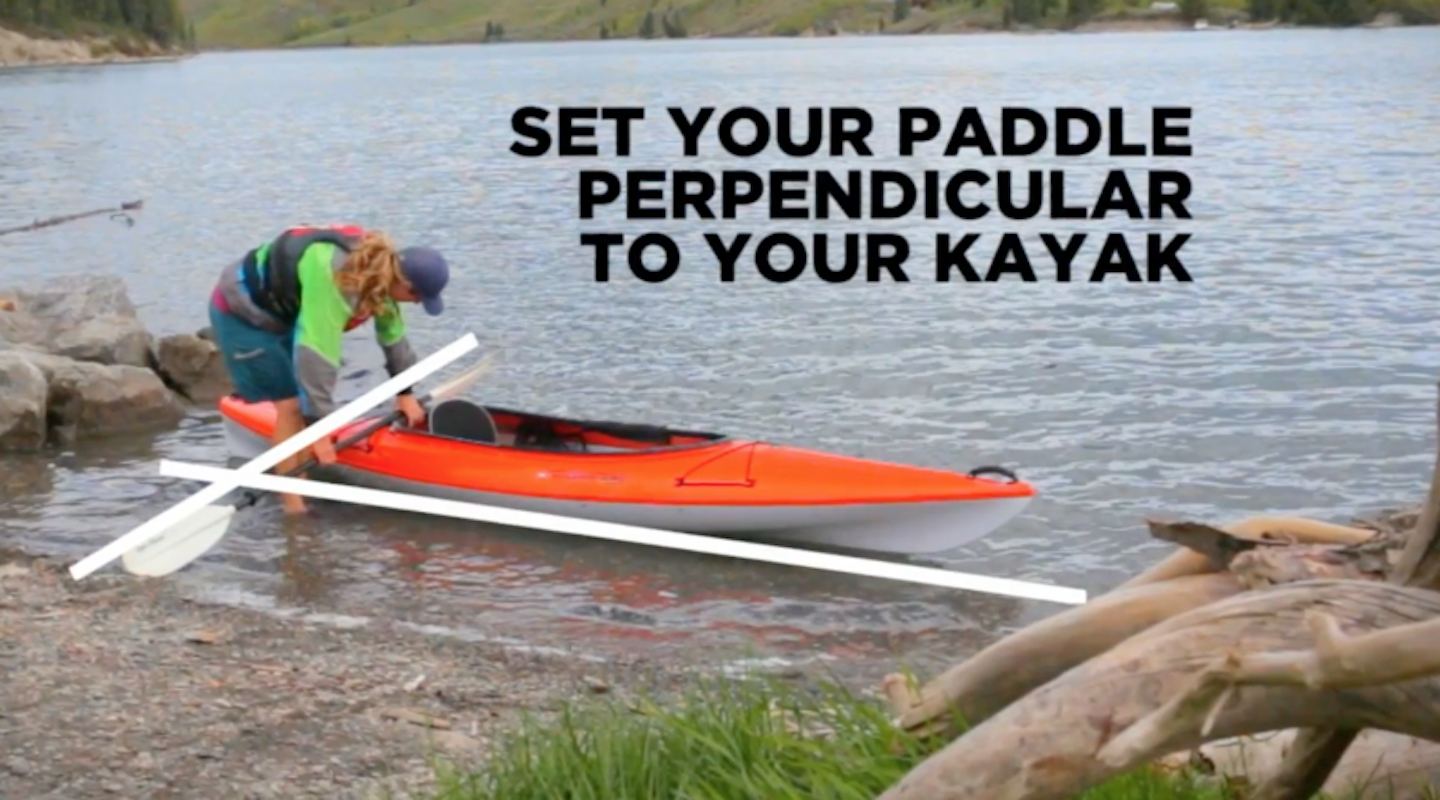
3. Set your paddle as an outrigger
Now place your kayak paddle over the deck of the boat behind the cockpit at a 90-degree angle to the boat. This creates stability and improves your balance by bracing the paddle on both the shore and deck of the kayak.
Photo: Simon Coward / AQ Outdoors
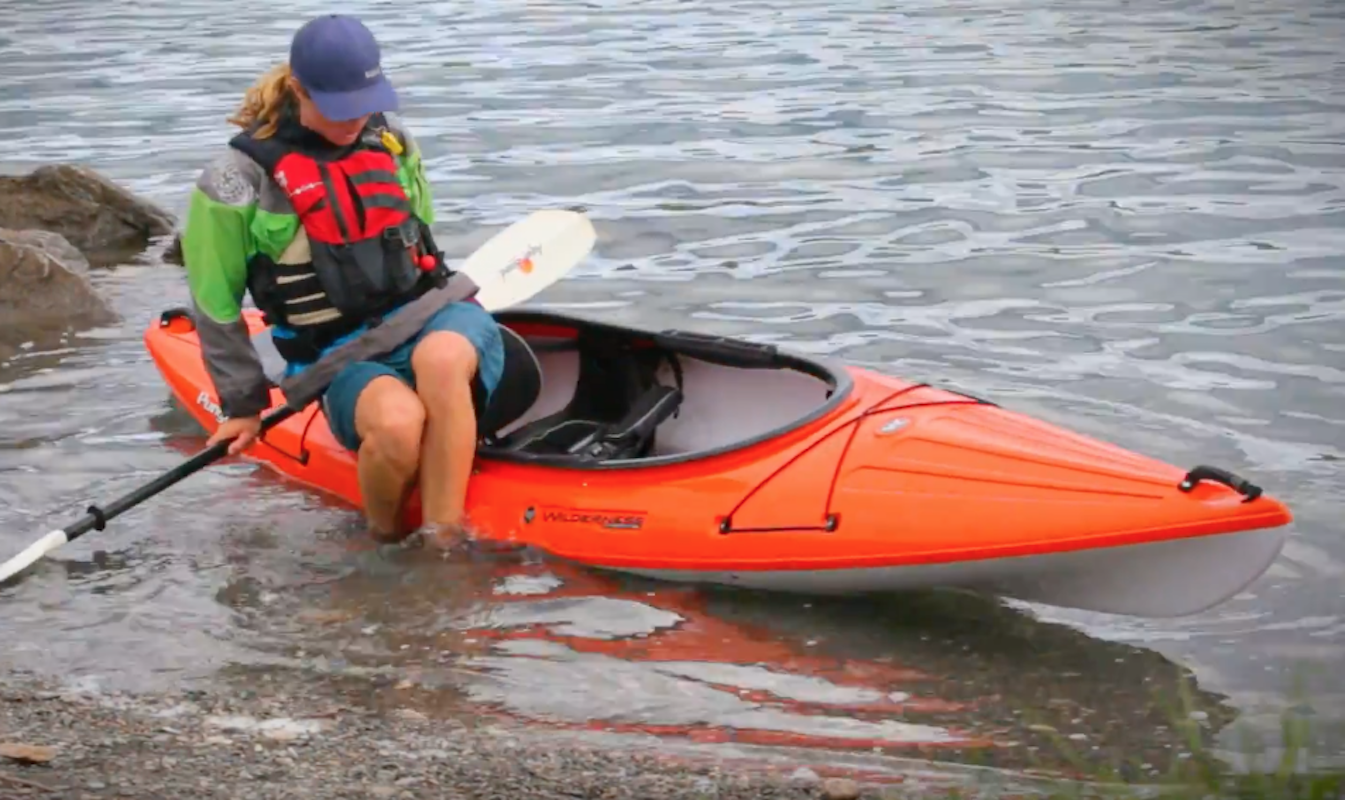
4. Place hands across paddle and lower yourself
Stand in front of the paddle facing the front of the kayak and put one hand at each end of the paddle shaft. The hand behind your seat should clasp both the paddle and the cockpit rim of your kayak. Bend your knees to lower yourself to a squat.
Kayaker lowers themself using paddle as an outrigger. Notice how the boat leans slightly toward shore. Photo: Simon Coward / AQ Outdoors
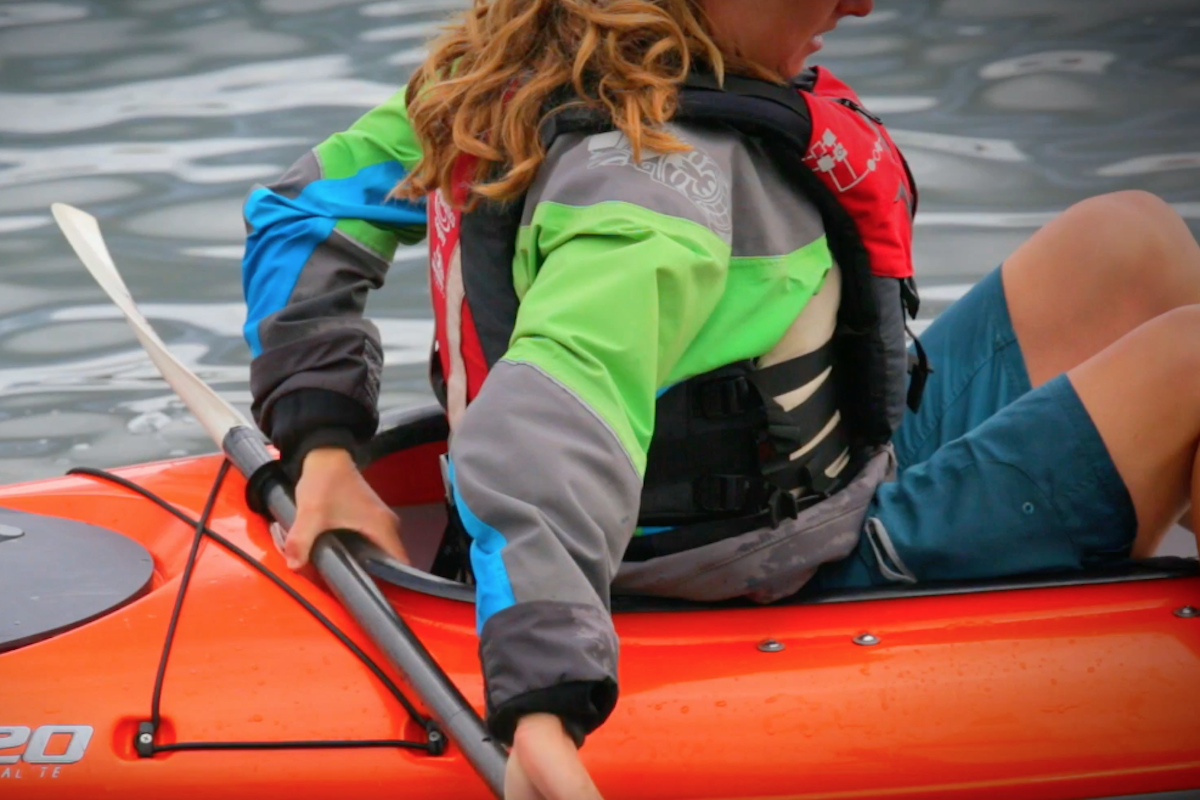
5. Step closest leg into kayak
Using your hands and paddle as support, take your leg closest to the boat and step into the cockpit (all the way to the far side if possible). Make sure to use your paddle and hands to keep the boat balanced.
Notice how the paddler clamps the kayak and the paddle for stability as she steps into the kayak. Photo: Simon Coward / AQ Outdoors
6. Step second leg in
Once balanced, step your other leg into the boat and lower yourself down into the seat. The first few times this may feel more like a “flop” into the seat. However, as you practice you will find yourself getting into the seat with ease.
You are now ready to set out!
Getting out of a kayak
To get out of the kayak, simply mirror the steps you followed to get in but in reverse.
Position your kayak parallel to shore.
Lay the paddle on the deck behind you and perpendicular to the kayak so one of the blades leans on the shore as an anchor.
While clasping the paddle, slide yourself from the seat into the low squat position leaning slightly toward the shore.
Swing one leg out at a time on shore.
Benefits of this technique
It’s a versatile and easy way to get in and out of most types of kayaks.
It prevents unnecessary scratching and damage to your boat. Some methods have you get in on shore and slide into the water which can cause needless wear and tear on the boat.
With practice it is an easy and controlled way to get into your boat.
It doesn’t require any gear other than what you will have available on any paddling outing.
Docks can be tricky because they often sit higher than your kayak on the water. This is one reason launching from shore is preferred, but this isn’t always an option. Here are a few tips to help if a dock provides a better or only choice for you to get into your kayak.
Similar as in the from shore method, place your kayak in the water parallel with the dock while keeping a foot or hand on it so it doesn’t float away.
Also lay your paddle on the dock next to you so it will be accessible to grab once you’re in your boat.
Sit on the edge of the dock over your seating area and put your feet on the inside floor of the kayak.
Facing toward the bow, use the dock to lower yourself. Slide your feet forward into position as you lower onto the seat.
Once you are seated and stable grab your paddle and either push away from the dock or pull yourself along it out to the end.
The instructions provide in this article are intended to be useful and concise. After a few rounds of practice this will put your mind at ease about how to get in and out of a kayak.
Pelican, founded in 1968, is one of the largest kayak manufacturers in the world. Feature Image: Pelican
On February 28, 2025, Pelican International Inc filed a Notice of Intention to Make Proposal (NOI) under the Bankruptcy and Insolvency Act (BIA) in Canada, citing challenges in the post-COVID economy including U.S. tariffs, significant shifts in market demand, supply chain disruptions, and rising costs. In a company-issued statement, Pelican emphasized that this filing does not signal bankruptcy or closure but is instead a “proactive decision to seek protection under the BIA.”
Pelican declined further comment.
Insolvency refers to the state of being unable to meet debt obligations; insolvency does not necessarily lead to bankruptcy.
With US-Canada tariff disputes, Quebec-based Pelican seeks insolvency protection
Pelican stated the goal of initiating the BIA process is to allow the company time and a legal framework to adjust its finances for long-term stability. Pelican retains full control over its operations and daily affairs, according to the statement.
The filing comes after increasing uncertainty surrounding global trade policies, with fluctuating tariffs and trade disputes involving the U.S., Canada, Mexico and China. The market instabilities, combined with lingering supply chain disruptions following COVID-19, where paddlesports inventory peaked as demand began to drop, have contributed to financial pressures for manufacturers worldwide.
Currently, Pelican’s U.S. subsidiaries are not subject to the NOI proceedings, but Pelican noted it is evaluating whether to seek similar protection for US subsidiaries in the future.
In the statement, Pelican stated that it will not reduce its operations, and will “communicate any relevant updates directly with employees” regarding any positions eliminated as part of the restructuring process.
“We are committed to keeping all stakeholders informed throughout this process,” concluded the statement.
News comes after a recent push to expand
Initially founded in 1968 with a staff of 10 people, today Pelican’s portfolio includes Wilderness Systems, Dagger, Perception, Advanced Elements, Boardworks, Mad River Canoe, and GSI Outdoors.
In 1970, Pelican was purchased by Gérard Élie. In the years following, the first Pelican pedal boats, canoes, snowmobiles, sleds, and motor boats were produced using thermoformed plastic, a process where plastic is heated then formed into a mold popular in kayaks as a compromise between heavy polyethylene kayaks and lightweight composite kayaks.
Pelican, founded in 1968, is one of the largest kayak manufacturers in the world. Feature Image: Pelican
In 1995, Pelican International Inc was acquired by Christian and Antoine Élie who had managed the company since 1979. Since 2001, Pelican’s head office has been located in Quebec, Canada.
Pelican has aggressively expanded in recent years. In 2019, Pelican acquired Confluence Outdoors Inc; in 2021 Pelican acquired Advanced Elements Inc, and in 2022 Pelican acquired GSI LCC.
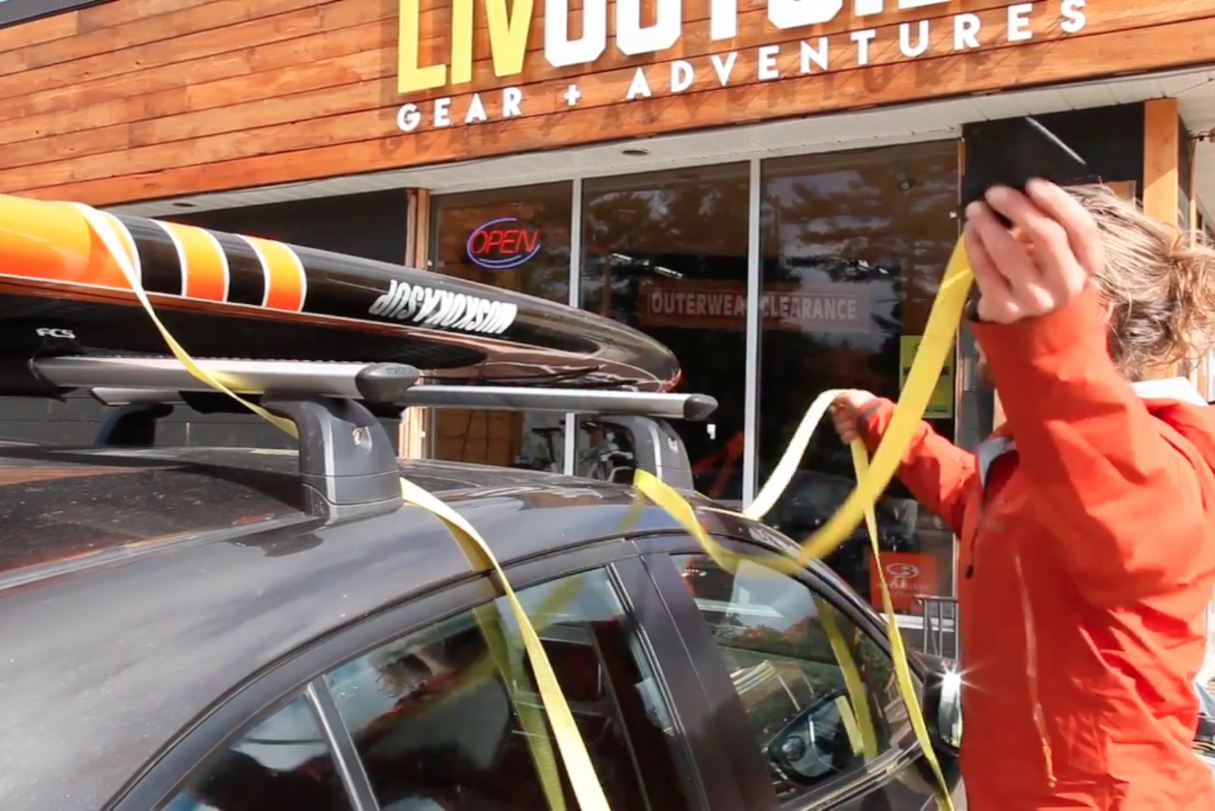
John Thomson strapping down a paddleboard. | Feature Photo: Paddling Magazine Staff
There are few things as peaceful in life as standup paddling down a crystal-clear river that meanders through a quiet forest or floating out on a calm bay. But for many learning to standup paddleboard, there are few things as stressful as figuring out how to load a paddleboard onto the car’s roof racks, and keep it secure on the highway to reach the water.
The act of transporting a paddleboard can be perplexing. But there’s a method that works for every board and every vehicle, and even whether you have roof racks or not. Once you learn the steps, it will soon be a quicker and easier process than you thought.
In this article, we’ll go over a few of the methods you can use to get your SUP to the put-in, as well as some helpful tips for keeping your board, vehicle and other vehicles on the road safe.
Paddleboard on roof rack with deck facing down. | Photo: Paddling Magazine Staff
How to transport a paddleboard on your car
Steps for using a roof rack
The great thing about paddleboarding is that, regardless of the length of board, most models are lightweight builds that can be lifted onto a car without the help of a second person. There are some exceptions—such as heavier plastic boards—but the vast majority of paddleboards can be loaded solo. Regardless of which roof rack (or lack of) your car might have, the loading process is generally the same.
Make sure the crossbars or pads are in place and the vehicle is clear and ready to have the board put on top. This will avoid you having to lay your board down in your driveway or trying to find a clear piece of grass for it.
The board can point with either the nose or tail forward. When you lift the paddleboard to place it on the racks you generally want it to lay with the standing deck face-down on the racks. Placing the board with the deck facing down lets air pass across the hull with little resistance, and keeps the bottom from getting damaged from over tightening on a roof rack without padding.
Once you pass the strap inside the rack pass the cam strap over the board. | Photo: Paddling Magazine Staff
Pass a cam strap around the inside of each rack at one end, then gently pass or toss the buckle end of each strap over the board.
Pass the buckle end underneath the crossbar at the other side, then bring the buckle back over the board to meet the free end.
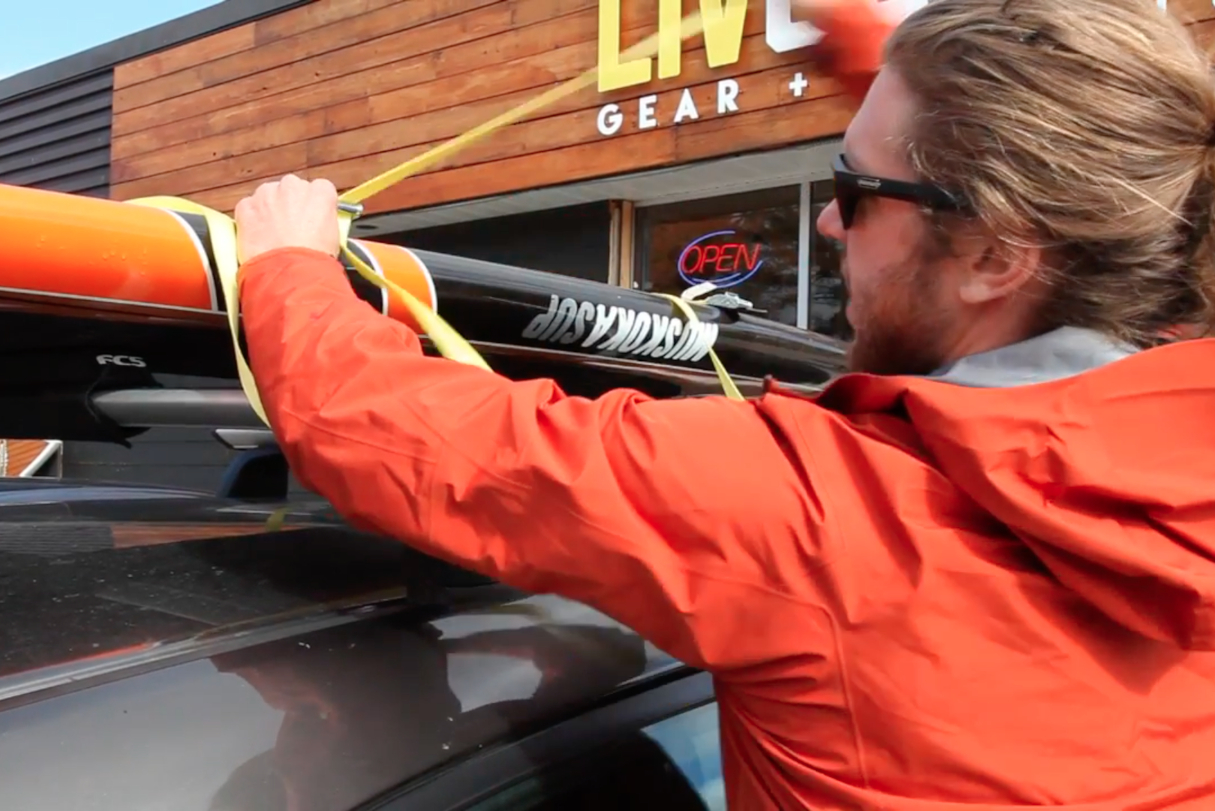
Insert the free end into the teeth of the cam strap. Cinch down the strap until the board is firmly secured. Wiggle the board. If it shifts easily cinch down some more. Avoid over tightening which could damage your board.
Tuck the excess strap either under the taut strap or wrap it around a free space on the roof rack.
Tightening the cam straps to secure board. | Photo: Paddling Magazine Staff
Additional tips
It’s best to place some form of board padding on your crossbars to protect your board from damage that can be cause from cinching the board down.
If you use a long standup paddleboard that extends beyond the back of your vehicle, then it’s best to attach a small red flag to make it clear to drivers following you.
How to transport a paddleboard without a roof rack
Many sedans and hatchbacks don’t come with roof racks or rails. Soft rack systems or foam blocks are relatively inexpensive and have protective padding to secure your paddleboard. They sit on the roof and are combined with straps that run through the interior of the vehicle to keep the paddleboard in place.
With the blocks in place the paddleboard on top as mentioned in the steps for using a roof rack.
Open your car doors to pass and end of the strap through the vehicle then over the board to meet the other end of the strap as if you’ve made a circle.
Tighten the straps before closing the doors, cinching them so the board stays in place if you give it a wiggle.
Keep in mind that the straps will be causing a small gap between the seal of the door and the door frame, so if you’re driving in rain, water will likely permeate the straps and drip into your interior.
How to transport a paddleboard in a truck
Trucks are great for transporting things that fit into the pickup bed, but with most paddleboards ranging from 10 to 14 feet, mounting them is a little more complicated.
Assuming the truck doesn’t have a rack system built in (in which case mounting the board is the same as with any vehicle with a rack), you’ll need to have the board hanging off the back.
Close the tailgate and set the board as far into the pickup bed as it will reach.
Put some sort of padding over the tailgate.
Then at one of the tie-down mounts in the bed or on the side rails of the truck, pass a strap or rope through and over the boards to the other side to secure them.
As mentioned above, if the board hangs past the tailgate by more than a couple of feet, a red or orange marker is highly recommended, and might be required by law.
Other considerations
Understanding the parts of a roof rack
In order to figure out how you’re going to mount your board, it’s important to understand the terminology.
There’s the roof itself, which is the easy one.
Then there are rails, which some cars have from the factory and which your rack system will attach to.
The feet, tower or leg is the blocky component that both attaches to the vehicle and the crossbar.
The crossbars are the board or pipe shaped lengths of the roof rack you mount your paddleboard onto.
Think of it like this: the paddleboard sits on a board rack or crossbar cushions, which sit on the crossbars, which sit on the rail or which are mounted to feet which are attached to the car.
One of the most appealing things about inflatable paddleboards is the fact that they fold down to fit into a (large) backpack. That means loading a board into a vehicle takes about as long as throwing a bag into the truck or hatch of a car. Of course, the tradeoff is allowing 10 minutes of preparation time before and after your paddle to inflate and deflate the board.
The question that often comes up for people using their inflatable boards on a regular basis is whether or not they can be transported on the roof of a car while inflated. The good news is that quality inflatable standup paddleboards today are surprisingly rigid, which means even 12-foot, 6-inch or 14-foot boards can be transported without folding in half like a poorly tied-down mattress.
Keep in mind that you are still transporting an air-filled vessel, meaning something hitting it could result in a puncture. That being said, something hitting your inflatable with enough force to cause a hole would also cause significant damage to a hard board.
Transporting two paddleboards
Unless you have extremely wide crossbars, carrying two boards will mean stacking them on top of each other to turn your vehicle into a double paddleboard rack.
To do this, load the first board onto the bars as suggested above, typically with the fin at the back of the vehicle. Next, put some padding on top of the first board so the two paddleboards aren’t directly touching each other. Pool noodles or plumbing insulation works great for this because they don’t create much of a gap between the two boards. Offset the boards so the top board sits just in front of the fin of the bottom board.
Understanding how to tie down two paddleboards isn’t much different from one board. Just strap the two paddleboards to the vehicle as suggested above with the straps going all the way over the top of the two boards. Longer straps might be required.
If you have a particularly tall vehicle like an SUV, be cautious entering garages or parking structures. Know how tall the total setup is and pay attention to height restrictions.
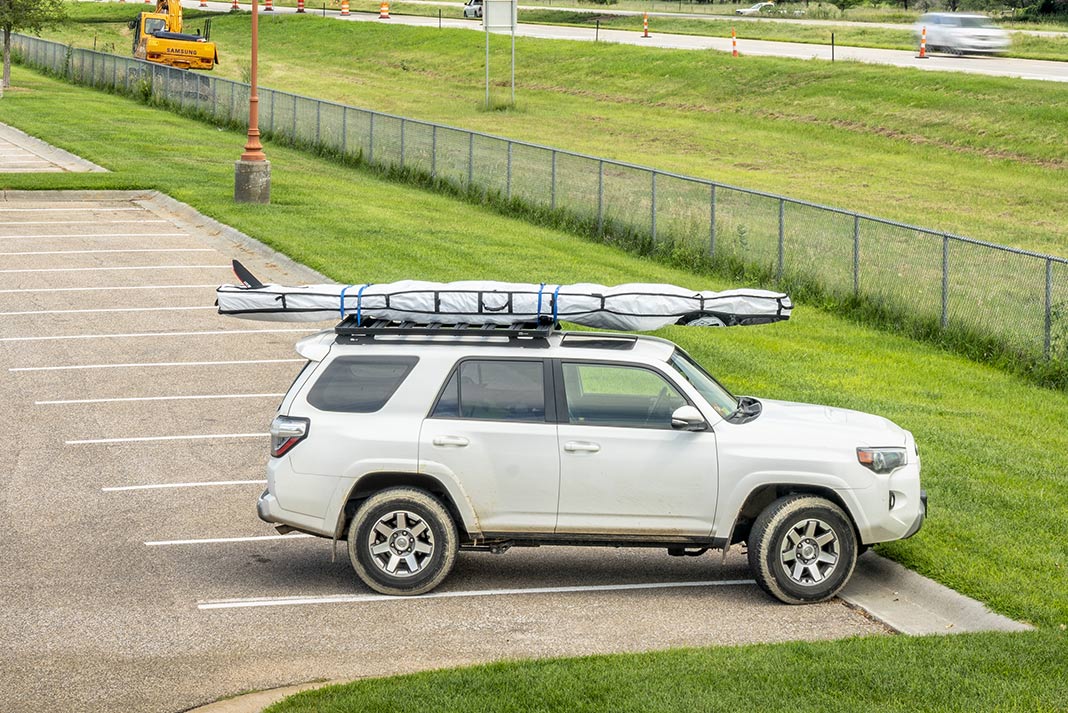
Using a bag will ensure your paddleboard isn’t damaged by the sun. | Photo by: MarekPhotoDesign.com – stock.adobe.com
To bag or not to bag
Other than inflatable boards, it’s extremely rare for paddleboards to be sold with a bag included. Depending on the length of board and the style of bag, bags can cost as much as $300. But is it a worthwhile investment?
A major concern with transporting paddleboards on the roof of the car is the impact of a hot sun. While the vehicle is in motion, the board is being constantly cooled by the wind, but if you’re leaving your board on a car all day at the office in order to hit the water as soon as the work day is done, the hot sun can be damaging. High-quality paddleboard bags have thermal protection to keep the sun rays at bay. An added benefit is protecting your board from rocks and road debris that might fly up and hit it while driving.
Most bags are not water-tight, so expect there might be some water in the bag if you’re driving in a heavy rain. It’s recommended that you leave the zipper open slightly at the back to allow the water to drain out. Keeping the zippers at the back rather than the front is also important because the wind will push the zippers open if they’re at the front of the bag. Paddleboard bags also keep boards protected in garages and sheds, but it’s always a good idea to let the board and bag dry off before storing it away.
Another big concern with leaving paddleboards on the roof is how to secure them. Unlike canoes or kayaks, which have easy places to run cable locks through, the simplicity of paddleboards means there are few options for locking them on the roof. Locking tie-down straps aren’t inexpensive, but they’re a must anytime you’re leaving a board on the roof unattended. They have metal-reinforced straps and key-locks on the closure, which should be enough to deter thieves looking for a quick slash and grab.
John Thomson shows how to strap down a paddleboard for transport. | Feature Photo: Paddling Magazine Staff







 This article was first published in the 2024 issue of Paddling Business.