Home Blog Page 292

Tumblehome: Symmetry and You

Photo: Yanik Chauvin
Canoes and symmetry | Photo: Yanik Chauvin

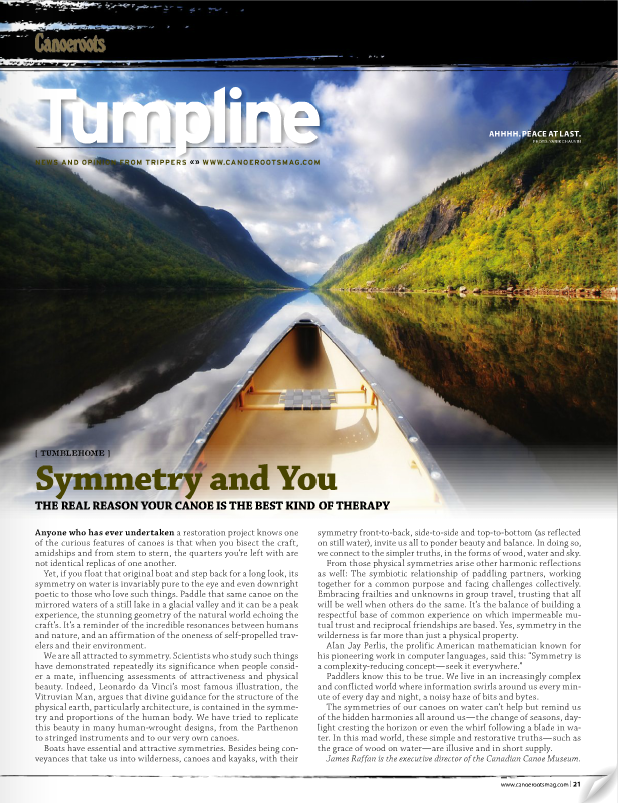
Anyone who has ever undertaken a restoration project knows one of the curious features of canoes is that when you bisect the craft, amidships and from stem to stern, the quarters you’re left with are not identical replicas of one another.

Yet, if you float that original boat and step back for a long look, its symmetry on water is invariably pure to the eye and even downright poetic to those who love such things. Paddle that same canoe on the mirrored waters of a still lake in a glacial valley and it can be a peak experience, the stunning geometry of the natural world echoing the craft’s. It’s a reminder of the incredible resonances between humans and nature, and an affirmation of the oneness of self-propelled travelers and their environment.

We are all attracted to symmetry. Scientists who study such things have demonstrated repeatedly its significance when people consider a mate, influencing assessments of attractiveness and physical beauty. Indeed, Leonardo da Vinci’s most famous illustration, the Vitruvian Man, argues that divine guidance for the structure of the physical earth, particularly architecture, is contained in the symmetry and proportions of the human body. We have tried to replicate this beauty in many human-wrought designs, from the Parthenon to stringed instruments and to our very own canoes.

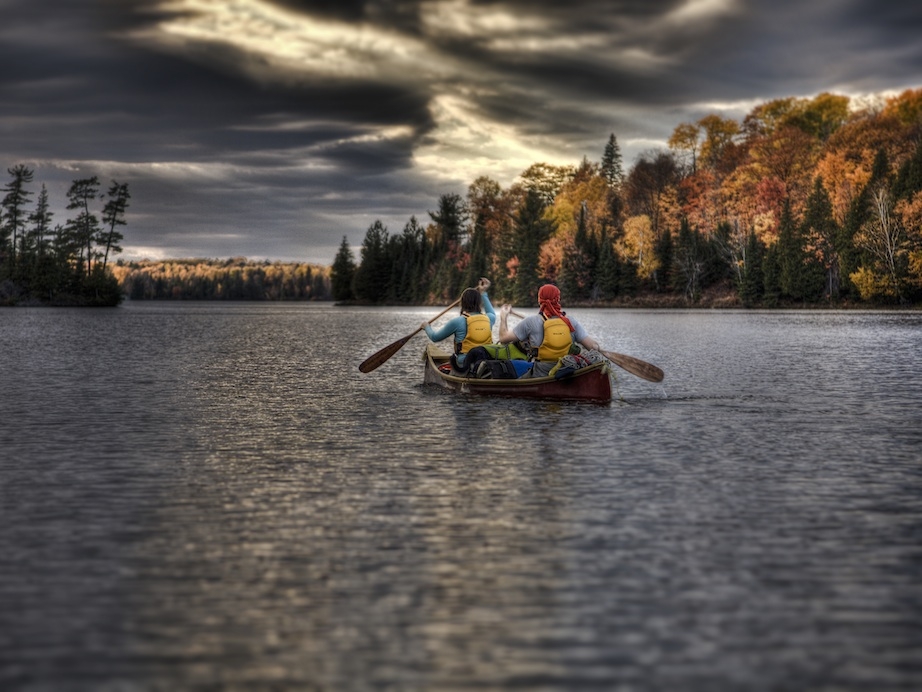
Boats have essential and attractive symmetries. Besides being conveyances that take us into wilderness, canoes and kayaks, with their symmetry front-to-back, side-to-side and top-to-bottom (as reflected on still water), invite us all to ponder beauty and balance. In doing so, we connect to the simpler truths, in the forms of wood, water and sky.
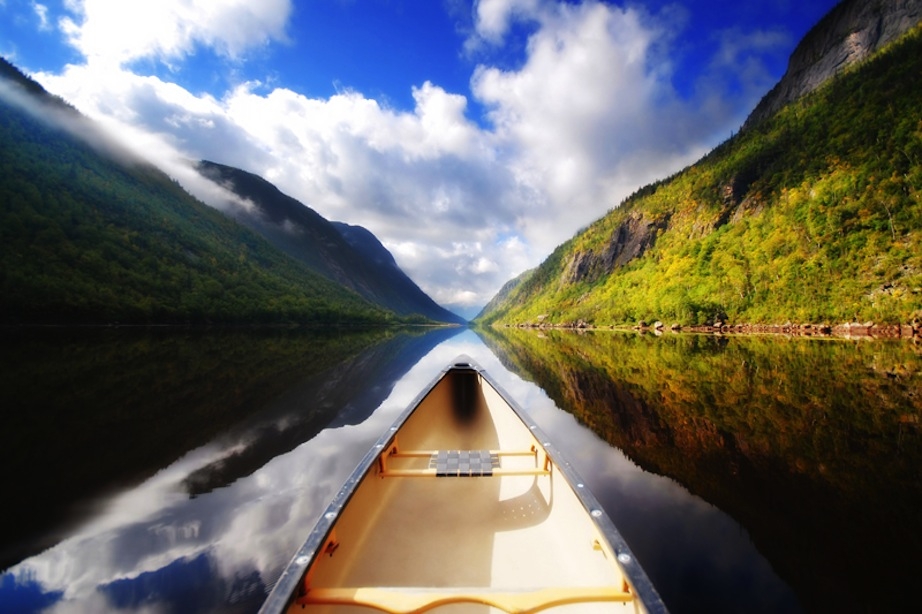
Photo: Yanik Chauvin
Canoes and symmetry | Photo: Yanik Chauvin

From those physical symmetries arise other harmonic reflections as well: The symbiotic relationship of paddling partners, working together for a common purpose and facing challenges collectively. Embracing frailties and unknowns in group travel, trusting that all will be well when others do the same. It’s the balance of building a respectful base of common experience on which impermeable mutual trust and reciprocal friendships are based. Yes, symmetry in the wilderness is far more than just a physical property.

Alan Jay Perlis, the prolific American mathematician known for his pioneering work in computer languages, said this: “Symmetry is a complexity-reducing concept—seek it everywhere.”

Paddlers know this to be true. We live in an increasingly complex and conflicted world where information swirls around us every minute of every day and night, a noisy haze of bits and bytes.

The symmetries of our canoes on water can’t help but remind us of the hidden harmonies all around us—the change of seasons, daylight cresting the horizon or even the whirl following a blade in water. In this mad world, these simple and restorative truths—such as the grace of wood on water—are illusive and in short supply.


Screen_Shot_2014-04-14_at_2.13.07_PM.pngThis article originally appeared in Canoeroots and Family Camping, Spring 2014.

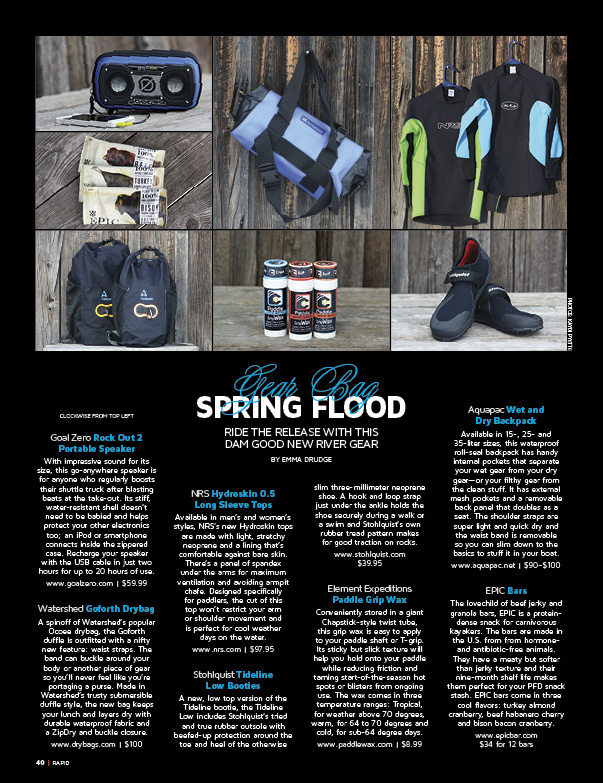
Stohlquist Tideline Low Booties

Photo: Kaydi Pyette
Stohlquist Tideline Low Booties

A new, low top version of the Tideline bootie, the Tideline Low, includes Stohlquist’s tried and true rubber outsole with beefed-up rubber protection around the toe and heel of the otherwise slim 3mm neoprene shoe. A hook and loop strap just under the ankle holds the shoe securely during a walk or a swim and Stohlquist’s own rubber tread pattern makes for good traction on rocks.

www.stohlquist.com | MRSP $39.95


RPv16i1-40

Check out the flood of new gear we lined up for Rapid, Spring 2014 in our free digital edition, or by downloading our free app for Apple or Android.

How To Stay Warm For Spring Surfing

Photo: Sierra Stinson
How To Stay Warm For Spring Surfing

The spring thaw is finally underway and that means two things—paddling and cold water. Knowing how to prepare yourself for the inevitable cold that comes with spring boating is important, not only for comfort, but for safety as well. Hypothermia is a very real risk if you’re on or in the water for any length of time, so make sure you’re cold water ready.

Pre-season Inspection

Start with the basics. Inspect your equipment before heading out for the first time this year. Anything that’s seen a lot of sun and is starting to show signs of use should be replaced, especially when it comes to your PFD. Check the gaskets on your dry gear, and determine if they’ll last another season—there’s nothing worse than getting to the river and having one of your gaskets blow right before putting on.

Layers, Layers, Layers

When it comes to spring paddling, layering is your best friend. Start with a base layer that wicks the moisture away from your skin. “Depending on how cold the water is, I use my Sweet Protection thermals under a drysuit,” says Ben Marr, who’s known for styling the biggest waves in cold spring waters. “I’ll also usually wear a onesie, and if it is hectically cold or windy, I put some merino wool base layers on under that.” Can’t afford brand new merino? Head to your local thrift shop and scour the racks—you’ll be surprised at how many 100% merino sweaters are hiding out there. (Bonus: many of them look great off the river, too!)

Essential Extremeties

Don’t forget about your head. While we’d like to think we won’t go upside down on our first paddle of the year, it’s always best to be prepared for immersion. “A lined skull cap goes a long way in the spring and winter,” says Marr. “We lose most of our body heat from our heads, so keeping that warm will make your time on the water much more enjoyable.” Making sure your feet are warm can help make your first paddle of the season that much more bearable. If you’re wearing a drysuit, wear wool socks as a liner, then pull neoprene socks on top to protect your suit and add an extra layer of warmth.

Be prepared

While dressing properly is important, so is a proper warm up. Get the blood moving with a touch of cardio and some stretches before sitting in your boat, and try to keep moving in the eddy. “I always do a good shoulder warm up, especially in spring,” says Marr. Ensure that you’re well hydrated before heading out, and bring a snack with you. You may be able to paddle for hours without getting tired in warmer weather, but it will surprise you how quickly your energy will fade in cold water.

Above all else, make sure you’re not in over your head before you head out in the spring flood—know your limits and keep an eye on hazards such as remaining chunks of ice and debris that’s washed into the river with the spring melt.

To learn more about getting ready for spring sessions, read Training Tips To Paddle Forever.

Gear: Goal Zero Guide 10

Photo: KaydiPyette
Goal Zero Guide 10 camping


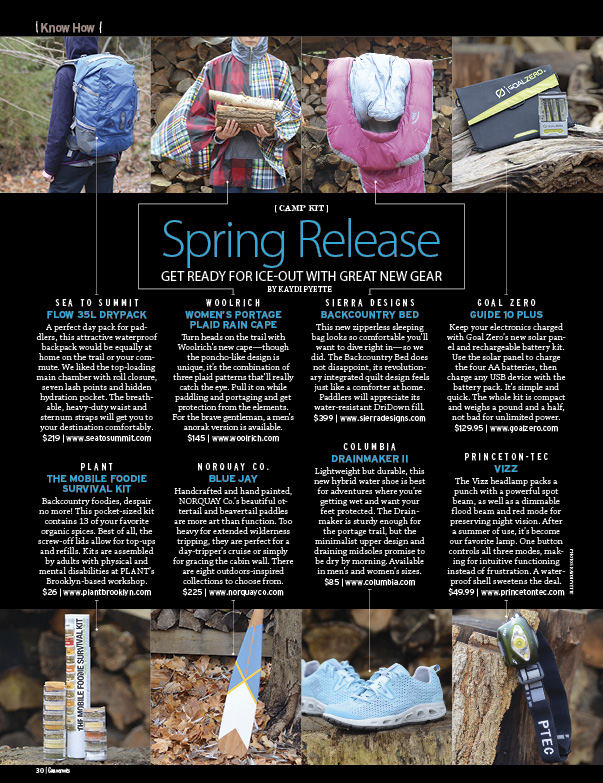
Keep your electronics charged with Goal Zero’s new solar panel and rechargeable battery kit. Use the solar panel to charge the four AA batteries, then charge any USB device with the battery pack. It’s simple and quick. The whole kit is compact and weighs a pound and a half, not bad for unlimited power.

Rechargable AA batteries are included and a handy built-in LED flashlight is located on top of the battery pack to help you search in your dark backpack. Plug in any small USB-powered devices to the battery pack or into the solar panel to recharge them anywhere. It’s powerful enough to handle smartphones, readers and tablets.

$119.95 | www.goalzero.com


CRv13i1-30 This article originally appeared in Canoeroots and Family Camping, Spring 2014. Get more great gear reviews by downloading our free iPad/iPhone/iPod Touch App or Android App or read it on your desktop here
 

First Descent: Michoacan Episode 5

Episode 5 – The Journey Continues

“The jewel of Michoacan calls the team back to her waters for a final adventure after difficult terrain and low water challenges the expedition. The next trip is already being planned.”

From Red Bull. 


Catch the first four episodes here: 

First Descent: Michoacan Episode 1 – The Journey Begins

First Descent: Michoacan Episode 2 – Scouting Uncharted Waters

First Descent: Michoacan Episode 3 – What we came for

 First Descent: Michoacan Episode 4 – Repelling Into Unexplored Rapids

What’s In: Jaime Sharp’s Shed

Photo: Jaime Sharp
What's In: Jaime Sharp's Shed? | Photo: Jaime Sharp

Jaime Sharp knows sacrifice is the flipside of the shiny coin of adventure. The 32-year-old guide, videographer and founder of World Wild Adventures left behind a good job and a beautiful woman to follow his dream. In 2011, Sharp fled the promise of a settled life to paddle the length of New Zealand. Three years later he remains an unapologetic vagabond. These days, Sharp hangs his hat in a shed in Vancouver Island’s Nanoose Bay. Equal parts office, gear garage and bachelor pad, the shed is a strategic—if Spartan—home base for Sharp’s on-the-road lifestyle.Virginia Marshall

Photo: Jaime Sharp
What’s In: Jaime Sharp’s Shed? | Photo: Jaime Sharp
  1. The shed belongs to a friend. It’s on an acre and a half right on the water. The shelving, plumbing and Internet connection were already here. I can pull my 23-foot bus right inside. It’s what I call ‘tactical homely.’
  2. I wanted a mobile kayaking HQ that I could paddle, live and work out of. My dream vehicle was a four-wheel-drive Sportsmobile. What I could afford was this 1990 Ford E350 Diesel medical transport bus. I use the wheelchair ramp for walking boats in and out. I bought the bus for $3,000 and drove to Jackson Hole, Wyoming, and back to make sure it was going to hold together. It has a bed, diesel space heater, battery inverter and kitchen. My plan is to drive down to the Baja Sea Kayak Symposium in April, then work my way back up to B.C. while filming for a paddling series about exploring the West Coast.
  3.  This duffle contains the TRAK folding sea kayak that I paddled down the Grand Canyon in winter 2012. When I first saw an ad for these boats, I was intrigued. I wrote TRAK a proposal: I would take their kayak all over the world with me and make films about it. The TRAK Files marked my first foray into making a professional online film series.
  4. On the right screen, I’m editing photos from the Grand Canyon. On the left, I’m backing up film from recent paddling trips to the Bay of Fundy and the United King- dom. Shooting video is a lot more work than shooting stills. Editing takes months, not days. Creatively, the stories you can tell with film are engrossing, but there’s a real satisfaction in capturing a moment in a single frame. It’s more like a trophy.
  5. I’m a closet Star Wars geek. And, yeah, the Ewoks are my favorite.
  6. I made this traditional bow and arrow with a Bushmen friend in Namibia. It’s an effective little bow, but more importantly it’s a memento of my travels and the friends I’ve made along the way.
  7. I found this wild boar tusk on my New Zealand expedition. Walking away from everything and using all my money to fund this trip was a huge sacrifice. Of course, things don’t go exactly as planned. The weather in the Pacific that year was terrible: cyclones, floods, the tsunami in Japan, an earthquake in Christchurch. I got bitten by a venomous katipo spider and had to be evacuated off a remote beach at 3 a.m. in excruciating pain. Ultimately, it ended up being a trip down the North Island. But experiencing the journey just for myself created a lot of growth, strength and healing. It was one of those crossroads when you make a critical choice and your life takes a completely new direction.

AKv14i1 cover300This article first appeared in the Adventure Kayak, Spring 2014 issue. Subscribe to Paddling Magazine and get 25 years of digital magazine archives including our legacy titles: Rapid, Adventure Kayak and Canoeroots.

Opinion: There Be Dragons

Photo: Robin Powell
Opinion: There Be Dragons

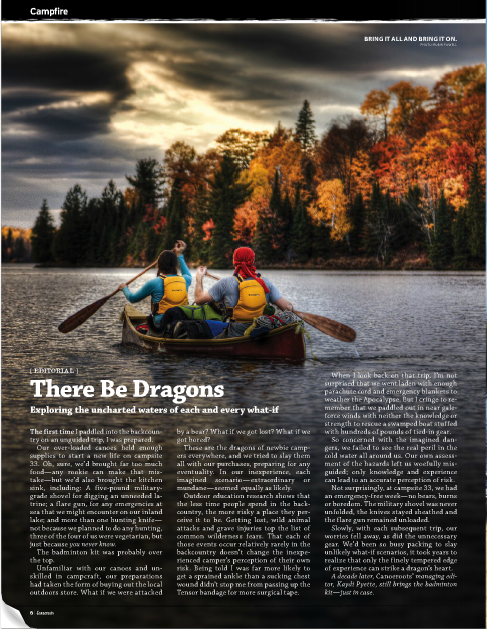
When I look back on that trip, I’m not surprised that we went laden with enough parachute cord and emergency blankets to weather the Apocalypse. But I cringe to re-member that we paddled out in near gale-force winds with neither the knowledge or strength to rescue a swamped boat stuffed with hundreds of pounds of tied-in gear.

So concerned with the imagined dangers, we failed to see the real peril in the cold water all around us. Our own assessment of the hazards left us woefully misguided; only knowledge and experience can lead to an accurate perception of risk.

Not surprisingly, at campsite 33, we had an emergency-free week—no bears, burns or boredom. The military shovel was never unfolded, the knives stayed sheathed and the flare gun remained unloaded.

Slowly, with each subsequent trip, our worries fell away, as did the unnecessary gear. We’d been so busy packing to slay unlikely what-if scenarios, it took years to realize that only the finely tempered edge of experience can strike a dragon’s heart.

A decade later, Canoeroots’ managing editor, Kaydi Pyette, still brings the badminton kit—just in case.

Photo: Robin Powell
Opinion: There Be Dragons

Screen_Shot_2014-04-05_at_1.22.54_PM.pngThis article originally appeared in Canoeroots and Family Camping, Spring 2014.

Why I Paddle Alone And Why I Am Unafraid

Photo: Aleksey Kupriko

“I wouldn’t have thought it possible to cry so much and for so many days on end. I cried because it never became easy. I cried because I had no one with whom to share the beautiful moments, and no one to encourage me. I cried because my resolve, my strength, my resourcefulness had to be enough and I was scared they would eventually be inadequate.”

This is one of the more thumb-sucking passages from Going Alone, a collection of essays from women adventurers. I read this and 19 other deeply personal accounts of solo wilderness experiences in preparation for my own extended voyage—seven weeks on the open coast, alone.

I felt ready. Ready to be lonely, fearful and weepy. But beneath the forlorn blinking of an automated lighthouse, alone on a tiny island far offshore, I felt more perplexed than distressed. I waited for the crushing loneliness that would constrict my chest, stealing my breath and my confidence. I fed warm carrot soup into a hollow stomach and watched, quite dry-eyed, a heartbreakingly beautiful northern sunset.

“Aren’t you scared?” asked nearly every person I encountered. It was not an unreasonable question. I knew all too well the hazards of coastal touring in remote areas by oneself: unpredictable, fast-changing weather and sea conditions, long stretches with difficult or no landings, frigid waters, defensive mama bears, lost or damaged equipment, making poor decisions. In my years on the lake, I’d lost count of how many times I had watched the search and rescue Hercules circling the steely skies above foam-streaked waters. I had witnessed forensic divers searching for the body of an experienced solo paddler who’s final decision – to go rather than to stay – had proved deadly.

But when I inventoried the dozens of emotions I experienced every day, fear was seldom amongst them. Most of the time, I felt calm, at ease. An expedition, I have always believed, is open to anyone who dares to depart with hatches and imagination full. Even if your boat—like my own 16 feet of rotomolded yellow plastic—is more weekend warrior than devoted tripper. Even if so are you.

I wasn’t afraid of the dark. I didn’t lie awake fretting over the night noises beyond the walls of my silnylon sanctuary. Even the unpredictable moods of the great, restless waters didn’t scare me. But I scared myself a few times. In six-foot waves on a remote five-mile crossing. In a clumsy slip beside a two-story drop to unyielding bedrock. In the reflection of a mirror in a campground washroom after 43 days on the water.

Perhaps solo kayak expeditions would enjoy broader appeal if more people learned to differentiate between irrational fear and actual risk.

My gut twisted and my skin prickled the evening a man appeared from the bushes near my tent. My hands were so numb on the aforementioned crossing I wondered if the paddle would slip from my grasp. Falling to my knees on the far shore, I thanked the evergreen hills, the copper cliffs and the howling wind for sparing my foolish self.

It’s healthy to experience fear in these situations, as long as you can rein it in and keep enough wits to make your way back to safer circumstances. Our fight-or-flight response—unchanged through millennia of evolution—is what has kept us alive in the face of saber-toothed tigers, thunderstorms and Simon Cowell.

It is an irrational fear that is problematic. The clamoring, claustrophobic fear that doesn’t bow to fight or flight. Fear of the dark beyond your vestibule. Fear of being alone. Fear of growing old, or sick, or even just less willful. Fear of being afraid.

Fear is a strange bedfellow. Like a good story, a carefully crafted paranoia is rarely hampered by the truth. I have friends from the country who are terrified of the city. And urban friends who fear if they venture too far beyond city limits, they are sure to meet a slow painful end, if not from wolves or exposure than from an equally silent killer, boredom.

Photo: Aleksey Kupriko

This fear of nothing to do is a surprisingly prevalent one. Or perhaps it is not so surprising. After all, we live in the most hyper-stimulated, over-programmed place and time the world has ever known.

Here’s a typical conversation, this one with a curious passer-by I met outside a campground office:

“You’re out here alone?” asks curious. “Yes,” I reply.

“By yourself?” curious confirms. “Uh-huh.”

“What do you do all day?” A refreshing break from the “Aren’t you scared?” line of questioning.

“Well, I paddle until late afternoon, then I make camp, cook dinner, explore the beach, jot down my thoughts…”

“Sure, sure, but after all that—don’t you, y’know, get kinda… bored?”

“Nah, I like having time to just sit and think and quietly observe nature,” I say.

Open-mouth stare.

“Besides, I’m quite tired by the end of the day,” I continue awkwardly, “I go to sleep pretty early.”

“Oh yeah, of course,” curious nods. It’s the first thing I’ve said that makes any sense. The ability to quickly summon unconsciousness is evidently the only thing that’s kept me alive in the absence of smartphones, Twitter feeds and Duck Dynasty downloads.

As Annie Getchell, a fellow solo sea kayaker, writes in Going Alone of trying to describe her experience to friends post-trip, “How do I explain about returning to stimulation instead of being?”

Perhaps solo kayak expeditions would enjoy broader appeal if more people learned to differentiate between irrational fear and actual risk. If you need evidence our sensors are screwy, look no further than the millions of dollars spent every year preparing for a zombie apocalypse. How is it acceptable to worry about the un-dead, but I am crazy to paddle by myself?

The dawn of the dead notwithstanding, most of us face relatively few mortal threats in our day-to-day lives. Immersing yourself in a wild environment, develop- ing the mindfulness to safely negotiate its hazards, finding the awareness that comes without constant artificial stimulation, acknowledging your apprehensions and calmly setting them aside—all of this is immensely and uncommonly rewarding.

In the words of another solo woman adventurer and writer, Jill Frayne, “To be in undisturbed places is good for humans and, at least once, you have to go alone. Nature brings us to ourselves.”

On the subject of fear, Frayne continues, “Sometimes camping alone puts an ache in my throat, a feeling close to homesickness. But I don’t think fear explains it. I think the feeling has to do with nature herself, the force of her presence. Nature gets us down to size, disquiets us, makes us anxious and lonesome and thrilled.”

Am I scared? The only thing I truly fear as a kayaker is the day that no one paddles alone because it’s too dangerous—or worse, too boring.

Editor Virginia Marshall does have another fear: tripping without chocolate. But she insists it is completely rational. 


AKv14i1 cover300This article first appeared in the Adventure Kayak, Spring 2014 issue. Subscribe to Paddling Magazine and get 25 years of digital magazine archives including our legacy titles: Rapid, Adventure Kayak and Canoeroots.

Stock Your PFD With Rescue Essentials

Photo: Screen capture Stock Your PFD With Rescue Essentials
Stock Your PFD With Rescue Essentials


A few small items and a bit of training can go a long way. Check out what Rapid’s editor has with her every time she gets out on the water. 

 What are your must-haves for a paddling session? Leave a note in the comments below!


Gear: Woolrich Portage Plaid Rain Cape

Photo: Kaydi Pyette
Woolrich Portage Plaid Cape

Turn heads on the trail with Woolrich’s new cape—though the poncho-like design is unique, it’s the combination of three plaid patterns that’ll really catch the eye. Pull it on while paddling and portaging and get protection from the elements. For the brave gentleman, a men’s anorak version is available.

Features:

  • 100% Polyester
  • Machine Wash
  • Hood with adjustable draw cord
  • Center front zipper closure
  • Packs inside front pocket
  • Water resistant
  • Center back length: 29 inch

$145 | www.woolrich.com 


CRv13i1-30 This article originally appeared in Canoeroots and Family Camping, Spring 2014. Get more great gear reviews by downloading our free iPad/iPhone/iPod Touch App or Android App or read it on your desktop here