Two kayakers re-enter their kayak while upside down.
Anyone who has had to self-rescue a double kayak can attest it takes communication and coordination, with bow and stern paddlers re-entering the kayak one at a time. But what if both paddlers were to re-enter the kayak together… upside-down? Leave it to an Adventure Kayak reader to find out the answer.
“I’m an ACA coastal kayak instructor trainer in Brazil and was inspired by the video posted [on the website of Adventure Kayak’s sister publication, Canoeroots] about the Fontaine Flop rescue in a canoe,” writes Christain Fuchs, of Brazilian outfitter and instruction center, Aroeira Outdoor. “We lauched a challenge, to make it with a tandem sea kayak, and here is the result!” Watch the video to see how it’s done.
See more kayak techniques and adventures on Aroeira Outdoor’s YouTube channel.
Exposed to pounding Pacific swell, wreathed in swift currents and far from manicured mainland highways, Vancouver Island’s rugged coast and rough roads have an insatiable appetite for composites. Spend enough time here, and odds are good that you and your kayak will eventually require the services of Campbell Black, owner of Blackline Marine.
Campbell is a master of composite construction and repairs. Formerly a partner in Current Designs Kayaks, it was Campbell who developed CD’s layups and figured out methods for production. In his head and capable hands resides a staggering wealth of expertise gathered over more than three decades of working with complex combinations of fibers and resins. He is a skilled communicator, a naturally gifted teacher and a genuinely nice man.
And yet, I experience a certain level of anxiety whenever I hear his voice.
My Pavlovian stress response triggers to Campbell because I typically only call him when I’ve done something really destructive to my boat. Etched indelibly in my primitive brain is the following formula: Campbell = smashed kayak.
Ours is a little like the relationship between a recovering heart-attack patient and his ace thoracic surgeon—I like and respect the man, but to be honest, I also sincerely hope that I’ll never need his services again. If waiting at a kayak factory to pick up your new boat is like pacing outside the maternity ward awaiting your baby’s arrival (nerve-wracking but joyful), then a trip to Blackline is akin to a visit to the trauma unit with your injured child (OMFG).
Housed at Canoe Cove Marina, 20 miles north of Victoria, Campbell’s facility is a collection of tidy workshops—each outfitted for a specific aspect of yacht repair. Big boats represent the vast majority of Blackline’s business, but tucked in amongst the behemoths, battered kayaks convalesce in fabric cradles like wounded soldiers on gurneys. some of Campbell’s patients are just here for minor scratches and a buff—more spa treatment than serious medical intervention. But others are close to flatlining.
Campbell has resurrected the kayak that rode its owner’s car into the ceiling of an underground parking garage. He’s repaired gaping wounds resulting from collisions with reefs and rocks. Patched deep barnacle gouges. Reconstructed the victims of countless MVAs (motor vehicle accidents) involving stray bowlines and rapidly rotating front axles. Black has rebuilt kayaks split wide open along their seams by the 60-mile-an- hour impact that follows slipped knots, failed straps or departed roof racks.
He’s even worked with a paddler who forgot to tie his boat down altogether before hitting the highway.
Sure, for minor scrapes and dings you can conceal your carelessness with home surgery. But when you need a real medical professional—whether it’s for a routine rear hatch exam or seri- ous trauma triage—Blackline is the Island’s best medicine.
Alex Matthews swears he’s never lost a boat off of his roof rack. Other paddlers’ cars, yes, but not his own.
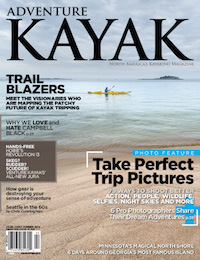
This article first appeared in the Early Summer 2014 issue of Adventure Kayak Magazine. Subscribe to Paddling Magazine and get 25 years of digital magazine archives including our legacy titles: Rapid, Adventure Kayak and Canoeroots.
Learn from the basics of tandem paddling from lengendary canoeist, Bill Mason, in Path of the Paddle: Doubles Basic presented by the NFB below.
“This short film from canoeist Bill Mason demonstrates the basic doubles paddling strokes and how to apply them in various combinations. The application of each stroke in rapids is shown briefly and the emphasis is always on working as a well-coordinated team.”
BELLYAK
PLAY | YOU OTTER TRY ONE OF THESE.
PHOTO: KAYDI PYETTE
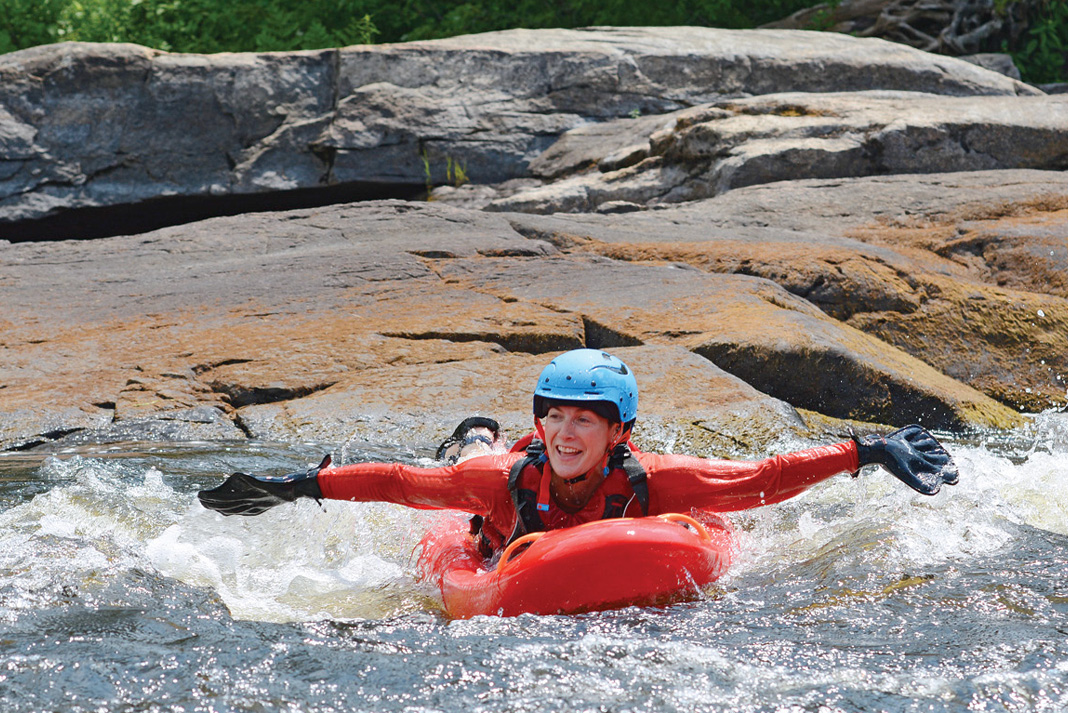
Our neoprene-mitted hands slap in the air and we slither onto our boats, stoked to be seeing our home river from a whole new angle. Paddling head-first on the Bellyak Play gives a fresh perspective to a familiar run.
With its boogie board-meets-playboat look, this lay-on-top design turns heads as it carves you headlong into the fun.
Bellyak Play 25/35/45
LENGTH 6’1”/7’7”/7’7”
WIDTH 20”/24”/25”
VOLUME 25/35/45 GAL
WEIGHT 22/25/30 LBS
PADDLER WEIGHT 60–110/ 70–150/150–250 LBS
MSRP $550 USD
www.bellyak.com
All the usual principles of whitewater apply: get some speed, hold your angle and if you don’t tilt into your turns, you’ll bite it.
At first glance, the Play might seem like a hard-to-control way to get downriver, but as I start goofing around in current, I find the boat’s stability and maneuverability confidence inspiring. Even better, I’m happy to discover that the full and rockered bow protects my head from oncoming rocks. Almost eye-level with the waterline, I feel less like a boater and more like a river creature.
Designer Adam Masters made his first Bellyak prototype by chopping a playboat in half and filling it with foam—he wanted to add challenge to class III and IV runs by paddling prone. The idea has caught on.
Masters says most people picking up Bellyaks are hoping to spice up their home runs or they’re newbies, wanting to try whitewater without the fear of being trapped in a kayak.
When I first flopped onto the water I wondered why the neoprene paddling mitts that come with the Bellyak don’t have stiff plastic for more water grip, but I soon learned why they’re floppy. Within nanoseconds of a swim, I could quickly scramble back on-board using the easy-to-grasp handles, conveniently located all around the boat.
The instantaneous exit makes it a great ride for beginners, building strong links between on-water mistakes and sudden swims.
Not being attached limits the boat from running big, pushy whitewater but Bellyaks are great for park and play surfing, and low-volume beginner to intermediate runs, says Masters.
BELLYAK PLAY | YOU OTTER TRY ONE OF THESE. | PHOTO: KAYDI PYETTE
My home river is drop and pool and between sets I try sitting up to paddle to the next rapid. It’s nice to get up for a stretch, but stability and directional control are compromised when I’m kneeling—Bellyaks are definitely best used prone.
All that hand paddling is a workout, and the soft mitts, which help fine-tune the boat’s direction by allowing me to feather in current, don’t contribute much to flatwater speed.
At just 30 pounds, portaging the Play is a breeze; the boat is easy to hold under an arm or drag using a handle.
Just like a playful otter, I find myself running the same section of river over and over again, careening in and out of eddies, surfing head-first and jet-ferrying this way and that, using only my neoprene paws to get around.
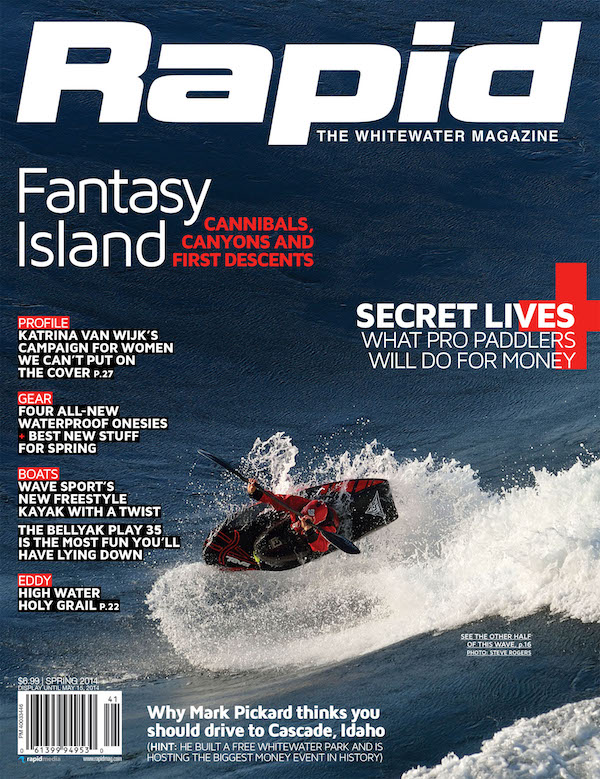
This article was first published in the Spring 2014 issue of Rapid Magazine. Subscribe to Paddling Magazine’s print and digital editions, or browse the archives.
“As a longtime sea kayaker, but new and ridiculously stoked convert to surf ski paddling, I seem to have a special interest in making sure that someone around me can haul my sodden carcass out of the water after a swim!” says Alex Matthews. Here, Victoria, B.C.-based Matthews and Bob Putnam of Deep Cove Canoe & Kayak (Canada’s largest surf ski dealer) practice a few strategies for aiding a swimmer who’s having a hard time with a solo remount. Watch the video to see how it’s done.
See more kayak techniques on Alex Matthews’ Vimeo channel.
In July, two Canadians—skinny stick aficionados and mentors James Roberts and James Manke—will set out for Greenland to compete in the 2014 National Greenland Kayaking Championships, making them the first team from Canada to do so. Inspired by the remarkable culture and history that drives their passion, they will navigate the challenges and logistics of getting to Greenland and participating in the event, experiencing the excitement and sharing their learning through a documentary film. “By working through this ourselves and creating a resource that will make it easier for others to do the same, we want to inspire paddlers to go visit this amazing, intact culture,” says Roberts.
{loadposition PTG_AK_Midcontent}
The film will be released to the public for free at http://greenland.qajaq.ca/ later this summer. Roberts and Manke are presently seeking community support to help complete the funding necessary to make Greenland Bound a reality. Visit http://greenland.qajaq.ca/ to learn more and make a donation. Follow along on Facebook for updates.
Balance, power and vision are imperative to strong, controlled boating.
This video demonstrates and explains a list of warm-ups for freestyle paddlers’ quiver of strength exercises, but they will be beneficial to every other facet of kayaking as well.
Every paddler, in any kind of kayak, can practice these warm-ups any time they hop on the water.
Chris Wing has been an instructor for as long as he has been a kayaker. He started H2o Dreams out of a desire to spur growth and reverence for paddle sports education all while providing a different spin to the presentation of familiar topics. Visit www.whitewaterdreams.com for more info or follow H2o Dreams on Facebook and Twitter.
One of the best parts of our job at Rapid is testing new boats and gear. Courier trucks deliver boxes of the year’s latest and greatest apparel and gadgets. For our Spring 2014 issue, we jumped into the Wave Sport Mobius and game-changing Bellyak Play. We tried out a wack of new products we really liked. We lined up and tested four new breathable drysuits.
It’s one thing to have access to the latest models, fabrics and colors, but it’s another thing entirely for new gear to find a permanent home in my gear bag.
In 20 years on rivers I’m only on my second drysuit. Six years ago I reluctantly upgraded to a new Kokatat Meridian, not because my original Gore-Tex suit was worn or leaked, but because I was logging more river days in my suit than without it and I wanted sewn-in feet and a pee zipper. Underneath, I’m still loving my original threadbare-in-the-elbows-and-knees Stohlqiust fuzzy fleece onesie, originally reviewed in the very first issue of Rapid, 16 years ago.
When the water warms I switch to a retro Patagonia short sleeved rip-stop nylon training shell. It was used when I traded it for my Kenwood car audio cassette deck. Patagonia stopped making their own brand of paddling gear in ’99, cassettes are now defunct, but I’ve yet to replace my favorite shell. Through winter, spring and fall I wear a holey pair of original Five Ten Water Tennies on my feet and come summer I switch to a pair of resoled Teva Alps.
For more than 10 years I’ve been racing open canoe slalom. If it weren’t for longer hair, shorter hair and facial hair there would be no way of sorting photos taken from 2003 to present—I’m even using the same boat and paddle.
Off the Tongue: Well-Worn Memories
The Rapid gear review closet is full of newer and snazzier versions of these items. The technology today is dryer, stickier, warmer, smarter and more protective. But the undeniable truth is, good gear lasts. And because it lasts we wear it a lot. Because we wear it a lot we get attached to it. We develop systems. We know what pieces layer well together at what temperature and in what boats. But we know layered deeper in our brains or maybe our souls, there is more to it than that.
This past Black Friday, Patagonia threw parties at 15 of their retail stories across the country, parties they said to, “Celebrate what you already own.” They screened the new short film, Worn Wear. Billed as the antidote to the Black Friday and Cyber Monday shopping frenzy, Worn Wear tells the stories of eight people—people just like you me—and their well-loved, well-used pieces of clothing that have become part of their lives.
As a couple seasons turn to ten and then to twenty, I feel the same way about paddling gear as I do about paddling friends. The more new rivers paddled together, more finish lines crossed together, and more great memories created together, the more good gear and good friends become part of our lives and who we are.
Scott MacGregor is the founder and publisher of Rapid magazine.
This article was first published in the Spring 2014 issue of Rapid Magazine. Subscribe to Paddling Magazine’s print and digital editions, or browse the archives.
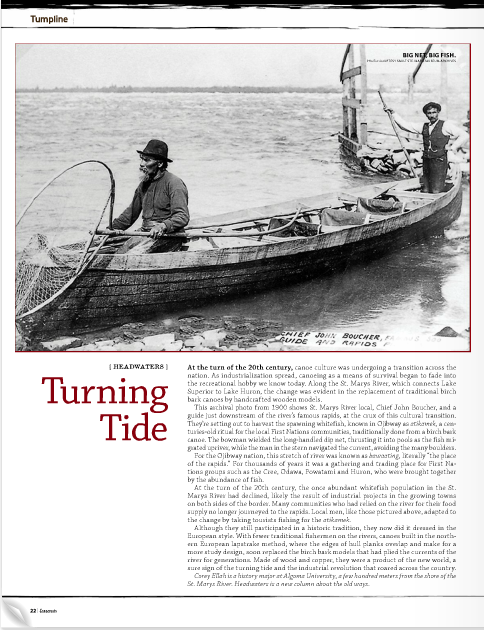
At the turn of the 20th century, canoe culture was undergoing a transition across the nation. As industrialization spread, canoeing as a means of survival began to fade into the recreational hobby we know today. Along the St. Marys River, which connects Lake Superior to Lake Huron, the change was evident in the replacement of traditional birch bark canoes by handcrafted wooden models.
This archival photo from 1900 shows St. Marys River local, Chief John Boucher, and a guide just downstream of the river’s famous rapids, at the crux of this cultural transition. They’re setting out to harvest the spawning whitefish, known in Ojibway as atikamek, a centuries-old ritual for the local First Nations communities, traditionally done from a birch bark canoe. The bowman wielded the long-handled dip net, thrusting it into pools as the fish migrated upriver, while the man in the stern navigated the current, avoiding the many boulders.
For the Ojibway nation, this stretch of river was known as bawaating, literally “the place of the rapids.” For thousands of years it was a gathering and trading place for First Nations groups such as the Cree, Odawa, Powatami and Huron, who were brought together by the abundance of fish.
At the turn of the 20th century, the once abundant whitefish population in the St. Marys River had declined, likely the result of industrial projects in the growing towns on both sides of the border. Many communities who had relied on the river for their food supply no longer journeyed to the rapids. Local men, like those pictured above, adapted to the change by taking tourists fishing for the atikamek.
Although they still participated in a historic tradition, they now did it dressed in the European style. With fewer traditional fishermen on the rivers, canoes built in the northern European lapstrake method, where the edges of hull planks overlap and make for a more study design, soon replaced the birch bark models that had plied the currents of the river for generations. Made of wood and copper, they were a product of the new world, a sure sign of the turning tide and the industrial revolution that roared across the country.
Corey Ellah is a history major at Algoma University, a few hundred meters from the shore of the St. Marys River. Headwaters is a new column about the old ways.
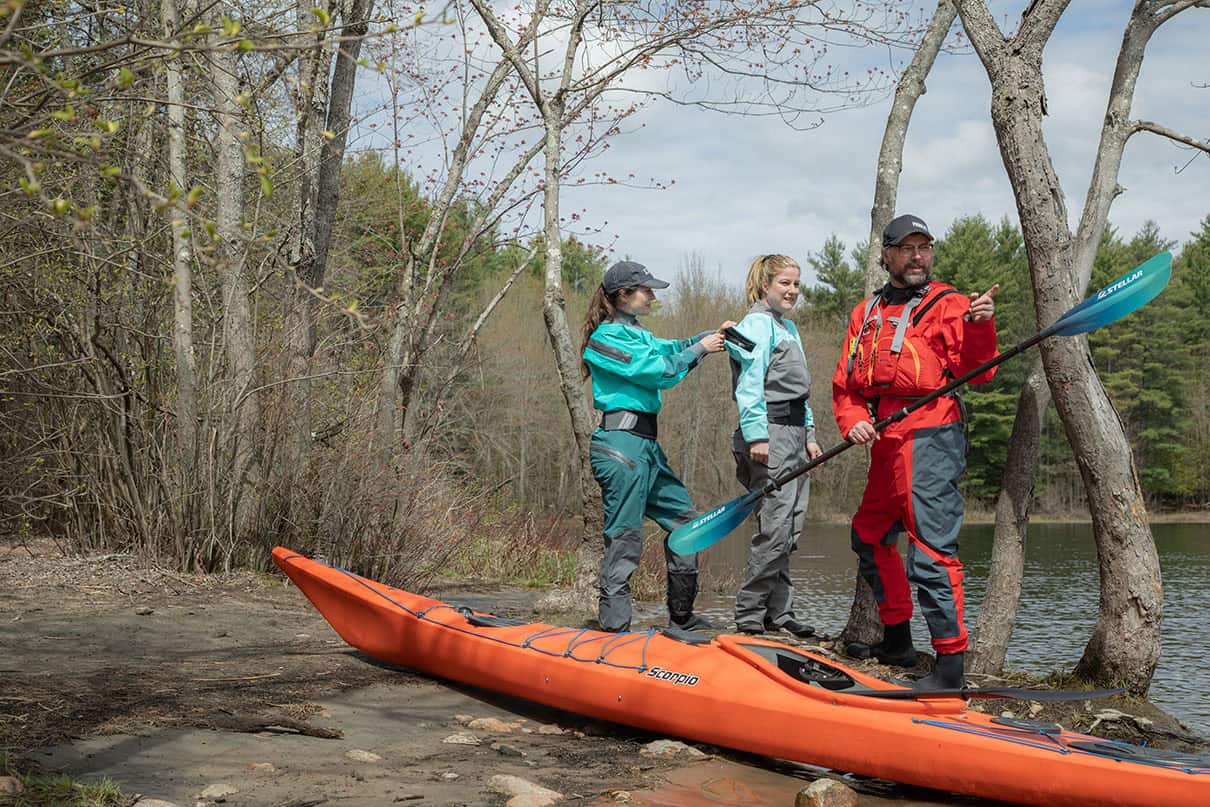
This article originally appeared in Canoeroots and Family Camping, Spring 2014.
“Mr. MacGregor?” A short, stern-looking woman wearing a lab coat and holding a clipboard motioned me into a small room. She closed the door behind her.
Half an hour earlier I’d carried my six-year-old daughter, Kate, into the emergency department of the hospital. After a few words with the doctor on duty Kate had been wheeled off to the X-ray room.
Kate, the stern-looking woman told me, had a spiral fracture of her tibia, the large bone between her knee and her ankle. This type of injury is common in cases of child abuse, she said. It happens, she continued, when children are forcefully dragged in directions they don’t want to go. The stern look and clipboard were beginning to make sense.
It gets worse.
I’d told the receptionist that Kate had fallen down. In the X-ray room the radiologist asked Kate where she was when it happened. Kate said, “Whitewater canoeing.” Our stories where not matching up.
Later I learned that when Kate was asked about her mommy she replied, “She left early this morning with my brother.” It was a Thursday and both kids should have been in school.
For the past two years, my son, Doug, and I have been racing in the junior-senior division at the Gull River Open Canoe Slalom Race. My wife, Tanya, and Doug did leave early that morning to set up our campsite. Kate and I had stopped at a river on the way for a few hours of training. This was to be her first race.
We’d grabbed every eddy in the 300-meter, class II lower set of rapids and even back surfed the wave at the bottom. We’d carried up to the upper chute and shadowed a solo boat test course in our 14-foot tandem. An instructor high-fived Kate and told her she’d just passed her level two. She smiled and asked me if the snacks were in the truck.
I was dumping the water out of the canoe when Kate ran back to the beach in a sundress, juice box in one hand and a granola bar in the other. One moment Kate was hopping on top of a rock shouting that she had a sliver in her foot, the next she was laying on the beach screaming her little heart out. Her sandy foot must have slipped into a crack in the rock and her body fell the other way creating the spiral fracture.
It took phone calls to my wife and the public school before I was downgraded from abusive parent to irresponsible parent. In this woman’s eyes it was pretty much the same thing. Children anywhere near whitewater rivers were a big mistake, she said. I was just asking for trouble.
All the while Kate’s leg was being casted I argued the report not read that it was a whitewater canoeing injury. She hadn’t even gotten wet, I pleaded. “If she’d been in school this wouldn’t have happened would it, Mr. MacGregor?”
As I carried Kate out of the hospital she asked, “You didn’t like that lady, did you?” I said I didn’t. I told her that the nurse thought I was a bad father. She hugged me and asked if I would like to sign her cast.
Scott MacGregor is the founder and publisher of Canoeroots. At the next Gull River Open Canoe Slalom Race, Kate and Scott placed second. Kate can’t remember which leg was broken.
This article first appeared in the Early Summer 2014 issue of Canoeroots Magazine. For more great content, subscribe to Canoeroots’ print and digital editions here.




 This article first appeared in the Early Summer 2014 issue of Adventure Kayak Magazine.

 This article was first published in the Spring 2014 issue of Rapid Magazine.




 This article originally appeared in Canoeroots and Family Camping, Spring 2014.
 This article first appeared in the Early Summer 2014 issue of Canoeroots Magazine. For more great content, subscribe to Canoeroots’ print and digital editions



