Home Blog Page 296

Editorial: One Carry Wonder

Photo: Peter Mather
Editorial: One Carry Wonder

Something valuable from my child- hood canoe trips has been lost. It’s not the Swiss Army knife my dad gave me when I was nine (that’s lost too, but don’t tell him). It’s not the oversized poncho that was supposedly the only piece of raingear a growing canoeist needed (I finally outgrew it).

What’s lost is the single portage carry. Time was we would land at a portage, each paddler would shoulder a canoe or a pack and two paddles and walk the portage trail exactly once.

Now we get to a portage and become beasts of burden. We hoist a pack full of video cameras, stoves, sleeping pads, ham- mocks, water filters, solar chargers, cameras and coffee makers. With knees about to hyperextend we bend over and collect a few handfuls of Pelican cases, water bottles and fishing rods before shuffling to the end of the portage. After dumping the first load we retrace our steps to see if the pile is any smaller. Countries have been invaded with less sophisticated supply lines than those on modern-day portage trails.

Ray Jardine would not approve. Jardine has sailed around the world, hiked the longest trails in America and once pioneered the world’s hardest rock climbs. He has sea kayaked the Northwest Passage and canoed many northern rivers including the Kazan and Coppermine.

Through it all he saw himself and others suffer from bent spines and cluttered campsites. In 1992 he self-published The Pacific Crest Trail Hiker’s Handbook, a trail guide that tells readers not just where to hike, but how to hike. Jardine thinks if hikers are carrying more than 12 pounds of gear they are missing the point and might as well stay home. Why bother lugging around a sleeping pad when you can sleep on “leaves, pine needles, and duff” he wonders.

No doubt most canoeists would dismiss that with a snort between laboured puffs into a full-length Therm-a-Rest (the one with a fuzzy top). But it wasn’t long ago that that was how it was done. Until I was 11, when I first saw the temptress that was a roll-up drybag, everything I needed for a canoe trip would fit into a bedroll that rolled up smaller than a rugby ball.

True, it was wound pretty tight, you wouldn’t want to be nearby when it sprang open, but everything I needed for two weeks of lake-hopping north of Superior was packed in the folds of that thin sleeping bag. Taking my reliance on gear as a measure, I was more of a man then than I am now, and I hadn’t even hit puberty yet.

I’ve since been so seduced by stuff sacks full of supposed essentials I’m little more than a burro on the portage trail and an equipment manager at the campsite. These aren’t roles that lend themselves to enjoying the outdoors. Canoe tripping should be about leaving not just civilization behind, but its trappings too.

As Jay Morrison points out in his feature on shedding pounds, the ability to reclaim a fast and light style of travel in the wilderness requires just a little discipline. I’m going to take his advice and try to be more like my friend Dave. When we paddled the French River over Thanksgiving a few years ago Dave showed up with a drybag not much bigger than my bedroll of yore. I think he enjoyed the trip, but I can’t be sure; I was too busy fussing with gear to notice.

If I ever find my Swiss Army knife, I hope I have the sense to leave it behind in favour of a knife that doesn’t have a corkscrew, magnifying glass and toothpick.


This article first appeared in the 2009 Late Summer issue of Canoeroots and Family Camping magazine. Read the issue in our free iPad/iPhone/iPod Touch App or Android App or read it online here.


The Ultimate Fitness Guide For Paddlers

Man paddling sea kayak

Kayaking can easily expose you to injuries ranging from joint stiffness to blunt-force trauma. It’s almost inevitable to experience some type of trauma in your kayaking career. Whether it’s overuse, muscle imbalance, tightness, direct trauma or less than ideal paddling form, every paddler will complain of some level of discomfort at some point.

Off the water, there are three important modalities to train with for optimal performance in your boat and to keep you paddling healthy for years and years—mobility, stability/strength and flexibility. Let’s define these terms and take a look at a few movements specific to kayaking.


Mobility

A state in which one is capable of moving readily from place to place, able to change quickly from one state or condition to another and change levels, all with fluidity and grace.

Mobility can be viewed as the basis for true athleticism—the single attribute that encompasses the body control, coordination and agility that we all strive for.

Mobility training can be used as a warm-up to begin your off-river training session. Here are a few movements I enjoy in my warm-up that emphasize mobility in the torso and shoulders.

Find these exercises for mobility training demonstrated in the video below:

  1. Lunge with twist – 5 on each side
  2. Worm crawl – 8 times
  3. Cat/cow – Alternate for a total of 10 reps
  4. Torso twist with elbow – 5 on each side

Start with one set and progress to three over a few weeks.

To prevent injuries in a sport as dynamic as kayaking, mobility training is crucial. Whether it’s being able to make multiple moves from one direction to another in a rapid, or landing a big drop and feeling the force of the water crash into your body and pushing you forcefully to the back deck.

We cannot always predict the way our body will respond to powerful currents and whitewater, but with this type of training our body will be able to adapt suddenly to change without significant injury.

To improve your mobility, try Yoga For Kayakers.


Stability/strength

The ability of a joint to properly align itself in order for connective tissue to take on less stress. 

If you lack adequate mobility you will compensate by using muscles, tendons and ligaments to take up the slack. Being able to move your body without limitation is important for stability and strength in the joints. Stability and strength in the joints keeps our limbs attached correctly for proper mobility. They go hand in hand.

A total body strength training routine is encouraged for all of your major muscle groups; but just as, if not more important, is training your stabilizer muscles. These are the important stabilizer muscles for paddlers:

Abdominals and lower back

For proper paddling form, taking impact from big hits, powerful boofs and strokes, and much more—kayaking is all about the stabilization of the core.

Read How To Relieve & Prevent Lower Back Pain From Paddling to learn more about this common type of discomfort paddlers experience.

Rotator cuff, internal/external rotation

Your shoulder is only as strong as the stabilizing muscles supporting it. The rotator cuff muscles need some love so they can do their job of holding your shoulder joint in place. Especially for big hits, play boating and accidental, forceful high braces, your rotator cuff plays the largest role in shoulder health. It is important to use light weights for working the rotator cuff muscles, as heavy weights will automatically trigger the deltoids (the large muscle of the shoulder). Think high reps (3X25) and light weights.

Latissimus Dorsi/Serratus Anterior/Rhomboids

Basically the muscles that pull your shoulder blades back and down. With all the paddling we do, we could easily turn into hunchbacks. The importance of working these stabilizing muscles is to put your shoulder and shoulder blades in proper form to minimize muscle imbalance injuries and aid in proper movement of the shoulder.

Find the following exercises for strength/stability demonstrated in the video below:

  1. Abdominal bracing – 8-10 reps, starting with one set and working toward three
  2. Plank hold – Start holding for 15 seconds and progress to 60 seconds
  3. Back extensions – 8-10 reps, starting with one set and working toward three
  4. Push/pull with cable/band – 10 reps, starting with one set and working toward three

Strength doesn’t mean having a six pack abs or bulging biceps. Ultimate strength means having the ability to move properly and depend on the stabilizing muscles to fire before your larger paddling movements are executed.

Read How To Use Strength Training To Improve Your Kayaking Performance and get started with The Ultimate Training Program For Paddlers.

[ Plan your next kayaking adventure with the Paddling Trip Guide]


Flexibility

The length of a muscle. Increased length of muscle improves joint range of motion, leading to better joint mobility and stability. 

Flexibility exercises are typically done at the end of your workout, when your muscles are at their warmest and ready to be lengthened. It is important to hold each stretch for at least 30 seconds (but ideally 90 seconds). Any less than 30 seconds and the muscle fibers do not remember the stretch and flexibility does not improve.

You can read our 5 Best Post-Paddle Stretches (+ Foam Rolling Routine) article to learn more. Here are a couple more stretches, demonstrated in the video below:

  1. Chest opener on the foam roller
  2. Lat opener on the foam roller

It isn’t until an injury happens or you experience pain in your body, that most people start thinking about off-water training. If we only kayak, we are neglecting certain muscles and creating limitations within our mobility, stability and flexibility. Creating a balanced body by being proactive in our training regimen will boost overall health and increase long-term paddling potential.


Heather Herbeck has a B.Sc. in Exercise Science and is a pro-kayaker, Certified Personal Trainer and Level 1 Crossfit Trainer with over 15 years experience. Check out her website or fitness Facebook page, Fitness and Sport Evolution.

Elements of Canoe Design

Photo: Canoeroots Magazine
Anatomy of a Canoe / canoe design

Looking for that perfect canoe? To find your match, look at the elements of canoe design—your canoe’s dimensions and hull shape determine how it paddles and whether it’s the right boat for you.

Dimensions of the canoe

Length, width, and depth are rough indicators of a canoe’s speed, stability, capacity and seaworthiness.

Length = Speed
Length is the primary factor in determining speed. When comparing two canoes of different lengths, everything else being equal, the longer canoe will be faster. Shorter canoes generally turn easier, making them more maneuverable.

Width = Stability
The canoe’s width and cross-sectional shape determine stability. A wider canoe has more initial stability. Narrow canoes are generally faster and more efficient in the water.

Depth = Capacity and Dryness
Depth is the distance measured from the bottom of the hull to the top of the gunwales. Greater depth allows for increased carrying capacity and protects against swamping, making the canoe more seaworthy. Deeper canoes have more freeboard, but they are harder to handle in windy conditions.

Carrying Capacity
Measured by how much weight a canoe is
 able to displace while maintaining at least six inches of freeboard. Making the canoe longer or deeper extends carrying capacity; the canoe’s width is generally not increased since it results in drag.

The shape of the canoe

A cross-section will illustrate how the shape 
of the bottom and sides of the canoe will determine its primary and secondary stability and performance characteristics. A canoe 
with primary stability is initially very stable, however, if leaned too far, it quickly upsets. Canoes with secondary stability offer better performance and stability while on edge, useful for whitewater and rough-water paddling.

Flat-bottomed
It offers great primary stability but sacrifices speed and rough-water performance, ideal for recreation and sport canoeists.

Shallow Arch

Designed for all-around performance. Maintains a good balance between primary and secondary stability.

Round bottom

Found in specialized racing designs. Great speed and efficiency but very little primary stability.

Flare

Flared hull sides help to deflect water, keeping the canoe dry.

Straight

A balance between the paddling efficiency of tumblehome and the dryness of flare.

Tumblehome

Sides that curve inward toward the gunwales, allowing closer placement of the paddle to the hull.

Rocker
Describes the upward
 curve of the bow and stern. Rocker determines the maneuverability of the canoe. For instance, a canoe with more rocker turns easily and is ideal for whitewater, whereas a canoe with less rocker tracks well and is suitable for racing and long-distance lakewater travel.

The canoe’s hull symmetry

Symmetrical

Canoes that have identical bow and sterns ends. This design offers versatility because it can be paddled solo or tandem.

Asymmetrical
Typically has the widest section behind the center of the canoe creating a longer bow. This shape increases forward speed and tracking, ideal for touring and performance canoes.

Now that you’ve got the basics, view all canoes in our Paddling Buyer’s Guide and choose the best one for you.

This article first appeared in the 2009 Early Summer issue of Canoeroots and Family Camping magazine. 

Unsalted

Illustration: Lorenzo Del Bianco
Unsalted

Deep in the heart of North America, surrounded by forest and field, there is an ocean.

A vast inland sea containing nearly a quarter of the world’s freshwater—enough to flood the lower 48 states to a depth of almost 10 feet—the Great Lakes contain upwards of 35,000 islands and their 10,000 miles of shore rival that of the U.S. ocean coastlines.

To those who dismiss them as “mere lakes”—mild tempered, serene and dreadfully boring—I invite you to consider the following.

As on the world’s seas, large weather systems can sweep in to whip the water to a violent fury. Storms originating on the hot, dry northern plains rush out over the lakes and unwary paddlers, increasing their ferocity with every mile.

When I visited the Battle Island light, the northernmost Great Lakes lighthouse, in Rossport, Ontario, the keeper there recounted how a 1977 winter storm sent three-story waves rolling past the tower, while spray and chunks of ice broke the glass out. “There’s 250 miles of fetch between here and Duluth,” he said. “So when the waves got here…well, they were pretty big.”

Also like the world’s oceans, the Great Lakes offer a water highway for vessels ranging in size from sea kayaks to thousand-foot-long bulk freighters. Deep in the American heartland, nearly 2,000 miles from the nearest ocean, it isn’t uncommon to see a cargo ship from Sweden sidle up to a dock in Milwaukee to unload wind turbine parts, while another takes on a load of grain bound for Jordan or coal for South Korea.

The same storms that threaten kayakers can plague even these large vessels. The first ship to sail the Great Lakes, La Salle’s Le Griffon, was almost inevitably the first to sink, presumed lost in a Lake Michigan storm while on her maiden voyage in 1679. The lakes account for nearly a quarter of all U.S. shipwrecks—nearly 8,000 in total.

Still have your doubts that these are real seas? Don’t tell that to the U.S. Coast Guard, who is responsible for safety and security on the 6,700 miles of America’s “third coast” bordering the Great Lakes and Saint Lawrence Seaway, performing everything from search-and-rescue operations to annual ice-breaking duties.

There are differences between the Great Lakes and the ocean, of course. But even these show that the lakes can be every bit as mercurial as the sea.

Only Lake Superior boasts any sort of measurable lunar tide (less than two inches), but all the Great Lakes can experience seiches, storm-surge-like oscillations of water caused by wind or atmospheric pressure variations. In 1929, a seiche with 20-foot waves came ashore near Grand Haven, Michigan, and swept 10 beachgoers from the pier. A 1995 seiche on Lake Superior raised and then lowered the water by over three feet, leaving small boats in Duluth’s harbor dangling from their mooring lines.

A ranger in the Apostle Islands National Lakeshore related how three kayak campers were stranded on Outer Island when a mysterious rise in water levels claimed their unsecured boats one night. Savvy Great Lakes paddlers—like their salty brethren—pull their kayaks far above the typical high-water mark and tie them to trees at night.

The very composition of freshwater lends it some distinctly different behaviors from seawater. Lake water is simply less dense: For paddlers, this lighter density creates steeper, sharper waves more easily whipped up by the wind. Rather than the gently rolling swells typical on the ocean, Great Lakes waves tend to stack up into taller, short-period waves with steeper vertical faces and breaking crests.

Lake or ocean? Ultimately, the question is irrelevant. If you have to take sides, you don’t get it. Instead, you’d be wise to humbly accept the Great Lakes on their own terms: a singularly beautiful and utterly unique place we call the Fresh Coast.


Jeffrey Lee edits www.SuperiorPaddling.com, a site that seeks to inform and inspire sea kayakers to explore the endless possibilities of paddling in the upper Great Lakes region.


  AKv13i2-Cover

This article first appeared in Adventure Kayak, Early Summer 2013. Download our free iPad/iPhone/iPod Touch App or Android App or read it on your desktop here. 


The Simplest Self Rescue

Photo: Rochelle Relyea
The Simplest Self Rescue

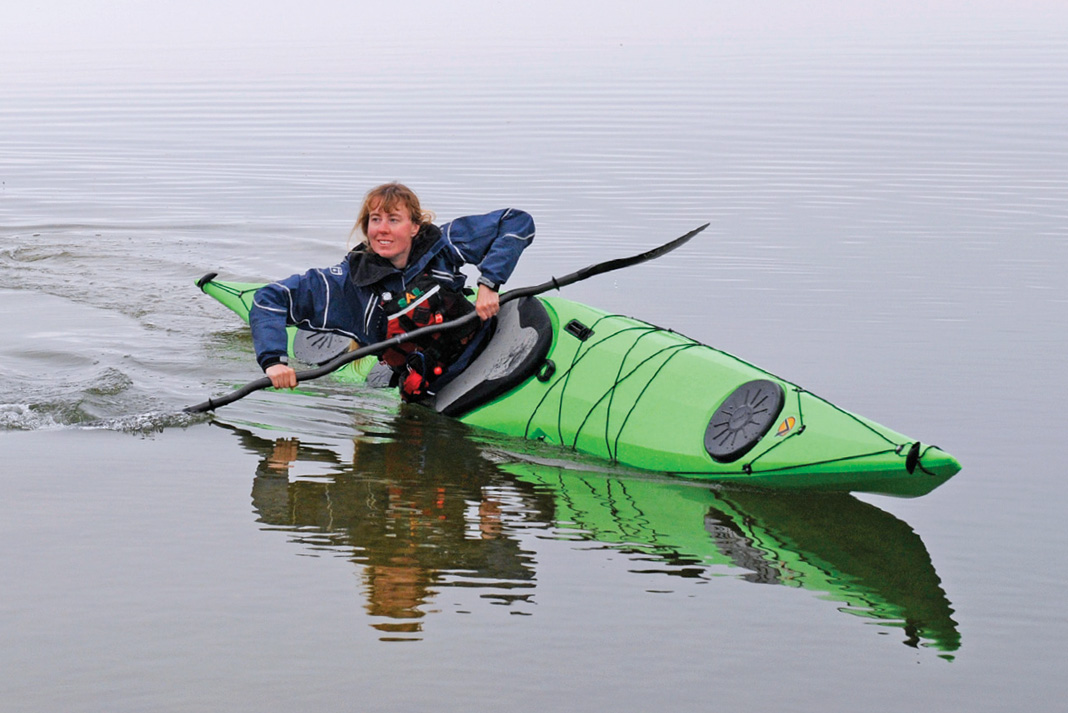
So your roll has failed you and now you are treading water beside your boat. Maybe it’s time to try the scramble. The scramble self-rescue must be too obvious, because it often goes untried and unpracticed. The scramble [aka rodeo, cowboy or cowgirl] is exactly what it sounds like: a rescue that has the swimmer climb back on top of their boat and slide back into the cockpit without the aid of any other paddlers or rescue gear…


Scramble copy


This technique feature originally appeared in Adventure Kayak, Early Summer 2007. To learn more self-rescue skills, download our free iPad/iPhone/iPod Touch App or Android App or continue reading here for free.

How To Hang a Bear Bag

Learn how to keep your food away from hungry critters with these tips and how-to video from Happy Camper, Kevin Callan.

The Mechanics of Personal Flotation

Illustration: Lorenzo Del Bianco
PFD Science

Thanks to Archimedes, we know that an object immersed in fluid is buoyed upward by a force equal to the weight of the fluid the object displaces. In other words, when your body is in the water, it floats because the weight of the water it displaces is greater than the weight of your body.

What does that mean for paddlers? Well, because the human body is made up mostly of water, the average adult weighs between about 10 and 15 pounds submerged in freshwater. Body fat is less dense than bone or muscle mass, making it quite buoyant. Therefore, just because someone is heavier doesn’t mean they require more flotation.

That’s a lot of science, but stick with us here. If we trust the cute kid from Jerry Ma­guire when he says a human head weighs around eight pounds, then in order to keep the most important parts above the water, somewhere in the neighborhood of 15 to 20 pounds of flotation is required. Phew!

A PFD, which stands for personal flota­tion device, is anything used to keep you afloat and includes everything from a seat cushion to a life saving ring to a vest.

A lifejacket on the other hand, is specifi­cally designed to keep your head above the water should you become unconscious. These are usually either keyhole-shaped, like you might find on a cruise ship, or vests that have flotation flaps behind where your head would go. True lifejackets must also be red, yellow or orange, one-size-fits-all and reversible so they’re easier to don in an emergency.

This is an important distinction—most paddling jackets are PFDs, not lifejack­ets. Designing for comfort and mobility has won out over the necessity to keep a paddler’s head above water should he go unconscious.

Okay, back to the science.

Any flotation device worth its salt has been approved by one of a number of agen­cies depending on its type and your loca­tion. Most vest and waist belt PFDs de­signed with paddling in mind currently fall into either Type III or Type V U.S. Coast Guard ratings, or Type III or Special Use ratings in Canada. The dis­crepancy in regulations has created some difficulty for consumers. But all that is about to change.

An initiative to har­monize standards across North America has been underway for the past five years and a resolution is likely to come sometime in 2013. Flotation devices will soon go through the same testing in both countries so that they will no longer be sub­ject to separate certification processes in or­der to meet legal requirements. The hope is that this will reduce confusion for users, put more options on the market and increase innovation since the barriers to releasing a new product into both U.S. and Canadian markets will be fewer.

Among other things, these ratings mean that the PFD offers a minimum level of buoyancy. Currently, for Type III that’s 15.5 pounds in a buoyant foam device and for Type V or Special Use ratings, it’s anywhere between 15.5 to 22 pounds, depending on its intended use.

Why the extra flotation? In choppier con­ditions, like coastal paddling or whitewater environments, it’s nice to have a little extra clearance above the water. Aerated water like the stuff found in rapids and surf is less dense than water, requiring even more flotation to keep a swimmer afloat. Another important factor is whether or not a pad­dler intends to perform rescues with the vest. If you’re towing another person or boat, once again, more flotation will help keep your head above the water.

Many paddlers opt for inflatable devices that use a cartridge or lungpower to blow up the device. Belt packs are espe­cially popular for standup paddlers. These are handy as they don’t interfere with your strokes (or your tan) like a traditional vest will. They don’t, however, offer the same degree of pro­tection as inherently buoyant foam-packed paddling jackets because they require the ex­tra step of inflation to become buoyant.

The consequence of a well-used paddling jacket isn’t just faded nylon and a worked-in feel. All inherently buoyant PFDs will lose flotation over time as the foam breaks down. Keep your jacket stored out of the sun so UV rays can’t break down the ma­terials. Allow it to dry fully so mold and mildew can’t accumulate. And resist the urge to sit or kneel on it to maintain its effectiveness. If you attend a pool train­ing session be sure to rinse out your PFD as chemicals can break down its compo­nents. It’s also a great idea to check for worn stitching and weak points to ensure that the jacket will do its job during an emergency or rescue situation.

To test out a new PFD or to check the effectiveness of an older one, try it out in the water. Relax your body and let your head tilt back. Make sure your PFD keeps your head out of the water and that you can breathe easily. If not, check the label and go for something with a couple more pounds of flotation or retire your old one. For average users, replacement every five to seven years is a safe bet, more often if you’re on the water every day.

Competent paddling shops will only sell PFDs that are approved, making most of this technical stuff less vital informa­tion. That frees people up to focus more on style, fit, comfort and whether the col­ors match. The flotation offered by your device will come into play in more adverse conditions and rescue situations. At the very least, now you understand the label in your paddling jacket and have some great conversation for your next cocktail party.


This editorial originally appeared in the 2013 Paddling Buyer’s Guide. Download our free iPad/iPhone/iPod Touch App or Android App or read it on your desktop here.  

Brave New Board

Photo: courtesy Point 65
Brave New Board

Meet the Rum Runner by Point 65, the world’s first modular Stand Up Paddleboard (SUP).

Following the success of Swedish manufacturer Point 65’s modular kayaks comes a three-piece SUP, available in two sizes: the Rum Runner 11.5 and Rum Runner 12.5. The Point 65 Rum Runner is an innovative, high-performance, take-apart, touring SUP with a displacement hull, making it a fast, stable, straight-tracking board on which to explore, exercise, and easily take home in the back of your car.

Like the modular kayaks, the Rum Runner features Point 65’s patented Snap-Tap system for ultimate usability both on and off the water. The 11.5’ Rum Runner has a carrying capacity of 265 lbs and weighs 55 lbs assembled. It easily separates into three manageable sections, each weighing as little as 15 lbs, allowing for easy transport in almost any car. Using the longer mid-section, your Rum Runner 11.5 is transformed into a 12.5’ SUP with a carrying capacity of 300 lbs.

The Rum Runner is fast and fun, yet comfortably stable and straight tracking. It is a SUP that snaps apart and reassembles in seconds, making it by far the most easy to carry, rigid SUP. The rotomolded polyethylene construction provides a combination of strength and impact resistance that most other materials can’t match.

Point 65’s Rum Runner features dry storage space with a watertight hatch in the front. The deck is partly covered with a structured EVA foam padding for paddling comfort and grip, and also features D-rings for installation of the optional AIR seat pad. Other features include a retractable fin for shollower draft and easier storage, cupholders, carrying handles on all sections, and scuppers to drain the deck area.

The Rum Runner is in production now and will be widely available at REI, LL Bean and many other retail stores by late winter/early spring 2014.

US MSRP 11.5′ $999
US MSRP 12.5′ $1,099


For detailed specs and to learn more, visit www.point65.com/kategori/5535/modular-sup-new.html


PRESS RELEASE


Tripping Canoe Review: Mad River Expedition 176

Overhead view of two people in red canoe with blue barrels
Set out on adventure. | Photo: Dan Caldwell

Whether it’s for the weekend or a whole month, Mad River’s Expedition 176 is a tripping canoe designed to take on the miles with you. It has the speed, capacity and seaworthiness to excel on long open-water paddles but is sized to handle smaller lakes and rivers.

The 176’s roots lie in Mad River’s famed tripping boat of the ‘70s, the TW Special.

“Tripping boats are essential to Mad River. We hadn’t had a true composite tripping hull come out through the early part of the century and that’s the heart of the canoe market. We wanted to bring it back into the game,” says Mad River Canoe’s product manager Buff Grubb of the 176’s release three years ago.

Mad River Expedition 176 Specs
Length: 17’6”
Width at gunwales: 34”
Depth at bow: 22”
Depth at center: 15.25”
Depth at stern: 18.5”
Weight: Aluminum trim 60 lbs; Wood trim 63 lbs
MSRP: Aluminum trim $2,579; Wood trim $2,799

madrivercanoe.com

The Expedition series, designed by Bob McDonough, began with the Expedition 186. Both are classic tripping boats, though the 176 is a foot shorter and more maneuverable. Whereas the 186 is large enough for a summer-long trip, the 176 is a more flexible option.

“The 176 is a boat both for the real enthusiast and someone who’s an aspiring paddler and doesn’t want to limit where they can go,” says Grubb. “It’s a boat that can take you from the Barren Lands to tripping in the borderlands.”

At first stroke, it’s easy to see why the 176 is such a popular boat. Its asymmetrical hull provides excellent forward speed and tracking, making for efficient paddling.

The shallow V-shaped hull offers high secondary stability and superior rough water performance. The lightweight composite construction makes portaging easy, while still providing solid durability.

Side by side with another tripping canoe of a different brand, what you’ll notice first is the outfitting. Mad River’s high-quality wood trim sets it apart from the rest. It boasts a sliding contoured cane bow seat, contoured portage yoke, adjustable stern ash foot brace, cane bucket stern seat and shaped ash carry handles.

[ Paddling Buyer’s Guide: View all Mad River canoes ]

You’ll also notice the Mad River logo laminated into the foam core of the hull. Confident Rabbit, Mad River’s symbol since 1971, was born out of a Micmac legend. While the rabbit sits, smoking his pipe, around him creeps his mortal enemy, the lynx.

But the rabbit isn’t worried—he’s confident in his own wisdom and knowledge. Similarly, canoeists can be confident in the knowledge that they would be hard pressed to find a better canoe to trip in. The only question that’s left is, what’s in the pipe?

Why I’m No Longer Opposed To Blowup Boats

Photo: Larry Rice

The first time I took on Oregon’s wild and scenic Rogue River, I was in a solo hardshell open canoe, as were my boating buds. Self-supported, with camping gear and food for our three-day trip, we used every trick in the book to avoid capsizing as we negotiated 35 miles of remote, challenging whitewater. We weren’t always successful, but we did fine-tune our skills chasing down runaway boats. Tackling rapids can test even the most experienced wilderness tripper.

Ten years later, I returned to the same section of the Rogue with the same crew. Only this time, there were no swims and we were even able to run one difficult rapid that we portaged before. What gives?

We were all paddling inflatable canoes. Self-bailing, and with more stability than their hardshell counterparts, our burly, blowup boats bounced through the frothing rapids of the Rogue, emerging triumphantly into the emerald pools below every time.

I wasn’t always a cheerleader for inflatables. When I was first invited to use one—on a weeklong, self-supported, 100-mile whitewater trip, no less—I was suspicious of their durability, usability and lack of sex appeal. Would it be sluggish on the flat stretches between rapids? Would it hold up to the beatings a hardshell can take on a wild river? Would my buddies think I was a wimp for choosing an inflatable over my trusty Bell Nexus tripper? Could I really trust my life in the wilderness to some kid’s ducky?

How an open boat and open mind can change a stubborn man. That 100-mile trip made me a true believer. My fully loaded, 14-foot inflatable felt and responded like a hardshell canoe. And because of its stability and self-bailing attributes, I was able to run boat-swamping rapids with aplomb while my hardshell brethren scrambled to make it through the gauntlets unscathed.

The inflatable canoe has evolved into a technological marvel over the past 15 years. Built of rugged materials and designed by paddlers for paddlers, these are serious boats for serious boaters. The fun factor definitely diminishes when paddling an inflatable on flatwater rivers and lakes, but speed isn’t everything when river tripping, which is the inflatable canoe’s true domain.

I’ve grown to rely upon these versatile craft. Their large cargo capacity is perfect for multi-day river safaris and I’ve taken them across the continent, everywhere from Texas’ Lower Canyons to the Nahanni in the Northwest Territories. My friends used to laugh at me, but I’ve since made converts out of them, too.

More than anything, my inflatables have proven their worth on remote and exotic rivers—the steamy jungle of Nicaragua, mountains of Bolivia and in the wild steppes of Mongolia. You try getting a hardshell there by mule, backpack or public bus. These rivers are only an option if your boat packs smaller than a golf bag.

Whether it’s short sojourns near home or hardcore getaways, don’t be surprised if, after putting it to the test, you, too, advocate for these practical and efficient blowup boats.

Larry Rice resides in Buena Vista, Colorado. Among his fleet of canoes are four inflatables, from 10 to 16 feet in length, stored neatly in bags under the pool table in his basement.