Home Blog Page 308

One Man’s Epic: Crossing Egypt

All photos by Dave Brosha
One Man's Epic: Crossing Egypt

I’m somewhere above the top of the world, the place where trees are a distant memory and you become convinced there are a thousand shades of white. Snow and ice and wind and a couple of hundred Canadian Forces members, scattered in and around Alert, the most northern military base in Canada. It’s the spring of 2010, and Arctic sovereignty has been the buzzword of the decade. As a freelance photographer and writer, I’ve been assigned to showcase Canada’s efforts in a land where people don’t normally live. 

A couple of days into this story, there’s a second story brewing. Word spreads quickly through the outpost: an Australian adventurer has put out a distress signal 50 days into his attempt to trek solo and unsupported to the geographic North Pole. A rescue team from the Canadian Forces is dispatched. It’s coincidence, and extremely good fortune for the troubled Australian, that the team is currently here at Alert for the operations that I’ve been assigned to cover—normally they are stationed thousands of kilometers to the south. The rescue is pulled off without a hitch and the Australian is brought back to the base. 

This is how I meet Tom Smitheringale, a six-foot-seven-inch, 260-pound giant with a broad smile, month-long beard, slight limp and the appetite of a bear having awoken from hibernation. An hour later I’m photographing him, stripped to his skivvies in a base washroom, documenting a moderate-to-severe case of frostbite that has blackened the ends of his fingers and toes. All I can think is, “Shit, did he really just fall into the Arctic Ocean, halfway to the North Pole…and survive? And he’s got the strength to smile?”

Fast-forward 18 months. I’m bombing down a deserted highway in post-Revolution Egypt with three locals that I’ve just met earlier that day: our destination is the shores of Lake Nasser near the Sudanese border to the south. Our tiny car has almost sunk to its axles from the weight of the gear we carry, and every bump feels like someone taking steel-toed boots to my ass.

We stop to stretch our legs at an ancient temple that looks long abandoned—a splendor rising from the sand. It’s the sort of thing that would be a major tourist draw anywhere else in the world. Here, a lazy dog is the only visitor. He raises an eye as we get out of our car.

Down a nearby dusty track through the rock and sand, the shores of Lake Nasser finally come into sight. As does the silhouette against the sun of a giant, standing on the deck of a decrepit barge, waving to us as we approach. 

WHY EGYPT?
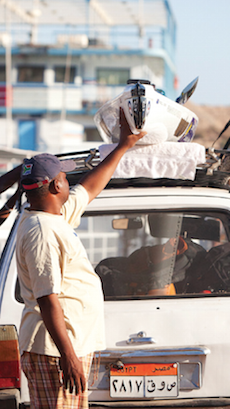
Man adjusting kayak on car in EgyptIn the year and a half since we first met, I’ve learned that while Tom Smitheringale, 43, may be a relative newcomer to the arena of self-propelled adventure travel—the North Pole attempt was his first major expedition—he is no stranger to hairy situations. A five-year veteran of the British Army, he served in Northern Ireland during The Troubles of the early ‘90s and in Africa with the elite infantry regiment, The Grenadier Guards, before turning his attention to the world of adventure outside military life. To prepare for this new expedition, he spent the previous year living in Egypt, learning Arabic and navigating a miasma of red tape.

Eventually titled by his support team as One Man Epic: Mission Sahara, Smitheringale’s sophomore expedition was no small feat on paper: cross the bulk of Egypt under human power, starting with a five-day paddle down 550-kilometer-long Lake Nasser, one of the world’s largest man-made lakes (created with the construction of the Aswan Dam across the Nile about 40 years prior), in some of the hottest conditions imaginable. From Aswan he would continue a further 20-or-so days and an additional 1,250 kilometers down the historic Nile to the Great Pyramids near the capital city of Cairo.

After becoming the first person to kayak the entire length of the Egyptian Nile, Smitheringale planned to meet up with a Bed- ouin guide and a small team of camels in the historic city of Luxor. From there, he would set out into the Sahara’s Western Desert to cross some 1,300 kilometers to the tiny, ancient Siwa Oasis near the Libyan border.

Why Egypt? I wondered when Smitheringale confided in me his plans.

“It doesn’t take a great leap of logic to understand when you’re freezing your bits off in the Arctic, you want to go thaw out some- where hot,” he explained. Still he admitted, “Of all the insane ideas in the world, I acknowledge that crossing the Sahara alone with four camels, in a world beyond guidebooks, with no support sys- tem, no hope of rescue, armed with $20,000 in cash and a small pack of essentials has to qualify as instantly certifiable.“ 

INTRIGUE, ADVENTURE, AND DANGER

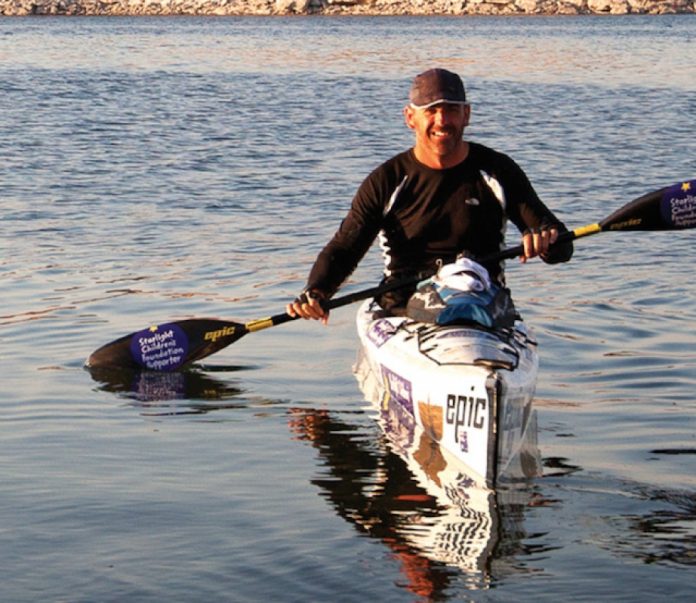
It all started smoothly enough. When I arrived, Smitheringale was just one day into his kayaking stage, and after the endless months of preparation, he was elated to finally be on the water. On Lake Nasser’s still surface, his Epic 18X Expedition—a highly efficient, race-inspired sea kayak that was manufactured in China and then shipped to Egypt—“cut through the water like the singing blade of a sharp knife.”

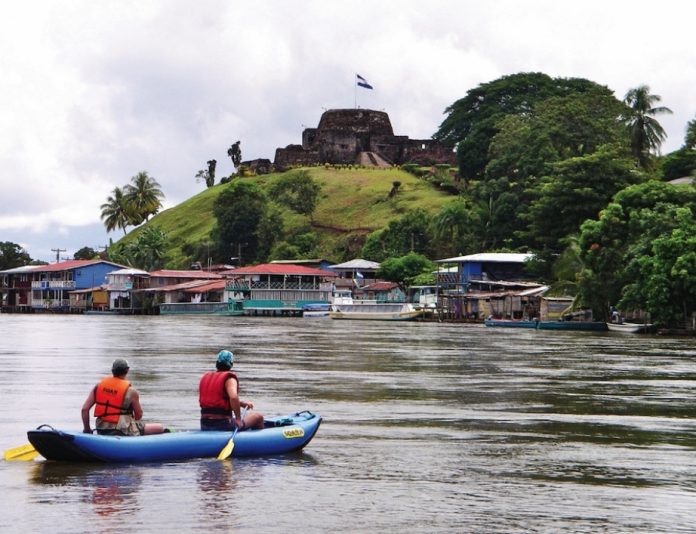
I followed this first leg of the Australian’s journey from the relative safety and comfort of a barge that the ever-fickle Egyptian government demanded tail Smitheringale as his official escort. According to the au- thorities, threats from crocodiles and bandits were too great to travel alone.

While accounts of Lake Nasser’s crocodile-infested waters proved greatly exaggerated—we saw just two small crocs all week—the danger of lawlessness was frightfully real.

Passing through some wild country on the Nile, traveling ahead of his escort, Smitheringale spotted “a crew of tough customers holding their AK-47s like cricket bats.” Waving hello,“I got a couple of ounces of lead in response,” he remembers. “Fearing the scene could go sour mighty quick, I made evasive maneuvers and put the kayak into cover.” Hoping his armed police escort would arrest the thugs, Smitheringale instead watched as his protectors fled downriver. Despite the government decree that he only kayak with his escort,“for more than half the trip, they never turned up or I succeeded in giving them the slip.”

Undeterred, he carried onwards. The three-and-a-half weeks Smitheringale spent on the Nile had its challenges but the rewards were many, too. The famous river was an object of constantly shifting beauty and intrigue, with something different to observe around every bend. Adventure travel is almost unheard of in Egypt, and it drew the curiosity of many along the route. “Some ran away screaming, but most people I met were downright chatty, hospitable, gracious and tons of fun,” he says.

After 31 days in “murder hot” conditions, Smitheringale completed the 1,800 kilometers from Lake Nasser to Cairo. Another 75 days and he had finished the 1,300-kilometer crossing of the Egyptian Sahara—a brutal slog with unpredictable beasts in a landscape favoring migraines and mirages.

That should be the end of this story. But simply doing what he set out to do was not enough for Smitheringale; he made a decision that would take his trip into a world of intrigue, adventure and danger seemingly scripted for Hollywood. 

SOLITARY CONFINEMENT IN LIBYA
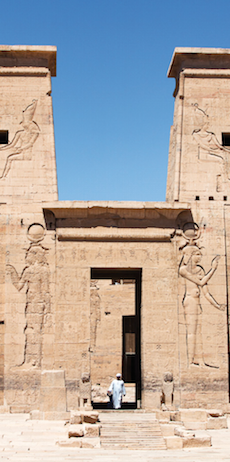
Man in historic building in EgyptBy the time Smitheringale finished his Egypt crossing, I had long since returned home. I followed his progress across the Sahara through Facebook, his blog and through emails with his support team. Tom had become a friend, and his story was enthralling.

Perhaps it was one too many days in the sun; perhaps it was just the notion of doing something even grander. Smitheringale decided he wasn’t done in Siwa. He wanted more. And more, in this case, meant crossing into Libya with the intent of traversing all of the Sahara in North Africa right through to Morocco. This, shortly after Libya made headlines the world over with the hunt for deposed despot, Muammar Gaddafi. It was, Smitheringale would later admit,“The single most stupid move of my life.” 

Eight days after crossing into Libya, he arrived in the border town of Al-Jaghbub, fell out of communication with his support team, and was accused of having a false passport and being a spy by trigger-happy militia. Arrested “at the business end of an AK-47” he was thrown into solitary confinement at a Libyan militia prison for 28 days.

As days stretched into weeks, his supporters held their breath. Finally, word came in the form of a Facebook post from Smitheringale on March 7, 2012, stating that he had been released, but with few other details. The post read, “It would be inappropriate of me to elaborate on the details of my capture and extraction as I’m still in country.”

What the world didn’t know—and it has never been published until now—was that a British Special Operations Team extracted Smitheringale and relocated him to a safe house where he spent the next four days being debriefed by a number of different agencies working in the country. Liberated in the most dramatic of manners, he was to return home on the “advice of British authorities.” The expedition was over. 

SETTLING DOWN

Smitheringale is now back in Australia working, perhaps appropriately, as a consultant for an operational risk company. For now, he is taking a break from the world of swashbuckling adventurer. “Time will decide [what’s next]. I’d like to fall in love, get married and have kids,” he confided in a recent conversation. Never one to seek the spotlight, he seems content to slip back into anonymity. I believe Smitheringale is genuine about settling down. But then again, as he says, “ The true test is not in the talking but in the doing.” Time, after all, may reveal something grander.

Dave Brosha is a photographer, author and filmmaker based in Yellowknife, Northwest Territories, where he lives with his wife and three young children. 
This article on adventure travel in Egypt was published in the Early Summer 2013 issue of Adventure Kayak magazine.This article first appeared in the Early Summer 2013 issue of Adventure Kayak Magazine. For more great content, subscribe to Adventure Kayak’s print and digital editions here.
Slow Adventuring

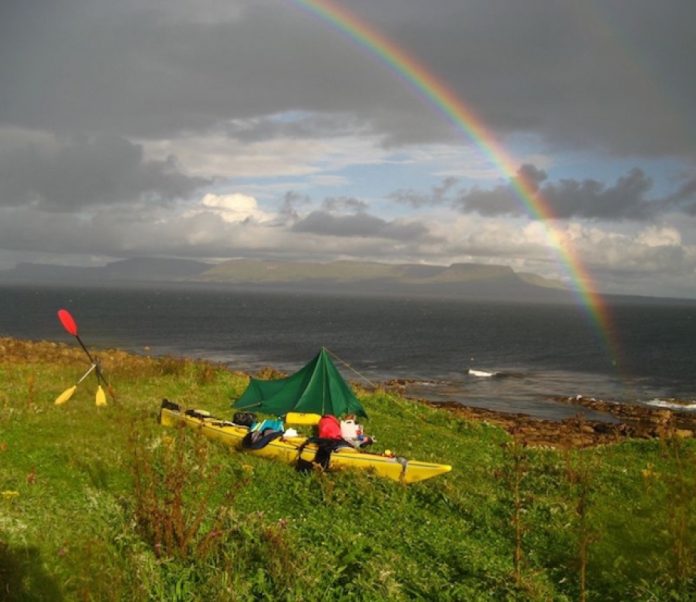
Photo: Jasper Winn
Slow Adventuring

Within two hours of paddling out from the sheltered waters of Castlehaven, the coastline of Cork was a distant scribble three miles to the north and I was further out at sea, alone, in a kayak than I’d ever been before. Everything around me was Atlantic or sky, or—where the spray was blowing off the wave tops—some combination of both.

Until setting off earlier that day to circumnavigate the thousand-mile coastline of Ireland, I hadn’t paddled a kayak for over a year.

Sure, I’m from the southwest of Ireland,
 and had sea kayaked a bit along this coast, but
 that only underlined how little I knew—really 
knew—of tidal streams and currents, of prevailing winds and headland races and the correct 
procedure for sending an SOS. I was using a 
landlubber’s units of furniture to measure the
 heights of the waves. Coffee- and dining table-
height were okay, breakfast counter not so much, and wardrobe-height was a horrifying specter.

Reading to this point, serious paddlers may be tempted to throw their flares, VHF radios and certifications of competence at me in frustration. I’m going to have to make a spirited defense of my position. It’s this: I was on a slow adventure.

Slow adventure is like slow food, slow travel, slow sex and all the other unhurried pleasures of the slow movement. It’s about taking as long as it takes to do something, rather than racing clocks and calendars. It’s about enjoying the actual doing, instead of worrying about achieving a goal. Time—rather than training or equipment—is my safety net.

Roald Amundsen, the pre-eminent Norwegian explorer who beat Scott to the South Pole in 1911, famously claimed, “Adventure is just bad planning.” I agree with him. But slow adventure is the result of just enough planning. In other words, it’s the opposite of an Amundsen-style, micro-managed expedition.

Heading round Ireland, I didn’t do much planning because I didn’t know what I was planning for. I had too little essential gear packed into my 16-foot, plastic Necky Narpa, but I was richly freighted with time.

Time enough to spend a fortnight in Dingle, playing guitar in Dick Mack’s pub whilst I waited for two weeks of high winds to blow through. Time to dawdle amongst pods of basking sharks, or spend three days camped between thousand-year-old stone huts on Inishmurray Island. And, this is especially important, time to postpone indefinitely if the trip proved really stupid.

Three decades of poorly planned, low-tech, comically inept but ultimately successful travel have kept things in perspective. Walking a thousand miles through North Africa’s Atlas Mountains, riding horses across Kyrgyzstan, or on saddle-’n’-paddle trips in Patagonia, I’ve only had to raise my eyes to see that whilst I was at play other people were at work. Pretty much everywhere I’ve looked, someone—a cowboy, a fisherman, a reindeer herder or, quite often, a child in poor shoes and inadequate clothing—is doing a tough job in extreme weather. Life, too, is a slow adventure.

The joy of the slow adventure is its random nature. Unexpected twists will make the trip different from—but just as good as—whatever you had intended. There’s no pressure to achieve something, so no failure if you don’t. A trip takes as long as it takes. Or you go as far as you can comfortably and safely go in a given time.

Anyone can have a slow adventure. It’s as easy as launching your boat on a whim. Adventure will follow. Just don’t plan on it.

Jasper Winn wrote about circumnavigating his home isle in Paddle: A Long Way Around Ireland, his first book, and is currently working on a new book about living and traveling for 10 months with a nomadic Berber clan in North Africa.

This article originally appeared in Adventure Kayak, Spring 2013. Download our free iPad/iPhone/iPod Touch App or Android App or read it here.


River Alchemy: Swimming Rivers

Photo: Brian Huntington
River swimming subculture

When Alison Howard front-crawled into Port Edward, B.C., last August, she was completing not just her 28-day source-to-sea swim of northern British Columbia’s Skeena River, but the circle in a longstanding river tradition. In raising awareness of threats surrounding this beautiful and pristine watershed, Howard enthusiastically volunteered for what so many of us enthusiastically avoid—swimming.

Twenty years on, I still have a mark on my jaw from when it hit the bedrock ground beside the Ottawa River. After briefing us on our ultimately futile, high water Coliseum rookie attempt, our raft training guide simply jumped in. To us, the rapid was a mess of roaring white and certain death. He disappeared in the first wave and surfaced somewhere below, indignantly waving for us to get in the boat and get on with it. Later on in my rookie guide years, I would commonly come upon a senior guide, on a day off, swimming the river for fun.

For many paddlers, those who swim rivers— whether for a cause or for pleasure—defy reason. Kayakers view swimming with contempt (if they are good) or humiliation (if they are not), and canoeists are typically terrified of the very idea. Raft guides, always the realists, take swimming for what it is—insignificance while immersed in a tremendously powerful, uncaring force of water and gravity.

The swimming ethos can trace its roots back to 1955, when footloose former servicemen Bill Beer and John Daggett swam the Colorado’s Grand Canyon on a whim, more or less, and became daredevil media darlings. Dragging two 80-pound army surplus dry bags each, they swam the 200-plus miles in 26 days—with no plan, no backup, and no idea what they were doing.

Amazingly, they hauled a film camera with them, and for a time Beer made a living touring with his movie and telling his story. His memoirs are subtitled The True Story of a Cheap Vacation That Got a Little Out of Hand (We Swam the Grand Canyon, 1988, Mountaineers Books). These two single handedly shattered the certain death mentality that early river runners carried with them, and they likely also opened the door to public acceptance of whitewater rafting as a carefree means of having some fun on the river.

This river swimming subculture persisted for many years, and in many places, but came to an abrupt end in 1993 when Stan Hollister—the same guide who willingly swam Coliseum, scarring my jaw—died while swimming Colorado’s Cataract Canyon.

Among guides, Cataract is considered significantly more difficult than the Grand Canyon, and above 60,000 cubic feet per second (cfs) is the hardest commercially run big water in the world.

Hollister swam it at 110,000 cfs in 1983, covering the standard two-day whitewater section in one hour. In 1993, the flow was 65,000 cfs and Hollister was 52 years old. He saw some friends above the Big Drops—notorious for their massive pourovers, chaotic and churning flow and grip- ping speed—and was later found drowned below them. No one knows what happened.

Swimming fell out of favor, even though canoes still swamped and rafts still flipped. For a time, raft guides were even trained without intentional swimming.

Then in the early 2000s, during the heart of the kayaking boom, river rescue training—with its strong focus on swimming—finally gained acceptance among the rapidly expanding ranks of mainstream paddlers, knocking back the certain death mentality once more.

Today, it is not uncommon to again see rookies bobbing down the main lines of commercial rafting rivers. Sometimes just for fun.

Jeff Jackson is a professor of Outdoor Adventure at Algonquin College in Pembroke, Ontario.

This article originally appeared in Rapid, Early Summer 2010. Download our free iPad/iPhone/iPod Touch App or Android App or read it here.

Kayak Review: Pygmy Boats Murrelet

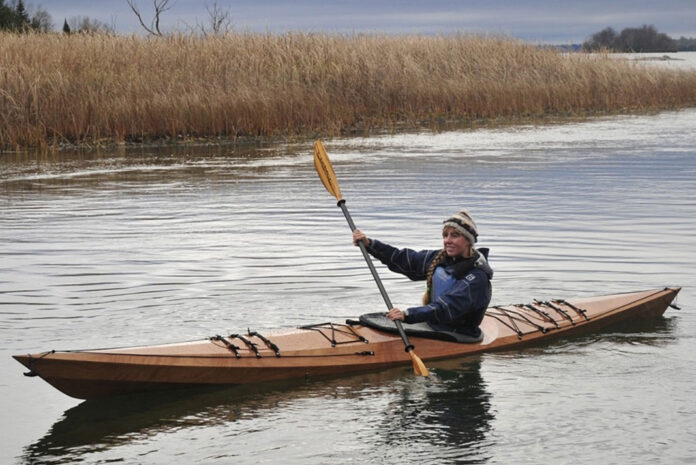
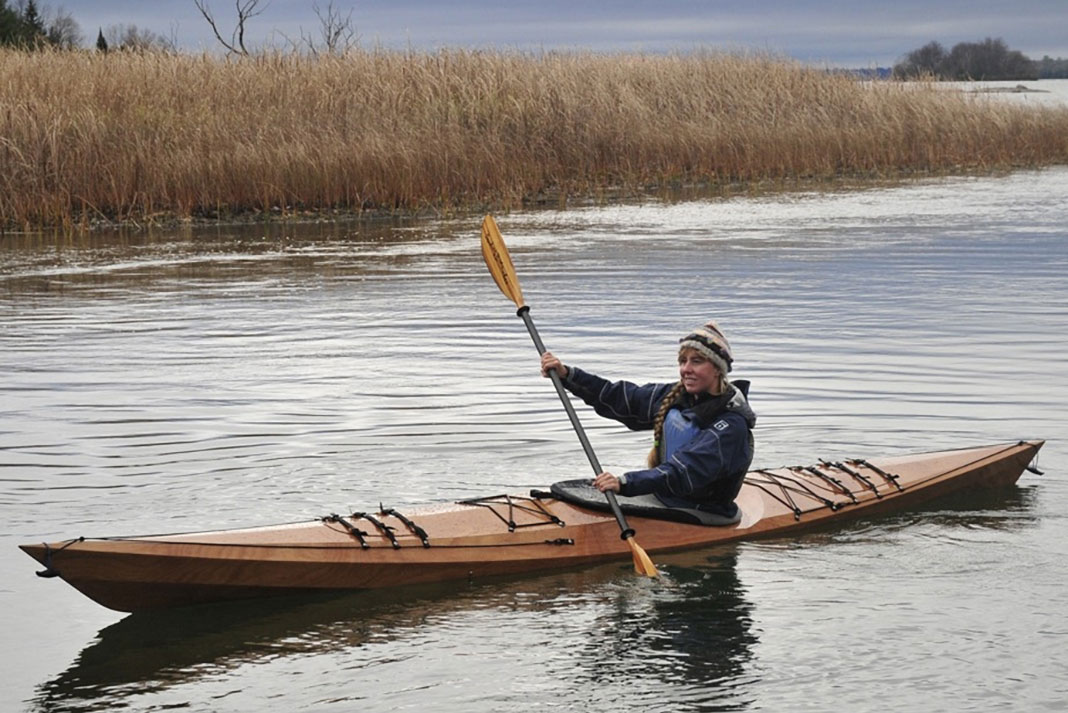
woman paddles a wooden Pygmy Murrelet kayak
The Pygmy Murrelet looks and performs like the culmination of 26 years of design experience and refinement. | Feature photo: Vince Paquot
Pygmy Murrelet Specs
Length: 17’
Width: 22”
Weight: 36 lbs
MSRP: $1,089 USD
pygmyboats.com

“I think people who’ve never worked with wood are intimidated,” Dan Jones tells me when we rendezvous in the border city of Buffalo. He leans forward conspiratorially, as if sharing a secret, “But you don’t need any skill to build these boats, just patience. If I can do it, anyone can.”

Pygmy Boats Murrelet is a build-it-yourself beauty

Jones is referring to the gleaming Pygmy Murrelet that we’ve just transferred from his roof rack to mine. In the interest of expediency, I was only too happy to leave the laborious side of this review to Jones—a veteran Pygmy paddler and builder—but now the seed is germinating: “Hey, I could build a kayak….”

It’s this spirit of self-reliance that inspired Pygmy Boats founder John Lockwood to build his first stitch-and-glue kayak in 1971. A fall at a construction site three years earlier had destroyed Lockwood’s hip and left him on crutches, but the lightweight, drag-anywhere durability of his homebuilt boat gave him the freedom to explore British Columbia’s remote Queen Charlotte Islands for months at a time.

woman paddles a wooden Pygmy Murrelet kayak
The Pygmy Murrelet looks and performs like the culmination of 26 years of design experience and refinement. | Feature photo: Vince Paquot

Trained at Cambridge and Harvard as a computer scientist and anthropologist—admiring of the peaceful Mbuti people of Africa, Lockwood’s college friends nicknamed him “Pygmy”—he designed cutting-edge naval architecture software before selling the world’s first computer-designed, precision-cut wood panel kayak kit out of his Seattle workshop in 1986.

Given the growth and popularity of Pygmy boats since then, the Murrelet looks and performs exactly as it should—like the culmination of 26 years of design experience and refinement.

Video review of the Pygmy Murrelet sea kayak:

Cover of Adventure Kayak Magazine, Spring 2013 issueThis article was first published in the Spring 2013 issue of Adventure Kayak Magazine. Subscribe to Paddling Magazine’s print and digital editions, or browse the archives.

The Pygmy Murrelet looks and performs like the culmination of 26 years of design experience and refinement. | Feature photo: Vince Paquot


Backpacker’s Pantry Outback Oven

Photo: Backpacker's Pantry
Backpacker's Pantry Outback Oven

This gear review was originally appeared in Canoeroots and Family Camping magazine.

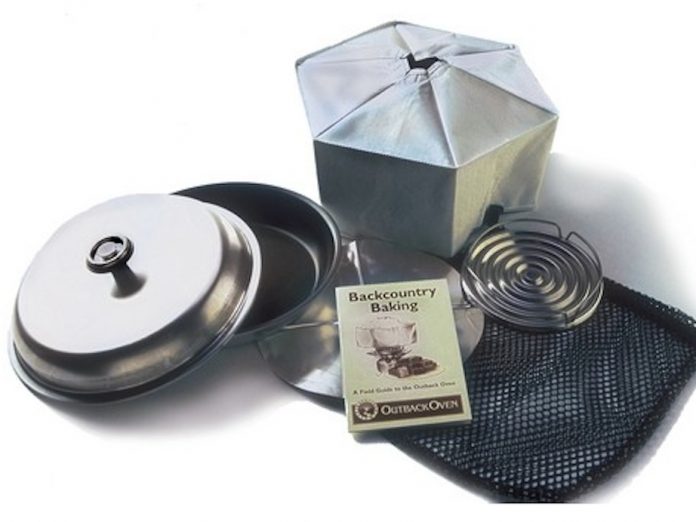
When you’re cooking with gas, you need a 10” Outback Oven. The kit includes a non-stick baking pan, lid, insulating hood and a heat dissipater designed to prevent the most common error of Outback Oven baking: the burnt bottom. To avoid this fate, keep an eye on the lid knob that doubles as a thermometer and be patient coaxing your stove to simmer. Best for stoves with separate fuel tanks. Tends to teeter precariously, so take care not to upset your leaning tower of pizza.

$84 | www.backpackerspantry.com 

This article appeared in Canoeroots & Family Camping, Spring 2009.


Tumblehome: The Original Canoe Stunts

Photo: Courtesy Roots Canada
Roots Canada Photo

This article originally appeared in Canoeroots and Family Camping magazine.

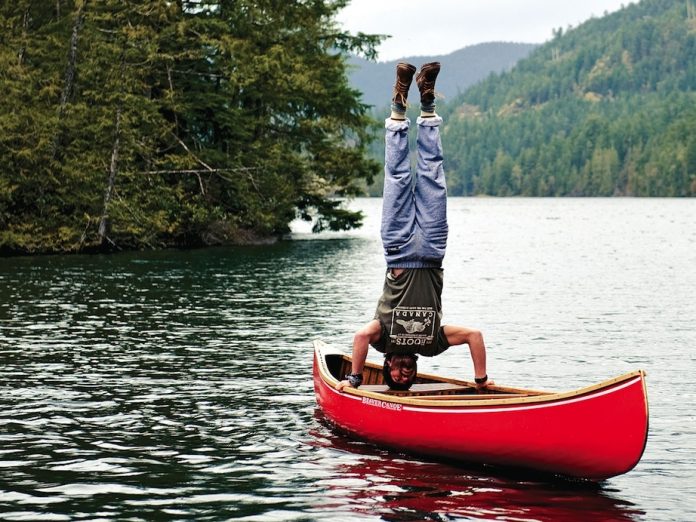
Since the passing in March, 2011 of canoe guru Captain Kirk Wipper, I’ve been thinking about one of the first amazing things I ever saw him do in a canoe—a headstand on the center thwart of a 16-foot, wood-canvas Peterborough Canadian.

Back when most rivers flowed the other way because the ice age had yet to come, proficiency in a canoe included a variety of novelty moves that any novice hungered to learn from the masters. Take Omer Stringer, a contemporary of Wipper’s, and his mesmerizing effect on young paddlers. Stringer mastered all the functional canoeing and portaging skills as a guide and general factotum in Algonquin Park. But in the 1960s he crisscrossed the province demonstrating canoe stunts—a kind of canoeing that is all but gone today, lost in the rush of getting certified and carded up.

I vividly remember Omer standing on the dock at Camp Kandalore, describing head- stands and shakeouts and all the cool stuff you could do in a canoe. As he was talking, his canoe, which floated behind him untethered, drifted gently away from the dock. Kids in the audience got agitated, pointing and calling out to Omer: “your canoe is floating away!”

Totally unconcerned, he kept talking. Then, with the power of a gymnast and the timing of a circus showman, he did a standing broad jump from the dock into the moving canoe, clearing a couple yards or more without missing a beat in his discourse. Howls of approval pealed out from the audience.

There were other tricks as well. Canoe over canoe is a rescue technique, of course. But the term also referred to a stunt per- formed regularly during free canoeing at camps throughout the ‘40s, ‘50s and ‘60s.

The stuntman or woman sat behind the stern seat and paddled like crazy toward a willing participant in another canoe. Lining up for a T-bone collision, the stunt involved ramping the moving canoe as far as possible over the mid-ships of the stationary canoe. Next, in one fluid motion, the paddler stood and ran up the moving boat until it balanced over the stationary canoe, and then see- sawed down on the other side. At this point, the paddler settled in and continued on his or her merry way. Canoe over canoe.

The spectacular headstand was some- thing that many Kandalore campers felt compelled to learn if ever they were to paddle like a master. Training for the headstand included the monkey walk—turning 360 degrees in a canoe with hands and feet on the gunwales—and progressed to the flip— spinning the canoe on its longitudinal axis, above the water, without sinking it.

Adding a second person opened doors to gunwale bobbing, jousting and the double headstand.

Since Kirk and Omer were doing their stunts, and encouraging others to do the same, canoeing has evolved. The glamor of these tricks has faded, lost to historic irrelevance. Maybe today’s leaders should sit down and delineate a curriculum for Flat- water Stunting levels I, II and III certification. A flashy badge could be awarded to those who achieve Master Stuntman status.

Why would you want to do a headstand in a canoe on flatwater? It’s a bit like practicing Zen. A path to enlightenment known only to the great canoe masters of old and those willing to wade in and give it a whirl.

James Raffan mastered the monkey walk in graduate school and is still working on his headstand.

This article appeared in Canoeroots & Family Camping, Late Summer 2011.


Rolling With Kids

Jean-Francois Marleau / SKILSca

“I hope your readers will find this inspiring,” writes JF Marleau, a senior instructor and guide trainer at SKILS kayak school in Victoria, British Columbia. Marleau shared this video of his 11-year-old stepdaughter, Sammy, norsaq-, angel- and hand-rolling a sea kayak at her local pool. “Enjoy this activity with the whole family!” JF enthuses, “it’s fun and rewarding.”


Editorial: Whitewater Parks

Photo: Scott MacGregor
Uncertain outcome

Consider the evolution of climbing. Once upon a time there was only mountaineering. Then along came rock climbing. Now there’s indoor sport climbing. It reminds me of the Darwinian t-shirts we wore in college with the six stages of evolution from prehistoric ape to Homo sapiens. All still involve ropes (usually) and going uphill. Are they really the same sport? i doubt if climbing gyms feed Mount McKinley.

It was difficult for equitable journalist Conor Mihell to find anyone to go on record saying that whitewater parks are bad for the sport. No one in the industry is going to speak up and give municipal officials any reason to stop urban paddling developments. No one is going to bash a nationwide trend that’s reverting old dams into rivers, opening green spaces and putting butts in boats.

So are whitewater parks good for the sport?

If you only paddle in whitewater parks you’ve never considered death as an option. And why would you? If your boat gets pinned in a park, a lifeguard blows his whistle and an engineer inflates a baffle or dewaters the course. A mild annoyance to the guy downstream setting up for a pistol flip, but he’s come to expect it and he too doesn’t know any different.

Maybe I shouldn’t care, I’m past pushing myself to the edge. With a young family, death is not an option for me either. There is too much about paddling (and life) I want to share with my kids. Like, for example, adventure.

Whitewater parks offer leisure, a freedom academics say is intrinsically motivating in and of its own merits. For true adventure, however, the outcome must be uncertain. Information to complete a task (like getting to the bottom of the river) must be missing, vague or unknown. Think about changing water levels, leadership, morale, weather, unknown access and times when your own skill and confidence (or the group’s) may be challenged.

For real adventure you need real rivers. Riding a conveyor belt to the top of the rapids or locking your keys in your truck at the clubhouse is not adventure.

Whitewater parks are neither good nor bad for our sport, they are simply creating a new leisure-based paddlesport—a name for those who paddle only in parks will evolve over time.

I’ve paddled at parks and had a great time. However the soul of whitewater, like that of mountaineering and backcountry skiing, lives inside those of us who paddle where we are not quite sure how the day will end.


Scott MacGregor is the founder and publisher of Rapid and host of Rapid Media TV.

This article originally appeared in Rapid, Early Summer 2010. Download our free iPad/iPhone/iPod Touch App or Android App or read it here.

Canoe With Grace & Power Using The Figure Eight Technique

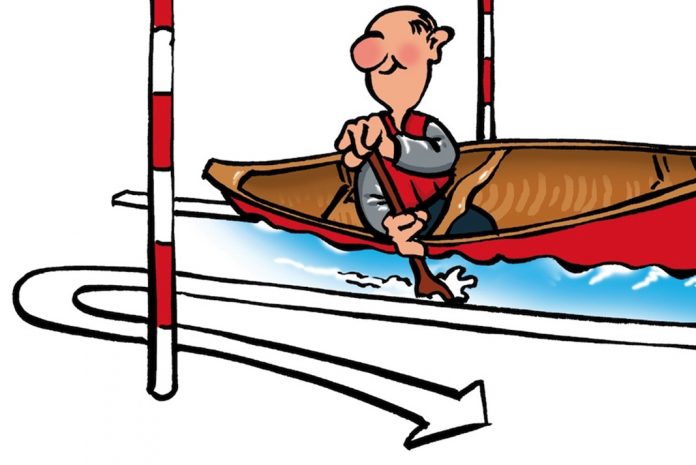
Illustration of person in canoe paddling between poles
Practice makes perfect. | Illustration by: Paul Mason

A few years ago while at a canoeing symposium I took a break to go for a solo paddle. As I passed the beach a stranger launched his canoe and joined me. We continued along the breakwater chatting and paddling until he pointed with obvious pride at two buoys spaced a few feet apart and asked what I thought of his English gate.

I didn’t know what to say, because I didn’t know what it was.

It turns out it’s a simple but wildly effective skill-testing drill for flatwater and whitewater canoeists. He insisted he demonstrate it and I watched bewildered as he blazed through the gate.

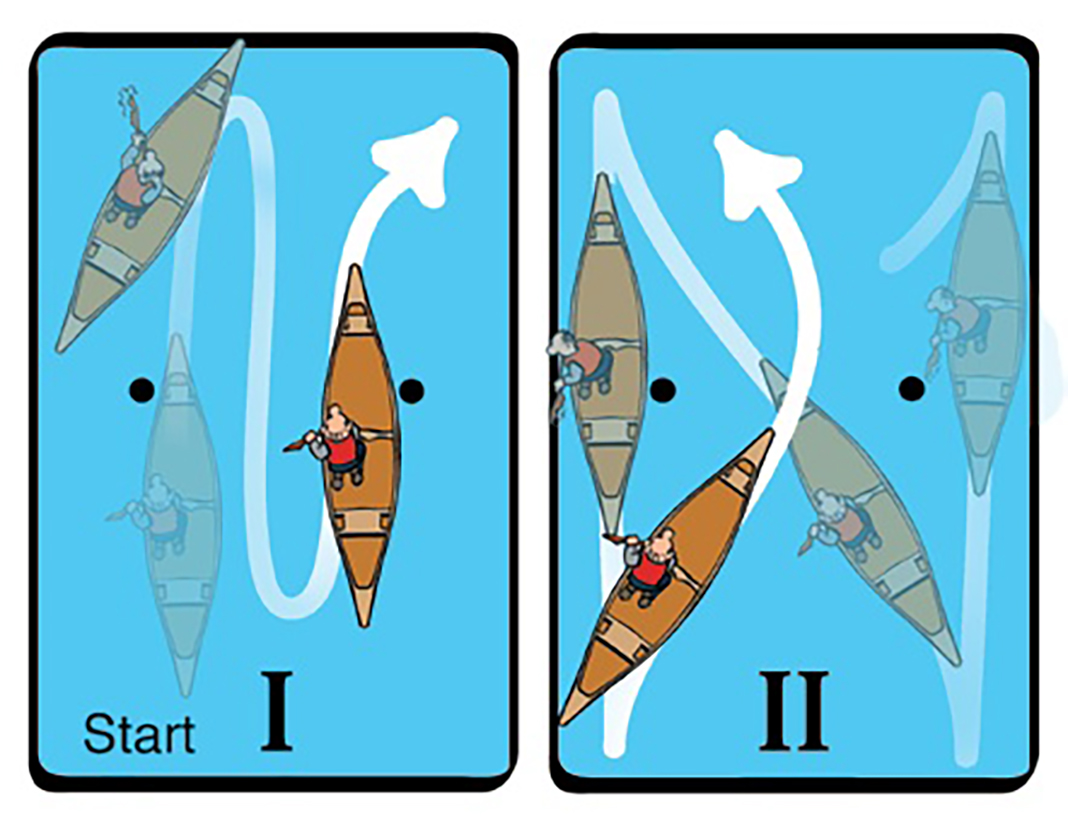
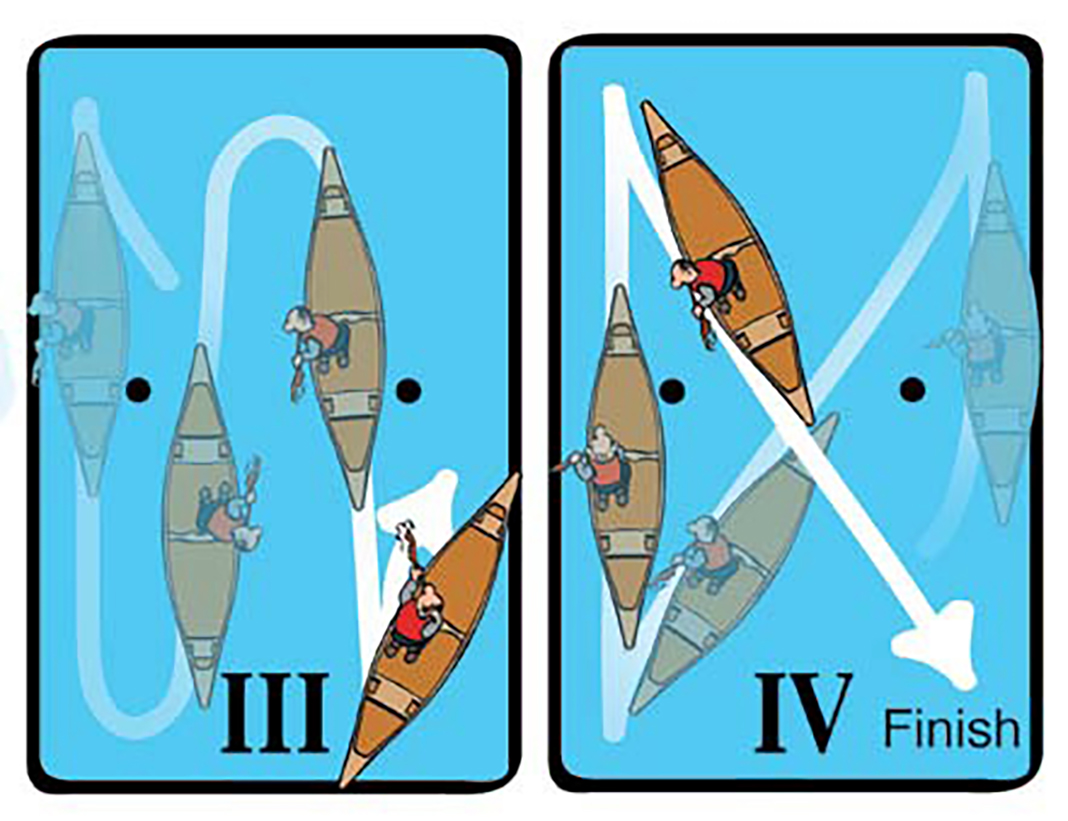
His canoe slid forward and back, backward and sideways in precise movements close to, but not touching, the buoys. The English gate, I learned, is a routine, made up of four phases or patterns that you follow through the buoys. By seeing how quickly and cleanly you can put the canoe through the phases you will get an immediate assessment of your skill as a paddler. Not only does it demonstrate your weaknesses and strengths, but it rewards you with evidence of quicker and cleaner paddling as you repeat the drill and improve.

After a few botched runs I had it figured out and realized that it’s really a fancy figure-eight with a few flourishes thrown in to keep you honest. Sometimes when you pass a buoy you stop and paddle backwards, sometimes you spin the canoe and continue. The diagrams explain the patterns to follow. They seem a little simpler when you realize the fourth phase is the same as the second, just reversed.

Drawing of canoe moving through dots Drawing of canoes moving through dots.

Keep the following in mind to speed your progress

You’ll need strong, quick strokes on the straights to build momentum to carry you through the turns.

[ Paddling Trip Guide: View all canoeing instruction clinics and courses ]

Before each pivot, shift your weight toward your paddling side for snappy turns. 
By keeping your speed up and paddling as close to the buoys as possible without touching, you will hone your control and efficiency. Paddle the gate often and you’ll notice yourself becoming more graceful and powerful in all your paddling.

This article was first published in Canoeroots & Family Camping’s spring 2009 issue. Subscribe to Paddling Magazine’s print and digital editions here , or browse the archives here.


Becky Mason is a canoeing instructor based in Chelsea, Quebec. She has contributed to several books, produced an award-winning video entitled “Classic Solo Canoeing,” and presents at canoe symposiums across North America.

Practice makes perfect. | Illustration by: Paul Mason

Wild Rice: Canoeing on Seven Continents

Photo: Larry Rice
Larry Rice Photo

This article originally appeared in Canoeroots and Family Camping magazine.

I really don’t know what made me want to explore the world, let alone in a canoe.
 I grew up in a Chicago suburb where Wisconsin was considered somewhere far-off and foreign. Maybe it was my inexplicable interest in African wildlife; I visited Chicago’s stately Field Museum of Natural History, with its immense African Hall, every chance I got. Or maybe it was my penchant to devour classics like Robinson Crusoe, Treasure Is- land and The Adventures of Huckleberry Finn. Even the Mississippi River was exotic and enthralling to a city kid.


But, digging deeper, I believe it was my discovery of canoeing that helped rock my sheltered world. Seeking a means to commune with nature somewhere closer to home than Africa, I purchased an Old Town Tripper and ventured—often blundered—through places I had only imagined up to then: the Florida Everglades, Missouri Ozark rivers, spectacular canyons of the Rio Grande. My horizons quickly expanded far beyond the urban jungles and cornfields of Illinois.

Since then, I’ve been fortunate to canoe in 25 countries and on all seven continents, but I’m still humbled by how big our planet is and how precious little of it I have visited. Running my index finger over the smooth curve of a globe in my living room in central Colorado, my mind begins to wander. I dream about canoeing far-flung places with challenging waters, unfamiliar cultures and more unknowns than knowns: Botswana, Tasmania, Peru, Ellesmere Island, Vietnam, Moldova. The list goes on and on. It’s impossible to see around the bend, which only raises the possibilities.

I like that about traveling, about paddling. Once you slip your bow into the current and let it usher you downstream, everything is possible, or seems to be.

When everything clicks on a paddling trip, I find not only the rugged wilderness I am seeking, but also a new way of appreciating the world. An appreciation of the unique qualities of the country I am visiting—its history, culture and the people I reach out to and meet along the way. Traveling by canoe allows me to discover my internal compass as well as be guided by an external one. By going with the flow, not fighting it, I find myself floating through life and oftentimes laughing along the way.

Following the path of the paddle these past 35 years, my passion for travel still burns as bright today as when I was that youngster fantasizing about tripping down Ol’ Man River.

Canoeroots columnist Larry Rice uses his global travels to justify his personal fleet of 18 canoes. 

This article appeared in Canoeroots & Family Camping, Spring 2012.