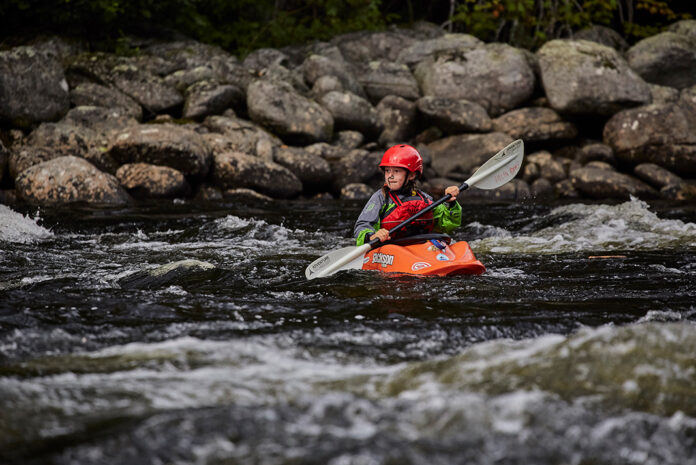
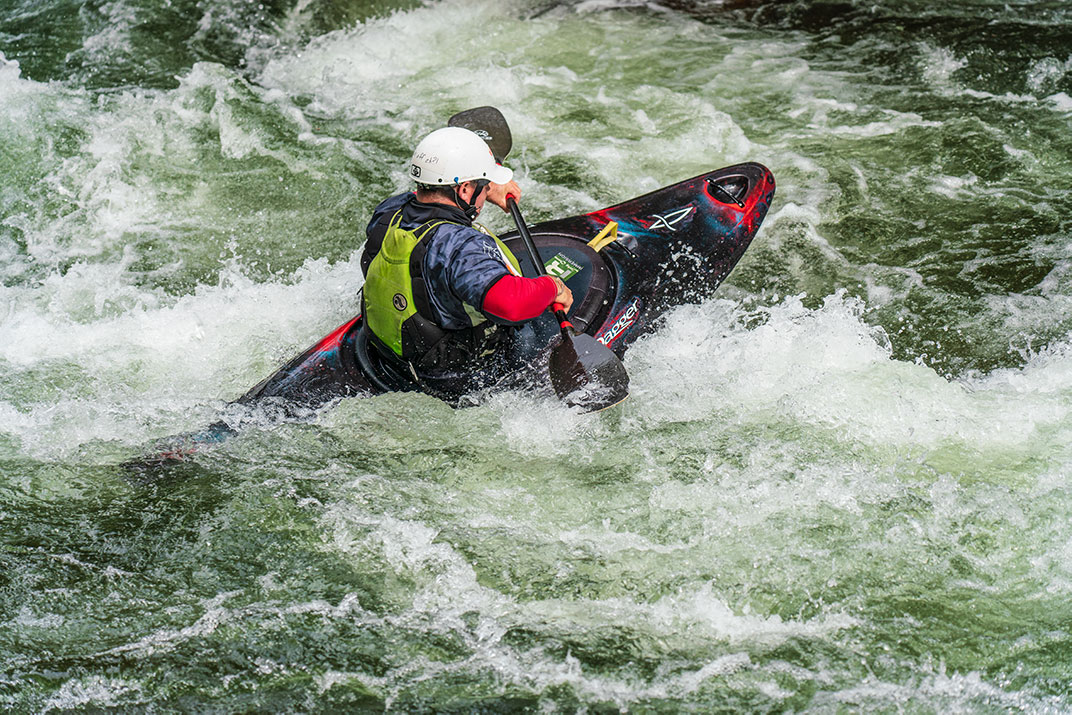
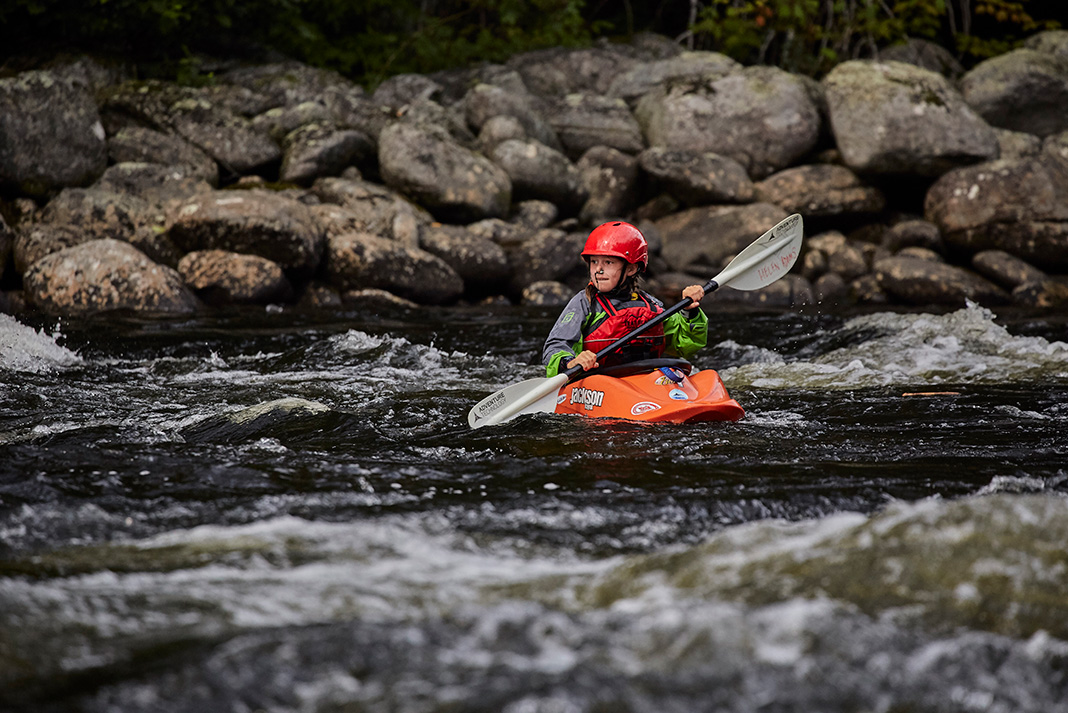
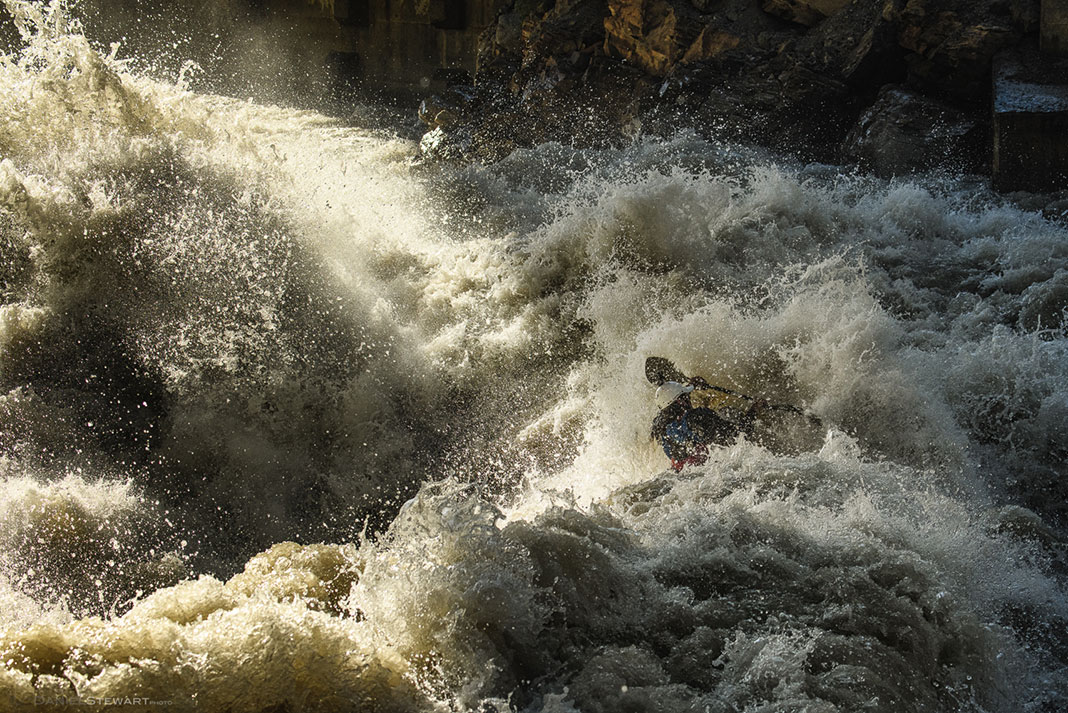
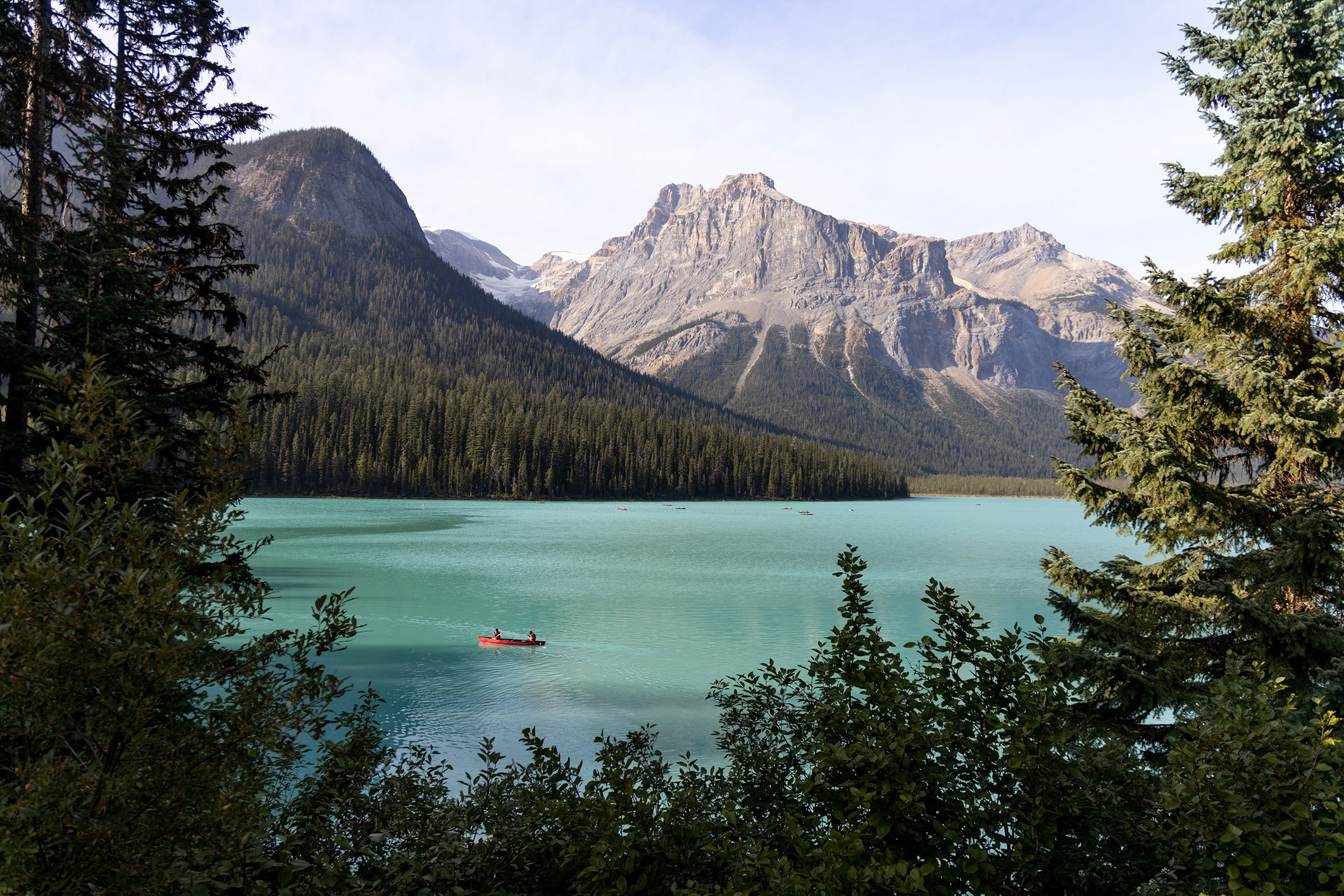
Bonus tip #2: Keep your eyes open! | Feature photo: Nick Gottlieb
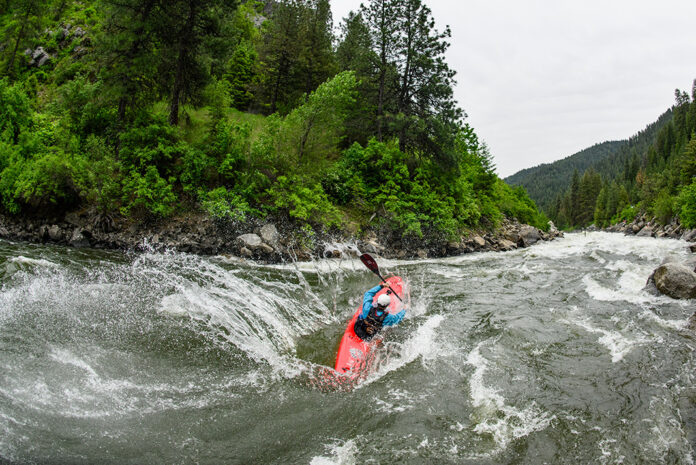
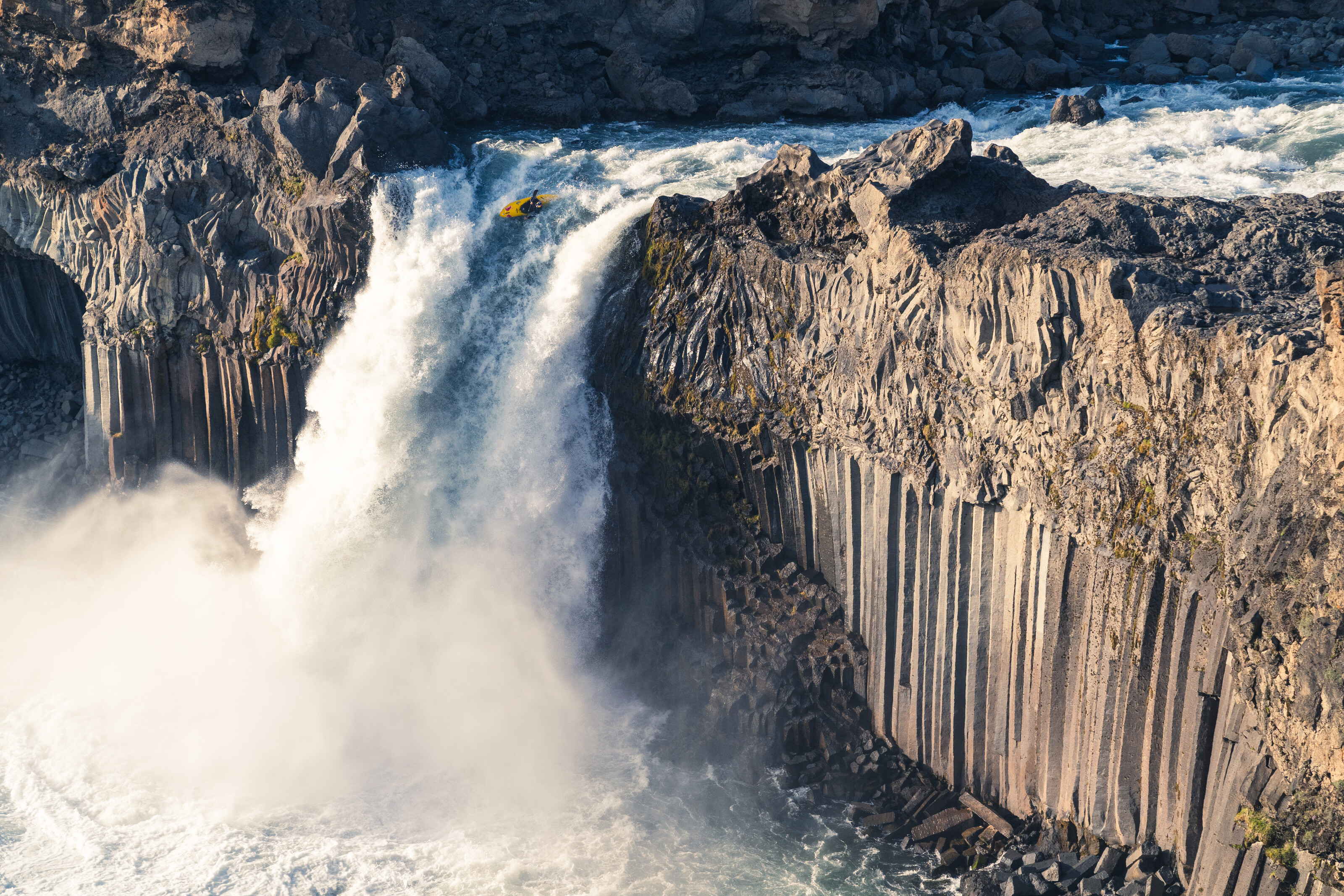
Running new rapids can be scary no matter what class they are or how experienced of a paddler you are. Regardless of whether you’ve been paddling for a month or 20 years, it is always difficult to push yourself to the next level and out of your comfort zone. I have a couple tricks I have used since I was a little kid—and still use to this day—that help me paddling scary rapids.
When you first look at a new rapid it can seem overwhelming and chaotic. It may seem like there are 20 holes, 30 rocks and 100 waves to navigate. That’s why it’s helpful to logically separate the rapid into sections. I like to break the rapid into three pieces: top, middle and bottom. Next, I find the crux of each section and the consequences.
Bonus tip #2: Keep your eyes open! | Feature photo: Nick Gottlieb
2 Choose your key strokes
In each section, look at where the eddylines, slack water, currents, rocks and waves are pushing the water and how that water direction affects your line and where you are trying to go. Then, plan one or two must-take strokes for the crux of each section—I like to plan out those strokes and only those strokes. Say the water above a boof is pushing left and the boof is on the right. I would select a key stroke of a right or left boof stroke and note that I’ll have to be driving right with the right angle to get to the boof.
3 Ask yourself: Can I do this?
At this point you know what the line is and how to do it. Now be reasonable—have you done moves like this before? If you don’t make one of the moves, are you confident in executing a plan B? Do you feel good about rolling or swimming if something goes wrong? And lastly, are the consequences worth it? Once you’ve contemplated these questions, it’s time to rock and roll.
[ Paddling Buyer’s Guide: View all whitewater kayaking accessories ]
4 Bonus tip: Don’t dwell on the consequences
Note the consequence in each section and decide if you have the ability to avoid it. Be confident in answering yes or no (the yes will especially take some practice). Once you’ve decided you can do it, push the consequence to the back of your mind and don’t dwell on it. From then on, all your thoughts should be about how to nail the line—not how to avoid the consequence.
This article was first published in the 2023 Paddling Buyer’s Guide. Subscribe to Paddling Magazine’s print and digital editions, or browse the archives.
Bonus tip #2: Keep your eyes open! | Feature photo: Nick Gottlieb
The famous canoe we wish no one knew about. | Feature photo: Courtesy The Canadian Canoe Museum
A canoe can change a life—imagine, for example, how many children have been affected by fleets at summer camps or grown folks by beat-up livery boats. But that’s kind of a personal thing. What about more famous canoes, ones that have changed the world?
Remembering the storied canoes that changed the world
The very first canoe undoubtedly deserves a place on this list. By first canoe, I mean the result of the first Hominid inkling that hollowing out and sharpening the end of the log they were using to cross the river might be a good idea. This was probably also the very first boat, the technological inflection point that began the entire march of maritime history. From bateaus to barques, canal boats to clipper ships, frog-ponders to freighters, coracles to container ships, the whole idea of moving people and goods over water began with that first hand-hewn dugout.
That DIY boat-building project probably happened in Africa, the cradle of Hominid evolution. Not surprisingly, we lack specifics on exactly where, or of what wood, or by whom this boat was built. But we do have several very old dugouts, including an 8.4-meter beauty thought to be between 6,000 and 8,000 years old that was discovered in Dafuna, Nigeria. Scientists involved in validating and investigating this remarkable find in the late 1980s concluded the vessel showed sufficient design sophistication and adapted tool use to deduce this boat-building technology had been in development for a long time and that the design was definitely not new either. Next time you’re on your windsurfer, anywhere near a commercial harbor, or heading to a tall ships parade, keep in mind all of that began with a canoe.
The famouscanoe we wish no one knew about. | Feature photo: Courtesy The Canadian Canoe Museum
From the famed Tilikum to Orellana
Fast-forward to modern times where there are canoes that might not have had the global impact, in a geographic sense, of the Dafuna canoe, but that certainly altered perceptions of what was possible in the world of canoeing. There was Tilikum, a 12-meter Indigenous-made Nuu-chah-nulth dugout canoe that was converted to a three-masted schooner and was sailed west around the world, from Victoria, British Columbia to London, England, by Captain John C. Voss between 1901 and 1904. Tilikum rests in the collection of the British Columbia Maritime Museum in Vancouver.
[ Paddling Buyer’s Guide: View all canoes ]
And then there was the bandy 6.7-meter fiberglass canoe called Orellana that took Don Starkell and his sons on an epic paddling adventure 20,000 kilometers from their home on the Red River in Winnipeg, Manitoba to the mouth of the Amazon River in South America. This storied canoe is in the collection of the Canadian Canoe Museum in Peterborough, Ontario.
The sad story of the Père Lallemant
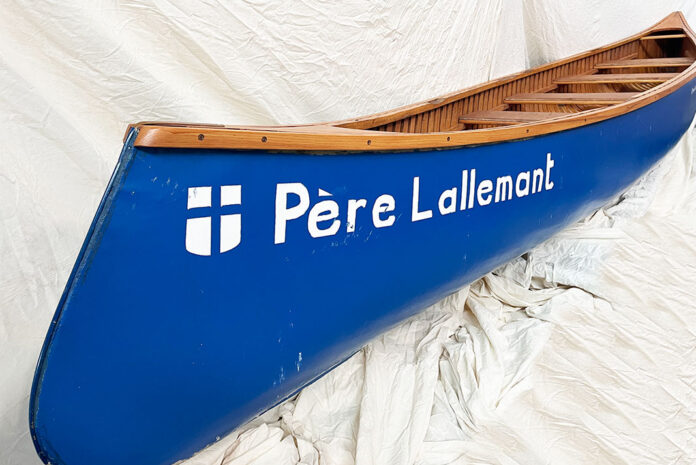
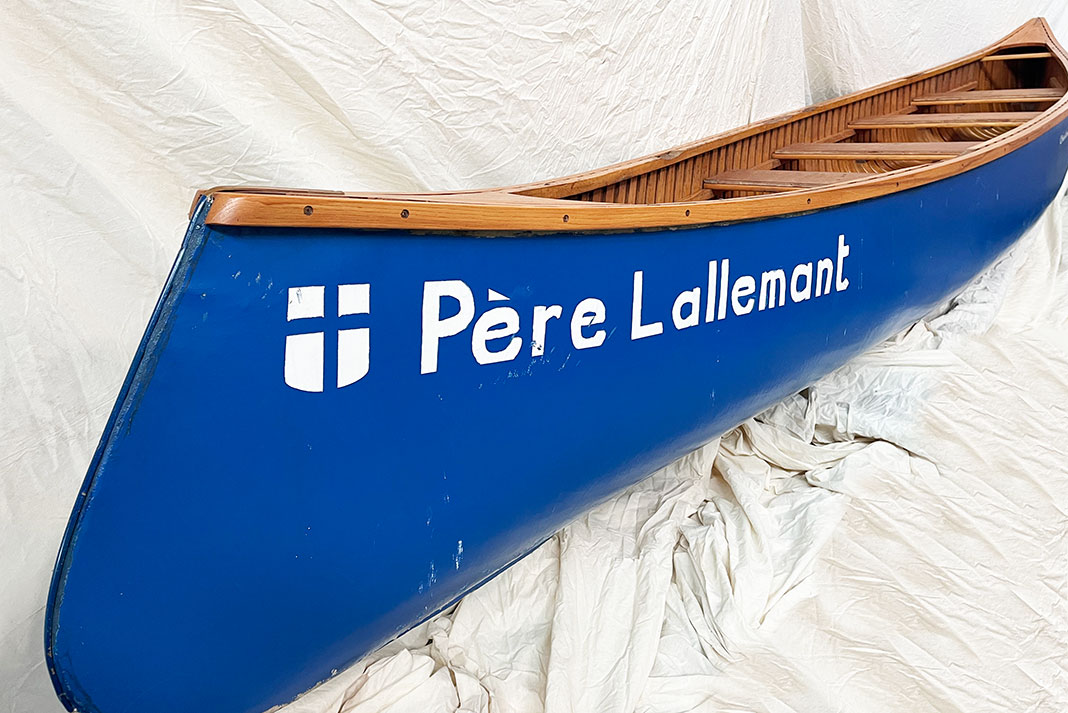
Lately, however, as we’ve been preparing exhibits for the new Canadian Canoe Museum that will be opening on Little Lake in Peterborough this fall, I’ve been reworking the story of a big blue Chestnut canoe I think changed the world of canoeing forever. Measuring the same length as Orellana, this canvas-covered canoe is called Père Lallemant and was one of the four vessels involved in the 1978 St. John’s School tragedy on Lake Temiskaming, in which 12 boys and one young master died on a high school canoe trip.
Without going into the details of the event (you can find those in a book called Deep Waters and a TVO film called Acceptable Risk?) suffice it to say a welter of canoeing instructors and certifying organizations all over the world took the lessons of the Temiskaming tragedy to heart and wrote them into standards of practice, certifying expectations and the general lore of how things should be done with youth—with any client group, really—in big canoes. The reason the Père Lallemant canoe is going to be the capstone experience in the exhibit zone of the new Canadian Canoe Museum called “Pushing the Limits” is that this vessel uniquely represents a sea change in thinking about big canoe practices and about canoe safety in general.
For better and for worse—we can never forget those lives that were so unnecessarily lost—this big blue canoe changed forever the world of canoeing. It’s just one of the reasons to make your way online to follow the developments as the new Canadian Canoe Museum takes shape or to stay tuned for details of the upcoming grand opening this fall.
James Raffan’s Tumblehome columnfirst appeared in the Spring 2006 issue of Canoeroots.
This article was first published in the 2023 Paddling Buyer’s Guide. Subscribe to Paddling Magazine’s print and digital editions, or browse the archives.
The famous canoe we wish no one knew about. | Feature photo: Courtesy The Canadian Canoe Museum
“All great men had simple beginnings.” —Lailah Gifty Akita. The same probably goes for paddlers, too. | Feature photo: Courtesy Madawaska Kanu Centre
Everyone has to start somewhere, including the pros who routinely take on world-class whitewater rapids. But with the benefit of hindsight, what lessons might they impart to their younger selves? We asked eight experts to share what they wish they’d learned in their first year kayaking. Listen up, whippersnappers! The answers might surprise you.
“I started paddling at a very young age of six, so there was a lot that wasn’t on my radar in the grand scheme of things. It is very cliché, but there is no way I would have known where kayaking would take me. That goes for the incredible destinations I’ve been, but also the lifelong friendships and relationships I’ve gained along the way.”
— Alec Voorhees
“All great men had simple beginnings.” —Lailah Gifty Akita. The same probably goes for paddlers, too. | Feature photo: Courtesy Madawaska Kanu Centre
“In my first year of paddling I wish I knew how to roll or even put on a sprayskirt. Hopefully this inspires people to not let a slower progression stop them from paddling. There are a few hurdles in learning to paddle, but it’s well worth it to put in the time and effort to master them even if it takes some patience.”
— Tyler Bradt
“Nothing. The learning process of any sport is super fun. Breaking down those walls and improving happens the quickest when you are first starting. Improving seems to slow down as you get better, unless you are more creative than I am. The community comes next. As you are improving and learning, you’re meeting more and more incredible paddlers who are all mostly incredible people. This was also a great surprise to me and something I’m glad came with time. I’m grateful for the process and amazed by the community. If I would have known more my first year of kayaking it might not have ended up so special.”
“It is really important to make a habit of doing hip and shoulder mobility routines from the very start. If I had done this, I likely would have avoided painful hip flexor issues that started my second year of boating that I still contend with 20 years later.”
“People tell you you can’t sleep your way to the top,
but I’ve seen it done. Also, wear earplugs.”
— Darby McAdams
“Train hard and study the sport. If you do whitewater, it is safer than you think.
That would have helped me because I was really scared of paddling.
But I started when I was nine.”
— Evan Garcia
“One thing I wish I had known earlier is how to scout rapids/waterfalls properly and evaluate the potential risks that come with running them. For me, realistic visualization is key—working backward from the worst to best possible outcome so you can set appropriate safety and be well prepared dropping into the stouts.”
“That it is better to go to a familiar run and make it difficult rather than stepping up to a harder river. It is a much better learning environment to push yourself on easier whitewater (catching all the eddies, surfing, boofing, etc.), basically making a class II or III run have class IV or V moves. That way when you step up to a harder river you are less physically and mentally challenged and much safer because you have built up your foundation.”
— Sage Donnelly
This article was first published in the 2023 Paddling Buyer’s Guide. Subscribe to Paddling Magazine’s print and digital editions, or browse the archives.
“All great men had simple beginnings.” —Lailah Gifty Akita. The same probably goes for paddlers, too. | Feature photo: Courtesy Madawaska Kanu Centre
Mario being expertly guided by Danny down Rapides Examination on day five of the trip. | Feature photo: Marissa Evans
The Dumoine is not the most remote river. Its rapids not known for being perilous, its scenery not unmatched, its history not pivotal. I felt a little foolish being so excited as our shuttle bumped down the old logging road to the put-in at kilometer 64. My thoughts flitting to friends who were boarding bushplanes bound for rivers of the North and the far reaches of Quebec. Those were adventures.
Still, I knew the Dumoine was a river capturing the hearts of both master and novice, prime minister and artist, summer camper and wilderness guide. Did it, in fact, qualify as adventure—despite its preestablished campsites, well-mapped rapids and general accessibility? And if not, what makes it so special?
Aventure or bust: Why a Dumoine River trip is worth taking
If discomfort is an ingredient in adventure, this trip was proving itself when it had barely begun. Cultural discomfort. I was the only non-Francophone in the group, and though our guide Guillaume made an effort to give me instructions in English, he admitted he didn’t know the English translation of certain whitewater strokes or terms I would later learn to mean cross-draw and hanging cross-draw. For now I would have to learn those in French. Since I was learning how to whitewater paddle basically from scratch, you’d think this wouldn’t matter much—but you try remembering the difference between appel débordé and appel débordé de stance when you’re in the middle of a set of rapids and approaching the dreaded pleurer.
Mario being expertly guided by Danny down Rapides Examination on day five of the trip. | Feature photo: Marissa Evans
The group at least made sure I got the joke about the word pleurer, which refers to a rock that has water cresting over it, making it very difficult to see and dangerous to hit—and also means “to cry.”
If excitement is another prerequisite for adventure, this too was present in abundance. Though we portaged around the infamous Canoe Eater—or, as my French trip mates called it in English, Canoe Swallower—Dom and Simon still managed to take a swim while we practiced grabbing the contre-courant at the bottom. And when descending Rapide Sleeper, all five of our canoes filled to the gunwales with water, forcing us to submarine to shore to dump them out.
Running “Rapides Big Steel”
If success is necessary, if only to distinguish adventure from misadventure, we cleared that standard on day four on Rapides Big Steel, the biggest and most technical rapid we’d attempted yet. With Guillaume in the stern, I hadn’t felt very nervous for any of the rapids so far, but I had to remind myself to take deep breaths as we led the charge. I hoped Guillaume could tell where we needed to enter the rapid because the place that had seemed easily discernible from downstream as we scouted was unidentifiable to me now.
Once we were in, the water immediately pushed us toward a pleurer, as Guillaume had told us it would. I heard him yell, “Fort! Fort!” and I knew it must be serious as up until this point he’d always yelled, “Hard! Hard!” when he needed me to paddle hard. We both dug in, shot past the pleurer, were rocked over a few more waves that sent water crashing over the bow and then swung around to make sure everyone else made it through. We’d avoided misadventure, some of us with more water in our boats than others—from the river or les pleurs I’m not sure.
If adventure is a feeling, we felt it most as we rounded the corner to Bald Eagle Cliff on the second-last day of our trip, the river narrowing and the trees seeming to get taller and the hills larger. We were less than 15 kilometers from civilization now, but we seemed all the more remote in both distance and time. The slap of a beaver’s tail only confirmed this suspicion, echoing back to both the fur traders who used to travel the Dumoine and the Algonquin bands who used to live here and believed the river was carved out by a great beaver being chased by the Trickster.
[ Paddling Buyer’s Guide: View all whitewater canoes ]
Adventure comes in many sizes
If adventure must be extreme, though, so as to only be undertaken by the most experienced in the sport, I couldn’t see how our trip down the Dumoine qualified. As we headed down the last stretch of river toward the Ottawa, I wondered aloud to Guillaume whether modern adventure authors we had both read were right, that true adventure is only big, harrowing and risky. Guillaume paused and then wondered back: how many people had this sentiment kept from getting out there, because they thought it wasn’t worth doing if it couldn’t be big?
“If sleeping in the woods one night is an adventure to someone, I hope they go out and do it and not feel it is too small to be considered an adventure,” he said. This from a man who cross-country skied 600 kilometers from Rouyn to Montreal in minus 35-degree-Celsius weather and spent 55 days on board a sailboat living in colonial conditions as it crossed the Atlantic.
This was the sheen of the Dumoine, I realized. Meeting paddlers where they are at and offering trips that are still remote, still challenging, still steeped in history. Still adventure.
[ Plan your next Quebec river trip with the Paddling Trip Guide ]
Digital editor Marissa Evans is filling in for Kaydi Pyette as editor of Paddling Magazine. This is her first issue.
This article was first published in the 2023 Paddling Buyer’s Guide. Subscribe to Paddling Magazine’s print and digital editions, or browse the archives.
Mario being expertly guided by Danny down Rapides Examination on day five of the trip. | Feature photo: Marissa Evans
Hayden Voorhees taking on Jacob’s Ladder. | Feature photo: Daniel Stewart
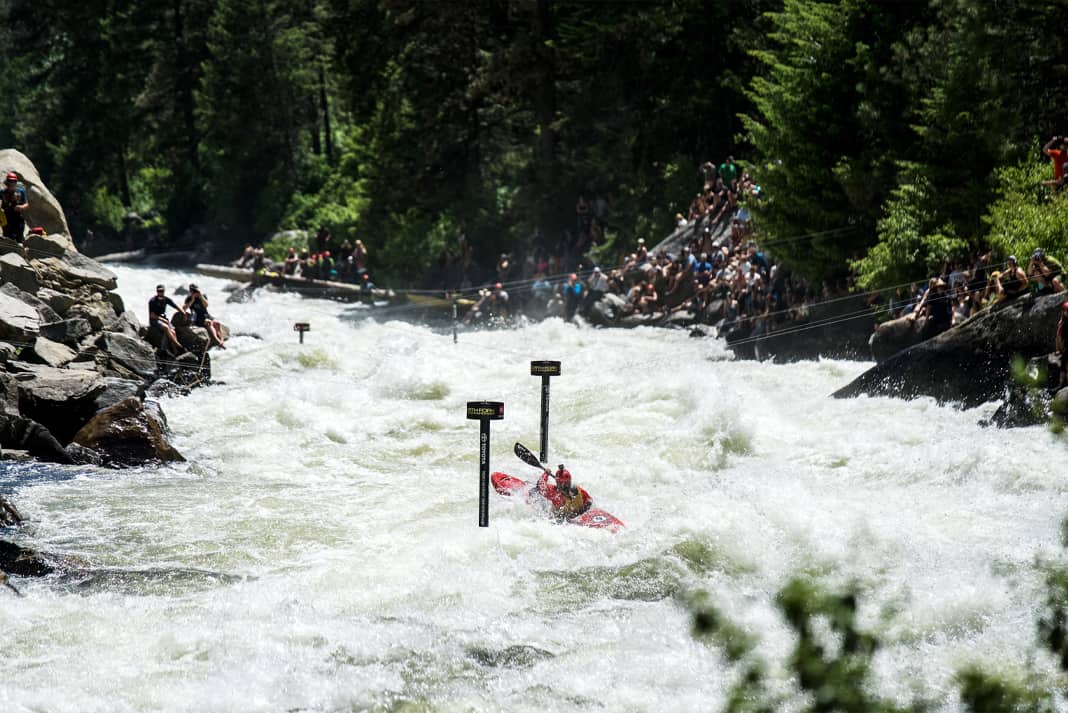
They say winners are made, not born. To earn the winning title at a North Fork Championship—a notoriously rowdy whitewater race on one of the world’s most challenging sections of river—you must be made from something pretty darn special. Whatever the secret sauce may be, 23-year-old Hayden Voorhees from Meridian, Idaho is clearly sipping on it.
The making of the last North Fork champion
The fresh-faced athlete took the win at last year’s Men’s Elite Race final on the Jacob’s Ladder rapid, paddling smoother and faster than all 29 fierce competitors from around the world. Voorhees even pinched the crown from field-favorite and reigning champion, Dane Jackson.
So, how did Hayden pull it off?
For a start, it doesn’t hurt that Idaho’s Payette River, the staging ground of the North Fork Championship, is Hayden’s home river. “It is such a special place for our family, the foundation of our kayaking skills, and our favorite river,” Hayden says. All five members of the Voorhees family are fully immersed in the whitewater scene, including Hayden’s older brother Alec who often competes against him.
Hayden Voorhees taking on Jacob’s Ladder. | Feature photo: Daniel Stewart
Playing on the Payette River
Navigated in part for the first time in 1975 by Idaho kayakers Roger Hazelwood, Tom Murphy and Keith Taylor, the tumultuous rapids of the North Fork of the Payette have since become a rite of passage for any class V boater. The Payette is also the perfect playground for skill progression, thanks to its many sections—namely, the North Fork, South Fork and Middle Fork—which offer varying degrees of difficulty to paddlers. The river certainly fostered the progression of Hayden’s skills, allowing him to gain his first sponsorship at age 10.
More recently, Hayden’s connection to the Payette was further strengthened. The original North Fork Championship organizers, Regan and James Byrd, retired from their roles just before the Pandemic struck. The event needed saving, and the Voorhees family wasn’t ready to lose it. They organized the race for two years, during which time the event grew in popularity.
Unfortunately, the Voorhees family announced the cancelation of the North Fork Championship in January 2023, citing various obstacles from logistical challenges to changes in insurance coverage.
Voorhees’ recipe for success
Beyond paddling infinite laps on the river growing up and organizing the event itself, Hayden has ample experience racing on the Payette—another factor that surely gave him the competitive edge for his 2022 win. He and his brother have been top contenders at the North Fork Championship for a number of years, Hayden having raced every year since 2017 and Alec since 2014.
Alec puts the recipe for success down to “being as consistent as possible during practice,” but notes it can be extremely difficult to nail all the gates during the actual event.
[ Browse the widest selection of boats and gear in the Paddling Buyer’s Guide ]
“Jacob’s Ladder is already such a demanding, pushy rapid on its own, and putting incredibly challenging gates in makes it so tough. Usually there is one gate per year where half the field gets a miss penalty,” he says.
As much as we can try to deduce the winning formula, it seems the true beauty of the North Fork Championship was that it was anyone’s game.
This article was first published in the 2023 Paddling Buyer’s Guide. Subscribe to Paddling Magazine’s print and digital editions, or browse the archives.
Hayden Voorhees taking on Jacob’s Ladder. | Feature photo: Daniel Stewart
August 17, 2023 – Knoxville, TN – America Outdoors, the nation’s one-stop resource for outdoor recreation providers and the industry leaders in public policy, is proud to announce a new award category that will be presented during the 2023 America Outdoors Conference, to be held December 5-8 in Phoenix, Arizona. The inaugural Innovator Award will be presented in addition to the George and Pamela Wendt Industry Achievement Award during the awards ceremony on December 7.
“We are proud to announce the addition of the America Outdoors Innovator Award category as the perfect complement to the George and Pamela Wendt Industry Achievement Award,” says Aaron Bannon, Executive Director at America Outdoors. “Outfitters are continuously innovating to expand the reach and the role of outdoor recreation in America’s great outdoors for all who seek it out, and we look forward to elevating and celebrating their efforts.”
Photo by Jackalope West on Unsplash
This new award was designed in response to creative initiatives in land and water stewardship along with mental health awareness and outdoor access. Unlike the George and Pamela Wendt Industry Achievement Award, which is given to individuals who’ve shown exceptional achievement and commitment to outdoor recreation throughout a long career, the Innovator Award can be presented at any time during someone’s career.
To nominate an individual for either award, please consider filling out this form before the September 15 deadline. Nominees are voted on by their peers through a survey sent out to all active America Outdoors members before the executive committee makes the final decision.
America Outdoors is a community of outdoor adventure businesses and organizations who have joined together to promote and support the outdoor recreation industry through advocacy, education, and collaboration. AO has been working on behalf of the outdoor industry for over 30 years. For more information, please visit our website www.americaoutdoors.org.
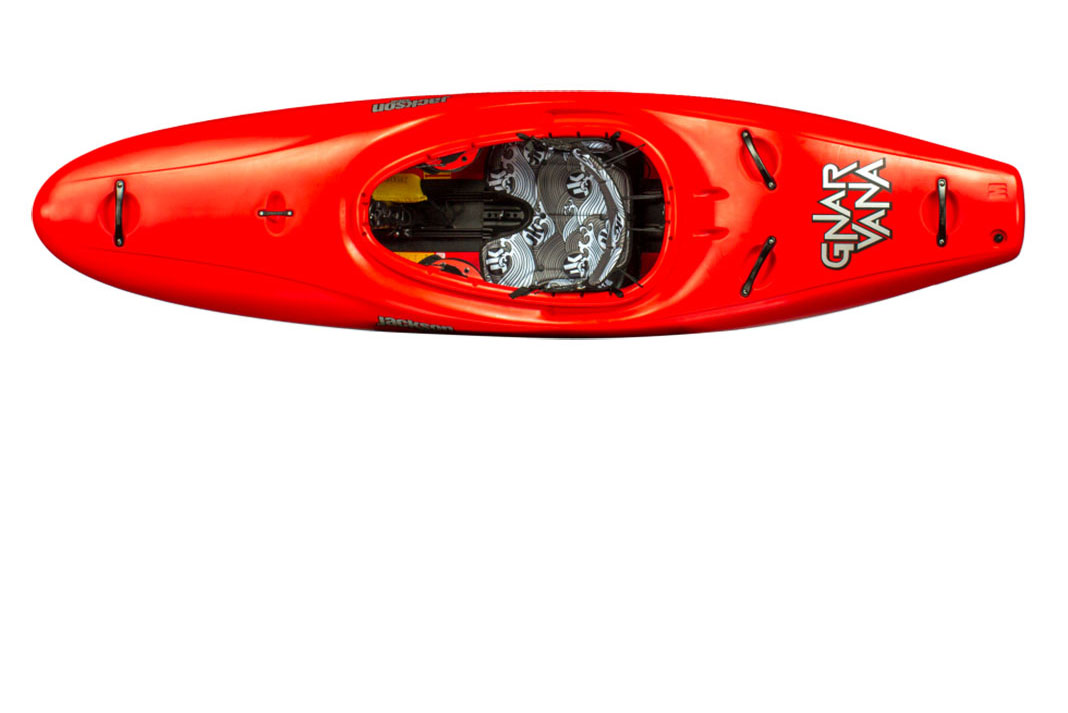
Jackson Kayak has taken the success of the recent Gnarvana and built it into a smaller, more nimble river runner built for your favorite runs called the Flow.
Meet The Jackson Flow
When the Gnarvana was released last year, it represented everything we’ve been seeing in the progression of whitewater kayaks built for heavy Class-V. A profile elongated in the nine-foot range, with hefty volume, tons of rocker, and a hull shaped to skip out of drops. But the Gnarvana is also a lot of boat—overkill perhaps for enjoying our local runs. Enter the Flow, a boat Jackson says provides paddlers all the benefits of a modern river-running creek boat while offering a dynamic boat-handling experience.
What Jackson did for the Flow was keep much of what they found success with in the Gnarvana. That includes a planing hull with long-running, dropped edges. As well as a lot of rocker at the bow and stern for easy boofs, maneuvering, and staying high on the water. But in creating a boat for paddlers looking to have fun on their local runs, Jackson obviously changed some of their approach with the Flow.
The Flow dials back the length, with the medium coming in at eight feet, five inches. Less boat means less to swing around on the water. With the shortened length Jackson also brought the rocker on the ends down a touch from the Gnarvana. The idea being that while still having the high-rocker benefits of the other, the Flow also has a slightly longer waterline for its shorter length to increase speed, and provide more contact with the water along the edges for carving. The hull is also narrowed for edge-to-edge transfer. Overall, a sporty hull design.
The Flow contains a large amount of volume around the center of the boat. The intention here is to provide a stable, confident feel for every paddler on any stretch of river. The bow maintains much of this volumes as it rounds to the nose. The stern features a tapered, squared off tail, with a good amount of volume directly behind the paddler, and flattening out toward the end. The tapered stern is meant to provide enough volume to stay above squirrely features, but also stay out of the way as you lift the bow for boofs and kickflips. Not to mention provide crisp, carvy surfing.
The overall volume of the medium comes it at 77 gallons. When you compare the shape and volume of the medium Flow to the 66 gallon Antix 2.0 and the 91 gallons of the Gnarvana you see where Jackson seeks to place the boat among their fleet of river runners. And they make it clear in their description of the Flow, “Confidence where you need it, and sportiness when you want it.”
[ Find your next Jackson Kayak in the Paddling Buyer’s Guide ]
Jackson Flow Specifications (Medium)
Length: 8’5″ / 259 cm Width: 26.75″ / 68 cm Height: 14.5″ / 36.83 cm Volume: 77 gal / 291.47 litres Paddler Weight Range: 120 – 200 lbs / 54 – 91 kg Boat Weight: 46.76 lbs / 21 kg Retail Price: $1,599.00 USD
The medium Jackson Flow is available now at local retailers, with plans to release a small and large in 2024. Learn more at Jacksonkayak.com.
Tim Emmett leading and Luca Malaguti below. | Feature photo: Jimmy Martinello
Growing up in Canada, the cold is something you become very familiar with. You know about the different kinds of cold—like the kind of damp cold of a rainy November day that gets into your bones and the biting cold of a mid-January day that makes your nostrils stick together—and better yet you know how to dress appropriately for all of them.
Personally, I’m not sure I’ve ever gotten used to the cold, but I do know it makes you feel alive. The cold gives you a heightened awareness that awakens and electrifies the soul. Wind, rain, snow, ice, cold water, brrr… But cold places—if you can get to them, if you can endure them—are often the most wild and the most beautiful.
Finding the freezing point: Paddleboarding the cold coast of Iceland
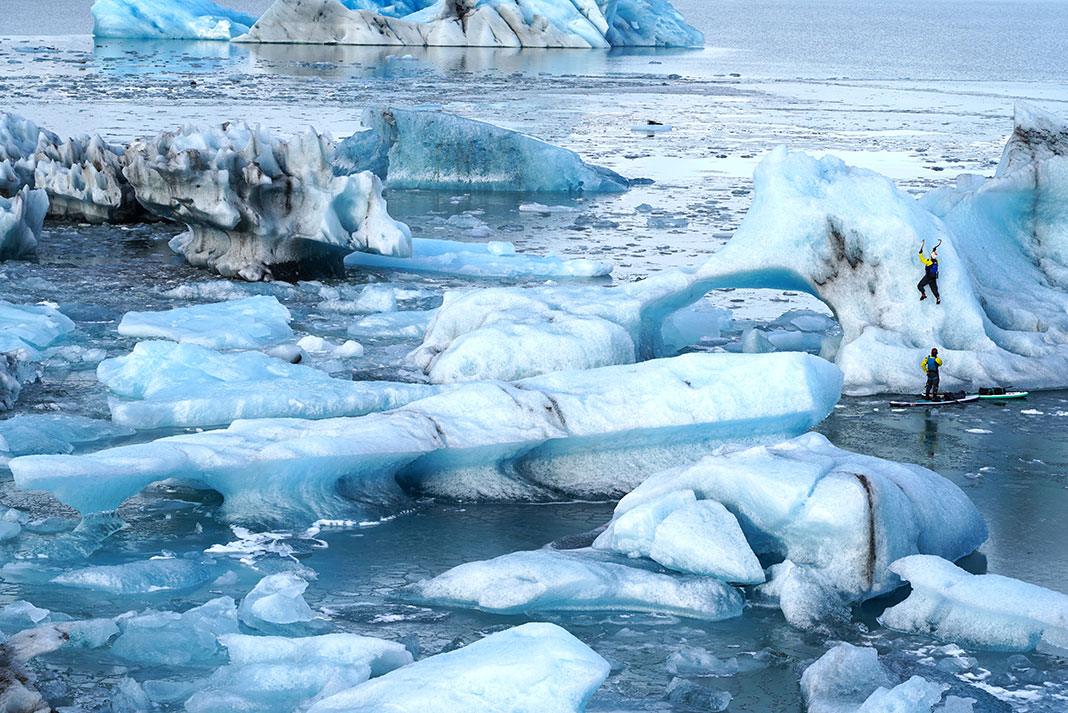
In November 2021, work and passion brought me to Iceland as part of a four-man crew to capture a theme, Water In Its Many Forms, on film. The idea was to find somewhere we could ice climb, free dive, surf and paddleboard, with a goal of showcasing the many transformations of water and the human connection to it.
Iceland was the perfect canvas for our quest. Still, winter in Iceland can be humbling and sometimes hostile. We embraced the cold temperatures, big storms and strong winds that encased us in ice as part of the adventure. I relished my role as both athlete and photographer as we chased the fine line between solid and liquid water.
Tim Emmett leading and Luca Malaguti below. | Feature photo: Jimmy Martinello
Adventures like this require an inspiring team. Tim Emmett is a longtime friend and adventure partner, as well as professional climber. Luca Malaguti is a free diver, fresh off breaking the Canadian national free diving record with a depth of 84 meters. Brian Hockenstein is a filmmaker who never shies from whatever the adventure requires to document the magic.
Captivated by the call of the cold
The days in Iceland flowed so naturally, blending together as we left one spectacular place for another. One moment I would be photographing Tim climbing out of a moulin, the next we would be surfing waves as a storm whipped up at sunset.
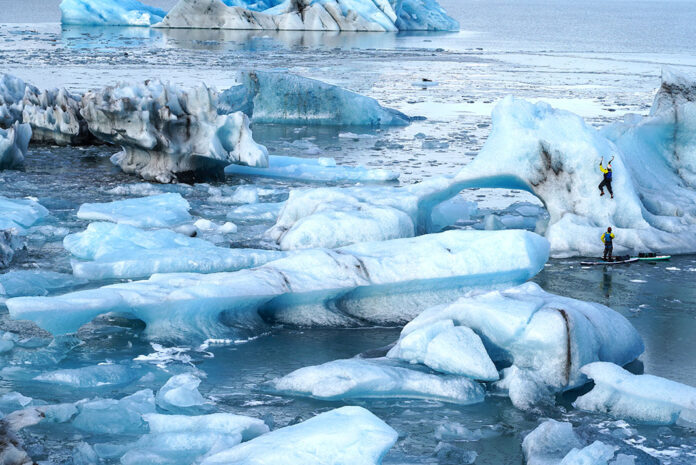
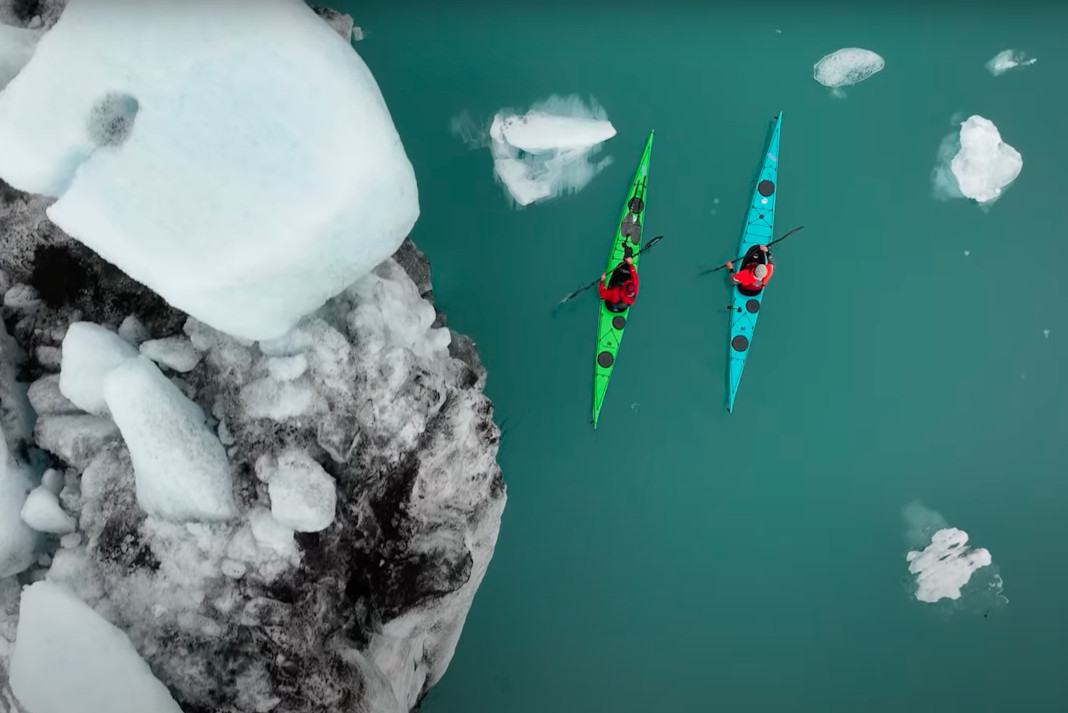
Exhausted at the end of each day, the four of us would squeeze into our rental SUV jam-packed with gear. Helmets, ice axes, boots, crampons, dive masks, flippers, wetsuits, drysuits, paddles—not to mention the multiple SUPs strapped to the roof. It was a lot, but we used it all almost every day. As has been common for me the past few years, inflatable SUPs were our main vessel of transport, breaking through ice, smashing through waves and cutting through wind as we navigated among icebergs.
Climbing onto these frozen blocks of ice was a terrifying endeavor. If these massive, unstable chunks were to break or roll over, our drysuits would help stave off the cold. But that would only matter if we weren’t bludgeoned or crushed in the process.
Wind was the biggest issue we had to navigate if we wanted to paddle or surf. Flexibility was crucial, the ability to go with the flow, not unlike the water we came to document. The locals said, if you want to know the weather, check the forecast every 15 minutes and be prepared for anything. We took their advice.
We let the weather dictate our days, using our gear and familiarity with the cold to decide which form of water to engage with. Some people find the cold numbing; I find it enlivening.
This article was first published in the 2023 Paddling Buyer’s Guide. Subscribe to Paddling Magazine’s print and digital editions, or browse the archives.
Tim Emmett leading and Luca Malaguti below. | Feature photo: Jimmy Martinello
Either way, it’s your parents’ fault. | Feature photo: Adam Hill
No circumstances conspired to turn me into a kayaker. I grew up in the city, far from the water. Yet I knew I wanted to go sea kayaking long before I ever had the chance to try it. Sometime in the 1980s, on a family trip to Cape Cod, I caught my first glimpse of a sea kayak hanging from the ceiling of a tourist shop.
The juxtaposition of the unfamiliar vastness of the ocean we’d been visiting and the notion of launching into it in such a tiny and exposed watercraft was intoxicating. Kayaking seemed like the appropriate response to the infiniteness of the ocean, and to me symbolized the kind of relationship I wanted to have with the world—one composed of unfiltered, direct, adventurous experiences.
Even though it would be more than a decade until I actually sat in the cockpit of a sea kayak, the idea of me as a sea kayaker gripped me. I started clipping pictures of kayaks out of magazines and taping them all over the walls of the house, as if to declare to myself and my family that this destiny would not be forgotten. As motivation, that’s as intrinsic as it comes.
Other people come to their outdoor passions similarly. The environment, or the activity, ignites something already deep inside. For some, it’s paddling, for others, it’s hiking or climbing in the mountains.
Falling in love with the landscape
I’m enjoying the new memoir by the California-based science fiction writer Kim Stanley Robinson, The High Sierra: A Love Story, about his lifelong affair with the Sierra Nevada. He didn’t start out as a backpacker. Like me, he grew up in the suburbs. But everything changed in 1973 when he and some university friends drove to a trailhead, dropped acid and went for a hike.
Either way, it’s your parents’ fault. | Feature photo: Adam Hill
“I didn’t know that my life had changed for the good,” he writes. “But I did know I had just lived one of the greatest days of my life. And I knew that this granite world, holding me in its cupped hands as I lay on it, glowing luminously in the moonlight, was a magic place. I loved it. I loved it. That feeling has never gone away. I trust now that it never will.” He went on to make hundreds of hiking trips into the mountains known as the Range of Light.
Robinson is talking about falling in love with a place, a specific mountain range, not backpacking per se. But outdoor sports are wrapped up in the experience of landscape in a way that’s difficult to disentangle.
Similarly, sea kayaking is about a relationship with the watery landscape. It’s a feeling.
“That feeling is one of the things I want to write about here. Crazy love. Some kind of joy,” Robinson gushes near the beginning of his 537 pages. “But what struck me most that day, and has lingered since in me, was a stupendous sensation of significance…what I was seeing was more than real.”
An innate propensity for paddling?
When I wrote a master’s thesis about wilderness adventure, that’s what people told me they were after: “ultimate reality.” Something too deep for the usual scientific research to grasp. The Outdoor Foundation’s 2015 Special Report on Paddlesports found 72 percent of kayakers are motivated “to get exercise.” And so on. Yadda yadda. Sponsored by The Coleman Company, Inc. that information might help you sell kayaks, but it doesn’t answer the question of what makes people paddlers in the first place.
No, I’m talking about paddling as a transformational act. People whose first glimpse changes them “for good.” As in for the better. As in forever.
In the 1978 classic of paddling literature, The Starship and the Canoe, writer Kenneth Brower compares the famous astrophysicist Freeman Dyson and his hippie son George, whose trajectories represent wildly divergent responses to a planet in crisis. Freeman looks to outer space: humans must colonize other planets. Dyson takes a back-to-the-land, low-tech approach: he retreats to the Pacific Northwest, lives in a treehouse and starts building kayaks fashioned after Aleut baidarkas.
Certainly the Princeton professor didn’t set out to turn his son into a kayaker. There must have been something innate in George that made him choose that watery path, like some genetic predisposition waiting to be expressed.
Like a duck to water
Sometimes people can see this propensity in you early, before you even discover it in yourself. There was an old man named Peter who went to my parents’ church and saw me grow up, though I hardly spoke to him. In high school I wrote an essay for the newspaper full of angst about living in the city disconnected from nature—the same stuff I write now. Peter read it and asked if he could take me out to lunch. He rambled about places he’d traveled and asked about my plans after school. He gently suggested I postpone settling down and take some itinerant jobs. A berth on a transoceanic freighter might be an interesting way to see the world. That was a weird conversation, I thought.
As the years went on, I studied outdoor recreation, moved to the West Coast, and worked as a tree planter, canoe trip guide and forest firefighter. The reports Peter got from my parents must have confirmed he’d read me correctly.
I don’t know if Peter ever kayaked, but I think he too was a kayaker in spirit—born, not made—and he recognized a kindred one when he saw it. Before he died he mailed me a poem out of the blue. It’s a popular one, called The Little Duck, by Donald Babcock:
“Now we’re ready to look at something pretty special
It is a duck
riding the ocean a hundred feet beyond the surf. […]
And what does he do, I ask you?
He sits down in it!
He reposes in the immediate as if it were infinity
—which it is.
He has made himself part of the boundless
by easing himself into just where it touches him. […]”
Whenever I think of that poem I think of Peter, how he saw some spark in me that he connected to a feeling in himself. It’s the spark that flared when I saw that kayak in Cape Cod.
Years later I collected the earnings from all those odd jobs, drove to Granville Island in Vancouver and walked into the Ecomarine store. I pointed at the sea kayak hanging from the ceiling and asked the staff to help load it onto my truck.
This article was first published in the 2023 Paddling Buyer’s Guide. Subscribe to Paddling Magazine’s print and digital editions, or browse the archives.
Either way, it’s your parents’ fault. | Feature photo: Adam Hill
For 40 years, REO Rafting and Yoga Resort had called the magnificence of the Nahatlatch Valley home. On August 18, 2023, the monthlong burning Kookipi Creek Wildfire exploded in growth. High wind fueled it across the Fraser River and up the Nahatlatch Valley toward REO. Those in the valley, including everyone present at REO, were forced to evacuate quickly as wind pushed the flames through the forest. When the gray ash had settled, the rafting operation that had grown within the valley over decades had been consumed.
“By the time we realized the severity and the speed of the fire that was approaching, it was too late. Everyone at REO grabbed everything they could and evacuated before the fire was at our doorstep,” Bryan Fogelman, founder and president of REO Rafting, and the REO team shared in a statement through the B.C. River Outfitters Association.
REO Home For Decades Instantly Destroyed By Kookipi Creek Wildfire
REO is just one place lost in the widespread fires overwhelming the province of British Columbia this summer, with over 2,000 fires occurring so far in 2023, burning nearly five-million acres.
The business Fogelman founded in 1983 just over a two-hour drive from Vancouver was known as a gem of a retreat along the jade-green rapids of the Nahatlatch River. REO offered rafters river experiences on the Nahatlatch, Fraser and Thompson, as well as served as a yoga retreat and family camping destination. Fogelman operated REO with his wife Karen—whom he met while she was a rafting guest there in 1993—and their three children. The outfitter was truly family-operated with plans for their daughter Sierra and her husband Matt to one day take over.
According to Fogelman, 80 percent of REO Rafting was destroyed by the Kookipi Creek Fire. Following the flames passing through, he and a group of employees were able to travel back to the resort briefly. While there, they put out numerous fires still smoldering around the property and collected any gear that wasn’t destroyed. The fire is still burning in the area, limiting their ability to access the REO property.
“All we can do is watch the fire’s progression and hope we can save what’s left,” they went on to say in the statement.
Hopes To Rebuild On The Nahatlatch River
The Fogelmans aren’t quitting on REO or the Nahatlatch Valley with plans to rebuild as soon as possible. There is a hitch though. Due to their business location, REO has been unable to secure wildfire insurance for the property in recent years, and will have to shoulder the financial burden of rebuilding.
REO was the entire livelihood of Bryan and Karen. With the devastation of the resort, loss of bookings, and lack of insurance coverage for the fire, the family faces a difficult path ahead. The Fogelmans have set up a GoFundMe campaign for past guests and members of the paddling community who would like to support the family in restoring the outfitter in the river valley they’ve seen themselves as stewards of for decades.
“This valley is our home and it has always been our passion to preserve its natural beauty. Over the years, we have worked endlessly to protect the Nahatlatch; from our role in the creation of the Nahatlatch Provincial Park to the continued effort in preserving the natural wildlife, improving the facilities on our property, and bringing awareness to the land,” the Fogelman family expressed on the fundraising campaign site.
“For all of those who have been to REO, and even those who may have seen it from afar, you’ll agree when we say that there was something so special about it. We hope that one day in the near future it’ll return to this state, but there is a long road ahead.”


 This article was first published in the 2023 Paddling Buyer’s Guide.