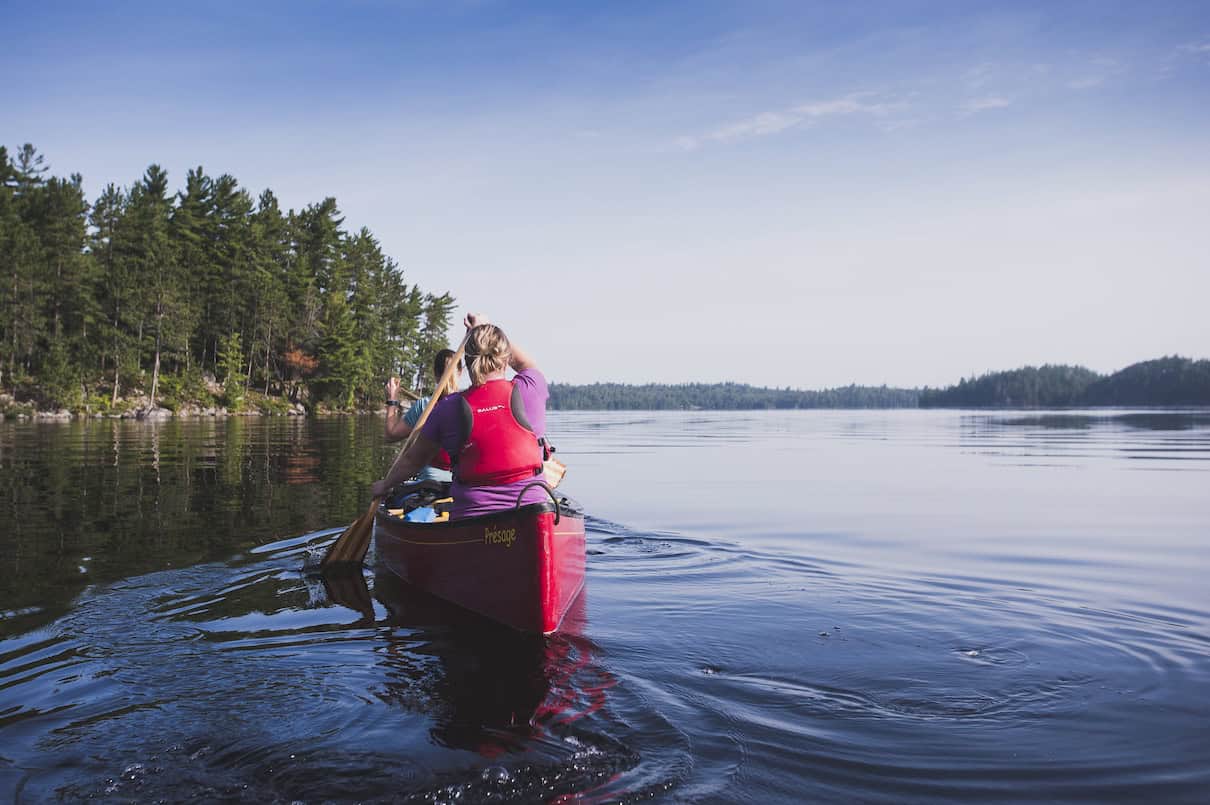
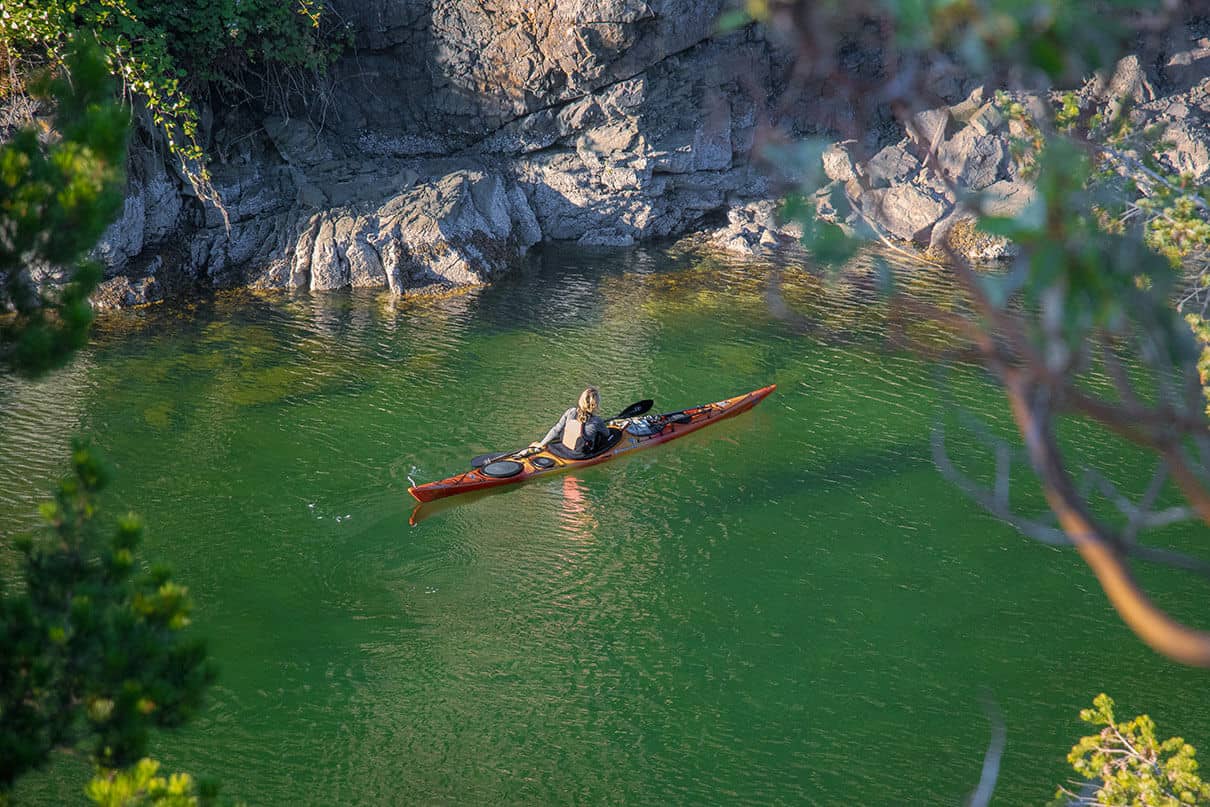
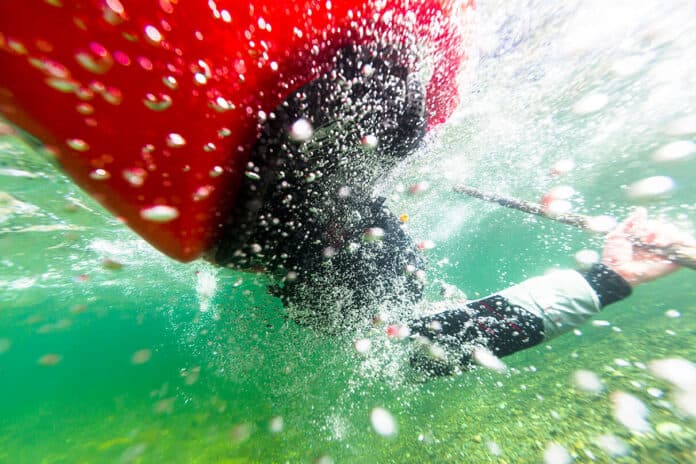
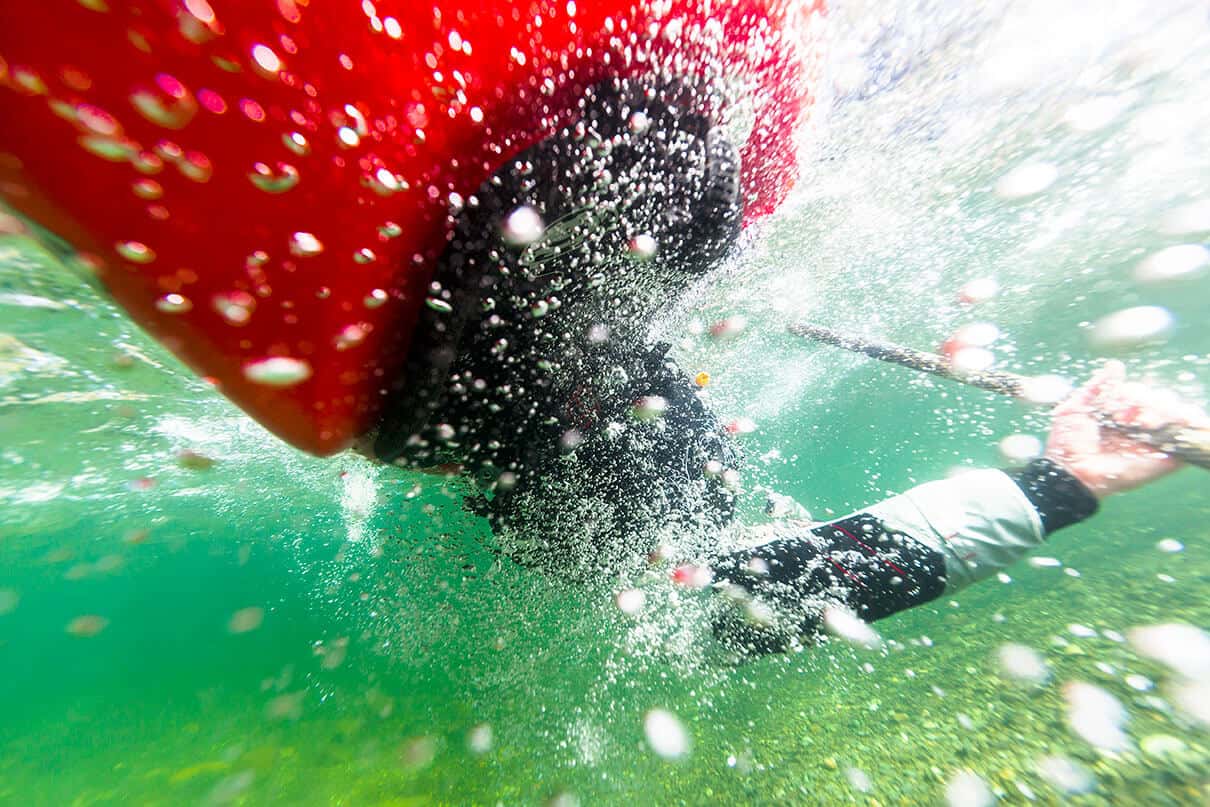
Failure can be instructive. | Feature photo: Boomer Jerritt
When I bought my first kayak, on the West Coast back in the early aughts, I was encouraged to get one of those inflatable paddle floats you stick on your paddle blade as an outrigger if you flip. These reassuring safety devices were everywhere then, spreading the tacit message not to worry, knowing how to roll wasn’t really expected or necessary. I immediately went out in a raging storm to practice with mine and discovered that it was impossible to get back in my kayak and pump it out in rough water without re-capsizing.
Nonetheless, like hikers wearing bells in grizzly country, kayakers would carry these floaty things like a sort of talisman to ward off the fear of flipping. I continued to hang onto mine just in case, but I also resolved that I must develop, per the bro-speak of the kayaking fraternity, a “bombproof roll.” A badge of honor that determines who is a real sea kayaker.
Myth of the bombproof roll
I sort of figured out the roll, but since I was terrified of what would happen if I swam—and had to rely on that infernal paddle float—I always paddled within my limits. And the more I got away with not flipping, the more the fear of swimming loomed in my imagination, the better I got at my panic brace, and the less confident I was to try rolling in real life.
I eventually mustered the courage to try rolling my fully loaded Current Designs Expedition and immediately bobbed back upright before I could even get my hair wet. My friend sat on the shore laughing hysterically. My hull was so crammed full of canned food, fresh water and books for the expedition we were on that it was as unflippable as the toy canoe with the lead keel in the movie Paddle to the Sea. We paddled all the way from Alaska to Victoria, and I can proudly say my roll never failed—but only because it was never put to the test.
Failure can be instructive. | Feature photo: Boomer Jerritt
So, I watched with puzzlement as an online debate blew up about the importance of having a bombproof roll. The debate started when Belgian kayaker Dimitri Vandepoele posted a YouTube video of himself and Hugo Germonpre playing in a tidal rapid at Pointe du Raz, Brittany (paddlingmag.com/0200). Vandepoele paddles and rolls deftly but Germonpre capsizes twice and swims. Vandepoele cooly rescues him—at one point flipping mid-rescue and rolling back up—and the pair carry on.
“What are you guys doing in this situation without a combat roll?” was one of the first comments. A long debate ensued, with a raft of people piling on to assert that “there is no such thing as a bombproof roll.”
I actually did have a bombproof roll once. It was on a Saturday. Playing at the Gales of November gathering on Lake Superior, I was not hit by any aerial bombardment, but I did capsize in heavy surf and break a paddle. I rolled up on my offside with the other blade and surfed back into shore. That was the mic-drop moment of my rolling career. But it was a long time coming. And I never did master the hand roll, or any of those specialized Greenland rolls, like that one where you pass a lit cigarette around the boat as you do it. As a non-smoker, I never saw the point.
I don’t think anyone else seriously believes in the bombproof roll either—except one commenter on Facebook who suggested that the people who don’t have one are just too lazy to practice. But that didn’t stop a flotilla of commenters. The typical post began with a humblebrag about the gnarliness of the writer’s own years of rough water experience, as if to say that if anyone had a bombproof roll, it would be them, so they can attest there is no such thing.
“I settle for a roll that works 95 to 99 percent of the time,” said one.
“My own roll hasn’t failed since 1976,” said another, “but I definitely don’t believe that I’m immune.”
A refreshing comment was from a humble Andrew, who wrote, “My roll isn’t great, so I don’t go out in my sea kayak when it’s ridiculously rough like that. I don’t focus on practicing my roll anyway, as my back is messed up.”
A long debate ensued, with a raft of people piling on to assert that “there is no such thing as a bombproof roll.”
This is how most normal humans approach kayaking—as a fun activity and not an analog for war. Why are we using the words “bombproof” and “combat” anyway? In the future, I propose we leave the bombproof and dynamite rolls to the sushi menu and switch to a more reasonable term suggested by another commenter—“reliable roll.”
The thing is, the original question of what Vandepoele and Germonpre were doing in Brittany without a, ahem, “reliable” roll (and Vandepoele clearly does have one), is clear: they were having fun practicing skills. Rather than being shocked at the pair’s boldness, I was impressed by their competence and humility.
My years of problem-free paddling, the fear that my roll won’t be good enough, and a lack of confidence about what to do if I swim, have grown to keep me from testing my limits. The video reminded me we can transcend such fears, not by being rolling combat heroes but by having a broad repertoire of rescue skills that makes it perfectly okay to swim, just as Germonpre does twice.
With the right safety systems and paddling partners, the scenario in the video is not one to avoid. Paradoxically, it might be exactly where a reliable roll, to whatever extent it’s possible, is most likely to be learned and practiced. But first you have to be comfortable swimming and getting back into your kayak.
“We find self-rescue more important than rolling,” explains Vandepoele. “There’s absolutely no excuse” not to practice it every time you paddle.
That’s exactly what I’m going to do next time I go out—but this time without the paddle float.
Tim Shuff is a former editor of Adventure Kayak magazine.
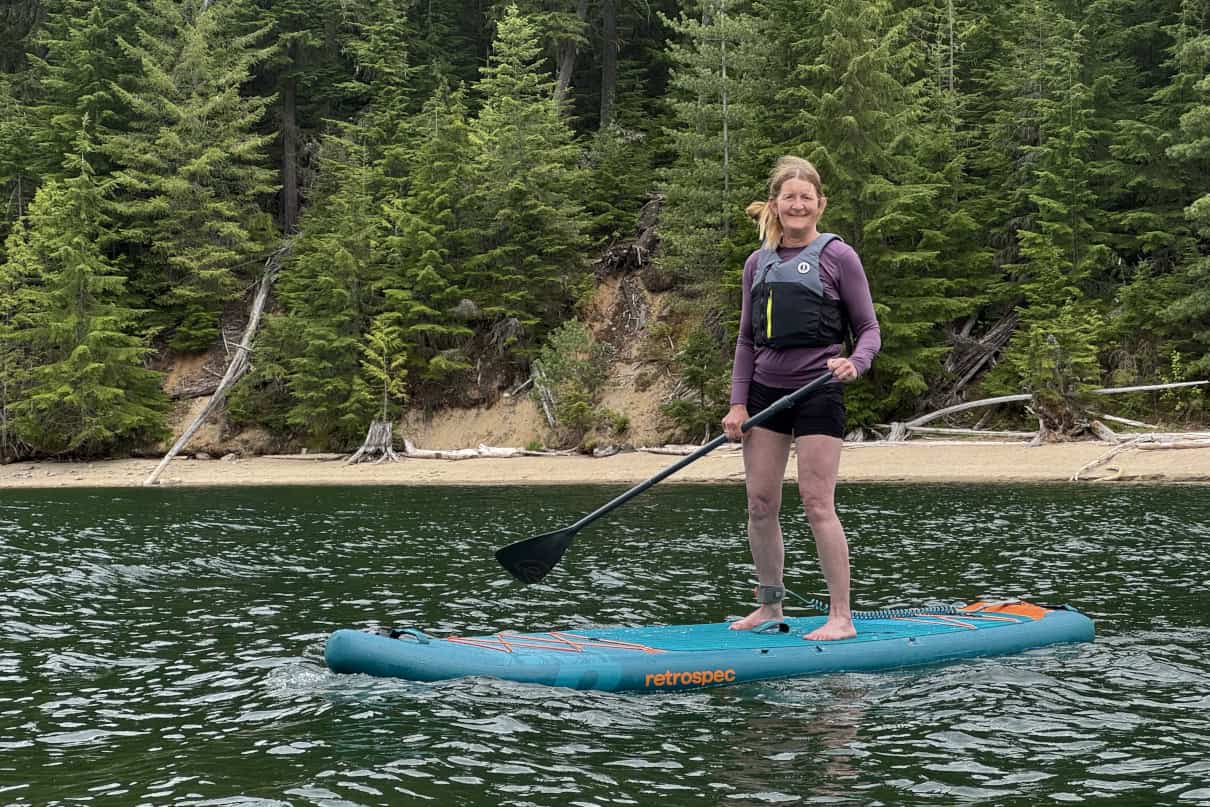
Level 50 PFDs, like the Mustang Podium shown, aren't yet available in North America, but are already being used in other countries. | Image: Cristin Plaice
There’s a glaring statistic in recreational boating: According to the U.S. Coast Guard, in 87 percent of boating-related drownings in 2024, the victim wasn’t wearing a personal flotation device. That number has been consistent within one or two percentage points for decades. Each year, paddlers account for one-quarter to one-third of those drownings.
Even with these hard numbers, it remains an upstream battle for agencies to convince every paddler on the water to wear their PFD. Anecdotally, lack of wearing a PFD appears especially common for activities including standup paddleboarding, flatwater kayaking and kayak fishing, where freedom of movement and even the lifestyle image of these sports has led to cumbersome PFDs being tucked under a bungee. The U.S. Coast Guard and Transport Canada are wagering they can change bad safety habits and dangerous figures with the recent approval of a new class of PFD called Level 50.
What are Level 50 life jackets?
The Mustang Podium 50N is an example of a Level 50 PFD soon available in the U.S. | Image: Cristin Plaice
Level 50 buoyancy aids are just like your traditional PFD, the only major difference being they are meant to provide a lower profile to be more comfortable and entice more paddlers to wear them. That means they have less flotation than your traditional Level 70, Type III or Type V life jackets.
It’s also important to start a conversation around these devices by saying that while the term “life jacket” gets thrown around often, most of the buoyancy devices paddlers use are not technically life jackets, since they are not designed to turn a person face up, regardless of their physical condition. They are instead buoyancy aids, which, along with life jackets, are all forms of personal flotation devices.
As the name hints, Level 50 jackets are performance-rated personal flotation devices that provide at least 50 newtons of buoyancy, which is around 11 pounds of flotation. For comparison, most recreational PFDs for adults are currently rated at 70 newtons or around 16 pounds worth of flotation.
If you’re wondering where something called Level 50 fits into the traditional Coast Guard rating system of Type I, II, III, IV and V, that’s a great question. Whether you’ve noticed or not, the U.S. Coast Guard started integrating the performance-based newton system alongside the established “Type” system back in 2014. The idea is to make selecting a PFD more intuitive and to align U.S. standards with Canada and other countries.
The Level 50 standard was approved and added to the list in 2025. And now the rankings are standardized from a minimum newton performance to a high end in the order of: Level 50, 70, 100, 150, 275.
There is just one other catch with the usage of a Level 50 PFD: with the lower flotation amount built in, a paddler needs to be actively wearing the jacket for it to meet legal carriage requirements. That means if you buy a Level 50, you can’t just bungie it to the deck of your kayak or SUP. You have to wear it.
Where to find a Level 50 buoyancy aid
While Level 50 aids were approved as acceptable flotation by the U.S. Coast Guard back in 2025, no products have been manufactured or tested yet for approval in the U.S. or Canada. However, there are Level 50 PFDs in production for other countries by brands including Mustang Survival, allowing U.S. paddlers to catch a glimpse of what these buoyancy aids look like in use.
Who should wear a Level 50 PFD
If you’re deciding whether a Level 50 PFD is a good option for you, there are a few other factors to consider. First, Level 50 devices are an option recommended for active watersports near shore or in areas where you are comfortable and prepared to self-rescue quickly. For paddlers, this looks like kayaking and canoeing on sheltered waters, SUPing near shore or kayak fishing on similar waters to the previously mentioned.
Also, Level 50 PFDs are recommended only for good swimmers in protected waters, and are not recommended for poor swimmers, non-swimmers, or situations where help is far away.
Even with the approval of these new Level 50 PFDs, paddlers will still ultimately need to decide if these devices or higher flotation PFDs are the right fit for their abilities and the water conditions. The hope, though, from officials and water safety advocates is that with this new classification, more paddlers will find a device they feel comfortable actually wearing on the water.
Level 50 PFDs offer a new buoyancy aid option in North America for good swimmers participating in certain paddlesports. | Image: Cristin Plaice
FAQ – Level 50 life jackets
With the approval of Level 50 PFDs, U.S. paddlers will soon have another option to keep themselves safe on the water. Here’s more info about the latest class of buoyancy aids.
What is a Level 50 life jacket?
A Level 50 buoyancy aid, sometimes called a Level 50 life jacket, is a lower-profile personal flotation device designed for comfort and freedom of movement for certain water activities that meets the U.S. Coast Guard’s new standards.
Do Level 50 PFDs count as my required flotation device on a boat or paddle craft?
Yes, but only if you’re wearing it.
Who are Level 50 PFDs for?
Level 50 PFDs are recommended for good swimmers taking part in paddling activities in protected waters where help is accessible.
Can kids wear Level 50 PFDs?
Yes, children can use Level 50 buoyancy aids, as long as they are also good swimmers and in protected waters.
Are Level 50 life jackets available now?
Not in the United States. Level 50 buoyancy aids are expected to reach U.S. stores in 2027.
Why is it called a Level 50 buoyancy aid?
The name comes from the amount of flotation measured in newtons. A Level 50 PFD has 50 newtons or about 11 pounds of buoyancy. By contrast, many recreational PFDs available currently have 70 newtons or about 16 pounds of flotation.
Is a Level 50 buoyancy aid as safe as a Level 70 life jacket?
Any PFD is only safe if you wear it. A Level 70 has more buoyancy than a Level 50 buoyancy aid, but either provides adequate buoyancy for its intended use by good swimmers in protected waters.
I have a 50-newton life jacket from abroad. Do I need to replace it with a U.S. Coast Guard approved Level 50?
Yes. To comply with U.S. requirements, you must have a U.S. Coast Guard approved flotation device.
Do I need to replace my old Type III life jacket to meet the new Level standards?
If your current life jacket is U.S. Coast Guard approved and in good condition, there is no legal requirement to replace it.
Learn more about the new Level 50 life jacket U.S. Coast Guard standards by visiting the Water Sports Foundation.
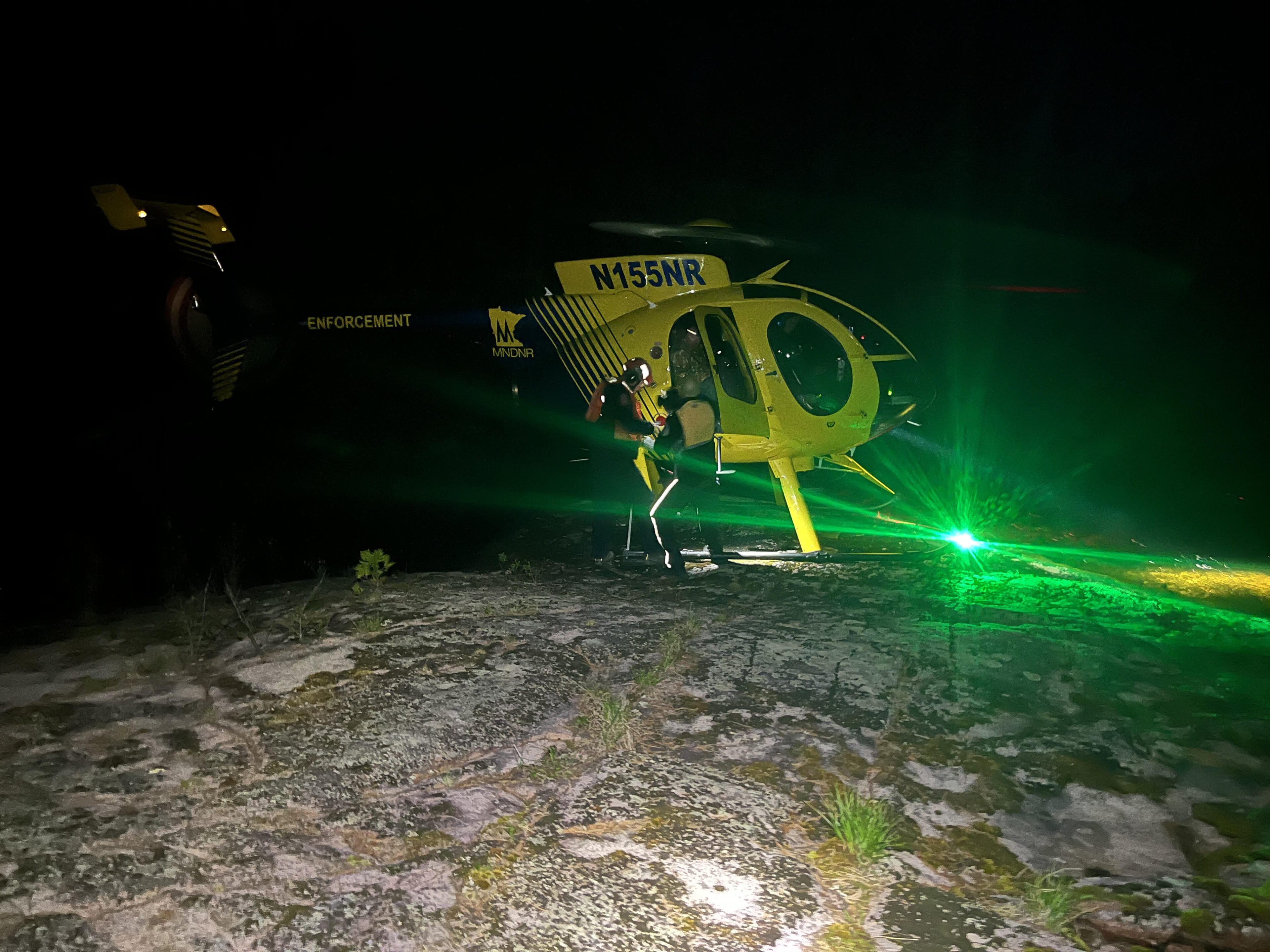
Dramatic video from the Minnesota Air Rescue Team shows a nighttime helicopter mission that extracted a pair of paddlers from the Boundary Waters Canoe Area (BWCA). Rescuers navigated darkness, rain and dense tree cover to reach the pair, who had lost their boat and lacked the gear needed to make it through the night.
First of-its-kind rescue in BWCA
The canoeists had been paddling near Morris Falls on the eastern side of the BWCA when their boat capsized in a rapid on May 14. While they were able to swim to land, they became separated from their canoe, leaving them soaked and stranded. As sunset approached, the paddlers were able to get enough cell service to contact 911.
High water levels and strong currents complicated a ground rescue, and the air rescue team was called in from St. Paul, Minnesota. Using night vision to navigate the wilderness in the dark, the team was able to fly directly to the pair of paddlers.
“We literally drove right to them, which saved us a ton of time,” pilot Dean Grothem said in an interview with KARE 11.
By the time the helicopter reached the paddlers, it was about 10:30 p.m., and they had been waiting in the cold for over three hours. Video shows the helicopter lowering rescuer Steve Merth into the darkness and then bringing the paddlers back up one at a time.
“There’s lights from the helicopter, but there’s tall trees and stuff. It can be kind of a sensory overload,” Merth told KARE 11.
The rescue was the crew’s first nighttime mission using a hoist system, which had been installed on the helicopter last year. Rescuers say it allows them to reach hard-to-access locations without having to wait for daylight, saving valuable time in high-risk situations.
“They were wet. It was colder that night, and the temperatures I think were forecast to get down into the low forties, if not lower. So the first thing you start to think about there is hypothermia, and are they going to get through the night if someone doesn’t get down there to them?” Grothem said in an interview with Northern News Now.
Cell service and starting a fire contributed to survival
While wet and cold, the paddlers were ultimately uninjured and were flown safely to Ely, Minn. In an interview with FOX 9, Merth said the pair was out on a day trip and had not planned to spend the night in the wilderness. The incident highlights the importance of bringing extra gear and an emergency kit on day trips in case of emergency. Merth says paddlers should always be prepared to spend longer than expected in the backcountry.
“Make sure you have the stuff—flashlights, a way to start a fire—so that if your original plan doesn’t go well, then you have that stuff with you. And then have a way to communicate,” Merth told FOX 9.
The stranded canoeists were able to get a text out to 911, but much of the BWCA does not have cell service. Merth encourages paddlers visiting remote areas to bring an additional communication device, such as a satellite messenger.
Rescuers praise the canoeists for starting a fire as they waited. In addition to helping them stay warm, the fire helped the helicopter locate the paddlers in the dark. If stranded, any light you have—a fire, a flashlight or even a phone camera—can help first responders locate you faster.
“They did a good job moving to where we could get to them and then having their lights and fire to bring us right in,” Merth shared.
Some lessons are sharp. | Feature photo: Mark Sundin
I read the prediction on a calm night two weeks into a trip tracing the Canadian shoreline of Lake Superior. We were sitting on a nameless cobble beach, watching the sunset and boiling water for tea. I pulled out a tea bag and read the tiny typed quote dangling at the end of the string: One thorn of experience is worth a whole wilderness of warning.
Why survival stories make us better paddlers
Unusually ominous for a brand called Nature’s Blessings, I thought. Typically, the fortunes were poetic lines about flowers and trees. I quickly forgot about it.
Two days later, we slipped onto the lake before a clear dawn. We were determined to make up miles after a day stuck windbound. But as the sun cleared the horizon, yesterday’s steamy tailwind returned, and the big friendly swells gained energy. Whitecaps appeared. The following sea was building fast, and we had to paddle farther and farther offshore to avoid waves crashing on hidden shoals. There was no turning back, and safe harbor was still miles away.
It wasn’t until we reached a sheltered bay—rattled, exhausted, jubilant—that I remembered the fortune-telling tea bag.
Some lessons are sharp. | Feature photo: Mark Sundin
The thorn was an effective teacher about how quickly conditions can turn. Fortunately, it’s not the only way to learn. Humans have always relied on stories—whether around campfires or in magazines—to pass along lessons about risk, judgment and wild places. In his book The Storytelling Animal, Jonathan Gottschall calls stories flight simulators for the mind because they offer a safe rehearsal of danger and decision-making.
Neuroscientists have found that when we listen to a story, our brains begin to mirror the teller’s. Research by Princeton University’s Uri Hasson shows that, when listening to a story in an MRI, our brains light up in the same regions as if we were living the moment ourselves. Stories activate the listener’s sensory and motor cortexes, simulating that movement. When a paddler describes a swim after capsizing, the rising pitch of wind or the peace of a loon call at sunset, we do more than imagine it, our brains start to simulate it.
When we’re listening to a good story—emotive, relatable, detailed—we tend to imagine ourselves in the same situation. Maybe this explains why humans tell so many stories about hard things. These stories aren’t just entertainment. They’re simulating struggle, decision-making and perseverance. They warn us about what to avoid and, equally important, how to endure. If that’s true, stories don’t just entertain us; they are survival tools.
The pages ahead offer a whole collection of tools and firsthand experiences. You’ll find stories of close calls, courage and comebacks woven throughout the book, from kayakers who rescue a family after their car plunges into a river (page 63) to the revival of an almost-lost form of canoe building (page 23) to some of the most basic tools you need to stay safe on the water (page 101). And on page 78, you’ll meet four paddlers whose resilience brought them through their hardest moments. You’ll also notice a refreshed magazine structure designed to bring you more of what you love, while keeping the same even spread of canoe tripping, kayak touring and whitewater.
The thorn of experience may be worth a wilderness of warning. Stories, thankfully, let us borrow a few of those thorns from each other.
Kaydi Pyette is the editor-in-chief of Paddling Magazine.
Iranian coastline near the Strait of Hormuz. | Feature photo: Alamy
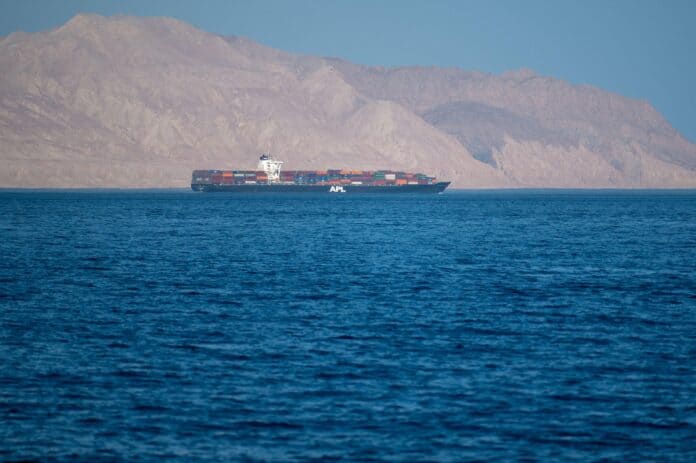
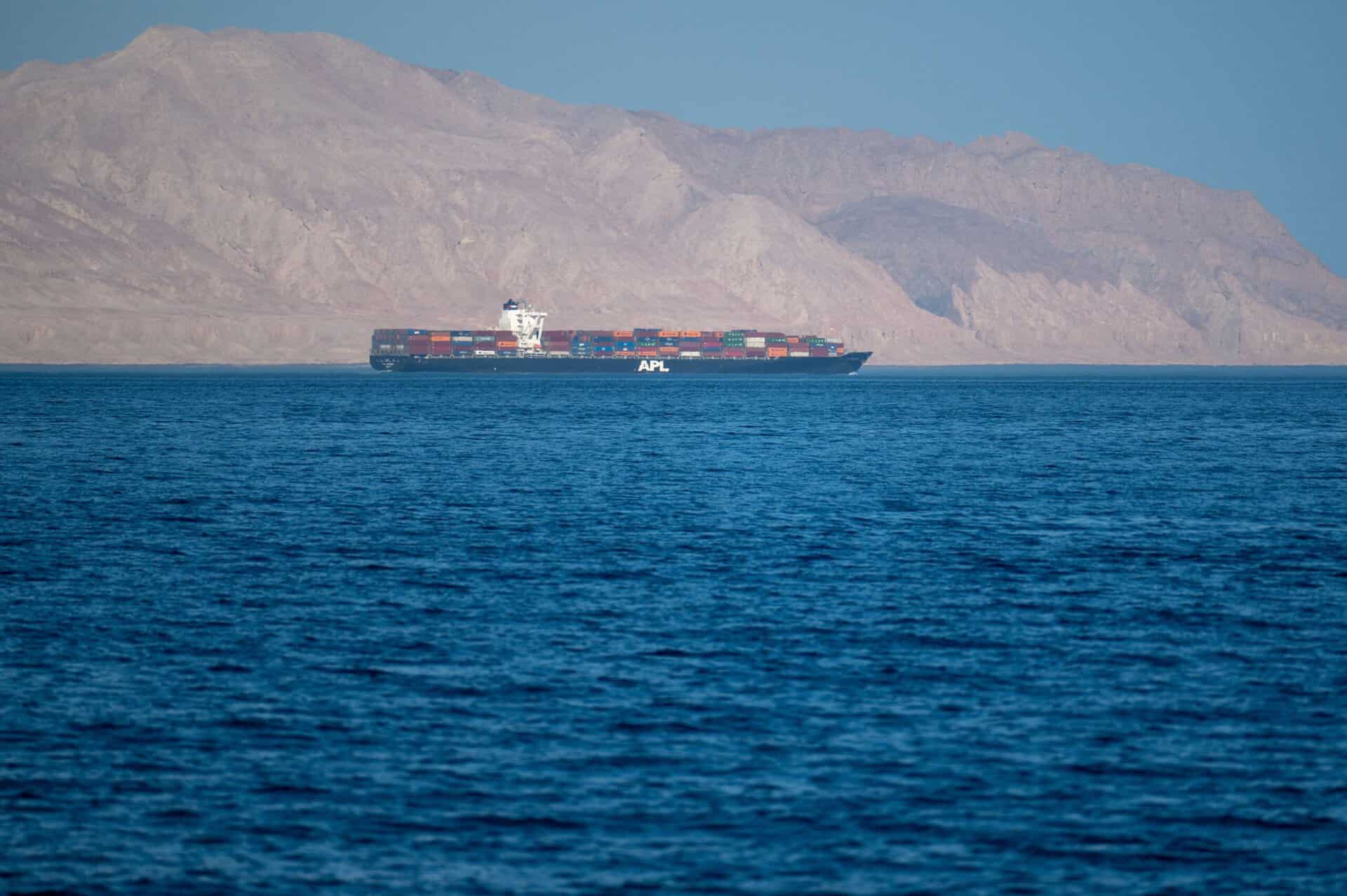
The closure of the Strait of Hormuz due to the U.S. and Israeli war with Iran is causing effects far beyond the fuel pump. For the paddlesports industry, the disruption of the strategic waterway has triggered a sharp spike in the cost of the plastics vital to modern kayak manufacturing.
From rotomolded polyethylene and thermoformed ABS hulls to composite sea kayaks, drop-stitch SUPs and inflatable rafts, nearly every component in a modern paddlecraft starts with petrochemicals. Even the deck bungies are made from oil. More than 40 percent of global polyethylene exports originate in the Middle East, and Reuters reports that 84 percent of that capacity is currently bottlenecked behind the Strait of Hormuz, the narrow seaway linking the Persian Gulf to the rest of the world.
On Friday, U.S. President Donald Trump teased on social media a “final determination” about a proposed cease-fire extension that he said would reopen the strait. After meeting with advisors for two hours on Friday afternoon however, the President emerged without making a decision. Trump has repeatedly promised that a deal to open the strait is near, only for talks with the Iranians to fall through. Efforts at diplomacy came under new strain Monday, as Israel and Iran threatened to escalate military action in Iran and Lebanon.
Listen to Jeff Moag’s interview with Rob Handfield, Professor of Supply Chain Management at North Carolina State University
Materials costs for U.S.-based kayak manufacturers have surged as much as 35 percent as a result of the blockade, while European and Asian producers have in many cases been hit even harder. Most of the plastics precursors that exit the Strait are bound for Asia and Europe. China and other Asian industrial juggernauts rely heavily on oil and chemical shipments flowing through the narrow waterway, in stark contrast to U.S. producers who source most of their ethylene feedstock domestically.
Still, that hasn’t stopped U.S. producers from raising prices.
From a baseline of about 60 cents per pound when the Iran conflict began on February 28, 2026, North American polyethylene contracts increased by about 10 cents a pound in March, then shot up another 30 cents in April. These increases were mostly the result of producers using the Hormuz crisis to grow their margins, said Michael Workman, executive director at ResinSmart, a buyer-side resin market intelligence platform.
Producers planned another 20-cent increase for May, but buyers pushed back. “The cost justification for further increases isn’t there,” Workman said on May 28. “This market is starting to turn.”
Iranian coastline near the Strait of Hormuz. Photo: Alamy
The Rising Cost Of Uncertainty
Most U.S. kayak manufacturers source their polyethylene from the same two companies. Even though some paddlesports companies have developed proprietary formulas the underlying chemicals—and thus the cost—are similar for everyone in the domestic market. Since Iran first closed the Strait in early March, U.S. companies are paying higher prices across the board, although companies that produce large volumes of entry-level kayaks in addition to higher-end boats can leverage slightly better prices.
“Plastic weight is in the mid-30-pound range for a whitewater boat to 90 pounds for a fishing kayak. We’re spending up to $68 per boat just on powder,” said an executive at a leading U.S. kayak manufacturer who asked for anonymity to discuss pricing.
The problem extends far beyond kayak hulls themselves. Virtually every material in the paddlesports industry is touched by petroleum markets.
“The interconnected nature of energy and manufacturing is becoming increasingly visible,” said David Blue of NRS. “Plastics such as nylon, polyester, PVC and TPU are all made using petroleum. Rubber compounds used in our raft materials also use petroleum.” Even products not directly derived from oil remain vulnerable because of rising energy costs throughout global manufacturing.
“The rising cost of heat and energy production creates a significant trickle-down effect, even for our non-petroleum materials like neoprene,” Blue said.
The impact has been especially severe for European manufacturers that have faced elevated energy costs since Russia invaded Ukraine four years ago. Rotomolded kayak production depends heavily on gas-fired molds, and natural gas from Russia has been under sanction for four years. Middle Eastern suppliers were filling that gap, until the Iran closed the Strait in March, causing U.K. natural gas prices to surge 93 percent.
In addition to energy, transport and materials cost increases, European exporters also must contend with volatile U.S. tariff policy. That adds another layer of cost and uncertainty.
“The first tariffs were ruled illegal,” said Chris Hipgrave, U.S. Sales Director for Pyranha, which makes whitewater and sea kayaks in the United Kingdom. “We’re still waiting for our refund check, and the second set of tariffs has already come in.”
Currency vs. Costs
Asian polyethylene costs shot up 30 to 40 percent after the strait closed in early March, but those increases have not impacted North American importers to nearly the same degree. One U.S.-based kayak importer told Paddling Business that his suppliers have increased prices only 8 to 10 percent, and they tell him the increase has more to do with the Chinese yuan’s rising value relative to the U.S. dollar than the cost of inputs.
“They all want orders,” explained the U.S. importer, who asked not to be identified when discussing pricing. “Chinese factories are well under capacity now. I would imagine the pressures in the U.S. are different. I don’t think anyone can build a polyethylene pellet factory in under a decade, so the American suppliers don’t fear upstart competition.”
Workman, the plastics pricing expert, breaks down the currency dynamic in more detail.
“The 8-10 percent price increase framing is almost entirely a currency story, not a cost story,” he said. “A U.S. buyer paying in dollars is absorbing a foreign exchange surcharge dressed up as a resin price increase.” In other words, Chinese polyethylene producers aren’t raising prices in yuan terms; they’re passing through U.S. dollar depreciation to keep their own margins intact when they’re invoiced in dollars.
Because U.S. plastics producers are getting most of their feedstock from West Texas, and their counterparts in Asia get theirs from the Persian Gulf, American producers have a structural cost advantage of 10 to 20 cents per pound in normal conditions. That gap widens when crude oil and naphtha prices are elevated as they are now. The Strait disruption adds a layer of logistical costs and uncertainty to that mix.
Based on those fundamentals, American kayak manufacturers should gain a cost advantage due to the Strait closure. But as U.S. war planners have learned in the last 90 days, cause and effect are not always as simple as they appear. Chinese plastics suppliers are willing to endure short-term losses for market share, while their American and European counterparts have chosen to take profits when they can.
Holding The Line
Kayak manufacturers are absorbing as much pain as possible while hoping global shipping routes stabilize before preseason ordering begins this fall. Whether brands can continue shielding consumers from rising raw material costs remains an open question. Some are already losing money on every boat that leaves the factory.
The longer the Strait crisis continues, the more pressure North American paddlesports manufacturers will face to raise costs. Even if the Strait opens today, the hangover will last for months. Even then, there’s no guarantee prices will return to pre-war levels. “Plastic companies tell us they expect prices to go down in six to eight months,” said an executive at a leading U.S. kayak molder, who requested anonymity to discuss business fundamentals. “I don’t believe that for a second. After Covid, prices never reset.”
Producers have always been skilled at using geopolitical headlines to build pricing momentum even when supply-demand data doesn’t fully support it, Workman said. His advice: “Ask for the data behind every increase request.”
For kayak manufacturers, uncertainty itself may be the most difficult challenge. Like whitewater boaters pushed off their line, brands can only react and hope for the best. “Rather than planning a season out, we’re planning a month out,” Hipgrave said. “You just don’t know what the news headlines are going to do.”
Indeed, the closure of the Strait of Hormuz is only the latest dip on a rollercoaster ride that in the last six years has included increased tariffs, a Covid bust and boom, the Ukraine war, more tariffs and now the Iran conflict.
“Everyone I talk to is on the same page,” Hipgrave said. “We’re like, good Lord, when is this going to end? And what the hell is 2027 going to look like?”
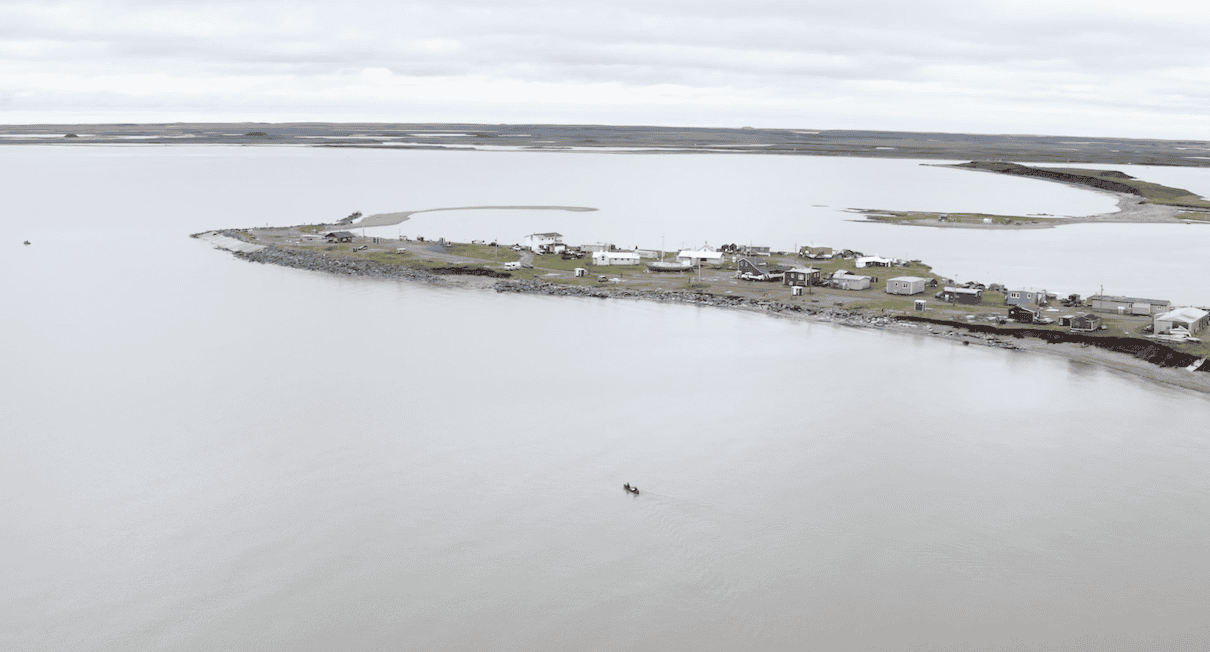
A journey of a thousand miles begins with a single step—or, in this case, a single paddle stroke. Niki Choo and Jared Gentz took the first paddle stroke of their 1,000-mile journey on the Pacific Ocean near Haines, Alaska. Three months later, they dipped their paddles in the Arctic Ocean and pulled their canoe ashore in Tuktoyaktuk, Northwest Territories. Along the way they were met with logjams, upstream travel, a two-day portage, stormy weather, and more challenges that tested their relationship and themselves, and at many points had them wondering whether they’d complete their mission.
The story of this incredible feat is told in the film 1,000 Miles to Tuk, directed by Whitney Hassett, which is touring in the 2026 Paddling Film Festival. The Paddling Film Festival review panel selected the film in the fall of 2025, and were impressed by the couple’s tenacity, honesty and skillfulness in threading together waterways that accomplished their goal of traveling from the Pacific to the Arctic Ocean—so much so that the panel awarded the film Best Canoeing Film, sponsored by Esquif.
In February 2026, Niki Choo was killed in an avalanche while backcountry ski guiding in California’s Sierra Nevada. She was 42. The tragedy turns a remarkable story into a tribute to Choo’s adventurous spirit and love for wild places. The Paddling Film Festival extends condolences to her family and loved ones.
In hindsight, the conversations around measuring risk, which is a major theme in the film, feel especially poignant. Risk was something Choo and Gentz thought about constantly. Their main fear heading into the trip was something happening to the other.
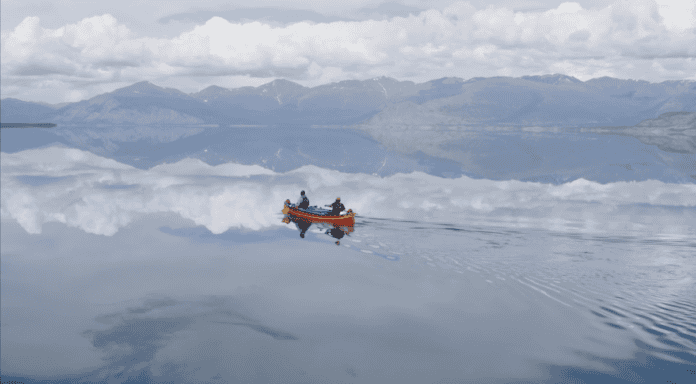
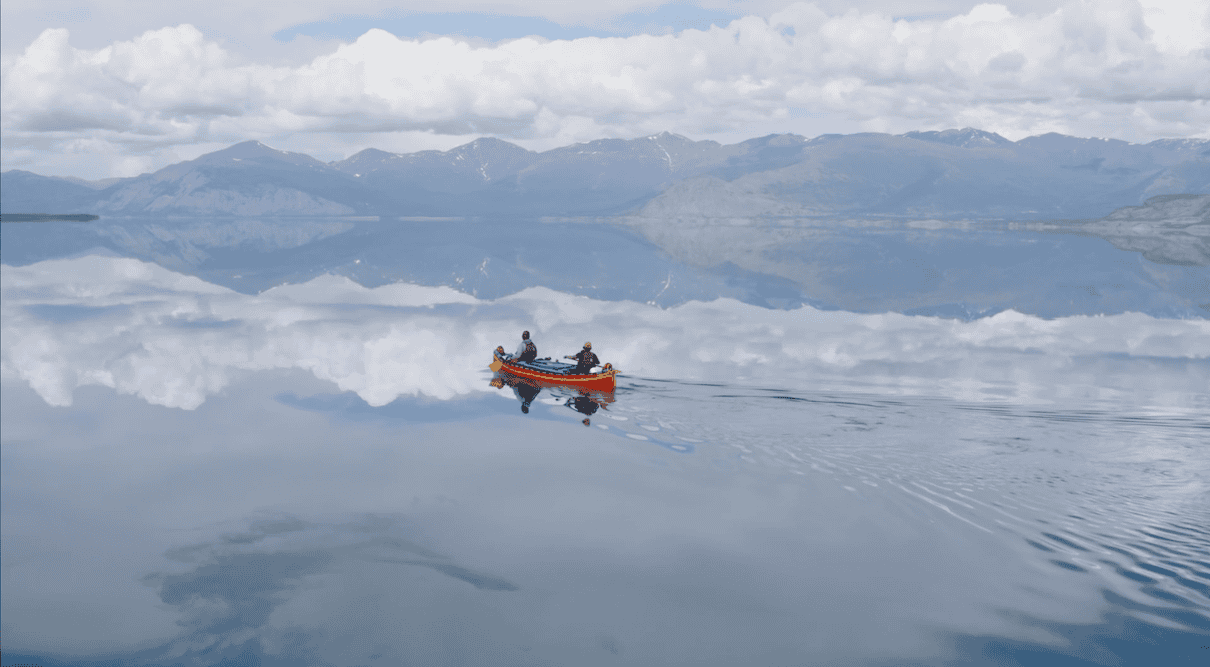
The pair lucked out with glass-like conditions when crossing Lake Kluane. | Feature photo: Courtesy 1,000 Miles to Tuk
“I worry about something happening to Niki and having to manage that on my own if she were sick or injured,” says Gentz in the film.
Choo was a highly accomplished adventurer, dabbling in everything from ski touring and climbing to mountain biking and whitewater paddling. She began whitewater kayaking at age 14, on the Ottawa River in Canada.
“Whitewater has a different smell and being out there with the trees and the birds, the water just drew me in like nothing else I had done before,” she told PackitGourmet in an interview. “I had loved canoe tripping at summer camp and being on the Ottawa River where I learned most of the whitewater skills reminded me of tripping… and I think during those first few summers guiding is when I began to think of doing a trip like this.”
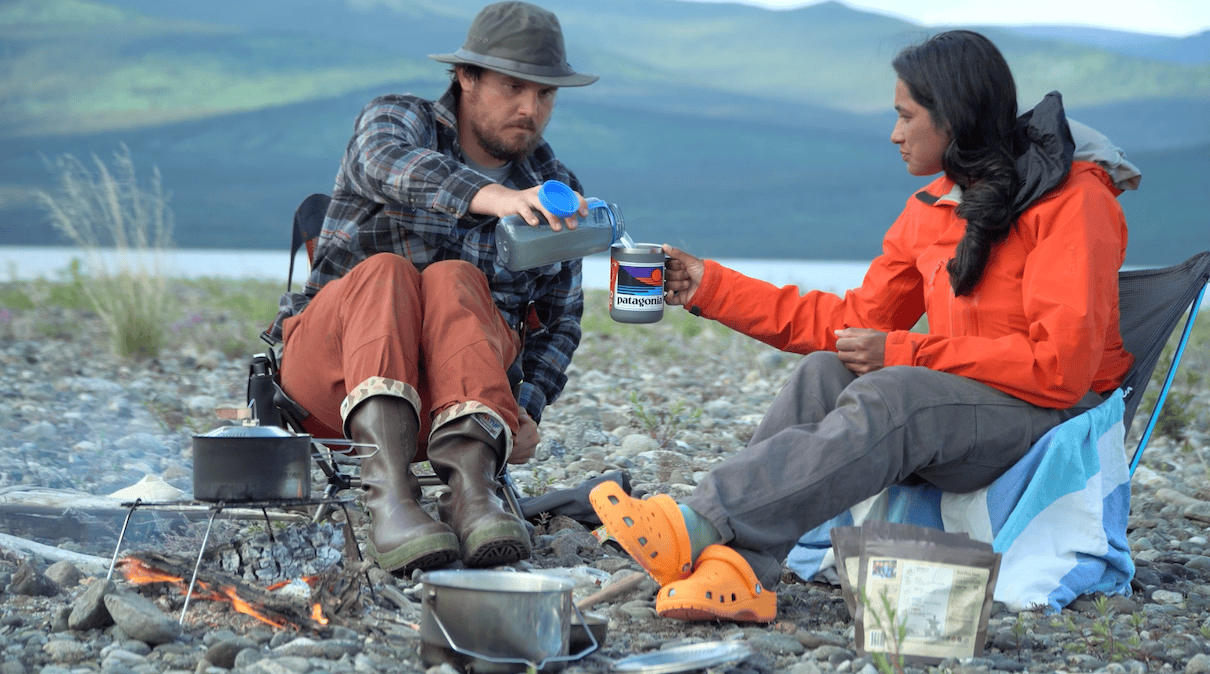
Jared Gentz (left) and Niki Choo (right). | Photo: Courtesy 1,000 Miles to Tuk
But Gentz was the first person she’d met who she could envision herself doing a big trip with. Before meeting Choo, he’d never done any whitewater paddling.
Planning for the trip took two years. Their boat of choice for the expedition was an Esquif Prospecteur 17. The trip began by paddling on the Pacific Ocean and up the Chilkat River to Haines, Alaska. They originally planned to ski from Haines to Kluane Lake, Yukon, where they’d begin paddling again. However a delayed start meant there wasn’t enough snow, so they pivoted to cycling the 200 miles.
“I know you have all the grit in the world to do this, but be cautious, right?” says Choo’s father in a phone call to Choo in the film. “And then you see it through to the end.”
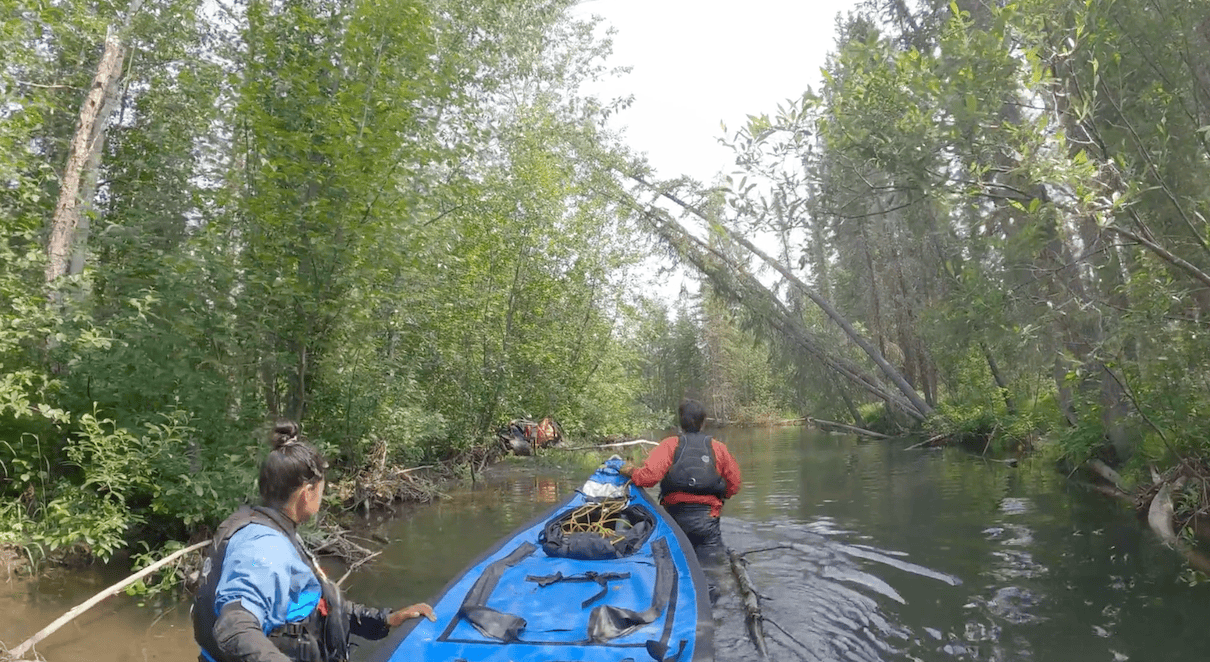
They were met with challenges almost right away, with high volumes of water pushing into strainers and logjams on the Donjek, and then on the White and Yukon rivers as well.
“I felt like we had to be on our game the entire time,” Choo told Caltopo’s Blog. “Those first few rivers were fast and furious, cold and rainy. Most days we were pulled off the river for a few hours because of thunder and lightning.”
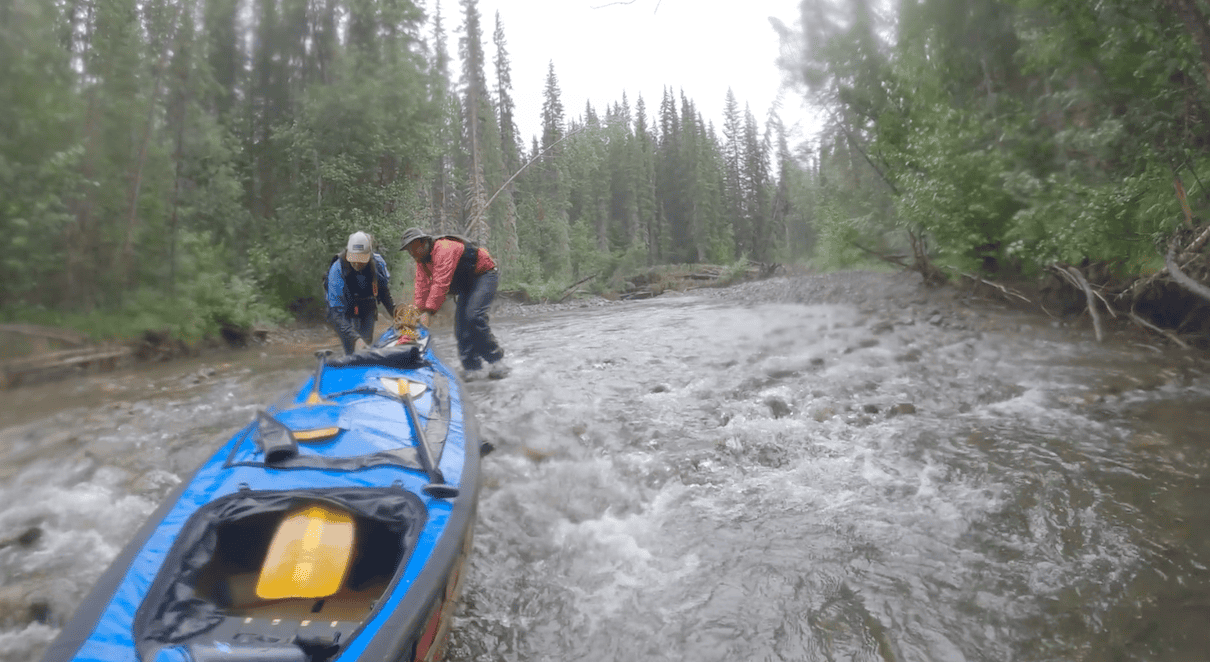
The biggest struggle of the trip happened while upstreaming on the Chandindu River. The river was moving faster than they expected, and they were met with hazards that also made progress slow. Choo and Gentz grappled for days about whether they should turn around due to the dangers and potential for running out of food. Gentz thought they should turn around.
They were met with many obstacles while traveling up the Chandindu.
Photos: Courtesy 1,000 Miles to Tuk
“I wanted to keep going,” says Choo in the film. “And we had difficult conversations and argued about it. And then I kind of realized, if he’s really not doing well, it puts us both at risk.”
They backtracked and made a new plan to upstream the Blackstone River instead.This proved to be much more feasible and they were able to continue on, reaching Seela Pass and then heading downstream on the Blackstone and onto the Peel and Mackenzie rivers.
The going still wasn’t easy. They had to line class IV rapids, complete a two-day portage around Aberdeen Canyon and sleep in wet gear after their campsite almost flooded. But after three months of travel, they finally reached Tuktoyaktuk, Northwest Territories, on the Arctic Ocean.
Choo and Gentz had navigated the risks of the journey and come out the other side.
Choo and Gentz arriving in Tuk. | Photo: Courtesy 1,000 Miles to Tuk
“It’s nice to know that the person you’re with shares a little bit of the same passions you do, even if you want to experience them slightly differently,” says Choo in the film. “I think that will always bind us together. All the things that build good relationships are a little bit amplified now in terms of the trust that we have with each other, the humor, the playfulness, the willingness to go through hard things together. All of those things are a little bit more full.”
Those who watch the film are sure to be inspired by the determination of Choo and Gentz, and will be touched by the way in which it acts as a fitting tribute to Choo’s adventurous approach to life and its challenges.
Just across the Ottawa River lies a sprawling labyrinth of deep bays, wild islands, hidden passages, interconnected lakes and spectacular whitewater. Scenic and unspoiled, Québec’s Kipawa region in Abitibi-Témiscamingue offers something for every level of paddling adventure. Explore the peaceful island archipelagos of Lake Kipawa for a relaxing weekend of canoe camping and fishing, or venture deeper into wilderness waterways for a descent of the rugged Kipawa River.
The name Kipawa comes from an Algonquian word meaning “at the narrows beyond which more water opens out,” describing the countless closed-off channels that form the many arms, reaches and bays of Lake Kipawa. The watershed drained by the Kipawa River encompasses close to 6,000 square kilometers of mostly untouched forest and small lakes, much of it within Québec’s largest managed outdoor recreation zone, ZEC Kipawa. Both the lake and river are known for exceptional camping, fishing, canoeing and kayaking with Opemican National Park and the welcoming villages of Kipawa and Laniel providing access and services.
Whether you enjoy portage-free paddling, intimate lake-to-lake journeys, or navigating rapids on a thrilling wilderness river, this guide will help you discover the best Kipawa canoe routes.
There are endless opportunities for exploring on sprawling Lake Kipawa. | Featured image: Courtesy Abitibi-Témiscamingue
Where is the Kipawa region?
The Kipawa region is situated within the Abitibi-Témiscamingue region in western Québec, just east of the Ottawa River, Lake Temiskaming and the Ontario border. The gateway towns of Laniel, which serves the northern end of Lake Kipawa, and Kipawa—on the lake’s south end—are less than a five-hour drive from Toronto and just over an hour’s drive from North Bay. Both communities are readily accessible from Highway 101 and are popular destinations for cottaging on area lakes and outdoor adventure opportunities in Opemican National Park, which lies midway between, 25 minutes south of Laniel and 30 minutes north of Kipawa.
The wider Abitibi-Temiscamingue area is known for its incredible outdoor adventure opportunities, from hiking and paddling to skiing and snowshoeing.
Where to canoe trip
Lake Kipawa canoe camping
With deep, clear waters covering over 300 square kilometers of rocky Canadian Shield and mature red and white pine forest, Lake Kipawa is a paddler’s paradise comparable to the iconic Ontario canoe country of Lake Temagami, which lies less than 70 kilometers west as the crow flies. Both lakes are roughly 50 kilometers long with sprawling, irregular shapes concealing quiet bays and forgotten islands splintering off in all directions.
Nearly 50 percent larger than its famed neighbor, Lake Kipawa boasts over 1,300 kilometers of shoreline with minimal boat traffic, fishing lodges or cottages interrupting the wilderness. Countless islands, passages and breathtaking cliffs give the impression of interconnected rivers and narrow lakes. Red pine giants, some over three centuries old, line the lake in several places and sugar maples create a crimson spectacle in autumn. Bald eagles and osprey soar overhead, while the haunting cry of the loon accompanies still mornings and evenings.
Lake Kipawa’s waters reach a maximum depth of 40 meters, with an average depth of 11.5 meters, and remain chilly throughout the summer. The lake and its ancient canoe routes are located on the Anishinaabeg ancestral territory of Hunter’s Point; both are deeply intertwined with the early fur trade era and traditional Algonquin ways of life.
Many of Lake Kipawa’s campsites are on Crown land. | Photo: Hugo Lacroix
Canoe routes
Lake Kipawa canoe routes include portage-free touring and camping on the lake’s maze of arms and islands or portaging into smaller surrounding lakes for a peaceful backcountry experience. With so much water to explore, routes range from easy two- or three-day loops to longer forays of 100 kilometers or more.
Opemican Archipelago Paddling Trail
For a scenic introduction to this vast lake, the Opemican Archipelago Paddling Trail visits deep-water bays, beautiful cliffs, uncrowded beaches and comfortable island campsites within Opemican National Park in Lake Kipawa’s north end. Launch from Laniel Municipal Park (free parking) or the national park’s Baie-Dorval access (recommended, entry fee applies) for this +25-kilometer “lollipop” loop. Three scenic island and sand beach campsites in the Île aux Fraises area can be reserved through Opemican National Park.
Opemican Crescent Paddling Trail
For a longer one-way (or out-and-back) journey, extend the above route into the Opemican Crescent Paddling Trail (33 km). Connecting the national park’s Baie-Dorval and Lac Ravalet access points, canoeists on this route enjoy paddling in the archipelago, nosing through narrow channels stalked by herons and cranes, and wild camping on the open lake before finishing with a tranquil paddle-and-portage journey along several small interior lakes.
Kipawa Archipelago Paddling Trail
More experienced paddlers can choose from two longer routes or link them for a journey of a week or more spanning much of the lake. The Kipawa Archipelago Paddling Trail arcs through the northern part of the lake for 64 kilometers, with just a six-kilometer shuttle ride on a gravel road separating the starting point from your finish in Laniel. Departing from Deux Milles Bay, enjoy remote beaches, secluded campsites and the old-growth pine forests of McKenzie Island.
Dramatic cliff-lined channels offer pulse-quickening jumping rocks and hint at the region’s active tectonic past. Lake Kipawa lies along the Grenville Front, where two sections of Earth’s crust meet, creating spectacular faults and occasional seismic activity like the 2000 Kipawa earthquake. Make a detour into Canal Bay to witness this narrow pass edged by steep granite walls; an opening at the end reveals an idyllic island campsite nestled within the heart of the mighty lake.
Kipawa Southeast Paddling Trail
As its name suggests, the Kipawa Southeast Paddling Trail departs from Chutes-du-Pin-Rouge, where the Upper Kipawa River flows into Lake Kipawa, and meanders for 55 kilometers through the southern part of the lake, finishing in the village of Kipawa. The route squeezes through some of the lake’s most intimate passages, connecting a series of scenic island campsites and beautiful sandy beaches. Free parking is available at both ends, or arrange a shuttle for a one-way trip.
Stay within Opemican National Park for more campsite amenities. | Photo: Christian Leduc
Campsites
Campsites are largely Crown land wild camping (free for Canadian citizens) with a handful of paid canoe campsites reservable through Opemican National Park. Expect basic amenities like a fire ring, cleared tent pads and occasionally a picnic table among the pines at Crown land sites, which are generally unmarked but easy to spot. National park sites feature outhouses and picnic tables and are marked with camping signs.
Reservations
Canoe camping reservations for Opemican National Park cannot be booked online and must be made over the phone by calling Sépaq at 1-800-665-6527, or the park at 819-627-3551. National park campsites are available from mid-June to mid-October.
Outfitters
Contact a local Lake Kipawa outfitter for canoe, kayak, paddleboard and camping equipment rentals. Coop de L’Arriere-Pays (The Backcountry Co-op) in Ville-Marie rents equipment and offers a convenient shuttle service to simplify transportation logistics or relocate your vehicle so it’s waiting for you at the end of a linear trip. Reservations are required.
Located in Temiskaming, Québec, near the south end of the lake, Algonquin Canoe Company maintains and outfits over 500 kilometers of traditional Algonquin canoe routes in the Ottawa River basin. Owned by Wolf Lake First Nation, the outfitter rents canoes, kayaks and camping equipment, offers accommodations and guided tours, and can assist with route planning.
For trips departing from Opemican National Park, Lake Kipawa canoe rental is available at Baie Dorval. Canoe rental includes paddles, PFDs and safety gear. Visit the Sépaq Visitor Centre in Laniel for rental information. Booking in advance is recommended and can be done at the same time as your camping reservation, by phone at 819-627-3551 (June through October).
It doesn’t get more magical than this. | Photo: Christian Leduc
Fishing
Lake Kipawa fishing is regarded as among the best in Canada, famed for trophy walleye, northern pike, lake trout and smallmouth bass. All anglers must carry a valid fishing license and follow local fishing regulations. In addition, canoe campers who wish to fish on the smaller lakes within Opemican National Park must pay a daily right-of-access fee ($22/person/day); book online or call 1-800 665-6527.
You can download the GPS track for each of the four paddling trails outlined above from the Access to Outdoors | Abitibi-Témiscamingue website in GPX (GPS) file formats. Each track includes the paddling route, distances, campsites, portages and notable points of interest. You can also download a printable PDF map set and route guide for the Kipawa Archipelago Paddling Trail.
For supplementary navigation on trip, it’s recommended you purchase the 1:50,000 Canadian national topographic series maps for the region: 31 M/03 Fabre, 31 L/14 Ottertail Creek and 31 L/15 Lac Grindstone. These can be ordered from Maptown or World of Maps.
Safety notes
Keep in mind it’s easy to get disoriented while navigating this immense body of water. Paddlers should carry a detailed Lake Kipawa map, compass and GPS with extra batteries—and feel comfortable using these tools to navigate. Because of the lake’s size, dangerous waves can form in windy conditions. Some route sections run along steep rock walls where chaotic reflection waves can form and no landing is possible. Check the forecast and exercise caution when there’s wind.
Lake Kipawa power boat traffic is generally concentrated within a few kilometers of villages (where you’ll also see the most cottages and Lake Kipawa fishing lodges) and to marked deep-water channels. Watch for boat wakes and stay close to shore when possible.
Find whitewater fun on the Kipawa River. | Photo: Hugo Lacroix
Kipawa River canoe camping
Renowned for its rugged scenery and exciting rapids, whitewater canoe tripping on the Kipawa River rivals popular Ontario rivers like the Spanish, French and Madawaska. Cascading over Precambrian bedrock and dashing beneath towering pines, the Kipawa River flows over 300 kilometers from its headwaters at Lake Dumoine to its precipitous final descent into the Ottawa River.
Along the way, the river meanders through remote forest and lakes, charges over spectacular waterfalls, and vanishes into the vast reservoir of Lake Kipawa, before reemerging for a rowdy, rapid-choked finale.
Most Kipawa River canoe trips take place on the upper section of the river, with the 40-kilometer route from Lac des Loups (Wolf Lake) to Lake Charette offering a perfect, four-day whitewater adventure for intermediate paddlers. The route begins in ZEC Kipawa and travels south, with straightforward road access to both ends and well-developed camping and portages along its length.
A dozen class I-III rapids challenge canoeists; portages at the more technical rapids mean this route is also suitable for more novice moving water paddlers. Camping beside the thundering ledges of Turner Falls is a Kipawa River highlight. On your last day, enjoy the natural sandy Kipawa River swimming beaches at Lake Sairs and search for striking aqua-green gemstones on Amazonite Island.
Rise and shine. | Photo: Christian Leduc
Extend your Upper Kipawa trip
For a longer Upper Kipawa River canoe trip, it’s possible to extend your route two or three days downriver to the town of Kipawa, via the southeastern portion of Lake Kipawa. Paddlers who arrange transport to Lake Dumoine can also paddle the Upper Kipawa from its source.
Lower Kipawa River
Plunging 90 vertical meters down more than 20 rapids from the Laniel Dam at Lake Kipawa to the river’s outlet at Lake Temsikaming, the Lower Kipawa River is a wild and thrilling day run (15 km) for expert whitewater kayakers and open boaters. Rapids range from class II to class V, with portage options at some (but not all!) of the more difficult rapids. There is one mandatory portage at Grande Chute, a breathtaking 30-meter waterfall that was featured on the Canada $10 bill.
Multiple put-in-and take-out options make it possible to plan shorter Lower Kipawa River kayaking runs. This section of the river is located within Opemican National Park, and camping is available nearby at the park’s scenic Kipawa River Campground, perched on a high cliff overlooking Lake Temiskaming. Kipawa River camping reservations are strongly recommended since there are only a handful of rustic walk-in tent campsites and glamping cabins available.
Outfitters
Local outfitter Coop de L’Arriere-Pays offers an all-inclusive, five-day guided Upper Kipawa River canoe trip on the upper section, suitable for intermediate paddlers looking to develop their whitewater skills. Guided trips include all meals, equipment, transportation and a professional French-speaking guide. The outfitter also offers equipment rental and shuttle services for self-guided paddlers. For route planning assistance and equipment rental closer to the Kipawa River put-in, contact Algonquin Canoe Company.
Campsites
Upper Kipawa River camping is largely on Crown land with no reservations required. Between Lac des Loups and the road bridge at Petit Calumet Rapids, the river enters ZEC Kipawa and there is a small fee for camping. Paddlers can register and pay camping fees at one of the ZEC welcome centers, self-check-in stations or using the online reservation service.
Fishing
Kipawa River fishing is popular on both the upper and lower sections of river. If you are fishing within ZEC Kipawa or Opemican National Park, you’ll need to purchase a daily fishing permit. Reserve your national park fishing permit online or by phone at 1-800 665-6527.
Maps
For Upper Kipawa River maps, ZEC Kipawa produces a topographic canoe routes map available from park offices. Alternatively, purchase the 1:50,000 Canadian national topographic series maps for the region: 31 M/01 Lac Ogascanan and 31 L/16 Lac Sairs. These can be ordered from Maptown or World of Maps. You can also download the GPS track for the Upper Kipawa paddling trail from the Access to Outdoors | Abitibi-Témiscamingue website in GPX (GPS) file format.
Get away from the crowds. | Photo: Christian Leduc
With no portaging necessary, Lake Kipawa is also a great destination for sea kayaking. | Photo: Hugo Lacroix
ZEC Kipawa canoe camping
Québec’s largest managed outdoor recreation area, ZEC Kipawa ensures public access to the region’s outstanding canoeing, camping and fishing. Planning a canoe trip in the ZEC is easy: Visitors must register at the welcome centre in Bearn or Temiskaming South upon arrival, or preregister online, and pay user fees to support conservation and maintenance. Reservations for specific campsites aren’t required (or available).
Expect good gravel access roads and well-marked and maintained portage trails. Campsites are marked and offer tent pads, a fire ring and benches. Thunderboxes are located at some sites. Many lakes within the ZEC have road and powerboat access, although traffic is generally light. You’ll see rustic cottages and fishing camps scattered throughout the area.
Looping 96 kilometers through a series of picturesque lakes and small rivers via a dozen easy portages, the five- to eight-day Kipawa Tuk Tuk paddling route is the ZEC’s most popular. The rich history of the Kipawa region is concentrated along this route, beginning with the settlement of Algonquin families at Hunter’s Point more than five millennia ago. Diverse landscapes and numerous marshes provide excellent opportunities to observe wildlife. Accessed from Bearn, the route departs from Hunter’s Point or Lake Ostaboningue and features warm waters, sandy swimming beaches, scenic rapids and a visit to the historic wooden church at Hunter’s Point. Learn more here.
Brousse (Bush) Circuit
For a shorter loop combining the cascading Saseginaga River section of the Tuk Tuk route with an exploration of the park’s more remote lakes, try the four- to five-day Brousse (Bush) Circuit. Accessed from Bearn and departing Lake Ostaboningue, this 58-kilometer route links remote lakes and rapids across 13 easy-to-moderate portages and visits a heron rookery as well as the beautiful falls at North Lake.
Saseginaga River
For those looking for a weekend-long adventure, it’s also possible to arrange a shuttle and paddle the pretty Saseginaga River from Albert Creek to the sandy beaches of Lake Ostaboningue. This 29-kilometer route requires just three short portages, making it ideal for an easy two- to three-day trip. Also available as a guided, all-inclusive three-day getaway from Ville-Marie outfitter, Coop de L’Arriere-Pays.
Cigarette Loop
If you are looking to access ZEC Kipawa from Temiskaming South, the easy Cigarette Loop (31 km, 3 to 4 days) tours through a variety of small lakes and visits the exotic, white-sand beaches of Lake Ogascanane. Depart from Lac des Loups (Wolf Lake) and paddle the loop counterclockwise, finishing with a 3,500-meter portage back to your start.
Imagine a sky like this every night of your trip. | Photo: Hugo Lacroix
Outfitters
Outfitters offering canoe rentals and shuttles for ZEC Kipawa include Algonquin Canoe Company in Témiscaming, Quebec, and Coop de L’Arriere-Pays (The Backcountry Co-op) in Ville-Marie.
Maps
ZEC Kipawa produces a topographic Kipawa canoe routes map available from park offices in Bearn and Temsikaming South. You can also download a guide to canoe camping routes from their website.
What is the weather like in Kipawa?
Weather in the Kipawa region is similar to that experienced in northern Ontario parks like Temagami or French River. The best time to plan your Kipawa canoe camping trip is from mid-May to early October. Plan an early season trip in May or June to witness spring wildflowers and take advantage of higher water levels on smaller creeks and rivers. Even better, this is prime time for viewing wildlife like moose, beavers and bald eagles, and you’ll experience very little motorboat or cottage activity with many waterways to yourself (just be prepared for biting bugs).
If you prefer warm waters for enjoying Kipawa’s legendary swimming beaches and jumping rocks, the peak summer months of July and August are your best bet. Late summer is also a great time if you’re looking to avoid blackfly and mosquito season. Alternatively, plan an autumn trip to catch hardwood forests ablaze with fall colours. The cooler days and crisp nights of late September through early October reward with bug-free campsites.
Still dreaming of more exploring? Learn more about the best paddling routes in the Abitibi-Témiscamingue region.
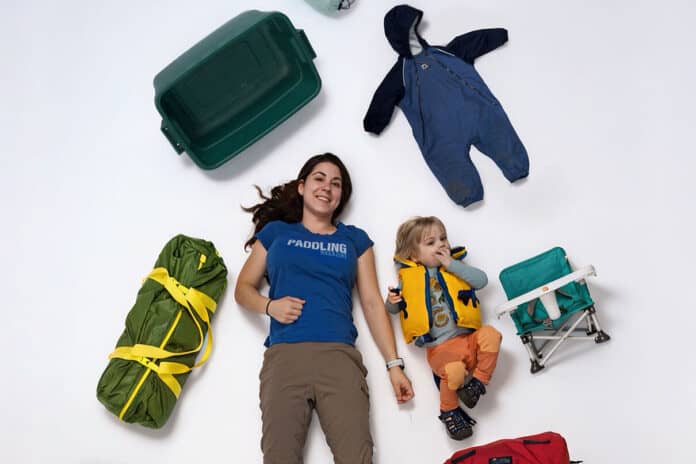
When I started planning my one-year-old son Sebastien’s first few canoe camping trips, I knew we were kissing single-carry portaging goodbye. As we upgraded our tripping kit, I kept a few questions top of mind: what would keep my son safe and comfortable, and make life easier for us as parents? After a summer of trial and error, here’s what earned a permanent spot on our packing list.
What’s in Editor Marissa Trepanier’s kit for canoe camping with a toddler
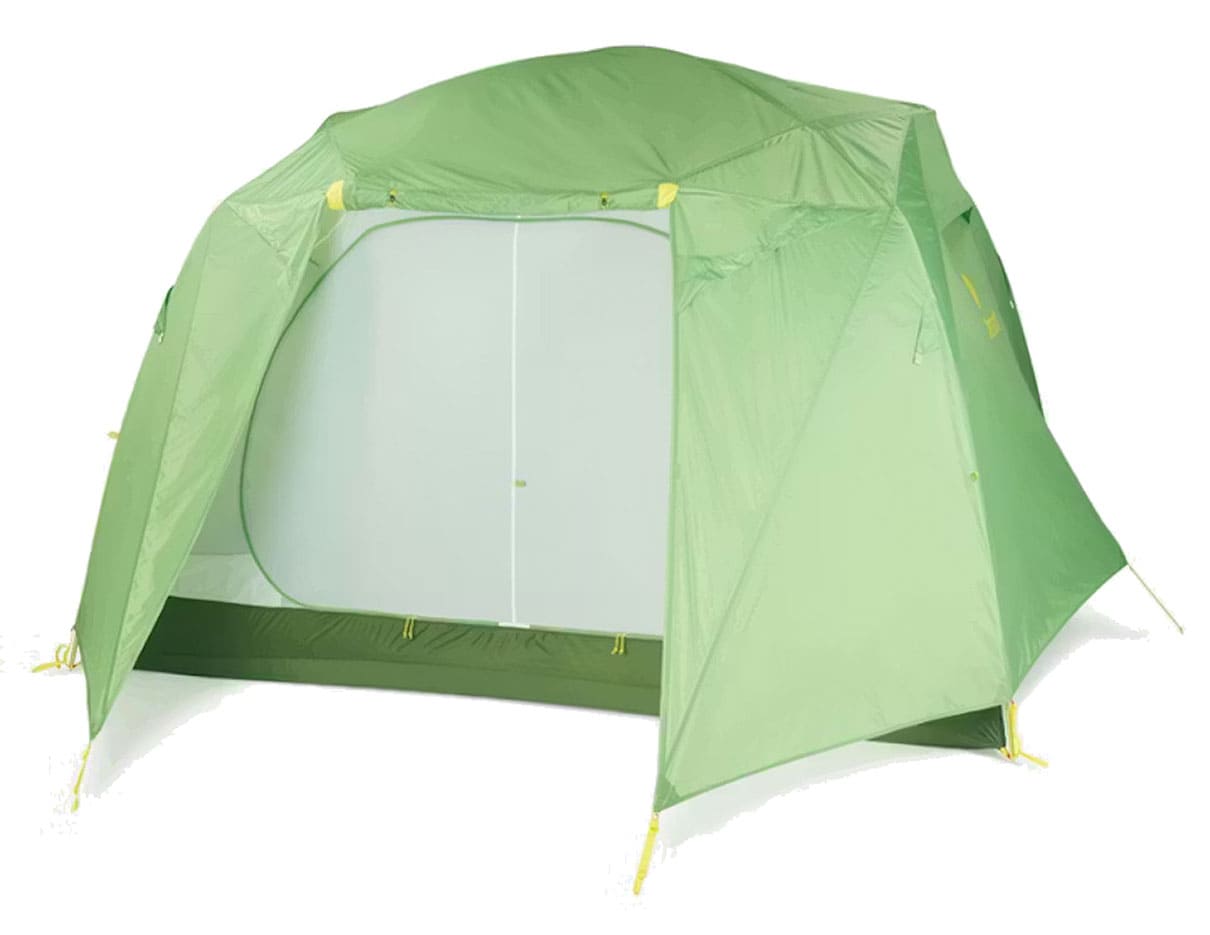
Marmot Limestone 6P
MSRP: $599
The Limestone has large vestibules for storing gear, two doors so we’re not climbing over a sleeping child at 3 a.m., and plenty of headroom to keep from feeling claustrophobic amid everything that needs to be kept in the tent (like: more diapers than you think). At 15 pounds, the Marmot Limestone 6P is one of the lighter and most compact six-person tents out there.
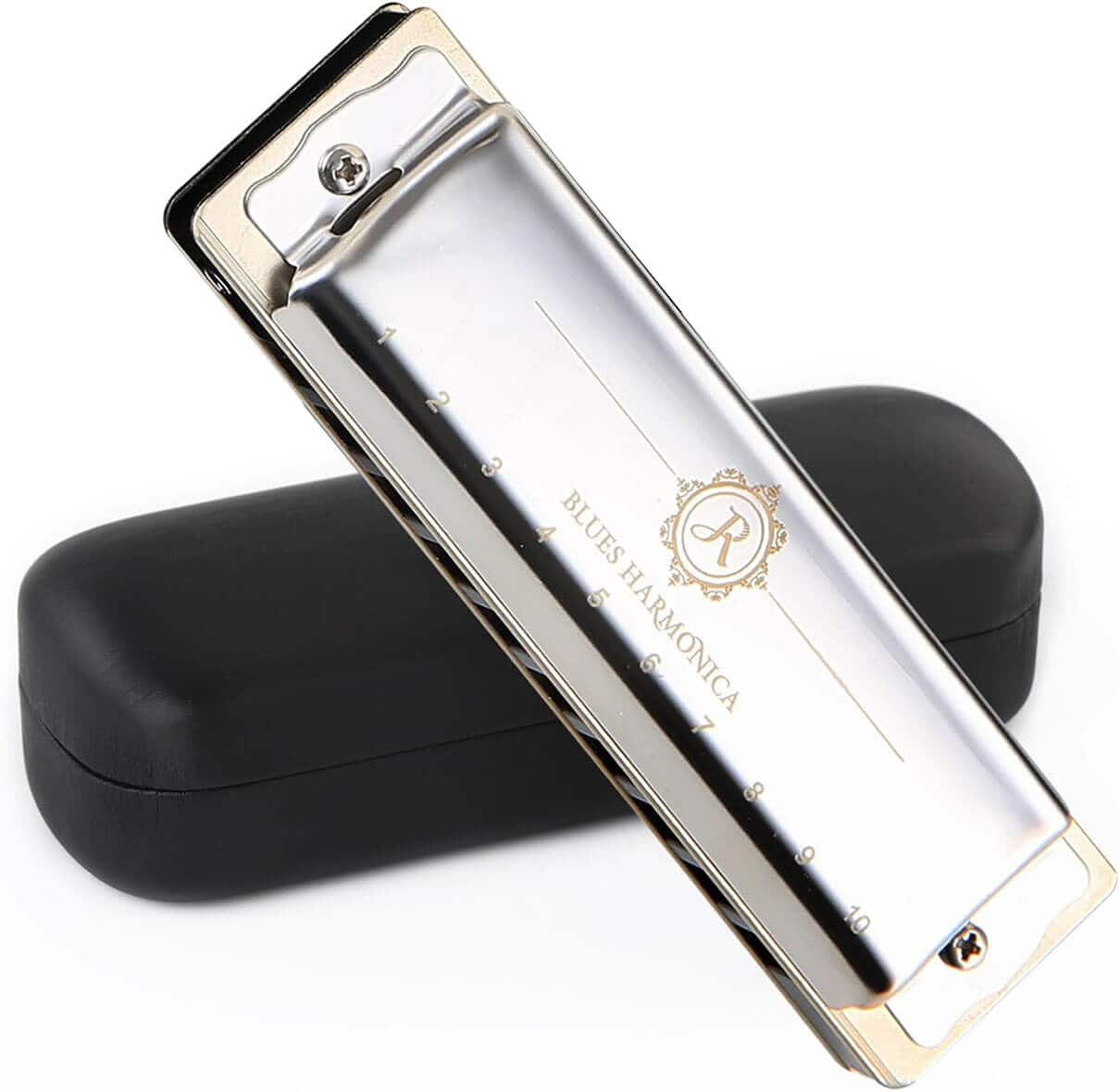
Excitable kids who won’t nap or sit still need something to keep them busy in the canoe. A harmonica provides long-lasting entertainment, not to mention accompaniment for many classic camp songs.
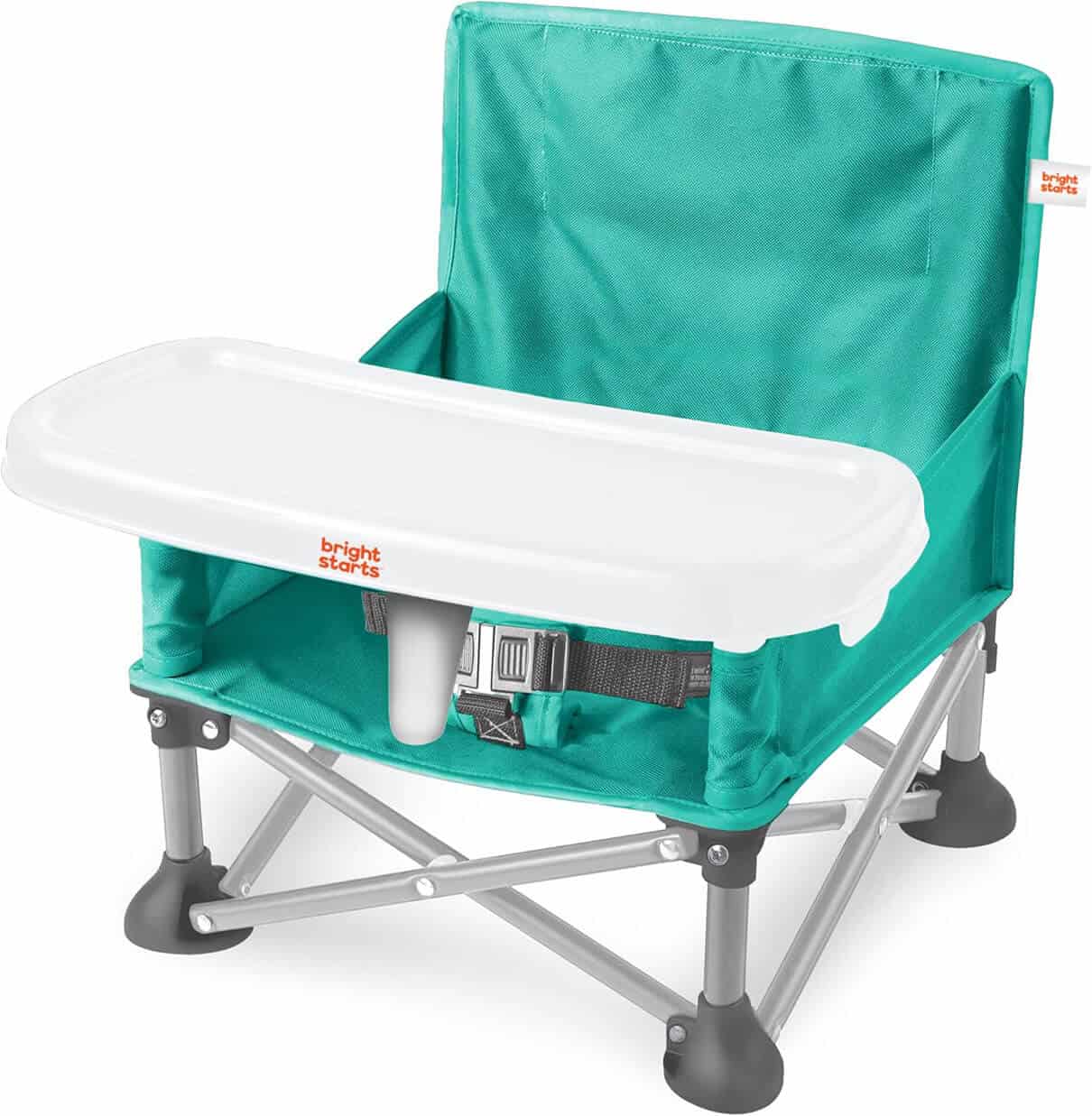
It’s nearly impossible to get Seb to sit still while he’s eating, making this collapsible booster seat a must on camping trips. Walking while eating poses two problems: it increases the risk of choking and makes it difficult to maintain a clean campsite when bits of food are dropped everywhere.
Patagonia Baby Capilene Silkweight Bottoms and Long-Sleeve
MSRP: $39 each
The thought of slathering sunscreen on my son’s arms and legs every couple of hours all day had me searching for long-sleeved UPF-protective clothing. The Baby Capilene Silkweight collection provides breathable sun coverage and stands up to inevitable tumbles.
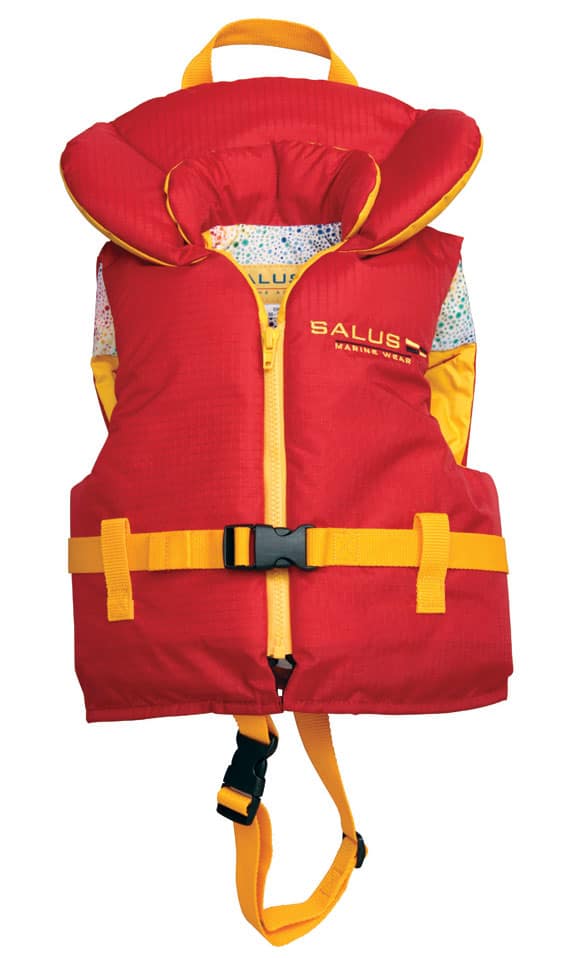
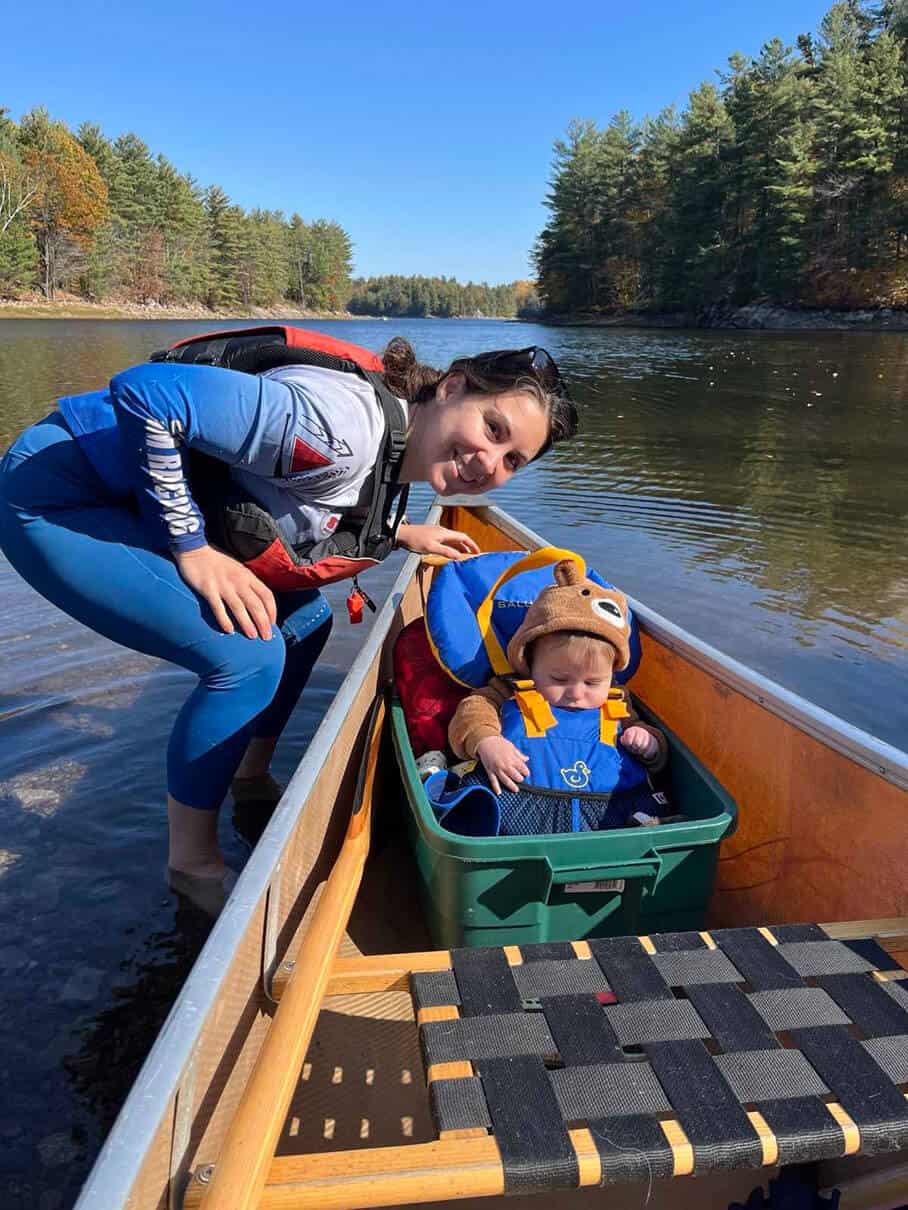
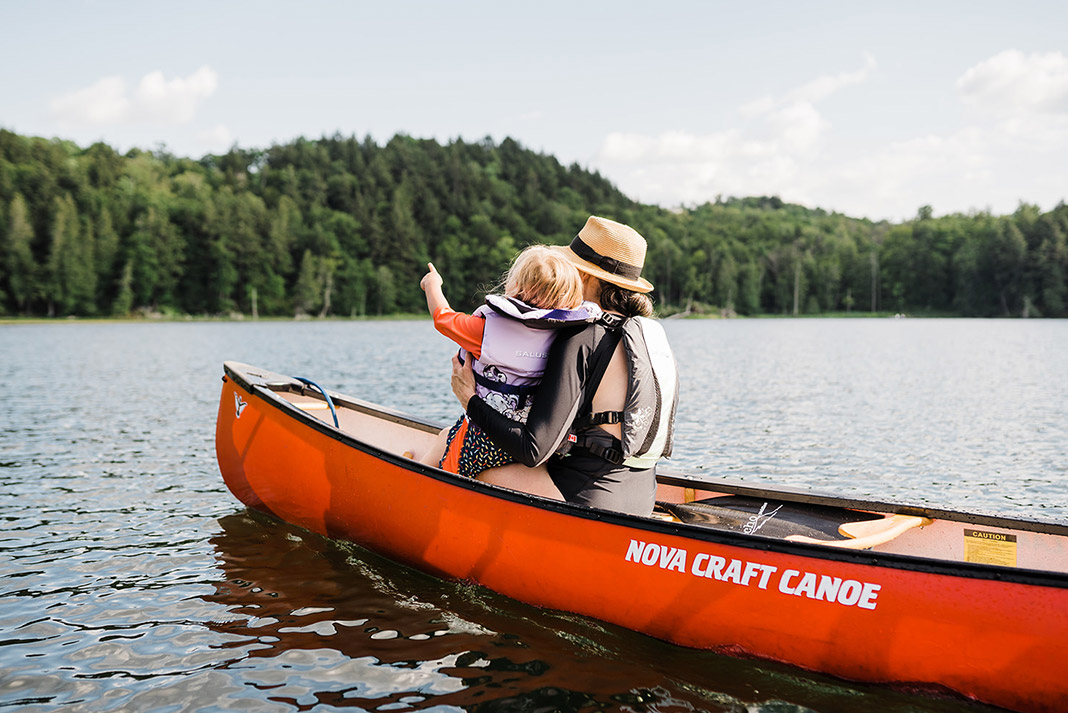
Between paddling and playing near the shore, Seb spends a lot of time wearing his life jacket. So finding a PFD that fit comfortably was non-negotiable. The Salus Nimbus isn’t too tight around Seb’s neck and it doesn’t ride up high when he’s sitting. It’s so comfortable that he even asks to wear it around the house.
The BabyDeeDee Sleep Nest Travel uses classic sleeping bag material that can be wiped clean and a sleep sack design with arms, ensuring warmth and eliminating the hazard loose blankets or a too-big sleeping bag pose to a small child. Removable arms make it versatile for warm and cool nights.
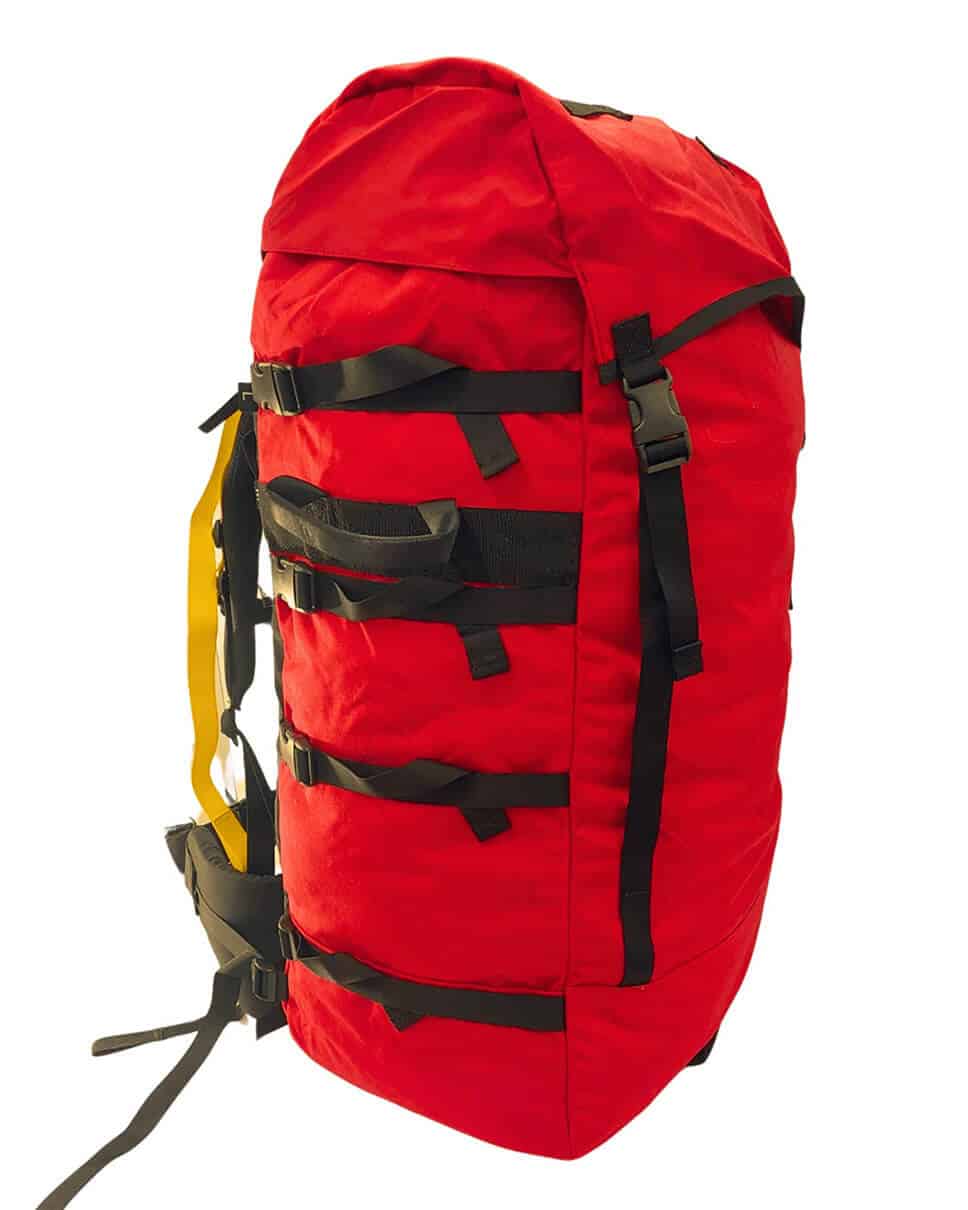
A family-sized kit calls for a family-sized pack. An Ostrom Winisk pack—or two—cuts down on our number of carries across the portage and Tetris skills are not necessary thanks to the pack’s cavernous interior.
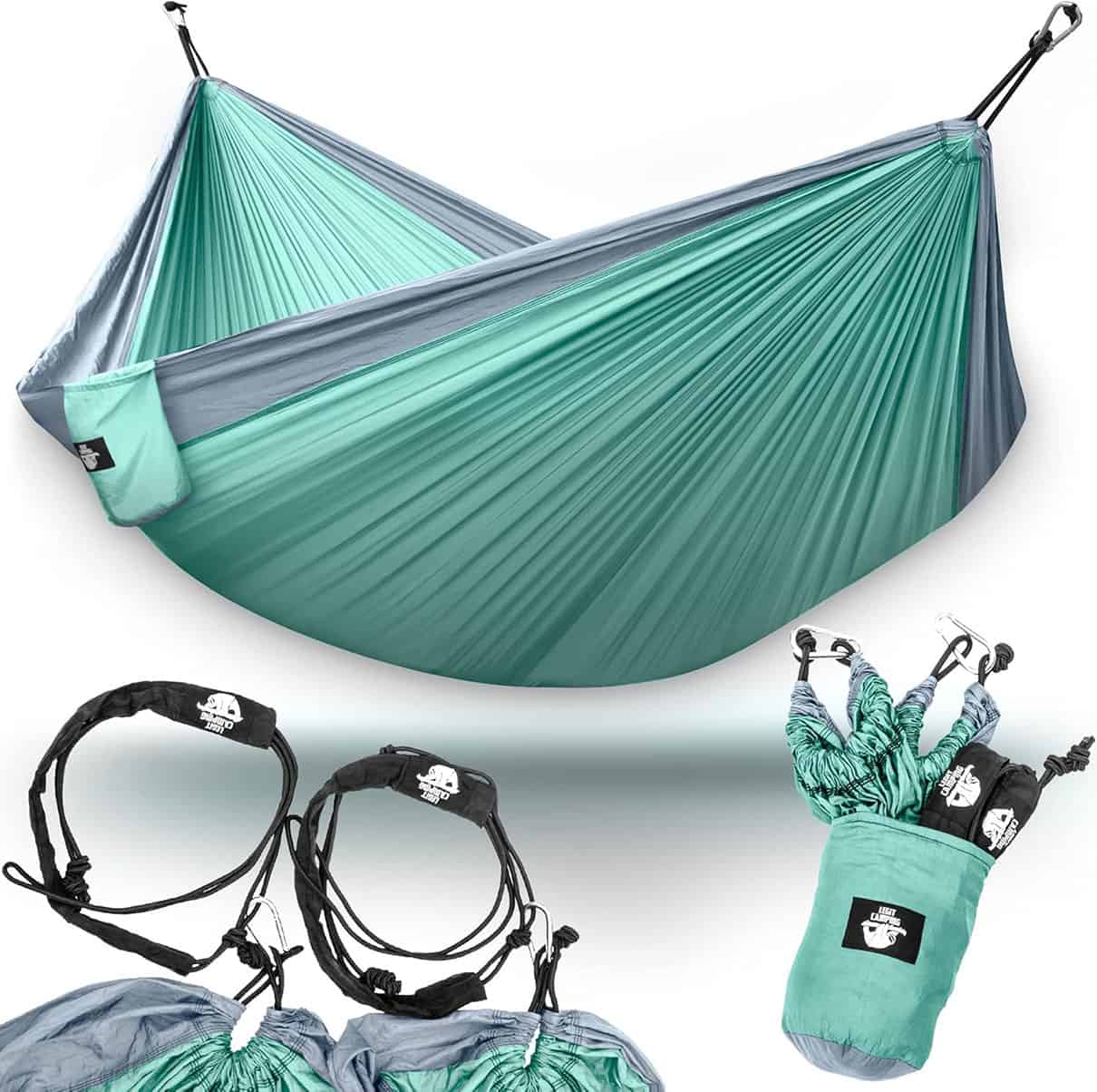
A hammock is a multipurpose tool with kids, great for winding down for naptime and ramping up for playtime. Any hammock works, but I like this one from Legit Camping because it’s compact and easy to hang.
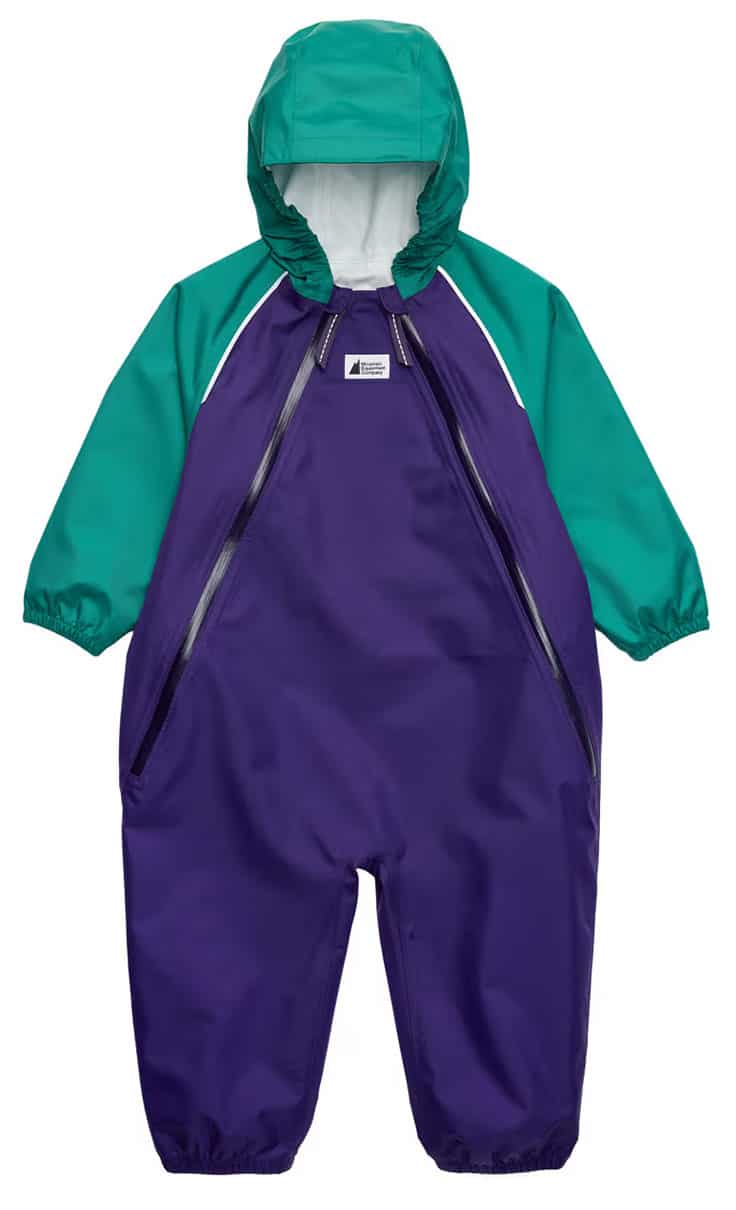
A good rainsuit can make the difference between a completed trip and one you bail on. The MEC Newt Suit’s elastic cuffs and hood, along with the high collar, provide full coverage and confidence that your little one will stay warm and dry in the rain. Plus, it’s durable, meaning your kid can do kid things.
Depending on when you’re starting your little one canoe camping, they may not yet be stable enough to stand or sit unassisted in the canoe. A generic tote with a blanket was my what-do-I-have-at-home solution to providing extra support on Seb’s first canoe outing.
The pings arrive before morning coffee: work emails, news headlines, social notifications. Thirty minutes later, you’re thumbing through suggested videos, trying to remember what you were supposed to check in the first place. The glowing screen sapping attention before the day has properly begun.
The modern benefits of being accessible mean our smartphones are interrupting our sleep, our conversations, and even intended quiet moments. Studies link excessive screen time to stress, anxiety, fragmented attention and emotional fatigue. Yet stepping away from our devices isn’t easy with the dependency on them we’ve interwoven into our lives, and it can feel equally stressful, nearly impossible, to disconnect.
Ironically, just a few hours north of the tech capital of Seattle, there lies an unexpected reset.
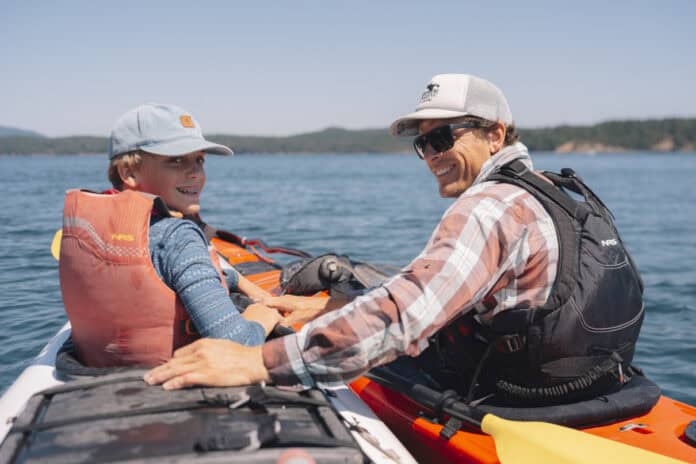
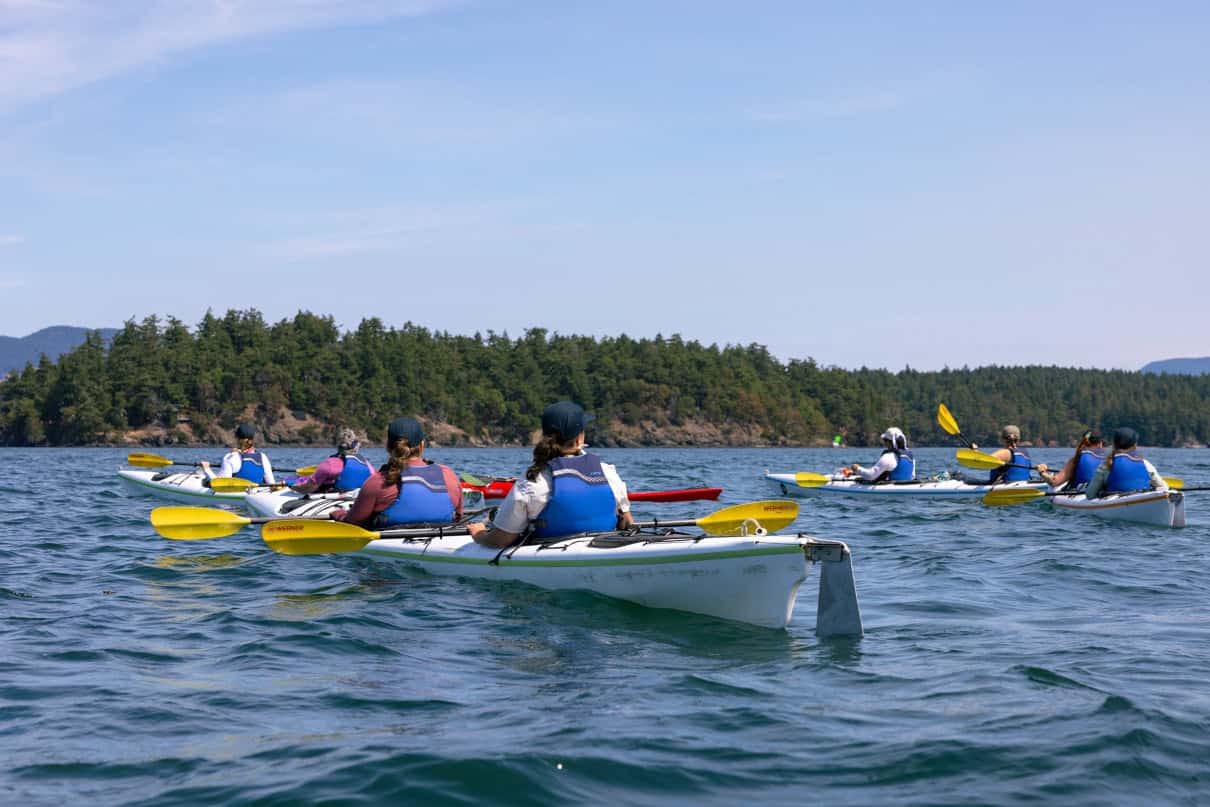
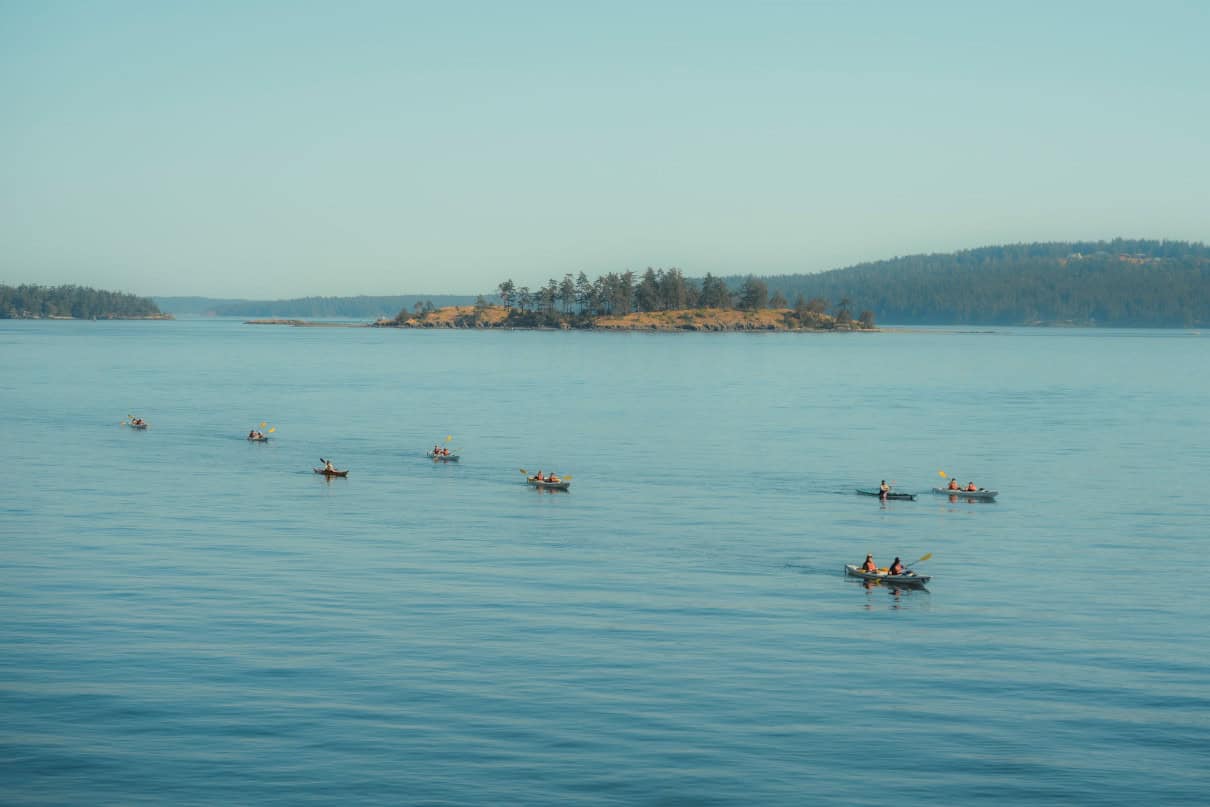
In Washington State’s San Juan Islands, guests launching sea kayaks with Outdoor Odysseys often begin their trip with a radical act: switching their phones to airplane mode (or as the advertising implies, kayak mode), and some even leaving them behind altogether.
Image: Outdoor Odysseys
“There’s information overload and mindless technology use. Both are taxing people in different ways,” says Tom Murphy, the owner of Outdoor Odysseys. Murphy has been with the outfitter since 2005 and purchased the company from founder Clark Casebolt in 2012. He believes strongly in the digital detox, an intentional period of time where we cut the cord and eliminate our screen time.
The research sides with Murphy. Exercise, meditative activities like paddling, and time spent outdoors, in nature, untethered from technology, have been found to reduce stress and symptoms of depression.
While everyone has the power to change their relationship with their phone anywhere, Murphy sees paddling the San Juan Islands as a transformative catalyst. “What we’re really helping guests do is reset their relationship with technology, to enjoy their time with us as fully as possible.”
Murphy and Outdoor Odysseys have built a four-decade reputation guiding paddlers through the waters around these islands. And as the small sea kayaking outfitter has evolved, they have become increasingly relevant with an essential need for modern travel: an analog antidote to our digital lives.
Digital Detoxing by Way of Kayak in the San Juan Islands
Rewriting the schedule on island time
Kayak travel dismantles urgency. Movement depends on tides, weather and daylight rather than rigid itineraries. Launch times sometimes shift. Routes sometimes adapt.
“We’re used to controlling our daily schedules,” Murphy says. “Out here, nature sets the pace, but no matter the route, you’ll have a great time on the water.”
That slower rhythm, commonly called “island time,” begins before paddles even touch water, with travel to the San Juans based on the schedule of ferries. The ride gives guests their first moment of pause to begin disconnecting from the mainland and focusing on the trip ahead and the people they will be traveling with.
Unlike viral destinations of social media fame, Outdoor Odysseys avoids performative tourism in the San Juan archipelago. “There are no queues for the perfect photo rock,” Murphy says.
Instead, you explore one place deeply rather than racing between highlights to check off a list.
Images: Outdoor Odysseys
Going out of office and into the blue
Sea kayaking demands presence almost immediately. Unlike passive sightseeing on a large boat, a kayak connects travelers directly at water level. The result isn’t an escape from reality, but more a recalibration, with attention returning to the physical world, truly IRL (in real life).
“You’re moving under your own power,” Murphy explains. “Your hands are busy, your brain is engaged, and you naturally start paying attention to what’s around you: the birds, the water, your paddling companions.”
Without engines or exhaust, the kayaks move almost silently, allowing you to tap into the marine network around you.
“It’s a respectful way to move through the water,” Murphy says. “You see things more organically, from urchins slowly crawling the sea floor in the clear waters to marine birds swooping and plunging nearby.”
Image: Outdoor Odysseys
Getting Real Without Reels
Wildlife encounters in the San Juan Islands are anything but predictable, but in a world of influencer-curated itineraries, that unpredictability is exactly what makes encounters so intimate.
“Seeing whales is a privilege, not an inevitability,” Murphy says as he expresses to aspiring detoxers that this is a kayak trip first and the rest is up to chance.
Encounters do happen regularly. Harbor seals appear on nearly every trip, curious heads bobbing like what Murphy jokingly calls “marine Labradors.” Sea lions announce themselves long before becoming visible. And occasionally, paddlers experience moments impossible to script, like the sudden breath of a porpoise breaking calm water or an orca surfacing nearby.
Guests often reach instinctively for cameras, but the quickness of these encounters usually foils their attempts. Murphy believes that dozens of rushed photos rarely replace one deeply lived moment.
Any wildlife interaction, according to Murphy, reminds us that there is a lot going on under the boat. And that it’s worth slowing down to experience it and consider the positive impacts of marine conservation too.
Meanwhile, night paddling transforms perception of the waterscape entirely. During bioluminescence tours, darkness settles across calm water until paddle strokes ignite flashes of living light.
For many guests, Murphy says, it’s their first experience with true darkness, free from screens, streetlights, or artificial glow. Without visual overload, he says, awareness sharpens. The water sounds louder and stars appear brighter.
Images: Outdoor Odysseys
Replacing social media with social life
Once phones get put away conversation is inevitable. And in tandem kayaks, communication is essential to adjusting pace, pointing out wildlife, and getting to know your shipmate. Even strangers quickly develop a shared rhythm.
“You’re literally in the same boat,” Murphy says. “Everything becomes something you’re doing together.”
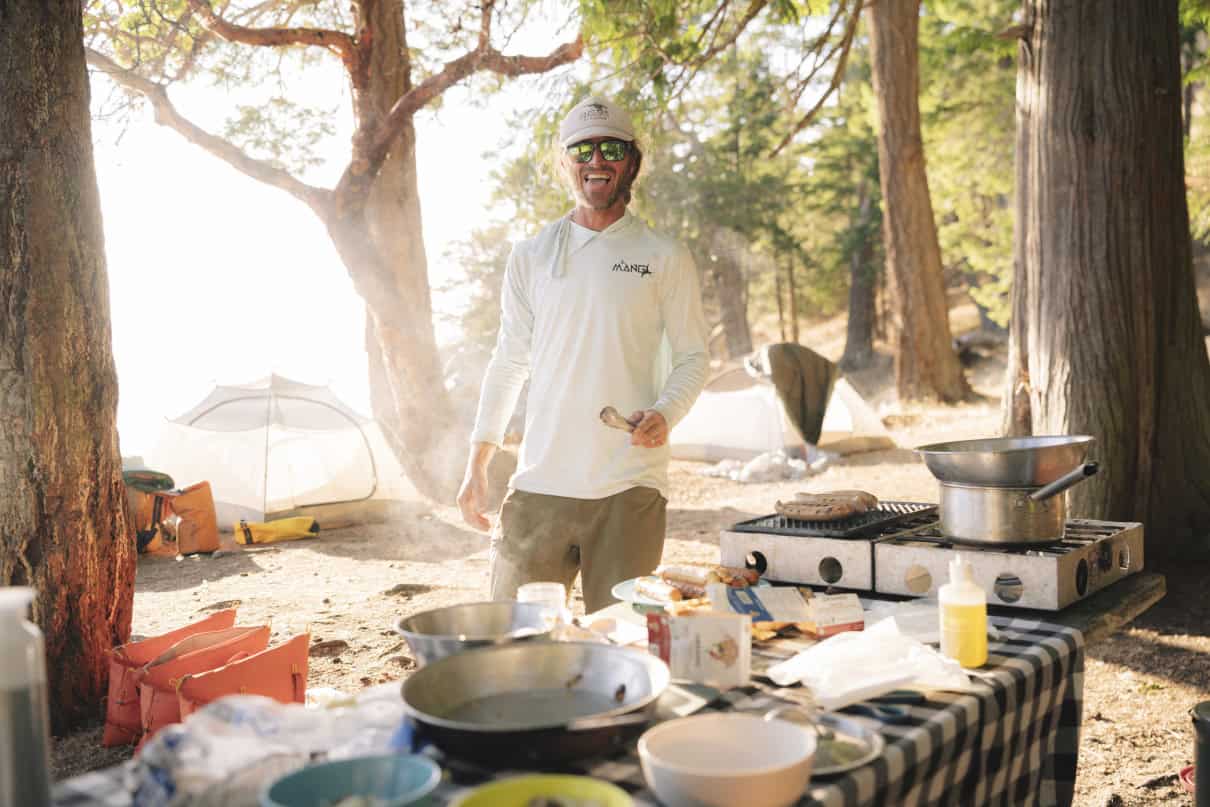
Evenings amplify that connection. Well-thought-out meals unfold slowly on remote beaches. Murphy, an avid cook, has shaped Outdoor Odysseys’ backcountry menu around sustainability and enjoyment rather than convenience and speed. Local produce is prioritized when possible, fair-trade coffee fuels mornings, and herbs grow beside the company’s office.
After hours of paddling, these shared meals become memorable rituals rather than refueling stops. Many of Outdoor Odysseys’ reviews comment on the excellent food, and amazing guides. So naturally, conversations at camp linger long after dinner ends.
Image: Outdoor Odysseys
Connection found
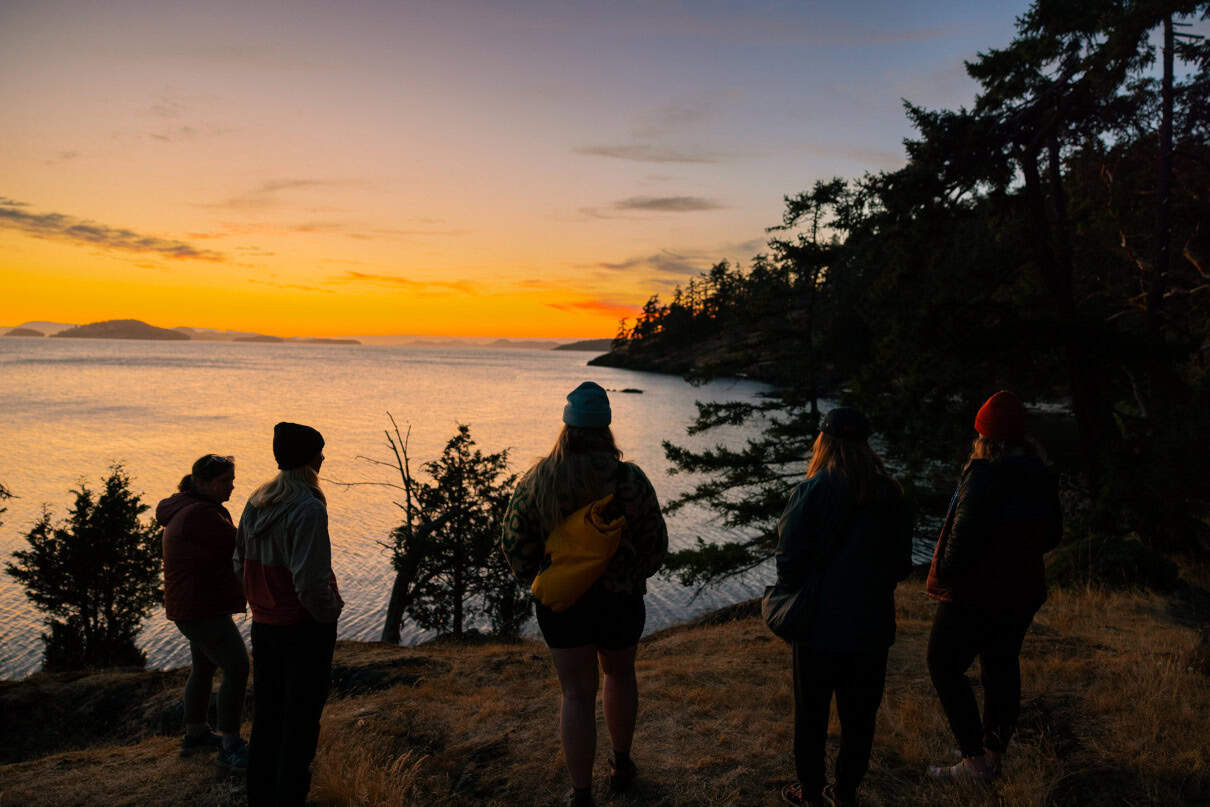
Without digital distraction, simple activities regain novelty: skipping stones, tidepooling, building driftwood sculptures, being mesmerized by flames dancing in a campfire, and watching sunsets that light up the sky.
Murphy recalls watching a young child sit happily in the middle seat of a triple kayak, occupied with nothing else as she turned her spray skirt into a tidal pool with some seawater, kelp and a rock crab.
“It pulls people away from a false urgency,” Murphy says. “They remember or figure out how to fill time differently.”
As trips end and phones reconnect, messages and notifications flood back. Headlines resume their relentless pace. And Murphy says that’s okay. What Outdoor Odysseys ultimately offers isn’t escape from modern life, he says, but perspective on how to live within it.
“We don’t need to abandon technology,” Murphy explains. “We just need a healthier relationship with it.”
Out on the water, paddlers rediscover things increasingly rare: sustained attention, shared experience and the quiet confidence that comes from moving through the water under their own power, immersed in the natural world.
Outdoor Odysseys offers half to multi-day kayaking itineraries in the San Juan Islands between Victoria Island, the mainland of British Columbia and Washington State.
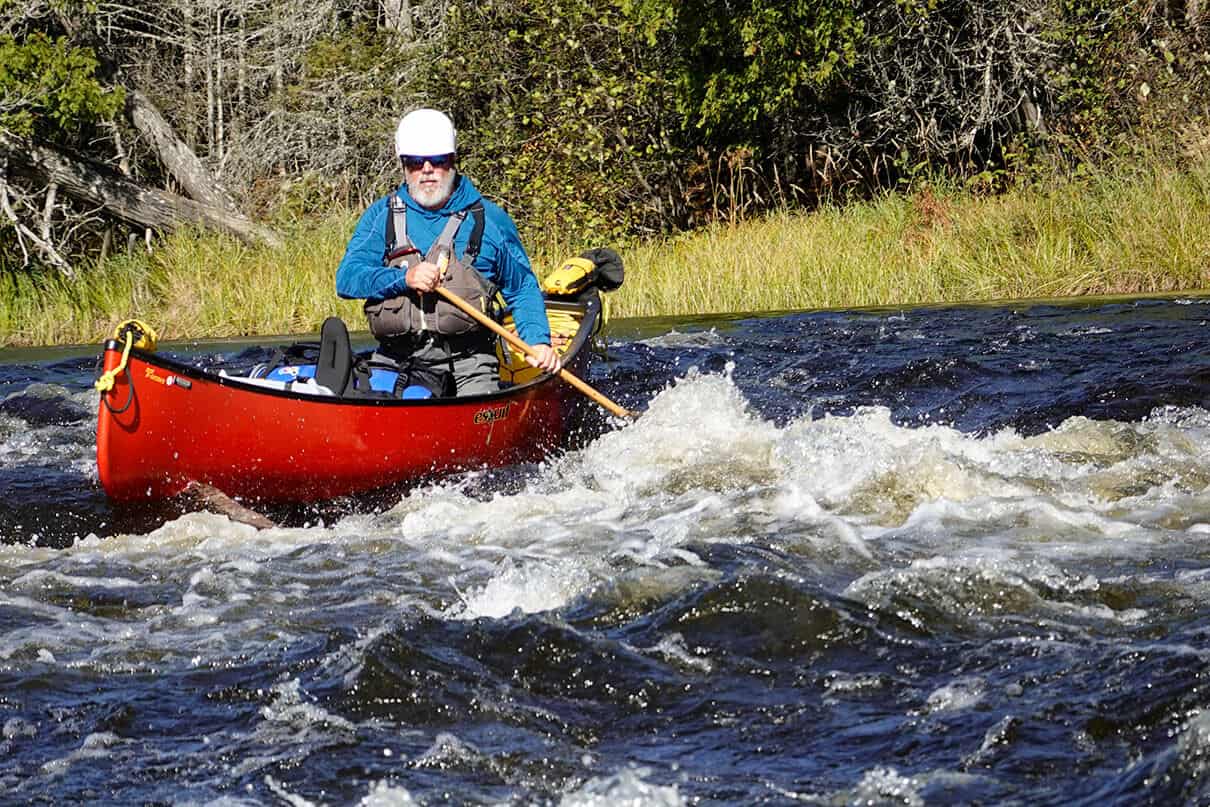
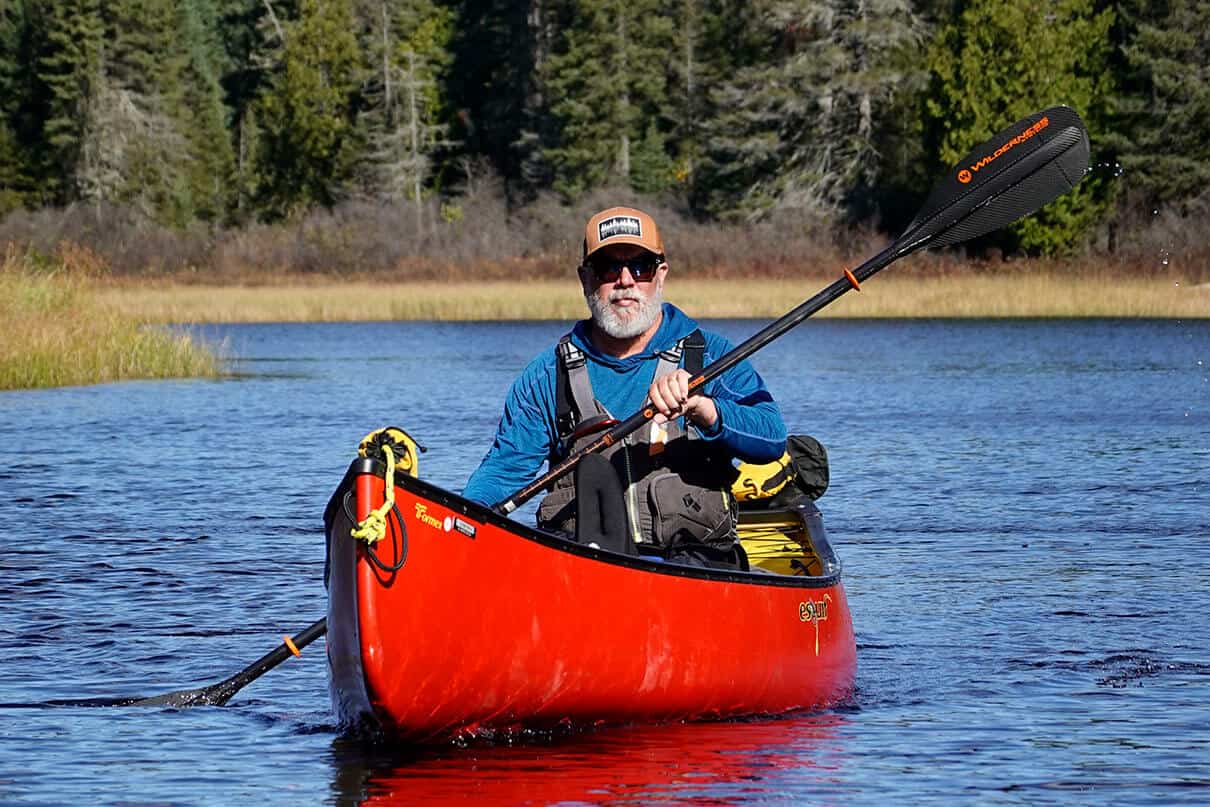
The Chestnut Prospector design has roamed windswept lakes and rivers for more than 100 years. Paddler Paul Brittain, not quite as long. | Feature photo: Scott MacGregor
Sometimes, Paddling Magazinegets one of the very first production boats out of the molds. There are NASA-like logistics to get a still-warm hull onto a trailer headed to some river put-in somewhere. Other times, like with the Esquif Prospecteur 16, we wait so long it feels like surely we’ve written about it already. Did we? We must have. Turns out, no. So, 10 years after its release, we loaded Esquif’s second best-selling tandem canoe into a boxcar for a five-day end-of-season whitewater trip down the Spanish River in northern Ontario.
This Spanish River trip was originally planned back in 2023, which would have been clever timing for the 100-year birthday celebration of the Prospector design from the Chestnut Canoe Company, from which the Esquif Prospecteur was eventually shaped. Before we get into the nibbly bits of this review, can you think of any other piece of sporting equipment designed in 1923 you’d consider using today? A paddle, maybe.
Lots of companies claim to make the Chestnut Prospector. Historian Dan Miller’s website, The Wooden Canoe Museum, tracks the changes over time, revealed in fractions of inches in beam and depth. The shape of wood-canvas Prospectors evolved slightly over time as builders’ forms deteriorated and were modified or replaced. The Peterborough Canoe Company version, which went out of production when the company folded in 1961, was sleeker in the stems and less rockered than the Chestnut.
In 1978, Bill Mason’s neighbor, Chris Frank, borrowed Mason’s river-scarred 16-foot cedar canvas Chestnut Prospector—the one seen in the film Path of the Paddle—to create a mold suitable for producing fiberglass and Kevlar hulls. The mold was passed along to Wally Schaber and Chris Harris, owners of the Ottawa-based paddling shop Trailhead, who began producing and selling composite Trailhead Prospectors.
Ten years later, Trailhead created its own version of the 17-foot Chestnut Prospector and, soon after, partnered with Mad River Canoe to create Royalex molds of both models. Eventually, these molds ended up at Esquif, which produced the Trailhead Prospectors until the end of Royalex. Esquif then purchased both the 16- and 17-foot molds, invented T-Formex to replace discontinued Royalex, and here we are.
A keen, historically accurate eye will notice both the 16- and 17-foot Prospecteur models have a flatter bottom than the original Chestnut cedar canvas versions. Maybe they were purposefully tweaked for more initial stability. Or maybe it was simply because the hulls didn’t need to be as rounded because they weren’t steaming and bending cedar ribs over a form.
The Chestnut Prospector design has roamed windswept lakes and rivers for more than 100 years. Paddler Paul Brittain, not quite as long. | Feature photo: Scott MacGregor
On the water
I’ve spent a lot of time in the Prospecteur 16. I like its symmetrical shape. I like how the gunwale lines smoothly and evenly arc from the 14-inch depth at the center yoke to the bow and stern ends. The 2.75-inch of rocker bow and stern is enough for a whitewater canoe, but not too much to be squirrely in flatwater. The Prospecteur 16 won’t win races like the sharp-edged Boundary Waters rocket ships. You have to remember that in 1923, Chestnut was building these out of cedar and canvas for the Geological Survey of Canada, which needed high-volume and seaworthy canoes that performed well on both windswept lakes and whitewater rivers, like say the Spanish River.
We got off the train in the whistlestop community of Biscotasing. In a matter of a few minutes, our two canoes and gear were handed down from the boxcar, the conductor posed for a photograph, and the train rolled north. Founded in 1884 as a railroad construction town and later a Hudson’s Bay Company fur trading post, Bisco, as they call it here, is now home to only 22 permanent residents. It is the northernmost access point to the West Branch of the Spanish.
One design to rule them all. | Photo: Scott MacGregor
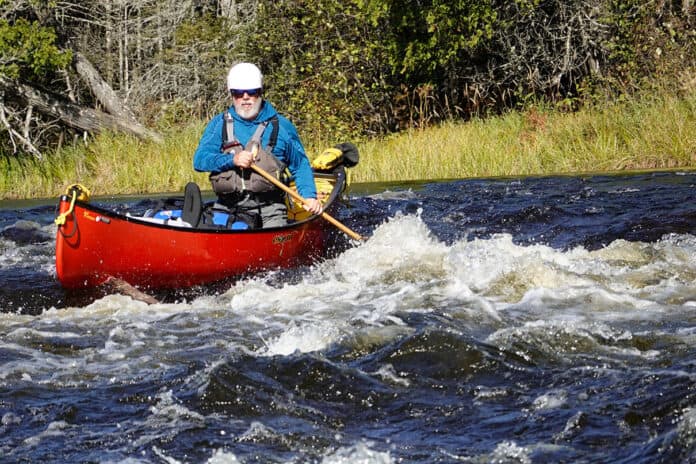
Leaving the trip until the middle of October limited the number of takers to just three. We agreed to take turns soloing the Prospecteur 16 in the flats and rapids.
Our beefier Prospecteur 17 is Esquif’s top-selling touring canoe, driven mostly by outfitter and livery sales. I have a 17-footer for big trips. But when people ask me what canoe they should buy, my answer is—if you can only have one—the canoe you should buy is the one you will paddle most often. And for lots of people, the 16-foot Prospecteur is one of those canoes.
Where the Prospecteur shines
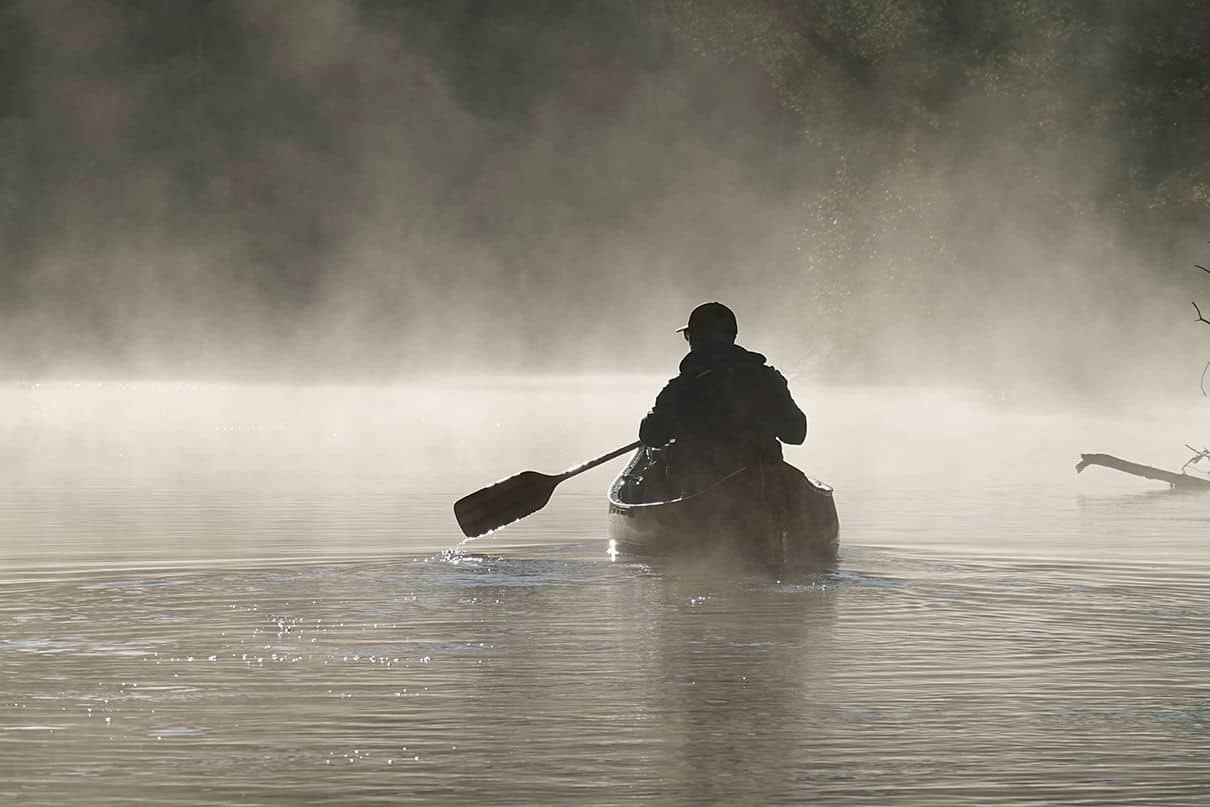
Going on a weekend-to-weeklong whitewater canoe trip like the Spanish? The Prospecteur 16 is perfect, either tandem or solo. The same is true for a lakewater trip. I realize that at 65 pounds it’s far from the lightest canoe, but it’s still fine. The T-Formex my shoulders begrudge on portages is the same T-Formex durability my dry feet appreciate when I mindlessly ram the bow up on shore and step out. Slide the Prospecteur 16 off the dock at the cottage for a misty morning tootle around the lake? Sure, why not. I see no reason why you couldn’t round up an old phonograph, wicker picnic basket and parasol and escape with your true love from the watchful eye of your chaperones. And it’s sporty enough that for the examination run of my moving water instructor course, I got sick of waiting for a solo whitewater playboat to become available, so I jumped in a 16-foot Prospector and ran the Madawaska River’s class III Chalet Rapids.
Carefree durability in T-Formex. | Photo: Scott MacGregor
Some canoeists will argue over a half-inch here and there. If that’s you, builders like Headwater Canoes are still making cedar canvas Prospectors from the original Chestnut forms. For me, I’ll trade the authenticity of having to do pine pitch and birchbark canoe repairs for the modern-day durability and practicality of T-Formex.
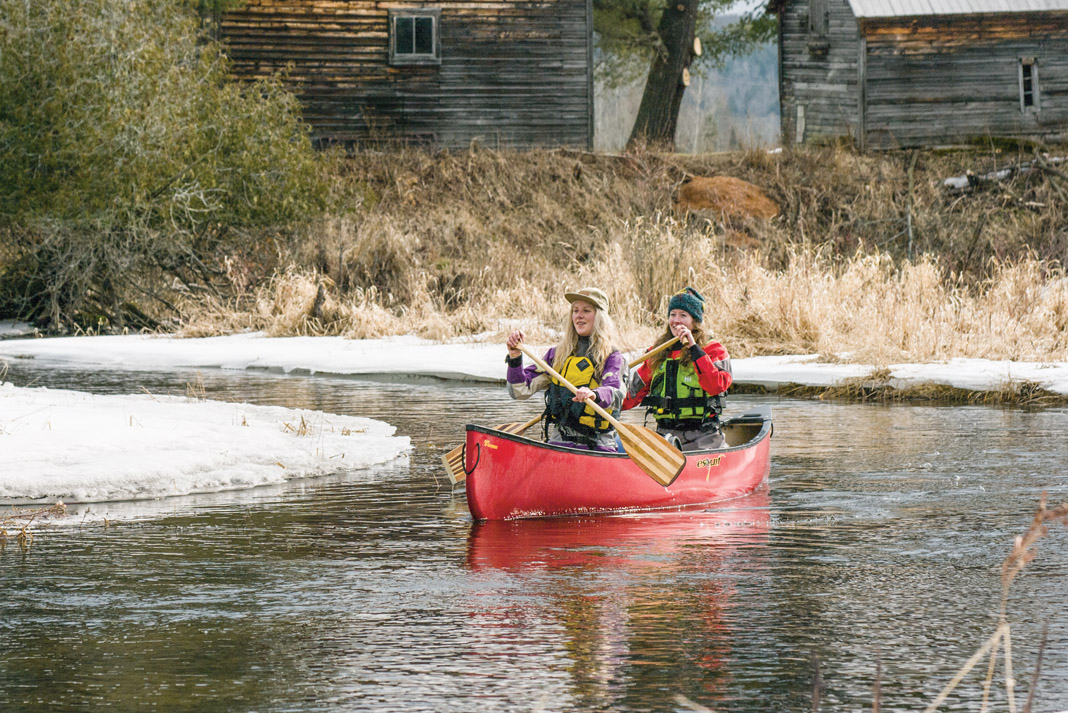
I’m not without a nostalgic bone, however. The Chestnut Canoe Company offered their Prospector canoes in two stock colors, red or green. Guess which of the two T-Formex Esquif Prospecteur 16 colors I think you should order. Red, of course. And while you’re at it, to celebrate more than 100 years on the water, I’d upgrade your Prospecteur from vinyl gunwales to Esquif’s ash trim package. It just feels right.
Scott MacGregor is the founder of Paddling Magazine. And yes, he passed his instructor level in the Prospector.
This article was published in Issue 75 of Paddling Magazine. Subscribe to Paddling Magazine’s print and digital editions, or browse the archives.
The Chestnut Prospector design has roamed windswept lakes and rivers for more than 100 years. Paddler Paul Brittain, not quite as long. | Feature photo: Scott MacGregor


 This article was published in Issue 75 of Paddling Magazine.