Home Blog Page 145

Boat Review: Pyranha Molan Kayak

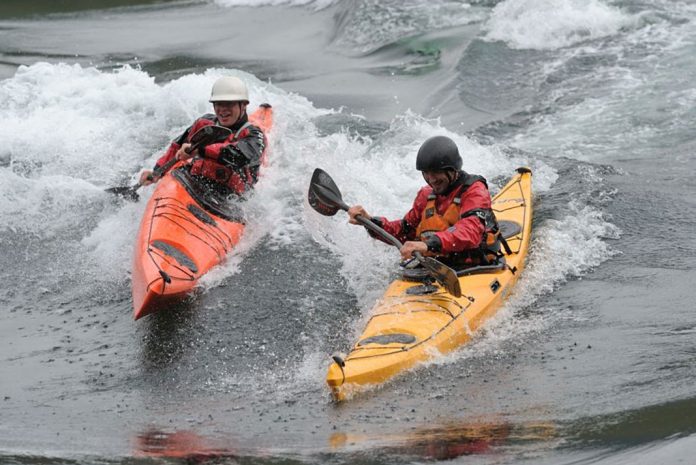
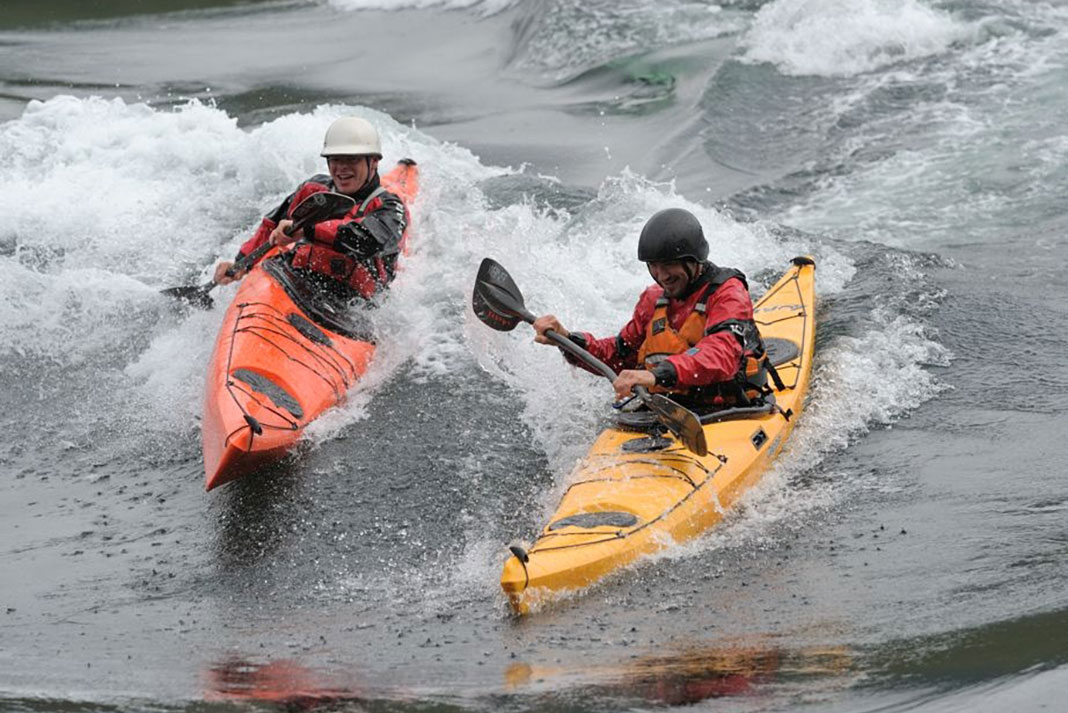
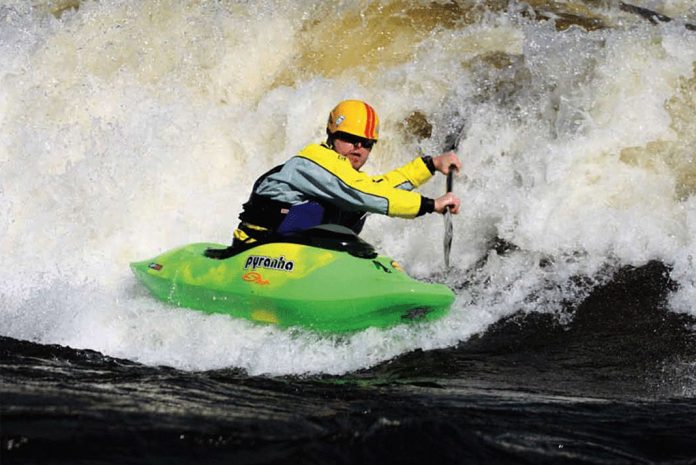
Man paddles a Pyranha Molan freestyle kayak through whitewater
Feature Photo: John Rathwell

Pyranha has a well-deserved reputation for releasing fresh, progressive designs year after year. In 2010, the English boat company rides onto the new wave of ultra-short playboats with the unfortunately named Pyranha Molan. With recent Worlds competitions showcasing how much is possible on just a small wave, Pyranha is betting that size does matter—and shorter is better.

Pyranha Molan Specs
(S / M / L)
Length: 5’7” / 5’9” / 6’4”
Width: 24.4” / 25” / 26.6”
Volume: 46.2 / 56.5 / 58 U.S. gal
Weight: 30.8 / 31.2 / 33 lbs
Weight Range: 90-175 / 120-200 / 185-285 lbs
MSRP: $1,099 USD or $1,299 CAD
www.pyranha.com
[ Paddling Buyer’s Guide: See all Pyranha kayaks ]

The Pyranha Molan springs from the page

The Pyranha Molan is a small package designed to go big on the moderate features and in the whitewater parks where most freestyle kayakers practice and play. It replaces the Rev as Pyranha’s sole freestyle design, but it shares little with its predecessor.

In fact, says lead designer Graham Mackereth, the Molan started quite unlike most new kayak designs—as a blank page. Instead of refining an existing model, Pyranha’s design team looked at top-end freestyle boats from every manufacturer and tried to figure out how they could better the lot. After extensive testing of multiple composite prototypes, the Pyranha Molan emerged.

The Molan has the volume on high

First impressions are that the Pyranha Molan looks a lot like another new playboat, the 2010 Jackson Star series, with a bit more volume in the trunk. Given the Stars’ stellar performance at freestyle competitions from local festival throwdowns to the World Championships in Thun, Switzerland, last year, this shouldn’t come as a surprise. Pyranha recognized a design that works—one that is suited to the modest wave slated to host the 2011 Worlds in Plattling, Germany—and tweaked it to make it their own.

Mackereth says the key design features are a high-volume bow and stern, centred around the kayaker to provide maximum pop for loop-based tricks; slicey, balanced ends for easy initiation of moves on flatwater, waves and in holes; and what Pyranha calls two-way rails. According to Mackereth, the rails are intended to be forgiving on the upstream edge, but will engage to provide a release edge.

Finely tuned for catching big air

Our testers found the Pyranha Molan generated plenty of air even in a small hole, and cartwheeled faster than we could keep pace with. On a wave, it had just the right amount of looseness without feeling flighty. Pyranha is known for speed on a wave and the Molan is no exception. For such a small boat, it accelerates and surfs incredibly fast, a trait that comes at the cost of stable carving edges. You have to work at keeping the Molan on its soft rails—no “sitting on edge” or transitioning predictably from one edge to the other; it’s fast as a wet bar of soap and just as slippery.
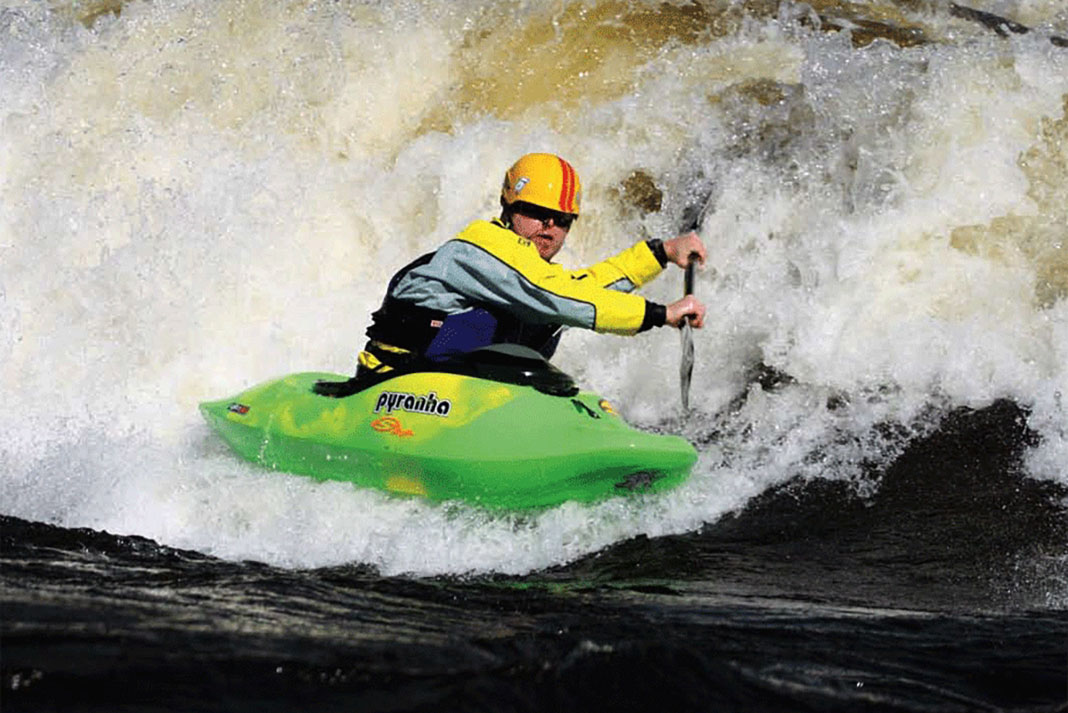
Man paddles a Pyranha Molan freestyle kayak through whitewater
Feature Photo: John Rathwell

Much design energy has clearly been focused on making the Molan effortless to throw around. A full six inches shorter than the Rev, the Pyranha Molan ties the Jacksons as the shortest playboats on the market. This makes it extremely quick in the air. Combined with a low cockpit rim and narrow, supportive knee bump, it has much to offer smaller paddlers. The trade-off is that performance is quite dependent on precise trimming. Sit too forward or back and the miscalculation is noticeable, although less so if you stick to the middle of Pyranha’s generous weight ranges.

[ Plan your next whitewater kayaking adventure with the Paddling Trip Guide ]

Go short and sweet with the Pyranha Molan

Beginning freestyle paddlers will appreciate the Molan’s high performance on small, friendly features. This same trait will be a draw for more advanced kayakers throwing together combos in the park or in competition.

Follow us on Instagram @paddlingmagazine now!
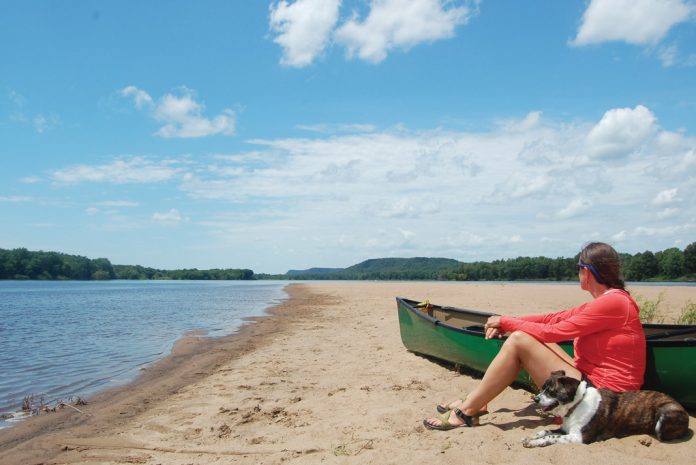
 

Canoeing And Kayaking The Lower Wisconsin River

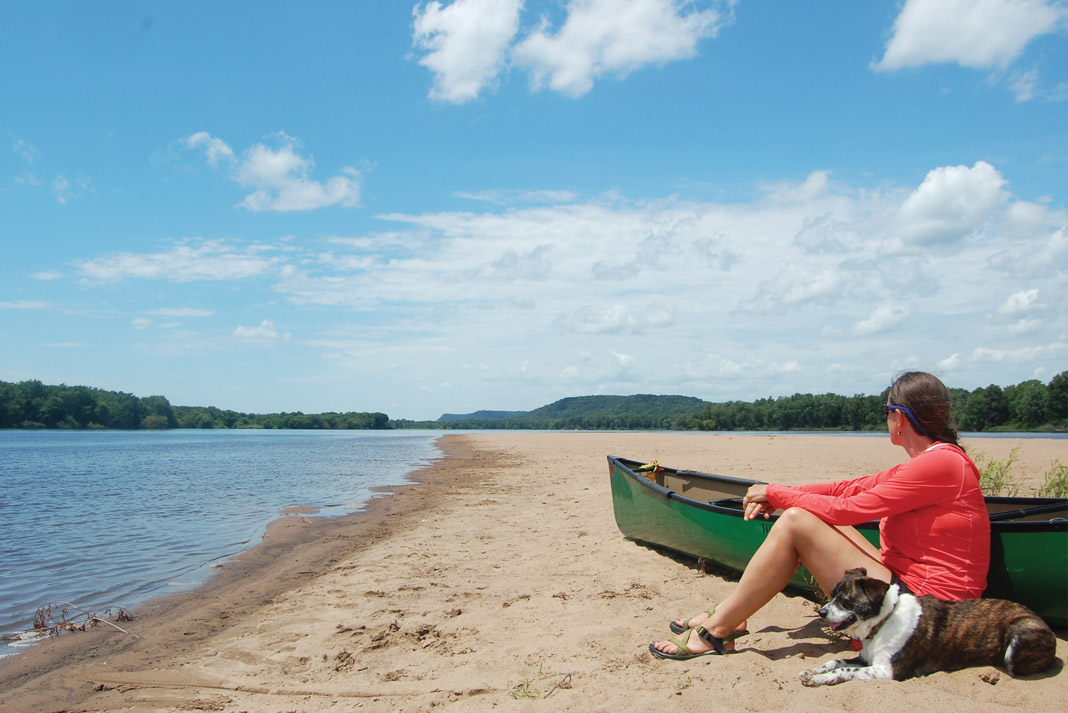
woman takes a break with her dog while canoeing the lower Wisconsin River
Feature Photo: Darren Bush

The Wisconsin River flows over 400 miles from its origin at Lac Vieux Desert in the North Woods to its confluence with the Mississippi River just downstream of the small city of Prairie du Chien. Most of the Wisconsin River is dammed, but the final 90 miles offers excellent canoeing and kayaking as it flows unimpeded through the Lower Wisconsin State Riverway.

The Lower Wisconsin River is worth a visit

On the way to the mighty Mississippi, the Lower Wisconsin flows past scenic bluffs and through stands of flooded timber. Its shifting sand bars provide ample opportunity for summer sun bathing and overnight camping. Over 95,000 acres of protected lands bordering the river provide habitat for abundant wildlife including deer, heron, eagles and a host of migratory waterfowl.

The Lower Wisconsin is within a half-hour drive of Madison, the state capital of Wisconsin. This makes it an easily accessible option for day paddling for anyone in South Central Wisconsin and worth a carefully planned weekend for paddlers in Chicago or Minneapolis.

The Lower Wisconsin is one of the best spots for multi-day canoe adventures in the state. Permits are not required and island campsites are undeveloped and operate on a friendly Midwest system of first-come first-serve availability. Summer weekends can be busy on the most popular sections between Sauk City and Spring Green, but you can avoid the crowds by choosing river sections farther downstream or planning your trip for mid-week or in the spring and fall. Early fall is prime time for overnight trips, with warm water, cool nights and bug-free campsites.

woman takes a break with her dog while canoeing the lower Wisconsin River
Feature Photo: Darren Bush

Plan your canoeing or kayaking trip to the Wisconsin River

Weather

Summer thunderstorms roll in quickly and the wind blows hard on the Wisconsin River. Check the forecast before you go, pack accordingly and plan extra time.

Shuttle

Several liveries rent canoes and kayaks along the Lower Wisconsin. Run your own shuttle or line one up with Wisconsin River Outings in Sauk City or Blackhawk River Runs in Mazomanie.

Don’t Miss

Fresh cheddar cheese curds from Carr Valley Cheese in Sauk City and Mazomanie. These curds are so fresh they squeak when you eat them.

Diversions

Wisconsin is home to architect, interior designer, writer, and educator Frank Lloyd Wright’s home, Taliesin.

Learn More

The Lower Wisconsin State Riverway is administered by the Wisconsin Department of Natural Resources.

If you have a half day

For a taste of the Lower Wisconsin put in at the DNR canoe landing near Arena and run your shuttle to the boat landing next to the Highway 14 bridge near the former town site of Helena. This seven-mile section offers lazy canoeing and kayaking and wide-open views of the Wisconsin River valley.

[ View the largest selection of canoes in the Paddling Buyer’s Guide ]

If you have a full day

The 15-mile stretch of river from Tower Hill State Park off County Highway C to the town of Gotham takes you past miles of wildlife refuge on a lightly travelled section of the river.

Before you launch, take a quick side trip to tour the nineteenth-century shot tower carved through solid rock in the 1830s. The tower used the region’s abundant lead supplies to produce shot for settlers.

If you have a weekend

If you are interested in more solitude the sections downstream of the town of Spring Green can’t be beat. Put in at the Spring Green canoe landing near the Highway 23 bridge and float down to Riverside Park in the town of Muscoda for an overnight trip with one night of primitive camping on the river.

For a long weekend you can camp at Riverside Park ($10 per night, reservations required) and continue down the river to the Blue River takeout seven miles downstream off County Highway T.

If you have a week

Canoeing or kayaking the entire Lower Wisconsin State Riverway will give you the full experience. Put in at Sauk City and float 90 miles of river to the Mississippi. End your trip at the confluence of the Wisconsin and Mississippi just upstream of Wyalusing State Park.

For a navigation challenge, pick your way through the backwater sloughs to take out at the boat landing inside Wyalusing State Park. Otherwise, take out at the landing downstream of the Highway 18 bridge on the Wisconsin River.

This article was first published in Issue 51 of Paddling Magazine. Subscribe to Paddling Magazine’s print and digital editions, or browse the archives.


Boat Review: Pakayak Bluefin 14 Packable Kayak

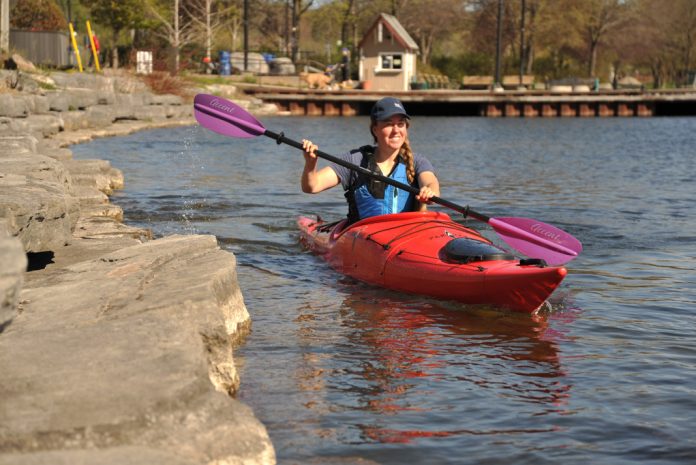
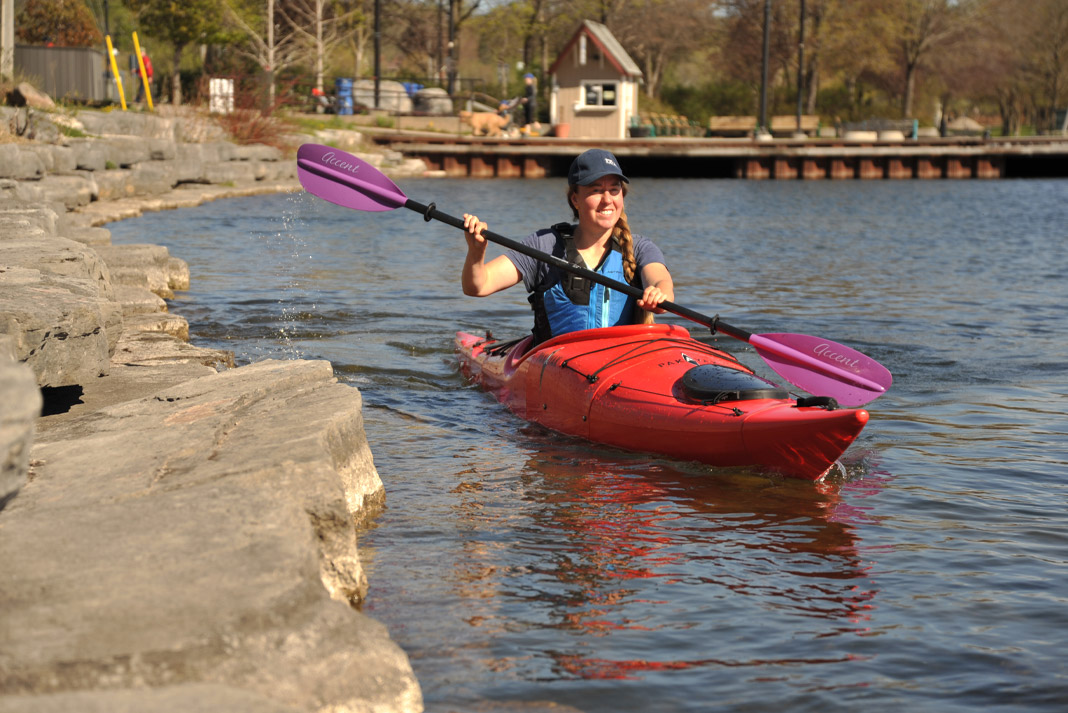
A woman paddles along the shore in a Pakayak Bluefin 14 packable kayak
Feature Photo: Vince Paquot

Until recently, a kayak’s off-water stealth didn’t factor into most paddlers’ purchasing decisions. Portable kayaks—an eclectic catch-all of inflatable, folding and sectional models—appealed chiefly to space-starved urban paddlers prioritizing easy storage and transportation, or international adventurers preoccupied with airline baggage restrictions. Now, in the midst of a global health crisis the Pakayak Bluefin 14 offers the intriguing prospect of under-the-radar pandemic paddling.

Pakayak Bluefin 14 Specs
Length: 14’
Width: 24”
Depth: 16”
Weight: 66 lbs (as tested)
Max Capacity: 300 lbs
MSRP: $,1795 USD
www.pakayak.com
[ Paddling Buyer’s Guide: See all portable kayaks ]

The Pakayak Bluefin 14 is a portable powerhouse

Picture a kayak that stashes, out-of-sight, in your compact’s trunk or back seat and transitions from bag to boat in just three minutes. Now imagine this sectional craft, once assembled, is virtually indistinguishable from a standard polyethylene touring kayak in features, comfort and performance. This is the magic of the Pakayak Bluefin 14, or as I like to call it, the ultimate low-profile, portable kayak for maintaining mental and physical health during lockdown.

Pakayak’s Kickstarter success story

Pakayak was founded in 2016, the same year its four co-founders launched a Kickstarter campaign to fund production of the Bluefin 14, raising over $546,000. The first boats shipped in early 2018, marking nearly seven years since Pakayak visionary Doug Mackro began tinkering with the design for a modular, nesting kayak with hard-shell performance.

Starting with wood and plastic prototypes cobbled together from other kayaks, Mackro sketched plans for a full-sized kayak that could be disassembled and stacked into a bundle just three-and-a-half feet long by two feet wide.

Numerous design tweaks later, Mackro and company partnered with an experienced plastics rotomolder in Massachusetts. Manufacturing domestically allowed Connecticut-based Pakayak to ensure high quality control while minimizing their carbon footprint. You can probably think of some other benefits to keeping production, assembly and distribution at a single facility.

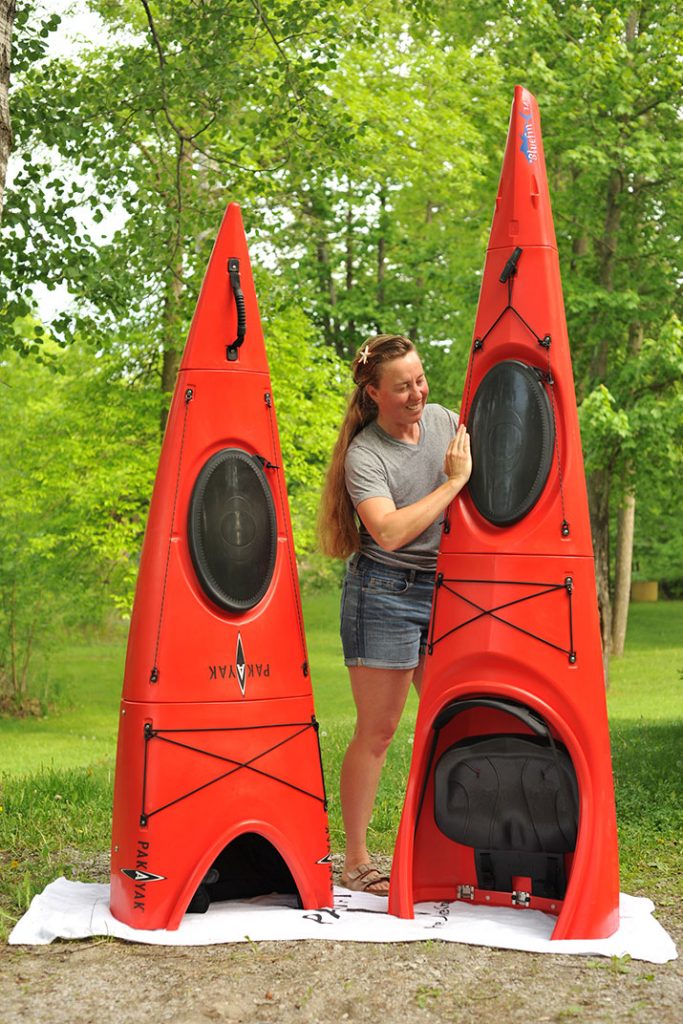
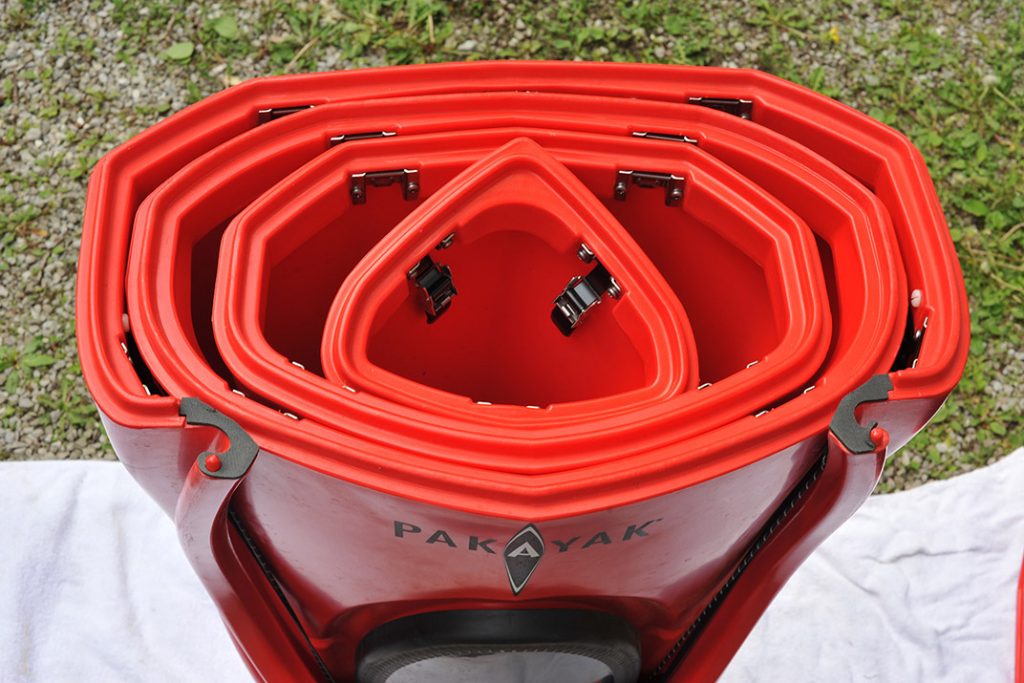
Stainless steel latches and silicone gaskets ensure a watertight seal between sections. Vertical assembly minimizes exposure to sand and other debris. | Photos: Virginia Marshall
Stainless steel latches and silicone gaskets ensure a watertight seal between sections. Vertical assembly minimizes exposure to sand and other debris. | Photo: Virginia Marshall

The Bluefin 14 is easy to assemble

Unlike some portable kayaks, you don’t need a video tutorial or engineering degree to assemble the Pakayak. Our chili red Bluefin 14 arrives neatly nestled inside a beer fridge-sized cardboard box with a single sheet of instructions.

Setup is intuitive: each successive piece removes from the nested stack and attaches to the previous piece—no tools or extra parts required. Pakayak recommends paddlers assemble the bow and stern ends vertically, then lay the two halves down for the final cockpit connections. It works like a charm—my first attempt takes about six minutes, with a bit more practice I’m snapping it together in three. Even better, it packs back up just as quickly.

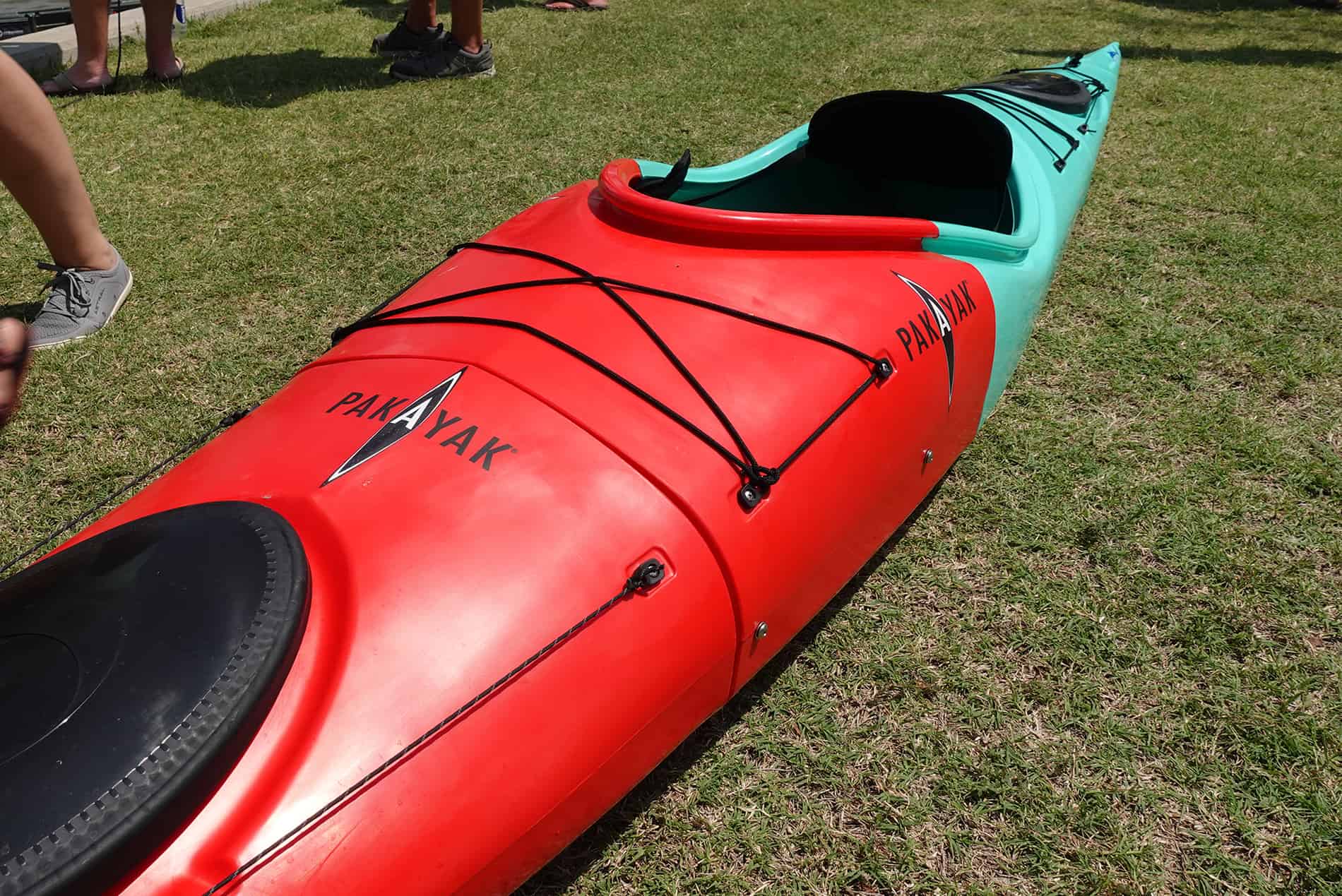
Pakayak’s design team engineered the internal clamps holding the sections together to be strong, simple and foolproof. Good news, since you need to operate some of them—tucked in the ends and reached through the oval deck hatches—by feel alone. Each of the stainless-steel clamps applies over 300 pounds of pressure, with three to five clamps at every joint. Paired with the sections’ interlocking tongue-and-grooves, this results in a hull and deck that are actually stiffer than a conventional plastic boat. It’s also just as watertight, providing the silicone gasket in each groove is kept clean. If the gaskets do become worn or damaged, they can be easily swapped out with replacements available through Pakayak’s website.

Photo of the Pakayak Bluefin 14 packable kayak
No engineering degree required for this portable kayak. Setup of the Pakayak Bluefin 14 is intuitive and fast. | Photo: Vince Paquot

All that hardware isn’t light, however. We measured our Bluefin 14 at 66 pounds, well above Pakayak’s listed 59 pounds and significantly heftier than most plastic singles of this length. Assembled, it’s a bear to maneuver on land. But that’s not the point.

Get rolling with Bluefin 14 accessories

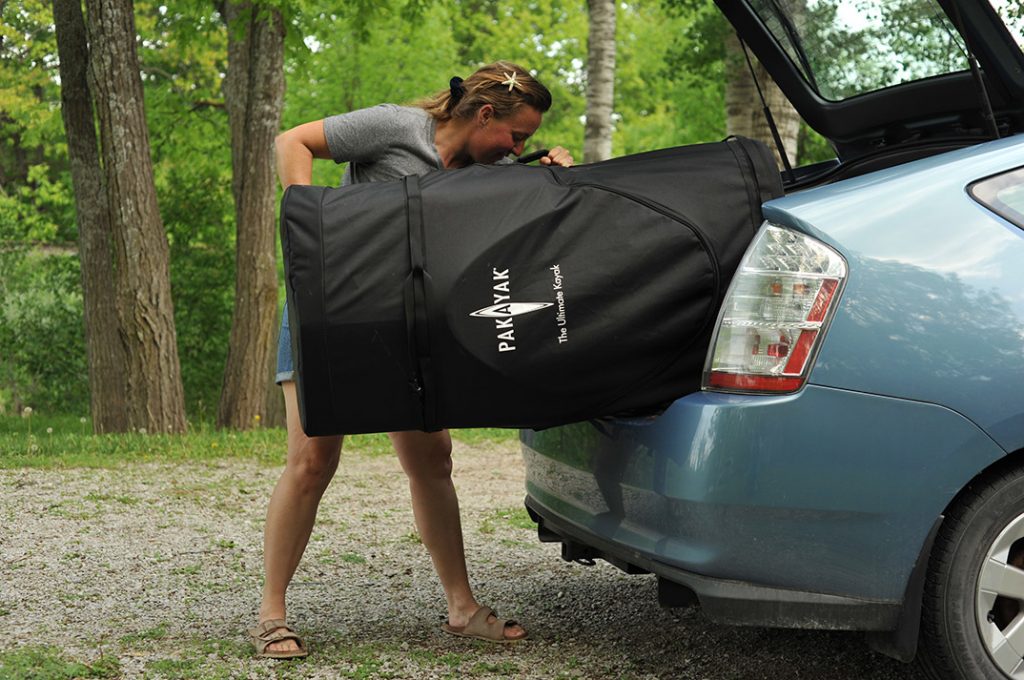
The Bluefin’s rolling travel bag makes it simple for anyone to wheel the packed boat to water, set up and slip offshore without any assistance—and without drawing too much attention (a handful of socially distanced admirers notwithstanding). It’s an easy, independent solution for challenging times.

If your walk to the water crosses soft sand or gravel, I recommend splurging for Pakayak’s optional all-terrain wheels. Slinging the comically large package across your back with the skimpy shoulder strap is another matter—a lighter folding or inflatable craft is a better choice for remote hike-in destinations.

On the water, the Pakayak Bluefin looks and feels like a standard 14-footer, save a couple of quirks particular to its packable design. To achieve the compact nesting of sections inside one another, the boat has a distinctly fish-form shape—the hull is widest and fullest ahead of the paddler, and tapers towards the stern. The narrower beam at the paddler’s hips gives the Bluefin less stability than I expected from a 24-inch-wide touring kayak.

Bluefin packable kayaks continue to grow

At just over 6 feet, our tallest reviewer also noted he had to adjust the foot braces to their maximum position, and could comfortably rest his feet against the forward bulkhead. Pakayak has addressed fit issues with taller paddlers by introducing a slightly roomier model—the Bluefin 142—that should be available by the time you’re reading this.

The Bluefin 142 will pack into the same dimensions as the original while adding 3.5 inches of legroom in the cockpit. Updates to the clamps, seat back and travel bag are also in the works. New CNC molds replace Pakayak’s original cast aluminum molds in the manufacturing process, which the team says will increase precision and shave weight from the finished product.

No engineering degree required for this portable kayak. Setup of the Pakayak Bluefin 14 is intuitive and fast. | Photo: Vince Paquot
Feature Photo: Vince Paquot

In just four years, Pakayaks have shipped to over 25 countries worldwide. Pakayak-olytes praise their portability, durability, competitive price tag and user-friendly simplicity. Touring fans enjoy the safety and ease of dry bulkheads and rubber hatches. One Australian adventurer has even embarked on multi-week expeditions, packing his Bluefin 14 with 80 pounds of food, gear and water. Facing daunting conditions and 30-mile days while island-hopping in the Philippines, Marcus Hill applauded his Pakayak’s seaworthiness and generous 180 liters of hatch volume. Hill’s most recent journey ended abruptly this March, proving not even Pakayaks are pandemic-proof.

[ Plan your next kayak expedition with the Paddling Trip Guide ]

Stow and go with the Pakayak Bluefin 14

If you’ve found yourself dreaming of a kayak that fits in your car or closet, assembles in minutes and paddles like a conventional hard-shell, the Bluefin is the boat for you. If you haven’t yet looked at portable kayaks, consider the convenience and possibilities of a boat that is always with you, stashed in your trunk for stealthy tours on local waters.

This article was first published in Issue 62 of Paddling Magazine. Subscribe to Paddling Magazine’s print and digital editions, or browse the archives.


Video review of the Pakayak Bluefin 14 Packable Kayak:


Boat Review: P&H Delphin Kayak

Two men surf ocean waves in P&H Delphin kayaks
Feature Photo: Steve Rogers

The very first day we tested the new P&H Delphin kayak in surf there was a ripping fall gale—ideal conditions for a boat aimed at maximizing sea kayaking’s rough water fun factor.

P&H Delphin Specs (150 / 155)
Length: 15’5” / 15’5”
Width: 21.5” / 22.5”
Weight: 55 / 58 lbs
Max Capacity: 230 / 275 lbs
MSRP: $1,799 USD
www.phseakayaks.com
[ Paddling Buyer’s Guide: See the P&H Delphin 150/155 kayaks ]

Surf’s up with the P&H Delphin kayak

The Delphin was designed by Graham Mackereth, owner of P&H and its whitewater arm, Pyranha, and Richard Taylor, contributing designer of Pyranha’s Molan and Varun whitewater kayaks, with wish lists from surf-loving pro sea kayakers. So it’s no surprise that it blends the performance fit and playful lines of a whitewater boat with sea kayak storage and speed.

A confidence-inspiring boat

Paddling out in the P&H Delphin is an immediate confidence boost. The rigid, triple-layer RM Corelite hull exudes compact strength and invincibility. The novice-friendly primary stability and easy, predictable edging encourage powerful strokes by erasing fear and hesitance.

Pivoting around to line up a surf is nearly instantaneous thanks to the Delphin’s short length, soft-chine midsection and flat bottom. Meeting the wind in profile, it’s equally happy to paddle, turn or just float in perfect neutrality. In a chaos of wind and waves, the Delphin cancels out opposing forces, seeming to bob in her own microclimate of calm—no need to drop the skeg.

Heading inshore, the Delphin accelerates quickly and catches waves with ease. P&H’s play gurus explain this as the effect of the hard chines at the bow, which “direct water onto the planing surface.” The Swede form and longer relative waterline achieved by the truncated, squared-off stern are two other factors that squeeze every shred of speed out of the Delphin’s 15 feet, five inches.

Two men surf ocean waves in P&H Delphin kayaks
Feature Photo: Steve Rogers

Staring down the face of a wave, we felt none of the usual fear of pitch poling into the trough. Chalk this up to the extra rocker, moved-back cockpit and generously proportioned cutter bow that P&H designed to float high and resist pearling on steep, fast waves. In their words, the bow “just kisses the water,” while the stern digs in for control and tracking. With all this design in your court, the Delphin virtually does the surfing for you.

[ Plan your next coastal kayaking adventure with the Paddling Trip Guide ]

The P&H Delphin is shaped to surf

The flat-bottomed planing hull is forgiving and incredibly maneuverable. Partial hard chines at the bow and stern soften in the midsection for beautifully smooth edging and a rock-solid secondary sweet spot.

Padded walls, aggressive thigh braces, contoured hip pads and a ratcheted backband borrow from whitewater outfitting and yield excellent plug-and-play fit and boat control. The skeg slider is well clear of the knees and the deck pod keeps a clutter-free foredeck.

The bow is the window to the Delphin’s soul: upturned for maneuverability, full volume to reduce diving and aid resurfacing, with hard chines to channel water onto the hull for quick acceleration on a wave.

[ Paddling Buyer’s Guide: See all P&H kayaks ]

Half the fun is getting there with the P&H Delphin

Suitable for a wide range of paddler sizes and abilities—a lower volume version is also available for small to medium paddlers—the Delphin lives to surf, ride current and dance in wind. As you’d expect of an aggressively rockered, planing hull, you won’t win any races against more destination-minded designs, but P&H is betting you’ll be having too much fun to care.

This article was first published in the Spring 2011 issue of Adventure Kayak Magazine. Subscribe to Paddling Magazine’s print and digital editions, or browse the archives.


Video demo of the P&H Delphin Kayak:


Boat Review: Jackson Kayak All-Star 2010

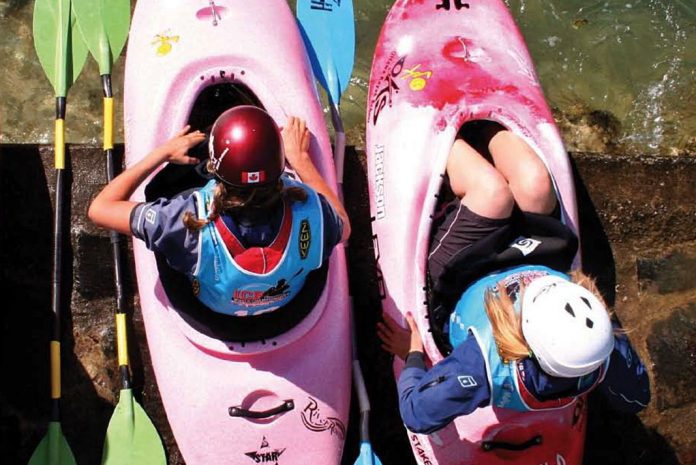
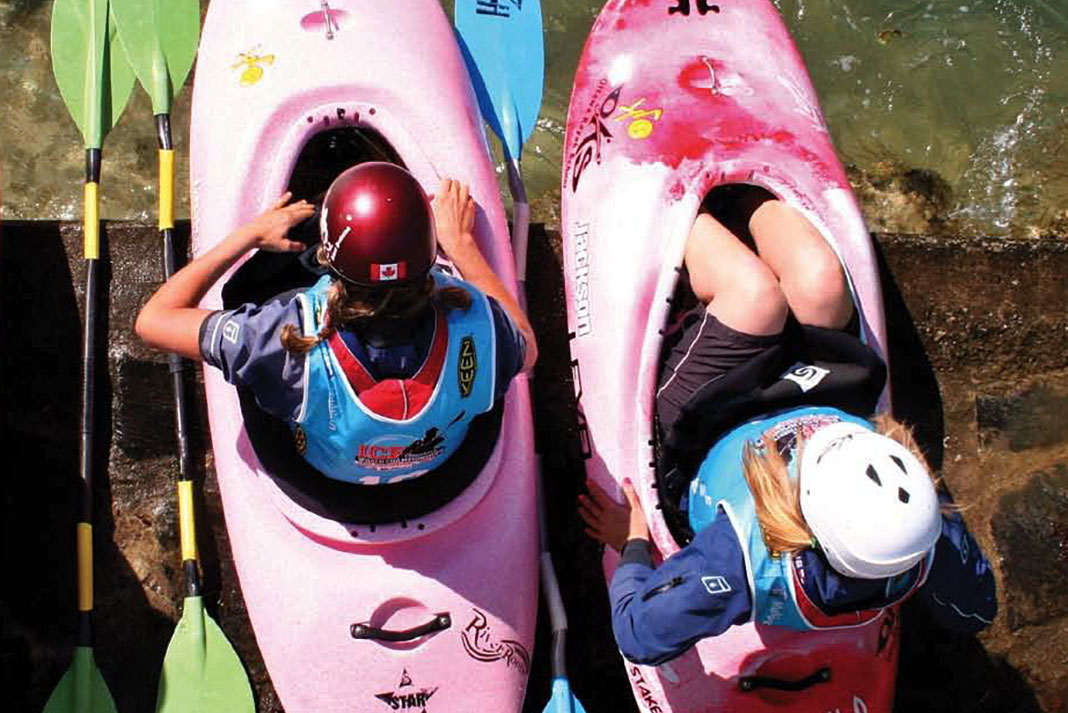
Two paddlers sit inside Jackson Star Series 2010 kayaks
Feature Photo: Alex Shallhorn

In the 2004 Formula One auto racing season, Team Ferrari won 15 of 18 races, earning Ferrari the coveted Constructors’ Crown—an award given to the auto manufacturer with the most season wins. It’s rare that a single vehicle so completely dominates an international competition, but it’s not just Italian automakers that have pulled off this coup. At the 2009 World Freestyle Championships, Jackson Kayak’s redesigned 2010 Star series, including the 2010 All-Star, was the chassis to beat—and not many did.

Jackson Kayak 2010 Star Series Specs
(Star / All-Star / Super-Star / Mon-Star)
Length: 5’6” / 5’10” / 6’2” / 6’5”
Width: 24” / 26” / 27” / 28”
Volume: 46.8 / 55.5 / 64 / 72.8 U.S. gal
Weight Range: 90-160 / 130-200 / 160-230 / 210-300 lbs
MSRP: $1,199 USD
www.jacksonkayak.com
[ Paddling Buyer’s Guide: See all Jackson kayaks ]

Jackson’s 2010 Star Series cleans up on the podium

There’s no doubt that Jackson Kayak founder Eric “EJ” Jackson’s policy of sponsoring a large, talented, highly motivated international team played a factor in the Star series’ dominance at the Worlds. The championship’s top three senior men, Nick Troutman, EJ and Stephen Wright, were all members of Team Jackson, as was fifth place finisher Joel Kowalski. But perhaps more tellingly, many competitors without affiliations to Jackson Kayak also chose to paddle Stars.

The senior men’s fourth place finisher, Jules Gallais of France, switched from a composite kayak into an All-Star on the first day of competition when he saw how it performed so strongly in the hands of his competitors.

“There are so many stories like Gallais’ where people jumped in the boat for the first time at the World Championships and felt immediately better and more competitive,” says Jackson.

The All-Star 2010 gains some new fans

Gallais can be forgiven for wanting a boat that made every trick look easy. After all, every aspiring and advanced playboater wants the same. And making freestyle tricks as effortless as possible is exactly what Jackson and long-time design partner David Knight had in mind when they sat down to redesign the three-year-old 2007 Star series.

Jackson and Knight started with the existing All-Star, tweaked the rocker and chines, added volume in the ends, narrowed and increased height in the knee area and shaved four inches off the overall length and three pounds off the weight.

“We spent most of the design process just figuring out ways to do the impossible—make the boat much shorter, but still faster,” says Jackson. “We don’t make prototypes so there is never any testing; just do a good job on the design, make the molds and cross your fingers!”

The updated Star suits female freestylers

The changes didn’t go unnoticed. The new Star’s lightweight, small stature and paradoxical speed made it a top choice for female competitors. On the Canadian women’s senior and junior teams, all six ladies paddled 2010 Stars. Canadian team paddler Annie-Pier Marchand explains, “It is the best freestyle boat for women. The shorter length makes it easier to throw around, spin, blunt, backblunt and stick moves.” Marchand adds that her Star launches off the water without too much effort and the hull speed makes it more retentive on a small, flushy feature like the Worlds wave.

Two paddlers sit inside Jackson Star Series 2010 kayaks
Feature Photo: Alex Shallhorn

With the broadest range of sizes in the playboat market, Jackson offers a fit for just about anyone. From the tiny Shooting Star—the only boat in the series to remain unchanged for 2010—to the brand new Mon-Star—the first XXL playboat for paddlers up to 300 pounds—a total of five sizes are available.

The new Stars’ proven track record makes them a clear choice for paddlers wanting Ferrari performance from their playboats. While the Star series is user friendly for a freestyle design, Jackson cautions that it isn’t as easy to master as the Fun—Jackson’s river play series—and says it is better suited to “paddlers who are comfortable flipping more often, or who are intermediates.”

[ Plan your next whitewater kayak adventure with the Paddling Trip Guide ]

Reach for the top with Jackson Kayak’s All-Star 2010

Perhaps the similar trajectories of Ferrari and Jackson Kayak are not surprising, given the parallels between Ferrari’s (and Formula One’s) winningest driver, seven-time World Champion Michael Schumacher, and four-time Freestyle World Champion Eric Jackson. Schumacher and the Ferrari crew likely never admitted to crossing their fingers in the pits, but Jackson’s designs are no less sporty or innovative. Somebody, hand the Jackson Kayak All-Star 2010 the checkered flag.


Boat Review: North Shore Atlantic LV

AS CHILLY AS ITS NAMESAKE. | PHOTO: VINCE PAQUOT

Even a freak blizzard, courtesy of the polar vortex that plagued early spring in the Northeast, can’t deter me from my date with the North Shore Atlantic LV. I scoop up one of these elegant touring mainstays from the distressingly wintry boat yard at Ontario Sea Kayak Centre (OSKC) for a frosty tour on the bay.

North Shore Atlantic LV Specs
Length: 15’11”
Width: 21.6”
Weight: 50 lbs
Weight Range: 88-220 lbs
MSRP: $3,750
www.northshoreseakayaks.co.uk
[ Paddling Buyer’s Guide: See all touring sea kayaks ]

North Shore’s Atlantic LV is an elegant ride

When I arrive, OSKC co-owner Dympna Hayes reveals that the smart looking, yellow-decked Atlantic LV I’m borrowing is her own personal kayak for teaching and tripping. “But you can take it for as long as you need,” she offers, eyeing the stubborn blanket of fresh snowfall, “seriously, you can have it until May.”

Hayes came to her Atlantic LV through a student, who found himself struggling to find confidence and comfort in the slender craft. For Hayes’ petite frame, however, the Atlantic LV’s low volume and responsive handling were a perfect fit.

“Lighter, intermediate to advanced paddlers will find it feels most stable,” she confirms, “and it’s a lot of fun for rolling, rough water and surfing.”

The Atlantic LV has a serious pedigree

Eager to test that assertion, I launch the Atlantic LV in water so recently thawed and brain freeze-cold that it seems somehow thicker than normal, like maple syrup. My first impression is that this boat is reminiscent of familiar compact, no-apologies-British sea kayaks, like Sea Kayaking UK’s (formerly NDK) Romany and Valley’s Avocet—with which the Atlantic LV shares outfitting touches like Valley’s bomber rubber hatches, well thought out deck rigging and minimalist seat with integrated backband.

The resemblance shouldn’t come as a surprise; the Atlantic LV is a direct descendent of North Shore’s Shoreline, originally launched in 1984 during the fledgling decade of contemporary British sea kayaks. The Shoreline pioneered a new breed of kayak—the shorter, more playful coastal tourer—becoming an instant, and oft-imitated, success.

Today, North Shore is operated as a boutique brand by Valley Sea Kayaks and the boats are hand-made at their facility in Nottingham, England.

AS CHILLY AS ITS NAMESAKE. | PHOTO: VINCE PAQUOT

Drop the skeg and point your toes

Low decks front and back reduce exposure to wind, minimizing weathercocking despite the Atlantic LV’s gracefully upswept bow and stern. Running downwind, deploying the solid-feeling skeg corrects the boat’s tendency to turn slightly into the wind. The shallow-V hull further aids tracking and makes for dynamic feeling edging when I throw the Atlantic LV onto its soft chine for sprightly turns. Plenty of rocker means this 16-footer runs just 13.5 feet of waterline and cranks around with a well-placed stroke and bow draw.

The Atlantic LV feels like an extension of my lower body, rather than a separate craft. That low front deck guides my legs down into the hull so they’re nearly flat, more akin to Greenland-style kayaks than modern, whitewater-influenced ocean play designs. Securely integrated, I can steer the boat just by pointing my toes, and bracing and rolling are a breeze. On a longer tour, however, there isn’t much wiggle room to alleviate pins and needles.

[ Plan your next sea kayaking & touring adventure with the Paddling Trip Guide ]

Tour in style with the North Shore Atlantic LV

Sure, there are faster kayaks and more cutting-edge kayaks. And yet I can understand the enduring popularity of the Atlantic design, and why Hayes chose an Atlantic LV as her daily driver. Maybe it’s the years spent paddling British-style kayaks—my own intimate connection formed over hundreds of miles—but gazing across the Atlantic LV’s perky bow just feels so right. I’m filled with an ineffable contentment knowing that the paddlers in my wake are watching the equally chipper profile of its jaunty stern.


This article originally appeared in the Adventure Kayak
Early Summer 2016 issue.
Subscribe to Paddling Magazine and get 25 years of digital magazine archives including our legacy titles: Rapid, Adventure Kayak and Canoeroots.

Boat Review: Dagger Alchemy 14.0

man paddling a Dagger Alchemy 14.0 S sea kayak
Feature Photo: Tim Shuff

Last year marked the launch of the Dagger Alchemy 14.0 S and L, small and large versions of a performance-minded, light-touring kayak in affordable and durable polyethylene. With one master stroke Dagger nailed the golden crossover segment where high-performance meets recreational day paddling, filling the niche where most of us paddle most of the time.

Dagger Alchemy 14.0 Specs
(S / L)
Length: 14’ / 14’
Width: 23” / 24”
Depth: 13” / 14.25”
Cockpit: 35” × 18.5” / 35” × 18.5”
Weight: 51 / 54 lbs
Capacity: 275 / 300 lbs
MSRP: $1,295 USD or $1,450 CAD
[ Paddling Buyer’s Guide: See all Dagger kayaks ]

Dagger’s Alchemy 14.0 has big capabilities

At 14 feet, the Dagger Alchemy is small, but not to be underestimated.

Paddlers will want to choose the size that fits them best. Small- to medium-sized folks will mesh perfectly into the sportier dimensions of the 14.0 S, the model reviewed here. Ours required removal of the foot braces to fit a six-footer. The equally priced L version is the same length but with added capacity from an extra inch of width and inch-and-a-quarter of deck height. Both sizes are designed to have a snug-fitting cockpit for solid control in rough water.

This kayak can really cruise

A combination of long waterline, low rocker and a Swede form shape result in impressive acceleration and cruising speed. We cranked out a consistent five to six kilometres per hour and topped out at 10 in a sprint—performance we’re accustomed to in much longer kayaks.

man paddling a Dagger Alchemy 14.0 S sea kayak
Feature Photo: Tim Shuff

The Alchemy’s shallow-V hull with hard chines offers an excellent compromise of stability and edgeability—moderate primary stability for a performance feel without being twitchy, and great, confidence-inspiring secondary stability on edge.

The Dagger Alchemy 14.0 compensates for its short length by reducing the rocker. The result is something that feels longer than it is—more like a highly rockered long boat than other 14-footers we’ve paddled. The effect is that the Alchemy tracks well and isn’t too skittish unless you get some speed and put it up on edge, or edge it in following seas, in which case the stern will skid out as you would expect from a short kayak.

The skeg reduces the skid effect and also helps tracking in crosswinds and following seas, although weathercocking or leecocking are minimal because of the low windage of the Alchemy 14.0 profile. The skeg slider is conveniently positioned in a tightly recessed groove that keeps it out of the way of fingers and knuckles but makes it a trick to dial on the go until you get used to it.

Details of the Dagger Alchemy 14.0 S kayak

The affordable Alchemy is feature‑rich

The deck is nicely appointed with three rubber hatch covers, bungees, a locking bar and recessed fittings. The day hatch is a bit of a far reach from the paddling position (there’s ample space behind the seat for provisions), but it’s yet another sign of the Dagger Alchemy 14.0’s full complement of sea kayak features.

The seat offers multiple adjustments for hips, thighs, leg height and backrest tension. A plastic rail adds rigidity to the hull in the cockpit areas.

[ Plan your next kayak day touring adventure with the Paddling Trip Guide ]

Get away for the day in the Dagger Alchemy 14.0

The capacity of the Dagger Alchemy 14.0 favors performance day paddling over hauling gear. It’s perfect for day trips or meticulously planned weekends. In the recreational price range with high-performance features, it best suits adventurous paddlers who want a kayak that will encourage them to grow and keep up with them every step of the way.

This article was first published in the Summer 2010 issue of Adventure Kayak Magazine. Subscribe to Paddling Magazine’s print and digital editions, or browse the archives.


Boat Review: Stellar S14S Surfski

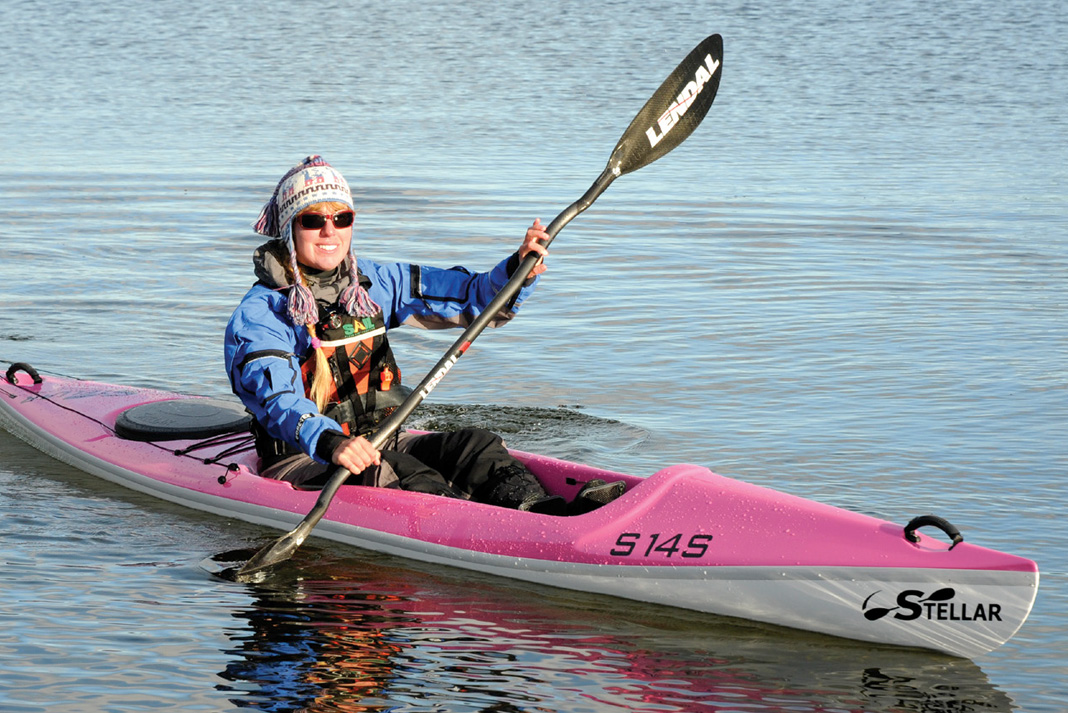
Stellar S14S Surfski | Feature Photo: Vince Paquot

According to Stellar Kayaks rep Vaughn Smith, “People have a head-trip about surfskis—they’re skinny, they’re tippy, they’re weird.” But the people to which Smith refers aren’t the manufacturer’s devoted niche of hard-core racing kayakers and fitness fanatics, a group who will no doubt welcome the arrival of the Stellar S14S surfski.

Stellar S14S Specs
Length: 14’6”
Width: 24.6”
Material: Advantage fiberglass
Weight: 34 lbs
MSRP: $2,555
www.stellarkayaks.com
[ Paddling Buyer’s Guide: See the Stellar S14S surfski ]

Stellar’s S14S is sleek and graceful

Any reservations I had about the new Stellar S14S, however, began to erode the minute I laid eyes on this sleek, bubble gum pink 14-footer. And they vanished completely when I slid into the surprisingly comfortable seat bucket for a frosty crossing to a cluster of offshore islands.

With its open cockpit, knees-up-and-together seating position, narrow racing bow and long waterline, the S14S is clearly a surfski. Just don’t tell Smith that. “We’re marketing this as a performance sit-on-top, that just happens to be incredibly fast,” he says. Like its longer, narrower siblings in the Stellar surfski family, the S14S is designed for maximum efficiency.

Stellar S14S Surfski | Feature Photo: Vince Paquot

Catch a free ride

As I discover minutes into the crossing, when I absent-mindedly pull away from my companions’ 16- and 17-foot touring kayaks, greater efficiency doesn’t just equal more speed, it delivers that sweet, hypnotic glide with ridiculously less effort. Ergo, more miles covered in an afternoon, and more waiting for your friends to catch up.

The effortless acceleration is particularly rewarding on downwind runs, where the S14S refuses to let even a small swell go to waste. If catching free rides on every wave doesn’t plaster a smile on your face, you should probably take up hiking.

More significant, perhaps, than the Stellar S14S being the fastest 14-footer we’ve ever reviewed is the fact that this is a boat beginners will feel comfortable paddling. The Swede-form hull—measuring a beamy 25 inches across at its widest point behind the seat—combined with the soft chines produce superb secondary stability. Should you take an unscheduled swim, the shallow deck is easily remounted from the water.

The S14S makes you want to go fast

Adding to the S14S’ versatility as a crossover vehicle between fitness and recreational paddling or touring, is the inclusion of two watertight storage compartments. Overnight trippers especially will appreciate the extra-large stern hatch and tent-sized bow hatch.

Like all Stellars, the S14S is available in four different composite layups, from basic fiberglass to featherweight carbon fiber. Featuring the mid-range Advantage construction, our demo weighed in at just over 34 pounds, translating to an equally effortless experience off the water. Grasping the two cockpit handles placed perfectly at the boat’s balance point, I easily lifted it off the roof rack and solo suitcase-carried it to the water.

Cleaving through a light, evening chop back to the mainland, I felt the undeniable tug that columnist and surfski convert Neil Schulman explored in “Paddle Faster.”

Head out on a weekend trip

Stellar’s steering system combines an over-stern rudder with gas pedal-style foot controls that are responsive without being twitchy.

The Stellar S14S may be novice-friendly, but advanced touring paddlers won’t be bored—twin hatches give this pocket rocket the capacity for weekend trips.

The contoured cockpit is comfortable and supportive. Pull the plug on the Venturi drain to empty water from the foot well while underway. The puddle under your butt you’re stuck with till shore.

[ Paddling Buyer’s Guide: See all Stellar kayaks ]

Catch the wave with a Stellar S14S

It’s true that as a sit-on-top ‘ski, the Stellar S14S robs you of certain facets that some kayakers consider integral to their experience—rolling, dynamic edging and bracing, extended tripping—but in return this boat offers something different and equally tantalizing: a spare, athletic grace accessible to almost anybody.


This article first appeared in the Spring 2015 issue of Adventure Kayak magazine. Subscribe to Paddling Magazine and get 25 years of digital magazine archives including our legacy titles: Rapid, Adventure Kayak and Canoeroots.

7 Uses For Pine Gum: Boating, Camping And More

Pine gum dripping down a tree
Feature Photo: istockphoto.com/yanikap

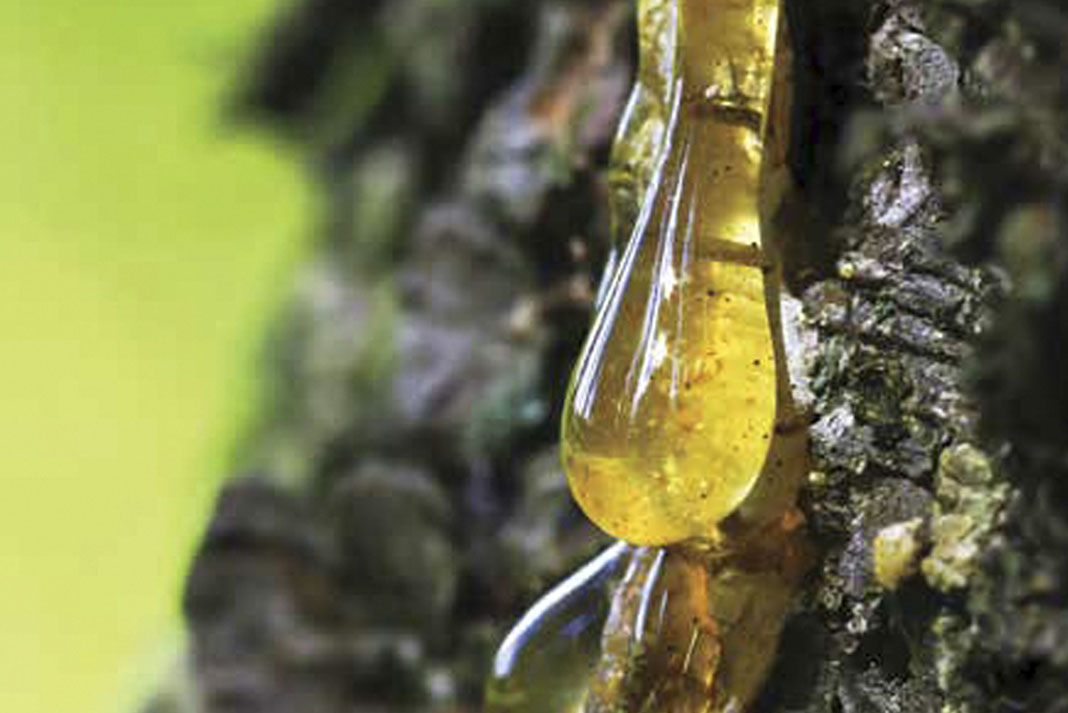
Despite the name, pine gum or resin isn’t specific to pine trees—it can come from pines, cedars, spruce, firs, junipers and most other coniferous trees. The sticky substance has long been used in various forms by artisans and industrial manufacturers as well as backcountry campers, survivalists and other practitioners of bushcraft.

Here are some handy uses for pine gum and resin to remember next time you need a hand from nature’s glue stick.

7 uses for pine gum

1) Protecting coniferous trees

Airborne diseases, insects and animals are blocked by resin’s defense mechanisms as it secretes from punctured areas on the tree. After leaving the tree, turpentine oils evaporate quickly and the resin hardens into a scab that can be harvested and reheated to soften the pine gum into a pliable paste.

Dinosaur fossil on rough stone formation
Photo: Marcus Lange / Pexels

2) Preserving dinosaur DNA

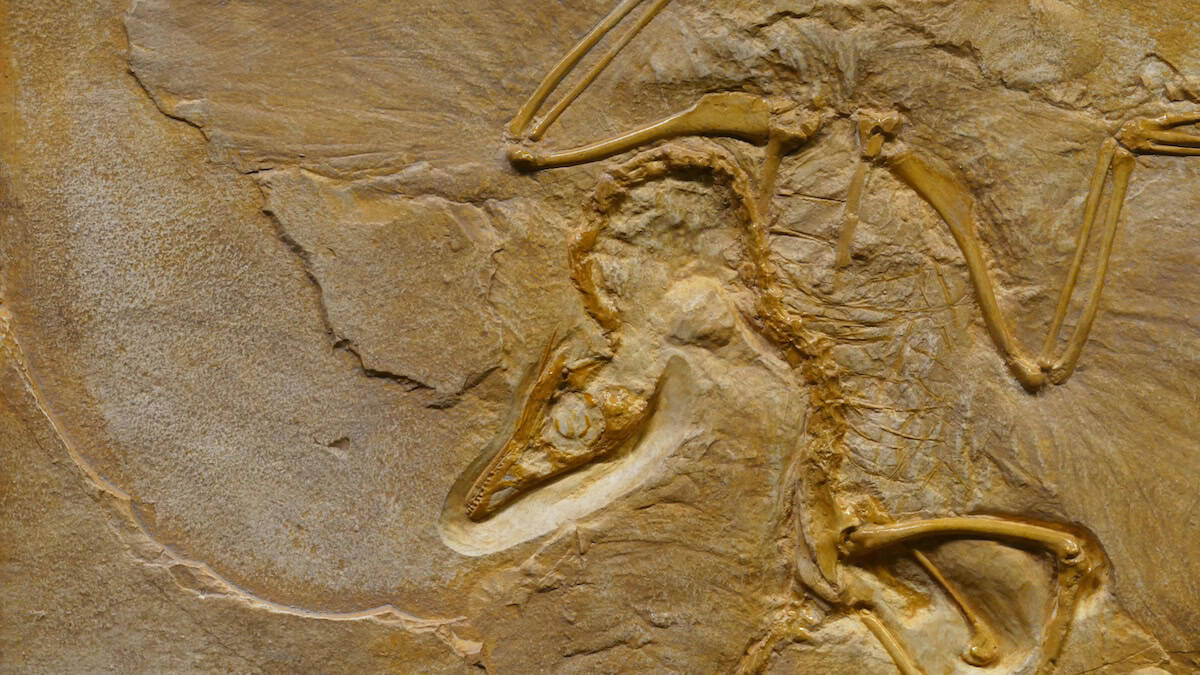
The scabbing process is responsible for preserving priceless fossils of plant and animal specimens from long before our time. Pine gum also played a crucial role in kickstarting the Jurassic Park movie series. Preserved chunks of amber have led to groundbreaking finds such as: a carnivorous plant, dinosaur feathers that still have their color and even a Caribbean Anolis lizard that’s 15-20 million years old.

A Person Playing Violin
Photo: Cottonbro Studio/Pexels

3) Treating musical instruments

Rosin, the distilled form of resin, is formally known as colophon. Colophon is used in everything from bandages to dental products. String instruments such as violins require rosin to coat their bow. Referred to in the Charlie Daniels song “The Devil Went Down to Georgia“, as the devil prepares to duel with Johnny, “fire flew from his finger as he rosined up his bow.”

[ Plan your next canoe tripping adventure with the Paddling Trip Guide ]

4) Varnishing furniture

Most recently, some unfortunate souls felt the burn when they experienced an eruption of localized buttocks reactions from ash tree toilet seats that were coated in resin-based varnish. Those who fell victim quickly removed their fiery thrones.

5) Pulp and paper manufacturing

Wide distribution is likely to blame for it being rated one of the most problematic allergens in North America. Commonly used in paper printing, adhesives and varnishes, it’s a tough natural material to avoid.

Pine gum dripping down a tree
Feature Photo: istockphoto.com/yanikap

6) DIY glue and waterproofing

Survivalists use all forms of tree gums for waterproofing boot seams, fixing leaky canoes and damaged tents by forming backcountry hot glue sticks. Because pine gum is highly flammable, it can even be used as a fire starter or candle torches.

7) Topical wound treatment

Resin straight from the tree can be applied to wounds to stop bleeding and work as an antibacterial salve and poultices.


Eddy Harris On His Mississippi Solo Paddling Trip

Jeff Jackson with Eddy Harris discussing Mississippi Solo

Ifirst read Adventures of Huckleberry Finn when I was 12 years old. As a young reader, Huckleberry Finn was the every kids’ kid, motivating a number of lashed-together raft attempts in the small swampy pond behind my Grandpa’s farmhouse. I didn’t understand at the time that Huckleberry Finn was not really about a river trip at all. In this tradition, Mississippi Solo (available on Amazon) is the account of an epic source-to-sea trip by Eddy L. Harris, but the true focus of his celebrated memoir is on much weightier topics.

Mississippi Solo is about more than a river trip

Seeking adventure but missing the point

Huckleberry Finn, Mark Twain’s sequel to The Adventures of Tom Sawyer is considered one of the classics of American literature and is hands down the most popular river story of all time. It has sold an estimated 20 million copies since first published in 1885.

I had yet to even sit in a canoe by the time I had read Twain’s novel, yet it instantly shaped my view of adventure, the Mississippi River and what a river trip should look like. In the early ‘90s I was in my early 20s, full time guiding, and voraciously collecting anything and everything to do with river lore. I lived out of a tired Chevy Sprint hatchback, half of which was filled with milk crates of river books.

From my dirtbag library I would loan novels and guidebooks to other guides. I’d bring copies on my river trips. I’d read aloud to my guests as we floated between deep canyon walls. I’d reference others for river facts and quote memories of early explorers on the same rivers.

In this time of collecting all things river, I stumbled upon an unlikely young author named Eddy Harris and his book, Mississippi Solo. Eddy was a self-declared total neophyte. He’d borrowed a canoe, hitched a ride with a friend to Minnesota, and proceeded to travel the entire length of the Mississippi River to New Orleans.

[ See the widest selection of canoes in the Paddling Buyer’s Guide ]

He paddled over 2,000 miles, eating in diners, camping in city parks, probably even changing sides every couple of strokes. I was left nonplussed by the book. Puzzled. Disappointed. It didn’t seem like an adventure to me. I totally failed to relate to Harris’ story.

What I didn’t understand at the time—not until rereading it decades later—Mississippi Solo was not about a river trip at all.

A closer reading of Mississippi Solo

Exactly 30 years after its 1988 publication, I again stumbled upon Mississippi Solo, pushed to the shadowed and dusty end of my basement bookshelf.

Rereading it now—I will optimistically attribute this to accrued wisdom, or at least just being closer to 50 rather than 20—I had my Huckleberry Finn moment. Eddy Harris, while telling the story of his novice canoe trip, was really writing about race and being a young Black man in America. It feels ridiculous to me how this was not more apparent the first time I read it. But then again, Adventures of Huckleberry Finn is about race and racism and I managed to miss that too on the first time around.

Imagine launching in 1988, as Harris puts it, “From where there ain’t no Black folks to where they still don’t like us much.” Let alone doing so in a craft about which the author knew little to nothing. This was adventure in a realm I could not fathom as a young, hard-skilled, self-absorbed white guy. Today, Eddy’s adventure impresses me completely.

[ Plan your next canoe tripping adventure with the Paddling Trip Guide ]

I was so inspired I picked up the telephone and cold called Eddy Harris. This is not something I would typically do, and graciously, he was happy to talk with me.

Harris gets to the heart of the matter

As it turns out, Eddy had just returned from a second source-to-sea trip along the Mississippi River, this time interviewing people for his film, River to the Heart (see the trailer on YouTube).

What struck me about my conversation with Eddy is the sense of ownership he has for his river, the Mississippi. He explained to me how his film was an extension of this ownership:

“Part of the rationale for the film, and talking to kids of color, is that this river, nature, the country, is ours too. The racial component is very important. Unless we feel a part of it, we won’t consider it. Part of my schtick is to push inclusion so we all care about the same things. No matter what color we are.”

Harris claims he had no idea Black people didn’t canoe. It didn’t occur to him until he was on his trip. He wrote in Mississippi Solo, “I promised myself I would not make race an issue out here…but it became clear people will see I’m Black only moments after they see my canoe is green. Maybe even before.”

Jeff Jackson with Eddy Harris discussing Mississippi Solo

Inspiring ownership of the outdoors

This tension of being a newbie canoeist, an outsider, a traveler and a Black man, set against a sense of ownership of where he was, on his river, is the most powerful aspect of his story. Eddy explained to me, “I never saw my being Black as an impediment to what I can or cannot do. I’m hoping the canoe in Mississippi Solo inspires the same sense of ‘it’s mine’ ownership.”

“Part of the rationale for the film, and talking to kids of color, is that this river, nature, the country, is ours too.”

“Once you feel ownership, you don’t restrict yourself from it. The canoe becomes a metaphor for this sort of ownership. The Mississippi River, too, everyday on the river you realize, ‘this is mine’. The locks and dams, they pass you through like everybody else because they are ours. This river belongs to me too.”

Now in his 60s, Harris is back doing it again. He’s setting out on another 2,000-mile journey. “The first time, I had no idea what I was doing. It was a real pilgrimage. The second time was different, because I was with this camera crew. I feel the need to do the solitary journey again. It’s my home river.”

The story runs deep in Mississippi Solo

Rereading Mississippi Solo I learned more about my limited perspective and what is says about me and my place in society. Just like Twain’s Adventures of Huckleberry Finn, and like always, if you look deeper into the waters you travel past you’ll discover there is always more to the river than just the river trip.

This article was first published in Issue 55 of Paddling Magazine. Subscribe to Paddling Magazine’s print and digital editions, or browse the archives.


Jeff Jackson is a professor at Algonquin College and a risk management consultant. Eddy—he insisted upon Jackson calling him Eddy—now lives in France and is a critically acclaimed author with several titles to his name. More information can be found at Eddy’s website, www.eddyharris.com.