Steve Jordan is no stranger to the ups and downs of the kayak business. His career has spanned nearly thirty years and taken him from Perception Kayaks, through the co-founding of Liquidlogic Kayaks to his current role as President of Hurricane Aquasports, and VP of Sales for BIG Adventures, the parent company that produces the Hurricane, Native and Liquidlogic brands.
All that experience gives Jordan a long view on the current paddlesports market. He’s positive about the performance of the brands but realistic about the challenges. Jordan says the 2019 season started out slowly. Sales are flat in some categories and down in a few. “It’s a challenging year,” said Jordan, “not like any season I’ve seen in some time, and the weather has not been on our side for an early start to the season.”
The challenges of 2019 are different than the tough times in 2007 and 2008. One of the key issues today is the proliferation of mass market product at ultra-low price points. Jordan sees these sales eating into sales and margins on recreational kayaks at specialty dealers.
Despite the competition from big box retailers, not all categories are down. Jordan says specialty products, like Hurricane’s lightweight ABS kayaks, have continued to perform.
These kayaks offer specialty retailers and their customers something they can’t find at chain retailers. High performance, lightweight designs at a great value and affordability.
Jordan says the Native line of fishing kayaks has been a huge success for Big Adventures and their dealers. These boats, particularly the pedal drive models, sell at higher price points than the recreational kayaks. Fishing kayak sales have increased the average transaction at retail and have helped support specialty paddlesports dealers even as sales in other categories have eroded.
Fishing kayaks can be a profit center for dealers, but they require expertise to sell. Kayak anglers want to buy from an expert, somebody who knows both the boats and the fishing.
“You can’t just put them out on the floor and expect them to sell,” says Jordan. “You have to live it.”
That’s why Native’s most successful fishing kayak dealers are also their most innovative, actively engaging on the web to build community and excitement around the sport and their shops. Dealers who create unique internet content increase their credibility with customers and are more likely to make the sale.
While internet marketing and content creation can drive customers into specialty shops, Jordan doesn’t see web sales as the future of specialty paddlesports. He says that several of his key dealers are re-evaluating the profitability of their internet sales. “You can reach a lot of customers, but there are heavy overheads,” says Jordan. And then there is the problem of freight. “Rates are sky high. A lot of that business was built on free freight or discounted freight,” says Jordan, “you can’t do that now.”
The spiralling cost of freight prompted BIG Adventures to take shipping in-house. “We leased a truck and hired a driver,” says Jordan. Having their own truck not only allowed BIG Adventures to drive down freight costs to their dealers, it also helped to reduce costs on the manufacturing side. “We back haul our own resin, transport our recycled product. It’s helped a lot of have our own truck, and our service level has increased with our dealer base.”
Driving down costs by doing things in-house is a big part of the strategy that BIG Adventures uses to stay nimble and flexible in a challenging marketplace. Jordan said that the past year has seen downward pressure on the profitable pedal drive fishing kayak category. There are more options on the market than there were a few years ago and prices and margins have come down.
The evolving market prompted BIG Adventures to bring pedal drive production in-house, sourcing components from regional suppliers. “We used to have our pedal drives built in Taiwan,” says Jordan, “now we build them ourselves.” By keeping their supply chain close to their manufacturing facility, Native stayed competitive in the category. “We’ve increased dealer margins and reduced price.”
While realistic about the challenges of the current market, Jordan remains optimistic about the opportunity for growth in key categories, and committed to maintaining a strong relationship with specialty retailers. “There’s a lot of opportunity for us to grow if we nurture what we’ve had for all these years—our passion for paddling.”
Paddlesports is again in the tariff crossfire as the United States opens a new offensive in the global trade war. In May the Trump administration increased tariffs from 10 percent to 25 percent on $200 billion worth of Chinese imports, including kayaks, canoes and inflatable boats. And on August 1, as Paddling Business went to press, President Trump announced a new 10 percent tariff on an additional $300 billion in Chinese imports, among them standup paddleboards, lifejackets, pedal drives and other components.
The increased tariffs come as a heavy blow to a paddlesports industry reeling from a three-punch tariff combo last year. First, the European Union imposed a 25 percent import tax on U.S. kayak and canoe exports in June 2018, and Canada followed suit with a 10 percent tariff in July.
Trade hostilities on the Chinese front have escalated steadily since September 2018, when the Trump administration imposed a 10 percent tariff on selected Chinese imports, since increased to 25 percent. The latest round of tariffs comes as U.S.-China trade negotiations faltered for the second time in three months, and makes almost all Chinese imports to the United States subject to tariffs of 10 to 25 percent, or even more. The levy on inflatable kayaks now stands at 27.5 percent.
Confused? You’re not alone.
Among the most difficult aspects of the tariff wars is the uncertainty they bring to supply chains and vendor-retailer relationships.
When the Canadian and EU tariffs took effect in June 2018, paddlesports industry leaders could only guess how their businesses would be affected. As million-dollar players in a trillion-dollar trade war, the best they could do is hunker down and hope for a speedy truce. A year later, the impact of those tariffs is visible on everyone’s balance sheets. The European Union’s 25 percent tariff on canoes and kayaks was a body blow to American manufacturers who play in the European market, some of whom saw their European sales decline as much as 80 percent. Canada’s 10 percent tariff was lifted in May, but with the majority of summer orders having already shipped, even that silver lining came with a bit of tarnish. The hangover will stretch deep into the 2019 season.
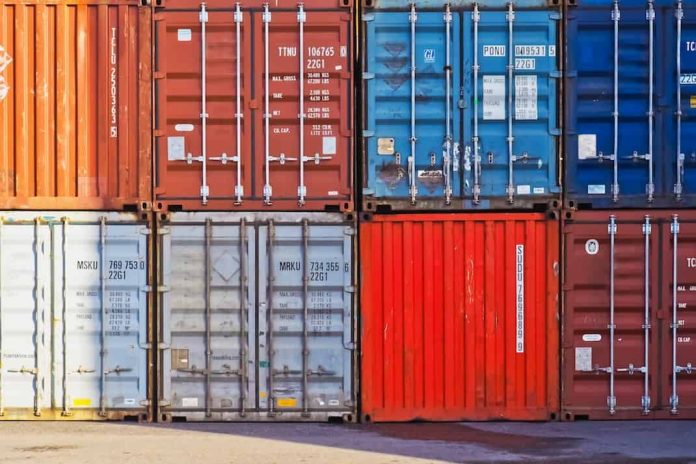
You can escape the tariff by paddling over the Canada-U.S. border, but just trying paddling from China. | Photo: Pixabay
The increased tariffs on Chinese-made canoes, kayaks and inflatables will hurt some brands more than others, but industry leaders who spoke with Paddling Business agree there will be many more losers than winners. Even companies molding kayaks in the United States braced for a substantial hit, as the cost of some Chinese-made components increased 25 percent overnight. In May, less than two weeks after the Trump administration announced the increase in Chinese tariffs, Hobie scheduled a five percent mid-season price hike on all its kayaks and SUPs—even though most of the company’s boats are manufactured in Oceanside, California.
Components make up a substantial portion of production costs and like many other U.S.-based kayak companies, Hobie sources some of those parts from China. The company was already absorbing the impact of the 10 percent tariff on Chinese components which went into effect in October 2018, and when the tariff increased to 25 percent company brass concluded they had no choice but to raise prices to compensate.
“Hobie is proud to employ hundreds of people at our headquarters in Oceanside,” the company said in a statement. “While a majority of our manufacturing takes place in our Oceanside facility, some of our production and materials do come from overseas. Unfortunately, the recent tariffs, among other factors, have forced us to increase prices on select Hobie products.” The increase took effect June 15, accompanied by a new retail price list. Dealer margin was not impacted.
A similar dynamic is in play for other U.S.-based manufacturers using imported components, although they’ve been able to hold the line on pricing for now.
Doug Ragan, senior vice president for sales at Jackson Kayak, says that if the List 4 tariffs go into effect the Sparta, Tennessee-based kayak maker may have no choice but to raise prices. The company already is reeling from the Canadian and EU tariffs imposed last year. Jackson’s strategy was to cut margin to the bone and try to hold market share. The rope-a-dope tactic allowed the company to wait out the Canadian tariff, but Jackson Kayak is still absorbing body shots in Europe. Sales suffered despite the best efforts of Jackson and its European retailers to hold prices in the same ballpark as their non-U.S. competitors, who suddenly had a 25 percent pricing advantage.
“European distributors who were taking six containers a year ago are now taking one,” Ragan says. “It’s a slap in the gut, and meanwhile they’re pouring hot coals on you from China. It’s a perfect storm right now.”
How tariffs impact small business
Sea Eagle Boats is in the eye of that storm. The Long Island-based seller of inflatable kayaks, boats and standup paddleboards has become a high profile example of how tariffs impact small and mid-sized U.S. companies.The company has been featured in the Wall Street Journal and other major outlets, thanks to owners Cecil and John Hoge’s candid assessment of how the Trump tariffs have impacted their business. The first thing John Hoge wants to make clear is that China does not pay the tariffs, as President Trump has repeatedly asserted. Importers, and ultimately consumers, pick up the tab.
“It’s not debatable. We have the bills that CBP (Customs and Border Protection) gives us for the tariff, in black and white. We get seven days to pay,” says Hoge. He gives the feds an account number, and they help themselves to the money—about $180,000 since the 10 percent Chinese tariff increase went into effect in September 2018. At the new rate, he would have to pay about $450,000 to land the same imports. That’s a heavy burden for a family business with 30 employees, Hoge says.
[Discover the hottest recreational kayaks in our online Paddling Buyer’s Guide.]
His Chinese suppliers have been little help. One reduced prices by 5 percent. The other wouldn’t budge. (A third supplier shifted production of Sea Eagle boats from China to a factory it owns in Vietnam.) Hoge says he had no choice but to pass the cost on to consumers, raising prices an average of 7.5 percent in January to compensate for the 10 percent tariff hike. The increase came on top of a 2.5 percent tariff already in effect for inflatable boats, raising the total tax to 12.5 percent. Now he’s paying a total of 27.5 percent and expects he’ll have to raise prices again when his current inventory runs low. Other inflatable importers face the same choice.
“While every business sector is price sensitive, our product categories fall on the extreme end of the spectrum,” Aquaglide general manager Jeff Cunningham wrote in a public comment to U.S. Trade Representative Robert Lighthizer. The letter urged tariff exemptions for products the Bend, Oregon-based company imports from China, including kayaks, paddles and standup paddleboards.
“If the 25 percent tariff goes into effect, we will be forced to pass substantial price increases on to our dealers and customers . . . I anticipate a 20-30 percent decrease in revenue, which would then force us to reduce our staff,” Cunningham wrote.
Who pays the tariffs?
Entry-level hardshell brands who import from China face the daunting prospect of competing at rock-bottom retail prices with U.S. and Canadian rivals, while absorbing a 25 percent import tax on every boat they import. Selling a kayak and paddle for as little as $200 leaves precious little margin, and importers will likely have to pass at least a portion of the tariff on to consumers. North American manufacturers like Pelican and Lifetime will have a choice: raise their own prices to sweeten margins, or keep prices low to seize market share. Either way, the Alibaba brands are in for a rough ride. Prospects are better for mid-market brands that import from China.
Josh Thomas, co-founder and CEO of Vibe Kayaks, says his company will tighten belts and hold the line on pricing. “A 25-percent hike, let’s be honest—it sucks. But we’re not necessarily going from zero to 25,” Thomas says. “There was enough blood in the water to know that some kind of trade war or tariffs was coming, and being a younger brand it was a little bit easier for us to plan ahead for it.”
Vibe raised prices last year, with MSRP for the flagship Sea Ghost 130 fishing kayak increasing from $899 to $999. That gave the company a bit of extra margin, Thomas says. “We planned for 10 or 15 percent, and the way we tighten up and close that last 10 percent gap is internal operations, making sure we’re running as lean and as efficient as possible.” One thing Thomas won’t do is change suppliers. When he went into the kayak business in 2013, he couldn’t find a U.S. manufacturer willing to work at the volume and pricing needed for his business plan to pencil out. In China, he had his pick of suppliers. The company he partnered with has grown with him as his sales volume doubled every year for six years. Now plenty of U.S. molders are courting him, but Thomas remains committed to his Chinese partner, who has become a close friend. If he does move his operations, it would be to another Asian country with the same partner, he says. They’ve gone so far as to scout sites, but for now the timing and difficulty of such a move is prohibitive, Thomas says.
[Discover all the best new gear in our online Paddling Buyer’s Guide.]
“Let me just move some molds over to what, a big empty field in the middle of Vietnam?” he says. “I’d have to put up a building, move machinery, learn their culture, learn their laws, learn their taxes.” That kind of investment doesn’t make sense, especially when there’s no telling what will happen next with tariffs.
While President Trump’s style of economic brinkmanship breeds uncertainty it’s also impossible to ignore. The tariffs could compel China to renegotiate a trade deal on terms more favorable to the U.S., or they could cause both sides to dig in deeper.
As Paddling Business went to press at the end of July, a U.S. trade delegation was preparing to travel to Shanghai for the first face-to-face negotiations since the proposed trade deal fell apart in May. That’s a promising development, though the parties are still miles apart. The Chinese say they won’t talk brass tacks until the U.S. lifts all tariffs, but have resisted U.S. demands that they strengthen regulations against intellectual property theft and forced technology transfers. President Trump’s response was a new round of tariffs and the threat of more escalation, saying his administration could raise tariffs in stages to “well beyond” 25 percent.
When Tennessee congressman John Rose toured the Jackson Kayak factory in April, founder Eric Jackson had one request—help with the crippling EU tariffs. Rose was sympathetic but said there was nothing he could do to help. “He said those decisions are coming from 16000 Pennsylvania Avenue,” Ragan says.
Jackson Kayak is one of the biggest employers in Rose’s district, with 160 workers most of whom are the primary breadwinners for their families. Tennessee is a deep red state, and Rose is a member of the President’s party. Still, Rose said there’s nothing he can do to influence tariff policy. The story is the same in New York. “My congressman understands, but he could lose his career with one tweet,” Hoge says of Rep. Lee Zeldin, a Republican. Hoge’s overtures to Senate Minority Leader Chuck Schumer also fell on deaf ears. The New York Democrat is frequently at odds with the President, but on China tariffs he’s urged Trump to “hang tough.”
Canadian and European tariffs
The Canadian and European tariffs came last year in response to U.S. import duties on steel and aluminum. They’re tit-for-tat measures targeting finished products containing steel and aluminum. Motorboats are high on this list, and they happen to share the same tariff code as kayaks and canoes. Paddlesports was literally collateral damage. The trade conflict with China is a tougher knot to unravel. American companies have complained for decades of China’s heavy-handed trade practices, including currency manipulation and theft of intellectual property. These policies have been a driving force in the rapid rise of Chinese manufacturing, and some American companies are happy to push back.
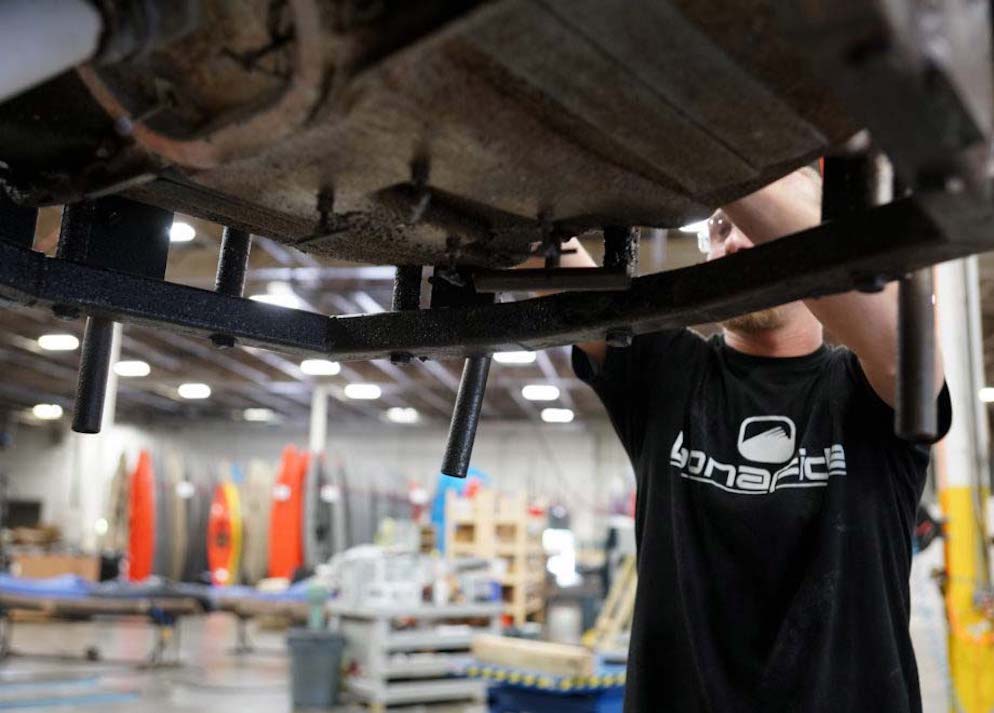
Bonafide manufacturers kayaks in North Carolina with a minimum of imported components. | Photo: Courtesy Bonafide Kayaks
“If you look at one of the big sticking points between the U.S. and China, it’s about intellectual property theft and government subsidies that allow them to be hypercompetitive,” says Luther Cifers, CEO of YakAttack and Bonafide Kayaks. “Those are two things that are kind of hard to argue with, you know. Don’t steal. So if there’s a little equalizer that makes doing business that way more difficult, I’m happy about that,” says Cifers, who got into the kayak fishing business after the automotive components plant in which he started his career moved to Mexico. His companies make injection-molded kayak fishing accessories in Virginia and kayaks in North Carolina, and Made in America is at the core of his philosophy.
Tariff policy had nothing to do with his decision to keep his factories close to home, Cifers says. Quality control and supply chain efficiency were reasons enough. With the percentage of homegrown components in his kayaks in “the high 90s,” Bonafide is immune to the tariffs on Chinese imports—but not the larger trade war.
“We could have picked up some European distribution if it wasn’t for the tariffs,” he says. “When you take tariffs and the strong dollar into account— and the fact that Chinese knockoffs of most American kayaks are readily available in Europe anyway—the export market’s pretty tough.”
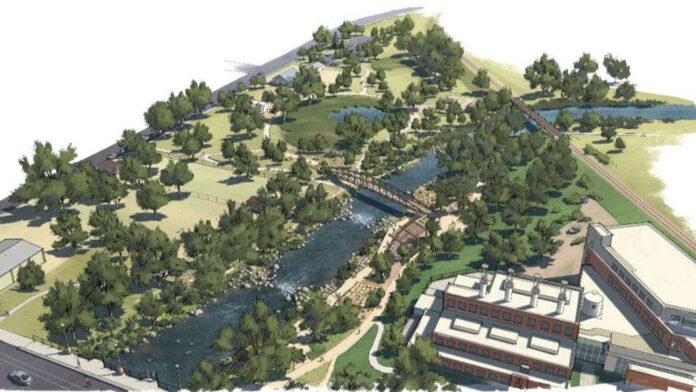
LYONS, COLO. (August 13, 2019) – Coursing through the heart of downtown Fort Collins, Colo., the Poudre River is now home to the country’s newest whitewater park. Driven by river park engineering firm S20 Design and Engineering, the new whitewater park features a series of waves for rafters, kayakers, and stand-up paddleboarders, a wading area for families, a pedestrian bridge, and extensive bank reconfiguration. The project, located near Old Town at Vine Drive and College Avenue, brings the river back to a more natural state, provides the community a greater connection to the river, and invites economic development to the area.
“The Poudre has always been a classic Colorado destination for river running, and now its recreational amenities will be more accessible than ever,” said S2O Design founder Scott Shipley. “Not only is it a beautiful site for a river park, it’s also a perfect example of various entities coming together to create a great focal point for the town.”
Lyons, Colo.-based S2O Design provided design, planning, permitting, and construction services to the project. S20 was chosen because of its expertise with whitewater park development and familiarity with the market. The park will officially open in September 2019.
Design and construction of the Poudre River Whitewater Park was a complex process with several moving parts and a broad array of stakeholders. S2O Design was charged with converting the dangerous Coy Diversion Dam, which was a barrier to fish passage, into a usable park area that also encourages fish migration. The river features needed to provide low- and high-water functionality to a wide variety of users, with extensive bank restoration and reconfiguration to bolster animal habitat and improve stormwater management.
Funding the $12 million project was achieved through both public and private partners. The city’s Building on Basics tax initiative, a program introduced in 2015 for community improvements, contributed $7 million; the city’s Storm Water, Natural Areas, and Parks and Rec departments contributed $3 million; and private donations totaled more than $2 million, including a $1 million gift from longtime Fort Collins residents Jack and Ginger Graham.
“The Poudre holds a very special place in our city’s history,” said Jack Graham, former U.S. Senate candidate and Colorado State University athletic director who spearheaded the school’s new on-campus stadium. “It has been in need of some TLC for decades and the park’s environmental repairs and restoration, coupled with its recreational features, will bring needed energy and economic development to the River District and downtown.”
Fort Collins Mayor Wade Troxell added, “The river, and its new park, is a true treasure for our community and a legacy for our future. It will build community, strengthen our downtown, and contribute to our vibrancy and prosperity.”
Bringing the project to fruition was a long time coming. It was formally approved by voters in 2015 as part of the city’s Community Capital Improvement Program, but was in the works for nearly 20 years prior. “We first started talking about it way back in 1986, so it’s great to finally see it come to fruition,” says Tim O’Hara, a commercial photographer who served as the lead fundraiser for the project.
Previous efforts at building a river park there had stalled. Shipley, who holds a master’s degree in Engineering and is also a three-time Olympian and World Cup slalom kayak champion, was able to organize the project’s multiple stakeholders, navigate the long public process, and drive the design decisions that led to its final construction. “A lot of other companies had looked at this, but we were the only ones who were able to get it done,” said Shipley.
S2O Design has completed several other river recreation and restoration projects in Colorado, including the Eagle River Park, Durango Whitewater Park, Canon City Whitewater Park, and Bohn Park in Lyons, Colo.
About S2O Design
S2O Design is an engineering firm specializing in innovative river engineering, restoration, and community-focused whitewater park design. Our team of expert boater-engineers has planned, conceived, designed, and created some of the best in-stream whitewater parks as well as largest and most dynamic recirculating whitewater parks in the world. S2O Design is led by engineer, Olympian, and three-time World Cup Kayak Champion and Freestyle Kayak Champion Scott Shipley. For more information, visit S2ODesign.com.
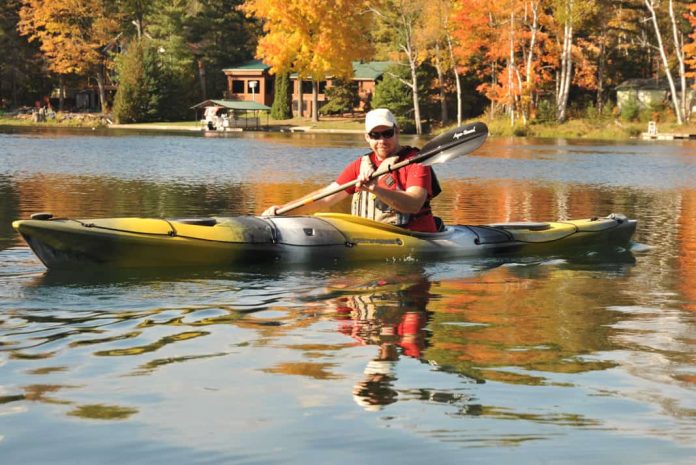
Wilderness Systems’ celebrating 15 years of doing it all well. | Photo: Virginia Marshall
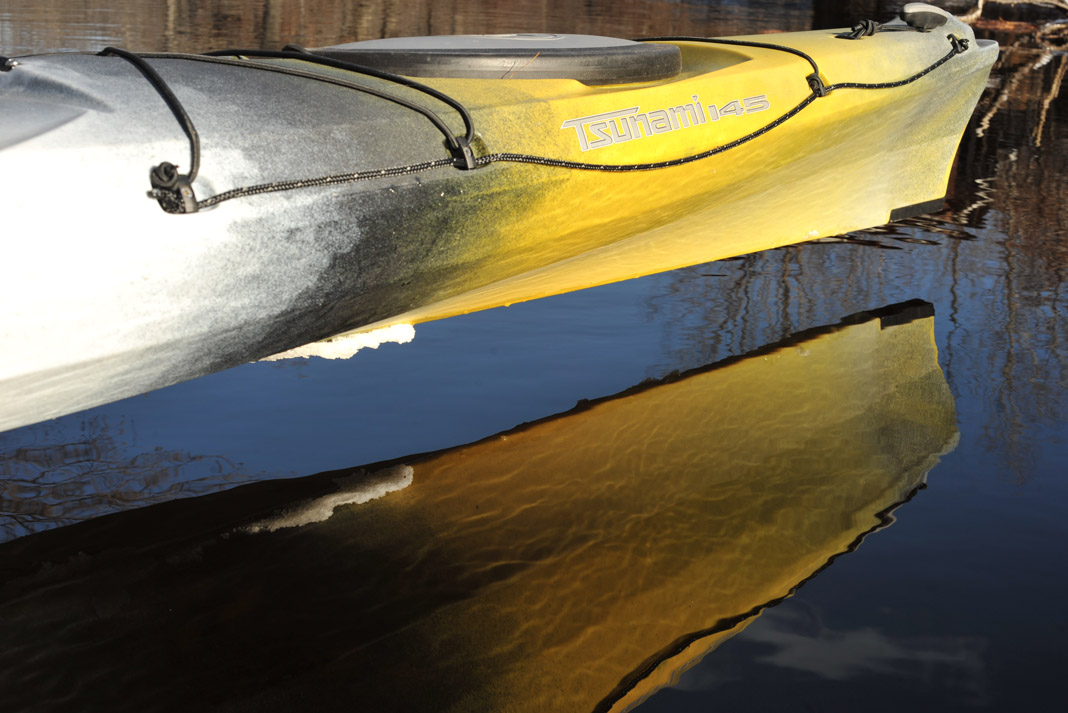
When the Wilderness Systems Tsunami 145 was added into the trio of updated Tsunamis to their light touring line-up in late 2018, they billed this latest iteration “the Swiss Army Knife of touring kayaks.”
Wilderness Systems Tsunami 145 Kayak Specs
Length: 14 ft 6 in Width: 25.5 in Weight: 56 lbs Paddler Weight: 180-245 lbs Capacity: 350 lbs MSRP: $1,299 USD/ $1,789 CAD
$1,519 USD/ $1,929 CAD (with rudder) Wildernesssystems.com
The Tsunami’s wide-ranging capabilities and functional aesthetic—enhanced by its unique outfitting (more on that later)—suggest a different epithet to us: the cargo pants of kayak touring. Unlike ephemeral fashion fads, however, the user-friendly Tsunami continues to be just as popular today as when it first debuted in 2004.
In the years since, Wilderness Systems has introduced three different Tsunami layups and tweaked and simplified the boat’s paddler-specific sizing—winnowing down eight options to just five. These updates take into account where and how the kayaks are being used, and who is paddling them. Translating this feedback into design refinements keeps a well-traveled offering like the Tsunami fresh and accessible for new paddlers, while giving existing fans more of what they already enjoy about the boat.
A 14-foot recreational kayak by Wilderness Systems
Our demo Tsunami 145 is the largest of the three updated sizes, proportioned to afford larger paddlers a comfortable fit and fearless stability without completely sacrificing touring efficiency.
Also new this year is a Tsunami 140 kayak—offering similar performance for mid-sized folks—and a 125, which fits larger paddlers seeking a stable day tripper. Two long-haul options, the Tsunami 165 kayak and the Tsunami 175, remain unchanged.
Reimagining a proven design is a delicate endeavor, says Shane Steffen, director of product management for Confluence Outdoor’s boat division, which includes the Wilderness Systems brand. “We started with styling,” he explains, “we wanted to bring a more modern look to the Tsunami.”
The deck redesign isn’t merely skin-deep. It also adds stiffness across the top of the boat, improving durability and resiliency during re-entries and transport.
Changes inside the cockpit are more subtle: the updated Phase 3 AirPro seat system makes it easier to adjust leg lifters, backrest height and tilt on the fly, and now enables users to trim the seat fore and aft. The seat back can also be quickly removed or swapped for a low-profile backband.
Wilderness Systems’ best kayak for stability and tracking
After 15 years on the water, Steffen has some theories about these kayaks’ popularity.
“People love the Tsunami for two main reasons,” he says. “One is the stability profile—it feels comfortable from the first time you sit in it. The second is tracking: new paddlers can point the boat where they want to go and it gets there.”
Small refinements aim to enhance these novice-friendly features. Designers shifted volume out of the hull to flare the sidewalls and further increase initial and secondary stability.
In the rec touring market—especially models for larger and newer paddlers—it’s refreshing to paddle a design promoting advanced skills.
An extended waterline gives hull speed a boost, great news for those touring with friends in longer boats.
Meanwhile, the shallow-V, multi-chine hull profile is classic Tsunami. Two defined edges in each chine act like secondary and tertiary keels, lending this kayak its trademark tracking and predictable handling.
Wilderness Systems’ Tsunami is rudder-ready, but pronounced keel and hard chines mean you don’t really need one. | Photo: Virginia Marshall
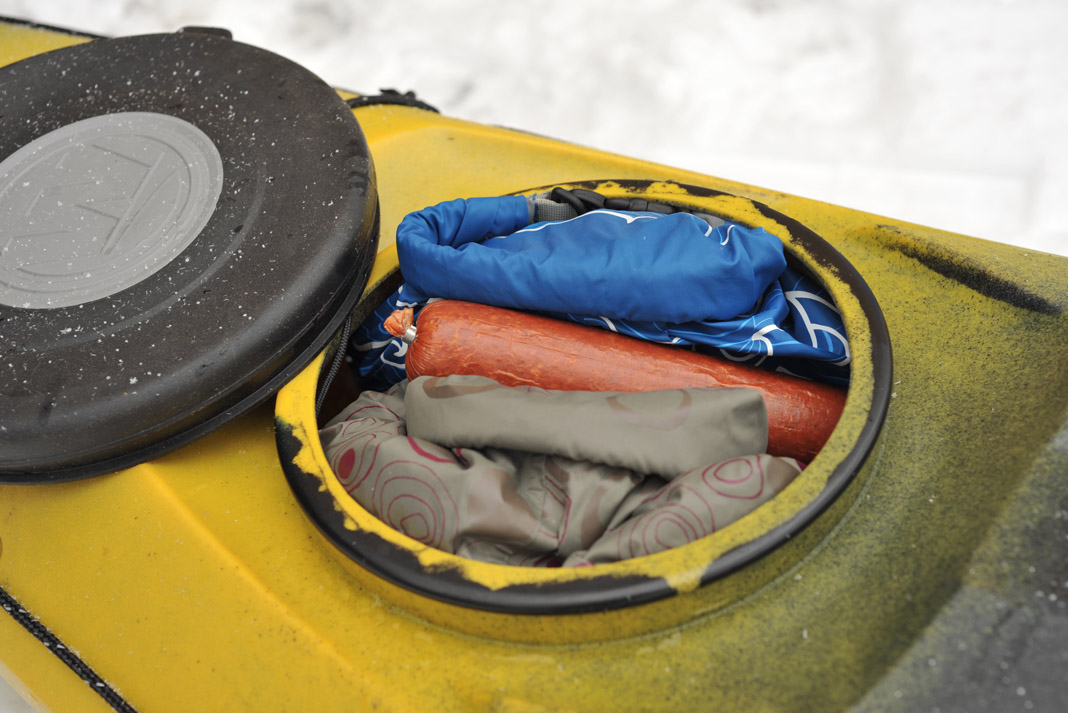
Generous hull depth translates to spacious hatches bow and stern. There’s room for all your gear and groceries—including the cured lunchmeat lending its name to an amusing Tsunami malaprop. | Photo: Virginia Marshall
A high-performance polyethylene sit-in kayak
Steffen says product longevity was also a focus of the redesign brief. Along with the stiffer deck, there is a replaceable skid plate where the keel reaches the stern—a wear point when dragging from the bow.
It’s something Wilderness Systems should know a thing or two about. In 2012, adventurers Jon Turk and Erik Boomer chose a pair of Tsunami 135s to complete the first-ever circumnavigation of ice-choked Ellesmere Island.
The diminutive boats were the largest that would fit in the airplane needed to reach this remote Arctic outpost. For much of the 1,500-mile journey, the men skied or hiked pulling the kayaks—each laden with 250 pounds of food and supplies—over snow, slush and jagged sea ice.
Like their predecessors, the new Tsunamis are constructed from hard-wearing-but-hefty rotomolded polyethylene. I’m not usually a dragger, but I admit to using Turk and Boomer’s strategy when I find myself alone with our demo and a long expanse of snow-crusted turf.
It’s utility, comfort and style in one package—just like your favorite cargo pants.
Hoarfrost rimes the desiccated grasses and parched canopies of the oaks lining the banks as I slip into the mirror of the river. When a gust of wind disturbs the stillness, orphaned leaves scatter like clutches of skittish water boatmen. Where the channel narrows, deadfalls create a natural slalom course.
Achieving tight-radius turns in the Tsunami necessitates putting the kayak on edge. Fortunately, cockpit fit and contact points are optimized to facilitate edging and bracing proficiency.
In the rec touring market—especially models for larger and newer paddlers—it’s refreshing to paddle a design promoting more advanced skills.
Wilderness Systems’ touring kayak accessories and features
Late in the afternoon, the sun peaks unexpectedly beneath clouds swollen with snow. Decanted golden light spills onto the river, illuminating three sleek otters fishing below a swift. The scene has me reaching for my camera, conveniently tucked in a deck pocket.
Replacing the behind-the-cockpit day hatch of previous Tsunamis, each new boat ships with a pair of mesh deck pockets. Removable cargo pockets for your front deck, these are Wilderness Systems’ solution to the question of accessible-on-the-water storage.
The pockets put small essentials within easier reach than a day hatch and are lower profile than an aftermarket deck bag, but there’s an obvious downside: they don’t provide dry storage.
The design team eschewed a more conventional third option—a cockpit-fitted deck pod—in favor of an open tube mounted under the front deck. The engineering is pretty basic, but it’s a convenient spot to stash a water bottle and doesn’t noticeably impede foot- or legroom.
Whether playing quiet waterways or venturing into open waters, the Tsunami 145 continues to offer larger paddlers a satisfying fusion of rec kayak stability and longboat efficiency. It’s utility, comfort and style in one package—just like your favorite cargo pants.
Celebrating 15 years of doing it all well. | Feature Photo: Virginia Marshall
In Dear Liza we tried to capture the feeling of paddling the British Columbia coast and how it can have a transformative effect of some people.
As a filmmaker, I’m inspired by new places and experiences but I keep coming back to the coastal waters of British Columbia. In the rush for new places, I really appreciate projects that force me to sit still and get to know a place more intimately. I had been doing some work filming for Spirit of the West Adventures on some of their sea kayak trips and spent many days in the landscape, much of it waiting and watching as the world around me was in constant flux.
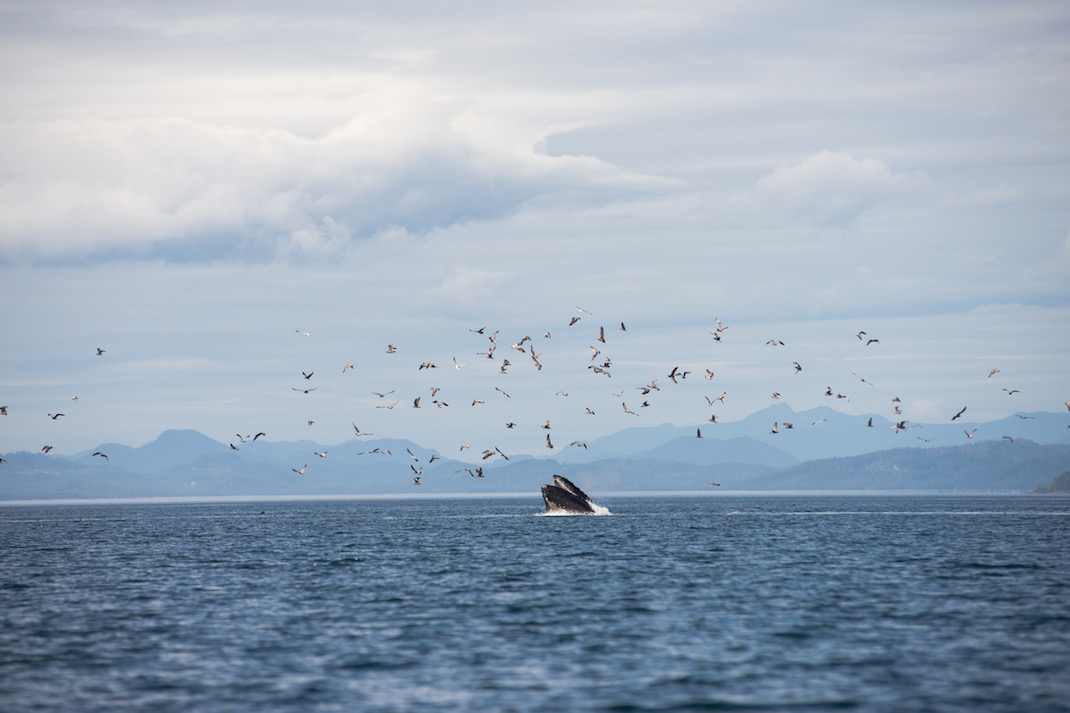
Most of my time was spent in the Broughton Archipelago which is in the northern reaches of Vancouver Island’s Inside Passage. It was almost a bit overwhelming the first time I visited because there really aren’t that many similarly dramatic landscapes so teeming with life and activity. The cold Pacific waters and strong currents in the area create ideal feeding grounds for all kinds of wildlife and it can feel pretty special to watch so many creatures come together in one place with a common purpose. I’ve been lucky over the years to experience some amazing encounters with orca and humpback whales, but have also been really impressed with all the smaller forms of life and how the ecosystem works as a whole. I think the sheer abundance of species in the area – from the sea stars to the birds and the dolphins and the little jumping salmon – far outweigh the excitement of any one animal.
Kayaking provides up-close encounters with marine life. | Photo: David Hartman
As you travel north up the coast to the Great Bear Rainforest, the landscape changes and you really start to feel more isolated. We paddled along this beautiful and rugged coastline in the outer island of the Hakai Protected Area and it was really memorable for me to feel so exposed to these coastal elements. I’ve always been a big fan of wolves so it was exciting to be in an area that is known for its sea wolf population. I think it’s pretty special to see how the open North Pacific Ocean has helped shape the world’s longest remaining stretch of coastal temperate rainforest in the world. The steep cliffs of these outer islands are covered in trees that look to have weathered more wind and rain than I can even imagine. But then dotted between all this rough rock are incredible white sand beaches perfectly suited to sea kayakers or anyone looking to take a rest.
I’m back in the area once again working on a project about humpback whales. Many thanks for Spirit of the West Adventures for their collaboration on this project.
Find David Hartman on Instagram at @haystac_hartman. See Dear Liza touring in the 2019 Paddling Film Festival and find a screening near you by clicking here.
“I’ve been going full-tilt for four days. Swamps, oceans, rivers, creeks—it’s the full spectrum of adventure and all between the lands of home and work,” says Beau Miles in The Commute. | Photo: Courtesy Beau Miles
When I reach adventure filmmaker Beau Miles at his home in Melbourne, Australia, it’s late January and he’s just a couple hours away from cracking his first can of beans.
Spilling the Beans With Beau Miles
That afternoon Miles embarked on a challenge to eat only beans until he consumed his body weight in legumes—all 85 kilograms. He expected the experiment, inspired by characters in John Steinbeck’s Tortilla Flat novel, to last 33 days.
Full of beans both literally and figuratively, Miles is a jack of many trades—sea kayaker, educator, ultra-runner and craftsman. His frank and quirky humour make his award-winning films—Africa by Kayak, Bass By KayakJunk Paddle and A Mile an Hour—a hit with viewers of all types.
“Ideas are cheap, application is hard. I have a million ideas,
to make them come full circle is a lot of work.”
Junk Paddle is an 11-minute peek into Miles’ work as an outdoor education lecturer at Melbourne’s Monash University. It reveals his talent for building with reclaimed wood as he turns garbage into a gleaming treasure. Without getting preachy, the film inspires viewers to recognize opportunities for adventure on their own doorsteps.
[ Find your own adventure on the Paddling Trip Guide ]
Miles’ next film, The Commute, explores a similar theme—re-envisioning his 65-minute daily commute as a four-day, paddle-and-drag odyssey from farm to office. While we await its release this fall, Miles shares on filmmaking, lessons learned, and why everything can turn into an adventure with the right attitude.
“I’ve been going full-tilt for four days. Swamps, oceans, rivers, creeks—it’s the full spectrum of adventure and all between the lands of home and work,” says Beau Miles in The Commute. | Feature photo: Courtesy of Beau Miles
5 Questions for Adventure Kayaker Beau Miles
1 What is Junk Paddle’s message?
Well, it’s not really a film about making a paddle out of wood at all. To a lot of people, wood is a square product from the hardware store. I want to make those connections between tree and forest and this thing around us everywhere in a square form.
One of the key things about outdoor education is to teach people how we’re connected to the world. There’s huge potential in a bit of crap timber because it’s going to teach me how to make a paddle and then paddle me down a river. That’s outdoor ed.
We’ve been doing this for eight years; the students spend six to eight weeks building a paddle from reclaimed wood, then use it to paddle 150 kilometres down Australia’s biggest river—the Murray River. They make some ugly ones, and they make some beautiful ones. In many ways, I’ve got the easiest job in the world. By the end, the students feel like I’ve given them a paddle, but they’ve done all the work.
3 When do you put down the camera?
Sometimes I hate filmmaking because it loses the now. You’re in the moment and enjoying yourself and then you have to change the camera perspective or the lens. But when you’re filmmaking versus just on an expedition, it’s a very different process. On some trips, I do leave the camera at home. You have to live your story sometimes and not just film it.
4 Why is good filmmaking so difficult?
Ideas are cheap, application is hard. I have a million ideas, to make them come full circle is a lot of work. Junk Paddle is a nice little film and it might be one of 100 I make, but it was still hard to find the story. It was a 10-second idea, filmed over three or four days but finding the narrative, that’s what is hard. Show me insight, show me something vulnerable. 20 years of making films, and I think I’m finally starting to show some story.
After crossing the Bass Strait, between Australia’s mainland and Tasmania, I was working on my Ph.D., “The Secret Life of the Sea Kayaker.” The most poignant feedback I received was: “Beau, you think adventure is inherently good and hard, and yet it’s not inherently good and it’s not hard.”
“A nine-to-five job is hard, and it’s mundane and repetitive. Putting food on the table is hard. What you do is exclusive and privileged, and it’s often fun and simplistic.” That was a very different perspective than I was used to. Junk Paddle and The Commute tap into asking questions about our everyday lives instead of focusing on exclusive adventure.
“I’ve been going full-tilt for four days. Swamps, oceans, rivers, creeks—it’s the full spectrum of adventure and all between the lands of home and work,” says Beau Miles in The Commute. | Feature Photo: Courtesy of Beau Miles
“He who is valiant and pure of spirit may find the Holy Grail in the Castle of Aaargh.”—Monthy Python Photo: Paul Villecourt
Maybe I was the only one bewildered by the news of brothers Kyle Roberts and Tom Schellenberg arriving at Everest Base Camp earlier this year with canoes on their heads.
It was a noble cause they promoted—raising cash for a women’s mental health facility in Kathmandu—and it was certainly an arresting image they created in the process. But in the pantheon of crazy-ass stunts one might do with a canoe to get attention, this one takes the Nepalese cake.
It got me wondering. How much farther and faster is it possible to go? As our wild places diminish, what waters—or heights or depths—remain unplumbed by a single blade?
Back in the mid-19th century, Sir George Simpson, governor of the Hudson’s Bay Company and his praetorian team of Mohawk paddlers from Kahnawake, paddled from New York City to the Pacific and back with a side trip to York Factory on Hudson Bay.
I’m not sure anyone has ever repeated a 5,000-mile single-year odyssey, though three-time cross-Canada canoeist Mike Ranta and his dog, Spitzii, have given Sir George a run for his money.
In 1934, Peterborough, Ontario’s own John Smith decided he’d paddle to Peterborough, England in a 16-foot cedar-canvas canoe.
Smith’s epic journey didn’t end well. He is buried in southwestern Newfoundland where he and his canoe washed up that summer.
As far as I know, nobody has even dreamt that dream since—except perhaps members of the Pacific Voyagers Project, although their canoes are powered largely by wind.
Holy Grail-like goals
A round-trip, single-season continent crossing or a single-bladed ocean crossing are definitely in the running for most impressive feats a canoeist could accomplish. And if speed is your thing, knocking a few hundredths of a second off any paddling world record would be a worthy Grail-like goal.
Thinking vertically instead of horizontally, let’s remember when Pedro Oliva hucked Salto Belo Falls in Brazil, approaching 100 kilometers per hour in his kayak at the end of the 127-foot freefall before rolling up and joining his pals for a brew on the shore.
Surprisingly—and sadly for Oliva—his record lasted barely a month, smashed by Tyler Bradt when he successfully kayaked over 189-foot Palouse Falls in Washington State.
And while Eric Boomer’s bold first descent of an unnamed waterfall on Greenland’s west coast, documented in the award-winning film Into Twin Galaxies, didn’t rewrite any Guinness records, it proved unequivocally size isn’t everything. He left no room at the top of the pyramid of extreme paddlers.
The search for canoe journeys’ continues
With almost superhuman distances, heights and speeds achieved—what’s left?
Consider for a second the world is going to hell in an environmental handcart, largely because of anthropogenic climate change. Paddlers are perhaps the human dwellers of planet Earth who are most connected to its rivers and oceans.
The next Holy Grail for paddlers could be in bringing public attention to the centrality of water—fresh water, in particular—in our lives.
The records would read differently but be no less heroic in their attainment; most number of school-age children and youth—seniors, tots, middle-agers, boomers, whatever—in canoes in a single season; most number of canoes on the water at one time; largest sums of money raised with canoes or by canoeists for water-related conservation initiatives.
Or, for something a little bit different again, we might follow the example of paddlers on the Sunshine Coast of British Columbia, who laud those with the most consecutive days in a canoe.
Gibsons Paddle Club has a special paddle insignia and key fob for anyone who paddles 100 consecutive days in any calendar year.
This tradition has morphed into the 101 Club, in honor of the 101 Brewhouse and Distillery on B.C.’s Sunshine Coast, which will give you a free meal and an excellent craft beer and a discount for the rest of the year for meeting the challenge and raising the bar.
Nobody says the quest for the Holy Grail of paddling has to be totally altruistic.
James Raffan is an author, recovering academic and former executive director of the Canadian Canoe Museum.
“He who is valiant and pure of spirit may find the Holy Grail in the Castle of Aaargh.”—Monthy Python. Feature Photo: Paul Villecourt
Pedal hard! Dispatches from a bold, new frontier of river running. Caleb Roberts pedals a precursor to the modern Monaco here. This 1987 model helped secure the sponsorship. Photo: Robert Faubert
Pro boaters are the tip of the spear, the first to break new ground and lead the sport in new directions. Gear manufacturers clamor to claim them, providing free equipment so the paying public will associate their products with the athletes at the cutting edge of whitewater paddling. Or whitewater pedaling, as this case may be.
The semi-pro pedal boaters
When Caleb Roberts and Marc Godbout need to make a tough move in a rapid, they line up their sponsored boat as well as they can, and then pedal furiously.
Online videos show their four knees as just a blur while their pedal boat drifts slowly toward huge features on rivers like the Ottawa and Gatineau. The pair are accomplished solo open boaters, but are undisputed superstars in what Roberts calls the new sport of whitewater pedal boating.
They caught the eye of recreational boat manufacturer Pelican after posting a video of one of their early descents.
Pelican offered them a free boat to do what they do, so long as they include in their videos a disclaimer stating these boats are not designed for whitewater.
Does this make them the world’s first semi-pro pedal boaters?
Roberts objects. “To say ‘semi-pro’ suggests there is a higher level to attain.”
The love for pedal-boating whitewater
There is nothing “semi” about practicing the sport at the highest level there is, he says. How much higher this level gets remains to be seen. Roberts says he is committed to training, which, for pedal boating amounts mostly to mental preparedness.
“I think about pedal boating a lot,” he says. “More than most people, anyway.”
But there’s also physical technique. For this sport, in which the athletes sit back and make small circles with their feet, any serious conditioning program starts with walking.
Roberts says his commitment to the sport sees him walking every day, even if it’s just short distances around the house.
Despite how far he’s come, Roberts remembers the first time he saw a pedal boat. “I was at my Opa and Ona’s cottage, and their neighbor had one. I remember seeing it there, listing in the reeds. It looked so cool.” Little did he know, one day he’d be one of the world’s most recognizable whitewater pedal boaters.
Roberts guides river trips for Black Feather Wilderness Adventure Company. When meeting clients on the Mountain River in the Northwest Territories last summer, one of his guests recognized him from pedal boating down the Ottawa River.
Evolution
Fame aside, Roberts insists the story here is about the boat. He thinks back to the pedal boat he saw at his grandparents’ cottage and notes the basic design hasn’t changed much in 30 years.
“Think how much kayaks have changed over that time,” observes Roberts, implying there must be something approaching perfection in the boxy, square hull. Roberts calls Pelican the “Apple brand” of pedal boats and credits their Monaco model with being a key to their success.
“The Monaco doesn’t hold a cooler, but it’s smaller and nimbler than some other models, so that’s a sacrifice we make,” explains Roberts.
Speaking of sacrifices, while he has dabbled with paddling by hand over the side of the rail to make particularly challenging moves in the plodding boat, he draws the line at packing along canoe paddles for auxiliary power. “It’s important, at this stage, that we keep the sport pure,” he argues.
What are the next stages?
And what are the stages that might come next? Roberts has his sights set on expeditions.
“It’s the next frontier,” says Roberts, who admits he hasn’t contacted any bush plane pilots yet to inquire about the chances of strapping a pedal boat to pontoon struts.
“I’m waiting to get a little more established first,” he adds, recounting a lengthy email exchange with Arizona Park Service Rangers in which he tried to clarify what type of boat he wanted to take down the Grand Canyon if granted a permit.
In the end, they said his pedal boat would be okay.
The thought of enjoying the Grand Canyon scenery from a pedal boat is almost too much for Roberts to contemplate.
“In a way, we pedal the rapids to get to the flats. Flatwater is where pedal boating shines,” says Roberts, arguing that pedal boating allows him to sit back and take in the sights, see and experience nature to an extent not possible with a paddle in his hands.
Of course, sooner or later, there are going to be rapids. Roberts knows he’ll be ready, for almost anything.
“We haven’t figured out how to boof yet, but when we do, the sky’s the limit.”
Ian Merringer is a former editor of Rapid magazine.
Pedal hard! Dispatches from a bold, new frontier of river running. Caleb Roberts pedals a precursor to the modern Monaco here. This 1987 model helped secure the sponsorship. Photo: Robert Faubert
As children, our growing brains are fascinated by everything around us. For those of us lucky enough to grow up outside the urban sprawl, our childhoods are spent exploring the forest, rivers and lakes of our backyards. As we grow up, we slowly become accustomed to these experiences. The forested area doesn’t seem nearly as large and mysterious as it did when we were less than four feet tall. Going exploring doesn’t happen as often. Now other things, like the lights and sounds of the city, a family to care for, and bills to pay take up our time and thoughts.
People may have told us it is time to grow up and get a “real job,” so we give up on the idea of finding another world, put away our exploratory kit, and leave the wilderness of our backyard dreams. There are, however, those that still go out into the wilderness to find another world and some of these people make exploring the forest, rivers, and lakes their real job.
Two of these people are Sam Anthony and Tristan Schneider from Winnipeg, Manitoba.
At the ripe age of 19 years old, these two avid paddlers decided they didn’t want to give up on the search for adventure in the wilderness. Sam’s exploratory bug came from paddling with his parents since he could walk and trying to jump out of a canoe into the exciting and fascinating moving water.
Tristan paddled most of his life; becoming an elite level paddler racing all over the world until a back injury ended his career in racing. The two had been friends for years and discovered a mutual passion to start an outfitting business specializing in Manitoba-area paddling. Loving paddling and adventure, they thought this might be an opportunity for them to keep doing the things they love and make a living at it.
In 2016, taking a page out of Steve Jobs’ and Bill Gates’ book, Anthony and Schneider took a hiatus from university education and decided to start their own paddling company. They named it Twin River Travel (www.twinrivertravel.com) after the Assiniboine and Red rivers flowing through Winnipeg. Twin River Travel (TRT) has added trips each year they’ve been in business, along with new routes.
Starting simple with small two- and three-day canoe trips in Nopiming Provincial Park along the border of Ontario, the two young men have filled a niche that has sat empty for years. Only taking small groups and working together to build a successful business over the past two years, the guys started running the Manigotagan this past year and are now ready to tackle more intense trips such as the Bloodvein River. The hope is to eventually also run guided trips down the Seal River.
Currently, TRT’s website offers trips on three of Manitoba’s canoe tripping gems, including two nights on the easy-paddling Seagrim Lakes, three nights on the remote Bird River, and a beginner-friendly, five-day whitewater trip on the Manigotagan River. A trip on the famed Bloodvein River was the newest trip added for the 2019 season.
An inspiration to any adventurer wanting to turn to entrepreneur, Samuel and Tristan’s journey from competition paddlers to outfit owners is a success story showing what hard work, determination, and research can accomplish.
Adventure is all about facing the unknown. The unknown is what made us go wandering out into the forests in our backyards to find that other world. What bigger unknown is there than leaving the standard path and striking out to start your own business?
All in a day’s work on the Bloodvein River in Manitoba. | Main Photo: Dustin Silvey
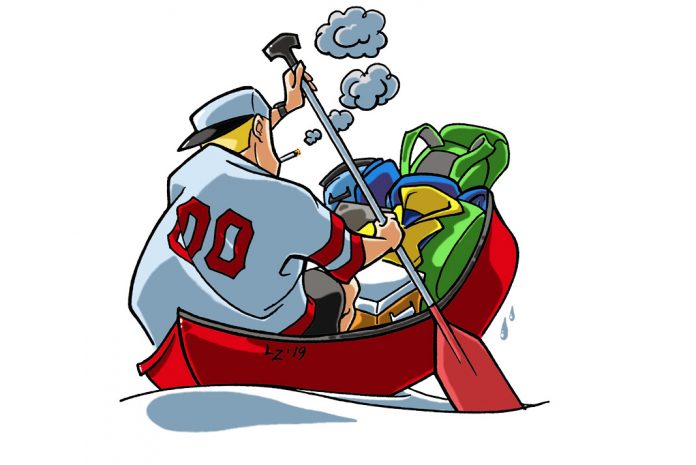
Columnist Kevin Callan recently celebrated the release of his 18th book, Once Around Algonquin: An Epic Canoe Journey, which spins tales from a lengthy trip where he witnessed a lot of questionable behavior. We turned the photo Kevin submitted for this story into an illustration to protect the guilty.
Canoe tripping skills aren’t learned quickly, but increasingly many paddlers I see don’t have the patience or even the desire to take the time to learn.
Just as watching YouTube videos on how to fix a toilet doesn’t make you a professional plumber, watching clips on how to light a fire, erect a tarp or perfect the J-stroke do not make you a master of the elements. Practice makes perfect.
Safety third
Provincial and national parks do little to ensure campers are sufficiently skilled before they head into the interior, treating it as an issue of personal responsibility.
Usually, park employees just hand over a permit and wave the campers on their merry way.
This wasn’t always the case. I bet there are a few longtime Ontario Parks campers who will remember the classic Crickets Make Me Nervous. It was a canoe tripping safety film shown at park amphitheaters in the 1970s. I haven’t seen anything like it in years.
I like to think most paddlers take their safety seriously, but I know there are some who don’t because I’ve met them. People are setting out without life jackets, an inch of freeboard or a clue.
Governing bodies like Paddle Canada and the ACA do an excellent job of training people to go on canoe and kayak trips safely, however, training is geared towards those motivated to learn the skills and play safe.
I’ve heard the odd rumble about mandatory skills tests for backcountry paddlers, or at least optional educational programs for the inexperienced.
What are the unprepared paddlers statistics?
Canada has the BoatSmart program, which requires anyone who wants to operate a motorboat to take a course on skills and safety and pass a test—for $49.95. Passing gets you a boating license.
Some argue the license system is just another cash grab, but boating fatalities have fallen by 32 percent since the system was introduced. Coincidence?
According to the United States Coast Guard (USCG), in 2017 there were 138 deaths involving canoes and kayaks. Of those cases, 88 percent of victims drowned. Of those drowning victims, more than two-thirds were not wearing life jackets.
Looking at the USCG’s boating fatalities more generally, 81 percent of deaths occur on boats where the operator did not receive boating safety instruction.
Only 14 percent percent of deaths occurred on vessels where the operator had received a nationally-approved boating safety education certificate.
Alcohol was also listed as the leading factor in 19 percent of all boating deaths.
Don’t be a stupid paddler, stupid
Through my local news, I hear about a handful of paddling deaths each year, usually due to drowning or cold-water immersion. I’m sad and frustrated each time I hear about another outdoor mishap because if the stats are anything to go by, these tragedies are often avoidable.
And the more accidents, the more likely regulations will eventually be forced on all of us because of a few who do not play safely. How fair is that?
In my presentations and books, I stress the importance of life jackets and wilderness safety. Often, what I really want to say to people is what my mother, who has a strong Scottish disposition, always told me before heading out into the woods: “Dinnea be stupid!”
She’d blurt it out every time I headed out on a trip, and she still offers this sage advice.
Wear a life jacket, wait until the wind dies down on a lake before crossing, bring a first-aid kit and know how to use it. Just dinnea be stupid.
Columnist Kevin Callan recently celebrated the release of his 18th book, Once Around Algonquin: An Epic Canoe Journey, which spins tales from a lengthy trip where he witnessed a lot of questionable behavior.
We turned the photo Kevin submitted for this story into an illustration to protect the guilty.