Home Blog Page 204

Sea Kayak Review: Nigel Dennis Explorer

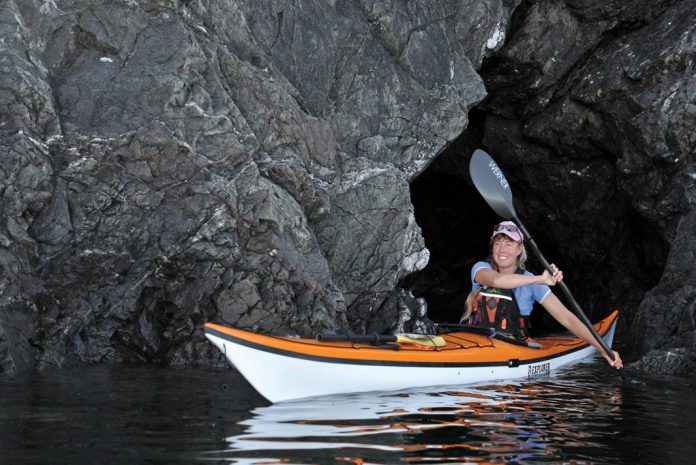
woman paddling an explorer sea kayak

If modern expedition kayaks have a phenotype—that is, a distinctive appearance and characteristics based on a combination of genetic traits and environmental factors—the Explorer may exemplify it best. No wonder it’s a perennial contender for best kayak.

Nigel Dennis Explorer Specs
Length 17 ft 6 in
Width 21 in
Weight 58lbs
Price $4,200 USD

The fine lines of the upswept bow and stern, the narrow beam and the clean, functional deck layout are informed by the classic British interpretation of traditional Greenlandic kayaks. From this base DNA, designer and renowned expedition paddler, Nigel Dennis, refined the shape and layup to address the unique challenges of extended journeys on remote, exposed coastlines.

History of the Explorer sea kayak

Few other sea kayak designs can boast the expedition pedigree of the Explorer. It has been the kayak of choice for circumnavigations in some of the roughest and least accessible waters in the world: Britain, Ireland, Iceland, New Zealand, Antarctica, South Georgia Island and the Aleutian islands. Twenty-five years after it was first introduced, the Explorer is still handmade in Anglesey, North Wales, and is now sold under the label Sea Kayaking UK (SKUK), formerly Nigel Dennis Kayaks.

I borrowed a shiny new, persimmons-orange-and-white Explorer last summer to better understand the sustained popularity of this mid-sized touring kayak. Along with its devoted following in expedition circles, the Explorer is a staple among elite coaches and at symposia from Illinois to Israel. My testing regimen included a week of teaching intermediate paddling skills, four weeks of self-supported kayak-camping journeys on open waters, and as many surf sessions as the water gods saw fit to deliver.

How did Nigel Dennis’ Explorer kayak perform?

After a summer on the water, if I had to sum up the Explorer in one word, it would be consistent.

Now, in 600 words, let me explain.
Explorer stability

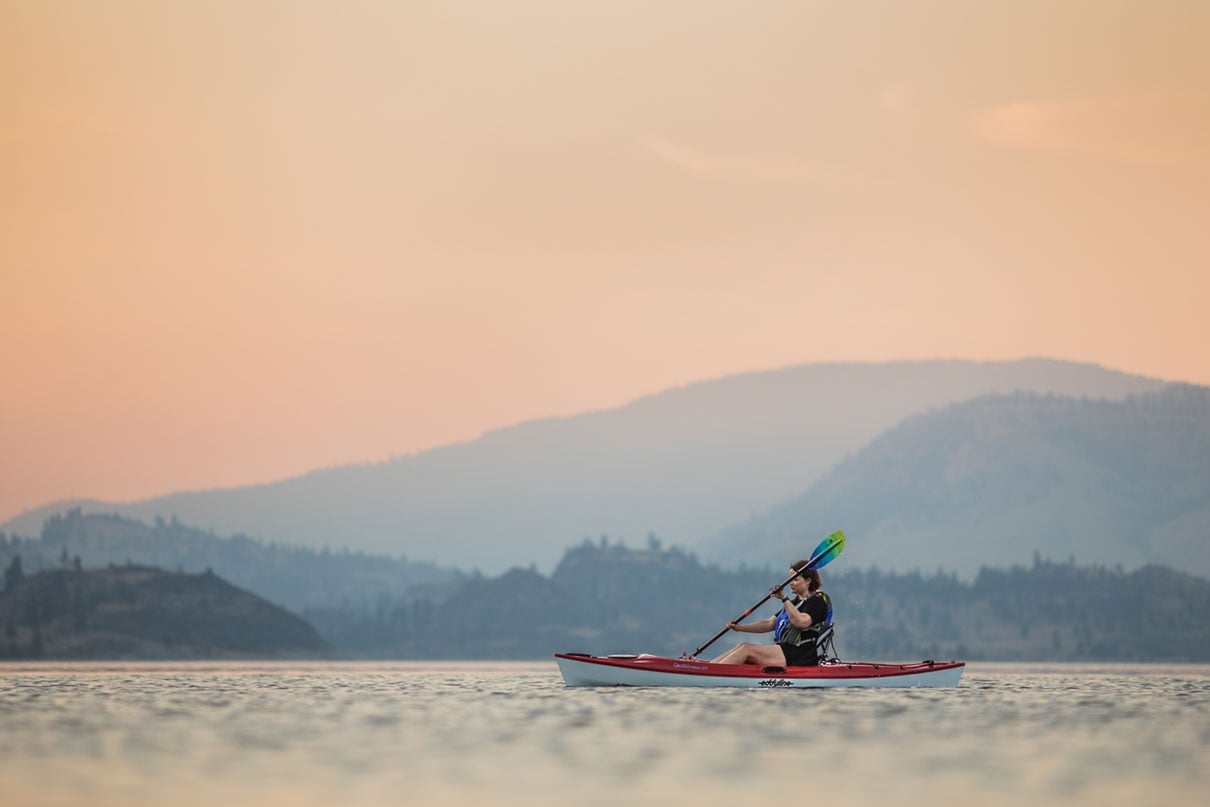
First up, directional stability. The Explorer is designed for covering distance and, as such, it tracks well and is very neutral in wind and confused seas. Weathercocking is minimal, making it easy to hold course with slight edging. When deployed, the skeg works exactly as it should to enhance tracking in high winds. The skeg slider feels sturdy and is well balanced to set-it-and-forget-it on long crossings.

Speed

I found it easy to maintain a relatively quick touring speed in a wide variety of conditions, however the Explorer is exceptionally fast with a following sea. Even heavily laden with camping equipment and fresh food for 10 days—including a secret watermelon (more on that later)—I rode effortlessly ahead on the swell while my companions’ boats mired in the troughs.

Handling

A useful measure of performance for any touring kayak is a comparison of handling with paddled with empty hatches and with hatches loaded. This is where the Explorer’s versatility and consistency really shine. Whether I was out for an hour or a week, the boat felt responsive to my inputs, carving graceful turns and remaining stable and predictable in sloppy conditions.

Hard chines and a boxy hull profile lend the Explorer more initial stability than you’d expect from its 21-inch beam, making it a surprisingly forgiving companion for novice paddlers. Secondary stability is also very solid, especially with hatches full of cargo. I could roll smoothly into a deep edge to coax tighter turns out of the kayak’s 17.5-foot waterline.

The Explorer may lack the turn-on-a-dime maneuverability of its shorter, more highly rockered sister, the Romany, but it’s no slouch in the surf. The high-volume bow doesn’t dive or deflect easily, which makes for wonderfully controllable rides. The responsive handling meant I was able catch long surfs on three-foot-high faces, even where the wave pattern splintered unpredictably above shallow sandbars. When my concentration faltered and I found myself upside-down, the low back deck and excellent cockpit fit made rolling up easy and uneventful.

The seat

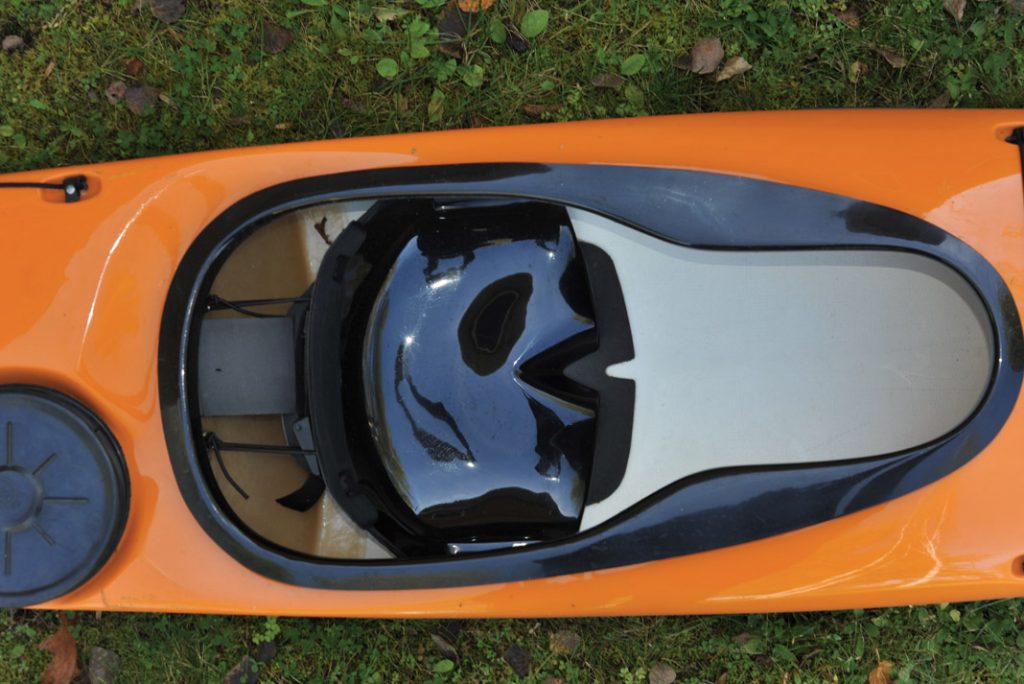
The seat is a small, fiberglass dish that suits me just fine for all-day tours. Those accustomed to the sophisticated seat systems found in many of today’s kayaks might find SKUK’s minimalist interpretation offers less leg support.
The Explorer’s cockpit

The Explorer accommodates medium-sized paddlers, with plenty of room under the foredeck for larger shoe sizes.

Or a cleverly concealed watermelon. Surprise!

Storage volume

With 166 liters of storage volume distributed across bow, stern and day hatches, there’s ample space for carefully packed extended trips. More challenging is squeezing bulky items through SKUK’s small, round hatches—I had to leave the Outback Oven and my three-ring binder of kayak lesson plans at the put-in. The upside of these smaller openings is that all three hatches remained bone-dry even after repeated rolling and playing in surf, and the soft rubber lids are very easy to peel off and press on.

Our standard fiberglass layup Explorer employs a relatively heavy, resin-rich construction built to withstand the abuse of expedition paddling. This laminate is also straightforward to repair, as damage tends to be localized around the site of impact. For weight-conscious paddlers, SKUK offers lighter Elite, carbon/Kevlar and hybrid glass-carbon/Kevlar layups.

Whether you’re planning an expedition of your own, or just looking to cover some miles and play along the way, the Explorer is an outstanding performer as you paddle into rougher waters. Its intuitive handling and composure in any conditions ensures all paddlers feel like great explorers.
 

A Paddling Adventure In Uncharted Territory

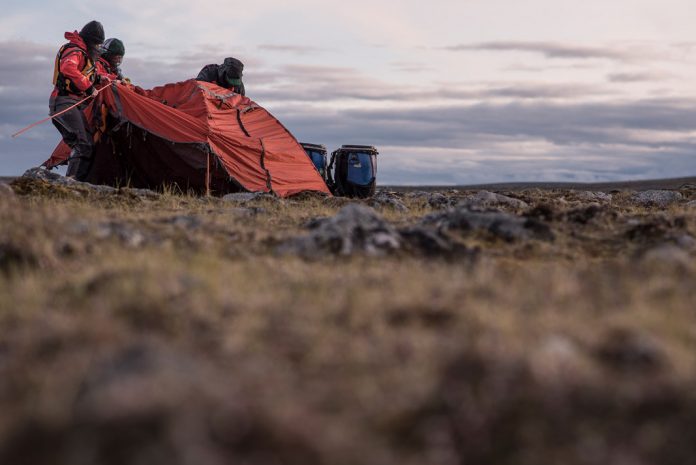
three people setting up a tent in vast territory
Photo: Francois Leger-Savard

Last July, six paddlers took a small plane to the vast Pingualuit Crater on the Ungava Peninsula in northern Quebec. We intended to paddle down the Lestage River, for which there is no written record of exploration.

A winter with low snowfall, combined with a warm spring had lowered water levels, making our plans immensely difficult. Rather than running rapids, we hauled our canoes over rocks while standing in a few freezing inches of water.

The slow and arduous progress was grueling. We were forced to accept the fact we would not reach the village of Kangirsuk in our time frame. The North is a land of splendor, but also a land of power—even after two years of planning this expedition the appropriate response was to be humble enough to modify our course.

The Lestage River will keep its mysteries. Our new path took us down the Arpalirtuq and the Lepellé, two more unmapped rivers accessible from our remote location.

Over the next four hundred kilometers and 26 days, we were graced with the company of seals, wolves and snowy owls. Most impressive were the thousands of caribou keeping pace with us.

Steady rain and occasional hail and snow accompanied the first 10 days of the trip. Constant high winds blew through the region, testing the mettle of our team of three men and three women, as well as our equipment.

[ See the largest selection of boats and gear in the Paddling Buyer’s Guide ]

Day after day, the environment changed, from stone landscape to comfortable moss. The only certainty was our daily routine of erecting camp. It was the place to recharge, heal our wounds, share and laugh. Our tents were more than shelters to us; they became the place to talk and listen, binding six individuals into a team.

No social facade or bravado can withstand the seclusion and challenges of a northern adventure like this. We each discovered the true essence of our traveling companions and were richer for it.

We wanted our adventure to be more than a friends’ trip and contribute to something more than our personal benefit. To achieve this we documented thousands of years of human life in the region, making notes on the presence of archaeological sites on our journey.

The discovery of tent circles, stone houses and cairns was a concrete reminder of the ancestral Inuit presence on these lands. These marks of the past bore witness to the strength, intelligence and resilience of the men and women who set these stones in place and lived in this difficult environment.

We were privileged to paddle those waves, walk those hills, admire that sky and be in communion with the fauna. This incredible opportunity comes with the responsibility of sharing the beauty of this fragile ecosystem and promoting its protection.

Featured Photo: Francois Leger-Savard

The Science Behind Why Paddling Makes Us Happier & Healthier

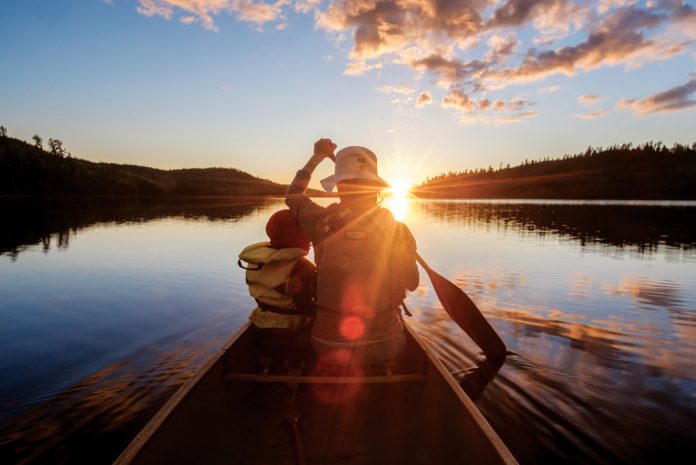
woman and child paddling into sunset stress free
"Imagine a therapy having no known side effects, was readily available, and could improve your cognitive functioning at zero cost." —Berman, Jonides, and Kaplan, 2008 | Photo: Ariel Estulin

In Apple’s App Store, I recently came across Wildfulness: Unwind in Nature. For $2.99, the app will pair “beautiful on-screen animations reflecting natural scenes, such as winter mountains and spring mornings, with forest sounds.” Wildfulness promises to help its users “relax from your busy day.” No need to ever step outside.

Wildfulness isn’t unique. A quick search reveals dozens of apps designed to mimic a natural outdoor experience, while promising to provide the same mood-boosting and stress-relieving benefits as the real deal.

The reason we need natural stress relief

Enter this as one more piece of evidence in the case-closed debate arguing North Americans are lacking time outdoors. A recent study by the Environmental Protection Agency claims the average American spends 93 percent of his or her life inside—87 percent indoors and six percent in automobiles. That results in the measly equivalent of just half a day outside a week—probably accumulated while taking out the garbage and walking around the block for a carton of milk.

Rather than prescribe themselves a walk in the park, today’s technophiles are increasingly turning to high-tech solutions to self-soothe. Surprisingly, there’s evidence to suggest these nature-infused apps do impart at least some of the benefits of actual time under a leafy canopy.

Photo by Rachel Claire from Pexels

Research shows forest scenes in a virtual reality atmosphere can lower blood pressure. Guided visualization exercises designed to mimic walking down a forest path can lower stress hormones. Listening to birdsong on earbuds can boost creativity. To me, these hacks seem like high-tech fixes to a low-tech problem.

An extreme example is in South Korea, where 90 percent of the nation’s youth experience myopia due to vitamin D deficiency from lack of sun exposure. Full-spectrum lights may be installed in classrooms nationally to stem the tide of short-sightedness.

“Thanks to a confluence of demographics and technology, we’ve pivoted further away from nature than any generation before us,” journalist Florence Williams writes in her 2017 book, The Nature Fix. “At the same time, we’re chronically burdened by ailments made worse by spending time indoors; from myopia and vitamin D deficiency, to obesity, depression, loneliness and anxiety.”

Stress relief activities and stress management

I know I’m preaching to the choir when I write nature is good for the body and mind. Last fall, I picked up The Nature Fix to find out why. I believe nature makes us happier, healthier and more creative, but what is happening on a physiological level?

Williams tracked down the top nature neuroscientists around the globe to explore why our brains are hardwired for nature. She travels to Japan to study the practice of shinrin yoku, or forest bathing—a fancy term for a walk in the woods. There she meets with Yuma University researcher Yoshifumi Miyazaki, who hypothesizes our bodies relax in pleasant, natural surroundings because they evolved there. For 99 percent of Homo sapiens’ history, we’ve been a species living outdoors.

Miyazaki’s work begins to quantify the almost mystical benefits the natural world can offer up. On average, his findings show a 15-minute walk in the woods offers a 16 percent decrease in stress hormone cortisol, a two percent drop in blood pressure, and a four percent drop in heart rate. It was enough for the Japanese government to take note and create 48 forest bathing therapy trails maintained by the national forest service.

Photo by RF._.studio from Pexels

Over two years, Williams traveled to three continents to meet with experts. Among some of the findings she uncovers: Just 15 minutes outside increases short term memory. When listening to birdsong or looking at fractal patterns—like a leaf or droplet on water—the prefrontal cortex quiets down and our brains produce more alpha waves, associated with calmness, flow and meditation. Phytoncides—a technical term for nice tree smells—boost white blood cell production.

Spend 45 minutes outside and most subjects will experience a boost in cognitive performance. Spend five hours a month in the woods to stave off depression, at least according to Finland’s public health officials. Spend three days outside and, in the words of one researcher, “that’s when things start to get profound.”

In the end, Williams comes up with this ultra-simple mantra: go outside, often, sometimes in wild places. To get maximum benefit, she recommends a pyramid approach. Take walks in tree-filled spaces in your neighbourhood daily, explore accessible and wilder areas weekly or monthly, and make time for transformative multi-day trips once or twice a year. The perfect recipe for a dose of natural stress relief and anxiety relief.

[ Find your stress-relieving boat in the Paddling Buyer’s Guide ]

A fact-based answer to the woolly question of why nature soothes us so effectively may always be elusive—perhaps, it’s a question best left to philosophers. What is becoming clearer is precisely how nature benefits us. The connection between humans and the natural world is so strong, viewing a digital representation of a beautiful landscape—or even the photo accompanying this column—may be calming.

The notion nature is essential to humanity seems romantically poetic. Increasingly, it’s also delightfully factual. The data is starting to catch up with what so many of us already intuitively know: We belong outside.

This article was first published in Paddling Magazine Issue 53. Subscribe to Paddling Magazine’s print and digital editions here, or browse the digital archives here.


Kaydi Pyette is the editor of Paddling Magazine. While creating this issue at her desk, she sat under a full-spectrum light, beside a humidifier infused with pine oil, while listening to a looped 11-hour track of tranquil birdsong on YouTube.

“Imagine a therapy having no known side effects, was readily available, and could improve your cognitive functioning at zero cost.”— Berman, Jonides, and Kaplan, 2008. | Photo: Ariel Estulin

The Most Influential Canoes Of All Time

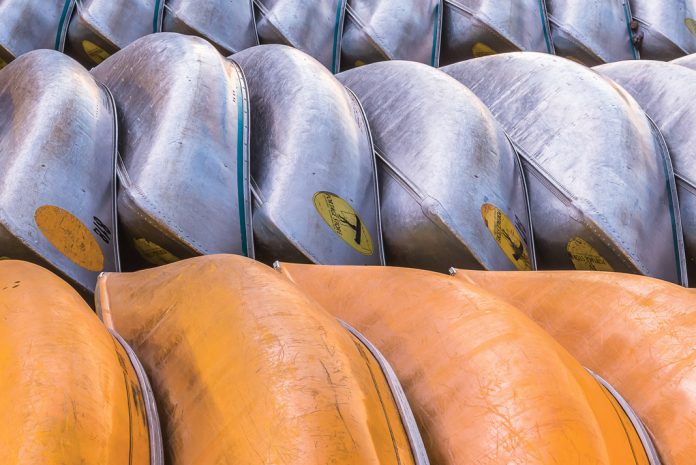
canoes lined up in a two rows

Anybody Who Tarries Long Enough On A Portage Trail Will Sooner Or Later Come To Wonder About The Growth And Evolution Of This Craft We Love So Dearly. I certainly have.

The last time I slowed to a nasty stop on a portage and took advantage of the time for contemplation of canoes of influence, I found myself wandering back to the very beginning. It seems clear naval history began with a floating log.

Somebody at some point, somewhere—on the steppes of Africa, if my biogeography prof has things lined up correctly—employed a floating log to assist with a passage and avoid drowning. It was the beginning of boating as we know it, in its many forms and permutations, but it was not necessarily the beginning of canoeing.

At some point later, someone got the bright idea to employ a stick of some kind to control the movement of the log in the water. This is not the genesis moment either.

The First Canoe—And, As Such, The Most Influential Canoe Of All Time—

It would have to be the log one creative Palaeolithic paddler decided to sharpen at both ends and perhaps flatten on top or hollow out so it might more easily be propelled and maneuvered to get to the proverbial another side.

This is just the beginning. There has been a slew of technological moments defining our evolving craft, and after the first, it’s difficult to order a hierarchy of the most influential and significant. However, I have some nominations—for example, going from dugout to planked and skinned craft.

A Second Revolutionary Innovation Was The Shift From Natural Materials To Human-Made Composites—Think Of The First Tin, Aluminum And Fiberglass Canoes. There were also design breakthroughs, such as ocean keels rockered for river maneuvering and air-bagged ABS scows eclipsed by ensuing generations of playboats. And, of course, the innovations of particular builders getting into the minds of the users of their boats, so as to change the canoeing experience—the shift from bare thwart or lashed paddles to custom shoulder-contoured yoke carrying comes to mind.

Continuums of design, materials and construction techniques may well define particularly significant and influential models in the ongoing evolution of the canoe. Similarly, canoes built for one purpose and reassigned to other ends, such as Campbell Mellis Douglas’s Harmony or John McGregor’s Rob Roy, both of which emerged from racing traditions, are considered by many as significant in the early stages of recreational paddling.

Of Course, There Are Also The People Who Paddled Them, And The Places Accessed, That Make Other Canoes Notable

The 16-footer Peterborough, Ontario, resident John Smith attempted to paddle to Peterborough, England. Frank Amyot’s gold-medal canoe from the very first Olympic C-1 1,000-meter competition in Berlin in 1936. Don Starkell’s Orellana, in which he paddled his way into the Guinness Book of World Records on a canoe trip with his sons from Winnipeg to the Amazon.

How about Steve Landick and Verlen Kruger’s hybrid boats in which they paddled 28,000 miles in and around North America. Or, perhaps, Glooscap, a character from the Mi’qmaq creation story, who turned up on this earth in a white stone canoe, as did Dekanawideh who, in some versions of the story, is credited with bringing the great law of peace to tribes of the Iroquois Confederacy. And what about la Chasse Galerie, the magical flying canoe piloted by the Devil himself, who flew lonely lumberjacks in the Canadian north woods back to their loved ones on New Year’s eve? Not to mention the first seafaring canoe to cross the Pacific Ocean or the first reed craft to cross Lake Titicaca.

The list goes on. What about the canoe in which Farley Mowat was conceived? Or the variety of double enders that conveyed Lewis and Clark into the American collective imagination. What about the aluminum canoe lightning accidentally welded onto comedian Paul Chatto’s head, turning him into a superhero? Or the bark canoes that conveyed the Maid of the Mist over Niagara Falls? What about the canoe Robert Service paddled on the Seine in France. Or Lootaas, the vessel that bore Haida artist Bill Reid to his final resting place on Haida Gwaii?

Like Children, It’s Tough To Pick A Favorite

However, I do have one. I nominate Holling Clancy Hollings’ Paddle to the Sea. If Paddle is not the most influential canoe of all time, then he’s certainly close to the honor, having inspired generation after generation of North American paddlers to get on the water to see what there is to see and feel what there is to feel, including the dull ache of dead double-ended weight on a portage trail.

James Raffan is an explorer, academic and former director of the Canadian Canoe Museum. On page 60, he shares his vision of the canoe as a perfect tool for creating unity in a nation.

Why You Must Explore And Paddle Scotland

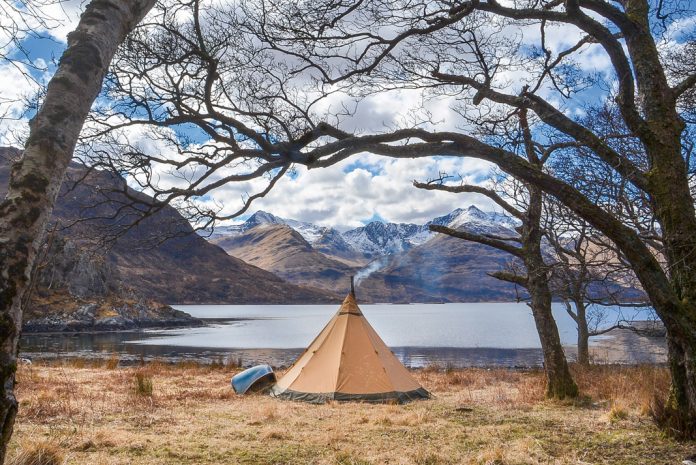
tent and canoe set up side of lake in Scotland

If the single-track road from Invergarry to Kinloch Hourn was a river, it would be described as long, narrow, twisty and challenging. Guidebooks would refer to bumpy, steep and committing sections, and warn of the absence of escape routes. This is a class III to IV road.

Yet, For A True Taste Of The Scotland Highlands, You Could Hardly Do Better

More importantly, this postman’s nightmare offers access to some varied and beautiful water.

It’s only this 22-mile road linking Glen Garry with Loch Hourn. Bristling with munros—Scottish hills over 3,000 feet—the land looms over both road and loch and is home to a range of classic Scottish wildlife. As you drive, paddle or walk in this rugged land, you will have entered someone else’s kingdom, your journey monitored by red deer stags and overlooked by golden eagles. You might even be watched by one of the Highland’s few remaining wild cats. Ravens and sea eagles also patrol the skies. Otters hunt the rivers and streams, joined in Loch Hourn by seals and dolphins.

Parts of Glen Garry still feel pretty wild. The land fringing Loch Hourn is wilder still, and represents one of the least populated areas in all of Britain.

If You Have A Half Day:

Lying only a few hundred yards from the A87, the road to Skye, Loch Garry offers the perfect opportunity for a morning or afternoon canoe exploration. Just turn off onto the Kinloch Hourn road, find one of the tiny roadside lay-bys and launch from amongst the silver birch.

If You Have A Day:

If you enjoy a wild river, run the Garry to Loch Garry. The river holds a quite a few class II to III rapids, only some of which can be portaged. Launch from below the dam just downstream of Kingie Pool. Land at the far end of Loch Garry, either before the Kinloch Hourn road meets the A87, or close to the dam.

If You Have A Weekend:

Spend a night on the shore of Loch Hourn. After paying a small fee to park near at Kinloch Hourn, launch into Loch Beag—the higher the tide the better—then paddle west to camp where you will. You may need to wait for slack water to negotiate the narrows of Caolas Mòr, perhaps following a pod of dolphins through the gap as the tide stills.

If You Have A Week:

Loch Hourn isn’t huge, but the shore is varied, with many stunning spots to wild camp. Just paddle a little, pitch your tent again and explore. The Knoydart to the south is Scotland at its wild and rugged best. The mountains are superb, and within the scope of most fit and experienced hill walkers, weather permitting.

Weather

Sublime on a good day. Otherwise, you’ll need the best weatherproof clothing money can buy and a sturdy tent.

Shuttle

There are many kit hire and shuttle options for paddlers, with information available from www.visitscotland.com.

Don’t Miss

If you’re happy on the hills, and the weather looks reasonable, climb Ladhar Bheinn (pronounced Larvan) for almost unsurpassed views.

Diversions

Leave your canoe at Barisdale Bay and walk the eight miles to Inverie Bay. Accommodation and camping is available at The Old Forge, Britain’s most remote pub.

Learn More

Scottish Canoe Classics by Eddie Butler is published by Pesda Press. Buy a Harvey Mountain Map—the Knoydart, Kintail and Glen Affric sheet is good for both hill and loch.

Try This Effortless River Running Trick For Tandem Canoes

several canoes doing a tandem trip down a river
It's always better with a friend.

I’m always looking for ways to run rapids with less effort. There is a myriad of forces at work in moving water, which means there are many ways to use river features to move downstream with style, finesse and ease.

Keep an open mind when it comes to tampering with established canoeing techniques. A bow paddler with a sore wrist paddling a long day of Class II and III rapids was the inspiration needed for me to explore to what extent I could glide effortlessly down a rapid, rather than back paddling to slow our descent.

Read my tips for canoeing down rapids below.

[ Paddling Trip Guide: View all canoeing instructional and skills clinics ]

Whitewater canoe trippers should know the back ferry

This has long been a staple technique of every accomplished whitewater canoe tripper. It is the most controlled way to descend rock-studded rapids. However, it’s not the easiest maneuver to master.

Each time a paddler engages a back ferry near an eddy, the countercurrent of the eddy tries to straighten the canoe, requiring correction strokes to maintain the back ferry angle.

This sometimes leads to blame being cast between paddling partners, often in the form of shouting, “What are you doing? We had the right angle!”

There may be another way.

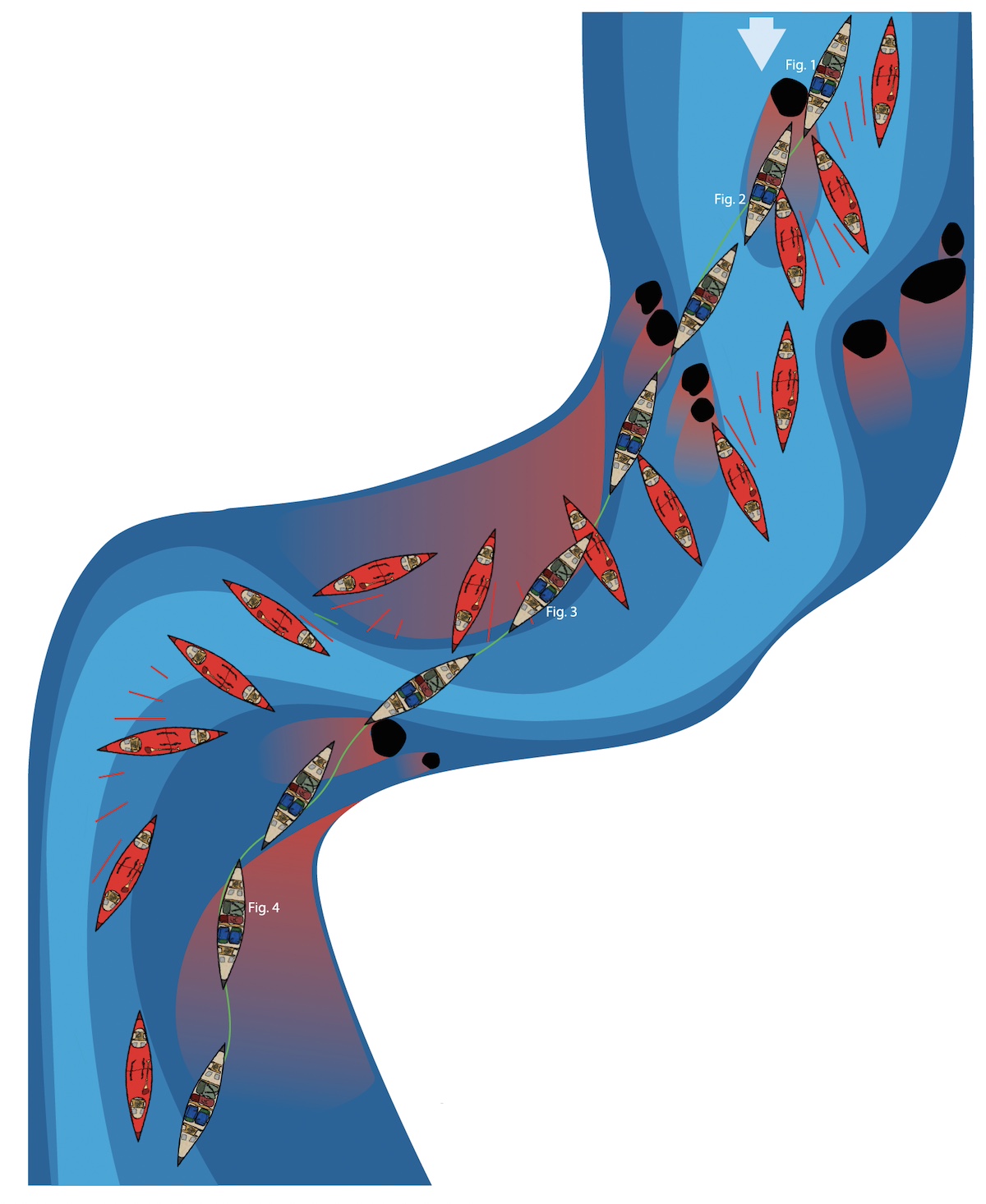
Use the canoe’s momentum and river currents to glide through a rapid

What would happen if, instead of back ferrying, paddlers used the canoe’s momentum, gravity and various river currents to glide through a rapid?

Gliding carves a sinuous path through a rapid, placing the canoe in
various currents propelling it in the direction you want to go. It requires planning a route several moves ahead and reading the minute details of the currents.

Begin by entering the rapid with slightly more speed than the current. Pass really close by a rock, slightly angled so the actual stem of the canoe is on the eddyline (figure 1).

The canoe should be so close to the rock if you were pointed straight downriver as you passed, the wide midship area of the canoe would hit the rock. Yes, this close. Bow paddlers will find this very disconcerting, and indeed gliding works better if bow paddlers keep their paddles out of the water most of the time.

Bite off just enough eddy current causing your canoe to carve in the direction you want to go.

When the canoe re-enters the current on the other side of the eddy it will regain momentum as it turns downstream (figure 2). Continue to slingshot in the general direction you want to go. The placement of the canoe in figure 3, just nipping the edge of the eddy, will allow you to carry more momentum than the line at figure 4.


Compare the overall route of the gliding canoe versus the back ferrying canoe—the one with the red spray cover. Both work, but one route is straighter and requires less effort than the other.

The true zen moment is when you glide down the rapid using no forward strokes at all. It’s not always possible, but the challenge alone makes it worth trying.

This article was first published in Issue 53 of Paddling Magazine. Subscribe to Paddling Magazine’s print and digital editions here , or browse the archives here.


Paul Mason is a cartoonist, Paddle Canada patron and moving water canoe instructor. He enjoys sharing his latest canoeing revelations through online tutorials, written articles and teaching his own courses.

7 Things You Didn’t Know About Bigfoot

bigfoot hiding behind a tree

1. Known regionally by many names, including Sasquatch, Yeti, Yowie and Almas, Bigfoot is reportedly a six- to 10-foot tall, 500- to 1,000-pound, hairy, humanoid creature said to live in the wilderness areas of the United States and Canada

2. Finding Bigfoot is one of Animal Planet’s most popular TV shows. On air for nine seasons and with nearly 100 45-minute episodes to its credit, none of its cameramen have yet captured any footage of the elusive creature. This makes Bigfoot a contender for the title of hide and seek world champion. 

3. In 1965, Bigfoot was added to the endangered species list in Russia

Germany and France followed suit in 1967. Skamania County, Washington, passed a law regarding Bigfoot in 1969, declaring “any willful, wanton slaying of such creatures shall be deemed a felony” and subject to fine or imprisonment. Though this legislation was passed on April 1, county commissioner Conrad Lundy said at the time, “This is not an April’s Fools Day joke… there is reason to believe such an animal exists.”

4. According to the Bigfoot Field Researcher’s Association, the “squatchiest” states—those with the most sightings—are Washington, California, Florida and Illinois. The organization’s online database of field reports dates back to 1995, and includes several encounters from harried canoeists. 

5. In 2008, legitimately fake news source Weekly World News claimed Hillary Clinton had named Bigfoot as her running mate

In November, 2012, Bigfoot made the news again, with the tabloid declaring: “Bigfoot is not only real and living among us, but he is married to three lovely women.” The women were reportedly very pleased with their love lives.

6. Bigfoot’s shaggy silhouette has been used to sell everything from pizza and beef jerky, to skateboards and skis, to paddle-boards and monster trucks. It’s also the namesake for a half-dozen canoe and kayak outfitters and rental operations in the Lower 48.  

7. The most famous image of a Bigfoot is from a short film shot in 1967 by Roger Patterson and Bob Gimlin during a horse packing trip

Shot in Bluff Creek, California, it shows a dark, man-sized and man-shaped figure striding through a clearing. Considered by many to be a hoax, it remains the most convincing evidence to date for the existence of Bigfoot.

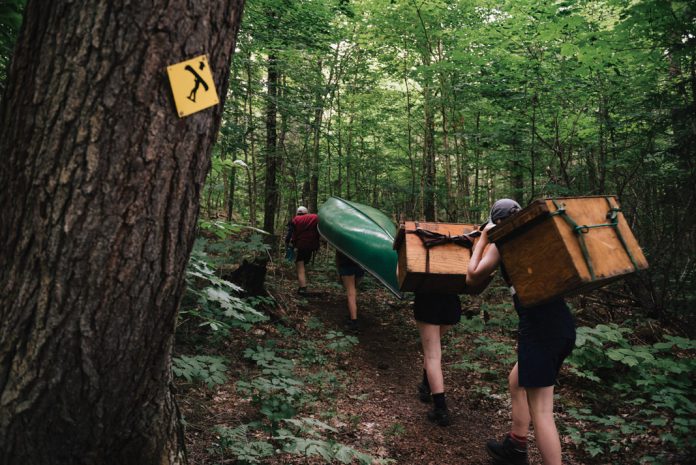
Paddlers’ Rules About Portage Trail Etiquette

paddlers carrying gear on a portage trail
The recipe for happy portaging and happy living isn't so different | Feature Photo: Mike Last

Some paddlers just don’t know the meaning of portage etiquette. I’ve witnessed a camper poop right in the middle of a portage trail. I’ve seen someone pee on a patch of blueberries at the take-out. Then there was the youth group who first blocked the put-in with their packs and boats, then left food wrappers, dirty socks and broken lawn chairs strewn in their wake.

An outdoorsy Miss Manners would be aghast.

I like to think of a busy portage as a Microcosm for the rest of life. Among all the nature lovers who want to leave the place a little better than they found it, there’s all the other people. You know the ones. They’re the litterers, the ones who wander past complaining, and those who come up fast from behind and tailgate. There are others still who are too hurried or self-important to even return a courteous hello.

My biggest peeve is when oncoming foot traffic doesn’t give a canoe-head the right of way. It feels like being cut-off on the highway or when someone cuts in line at the grocery store. “Excuse me,” is the politest thing I can think to say.

On the portage trail, just as in life, you’ll meet jackasses.

It was the guys with the flip-flops who really did me in. My canoe mate, Andy, and I were on a challenging 20-day route. The bugs were bad, water levels were low, and we had to complete a total of 93 portages. I had many opportunities and plenty of time to contemplate trail etiquette on this trip.

We were trudging up a portage near the highway corridor when a group of young guys approached on the single track trail. I was carrying a colossal pack and Andy shouldered our 70-pound canoe. This group was walking back for their second load, carrying nothing but flip-flops. They decided they had the right of way and literally sent Andy and I crashing off trail to get around them.

[ View all the boats and gear you can portage in the Paddling Buyer’s Guide ]

I lost it. When I sternly informed them of their wrong-doings, the group just stood dumbfounded. One guy even threw back a few nasty curse words, flipped me the bird, and brashly asked where the sign was with a list of all this portage etiquette stuff I was ranting on about.

I left the quarrel muttering about rude people, and how society is doomed if people take self-interested city attitudes into the wilderness. Andy had to listen to me all afternoon.

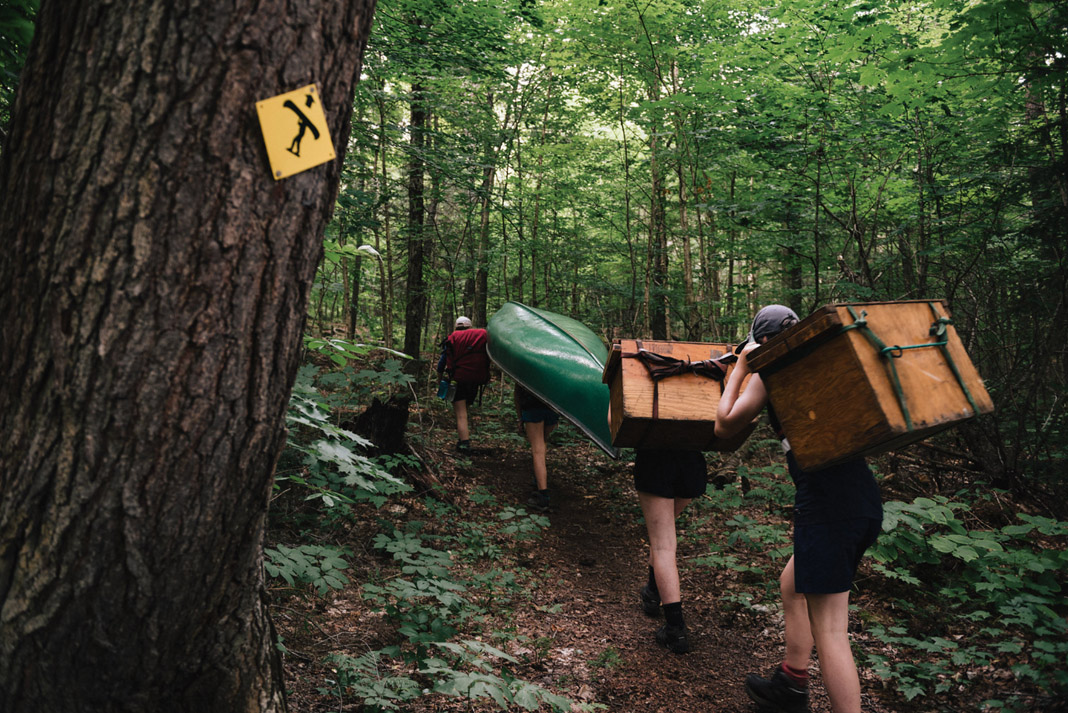
paddlers carrying gear on a portage trail
The recipe for happy portaging and happy living isn’t so different | Feature Photo: Mike Last

While many paddlers learn portage etiquette from summer camp, family members or courses, newbies are sometimes oblivious to the unwritten rules. The usual excuse for ignoring protocol? “No one told me,” they plead.

[ Plan your next paddling adventure with the Paddling Trip Guide ]

It reminds me of the old Steve Martin routine, where he says to the judge, “I didn’t know armed robbery was illegal. If you told me it was, I wouldn’t have done it.”

If you don’t know, fortunately, the rules are straight forward.

Make way for whomever is carefully carrying an awkward and heavy 17-foot-long burden. Don’t poop on the trail—ever. Bathrooms breaks should take place 100 meters from the trail and water sources. Finally, leave all your gear neatly off to the side of an the access point, and don’t leave anything behind when you paddle away.

The golden rule of kindergartners everywhere—to treat others as you want to be treated—also goes a long way. Some might call these rules common sense.

On the portage trail, just as in life, you may have to do your best to avoid or reeducate the complainers, the tailgaters, and the poopers. Accept some paddlers will rush past, others will carry too much, and others won’t even look up, let alone return your friendly hellos.

What I do know is those who tend to enjoy the portage the most are the ones who savor the scenery, don’t carry too many burdens, and know when to get the hell out of the way.

Butt End celebrates the lighter side of canoe culture. Kevin Callan is the author of 16 paddling related books, including The Happy Camper, and best-selling series of guidebooks.


The recipe for happy portaging and happy living isn’t so different | Feature Photo: Mike Last


Secrets To Staying Off The Paddlers Black List

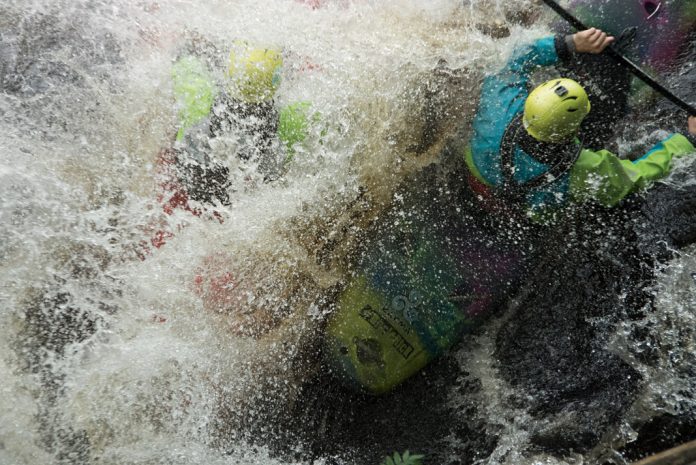
two kayakers crashing in whitewater
Feature Photo: Rob Litherland

There is a short list of paddlers with whom I will never run another river. Nice enough individuals, I just don’t want to be anywhere near them on the water.

Take Larry. He runs in my social circle, has more skill as a paddler than I do and I’ve spent quite a few river days with him.

But his antics just added up. Poking around upstream of log jams, probing big holes, which sometimes ended in broken paddles or smacks to his head. Finally, a stupid rock spin on the lip of a drop resulted in a stern pin I bailed him out of. Never again, I promised myself.

we trust paddlers who have skills to deliver on whatever they bite off, do so reliably and predictably, and appear to be in it for reasons aligning with our own

Take Curly. He’s not really a friend of mine, but he is in the local paddle gang. One day with Curly— during a spring flood run in which he was totally spooked, choked, and got himself into trouble with four swims—I said never again. It was carnage.

Then there is Moe. Moe just never shows up at the put-in. He always leaves the group hanging, unsure if we should wait a couple minutes longer or go without him. Something always comes up with him. I just don’t call Moe anymore.

As you might have guessed, names have been changed to protect the guilty. My short list is really just the list of paddlers I don’t trust.

In my professional life, I study safety. Specifically, I study how social influences such as peer pressure affect safety. My research is focused on different industrial sectors; however, I often include our small whitewater world. The environment in which we play turns out to be a good testing ground for safety behavior. I conducted one study looking at how raft guides influence each other’s safety beliefs and it was no surprise to me trust is a key variable.

Paddling with untrustworthy people is stressful

In the academic community, there is consensus a person’s trustworthiness is based upon one’s competency, predictability and intentions. In other words, we trust paddlers who have skills to deliver on whatever they bite off, do so reliably and predictably, and appear to be in it for reasons aligning with our own.

The relative importance of these three factors depends upon the context. For whitewater guides, my study found, predictability is paramount. Some guides have more skill than others, and individuals’ motivation may vary, but the most trusted guides are the ones who predictably do what is expected.

Interestingly, what guides want from their peers more than anything is to be trusted. Trust is currency in the guiding world. When guides say one of their own is good, what they really mean is this person can be trusted. More specifically, it means the individual’s behavior is predictable in safety and performance.

Guides also have their own short lists—their own Larry, Curly and Moe—of guides worked with but not trusted. My research found covering for bad guides is a significantly stressful aspect of river life.

Paddling at any time with untrustworthy people is stressful. Even if you’re not a raft guide, trust is still the dynamic holding your paddling gang together, and it’s certainly a prerequisite for allowing someone new into your gang.

In most cases, a paddler’s moral compass won’t allow him to just walk away from a sketchy or spooked paddler, so we end up taking responsibility for them.

At best, the experience is no fun and at worst it’s terrifying. Later we add this person to our short list. Don’t feel guilty for having your own blacklist of names—it’s self-preservation, sometimes literally.

Jeff Jackson is a risk management consultant and outdoor education professor at Algonquin College. Feature Photo: Rob Litherland

Sabrina Barm Designs Esquif’s Extasy Canoe

Sabrina barm paddling esquif C1 canoe

Like most whitewater paddlers, Sabrina Barm struggles to find words to describe her passion for wild rivers.

“It’s something I need, like breathing,” says the 30-year-old canoeist and extreme creek racer from Germany. “If I can’t paddle, something is going to go wrong sooner or later. It’s a sensation.”

Barm also focuses on a feeling when describing the nine-foot creeking and river running OC1 she designed for Quebec’s Esquif Canoes, which hit the market late 2017. With the new Esquif Extasy, Barm says she achieved her goal of creating “the most intense form of joy.” In doing so, she also became the world’s first female whitewater open boat designer.

Barm took her first strokes in a canoe with her father on bucolic European waterways. Soon she was paddling whitewater, a rare breed in Europe for her propensity for single blades and open-decked boats. She found inspiration in European paddlers Eric Deguil and James Weir, along with pioneering American open boaters Dooley Tombras and Eli Helbert.

Barm began a meteoric rise as a whitewater athlete, training with Deguil on the technical rivers of France, competing in International Canoe Federation downriver races, and ultimately visiting North America. Barm connected with Esquif in 2014, when she turned heads as the first female canoeist to compete in North Carolina’s infamous Green River Race, running the intimating class V rapid known as Gorilla. She’s also competed in two Adidas Sickline Extreme Kayak World Championships at Austria’s Wellerbrucke Rapids, paddling C1 against a field of kayakers.

An engineer by training, Barm balances elite-level paddling with a professional career in the automotive sector. However, it didn’t take an engineering degree for her to identify a critical fault in open canoeing. The market was exclusively comprised of boats designed by men.

They were great for a standard size guy but for smaller people there was nothing,” Barm says. “Basically it’s like wearing shoes a few sizes too big. You won’t have an optimal experience.

She made her case to Esquif. “In university I worked on a boat design method and I wanted to try my theory on a new canoe,” she says. Esquif owner Jacques Chassé was an easy sell. Barm tackled the project with vigor, establishing performance parameters—“acceleration, precision, hull speed and ergonomics”—crunching numbers in mathematical models and manually shaping foam prototypes on weekends.

“The budget was as low as it can be,” she admits, “I was pretty happy when the second prototype worked.”

Like Esquif’s game-changing L’Edge, a do-everything OC1 debuting in 2011, the Extasy is compact enough to be adequately light and stiff in bombproof rotomolded polyethylene. With pronounced asymmetry and hard edges, it lacks the aesthetic curves of traditional canoes, reflecting Barm’s commitment to “100 percent fluid dynamics and functionality” in her design process.

She Says The Extasy Displays Exquisite “Driving Dynamics”—Engineer Language For Effortless Motion Through Water—And Is Optimized For Sub-150-Pound Paddlers.

“I’m so in love with the design, it’s hard to contain myself,” Barm enthuses. “Acceleration is so on point, it boofs like launching a space rocket and it’s faster than many longer boats.”

Chassé says the Extasy captures Esquif’s focus on innovation. Initially, Barm’s design was “a bit surprising to us,” Chassé admits. But he was sold on the performance. “It brings the open canoe to another level with a focus on speed, quick turns and precise paddling.”

Chassé alludes to Barm’s bright future, noting, “The Extasy will inspire more designs.”

Barm isn’t too concerned with being the first female open boat designer.

Being female doesn’t make me special. My parents taught me to be strong, and raised me to do what I want regardless of my gender,” she says. “If I can inspire other women, who may not have been given the confidence, then of course it’ll make me happy.

Barm says her next step is developing confidence in pushier water. The Extasy is a big part of her development. “I don’t have to worry about the boat any more,” she says, “I just paddle.”

Just as her own performance reaches new heights, Barm hopes the Extasy will inspire others to reach their own objectives.

“It’s more than just a boat,” she says. “To me, it’s empowerment to reach your potential, to paddle without limits. It’s an encouragement to go as big as you want to go. Most of all, it is my declaration of love for the river.”