Home Blog Page 242

Just Like It Always Was

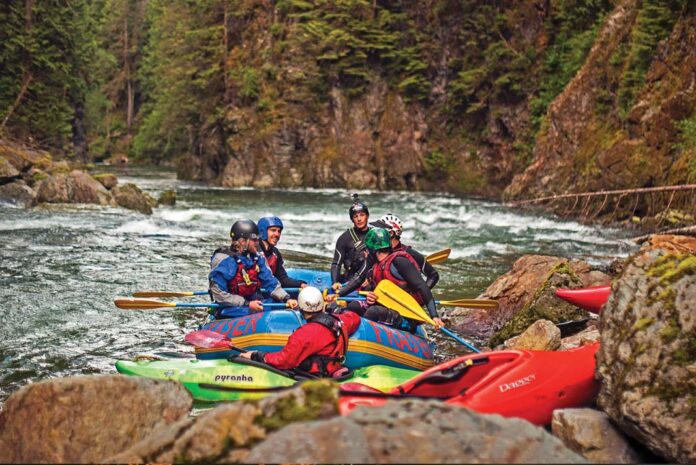
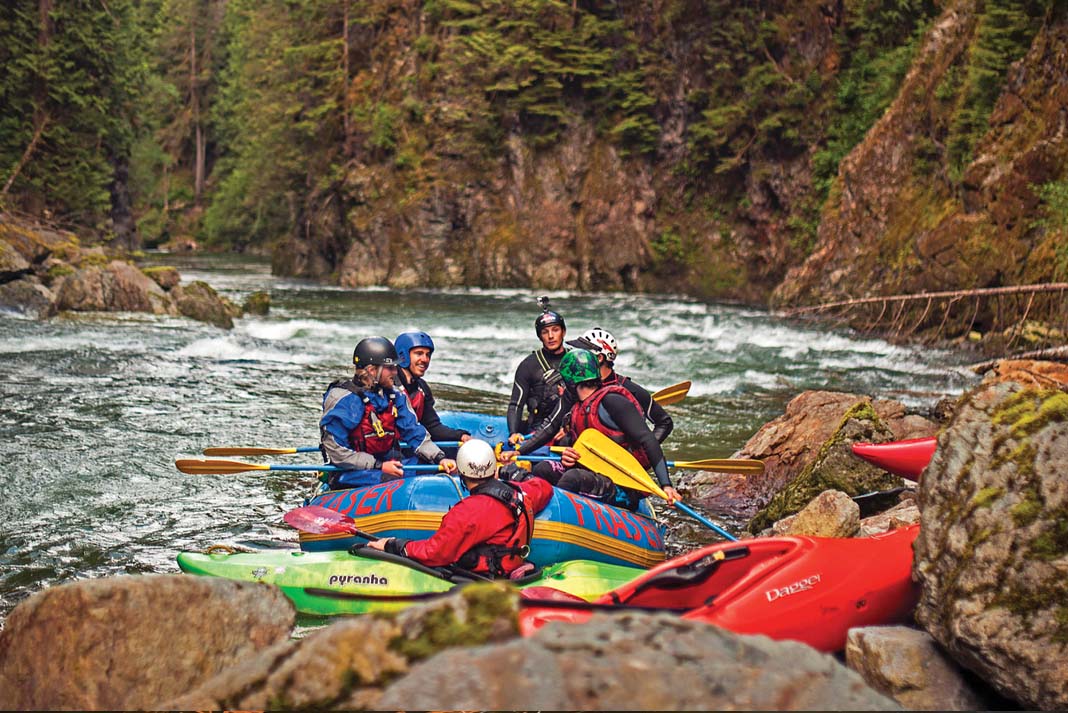
FREEBOATING REVIVAL.| PHOTO: TEGAN OWENS

At the dawn of the new millennium, whitewater was having an identity crisis. River running, in the face of ever-evolving freestyle, was becoming incredibly uncool. Pro-Tec full coverage helmets, Salamander geek beak visors, striped polypro long underwear and woolen socks in Teva sandals. We were safe and we were warm, but goddamn we were ugly. I’m okay with ugly, but ugly and outnumbered is a serious problem.

In 2000, I coined the phrase whitewater freeboating. I had hats made and the term appeared on the cover of this magazine.

As I saw it, for whitewater to survive long-term we needed to make river running cool again. Like freeskiing was the new movement of all – mountain skiing, freeboating, as I proposed it, was top to bottom with play along the way. The name didn’t stick around but the concept did.

I was thinking about this last fall as I met up with a group of freeboaters. They were checking straps and pacing to keep warm. The temperature was hovering just above freezing, appropriate conditions for an annual gathering dubbed Chill Fest.

This paddling club has no elected president, no treasurer, no secretary and no fundraising bake sales. It is free to join. Joining—and I use that term loosely—puts your name on a mailing list used only to coordinate four weekends per year. To be removed from the list there is a $100 membership fee. To date, this river running whitewater club has never lost a member.

Chill Fest is nothing more than a river, a few suggested hotels, a Saturday night dinner and, ideally, cheap beer. Whoever shows up, shows up.

We meet at a general store, a parade of floats piled high with boats of every color, shape and size. I know a couple folks, recognize a few more faces. A round of handshakes and complete strangers begin mocking me for living the closest and being the last to show up.

FREEBOATING REVIVAL.| PHOTO: TEGAN OWENS

Mike McCaffin is a lab technician here with his teenage son. There are teachers, two husband wife teams and a couple university students who should be studying for exams. There are creek boats, freestyle kayaks and everything in between. At Chill Fest anything goes.

I’m testing the new Silverbirch Covert 9.3 Some guys practice bow stalls in the flats and two kayakers don’t have whitewater rolls. They swim all the sets they don’t carry around. We all put in at the top and make it to the bottom. This is exactly what I was talking about. This is freeboating.

Around the parking lot campfire we joke like old friends. As drysuits change into Carhartts and puffy coats, the fire burns up and talk turns to who has the longest drive home. We pile into each other’s cars for the ride to the top. The sweet smell of wet gear wafts from mesh bags, chipped paddle blades rub against my shoulder. Van Morrison sings, “Into the Mystic.” It occurrs to me that all these years we’ve been asking ourselves the wrong question.We’ve been asking, what does the future of whitewater look like? We should have been asking, what does the future of whitewater sound like?

The answer is not cowbells and roaring crowds. The future is not live streaming coverage from a concrete ditch in Rio. It’s not the roar of twice as many hydrogen as oxygen molecules crashing 198 vertical feet somewhere in the state of Washington. The future of whitewater sounds just as it

always has. It sounds like, “Hey [name of friend], want to run the [section of moving water] this weekend?”

Scott MacGregor is the founder and publisher of Rapid. He’s been wearing the same ugly shorty paddling jacket since forever.


This article originally appeared in Rapid
Early Summer 2016 issue.

Subscribe to Paddling Magazine and get 25 years of digital magazine archives including our legacy titles: Rapid, Adventure Kayak and Canoeroots.

6 Questions To Ask Before Your Next Kayak Rental

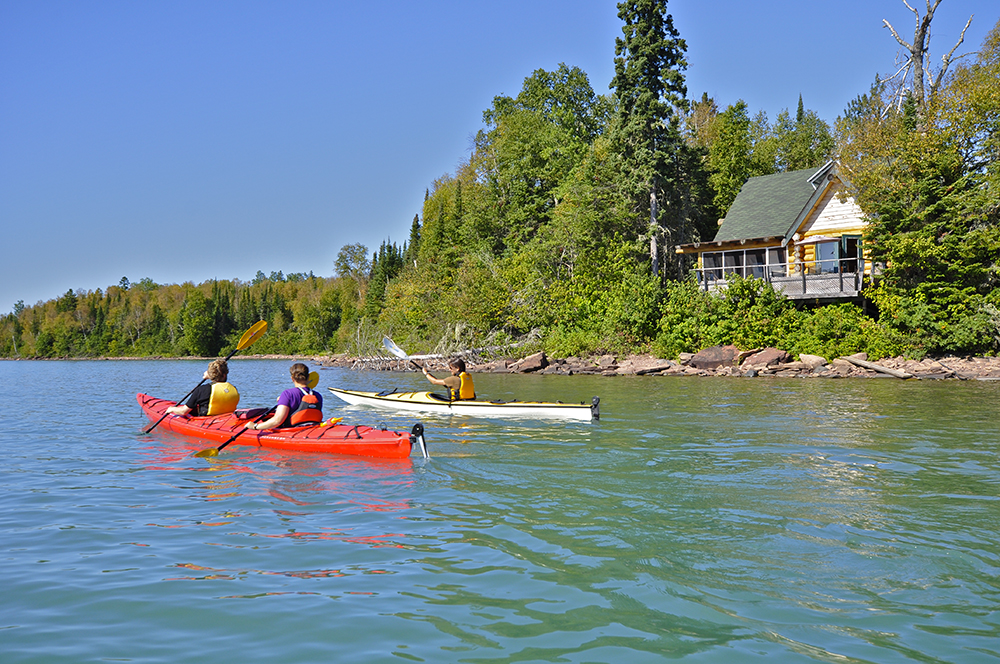
one solo kayak and one tandem kayak paddling on flat water
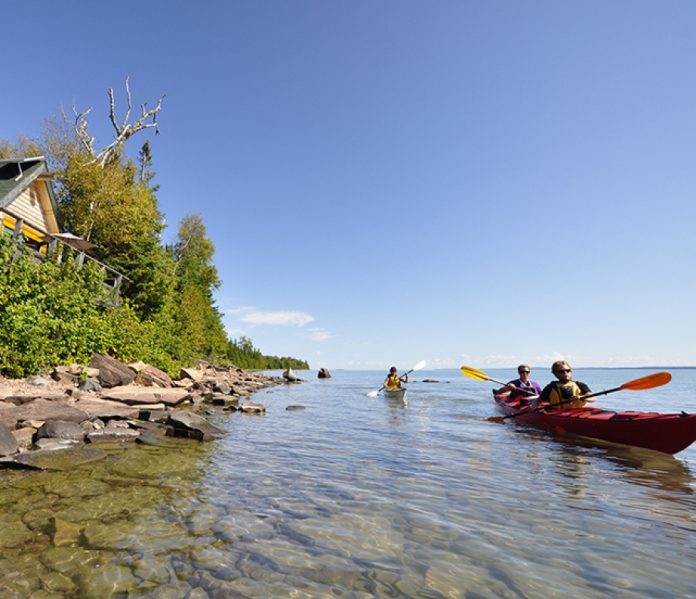
Kayakers enjoy paddling on an Ontario lake. | Photo: Ontario Tourism

1. What style of kayak should I rent?

Different types of kayaks may all look pretty similar to the newbie, but there are actually multiple different kayak designs intended for specific conditions and paddling styles.

For example, recreational kayaks are wide and their stability makes them a good place to start for the new paddler. If you are renting a kayak for a few hours on a calm lake, this will be a good choice.

If you are renting a kayak for a longer trip, especially one in rougher or more open water, touring kayaks will be best. Touring kayaks have more space to store food and gear, and they are significantly longer and narrower than recreational kayaks. You will notice that many also come with a rudder or a skeg attached to the stern, a feature we will cover below.

Touring kayaks come in different sizes. Some are for multi-week expeditions and therefore much longer with extensive storage, while day touring kayaks will be shorter.

Sit-on top-kayaks feature a low, wide seat and you don’t have the option of using a spray skirt. They are extremely stable due to a wide design, and if you are a nervous kayaker, kayaking with a child, are a beginner or want something to fish from they can be a great choice. With a sit-on-top kayak, you will be more exposed to the sun and water.

If you’re still not sure which kayak to rent, tell the outfitter about your trip. They’ll be able to recommend the best boat for you.

2. Do I want to kayak solo or tandem?

One of the more basic questions you should ask yourself before you rent a kayak is whether you want to paddle solo or tandem. The names are self-explanatory— solo kayaks are for one paddler and tandem kayaks are equipped for two.

Renting a tandem kayak can be a good choice if you or your paddling partner is nervous and the experience would be more confidence boosting with a buddy. Tandem kayaks can also be great if you are paddling with a child who isn’t ready to kayak alone.

If one kayaker’s ability or strength means they won’t do well paddling a solo kayak, having a stronger or more capable tandem partner is key. Some experienced kayakers also simply enjoy the companionship and teamwork that a tandem provides. See tandem kayaks here.

A solo recreational kayak offers more independence and freedom, and the paddler is solely responsible for the direction and performance of their boat.

Don’t worry about making the wrong decision. The beauty of renting kayaks is that you can try both. If paddling with your friend or partner doesn’t work out, the next time you go kayaking you can both try a solo boat.

people paddling a solo and a tandem kayak on a lake.
Bring a friend or do it yourself, kayaking is fun every which way. | Photo: Ontario Tourism

3. Do I want a kayak with a skeg or a rudder?

When you go to rent a kayak, you may have the option of choosing between a kayak that has a skeg and one that has a rudder. What are skegs and rudders, and what is the difference between them?

A skeg is a blade that comes down from a compartment near the kayak’s stern. A cable that the paddler can adjust from inside the cockpit, usually positioned by their leg, controls the depth that the skeg drops into the water.

The purpose of the skeg is to aid tracking and control the influence of waves, wind, and current on the kayak by allowing the stern to better stay in place on the water.

A skeg can aid tracking and trimming for wind, but doesn’t aid turning. Since you can use the cable to control how much of the skeg is actually in the water, you can adjust how much control you need based on conditions. View kayaks with skegs here.

Some people prefer skegs to rudders because of their simplicity. Skegs have less moving parts than rudders, and if your kayak rental day will be one of your first paddling, it may be good to keep it simple and avoid spending time dealing with learning how to use a rudder.

A rudder differs from a skeg because the paddler can move it side to side in the water. A rudder is usually outfitted to the stern of a kayak, with cables that connect to foot pedals the paddler controls with their feet from inside the cockpit.

Rudders are good for controlling the direction and if used properly can decrease the amount of time you need to spend using correcting strokes. A rudder can usually be flipped out of the water if the paddler doesn’t need or want to use it.

If you are renting a kayak to work on your beginner strokes and develop basic skills, you may want a kayak without a rudder to avoid relying on it instead of learning the correct techniques for turning.

Once at your kayak outfitters, ask about the specific mechanisms of the skeg and rudder systems on their kayaks, as they can vary depending on the age and make of boats.

4. Once I rent a kayak, will I take a lesson, be guided or paddle by myself?

Renting a kayak is simply a means to get you on the water. You will need to decide what you want to get out of the experience. Many places that rent kayaks will also offer lessons, ranging from beginner lessons to advanced and skill-specific clinics.

Even if you are an experienced paddler, combining a kayak rental with a lesson can help you greatly enhance your capabilities. You also may be able to have a lesson for half of the duration of your rental period and free paddle for the remainder.

If you want to explore but you aren’t quite ready to do so yourself, your kayak outfitter may also offer guided trips. Renting a kayak and then going on a guided tour, whether it is for a few hours or a week, can allow you to get instruction, learn about the area’s environment and history and enjoy the beauty of a new place.

If you are experienced in kayak touring, you may rent a boat and then go paddling on your own. You can use your kayak rental shop as a resource. Some may offer trip plans, pack your food for you, rent additional safety and equipment and shuttle you back from your take-out.

5. How prepared am I to go kayaking?

While renting a kayak, paddle and spray skirt may seem like the essentials for hitting the water, there are many other considerations to make sure you and your paddling partners are safe. If you decide to forgo the aforementioned guide or lesson, it is essential you are well prepared. Here are steps to make sure you stay safe on the water.

Float plan

A float plan outlines all the details about your trip you want someone to know in case something goes wrong. It should include the full names of those on the trip, the make and colors of each member’s kayak, emergency contacts, launch time and location, your route, intended campsites, and map coordinates and the intended take out place and time.

This plan should be printed out and left with a reliable friend or an outfitter. Even if you are only going for a day, it’s good to leave an abbreviated version of this especially if you are in a new area.

Boat safety kit

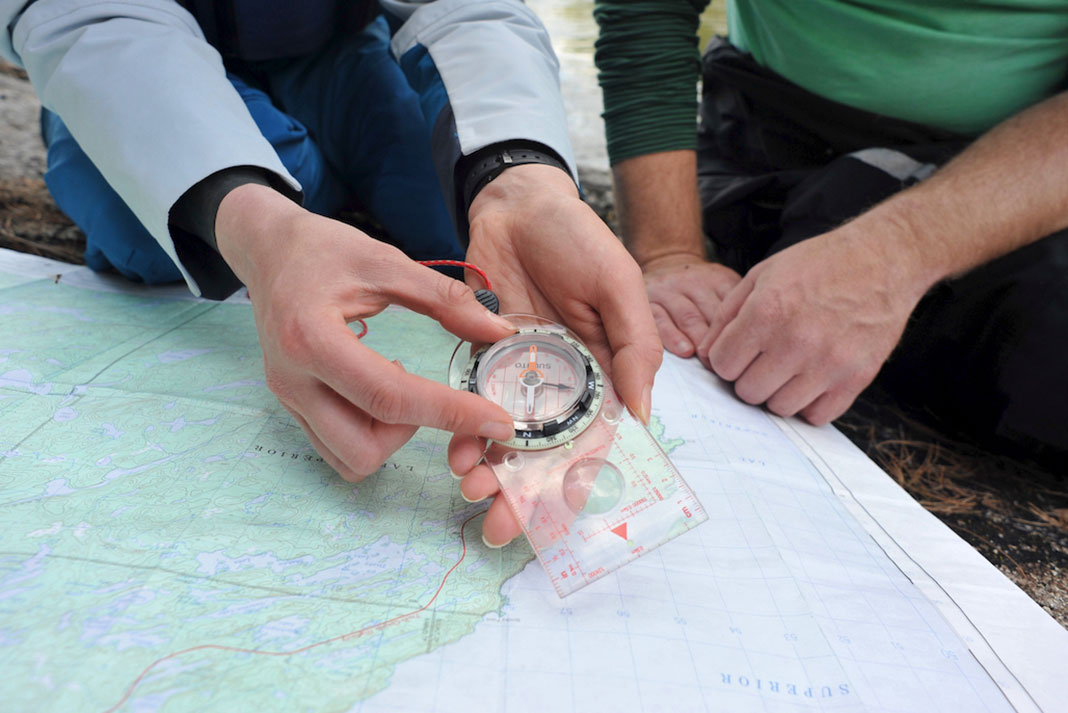
Like in all outdoor activities, there is always the chance something can go wrong. In addition to your kayaking PFD, a safety kit onboard should include a whistle, a floating rope, a bailer or pump, a flashlight, flares, an extra collapsible paddle, and a compass. For longer trips, a VHF radio and GPS are a good idea too.

Maps and an understanding of the area’s water

Even if you are only taking your kayak rental out for an afternoon, ask the outfitter for a map in a waterproof case to take along. It is surprisingly easy to get lost in certain areas, especially when you are unfamiliar. If you are renting a kayak to go sea kayaking, speak with the rental company about the tides and currents and look at a tide chart if you can.

6. Have I made sure everything on the kayak is in working order?

Most rental shops and outfitters are honest and qualified, but before you take your rental kayak out use this checklist to ensure you don’t get dinged for damage you weren’t responsible for or find problems once your journey is underway.

Check for dents, scratches or gouges on the hull and sides of the kayak. Scratches and minor dents are normal on a kayak, but a gouge or a major dent will affect the seaworthiness and function of the kayak.
Make sure the outfitting inside works properly and is not damaged.
Test the skeg or rudder if applicable to make sure cables and all parts function properly.
Make sure your skirt doesn’t have holes or rips and the grab loop is intact.
If your kayak has hatches, check they open and close properly.
Check the deck rigging is in place, especially if you are going on a long trip and will want to have your map attached and in front of you as you paddle.
Lastly, make sure at all times you have a PFD, either your own or rented along with your kayak and paddle.

Summer Gear

Photo: Virginia Marshall

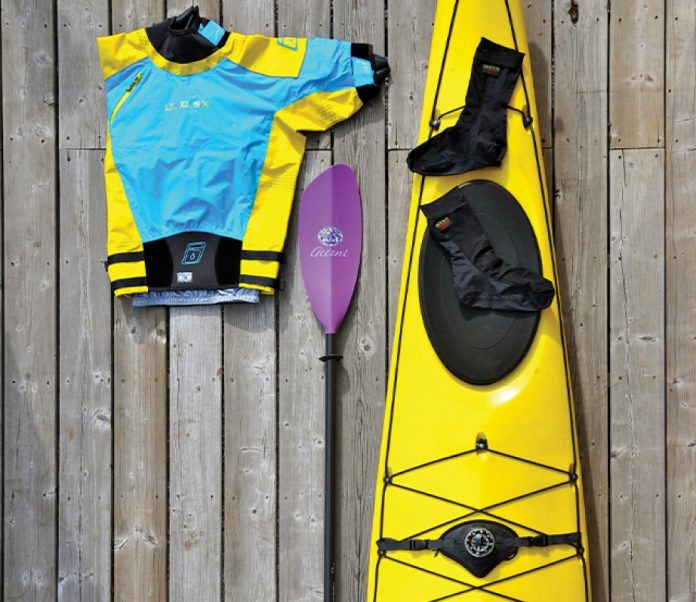
Level Six | Chochee 2.0

The short sleeve version of Level Six’s legendary Mack dry top gets updated for 2016, with new eye-catching colors and lighter 2.5-ply breathable fabric on the chest and back to keep us looking and feeling cool on hot summer days. Rolling geeks and rough water paddlers will appreciate the addition of latex bicep gaskets for an even dryer fit. $309.99 CAD | LEVELSIX.COM

Accent Paddles | Moxie

The Moxie’s funky purple blades are ample incentive to treat ourselves to this budget- friendly paddle, but pragmatists will find plenty of other great reasons. Pairing a carbon shaft with fiberglass nylon blades, the Moxie is stiff and surprisingly light. The mid-angle blades are perfect for all-around touring, and we love Accent’s Kingpin ferrule adjustment system—one of the slickest designs we’ve tested, providing a snug one-piece paddle feel. $159 | ACCENTPADDLES.COM

{loadposition MidContent}

KaYoke

Would-be interior kayakers have a champion in inventor and entrepreneur Scott Gill, who devised this clever universal portage yoke as a solution to backcountry kayaking’s biggest problem: carrying the damn boat. The KaYoke attaches to the cockpit coaming so paddlers can shoulder their boats across trails and terrain too rugged for a wheeled cart (caveat: you’ll want to empty heavy gear out of your hatches first). Clunky DIY versions notwithstanding, Gill’s compact, folding design is an overdue first. $119 CAD | WWW.THEKAYOKE.COM

Rocky | Gore-Tex Waterproof Socks

Soggy dogs are a familiar paddling discomfort, but they don’t have to be. We love pairing these stretchy Gore-Tex socks with wool socks and our favorite river shoes for dry and toasty toes. Goodbye booties. $64.99 | WWW.ROCKYBOOTS.COM

Seattle Sports | Sea Rover Deck Compass 

While we think reliable navigation is a necessity rather than a luxury, the Sea Rover is a no less elegant solution for kayaks without a built-in compass recess. Quick-release buckles attach securely to decklines and the compass dome’s bold markings are easy to read even when mounted near the bow. $38.95 | WWW.SEATTLESPORTSCO.COM 

This article was originally published in Adventure Kayak, Volume 16 • Issue 2.

Sweden’s Untouched Whitewater

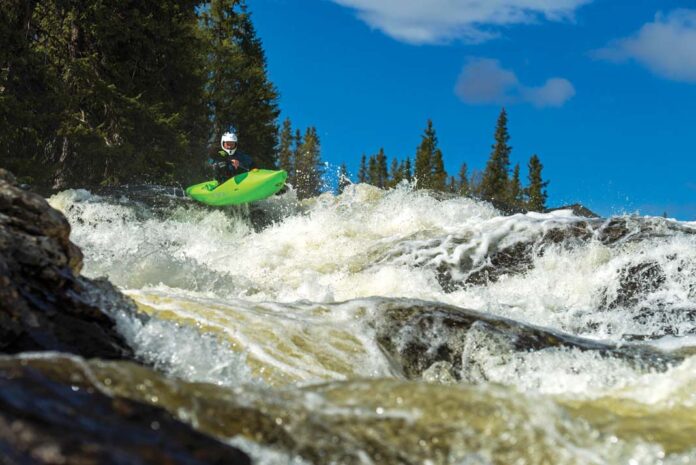
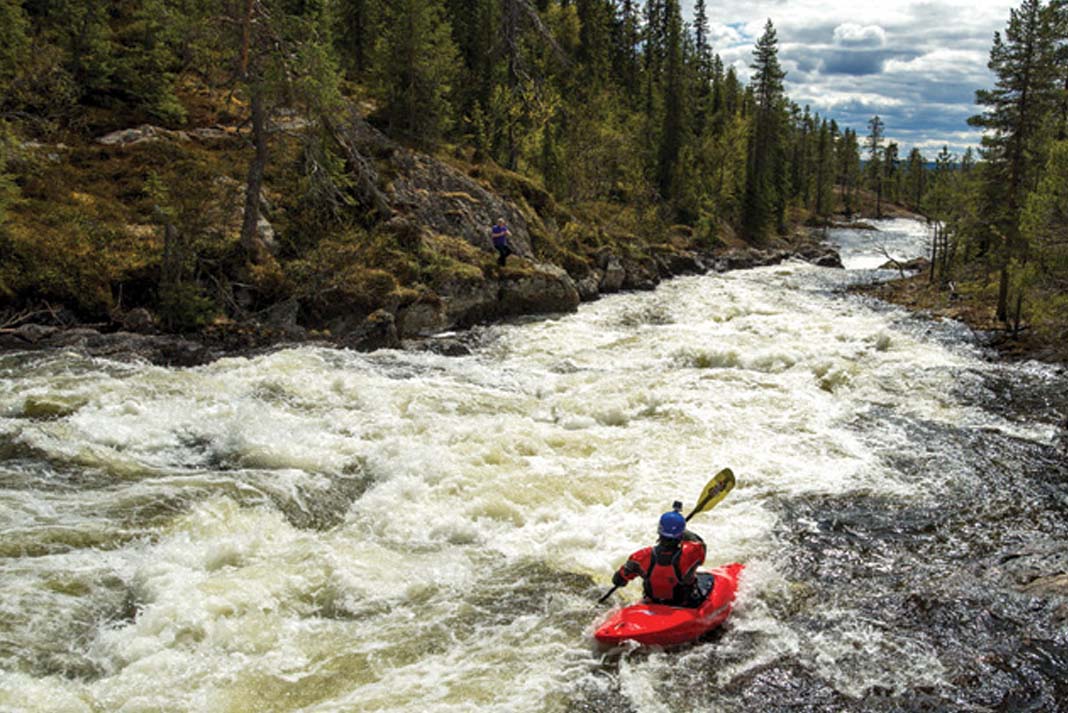
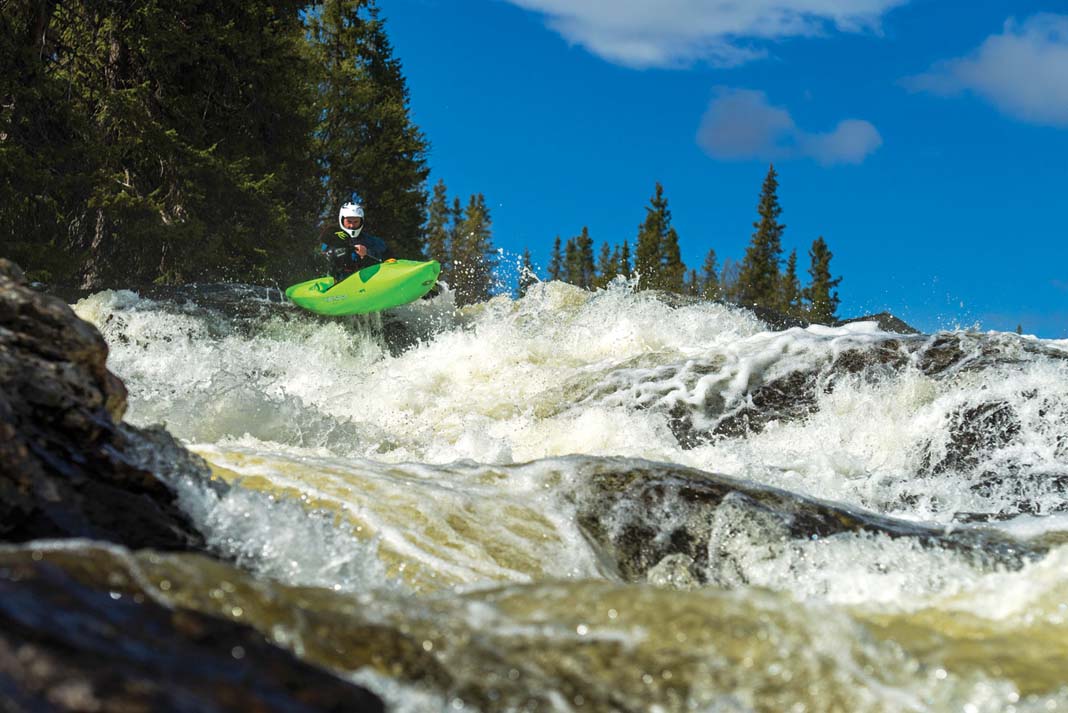
STEEP TOPOGRAPHY TURNS SMALL STREAMS INTO CLASS V CREEKS. | PHOTO: SCOTT MARTIN

Windblown snowdrifts dappled by the soft light of the midnight sun make the winding, wilderness roads of rural northern Sweden look like a painting from the front of a Christmas card. Instead of a tree tied to the roof, this car carries bright green and red kayaks.

Tyler Curtis slams the brakes as a reindeer wanders out of the forest and into the road. “Is that real?” asks Scott Martin, from the passenger seat.
The outskirts of the quiet mountain town Kittelfjäll couldn’t feel further from home.

Growing up in South Africa, Martin spent holidays at the beach—the reindeer may as well have been a unicorn.

INTRODUCING HIDDEN GEMS TO THE WHITEWATER WORLD

It’s springtime in Sweden. Buds are bursting open on roadside aspens, giving the forests a fresh and fuzzy, deep-green coat. Snow banks linger in town and there’s still a sprinkling in the mountains, but Curtis is packing his skis away.

A five-time Canadian National Champion kayaker, Curtis has traveled the world, winning extreme races and freestyle events. He moved to Kittelfjäll, Sweden, in 2011 with his partner, Lisa, to start a family and live, work and play in the mountains of Scandinavia’s North. The lifestyle allows them a seasonal migration back to Canada with their newborn daughter, Tove.

After spending a few winters charting undiscovered rivers carving through northern Sweden’s mountainous landscape, Curtis is itching to introduce the area’s gems to the rest of the whitewater world.

Just kilometers to the west is Hattfjelldal, the region in Norway that has become a mecca for elite paddling, drawing crowds of traveling kayakers and exploding in popularity in recent years. While Norway has larger cities near the Swedish-Norwegian border, most of Sweden’s population centers are far to the east along the coast or in the country’s interior.

A FREESTYLE STOP BETWEEN CREEK RUNS. | PHOTO: SCOTT MARTIN

“As soon as you cross the border, it feels a bit like the Wild West,” says Curtis. The isolation of the region means few paddlers bother to make the hour-long drive into northern Sweden’s little-known class V playground.

Curtis wants to change that.

“I’ve been testing out water levels for a couple springs now,” he says, “and getting beta from paddlers here in Sweden.”

This trip with Martin is the first time a friend from outside of Sweden has flown in to kayak with Curtis, and their mission is clear: paddle and document the region’s untouched whitewater to make it more accessible for the international kayaking community. Martin, a seasoned whitewater photographer, is the perfect partner in crime.

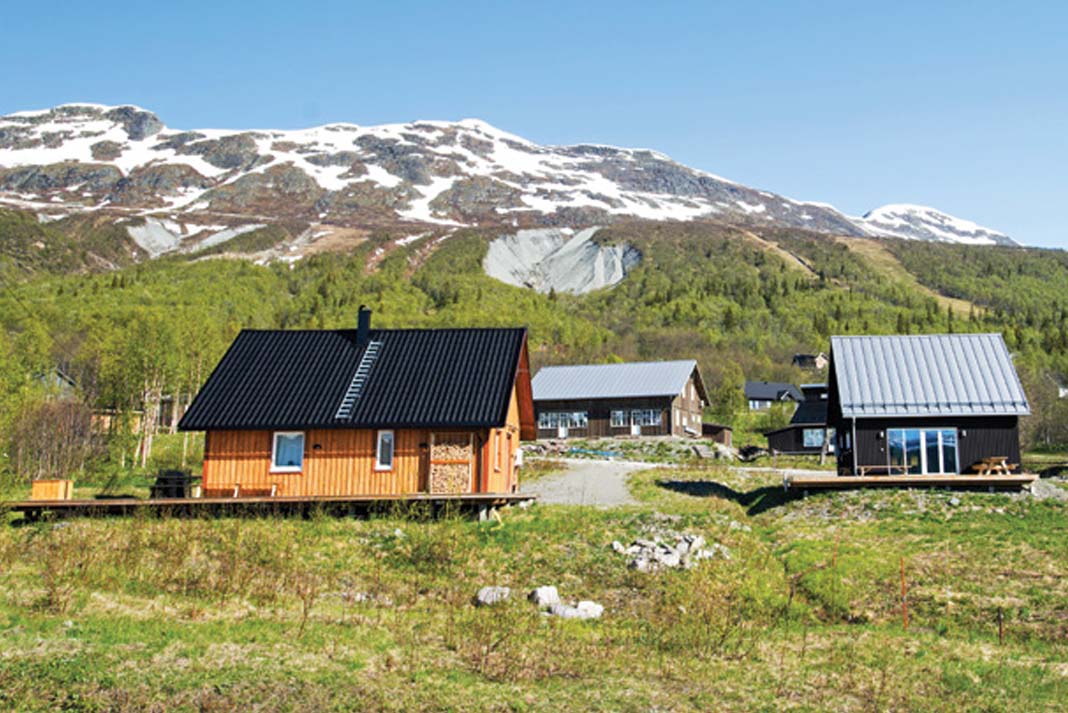
The steep sides of Kittel Mountain meet the small town of Kittelfjäll near the tree line, where traditional red-painted timber cottages are scattered amongst the lanky birch and spruce. Fishing, hunting and reindeer herding are primary activities for the hundred yearround locals. To the rest of the world, Kittelfjäll is known as a ski town. Winter tourism plays a major roll in the town’s economy, with a resort that employs locals and draws an influx of out-of-town employees and customers during the ski season. With no real downtown, Kittelfjäll contains a couple scattered stores, the rustic Hotell Kittelfjäll and a single restaurant serving quality local food. One lonely road curves through the village and valley with a gas station and general store aptly named SistaUtposten—Last Outpost.

“Kittelfjäll is the epicenter of the mountains,” says Curtis, “and it’s my home.” Using his cabin, a typical Swedish-style clapboard cottage, as home base, they are able to eat well, dry clothes and keep camera gear charged. Natural light floods the cabin where Curtis and Martin sit with maps spreadout on the thick wooden dining table. This is how they plan their whitewater exploration of the surrounding South Lapland area. The potential for paddling is greatly defined by geography. The varied topography and subalpine climate create a whitewater wonderland where the movement of melting snow can be followed as it travels from its source, high in the mountains, down to the Baltic Sea.

PHOTO: SCOTT MARTIN

With little human impact, save for a few small communities and hydroelectric dams the region is pristine wilderness. “We paddled a small zone in a big country and were able to do everything within an hour-and-a-half drive,” says Curtis. And by everything, he means steep creeks, drop pool rivers, park ‘n’ huck waterfalls, continuous whitewater runs, big water and quality freestyle and surf waves.

Sweden is the land of plenty.

Jumping up and down on the bank of the Vojmån River, Martin pulls his hands from his armpits where he’s been attempting to thaw them. Fumbling his camera with frozen fingers, he aims at Curtis who’s easing his way down a long, cruisey rapid. Just seven kilometers from the cabin door, the Vojmån is a breezy backyard run, dropping through two scenic lakes and passing by Gömda Vågen or Hidden Wave. One of the only easily accessible standing waves in the area, Vågen is a favorite spot for the handful of local paddlers. In its current super-flood stage, the Vojmån is a perfect warm up.

Warm being used loosely—getting used to frigid water is the biggest adjustment in this northern destination. “After our first day, I was really happy to get off the water and wrap my hands around a warm cup of coffee,” says Martin. Most rivers in the region originate to the west, in the mountains that form a natural border between Sweden and Norway. “They start as small streams and quickly turn to creeks with steeper sections as they flow out of the mountains toward the interior of the country,” explains Curtis. The start of spring’s thaw provides a cycle kayakers can follow: catch the snowmelt runoff in the west and follow it east as the high water moves downstream.

“You can see the heart of the change from winter to spring,” says Curtis, and the changes are quick and tangible. Leaves spring out of trees that have been bare all winter as runoff pushes new life through cold creeks. Paddlers everywhere know these are the signals to start following flow, and in Sweden steep topography speeds up the process.

“We wanted to push to get some of the smaller creeks that run for a shorter amount of time,” says Curtis. “You need to get certain runs on optimal days when they have the perfect level.”

With the knowledge Curtis has accumulated during his time as a local, tracking down the best water levels is tricky, but not a frenzied rush. Only on a couple occasions during a two-week period did Curtis and Martin re-visit runs, mostly seeking to explore new territory.

For photographers like Martin, the golden hour is a magical time when the sun, low in the sky, casts warm, soft light across a subject, be it a landscape or a boat on the water. As Martin blinked sleepy, jet-lagged eyes on one of the first nights in Sweden, it caught him by surprise that the clock read 2 a.m. Warm sunset hues filled the room as the midnight sun dropped gently towards the horizon. Jumping up, Martin frantically, quietly—so as to not wake the snoozing baby—set up a time lapse.

“This was the furthest north I’d ever been,” he says, awed at the fact that at this time of year in Sweden, shooting in the golden hour would mean being on the water all night. Another challenge to documenting South Lapland’s rivers is the fact that Curtis and Martin are a party of two. As Martin positions himself on the edge of the Gardsjöbäcken River’s frothy blue-green water, his camera is in one hand as he keeps the other free to grab the throw bag at his side.

STEEP TOPOGRAPHY TURNS SMALL STREAMS INTO CLASS V CREEKS. | PHOTO: SCOTT MARTIN

With a backdrop of 200-year-old pines and a series of slides, technical boofs and drops, the Gardsjöbäcken is a photographer and paddler’s dream. It’s a short run—around three kilometers—and it’s stacked, dropping a couple hundred meters over that distance. Running it on what Curtis calls “the high side of good,” means every rapid is a scout. “We had to get out and check if it was runnable before we even thought about getting the camera out,” says Curtis. Safety dictated the day. “Knowing that our goal was to document each run instead of just getting down it meant we moved slow,” says Martin. “It meant camera angles had to be sacrificed to set up safety.” Every shot was hard-earned.

From drysuits on the water to board shorts at the BBQ, Curtis and his family prepared a traditional Swedish meal of pickled herring, boiled potatoes, boiled eggs and sliced, dried meats to celebrate Midsommar. Next to Christmas, Midsommar is the most important celebration in Sweden, signifying the start of summer and, for many, a five-week summer break from school. For Martin, connecting with local traditions is an important part of exploring a new region.

“It helps me get a feel for the people of the area,” Martin says, “and a sense of how the landscape has shaped them.”

Joining the Kittelfjäll community for festivities around the maypole in a local park brought this element into their whitewater adventure.

One of the last days of exploration took the team in search of big alpine water. “Our aim was to hit the leftover snowmelt in the higher terrain and ride out some of the more pushy, full-on whitewater,” Curtis says.

Above the tree line, they put on the Skalmodal River in the open tundra. Surrounded by snow-covered peaks in all directions, the alpine river drops into a zone of azure sky, green tundra and cold grey rocks framing roaring whitewater. Plunging down toward the tree line, birch trees take on a twisted, bonsai-like form, gnarled by the harsh mountain exposure. Running deeper into the dense forest, Curtis looks up from his creekboat to towering spruce and skyward peaks. It’s easy to feel isolated here, and impossible to imagine that a gravel road runs parallel to the river just 800 meters away.

Reaching the Skalmodal’s take-out at the Norwegian border, exhilarated from a breathtakingly scenic run, Martin finds a sign that sums it all up: “Welcome to Sweden.”

Having earned the respect of the Swedish kayaking community, Curtis is developing a reputation amongst local paddlers for his knowledge of the area’s rivers. “I get Swedish paddlers messaging me asking about water levels and runs,” he laughs. Encouraging paddling in northern Sweden is exciting for Curtis, and as Martin defrosts from this trip, he’s already planning their next adventure, hoping to add to the list of discoveries they can share with others who hunt for whitewater gold.

CLASSIC SWEDISH CLAPBOARD COTTAGES. | PHOTO: SCOTT MARTIN

RIVER BETA

SWEDEN HAS MANY GREAT AREAS for intermediate and beginner kayakers. The Vindelalven River—located near larger cities Umeå and Övik along the east coast—offers perfect destinations for learning to paddle and raft. In northern Sweden, other than some sections of the Vojmån River, the Kittelfjäll area is a destination for experienced boaters.

VOJMÅN

Big water run with long rapids, a few drop pool runs, and one big cascade. Home of the popular surf wave Gömda Vågen.

KVARNFORSEN

Giant two-stage slide with a park ‘n’ huck option. Could be called the “Graceland” of the area. Curtis made the first descent two years ago.

GARDSJÖBÄCKEN

Can be paddled at lower water levels and has a little bit of everything: long slides, technical drops, a great waterfall and breathtaking scenery. A three-kilometer shuttle makes it easy to lap with a car or on foot.

SKALMODAL

Creek run with technical whitewater and big cascades and drops. Clear, cold water. Starts above the tree line, and drops deep into a valley of pristine forest with a view of snow-covered mountains.

VOUVOSJOKK

A lower volume ride running lake-to-lake with quality creeking and a few unrunnable rapids that can be portaged.

STEKKENJOKK

One of Curtis’ favorite runs, but timing is tricky: the put-in road is closed from November to June 5th, when it opens for through traffic. However roadside stopping—therefore river access—is illegal until July 5th, to protect the falcon nesting area from poachers. If water levels maintain, this gem is worth the wait with unmatched scenery and crystal clear water carving through the open tundra. Waterfalls, long multi-stage slides and technical rapids.

PITEÄLVEN

Home of the well-known Palt Wave, located at Trollforsen (Troll Rapid), which was host to the 2010 European Freestyle Championships.

PHOTO: SCOTT MARTIN

If You Go…

TRANSPORTATION

Fly into Stockholm and hop on a bus or train—both offer good access to the countryside. Rental cars are available in airports and large cities—prices are comparable to what you’d pay in North America.

TIMING

Go in June. Flow peaks in late May, when levels are likely to be too high. By July many creeks get too low. June is also pre-bug season and has 24-hour daylight.

ACCOMMODATION

Bring camping equipment—accommodations are scarce in rural areas. Ads in local grocery stores or at tourism kiosks provide info on guesthouses, rustic cabins on residential properties available to rent from the owner. More information at www.stugknuten.com and www.swedishlapland.se.

LANGUAGE

English is spoken in highly populated areas but in rural northern regions, a few Swedish words go a long way: Forsen means “rapid.” Älven means “the river.” Bäck means “creek.”

EVENTS

Norlandsturen Midsummer Tour and Week of Waves are paddling events gaining momentum in Sweden. Check out the Week of Waves Facebook page for more info.

GEAR

Renting can be quite difficult. Unless you are coming specifically for a festival or have a personal connection, bring your own boat and equipment.

MAPS

Paper maps are easy to find at gas stations and are quite detailed. Swedish boater board www.forspaddling.se also contains river information and map options.

ACCESS

Allemansrätten translates to “Right of public access” and is legislation that grants use of land, public or private, for no-trace recreation. Be respectful, and walk, swim, bike and paddle anywhere.


This article originally appeared in Rapid
Early Summer 2016 issue.

Subscribe to Paddling Magazine and get 25 years of digital magazine archives including our legacy titles: Rapid, Adventure Kayak and Canoeroots.

Boat Review: Prana by Current Designs

WHAT DO YOU CALL A DANISH IN DENMARK? A: A PASTRY. WHAT DO YOU CALL A DANISH- STYLE KAYAK IN DENMARK? A: A KAYAK. | PHOTO: VINCE PAQUOT

What exactly is Danish-style? That was the question on our minds when Current Designs revealed the Prana at Outdoor Retailer last summer, billing this sleek new sea kayak as the first of several Danish-style designs to watch for in coming years.

The Prana is a collaborative effort between the Current Designs team and Danish designer Jesper Kromann-Andersen. Proficient paddler, sailor and craftsman, Kromann-Andersen is well known in Scandinavia for his popular Arrow Kayaks, which were purchased in 2014 by European paddlesports giant Tahe Outdoors and are now distributed under the Zegul brand.

So… Danish-style is any kayak designed by a Dane? Not quite. “Danish-style is an approach towards kayak design that is influenced by many different styles,” explains Kromann-Andersen. “The hull shapes are a blend of North American and Greenland-style kayaks—efficient and streamlined with rounded hard chines, low back deck and a snug-yet-comfortable fit.”

Evident in these kayaks is “the Scandinavian design tradition of pure form and function,” continues Kromann-Andersen. Think stylish-yet-spare furniture and sophisticated-yet-simple fashion. “Part of this process is looking at kayak shaping in a water flow dynamic context, testing the design in the elements and translating the experience into drawings and 3D computer models.”

Current Designs recognized Kromann-Andersen’s ability to bring something different to their existing models. “Jesper uses a significant rocker profile and he’s an anarchist with conventional hard chine lines,” says CD vice president Bill Kueper. Indeed, the Prana has more rocker than any other kayak in the CD line-up.

“It’s exciting to see a new, playful, more aggressive design from Current Designs,” says Brian Pettinger from White Squall Paddling Centre, echoing my thoughts as I eye the gleaming red-and-white Prana he’s helping me load onto my roof rack.

Thirty minutes later, I’m slipping the Prana into wind-raked waters. The boat feels fast and responsive, accelerating quickly and dancing gracefully through edged turns.

Kromann-Andersen optimized the Prana for speed, using a shallow-arch hull to reduce resistance and a Swede-form shape that places the widest part of the kayak behind the paddler for a long, lean entry. Powering into a stiff headwind, the kayak’s glide feels more effortless than the scudding wavelets would lead me to expect, and the raking bow seems to part the waves rather than slapping or plunging.

Turning downwind and catching a surf, the Prana remains maneuverable on a wave and edge-to-edge transitions feel seamless thanks to a mid-section that merges a nearly flat profile with rounded, well-defined chines. Tracking across the wind is surprisingly well behaved for such a nimble kayak, and dropping the Prana’s skeg takes care of any minor weathercocking.

The Prana’s unique blending of attributes extends to the cockpit, where CD’s padded seat is paired with an adjustable backband and molded-in thigh braces for a fit that is low on frills but high on comfort. The deep front deck makes the svelte 21-inch beam seem much roomier, accommodating both a handy knee hatch and fidgety legs, while thoughtful shaping ensures it doesn’t feel like I’m paddling a barrel. Despite my shorter torso, I can hammer high angle strokes or cruise along at a low angle without striking my thumbs on the deck.

With ample volume and speed for touring, and a playful agility that begs to be let loose in surf zones and rock gardens, the Prana is a versatile companion for both advanced paddlers and ambitious beginners who want to develop their skills in a seaworthy kayak they can grow with. “If you only have room for one kayak,” says Kromann-Andersen, embodying the Danish proclivity for restraint, “this is the one.”

WHAT DO YOU CALL A DANISH IN DENMARK? A: A PASTRY. WHAT DO YOU CALL A DANISH- STYLE KAYAK IN DENMARK? A: A KAYAK. | PHOTO: VINCE PAQUOT

Scandinave Style

“Above and below the waterline, designer Jesper Kromann- Andersen thoroughly addresses safety and comfort and brings the Danish prowess for style to fruition,” says Current Designs’ VP Bill Kueper.

Simple Solutions

The centered day hatch isn’t as easy to reach on the water, but it provides better access to the entire compartment than an offset hatch. Good news, since the Prana’s day hatch is wonderfully spacious.

Fosake Excess

A low profile, padded backband provides ample support and allows a full range of motion. Current Designs’ vacuum-bagged fiberglass laminate has an impeccable finish and optimal strength without adding unnecessary weight.


This article originally appeared in the Adventure Kayak
Early Summer 2016 issue.

Subscribe to Paddling Magazine and get 25 years of digital magazine archives including our legacy titles: Rapid, Adventure Kayak and Canoeroots.

80-Year-Old Paddles Mississippi River Source To Sea

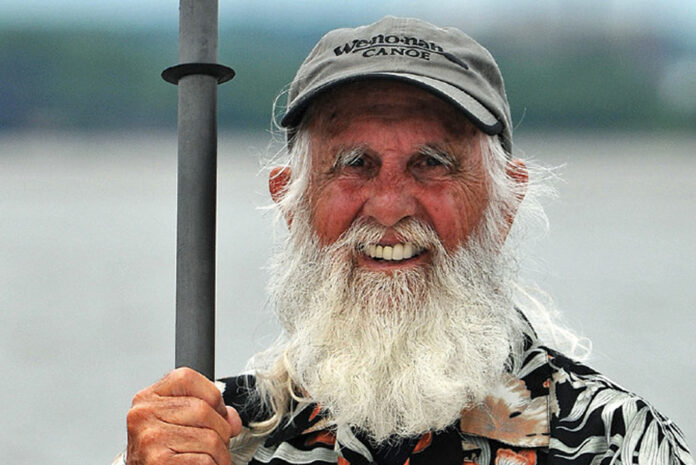
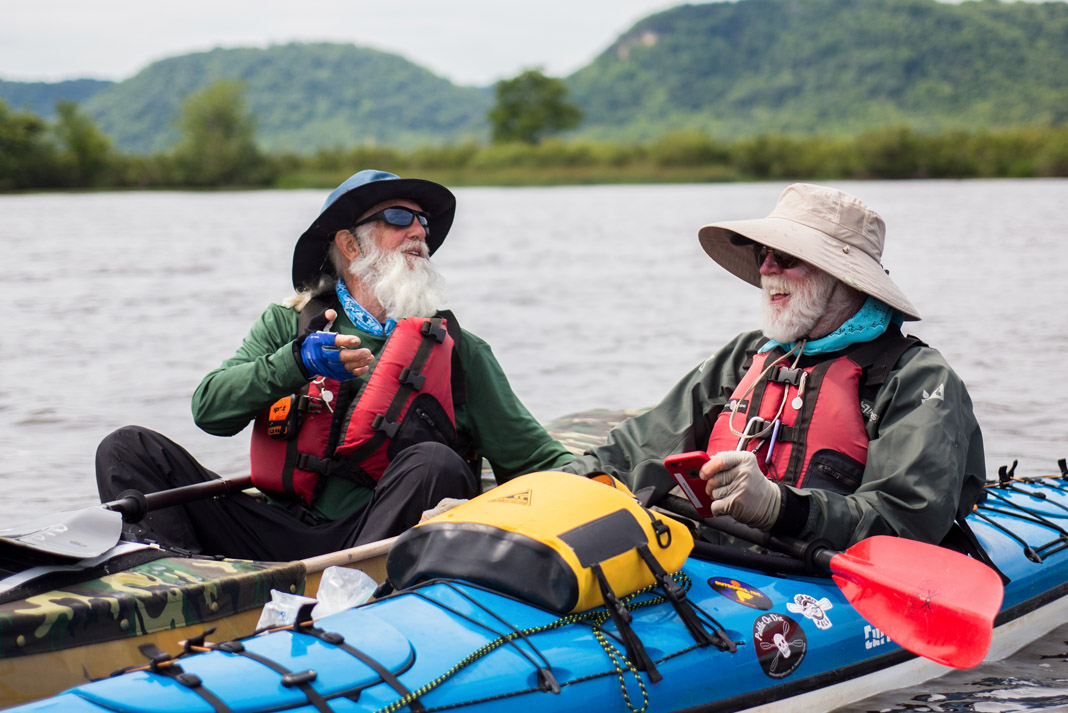
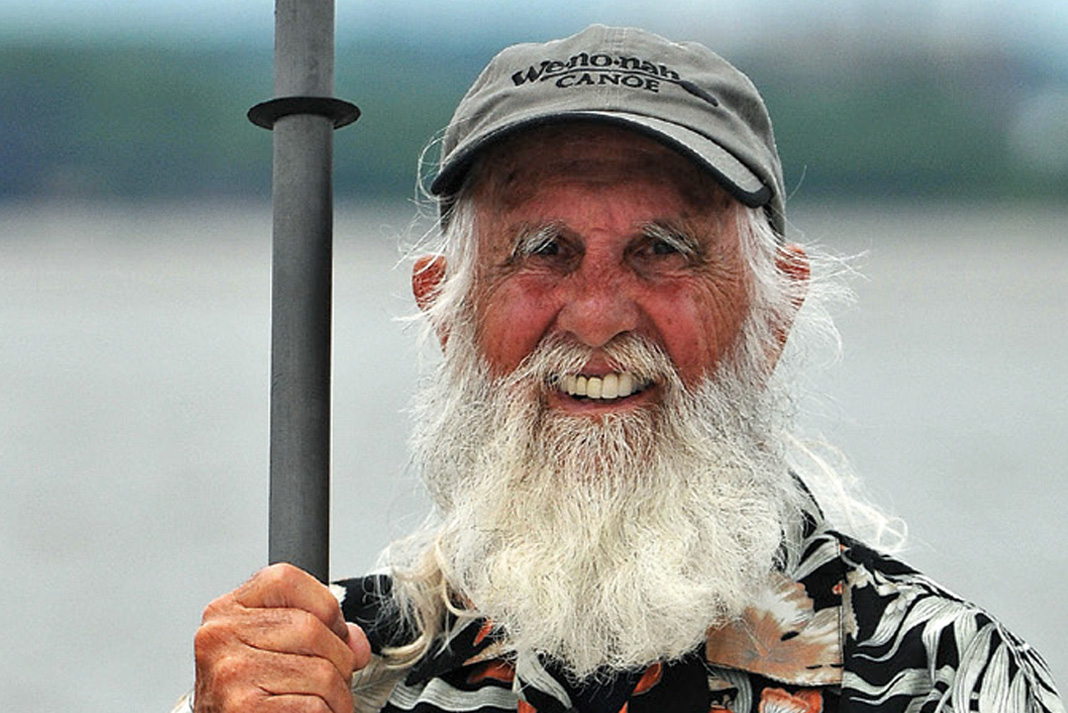
80-year-old “Grey Beard Adventurer” Dale Sanders stands smiling while holding a paddle
Dale Sanders prefers Tchaikovsky to Beethoven. | Feature photo: Paul Colletti

Dale Sanders celebrated his arrival at the Gulf of Mexico last fall with a much-deserved glass of champagne. He’d spent the previous 80 days paddling the Mississippi River, a 2,300-mile stretch of water known for its difficult portages, countless dams and intimidating freighter boats.

Even when Sanders reached the salt waters in his Wenonah Wilderness, what he’d achieved hadn’t entirely sunk in. In addition to raising over $22,000 for Type 1 diabetes research, Sanders had set a world record. At 80 years old, the “Grey Beard Adventurer” had become the oldest person in the world to solo paddle the river from source to sea.

80-year-old paddles Mississippi River source to sea

1 Who was your canoe Anna named for?

My grandniece, Anna, was diagnosed with Juvenile Type 1 Diabetes when she was four. I had considered several different causes, but none of them seemed to click, until I got that feeling in my gut that this was the thing—to paddle for the kids.

I saw so much suffering from diabetic children whose parents brought them to the water’s edge. I paddled the full Mississippi River—under every bridge, around every dam, through life-threatening conditions, in record high waters—all for those kids suffering from T1 Diabetes.

80-year-old “Grey Beard Adventurer” Dale Sanders stands smiling while holding a paddle
Dale Sanders prefers Tchaikovsky to Beethoven. | Feature photo: Paul Colletti

2 When did you decide you wanted this world record?

All my life, I’ve had a competitive spirit. The first world record I had was for holding my breath underwater back in the late ‘50s. (Editor’s note: Sanders held his breath for six minutes and four seconds.) In the mid ‘60s, I was the United States champion underwater spear-fisherman, and I was in the circus for a while as an acrobat. I’m only 5’6” and sometimes I think I wanted to overcome my stature and show that I’m bigger than I really am.

3 Where on the river did you fear for your life?

Blanchard Dam [in Minnesota] is the mother of all portages. I knew a storm was brewing, but I didn’t want to get caught on the lake. I decided that maybe I could get all my stuff to the other side before the rain came in. That wasn’t the case. It took five trips—three-quarters of a mile each way—to get all the gear through the woods, over old railway tracks and up some hills. After my second trip, the storm came. It was 35°F and raining hard, with lightning and wind. That went on for about three hours. I was near hypothermic.

4 Why do you listen to classical music when you paddle?

Classical music is unbelievable for soothing the mind. You’re already slowing your life down by paddling, and getting into that music just puts you into a trance, a mood. I could paddle probably eight to 10 hours now, without ever getting bored.

5What’s the next adventure?

Hundreds of people of age have said to me, “You will never know how much your journey down the Mississippi River has given me hope.” That’s one of the reasons I have to try and become the oldest person to hike the 2,185-mile Appalachian Trail from Georgia to Maine in 2017. If I can do that, I feel I really will become an inspiration for the older people in the world.


Dale Sanders has since returned to again reclaim the title of oldest person to paddle the Mississippi. His journey is documented in Graybeard, an official selection of the 2023 Paddling Film Festival. Available to stream today as part of the Adventure Program.

Cover of the Early Summer 2016 issue of Canoeroots MagazineThis article was first published in the Early Summer 2016 issue of Canoeroots Magazine. Subscribe to Paddling Magazine’s print and digital editions, or browse the archives.


Dale Sanders prefers Tchaikovsky to Beethoven. | Feature photo: Paul Colletti


Toeing The Line Between Terrific Trip And Terrible Disaster

mountains and swift-flowing river under a cloudy dusk sky
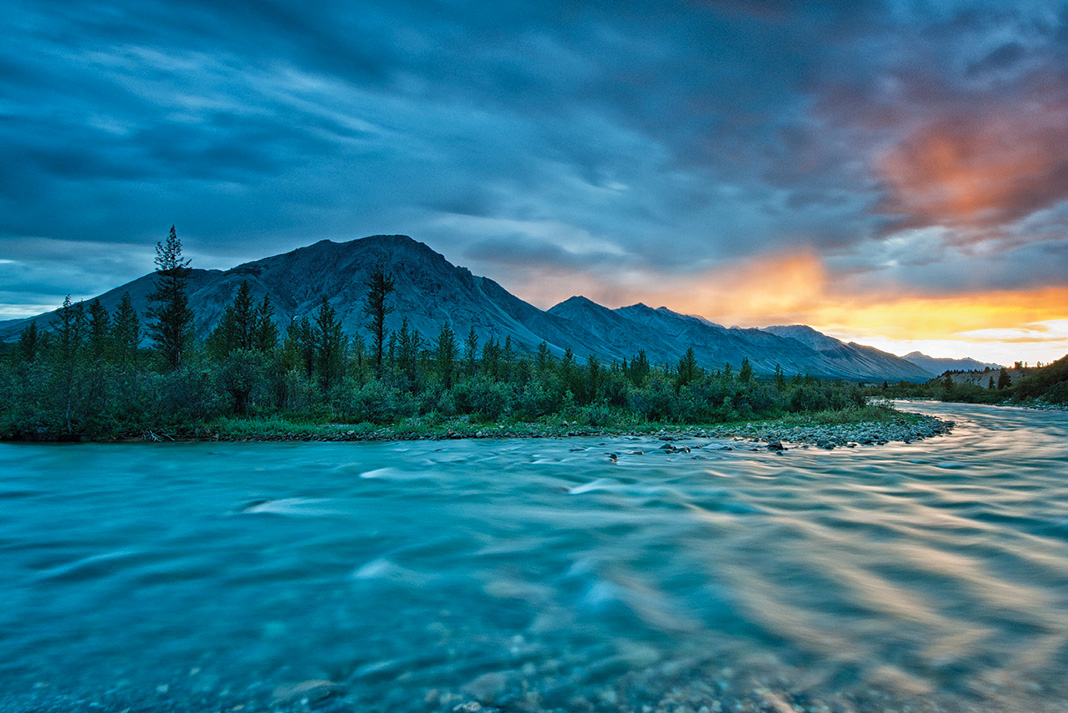
Use misadventure management to avoid a disaster trip. | Feature photo: Peter Mather

We were approaching the river when we heard the screams.

A young hiker halfway through a remote four-day hike on the rugged Bay of Fundy coast had attempted to cross a storm-swollen stream. The grip on her Converse sneakers was no match for the strength of the now-raging river and she was swept downstream, trapped underneath her still-fastened, oversized pack.

By the time my hiking partner, Emma, and I got down to the river, the hiker had made it to the far shore some hundred meters downstream. Disaster averted, we thought.

Toeing the line between terrific trip and terrible disaster

As her two friends milled about helplessly on our side of the rocky shore they filled us in. The girl who’d been swept downstream couldn’t swim, they told us. Her pack was lost. She was lightly dressed on a cold and rainy day. She’s been hiking for two hours and hadn’t eaten anything that morning. Eventually starting to panic, one of the friends suggested she attempt to locate cell service and call 911.

Use misadventure management to avoid a disaster trip. | Feature photo: Peter Mather

An hour later, after the river began to drop, and Emma half-carried, half-swam the sobbing and shivering wisp of a girl back across the river, everyone warmed up around a campfire. When we asked the threesome whether they had a compass to assist with their now-necessary self-evacuation, the de facto leader of the group confirmed she did, only to be undermined by her friend who helpfully piped up to add, “But we don’t know how to use it.” The leader hissed back, “We have a book.”

Admittedly, the Atlantic Ocean provides an obvious navigational landmark. Yet, glancing between the still-shivering girl recovering in a down bag by the fire and the bloody cuts on the arms and leg of the third member, it was clear: this group didn’t have a clue. You shouldn’t be out here, I thought.

Everyone experiences misadventure—up to a point

I was reminded of this river rescue episode last November while standing on the dock of a big lake. It was blustery, sleeting and late afternoon. I was setting out on a weekend canoe trip. Standing in front of the wind whipped water, potential disaster scenarios played through my mind—capsize, rescue, death—each far more unlikely and serious than the last.

I was torn between caution—this was ill-advised paddling weather without a drysuit—and confidence we could handle the conditions. The thought kept playing through my mind: if something happened, others— myself—would have said the same: You shouldn’t have been out there. Were we so different?

Unlike my own methodical deliberating of the risks and potential outcomes, the threesome on the coastal hike had been blissfully unaware of just how unprepared they were to deal with an emergency. Yet, had it not rained and that hiker not been swept downstream they very likely would have completed their hike with only a colorful array of scrapes and bruises, and a hell of a story to tell.

[ Paddling Buyer’s Guide: View all safety & rescue accessories ]

When learning to live comfortably in the wilderness, we all experienced misadventure. Shoddy bear hangs, missed portage trails, inedible meals, inexplicable capsizes, leaking shelters, lost pride, situation mismanagement. The margin for error on beginner trips tends to be wider, the experience softer—rarely is anyone in danger of more than discomfort. Hopefully, by the time we push limits and the margin of safety constricts, we’ve gained the experience and skills to quell the sparks of a crisis before it feeds itself into a wildfire.

Kaydi Pyette is the managing editor of Canoeroots. Her blustery November trip was just fine, thanks.

Cover of the Early Summer 2016 issue of Canoeroots magazineThis article was first published in the Early Summer 2016 issue of Canoeroots Magazine. Subscribe to Paddling Magazine’s print and digital editions, or browse the archives.


Use misadventure management to avoid a disaster trip. | Feature photo: Peter Mather


How To Choose The Right Canoe Paddle

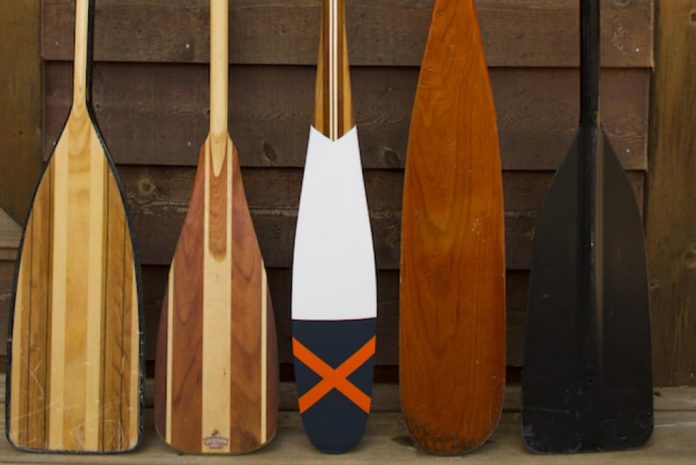
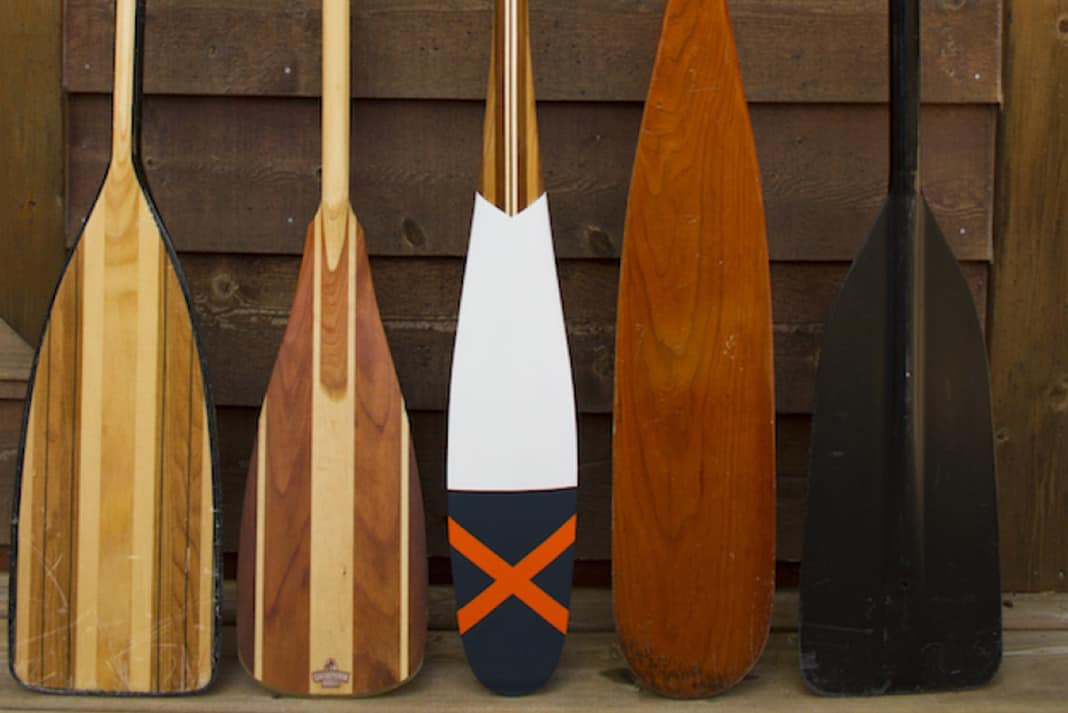
Five canoe paddles lined up along wall
Paddles of different shapes and styles, which one is for you? | Photo: Hannah Griffin

Figuring out the best canoe paddle for you is about understanding different designs and materials, but also about how the paddle actually feels as you move through the water.

Before you buy a new paddle you should first demo several and try your friends’ blades. Most paddles work for most people, however, the gains afforded to the perfect match can be significant. “I ask customers, ‘Do you want speed, muscle or value?’” says Andrew Stern, marketing manager at Bending Branches. “Speed means a lightweight paddle for going fast and covering long distances. Muscle means a durable paddle for rocky rivers and shallow waters. Value means the price is most important. The more you spend on a paddle, the lighter or stronger the paddle is.”

This guide on how to pick a canoe paddle will help you buy the paddle that works best for you. The first thing you should do to jump-start your search is determine what kind of paddling you will be doing most often.

Just like canoes, there’s no one blade that is perfect for every type of on-water condition you might encounter. Paddle construction, blade shape, and design are different based on the kinds of canoeing they are intended for.

The canoe paddle’s purpose

Flatwater and tripping paddles

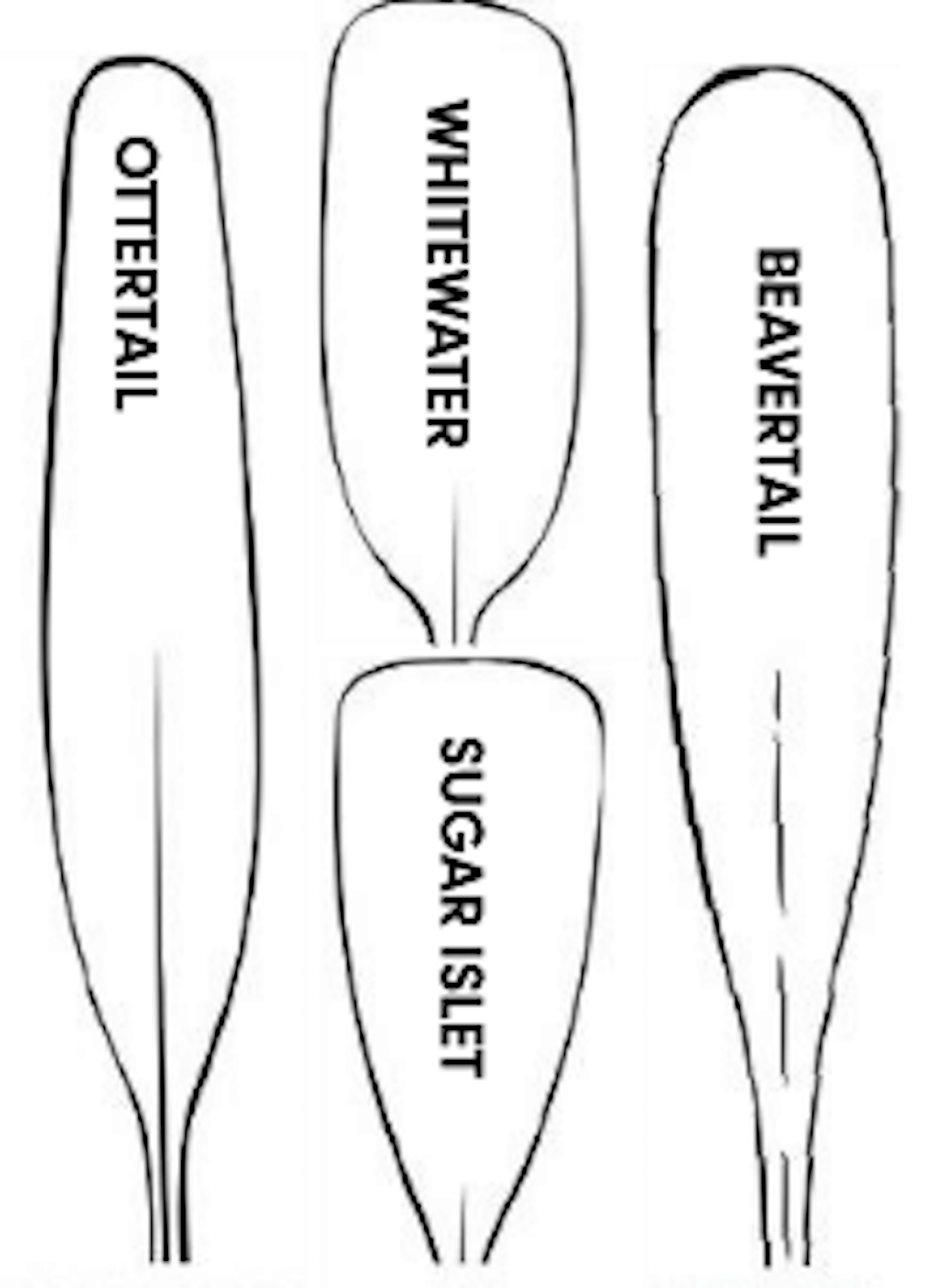
If you are going to be doing most of your paddling on flatwater lakes, choose an ottertail or beavertail blade shape. The beavertail shape has a rounded blade tip and a nearly consistent width until it tapers off towards the neck.

The ottertail has a slightly less rounded blade tip and is narrower. These blade shapes hold less water on the face of the blade than wider designs, which can make for less tiring and more enjoyable paddling on extended flatwater trips.

[ Paddling Buyer’s Guide: View all tripping paddles ]

Some paddlers on long flatwater expeditions or those focused on speed prefer a paddle with a bent shaft.

“Bent canoe paddles are more efficient than straight paddles,” says Bending Branches’ Stern. “Bent shaft paddles allow the blade to be kept vertical for a longer portion of the stroke, which is where the available power is greatest, moving more water with less effort.” The trade-off is that maneuvering strokes tend to be awkward with bent-shaft paddles.

Four different shapes of paddle blades
Which one do you want?

Whitewater canoe paddles

Paddles intended for whitewater have blades that are shorter and wider with square blade tips. This design makes it easier for whitewater paddlers to make quick strokes and last-minute maneuvers like draws or pries. A straight shaft is essential for a whitewater canoe paddle as it makes key techniques like a brace much easier.

Many whitewater paddles will have a curved blade, a design feature that helps the blade grip the water better upon contact. Some paddlers on trips with both whitewater and flatwater will bring a paddle suited for each.

Solo canoe paddles

For those paddling solo, a paddle with a longer and narrower blade and a shorter shaft gives more control and precision in the water.

The long blade is designed to remain in the water, with the paddler recovering underwater instead of in the air.

Racing canoe paddles

Racing canoe paddles often have a shorter and wider blade, like the Sugar Islet pictured. This blade face catches more water and its stout stature allows for paddling at a faster cadence.

Many racing and performance paddlers will also have shafts that are bent, increasing forward power and efficiency for every stroke.

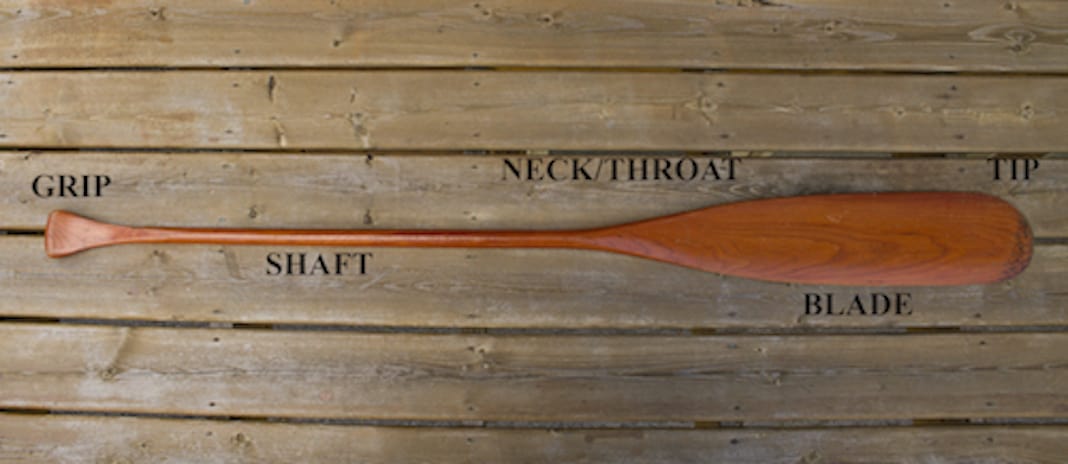
Labelled diagram of canoe paddle parts.
Good to know. | Photo: Canoeroots Magazine staff

Canoe paddle grips

The two common grip shapes on a paddle are a classic palm grip and a T-grip. A palm grip is shaped like a teardrop and fits nicely into the paddler’s hand, making it the go-to choice for long flatwater trips and recreational paddling.

The T-grip has a longer horizontal section the paddler can wrap their hands around, making it less comfortable but allowing a lot more precision and control. You will usually see the T-grip on whitewater paddles, and the palm grip on flatwater ones.

The diameter of the shaft

The diameter of the paddle shaft will either be round or oval. Oval shafts can be much more comfortable to hold onto while paddling, but some round shafts will have “oval indexing,” which is when a section of the shaft is oval-shaped to provide a better grip.

Five canoe paddles lined up along wall
Paddles of different shapes and styles, which one is for you? | Photo: Hannah Griffin

Canoe paddle materials

Wooden canoe paddles

This classic paddle material is beautiful, feels good in the hands and is warm to touch in chilly weather. Wood canoe paddles are typically the choice of lakewater paddlers. Wood paddles do require some maintenance over time, such as occasional sanding and varnishing to keep moisture and rot at bay.

Not all kinds of wood are the same. Ash is a very durable wood that is a great choice for tripping as it can stand up to more rough conditions. Maple is also quite strong but also flexible. Cherry is a popular wood for canoe paddles because it is durable and quite light, making it a popular choice for wood paddles.

Walnut is quite stiff and on the heavier side, and can also be more expensive. Some paddles will come with a fibreglass tip; this can be a good choice if you are going to be paddling consistently in shallow or rocky waterways and want some impact protection.

Some wooden canoe paddles are made from not just one but a number of different types of wood laminated together. You can tell if a wooden paddle is laminated because there will be different colours or shades of wood side by side.

Composite materials

Aramid, fibreglass and carbon canoe paddles

Canoe paddles made of composite materials like carbon, aramid and fibreglass are extremely light and strong. These paddles don’t require the maintenance wooden paddles do.

[ Paddling Buyer’s Guide: View all fibreglass canoe paddles ]

Carbon canoe paddles are the choice of racers, and depending on the ratio of carbon to other fibres in the paddle, the price will vary. The higher the amount of carbon in the paddle, the more expensive it will tend to be. Composite paddles are stiff and have less flex than some types of wooden paddles.

Aluminum and plastic canoe paddles

Most plastic canoe paddles you will find have a plastic blade and an aluminum handle. Plastic paddles are durable and don’t require maintenance. It can be somewhat less enjoyable to grip the aluminum shaft as opposed to a wooden one on a cold day.

They are heavier and can be less efficient and complex in design than other paddle types, but can be good as an extra on a long trip or the odd canoe outing at the cottage.

How to size a canoe paddle

Maybe you have found a canoe paddle that is perfect for the kind of canoeing you want to do. If it isn’t the right size for you however, the fact that its beautiful wood finish makes your heart skip a beat is irrelevant.

A paddle that is too small or large is uncomfortable and inefficient on the water and may result in you not using it very often. Here are a few of our tried and true methods for making sure your canoe paddle is the correct size for you.

The ideal paddle size for you will vary based on the canoe you are in and how you sit in it. It is best if you can actually get on the water in your canoe to see exactly how the paddle feels, but if that isn’t an option we have some sizing methods for you too.

1 If you are in the store, kneel on the ground and hold the paddle by its neck with the grip touching the floor in front of you. If the paddle is the correct size for you, your arm should be horizontal.

2

Sit in your canoe seat with your feet on the floor and take note of the distance between the water and your nose. This distance should be equal to the length between the grip of the paddle and the paddle’s neck.

3

Paddling Magazine’s Publisher Scott MacGregor recommends the precise method of paddling in your canoe on the water with a broomstick. Paddle normally and the section of the shaft that stays dry is equal to the right shaft length for you in that particular canoe. MacGregor likes this method because it takes into consideration the position of your hands, the height of the canoe seat, the depth of the canoe and how you paddle. After using this method you will just need to figure out the length of blade you want.

4

If you don’t yet have a paddle or a canoe at your disposal, you can sit in a chair and determine the distance from the chair to the top of your eyebrows to find out a suitable shaft length for you.

Extra tips about your paddle

Store your canoe paddle properly

You can find lots of resources online for building your own simple paddle rack or holder, or you can just place it flat somewhere in your house or garage. Keep it out of the sun and store it in a dry place over the winter where moisture won’t find it’s way into the wood. Remember that storing your canoe is just as important as storing your paddle.

Pack an extra

Whether it’s forgetting your paddle in the bushes at a portage or having it wash away during the night when the water level changes, it’s not hard to lose your blade.

If you are going on any kind of extended canoe trip, pack an extra just in case. It will make you much happier, as well as your friends who won’t have to paddle-chauffeur you around.

Make use of hockey socks for wooden paddles

On a canoe trip, slip a hockey sock over your paddle blade on portages or at the campsite. This is an easy way to protect your wooden canoe paddle and can help maintain the beautiful aesthetic of it. Many people have their canoe paddles for decades if they are well taken care of. Don’t make your decision solely based on price. A well-made paddle that fits your canoeing needs and feels great to use is worth paying for.


Paddles of different shapes and styles, which one is for you? | Photo: Hannah Griffin

Uncut: Q&A with Coach Gordon Brown

Photo: Tom Gomes
Gordon Brown coaching at San Francisco's Golden Gate Sea Kayak Symposium.

Born and raised in Scotland, Gordon Brown is well known by paddlers around the world for his charming accent, exceptional coaching and incredible coordination in a kayak. His many contributions to the sport include the award-winning DVD skills trilogy Sea Kayak with Gordon Brown, an indispensible book, Sea Kayak: A Manual for Intermediate and Advanced Kayakers and guest coaching at events from Chilé to Israel to San Francisco. When he’s at home on Scotland’s Isle of Skye, Brown balances family time and running Skyak Adventures with his wife, Morag, and studying for his Masters in Performance Coaching. Another book is also in the pipeline. But if these seem like the achievements of a lifelong paddlesports professional and natural academic, you don’t know Brown as well as you may think.


What’s your background: are you originally from Skye? How did you discover a passion for sea kayaking?

Although I live on Skye, and have done for sixteen years, it was not originally home for me. Born in Greenock on the Clyde coast on the west of Scotland and then spent the first few years of my life in Paisley which is attached to Glasgow. At six my parents moved to a small village in North Ayrshire called Beith and at the same time my dad bought a small row boat. As money was tight, all of our holidays were in Scotland, always camping and always next to water. My brother Kenny and I would have the boat in the water and we would always have to be shouted to come and get something to eat as we would be off somewhere having our own adventure. It was always me rowing and Kenny sitting waiting for something exciting to happen. 

When I was nine, my dad saw an advert in the local newspaper classified ads where someone was selling a canoe, paddle and lifejacket. We went to have a look at it and it was bought for the princely sum of £10.00GBP, this money Kenny and I had to pay back in the form of chores around the house but I don’t remember these being too arduous. Anyway, it turned out the canoe was in fact a kayak and a home built sea kayak with a rudder. We spent many days working out what the thing did and safety was always the highest priority. Initially a length of line about thirty feet was tied to the kayak in order that should we fall in there was the means of getting back ashore. Capsizing was quickly followed with lots of fun exploring the boundaries of what was possible in this new boat. Kenny preferred to stay dry, while I was quite happy being as wet as it was possible to get. One thing that still remains in my memory were the leeches that lived in the mud on the loch we paddled on regularly.

When I went to high school at Garnock Academy, I never really fitted in with any of my classmates and quickly found my way to the technical studies department where I could hide. On one of my first visits there, I saw another kayak which was the same as my own in every way and asked the teachers about it. It turned out that one of the metalwork teachers, George Kerr, had built two identical kayaks and sold one in order that he could fund his own. So I now had a bit of history of the chined plywood hull and canvas deck kayak that was my pride and joy.

My dad had set up his own garage business and it was inevitable that I would go and work for him when I left school. At school, I was less inclined academically and much more interested in the practical things such as woodwork, metalwork and outdoor studies. I managed to get on the school trips to the island of Arran in the Clyde which were normally only open to fourteen years and upwards. I remember the first longish journey we did; starting from Corrie on the east coast of the island, the plan was to travel south and cross Brodick Bay then round past Hamilton Rock into Lamlash Bay where we would be collected by the Land Rover and trailer. Just as we passed Hamilton Rock, I was suddenly very tired and had to be towed the last mile and a half.

After this I was allowed to join the School based canoe club and found a group of people who had similar interests to my own. It was here that I met an old guy by the name of Duncan Winning. It turned out that Duncan had designed the kayak which I owned and now, some forty years down the water, he still paddles every week in a kayak which he designed himself. 

Duncan has been to the fore in sea kayaking in Scotland for about sixty years and is responsible for the development of the sport in the UK to a huge amount. In 2004 I accompanied him to West Greenland to visit Ubekendt Island north of Disco Bay, it was here that the kayak that became known as Ken Taylors Kayak was built and which Duncan measured and made plans available to everyone. Anas Acuta, Nordkapp, Pintail, Avocet… all of these kayaks and more have come from this original kayak which is still held in the Huntarian Museum in Glasgow.

These early days were all spent in a sea kayak apart from once a year when the club would go to a race on the River Clyde and we would just bash down with very little knowledge or direction.

The structure of the club was such that the people who were able to progress were encouraged and became involved in helping those who were less able. It was also fairly early days in the BCU coaching scheme and seemed natural that I would do this and give something back.

At school, I spent all of my time in the technical department building kayaks and sailing boats, maintaining the school minibus and trailers as well as running a business repairing the teachers cars, so it was no surprise when I left at fifteen having completed no academic qualifications whatsoever. I did have my BCU Sea Proficiency though. At this time I started competing in motorsport and by eighteen was the Scottish road rally champion as well as the Scottish Autotest champion. I was still kayaking and the motorsport was using all of my money so I decided not to continue with driving fast. Instructor award and then Senior Instructor awards followed before I was nineteen and then the Advanced Proficiency was soon afterwards. 

I decided to go and undertake the Coach training course not knowing how I would fare along with all the professional coaches who typically went on these courses. It turned out that I did okay and after some twenty years working in the motor trade, I left and started to develop sea kayaking freelance work around the UK. This led to some other developments and in 2000 I spent three months working on the rivers in Nepal.

Sea kayaking was where my heart was though and it was after my return to the UK that I seriously thought about setting up a sea kayak coaching company, the result is Skyak Adventures which I run with huge support from Morag, my wife.


What has kept sea kayaking fresh and exciting for you for all these years?

I think the fact that there is always something new to learn and something new to discover keeps it fresh. Also being in the privileged position as a coach, I can allow others to see some of what I have seen and hopefully make it easier for them as I’ve made most of the mistakes it is possible to.

Seeing the coastline through my students eyes is an amazing, exciting and very rewarding experience and I just keep getting a real buzz from it.


What is you favourite part of coaching? 

My favourite part of coaching is seeing people develop way beyond what they thought was possible for them. Currently, I am coaching a client who is a wheelchair user and the amount of cerebral effort I am having to put in is matched by her determination to succeed. There are so many challenges to overcome and so far we are developing some interesting results by working together.


Your coaching skills are both applied and academic; what’s the most fascinating nugget that’s come out of your Masters work?

I think that the most fascinating thing to have come out of my academic studies is that what I have done intuitively and because it feels the right thing to do has been studied and written about by clever people with letters after their names. That I am now able to engage with this writing, and understand it has really added to my knowledge about coaching.


Who do people think you are, versus who you really are?

I’m not really sure who people think I am, but it is very strange when people nudge each other and whisper such things as “that’s him…”. I think that I often come across as brash and loud but that is just a front as I really am quite shy. I think that would surprise most people who think that they know me.

I am really just a normal guy who tries hard to be a good dad to my kids, honest to my beliefs and generous with my time. I love music and have recently been singing at the local folk club which is fun and scary at the same time. I think that coaching is a bit like this too – it is a performance. I remember the late Derek Hutchinson saying to me, “ShowTime, young Brown.” That has stuck with me and if it is a performance I hope that I will be able to perform for a long time to come.


Where does a guy like you get such amazing balance?

The good balance comes from falling in lots and lots and lots. I have fallen in more times than I can remember by trying things that I’ve been told are impossible. If you are not prepared to fail at something then you will never reach your potential. I also have huge feet.


Have you ever been in over your head in a kayak?

I can’t think of a time when I have personally been in too deep, but with groups it is too often an occurrence. Having four people capsize at the same time when a strong gust hits keeps me busy and checking to make sure my VHF radio is on CH16.


Why don’t many UK paddlers wear helmets in rough water?

I don’t think that this is actually the case. I choose whether I wear a helmet or not based on where, what and who I’m coaching and what the context of the session is. For example, if it is about landing in rough water in the context of journeying, then if a helmet is not a normal part of expeditioning equipment, paddlers have to be able to make decisions about the outcome. So, for me, this comes to the fore as decision-making, which is what my MSc is investigating.


What are some other projects that you are working on?

Adventures in the pipeline include spending five months this coming October 2016 on Vancouver Island, writing another book and having some quality family time while we are there. There are always dream trips bouncing around inside my head but being so busy usually means not making the dreams come true too often.


This article appears in the Late Summer 2016 issue of Adventure Kayak. To discover more great stories and fascinating paddlers, get the full issue here.


Video: Understanding Weather Systems

An oldie but a goodie—watch above to see the third episode in a series on sea kayaking hosted by John and Bea Dowd.

John was the founding editor of Sea Kayaker magazine, and has written numerous books on paddling. Above, he helps you take the constant changing of weather into account when planning a kayak trip—whether it be a day trip on the coast or a multi-day paddle on remote waters.