Home Blog Page 271

Folding Sea Kayak Review: TRAK Seeker ST 16

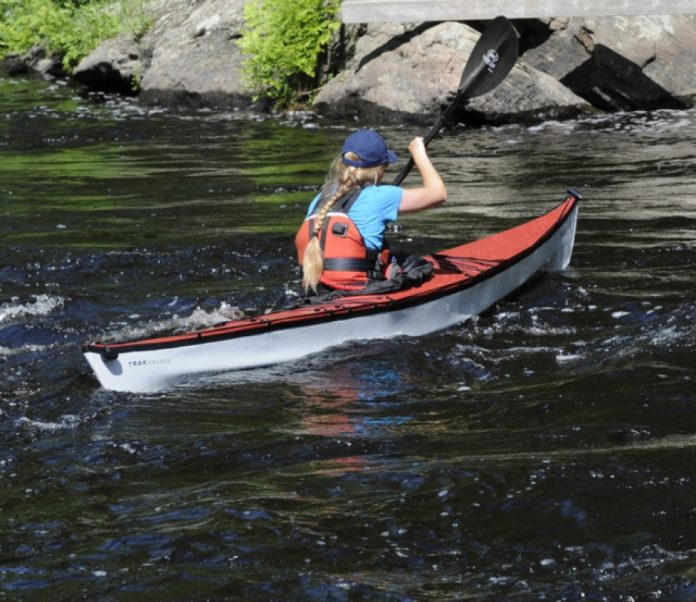
Photo: Po Marshall
Video: Trak Seeker Kayak Review

Are you bulls***ing me?” This is autobody mechanic—and TRAK Kayaks’ neighbor in Airdrie, Alberta—Dennis Paron’s reaction when he sees the kayak he ran over with a customer’s truck, twice, just days after the accident. TRAK Seeker, serial number 2535, suffered only a bent gunwale and cracked coaming—both easily replaced—in the Dodge dust-up.

A week later, #2535 arrives on my doorstep. I eagerly assemble the beleaguered boat. It looks brand new. I search the sleek red and white skin and find a faint tread mark on the hull.

When it comes to TRAKs, disbelief is a not uncommon response. How can a folding boat that assembles effortlessly in just 10 minutes look and paddle like a high-performance composite sea kayak?

The Seeker’s bow and stern frame sections use shock-corded aluminum poles and snap-in crossribs for intuitive assembly. These then slip into the polyurethane skin through a watertight sliding seam in the back deck. Every folding kayak requires some kind of clever trick for expanding the frame inside the skin, and TRAK’s slick hydraulic jacks are the easiest system we tested.

[ Paddling Buyer’s Guide: View all TRAK kayaks ]
Trak Seeker ST 16 Specs
Assembly time: 10 minutes or less
Length: 16’
Width: 22.5”
Material: Polyurethane skin/aluminum frame
Weight: 48 lbs
Price: $2,799 USD

TRAKkayaks.com

The hydraulics also allow you to change on-water performance on the fly: pump the keel lever to adjust rocker for playful maneuverability or straight tracking; use the gunwale levers to compensate for weathercocking by adding a slight side-to-side curve to the waterline.

Solid foot pegs, adjustable thigh braces and a padded seat with low-profile backrest combine to provide excellent contact and control for edging, bracing and rolling. With its drum-tight skin and full complement of deck bungees, perimeter lines and end toggles, the Seeker is all but indistinguishable from a hard-shell. Included dry bag-style bow and stern floats can be packed with tripping gear or inflated for buoyancy.

Mimicking Greenland-style kayaks, the Seeker’s graceful entry, hard chines and V hull reward intermediate and experienced paddlers with very quick hull speed and responsive carved turns. Initial stability will feel tippy for beginners, but super forgiving edges make this a great boat to grow with.

Composite performance and durability come with a price and weight to match. The Seeker’s robust, wheeled travel bag rolls easily over grassy lawns, international terminals and exotic ports, but it’s not a package you can simply throw over your shoulder when it suits. TRAK’s do-it-all design, however, means it’s truly the only boat you need.

Ideal for

Tripping, fitness paddling and surfing on all types of water; airline travel or out-of-trunk mini adventures.

This article originally appeared in Adventure Kayak‘s Summer 2014 issue. Subscribe to Paddling Magazine’s print and digital editions here, or browse the archives here.


Your next adventure awaits. | Photo by: Virginia Marshall and Vince Paquot
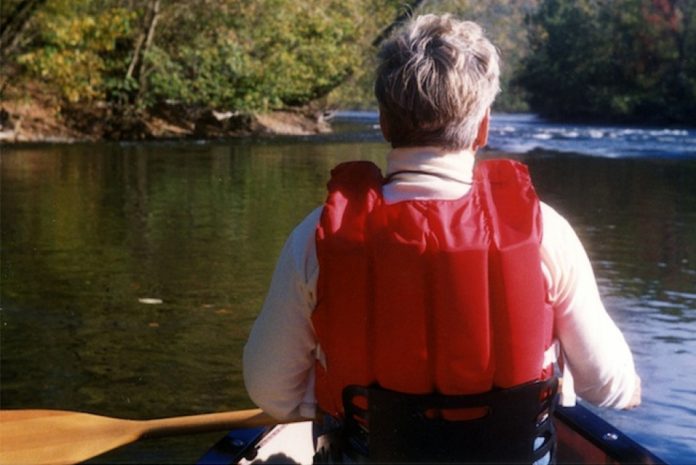
Video: Packing for a Weekend Canoe Trip

Rich Swift from Algonquin Outfitters describes some of the essentials for packing for a three-day canoe trip and how best to carry them.


Stay tuned for more great paddling skill videos, including canoeing, kayaking and whitewater techniques, brought to you in partnership with Rapid Media and Ontario Tourism. 

Paddling Puts You In The Right Place

How many paddle strokes will you have put in by the end of your life? | Photo: Steve Neumann

The muscular river that begins in the Catskill mountains and consigns itself to the Atlantic Ocean has a storied history of paddling. Before it reaches the sea, the Delaware River flows past the city of Philadelphia, where the American Declaration of Independence was signed—the same year George Washington and his army paddled through ice floes to capture Hessian soldiers and their provisions, helping to turn the tide of the war.

Since the 19th century, innumerable paddlers, hikers and other vacationers have made the Delaware their primary retreat from the modern world. My parents are avid paddlers, even as they begin their ninth decade.

[ Paddling Trip Guide: View all paddling adventures ]

My mother records their trips in a journal she named “River Ramblings,” which chronicles the interesting people and events they encounter, as well the personal reflections that bubble up to the surface on the quietest days.

My parents started with a canoe the year my father retired. He’s always been an ardent angler, but a big fishing boat was never a realistic possibility on their limited income. A canoe was a no-brainer. For over 20 years now they’ve set out on the sinuous Delaware every spring, as soon as the water’s current subsides enough for their aging arms.

Another glorious day on the river, is a frequent refrain in the journal, quoting my father. They reveled in the fluency of the river’s natural beauty, a respite from the static hum and buzz of modern life. There are vignettes of kingfishers and eagles, ospreys plunging from the heights and emerging with trout, and two blue herons fighting over a prime fishing spot in a secluded cove. In addition to the accounts of the numerous perch, pickerel, bass, and carp they caught, my mother describes the three-foot muskellunge that threw the lure before my father could grab the net. He was my mother’s Moby Dick—to this day, she’s still searching for him.

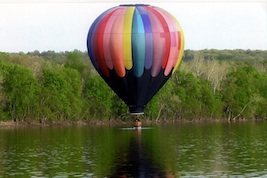
Hot air balloon landing on a river

They were as excited by the flora and fauna as they were by the people they met. My mother recounts the time they were surprised by the appearance of a hot air balloon deftly touching down on a placid stretch of the river. She was just about to call 911 before it lifted off again. And of course no paddling trip would be complete without a stop at The Famous River Hot Dog Man, whose kiosk you can sidle up to and enjoy a meal without leaving your canoe. Or if you need a rest, you can take a quick snooze in one of his many hammocks on the shore.

But there are more somber entries in the journal, too. The shock of the terrorist attacks of September 11, 2001 are noted, along with prayers for the loved ones of those killed. Several pages are devoted to the bittersweet migration of my sister and her family to the Midwest, after having lived close to my mother for 20 years of her married life. Memories of taking their grandchildren canoeing with them are recalled, and episodes from my sister’s childhood are celebrated.

The most melancholy entry is my mother’s mention of her diagnosis of breast cancer and double mastectomy at age 70. Yet there is a remarkable quality of equanimity about it, an acceptance that is as uninhibited as the river upon which she regularly drifts. Now a little over two months after surgery and feeling great, she writes, I’m looking forward to a nice warm spring, and to resume paddling on the Delaware. On the river, she’s in a good place.

The allure of paddling is a persistent one. It’s a lifelong, affordable recreation anyone can enjoy because it’s less about brute physical strength than about technique. But as Lance Armstrong would say, it’s not about the boat. The boat is a vehicle, not only for transportation and recreation, but for a return to a natural state we all intuitively know but seem to have forgotten: being near water makes us happy.

Marine biologist Wallace J. Nichols noted in his book Blue Mind that being near water is “the inverse of our current condition of monotonous suffocation.” In our day-to-day lives, we’re over-stimulated and overcommitted—and stressed. Stress isn’t new, of course, but our kind of constant, chronic stress is. “So when you see water, when you hear water, it triggers a response in your brain that you’re in the right place,” Nichols said.

The perk of paddling is that it puts you in the water and not just near it, one with its elemental rhythms. Paddling becomes like a meditation that begins with your body and ends up sending gentle ripples into your mind—it encompasses your whole being. When you’re able to disconnect and let go like that, you’re free to calmly acknowledge even the most terrifying experiences life throws at you. It allows your mind to disengage from them and wander at its leisure, mimicking the whimsy of the river itself. Paddling is the ultimate restorative.

When you set out in a canoe or kayak, luxuriating in the undulating embrace of the water, you can navigate the tributaries of your spirit or simply relish the silence of solitary moments. Whether it’s coping with illness or enjoying convalescence, worrying about the future or begrudging the present, my mother’s journal has shown me that paddling always puts you in the right place.


Writer Steve Neumann tweets at @JunoWalker

How The Prospector Became Canoeing’s Most Enduring Design

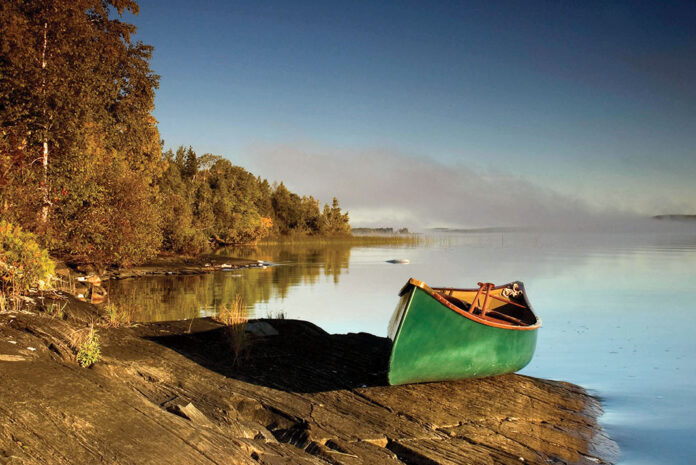
a Prospector canoe rests on the shore of a lake
Even Prospectors have to rest. | Feature photo: Klaus Rossler

The bones of countless battered Prospector canoes have rotted to dust on empty shorelines over the last century, but many more have died quietly in city backyards and northern lots, their adventure-seeking owners having long since done their own version of returning to dust.

The Prospector has been the workhorse of the wilderness for more than eight decades, and its reputation has become rich like aged cedar, as the stories and trip reports of one generation have become the legends of the next.

But what is a Prospector? And more to the point, can all past and present versions labeled as Prospectors be much like the real thing?

How the Prospector became canoeing’s most enduring design

Prospectors came into being to meet the needs of an industrializing country and the urges of its citizens to travel, explore and ultimately exploit the Precambrian Shield. According to Roger MacGregor, author of When the Chestnut Was in Flower, it was designed to service railway survey companies, timber cruisers, trappers and men with wide-eyed Gold Fever. It was popular because it was good at what it did. And what it did was work hard.

a Prospector canoe rests on the shore of a lake
Even Prospectors have to rest. | Feature photo: Klaus Rossler

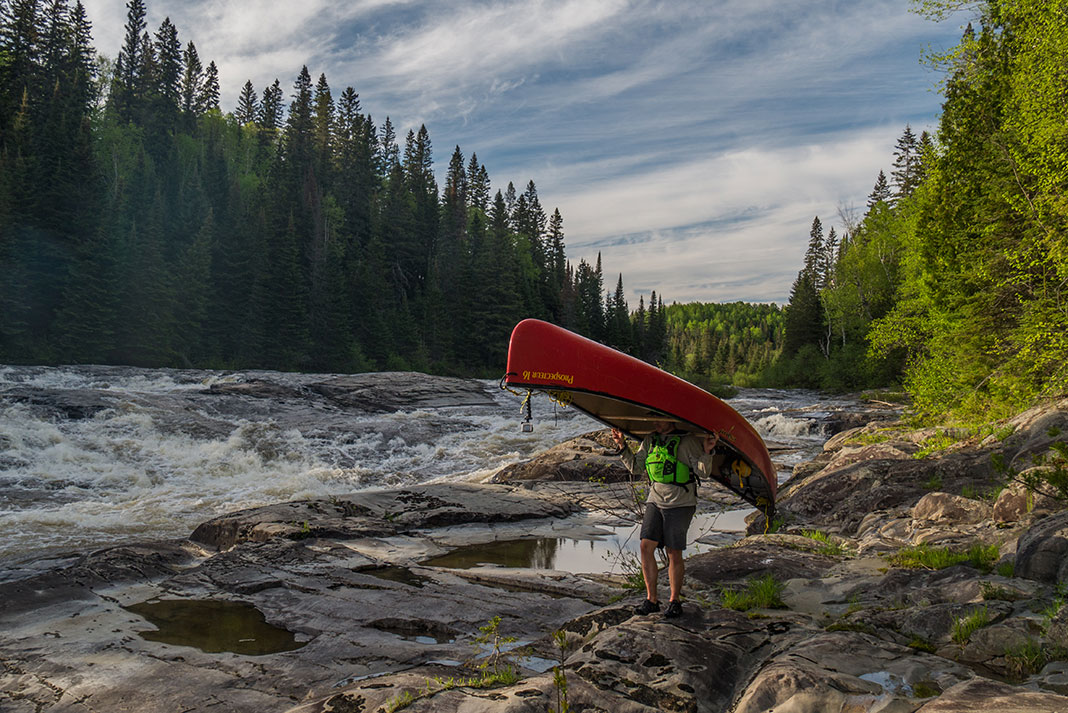
It was, and is, in essence a high-capacity gear-hauler; a wilderness transporter with lots of freeboard that was designed to be paddled loaded. Even the shorter 16-foot version could take you “out” for a month or more. Its classic construction was a complex, time-consuming feat of woodworking expertise involving white cedar ribs and planking and spruce gunwales; it was a melding of the design features demanded by laden travel over rock and rivers.

Cedar-canvas canoes had appeared in the 1870s but didn’t come into general use until after 1904. It was then that William and Harry Chestnut of Chestnut Canoes in Fredericton, New Brunswick, were granted the Canadian patent for that type of construction.

It was an important time in the history of canoeing. The evolution of the factory-produced canoe in those years from heavy ship-lapped planking to light cedar-canvas rescued wilderness travellers from much torturous work, a technology shift as liberating for the human spine as the introduction of Kevlar 80 years later.

Chestnut’s Prospector model, first produced in 1923, was so successful that the Geological Survey of Canada, with half a continent to survey, ordered 25 to 35 of them every year. It was built without a keel—unless specified by the customer—and was symmetrical—unless you wanted the V-stern version to have the option of using an outboard motor. It had moderate rocker compared to today’s more dedicated whitewater hulls, though in longer lengths the rocker become much more pronounced. It was available in a diversity that General Motors would appreciate; there were six different models from 16 to 18 feet in length.

[ Paddling Buyer’s Guide: View all canoes ]

After Chestnut, a profusion of Prospectors

For 55 years Chestnut stamped their name to the deck plates of Prospectors, right up until the company closed shop in 1978. In flattering gestures that the holders of the original Chestnut molds have not always appreciated, dozens of canoe makers hoping to gain both credibility and add a sure best-seller to their stock have since produced their own version of the design.

Hugh Stewart of Headwaters Canoes in Wakefield, Quebec, builds 15 to 18 canoes a year from traditional materials. Given that he actually owns two of the original Chestnut forms, and does extensive hard tripping in his own Prospectors, he has an authoritative take on the design.

“These boats are not to be thought of as Chippendale furniture,” he says, “They are tough, field-repairable working machines. Their primary characteristic is their great bow buoyancy under load.”

Rather than push water, the bow cuts it sharply and then, ideally just forward of the bow paddler’s knees, the hull flares gracefully at the waterline into its full width and volume to provide the buoyancy needed to carry the work gear of the past, and camping gear of today.

Despite its utilitarian genesis, it combines lines no barge operator would recognize. The upward slope of the gunwales at the bow and stern, the flaring hull shape and the slight tumblehome make for a symphony of curves for those with the eyes to see it.

An unmatched design for wilderness tripping

The original Chestnut Prospector forms have scattered across the continent and met various fates, though some of them, like Stewart’s, are still turning out “real” Prospectors. Many new molds turn out variations on the same design in all manner of materials.

So, it is up to the buyer, to the eyes of the beholder, to decide if their modern version of the Prospector is deserving of the name and comes close to the original 85-year-old idea.

You may decide you want a real card-carrying Prospector, one built from cedar sheeting and canvas in which you’ll go forth and seek your adventure. But if you do, caution your children sternly not to leave your legacy outside in the backyard after you pass on.

Brian Shields paddled his first Prospector at the age of 10, a story he recalled in “Bred in the Bone” [Canoeroots, Early Summer 2006].

Cover of the Spring 2008 issue of Canoeroots MagazineThis article was first published in the Spring 2008 issue of Canoeroots Magazine. Subscribe to Paddling Magazine’s print and digital editions, or browse the archives.

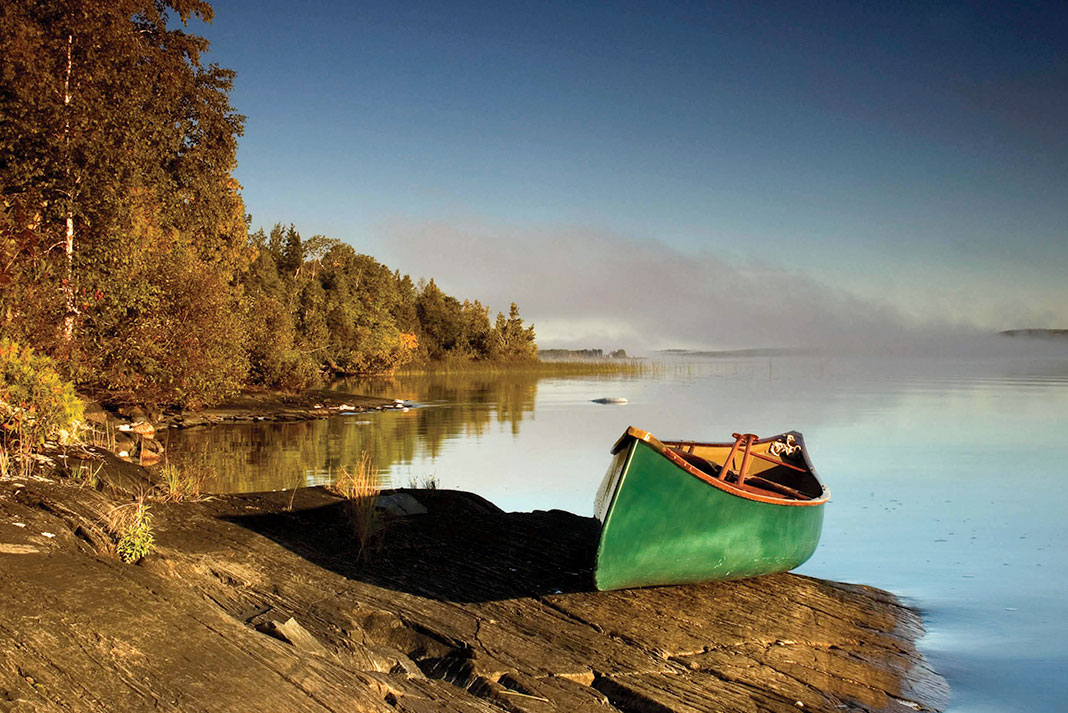
Even Prospectors have to rest. | Feature photo: Klaus Rossler


Video: Ray Mears Builds Birchbark Canoe

Watch survival expert Ray Mears construct a birch bark canoe with Algonquin canoe maker Pinock Smith, one of the few people left who know how to craft them using traditional methods. As far as Mears is concerned, the birch bark canoe is the best vessel man has ever created.

This is episode one in the second season of Ray Mears’ Bushcraft TV show.

Video: How To Low Brace Turn

Brian Pettinger from White Squall Paddling Centre shares his step-by-step basics for making smooth and efficient low brace turns in your kayak. Turning with a low brace adds support to your turns in rough water, and increases the speed and grace of your edged turns on calm water. Try it now!


Stay tuned for more great paddling skill videos, including canoeing, kayaking and whitewater techniques, brought to you in partnership with Rapid Media and Ontario Tourism. 


Once Upon A Storm

Photo: Colin Sillerud
Once Upon A Storm

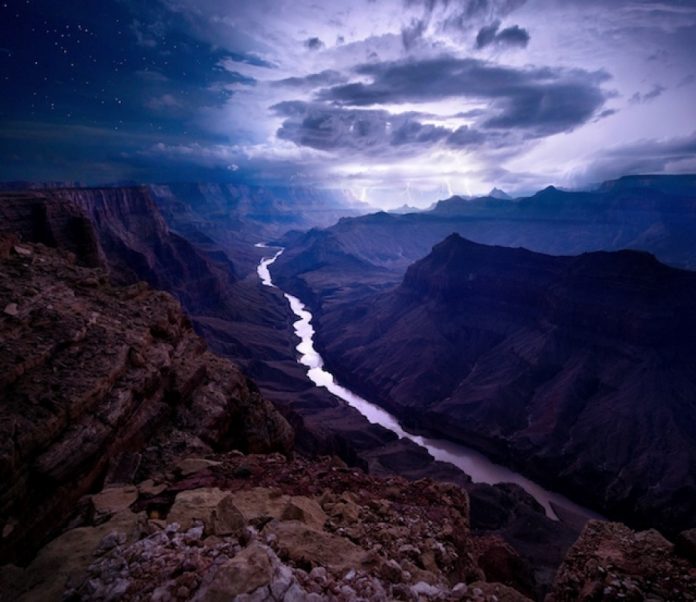
It was cloudy as I drove through the Southwest, jolting around my truck as it shook over the rugged road I’d picked off a map, the most remote trail I could find heading in towards the canyon.

Leaving the vehicle behind in favor of 30 miles by foot, I hiked until what I saw left my breath in my throat. A 270-degree vista of reds, yellows and blues stretched for hundreds of miles, with the Colorado River cutting through the Grand Canyon 5,000 feet below.

I have been hunting lightning with my camera for four years now, returning every monsoon season to the spot that sparked my love affair with this landscape.

The trick to capturing these storms, I have learned, is being patient, prepared and crossing my fingers for good luck.

On this day, I was sitting over a sheer drop with my girlfriend, watching the clouds dissipate down to nothing as the sun set, feeling another monsoon season going down the drain. After weeks of planning, tracking and learning the patterns of the storm systems, I had nothing.

Then, just after nightfall, BOOM! Blood flooded my brain.

A series of electrical storms built and hit out of nowhere. The density of lightning was something I didn’t even know could happen. For a period of two hours, from 11 p.m. until one in the morning, three surrounding storms unleashed a bolt every second, an endless atmospheric strobe. The thunder was constant and deafening.

Making split second decisions with my camera, there were times I forgot to breathe I was so excited and focused.

The bolts were so bright that in order to expose them properly, I had no information on the surrounding landscape and night sky. With trepidation, I gave up a few bolts by overexposing the lightning to register the land. There was no way of knowing when the perfect bolt would strike and, indeed, some of the night’s best lightning occurred while I was exposed for the land.

In the instant this bolt struck, I clutched my camera and took a deep breath—I had captured the storm, both the desert’s lifeblood and a violent expression of its unforgiving nature.


This article first appeared in the 2015 Paddling Buyer’s Guide. Subscribe to Paddling Magazine and get 25 years of digital magazine archives including our legacy titles: Rapid, Adventure Kayak and Canoeroots.
Kokatat Hydrus 3L Stoke Dry Top

Photo: Emma Drudge
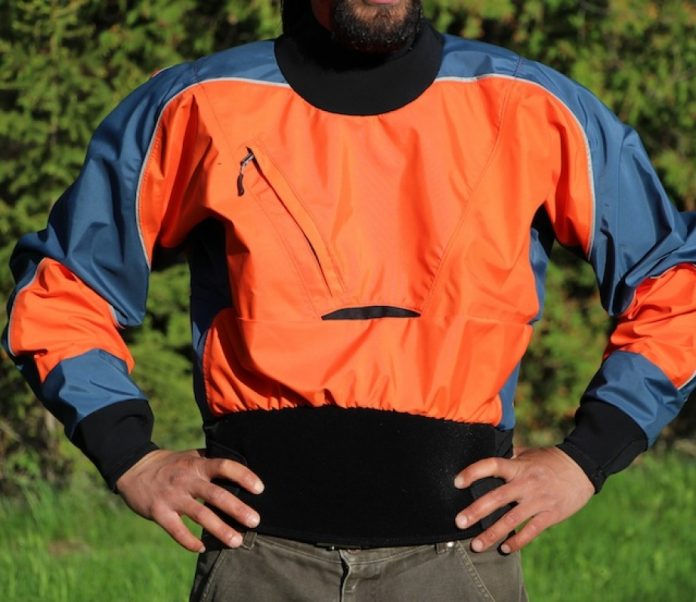
Kokatat Hydrus 3L Stoke Dry Top

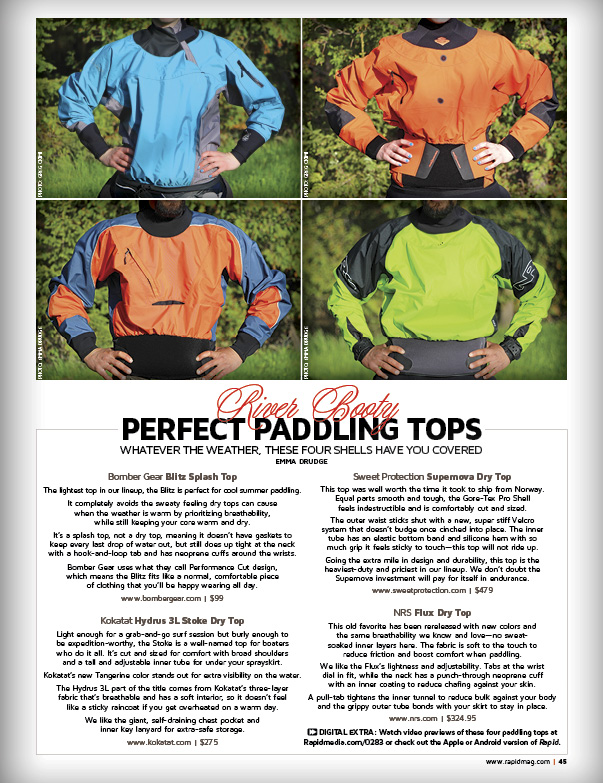
Light enough for a grab-and-go surf session but burly enough to be expedition-worthy, the Stoke is a well-named top for boaters who do it all. It’s cut and sized for comfort with broad shoulders and a tall and adjustable inner tube for under your sprayskirt.

Its new Tangerine color stands out for extra visibility on the water.

The Hydrus 3L part of the title comes from Kokatat’s three-layer fabric that’s breathable and has a soft interior so it doesn’t feel like a sticky raincoat if you do get overheated on a warm day.

We like the giant, self-draining chest pocket and inner key lanyard for extra-safe storage.

www.kokatat.com | $275

Click here for more dry top reviews in the free online edition of Rapid, Summer/Fall 2014.


RPv16i3-45

This article originally appeared in Rapid, Early Summer 2014. Read the entire issue on your desktopApple or Android device.  


Totem: Keeping Around Old Gear

Photo: Emma Drudge
Totem: Keeping Around Old Gear

When I started my first job as a river guide, I had no equipment of my own. Other than a couple short canoe trips at summer camp, I hadn’t spent much time on the water. So it was with great confu- sion I read the following pre-season email, sent out to all first-year staff:

As you budget for the summer, bear in mind there is some gear you will want for your job. You WILL be in cold water. We can supply you with a paddle, PFD, helmet and wetsuit. Said gear will be entirely safe and functional, but be forewarned: you will look like a dork. You will have no sex appeal. All our staff inevitably invest in their own equipment.

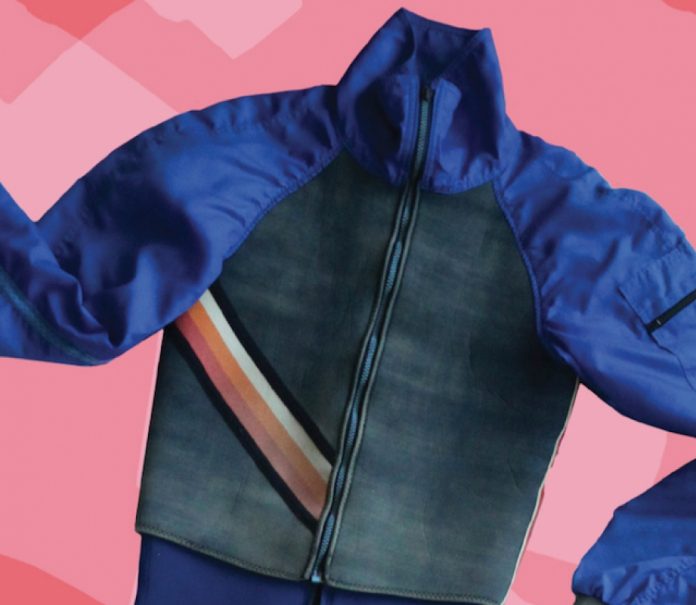
More broke than fashion conscious, I arrived ready to wear whatever they gave me. The first thing I noticed was the color. Angular pink patches cut through a blue body so faded it looked more like acid- wash grey. The stiff, thick neoprene made me walk with straighter-than-normal knees—the fabric pulling my joints into alignment with the suit’s pre-cut shape that when dry, looked like it may be freestanding.

BREAKING THE BANK

A few years later I blew my river guide salary on a hot new drysuit and technical layering system well worth breaking the bank.

Drysuit donned, I outfitted newbie interns in their own well-worn neoprene. I was cozy during an early-season rescue course. I stayed bone dry as I taught new staff how to swim effectively in whitewater. I was warm. I was comfortable. I looked like I knew what I was doing.

There were good reasons I replaced ol’ faithful: too many consecutive river days resulted in an irritating itch. The faded fabric’s pores, rife with sun-dried urine, caused an odor that ripened when wet despite years of valiant laundering attempts. I even tried a cocktail of every home cleaning product I could get my hands on—the only result was a rash.

But my blue and pink polygon suit was never tossed to the curb.

Somewhere in the depths of a Rubbermaid storage bin, I hoard this relic of paddling days gone by. It gets pulled from retirement from time to time to enrobe a rightfully self-conscious first-time paddler friend; more often I just flip past it as I reach for my replacements. But like listening to any old song, seeing it there takes me back to another place and time.

I’ve never paddled as many days in a year as I did those first few summers. They were endless river days. Nights were spent under the stars on shore, around a campfire surrounded by friends with a similar lack of responsibility and urge to play. I fell asleep to the roar of rushing water. More than a piece of gear, it’s a memory of the places and people who helped shape the person I’ve become. And that is something you don’t throw away.

Emma Drudge is the editor of Rapid magazine. She looks forward to letters from readers who still rock these suits. 

This article on hoarding old gear was published in the Spring 2015 issue of Rapid magazine.This article first appeared in the Spring 2015 issue of Rapid Magazine. For more great content, subscribe to Rapid’s print and digital editions here.
How To Become A Real River Legend

three local river legends stand around in drysuits loading kayaks into a truck bed
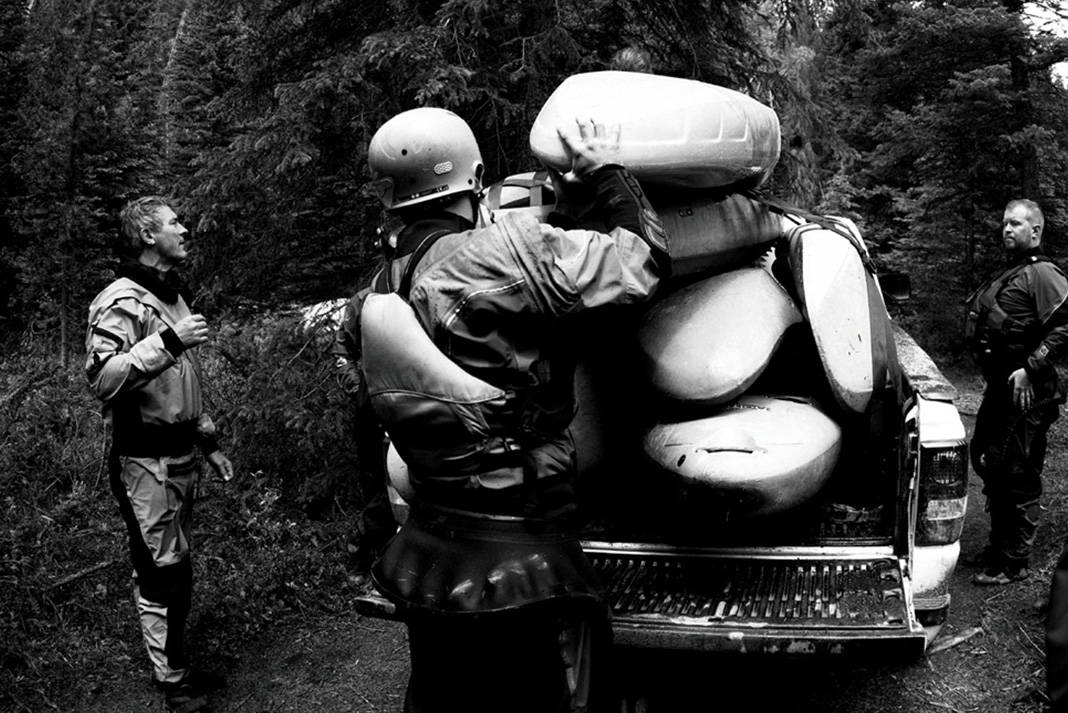
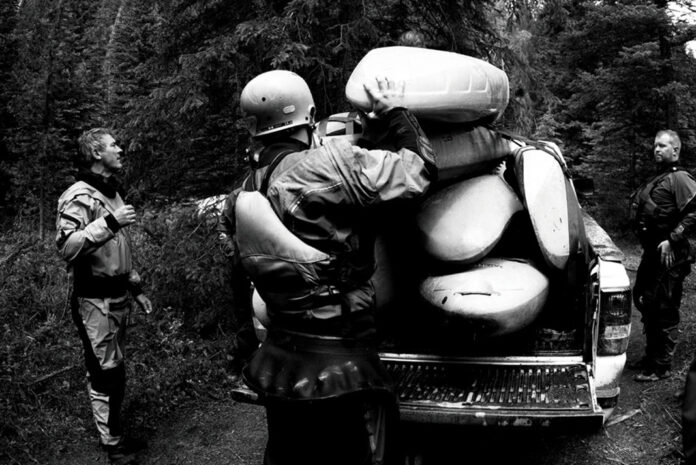
The easy way to become a legend is through utter stupidity brought about by laziness, foolishness, or booze. The hard way is by doing something for a long time. | Feature photo: Ryan Creary

There seem to be two ways of becoming a legend around rivers. The first is the easiest. It requires absolutely no planning and no thought. In most of these cases, the act of thinking stands in the way of creating the circumstances required to generate legendary status. Let me give you an example.

How to become a real river legend

The Ottawa River rafting companies use trailers to return their rafts from the take-out back to the put-in. Deflating and re-blowing the boats, the guides complained, took too long. Guides used to see how high they could stack the rafts. There was a macho pride in riding the tallest trailer load of boats.

But there are telephone wires across Grants Settlement Road.

The guy who, at 50 miles per hour, was knocked from the first compartment of the top raft and landed in the back compartment, is a local legend—not to mention lucky to be alive.

The easy way to become a legend is through utter stupidity brought about by laziness, foolishness, or booze. Often all of the above.

The easy way to become a legend is through utter stupidity brought about by laziness, foolishness, or booze. The hard way is by doing something for a long time. | Feature photo: Ryan Creary

Becoming a legend the hard way

As we were preparing this issue of Rapid, an old friend of mine patted me on the back and said, “I can’t believe you’ve been at this little magazine business of yours for 17 years.”

This was his way of saying, “Good for you,” or maybe, “I didn’t think you’d make it this far.” To which I replied, “Well, you know, if you stick with something long enough, you end up doing something for a long time.”

The local legends featured in this issue have become legends the hard way—by doing something for a long time.

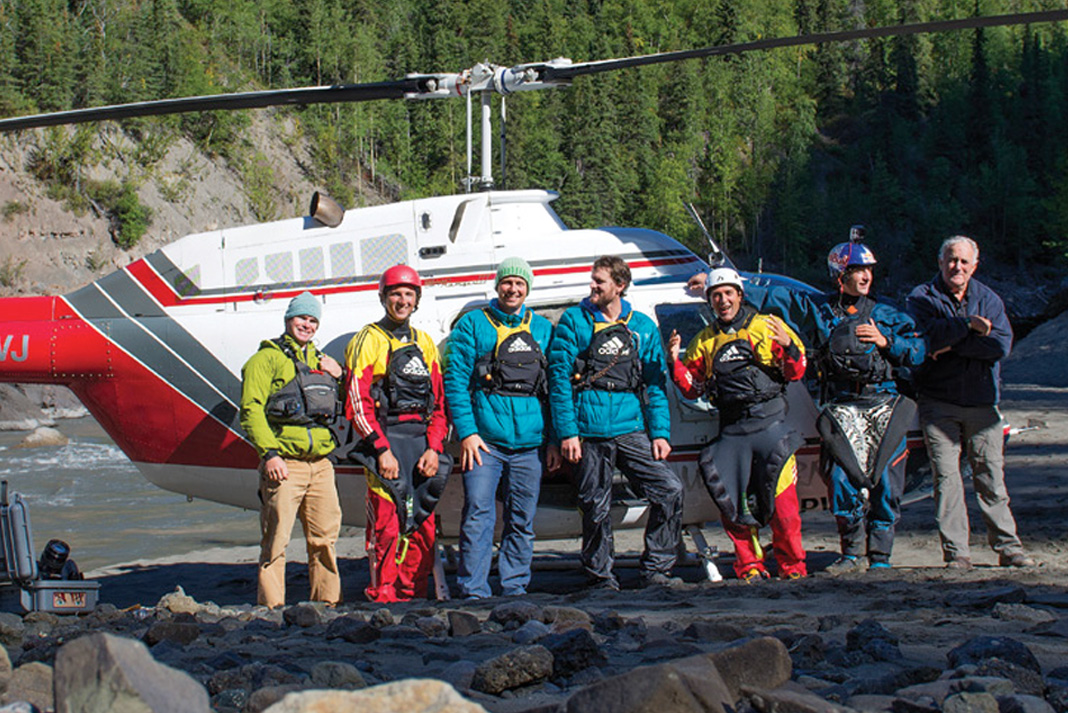
If helicopter pilot Jim Reed had only flown one group of paddlers out of the Stikine he would not be featured in this issue. If Christie Cochran had taken the geology job she wouldn’t have been guiding on the rivers of the Southeast for 17 years. And Brad Camden hasn’t been running shuttles on California’s North Fork of the Smith for 29 years because it pays well.

These local legends have been doing it for a long time because they like it and because they are good at it. They are good at it because they care about people—they care about us. Because they care about us they become part of what makes our river travel so special. Local legends become part of our memories and those memories become part of who we are.

“Local legends become part of what makes our river travel so special.”

Brian Shields and I have outfitted the last seven of my canoes, which shouldn’t come as a surprise—he’s outfitted almost all the canoes around here. I’m quite capable of outfitting my own boats, but spending time with Brian is a big part of buying a new canoe. Brian is thoughtful. Wise. Kind. Precise. Passionate. Retired. He’s a romantic. He’s nostalgic. He’s the kind of guy you like telling your friends about when they ask about your beautiful ash gunwales.

[ Paddling Buyer’s Guide: View all canoes ]

The busier our lives become—the more we type at each other with our thumbs, the more we buy from Amazon—the more we appreciate real people, people who care about us and people who stick with something long enough to end up doing it for a long time.

Scott MacGregor is the founder and publisher of Rapid. He is not, for the record, the raft guide clotheslined in this story. 

Cover of the Spring 2015 issue of Rapid magazineThis article was first published in the Spring 2015 issue of Rapid Magazine. Subscribe to Paddling Magazine’s print and digital editions, or browse the archives.


The easy way to become a legend is through utter stupidity brought about by laziness, foolishness, or booze. The hard way is by doing something for a long time. | Feature photo: Ryan Creary