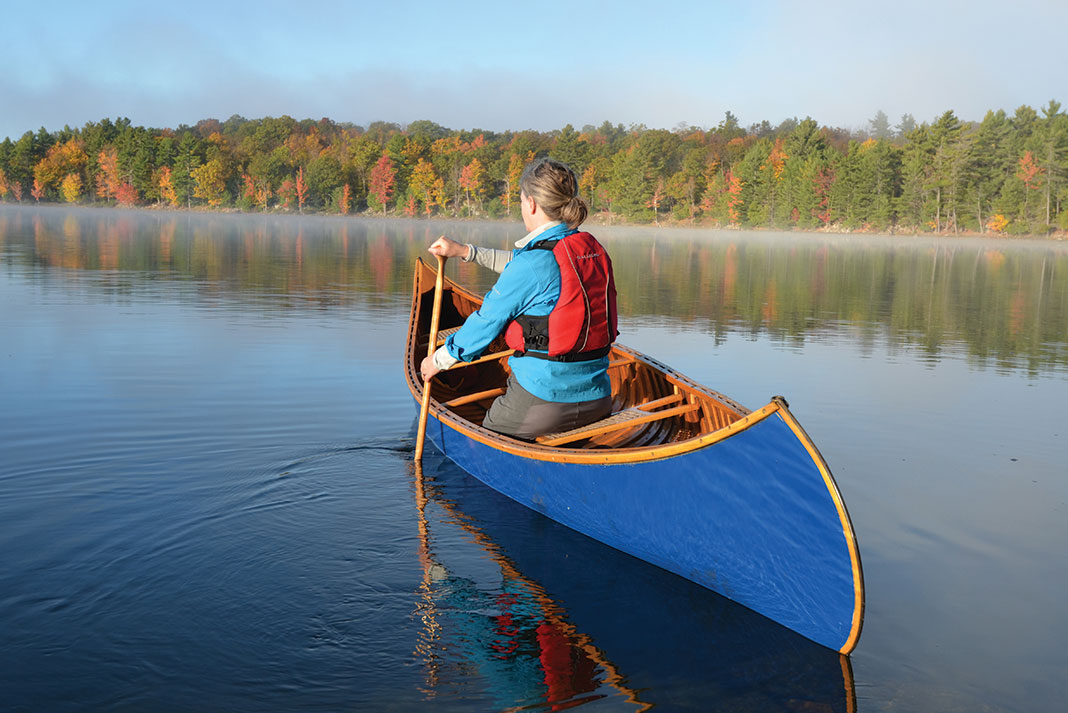
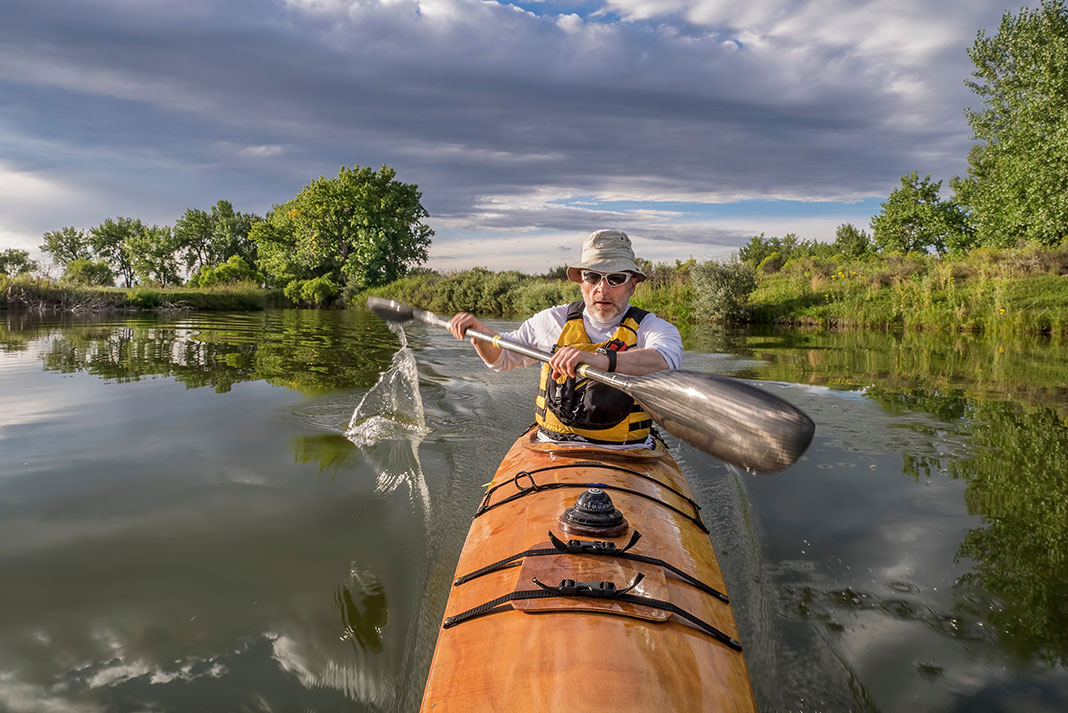
One stroke forward, two strokes back. | Feature photo: Reid McLachlan
It was a revelation when I first learned how to paddle a canoe backwards. Everything was so dramatically different. I was on the edge of control, where nothing feels natural and everything is new. But backwards paddling is not some idle trick; it brings real benefits to your paddling proficiency.
It was my dad who first got me going in reverse. He had returned excited from a symposium where he’d been canoeing with a freestyle paddler. “He said it almost like a mantra,” Dad told me and then he recited: “Anything you do forward you should be able to do backward.” It didn’t sound like a big deal, but then I tried it.
Paddling backwards is a great way to teach solo and tandem canoeists important concepts by taking them outside of their comfort zone. Not only does this translate into more efficiency and grace on the water, these are also skills that we can carry to moving water, whether back-ferrying a loaded tripping canoe or riding a sweet surf wave.
Initial tips for backward paddlers
There are two important pointers that will help for practising your strokes in reverse. For solo paddlers, the most common problem at the outset is trim. It is critical to have your weight in the center of the canoe, or a little forward of center, so you are not stern heavy.
Secondly, watch where you’re going! My clients get so focused on their strokes that they forget what the canoe is doing and they run into the shore, each other, me, and once, even a wading nudist.
All of the traditional strokes—including the J-stroke, draws and pries—are fair game for backwards paddling, whether you’re solo or tandem. For a fun beginner stroke that’ll make you think about blade placement, try a reverse running stern draw. Practice it and impress your paddling buddies with a reverse dock landing or reverse eddy turn in moving water.
The instructions below are for solo paddlers, but tandem paddlers can try this if the bow paddler performs continuous reverse sweeps to both initiate and power the turn, while the paddler in the stern follows the instructions described here from step two on.
One stroke forward, two strokes back. | Feature photo: Reid McLachlan
5 steps to paddle backwards
1 Reverse J-stroke
First, gain momentum going backwards in a straight line with a reverse J-stroke. Now, just like its forward counterpart, initiate a turn with a hard reverse J at the end of the stroke.
2 Set up the stern draw
With the turn starting, tilt the hull to the inside of the turn and slice your blade out and slightly behind you to set up the stern draw.
3 Carve the turn
Open the blade to catch water by turning your grip hand thumb out. Doing this slowly, and gradually introducing more blade angle, will allow you to use the momentum of the canoe and carve a beautiful turn.
Hang on to the stern draw for as long as you can, allowing the canoe to pivot around your paddle.
5 Finish in style
For style points, finish off the draw with a palm roll and reverse J-stroke and now you’re set up to do the maneuver again, or maybe a reverse running pry sideslip, or a reverse low brace turn, or a reverse one-handed pry, or how about a reverse…
Becky Mason is owner and operator of Classic Solo Canoeing. She is a Paddle Canada Instructor Trainer and has been teaching people to go backwards, forwards and sideways for 27 years. Visit redcanoes.ca.
This article was first published in the Summer/Fall 2014 issue of Canoeroots Magazine. Subscribe to Paddling Magazine’s print and digital editions, or browse the archives.
One stroke forward, two strokes back. | Feature photo: Reid McLachlan
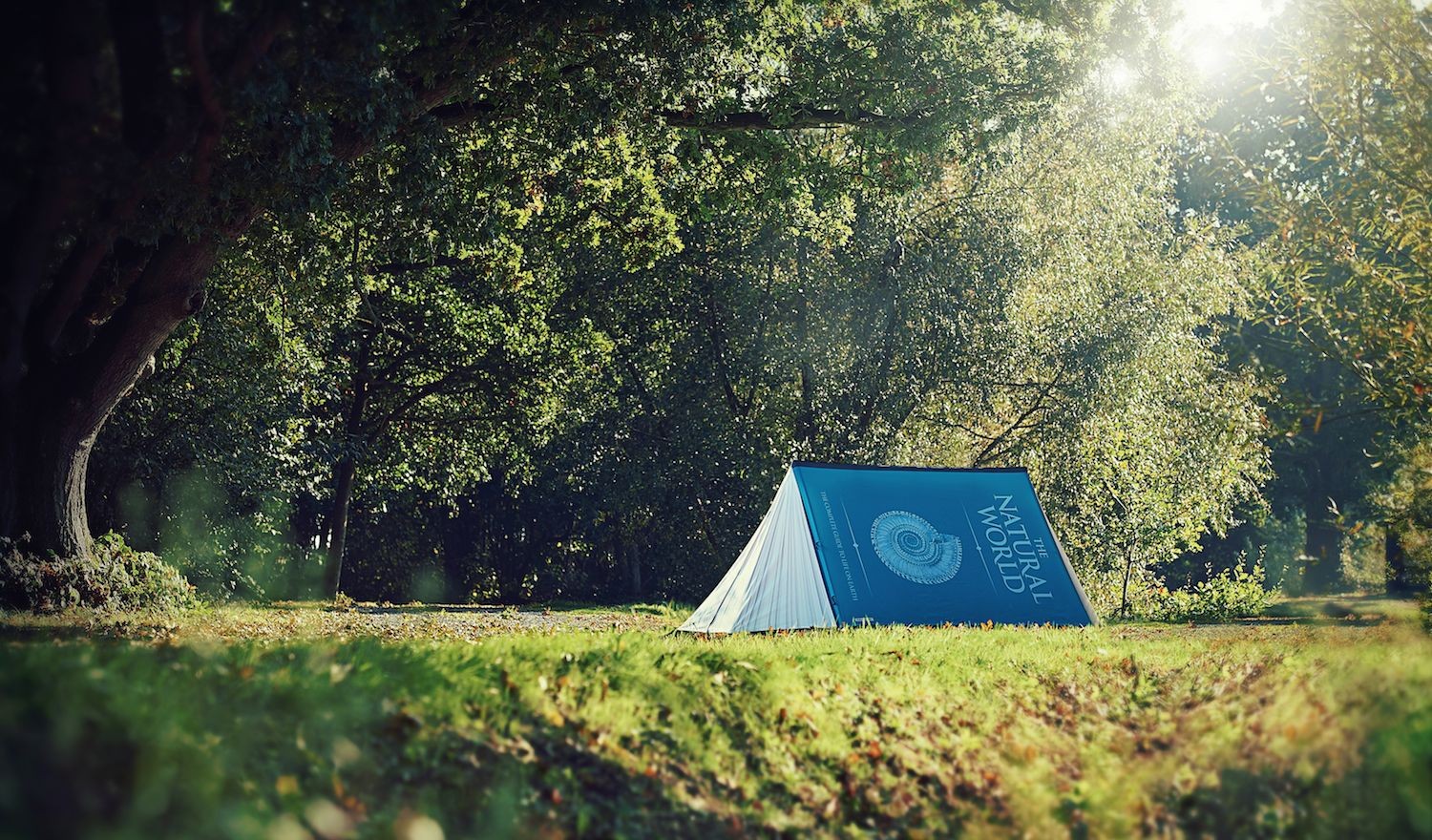
Always wanted to sleep in a giant slice of watermelon or show your love of the written word by peering out from between the pages of a gigantic paperback? Field Candy’s INNOVATIVE TENT flys feature bold patterns and daring scenes, ensuring you’ll never confuse your tent with another campers’ again (www.fieldcandy.com).
Field Candy writes: “Original Explorer tents are much bigger than most other standard two person tents, providing you with a spacious sleeping area and extra storage for muddy boots in the lobby. Each tent is made to the high quality of an expedition tent built to withstand extreme conditions. The unique designs will help you stand out from the crowd with colour and creativity.”
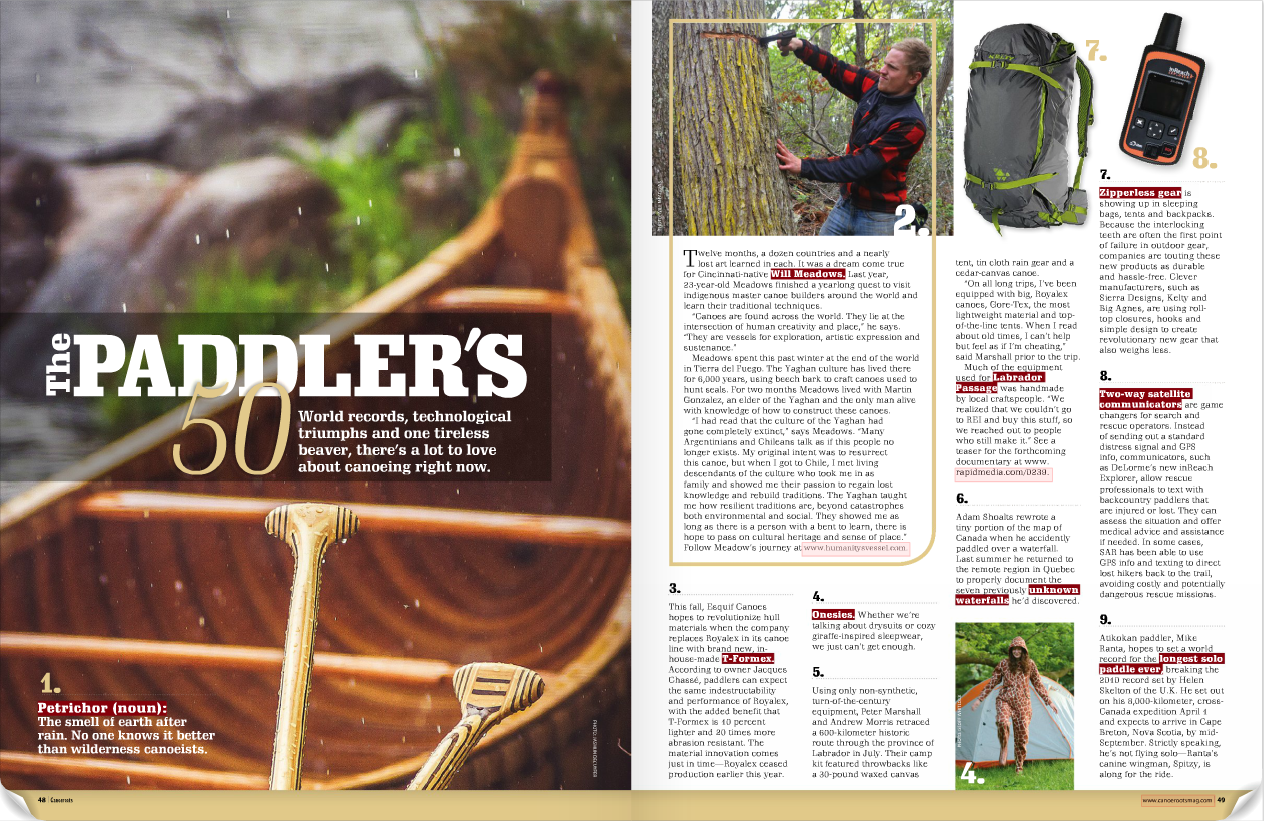
Discover 49 more of the coolest people, gear and innovations in canoeing this year in the digital edition of Canoeroots and Family Camping, Summer/Fall 2014, on our free iPad/iPhone/iPod Touch App or Android App or read it on your desktop here.
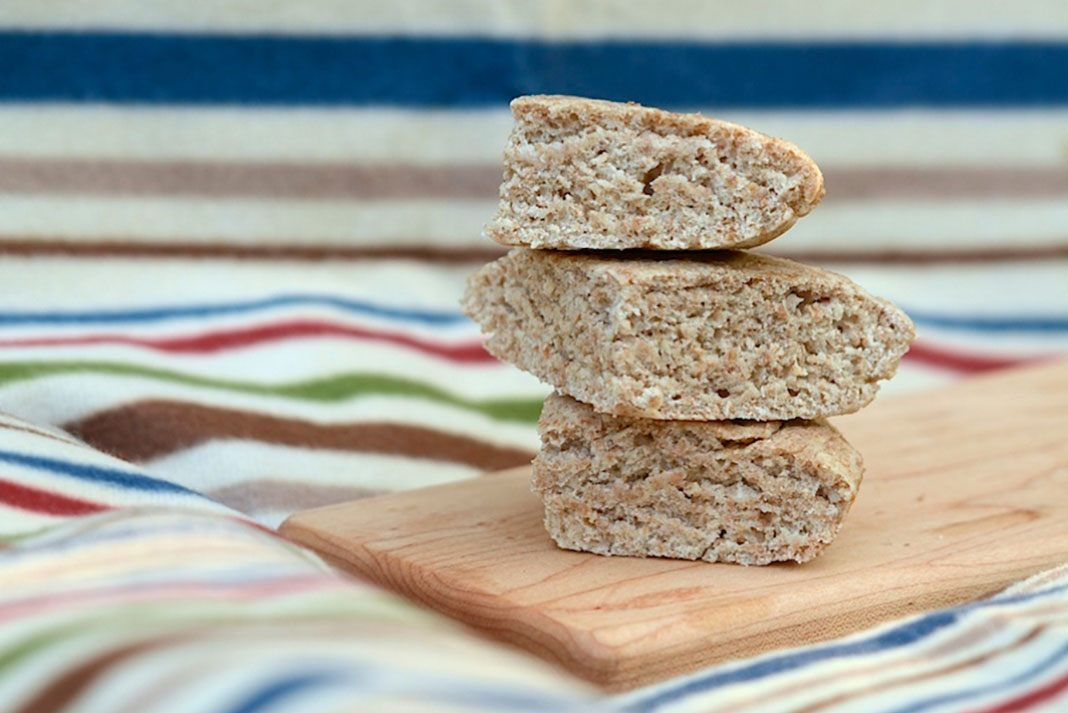
Making bush bannock is so simple, you’ll have it everyday while on trip. | Feature photo: Kaydi Pyette
Most of us make compromises on our food when tripping in the wilderness. It doesn’t mean we don’t eat well, but we often give up the taste and comfort of soft, fresh bread for pita and flatbreads that won’t squish. Stop sacrificing! Here’s a delicious recipe for bannock that promises a fluffy backwoods treat.
Easy Backcountry Bannock Recipe
Bannock is a Gaelic-rooted word that comes from the Latin panecium, which means baked things. A bannock is a small, flat loaf of bread, risen by a leavening agent. Its roots date back to ancient times, where bannock nourished Roman armies and First Nations tribes. Add some honey and it tastes like manna from heaven—hot, light, and delicious.
Make the mix at home before your trip. To do so, mix the dry ingredients together then cut the shortening in with a pastry cutter or two knives until you have a granular, corn meal-like mixture. Package in Ziploc freezer bags and double bag it if you’re going on a long trip.
Making bush bannock is so simple, you’ll have it everyday while on trip. | Feature photo: Kaydi Pyette
To Serve
Once fireside, warm a small cast iron frying pan on the fire and oil it well. Next, pour water into the bag of mix, squishing it around in the bag. Pour in enough water so the dough spreads easily, but has a heavy and thick consistency. The faster you go from mixing the dough to spreading it in a skillet, the lighter your bannock will be.
Squeeze the mix out of the bag and onto the warmed pan. If the dough sizzles, it means the pan is too hot, cool it off and try again. Spread the dough so it’s no more than an inch thick, then place the pan over hot coals. As the dough cooks, it will start to rise slowly. Flip over your loaf when the underside takes on a golde tone. Wait another five minutes, then flip again.
The key to great bannock is a consistent heat, ideally from glowing red embers of hardwood. You’ll know it’s ready to eat when you can stick a fork in the center and it comes out clean.
[ Paddling Buyer’s Guide: Browse all camp kitchen accessories ]
Bannock Recipe Variations
A fun variation is cooking bannock on a stick. To do this, roll out a snake-like length of dough and wrap it around a stick, keeping it a half-inch thick. Rotate your bannock above hot coals until it cooks through and is easy to slide off, usually about 10 minutes.
Get the full article in the digital edition of Canoeroots and Family Camping, Summer/Fall 2014.Subscribe to Paddling Magazine’s print and digital editions, or browse the archives.
When it comes to the van life, this famous warning likely rings through your head: “You’ll be living in a van down by the river!”
Chris Farley always said it like it was a bad thing. The Saturday Night Live comedian would yell in his classic sketch, “You’re not going to amount to jack squat!”
To paddlers, Farley’s idea of being a deadbeat sounds more like living the dream—stay where you want, when you want, with minimal money and a river within reach.
Some boaters go the extra mile and deck out their cars to live comfortably, cheaply and best of all, happily. These paddlers have traded mortgages for moving water and stress for stunning scenery. With the perk of paddling on a whim, who wouldn’t drop everything to live in a van down by the river?
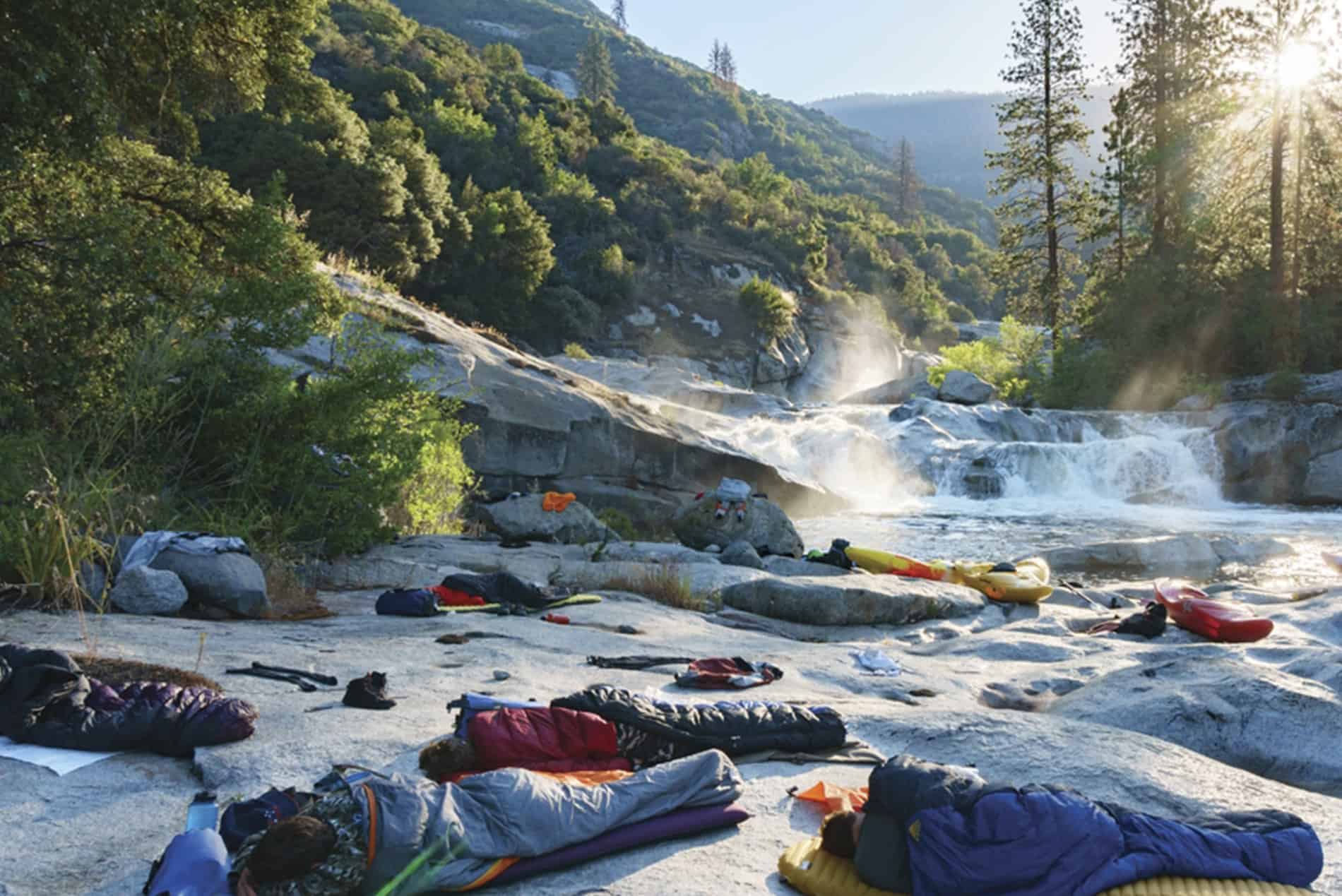
Eat, sleep, paddle, repeat. | Photo: Sierra Stinson
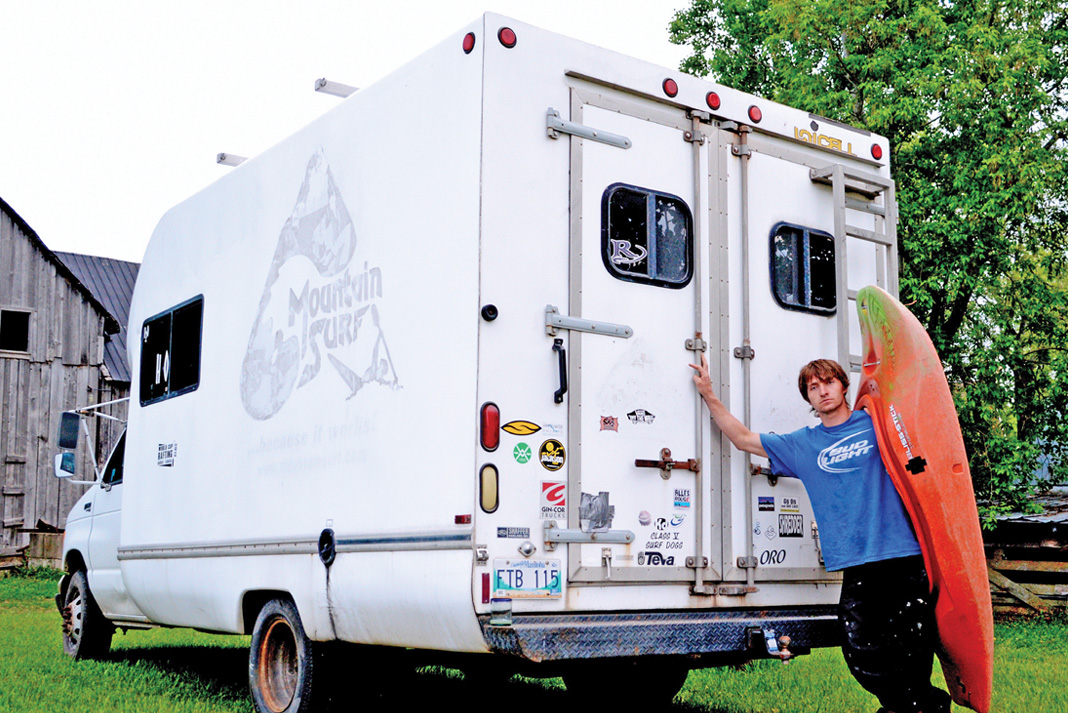
1 The White Beast
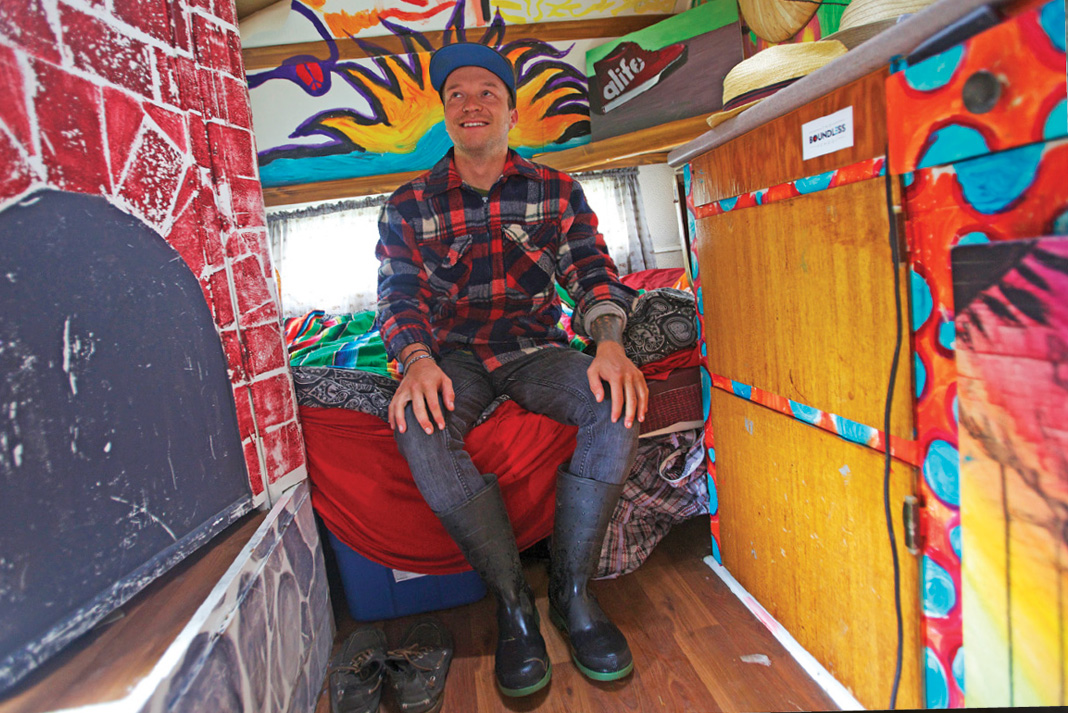
Andy Hill moved to Ontario at age 17 to pursue a life of playboating on the Ottawa River. In the nine years that followed, he went through eight vehicles, each too expensive to drive or not tough enough for Canadian winters. After much trial and error, Hill has found love in the former Mountain Surf van.
Vehicle name: The White Beast
Vehicle year/make/model: 1997 Ford E-350
Odometer reading: 270,000 miles, 20,000 of which were powered by veggie oil
Original vehicle cost: $1. Hill bought the van from freestyle champion kayaker Billy Harris who was sick of paying to maintain an old vehicle. “I have a bill of sale that says I bought it for one buck.”
Occupancy (people): 6
Occupancy (boats): “If you were very proficient at Tetris I would guess you could fit 30 or more kayaks in and on it.”
Under the hood: “Having a 7.3-liter, turbocharged diesel is great. It’s completely oversized but the cost of running such an engine is usually halved, because I use 50/50 veggie oil and diesel whenever possible.”
Memorable moment: “There are a lot of stories that came with that van, like when a tornado put a stop sign through the roof at a kayaking festival. When I bought it from Billy I promised I would only ever pass it on to another boater, so it’s a pretty cool legacy.”
Photos: Mícheál Howard
2 #RedDraggon
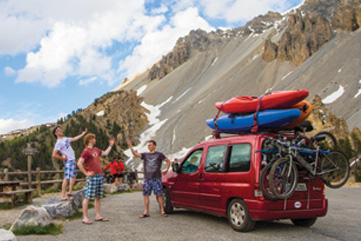
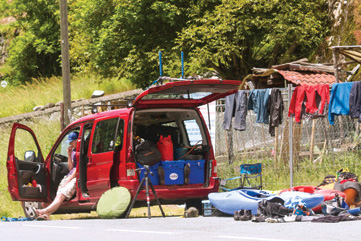
After years together in a gear-crammed college apartment, Mícheál Howard, Eoin Farrell and Simon McCormack started life on the road. Although they opt to camp outside of their car instead of sleeping in it, they all consider it home base. The three Irishmen agree that van life has made a world of difference to their European travels. “It’s the freedom really,” says Howard, “not having to worry about campsites or hotels. You can stay wherever you want.” The trio headed out on their first three-month kayaking trip last summer, and it won’t be their last.
Vehicle name: #RedDraggon
Vehicle make/model: Citroën Berlingo
Odometer reading: 100,000 kilometers
Essential features: Roof racks were a mandatory addition for carrying boats, but the group also got a rack for the back to carry a bike for shuttles. Finally, they added three big bins “to store all the living gear in the boot.”
Reno cost: “The turbo went in it, and that cost $2,500 to replace. But other than that just the regular maintenance and servicing costs.”
Occupancy (people): Zero. “We spent one night with all three of us inside and it was miserable.”
Occupancy (boats): Eight—creekers on the roof and playboats in the back.
Memorable moment: “Driving through amazing mountains and landscapes with great music blaring on the radio.”
Feature photo: Tommy Penick
3 Grandma’s kitchen
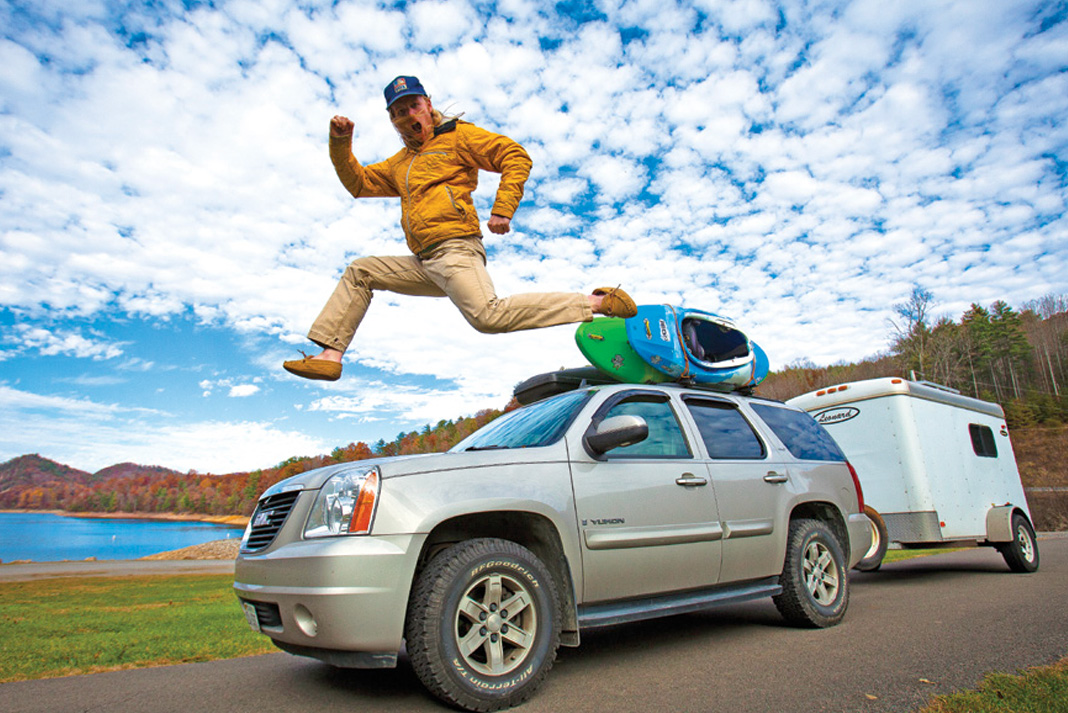
Tommy Penick’s license plates say he’s from Virginia, but he hasn’t lived there in over six years. Instead he’s been on the road building his photography business. “There’s more or less two ways to make your career come together,” he says. “You either find a job that helps you supplement your income, or you drastically cut your living expenses.” For Penick, who’s at home on a class V river, it was a no brainer: cut down on comforts for the freedom of life on the road.
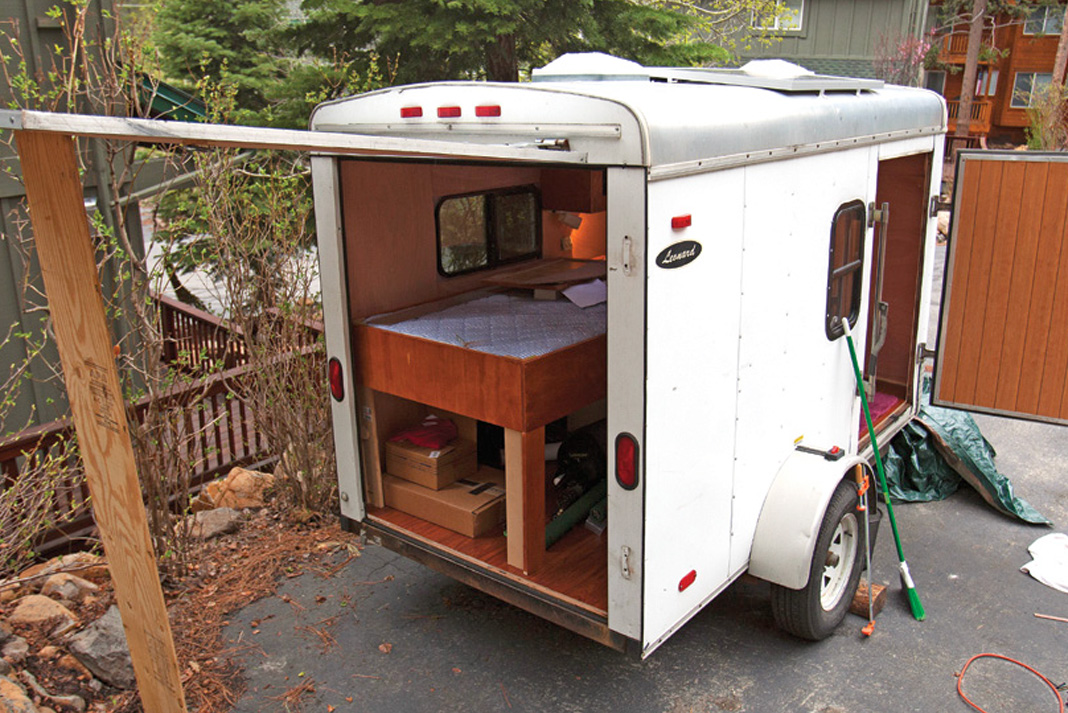
Vehicle year/make/model: 2009 GMC Yukon and converted 5×10 utility trailer
Odometer reading: 90,000 miles
Occupancy (people): Three really good friends.
Occupancy (boats): Five boats on the highway, seven for the shuttle.
Photo: Tommy Penick
Photo: Tommy Penick
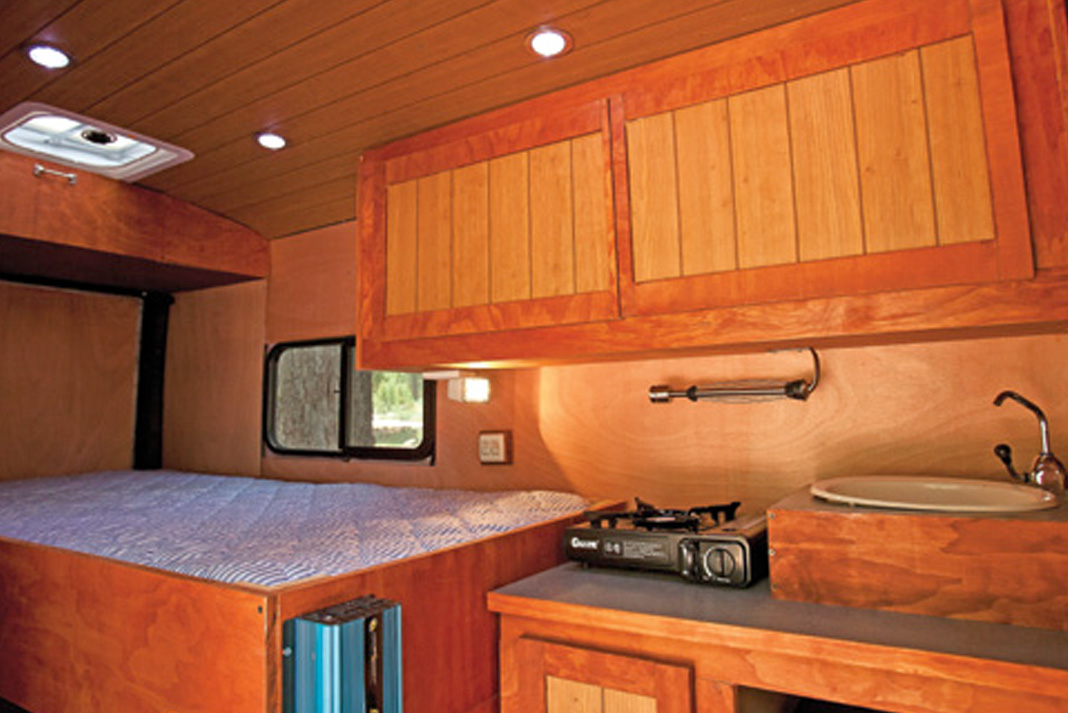
Essential features: Penick added insulation, hardwood floors, solar panels and a water tank to his trailer, and, to make it feel like home, “I bought a really nice candle from a thrift store and called it done. It’s called Grandma’s Kitchen and it smells delicious.”
Memorable moment: Attempting to hit up Cali classic South Silver, Penick and a friend missed a turn during a midnight shuttle, trailer in tow. “Long story short, we were on the wrong road, and got stuck.” They were a little late for work the next day, but squeezed in a good run.
Photo: Stephen Wright
Photo: Stephen Wright
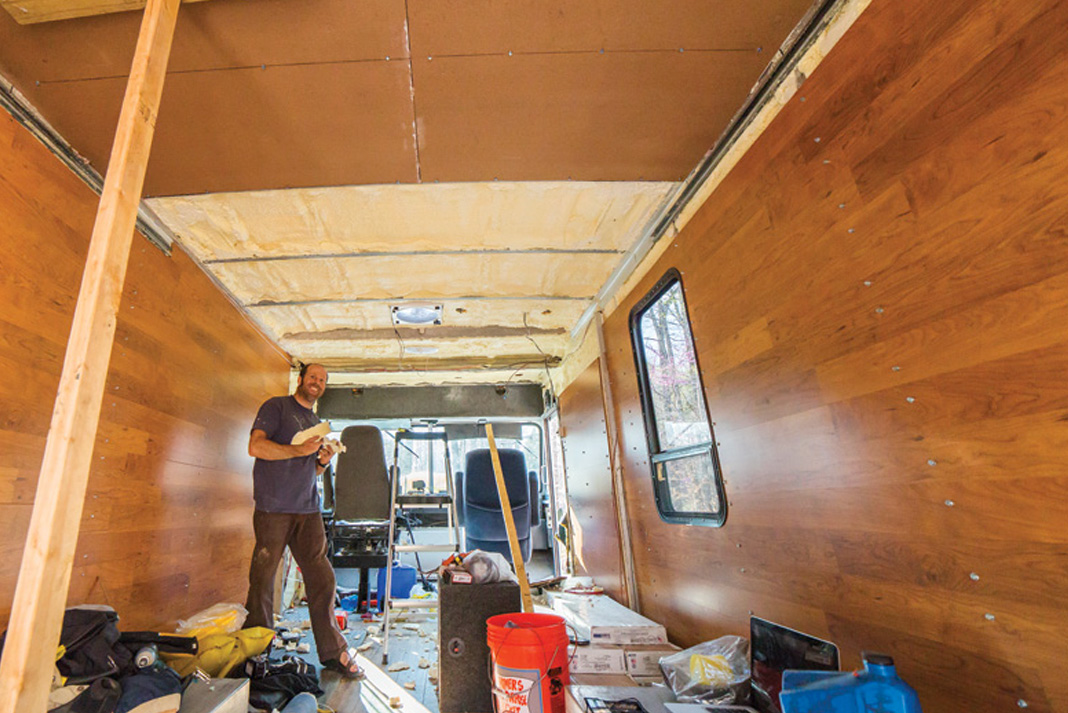
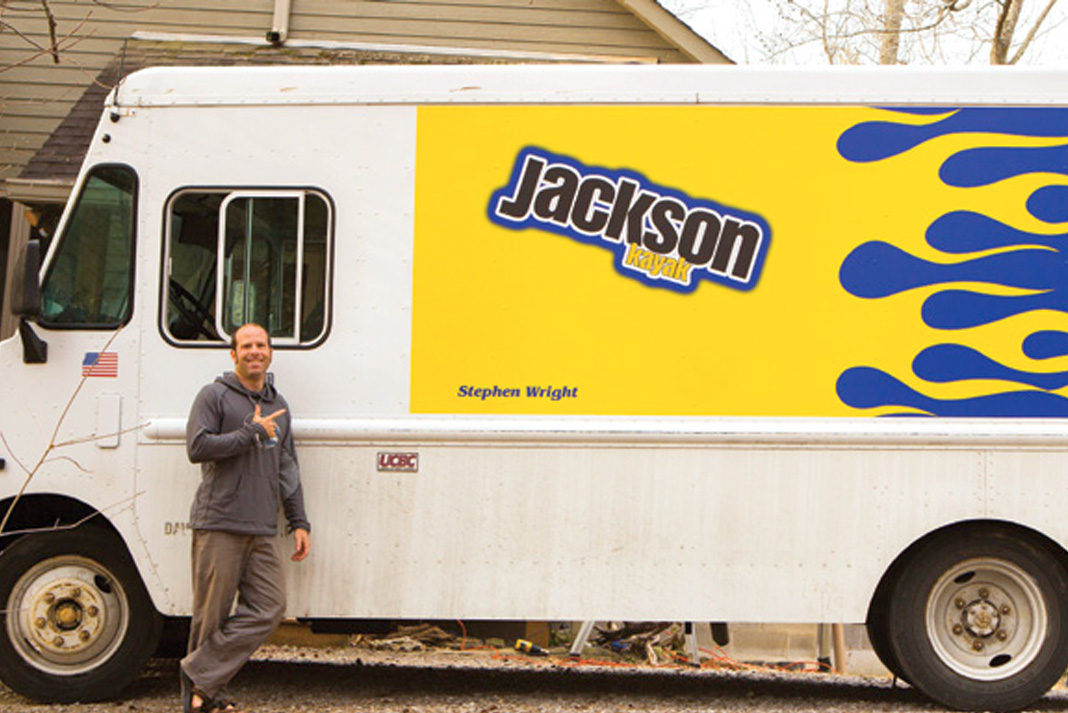
4 Beast
Stephen Wright is a three-time U.S. National Freestyle champion and Jackson Kayak athlete who spends a lot of time on the road, traveling to and from his hometown of Vienna, VA. When the engine on his first shuttle vehicle, a Toyota Corolla, overheated and exploded, Wright knew he needed something to keep up with the demand. “I was planning to quit my real job and just make my way traveling and kayaking,” says Wright, “I wanted something I could sleep in and carry most of my stuff.” When this Hostess delivery truck came up on eBay, he knew it was the one.
Vehicle name: Beast
Vehicle make/model: Freightliner MT35
Original vehicle cost: $7,000
Reno cost: $2,000
Occupancy (people): 2–3
Occupancy (boats): Many!
Essential features: “I soundproofed the engine compartment, added a passenger seat, radio, solar panel and LED interior lights. I added insulation, wall paneling, laminate hardwood flooring, a futon bed and new back door, cut two windows, two vents, and will eventually add a table, cabinets, stove, roof racks and more—I’m basically building a small RV.”
Memorable moment: Wright’s first drive in Beast was almost 1,700 miles from the seller in Texas to Philadelphia, with the speedometer maxing out at 52 miles per hour. He’s since swapped the transmission.
Photo: Tommy Penick
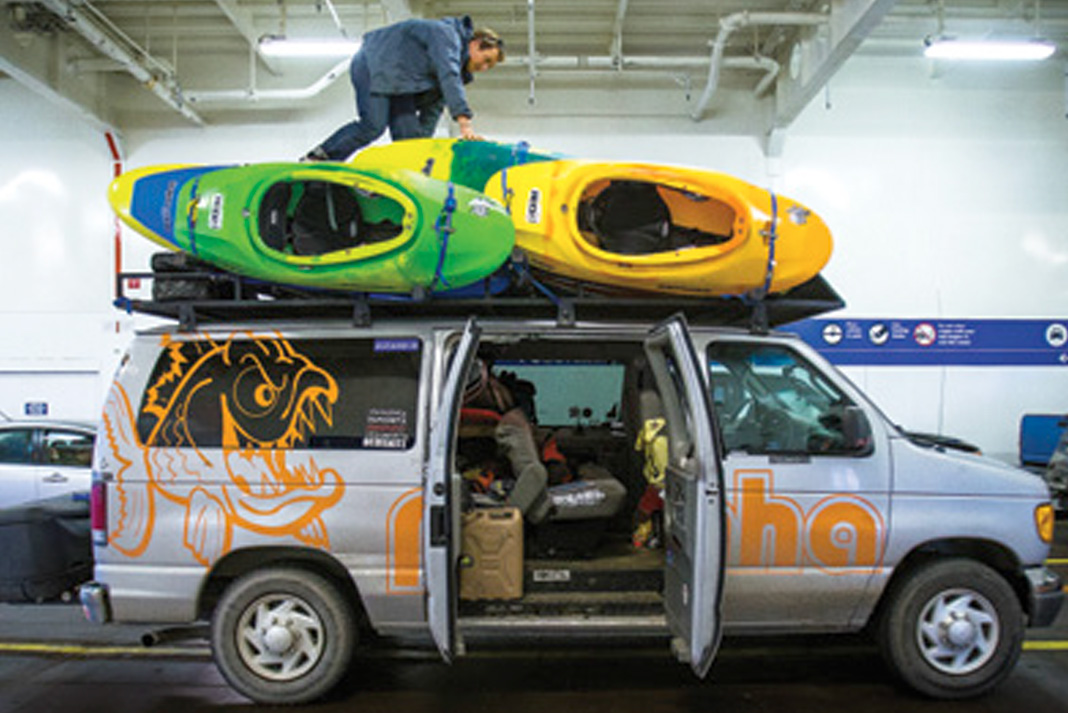
5 Orange B!tch
If you’ve been to any number of kayaking festivals around North America, chances are you’ve seen Dave Fusilli. The Fayetteville, WV, native spends his year touring to festivals and running rivers. “It’s my eighth year traveling the good parts of the USA kayaking,” Fusilli says. Pyranha handed over the keys and a gas card as part of a sponsorship deal and Fusilli hasn’t looked back.
Vehicle name: Orange Bitch
Vehicle make/model: Ford 350
Odometer reading: “I have put about 200,000 miles on it,” says Fusilli. “Almost entirely kayak trips.”
Essential features: Fusilli added a box onto the back of the van for wet gear. “There are some crazy smells that come out of that damn box—we call it the Gnar Box.”
“I find all kinds of gear that is not mine back there,” says Fusilli. “Usually I just sell it to someone in need.”
Occupancy (people): “Three is the magic number and five is pretty stressful.”
Occupancy (boats): 12–20
Memorable moment: “One time, the windshield fell off when it was dumping rain. We went kayaking and dealt with it later.”
Photo: Kaydi Pyette
6 Grey Goose and Whiskey Militia
Kyle Smith and Dan Whillans migrate to the Madawaska Valley every spring for a season of surf. Just minutes from the Rapid office, their trailers are parked a mile from the local river and they commute to and from the shore in a muffler-less Subaru Forester. “I live in my trailer for five months of the year,” Smith says, “then I move to where the weather is better and living is cheap.”
Vehicle name: Grey Goose and Whiskey Militia
Vehicle year/make/model: 1965 Golden Falcon 13.5’ and 1974 Jayco 15’
Essential features: No electricity, no indoor plumbing—no problem. These guys have a sunset view of the river valley and 240 acres of scenery unrolling around them. Trailer renos included removing a family of mice, hanging some curtains and adding a custom paint job.
Occupancy (people): “Sleeps five, so tell your friends.”
Occupancy (boats): The Subaru maxes out at six boats and five boaters.”
Memorable moment: “Sunset sessions.” Every night paddlers from the area head to the trailers with guitars and drums to watch the sun set over the river valley’s rolling hills.
This article was first published in the Summer/Fall 2014 issue of Rapid Magazine. Subscribe to Paddling Magazine’s print and digital editions, or browse the archives.
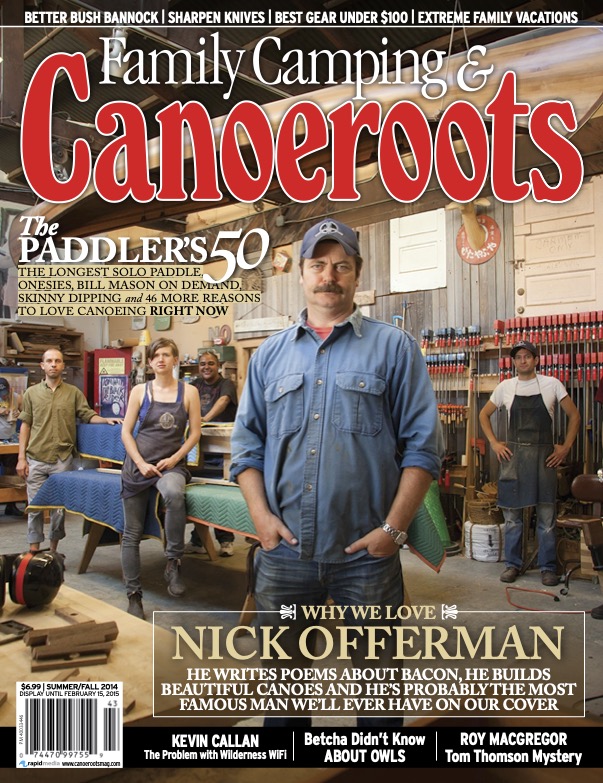
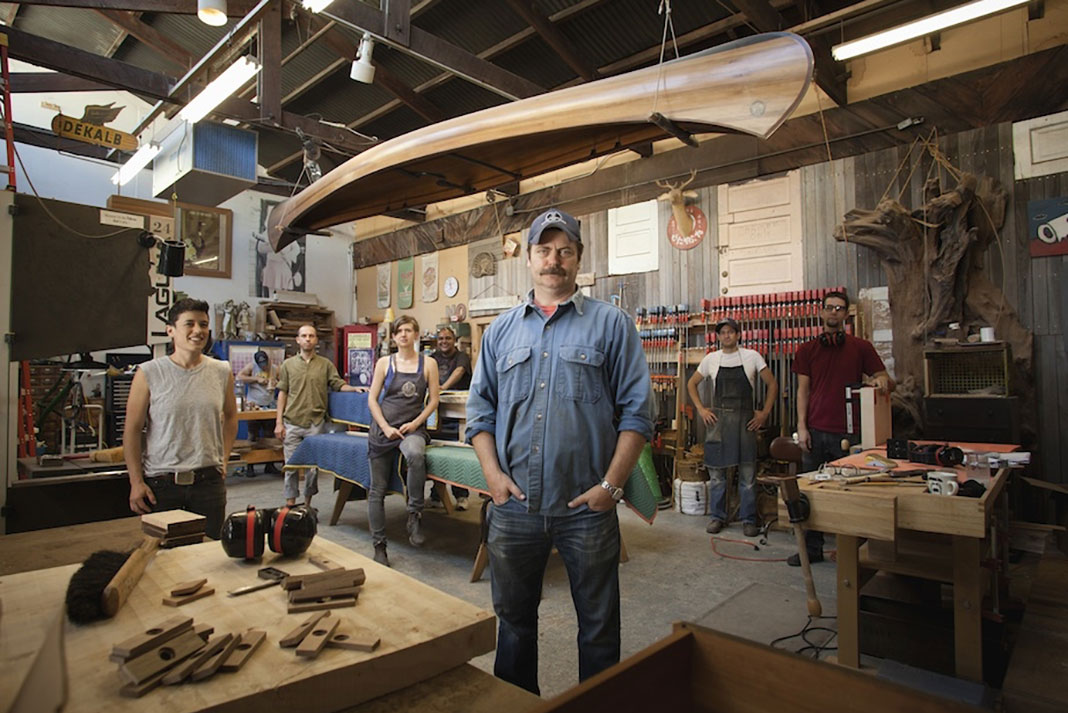
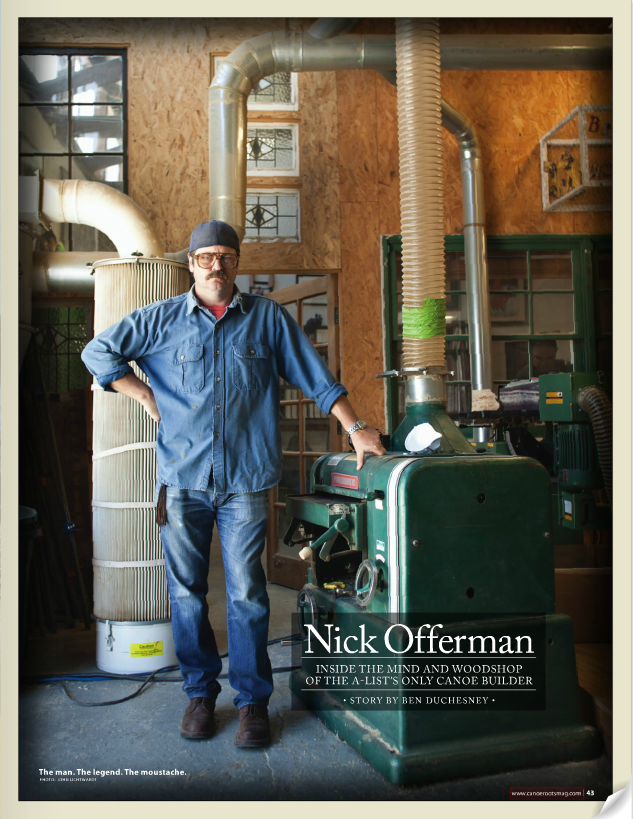
The cast of characters at Offerman Woodshop.| Feature photo: John Lichtwardt
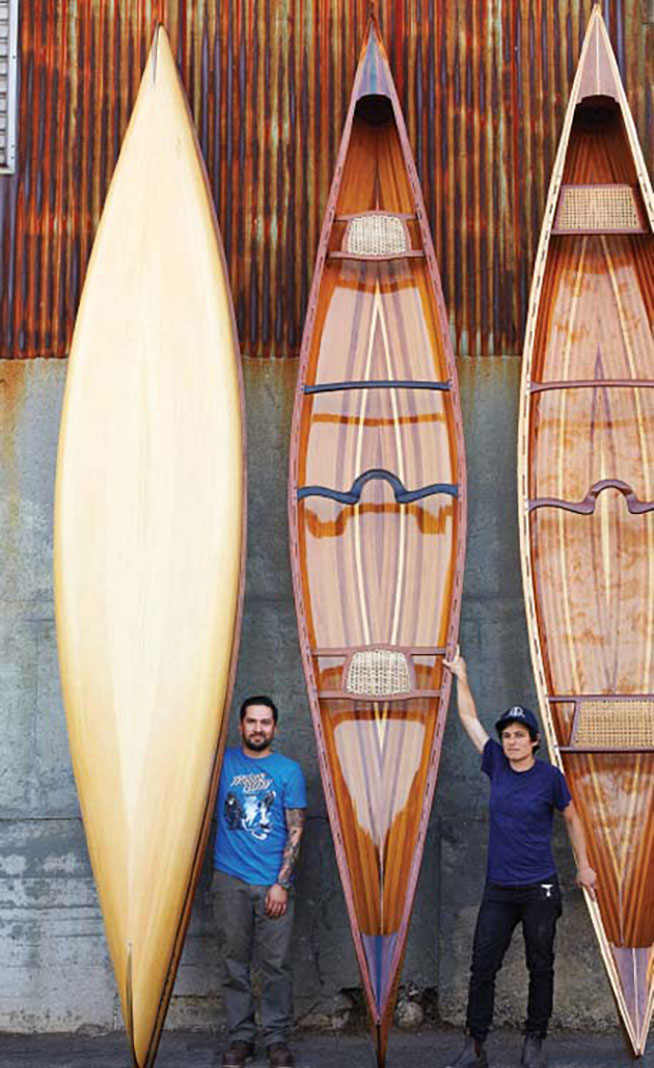
Amidst the beautified bombshells and out-of-touch actors of Hollywood Boulevard stands a man who goes against the grain—the wood grain. When Nick Offerman is not playing burly and beloved Ron Swanson, his character on the hugely popular NBC television show Parks and Recreation, he is busy inside Offerman Woodshop building cedar-strip canoes and custom furniture pieces.
It’s not just comedic prowess and perfect deadpan delivery that has given the 44-year-old actor a cult following, it’s also his bacon-and-eggs-loving, Paul Bunyan-esque persona, an alter ego he embraces.
Off Parks and Rec, Offerman has starred in box office hits, including 2014’s We’re The Millers, and off-Broadway productions alongside his comedian wife, Megan Mullally, known for her role on sitcom Will & Grace. Offerman also tours the country, performing his one-man comedy show, “American Ham.”
Though acting is one of his great loves, Offerman’s time woodworking and paddling is his greatest medicine.
“In the middle of this insane business—the entertainment industry is so full of ugly, superficial bullshit—to escape into my shop and build something with my hands, just feels like medicine.”
“Woodworking is an incredibly Zen discipline,” says Offerman. “In the middle of this insane business—the entertainment industry is so full of ugly, superficial bullshit—to escape into my shop and build something with my hands, out of the organic material that trees provide, just feels like medicine. It feels like I’m rubbing Neosporin on the open wounds of my artistic soul.”
For Offerman, canoeing goes way back
Born in Joilet, Illinois, Offerman grew up in a family of hardworking farmers, public servants, schoolteachers, nurses, paramedics and firemen. “My whole family learned that to have a good time on a meager income, all we had to do was find a place to experience nature as richly as possible,” he says.
“No matter where I am, or how stressful or high-octane my life has become,” Offerman adds, “just getting out in nature and breathing in the smells, sights and sounds is incredibly healthy and therapeutic.”
As a struggling actor during his thirties, Offerman used manual labor to pay the bills and discovered he had a natural talent for carpentry. As his interest in woodworking increased, Offerman was drawn to building a canoe.
“The canoe was the Fender Stratocaster of my young, watersports life. Canoeing down the creeks in my neighborhood was the ultimate escape,” he says. “It was only natural, given the choice of building any boat style, that I would gravitate towards the canoe.”
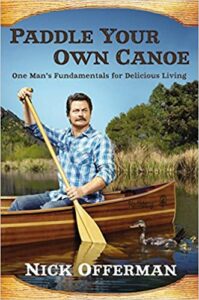
In his book, Offerman gives another reason for his love for canoes: He lost his virginity in one. “Is it any wonder that I have grown to become obsessed with building wooden canoes and luxuriously running my hands along their hulls?” he writes.
With an itch to build a canoe, Offerman went looking for help. “All the research pointed towards the book Canoecraft by Ted Moores, who runs Bear Mountain Boats with his partner, Joan Barrett,” he says.
Moores and Barrett saw Offerman as more than a customer and requested he use his confidence in front of the camera to make a how-to video for other would-be boat builders.
The cast of characters at Offerman Woodshop.| Feature photo: John Lichtwardt
“I felt like Luke Skywalker and Obi-Wan Kenobi were suggesting I make a lightsaber instructional video,” says Offerman.
He visited the Bear Mountain Boats workshop in Peterborough, Ontario, to meet the couple and pick up his materials. Back in New York, Offerman began building a red cedar strip canoe he named Huckleberry while filming the process. The 126-minute “Fine Woodstrip Canoe Building with Nick Offerman” was released in 2008, and won the Paddling Film Festival’s best instructional film award.
Taking a vacation from fame
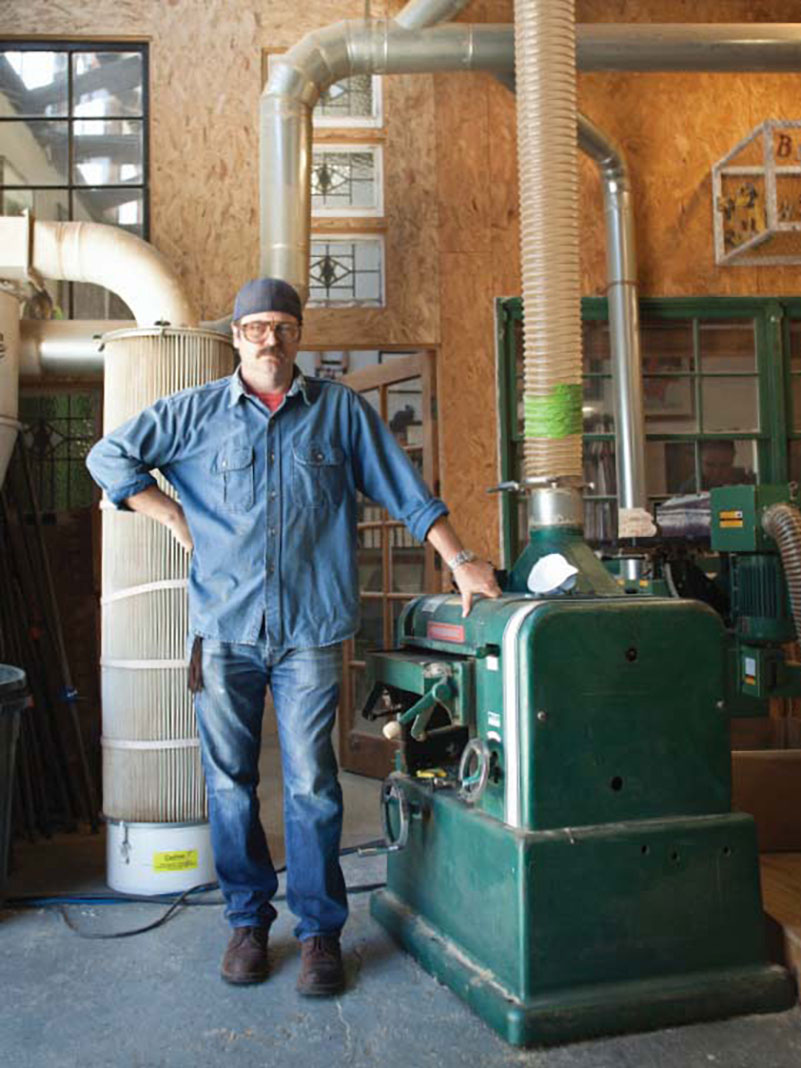
Living in Los Angeles, Offerman spends as much time as he can in his 3,200-square-foot woodshop in between shooting episodes of Parks and Rec. Now that Offerman Woodshop has a staff of woodworkers, he spends less time elbow-deep in sawdust and more time as a mentor.
Though Offerman claims he’s not the only canoeist in Hollywood, he can’t name names—“I’m sworn to secrecy.”
“I design a lot of our pieces and advise on how best to create them,” says Offerman with audible enthusiasm. “I envy them though, that they get to enjoy all the hours of actual, hands-on card scraping.”
Though Offerman claims he’s not the only canoeist in Hollywood, he can’t name names—“I’m sworn to secrecy,” he says. He doesn’t do much paddling while he’s in L.A., but each year he escapes with his family on an annual trip to Minnesota, staying in rustic fishing cabins.
“Growing up in a pretty thrifty farm family, I never would have known they were rustic—that’s from the point of view of living in Los Angeles and having been spoiled by the ridiculous thread counts my wife has introduced me to,” he says.
Offerman Woodshop’s canoes make frequent cameos on Parks and Rec. | Photo: Blake Little
There’s nothing fancy about these vacations, but that’s fine with Offerman. “You can’t beat the landscape, water, forest and sky of Minnesota’s North Woods, combined with the camaraderie of family, fresh fish, plenty of beer and libations and euchre,” says Offerman. “I’ve been all over the world on expensive vacations and I’ve never found a recreation to beat those Minnesota activities.”
These vacations are also a chance to shed his famous alter ego, including shaving off Ron Swanson’s trademark moustache.
“As an actor, I’m not Ron Swanson,” says Offerman. “I love to shave it off; I love to shave my entire head at the end of a season, if I can. It turns out that my clean-shaven face is the ultimate disguise. I love playing Ron, but when we shut off the lights at the end of a season, I love peeling him off like a mask.”
Still, the moustache comes with its fair share of benefits. When asked how important facial hair is to being a good canoeist and outdoorsman, Offerman replies, “Incredibly important,” without missing a beat. “On the left hemisphere of my moustache I store beef tallow, which can provide calories if I should get lost or I can fashion a small candle out of it. It’s a great survival item,” he deadpans. “On the right side, I store a few ounces of epoxy resin, in two parts, so that if I am fishing for a marlin and it should puncture my hull, using the whiskers and the resin, I can fashion a quick little fiberglass patch.”
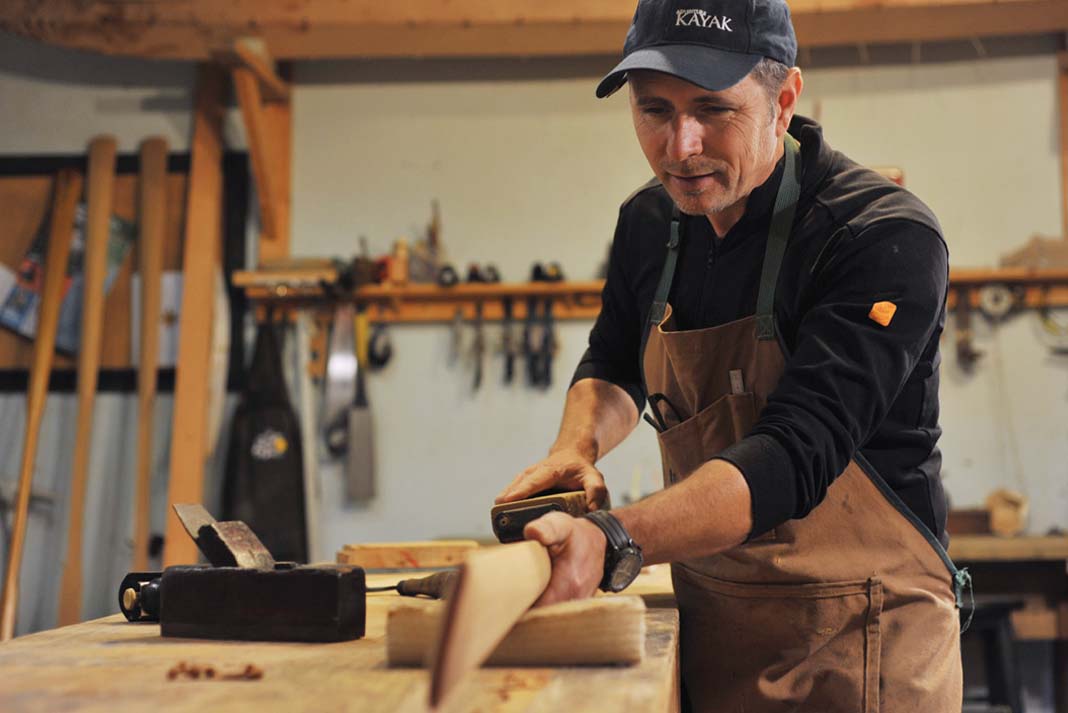
For paddlers interested in building their own canoe, Offerman recommends more than just growing a moustache (“Though it will help,” he advises). “A paddle is a great place to start; that’s where you can get hooked.” Once familiar with the basic tools of woodworking, a canoe is much less daunting.
“Ted Moores put it well,” Offerman says. “He says, ‘Don’t look at the whole thing; don’t look at the skyscraper as a whole. Look at each piece, one at a time. A concrete foundation, some steel girders—you can only do one piece at a time.’ When you break it down like that, it’s a lot less daunting. You might feel like, ‘God, I don’t think I could make a Corvette, but I know I could thread the lug nuts onto that wheel.’ Building a Corvette is only a sequence of lug nuts when you get down to it.”
The man. The legend. The moustache. | Photo: John Lichtwardt
Offerman is looking forward to his next personal woodworking project, a 17-foot sleek and modern kayak design called the Endeavor.
When paddling, Offerman says he feels a direct kinship with his ancestors and the natural world. “Lest we get too cocky, though,” he writes in his book, “as soon as I start to think this way Ma Nature slaps me with a squall and dumps my canoe over a submerged tree trunk, reminding me that behind that spoke shave there still stands a jackass.”
Ben Duchesney is the former web editor of Kayak Angler. He’s a fan of Nick Offerman, Parks and Recreation and bacon.
This article originally appeared in the Summer/Fall 2014 issue of Canoeroots Magazine. Subscribe to Paddling Magazine and get 25 years of digital magazine archives including our legacy titles: Rapid, Adventure Kayak and Canoeroots.
The cast of characters at Offerman Woodshop.| Feature photo: John Lichtwardt
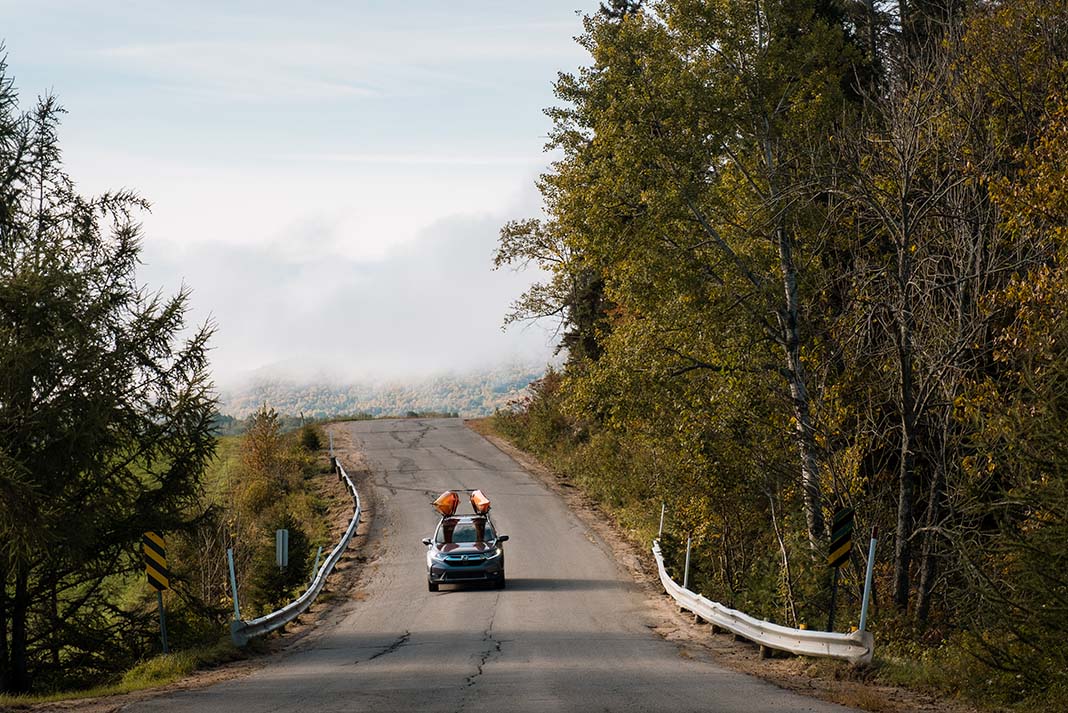
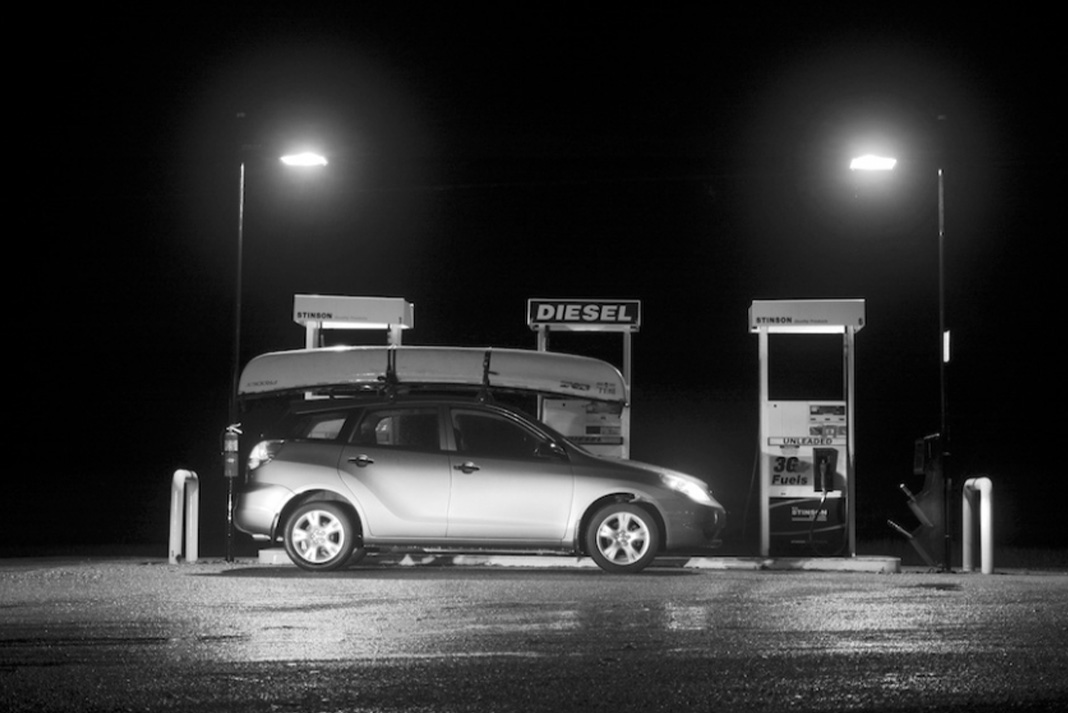
With gasoline prices in America at an all-time high, fillin’ ‘er up can feel like a punch in the gut. The added wind resistance of a car-topped canoe can be even more of a drag on your finances. With these challenges in mind, you can still find ways to save money at the pump on your way to the put-in.
On a recent trip, my fuel economy dropped by six miles per gallon, about 25 percent, with a single car-topped Prospector. With local gas prices hovering around $5 per gallon, the round-trip fare for my canoe alone cost $60—equal to the cost of renting a canoe for my weekend trip.
The decrease in gas mileage with a car-topped canoe varies with vehicle model, ranging from five to 25 percent according to the U.S. Department of Energy.
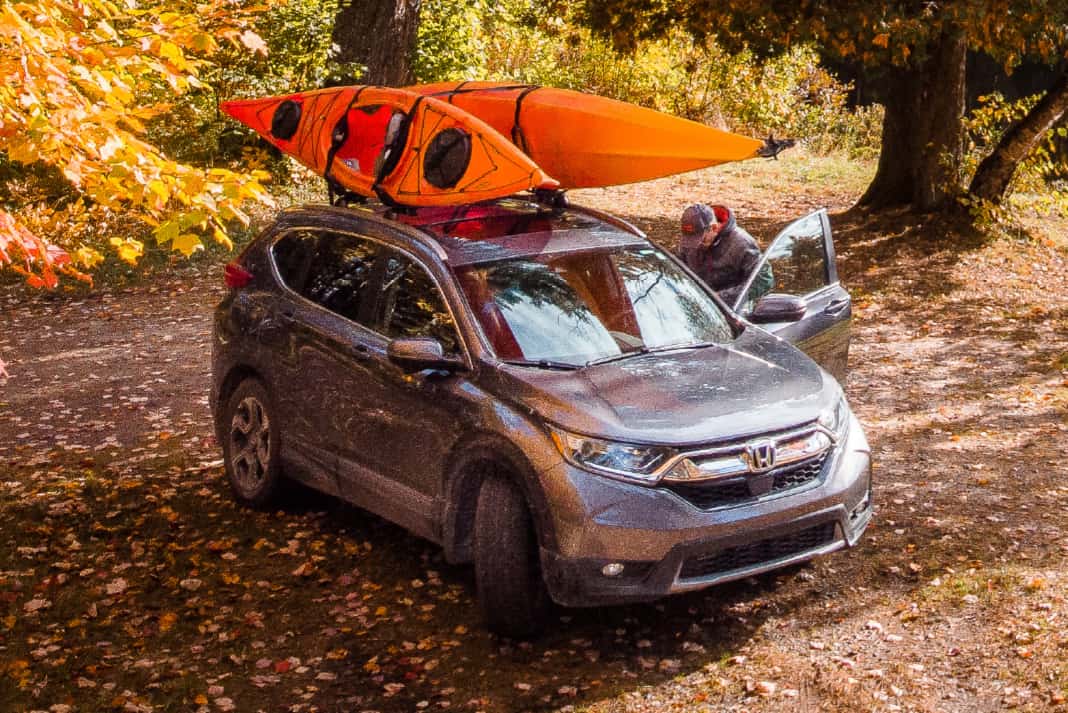
“You’ll really notice a decrease in efficiency if you’re driving an aerodynamic design, like a Prius. A Ford F-150 is barely going to notice the difference with a canoe up top,” says Dave Condon, senior design engineer for Yakima. “If a vehicle has been created to move very efficiently and you add a boat, you’ve just added a lot of drag; a little Honda is going to suffer far more than a big rolling brick.”
Your mileage may vary. | Feature photo: Kaydi Pyette
The shape and size of your boat, tie-down method, road conditions and terrain, as well as wind direction and speed are all variables that will also affect your mileage.
To get the most distance for your dollar, Condon recommends a dedicated system for transporting your boat, such as roof racks or a trailer. Though trailers have a larger ecological footprint, they offer better fuel economy because they cruise in the slipstream behind your car.
DIY techniques to improve efficiency
Canoeroots readers shared stories of experimenting with their own DIY hacks for making the gallons last, including transporting canoes with inflated flotation bags and spray decks to create a more aerodynamic shape. They reported marginally better fuel economy with than without.
However, the most effective way to increase fuel economy is unfortunately also the least popular—get out of the fast lane.
“Taking the back roads, compared to driving at 70 miles per hour on the freeway, will increase your mileage,” advises Condon. “The power required to push a car (and boat) through the air increases exponentially with increased speed.”
This means that wind resistance increases more between 70 and 80 miles per hour than it does between 50 and 60. Just slowing down from 65 to 55 miles per hour can increase your fuel economy by as much as 15 percent—that’s mileage you’ll need if you’ve got a car-topped canoe.
This article was first published in the Summer/Fall 2014 issue of Canoeroots Magazine. Subscribe to Paddling Magazine’s print and digital editions, or browse the archives.
Your mileage may vary.| Feature photo: Kaydi Pyette
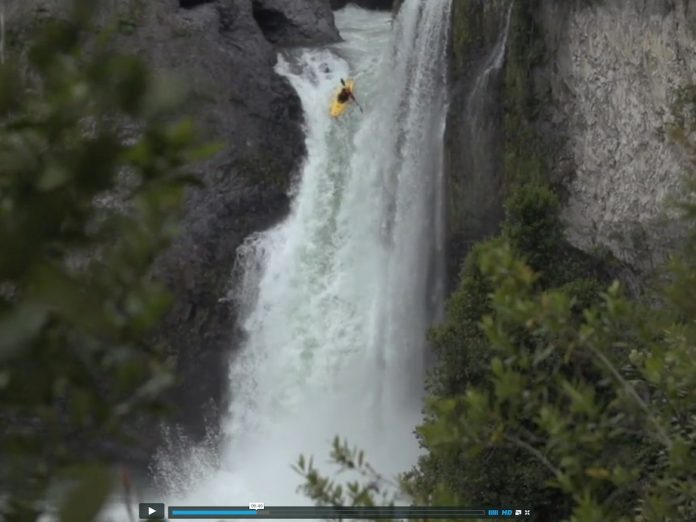
“The Siphon of Pucon is a retentive force of massive proportion. Epic paddling, beautiful scenery, night life, and yes…The big white Volcano! For the past 8 years I have continuously been pulled back into The Siphon mercilessly. Once you are able to break free of this powerful force and explore the rest of Patagonia you will be rewarded with -> The Tour de Stout…Back to Back to Back -> River to River you go carelessly running the brown and getting SUBSTANTIAL! Enjoy on one the best seasons Chile has blessed us with and relive some of the craziest moments we have ever captured on film.
Shot by: Evan Garcia, Ryan Lucas, Aniol Serrasolses.
DryVIBES is salt-proof, sand-proof, dust-proof, and waterproof.
Rock out on the water with the newest speaker from DryCASE, the manufacturer of waterproof electronic cases. Their new DryVIBES, $79.99, is “a compact, yet powerful waterproof speaker system that allows you to connect to your playlists while hanging by the pool, out on the water, or in the shower.”
More importantly, DryVIBES is salt-proof, sand-proof, dust-proof, and waterproof. An attached suction cup allows the DryVIBES speaker to mount right onto your kayak and a built-in waterproof microphone doubles as a speakerphone. Now you can make calls even while paddling (unless it’s a work call, then you can say it doesn’t make calls, sorry boss).
In the days when playboats were more than eight feet long, when freestyle was called rodeo and pirouettes were a hot move, paddlers had a problem.
It was the early 90s, and the Pro-Tec and Wildwater helmets of the day worked well for protection but did little for sun protection.
People layered baseball caps under their helmets to add a brim, but the pressure of the hats’ buttons pressing into their skulls meant every paddling session ended with headaches.
Around the same time, Patrick Kruse sat in his Seal Beach, California, basement apartment trying to solve a dilemma of his own: how to launch his startup gear company into the world of whitewater and stand out against other manufacturers.
A paddler himself, Kruse had heard complaints about the baseball cap conundrum.
After a two-day flurry of cardboard and fabric cutting and pasting, he emerged with a design that would push his new business into the mainstream.
The Salamander brim was a hit.
For years, every Dagger Crossfire and Perception Pirouette contained a paddler whose helmet had a sticky Velcro strip and colorful, three-inch, foam-filled visor.
It came out in more and more colors and jungle and hibiscus patterns that would’ve made the Fresh Prince proud.
More than two decades later, the same brim comes with the same Salamander logo on the same 600-denier poly-cloth and Volara foam with Velcro-705 molded hooks, as when Kruse first designed it.
It remains on Salamander’s best seller list and is easily the company’s defining product.
In the late ‘90s though, helmet companies like Orosi started catching on—modern helmets emerged with built-in brims and started turning heads.
The Salamander does offer one advantage over built-in brims, says current owner, Shane Preston, who’s been with the company for six years. “If a kayaker is upside down, the bill will actually flip back rather than catch the water and yank your head back.”
Today, companies like Sweet Protection, WRSI, Shred Ready and Predator all make brimmed buckets of their own. But Salamander lives on.
The company still sells 2,500 visors every year, although for the most part, it’s not us buying them.
“To be 100 percent honest, it’s the horse industry—they love these things,” says Preston.
Salamander now sells 20 times more brims to its equestrian market than to whitewater paddlers. The visors fit on riding helmets just as well as they once did on whitewater helmets.
He’s also selling to bike and ski shops.
“For the hot kayakers, not too many kids are wearing them because they’re a little dorky looking,” Preston says. “But they work. You can’t deny that it gives you some nice protection.”
Salmander’s original visor designer Patrick Kruse now runs a company called Ruffwear selling performance dog gear in Oregon.
Three years ago on a hot summer day he was driving down Highway 395 towards Red Rock Canyon when a giant grin spread across his face. On the side of the road he saw a crew of 20 or so road workers, each with a bright red Salamander visor Velcroed to their hardhats.
This article first appeared in the Summer/Fall 2014 issue of Rapid Magazine. Subscribe to Paddling Magazine’s print and digital editions, or browse the archives.



 This article was first published in the Summer/Fall 2014 issue of Canoeroots Magazine.
 Discover 49 more of the coolest people, gear and innovations in canoeing this year in the digital edition of Canoeroots and Family Camping, Summer/Fall 2014, on our free

 This article was first published in the Summer/Fall 2014 issue of Rapid Magazine.
 This article originally appeared in the Summer/Fall 2014 issue of Canoeroots Magazine.