Home Blog Page 291

DIY Fire Starters

Photo: Kaydi Pyette
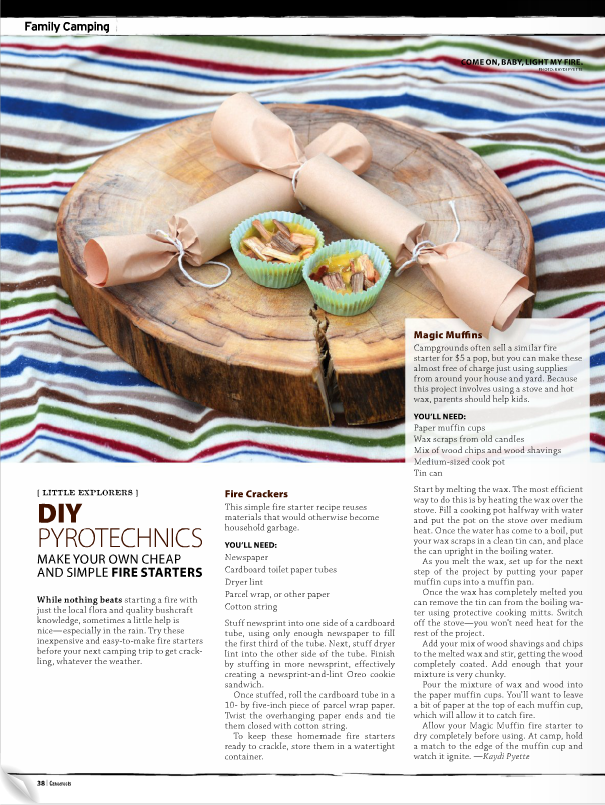
Homemade firestarters
This campcraft article about how to make homemade fire starters was first published in Canoeroots and Family Camping magazine. 
While nothing beats starting a fire with nothing but the local flora and quality bushcraft knowledge, sometimes a little help is nice—especially in the rain. Try these inexpensive and easy-to-make fire starters before your next camping trip to get crackling, whatever the weather.
 

Fire Crackers

This simple fire starter recipe reuses materials that would otherwise become household garbage.
 
You’ll need:

Newspaper

Cardboard toilet paper tubes
Dryer lint
Parcel wrap
Cotton string

Stuff newsprint into one side of a cardboard tube, using only enough newspaper to fill the first third of the tube. Next, stuff dryer lint into the other side of the tube. Finish by stuffing in more newsprint on that side, effectively creating a newsprint and lint Oreo cookie sandwich.

Once stuffed, roll the cardboard tube in a 10- by five-inch piece of parcel wrap paper. Twist the overhanging paper ends and tie them closed with paper string. Ta da—your fire starter is complete.

Magic Muffins

Campgrounds often sell a similar fire starter for $5 a pop, but you can make these almost free of charge just using ingredients from around your house and yard. Because this project involves using a stove and hot wax, parents should help kids.

You’ll need:

Paper muffin cups
Wax scraps from old candles
Mix of wood chips and wood shavings
Medium-sized cook pot
Tin can

Start by melting the wax…


Screen_Shot_2014-04-24_at_2.13.08_PM.pngContinue reading this article in the digital edition of Canoeroots and Family Camping, Spring 2014, on our free iPad/iPhone/iPod Touch App or Android App or read it on your desktop here.


Story Behind the Shot: Siren Song

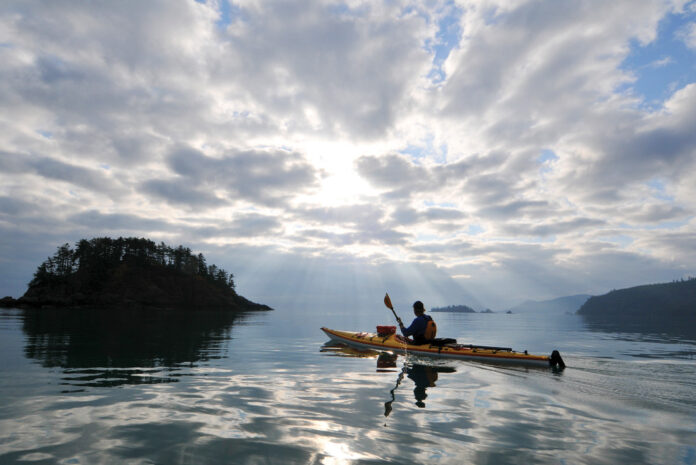
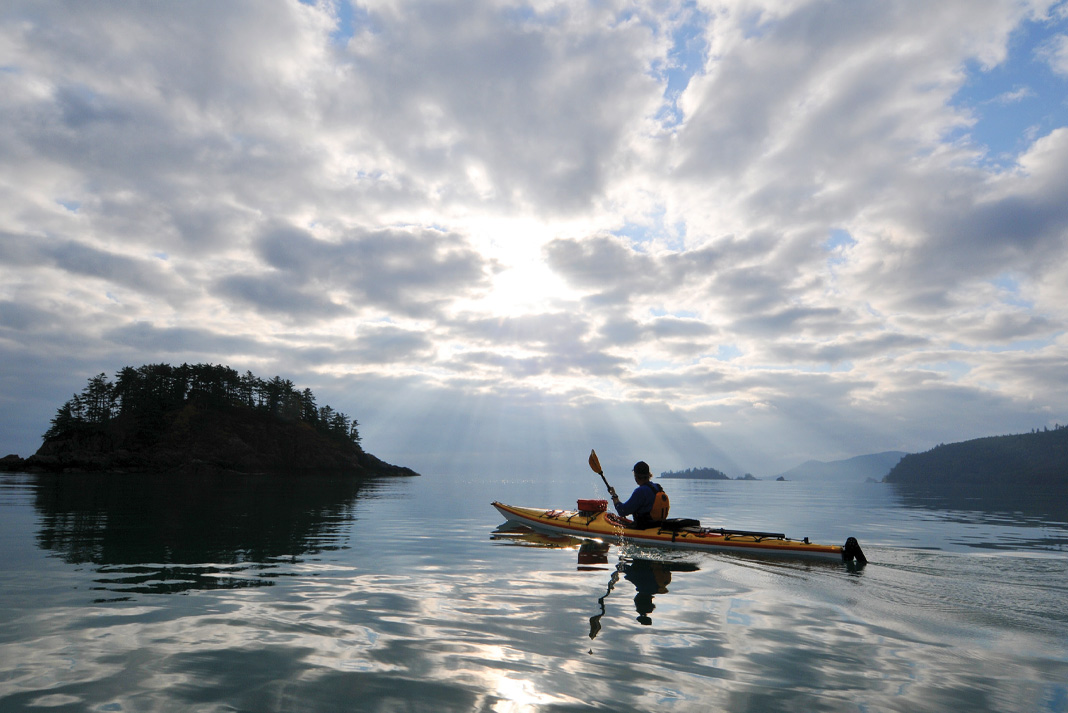
Story Behind the Shot: Siren Song | Photo: Dave Quinn

All Alone Stone. A lonely islet with a lonely name, a microcosm of Haida Gwaii that sits like a siren in the middle of tempestuous Juan Perez Sound, on the eastern edge of the Gwaii Haanas protected area. Although crowned with a toupee of wind-sculpted spruce, the curved dome of this tiny islet has been stripped bare of vegetation for 30 meters by the fury of Hecate Strait’s storm-driven swell.

For nearly two decades the stone has fired my imagination, calling to me on literally dozens of kayak trips along the more sheltered coast of Moresby Island to the west. As I paddle past, the stone slides slowly by in the distance, encircled by breaching humpbacks, a pod of cruising orcas or a herd of rambunctious dolphins. but I never go out to it.

Until this past summer.

Bruce Kirkby and I were in Gwaii Haanas, British Columbia, for a light and fast, four-day paddle mission, documenting the first traditional Haida monumental pole raising in the park area in 130 years. After leading guided trips in these unforgiving waters, it was sheer delight to be there with a strong paddling partner and no agenda.

Story Behind the Shot: Siren Song | Photo: Dave Quinn

On the second morning, Juan Perez Sound was glassy calm. We reached the All Alone Stone just as God rays burst through cracks in the grey sky. This made for tricky, high-contrast shooting—perfect conditions for the backlighting of this photo. I really wanted to capture the remoteness of the islet, but in the end, i opted for a simple silhouette of paddler and beckoning stone.

it is an image of contrasts: light and dark, hard rock and supple water, a lone paddler isolated in a vast marine wilderness, and a millpond in the stormy north Pacific.


AKv14i1 cover300This article first appeared in the Adventure Kayak, Spring 2014 issue. Subscribe to Paddling Magazine and get 25 years of digital magazine archives including our legacy titles: Rapid, Adventure Kayak and Canoeroots.

Gear: P-Tec Vizz HeadLamp

Photo: Kaydi Pyette
P-Tec Vizz head lamp

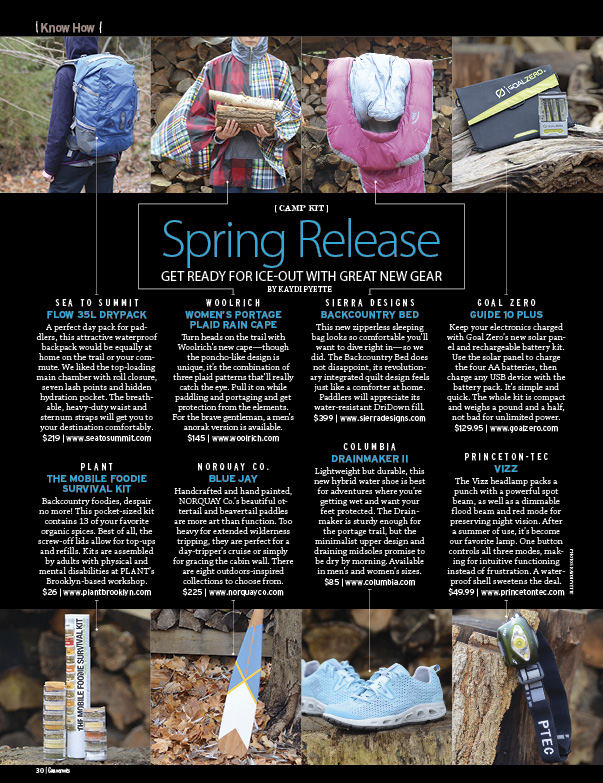
The Vizz headlamp packs a punch with a powerful spot beam, as well as a dimmable flood beam and red mode for preserving night vision. After a summer of use, it’s become our favorite lamp. One button controls all three modes, making for intuitive functioning instead of frustration. A waterproof shell sweetens the deal.

SPECIFICATIONS

POWER 165 Lumens
LAMP Maxbright LED, Ultrabright White LED, Ultrabright Red LED
BURN TIME 150 Hours
BATTERIES 3 AAA Alkaline or Lithium
WEIGHT 92 Grams

$49.99 | www.princetontec.com


CRv13i1-30 This article originally appeared in Canoeroots and Family Camping, Spring 2014. Get more great gear reviews by downloading our free iPad/iPhone/iPod Touch App or Android App or read it on your desktop here


Turn Faster with this Sea Kayak Stroke

Photo: Screen Capture
A screenshot of a smiling Leon Somme from their skills video explaining turning strokes for sea kayaking.

Turning a sea kayak effectively is an important skill to acquire so you can quickly change directions. Whether you want to snag a passing wave for a surf, or reach a fellow paddler in distress, the Haghigi is one of the best and quickest methods for getting to your destination point. The Haghigi was a name given to this low-angle stroke by Leon Somme of Body Boat Blade International (hyperlink) as it was taught to him by his dentist, Dr. Haghigi. This instructional video gives you multiple vantage points to begin practicing this kayak stroke without even having to get into your boat. It will not only help you turn a kayak quickly but will test your upper and lower body seperation and allow you to brush the rust off everyone’s favorite – the low-brace.


See more kayak techniques on Body Boat Blade International’s YouTube channel.


Skill Video: Kayak Momentum

Photo: Screen capture Whitewater Troubleshooter - Momentum - Episode 4
Skill Video: Kayak Momentum


When a student who has been paddling for a while expresses that they want better boat control, they are specifically referring to their ability to make the boat move the way they want relative to the current. When they say they want the ability to read water better, they mean they want to know how to identify and utilize how the motion of the boat relative to the current’s momentum will make them move through the river and its features.

In this video, we take a different approach to the typical progression and discuss why the boat moves the way it does through the physics of the hull and our stroke-work.


Chris Wing has been an instructor for as long as he has been a kayaker. He started H2o Dreams out of a desire to spur growth and reverence for paddle sports education all while providing a different spin to the presentation of familiar topics. Visit www.whitewaterdreams.com for more info or follow H2o Dreams on Facebook and Twitter


 Click for more pro tips on whitewater skills. 


Gear: Sea To Summit Flow 35L

Photo: Kaydi Pyette
Sea to Summit Flow 35 L backpack waterproof

A perfect day pack for paddlers, this attractive waterproof backpack would be equally at home on the trail or your commute. We liked the top-loading main chamber with roll closure, seven lash points and hidden hydration pocket. The breathable, heavy-duty waist and sternum straps will get you to you destination comfortably.

Features:


  • Waterproof, abrasion resistant, TPU laminated 420D nylon fabric
  • Top loading roll top main chamber
  • Fully seam sealed construction
  • White interior for improved visibility of contents
  • Internal zippered stretch fabric pocket for small items
  • Ergonomic integral back panel
  • Ventilating, perforated shoulder straps
  • Removable padded waist belt
  • Large top handle for comfortable lifting
  • Easy access hydration compartment


$219 | www.seatosummit.com 


CRv13i1-30 This article originally appeared in Canoeroots and Family Camping, Spring 2014. Get more great gear reviews by downloading our free iPad/iPhone/iPod Touch App or Android App or read it on your desktop here

Frozen Oceans

Words & Photos: Steve Ruskay
Frozen Oceans

It only took three hours once I witnessed the first bits of ice being pulled into the fjord by the relentless ocean currents. This morning, the Agnassalik Fjord of Eastern Greenland was virtually ice-free. Now, this five nautical mile-wide passage was completely ice choked. Despite my efforts of navigating leads and bulldozing ice with my kayak, I was stuck. Very stuck. What would normally be an easy paddle back to shore was an exhausting struggle through an icy Arctic maze.

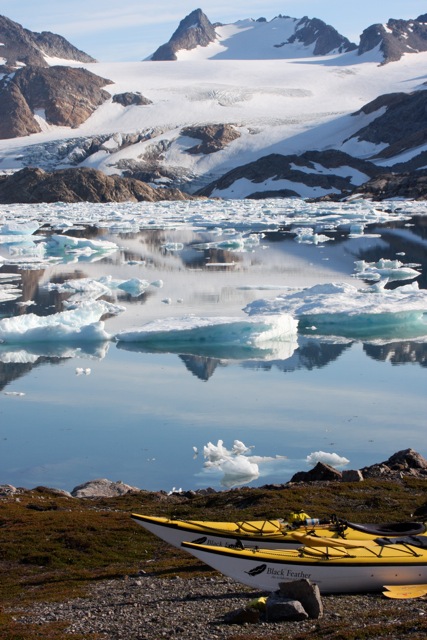
Ice has dogged mariners for centuries, brought feast or famine for ancient nomadic Inuit hunters, and stumped modern-day sea kayak explorers. One of the most fascinating and beautiful parts of high Arctic paddling can easily and quickly become one of the most dangerous. There are two main types of ice that the Arctic paddler—or even those stretching the season further south—might encounter, and each presents its own characteristics and hazards.


Sea Ice is the leftover frozen ocean from the previous winter’s freeze up. Chunks of ice, up to two meters (six feet) thick, float low and flat to the water surface. These chunks can drift close together to form an impenetrable pack, or slowly melt away by themselves. Sea ice pieces are generally quite stable, and are not likely to tip over or roll. If necessary, paddling close to sea ice is possible. When sea ice gets packed together, or is moved quickly by wind or current, it presents hazards to kayakers and mariners alike. Even relatively little ice coverage with any ocean currents possesses the ability to crush or strand a kayaker, turning a beautiful paddle into an extreme situation.


Berg Ice is formed on land as a glacier, and is calved from the toe of a tidewater glacier into the ocean. After thousands of years of snow accumulation, glaciers grow to be several hundred meters thick. The Greenlandic Ice Sheet is close to 3,000 meters (10,000 feet) thick, and produces the largest icebergs in the Northern Hemisphere. Icebergs can be as large as several city blocks, and can tower hundreds of meters out of the water. Even with the largest bergs, 75 percent of an iceberg’s mass is below the surface. As an iceberg drifts in the ocean currents, it melts faster below the water line, causing the berg to become top heavy. Without warning bergs can roll over, or even break apart, presenting a spectacular eruption of ice and water. Avoid falling ice and sudden waves by keeping your kayak well away from icebergs.

To determine a safe distance, estimate the iceberg’s height out of the water and double it. For example, if the iceberg is estimated to be 20 meters (65 feet) in height, you should paddle no closer than 40 meters (130 feet) to it. This serves as a rough distance guideline for a minimum safe setback.
 

 IMG_9316.jpeg


After four days of observing the ice-choked bay from the same campsite, expedition days were numbered. With extremely precise timing of tides, currents and daylight, I was able to inch towards the new expedition objective—getting home! During the brief hour of slack water, and favoring the ebb, the ice along shore became open enough to sneak a pod of kayaks through.

This was no easy task. Each mile took almost our entire paddling window. Once the ebb currents had picked up and began moving thousands of pounds of ice around, sitting in a kayak was the last place you would want to be. Leads start to close, kayakers get separated and kayaks can easily and quickly be crushed.

Each remaining day presented a new, yet familiar challenge. With careful ice and water reading, the expedition had a successful and safe ending, not to mention invaluable lessons and experience from the world’s greatest instructor—the waters of the Arctic Ocean.


Steve Ruskay is a Kokatat Regional Ambassador, and the lead guide at Black Feather – The Wilderness Adventure Company. He spends his summers guiding sea kayak expeditions in the high Arctic.




Expedition Paddler: What’s in My PFD

Marc DeLuca

On March 1, 2014, kayakers Marc DeLuca and Jim Windle finished the entire 1,515-mile Florida Circumnavigational Saltwater Paddling Trail. In this video made during the trip, DeLuca reveals what essential items—stored within reach on his PFD—kept him safe and comfortable on the four-month journey.

The two retired police officers from Charlotte, N.C., began their trip Nov. 2, 2013 at Big Lagoon State Park near Pensacola and finished near Fort Clinch State Park just south of the Georgia border. They are the 12th and 13th paddlers to complete the entire trail since it opened in 2007.

“While thousands of people paddle short segments of the trail each year, we can appreciate the few who have the time and fortitude to paddle the whole thing,” said Donald Forgione, Director of the Florida Park Service, “It’s a huge accomplishment.”

The two men faced extreme weather, large ocean swells and some health scares. On day three, DeLuca’s kayak almost sank in rough seas due to a leaky rear hatch cover. They battled a case of influenza near Miami, and a serious foot infection requiring hospitalization almost sidelined Windle in St. Augustine. The two pressed on, vowing not to give up.

Despite the hardships, what they remember most is the coastal beauty and acts of kindness and hospitality along the way. “People opened their homes to us, offered food, and helped out in various ways,” Windle said. “You find out how important the little things are like a hot shower or clean clothes.”

DeLuca added: “We saw some of the most stunning coastal scenery in the country in a way few others have. Pods of dolphins escorted us almost every day.”

Designated as a National Recreation Trail, the Florida Circumnavigational Saltwater Paddling Trail educates paddlers about Florida’s rich history and fragile coastal environment. Following the Florida peninsula from Pensacola around the Keys to the Georgia border, this 1,515-mile sea kayaking paradise is often described as the saltwater version of the Florida National Scenic Trail. The trail highlights 37 of Florida’s 41 aquatic preserves and offers paddlers access to numerous state, national and local parks, seashores, wildlife refuges, marine sanctuaries and historic sites.

For more information on the Florida Circumnavigational Saltwater Paddling Trail, visit www.FloridaGreenwaysandTrails.com.

A multi-media blog capturing DeLuca and Windle’s experiences can be seen at http://KayakAroundFlorida.wordpress.com/.


High Water Holy Grail

The promised land of triple combos, beatdowns and bliss. Photo: Nick Troutman
High Water Holy Grail

“Dude, Gladiator is in. Get up here as fast as possible.”

The voicemail on my phone was from Joel Kowalski, the Ottawa River local who got me into kayaking 12 years ago.

Dane Jackson and I packed up his Sprinter van, rearranged our schedules for the next three weeks and made our way to the land of epic river waves and equally epic parties—Stakeout, the forefront of big air tricks.

Bare trees, melting snow and the roar of running water marked the end of our 23-hour, Red Bull-fueled migration. First stop, Glad- iator, as Joel had suggested. Our initial scout ended in an impossible discovery: the high water was too high!

Water was coursing through the river valley at levels unheard of in our generation of boaters—perfect for the purpose of our Stakeout started in the early 2000s when a group of kayakers, including Pat Camblin, Marlow Long and the crew of Young Gun Productions, went searching for the biggest river waves ever surfed. With no idea where to go, we joined up with Joel, Pat and Ben Marr and, during some pre-partying, made a wave hunting plan. The following days were spent searching bulging riverbanks for the perfect whitewater.

THE BEST WAVE ON EARTH

The first two waves, Bryson Bowl and Trailer Park Wave, offered lots of air and trick potential, but we wanted even more.

On the fourth day we learned that Lucifer’s was in—a wave known for epic beat-downs and massive air potential. We stuffed six people and nine boats into the Sprinter van and headed off. The wave packed a punch with a meat-eating hole on surfers’ left and an ocean wave-style green shoulder on your right. Insanely aerial tricks and technical combos happened between beatings, until we got some news that made us drop everything and move on.

The Ruins had flooded in with the perfect level to draw big wave paddlers from around the world. The parking lot was filled with boats, shuttle rigs and drying gear.

Those who have surfed it claim it to be the best wave on earth.

It was a blank canvas—Triple Airscrew, Bread and Butter-Airscrew, Airscrew-Bread and Butter, Flash- back-Airscrew-Clean Blunt—only imagination could limit the poten- tial. With triple combos as a goal, we lined up to link as many tricks as possible, throwing continuous combos that hadn’t been seen until recently on almost every ride.

As a final Stakeout miracle, the river Gods granted Gladiator levels just in time for the Ottawa XL, a qualifying competition for the Whitewater Grand Prix. Gladiator, the Holy Grail of Stakeout, has one of the biggest green faces known to man, ridiculous airtime potential and a frightening ledge hole behind it.

After three weeks of endless tricks and a new limit for what can be done in freestyle, it was time to move on. But when spring melt draws the waves back out of hibernation, you’ll find the same group making their migration, flooding to the banks for Stakeout, the greatest time of year.


Scott MacGregor is the founder and publisher of Rapid magazine. 

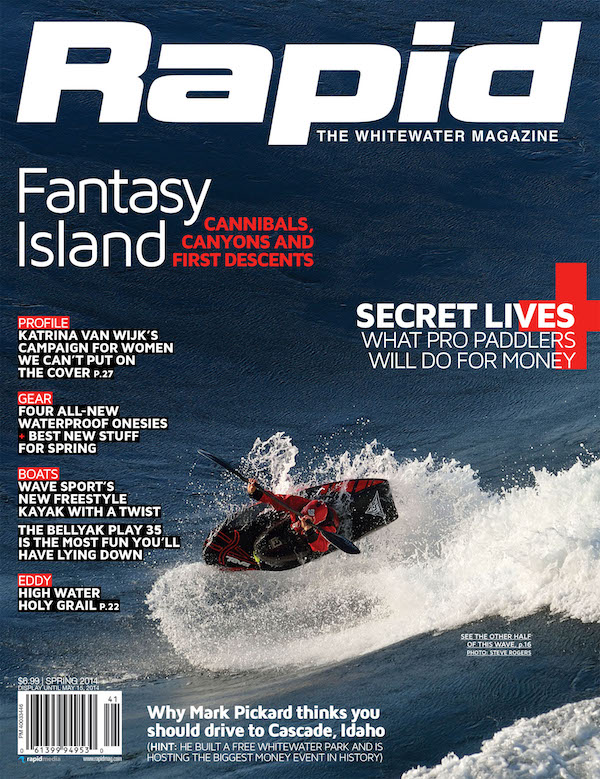
This article was first published in the Spring 2014 issue of Rapid Magazine. Subscribe to Paddling Magazine’s print and digital editions, or browse the archives.

Wenonah Advantage Canoe Review

Photo: Emma Drudge
Wenonah Advantage at sunrise

This boat review of the Wenonah Advantage canoe first appeared in the Spring 2014 issue of Canoeroots and Family Camping magazine. 

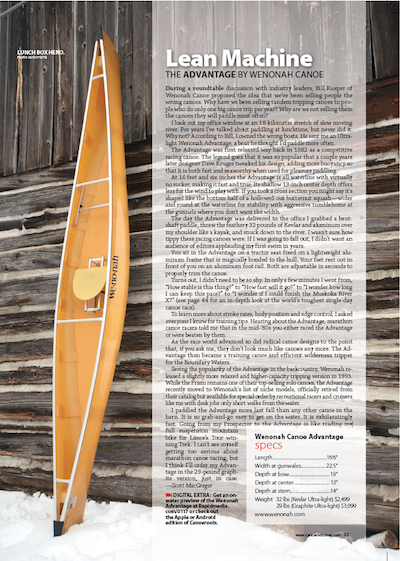
During a roundtable discussion with industry leaders, Bill Kueper of Wenonah Canoe proposed the idea that we’ve been selling people the wrong canoes. Why have we been selling tandem tripping canoes to people who do only one big canoe trip per year? Why are we not selling them the canoes they will paddle most often?

I look out my office window at an 18-kilometer stretch of slow moving river. For years I’ve talked about paddling at lunchtime, but never did it. Why not? According to Bill, I owned the wrong boats. He sent me an Ultralight Wenonah Advantage, a boat he thought I’d paddle more often.

The Advantage was first released way back in 1982 as a competitive racing canoe. The legend goes that it was so popular that a couple years later designer Dave Kruger tweaked his design, adding more buoyancy so that it is both fast and seaworthy when used for pleasure paddling.

At 16 feet and six inches the Advantage is all waterline with virtually no rocker, making it fast and true. Its shallow 13-inch center depth offers less for the wind to play with. If you took a cross section you might say it’s shaped like the bottom half of a hollowed-out butternut squash—wider and round at the waterline for stability with aggressive tumblehome at the gunnels where you don’t want the width.

The day the Advantage was delivered to the office I grabbed a bentshaft paddle, threw the feathery 32 pounds of Kevlar and aluminum over my shoulder like a kayak, and snuck down to the river. I wasn’t sure how tippy these racing canoes were. If I was going to fall out, I didn’t want an audience of editors applauding my first swim in years…

Screen_Shot_2014-04-16_at_10.19.23_AM.pngGet the rest of this boat review that originally appeared in Canoeroots and Family Camping, Spring 2014 by downloading our free iPad/iPhone/iPod Touch App or Android App or read it on your desktop here.