Home Blog Page 292

High Water Holy Grail

The promised land of triple combos, beatdowns and bliss. Photo: Nick Troutman
High Water Holy Grail

“Dude, Gladiator is in. Get up here as fast as possible.”

The voicemail on my phone was from Joel Kowalski, the Ottawa River local who got me into kayaking 12 years ago.

Dane Jackson and I packed up his Sprinter van, rearranged our schedules for the next three weeks and made our way to the land of epic river waves and equally epic parties—Stakeout, the forefront of big air tricks.

Bare trees, melting snow and the roar of running water marked the end of our 23-hour, Red Bull-fueled migration. First stop, Glad- iator, as Joel had suggested. Our initial scout ended in an impossible discovery: the high water was too high!

Water was coursing through the river valley at levels unheard of in our generation of boaters—perfect for the purpose of our Stakeout started in the early 2000s when a group of kayakers, including Pat Camblin, Marlow Long and the crew of Young Gun Productions, went searching for the biggest river waves ever surfed. With no idea where to go, we joined up with Joel, Pat and Ben Marr and, during some pre-partying, made a wave hunting plan. The following days were spent searching bulging riverbanks for the perfect whitewater.

THE BEST WAVE ON EARTH

The first two waves, Bryson Bowl and Trailer Park Wave, offered lots of air and trick potential, but we wanted even more.

On the fourth day we learned that Lucifer’s was in—a wave known for epic beat-downs and massive air potential. We stuffed six people and nine boats into the Sprinter van and headed off. The wave packed a punch with a meat-eating hole on surfers’ left and an ocean wave-style green shoulder on your right. Insanely aerial tricks and technical combos happened between beatings, until we got some news that made us drop everything and move on.

The Ruins had flooded in with the perfect level to draw big wave paddlers from around the world. The parking lot was filled with boats, shuttle rigs and drying gear.

Those who have surfed it claim it to be the best wave on earth.

It was a blank canvas—Triple Airscrew, Bread and Butter-Airscrew, Airscrew-Bread and Butter, Flash- back-Airscrew-Clean Blunt—only imagination could limit the poten- tial. With triple combos as a goal, we lined up to link as many tricks as possible, throwing continuous combos that hadn’t been seen until recently on almost every ride.

As a final Stakeout miracle, the river Gods granted Gladiator levels just in time for the Ottawa XL, a qualifying competition for the Whitewater Grand Prix. Gladiator, the Holy Grail of Stakeout, has one of the biggest green faces known to man, ridiculous airtime potential and a frightening ledge hole behind it.

After three weeks of endless tricks and a new limit for what can be done in freestyle, it was time to move on. But when spring melt draws the waves back out of hibernation, you’ll find the same group making their migration, flooding to the banks for Stakeout, the greatest time of year.


Scott MacGregor is the founder and publisher of Rapid magazine. 
This article was first published in the Spring 2014 issue of Rapid Magazine. Subscribe to Paddling Magazine’s print and digital editions, or browse the archives.

Wenonah Advantage Canoe Review

Photo: Emma Drudge
Wenonah Advantage at sunrise

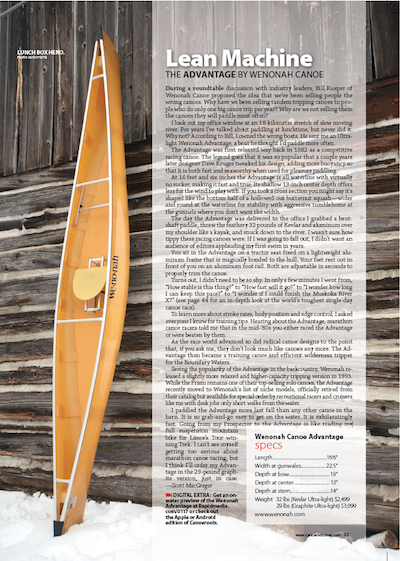
This boat review of the Wenonah Advantage canoe first appeared in the Spring 2014 issue of Canoeroots and Family Camping magazine. 

During a roundtable discussion with industry leaders, Bill Kueper of Wenonah Canoe proposed the idea that we’ve been selling people the wrong canoes. Why have we been selling tandem tripping canoes to people who do only one big canoe trip per year? Why are we not selling them the canoes they will paddle most often?

I look out my office window at an 18-kilometer stretch of slow moving river. For years I’ve talked about paddling at lunchtime, but never did it. Why not? According to Bill, I owned the wrong boats. He sent me an Ultralight Wenonah Advantage, a boat he thought I’d paddle more often.

The Advantage was first released way back in 1982 as a competitive racing canoe. The legend goes that it was so popular that a couple years later designer Dave Kruger tweaked his design, adding more buoyancy so that it is both fast and seaworthy when used for pleasure paddling.

At 16 feet and six inches the Advantage is all waterline with virtually no rocker, making it fast and true. Its shallow 13-inch center depth offers less for the wind to play with. If you took a cross section you might say it’s shaped like the bottom half of a hollowed-out butternut squash—wider and round at the waterline for stability with aggressive tumblehome at the gunnels where you don’t want the width.

The day the Advantage was delivered to the office I grabbed a bentshaft paddle, threw the feathery 32 pounds of Kevlar and aluminum over my shoulder like a kayak, and snuck down to the river. I wasn’t sure how tippy these racing canoes were. If I was going to fall out, I didn’t want an audience of editors applauding my first swim in years…

Screen_Shot_2014-04-16_at_10.19.23_AM.pngGet the rest of this boat review that originally appeared in Canoeroots and Family Camping, Spring 2014 by downloading our free iPad/iPhone/iPod Touch App or Android App or read it on your desktop here. 


TiTS DEEP! How Katrina Van Wijk’s Four-Letter Word Is Changing The Game For Women

TALKIN’ ‘BOUT A REVOLUTION. | PHOTO: STUART MULLENBERG

Its stickers have branded the boats of pro whitewater women and its social media accounts are shocking followers with semi-nude photos and a web series of serious whitewater. TiTS DEEP was founded by Katrina Van Wijk, who, at 23-years-old, has already charged through a successful slalom career and onto freestyle, falls and serious racing.Despite winning the 2013 Green Race with a time that beat the previous women’s record and hucking bigger and bigger drops, Van Wijk has met both men and women who have told her there’s certain whitewater girls just don’t run.

Through social media and a website that’s in the works, Van Wijk is sharing stories of women in sports that give the opposite message—gender doesn’t have to hold you back. Over lunch with Rapid, Van Wijk shared what TiTS DEEP is all about.

WHEN DID TITS DEEP START?

At the 2012 Green Race I was up to my nipples in water above Gorilla Rapid and I yelled, “This is TITS DEEP!” Everyone thought it was hilarious—me and the girls I paddled with started yelling it out as a morale boosting, female empowerment thing. We made stickers and gave them to all the girls at the White Water Grand Prix. Lots of people were covering the event and we got tons of Facebook followers after that.

WHY DID YOU STICK WITH THAT NAME?

I like the shock factor. That’s why we post the topless photos too. Supporters have been sending me semi-nudes and I want to post them all but sometimes Facebook and I disagree on what’s considered porn. I keep getting locked out of the TiTS DEEP page and my own account. Lots of people email me saying they love what TiTS DEEP is about but hate the name, but I want to reclaim the word tits—it’s just another way to say breasts and it doesn’t have to be offensive.

TALKIN’ ‘BOUT A REVOLUTION. | PHOTO: STUART MULLENBERG

WHAT DO YOU SAY TO THEM?

I’m happy to hear other people’s opinions. Everyone assumes I’m taking a strong stance on sexism in sports, but I don’t have it all figured out. I just want to inspire other girls. TiTS DEEP applies to all sports but kayaking is a good example because the water is a force of its own—you can harness the power of the water and use it to make moves, so the bigger and more powerful the whitewater is, the more equal men and women are in it.

WHO IS TITS DEEP?

You are! Everyone can be TiTS DEEP. I’m working on the web series with a friend but I’m the only one consistently posting content. It’s my baby, I guess, but it’s not really about me. I was running the Green River and someone from shore saw the logo on my helmet and yelled, “Are you TiTS DEEP?” I yelled back, “You’re TiTS DEEP!” I want women from all sports to consider themselves TiTS DEEP and hope to have official ambassadors soon.

WHAT’S NEXT?

I’m secretly a computer nerd so I’m going back to school for graphic design and web design. I want to build a website that features stories from women in different extreme sports. The website will profile our official ambassadors and not in the ‘20 years old, blonde hair, blue eyes’ way—we’ll talk about how they’re pushing them- selves and the boundaries of their sport.

AS TOLD TO EMMA DRUDGE


This article was first published in the Spring 2014 issue of Rapid Magazine. Subscribe to Paddling Magazine’s print and digital editions, or browse the archives.
Smarter Straps: HOW TEVAS BECAME THE BOOTS OF THE WORKING-CLASS RIVER WORLD

In 1984 one Grand Canyon river guide singlehandedly launched the sport sandal market by beefing up his flip flops with an extra ankle strap.

It was the start of Teva, and by the end of the decade, his simple sandal fix had become an outdoor giant and marketing sensation. Teva’s custom webbing designs and all manner of Velcro straps brought the outdoors to the masses.

But real river guides wore Alps.

In the early ‘90s, Alps dealt with all of the deficiencies of Teva’s original designs. Every river guide knows Velcro lasts 10 seconds in whitewater. Alps could take a pounding. They had a sticky climbing shoe tread and a multi-anchor strap system that built redundancy so if one blew, you didn’t lose your sandal. They were brilliant, functional and ridiculous looking, better suited to a Roman soldier or toga party.

Rookie guides would always show up to training with new Velcro Tevas, only to lose one on the first day’s swim and contribute to the staff room box of single sandals (in which you might get lucky and find a match—sweet!).

Alps stayed on.

One of my most memorable swims from a raft ruined my first pair. They were light blue, and as a rookie guide I was quite proud of them—I’d already lost a left Teva, size 10.5 (I still have the right one). I flipped my paddle raft and got tangled up in the bowline that snaked free. I pulled my brand new river knife to cut the rope from around my ankles and accidentally sliced my Alps. I was heartbroken, but relieved that they’d saved me from chopping into an ankle artery. I promptly replaced them with a nice burgundy pair; it was the ‘90s, after all.

They lasted three seasons of guiding and by the time I went to replace them, Alps were gone. Sort of.

As a company, Alps never circulated beyond the small river guide fraternity, and hadn’t seemed to try to. That made them an easy target for footwear giant, Deckers, who, by this time, owned Teva. Deckers bought out Alps in 1995 and the sandals were demoted to a style line within Teva.

Luckily, the new Teva Alps were as good as the originals. They opened the door for more sport sandals to mature from Velcro to intelligent buckles and straps. Alps turned Tevas into the workhorse of the river world.

Alps’ multiple thin straps looked ridiculous and they weren’t made for long, but I pulled my ’96 Teva Alps out a couple of summers ago for a five-day memory trip love-in, and they were still bomber.

Alps got it right early on, even though the minimalist sole left my heels aching after a mild hike. I never did see an abandoned Alp in the staff room singles box. JEFF JACKSON


Scott MacGregor is the founder and publisher of Rapid magazine. 

This article was first published in the Spring 2014 issue of Rapid Magazine. Subscribe to Paddling Magazine’s print and digital editions, or browse the archives.

Tumblehome: Symmetry and You

Photo: Yanik Chauvin
Canoes and symmetry | Photo: Yanik Chauvin

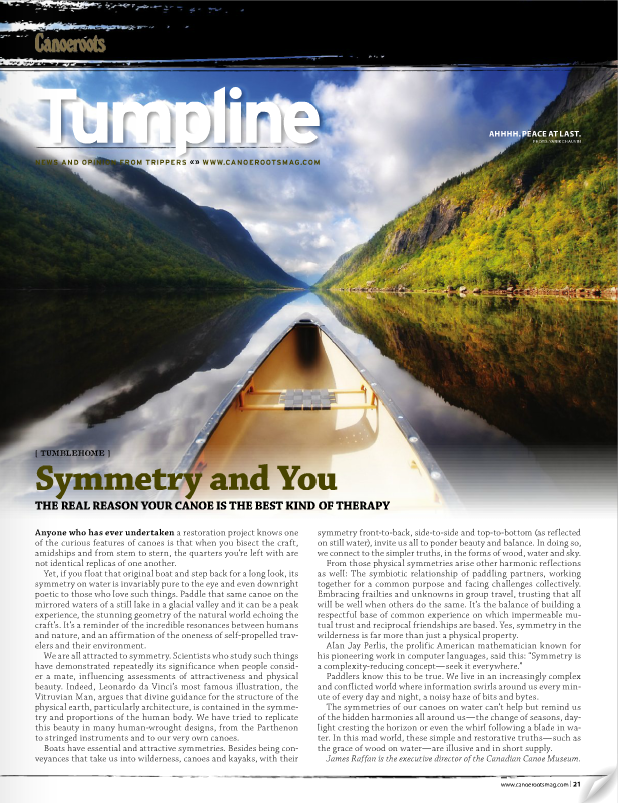
Anyone who has ever undertaken a restoration project knows one of the curious features of canoes is that when you bisect the craft, amidships and from stem to stern, the quarters you’re left with are not identical replicas of one another.

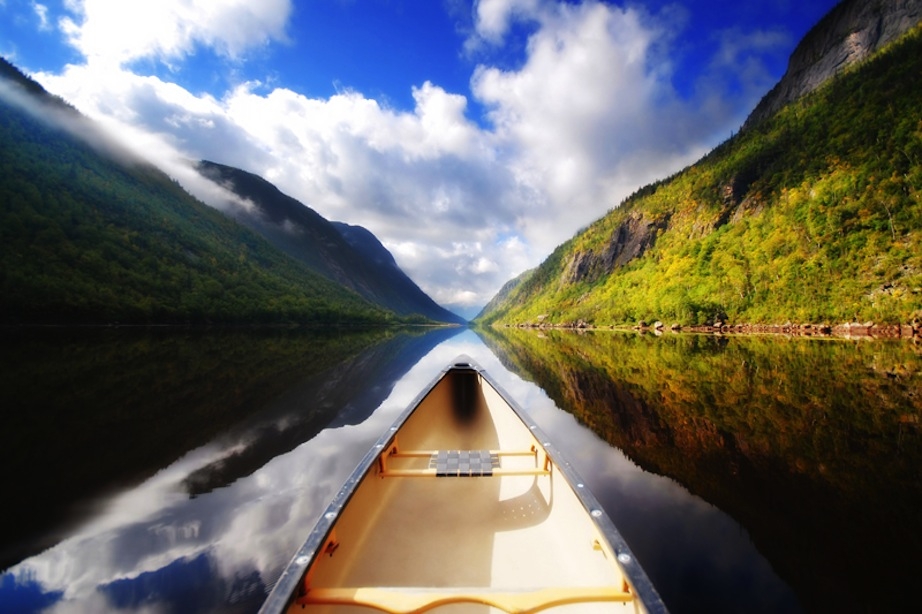
Yet, if you float that original boat and step back for a long look, its symmetry on water is invariably pure to the eye and even downright poetic to those who love such things. Paddle that same canoe on the mirrored waters of a still lake in a glacial valley and it can be a peak experience, the stunning geometry of the natural world echoing the craft’s. It’s a reminder of the incredible resonances between humans and nature, and an affirmation of the oneness of self-propelled travelers and their environment.

We are all attracted to symmetry. Scientists who study such things have demonstrated repeatedly its significance when people consider a mate, influencing assessments of attractiveness and physical beauty. Indeed, Leonardo da Vinci’s most famous illustration, the Vitruvian Man, argues that divine guidance for the structure of the physical earth, particularly architecture, is contained in the symmetry and proportions of the human body. We have tried to replicate this beauty in many human-wrought designs, from the Parthenon to stringed instruments and to our very own canoes.

Boats have essential and attractive symmetries. Besides being conveyances that take us into wilderness, canoes and kayaks, with their symmetry front-to-back, side-to-side and top-to-bottom (as reflected on still water), invite us all to ponder beauty and balance. In doing so, we connect to the simpler truths, in the forms of wood, water and sky.

Photo: Yanik Chauvin
Canoes and symmetry | Photo: Yanik Chauvin

From those physical symmetries arise other harmonic reflections as well: The symbiotic relationship of paddling partners, working together for a common purpose and facing challenges collectively. Embracing frailties and unknowns in group travel, trusting that all will be well when others do the same. It’s the balance of building a respectful base of common experience on which impermeable mutual trust and reciprocal friendships are based. Yes, symmetry in the wilderness is far more than just a physical property.

Alan Jay Perlis, the prolific American mathematician known for his pioneering work in computer languages, said this: “Symmetry is a complexity-reducing concept—seek it everywhere.”

Paddlers know this to be true. We live in an increasingly complex and conflicted world where information swirls around us every minute of every day and night, a noisy haze of bits and bytes.

The symmetries of our canoes on water can’t help but remind us of the hidden harmonies all around us—the change of seasons, daylight cresting the horizon or even the whirl following a blade in water. In this mad world, these simple and restorative truths—such as the grace of wood on water—are illusive and in short supply.


Screen_Shot_2014-04-14_at_2.13.07_PM.pngThis article originally appeared in Canoeroots and Family Camping, Spring 2014.
Stohlquist Tideline Low Booties

Photo: Kaydi Pyette
Stohlquist Tideline Low Booties

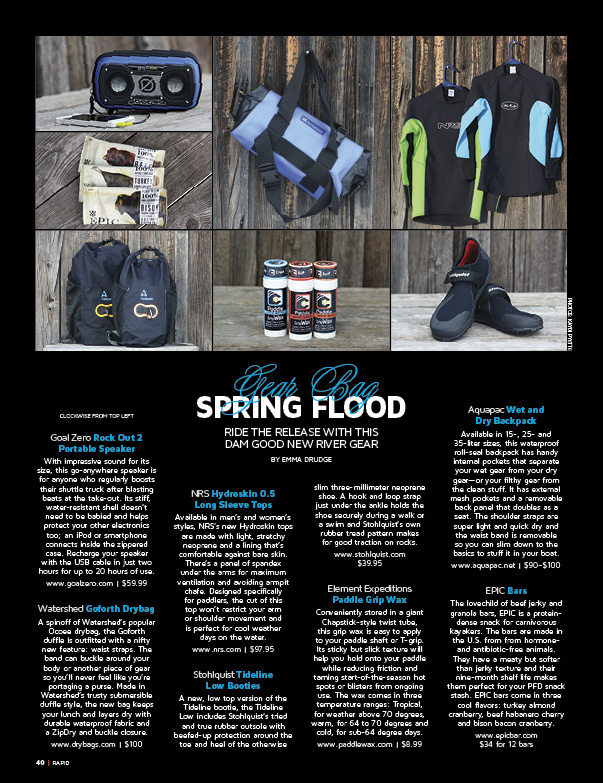
A new, low top version of the Tideline bootie, the Tideline Low, includes Stohlquist’s tried and true rubber outsole with beefed-up rubber protection around the toe and heel of the otherwise slim 3mm neoprene shoe. A hook and loop strap just under the ankle holds the shoe securely during a walk or a swim and Stohlquist’s own rubber tread pattern makes for good traction on rocks.

www.stohlquist.com | MRSP $39.95


RPv16i1-40

Check out the flood of new gear we lined up for Rapid, Spring 2014 in our free digital edition, or by downloading our free app for Apple or Android.

How To Stay Warm For Spring Surfing

Photo: Sierra Stinson
How To Stay Warm For Spring Surfing

The spring thaw is finally underway and that means two things—paddling and cold water. Knowing how to prepare yourself for the inevitable cold that comes with spring boating is important, not only for comfort, but for safety as well. Hypothermia is a very real risk if you’re on or in the water for any length of time, so make sure you’re cold water ready.

Pre-season Inspection

Start with the basics. Inspect your equipment before heading out for the first time this year. Anything that’s seen a lot of sun and is starting to show signs of use should be replaced, especially when it comes to your PFD. Check the gaskets on your dry gear, and determine if they’ll last another season—there’s nothing worse than getting to the river and having one of your gaskets blow right before putting on.

Layers, Layers, Layers

When it comes to spring paddling, layering is your best friend. Start with a base layer that wicks the moisture away from your skin. “Depending on how cold the water is, I use my Sweet Protection thermals under a drysuit,” says Ben Marr, who’s known for styling the biggest waves in cold spring waters. “I’ll also usually wear a onesie, and if it is hectically cold or windy, I put some merino wool base layers on under that.” Can’t afford brand new merino? Head to your local thrift shop and scour the racks—you’ll be surprised at how many 100% merino sweaters are hiding out there. (Bonus: many of them look great off the river, too!)

Essential Extremeties

Don’t forget about your head. While we’d like to think we won’t go upside down on our first paddle of the year, it’s always best to be prepared for immersion. “A lined skull cap goes a long way in the spring and winter,” says Marr. “We lose most of our body heat from our heads, so keeping that warm will make your time on the water much more enjoyable.” Making sure your feet are warm can help make your first paddle of the season that much more bearable. If you’re wearing a drysuit, wear wool socks as a liner, then pull neoprene socks on top to protect your suit and add an extra layer of warmth.

Be prepared

While dressing properly is important, so is a proper warm up. Get the blood moving with a touch of cardio and some stretches before sitting in your boat, and try to keep moving in the eddy. “I always do a good shoulder warm up, especially in spring,” says Marr. Ensure that you’re well hydrated before heading out, and bring a snack with you. You may be able to paddle for hours without getting tired in warmer weather, but it will surprise you how quickly your energy will fade in cold water.

Above all else, make sure you’re not in over your head before you head out in the spring flood—know your limits and keep an eye on hazards such as remaining chunks of ice and debris that’s washed into the river with the spring melt.

To learn more about getting ready for spring sessions, read Training Tips To Paddle Forever.

Gear: Goal Zero Guide 10

Photo: KaydiPyette
Goal Zero Guide 10 camping


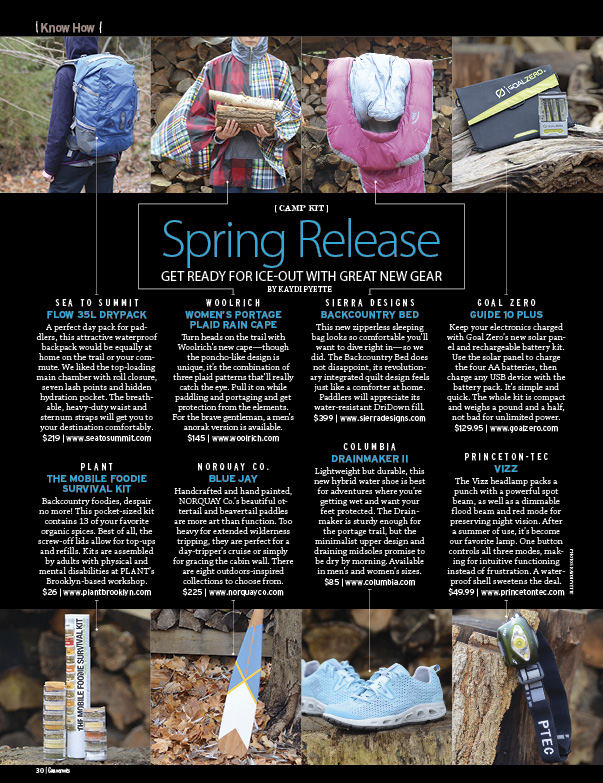
Keep your electronics charged with Goal Zero’s new solar panel and rechargeable battery kit. Use the solar panel to charge the four AA batteries, then charge any USB device with the battery pack. It’s simple and quick. The whole kit is compact and weighs a pound and a half, not bad for unlimited power.

Rechargable AA batteries are included and a handy built-in LED flashlight is located on top of the battery pack to help you search in your dark backpack. Plug in any small USB-powered devices to the battery pack or into the solar panel to recharge them anywhere. It’s powerful enough to handle smartphones, readers and tablets.

$119.95 | www.goalzero.com


CRv13i1-30 This article originally appeared in Canoeroots and Family Camping, Spring 2014. Get more great gear reviews by downloading our free iPad/iPhone/iPod Touch App or Android App or read it on your desktop here


First Descent: Michoacan Episode 5

Episode 5 – The Journey Continues

“The jewel of Michoacan calls the team back to her waters for a final adventure after difficult terrain and low water challenges the expedition. The next trip is already being planned.”

From Red Bull. 


Catch the first four episodes here: 

First Descent: Michoacan Episode 1 – The Journey Begins

First Descent: Michoacan Episode 2 – Scouting Uncharted Waters

First Descent: Michoacan Episode 3 – What we came for

 First Descent: Michoacan Episode 4 – Repelling Into Unexplored Rapids

What’s In: Jaime Sharp’s Shed

Photo: Jaime Sharp
What's In: Jaime Sharp's Shed? | Photo: Jaime Sharp

Jaime Sharp knows sacrifice is the flipside of the shiny coin of adventure. The 32-year-old guide, videographer and founder of World Wild Adventures left behind a good job and a beautiful woman to follow his dream. In 2011, Sharp fled the promise of a settled life to paddle the length of New Zealand. Three years later he remains an unapologetic vagabond. These days, Sharp hangs his hat in a shed in Vancouver Island’s Nanoose Bay. Equal parts office, gear garage and bachelor pad, the shed is a strategic—if Spartan—home base for Sharp’s on-the-road lifestyle.Virginia Marshall

Photo: Jaime Sharp
What’s In: Jaime Sharp’s Shed? | Photo: Jaime Sharp
  1. The shed belongs to a friend. It’s on an acre and a half right on the water. The shelving, plumbing and Internet connection were already here. I can pull my 23-foot bus right inside. It’s what I call ‘tactical homely.’
  2. I wanted a mobile kayaking HQ that I could paddle, live and work out of. My dream vehicle was a four-wheel-drive Sportsmobile. What I could afford was this 1990 Ford E350 Diesel medical transport bus. I use the wheelchair ramp for walking boats in and out. I bought the bus for $3,000 and drove to Jackson Hole, Wyoming, and back to make sure it was going to hold together. It has a bed, diesel space heater, battery inverter and kitchen. My plan is to drive down to the Baja Sea Kayak Symposium in April, then work my way back up to B.C. while filming for a paddling series about exploring the West Coast.
  3.  This duffle contains the TRAK folding sea kayak that I paddled down the Grand Canyon in winter 2012. When I first saw an ad for these boats, I was intrigued. I wrote TRAK a proposal: I would take their kayak all over the world with me and make films about it. The TRAK Files marked my first foray into making a professional online film series.
  4. On the right screen, I’m editing photos from the Grand Canyon. On the left, I’m backing up film from recent paddling trips to the Bay of Fundy and the United King- dom. Shooting video is a lot more work than shooting stills. Editing takes months, not days. Creatively, the stories you can tell with film are engrossing, but there’s a real satisfaction in capturing a moment in a single frame. It’s more like a trophy.
  5. I’m a closet Star Wars geek. And, yeah, the Ewoks are my favorite.
  6. I made this traditional bow and arrow with a Bushmen friend in Namibia. It’s an effective little bow, but more importantly it’s a memento of my travels and the friends I’ve made along the way.
  7. I found this wild boar tusk on my New Zealand expedition. Walking away from everything and using all my money to fund this trip was a huge sacrifice. Of course, things don’t go exactly as planned. The weather in the Pacific that year was terrible: cyclones, floods, the tsunami in Japan, an earthquake in Christchurch. I got bitten by a venomous katipo spider and had to be evacuated off a remote beach at 3 a.m. in excruciating pain. Ultimately, it ended up being a trip down the North Island. But experiencing the journey just for myself created a lot of growth, strength and healing. It was one of those crossroads when you make a critical choice and your life takes a completely new direction.

AKv14i1 cover300This article first appeared in the Adventure Kayak, Spring 2014 issue. Subscribe to Paddling Magazine and get 25 years of digital magazine archives including our legacy titles: Rapid, Adventure Kayak and Canoeroots.