Home Blog Page 294

Muskoka River X

Photo: Rich Swift / Algonquin Outfitters
Muskoka River X | Photo: Rich Swift / Algonquin Outfitters

At the start line, nobody spoke. It was too cold and the anxiousness of the race permeated the pall of early morning. Misted breath hovered over each paddler as I looked around. We were an eclectic gathering of 50 teams. The three standup paddleboarders among the canoes and kayaks looked out of place, rearing up like wraiths in the fog. I couldn’t fathom how they were going to stand it for 130 kilometers. When the air horn blew, signalling the beginning of the race, I just sat there, waiting for the initial explosion of blades in water to calm. The early morning sun burst from behind a cloud, giving the misty morning a golden glow. It was surreal.

“Hap!” my wife, Andrea, called from the bow. “Get paddling, I’m freezing!”

Longest and Toughest

We were one of the first teams to sign up for the inaugural running of the Muskoka River X, touted as the world’s longest and toughest single day canoe race. Its 24-hour deadline makes it an event like no other.

The math is simple: Just keep up a five-and-a-half kilometer per hour pace to finish in time. The reality is more difficult—the 130-kilometer route tracks across four lakes, two river systems and six kilometers of portages. It translates into 23,466 strokes at three meters per stroke, through large, exposed lakes and remote river waterways. Navigating portages, rapids, waterfalls, chutes and gravel bars with only map and compass are necessary skills; all the better if you can do them in the dark, without sleep.

Navigating portages, rapids, waterfalls, chutes and gravel bars with only maps and compasses are necessary skills; all the better if you can do them in the dark, without sleep.

Leaving from the picturesque town of Huntsville on the morning of September 14, racers first crossed a series of lakes, including the notoriously rough Lake of Bays, to reach the South Muskoka River and the town of Brace-bridge. By that time, most competitors were paddling into the sunset and the final leg of the loop, upstream on the North Muskoka River, was completed in total darkness.

“Muskoka was the perfect place,” says race co-director Rob Horton. “Its combination of history and accessible wilder-ness made it perfect for a race route.”

The area is quintessential cottage country. Muskoka chairs line the shoreline and canoes have a rich history here. I’m familiar with the area, having mapped it out for a book I wrote about local canoe routes a dozen years ago.

The local routes were the hunting grounds for First Nations communities long before the coureur de bois arrived. The river systems afforded access deep into the interior, and explorers like David Thompson navigated them on his way west.

In the early 20th century, the re-source-rich area was a mecca for loggers, who plied the thick forests for gi-ant pine to ship south and hemlock to float down to the mills to feed the burgeoning tanning industry. Look closely, and you can still see some remnants of the industry along the shoreline, mooring anchors in rock and felled trees be-neath crystal blue waters.
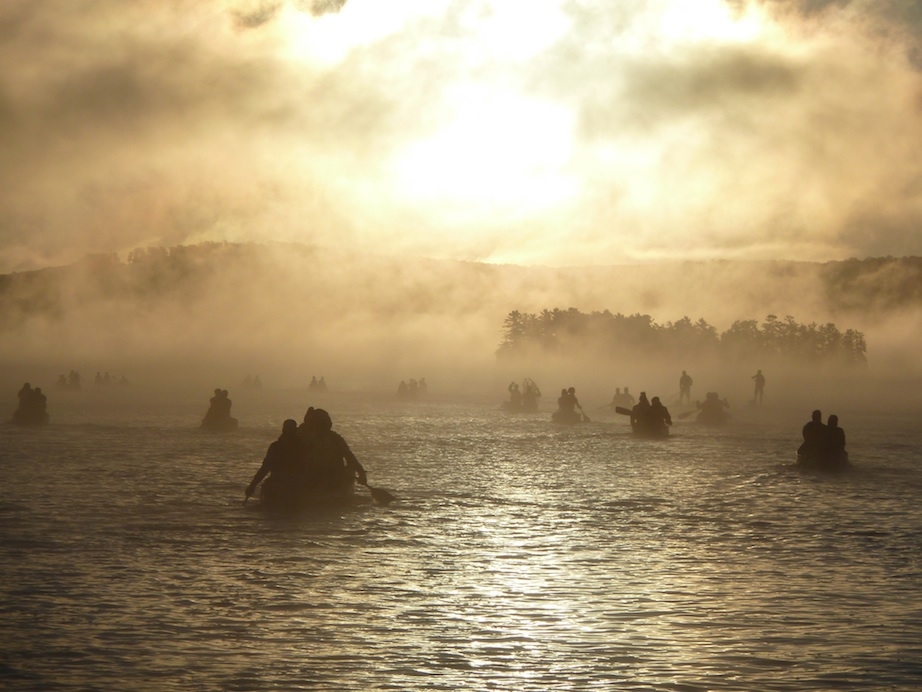
Photo: Rich Swift / Algonquin Outfitters
Muskoka River X | Photo: Rich Swift / Algonquin Outfitters

Self Reliance

Race day excitement had begun the night before with a mandatory gear check in.

“All teams are required to carry essential wilderness tripping gear for the duration of the race,” explained Horton. That included sleeping bags, a tent, a water purifier, extra clothing for warmth and food for 24 hours or more. Looking around at the lightweight gear spread out in front of other participants, I noticed Andrea and I had considerably more—enough for three days out, in fact. Four decades of tripping in Canada’s harshest environments taught me to be prepared. We’d chosen to secure our gear in two watertight barrels—also not the norm for racing, I noticed.

The race’s mantra of self-reliance was inspired by the adventure racing world, which both Horton and co-director Mike Varieur are regular participants in. “We learned from other races,” says Varieur, who came up with the idea for the River X a year and a half ago. “I did all the logistics work and course design, while Rob [Horton] was the technology guy.”

Horton created a virtual map, so that armchair spectators could follow each team on the race’s website. Because of the remote route and potential risks, such as hypothermia, capsizing in rapids and night paddling, SPOT satellite messengers were part of the required safety equipment. Having the ability for racers to hit an SOS button for immediate rescue was reassuring to all involved—and some would use it before the day was done.

I couldn’t fathom not doing a proper J-stroke. That alone slowed us down by two kilometers an hour. It was enough to make a marathon paddler cringe.

Reflections

I was mid-route when I started reflecting on the differences between marathon paddlers and wilderness trippers. Trippers typically use a J-stroke for correcting steerage; racers use the “hut” stroke, switching sides constantly to keep the canoe aligned. They also use bent-shaft paddles, curved to eliminate the unproductive reach of the traditional blade. I couldn’t fathom not doing a proper J-stroke. That alone slowed us down by two kilometers an hour. It was enough to make a marathon paddler cringe.

Though sanctioned by the Ontario Marathon Canoe and Kayaking Race Association—necessary for insurance—few OMCKRA members participated. All crafts in the River X had to have the capacity to carry wilderness tripping supplies, so traditional racing shells were disallowed.

The end result was that the race attracted casual paddlers and trippers, many without any racing experience. Most of the racers were just your average canoe trippers with the crazy notion that paddling and portaging 130 kilometers in one day would be fun.
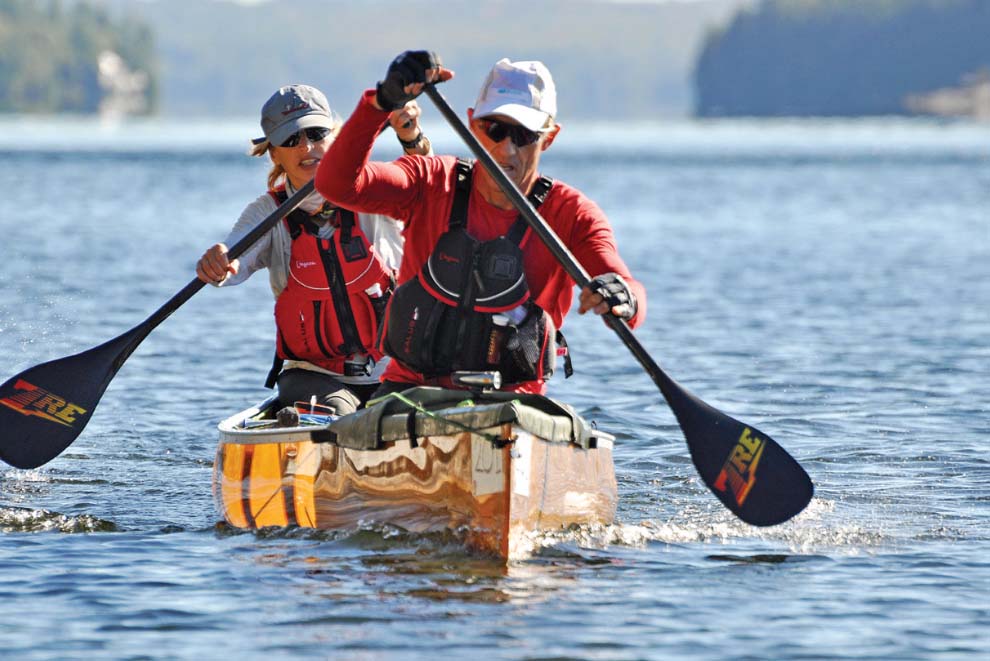
Stroke eighteen thousand, four hundred and thirty-nine... | PHOTO: BILL LANNING
Stroke eighteen thousand, four hundred and thirty-nine… | PHOTO: BILL LANNING

Pushing Upstream

Stroke after stroke can get the mind wan- dering. As the dim haze of the evening approached, I reflected on how history has a convoluted way of repeating itself, at least when it comes to canoeing. Marathon distances were the driving element governing success or failure during the frenzy of the fur- trade and exploration era.

In 1828, Sir George Simpson, governor of the Hudson Bay Company, pushed his heavily laden canoe upstream 630 kilometers on the Hayes River in Manitoba, from York Factory to Lake Winnipeg, in six days. Today, the same trip going downstream takes an average of three weeks.

Simpson was known for his physical stamina when traveling through the wilderness. In his day, paddling great distances in a short time meant profit for the company; paddlers were paid to push the limits of endurance. Today, marathon paddling is something entirely different; now, we gladly pay for the opportunity to test our mettle and see if we’re as tough as our forefathers.
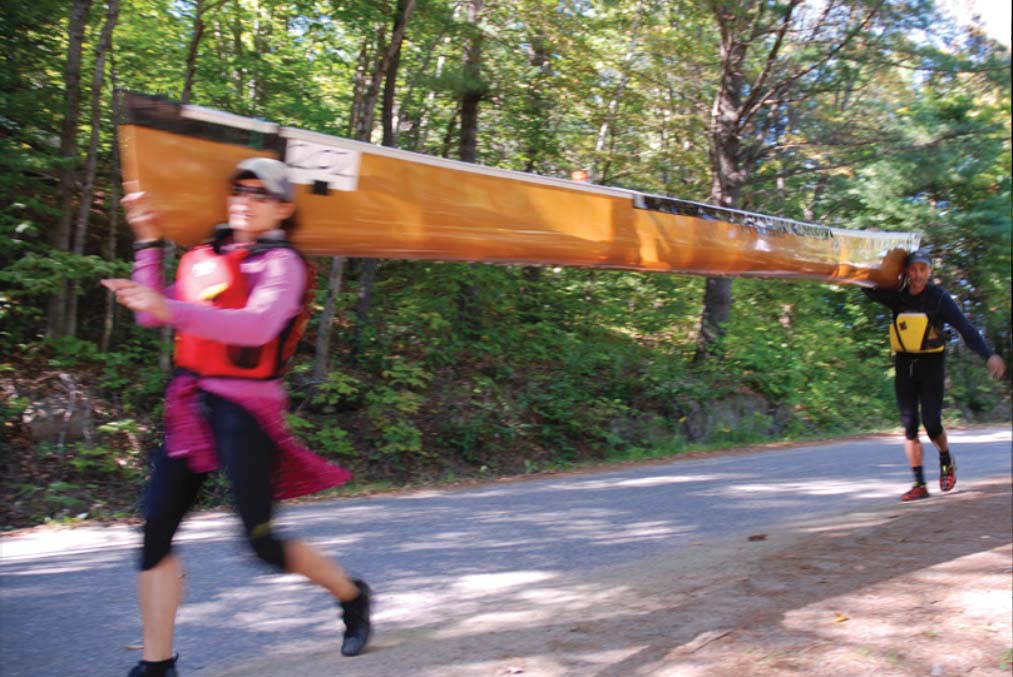
Just one of 20 portages.| PHOTO: BILL LANNING

Day’s End

By the time we reached our third and final checkpoint in Port Sydney at 2 a.m., we were just 20 kilometers from the finish line and chilled to the bone. We’d arrived after hours of slogging upstream through shallow rapids. A weak moonlight had illuminated the shore briefly, but once temperatures dropped below freezing the river fog consumed everything. Icy tendrils worked their way down our collars and through our carefully planned layer systems.

The fog thickened until the spotlights affixed to the bow of the canoe were useless and we were forced to feel our way upriver in total darkness. At the checkpoint, we were grateful to warm ourselves by a crackling campfire. Family had come out to cheer us on and while we chatted, rested and snacked, shore-side cottagers cheered other racers as they came and went.

Officials told us close to a third of the teams had quit—some had gotten turned around, some were lost and others were just dead tired and found solace by sleeping in the forest, waiting for sun-up.

With our 24-hour deadline approaching and committed to finishing, we paddled away from the checkpoint’s warmth. But back on the water, it wasn’t long before we started to drift into sleep, paddle in hands.

“It was scary,” Andrea later told me, “it was like falling asleep at the wheel.” We would paddle a few strokes then, leaning on the gunnels, fall half asleep and drift. And we continued that way for some time.

“It was scary,” Andrea later told me, “it was like falling asleep at the wheel.” We would paddle a few strokes then, leaning on the gunnels, fall half asleep and drift. And we continued that way for some time.

It was the brightening sky in the east that revitalized us. We spent the last hour of the race in a sprint, J-stroke and all. We crossed the finish line just as the sun peaked over the horizon, 14 minutes inside of the 24-hour cut-off. Exhaustion was forgotten in the excitement of success. Aside from the race coordinators, there was little fanfare. Most of the teams wait- ed for a post-race breakfast at a nearby restaurant, and we wasted no time in joining them.
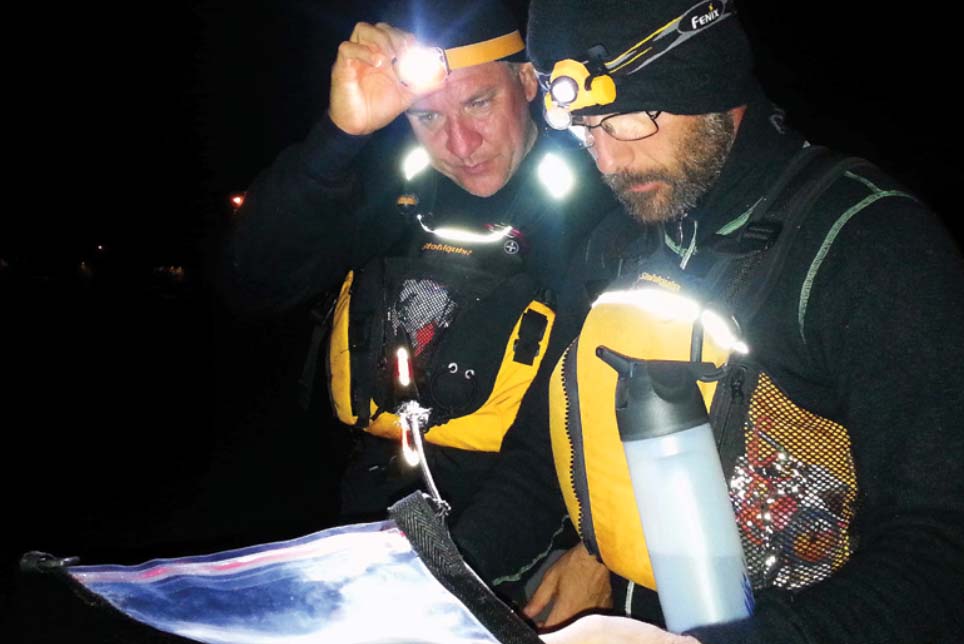
Lost and found. | PHOTO: COURTESY GREG GOULTER/ALGONQUIN OUTFITTERS

Damage Report

As I dug into a plate of bacon and eggs, we got the damage report.

By morning, six emergency calls had been placed. Two were from SPOT panic buttons, one due to a shoulder injury and another because of exhaustion. Three teams also called for assistance via cell phone, due to being lost or exhausted.

“The sixth team was heading in the wrong direction and we were watching them on the live tracker and sent a team to intercept them,” said Varieur. “Only one person was taken to the hospital, and that was for pre-cautionary measures.”

Blowing away even the race organizers’ expectations, veteran marathon paddlers Bob Vincent, 71, and bow mate Dean Brown, won first place, clocking in at 14 hours and 12 minutes.

“Our plan was to never stop paddling except for the portages,” says Vincent of their strategy. Even snacking was done in shifts.

And while Andrea and I didn’t come in first, we did receive an award of our own—we won the prize for most gear carried. Trippers to the bone, our three-day supply of food, hot coffee and gear had not gone unnoticed.

Post-breakfast, paddlers shared stories of their difficulties and successes on route—tales of rugged portages, exhaustion-induced hallucinations and hidden river entrances. We talked about why we had signed up this year and why, even though many had sworn just hours prior that they’d never do it again, most of us probably will.

It was a kayaker, Allyson McDonald, who summed it up best: “If you’re not moving, then you’re dying.”

Aside from the occasional gig playing advisor to Hollywood, teaching Pierce Brosnan how to throw a knife and paddle a canoe, Hap Wilson is an author and artist. Over his four decades spent as a writer and researcher, he has published 12 books. www.hapwilson.com.

Screen Shot 2014-03-20 at 10.43.51 AM

This article originally appeared in Canoeroots and Family Camping, Spring 2014. Subscribe to Paddling Magazine’s print and digital editions here, or download the Paddling Magazine app and browse the digital archives here.

 

Kayak: A Repair Saga, Part II

Words & Photos: Dene Berman
Kayak: A Repair Saga, Part II

Some boat repairs are of the on-water emergency variety; other fixes may allow for minor gelcoat touch-ups done at one’s leisure. This story is about one boat so badly damaged that it was thought to be beyond repair.


Don’t miss the first installment of Dene Berman’s two-part repair guide—where we look at making structural fiberglass repairs and beginning to mend spider cracks.


Spider Cracks

What is needed is a waterproof bonding agent that will adhere to the fiberglass and the existing gelcoat, expanding and contracting with temperature changes at the same rate as the gelcoat. Material of this sort is referred to as a fairing compound, and can be shaped to blend in with the surrounding areas. The repaired area can then be determined to be “fair” to one’s eye and touch.

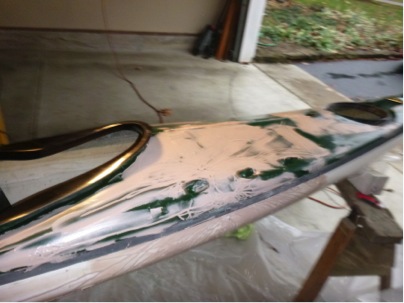
FairingUnable to find a satisfactory compound, I contacted the traditional source for all things needed to keep a boat supplied – a ship chandlery. Jamestown Distributors in Bristol, Rhode Island, was very helpful. Their fiberglass repair specialist knew just the right product to recommend. I took his advice and purchased Quikfair fairing compound by System Three. This product contains microbaloons, hollow glass micro-spheres that help create a strong yet lightweight fairing compound. This two-part epoxy putty is intended for use above or below the waterline, has a pot life of 10 minutes and can be sanded in a few hours. I mixed small, golf-ball sized batches, and used auto body putty spreaders to apply the mixture. The result looked like I was frosting a cake.

 

Sanding

Removing the excess fairing compound is a matter of sanding. Lots of it. Start with an orbital sander and 80-grit paper and work toward 220-grit. The goal is to use the original gelcoat as the guide for when to stop sanding. While that yielded rough results, it also revealed holidays, or missed spots, in the outcome as well as ridges and valleys in the finish. Nevertheless, the overall outcome of this stage was beginning to take the shape of an intact boat.

Sanding


Priming and Painting

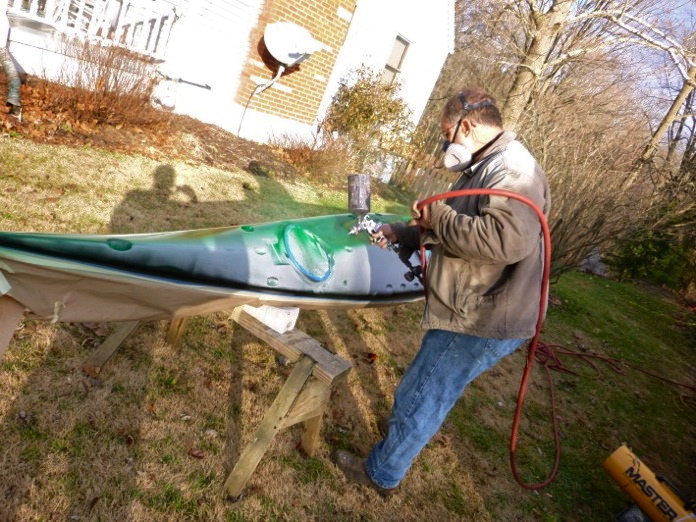
My neighbor Dave is a car body paint expert who, out of his van, goes around to car dealers, making the finish of cars look as near to new as possible. We talked about the right products to use, settling on two-component acrylic finishes that are appropriate for surfaces like auto bumpers – strong, resilient and weatherproof. We started with a primer coat that revealed many of the imperfections that made my fairing compound not quite so fair to the eye. This was followed by the use of thin coats of the fairing compound and lots of detailed sanding, even to the point of removing much of the primer.

Next was the final paint stage of painting the hull and deck. We chose Spies-Hecker two-component acrylic urethane mixing colors, scale-weighed to tenths of grams, to which bonding and curing agents are added.  For the finish coats, lots of thin coats are sprayed, with light sanding, close inspection, minor adjustments and more spraying. The process may seem easy, but involved masking off areas of the boat and finding the right colors – we started with the NDK color chart and modified from there. Waiting for the right temperatures, putting the boat inside during the rain, getting out the propane heaters when the temperature plunged, re-doing the mixture when the yellow hull was too translucent… Seeing Dave with his spray gun was like watching magic as he transformed the boat into a shining gem.

RepairMain


Final Touches

Repaired and painted, the boat needed only new hatch covers, stickers, deck lines and bungees to complete the transformation. With the help of suppliers and friends, what had been a rotting hull held prisoner for years is now a sleek craft that again awaits the spring thaw to carve beautiful lines in the water. This project is proof that an avid kayaker can resurrect a lost cause into a sea-worthy, beautiful craft.  -Dene Berman

Final

Final2

History of Kayaks

This entertaining film tells the remarkable and romantic 43-year history of Eddyline Kayaks, as well as the 5,000-year-old story of kayaking itself. Learn about the resourceful people who built the first kayaks, watch a modern thermoform kayak take shape from a few sheets of shiny plastic, see retro footage from the early days of modern kayaking, and enjoy the love story that is central to Tom and Lisa Derrer’s family-owned kayak company.


Gear: Mobile Foodie Survival Kit

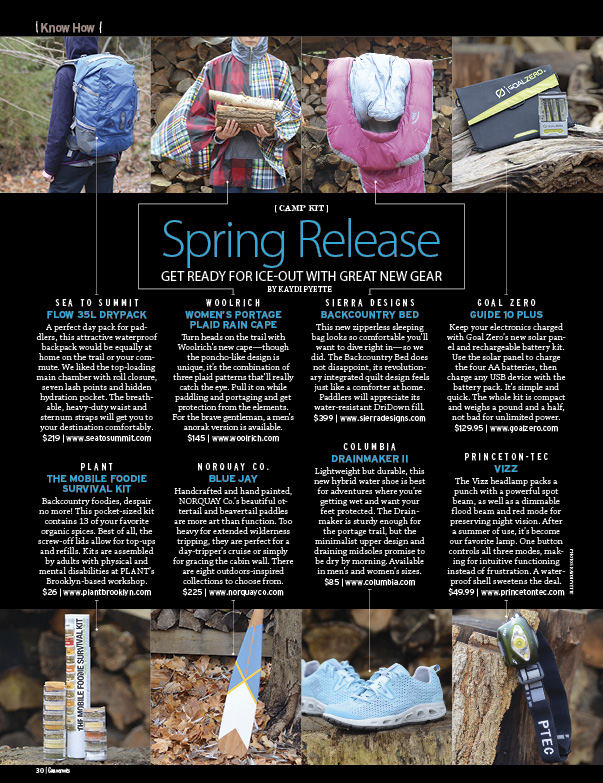
Mobile Foodie Survival Kit by PLANT. Photo: Kaydi Pyette
Mobile Foodie Survival Kit by PLANT

Backcountry foodies, despair no more! This pocket-sized kit contains 13 of your favorite organic spices. Best of all, the screw-off lids allow for top-ups and refills. Kits are assembled by adults with physical and mental disabilities at PLANT’s Brooklyn-based workshop.

Contents: organic basil, organic cayenne, organic curry, organic dill, organic granulated garlic, organic ginger, organic cinnamon, organic oregano, organic thyme, organic granulated onion, sea salt, organic black pepper, organic rosemary.

The herbs and spices have been certified by the Department of Agriculture as products that are grown entirely without antibiotics, hormones, pesticides, irradiation or bioengineering. The pots are BPA-free and fully recyclable, and tubes are made of post-consumer recycled paperboard.

$26 | www.plantbrooklyn.com 


CRv13i1-30 This article originally appeared in Canoeroots and Family Camping, Spring 2014. Get more great gear reviews by downloading our free iPad/iPhone/iPod Touch App or Android App or read it on your desktop here

Butt End: Wild Child

Photo: Kevin Callan
Butt End: Wild Child

Getting in touch with the wilderness has never been more important—and harder—than in our ultra-connected world. Kevin Callan discusses how to stay untamed in the modern age in this article first published in Canoeroots and Family Camping. 


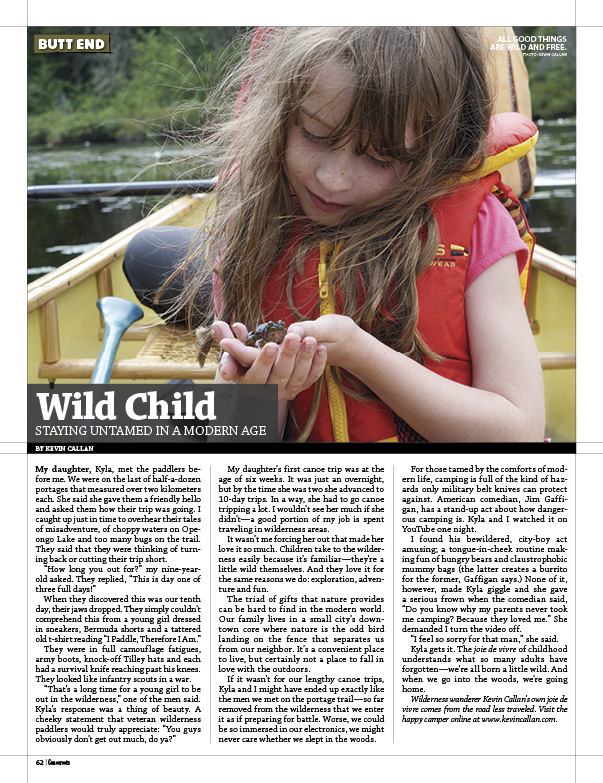
My daughter, Kyla, met the paddlers before me. We were on the last of half-a-dozen portages that measured over two kilometers each. She said she gave them a friendly hello and asked them how their trip was going. I caught up just in time to overhear their tales of misadventure, of choppy waters on Opeongo Lake and too many bugs on the trail. They said were thinking of turning back or cutting their trip short. 

“How long you out for?” my nine-year-old asked. They replied, “This is day one of three full days!”

When they discovered this was our tenth day, their jaws literally dropped. They simply couldn’t comprehend this from a young girl dressed in sneakers, Bermuda shorts and a tattered old t-shirt reading “I Paddle, Therefore I Am.” They were in full camouflage fatigues, army boots, knock-off Tilley hats and each had an eight-inch survival knife reaching past his knees. They looked like infantry scouts in a war.

“That’s a long time for a young girl to be out in the wilderness,” one of the men said. Kyla’s response was a thing of beauty. An almost Gandhi-like statement that veteran wilderness paddlers would truly appreciate: “You guys obviously don’t get out much, do ya?” …


CRv13i1-62Continue reading this article in the digital edition of Canoeroots and Family Camping, Spring 2014, on our free iPad/iPhone/iPod Touch App or Android App or read it on your desktop here.


Kayak Review: THE JURA HV By Venture Kayaks

THE JURA HV By Venture Kayaks | PHOTO: PO MARSHALL

WINDING AMONG THE DARK TRUNKS of a spring-flooded forest, then ferrying out across a wind-raked channel, it strikes me as ironic that the world’s first kayak equipped with a Skudder—that is, a combination skeg and rudder—seems to have little use for either. Let me explain.

The Venture Jura’s long waterline and slim stern yield excellent tracking even in heavy crosswinds. Heeled over on its hard chines, the Jura becomes quite nimble, carving gracefully between the shadowy trees.

Venture Jura HV
Length: 16 ft
Width: 23 in
Weight: 63 lbs
Max Capacity: 275 lbs
Price: $1,599
www.venturekayaks.com

Still, most paddlers expect a touring kayak to be equipped with either a skeg or rudder. Now you can have both.

“The Skudder is something that Graham [Mackereth, owner of Venture and sister brand P&H] has been interested in for a long time,” says Brian Day, Venture’s head of operations. “We’ve all paddled in conditions where a skeg helps to trim the boat in the wind. And a rudder allows paddlers to save energy by focusing on forward paddling. The Skudder gives you the benefits of both systems.”

Since the Jura’s well-mannered tracking means it doesn’t want to turn unless edged, the Skudder will aid beginners who don’t yet feel confident on edge. Fully deployed, the Skudder can be used to initiate turning, but its unobtrusive design and ability to function as a skeg means novice paddlers won’t outgrow the boat as their skills develop. Experienced paddlers with a pre-existing skeg or rudder bias will find the Skudder moves in either direction with them.

In rough water and following seas, the Skudder is more effective than a conventional rudder. That is, it spends more time actually in the water when paddling in steep, short period waves. Moreover, its under-stern placement doesn’t catch the wind or pose a hazard during rescues.

The Jura’s cruising speed is average for a 16-foot boat. But cruising, as any intrepid traveler will tell you, is about more than just speed—it’s about confidence, comfort and capability.

Jotting notes inside a Ziploc bag—head buried in my lap, hood lashed by a driving rain and the kayak pulled by a swift current that had also snared fallen branches and the odd ice floe—concerns about stability never crossed my mind.

The Jura’s near-flat, slightly V hull has the primary stability to put first-timers at ease. High volume in front of the cockpit rewards intermediate paddlers with stable yet dramatic edging, although shorter paddlers will have to reach a bit to paddle the HV on edge. An upcoming MV version will offer the same performance for smaller folks.

Plush, butt- and back-cradling outfitting pairs a contoured foam seat with a ratcheting backband. The large, ergonomic thigh braces combined with a high knee position round out the roomy and comfortable cockpit.

Bow, stern and day hatches offer plenty of volume for longer tours. The Skudder control cables are routed just below the deck and through a molded pillar to the hull, so there are no exposed wires to worry about damaging with carelessly crammed gear.

Venture’s Jura delivers as promised. This is a boat that fits a wide range of paddler sizes, styles and experience levels. Even better, it grows with the paddler as style and experience develop.

THE JURA HV By Venture Kayaks | PHOTO: PO MARSHALL

Happy Feet

The Smart Track foot braces are easily adjusted from a sitting position and combine a solid footrest for strong leg drive, with a user-friendly toe pedal for steering the Skudder.

Hide-a-Skudder

Part skeg, part rudder. The best of both worlds in one tough and tidy package.

The Secret Door

The Skudder’s control mechanism is covered for safe transportation, and accessible for easy cleaning and maintenance.


This article on why the kayak is the best way to enjoy the outdoors was published in the Early Summer 2014 issue of Adventure Kayak magazine.This article first appeared in the Early Summer 2014 issue of Adventure Kayak Magazine.  Subscribe to Paddling Magazine and get 25 years of digital magazine archives including our legacy titles: Rapid, Adventure Kayak and Canoeroots.

Freestyle Kayak Review: Wave Sport Mobius

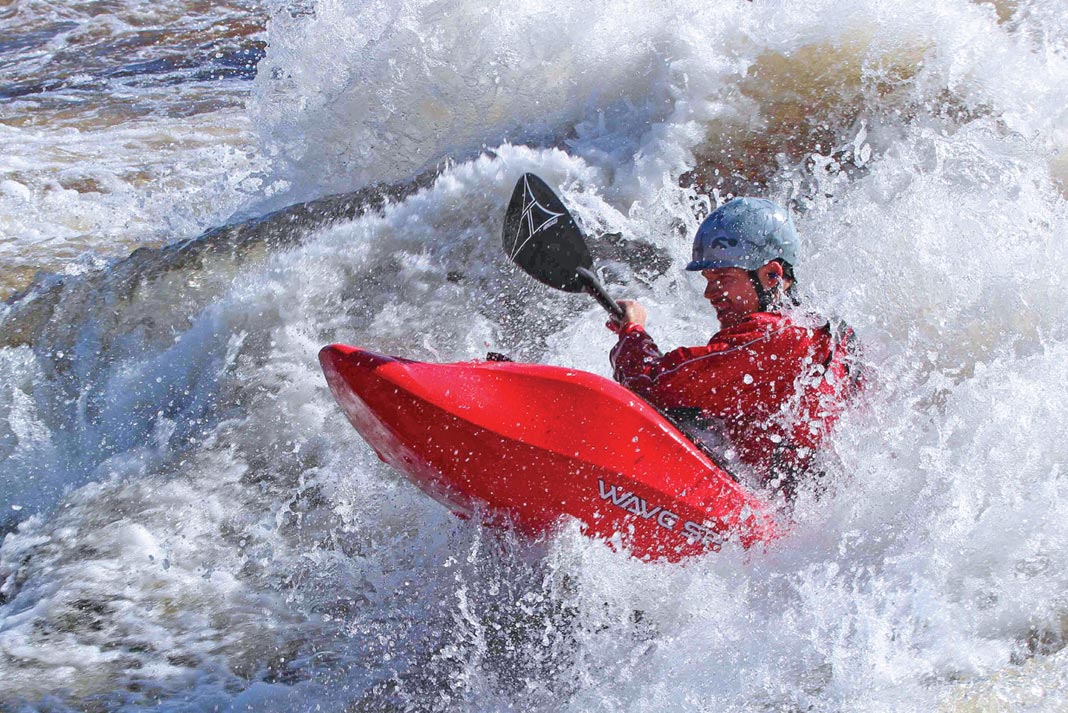
Man using red whitewater kayak
Shorter. Wider. Fatter. Better. | Photo: Dan Caldwell

Take a long, thin strip of paper, put a twist in it, attach the ends and you create the Möbius strip—a continuous curve discovered by German mathematicians in the 1800s that, because of a simple change, seems to defy logic.

When boat designer Hans Nutz showed us Wave Sport’s latest freestyle kayak, the Mobius, he told us how a few simple design twists can yield surprising results.

Comparing the Mobius to Wave Sport’s previous freestyle machine, the Project X, on paper you notice a few of the twists right away. The medium-sized Mobius is 3″ shorter, half an inch wider and has a gallon of volume on the medium-sized Project X. The result? A boat that is actually faster, easier to throw around and explodes more forcefully out of the water.

So how does the shorter Mobius gain its wave speed? “We have a little trick on the stern of this boat that actually helps it to catch waves,” Nutz explains. He’s referring to a stern release edge that’s paired with the new boat’s continuous rocker. “The combination of those two things helps the Mobius catch waves and then shoot right down them,” says Nutz. A few quick surfs on catch-on-the-fly waves confirms it.

Mobius Specs 49/57/65
Length: 5’6″/5’8″/6′
Width: 24.75″/26.25″/26.75″
Volume: 49/57/65 gal
Weight: 30/32/34 lbs
Paddler Weight: 90-160/130-200/250 lbs
MSRP: $1,149 USD
wavesport.com

Since the Mobius is only 5′ 8″ long I expected to have way less foot room than in the Project X, but I was wrong. With more volume around the cockpit my knees are held in a higher, slightly wider position, effectively bringing my feet closer in, and out of the shallower bow where there’s less room. This puts me in an aggressive paddling position that makes it easier to shift edge to edge. Because of the volume around the cockpit, there’s plenty of pop to go huge on loops and the bow is slicey enough to initiate hole moves like cartwheels.

Wave Sport’s Core Whiteout Outfitting is their most comfortable offering yet. The Adjustable Ratcheting Leg Lifter raises the front of the seat to support my thighs and is a quick and easy way to lock or unlock myself from the boat. There’s a tried and true foam block in the bow.

Man using red whitewater kayak
Shorter. Wider. Fatter. Better. | Photo: Dan Caldwell

The Mobius will no doubt be a weapon of choice for seasoned freestyle kayakers but it’s also a great option for those just getting into the sport. It’s a truly confidence inspiring ride when paddling downriver. The wide hull is super stable, and the voluminous, water-shedding stern means the Mobius glides over eddy lines and bobs through boils and seams without letting grabby water flip it over. When I got lazy and leaned back, though, the bow was picked up and toppled over backwards—there just isn’t enough stern to lean on.

[ Paddling Buyer’s Guide: View all freestyle kayaks ]

Using small features and waves to surf around and across the river maximizes the boat’s speed and gets me where I need to be quickly.

Like the mind-boggling Mobius strip that gives the boat its name, Wave Sport’s design features a few simple twists that result in a fantastically fun and friendly freestyle design. The new Mobius will add twists and turns, speed and pop to your ride.


This article was first published in the Spring 2014 issue of Rapid Magazine. Subscribe to Paddling Magazine’s print and digital editions, or browse the archives.

Kayak: A Repair Saga, Part I

Words & Photos: Dene Berman
Kayak: A Repair Saga, Part I

Some boat repairs are of the on-water emergency variety; other fixes may allow for minor gelcoat touch-ups done at one’s leisure. This story is about one boat so badly damaged that it was thought to be beyond repair.

It all started in the summer of 2013, when I spotted a dirty, green-and-white kayak under a friend’s deck. “Oh, that boat,” said Jay, “it was given to us by a friend who had it lying around for years after it flew off the roof of her moving vehicle.” We pulled the fiberglass boat out from under the deck and loaded it on top of his car—cracked and missing hatch covers—grabbed a roll of duct tape, and took it to a nearby lake. Even though it leaked no matter how much tape we used, I began to form an image of what the British racing green NDK Romany might have looked like when it was shiny and new…and what it could look like again.

Returning home to Ohio, the image of this Romany as a winter project was stuck in my head. In half-jest, I proposed to my friends that I trade the Romany for a dry top that Jay was interested in and they accepted. The Romany was mine!


Assess the Damage

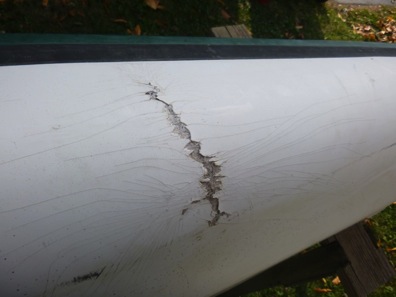
Putting the boat up on saw horses and surveying the damage left me with a sense of nausea in the pit of my stomach. The hull had major cracks running through the structural fiberglass in four places.  Moreover, a multitude of spider cracks populated the entire boat, hull and deck.

AssessDamage 

Structural Fiberglass Repair

The four major breaches were all reachable from the hatches and easily repaired from the inside. Rough up the surface, cut fiberglass tape a little larger than the size of the repair, place the cloth on a piece of wax paper and saturate the cloth with epoxy resin, and then slap the patch in place. The next day, I was able to sand the patch and spray a little paint on the area. Done with the fiberglass repair.


Spider Cracks

I had performed gelcoat repairs on other boats, but none as badly damaged as this one. How to even tackle spider cracks that covered nearly every square inch of a boat? My first thought was to use an angle grinder and remove nearly all of the gelcoat and find a way of spraying a new coat on the entire boat. Luckily, before I impulsively jumped on this idea, I consulted my trusted sources for all things unknown – friends, Internet searches and YouTube.

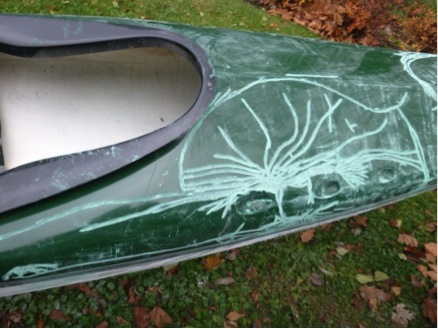
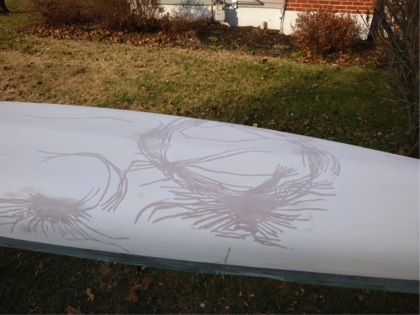
Spider cracks are likely to re-appear unless you widen the crack, with tapered edges, through the full thickness of the gelcoat. There were lots of suggestions on how to affect this repair, but I chose one not mentioned by any of them – my Dremel tool. A conical, aluminum oxide grinding stone did the trick. It allowed me to trace each crack from source to end to a depth where the crack line was no longer apparent. In most cases, this was down to the fiberglass – without penetrating the glass. The advantage of this time-consuming method was that it provided enough of the surrounding gelcoat to serve as a thickness gauge so that when a filler was later applied, it could be sanded to the level of the original gelcoat. The result looked like an abstract painting…

SpiderCracks


Don’t miss the rest of Dene Berman’s tutorial, Kayak: A Repair Saga, Part II


Sit-Up Stern Stall How-To

Photos: Lisa Lind
Sit-Up Stern Stall How-To

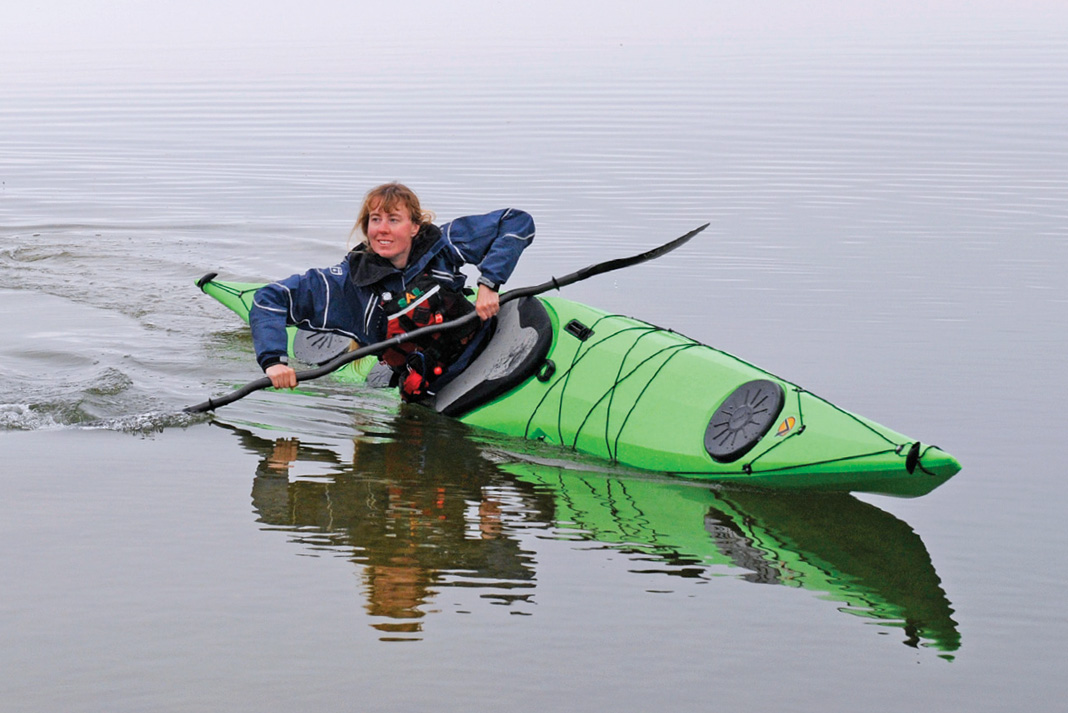
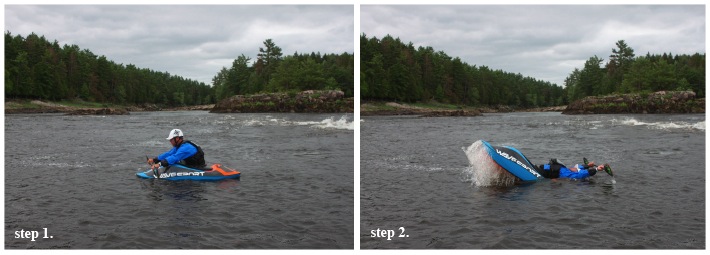
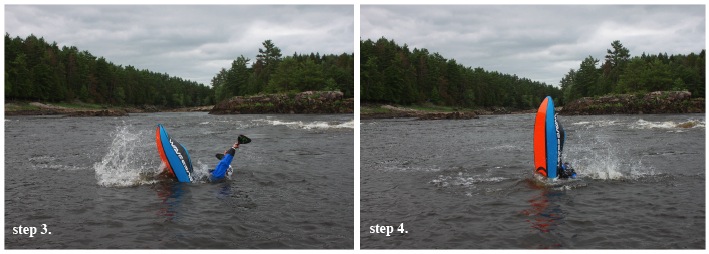
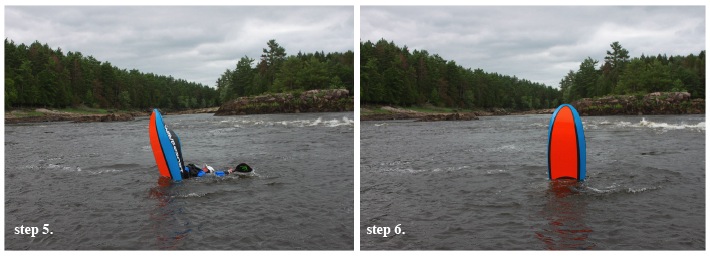
 The Sit-up Stern Stall is an explosive flatwater trick that has recently become my new favorite. Now that boat design has distributed volume in all the right places we can use our power and body positioning to get our kayaks vertical.

I have written down a few pointers along with a sequence photo of how this flatwater technique works.

Technique1

Step 1.

With your kayak sitting still, your first task is to get all your weight and body mass to the bow of the kayak. Think about bending at the hips and stretching your arms and paddle forward—way forward.


Step 2.  

Throw your entire upper body and weight to the stern of your kayak. Again make sure to reach with your arms and paddle. Your entire body should be on the back deck and stretched out. This will also lock your knees into your thigh braces and set you up for your next step.

Technique4

Step 3.

With your upper body stretched out start to pull up on your knees/thighs while sitting up. Your body should be doing a sit-up but focus on keeping your upper body stretched out so you are using all your upper body muscles and not just your lower crunch abs. You should be trying to pull your feet and hands together to get the maximum leverage to force the stern of your kayak under the water!

Note: If you try to crunch your torso to bend forward you will simply push your kayak back to flat. Remember stay stretched out with your torso and use your leg muscles as well.


Step 4.

Once you have finished your sit-up and your boat starts to approach vertical, you can once again lay your body toward the back deck (stern of your kayak). Reach your paddle blades toward the stern and into the water. By lying back at this point you will help the momentum of your kayak and add weight to the stern to get the volume of the boat under water. Continue to pull with your legs to get the boat fully vertical.

Technique5

Step 5.

Once the boat is vertical your can start to sit forward again to find your neutral body position and balance point of your stern stall.

Note: If you continue to lie back after step 4 your boat will be pulled over vertical. You need to sit back neutral to stop the momentum and establish your stern stall by finding the balance point. It may also help to push your legs away from you to stop the momentum.


Step 6.

Now that you have found your balance and neutral position you can chill out in a stern stall and keep working on your paddler six pack abs.

This technique takes some serious explosive power and some time to perfect. Try it out and add something new to your bag of tricks.


—Tyler Curtis, www.riverplay.ca


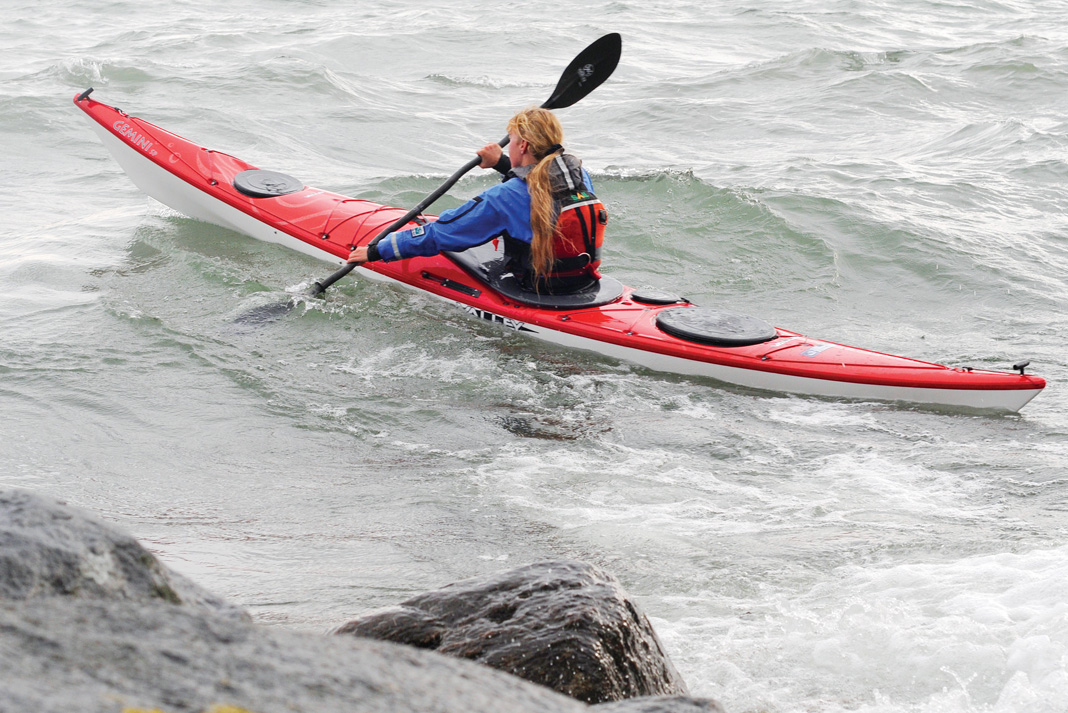
Kayak Keview: Valley Gemini SP Kayak

TWIN ENVY. PHOTO: PO MARSHALL

In Greek mythology, Castor and Pollux were Gemini, the twins. Like most twins, the brothers were similar in appearance but disparate in personality and talents. Both were adventurers and Argonauts, but Castor was a skilled horseman while Pollux’s talents lay in boxing. (Unlike most twins, the Greek heroes also had different fathers—mortal Castor’s a human king, immortal Pollux’s the god Zeus).

Improbable genetics aside, the Gemini myth demonstrates the Ecclesiastical adage that two are better than one.

Valley Gemini SP Specs
Length: 14 ft
 10 in
Width: 22 in
Weight: 45 lbs
Price: $3,500
valleyseakayaks.com

Designers at British boat builder Valley Sea Kayaks reached the same conclusion when they decided to enter the compact touring kayak market for the first time. As Valley puts to develop a proper sub-16-foot kayak was complicated by the spectrum of reasons a paddler might seek out a shorter kayak.”

The solution? Twins. Valley split the egg, creating two boats from the same design and tuning each for a specific purpose. The Gemini SP (Sports Play) is the playful twin, prioritizing maneuverability, agility and strength. The Gemini ST (Sports Touring) is more journey-oriented, emphasizing speed, tracking and lighter weight.

Of course, Valley is quick to point out, you can still play in the touring version and tour in the play one, but “the further you get to the ends of that use spectrum, the more you’ll benefit from the specialist.”We put this claim to the test in the mercurial waters of a late autumn rendezvous on Lake Superior. When

the hoped-for witch of November fails to come stealing, I find myself paddling the Gemini SP on a scenic tour of the coast, sprinting across placid waters with a pod of Nordkapps and Explorers.

Considering the SP’s pronounced rocker, hard chines and flatter mid-hull profile—not to mention the two-to-three-foot longer waterlines of conventional expedition kayaks—I am pleas- antly surprised that it is able to keep pace. While I am undoubtedly working harder than my companions, the SP doesn’t possess the chelonian flatwater performance of some play- biased boats. Tracking is more than adequate with the skeg deployed, I discover when a beam wind teases us on a crossing.

TWIN ENVY.
PHOTO: PO MARSHALL

Getting in close and scooting through clefts in the cliffs at Montreal River is a highlight of our tour. Unlike many bigger boats, there’s no need for dramatic edging to make effortless turns. Combined with forgiving initial and secondary stability, this makes the SP as much fun for developing paddlers playing a shoreline in calm water as it is for more advanced folks throwing it around in surf or rock gardens.A day later and 500 miles to the south, the wind is blowing furiously on my local lake, hurling steep, short-period waves against the shore.

Hardly the sensuous swell of the ocean, but the SP doesn’t mind. It accelerates quickly with just a few strokes, matching speed with the impatient breakers. The high volume bow stays out of the troughs and the stern stays loose while surfing, making the boat easy to turn and resistant to broaching.

Like Castor and Pollux, the Bryan Brothers and Ashley and Mary-Kate, the Valley Gemini twins demonstrate two really are better than one. Both boats are spacious enough to accommo- date weekend tours, but if your inclinations lie toward cover- ing distance look to the Gemini ST. From placid gunkholing to rollicking rough water, however, the Gemini SP is a play partner nonpareil.

Sit and Fit

A keyhole cockpit and con- toured thigh braces provide a secure fit with room to relax. No ratchets or risers here, just a padded seat and low profile backband.

Twice as Nice

Both Gemini benefit from impeccably finished vacuum- infused composite con- struction, a new technique for Valley that allows up

to 20 percent reduction in weight. A reinforced lay-up for roughhousing adds 7.5 pounds to the SP. A polyeth- ylene version is also available.

Peel and Stick

Three rubber hatches—stan- dard round bow, oversized oval aft and teeny-weeny day—provide a bone-dry seal.


AKv14i1 cover300This article first appeared in the Adventure Kayak, Spring 2014 issue. Subscribe to Paddling Magazine and get 25 years of digital magazine archives including our legacy titles: Rapid, Adventure Kayak and Canoeroots.