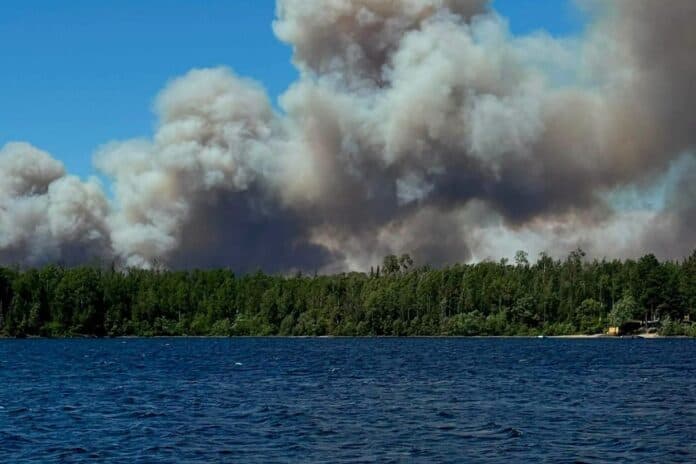
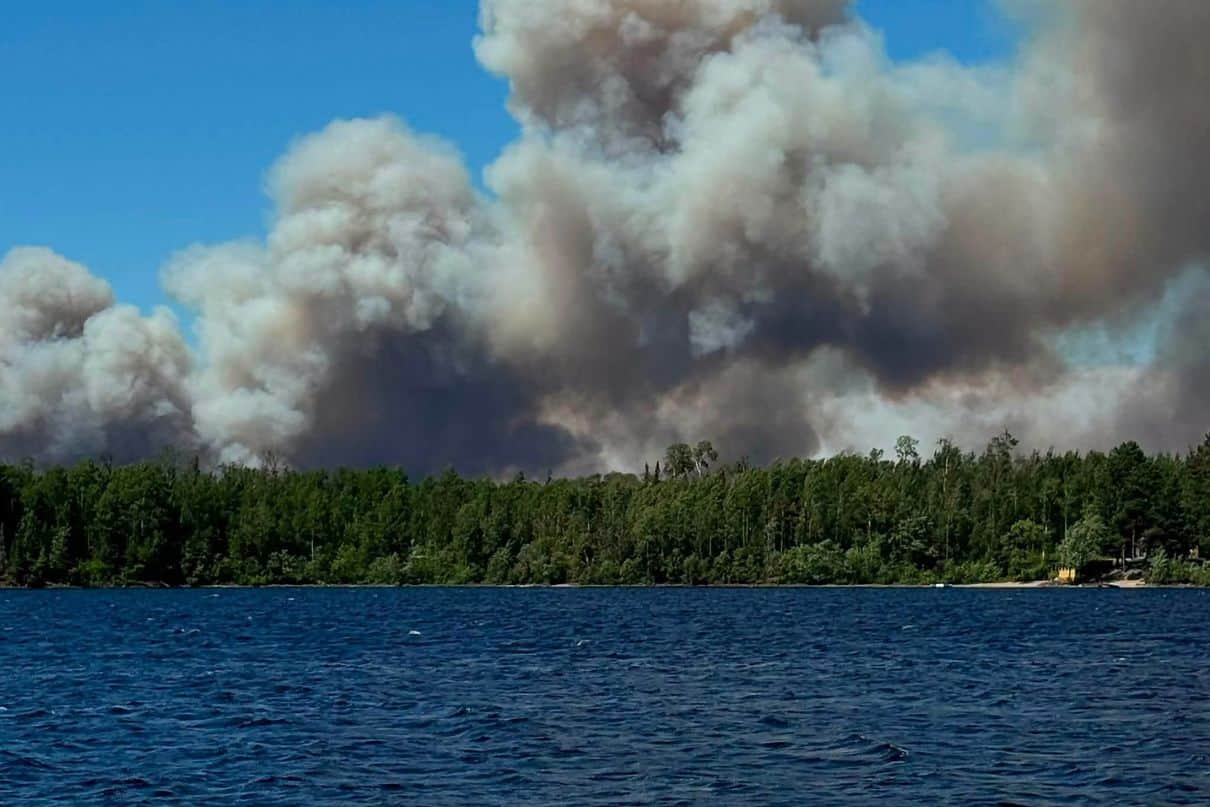
Smoke billows up from the BWCA. | Photo: courtesy Howard Kieffer
The U.S. Forest Service closed the Boundary Waters Canoe Area (BWCA) on Tuesday as wildfires surge across northern Minnesota and dry, windy weather persists. The wilderness area has only been closed completely twice before in its history.
“This closure is about keeping people safe,” the Forest Service shared in a press release on Monday. “Wildfires don’t just threaten trees and campsites—they create dangerous smoke, unstable conditions and rapidly shifting fire behavior that can trap visitors with little warning.”
Fires spread
As of Tuesday, the Forest Service reported 17 active wildfires within the Superior National Forest, with three burning inside the BWCA. Many of the fires were started by lightning from a storm that moved through the area on the evening of July 6. More storms with lightning and little rain are in the forecast.
Together, the three fires inside the BWCA have burned over 27,000 acres so far. On Monday, the Bear Trap Fire, which is burning south of Lac La Croix, crossed the border into Canada. Quetico Provincial Park and northern Ontario are also experiencing numerous wildfires.
Smoke billows up from the BWCA. | Photo: courtesy Howard Kieffer
“[On Monday,] extreme fire conditions occurred widespread across the entire forest. Most fires had wind-driven size growth and some spotting,” the Forest Service wrote in a statement.
Crews worked under hot, dry and windy conditions on Tuesday, using a full suppression strategy when possible. Given the dangerous conditions and the highly active fires, the Forest Service says firefighters and public safety are their highest priorities.
“Even healthy adults can experience breathing problems when smoke levels rise, and people with heart or lung conditions can be especially vulnerable,” the Forest Service wrote. “In a wilderness as large and remote as the Boundary Waters, emergency response is challenging even on a normal day; during potential widespread wildfires, those risks increase significantly.”
Campers impacted
While no new visitors are allowed to enter the BWCA, the Forest Service is working to evacuate many who entered before the closure.
“Under these conditions, it isn’t safe for people to travel, camp or paddle in the wilderness. Rapid fire growth and thick smoke can make it hard to breathe, hard to see and difficult for firefighters to reach anyone who needs help,” the Forest Service wrote.
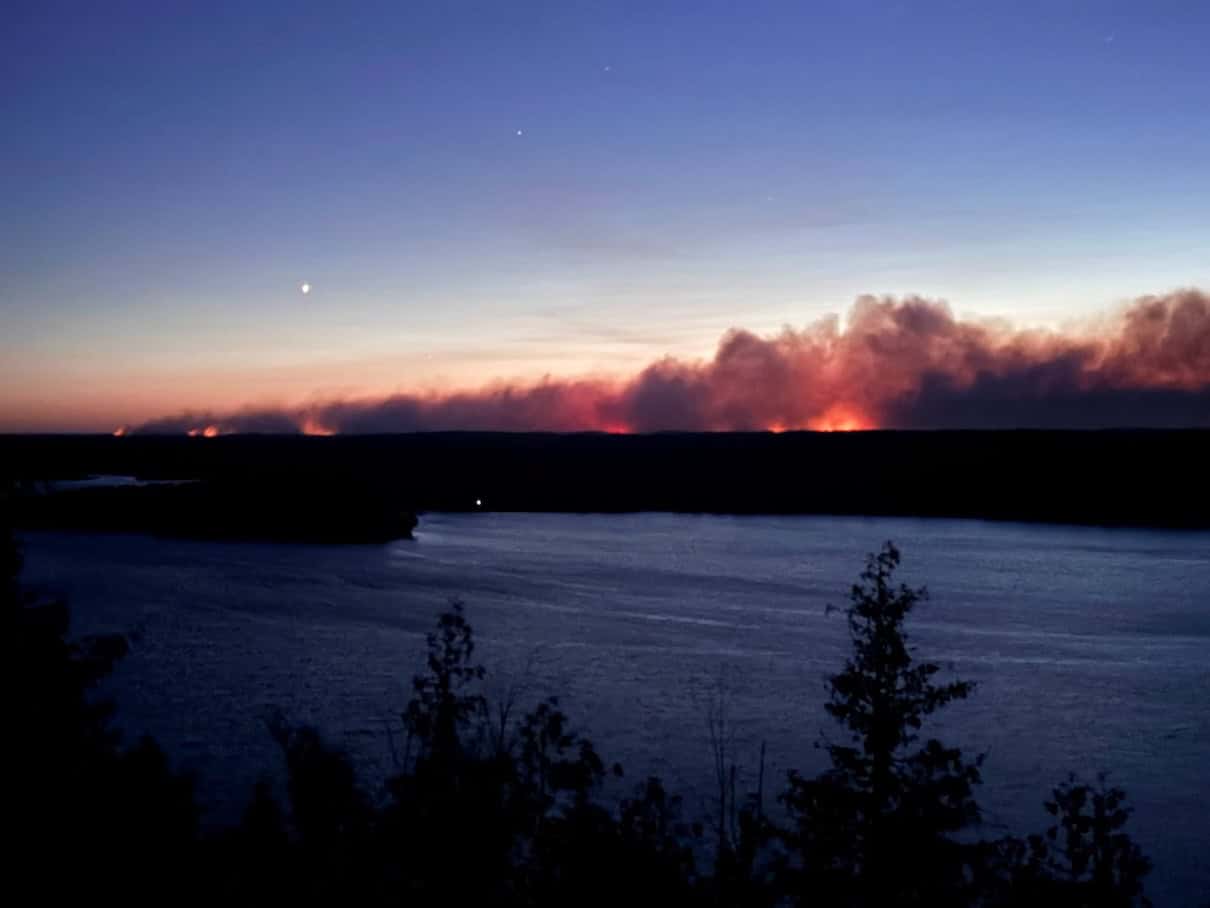
The view from Moose Lake of the Camp Fire burning on Monday night. | Photo: courtesy Bria Schurke
In a video shared on Facebook, Superior National Forest wilderness manager Carl Skustad detailed efforts to evacuate BWCA visitors on Monday after strong winds caused fires to spread aggressively. A Forest Service plane spotted multiple groups but was unable to land due to large waves. Rangers then went in on a motorboat to rescue the paddlers.
“The rangers on the water were able to sweep the area in the smoke and ash and get those public out, and then we transferred them to our amazing cooperators—outfitters, guides—and they were able to transport them back,” said Skustad.
The Forest Service issued a refund to all permit holders through July 17, but more permits could be canceled as the closure extends. Roughly 1,900 campsites are impacted by the closure. Officials say it will remain in effect until the fires are contained and the risk to the public has decreased.
“We know how important the Boundary Waters is to local communities and the more than 150,000 people who visit each year, and we appreciate your patience as we work to restore safe conditions,” the Forest Service shared.
When Kelsey Pfendler pushed off from California, she hoped to reach Hawaii in under 70 days. Her solo row across the mid-Pacific over the next 44 days shattered speed records and her own expectations.
“Bodies are amazing, and I do believe that women are really good at endurance sports. We’re super capable of dealing with pain and emotional regulation under stress. Just what a body can do—we don’t even know,” Pfendler told ESPN in an interview reflecting on her trip.
Pfendler, a 32-year-old Grand Canyon river guide, is now the fastest person to complete a solo row across the mid-Pacific and the first American woman to do so.
The journey
Pfendler began the roughly 2,400-mile (3,862-kilometer) trip on May 21 in Monterey, California, and finished in Honolulu, Hawaii, 43 days, 17 hours and 55 minutes later.
“I didn’t expect to get in that early, but I picked up a lot of speed at the very end because there was some good current going into Honolulu,” she told ABC News after the trip.
Pfendler beat the previous women’s record by over 40 days and the men’s record by about nine days. She is now the 10th person to have rowed solo and unsupported across the mid-Pacific.
“It’s a crazy feeling to have this moment when I didn’t even expect fully to break the women’s record coming out here. I just wanted to do my best. And I trained my butt off and I prepared in every way I could, but I had no expectations of this moment,” Pfendler shared in a Facebook video the day before she made history.
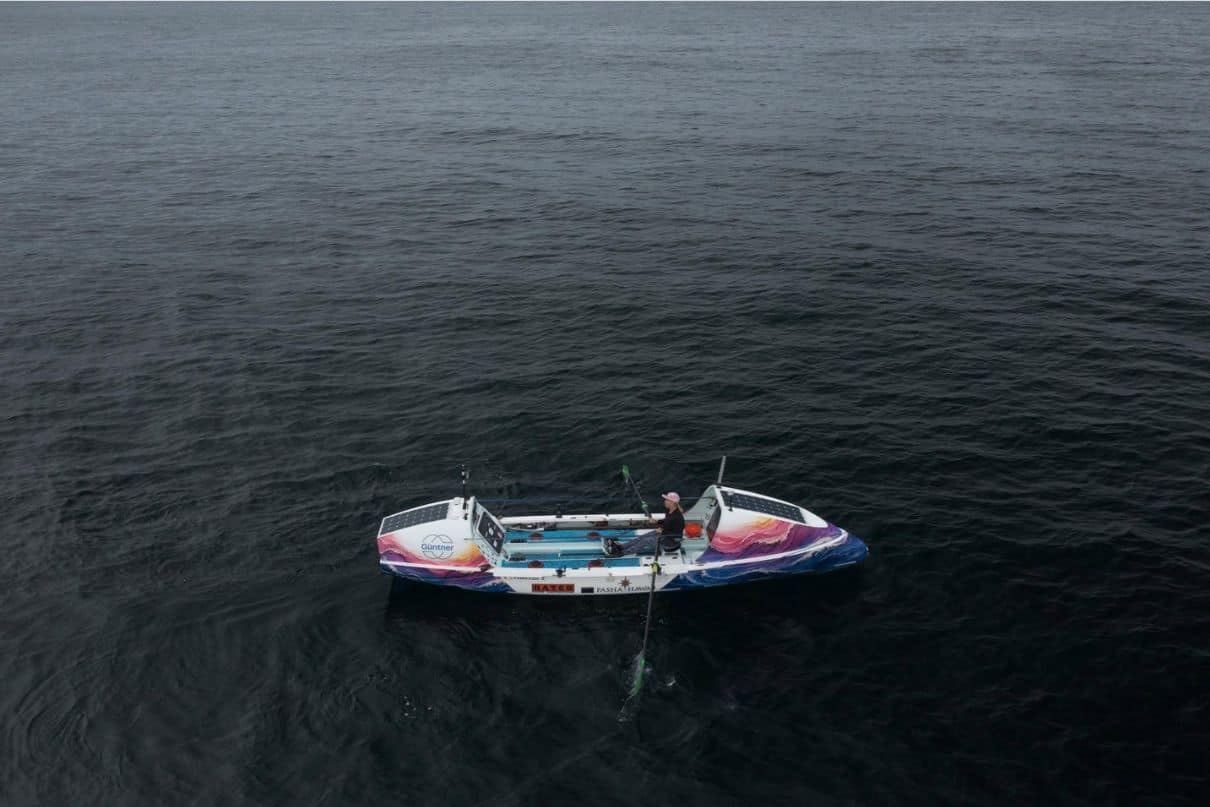
Kelsey Pfendler rows her 21-foot boat, which she used to cross the mid-Pacific. | Photo: You Row Kelsey | Facebook
While she made the journey completely alone, carrying everything she needed with her in her 21-foot (6.5-meter) boat, hundreds of thousands of people followed along on social media where Pfendler posted videos documenting her struggles, success and daily routines.
Pfendler says the first week of the trip was the most difficult. As boats leave the coast of California, they battle wind and currents pushing them south or back toward shore until they clear the continental shelf. To avoid losing ground, Pfendler slept for just one hour each day during her first week and a half. She slept for only four hours each day for the rest of the trip.
“The utter lack of sleep that I was able to function on was pretty interesting to me. I didn’t know how that was all going to go,” she told ESPN.
Beyond sleep deprivation, Pfendler battled changing weather, wind, fear, self-doubt and isolation. For the vast majority of her trip, Pfendler was out of reach of a helicopter rescue, meaning she would have to wait on a much-slower boat rescue if anything went wrong.
Kelsey Pfendler reflects on her journey in an interview with ESPN. | Photo: ESPN
”You have to have this sense of humility when you’re getting faced with such a powerful thing like the ocean. It was scary, it was amazing, it was humbling. It was everything that it could be,” Pfendler told ESPN.
The motivation
In 2024, Pfendler rowed across the mid-Pacific as part of a four-woman team and began brainstorming her next adventure immediately afterward. Pfendler says she uses the challenges to grow and learn about herself, viewing fear as motivation.
“I like to be afraid because you get to work through it, and it’s the only way you can grow as a human being if you want to push yourself,” Pfendler told ESPN. “It’s always just a choice. You can be afraid of what you’re doing and still choose to go through with it because fear shouldn’t be the limiting factor to what you want.”
Beyond personal growth, Pfendler hopes her achievement will inspire others to take on their own challenges. Just 20 miles from the finish, Pfendler paused to record a video for everyone following along on social media.
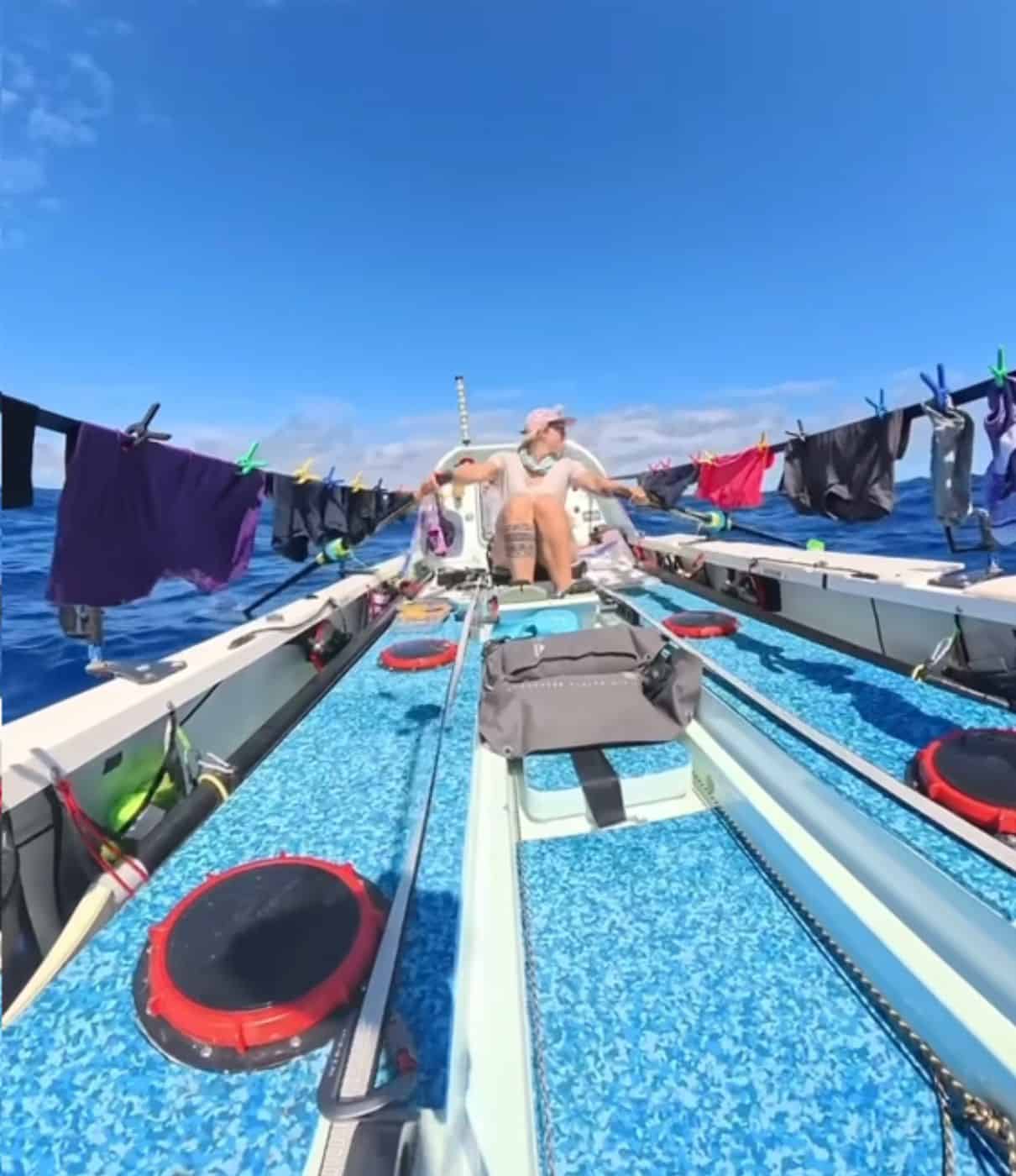
Kelsey Pfendler rows while her laundry dries. | Photo: You Row Kelsey | Facebook
“If any part of this made at least one person feel a little bit more powerful in their own skin, I couldn’t ask for anything else, and I’m happy,” Pfendler said in the video. “Think about trying to find your own big, hard, scary thing. You might not think that you are strong enough to finish it right now, but you’re definitely strong enough to start it, and you’ll find everything else along the way.”
Pfendler also used her row to fundraise for the Whale Foundation, an organization that offers free counseling services to the Grand Canyon river guiding community. Pfendler has raised over $180,000 for the nonprofit, which she says helped her through a mental health crisis after an incident on a Grand Canyon trip.
While Pfendler does not have a concrete plan for her next challenge, she intends to keep chasing “big, scary things.”
Phoebe Lenhart at Tablesaw Rapid on the Ocoee River. | Feature photo: Rob Giersch
Created In Partnership with Tennessee Department of Tourist Development
Whitewater paddling is the bedrock of adventure tourism in East Tennessee, thanks to the Southern Appalachian Mountains.
Millions of years ago, massive tectonic collisions gave rise to the mountain range, stretching from Alabama into Canada. In the North, ancient glaciers smoothed the terrain, but in the South, the mountains remained rugged and steep. Rivers squeezed through boulder-strewn canyons, creating the whitewater meccas now found along Tennessee’s Pigeon, Nolichucky and Ocoee rivers.
But while these lush gorges share a geologic history, each offers a unique experience shaped by generations of paddlers and long-established outfitters. The world-class river running adventures offered within these three Tennessee river gorges are eons in the making.
Where Whitewater Runs Deep
Nolichucky River Gorge: Wild & Remote
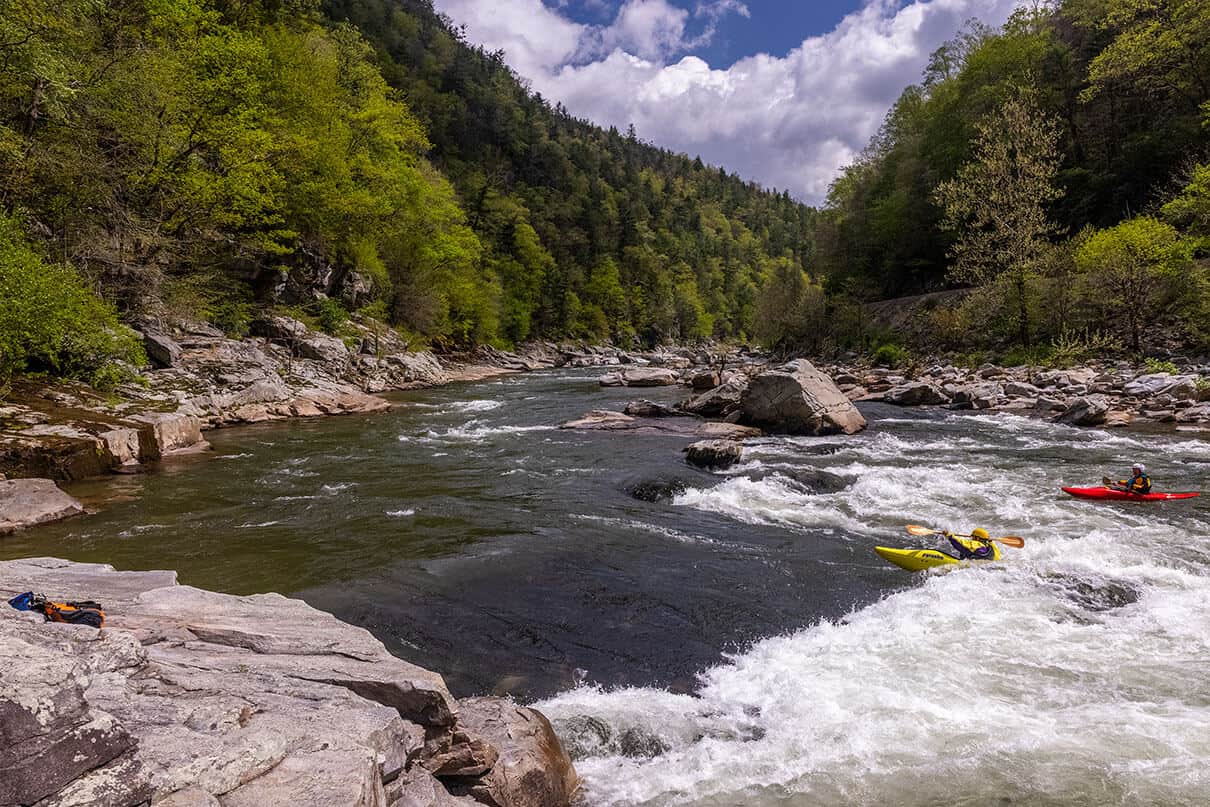
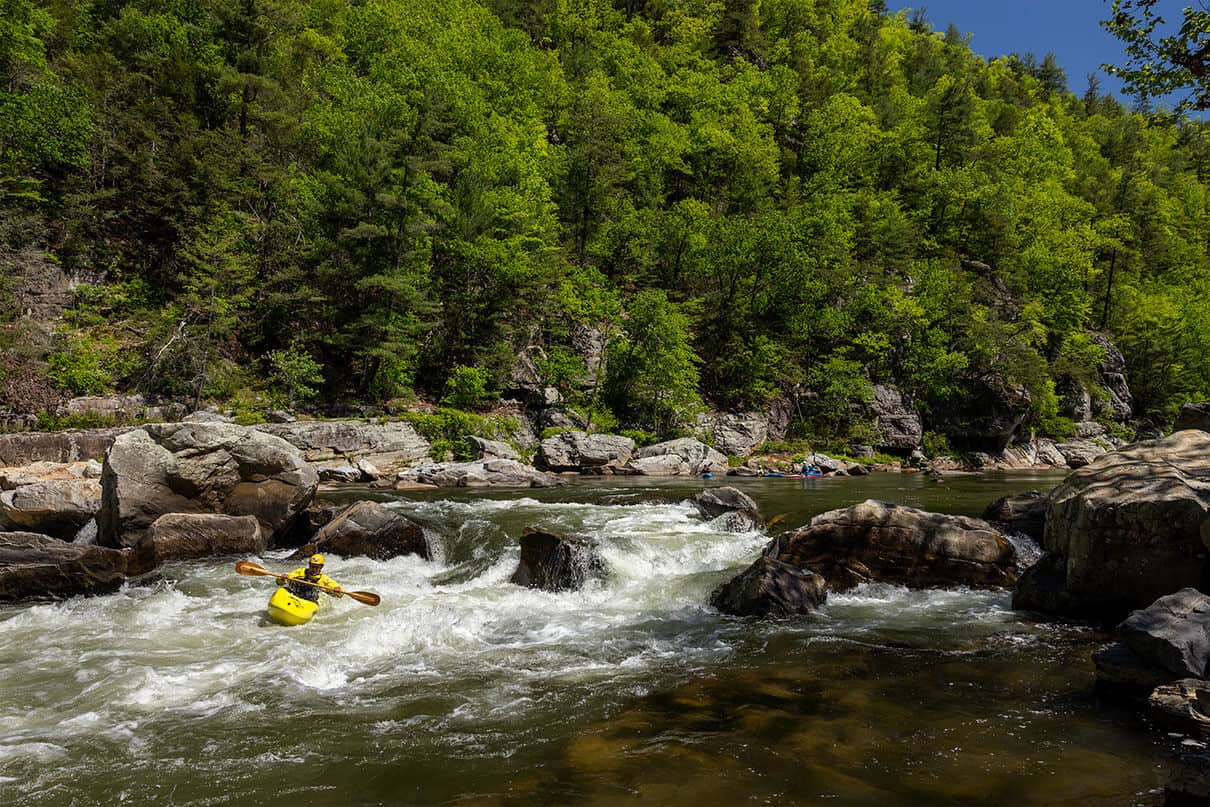
The fast-moving Nolichucky carves through the eastern edge of the Southern Appalachians, creating Tennessee’s deepest river gorge. The class IV run features a mix of technical lines, pushy boulder gardens and powerful wave trains. There is no cell service and few places to hike out—that’s part of the appeal.
Matt Buys on Quarter Mile Rapid on the Nolichucky River. | Photo: Rob Giersch
Welcome to the “New-lichucky.” | Photo: Rob Giersch
Gordon Grant surfing at Jaws Rapid. | Photo: Rob Giersch
Paddlers who find their way to the Nolichucky Gorge are seeking a distinct experience, says Slayton Johnson, 33, owner of Wahoo’s Adventures raft outpost in Erwin, Tennessee. “They didn’t just Google ‘whitewater near me.’ They come for the Noli,” he says.
Paddling the gorge takes grit. The run is nine miles; the shuttle is long. Just an hour away, the class III French Broad River offers much easier access, says 55-year-old Brad Eldridge, president of the Appalachian Paddling Enthusiasts (APEs) club.
But the reward for those that put forth the effort, he says, is an immersive wilderness experience.
Bald eagles soar; river otters splash; the occasional bear lumbers along the forested banks. “Some days you’ll maybe see one or two other [paddling] groups,” says Eldridge, who’s been kayaking the Nolichucky for over a decade.
During commercial rafting season, typically April through October, Johnson says Wahoo’s guides at most 20 customers a day through the gorge—a stark difference from the summers he spent as a guide on the bustling Upper Pigeon where the short run allowed his company to take hundreds each day.
In 2024, the Nolichucky was hit with historic flooding followed by railway construction that temporarily shut down the river. Commercial paddling is still restricted while the forest service reconstructs the put-in (due to be completed in June), but private paddlers began to return within weeks of the storm.
Scott Fisher, founder of the Nolichucky Outdoor Learning Institute (NOLI), was among the first of them. Everything had changed, he says.
Holes were stickier, wave trains more technical. Within the long and bouldery “Quarter Mile” rapid there was a new four-foot drop, deemed “Helene Hole” after the hurricane that caused it. In spots where sediment had been scoured from the bed, the current channelized, creating pushier lines but also opening up the free-flowing river to lower flows.
Technical lines, pushy boulder gardens, and powerful wave trains define the run. | Photo: Rob Giersch
“It’s taken a while to admit—but the whitewater is better than it was before,” says Fisher.
The consensus, says Eldridge, is that the Nolichucky Gorge is now half a grade harder.
And while they wait for commercial rafting season to reopen this June, Johnson says he and his guides are relearning the river, taking every opportunity to train on what Fisher calls the “New-lichucky.”
More than grit, those who know the Nolichucky best bring a deep reverence for the ever-changing nature of a river.
“We watched a watershed be remade in 24 hours,” Eldridge says. “There’s a sense of loss but also a sense of wonder. The Nolichucky is wild and new again.”
If You Go: Nolichucky River Gorge
Location: Erwin, Tennessee
Rating: Class IV
Length: 9 miles
Flows: The Nolichucky is a rain-dependent, free-flowing river. Since the flooding, optimal flow rates are yet to be determined though outfitters say the river now goes at much lower levels than before.
Commercial Season: In typical years, the commercial season runs from April through October. At the time of publication, the season had not yet reopened following the forest service’s reconstruction of a commercial put-in—scheduled for completion in June 2026.
Pigeon River Gorge: Family-Friendly + Accessible
More than 200,000 paddlers visit the class II-III Pigeon River Gorge, also known as the Upper Pigeon, each year. A 2022 America Outdoors report ranks the stretch as the second most-visited whitewater river in the U.S., just behind Colorado’s Arkansas River.
A women’s paddling group gathers below Entrance Rapid. | Photo: Rob Giersch
Located among some of the tallest peaks in the Southern Appalachians, the Pigeon’s proximity to Gatlinburg and Great Smoky Mountains National Park makes it a hub for vacationing families. Its whitewater—dynamic but not overwhelming—makes it a key river for paddlers progressing their way to harder runs.
“It’s a friendly river. There isn’t a ton of consequence. That allows us to not be so serious,” says Lacy Bramlett, who worked as a Pigeon guide for 15 years before becoming director of operations for Smoky Mountain River Rat outfitter in Hartford, Tennessee.
The atmosphere in the gorge is fun-loving; the guides are spirited. The job is as much about entertaining as it is navigating the rapids, Bramlett says. “I love telling [customers] about the biodiversity and the history of the Pigeon. I love a good dad joke.”
Play spots galore on the Pigeon River. | Photo: Rob Giersch
Smoky Mountain River Rat Rafting at home
on the Pigeon River. | Photo: River Rat/Tennessee Tourism
The small, riverside town of Hartford is built on whitewater tourism, home to outfitters, food trucks and not much else. Each summer, when the guides return, the town’s population of about 900 grows by nearly 50 percent.
In 2024, when Hurricane Helene brought unprecedented flooding to the area, it reshaped nearly every rapid on the river.
The fast and technical class III Accelerator is the only rapid that bears resemblance to what it used to be, says kayaker Mark Jaben, 71, who’s been paddling the Pigeon since the mid-1990s.
“The river gives and the river takes away,” he says. “I hear there are a few new surf waves that have emerged.”
But the storm also reshaped the community of Hartford.
“It unified us,” Bramlett says of the raft industry. “We’re competitors by day but friends by night. Once you find a love for whitewater, it’s hard to ever step away, but it’s the community that keeps me coming back. This place has magic in it.”
If You Go: Pigeon River Gorge
Location: Hartford, Tennessee
Rating: Class II-III
Length: ~4 miles
Flows: Dam-controlled commercial releases typically provide 1,300-1,400 cfs. For natural flows, the comfortable range is 700-2,500 cfs.
Commercial Season: March through October
Ocoee River Gorge: Iconic Olympic Hot Spot
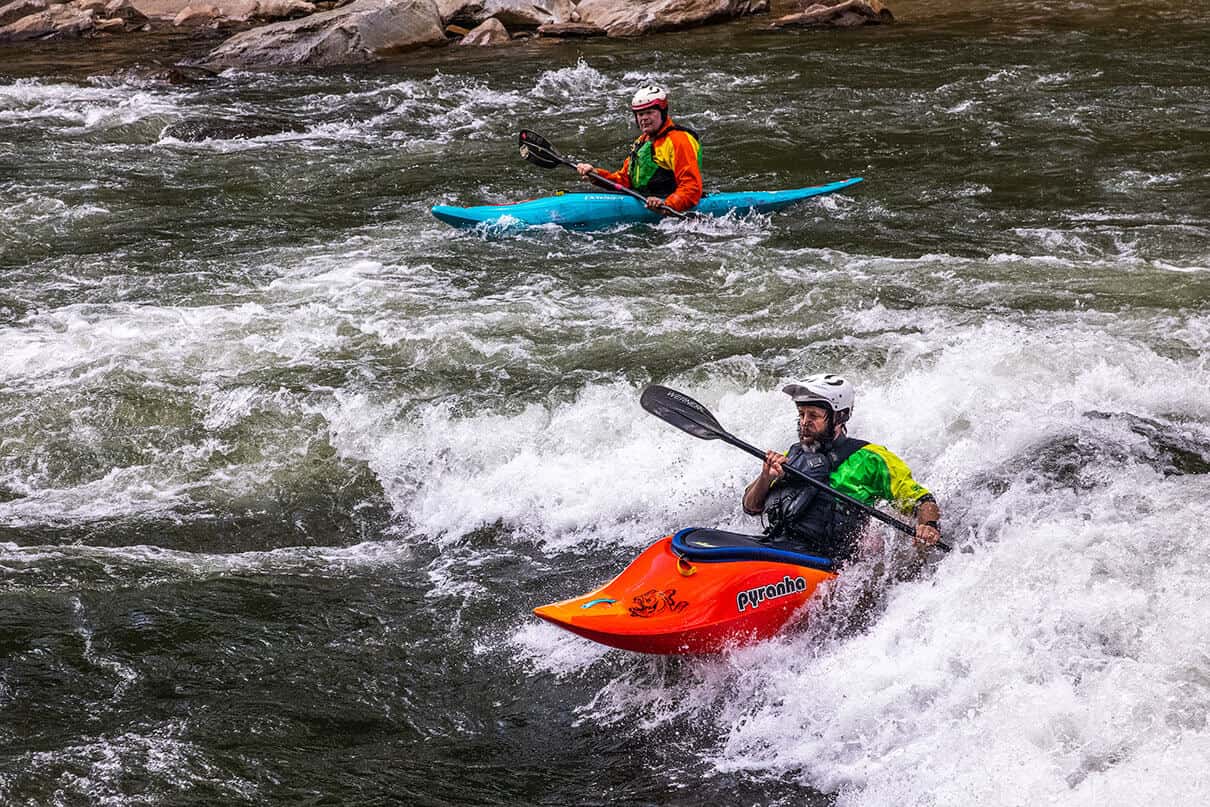
On a hot summer day, the Middle Ocoee put-in buzzes with activity. Groups of kayakers and canoeists gear up. Throngs of rafters huddle for safety talks shouted over the roar of the spillway. At the bottom of the ramp, paddlers launch into instant action: the long and manky class III+ Grumpys rapid.
But those who want a gentler start can hike their boats a few hundred feet downstream and put in just beneath it.
“You can make the Ocoee as easy or as hard as you want,” says kayaker Ally Shaner, 29.
Ocoee raft guide training at Flipper Rapid. | Photo: Travis Camp
Ladies Take The Ocoee community event. | Photo: Travis Camp
Katey Nuffer at Broken Nose Rapid. | Photo: Travis Camp
The 10-mile Ocoee River Gorge cuts through the southern edge of Cherokee National Forest and is split into two sections.
The five-mile class IV Upper is characterized by bigger, stronger rapids. It’s more secluded, framed by the lush forested gorge, until reaching the end where the riverbed was reconstructed to create the challenging 500-meter course used during the 1996 Olympic whitewater games.
Then, there’s the bustling class III+ Middle section, a social, roadside run featuring a continuous mix of waves, holes, drops and technical maneuvering.
Ally and her brother, Mason Shaner, 26, are third-generation Ocoee paddlers. Their mother, Tani Shaner, 63, first began kayaking the Ocoee, following her father’s lines, at age 12—several years before the start of commercial rafting in 1977.
Tani became a guide in 1982 and raised both of her children on the water.
“[The Ocoee] is an unusually perfect river to learn on,” says Mason. “The moves, the playspots—they’re just remarkably good.”
Kate Shaffer and friends below Slice and Dice Rapid. | Photo: Rob Giersch
The Middle is a relatively friendly stretch, absent of dangerous hazards such as sieves and caves. It’s versatile—nearly every rapid boasts a sneak line, a traditional line and a challenging line, says Ally.
“You can always find a way to scare yourself—you can throw a kickflip right above Grumpys [ledge hole],” says Mason, who became a class V boater through training on the Ocoee.
While the Middle helps paddlers build technical creeking skills, the Upper, with its massive hydraulics, hones big-water abilities.
Each year, the dam-controlled Ocoee attracts more than 150,000 paddlers, making it one of the highest-use rivers in the Southeast, according to a 2024 America Outdoors report.
The sheer volume of commercial trips allows guides to learn the river exceptionally well—every rock, every whirlpool, says Sarah Beth Neal, 32, raft guide turned owner of Outdoor Adventure Rafting and Ocoee Outdoors outfitters.
The “level up” culture that permeates the gorge is a mindset Neal applies off water, too. In guide training, she includes lectures and exercises aimed at developing kindness, self-awareness and personal responsibility among her staff.
On the river, everyone looks out for everyone.
If a person needs help, “it doesn’t matter what boat you’re in—hard boat, raft. Everybody pitches in and works as a team,” Tani says of the community.
Dropping into Hell Hole. | Photo: Rob Giersch
The wonder of whitewater, says Neal, is that it forces guides, customers and private boaters alike into the present moment, deepening their relationships with the river and with each other.
The character of Tennessee’s gorges may vary, but the primal connection they evoke feels as old as the mountains themselves.
If You Go: Ocoee River Gorge
Location: Ocoee, Tennessee
Rating: Middle Ocoee section, class III+ / Upper Ocoee section, class IV
Length: Middle Ocoee, 5 miles / Upper Ocoee, 5 miles
Flows: Dam-controlled commercial releases range between 1,200-1,600 cfs on the Middle and 1,600 cfs on the Upper. Commercial rafting operates up to 3,000 cfs.
Commercial Season: Commercial Season: Middle Ocoee releases run from March through October, with Upper releases from late May through early September.
Sunny Montgomery is a freelance writer and open boater based in Ocoee, Tennessee. She shares a homestead with her husband, toddler and too many canoes to count.
This article was published in Issue 76 of Paddling Magazine. Subscribe to Paddling Magazine’s print and digital editions, or browse the archives.
Phoebe Lenhart at Tablesaw Rapid on the Ocoee River. | Feature photo: Rob Giersch
As convenient as inflatable kayaks can be, they aren’t exactly praised for performance. That’s because almost every model out there hits certain limitations known all too well compared to their plastic and composite counterparts. Now, an emerging brand called Razor Kayaks has landed on the shores of the U.S. with the ambitious promise of producing not your typical inflatable but a high-pressure boat as capable as a hardshell.
Review of the Razor Kayaks Edge Pro Inflatable Kayak
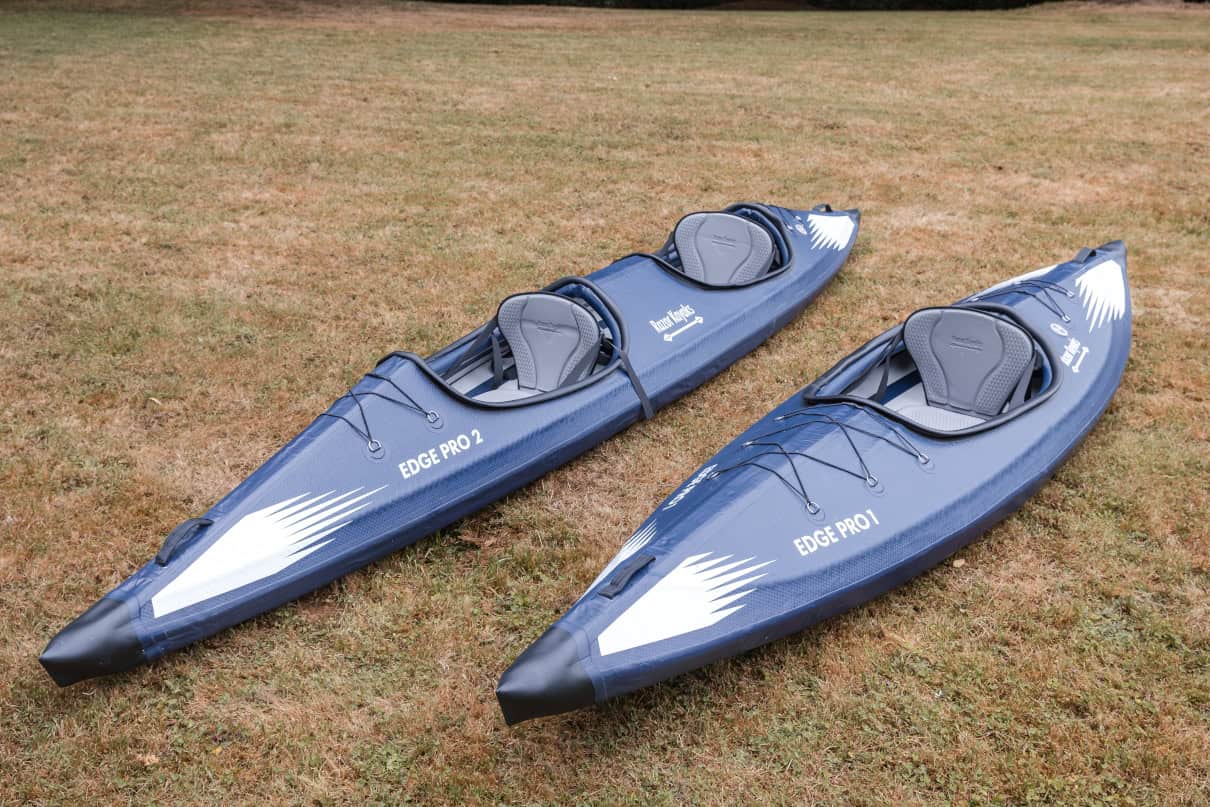
Razor Kayaks is the vision of founder Rob Fallon, a self-described “kayak tragic” with a dozen recreational boats lying around, who wanted to create something he actually enjoyed paddling. The seven-year-old company based in Australia has released multiple designs, but it’s one of their latest, a flagship boat years in the making, that they are most excited about. The series is called the Razor Edge Pro, and it has a unique construction that features dropstitch material around the entirety of the kayak, including a closed deck which is rarely found on an inflatable.
Edge Pro Design
The Razor Edge Pro is available in both single and two-person kayak models, aptly named the Edge Pro 1 and Edge Pro 2. One of the first things I noticed about these boats was their overall shape and layout. The Edge Pro 1, for example, is 13 feet long and has a tapered shape that narrows at the bow and stern and widens around the cockpit where the paddler is seated, just as many recreational and day-touring kayaks.
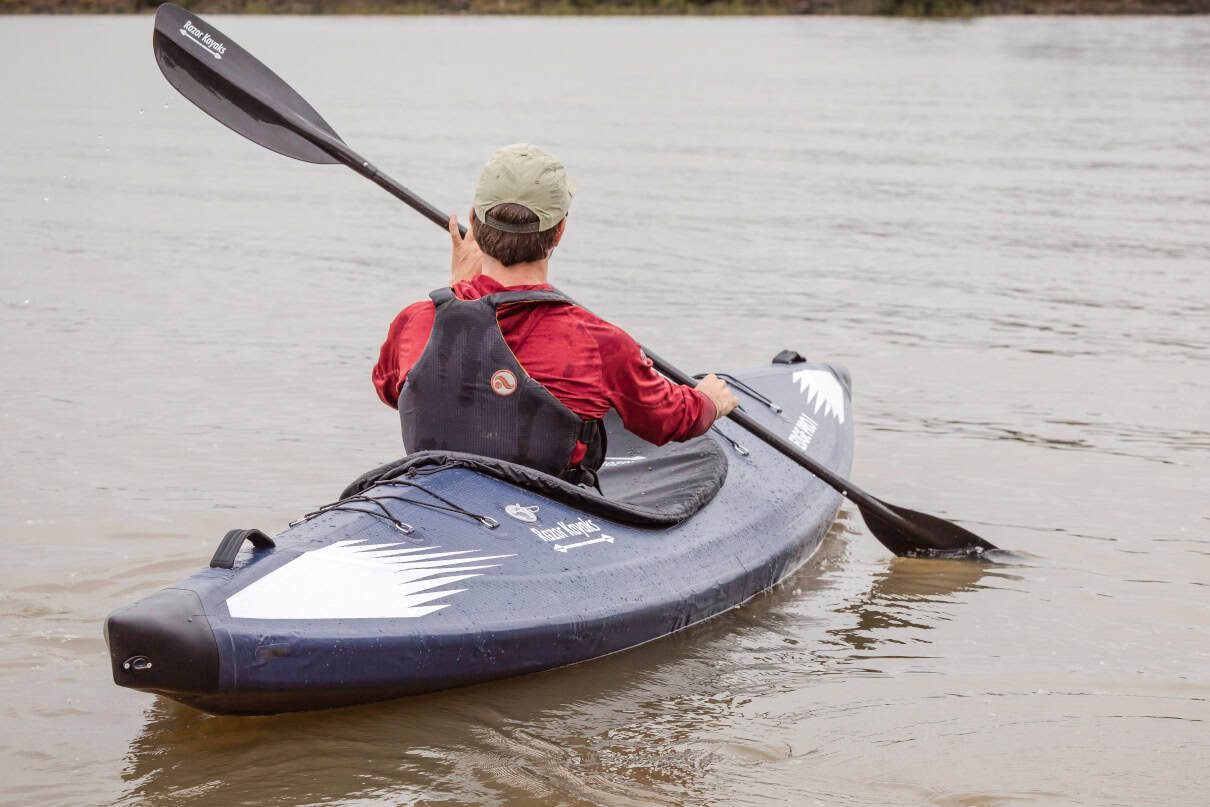
The boats also have the intriguing closed deck, which means the paddler sits with their lower legs partially enclosed inside the kayak on the foot brace. The cockpit is open enough that it still leaves ample room for the paddler to climb in and out easily, and situate themselves comfortably. Overall, I’d say it’s a similar cockpit to a closed-deck recreational kayak.
There is also an understated perk of the combination of the closed deck and light weight of the Edgo Pro 1: the ability to easily shoulder the boat and carry it to the water, which is not often an option for inflatables, and with hardshell recreational kayaks can be an awkward and cumbersome part of an outing.
Laser Cut Panels
The shape of the kayak’s hull and deck profile surprised me most. Inflatable kayaks regularly have either flat panels or round tubes. This tends to mean rudimentary hull shapes that don’t really let the paddler lean the boat edge-to-edge, and make for a kayak that plows over the water rather than glide through it.
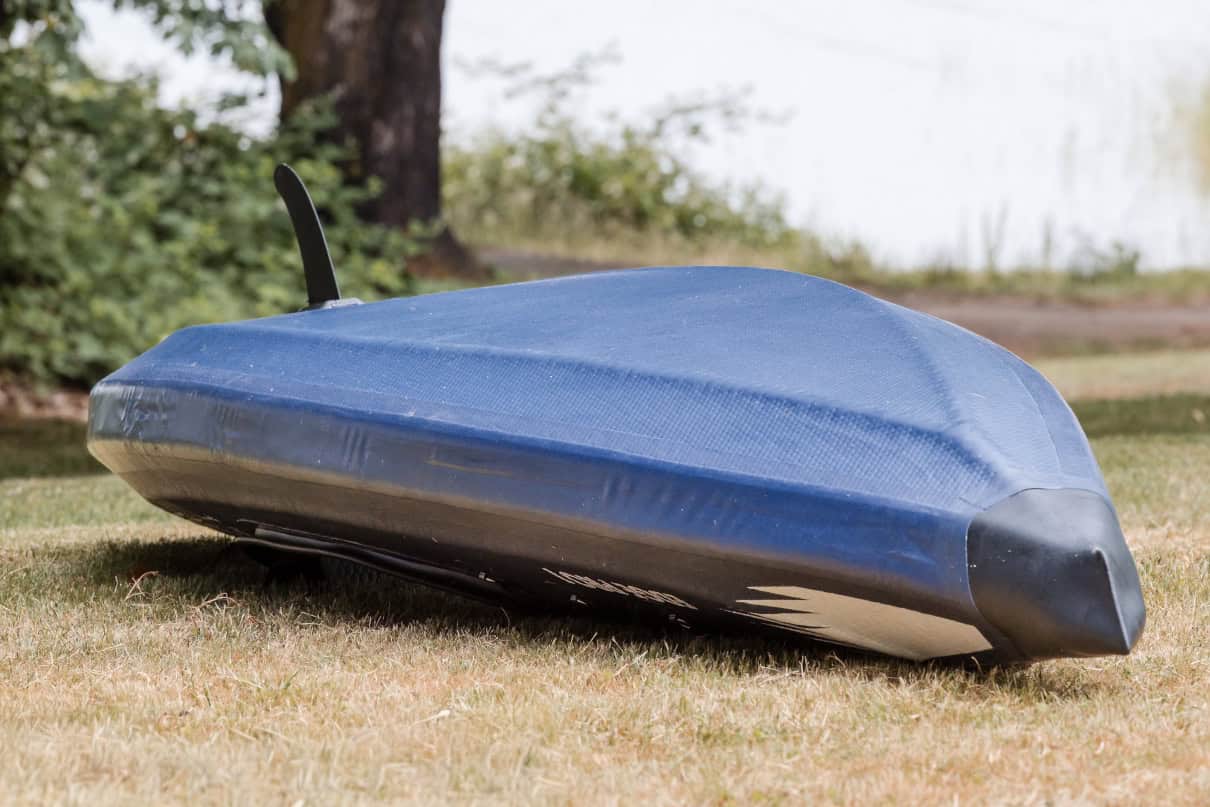
For the Edge Pro, Fallon and Razor brought in an engineer with a background from Boeing and an understanding of hydro and aerodynamics. They drew up the plans over years of testing, with the secret weapon of their design being the use of a laser cutting process to remove material and join sections of the PVC material together in multiple panels. This allowed them to create an inflatable kayak with more of what we see in hardshells—intricate bottom and deck shapes. If you look at the hull of the Edge Pro, you can see how the kayak transitions from the hull to the sides in multiple stages. Razor says this gives the boat roundness. What I see looking at the kayak is a flat-bottomed hull at the center under the paddler with transitions that equate to multi-chined edges. The result is that the hull design does in fact let you lean the boat side to side. The hull is wide and stable, however, on a section of moving river, I was able to lightly edge this inflatable kayak and actually carve in and out of eddies.
The hull also has a noticeable amount of rocker lifting the bow and stern from the water, which is helpful in paddling over waves and turning the boat.
There is a plastic fin included which can be attached to the stern to help the kayak track in a straighter line, however, I mostly paddled without it and had no issues feeling like I was getting spun out or thrown off course. If you are a newer paddler or plan on being in wavy or windy conditions where a skeg is generally useful, then you have the fin to throw on.
The deck of the kayak uses the same laser-cut panels to aggressively peak, letting water roll down the sides rather than into the boat. This peaked deck also plays a role in the next aspect of the Edge Pro’s drop-stitched construction—its rigidity.
Image: Owen Roth
Going to Another Level of Drop Stitch
Beyond boat shape, what has limited the ability and fun factor of inflatable kayaks when it comes to places like lakes or bays is largely the construction of the air bladders. Try as you may to top an inflatable off with as much air as your barrel pump can muster, the traditional raft tubes often used are only made for a maximum of a couple of pounds of pressure per square inch. This means even with quality materials, the tube will have some give that equates to a noticeable sponginess when you are sitting in it on a lake. That bit of sponginess means, at best, lost energy when you are trying to cross a headwind or cover miles, and at worst, a paddler sinking uncomfortably in their seat waiting for the outing to be over.
The use of drop-stitched high-pressure floors is ubiquitous on standup paddleboards, and makes a huge difference in capability. These boards can be inflated north of 10 PSI. Some can even be inflated beyond 20 PSI. This makes them extremely rigid, almost as if they were made of fiberglass. Inflatable kayak manufacturers have started incorporating drop stitch floors in their boats in recent years to provide stiffness, and it’s made a huge difference, but even with these floors, there remain the outer tubes, and also the fact that almost all inflatable kayaks are sit-on-top designs where there is no top deck to the boat.
What this means in theory is even with a stiff floor you are left with some amount of “tacoing” of the boat folding upwards from the paddler sitting in it, even if unnoticeable. What Razor set out to accomplish with the Edge Pro is something only a few manufacturers have done: make an inflatable kayak with not only a drop-stitched floor, but have a closed deck that is completely drop-stitched construction as well.
Why in Razor’s mind is this beneficial? Imagine the deck as the idea of a keystone in an arch. The piece at the top makes the architectural physics of an arch possible, because it not only braces the stones leaning into it, but redirects the force outward and down to give the structure its enduring strength. So the idea for Razor is that by having the drop stitch deck, the boat’s rigidity is increased by pushing back on itself. And generally speaking, rigidity equates to glide and responsiveness in a kayak.
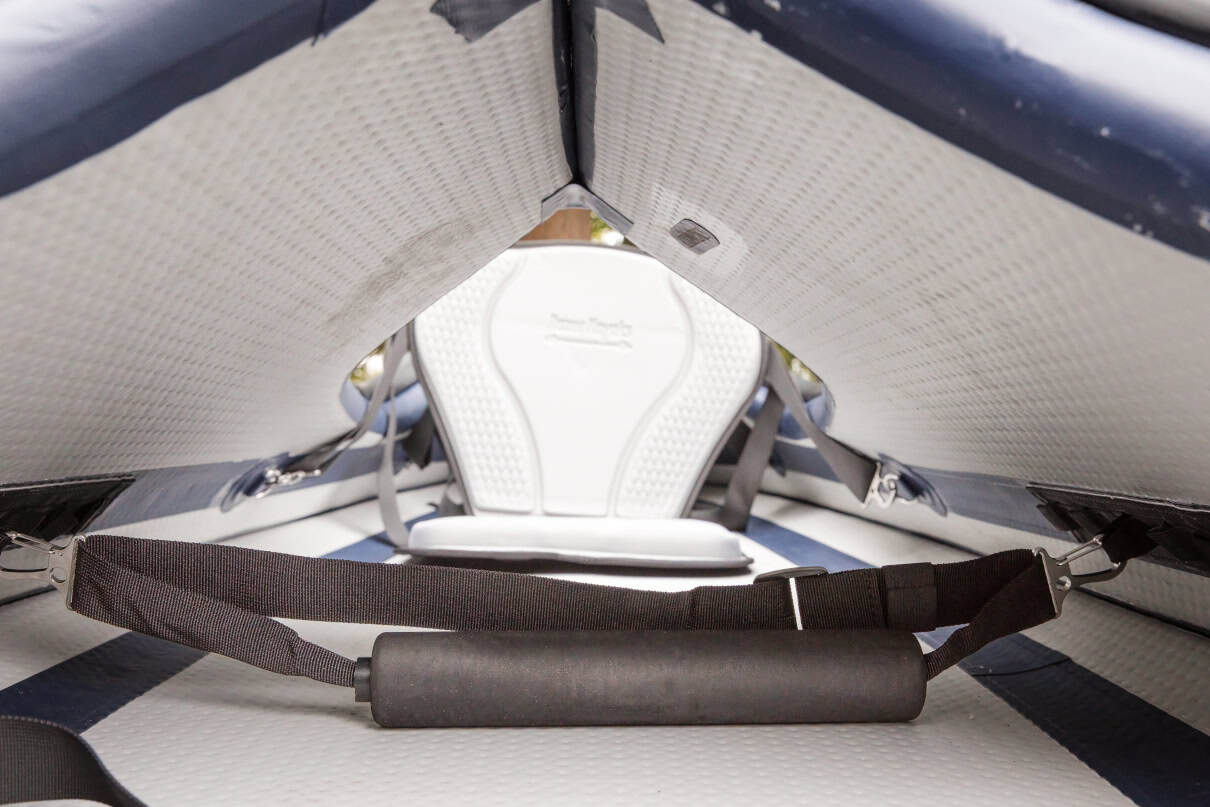
View from the inside of the deck with the foot brace and seat | Image: Owen Roth
Outfitting
Razor kept the outfitting inside the Edge Pro streamlined. There is a foam seat that clips into the boat and attaches to the floor on a hook-and-loop fastener track. The seat on top of the inflated floor was perfectly comfortable. The foot brace is simplistic, made of plastic piping with a foam cover, and is clipped into webbing loops inside the boat.
I appreciate streamlined outfitting and felt overall that Razor has done a nice job with their setup. It’s intuitive to use, has few parts, and is comfortable.
Razor also has a sprayskirt for the Edge Pro, which can be worn and attached around the cockpit rim to keep water and a cool breeze out of the boat. The sprayskirt was a little tricky to attach around the rim on the first go, and I recommend a few practice runs on dry for newer paddlers before launching and trying to put it on while on the water. Razor also offers numerous other accessories, including paddles, PFDs, and electric pumps at reasonable prices.
On the water
I wasn’t sure what to expect when I set out to paddle the Edge Pro. It’s difficult to be wowed by an inflatable kayak, yet Razor’s design has taken a bold direction, and it’s been a fun boat to paddle.
At 13 feet long with the rigid drop-stitch shell, the boat is reasonably fast for its class, and I used it to paddle upstream against the current in stretches of moving river I wouldn’t have expected it to cruise up so easily. As mentioned earlier, the multi-chine hull makes the kayak capable of edging, which is not a term we tend to throw around with inflatable kayaks. The hull is wide, with good initial stability for leisure paddling even with the capability to do some edging. And the flat center of the hull combined with the lifted ends lets the kayak spin easily. Meanwhile, out on the lake, it seemed to have no issues holding a course and making ground in mild headwind and chop.
The Edge Pro could easily be a replacement for a hardshell plastic recreational kayak, or to an extent a day touring kayak. This is because Razor has delivered on creating a performance-minded inflatable kayak that feels much like you are paddling a hardshell. The Edge Pro is well suited for moving rivers with mild rapids, sheltered lakes and tidal waters. I am curious to push it into more adverse conditions or ambitious outings to see how it handles. It would also be interesting to see Razor take the Edge Pro design and tweak it with a smaller keyhole cockpit and pull in the width to further increase performance and put it up against true touring kayaks.
The Edge Pro is a refreshing newcomer to the scene with a unique take on the inflatable kayak. Considering the design effort and materials put into these boats by Fallon and team, the price is reasonable, and they are available now in the U.S. directly from Razor Kayaks.
Choice in tripmate can make or break even a weekend canoe trip in Algonquin Park, let alone a multiweek expedition in a remote location. For couple Sarah McNair-Landry and Erik Boomer, they found the perfect adventure partner in each other. Since they started dating more than a decade ago, they’ve been on 10-plus big trips together.
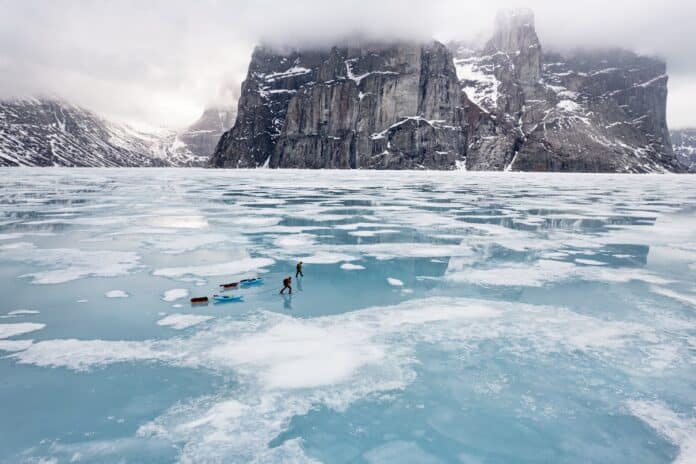
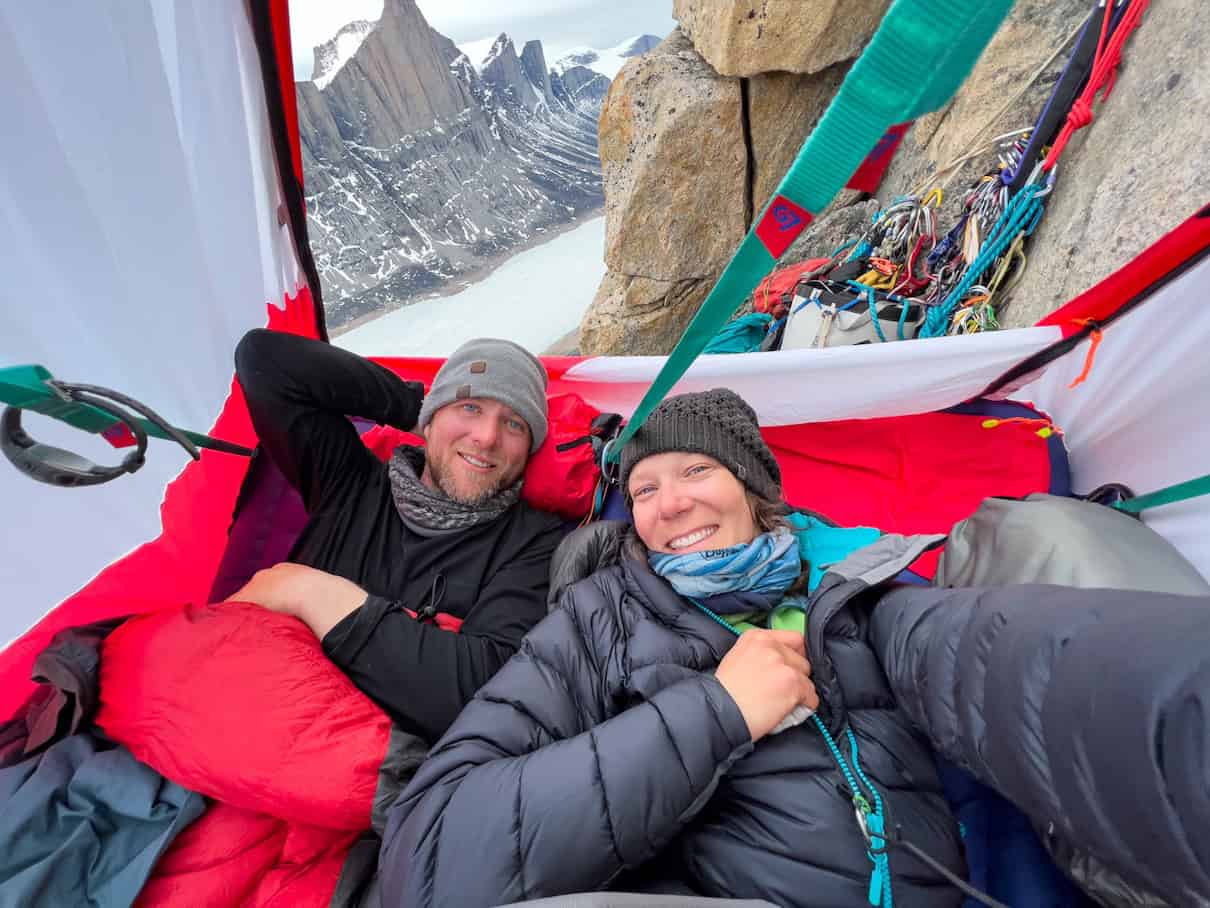
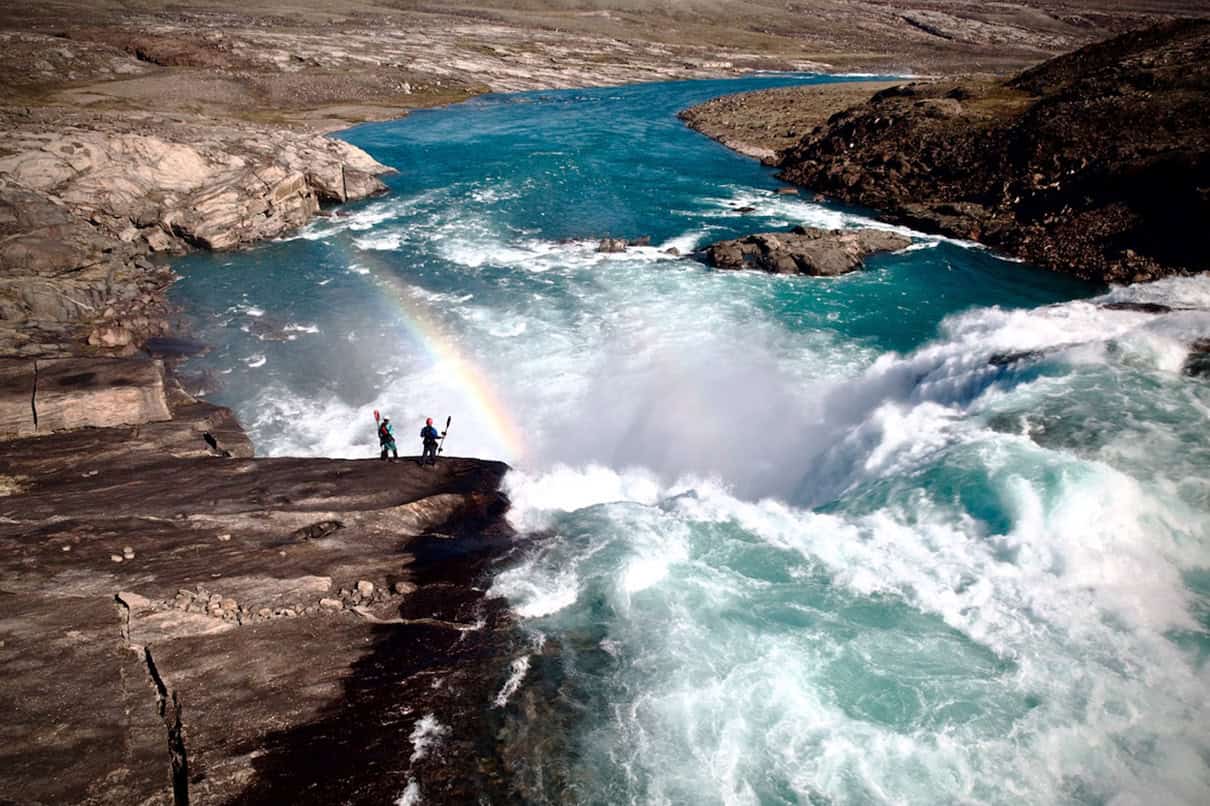
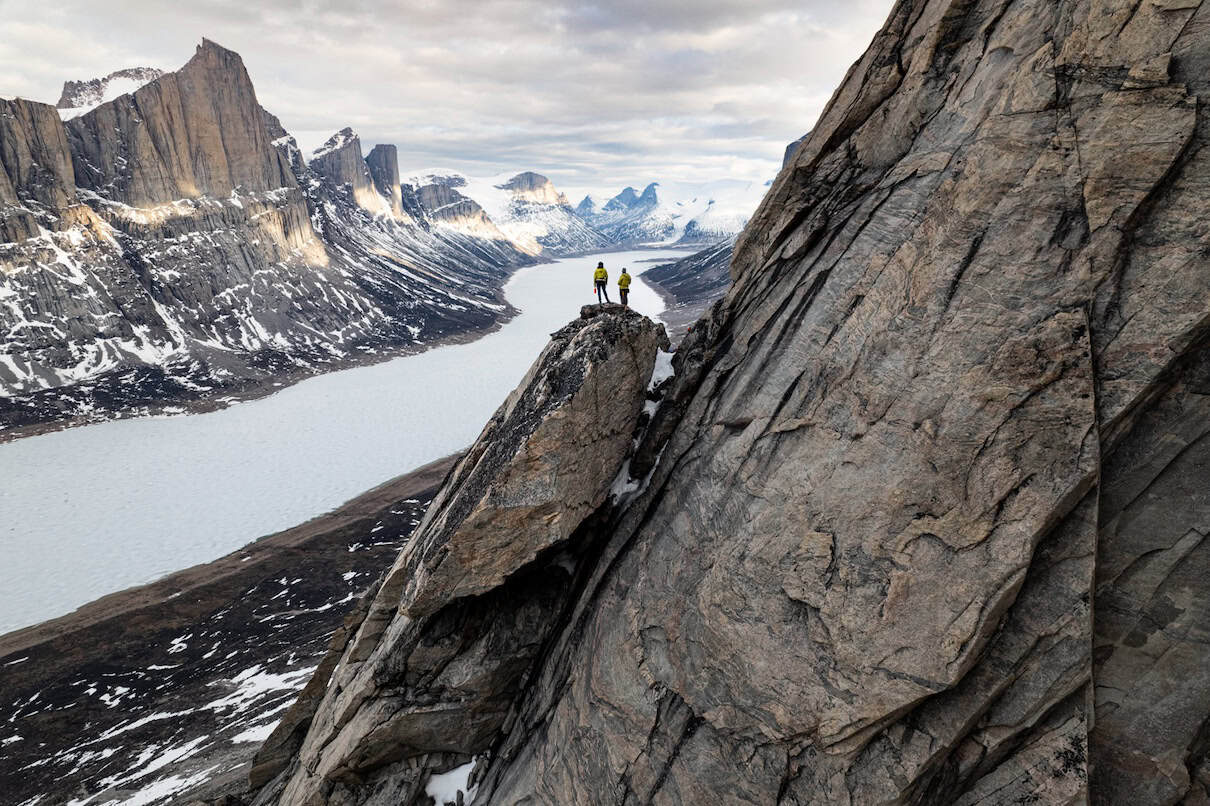
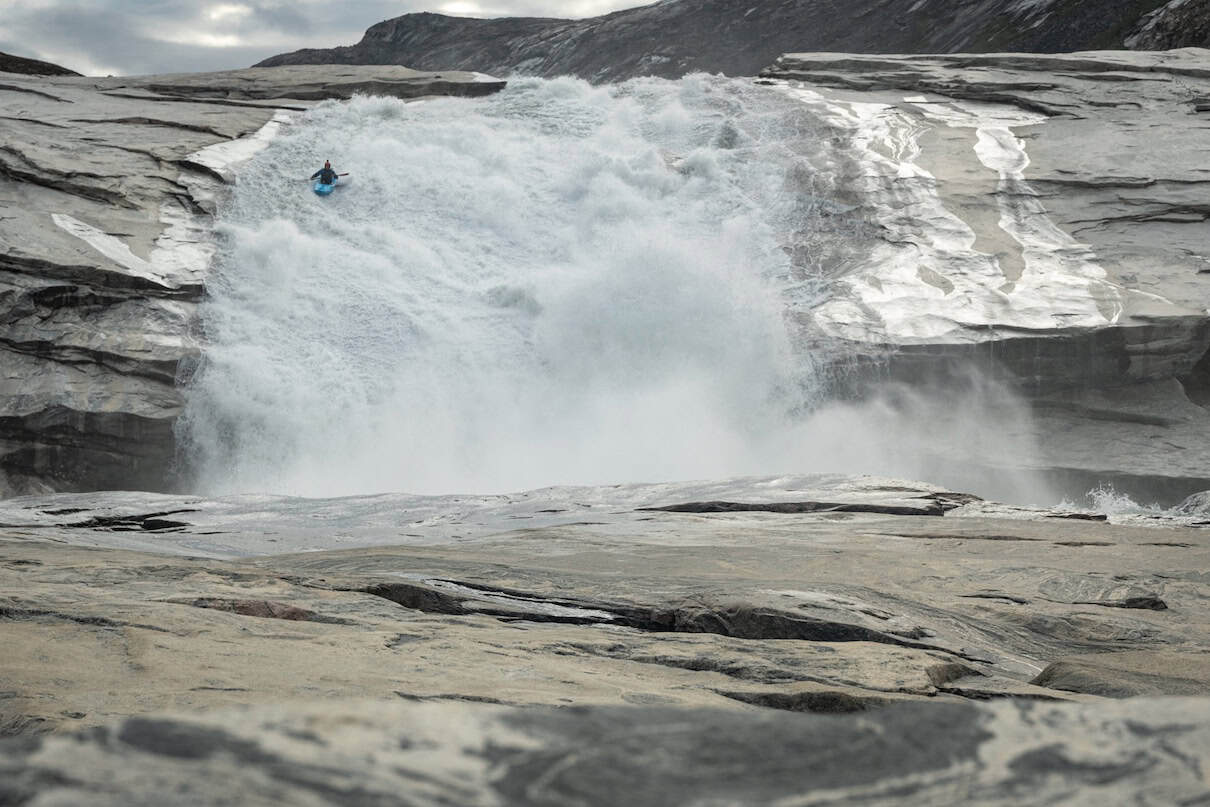
In 2022, they embarked on a 69-day expedition on Canada’s Baffin Island, skiing mountains, kite skiing the frozen ocean, climbing rock walls and crossing glaciers to find never-before-paddled rivers to whitewater kayak.
You can watch McNair-Landry and Boomer’s epic adventure in the film A Baffin Vacation, Love on Ice, which is touring in the 2026 Paddling Film Festival and won Best Adventure Film, sponsored by Kokopelli.
With years of remote expeditions under their belts and various extreme sports within their skill sets, the pair have a lot of options at their disposal when planning a trip. McNair-Landry says sometimes they start with a destination and decide what activities to do while there, and other times they start with the activities and figure out where to go.
“Boomer spends a lot of time on satellite images scanning for new rivers to paddle,” she continues. “The ideal, like in Baffin Vacation, is when there are multiple rivers close together, giving us several options.”
For this trip, they started with a desire to go to Kangiqtualuk Uqquqti (formerly Sam Ford Fjord), on the northeast coast of Baffin Island. Because access is generally the most challenging part of doing a trip on Baffin, they decided to bring many types of sporting equipment with them.
“Kite skiing was the best way to travel the 150 kilometers to the fjord,” says McNair-Landry, “and since we had our skis, we decided to do some backcountry skiing along the way. With hundreds of miles of granite coastline, climbing a big wall was next on our list. And as spring turned into summer, we headed inland to find new whitewater rivers to paddle.”
McNair-Landry and Boomer completed their first big wall climb on the trip. | Photo: Sarah McNair-Landry
Amid showcasing the stunning views and impressive feats of skill, the film also explores McNair-Landry and Boomer’s relationship. How they push each other, deal with “the grumpies,” rely on each other for safety, accomplish goals and celebrate successes.
“My favourite thing about doing trips with Sarah is creating all these shared memories together,” says Boomer. “That is something we can take with us forever.”
In the film, Boomer talks about how he could be doing polar trips with “some grisly old dudes” but that being able to do those same trips with his girlfriend is really special. In an interview, he explains it can be difficult to be away from your partner for months at a time, so being able to do expeditions with McNair-Landry makes it feel as though they’ve moved somewhere together. And they have fewer reasons to go home early.
When it comes to adventuring with a significant other, Boomer says good communication, like with any team member, is essential.
“Having the same expedition goals and trusting each other in decision making and safety are key,” he continues.
The pair completed 80 kilometers of sea kayaking and hiking over passes and up a glacier to access rapids—which they weren’t even sure ahead of time they could run.
Putting up a route on “the ridge.” | Photos: Erik Boomer
Erik Boomer keeping the stoke high. | Photo: Sarah McNair-Landry
Spoiler alert: Near the end of the film, Boomer gets down on one knee next to a rushing glacial river and asks McNair-Landry to marry him. She says yes.
“It’s something I had been thinking about for a long time, but I didn’t really know what Sarah would say or how she would react,” says Boomer. “During the trip, I started to realize how epic it was and how many great adventures we were having and it occurred to me that this was a really good time to let Sarah know how I felt.”
McNair-Landry says she was totally surprised by the proposal.
“We have not gotten married yet,” she says. “But we have been on several more adventures since.”
Accessing the fjord where they’d be spending much of their vacation required traveling 150 kilometers by ski and kite ski. | Feature photo: Erik Boomer
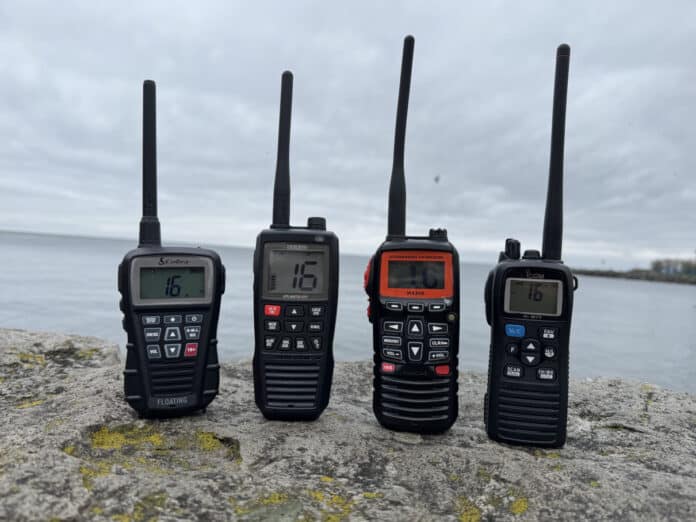
My first VHF marine radio was a hand-me-down clunker, nearly the size of a shoebox and powered by a feeble alkaline battery that didn’t allow for any casual listening to the weather forecast. It wasn’t waterproof, so I kept it stowed in my best dry bag in the day hatch of my sea kayak. I wondered how I would ever employ it in a distress situation involving wind, spray and big seas. Yet in the days before ubiquitous cell phones and satellite communicators, that old radio was the best safety margin I could afford as a rookie sea kayak guide and aspiring expedition paddler. Within a few years I purchased a sleeker, waterproof model that slipped into a pocket on my PFD.
Even today, when most new cell phones allow satellite text messaging, a waterproof handheld marine radio is the most practical means of communication on the water. The coast guard, larger vessels and marinas all monitor certain channels, so it’s possible to issue calls to “all stations” in times of need. There’s a long maritime tradition and strict hierarchy of calls, from general communications to safety warnings, semi-urgent requests for assistance and Mayday broadcasts for the most serious emergencies—all aimed to harness the strength of many to ensure safety at sea. You cannot get this type of broad security net with any other means of communication. This makes a VHF marine radio an essential for anyone journeying in busy harbors or big water.
Know the “Rules of the Road” Navigation Rules that govern all boat traffic and stay out of the way of all other vessels.
Never assume that power boaters can see you. Avoid high-traffic areas whenever possible. Proceed with caution when you can’t avoid paddling near boats. Dress for visibility.
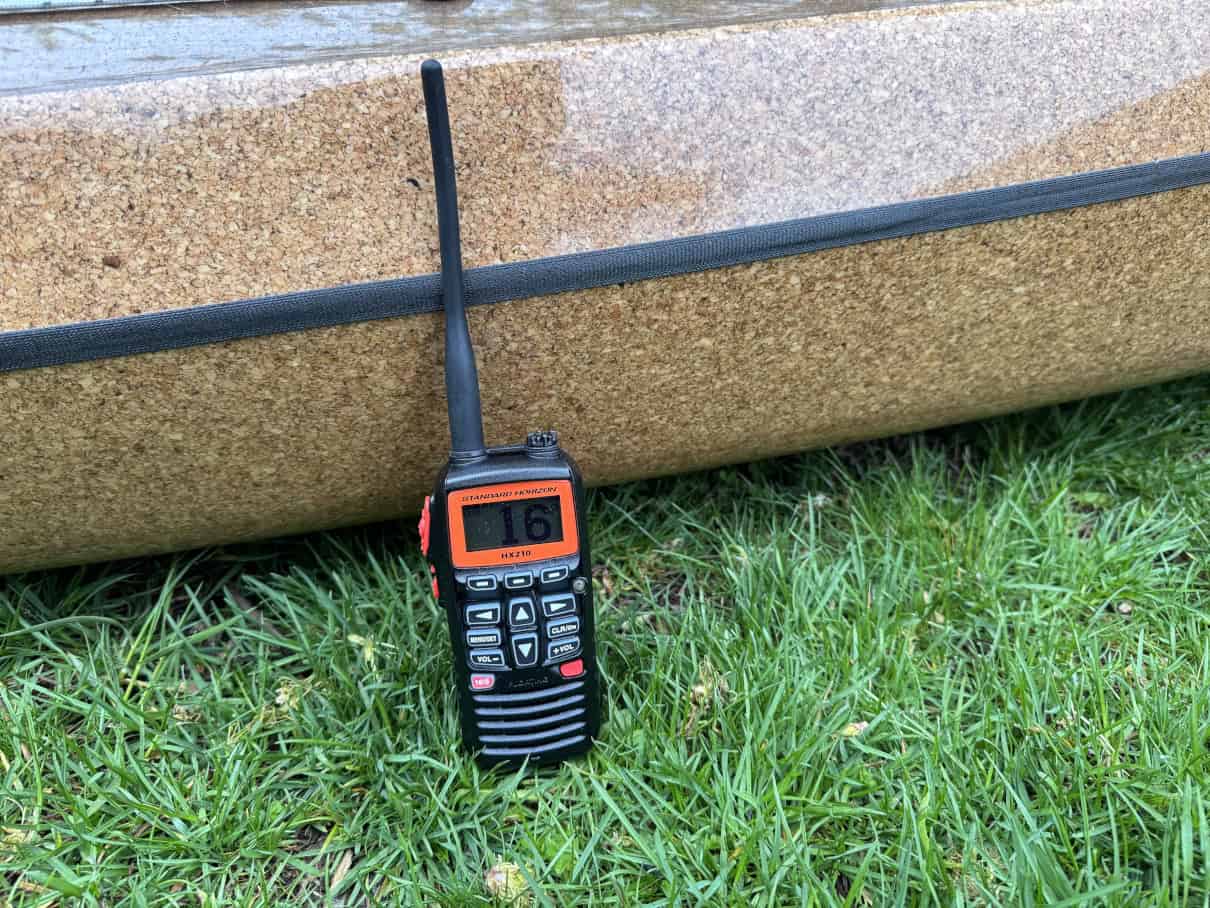
The Standard Horizon HX210 VHF radio offers a plethora of features, including the option of tuning in to local FM radio stations for music, news and weather. It’s a solid, well-made unit that’s powered by a lithium-polymer battery with the most endurance in our test (up to 20 hours). It’s waterproof to IPX7 standards (submersed to a depth of 1 m for up to 30 minutes) and designed to float face-up. Best of all, immersion in water triggers a flashing strobe, whether or not the unit is turned on when you drop it in the drink.
Standard Horizon has managed to squeeze a lot of functions into a small number of buttons. As a result, it takes some time to learn the various keys, toggles and sequences. The high-power 6W setting affords an extended call range for a handheld unit. The price is right, especially for such a full-function marine radio.
Reasons to buy
Professional-grade construction that floats
FM-band radio adds versatility (and entertainment)
Three-year waterproof warranty
Consider another if
Looking for a smaller-body radio
Seeking more buttons for intuitive functionality
Bottom line
The HX210 is a high-quality, reliable marine radio for guides and other professional users.
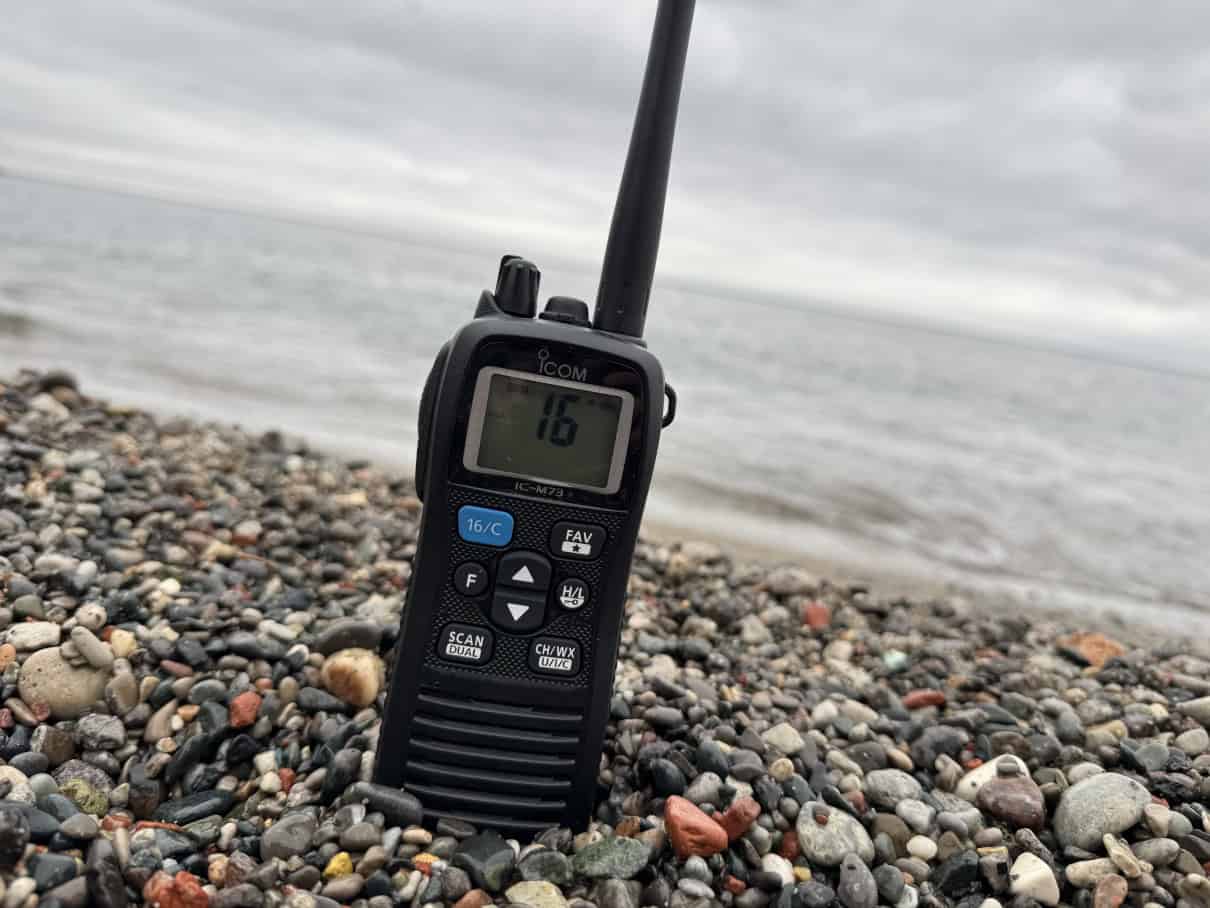
The Icom M73 is rated IPX8, meaning it’s been tested to function after being submersed to a depth of 1.5 m for up to 30 minutes. What’s more, it features “AquaQuake” — aptly named technology that drains moisture from the speaker grill, so you can get the most out of the unit’s powerful 700 milliwatt audio. If that’s not enough reassurance, the Icom M73 boasts a solid three-year warranty.
From a performance standpoint, the M73 (known as the M73E in Europe) is also the most comfortable to hold, with keys that respond to gloved fingers and instant access to Channel 16— the general hailing and distress frequency. The push buttons are easier to understand and more logical to use than some of the other radios we tested. The slim and sturdy unit fits in the pockets of most PFDs. The power on/off function is a simple twist knob that doubles as the volume adjustment, and the battery lasts about 18 hours on a charge.
Reasons to buy
Easy to use right out of the box
Solid construction and reliable waterproofing
Slim and compact
Consider another if
You want a floating radio
Need a budget-friendly option
Bottom line
The Icom M73 is a well-made and reliably waterproof marine radio.
Carry A Waterproof VHF Radio, Use Your Phone Only As A Backup
A handheld VHF marine band radio allows you to communicate with the Coast Guard and other boat traffic. Use Channel 16 only for hailing and emergencies. The radio should be waterproof, because it is virtually certain to get wet.
A cell phone, even if in a waterproof case or sealable bag, might not work, so don’t rely on it as the primary means of emergency communication.
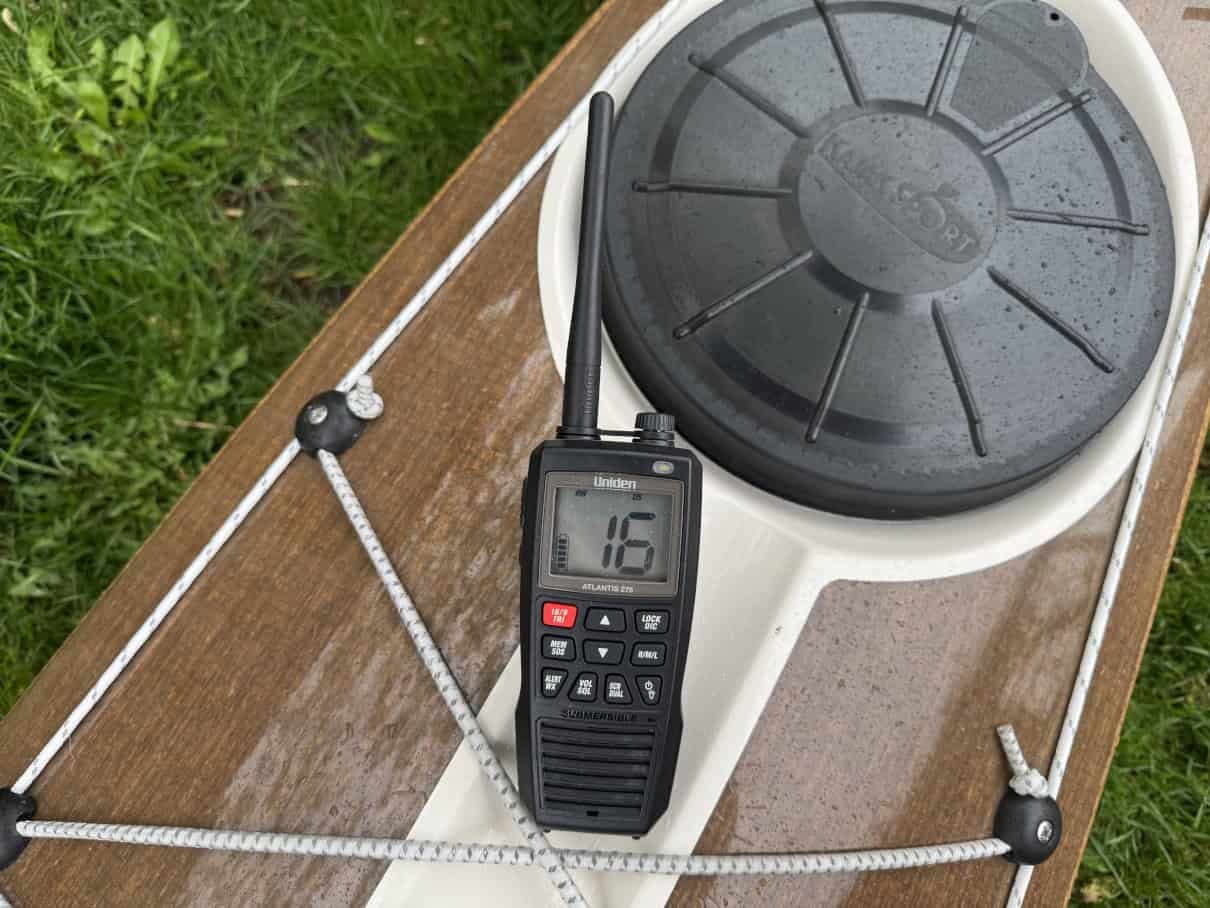
The Uniden Atlantis 275 is a practical, easy-to-use marine radio with the largest, backlit LCD screen of the models we tested. It also has solid, waterproof performance. It floats and was one of the most waterproof of all the VHF radios we tested. Tri-channel mode allows you to , simultaneously monitor the typical hailing channels (9 and 16), as well as one other working channel.
While some other VHF radios offer low and high settings only, the Atlantis 275 includes 1-, 2.5- and 6W transmission modes. Selecting medium power allows you to save battery in certain situations. Other convenient features include a built-in flashlight that doubles as a strobe in emergency situations.
Reasons to buy
Floating, with enhanced IPX8 waterproof rating (submersed to a depth of 1.5 m for up to 30 minutes)
6W maximum power offers extended calling range
Powerful lithium-ion battery
Consider another if
You need larger buttons
Bottom line
The Uniden Atlantis 275 has plenty of features and reliable performance in a user-friendly package.
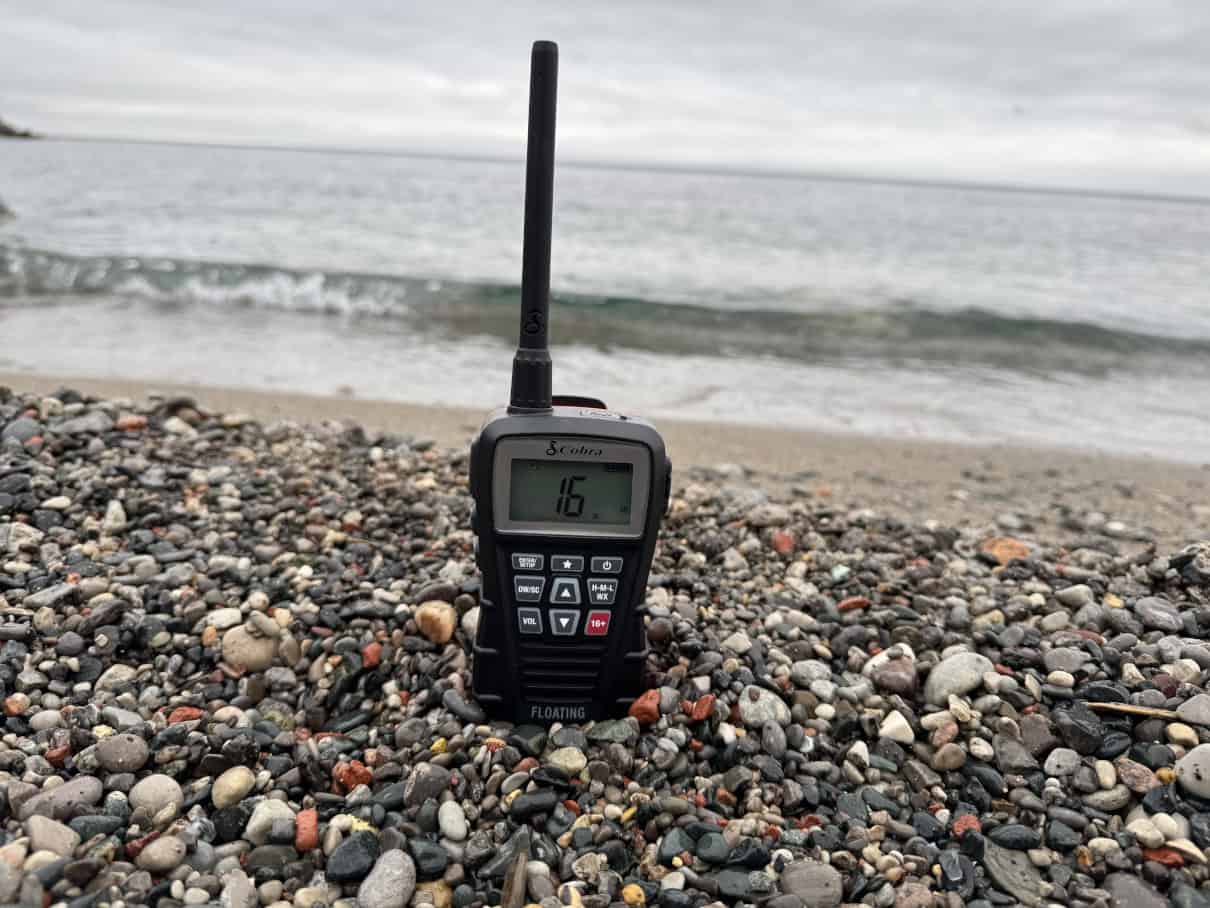
The compact, waterproof and floating Cobra BlueBound 150 slips easily into most PFD pockets, so it’s easy to carry without investing in a new guide-grade life vest. The unit is powered by five rechargeable NiMH batteries, and It’s the only radio in our test that’s rechargeable via USB. However, battery life is only around 11 hours. The BlueBound 150 has the cheapest price tag in our test, and as you’d expect it feels more plasticky compared to higher-end models. However, it’s still IPX6 waterproof (submersed to 1 m for up to 30 minutes) and it floats. The BlueBound 150 is also simple to use, with an intuitive array of push buttons that are easy to learn.
Reasons to buy
The only radio in our test that’s rechargeable by USB
Great price
Consider another if
Seeking higher watt power for longer range
Battery life is one of your top priorities
Bottom line
Cobra’s Bluebound 150 is a great choice for casual users looking for a compact, waterproof VHF radio that’s easy to charge.
What to consider when buying a VHF radio
As with anything tech-related, you get what you pay for with a VHF, which stands for very high frequency radio. It’s worth spending a little extra to buy from a reputable marine manufacturer, including all the brands listed here, rather than ordering a discount knock-off.
Look for a unit with a lithium (ion or polymer) battery as well as a robust Ingress Protection Standard (IP) waterproof rating. It’s also important to understand the technical specifications—and limitations—of VHF radios for kayakers. There’s a tradeoff between the portability of a handheld marine radio and the more powerful units, also known as “fixed-mount” marine radios, designed for larger pleasure craft and commercial vessels, with much larger antennas.
Compact, handheld radios are restricted to line-of-sight communication, which can be substantial across open water. When using a radio on land, you can get far more transmission range by climbing to an elevated location to make a call. Most handheld units have dual power: 1-watt and 5- or 6-watt. Some feature a medium-power setting. When making a call, use the low power setting for communication at close range (typically within a few miles) and high power if you’re trying to communicate with a vessel (or the Coast Guard) farther away. Repeater towers in marine areas broaden the calling range considerably, even when using a handheld unit.
Finally, licenses are not required to operate a handheld VHF in the United States. The circumstances are different in Canada. Though it’s rarely enforced, VHF marine radio users in Canada are obligated to have a Restricted Operator’s Certification (Maritime). It’s well worth studying the material and taking the test to obtain a license to ensure you understand communication protocol and the legal ramifications of using a VHF marine radio. You do not need a VHF marine radio address license (that is, a permit for your vessel) for recreational boats.
I’ve worked as a sea kayak and canoe guide, outdoor educator and environmental journalist for over 20 years. Understanding how to use a VHF radio effectively and which available models are worth the investment are essential to what I do. The models included in this article were tested side-by-side with the conditions and needs I’ve experienced over the years in mind.
This article was published in Issue 76 of Paddling Magazine. Subscribe to Paddling Magazine’s print and digital editions, or browse the archives.
VHF (Very High Frequency) radios allow paddlers to communicate directly with nearby vessels, marinas and the Coast Guard. | Feature photo: Kaydi Pyette
Every paddler learns to avoid low-head dams, but to the uninitiated drifting above, this river hazard can look like smooth water.
Such is the case at the Lake Springfield Dam on the James River in Missouri. A horizon line runs bank to bank, so smooth and blended into the water beyond it that you might never guess you’re floating above a low-head dam, a manmade feature so dangerous it’s nicknamed the drowning machine among paddlers, anglers and rescuers.
“These structures are responsible for just under 10 percent of all whitewater deaths each year,” says Charlie Walbridge, a 30-year swiftwater rescue expert who maintains American Whitewater’s Accident Database. For reference, not wearing a PFD is attributed to about a third of whitewater deaths a year by the database.
The hidden dangers of low-head dams
A low-head dam spans the river and sends water pouring over its crest in one unbroken sheet. The flow drops, hits the base, folds back on itself, and builds a churning hydraulic. Most natural hydraulics break up on rocks and ledges, so a swimmer can catch a seam of downstream current and ride it out of the hole. A low-head dam gives nothing to catch: no rocks, no seams, only a hope and sometimes a log. The water turns white with aeration, and people caught in it lose their bearings, clawing toward a surface they can’t reach.
What makes low-head dams especially dangerous is how harmless they may look. In a natural rapid, water smashing over rock throws up spray and noise that make holes look chaotic. The uniformity of dams mean the currents that trap swimmers are hidden below the surface. From above, we mostly see foaming flatness.
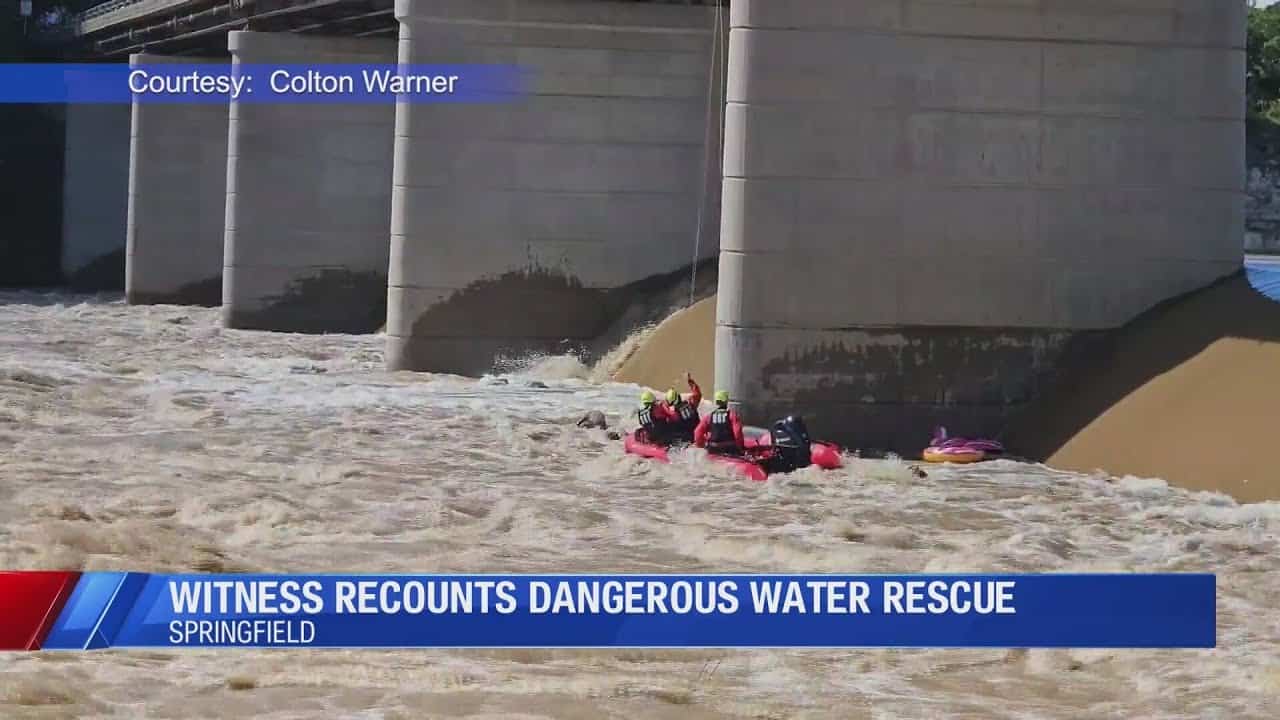
On June 14, the James River rose fast after a night of rain, and a mother and her three daughters went over the Lake Springfield dam in inflatables. The Springfield Fire Department swiftwater team responded and motored their raft into the hydraulic to reach the youngest victim, 12-year-old Aurelie Stawny. The raft flipped against the base of the drop and threw the rescue crew into the boil, which was captured on video. The rescue team pulled Aurelie out before she was swept back into the water and had to be recovered a second time. She lived and the rescue team survived. Her two older sisters, Andrea, 19, and Sofie, 17, as well as her mother, drowned.
Speaking to Ozarks First after the incident, Aurelie said the family was pulled toward the dam by the current and did not realize the dam was there until it was too late. It was their first time on Lake Springfield. She survived until rescuers arrived by holding onto a log.
Local firefighters work to save a person in the water at Springfield Lake Dam in Missouri. | Photo: Ozarks First
“If you look at the video of the motor raft, [at one point] it looks like they’re going the wrong way, away from the survivor, because the water is being pushed back toward the dam,” said Christopher Roush, EMS and Special Operations Chief for the Springfield Fire Department. Three firefighters were injured in the rescue.
Locals have asked for changes to increase dam safety following the Springfield accident, particularly additional warning signs. River flow speed changes with water levels, so 200 feet could be a safe distance at low flow, but still too close when the river is high.
Identifying low-head dams can be difficult from the water
Sometimes, even relentless warnings fail. Outside Calgary, Alberta, at a dam on the popular Bow River, signs pepper the river upstream. “And people were still going over the dam,” said Walbridge. “It’s very easy to say, ‘Oh, that’s really stupid,’ but I think any of us have been in a position where we’ve gone past signs just because we weren’t clued in.”
Mapping low-head dams is no easy task. Built decades and sometimes centuries ago to turn mill wheels, divert irrigation or pen fish, many have outlived the people and organizations that built them. Engineers now call them “deadbeat” or “non-jurisdictional” dams: no federal or state agency inspects them, maintains them or answers for them.
A national task force out of Brigham Young University (BYU), working with the American Society of Civil Engineers and the Association of State Dam Safety Officials, set out to map America’s low-head dams and has already logged more than 13,000 across the country. They expect the real count runs higher. The BYU research found that more than 1,000 people have drowned at low-head dams over the last 50 years.
For paddlers, the lesson is to know what lies downstream. Because low-head dams can be difficult to spot from the water, watch for warning signs, study your route before launching and talk to local boaters when possible. If you can’t clearly see what waits around a bend, get out and look.
Created In Partnership with Tennessee Department of Tourist Development
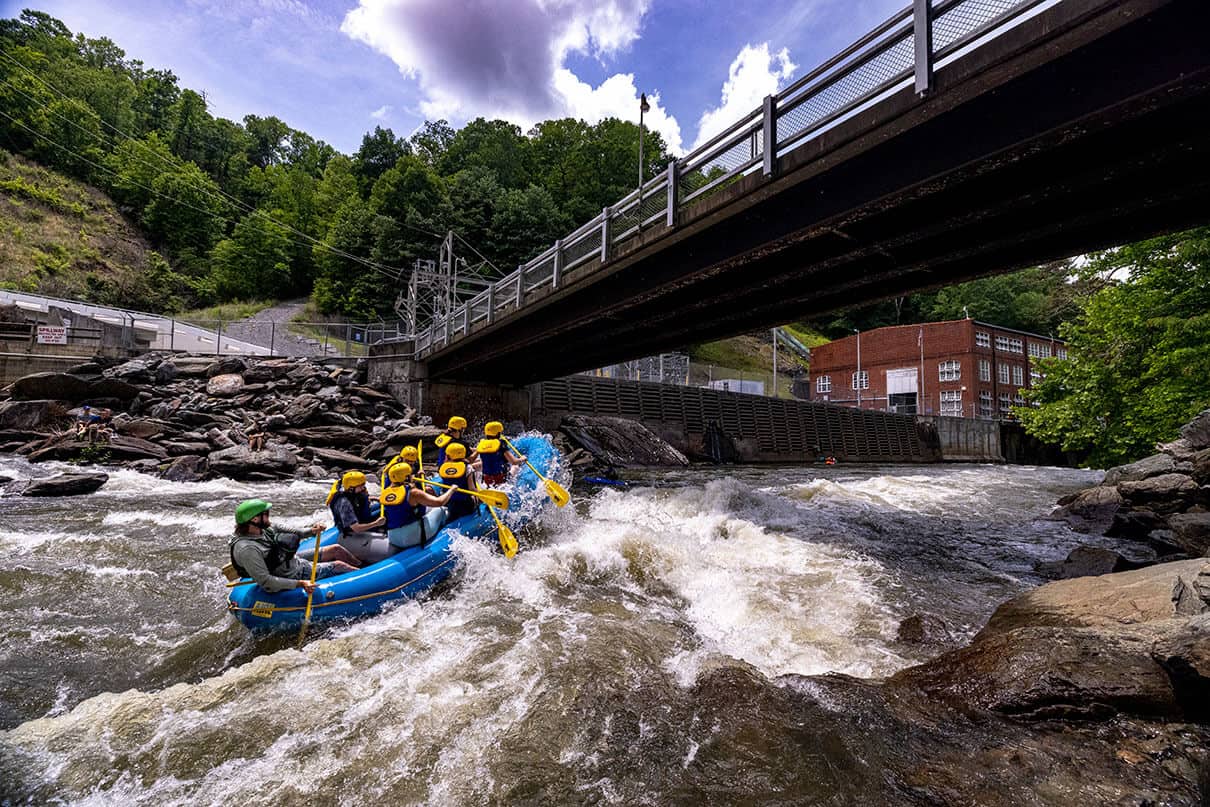
Scheduled dam releases, a close river community, and five miles of punchy class III—the Pigeon River Gorge has about everything a budding whitewater enthusiast could ask for. Throw in the mix that it’s located just off Interstate 40, at the edge of the Great Smoky Mountains, and you have one of the most accessible stretches of fun whitewater in the eastern U.S.
The Rafting Scene on the Pigeon River in East Tennessee
“One of the coolest things about the Pigeon River is it is a friendly river,” says Lacy Bramlett, a guide with Smoky Mountain River Rat. “This river still has its dangers and its safety precautions, but it does allow us to take a broad range of people. The upper trip is considered a beginner-to-intermediate class III-IV river. It’s a great river to start out on. People use this as a stepping stone for class V,” Bramlett adds.
The Pigeon River Gorge, also called the Upper Pigeon River, begins at the outflow of the Walters Hydroelectric Plant, where scheduled whitewater releases from the river confluence with Big Creek flowing out of the Smoky Mountains. Pinched between the mountainsides, the Pigeon wastes no time tumbling down the rocky river bed into frothing wave trains as it catapults paddlers down rapids overheard in many a river tale, including Lost Guide, Double Reactionary and Accelerator.
Five miles from the beginning, the Gorge concludes in Hartford, Tennessee, a river community of 900 that is just as memorable as the river run itself, and home to more than half a dozen of the Pigeon’s rafting outfitters, including River Rat, Big Creek Expeditions and others.
Hartford is the kind of place where guides from across town find their way to congregate on rocking chairs outside the local gas station after a day’s work or meet for a standing volleyball match on Tuesday nights.
“Our community is very close-knit,” Brammlett says of the front porch of the Pigeon Gorge. “It’s like adult summer camp.”
Ultimately, it’s the bond of the river that pulls Brammlett and other guides together to call Hartford and the whitewater of the Pigeon home.
To learn more about rafting the Pigeon River Gorge visit tnvacations.com.
A short documentary profiling Bobbi Rose Koe premieres in April 2026. | Feature photo: Taylor Burk
Bobbi Rose Koe grew up hearing one rule above all others: “If you look after the land, the land will look after you.”
Koe is Teetl’it Gwich’in—which means “People of the Headwaters”—and was raised by her grandparents in Fort McPherson, Northwest Territories. Much of her life has been spent on the land, learning from them. After becoming the first Gwich’in canoe guide, she turned her focus to building opportunities for others. Through her company, Dinjii Zhuh Adventures, she now mentors Indigenous youth to lead trips on their own homelands, helping reshape northern river tourism from the inside.
Bobbi Rose Koe is reshaping Northern river tourism
Koe’s leadership began early. At 16, while most teenagers were figuring out how to sneak out of the house to party, she was negotiating water rights and learning about the land. She recalls one pivotal moment that shaped her path. While attending a meeting about the future of the Peel Watershed with her grandfathers, Robert and Abraham, Koe was encouraged to speak up. Not just for herself, but for all the people who live on the land and generations to come. The encouragement stuck with her.
From that point on, advocacy wasn’t optional; it was responsibility.
The Wind River is one of the seven sacred rivers of the Peel Watershed, which flows through her grandparents’ homelands, an area that was once threatened by mining interests. Koe played a role in the campaign to protect it, helping secure the preservation of roughly 83 percent of the watershed. It was hard-won and deeply personal.
Her path to becoming a river guide began in 2015 on a trip down the Wind River. “On that trip, I realized my grandparents taught me a lot, and I was teaching a lot too,” she says.
A short documentary profiling Bobbi Rose Koe premieres in April 2026. | Feature photo: Taylor Burk
The journey was transformative, and it revealed something missing. Northern rivers were often paddled, photographed and shared with the world without Indigenous guides or narratives shaping them. Koe dreamed that one day, people would paddle these rivers alongside Indigenous guides, learning about the territory from those whose ancestors have lived there for thousands of years.
That dream became reality when she became the first Gwich’in canoe guide. She now works closely with Nahanni River Adventures and Canadian River Expeditions.
To make sure she wasn’t the only Indigenous trip leader, Koe founded Dinjii Zhuh Adventures in 2021, becoming one of the first Gwich’in women to launch an outdoor adventure company. The goal wasn’t just to guide trips, it was also to create pathways. Dinjii Zhuh Adventures trains Indigenous youth, inspiring the next generation, and creating a sense of belonging in spaces where Indigenous presence has often been overlooked.
“We’re not just training river guides,” Koe says. “We’re training the next leaders and elders.”
In 2025, Dinjii Zhuh Adventures celebrated its second cohort of river guides after a seven-week program followed by a river expedition.
“It feels good,” Koe says. “When I first started, there weren’t many Indigenous people known as river guides.” Today, her trainees paddle rivers across the Northwest Territories and Yukon, sometimes guiding on their own traditional territories.
At its core, Koe’s work is about connection, ensuring visitors, filmmakers and outfitters work in ways that benefit local communities. “These places are alive with memory, and we are part of them,” she says. There is still work to be done, but Koe has seen how change can happen when businesses are willing to listen, learn and find qualified Indigenous guides.
When she reflects on her mentors, one value stands out: commitment to being on the land. “The more Indigenous people on the land, the better the world will be,” she says, and the better the paddling stories too.
Pretty Frickin’ Deadly, a short documentary by Hangtime Productions profiling Bobbi Rose Koe, is set to premiere in April 2026.
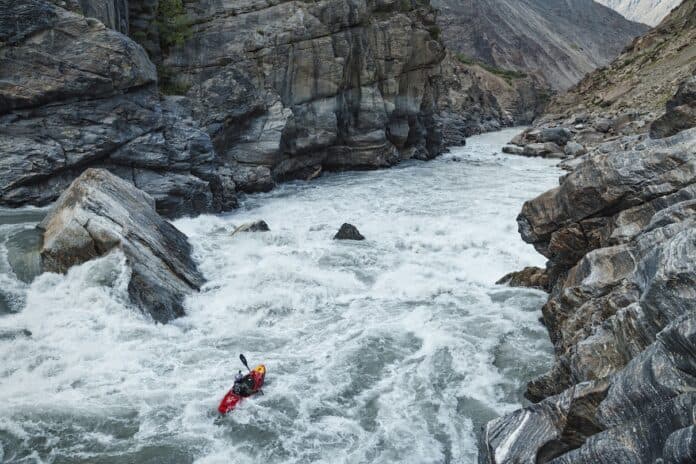
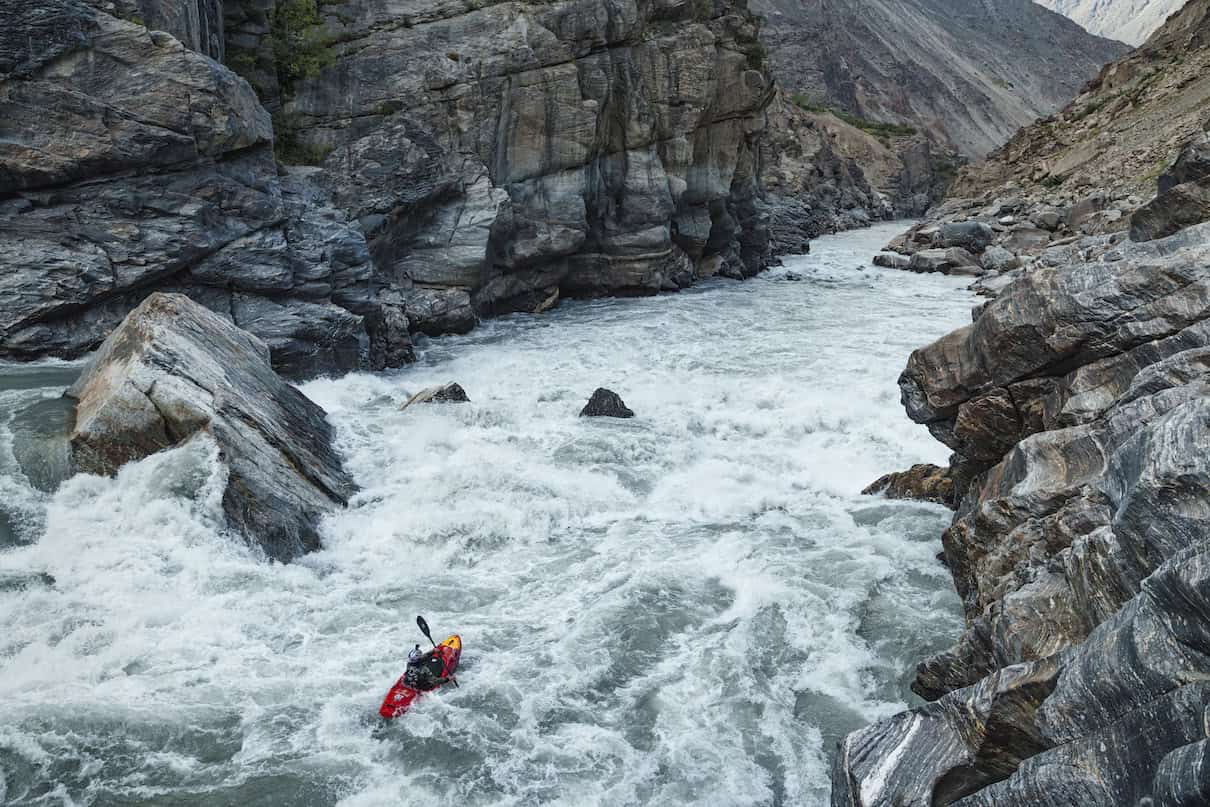
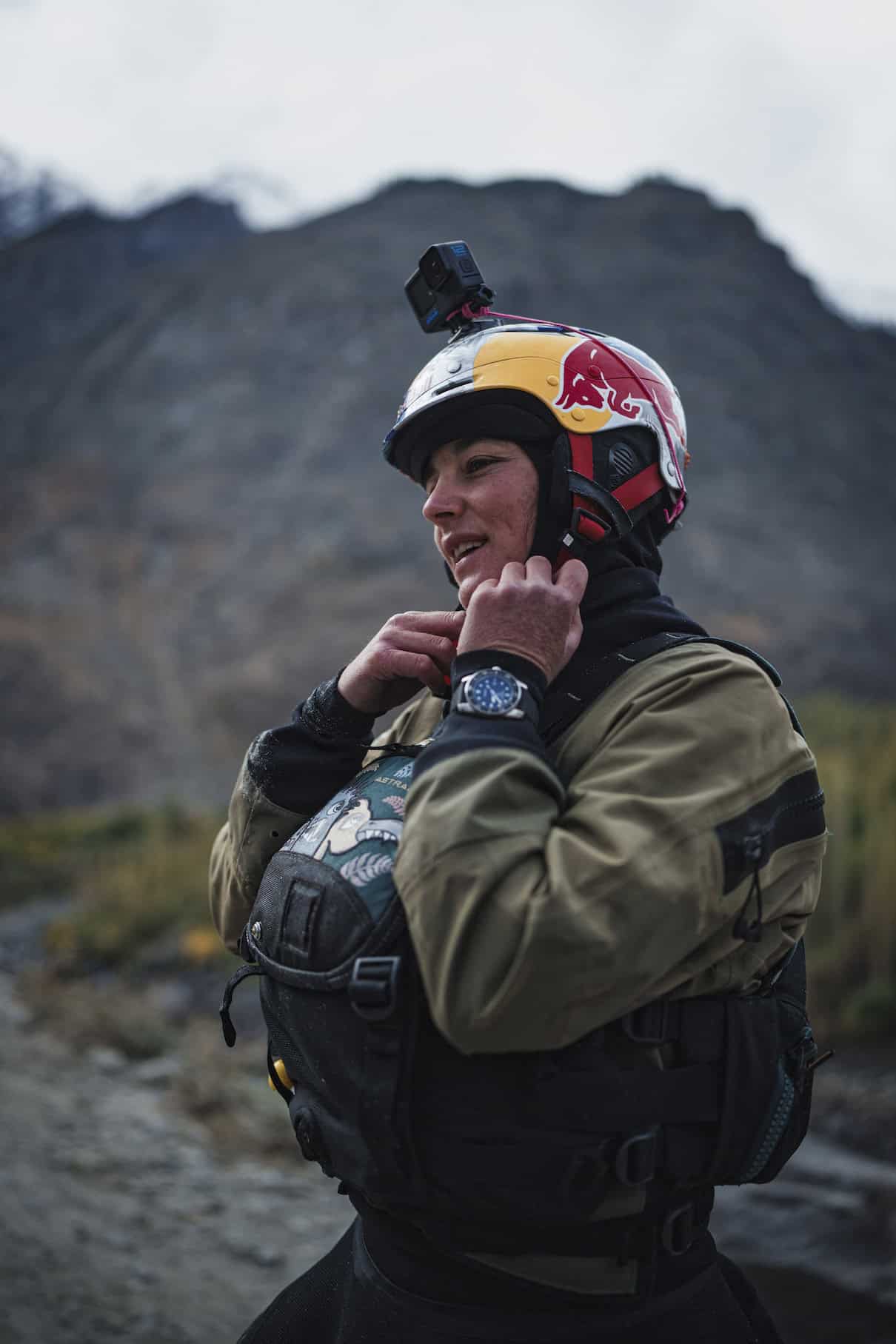
Extreme kayaker Nouria Newman says the Indus had been on her mind ever since she saw Aniol Serrasolses paddle it in the film Inside the Indus – A Pakistani Odyssey, which was released in 2017. Known as one of the most challenging whitewater rivers in the world, the Indus has been taken on by various elite kayakers over the years, including Dane Jackson and Ben Stookesberry, in addition to Serrasolses. However, despite Newman being invited to paddle the Indus with different teams, she didn’t make it to the river until 2023.
“I was waiting for the right time for me to feel ready, but also for the right crew,” she explains. “I think I wanted to do it with a group that we all commit to go together as a team. And then I think it was really fun to go with just French people and childhood friends.”
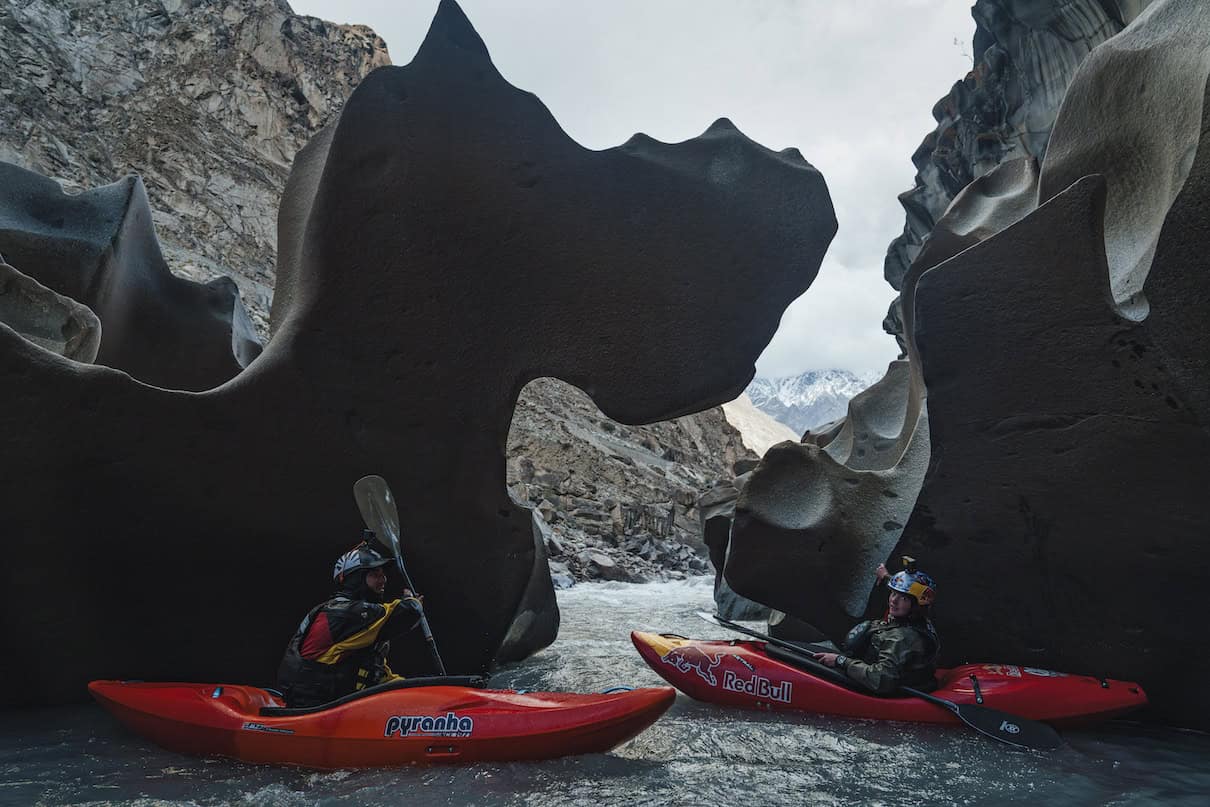
Her tripmates were Jules Domine and Maël Nguyen, two accomplished whitewater paddlers who own Expedition Colombia, a rafting and kayaking tour company.
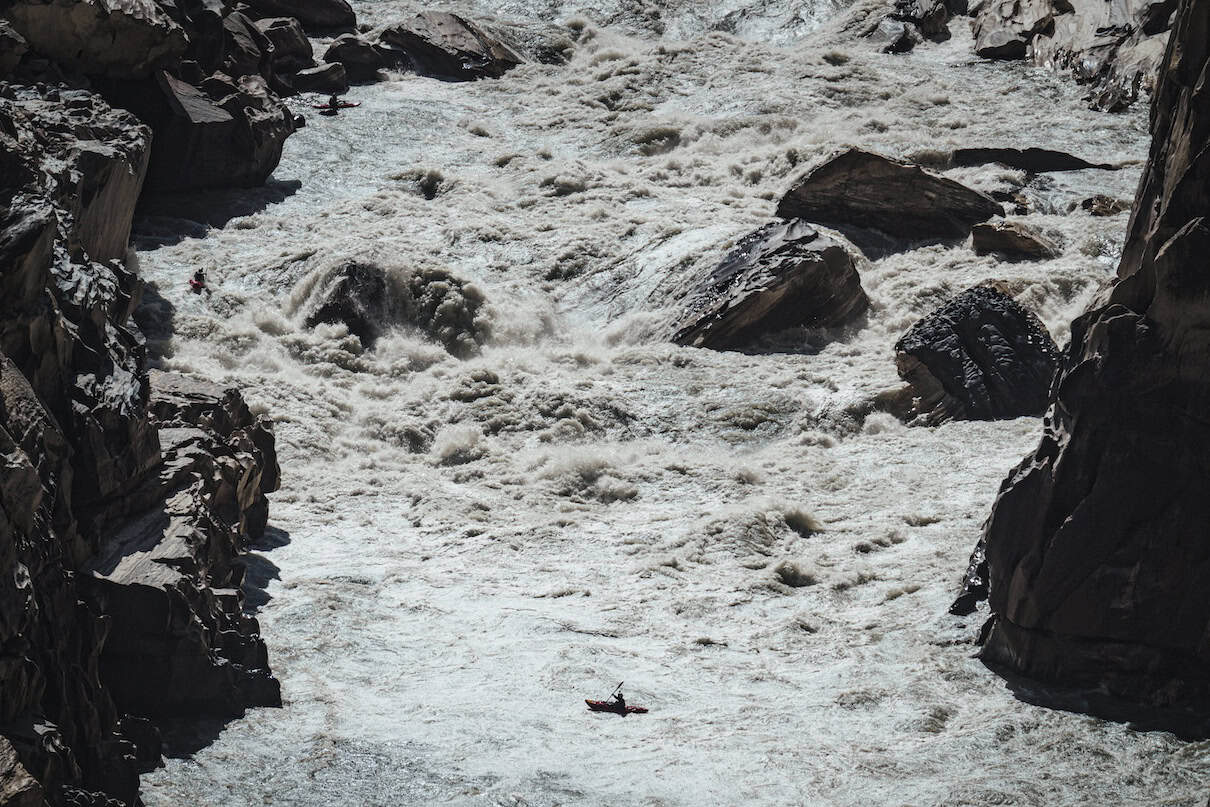
The section of the Indus they ran is called the Rondu Gorge, a 150-kilometer stretch of river in northern Pakistan with particularly high flow, frequently changing rapids and high walls that make it difficult to get on and off of.
The Rondu Gorge is infamous for its high volume, steep walls and massive, ever-changing rapids. | Feature photo: Jules Domine
Newman says she felt confident she could run the river, even if they ended up portaging all the hardest rapids.
“The thing is, you can’t know until you get there,” she continues. “And it’s like that for every single river. You can’t fully be prepared for something that you don’t really know what to expect. That’s whitewater. If you want to be sure then you go do some freestyle in a hole or some slalom on an artificial course and do something in a more controlled environment.”
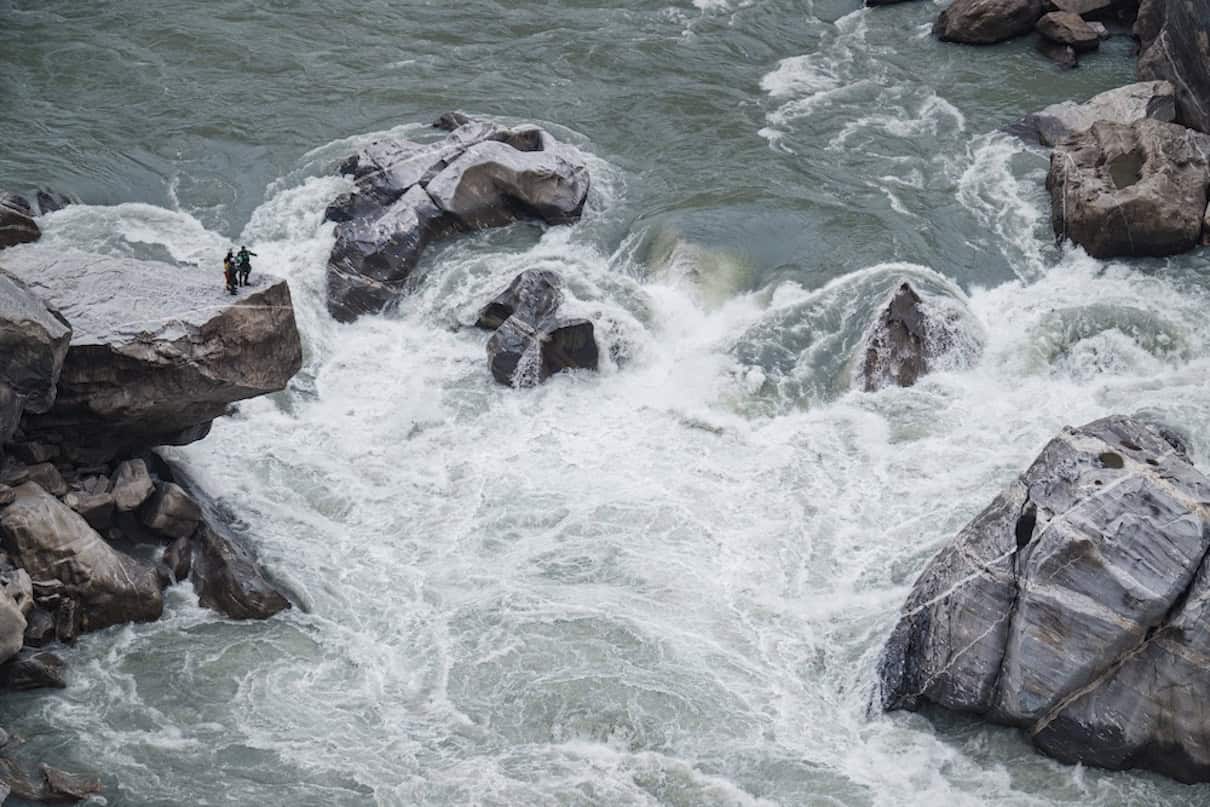
In the film, Newman, Domine and Nguyen spend a lot of time scouting rapids and deciding whether they want to run them. Sometimes all three run the rapid; other times only one or two feel confident enough in hitting the line to go for it. Other times, they all portage.
Only Newman and Domine decide to run Malupa Rapid, which prior to their descent had only been run once—by Dane Jackson. In the footage, Newman and Domine are notably nervous before making their attempts, because missing the line could have high consequences.
But Newman says she doesn’t view fear the same way others seem to.
Jules Domine
Maël Nguyen
Nouria Newman. | Photos: Emile Domine
“Fear is always seen as something really bad,” she explains. “But I’m always scared, and I think it’s a really good thing. Because when you’re not scared, you’re not aware of the consequences. You’re not focused. You’re disrespecting the river and you become both dumb and numb as a paddler.”
She sees fear more as a tool, something that helps her understand herself.
In the film, she misses the line and flips her kayak, but is still able to successfully run Malupa. Domine hits the line and also makes it through.
Days on the Indus were taxing, both physically and mentally. When they paddled rapids, they had to go hard to make it through. When they portaged, it involved climbing over massive boulders and up and down steep embankments. Through it all, they had to be focused on every step and paddle stroke.
“It’s hard to compare what’s more exhausting—the hike or the scout or climbing boulders or the actual paddling that’s shorter but high intensity,” Newman says. “I think that’s why the river we were running was so exciting, because it takes a lot of different skill sets.”
It took them seven days to run the Rondu Gorge. Then they did a second lap, this time with a fourth paddler, friend Thomas Neime.
Since the Indus, Newman has paddled big rapids and done expeditions all over the world, including in the Pacific Northwest of the U.S.; Brazil; Norway; British Columbia, Canada; Arunachal, India; Portugal; Madagascar; and Mexico. At the time of publication, she was back home in France after many months of travel, and said she doesn’t have any major expeditions planned for the rest of this year.
She doesn’t keep a bucket list of places to paddle next, either.
With fast-moving water carving new paths and frequent rock slides, the Indus is constantly changing. | Photo: Jules Domine
Feeling small on the wild Indus.
Taking time to scout. | Photos: Emile Domine
“I try not to because I think it’s kind of dangerous to do things that way,” she says.
She points out that doing so has the potential to make you desperate to paddle a river or rapid, even when the situation isn’t ideal—like the water is too high or low, your team isn’t ready or you aren’t ready.
“I think people see kayaking as the act of paddling, but I think more than half of it happens in your brain and in your decision making and whether or not you’re making the right decisions.”
That’s why these days she prefers paddling with friends, who share the same fundamental values she does.
“I think it’s easier to be on the river with people who are likeminded and perceive danger in a similar way. And see the risks and accept it and take responsibility,” Newman continues. “It’s easier to be on the river with people that you align with on safety, for example. And I think for me people that have a list and have too many goals, sometimes they forget the main point.”



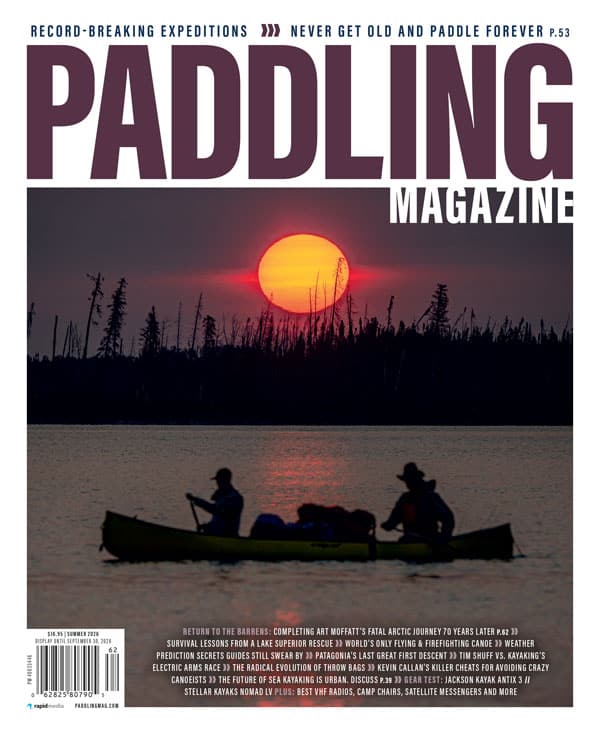 This article was published in Issue 76 of Paddling Magazine.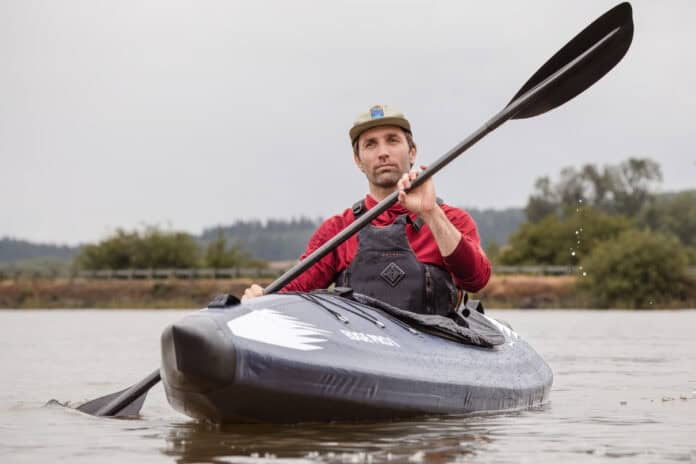

 This article was published in Issue 75 of Paddling Magazine.