Home Blog Page 302

Q&A with Nigel Foster

Photo courtesy Nigel Foster
Q&A with Nigel Foster

Adventurer Paul Everitt speaks with veteran expedition paddler and sea kayak designer, Nigel Foster. To read the full interview, click here, and to learn more about Everitt and other adventurers around the world, visit Going Solo.

Crossing oceans in a sea kayak. For the foolish or the daring? 
Nigel – For the foolish and the daring! In my early days I was fascinated by what motivated people like John Fairfax, and others who rowed across the Atlantic solo, so I read all the books I could find. I also read solo sailing books by people like Joshua Slocum. I was intrigued by Alain Bombard drifting across the Atlantic in 1952, and then Romer, and Lindeman kayaking across. It takes some daring to set off on even a short open crossing in a kayak, but to tackle an ocean is in a different category. Some succeed but not all. Bombard’s health suffered, and Romer, and more recently Andrew McAuley both did amazing things but died. My own take on it? The kayak is the boat that excels in conditions close to shore, and it is the boat that can find a landing more easily than pretty much any other. It is ideal for daytime travel, when you can sleep on shore. There are other better boats than kayaks when you consider using sails or oars, or cooking on board or sleeping on board, and for crossing big open water. Crawling on hands and knees does work well when caving but why use that technique to scale a mountain? 

Who are your paddling idols, who inspired you and who continues to?
Nigel – I always admire people who take off to do their own thing, stretching their own limit of comfort. And there have always been a lot of them! Nowadays I am really impressed by Freya Hoffmeister. Her dedication to long distance kayaking trips is phenomenal. Also Oscar Chalupsky: an amazing powerhouse of a personality with dedication to his sport.
 
I also really admire people like Carmen Adell, who has worked really hard for kayaking in Catalonia and Spain, especially in enabling disabled paddlers, and she has such a contagious joy for life. I also get a lot of inspiration from the paddlers I meet day to day, full of enthusiasm for the sport and doing their own thing!
 
What’s the longest distance you’ve gone paddling without touching land and where was this? 
Nigel – About 40 miles. (Nautical). That was across the eastern entrance to Hudson Strait from Resolution Island to the Button Islands.

 
You’ve kayaked places that many have not heard of, If you was to recommend an area to explore where would it be and why?
Nigel – So many to choose from but how about Shetland? This group of islands off to the north of Scotland offers some of the most amazing cliff erosion scenery, with stacks, arches, tunnels and caves that take your breath away. It’s a particularly good place for seeing north Atlantic sea birds, and otters, seals etc. There are a few areas with strong tide and plenty of opportunity for rough water, or smooth, on any given day, depending where you go. On land you’ll find all manner of ancient ruins, from standing stones and burial mounds to ruins of ancient villages. Lots of potential for exploration, reasonably accessible, and very interesting!

 
During your Labrador trip you had some very close encounters with Polar Bears, what goes through your mind when you have the tidal sea dropping behind you and a Polar Bear approaching you from the front? Has there ever been any other moments in your life while kayaking where you’ve wondered if this is it, no tomorrow?
Nigel – Our closest polar bear scare was very real. We could so easily have been a meal. I think the bear was just enough uncertain of us. We were not behaving like prey: Kristin stood and told it to go away. If she’d reacted differently maybe we wouldn’t be here. My flares had no effect even when fired from eight feet away. It’s not a comfortable feeling.

 
But that incident was sudden and stunning. We had plenty of other polar bear encounters that were unsettling but less life-threatening.
 
On another trip I had the slow realization that things were going wrong that might lead to doom. That was while crossing the Hudson Strait. One element after another stacked up against me through the day until I barely made it. It’s a different feeling when you have plenty of time to consider your predicament, and you are very much on your own.
 

To anyone who is new to the world of kayaking what one tip would you give them to aid them into being a successful kayaker?
Nigel – Get some good instruction early on so you develop good technique… it’ll save you a lot of energy and frustration. Then don’t think you have to go out to practice. Instead, get on the water somewhere and explore. Use the skills!
Nova Craft Moisie Canoe Review

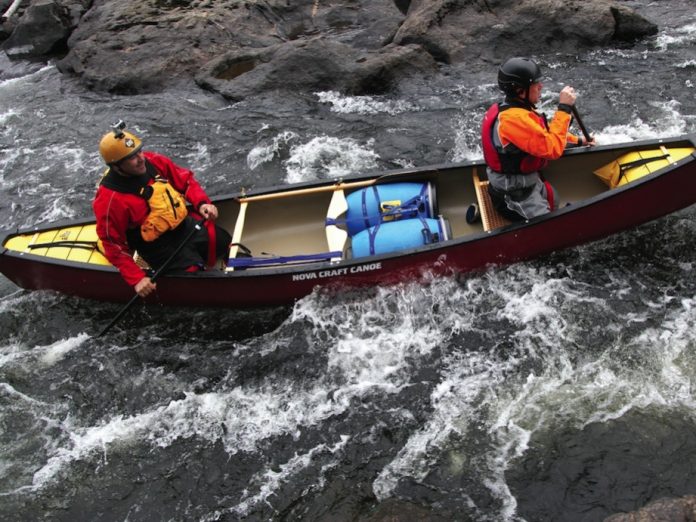
Photo: Scott MacGregor
Nova Craft Moisie

This review of Nova Craft Canoe’s Moisie was originally published in Canoeroots and Family Camping magazine.

Nova Craft has reinvented a boat with an enviable reputation among river trippers. The long-defunct Blue Hole Canoe Company of Sunbright, Tennessee, first released this canoe in the early ‘80s as the Cumberland. Steve Scarborough, creator of the celebrated Mad River Canoe Caption, was responsible for its original design. Evergreen Canoes then reproduced it as the Starburst in the 1990s.

The now legendary, highly rockered hull design has never been bettered as a river running tripping canoe. However, since Evergreen stopped making boats several years ago, a re-sale market hardly exists—why would anyone sell a boat this good? So, a hungry frustrated market for this boat built quickly as time passed.

Enter Nova Craft Canoe of London, Ontario. They created a new mold carefully taken from the dimensions of the Cumberland and Starburst, and in response to paddler demand, began pressing Royalex. The new hull was christened the Moisie in honor of the iconic Quebec white-knuckle river. At first glance, the Moisie is a dead ringer of the Starburst. It is the same 16-foot four-inch hull with aggressive rocker and a very round bottom. It isn’t until you get out the tape measure that you realize the subtle improvements Nova Craft has made.

With each iteration, this boat has become deeper. The Moisie is half an inch deeper than the Starburst, making a dry boat even dryer.

“Hollow vinyl gunwales are prone to collapsing at the points where the seat and yoke bolts pass through,” says Roch Prevost of Nova Craft, “so we inserted a tough vinyl bushing into an oversized hole at these locations to take the pressure, and bingo, we have a simple solution to grossly sunken bolt washers.”

The Starburst hull was prone to a splitting of the interior vinyl just forward of the stern paddler’s knees—most likely from flexing of the floor when running the boat empty. A new Moisie has a hull completely lacking in flex because of the heavier expedition-grade material Nova Craft is calling Royalex Plus. It also comes in stan- dard industry Royalex. The seats are set in an optimum tripping position, maximizing the load carrying space with room for far more than two 60-liter barrels between the bow seat and the yoke and two more to fit snugly between the yoke and the stern thwart.

Any real-world comparison of this hull with other boats highlights its exceptional dryness and maneuverability. It should be mentioned here that the Moisie is a boat that begs for whitewater outfitting—thigh straps, contoured kneepads, flotation bag cages and forward-tilted seats bring it to life. Our demo boat came without outfitting so we set shaped kneepads loosely in the bottom and set out to do some turns.

The Moisie sweetly initiates, turns and carves like a playboat. It feels even better carrying a load as the extra weight sits the boat lower in the water, adding stability. It is so responsive to input from both bow and stern thanks to its heavy rocker and dramatically rounded bottom that new paddlers may find it requires a lot of minding to keep it straight. But advanced paddlers will be left smiling and wondering if they should finally send their scarred and treasured veteran Starbursts out into the resale market.

If you are going to travel a river straight through and just enjoy the scenery, there are many other boats that will float you. But this is the boat for playful three-week river adventures far from the maddening world.

Nova Craft Canoe Moisie specs

  • Length: 16’6”
  • Width at gunwales: 34”
  • Depth at bow: 26”
  • Depth at center: 15”
  • Depth at stern: 26”
  • Weight: Royalex plus, vinyl trim, 77 lbs | Royalex, aluminum trim, 67 lbs
  • MSRP: $1,899 CAD
  • www.novacraft.com

This article originally appeared in Canoeroots & Family Camping, Spring 2013. Download our free iPad/iPhone/iPod Touch App or Android App or read it here.


Video: Kevin Callan Around Algonquin Park

This is the first of five segments about Kevin Callan’s crazy canoe trip around Ontario’s Algonquin Provincial Park taken in June 2013. The route followed was initiated by Algonquin Outfitters and labelled “The Meanest Link.” It’s a 20-day trip consisting of 350 kilometers, 55 lakes, six rivers (three of which necessitate upstream travel) and 93 portages that add up to 68 kilometers.

See the next segment on his YouTube page here: http://www.youtube.com/user/KCHappyCamper


Doggy Paddling Canoe Tips

Photo: Kevin Callan
Doggy Paddling Canoe Tips

Camping with your best friend can be hassle free. Use the know-how below, and have a howling good time.

Let sleeping dogs lie

Only a few breeds are independent enough to curl up under a balsam branch and tolerate being chewed by the blackflies. Unless you own huskies and are in the midst of running the Iditarod, your dog can sleep inside the tent with you or can be leashed inside the vestibule. Packing his matt or blanket from home will keep him warm and settled at night and discourages him from sneaking into your own personal sleeping quarters.

Guard dog

Never assume your dog will protect you from black bears or grizzlies—although a few breeds such as the Karelian Bear dogs are bred specifically for confronting and herding problem bears. Instead, stick with regular bear safety practices. In my own experience, I’ve found that more often than not, my dog will chase a bear out of the campsite only to come running back to hide behind me, bringing the bear with her!

Vet’s Orders

A trip to the vet is a must to make sure your dog gets the shots it needs. Ask your vet if your dog needs additional vaccines to protect against Leptospirosis, which is contracted through rodents and deer populations, or Lyme disease, which is spread by deer ticks. Your dog may also need an oral medication to prevent heartworm. While you’re at the office it’s a good idea to inquire if there are any poisonous reptiles or insects in the area and how to treat a bite.

Hot dog

To prevent heat exhaustion and heatstroke, let dogs go for frequent swims to lower their body temperature. According to Dogs Ultimate Care Guide, fast, heavy panting and excessive salivation are the first signs of heatstroke. Try to keep them shaded on hot, humid days. Fixing a small sun umbrella to the canoe gunwale works wonders.

Sun dog

Some dogs’ noses are prone to sunburns. This is easily preventable by applying a little bit of waterproof sunscreen.

Dog Bitten

Make sure to also bring along bug repellant that’s free of nasty chemicals such as DEET. My vet supplies me with repellant made of oil of peppermint, eucalyptus, pennyroyal and citronella.

Cool dog

For cold-weather camping, pack a dog blanket or a children’s sleeping bag and a small ground sheet for sleeping. Dogs burn more calories in cold weather to keep warm, so give them additional food and treats.

A Bone to Gnaw On

Plan to take two extra days of dog meals beyond your planned stay, just in case. All dog food and treats should be stored like your own food—away from the campsite in water- and critter-proof containers. Feed your dog in the kitchen area and pack up any kibble that falls out of the bowl. It’s also important to use the same food brand your dog is accustomed to at home. Canoe trips are a bad time and place to deal with allergic reactions or a picky eater.

Water dogs

It’s pretty difficult to stop them, but dogs can get sick from drinking contaminated water in rivers and lakes. A common waterborne parasite known as Giardia will give dogs volcanic diarrhea and could be transmitted from them to you. Provide them with plenty of clean water throughout the day.

Doggy Bag

Purchase a dog pack so she can carry her own food, water and snacks. Always store the pack away from the tent and out of reach of wild animals. I believe that if the dogs feel more involved with the trip, they will enjoy the time out there far more…and so will you.

Sit…lay down…Stay

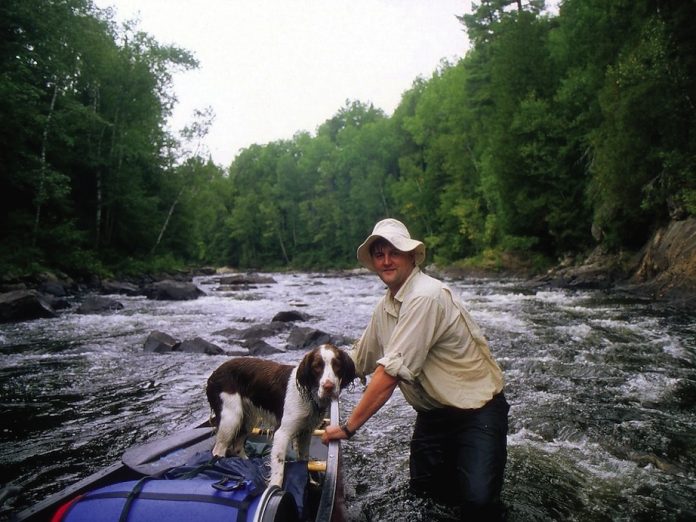
The best way to get dogs to stay in the canoe is to create a comfortable place for them. Try gluing a slab of foam to the floor of the canoe or bring their favorite mat from home. Go for an afternoon test paddle with all your gear to work out the wrinkles and get your pooch familiar with the drill. Training him to sit or lie down takes time…and patience.

Don’t tie me down

It’s very important to never tie your dog into the canoe. If your canoe capsizes, your dog must be able to swim free of the boat and gear. Paddling with your pup in rapids depends on both his and your own comfort level. Dogs can run the portage trail while the owners run the rapid.

Dog rules

Dogs are permitted in many provincial parks across Canada. Park rules state that pets should always be kept on a leash, are never left unattended, do not make excessive barking noise and that their waste is cleaned up and disposed of properly. Some parks have dog-free zones, so make sure to check regulations before heading to your destination. My preferred choice is to go north to the less crowded, more dog-friendly parks and public land areas.

This article first appeared in Canoeroots and Family Camping, Early Summer 2010 issue.  For more expert tips, download our free iPad/iPhone/iPod Touch App or Android App or read it here.

Flushed: A Sobering Truth

Photo Steve Rogers
whitewater kayaking.


Eighteen months ago, I shattered six vertebrae after one bad stroke off the lip of a 40-foot drop in the Royal Gorge. One month later, I at­tended the funeral of my paddling hero and role model, Boyce Greer. In September, my close friend and accomplished paddler, Alan Panebaker, drowned on a rapid on the Pemigewasset that we often bombed without a second thought. I’m left wondering why I kayak. Do the rewards justify the risks? Have I simply replaced my addiction to alcohol with an addic­tion to whitewater?

Before kayaking, I spent 10 years of my life pursuing alcohol. I was secretly proud when my girlfriend told me that I had been hospitalized with a blood-alcohol level significantly above the normal fatal level yet still managed to get to work the next day.

Like most, when I was drinking, I only thought about myself. I claimed I was only hurting myself, ignoring the concerns of my family and friends. I was living in the moment and when the drinking got worse, I said I wanted to escape reality. When my friends died in drunk driving and from suicidal drinking, I came up with excuses about how they were different from me. Then I drank to celebrate their lives.

I stopped drinking a little over six years ago. Not knowing how to enjoy life, I started kayaking, another escape from the doldrums of the daily grind…

This editorial originally appeared in Rapid, Spring 2013. Download our free iPad/iPhone/iPod Touch App or Android App or read the rest here.


Boost Your VHF Range

Photo: Ryan Creary
Boost Your VHF Range

How can I boost the range of my VHF marine radio?

Handheld VHF marine radios work on a line of sight principle, with the transmission range being a function of the unit’s wattage. For example, a five-watt radio has a transmission range of about five nautical miles. Radio repeater stations placed in elevated areas along coastal regions greatly increase the range of transmission—this is why compact marine radios (and even basic weather radios) can pick up weather forecast broadcasts almost everywhere sea kayakers like to paddle.

But dead zones do exist. Sea kayak instructor and Paddlinghq.com founder David Johnston had problems receiving forecasts and making a call to the Coast Guard to file a float plan on Lake Superior’s remote Michipicoten Island. “It’s minerals in the rocks that kill reception,” says Johnston. “We had to get offshore about half a kilometer to pick up the Coast Guard.” Similarly, hazy or cloudy weather can also reduce reception.

Since radio waves are deflected and obstructed by landforms, going offshore is the best way to boost range. Climbing to an elevated point can also work—the idea is to open up your VHF’s sight lines. Johnston points out a basic principle that can also improve transmission: Hold the radio as vertical as possible to keep its antenna high. Length of antenna also dictates a radio’s range. If you’re headed far off the beaten path, consider purchasing a longer aftermarket antenna that’s compatible with your radio.


This Skills Q&A article originally appeared in Adventure Kayak, Summer/Fall 2013. 

Folding Kayak Review: Pakboats Quest 135

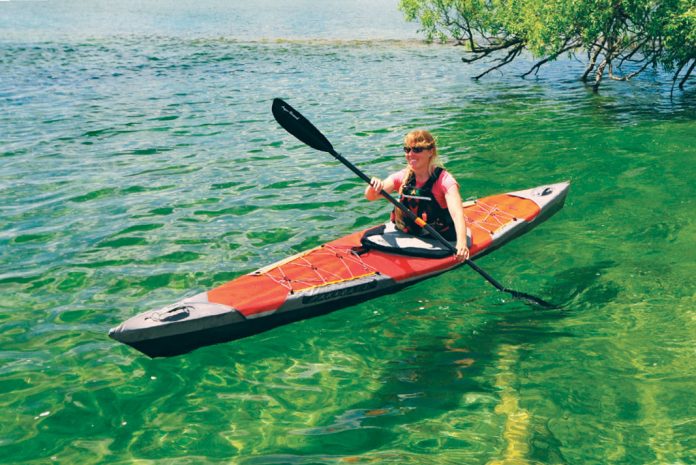
Woman paddling red folding touring kayak
"I can go anyway, anyhow, anywhere I choose." | Photo: Vince Paquot

Alv Elvestad knows a thing or two about portable boats. The Norwegian-born founder of Pakboats was introduced to folding canoes on the remote rivers of Lappland in the late 70s. After a decade in the distribution business, he started tinkering on his own design and sold the first PakCanoe in 1995. Since then, recreational and touring kayaks have followed as Elvestad and his small, New Hampshire-based team continue to refine Pakboats’ design and construction.

[ View all the best foldable kayaks ]

Pakboats Quest 135 Specs
Length: 13′
8″
Width: 23″
Material: Polyurethane/aluminum frame
Weight: 29 lbs
Price: $1,515

pakboats.com

The Quest series is the next step in that evolution. Elvestad looked at the company’s existing line of XT touring kayaks and realized the somewhat cumbersome frame structure was overkill for a compact solo kayak.

He identified three critical traits for this next generation: shorter, simpler and lighter. Both the Quest 135 and 155—a longer, slightly beamier version for more extended touring—feature Pakboats’ clever hybrid folding/inflatable construction.

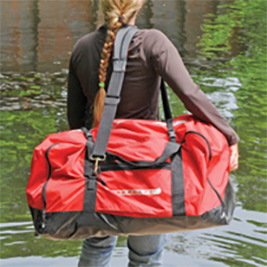
The 135 shaves 13 pounds off the lightest XT kayak, and packs into a duffle that’s very manageably sized for tossing in your trunk or checking in as airline baggage.

Assembled, it’s a breeze to solo carry or car-top, and feels as light and nimble on the water as it does off.

Paddling in moderate wind chop, the hull feels stiff and both acceleration and cruising speed are pleasantly quick for a sub-14-foot boat. Even without a rudder or skeg, the Quest tracks well thanks to minimal rocker and low decks that reduce windage.

The Quest’s lightweight deck attaches to the hull with full-length Velcro strips and can be peeled back from either end to access storage areas. Abrasian-resistant end caps with built-in carry handles and wrap-overs with integrated deck bungees fore and aft of the cockpit complete the seal. Although we stayed dry in splashing waves, we did find some water crept in when this seal was immersed; for example, when edging deeply for leaned turns or braces.

Reflecting the same usability versus complexity trade-off that explains why some fixie riders forgo brakes on their bikes, standard outfitting on the Quest doesn’t include foot pegs or thigh braces.

Woman carrying red duffel bag.
Photo: Virginia Marshall

If you want to perform maneuvers that require a large degree of edging, such as rolling, you’ll need to install Pakboats’ optional backpack-style thigh straps.

SmartTrack foot braces are also available, and recommend these to all paddlers to improve efficiency and fit.

Capable, affordable and supremely portable, the Quest 135 shines as a travel kayak for mellow journeys in faraway places.

Ideal for: Short jaunts and weekend trips on sheltered waters; plane, bus and car travel.

Assembly time: 30 minutes

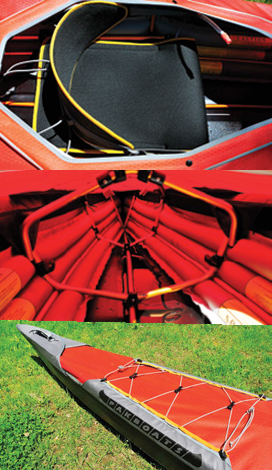
Support report (top)

Pakboat’s sling seat is comfortable and supportive with an inflatable thigh riser, but its high placement on the frame makes the boat feel very unstable.

Parts of a read touring kayak
Photos: Virginia Marshall

Removing it and putting a Therm-a-Rest inflatable seat directly on the hull transformed our Quest from wild animal to well-behaved pet. Elvestad says he’s aware of the problem and is looking into ways of lowering the seat.

Best of both worlds (middle)

The aluminum frame assembles like a tent: shock-corded poles clip together and slide into sleeves in the heavy-duty polyurethane fabric to form the crisp lines of a multi-chine V hull. Inflatable tubes along the chines enhance stability, tension the skin and allow the baot to float upright when flooded.

That’s a wrap (bottom)

Using Velcro and clever wrap-overs, the Quest’s peel-and-stick deck eliminates the weight and complexity of hatches while providing convenient access.


“I can go anyway, anyhow, anywhere I choose.” | Photo: Vince Paquot

P&H Hammer Kayak Review

Photo: Dan Caldwell
P&H Hammer Kayak Review

A review of the P&H Hammer sea kayak by Adventure Kayak magazine.

Three years ago, the P&H Delphin was considered radical. Since then, the pioneering playboat has gained significant traction amongst the traditionally conservative sea kayaking community. P&H Sea Kayaks owner and designer Graham Mackereth admits his design team had no idea the Delphin would be so well received—only a hunch that the timing was right for a sportier sea kayak.

Now, the Delphin has set the stage for an even more radical design, the Hammer—prompting P&H to define a whole new category in their line-up: ocean play.

Given their pedigree—Mackereth founded Pyranha whitewater kayaks in 1971 and acquired P&H in 2003; and designers Rich Taylor and Robert Peerson split their time between modeling kayaks for rivers and sea—it’s no surprise P&H are leading the way in this emerging niche.

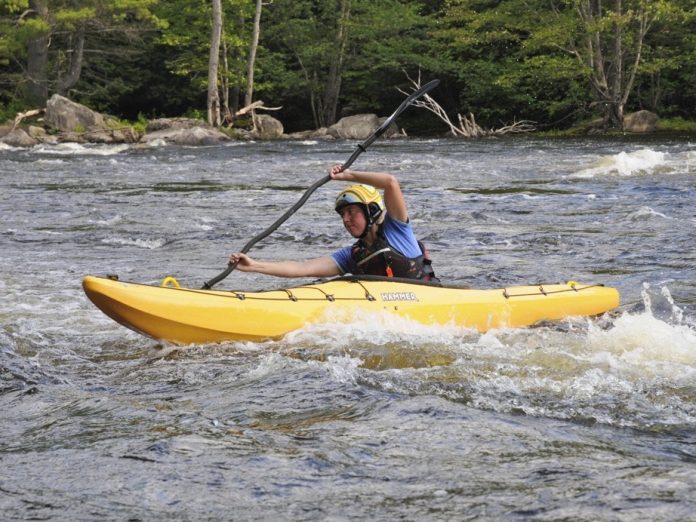
One of the first things you’ll notice about the Hammer is that it’s built like a whitewater kayak…

P&H Hammer specs

Length: 13 ft
 8 in
Width: 24.5 in
Weight: 50 lbs
Price: $1,799
This article originally appeared in Adventure Kayak, Summer/Fall 2013. To continue reading the full review and watch an exclusive video review, download our free iPad/iPhone/iPod Touch App or Android App or read it here for free.

Dagger Jitsu Review

Photo: Chris Gragtmans
A review of Dagger's new Jitsu playboat

This whitewater kayak review originally appeared in Rapid magazine.

It’s not always easy for companies to garner award-winning status with each new product release. Some of the biggest brands in the world have had a few products I bet they’d like to forget about—Crystal Pepsi, Apple’s Maps App, and McDonald’s Arch Deluxe. The important thing is to learn from the past and move forward, and that’s exactly what Dagger has done with the Jitsu.

The first thing that stands out about the Jitsu is its all-new contour ergo Outfitting. Cool graphics on the fabric aside, the most attractive feature of the entire system is the rotomolded seat with leg-lifter. This framework stiffens the kayak’s hull, making the boat bouncier on waves. It’s easy-to-use ratcheting leg-lifter holds your legs and knees up where they should be, aggressively braced for throwing your entire body into big aerial moves. Drop in foot blocks and foam shims on the hip pads and you’ll become one with the Jitsu in under 10 minutes.

The Jitsu is noticeably more in harmony with today’s freestyle moves than its predecessor, the Agent. The medium 5.9 Jitsu is a little over two inches shorter, an inch wider and has seven more gallons of overall volume than the medium 6.2 Agent. The outcome is a boat that is easier to throw around. And, thanks to the added width and volume, the Jitsu floats higher in the water, remaining stable enough to actually run rapids.

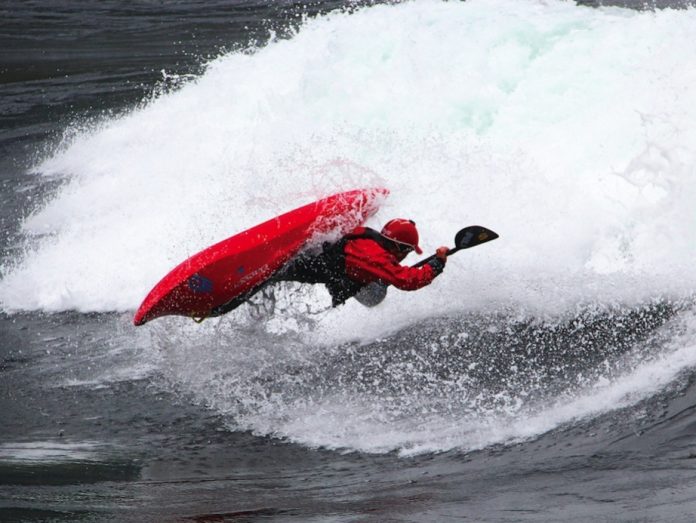
We first previewed the Jitsu last summer on dry land with Dagger Pro Team Manager, Chris Gragtmans. “Our two main goals were to create a boat that was dynamic on a wave and still able to do the whole realm of hole tricks,” he told us. He also emphasized the edges, stating that “the double step carve rail is a pretty cool concept and the boat definitely feels like it goes edge to edge on a wave really well.” Getting the Jitsu on the water we found Gragtmans was bang on. Reminiscent of Dagger’s Crazy 88, released nearly 10 years ago, the Jitsu loves to carve and easily transitions edge-to-edge, making zipping across the face of a wave a delight. This also makes rotational moves like blunts and airscrews whip around like a rice bale throw.

Its minimal stern rocker and abrupt tail end, or as Gragtmans puts it, “really defined parting line,” give the boat maximum speed on a wave— perfect for explosive aerial moves and grabbing smaller catch-on-the-fly waves. The tradeoff is a need to keep weight forward during spins, backsurfs and heavy landings—otherwise the stern may initiate an unintended back loop.

Dagger should be excited with this new release. The Jitsu vaults Dagger back to the leading edge of the freestyle scene and should definitely be on your list of boats to try if looking for a new play machine.


Check out our video tour of the boat with Gragtmans here.


Dagger Jitsu 5.5 / 5.9 / 6.0 Specs

LENGTH – 5’6″ / 5’9.5″ / 6′

WIDTH – 25″ / 26″ / 27″

VOLUME – 48 / 57 / 63 US GAL

WEIGHT – 29 / 31 / 34 LBS

PADDLER – 90-155 / 140-200 / 165-245 LBS

MSRP – $1,049

dagger.com 


To read the rest of this review of the Dagger Jitsu check out Rapid, Early Summer 2013. Download our free iPad/iPhone/iPod Touch App or Android App or read it here.


Flushed: Moon River

Photo: Flickr user Rabinito
Why river running at night is a beautiful thing


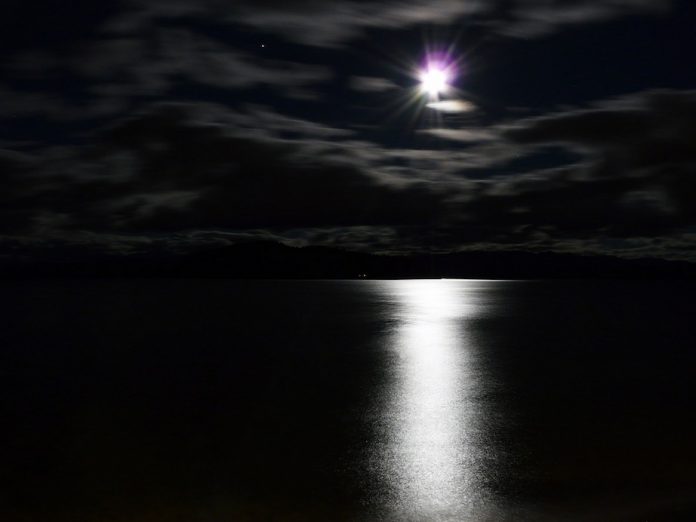
There were four of us in hardboats that first full moon night on the Chattooga. Everything was strange—shiny and magical, the way river running by lunar light can be. When we dropped through the last wave into the approach above Seven Foot Falls, however, things went dark. it was a clear night, but the moon was no longer visible; hidden by rapid and ridge.

The trip had been going well. We’d all been guides on the river for a while and knew the Chattooga and each other, in some ways, better than ourselves. We’d stopped talking somewhere above Woodall Shoals, none of that pre- or post-rapid chat. When we made sounds, we made animal noises. Mostly, we were quiet. We’d been listening with hips, hulls and strokes to what the river had to say, and what the river had to say was, in part, translated by the moonlight reflected and flickering on its surface.

A river is the same river by moonlight as it is in the day, only naked, moody, evocative, less in your face. There’s nothing black and white about being on a river at night under the moon. The colors are there, but they are changed: hushed, shimmery, wavering. Trees that appear green in daytime become a soft violet; to regard them is to be less attuned to detail—leaves or bark—than to the whole…


To read the rest of this article, check out Rapid, Early Summer 2013. Download our free iPad/iPhone/iPod Touch App or Android App or read the rest here.