Home Blog Page 33

When A Paddler Dies, We Are Too Quick To Judge

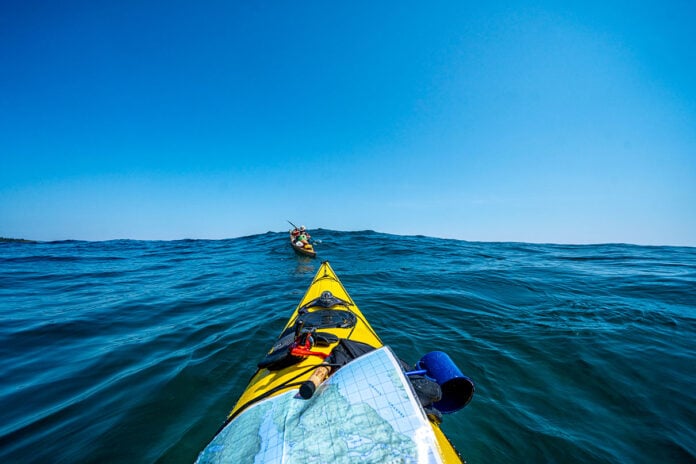
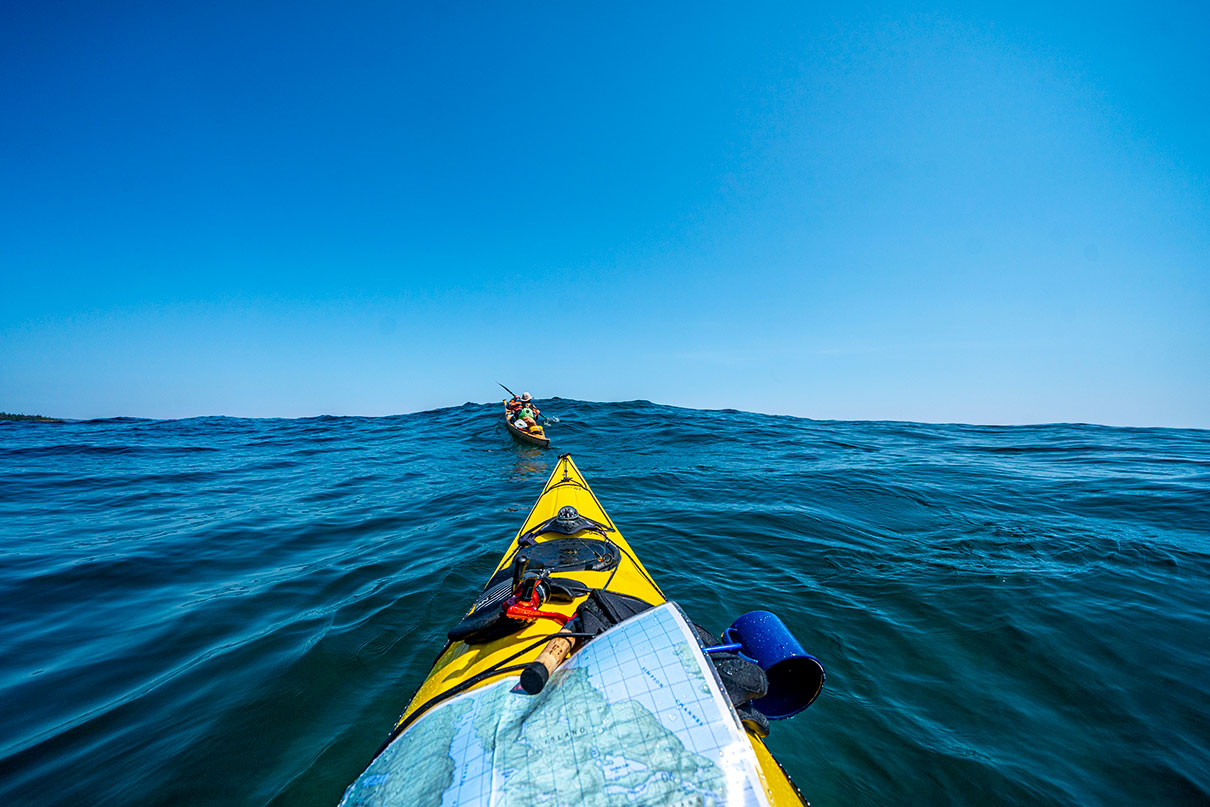
bow shot of a sea kayaker with map paddling after another kayaker over an ocean swell while they are on an expedition
Friendly swell or time to get off the water? It depends on who you ask. | Feature photo: David Jackson

The paddling community judges accidents harshly. We are so determined to figure it out and ascribe a cause to the incident we often rush to conclusions before all the facts are available and blame the victims in the process. Instead, we ought to humbly reflect on what lessons the incident can teach us and give thanks for surviving our own near misses.

When a paddler dies, we are too quick to judge
To be sure, analyzing, debriefing and accident reviews are essential to lifesaving takeaways. Accidents are too common and need to be reduced. According to United States Coast Guard (USCG) data, there were 183 paddling deaths in the U.S. in 2023. Kayaks were the second most common type of vessel involved in fatalities, second only to open motorboats.

Even as I sat down to write this, reports came in of two separate kayaking accidents that killed three people in one windy afternoon in British Columbia. On Saturday, April 20, two young men flipped in a tandem kayak in waves and tidal currents near Victoria. Their kayak and bodies washed ashore separately in the nearby San Juan Islands. Later the same day, a father and son in another tandem kayak flipped in Deep Cove, a popular kayaking spot near Vancouver. They were rescued, but the 70-year-old father didn’t survive. Early reports, which can often be wrong, suggest none of the victims were dressed for immersion.
bow shot of a sea kayaker with map paddling after another kayaker over an ocean swell while they are on an expedition
Friendly swell or time to get off the water? It depends on who you ask. | Feature photo: David Jackson

Predictably, the online comments rolled in. First came the ill-informed armchair experts, pompous pronouncers of the obvious who bestow Darwin Awards and claim they wouldn’t have made the same mistakes. They are the first to speak up because what they say requires the least thought.

“Why would they be so far off land in a kayak in the ocean in the first place?” suggested one commenter about the first incident. From another: “This area is subject to the Venturi Effect. Consequently, currents can be quite strong and are influenced by various factors, including tides, winds and the topography of the sea floor.”

Okay, Einstein.

Or how about this one: “When a mistake is made in the ocean, it can be an unforgiving place.”

Thanks, Captain Obvious.

More knowledgeable commentary emerges later. However, some self-appointed experts parse the details and act as if the mastication of the event’s minutiae by their incisive intellectual chops can nullify all likelihood of any such tragedy occurring in the future. If only we would all keep cool heads and just look at the facts, our safety would be guaranteed. Simply venture forth protected by perfect knowledge, perfect judgment and an armor of radios, flares, satellite communicators, Gore-Tex, and leashes of the appropriate length and material to stay attached to all of it, in all conditions.

Too often, this is accompanied by an unspoken it-couldn’t-have-been-me subtext. We cling to every discerning detail—the victims had the wrong kind of kayak, a lack of certain safety equipment, insufficient training, or a bad weather forecast—anything to separate them from us.

That wouldn’t have happened to a real sea kayaker.

“The truth is, we are all vulnerable. The judgment we are too keen to apply to other people’s paddling accidents is an unhealthy coping tool, a way to avoid facing this truth.”

There is some truth to such distinctions. According to the same USCG data, three-quarters of paddlesports deaths are people with less than 100 hours of experience. And over 80 percent of people who drown in boating accidents weren’t wearing PFDs. But these stats probably say less about how dangerous it is to be a beginner and more about how many beginners there are. It’s like the statistic stating most people die near where they live. It doesn’t mean you’re safe if you never go home. Similarly, having a kayak with bulkheads and wearing a PFD doesn’t make you immortal.

Down to a coin flip

The movie Beyond the Salish, which won best sea kayaking film in this year’s Paddling Film Festival, shows how easily things can go wrong even for those who think they’re well-prepared. It tells the story of two enthusiastic young kayakers, Richard Chen and William Chong, who are rescued by helicopter after a harrowing capsize on the outer coast of Vancouver Island.
The pair had practiced rescues and wore wetsuits, paddling jackets and quality PFDs. But the movie will attract commentary from the same backseat critics who vulture around every kayaking accident: They were stupid and should have known better. Richard says as much himself.

My friend Dave and I paddled the same stretch of coastline when we were about the same age. In hindsight, I tend to think our survival is evidence of superior skill and judgment. I wouldn’t have let go of my paddle and lost my balance like Richard, right? But I need look no further than my journals to see how much of our safety was dumb luck.

There was the time we found ourselves panicking in huge seas offshore of the Cape Beale Lighthouse. In my memory, we’d headed out into calm weather and been surprised by the conditions. But my journal tells a different story. The forecast had been for a 13-foot swell.

“This could be a crazy day,” I’d told Dave. But, brimming with confidence from hundreds of miles of safe paddling, often with threatening forecasts that had turned out to be fine, our motto had become, “paddle anyway, change plans later.”

“If we get pummeled, we get pummeled,” Dave announced, responding to my concern about what 13-foot swell might mean for a surf landing. Once we got a half-mile offshore, our confidence dissolved.

“Now I’m scared,” Dave yelled over the wavetops. We shakily turned around, bracing against the whitecaps, and surfed into safety behind the lighthouse.

“So you’re the kayakers giving me more grey hairs this morning,” the lightkeeper greeted us. He’d had his binoculars trained on us the whole time, ready to call the coast guard.

I can count half a dozen other close calls with no help nearby.

“I thought we were elite kayakers, but now I see we just had good weather,” I wrote in my journal. “The feeling of power is gone, replaced by a reverence, gratitude, humility.” Over time, humility was replaced by complacency and pride.

The only thing separating us from Richard and William is we didn’t capsize. Maybe we were stronger paddlers, or perhaps it was because we had the good judgment to turn around. But at the time, the decision felt like a coin flip. There’s probably some alternate universe where those two young men finish their trip safely, and Dave and I are airlifted out. Our good fortune is not a qualification for grandstanding.

What the water teaches

The truth is, we are all vulnerable. The judgment we are too keen to apply to other people’s paddling accidents is an unhealthy coping tool, a way to avoid facing this truth. In her memoir, No Cure for Being Human, the religious scholar and cancer survivor Kate Bowler explains this tendency we have to recoil from the tragedy in others’ lives. “Who wants to be confronted with the reality that we are all a breath away from a problem that could alter our lives completely?” she writes.

To learn from others’ mistakes and misfortune, we have to first accept it could have been us. Less judgment, less opining, more openness and empathy. This is what the water teaches us, after all, if we are willing to listen.

Tim Shuff is a sea kayaker, firefighter and former editor of Adventure Kayak magazine.

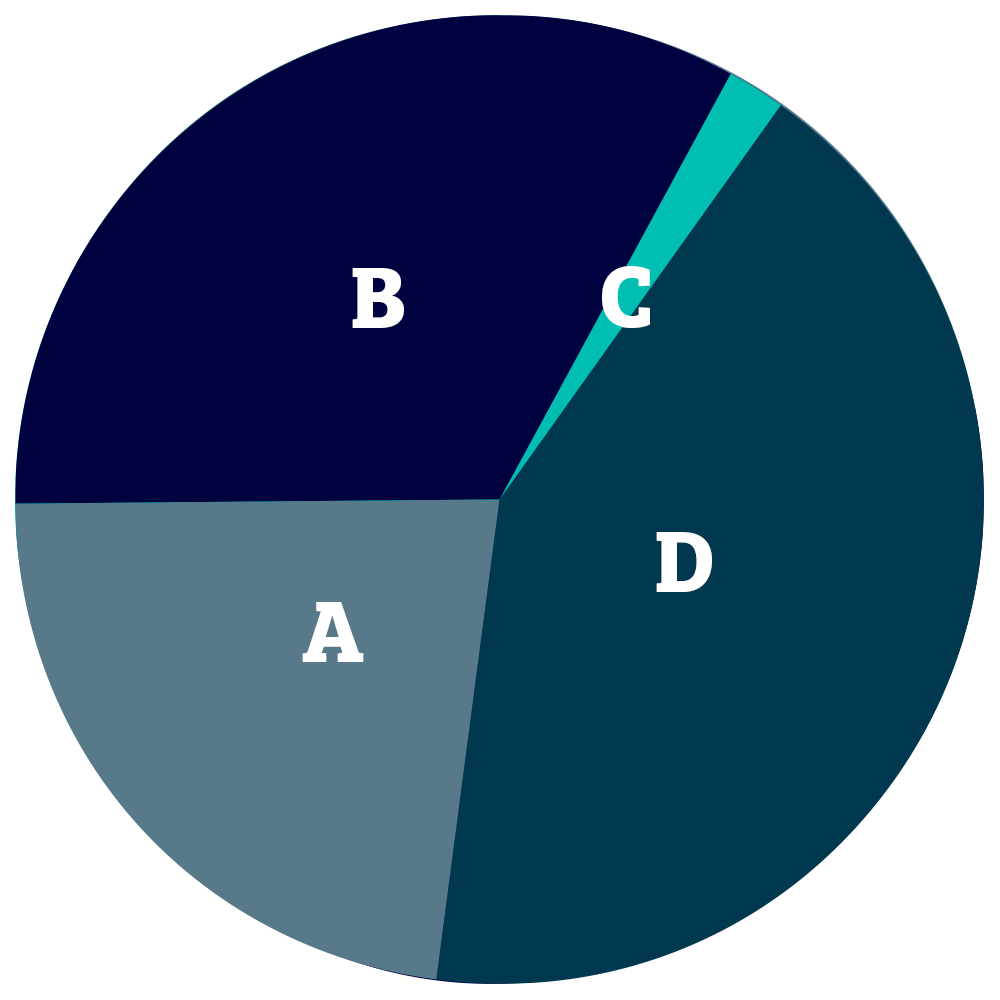
Survey Says

We asked our readers about safety habits. Here’s what you had to say.

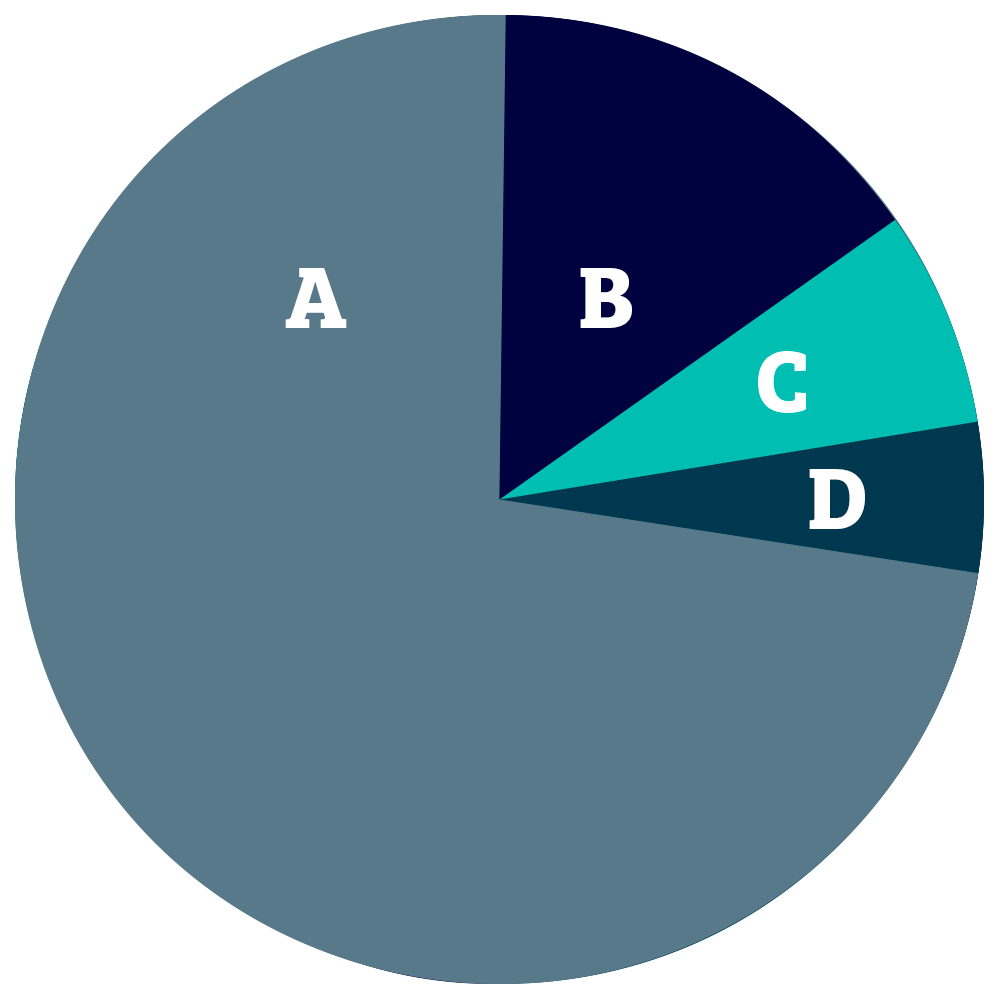
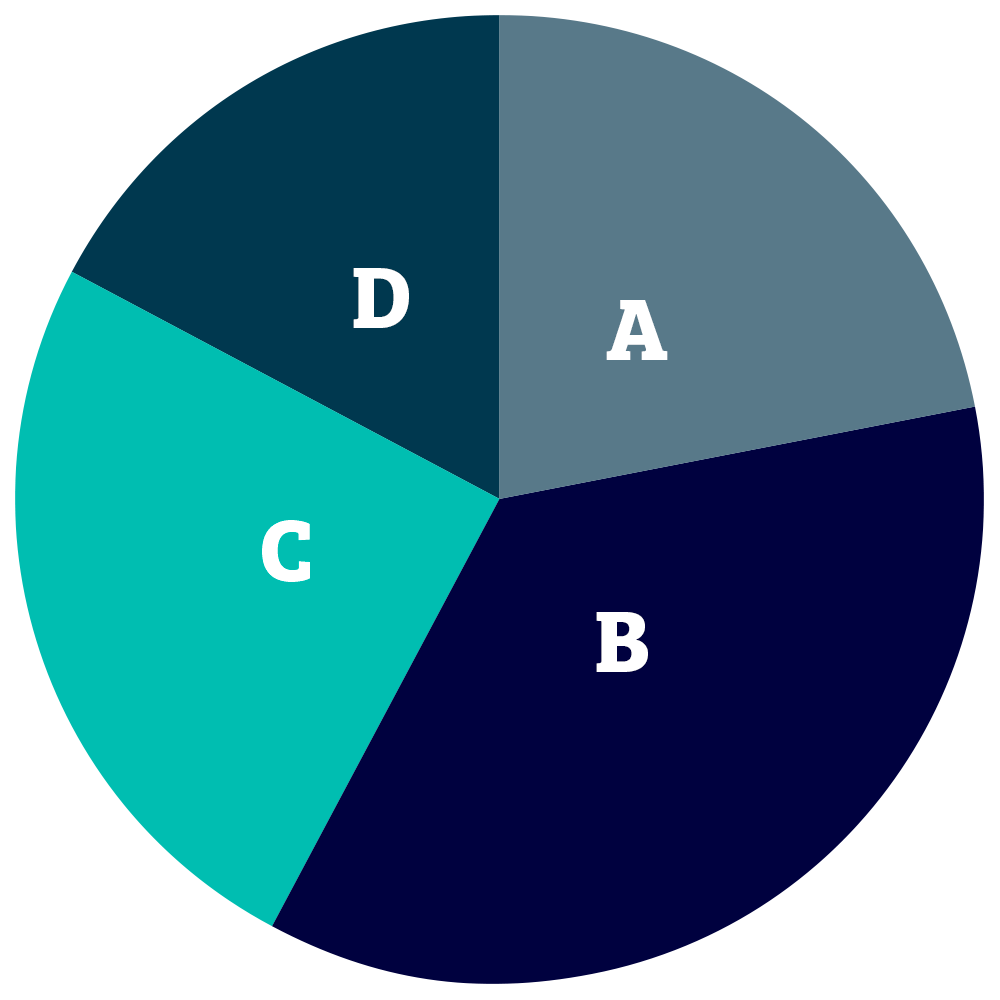
How often do you paddle alone?

A: All the time — 22%
B: Most of the time — 36%
C: Rarely — 25%
D: Never — 17%


When paddling, which do you always carry?

A: Signaling device (whistle or strobe) — 23%
B: Cell phone in a waterproof bag or case — 33%
C: Handheld VHF radio — 2%
D: A combination of these devices — 42%


Do you check weather or river gauges before paddling?

A: Always — 73%
B: Frequently — 15%
C: Occasionally — 7%
D: Never — 5%


Well, this is a surprise. More than half of our poll respondents say they paddle alone most or all of the time. That goes against the prime directive we paddlers have heard from summer camp straight up to today—never paddle alone. According to our survey, only 17 percent of paddlers stick to that golden rule all the time, while 25 percent admit to paddling alone on rare occasions.

There are different degrees of paddling alone, of course. If you go to a popular paddling area by yourself, you could be alone but not entirely on your own. After all, another cardinal rule of our sport is to always help a paddler in need—strangers included.

Readers do better when it comes to carrying signaling devices and phones with them on the water. Still, if you need help, it’s a lot easier to holler at the paddling buddy next to you than to phone a friend in the next county.
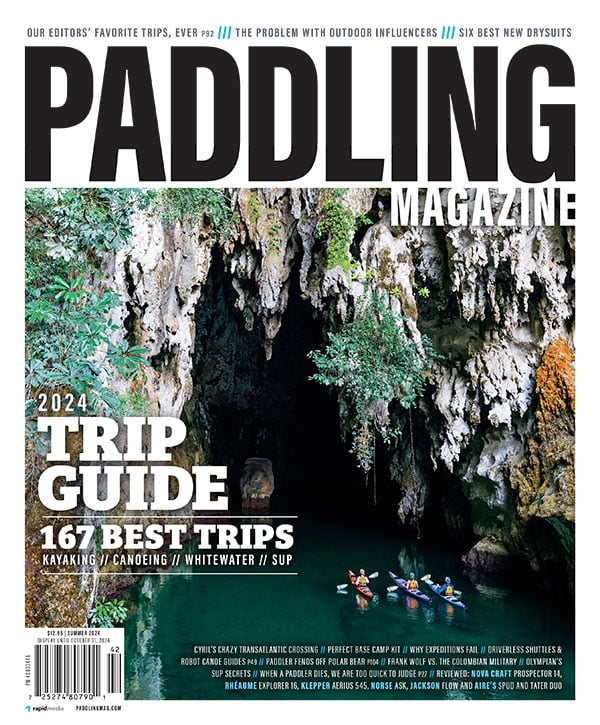
Cover of Issue 72 of Paddling Magazine, Issue 72This article was first published in Issue 72 of Paddling Magazine. Subscribe to Paddling Magazine’s print and digital editions, or browse the archives.


Friendly swell or time to get off the water? It depends on who you ask. | Feature photo: David Jackson
 

Our Editor’s Favorite Stories Of The Year

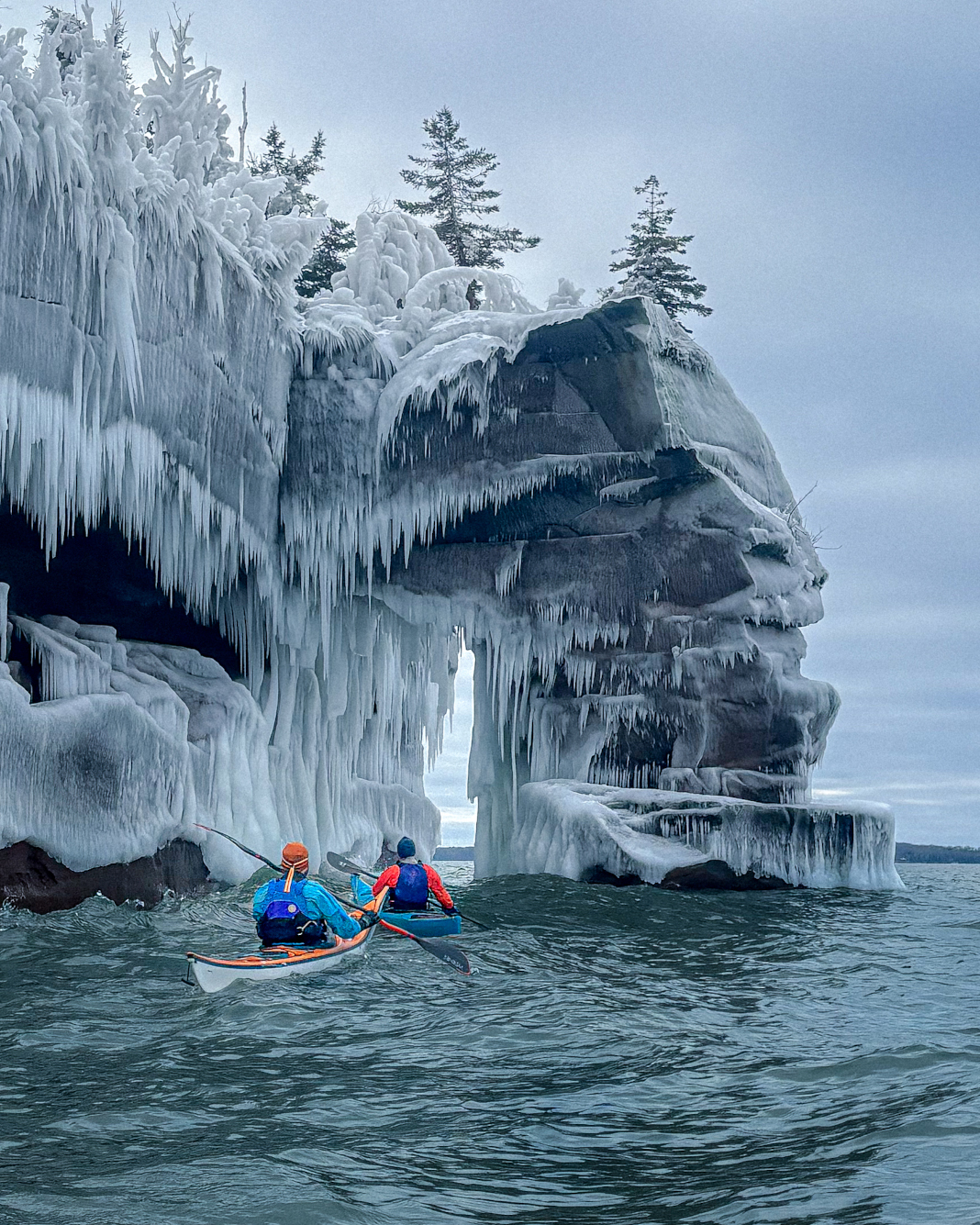
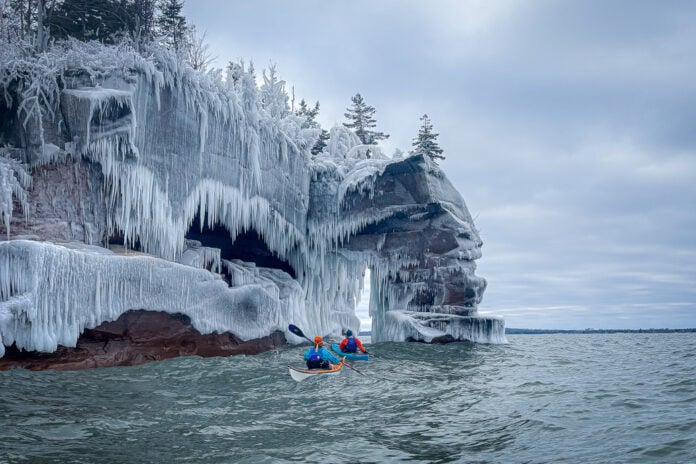
kayakers at an ice cave | image maddy marquardt
Sea kayakers at an ice cave on Lake Superior. | Photo: Maddy Marquardt.

Happy New Year! In 2024, the Paddling Mag team covered some unforgettable tales. Our favorite stories included a kayaker who used a camp chair to fend off a polar bear, a canoeist who survived an underwater gunfight, a follow-up with the paddler nearly crushed by a whale in that jaw-dropping viral video (you know the one), and our picks for the greatest kayak expeditions of the century (so far). Below is a selection of 10 top stories that inspired the most discussion, debate and delight amongst the team in 2024. Enjoy! —Editors

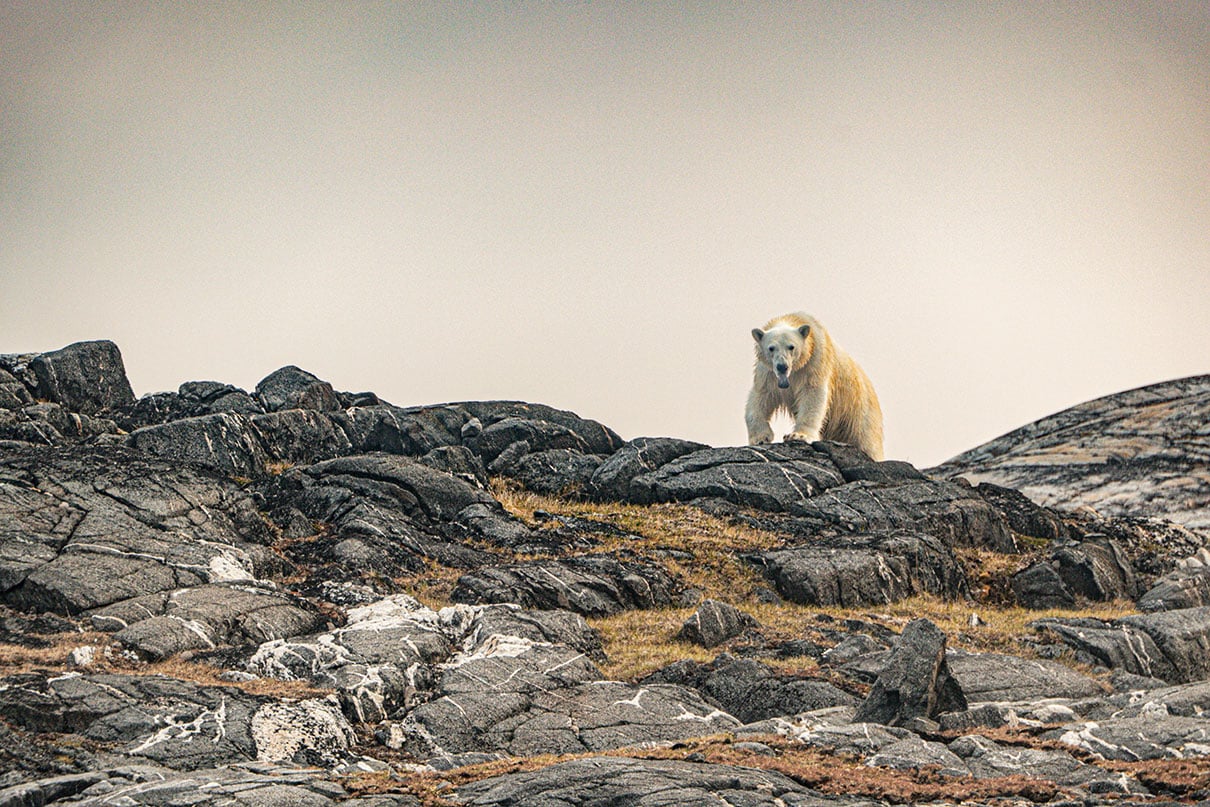
1) Kayaker Fends Off Polar Bear With Camp Chair

Four kayakers navigate treacherous waters, towering icebergs and one of the densest polar bear populations on the planet, culminating in one dangerously close encounter:

“Instinct tells me to turn around. Urgently. The worst-case scenario is a polar bear right behind me, I think, not believing it as I write in my diary by the fire. I look over my shoulder, and two piercingly black eyes in a creamy white face meet mine. For a moment, I wonder if I am dreaming. Twenty meters away, dinnerplate-sized paws pad slowly but purposefully toward me.”

When four kayakers embark on a 1,000-kilometer journey along the remote coastline of Labrador, they navigate dangerous waters, towering icebergs, and the constant presence of polar bears. In this gripping first-person account, Justine Curgenven recounts a heart-pounding encounter with one of the planet’s top predators. Read more about the daring expedition and close call…

2) Canoeist Survives Underwater Gunfight On Amazon

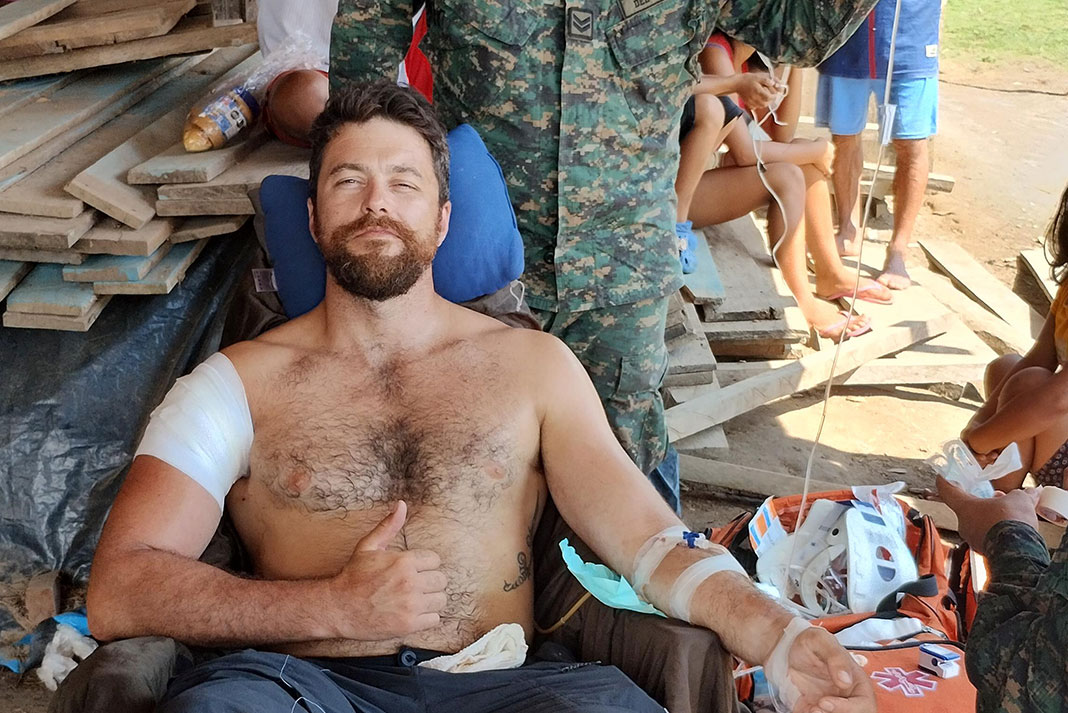
John Bathgate was shot twice—here’s why he’s going back to finish the expedition:

John Bathgate was submerged beneath his attacker’s boat when he realized he’d been shot through the shoulder. His expedition partner, Ian Roberts, was still up above somewhere, along with the gun-wielding pirate. He and Roberts knew of the piracy problem along the Amazon River and even discussed what they’d do if attacked. Still—they never thought it’d happen to them.

The Amazon Summit to Sea Expedition began in early May 2023. Unlike other Amazon River paddling expeditions that sought to traverse the river from its farthest source to the Atlantic, Summit to Sea would begin from the highest source: Mount Chimborazo…

3) The Man With The Mushroom Kayak

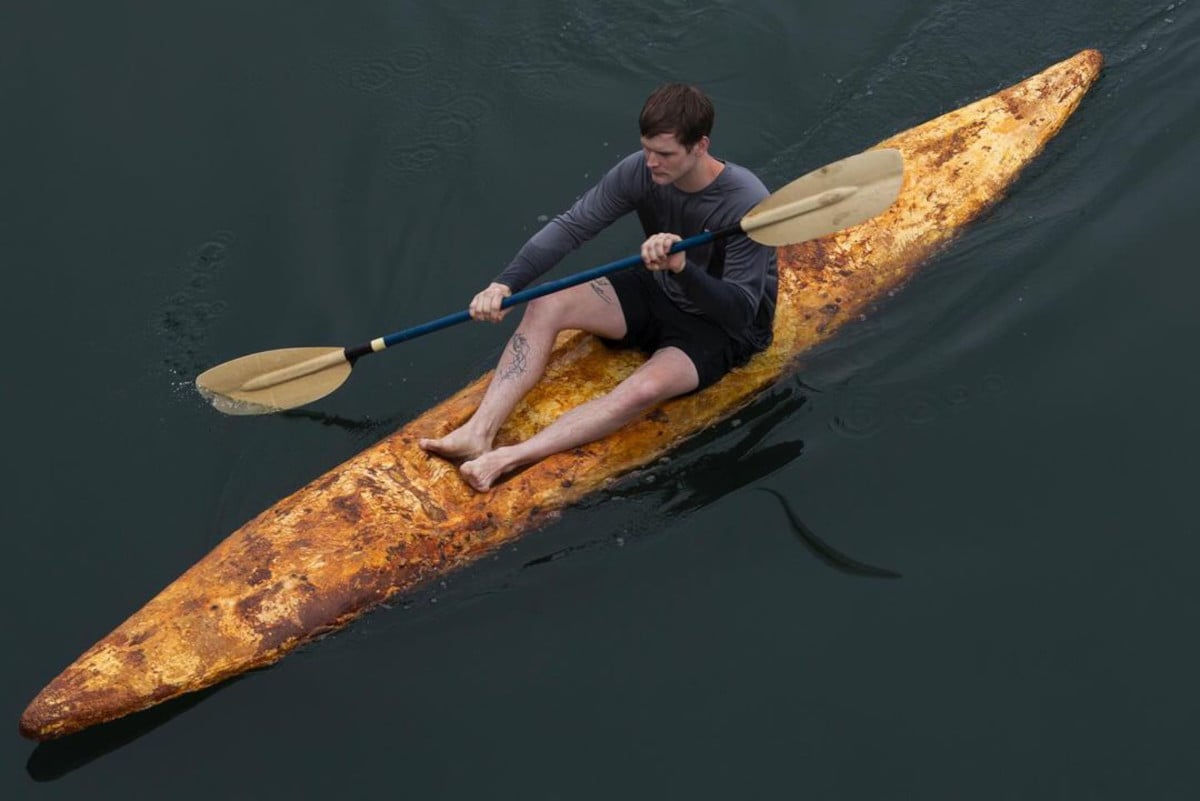
The harbor of Long Beach, California has seen its share of remarkable vessels, but perhaps none as intriguing as the one Los Angeles artist Sam Shoemaker launched on its waters. Shoemaker recently caught the attention of social media with images of a full-size mushroom kayak grown in his studio and bravely brought to a marina adjacent to the second busiest port in the U.S. for a float test.

4) Orcas Investigate Kayakers

For as many kayakers and whales travel the ocean, it’s incredible just how magical the moment remains for the two groups to share an interaction. Now, imagine how it would feel to have an Orca swim right up to the side of your boat

When a group of kayak guides in New Zealand, who seek to show others whales and wildlife, actually came face to face with a pod of Orcas, even they had trouble finding the words to express the astonishment…

5) Outdoorsy Girls Are Mean Girls But We Don’t Have To Be

Sexism in the outdoors isn’t always from the direction you’d expect:

Last year at a wilderness medicine course, I shared a quick story about an incident with a bee sting to the neck on the water. A woman just a little older than me approached me afterward, wanting to know who I was and where I was from.

“I’m a sea kayaker too,” she said. “I guided for two years in the San Juan Islands.”

There were only three other women in the class of more than 25. We were the only two who had taken the course before, and I could tell she did not like me. She had approached me with the intent of comparing her guiding and outdoor resume to mine—to correct me on something I had shared.

I’m a fifth-year coastal kayaking guide and people often ask if I experience sexism in the outdoors. Yes and no, I respond, and never from the direction I expect it…

6) Meet The Kayaker Almost Crushed By A Whale In This Viral Video

How the near-death experience inspired Tom Mustill to investigate human-animal communication:

In September 2015, Mustill, an accomplished biologist and documentary filmmaker, was kayaking off the coast of Monterey, California, when a 30-ton humpback whale the size of a school bus breached and collided with his kayak, sending him and his paddling partner tumbling into the ocean. The dramatic moment, captured on video by a nearby whale-watching boat, has been viewed more than 6.6 million times…

7) Out In Front With Dan Dixon

The kayak instructor of 40 years has traveled the globe and has wild tales to share:

“I put the student out in front,” explains kayak instructor Dan Dixon. “They lead me down the river, and I let them get into anything I can get them out of.”

Three of us are kayaking down Section 9 of the French Broad, eddy hopping and joking along the way. Going first is Jean-Marc, an adventurer from Mexico City who has worked with Dan for five years. After decades of cenote diving, sailing and car racing, an accident forced Jean-Marc to have several vertebrae fused. So, he sought Dan’s guidance to adapt his paddling…

8) How To Make Portaging Great Again

“When it comes to load carriage, we’re awash in dubious improvements to what was very likely the first and simplest way to move stuff from one place to another: the tumpline. Back straps, external frames, internal frames, Trapper Nelsons, widgets, zippers, waist belts and chest straps—all came along after the tumpline and eclipsed the single head strap,” says James Raffan. But tumplines allow paddlers to carry a heavier load for a longer distance than anyone ever could with just shoulder straps…

9) Greatest Kayaking Expeditions Of The Century (So Far)

Following his successful transatlantic expedition, kayaker Peter Bray said, “If somebody says something can’t be done, I like to know why it can’t be done, and then prove it can be.” This sentiment echoes through the motivations of some of the most extraordinary kayaking expeditions, inspiring journeys that push not just physical and mental boundaries, but also the limits of what we believe is possible.

Drawing on the nominations from more than a dozen of today’s most accomplished expedition paddlers, we’ve curated a list of some of the most remarkable journeys by double blade in the past 25 years. While few of us will ever attempt such daring trips, these stories inspire us to question our own limits and fuel the spirit of adventure…

10) Last Call On The Klamath River

The world’s largest dam removal project has wiped out one of the West’s best summer rafting experiences. Here’s why that is a good thing:

Join writer Mary K. Miller on one of the last guided rafting trips on the Upper Klamath, taken on the cusp of its historic transformation. Construction has begun to demolish four aging dams on the river, in the world’s largest dam removal project. Its aim is to return historic salmon runs to the Klamath—once the second-largest in the lower 48 states—and free 400 river miles on one of the most culturally important rivers in the western United States. The implications for river enthusiasts will ripple for years to come. Find out why…

Sea kayakers at an ice cave on Lake Superior. | Feature Image: Maddy Marquardt.

Canoe Surfing Biggest Swell In 30 Years Off Waikiki (Video)

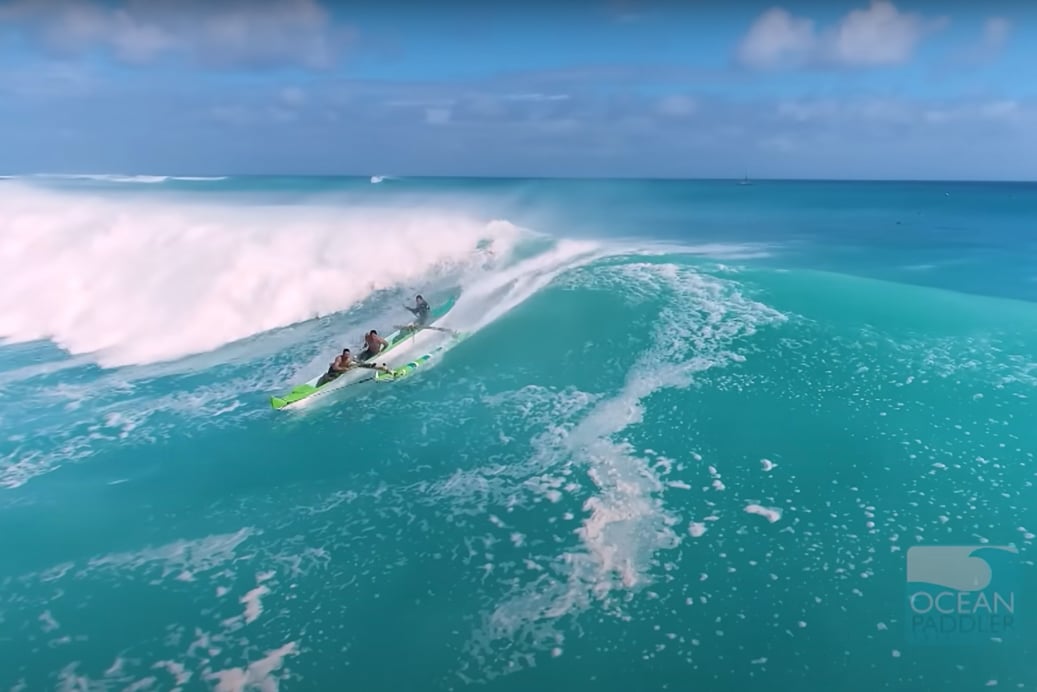
Early December 2024, outrigger canoe surfers gathered at Castles in Waikiki to catch the biggest swell in decades with waves towering over 30 ft (9 m).

“It’s probably once a 30, 40-year swell,” said Jimmy Austin, a canoe surfer in a video on Ocean Paddle TV. “I don’t think I’ve ever actually seen waves this big in Waikiki.”

Castles is one of the best big wave surf spots on the Hawaiian South Shore. Manned by three to four surfers, the outrigger canoe is paddled similarly to a typical canoe but includes an outrigger on one side for additional stability in big water.

“There’s two types of people; ones that drop everything when it’s 10 ft and ones that always have excuses,” Alika Winter, a canoe surfer, shared in the video.

History of the outrigger canoe

The outrigger canoe is designed for both stability and efficiency on open water with an outrigger (ama) as a secondary floating hull parallel to the main canoe hull (vaka or wa’a). Traditionally, the canoe body is carved from a Koa tree and shaped to cut cleanly through the water, while the outrigger provides additional stability.

Outrigger canoes are related to the traditional voyaging canoe used by Polynesian mariners to travel between the islands in the Pacific. Traditional Polynesian voyaging canoes were much larger than the outrigger canoe. A 50-60 ft (15-18 m) boat was considered medium-sized and capable of transporting whole families and their belongings across oceans. The voyaging canoe is essentially two canoe hulls connected by crossbeams with a central platform over the crossbeams, similar to a catamaran. These boats were equipped with sails and steered by a long paddle. Traditional voyaging canoes were used to travel and migrate between different islands in Polynesia.

Canoe surfing the biggest swell in 30 years of Waikiki, Hawaii in outrigger canoes
Outrigger canoe surfing the biggest swell in 30 years of Waikiki, Hawaii. Featured Image: Ocean Paddler TV | YouTube

It is estimated based on ethnobotanical evidence that the first voyaging canoes, and with them soon after the smaller outrigger canoe, reached the Hawaiian Islands by 400 CE or earlier. For context, European sailors did not reach the Pacific Ocean until the 16th century at which point most of the islands in Polynesia had been settled for hundreds of years.

“While Europeans were sailing close to the coastlines of continents before developing navigational instruments that would allow them to venture onto the open ocean, voyagers from Fiji, Tonga, and Samoa began to settle islands in an ocean area of over 10 million square miles,” Dennis Kawaharada explained in The Discovery and Settlement of Polynesia.

The outrigger canoe today

Closer to the present, the Outrigger Canoe Club was started in 1908. Shortly thereafter, the Hui Nalu (Club of the Waves) was started as a similar club for Native Hawaiians by Duke Kahanamouko. Kahanamouko was not only the founder of Hui Nalu but also a proud member of the Outrigger Canoe Club according to Hawaiian Paddlesports; the two clubs began a friendly competition.

Today, outrigger canoe enthusiasts gather to race, play, and celebrate the legacy of the outrigger canoe in the Hawaiian Islands. Oh, and occasionally they get lucky and catch a 30 ft (9 m) wave.

From Ireland To India: One Family’s 51,000KM SUP And Moto Odyssey

two people paddleboarding while silhouetted by the sunset at Loch Lomond, Scotland
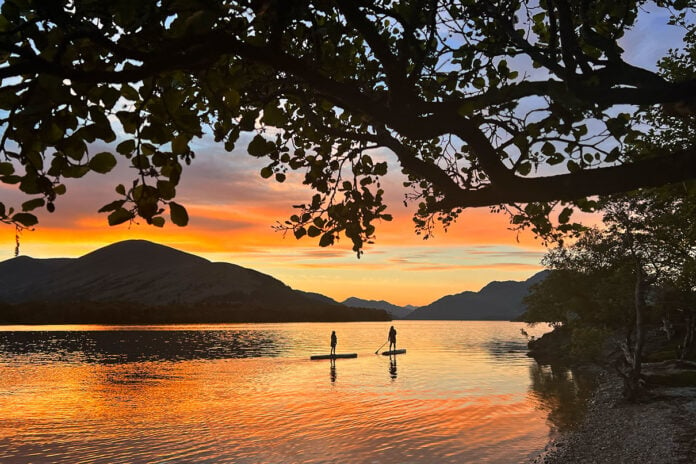
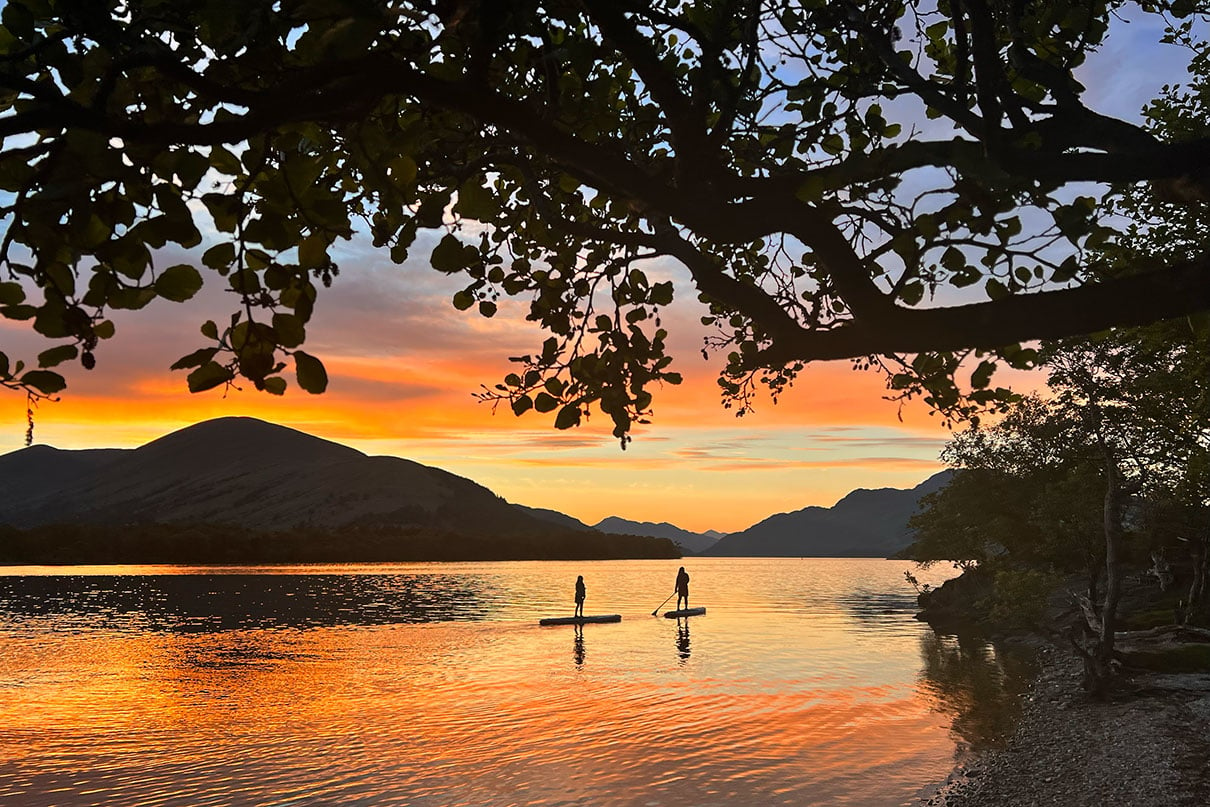
Moments of glassy magic, like during this sunset on Loch Lomond, Scotland, made the Lawson family's decision to carry two inflatable SUPs on their yearlong adventure totally worth it. | Feature photo: Todd Lawson

Respite from the searing summer heatwave was a mere 12 kilometers away—a small lake we could reach in only 33 minutes, according to Guida, the voice coming through our helmets via Google Maps. We named the voice as she was our trusty guide as we navigated from Ireland to India during a yearlong family SUP and moto mega-adventure. We had hoped to end another long day in the saddle with a much-needed paddle and swim to wash off the day’s dust and road grime.

From Ireland to India: One family’s 51,000KM SUP and moto odyssey

“Let’s push on,” I said as the road became rougher. “We’re not that far away; it’ll be worth it.” As we pressed on, the rocks became bigger, the ruts deeper. Fun stuff on an unladen motorcycle but not so much in the searing Spanish heat with fully loaded bikes, one with a sidecar carrying two inflatable SUPs.

“I don’t want to turn back,” said Seanna, our 10-year-old daughter. “We’re almost there. Let’s get to the lake and swim, it’s so hot.”

We hopped back on, bouncing along the rocks and ruts, rolling through the thirsty pine forest—down, down, down in the direction of Guida’s mysterious lake. But when the road became steeper, the ruts even deeper and cell service cut out, we knew the consequences could be dire if we kept going.

Finally, my wife, Christina, waved the red flag when her back tire sunk into a rut about two feet deep. We’d have to turn around and make the dreaded backtrack to the main road before things got really bad. The smell of defeat rippled across the road. Dipping our paddles into this lake would remain a mirage-like dream. Sometimes, plans fall apart. Going with the flow is a lesson the road keeps teaching us and is all part of the adventure.

the Lawson's family motorcycles parked by their campsite with paddleboards along the grassy coast near Galway, Ireland
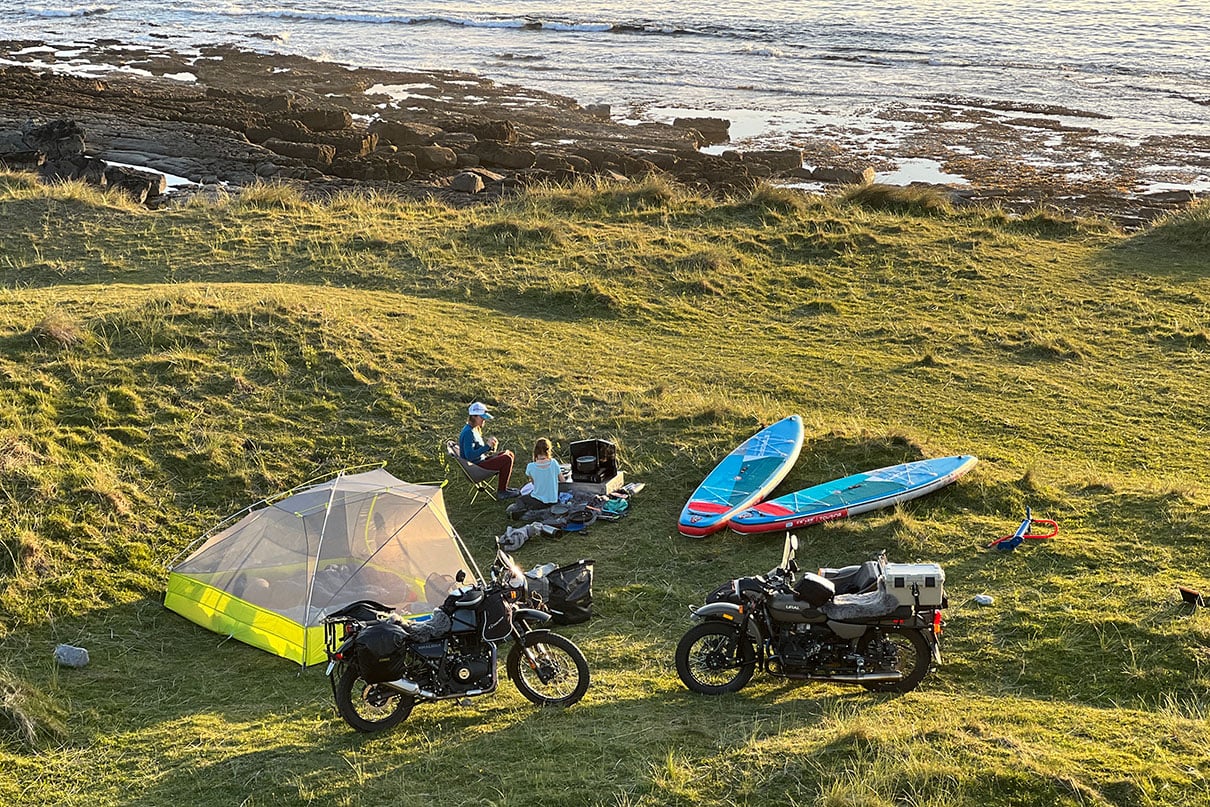
The perfect camp scene unfolds on the grassy shoreline of the Wild Atlantic Way in Galway, Ireland. | Photo: Todd Lawson

Freedom on two wheels

I’m not sure many motorcycle travelers are packing inflatable paddleboards, but it’s a niche that could and should keep growing. We brought paddleboards for the same reason we love to live behind the handlebars of a motorcycle—ultimate mobility and freedom.

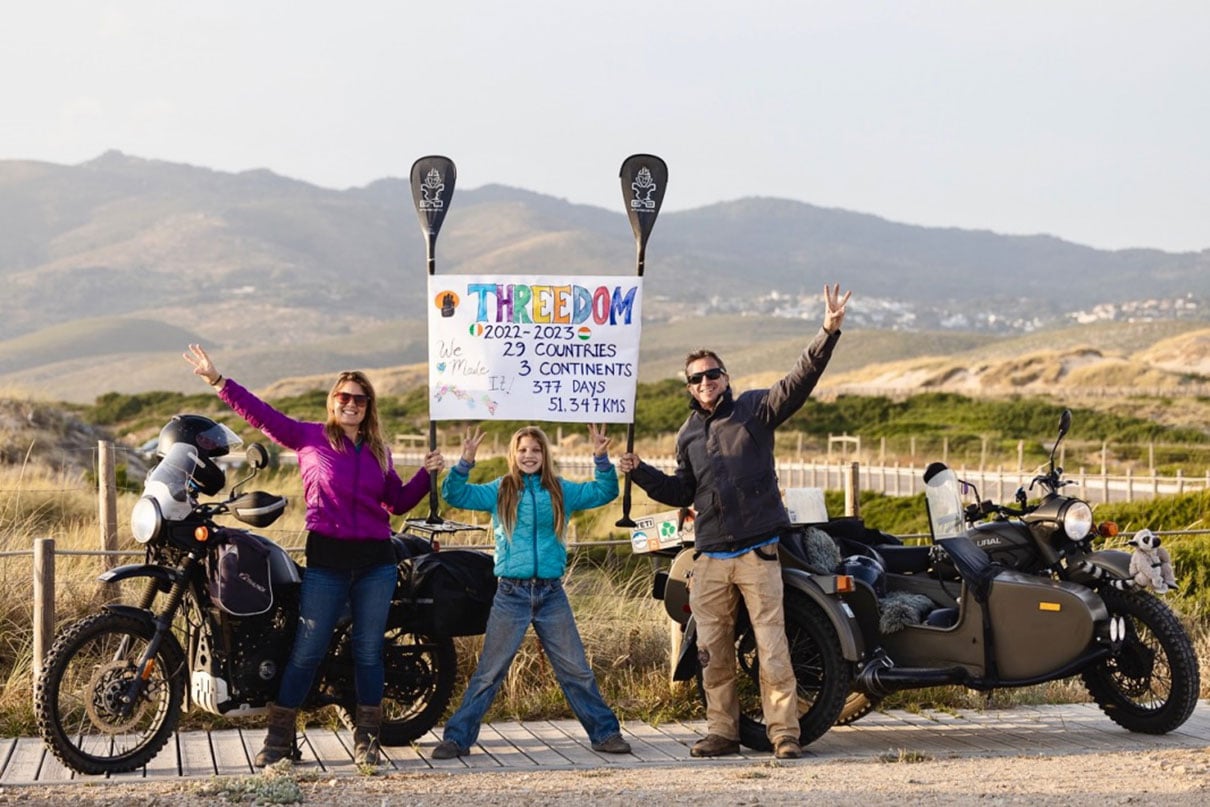
On our yearlong motorcycle journey, we carried two inflatable SUPs and the search for water defined our 51,000-kilometer journey. We called our journey Threedom, and it was an incredible family adventure that tested the resilience of mom, dad and daughter every single day.

Before our daughter was born, Christina and I traveled extensively on motorcycles. On two major overland trips, we covered 67,000 kilometers through more than 40 countries. Back in those days, when we came across a lake, lagoon or slice of ocean paradise with rolling waves, all we could do was wish we had a canoe or kayak to explore with or rent overpriced, by-the-hour paddlecraft.

Now we had the perfect bikes—a 2021 Royal Enfield Himalayan and a 2021 Ural Gear Up—and a sidecar we named the Mule, so we figured, why not bring the fun with us? While dreaming, planning and researching for almost three years, we devised an efficient system to carry our 200 pounds of gear, which included our camping kit, paddling gear, spare tools and clothes, plus our daughter. Then we researched the best places on the European continent where we could set up camp for a couple of nights, inflate the boards and paddle. We put red dots on the map, ticked them off while on the road, and added more along the way.

The first of those red dots was on the west coast of Ireland, the very first night of our trip. We pitched camp atop a vast network of rabbit burrows and waited for the sun to pierce the cloudy skies. The white-capped ocean wasn’t terribly inviting, but after so much time packing and planning to make this trip a reality, how could we not celebrate with a cold-water experience along the Wild Atlantic Way?

two people paddleboarding while silhouetted by the sunset at Loch Lomond, Scotland
Moments of glassy magic, like during this sunset on Loch Lomond, Scotland, made the Lawson family’s decision to carry two inflatable SUPs on their yearlong adventure totally worth it. | Feature photo: Todd Lawson

The isles of Scotland’s Loch Lomond were next, where our ultimate transition transpired—all our gear from bikes to boards in less than an hour. After a windy, wobbly crossing from the mainland to Inchtavannach island, the perfect campsite presented itself. It was a protected forest with a beautiful, grassy area to spread out on, lots of firewood and not a soul in sight. As we had plenty of time and sunny skies to paddle under, we spent our days circumnavigating the small islands surrounding our camp and meeting strange locals. One morning, it was a gang of long-haired Highland cows, and the next, a wildly out-of-place wallaby sunning itself on the seaside rocks.

As we headed south, we hit more red paddle dots on our map, including in England, Wales, the west coast of France, and finally down into the clear, warm waters of the Mediterranean in southern Spain. The paddle dots on our map took us through Morocco, Greece, Italy, and as far east as the coast of the Mediterranean Sea in Turkey before a major engine failure made us ditch the bikes for a time and find other transportation into India.

Family vagabonding

Traveling for so long meant tapping into the art form known as dirtbaggery. We cooked over open flame to save fuel, cooked in hotel rooms instead of eating out to save money, washed our clothes in sinks, ate cheap cheese-and-bread picnics alongside the road, wild camped under the stars, and stayed with generous strangers who took us in, who we called road angels.

the Lawson family pose with sign and motorcycles while on their trip from Ireland to India
“We’ll keep this sign forever,” says writer Todd Lawson, pictured here with his family in Lisbon, Portugal. | Photo: Todd Lawson

Paddling was a bonus to the journey. Traveling by motorcycle, with everything you need in a few saddlebags strapped behind you, is the fuel that feeds the fire of adventure for us. It’s a wildly self-sufficient world we wanted to introduce Seanna to. At age 10, she was old enough to remember everything, yet still young enough to hang with her parents 24/7. Bikes and boards allowed for the best of both worlds, a surf-and-turf adventure unifying our primary interests—motorcycles and paddleboards—into one primary passion: adventure travel.

We knew this journey through 29 countries would remain with our daughter for the rest of her life, so we wanted to make it as memorable as possible, and being able to paddle and swim in as many places as our route allowed was icing on the cake. Camping, hiking and fishing were part of the package when we needed time away from the bikes and allowed us to immerse ourselves in the landscapes and culture of Europe and Asia. Along the way, our daughter received the ultimate education in humanity, geography, adaptation, compassion, reliance and what true adventure can teach one’s soul.

Todd Lawson is an avid traveler, paddler and a publisher at Mountain Life Media. His first book, Inside the Belly of an Elephant: A Motorcycle Journey of Loss, Legacy, and Ultimate Freedom, was released in 2023.

Cover of the Summer 2024 issue of Paddling Magazine, Issue 72This article was first published in Issue 72 of Paddling Magazine. Subscribe to Paddling Magazine’s print and digital editions, or browse the archives.

Moments of glassy magic, like during this sunset on Loch Lomond, Scotland, made the Lawson family’s decision to carry two inflatable SUPs on their yearlong adventure totally worth it. | Feature photo: Todd Lawson


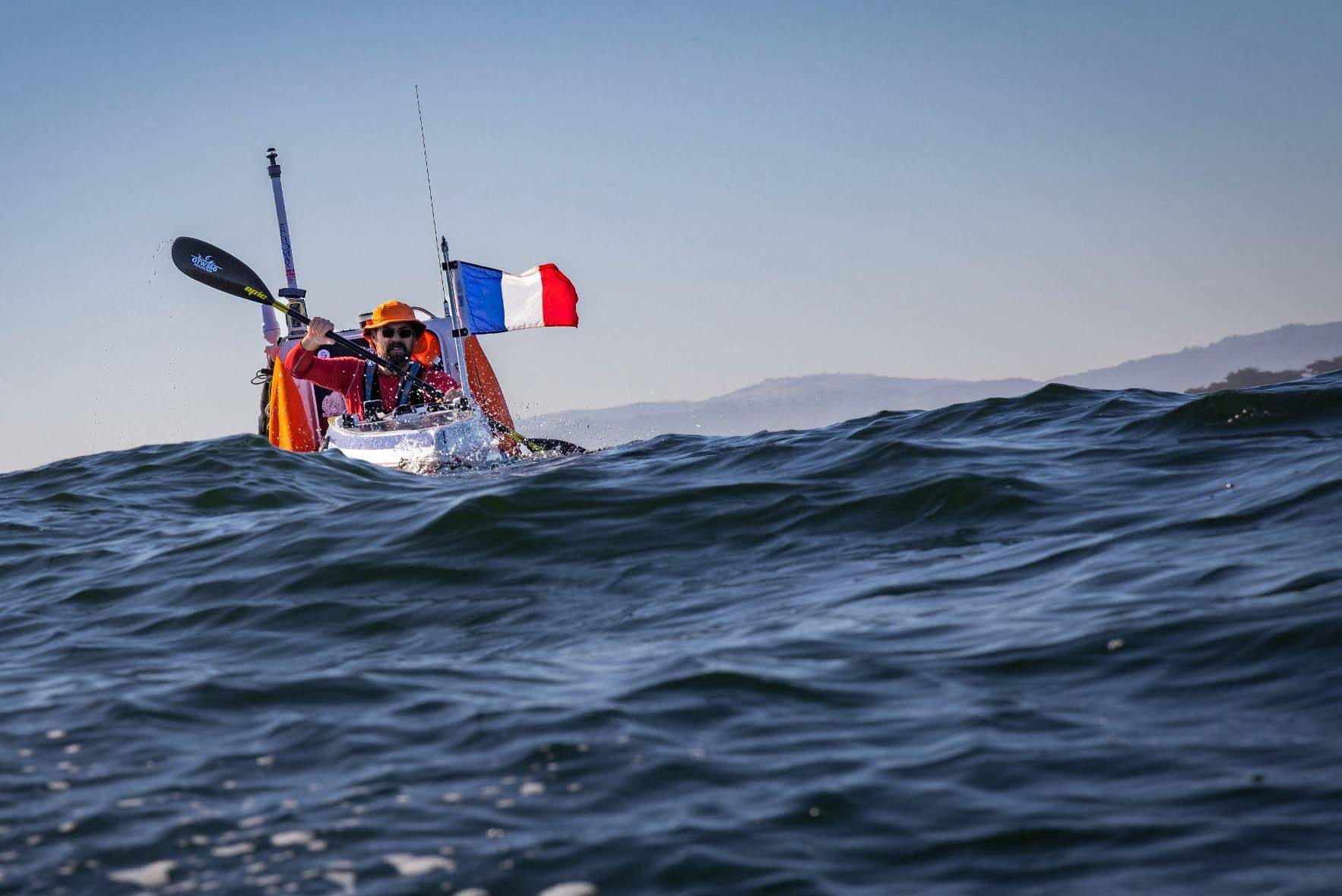
Cyril Derreumaux To Depart On Atlantic Crossing December 19, 2024

Cyril Derrumaux prepares to launch for Atlantic Crossing December 19, 2024
Cyril Derrumaux arriving in in Hilo, Hawaii, September 2022 after crossing the Mid-Pacific. | Feature Photo: Tom Gomes

Ocean expedition paddler Cyril Derreumaux departs December 19, 2024 to cross the Atlantic Ocean. Derreumaux will depart from La Restinga, The Canary Islands with the goal of reaching the easternmost Lesser Antilles archipelago on the other side of the Atlantic Ocean by kayak. The journey will total an estimated 3,000 miles and will be completely human-powered, solo, and unsupported.

Derreumaux’s departure date was initially set for Dec 17 but was delayed slightly for a better weather window.

Derreumaux’s previous journeys

In September 2022, Derreumaux completed his first solo ocean crossing, a 2,761 mile (4,444 kilometer) journey from California to Hawaii across the mid-Pacific in a total of 91 days and nine hours at sea. This journey, much like his upcoming crossing, was completely human-powered, solo, and unsupported.

Cyril Derrumaux prepares to launch for Atlantic Crossing December 19, 2024
Cyril Derrumaux arriving in in Hilo, Hawaii, September 2022 after crossing the Mid-Pacific. | Feature Photo: Tom Gomes

Derreumaux first ventured into the world of outrigger canoeing and kayaking in his early 30s after a move to California to follow his profession in the wine business. In California, Derreumaux found the Great Pacific Race and joined a four-man team to row from California to Hawaii. The trip earned the team the Guinness Record for the fastest ocean team rowing crossing at 39 days and sparked Derreumaux’s interest in big solo crossings and endurance paddling.

What goes into crossing the ocean?

The first 19 days are the hardest, battling seasickness, sleep deprivation and adjusting to new foods and the pace of paddling according to Derreumaux.

While at sea, potable water is made using a water maker or desalinator and most of Derreumaux’s food is freeze-dried or dehydrated. En route, Derreumaux will burn close to 8,000 calories a day and ingest 6,000 calories daily, leading to an average daily deficit of 2,000 calories. This amounts to an expected weight loss of 20-25 lbs, weight that the paddler worked to gain in advance of his departure.

Throughout the course of his ocean crossings, Derreumaux typically wakes up before dawn for breakfast and begins his paddling at sunrise. From here, he paddles 4-5 hours before breaking for lunch, then paddles another 4-5 hours. Around sunset, Derreumaux prepares for the night. Throughout the night, he wakes up every two hours to check on the boat.

Derremaux’s kayak is a 23-ft (7 meter) boat with a fully sealable self-righting cabin. The kayak is human propulsion only, by both kayak paddle and a system to pedal by feet to alternate muscle groups used along the journey. Fully loaded, the boat will weigh 800 lbs.

In total, Derreumaux’s upcoming journey will span an estimated 3,000 miles / 4,800 kilometers / 2,800 nautical miles and an expected 80-90 days.

Follow Derreumaux’s progress here.

If You Gotta Go, Go Now

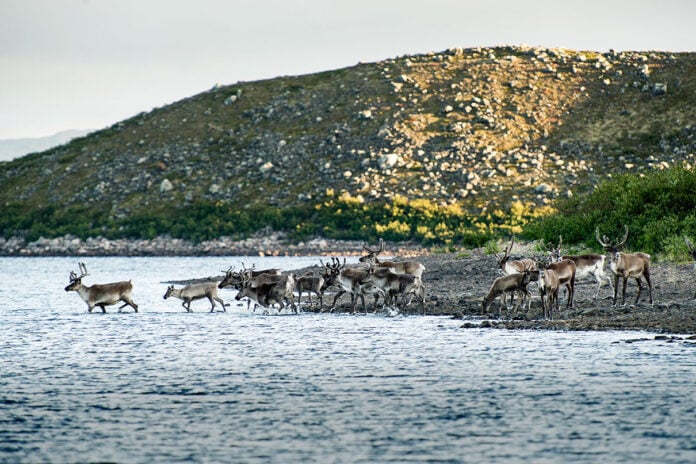
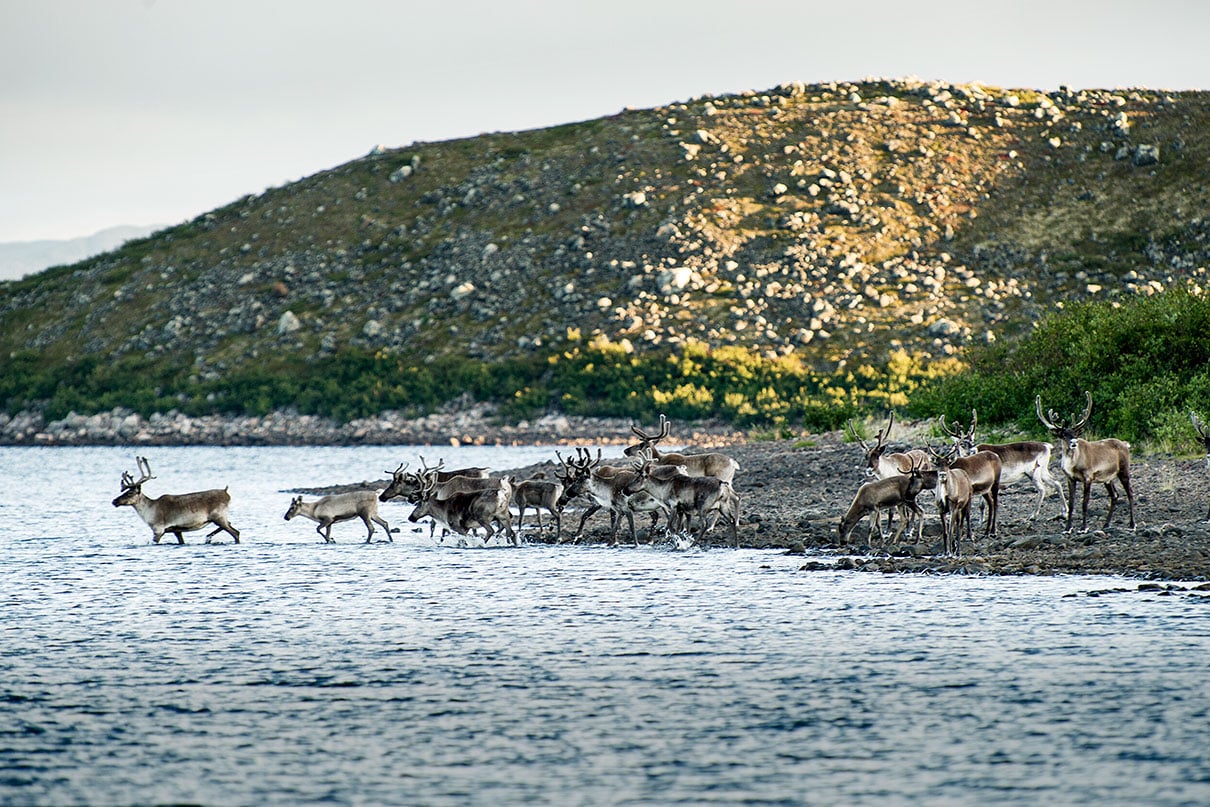
a herd of caribou venture into the water in a landscape of northern tundra
To the polar sea. | Feature photo: François Léger-Savard

It was our third consecutive lunch of pitas and cheese and we were ready for a distraction. We had pulled up at a narrows about two-thirds of the way down Nunavut’s Coppermine River. The bank on the far side was splattered with head-high willow shrubs and Barb was adamant that there was a caribou grazing among them.

“There,” she said, “just to the left of the little clearing.”

The rest of us munched away, squinting across the river and assuring her we also saw it before realizing what we thought were antlers were just another pair of willow branches.

This went on for 15 minutes, until the pitas were put away for another day, before Mike declared, “It must be a caribou. I can smell it.”

a herd of caribou venture into the water in a landscape of northern tundra
To the polar sea. | Feature photo: François Léger-Savard

Mike has admirable olfactory abilities, but this was too much. I was about to suggest he was smelling himself when I caught a whiff of what I imagined caribou breath must smell like.

Ally turned around and laughed. Not 20 meters behind us four caribou were mowing down tufts of lichen. We could see every whisker, and hear every gum smack—I had assumed the noise was Mike eating dessert. It’s a good thing we had a large store of pitas, because if we had been relying on keen senses to deliver us food from the land we would have gone hungry.

I couldn’t help but feel out of my element up there. The conventions that time and space follow down south, even on a remote river in the boreal, have no purchase in the Arctic. With the land frozen so much of the year, cycles such as growth and decay grind to a crawl while seasonal imperatives like spring runoffs and animal migrations take on a determined frenzy. It is hard to know what to expect, even hard to know how to adjust your eyes to a landscape that is so barren and hard to read it turns what you thought would be a half-hour hike into a half-day trek.

If you gotta go, go now

That was 10 years ago, and I haven’t been back to the Arctic, a fact that hit me in the gut last week when a couple I know asked me out for a beer and counsel about their plan to paddle the Coppermine.

They were nervous, and had reason to be. They had paddled a handful of rivers, but their whitewater history wasn’t one that begged for a biography. The weather in late August could well be punishing. With only one canoe in their party they would have no one to collect pieces for them after a dump.

As we batted around these caveats I couldn’t help but wonder if I was erring on the side of caution so I would feel better about my inability to muster a return trip above the 66th parallel.

As we often recount in these pages—call it our editorial mission—paddling trips on the whole are getting shorter and shorter. Fewer people are making the sort of time commitment needed to do extraordinary trips. Everyone has reasons. I know I have mine. I just don’t know if they are good enough.

My friends emailed me last week to tell me they had weighed the risks and had decided to paddle the Coppermine. They may become stormbound for a few days. They may dump and lose equipment—or worse. One fate that won’t befall them, however, is they’ll never have to sit on a patio sipping a beer and mumbling sorry excuses for how they didn’t go north that summer because they were too busy.

Recirc celebrates our favorite stories from the first 25 years of Rapid, Adventure Kayak and Canoeroots magazines. Author Ian Merringer was the editor of Canoeroots when this article ran in 2006. In 2022, Ian enjoyed a couple glorious weeks running northern B.C.’s Stikine River.

Cover of Issue 72 of Paddling Magazine, Issue 72This article was first published in Issue 72 of Paddling Magazine. Subscribe to Paddling Magazine’s print and digital editions, or browse the archives.


To the polar sea. | Feature photo: François Léger-Savard


Bears VS Kayakers

Many a paddler has had an encounter with a bear in the wild. Whether our favorite furry friend is poking around your bear hang at night, or encountered from the water it always makes for a memorable story at the… bear minimum.

From grizzlies chasing kayaks to polar bear run-ins, here are the best kayak vs bear videos on YouTube:

BEAR: On the Alaskan Coast, a bear breaks a kayak leaving paddler left to swim for help.

During a solo kayak trip from Ketchikan, Alaska to Petersburg, Alaska, kayaker Mary Maley’s boat was mauled by a bear. In one of the most viral paddling bear videos of all time, Maley shouts at the bear in an ultimately unsuccessful attempt to scare it off.

The video begins five minutes after the attack began, and the bear continued to eat her kayak after the video concludes.

BEAR: Grizzly chases kayaker across a river

Near Squamish, British Columbia, watch as a kayaker is chased by a Grizzly bear on the Elaho River.

DRAW: After observing an uninterested polar bear, kayakers lose dignity to walrus

While sea kayaking in the Arctic, Steve Leonard and Jason Roberts have a serene encounter with a polar bear only to be attacked by a walrus! Jump to the 2:30 minute mark to get to the meat of the video.

KAYAKER: Paddlers successfully scare off a polar bear without further incident.

On a sea kayak expedition in Greenland, Steve Backshall and his team have a frightening encounter with a polar bear in search of food.

In this video, the crew is well-equipped for bear encounters and ultimately grateful that the bear scares away in the end and they don’t have to resort to methods of self defense that could harm the bear.

Feature Image: While on a kayaking expedition in Greenland, Steve Buckshall and his team encounter a polar bear. PBS | YouTube

Red Bull Releases A Film On Historic First Descent Of Ivindo Falls (Video)

The Ivindo River winds through the Gabon Rainforest, with elephants and hippos, thick forest, and a maze of rapids untouched by whitewater paddlers—until recently.

Four-man elite kayak team of Adrian Mattern, Dane Jackson, Kalob Grady and the late Bren Orton tackled a 90-mile (145 km) expedition on the river with the goal of the first descent of four major rapids on the Ivindo River in Gabon, a country on the central African Atlantic coast bordered by Cameroon, Equatorial Guinea and the Congo. The Red Bull film Gabon Uncharted documents the depth of their drive to complete the expedition.

Meet the SEND collective

The team, self-named the SEND Collective, includes some of the top names in whitewater kayaking and as the film cheekily notes, most definitely the top names on whitewater kayaking Instagram.

Dane Jackson is often called the GOAT (greatest of all time) whitewater kayaker. Kalob Grady grew up on the banks of the Ottawa River and is now the head coach for World Class Academy. Bren Orton was the first European to paddle the 128 ft (almost 40m) Big Banana Falls in Mexico. In May 2024, Orton tragically passed away while kayaking with a group on the Melezza River in the Swiss Alps.
For the last member of the team, Adrian Mattern, the driving force behind the trip, the Ivindo has been a childhood dream to follow the expedition of Olaf ‘Big O’ Obsommer in 2007. On Obsommer’s Ivindo expedition they portaged most of the major rapids due to a lack of local knowledge and resources.

This attempt is different—with new technology and beta from Obsommer’s 2007 trip, the SEND collective seems set up for success. The ultimate game-changer this time around boils down to drones. Not only useful for capturing videos from above, drones allowed the paddlers to scout the rivers from the skies, virtually creating an aerial map of the area.

Is there more to the SEND Collective than big water and money shots?

Gabon Uncharted: Sending Ivindo Falls is not just another big water film. The film, produced by videographer David Arnaud who narrates and seems slightly skeptical of the SEND collective and their Instagram hype, on one hand sets out to make an epic whitewater expedition video.

But the film also asks a question—when you peel back the photos of epic drops, flips and thousands of likes, what’s left?

In the film, we watch the SEND collective pore over route plans and water level data prepared by Mattern. The SEND collective spends three days inspecting the area, and meets with local park rangers of Ivindo National Park, as they take extra care to minimize the impact of their expedition on the environment and pay astute attention to their own safety in the context of an extreme wilderness sport.

“We were told that there are most likely, almost certainly, perhaps not that many crocodiles in this area,” Orton jokes as they begin their journey.

The first major rapids on the Ivindo fan out through the forest in a labyrinthine rapids complex over a mile wide. On this first send, Arnaud describes the SEND collective as “joyful kids on an awesome playground.”

While there’s plenty of exciting big water shoots in the film, just as interesting, if not more so, is the group’s approach to risk management. In a move that seems to surprise the filmmaker, the SEND collective of Instagram fame unanimously chooses to play it safe and portage one of the large, iconic waterfalls they came to descend.

“Too often, group dynamics, biases, and egos lead to stupid decisions. Here it’s the opposite,” narrates Arnaud. “The SEND team navigates these pitfalls with grace and humility.”

Throughout the film we watch the SEND collective run incredible rapids, read their favorite books and get bug bites. We also watch as they help team member Mattern come to terms with the idea that one of the falls he’s dreamed of paddling is likely unrunnable and delicately handle the line between safety and the drive to push their skills for “the send.”

What’s compelling about Gabon Uncharted isn’t that you’re watching top whitewater kayaking athletes do inspiring athletic things—it’s that you’re watching top whitewater kayaking athletes work as a team, manage risk as a team, and ultimately just be people in a way that is inspiring to paddlers wherever they are with their own “send.”

Kayakers Beware: Geese Gone Wild

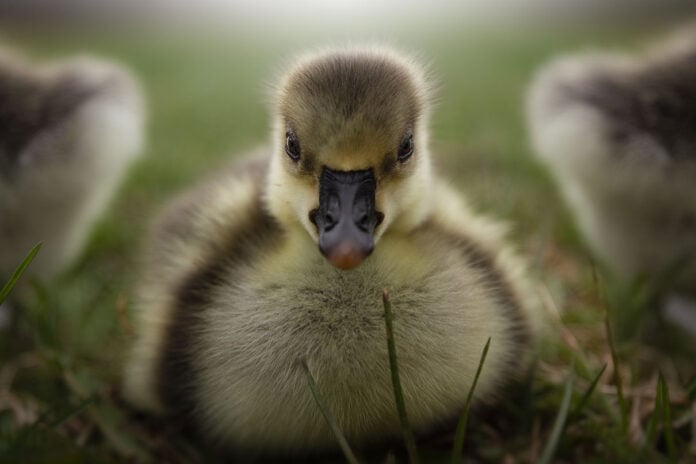
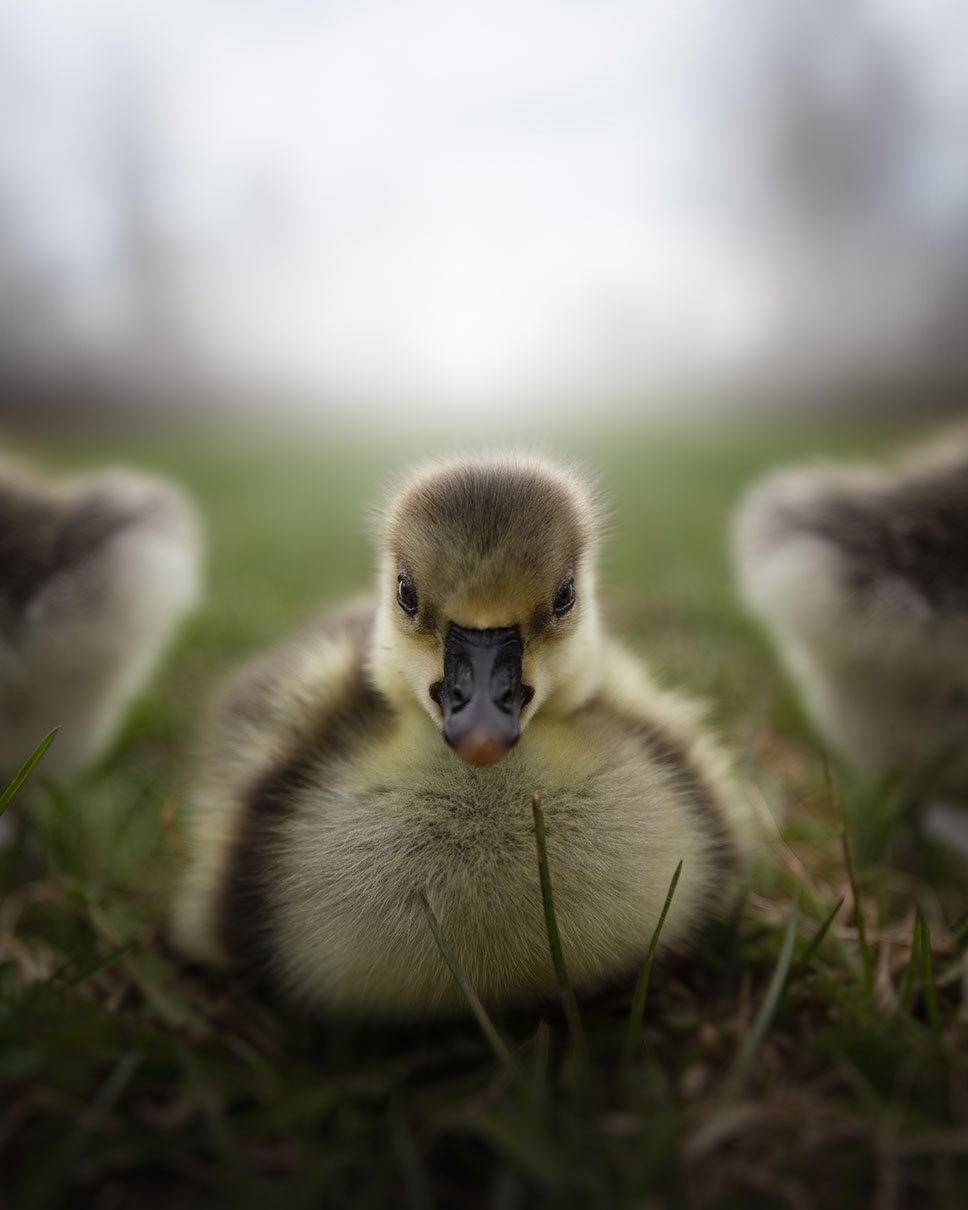
close-up photo of a gosling
Cute today; wreaking honking havoc at your local launch tomorrow. | Feature photo: Alan Poelman

In three decades of kayaking, the only injury I’ve suffered wasn’t from a pounding surf landing, a strainer or an angry grizzly bear. It came at the hands of Branta canadensis, the Canada goose, terror of kayak launches and golf courses. Carrying my kayak across the dock, I hydroplaned on a slimy layer of liquified goose poop and went stern-over-teakettle, landing hard on my wrist. Of all the critters kayakers encounter—hatch-opening raccoons, bloodsucking swarms of mosquitos or sand-lurking stingrays—geese are our true nemesis.

Kayakers beware: Geese gone wild

Hear me out.

The hairline fracture in my wrist was just one instance when my goose was cooked by the feathered scourge of city parks and shorelines. One goose guarded its bay on San Juan Island with such ferocity that as soon as we rounded the point, it sallied forth from its beach hissing. After a few days of us paddling by twice daily, it had enough and came in low and fast to bite our sterns. On a nearby island, a goose had set up its nest next to the outhouse door and assaulted anyone nearby, wings flapping, neck extended, honking obscenities. Its biological imperative to reproduce conflicted with our biological imperative to, well, you know.

close-up photo of a gosling
Cute today; wreaking honking havoc at your local launch tomorrow. | Feature photo: Alan Poelman

We scurried past when we needed to, and the next round of honking would signal the outhouse was free. And there are countless times when I’ve pulled up to a campsite of soft green grass, perfect for strolling barefoot or lounging after long miles in the kayak, only to find the grassy lawn was only 60 percent grass and 40 percent goose poop.

What’s their problem?

Like most species that have become hassles to humans, geese are problems because we create the perfect environment for them. According to the Canadian Wildlife Service, North America has at least seven million Canada geese. Their population increased by seven percent annually between 1966 and 2019, largely due to favorable conditions thanks to urbanization.

Geese like big open areas near water, where they can feast in big family groups, see predators coming and make for the water for a quick escape. This jives perfectly with our love of grassy lawns near water and idyllic campsites for kayakers.

The roots of the conflict between Homo sapiens and Branta canadensis run deep. Those open landscapes geese love, with a view near water, are also hired-wired into humanity’s evolutionary history from our origins in Africa’s savanna. John Falk, a professor at Oregon State University, showed photos of different landscapes to people worldwide, including those who had never seen a wet savanna along the shore of a large body of water. Yet, everyone selected it as the ideal landscape for finding food and water, and avoiding ambushes by saber-toothed cats and other Paleolithic predators. Geese love the same thing; of course, we come into conflict.

The geese are winning. Attempts to keep them from pooping all over our docks, fields and campsites have involved noisemakers, wooden cutouts of coyotes, bullets, poison, dogs and even robot dogs. They’ve all failed. The geese are undefeated.

If you can’t beat ’em…

Faced with a losing battle, I’ve tried to make friends. When I led kayak tours, a goose family near our dock would inevitably charge my tour groups. One day, we encountered a squawking, panicked gosling separated from the family. We carted the caterwauling kiddo on a sprayskirt back to its home cove, where the family came to claim him. Did it result in any sort of detente? Not a chance. The goose-on-kayaker harassment continued all summer.

But our cold war with geese is more than a territorial squabble. We hate geese because they’re just like us. They hang out in family groups, eat a lot, make a mess, travel great distances by air and love waterfront property. Except they’re better at it than we are.

“Geese mate for life with very low ‘divorce’ rates, and pairs remain together throughout the year,” says the Cornell Lab of Ornithology. Family groups remain together on migration and fly great distances without burning fossil fuels. They’re smart enough to let us build their waterfront property for them and then move in and make themselves comfortable. They just might be smarter than we are.

Neil Schulman kayaks, writes, photographs and tries to avoid stepping in goose poop in Portland, Oregon.

Cover of Issue 72 of Paddling Magazine, Issue 72This article was first published in Issue 72 of Paddling Magazine. Subscribe to Paddling Magazine’s print and digital editions, or browse the archives.


Cute today; wreaking honking havoc at your local launch tomorrow. | Feature photo: Alan Poelman


The Best Places To Standup Paddleboard In San Diego, According To A Local

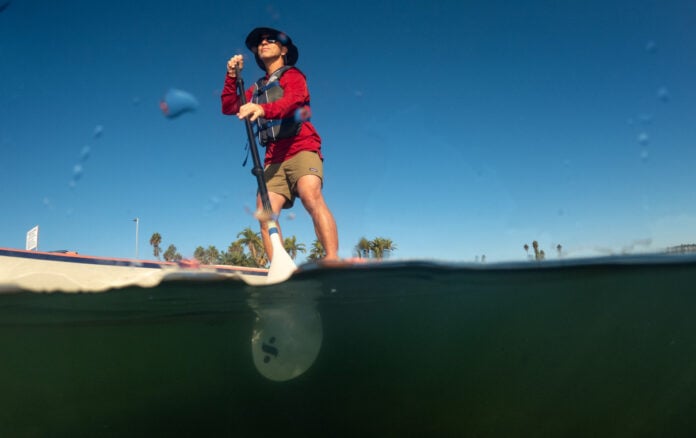
Man on paddleboard seen from water level.
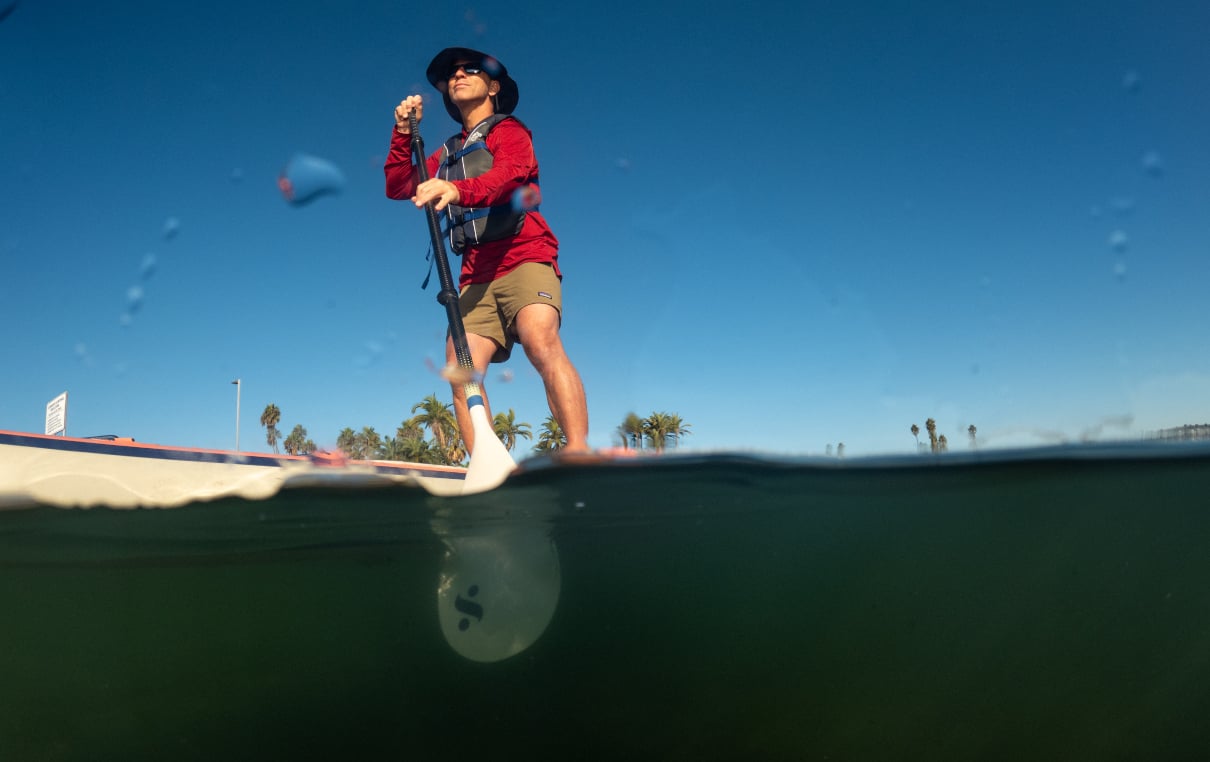
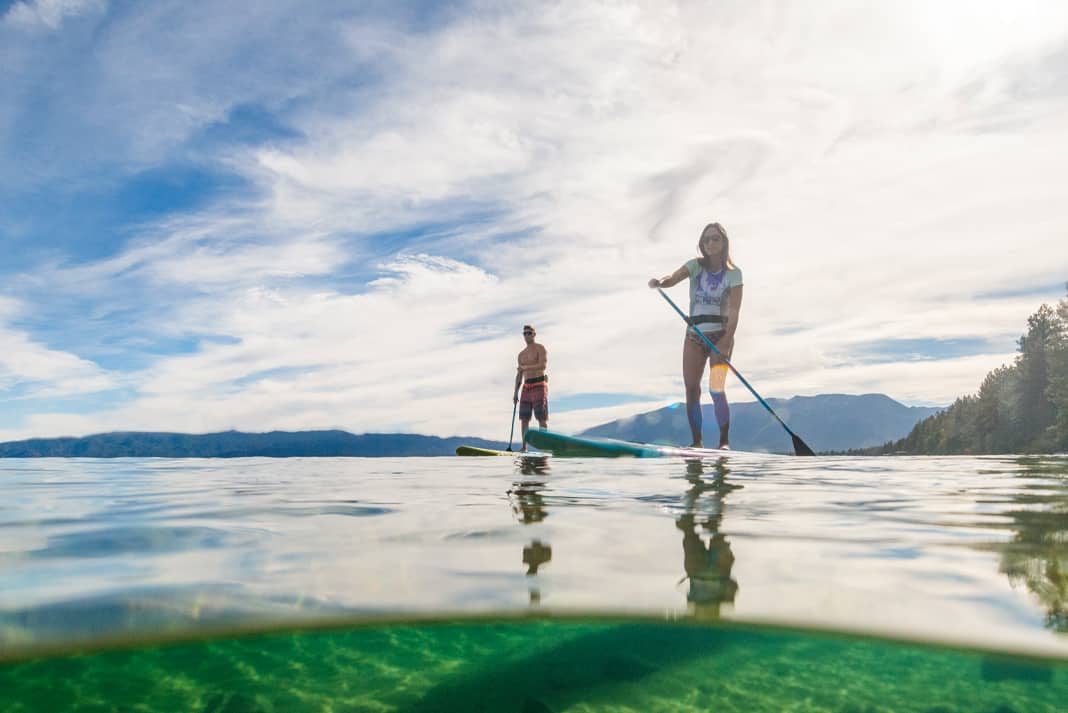
A seal's-eye-view of the San Diego paddleboard scene. | Feature photo: Ana Ramirez

More than a decade ago, when I moved to San Diego, the bays and ocean afforded me the opportunity to access a paddling lifestyle. At first kayaking was my fix, but then I gravitated towards standup paddleboarding because of the higher viewpoints it provides. Plus, you can sit or kneel while paddling, offering a variety of angles.

What am I viewing? Wildlife. Mission and San Diego Bays are home to myriad wildlife and I know that every time I glide across the water, I’m going to observe the animal kingdom. One of my favorite memories is of a gull that seemingly flew directly over my shoulder to land on a small dock. On that dock were two smaller gulls, fledglings it turned out. In a moment of time, I watched as the adult gull regurgitated sardines onto the deck and then assisted in getting them into the mouths of their young. Cycle of life, I thought, as I slowly paddled on the water’s surface.

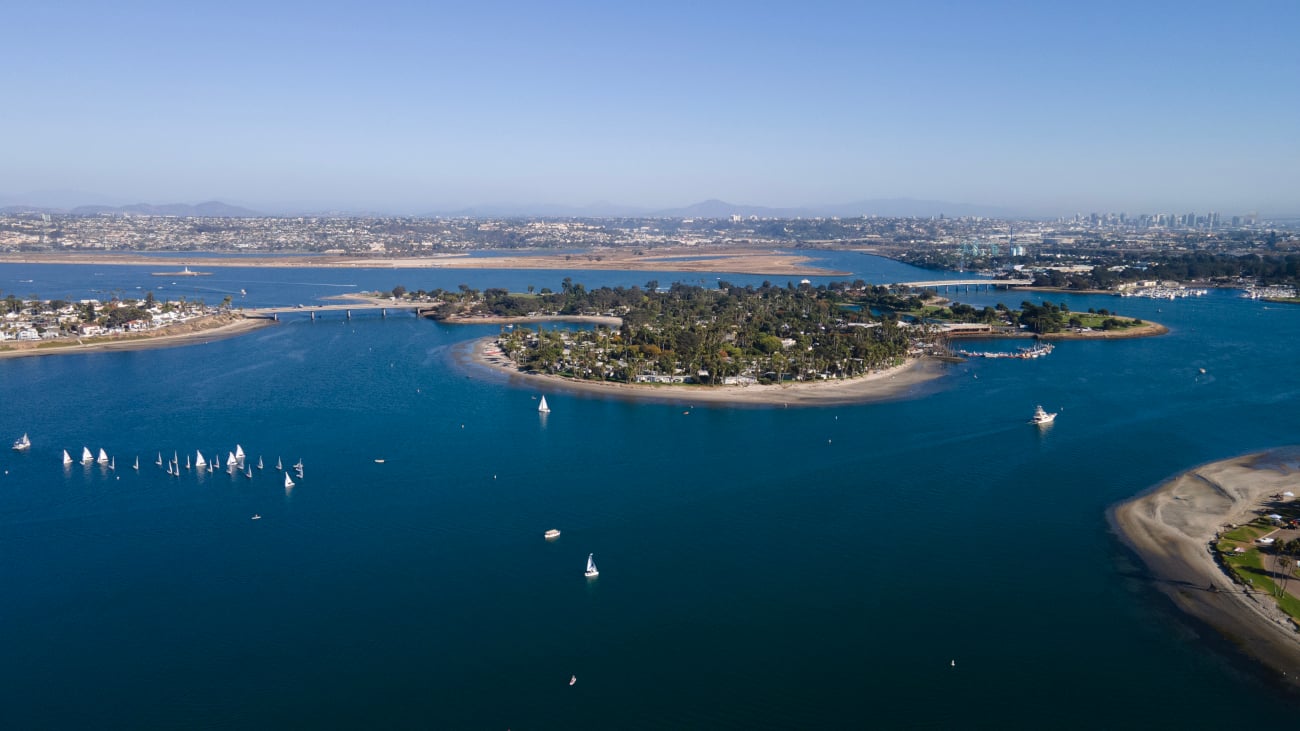
Drone shot over Mission Bay San Diego.
Mission Bay San Diego. | Photo: Ana Ramirez

The best places to standup paddleboard in San Diego according to a local

Mission Bay

San Diego’s Mission Bay consists of approximately 27 miles of shoreline, 19 of which are sandy beaches perfect for a stop. The bay itself is comprised of some 2000 water acres and is part of the larger Mission Bay Park, which totals about 4000 acres of man-made saltwater bay and recreational grounds. There is also a channel that provides access to the Pacific Ocean.

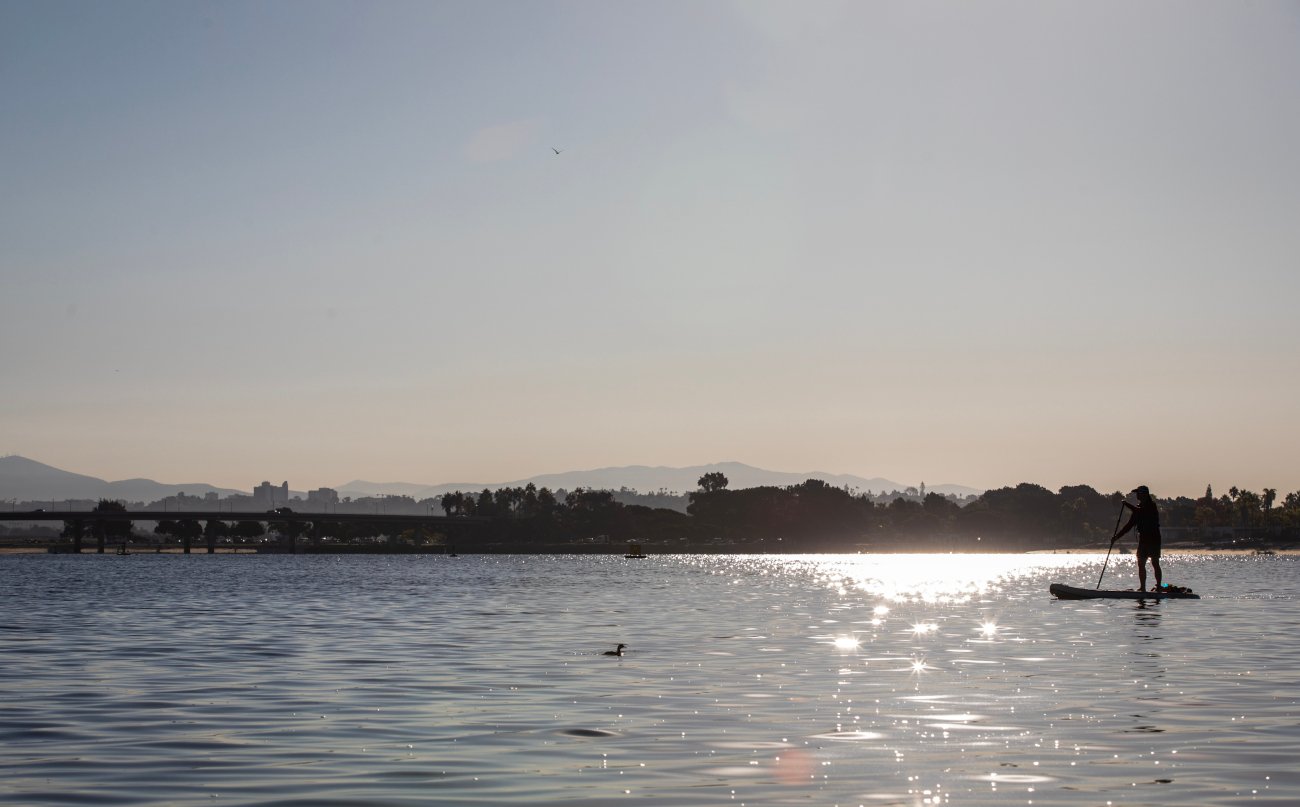
Mission Bay serves as a place for paddlers of all kinds, as well as kiters, anglers, water and jet skiers, and boat enthusiasts, among others. Yes, it can be a busy place, but if you get out on the water in the early morning or dusk hours, or during the off-season between October and April, SUPing on Mission Bay is a paddler’s delight complete with aquatic and aerial wildlife and distant views of rising foothills and roller coasters.
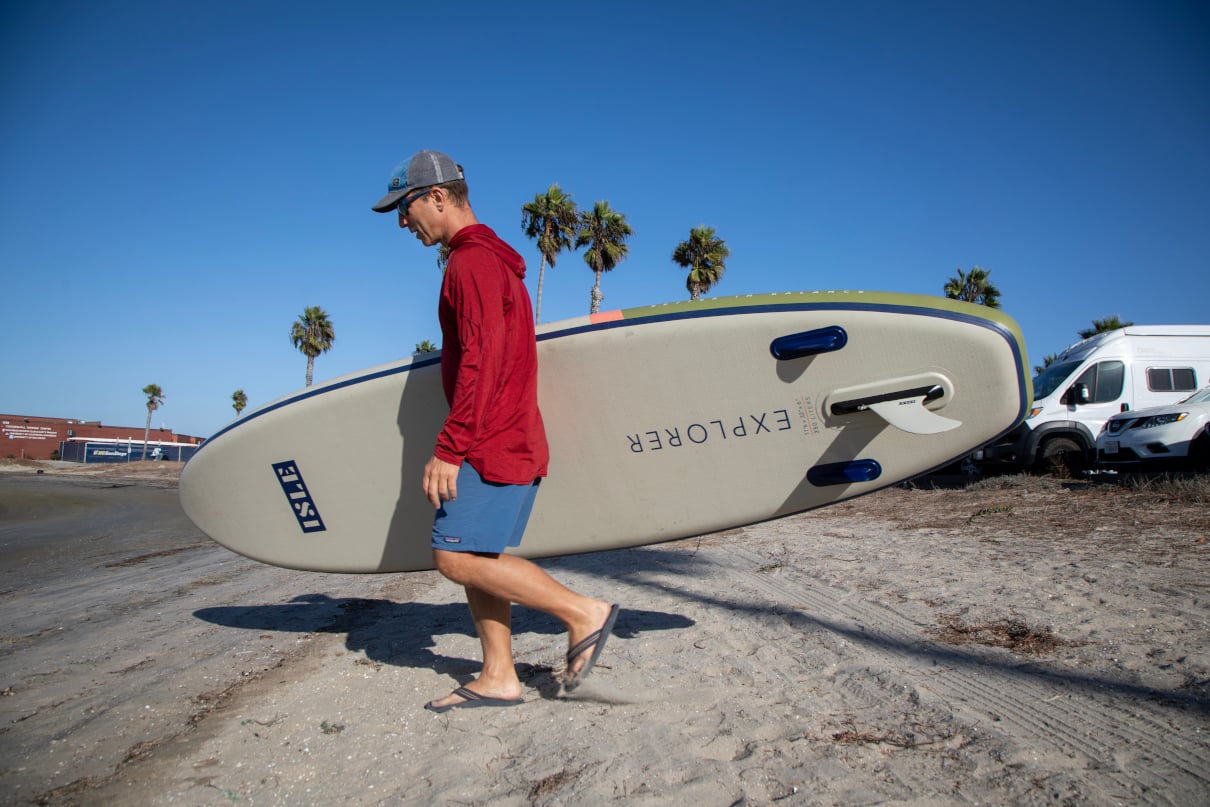
Man walking paddleboard to the water in San Diego.
The author heading for the water. | Photo: Ana Ramirez

Where to launch your paddleboard on Mission Bay

There are numerous put-in spots around the bay, but I prefer the public parking at Bahia Point. It is a little less traveled than other better-known areas, andhas public restrooms.

Mission Bay paddleboard routes

From Bahia Point you can go north into the larger bay area, creating longer routes that include several coves. Paddling all the way to the northern terminus, which is a sub-bay area called Sail Bay, you can then go along the eastern shoreline, watching for rays and crabs in the grasses and sandy bottoms.

You can continue on, going under and past the Art and Anne McDaniel Bridge (Ingraham Street) in the direction of Crown Point. Watch for flocks of California least tern flying overhead as you paddle. They are a protected species under the U.S. Endangered Species Act and some sections of land around the bay are off limits to human activity to protecting nesting. These are clearly signed and visible from the water. All told you can make a short trip through a few marinas in cove that’s around 1.5 miles or up and around to Crown Point and back for a more than four-mile loop.

A wading heron.
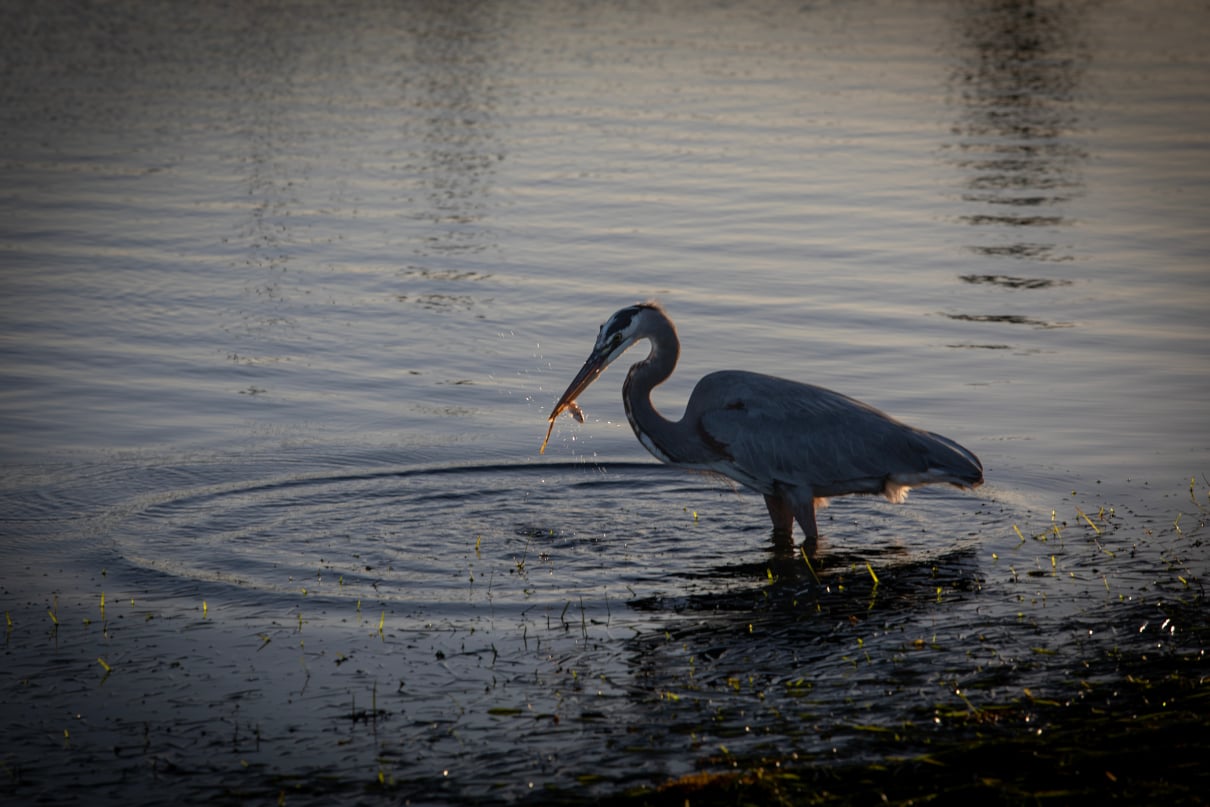
Heron savoring a baitfish. | Photo: Ana Ramirez

If you are in it for a longer day, to the east is Fiesta Island, though it is not a true island, meaning you cannot paddle all the way around it. Check the map closely, determining which coves you many want to go check out, but noting that if you do paddle in the direction of the eastern side of the faux island, you will have to work your way back out and around to the open water of the bay. You could easily stretch a trip from Bahia to Fiesta Island and back up to eight miles depending on how deep along the eastern shore of Fiesta you’d like to go.

As you travel back to the McDaniel Bridge area, you can also work your way along the eastern shore of Vacation Isle by going south along it. The isle is a popular circumnavigation route for paddlers, offering several beautiful beaches for resting and refueling. As you paddle around it and come up and around the western shore watch for a sea lion or two in the water, as they are often seen in this area. In early 2024, a juvenile grey whale also spotted hanging around this area for a few weeks.

Worth the stop

Beach your SUP just north of the little marina on the western shore of Vacation Isle, maybe keep your paddle with you, bring your valuables, and walk on over to the Barefoot Bar and Grill for a bite.

Man on paddleboard seen from water level.
A seal’s-eye-view of the San Diego paddleboard scene. | Photo: Ana Ramirez

The Pacific Ocean

For experienced paddleboarders seeking an adventurous trip from the Mission Bay Bahia Point parking area, go south and make your way to the Entrance Channel. Follow the inlet out into the Pacific Ocean, being cautious of motorboat traffic.

Once you exit the inlet you’ll be beyond the surf unless it is a big swell day. Turn “left” and go south past Ocean Beach, the Ocean Beach Pier, and to Sunset Cliffs—a 3.5 mile trip one way. Watch for dolphins, and if you are super lucky during whale migration (December through April) you might see a grey whale or three, as upwards of 15,000 – 20,000 of them migrate south and then back north along the San Diego coast.

On a clear day, looking south, you will even spot the Coronado Islands (not to be confused with San Diego’s Coronado Island) in Mexican waters.

Magic hour paddleboarding in San Diego.
Get after the magic hours. | Photo: Ana Ramirez

San Diego Bay

San Diego Bay is another SUP-friendly location in the city environs. Locally, the southern part of it is called “South Bay,” which is the area I prefer to paddle.

Where to launch your paddleboard on San Diego Bay

To paddle the South Bay of San Diego Bay, I recommend going to a put-in at a little spit of sand right next to the Coronado Skate Park on Coronado Island. When you are coming over the bridge from the city, look down to your right as you are nearing the end of the bridge and you will see the small beach. Park your car in the public parking area in Tidelands Park. Get as close to the skate park as you can to shorten the distance for carrying your SUP.

San Diego Bay paddleboard routes

From the beach, you can paddle south into the wide open “South Bay” area. I suggest keeping to the Pacific Ocean side, which tends to be less trafficked with boats. This open bay stretches on for seven miles.

If you paddle north from the beach, you will get great views of the city skyline. Continuing north you will be in the vicinity of the naval base, with distant views of Point Loma peninsula in front of you. In 1769, the Spanish sailed into this area of the bay, home to the native Kumeyaay, who had already been living in the San Diego region for more than 10,000 years before colonization.

The northern end of San Diego Bay can be quite active with boats and even Navy ships. If you do paddle in and around the Shelter Island area (also not a true island), a good destination is the Shelter Island Pier, which is more than five miles paddle from the Coronado Skate Park.

Worth the stop

When you reach the Shelter Island Pier, go around to the back side of the pier. Look for the small landing dock. Use your leash to hitch your SUP to the dock, and ask if it is okay to keep it there for a maybe an hour. If not, paddle over to the shore, scramble up the rocks/boulders and make your way up onto the pier. The reason you’re here: Fathom Bistro. The bistro has one of the best beer selections in all of San Diego, all of the sausages are hand-made in-house using all-natural casings. This is a spot not to be missed.

Paddleboard among boats at a marina in San Diego.
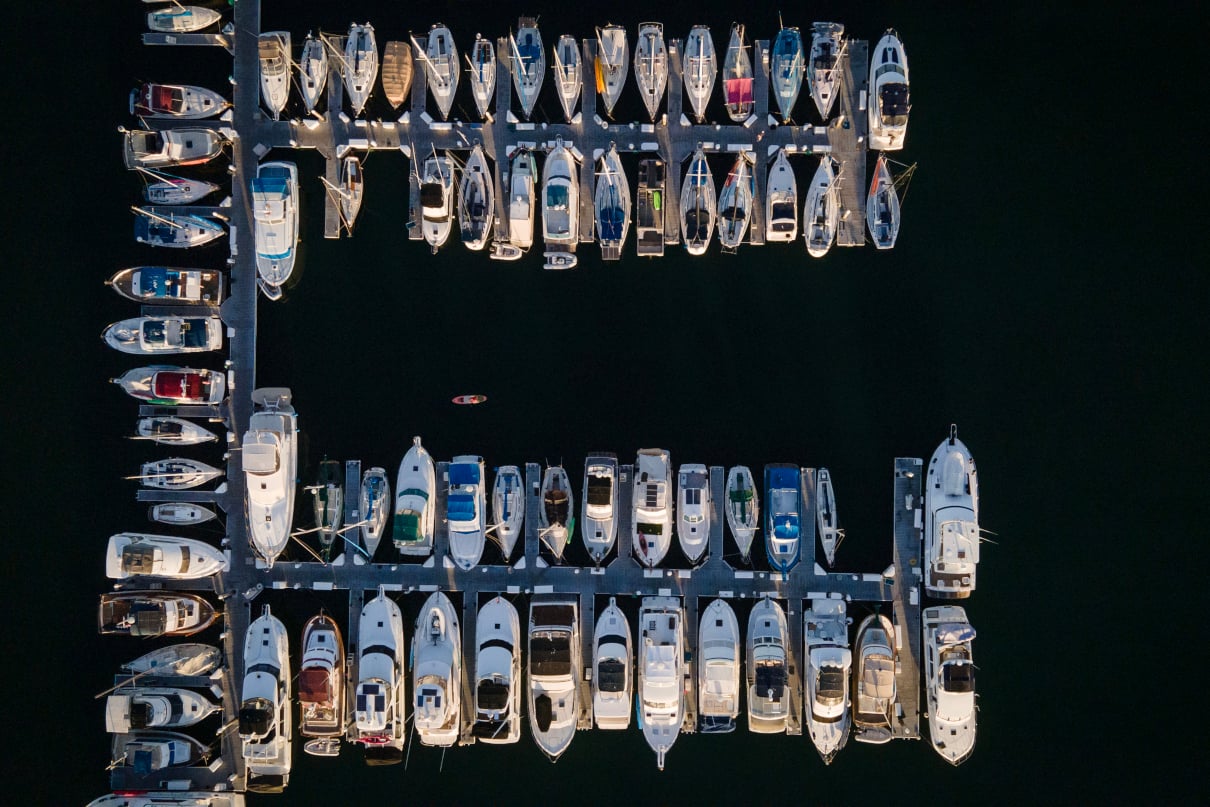
You could easily spend the day scoping out marinas and coves. | Photo: Ana Ramirez

Paddleboard rentals in San Diego

Mission Bay Aquatic Center

The Mission Bay Aquatic Center is a unique venture jointly owned and operated by San Diego State University’s Associated Students and University of California San Diego Recreation. They rent standup paddleboard gear, as well as for other watersports including kayaking, surfing, and sailing. The MBAC is open to the public and also offers various classes you can attend.

SUP Coronado

SUP Coronado has served San Diego Bay/Coronado Island paddleboarders since 2008. Rental wise, they have everything you need for a day of paddleboarding on San Diego Bay. They also offer guided tours.


A seal’s-eye-view of the San Diego paddleboard scene. | Feature photo: Ana Ramirez