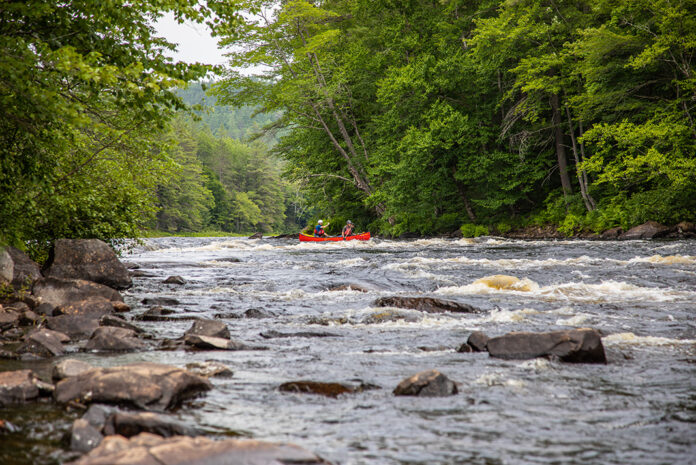
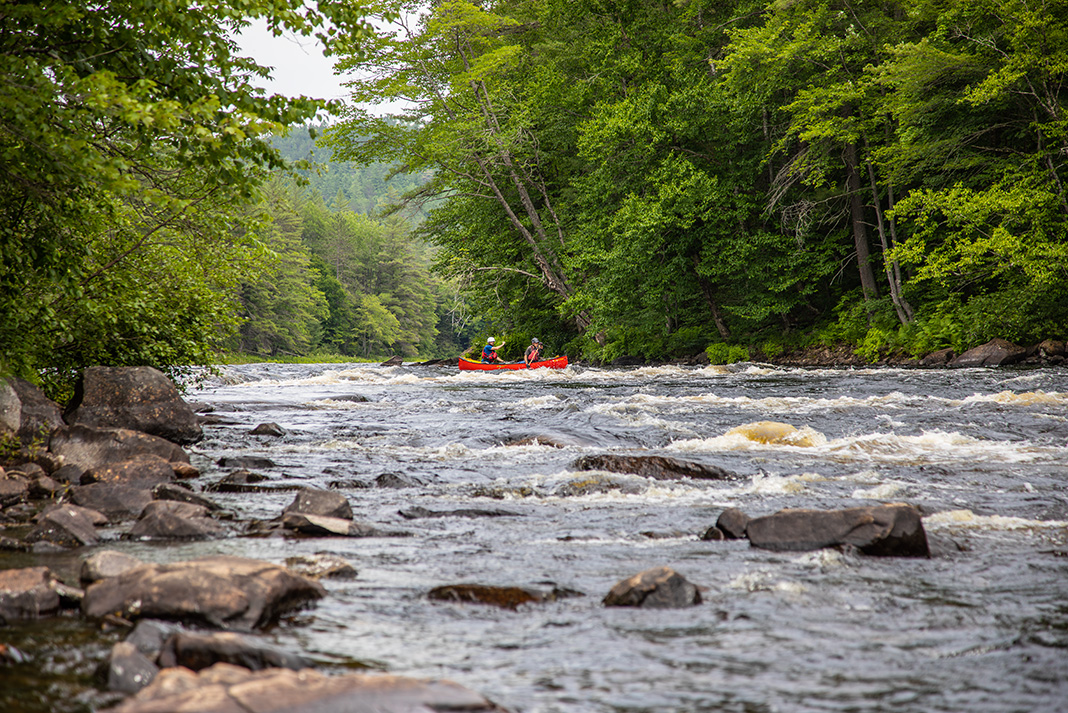
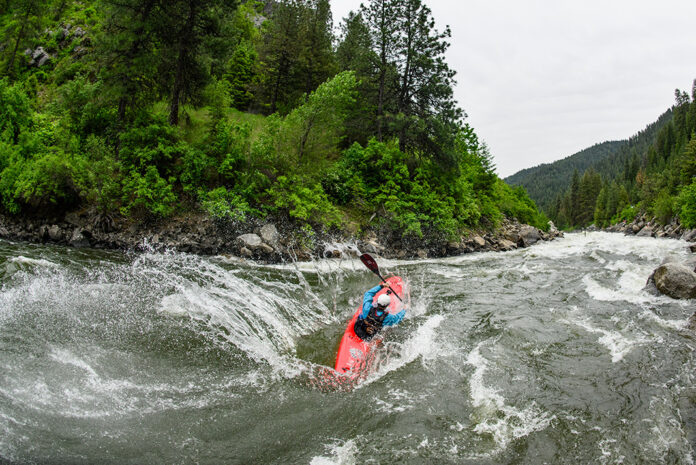
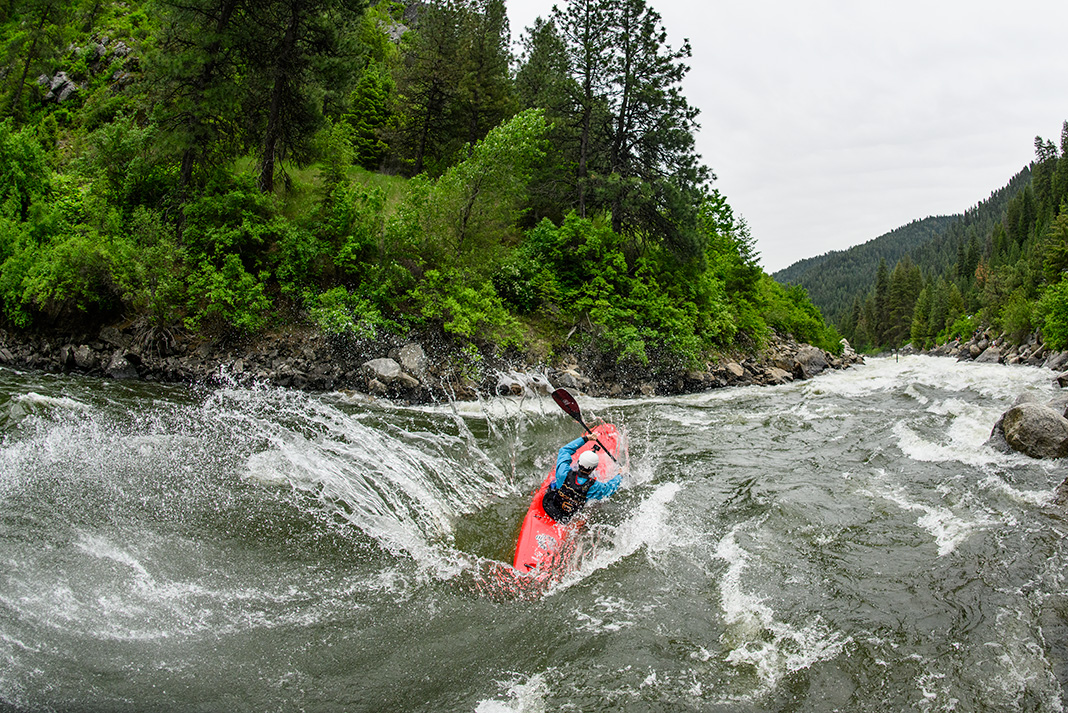
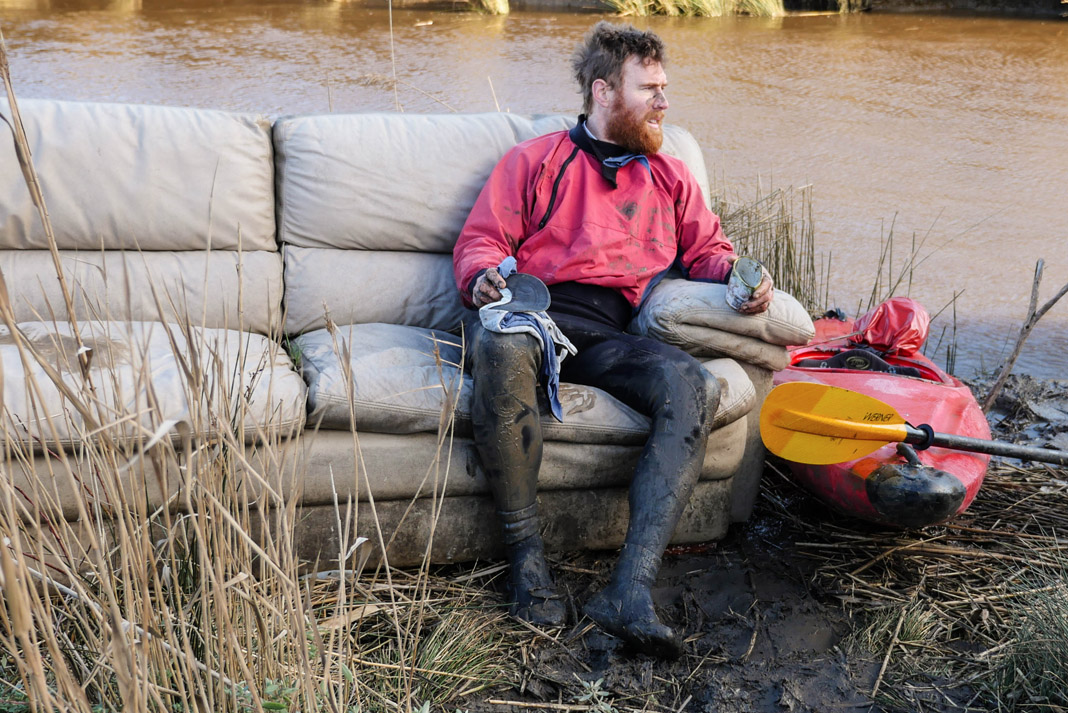
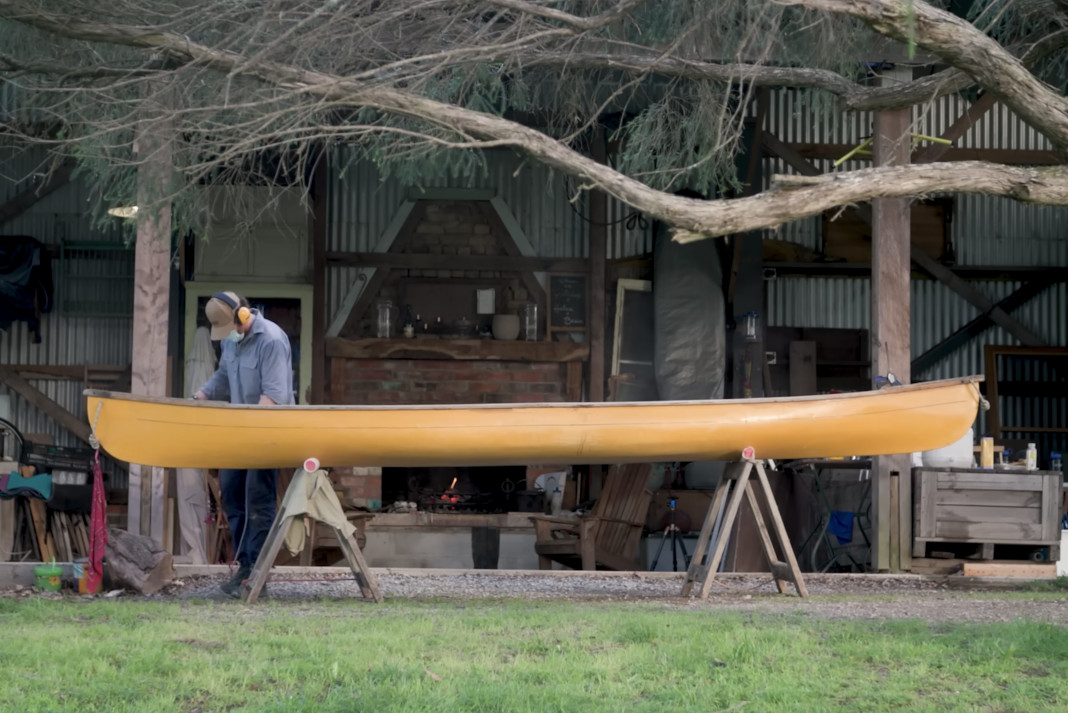
Productivity experts out there likely know the Pomodoro Technique well. The time management method invented by Italian Francesco Cirillo in the 1980s. While attending university, Cirillo used a tomato-shaped kitchen timer set for 25-minute uninterrupted work intervals. Each interval then followed by a five-minute break. The Pomodoro Technique has proven its efficacy in the decades since. Paddler Beau Miles may have taken productivity hacks to a new level though, as he used a Pomodoro-type Technique of his own to tackle two daunting endeavors: renovating an old canoe while running a marathon.
This isn’t the first time Miles has teamed tedious tasks with long-distance running to appear to be the most productive human being on earth. In 2018, Miles completed another version of the endeavor. Miles would run one lap around his mile-long block. Then work at one household task on his to-do list until the next hour. Fans seemed to be enthralled with Miles’ accomplishment. The video Miles published following his last 24-hour marathon has received more than 4.5 million views. Not to mention, less than two years later, we’d all be at home, online, looking for ways to keep ourselves busy and sane.
With the success of the previous productivity marathon, Miles has returned with a new mission, melding two accomplishments many of us in the outdoors romanticize—running a marathon and restoring an old canoe. Miles sets off to prove both items on your bucket list can be accomplished in little more than a day.
This time, the paddler sets out to complete his marathon with laps around his property. The most entertaining aspect for you canoe aficionados is the worn-out, yellow livery boat in his possession. Over the course of the day, Miles ticks off miles while renovating the canoe. Each hour, he goes from stripping the boat down to the bones, sanding it, and rebuilding yokes and seats. Miles ends up with a seaworthy canoe, all while making the rest of our days look flat-out lazy.
The best way to cure end-of-trip blues. | Feature photo: Colin Field
After 46 years running Wabakimi Outfitters & EcoLodge, owner Bruce Hyer is looking to retire. But with no one to pass the torch onto, the future of the business is uncertain. Photojournalist Colin Field and his son venture into the Wabakimi wilds on a guided whitewater adventure to find out what the outfitting operation is all about and to discover the magic of the Park for themselves.
Dreams for sale: Passing the torch at Wabakimi Outfitters
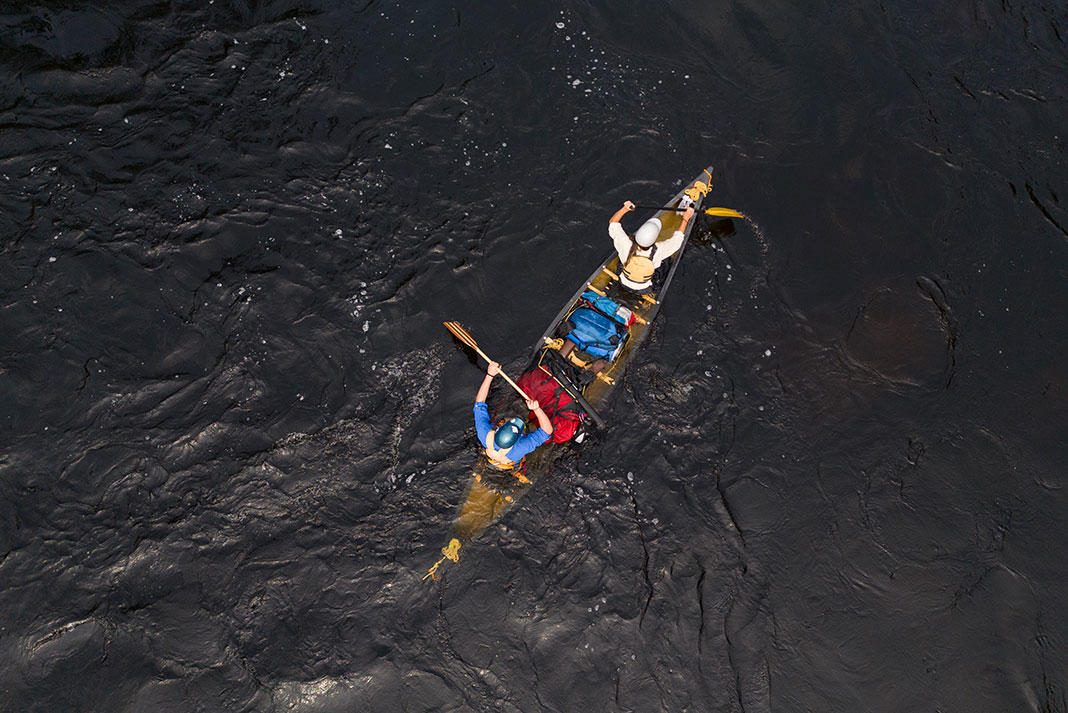
Paddling through the waves of a nameless rapids, we desperately try heading to river right—away from the massive three-foot-high wave downstream. But the river has other plans; it’s pushing us directly into the meat of the intimidating liquid wall.
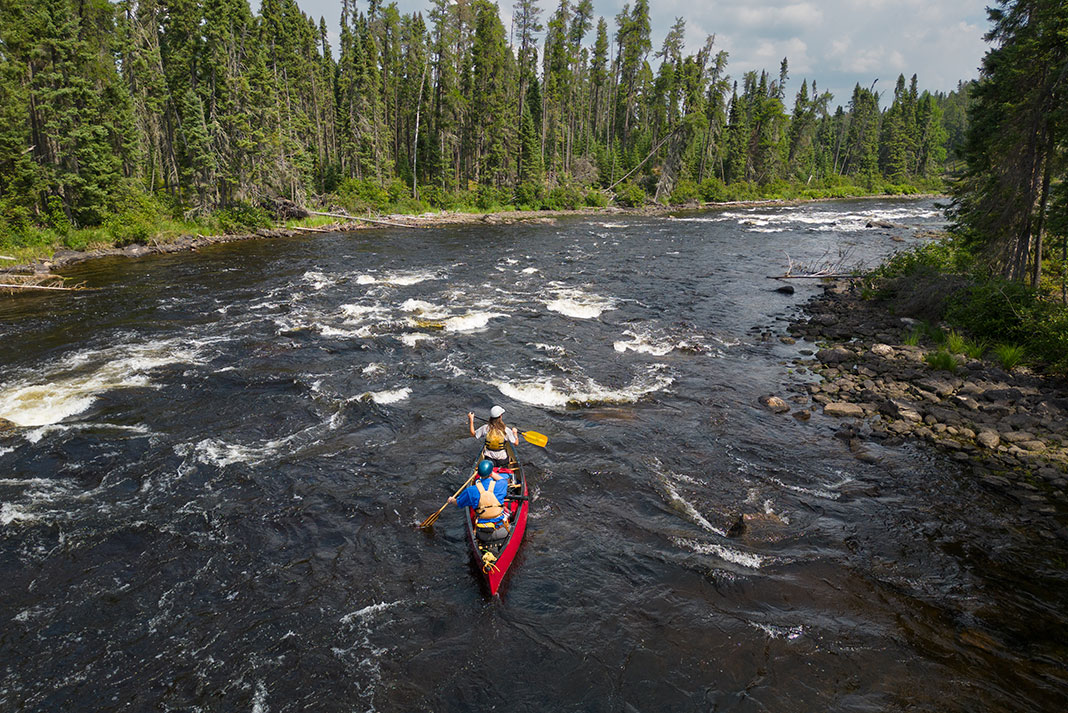
The Allan Water River provides rock dodging, wave crashing, boat swamping fun on its class II rapids. | Photo: Colin Field
Our bow rises then falls into the trough before plunging through the powerful curling mass of water. For a millisecond the front end of the boat is completely submerged. And it’s in that fraction of time the boat fills with water. It’s my son’s first time swamping a canoe. The rapids end and I’m up to my belly button in water. With each tilt of the boat more water pours in and causes us to sink lower. It’s a feedback loop of submersion. We keep our paddles in the water to stabilize while wobbling precariously.
Our drybags and barrels are all tied in. My camera gear is sitting safely on shore. I laugh as the boat sloshes about like a floating bathtub and I realize my son is also thrilled. He thinks it’s fun. The relief of paddling rapids he was nervous about literally washed over him.
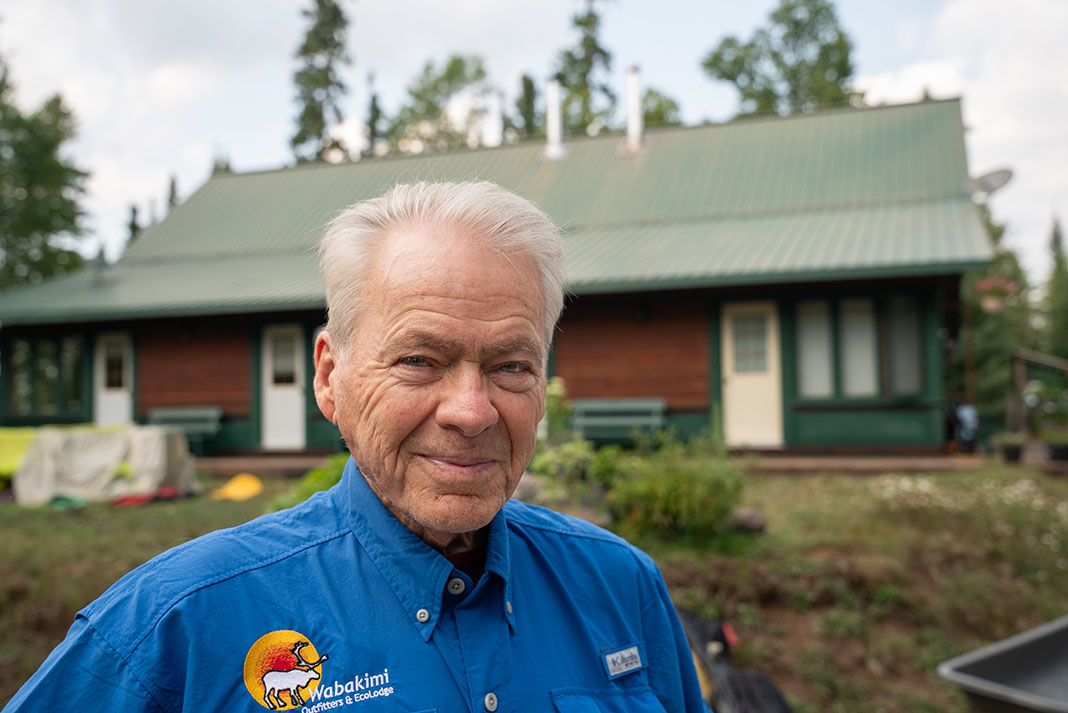
Bruce Hyer, 77, founder of Wabakimi Outfitters & EcoLodge, trip planner and storyteller extraordinaire. | Photo: Colin Field
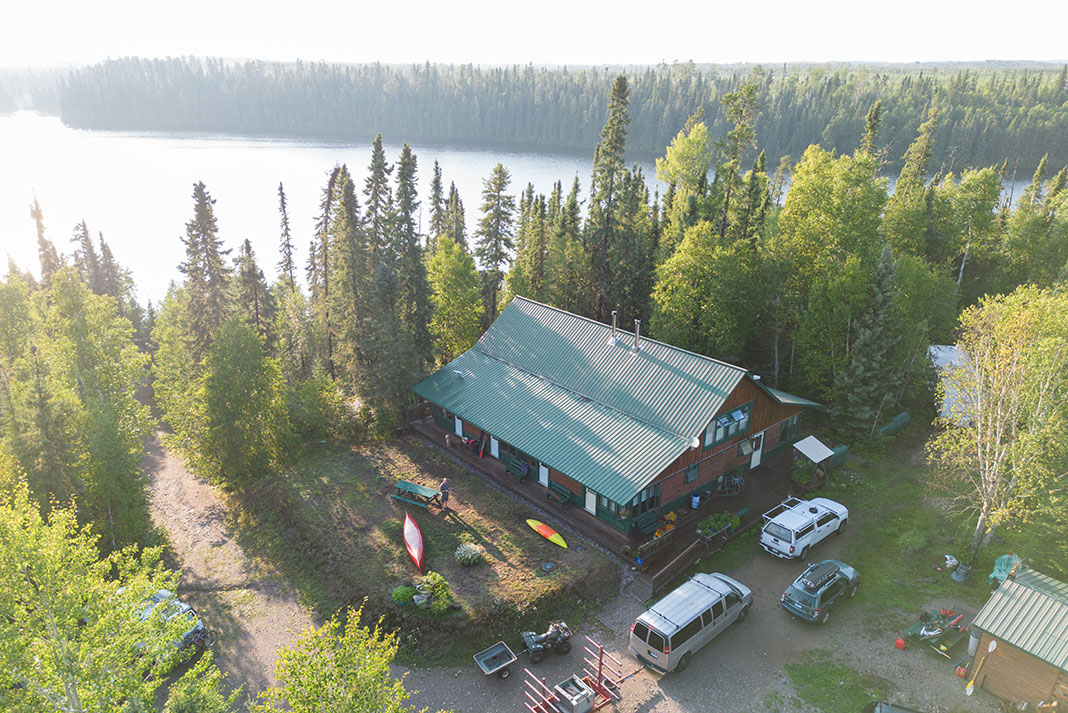
Paddlers and anglers using Wabakimi Outfitters’ services begin and end their trips at the EcoLodge. | Photo: Colin Field
Sons and fathers set their course
Usually a trip like thisis created to promote a business. An outfitter invites a journalist along to hype up the brand and voila! They get international exposure to a perfectly targeted audience. It’s a cost-effective form of marketing with a somewhat trackable return on investment. But that’s not what’s going on here.
Wabakimi Canoe Outfitters & EcoLodge is having an existential crisis. The business’ founder, Bruce Hyer, is getting old. He’s spry, quick on his feet and one tough old man. But, as he says, “I’m 77, let’s get real here. I don’t know what’s going to happen to the business.”
Bruce’s business is the culmination of over 40 years of passion for the outdoors, canoes and sharing that love with others.
“I think Michael’s one of the top human beings on the whole planet. He only has one flaw: he doesn’t want this business.”
In an ideal world, his son would take over. Twenty-eight-year-old Michael Hyer went to law school, recently passed the bar, and has a job starting in the fall working in human rights law and Indigenous self-governance.
“I’m totally biased, of course,” says Bruce, “but I think Michael’s one of the top human beings on the whole planet. He only has one flaw: he doesn’t want this business.”
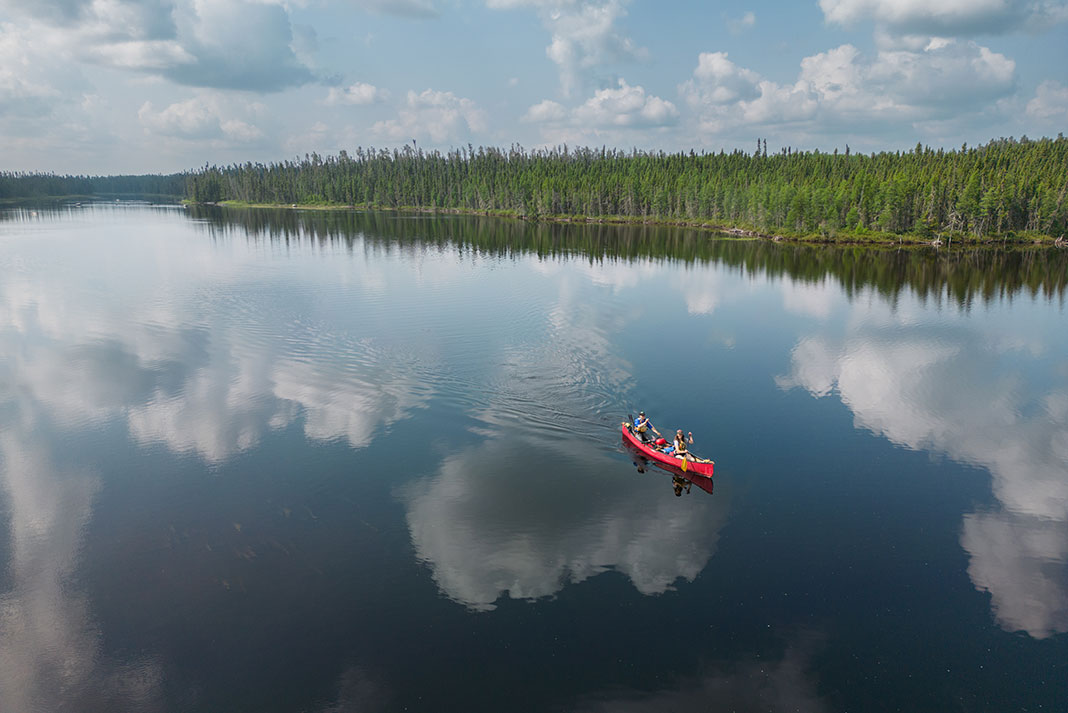
I’ve brought my own 13-year-old son along. We’re headed out on a four-day trip down the Allan Water River in Northern Ontario’s famed wilderness canoe tripping destination, Wabakimi Provincial Park.
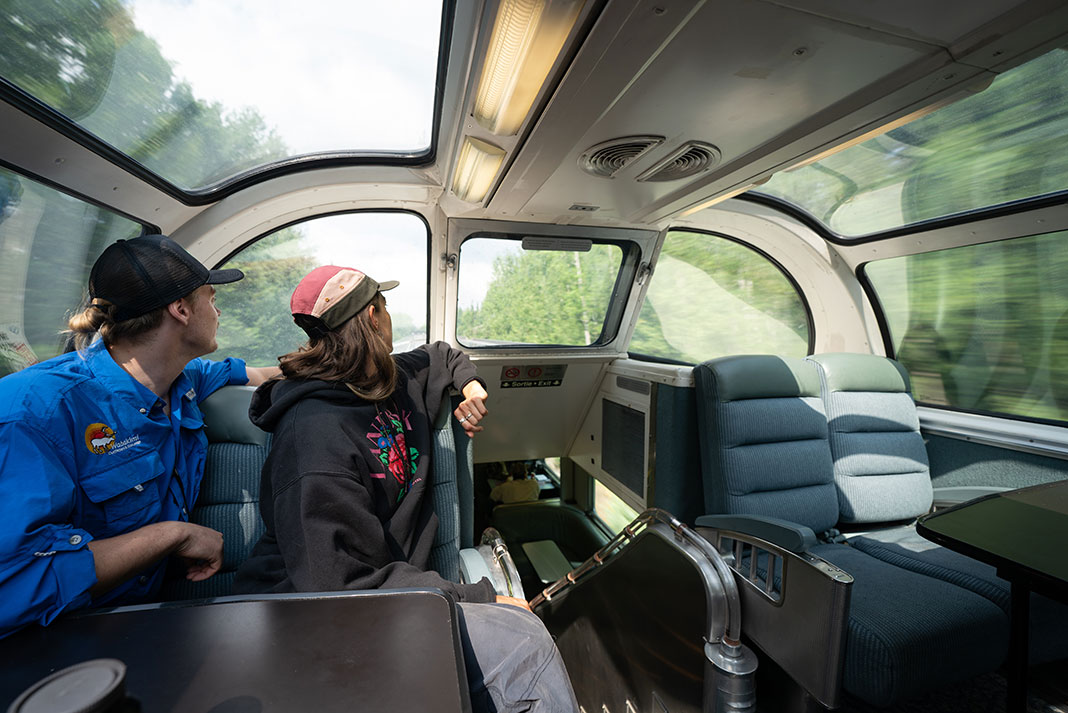
The fashionably late train service provided by Via Rail is part of the charm of a train-in adventure. | Photo: Colin Field
Whither Wabakimi
The trip begins at the EcoLodge itself near Armstrong, Ontario, about three hours north of Thunder Bay. It’s a beautiful eight-bedroom lodge with a spacious common room and an all-inclusive vibe. Bruce and his wife, Margaret, are hosting us along with 20 other people who are spending the night. It’s from the lodge that groups of canoeists, anglers and outdoor enthusiasts begin their trips. They’ll either take the train, a floatplane or a truck shuttle to their put-in or one of Wabakimi Outfitters’ seven outpost camps. While Bruce’s first love is canoe tripping, he also helps anglers get to some of the best fishing in the province.
During the course of the evening, Bruce is careful to spend time with every guest, going over their itineraries.
Thirteen years ago Bruce beat cancer, but lost half his tongue; his speech is slurred and sometimes difficult to understand, but that doesn’t stop him from speaking. He shares his years of knowledge about the Park readily. Bruce knows Wabakimi intimately and claims to have created 90 percent of its recreational routes. In fact, he spearheaded the creation of the Park itself.
We begin the canoe portion of our trip at the “train station” in Armstrong, about 15 minutes from Wabakimi EcoLodge. The station itself is little more than a gravel parking lot littered with detritus. There’s no washroom, ticket kiosk, cafe, bathroom or attendants. We arrive for the 9 a.m. departure, fully aware the passenger train is often late. It’s a surprising, but not uncommon occurrence on the Via Rail lines; problems arise when the train arrives uncharacteristically early and departs before the scheduled arrival. On this day, the train is 3.5 hours late. We load our canoes into the cargo car, then board the passenger car and spend the majority of the 90-kilometer ride enjoying the scenery from the bubble car, which has a second floor where the walls and ceiling are all window.
We hop off the train at Allanwater Bridge where the Hyers have one of their outpost camps. It’s finally time for our boats to touch water, and we begin our paddle downstream.
This is the same river Bruce Hyer paddled back in the early 2000s with husband and wife Jack Layton—then leader of the New Democratic Party—and Olivia Chow—former NDP Member of Parliament and current mayor of Toronto. Layton convinced Bruce to run for Member of Parliament for the riding of Thunder Bay-Superior North on this trip—a position Bruce would then hold for two terms, championing work on climate change legislation and the Superior Passenger Rail Motion mandating the return of Via Rail service to the north shore of Lake Superior and Thunder Bay.
It’s also the same river Bruce paddled with famous wildlife artist Robert Bateman, the canned joke being he taught Bateman how to draw.
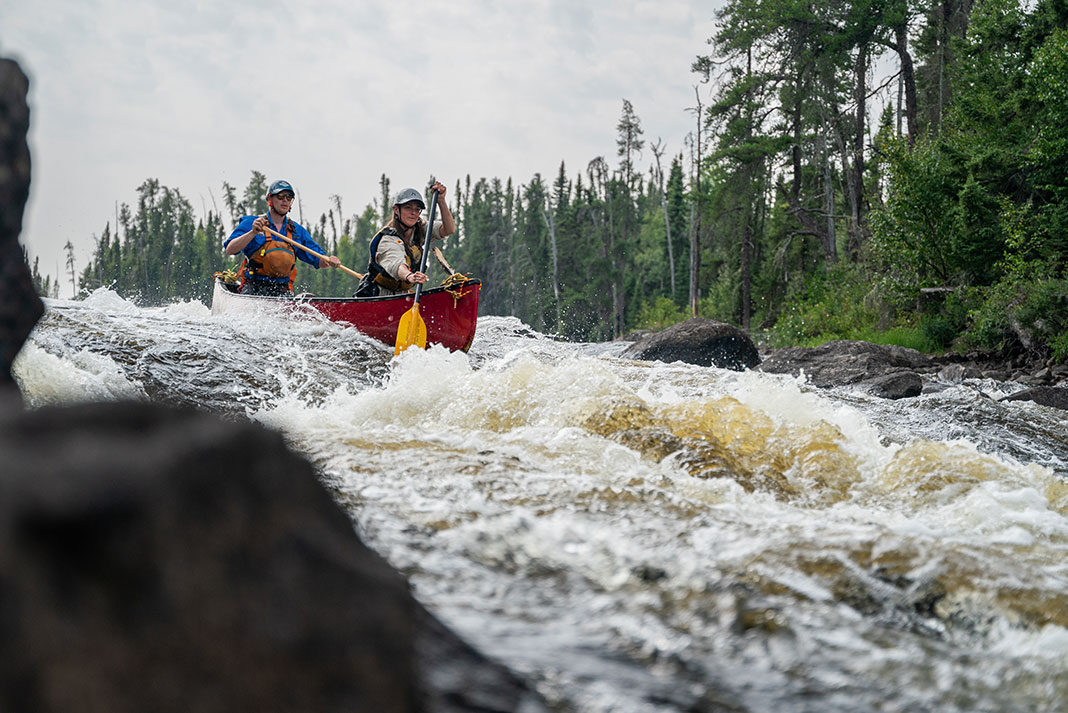
Michael (stern) and Eden (bow) running one of the Allan Water’s many splashy rapids. | Photo: Colin Field
Blueberries—and therefore black bears—abound in Wabakimi in early August. | Photo: Colin Field
Expect pensive paddling like this between sets on the Allan Water. | Photo: Colin Field
How Hyer helped launch new park
Bruce’s story with Wabakimi Provincial Park goes back to 1976 when he first arrived in the area. Bruce is an American from Connecticut, but he’d dreamed of living in a cabin in the woods since he was five years old. Before he relocated to Canada, he’d had a varied career, including a stint as a saxophonist in an otherwise all-black jazz band in the 60s and as a cop.
“In 1970 I got myself put in charge, at age 24, of the pesticide department for the state of Connecticut,” he recalls. “I banned DDT. I was the guy who banned DDT in the U.S.A.”
In 1976, Bruce decided he didn’t want to wait for retirement to move to the wilderness, so he quit.
“I quit my job and brought my first wife up here and lived in a tipi for a year and a log cabin for a year,” he recalls. “My first wife went away after a few months. We had this very polite conversation: ‘Bruce you’re very persuasive, you made this sound very romantic, but I’m sick of eating blueberries and beaver tails, and I’d like to see a few other human beings.’ So I stayed and she left.”
Bruce continued to live in the bush for the next three years, living mostly off the land. Then he heard rumors the Ministry of Natural Resources and Forestry was going to log the area. He moved to Thunder Bay and began working to prevent it. In 1983, after much lobbying, letter writing and Toronto visiting, Wabakimi Provincial Park was formed. In 1997, the Park was significantly expanded to its current size.
Today, Wabakimi Provincial Park is nearly 10,000 square kilometers, is one of the world’s largest boreal forest reserves and is the second-largest provincial park in Ontario. Wabakimi Outfitters & EcoLodge is the only canoe-focused company operating in the Park.
Michael takes after his father: hiking boots, long pants, and an expansive knowledge of Wabakimi. | Photo: Colin Field
Growing up a guide
Bruce’s son Michael is our guide. The trip consists of me, my son Taj, Michael and his friend Eden. My son is 13 while Michael and Eden are in their late 20s. They’re full of big ideals and dreams for the future. Both are recovering tree planters whose social circles run deep in the planting end of the forestry business. They’ve got serious outdoor skills and Michael obviously inherited some of his father’s old-school habits; he says portage like an American (pronounced portidge), always wears pants with a long sleeve shirt in the bush and instead of river shoes he wears Scarpa hiking boots that he tromps through the water in. He’s always got a compass around his neck, a knife on his belt and a multi-tool clipped to a belt loop with a carabiner. He guided his first trip when he was 12 and I have absolutely no doubt in his ability to take care of us.
The Allan Water River is a beauty. The short section we paddle has lots of fairly low consequence whitewater, especially with the lower water levels we find in early August. We don’t encounter anything more difficult than class II and for the most part, it’s just good old fashioned fun—rock dodging, wave crashing fun. Even when we need to portage, the trails are short and easy, downright dreamy with two 28-year-olds who are happy to carry the boats.
While our last day on the four-day trip entails two short upstream portages, the other three days consist of scouting and paddling rapids with brief lake paddling stints between sets. The Allan Water is a perfect river for the whitewater enthusiast; undoubtedly among my top three favorite Ontario rivers I’ve paddled.
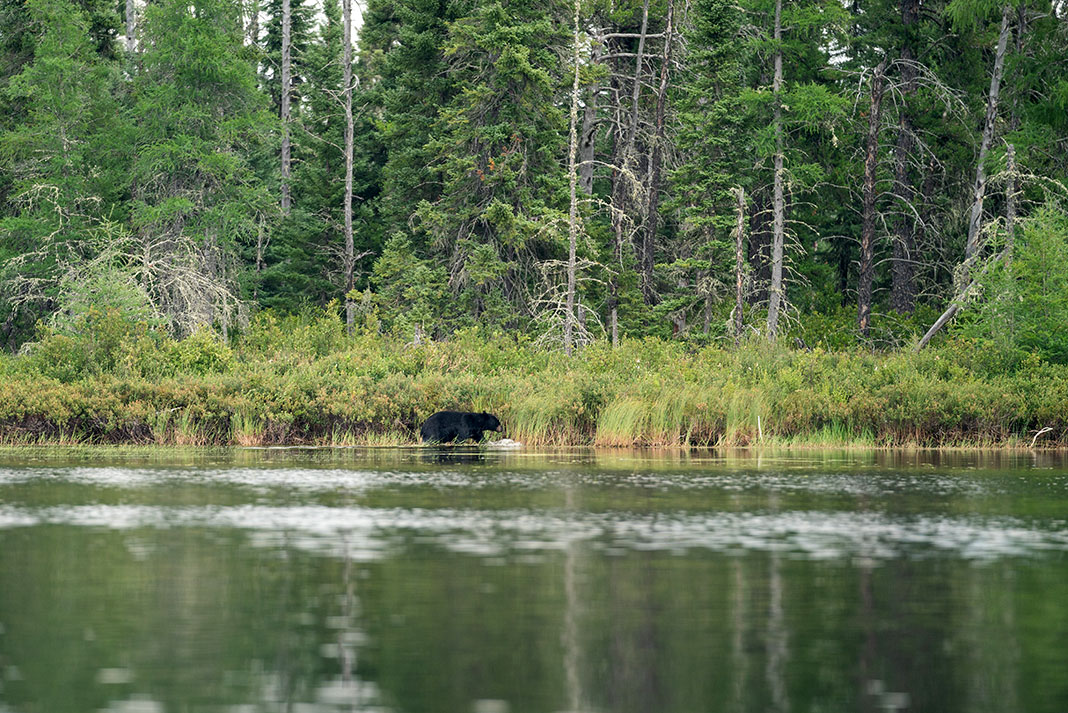
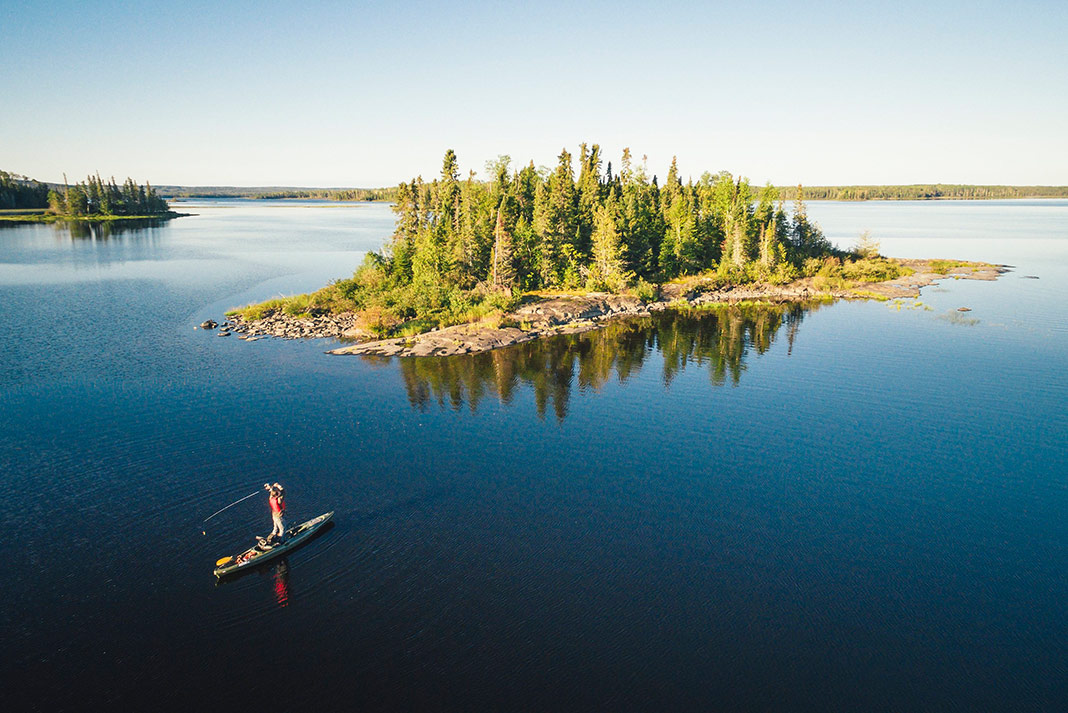
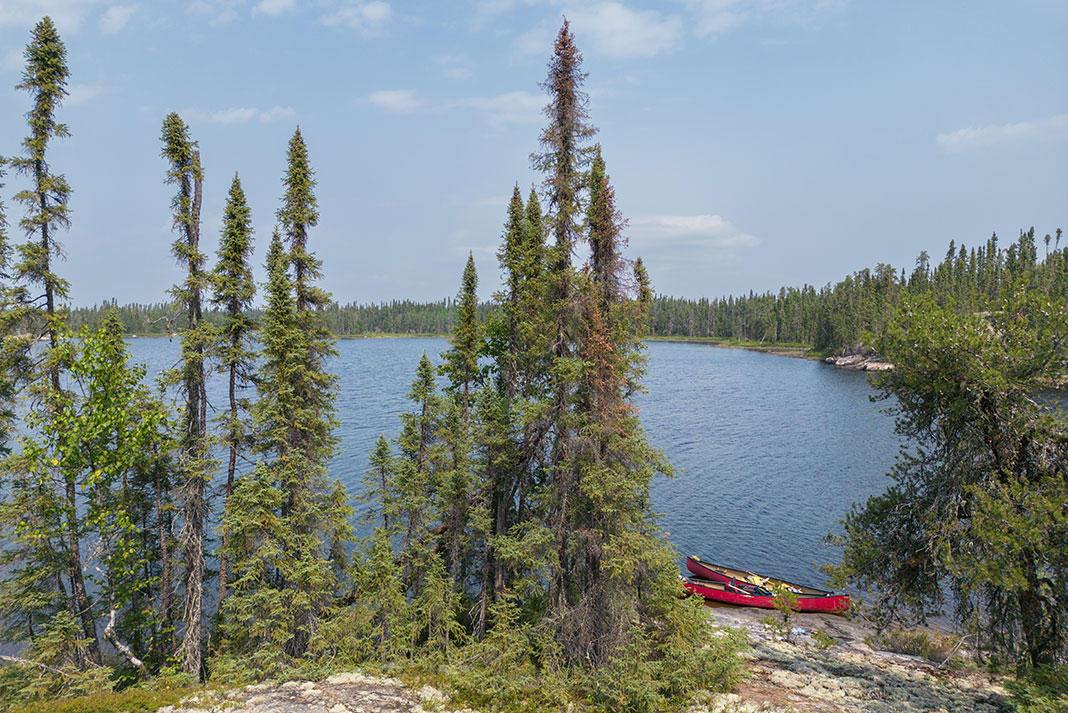
We’re surrounded by wilderness with no sign of humankind other than the occasional floatplane passing overhead. The black spruce and jack pine forest is peaceful, rugged and beautiful. We see a couple black bears on the side of the river. We see loons and bald eagles. There are also moose and caribou in the Park, but we don’t see any. And there are blueberries absolutely everywhere.
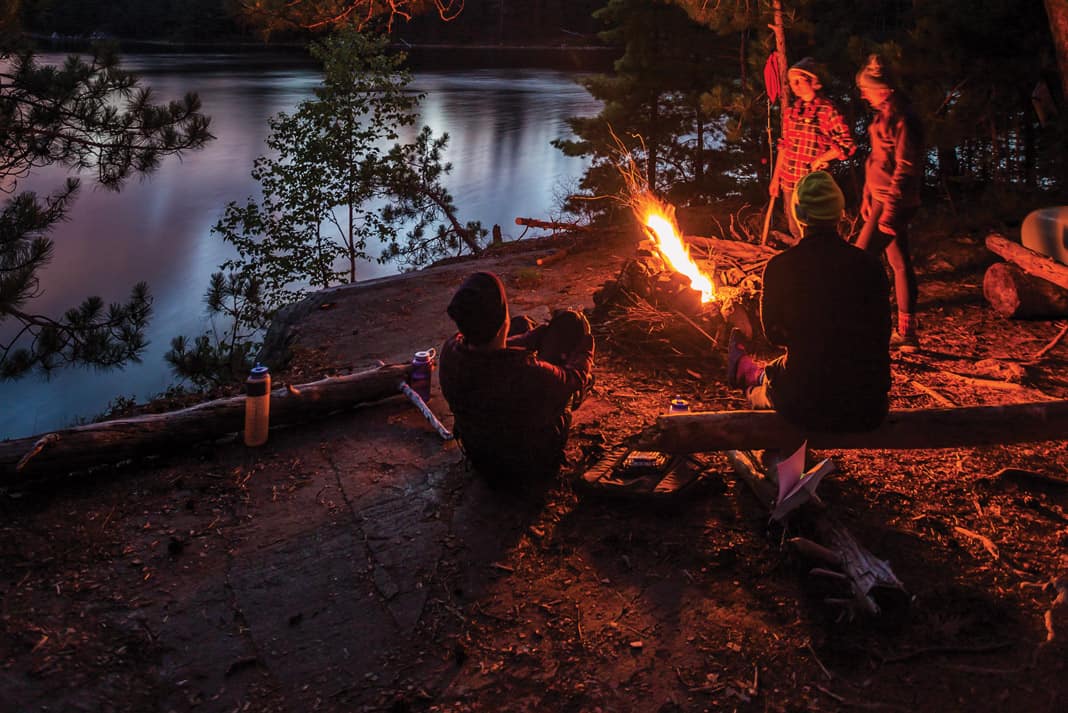
When Michael asks if we want fish for dinner, Taj and I instantly respond with a synchronized “Heck yes!” Michael delivers; after half an hour of fishing from a canoe, he returns triumphantly with two dinner-sized walleye.
I ask him if he’s really good at fishing or if the fishing is actually that good.
“It’s just knowing where to be,” he says humbly. “Right on the eddyline, where they wait for food without expending any energy.”
I suspect he’s actually a great fisherman even though he claims he isn’t that into it.
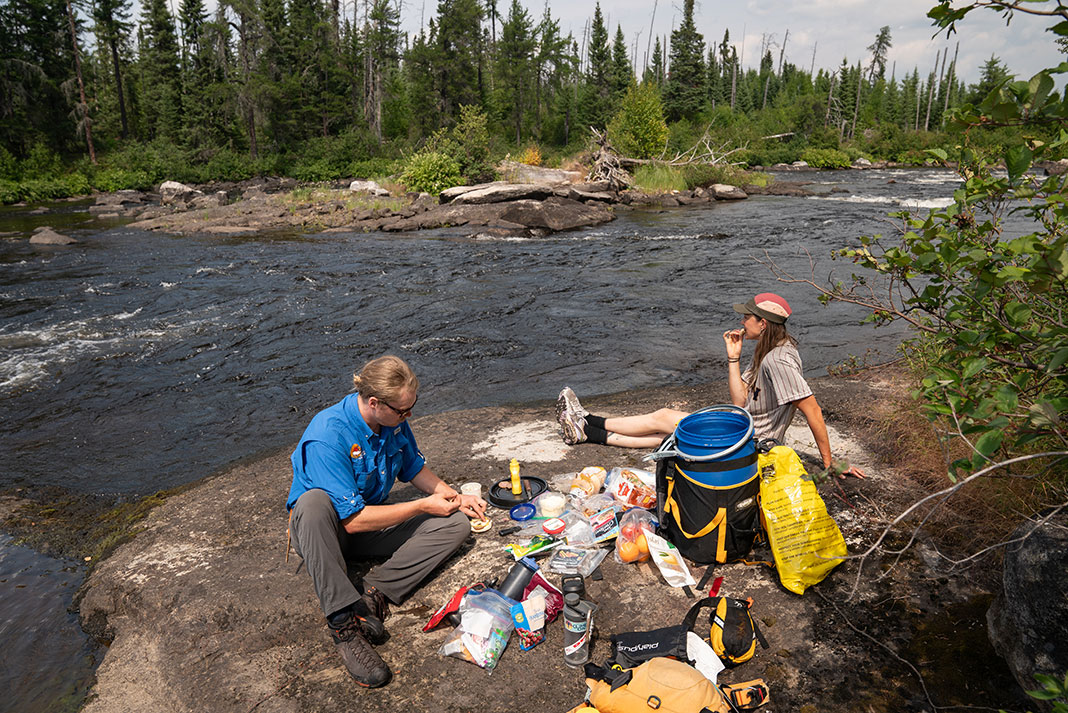
Michael and Eden lay out a typical shore lunch. | Photo: Colin Field
“Wabakimi’s been discovered”
Wabakimi Outfitters isn’t really a guiding company. Although they’ll do it, they specialize in setting up self-guided groups.
“I try to match the right people to the right budget, route and skills,” says Bruce.
He carefully questions people about their skill levels and trip requirements before recommending a corresponding experience. Then he coordinates shuttles in and out of the Park. He says canoeists balk at floatplane prices—although they rave about the experience afterward—while anglers never question expenses as long as the fishing is good. But it’s the knowledge that is truly valuable.
“During COVID, when everything was closed, we were it. COVID didn’t hurt us, it helpedus. That and social media.”
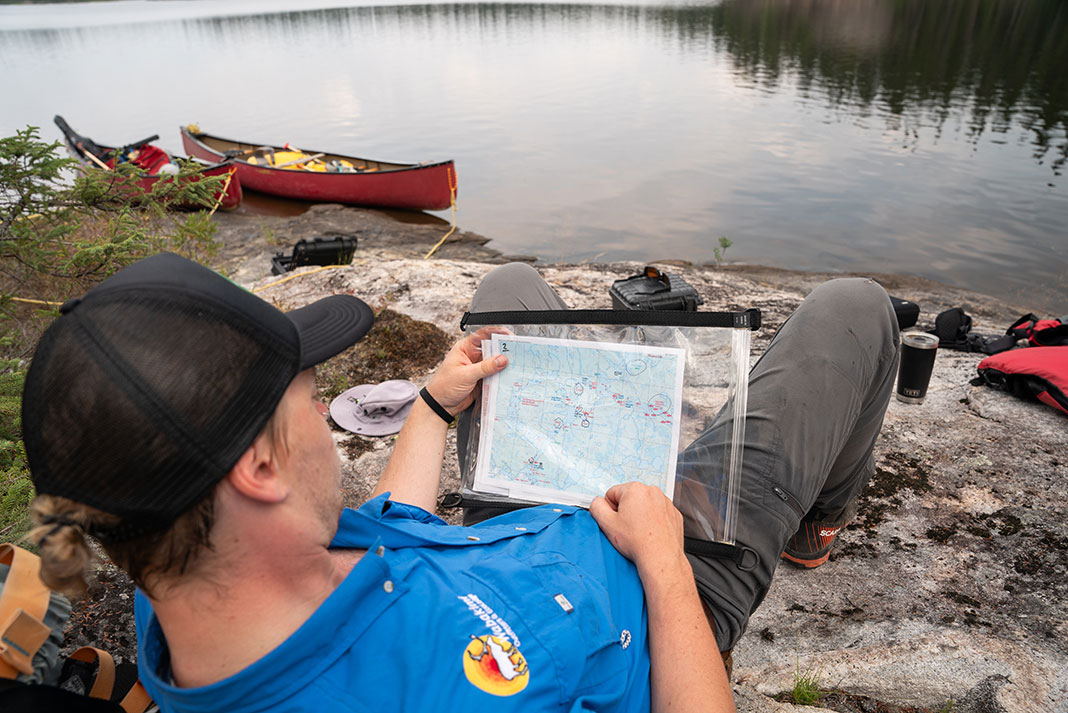
“You saw my maps,” he says to me. “That’s the most valuable thing. There are hundreds of hours in those maps and thousands of hours developing the routes. And they’re pretty accurate. I always say they’re 99 percent accurate because a) we’re human, b) things change and c) to cover my ass. Maybe that’s a).”
It’s that knowledge, along with the properties, buildings, equipment, clients and relationships, that make Wabakimi Outfitters & EcoLodge a successful business. That and decades of sheer willpower.
“I’ve been at this for 46 years,” says Bruce. “And I didn’t make any money off of it for most of that time. Margaret and I kept pouring money into it. It’s our retirement fund. Will we get what we put into it? Probably not. Will we get enough to retire? Hopefully.”
Like many outdoor companies, Wabakimi Outfitters saw better business during COVID. And they’re still enjoying more success than ever.
“All of a sudden Wabakimi’s been discovered,” says Bruce. “During COVID, when everything was closed, we were it. COVID didn’t hurt us, it helpedus. That and social media. Wabakimi’s been discovered, we’ve been discovered, I’ve been discovered. It’s kind of embarrassing; I’m kind of a cult hero now.”
The best way to cure end-of-trip blues. | Feature photo: Colin Field
That cult hero status is well-deserved. Mention the name Bruce Hyer to anyone in Thunder Bay and they’ll have a story. Like the time he crashed his floatplane.
“I turned a $150,000 plane into a $5,000 pile of scrap,” he recounts.
This was five years ago, when he was 72. He flipped the plane while landing on a lake and escaped through one of the doors as the cockpit filled with water. He sat on the upturned float while awaiting rescue and laughed uncontrollably for an entire 10 minutes.
“I borrowed a phone and called Margaret,” he recalls. “I told her I had some good news and some bad news. The good news was that I was alive.”
Searching for a successor
He’s still holding out hope Michael will change his mind and take over the business.
“We’re very interested to see what he does,” says Bruce. “Am I disappointed he doesn’t want to take over? Yes. On the other hand, I can see how effective he’ll be as a lawyer. That’s probably a more important job.”
In the meantime, Wabakimi Outfitters & EcoLodge is tentatively for sale.
“I can sell the whole thing outright. It wouldn’t be my first choice, but I would do it,” he says. “Or I could share it, find a good partner and I’ll do some planning, sorting, shuttles. I think someone should buy half of it, maybe 49 or 51 percent, and run it alongside us.”
“Rivers know this: there is no hurry. We shall get there some day.” —A.A. Milne | Photo: Colin Field
Wrap up on Windfall Lake
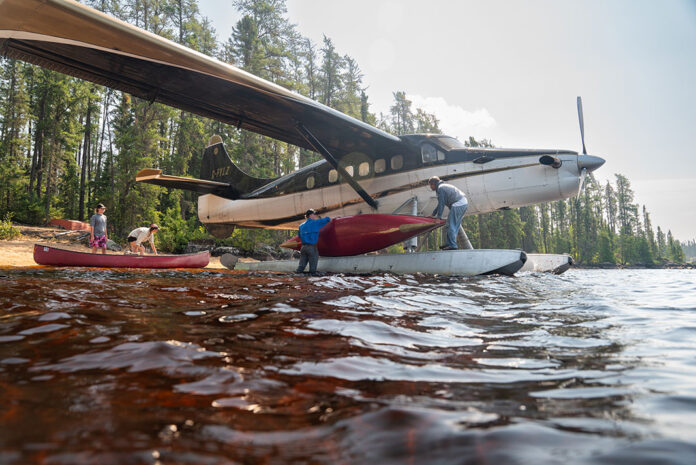
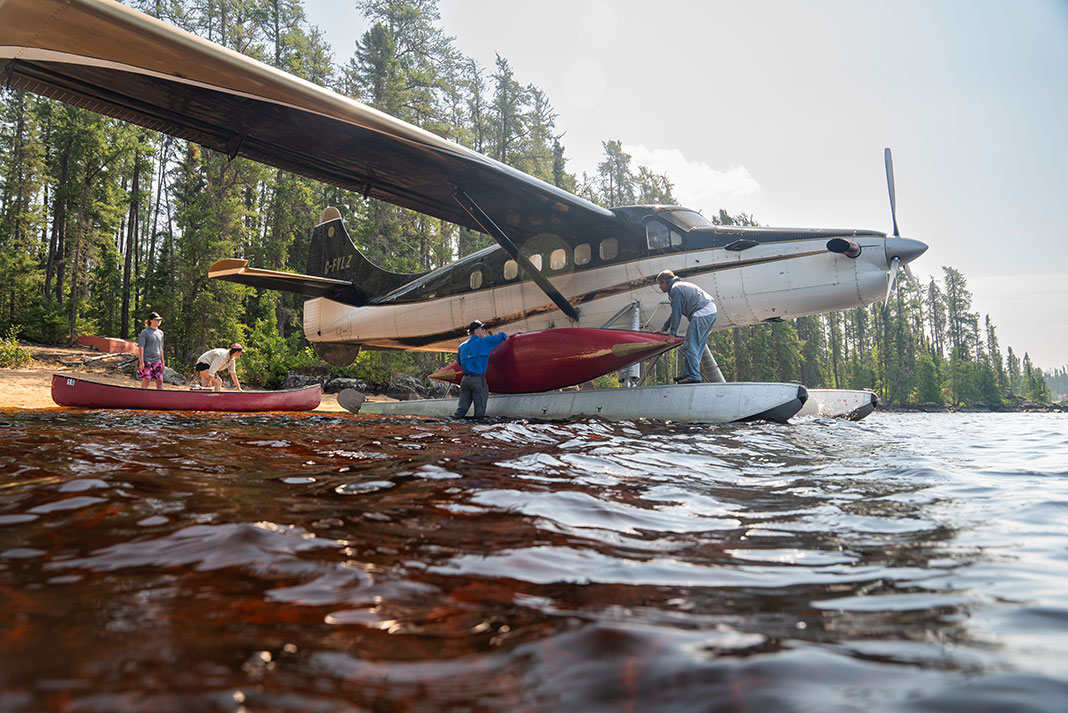
On our final day on the river, we paddle to one of the company’s outpost camps on Windfall Lake. The rustic cabin is complete with solar panels, electric lights, a fridge and a 20-foot-high water tower. We soon hear the sound of the floatplane and marvel as the de Havilland Otter flies in, lands noisily, then reverses onto the beach to pick us up. Strapping the boats to the landing gear struts, the pilot swears and jokes while we load up the rear of the plane with our gear. My son gets to ride shotgun and after we take off, the plane dips and careens in what I assume is turbulence (after landing my son assures me every time we dipped the pilot was lighting a cigarette), an experience I’m eternally grateful he was part of.
The floatplane takes us over the scrubby, barren landscape littered with rivers and lakes and I’m transfixed by the terrain and the tripping potentials. It’s a flight that leaves me smiling for the rest of the day and the landing back at the Wabakimi EcoLodge dock is as smooth as they come.
Wabakimi Provincial Park is one of the world’s largest boreal forest reserves and is the second-largest provincial park in Ontario. | Photo: Colin Field
A chip off the old block?
In essence,Bruce’s dilemma is that the Lodge was his dream. He believes he has the best job in the world. While he brought his son up to love the outdoors and created another capable and great outdoorsman, the Lodge is not Michael’s dream. Nor does it have to be.
It makes me think about my own son. For the past few years, he’s claimed he’d like to be a videographer when he grows up, which is remarkably similar to what I do as a photojournalist. I suppose I could count that as following in my footsteps. When I’m on assignment, paddling rapids, skiing powder or watching belugas, I honestly feel like I too have the best job in the world.
Over the course of the trip, my son assisted while we created imagery of paddling. When I was flying the drone, he’d take pictures. When I was taking pictures, he’d film the action. He’s good at it. With some minor guidance, it came to him naturally.
On the cramped, stuffy Air Canada flight home, I ask him the big question. I don’t expect a 13-year-old to know the answer to the question. But after watching me work and getting to experience what my job entails, I suspect he finally realizes my job is pretty cool. We just did a train-in, fly-out four-day whitewater trip with some of the coolest folks in Northern Ontario and it’s my job. So I do it, I pop the question.
“What do you think you want to do when you grow up?” I ask cautiously.
“I don’t really know,” he says thoughtfully. “But I’m really interested in history. Maybe a historian?”
Colin Field is an outdoor photographer and writer based near Collingwood, Ontario. An avid skier, cyclist and paddler, he prefers the gravity powered spectrum of each sport: alpine skiing, lift-accessed mountain biking and whitewater paddling (he’ll paddle lakes if he has to). If you need someone to drop everything and go on the trip of a lifetime three days from now, he’s your man.
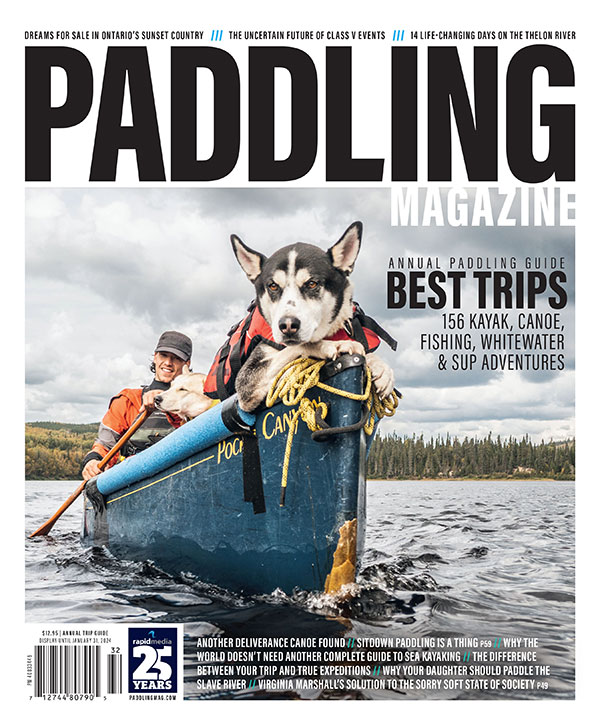
This article was first published in the 2023 Paddling Trip Guide. Subscribe to Paddling Magazine’s print and digital editions, or browse the archives.
The best way to cure end-of-trip blues. | Feature photo: Colin Field
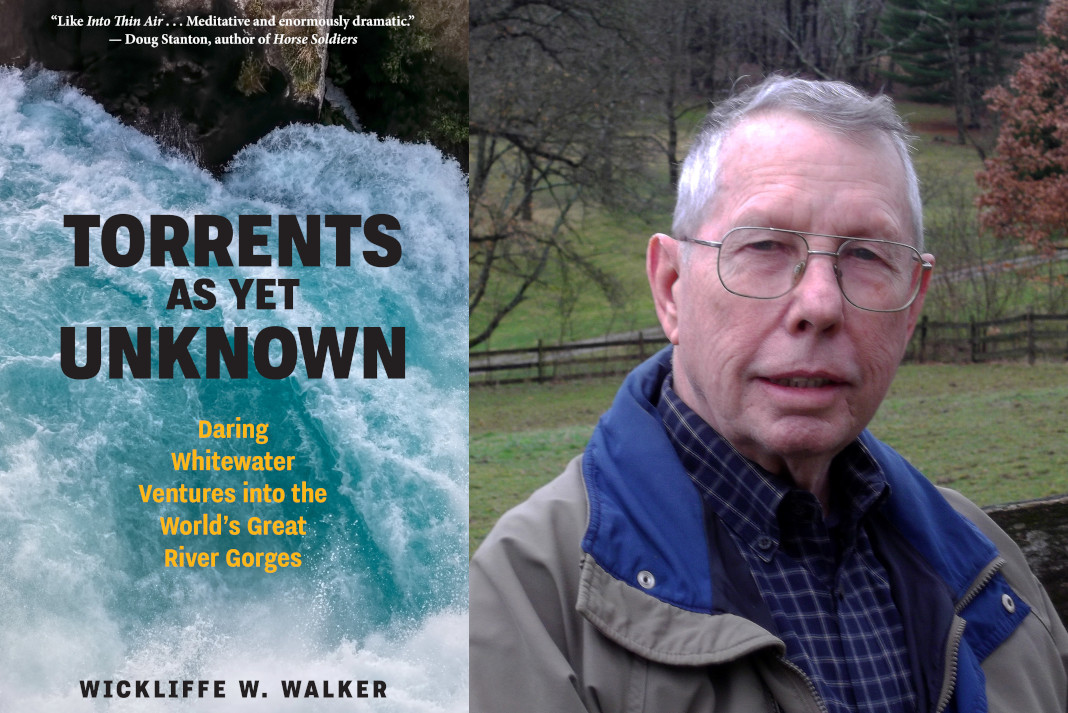
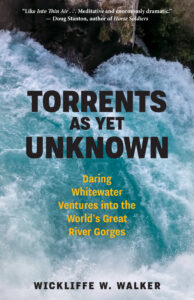
Torrents As Yet Unknown and author Wickliffe (Wick) Walker. Feature Image: Courtesy Steerforth Press / Penguin Books
The river expeditions of the second half of the 20th century were the founding of whitewater paddling as we know it today. Stocked with surplus military gear and emerging technologies, paddlers descended into treacherous and concealed river gorges. The only information known on the whitewater within their depths sourced from the accounts of local communities and what limited geographic knowledge existed. It was a time before Google Maps and stockpiles of GoPro footage flooded YouTube. When paddlers returned with tales of mysterious cataracts they proved runnable.
At 77, it is a volume of whitewater history Wickliffe (Wick) Walker has lived through and has himself largely contributed to. In his new book, Torrents As Yet Unknown, Walker guides us in narrative form through a collection of the most compelling ventures into river gorges around the globe over the course of this significant half-century. The reported stories are not of his own feats, but of fellow peers and icons of the day.
“The idea came to me that a lot of these stories from the 1950s through 2000 were very little known or were all distorted with campfire rumors,” says Walker. “I thought it would be an interesting project while there were still most of these people alive to track down and tell some of these stories.”
A Lifetime of Whitewater Tales
Walker found his path to whitewater the same way many have, through open canoeing in his youth. Through his adolescence and early adulthood, he forged his paddling prowess on the Potomac River alongside childhood friend Tom McEwan—another whitewater legend in his own regard. Walker went on to race canoe slalom at the highest level and represented the U.S. in C1 at the 1972 Munich Olympic Games, the first to include whitewater.
Not long after competing in the Olympics, Walker’s taste for expedition paddling took shape close to home. Walker accompanied a party including McEwan to make the first known descent of the Great Falls of the Potomac River in 1975—a feat he and McEwan had dreamed of for years. Walker went on to take part in expeditions on rivers as far off as Bhutan and Pakistan. He also served a career as an officer in the Army, retiring as a lieutenant colonel after his work that included intelligence and special forces.
In 1998, Walker was a trip leader and served as ground support for the first American expedition into the Yarlung Tsangpo Gorge, accompanying paddlers Tom McEwan, Jamie McEwan, Roger Zbel and Doug Gordon—a superb class of their day. Tragically, Gordon lost his life during the attempted descent, bringing the team to exit the gorge, which Walker chronicled in depth in his 2000 book, Courting the Diamond Sow: A Whitewater Expedition on Tibet’s Forbidden River.
Torrents As Yet Unknown and author Wickliffe (Wick) Walker. Feature Image: Courtesy of Steerforth Press
Torrents As Yet Unknown
To write his new book, Torrents As Yet Unknown, Walker spent nearly a decade reporting on archived materials and traveling to interview many of the characters in the book. What Walker has compiled is an indispensable history of modern river running and the rivers that are now benchmarks in the sport—some even run commercially.
The 200 pages of Torrents feature 10 of these histories framed around specific expeditions. It begins with the film production that brought about the 1950s raft descent of the Indus River by Grand Canyon guide Don Hatch and company. The book also includes a decade of fantastical ventures by British kayaker Mike Jones, including the time he paddled down the flank of Mount Everest from the base of the Khumbu Glacier, as well as other tales like the endless Soviet-era road trip of the Polish team called the Canoandes, which culminated at what was once believed to be the world’s deepest canyon on Peru’s Colca River, and Doug Ammons’ solo first known descent of the Stikine River.
In the book’s final act, Walker revisits his team’s 1998 expedition to the Yarlung Tsangpo River, often called the Everest of rivers. The author shares the experience of his friends within the gorge, which would turn to a devastating conclusion.
With Torrents As Yet Uknown, Walker brings us to river level and captures the sensation of anticipation as we drift toward the rumbling around the next bend. Paddling Magazine caught up to discuss the book with the author and the wisdom of whitewater he has amassed in his lifetime.
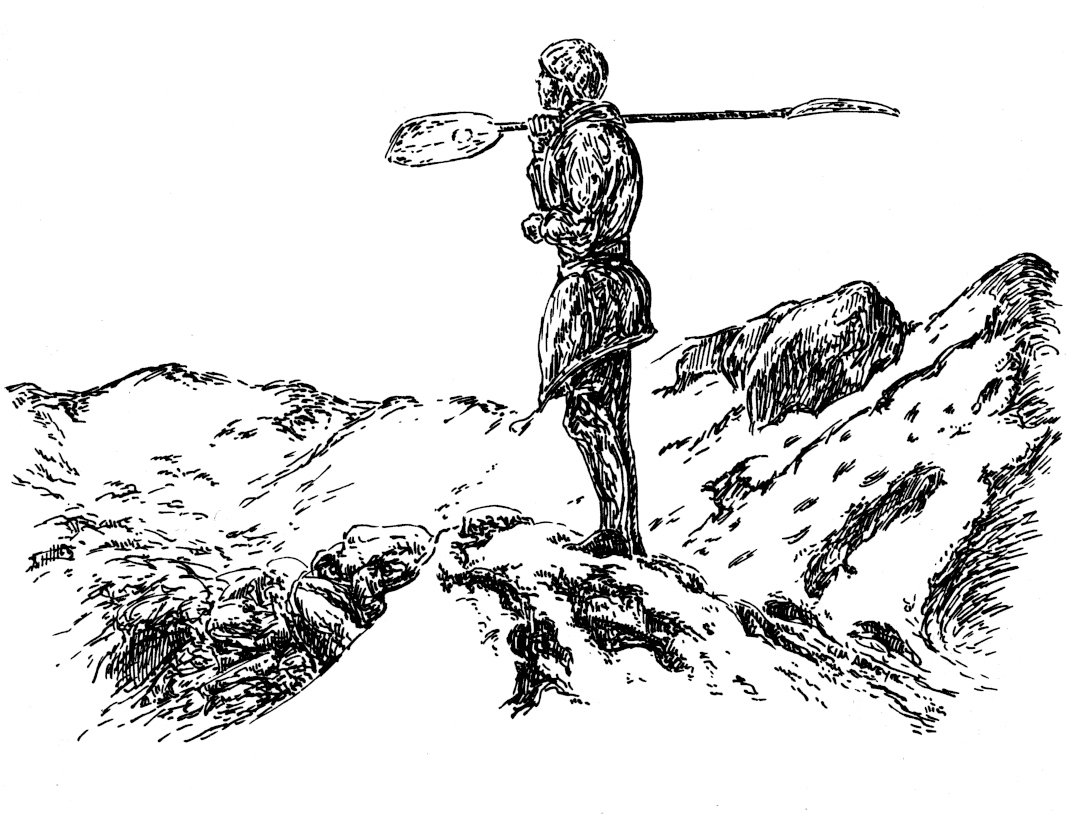
Mike Jones and a meteoric decade. Illustration: Kim Abney / Courtesy of Steerforth Press
An Interview With Wick Walker, Author of Torrents As Yet Unknown
Paddling Magazine: You’ve lived through the entire era written about. It’s something you grew up with as a kid coming up in paddling and paralleled your entire life. How did it feel for you, personally, to catch up with some of these paddlers—some your heroes, some your peers—and to have these conversations about these historic expeditions?
Wick Walker: That wound up being the most rewarding part of doing this whole project—traveling around and meeting some of these people and talking with them in depth. Some I had met in passing over the last 50 years. Some I knew only by reputation. But during that period most of us had been focused in our own silos, on our own expeditions. Sometimes keeping them deliberately secret from people. So the chance to travel around now and meet them and experience it through their eyes was the most remarkable and rewarding part of the project. I also like to think that although this certainly isn’t a memoir, that seeing it through my eyes and through my own experience provides kind of a unique viewpoint on all this.
PM: Which of the paddlers included in the book stood out as especially interesting characters?
Walker: There were such a variety of people as protagonists in these different stories. I think the individuals and their motives were so various. I never actually got a chance to interview the Chinese team members on Tiger Leaping Gorge. Happily, I got ahold of one of their diaries, but I wasn’t able to get out to China and track down anybody because the geopolitics just made that impossible before I could get to it. There were the motivations, almost suicidal motivations, of the Poles and the world’s longest road trip. And Doug Ammons is a case all by himself. I love his writing. I like Doug and there’s just nobody like him.
So I’d have to say each chapter I kind of selected because they were these interesting people.
Oh, and Mike Jones. If there was one that I had to pick off the top of the whole list, it’s probably Mike Jones, the Brit. He was a total adrenaline junkie, and he had this vision, kind of the British 19th-century exploration calling. He was out there doing things before anybody else and taking some huge risks—which eventually killed him. Jones was the only one where I couldn’t write a chapter about this one canyon, or this one group on these dates. I had to do the whole 10 years of Mike’s career to tell that story.
He deserves a book. Not by me. I wouldn’t be the perfect person to do it. But as far as I know, the two chapters about him in Torrents are the only beginning-to-end story of his paddling that’s ever been done. Everything else I found were magazine articles of verbal accounts and that sort of thing of one adventure or the other. As far as I know, I’m the only person who started with him as a beginner paddler on the Ian River and wound up in the Karakoram.
PM: There aren’t many photos in the book, but instead illustrations and maps for each chapter. It felt complementary to the narrative. Was it your intent to not use photography?
Walker: Aside from the economics of publishing a book with photos, which is much more expensive than publishing a book without, I also just feel like the sport, especially these days, is inundated with good-quality photography and video. All over YouTube and everywhere else. I didn’t know that I could contribute much to that. I’ve always liked pen and ink illustrations in expedition accounts. In 18th- and 19th-century expeditions artists went out as the recorders of the expedition and brought back wonderful illustrations that were expressive and gave you a sense of place. I liked that old-fashioned look and thought I did not want to be producing a coffee table book. I found Kim Abney, and I’m really happy with what we came out with as the overall visual appearance of the thing.
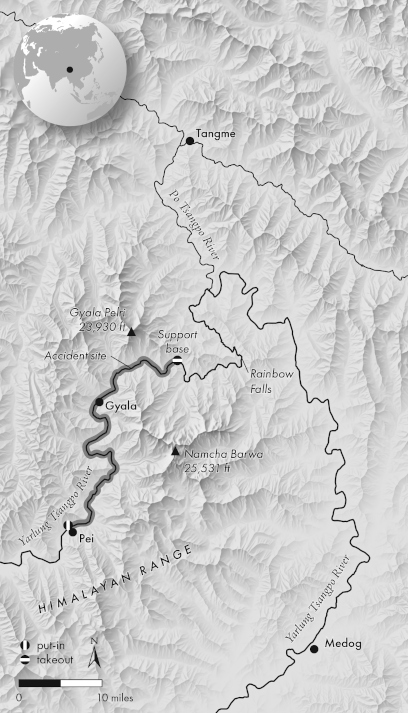
Map of the Yarlung Tsangpo River. Illustration: Kim Abney / courtesy of Steerforth Press
PM: You end the book with the Tsangpo expedition of the late 90s—a serious and tragic expedition that you were a part of. This felt like a moment closing the era you’ve captured in the book and the transition to the period of whitewater paddling where we are today. Would you agree with that?
Walker: I think the period of time I knew and was involved in was very much the early development days of the sport. And we were in some ways so lucky to be able to be inventing some of this stuff. That progress was in radical leaps and bounds from rubber World War II bridge pontoons to more specialized rafts. And from aluminum canoes to covered fiberglass and then rotomolded plastic. So we really were able to experiment with and make changes. Today it changes in inches.
The extreme boaters today are all doing these really wonderful things, but they’re maybe adding layers slowly to the sport. So it’s a different thing. I also think that in terms of expeditions, I cut off the book right at the point where a lot of things like satellite photography and satellite telephones really changed the expedition world and how you could prepare and scout.
PM: What’s held you to whitewater over the course of your lifetime?
Walker: Oh, I’m probably the last person to be able to describe that. But certainly, there were so many facets to it. I got into it through open canoeing in the Quebec wilderness and migrated to slalom racing at the upper levels. Then migrated to river running and expeditions, and then to writing about it. Each time I wore out my knees, broke something or got too old, there was some new aspect of paddling that emerged to me. And I think rivers are that way. I think there’s just so much dimension to moving water and how we relate to it.
PM: Is there an ultimate lesson river running has taught you?
Walker: Probably a sense of humility in relation to nature as a whole. You know touching the living planet and the humility that brings to you, but also the appreciation.
PM: What do you hope readers walk away with from Torrents As Yet Unknown?
Walker: I expect it’s going be different things for different people. I felt all along that I was writing for a couple of different audiences. I think the paddling community is going to take some interesting history, and appreciation of their sport, and maybe learn some lessons to use on the rivers. I’m also hoping it’s going to touch a broader audience of the outdoors and maybe the general reading public. To be honest, I have no idea what some of those people are going make of this. [Laughs.] I’ve gotten some very blank stares at times. So I’m looking forward to seeing what happens.
PM: What’s next? Do you have another book in the works?
Walker: Well, my wife has pointed out that my books have each been almost exactly 10 years apart, all four books. Going by that, my next would be in my late 80s. So she suggested I take up short stories.
Truthfully I want to continue writing. I don’t have another book like Torrents. Like everybody, I’ve got the half-finished novel in a drawer. But realistically, I’m looking forward to two things. One is some shorter work. The other is going back to something I’ve done a number of times in my continuing education and doing writers’ workshops here and there. I kind of gave up doing those when I got deeply involved in the book and had a deadline. But I want to get back to those. I find those fascinating.
“Intention is everything. Nothing happens on this planet without it.” —Jim Carrey | Feature photo: Rick Matthews
The local shop showed upat our annual spring whitewater paddling festival with these white capital letters screened across the chest of their red T-shirts: YOUR BOAT SUCKS.
Bold. But it was the early 2000s and the heyday of whitewater kayaking. Designers were chopping, squishing and sharpening boats at an alarming rate, racing to get pivotal improvements to market.
Most of the whitewater kayak brands were still independently owned and operated. Nobody was concerned about maximizing profits for shareholders. It was all about who could shape the best performing boat for the newest trick just invented. And if your boat couldn’t do it? Well, your boat sucked. Or so said the T-shirts.
Your boat sucks
Malcolm Gladwell is a staff writer for The New Yorker and five-time New York Times bestselling author. He wrote The Tipping Point, Blink, David and Goliath and Outliers. He’s the thoughtful guy we can thank for making the 10,000-hour rule the reason we’re not all on cereal boxes.
What drives Gladwell crazy is bad book reviewers.
Bad book reviewers, he believes, are ones who try to answer the question, if I had written this book how would I have done it? And if how the author wrote it deviates from the way the reviewer would have written it him- or herself, the reviewer gives the book a bad review. YOUR NOVEL SUCKS.
“That’s being a bad reader,” believes Gladwell. “The good reader is the one who says, ‘What did the author intend when he or she was writing this book?’”
“Intention is everything. Nothing happens on this planet without it.” —Jim Carrey | Feature photo: Rick Matthews
Criticism can come cheap
When we receive new floaty things here at Paddling Magazine, whether it’s a canoe, kayak or paddleboard, the initial feedback we get from reviewers is… You guessed it. “Man, this boat kinda sucks!”
Does it really? Some of the bestselling boats in the last 25 years have sucked, or so read the first impressions from our boat testers.
“Being critical is the easiest thing in the world,” says Gladwell. “If you asked me to do a hit job on War and Peace, I could do it. If you’ve never read War and Peace, and the only thing you’ve read is Malcolm’s book review of the greatest novel ever told, I could make it sound like the worst piece of trash.”
What’s hard, says Gladwell, is telling the interesting things; telling why the novel is great. Or in our case, why the boat or board is great. And, for whom it will be great.
“The problem with writing criticism is that it’s called criticism,” says Gladwell. “The implicit assumption driven by that word is that the job of the critic is to criticize.”
We don’t call boat reviewers critics, but hang out long enough in any paddling shop or Facebook group and you’ll get your fill of subjective preferences and personal biases. Seldom do you hear, “Well mate, it holds up to the designer’s intention. That’s a bloody success of a boat, if you ask me.”
To understand the intended purpose of any piece of paddling gear you only need to turn the pages in this year’s Paddling Buyer’s Guide. Still not sure what the designer was thinking? Visit the online Paddling Buyer’s Guide or Google it.
“The job of a critic is to appreciate,” says Gladwell. “Sometimes in appreciation we point out things that are not worthy of our appreciation. But the real job is to point out all the things that are worthy.”
[ Paddling Buyer’s Guide: View all boats & boards ]
Digging into the designer’s intent
No designer anywhere ever sets out to develop a product that sucks. Why would they?
This paddleboard doesn’t suck because it’s slow. It’s wide and fantastically stable.
This canoe isn’t too heavy. No, it’s indestructible and inexpensive.
Sure, the Wave Sport XXX doesn’t loop. But it won the Freestyle World Championships and is one of the best cartwheeling boats of all time.
If someone can show you things to appreciate and produce in you a sense of wonder, that’s what will make you investigate it more on your own. “Interesting… I’d like to try that boat,” you think to yourself.
And that, my friends, is how we end up with more boats than T-shirts.
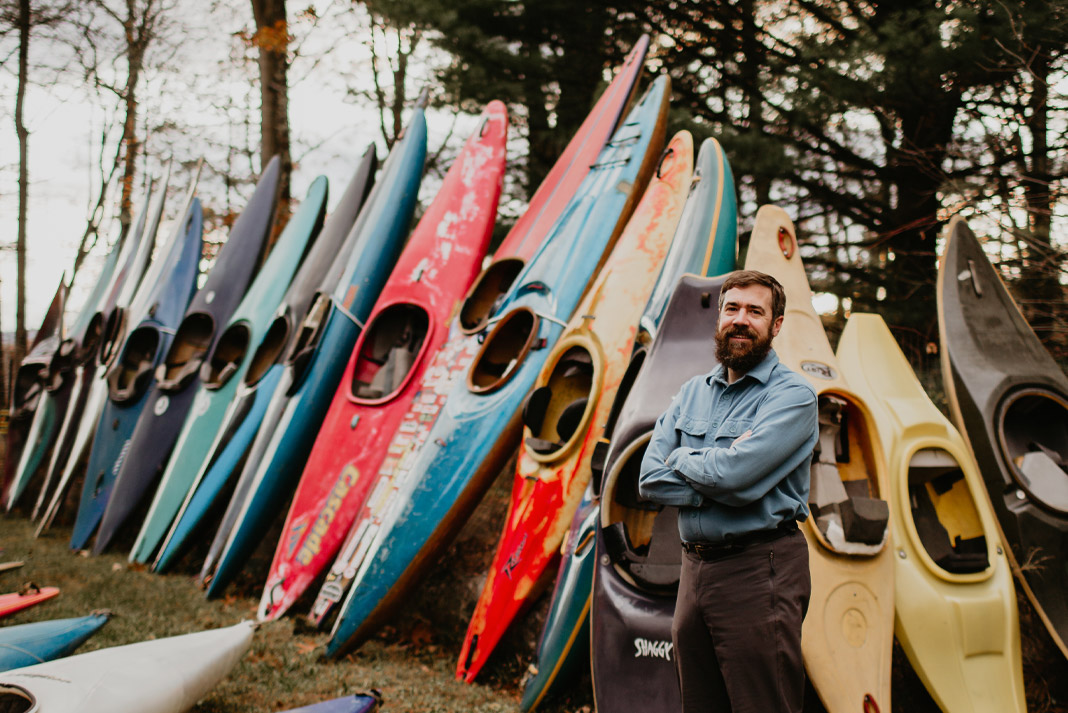
Scott MacGregor is the founder and publisher of Paddling Magazine. If you have his 20-year-old C1 XXX pictured above, he’ll buy it back from you.
This article was first published in the 2023 Paddling Buyer’s Guide. Subscribe to Paddling Magazine’s print and digital editions, or browse the archives.
“Intention is everything. Nothing happens on this planet without it.” —Jim Carrey | Feature photo: Rick Matthews
September 12, 2023 – Spinera, one of the largest watersports brands in Europe, is excited to announce its launch in the U.S. market with its Paddlesports, Watersports, & Commercial inflatable product lines.
Inflatable kayak and SUP products will be available to paddlesports specialty dealers for preseason orders for the 2024 season.
The U.S.-based team draws from a depth of industry knowledge.
Mike Mowrey, CEO of Tsunami Sales & Marketing, comes to the team with over 25 years of industry—and inflatable-specific—experience and will lead U.S. Paddlesports sales. Mike was tapped for his depth of product knowledge, industry knowledge and sales acumen.
“I see great opportunity in this maturing category,” Mowrey said. “We’ve put together a great team with solid experience. We intend to take hard lessons from the industry to build a better brand.”
The team realizes the market is recovering from post-COVID disruptions and consumer behavior changes. Even with these headwinds, there is substantial opportunity with an established, enthusiastic consumer base. There are fundamental takeaways from some of the mistakes brands have made in this category which the team looks to integrate in its go-to-market strategy.
“Many competitors lost sight of the collaborative brand-dealer partnership necessary for long-term healthy growth in the market,” Mowrey added.
Spinera will position itself in the mid/high tier of product quality, and feature sets will offer a compelling value proposition to customers and retail partners. Purpose-built design inputs from experts with decades of expertise in inflatable kayak/SUP categories are a major initiative as the product line comes to market.
“We are not positioning Spinera to compete against the inexpensive, mass-market, and factory-direct brands,” Mowrey continued.
Start-up Creativity and Agility Backed by Spinera’s Resources
The U.S. team will be empowered to pursue best practices specific to the U.S. market and consumer while drawing from Spinera’s product, sourcing and marketing teams, as well as trusted factory relationships. This will allow Spinera USA to accelerate its presence in the U.S.
“Unlike many start-ups in the outdoor industry, we don’t have to sacrifice due to budget or team resource constraints. This allows the team to focus on the best ways to grow the brand in a healthy and sustainable way—with a focus on our paddlesports specialty partners,” Mowrey said.
2024 and Beyond
Richard Ems, founder of Spinera, added, “We fully understand that the market is working through inventory challenges and they will continue through 2024. We see opportunity in the disruption and are strategizing through 2024 to an improving market in 2025 and beyond. We are committing to the U.S. over the long haul.”
Richard Ems has roots in watersports, beginning as a dealer in Germany and developing into a major distributor and brand owner.
“I attend over 20 international trade events a year. It is important for me to have my finger on the pulse of the industry,” said Ems. “The U.S. market has excellent potential and the team in Germany is excited to support the U.S. team.”
Partnership with The Crystal Kayak Company
Spinera has collaborated with The Crystal Kayak Company, leveraging Crystal Kayak’s expertise in e-commerce and fulfillment on this venture. The integration of the companies will allow Spinera to be distributed without the typical growing pains around fulfillment of product to dealers. Knowledge of how to build all channels while minimizing distribution leakage and other digital marketplace-related headaches will be crucial to growing partnerships.
“Ensuring a fair and healthy market for all partners is a focus for the team,” Brian, founding partner, added.
Not Just Inflatable Kayaks & SUPs
While Spinera has invested significant resources in paddlesports, the brand also has mature, expansive watersports—including towables—and professional product lines—including yacht and commercial. Many of the product innovations in inflatables can be leveraged across product lines to improve designs, fabrication and feature sets.
“The halo effect of these product lines is a distinct Spinera advantage,” Ems said.
Look for updates on watersports inflatables and commercial inflatables in the U.S. market soon.
About Spinera
Spinera was founded in 2007 as a subsidiary of Point of Sports GmbH by founder Richard Ems. The Spinera team has over 20 years of know-how in paddlesports, watersports and commercial inflatable categories servicing the EU & APAC markets. Spinera products are designed and tested at its headquarters in Austria.
Spinera’s 2024 wholesale prebook program launches on September 12.
For more information, please contact:
info@spinerausa.com spinera.com
Bonus tip #2: Keep your eyes open! | Feature photo: Nick Gottlieb
Running new rapids can be scary no matter what class they are or how experienced of a paddler you are. Regardless of whether you’ve been paddling for a month or 20 years, it is always difficult to push yourself to the next level and out of your comfort zone. I have a couple tricks I have used since I was a little kid—and still use to this day—that help me paddling scary rapids.
When you first look at a new rapid it can seem overwhelming and chaotic. It may seem like there are 20 holes, 30 rocks and 100 waves to navigate. That’s why it’s helpful to logically separate the rapid into sections. I like to break the rapid into three pieces: top, middle and bottom. Next, I find the crux of each section and the consequences.
Bonus tip #2: Keep your eyes open! | Feature photo: Nick Gottlieb
2 Choose your key strokes
In each section, look at where the eddylines, slack water, currents, rocks and waves are pushing the water and how that water direction affects your line and where you are trying to go. Then, plan one or two must-take strokes for the crux of each section—I like to plan out those strokes and only those strokes. Say the water above a boof is pushing left and the boof is on the right. I would select a key stroke of a right or left boof stroke and note that I’ll have to be driving right with the right angle to get to the boof.
3 Ask yourself: Can I do this?
At this point you know what the line is and how to do it. Now be reasonable—have you done moves like this before? If you don’t make one of the moves, are you confident in executing a plan B? Do you feel good about rolling or swimming if something goes wrong? And lastly, are the consequences worth it? Once you’ve contemplated these questions, it’s time to rock and roll.
[ Paddling Buyer’s Guide: View all whitewater kayaking accessories ]
4 Bonus tip: Don’t dwell on the consequences
Note the consequence in each section and decide if you have the ability to avoid it. Be confident in answering yes or no (the yes will especially take some practice). Once you’ve decided you can do it, push the consequence to the back of your mind and don’t dwell on it. From then on, all your thoughts should be about how to nail the line—not how to avoid the consequence.
This article was first published in the 2023 Paddling Buyer’s Guide. Subscribe to Paddling Magazine’s print and digital editions, or browse the archives.
Bonus tip #2: Keep your eyes open! | Feature photo: Nick Gottlieb
The famous canoe we wish no one knew about. | Feature photo: Courtesy The Canadian Canoe Museum
A canoe can change a life—imagine, for example, how many children have been affected by fleets at summer camps or grown folks by beat-up livery boats. But that’s kind of a personal thing. What about more famous canoes, ones that have changed the world?
Remembering the storied canoes that changed the world
The very first canoe undoubtedly deserves a place on this list. By first canoe, I mean the result of the first Hominid inkling that hollowing out and sharpening the end of the log they were using to cross the river might be a good idea. This was probably also the very first boat, the technological inflection point that began the entire march of maritime history. From bateaus to barques, canal boats to clipper ships, frog-ponders to freighters, coracles to container ships, the whole idea of moving people and goods over water began with that first hand-hewn dugout.
That DIY boat-building project probably happened in Africa, the cradle of Hominid evolution. Not surprisingly, we lack specifics on exactly where, or of what wood, or by whom this boat was built. But we do have several very old dugouts, including an 8.4-meter beauty thought to be between 6,000 and 8,000 years old that was discovered in Dafuna, Nigeria. Scientists involved in validating and investigating this remarkable find in the late 1980s concluded the vessel showed sufficient design sophistication and adapted tool use to deduce this boat-building technology had been in development for a long time and that the design was definitely not new either. Next time you’re on your windsurfer, anywhere near a commercial harbor, or heading to a tall ships parade, keep in mind all of that began with a canoe.
The famouscanoe we wish no one knew about. | Feature photo: Courtesy The Canadian Canoe Museum
From the famed Tilikum to Orellana
Fast-forward to modern times where there are canoes that might not have had the global impact, in a geographic sense, of the Dafuna canoe, but that certainly altered perceptions of what was possible in the world of canoeing. There was Tilikum, a 12-meter Indigenous-made Nuu-chah-nulth dugout canoe that was converted to a three-masted schooner and was sailed west around the world, from Victoria, British Columbia to London, England, by Captain John C. Voss between 1901 and 1904. Tilikum rests in the collection of the British Columbia Maritime Museum in Vancouver.
[ Paddling Buyer’s Guide: View all canoes ]
And then there was the bandy 6.7-meter fiberglass canoe called Orellana that took Don Starkell and his sons on an epic paddling adventure 20,000 kilometers from their home on the Red River in Winnipeg, Manitoba to the mouth of the Amazon River in South America. This storied canoe is in the collection of the Canadian Canoe Museum in Peterborough, Ontario.
The sad story of the Père Lallemant
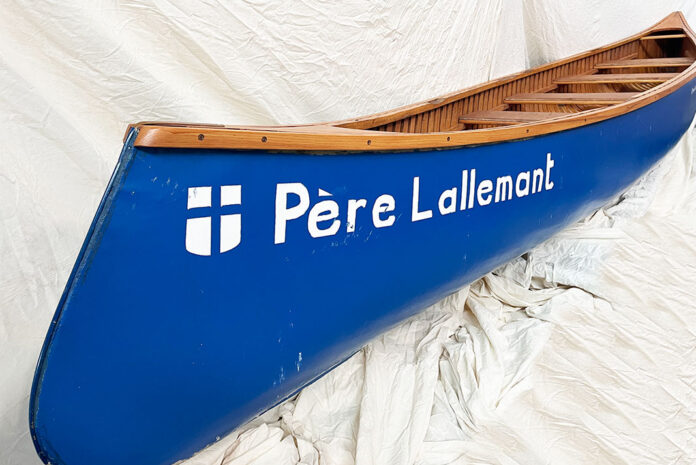
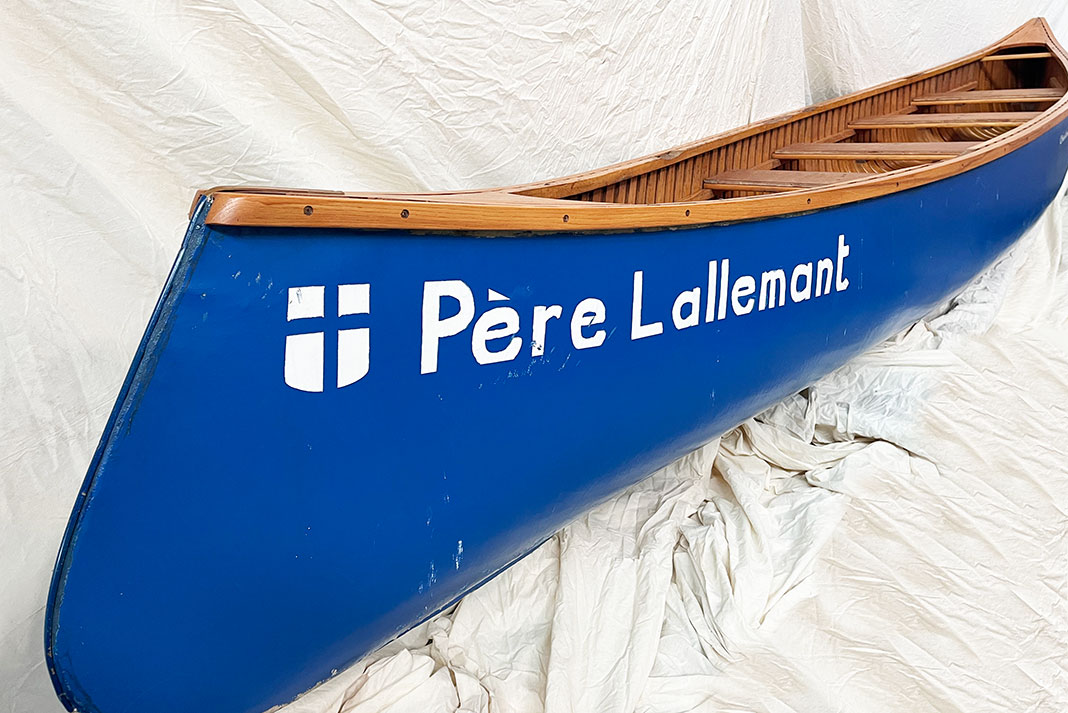
Lately, however, as we’ve been preparing exhibits for the new Canadian Canoe Museum that will be opening on Little Lake in Peterborough this fall, I’ve been reworking the story of a big blue Chestnut canoe I think changed the world of canoeing forever. Measuring the same length as Orellana, this canvas-covered canoe is called Père Lallemant and was one of the four vessels involved in the 1978 St. John’s School tragedy on Lake Temiskaming, in which 12 boys and one young master died on a high school canoe trip.
Without going into the details of the event (you can find those in a book called Deep Waters and a TVO film called Acceptable Risk?) suffice it to say a welter of canoeing instructors and certifying organizations all over the world took the lessons of the Temiskaming tragedy to heart and wrote them into standards of practice, certifying expectations and the general lore of how things should be done with youth—with any client group, really—in big canoes. The reason the Père Lallemant canoe is going to be the capstone experience in the exhibit zone of the new Canadian Canoe Museum called “Pushing the Limits” is that this vessel uniquely represents a sea change in thinking about big canoe practices and about canoe safety in general.
For better and for worse—we can never forget those lives that were so unnecessarily lost—this big blue canoe changed forever the world of canoeing. It’s just one of the reasons to make your way online to follow the developments as the new Canadian Canoe Museum takes shape or to stay tuned for details of the upcoming grand opening this fall.
James Raffan’s Tumblehome columnfirst appeared in the Spring 2006 issue of Canoeroots.
This article was first published in the 2023 Paddling Buyer’s Guide. Subscribe to Paddling Magazine’s print and digital editions, or browse the archives.
The famous canoe we wish no one knew about. | Feature photo: Courtesy The Canadian Canoe Museum
“All great men had simple beginnings.” —Lailah Gifty Akita. The same probably goes for paddlers, too. | Feature photo: Courtesy Madawaska Kanu Centre
Everyone has to start somewhere, including the pros who routinely take on world-class whitewater rapids. But with the benefit of hindsight, what lessons might they impart to their younger selves? We asked eight experts to share what they wish they’d learned in their first year kayaking. Listen up, whippersnappers! The answers might surprise you.
“I started paddling at a very young age of six, so there was a lot that wasn’t on my radar in the grand scheme of things. It is very cliché, but there is no way I would have known where kayaking would take me. That goes for the incredible destinations I’ve been, but also the lifelong friendships and relationships I’ve gained along the way.”
— Alec Voorhees
“All great men had simple beginnings.” —Lailah Gifty Akita. The same probably goes for paddlers, too. | Feature photo: Courtesy Madawaska Kanu Centre
“In my first year of paddling I wish I knew how to roll or even put on a sprayskirt. Hopefully this inspires people to not let a slower progression stop them from paddling. There are a few hurdles in learning to paddle, but it’s well worth it to put in the time and effort to master them even if it takes some patience.”
— Tyler Bradt
“Nothing. The learning process of any sport is super fun. Breaking down those walls and improving happens the quickest when you are first starting. Improving seems to slow down as you get better, unless you are more creative than I am. The community comes next. As you are improving and learning, you’re meeting more and more incredible paddlers who are all mostly incredible people. This was also a great surprise to me and something I’m glad came with time. I’m grateful for the process and amazed by the community. If I would have known more my first year of kayaking it might not have ended up so special.”
“It is really important to make a habit of doing hip and shoulder mobility routines from the very start. If I had done this, I likely would have avoided painful hip flexor issues that started my second year of boating that I still contend with 20 years later.”
“People tell you you can’t sleep your way to the top,
but I’ve seen it done. Also, wear earplugs.”
— Darby McAdams
“Train hard and study the sport. If you do whitewater, it is safer than you think.
That would have helped me because I was really scared of paddling.
But I started when I was nine.”
— Evan Garcia
“One thing I wish I had known earlier is how to scout rapids/waterfalls properly and evaluate the potential risks that come with running them. For me, realistic visualization is key—working backward from the worst to best possible outcome so you can set appropriate safety and be well prepared dropping into the stouts.”
“That it is better to go to a familiar run and make it difficult rather than stepping up to a harder river. It is a much better learning environment to push yourself on easier whitewater (catching all the eddies, surfing, boofing, etc.), basically making a class II or III run have class IV or V moves. That way when you step up to a harder river you are less physically and mentally challenged and much safer because you have built up your foundation.”
— Sage Donnelly
This article was first published in the 2023 Paddling Buyer’s Guide. Subscribe to Paddling Magazine’s print and digital editions, or browse the archives.
“All great men had simple beginnings.” —Lailah Gifty Akita. The same probably goes for paddlers, too. | Feature photo: Courtesy Madawaska Kanu Centre
Mario being expertly guided by Danny down Rapides Examination on day five of the trip. | Feature photo: Marissa Evans
The Dumoine is not the most remote river. Its rapids not known for being perilous, its scenery not unmatched, its history not pivotal. I felt a little foolish being so excited as our shuttle bumped down the old logging road to the put-in at kilometer 64. My thoughts flitting to friends who were boarding bushplanes bound for rivers of the North and the far reaches of Quebec. Those were adventures.
Still, I knew the Dumoine was a river capturing the hearts of both master and novice, prime minister and artist, summer camper and wilderness guide. Did it, in fact, qualify as adventure—despite its preestablished campsites, well-mapped rapids and general accessibility? And if not, what makes it so special?
Aventure or bust: Why a Dumoine River trip is worth taking
If discomfort is an ingredient in adventure, this trip was proving itself when it had barely begun. Cultural discomfort. I was the only non-Francophone in the group, and though our guide Guillaume made an effort to give me instructions in English, he admitted he didn’t know the English translation of certain whitewater strokes or terms I would later learn to mean cross-draw and hanging cross-draw. For now I would have to learn those in French. Since I was learning how to whitewater paddle basically from scratch, you’d think this wouldn’t matter much—but you try remembering the difference between appel débordé and appel débordé de stance when you’re in the middle of a set of rapids and approaching the dreaded pleurer.
Mario being expertly guided by Danny down Rapides Examination on day five of the trip. | Feature photo: Marissa Evans
The group at least made sure I got the joke about the word pleurer, which refers to a rock that has water cresting over it, making it very difficult to see and dangerous to hit—and also means “to cry.”
If excitement is another prerequisite for adventure, this too was present in abundance. Though we portaged around the infamous Canoe Eater—or, as my French trip mates called it in English, Canoe Swallower—Dom and Simon still managed to take a swim while we practiced grabbing the contre-courant at the bottom. And when descending Rapide Sleeper, all five of our canoes filled to the gunwales with water, forcing us to submarine to shore to dump them out.
Running “Rapides Big Steel”
If success is necessary, if only to distinguish adventure from misadventure, we cleared that standard on day four on Rapides Big Steel, the biggest and most technical rapid we’d attempted yet. With Guillaume in the stern, I hadn’t felt very nervous for any of the rapids so far, but I had to remind myself to take deep breaths as we led the charge. I hoped Guillaume could tell where we needed to enter the rapid because the place that had seemed easily discernible from downstream as we scouted was unidentifiable to me now.
Once we were in, the water immediately pushed us toward a pleurer, as Guillaume had told us it would. I heard him yell, “Fort! Fort!” and I knew it must be serious as up until this point he’d always yelled, “Hard! Hard!” when he needed me to paddle hard. We both dug in, shot past the pleurer, were rocked over a few more waves that sent water crashing over the bow and then swung around to make sure everyone else made it through. We’d avoided misadventure, some of us with more water in our boats than others—from the river or les pleurs I’m not sure.
If adventure is a feeling, we felt it most as we rounded the corner to Bald Eagle Cliff on the second-last day of our trip, the river narrowing and the trees seeming to get taller and the hills larger. We were less than 15 kilometers from civilization now, but we seemed all the more remote in both distance and time. The slap of a beaver’s tail only confirmed this suspicion, echoing back to both the fur traders who used to travel the Dumoine and the Algonquin bands who used to live here and believed the river was carved out by a great beaver being chased by the Trickster.
[ Paddling Buyer’s Guide: View all whitewater canoes ]
Adventure comes in many sizes
If adventure must be extreme, though, so as to only be undertaken by the most experienced in the sport, I couldn’t see how our trip down the Dumoine qualified. As we headed down the last stretch of river toward the Ottawa, I wondered aloud to Guillaume whether modern adventure authors we had both read were right, that true adventure is only big, harrowing and risky. Guillaume paused and then wondered back: how many people had this sentiment kept from getting out there, because they thought it wasn’t worth doing if it couldn’t be big?
“If sleeping in the woods one night is an adventure to someone, I hope they go out and do it and not feel it is too small to be considered an adventure,” he said. This from a man who cross-country skied 600 kilometers from Rouyn to Montreal in minus 35-degree-Celsius weather and spent 55 days on board a sailboat living in colonial conditions as it crossed the Atlantic.
This was the sheen of the Dumoine, I realized. Meeting paddlers where they are at and offering trips that are still remote, still challenging, still steeped in history. Still adventure.
[ Plan your next Quebec river trip with the Paddling Trip Guide ]
Digital editor Marissa Evans is filling in for Kaydi Pyette as editor of Paddling Magazine. This is her first issue.
This article was first published in the 2023 Paddling Buyer’s Guide. Subscribe to Paddling Magazine’s print and digital editions, or browse the archives.
Mario being expertly guided by Danny down Rapides Examination on day five of the trip. | Feature photo: Marissa Evans
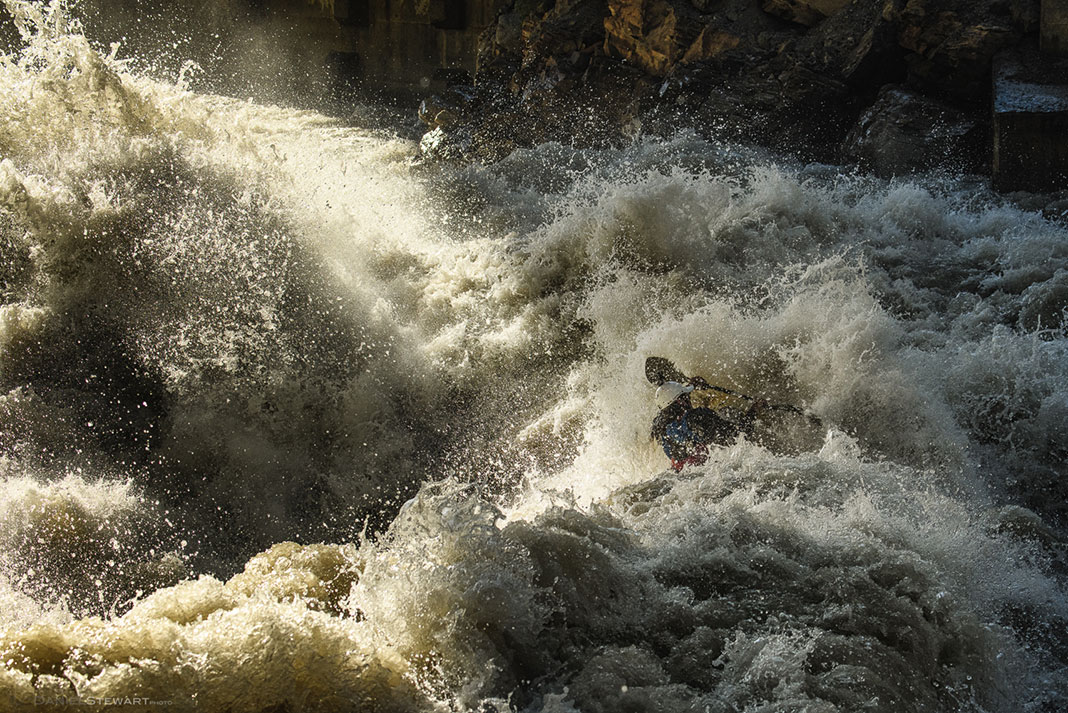
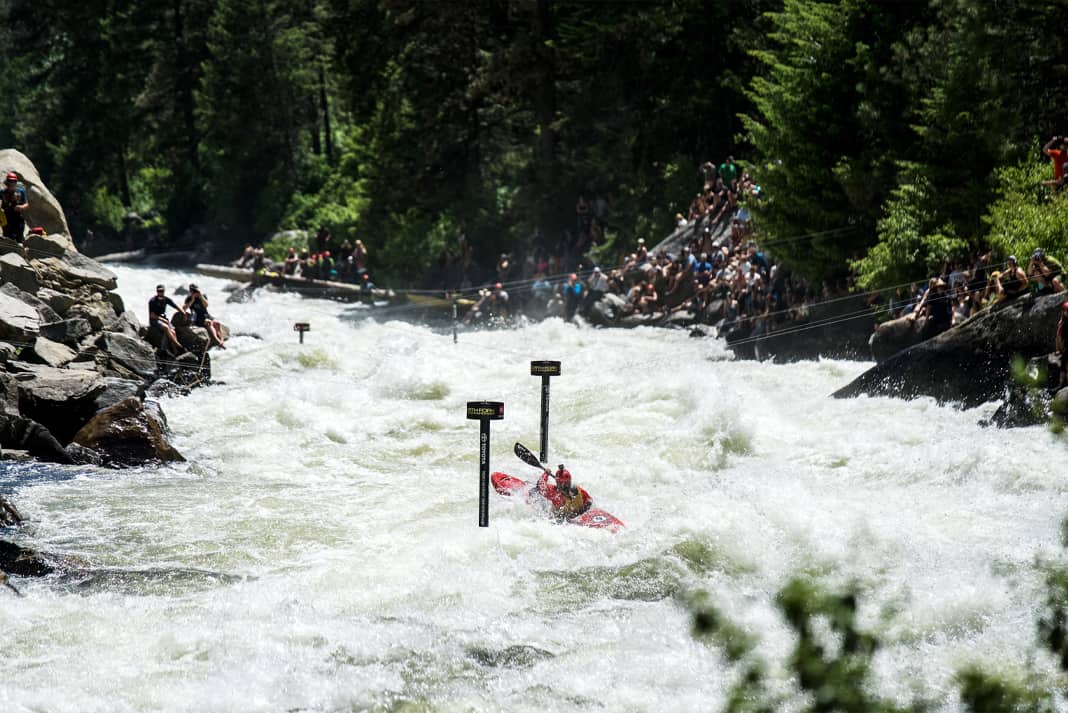
Hayden Voorhees taking on Jacob’s Ladder. | Feature photo: Daniel Stewart
They say winners are made, not born. To earn the winning title at a North Fork Championship—a notoriously rowdy whitewater race on one of the world’s most challenging sections of river—you must be made from something pretty darn special. Whatever the secret sauce may be, 23-year-old Hayden Voorhees from Meridian, Idaho is clearly sipping on it.
The making of the last North Fork champion
The fresh-faced athlete took the win at last year’s Men’s Elite Race final on the Jacob’s Ladder rapid, paddling smoother and faster than all 29 fierce competitors from around the world. Voorhees even pinched the crown from field-favorite and reigning champion, Dane Jackson.
So, how did Hayden pull it off?
For a start, it doesn’t hurt that Idaho’s Payette River, the staging ground of the North Fork Championship, is Hayden’s home river. “It is such a special place for our family, the foundation of our kayaking skills, and our favorite river,” Hayden says. All five members of the Voorhees family are fully immersed in the whitewater scene, including Hayden’s older brother Alec who often competes against him.
Hayden Voorhees taking on Jacob’s Ladder. | Feature photo: Daniel Stewart
Playing on the Payette River
Navigated in part for the first time in 1975 by Idaho kayakers Roger Hazelwood, Tom Murphy and Keith Taylor, the tumultuous rapids of the North Fork of the Payette have since become a rite of passage for any class V boater. The Payette is also the perfect playground for skill progression, thanks to its many sections—namely, the North Fork, South Fork and Middle Fork—which offer varying degrees of difficulty to paddlers. The river certainly fostered the progression of Hayden’s skills, allowing him to gain his first sponsorship at age 10.
More recently, Hayden’s connection to the Payette was further strengthened. The original North Fork Championship organizers, Regan and James Byrd, retired from their roles just before the Pandemic struck. The event needed saving, and the Voorhees family wasn’t ready to lose it. They organized the race for two years, during which time the event grew in popularity.
Unfortunately, the Voorhees family announced the cancelation of the North Fork Championship in January 2023, citing various obstacles from logistical challenges to changes in insurance coverage.
Voorhees’ recipe for success
Beyond paddling infinite laps on the river growing up and organizing the event itself, Hayden has ample experience racing on the Payette—another factor that surely gave him the competitive edge for his 2022 win. He and his brother have been top contenders at the North Fork Championship for a number of years, Hayden having raced every year since 2017 and Alec since 2014.
Alec puts the recipe for success down to “being as consistent as possible during practice,” but notes it can be extremely difficult to nail all the gates during the actual event.
[ Browse the widest selection of boats and gear in the Paddling Buyer’s Guide ]
“Jacob’s Ladder is already such a demanding, pushy rapid on its own, and putting incredibly challenging gates in makes it so tough. Usually there is one gate per year where half the field gets a miss penalty,” he says.
As much as we can try to deduce the winning formula, it seems the true beauty of the North Fork Championship was that it was anyone’s game.
This article was first published in the 2023 Paddling Buyer’s Guide. Subscribe to Paddling Magazine’s print and digital editions, or browse the archives.
Hayden Voorhees taking on Jacob’s Ladder. | Feature photo: Daniel Stewart


 This article was first published in the 2023 Paddling Trip Guide.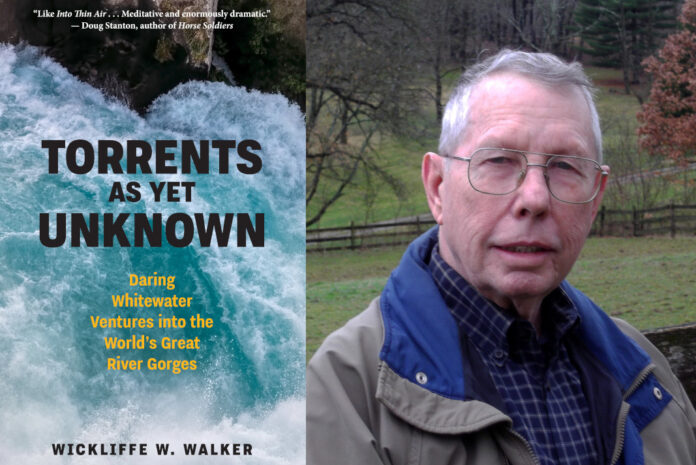
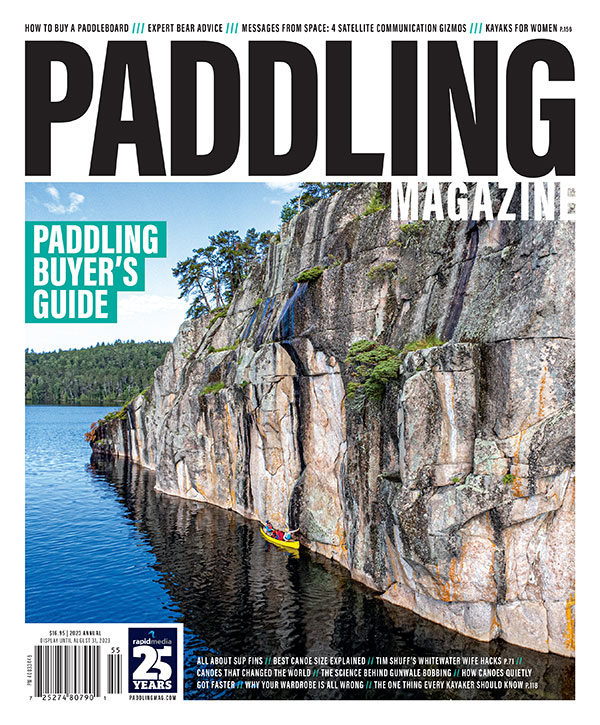 This article was first published in the 2023 Paddling Buyer’s Guide.