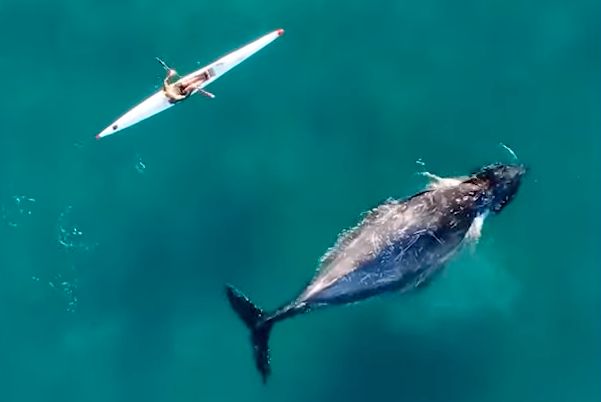
Joachim Larssen was paddling in the harbor of Hammerfest in Norway in 2019 when he encountered an inquisitive beluga whale. After a few moments, the beluga whale stole Larssen’s GoPro camera, which fell to the bottom of the harbor. The beluga retrieved it and returned it to Larssen.
A Spy Whale Compromised
There is much more to the story than a quirky encounter captured on camera though. When the whale first arrived in the harbor, he was wearing what appeared to be a strap for a camera mount with the words “Equipment St. Petersburg.” With this telling apparel, and his comfortable behavior around humans, many believe the beluga may be a Russian-trained spy whale. The beluga was dubbed with a playful name fitting of the theory, blending the Norwegian word for whale and the name of the Russian president to form, Hvaldimir.
Hvaldi, as he is also affectionately referred to, spent some time in the harbor following his arrival to the bemusement of locals before moving along. He has traveled the Norwegian coast in the years since the GoPro encounter. And as recently as May 2023, Hvaldimir resurfaced in the waters of Sweden.
Whale conservationists believe Hvaldimir is at risk. His comfort around humans has led to injuries from boat propellers and fish hooks. He has a knack for picking up intriguing foreign items with his mouth. And in Sweden, it’s said the fish stocks are lower than in Norway, and they worry whether the whale has an adequate diet.
“He is a friendly, tamed, displaced, formerly captive whale who relies on humans for social interaction,” OneWhale, a nonprofit established to protect Hvaldimir, told NPR. “Belugas are highly social whales and he has been living all alone the past four years.”
[ Touring kayaks for your next whale-watching excursion ]
For now, Hvladimir continues to roam the seas, but for his welfare, OneWhale has a long-term vision to create a 500-acre marine reserve in northern Norway where Hvladmir can be rehabilitated. The hope is that the reserve will carry them to the goal of releasing the former spy whale into a population of wild belugas, free of his life of espionage and sea kayakers’ rough POV edits.
The latest technology means you get to choose how much you stay in touch with the outside (or, in this case, inside) world. | Feature photo: Mike Hewis
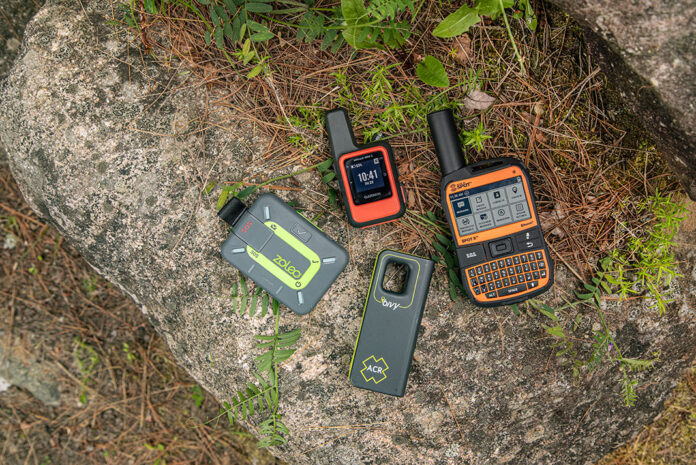
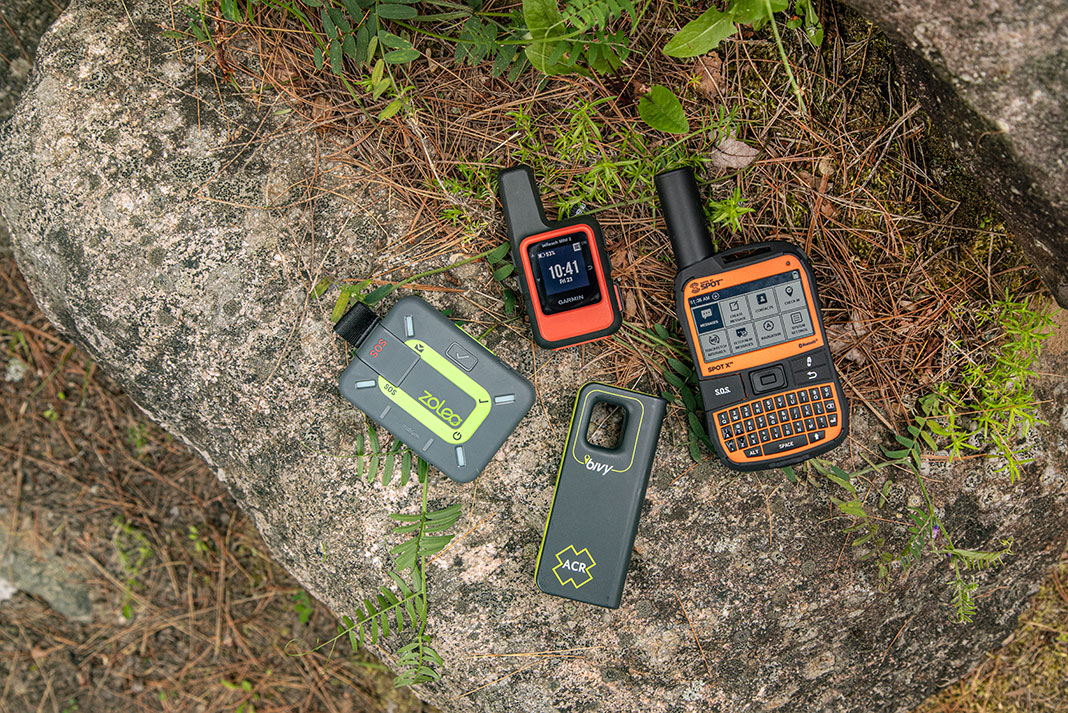
Backcountry travel used to mean you were unreachable for long stretches, unless you happened to carry a bulky, brick-shaped satellite phone along for the ride. But the selection of satellite communication devices has grown by leaps and bounds in recent years, with the latest generation of gizmos offering all the bells and whistles of smartphone-enabled apps. Is it time to upgrade your ability to send messages from space? Stay in range and in touch with our selections for the best two-way satellite communicators for paddlers.
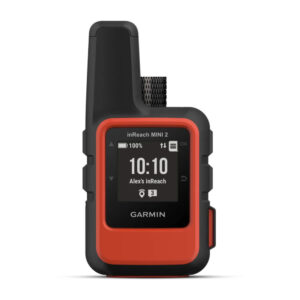
Updated in 2022, the inReach Mini 2 remains a favorite for those looking for robust mapping capabilities, two-way messaging, SOS and weather reports in a compact package. If you go on extended paddling trips, it’s worth upgrading from the Mini to the Mini 2 to benefit from the longer battery life—now lasting for 14 days in the 10-minute tracking mode compared to 90 hours previously—as well as the ability to add more waypoints, courses and activities.
When compared to the competition, the Mini 2 gets bonus points for being a fully standalone device, offering all the same features whether it’s connected to your phone or not. Without a keyboard, writing a custom message on the device can be tedious, but this is less of an issue if you plan to mainly use the three check-in messages and the 20 Quick Text messages for communication—or if you plan to primarily use the device with your phone. Connecting the device to the Explore app on your phone will allow you to take full of advantage of the extensive mapping features, including marking and navigating to waypoints, tracking your progress, backtracking to your starting point, and following preprogrammed routes. And since Garmin uses the powerful Iridium satellite network, the Mini will keep you connected anywhere on Earth.
One drawback—or advantage, depending how you look at it—to the inReach Mini 2 is that your contacts cannot initiate text message conversations with you, they can only reply to messages you’ve sent them. You should also keep in mind the activation fee and monthly and annual tiered plans when pricing out the device.
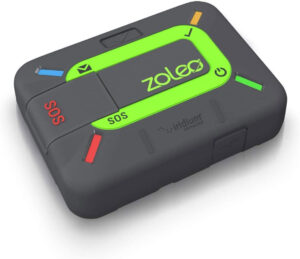
The ZOLEO lets you keep things sweet and simple, offering two-way messaging, SOS and weather reports on even its most basic plan. An optional add-on will give you access to location sharing and tracking capabilities. With no screen on the device, the ZOLEO is meant to be used with your cell phone; we found the ZOLEO app to be the simplest and most intuitive to use out of all the devices.
In the event your phone is out of commission, there are buttons on the device for sending a predefined check-in message and SOS alert. You’ll also get a designated phone number and email address, making it easy for contacts to initiate conversations with you.
One standout feature is that the ZOLEO will attempt to send all messages over Wi-Fi or cellular network first—a boon if you are on one of the lower tier plans with limited messaging. If you are out of range, though, the Iridium satellite network will provide you coverage. An activation fee for the device does apply. You can also suspend your plan when not in use and retain your number and email address for a fee of $4 per month.
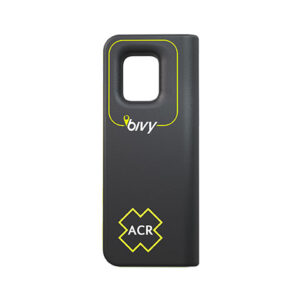
ACR is the newest company delving into the two-way satellite communication market. The Bivy Stick is best used when paired with your cell phone, though you can use it as a standalone device to signal SOS, send a preset check-in message and start/stop tracking. All plans come with tracking and you’ll receive a dedicated phone number and email for the device. The Bivy Stick also searches for Wi-Fi or a cell signal before sending via the Iridium satellite network.
Those who love collecting and analyzing their activity data will appreciate the unique features of the Bivy Stick: the ability to label tracked adventures with an activity type and access stats including time, distance, vertical, calories burned, average speed and top speed. You can also search for hiking, paddling, climbing and offroading routes in a given area, making it easy to plan your next adventure.
A deciding factor for those who only need a satellite communicator for a small window of time each year—like, the paddling season—is that the Bivy Stick has no activation or deactivation fees and credits roll over month to month.
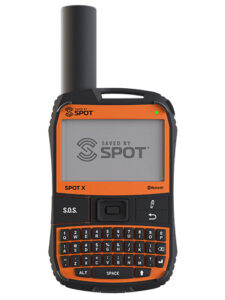
This isn’t the SPOT X you thought you knew. This SPOT X comes with Bluetooth capabilities allowing you to link up to your phone. It’s still a fully standalone device, though, and for many, the SPOT X gets the edge over the competition thanks to its handy QWERTY keyboard that makes writing custom messages that much easier—the tradeoff being that this is the heaviest and largest device on this list. You also get one check-in message and 14 preset messages, all of which you predefine. For some, the lack of weather reports is a deal-breaker.
SPOT is the only device on this list that uses the Globalstar satellite network, providing ample coverage for paddling destinationsin North America, South America and Australia. Check the coverage map for full service details. With the SPOT X you’ll get a dedicated phone number and all plans have tracking included. There is an activation fee and an additional charge if you choose one of the flex plans which only require a one-month subscription.
The latest technology means you get to choose how much you stay in touch with the outside (or, in this case, inside) world. | Feature photo: Mike Hewis
And don’t forget to safeguard your device with a waterproof pouch.
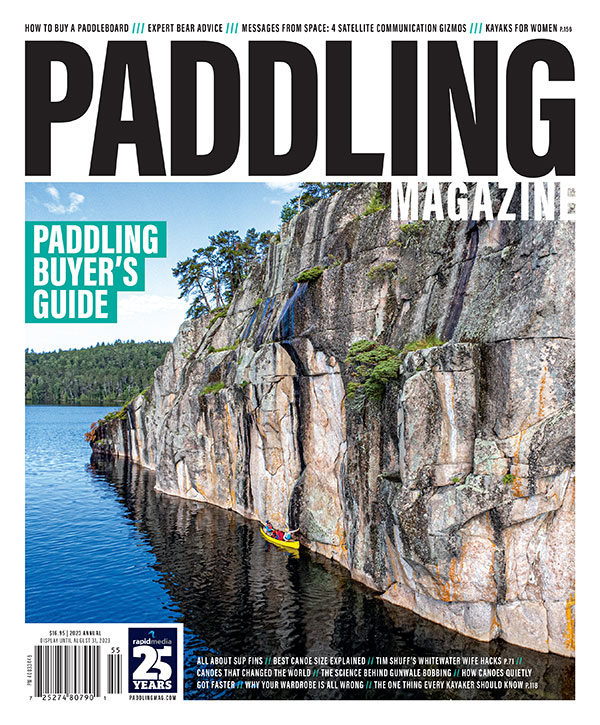
This article was first published in the 2023 Paddling Buyer’s Guide. Subscribe to Paddling Magazine’s print and digital editions, or browse the archives.
The latest technology means you get to choose how much you stay in touch with the outside (or, in this case, inside) world. | Feature photo: Mike Hewis
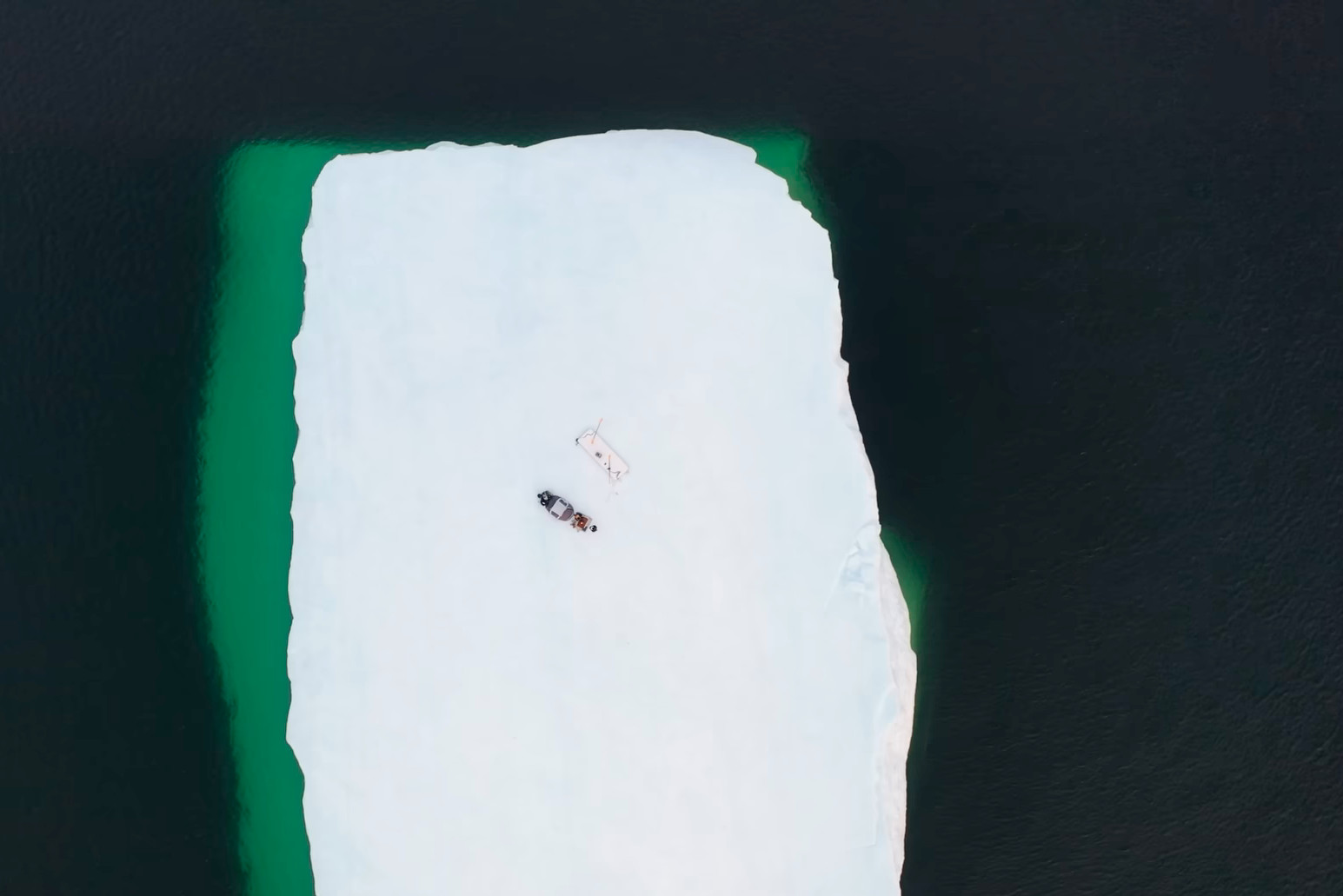
Two paddlers have drawn recent media attention for their choice of an unusual campsite—an iceberg. Ethan Harold and Ammar Alkassm of New York State took an inflatable raft just off the coast of Twillingate in Newfoundland to set up for the night on one of the area’s floating strips of frozen water.
The duo set out on the stunt in June to film what would be the first episode for their YouTube channel, Orange Carabiner. The video was published in July. Spoiler, Harold and Alkassm returned safely from the iceberg camping trip. But since they embarked on the campout, their stunt has continued to draw attention.
As news stories populated on Harold and Alkassm’s iceberg camping trip, two predictable sides appeared from the local communities and comment sections across the web. Those who called the act foolhardy and selfish claimed the pair were ignorant of the dangers of icebergs and were putting the lives of local first responders at risk. Others expressed that people should let the pair live their lives and not put guardrails on the endeavors of individuals. The episode has renewed perennial conversations in the outdoors, including who should be responsible for the cost of rescue.
The Dangers Of Camping On An Iceberg
For those unfamiliar with what makes camping on an iceberg so controversial, here’s a bit of information on these peaceful looking hunks of ice drifting in the ocean. They come into the world violently, calving off the edges of glaciers. An iceberg in its infantile stage is erratic in shape and weight distribution, making it prone to rolling.
Even a well-established iceberg that appears stable can be melting below the surface. Many of us are familiar with the idea that most of an iceberg’s mass is beneath the water. When this is no longer the case, the iceberg becomes top-heavy and can roll.
Last but not least is the splintering of an iceberg. The action has been reported to be capable of emitting a roar equivalent to the sound of 214 supertankers. In their video, Harold and Alkassm even remark how they heard the boom of calving ice nearby through the night and how it sounded as if Newfoundland was being bombed.
According to studies, a rolling iceberg can produce the force of a magnitude five earthquake. Bearing all this in mind, the concerns are understandable.
The Gray Line Between Calculated Adventure And Foolhardy Stunt
We see all sorts of athletes take what can be called selfish risks. Many extreme stunts are questioned and receive criticism from the public, so it begs the question if Orange Carabiner’s act is any different.
In a follow-up CBC article on Orange Carabiner’s camping trip, the news outlet interviewed Canadian climber Will Gadd. Gadd has ascended a frozen Niagara Falls, bolted his way up glaciers on Mount Kilimanjaro, and, yes, ice-climbed ‘bergs in Newfoundland and Greenland. Gadd’s athletic stunts have appeared in the pages of National Geographic.
In the article, Gadd clearly states what the dangers of icebergs are. On the climbs, he has had a support dinghy nearby. Those involved were also wearing drysuits and survival suits the entire time.
After watching Orange Carabiner’s YouTube video, Gadd told CBC, “Camping on an iceberg is, bluntly, stupid.” And adds, “They were remarkably clueless.”
Harold went on to state, “We spent a couple of months planning equipment, where we want to go, what to expect, what our criteria is for what we want to mount, are we going to be close to land, what’s the current like, what’s the wind speed, the water. We tried to take every possible factor into account but we also acknowledge, yes, it’s not an extremely safe thing to do.”
Harold claims the locals they encountered on their trip were nothing but supportive and even gave them advice. Alkassm explained they spent a couple days picking a suitable iceberg, eventually choosing one close to shore, in shallow water and that wasn’t drifting.
The Orange Carabiner duo began the trip with a rented tandem sit-on-top kayak which developed a crack. This left them to make the paddle to the iceberg on a Bestway Sun Deck, an inflatable floating deck described as a pool or lake accessory. It is constructed of triple laminated drop stitch PVC, similar to many inflatable standup paddleboards. On the paddle to the iceberg, Alkassm is wearing a neoprene top with board shorts. They establish in the video that water temperatures were 38 degrees Fahrenheit. On the iceberg, Harold is also seen not wearing any microspikes or crampons, walking on the ice at camp.
Within all the chatter surrounding the Orange Carabiner video, the pair are the first to acknowledge what they did was dangerous. But they are also concise to say that was part of the appeal.
“A lot of things in life are dangerous that we encourage. For example, UFC, boxing. People that climb Everest—you lose a lot of people a year—but they do it because they’re pursuing something they truly love,” Harold told CBC.
Gadd’s comments echo that the risks of an activity to an individual itself are not necessarily the deterrent if known and accepted. Nor are the financial burden of a rescue which he says pales in comparison to lifestyle associated health risks society combats daily. There is another factor, though, that Gadd considers as a veteran adventure athlete when making these types of decisions.
“One of the biggest concerns for me personally is trying to minimize the amount of risk I would put a rescuer in,” Gadd told CBC.
The pair from Orange Carabiner do not encourage anyone else to follow in their footsteps. But, in today’s viral world, we are well aware of how quickly a social media trend can take off unwittingly with the force of, say, a rolling mass of ice. Whether their stunt falls in the column of endeavors capturing the limitless human spirit or the likes of taking a selfie with a bison is a question unlikely to reach a unanimous answer.
After 268 days in his kayak, 1,643 hours of paddling and a journey of almost 11,000 kilometers, 65-year-old Mark Fuhrmann has today completed his epic Reverse the Bad charity expedition across Canada and the United States.
In doing so, he becomes the first person to solo kayak the Greater Loop circuit, beginning (and ending) in Halifax, Nova Scotia and traversing the Great Lakes, the Illinois, the Mississippi, the Tennessee and Tombigbee rivers, before hitting the Gulf of Mexico and heading up the Atlantic Coast.
Photo: Courtesy of Reverse the Bad
Paddling for positivity
A smiling, but understandably exhausted, Fuhrmann, stepped out of his kayak—possibly for the last time—greeting well-wishers with the memorable line, “Can I get a beer, please?” As it transpired, he got more than one.
The Canadian native, who relocated to Oslo, Norway in the 1990s, set out from Halifax on June 2 last year. His aim, apart from traveling across North America, was raising much-needed funds for charities Doctors Without Borders and Captains Without Borders, as well as pushing a message of “positivity, community and caring for our troubled times.”
Photo: Courtesy of Reverse the Bad
Deep connections
“It’s been a hell of a trip,” he exclaims, “but worth every minute of exertion, discomfort and pain. Not only to raise money and awareness, but also to have such a genuine experience; one where I feel I’ve really connected with nature, people and something deep within myself. Looking back, I’m truly grateful for every day, in addition to the immense, and touching, generosity of an army of supporters en route.
“But that doesn’t mean I’m planning another trip anytime soon!”
Photo: Courtesy of Reverse the Bad
Extreme endurance
Fuhrmann, who also completed a charity kayak from Oslo to Athens, Greece in 2017, says the last leg of the journey was arguably the toughest of all. He had to navigate through 23 days of continuous fog, tackle extreme tides and currents—particularly in the Bay of Fundy—and struggled to find anywhere to pitch his tent on the rocky, treacherous coastline.
“Some evenings I had to drag my kayak up three or four metres of rock inclines, while others I was lucky enough to sleep on moored lobster vessels. There were some challenging waves too, as well as a lot of ferries and fishing boats to avoid. It’s been incredibly draining… and I’m looking forward to a good night’s sleep, in an actual bed.”
He’s also eager to see his family, including his young grandchildren, and friends face to face, and may throw a small party when he’s back in Norway.
“I think we have to celebrate the fact I survived,” he says with a big grin, adding, “I hope the folks back home feel the same way too.”
Vital support
Mark chose the Reverse the Bad charities as his late wife was a doctor, while the company he ran before retirement—Blue-C—is a specialist maritime PR and communications firm. Captains Without Borders focuses on providing education scholarships and assistance to individuals from disadvantaged backgrounds looking to forge careers at sea.
There’s still time to donate to the charities through the Reverse the Bad website and help out these incredibly worthy causes. Please seewww.mark-ervin.com
I’ve canoed over 20,000 kilometers across North America, both in my native country Canada and in the U.S. Recently I made my first long-distance paddling adventure over in Europe, with a successful traverse of France.
When people ask me what my favorite pieces of canoe camping equipment are, they often expect me to name a boat model, a well-crafted paddle or some indispensable technical wear. It tends to surprise them when I mention my favorite canoe equipment for months-long expeditions are, in fact, a few simpler luxuries.
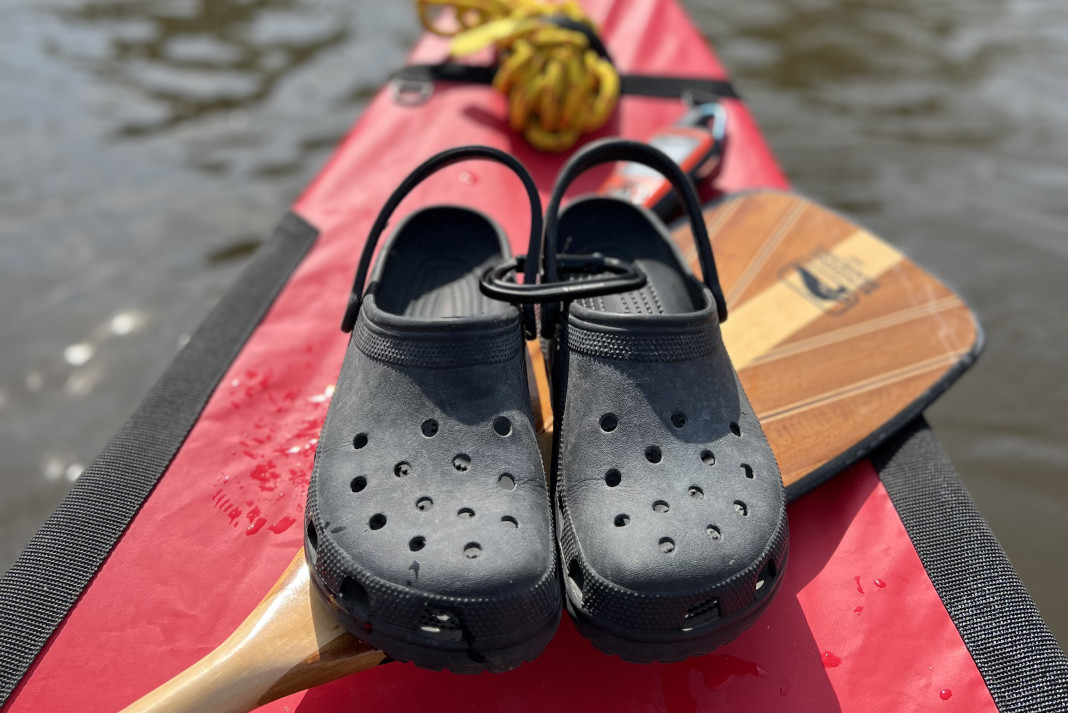
Crocs sandals are hideous, awkward and ugly, but they’re amazingly comfortable, even when wet. Also, they offer excellent toe protection. They’re indestructible, versatile, dry quickly, hang easily with a carabiner and are perfect for slipping on when leaving the tent. However, be sure to shake them before putting them on to avoid stepping on a hairy spider or a large, slimy slug.
After spending the day in my neoprene socks and water shoes, my feet are impregnated with a strong, disgusting smell. Crocs are antibacterial and odor-resistant. So even if I use them for several hours with stinking feet, they don’t really absorb odors. What’s more, they are very easy to clean.
The cult of Crocs is real, but we will always find people who hate them. Life is better in Crocs. It’s a fact we don’t need science to prove.
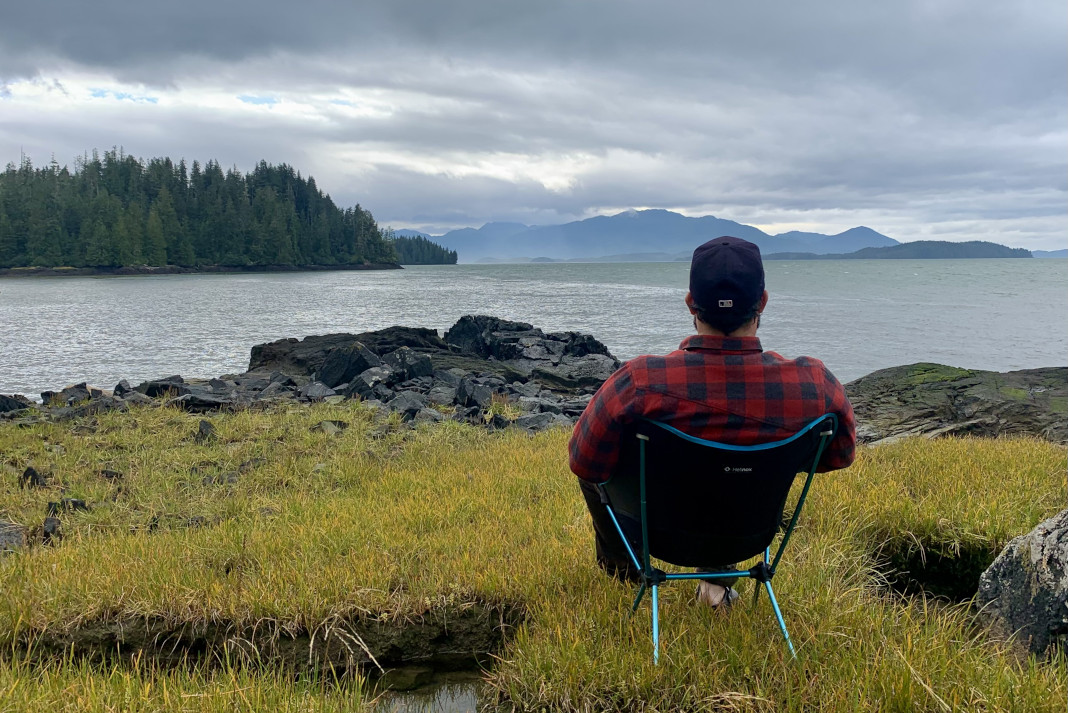
When I was younger, I was often laughed at for bringing a chair along on my canoe camping adventures. My ego could take it, but I was shaken nonetheless. Then, as I grew older, I began to fully embrace myself. My Helinox Chair One accompanies me wherever I go. It’s compact, solid, light and so comfortable.
Comfort makes all the difference when I’m out in nature for days or weeks at a time. The same friends who used to make fun of me are the same ones who now offer me chocolate or candy to borrow my chair for an evening around the fire. The campfire is where we gather in the morning or after a long day on the water. It’s a happy place to drink an early morning hot coffee or a whisky at night. Those special moments always feel better when sitting in a chair.
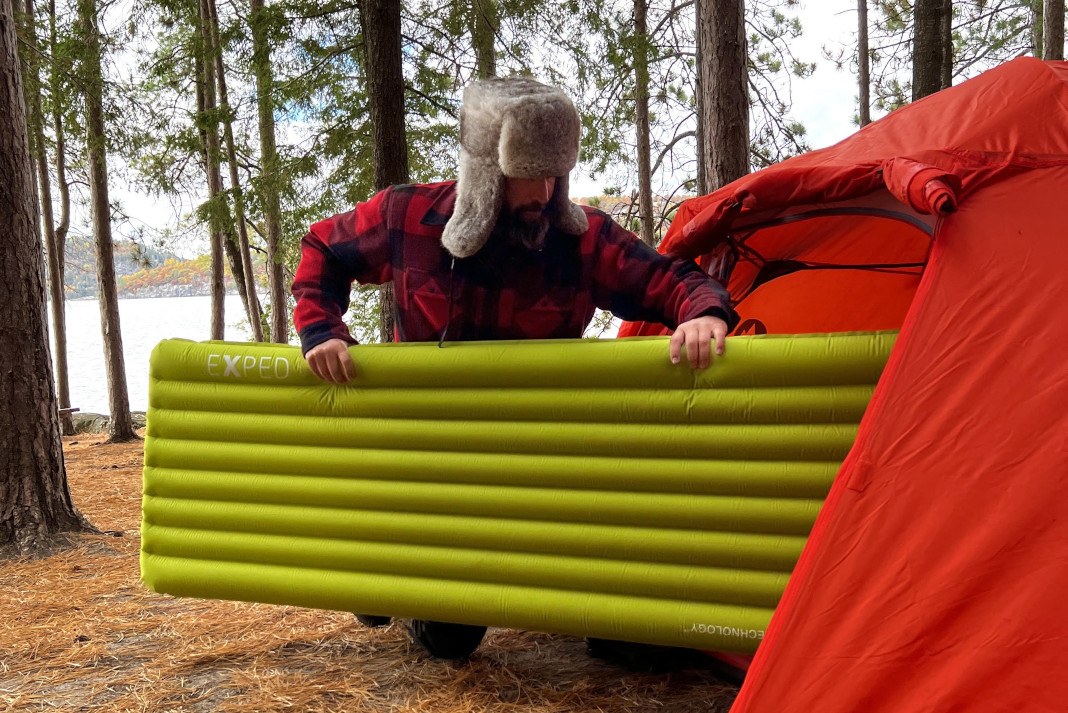
Exped’s Ultra 5R sleeping pad is exceptional and of the highest quality. The long, wide, seven-centimeter-thick model offers unrivaled comfort and, above all, makes me forget my backache for a good night’s sleep. The thick sleeping pad helps prevent my sleeping bag from getting wet when the tent floor is damp.
I’m always taking good care of my gear. I’ve been using Exped sleeping mats for eight years and haven’t broken any of them. However, even if it’s sturdy, I wouldn’t make love on it because, you know, there’s a limit to how far you can go. It’s expensive, but I’ve never missed my bed thanks to it. Sleep is invaluable to me during expeditions, so it’s well worth the investment, in my opinion.
Photo Courtesy of Emily Nuchols, Under Solen Media // NRS
Moscow, Idaho and Boulder, Colorado — Northwest River Supplies (NRS), the world’s leading supplier of equipment and apparel for water recreation, safety and rescue, is excited to announce the launch of PaddleWays, the first-ever navigation app built specifically for paddlers. Joining forces with onWater, the most innovative water recreation GPS navigation and mapping app, NRS is excited to serve paddlers with new tools and technology to help improve experiences on the water.
“While other adventure sports have long benefitted from widely used mobile technologies, paddlesports has been left behind, until now,” says NRS chief marketing officer, Mark Deming. “Our vision for PaddleWays is to continue breaking down barriers to the outdoors, delivering the tools that help all paddlers access the information they need to get out on the water.”
Photo: Courtesy of NRS
Known for their fishing app, onWater provides detailed information on thousands of miles of rivers, creeks and shorelines across the United States. Satellite imagery provides GPS-specific points of interest and public versus private property boundaries along river corridors. Using a mobile device, users can track their current location and movement or calculate distances, in river miles, to any point of interest including access points, boat ramps, campgrounds, river hazards, rapids and more.
A fully integrated photo and journal feature also allows users to use GPS-specific data to record and relive their adventures. PaddleWays harnesses this powerful technology to deliver an all-in-one tool for discovering, planning and navigating experiences on the water.
“It’s about time we brought these tools to the paddling community,” says Alex Maier, onWater chief marketing officer. “We’re proud of our deep bank of data and mapping that gives paddlers all the beta they need—right at their fingertips. And because we’re constantly adding rivers and updating information, the community plays an active role in building this experience as we go.”
Photo: Courtesy of NRS
The PaddleWays app will serve as a guidebook and GPS navigation technology, with offline capabilities, to help paddlers make informed decisions on and off the water. Additionally, in cooperation with American Whitewater, a river conservation organization, the team aims to utilize the app to promote responsible use and to protect rivers and streams across the country. NRS is donating one percent of its PaddleWays app sales to American Whitewater.
“American Whitewater has been committed to providing easy access to river information in pursuit of creating a safer river going experience for almost 70 years, and we’re excited to partner with NRS and the PaddleWays app to offer new and exciting tools to better inform river runners,” says Evan Stafford, American Whitewater communications director. “We hope PaddleWays app users will take seriously the river safety and responsibility code we’ve helped to include with its purchase, and that as river users we can all work together to help protect, restore and maintain access to our rivers.”
About NRS
100 percent employee-owned, NRS is the world’s leading supplier of equipment and apparel for water recreation, safety and rescue. Founded in 1972 with a vision to create a better kind of company, NRS is dedicated to promoting the health and well-being of its customers, employees and community. For more information on NRS, visit nrs.com, email the company at service@nrs.com or call 877.677.4327.
About onWater
As an outdoor recreation technology and data provider, onWater is revolutionizing the way water enthusiasts discover, plan, track and experience their best days on the water. The onWater platform has been designed to help distribute recreation, increase safety on the water, and bring awareness to critical conservation, access and stewardship topics across the nation. To learn more about onWater, subscribe and download by visiting onwaterapp.com, email the company at team@onwaterapp.com or call 720.316.4257.
About American Whitewater
American Whitewater is a national non-profit 501c(3) river conservation organization founded in 1954 with approximately 7,000 members and 85 local-based affiliate clubs, representing whitewater enthusiasts across the nation. American Whitewater’s mission is to protect and restore America’s whitewater rivers and to enhance opportunities to enjoy them safely. The organization is the primary advocate for the preservation and protection of whitewater rivers throughout the United States, and connects the interests of human-powered recreational river users with ecological and science-based data to achieve the goals within its mission. Learn more at americanwhitewater.org.
It’s argued the greatest section of whitewater in California is up in the headwaters of the North Fork of the Mokelumne River in the Sierras. A section of river aptly called Fantasy Falls, where clear mountain water twists down long stretches of pink granite. It’s a reach on the dream list for any whitewater kayaker looking for the most rowdy, remote, high-quality rivers in the world. The trouble is catching during the California snowmelt season.
Nouria Newman has been getting after the goods in the U.S. this year, including one of the best California seasons in recent memory. What better way to cap it off, than with this run down Fantasy Falls.
The Cuyahoga River stands as one of the great comeback stories in the United States. The industrial river in Cleveland, Ohio became a symbol of the environmental movement and the push for the Clean Water Act. In 1969, images of the river catching fire gained widespread media attention. The Cuyahoga has improved significantly in the 50 years since the Clean Water Act. So much so that today it is a celebrated place of recreation in Cleveland.
On July 21-22, 2023 local organization Share the River, hosted the fifth annual Blazing Paddles Paddlefest. The event included races on the Cuyahoga as well as a recreational float. According to this video published by Cleveland.com, this year’s Blazing Paddles festival drew 715 paddlers on the waters of downtown Cleveland. It’s believed to be the most on the water at once in Cleveland’s history.
I blew out my flip flop; Stepped on a pop top; Cut my heel, had to cruise on back home. | Feature photo: Garrett Fache
It didn’t make any senseto my father. He was a pragmatic man. I’m a truck driver’s son. After a 50-hour week behind the wheel of an 18-wheeler, I’d jump in my pickup hell-bent for the Ottawa River where I’d make a measly $65 per day. Once you’d accounted for blowing up rafts in the mornings and cooking and serving guests steak dinners in the evenings, raft guiding worked out to be about $6 per hour, at best. He’d shake his head, baffled at why I’d work below minimum wage, barely covering my gas back and forth.
Who else could make more money elsewhere? You. And probably everyone else reading this. Paddlesports is full of talented and highly driven people who could be more financially successful doing their same jobs in virtually any other industry.
Author and speaker Simon Sinek says, in an organization money is like fuel.
“Cars need fuel, but the purpose of the car is not to buy more fuel.” Business is the same, Sinek says. “The purpose of business is not to make money, it’s to advance a greater purpose or cause.” Money is the fuel for greater purpose.
These little piggies didn’t go to market or stay home. | Feature photo: Garrett Fache
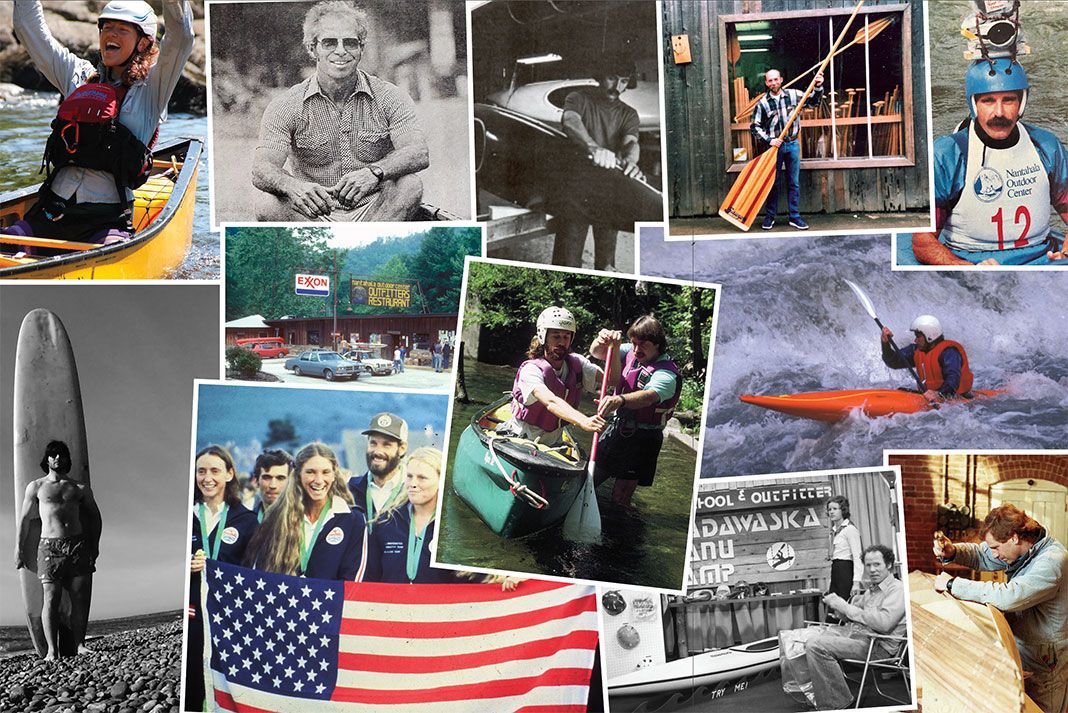
At the time, my greater purpose was the guide lifestyle. Tim Niemier dreamed of a kayak he could punch through ocean surf. Frank Goodman created the Valley Nordkapp so he could do bigger trips, like paddling around Cape Horn. The Nantahala Outdoor Center began with three friends gambling on a gas station and motel to create a center for paddling outdoor pursuits. Outfitting businesses grew out of schemes to fund personal exploits to remote northern rivers. Tom Derrer built kayaks for himself and friends; he liked it so much he built a few more. Not exactly world peace, but so far from the purpose of making money it’s a wonder we are all still here. In fact, I think it’s probably the reason we are all still here.
When I speak to classes of outdoor education and business students, they always ask me for the secret to success as an entrepreneur. I ask them to guess at the most motivating factor among my peers in paddlesports.
When I tell them it isn’t money, they ask if it’s the freedom to work whenever we want… Yeah sure, you mean like all the time? And this was before the Pandemic.
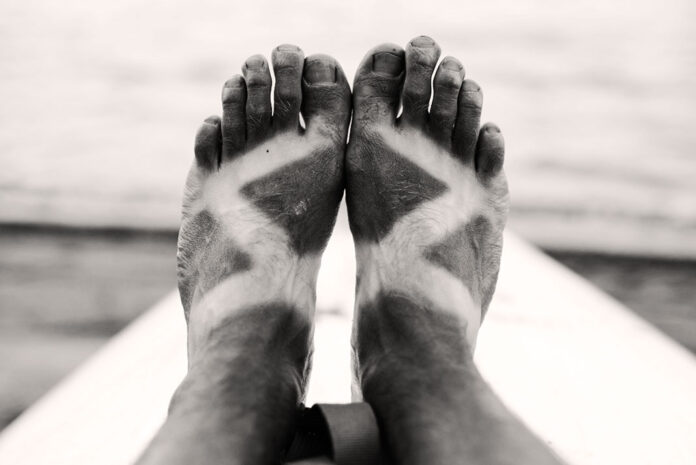
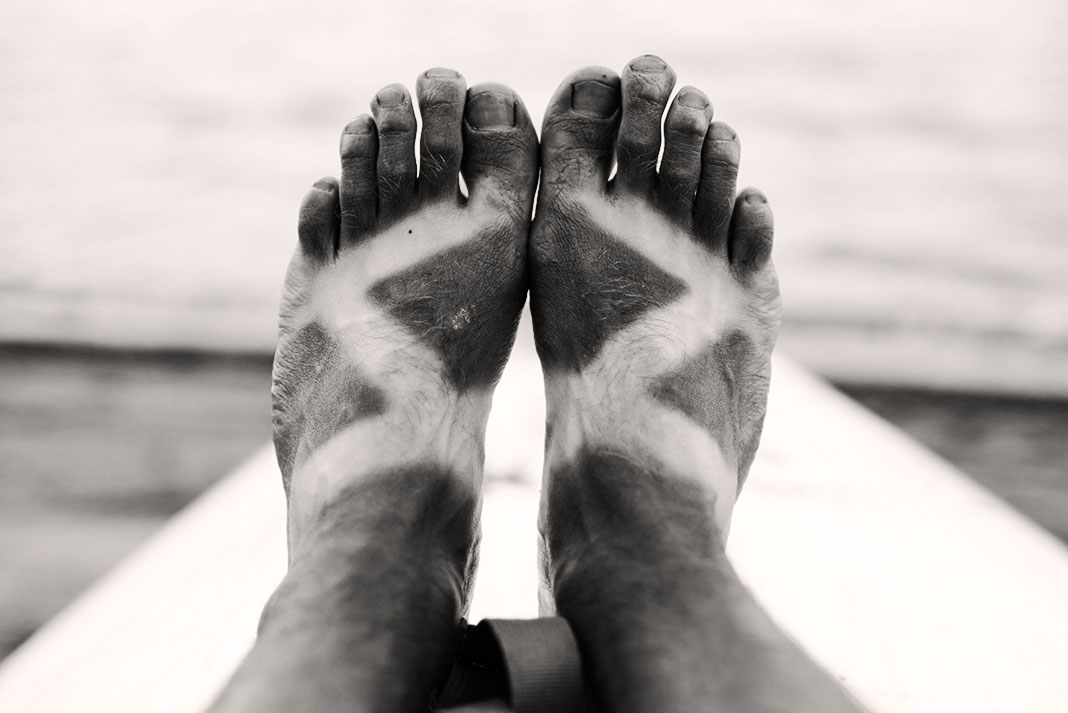
I believe the most motivating thing, if not the secret to success, is the fear of failure. Failure to keep our dreams alive. Failure to keep living the lifestyle, even on the days it doesn’t feel like a lifestyle job. Basically, fear that someday we may not get to wear flip-flops to work.
Living the dream, through triumph and tribulation
The last couple years haven’t been easy in paddlesports. We lost longtime outfitters and guides who lost two full seasons. The lack of shows and events sucked the fun from otherwise nomadic sales reps. Industry leaders retired. ACK locked its doors. The legendary Mike Neckar died.
“What do you do?” people politely ask each other at parties. If I made computer electronic chips or published a B2B magazine about dental equipment, they’d nod an imminent end to the conversation. When I tell them about Paddling Magazine and Kayak Angler, they tell me stories about fishing, family canoe trips, learning to paddleboard, kayaking Puget Sound or when they first learned to roll.
The boats we build. The gear we sell. The trips we lead. The skills we teach. The equipment we rent. What we do does have a greater purpose. Thirty million Americans got on the water and paddled last year. We did that. All of us together. Collectively, as an industry.
Thanks to those who started all this 50 years ago, and cheers to those still happy to be here. Too stubborn to quit.
This article was first published in the 2023 issue of Paddling Business. Inside you’ll find the year’s hottest gear for canoeing, kayaking, whitewater and paddleboarding. Plus: Industry leaders on the post-pandemic landscape, 50 years of paddlesports, the rise and fall of ACK and more. READ IT NOW »
These little piggies didn’t go to market or stay home. | Feature photo: Garrett Fache
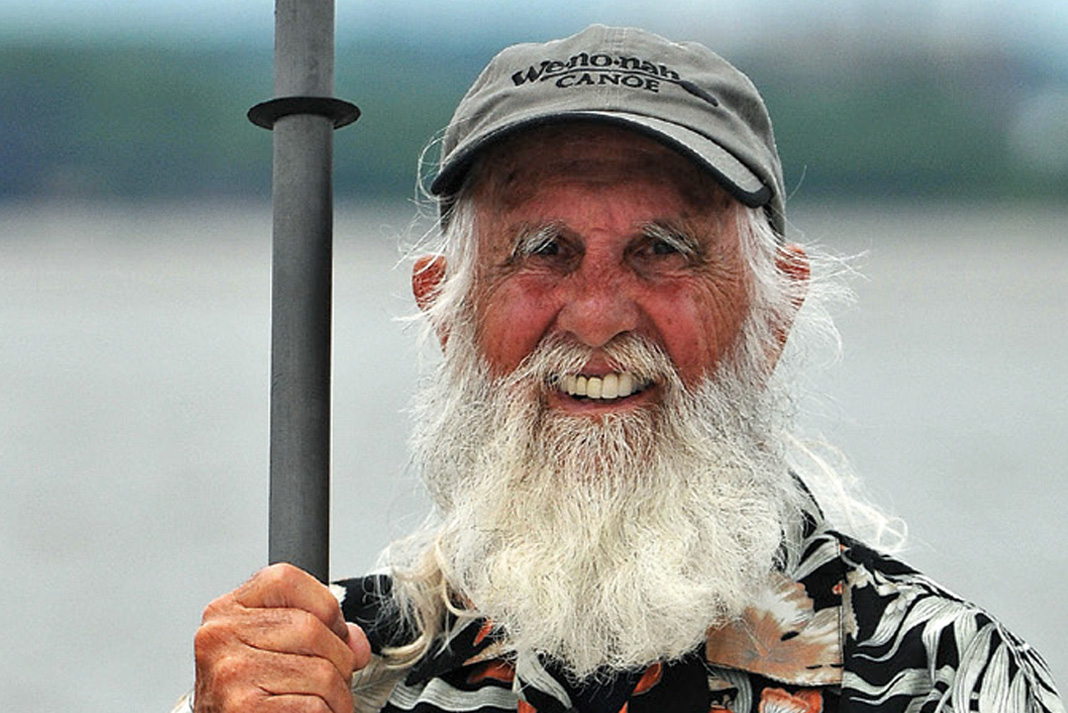
In 2016, I received my first assignment from Paddling Magazine, then known as Canoeroots. Dale “Greybeard” Sanders, had just finished paddling the 3,700-kilometer-long Mississippi River—a stretch of water known for its exposed lake crossings, countless dams, difficult portages and dangerous freighter traffic.
It was an extraordinary feat, made more extraordinary by the record Sanders had set. At 80, he was the oldest person to paddle the Mississippi from source to sea, and I was asked to interview him.
“I’m only 5’6” and sometimes I think I wanted to overcome my stature and show that I’m bigger than I really am,” he told me then. “All my life I’ve had a competitive spirit.”
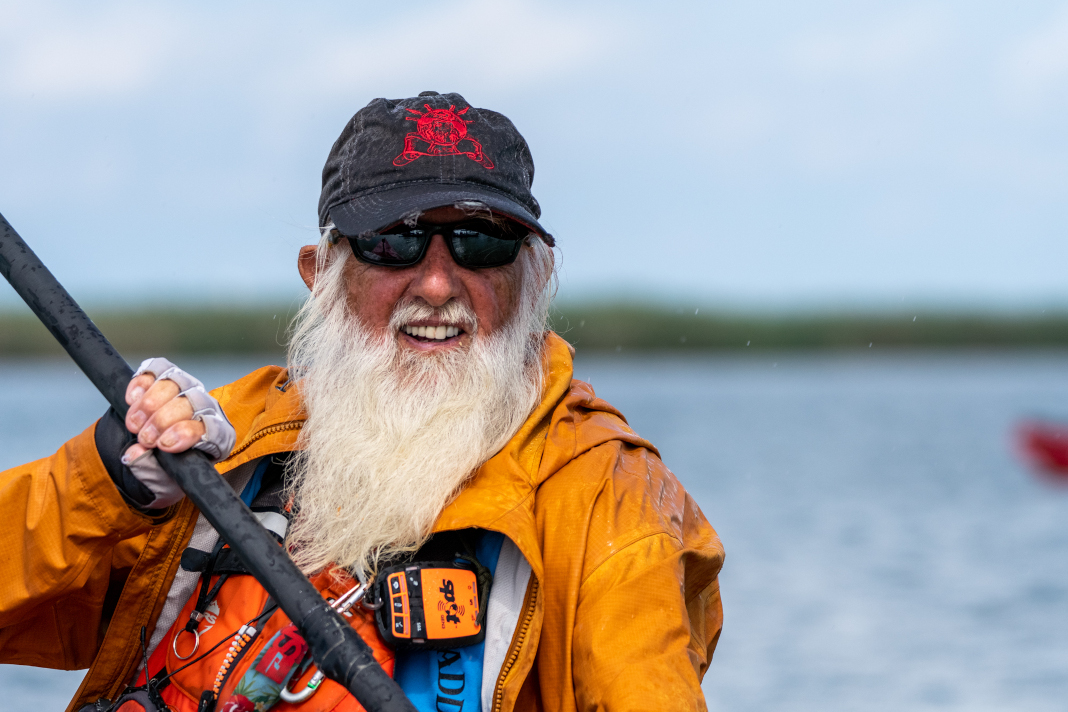
It was that competitive—some might say stubborn—spirit that led Sanders, now 87, to do it all over again. Sanders had a title to reclaim. His record on the Mississippi had been broken by 81-year-old Stan Stark in 2020.
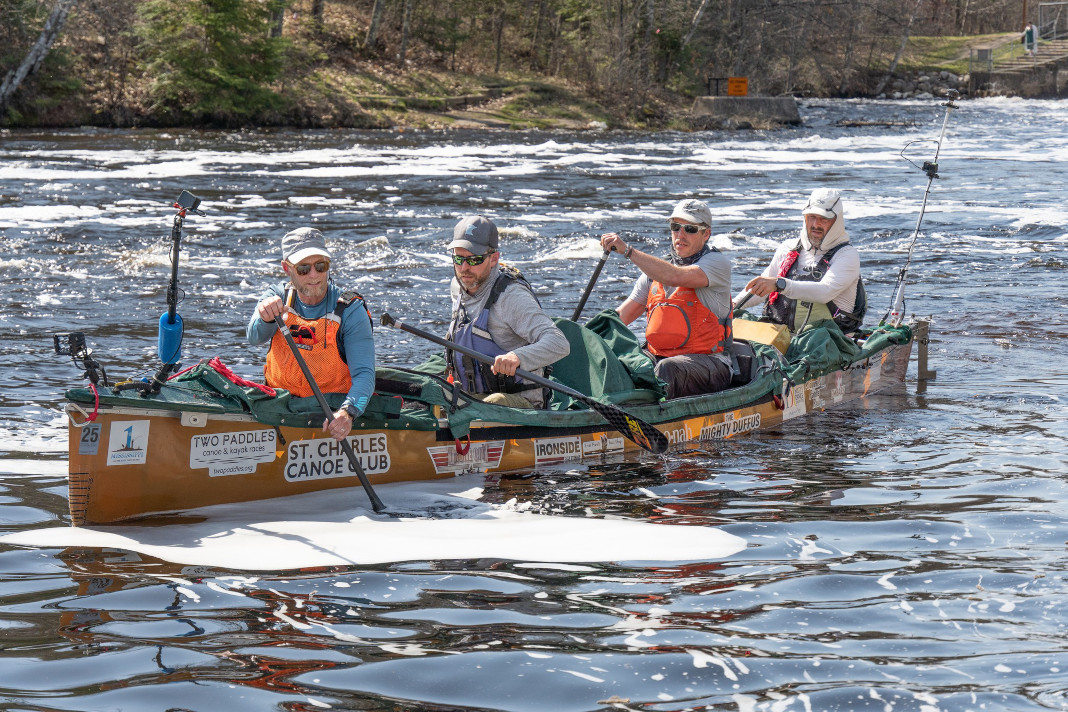
So, in June 2022, Sanders set out in his 15-foot canoe, Perseverance, and invited a documentary crew along for the ride. The resulting 90-minute film, Greybeard: The Man, The Myth, The Mississippi, chronicles Sanders’ journey from the headwaters of the Mississippi River at Lake Itasca, Minnesota to the Gulf of Mexico—as well as provides the origin story for the serial record-setter.
Born on June 14, 1935 in Lickskillet, Kentucky, Sanders first discovered his competitive nature as an acrobat, and later as a springboard diver, spearfisher and free diver. A true Renaissance man, his adventures haven’t been limited to watersports either. In total, he’s set nine world records (some official, some not) including becoming the oldest person to hike the Appalachian Trail when he was 82. But all the records Sanders holds aren’t the most notable thing about him—nor is his age. Instead, it’s Sanders’ infectiously positive attitude and approach to life that are impossible not to be swept up in.
In celebration of reclaiming the Mississippi age record and his recent documentary, I spoke with Sanders again—just shy of his 88th birthday. He told me why he’s a canoeing purist—and even shared his three-ingredient recipe for everlasting youth.
Dale “Greybeard” Sanders. | Photo: Courtesy Greybeard: The Man, The Myth, The Mississippi
A conversation with Dale “Greybeard” Sanders
Paddling Magazine: In 2015, you paddled the Mississippi River in 80 days at the age of 80. In 2022, you did it in 87 days at the age of 87. How did the two experiences compare to one another?
Dale Sanders: I expected it to be easy this time. And because I was already in good shape, I didn’t train right. I paddled one day for a couple of hours and that was it—so I did not train at all. I was overconfident, I think, and probably should have spent a little more time with a paddle in my hand than I did.
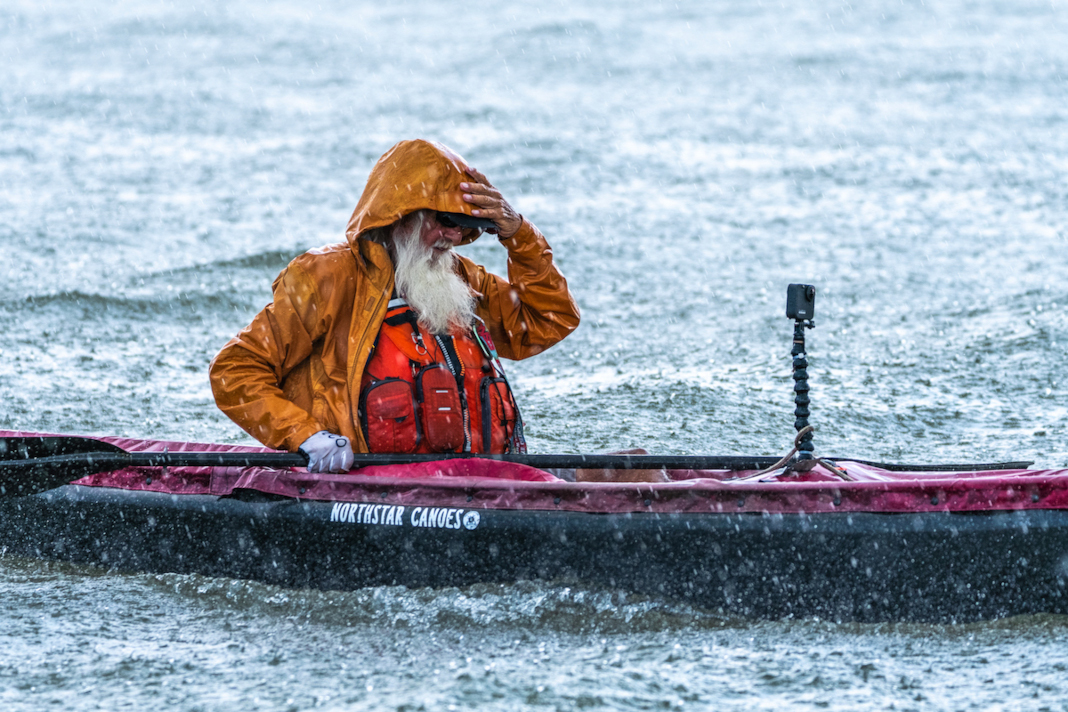
I was able to do it, but it was actually harder than the first time. We had record-low water, so it was really slow. I also wanted to start on my birthday on June 14, but that put me on the Lower Mississippi River right in August; right at the time of year when it’s very hot and humid. It was unbearable at times and the mosquitoes almost took me away. So, to put those three things together? It just made for a tough trip, although I never thought about quitting. But there might have been another factor, too: I’m 87 years old.
Us old people, we can get in and out of shape, just like at any age. But it probably takes us longer to get back into condition. I’m just really fortunate to be healthy.
PM: Why does a canoe remain your watercraft of choice?
Sanders: I was really active in my younger years as a lifeguard and swimming instructor, and became a canoe instructor in 1954.
The way Guinness Book of Records has it written, I could have paddled a kayak or canoe down the Mississippi. As a matter of fact, Stan Stark paddled a kayak when he broke my record to become the oldest person to paddle the length of the Mississippi in 2020. So really, if we want to get technical, he didn’t break my record because I had a canoe record—but Guinness-wise, it is a record.
I prefer canoes over kayaks—it’s the historic and classic way of paddling. That lifelong connection to canoeing certainly has had a big play in it.
PM: You’re an active river angel on the Mississippi, with paddlers invited to sign a wall of fame in your home. You even hosted Stark when he was attempting to break your Mississippi record in 2020. In the film, we meet some of the river angels along the way—but are there any who stand out to you?
Sanders: Venice is very special for its river angels. The Gulf of Mexico’s saltwater is 110 miles south of New Orleans and 22 miles south of Venice, which is the last town on the road. There’s nothing beyond Venice. There’s no trail. It’s all mangroves and it’s just a mess of water. The only way to get back up is in a boat. Somebody has to bring a powerboat to help us get our boats back. So, the last day on the river is very special—but it’s also a very special place for river angel support.
Feature photo: Courtesy Greybeard: The Man, The Myth, The Mississippi
PM: When it comes to group adventures, attitudes can mean the difference between a unified team and a fractured one. While most struggle to stay positive in moments of adversity, you seem to have the opposite problem—in the documentary, your paddling mates struggled at times with your relentless positivity. How do you keep morale up, even when everyone around you is struggling?
Sanders: You hit the nail on the head because anything you do in life with other people—especially adventure—you have to, have to, have to stay positive and keep the negative words out. That’s really important.
When we were paddling the Mississippi, we tried to stay positive. Occasionally we’d break down and once in a while we’d have an argument, but we would always end it with, “Hey, let’s put it aside,” shaking hands, and then looking at each other and laughing.
Once in a while, I wanted to get off by myself and paddle and get out of the rigamarole of communicating and not hearing well. I didn’t hear well even with my hearing aids, so it was very frustrating trying to carry on a conversation. If I had one thing that I could ask for—for doing an expedition with other people along with me—it would be better hearing. It can be really rough to try to do an expedition when you can’t hear well.
PM: If we gave you one of those “real age” tests—which measure how fast you’re physically aging—how old do you think it would say you actually are?
Sanders: I don’t know what an 87-year-old is supposed to feel like, but I don’t feel old. I don’t feel 87.
There are studies to suggest that if you’re happy, then the body can ward off disease better. And if you’re really happy and active in life, your body is filled with adrenaline, which also keeps the brain working.
I live a really happy life. I’m active. I have a good spiritual life. And if you put those three things together, that’s a pretty good formula to ward off disease and have a productive life.
PM: The last time I spoke with you was in 2016. If I call you again seven years from now, you’ll be 94. What do you think competition will look like for you then?
Sanders: Well, God willing I stay healthy and the creek don’t rise, I’m gonna try to do the Appalachian Trail again.
In 2021, my friend Nimblewill Nomad [83-year-old M.J. Eberhart] took the record, so I don’t hold that age record anymore. I would really like it. I could pull that off.
PM: I’m having déjà vu. When we last spoke, you told me you were planning on hiking the Appalachian Trail next—and then you went on to set the record a year later.
Sanders: Well, don’t wait seven years to call me again. What about you call me when I’m 90?


 This article was first published in the 2023 Paddling Buyer’s Guide.


 This article was first published in the 2023 issue of Paddling Business. Inside you’ll find the year’s hottest gear for canoeing, kayaking, whitewater and paddleboarding. Plus: Industry leaders on the post-pandemic landscape, 50 years of paddlesports, the rise and fall of ACK and more.