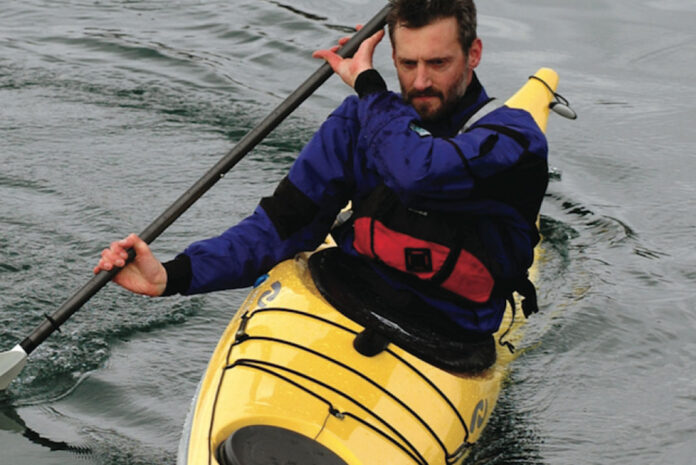
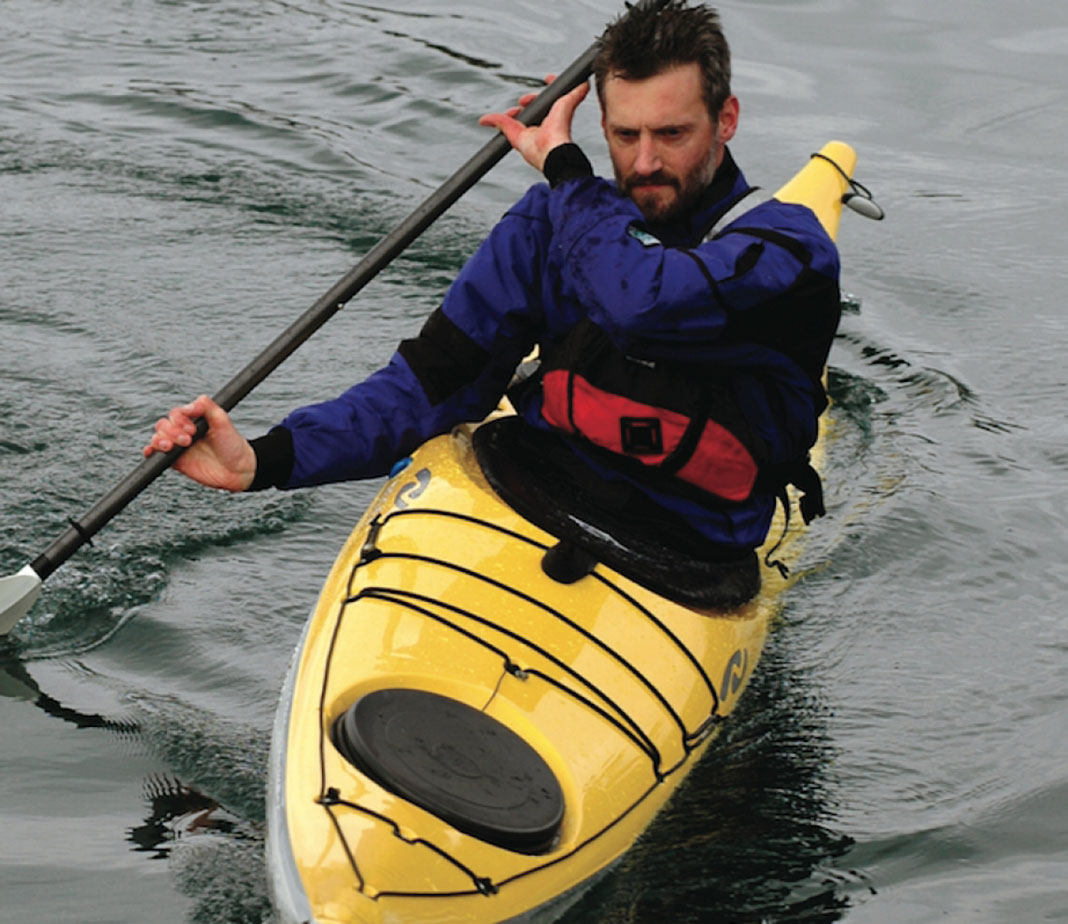
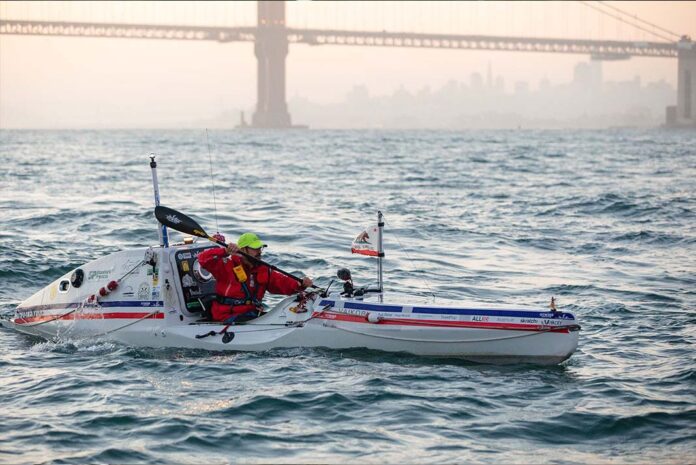
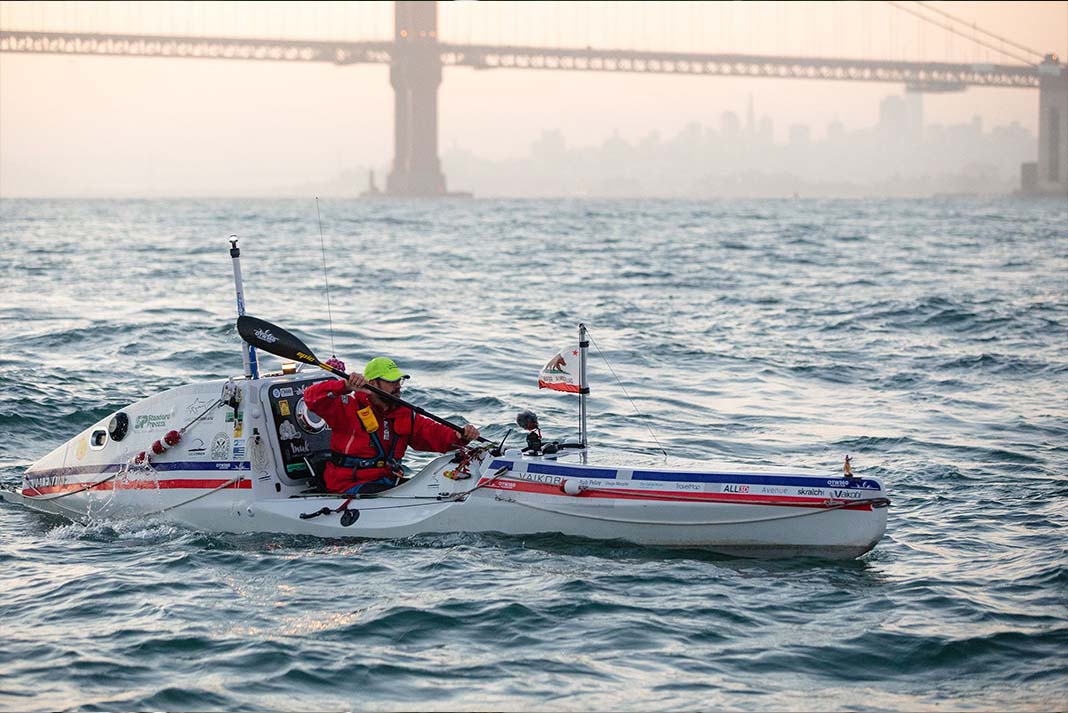
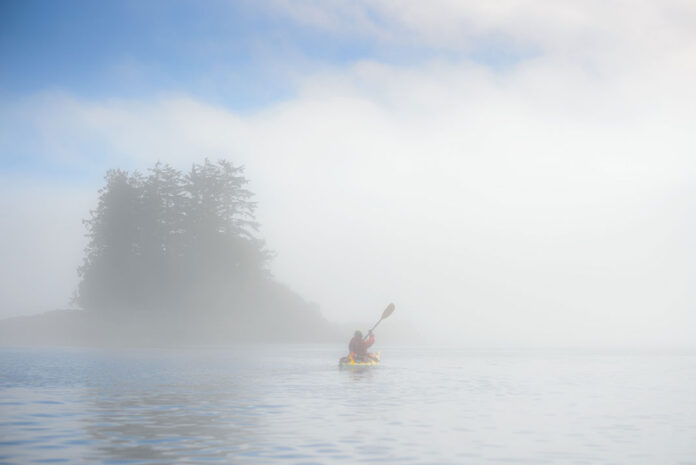
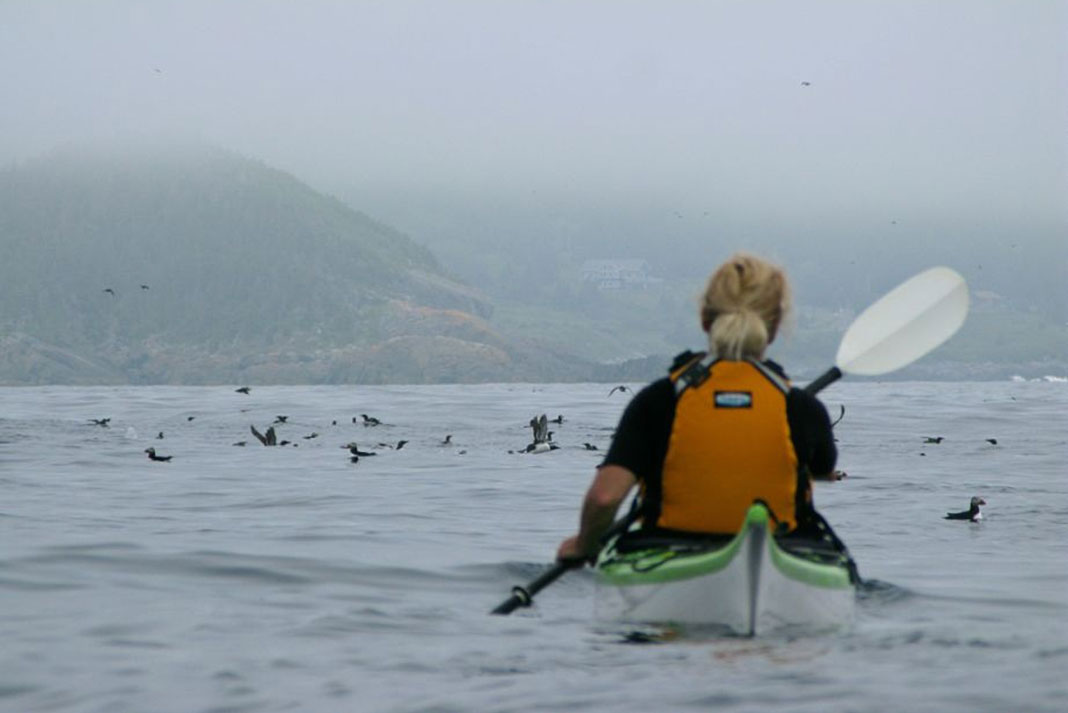
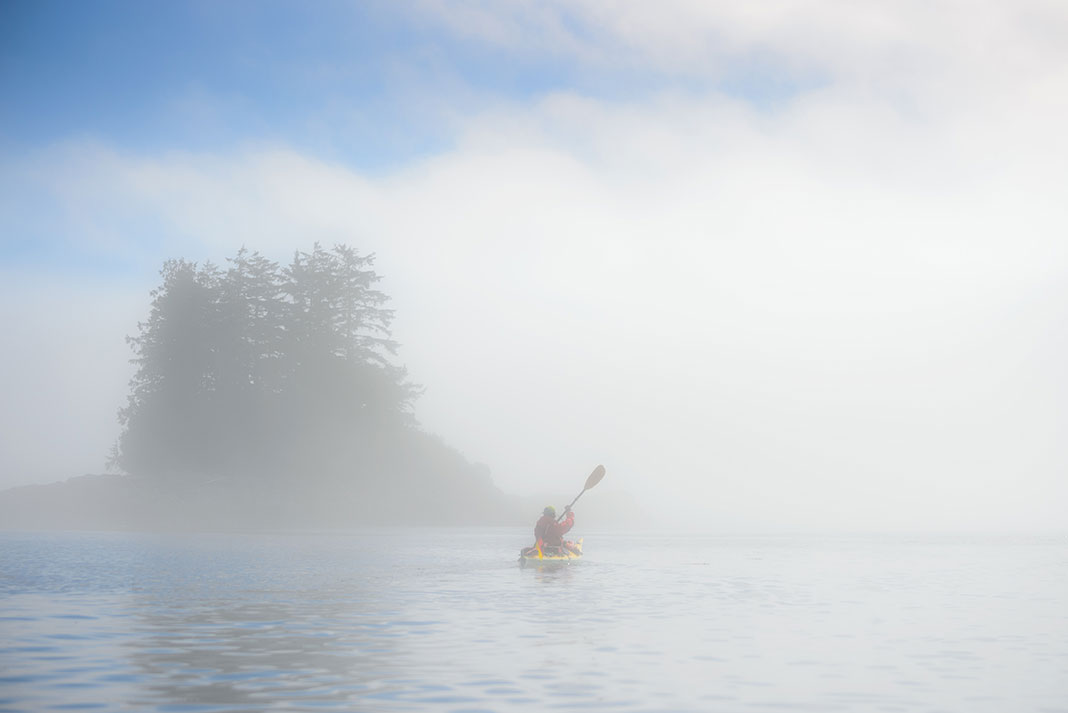
Alex Matthews executes a bow draw in his Wilderness Systems sea kayak. | Feature photo: Rochelle Relyea
The bow draw, also known as the bow rudder, is an efficient and elegant turning stroke that provides remarkably fine control over the bow of a sea kayak. It is excellent for making minor course corrections and essential for maneuvering in and out of really tight places. Follow these tips to get the benefits of a properly-executed sea kayak bow draw for yourself.
[ Paddling Buyer’s Guide: View all sea kayaks ]
Learn the Sea Kayak Bow Draw
If you’re slipping between two other kayaks, playing around rocks, or negotiating a gap between boulders, a bow draw stroke combined with some forward momentum can give you that last-second fine adjustment you need to hit your line and thread the needle.
Alex Matthews executes a bow draw in his Wilderness Systems sea kayak. | Feature photo: Rochelle Relyea
The bow draw turn requires forward momentum, so start with good speed.
To get the most turning power, initiate your turn with a sweep stroke on the opposite side. Then rotate your torso aggressively in the direction of the turn and plant your paddle in the water in front of your body, about a foot or two out to the side, beside your knee. Reach across your forehead with your upper arm with your paddle shaft vertical. Keep the lower arm close to your body to keep your shoulder safe.
Angling your blade
Angle your paddle blade with the leading edge outward so that the power face of your paddle catches water, loading the blade. The more you open the blade to the oncoming water and the further out you plant your blade, the more force you will generate with this stroke.
Time and practice will allow you to dial in the amount of blade angle that is appropriate for each situation. Too much angle will load your blade too much, acting more like a brake than a turning stroke. Too little angle will not generate much turning power at all.
Because you’re catching water with this stroke, it will slow your boat down as it turns. As you lose speed, draw the blade in to your toes to finish the stroke. You’ll then be in a perfect position for a forward stroke to get yourself going again, without even lifting your blade out of the water.
Increasing efficiency
As with any turning stroke, tilting your boat on edge away from the turn will greatly increase the efficiency of the turn. For the bow draw turn, this means tilting the kayak away from your paddle side. Because the bow draw doesn’t generate much support and you’re edging on the opposite side, tilting on a bow draw requires confident balance and solid paddle control. Start playing with bow strokes on flat water and work up to putting your kayak on edge. Once you get comfortable, the bow draw will naturally find its way into your paddling repertoire in rougher conditions.
This article was first published in the Fall 2007 issue of Adventure Kayak Magazine. Subscribe to Paddling Magazine’s print and digital editions, or browse the archives.
Alex Matthews executes a bow draw in his Wilderness Systems sea kayak. | Feature photo: Rochelle Relyea
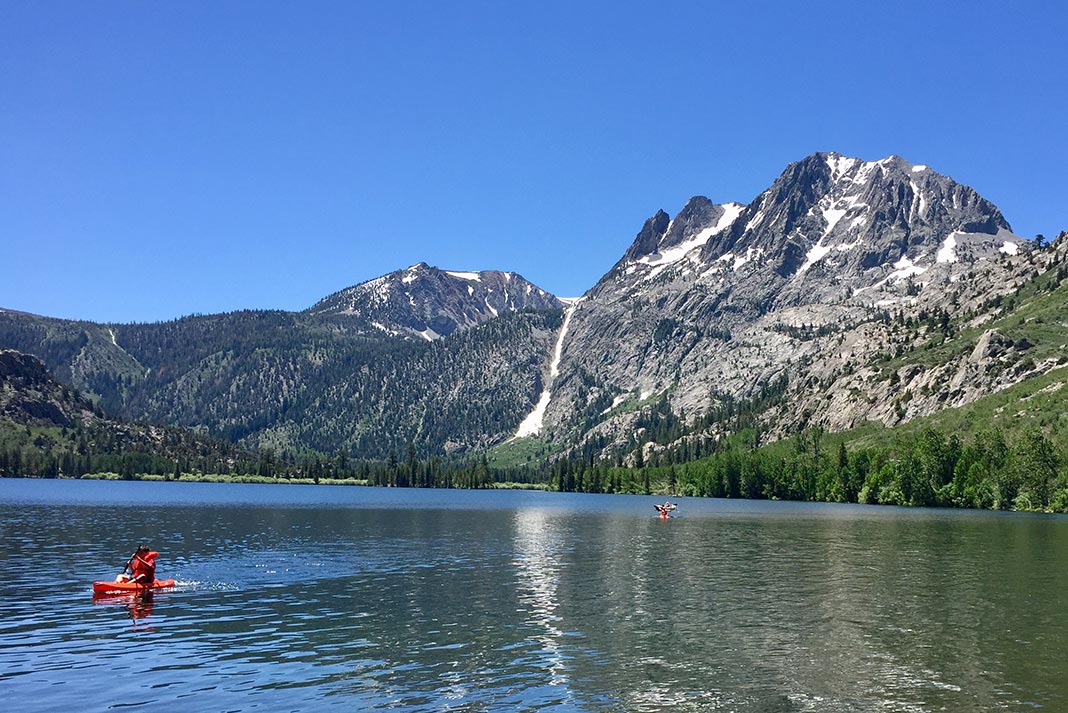
Whether you choose to paddle inland or coastal waters in California, you won't be disappointed. | Photo courtesy of: Mono County Tourism
When you think of California, what comes to mind first: The giant redwood groves of NorCal? Death Valley’s sand dunes? The famed yuccas of Joshua Tree? The mountains of the Sierra Nevada? Or the oceanside cliffs that shoulder the Pacific Coast Highway?
California has more plants, animals and ecosystems than can be found anywhere else, making it the most biodiverse state in America. This diversity also results in some of the country’s best kayaking. From half-day pleasure paddles in ocean bays frequented by humpbacks, to week-long camping adventures on fast-flowing whitewater rivers, California has it all.
[ Paddling Trip Guide: View all kayak trips and clinics in the United States ]
Best kayaking in California
With around 1,350 km of coastline, over 300,000 km of rivers and 4,900 lakes and reservoirs, you’re never far from a solid put-in spot in the Golden State.
Here are 11 places where you can find some of the best kayaking in California:
Sonoma County
Mendocino County
San Francisco Bay
Point Reyes
The bioluminescent waters of Tomales Bay
San Diego’s La Jolla neighborhood
Monterey Bay
The Central Coast, including Santa Barbara
Los Angeles River
The Channel Islands
California’s interior, including June Lake, Big Bear Lake and along the South Fork of the American River
Read on to learn about our favorite California kayak rentals and tours.
Sonoma’s mild Mediterranean climate makes for some spectacular wines, as well as some incredible kayaking. It’s the jumping-off for adventures on the Russian River (this waterway flows through vineyards and redwood forests), Lake Sonoma (a reservoir nestled in the foothills), Spring Lake (ideal for swimming, fishing and picnicking), and, of course, along the coast.
Sonoma County kayak rentals & tours
Smart Tours offers guided tours of the Sonoma Coast as does Sonomads.
Meanwhile Russian River Adventures and Burke’s Canoe Trips will fully outfit you for an adventure down the Russian River, including coordinating return shuttles.
Kayak at Mendocino County
Although it’s only a three-hour drive north of San Francisco, Mendocino County is part of California’s “Lost Coast.” North of Fort Bragg lies a section of coastline that’s wild, all-natural, undeveloped and inaccessible from major highways, which all adds up to some epic and uncrowded paddling. Thinking about kayak camping in Northern California? This might be the place to do it.
Mendocino is also where you’ll find the Noyo River—a calm stretch of water frequented by sea lions, harbor seals and river otters.
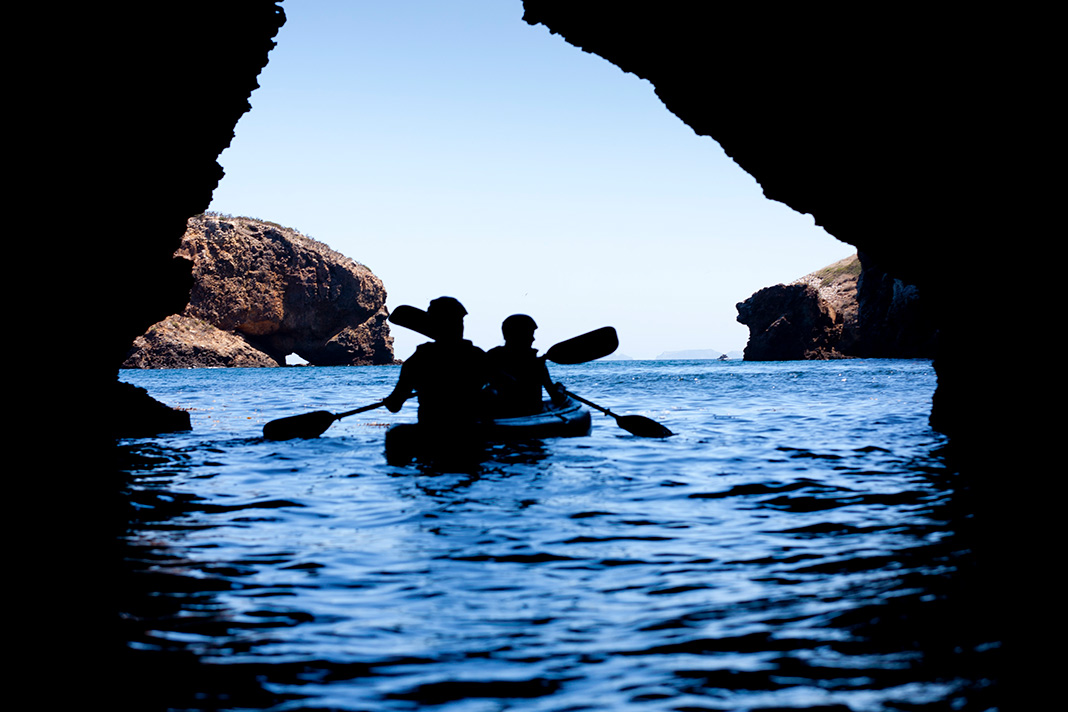
Taking a kayak trip gives you special access to sea caves. | Photo: Courtesy Ventura County Coast
Mendocino kayak rentals & tours
Based in Fort Bragg, Liquid Fusion Kayaking is well-placed to offer rentals and tours of the Noyo River, as well as sea kayaking excursions.
Kayak in San Francisco
San Francisco Bay is probably best known for the iconic Golden Gate Bridge, but it’s also a family-friendly kayaking destination. Highlights include seal and sea lion sightings, as well as opportunities to admire Sausalito’s eclectic houseboat community from the water.
In addition to offering sit-on-top and sea kayak rentals, SeaTrek runs half-day, full-day, full starlight and overnight tours of the Bay Area, including underneath the Golden Gate Bridge.
Sausalito is also home to Environmental Traveling Companions, an organization dedicated to making the outdoors accessible. It offers regular scheduled guided trips for people with disabilities, including a San Francisco Bay tour and bioluminescence paddle on Tomales Bay. Check its website for upcoming trips.
Kayak at Point Reyes & Tomales Bay
Tomales Bay offers one of the most epic kayak trips in Northern California, even though it’s not particularly long or difficult. That’s because it’s one of the most reliable spots in Cali to find bioluminescent waters.
Although phytoplankton—the organisms responsible for turning waves neon blue—have been reported everywhere from Monterey to San Diego, their presence and intensity depends on environmental factors like swell and wind conditions. That means bioluminescence isn’t guaranteed anywhere on any given night.
Tomales Bay is the possible exception to this rule. With its own colony of phytoplankton, the narrow inlet is more sheltered than other spots, making for an ethereal experience nearly any night of the year.
Choose from guided and self-guided tours. | Photo: Courtesy Wild Blue Adventures
Point Reyes kayak rentals & tours
Tomales Bay Expeditions and Blue Waters Kayaking both offer rentals and guided nighttime bioluminescence tours on Tomales Bay. Blue Waters Kayaking also offers a private overnight camping adventure (for groups of six or more). Visiting on either side of the new moon in summer and fall is recommended.
Kayak at Monterey Bay
A renowned whale-watching destination, the waters of Monterey Bay are frequented by humpbacks (several hundred spend their feeding season here from April until November), orcas, grey whales, blue whales and dolphins.
For this reason, sea kayaking tours in the Marine Sanctuary might get all the glory, but the area is also where you’ll find the kid-friendly Elkhorn Slough Estuary, a tidal estuary with diverse marine life and a chance to see bioluminescence after-dark.
Monterey Bay kayak rentals & tours
The family-owned Monterey Bay Kayaks are Certified Wildlife Stewards who guide trips through Monterey Bay and the Elkhorn Slough Estuary. Bioluminescence tours must be booked 48 hours in advance and are only offered during the new moon. Kayak fishing trips for halibut, lingcod and rockfish in the bay are also on offer.
For rentals, contact Adventures by the Sea, which hires out single and tandem kayaks.
Best kayaking in Southern California
Kayak at La Jolla Beach
La Jolla is only 15 minutes from San Diego’s downtown, but it might as well be a world away. Known for its crystal-clear waters, the area is home to the La Jolla Underwater Park—a 6,000-acre area of protected ocean featuring submarine canyons, kelp beds, sand flats and even artificial reefs designed to attract marine life.
This is your chance to see leopard sharks, shovelnose guitarfish and sea lions, as well as to explore the area’s seven sea caves—including one that you can paddle into. Simply put, La Jolla offers some of the best kayaking in Northern California.
La Jolla kayak rentals & tours
As its name implies, La Jolla Sea Cave Kayaks specializes in tours of the area’s sea caves. In addition to the sea caves, Bike and Kayak Tours and La Jolla Kayak both offer a kayaking and snorkeling combo through the Underwater Park. All three operators offer kayak rentals.
Kayak at Central Coast
Stretching from Monterey Bay in the north to the Ventura region in the south, the Central Coast is home to wine regions, beach and college towns, and miles of stunning coastline.
Its adventure epicenter is arguably Santa Barbara, which is one of the entry points to the Channel Islands. But just north of the city is an untapped treasure; the Gaviota Coast is the largest stretch of undeveloped coastline remaining in Southern California.
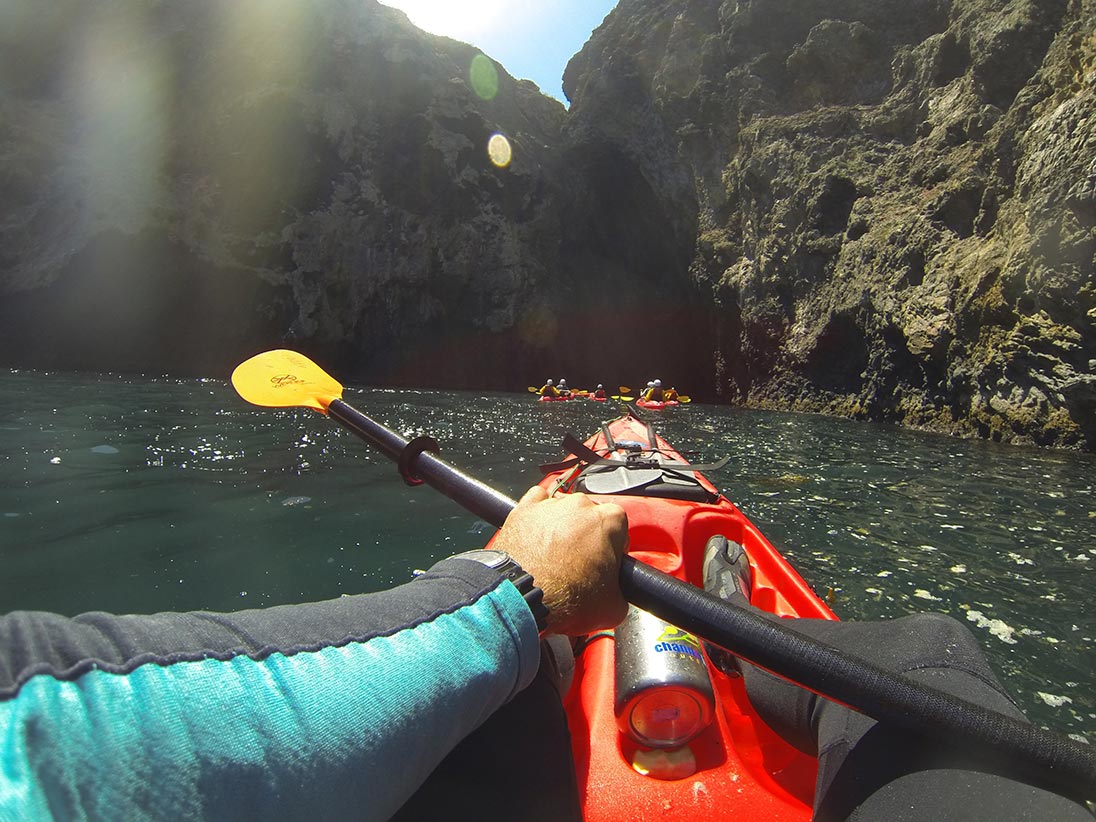
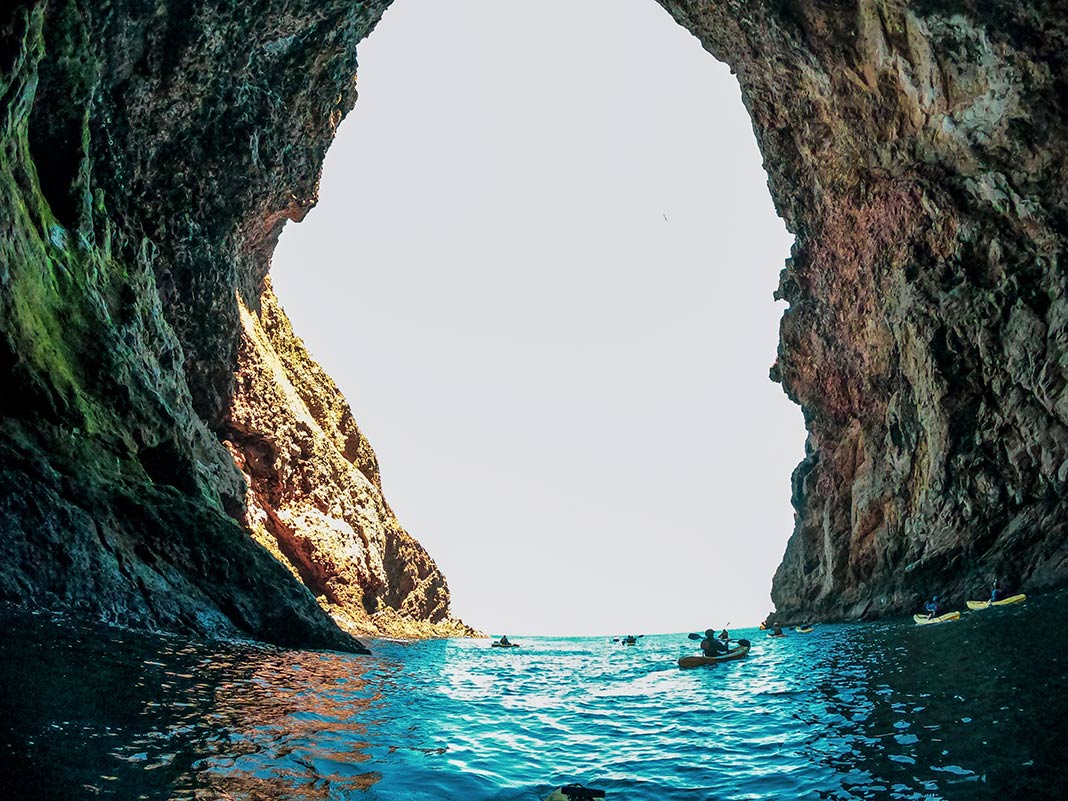
Explore the popular tourist attraction the Painted Cave when touring the Channel Islands by kayak. | Photo: Courtesy Santa Barbara Adventure Company
Central Coast kayak rentals & tours
Based out of Pismo Beach (halfway between Los Angeles and San Francisco), Central Coast Kayaks does it all: rentals, sea cave tours, Morro Bay wildlife tours (perfect for families) and guided kayak fishing.
The Santa Barbara Adventure Company offers guided adventures around the Santa Barbara coastline, as well as to the nearby Channel Islands. For kayak rentals in Santa Barbara, contact Calcoast Adventures. In addition to guided tours of the waterfront, it hires out single and tandem models.
Kayak in Channel Islands
When it comes to kayaking in Southern California, there’s no destination more iconic than the Channel Islands, which are only accessible by plane or boat. The archipelago has eight islands, five of which belong to Channel Islands National Park. Two of the most popular islands for paddling are Anacapa and Santa Cruz, owing to their large sea caves (the latter’s vibrantly colored Painted Cave is the fourth largest sea cave in the world). Meanwhile, Catalina Island, while outside of the national park boundaries, is where you might spot bat rays, leopard sharks, flying fish or garibaldis.
Tour operators depart for the Channel Islands from Santa Barbara and Ventura, but Oxnard (just south of Ventura) is the closest access point.
Channel Islands kayak rentals & tours
Channel Islands Adventure Company has a range of kayaking excursions, including to the perennially popular Painted Cave and a kayak-snorkel combo tour.
Channel Islands Kayak Center leads a tour that explores the unique history of the islands. Kayak rentals are also available from both the center and from Hopper Boat Rentals in Oxnard.
For those with less experience, Wild Blue Adventures takes guests by boat to prime kayaking locations, from which they explore by tandem kayak.
Finally, for Catalina Island rentals and tours, reach out to Catalina Island Expeditions.
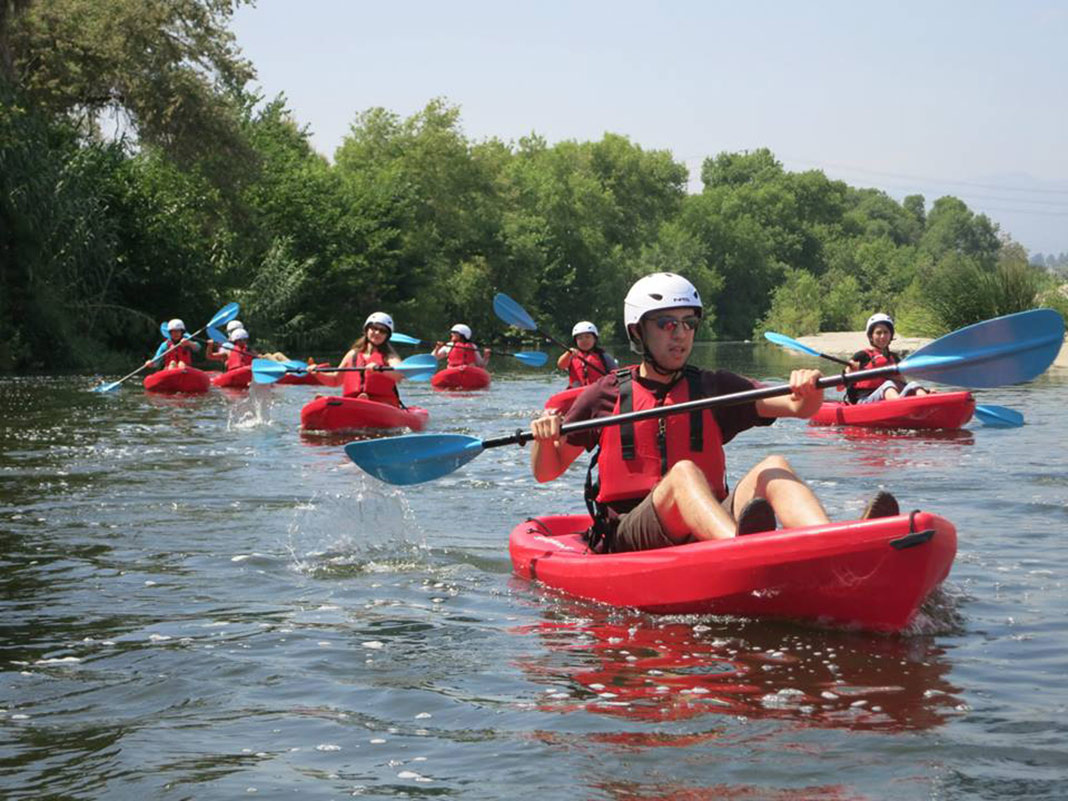
You don’t have to venture far to find outdoor adventure. | Photo: Courtesy LA River Kayak Safari
Kayak in Los Angeles
Yes, the name “Los Angeles” might conjure up images of a streaming flow of traffic on a freeway, but that’s not the only thing that flows through the city—so does the Los Angeles River. An entirely unexpected take on a familiar destination, it’s where urban life and wildlife meet.
Los Angeles kayak rentals & tours
LA River Kayak Safari’s three-hour tour combines a bike ride with a leisurely downstream paddle that makes for a great afternoon out.
If the LA River isn’t your thing, OEX Sunset Beach specializes in rentals for exploring the canals of Huntington Harbor, and can also fully outfit keen kayakers for the 35-km crossing to Catalina Island.
Best kayaking in California’s interior
While this article has mainly covered sea kayaking, we can’t dismiss the thousands of lakes, rivers and reservoirs that can be found statewide, making the interior one of the best places to kayak in California.
Below we’ve highlighted a few tours and rentals, but whether you’re looking for family-friendly lakes or more challenging whitewater, there’s no shortage of outfitters and tour operators state-wide.
California interior kayak rentals & tours
Known for its whitewater instruction, California Watersport Collective is a community-building organization that runs kayaking classes, custom trips, coaching and regular clinics, including on the American River. Current Adventures Kayak School, based in Lotus, are the experts on the American River; in addition to workshops and organizing multi-day trips, they also offer kayak rentals.
Outside San Bernardino is Big Bear Lake, where Paddles and Pedals rents single, tandem and even triple kayaks.
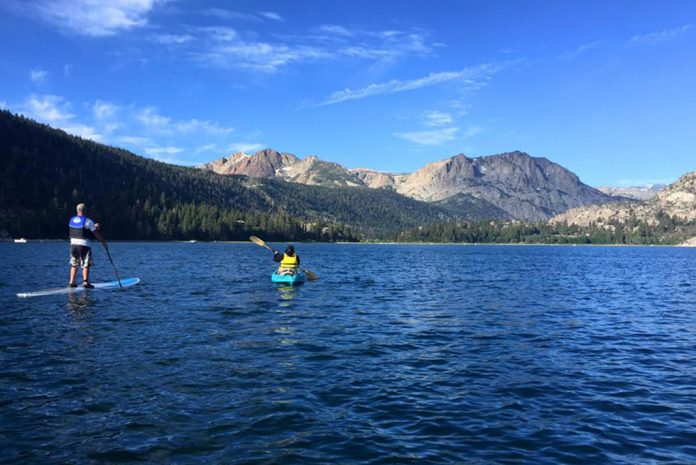
Paddle beautiful June Lake. | Photo: Courtesy Mono County Tourism
Nestled in the mountains near Yosemite National Park, the subalpine June Lake might be one of the most pristine places to paddle in Cali. Mammoth Kayaks and Paddleboards (open seasonally) will set you up with a rental.
California kayak laws
According to California State Parks’ Division of Boating at Waterways, the regulations surrounding canoes, kayaks and other manually propelled vessels less than 16 feet are as follows. Vessels must carry one wearable Coast Guard-approved life jacket of a type and size appropriate for the conditions and the boat activity being engaged in for each person on board. Life jackets must be readily accessible and fit the intended wearer properly. Children under 13 must wear a life jacket at all times.
All vessels are required to display navigation lights between sunset and sunrise and during times of restricted visibility. A vessel less than 39 feet, 4 inches is not required to carry a whistle or bell, but must be able to provide some other means of making an efficient sound signal.
If you’re wondering, “Can I get a DUI on a kayak in California since it’s a vessel?” the answer is a resounding yes. You can get a BUI (boating under the influence) for being impaired or having a blood alcohol level of 0.08 percent or more.
Finally, kayaking along the Californian coast means you might encounter otters, sea lions, whales, dolphins and other marine mammals. As you’re in a vessel, you’re required to keep your distance—about 100 meters is recommended.
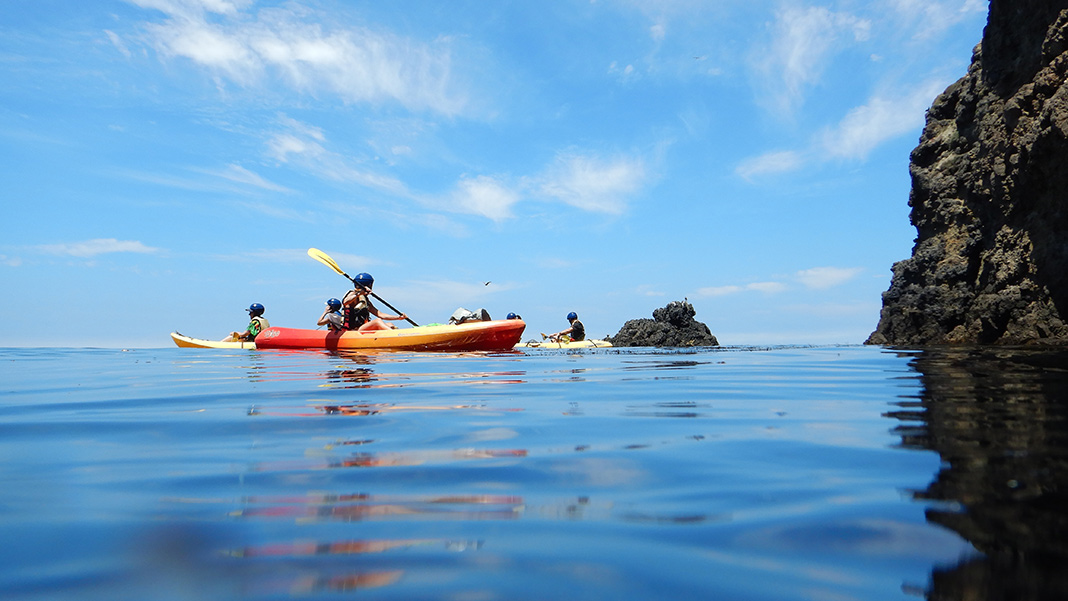
Rental companies and tours usually supply everything you need—just bring your sense of adventure. | Photo: Courtesy Ventura County Coast
Do great white sharks attack kayaks in California?
Cases of great white sharks attacking kayakers—particularly those kayak fishing—regularly make headlines. But given the hundreds of thousands of people who kayak off the coast of California every year, these incidents are an exception to the rule; the last fatality of a kayaker by shark was in 1989. Here’s how to avoid shark encounters.
When to kayak in California
California offers excellent year-round kayaking conditions. However, if you want to see a particular type of marine wildlife (such as humpback whales) check with the tour operators to determine when they’ll be in the area.
Similarly, bioluminescence is most visible on the darkest nights, close to the new moon.
Finally, keep in mind that some operators—particularly in California’s interior—may only operate on a seasonal summer basis.
What to wear kayaking in California
Although California’s weather is beautiful—expect slightly rainy winters and dry summers—you’ll still want to follow the best principles for what to wear kayaking. Layer-up, avoid cotton fabrics, wear sun protection (including polarized sunglasses so you can see all the fish, sharks and underwater life) and dress for the temperature of the water, not the air.
Whether you choose to paddle inland or coastal waters in California, you won’t be disappointed. | Feature photo: Courtesy Mono County Tourism
Laval, Québec, Canada, May 19, 2022 – Pelican International Inc, a world leader in paddle sports, acquires a majority stake in GSI Outdoors, a leader in the outdoor equipment industry. This transaction marks a major step in the growth of Pelican, which is building on a solid foundation to diversify its offering in the North American and international outdoor market.
“The acquisition of GSI Outdoors, our third since 2019, allows us to pursue our ambition to be an eco-friendly leader in the outdoor equipment sector by investing in a portfolio of renowned brands that respond to the growing desire of the population to connect more with nature. While our last acquisitions consolidated our leading position in the paddle sports, fishing boats and nautical accessories sector, the integration of GSI Outdoors into our fold allows us to diversify our activities and makes a remarkable entry into a sector that has shown sustained growth for several years which is expected to be maintained for the years to come,” said Danick Lavoie, President and CEO of Pelican International.
[ Discover the best gear of the year in the Paddling Buyer’s Guide ]
Focus on growth and diversification
With a rich 50-year history, the Quebec-based family business has carved out a special place in the hearts of outdoor and water sports enthusiasts. Today, Pelican International has met its desire to expand its offer to nature lovers by getting out of the water and accompanying them around the picnic table thanks to another family business, GSI Outdoors, and its innovative camping equipment and accessories.
Based in Spokane, Washington, USA, GSI Outdoors has been designing and distributing quality outdoor cooking and hydration products for the outdoors for over 37 years.
“It was our love of the outdoors and our desire to provide quality products that motivated us to found GSI Outdoors in 1985. Today, our commitment remains the same and in Pelican International we have found the perfect partner to take the company to the next level,” said Don, Ian, and Kathy Scott, co-founders. Ian and Don will remain at the helm of the company for the next cycle of growth for GSI Outdoors.
A booming sector
According to the North American Camping Report 2021, the growth prospects for the outdoor and camping market were excellent, long before the pandemic which has caused an unprecedented craze for outdoor activities and products. In 2021, the global market was estimated at US$15 billion and is expected to reach US$21 billion by 2026, boding well for steady demand for camping products in general.
“Pelican intends to quickly leverage the reputation, distribution channels as well as the supply and innovation capabilities of both companies to offer more to our retailers, and meet the expectations and aspirations of camping, fishing and paddling enthusiasts,” concluded Pelican President and CEO Danick Lavoie.
As GSI Outdoors joins the Pelican Group of companies, the Laval-based company will now have more than 1,100 employees in North America, revenues in the hundreds of millions of dollars, and a portfolio of well-established companies and brands.
[ Plan your next paddling adventure with the Paddling Trip Guide ]
About Pelican International
Pelican International is a world leader within the paddle and nautical sports industry. Renowned for exceptional quality, innovation and expertise, Pelican has become the foremost global authority in the design and manufacture of kayaks, canoes, pedal boats, stand-up paddle boards (SUPs), fishing boats, and watersport accessories.
As an international driving force within the industry, Pelican and its group of companies offer to both paddle sports and everyday outdoor enthusiasts a diverse array of products through its portfolio of well-known brands: Pelican®, Wilderness Systems®, Perception®, Dagger®, Mad River Canoe®, Harmony Gear®, Advanced Elements, Adventure technology and Boardworks®.
Pelican International has three manufacturing sites in North America—this strategically located distribution footprint allows our clientele to easily procure kayaks, paddle boards and boats anywhere they choose to enjoy the water.
About GSI Outdoors
A small, family-owned company, GSI Outdoors makes hydration, cookware and dining products that bring the comfort of home cooking practices to the great outdoors. Since 1985, GSI Outdoors has produced innovative dining gear for use at the campsite, on the trail, and everywhere in between.
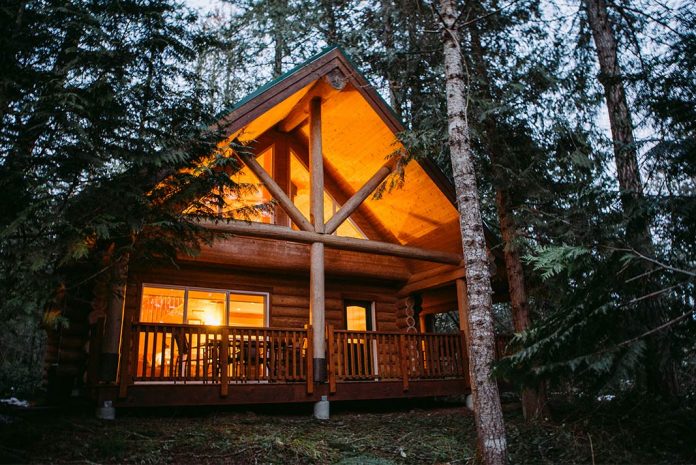
Book your stay: A cozy wood cabin in the woods of Vancouver Island. | Photo courtesy of: Tourism Vancouver Island // Ben Giesbrecht
With its sea and sand, towering old-growth forests and snow-capped mountains, Vancouver Island is one of Canada’s top vacation destinations. It’s also great for a staycation if you’re fortunate enough to live there. For the rest of us, planning a trip to Vancouver Island is easy: Accommodation options include drive-in campgrounds, wilderness camping and also cabin rentals.
If you’re looking for a more permanent home base for your paddling adventures, check out a Vancouver Island cabin rental. The options are nearly endless, including family- and pet-friendly cottages, unique treehouse stays, and glamping accommodations that bridge the gap between cabin and tent. Best of all, many cabins on Vancouver Island are perfect for paddlers, with easy water access to some of the most spectacular places on earth.
Book your stay: A cozy wooden cabin in the forests of Vancouver Island. | Photo courtesy of: Tourism Vancouver Island // Ben Giesbrecht
Best Cabins with Hot Tubs
What’s better than a long soak in a hot tub after an adventure-filled day? Some of the best cabins on Vancouver Island feature hot tubs for your pleasure.
Secluded Oceanfront Cabin in Sooke
Secluded, oceanfront, hot tub—this private Vancouver Island cabin rental located just 40 minutes west of Victoria has it all. The Covehouse sleeps four adults comfortably, with one bathroom. You’ll find cozy indoor space and sweeping views from the deck. There’s great access to sheltered water for kayaking and paddleboarding.
Soak in a hot tub in your own private Vancouver Island cabin, set in the majestic rainforest near the trendy West Coast town of Ucluelet. This Vancouver Island cabin rental features modern accoutrements like cell service and wireless Internet, as well as a luxurious bathroom—choose between soaking indoor or out! Of course, you’ll also get easy access to some of the best beaches of Vancouver Island for paddling, sunbathing and long oceanside walks.
Great for outdoors-loving couples, this cozy one-bedroom Ucluelet cabin with a hot tub is set on a private beach. Indoor features include a gas fireplace and luxurious king-size bed. Paddlers can cross the cove to visit the town of Ucluelet.
[ Plan your next paddling adventure with the Paddling Trip Guide ]
Nature’s Edge in Tofino
This Tofino cottage rental is set on nature’s edge—and literally perched on the rocky shore of the Pacific Ocean. Soak in a luxurious outdoor hot tub and gaze across saltwater to the stunning mountainous skyline of Clayoquot Sound. With three bedrooms and two baths, this gorgeous timber frame Vancouver Island cabin will accommodate up to six people.
You can’t get much closer to the ocean than this Vancouver Island rental cabin set on the famous West Coast beaches of Tofino. This cabin sleeps four—with a luxurious hot tub and a unique outdoor shower. World-class paddling and surfing is within steps (60, to be exact) from the door.
You may desire something more than a tent, but less than a cabin. Look no further for the best camping cabins on Vancouver Island—featuring great glamping accommodations for paddling enthusiasts.
Clayoquot Wilderness Lodge
This luxurious resort near Tofino offers 25 glamping tents for adventurous Vancouver Island travellers looking to blend cabins with camping. Bright and spacious canvas tents are available for couples and families, with indoor bathrooms and showers. Interiors were refreshed in 2021 with the goal of achieving “refined luxury.” Make these unique accommodations your perfect Vancouver Island retreat for day paddling and comfortable overnight stays. Reserve online.
Wya Point is a private oceanfront campground near Ucluelet on the west coast of Vancouver Island, with accommodations ranging from tent campsites to RV parks, yurts and luxury cabins. Fourteen yurts are located right next to a secluded beach, with several sizes available. Wya Point is dog friendly and provides surf lessons, whale-watching tours and more. WiFi, showers and flush toilets are available. Book online.
Stay in a unique geodesic dome at WILDPOD Glamping, located in Tofino. Six oceanfront cabin domes are available for a luxury Vancouver Island camping experience. You’ll go to sleep to the sound of the tide and wake up refreshed, ready for adventure in one of Vancouver Island’s greatest outdoor destinations.
Of course, Vancouver Island’s Pacific Ocean beaches are renowned. But you’ll also findcabin rentals on spectacular mountain-fringed freshwater lakes. Here are a few of the best choices available.
Lake Cowichan Cabin
This cabin rental is set on the shore of Lake Cowichan, a freshwater jewel on southern Vancouver Island, a short drive from Victoria and the town of Duncan. Crystal-clear water is great for paddling; the cabin sleeps five comfortably with two bathrooms. This sun-soaked region is noted to have the warmest climate in all of Canada.
You’ll enjoy spectacular sunsets at this Vancouver Island cottage rental on McIvor Lake, located minutes from Campbell River. Explore the islands of McIvor Lake by canoe or kayak (included with the property) while taking in the glorious mountain views. Plenty of windows bathe the spacious cabin in natural light. Sleeps six.
This private lakefront cabin on Vancouver Island is located on Sproat Lake, just west of Port Alberni. You’ll find inspiring outdoor spaces with amazing views and a bright, modern interior that sleeps six guests. Launch your kayak from the dock and trace the shores of Sproat Lake, soaking in the mountain views.
Looking for a unique Vancouver Island cabin rental? Live the life aquatic with a rental from Island Houseboats on scenic Lake Cowichan, near Victoria. Several sizes of fully equipped, floating cottages are available to accommodate groups of up to 14. Rental kayaks are available.
Close to Campbell River, this lakefront cabin is your quintessential Vancouver Island mountain retreat—with great paddling opportunities for kayakers and paddleboarders on Upper Campbell Lake. Two kayaks are included with the rental; launch from a private beach. The cabin is located on the edge of Vancouver Island’s famous Strathcona Park and is perfect for couples or a small family.
Paradise need not cost a fortune. We pared down the best Vancouver Island cabin rentals under $150 per night.
Studio at French Beach
This cozy cabin is a real bargain for couples, located near Sooke on a large, private property with quick access to great Vancouver Island beaches and hiking trails. The 240-sq-ft cabin includes a full bathroom and all you need to prepare your own meals. Make this your home base for exploring the southwest corner of Vancouver Island.
This small yet well-appointed cabin is located on the ocean’s edge, between Parksville and Campbell River on Vancouver Island’s east coast. You’ll find a compact kitchen with a fridge and microwave, as well as an indoor sink and shower with a heated outdoor shower. The cabin is nestled in the woods, with a sweeping deck and a short trail to the Pacific Ocean, where you can launch a kayak or paddleboard.
This seaside, B&B-style private guest suite is located on Malcolm Island, home to the quaint village of Sointula. You have 500 square feet to yourself, with a self-contained kitchen, full bathroom and a hot tub. The paddling here is outstanding, with opportunities to explore Johnstone Strait (a prime whale-watching and kayak fishing destination) right from your door. Drive to the northern Vancouver Island town of Port McNeil and take a 20-minute ferry ride to visit this idyllic retreat on a near-forgotten island.
Fido is welcome to join the family for vacation fun at these pet-friendly Vancouver Island cabins.
Courtenay Beach House
This Vancouver Island cabin rental is pet-friendly and located on the ocean in Courtenay. With two bedrooms and one bath, it’s comfortably rustic with plenty of large windows for natural light. But the real attraction is the waterfront, which is perfect for dogs and paddling enthusiasts alike.
Saltspring Island is noted for its laidback vibe and rich artisan scene. Get a taste of Saltspring and bring your pet to this two-bedroom cabin rental in the woods, with easy access to a freshwater lake or the Salish Sea. Saltspring Island is a short ferry ride from Vancouver Island.
This pet-friendly cabin rental is located on a freshwater lake near Victoria in southern Vancouver Island. Revel in relaxing privacy, with your own waterfront that’s perfect for launching a kayak or SUP. The cottage is perfect for a family of four and features a fenced backyard for pets, as well as direct access to walking and hiking on the Cowichan Valley Trail.
Looking for something whimsical and totally unique? Check out these great Vancouver Island tree cabin rentals.
Free Spirit Spheres
Looking for “the most remarkable accommodation in the world”? You may find it at Free Spirit Spheres, in Qualicum Beach. This Vancouver Island tree cabin rental provides three unique treetop globes, with designs in Douglas fir and fiberglass and connected by elevated forest walkways. Perfect for couples and those looking for creative inspiration. Check availability and book online.
Bird’s Eye Views of the Salish Sea
This Vancouver Island treehouse rental is located five minutes from Sooke. The stunning wooden tree cabin features a sleeping loft and plenty of deck space to enjoy the views. It’s located on Sooke’s Galloping Goose Trail and close to some of the region’s best beaches, with plenty of options for launching a kayak or paddleboard nearby.
This treehouse rental overlooks French Beach and the Juan de Fuca Strait, with easy access to some of the best beaches on Vancouver Island. With one queen-size bed this tree cabin is ideal for couples looking for a unique getaway. It is located between Sooke and Jordan River, off of Highway 14.
Sand and sea are Vancouver Island staples. Here are some examples of fantastic West Coast cabin rentals set on the Pacific Ocean’s edge.
Gulf Islands Oceanfront
Kayak and SUP rentals are available with this luxurious waterfront cottage rental on Pender Island, an easy ferry ride from Victoria. You’ll experience a laidback lifestyle including a great Saturday market for fresh fruit, vegetables, breads and more. This Vancouver Island cottage rental also gives you access to swimming pools and yoga classes.
Famous among landscape photographers and storm watchers, the legendary Wickaninnish Inn is one of Tofino’s greatest luxury resorts, with guest rooms and suites on Chesterman Beach. Experiences include kayak day-tripping in Clayoquot Sound, surfing and ocean fishing. Check availability and book a suite online.
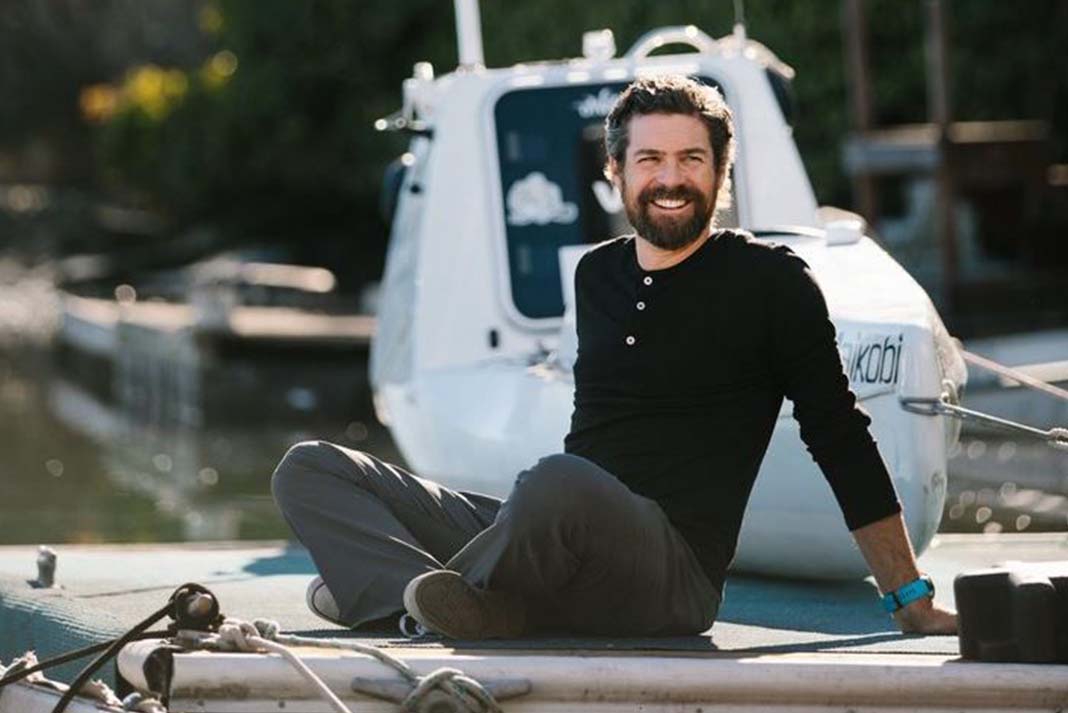
Last June, French-born U.S. citizen Cyril Derreumaux set out to kayak solo and unsupported from San Francisco Bay to Hawaii aboard a 23-foot-long custom carbon fiber kayak. The voyage has been completed by paddle power just twice before—first by Ed Gillet in 1987 and then by Antonia de la Rosa aboard a souped-up SUP in 2019.
On June 4, 2021—just one week after setting out—Derreumaux ran into trouble. Ocean conditions had begun to deteriorate; winds of 55-65 kph generated monstrous 4.5 m waves. Derreumaux tried to deploy his sea anchor, but his equipment malfunctioned. He took shelter in the cabin of his kayak but was violently tossed around by his almost-parallel position to the axis of the waves.
It was only when water started to leak inside the cabin that he knew he couldn’t hold out any longer–he called the US Coast Guard in for rescue.
On June 1, 2022, Derreumaux will once more embark on the 2,400 nautical-mile (4,444 kilometers) solo trip across the mid-Pacific Ocean. Though, this time, he’s made some important changes.
In addition to training specifically for high wind situations off the coast of Santa Cruz, he’s installed a satellite communication system with an external antenna enabling him to make phone calls and emails from inside the cabin.
He’s added custom side panels to his craft to prevent water from entering the cockpit, as well as the addition of a manual bilge pump. Finally–perhaps most importantly–Derreumaux has modified the sea anchor system and its lines to the rudder and the daggerboard.
[ View all Safety and Rescue Equipment in the Paddling Buyer’s Guide ]
Photo: Teresa O’Brien
Derreumaux expects to complete his descent in 60-70 days, weather permitting. Starting each day at sunrise, he’ll paddle for 4-5 hours, breaking only for lunch, then paddle another 4-5 hours or more. He plans to wake up every 2 hours during the night to check on the boat. Follow updates and progress reports of the voyage here.
[ Discover the best gear of the year in the Paddling Buyer’s Guide ]
Quick Facts About The Craft:
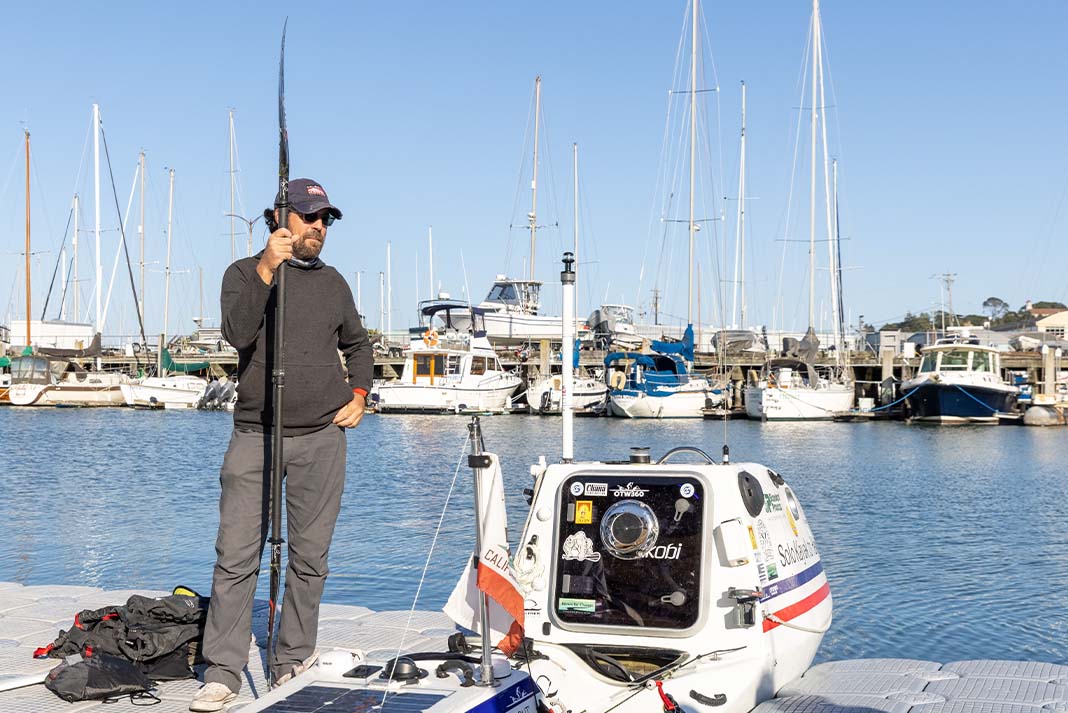
The craft is a single kayak with cabin, measuring seven meters long (23 feet). Made of carbon / epoxy composite.
Cabin is a fully sealable self-righting survival “pod”
Propulsion by kayak paddles with the possibility of using the Hobie Mirage Drive as a backup and alternative option for safety or in the event of injury.
Empty hull weight estimate: 176 lbs. Estimated weight full is 800 lbs.
PHOTOGRAPHER CHRIS CONSTANTINE
Boat Building Details:
Building began October 20th, 2019, in England
Designers are Rob Feloy & Daniel Davy. Daniel is a Naval Architect and Rob has extensive previous experience in designing kayaks and small craft. Dan and Rob have collaborated on various previous projects from kayaks to rowing boats including the successful “Trans-Tasman” double kayak.
Build carried out by Rob’s company Inuk Kayaks. Inuk Kayaks have previously designed and build various long distance expedition craft including Peter Bray’s North Atlantic crossing kayak, Justin & James “Trans-Tasman” double kayak, Olly Hicks’ “Shetland Bus” kayak and again Olly’s Greenland to Scotland double kayak.
Sea kayaking in the fog when out on big open water and navigating to an intended way-point can be intimidating even for the seasoned paddler. There are numerous variables such as wind, currents, bad weather and low visibility that can work to turn a great day on the water into a less-than ideal situation. Writer and avid kayaker Conor Mihell shares with us his tips for staying the course and reaching your intended destination.
It’s only when we pull out a chart and compare it to reality that my friend Craig and I realize the magnitude of the endeavor we’re about to attempt. Our destination, tiny Caribou Island, a mop-topped sandbank in the heart of Lake Superior, lies 22 nautical miles from our gravel beach on the south shore of Michipicoten Island.
With careful preparation and the right skills you can keep on kayaking in the fog. | Photo: Virginia Marshall
Today, the yawning gulf of open water depicted on the chart is represented in real life by a swirling mass of gauzy fog. A quick compass bearing taken on the chart reveals the truth: To stray merely 2.5 degrees on either side of our intended bearing would see us paddling over 100 kilometers until we hit the nearest land. Even the best-made plans would have us playing a dangerous game of dice. We’re fogbound.
1 Dead reckon
Before setting off in the fog, measure the distance of your intended route using a map or chart. Then estimate your time of passage by dividing the distance by your average paddling speed. Keep tabs of your progress on the water with a wristwatch, and have a backup plan just in case your target doesn’t appear on time. This usually means a direct bearing to the nearest sizeable point of land.
2 Aim off
Always err on the side of caution when planning a low-visibility crossing. Intentionally follow a compass bearing toward a prominent landmass—or ‘backstop’—adjacent to your destination. Aiming off is especially important in currents and windy conditions, or on long crossings, where the risks of screwing up are considerably higher.
3 Trust your compass
While GPS units are handy for gauging your speed, the distance from your destination, and adjusting to the vagaries of wind and current, a deck-mounted compass is your best ally in navigating low-vis conditions because of its simple, hands-free operation. So long as you’ve remembered to pack the cooking pots and canned beans in the back hatch, a compass is also extremely accurate. Deploy your rudder or skeg while following a compass course to keep on track.
Clearly defined lead and sweep roles help while navigating in the fog. The leader follows a compass course while the paddler at the rear of the pack confirms the group’s progress on the bearing. In dense fog, visibility can be just a few feet so sticking close together to maintain visual contact is essential.
Visibility can be just a few feet when kayaking in dense fog, so it’s essential to stick close together to maintain visual contact. | Feature photo: Frank Busch/Unsplash
5 Rules of the road
If you must cross shipping lanes in foggy conditions, use your VHF radio to inform mariners of your intended route and time of passage. Rumor has it that placing a wad of tinfoil beneath your hat works as a radar deflector, but don’t count on its effectiveness.
It’s always more interesting, safer and less stressful to paddle a few extra miles and follow the coastline rather than striking off in the fog across open water when the option exists.
This article was first published in the Spring 2012 issue of Adventure Kayak Magazine. Subscribe to Paddling Magazine’s print and digital editions, or browse the archives.
Visibility can be just a few feet when kayaking in dense fog, so it’s essential to stick close together to maintain visual contact. | Feature photo: Frank Busch/Unsplash
The two most common and effective ways to roll a sea kayak are the C-to-C method and the sweep method. Both techniques can be a little tricky to learn but are invaluable skills to have in your kayaking tool kit.
The C-to-C roll method—generally considered an easier option for beginners—is comprised of three main steps. It consists of the setup position (the kayaker leans forward, with the paddle parallel to the kayak and off to one side), the middle step (once capsized in a setup position, the paddle is moved perpendicular to the kayak, and pressure is applied to the furthest paddle blade), and the final lift (the kayaker pulls down on the blade and initiates a simultaneous hip flick to roll the kayak up).
[ View All Sea Kayaks in the Paddling Buyer’s Guide ]
The sweep method is a coming together of similar movements in one fluid motion, using paddle blade angle to generate lift. Get a step-by-step written breakdown of the sweep roll here.
Whenever my dog comes in from outside, he roams the house getting into trouble. He usually flips open the garbage can lids, rips apart plastic bags and old tissues, and pulls toilet paper off the roll and eats it. I suspect he’s pissed off because he’s just had a taste of what he’s missing, the canine equivalent of post-vacation blues. It’s hard to come back inside.
I have the same problem when I’ve been on a wilderness trip—I often just don’t want to come home. Sometimes it’s nice to have a flush toilet, running water and a roof to protect from the rain, but with creature comforts come the return of everyday worries.
Last winter this problem became acute. I spent almost every weekend outside the city skiing, which was great except it amplified my desire never to return. Every Sunday it got harder. By springtime I’d hit a crisis, ready to quit my job and move to a ski town permanently.
Now, in the height of summer, I’m having the same problem with paddling trips. In my daily life, I have a pretty comfortable routine going. I paddle regularly, so the shifting patterns of weather, water, and solitude are part of the rhythm of my days. I read and sit at my desk and drink expensive coffee and carefully circumscribe my excursions to familiar paths, effectively reducing my metropolitan life to a small-town existence.
Every new wilderness trip brings with it the inevitable reckoning of a return to civilization.
For the most part, I avoid traffic congestion, lineups and unpleasant human interactions. It’s just five minutes to the lake, the grocery store, and the kids’ school, which I do human-powered as much as possible. And the backyard oasis is coming along, complete with a roofed boat shed and plantings to screen us from the neighbors.
It’s such a comfortable life I sometimes wonder if I should just never leave, because every new wilderness trip brings with it the inevitable reckoning, storming my mood as soon as we re-enter the city’s orbit. My personal version of eating toilet paper is to get cranky and start chewing over the same old questions.
A paddler contends with post-vacation blues
How do I remain true to my values of wanting to be in the wilderness, and yet live in the city without breaking down? At what point should you actually just follow your bliss, quit your job, hightail it for the woods, and when should you just talk yourself into a state of equanimous acceptance of the status quo?
I spent a good part of my youth resenting my parents’ complacency in the face of what I considered the intolerable blandness of their lives, a failure to make the obvious improvements that to my mind would have been easy. Now here I am, an adult like them, learning to cultivate the level of stoic acceptance they modeled.
[ Plan your next paddling adventure with the Paddling Trip Guide ]
After each paddling trip, fraught conversations with my wife about the practicalities of work and family life gradually bring me down to reality. Okay, the ideal life might not happen right away. Moving might have to wait for retirement. Or like the hordes we crawl the highway with, we could acquire real estate when our city jobs provide us with the means to become the absentee landlords of some rustic piece of earth upon which to tend our dreams of eventual escape. In the meantime, I buy gear for the next trip. That often helps. Like my dog who eventually gives up eating the toilet paper and dozes off on the living room carpet, I concede although the city life is not ideal, there is no life that is.
I can make do.
This is the truth lying between dream and reality. Often going outside puts us in touch with what we most value. But we have to be careful not to idealize the experience to the point it destroys our relationship with everything that follows. After all, the wilderness experience doesn’t always start out well. Often it’s uncomfortable—rain! bugs!—and it’s only in facing the imperfect situation we’re drawn out of ourselves and into the present and a mindset of forward-looking acceptance, gratitude and appreciation.
How to stay in your happy place
The challenge is to carry this mindset forward on the journey home and into our everyday lives. When I come home looking back on the experience as something I want to hang on to, resenting the conditions of my life, I effectively unwind all the positive effects of going into the wilderness in the first place.
To think the circumstances of my life need to be a certain way to sustain the happiness I find in the wilderness is a gross misinterpretation of the experience. This impulse mixes up the conditions of mystical enlightenment—in my case, the rivers, the mountains, the sport—with its central lesson. As soon as you try to codify what you’ve experienced into some permanent way of being, your hope of achieving it is gone. As Stephen Mitchell writes in The Second Book of the Tao, “Every ism is a wasm.”
It’s all about your mindset, stupid.
To beat post-vacation blues, carry the tripping mindset forward into your everyday life. | Photo: Patrick Hendry/Unsplash
I’m not much brighter than my dog. His toilet paper eating is a canine version of my human angst, the chomping at the invisible chains of my daily existence I have to re-accept every time I return from the outdoors. For me to hold all this clearly in my own tumultuous consciousness when I hit the pestilent city traffic on the way home from a blissful outdoor experience is beyond the capabilities of my limited human mind.
I have to keep re-remembering this. Probably I’ve written it before and forgotten, and so now here I am writing it again. If you are like me, you’ll benefit from the repetition.
As I would explain to my dog if he would listen, there will always be more adventures. Be grateful for the ones you’ve had, look forward to those to come.
Soon I will go paddling again. For now, I’m going out to buy more toilet paper.
This article was first published in Issue 55 of Paddling Magazine. Subscribe to Paddling Magazine’s print and digital editions, or browse the archives.
To beat post-vacation blues, carry the tripping mindset forward into your everyday life. | Photo: Patrick Hendry/Unsplash
Explore Algonquin Park from the comfort of your campsite. | Feature photo: Courtesy Ontario Tourism
Looking to experience the magic of an overnight visit to Algonquin Provincial Park for yourself? Each of these nine Algonquin Park campgrounds is situated beside an unspoiled lake and nestled amid the park’s famous hardwood and pine forests. We’ve also included a private camping option that’s rich with amenities and just minutes from Algonquin Park’s West Gate. All nine campgrounds are centrally located along Algonquin’s popular Highway 60 corridor and easily accessed within a 3- to 4-hour drive of Toronto.
[This article is part of the Ultimate Algonquin Park Travel Guide. Find all the resources you need to plan an adventure-filled trip to Algonquin Park.]
Rock Lake Campground lays farther off Highway 60 than any other developed Algonquin Provincial Park camping areas. Accessed via an 8-km gravel road, the campground occupies two pine-shaded points of land on the northeast shore of beautiful Rock Lake. What these campsites lack in seclusion from your camping neighbours (or day-trippers travelling along Rock Lake Road), they more than make up for with breathtaking views, a stunning sandy beach and sublime canoeing opportunities on island- and cliff-studded Rock Lake. The campground is also a short walk from the start of the wonderful Booth’s Rock Trail. Cyclists enjoy direct access to the eastern end of the 16-km Old Railway Bike Trail.
Rock Lake Campground is located 8 kilometres south of KM 40 on Highway 60. Amenities include 121 campsites, electrical sites and a comfort station with flush toilets, showers and laundry facilities. Those seeking a secluded camping experience should look elsewhere; however the open nature of this camping area means everyone gets to enjoy the spectacular views and sunsets. Open mid-May to mid-October.
Best campsites in Algonquin Park for:canoeing, hiking, cycling and sunsets.
Tiny Coon Lake Campground is the most rustic of Algonquin Park’s Highway 60 camping areas. For those who enjoy an old-fashioned camping experience, Coon Lake offers an added bonus: a little-known side trail links campers to the Centennial Ridges Trail, a breathtaking 10-km loop that offers day-hikers what many consider the finest views in Algonquin Park. Trailheads for the equally lovely Booth’s Rock Trail and the Old Railway Bike Trail lay just down the road.
Accessed via gravel Rock Lake Road, 6 kilometres south of KM 40 on Highway 60, Coon Lake Campground offers 48 non-electrical sites and basic amenities. Campers hoping for more than a vault toilet must travel 2 kilometres south to Rock Lake Campground for shared shower and laundry facilities. Open mid-May to early September.
Best campsites in Algonquin Park for: rustic peace and quiet, tent or van camping, hiking Centennial Ridges Trail.
Largest of the eight Algonquin Park vehicle camping areas found along Highway 60, Pog Lake Campground encompasses sprawling pine forest and generous lake and river shoreline. All of the 286 well-spaced campsites here are within a short stroll of the water, and many are perched right beside Pog Lake. This campground also boasts two beaches, direct access to the Old Railway Bike Trail and peaceful canoeing along the Madawaska River to Lake of Two Rivers or Whitefish and Rock Lakes.
Accessed from Highway 60 at KM 37, Pog Lake Campground accommodates everything from tents to large recreational vehicles. Over 100 sites offer electrical hook-ups, there is a dedicated loop for radio- and dog-free camping, and three large comfort stations have flush toilets, showers and laundry facilities. Those seeking an exceptionally secluded camping experience should reserve campsites in Pog Lake Campground’s Section C. Open May long weekend and mid-June to early September.
Best campsites in Algonquin Park for: greatest campsite selection, waterfront campsite views, canoeing and cycling.
Tucked across the highway from Pog Lake, the much smaller Kearney Lake Campground offers two loops of campsites on either side of Kearney Creek at the head of clean, clear Kearney Lake. Two fine swimming beaches, easy access to the park’s family-friendly Old Railway Bike Trail and a more rustic camping experience are the highlights here.
Located just north of Highway 60 at KM 36.5, Kearney Lake Campground has 104 campsites, flush toilets and showers. This campground does not offer electrical hook-ups, but some sites can accommodate recreational vehicles. Open May long weekend and mid-June to early September.
Best campsites in Algonquin Park for: swimming, family cycling and rustic camping.
The oldest and best known of Algonquin Park campgrounds, Lake of Two Rivers Campground features an excellent swimming beach and central location close to many park attractions. Lake of Two Rivers is an excellent starting point for canoeists—from the campground, you can paddle up the Madawaska River toward Cache Lake or across Lake of Two Rivers into Pog Lake and beyond. Meanwhile, cyclists enjoy direct access to the Old Railway Bike Trail, with bicycle rental and repair available right at the campground entrance.
[ Paddling Trip Guide: Hailstorm Creek Wildlife Viewing Guided Canoe Day Trip with Algonquin Outfitters ]
Located near KM 32 adjacent to Highway 60, Lake of Two Rivers Campground offers 241 campsites—many with electrical hook-ups suitable for larger RVs. Amenities include flush toilets, showers and laundry facilities, as well as the Two Rivers Store, which has groceries, camping and fishing supplies. The campground’s open white pine forest means campers should expect less seclusion than other Algonquin Park campsites. Highway traffic noise can also be heard at some sites. Open May to late October.
Best campsites in Algonquin Park for: bike and canoe rentals without leaving your campground plus easy-access routes for both. Watching the sunrise.
Mew Lake Campground is Algonquin’s only campground open year-round, making it perfect for those who want to experience the park in all four seasons. For those who love snow, but aren’t ready to try camping in the cold, Mew Lake also has a handful of heated yurts available for rent. Don’t forget your ice skates and hockey sticks—when temperatures remain below freezing, the park maintains a lighted, outdoor ice rink for campers near the comfort station.
Two exceptional trails are accessible directly from the campground: bring bicycles (or rent bikes at the adjacent Two Rivers Store) to enjoy a leisurely ride along the 16-km Old Railway Bike Trail. Ride to the west end of the bike trail, then hike up the Track and Tower Trail to take in a premier vista of Algonquin Provincial Park. During snow season, the Railway Trail is groomed for cross-country skiing, snowshoeing and fat-biking.
Centrally located at KM 30 on the Highway 60 corridor, Mew Lake Campground offers all modern amenities as well as seven yurt rentals. Many of the campground’s 131 campsites are tucked beneath towering white pines, while some sites are more open with scattered trees. Features electrical hook-ups, radio- and dog-free camping, nice swimming beach and a winterized comfort station with flush toilets, showers and laundry facilities. Open January to December.
Best campsites in Algonquin Park for: experiencing winter camping and activities in the park. Combining biking and hiking (or snowshoeing).
Nestled away from any road noise on the south shore of a lovely backcountry lake, Canisbay Lake Campground offers fully serviced vehicle camping with excellent access to Algonquin’s labyrinth of interior canoe routes. Paddle from the campground’s sandy swimming beach to one of Canisbay Lake’s 16 backcountry campsites for a scenic picnic or refreshing dip away from it all. Trail enthusiasts will find five day-hiking trailheads nearby and direct access from the campground to the Minnesing Mountain Bike Trail.
Located north of Highway 60 at KM 23, Canisbay Lake Campground offers 242 spacious and well-secluded campsites suitable for everything from tents to larger recreational vehicles. Roughly 60 sites offer electrical hook-ups, while campers looking for an exceptionally quiet experience can reserve sites on the campground’s radio- and dog-free loop. Situated in hardwood forest, the campground features comfort stations with flush toilets, showers and laundry facilities. Open May to October.
Best campsites in Algonquin Park for: avid mountain bikers who love fall colours, stargazing and seclusion.
Tea Lake Campground is the nearest vehicle camping to Algonquin’s popular Canoe Lake and Smoke Lake access points, making this small campground a convenient choice for canoeists heading out into the interior of the park. Paddle from your campsite or the campground’s beach to either of these larger lakes in just a couple of kilometres.
[ Paddling Trip Guide: View all paddling trips in Algonquin ]
Located adjacent to Highway 60 near KM 12, Tea Lake Campground offers 42 campsites set in mixed hardwood and evergreen forest. This compact campground is one of the park’s least busy—it offers flush toilets, shower and laundry facilities, but no electrical hook-up sites. Reserve a lakeside site for the quietest camping; sites closer to the highway experience traffic noise. Open May to early September.
Best campsites in Algonquin Park for: paddle access to iconic Canoe Lake, Smoke Lake and the Oxtongue River.
For travellers heading to Algonquin Park from Highway 11 and points south or west, the privately managed Algonquin Pines Campground in Dwight offers a convenient base that’s equidistant to the park’s West Gate (20 km) and the amenities of Huntsville (23 km). Along with 98 spacious, serviced sites for tents, trailers and RVs, Algonquin Pines has 10 cozy canvas “glamping” tents and a rustic cabin for rent.
Nestled amid shady pine trees at the intersection of Highway 60 and Highway 35, Algonquin Pines Campground is two minutes from Dwight Public Beach. On-site features include a renovated comfort station with showers and laundry, heated pool, volleyball court, playground, mini-putt, hiking trails and a camp store. Open May to October.
Experience Algonquin Park at its most rugged and wild: a vast landscape of maple hills, rocky ridges, spruce bogs and thousands of lakes, ponds and streams. Enter the backcountry by paddle and portage to sample more than 2,000 kilometres of canoe routes and over 1,900 canoe campsites. Additionally, Algonquin has three backpacking trails that await those seeking seclusion in the park on foot. Discover some of our favourite Algonquin backcountry sites here: Plan Your Dream Backcountry Camping Trip Now.
Glamping in Algonquin
In recent years, glamping—also known as luxury camping—has exploded in popularity. Glamping accommodations offer first-time campers a comfortable segue into more rustic traditional camping, and glamping is also a great way for experienced campers to enjoy a bit of pampering! Basically, luxury camping means camping with many of the same comforts you’d have at a high-end hotel—with birdsong and natural beauty just outside your tent door. Expect a spacious canvas-walled tent on a wooden platform, complete with a real bed, linens, duvet, lighting, deck chairs and more cozy touches conceived to make sleeping outdoors as cushy as possible.
Bartlett Lodge is the only resort offering glamping inside Algonquin Park. However campers can choose from a growing number of luxury camping retreats located on the edges of this vast park. Minutes from the Highway 60 East Gate park entrance, Four Corners Algonquin offers some very unique accommodations in a beautiful forest setting. For easy access to Algonquin Park’s western access points, check out Algonquin Pines Campground (see listing above), the Northridge Inn on Lake Bernard and Northern Edge Algonquin Nature Retreat on Kawawaymog Lake.
Winter camping
Algonquin Provincial Park is a terrific destination for first-time winter campers. On Highway 60, Mew Lake Campground offers the park’s only developed winter camping area—complete with firewood, winterized comfort station, an ice surface for skating and access to groomed trails for Nordic skiing, snowshoeing and fat biking.
If you’re not sure about winter camping, or don’t have the right equipment, Algonquin Outfitters can provide expert advice and gear rentals. Mew Lake Campground also has seven heated yurts available for rent year-round—a perfectly comfy solution for would-be winter campers who aren’t quite ready to sleep in the snow! Learn more about winter in the park here.
Ontario Parks charges fees for all developed and backcountry camping in Algonquin Park. Expect to pay around $42–$48 per night for a vehicle campsite, or $54 for an RV site with electric hook-up. This covers one vehicle and a maximum of six people per campsite. Backcountry camping fees are charged per person: around $12 for each adult, $6 each for those under 18.
Campsite bookings and reservations
Campgrounds in Algonquin Park fill up quickly—reservations are strongly recommended to avoid disappointment. Reservations can be made up to five months prior to your arrival date (for example, you can book February 1st if you plan to arrive July 1st), and can be site-specific for developed campgrounds.
Book campsites online at www.ontarioparks.com, or by calling 1-888-ONT-PARK (1-888-668-7275).
Campground maps
Viewing individual campground maps will aid you with campsite selection for your stay. Follow the links in each of the above campground descriptions to see maps of these camping areas. For even more maps of the park, visit Don’t Get Lost In The Woods: A Guide To Algonquin Park Maps.
Explore Algonquin Park from the comfort of your campsite. | Feature photo: Courtesy Ontario Tourism
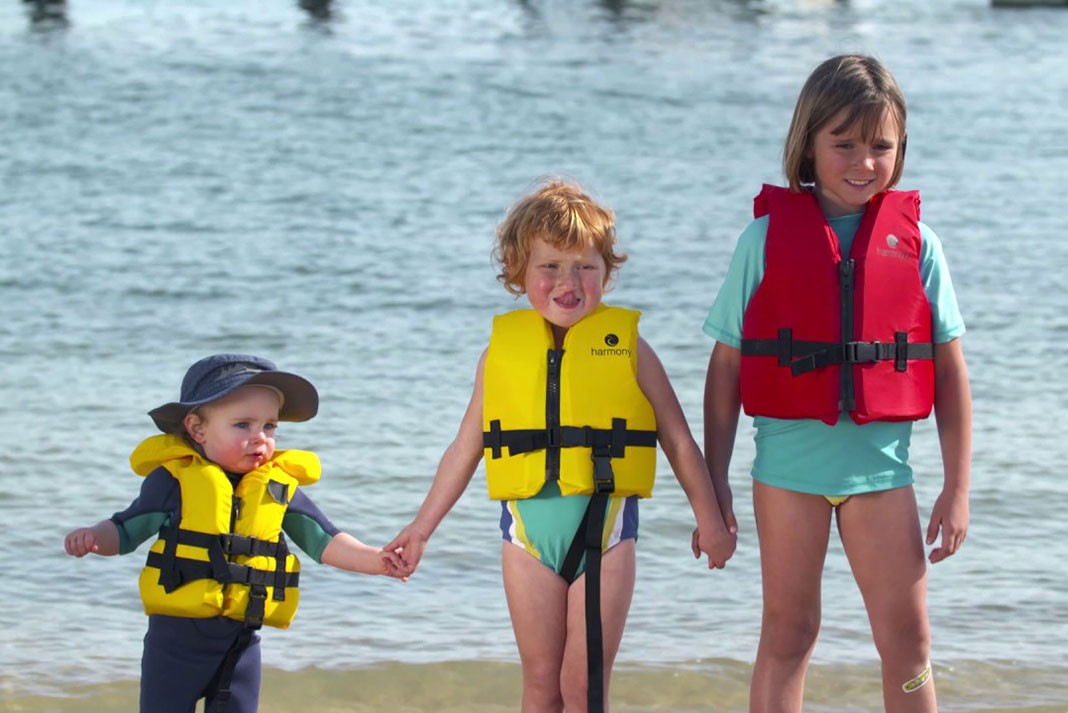
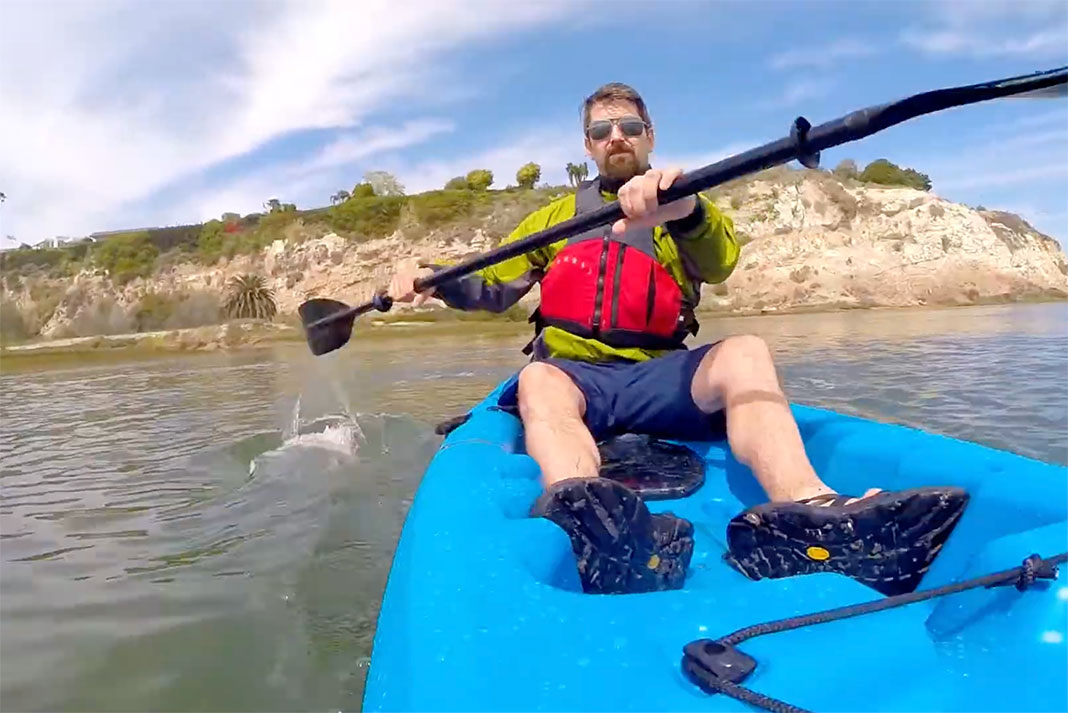
Everyone, even strong swimmers, needs to wear a life jacket at all times when on the water. It is extremely difficult to put a life jacket on once you fall into the water. Even a light wind can blow any paddlecraft away from you, faster than you can swim.
Always wear a USCG-approved Level 70 or Type III life jacket designed for paddling.
2 Wear the appropriate leash when stand up paddleboarding
A leash should be worn to keep your SUP with you when you fall off. An ankle leash is appropriate for surfing, but not on rivers, in swift currents or any conditions where being tied to the board could prove dangerous. For those activities, use a quick-release leash that attaches to your life jacket.
3 Paddle sober and smart
Never mix alcohol and paddling. Coast Guard and state BUI (boating under the influence) laws apply to all vessels. This includes canoes, kayaks, SUPs and rafts.
Know the “Rules of the Road” Navigation Rules that govern all boat traffic and stay out of the way of all other vessels.
Never assume that power boaters can see you. Avoid high-traffic areas whenever possible. Proceed with caution when you can’t avoid paddling near boats. Dress for visibility.
5 Dress for immersion, not air temperature
Your body loses heat much faster when immersed in cold water than it does when dry.
Avoid cotton clothing like t-shirts and jeans; they retain water and accelerate cooling when wet. Synthetic fabrics, or wool, are generally a better choice. If the water is very cold (60° fahrenheit or less), you should wear a wetsuit or drysuit.
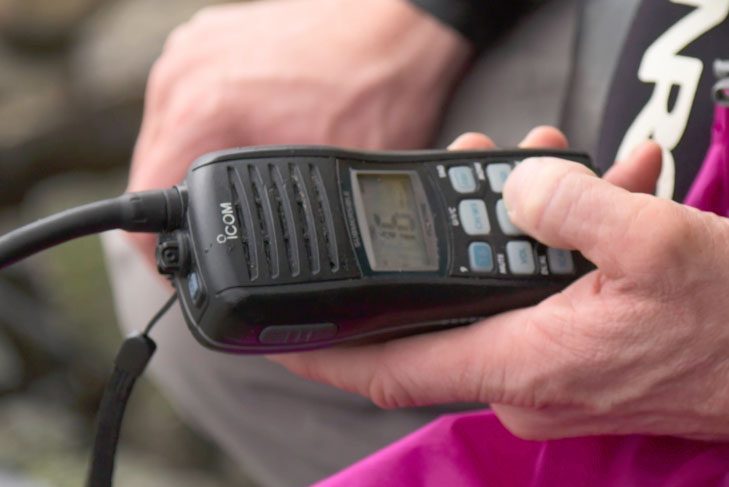
A handheld VHF marine band radio allows you to communicate with the Coast Guard and other boat traffic. Use Channel 16 only for hailing and emergencies. The radio should be waterproof, because it is virtually certain to get wet.
A cell phone, even if in a waterproof case or sealable bag, might not work, so don’t rely on it as the primary means of emergency communication.
9 Know the local hazards
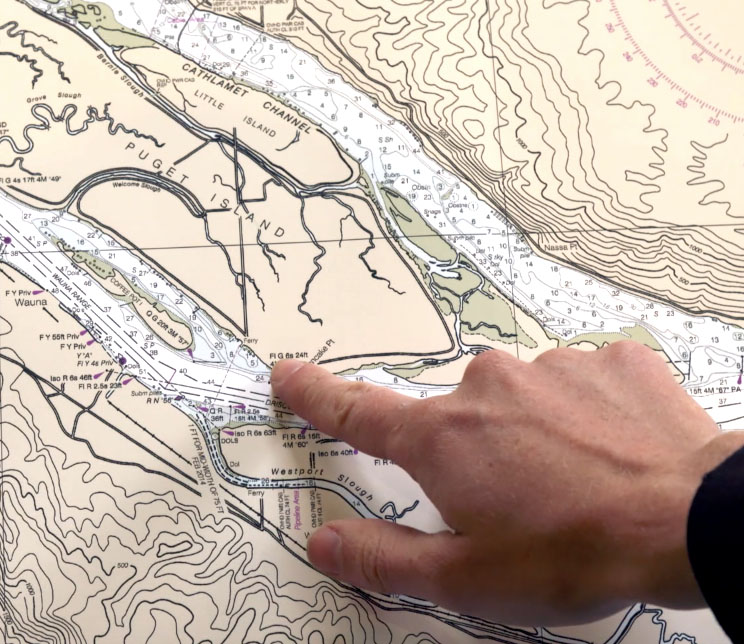
Check navigation charts before you launch. Check with those who have local knowledge of man-made and natural hazards, e.g. low-head dams; sweepers, strainers and undercuts; tides and currents; and rocks and shoals.
10 Education: Get some!
Take a paddling safety course from the American Canoe Association (ACA), your local paddling shop or outfitter, or other reputable source. Take a boating safety course from the U.S. Coast Guard Auxiliary, U.S. Power Squadrons® or your own state’s boating agency. Take on-the-water skills training.