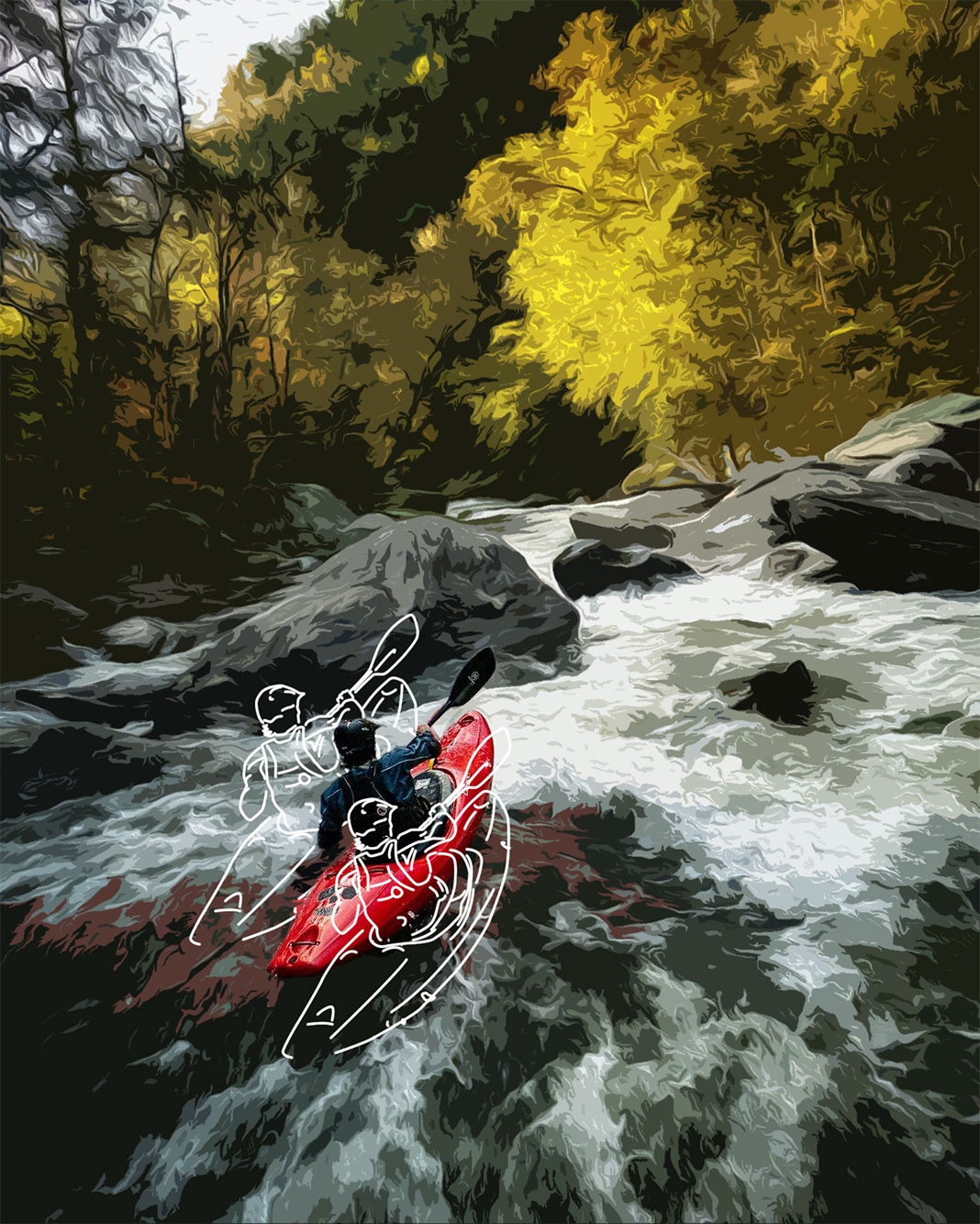
In this recent video, Dane Jackson launches a switch-freewheel off the lip of Sahalie Falls in Oregon, USA. The impressive, 90-foot drop was first run back in 1998 by a fresh-faced young ripper, Shannon Carroll. Pro kayaker and filmmaker Rush Sturges commented that at the time of the first descent, Carroll had “raised the bar of what was possible in a whitewater kayak.”

Now—over two decades years later—our definition of “what is possible” has been challenged once more. “Downriver freestyle has always been a big passion of mine and for many years I had dreamed something this big would go down,” Sturges commented in the write up for the video (filmed and produced by River Roots), “It seems we have arrived at the future (for now).”
[ Browse all whitewater kayaks in the Paddling Buyer’s Guide ]
It took a whole crew of photographers, videographers, and safety boaters to pull off this dynamic shoot. It seems the hard work paid off. Watch the full video of the impressive trick here.
David Parker found himself with a fair amount of free time on his hands during the coronavirus lockdown in Auckland, New Zealand. As a recreational canoeist and a woodwork enthusiast with over 6 years of experience building guitars, he decided that building a canoe would be a suitable way to spend this unprecedented downtime.
Parker quickly grew tired of seeing coronavirus stories in the local newspapers, so much so that he was driven to actually “hide” them. And, as is the case with many old newspapers after (or, if) their primary purpose has been served, they usually live a second life in some form of art or craft. In this case, they became the body of a canoe.
Note that this was not the first canoe build that Parker had on the go (he also had a cedar strip 15-foot prospector canoe-build in the works). Yet conveniently, this additional cedar canoe project ended up serving as the mold for its experimental younger sibling: the newspaper canoe.
Using the cedar strip canoe as a mold, Parker began the process by using 12 layers of paper (paper mache) to form the inside of the canoe. As well as newspaper, he thought it would be funny to use a copy of a popular canoe-building instructional book, “Canoecraft”, to have as the top layer on visible display.
Next, he put a layer of 6oz fiberglass both the inside and outside, making it completely waterproof and durable enough to be used for its intended purpose.
Parker commented that even after the application of the fiberglass, “it was a bit floppy”, but once the wood trim had been added to the hull, there was a lot more strength and rigidity. He then added a thin cap of wood to the gunwales to prevent water from getting into the paper layers.
Watch the video above to see the full start-to-finish process.
When Kiran Shrestha and his friends set out for a serene paddle around Kapuche Glacier Lake in the Annapurna region of central Nepal, it’s safe to say that they didn’t anticipate the hair-raising events that would soon unfold.
After paddling out to a prime position on the lake, Shrestha pulled out his camera to film some selfie-style footage of himself kayaking in its crystal-clear, sapphire waters. In the first few frames, we do witness that serenity that Shrestha was striving to capture. But what followed was, uh, less than calming.
After some selfie moments on the lake, we watch him running up and down the foot of the glacier—which, in itself, was a little concerning. After sussing out the area, he returns to his camp by the lake (on flat ground) and that’s when we see… it.
A colossal white cloud appears at the top of a rocky outcrop. As the cloud quickly grows in size and shape, it becomes evident that we are witnessing a giant avalanche starting from the top of the glacier.
The thundering debris rips down the canyon in a path that uncannily retraces Shrestha’s footsteps from earlier that day. Luckily for Shrestha and his friends, they were now positioned at the opposite side of the lake, back at their camp.
His friends begin hooting and hollering in excitement as the wind picks up and mercilessly launches their tents and belongings into the air as it passes through. The group remained unharmed, as the dangerous debris seemed to halt further up the slope, not quite reaching the lake.
[ Paddling Buyer’s Guide: See all recreational kayaks ]
The Kapuche Glacier Lake, only recently opened to the public in the last 3 years, is located about 90 miles northwest of Kathmandu and is located over 8,350 feet above sea level. It is known as the lowest-altitude glacier lake in the world. The area is prone to small-scale, frequent avalanches.
Although no one was hurt during this incident, it still serves as a solid reminder to always do your research when embarking on backcountry trips. Look at weather patterns, recent incidents in the area, and remember that even if you’re not traversing on snow, you could still be traveling past, or recreating within, its runoff path.
Sea kayaker and conservationist, Naude Dreyer, is no stranger to dealing with wild, uncooperative seals and sea lions. Through the work of the Ocean Conservation Namibia (OCN) non-profit organization, he and his team have rescued hundreds—if not thousands—of seals from human-caused ocean debris.
After viewing so many successful seal and sea lion rescues, one could assume that the art of capturing these semiaquatic creatures (in order to free them from their respective ailments) would be second nature to Dreyer. But even with a skill set as close to “expert” as it gets (on dry land), when you add in a kayak and ocean current, well, that’s a whole other beast.
“It’s seldom that we can actually get close enough to the entangled animals in the water to grab them,” said Dreyer. He explained that this was actually the fifth attempt to save this one Cape Fur Seal (eared seal). The seal “gave up a good fight,” Dryer explained, but in the end, the intervention was a success.
[ Paddling Trip Guide: plan your next kayaking adventure ]
Michigan 8th Graders to Stand-Up-Paddleboard 50 Miles of the St. Mary’s River to Raise Funds for Great Lakes Preservation
On May 1, 2021, three 8th grade students from Cherryland Middle School in Elk Rapids plan to standup paddleboard the treacherous St. Mary’s River.
Owen Werner, Max Ward and Jamie Peters will begin at the Soo Locks and end on their 50-mile journey on Drummond Island. Along the way, the students will encounter 600-foot freighters which create dangerously large wakes. The water will be bone-chilling cold at about 36 degrees and there may even be ice floating down the river.[
The trio plans on paddling this with Kwin Morris, their science teacher and co-founder of Stand Up for Great Lakes. Kwin has paddled four of the five Great Lakes with fellow co-founders Joe Lorenz and Jeff Guy. They will be accompanied by a safety boat with an EMT on board. Each paddler will be outfitted in drysuits and PFDs.
The group is paddling to raise funds and to raise awareness of the increasing levels of plastic pollution in the Great Lakes. All funds will be donated to Stand Up For Great Lakes, a non-profit organization dedicated to protecting the Great Lakes Basin.
“I fish these waters with my buddies, swim, boat, ski in them and much more,” said Jamie Peters. “They are a big part of my life and the lives of thousands and thousands more.”
[ Discover the best PFDs of the year in the Paddling Buyer’s Guide ]
“My goal is to inspire people around the Great Lakes to stand up for them,” added Max Ward. “The Great Lakes are crucial to the lives of every living thing in and around the lakes.”
“The lakes represent 84 percent of North America’s fresh water supply,” says Owen Werner. “My concern is that plastic particles as small as a pin head are getting into fish and damaging the habitat as well. Over 20 million pounds of plastic ends up in the lakes each year, and those numbers will only continue to grow.”
Michigan 8th Graders to Stand-Up-Paddleboard 50 Miles of the St. Mary’s River to Raise Funds for Great Lakes Preservation
About Stand Up for Great Lakes
It began with a love of water. The group has crossed four of the five great lakes by stand-up paddleboard and has raised more than $80,000 to help raise awareness of the issues facing the Great Lakes. The lakes are under threat. Oil pipelines of questionable integrity, invasive species, sewage leakage, pharmaceutical pollution, agricultural runoff, and those who choose to throw beer cans and cigarette butts wherever they please, the list of threats to these majestic and vital bodies of water is endless. We’re asking others to Stand Up for Great Lakes and provide support and encourage us on this important mission.
On April 13, 2021, American Rivers named the Snake River America’s #1 Most Endangered River of 2021, pointing to perilously low returns of Snake River salmon and the urgent need for lawmakers and communities to come together to develop a comprehensive economic revitalization plan that not only invests in salmon recovery and honors national obligaions to Native American tribes but also invests in clean energy, agriculture, technology and tourism.
“The America’s Most Endangered Rivers report is a call to save rivers in need of urgent action,” said Tom Kiernan, President of American Rivers. “We’re facing a critical choice on the Snake River. We can either stay with the status quo, which means failing salmon runs, more costly ligitation, increasing energy insecurity and broken promises to tribes. Or we can choose to invest in salmon recovery and infrastructure solutions that create a future of abundance and prosperity for the region. We think the choice is clear and we’re calling on the Northwest congressional delegation to take action now.”
[ See the best gear of the year in the online Paddling Buyer’s Guide ]
Once the largest salmon producer in the Columbia River Basin, today Snake River salmon runs are at the brink of extinction. The loss of salmon is a crisis for the entire web of life, from black bears to Southern Resident killer whales. It is also an existential threat to Northwest tribes who depend on the fish for their cultures and identities.
“Salmon are critical to the cultural lifeways of Columbia-Snake River Basin tribes, like my own people of the Confederated Tribes of Warm Springs, Oregon, and are integral to regional identity, economies, and even the orcas and the Puget Sound,” said Alyssa Macy, CEO of Washington Environmental Council / Washington Conservation Voters. “Removal of the four dams is a once-in-a-lifetime opportunity for salmon restoration that will benefit Tribal Nations, local economies, environmental ecosystems, and the Southern Resident Orca population for generations to come.”
Scientists say that removing four dams on the lower Snake River in eastern Washington must be part of a Snake basin salmon recovery plan. It is estimated that by 2080 the Snake River Basin will provide two-thirds of the coldest, most climate resilient stream habitats for salmon and steelheadon the West Coast. Congressman Mike Simpson (R-ID) has proposed a $33.5 billion framework to remove the dams, recover salmon, and revitalize the region’s infrastructure and economy.
American Rivers and Washington Environmental Council called on the Northwest congressional delegation to build on Congressman Simpson’s proposal and advance a comprehensive salmon recovery solution that includes lower Snake River dam removal, as well as robust job-creating
investments to replace the dams’ energy, transportation and irrigation services. This critically important legislation must be included in President Biden’s national infrastructure package.
“A well-crafted, comprehensive solution would benefit the nation as a whole by saving iconic salmon and Souther Resident orcas, bolstering clean energy and strengthening the economy of one of the most dynamic regions in the country,” Kiernan said.
The Snake River is the largest tributary of the Columbia River, flowing more than 1,000 miles from its headwaters in Wyoming to the confluence with the Columbia at the Tri-Cities in Washington. The Snake Basin is home to 50 percent of the current cold water habitat for Pacific salmon in all of the lower 48, and once produced 40 percent of the prized Chinook salmon and over half steelhead in the Columbia River Basin.
Salmon are at the heart of the cultures of Northwest Native American tribes, integral to religion, identity and physical sustenance. Abundant returns of salmon are also critical to local economies, driving lucrative fishing, recreation and tourism.
Wild salmon returns plummeted by over 90 percent following construction of the four federal dams on lower the Snake River. In recent years, fewer than 10,000 wild Chinook salmon have returned to spawn. Today, 13 Columbia-Snake salmon and steelhead populations are protected under the Endangered Species Act. Scientists believe that all four salmon and steelhead populations in the Snake River Basin will go extinct without urgent action.
The threat posed by the dams is exacerbated by climate change, which is warming up the Snake River and making conditions even more dire for salmon. In 2015, for example, 96 percent of the Snake River sockeye died trying to navigate through lethally warm waters to cooler tributaries and spawning grounds upstream. While the dams are heating up the major river thoroughfares for salmon, scientists estimate that the essential habitat above the dams will continue to provide clean, cold water.
The annual America’s Most Endangered Rivers report is a list of rivers at a crossroads, where key decisions in the coming months will determine the rivers’ fates. Over the years, the report has helped spur many successes including the removal of outdated dams, the protection of rivers with Wild and Scenic designations, and the prevention of harmful development and pollution.
Other rivers in the region listed as most endangered in recent years include the Puyallup River (2019), Green-Dwiamish and Willamette rivers (2018) and the South Fork Skykomish and Green-Toutle rivers (2017).
AMERICA’S MOST ENDANGERED RIVERS OF 2021
#1: Snake River (ID, WA, OR)
Threat: Four federal dams on the lower Snake River
#2: Lower Missouri River (MO, IA, NE, KS)
Threat: Outdated river management
As much as we love watching our whitewater heroes send the tallest waterfalls and throw down the most impressive tricks, there is something infinitely more satisfying about watching them execute an impressive rescue.
In this video, we see pro kayaker Dane Jackson step in to assist with a nail-biting cave rescue on the Green Truss section of the White Salmon River.
The video starts with Dane feeling “fired up” and enjoying laps on this classic PNW run. But less than 1 minute into the action, things take an ugly turn for the worse. A fellow kayaker has swum from his boat and has become trapped in a dangerous cave, bound by the strong recirculating current.
Dane approaches the waterfall—ready to paddle it—until he realizes something is wrong. He pulls over into a safe spot to access a better vantage point. “There’s someone in the cave!” he yells, as he quickly hops out of his boat and into action.
There is little time to waste. He discusses a plan with his paddle partner and, after setting themselves up in a good spot, they toss a throw rope directly at the swimmer. A perfect throw meant that the swimmer was able to grab onto the line with less difficulty. Both athletes clearly struggle as they heave on the line and attempt to pull the swimmer out of the cave and into the main flow, fighting the current.
Moments later, we breathe a sigh of relief as we see the swimmer—and the kayak—pop out of the cave. Both the boat and the paddler seem to have come out of the incident physically unharmed.
This kayak rescue highlights the importance of having whitewater rescue training. A slower reaction time and/or inadequate equipment could have changed the outcome of this event entirely. While our paddling skills may not be on par with Dane’s, we can certainly make sure our rescue skill set is just as impressive.
As much as we acknowledge and appreciate the wealth of life that lives beneath the ocean’s surface, we generally like to experience it on our own terms. When Scottish kayaker Ewan Campbell set out on a day mission to surf the waves of Lora Falls in Scotland, a meet-up with a slippery semi-aquatic friend was certainly not on his agenda.
The heart-stopping video shows the moment a seal suddenly flips out of the water and over top of his kayak. Campbell, clearly rattled, exclaims and struggles to stay upright. The seal, weighing in the region of 60-80 lbs, casually re-enters the water–unharmed–and resumes business as usual.
Campbell was on a solo mission that day and was the only witness of this wild, unusual event. For us as viewers, we are equally grateful that Campbell and the seal were both unharmed, as we are that he was wearing a GoPro to film the encounter.
[ Plan your next paddling adventure with the Paddling Trip Guide ]
Warning: This video contains language that some viewers may find offensive.
Engineering student Konrad Van Varseveld has never shied away from a good ol’ DIY challenge. After recently building a hydrospeed (a whitewater riverboard) out of an old whitewater creek boat shell, he decided to upcycle the kayak outfitting too. “I figured I could probably build a new kayak to put the outfitting in,” he said.
Determined to not let the idea fall into the draw of winter-projects-I’ll-never-get-to, the 20-something boater let these leftover, odd bits serve as kindling for his next upcycled creation.
Paying close attention to edge and rocker design, he assembled multiple paper prototypes until the pieces fit together seamlessly. Once he had found the winning combination, he traced the outlines onto high density polyethylene (HDPE) sheets before cutting them out and beginning the welding process. He then transplanted the cockpit rim from the dismantled creeker.
Van Varseveld took the new kayak for a test ride down his local class III run. He bumped a few rocks, hit a few boofs, and yet the homemade kayak endured. “My first kayak project went well, but after hiking five laps of the pink mountain wave without catching it, I decided to build a faster boat.
Everything is made more magical in Banff. | Photo courtesy of: Jake Dyson
Sitting on the western edges of Alberta, Banff National Park is all the superlatives of Canada crammed into one place. It’s aquamarine glacial lakes, backed by snow-capped rocky mountain peaks, set against a bluebird sky. And that’s not even making mention of the bears, elk, marmots, mountain goats and other incredible wildlife you’re likely to see on a trip here.
You could visit Banff in a day, but this is a park that deserves more than a few hours. Unfortunately, hotels in Banff tend to have prices that reflect their demand (this is the most popular park in Canada, after all), which is only part of the reason a Banff camping trip is one of the best ways to explore the region.
Whether you’re a first-time camper looking for a glampsite, a family researching the best camping around Banff, or an experienced outdoors person who is looking for a paddle-in backcountry site, we’ve got you covered. Here’s our comprehensive Banff camping guide.
You’ll be even more immersed in Banff’s beauty when you camp. | Photo courtesy of: Travel Alberta
Banff campgrounds
Banff National Park‘s campgrounds are managed by Parks Canada, which operates 13 frontcountry camping areas with a total of nearly 2,500 sites available for tents and motorhomes.
The seven main campgrounds are within a short drive of the Banff townsite, but additional campgrounds exist closer to Lake Louise and along the Icefields Parkway. Most Parks Canada campgrounds in Banff are only open from May until the beginning of October, although some are open year-round.
Here are some of the most popular places to camp near Banff.
Tunnel Mountain campgrounds
If you want to be close to Banff’s townsite, then make a reservation at one of the Tunnel Mountain campgrounds. These three campgrounds are the biggest in the national park and offer some of the best camping in Banff, with a total of 1,149 sites. You won’t get much privacy, but you will have every amenity you could possibly need.
Tunnel Mountain Village II (209 sites for $33.01 CAD per night) hosts evening programs with park interpreters, while Tunnel Mountain Trailer Court (322 sites for $39.04 CAD per night) can accommodate RV’s up to 50 feet in length.
Meanwhile, Tunnel Mountain Village I ($28 CAD per night) is the largest campground in the national park, with 618 sites and an evening theater program six nights a week during the summer months. All three must be reserved online in advance.
Johnston Canyon campground
Centrally located along the Bow Valley Parkway, the Johnston Canyon campground provides the best access to the waterfalls and walkways of Johnston Canyon. It has 132 sites for small RV’s (up to 27 feet) and tents, and much like the other Banff campgrounds on this list, can even be accessed via public transportation from Banff. Make a reservation in advance to secure your spot for $28 CAD per night.
Castle Mountain campground
With just 43 sites, this is one of Banff’s smallest and most intimate frontcountry campgrounds. On the more rustic side of things, it’s in a fully wooded area about 30 minutes from town, and has limited amenities (there are flush toilets, but no showers and there’s no electrical hook-up available). As such, it’s most suitable for those in tents or camper vans. The campground fills up on a first-come, first-serve basis and payment ($21.97 CAD per night) can be made by self-registration.
The best memories are made around a campfire. | Photo courtesy of: Parks Canada
Two Jack campgrounds
Two Jack Lake has two campgrounds, with a total of 454 sites. The Two Jack Lakeside campground is one of your best options for lakeside camping in Banff, as it offers direct water access to tenters and small RVs. It’s also where you’ll find 10 oTENTiks—Parks Canada’s walled shelters. This makes it arguably the best camping in the Banff area. Regular sites cost $28 CAD per night.
The Two Jack Main campground is a bit more secluded, and just minutes from Lake Minnewanka. Sites at both campgrounds must be reserved online in advance, but be prepared for just the basics when it comes to amenities—there is no electrical service at either campground (although there is a sanitation dump at Two Jack Main), and Two Jack Main doesn’t have showers. Sites at Two Jack Main cost $21.97 CAD per night.
Protection Mountain campground
Located a little farther down the Bow Valley Parkway toward Lake Louise, Protection Mountain has 72 sites that are available on a first-come, first serve basis. Once a treed area, it’s recently been opened up for safety reasons, providing even better views of the surrounding mountains. Note that there are no showers available, cell phone reception is limited, and there are some campsites where no fires are permitted. It costs $21.97 CAD per night.
Lake Louise campground
The Lake Louise campground is split into a hard-sided and soft-sided section, containing 189 and 206 sites respectively. As the name suggests, the hard-sided campground is reserved for hard-sided camping units. It contains double sites with electrical service, only some of which have fire rings. There is a sanitation dump on-site, as well as flush toilets and showers. Campsites cost $33.01 CAD per night.
The soft-sided campground is reserved for tents, soft-sided trailers and camping equipment with soft-sided pop-outs. It’s completely surrounded by an electric fence for the safety of campers due to seasonal bear activity in the area. There are flush toilets, showers and a sanitation dump on-site, but there is no electrical hook-up. Campsites cost $28 CAD per night.
Reservations for both sections of the Lake Louise campground can be made in advance.
Mosquito Creek campground
Don’t let the name alarm you—the skeeters are no worse here than they are elsewhere in the park. Located about an hour north of Banff on the Icefields Parkway, Mosquito Creek is a first-come, first-serve campground and is among the park’s most basic. There is no cell phone coverage, nor are there flush toilets or showers, although there are an outhouses. The campground contains 32 sites, which costs $17.99 CAD per night.
Waterfowl Lakes campground
The Waterfowl Lakes campround is nearly at the border of Banff National Park and Jasper National Park, about 90 minutes northwest of the Banff township. Located on the edge of a series of small lakes along the Icefields Parkway, it contains 116 first-come, first-serve sites, flush toilets, firepits and a sanitation dump—but no has cell phone service or showers. Sites cost $21.97 CAD per night.
Rampart Creek campground
One of the most northerly campgrounds within Banff National Park, Rampart Creek is a short drive away from Saskatchewan River Crossing, where the North Saskatchewan, Howse and Mistaya rivers meet. Campsites must be reserved in advance for $17.99 CAD per night. The campground is best suited for tent campers and smaller trailers, as amenities such as flush toilets, showers, electrical hook-up and sanitation dump are not available. There’s also no cell phone service here and fire permits must be purchased at the campground.
Silverhorn Creek campground
Located 50 km north of Lake Louise, Silverhorn Creek campground has the most limited amenities of any in national park. While other campgrounds at least have running water and picnic shelters, neither are available here, no are there flush toilets, showers or options for electrical hook-up. Instead you’ll find fire rings and outhouses.
Sites are big enough to accommodate large trailers and motorhomes, however, and tenters of course are also welcome. The 45 campsites here are available on a first-come, first-serve basis and cost $16.05 CAD per night.
Banff backcountry camping
As Canada’s most popular national park, Banff receives millions of visitors per year. The result is that frontcountry camping in Banff can be incredibly busy during the summer months, making it hard to be at one with nature.
The good news is that there’s 6,641 km² of wilderness to explore. Banff’s extensive backcountry hiking system makes it easy to immerse yourself in remote natural environments.
So, are you ready to go wild camping in Banff? If so, there are over 50 backcountry campgrounds spread across the park, all of which have pit toilets and food lockers. Many have fire rings—fires are not permitted at campgrounds where fire rings are not present. Almost all the backcountry campgrounds have hike-in access, but paddlers will love the six canoe-in campgrounds in the Lake Minnewanka Area and the one canoe-in campground in the Cascades/Sawback Area (this one is located on the Bow River and is the only backcountry campground that can only be accessed from the water).
[ Paddling Trip Guide: View all paddling adventures in Alberta ]
Most of the backcountry campgrounds have five to 10 sites available, so reservations are highly recommended for the summer months. Likewise, rustic shelters at Bryant Creek and Egypt Lake ($6.95 CAD per night) can be booked online in advance.
Random camping is only permitted in designated areas. Pick a place to pitch your tent somewhere that’s 5 km or more from either the trailhead or any designated campground, 50 m from the trail and 70 m from the nearest water source.
Regardless of whether you choose to camp at a designated backcountry campground or designated random camping area, you’ll need to purchase a backcountry camping permit ($10.02 CAD per night). These are mandatory and can be obtained in-person at the Parks Canada Visitor Centres in Banff and Lake Louise, or by calling (403) 762-1556 in Banff or (403) 522-1264 in Lake Louise.
Campers are only permitted to stay on backcountry campsites for a maximum of three consecutive days and group sizes are a maximum of 10 people and five tents.
For trips itineraries and more information on the best backcountry camping in Banff, visit pc.gc.ca/banff-backcountry or download the brochure “Backcountry Trails in Banff National Park,” which has a Banff backcountry camping map and full list of sites.
Camping in Banff is amazing no matter the time of year. | Photo courtesy of: Paddy Pallin
Winter camping Banff
Banff National Park may be a ski and snowboard mecca during the winter months, but that doesn’t mean camping comes to a halt.
For frontcountry wintertime camping, the Tunnel Mountain Village II campground is open year-round. Recreational vehicles and tents are both welcome and there’s no need to worry about getting cold—you’ll be able to keep warm with all the activities on offer at the neighboring Tunnel Mountain Trailer Court campground, including cross-country skiing, fat biking and snowshoeing. Down the road, the hard-sided section of the Lake Louise campground is also open year-round.
Banff’s backcountry system of campgrounds is also open year-round, but be aware there is an avalanche risk and no cell phone coverage, so you must be well-prepared for these excursions.
Luxury camping Banff
Two Jack Lake oTENTiks
A cross between an A-frame cabin and a canvas tent, the oTENTiks at the Two Jack Lakeside campground are Parks Canada’s answer to glamping. The structures have two queen-sized beds and one double bed. Reservations are recommended for these glampsites, which cost $122.64 CAD per night and book out months in advance.
Located in nearby Kananaskis Country, Sundance Lodges offers trapper’s tents and tipis, complete with wood bed frames and mattresses. You’ll be comfortable and warm inside these upgraded tents, while still being able to enjoy the sound of rain on canvas and fresh air. Tipis and tents start at $79.50 CAD per night and can be booked at online, although two-night minimums may apply during the high season.
Glamp in comfort at Sundance Lodges. | Photo courtesy of: Travel Alberta // Karl Lee
Elevated Escapes
One of the most luxurious glamping options in the Banff area, Elevated Escapes in Canmore has four themed belle tents with all the bells (get it?) and whistles. Upon request, they’ll even decorate the tent with rose petals and throw in a bottle of champagne. The tents start at $150 CAD per night.
During the COVID-19 pandemic, the popularity of camping on crown land exploded in Alberta. Although there is no crown land camping directly in the national park, you’re permitted to camp in “random” backcountry spots—provided they’re designated and you have a permit in-hand. (See above for more information on backcountry camping in Banff.)
There are, however, some crown land areas just outside the national park boundaries, particularly in Kananaskis. For a full rundown of free camping in Alberta and Public Land Use Zones (PLUZ), Road Trip Alberta has produced a comprehensive guide, which includes recommendations for sites near the Rockies.
If you do decide to crown land camp, please practice Leave No Trace principles and be respectful of the area you are choosing to pitch your tent or park your trailer for the night.
Banff camping opening dates
Most Parks Canada campgrounds in Banff are open from May until the beginning of October, with the busiest months being July and August. If you plan on visiting during the summer months, you’ll want to reserve your site well in advance. However, a handful of sites operate on a first-come, first-serve basis, with turnover happening around 11 a.m.
See the section above for information about year-round campgrounds in the park.
Banff camping reservations
While some of Banff’s frontcountry campgrounds are first-come, first-serve, many allow you to book sites in advance of your visit. Reserving campsites at these campgrounds is recommended, as they tend to be busy particularly during the summer months. You can do so online or by phone (1-877-737-3783).
You must make a reservation for all of Banff’s backcountry campgrounds. Purchase your permit online or by calling 1-877-737-3783.
For random camping, you must purchase a permit in-person at the Parks Canada Visitor Centres in Banff or Lake Louise, or by calling (403) 762-1556 in Banff or (403) 522-1264 in Lake Louise.
If you’ve arrived in Banff without a reservation during the months of July and August, you’re likely going to be out of luck. Your best option is to drive to nearby Canmore or Kananaskis to see if any campsites have availability in those areas, or camp near Calgary and plan a day trip into Banff.
Parks Canada campsites in Banff are affordably priced, ranging from $16.05 CAD for a basic site to $39.04 CAD for sites with power hook-ups.
Backcountry campground and free camping permits cost $10.02 CAD per person. There’s also a non-refundable reservation fee of $11.50 CAD when you book online and $13.50 CAD when you book over the phone.
Regardless of what type of site you choose, you’ll need to pay your national park entry fee ($10 CAD per day for adults, $8.40 CAD for seniors, $20 CAD for families and groups). This fee is not included in your camping fees.
If you’d like to have a campfire in one of the designated fire rings, fire permits ($8.80 CAD per day) are also available when you reserve your site or at camping kiosks. This also gives you access to firewood supplies at frontcountry campgrounds.
Finally, if you want to fish, you’ll need to apply for an additional permit ($9.80 CAD per day).
Take a stroll down Banff Ave in downtown Banff, and you’ll see store after store with all of your camping and outdoor supply needs. From big outfitters like Atmosphere to high-end brands like Smartwool, Patagonia and Fjällräven, they’re all here. However, the stores are heavy on apparel and ski gear.
To avoid steep tourist prices and get better selection, it’s best to arrive fully equipped. Calgary has a wide range of big box camping stores, including Mountain Equipment Co-op.
Find backcountry lakes—and have them all to yourself. | Photo courtesy of: Paul Zizka
Camping rentals in Banff
Bactrax
This is arguably the best place to go in Banff for camping equipment rentals. Located at 225 Bear Street, Backtrax offers individual camping items for rent, along with its car camping packages, which set you up with everything you might need.
Located in nearby Canmore, Rent-a-Tent has far more than just tents. This outfitter specializes in total camping packages, which include sleeping bags, tents and all your cooking gear. One-off gear rentals and add-ons are also available.
Looking for Banff camping tips? Here’s what else you need to know about how to camp in Banff.
Each Parks Canada campsite can accommodate six people (including children).
You must check out of your campsite or re-register by 11 a.m. The maximum stay per campsite is 14 nights for frontcountry camping.
Practice the Leave No Trace principles at your campsite. Tents and vehicles should only be on gravel pads (not vegetation) and you shouldn’t tie anything to the surrounding trees.
Ready to crack open a beer? Not so fast. During long weekends, visitors to Parks Canada campsites are not permitted to possess or consume alcohol or cannabis products.
In the Rocky Mountains, the focus tends to be on bear-proofing your campsite, but they’re not the only animals to be wary of. From squirrels to deer to elk, the name of the game when camping in Banff is ensuring you’re not only protecting yourself from wildlife, but also protecting wildlife from humans. Don’t feed the animals, keep your campsite clean, store food and scented products in your car, put garbage in wildlife-proof bins, keep your dog on a leash, report bear sightings, and give wild animals the space they need.
When hiking in Banff, always carry bear spray, make lots of noise and travel in groups. For the latest trail conditions, check with Parks Canada before you set out.
Everything is made more magical in Banff. | Photo courtesy of: Jake Dyson