Home Blog Page 144

Boat Review: LiquidLogic CR125 and CR250 Kayaks

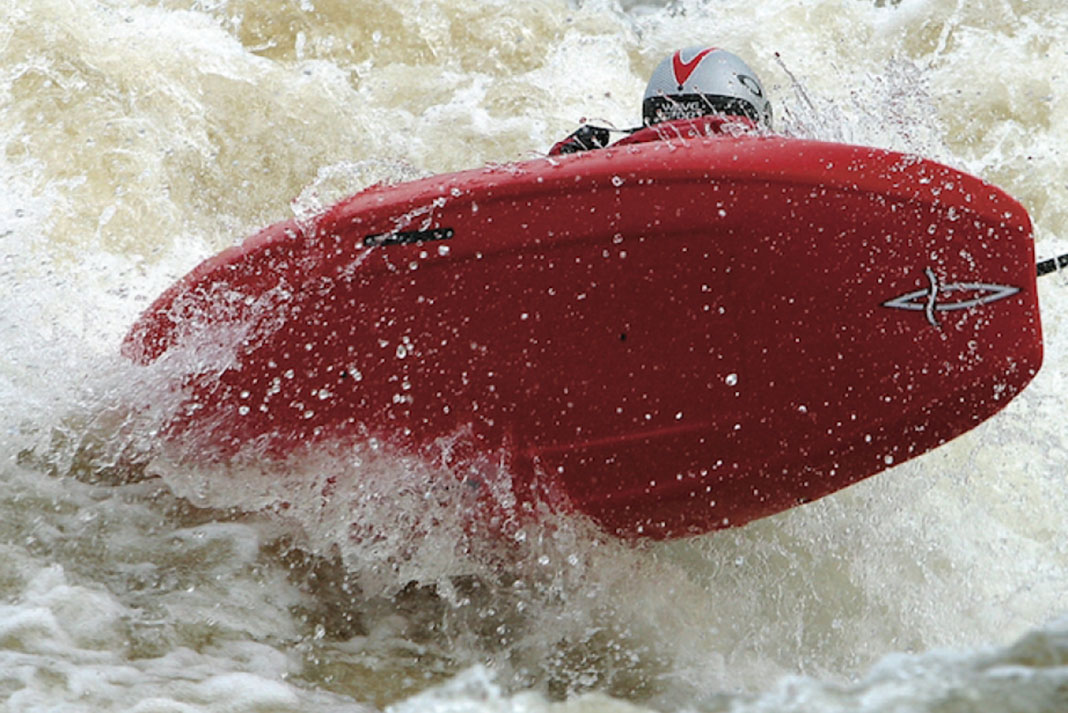
Man paddles a Liquidlogic CR125 or CR250 kayak
Feature Photo: Ian Merringer

You wouldn’t know it from looking at kayak ads, but most boaters gave up hopes of ever throwing big aerial moves long ago. Most boaters have a job off the river, appreciate being able to walk after a full day of boating and still see a long front surf as a worthy pursuit. Enter the Liquidlogic CR125 and CR250 kayaks.

Liquidlogic CR125 / CR250 Specs
Length: 6’7” / 6’9”
Width: 25” / 25.75”
Volume: 55 / 63 U.S. gal
Weight Range: 140-210 / 180-250 lbs
MSRP: $999 USD
[ Paddling Buyer’s Guide: See all Liquidlogic kayaks ]

Liquidlogic’s CR125 and CR250 surf in style

The CR, which stands for Cross River, is available in the 125 and 250 models. The names obviously don’t indicate their size in gallons; instead they are a play off Honda’s CR 125 and CR 250 high-performance racing motocross bikes. It’s a curious choice, since the CR boats are not high-performance competition designs, but are designed for the paddler that wants predictable river running performance, all-day comfort, and the ability to surf with style—more like Honda’s trusty Enduro line of trail bikes.

Run the river like a motocross track

Looking like a slightly stretched-out playboat, the CR125 and CR250 have a long and narrow planing surface that is almost seven inches longer than that of the Liquidlogic Vision. They also have sidewalls that flare more toward the stern and less kick rocker than most modern playboats.

With these design features the CR delivers performance but remains forgiving and comfortable. The wide stern—without kick rocker—provides easy edging and predictable eddyline crossing. Up front, the prominent rocker keeps the nose riding over eddylines and weird water. Compared to freestyle boats, it’s like running rivers with training wheels.

Ferrying the CR is a joy. Noticeably faster than other sub-seven-foot boats, the long and narrow planing surface allows the boat to plane quickly. The higher top speed allows you to nail river-running moves with fewer paddle strokes and more smiles. On big water this reduces the pucker factor while getting around the nasty stuff.

Carve the waves in complete comfort

As a playboat, the Liquidlogic CR125 and CR250 will inspire you on some features, and limit you on others. It shines on a wave, with the speed and looseness needed to play waves that are too flat or slow for most short boats. Sit up and use the front edges and the CR can lay down some serious carve. Sit back too much and it feels a bit sluggish, but very stable, edge-to-edge. The CR blunts almost as well as more dedicated playboats. The extra speed and stability will encourage boaters that have been trying to master the flat spin to go for it with gusto.

On eddylines and in small holes the CR is not going to open up the world of vertical play for the average boater. The large sidewalls make it difficult to get vertical without applying plenty of muscle and perfect technique. In more retentive holes the boat is a well-balanced cartwheeler and delivers impressive loops.
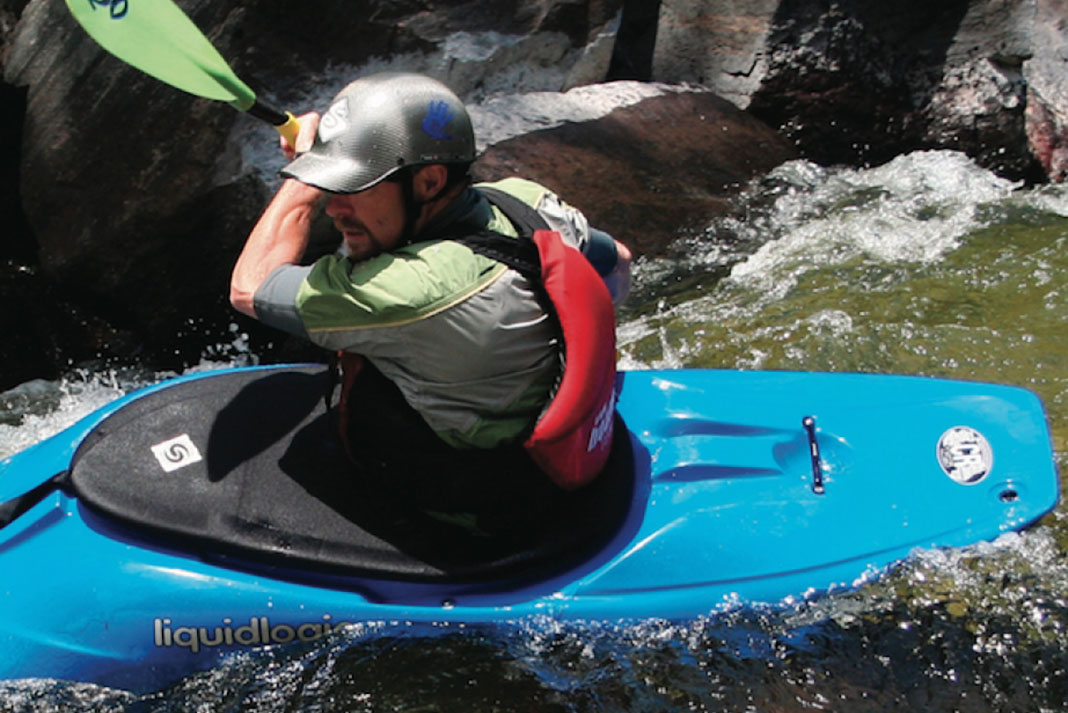
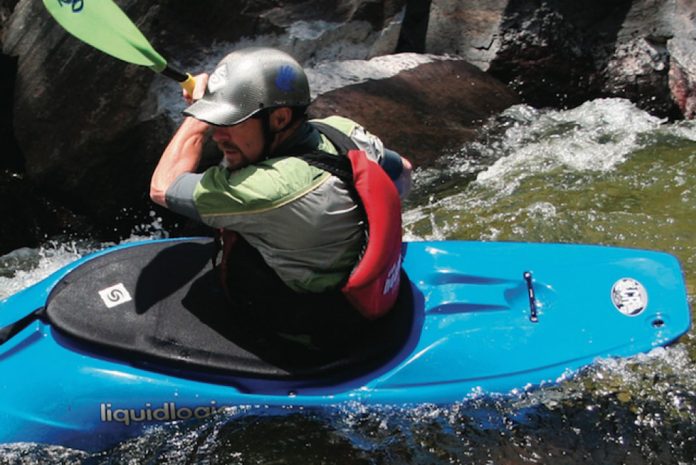
Man paddles a Liquidlogic CR125 or CR250 kayak
Feature Photo: Ian Merringer

According to Shane Benedict—head designer and lifestyle consultant at Liquidlogic—lots of us are sick of cramming ourselves into small, uncomfortable boats for long days on the river. In response, Liquidlogic made the CR125 and CR250 as comfy and roomy as your favorite easy chair, with lots of volume around the knees, plenty of foot room, a large, easy-entry cockpit, and the “Cone of Comfort,” a thin foam lining in the bow.

[ Plan your next whitewater kayaking adventure with the Paddling Trip Guide ]

Stick some tricks with the Liquidlogic CR125 and CR250

If you want to get to waves easily, surf them in style, and still be able to walk to your car without looking and feeling like you spent the day on a dirt bike, give the Liquidlogic CR125 or CR250 a test paddle—one of them could be your new ride.

This article was first published in the Fall 2006 issue of Rapid Magazine. Subscribe to Paddling Magazine’s print and digital editions, or browse the archives.


Boat Review: Liquidlogic Skip And Pop Kayaks

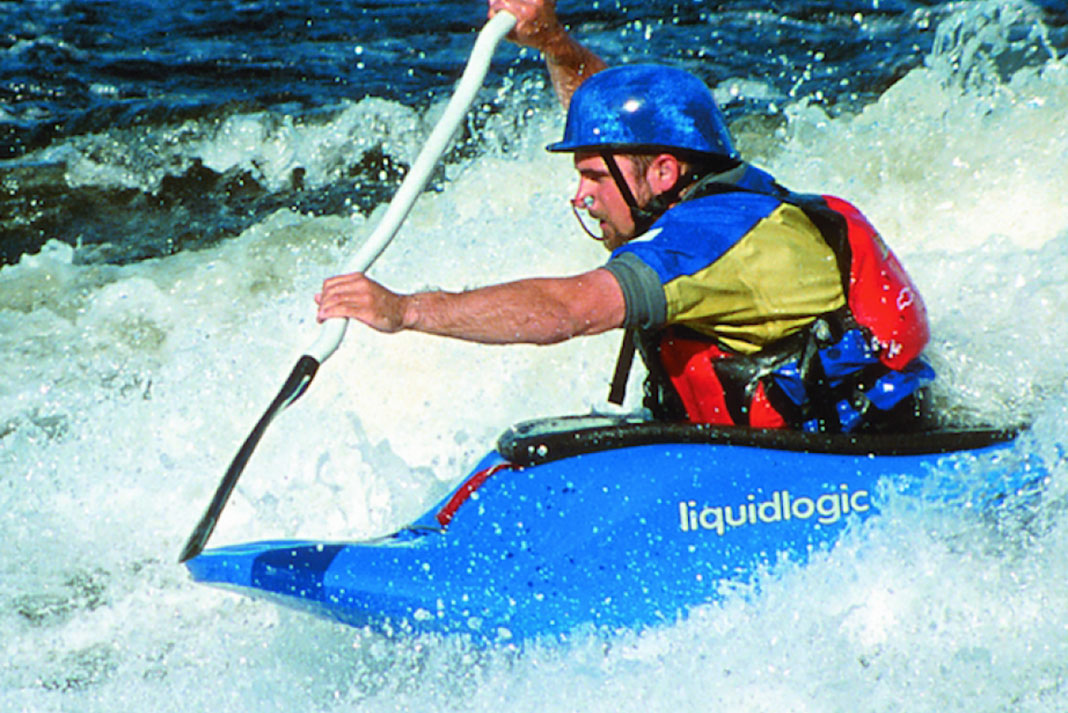
Man paddles through whitewater in a Liquidlogic Skip or Liquidlogic Pop kayak
Feature Photo: Rapid Staff

It’s funny how time changes perspective. A year ago, Liquidlogic’s shiny hulls and Lego colours were new and different, simple and seemingly at the time, unfinished. We felt like we were paddling a prototype. With familiarity comes acceptance, and with the amount of yellow and blue on the river it seems paddlers are embracing the Liquidlogic Skip and Pop kayaks with open arms.

Liquidlogic Skip / Pop Specs
Length: 6’4” / 6’6”
Width: 23.5” / 24.25”
Rocker: 7” / 8”
Volume: 39 / 50 U.S. gal
Weight: 29 / 32 lbs
Weight Range: 100-160 / 160-220 lbs
MSRP: $1,500 CAD
[ Paddling Buyer’s Guide: see all Liquidlogic kayaks ]

Liquidlogic’s Skip and Pop arrive in style

Liquidlogic started with the same spin surface used in the slicier Session and Session Plus, but the basic premise behind the hull design of the Skip and the Pop was to get air. Once they had a boat they figured would hop, they added back in cartwheelability and comfort.

Designer Shane Benedict separates air into three different types: hole air, wavewheel air and wave air. Hole air is used for moves like loops or space Godzillas. These moves happen by trapping volume underwater quickly, forcing the boat to explode back to the surface and catch air. Wavewheel air is more just keeping the boat on the surface paddling downstream over waves and drops and then being able to easily throw it around. Finally, wave air is for moves like ollies (hops) or blunts—air you can achieve from the surface of a wave.

Emphasis was put on making the boat perform best on faster waves. Liquidlogic feels this was achieved by paying close attention to the rocker geometry of the boat. Shane explains: “Rocker allows the boat to rock from the bow to the flat surface easily. If you wanted a good analogy you could say that having a slightly curving rocker through the ends of the boat is like having small skate ramps attached to the front and back of your boat. If the skate ramp is just straight from flat ground to 45 degrees it is very rough and hard to control, but if the ramp has a smooth curving transition from flat to 45 degrees it is much easier to control and carry speed into the move or jump.”

Outfitting requires some work to customize

It’s as if Liquidlogic focused on the performance of the hull and left the outfitting for paddlers to tweak and play with. There is plenty of room in the Skip and Pop for your butt and feet but not quite enough room for our testers’ knees. The back band is ratcheted into the thighbraces and the front pillar pulls out to insert the one-piece foam foot block. There is little shape to the thigh braces, potentially creating pressure points and bruising. The seat and thigh braces do move forward and back but require separate tools to make the adjustment.

The Liquidlogic Skip and Pop come with a bare bones outfitting rig by today’s multi-adjust standards; designer Shane Benedict’s confirms, “We added the normal outfit kit and foam foot blocks because we found that most people still did their own custom outfitting. We weren’t going to rush into an outfitting system that everyone is just going to tear out and rebuild with normal foam anyway.”

Designers can do many things with plastic, but length of waterline equals speed. Short boats like the Skip and Pop, with their extreme rocker, are slow. But what does it mean to the average river runner? You have to paddle like mad everywhere you go.

Beginner and intermediate paddlers were frustrated with the lack of river running performance. River paddlers said the Skip and Pop paddled like a Kleenex box. We’d never heard that one before, but apparently a Kleenex box doesn’t hold a line, slides sideways, and its square side-walls catch every little current. The high sidewalls made it difficult to roll and paddlers kept smashing their elbows on them. Luckily for these paddlers, Kleenex boxes are full of tissues. There are tough choices to be made when designing and buying boats. Liquidlogic didn’t design the Skip and Pop to be river running boats, they were made to play.

[ Paddling Buyer’s Guide: See all river running kayaks ]

Skip through the water and Pop in the air

With most spud boats you trade sliceability for wave bounce. Not so with the Skip and Pop; they are one of the most vertically slicey and stable short boat designs. The volume drops away from the cockpit like in traditional hole boats allowing the ends to slice cleanly underneath. Flatwater initiation and stalls are a breeze and put these boats in a small pourover and you’re in for piles of fun. However, it took some of our intermediate testers a few tries to get used to being further down in the trough when initiating the bow. And because the ends are so short and slicey, you have to be lightening fast to stay ahead of it. As the holes got bigger true cartwheels became more just tumbling forward toward the trough. Difficult to score but balls of fun.

Man paddles through whitewater in a Liquidlogic Skip or Liquidlogic Pop kayak
Feature Photo: Rapid Staff

If surfing and spinning is more your cup of tea, there are definitely fewer waves in the world if you are paddling the Skip or Pop. Slower, green waves are just not accessible in these boats. Get them on something a little steeper or with a bit of a foam pile and they wake up into carving machines.

The Skip and Pop want to be surfed off the front edge just behind the rocker break, so get forward in an aggressive paddling position. One tester said it surfs like a watermelon seed—a quick lift of your knee and you are sharply squirting (like a seed, not a squirt boat) across the wave setting up for spectacular blunts. They are so short and the rocker so extreme you effortlessly roll up on the bow or stern and come around so quickly it is difficult to judge if you’re vertical. You quickly learn to use the edges and put less effort into every move.

Our reviewers were not seasoned pilots on the aerial frontier. We can’t tell you if they bounce better than other spud boats, and we’re not entirely sure if the pros have figured it out yet either. We can tell you that in a couple weeks in the Skip and Pop we figured out loops, bouncing, aerial blunts and are playing around with the rest. These boats are super light and learning the moves is as easy as bobbing your hips for some bounce and then just huckin’ your body in the direction you want to go—we’re still working on the timing.

Play your way with the Liquidlogic Skip and Pop kayaks

To say the Skip and Pop are boats for advanced paddlers isn’t really true; what is true is that they are boats designed for paddlers wanting to play. And they are one of the few designs that excel in a hole, on a wave and in the air.

Our moaning about Liquidlogic’s outfitting hasn’t seemed to bother owners of either a Skip or Pop. They’ve simply padded their knees and built themselves a solid fit out of foam.

With so few paddlers taking advantage of the aerial capabilities of these new boats we can’t help but wonder if Liquidlogic will let the Skip and Pop ride for another year while skills catch up to the boats.

This article was first published in the Summer 2002 issue of Rapid Magazine. Subscribe to Paddling Magazine’s print and digital editions, or browse the archives.
 

8 Steps To The Ultimate Canoe Bike Trailer Rig

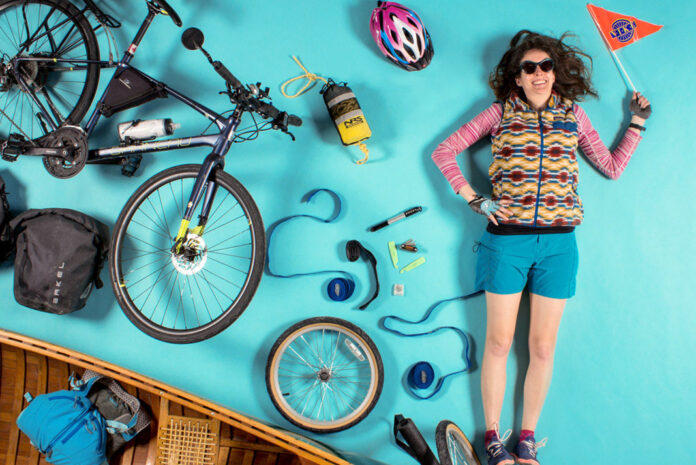
Woman surrounded by things needed for a bike canoe trailer rig
Disclaimer: Towing this 75-pound relic is not editor recommended. | Feature Photo: Alexandra Cousins

Packrafting is the trend du jour in the paddlesports world. Yet, paddlers have been towing their boats to rivers on two wheels since the days of the penny-farthing. If you want to bike through the mountains then a space-age seven-pound packraft mounted to your handlebars is a perfect idea. Otherwise, you’ll want to use a canoe bike trailer or cart, along with all the proper fittings and accessories to ensure a safe and comfortable trip.

If you’re already inclined to pedal meandering roads and trails, explore environmentally-friendly options for getting to the water, or just want to expand your adventure horizons, you may already have most of what you need for a great canoe bike trailer.

Your canoe bike trailer rig in 8 steps

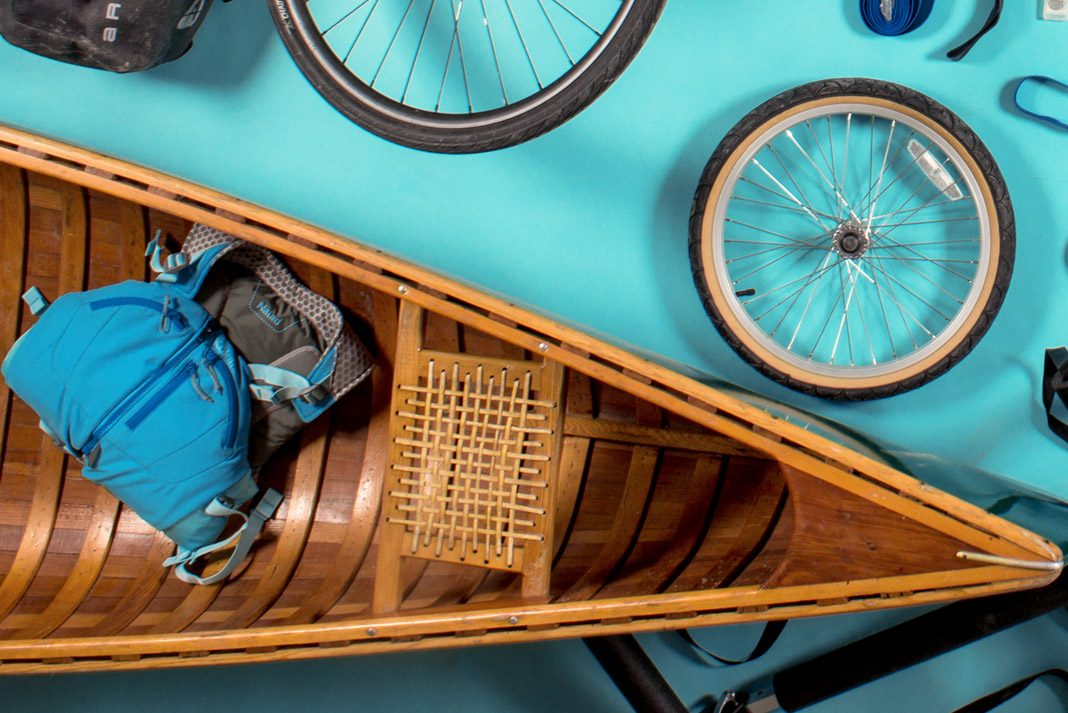
the canoe to be towed in a trailer behind a bike
Canoe. | Photo: Alexandra Cousins

1. Canoe

On a windless day, traveling flat and smooth-as-butter pavement, a cyclist will barely notice the weight of towing a canoe once up to speed. On a hill of any gradient, pedalers will gain a new appreciation for a lightweight layup.

The heavier your kit the more energy you must expend to overcome gravity—by the time a cyclist is faced with even just a five-percent gradient, 75 percent of pedal power is exerted combating gravity alone. Go light with you canoe bike trailer rig.

bike canoe trailer
Trailer. | Photo: Alexandra Cousins

2. Trailer

Constructing a canoe trailer is a feasible weekend DIY project for handy folks. For the rest of us, Wike’s Canoe Trailer ($220 CAD) does the job admirably. The compact unit sets up and takes down in two minutes.

The trailer consists of two components—the Towing Tee connects the front of your to the bicycle seat post with a universal joint, and a two-wheeled cart supports the boat midship for ultra-smooth sailing.

Wike’s 13-pound unit has an adjustable width up to 36 inches.

a vest and shorts
Clothing. | Photo: Alexandra Cousins

3. Apparel

The only enthusiast group more particular than paddlers when it comes to gear is cyclists.

There are many good reasons for enthusiasts to wear sport-specific apparel, but for day-long and weekend adventures, there’s no compelling reason why your Patagonia boardshorts can’t double as cycling shorts, or why you’d need sport-specific fingerless gloves.

Leave the Lycra behind. Simply abide by the tenants of dressing for outdoor adventures everywhere—layer up, and leave cotton at home.

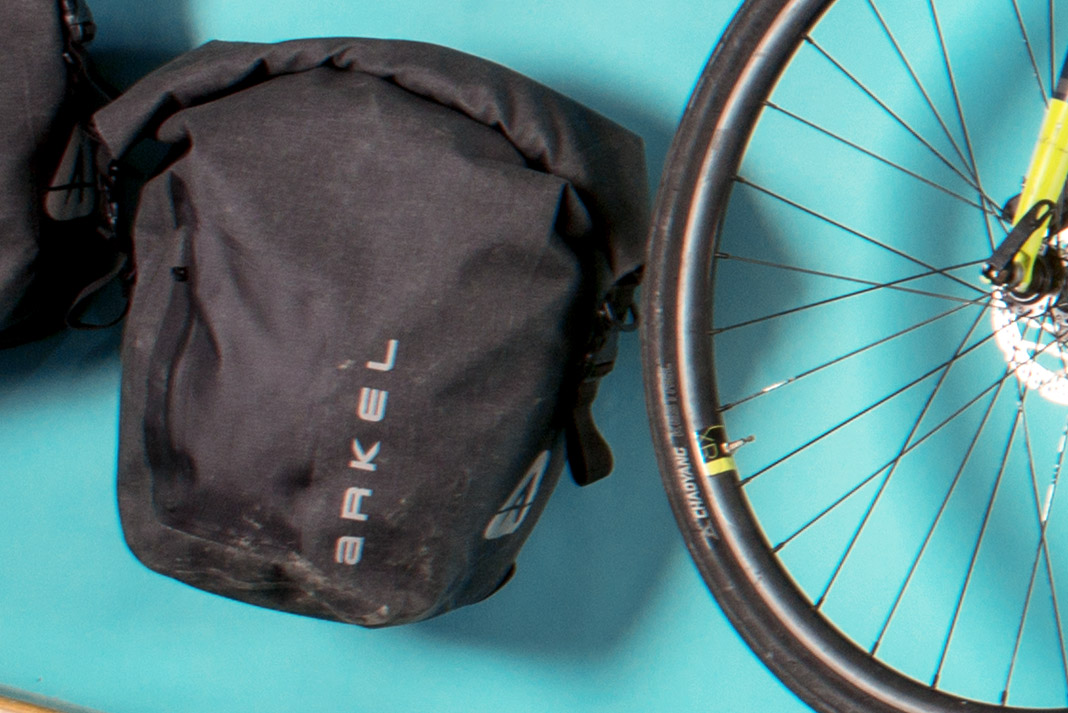
waterproof panniers as part of a bike canoe trailer rig
Waterproof panniers. | Photo: Alexandra Cousins

4. Panniers

You could throw all your gear into the canoe to rattle along behind you, but I bet you won’t pedal far towing that racket. Panniers are an excellent addition to your canoe bike trailer rig because they will efficiently distribute load on your bicycle frame—whether it’s snacks and an extra layer, or cooking pots and camping gear for an overnight excursion.

Waterproof panniers can do double-duty on rainy days and river runs. Arkel’s Orca 35-liter pannier pair ($209) can be mounted on most front and rear racks, feature welded seams and the Cam-Lock mounting system will keep bags on the rack, regardless of the load and rough road conditions.

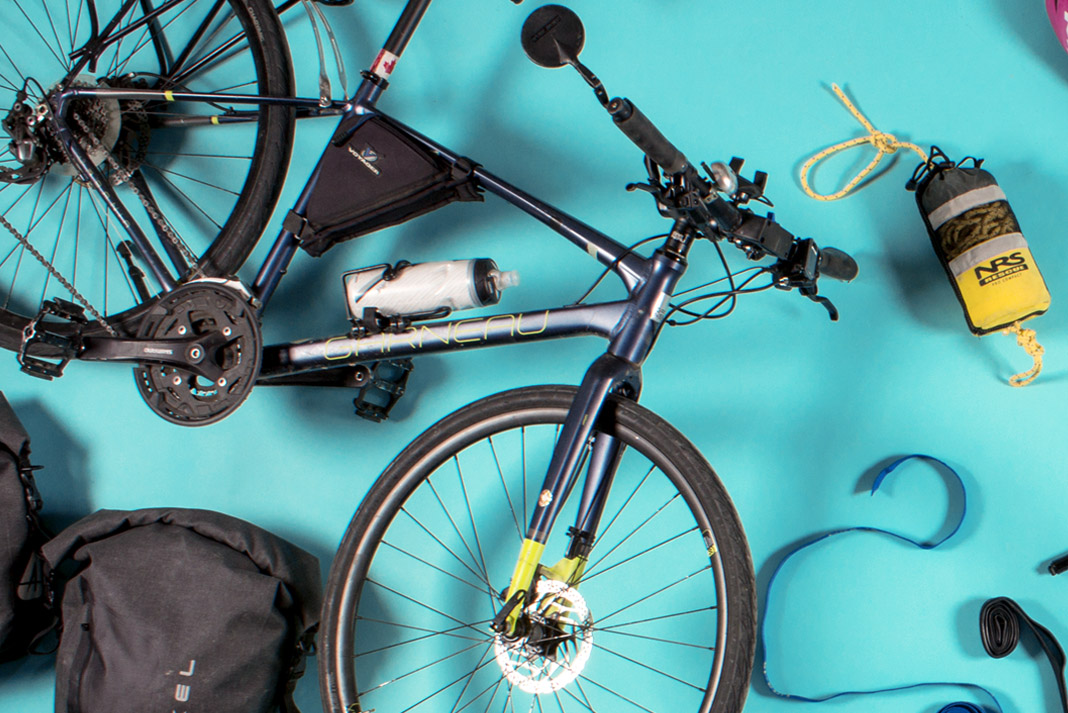
bike
Bike. | Photo: Alexandra Cousins

5. Bicycle

Any bike—even a skinny fixie—can tow a canoe trailer rig. However, you’ll enjoy the ride to the water more if you roll on tires a couple inches wide. Wider tires offer more traction, which will help you pull, and are needed for rougher roads.

A solid rear rack like Topeak’s Super Tourist ($40) will carry your panniers and larger, oblong objects—say, like a packed tent—on the top of the rack.

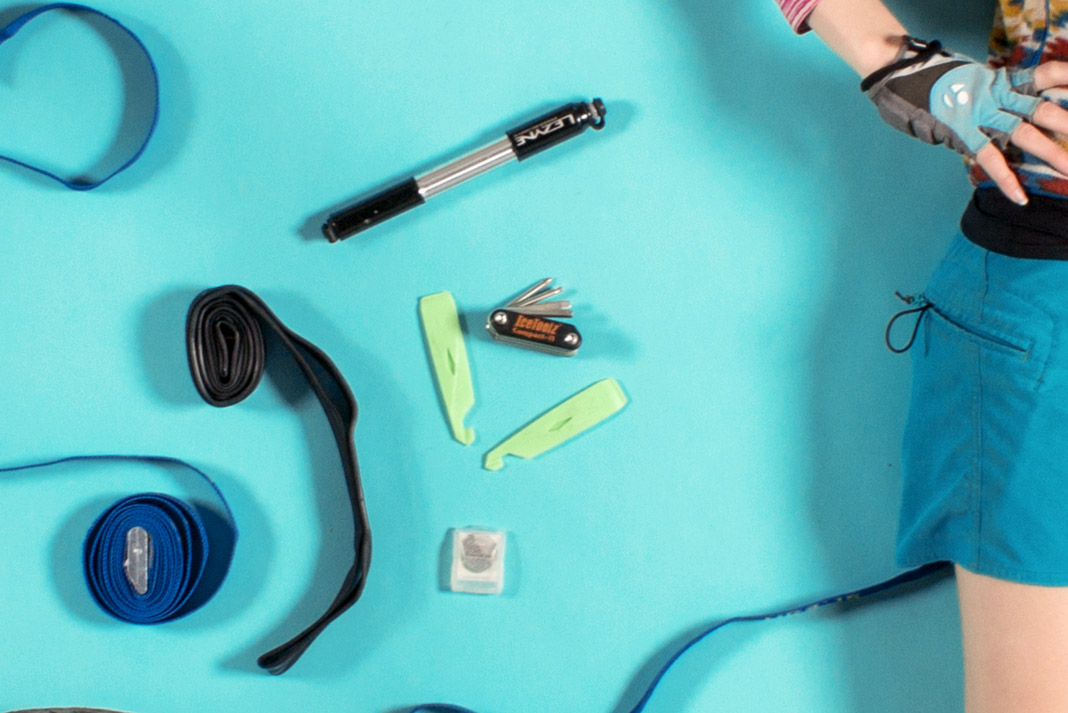
tools to help repair bikes
Repair kit. | Photo: Alexandra Cousins

6. Repair Kit

Bring the basics for tire repair, just in case. For peace of mind, pack along a spare tube, small hand pump, puncture patch and tire levers.

You’ll need either the skills to use the items or a data connection to stream a how-to video on YouTube. Your dad would recommend the former.

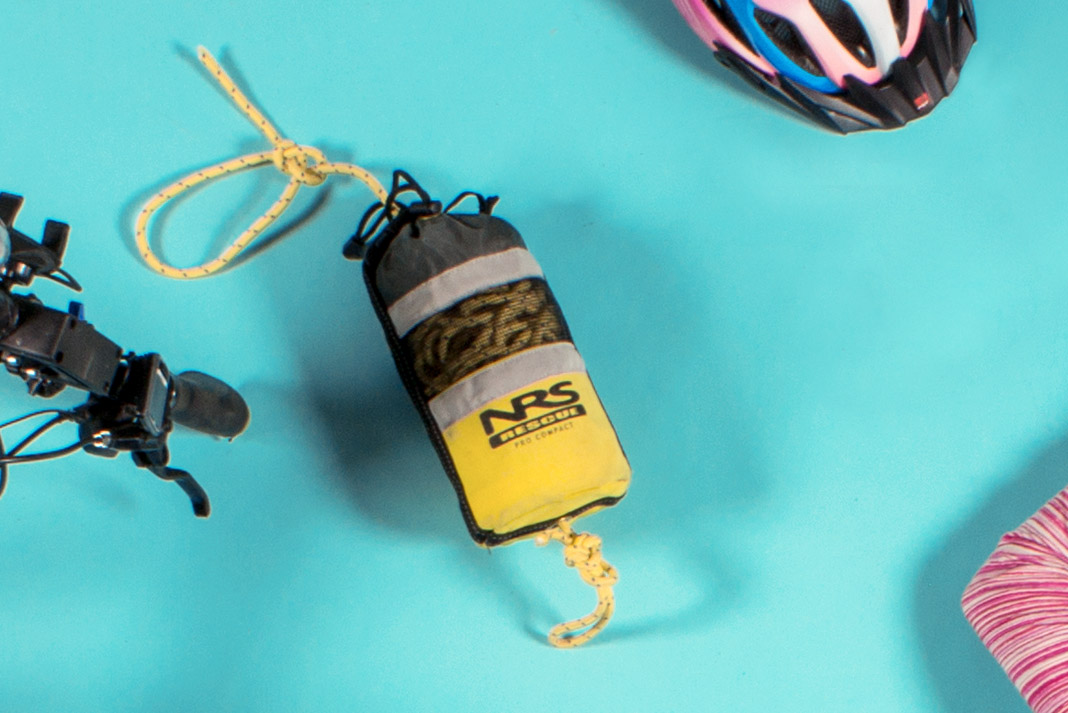
yellow NRS throw bag
Throw-bag. | Photo: Alexandra Cousins

7. Safety

In all the excitement of combining two favorite pastimes, don’t forget standard safety equipment still applies, like a helmet, PFD, bailer bucket and buoyant line.

Though it’s more likely your strange load will attract attention and passing motorists will give you wide berth, mark the stern of your canoe with a red or orange bike safety flag.

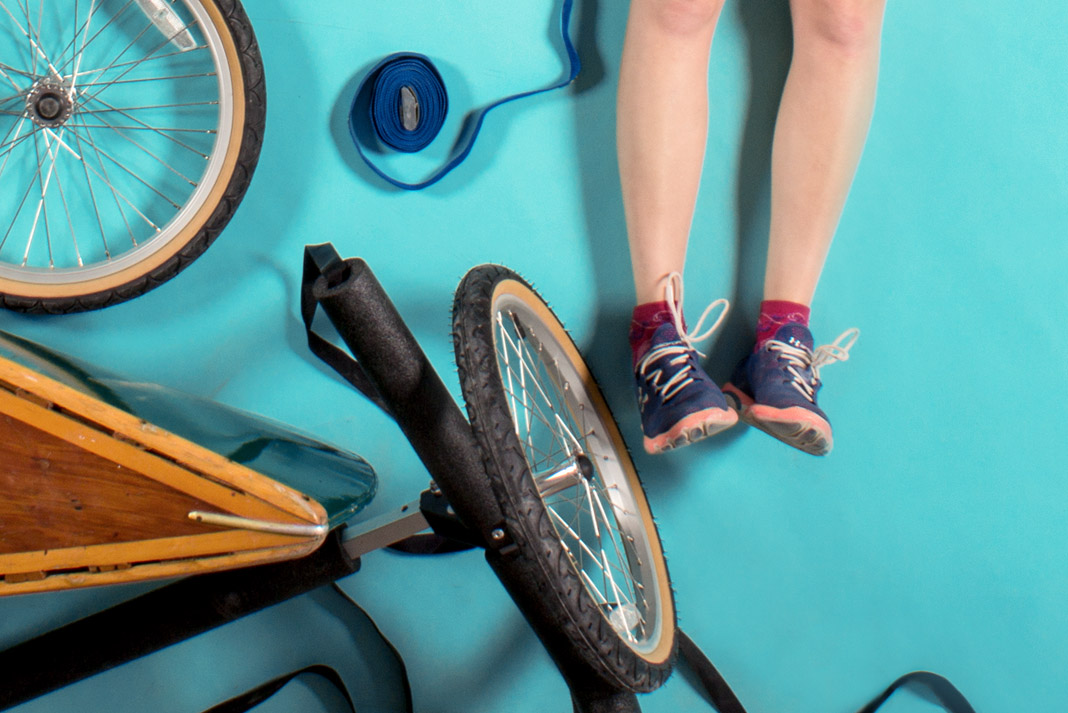
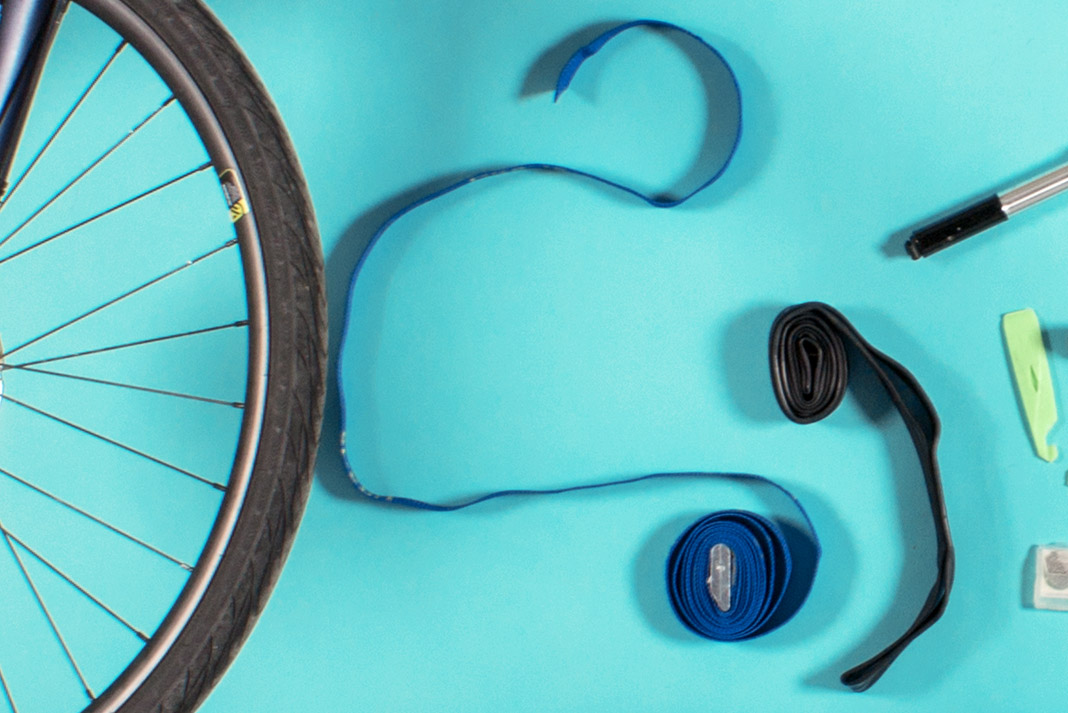
blue cam straps
Cam Straps. | Photo: Alexandra Cousins

8. Cam Straps

A jack of all trades. NRS cam straps ($6 and up) are perfect for securing your canoe to roof racks at the beginning and end of the journey, your tent to your bicycle rack while pedalling, and your disassembled bike frame and wheels to the thwarts in your canoe while paddling. Cam straps are a key part of your canoe bike trailer rig, so never leave home without ‘em.

This article was first published in Issue 53 of Paddling Magazine. Subscribe to Paddling Magazine’s print and digital editions, or browse the archives.


Disclaimer: Towing this 75-pound relic is not editor recommended. | Feature Photo: Alexandra Cousins


Coalition Calls for Protection of the Piatúa River in Ecuador

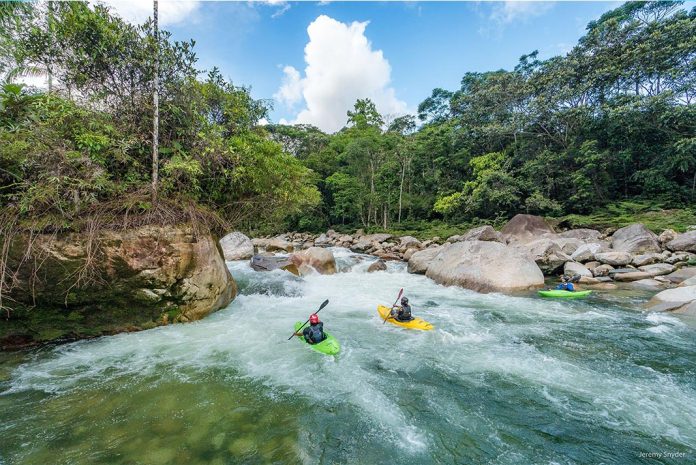
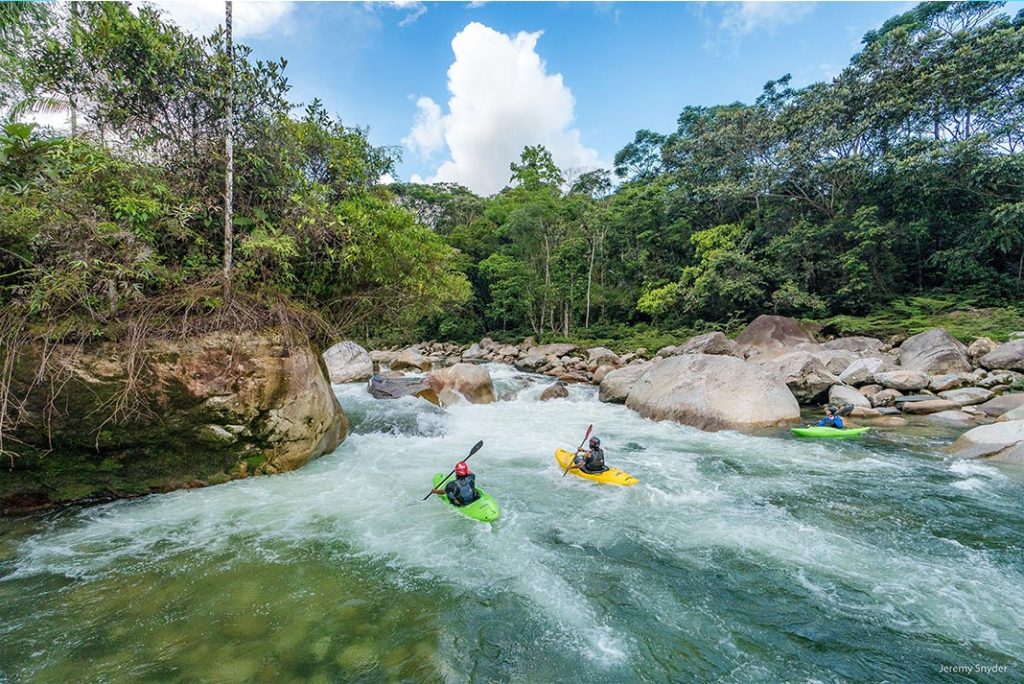
kayakers on the lower Piatua River. Photo by Jeremy Snyder

QUITO, ECUADOR — On November 26, a coalition of civil society organizations and law professors submitted an amicus brief to Ecuador’s Constitutional Court calling for the protection of the Piatúa River based on the Rights of Nature and Indigenous rights. The Piatúa River is under threat from a hydroelectric project that Ecuador’s government approved without the free, prior, and informed consent of Indigenous Kichwa communities. The project is suspended as the Constitutional Court reviews the case.

kayakers on the lower Piatua River. Photo by Jeremy Snyder
Kayakers on the lower Piatua River. | Photo by Jeremy Snyder

While all rivers and other ecosystems possess rights under Ecuador’s constitution, the amicus brief recommends urgent protections for rivers with outstanding natural and cultural values, including the Piatúa River. The amicus brief also highlights other deficiencies, errors, and omissions in the hydroelectric permitting process. Finally, the amicus brief supports Kichwa communities who assert violations of their own Indigenous rights.

“Ecuador’s government must begin to apply the Rights of Nature in practice, including by rejecting unnecessary dam projects that fragment ecosystems and negatively impact Indigenous territory,” said Constanza Prieto Figelist, the Latin American Lead at Earth Law Center, which is amongst the groups that submitted the amicus brief. “Today, our coalition presented a blueprint for Ecuador to enforce the rights of rivers in a strong and practical manner.”

The Piatúa is a wild and free-flowing river which drains out of the rugged Andean cloud forests of the Llanganates Mountains in the Ecuadorian Amazon. It provides an intact ecological corridor as it passes through montane rainforests down to the humid tropical rainforests of the Napo River basin. The Piatúa River is one of the last rivers in this region to avoid contamination from widespread deforestation, gold and gravel mining, dams, and other threats.

Species in this region are declining at breakneck speeds. The 2020 Living Planet Report found a 94% decline in monitored vertebrate populations between 1970-2016 for tropical subregions of the Americas, the most of any region in the world. The proposed hydroelectric project stands to exacerbate this trend.

Native Kichwa-speaking Indigenous families have inhabited the Piatúa watershed for centuries and lived in a traditional manner until the first road was opened to this area in 2007. These Indigenous communities have a deep respect and appreciation for the Piatúa River, which they rely upon for food and water and believe has special curative properties. They have always lived harmoniously with the river.

Pablo Shiguango, who was born and raised along the Piatúa River in the Kichwa community of San Juan de Piatúa, states “The Piatúa River has an incalculable value from the cultural perspective and cosmovision of our people. The Piatúa River provides life-bearing sustenance and well-being to our lives.”

The Piatúa River is also a destination for international paddle sports tourism. River enthusiasts share similar respect and values for the river and joined together with the Indigenous  communities to present the constitutional demand to uphold the rights of the river, including its right to flow freely. They share a mutual respect for the river.

“The Piatúa River in Ecuador offers one of the most special whitewater experiences that I have found. The Piatúa River attracts kayakers for its crystal-clear waters, incredible forests and bird life, and the friendly local communities who call this river home,” said Darcy Gaechter, a prolific kayaker and author of the book Amazon Woman.“The Piatúa deserves to be protected for the benefit of future generations and for nature itself.”

In 2008, Ecuador became the first country in the world to constitutionally recognize the Rights of Nature. However, Rights of Nature advocates argue that these rights are neither regularly nor adequately enforced. Ecuador’s government rarely considers the Rights of Nature in permitting decisions on projects that have major ecosystem impacts—mining, hydroelectric dams, new road projects, and so forth. While the courts have upheld Nature’s rights on occasion, such as a 2011 case ordering the restoration of the Vilcabamba River in the wake of a harmful road widening project, such rulings are sporadic and inconsistent.

“Our amicus brief provides Ecuador’s Constitutional Court with practical guidance to enforce the rights of rivers and all other ecosystems in practice,” said Monti Aguirre, the Latin American Coordinator at International Rivers. “The Rights of Nature can successfully work in practice if we develop clear standards for its enforcement, which our amicus brief aims to help achieve.”

Globally, the Rights of Nature are now recognized to some extent in over a dozen countries. This includes Colombia, which has issued a series of major court victories for the Rights of Nature, and even the United States, where a handful of Native American tribes and local communities have passed Rights of Nature laws, declarations, and resolutions. The Convention on Biological Diversity’s post-2020 global biodiversity framework also recently promoted the Rights of Nature in its updated zero draft, which is up for adoption in 2021.

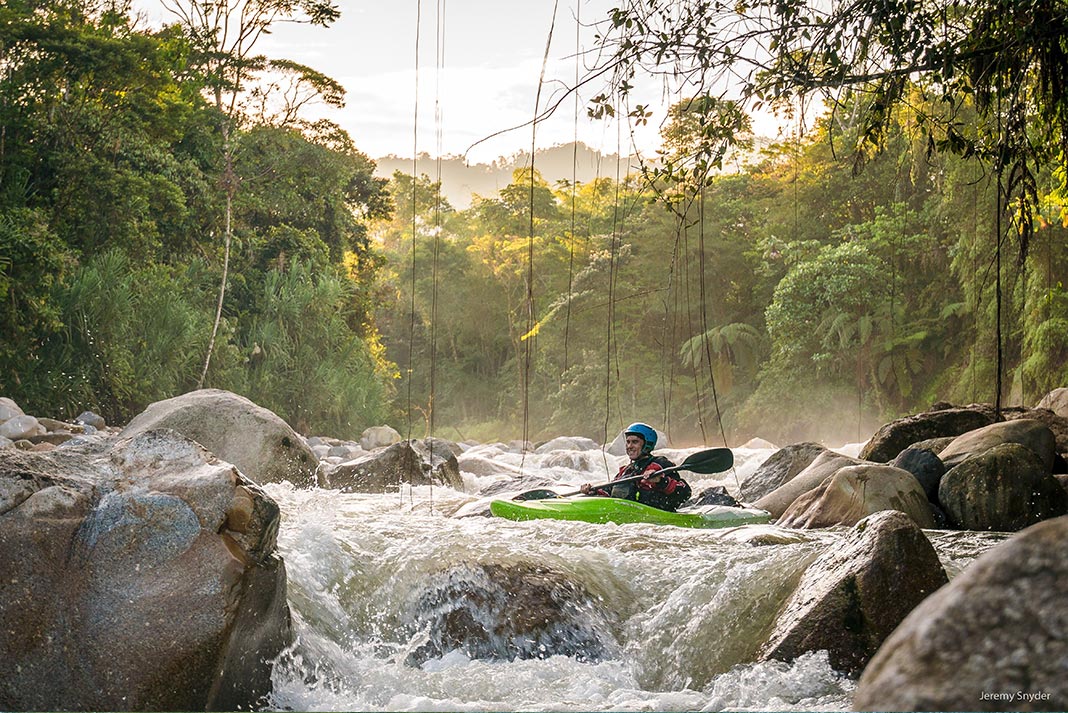
Andres Charpentier on the Piatua River. | Photo by Jeremy Snyder


Earth Law Center (earthlawcenter.org) is a 501c3 organization that works to transform the law to recognize and protect nature’s inherent rights to exist, thrive and evolve. They recently released the first-ever law school coursebook on “Earth law,” which is an emerging body of ecocentric law, including the Rights of Nature.

International Rivers (internationalrivers.org) protects rivers and defends the rights of communities that depend on them. We seek a world where healthy rivers and the rights of local river communities are valued and protected. We envision a world where water and energy needs are met without degrading nature or increasing poverty, and where people have the right to participate in decisions that affect their lives.

Ecuadorian Rivers Institute (ecuadorianrivers.org) is a 501c3 organization that provides technical assistance and support to help protect and conserve unique watershed resources in Ecuador.

Fundación Río Napo (info@rionapo.org) works to preserve strategic, free-flowing watershed corridors in Ecuador to conserve freshwater biodiversity and ecological connectivity, and organizes river festival events to promote the value and importance of these resources for sustainable economic alternatives based on tourism.

The Great Lakes Environmental Law Center (glelc.org) is a Detroit (USA)-based nonprofit that offers community education, policy support, and various legal services to address environmental, resource, & energy issues affecting communities in and around Detroit, all over Michigan, and throughout the Great Lakes region.

Amazon Woman (amazonwoman.net) is building a community of writers who aspire to spread the love of wild places. We interact with our environment through river expeditions and then share these experiences through the written word. We believe that preserving wild places is key to our survival.

Bluegrass Wildwater Association (bluegrasswildwater.org) was formed in 1976 to promote the safe enjoyment, access, and conservation of wilderness waterways for human-powered watercraft, and is one of the oldest paddling organizations in the United States. The BWA has designated the Piatúa River as a natural wonder and supports measures for its permanent protection.

American Whitewater (americanwhitewater.org) was founded in 1954 to protect and restore America’s whitewater rivers and to enhance opportunities to enjoy them safely. AW is the primary advocate for the preservation and protection of whitewater rivers throughout the United States, and connects the interests of human-powered recreational river users with ecological and science-based data to keep remaining wild and free-flowing rivers intact, restore developed rivers to function and flourish, and ensure that the public has access to rivers for recreation, and that river enthusiasts are active and effective river advocates.

Sign this petition to urge the Ecuadorian government authorities to preserve the Piatúa River as an intact, free-flowing Andean Amazon tributary.

Canadian Canoe Museum announces purchase of Johnson Property

2020 artisan workshop lineup features five unique new experiences

The Canadian Canoe Museum (CCM) and the City of Peterborough announced today the conditional purchase and sale of Johnson Property, the City-owned land at 2077 Ashburnham Drive in Peterborough, ON.

City Council approved the direction to proceed with the sale of the land on Monday subject to a number of conditions including rezoning. Project validation and confirmation of site appropriateness are among the additional conditions that must be met to close the deal. CCM will pay $1.575M for the five acres of land in a transaction expected to be completed by the summer.

Photo: Canadian Canoe Museum
Canadian Canoe Museum announces purchase of Johnson Property | Photo: Canadian Canoe Museum

CCM intends to sell its current property at 910 Monaghan Road to help fund the new build project.

“Kicking off the New Year with this key milestone realized drives further momentum to our new world-class museum build,” stated Carolyn Hyslop, executive director, The Canadian Canoe Museum. “In less than a year we’ve moved from walking away from a contaminated site to forming a new build project team and identifying and securing an alternate location. The purchase of a viable new site puts our project firmly on-track to be shovel-ready by the end of this year.”

Hyslop conveyed CCM’s gratitude for the continued support and partnership of the City of Peterborough and for the strong continued support of its donors and funders as well as that of the local community.

“Museums are part of the fabric of our country and our community.”

“Museums are part of the fabric of our country and our community. The new location for The Canadian Canoe Museum will enhance the waterfront experience in Peterborough with the location next to Little Lake and along the Trans Canada Trail network. It’s an ideal location beside parks and greenspaces with nearby public parking at East Gate Park and Beavermead Park, as well as easy access to Highway 7/115,” said Councillor Gary Baldwin, City Council’s representative on the Canadian Canoe Museum Board.

“The new build will take an Integrated Project Delivery (IPD) approach where people, systems, business structures and practices are integrated into a concurrent process, from design to fabrication and construction, in order to maximize efficiency and accelerate schedules,” said Hyslop. “This integrative and collaborative, team-based project delivery method will ensure the new museum project can begin construction before the end of this year and provide cost certainty as early as this spring with design concepts expected to be available for sharing by June.”

IPD is a relatively new process which takes a values-based approach to construction, assembling key project partners to the table from the start to work simultaneously to design, plan and execute together.

Project partners include:

Architect: Lett Architects Inc., Peterborough, ON
General Contractor: Chandos Construction Ltd, Toronto, ON
Structural Engineering: LEA, Markham, ON
Mechanical trade partner: Kelson Mechanical, Sharon, ON
Mechanical and Electrical Engineering: DG Biddle & Associates, Oshawa, ON
Mass Timber trade partner: Nordic Structures, Montreal, QC
Electrical trade partner: Lancer Electric, Peterborough, ON
Environmental: Cambium Inc., Peterborough, ON
Civil Engineer: Engage Engineering, Peterborough, ON
Geotech/Hydrogeological: Thomas Grace & Associates, Lindsay, ON
Conservation: Michael Harrington, JHG Consulting Network Inc., Merrickville, ON

Johnson Property is situated on Little Lake, north of Beavermead Park and south of the Parks Canada-Trent Severn Waterway head offices. The new canoe museum will be built on a flat portion of the property, away from the floodplain, on the open land along Ashburnham Drive so as to preserve the existing trail, shoreline and natural waterfront.

The new museum will enable CCM to house 100 per cent of the museum’s canoe collection in a building that meets Class A conservation standards, directly on the water, which allows for increased on-water and in-person programming while being a key cultural tourism driver in what will become a vibrant community hub on the Peterborough waterfront.

About The Canadian Canoe Museum (canoemuseum.ca)

With a world-class collection as a catalyst, The Canadian Canoe Museum inspires connection, curiosity and new understanding. In partnership with individuals, groups and communities – locally, provincially and nationally – we work to experience and explore all that our collection can inspire. This sees students opening their minds in our galleries; community members connecting through artisanry; people of all ages getting on the water and learning to paddle; and exhibitions and events that spark conversation and collaboration.

Boat Review: Prijon Catalina Kayak

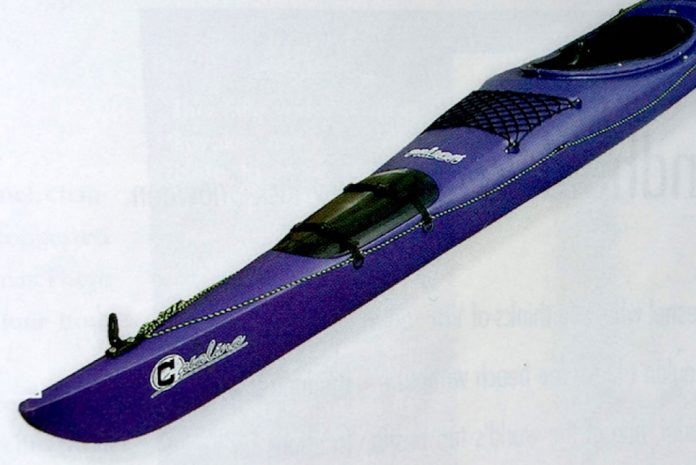
Promo image of the Prijon Catalina kayak
Feature Photo: Paddling Staff

There are many reasons for purchasing a light-touring kayak. It makes good sense for small paddlers to get in a boat that fits proportionally. Others enjoy the sporty feel. But when it comes down to it, many paddlers do mostly day or short overnight trips and simply don’t need a full-sized touring boat. Instead, many want some of the touring features but in a lighter, easier to manoeuvre and economical package. The Prijon Catalina fits all these needs.

Prijon Catalina Specs
Length: 15’3”
Width: 23”
Cockpit: 32” × 18”
Weight: 44 lbs
Weight Range: 90-225 lbs
MSRP: $2,049 CAD

The Prijon Catalina excels on day trips

The Prijon Catalina is a nimble feeling 15’3” light-touring boat manufactured from a polyethylene plastic they call High Performance Thermoplast. This material is closer to fiberglass or Kevlar in terms of rigidity and weight, but maintains the durability and low maintenance of plastic. Prijon is able to shape their boats with sharp lines, creating more performance oriented plastic boats.

Pleasing maneuverability

The Trihedral hull shape is a variation on a multi-chine design without the more common V-shaped keel line. Jumping into the Prijon Catalina for the first time, paddlers used to a very stable recreational or wide touring kayak will be surprised by how tippy or light and active the Catalina initially feels. They should be equally pleased by how quickly the Prijon Catalina rolls on to its more solid secondary stability.

Putting the Catalina on edge quickly initiates a turn that will continue until you run out of forward momentum or you level off the tilt. It really is a quick turning touring boat. If long distance paddling is more your style the standard rudder works well for straight-ahead tracking.

[ Plan your next paddling adventure with the Paddling Trip Guide ]

Sizing up the Prijon’s rudder and outfitting

We wondered if the rudder system was an afterthought to this hull design, tacked on for the North American market. In the up position the rudder lays on top of the stern carrying toggle, making it a nuisance to carry. Also, the pulley system to raise and lower the rudder is mounted too close to the cockpit rim, interfering with getting your sprayskirt on. We also noticed that some skirts are difficult to get on the shallow cockpit coaming.

Inside the cockpit, the rudder is controlled by Prijon gas pedal foot braces that are now becoming popular on more expensive full-sized touring boats. The concept is that the foot braces lock into position and the pedals tilt to control the rudder.

The sporty feel of the Prijon Catalina, or any other boat really, is more appreciated when you have taken the time to properly fit the boat to your dimensions. Instead of leaving you to maybe get around to adding outfitting foam, Prijon has answered the how-to-fit-everyone question by incorporating adjustable thigh braces and hip pads. An Allen wrench loosens the bolts so you can ensure both a comfortable fit and a fit that maximizes control of the boat.

[ Paddling Buyer’s Guide: See all day touring kayaks ]

Perform in plastic with the Prijon Catalina

The Prijon Catalina is a capable light-touring kayak that provides the right fit for paddlers who don’t want the hassle of more boat than they need. This durable plastic boat tracks and maneuvers well, with a sporty feel for your days of coastal paddling.

We think Prijon’s adjustable outfitting will be the next step for kayak touring companies who constantly battle with making the perfect cockpit ergonomics that will fit the greatest number of people.

This article was first published in the Spring 2002 issue of Adventure Kayak Magazine. Subscribe to Paddling Magazine’s print and digital editions, or browse the archives.


8 Techniques For Canoeing In Rough Water

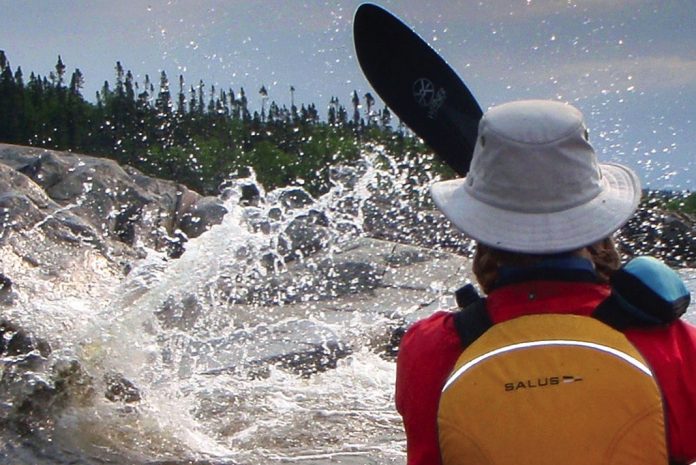
A person canoeing in rough water
Feature Photo: Jonathan Pratt

Cresting whitecaps, furious winds and meter-high seas—many canoeists have harrowing campfire tales of fighting to stay afloat as the wind and weather changed rapidly. When canoeing in rough water, use these tactics to stay upright and (relatively) dry.

8 techniques for canoeing in rough water

1 Install a spray deck

“It provides a drier and safer time in rough water,” says Morgan Goldie of North Water, manufacturers of expedition proven canoe spray decks. “Aside from helping reduce the effects of wind on the boat and help keep water out of the boat,” he adds, “a spray deck can also aid in keeping the paddlers’ legs and bodies warmer during inclement weather and act as an emergency shelter in a pinch.”

[ Paddling Buyer’s Guide: See the North Water custom canoe spray deck ]

2 Prevent seasickness

The time-honored herbal remedy of ginger root effectively prevents swell-induced queasiness. Available in pill form or as chewable candies—take the recommended dosage before heading out on the water. If you get sick, remember to lean straight forward, not over the side—this is not the time or place to flip.

A person canoeing in rough water
Follow these tips to stay upright and (relatively) dry. | Feature Photo: Jonathan Pratt

3Trim your canoe

A properly balanced canoe is important for performance and stability when canoeing in rough water. Think about keeping canoe packs, barrels and paddlers as low and centered as possible. Sliding seats can help fine-tune the balance of a loaded canoe once you are on the water. Weight your canoe slightly fore of center for a headwind and slightly aft of center for a tailwind.

[ Plan your next canoe adventure with the Paddling Trip Guide ]

4 Try a double blade

Although traditionalists might scorn the use of double-bladed paddles, they’re ideal for big lake water travel. Even the late expedition canoeist, Herb Pohl, swore by it, as it allows the paddler to brace quickly on either side in unpredictable conditions.

5 Time your surf launches and landings

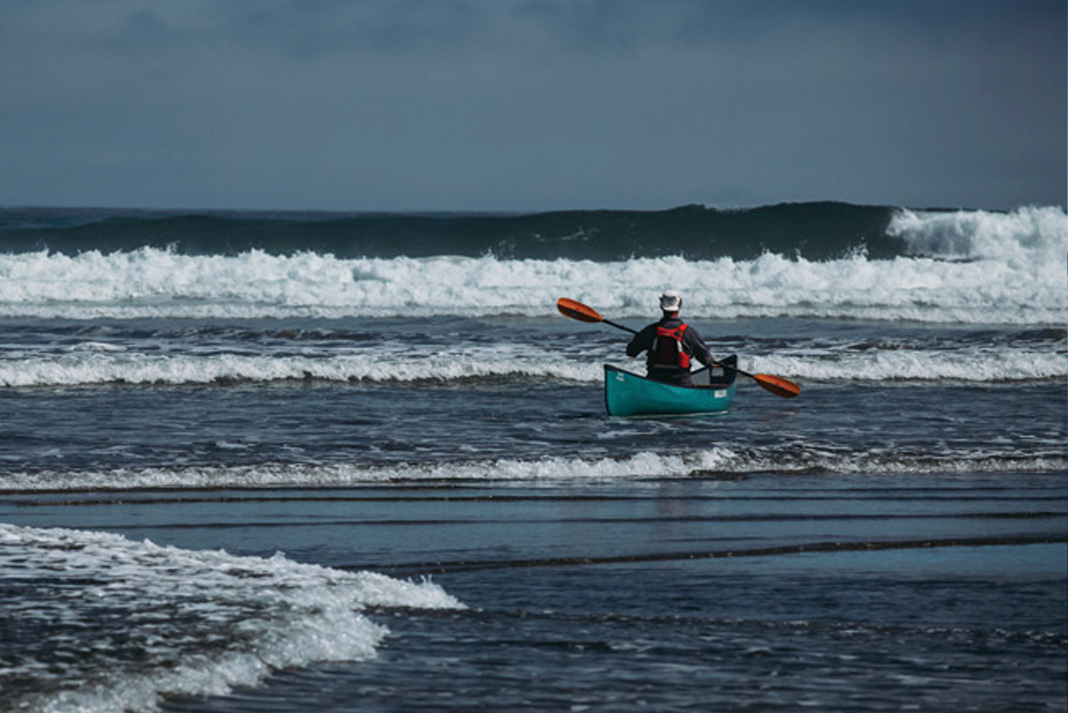
Before heading out from, or in to, the beach, take time to study the conditions into the surf zone. Avoid areas with large cresting waves and submerged rocks. Once in the surf zone, always stay perpendicular to the waves to avoid broaching. Launching into surf can be difficult, so maintaining power and direction through the break zone is important. Any bailing can be done once you clear the area. When landing, avoid surfing a wave to shore. Instead, paddle in the trough—back-paddling as needed to stay off the face—and aim to reach shore on the back of the wave crest in front of you. Once you hit the beach, jump out and pull your canoe out of the way before the next wave crashes down.

6 Steer clear of headlands and steep cliffs

In rough conditions, waves typically bounce off these features, creating what is known as reflection waves. In turn, these reflection waves interact with incoming waves, forming confused and choppy seas. When planning your route, use topographic maps or charts to plot a smoother course around these obstacles.

7 Set a ferry angle

Crossing to an island in strong wind and waves is like paddling in current. Use a ferry angle to offset the forces working on the canoe.

8 Accurately gauge the size or power of waves

Depending on wave height and length, rough water conditions can be a fun challenge or hellish struggle. Beware of tall waves with short wavelengths, as these lead to cresting waves that will quickly swamp a canoe. Avoid taking any waves broadside.

The final word on rough water canoeing

If in doubt about canoeing in rough water, a wise paddler once gave me this advice: “It’s better to be on shore wishing you were on the water, than to be on the water wishing you were on shore.”

Cover of the Summer/Fall 2010 issue of Canoeroots MagazineThis article was first published in the Summer/Fall 2010 issue of Canoeroots Magazine. Subscribe to Paddling Magazine’s print and digital editions, or browse the archives.


Follow these tips to stay upright and (relatively) dry. | Feature Photo: Jonathan Pratt


Biking And Boating To Alberta’s Waterfowl Lakes

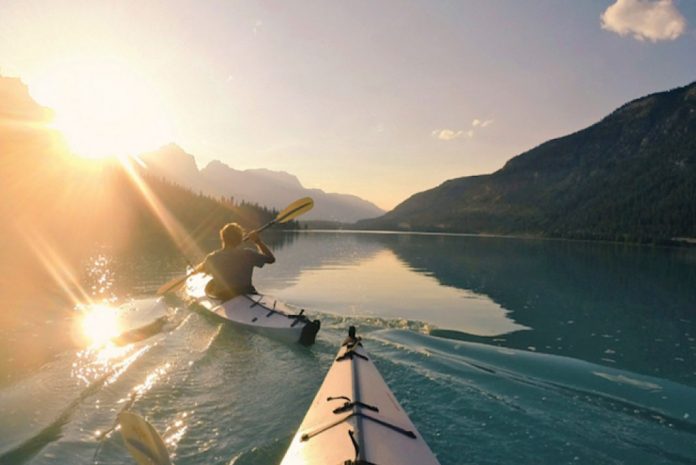
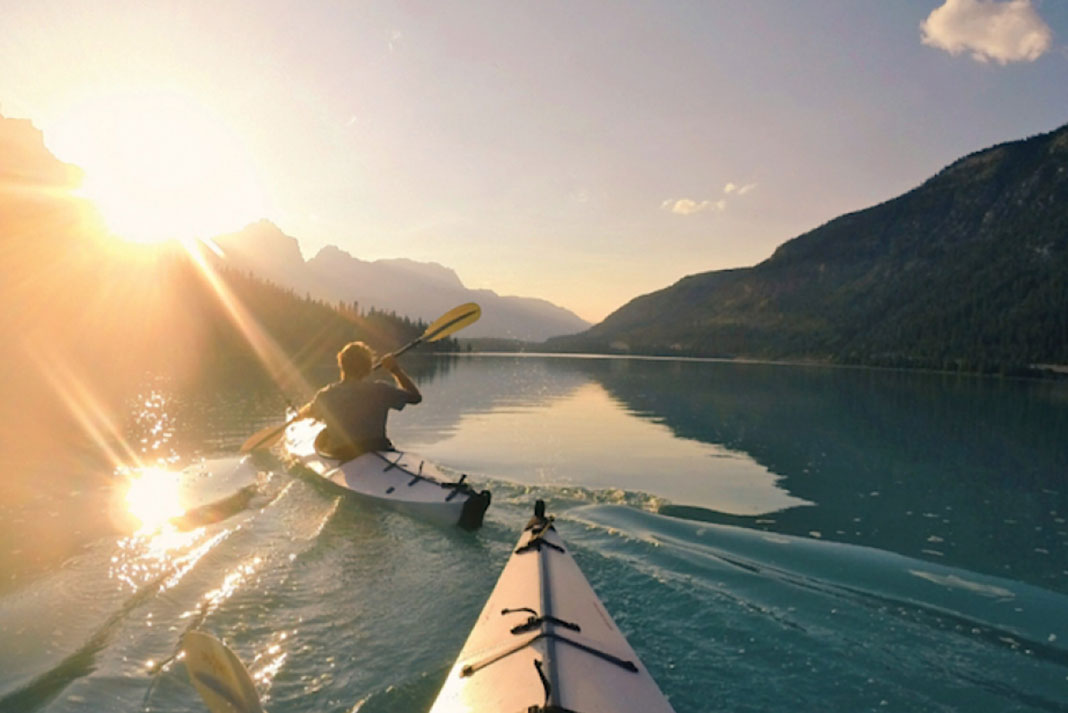
Paddling Oru kayaks on the Waterfowl Lakes in Alberta
Feature Photo: Rachel Kristensen

Suspended nearly 1,700 meters above sea level in Alberta’s Banff National Park, the Waterfowl Lakes are surrounded by dramatic mountains shrouded in sweet-smelling pines. For most of the park’s 3.6 million annual visitors, Waterfowl Lake is an easily accessed pit stop along the famous Icefields Parkway. But not for us.

In search of pristine waters

Kieran and I had arrived at the Waterfowl Lakes after asking ourselves, where is the most unlikely place to take a pair of 30-pound, origami-inspired folding kayaks? Our answer: towed behind bicycles on a 2,500-kilometer tour from Vancouver to the Canadian Rockies and back, in search of pristine mountain water. Never mind that neither of us were experienced cycle tourists; the furthest I’d ever pedaled before was 20 kilometers along a seawall.

[ Paddling Buyer’s Guide: See all folding kayaks ]

Visiting the Waterfowl Lakes in Alberta

Located 57 kilometers north of Lake Louise on Hwy 93, the Waterfowl Lakes are fed by glacial meltwaters from the Mistaya River. Lower Waterfowl Lake is located on the west side of the Icefields Parkway and plays host to the popular Waterfowl Lakes Campground. Upper Waterfowl Lake is the more scenic of the pair, with beautiful turquoise waters created by rock flour from the Peyto glacier. It can be reached by a short portage from the south end of the campground.

In addition to paddling, the area surrounding Waterfowl Lakes offers excellent hiking and stunning views of nearby Mount Chephren and Howes Peak. The Waterfowl Lakes are also an excellent dark-sky site, ranking as a 1 on the Bortle scale for their lack of light pollution and ease of celestial viewing.

[ Plan your next Alberta paddling adventure with the Paddling Trip Guide ]

Biking closer day by day

Each day of our trip had a similar goal. Traverse river valleys, historic gold rush trails, a sprawling desert, abandoned train routes, and some of the country’s highest road-accessible alpine passes. Then, find a lake before sunset, unpack the folding boats from Oru Kayak and enjoy an evening paddle.

Paddling Oru kayaks on the Waterfowl Lakes in Alberta
Feature Photo: Rachel Kristensen

In six weeks, we crossed five mountain ranges in blazing summer heat. Endured hours of punishing climbs, dragging 120 pounds of kayaks and camping gear up 11-percent grades. Braved white-knuckle descents as our onerous loads taxed the bikes’ brakes, causing shuddering and violent swinging of the cargo trailer when we tried to slow down.

We survived close calls with careless semi trucks, awoke to find our campsite had been robbed, and wondered on a few occasions if the journey was worth continuing.

Of course it was.

Alberta’s Waterfowl Lakes are a worthy destination

Every day brought dramatic new views and every evening recharged our souls in a wild setting.

The challenges of the journey faded to insignificance in the timeless lens of the Waterfowl Lakes. Heading into the sun’s last golden rays, we paddled through mirror smooth waters shimmering bright topaz. As the sun dipped behind the rocky peaks engulfing the valley, not another soul was in sight, only a sky full of stars.


Boat Review: Dagger Juice Kayak

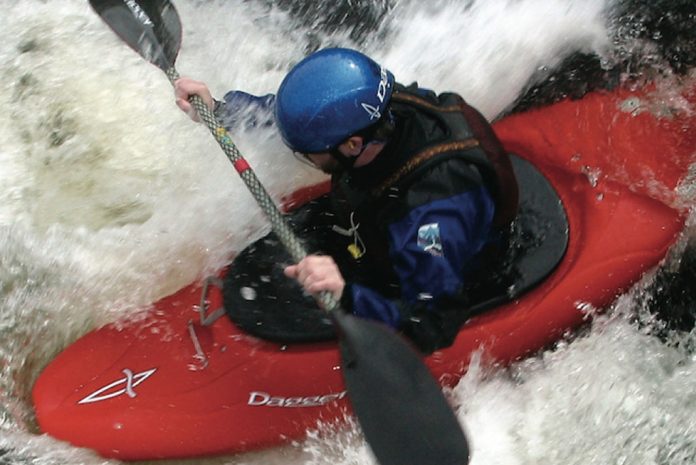
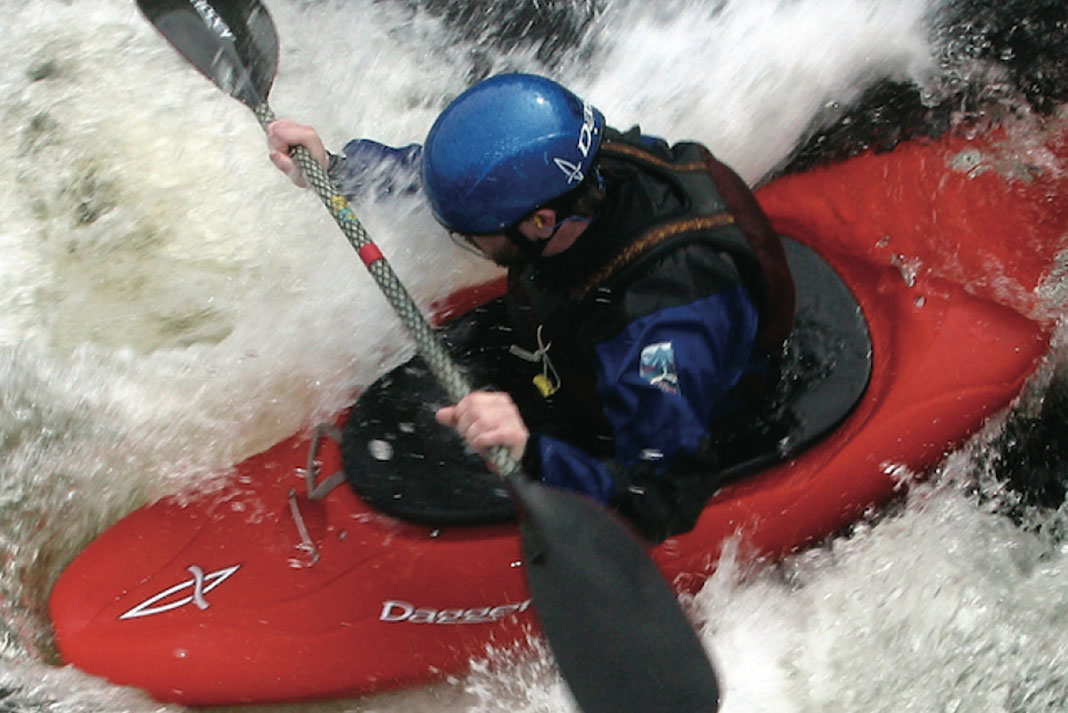
man paddles through whitewater rapids in a Dagger Juice kayak
Feature Photo: Rapid Staff

The Dagger Juice kayak combines downriver performance, volume and speed with a playful hull and a comfy cockpit. The Juice hull is predictable and loose—the one boat that does it all.

Dagger Juice Specs
(6.9 / 7.1)
Length: 6’11” / 7’1”
Width: 25” / 26”
Cockpit: 34” × 19” / 34” × 19”
Volume: 60 / 65 U.S. gal
Weight: 33 / 35 lbs
Weight Range: 110-180 / 170-240 lbs
MSRP: $1,150 USD or $1,599 CAD
[ Paddling Buyer’s Guide: See all Dagger kayaks ]

With this boat, Dagger really has the Juice

Dagger’s Performance Fit System cradles you in spacious comfort. Day one setting the hip pads may have you dreaming of foam and glue but pumping them up for a perfect fit is pretty cool. Dagger answered complaints about too many outfitting tools by providing one tool with different bits—clever but cheeky. Overall, the Juice has vitamin C added, and C is for comfort.

The Juice has a twin sibling

The category is whitewater kayaks. The answer is ID and Juice. Jeopardy fans have buzzed in with the question, “Alex, what did Dagger produce from the same mould?” And why not? The Dagger ID is a slicey, loose and forgiving boat with decent river play and running speed.

Re-decked and re-branded, the Juice is a river/play boat fitting in somewhere between the Dagger GT and, well, the ID. The Juice is not likely to paddle anything more technically challenging than a freestyle boat but has the speed, comfort and volume river runners love.

man paddles through whitewater rapids in a Dagger Juice kayak
Feature Photo: Rapid Staff

Get in play with the Dagger Juice kayak

The Dagger Juice is a combination of old and new: It cartwheels like the longer freestyle boats—slower and balanced but not super slicey—it frontsurfs edge-to-edge smoother than super-flat freestyle boats; spins not as greasy as the fattest planing hulls but the longer length lets you use the water rather than forcing it to break loose. Best of all, its river speed and rockered bow make it easy to get on the wave.

This article was first published in the Summer 2004 issue of Rapid Magazine. Subscribe to Paddling Magazine’s print and digital editions, or browse the archives.
 

Boat Review: Dagger Kingpin Icon Kayak

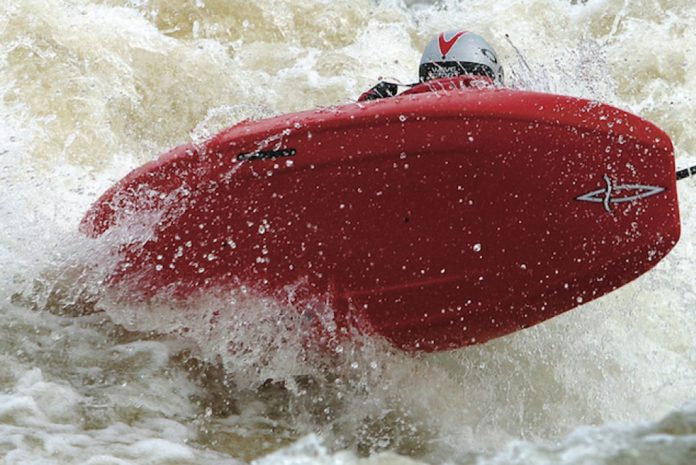
Paddler catches some air in a Pyranha Kingpin Icon whitewater kayak
Feature Photo: Rapid Staff

The Kingpin from Dagger racked up six medals at the last World Championships. For ’04 you’re getting the Dagger Kingpin Icon, both a great wave boat and a great hole boat. The removable fins serve up impressive carving and speed and the removable pods adjust volume for any sick trick.

Dagger Kingpin Icon Specs
(6.1 / 6.2 / 6.3)
Length: 6’1” / 6’1” / 6’5”
Width: 23.25” / 24.75” / 26”
Cockpit: 34” × 19” / 34” × 19” /
34” × 19”
Volume: 44 / 47 / 56 U.S. gal
Weight: 33 / 34 / 35 lbs
Weight Range: 80-140 / 100-180 / 150-230 lbs
MSRP: $1,149 USD or $1,599 CAD
[ Paddling Buyer’s Guide: See all Dagger kayaks ]

Dagger’s Kingpin Icon is new and improved

The marketing guys at Dagger know that releasing the same ‘03 boat is whitewater hype suicide. So with the new Kingpin Icon, hole paddlers get some cool new pods for added volume and loop ejection. Unlike the original pod concept released on the FX, the new pods look cool, adding volume without changing the shape of the deck.

Catch waves with Kingpin’s fins

Wave surfers get to play with new fins. Here’s the trick to setting Dagger’s new hip pads: Take the seat out, adjust and reinstall. Dagger didn’t shrink the Icon 6.2 mould; the new rebound seat pad raises you up, flattening your knees a bit. Shave the seat if you must.

[ Plan your next whitewater kayaking adventure with the Paddling Trip Guide ]

Previous Kingpin paddlers know sizing and trim is critical to top performance. Team Dagger paddler Brendan Mark says, “Be certain that your bow is approximately two inches out of the water and your stern one inch.”

Paddler catches some air in a Pyranha Kingpin Icon whitewater kayak
Feature Photo: Rapid Staff

Take the Dagger Kingpin Icon out for a spin

The Dagger planing surface is not flat but sort of rounded into two tears, allowing smooth edge-to-edge control and making it one of the easiest and most forgiving boats to blunt. Spins are beginner-friendly.

Add the fins (and do try them) and skidding carves bite like you have a longer, sharp-edged boat beneath you. In a hole or in flatwater the Kingpin Icon cartwheels like a much longer, slicey boat but is right at home wheelin’ in pokey ledge holes.

Pros and cons of the Dagger Kingpin Icon

Pro: Balanced ends. Good bounce. All-round performer.

Con: Heavy with new outfitting. Slow on the river.

This article was first published in the Summer 2004 issue of Rapid Magazine. Subscribe to Paddling Magazine’s print and digital editions, or browse the archives.