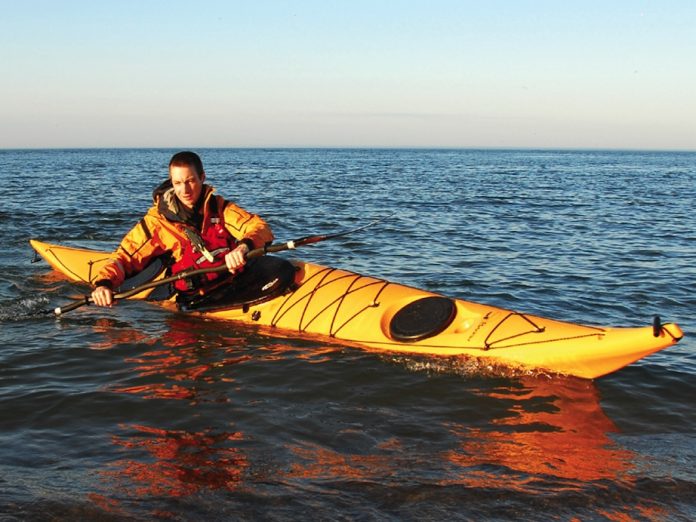
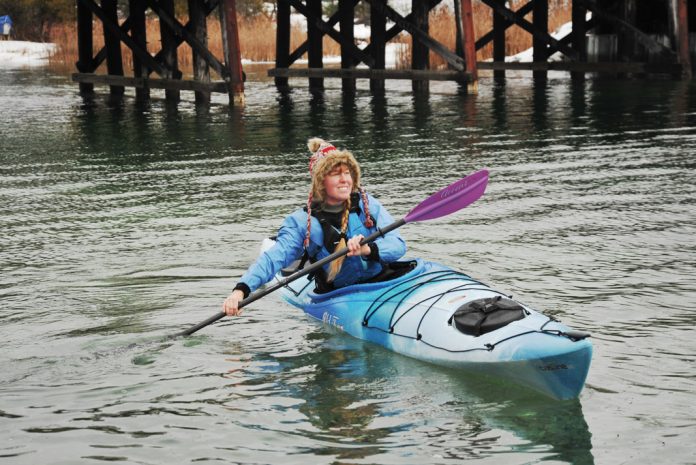
The Boréal Design Baffin first came on the scene in 2008 as a plastic version of the popular Greenland-style Ellesmere and promptly ran away as Boréal’s top seller. The touring kayak follows the smart trend of replacing a dog’s breakfast of models with a simple flow: 1) choose a design that suits your paddling style; 2) choose a size; 3) choose from poly or composite. Brilliantly easy, like buying shoes, and retailers and customers loved it.
In 2009, Boréal’s multipurpose touring kayak, the Epsilon, was their first to offer three sizes to accommodate paddlers from 90 to 280 pounds. With the success of the Epsilon, it only made sense to add a larger and smaller version to the Baffin’s 2011 redesign, and to also offer it in composite. So if you like the Baffin, Boréal has your size and material.
If you like a snug-fitting, sporty, close-to-the-water feel; if you like hard chines that let you use super-subtle edging to steer; if you like skin-on-frame-inspired lines that gracefully accommodate low-angle, Greenland-style strokes and laybacks, then the answer is yes.
I tested the smallest size, P1 (“P” for plastic). I found the initial stability to be comfortably moderate yet it took no effort at all to edge the trademark, down-curving “reverse hard chine,” which carves like a shaped ski, only in the opposite direction.
No surprises
With high secondary stability and predictable edging, the Baffin has the even-tempered personality you want in a foul-weather friend—a solid blend of soft-chine predictability and hard-chine turning characteristics.
The Baffin P1 has a long, flat keel with low rocker—perhaps to give its shorter hull a speed boost. It tracks surprisingly well, yet it’s easy enough to steer by throwing in some of the effortless edging while carrying speed.
Dial up the skeg for rough weather and you’re on rails. We love the smooth, precise operation and bomber spectra-cord construction of Boréal’s signature dial skeg, placed up front for easy reach and neatly recessed into the deck. These are perfect sporty touring traits.
This is a low-volume boat, so pack accordingly. The cockpit has enough length for just about any paddler within the P1’s weight range and a slim fit that’s fantastic for boat control—aided by an aggressively contoured bucket seat, adjustable thigh braces and sturdy metal foot braces. Stand warned that the streamlined decks strictly limit capacity.
Hatch covers are wickedly supple and the easiest we’ve found to get on and off, while also being dry thanks to the fit of the hard plastic hatch rims.
[ Paddling Buyer’s Guide: See all Touring Kayaks ]
The Boréal Design Baffin is a trusty touring boat
Boréal rightly pegs the Baffin as “an extremely fun and stable kayak for athletic paddlers from intermediate to advanced, suited for day and weekend trips.” And now with more sizes, Boréal’s sprightly bestseller will have an even bigger (and smaller) audience.
This article was first published in the Summer/Fall 2011 issue of Adventure Kayak Magazine. Subscribe to Paddling Magazine’s print and digital editions, or browse the archives.
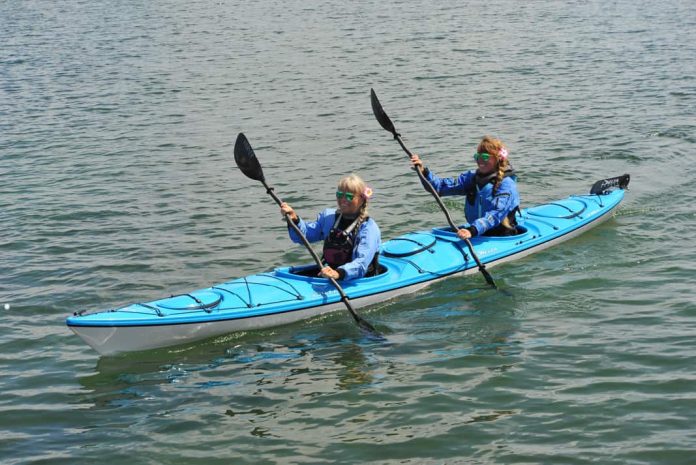
Double your fun with Delta Kayak’s Traverse 17.5T. | Photo: Owen Marshall
I’m a big fan of tandem kayaks. A fleet of doubles halves the number of boats on the water, making it easier to keep the group together, and they provide opportunities to pair stronger paddlers with those who are fatigued, seasick or otherwise struggling. Even a single tandem can be a huge asset to a group—think of it like an insurance policy. Enter the Delta Traverse 17.5 T, a new compact tandem embodying the new light touring ethos in a double design.
Delta Traverse 17.5 T Specs
Length: 17’ 6”
Width: 27.25”
Weight: 70 lbs
Max Capacity: 560 lbs
MSRP: $2,750 USD
Despite their many benefits, some paddlers still have reservations regarding doubles. For starters, there’s the stigma of the “divorce boat.” It’s true, paddling tandem does take more coordination and communication than piloting solo, but I’ve seen a great many more pairs flourish rather than flounder.
At a time when most paddling trips are just a couple of hours to a couple of days long and kayak sales are dominated by shorter, lighter boats, the biggest hurdle for tandems may be, well, their size.
Many traditional tandems were designed for—and excel at—expedition-style journeying. But casual paddling partners out for an afternoon or weekend don’t need cargo ship capacity. Add waterlines that project nine feet beyond the bars of a hatchback’s roof rack and 80 to 105-pound hull weights, and the honeymoon is over before it’s even hit the water.
The Delta Kayaks’ Traverse 17.5T is not merely a downsized version of Delta’s other tandem offering, the 20 T; it’s a fresh take informed by the brand’s spectrum of popular single kayaks.
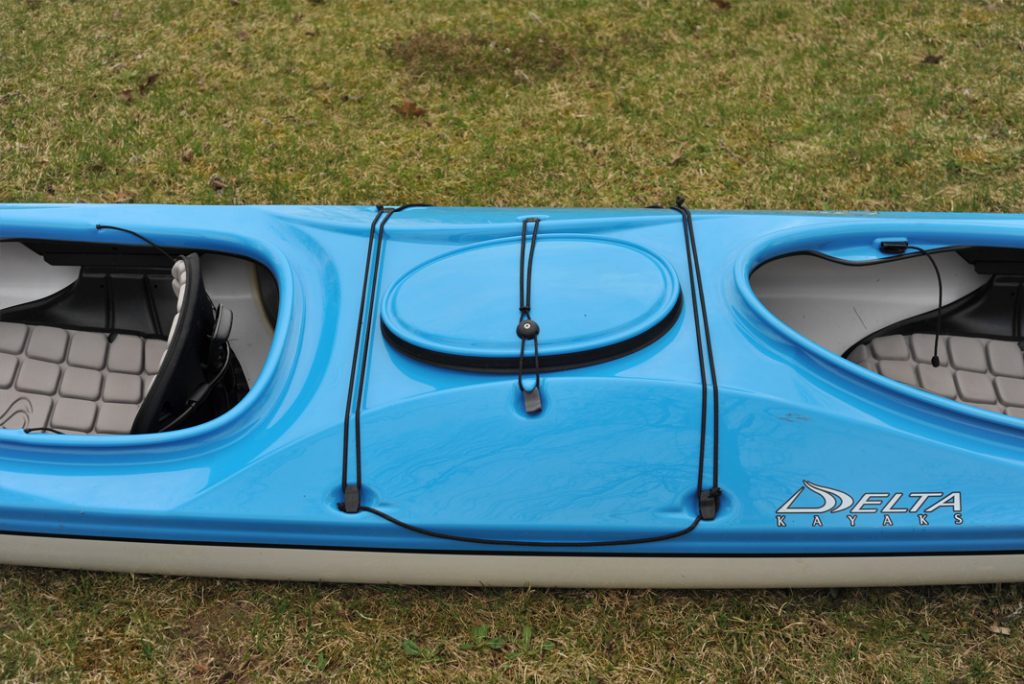
Delta’s generously sized Press-Lock hatches access 190 liters of dry gear storage, and the gasketed lids are easy on and off. | Photos: Virginia Marshall
We pick up our demo 17.5 T at White Squall, a Parry Sound, Ontario, paddling center whose racks are piled high with spring inventory of Delta kayaks. For budget-conscious paddlers seeking a boat that’s capable, attractive, user-friendly and lightweight, Delta’s thermoform plastic offerings tick all the right boxes. The finish of their durable vacuum-molded, ABS-acrylic laminate kayaks is flawless—and our Traverse is no exception.
[ Paddling Buyer’s Guide: See all Delta Kayaks Products ]
A weight off your shoulders
The first thing anyone who has ever paddled tandem will notice about this double is the weight—or lack thereof. Historically, wrangling a touring tandem onto and off of your vehicle’s roof was a feat requiring near-Herculean strength—and ideally a footstool. The Traverse tips the scales at a modest 70 pounds; that’s just a chubby housecat more than my 16-foot single.
Delta’s designers finessed two cockpits into the Traverse’s 17-and-a-half feet—a length more typical of solo sea kayaks than tandems. As veterans of tandem bicycles and boats know (and the uninitiated soon discover), cockpit proximity is one of the finer points of double design. Too close together and unsynchronized paddle strokes amount to a jousting match. The 17.5 T, we are relieved to report, gets paddler positioning just right.
Sleek deck cutaways slim the Traverse’s topside profile, promoting improved stroke efficiency. Paddling the 17.5 T feels a lot like helming a Delta single. | Photos: Virginia Marshall
A comfortable fit for two
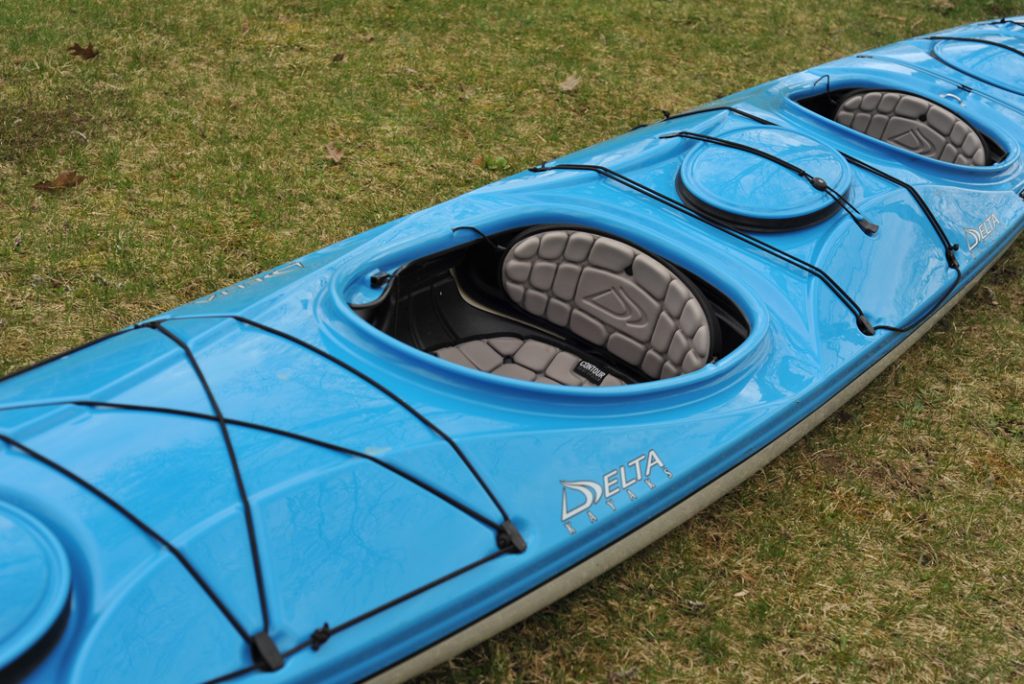
In-cockpit adjustments are a breeze thanks to Delta’s straightforward outfitting. The foot braces and multi-height backrest are accessible while seated, and fine-tuning backrest tilt and fore-aft positioning of the sliding seats can be accomplished with one hand. The latter is especially helpful for paddling partners of different heights and weights. For example, rather than adding ballast in the bow hatch to offset a heavier stern paddler, the bow paddler can simply slide his or her seat forward to trim the boat.
While the beamier dimensions of some tandems can hinder their fit for smaller paddlers, this is not the case with the 17.5 T. The thigh braces and other contact points feel secure at both bow and stern cockpits. Stylishly sculpted deck cutaways at both paddler stations reduce interference and enhance stroke efficiency. In fact, working from either seat feels uncannily like paddling Delta’s single kayaks.
[ Paddling Trip Guide: Plan your next paddling adventure ]
Delta is known for accessible designs, and the Traverse is perfectly suited for introducing a friend, partner or family member to kayaking. The boxy hull profile offers outstanding primary stability—it took a considerable, coordinated effort for our test paddlers to achieve a capsize on calm waters. A full-length keel ensures hassle-free tracking; drop the rudder to improve maneuverability in tight quarters. Hull speed is another advantage: two paddlers working together are faster than two single paddlers putting in the same effort.
The Traverse’s full chines and pronounced keel deliver superb stability and tracking. | Photo: Virginia Marshall
Ready to try kayak camping? The spacious bow and stern hatches still have ample combined capacity for a pair of weekend adventurers. The center hatch accesses an oversized deck pod with 14 liters of dry storage—handy for snacks, camera, repair kit, spare layers, paddle jackets, and more. Even better, it’s within reach of both paddlers, functionally serving as a shared day hatch, and doesn’t impede foot room for the stern paddler.
Double your fun in the Traverse 17.5 T
Since the earliest kayaks appeared on Arctic waters, tandems—and even triples—have been indispensable—from family freighters to hunting vessels for highly skilled teams. Fast-forward to today’s recreational paddlers and a double still makes a lot of sense. Delta’s Traverse 17.5 T gets two people on the water with less storage and transportation hassles—not to mention less cost—than two comparable singles. Still skeptical? Just grab a friend and take the Traverse for a spin.
This article was first published in Issue 58 of Paddling Magazine. Subscribe to Paddling Magazine’s print and digital editions, or browse the archives.
Double your fun with Delta’s Traverse 17.5 T. | Feature Photo: Owen Marshall
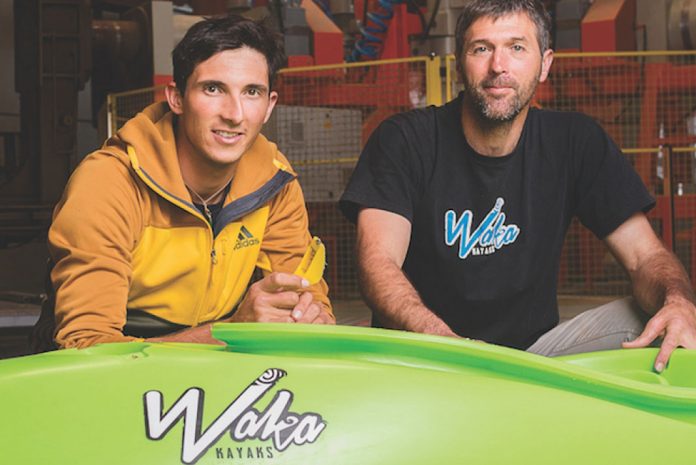
Sam Sutton and Kenny Mutton of Waka Kayaks in Italy. | Photo: Luigi Mazzucchi
The sun is barely up. Soft light touches the green water of the Kaituna River, making it sparkle. Giant fern trees, straight out of Jurassic Park, hang over the river as boat shaper Kenny Mutton and decorated freestyle athlete Sam Sutton slide from the riverbank into the water. A terrestrial bystander might think this is just a leisurely paddle, but it’s also a business meeting for Waka Kayaks.
Good friends, good connections and good timing led to the creation of Waka Kayaks in 2013. Back then, Mutton and Sutton were discussing the idea of buying the Tuna mold from Bliss-Stick Kayaks and starting their own production.
“Both of us were a little out of money,” says Sutton. “I had enough to buy the mold, and Kenny paid for the set-up costs and airfreighting the mold. We both went in halves.” Mutton was the shaper of the original Bliss-Stick Tuna and Sutton helped with design and testing, so it felt right that they were reunited with the design.
“Waka means canoe in Maori,” says Sutton. “We wanted to keep our Kiwi roots, even though we weren’t going to manufacture the boats in New Zealand.”
In search of a home base
Designed and tested on the warm water of the Kaituna, Waka’s rotomolded boats were manufactured for three years in the cold north of the Czech Republic. The two paddlers had contacts in the Czech making the start-up easier and knew it was close to their largest market, which meant saving money on shipping costs.
At that rural Czech factory, the building was camouflaged with no signs for Waka Kayaks out front. The houses butted up against each other along the street, giving way to a massive roller-style garage door that opened up into what used to be an old pig farm.
In May 2016, the factory moved to Italy, 40 kilometers south of Milan. “We had a bit of a supply issue at the old location when it came to production—the move has been an awesome step forward for Waka and its future,” says Sutton. “Plus, the food is really great in Italy.”
“We have only just figured out how much running a business costs, and it’s more in buying materials for full-scale production. Some things you need to buy three years supply,” says Sutton. “That makes a big impact on balancing cash and at the end of the day you are still unsure you will get a single dollar from the year.”
[ Paddling Buyer’s Guide: See All Rotomolded Plastic Kayaks ]
Using a third party for manufacturing means Mutton and Sutton have less control of production times and supply. The biggest challenge Waka Kayaks has faced is keeping up with the demand of boats, says Sutton. “People knew who I was in Europe and Kenny was the man at shaping so it was easy to market the boat straight away,” he says.
Helping paddlers to level up
When Sutton is paddling and racing around the world, it’s satisfying for him to turn up at a river and see a fleet of Waka kayaks at the put-in. It’s even more rewarding when he hears that his boats help paddlers progress their ability. He talks about a 50-year-old Waka Tutea paddler who fired up a run she’d only done once in her life. “She said it took her a grade above her previous ability,” says Sutton. “Giving her the chance to paddle harder whitewater again was cool.”
A handful of professional kayakers, including Aniol Serrasolses and Evan Garcia, have turned down money from other companies to paddle for Waka for free, says Sutton. “As soon as they tried it, they didn’t want to paddle anything else,” he adds. “We just want to make a boat that we love racing down in the morning and that makes you feel like a gangsta.”
Made in Canada. Paddled everywhere. | Feature Photo: Steve Ruskay
Feathercraft ended 40 years of production in 2016, marking the end of an era in the sea kayaking world. Fortunately, many Feathercraft kayaks continue to thrive on the expedition scene because the unique folding design allows them to be transported to places hardshell boats simply can’t go.
Light—and sturdy—as a feather
Doug Simpson, Feathercraft founder and designer, invented the skin-on-frame foldable kayak design while working as a prospector and pilot in the remote wilderness of Canada’s Northwest Territories.
He wanted a lightweight, packable boat to load into float planes, that was quick to assemble and disassemble, and durable enough to last in the remote Canadian wilderness.
His patented his first design in 1977. He chose the name Feathercraft as an ode to a feather’s sturdy, hollow vane, like the tubes used in the frame.
The most popular Feathercraft design was the K2 Expedition tandem kayak. The K2 weighed 87 pounds and had a capacity of 700 pounds, making it ideal for extended expeditions with extensive food and gear requirements.
[ Plan your next adventure with the Paddling Trip Guide ]
The early years of Feathercraft
During his early design years, Simpson rented a small shack on Granville Island in Vancouver, British Columbia. The space was 19 feet and three inches in length, which determined the maximum length of kayak he could build. To work on the opposite side of the boat, Simpson had to take the kayak outside, turn it around and squeeze it back into this shop.
Simpson chose T-6 anodized aluminum for the frame material, a common material for airplane parts. It has a high strength to weight ratio, and most importantly, is resistant to pitting and corrosion by salt water. The hypalon and urethane skin was all hand-cut and sewn. Thanks to high-quality components, Feathercraft kayaks regularly lasted for 30 years or more with proper maintenance.
Feathercraft kayaks are at home in the Arctic
I have been paddling Feathercrafts for many years in the Arctic. There certainly are tricks and quirks about building them, maintaining them on an expedition, and storing them. The manual suggests a 45-minute time for assembly.
In the field, with sometimes damaged or missing parts or in bad weather, this process can take quite a bit longer, and cost a few skinned knuckles along the way. Yet, as expedition boats, they are user-friendly—easy for packing and ideal for large cargo volumes. I have landed them in the surf, bashed through thick brash ice, and felt them flex in the large ocean swell.
I have also had a few mishaps. Luckily, field repairs are easy, and often permanent. The old saying holds true: take care of your boat, and your boat will take care of you.
With the high price of air cargo, most Feathercrafts still in service are cached high in the Arctic, or in holds of expedition cruise ships.
Salute to Pinky
This past summer, I took a moment to salute one of the Feathercrafts in our long-standing East Greenland fleet. Pinky, as it was aptly named in recent years, was a first-generation K2 Expedition kayak with a woven nylon skin. It had seen many sea days over its years of service, and its once deep red hull is now a sun-faded and salt-stained pink.
Pinky’s last trip was in the Ammassalik Fjord on the East Coast of Greenland. It was transported from Ittoqqortoormiit, Greenland, further north, where it previously served as an expedition fleet boat for more than two decades years.
During the long voyage, which included a snowmobile trek through two mountain passes, Pinky sustained two injuries to critical frame components. Even with careful hands and a delicate touch, these components failed while it was being dismantled. A short service was held for Pinky beside the sea, and a salute made to the many miles traveled, and many amazing things seen from its cockpit. Most of Pinky’s parts were donated to other Feathercrafts, so in a way, it will live on as a part of the fleet. At sea, where it was meant to be.
This article was first published in Issue 56 of Paddling Magazine. Subscribe to Paddling Magazine’s print and digital editions, or browse the archives.
Made in Canada. Paddled everywhere. | Feature Photo: Steve Ruskay
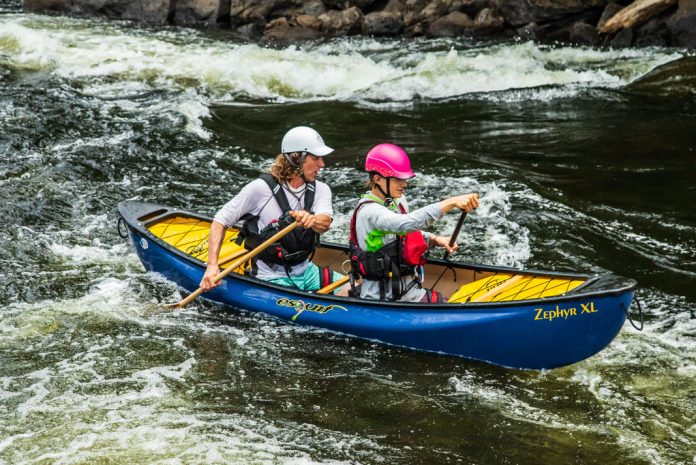
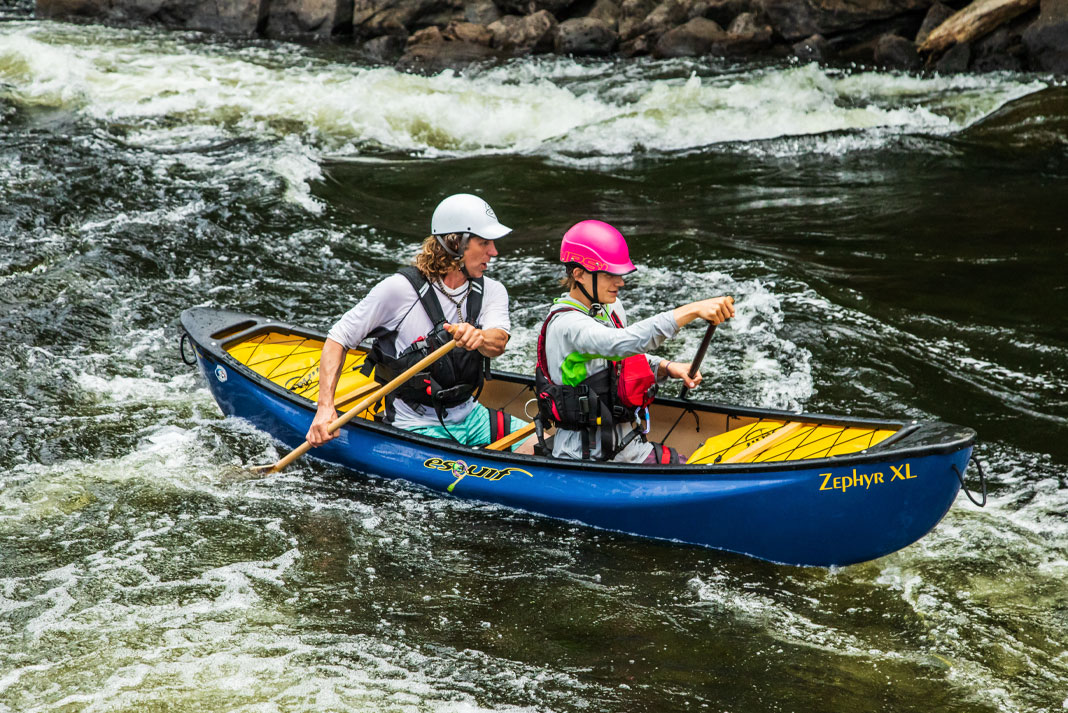
Just the two of us, we can make it if we try. | Photo: Michael Hewis
I dug through the Rapid archives all the way back to 2006 to find my original review of the revolutionary Esquif Zephyr.
Esquif Zephyr 2.0 XL
Material: T-Formex Length: 11 ft 3 in Width: 30 in Depth: 16 in Capacity: 325 lbs Price: Solo $2,020 USD // $2,230 CAD ||
Tandem $2,340 USD // $2,580 CAD
Fourteen years ago, Jacques Chassé, the founder and owner of Esquif Canoes, was on a tear, collaborating with the who’s who of solo open boating. Chassé and his team were cranking out new models almost every spring. As Quebec rivers melted, we came to expect new, progressively shorter and more aggressive whitewater canoes from Esquif’s Frampton factory. The Nitro, Detonator and then Andrew Westwood’s Zoom—one of my favorite boats of all-time. They were followed by the Chassé, Westwood, Paul Mason, Joe Langman and Mark Scriver creation, the Taureau. Then, all of a sudden, scratch the needle off the vinyl record, Chassé released the full-bodied, 11-foot, three-inch Zephyr.
Esquif took the speed, stability and dryness offered by a larger hull and added advances Chassé and his team had made in areas such as chine and flare developed for the smaller boats to produce the Zephyr.
People said the Zephyr was Esquif’s answer to the popular Dagger Rival. A younger, sassier version of me wrote the Zephyr was a Zoom with training wheels. Whatever it is, 14 years later, the Zephyr has proven to be one of Esquif’s top-selling solo canoes.
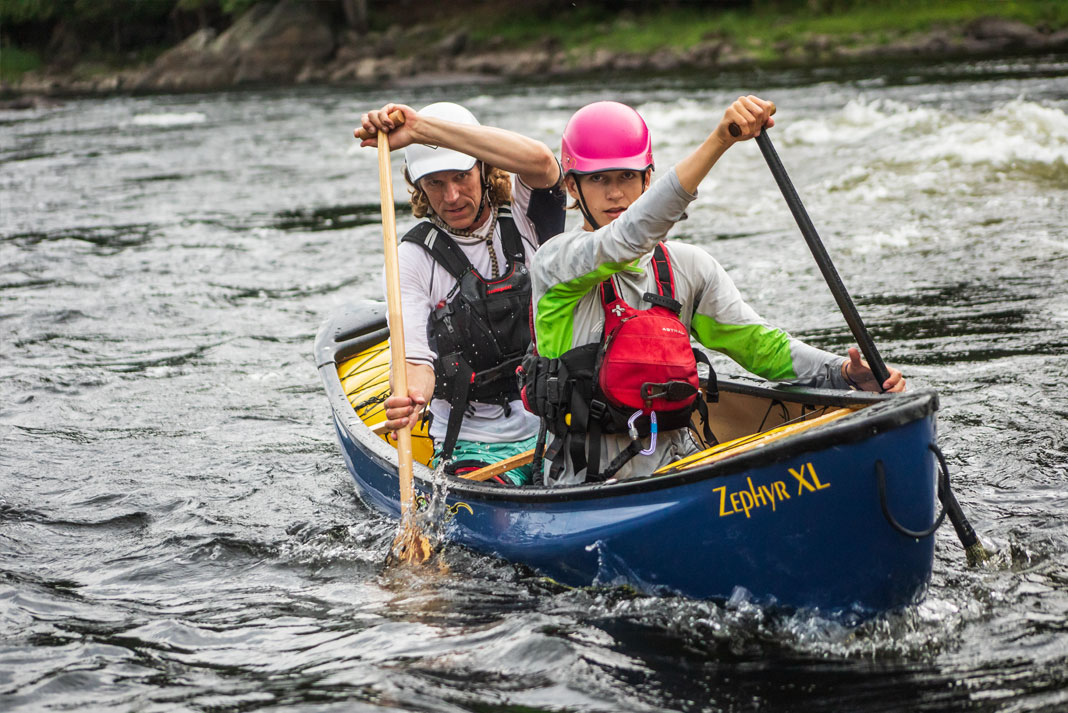
Just the two of us, we can make it if we try. | Photo: Michael Hewis
The Esquif Zepher 2.0 XL is slightly bigger. For bigger dudes. For bigger water. For bigger fun.
Usually, an XL version of something is extra, larger. And usually, a 2.0 version is a complete update. The Zepher 2.0 XL is neither, really. So, what gives?
[Paddling Buyer’s Guide: See All Esquif Whitewater Canoes]
The XL is the same length, 11 feet and three inches long. Same as the original Zephyr. However, the XL is an inch wider. An inch doesn’t seem like much, but it ups the capacity from 220 to 325 pounds. It means the XL feels to a 200-plus paddler like the Zephyr does to someone smaller than me. Or it means I can pack a weekend of gear for a solo backcountry mission.
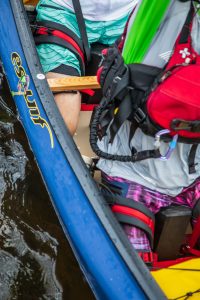
Esquif’s tandem pedestal outfitting. Also available with tandem bulkhead. It’s cozy in there. | Photo: Michael Hewis
The original Zephyr was available only in Esquif’s proprietary Twin-Tex material. Twin-Tex is a matte black woven material marrying together fiberglass fabric with melted polypropylene plastic instead of resin. It was lighter than Royalex, but it is a pain in the ass to outfit—anchors always seemed to peel. And Twin-Tex is harder to fix.
The 2.0 in the new Zephyr 2.0 and 2.0 XL represents the big switch from Twin-Tex to T-Formex, Esquif’s own version of a plastic laminate now used in most of their whitewater solo canoe line-up. Due to material supply issues as a result of COVID-19, the Zephyr in Twin-Tex was not available in 2020. But it will be back.
While Esquif sells more 2.0s than XLs, and more solo set-ups than tandem, for testing I borrowed a 2.0 XL already outfitted with tandem foam pedestals. Just to be different.
It’s cozy in the cockpit with two paddlers.
My son Doug and I are so close I could give him wet willies without leaning forward. I had to shorten my forward stroke and there was no chance of sneaking stern cross-draws or cross-forwards without clipping him upside the head on the way over. My 175 pounds and Doug’s 130 pounds placed us perfectly within the maximum listed capacity.
Lots of flair and lots of tumblehome. Stability and easy to paddle. We’re almost at the 325-pound max capacity. | Photo: Michael Hewis
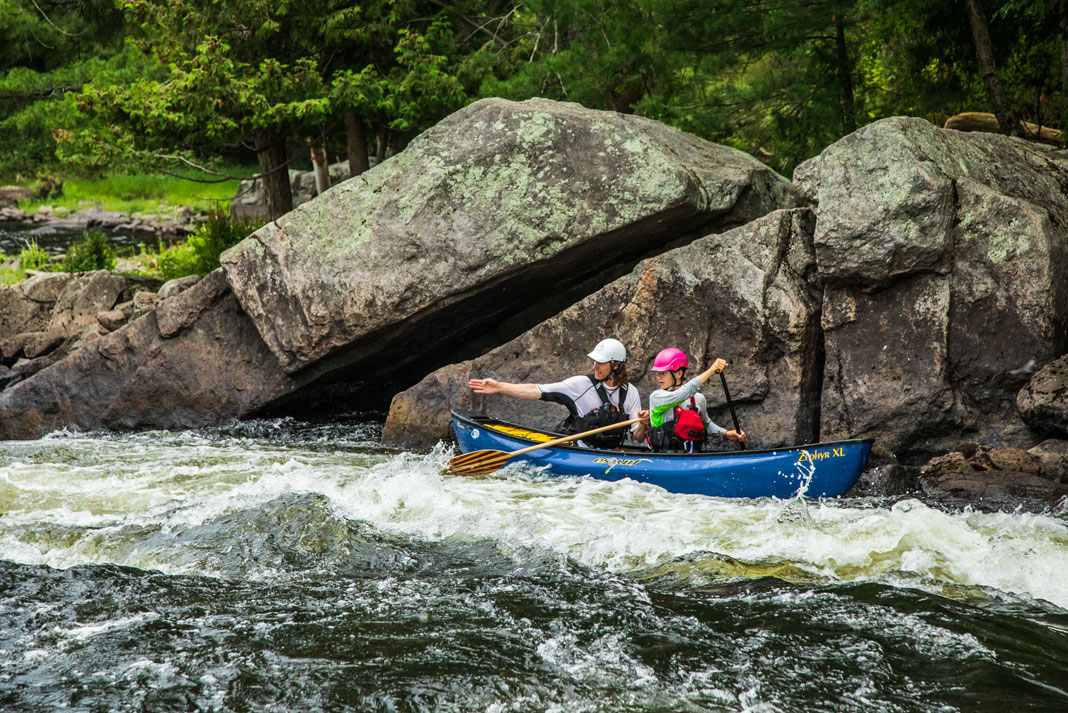
Bow partners have accused me of trying to stuff big boats into small eddies. Too small of eddies, in fact.
“Think we can hit that one?” I ask, already on my way charging for it.
There’s something magical about a well-synchronized tandem team and 11 feet of plastic snapping into 12 feet of calm water between a rock wall and raging current. It’s not for everyone, I’ve learned. But if it’s for you, buy yourself the Esquif Zepher 2.0 XL with two foam saddles and a spiderweb of straps. Doug and I had a blast in this boat—not to be confused with Esquif’s actual 13-foot tandem, the Blast.
Years ago, Jacques Chassé told me he wanted to impart the responsiveness of his Zoom into a hull with the stability demanded by intermediate paddlers. The chines, though softer than those on the Zoom, still allow for effective carves and off-side tilts. The Zephyr is not a pig to paddle because the narrow bow of the asymmetrical hull and the dramatic tumblehome of the gunwales mean you don’t have to reach out over the boat to get your paddle in the water.
The sharper bow entry point, longer waterline and slightly rounded hull—as opposed to the truly flat hulls of the Nitro or Detonator—combine to create a boat that accelerates with only a stroke or two and carries speed deep into eddies, especially with a tandem team driving it.
One of the shortest tandem canoe set-ups—perfect for snapping into tight spots.| Photo: Michael Hewis
To achieve a cushy secondary stability that stops the boat dead when the gunwales are about six inches above the waterline, Chassé kept the dramatic mix of flare and tumblehome. The mid-ship flare gives you something to rest on while the boat is carving or pivoting. The tumblehome brings the gunwales safely back from the water to produce a reasonably dry ride.
Sometimes you don’t need to reinvent things. Sometimes you can just make them bigger and better. And that’s the Zephyr 2.0 XL.
Paddle the XL solo or tandem. Load it with gear for wilderness river solo adventures. Dress it up with wood trim. Paddle it for another 14 years. So many options.
If you think a Zephyr re-release is Chassé getting lazy in the R&D department, don’t forget about Esquif’s nine-foot Extasy creeker, a collaboration with Sabrina Bram, the world’s first female whitewater open boat designer. And then the larger boy version, the Excite, a year later.
Chassé is not getting lazy; he’s doing what he’s always done at Esquif—giving discerning paddlers like Scriver, Mason, Westwood, Bram and you and me exactly what we want.
This article was first published in Paddling Magazine Issue 62. Subscribe to Paddling Magazine’s print and digital editions here, or browse the archives here.
Just the two of us, we can make it if we try. | Photo: Michael Hewis
Three sizes to choose from means there's a Castine for every fit | Feature Photo: Vince Paquot
Last June, fans of Necky Kayaks’ touring designs were disappointed to learn Johnson Outdoors, which acquired Necky in 1998 from company founder Mike Neckar, was discontinuing the iconic brand. Now, Johnson flagship Old Town Canoe & Kayak carries the torch with a new light touring design, the Old Town Castine series.
Old Town Castine 140 Specs
Length: 14’
Width: 25”
Weight: 33 lbs
Max Capacity: 375 lbs
MSRP: $1,349 USD / $1,499 CAD
Getting to know the Old Town Castine
Given its pedigree, the Castine should tick all the boxes on a day-tripper’s wish list. Along with a venerable 120-year history in the U.S. market, Maine-based Old Town benefits from the expertise of Johnson’s director of research and development, Bob McDonough. An industry veteran with numerous top-selling designs to his credit—first at Perception Kayaks and later as a senior designer at Confluence Outdoor—McDonough knows what recreational paddlers want.
Stable? Check. Responsive? Check. Comfortable? Check. If market research is about giving people what they want, innovation is about giving them what they don’t yet know they desire. McDonough and his team have succeeded on both fronts: blending the tried and trusted with a dash of the unexpected.
Our demo Castine 140 (the middle sibling of the 135 and 145) arrives a few weeks into one of the coldest Decembers on record. I wait another month for a brief reprieve from the glacial temperatures: a comparatively mild, just-above-zero day. Leads of pewter water open up where currents tug at the lake narrows. The ice shelf stubbornly gripping rocks and docks since before Christmas recedes to a few hundred yards offshore.
[ Plan your next paddling adventure with the Paddling Trip Guide ]
I toss the Castine onto my roof rack and race eagerly to the village launch, where I find I am not the only hydrophilic creature drawn to the open water. Slipping quietly away from shore, my passage startles a raft of common goldeneyes. As the crisp black-and-white ducks lift into the air, I pause my stroke to listen to the distinctive whistling sound of their flight.
The Old Town Castine checks all the boxes
My first impression of the Castine is that it’s responsive without compromising stability. The rounded chines encourage confident edging with no twitchiness between initial and secondary stability. Whether I’m plying the calm lake, negotiating a shallow, winding river or picking my way through swifts and swirling currents, the Castine holds the course I set for it.
The hull shape places the beam’s widest point at the paddler’s hips, allowing for an efficient forward stroke and good acceleration. Day-trippers who prefer a relaxed, low-angle touring stroke will also appreciate the Castine’s relatively low deck and cockpit coaming.
The Castine comes equipped to accept an optional rudder, however, I find the integrated keel is sufficient to produce fine tracking in most conditions.
[ Paddling Buyer’s Guide: View all boats and gear ]
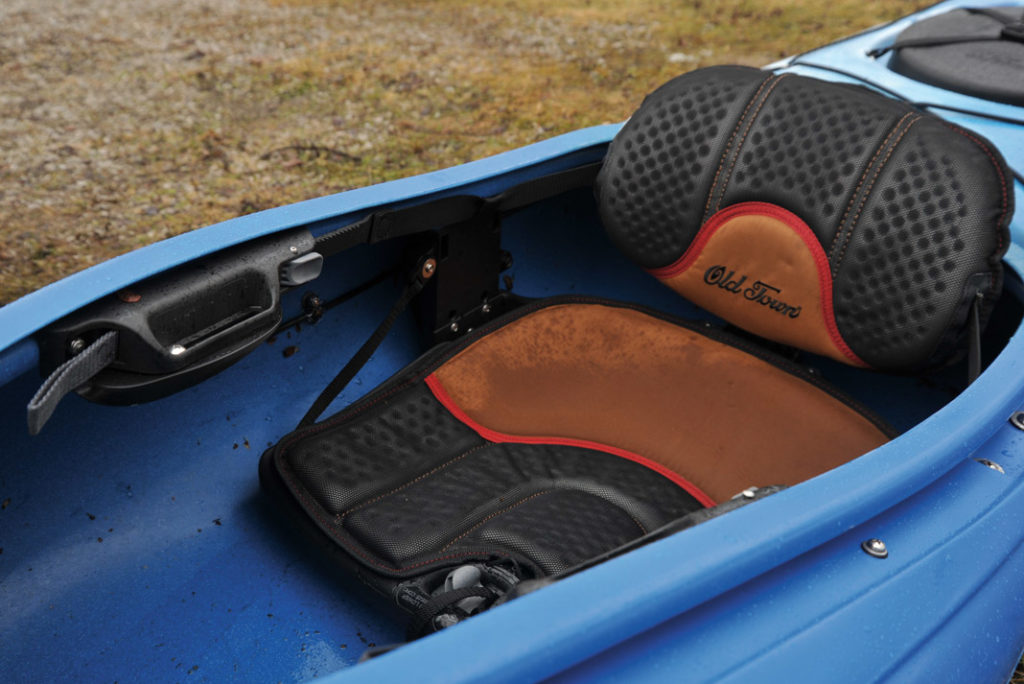
Build quality has the same sturdy feel as Necky’s rotomolded polyethylene kayaks, and the similarities don’t end there. The Castine also shares Necky’s user-friendly CrossLock hatch covers and an updated version of the popular ACS2 seat system.
While the Castine’s back rest sits higher than my personal preference—the lowest position is proud of the coaming by three inches—it offers superb lumbar support.
The back rest ratchets and the thigh riser handle are easy to reach and fine-tune. Ditto the sliding foot rests, which are new for 2018 and feature a nifty pull loop making on-the-fly adjustments a breeze. The foot rests are also angled forward for an ergonomic ankle position, with a slightly cushy texture that’s bliss for bare feet—this I had to confirm in my basement, in front of the wood stove.
Innovative under-deck outfitting
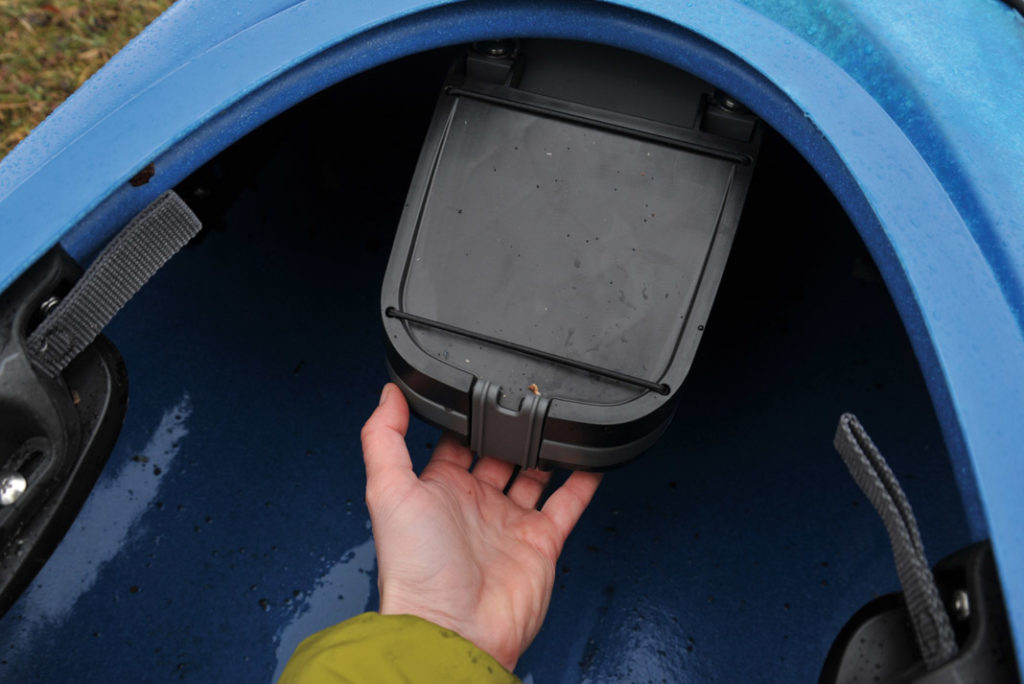
The most innovative feature of the Castine’s outfitting is a removable, under-deck day storage compartment.
The Castine offers an ingenious solution to accessible-on-the-water storage—a roomy retractable under-deck compartment with a dry-sealing lid. | Photo: Virginia Marshall
With a look that’s distinctly old town, the ACS2 seat system features an adjustable thigh riser and secure knee braces for maximum comfort and confident edging inputs. | Photo: Virginia Marshall
Traditional deck pod design places an integrated storage cubby in front of the cockpit, accessed through a hatch in the deck. While this is convenient when a spraydeck is fitted, these hatches can be prone to leaks and difficult for smaller folks to reach.
Old Town’s research and design team concealed the Castine’s clever compartment under the deck, where it is sheltered from splashes and drips. Aluminum tracks allow the box to slide out towards the paddler’s lap for easy access to cameras, communication devices or lunch. The gasketed lid includes bungees for securing a smartphone for one-handed use on the water—not a feature I’ve been personally craving while kayaking, but one many recreational paddlers will doubtless appreciate.
Beyond the gusty expanse of the icy lake, I follow the flow into a quiet back channel edged by the skeletal limbs of birch trees and the muted green brush strokes of white pines. A bald eagle soars overhead. It isn’t easy, but I finally bring my focus back to the kayak I am paddling. The Old Town Castine makes it awfully easy to lose oneself in the moment.
This article was first published in Issue 53 of Paddling Magazine. Subscribe to Paddling Magazine’s print and digital editions, or browse the archives.
Three sizes to choose from means there’s a Castine for every fit. | Feature Photo: Vince Paquot
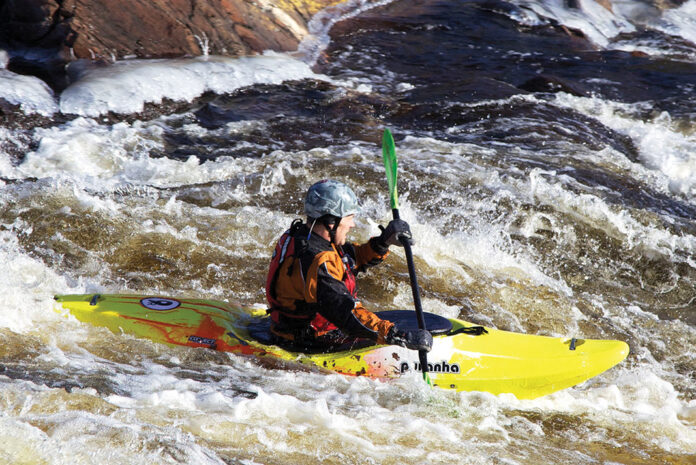
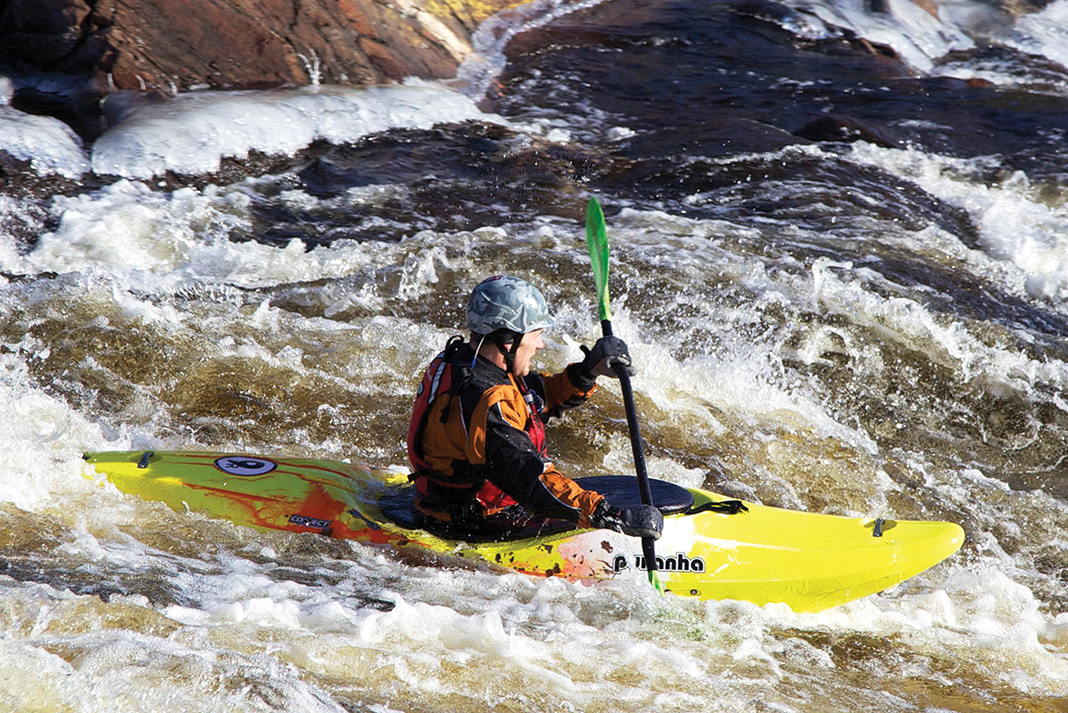
Whitewater races are won and lost between the big rapids. Unless you have an accidental freestyle session in a hole, it’s the class II and III sections that determine your time. Expert handling of choppy waves is what shaves seconds from your run, which is why the next time you’re sprinting to the take-out, there’s a good chance you’ll see the new Pyranha 9R nearby.
[ Paddling Buyer’s Guide: See the 2020 Pyranha 9R M ]
Lining up for the race
With the surge in popularity of whitewater races, manufacturers have started building more race-specific boats. While many have designed them at 11 feet or longer for the long boat category, the all-new 9R aims to dominate the short boat class. It comes in one size: eight feet, 11 inches, to measure just under the nine-foot cutoff of most short boat race divisions.
At six feet tall with a 32-inch inseam and 185 pounds, I felt like I was right in the sweet spot, though Pyranha’s Connect 30 outfitting means it can be easily adjusted to fit larger or smaller paddlers.
The 9R’s high bow and continuous rocker ensure I ride up and over waves, through holes and stay on the surface of the water where I’m fastest and most efficient. It allows me to sit in an aggressive forward position so I can use my whole body for strokes, saving energy and maintaining speed.
An asymmetric hull design—the widest part of the boat is just behind the cockpit—allows for more downriver speed by displacing water efficiently and minimizing drag. A narrow cockpit area makes it easy to get my paddle vertical in the water without reaching over the sides, a bonus for smaller-sized paddlers and racers.
The slim hull means less primary stability than wider, flat-hulled boats like Pyranha’s Burn, but it also means it’s easy to get on edge. Since those edges run from the midpoint of the boat to the stern, I can get them to bite by leaning slightly back. When I want to spin quickly, leaning forward keeps them clear of the waterline allowing a quick change of direction—a good balance between holding a line and maneuverability.
[ Paddling Buyer’s Guide: See all Pyranha boats ]
A racer with broad appeal
While the Pyranha 9R is undoubtedly a race machine, it will also appeal to everyday paddlers who aren’t trying to break speed records.
“It’s not just a race specific boat,” said designer Robert Peerson when we talked to him at the unveiling of the 9R in August. “It’s not as long so it’s not as intimidating for a lot of paddlers to get in and still have a boat that’s friendly and speedy.”
The Pyranha 9R is likely to find its way onto podiums in the blossoming whitewater race scene, but could just as easily become your go-to kayak for a local run, because a race to the take-out beer is just as important.
This article first appeared in the Spring 2015 issue of Rapid magazine.
Subscribe to Paddling Magazine and get 25 years of digital magazine archives including our legacy titles: Rapid, Adventure Kayak and Canoeroots.
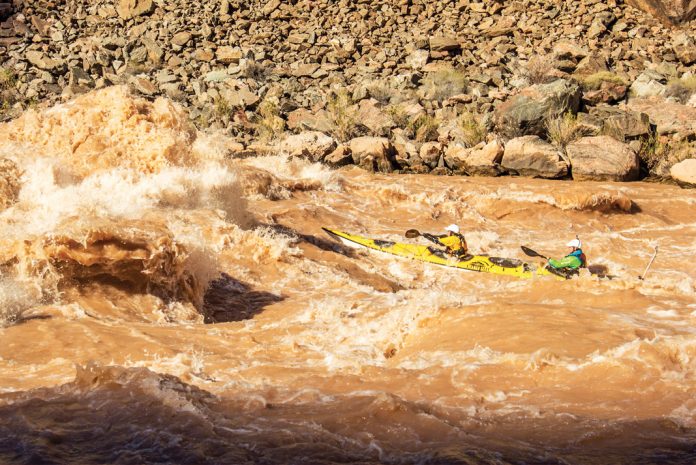
The only way to get the double through the biggest falls in Hermit Rapid is straight down the middle. | Photo: Heather Nichols
The following is an account by Jamie Sharp of an eleven-day trip down the Colorado River he undertook with Jillian Brown, kayaking the Grand Canyon together in a tandem sea kayak.
We were standing next to our kayak on the bank of the Colorado River in the depths of the Grand Canyon, its rusty red rocks towering above us. Downstream lays a tricky and impressive rapid called Hance. We have just returned from scouting the line and we’re rethinking our moves.
“Are you nervous?”
Jill looked up at me with a wry smile. “No, ” she stated flatly. “We’ve got this. We’ve made it this far and hey… I trust you.”
I smile as Jill climbs into the bow seat of our yellow 22-foot double sea kayak. Once her gaze is off me, my smile contorts into a bemused grimace and I push the bow away from the shore into the deceivingly tranquil muddy waters above the chaos downstream. I climb into the rear seat and find myself chuckling under my breath. I am bemused at her statement, what does trust have to do with not feeling fear?
Forward we go!
I call “forward paddle” and in unison we paddle our large oceangoing craft out of the eddy into the downstream flow to face the coming rapid. As we drop over the lip into the cauldron of standing waves and foaming recirculating holes stretching out ahead for 200 meters or so, I find myself thinking “Hell! It doesn’t matter how much she trusts me. This is crazy.”
Perhaps it was because Jill doesn’t know any better. Maybe she doesn’t fear these rapids because she isn’t making the calls, or perhaps she is just being brave. Either way, what makes me scared is what I know and she doesn’t. I know these rapids hold the power to crush our fiberglass sea kayak if we make a wrong decision.
I know steering a double sea kayak fully loaded with 11 days food and gear through some of the largest rapids in North America is actually quite tricky.
Then to top it off, I am doing the trip with someone who doesn’t know how to roll and has never paddled a large river like this before. The responsibility of not screwing up makes me plenty nervous. But hey, it was my big idea in the first place.
Back to old stomping grounds
This trip is my third journey down the Grand Canyon. This time I wanted to bring my girlfriend with me. The tricky part is to do the whole trip without raft support, and my girlfriend at the time was not a kayaker. And so began the planning of how to get her down the canyon without a raft.
I have paddled a single sea kayak down the 20-day run as well as oared a raft through the Canyon. I knew what to expect and decided a double sea kayak could be a feasible idea.
In the spring I came across a great deal on what I had decided was the perfect craft. I picked up a used Seaward Passat G3 double. This particular design is agile, with an up-swept bow for punching through surf, or in this case, driving through whitewater. It could carry a lot of gear and had very good hull speed. Now all that was left was some pre-trip training.
A big problem with double sea kayaks is the almost inevitable power struggle that occurs, especially between couples. For this reason doubles are commonly nicknamed, divorce boats. I personally have always enjoyed journeying in double sea kayaks.
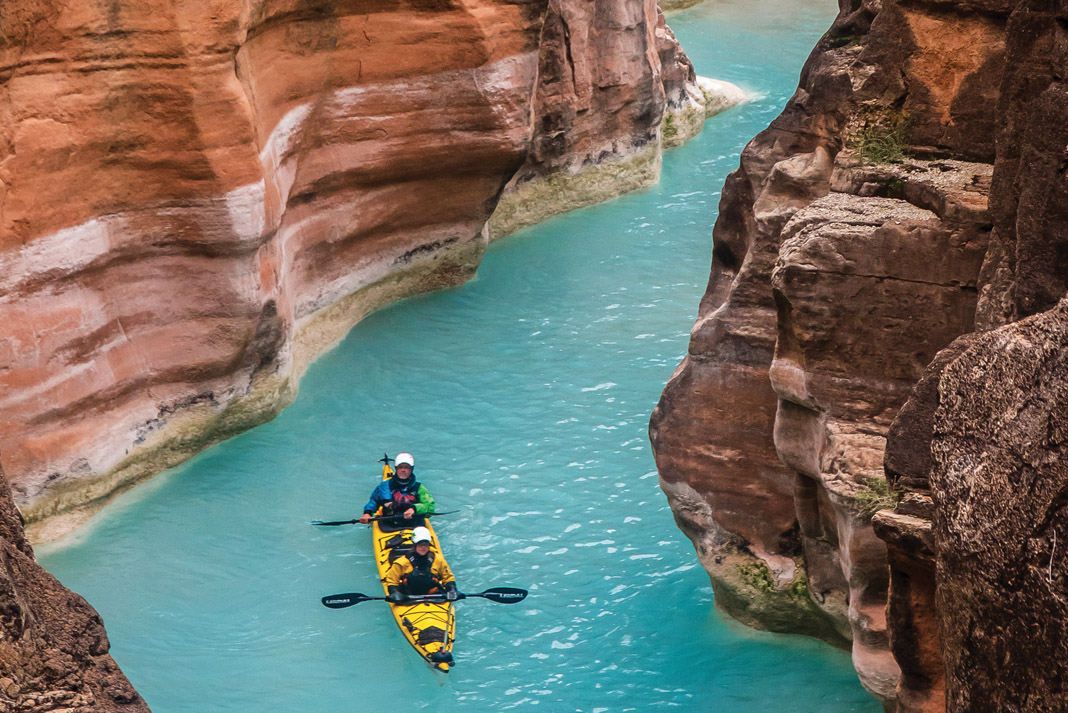
Havasu Creek is one of the most photographed spots on the Grand Canyon. We couldn’t resist. | Photo: Ryan Fair
The extra efficiency and safety makes them a great long distance touring vessel, especially with an inexperienced team member. Which is why the Passat G3 is so popular with sea kayaking outfitters and tour companies.
During the training lead up, I used the double in a surf competition in Washington State where it managed to help seal a second place podium position in the open category. The surf competition confirmed the agility and good design of the kayak, though ironically perhaps, the double lived up to its nickname. I had gone through two relationships on my way to kayaking the Grand Canyon.
Two weeks out from our launch date, I found myself in desperate need of a paddling partner to tackle this crazy journey.
My friend and outdoor photographer Jillian Brown jumped on the chance despite not being a whitewater kayaker, not having a roll and not having time to practice before hitting the river. I think the adventurer in both of us kind of liked these odds.
Exploring the Colorado River
With 30,000 people going down the Grand Canyon each year, paddling a tandem sea kayak added a touch of unknown to the trip, something like Powell’s first descent down the Colorado back in 1869.
John Wesley Powell led, what is believed to be, the first voyage of white men through the entirety of the Grand Canyon. The voyage, conducted in shallow draft wooden dories, started on the Green River and ended at the end of the Grand Canyon at the confluence of the Virgin and Colorado rivers. This expedition produced the first detailed descriptions of the previously unexplored canyon country, though had been fraught with danger and anxiety.
Powell wrote in his diary, “We have but a month’s rations remaining. The flour has been resifted through the mosquito-net sieve; the spoiled bacon has been dried and the worst of it boiled… We have an unknown distance yet to run, an unknown river to explore. What falls there are, we know not; what rocks beset the channel, we know not; what walls rise over the river, we known not. Ah, well! We may conjecture many things.”
Damaged and sunken boats, near drownings and a gruelling river of immense rapids had left the team desperate and brittle. Three men abandoned the trip, preferring to hike out rather than continue to face the wrath of the Colorado for who knew how much longer. Those men were never seen again. Ironically, the expedition reached its end only two days later. I’d told Jill this story before we launched as a deterrent to possible mutiny.
The Colorado River has since been dammed in two locations reducing the length of runnable whitewater river, yet the allure and beauty remains. What was once a truly epic life-threatening journey has become one of the greatest recreational adventures in North America.
It takes a village to make the descent
Like the Powell Expedition, we team up with others for this trip.
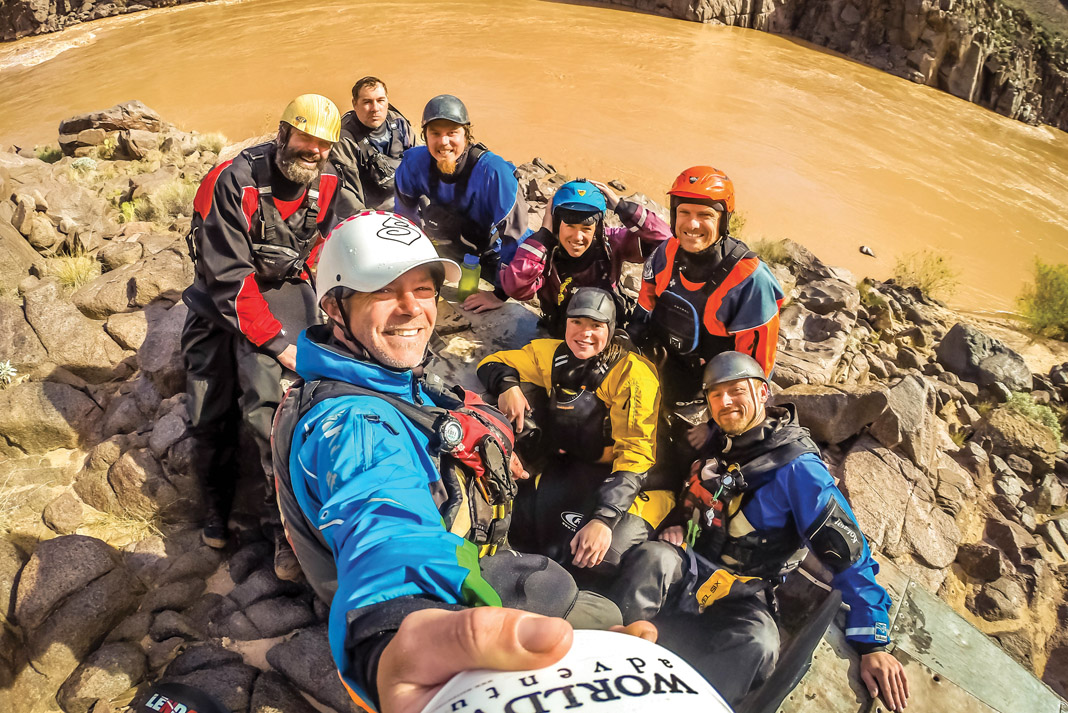
Neil Gibby, Ryan Fair, Judd Spencer, Heather Nichols, Jill Brown, Kevin Murur, Mike Gill, Jamie Sharp (Absent Danielle Cullen). | Photo: Jamie Sharp
Ryan Fair, Kevin Maurer, Judd Spencer and our permit holder Heather Nichols are all paddling crossover river kayaks. Mike Gill and Danielle Cullen are in single sea kayaks, and last but not least is Neil Gibby, who crams 11 days of gear and food into a whitewater creek boat. We are a motley crew to say the least and an odd site to see on a rafting river. Every group we pass asks, “Are those sea kayaks?”
Our skill sets are also a mixed bag. Jillian has very little river experience. Neil has paddled the Milner Mile, a notorious class V considered the training ground for the Stikine River. Mike had a solid skill set though had never paddled a proper whitewater river before this. Danielle, who prefers Dan, had a solid roll and good skills, though limited experience in any rough water and nothing like kayaking the Grand Canyon in a composite sea kayak.
Energies are high at the put in as we shove our kayaks in the the current of the Colorado River marking the beginning of our 11-day, 364-kilometer endeavor.
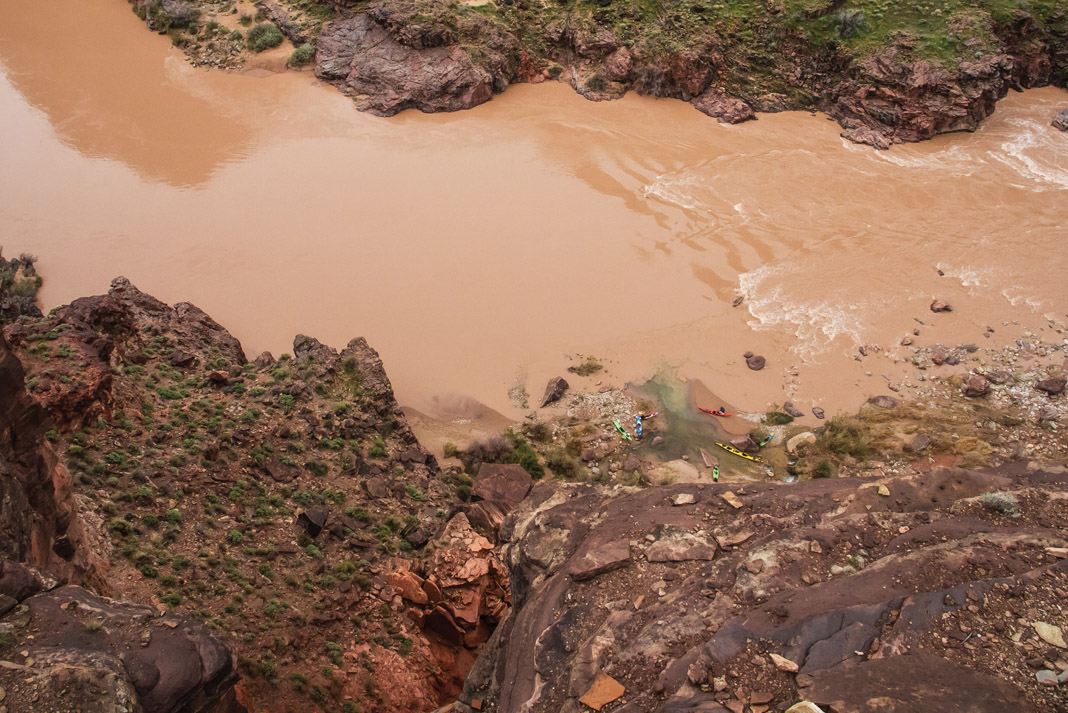
From atop deer creek our fleet seem like toys in a swimming pool of chocolate milk. | Photo: Jillian Brown
Once we round the first corner in the river, we are isolated, with only three ways out: hike up and walk out, float out, or fly out by helicopter rescue. The only reasonable hike is at a trailhead almost halfway down our intended journey.
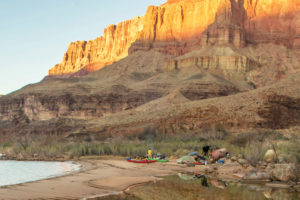
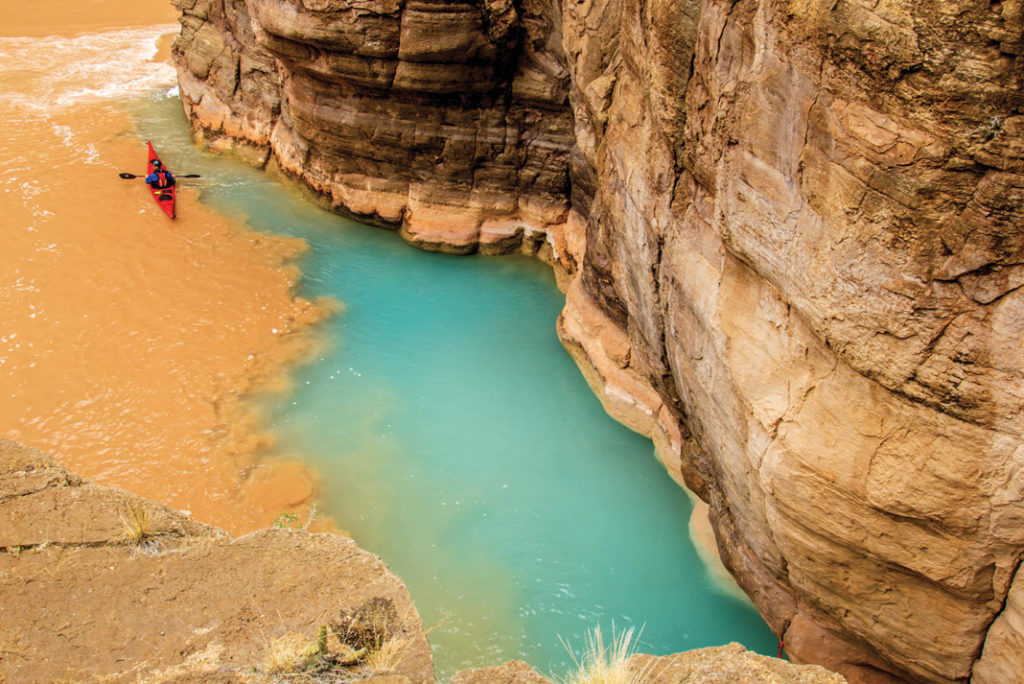
As wonderfully remote as it is beautiful, the Grand Canyon appears a most suitable name for such a majestic geographic landmark. Seasonal rain congregates in side gulleys and canyons, rushing into the main river with silt, staining the river orange red, a trait that led to the river’s name. Colorado means the color red in Spanish. With red walls climbing to the sky and a red river running through it, almost always everything had an orange-red hue, emblazoned further by the setting or rising sun.
“The glories and the beauties of form, color and sound unite in the Grand Canyon–forms unrivalled even by the mountains, colors that vie with sunsets, and sounds that span the diapason from tempest to tinkling raindrop; from cataract to bubbling fountain,” wrote Powell.
Some calls are closer than others
The first couple of days through this majestic desert-scape are good training.
Campfires are key for warmth on winter trips, the group would cook BBQ style then Jamie would bake dessert in his dutch oven with the coals. | Photo: Jill Brown
Laughter floats in the air, dancing with the smell of food, smoke and the crackle of the glowing campfire. | Photo: Jamie Sharp
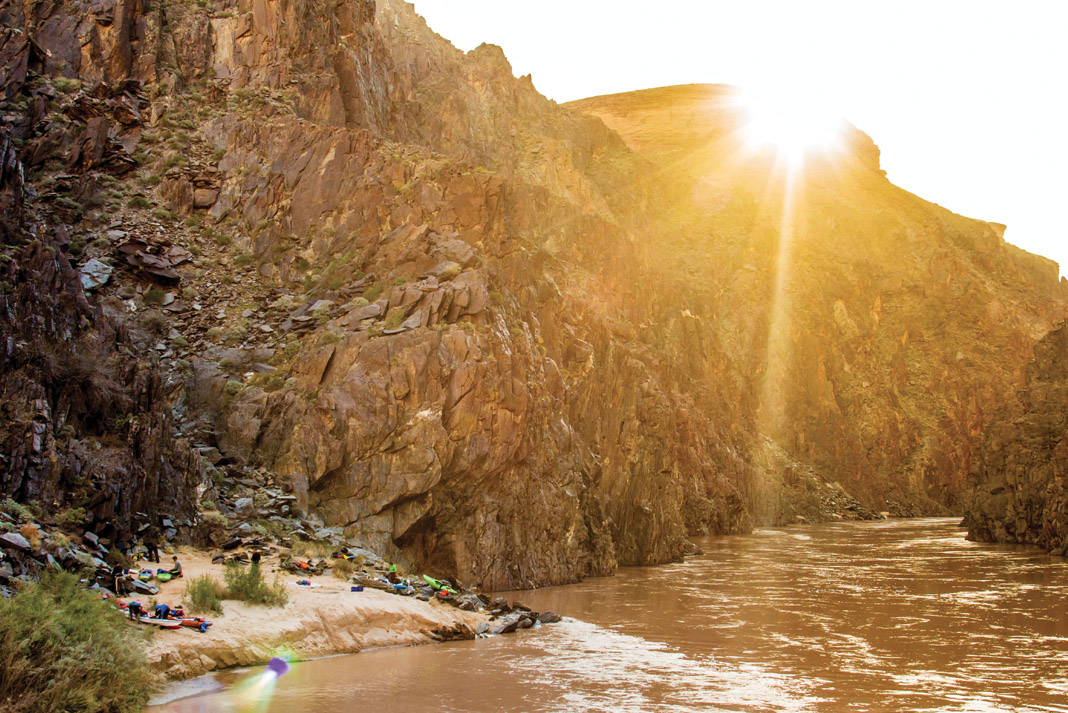
Each campsite, like this one on Palisades Creek, has its own personality and stunning vista of glowing canyon walls. | Photo: Jamie Sharp
There are a couple swims and rescues, including our double. By the third day we find ourselves mere specks at the bottom of clay red cliffs looming thousands of feet above, threatening to choke out the sky.
February trips like ours are considered winter trips. We are allowed campfires. The days are not blisteringly hot. It is easier to get a permit in the winter.
Most trips down the canyon take about 18 to 21 days. Except with our chosen fleet of mostly smaller whitewater kayaks, we couldn’t carry that much food. Despite our shorter timeframe and more daily miles, we manage to end each day with plenty of light. In this “land that time forgot” we jump from waterfalls and sit amongst ancient ruins of people who once lived in the canyon and stored their foods high up in the cliffs above the seasonal flood levels of a once undammed river below.
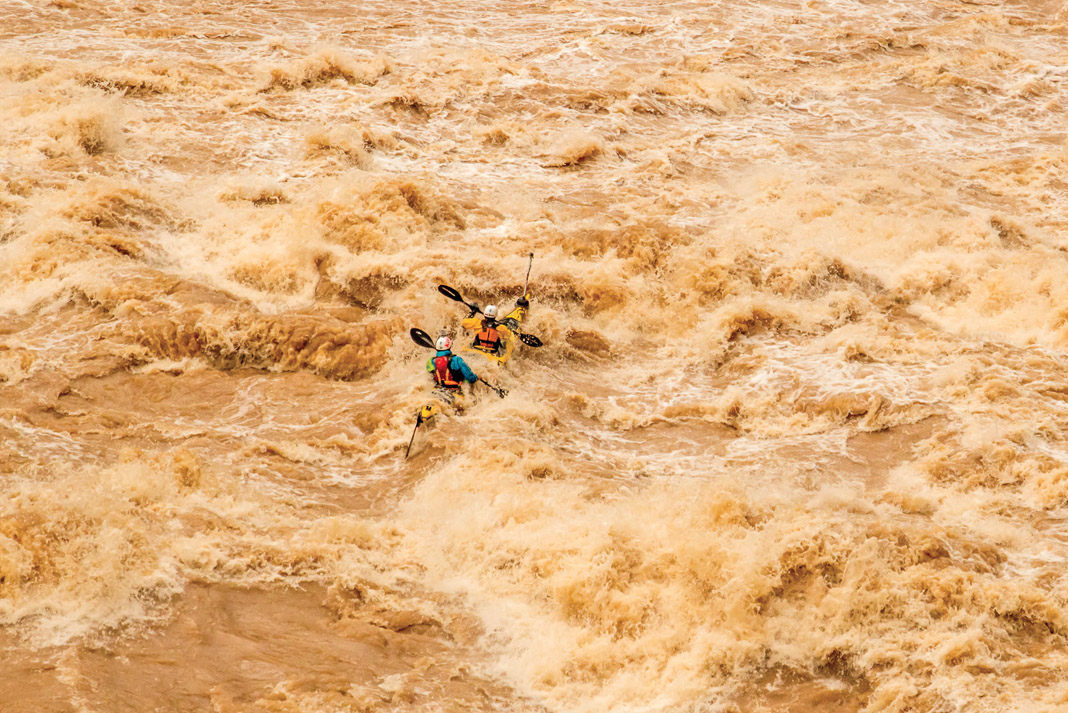
Chocolate colored whitewater thunders around us as we drop into Unkar Rapid.
Main pushing the double through Lava Falls. | Photo: Ryan Fair
A large wave erupts to our right as I yell to Jill to paddle on the left, “Hard!” As our double kayak straightens up, Jill is plunged out of sight into a foaming pit of water, and then I disappear with her, into the silty darkness of an all-consuming valley and curtain of water. This is how it goes for us on the Colorado.
Through the rapid, we slip into the eddy to wait and watch for the rest of the team to come down. What we see is not good. Dan is swimming. But that isn’t the real the problem.
The real problem is her fiberglass kayak is running the rapid driven by unrelenting surging whitewater over and against the rocks, a place even a plastic boater doesn’t want her boat to be. I can hear in my mind the hollow thuds and brittle crunches of her kayak smashing on rocks.
We scramble to put Danny and the kayak back together at the bottom of the rapid.
The state of the kayak isn’t good. It had taken a couple of hits yesterday already, but this incident has it beaten raw. We look at frayed exposed fiberglass and large fractures in the gel coat. The dangers of kayaking the Grand Canyon in a composite kayak have literally hit home.
With the kayak patched with duct tape, we push on to camp.
With shorter days and our shortened itinerary we ended each day chasing the disappearing sunshine for drying gear. Sunset at Clear Creek Campsite. | Photo: Jamie Sharp
A parting of ways?
“I need to get out,” Dan states frankly at dinner. “I am in over my head and I am just destroying this kayak”.
“Let’s just sleep on it,” I tell her.
Around the fire we talk about ways to get Danny and what is left of her kayak out of the Canyon. We all agree knowing your limits and making smart decisions, even if it means backing down or adjusting your goals, is just a part of adventuring.
The next day we reached Phantom Ranch. This rustic lodge was set up in 1907 by David Rust to cater to prospectors, hunters and adventurous tourists who wanted to experience being in the Grand Canyon with some comfort.
As the only site in the Canyon developed for tourism, it provides relatively easy access for hikers and mule packers from rim to river. The only catch is that it is a six to nine hour hike straight up the canyon, and Dan has a kayak and gear. Even if she does get up there, how is she to get back to Flagstaff where our cars are parked?
There is no way a mule can carry a 16-foot kayak. We consider cutting her kayak completely in half. Or maybe three pieces will be better. And so goes the conversation.
Then we met Zach. Zach is a young scraggly hiker, a true-life character stepping out of a REI catalogue. He arrives sporting the quintessential mid-west stubbled face, trucker’s cap, shorts, flannel shirt, light hikers and a small backpack.
He has been hiking for three days off trail in the Grand Canyon and is just about to walk out to his car at the top of the trail and then drive home to Flagstaff. Perfect. A friendly, curious and adventurous guy, we all strike up an easy conversation. Jokingly, but not really, we throw out the idea of hiking out a sea kayak with Dan and driving her to Flagstaff.
“Sure, sounds like a good adventure,” replied Zach. “Though we need to leave soon.” Now two groups on separate adventures, we part ways below the bridge at Phantom Ranch.
Dan and her basic supplies along with Zach start hiking into the harsh, stark and steep canyon desert. She leaves three satchels of gear for mules to bring out the next day. If all goes well they’ll make it out before 10 p.m., climbing 5000 vertical feet over seven hours to the Grand Canyon’s south rim, three hours of that in the dark, all while carrying a touring kayak.
We wish Zach and Dan luck, certain that Dan’s fate will be better than the men who abandoned Powell. The rest of us have four of the biggest rapids on the canyon before camp. We float down the canyon as Dan’s tattered kayak floats up the canyon atop their shoulders.
Back to the task at hand
A few days later Jill and I have not flipped the double again and we’ve now run most of the bigger rapids.
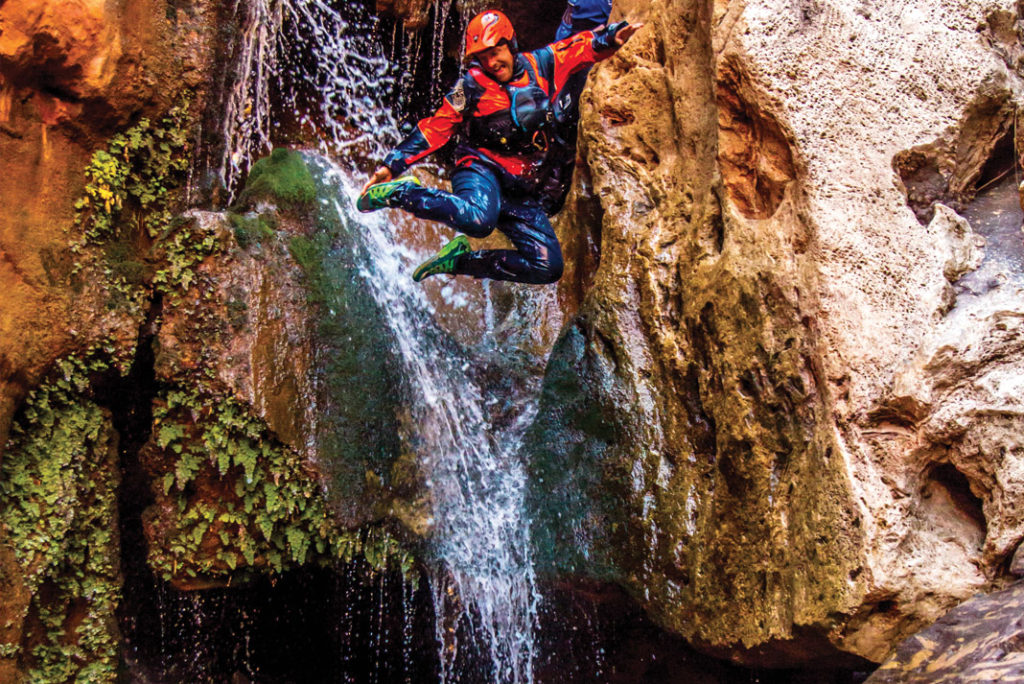
Kevin Murar leaps freestyle off the waterfall at Elves Chasm. | Photo: Jamie Sharp
The confluence of the turquoise Havasu Creek and the silty orange Colorado River. | Photo: Jamie Sharp
Granite slammed us hard onto our side but I managed to roll back up with the help of the next wave. Jill is feeling pretty battered after days of being the first one to greet the waves of the Colorado. We still have the most notorious rapid on the trip, Lava Falls, and Neil’s been telling everyone, “It’s easy as long as you keep your line.”
There are apparently multiple options of travel through Lava, though for us there seems only one—moving from right to left right through the meat of the largest rapid on the Grand Canyon.
[ Plan your next great adventure with the Paddling Trip Guide ]
Despite what feels like hours scouting from above, getting to know our line, once on the water it all looks different. Bigger.
A huge foaming pit the size of a Silver Eagle tour bus is parked at the beginning of the rapid. This river feature flips fully-loaded whitewater rafts, breaks wooden oars like toothpicks and folds aluminum raft frames like tacos. Yet from the water we cannot see it until we are right above it and then we need to enter the rapid right next to it… and not into it.
With Neil’s simple speech ringing in my ears, I realize our line is slightly off. We need to be further right.
“Paddle,” I shout at Jill’s back. “PADDLE!”
Furious forward strokes from both of us and we slip past the thunderous hole, our blades grabbing the edge of the monster in unison while the rudder on the stern deck dips beneath the crashing water. We are sucked into the main flow and into waves coming together like the rotating blades inside a pencil sharpener. I struggle to find breaths amongst the exploding water, exertion of paddle strokes and shouting encouragement to “FORWARD PADDLE”.
I feel on the edge of control. I watch Jill disappear just as darkness engulfs us both like a heavy wet blanket. The water is so full of silt it is impenetrable by light.
Our entire kayak disappears underwater then erupts like a torpedo from a submarine.
We keep driving forward and toward the left side of the river. Eventually our slender double crosses the surging eddyline and turns back upstream.
“I think I was underwater for that whole thing,” Jill says grinning back over her shoulder. “Turns out it’s hard to be scared when you can’t see anything.”
A feeling of accomplishment
We travel a few more day of rapids, though now with Lava behind us the energy of the group has shifted. Our spirits are high, relaxed. We spread out more and enjoy time alone floating toward our agreed upon camping areas.
Mission accomplished…still talking after 11 days together in a double. | Photo: Jillian Brown
On the last day we float to the take out to find Dan sitting with our shuttle driver, vehicle and trailer. We have tasted a little of what John Wesley Powell experienced in his wooden dories some 150 years earlier. Dan is holding a box of donuts with a big grin on her face and her own great story to tell. After all, she played a key role in the first expedition to hike out of the Grand Canyon with a sea kayak.
[ View all sea kayaks in the Paddling Buyer’s Guide ]
This article was first published in Issue 51 of Paddling Magazine. Subscribe to Paddling Magazine’s print and digital editions, or browse the archives.
The only way to get the double through the biggest falls in Hermit Rapid is straight down the middle. | Feature Photo: Heather Nichols
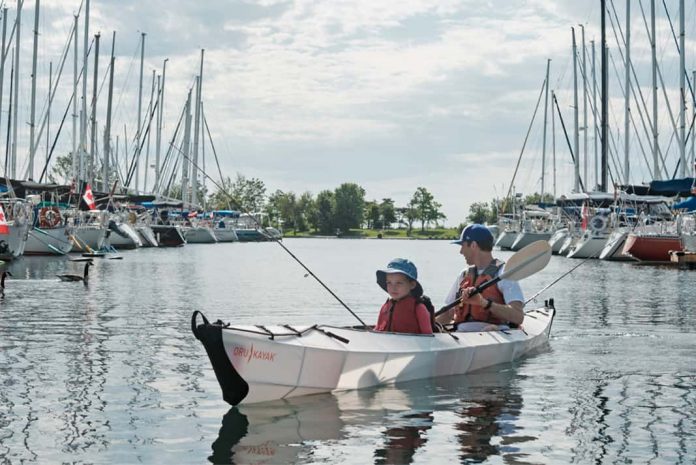
Build-a-boat. From suitcase to shore in just 10 minutes, the tandem Oru Haven offers excellent portability in a recreational design. | Photo: Wyatt Michalek
Once upon a time, people who wanted to sell kayaks just went and built them first. High-tech companies like San Francisco-based Oru upended the tradition by coming up with a kayak concept and crowdfunding it first. The latest in the lineup of “origami-inspired” folding plastic kayaks is the Oru Haven, a tandem kayak design for friendly waters.
Straight from the minds of entrepreneurial designers and the voodoo economics of cyberspace, some truly disruptive creations have emerged since Oru launched its first single kayak and top seller, the Bay, in 2012.
Oru’s base material is white, double-walled corrugated polypropylene, custom-made in Canada and assembled in Mexico. Think plastic signboard material or, as Oru’s spokesperson put it, “the mailboxes you see at the post office, although much more durable and custom created.”
Assembling the Oru Kayak Haven
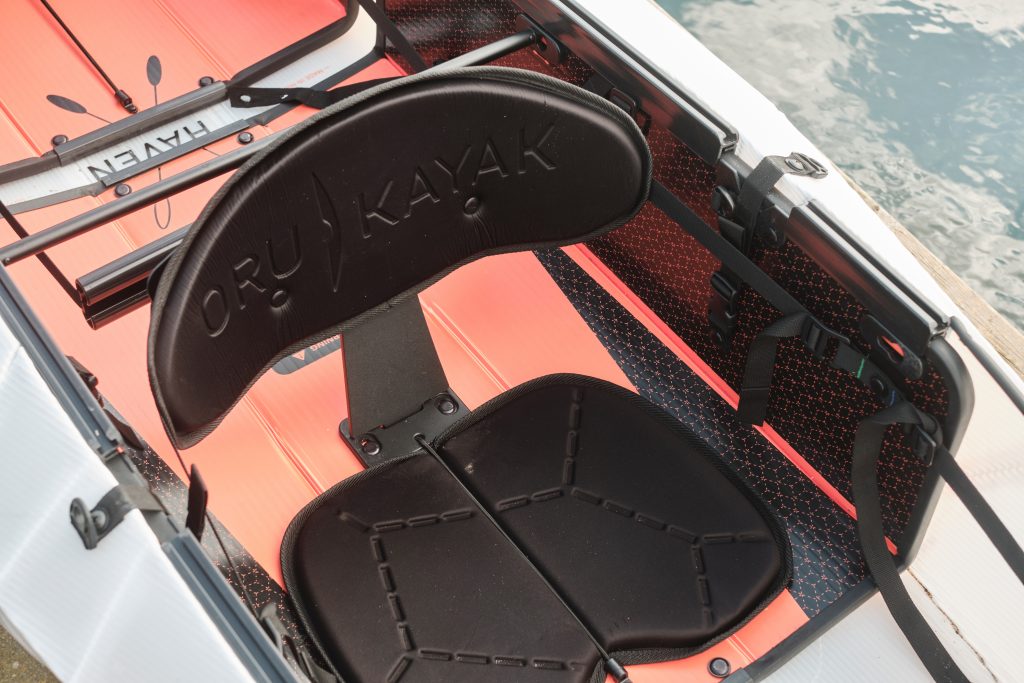
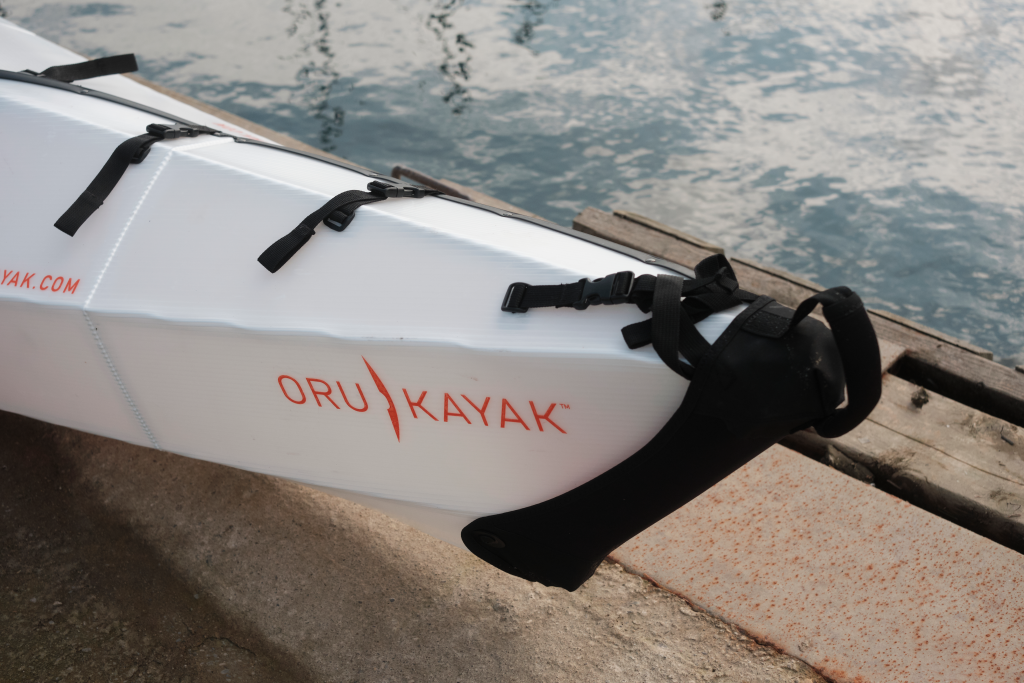
The single-piece hull is pre-creased with lines that quickly folding into kayak shape, then neatly clipping together with neoprene end caps, nylon straps and plastic buckles. It’s thoroughly postmodern, yet bears a remarkable resemblance to its sealskin predecessors in all its translucent glory.
Birthed through an Indiegogo fundraising campaign last fall, the Haven started shipping in early 2019. The Haven fits into Oru’s lineup of four folding kayaks as the only tandem—a wide, open-cockpit recreational design similar to the smaller Oru Beach LT, with the bonus of converting from a single to a tandem and including a new metal rail system for attaching accessories.
Setup is straightforward compared to other folding kayaks. I threw the boxed Haven into my van for a vacation with my kids and hauled it out on a campground beach. Without previewing the instructions or setup video and battling a stiff onshore breeze, I cobbled it together in under an hour, including a trip back to the campsite for snacks. With a little practice, the advertised 10-minute setup is definitely achievable.
How does the Haven hold up to rough handling?
Oru responds to durability concerns with videos of their kayaks being dragged across rocks and paddled in surf. If needed, field repairs are easy with duct tape or epoxy. The hull has a 10-year UV treatment and is rated for 20,000 folds—theoretically, more than 50 years of daily paddling and folding. And, since it’s 100-percent recyclable, in the end you could throw it in the blue bin to be turned into plastic lumber or an outdoor rug.
I was impressed by the single-piece hull but questioned the durability of the floorboards and fittings.
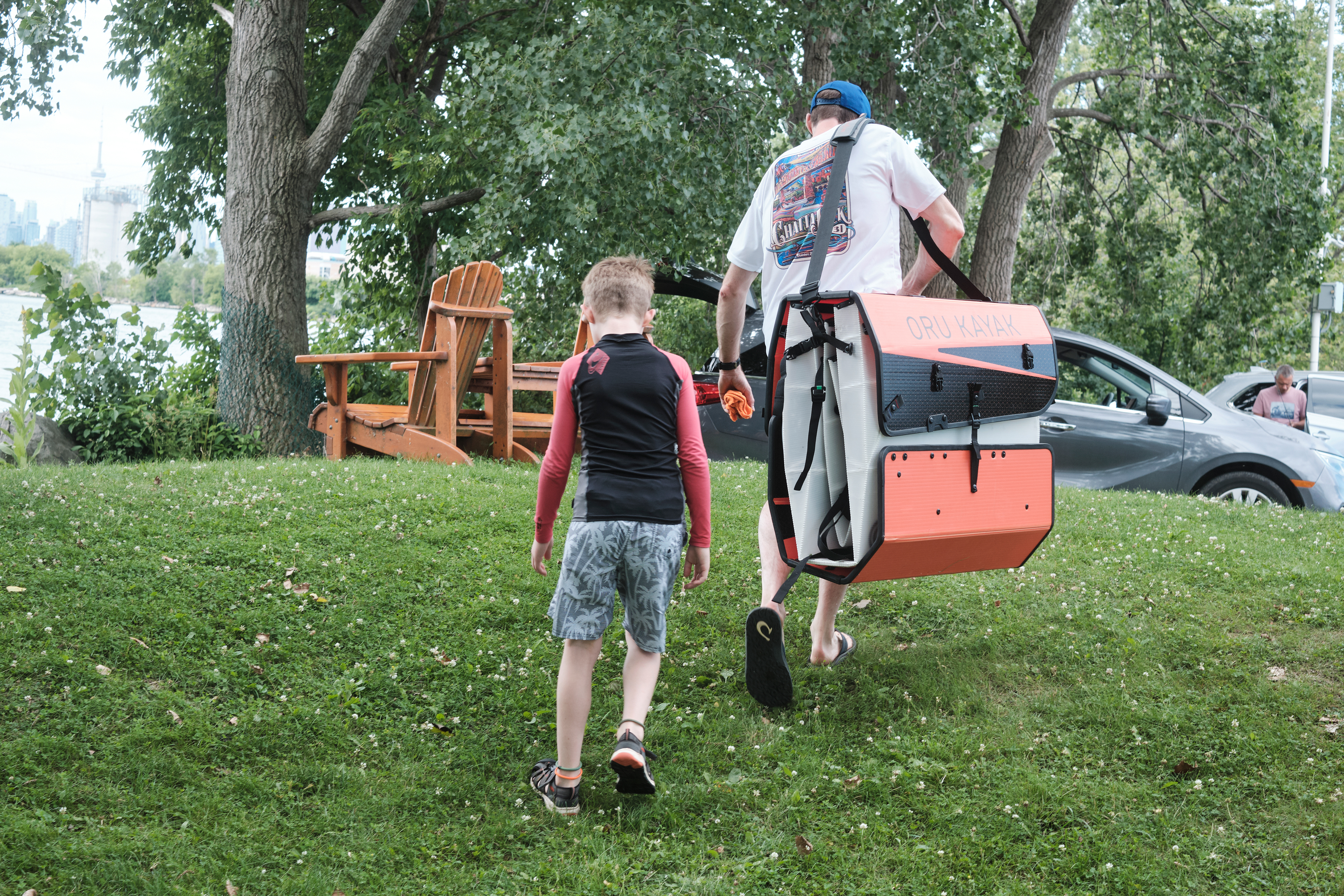
The folded Oru fits into a suitcase-sized box formed by its two floorboards, easily carried with a shoulder strap and stowed in the trunk of a car. | Photo: Wyatt Michalek
The rigid orange floorboards, which form the top and bottom of the carrying box when the Haven is folded, invert into the hull during assembly. Ours showed some deep cracks along the seams—an observation shared by some online reviews, which also noted bending and slipping of the metal G-hooks attaching the seatbacks to the hull.
Our G-hooks held up well but required a back-up knot to prevent slippage. On the pro side is the ease with which you could replace any of these parts. Oru stocks replacement parts on its website and stands behind its one-year warranty.
On the water, the Haven performs as you’d expect for an open-cockpit rec kayak with a 31-inch beam. Stability is rock solid, its lightweight hull responds quickly to every paddle stroke, and it tracked straight and stayed dry even in a stiff breeze with small whitecaps.
Color-coded stitching shows where to clip the seats and footrest straps for tandem and single setup. A universal rail fits accessories like rod holders and electronics. | Photos: Wyatt Michalek
Nylon buckles and neoprene end caps hold the folding plastic hull in kayak form. | Photos: Wyatt Michalek
The Oru Haven can accompany you practically anywhere
Versatility is the Haven’s key advantage, converting quickly from a tandem to a single by merely clipping the seat and footrest to different attachment points. For a single paddler, there’s loads of room for gear in the cockpit, but no dry storage. You could also squeeze some gear bags into the bow and stern behind the bulkheads by partially unfolding the ends.
Folding up the Oru Haven looks daunting when you see the mass of its hull spread out before you like a skinned whale and the size of the box you’re supposed to end up with. But once you figure out the subtle twisting motion that nests the two ends together, it practically folds itself, and all the parts stow into the folds. Then you’re on the road with nothing but an empty roof rack and a nagging feeling that you’ve left something behind.
Is this folding kayak a Haven for you?
You likely already know if the Haven is for you. Most people who encountered mine either loved it or hated it. Random guy on the beach giving me the thumbs up was definitely a fan. My wife (“What is that thing?”), definitely not. This sort of gut response should make the decision easy. Besides, if you require an ultralight kayak that folds up into the size of a suitcase and converts from tandem to single, the Oru Haven is one of few options.
However, there’s a swath of potential buyers who should give the Haven a serious second look, and that’s anyone considering a regular open-cockpit tandem recreational kayak. For not much more money than one of those 70-plus pounders for which you practically need a boat trailer, the Haven is half the weight, giving it the potential to be much more user-friendly, with the bonus of unprecedented packability and storage.
This article was first published in Issue 59 of Paddling Magazine. Subscribe to Paddling Magazine’s print and digital editions, or browse the archives.
Build-a-boat. From suitcase to shore in just 10 minutes, the tandem Oru Haven offers excellent portability in a recreational design. | Feature Photo: Wyatt Michalek
The put-in is quiet as I unload my boat from the back of my truck. It’s 11 a.m. on a Tuesday, and I couldn’t find any boating partners today, which means I am kayaking alone.
The Experience of Kayaking Alone
Paddling solo is a much different experience than paddling with a group. Not because I need to be more focused on safety—I have been paddling this stretch of river since I was 13 years old and I know I am not going to swim.
I also know if something happened and I did end up swimming, I would still be fine. The rapids are deep, short and without consequential hazards.
Instead, my experience changes because my mindset changes. When I am with a group, I feel the need to show off. I feel the need to paddle my best. To throw my biggest downriver freestyle moves. To catch the most eddies. I think it stems from my competitive personality. My desire for perfection. It is one of my worst personality traits.
But when I am paddling solo, all of that goes away. I don’t need to be the best. I don’t need to show off. I don’t need to be perfect. I can just be. I can just paddle.
Reasons For Going Alone
Everyone has a different reason for kayaking alone. In 1992, Doug Ammons became the first to solo the Grand Canyon of the Stikine. To this day, his descent remains one of the most notable accomplishments in whitewater history.
“I get immense pleasure and inspiration from the experience,” Ammons says. “Words and social concerns disappear, and you are left with a single important reality, which is the flow of the river.” He describes soloing as one of the easier ways of entering flow state.
Psychologist Mihály Csíkszentmihályi defines flow state as “being completely involved in an activity for its own sake. The ego falls away. Time flies. Every action, movement and thought follows inevitably from the previous one, like playing jazz. Your whole being is involved, and you’re using your skills to the utmost.”
With a Ph.D. in psychology, Ammons knows flow state well. For him, “The key to entering a flow state is focusing on what you wish to accomplish physically, and completely giving yourself up to it. Setting all fear or threat aside, all judgment and criticism, all comparisons and all social concerns—having all the barriers down.”
This notion of experiencing flow state while solo is not limited to kayaking. Free solo climber and BASE jumper Steph Davis experiences flow state most easily when she is climbing without a partner.
“For me, a big factor for reaching focus, or flow, is getting away from outside energy—so free soloing inherently works really well because you are alone,” says Davis.
Alex Honnold, famous for his free solo climb up El Capitan in Yosemite, says flow doesn’t come as easily when climbing with ropes and a partner.
“I think a big part of the pleasure in free soloing is that it forces you into that state more than other kinds of climbing,” he says.
In every beginner whitewater course, students are told never to paddle alone. I teach this rule, and yet I don’t follow it. I paddle alone often. Whether it be a flatwater sprint workout, a freestyle session in the whitewater park or a river run, I break this rule all the time. So why do I teach this to beginners?
“It is an important rule to impregnate into new kayakers and the up-and-coming kids who watch YouTube videos,” says 10-time Green Race champion Adriene Levknecht.
“The people who are solo paddling have been in it for a very long time, and they understand the underlying danger.” In her view, the danger of kayaking alone isn’t less for experienced kayakers, but the risks are better understood and accepted by the paddler.
Ammons has a different view. “Bullshit,” he says when asked whether he agrees with the never-paddle-alone rule. “The bottom line is even when you’re in a group, you take every paddle stroke alone.
You are the captain of your own ship; you are always soloing even in a group. I’d say 90 percent of having partners is purely social, and less than 10 percent is safety.”
In Ammons’ view, even paddlers in a group are soloing. “Beginners are fine paddling solo as long as they stay within simple situations, like near the bank in slow-moving flatwater, or on a pond,” Ammons believes.
Considering Ammons’ opinion, I began to ponder my thoughts on running hard whitewater. My personal view of running consequential rapids is I need to be 100 percent confident on my line before running the rapid. If I am not 100 percent, I portage.
With this mentality, there is no need for me to depend on paddling partners for safety purposes. If I am 100 percent confident on my line, I should be able to run those difficult and consequential rapids solo just as easily as with a group.
And yet, this is not what happens. I usually cut myself off of kayaking alone at class IV-, where I feel extremely comfortable.
“Most of the negative attitude toward soloing is merely the sense of security people have when other people are close, so in this way, it can easily blind you to the reality of their situation,” adds Ammons. “The real question is, do people want to believe things because they comfort us? Even if they only give a false sense of security?”
[ Plan your next adventure with the Paddling Trip Guide ]
Go Alone, Be Safe
Of course, the sense of security a group provides isn’t always false, which Ammons admits.
I have both witnessed and experienced instances where paddling partners have pulled each other out of risky situations, relied on one another for a throw rope or live bait, and saved each other’s lives.
Mistakes on the river happen. We swim. We get beat down. We get pinned. And in those instances, a paddling partner who helps you clean up your mess is a lifesaver—even if only 10 percent of the time.
Nouria Newman, one of the best whitewater kayakers in the world, recently completed a seven-day solo expedition of the remote Zanskar and Indus rivers in northern India.
On day two of her expedition, she got stuck in a siphon. Luckily, she made it out unscathed. Her response after the expedition?
“Why go solo when you can go with friends.”
This article was first published in Issue 57 of Paddling Magazine. Subscribe to Paddling Magazine’s print and digital editions, or browse the archives.