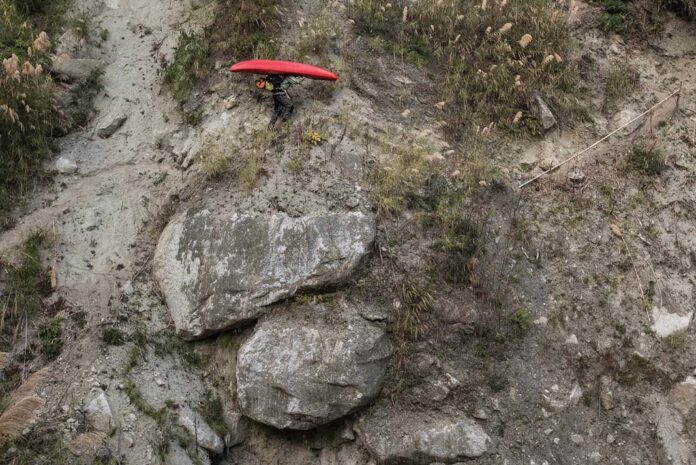
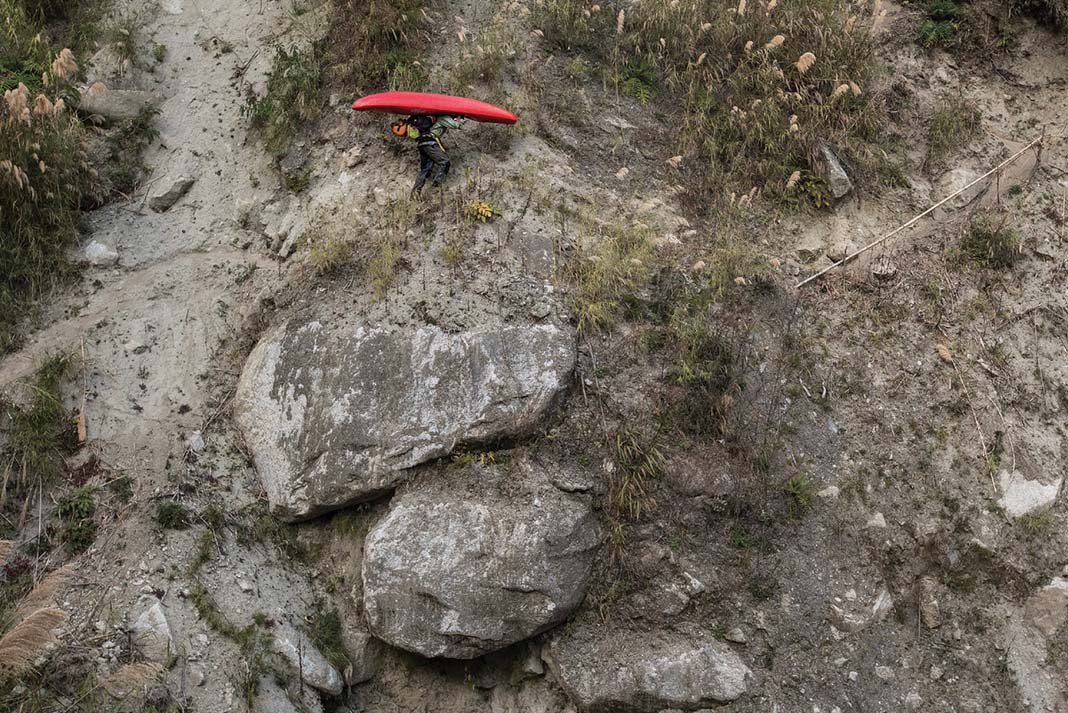
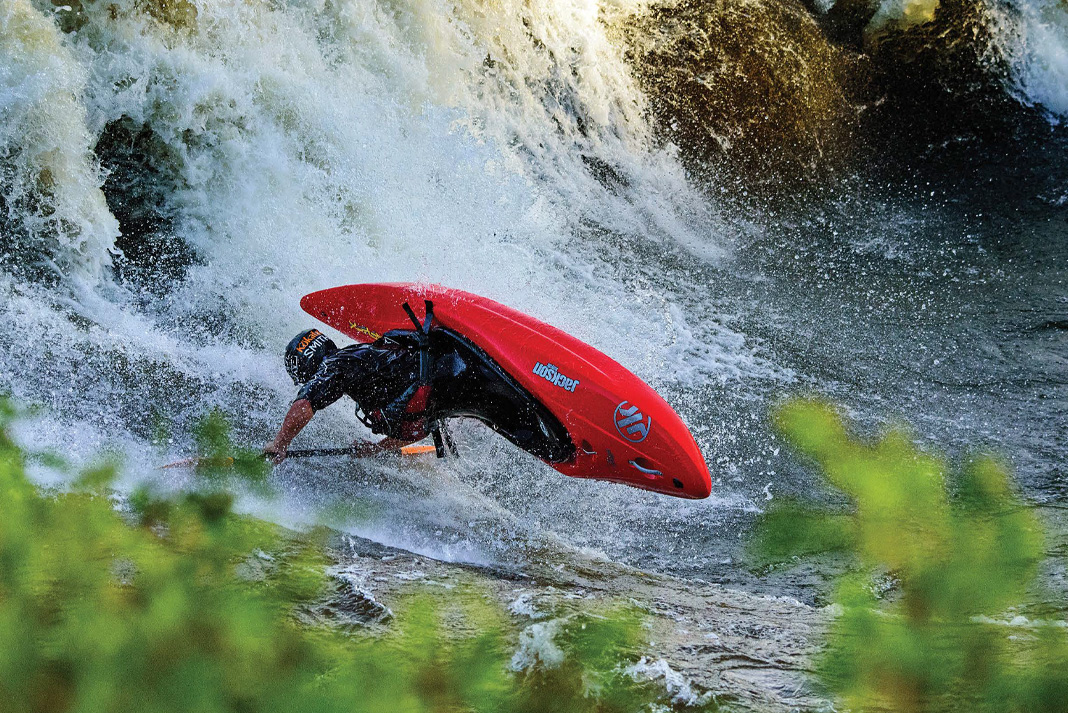
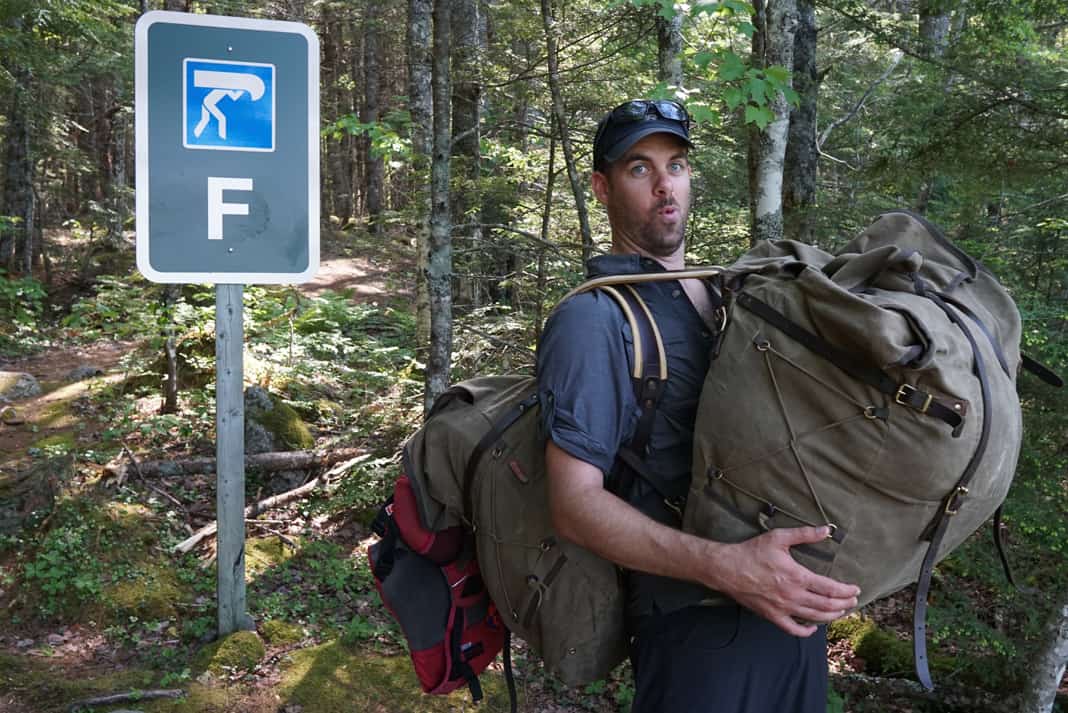
I am multitasking. I am carrying my boat and not falling to a tragic death. | Photo: Chris Korbulic
We live in a time where multitasking is king. Job postings call for applicants who can skillfully handle many duties at once. Families eat breakfast together while scrolling through photos on their phones, periodically tuning into the conversation. We answer emails while chatting on speakerphone and sneaking in a sandwich, all in the name of productivity. We are at the mercy of the notifications, pings and vibrations emanating from our numerous devices. The ability to manage many thoughts and ideas at once is seen as an asset, although there is mounting evidence to the contrary.
In their 2011 study “Juggling on a high wire: Multitasking effects on performance,” Rachel F. Adler and Raquel Benbunan-Fich found that while some multitasking improves productivity, too much has a negative effect. When performance is measured in terms of accuracy, the negative effects of multitasking are especially pronounced.
Rivers have no patience for mulitaskers. Experiencing the features they have to offer requires concentration, focus and a relinquishing of unrelated thoughts, worries and catwheeling attention spans. Sharp ledges and retentive holes demand to be the sole focus. It’s like skiing powdery slopes coated in tight trees, leaning into greasy switchback turns on a mountain bike trail or problem-solving an incredibly technical climbing route.
I am multitasking. I am carrying my boat and not falling to a tragic death. | Photo: Chris Korbulic
Last spring I went to a whitewater festival on a new river. It was dam controlled and the single release each year brought paddlers from hundreds of miles away to camp in an idyllic mint-green field where the river melted into a deep lake.
I’d just begun a new job and felt perpetually frazzled, always convinced I’d left some key detail unattended or forgotten to respond to an important email. During the two-day festival, the challenges of the river I faced during five-hour day runs were all I could think about. My obsession was how to navigate tricky holes and catch those crucial can’t-miss eddies. Driving home Sunday night through tiny riverside towns, my relaxed mental state indicated I had enjoyed a reprieve from rumination that weekend, but I wasn’t quite sure why.
After shooting photos of a new whitewater canoe with some other members of the Rapid team on a -5-degree Celsius January afternoon on our backyard river, we stood around the take-out. In between shedding helmets, reaching for beanies and clawing at gaskets with numb fingers, someone mentioned they felt way better than they had before paddling. Paddling the short section of whitewater ringed by sheets of ice required her to completely cease thinking about other things. In an unlikely place— the bow of a canoe in a rapid—she relaxed.
You don’t have the luxury of thinking about other things in whitewater. Maybe that is the luxury.
Hannah Griffin is a journalist, photographer, and mountain lover. She’s a NYU Journalism alum, and her work has appeared in The Guardian, Al Jazeera and Vice.
This article originally appeared in Rapid’s Early Summer 2017 issue.
Subscribe to Paddling Magazine and get 25 years of digital magazine archives including our legacy titles: Rapid, Adventure Kayak and Canoeroots.
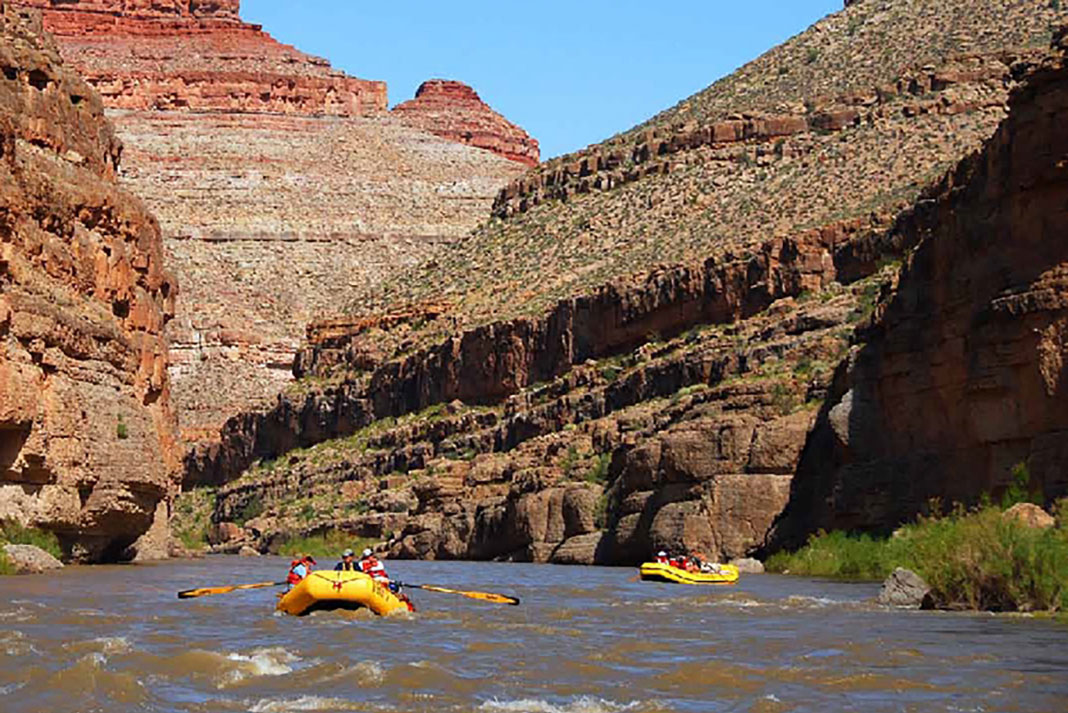
An Oars commercial rafting trip on the San Juan River, bordering the Bears Ears National Monument. | Feature photo: Courtesy David Hessell/Oars
This past May, the Outdoor Industry Association released a report claiming outdoor recreation contributes $887 billion and 7.6 million jobs to the U.S. economy. The message is that the outdoor industry is all grown up, having matured into an economic powerhouse nearly twice the size of the automobile business and employing more Americans than the construction industry. Yet in political terms, the outdoor industry is still sitting at the kiddie table.
The real fight to save America’s public lands
Take for example the recent posturing over the Bears Ears National Monument, a 1.35 million acre reserve in southeastern Utah harboring the country’s densest concentration of Native American artifacts. Then-President Barack Obama designated Bears Ears a National Monument just 23 days before leaving office using his authority under the 1906 Antiquities Act, which empowers U.S. presidents to proclaim national monuments with the stroke of a pen. There isn’t a provision in the law for subsequent presidents to delist monuments once they are declared, but that did not stop Utah Governor Gary Herbert from urging incoming president Donald Trump to reverse the Bears Ears designation.
Emboldened by Trump’s election and a clear Republican majority in both houses of Congress, western lawmakers have begun toppling legislative dominos in a long-planned effort to transfer federal lands to state and local control. On the first day of the 2017 legislative session, the U.S. House of Representatives prohibited the Congressional Budget Office from reporting how much revenue the federal government would lose if U.S. lands were transferred to state and local governments. Utah congressman Jason Chaffetz then introduced a bill calling for the sale of 3.37 million acres of federal land in 10 states. Chaffetz later withdrew the land-transfer bill in the face of widespread public outrage, notably from the hunting and fishing community.
The Trump administration has been an enthusiastic partner in these efforts.
In April, Interior Secretary Ryan Zinke announced his department would review the status of 27 national monuments, including all those designated since 1996 and larger than 100,000 acres. Zinke’s expedited review of Bears Ears, completed in June, recommended reducing the size of the monument. The fate of others remains in the balance, including several of particular interest to paddlers, such as the Upper Missouri Breaks in Montana, Hanford Reach in Washington and Río Grande del Norte in New Mexico. The 87,000-acre Katahdin Woods and Waters National Monument in Maine—established in August 2016 on land gifted by Burt’s Bees co-founder Roxanne Quimby—is also under review.
All of this is happening despite the concerted and very public opposition of the outdoor industry.
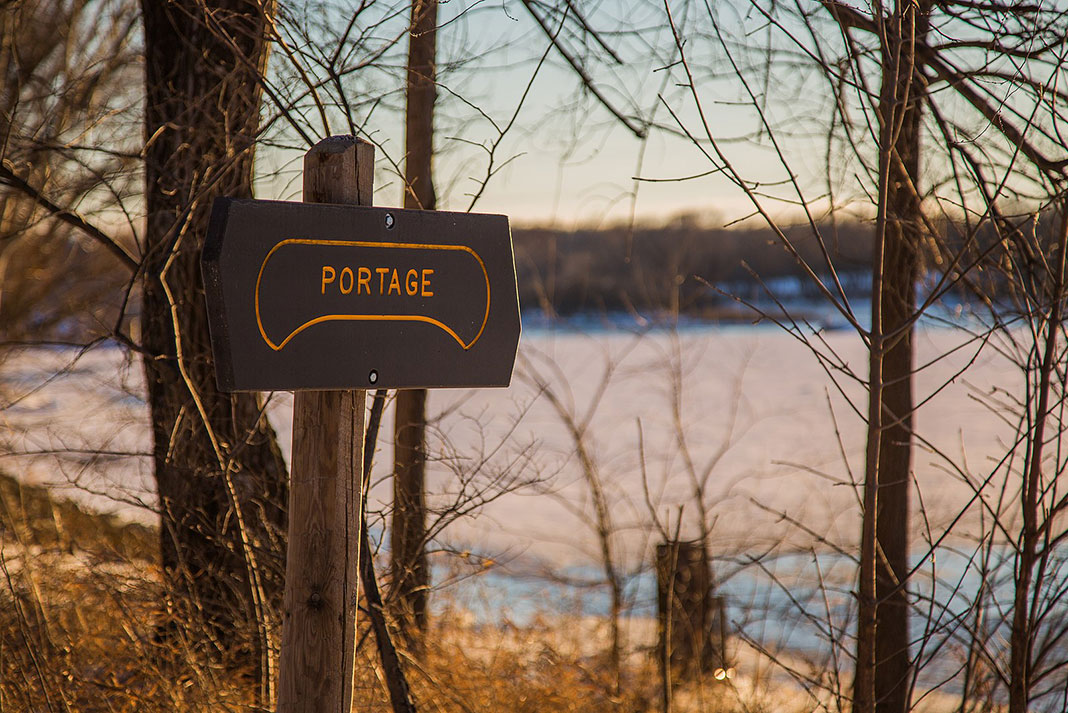
An Oars commercial rafting trip on the San Juan River, bordering the Bears Ears National Monument. | Feature photo: Courtesy David Hessell/Oars
Back in February of this year, Patagonia announced that if Herbert didn’t change his tune on Bears Ears it would boycott the Outdoor Retailer tradeshows in Salt Lake City. The show injects some $45 million into the Utah economy each year. Other outdoor companies followed suit. At a rally at the Utah state capitol on the opening day of the 2017 Winter Outdoor Retailer show, Black Diamond Founder Peter Metcalf said that if Utah politicians don’t change their land-grabbing ways, “We should respond with our dollars, with our conventioneers, with our money, and take this show to a state that is much more aligned with our values.”
It was the kind of political brinkmanship that only works when you have the economic cards to play and the outdoor business holds a strong hand in Utah. The state’s own website heralds OIA figures showing that outdoor recreation contributes more than $12 billion to the Utah state economy and employs more than 122,000 people there. That compares favorably to the petroleum industry, which extracted only $2.4 billion worth of oil and gas from Utah fields in 2015 and employs fewer than 7,000 people in the state.
In a February teleconference with Herbert, OIA Director Amy Roberts and a crew of outdoor industry heavy hitters representing Patagonia, The North Face, REI and Outdoor Retailer demanded Herbert’s administration stop seeking to roll back the Bears Ears designation and transfer federal lands to the states.
Herbert told them to pound sand.
Why did Herbert side with oil and gas when outdoor recreation generates 17 times as many jobs in Utah? The answer, not surprisingly, is money. Not just how much, but to whom it goes.
Recreation may contribute more to Utah’s tax base than oil and gas, but it contributes far less to the campaign coffers of Herbert and other politicians. Oil and gas interests donated $90,000 to Herbert’s 2016 reelection campaign; the OIA spends about $50,000 annually for all of its campaign donations, nationwide.
Money talks in American politics and the outdoor industry is simply not spending enough to be heard.
“In the past you had two arguments to use when you tried to protect public lands. The first argument is because protecting these places for future generations is the right thing to do. The second is that protecting public lands is good for business because they support the recreation economy,” says Seth Cobb, President of Chaco and board member of the Conservation Alliance. “With Trump coming into the presidency, the ‘right thing to do’ argument is off the table. So now we are left with the economic argument.”
If the $887 billion figure in the OIA’s Outdoor Recreation Economy report is accurate, outdoor recreation is the third-largest segment of the U.S. economy, behind only healthcare and finance and insurance. The OIA casts a very wide net to reach that number. For example, the report includes activities such as motorcycling and power boating alongside the full gamut of hook-and-bullet sports and traditional outdoor pursuits like hiking, climbing and paddling. Still, whether you count apples or oranges, there’s an awful lot of fruit in the outdoor recreation basket.
The outdoor lobby will soon have a new set of numbers to work with, thanks to a 2016 law that requires the U.S. Department of Commerce to calculate the industry’s contribution to the U.S. economy. The first report is due in 2018 and should provide ammunition in what is beginning to feel like an existential fight.
“If we don’t protect the places our consumers recreate and play then there is no outdoor industry,” Cobb says. “So the return on investment is a given.”
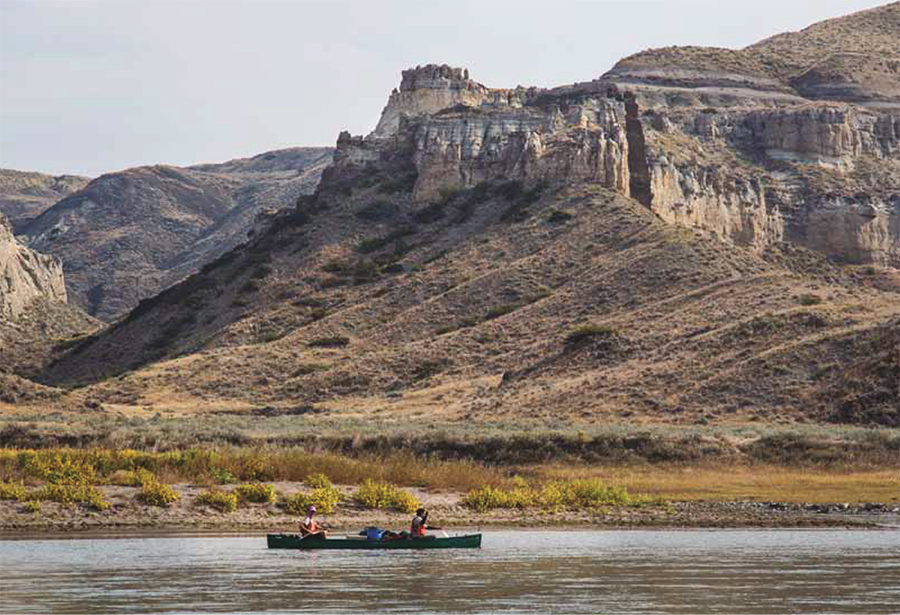
Glenn Monahan has outfitted raft and canoe trips on Montana’s Upper Missouri Breaks for 23 years. His business took off after then-President Bill Clinton declared the area a national monument in 2001, protecting a landscape that has been called an “American Serengeti.” But the region’s serene beauty is not what causes thousands of out-of-state tourists to book river trips. They come to see the national monument. If it were rescinded, Monahan doesn’t know what would happen to his business.
“We would still do everything we can to stay in business,” says Monahan, who employs six people, all native Montanans. His clients nearly all come from out of state.
According to a University of Montana study, tourism contributes $4.7 billion to the state economy, surpassing agriculture and all other sectors. Montana Gov. Steve Bullock, a Republican, supports access to public lands and reportedly lobbied Zinke to leave the Missouri Breaks monument alone. (As Paddling Business prepared for press, Zinke announced his department would not seek to change the monument’s status. Three other monuments had also been given reprieves as of August 9: Craters of the Moon, Hanford Reach and Grand Canyon-Parashant. Zinke’s report assessing all the monuments was due August 24.)
Small outdoor businesses aren’t the only ones threatened by the movement to transfer federal lands to the states. The biggest paddlesports outfitter in the United States also views the land grab as an existential threat.
Canoeists in the Upper Missouri Breaks National Monument. | Photo: Courtesy Bob Wick/BLM
OARS’s bread-and-butter is multi-day trips on iconic American waterways, including the Grand Canyon and the Middle Fork of the Salmon.The company also operates on the San Juan, a Class III desert canyon that marks the southern edge of the Bears Ears monument. The company specializes in the kind of paddling trips that change people’s outlook on life.
“It’s embedded in our culture to bring people into these places to help develop a sense of appreciation, so we’re constantly fostering new river and environmental advocates,” says Steve Markle, Vice President for Sales and Marketing at OARS. “Getting people down there to see these places is often what it takes.”
The outdoors lobby has always depended on the grassroots. The Conservation Alliance collects almost $2 million a year from member companies and distributes it to local activists. Now many of those activists are urging outdoor businesses to take a more hands-on role in conservation efforts, Cobb says. “They say, ‘We appreciate your funding, but far more impactful is when you can come to D.C. and advocate on our behalf.’ Because in the current political environment the business voice appears to carry more weight.”
Cobb travels to Washington about twice a year to lobby Congress and the executive branch. He says there’s a growing awareness in Washington that outdoor recreation has an important role to play in the overall economy. About half his visits are with members of Congress who support public lands.
Cobb says it’s important for those lawmakers to know businesses like his have their back on conservation issues.
Still, there’s no question conservation interests have been outgunned and outmaneuvered in the political sphere. American politics is a dirty and cynical process. Perhaps it’s time for the outdoor business to steal the playbook of the most effective player in the game, the National Rifle Association. The firearms industry has used money, a passionate constituency and a relentlessly single-minded focus to become one of the most feared and powerful lobbies in Washington.
Few dare to cross the NRA, despite the fact it represents a relatively small industry. The firearm trade association, the National Shooting Sports Foundation, produces an economic impact report remarkably similar to the OIA’s, straight down to the stock photos and bar graphs. What’s the difference? The gun folks claim only $51 billion in economic impact, to outdoor recreation’s $887 billion. The outdoor business is roughly 17 times bigger than the firearms industry, but when is the last time the outdoor lobby bounced from office a congressman who stepped out of line?
The NRA spent more than $36 million on campaign contributions in the 2016 election cycle. That’s a lot of money, but as James Surowiecki wrote in The New Yorker, “The NRA’s biggest asset isn’t cash but the devotion of its members.”
Surowiecki describes a study in which people who favor requiring permits for gun owners described themselves as more invested in the issue than gun-rights supporters did. Yet people in the pro-gun group were four times as likely to have donated money and written a politician about the issue. The outdoors has passion too. According to an analysis by the Center for Western Priorities, more than 98 percent of public comments on the national monuments issue support maintaining or expanding the amount of land under protection.
There are lessons here for those of us who care about wild places. The first is, money talks. If the outdoor industry truly wants a seat at the grownups table it must not only proclaim its economic power in flashy reports, it must wield it in the halls of Congress and the statehouses. The second lesson is to remember what we are fighting for and why it matters.
When Steven Quarles was a young staffer on the Senate Natural Resources Committee in the 1970s, there was talk of erecting a dam that would have flooded the Upper Missouri River Breaks, where Glenn Monahan now runs his outfitting business. The committee held a hearing on the river’s future in Montana. Afterward, Quarles and two other committee staffers paddled the Breaks with a Montana Fish and Wildlife ranger.
For several days and nights, the river champion said nothing about the potential impoundment, recalls Quarles, who is now a leading conservation lawyer in Washington. “Then on the last night around the campfire at sunset, he asked us to look up at the alpenglow near the top of a cliff face across the river and quietly said, ‘That’s where the water’ll be.’ I have never encountered a more powerful, truly heartfelt, and effective lobbying moment.”
An Oars commercial rafting trip on the San Juan River, bordering the Bears Ears National Monument. | Feature photo: Courtesy David Hessell/Oars
Ditch Your Political Compass. Navigating The Facts On Climate Science Couldn't Be More Straight Forward. | Francis Lepine
We stopped for lunch on a Puget Sound beach full of oyster shells. Despite the fact I don’t really know how, I felt a strong desire to measure the thickness of their shells to see if they had been affected by ocean acidification, a side effect of climate change.
Meanwhile, record-breaking hurricanes just devastated Florida, Texas and Puerto Rico. Wildfires incinerated western forests, causing the deaths of 42 people. Heat waves swept across the country, breaking records through spring, summer and fall.
Hurricanes, fires and heat waves—and this is just what’s happening at home in the United States. Elsewhere, glaciers are receding, water levels are rising and ocean temperature is warming at such speed scientists predict all coral reefs worldwide could be bleached and dead within 30 years.
“Ninety-seven percent of researchers believe climate change is happening, and its in part due to human activity. Government action is needed. This is an emergency for more than just paddlers.”
This isn’t fake news. Ninety-seven percent of researchers believe climate change is happening, and its in part due to human activity. Government action is needed. This is an emergency for more than just paddlers.
The ability of sea kayaks to get to remote places puts us at spear’s tip of climate change science. We can collect data nobody else can. This puts us on the front lines of this war. So, let’s act like it. It’s time for kayakers to nerd out.
Access to the deep wilderness is at a premium. “Much of the data land managers and decisionmakers need is simply unobtainable any other way. They need to know how species are moving as climate shifts so they can manage habitat accordingly,” says Merrill Warren, operations and devel-opment manager of Adventure Scientists, a nonprofit pairing outdoor adventurers with scientists.
In 2014, Rob Avery, Adam Andis, Chris Lewis and Paul Norwood spent 16 days kayaking the outer coast of Alaska, to record plant and bird data and test amphibians for disease. The intimate way paddlers travel a coastline lends itself to the kind of close inspection you can’t get from remote imaging, flyovers or chartering a skiff.
“For our micro-plastics study, we needed global data from freshwater, coastal margins, and the mid-ocean, so a lot of samples came from people’s home water.”
Not all citizen science requires weeks in Alaska. “For our micro-plastics study, we needed global data from freshwater, coastal margins, and the mid-ocean, so a lot of samples came from people’s home water,” says Warren.
This need will only grow. The orange-faced guy in the Oval Office and his henchmen are cutting funding for climate research, which means more projects will rely on volunteers to collect data. Volunteers like us. To be capable data collectors, paddlers will need to cross two barriers. The first is discipline. Data has to be accurate.
“Volunteers must be committed to following strict protocols,” says Warren. Adventure Scientists puts volunteers through an eight-step process and final test before approving them for a project. When I worked for a parks department, I learned the hard way that data collected by poorly trained volunteers just sits in a filing cabinet forever. In the past, Adventure Scientists’ volunteers have been conscripted to swap cards in wildlife cameras, take water or soil samples, and retrieve data recorders.
However, there is a mindset change. “Paddlers have to see the value of going the extra step on a trip,” says Stanford researcher Lauren Oakes. From the Outer Island Expedition, Avert recalled, “do we really want to paddle six more miles up an inlet to survey the beach? Yes, we have to. We’re not on a pleasure trip.” And even when we are on a pleasure trip, we may still need to reach an island to change out data cards.
The second barrier is bigger. It’s abandoning neutrality.
The unspoken rule in paddling is that politics stops at the water’s edge. Like most outdoor sports, which emphasize self-sufficiency, paddling attracts its share of libertarians as well as back-to-nature lefties. My kayaking pals include small government conservatives, bleeding heart liberals, avid hunters and passionate vegetarians. They all get along fine on the water. However, now hyper-charged partisanship has shoved a wedge into our world.
Ditch Your Political Compass. Navigating The Facts On Climate Science Couldn’t Be More Straight Forward. | Francis Lepine
Guess what? It’s time to shed the notion we can be paddlers and pretend climate change isn’t real. It’s no more realistic than trying to be a camper and pretend mosquitos don’t exist.
We paddle on water. The temperature, carbonic acid and oxygen levels in water matter to our paddling experience. Yes, there are some aspects of politics which can remain separate from paddling, but climate change, ocean health and clean water are not on this list.
I’m sure some people will read this and dread their paddling club meetings will become contentious political debates, or every time they go paddling they’ll feel guilty for not collecting data when they’re just out having fun. I say: A little guilt can be a good motivator. Plus, being a science nerd is fun—why do you think paddlers are always trying to identify every bird and tide pool critter we see?
In wilderness survival training there’s a foundational rule which must be observed before anything else can happen. “The first step is to recognize you’re in an emergency,” I remember an instructor telling me.
Kayakers are good at this type of situation assessment—when we’re transiting a cliffed-out section of coast and the barometer plunges, or when our buddy capsizes and gets washed against the rocks. We recognize the situation for what it is and we leap into action. Let’s do that now.
Neil Schulman paddles, writes and does conservation work from Oregon. He has no idea how to measure the thickness of oyster shells, but he loves eating oysters
Ditch Your Political Compass. Navigating The Facts On Climate Science Couldn’t Be More Straight Forward. | Photo: Francis Lepine
This article first appeared in the 2015 Paddling Buyer’s Guide. Subscribe to Paddling Magazine and get 25 years of digital magazine archives including our legacy titles: Rapid, Adventure Kayak and Canoeroots.
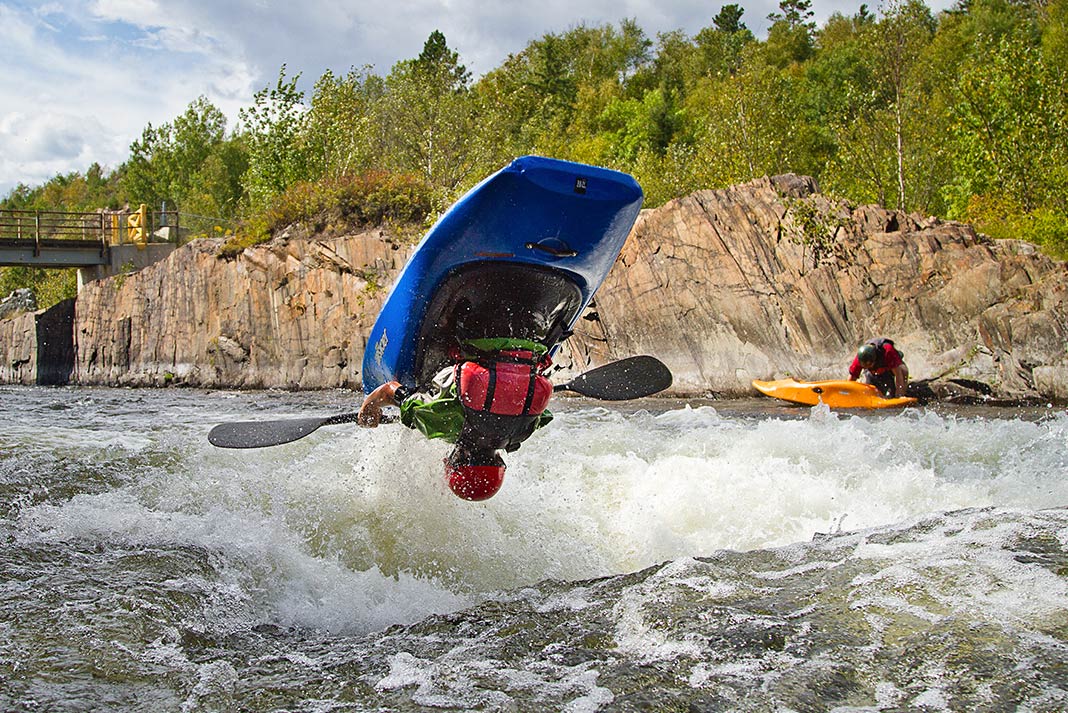
Sometimes it's the small accomplishments that mean the most. | Photo: Destination Ontario
We asked the pros to think back on their up-and-coming freestyle kayak days, when they were still mastering the basics or trying to add more difficult skills to their repertoire. We wondered which freestyle kayak trick they were most proud of learning. The answers might surprise you.
I learned to handroll in 1973 or 1974. At that point, at least around the Chattooga, it was a rare enough stunt my friends would often gather other people around and have me roll, and sometimes bet a beer over whether or not I could do it. —Joe Pulliam
I did my first blunt on Garburator in 2005. I was so excited, I talked about it for years. —Adriene Levknecht
The front loop. I spent months working on it in inlet gate at Nottingham. Trying to be superman and jump for the sky or a basketball being dunked through a hoop upstream of the hole. When it finally began to work it was the best feeling ever. —Claire O’Hara
Thirteen years old on the Ottawa River, with some guidance from Nick Troutman, landing straight airscrews for the first time. —Dane Jackson
Tailies. The first time I managed to get my kayak vertical. I couldn’t get enough of them. —Bren Orton
Putting on my spray skirt. —Tyler Bradt
“I’VE BEEN PROUD OF ALL THE TRICKS I’VE BEEN ABLE TO LEARN, FROM MY FIRST SPIN TO MULTIPLE COMBO MOVES. HOWEVER, FULLY DIALING IN CLEAN, FAST HULL-TO-HULL AIRSCREWS IMMEDIATELY BECAME, AND CONTINUES TO BE, MY FAVORITE TRICK.”—KALOB GRADY. | PHOTO: DANIEL STEWART
When I was seven and did my first freestyle competition ever, I made a trick and I called it the Tricky Horse. I remember running up to Emily Jackson, who was the head judge for the cadet competition, bubbling with excitement to tell her to keep an eye out for it and find out how many points it would be worth. —Sage Donnelly
I was really stoked when I learned how to air loop my Disco around 2001 or 2002. The Disco was way ahead of its time and most pro kayakers couldn’t loop their slicey boats. —Chris Gratmans
All of them, but it started with the stoke when I learned to spin. I still get fired up any time I learn a new trick, or even just do a hard one. —Nick Troutman
Sometimes it’s the small accomplishments that mean the most. | Photo: Destination Ontario
Probably the first time I did a legit roll in whitewater. I was eight or nine and it was just before a slalom competition so there was a lot of people around. I was very proud because no one knew I could roll and they were all expecting me to swim. —Nouria Newman
The third end. When you are learning to cartwheel, the third end is the hardest to gain. It means you have done more than just used the momentum of the initiation to gain a stern end, you have balance and used technique to get the third. I’ll never forget my first third end. It was in a small hole on the Madawaska River, while my dad and his friend watched as they ate lunch. My dad yelled, while holding up three fingers, “That’s three, that’s three!” —Ben Marr
Good old-fashioned ender. I’d seen my childhood hero, Jerome Truran, doing them and I really wanted to do it. I was about 13 or 14 at the time and was in a Dancer. I did the first one just messing about at this rapid up the road from my house in Durban, South Africa. I was beside myself with happiness. —Corran Addison
Backsurfing my Perception Dancer was one of my prouder moments. —Erik Boomer
I’ve been proud of all the tricks I’ve been able to learn, from my first spin to multiple combo moves. However, fully dialing in clean, fast hull-to-hull airscrews immediately became, and continues to be, my favorite trick. —Kalob Grady
This article first appeared in the 2015 Paddling Buyer’s Guide. Subscribe to Paddling Magazine and get 25 years of digital magazine archives including our legacy titles: Rapid, Adventure Kayak and Canoeroots.
“We’re always looking for the dream wave,” says French photographer Pierre Bouras. And no better place to go searching for a gorgeous, unknown surf spot than the most remote island in the world.
Easter Island, also known as Rapa Nui, is a dot in the vast Pacific Ocean. It’s just 101 square miles and home to 5,700 year-round residents.The nearest landmass is more than 2,000 miles away. Bouras explored the small, remote island with his friend, Manu Bouvet, on a quest to discover untouched shores and new waves.
The island’s paddleboarding potential is untapped. “We saw just one other paddleboarder while we were there,” says Bouras.
Bouras’ trip was timed to coincide with the arrival of Race for Water, a sailboat on a round-the-world research expedition, for which Bouvet is an ambassador. The group is racing to raise awareness for the 25 million tons of plastic ending up in the ocean every year. No beach is safe from plastics pollution—even the remote beaches of Rapa Nui, as Bouras soon found out.
The scientists onboard take water and soil samples everywhere they go, estimating the concentration and the source of plastic debris. The most common culprits are fishing and tourism industries, as well as domestic wastes. The scientists take their findings to government, as well as classrooms around the world, hoping to inspire the next generation to protect our oceans.
Bouras and Bouvet like to balance work with play. After meeting with the crew and assisting in taking micro-plastic-filled soil samples from the beach, it was time to go paddling.
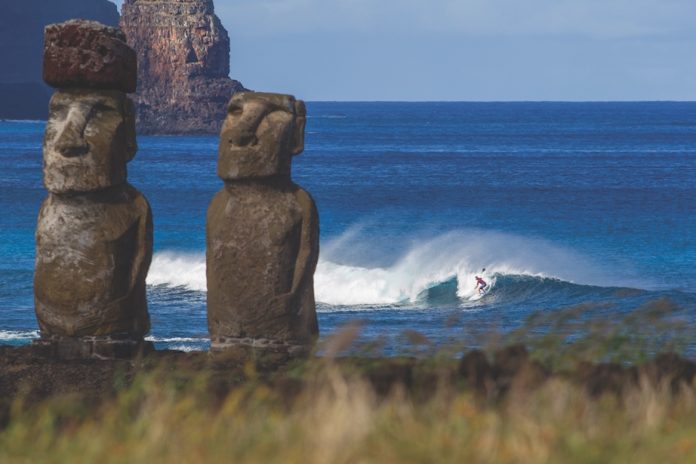
“At Tonga Riki we saw beautiful waves behind 10 to 12 moais,” says Bouras, referring to the iconic monoliths carved by the Rapa Nui people hundreds of years ago. “I wanted to give perspective—to show this little person surfing between the big moais. To me, that’s the vibe of the island right there.”
To get this photo, Bouras used a 400mm 2.8f lens and Canon 1D camera. The maoi are between 45 to 75 feet tall, so Bouras had to stand almost a half mile back to be able to fit these two in frame.
The waters around Rapa Nui are challenging and not for beginner paddlers. However, the difficulty of the waves and getting to the island comes with great reward. Bouvet, pictured surfing here, said he never felt such mana—a term for spirit—anywhere he’d surfed before.
This article first appeared in the 2015 Paddling Buyer’s Guide. Subscribe to Paddling Magazine and get 25 years of digital magazine archives including our legacy titles: Rapid, Adventure Kayak and Canoeroots.
committed to a given—usually extreme—lifestyle to the point of abandoning employment and other societal norms in order to pursue said lifestyle. The description goes on to differentiate dirtbags from hippies in that dirtbags are seeking to spend all their moments pursuing their lifestyle. The example provided is the community of climbers found at major climbing areas like Yosemite, Joshua Tree and Squamish. Dirtbags we know can also be skiers, mountain bikers and of course, paddlers. Hippies, I suppose, are just hippies.
By definition then to be a dirtbag you need to be three things. You need to be passionate about something. You need to act outside societal norms. And you must abandon employment to pursue a certain lifestyle. Let’s break it down.
Readers of this magazine are life-alteringly passionate about paddling rivers—there is no question about that. Next point.
Talk to your friends and family members about your weekend plans and you realize very quickly that normal society feels you operate outside the rules of acceptable behavior. They worry about you.
For 19 years I’ve been trying to make whitewater kayaking and canoeing more mainstream. As a whitewater industry we’d hoped we could make it appeal to a wider audience. The act of paddling whitewater, like climbing, is scary behavior forever falling way outside societal norms. This is exactly why motorists on bridges make 911 calls to emergency services when they see brightly colored kayaks tumbling in the foamy water below.
Not to mention what society thinks of mullets, ketchup-packet soup and the 24 other defining cultural characteristics in Hannah Griffin’s “ABCs of Dirtbags” on page 38. It’s not only the scary rapids that make normal people squeamish, there’s also the whole getting naked in public places they’d need to get over.
For a long time I was never sure if I was truly a dirtbag. I certainly have always had dirtbag tendencies. I once shaved off my beard in a Denny’s restroom sink. Thumbed my way across the country a few times. Used my paddling helmet as a salsa bowl. Have never refused truck temperature beers.
On the other hand, I’ve never milked employment insurance to go paddling. My blue collar sensibilities wouldn’t allow me to fully embrace dirtbag culture, as defined by the Urban Dictionary. As a raft guide, on Sunday nights while my buddies got high and played Frisbee before moonlit surf sessions, I would drive home to work so I could pay for school.
Dirtbag in my opinion should be a state of mind and not the number of zeros missing from your tax return. The abandonment of employment criteria set out in the definition above is what should be abandoned.
At any given put-in on a Sunday morning you’ll find high school dirtbags too young to qualify for minimum wage. You’ll also find retired dudes and dentists, teachers, lawyers, farmers and oil rig workers. They all smell of wood smoke, whiskey and damp goose feathers. No matter the length or color their hair is a tangled mess. Nobody has showered since at least Friday morning. And if anybody swims on the river, he or she will drink a beer from a soggy bootie.
Like many paddlers in their 40s, I have a job. I also have a gold-colored credit card with a spending limit greater than the sum total of all my days river guiding. This card accumulates travel points redeemable for flights and hotel rooms. The funny thing is, I still find myself driving to rivers, sleeping in my truck and cooking ramen noodles on my tailgate. Dirtbags may not get to spend all their moments pursuing said extreme lifestyle but the moments we do are just as sweet.
Scott MacGregor is the founder and publisher of Rapid.
This article originally appeared in Rapid Early Summer 2017 issue.
Subscribe to Paddling Magazine and get 25 years of digital magazine archives including our legacy titles: Rapid, Adventure Kayak and Canoeroots.
Imagine the possibilities. | Photo by: Tim Carstens
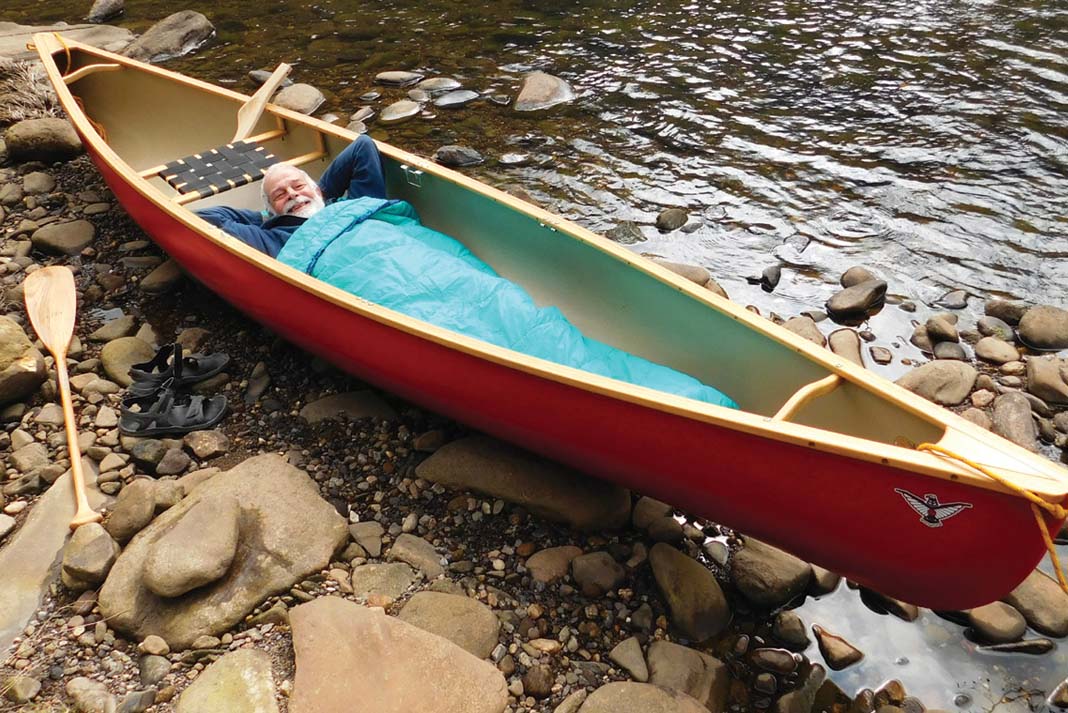
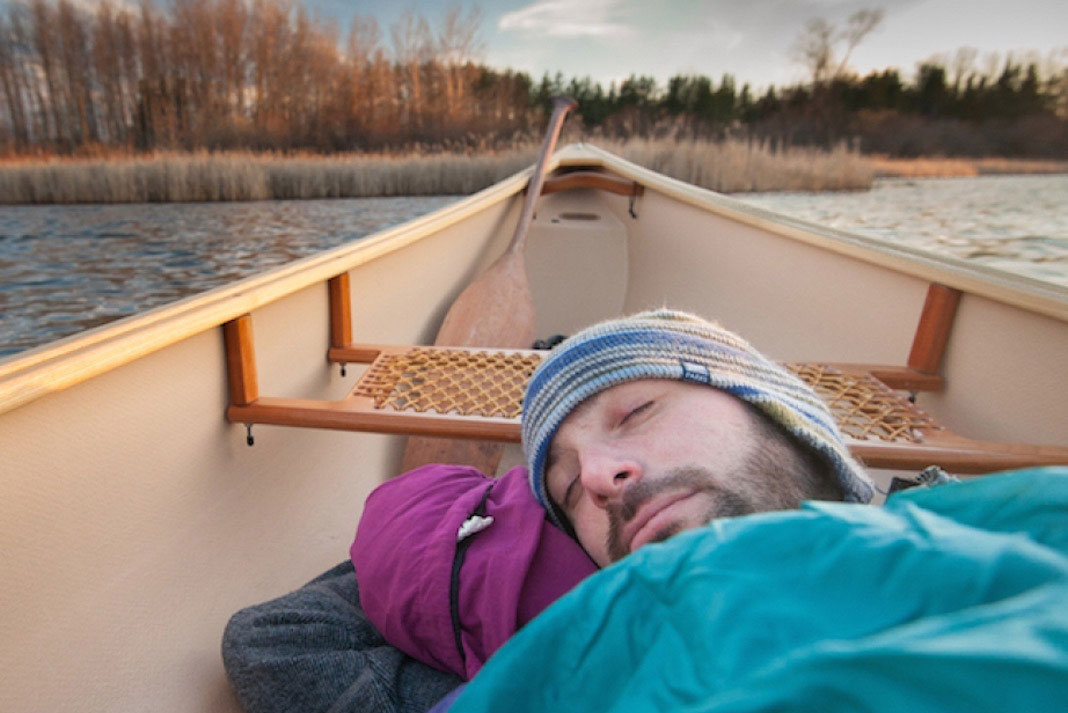
What makes the best bed on a canoe trip? Some say a thick pad in a tent. Others swear by a hammock. Still others are partial to the ground itself, cowboy camping out in the elements next to the fire. We think one of the very best sleeps you can get in the backcountry, though, is in your canoe itself.
There are a couple of options for sleeping in a canoe—you can pull your boat up on shore or float it in the water. The onshore method can be used in almost any situation, whereas sleeping on the water is best reserved for very particular conditions: calm, clear and moonlit nights well outside of high bug season.
If you’re opting to sleep on solid ground, go ahead and pull your canoe up on shore. As with setting up a tent, finding a level spot to sit your canoe is best. However, the beauty of sleeping in a canoe is you don’t have to worry about rocky, uneven or muddy ground.
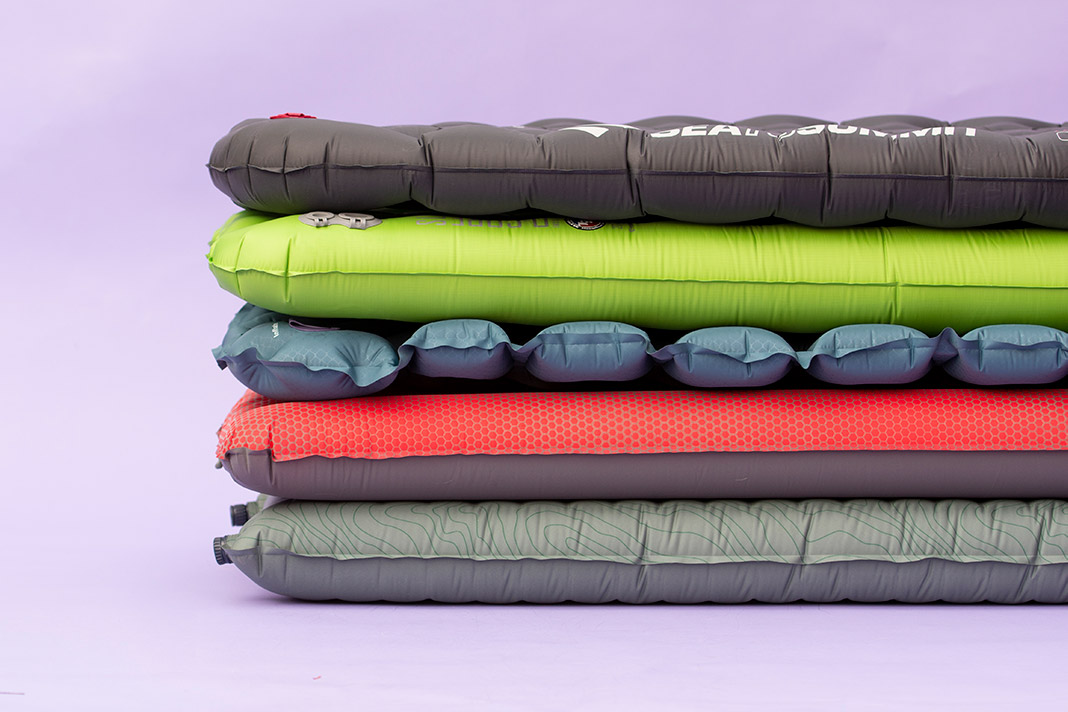
You’ll want to lay a sleeping pad and sleeping bag in the boat. But here are some tips for modifying your sleeping arrangement depending on the conditions:
One problem you might encounter is being able to squeeze under the thwarts. If it’s a tight fit, you can easily solve this by installing a quick-release method for taking the thwarts out.
Here are two ways of doing so:
1 The wing nut method
Simply remove the factory nuts that come on the bolts holding the thwart to the gunwales, and replace them with wing nuts, which are readily available at hardware stores. To open up the boat for sleeping, twist the wing nuts off and tap out the thwart. If the original bolt holes through the thwart are tight, drill them slightly larger. “The downside?” you ask. In the morning when you put the wing nuts back on, you’ll have to stand on your head to see what’s going on under there.
To avoid standing on your head, use the second method.
2 The wire lock pin method
Call it WLPM for short. Here’s how to make it work.
Remove the factory hardware on the thwart/gunwale connection.
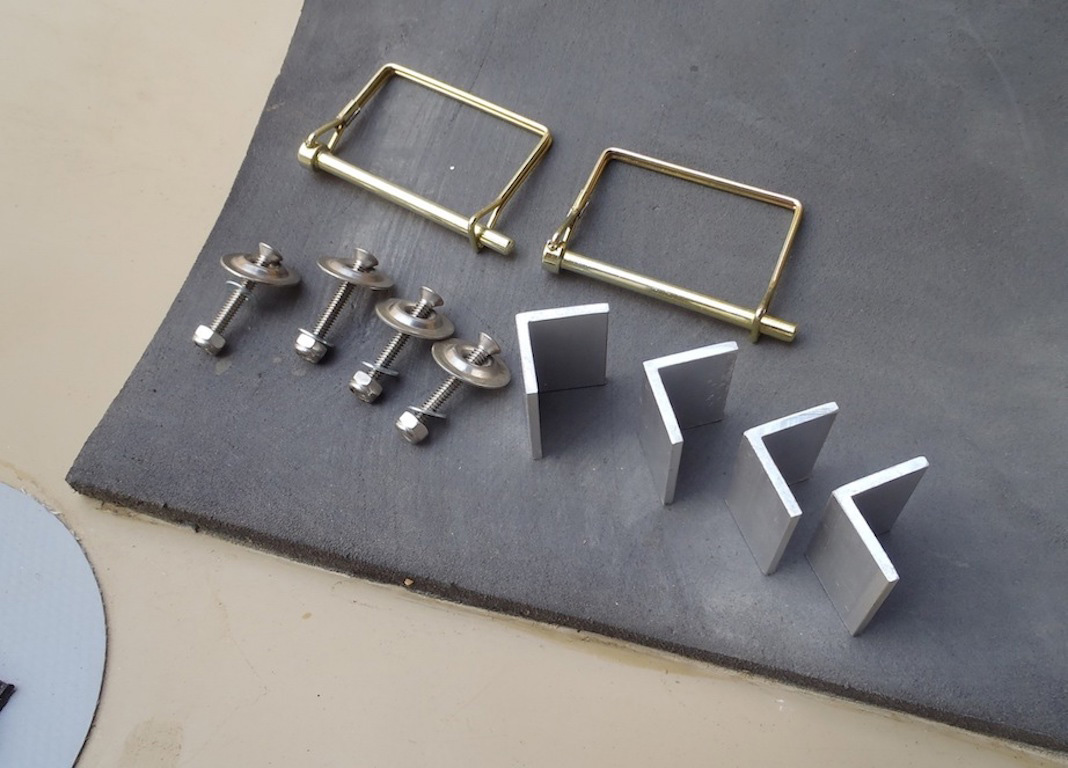
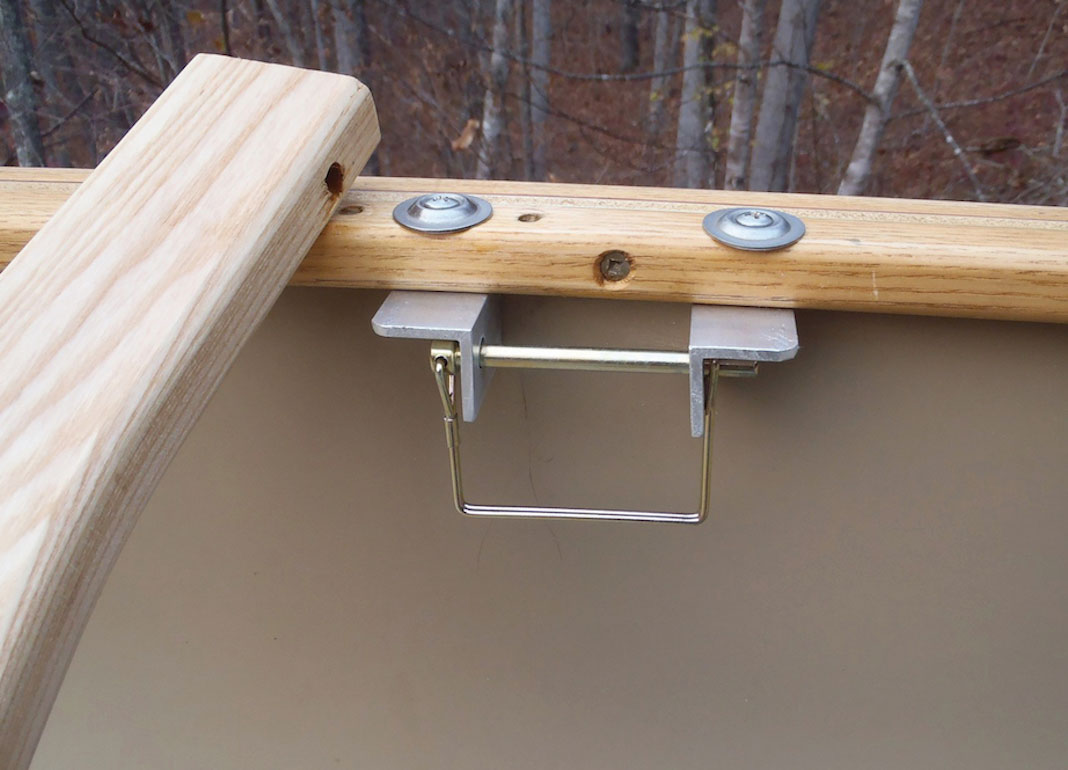
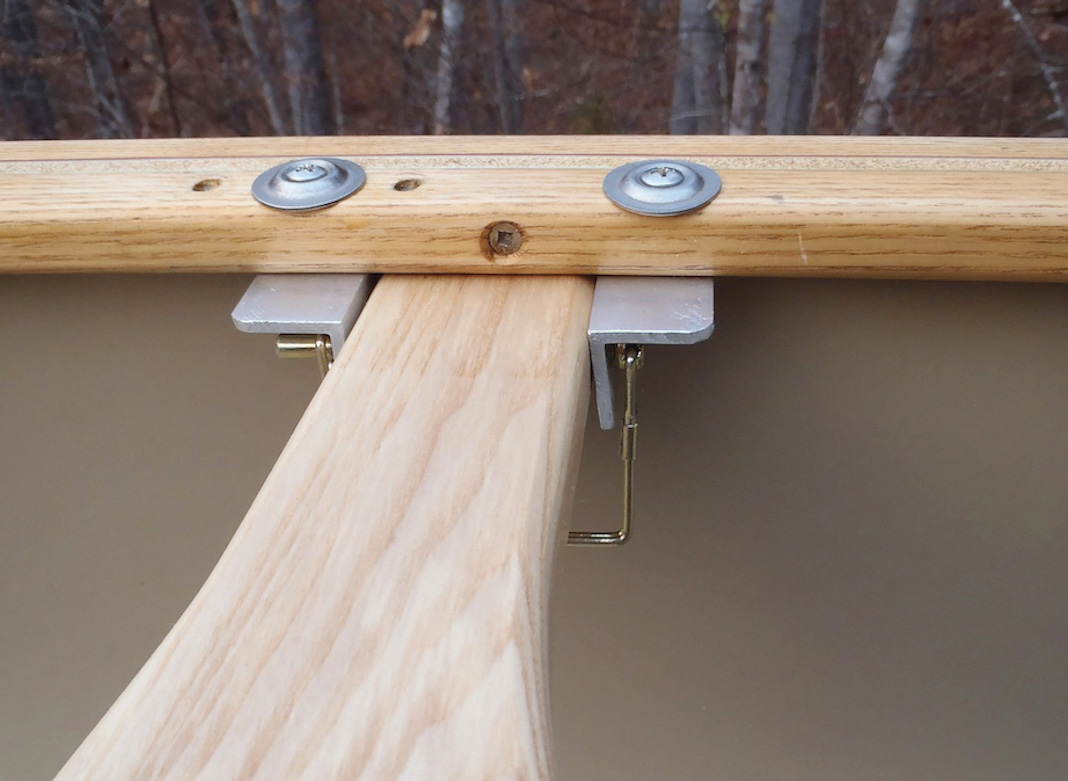
Bolt two right angles of aluminum under the gunwale so they snug up on either side of the thwart.
Drill a 5/16-inch hole horizontally through the angles and the thwart.
Insert a “wire lock pin.” When you push the pin in, it will securely connect the end of the thwart to the right angles and thus to the gunwale. When you pull it out, the thwart comes loose.
You may be able to buy suitable right angles, but it’s straightforward to make your own. The ones pictured here are 1.5 inches long and were cut off a stalk of “one-inch aluminum angle,” sold in the hardware stores in three-foot lengths.
A hacksaw or a carbide saw blade cuts the aluminum like butter. Be sure to wear safety glasses when doing this and sand smooth any sharp edges. As for the wire lock pins (1/4-inch × 2.5-inch), they are typically used to hold implements to tractors. These ones were found at a farm supply store.
The only tricky part of the installation is drilling the 5/16-inch hole for the wire lock pin straight through the center of both angles and the thwart. It helps to clamp everything tight.
In these photos, the extra holes you see in the gunwale are from the original factory bolts.
Rock the boat to slumberland. | Photo: Mike Monaghan
Sleeping on water
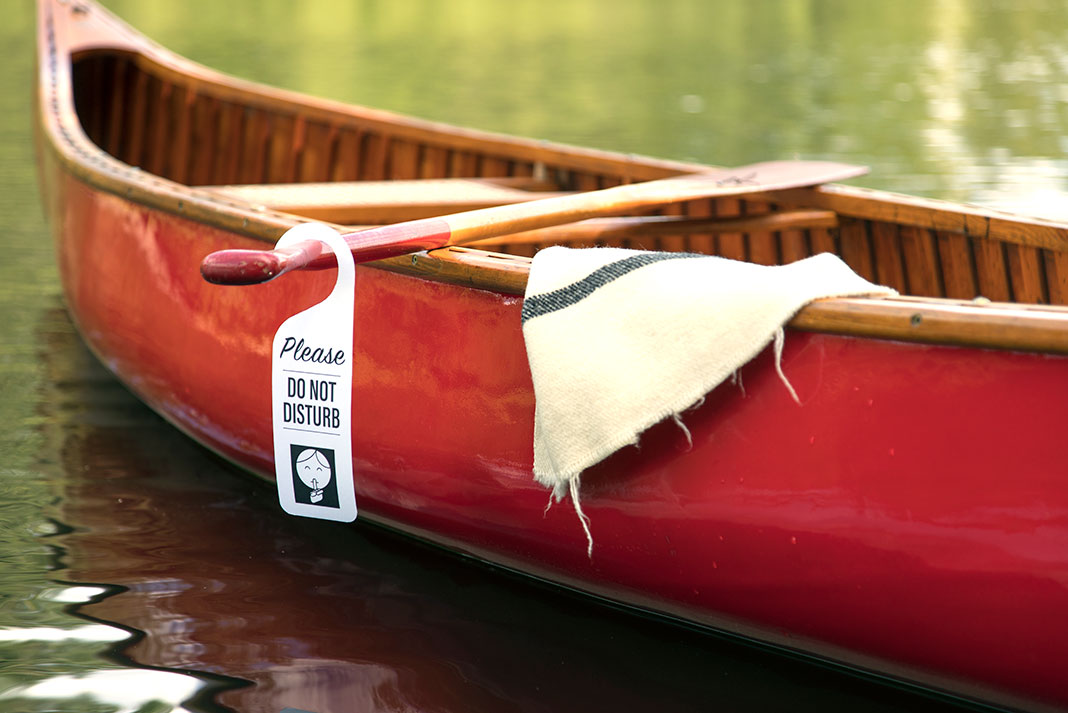
If literally drifting to sleep sounds like heaven to you, you might try anchoring your canoe just off the shore of your campsite. As with the onshore method, you’ll want to lay a sleeping pad in the bottom of your boat.
Here are some other tips:
As previously stated, it’s best to pick a calm, clear, moonlit night outside of high bug season. Expect to bundle up a little warmer than when sleeping in your tent. A small lake or sheltered bay in the backcountry is the perfect location.
Drop anchor close to shore. Easily make your own anchor by putting a rock in a stuff sack attached via a rope to your thwart. Don’t use too large a rock. The last thing you want to do first thing in the morning is haul up a big boulder that seems intent on taking you for an eye-opening dip in the lake.
While sleeping, your low center of gravity will make for a very stable canoe, but it is always wise to wear your PFD on the water. You will barely notice it once you get tucked in beneath the Milky Way.
Even if you plan to sleep in your boat all night, make camp on shore. Set up your tent, and build—but don’t light—a quick-start fire. If you wake up damp from a cool morning mist, it’s nice to be able to paddle to shore, light a match and get a fire going right away. By having your tent set up and ready to go, you’ve got a shelter should the weather take an unexpected turn.
Mark your campsite with a large piece of reflective tape in a visible spot. If for some reason you have to paddle to shore in the night, one shot from your headlamp will show you the way to go.
Sweet dreams!
This article was first published in the Early Summer 2017 issue of Canoeroots Magazine. Subscribe to Paddling Magazine’s print and digital editions, or browse the archives.
Kick back and imagine the possibilities. | Feature photo: Tim Carstens
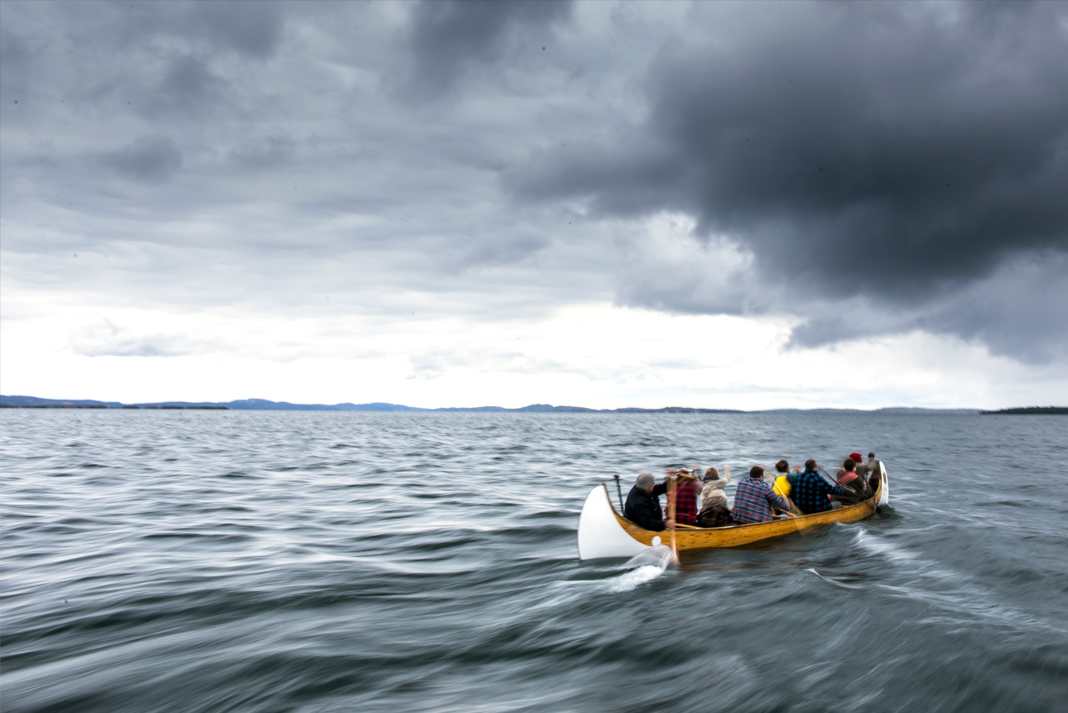
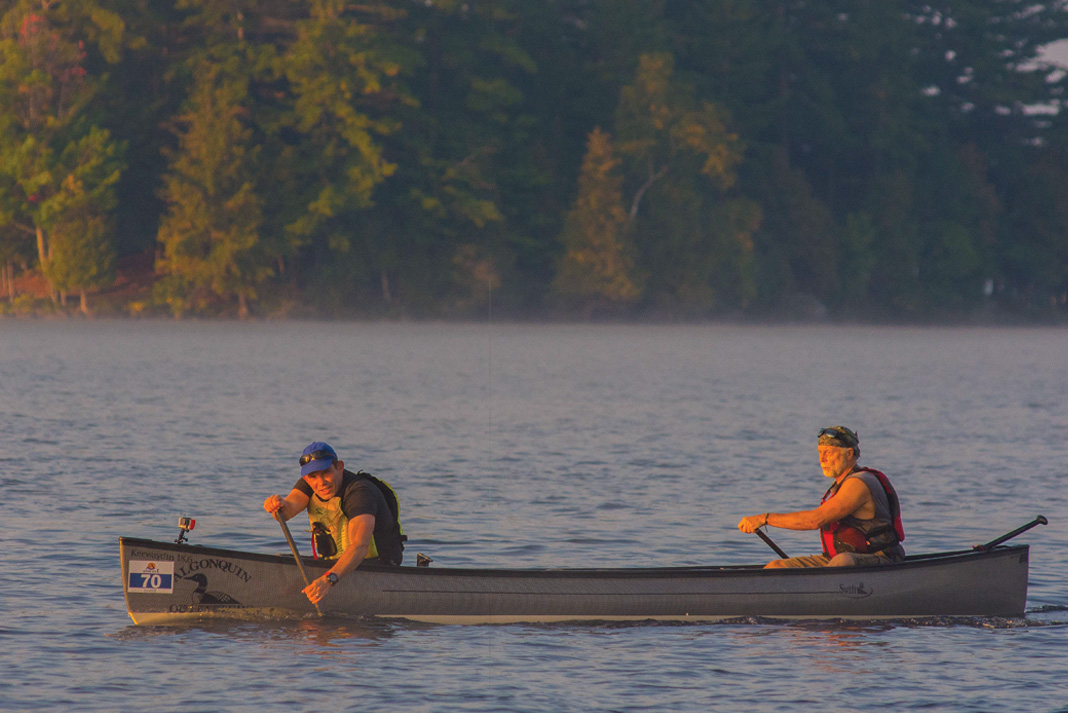
Richard Harpham (bow) and Hap Wilson (Stern) at the start of the 130-kilometer race. | Feature photo: Randy Mitson
This is not your traditional marathon event. In the toughest single-day expedition paddling race in the world, canoes, kayaks and paddleboards traverse two rivers systems, three lakes and 20 portages. It’s a total of 130 kilometers in less than 24 hours. No assistance, no support and no mercy. Each year more than a third of teams drop out. British adventurer Richard Harpham takes on the challenge.
Why Muskoka River X is the toughest paddling race ever
I’m no stranger to long distance canoe and kayak racing. I’ve weathered the 715-kilometer Yukon River Quest and the so-called “Everest” of paddling races, the Devizes to Westminster International Canoe Race. Yet, even with those exploits behind me, the Muskoka River X—heralded as the toughest single day canoe race in the world—caught my eye.
I picked Hap Wilson for my paddling partner. Hap’s reputation precedes him. The Canadian paddling icon is known for his work as an environmentalist and author of multiple canoeing guidebooks. He’s even written a guidebook on the Muskoka River system we would be paddling. No question, he seemed like the ideal partner.
Go time on Fairy Lake at 7:07 a.m. | Photo: Randy Mitson
Hap set the tone of our partnership at the outset with a brief email: “One warning about the race,” he wrote. “I’m a canoe tripper, not a racer. So I hope you aren’t disappointed.”
While Hap is a veteran of the Muskoka River X and always places respectably, he’s never won. Stopping for a pot of coffee or a picnic dinner and a little blues on the harmonica are par for the course when racing with Hap.
With this in mind, at least I wasn’t nervous about traveling from my home in Bedford, England, to spend what could have been 24 stressful hours in a canoe with a complete stranger. Hap’s kind of racing seemed positively civilized. It wasn’t long before we’d nicknamed ourselves the Gentlemen Racers. Cuppa tea, anyone?
I meet Hap in the parking lot of Algonquin Outfitters’ retail shop in Dwight, Ontario. We were there to pick up our loaner race vessel and have just an hour-long warmup session together paddling from Oxtongue Lake to Ragged Falls at the edge of Algonquin Park. With tens of thousands of miles of paddling behind both of us, it’s easy to find our rhythm on the water.
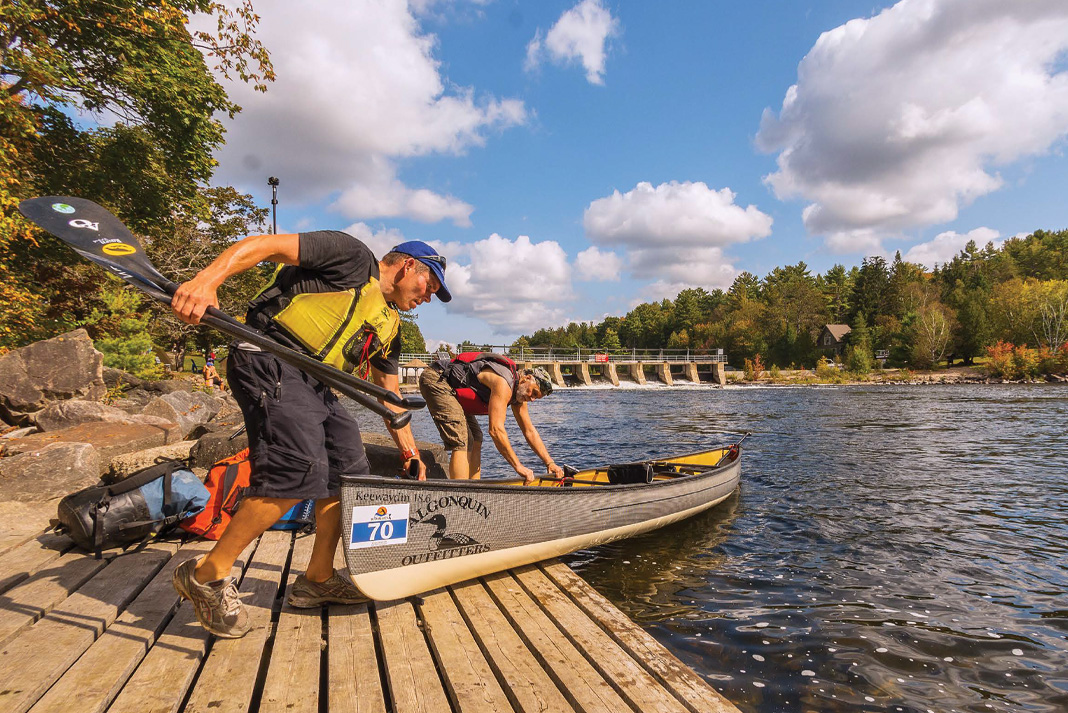
We are paddling a brand-new, 18.5-foot carbon-fiber Keewaydin cruiser by Swift Canoe. The carbon-Kevlar trim is gorgeous. The contoured carbon yoke would turn out to be a gift on the portages. And though the Keewaydin isn’t a racing canoe, it would keep pace with speedier designs and overtake plenty of canoes.
Some might argue our short and leisurely five-kilometer warm-up wasn’t ideal preparation for a 130-kilometer race with 20 challenging portages, exposed lakes and swift rivers. However, it cements our deep friendship, built on kindred spirits and a love of the outdoors. We are ready.
At the pre-race briefing the evening before the race, we go over route maps for the loop course that will take us from Huntsville to Baysville to Bracebridge and back. There’s also a mandatory gear check. Paddlers must be completely self-reliant for the duration of the race. Each team is required to carry sleeping bags, a tent, water purifier, extra clothes and food for 24 hours or more. They also need to bring a map and compass to navigate, as there are no markers on route.
I notice we have more than the essentials. A tripper to the core, Hap is one of few to race with a 60-liter food barrel and the target of some good-natured ribbing for it. The barrel is where we’ll be storing our cooking kit.
Portage one of twenty. | Photo: Randy Mitson
Who competes in the Muskoka River X?
Paddlers from ages 15 to 74 have competed in the Muskoka River X. In five years, the event has grown, hosting 72 racers the first year and 116 in 2017. It’s also grown into a series, including the 40-kilometer Big East River X and new Hours of River X, which challenges teams to paddle as far as they can in 24 hours. Those new events join Ontario’s already vibrant marathon racing scene which hosts the famous 200-kilometer K2O event, the Mattawa River Canoe Race and dozens more around the province.
While there’s no shortage of opportunity for challenge, the original Muskoka River X remains special because it appeals to a wider audience than the traditional marathon crowd.
“Marathon canoeing used to be a very small community,” says race co-founder Rob Horton. “It’s growing. The Muskoka River X has lured in a lot of trippers to see if it’s something they’re capable of.”
Each year between 30 and 40 percent of paddlers do not finish. Exhaustion and not making checkpoints within the time limits are the most common causes.
Horton and business parter Mike Varieur both come from an adventure racing background. “We wanted to put on a paddling race on a larger scale than had ever been done in Ontario—the Muskoka River X was the result,” says Horton.
“Looking good!” “You got this! Keep it going! Keep it strong! You’re killing it!” | Photo: Randy Mitson
Where they race
The Muskoka region is perfect because of its accessible wilderness. On the surface this is quintessential cottage country, with cabins and Muskoka chairs lining the shore, but its history runs deep. Long before the courier de bois and David Thompson used these routes to navigate west, it was the hunting grounds of the First Nations. More recently, it was a mecca for 20th century log drivers who shipped giant pine south. For those in less of a hurry than Hap and I, there is history to be found on the shorelines, including mooring anchors in rock, and felled trees beneath clear waters.
I have a love and hate relationship with racing. I love the endurance and physical nature of it, testing myself in tough and beautiful environments. The hate side usually builds towards the start of the race as I wonder why I have once more stepped into the breach.
These thoughts go through my head on race day in the pre-dawn light at Fairy Lake in Huntsville. The shore is an explosion of brightly colored drybags, Spandex and race boats and boards. Racers are busy making last-minute preparations—pocketing extra snacks, hugging loved ones and checking gear one last time.
Though there are smiles, I can feel the pre-race jitters. Nerves have me pacing. It’s a relief when organizers say it is time to get on the water.
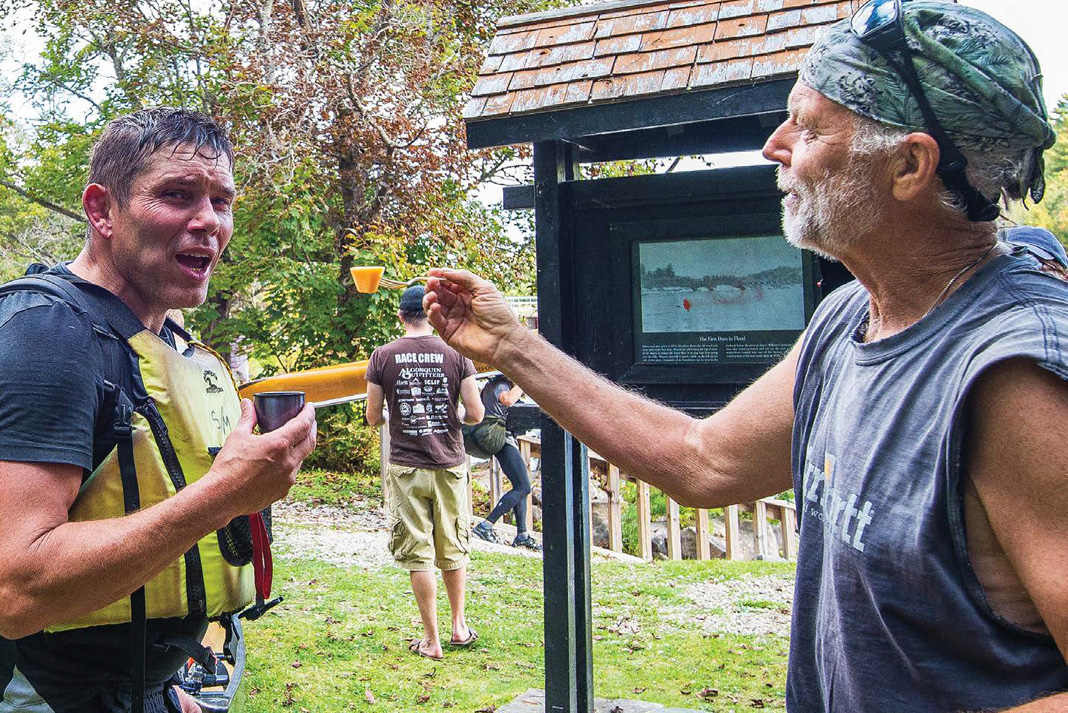
Hap Wilson feeds Ricard a piece of melon cake during a snack break. | Photo: Andy Zeltkalns
The Muskoka River X begins
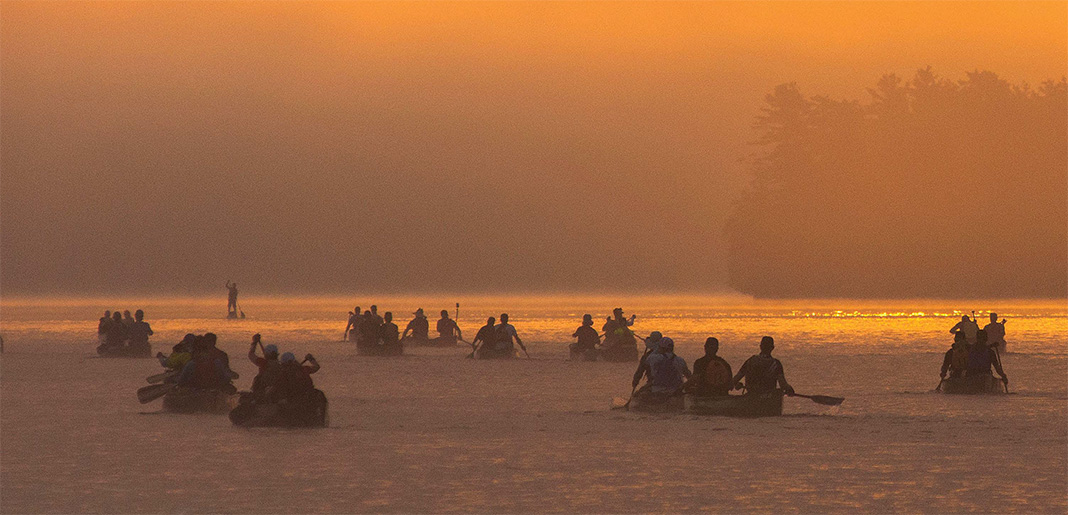
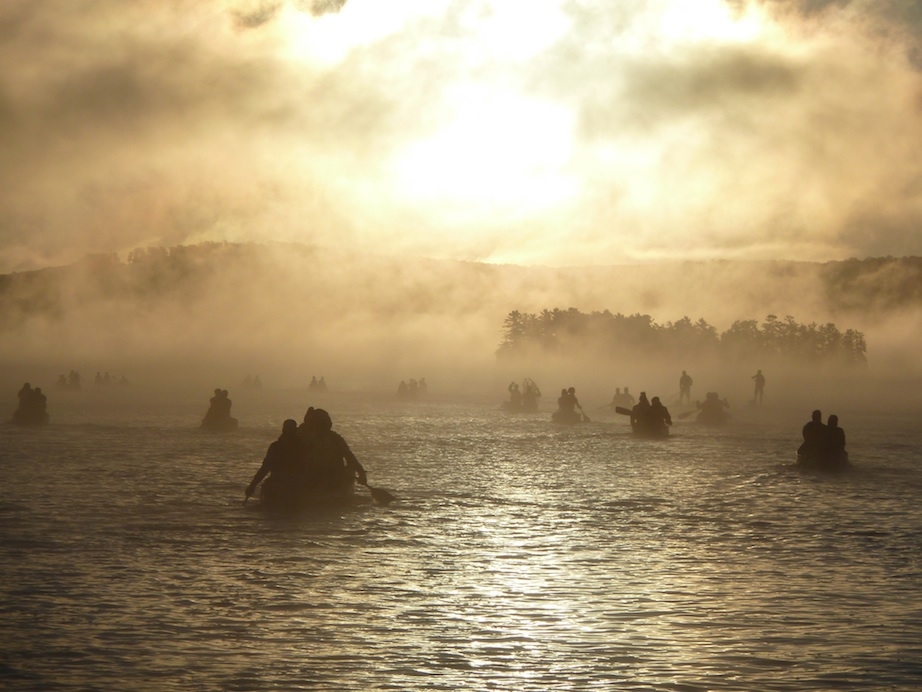
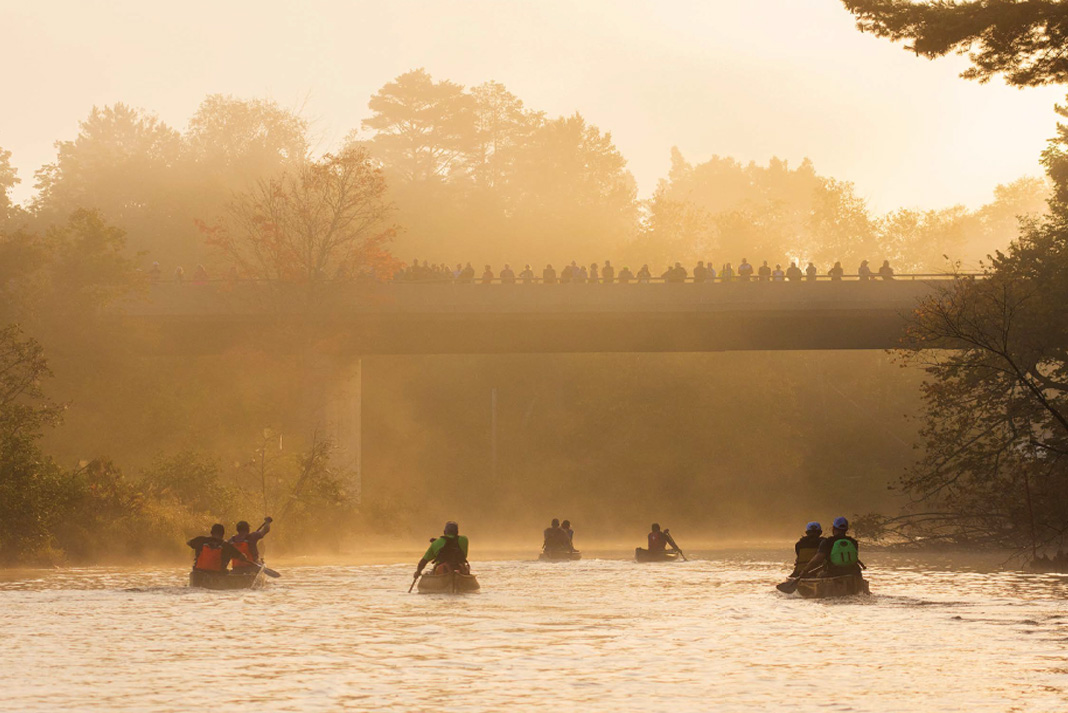
The start line is surreal. Paddlers and boats are silhouetted like spectral forms against a full spectrum of golden shades from the waking sun.
The air horn brings us back to business. Canoes, kayaks and paddleboards lunge forward. The air is electric with shouts from anxious racers.
“Look out!”
“On your right!”
“No, your other right!”
Once out of the narrow channel the fleet begins to spread out and we settle into a racing rhythm. My strong, short racing strokes are matched by Hap in the stern—though I tease him about not really knowing what he is doing back there.
“I’m pretty sure you’re paddling one-handed and reading the paper,” I say.
When we pass other teams I treat them to my best BBC impression.
“Good morning…And the time is 8:15 a.m.,” I might say as we grunt past. It’s the jokes, small talk and words of encouragement keeping us going for the next 125 kilometers.
Richard Harpham (bow) and Hap Wilson (Stern) at the start of the 130-kilometer race. | Feature photo: Randy Mitson
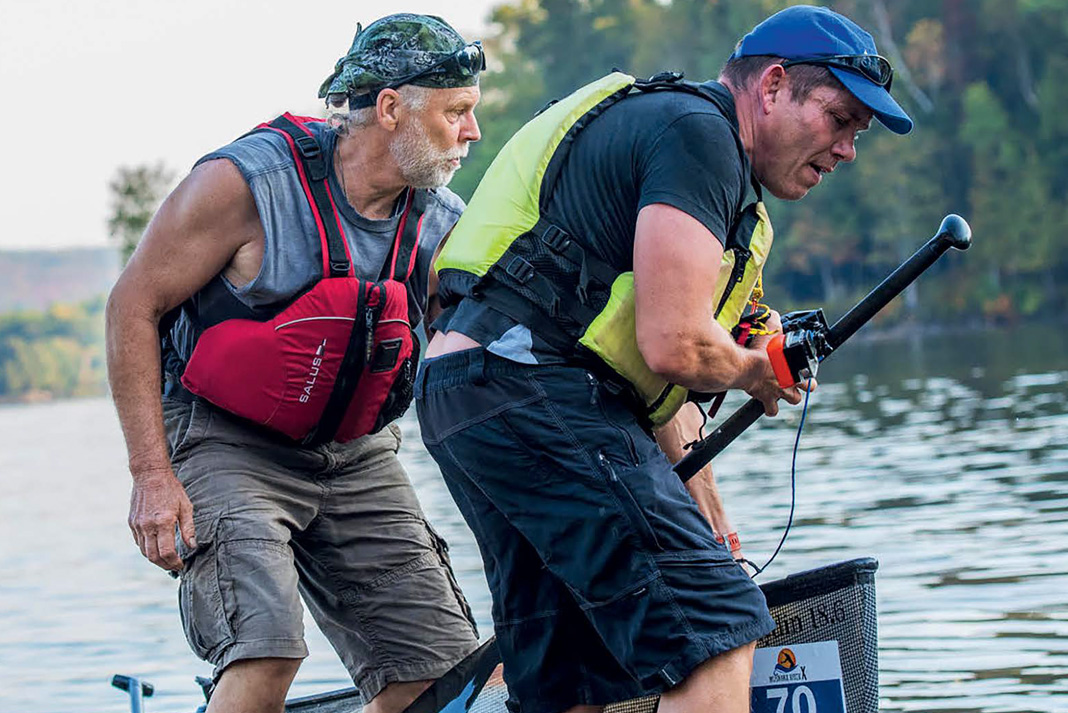
The first portage at the end of the lake is a true baptism of fire—1,700 meters long, traveling up and over a gnarly hill. Huffing and puffing we power up the incline with bags, barrel and the canoe bouncing on shoulders and backs.
With 20 portages en route, we eventually develop a routine and become a finely tuned portaging machine. Accessing the canoe is tricky at many portages, with rocks and flow adding to the challenge. I honor Hap’s wish to keep his feet dry and help him to land.
We were lucky to be experiencing warmer than normal temperatures. Everyone is in T-shirts and glorious sunshine bathes the racers and the early autumn leaves.
In years past, hypothermia has been a problem for some racers, especially at night when temperatures dropped below freezing.
We count ourselves lucky to be sweating instead of shivering and press on.
Near dusk, as we reach the 80-kilometer mark at the town of Bracebridge, it seems we are on the homeward leg. We make a big right turn to head back north towards Huntsville and suddenly the river is against us.
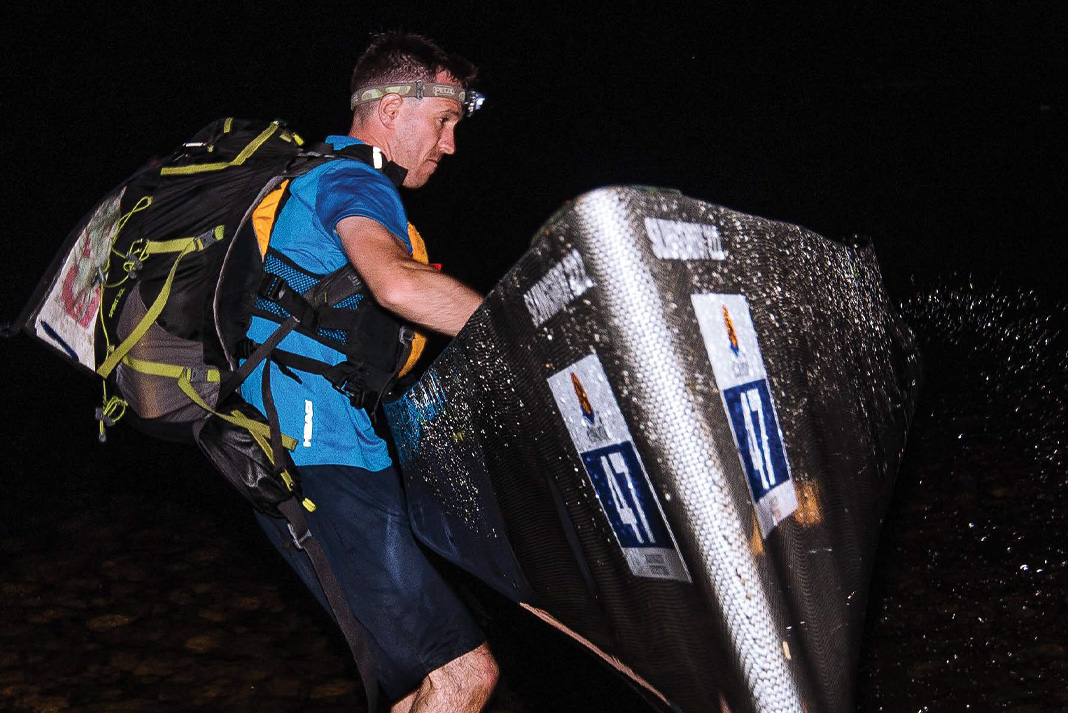
Our conveyor belt of water is cruelly reversed. Paddling upstream in the dark is thankless work. It’s hard to get perspective on distance traveled in the inky blackness. It feels like too much effort for not much gain. And mistakes can happen. In fast and shallow section I crack my paddle on a rock. “It’s about as much use as an ashtray on a motorbike now,” I called back to Hap.
Hap, however, was in no mood for surrender.
“Paddle, paddle harder!” came the shout. I try, one hand holding the cracked shaft and digging deep. We are losing ground. We hit an eddy and liberate the spare paddle.
Working on his night moves. | Photo: Andy Zeltkalns
Taking a pit stop
Shortly after we decide it’s time for some coffee and noodles. We fire up the stove and enjoy a night time picnic, complete with cheese and crackers. Though it might not have met race priorities, it’s one of the most enjoyable 45-minute pit stops I have ever had.
Back on the water, our night navigation is going well despite the pockets of heavy fog. Occasionally we spot other paddlers illuminated by their headlamps. They seem to be floating in white clouds of mist. They look like something straight out of a science fiction scene. The paddleboard racers in particular remind me of a hover-boarding Marty McFly from Back to the Future II.
Thoughts wander in the sleepless night. From previous races I know making distance is a case of paddling and watching the clock and kilometers count down. One stroke after another, after another.
Warm weather led to a higher-than-average finish rate for 2018 competitors. | Photo: Andy Zeltkalns
The finish line is near
The final portage back onto Fairy Lake is exciting because we know the end is close. The fog finally clears to reveal a clear and starry night and we spot four shooting stars.
So busy looking up, we lose our bearings in the darkness. It’s the gleaming bright lights of a Tim Hortons coffee shop that sets us straight.
“There’s definitely no Tim Hortons on route,” Hap calls from the rear. We retrace our paddling steps without complaint, or stopping for a double-double.
“Just a little magical mystery detour,” I tell Hap. At 3:37 a.m. we pass under the town bridge, arriving back to our starting place. We had done it. Just 20 hours and 37 minutes later.
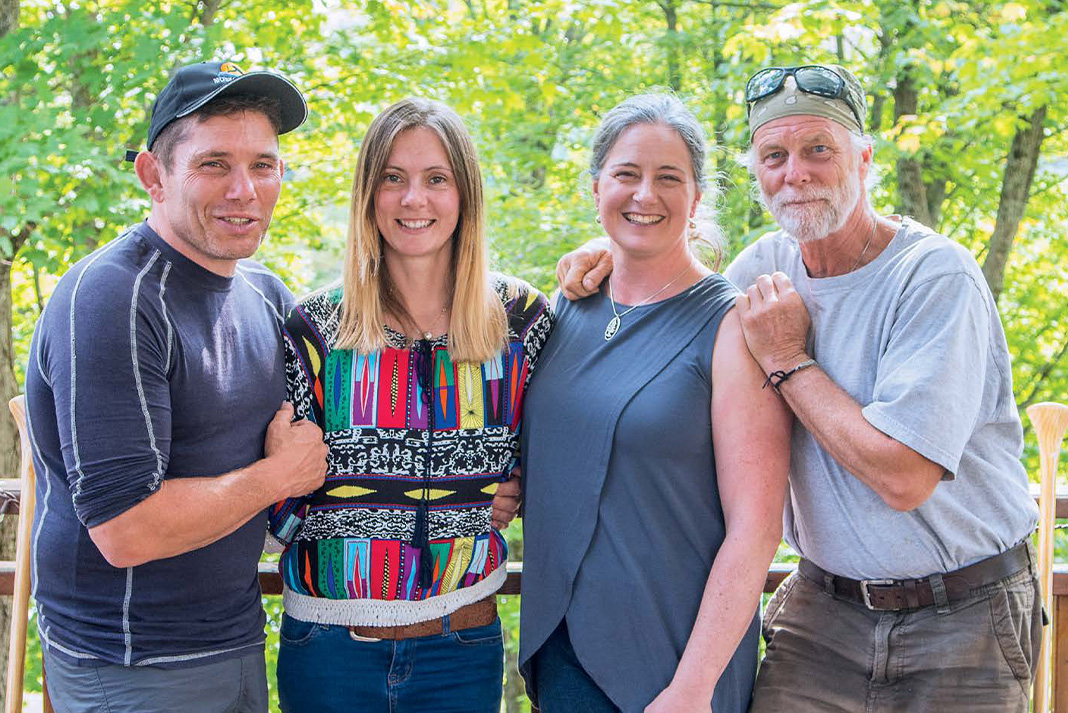
The gang is all here. Richard and Hap with their partners, Ashley and Andrea, at the awards banquet. | Photo: Randy Mitson
At the post-race banquet racers reunite like old friends. A local plays an acoustic guitar. Prizes and swag galore are handed out. Thanks are paid to race organizers Mike Varieur and Rob Horton and their brilliant team of volunteers. Hap and I placed 24th, finishing almost seven hours behind winning tandem canoe team members Glen Dawson and Mike Vincent.
Thanks to the good weather conditions, 90 percent of teams finished this year. There are a lot of smiling faces in the room.
To much excitement, Varieur and Horton announce a race shake-up for next year—the Muskoka River X will follow the same course, but backwards.
“It’ll challenge racers with more upstream swifts, and navigating the large Lake of Bays at night,” says Horton.
Hmm. Sounds good enough that I might have to return for round two.
Richard Harpham is a human-powered adventurer and inspirational speaker who has completed over 9,000 miles of expeditions by kayak, canoe, bike and on foot including exploring the Yukon, cycling the Sahara and Canada’s Inside Passage. www.canoetrail.co.uk
This article was first published in the 2015 Paddling Buyer’s Guide. Subscribe to Paddling Magazine’s print and digital editions, or browse the archives.
Richard Harpham (bow) and Hap Wilson (Stern) at the start of the 130-kilometer race. | Feature photo: Randy Mitson
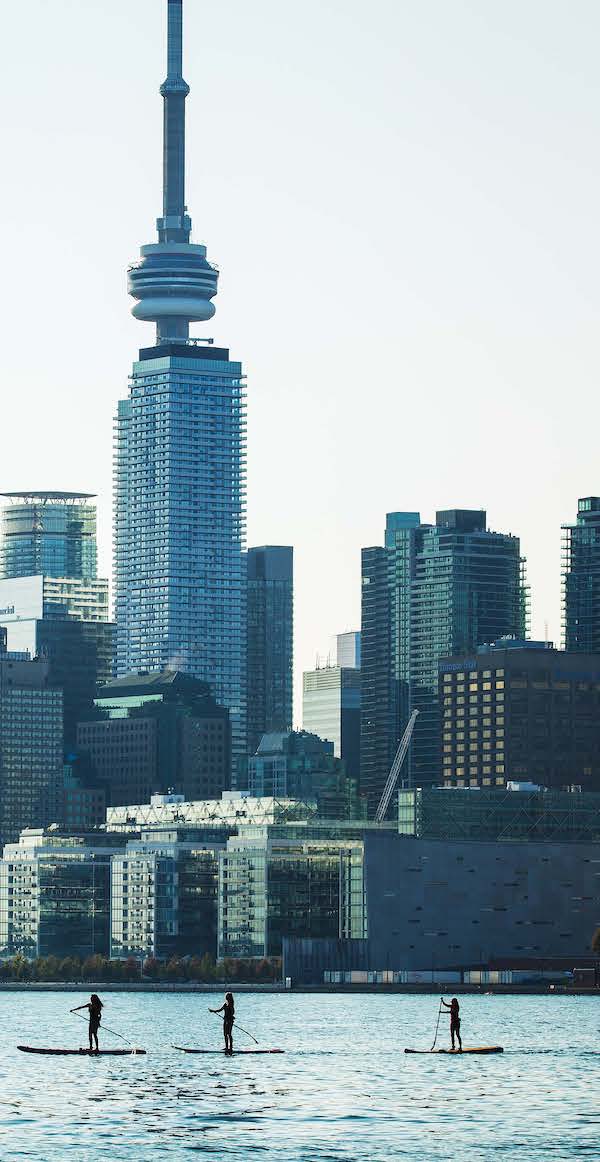
ACCORDING TO DIANA LEE, AND SUPS AREN’T AN UNUSUAL SIGHT. | Photo: Matt Stetson
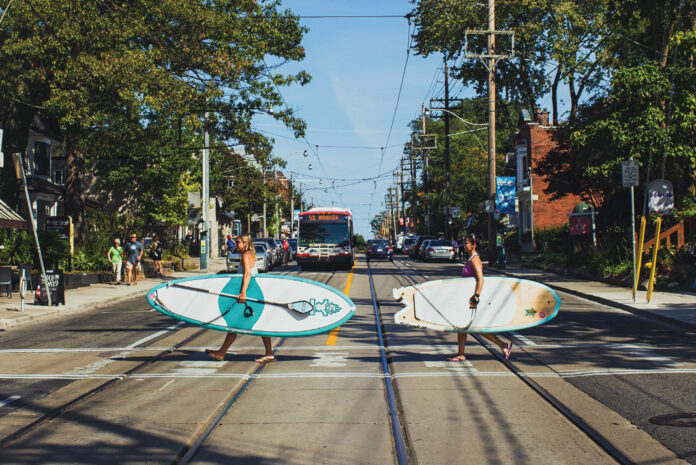
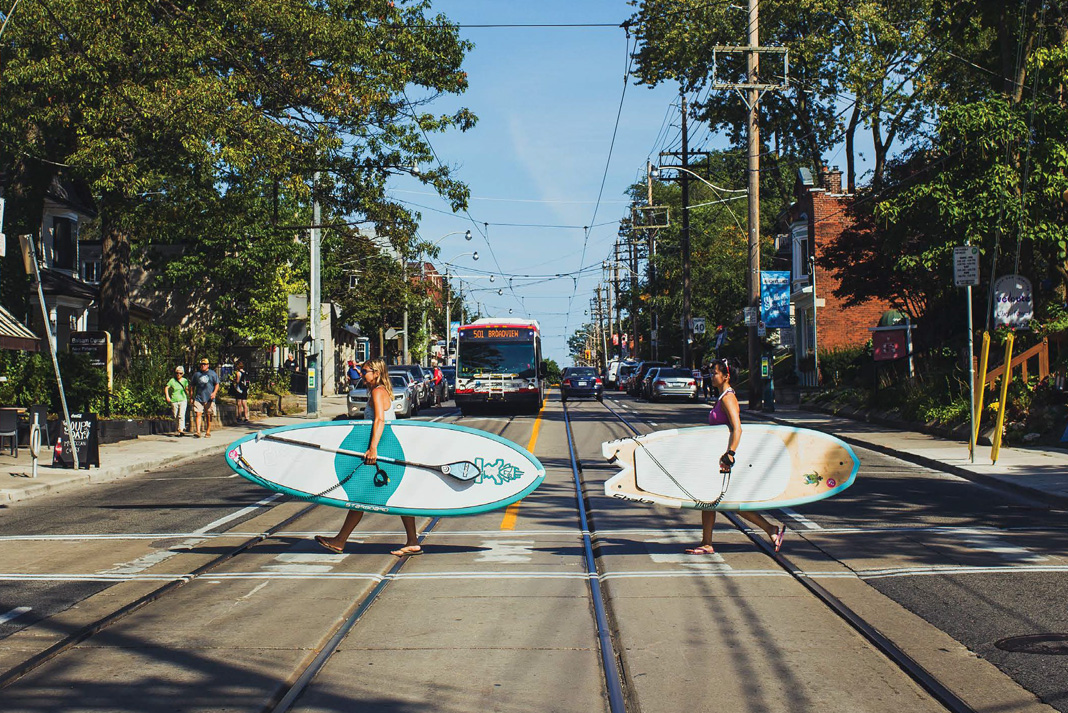
It’s a warm fall day in my hometown of Toronto. The sounds of sidewalk life, traffic and streetcars filter through the door of the cafe where I meet Diana Lee and Janna Van Hoof. Over lattes, we discuss their shared passion and the city’s hot, new summer pastime—standup paddleboarding.
Paddleboarding is reshaping Toronto’s waterfront access
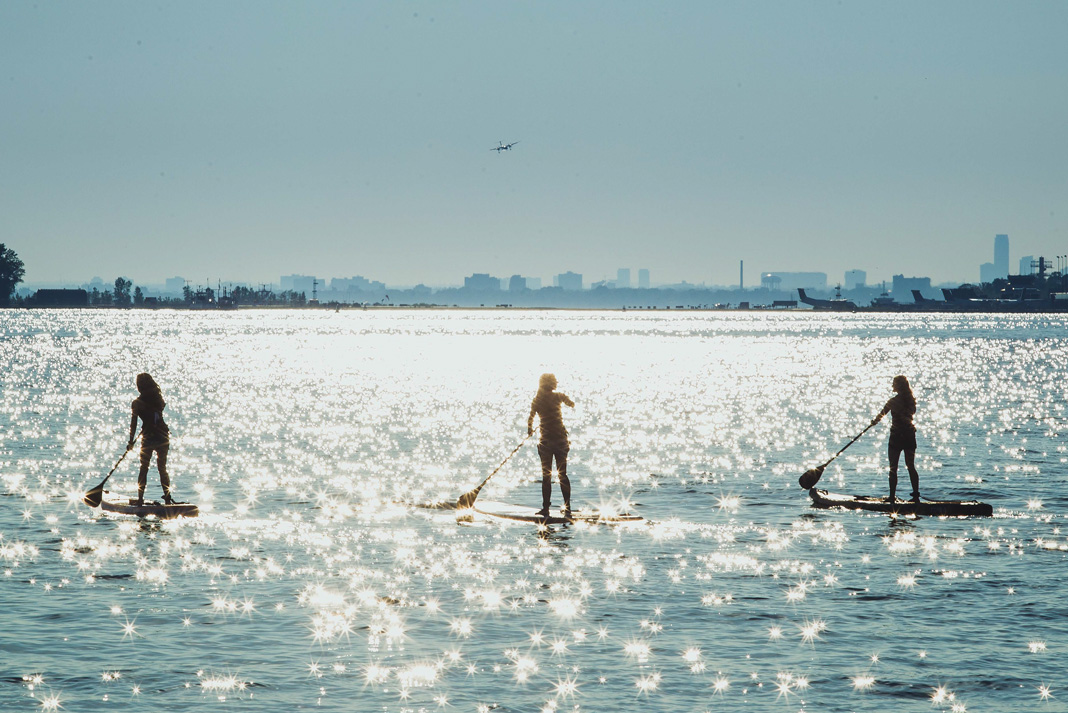
The two women are at the forefront of a growing tribe. Almost 5,000 miles away from SUP’s Hawaiian roots, North America’s fourth-largest city might seem like an unlikely hotspot for SUP culture. Yet, perched on the shining blue expanse of Lake Ontario, paddleboarding is reshaping Toronto’s waterfront access and the lives of its locals.
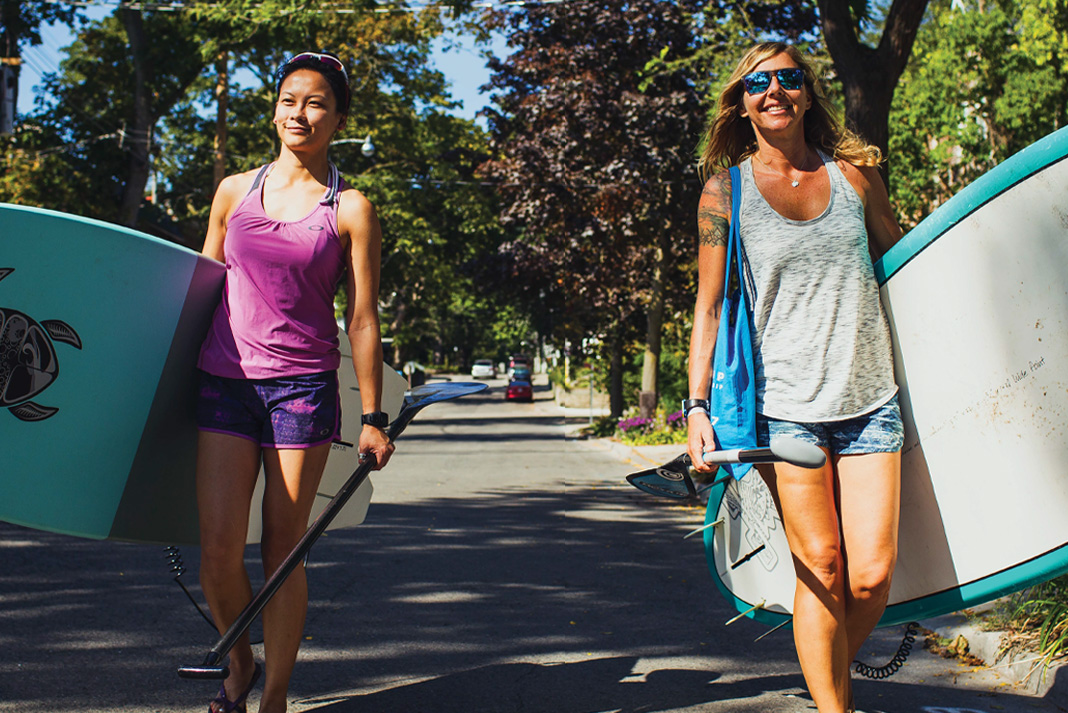
There is no better face to put to this trend than Diana Lee. By day she is a librarian with the Toronto Public Library; by night she’s an adventure sports junkie. She’s determined to defy the stereotypes of her profession—instead of meek and mild, she’s a bubbly adventure racer, wilderness tripper, and dragon boat paddler. Paddleboarding has captured her interest above all other sports. Just about every photo blasted out to her Instagram followers and many of the outdoor events she covers for local outdoor magazines feature paddleboarding in some form. Lee just wants everyone to have as much fun on the water as she’s having.
Since 2010, the number of paddleboarders in North America has exploded. According to the Outdoor Industry Association, SUP was the fastest growing outdoor activity from 2013 to 2016, growing at an average rate of 18 percent—or 250,000 participants—per year. Newbies are attracted to the ease of getting on the water—just grab a board, PFD, paddle and go. For some it’s a one-time excursion, but for others— Lee among them—it’s a life-altering passion.
Lee’s enthusiasm is borderline evangelical. She’s quick to advise me on the best local spots to get on the water. “I paddle everywhere. Often out of Cherry Beach for the sunsets and the skyline, and Kew Balmy Beach for the best unobstructed sunrises,” she tells me.
In just a few minutes of conversation I realize that in my decades of canoeing, kayaking and paddleboarding in this city, I’ve only scratched the surface of the destinations I could go. From the bustling downtown inner harbor, to the secluded waterways of the Toronto Islands, there’s no shortage of hotspots and Lee makes each sound positively dreamy.
Lee also enthusiastically rhymes off a dozen things to do on a paddleboard, from nighttime excursions to day-long trips to camping—an inflatable board makes a great air mattress, she tells me. Then there’s wave surfing, paddling with pets, winter paddling, downwinding, racing, yoga, and her latest passion—SUP fishing. She hasn’t caught any of Lake Ontario’s fabled salmon, pike or largemouth yet, but she persists.
As Lee’s experiences attest, just about anything you can do on a SUP, you can do in the city. “You can drop in wherever and whenever, regardless of your lifestyle on land,” she says.
Paddleboards—particularly inflatables—tend to be more manageable than kayaks and canoes in space-strapped and condo-dense cityscapes.
“And the real benefit to paddling in the city is that you don’t have to get on the highway to get on the water,” says Lee. “It’s a far more accessible way for far more people to get those same feelings of tranquility and relaxation that a wilderness experience provides.”
It’s an increasingly common sentiment. With more than half-a-dozen new SUP-specific businesses opening over the last five or so years, Toronto has joined the likes of Thunder Bay, Minneapolis and Chicago, lakeside cities with flourishing freshwater paddleboard scenes. These communities are united by passionate paddlers, small business owners and grassroots social activities.
The popularity of paddling is its own positive feedback loop. Enthusiasts are ambassadors, bringing more people out to enjoy the lake, which in turn draws more businesses, more paddling infrastructure, and ultimately, even more people to the water’s edge.
DIANA LEE AND JANNA VAN HOOF ON A SUNNY FALL DAY IN THE CITY. | Photo: Matt Stetson
The SUPGirlz
Businesses stoking the passion for beginners play a key role. Lee first saw paddleboarders while vacationing in Hawaii. She thought those people learning to surf on bigger boards and with paddles in their hands were onto something. It wasn’t until she was back home in Toronto that she got hooked by taking a course with SUPGirlz, Janna Van Hoof ’s local school.
Van Hoof is a globe-trotting surfer who grew up in Florida. Like Lee, she got the paddleboarding bug in Hawaii, while living for a spell in Maui. After settling down in Toronto, she turned to paddleboarding as a way to stay in touch with the water and make the most of a short summer.
Van Hoof started SUPGirlz in 2008 out of a rented apartment near Kew Balmy Beach in Toronto’s east end. She became the face of one of the first paddleboarding businesses in the city, predating the big SUP boom by almost half a decade. With a humble garage as a base and the entire Great Lake as a free playground to teach upon, she’s been fulfilling her mission of “bringing surf culture to the city via standup paddleboards” ever since.
“Interest in paddleboarding has grown in the decade since I opened SUPGirlz,” says Van Hoof. Back then, barely anyone outside of California knew what SUP was. “Now I see paddleboarders everywhere.”
“I started to teach people to SUP because I wanted to teach people how to surf,” she adds. “With a paddle in their hands people are much stronger. Your pop-up doesn’t have to be perfect anymore. I can teach people what used to take two years in a week. The curve to take up long boarding is way shorter.”
The “Girlz” part of the business name sparks some confusion, to Van Hoof ’s amusement. People often ask, “Are guys allowed?” They are—SUPGirlz also has male instructors—but Van Hoof embraces the ladies-first philosophy as a refreshing change in a sport with maledominated roots.
“The guys have had surfing for years,” she says. “I don’t mind sending some energy towards raising the status of women on the water.” Anecdotally, women make up the largest segment of the recreational paddleboarding demographic. This gender split is echoed in yoga and running communities. And like yoga and running, paddleboarding isn’t simply an activity when you’re an enthusiast—it can be your social circle and your lifestyle.
It’s what SUPGirlz does beyond the basics of just providing skills and equipment that has helped build the local scene. Operating more like a community center or fitness studio than a mere outfitter, SUPGirlz offers more than a dozen different types of classes. There are the typical intros for first-timers, sunrise yoga sessions and boot camp fitness classes. Then there are kids camps, three-hour adventure paddles, surf clinics, holiday fireworks-viewing trips and fullmoon night paddles with 1,000-lumen light bars strapped to the boards. There are also occasional weekends away and international surf trips.
Social paddles are an anchor where friendships are built. Regulars can paddle with their dogs and newbies can mix with veterans. Clients don’t just pick up a rental board, they gather by the SUPGirlz garage for birthdays barbecues and they get together after paddling at the local bakeshop for a latte and a snack.
Paddleboarding is the new yoga or gym session. It’s become something you do daily in the city for mind-body-soul fitness, and it comes with the bonus of getting in touch with nature, unlike most urban hobbies.
JUST ANOTHER MANIC MONDAY. | Photo: Matt Stetson
Political Pressure
Entrepreneurs catering to the growing SUP demand are being met with support from city government keen to turn Toronto into a paddlefriendly city. The aim is to develop the waterfront for paddlers much the way progressive cities everywhere are remodelling streets for cyclists. Toronto already has an advantage over many cities with 11 city beaches and 138 kilometres of shoreline, including the Toronto Islands park just offshore of downtown.
Tasked with the multi-decades revitalization of the city’s post-industrial waterfront, government-funded agency Waterfront Toronto has transformed parking lots and industrial docks into public spaces, drawing tourists and paddlers alike. Torontonians are slowly changing their own perception of their waterfront, from an industrial shoreline best avoided to embracing a recreational asset.
“Not everyone has a cottage or a place to escape to. As a city we should be making better use of our beautiful, clean lake,” says Mary-Margaret McMahon, the Toronto Beaches’ firecracker of a city councillor. McMahon initiated the RFP process that saw two new SUP rental businesses open up—one out of a trailer and the other out of a shipping container—on the Beaches Boardwalk last summer. It’s the first step in a five-year pilot project to “animate the beach.”
“The paddleboard rentals are highly successful,” adds McMahon. She hopes to see the idea expand into the city’s other waterfront neighbourhoods. “I think some Torontonians still don’t realize we have a beach down there.”
The city has also approved funding for up to 12 water access points, called recreational nodes. James Dann, Toronto’s manager of waterfront parks, says the plan grew out of working with lakefront city councillors, including McMahon, to find ways to improve free recreational access to the lake.
“We’re looking at what makes it easy to get around and paddle within your local community,” says Dann.
The project will accomplish several goals: shoreline rehabilitation to mitigate future flood damage, improving fishing habitat, and providing places for free public water access. This is great news for paddlers who sometimes find themselves launching from break walls or competing for space with motorboats at launch sites.
As construction on the access points proceeds, “people are feeling more confident about using the water as a resource,” says Dann. This has been furthered by Toronto’s beaches receiving Blue Flag labelling in 2017. Blue Flag is an international certification of cleanliness. In a city where many were told not to swim in Lake Ontario during in the ‘60s, ‘70s and ‘80s because of heavy industry operating on the shoreline, Blue Flag is a powerful signal of changing times. The water at the downtown beach that SUPGirlz favors for classes was declared safe for swimming 120 days of 122 during the official 2017 summer season.
TORONTO BOASTS 138 KILOMETERS OF SHORLINE, INCLUDING 11 CITY BEACHES. | Photo: Matt Stetson
Creating Water Warriors
Even with the Blue Flag certification there’s room for improvement. Lee and Van Hoof are strong believers that for every new SUP convert, the lake gets a new defender. The growing numbers of users strengthens the case for further protection and clean-up, and for more infrastructure like rental kiosks and launch nodes. Paddleboarders have a big stake in environmental protection, according to Lee. “You’re more exposed to the water than in a canoe or kayak, so you can’t help but become an ambassador for its health,” she says.
Being an ambassador means picking up or towing in all kinds of garbage, Van Hoof adds—including, in one memorable instance, a disabled jet ski. Being an ambassador also means talking about safety, like the importance of using a leash and PFD and the unique weather hazards of the lake, and also being a good steward by encouraging others to rethink single-use plastics, which are often found floating in lakes and oceans around the world.
“I hope that everyone who comes out on the water with SUPGirlz falls in love with what they find, and is inspired to protect the water,” says Van Hoof.
Ambassadors like Van Hoof and Lee are vital. They do so much more than teach new paddlers the skills to get on the water. They’re not just creating a paddling culture and connection to nature for urbanites—they’re inspiring protection for an area that 4.5 million people call home. If all paddlers were to promote their love of water the way Van Hoof and Lee do—well, it’s the kind of thinking that changes lives and shorelines, and could maybe even protect entire ecosystems.
Tim Shuff is the former editor of Adventure Kayak magazine. When not rescuing kittens from trees, he can be found at the beach with his young family.
This article first appeared in the 2015 Paddling Buyer’s Guide. Subscribe to Paddling Magazine and get 25 years of digital magazine archives including our legacy titles: Rapid, Adventure Kayak and Canoeroots.
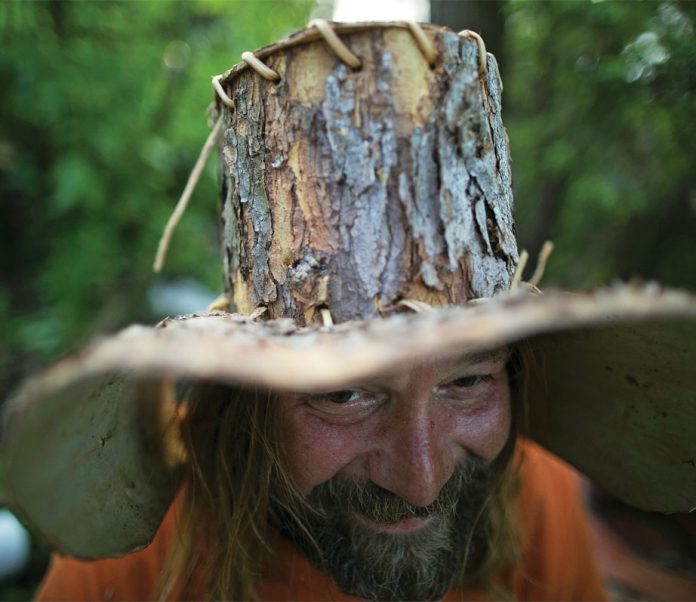
Mike Ranta wearing his voygeur crown. | All photos by David Jackson
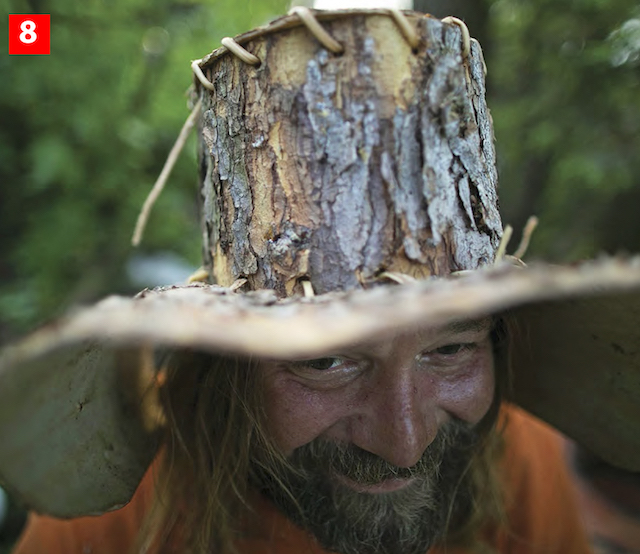
Canada’s modern-day voyageur is windbound in a spruce swamp on the edge of Cedar Lake, Manitoba. Windy days have been a theme on this trip, which is Ranta’s attempt at a third coast-to-coast solo canoe expedition. Time is running out with each crashing wave during the stormy summer. Ever the optimist, Ranta is keen to put his time on shore to good use and spends the afternoon making one of his iconic bark hats. “The sap is still running,” beams Mike Ranta as he licks his finger clean of the sticky, sweet ooze.
For those who dream of building a birch bark canoe, Ranta’s signature hat is a great way to learn how to work with natural materials. And while you might never wear yours on a seven-month cross-continent canoe trip, you’ll still have a functional hat to connect you to the land and protect you on long days under the sun.
How to make a hat from a tree
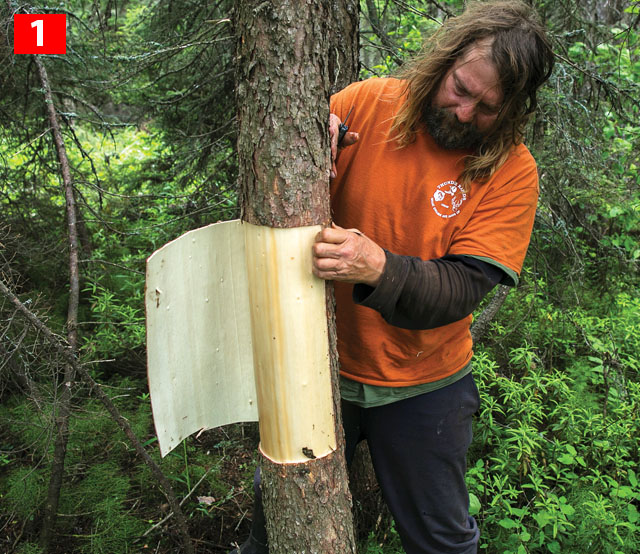
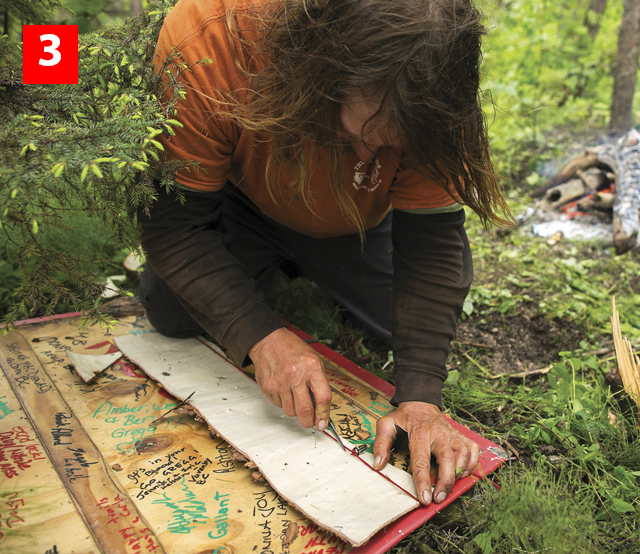
1. Gather two pieces of bark, one about 18 by 18 inches and the other four by 12 inches. Lay them flat.
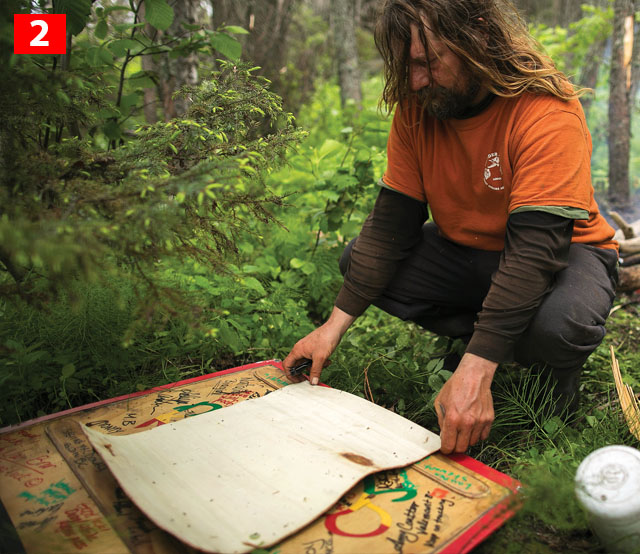
2. Wrap a string around your crown to get a rough measurement of your head’s circumference. Translate this measurement onto the bigger piece of bark. Use a knife to cut out the circle. This cutout will serve as the top of your new hat. The remaining piece is the hat’s brim; trim its edges as desired.
3. Trim the long and narrow strip of bark an inch longer than your head’s circumference. This will be the bucket of the hat. That extra inch creates the overlap needed to use spruce lashings to bind the strip together.
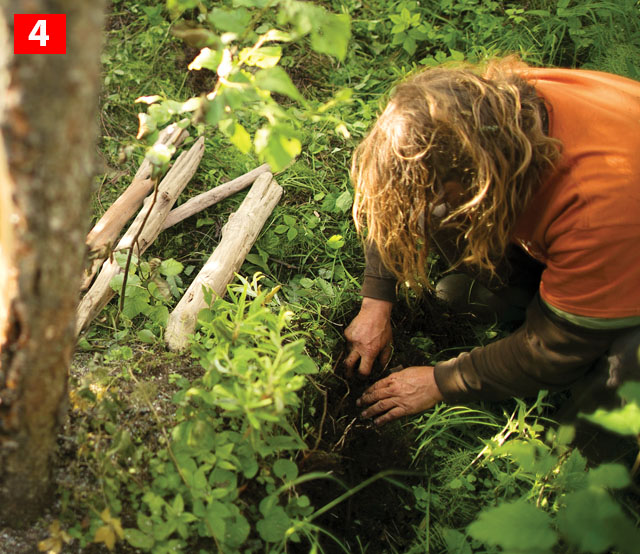
4. Gather two lengths of spruce root about four feet long and a quarter-inch thick. Working delicately with a knife, split the root down the center lengthwise. Splitting the root adds flexibility. For a quarter-inch thick piece, Ranta might split the root four times, before coiling the pieces into warm water. Spruce root becomes very pliable when wet.
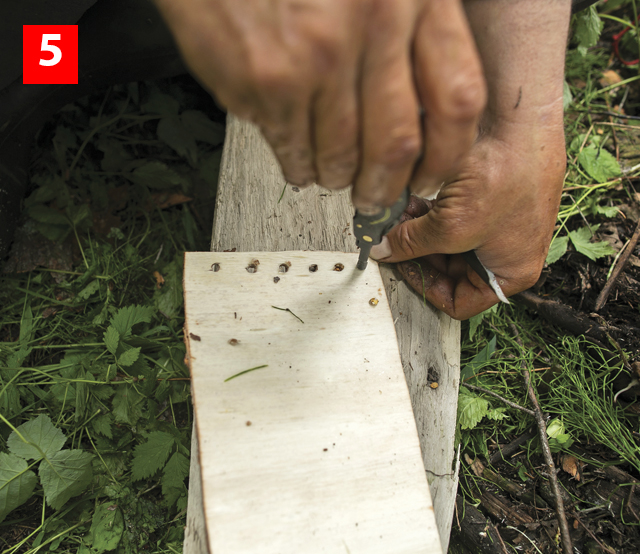
5. Using a carving knife, create a series of tiny holes around the inner edges of the brim, about a half-inch apart. Holes should be only large enough to accept the diameter of the root. Make more holes along the top, bottom and seam of the bucket piece, as well as the edge of the piece that creates the top of the hat.
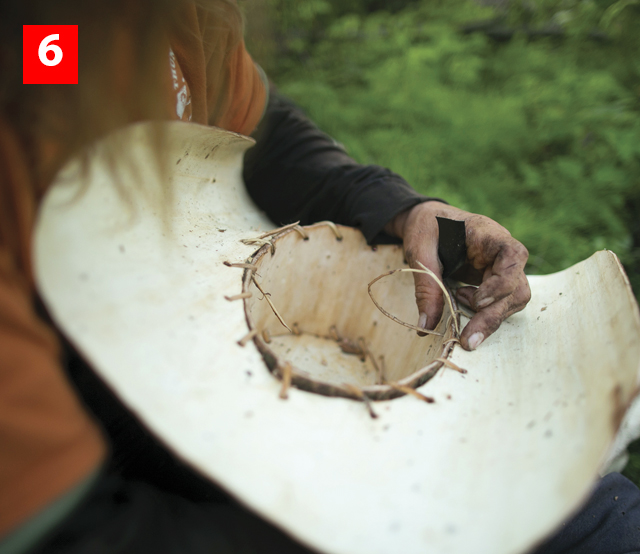
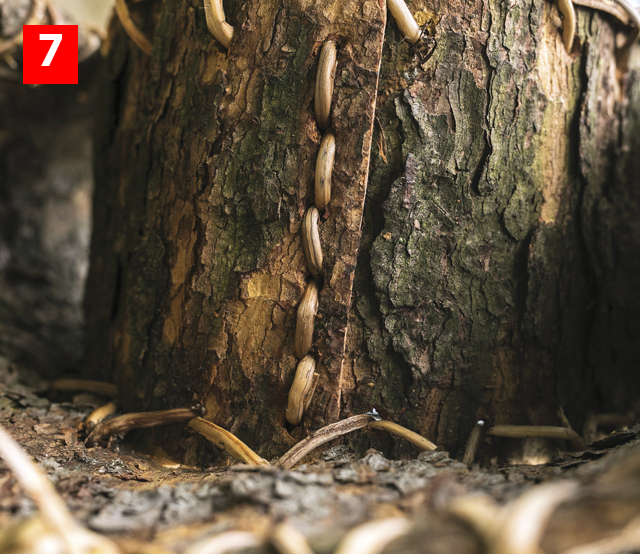
6. Feed the spruce root through the punctures, first lashing the seam of the bucket and ensuring the fit is right for your head. Next, lash bucket and brim together, and affix the top piece in the same manner.
7. Make a final series of holes on the outer edge of the brim. Cut a thin strip of bark, notch it with holes along both edges, and bend the strip, bark out, around the brim. Lash in place. This step is crucial for keeping the edge of the brim from fraying once the sap dries and the hat begins to harden.
8. Traditionally, First Nations and voyageurs would use a mixture of bear fat, pine pitch and ash to seal the seams on their bark canoes.
While Ranta did this in the early days of his hat building, the modern voyageur now uses a black automotive silicone to seal all the lash seams. Without bear fat or silicone, Ranta skipped this step in the swamp. Once sealed, the hat becomes completely waterproof.
HELPFUL HINTS
Harvesting natural materials is a laborious task. Bark is easiest to harvest in the spring when the sap is running, however improper techniques can damage the tree. Bark takes 10 to 20 years to grow back.
Harvesting roots involves finding a suitable stand of spruce, penetrating the earth, and pulling at stringy roots in hopes of finding a long enough piece to allow for long runs of lashing. Ranta favors looking for roots in wet swampy areas—without the burden of rocks and other trees crisscrossing roots, extraction can be much easier.
Ensure harvesting bark and roots is legal in your area before you begin. Most provincial, state and national parks have rules prohibiting it.
While the hat is still damp with sap, use a string to tie the hat into the shape you like. Ranta shaped this one into a cowboy hat. If the bark is already hardened when you begin, heat up a pot of water and begin pouring it on the pieces. The bark will soften under the moist heat and will become workable. This allows you to reshape the hat whenever you choose.
Author: David Jackson. Feature Photo: David Jackson
Modern-day voyageur Mike Ranta is from Atikokan, Ontario, and has paddled across Canada three times. Read “Hat Trick,” the feature story on his 2017 journey here.
This article first appeared in the 2015 Paddling Buyer’s Guide. Subscribe to Paddling Magazine and get 25 years of digital magazine archives including our legacy titles: Rapid, Adventure Kayak and Canoeroots.


 This article originally appeared in Rapid’s Early Summer 2017 issue.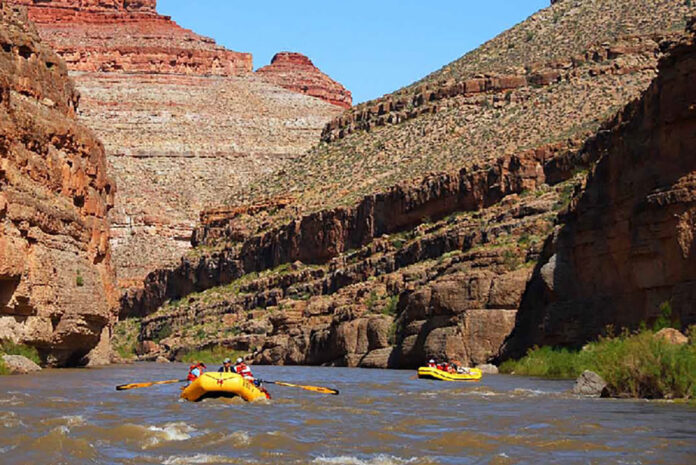
 This article first appeared in the 2015 Paddling Buyer’s Guide.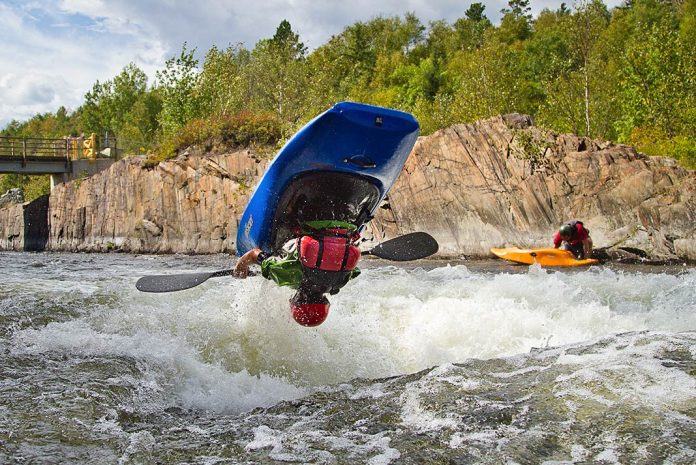
 This article originally appeared in Rapid Early Summer 2017 issue.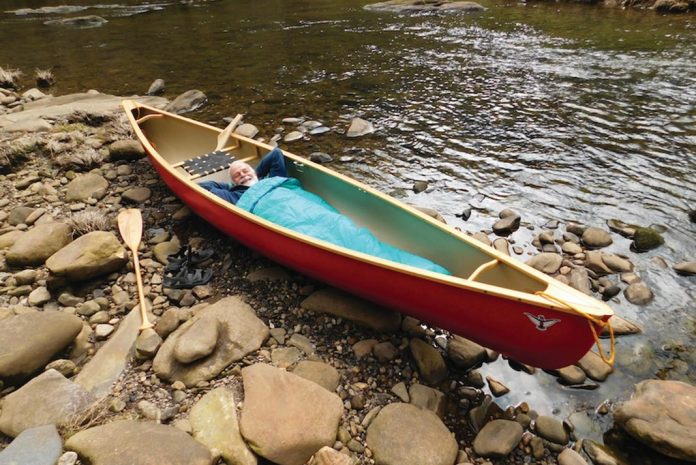
 This article was first published in the Early Summer 2017 issue of Canoeroots Magazine.
 This article was first published in the 2015 Paddling Buyer’s Guide.