Home Blog Page 221

Remembering Frank Goodman

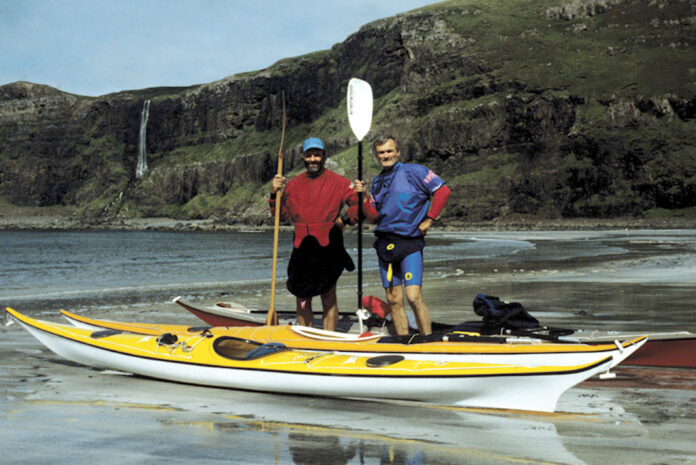
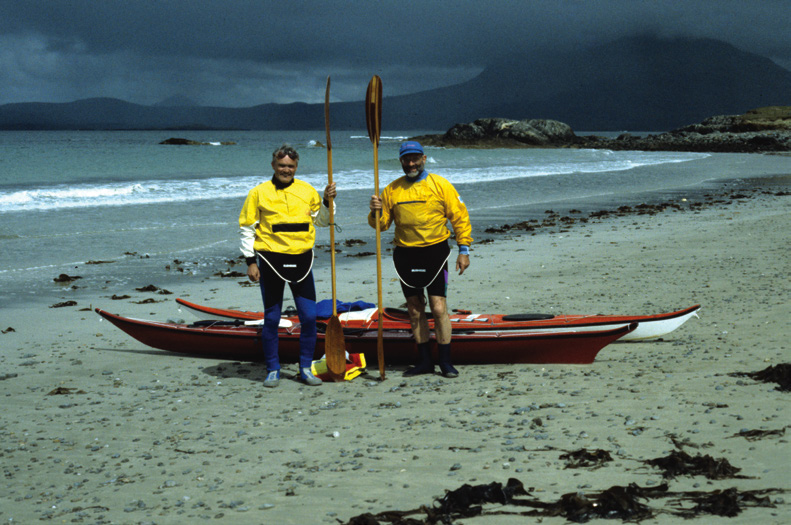
Frank Goodman and Stan Chladek pose with their Nordkapp sea kayaks in Tallisker Bay, Isle of Skye
Goodman, Stan Chladek and their Nordkapps in Tallisker Bay, Isle of Skye, Scotland. Summer, 1987. | Photo by Doreen Goodman.

When Frank Goodman died in late February 2017, peacefully at age 86, the kayaking world bade farewell to one of its pioneers and greatest talents. Many paddlers knew Frank as a presenter at sea kayaking symposiums in the 1980s and ‘90s, or at least as the legendary name behind Valley Canoe Products and iconic, enduring kayak designs like the Anas Acuta, Skerray and the Nordkapp.
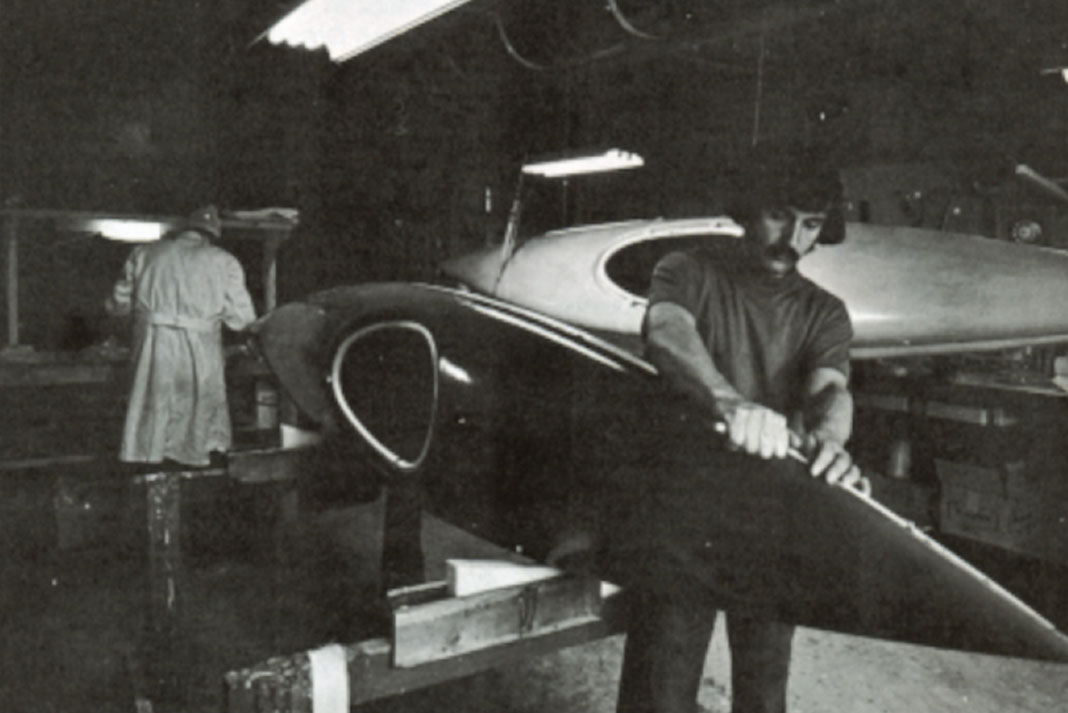
Remembering Frank Goodman, Nordkapp designer & sea kayaking pioneer
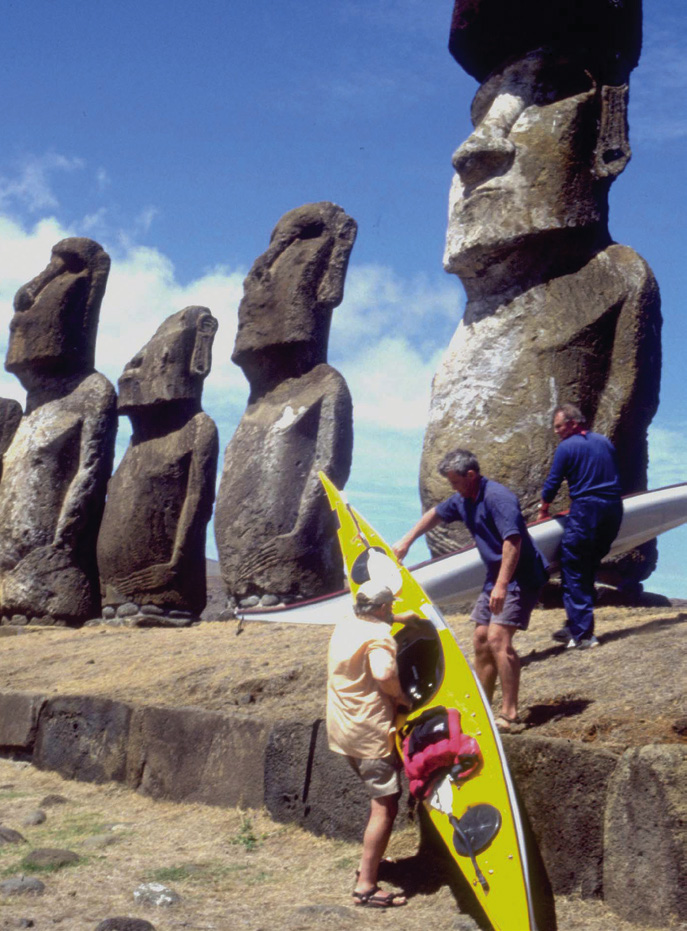
three men carry sea kayaks to pose beside Easter Island statues
Frank Goodman, Nigel Dennis and Stan Chladek put their kayaks next to the statues on Easter Island. It was Frank’s idea to photograph two kayaks next to the statues as a document. This episode happened during Stan Chladek and Nigel Dennis’ circumnavigation of Easter Island in February 2001. | Photo: Ema Chladek

Look a bit deeper and it becomes apparent that much of what we consider the defining features of the sea kayak—innovations like waterproof hatches and bulkheads—owe their origins to Frank Goodman. The expeditions that defined a golden era of sea kayak exploration, including circumnavigations of Great Britain, Cape Horn, Australia, New Zealand and Japan in the 1970s and ‘80s, were done in Frank Goodman-designed boats. Even if we are not of the older generation of paddlers who picked up some bits of knowledge from Frank himself, we are probably just one mentor removed from someone who did. It seems almost inevitable that Frank Goodman had to come along to make our sport what it is.

Look beyond the well-known lore of Frank Goodman the sea kayaker—there is so much more to the man. He was an artist, designer, builder, educator, musician and jazz enthusiast, father, polymath and creative force. It seems almost a fluke and our very good fortune that this young art teacher from the landlocked English Midlands somehow ended up devoting his prodigious talents to sea kayaking.

Frank’s formative years

Frank Goodman, the second oldest of four children, was born in 1930 in the town of Hinckley, in Leicestershire. His love of craftsmanship and adventure may have come from his parents, who Frank’s daughter, Anna Conochie, laughingly remembers as “slightly crazy in a good way.” His father Lance Goodman was a craftsman, the son in the established Goodman & Son joinery business. His mother, Marjorie, possessed the family’s adventurous streak, renowned as the first woman in Leicestershire to perform an aerial loop as a passenger in a crop dusting plane.
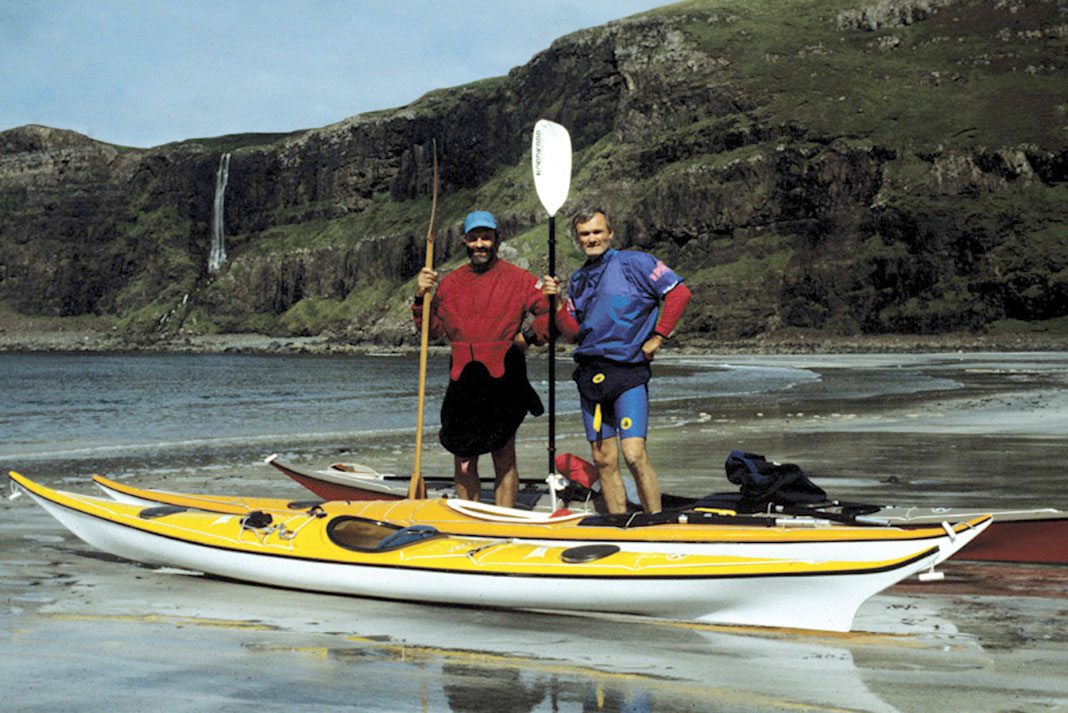
Frank Goodman and Stan Chladek pose with their Nordkapp sea kayaks in Tallisker Bay, Isle of Skye
Goodman, Stan Chladek and their Nordkapps in Tallisker Bay, Isle of Skye, Scotland. Summer, 1987. | Photo by Doreen Goodman.

Frank used to say he lacked the hand-eye coordination for school sports like rugby, soccer or tennis but he loved the water and swam competitively for the county. He excelled in the arts and went on to train as a teacher in woodwork, metalwork, art and design at what is now the prestigious Loughborough University.

Besides his love of swimming, Frank’s young adult resume shows little sign of the fanatical paddler he was to become. He devoted himself to jazz, playing clarinet at a semi-professional level. He completed his year of compulsory national service in the Royal Airforce, where he played in a RAF band. He met and married Doreen, a teacher in Hinckley. Typically dreaming of the future, the first home he bought was an Edwardian detached, big enough to raise a family. He would live here the rest of his life. The newly married Goodman couple would tear around Leicestershire County in the open cockpit of a three-wheeled Morgan sports car. Frank was beginning to seize hold of a vision he’d outlined in a carefully illustrated journal as a small child, in which he was the commander in chief of a club that had its own sports car, boat and airplane.

In the mid-60s Frank was a mid-life professional and an established lecturer in woodwork, metalwork, art and design at Clifton College in Nottingham. He had two daughters, Anna and Penelope. He did not abandon youthful adventure; if anything he was barely getting started. He dabbled in climbing like many British sea kayakers in those days and was a member of the Royal Geographical Society, joining two expeditions to Yugoslavia in 1963 and ’65 to indulge his lifelong interest in geomorphology.
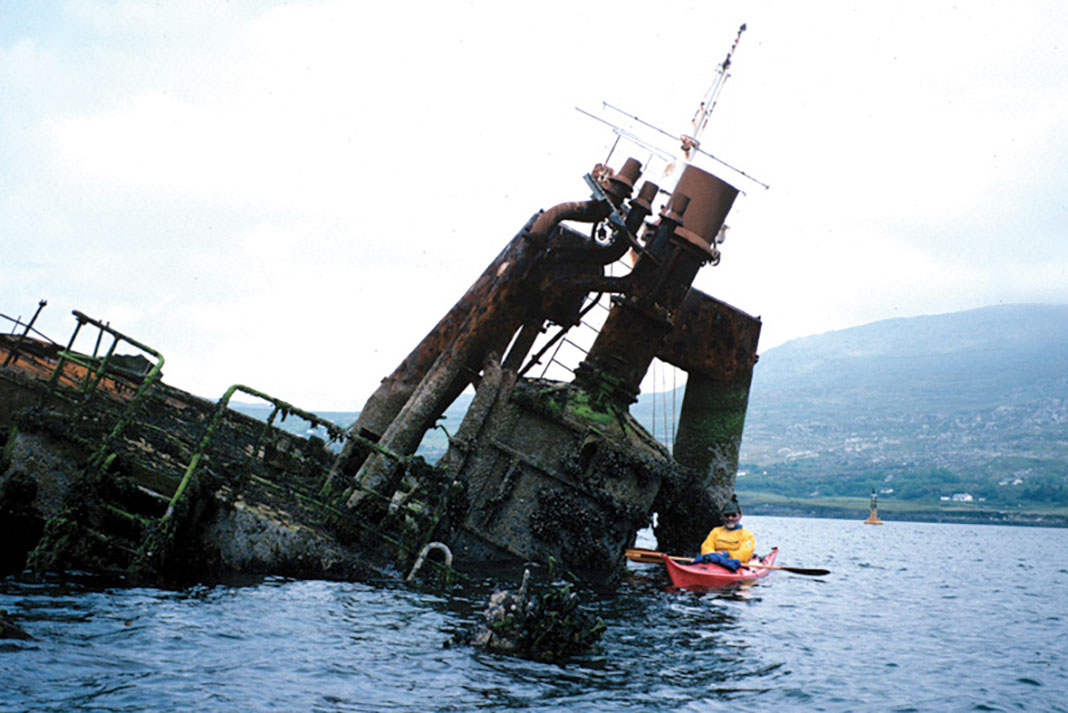
Frank Goodman poses beside an Irish shipwreck in his sea kayak
Goodman in the Skerry next to the Irish shipwreck on the southwest coast of Ireland, May 1994. | Photo: Stan Chladek

He once told a reporter that he got hooked on kayaking while “messing about” in a homemade kayak in ocean surf in 1964. By the late ’60s he became an avid whitewater slalom kayaker and began to turn his design skills to the problem of equipment, creating a fiberglass slalom kayak for his college’s physical education department and fellow paddlers in the Soar Valley Canoe Club. His design was so successful, it was ripped off by a commercial producer. Frank considered quitting teaching and going into the kayak business himself, as a way to combine his loves of paddling and design, but then received a Fulbright scholarship to lecture in California for a year.

In 1969 Frank packed his family off to San Jose and shipped along a fiberglass kayak mould. While in the U.S. he built a kayak in his garage, which he paddled down rivers in the Sierra Nevada and raced to 12th place at the legendary Arkansas River Race in Salida, Colorado.

In 1970, he returned to the U.K. where he advanced to Britain’s first division in whitewater slalom at the age of 40. Kayaking had consumed him as a hobby and now he followed through on his dream to make it a business, starting up Valley Canoe Products in Nottingham.
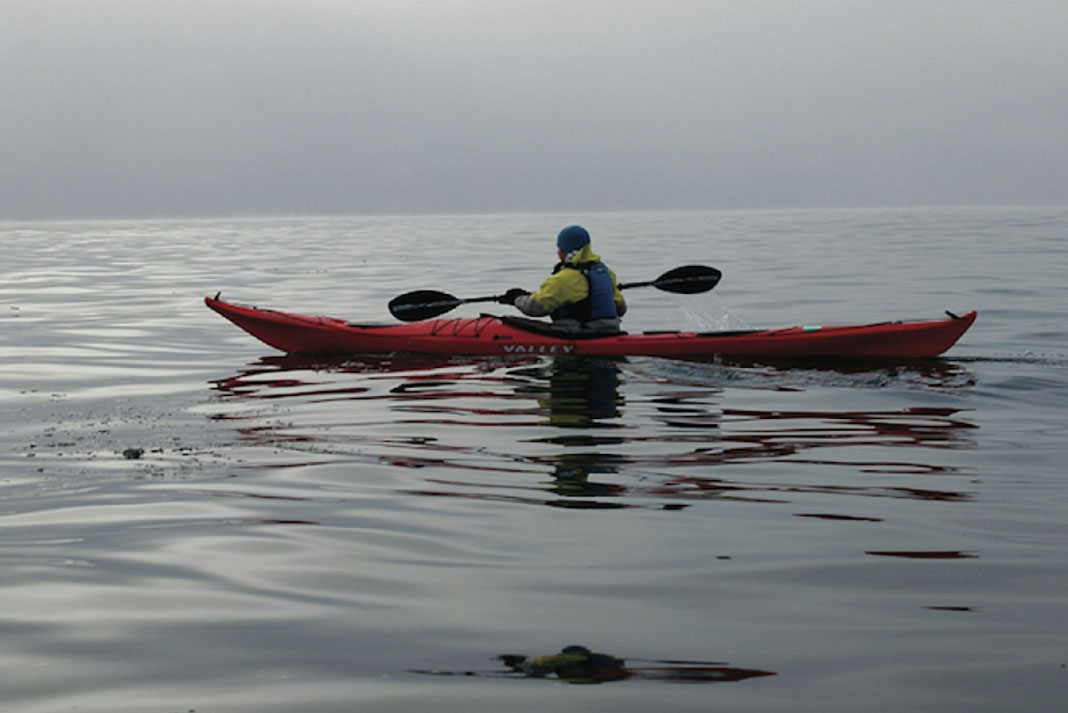
Designer: The making of the Nordkapp

In the beginning, Valley Canoe Products produced Frank’s Soar Valley Special slalom kayak, surf kayaks and starting in 1972, one of the very first commercial fiberglass sea kayaks, the Anas Acuta. This iconic hard-chined sea kayak, named for the northern pintail duck whose stern it resembles, is still produced today. At the time it was already a popular design in the U.K., adapted by various small-scale builders from a West Greenland hunting kayak brought from Igdlorrsuit to Scotland in 1959 by an anthropologist named Ken Taylor.

In 1974, 44-year-old Frank was still pushing himself as a paddler; he and Nigel Matthews, a Leicestershire outdoor education teacher, kayaked across the Irish Sea in Anas Acutas. Frank also tied the world record for the longest surf at more than four miles on the Severn Bore, an accomplishment about which he was characteristically modest. “If you were discussing the area it might come out in general conversation that he used to surf there,” says Nigel Dennis. The world record would be brushed off as some stroke of luck.
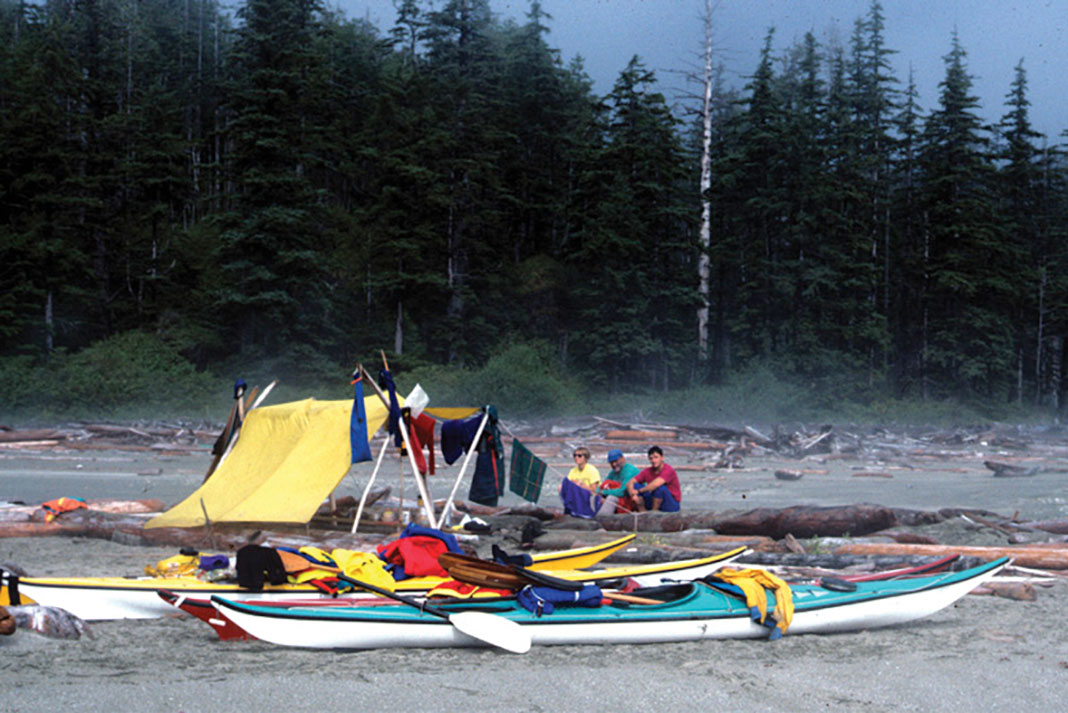
a group of people sit at a sea kayaking campsite on the west coast of Vancouver Island
Camp at a beach, west coast of Vancouver Island, BC, early 1990. From the left: Dana Chladek (Stan Chladek’s daughter), Frank Goodman and Thierry Humeau (Dana’s husband). | Photo: Stan Chladek

In 1974 came another pivotal moment for Frank. He was approached by Nigel Matthews, Sam Cook and other members of the British Nordkapp Expedition to design a kayak for their proposed 500-mile journey to Europe’s Northern Cape. Having just circumnavigated the Isle of Skye in Anas Acutas with gear strapped to the decks in plastic bags, they saw the need for a kayak up to the task of longer voyages.

Frank was a bundle of creative energy and enthusiasm, brimming with design ideas and ambitious dreams. He poured his heart into the task, working closely with the expedition members, even accompanying them on a test trip to the Farne Islands and tweaking prototypes to their feedback. The resulting Nordkapp sea kayak is said to be essentially a larger, faster, soft-chined version of the Anas Acuta, the lines of a West Greenland hunting craft still visible in its hull and adding to its enduring appeal.

“He did a terrific job with that boat,” expedition member Sam Cook recalls. That Nordkapp Expedition was to be the moon launch of modern sea kayaking, spinning off a surprising number of equipment innovations including the first Lendal sea kayak paddle, the first PFD with pockets to replace bulky life jackets and the first neoprene sprayskirt. But the crowning glory was the Nordkapp kayak itself, which premiered many signature design features of the modern sea kayak: waterproof bulkheads and hatches adapted from sailboats, a cockpit pump, deck fittings, a compass recess and an early version of the day hatch.
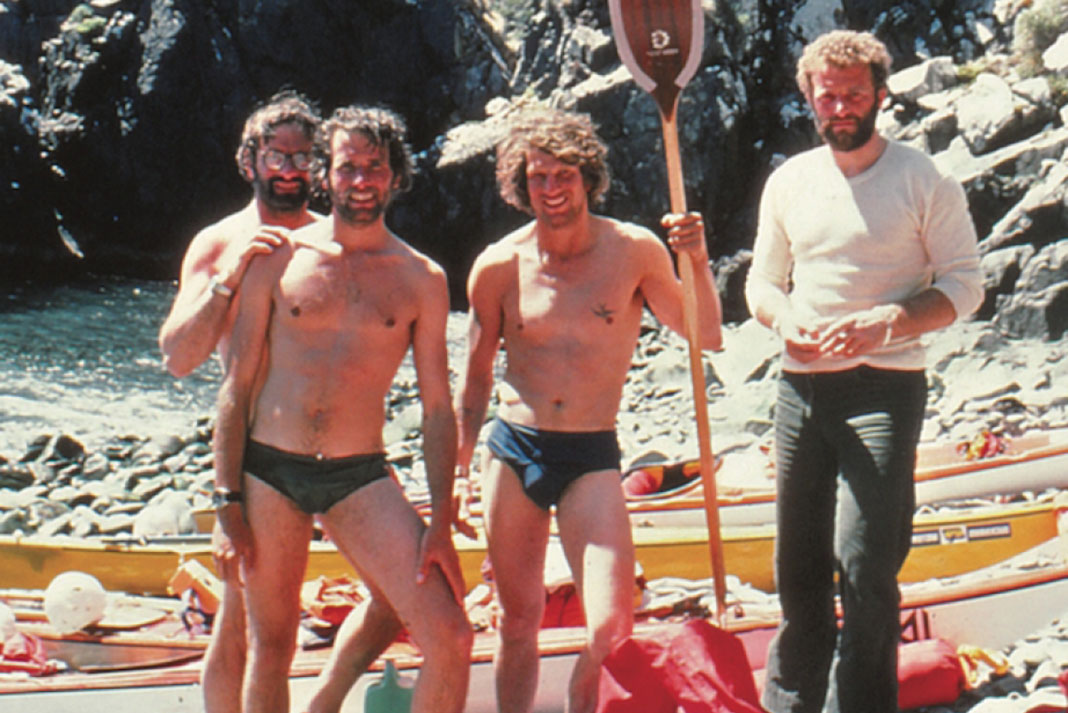
The kayak’s subsequent history is well documented. A Nordkapp resides in the collection of the British National Maritime Museum as “the archetypal sea kayak.” It became the go-to craft for a global hit list of circumnavigations. In New Zealand, a builder named Grahame Sisson began producing Nordkapp-inspired designs for the southern hemisphere. In its wake came other classics such as the 16-foot Selkie and Skerray XL for the North American market. In the mid-1980s, at the urging of close friend and fellow sea kayaker Stan Chladek, Frank built the round-chined Pintail ocean playboat modeled on the Anas Acuta that expanded the interest for shorter trips.

Through it all, the Nordkapp “was Frank’s baby,” Sam Cook says. He treated it like one, following its adventures with a fatherly pride. When the Nordkapp Expedition arrived at their destination in northern Norway, they saw someone signalling them from the top of the cape with a mirror. It was Frank, Doreen and their two daughters. “He was so interested in how these boats performed that he drove with his whole family up the whole length of Norway to meet us,” says Cook.
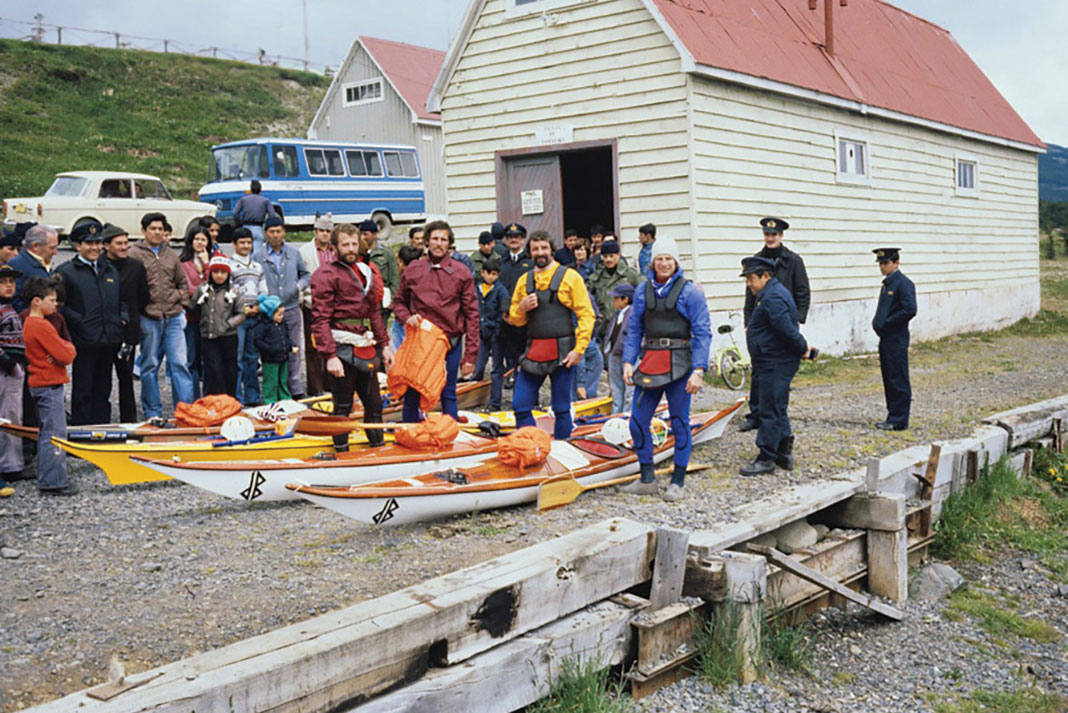
four expedition sea kayakers pose before setting off with a crowd and several police officer standing behind them
The Cape Horn Gang (from left to right Nigel Matthews, Barry Smith, Frank Goodman and Jim Hargreaves) with the Chilean Navy and well wishers in 1977.

Adventurer: The Cape Horn expedition

By the mid-70s Frank’s passions had turned almost exclusively to sea kayaking. One can imagine him looking out from the North Cape in 1975, dreaming of taking his baby on a grand expedition of his own. In 1977, he did. Goodman, Jim Hargreaves, Barry Smith and Nigel Matthews paddled Nordkapps around Cape Horn along Chile’s southern-most coast.

In the expedition report Frank describes himself, perhaps with a bit of self-deprecating exaggeration, as an overweight businessman, whipping himself into shape with mile-and-a-half lunchtime runs and Sunday distance paddles on the Trent. He also resumed whitewater slalom to get fit because he found training on calm water excruciatingly boring.

A newspaper clipping preceding the expedition with a picture of Frank is captioned, “Goodman says we should be alright.” It was comically typical, says his daughter Anna, who shared a laugh with her sister when they came across the clipping recently, “because all the time when were were kids doing all sorts of hair raising things, dad would be saying ‘we’ll be alright.’ That was sort of a family saying.”
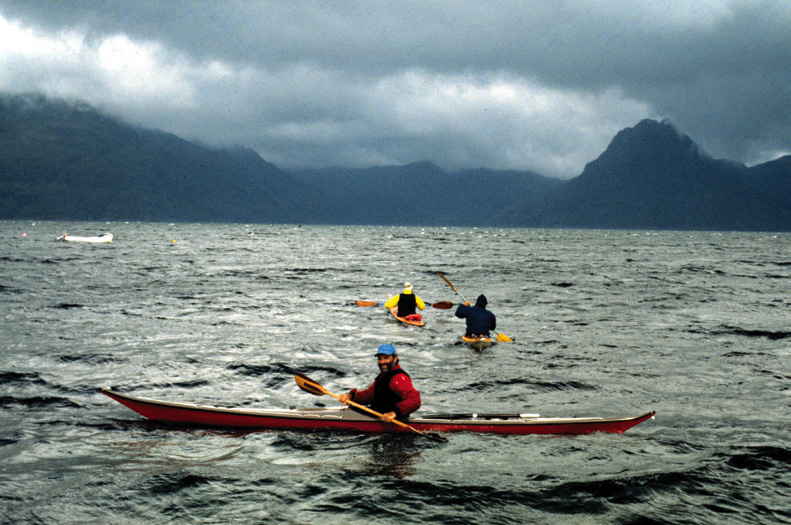
The night before the Cape Horn expedition was to depart, everyone went to bed except Frank, recalls Hargreaves. “He just disappeared down into his workshop. And when we got up in the morning he appeared with collapsible griddle that could be folded up and put inside the hatch of a kayak.

“He was always trying to improve things and he would pull all nighters all the time. Because he was fanatical about finding solutions.” Hargreaves said. “There was an idea bursting out of him every second, and he would pursue as many of them as he could.”

Frank’s pride in his own creations shines through in the expedition report, where he calls this campfire grill their most useful piece of equipment: “I made this as an afterthought a couple of hours before we left, and it saved many a meal from being deposited into the fire.”

He carried a weighty responsibility for the kayaks. “I felt that any malfunction or weakness could be laid squarely at my door,” he writes. One of the boats was found to be badly twisted from shipping and it was Frank’s job to straighten—heating it over an open fire and tensioning it in the crook of a tree overnight. After the expedition Frank asked for a critique of the Nordkapps. “They all replied that they hadn’t noticed the boats at all. I must admit that I took this to be the highest praise.” It was as if the trip to Cape Horn was driven purely by the desire to see how his beloved design would survive the ultimate sea trial.

“Dad was sort of larger than life in so many ways but he was quite a modest guy,” explains Anna. “I think partly because his standards were so high. You could never compliment my father. He was a very good soprano saxophonist but his idol was Sidney Bechet. If you said ‘that was really good’ he would say ‘it wasn’t really, it wasn’t as good as Sidney Bechet.’ The only time I ever heard him say he was really proud of himself was when he said he was proud of the Nordkapp.”

This was in later years, when she found a picture of him in a Nordkapp on the cover of an in-flight magazine. “He said, ‘I’m proud of that boat, really. I think it’s the thing I’m most proud of in my life.”

Frank Goodman was the Sidney Bechet of sea kayak design.
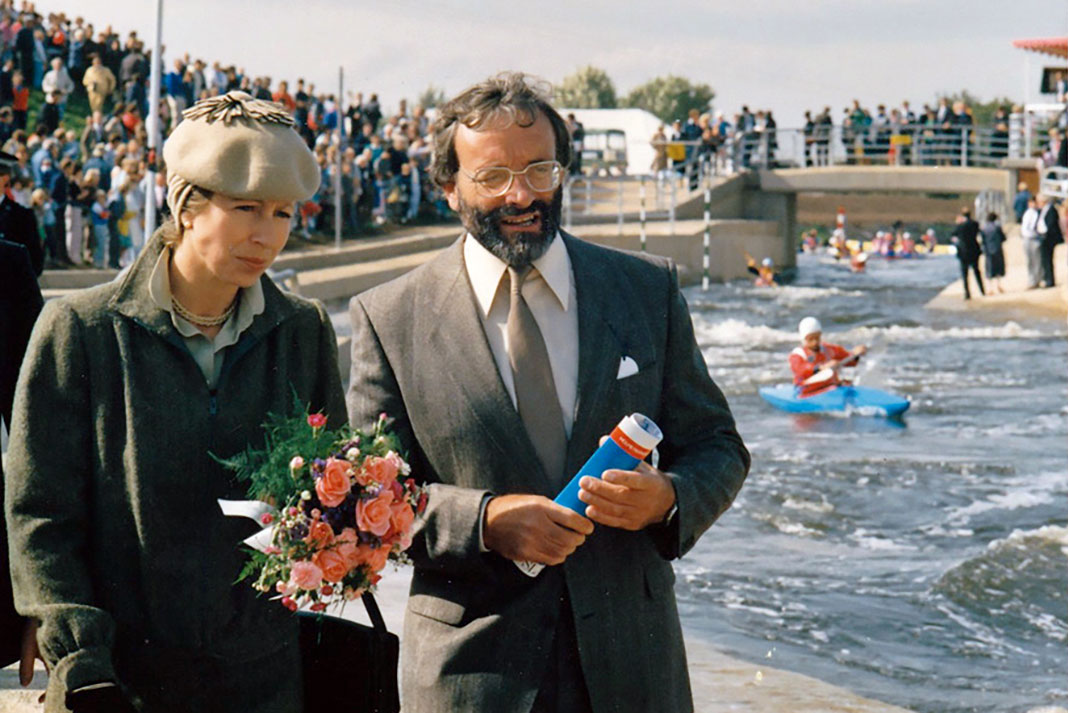
Princess Anne opens an artificial slalom course alongside Frank Goodman with crowds standing on a hill behind them
Her Royal Highness Princess Anne opened the artificial slalom course alongside Goodman who designed the Holme Pierrepont course.

Teacher: The symposium years

After Cape Horn, a man named Nigel Dennis was approaching U.K. kayak manufacturers with a dream of paddling around Great Britain, despite having never sat in a kayak before.

“Frank was the only one who took me seriously,” Dennis recalls. “He always had a lot of time for people.”

In 1980, Dennis and Paul Caffyn ultimately completed the British circumnavigation in Nordkapps and just as he’d done before, Frank came out to welcome them at the end. “He went out of his way to meet us a couple of times on our trip. He was always going out of his way to support us in the sport.”

Dennis went on to start his own kayak company and instructional business. He and Frank remained close friends and collaborators in promoting the sport. In 1985 they teamed up to launch a free gathering for Nordkapp owners—the Nordkapp Meet, which later evolved into the renowned Anglesey Sea Kayak Symposium. They also established the Nordkapp Trust, a worldwide organization to “promote safe and sociable sea kayaking.”
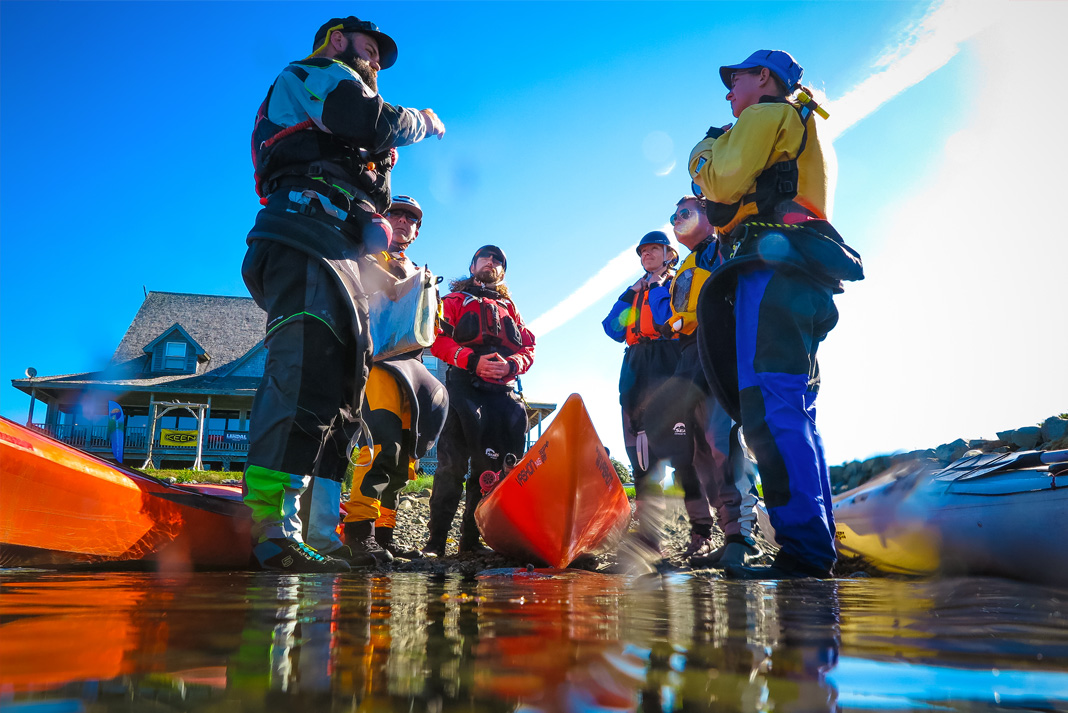
Year after year Frank was a regular lecturer and instructor at Anglesey and other symposiums like the Atlantic Coast Sea Kayak Symposium in Maine and the Great Lakes Sea Kayak Symposium started by his close friend Stan Chladek in Michigan. Attendees remember him as gentlemanly, polite and modest, giving time to anyone who approached him. In kayaking he found a way to combine three facets of himself, says his daughter Anna—the designer, the teacher and the risk-seeking adventurer.

Frank took Nordkapps to Baffin Island with his daughter, Anna and others to paddle and share knowledge about kayak building.

“He was always at great pains to impart knowledge to other people,” recalls Anna, who remembers him fondly as an enthusiastic father who was at times a taskmaster with high expectations. He once crafted her a slalom kayak and took pains to gel-coat her name into the hull in such a way that suggested she might be spending most of her time upside down.

“I remember once as a teenager…Dad was on the bank and I was practicing and he’d always be yelling about where to put the paddle and what to do. One day another competitor came up and said, ‘Who’s the awful man who runs up and down the bank and shouts at you?’ I said, ‘Oh yeah, that’s my dad.’”
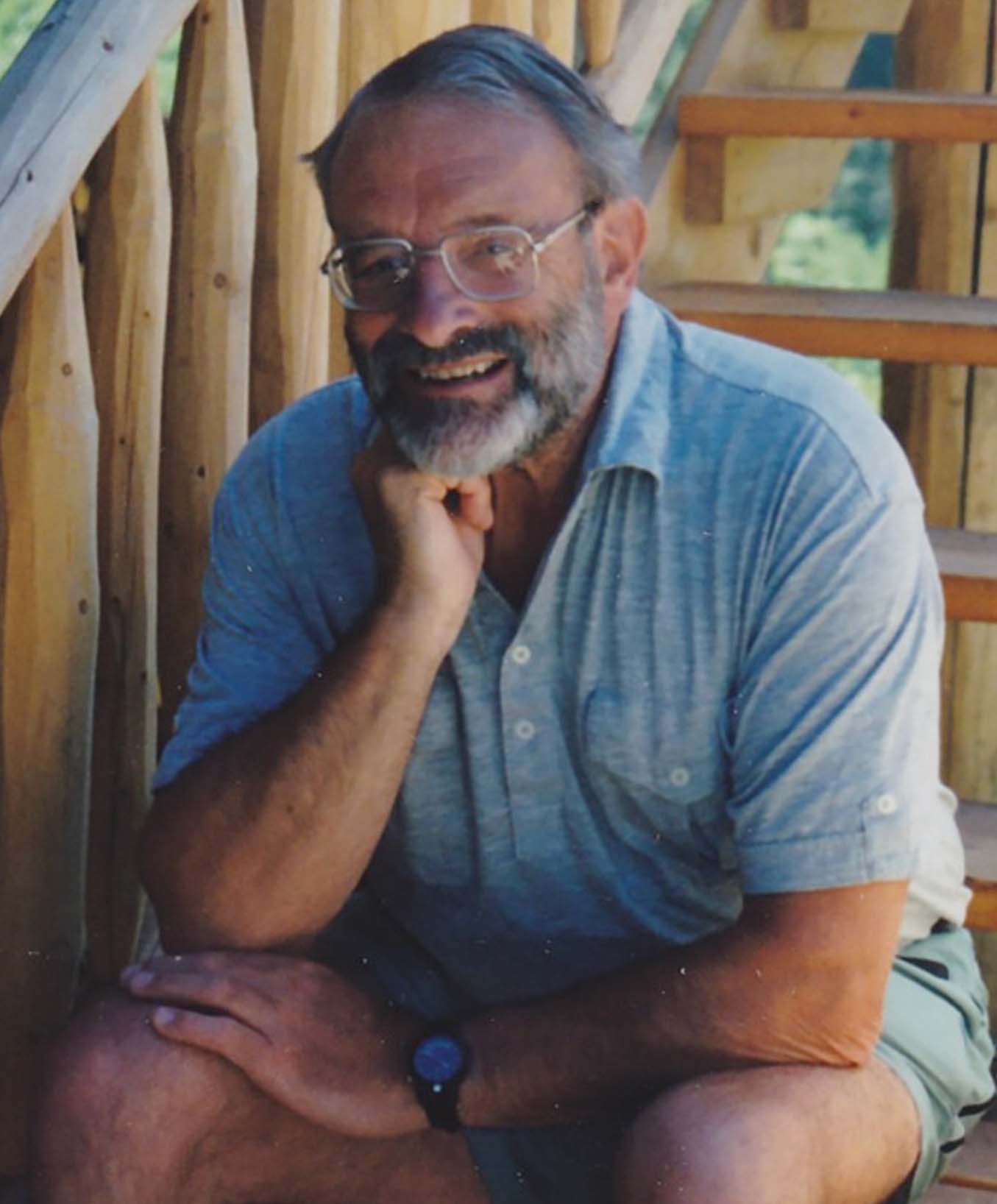
Frank Goodman poses while sitting on the steps of a friend's cabin in Colorado
Goodman sitting on the steps at Stan Chladek’s cabin in Colorado. Frank and Stan were great friends, colleagues and fellow adventurers who paddled together in the United States and in Ireland.

Multifaceted Frank

Frank Goodman was always looking for a creative challenge. His interests ranged far beyond kayaking. Jim Hargreaves describes him as a great raconteur, a member of MENSA and a jazz fanatic with an impressive vinyl collection. Hargreaves would teasingly call it “a cacophony of disjointed, disconnected notes,” much to Frank’s scorn.

“He looked a bit like Acker Bilk—he had the same goatee beard and I think that was a nod towards the world of jazz. That was the beauty of Frank. He was a multifaceted individual. You could not possibly be bored,” says Hargreaves, who kept in touch with him for all the decades after the Cape Horn trip and delivered a eulogy at Frank’s funeral in April.

Hargreaves remembers the time Frank thought he’d come up with a revolutionary design for a sailboat, with a symmetrical hull that could be sailed in any direction. The boat sank on its maiden voyage in an icy lake with Hargreaves at the helm. “Nothing was sacred to his ingenuity, even the idea of the principle of sailing, which has been around a long time,” says Hargreaves. “As a result of his intense curiosity and stubbornness were enormous improvements and developments to existing boat design and equipment design. His characteristics were very ingenious, very creative, very determined while at the same time he always liked to use the simple approach.”

Frank designed a lot more than kayaks. As far back as the Cape Horn trip in 1977, his design credits included the Slip-on Skeg, Tie-Beam Fail Safe Footrest, Tailored Air-bag buoyancy and Chevron Buoyancy Aid. Frank would not only design equipment, he’d then design the machinery to manufacture it, recalls Hargreaves. “He designed these simple, super little white plastic toggles and basically sold them to the entire world. Every boat had them—before then they just had end loops. He probably made more money off a simple little item than he ever made spending six months designing a new kayak.”
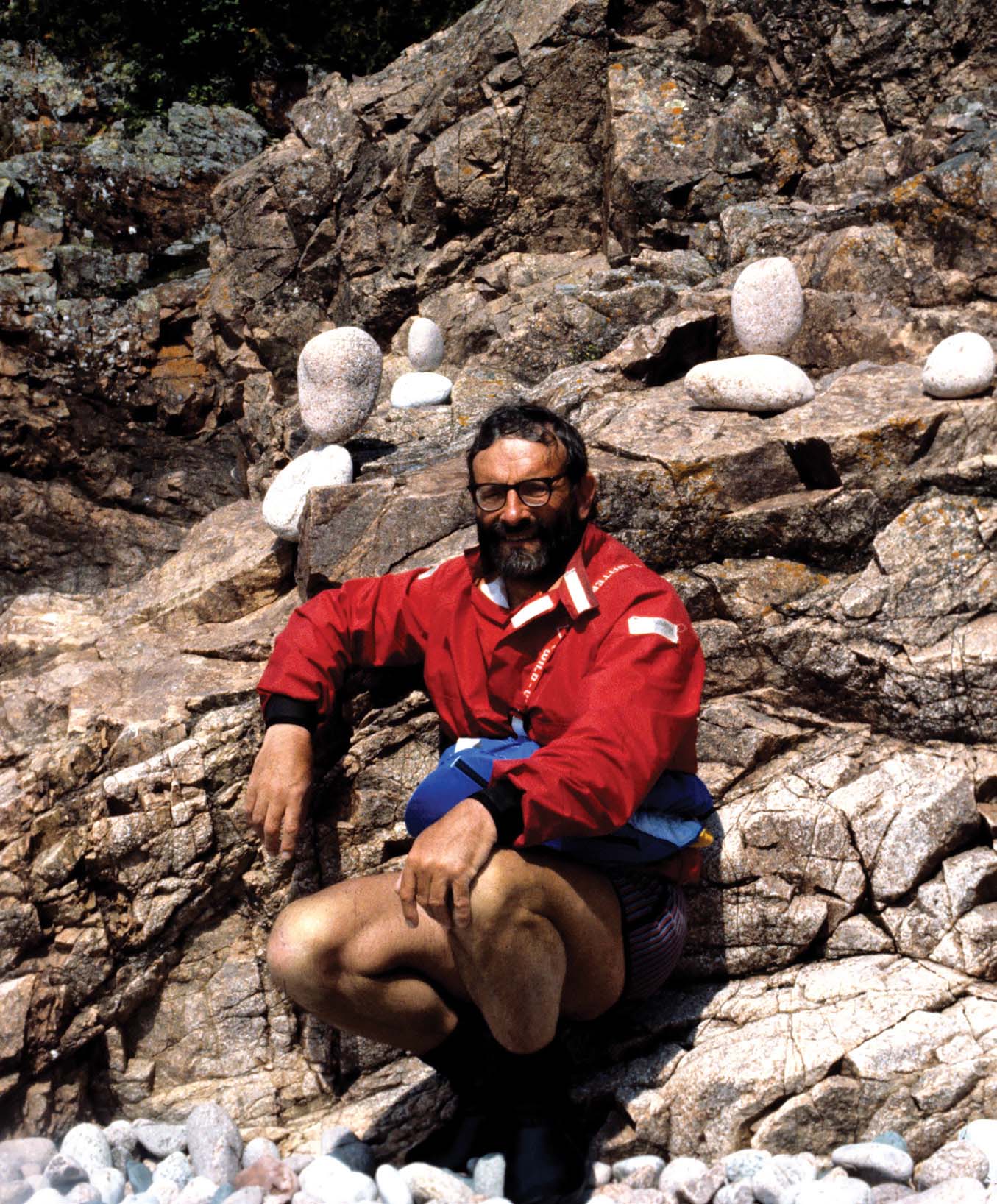
Frank Goodman poses in red drytop on a rocky, pebbly beachIn the mid-2000s, Frank sold Valley Canoe Products, which still turns out 40th anniversary-edition Nordkapps under the name Valley Sea Kayaks. In his seventies, Frank had to give up kayaking after back surgery, so he took up flying instead. He showed up in Anglesey with an ultralight “powrachute” aircraft and later became a master paraglider, making cross-country flights all over Europe. When he tore his rotator cuffs and couldn’t fly anymore, he returned to his love of jazz, mastering the soprano saxophone. Anna, who had worried what would happen to her adrenaline-loving dad as he aged, marvelled at this adaptability: “He really coped with getting older and he did it with his usual thoroughness, dignity and aplomb.”
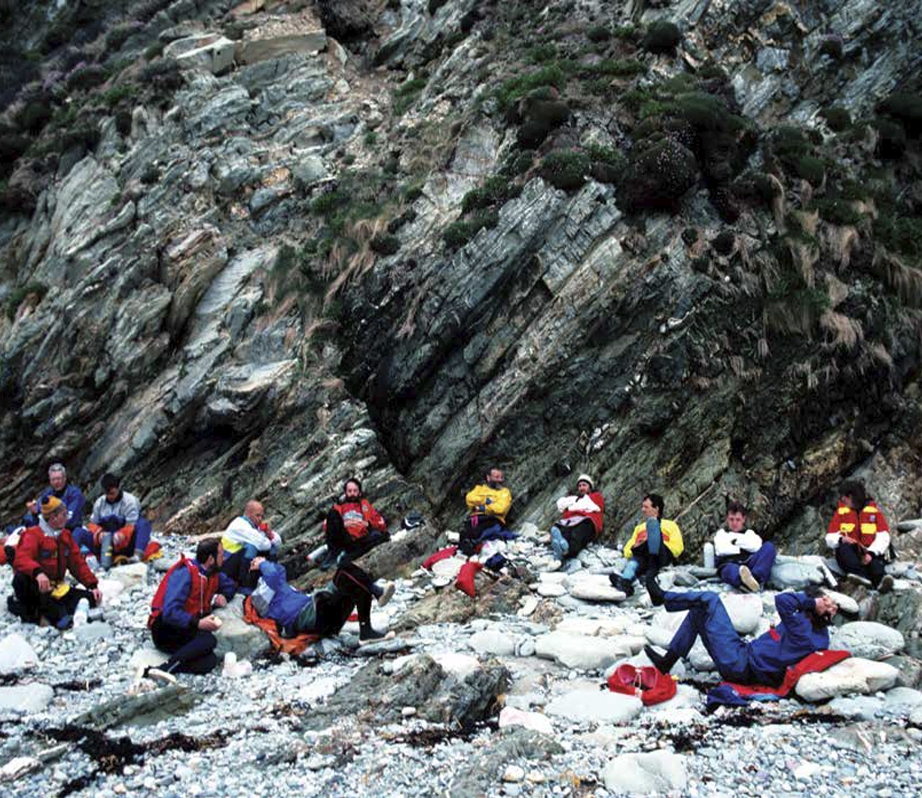
Anna would often join Frank for sailing trips on the Mediterranean. Even then he was testing limits—always wanting to navigate the boat in tight and shallow places instead of taking the safest routes. “He did like to push; even when he was in his eighties he liked to get the maximum fun out of everything,” she says, remembering a telling quote from his Cape Horn expedition report that reads:

“There are two types of dreams that people are apt to indulge in: one is the pipe-dream, where the brain conjures up a fantasy that is so manifestly beyond the possibility of fulfilment, that no positive steps are ever taken to try and achieve realisation. The other is the dream that stimulates action because its substance is not completely beyond the bounds of possibility.”

That quote sums up Frank Goodman, his can-do mentality, his remarkable ability to take dreams from the limits of possibility and to turn them into a reality that has touched us all.

Tim Shuff is a former editor of Adventure Kayak. He bought a new Nordkapp in the mid-2000s and paddled it on both the Pacific and Atlantic coasts, including the Southwest Coast of Newfoundland (Adventure Kayak, Summer 2008). He then sold it for more than he paid for it, but wishes he hadn’t.


Goodman, Stan Chladek and their Nordkapps in Tallisker Bay, Isle of Skye, Scotland, summer, 1987. | Feature photo: Doreen Goodman
 

5 Common Mistakes To Avoid When Buying A Paddleboard

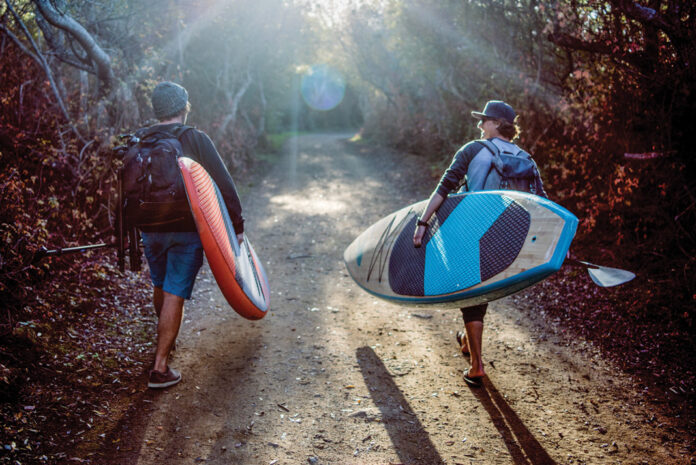
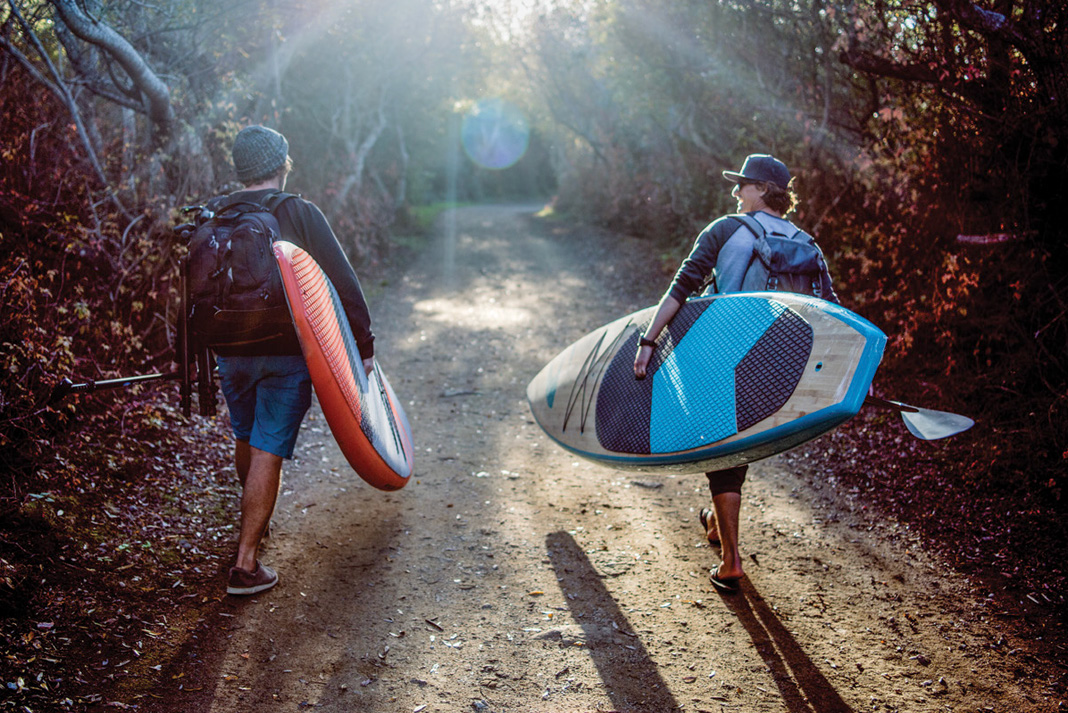
two men walk down a sunlit path carrying inflatable paddleboards and paddles
Happy customers. | Feature photo: Ben Horton

The growth and accessibility of standup paddleboarding has led to a crowded marketplace filled with hundreds of brands and models. It can feel overwhelming to shop for a paddleboard, but being aware of these five common board buying mistakes will help you pick the right one.

5 common mistakes to avoid when buying a paddleboard

1 Buying from a big box store

Earlier this year, I was shopping for home supplies when I came face-to-face with a paddleboard display outside of a big box store. They were selling a package deal of foam board, plastic paddle and leash for $400. Good deal? Not likely. Not only would any burgeoning enthusiast out-paddle that board within the season, knock-offs typically offer less durability and questionable performance. Instead, take that $400 and invest it into the high quality board that you’ll want to upgrade to in a couple months anyway. Even better, buy from your local paddle shop, who can share their expertise and introduce you to the local community.

two men walk down a sunlit path carrying inflatable paddleboards and paddles
Happy customers. | Feature photo: Ben Horton

2 Buying before trying

You wouldn’t buy a new car before test-driving it, or buy a new home without getting it inspected, so why would you buy a board without trying it first? Take the time to get some boards on the water, discover what feels right and make your first SUP investment a wise one.

3 Not investing in good instruction

Anyone can buy a board and take it out on the lake to putz around. However, for those who want to achieve a little power, efficiency and finesse, taking a skills class will make the most of your purchase. Too many paddlers spend frustrating weeks attempting to catch a wave or master buoy turns, when a simple one-hour session with a pro would offer the building blocks for success.

4 Defaulting to inflatables

It’s one thing to buy an inflatable because it’s perfect for the type of water and paddling you do, or because you don’t have enough storage space for a rigid board. It’s another thing to default to inflatables because they seem (falsely) “easier” or to avoid the minimal hassle of buying and installing roof racks. Too often I meet people who bought an inflatable without having ever inflated a board. Be assured it takes a bit of time and energy—not too much, but some. Even after using an electric pump most boards need to be finished by hand to achieve performance-level rigidity. Try pumping up a friend’s board before you buy, and then decide if it’s a ritual you want before each paddling session.

5 Sticking with the same board

All of us grow attached to our boards, but as skills increase, sometimes we outgrow our boards. In a recent paddleboard instructor certification class, one of the candidates asked me for tips on his forward stroke. We had just worked on refining stroke technique and he felt that the board was turning too much instead of going straight. What he assumed was flawed technique was instead due to the board—it wasn’t optimal for his height, weight or growing paddling ability. He really should have been paddling a 12.5-foot touring board instead of the 10.5-footer he had purchased. As you refine your skills and explore new types of water, be open to trading in for a new model that suits your growing abilities and interests.

[ Paddling Buyer’s Guide: View all paddleboards ]

Instructor Anna Levesque runs women’s paddleboarding camps through her company, Mind Body Paddle.

Cover of 2017 Paddling Buyer's GuideThis article was first published in the 2017 Paddling Buyer’s Guide. Subscribe to Paddling Magazine’s print and digital editions, or browse the archives.

Happy customers. | Feature photo: Ben Horton


How To Paddle A SUP Safer: Know Your Limits

We all know the feeling, you are the proud owner of a new kayak or SUP. You want to get on the water immediately. But you have to be careful to not get in over your head. You have to know your limits.

When you take your SUP out for it’s first test run, you have two choices. You can find a nice calm spot of water to get used to your new board, or you can take it directly to the waves. To practice safer paddling, you must know your limits.

“This is Larry. Larry is a standup paddling enthusiast. Larry has something to prove.

Often Larry’s confidence exceeds his abilities, which can lead to problems, leaving Larry unprepared for his recreational paddling experience.

For Larry, one choice makes all the difference. Excellent choice, Larry. Always know your limits.”

If you are not a seasoned paddler, it’s safer to find a spot of calm water and get used to your new board. The video above is fun, but the point is serious. If you don’t know your limits, you could end up in serious trouble.

Know your limits before you hit the water.

How To Share The Waterways

Photo by: Larry Dostal
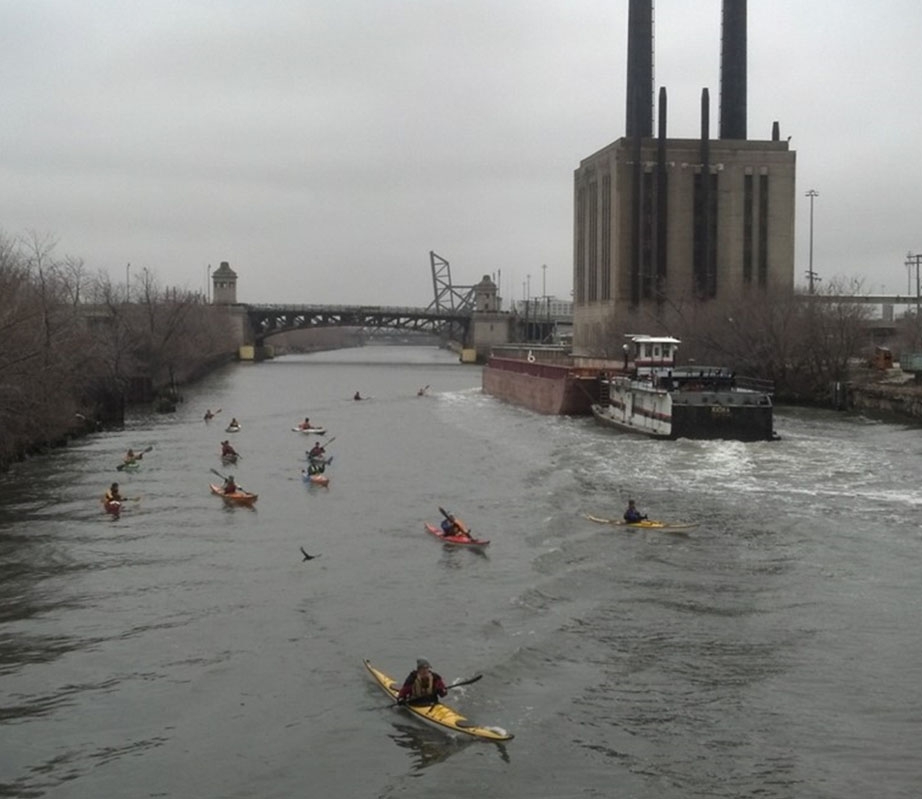
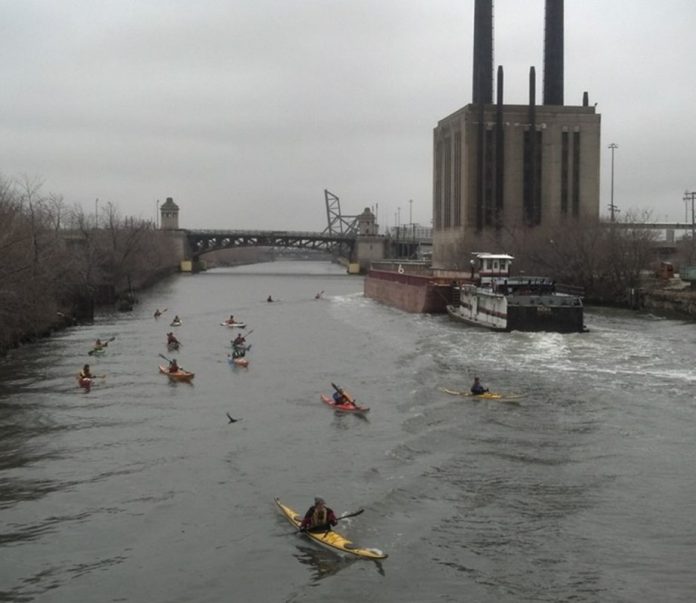
A group of kayakers paddling near a barge.

As summer gets closer and more boats are hitting the water, it is important for everyone on the water to be aware of others sharing the waterway. The United States Coast Guard has issued Marine Safety Alert 04-17, a shared waterway alert.

“This Safety Alert reminds all operators of powerdriven, sail, and human propelled vessels of the importance of maintaining a sharp look-out while on a shared waterway and recommends that all recreational boaters carry a DSC-VHF marine radio in order to communicate with other vessels.”

[ Paddling Buyer’s Guide: See All SUP Leashes & Safety and Rescue Gear ]

The safety alert arose from a recent accident involving a passenger ferry and a group of kayakers on a busy metropolitan waterway. According to the alert “The incident occurred during late afternoon while the sun was low on the horizon with an angle of about 15 degrees and the ferry was heading westerly into the sun’s glare.

The ferry had just begun its voyage and was operating at about 20 knots across the waterway while a group of kayakers was ahead of the ferry and heading south. The low angle of the sun created significant glare on the water, obstructing the ferry operator’s view of the kayakers who were within the reflected light.

The kayakers did not have a DSC-VHF marine radio with them and they were unable to hail the ferry. The ferry subsequently collided with multiple kayaks resulting in two serious injuries.”

In order to safely share the waterways, you must have a good working knowledge of the Navigation Rules before entering the waterway. These rules include Steering and Sailing Rules, Conduct of Vessels in Sight of One Another, and Conduct of Vessels in Restricted Visibility.

Photo by: Larry Dostal
A group of kayakers paddling near a barge.

You must also understand proper nautical lighting and shapes, as well as the the sound and light signals that may be encountered in order to take appropriate actions to prevent collisions.

According to the Safety Alert, The Coast Guard also strongly recommends “that all paddlesport enthusiasts participate in boating safety education as well as taking paddlecraft specific skills training. Additionally, the following best practices should be considered every time before going out on the water:

  • Always wear a Coast Guard approved life jacket
  • Make yourself be seen (bright / contrasting clothing)
  • Carry a sound producing device such as a whistle
  • Carry a DCS-VHF radio • Know your paddling limits
  • Know the area where you will be operating
  • Avoid paddling in main channels of busy waterways when possible
  • Dress appropriately for the water temperature and forecasted weather
  • Don’t paddle alone
  • Tell a friend where you are going and when you will return – file a float plan.
  • If you plan to be out after dark, you will be required to exhibit an all-round light or have a flashlight readily available
  • Don’t drink alcohol and operate a boat or paddlecraft”

Online information on Shared Waterways is available at TheSafeHarbors.us

View the full Marine Safety Alert here…

Video: How to do a Loop

Over the many years, I have been teaching kayakers it has always been a goal of mine to stay current with the evolution of our sport. This has meant many minor (and some major) tweaks to teaching progressions to ensure that our team is delivering content and information that lines up with modern paddling techniques.

Being in Western Canada, much of this focus has been on developing creative and successful progressions for creeking and river running as most of our clients are interested in that realm. One day a year or so ago it struck me that although I still playboat a bunch that I had neglected to stay current with how to teach modern playboating moves.

With this realization, I went full blast last season trying to put together (and put into practise) a solid freestyle progression for beginner paddlers all the way through to those starting to play around with aerial moves (both on waves and in holes). That is where this video and progression stemmed from. It is a slight departure from many how to loop videos in that it breaks the move down into 5 easily practised components and hopefully gives aspiring freestyle paddlers a set of smaller goals to attain, and in doing that the loop will be an easier to achieve and less frustrating goal.

Step 1

Find an appropriate feature.  It needs to be a hole, reasonably retentive, ideally with good eddy service and one you are comfortable moving around in.

Step 2

The 5 steps of the loop:

The Setup: This is simply how you get lined up to the upstream current.  The video outlines a couple of different techniques

The Plug: Initiating the bow in the green water coming downstream (basically in the seam between whitewater and green water).  How you go about this depends on the depth and size of the hole.

The Stomp: Here, we stand up on our foot pegs to plunge the bow deeper into the green water in turn loading up the volume in the kayak.

The Jump: Once the plug goes as deep as it can, we now want the volume to release in an upwards motion.  In this stage, we jump up and a little upstream whilst sucking our hips towards the sky.

The Finish: The last step as we bring the boat over our head and complete the loop.  As the boat comes over your head you lay out backwards and throw your feet towards the green water.  Then sit up once you’ve landed and you are done!

Step 3

It is important (IMHO) that you practise each stage until you are successful about 90% of the time.  Once you achieve that, add the next step on until you have all 5 combined and a loop is achieved.

Thanks for checking out this instructional video, we hope it is useful and helps get you looping at your local play hole and beyond.  If you have any further questions, please don’t hesitate to contact us at courses@aquabatics.com.

For more great instructional videos check out our You Tube channel at www.youtube.com/aquabaticscalgary or our website at www.aquabaticscalgary.com.

How To Choose The Right Inflatable PFD For Paddleboarding

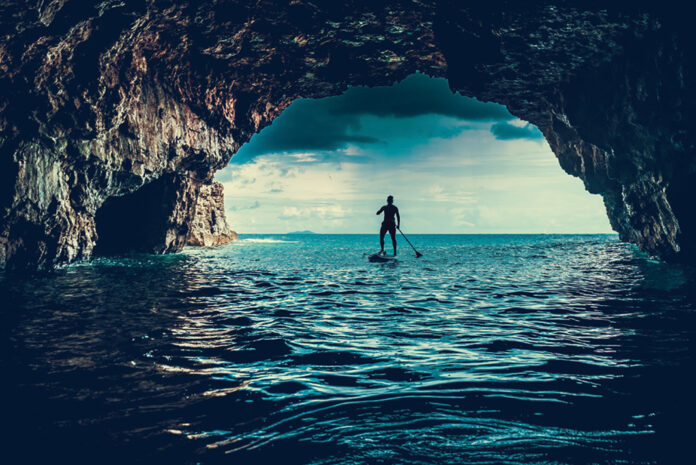
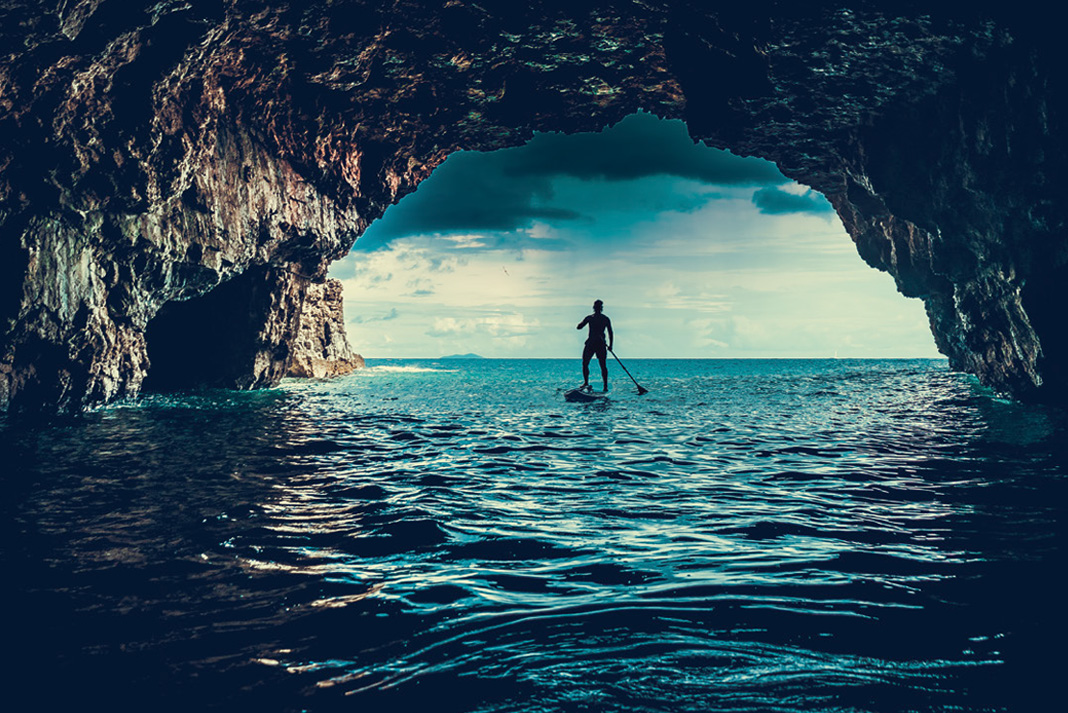
person paddleboarding into a watery cave entrance while wearing an inflatable PFD
An inflatable PFD for paddleboarding can be your bridge over troubled waters. | Feature photo: Simon Podehradsky

“Everything’s okay, until it isn’t,” says Hawaiian big-wave surfer Roger Erickson, referring to the perils of surfing in giant waves. His quote applies equally to standup paddlers—even on a perfectly calm day. Everything’s okay until the wind comes up, a current sweeps a paddler out to sea or someone ends up in the cold water. That’s just one reason why choosing and wearing the right inflatable PFD is so important for paddleboarding.

The other reason is to avoid a ticket. Despite the toned and PFDless beach bodies decorating industry ads and Instagram photos promoting the #SUPlife, U.S. Coast Guard regulations are clear. Paddleboarders are required to carry an approved PFD at all times when outside of the surf zone or an obvious bathing area.

How to choose the right inflatable PFD for paddleboarding

Despite the risks and U.S. Coast Guard regulations, PFD use by the recreational paddleboarding community remains spotty. A 2012 survey by the American Canoe Association estimated just 25 percent of paddleboarders always wear a PFD when on the water. Amongst paddleboarders, inflatable PFDs have been used with far greater frequency than foam-filled flotation vests. This is because inflatable PFDs have many advantages: the minimalist designs are low profile, cooler in hot climates, and offer an unrestricted range of motion and fewer tan lines.

“When standup hit the ground running after Outdoor Retailer in 2009, I knew that this was the place to focus our attention,” says Lili Colby, co-owner of PFD manufacturer, MTI Adventurewear. “MTI has made inflatable belt packs since 2006. We went from selling a few hundred belt packs a year to thousands. All because of standup.”

a person standup paddleboarding near a cave entrance while wearing an inflatable PFD
An inflatable PFD for paddleboarding can be your bridge over troubled waters. | Feature photo: Simon Podehradsky

Automatic versus manual inflation

More than a dozen companies are now manufacturing inflatable PFDs. Two types are available: automatic and manual. Both have an inflator mechanism that triggers a CO2 canister to fill the PFD’s bladder. In manual designs, inflation must be initiated by a conscious paddler who pulls the vest’s inflation tab, piercing the CO2 cylinder.

An automatic PFD inflates when a water-soluble bobbin comes in contact with water, releasing a spring-loaded pin that punctures the CO2 canister.

Both types of inflatable PFDs have a manual inflation tube for inflating the PFD by mouth in case of mechanical failure.

An automatically inflating vest could save a paddler’s life if they were knocked into the water unconscious. However, in lower end models, automatically inflating vests have been known to deploy when exposed to heavy rain. Beginners and some recreational paddlers may also find themselves falling off their boards and in the drink regularly, so a PFD that inflates on contact with water may be a nuisance.

Waist belts versus collars

Inflatable PFDs come in two styles: waist belts and collars. A waist belt must be worn in front, so that when the horseshoe-shape bladder pops out, it’s easy to pull over a swimmer’s head, Mae West-style.

“Have you pulled a waist belt?” asks veteran paddleboarding instructor, Rob Casey. He recommends practicing so that managing paddle, board and pulling the inflated bladder over the head is a fast and familiar process when it counts.

“Swimming with inflatables isn’t much fun,” cautions Casey. “The inflated part is wrapped around your neck and lower head, so it’s hard to see.” Paddlers who want flotation for non-emergency scenarios would do better to look for foam-filled flotation vests.

man standup paddleboarding while wearing a belt pack inflatable PFD
A waist belt must be worn in front, so that when the horseshoe-shape bladder pops out, it’s easy to pull over a swimmer’s head. | Photo: Reed Naliboff/Unsplash

Other considerations

Inflatable PFDs are also not recommended for use in whitewater. Paddlers in cold climates or frigid waters may prefer foam flotation vests, which provide core insulation and may help protect against hypothermia during immersion.

“In my experience, a first-time paddler should be wearing a non-inflatable PFD [in case they panic],” recommends Starboard paddleboard athlete, Dan Gavere. It’s up to everyone else to weigh the pros and cons of inflatables and foam vests and pick what’s right for them.

While there are advantages to each style, ultimately the best PFD is the one you always wear. “Inflatables are certainly a better option for hot environments, where vest styles are simply too warm,” says Casey.

Benjamin Marcus is the author of The Art of Stand Up Paddling, and the former editor of Surfer magazine.


An inflatable PFD for paddleboarding can be your bridge over troubled waters. | Feature photo: Simon Podehradsky


The Myth About Mindfulness

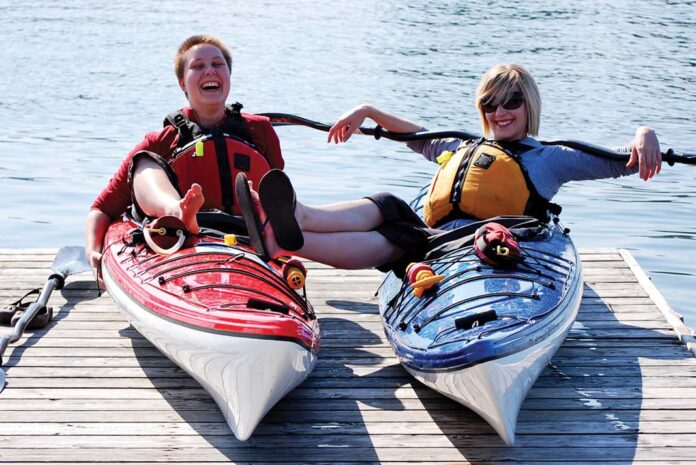
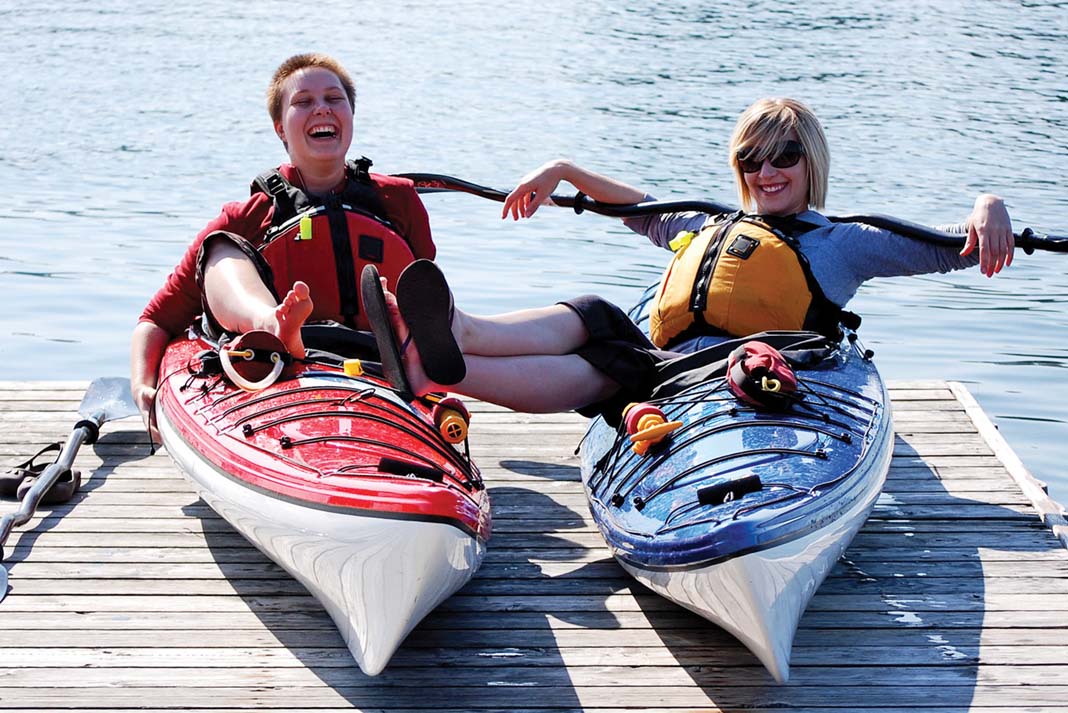
two women lounge on sea kayaks on a dock while laughing
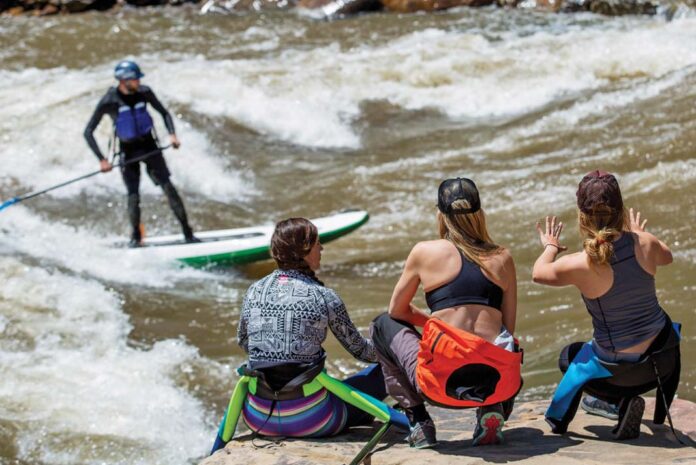
Side effects may include uncontrollable fits of laughter.| Feature photo: Evan Boyd

Everywhere I look these days, there are weekend mindfulness retreats, five-minute stress reduction regimens and self-help gurus proselytizing the four-day work week. “Slowing down” and “being mindful” have become pop culture catch phrases, but by seeking shortcuts to enlightenment we risk missing the point entirely. What can slow travel teach us about retreats that truly calm our anxieties?

The Myth About Mindfulness

Meditation and mindfulness programs in classrooms, businesses and even medical practices promise everything from soothing the savage pre-schooler to increasing workplace productivity and helping to heal disease. People seeking to unplug from the over-connectivity and constant busy-ness of modern life are looking to mindfulness for the antidote. Yoga studios and commercial meditation centers are booming. Across our culture, there is a growing recognition that fostering inner stillness, slowing down our pace and taking a break from our technological addictions has immense benefits for our physical, mental and emotional health.

Take, for example, the outdoor industry where average trip lengths and program durations have grown ever briefer in response to participants’ lifestyles and demands. Time outside has become one more thing to cram into our busy schedules; hurried at best, irrelevant at worst.

Exploring the wilderness of the mind

One promising area of growth has been wilderness expedition-based mindfulness programs. I’ve been involved first hand as a program director and senior instructor for an organization that has been steadily building a raft of these programs over the past 10 years.

Side effects may include uncontrollable fits of laughter.| Feature photo: Evan Boyd

In 2012, I found myself signed up to instruct a nine-day mindfulness backpacking course. I arrived to the pack-out day unaware that the marketing department had sold my eight students on this curriculum. Amidst the usual flurry of course planning and logistics, I fretted about being unable to deliver the promised experience. Although I had some personal background with meditation and was a student of Buddhism and mindfulness-based practice, I had never been trained as a teacher and had no small measure of imposter syndrome.

To further complicate matters, the route that had been sold to the students on our website was a committing and physically challenging hike for novice backpackers. How were we going to fit the distance in, along with the promised hours of cross-legged beach-sitting, expectations of slowness and time for long, contemplative silences?

On that course, while neither the students nor myself got what we expected based on our previous associations with mindfulness, the experience provided many of the associated benefits. The innate qualities of time in the wilderness and group process did much of the work for us, no Shavasana required. Over the years since, I have adjusted my view of just what mindfulness is and how it can be achieved.

Mindfulness on the move?

Mindfulness may be one of the buzzwords of this decade, but what does it really mean? The Oxford English Dictionary defines midfulness as, “a mental state achieved by focusing one’s awareness on the present moment, while calmly acknowledging and accepting one’s feelings, thoughts and bodily sensations….” When we think about meditative practices, many people envision long hours of physical stillness and gratuitous navel gazing. But when we look more closely, it doesn’t necessarily exclude movement and purposeful activity. Indeed, it’s possible the repeated challenges that pop up and resolve themselves over and over in the course of a backpacking or paddling trip contribute to the sense of calm, centeredness and inner peace that are said to result from more sedentary practices.

If mindfulness is inherent in time spent outside, then the outdoor industry could be considered far ahead of the curve. Recently, however, another trend is pulling us in a conflicting direction.

Mindfulness promises everything from soothing the savage pre-schooler to increasing workplace productivity.

Witness sea kayaking: In the ‘90s, images of kayaking featured idyllic calm waters and a relaxing tranquility. The activity had an approachability that suggested only a minimum of technical skill was required. In the past 20 years, that image has shifted away from a gentle pursuit for the novice adventurer to an activity focused on cutting edge equipment, technical instruction and hard-core adventuring.

To use a term coined in a recent article in Adventure Journal, sea kayaking—along with the rest of the outdoor industry—is becoming “bro-ified.” In so doing, we’ve begun to alienate those attracted to its more esoteric qualities. We’re in danger of missing out on the societal need for retreat, of becoming irrelevant.

Contemplation can’t be rushed

The mindfulness revolution is a Band-Aid cure to the problems plaguing our culture today. We fail to take the time we need to stay healthy and sane, away from modern distractions, so we look to these programs and other trendy prescriptions for a fast fix.

Physical, nature-based activities like kayaking are the real deal and, irrespective of public image, they’re accessible to anyone. While it’s exciting to celebrate the achievements of daring outliers, we need to do a better job as an industry and as individuals of promoting the far-reaching benefits of slow travel. Kayaking trains us to focus on the present moment authentically. It forces us to take time away, in order to come back to the here and now.

Fiona Hough has worked as a paddlesports guide, instructor and trainer for more than 25 years.

cover of Adventure Kayak Magazine, Spring 2017 issueThis article was first published in the Spring 2017 issue of Adventure Kayak Magazine. Subscribe to Paddling Magazine’s print and digital editions, or browse the archives.

Side effects may include uncontrollable fits of laughter.| Feature photo: Evan Boyd


Face Lift: Inside The Restoration Of Durango Whitewater Park

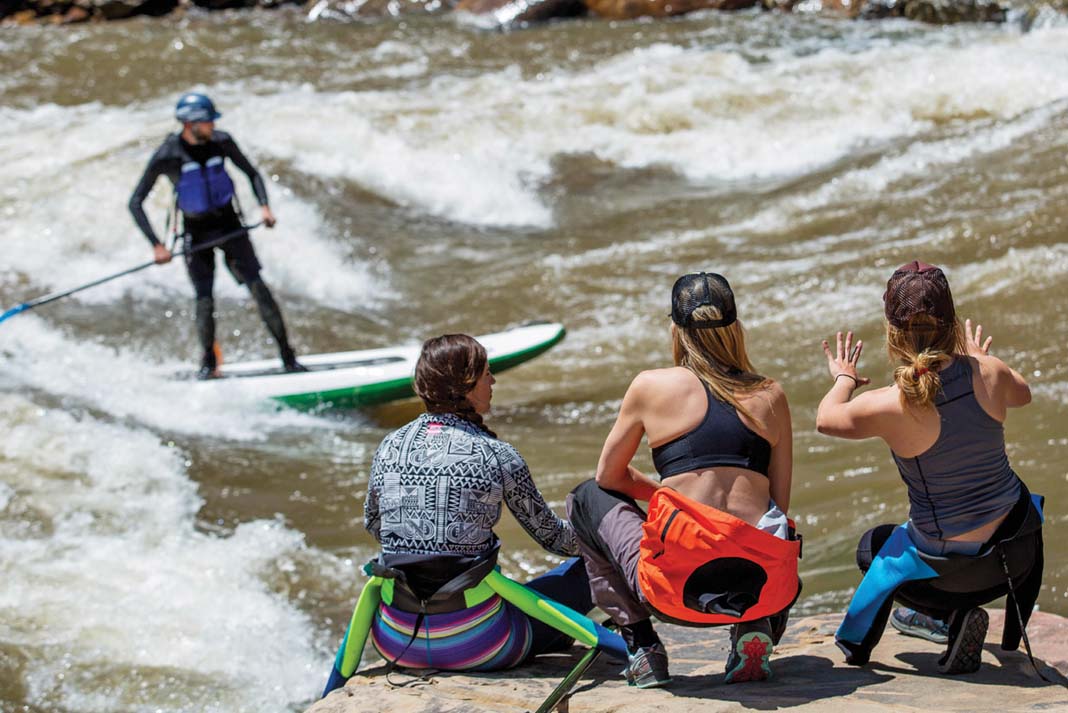
“10 SECONDS UNTIL HE BAILS...”| PHOTO: HEATHER JACKSON

It was a bright fall day in Durango, Colorado, and seven young slalom kayakers were training after school on the Animas River. As they worked on skills with coach and Olympian Cathy Hearn-Röthenmund, another group of kids in the local mountain bike club did interval work on the trail that runs alongside the river, often full of birders, cyclists and young families. This was a quintessential moment in Durango, a town with a fiercely strong paddling community and a whitewater park that ties them all together. A 2006 study showed whitewater recreation on the lower Animas had an annual economic impact totaling $19 million.

Inside the restoration of Durango Whitewater Park

The young paddlers that day were just a tiny fraction of the passionate river users drawn to the Animas and the 1,200-foot-long Durango Whitewater Park. Local paddling legend Kent Ford estimates roughly one-third of the 18,000 residents of Durango own a raft, canoe, kayak or paddleboard. Located less than a mile from downtown, the parking lot near the river is often full of boats, boards, inner tubes and duckies adorning roof racks.

One of the oldest whitewater parks in America, Durango continues to undergo upgrades to make the park safer and more suited to a wider variety of users. Enthusiasts, along with commercial rafting companies and private rafters, come for waves like Smelter, Corner Pocket, Ponderosa and Clock Tower. These year-round paddling opportunities for Durango residents are an important part of the local economy.

“10 seconds until he bails…” | Feature photo: Heather Jackson

The original Durango Whitewater Park was built in the early 1990s. Rocks the size of 55-gallon trash cans were placed in the river, but since the rocks were not grouted down, the free-flowing Animas altered their position season to season. When the city of Durango secured recreational water rights to preserve the river’s natural flow for boaters, upgrades were required at a construction cost of approximately $1.5 million.

Scott Shipley, owner of S2o Design and Engineering, says the design process and modernizing the park was tricky. “There’s a lot of stakeholders in that town,” he says.

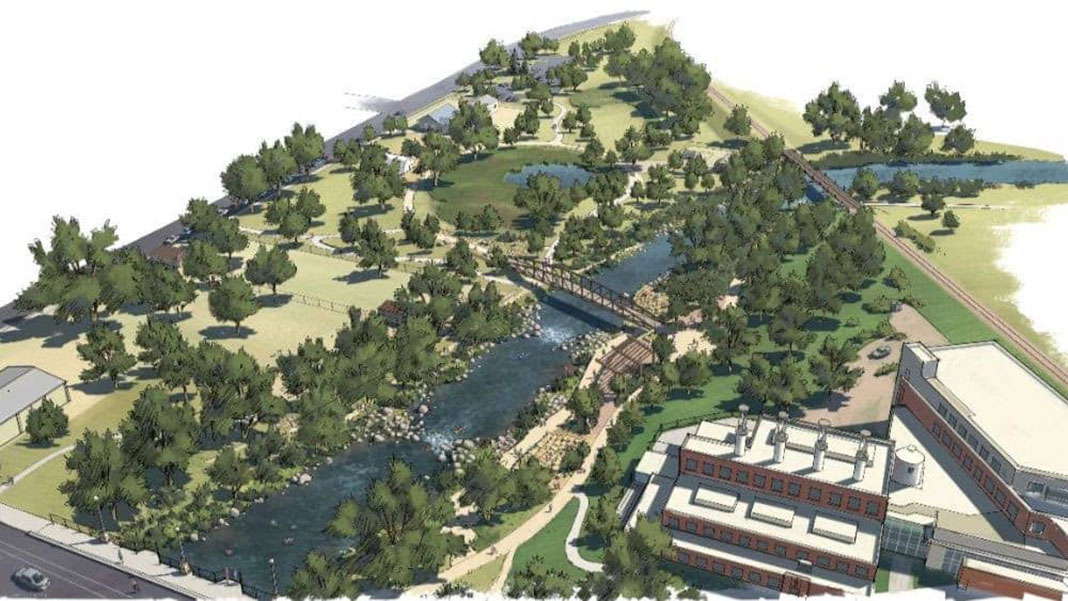
After an extensive consultation and public process, S2o redid the entire reach of the park beginning in December 2013, creating two new waves—Ponderosa and Clock Tower—and restoring two old waves—Smelter and Corner Pocket.

Durango’s grand re-opening

The updated park opened in 2014 and in a town saturated with paddlers, everyone has an opinion on the rebuild. Many are pleased, especially as the changes provide a more exciting experience when water levels are low. However, some local rafting companies argued that rebuilt features negatively affected their trips and necessitated portaging around waves known for flipping rafters at high water.

This winter S2o will do some further fine-tuning on Ponderosa and Corner Pocket to adjust how they flow at over 6,000 cfs, as well as create a new feature not yet seen at high flows. On natural river courses, continued maintenance and fine-tuning like this is the norm. In Colorado alone, whitewater parks in Salida, Buena Vista, Vail, Eagle and Boise have all required some kind of adjustments.

Regardless of opinion or paddling discipline, construction will be complete in time for the whitewater community to come together at the annual Animas River Days, a celebration of the river and park. The festival culminates in the River Parade, where hundreds of vessels—ranging from inflatables with couches strapped to them to 10 rafts tied together—carry revelers downstream through the park while spectators watch from under the cottonwoods and native willows on the banks of the Animas.

cover of Rapid Magazine, Spring 2017 issueThis article was first published in the Spring 2017 issue of Rapid Magazine. Subscribe to Paddling Magazine’s print and digital editions, or browse the archives.


“10 seconds until he bails…” | Feature photo: Heather Jackson


Live The Good Life: Q&A With 8 Inspiring Paddling Coaches

paddling coach Angela Bueckert
Angela Bueckert | Photo: Yasmeen Strang

Wondering whether to seize the day or sleep in? Or which nightcap to pack for your next campfire social? Perhaps your dilemmas are more existential: how to make the world a better place, what advice to offer others, or why is it so difficult to turn dreams into reality?

When we put these questions to some of paddling’s finest coaches, we learned a lot about the leaders we trust to make us better in our boats, safer on the water and, yes, happier in our lives. From dirty jobs and pet peeves to speculations on the true nature of contentment, their responses surprise, inform and reaffirm what we already know: kayakers share many core values, but we are a wonderfully diverse community.

Our panel of paddling coaches

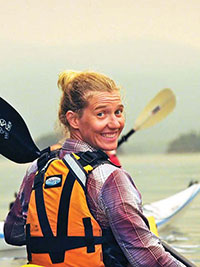
paddling coach Angela Bueckert
Angela Bueckert | Photo: Yasmeen Strang

1 Angela Bueckert (AB)

Location: Ucluelet, British Columbia
Occupation: Adventure Guide, Co-owner of Expedition Engineering

Roots: For the past 12 years, skis and kayaks have been Bueckert’s tickets to mountains, rivers and saltwater around the world. From teaching whitewater paddling in Tibet, Nepal and Ecuador to guiding sea kayak expeditions in Norway, Greenland, the South Pacific and throughout British Columbia, she’s expertly spun these once-in-a-lifetime trips into her full-time job.

paddling coach Chris Audet
Chris Audet | Photo: Christopher Lockyer

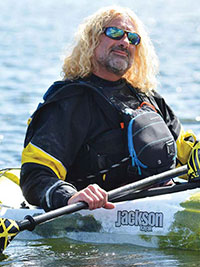
2 Chris Audet (CA)

Location: Searsport, Maine
Occupation: Outdoor educator and athletic trainer

Roots: His high school students know him as Mister Audet, while his Friday night fans know him as lead singer, rocker and Sammy Hagar lookalike in the Van Halen tribute band, Balance. A registered Maine sea kayaking guide since 2001, Audet’s wild blonde curls are equally recognizable on the water, where his paddling students benefit from his years of teaching and performing.

paddling coach Christopher Lockyer
Christopher Lockyer | Photo: Virginia Marshall

3 Christopher Lockyer (CL)

Location: Bay of Fundy, Nova Scotia
Occupation: GIS mapping tech

Roots: Out of a desire to develop a strong community of skilled kayakers in his backyard and showcase the region’s first-rate paddling opportunities, Lockyer founded Committed 2 the Core Sea Kayak Coaching. In 2013, the Nova Scotia native expanded on those goals with the establishment of the annual Bay of Fundy Sea Kayak Symposium, drawing top coaches from around the world.

paddling coach Conor Mihell
Conor Mihell | Photo: Virginia Marshall

4 Conor Mihell (CM)

Location: Sault Ste. Marie, Ontario
Occupation: Magazine writer, part-time college educator

Roots: Descendent of a Lake Superior lightkeeper, Mihell has lived with the restless lake all his life, drawing from its infinite well of inspiration and adventure. His students and friends respect him as much for his work-to-paddle lifestyle as his exhaustive knowledge of the north shore.

paddling coach David Johnston
David Johnston | Photo: Virginia Marshall

5 David Johnston (DJ)

Location: Toronto, Ontario
Occupation: Web designer

Roots: Kayakers across the country know Johnston as the tireless and self-effacing chair of Paddle Canada’s sea kayak program development committee. While the role can be a challenging one for the busy coach and father, it embodies his belief that the best instructors listen as well as they lead.

paddling coach Ginni Callahan
Ginni Callahan | Photo: Freya Fennwood

6 Ginni Callahan (GC)

Location: Loreto, Mexico and Skamokawa, Washington
Occupation: Founder of Sea Kayak Baja Mexico and Columbia River Kayaking

Roots: Callahan boasts that while she’s never held down an indoor job for an entire year, she’s survived on sea kayaking for nearly twenty. An impulsive move to Baja in 1998 kicked off her journey to top certifications in coaching and guiding, as well as the migratory pattern she follows between paddling seasons in the Sea of Cortez and the Columbia River.

paddling coach James Roberts
James Roberts | Photo: Virginia Marshall

7 James Roberts (JR)

Location: Parry Sound, Ontario
Occupation: Co-founder of Ontario Sea Kayak Centre

Roots: A product of surfing the steep, gray swell of his native Isle of Wight and exploring the rugged coastlines of Canada, Roberts has also mastered a remarkable repertoire of Greenland rolls, making him a true student of the world. Those who’ve mentored with him appreciate his insightful feedback and outrageous sense of humor.

paddling coach Paul Kuthe
Paul Kuthe | Photo: John Waller/Uncage the Soul Productions

8 Paul Kuthe (PK)

Location: Portland, Oregon
Occupation: Business, life and paddlesports coach

Roots: Parlaying his extensive kayak coaching experience into a growing life and business coaching career was a natural next step for Kuthe. When he’s not teaching the finer points of paddling as program director for Portland outfitter Alder Creek, he’s helping students achieve their personal and professional goals through his work at Tributary Coaching.

Paddling coach Q&A

My advice for paddlers who want to step up their game is…

AB: Do solo trips. Relying on your own judgment and decision-making lets you know pretty fast where you’re at.

CA: Paddle with as many different people as possible.

CL: Repetition is the key to learning.

CM: Paddle rough water.

DJ: Set specific goals with a deadline for this paddling season.

GC: Try whitewater, surf, open canoe, SUP, competition, sailing, rock hopping and journeys.

JR: Learn to roll. This will increase your confidence and the rest of your skills will get way smoother.

PK: Get some quality coaching.


If I weren’t so into kayaking, I’d…

CA: Take up flying airplanes.

CL: Take up mountain biking.

CM: Take up triathlon.

DJ: Be a professional waterslide tester.

GC: Take up outrigger team paddling, underwater photography and writing a book.

JR: Take up kite surfing.

PK: Take up something more lucrative.


My biggest blunder was…

AB: Not being patient with the weather and I learned that it always pays to wait out the wind.

CA: That I didn’t start kayaking until my late twenties and I learned that the younger you start the more experiences you can have.

CL: Getting lost in dense fog around the Tusket Islands and I learned to never underestimate the ocean environment and the power of the tides.

CM: Not taking advantage of each and every opportunity I’ve had to go paddling and I learned that if you make an excuse not to go, you’ll likely regret it.


Happiness is…

AB: In the moment, not something that is wrapped up in the next big thing.

CA: A large glassy wave and a boat to surf it in.

CL: Catching rides on the Shubenacadie River with other members of Team Core.

DJ: Sitting around a campfire with friends.

GC: Living daily according to one’s values. And paddling the turquoise lagoon of a palm-studded atoll in the South Pacific.

JR: An amazing meal, a glass of wine and a stellar sunset in the wilderness.

PK: Sharing the sport we love and making a difference in the lives we share it with.


The coastline that stirs me most is…

AB: Norway because I feel my Viking warrior princess heritage taking over.

CA: Maine because I feel at home.

CL: Brier Island because I feel I am paddling at the end of the world.

CM: Lake Superior’s north shore because I feel at home here.

GC: The Sierra La Gigants because I feel awe, inspiration and at home.

PK: The Oregon Coast because I feel insignificant.


One thing you probably wouldn’t guess about me is…

AB: I am a Feldenkrais Practitioner.

CA: I hate swimming with a passion.

CL: I know every word to Phantom of the Opera and I am a huge Prince fan.

CM: I was once a hockey goaltender. It taught me to be thick-skinned in the face of criticism.

DJ: I absolutely love china plates, teacups and teapots.

JR: I used to play trumpet in a jazz band.

PK: I’m scared out there sometimes.

My biggest pet peeve is…

AB: Negativity.

CA: When people call a chart a map, or worse, a water map.

CL: People who don’t give things an honest go and self-handicap themselves before leaving shore.

CM: Cell phone towers creeping into the wilderness.

DJ: That my puppy only pays attention to me because I have food in my hands.

GC: Dragging kayaks on the beach, especially fiberglass, and especially mine!

JR: Packing trips.

PK: When students attribute either success or failure to their equipment.


More paddlers should learn to…

AB: Roll and pee while in their boats (not necessarily at the same time).

CA: Navigate properly.

CL: Swim.

CM: Make the time to go on long, unsupported journeys.

DJ: Paddle with a faster cadence.

GC: Look behind them.

JR: Invite me when going somewhere cool.

PK: Roll in conditions.


The worst job I ever had was…

AB: Working in a bookstore and it taught me to do what you love.

CA: Painting houses in college and it taught me that life is too short to have a job that isn’t fun.

CL: Painting fishing boats and it taught me to appreciate how much hard work will pay off.

CM: Assisting with the managing of an outfitting business and it taught me I’d rather be the guy on the water than the one steering the ship.

DJ: Working in a hotrod restoration shop but it taught me how to use an automotive sandblaster.

GC: One day in the Sterilite plastics factory in Lake Havasu City, Arizona and it taught me the tremendous freedom of being outside.

JR: Sanding the woodwork on a sailboat and it taught me that working hard and not drinking enough can make you faint.

PK: Housekeeping and it taught me humility.


Things I can’t live without on trip are…

AB: Dark sea salt Lindt chocolate.

CA: Lots of coffee.

CL: Good friends.

CM: A good book and my harmonica.

DJ: A decent camping chair.

GC: Lip sunscreen.

JR: Chocolate.


The best companions are…

AB: Funny and brutally honest and that’s true when you want the truth.

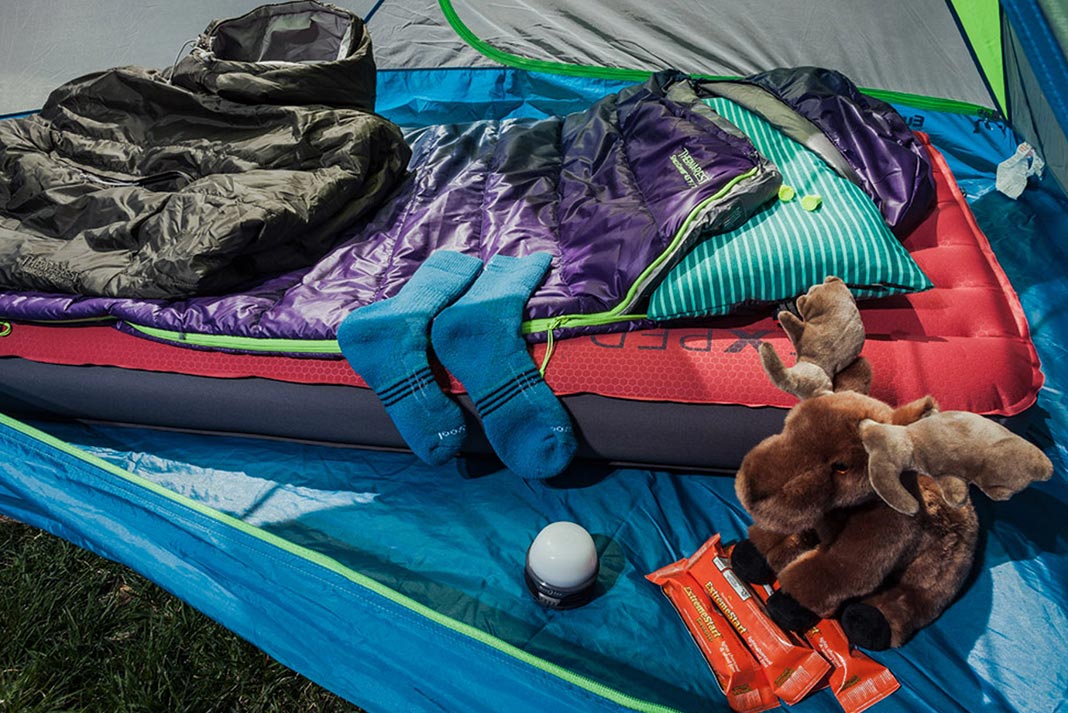
GC: My husband Henrick and my stuffed moose and that’s true even on a small sailboat together for six months.

PK: Willing to challenge you as much as they support you.


The greatest piece of advice I ever got was…

AB: It’s all a game and I made that up.

CA: Don’t be afraid to walk away from a rapid if you’re not feeling it and I got that from Michael J. Smith.

CL: Remember to take things as they come and don’t push yourself too hard and I got that from Andy Stamp, my BCU Level 5 mentor.

CM: Always make contingency plans and backup your backup and I got that from my friend Bruce Lash.

DJ: If you are unsure of the answer just speak with confidence and everybody will believe you and I got that from my father.

JR: When paddling in surf you are playing in a three-dimensional world with X, Y and Z axes—forward, turning and revolving—and I got that from Turner Wilson.

PK: Don’t worry about what you can’t change and I got that from my mom.


Ten years from now…

AB: I will be whispering to wild mustangs.

CA: Will still be trying to improve my personal paddling skills and instruction methods.

CL: I will be watching my three boys surfing waves on the Shubie.

CM: I hope I am doing the same things I do today.

DJ: I will still be debating if I should get that tattoo or not.

GC: I would love to have helped inspire a local, self-sustaining community of paddlers in Loreto.

JR: I will own a Mercedes Sprinter 4X4 dream van.

PK: I want to go on a huge expedition with my son who is now two.

The kayak I’m paddling most right now is…

AB: The kayak that I rent from whatever country I am paddling in at the time.

CA: Jackson Karma RG and my TideRace Xplore.

CL: P&H Aries 155.

CM: Valley Nordkapp.

DJ: P&H Cetus LV.

GC: NDK Romany Classic for coaching, NDK Explorer for guiding, and Pygmy Arctic Tern 14 for kicks.

JR: My Valley Anas Acuta.

PK: P&H Aries.


The world would be a better place if more people…

AB: Would give and receive hugs.

CA: Got together and went to wild places on a regular basis.

CL: Were honest to one another and appreciated the things they have.

CM: Supported the political notion that education, vacation and health care are fundamental human rights.

DJ: Listened to Air Supply.

GC: Giggled like Tara Mulvany. Or paddled like her.

JR: Cared about the environment.

PK: Experienced new places and cultures.


The most important qualities of a leader are…

AB: Great communication, no ego and stoke.

CA: Listening and empathy.

CL: The ability to give quality feedback and ask appropriate questions.

CM: Tolerance and the ability to set a good example.

DJ: The ability to make it fun. Check your ego at the door. Students are there to learn, not to worship you.

GC: The ability to build a team and to help each member feel like they contribute something elemental to its success.

JR: Listening well.

PK: Empathy, confidence and communication.


The hardest part about making that dream trip happen is…

CL: Vacation time.

CM: Choosing between so many dream trips.

DJ: Getting everybody’s availability synced up.

GC: Picking a date to leave. Without a date, it’s just a dream.

JR: Getting free time during the peak season.

Cover of Adventure Kayak Magazine, Spring 2017 issueThis article was first published in the Spring 2017 issue of Adventure Kayak Magazine. Subscribe to Paddling Magazine and get 25 years of digital magazine archives including our legacy titles: Rapid, Adventure Kayak and Canoeroots.
 

Rethinking the Canoe

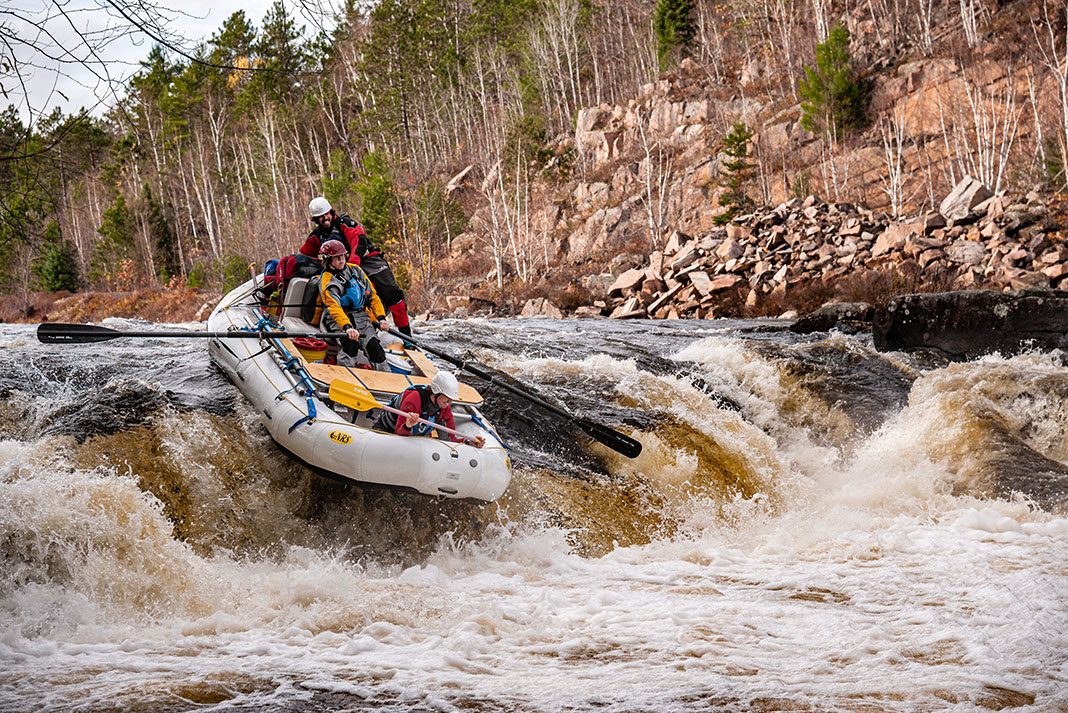
TROUBLED WATERS BELOW.| PHOTO: MICHAEL MELFORD

A while back, a publisher sent me a manuscript for review that eventually became the book, Inheriting a Canoe Paddle: The canoe in discourses of English Canadian nationalism. I didn’t particularly like what author, University of Victoria English professor Misao Dean, had to say about the canoe as a vessel of conquest.

In the book, Dean alleges the canoe to be a symbol of theft, genocide and colonialism, appropriated by mostly white, middle and upper class men. She charges that by turning the canoe into a symbol synonymous with the natural world, we’ve disassociated ourselves from the crimes the Canadian government and Canadians committed against First Nations.

While I chafed at the post-structuralist language she used to make her argument—and that she pointed to romantics like me as perpetuators of the idea of the canoe as a “morally untouchable symbol”—I knew at the core of what she had to say was a perspective all canoeists must engage.

Fast forward to 2016. I ran into Jim Brown, the irrepressible host of contrarian radio program, The 180. “Got any contentious canoe stories?” he asked. Did I ever. I tipped him off that Dean would be sure to put the contrarian post-modern cat amongst the self-possessed paddling pigeons.

Following the radio program, response to Dean’s thesis blew up. Reaction was swift and largely furious, expressing vitriol that would never be used in face-to-face conversation. Even Fox News picked up the story.

The recent findings of the Canadian Truth and Reconciliation Commission call for a long overdue righting of historic wrongs put upon North American Indigenous by those of us who followed Columbus in 1492. The central message of the TRC Report is that these transgressions are so deeply seated in our ways of thinking and so seamlessly integrated into the decision-making structures of our governments as to be totally invisible. We see, hear and experience ongoing consequences of conquest and still, for the most part, configure trauma in Indigenous communities as problems for “them” to solve.

TROUBLED WATERS BELOW.| PHOTO: MICHAEL MELFORD

The ongoing legacy of colonialism is not their problem. It is our problem—it belongs to us all. And it’s high time we started taking collective action to reinvent ourselves, as individuals, as communities and as nations. The trouble is finding workable ways to turn that desire to become part of the solution into our everyday lives. That’s where the canoe has massive untapped potential.

Canada is a river of nations flowing through a nation of rivers. The canoe in all its forms is still the often best and most appropriate way to get around. It’s also something that Indigenous and settler peoples of every stripe have in common. Whether in Albuquerque or Attawapiskat, we are all in the same proverbial boat. If we are to reconcile successfully, all paddlers need to pull together. That means listening to all well-considered voices, including Misao Dean. While I respectfully disagree with much of Dean’s views on the canoe, she does say some things that are worth repeating.

Toward the end of The 180 interview, the host asks what the author would like paddlers to do.

“When they go to their put-in points, when they plan their trips, they should ask themselves, ‘Whose traditional territory is this? How did it get to be in public domain? How do I feel about the fact that kind of narrative was done in my name?’” says Dean. “Look online and see where you can support the struggles of Indigenous people, for their legal rights, for their treaty rights and for their real valuation in Canadian culture.”

That’s a sentiment all canoeists can get behind.

CCC PartnerBadge WebJames Raffan is the director of external relations for The Canadian Canoe Museum in Peterborough, Ontario. Watch THE CANOE, an award-winning film that tells the story of Canada’s connection to water and how paddling in Ontario is enriching the lives of those who paddle there. #PaddleON.


This article originally appeared in Canoeroots
 Spring 2017 issue.


Subscribe to Paddling Magazine and get 25 years of digital magazine archives including our legacy titles: Rapid, Adventure Kayak and Canoeroots.