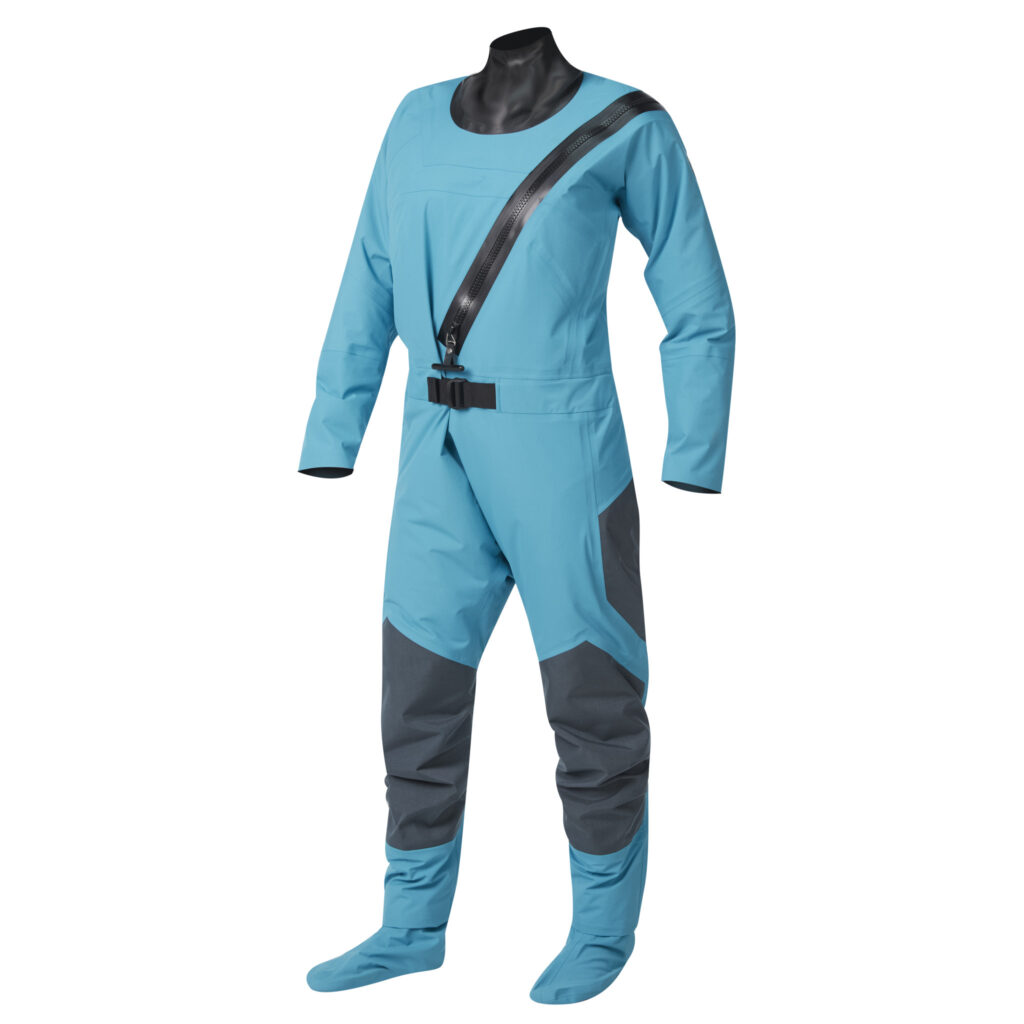
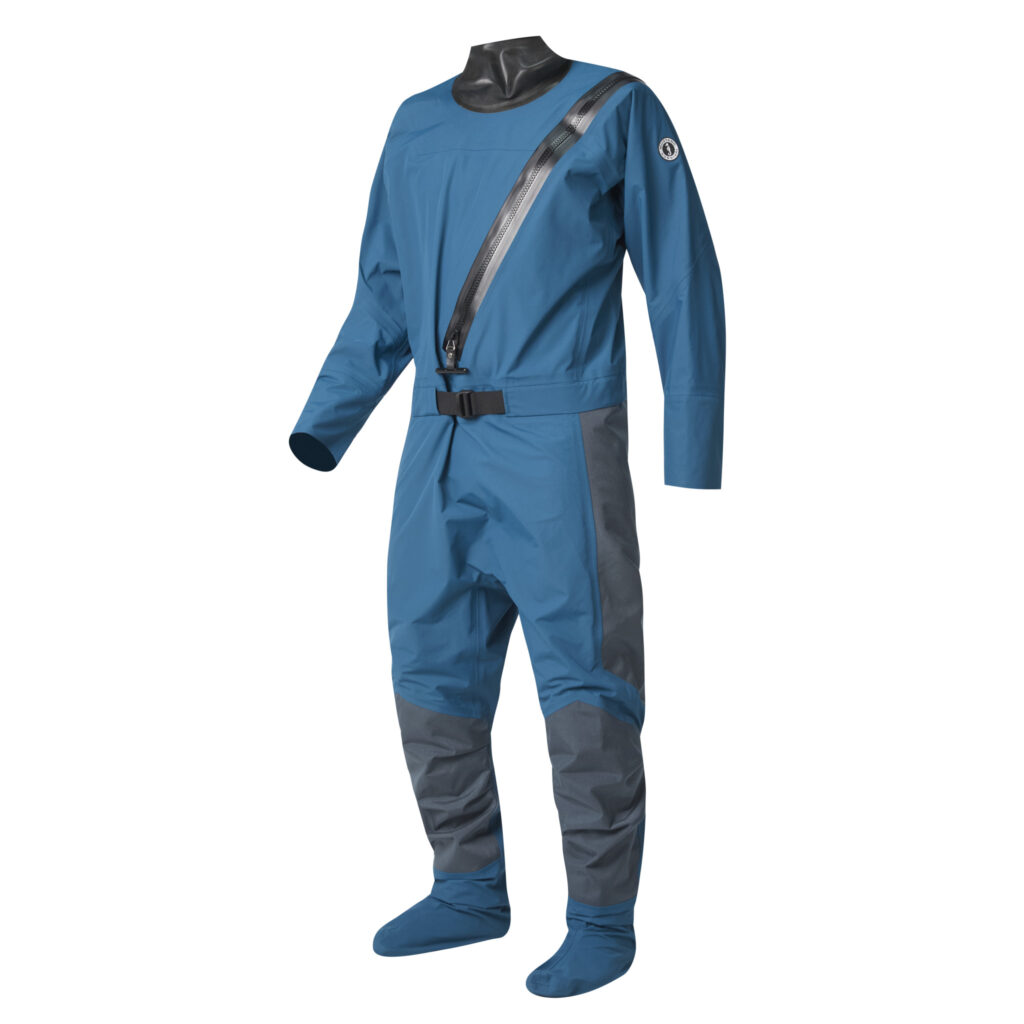
Burnaby, 2024 — Mustang Survival, the Canadian brand known for innovative solutions for the most demanding marine environments, announced on August 15 the launch of the Quadra Dry Suit. This brand-new minimalist, multi-purpose drysuit is designed for those who enjoy shorter-duration water activities and is available in men’s and women’s versions.
The Quadra Dry Suit is an excellent introduction to Mustang Survival’s high-quality standards. It features the same tough and durable three-layer Marine Spec BP fabric used in their other drysuits, with a design inspired by the gear they’ve innovated for military and public safety agencies and subjected to the same comprehensive testing.
Read a field-tested review of the Quadra in Issue 72 of Paddling Magazine.
Key features of the Quadra:
Durable Fabric: Waterproof and abrasion-resistant 3-layer Marine Spec BP fabric holds up in challenging saltwater environments
Custom Fit: Trimmable latex neck and wrist seals for maximum protection and comfort
Easy Maintenance: Collar and cuffs design make repair and replacement straightforward
Adjustable Waist Belt: Ensures a snug fit, accommodating various body types
Heavy-Duty Reinforcements: 500D Cordura® panels on the seat and knees add durability
Convenient Drying: External hanging loop simplifies the drying process
User-Friendly Zipper: Waterproof YKK® AQUASEAL® zipper for easy donning and doffing
Leak-Proof Assurance: Every suit undergoes comprehensive leak testing, ensuring superior performance and reliability
“Drysuits often come with a hefty price tag, and understandably so as a lot of engineering and materials go into a specialized garment that keeps you completely dry,” says Anja Mueller, Head of Marketing at Mustang Survival. “With the Quadra, we offer people new to cold water marine activities the same quality materials at a budget-friendlier price.”
Men’s Version: Ocean Blue/Admiral Grey and Red/Admiral Grey, sizes small to 2XL
Women’s Version: Bluefin Blue/Admiral Grey, sizes X-small to X-large
Retail Price: $849.99 USD / $999.99 CAD
Why a Mustang Survival dry suit?
Every model of recreational dry suits uses the same rugged 3-layer Marine Spec BP material and 500 Cordura® reinforcement material found in the successful Hudson and Helix designs.
One hundred percent of the suits that leave the factory are thoroughly leak tested using pneumatic air pressure and must have zero leaks at 0.6 PSIG. Competitor suits have been put through these same testing procedures, and they have failed to perform at the same level.
All dry suits exhibit a consistent, clean aesthetic design DNA and are sleek and functional. They deliver performance through well-thought-out designs and features that reduce the bulk of redundant and unnecessary material overlaps and excessive patterning.
Learn about Mustang Survival’s Jacksonville Manufacturing facility—the epicenter of innovation for the Sentinel Series Water Rescue Dry Suits in Episode 2 of the web series Behind the Seahorse.
About Mustang Survival
Pioneer in the design and manufacture of lifesaving solutions since 1967. Mustang Survival is committed to the protection and enhancement of those who push themselves to extremes on the water, whether for work, duty, or to escape the daily grind. www.mustangsurvival.com
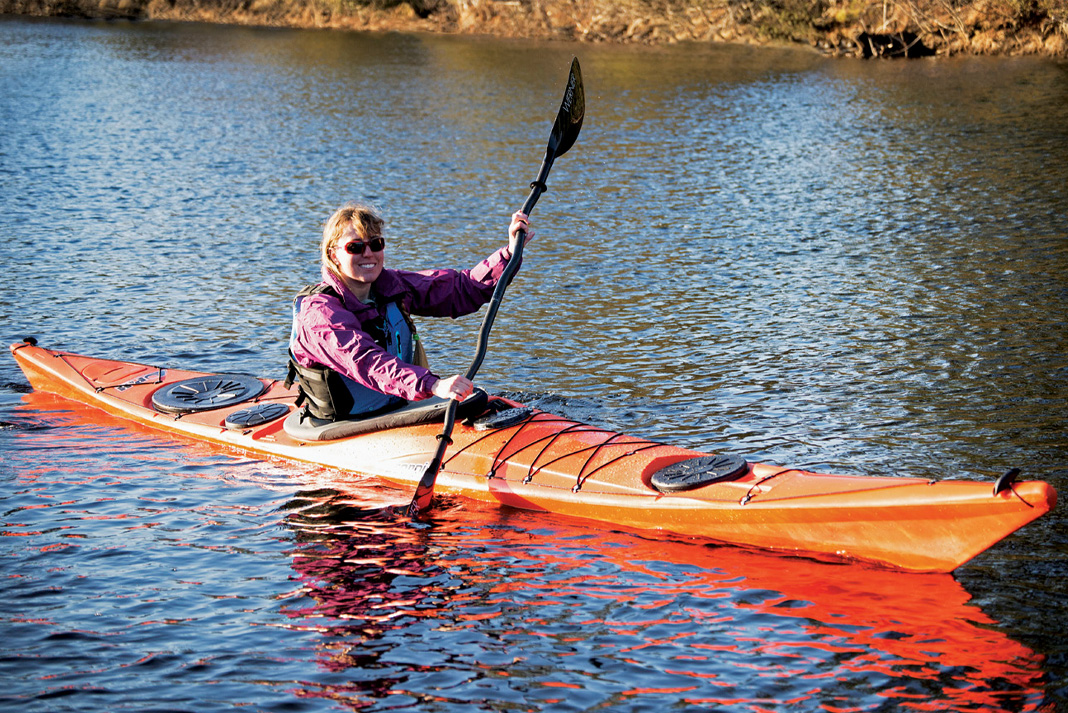
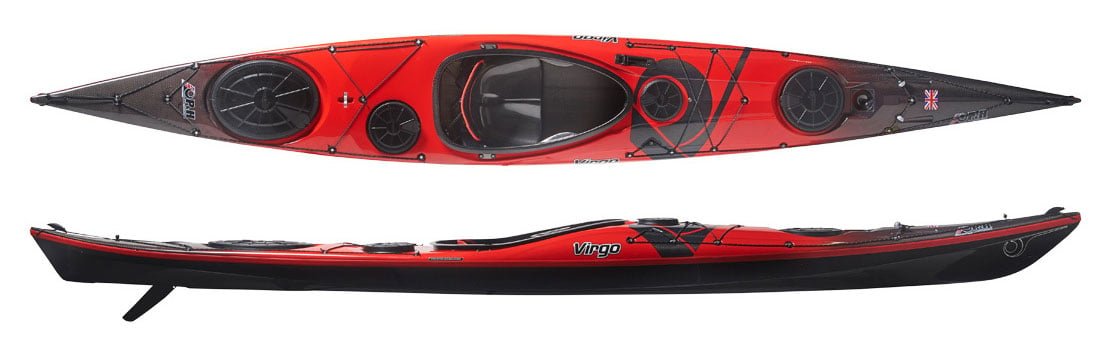
Paddlers have been asking for a lighter, composite version of the Virgo, and P&H Kayaks has delivered with this new release. Chris Hipgrave, director of sales for P&H, toured the Paddling Magazine team through the latest evolution of the brand’s best-selling sea kayak at Canoecopia in March 2024. The demo model was one of the first composite Virgos to arrive in North America.
P&H unveils composite upgrade for best-selling touring kayak
“The plastic Virgo is our best-selling sea kayak by far,” Hipgrave said. “It’s really been a runaway success for us. But we’ve been hearing from customers that they want a composite, lighter version on the water. So, we’ve done it.”
“We took all the things that make the plastic Virgo amazing and put it into a lightweight, high-performance composite package,” he added.
Image: Courtesy P&H Sea Kayaks
The new composite Virgo retains all the features that made the original plastic model a hit while shedding considerable weight. The 15-foot plastic Virgo weighs between 54 and 56 pounds, whereas the composite version weighs just 34 pounds.
“We took all the things that make the plastic Virgo amazing and put it into a lightweight, high-performance composite package.”
“Super light,” says Hipgrave. “It still has all the storage. We have a lot of bow and stern storage and our typical four-hatch system. It is exactly the same setup as our plastic boat.”
This new offering will appeal to paddlers who have long appreciated the Virgo’s design but are looking for a higher-performance, lightweight alternative.
Key features of the P&H Virgo include:
V-hull cuts cleanly through the water but softens towards the kayak’s center for comfortable stability.
Functional details include split paddle recesses, a drop-forged, anodized aluminum security point, a paddle park, and a full complement of deck lines and bungees.
Moderate rocker allows the Virgo to pick up and carry speed efficiently when flat but swing around effortlessly on edge.
Flared bow edges give a dry ride through choppy water and lift the boat over waves on the paddle out from the shore.
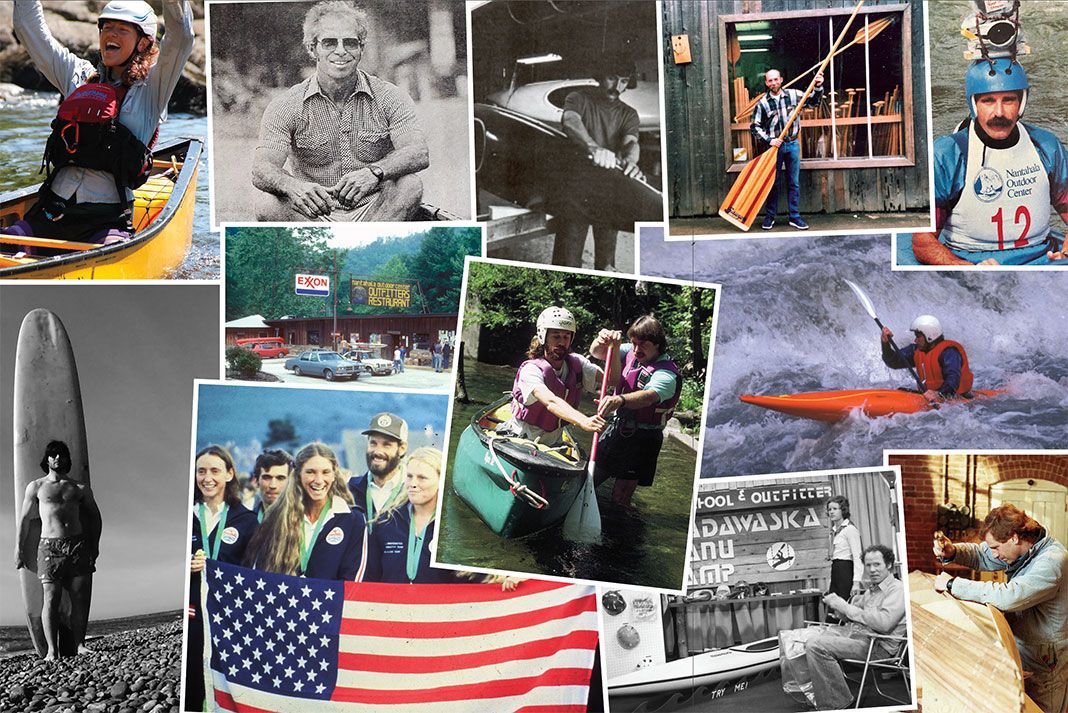
Celebrating five decades—or thereabouts—of rich, recreational paddling history. | Feature photo: Robert Faubert
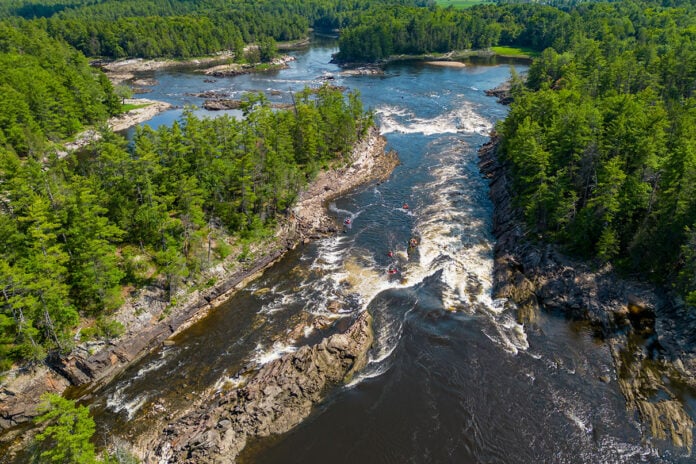
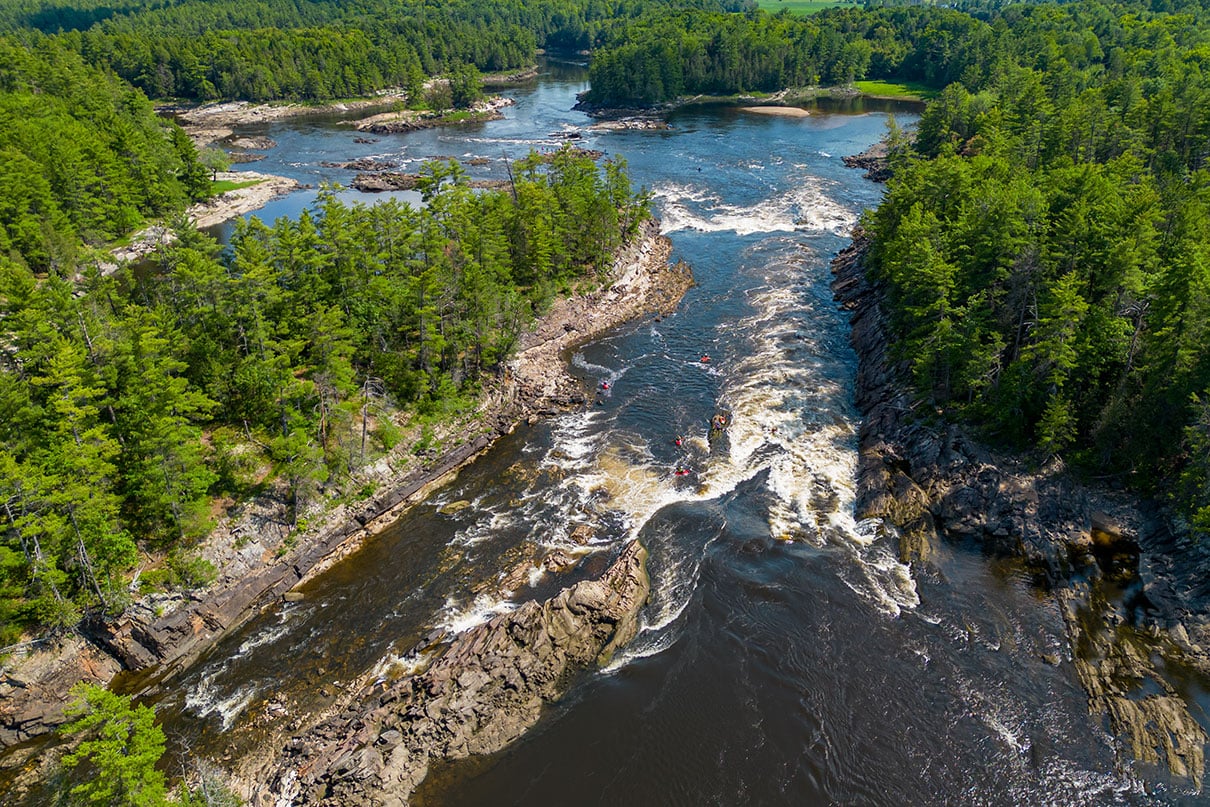
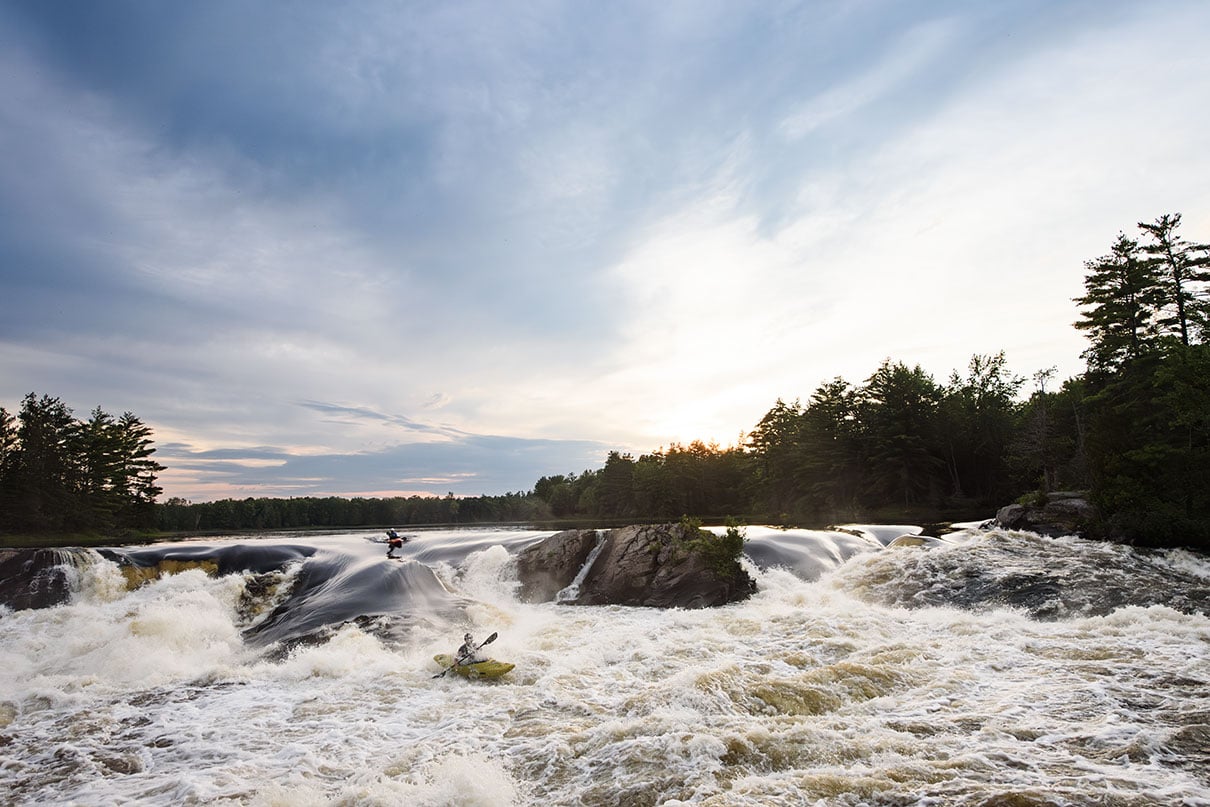
When Ottawa River paddlers feel the pull toward Phil’s Hole at the start of a whitewater run this summer, they will have reason to feel nervous. The 60-foot-wide recirc is hard to avoid and has been known to treat kayaks like playthings. They might take some comfort, though, in knowing recreational paddlers have been feeling—and surviving—the same nervousness for half a century now.
50 years of rapids and revelry on the Ottawa River
The large-volume Ottawa River separates Ontario from Quebec and runs through the nation’s capital. It has floated a watershed’s worth of logs downstream to lumber mills, served as a fur trade thoroughfare and hosted Indigenous travel for millennia. And yet, in the early 1970s, the fact it was home to truly world-class rapids seemed to surprise what was then just a nascent whitewater paddling community.
In 1973, Ed Coleman was a university professor in Pennsylvania with a side gig running canoe trips down the rocky Petawawa River in Ontario’s Algonquin Park. After a revealing aerial tour, Coleman told three of his guides to test out the whitewater he had seen “somewhere near Beachburg.”
The three spent a day driving rural roads, trying to get views of the river guarded by unexciting farmers’ fields. Finally, at sundown, they saw huge waves at the end of a pool and camped nearby.
Celebrating five decades—or thereabouts—of rich, recreational paddling history. | Feature photo: Robert Faubert
Guide Phil Coleman, who would later lend his name to the hydraulic welcoming boaters to the run, recounted the next day scouting the Ottawa, getting as far as Garvin’s Chute after following the smaller left, or Middle, channel. “The whitewater was huge. It was clean. It was warm. It was beautiful. All three of us were blown away. We had never imagined such a river.”
The makings of a major destination
News of the rediscovery didn’t get far in the thinly spread whitewater community. A few months later, Hermann and Christa Kerckhoff were promoting their recently founded Madawaska Kanu Centre (MKC) at the Toronto Sportsmen’s Show. Next to them were the Lamont brothers, who ran a wilderness survival school on Calumet Island. The brothers told the kayakers about the monster whitewater downriver from their school. Hermann, who had competed in the 1972 Olympics in slalom kayaking, had a daughter, Claudia, who was 13 then but already the Canadian women’s whitewater champion. The family pulled Claudia out of school one day next spring and drove five hours through the farmland of southern Ontario with two Kevlar kayaks on the roof.
Putting in just downstream of Phil’s, they followed the lazy current not left, where Coleman’s party had gone, but to the right, down the Main Channel.
“We had started to think it had been a waste of time,” says Claudia. Then they saw Black Chute—a.k.a. The Lorne—home to the famous Garburator and Buseater features. “Oh my God,” remembers Claudia. “Neither of us had ever seen whitewater so big.”
After completing the run through massive wave trains at Butcher’s Knife, Normans and Coliseum, they saw the Lamonts and Christa Kerckhoff waiting for them on shore.
“We were bursting,” remembers Claudia. “We had just paddled something the world needed to know about, something that was going to be a major destination.”
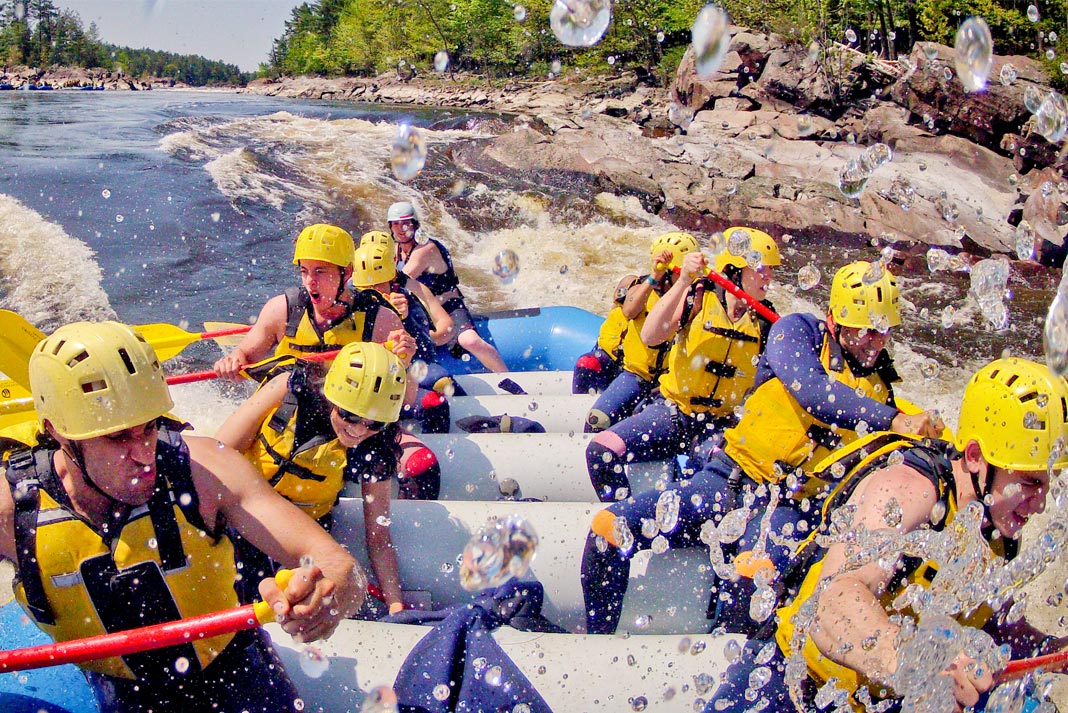
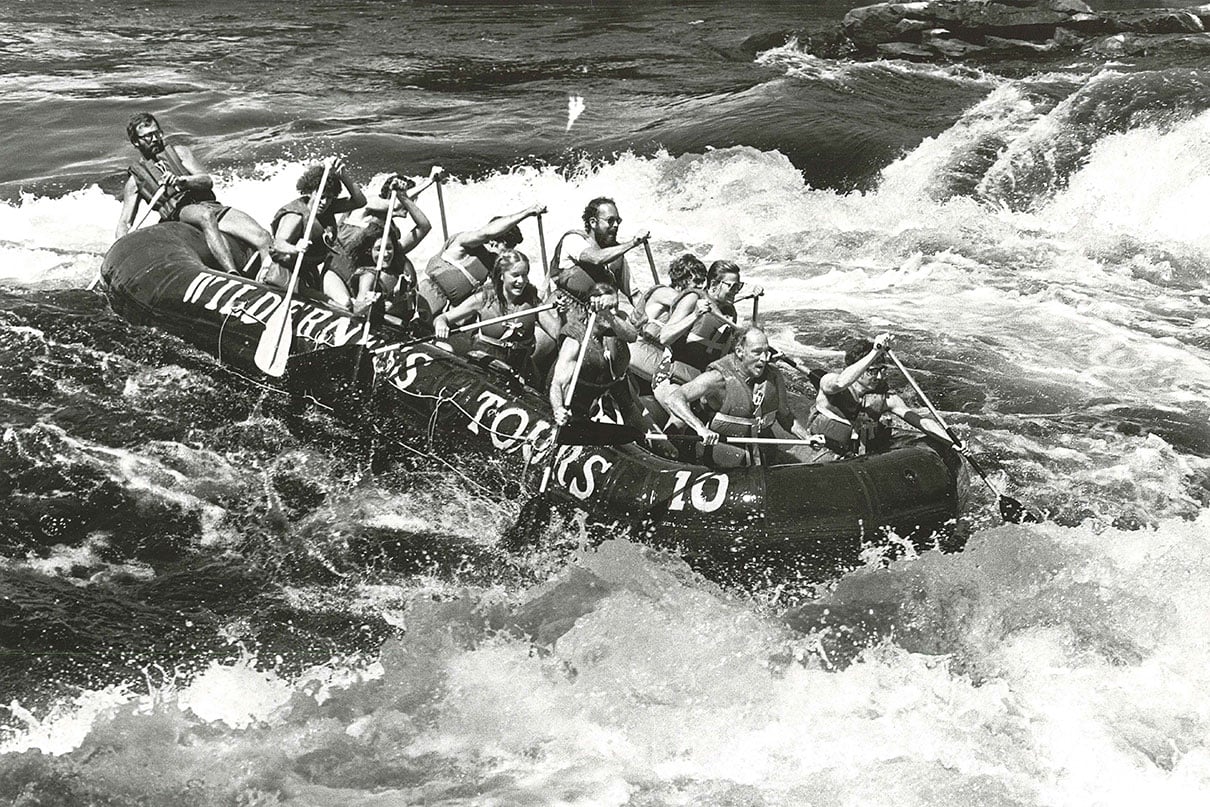
She was right. Fifty years later, more than two million people have floated down those rapids on rafts, many with Wilderness Tours, which grew out of Ed Coleman’s outfitting operation. A portion floated with other operators like OWL Rafting, started by the Kerckhoffs and continued by Claudia, her husband Dirk van Wijk, and daughters Stefani and Katrina.
And while most visitors have been raft-borne, the many thousand guides and safety boaters employed by the rafting companies have engendered a playboating scene that grew to global prominence in the 1990s.
Wilderness Tours owner Joe Kowalski guides a raft with former Canadian prime minister Pierre Elliott Trudeau (front left), circa 1981. | Photo: Courtesy Wilderness Tours
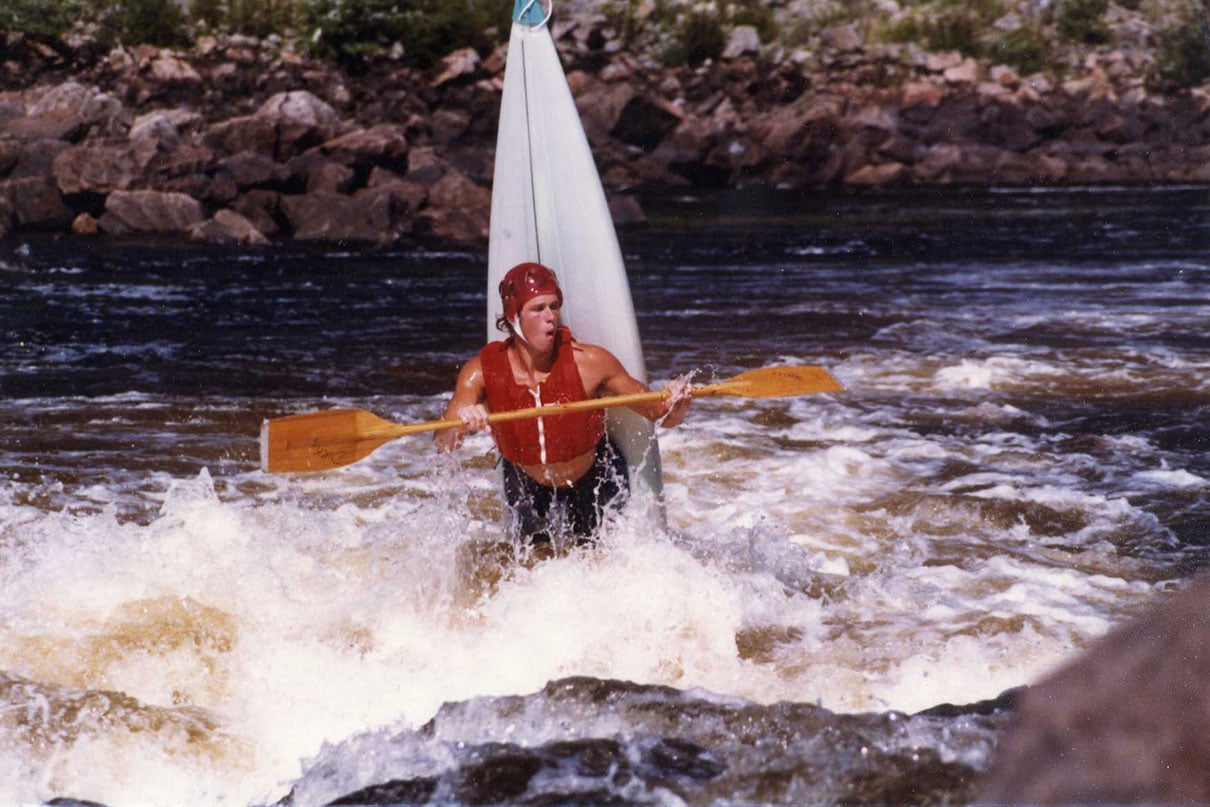
Dirk Van Wijk doing an ender at Centre Slot, circa 1980. | Photo: Courtesy Claudia Van Wijk
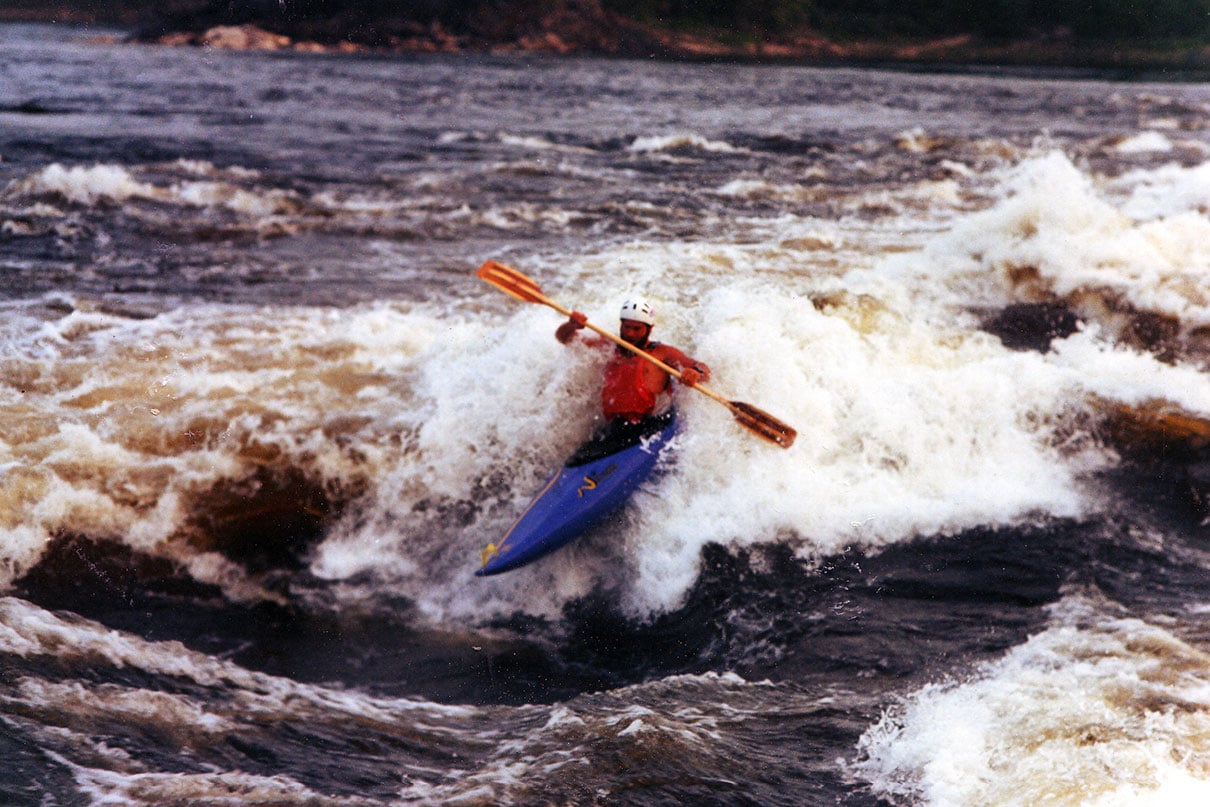
LJ Wilson surfing Baby Face in a Perception Pirouette, circa 1987. | Photo: Courtesy Claudia Van Wijk
The Ottawa welcomes the world
Joe Kowalski has been running Wilderness Tours since 1974. The former student and guide of Ed Coleman remembers the early days when recreational kayaks were hard to come by and hard to paddle.
“We called them Tupperware boats, like the Perception Dancer,” says Kowalski. Ottawa River eddylines were home to some serious enders, but you could only do so much in these boats.
Then Eric Jackson started showing up for a week or two every summer, and the playboating scene took off in lockstep with more sophisticated boat materials and designs. When the World Freestyle Championships came to the Ottawa River in 1997 and local paddler Ken Whiting won in a capable Wavesport X, the table was set for an explosion in popularity for whitewater and the Ottawa.
The river became a mecca for the world’s top paddlers, including Eric Jackson, Steve Fisher, and locals like Benny Mar, Anna Levesque, Tyler Curtis, Billy Harris and Nick Troutman.
The boats may change, but the stoke remains the same. | Photo: Dan Stewart
They came because the Ottawa is home to features allowing the best paddlers in the world to push the limits of freestyle, but that’s only half the story. The Ottawa scene achieved a critical mass of activity because it’s also, in Kowalski’s estimation, “the world’s best intermediate whitewater river. It’s not extreme, but it has extreme play spots. It’s a great place for people to go from intermediate to advanced.”
The reasons why are many. Numerous hydropower dams upriver spill water from the surface, meaning the Ottawa is unnaturally warm. It flows over granite, not soft sedimentary rock, so there are next to no undercut features or strainers, making it as safe as whitewater of its caliber can be. To top it off, it’s only an hour from the nation’s capital, with paved access close to both sides of the river.
All of which allowed it to have an outsized influence on the paddling community beyond its banks. Alastair Baird has lived on the Ottawa’s banks all his life, worked in the paddling industry, and served as manager of economic development for the local county. He notes many of the rafting companies hired guides from the U.S., New Zealand, South Africa and Europe, who have gone home and contributed to their own whitewater industries. “Similarly, a number of the Alberta, B.C. and Quebec rafting companies were created by people who first worked on the Ottawa. It really kickstarted the industry in Canada.”
The inaugural Ottawa Paddlefest took place June 21 to 23, 2024, celebrating the Ottawa River’s golden anniversary with clinics, films, live music, vendors and shuttles.
This article was first published in Issue 72 of Paddling Magazine. Subscribe to Paddling Magazine’s print and digital editions, or browse the archives.
Celebrating five decades—or thereabouts—of rich, recreational paddling history. | Feature photo: Robert Faubert
Call it destiny the day Tom Hudson paddled through the town of The Pas on the Saskatchewan River, some 8,000 miles from his home in New Zealand. Hudson was two months into his solo canoe trip across Canada and leaving The Pas when he heard a dog bark. Something of about the barking gave Hudson pause. He turned his canoe around to investigate and soon the canoeist would rescue the dog from the river.
Man on solo canoe trip across Canada rescues dog from river
Hudson found the dog, which he later learned was a 14-year-old Great Pyrenees named Ivy, along the river bank. Ivy was half submerged under the water, with her rear stuck beneath a log. Hudson was able to free the dog from beneath the log, but she had no strength in her legs.
“She obviously hadn’t been able to rest or sleep, because obviously if she did, her head would have dropped under the water,” Hudson told the CBC. “She was just there in the water, awake and exhausted.”
Ivy wan’t able to move under her own strength. Seeing this, Hudson picked the dog up and loaded her into his canoe. He then looked for the closest home he could find and brought Ivy to the dock. It happened to be Ivy’s home and they had been looking for her for days. Hudson stuck around for a while and recorded Ivy’s reunion with her home as they cared her back to health.
As for Hudson, he’ll continue documenting his canoe trip across Canada. His goal was to reach Montreal this year, however he now expects with the changing seasons it will take him a second year to complete the trip. While the man from New Zealand has attested he has no prior canoe experience, he’ll likely have a new outpouring of fans after empathetically pausing his journey to rescue the dog named Ivy.
Wojciak typed “toddler life jacket” into the Amazon search window and chose one with more than 6,000 five-star reviews. When the vest arrived the next day, Wojciak discovered it was not a true life jacket at all. It was a “life jacket swim vest,” and the label clearly stated it “will not prevent drowning.” Wojciak, a popular content creator with nearly 18,000 followers on TikTok, shared her experience online.
“If you have a baby, please watch this video. I do not want you to make the same mistake that I almost did,” she says in a video that quickly went viral.
In the United States, life jackets for boating are approved by the Coast Guard, assuring they meet certain specifications and have undergone rigorous testing. The vest Wojciak bought didn’t even pass spell check.
“Here is what the inside of the jacket looked like,” she says in the video, pointing out a label that, at first glance, looks a lot like a Coast Guard approved life jacket. “The first red flag is the word ‘intended’ is spelled wrong. It says, ‘intened use: swim vest for kids.’
“It is not a life jacket,” Wojciak continues. “Right here it says, ‘will not protect against drowning.’”
The Amazon listing described the vest Wojciak ordered as a “kids swim vest life jacket.” Even though the term life jacket was included in the product description, the item was in fact a child’s swim vest. They are not the same thing.
A life jacket will protect your child in an emergency. A swim vest won’t.
Yet in a recent search on Amazon for “toddler life jacket” only three of the first 10 results were for U.S. Coast Guard-approved life jackets. The others were swim vests providing less protection. Searches for “Kid’s Life Jacket” and “Children’s Life Jacket” yielded slightly better results, with six of the top 10 results being U.S. Coast Guard-approved.
Amazon isn’t the only online retailer offering swim vests in response to searches for life jackets. Google, Walmart, Target and others fail to make this critical distinction. That means parents should be especially vigilant when purchasing life jackets for their children.
How to be sure your child is protected
When choosing a life jacket, the first thing you should look for is the U.S. Coast Guard approval label. If you’re shopping online, look to see if the Coast Guard approval is included in the listing. You may also be able to see the Coast Guard label in the product photos. The label will be located on the inside back panel of the life jacket.
As Wojciak discovered, the printed labels on some swim vests can look similar to the Coast Guard label—even if the device is not certified. Look closely to make sure your child’s vest is U.S. Coast Guard approved.
Photo: Roland Chanson
The Coast Guard categorizes life jackets by performance Type and/or performance Level.
Level 50, 70, 100, 150
Type I, II, III, V
The number in performance Level devices indicates the minimum buoyancy of the device in newtons. For example, a Level 70 device provides 70 newtons, or 15.74 pounds of buoyancy. That’s roughly equivalent to the 15 pounds of float in a Type III life jacket.
The Coast Guard is transitioning away from the Type ratings, but you’ll still find plenty of new life jackets classified that way, and they’re perfectly fine. The important thing is that any life jacket you buy be Coast Guard approved.
Most kids in a supervised recreational boating situation will be best served by a Type III life jacket. Featuring the classic ski-vest design, Type III jackets are easy to put on, comfortable and, when properly sized, will keep a conscious child afloat with their head above the water until a parent or other rescuer can quickly swoop in. Inflatable jackets of any type are not approved for kids under the age of 16 and are not recommended for nonswimmers.
Kid’s sizes are based on weight, with typical designations being infant (8 to 30 pounds), child (30 to 50 pounds) and youth (50 to 90 pounds). Avoid the temptation to give a child growing room by purchasing a jacket that is too large. A struggling child may sink out of it when in the water.
Takeaway for boaters and parents
U.S. federal law requires all children under age 13 to wear a life jacket at all times while underway, unless they are below deck or in an enclosed cabin. It goes without saying that a swim vest doesn’t cut it.
Life jacket laws vary by state, so be sure to check the rules in your state. Adults engaged in certain water sports, such as wakeboarding, waterskiing or operating a personal watercraft are also required to wear a life jacket in most states.
Every vessel is required to have a U.S. Coast Guard-approved life jacket for everyone on board. Swim vests don’t count. The life jackets must be the proper size for the intended wearer, in good and serviceable condition, and readily accessible.
The best life jacket is the one you wear, so it’s important to shop for life jackets that are both comfortable and approved by the Coast Guard for their intended use. Check the fit each time you go boating and adjust as necessary. This is especially important for growing kids.
It’s important for boaters and parents to understand that a swim vest is not a life jacket. It’s a swim aid. Swim vests have less buoyancy and are intended for use in calm water, like pools. They aren’t a safe option kids on lakes, rivers, or oceans.
Still, the two types of devices look very similar, and after mixing up her own online order Allie Wojciak wanted to make sure other parents were aware of the difference.
“I should have read that description more carefully, but I searched for ‘life jacket.’ This is one of the first that came up and it had so many five-star reviews,” she says in the video, which received more than 270,000 likes. “Luckily we figured that out, I returned it, and got another one that does say it’s Coast Guard certified—an actual life jacket.”
Wojciak has one piece of advice for parents shopping online for life jackets. “Please make sure that it is actually a life jacket, to make sure your baby is safe this summer.
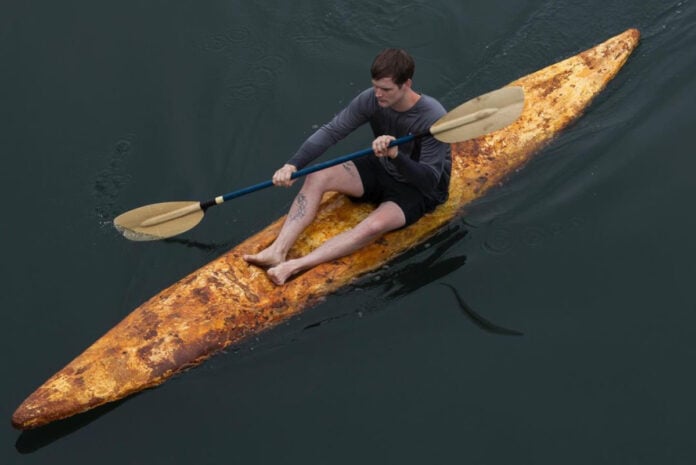
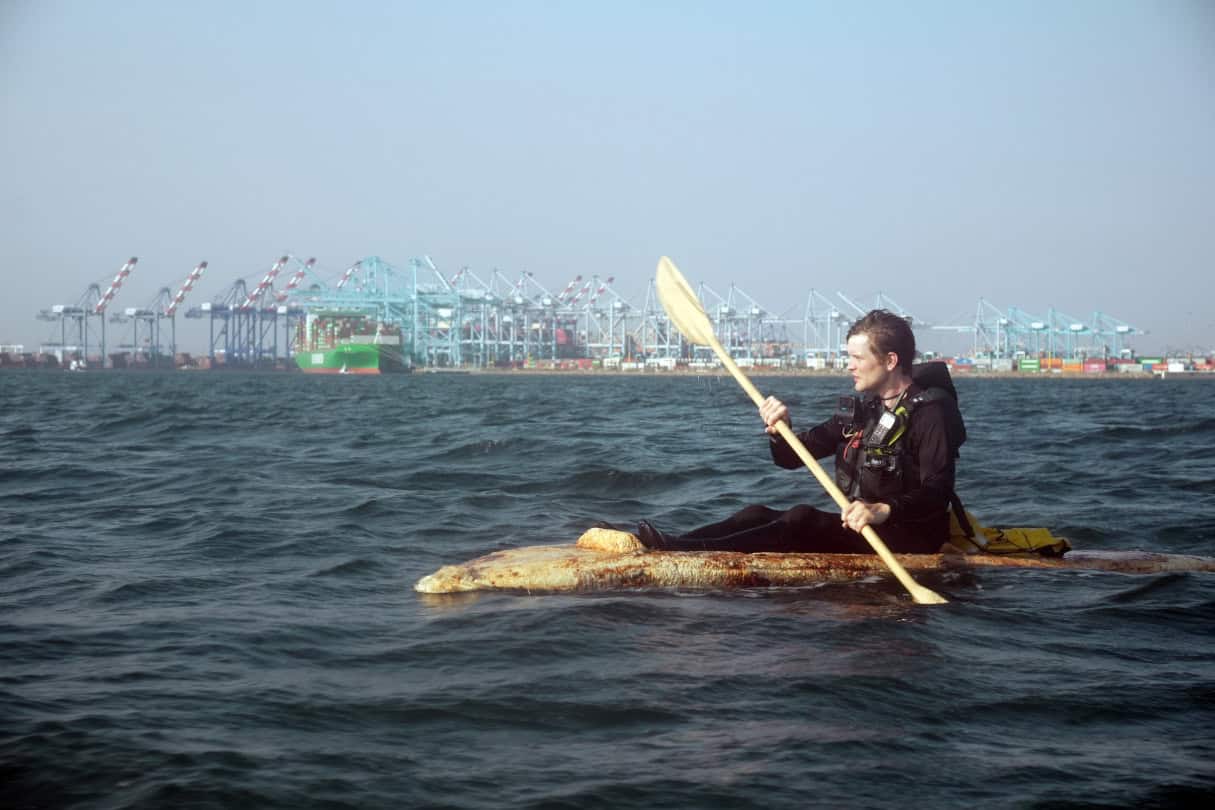
The harbor of Long Beach, California has seen its share of remarkable vessels, but perhaps none as intriguing as the one Los Angeles artist Sam Shoemaker launched on its waters. Shoemaker recently caught the attention of social media with images of a full-size mushroom kayak grown in his studio and bravely brought to a marina adjacent to the second busiest port in the U.S. for a float test.
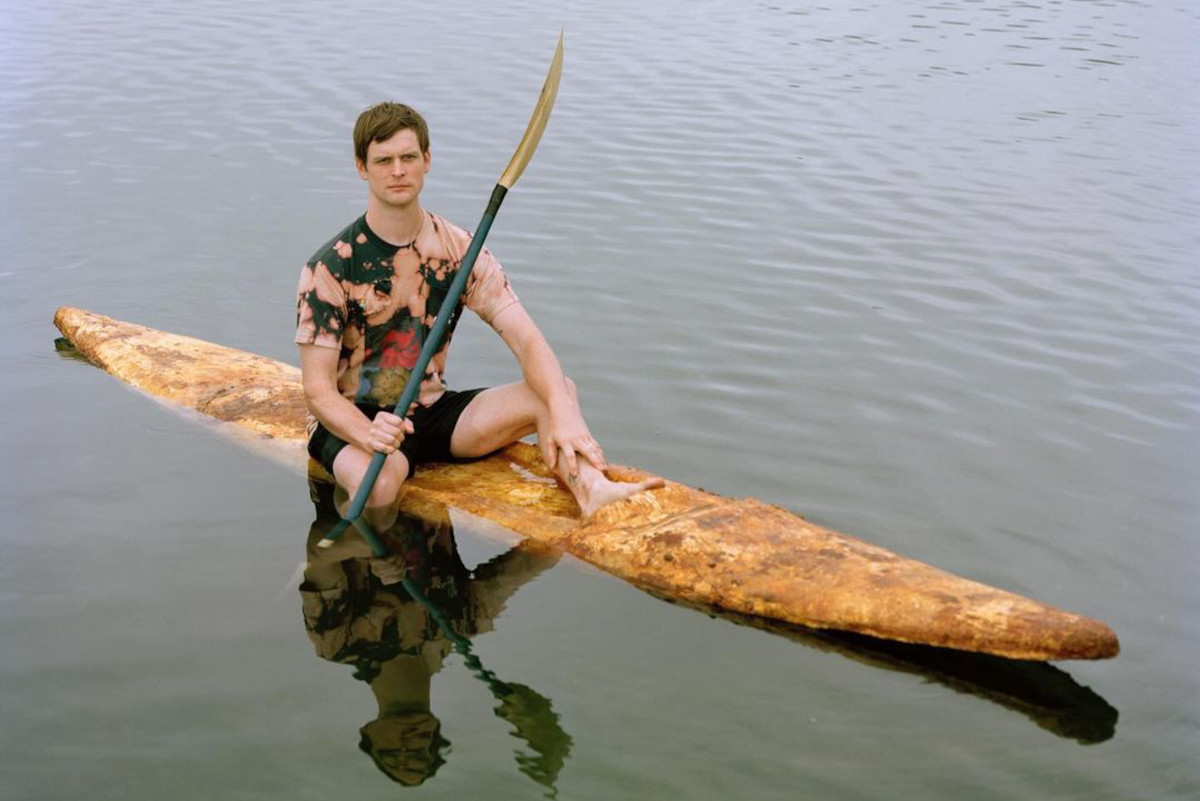
More specifically, Shoemaker’s kayak is made of the mycelium of a polypore, a shelf fungus, harvested from near his place in Los Angeles. Mycelium is the vast, interconnected, thread-like root network of a fungus that often stretches well beyond the fruiting bodies we see above ground that make their way to grocery aisles. The mycelium of fungus can grow to thousands of acres. With this kind of potential, Shoemaker saw the opportunity to mix art, science and paddling.
“I think that it’s really meaningful for people in the creative community to explore what is possible with these mushrooms,” Shoemaker shared. “And I feel that maybe our understanding of mycelium and how it can be used in these applied ways are pretty rudimentary.”
Sam Shoemaker and the mycelium kayak grown in his Los Angeles studio. Image: Ian Byers-Gamber
Ever incredible fungi
Fungi has shown promise in experimentation as an alternative in industrial applications such as packaging and building materials, even for textiles in the fashion industry. The draw: it is natural, renewable, benefits environmental impact, and to speak to that point further, fungi are decomposers capable of storing carbon.
As a student more than a decade ago, Shoemaker heard of an artist Phil Ross who was creating art installations with mushrooms grown on agricultural byproducts. The idea was fascinating to Shoemaker and the spore to pursue fungi art sprouted. Shoemaker has used the growing organisms as the medium of his sculpture work—which have regularly featured geometric shapes built with molds, then exploding outwardly with fungi. Now his myco sculptures have evolved to a working art taken to the harbor.
“using a wild mushroom collected off the streets of Los Angeles to build a 15-foot boat is a very impractical thing to do.”
A kayak grows in Los Angeles
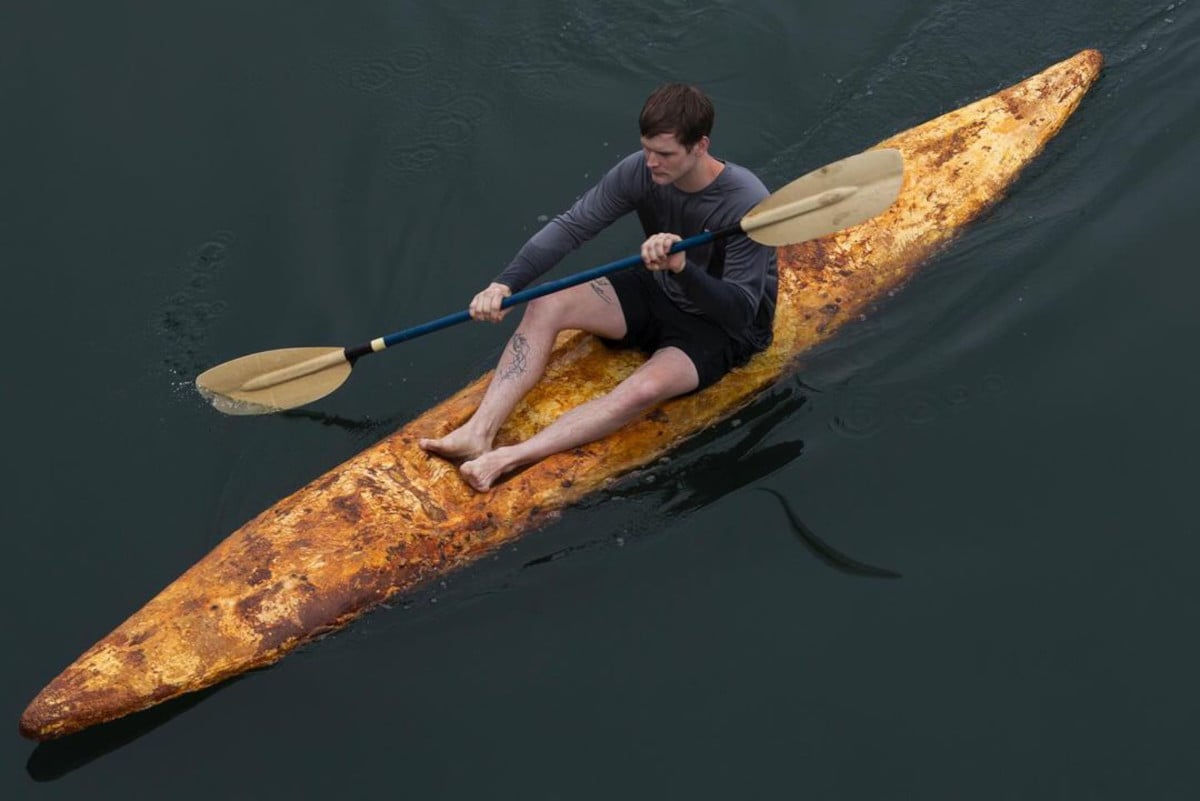
For Shoemaker, the first step to growing a boat was finding a kayak design to use as a template. He connected with his muse where many others have, on Craigslist. The design, a Malibu Kayaks CK 4.4, a 14-foot sit-on-top from a now defunct brand. Shoemaker used the Craigslist find to produce a two-part mold inside of which he placed hemp as a substrate for the mycelium to consume and grow on. It took just four weeks for Shoemaker’s kayak to reach size. He then dried it in an oven to a cork-like hydrophobic material and coated it with beeswax to seal it. Once complete, the kayak weighed in at 135 pounds.
Shoemaker acknowledged he’s not the first to have pioneered mushroom paddlecraft. That title likely belongs to fellow mycophile Katy Ayers, who showcased her mushroom canoe at the Nebraska State Fair in 2019 and has since gone on to a Fulbright scholarship in advanced biological sciences.
“Katy put a really good and interesting idea into the ether,” Shoemaker credited. “And there’s always been talk of mushroom surfboards. I’m doing things a little bit differently than the way Katy built that boat. I thought it would be interesting to apply some of these different ideas to that idea and do something that could be used on the ocean.”
With the help of friends, Shoemaker carried the mycelium boat of his own to the water in Long Beach and proved he had something that floats.
Feature Image: Ian Byers-Gamber
Seaworthy mycelium
The artist’s post about the successful launch drew more attention than he ever could have imagined. There were plenty of wowed responses, and along with those, plenty of critiques. Some said it was no kayak but a baguette. Others questioned the hefty weight. Aspects Shoemaker openly agreed are part of the process of bioengineering his vessel.
“People have reached out to me about the boat to say, ‘That seems quite heavy and impractical,’ to which I say, using a wild mushroom collected off the streets of Los Angeles to build a 15-foot boat is a very impractical thing to do. If anything, I’m relieved that it only weighs 135 pounds.”
To Shoemaker’s defense, a kayak’s weight is not completely tied to its buoyancy and capability if the design and materials are sound. Popular fishing kayak models today easily tip the scale well beyond 100 pounds.
Shoemaker considers his mushroom kayak a prototype toward a larger goal—producing a craft capable of making the 22-mile open water crossing from L.A. to Catalina Island. The artist was quick to point out this is something he will spend ample time preparing for and will be accompanied by an experienced support crew. Shoemaker hasn’t gotten ahead of himself, however. For now, he has returned to the studio to tinker with his methods and grow more kayak designs if he’s to make the attempt.
“I’m not interested in making props. I want to go on a journey. I want a boat that can actually be used for something.”
Paddle safe and responsibly, always wear a life jacket.
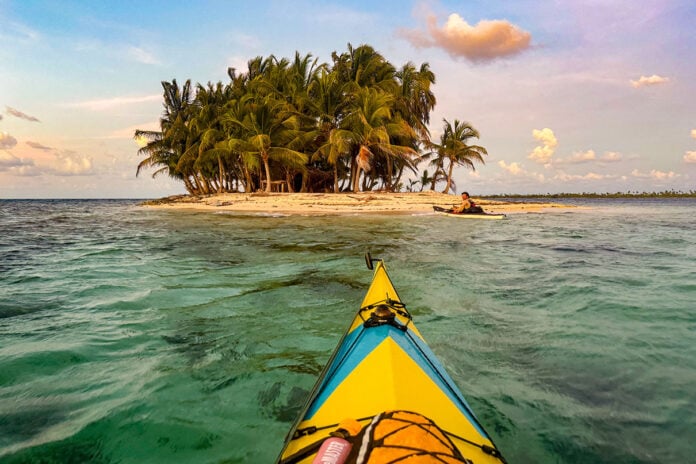
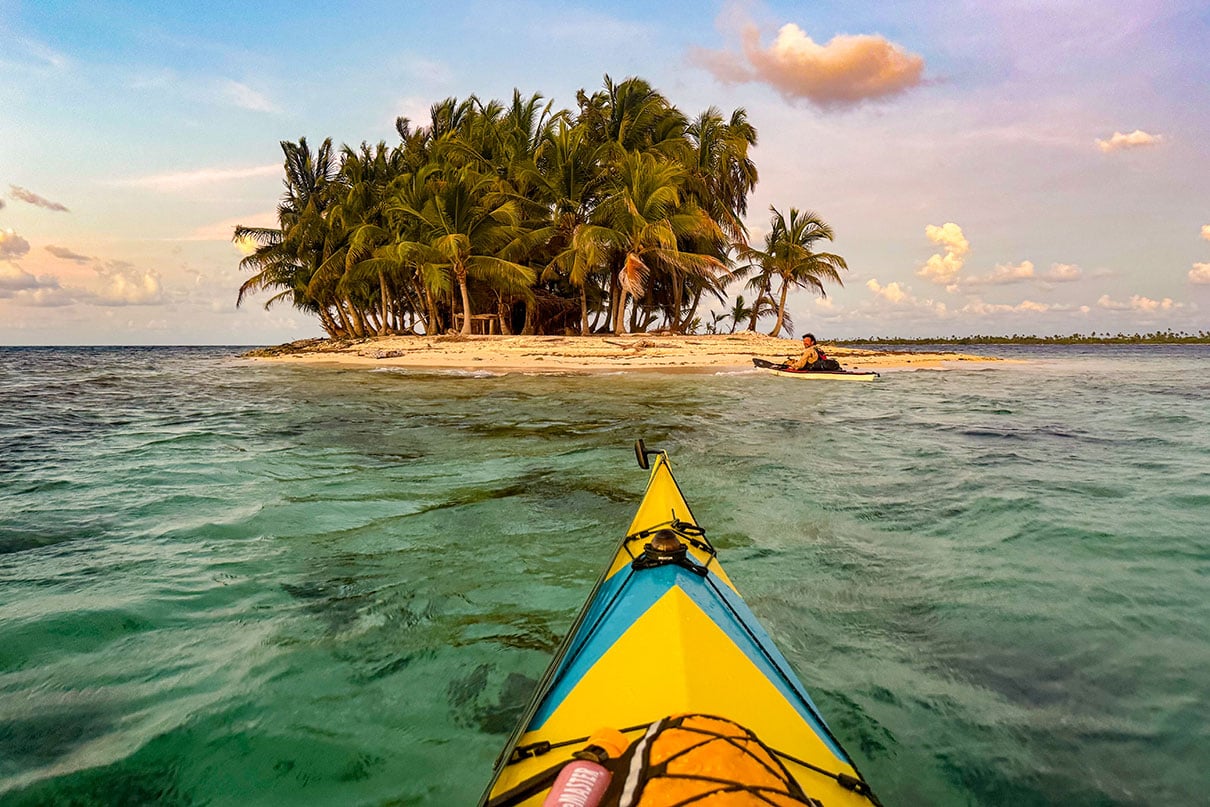
Idyllic island camping doesn't hint at the Darien Gap's reputation as a notoriously dense and dangerous jungle. It is the only break in the Pan-American Highway, which stretches from Alaska to Argentina. | Feature photo: Frank Wolf
The 10-kilometer night crossing began at dusk as we escaped the submerged landscape of the Rio Atrato delta in search of higher ground on the next peninsula. Our hopes of staying in El Roto—a village on stilts a couple of kilometers upriver—had been dashed after the headman refused us.
Mark Sky and I were nearing the end of a 500-kilometer sea kayak trip from Colón, Panama, to Turbo, Colombia. He was almost a year into a fully self-propelled cycling and climbing journey from Squamish, British Columbia, to Argentina’s Mount Aconcagua. His major crux was the Darien Gap—the roadless, swampy, unchecked border region between Panama and Colombia. To help him in his mission, I flew down with two folding kayaks to paddle around the Gap and get Mark to the start of the road in Turbo. From there, he would continue through South America.
It was pitch black by the time we were halfway across the delta. Then, like a switch had been thrown, lightning flashed and thunder clapped, introducing a storm with furious wind whipping the seas around us into a froth.
Idyllic island camping doesn’t hint at the Darien Gap’s reputation as a notoriously dense and dangerous jungle. It is the only break in the Pan-American Highway, which stretches from Alaska to Argentina. | Feature photo: Frank Wolf
As we approached land, the surf zone jacked up. Mark is a relatively novice paddler, so he was pretty gripped, and I wasn’t keen on a blind landing either. In front of us was nothing but darkness and crashing seas. The landing could be mangrove, impenetrable forest, rocky reef or a beach—we had no idea.
“Mark! Let’s raft up!” I shouted over the din.
Hanging onto each other’s boats, I decided we’d let the waves decide our fate. In a raft, we’d be stable and together, far less likely to have a yard sale in the sea.
Wave after breaking wave rolled over us as we were inevitably pushed to shore. When we struck ground, we were elated to find we’d washed up on a sandy beach and quickly dragged our boats up.
Any port in a storm
Checking our GPS, we saw our thin strip of sand would be underwater once high tide came around in a couple of hours. As I prepared dinner, Mark walked up the beach to find higher ground for our camp. He was slow in returning and I wondered if he’d had a run-in with a crocodile—until I spotted a bunch of lights approaching me.
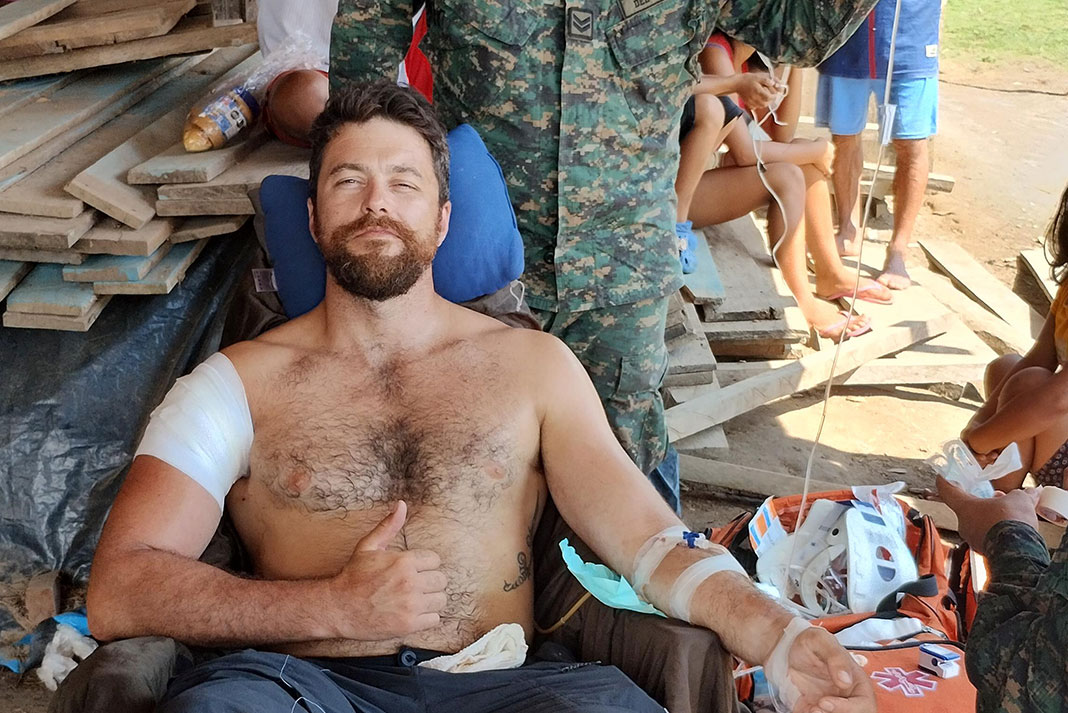
In short order, I was surrounded by a dozen military personnel in fatigues armed with M4 machine guns and a very wide-eyed Mark. He’d strolled onto their base, machete in hand, and was quickly detained and questioned. He was first accused of being a thief but explained we were just kayakers. Unbeknownst to us—and not marked on any maps—the peninsula was a Colombian naval base. The men proceeded to pick up our kayaks and gear and marched everything a kilometer away to their compound. They put us in a dank room under guard for the night.
Discussions about what to do with us went up the chain of command. They decided the next day the coast guard would take us to Turbo to be processed. We pleaded to be allowed to paddle the final 20 kilometers to town but they couldn’t be dissuaded. However, once the two coast guard officials arrived and saw the mound of our gear they’d have to transport, they decided it would be more prudent to process us on the spot. Mark was overjoyed—his self-propelled line would remain unbroken.
That afternoon, we paddled into Turbo and raised a toast to our Colombian captors and to rounding the Darien Gap.
Adventurer Frank Wolf is known for his award-winning films documenting wilderness expeditions. His second book, Two Springs, One Summer, will be available in September.
This article was first published in Issue 72 of Paddling Magazine. Subscribe to Paddling Magazine’s print and digital editions, or browse the archives.
Idyllic island camping doesn’t hint at the Darien Gap’s reputation as a notoriously dense and dangerous jungle. It is the only break in the Pan-American Highway, which stretches from Alaska to Argentina. | Feature photo: Frank Wolf
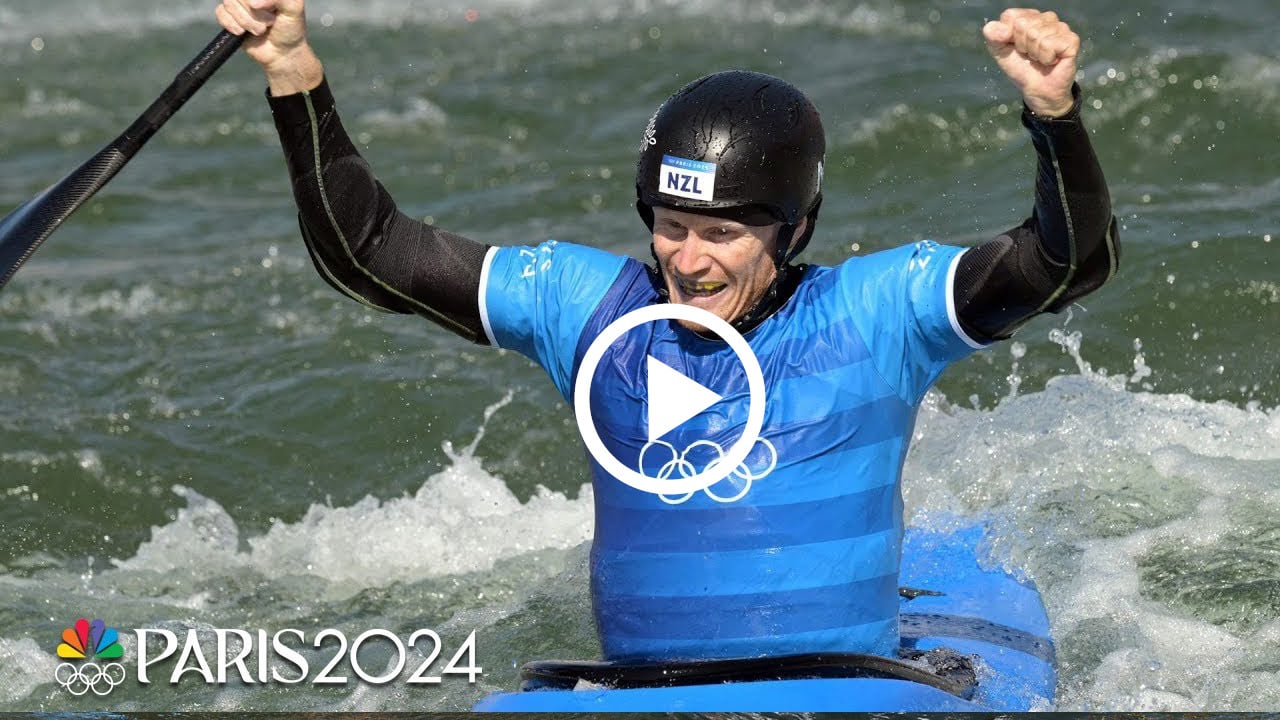
The first-ever Olympic whitewater kayak cross came to its conclusion Monday at the Vaires-sur-Marne Nautical Stadium east of Paris with the first-ever champions crowned. In the end, it was Australia’s Noemie Fox in the women’s and New Zealand’s Finn Butcher in the men’s who would find themselves atop the podium in the history-making whitewater event.
Olympic kayak cross champions made in historic debut
Maybe it’s our algorithm, but kayak cross appeared to garner notable media interest and fanfare online heading into and through this stage of the Summer Games. Prior to the opening ceremony, the new event found itself on the likes of shows such as Good Morning America and held newswire headlines.
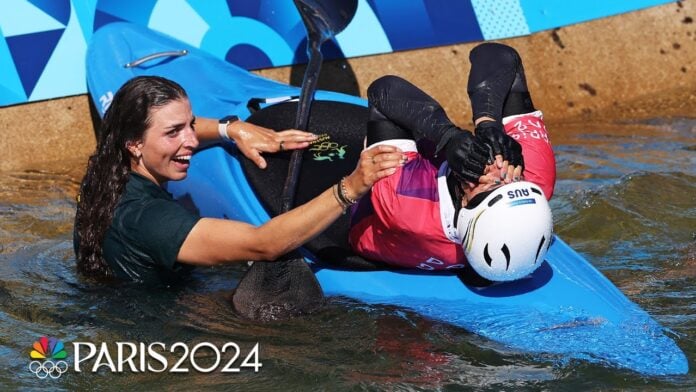
The inaugural event even had its share of sporting drama. Early in the knockout rounds the eventual women’s champion Fox had to defeat her older sister Jessica Fox, who had in the days prior won back-to-back gold medals in canoe and kayak slalom, in order to advance. With kayak cross, the Fox family stunningly swept whitewater gold in the 2024 games for Australia.
“You don’t really dare to dream this big but I really did this time,” Noemie Fox shared in an interview published on Planet Canoe. “I dared to dream to get to the Olympics and then to get to the final. When I saw in the last upstream gate that I was first, it was pure joy.”
On the men’s side, Kiwi Finn Butcher had to best 2016 Olympic slalom champion Joe Clarke who was a solid favorite to win the kayak cross. Butcher had competed in the slalom semi-final days prior, where a costly gate penalty kept him from advancing to the final in the traditional whitewater event. Kayak cross was his redemption, where he brought home the first ever Olympic gold in men’s whitewater for New Zealand.
“When I dropped off the ramp and I had a bit of clear water in front of me, I just went as hard as I could and to finish in front was insane,” Butcher stated in an interview published on Planet Canoe. “Coming out of the last upstream, I honestly couldn’t believe it so it is going to take a while to sink in.”
2024 Olympic Kayak Cross Medalists
Women’s Kayak
Gold: Noémie Fox, Australia Silver: Angele Hug, France Bronze: Kimberley Woods, Great Britain
Men’s Kayak
Gold: Finn Butcher, New Zealand Silver: Joe Clarke, Great Britain Bronze: Noah Hegge, Germany
Park wardens fly out a sleeping bag filled with rotting garbage from Algonquin Park’s backcountry. Rangers encounter garbage and abandoned equipment on almost every maintenance trip. | Feature photo: Ontario Parks
What the heck is going on out there?
On my latest canoe trip to Ontario’s Algonquin Park, my group spotted bags of garbage left at several backcountry campsites, lined up by the shore like you’d put garbage by the curb for early morning pickup. On our campsite, the forest floor behind our tent pads was decorated with white toilet paper mounds and human poop. Countless living trees had been hacked down by Daniel Boone wannabes. And while on day trips on big Lake Opeongo, we went to shore—twice—to put out campfires left burning after the occupants had cleared off their sites.
We finished our trip feeling distraught and majorly concerned for the future of our beloved backcountry.
Is mandatory backcountry education coming to a park near you?
There have always been ignorant, unethical and apathetic campers wandering the woods. But if you’re feeling, like my group did, as though there are a lot more of them lately, you’re right.
The latest stats from public and private parks and campgrounds in Canada and the United States show, on average, a 30 percent increase in campground and backcountry use since 2019 and almost double the usage compared to a decade ago. For example: Camping reservations in Alberta provincial parks skyrocketed 5,000 percent during the pandemic, going from 5,209 to 286,657 reservations in one season, and have remained high. Ontario Parks recorded growth from 4.3 million camper nights to 6.6 million per year. And reservations for fall season camping in the United States are up by 192 percent compared to five years ago. The list goes on.
Park wardens fly out a sleeping bag filled with rotting garbage from Algonquin Park’s backcountry. Rangers encounter garbage and abandoned equipment on almost every maintenance trip. | Feature photo: Ontario Parks
It’s no surprise that with more people comes more litter, toilet paper and abandoned campfires.
To be clear, these stats aren’t a result of existing campers simply deciding to camp more. More than half a million Canadians and 15 million Americans took to the outdoors and camped for the first time in 2023. The average age of campers also shifted. The younger Gen Z went from eight percent of campers to 18 percent, and Millennials from 32 percent to 46 percent. It stands to reason more newbies in the bush equals more folks who are likely to be unfamiliar with the rules.
Now I’m hearing some paddlers talk about the need for a mandatory backcountry etiquette course taken before anyone heads out to sleep in the woods. This isn’t a new idea. Many national parks, including Canada’s Pacific Rim and Gros Morne National Parks and the United States’ Yosemite, Denali and Glacier National Parks, require users to attend orientation sessions before issuing permits on some backcountry routes. Why not do the same for all protected spaces?
I disturbed a wasp nest when I proposed this question on social media. Some paddlers were in favor of the idea—after all, education never hurts. Others cried freedom louder than Mel Gibson while his intestines were being yanked out in Braveheart. The naysayers claimed being forced to watch a film or take a course would be insufferable—whether once per trip, once per year or once in a lifetime.
Some detractors argued education wouldn’t make a difference because those responsible for the kind of abuse I witnessed already knew what they were doing was wrong. That kind of behavior has much more to do with laziness than ignorance, they argued. And you can’t educate that out of people.
Despite the differing opinions, the one thing everyone agreed on was that something should be done. There’s not much we can do to make a difference in camper behavior on public lands—other than ruthlessly shame those unmanaged enough to post about it on social media. But we can take action to protect our parks.
That could mean a mandatory course or video. Or, as some social media commenters suggested, parks could offer a backcountry learn-to-camp program, which teaches participants the basics. How about a skill testing questionnaire taken at checkout for online reservations? True or false: It’s okay to leave unburied poop on a campsite, as long as it’s directly behind the tent pads.
We could create TikTok videos and Instagram Reels on backcountry etiquette to catch the attention of Gen Z and Millennial campers. And to deal with those folks who still haven’t learned—a few more park wardens paddling around and handing out hefty fines might make the lessons stick.
Kevin Callan is the author of 19 books about canoeing. His Butt End column appears in every issue of Paddling Magazine.
This article was first published in the Spring 2024 issue of Paddling Magazine. Subscribe to Paddling Magazine’s print and digital editions, or browse the archives.
Park wardens fly out a sleeping bag filled with rotting garbage from Algonquin Park’s backcountry. Rangers encounter garbage and abandoned equipment on almost every maintenance trip. | Feature photo: Ontario Parks
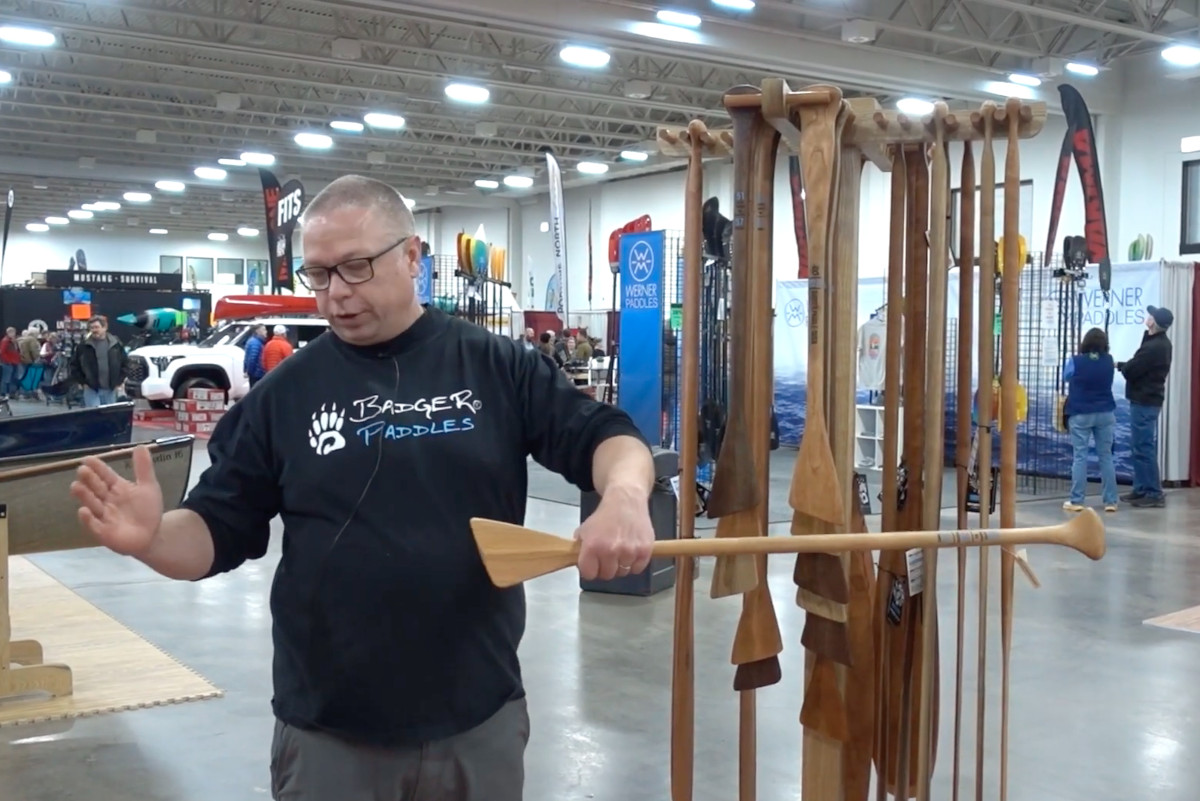
In theory, sizing a canoe paddle should be simple. Yet doing so is tricky, and the best method often argued. When we spotted Badger Paddles at Canoecopia, we noticed something intriguing about the paddle shafts at the edge of their space and had to know more. That’s when we learned Mike Ramsay, the owner of the 15-year-old paddle-building business, and his team have discovered a fascinating method for sizing a canoe paddle.
A simple and ingenious method to sizing canoe paddles
“We’ve been racking our brains for a long time about a good way to size paddles without being on the water,” Ramsay shared with the Paddling Mag team. “I think we finally came up with a way that we’re really happy with–especially here in the Midwest where we are used to different proportion paddles.”
Paddle Sober And Smart
Never mix alcohol and paddling. Coast Guard and state BUI (boating under the influence) laws apply to all vessels. This includes canoes, kayaks, SUPs and rafts.
According to Ramsay, the traditional long-bladed paddles throw people off when it comes to sizing. People think they will need a shorter shaft because the blade is longer. But Ramsay proclaimed the blade length shouldn’t really be part of the equation. Which is why for sizing, Badger has gone ahead and chopped the paddle blade off, leaving the grip, shaft and throat.
Mike Ramsay holding one of his canoe paddle shafts intended for sizing. Image: Paddling Magazine Staff
Having a bladeless paddle allows the canoer to jump in a boat on dry ground (or in most cases a shop floor) and see how their hand positioning is actually going to be in relation to the canoe.
Once you have your size sorted out, each of the Badger test shafts includes a correlation to the paddle model and overall length it would correspond to. At the show Ramsay held a 31 1/2-inch shaft as a Badger paddle sizer. This shaft was marked to equate to a 60-inch Tripper but a 66-inch Feather long-bladed solo paddle, or a 54-inch shorter-bladed Bonga.
Stay Clear Of All Other Vessels
Know the “Rules of the Road” Navigation Rules that govern all boat traffic and stay out of the way of all other vessels.
Never assume that power boaters can see you. Avoid high-traffic areas whenever possible. Proceed with caution when you can’t avoid paddling near boats. Dress for visibility.
“The biggest thing it’s going to show me is where my top hand is going to be,” Ramsay explained of the sizing method. “If your top hand is too high and you’re too spread out you’re going to be punching up. Which can be painful and just not effective.”
The ability to do so, Ramsay believes, will be the secret to narrowing in on a canoe paddle size with confidence.



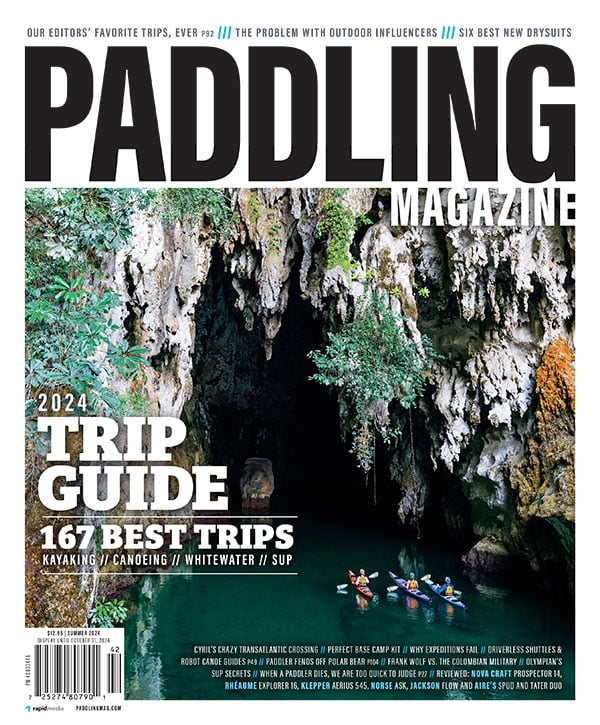 This article was first published in Issue 72 of Paddling Magazine.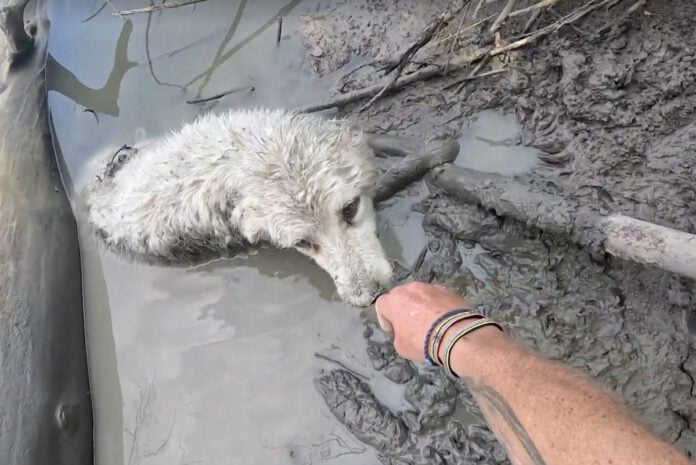
 This article was first published in the Spring 2024 issue of Paddling Magazine.