Everybody swims—it’s part of the sport, and whitewater kayaking is more of a team activity than we may credit it for. You want to strive to be a strong teammate on the river and know others have your back too. Among essential rescue techniques is the ability to wrangle a friend’s boat, and here to help is Simon Coward, owner of AQ Outdoors (AQ Outdoors is a paddling shop and school with locations in Calgary and Edmonton). The following is a transcript of Coward’s kayak rescue method of choice.
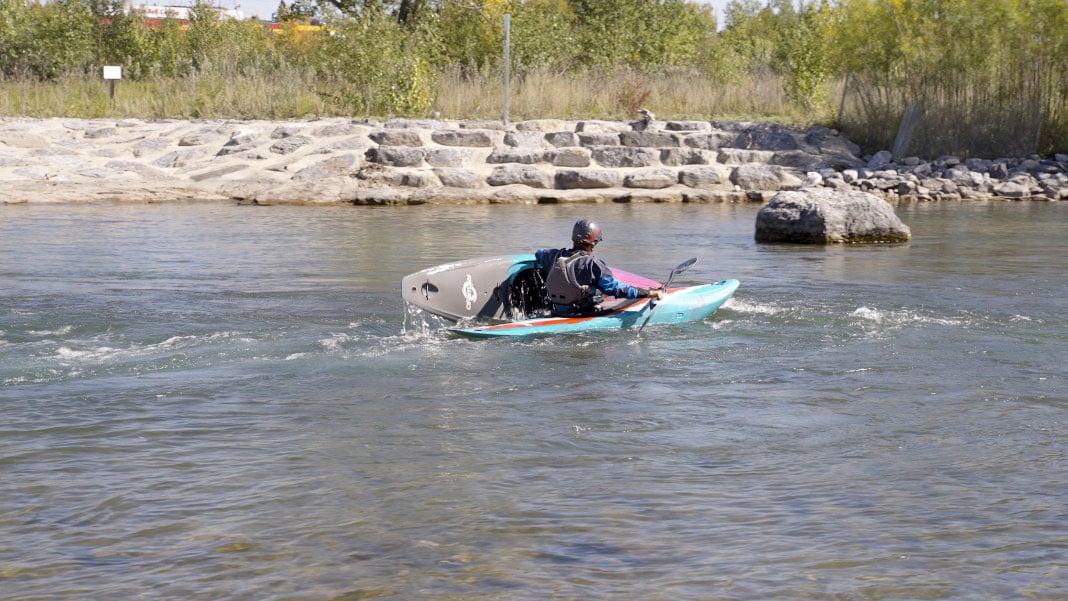
Timing your rescue to meet the kayak at the bottom of a rapid. | Image: AQ Outdoors
How to perform an effective kayak rescue in whitewater
Simon here from AQ Outdoors, just checking in with a little tutorial on some best practices and the easiest ways to rescue kayaks. Over the last 20-odd years of teaching and such I’ve made lots of mistakes, I’ve learned from others, and I’ve seen others make mistakes, and some do really great rescues.
Basics of rescuing a kayak
This is very much about how to keep it as simple as possible. We’re going to start in flatwater how we might address this. My personal preference is to not clip the boat and to get the boat upright as soon as possible. If I get the boat upright and it has float bags in it, it’s much easier to manipulate—whether you’re clipping it, pushing it or bumping it. Ideally we want the boat upright and empty. It’s very easy to rescue at that point but you don’t always get that good of a bounce, well we usually don’t because people are usually upside down.
[ Paddling Trip Guide: View classes at AQ Outdoors ]
After someone swims, the boat is going to be upside down and have a bit of water in it, right, so with this, the most common way I see people try and right the boat is essentially to lean across, grab the gunnel on the other side, push down with this hand and right the kayak. And that works, however, once you get into moving water and it’s a bit more dynamic, that becomes a lot harder. Especially with larger boats and smaller people, it becomes very difficult.
Simon Coward’s chosen method of righting a kayak. | Feature image: AQ Outdoors
A straightforward rescue technique
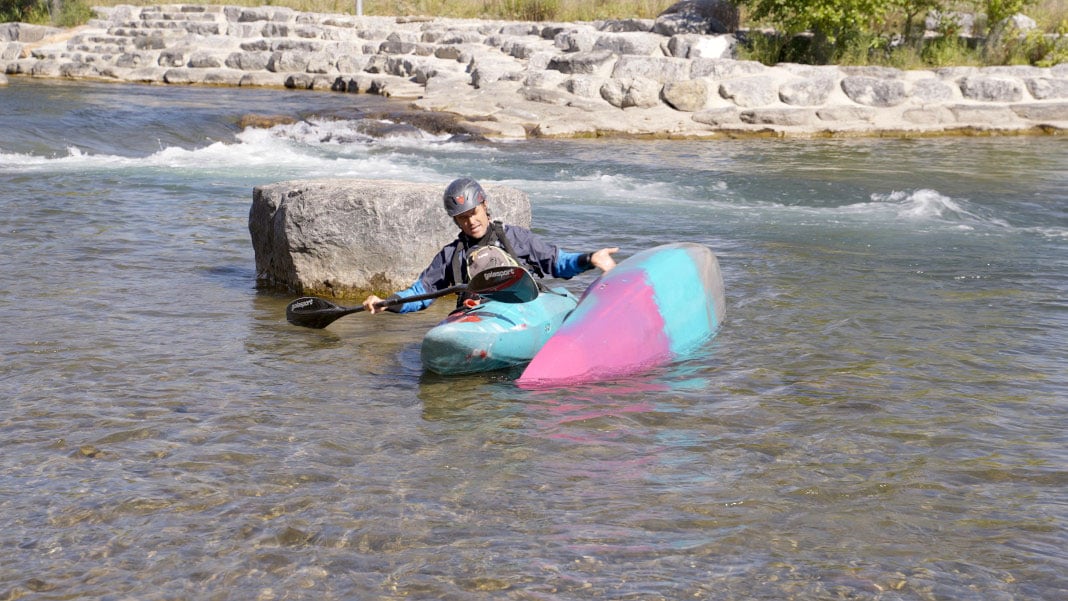
My preferred way of righting the boat if it is upside down, is just essentially to get alongside it, grab the inside gunnel, and slowly start to right it. Then, I lean away and push away. This way I actually have contact with my paddle the whole time—I don’t have to let go of it. And, it’s very quick and very easy to get the boat back upright again. Now we have a kayak, presuming there are float bags in the back, that’s very easy to push and manipulate and move around. It’s not always going to cooperate, sometimes it’s going to flip back over again.
So, super simple: get alongside it, grab, lean away, push the gunnel away, the boat’s right again and you’re off to the races.
A final push to right a fellow paddler’s kayak. | Image: AQ Outdoors
Rescuing a kayak in whitewater
Okay so I’m presuming I’m running safety at the bottom of this little drop. We’ve got our swimmer out, and this boat’s coming down. The first thing to think about is timing. When am I going to go out and get myself to the boat? I pop out [of the eddy] and I get alongside it. Now I’m going to grab the inside of the kayak and then push. I can spin it [the direction I want it to go] then I push the boat [toward shore]. It’s going to spin. It almost flipped there but there’s not that much water in it so it stayed upright.
I haven’t had to clip the boat at all. So if there were any hazards I’m not at risk of flipping over and getting hung up. Basically I’ve got the boat to shore very quickly, very simply. Now I can get out, and I can empty the water out off the kayak and we can get the paddler back going again.
That’s it, a quick and simple way to rescue a whitewater kayak that doesn’t have a rider anymore. Obviously, it’s ideal that there are float bags in the back, but this method doesn’t require you to let go of your paddle. It doesn’t require you to clip onto the boat. It’s a quick flip push get it into the eddy and you’re off to the races.
AQ Outdoors offers retail and kayak instruction in Calgary and Edmonton. Learn more about their school and stores at AQOutdoors.com.
Simon Coward’s chosen method of righting a kayak. | Feature image: AQ Outdoors
Sometimes headlines can be deceiving. Rather than highlighting specific trips, our list of best paddling “trips” for this year showcases regions with multiple world-class options for canoeing, sea kayaking and whitewater paddling. The result, we believe, is anything but deceptive. This article provides a comprehensive rundown of the best destinations to paddle in 2025.
Of course, curating a “best-of” list doesn’t come without challenges—and biases. We focused on places north of the equator so you can plan great adventures for this year’s summer and fall. We also targeted many of the amazing North American paddling hotspots (including one in Paddling Magazine’s backyard) that we love, as well as a few international destinations that we’re dreaming about. It’s time to start planning your own best paddling trip for 2025.
For half a century, paddlers have been flocking to sign up for guided raft trips on the Ottawa River, in Canada’s National Capital Region. This anniversary is but one reason the Ottawa Valley is a renowned paddling epicenter that’s worthy of topping your list of dream destinations for 2024. Besides exciting whitewater rafting, you’ll also find great recreational kayaking options in view of Parliament Hill in downtown Ottawa.
The mighty Ottawa River, and the nearby Madawaska River, are also home to some of Canada’s best kayak schools and summer camps for kids and adults. You will rapidly discover why the Ottawa River has been instrumental in the development of freestyle kayaking and continues to serve as a proving ground for the world’s best paddlers.
The East Gate of Algonquin Provincial Park is located within a two-hour drive of the nation’s capital, providing great access to a vast network of lake-to-lake canoe trips along with whitewater canoe tripping on the Petawawa River.
Meanwhile, on the Quebec side of the Ottawa River, go paddleboarding on the Gatineau River at the picturesque village of Wakefield (30 minutes from downtown Ottawa) or reserve an island campsite at Parc regional du Poisson-Blanc (about a 90-minute drive from Ottawa) for an easy overnight canoe, kayak or SUP trip.
VIEW ALL ONTARIO & QUEBEC PADDLING TRIPS
Photo: Colin Field/Northwest Territories Tourism
2 Northwest Territories
From whitewater canoe tripping in the legendary Barrenlands on waterways like the Coppermine River, whitewater rafting through the deep canyons of the South Nahanni River, or sea kayaking the remote shores of Great Slave Lake, it’s little wonder why Canada’s Northwest Territories (NWT) is a bucket-list destination for all types of paddlers.
A longtime commitment to adventure tourism has allowed the NWT to achieve a seemingly impossible balance of accessibility and remoteness: you can get to places like Yellowknife, Fort Simpson and Norman Wells on commercial flights, and a host of great outfitters will take it from there.
An incredible array of NWT guided paddling trips are available, from whitewater canoe expeditions for experienced paddlers to family-friendly raft and canoe trips in iconic destinations. NWT outfitters also offer canoe and gear rentals and trip planning services to help arrange floatplane charters to help make your dream a reality.
VIEW ALL NORTHWEST TERRITORIES PADDLING TRIPS
Photo: Destination Ontario
3 Northwestern Ontario
The vast region between Lake Superior, Hudson Bay, and the Manitoba and U.S. borders contains enough water and paddling routes to fill lifetimes. Northwestern Ontario is home to countless provincial parks that were seemingly purpose-built for paddlers. Quetico Provincial Park, a quick border crossing away from Minnesota’s Boundary Waters Canoe Area, gives a fantastic glimpse of the potential with thousands of kilometers of wilderness canoe routes.
Venture farther (and with the appropriate backcountry skills) and you’ll find the boreal wilds of Wabakimi, one of Ontario’s largest provincial parks, as well as the unique boreal-meets-prairies scenery of Woodland Caribou Provincial Park. Both of these immense protected areas feature endless canoe tripping on lakes and wild rivers. Farther beyond, rivers like the Winisk draw expert canoe trippers to the Arctic waters of Hudson Bay.
The big lakes of Wabakimi and Woodland Caribou are alluring to sea kayakers, too. But kayakers will be spoilt for choice when they consider the paddling prospects of Lake Nipigon, Lake of the Woods, and of course the massive expanse of the Lake Superior National Marine Conservation Area.
VIEW ALL NORTHWESTERN ONTARIO PADDLING TRIPS
Feature photo: Travel Alaska
4 Alaska
Alaska is a perennial destination on any outdoor adventure bucket list. The state shines for paddlers, with a well-established array of adventure tourism outfitters allowing just about everyone to experience the wilderness frontier safely and in comfort.
Sea kayaking in Alaska includes the deep, glacier-clad fjords of the northern Inside Passage, including Prince William Sound and Glacier Bay. These island-clogged waters feature iconic marine life like salmon and orcas, as well as jaw-dropping mountain views.
Plan a whitewater kayak trip near Anchorage for a more intimate view of the coastal range. Alaska whitewater rafting expeditions on the Alsek or Tatshenshini rivers, which flow through mountain-rimmed, glacier-clad corridors across the international border and into the Panhandle region, are truly trips of a lifetime. Or, venture into the deep wilderness of the interior for a canoe expedition on Alaska Wild and Scenic rivers like the Noatak, Koyukuk or Kobuk.
VIEW ALL ALASKA PADDLING TRIPS
Photo: Paul Vincent/Explore Minnesota
5 Minnesota
The Land of 10,000 Lakes is an obvious destination for where to go paddling in 2024. For starters, the immense Boundary Waters Canoe Area Wilderness makes Minnesota a canoeing epicenter. Supported by great outfitters in towns like Ely and Grand Marais, the Boundary Waters ranks among the top places to canoe in the world, with thousands of miles of route options. What’s more, the million-acre area abuts Ontario’s Quetico Provincial Park for trans-border canoe expeditions. Voyageurs National Park, with its headquarters in International Falls, Minnesota, is made up of mostly huge lakes that are perfect for multiday kayak trips.
Minnesota also fringes on Lake Superior’s northwestern coast, making it an ideal location to explore this inland sea by kayak. Day trips are available from Duluth and Grand Marais and you can also take the ferry to remote and mystical Isle Royale National Park to experience some of the finest freshwater sea kayaking in the world. If that’s not enough, Minnesota is home to the headwaters of the Mississippi River and the Twin Cities of Minneapolis-St. Paul offer some of the finest urban paddling in the world on countless lakes.
Over 150 years ago, American author Henry David Thoreau ventured into Maine’s North Woods by canoe with an Indigenous guide and shared his experiences in a journal that’s become an iconic piece of outdoors literature. The experience of canoe tripping in Maine hasn’t changed much since then—the state’s pristine rivers and remote Appalachian lakes have a reputation as the crowning jewels of the 740-mile Northern Forest Canoe Trail.
Maine also offers outstanding whitewater canoe tripping on the Allagash Wilderness Waterway, along with fine family paddling opportunities in wilderness areas like Rangeley Lakes. Not to be outdone, Acadia National Park is a dreamscape for sea kayaking in coastal Maine. Depending on their skill level, paddlers can explore secluded bays and visit historic lighthouses, or set out on overnight coastal tours into labyrinths of tide-washed granite islands.
VIEW ALL NEW ENGLAND PADDLING TRIPS
Photo: Visit Kitsap Peninsula
7 Washington
With a diverse geography spanning the Cascade Mountains to the Pacific coast, it’s no surprise Washington offers plenty of opportunities for paddlers. Make 2024 your summer to sea kayak the bucolic San Juan Islands, where you can join a local outfitter for a day tour or rent kayaks and set off on weekend to one-week trips in Puget Sound.
Washington also abounds with whitewater, making it a great destination for a road trip. Rivers like the Skykomish are popular all-season runs in the Seattle area. The White Salmon near Hood River allows you to take in the scenery of the fabulous Columbia River Gorge.
There are plenty of good destinations for canoeing as well, including Lake Chelan, a ribbon-like body of water immersed in the North Cascades, Lake Crescent in Olympic National Park, and Lake Wenatchee in the massive Okanogan-Wenatchee National Forest.
VIEW ALL WASHINGTON PADDLING TRIPS
Photo: Visit Wales
8 Wales, United Kingdom
Located on the west coast of Great Britain, Wales’ geography ranges from tide-washed coastal areas to the 3,500-foot-tall mountains of Snowdonia. For expert sea kayakers, a trip to paddle places like Anglesey is like experiencing Mecca: This is arguably the birthplace of modern British-style sea kayaking, where some of the finest paddlers have pitted their skills against immense tidal streams and surf. A wide variety of sea kayak skills courses are available for all levels of paddlers. Meanwhile, Pembrokeshire Coast National Park is renowned for its sea caves, hidden beaches and marine wildlife, making it another great destination for kayak touring.
For a mellower experience canoeists and recreational kayakers can paddle the smaller waters of Snowdonia National Park, including Llyn Padarn. Also in Snowdonia, the River Tryweryn with its class II to IV rapids is an example of the great opportunities for great whitewater kayaking in Wales. Finally, the River Wye is one of the U.K.’s longest waterways, with a rich human history ranging from ancient cave dwellings to Roman settlements and some of the country’s greatest biodiversity, including aquatic mammals and many species of birds. Canoeists can trace a 251-kilometer water trail along its entire course.
Photo: Image Bank Sweden
9 Scandinavia
Long summer days are but one attribute of paddling in Scandinavia. Between Sweden, Finland and Norway, there’s a huge array of experiences available for canoeing and kayaking. The Swedish backcountry offers multitudes of canoe routes amidst a classic landscape of lakes, rivers and boreal forest, with Pieljekaise National Park’s lakes and rivers reflecting the great opportunities for multiday trips in Swedish Lapland.
Not to be outdone, the Lakeland area in the central Finland interior features a similar landscape with multiple protected areas that are best explored by canoe, including Kolovesi National Park, Paijanne National Park and Linnansaari National Park, which is home to a unique population of freshwater ring seals.
Both Finland and Sweden offer outstanding sea kayaking, too. The fjords and islands of Norway’s Lofoten area, however, take coastal scenery to the next level with incredible seascapes and historic fishing villages clinging to the rocky shore. Globetrotting paddlers can go even farther by planning the trip of a lifetime to Svalbard, an extremely remote cluster of Norwegian Arctic islands home to glaciers, polar bears and reindeer.
VIEW ALL NORWAY PADDLING TRIPS
Photo: António Duarte
10 Portugal
Portugal is an off-the-radar Mediterranean paddling destination that’s gaining recognition as one of Europe’s best places to kayak for its smooth-flowing rivers and idyllic pastoral scenery. The Douro River flows through a living picture postcard of sparsely forested hills, ancient homesteads and some of the planet’s best vineyards. The climate is mild, the people are friendly, and you can paddle inn to inn on guided canoe or kayak tours with local experts handling the logistics for a more immersive journey. Tributaries of the Douro, including the Mondego River, offer unique experiences on smaller watercourses with the same Old World feel.
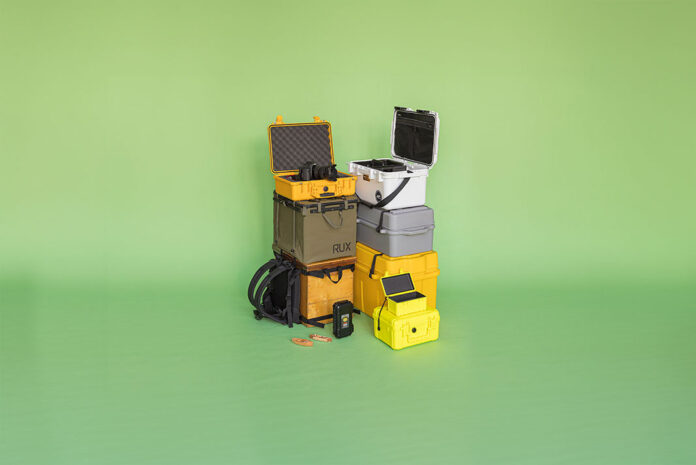
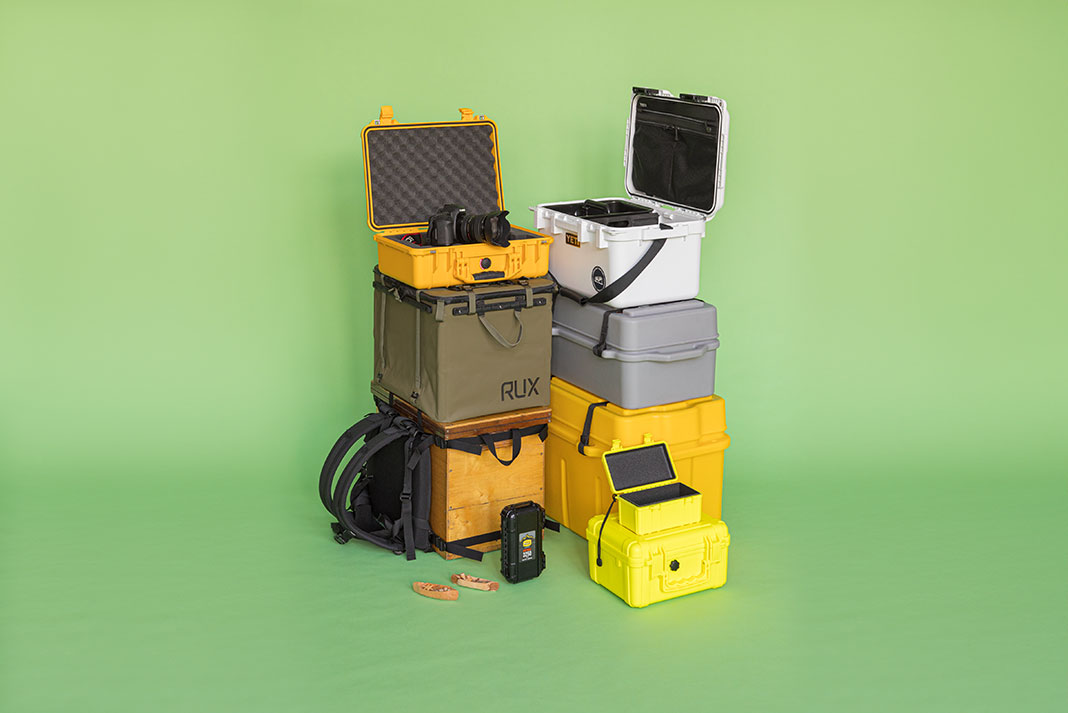
Settling on the right gear storage solution can make the difference between smooth paddling and a spoiled time on trip. Drybags are fantastic for shaping to spaces, but not always up to the rigors of a long canoe trip. Whether you’re looking to protect your phone, your camera, your camp kitchen or your whole kit—we’ve got you covered. Below, eight weather-proof gear boxes go head-to-head against the OG wooden wanigan for gear storage supremacy.
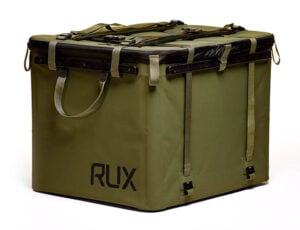
Meet the RUX 70L, a gear storage companion that’s neither quite a box nor a bag. Crafted from flexible, waterproof TPU-coated 840D nylon, it adapts to your needs with aluminum corner stays that work like magic slap bracelets. Need a stiff box? Done. Want it flat for storage? No problem. Set up might require a quick video tutorial the first time, but the 70L is worth it. Most suited to frontcountry camping and portage-free paddling, the built-in grab handles and removable backpack straps make it a breeze to carry, while its wide, rigid opening ensures easy access. The RUX 70L is lightweight, rugged and weatherproof, and the Paddling Mag staff were all quite taken with it—until we checked the price tag. For $369, a paddler could buy 30 large Rubbermaid bins at $11.99 each and organize the whole gear room, not just the camp kitchen.
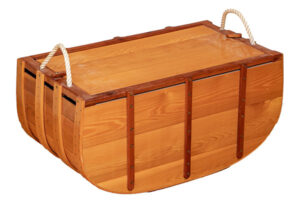
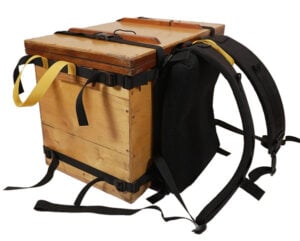
Meet the OG gear box, a timeless favorite that was the go-to for hardy voyageurs for a couple centuries. Still revered by trad trippers and canoe camp enthusiasts, many claim the wanigan is the real MVP on a trip. Need to haul food or oddly shaped essentials? It’s the go-to storage for cooking pots, large utensils, stove fuel, hatchet and bush saw. And the wanigan is not just mere storage, oh no—it moonlights as a makeshift bench or dining table for your wilderness feast. The wanigan pictured here weighs just under 10 pounds. It’s not featherlight, but fans swear by its durability and repairability. The classic wanigan is often DIY-ed with plywood and pine and is an affordable weekend project—for roughly $50, you too can tump around with a piece of history.
Portages can be a pain, but they don’t have to hurt. The new Wanigan Harness from Recreational Barrel Works offers a comfortable solution for carrying traditional wanigans, the NRS Canyon and Boulder dry boxes (below) and many hard-sided coolers. The modern Wanigan Harness features shoulder straps and a cushy foam back pad. The combination of the two prevents the gear box’s bottom edge from digging into the paddler’s back. Weighing just one pound, it’s lightweight but can carry up to 65 pounds. Designed for camps, outfitters and individuals alike, expect the top-tier quality RBW is known for. Fits gear boxes from 18 to 29 inches long, 12 to 17 inches wide, and 10 to 17 inches tall.
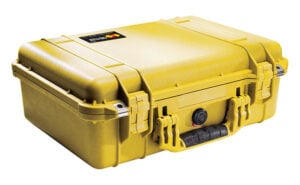
Pelican started in 1976 out of the California garage of founder Dave Parker when he began designing first aid kits. As the story goes, the durable and waterproof cases were a hit with divers, who tossed out the first aid supplies and used the cases to protect other valuables. From those humble beginnings, Pelican has become a go-to for military personnel, first responders and international river runners, protecting fragile equipment in the world’s harshest environments. Getting dropped, run over, submersed and facing TSA scrutiny unaccompanied is all in a day’s work for the waterproof and crushproof 1500 Case. The 1500 is an ideal size for photo and film enthusiasts toting multiple lenses. It is buoyant with up to 50 pounds and throws in a lifetime guarantee, too. Paddling Mag’s publisher has been using this eight-pound case for more than a decade.
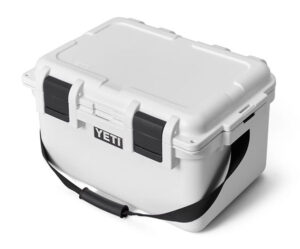
A favorite among rafters, campers, hunters and tailgaters, Yeti needs no introduction. Their LoadOut GoBox 30 is a fully submersible beast with tie-down points and lock ports for any wild escapade. Team it up with Yeti’s many accessories—cargo trays and gear compartments—for an organized interior. Yeti’s Pack Attic accessory nests in the lid with three large zippered compartments for stashing small items. Use the hefty hauler handle for one-hand carries. The GoBox 30 weighs 12 pounds and is ideal for stowing the camp kitchen or food. The smaller 15 size has just enough room for fragile essentials, while the burly 60 is a full-on gear locker. The only complaint from Yeti fans? The GoBox comes in just four colors: white, orange, black and tan.
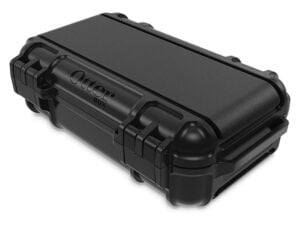
Perfectly sized for stowing a phone, cash and key fob while on the water, Otterbox’s Drybox 3250’s padded foam interior protected our editor’s valuables while bouncing around the cockpit on a 52-day kayak trip last summer. As for the polycarbonate case itself, Otterbox claims you can “beat the living daylights out of it”—and honestly, we tried. Weighs less than a pound and is waterproof up to 90 feet for 30 minutes. Paddling Mag’s designer has dreams of turning it into a mini fly fishing tackle box next.
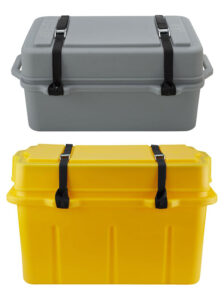
The NRS Canyon and its little brother, the Boulder, boast 3.6 and 1.6 cubic feet of roominess inside, respectively. These rain-defying gear boxes won’t win gold in a flip test, but they sure can keep things dry. Just snug the straps tight to ensure a secure lid fit, and then forget about rain and splashing. The Canyon weighs 13.5 pounds, while the Boulder weighs 8.8 pounds. There aren’t handles, but you can rig your own with straps fed through the holes on each end. These polyethylene cases are essentially modern wanigans and perfectly sized for stashing your camp kitchen gear or a week’s worth of food. They’re affordable sidekicks whether in your canoe, at camp or on the road in a truck bed. NRS advises against turning these gear boxes into seats, as the compression might mess with the foam weatherstripping in the lid. Opt for gray or yellow to suit your style.
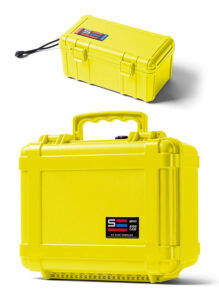
Waterproof and built to withstand the rigors of the most rugged adventures, S3 Cases’ gear boxes are built with tough injection molded ABS to keep your delicates safe. The one-pound T3500 model is perfectly sized to carry midsize items, like small medical kits, microphones, multiple cell phones and wallets, sunglasses, power banks and GPS units. The four-pound T6500 is more appropriate for storing large DSLR cameras, drones, laptops, and other compact and fragile equipment. Both models’ heavy-duty hinges and handle pins are extra tough and confidence-inspiring. Available in black, yellow and red at salamanderpaddlegear.com for paddlers in the United States and underwaterkineticscanada.com for paddlers in Canada.
This article was first published in the Spring 2024 issue of Paddling Magazine. Subscribe to Paddling Magazine’s print and digital editions, or browse the archives.
Norm Hann navigates the offshore islands and narrow waterways of B.C.’s north coast, en route to Kitkatla at the end of the expedition. | Feature photo: Bruce Kirkby
The notorious waters of Hecate Strait separate the islands of Haida Gwaii from British Columbia’s northern coastline. Renowned for strong winds, powerful tidal currents, frequent storms and shallow waters, Hecate is listed by Environment Canada as the most dangerous body of water on the entire Canadian coast and the fourth most dangerous in the world.
John Vaillant, author of The Golden Spruce, describes Hecate this way: “The Strait is a malevolent weather factory. During winter storms, waves can reach 10 to 20 meters and expose the sea floor. The result is one of the most diabolically hostile environments that wind, sea and land are capable of conjuring.”
Generations ago, the Haida First Nation crossed the Strait routinely in great cedar canoes, up to 60 feet long and six feet wide. Carrying as many as 100 men, they were able to disappear back across Hecate’s moody waters where none dared follow.
The recent history of human-powered Hecate-crossings is scanter. Masset kayaker Chris Williamson made two attempts in the 1990s. One was successful; the other turned back at night by changing winds. Legendary painter Stewart Marshall from Sointula Island sailed a homemade kayak 200 nautical miles across southern Hecate in a storm, surviving for three days on popcorn and coffee before arriving at Cape St. James. In 2008, a group of four young Haida Gwaii men crossed in double sea kayaks as part of a fundraiser.
Norm Hann navigates the offshore islands and narrow waterways of B.C.’s north coast, en route to Kitkatla at the end of the expedition. | Feature photo: Bruce Kirkby
To put the challenge in perspective, in the 70 years since Edmund Hillary and Tenzing Norgay first climbed Everest, another 12,000 climbers have stood on the summit. In the same span, you could count on your fingers the number who have paddled across Hecate.
A first, unrealized attempt
I first met Norm Hann at a storytelling festival in 2016. Quiet and confident, Norm was a successful SUP racer, well-known for long coastal journeys in support of First Nations issues. I’d recently paddleboarded from Port Hardy to Tofino, and we had lots in common. When Norm called a few months later and asked if I’d consider trying to paddle across Hecate with him, my reply was an enthusiastic yes.
The next June, we met in Prince George, with plans of carrying on toward Haida Gwaii, and tackling Hecate. But with one storm after another crashing into the B.C. coast—and no end to the foul weather in sight—we reluctantly turned around.
Thank goodness because we weren’t ready. Not even close.
A few months later, I herniated a disc in my back. Unable to even walk for months, I was devastated. The dream of crossing Hecate seemed impossible. Little did I know, the five-year recovery journey would be a gift that left us a much stronger team, and much better prepared to tackle Hecate.
A key to crossing Hecate is choosing the right weather window. No one conquers the Strait. Rather, they sneak across in a rare moment of calm, always aware conditions could change in a heartbeat.
For summer after summer, we watched Hecate’s weather patterns, recording forecast wind and wave heights versus actual buoy observations. We learned what conditions preceded rare calm periods and how long the smooth waters lasted. Entire seasons would pass without a single favorable paddling day.
As my body healed, Norm and I tackled increasingly challenging SUP expeditions together, first retracing a Gitgat Grease Trail in the Great Bear Rainforest, then rounding Cape Scott, Brooks Peninsula, and finally Cape Caution. We grew comfortable paddling side by side in rough waters, aware of what the other was thinking without words, and able to make decisions even while battered by wind and waves.
As the seasons passed, we trimmed our gear to the barest minimum and learned to load our boards so they could ride downwind swells, push through chop and land safely in surf. We experimented with a vast constellation of different boards before eventually designing our own expedition paddleboards: Norm with Sunova and me with Starboard.
At last, setting out across the Strait
In May 2023—six years after first planning to cross Hecate—Norm and I arrived in Prince Rupert by ferry, long after midnight. With rain pelting down, we pitched our tent in a dark corner of a parking lot, listening to the marine weather forecast on a crackling VHF radio. The frontal system lashing the North Pacific would dissipate over the next day, and just as we had hoped, a brief period of light and variable winds would follow. Game on.
Twenty-four hours later, we stood on the desolate shores of Rose Spit. Few words were shared as we loaded boards and double-checked GPS waypoints. Then we were off. With a brisk west wind at our backs, we knew there would be no turning back.
Bruce Kirkby, safely tucked ashore on a rocky islet north of Banks Island, stares out across the eternity of Hecate Strait. | Photo: Norm Hann
Gusty winds pressed us over smooth waters, and we covered 7.5 kilometers in the first hour—great progress for fully loaded boards. Then Hecate began to show her capricious nature. Ocean swell built from the north, hitting us on our rear quarter. Then the ebb tide turned to flood, and an aggressive wind chop arrived, mixing with the swell and turning the ocean into a confused mess. Our progress slowed to five kilometers per hour. Then four. Then, a painful three and a half.
[ Plan your next B.C. paddleboarding trip with the Paddling Trip Guide ]
The minutes and hours crawled past. We spent a lot of time alone with our thoughts. I struggled not to concentrate on our speed—for it felt dishearteningly slow. Snacks and gulps of water were stolen between strokes. On those lonely waters, we saw nothing save a few gulls. Not a single whale or boat. For 12 hours, we never stopped paddling.
Eventually, the peaks of Stephens Island appeared through mists, inching closer. Twenty kilometers to go. Then 10. Dusk had descended by the time we reached the first rocky headlands. When we crawled ashore at last, neither of us could walk very well—or form complete sentences. But we shared the overwhelming joy of having finally achieved a long-sought-after goal. After setting up a tent, we used our last reserves to cook a freeze-dried meal, then collapsed into sleeping bags.
This article was first published in the Spring 2024 issue of Paddling Magazine. Subscribe to Paddling Magazine’s print and digital editions, or browse the archives.
Norm Hann navigates the offshore islands and narrow waterways of B.C.’s north coast, en route to Kitkatla at the end of the expedition. | Feature photo: Bruce Kirkby
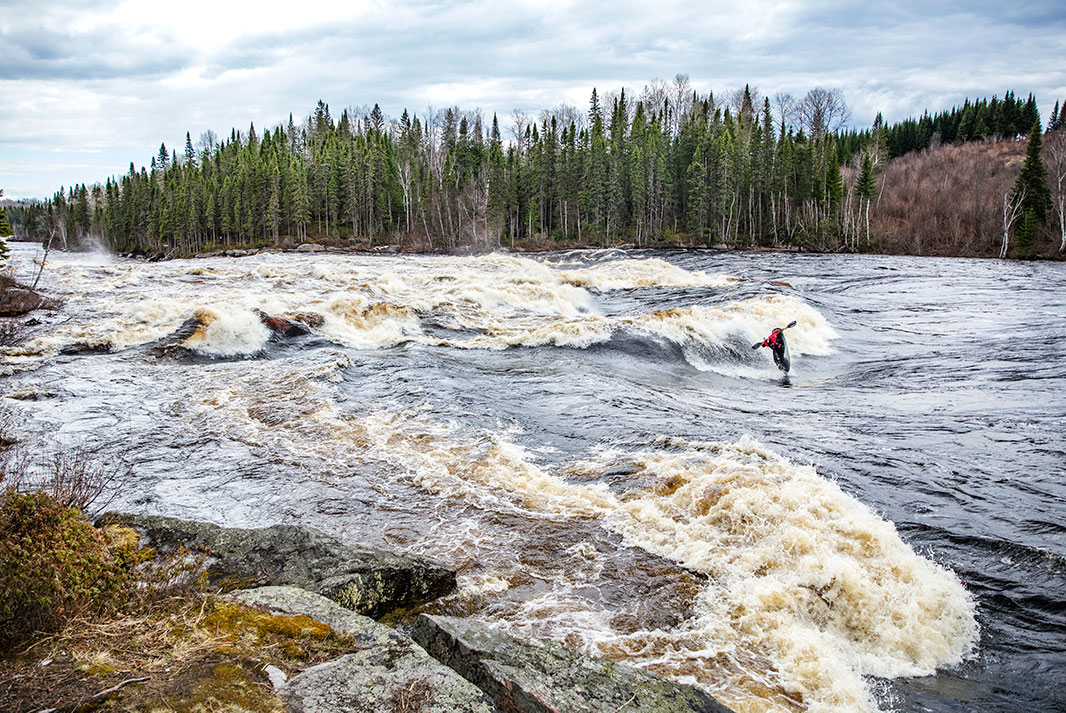
This is the wave that never ends, it surges on and on, my friend. | Feature photo: David Jackson
A few days upstream of James Bay, over the seething volume of a flooded Nottoway River in mid-June, Benny Marr hollered from a boat length away, “In my imagination, it goes on forever.”
Finding the forever rapid on Quebec’s Nottoway River
He was referring to the seemingly endless rapid we were entering. It’s the sort of whitewater this region is famous for, where waves can be measured in stories and holes appear that could devour a house. His voice faded into the river, and for a time, he was right; this was a never-ending joy train of towering waves, a river he’d only visited once before, featuring the type of high-volume wilderness whitewater he’d searched the world for.
When holes began to open mid-river—ones I looked up at and down into—Benny opted to go river right. When the horizon disappeared, the river appeared far below some hidden gradient, and Benny hit the gas hard to the middle. It was a ferry not for the faint of heart in fully loaded long boats. With each of his strokes, he flashed a little thumbs up to where he was going next.
This is the wave that never ends, it surges on and on, my friend. | Feature photo: David Jackson
As the tongue unraveled below, so did my stomach. All I could discern in the chaos beneath was a needle of water moving through a two-sided hole of destruction. It was Benny’s line, but I missed.
Back to the beginning
Four days earlier, we had left a rough gravel road behind and begun a 260-kilometer paddle that would end where the road meets the ocean in the Cree community of Waskaganish. Benny and Dan Sutherland were fresh from a big wave scouting mission in Quebec, and I was here to experience the mighty Nottaway I’d heard so much about.
For days we navigated the large stormy lakes that provide the Nottoway River’s volume. At this flood level, the water wasn’t just lapping at the tree trunks but well into the forest. We paddled until the last touch of pink in the sky before tucking into a sad highwater hovel each night.
In the wake of the lakes came horizon lines so wide they induced both joy and nausea. Looking downstream, we saw plumes of mist half a kilometer wide. The riverbanks didn’t lend themselves to shoreline scouts. In lieu of a view, Benny launched a drone to scout for lines. We huddled around the tiny screen, following Benny’s finger down the obvious course. It always looks breezy from above.
Upon entering, the lines disappeared, and holes greeted us. Afterward, Benny proclaimed he was still “figuring out this drone scouting thing.” This wasn’t the Congo River, where Benny and a legendary team of expedition kayakers used helicopters to scout Inga Rapids and where he was later airlifted off a small island above an unfathomable cataract. On the Nottoway, there was no chopper or big team, just Benny reminding me to “only look where you want to go, ignore the rest, and stay away from the edges.” I watched as he left the obvious lines to prospect for joy, trying for bigger, making meaning from chaos, using his boat like a painter’s brush to explore the canvas of a wild rapid.
[ Plan your next Quebec whitewater kayaking trip with the Paddling Trip Guide ]
A Google search of Benny Marr reveals glimpses into his life. An Ottawa Valley youth toting a mullet. The first descent of Site Zed on the Stikine River. The viral Lions Bay drainage ditch descent. Canyons in Papa New Guinea, among others. He is one of whitewater’s most well-known paddlers and nabbed the cover of Rapid magazine three times.
One evening, I pointed out a small, deep pool with walleye in it out front of camp. Benny was all smiles when they pulled, and his face focused when I instructed him on filleting them. All these years on the water and the river still has more to teach.
Drama and deliverance
But back to my missed hole. When I rolled up, I could hear Benny high above and behind me screaming, “You’re a warrior, Dave!” But I needed out, I needed air, and this hole was too big to escape. Next thing I knew, it was violent, then I was hanging onto Benny’s bow, blood pouring from my knuckle, fending for myself through holes, catching glimpses of Dan with my boat. It was a long 15 minutes before Benny nudged me into a shoreline eddy. Lying amidst boulders under the warm sun, the guys were laughing. Dan narrowly escaped the hole opposite me, and the good fortune of one swimmer instead of two was a wholehearted relief.
On shore, Dan emptied my boat of water as I lay exhausted, staring at the blue sky. I pointed to a piece of chaga on a birch tree up the bank. Benny grabbed his river knife and removed it, smiling. He’d never found the fungi responsible for the earthy tea before. Sitting around the steaming steeped brew that evening, we talked about the big rapids still to come and the 50 kilometers of windy James Bay we would have to paddle to get to the road; we reminisced on bad swims, and Benny shook his head at the day’s drama.
He was there in his happy place, beside a rapid he had searched the world for, one that stretched pulsing into the horizon, a ride that goes on forever in his mind. He talked about coming back next year, and it dawned on me this big, obscure river wasn’t just another expedition; it was the epitome of his life, intertwined with the pulse of wild water.
This article was first published in the Spring 2024 issue of Paddling Magazine. Subscribe to Paddling Magazine’s print and digital editions, or browse the archives.
This is the wave that never ends, it surges on and on, my friend. | Feature photo: David Jackson
When disaster strikes, guides’ livelihoods are often among the most immediately impacted. Think hurricanes, wildfires and, of course, the shutdowns of a global pandemic. When the public spaces and waterways we enjoy are inaccessible, guides are left without work. Combine this with the already limited benefits that accompany the fact most guides are contractors or seasonal employees, and you have a recipe for hardship.
Photo: Courtesy Guide Relief Program
The relief program rescuing guides in times of hardship
These reasons are largely what has motivated Mollie Simpkins to found the nonprofit organization the Guide Relief Program, which is now running a specific fundraising campaign called Guide Across America.
“We all choose our professions,” shares Simpkins. “Because we’ve chosen to be guides that doesn’t mean we shouldn’t have access to benefits.”
Simpkins, who also serves as the executive director of the program, works in various management roles at Sweetwater Flyshop, in Montana’s Yellowstone country. When the world went into lockdown during the COVID-19 pandemic, Simpkins’ boss wanted to put together a fundraiser to help Montana’s guides through the trying time. Utilizing a background in the nonprofit sphere, Simpkins stepped up to lead the fundraising effort, and took it beyond a singular event by founding the relief organization.
The Guide Relief Program offers grants to guides facing hardship through a straightforward application process. The relief program also assists guides with access to needs including mental health and well-being services. To date, Simpkins shares that the fund has awarded $36,000 in grants. An example of the program jumping into action was following the June 2022 Yellowstone floods, when guides lost work due to the destruction.
Now, in an effort to take the work of the Guide Relief Program mainstream throughout the U.S., the nonprofit has partnered with Sawyer Paddles and Oars and the Fly Fishing Film Tour in a fundraising sweepstakes, Guides Across America.
“Everybody in the paddle industry and everybody in the outdoor guiding industry are really good at responding after catastrophic events devastate these communities that really rely on a tourism economy,” believes Sawyer CEO Zac Kauffman.
“When an event happens, everybody kind of rallies around to get food, water, power, infrastructure, and then tourism isn’t even a thought. And it’s really like that’s the last thing to come about,” Kauffman adds in reference to the precarious state of local guiding communities hit by disaster.
Kauffman, whose company is based in Oregon, was involved with support for guiding communities in southwest Florida following Hurricane Ian, when he got to thinking—if his small business on the other side of the country can help out, maybe a larger campaign of guides helping guides throughout the U.S. could be formed.
Kauffman conjured the Guides Across America sweepstakes, then found Simpkins and her existing organization bent on supporting the guiding community. The pair, along with the Fly Fishing Film Tour, have now combined their efforts to strengthen the funding the Guide Relief Program has accessible for those affected by catastrophe.
Feature photo: Courtesy Guide Relief Program
A good cause and a chance to win a hefty prize
The sweepstakes includes a long list of sponsors, and by donating, entrants stand a chance to win a prize package worth $17,000 and includes a set of Sawyer Oars, an Outcast Sporting Gear raft, a Downriver Equipment frame, and a guided stay at the Royal Big Horn Lodge in Montana. Best of all, entering the sweepstakes supports the guiding community many paddlers have worked in, and continue to work, in as part of the lifestyle we all hold dear.
“A lot of our team, myself included, come from the guiding industry. I was a guide for 30 years and that’s basically how I ended up with Sawyer,” Kauffman adds of the significance of supporting the community both personally and as a business. “No matter where you are, we have a common element, we are all water guides.”
“Some are fast. Some are slow. Some are high. Some are low.” —Dr. Seuss | Feature photo: Peter Bowers
My first canoe was a junker. A generation older than me, this hand-me-down was just 14 feet long and weighed a hefty 80 pounds. It was all fiberglass, aluminum and paint. The multiple cover-up jobs had taken it from blue to green to rubber duck yellow in half-assed attempts to hide its many scratches, chips and gouges.
Car topping it solo was out of the question—the missing passenger side mirror of my parent’s van was a testament to why—and solo lifting to portage was a feat of both acrobatics and athleticism with a 50 percent chance of success or chiropractic failure.
My first canoe took me to places that had previously only been a smattering of blue and green on folded paper. It carried me through morning mist to reveal moose grazing and caused a happy little lurch in my stomach whenever I lifted the garage door—the promise of adventure woven in layers of tired fiberglass.
“Some are fast. Some are slow. Some are high. Some are low.” —Dr. Seuss | Feature photo: Peter Bowers
In waves my first canoe may have taken on more water than some, and yes, its oil canning hull ensured it always felt like I was paddling a barge, but it was mine and it floated and I loved it. Her name is Nessie.
An old flame for new paddlers
When we all started canoeing, it didn’t much matter what we were paddling. Aramid, polyethelene, Spectra and Royalex were words without meaning—a foreign language spoken only by older, bearded and flannel-wearing fellows we met on the portage trails. An appreciation of how materials and design affect performance is irrelevant when there’s no concept of what performance feels like.
Nowadays, it’s a different story. I have a sexy red lightweight tripper that is far more suited to the type of paddling I like to do. I can car-top it solo and announcements of upcoming portages aren’t followed by a sad sigh of resignation. My tripper isn’t ideal for every occasion though. I’m lusting after a sleek solo racer for lunchtime jaunts, and a traditional wood canvas design for Sunday afternoons.
It’s been years since I’ve paddled Nessie. She still hits the water a few times each summer, borrowed by friends who are unencumbered by such considerations as tracking and tumblehome. Nessie is a vessel to adventure. And I’m sure if you asked them, each and every one of my friends would say that Nessie is a great canoe. For the rest of us, this is this year’s Paddling Buyer’s Guide.
This article was first published in the 2014 Paddling Buyer’s Guide and was republished in the Spring 2024 issue of Paddling Magazine. Subscribe to Paddling Magazine’s print and digital editions, or browse the archives.
“Some are fast. Some are slow. Some are high. Some are low.” —Dr. Seuss | Feature photo: Peter Bowers
The Paddling Mag team is thrilled to announce it has been shortlisted in the special interest category at the prestigious 46th annual National Magazine Awards. This nomination underscores the exceptional work of our contributors and staff, whose dedication and passion for paddling have shaped the magazine’s success.
Judges praised Paddling Mag for its user-friendly design and engaging content, noting, “From the very first turn of the page, Paddling Magazine was easy to navigate, fun, and informative to read.” They were impressed by the magazine’s ability to “draw us into its world of technique, cool gear, and—most impressively—breathtaking photography of the places to be discovered.”
Being shortlisted at these distinguished awards, known for recognizing excellence in magazine journalism and creative design, is a significant achievement and we are grateful for the recognition. The award also celebrates the vibrant community that makes our magazine what it is. A huge thank you to our writers and photographers—your stories and visions bring the spirit of paddling alive on our pages!
We are also immensely appreciative of our readers and the paddling community for their continued support and enthusiasm, which fuels our ongoing mission to deliver the best of paddlesports.
Category winners of the National Magazine Awards will be announced on June 7, 2024.
If you’re not already a subscriber, you can dive deeper into the world of paddling with a subscription to Paddling Magazine. If you’re passionate about paddling adventures and value top-notch storytelling, subscribing is the perfect way to ensure you never miss out on our exclusive content. From thrilling expedition stories to expert tips and the latest gear reviews—Paddling Magazine is crafted for enthusiasts by enthusiasts. Subscribe now and let us bring the adventure to your doorstep. If you love paddling, you’ll love Paddling Magazine.
Known as the Land of 10,000 Lakes, it makes sense there’s a lifetime’s worth of incredible kayaking in Minnesota. From the vast horizon of Lake Superior to storied rivers and immense networks of interior lakes, there’s something to suit every kayaker.
The world’s largest freshwater lake is an unparalleled destination for sea kayaking, with the Lake Superior Water Trail boasting 150 miles of rugged bedrock coastline and hidden agate beaches. Paddling the beginnings of the Mississippi on its visually stunning tributaries such as the iconic St. Croix River. Pushing up against the Canadian border, Voyageurs National Park and the Boundary Waters Canoe Area Wilderness feature sprawling, interconnected lakes and idyllic campsites for overnight kayak excursions. Finally, the cities of Minneapolis and St. Paul offer some of America’s best urban kayaking.
From easy day trips to challenging weeklong sojourns, we’ve just scratched the surface of all the beautiful kayaking you’ll find in Minnesota, which boasts more than 13 million acres of waterways.
9 magnificent kayaking destinations in Minnesota
Kayaking Minnesota water trails
Whether you are searching for a relaxing family float or exciting rapids to get your adrenaline pumping, Minnesota’s countless rivers promise a memorable kayaking experience for everyone. State water trails offer easy access to over 4,500 miles of exceptional paddling.
Photo: Twin Cities Kayaking
Rum River
The picturesque Rum River State Water Trail is perfect for a kayak trip that feels remote but is less than an hour’s drive from Minneapolis-St. Paul. With a significant current, the river’s final 11 miles offer an exhilarating day trip with easy class I and II rapids, wonderful natural scenery and great fishing. The water is clear and clean, making for great swimming and picnicking spots en route.
Twin Cities Kayaking offers kayak rentals with free delivery and pick-up, as well as guided Rum River fishing excursions.
Photo: Paul Vincent
St. Croix River
One of the first National Scenic Rivers protected by U.S. Congress, the wild St. Croix River is also a state water trail capturing all that paddling in Minnesota has to offer. Kayak the lower St. Croix near Taylors Falls for quiet, wildlife-filled waters flowing through a heavily wooded, steep-sided valley with sandstone and limestone bluffs. Spend a full day meandering 15 miles down to William O’Brien State Park Landing. Or turn your outing into a weekend escape with one of the dozen free watercraft campsites along this route available for camping on a first-come, first-served basis.
The Root River State Water Trail flows 85 miles through the rocky landscape of southeastern Minnesota’s Driftless Area, before draining into the Mississippi River. This unique area escaped the scouring effects of the last Ice Age and features massive limestone bluffs and cold-water springs, which create perfect conditions for trout species. Flows along most of the river are gentle to moderate, making it ideal for families.
With nearly 12,000 to choose from, it’s little wonder the word “lake” conjures many different images in Minnesota. Lakes here range from tranquil interior gems perfect for a quiet day of kayak exploration to the wave-tossed bedrock shores of Lake Superior—the world’s largest freshwater expanse.
Lake Itasca
The serene birthplace of the mighty Mississippi, paddling on Lake Itasca feels both peaceful and momentous. Nestled within Itasca State Park, this small glacial lake marks the beginning of the great river’s 2,552-mile journey to the Gulf of Mexico. Kayak beneath old-growth pines and watch for abundant bald eagles while exploring the Itasca Wilderness Sanctuary located along the western shore of the lake.
Kayak rentals are available from Itasca Sports at Itasca State Park, where you’ll also find more than 200 campsites and the historic Douglas Lodge, should you wish to extend your stay.
Photo: Paul Vincent
Chain of Lakes
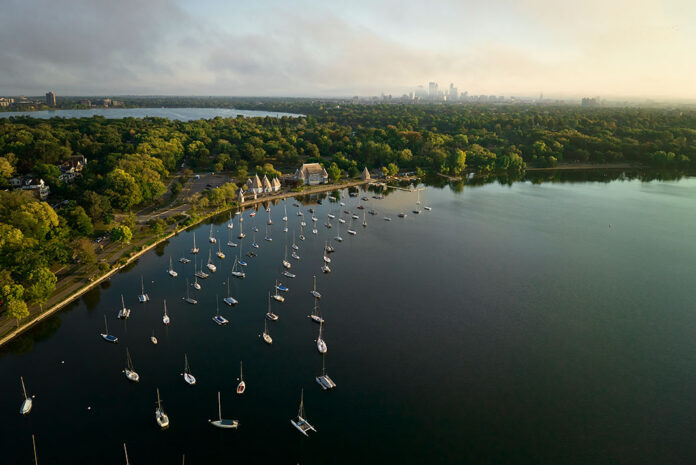
In a city spoiled for blissful paddling opportunities, Minneapolis’ Chain of Lakes stands out as some of the best beginner-friendly kayaking in the state. Five sapphire gems—Bde Maka Ska, Harriet, Lake of the Isles, Cedar and Brownie—stretch 13 miles across Minnesota’s largest city. Three of the five are connected and can be paddled as one. From your kayak, downtown skyline vistas alternate with areas of serene natural beauty as you paddle through protected wildlife refuges and explore small beaches.
Launches and free parking are found around many of the lakes. Rent kayaks from Wheel Fun Rentals at Bde Maka Ska and Lake Harriet.
Photo: Ryan Taylor
Lake Superior
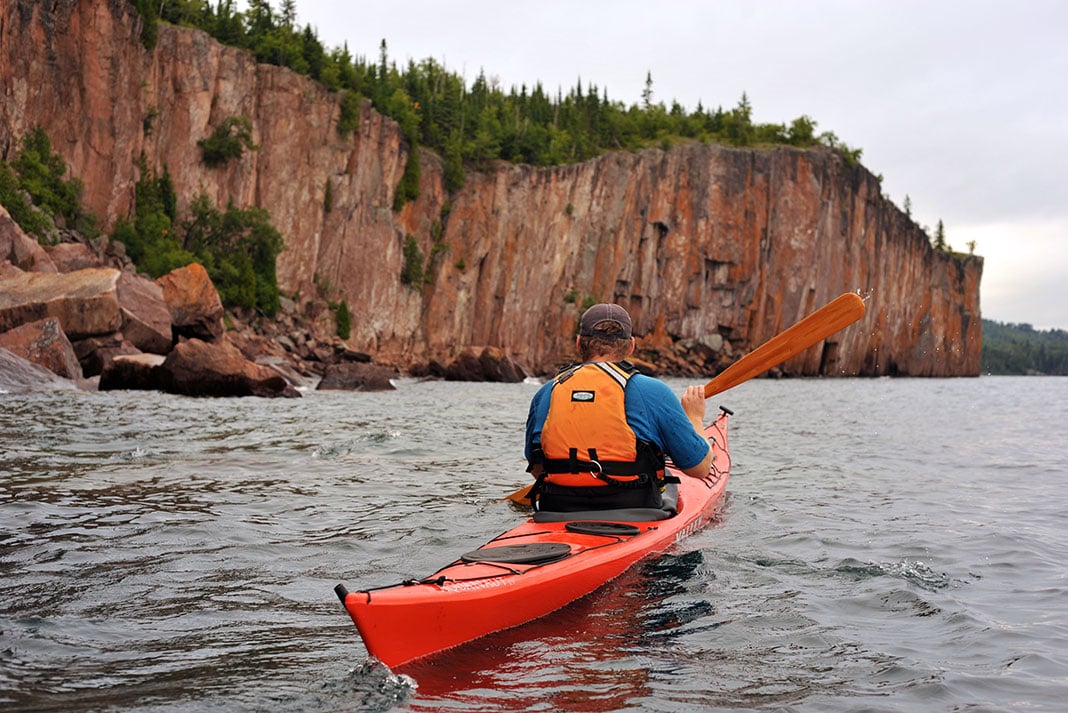
Crystal clear and famously frigid, Lake Superior offers a plethora of exciting day trips for more seasoned kayakers. Popular destinations include paddling out of Grand Marais to the Fall River, where you can swim beneath a 25-foot waterfall. View a shipwreck and explore maritime history at Split Rock Lighthouse State Park. Or try Tettegouche State Park, where you can kayak around ancient rhyolite lava flows, paddle through sea caves and view the spectacular 200-foot cliffs of Palisade Head.
You’ll need a calm day to enjoy these coastlines safely. Lake Superior is a veritable inland sea, meaning it behaves more like an ocean environment than a regular lake. Conditions can change quickly—so come prepared and always get a forecast before heading out.
For kayakers looking for a more immersive escape, overnight paddling trips in Minnesota offer the best of everything this beautiful state has to offer. You can awaken to a spectacular Lake Superior sunrise, and end your day with superlative stargazing from a wilderness campsite, before falling asleep to the soothing rhythm of lapping waves.
Comprising four vast, interconnected lakes sprawling 56 miles along the Canadian border, the interior of this unique national park is best explored by kayak. In fact, most of the park is only accessible from the water, including its hidden waterfalls, scenic trails and some 500 rocky islands. Even better, 150 well-appointed paddle-in campsites invite you to linger as long as you like.
On lovely Lake Kabetogama, Northern Lights Resort and Outfitting rents out single and tandem sea kayaks. Nearby Arrowhead Lodge also offers sea kayak rentals for trips departing from the resort, and the owners are able to assist with trip planning.
Photo: Paul Vincent
Boundary Waters
Boasting 1,200 miles of canoe routes and 2,200 wilderness campsites, Minnesota’s Boundary Waters Canoe Area Wilderness is the most popular tripping area in the world for single-blade enthusiasts. But many of its large lakes—all blissfully free of motorized traffic—also offer great overnight getaways for kayakers. On Hegman Lake you can spot centuries-old Indigenous pictographs adorning granite cliffs. With a few short portages, kayakers can also access the larger bodies of water of Saganaga, Knife and Crooked lakes along the U.S.-Canada border.
Most Boundary Waters outfitters are based in Ely, including Piragis Northwoods Company, which offers kayak rentals and complete outfitting. Sawtooth Outfitters and Stone Harbor Wilderness Supply rent sea kayaks and run guided Boundary Waters kayak day trips—a great way to ease into overnight tripping in the area.
The Lake Superior Water Trail runs 150 miles from Duluth, Minnesota, to the Canadian border. Along the way, spectacular backcountry campsites every 10 to 15 miles let you experience the shoreline at a relaxing pace. Allow three days to explore the breathtaking coast between Gooseberry Falls and Tettegouche state parks, or a full week to continue paddling all the way to Grand Marais. Highlights include Palisade Head, Split Rock Lighthouse and the Manitou River waterfall.
Stone Harbor Wilderness Supply in Grand Marais offers kayak rentals and custom guided trips. Rentals are also available from Sawtooth Outfitters in Tofte. Book a guided multiday journey on the Lake Superior Water Trail with Day Tripper of Duluth.
What you should know about kayaking in Minnesota
Important laws and regulations
It is strongly recommended that everyone wear a life jacket when on the water. State law requires one U.S. Coast Guard-approved, properly sized and easily accessible life jacket for each person aboard a kayak.
Children less than 10 years old are legally required to be wearing a properly fitted, U.S. Coast Guard‑approved life jacket when aboard any watercraft—including kayaks—while underway.
Additionally, always carry a whistle and a white light—especially if you will be on the water between sunset and sunrise.
Find more paddling safety information on the Minnesota DNR website.
Do you need to register a kayak in Minnesota?
Kayak owners in Minnesota must purchase an annual watercraft license ($42 in 2024) from the Minnesota Department of Natural Resources, with some exceptions.
[ Plan your next Minnesota kayaking trip with the Paddling Trip Guide ]
A watercraft license is not required for nonmotorized watercraft 10 feet in length or less. Registration is not required for out-of-state (or country) kayaks, provided the owner’s state or country of residence does not require licensing of that type of watercraft, and it is not within Minnesota for more than 90 consecutive days. Kayaks licensed in another state do not require registration in Minnesota for durations of less than 90 consecutive days.
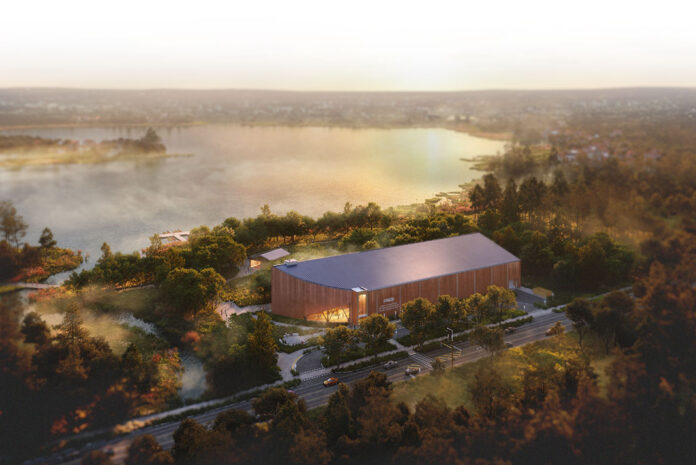
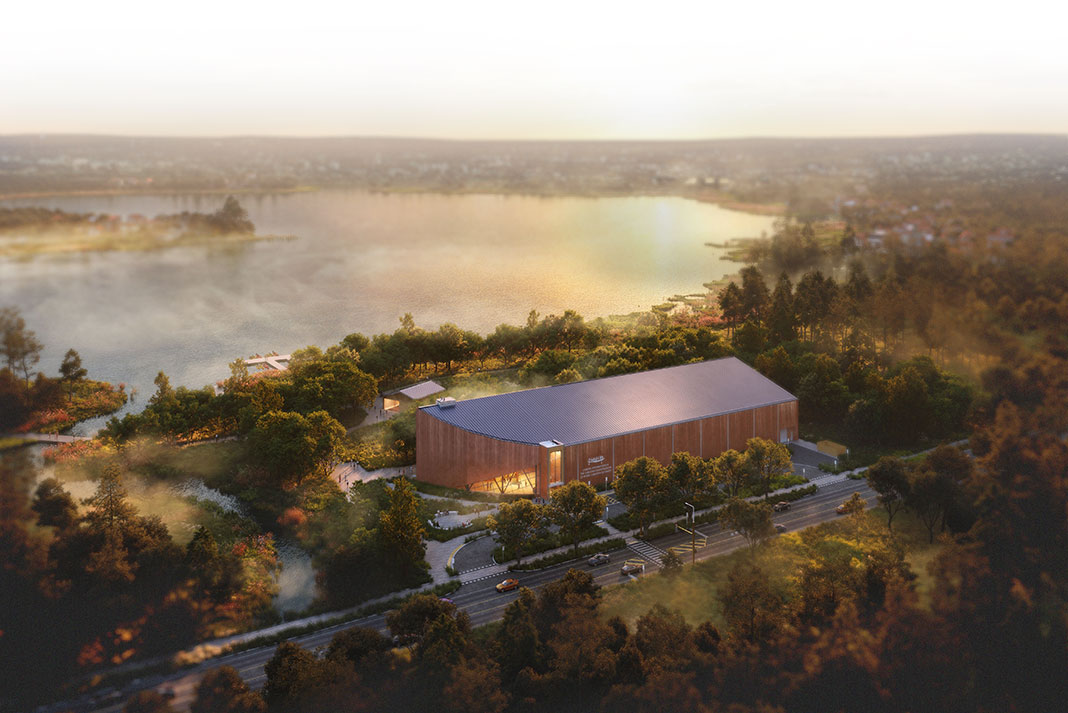
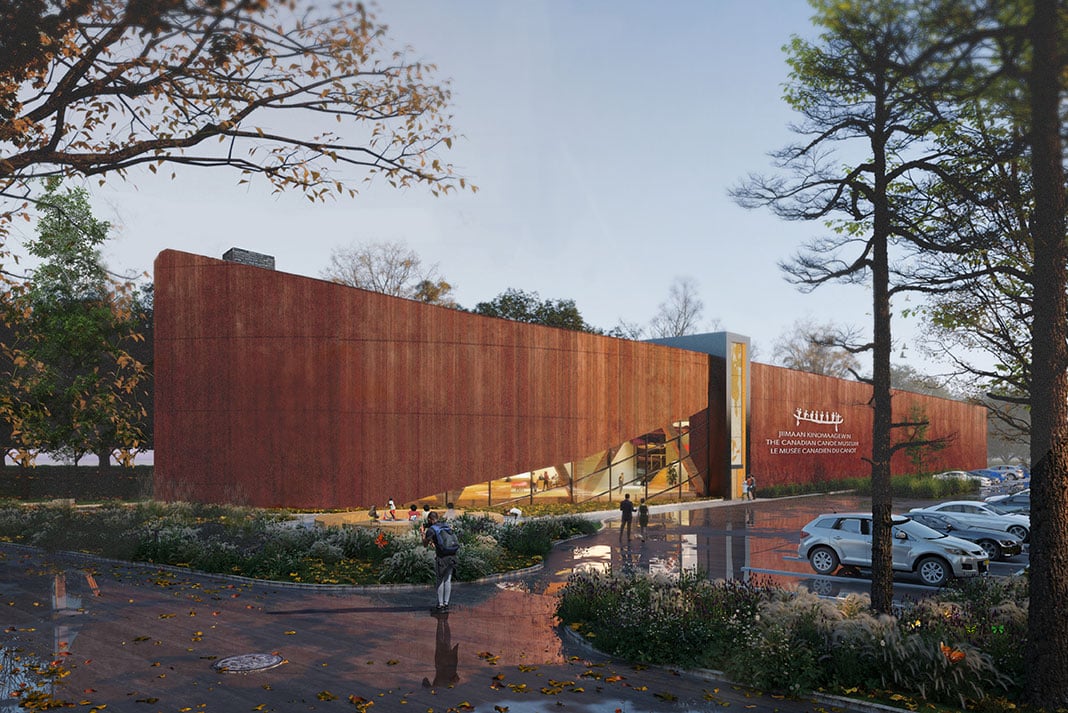
A rendering of the new Canadian Canoe Museum located on the shore of Little Lake in Peterborough, Ontario. The museum has stewarded the world’s largest collection of canoes, kayaks and paddled watercraft over the past 20 years. | Feature photo: Unity Design Studio
A west wind blowing across Little Lake delivers a steady chop into the thin beach on the east shoreline. Just inland, four midsize white pines have created a small clearing underneath. Jeremy Ward remarks on how the flat carpet of pine needles would make a good campsite and Carolyn Hyslop agrees, noting the trees are perfectly spaced for a few hammocks.
It’s easy to imagine a canoe overturned on the beach and a campfire crackling. A far greater imaginative feat would have been to look at this former woodlot on the edge of the small city of Peterborough, Ontario, and envision it as the site of a marquee museum and draw for 87,000 visitors a year. And yet, three years and $40 million later, the Canadian Canoe Museum is about to move into a new home showcasing and celebrating the world’s largest collection of canoes and kayaks.
But to say the process took only three years would be a gross understatement.
From its inception as the private collection of summer camp director Kirk Wipper in the 1950s, to its years on occasional life support in a vacated outboard motor factory, to a gut-wrenching about-face during initial relocation plans, the job of running a niche museum has never been easy. But with the May 11, 2024, grand opening coming into view, two individuals at the center of what one past executive director has called a “triumph of leadership” are eager to show off the new museum.
A rendering of the new Canadian Canoe Museum located on the shore of Little Lake in Peterborough, Ontario. The museum has stewarded the world’s largest collection of canoes, kayaks and paddled watercraft over the past 20 years. | Feature photo: Unity Design Studio
Building a bigger, better Canadian Canoe Museum
Recently, when not on-site overseeing the construction of a major large-artifact museum, executive director Carolyn Hyslop and curator Jeremy Ward were plenty busy trying to run the Canadian Canoe Museum in the site it had occupied in south Peterborough since 1997.
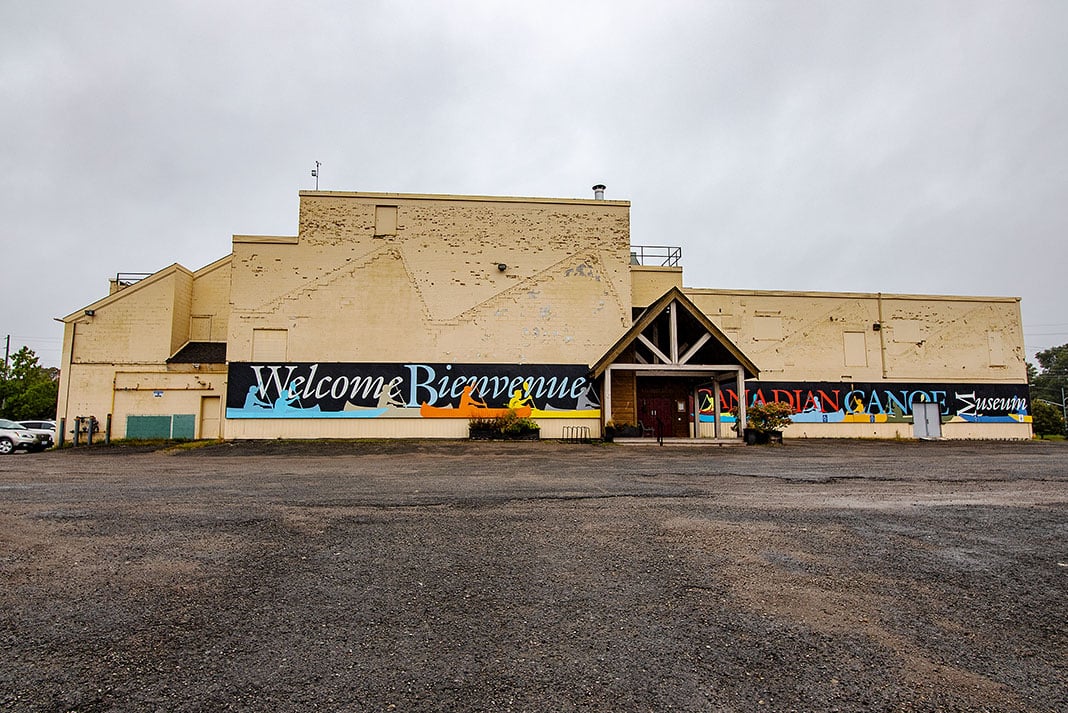
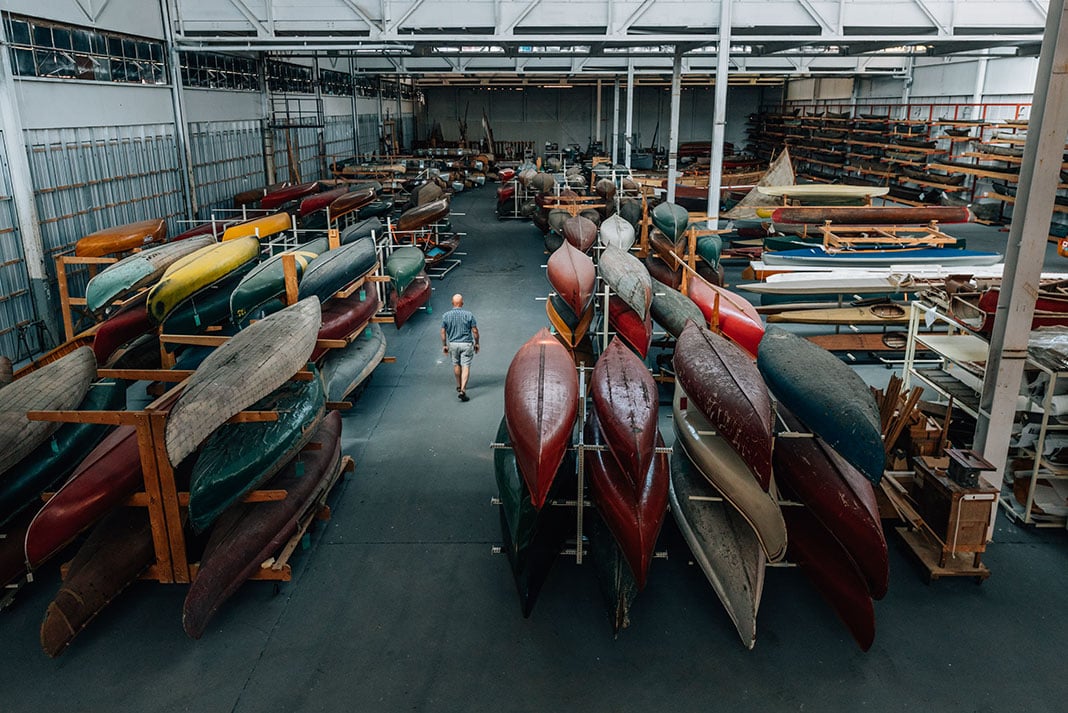
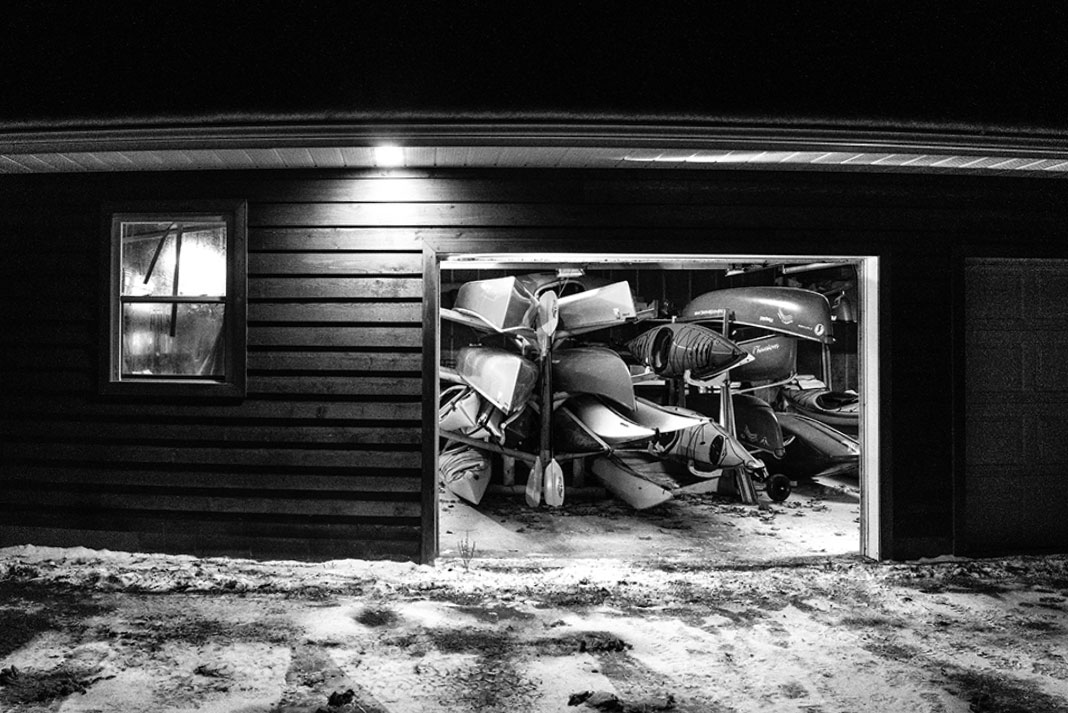
The 1960s-era location cost the museum one dollar, which was generally considered to be a good deal. It consisted of the office building and factory of the bankrupted Outboard Motor Corporation (OMC), a manufacturer of outboard motors. Appealing irony aside, it was a barge of a location to house a collection that had grown to 600 examples of, arguably, the finest form of watercraft. With room in the office building to display only 20 percent of the collection, most of the canoes were hidden away out of sight in the factory building.
Its exterior did not hint at the beauty inside. You could drive around the two-story exhibit building and be forgiven for not knowing where the front door was. The facing property was the backside of a big box dollar store.
Despite this deficit of curb appeal, the two buildings had sheltered the museum for a quarter-century while the volunteer-based organization found its governance footing and hatched its plan to launch itself into the upper echelon of Canadian museums. In late February, a billboard sign explained the lack of cars in the parking lot below: “Closed While We Move to the Water.”
Pro: The former museum site cost just a dollar. Con: Its exterior did little to hint at the wonders inside. | Photo: Canadian Canoe Museum
At the former museum site, 80 percent of the canoes were kept in storage and inaccessible to the public. | Photo: Destination Ontario
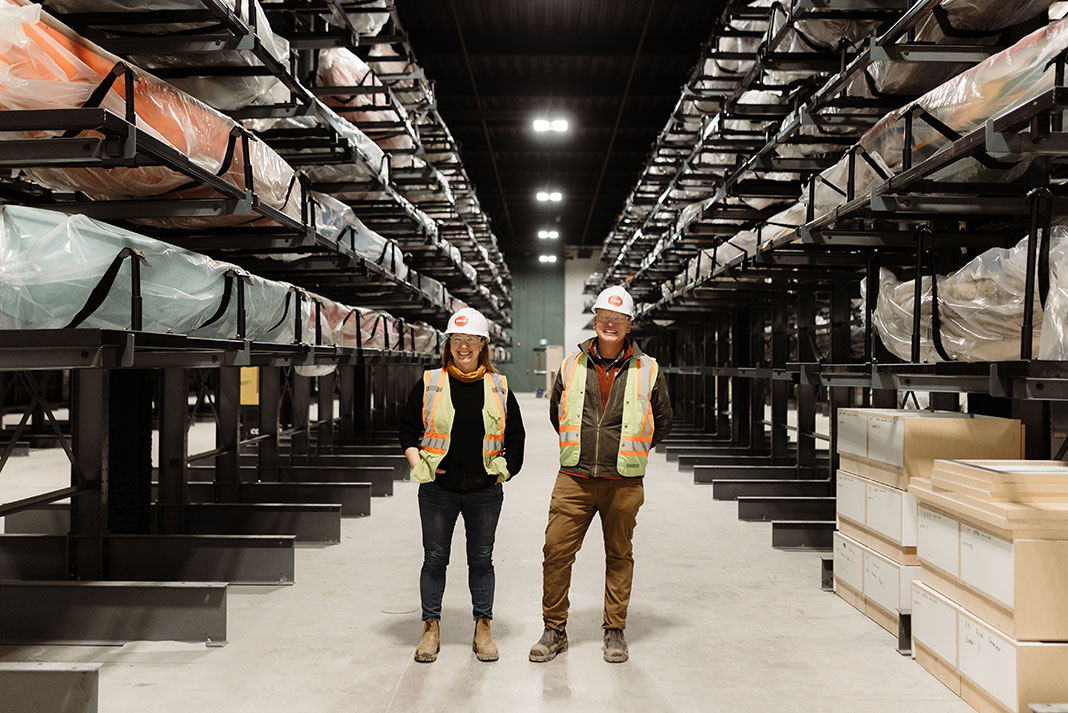
Hard hats have been part of the job lately for museum executive director Carolyn Hyslop and curator Jeremy Ward. The teal canoe to their right belonged to Farley Mowat. The orange canoe above was Gordon Lightfoot’s. | Photo: Heather Coughlin
In search of a suitable home
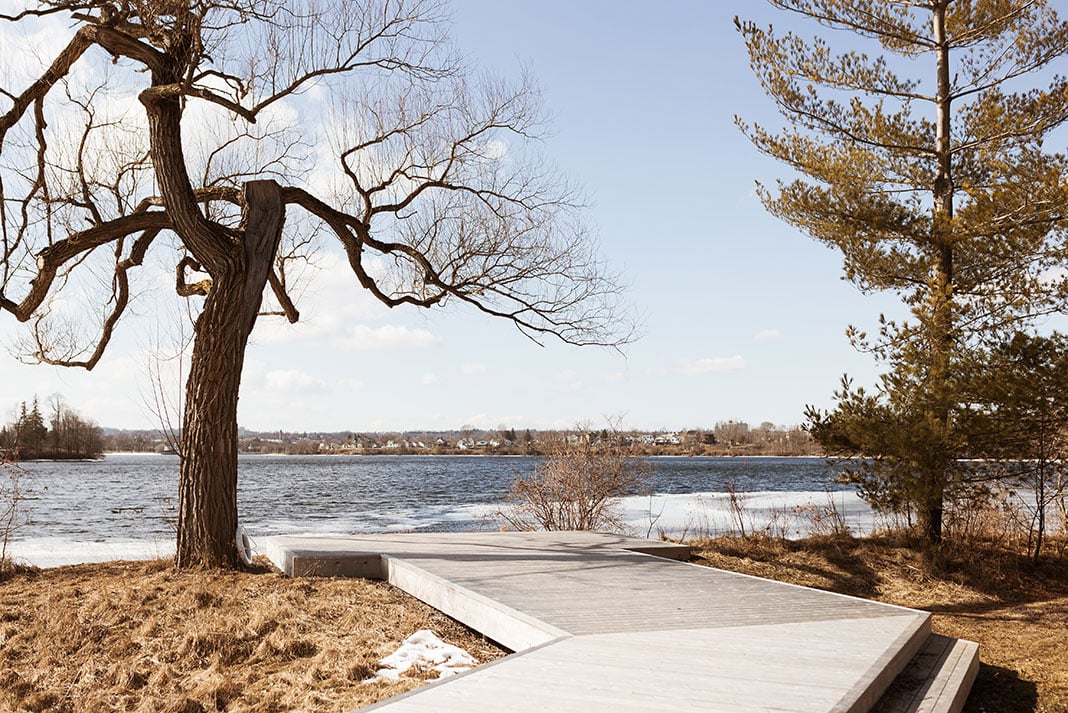
With white hard hats gleaming, Hyslop and Ward don’t know which way to look to contrast the new property with the old. They stand on a portion of the Trans Canada Trail that traverses the new museum site and look to the public docks 200 meters north, where 10,000 vessels a year travel in or out of the mouth of a canal as part of the Trent-Severn Waterway. Straight across the lake the view is of downtown Peterborough. The peninsula making up much of the visible shoreline to the south hosts a wooded cemetery off-limits to development. To the immediate south is a pedestrian bridge spanning a sheltered creek and leading to a playground and public park. At the back of the property is free parking at a public sports field complex.
Taking it all in, it’s hard to believe this was the second choice for the museum’s location. But similar to when a contingency campsite downriver ends up being an all-timer, this wasn’t Plan A.
As the museum matured in the OMC buildings, its board of directors faced existential questions about its future. Aluminum canoes are one thing, but the collection also includes wooden crafts hundreds of years old. Over the years, there wasn’t the money or the confidence in the long-term suitability of the site to properly invest in it. The buildings would need to be upgraded to care for fragile artifacts properly.
“There are so many different ways in which canoeing is an important part of lives and cultures. The more you try to pin it down, the more it slips through your fingers.”
—Jeremy Ward, curator
“We couldn’t stay where we were. It had been allowed to fall into disrepair,” explains museum curator Ward. The museum’s 2010 strategic plan identified a move to the water as necessary for the institution to take its place on “the national stage.” Money would be raised and the museum would move to a purpose-built waterside facility.
After four years, a site was selected, right beside the Peterborough Lift Locks in the nearby Trent Canal. The 120-year-old National Historic Site is home to the tallest hydraulic lift locks in the world, essentially big swimming pools raised or lowered 20 meters to let boats bypass part of the Otonabee River. The locks attract 25,000 tourists a year and would have been an appealing one-two combination for a museum looking to boost attendance numbers with walk-ins.
Architectural renderings sent far and wide in 2017 showed a sleek building with sweeping, curved walls lining the canal. The 90,000-square-foot building would have a 1.5-acre green roof, complete with a pollinator garden.
“It was a beautiful design. You would have been able to heat the building with a candle and cool it with an ice cube,” says the museum’s former executive director and Paddling Magazine columnist, James Raffan. The building would elevate the entire collection and piggyback on the busy tourist site next door.
The site had a lot going for it. It also had trichloroethylene going through it. The industrial degreasing solvent was leaching into the soil from the site of a former clock factory uphill. Initial environmental assessments carried out by consultants at the start of the process hadn’t picked it up, but new groundwater sampling conducted as construction approached in 2020 threw up a red flag.
“It was gut-wrenching, traumatizing,” remembers Hyslop. They were just months away from the scheduled ground-breaking when, all of a sudden, everything was in question.
“This is a passion project for so many people. It was never just about that building, or any building. The passion is shared by all the folks who want to see this thing grow and thrive.”
—Carolyn Hyslop, executive director
“It would have been a perpetual problem,” says Hyslop of the contamination, with the source on another property and beyond their control.
“There was a long period when we didn’t know if the project would collapse,” she says. “We had donors with expectations, we had government funding schedules to meet.”
In addition to private donors, much of the funding supporting the Canadian Canoe Museum has been provided by the Government of Canada, through both the Department of Canadian Heritage and the Federal Economic Development Agency for Southern Ontario (FedDev Ontario), the Weston Family Foundation, the City of Peterborough, Peterborough County and the Province of Ontario.
But everyone Hyslop and Ward talked to said they were fully committed to a new museum.
“This is a passion project for so many people. It was never just about that building, or any building. The passion is shared by all the folks who want to see this thing grow and thrive,” says Hyslop. “When the wheels fell off, we had to ask, ‘Who are our people?’ We went to them and said, ‘You know us. We will find another location.’”
And then COVID lockdowns shut the museum. “Everything stopped all at once, just as we needed to keep momentum and scour the county for a site,” she adds.
The New Canadian Canoe Museum’s curved exterior and use of weathered steel make for an impressive view from the street. | Photo: Unity Design Studio
It was during this chaotic time the woodlot between the Parks Canada canal office and a public park on the east shore of Little Lake came back into consideration. “We knew about this property, and always thought it would be an ideal base for on-water activities, but we always understood it to be a flood plain,” explains Ward. After the canal false start, they took a closer look.
As Hyslop says, once it became clear a cooperative Peterborough city council would be willing to part with the land—for the market value of $1.575 million—there followed a process of reaffirming a few priorities that might have been lost sight of in the glint of the canal design.
“When forced to start again, we decided we had to go back to our values.” The core value? Staying within their means and being sustainable over the long term.
The square footage of the new building would be 65,000 square feet, one-third smaller than the canal design. The budget was similarly reduced, from $65 million to $40 million.
The new museum comes together
During a tour of the new museum with Hyslop and Ward less than three months before the springtime grand opening, the site is still very much a work in progress. A tarp covers part of the facade reaching 55 feet above the front door, scaffolding crowds the entrance and the mud around the building makes route-finding a necessity on approach. There remains much to be done, but the pair betray no nervousness. Instead, there is palpable excitement—and even what seems like a sense of relief at how things worked out. The design of the canal site might have gained more attention in architectural digests, but the lower price tag and, especially, the more flexible setting of the Little Lake site let Hyslop and Ward assert with convincing conviction they are in just the right place, literally and figuratively.
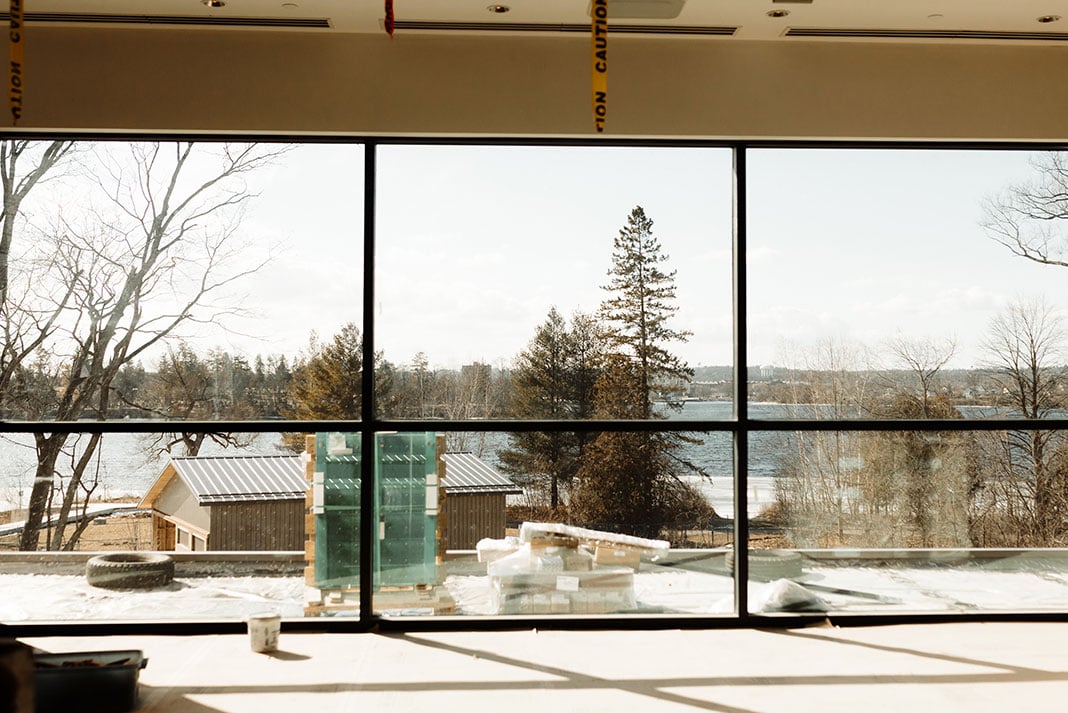
The five-acre site provides west-facing views of Little Lake. | Photo: Heather Coughlin
Immediately to the right of the western entrance is a fireplace built into the exterior stonework.
“A museum should be a sensory experience,” explains Hyslop. “We wanted visitors to be immediately greeted with the smell of woodsmoke.”
All well and good, but there’s another fireplace on the other side of the wall, inside the entrance.
“The architects said, ‘You guys are nuts. You want a fireplace in a Class A museum environment?’” Hyslop says of concerns woodsmoke and artifacts don’t mix. “We told them we’d figure it out.”
The fireplace they figured out animates a spacious atrium rising to the roof of the museum and serves as a grand entrance hall, but also an indoor space for the indoor/outdoor café, which is licenced for alcohol, caffeine and baked goods. The café’s serving counter slides seamlessly into the admissions counter, which doubles as the canoe rental desk.
“Every room is asked to do two or three things,” says Ward, explaining while the square footage and price tag were reduced, the result is a building “meeting all our needs.”
The first separated space from the atrium is a bright and spacious workshop, which Ward says will host builders-in-residence and be home to restoration work and hands-on workshops for visitors for things like paddle carving.
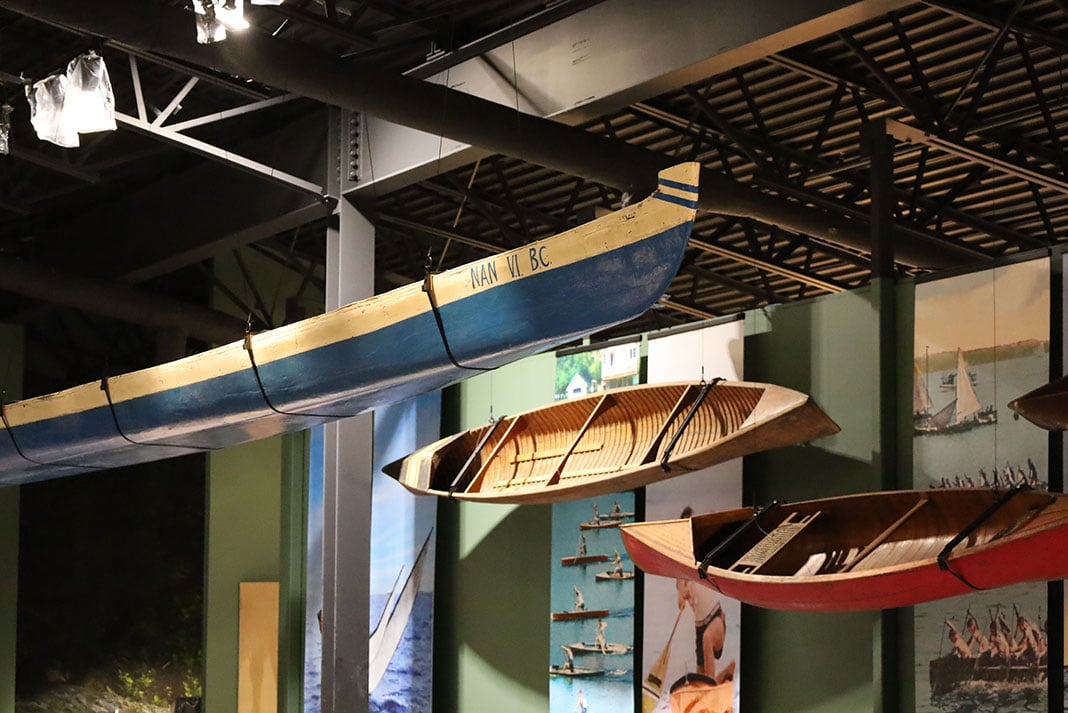
The ground floor hallway ends at a double door, behind which rests the most significant collection of historic canoes and kayaks on the planet. Walking through the door, it’s impossible not to be struck by the sheer size of the 20,000-square-foot room packed, wall to wall, floor to 25-foot ceiling with five tiers of canoes and kayaks spanning centuries and cultures.
More than 500 crafts lie in steel cradles. Ward points to one canoe, saying it once belonged to Farley Mowat, the author who introduced so many to the terra incognito of Canada’s north. Above it, a canoe donated by singer-songwriter Gordon Lightfoot. It’s not the more famous canary yellow canoe he sang about (that one is upstairs). This one is a cedar canoe; one Lightfoot told Ward he had paddled through thousands of kilometers of wilderness. The sprayskirt snap fasteners underneath the gunwales, patches on the underside of the hull and a railway boxcar sticker on the bow suggest the inspiration for many of Lightfoot’s wilderness-themed songs would have been received in the stern seat of this ordinary-looking hull.
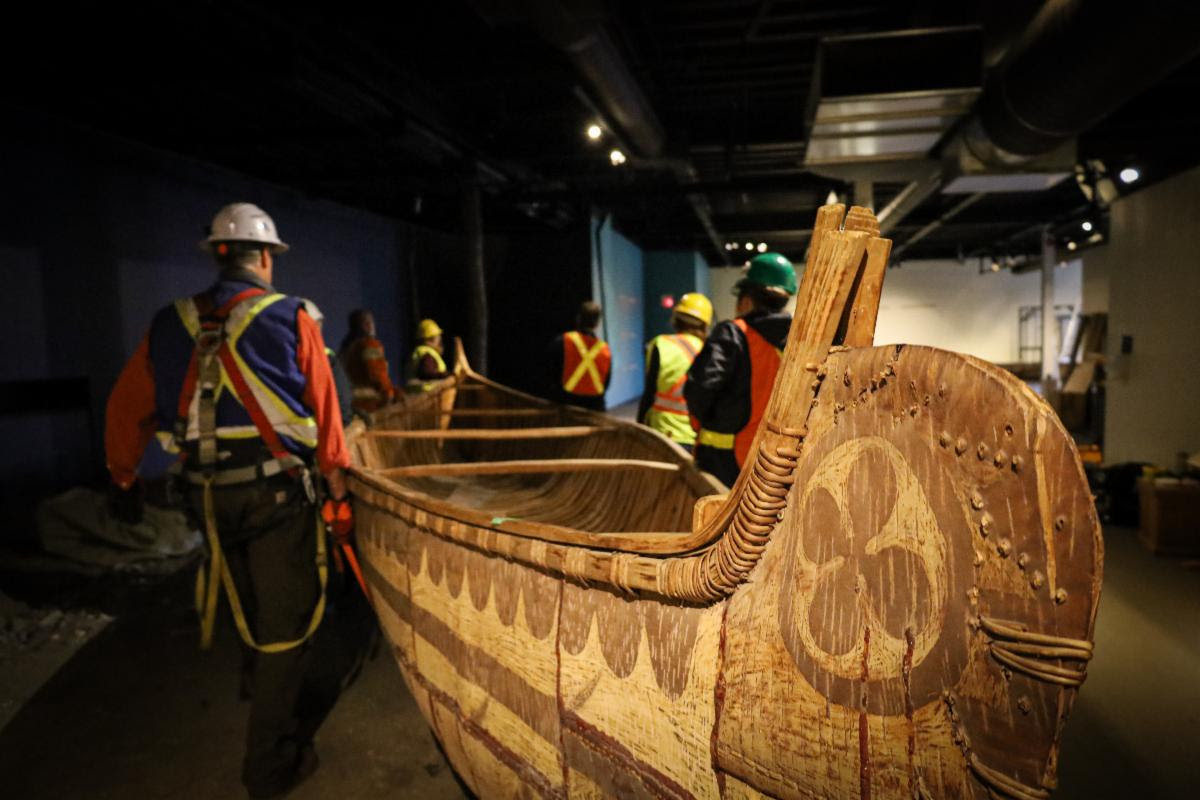
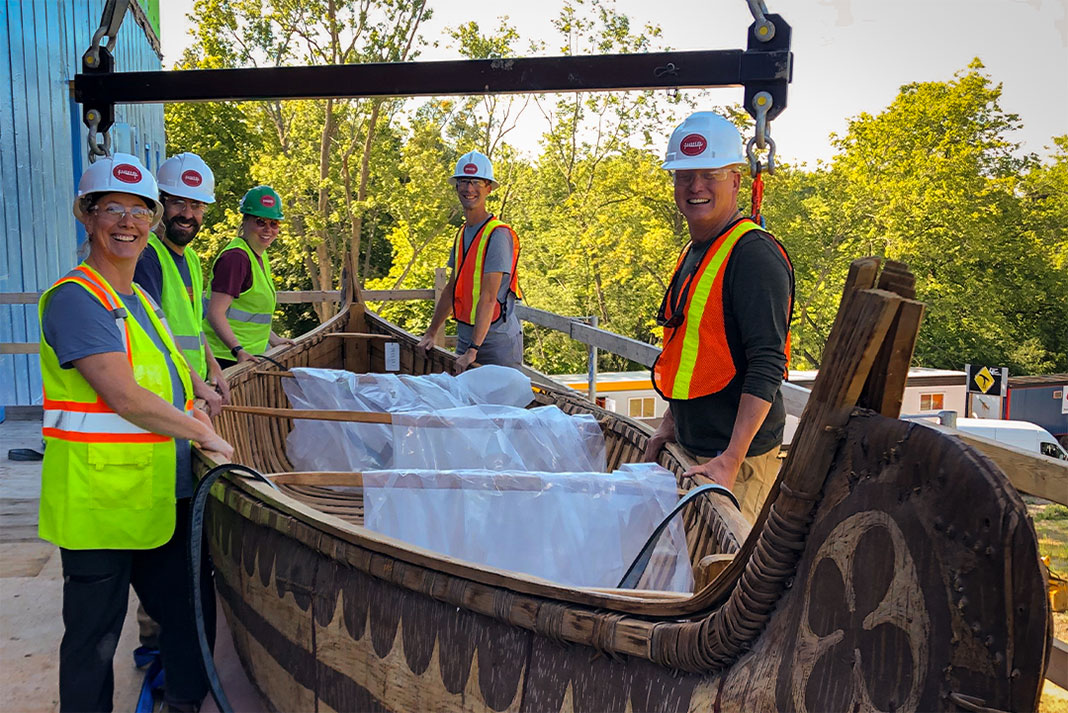
Canadian Canoe Museum staff unload a 28-foot bark canoe by Attikamekw builder César Newashish from a crane. | Photo: Canadian Canoe Museum
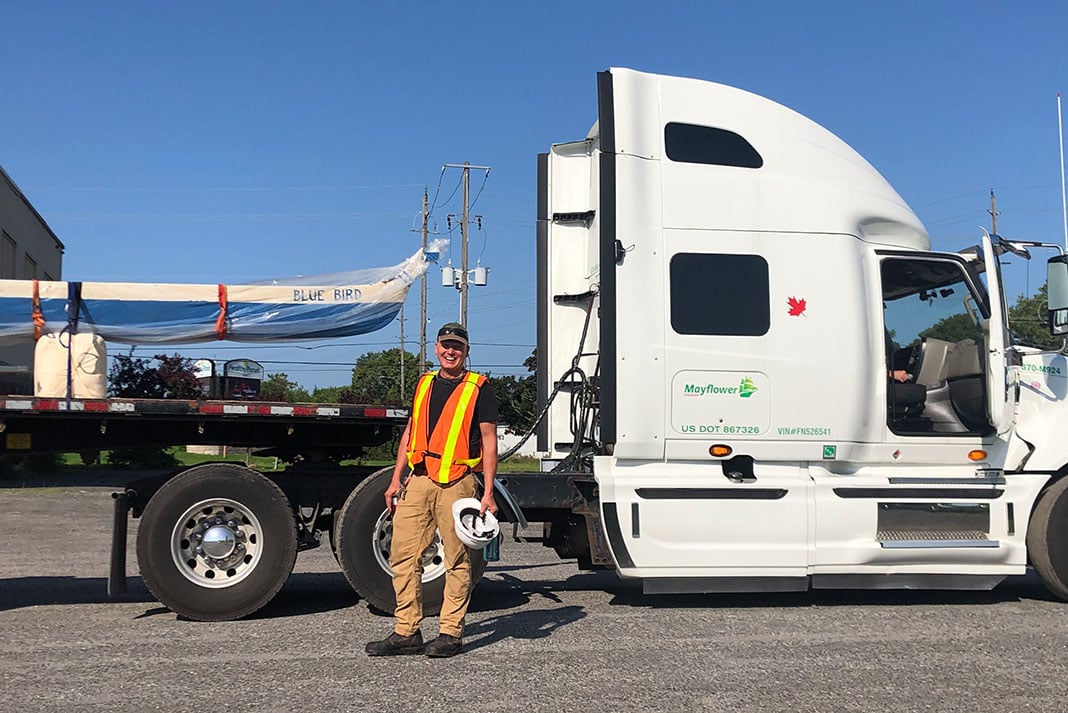
Jeremy Ward with the Snuneymuxw dugout racing canoe Blue Bird by Chester Thomas, the longest canoe in the collection at 54 feet, as it’s moved to its new location. | Photo: Canadian Canoe Museum
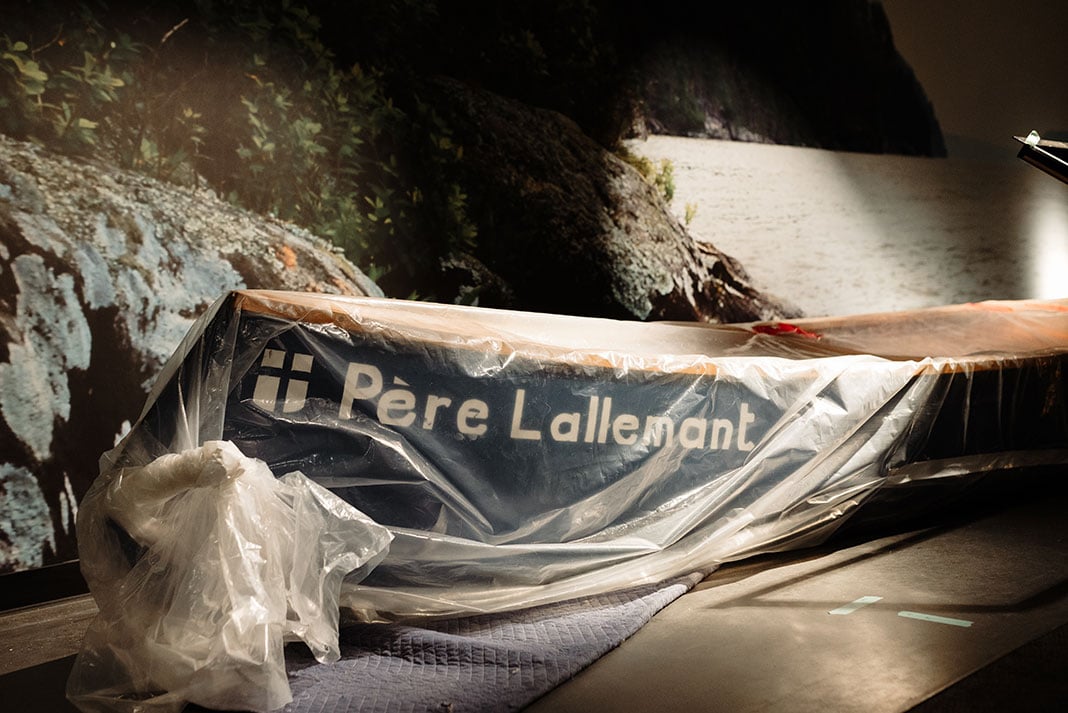
For now, it and the others are wrapped in clear plastic while construction finishes. Ward checks a sensor to note the temperature and humidity levels, factors controlled with help from the $11 million from Heritage Canada for artifact preservation systems. When the museum opens and the dust settles, the canoes will be unwrapped, and the hall will open for scheduled tours. No interpretive plaques, just a feast for enthusiasts’ eyes.
“We didn’t want to rent space off-site for the artifacts,” says Ward. “We wanted to have them under one roof where we could take care of them.” He notes there is room for the collection to grow by 10 percent. At which point Hyslop reminds him there is a moratorium on new acquisitions. They share a look like they’ve been over this before, and we all agree it’s time to go upstairs.
“A museum should be a sensory experience.”
—Carolyn Hyslop, executive director
The exhibition hall is situated above the lofty collection hall, a configuration giving the two-floor museum the height of a four-story building. To get there, climb three flights of stairs, the treads of which were milled from the white ash felled to make room for the building.
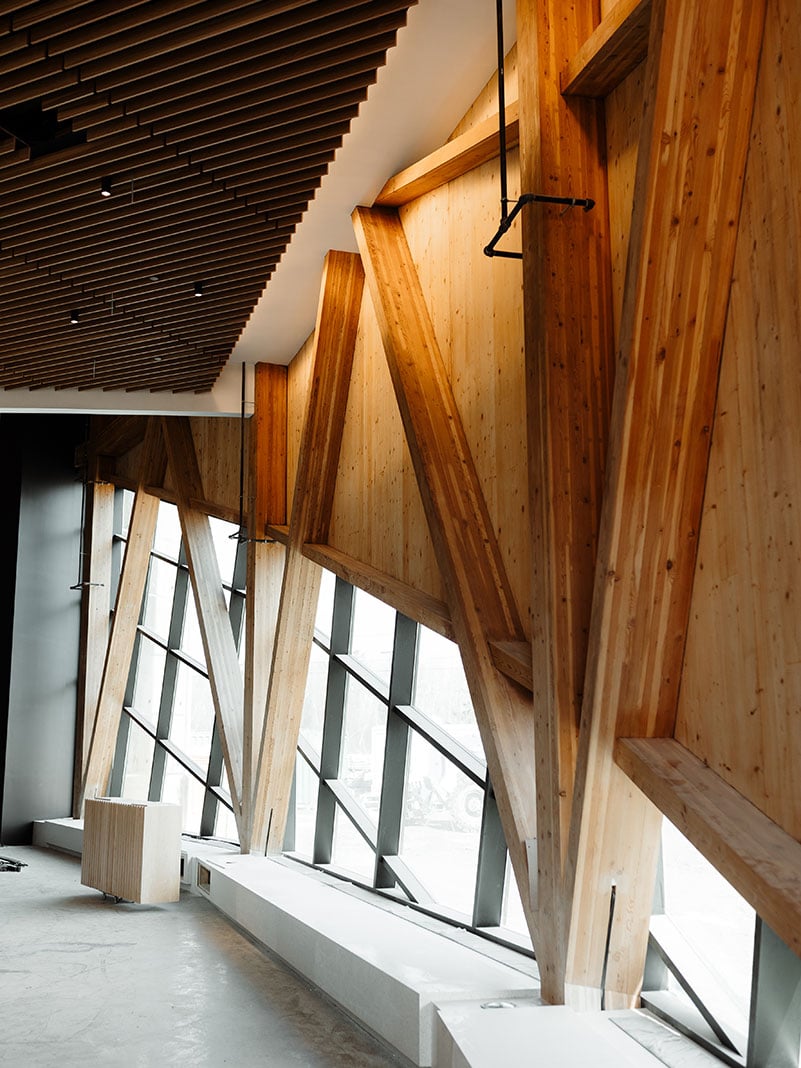
The atrium of the Canadian Canoe Museum features soaring ceilings and exposed timber. | Photo: Canadian Canoe Museum
The top floor is home to the library. In what will be a brand-new offering for the museum, it now has space to host researchers who want to get their (washed) hands on the museum’s archive of canoeing-related books, maps and catalogs. More than 1,200 books will be stored here, with rare and antique items available but safeguarded on 1,400 linear feet of shelving in the archives.
Across the hall is the wide opening of the indoor/outdoor event space, future home to weddings, conferences, galas and more. Its wall of windows offers a view of the lake through the treetops. The room will be an important moneymaker, a means to support the collection, which is waiting behind one last set of climate-controlled doors.
In contrast to the airy and expansive collection hall, the exhibit hall strives for intimacy. Within its forest green walls will be six permanent exhibits and a space for temporary displays.
While most exhibits are still being assembled, a feature called The Swirl has already taken shape and catches the eye. It’s a collection of canoes suspended in a circle from the central ceiling. It includes conventional-looking hulls, but also a dugout, birchbark canoe, plastic freestyle kayak, carbon fiber sprint racing hull, Grumman aluminum, early 20th-century courting canoe, solo whitewater boat and more.
“Wherever we go across the country, people take us out to the water,” says Ward. “They say, ‘You think you know what canoeing is in Ontario. Now you’re going to learn what it is here.’ And then we get schooled. There are so many different ways in which canoeing is an important part of lives and cultures. The more you try to pin it down, the more it slips through your fingers.”
Ultimately, the worth of any museum is in the interpretation of the displays. That storytelling material is not yet in place three months ahead of opening, but Ward points to stands of different shapes that will hold not just text but also audio and visual equipment. Over his 27 years with the museum, he’s crossed the country, with an emphasis on visiting the Indigenous communities that can be seen as the origin of almost all the designs in the building. It will be Indigenous voices and faces telling many of the stories taking shape in this room.
Canoes are hung from the ceiling as the Canoe Swirl takes shape three months before the grand opening. | Photo: Canadian Canoe Museum
Capturing the diversity of canoeing culture is one of the missions of the museum. The other is promoting it. And this mission will get the biggest boost of all from the move to this five-acre site, with its expanded capacity to let people not just see canoes, but also paddle them.
As dazzling as the canal design was, the waterfront there was the side of a canal. Peter Vooys, program manager since 2002, observes anyone launching a canoe from the museum would have been competing with yachts and motorboats lining up for a ride in the locks.
“We want to be the first step, giving inexperienced people the inspiration, but also the tools, to canoe in the backcountry.”
—Peter Vooys, program manager
At Little Lake, on the other hand, there will be an open lake and a sheltered creek for paddlers to explore. They will take to the water in rented tandem canoes or as part of scheduled 36-foot voyageur canoe tours. They will do it as part of instructional courses, summer day camps and school field trips, or as walk-ons at the end of a private trip to the museum, or on overnight trips to nearby Kawartha Highlands Provincial Park.
It won’t just be on-water activities visitors can expect. There will be workshops, ranging from basic camping skills all the way up to gourmet campfire cooking courses.
“We want to be the first step, giving inexperienced people the inspiration, but also the tools, to canoe in the backcountry,” says Vooys. “We imagine it being a very busy place.”
In addition to diversifying the ranks of canoeists, all these offerings will also diversify the revenue stream for this nonprofit that would like to be as self-sufficient as possible.
Hyslop estimates annual budgets of around $1.5 million, of which two-thirds will come from revenue and one-third from fundraising. At the old site, the ratio was reversed. She projects the exhibits and programs will bring in 87,000 visitors annually, a 2.5-fold increase over pre-pandemic numbers.
Whether it’s admission tickets, program fees, equipment rentals, event bookings, gift shop sales or the café’s annual lease, the site has a promising projected revenue stream that should address a reality identified by Raffan, “It’s relatively easy to get money to build a new building. What’s not easy is not closing it in a few years for lack of funds.”
A canoe from the Saint John’s School tragedy on Lake Temiskaming in 1978 that claimed the lives of 12 boys and one young youth leader. | Photo: Heather Coughlin
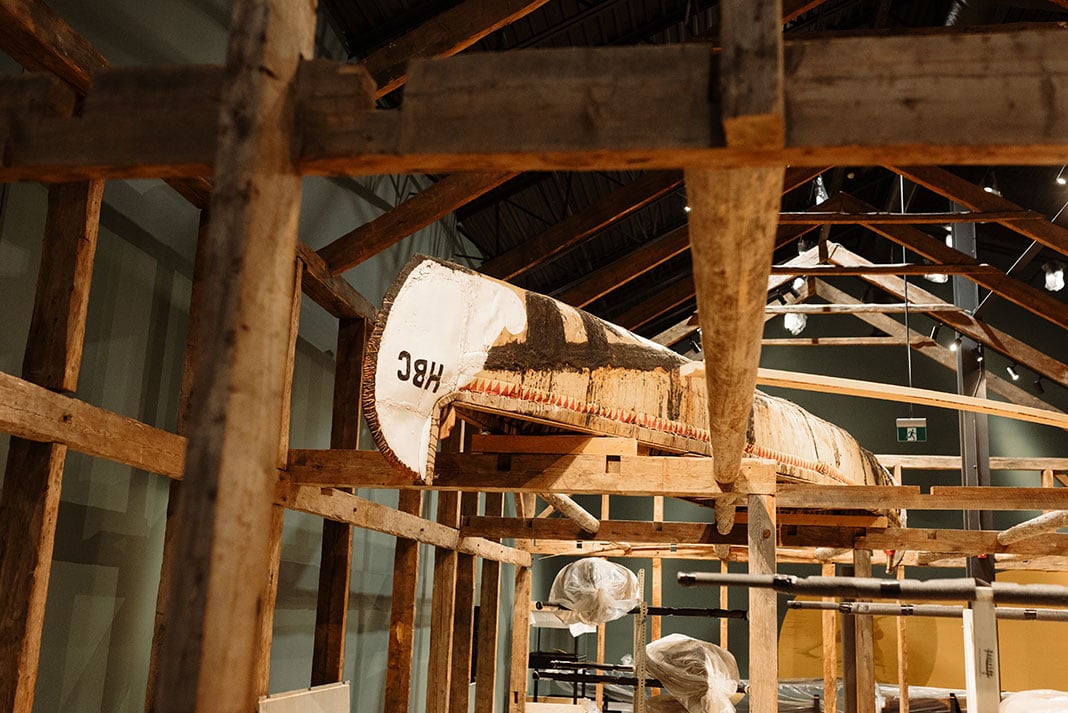
An HBC canoe rests in the rafters next to salvaged building beams from the mid-1800s fur trade post at Michipicoten River. | Photo: Heather Coughlin
A collection for all canoeists
When visitors do begin arriving, from Canada and beyond, they will be walking past the sign identifying it as the Canadian Canoe Museum. Ward acknowledges waterways don’t follow national borders, and while Canada has a special relationship with the canoe, it’s not an exclusive one.
Graham Mackereth, founder of Pyranha Kayaks, agrees. A collector himself, with more than 100 crafts of his own, he’s visited the museum three times from his home in England, claiming to be in awe of what has been achieved in Peterborough.
With the perspective of a European collector, he points out almost every nation has its own canoe history. “Ethnic canoes are a worldwide phenomenon. They were important in Europe too, but that was centuries before. In Canada, it was a major part of getting around and close enough in living memory to be appreciated.”
That makes this homegrown effort important on a global scale, says Mackereth. “Canoes are important to all of us, and without somewhere to look after the artifacts, the sport would be in a poor place. It’s the world’s museum, really.”
And it’s about to open its doors.
Ian Merringer is a former editor of Canoeroots magazine and the current managing editor of Ski Canada.
This article was first published in the Spring 2024 issue of Paddling Magazine. Subscribe to Paddling Magazine’s print and digital editions, or browse the archives.
A rendering of the new Canadian Canoe Museum located on the shore of Little Lake in Peterborough, Ontario. The museum has stewarded the world’s largest collection of canoes, kayaks and paddled watercraft over the past 20 years. | Feature photo: Unity Design Studio


 This article was first published in the Spring 2024 issue of Paddling Magazine.