Rupert Kirkwood is living every paddler’s dream. From whales to leaping tuna, this paddler spends his time exploring the waters and experiencing the wildlife of southwest England building an impressive resume of close encounters along the way.
Rupert, who goes by The Lone Kayaker, has plunged into the world of wildlife paddling close to home, with his filmmaker son Henry Kirkwood there to document his close encounters. While kayaking off the coast of western Wales, Rupert had an encounter most paddlers can only dream of with a pod of bottlenose dolphins.
Father and son duo document wildlife and explore waterways in southwest England by kayak
“I have kayaked every inch of the coast of SW England, from Poole to Minehead, all 1156 miles of it,” wrote Rupert in his blog. “It really is that far if you paddle up every creek as far as you can get at high tide, and out to every island. Also 2,000 miles in Scotland, and short jaunts in Spain, USA, Mexico, Greenland, Chile, and Antarctica.”
Rupert has paddled with ocean sunfish, minke whales, Risso’s dolphins, seals and even humpback whales. Together with Henry, the father-son duo have experienced and captured close encounters with wildlife throughout southwestern Great Britain. One of their most memorable and viral encounters included Rupert in his comparatively small kayak, surrounded by leaping bluefin tuna, which weigh up to 600 pounds.
Family has the wildlife experience of a lifetime in Cardigan Bay, Wales
On a sunny day in western Wales, the family watched from cliffs above Cardigan Bay scouting out their route before heading out for a beautiful day of paddling.
Western Wales is home to a semi-resident population of bottlenose dolphins based in Cardigan Bay. Occasionally, these bottlenose dolphins can travel in groups of more than a hundred.
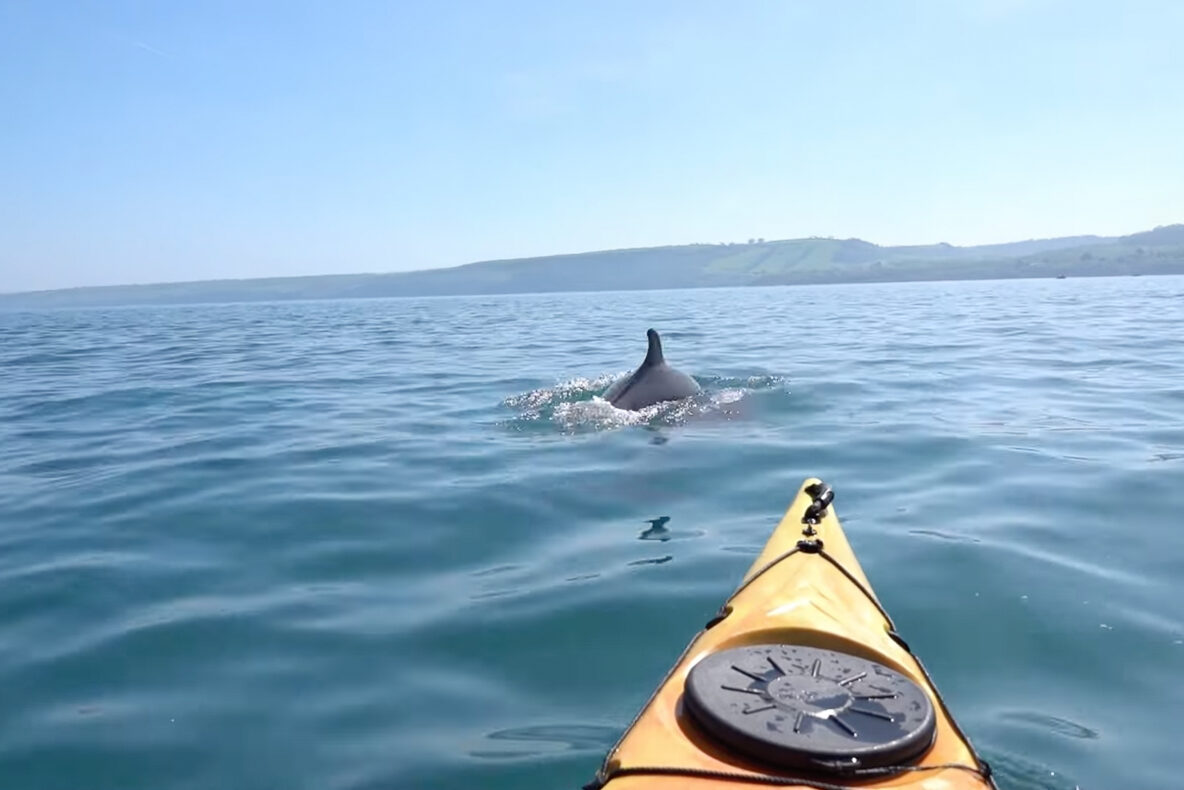
A bottlenose dolphin surfaces off the bow of Rupert’s kayak. Image: Henry Kirkwood Films | YouTube
With a glassy sea, the father-son duo spent their first morning paddling past jellyfish and kittiwakes then hiking headlands to scout for bottlenose dolphins. The second day, the pair became a trio, joined by Rupert’s wife and Henry’s mother, and they paddled toward where they had seen the bottlenose dolphins the previous day.
It wasn’t long before they spotted bottlenose dolphins in the distance and took their paddles out of the water to watch from a distance. The curious dolphins came over to check out the kayaks, giving this family an up-close encounter with one of the ocean’s most notoriously playful critters.
“I didn’t want to spend all my time photographing because I wanted to enjoy seeing them as well,” shared Rupert.
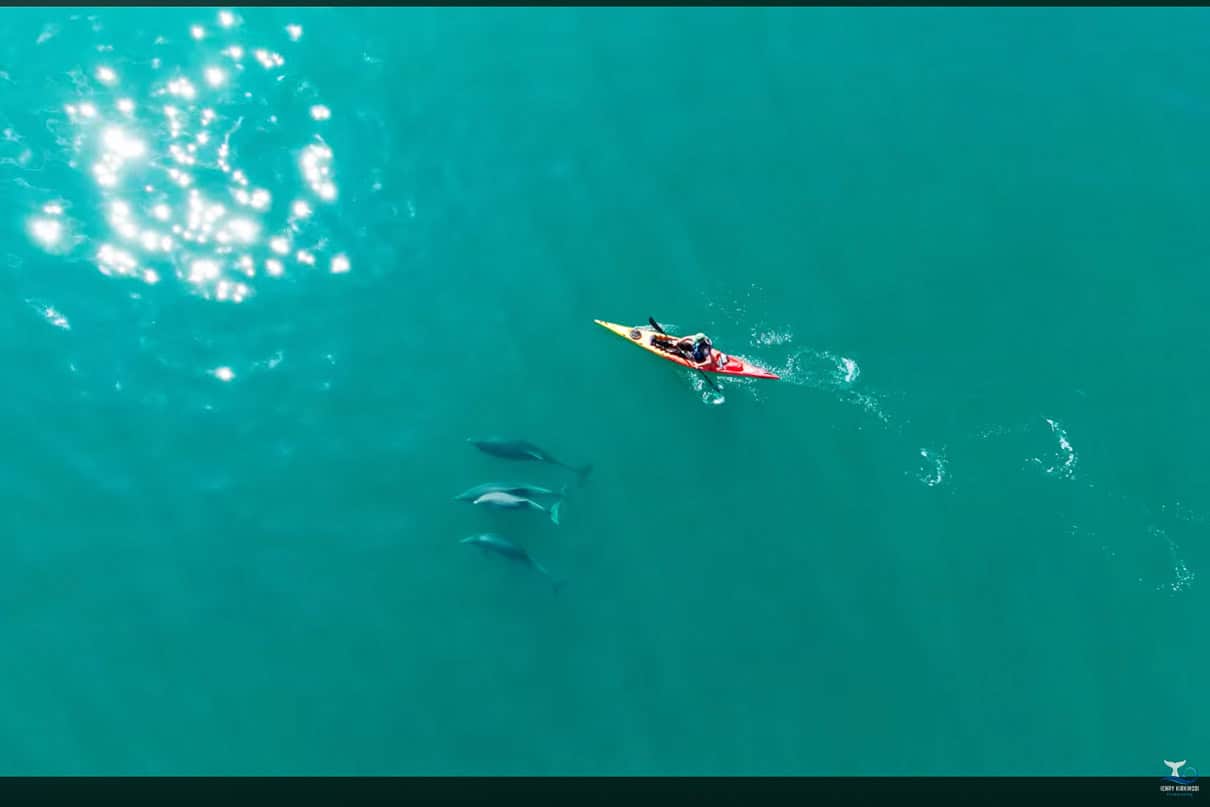
Rupert Kirkwood has a close encounter with bottlenose dolphins in Cardigan Bay. Feature Image: Henry Kirkwood Films | YouTube
Bottlenose dolphins played around the kayaks, diving beneath them and one even surfaced with a fish in its mouth near the paddles.
Henry launched a drone from the kayak to get footage of the bottlenose dolphins from a distance above.
“Dad continued to paddle in a straight line to avoid disturbing the dolphins but then they decided to come over to his kayak and check him out,” shared Henry.
Rupert found himself with a pod of six or seven bottlenose dolphins trailing him, bow riding and splashing. Eventually, the dolphins outpaced the paddlers.
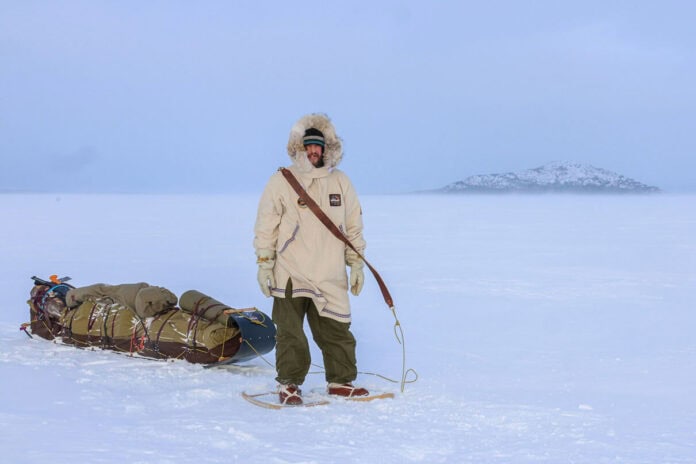
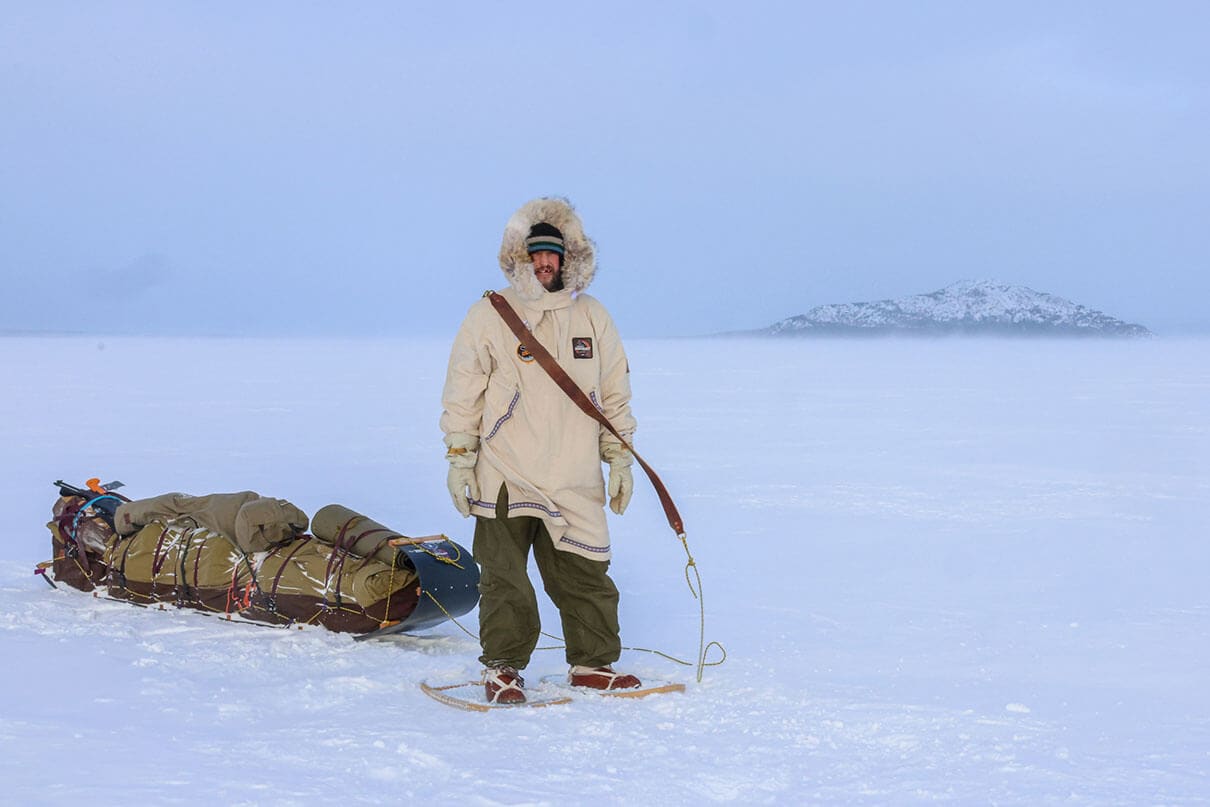
Justin Barbour crossed Canada’s wild east during a yearlong expedition. | Feature photo: Courtesy
Justin Barbour
In late September 2018, Justin Barbour was barely 200 kilometers into a canoe expedition across subarctic Labrador and Quebec when winter arrived far earlier than expected. Barbour, a professional adventurer who goes by the handle Newfoundland Explorer on his popular YouTube and social media channels, recalls breaking ice with his paddle and spending “numb days, ill-equipped in the canoe with frost-nipped toes.”
But instead of feeling the sting of defeat when he eventually used his satellite communicator to summon helicopter rescue, Barbour was already planning a more audacious adventure. “I badly wanted to continue with a sled and snowshoes, but I did not have enough winter travel experience,” says Barbour. “Looking over the vast snowy landscape on the chopper ride out, I said to myself, ‘I’ll be back, and when freeze-up strikes, I’ll be ready.’”
Inside Justin Barbour’s 4,000KM journey across the hardest route you’ve never heard of
Barbour went home to St. John’s, Newfoundland, and studied winter travel by snowshoe, toboggan and canvas tent heated by a woodstove—“the way of the old Labrador trapper,” as he describes it. “The goal was to spend the year traveling in nature like the Indigenous people and earliest settlers, who inspired me and who lived much closer to the land than we do today.”
Five years later, Barbour started Expedition Northeast on the shores of northern Hudson Bay in Puvirnituq, Nunavik. His destination: Cape Pine, the easternmost point in Newfoundland, nearly 4,000 kilometers away. Traveling alone and sometimes with his dog, Saku, Barbour’s four-season journey would include canoeing, hiking, snowshoe and toboggan travel and mountain biking.
Justin Barbour crossed Canada’s wild east during a yearlong expedition. | Feature photo: Courtesy Justin Barbour
“Essentially, I would cross a huge portion of Northeastern Canada,” he says. “I wanted to feel the seasonal changes in my soul, to experience every minute of it, and to complete the route by human power.”
Barbour was strategic in starting by canoe, knowing it would be most efficient to paddle across the water-dominated landscape of the Ungava Peninsula. “I wanted to eat up some big kilometers early in the expedition,” he says. “I also wanted to enjoy the fantastic Arctic watershed monster fishing.”
This initial paddling portion of the journey proved to be a highlight. Being out year-round meant “there were times when I had to push hard and other times I would lay off the gas,” he says. Barbour spent about a month in communities along the way, “cleaning up, swapping gear, backing up video footage to hard drives, dealing with logistical delays, learning about villages and local outdoor people, and spending time with my wife, Heather, who came to visit.”
As winter approached, Barbour camped for six weeks on the outskirts of Schefferville, Quebec, waiting for ice to form on the waterways. When he finally set out on snowshoes on New Year’s Day, 2024, Barbour faced brutal conditions and short daylight hours, making for slow progress.
He hauled a 250-pound toboggan through snowdrifts, storms and -50°C temperatures, and faced the time-consuming tasks of making camp and gathering firewood after each day’s travel. Over 86 days on the winter trail, Barbour covered just over 700 kilometers, before mountain biking 1,150 kilometers on the Labrador Highway to the Atlantic coast in the spring.
By the numbers
Days from start to finish: 372
Total distance: 3,902 km
Distance canoeing: 1,150 km
Distance by snowshoe & toboggan: 702 km
Distance hiking: 550 km
Distance mountain biking: 1,500 km
Number of resupply points: 6
Average distance on traveling days: 14.1 km
After riding the ferry to Newfoundland, Barbour bushwhacked south on the island’s Great Northern Peninsula. He finally completed his journey at Cape Pine on day 372. The feeling of being home “was almost out of body-like,” Barbour recalls. “It was difficult to comprehend I had come that far and been out so long. It was bittersweet, fulfilling and rewarding.”
A year later, Barbour is editing expedition video for a late 2025 or early 2026 release and reflecting on the bigger lessons of Expedition Northeast. “There’s no feeling more powerful than realizing a dream.”
Tell you all about it later. | Feature photo: Virginia Marshall
You’d be amazed what people will tell you in a ferry line. I’m leaning against my car on a scorching July day, trying to catch a faint breeze while waiting for the ferry to load. A man in the lane next to me is doing the same. He gestures to the canoe on my roof and delivers a classic opener:
“Nice canoe you got there.”
The canoe confessional
It’s the kind of throwaway comment you say to pass the time. I tell him I’m on the way home from a trip and that I work for a paddling magazine.
That’s all it takes.
“I haven’t paddled in years, but—”
And he’s off. The time he was on a weeklong Boundary Waters trip with his brothers. They dumped a canoe, lost a shoe and soaked their sleeping bags. His dad was still alive then. His brothers still talk about that trip.
I ask him if he has a canoe of his own, and instead he tells me about his daughter. He got a canoe for their first trip together. She was seven. A thunderstorm came out of nowhere and it poured rain for three days straight. A slog at the time but magic in memory. She’s 21 now, and he’s real proud, though he doesn’t see as much of her as he’d like.
Tell you all about it later. | Feature photo: Virginia Marshall
It’s not just the ferry line. My cherry-red canoe is a conversation starter and a magnet for stories. Notice the canoe, and suddenly, we’re not talking about the weather, we’re into the summers that changed everything. The people we miss. The best times. Or the worst. I hear these stories everywhere.
A plaid-clad couple at a gas station tells me they got engaged three decades ago on the Nahanni River. “Ever heard of it?” they ask.
In the hardware store parking lot, a man throws out his arms to tell me, “Catch of a lifetime; fish was this big.” It was during his first solo trip, back when he was too scared of bears to get much sleep.
The quiet woman at table eight at a friend’s wedding lights up when she talks about her teenage summers spent at paddling camp. She lived off trail mix and met her best friend. She and that friend are going out for an overnight later this summer, she says, the first since her diagnosis.
Maybe you’ve had some of these conversations, too.
The canoe—or kayak—confessions, as I’ve come to think of them, are sometimes someone’s favorite paddling story; other times, it’s their only one. I’ve stopped trying to guess where they’re going. Some stories are about the boat. Most are about something else entirely. Who they were with. Where they were. What the trip made clear. The boat doesn’t matter so much. It’s who and what it connects us to.
Back in the ferry line, a man in a safety vest waves on the first vehicles and the motorcycle engines roar to life. Pulled from his reverie, my chatty lane neighbor looks a little startled.
“Nice chatting with you,” I say.
I still don’t know his name, and thanks to my canoe, we never did get to the weather.
Kaydi Pyette is the editor-in-chief of Paddling Magazine.
This article was published in Issue 74 of Paddling Magazine. Subscribe to Paddling Magazine’s print and digital editions, or browse the archives.
Tell you all about it later. | Feature photo: Virginia Marshall
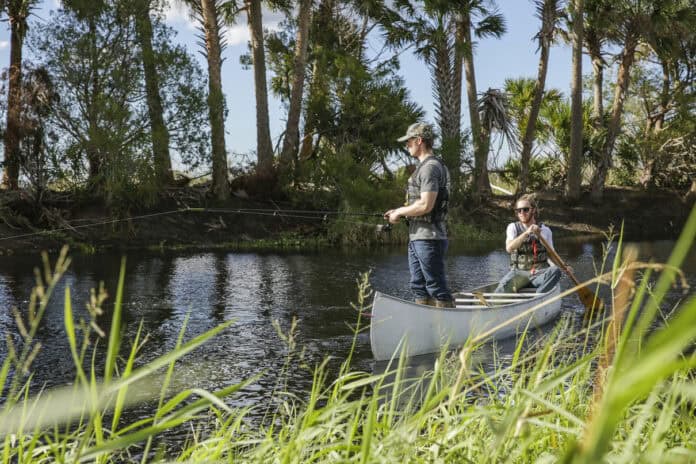
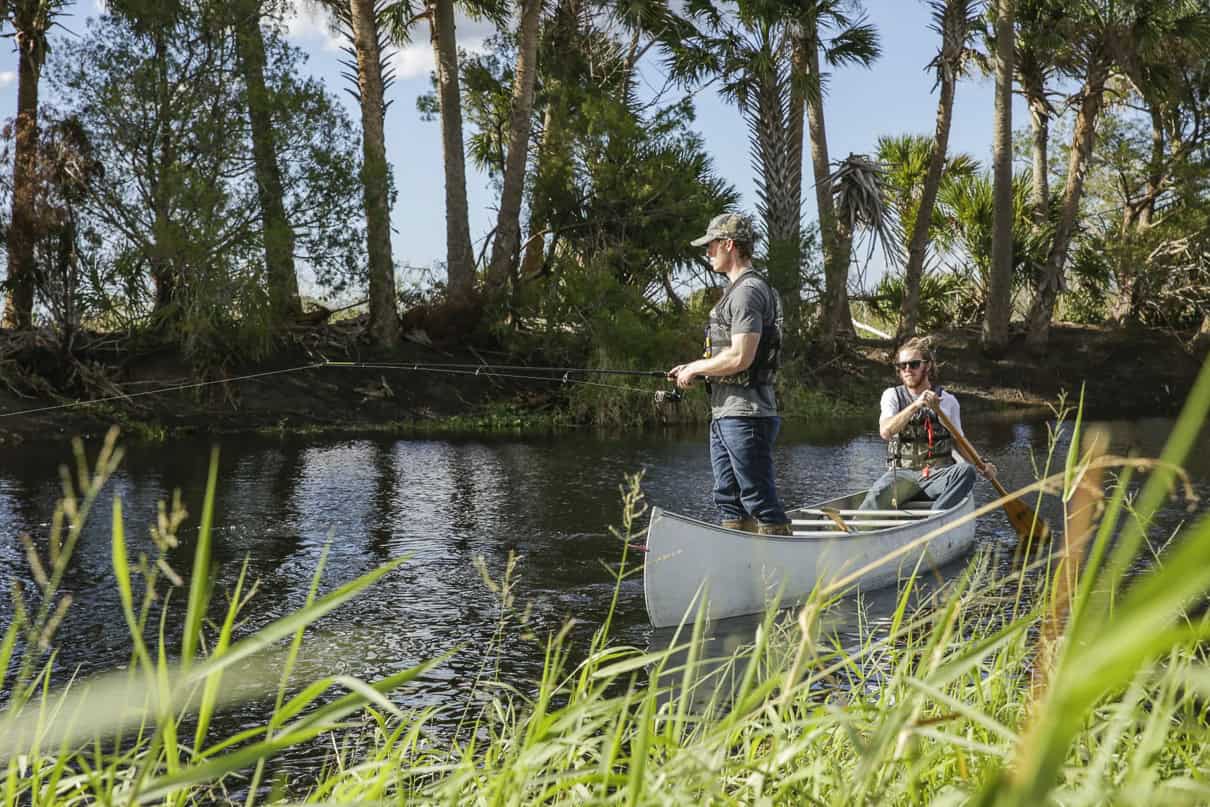
Fishing from a canoe on the St. Johns River near Christmas, Florida. Feature Image courtesy Watersports Foundation.
Once every five years, the National Recreational Boating Safety Survey (NRBSS) sponsored by the U.S. Coast Guard makes rounds collecting data on how many people go boating, the types of boats they use and how often they’re on the water.
As state boaters registrations typically target motorized vessels leaving human-powered kayaks, canoes and paddleboards unrecorded in many states, the NRBSS may be one of the best ways for paddlesports boaters to ensure their interests are represented and participation in boating recreation properly recorded.
Based on 2018 survey results, it is estimated that there are 84.5 million recreational boaters in the United States operating more than 25.5 million boats on over 25,00 miles of navigable waterways, according to the NRBSS. Now, in 2026 the survey returns for the first time since 2018, making this year’s survey the first time since 2020, when the industry experienced a rise in boating as an outdoor activity, that the survey has been conducted. In total, seven surveys have been conducted since 1973.
The Coast Guard is asking for your help in 2026. Volunteer to participate by completing a brief sign-up page sharing your boating habits and contact information with the Coast Guard. Later in the year, a large range of boaters will be invited to participate in the larger NRBSS survey.
Conducted since 1973, the data collected through the NRBSS helps support national, state and local boating safety and law enforcement programs. Results are used by the U.S. Coast Guard and state agencies to make better decisions about how resources are used, and make boating and water recreation both safer and more enjoyable for all.
Fishing from a canoe on the St. Johns River near Christmas, Florida. Feature Image courtesy Watersports Foundation.
“The NRBSS has an extensive history of giving important insight into how people are boating in waterways across the country,” shared Captain Brent Schmadeke, Coast Guard Office of Auxiliary and Boating Safety, United States Coast Guard. “The findings are critical in guiding the Coast Guard’s security efforts to keep boating safe and enjoyable for everyone.”
Boaters of all levels of participation are encouraged to apply, including those who consider themselves infrequent boaters. Participation from a variety of boaters helps ensure the NRBSS results accurately represent boating activity across the country. The survey is funded by a grant from the Sport Fish Restoration and Boating Trust Fund administered by the USCG and is being conducted by NORC, a nonpartisan research organization, at University of Chicago in partnership with the U.S. Coast Guard. All information provided is kept strictly confidential.
NRBSS survey may be the only means to estimate unregistered paddlecraft in the United States
Throughout the next year, NORC will collect information from more than 50,000 households throughout all 50 states to learn more about individuals who own or rent boats.
One particular strength of the NRBSS is estimating the number of boats not required to be registered by states, such as canoes, kayaks, paddleboards and rowboats. Presently, there is no authenticated count of these boats and an estimated 13.4 million boats owned in the U.S. are not required to be registered by the state where they’re kept.
The NRBSS also provides estimates on safety equipment used by boaters, including Emergency Position Indicating Radio Beacons (EPIRB), Personal Location beacons (PLB), Engine Cut Off Switch (ECOS) and VHF-Digital Selective Calling (DSC) Radios.
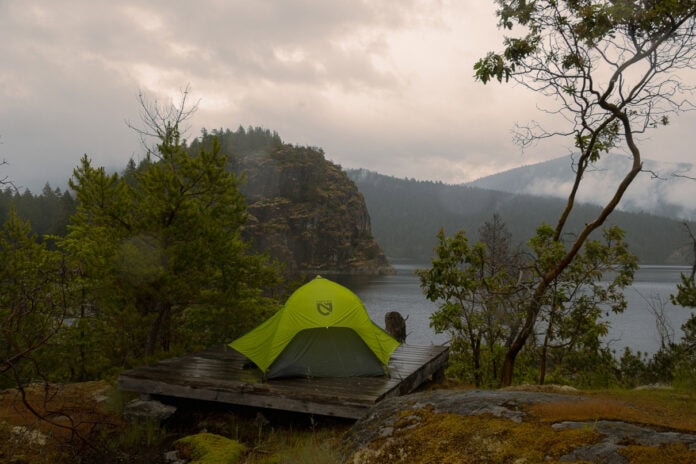
A waterproofed rainfly can be the difference between a happy camper and a trip cut short. Feature Image: Maddy Marquardt
Soon, the last of the ice will crack and melt on the northern lakes, the sun will warm the ground and it will be time to dust off your paddling gear for the first trips of the season. Before paddling season comes gear repair season, and now is the time to pick through the gear you promised you’d patch up in the fall to make sure it’s water-tight for the summer.
How to re-waterproof a rain jacket
Nothing ruins your paddle trip quite like getting to camp, pulling on your dry clothes, throwing on your rain coat and getting ready to cook under your tarp only to find your raincoat is soaking through. Just like that, you no longer have any dry clothes.
Luckily, this all can be prevented by properly refreshing the waterproofing of your jacket before the season starts. All you’ll need is Nikwax TX Direct Spray-On Waterproofing, your clean raincoat, and a hanger and space to dry the raincoat on after treating.
How to repair a leaky dry bag
Dry bags go through a lot. We fill them to the brim then roll them up tight. We jam our dry bags in kayaks, and to be honest, how many of us are really cleaning them out after every trip?
With all that wear, tear and questionable care, you might find that it’s time to patch your leaky dry bags.
There are a couple of things to keep in mind when repairing your leaky dry bag. First, you’ll want to make sure the points on the dry bag that you’re applying adhesive to are totally clean; rubbing alcohol is a good way to remove dirt and residue and prep your surface for the repair.
For larger cuts and tears, you’ll typically want to use a patch like a Gear AID Tenacious Tape Gore-TEX Fabric Patch. It often works well to use a patch on both sides of the hole to ensure full water proofing. You can also reinforce the edges of your patch with Aquaseal to reduce the changes of the patch catching and ripping off. For smaller, pinhole leaks, Aquaseal alone may be enough to repair the dry bag.
Patches like this are meant to be permanent patches to save your gear from an early grave rather than a temporary fix or quick trail repair.
How to repair a leaky drysuit
With drysuit prices running you several hundred dollars, no one wants to replace a drysuit that’s still mostly dry. When it comes to drysuits a savvy repair can save you a lot of money.
In order to effectively repair your drysuit you’ll need to check for leaks first. This can be done by sealing off your gaskets and filling the drysuit with air. Similarly to how you might locate leaks on a sleeping pad, spray the drysuit down with soapy water. Gently press on the inflated drysuit to check for leaks; you’ll be able to locate leaks from the soapy foaming bubbles as air comes out of pinholes.
From here, repair methods range from patches to gel adhesives. When patching a drysuit it’s extremely important to create a smooth patch that won’t catch and tear off as you’re paddling.
A surprise leaky rainfly is one way to complicate your comfort on a camping trip, but the good news is rainflys are surprisingly easy to patch. Similar to other patches, you’ll want to be sure to clean your rainfly before applying your patch. Often, a Gear AID Tenacious Tape Gore-TEX Fabric Patch applied to both sides of the tear is enough to re-water proof a rainfly.
If your rainfly isn’t torn but soaks through in a heavy rainstorm, consider using Nikwax TX Direct Spray-On Waterproofing to re-up the waterproof coating exactly as you would on a raincoat.
A waterproofed rainfly can be the difference between a happy camper and a trip cut short. Feature Image: Maddy Marquardt
Experienced river runner Aaron Benjamin was the last of his group to pass through Hance Rapid on the Colorado River on February 19 when he was thrown from his raft. With both Benjamin and his raft caught in a hole for as long as a minute, the rafter’s party went on to perform life-saving care measures when he emerged from the rapids unconscious.
Experienced rafter who died in Grand Canyon accident cared deeply about waterways
Benjamin was with a ten person group with a non-commercial permit provided by the Parks Service. Joe Dana, a journalist with 12 News, had personally met Benjamin the previous year on the Colorado River, crossing paths with his group several times and sharing campsites.
“Aaron was a very kind and respectful person,” said Dana. “And really respected the canyon… he cared deeply about waterways. He actually worked as a water technician in his hometown.”
Aaron Benjamin enjoys a rafting trip. Feature Image: 12 News | YouTube
Beyond the interview with 12 News, Dana went on to write a tribute to Benjamin’s life and breakdown of the incident. In this article, Alan DeKalb, one of the ten members of Benjamin’s party, shared that the group had scouted Hance Rapid from a higher elevation both the day before and morning of the incident, discussing hazards and obstacles. DeKalb told Dana that Benjamin was the last boat to go, the sweeper, because of his years of experience.
DeKalb also shared with Dana that he believes the hole, a powerful hydraulic feature known to trap boaters and paddlers, Benjamin found himself stuck in was Emilio’s Hole, named after Emilio Solares who died there in 1994. Out of respect for Benjamin’s family DeKalb declined to discuss further lessons learned at the moment.
Parents of victim of rafting accident want paddlers to know there is inherent risk in everything
Dana emphasized that Benjamin was an experienced rafter, wearing a PFD, a helmet, and a drysuit.
“Aaron’s parents tell me he truly was doing what he loved,” added Dana. “And was always more comfortable in nature than anyone else.”
Dana also shared that overall deaths in the Grand Canyon are rare compared to the amount of visitors. The Grand Canyon sees an average 12 deaths a year, with airplane crashes being the leading cause followed by falling and environmental concerns including heat-related illness and dehydration. Drowning accounts for approximately 100 of the 900 Grand Canyon deaths between the 1800s and 2017 according to Hastings and Hastings Grand Canyon Deaths Analysis.
“Aaron’s parents want the biggest takeaway to be that there are risks inherent in everything,” said Dana. “They’re confident that Aaron did not do anything reckless. He was careful and confident in everything he did.”
Dana went on to encourage paddlers to dress for the water temperature rather than the air temperature even in the heat of summer, and to wear a drysuit when necessary. In February, average temperatures at the bottom of the canyon range from the low-40s to mid-60s (F) and water temperatures on the Colorado River in the canyon hover around a chilly 50 degrees year-round.
“Sometimes people who die in these accidents, they actually die of a heart attack,” explained Dana, describing cold shock response, which can occur when a body comes into sudden contact with cold water, triggering dramatic changes in breathing, heart rate and blood pressure.
One common outcome of cold shock response is a gasp reflex is triggered. A life jacket (PFD) and proper immersion gear including a drysuit or wetsuit can help mitigate the impacts of cold shock, but, as emphasized by Benjamin’s parents, there are inherent risks to paddlesports.
The National Parks Service shared in a press release that Grand Canyon National Park received an emergency alert at 11:15 a.m. on February 19 near Hance Rapid on the Colorado River followed by a report that CPR was in progress. Park rangers were then flown to the location by helicopter and all resuscitation efforts were unsuccessful.
The National Park Service stated that they, along with the Coconino County Medical Examiner, are investigating the incident and no further information is available at this time. Investigating a fatality within park boundaries is National Park Service protocol.
Rip higher and drier in the Pyranha ReactR. | Feature photo: Matt Allen
In May 2024, just a month after Pyranha dropped the much-hyped ReactR kayak, I found myself at an industry event chatting with Dave Fusilli, longtime Team Pyranha paddler and Western Canada sales rep. As Dave walked me through the standout features of this new river weapon, my marketing brain kicked into gear: was Pyranha sneakily inventing a new category of kayak? A classic marketing move—create a new problem, then solve it with your product.
“Ah, the quarter-slice,” I joked. Three-quarters creeker, one-quarter slice—just enough to stay fast, agile and pivotable, without sacrificing the confidence-inspiring volume of a creeker.
Genius.
Before our chat, I was certain my kayak quiver was complete. I had a playboat, a half-slice and a trusty creek boat. But as Dave highlighted the ReactR’s comfy new outfitting, cushy shoulder pads for hauling and exaggerated rocker made for dry boofing, I realized I was facing a new problem.
Maybe I needed a fourth kayak.
Whitewater Kayak Review: Pyranha ReactR
Pyranha ReactR (Medium) Specs
Length: 8’11”
Width: 27.5”
Weight: 51 lbs
Volume: 86 gal
MSRP: $1,899 USD | $2,589 CAD
Pyranha Kayaks has been shaping the whitewater world since 1971, when British paddler Graham Mackereth started building fiberglass boats for slalom, flatwater and whitewater. A former U.K. Olympic team member in K1 Sprint, Mackereth used his racing background to build high-performance designs and eventually pioneered the first market-ready rotomolded kayaks in Europe by the late 70s.
Growing up paddling in Britain, I associate its rivers with being shallow, rocky and a little dirty. Back then, when I shopped for a creek boat, my criteria were simple: would it keep me upright and take care of me? Popular models of the time, like the Dagger Mamba or Liquidlogic Jefe, suggest the sentiment was widely shared.
In recent years, however, there has been a shift toward a different core need: speed, skips and agility. It’s a style Mackereth probably would’ve appreciated in his early racing days. This is where the ReactR enters the chat. It is one of the first boats to blend the playful and popular slice-boat energy with creek boat confidence. Think Ripper 2 meets Scorch. No surprise it took home the 2025 Paddling Magazine Industry Award for best whitewater boat.
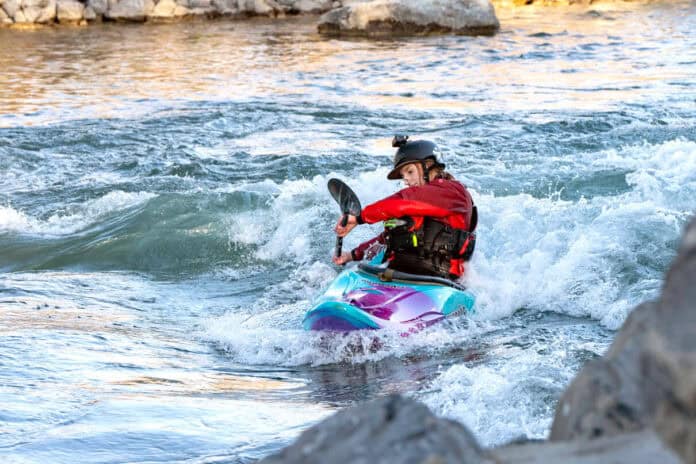
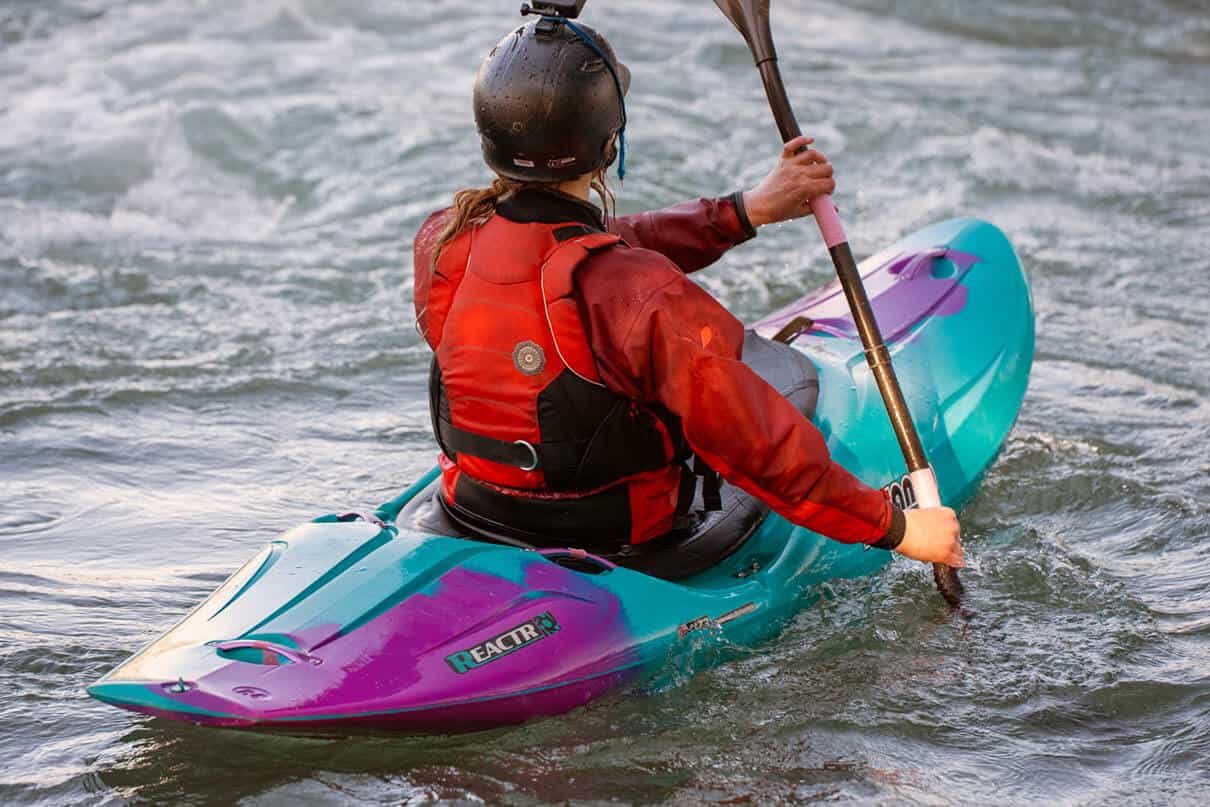
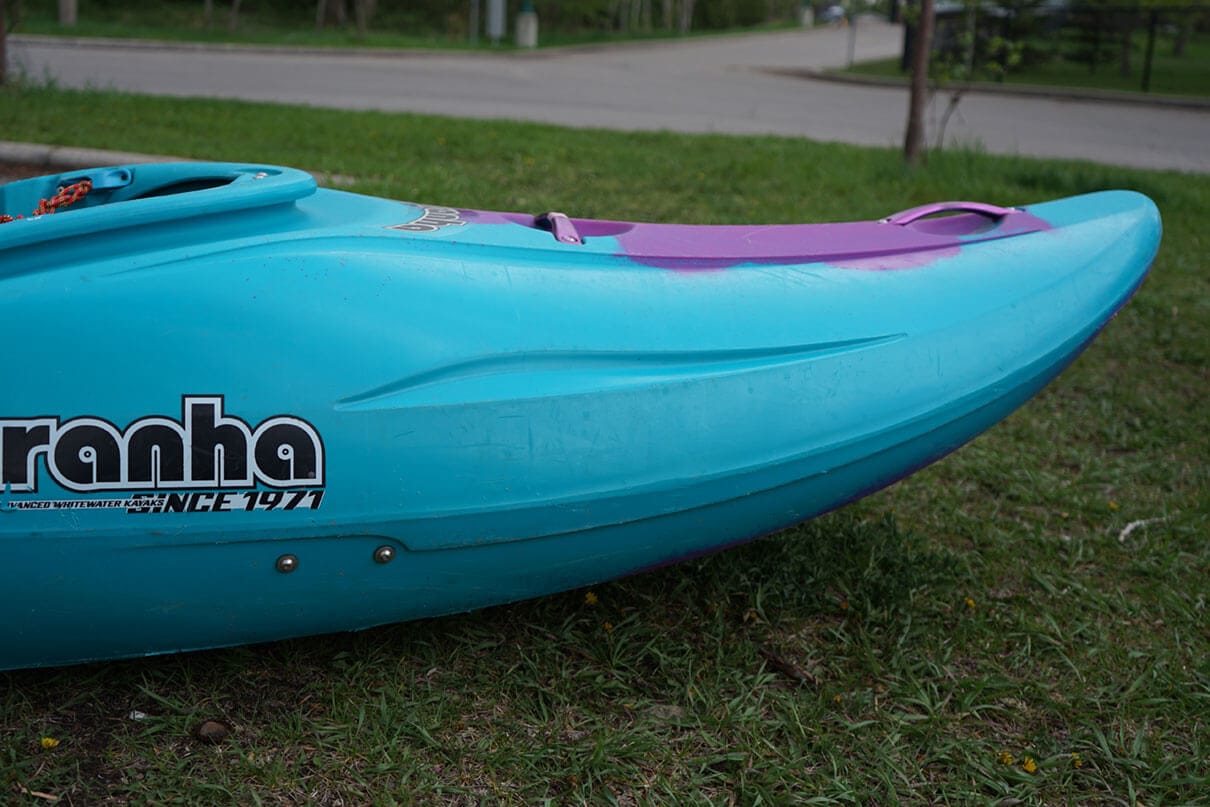
The ReactR’s stern stays on top of the water when heading downstream, but enables rapid direction changes through low-angle pivot turns. | Photo: Matt Allen
When I got it on the water this spring, I quickly realized what draws comparisons is the ReactR’s pivot hull. By shifting back the pivot point—where bow and stern rocker meet—Pyranha has created an impressively nimble boat that facilitates the drive-from-the-backseat technique. With your weight back, you can lift and swing the bow around or over features. Put your weight forward, and it glides with control. Compared to older creekers, or even its Scorch predecessor, the ReactR’s rocker profile is more banana-like, and that’s one of the first things I noticed when testing it out.
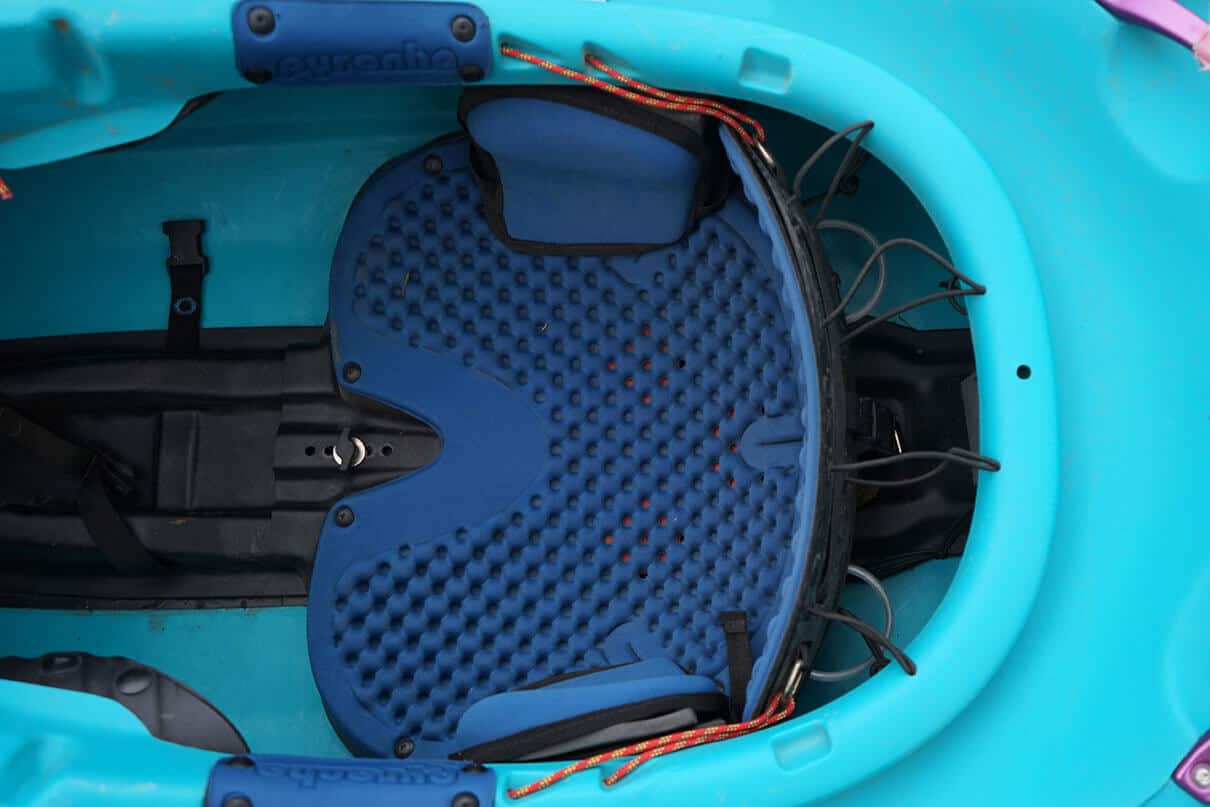
As a woman with wide hips and long legs, I often get cramped in boats. That’s why the new Elite outfitting on the ReactR really spoke to me. The extra foam padding in the backrest and seat base adds noticeable comfort, and the wider backband offers better support. Even better, the adjustable thigh grips provide two-way adjustment, making it easy to find the perfect angle for my legs and hips. The comfort carry pads on the shoulders are such a simple but brilliant touch, I can’t believe it took this long to become standard.
The Elite outfitting ditches the traditional ratchet system in favor of a pulley setup, similar to the system Jackson Kayak uses, but with its own twist. Thick Dyneema cord runs through aluminum racing cleats, and an internal pulley redirects tension toward the paddler. The result is a secure fit that encourages your back to form a natural concave arch, not a hunched one. Bonus: the cleats are also easier to lock off than Jackson’s.
Pyranha seems confident about the new outfitting, too—they’ve now rolled it out in the 2025 Firecracker and Ripper 2 models, replacing the older Stout 2 system. After spending a week in the medium ReactR, getting back into my medium Scorch felt like a downgrade; I missed those comfort features.
Sitting in the ReactR, both on dry land and in the water, the first thing I noticed was how big it felt. And that’s because it is: the medium comes in at 27.5 inches wide and 86 gallons (325 liters) of volume, compared to the medium Scorch’s 25 inches and 82 gallons (310 liters). If you’re near the top of the Scorch’s weight range, the ReactR medium might be your Goldilocks fit.
So far, I’ve paddled the ReactR on mostly class II–III rivers, and that gave me a solid feel for how it handles in different scenarios. The wider profile did make it less snappy to roll than the Scorch.
That said, boofing was an absolute dream thanks to the elevated rocker. It was actually hard to get the nose wet at all. I found myself unintentionally boofing through small waves, purely due to the hull shape.
Pyranha’s new Elite outfitting system has been redesigned to give paddlers more control and comfort. | Photo: Louise Stanway
The aggressive rocker allowed us to skip up and over everything we threw at it. | Photo: Louise Stanway
One downside I noticed was the tracking. The ReactR’s width, planing hull, softer edges and shorter waterline made it a little harder to hold angles or generate and maintain speed compared to the Scorch. It felt more like a slow plod at times, especially when trying to drive above a feature. This might not be an issue for a heavier paddler who can power it around more easily, but it stood out to me.
Once on the water, the quarter-slice stern really showed its design strengths. I was initially concerned about catching the tail unexpectedly, but my fear vanished quickly. The low-volume stern just gives you more room to lean back and pivot—it’s not slicey enough to surprise you. In fact, stern squirting the ReactR is nearly impossible. Only a select few have managed it, and I’m not one of them.
One of ReactR’s standout traits is how well it surfs for its size. The planing hull and shorter waterline make it easy to catch waves of any variety. Where some creek boats wash out on a feature, or become locked in at an angle, and some playboats feel too squirrelly to track, the ReactR found a sweet middle ground. I found myself catching waves I’d normally skip in a creeker and hanging on longer than expected. I haven’t quite dialed in flatspins in a ReactR yet, but paired with the agility of the pivot stern, the movement feels inviting for a creek boat.
If you’re coming from a racing background, want to play more aggressively in dynamic water, enjoy surfing waves in a full-volume boat, or want something to launch you off drops with a clean, satisfying skip, the Pyranha ReactR could be your Cinderella slipper.
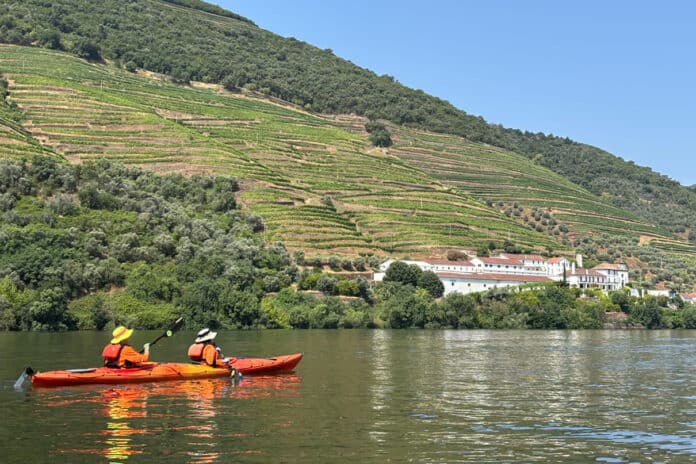
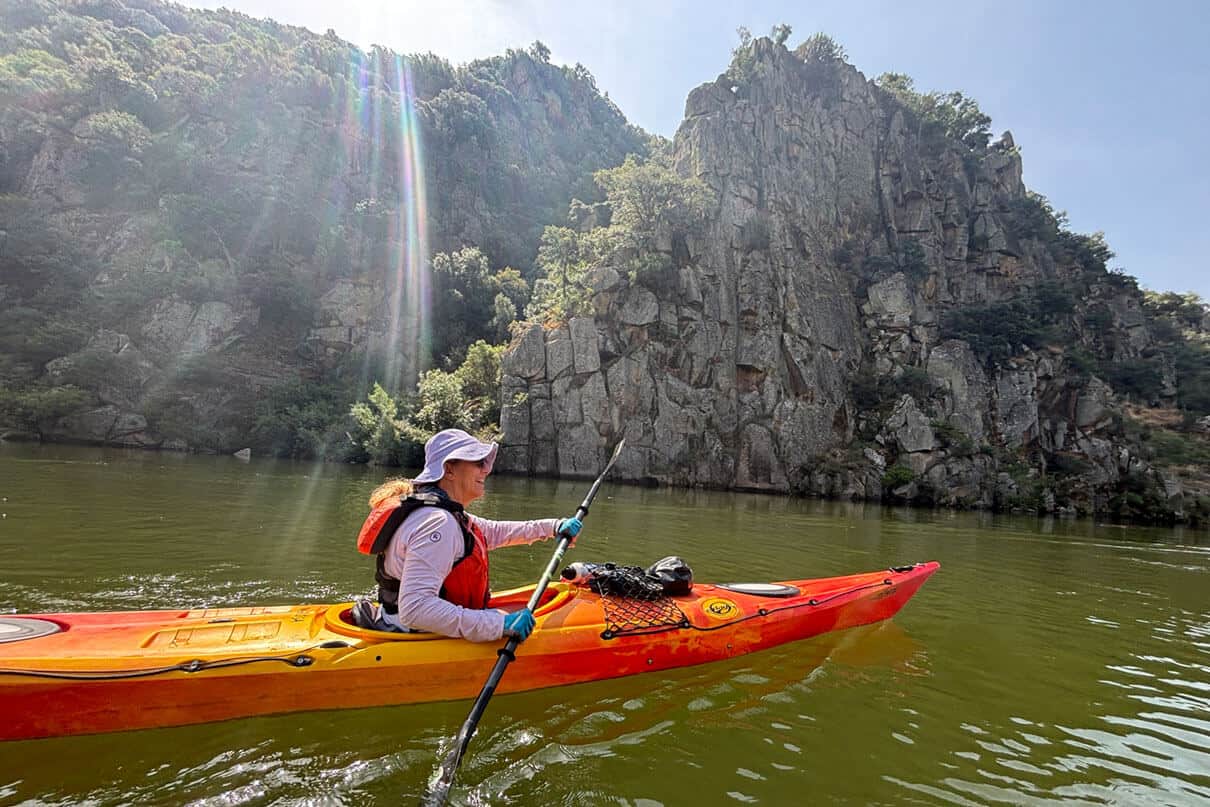
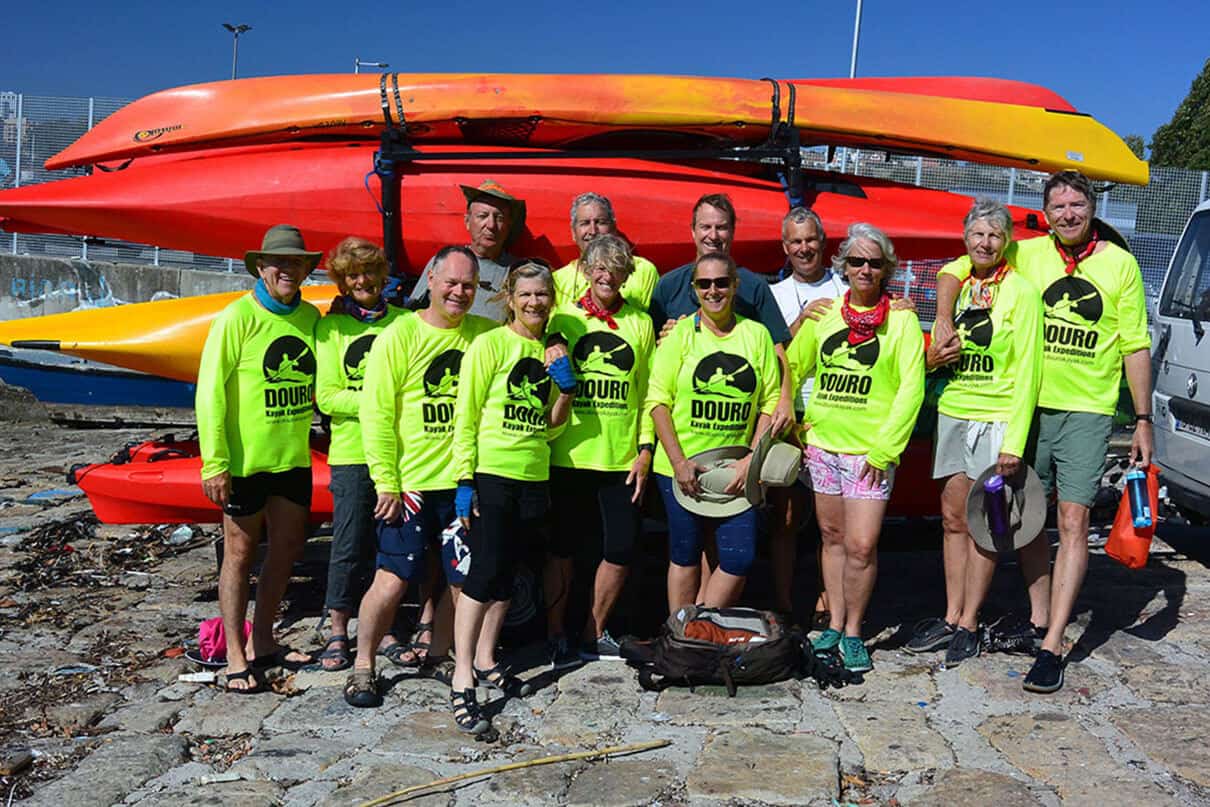
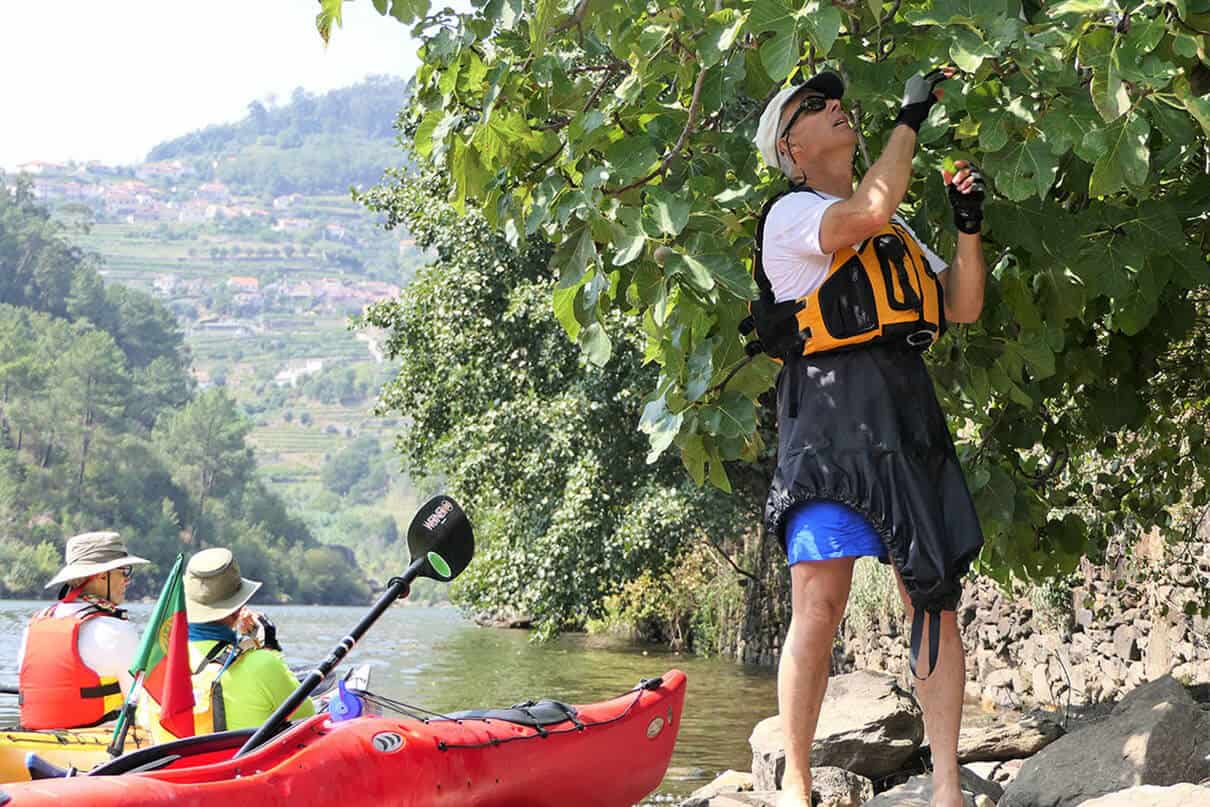
Join Paddling Magazine for a free, live webinar with Douro Kayak Expeditions, where we’ll explore what it’s really like to kayak through Portugal’s legendary Douro Valley.
For this webinar, Brenna Kelly hosts two of Portugal’s veteran guides from the Douro Valley. Together they have over 60 years of experience traveling, planning and guiding sea kayak adventures across Portugal. Join them to learn about what you can expect and how to best plan your paddling adventure in this scenic and flavour rich countryside. Wine and cheese anyone?
Photo: Douro Kayak Expeditions
Photo: Douro Kayak Expeditions
Note: A recording of the webinar will be made available to registrants via email after the live session concludes, so sign up even if you can’t attend on March 27!
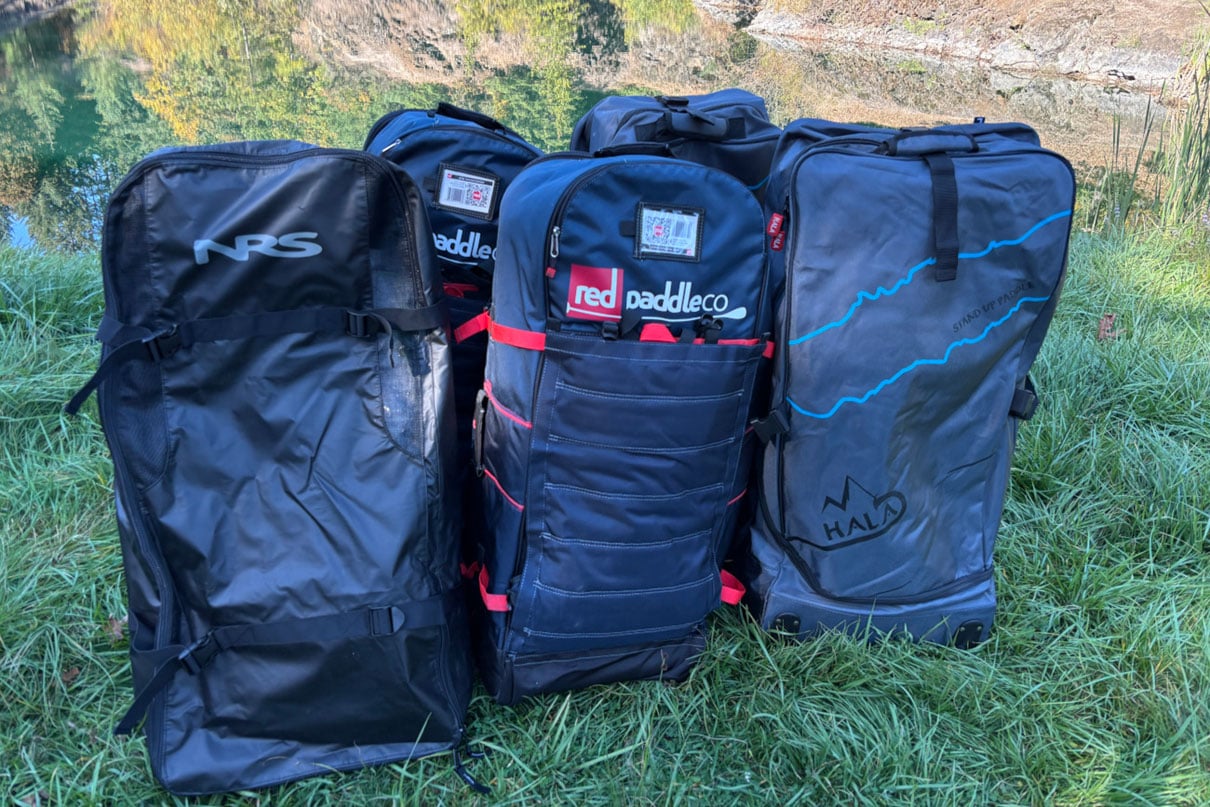
Inflatable standup paddleboards have revolutionized the sport of SUP. They store in oversized luggage bags to transport, often include a pump and breakdown paddle, and provide ease in the ability to access arguably the most relaxing form of paddling there can be. Oh, and there’s no shortage of budget-friendly options out there. When I first set eyes on an inflatable years ago, I thought they were a gimmick, and wondered who would want one in place of a fiberglass layup. I shake my head today at my shortsightedness and lack of imagination.
This is because it is not convenience alone responsible for the astronomic rise of inflatable paddleboards. They would be no fun at all if it weren’t for their continually improving performance, thanks to the competitive race in innovations of their construction. As manufacturing, new materials, and layup patterns keep advancing, inflatables continue their march toward matching the performance of hard standup paddleboards.
What this all means is the inflatable paddleboard is no longer just the choice of beginners. Thanks to these advances, 12- and 14-foot boards have even made it to the SUP race scene. And the durability of inflatables has made them the go-to board for those SUPing whitewater.
The popularity of these boards has also led to an overwhelming flood of options to choose from. If you stick to a few key points in shape and construction you’ll likely end up with a board you’ll enjoy, but to help guide the search, the Paddling Mag team including myself have tested the best inflatable paddleboards available across every category there is, and provided here a selection of our favorites.
Your body loses heat much faster when immersed in cold water than it does when dry.
Avoid cotton clothing like t-shirts and jeans; they retain water and accelerate cooling when wet. Synthetic fabrics, or wool, are generally a better choice. If the water is very cold (60° fahrenheit or less), you should wear a wetsuit or drysuit.
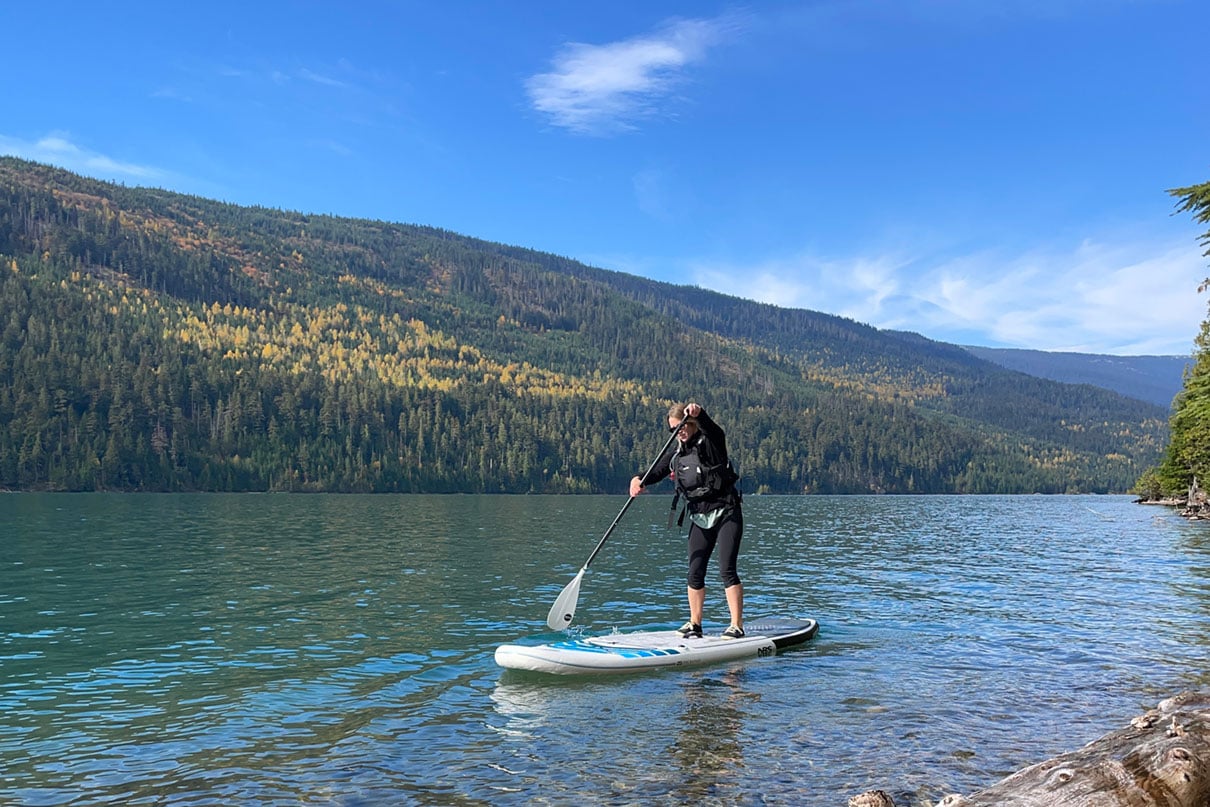
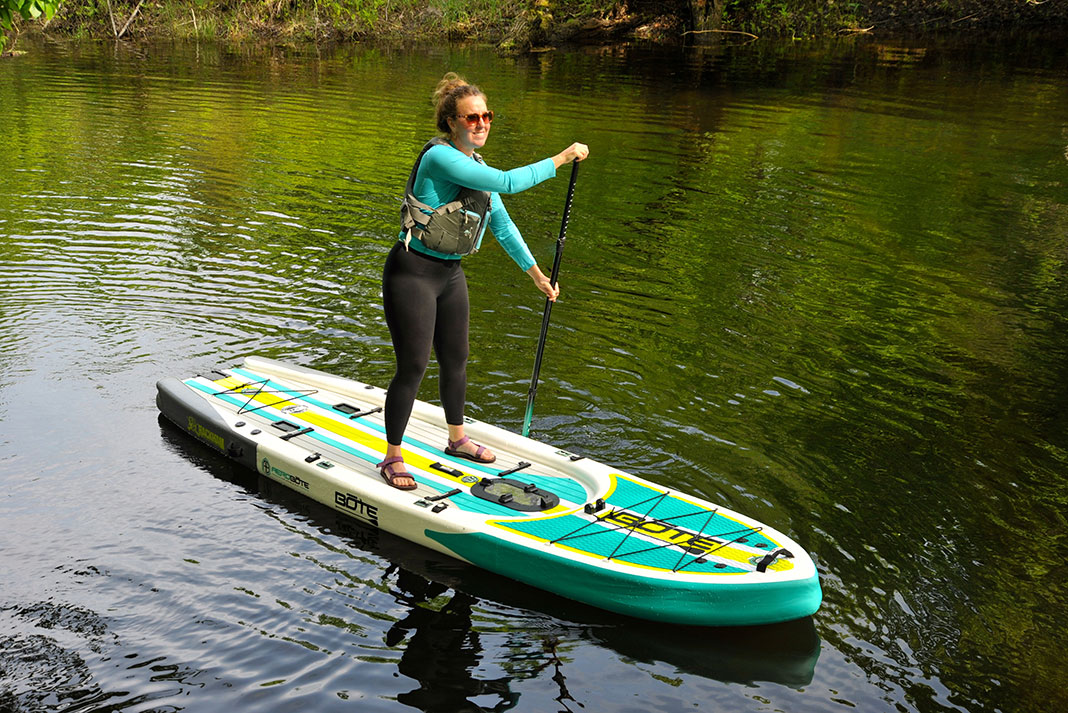
The Jukdo is NRS’s statement that an all-around inflatable SUP can be much more than the cookie-cutter shape of a round nose and 30-some-inch wide board. They accomplish this mostly with their Integrated Shaping Technology (IST), which uses multiple air chambers to give the Jukdo unique shapes usually found on rigid boards.
What this IST looks like on the board is a dropped deck allowing NRS to lower your standing height without sacrificing volume—translation, a lower position increases your stability, especially when the river or lake gets wavey. Paddling Magazine media strategist Brenna Kelly tested the Jukdo on the waters surrounding Revelstoke, B.C., and after using the board, expressed that the raised deck edges are what separate the Jukdo from any other all-around inflatable paddleboard.
NRS also utilized IST to create a channeled hull, similar to what we see on pontoon-style kayak hulls. This channeled hull provides a smooth paddle on flat water and increases the surface area of board on water.
The Jukdo includes a set of three all-around fins and a touring fin, a well-built dual-action pump with a setting for high-pressure inflation, and a burly travel bag.
Reasons to buy
IST-developed dropped deck for increased stability
Channeled hull for smooth flatwater paddling
Z/Blend Core construction is 20 percent stiffer yet 15 percent lighter than previous NRS board generations
Options for three-fin or single-fin setup included
Consider another if
You prefer a traditionally decked inflatable
Are seeking a board specific to touring or whitewater
Bottom line
The Jukdo is an all-around inflatable paddleboard anyone will enjoy whether you are a beginner or advanced paddler. It won Paddling Magazine’s 2024 Industry Awards for the SUP category thanks in no small part to its innovations in the space.
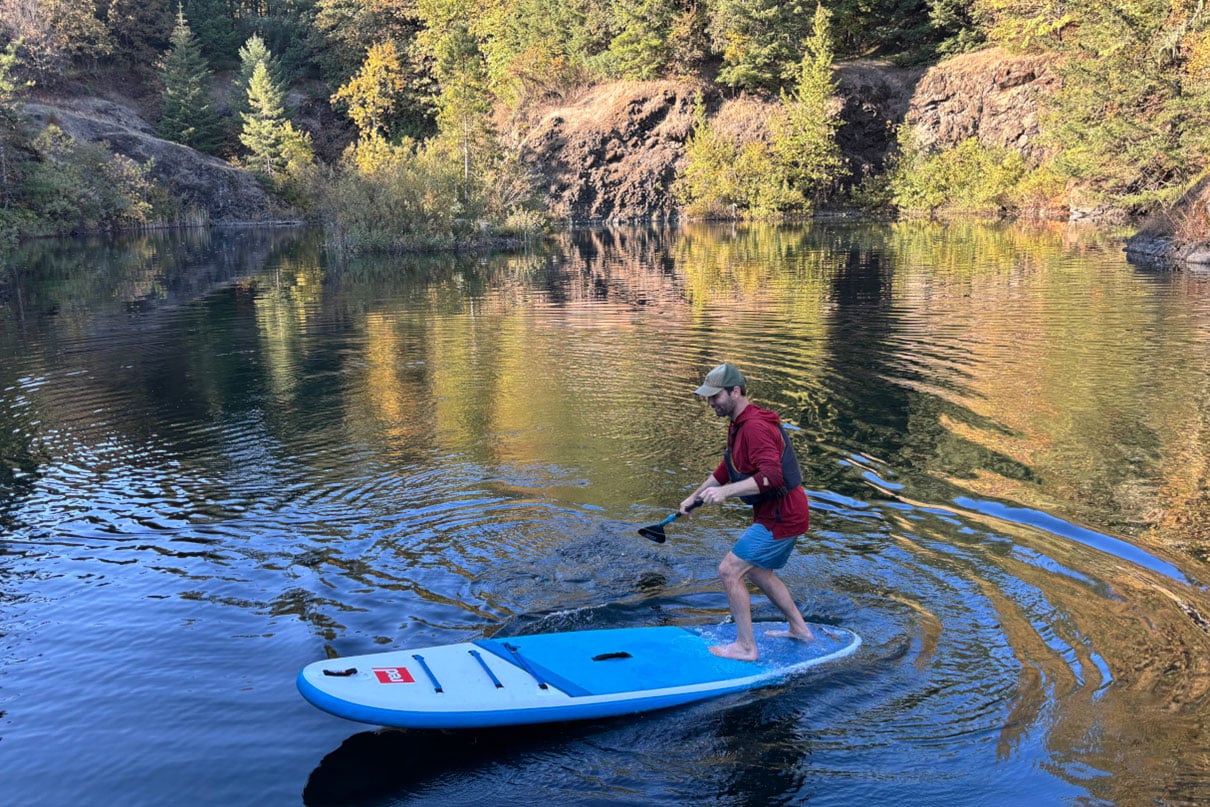
With the number of inflatable boards I’ve paddled, I appreciated Red’s Ride 10’6” the moment I stepped onto it. The deck height at 4.7 inches sits a half to an inch lower than many other all-around boards, and at 32 inches wide, it’s a little narrower as well. I wondered if this would make the Ride feel less stable or spongy, but the flat bottom still provides plenty of stability, and when I jumped on the board, the sense I felt was more connected to the water. Beyond the paddler positioning, the board also glides well and makes smooth arching turns thanks to the rounded tail.
This may sound like an odd detail to point out, but the Ride’s deck pad is one of the most comfortable I’ve ever stood on. When the name of the sport is standup, and you plan to spend hours on your feet, this says a lot.
The Ride 10’6” also has fixed permanent twin fins, which is not the case for many boards. They are a durable and bendable construction to avoid damage, but this also means they do not detach or swap for other fin styles. It’s helpful not having to keep track of fins, nuts and bolts, but it is likely a love-it-or-hate-it feature of the Ride.
Reasons to buy
Narrower and with less height than most others in the class for a connected-to-water feel
Monocoque Structural Laminate (MSL) can be inflated to 22 PSI yet feels stiff even at lower levels of inflation thanks to reinforced composite coating
Incredibly comfortable EVA deck pad
Individual bungee straps for deck storage
Built-on twin fin setup means you’ll never have to screw keep track off or screw in fins
Consider another if
You prefer the feel of a wider or higher Inflatable SUP
The fixed fins are not your jam
You want a longer touring-specific board or a rockered board for running whitewater
Bottom line
Red Equipment builds exceptional inflatable boards, and you can feel the difference in the Ride compared to other similar-looking all-arounders the moment you step onto it.
Inflatable SUPs are supposed to be easy. Easy to store, easy to load in the car, easy to paddle. And easy on the wallet to enjoy a float on the water helps too. This is what I love most about the Niphean Classic 10’6” paddleboard, also called the Clovis Point. The board sticks close to a standard shape and dimensions that work, and costs less than $300. For that price you are getting just about everything you need to go standup paddleboarding except for a PFD. When you aren’t looking to win races or shred waves, and just want a board you can inflate for an afternoon with friends, it is all you need.
Is paddleboarding a sport where you get what you pay for? Sure. With inflatables, increased cost goes toward design performance, construction material, and the adhesive to hold it all together, but generally speaking, people are able to enjoy a budget-friendly inflatable paddleboard like Niphean’s for numerous summers without issue.
Reasons to buy
About as cheap of an inflatable paddleboard as you’ll find and still have fun
Includes every accessory you need to get on the water except a life jacket
Kayak seat add-on also available to sit down
Includes a unique keel fin that is removable if you’re not a fan
Stable feel
Consider another if
You are looking for a high-performance paddleboard for ambitious outings or difficult conditions
An inflatable kayak would better suit your needs
Bottom line
Bottom line
If the water is calling but the budget is tight, the Niphean Classic will get you off the shore so you can enjoy the sport.
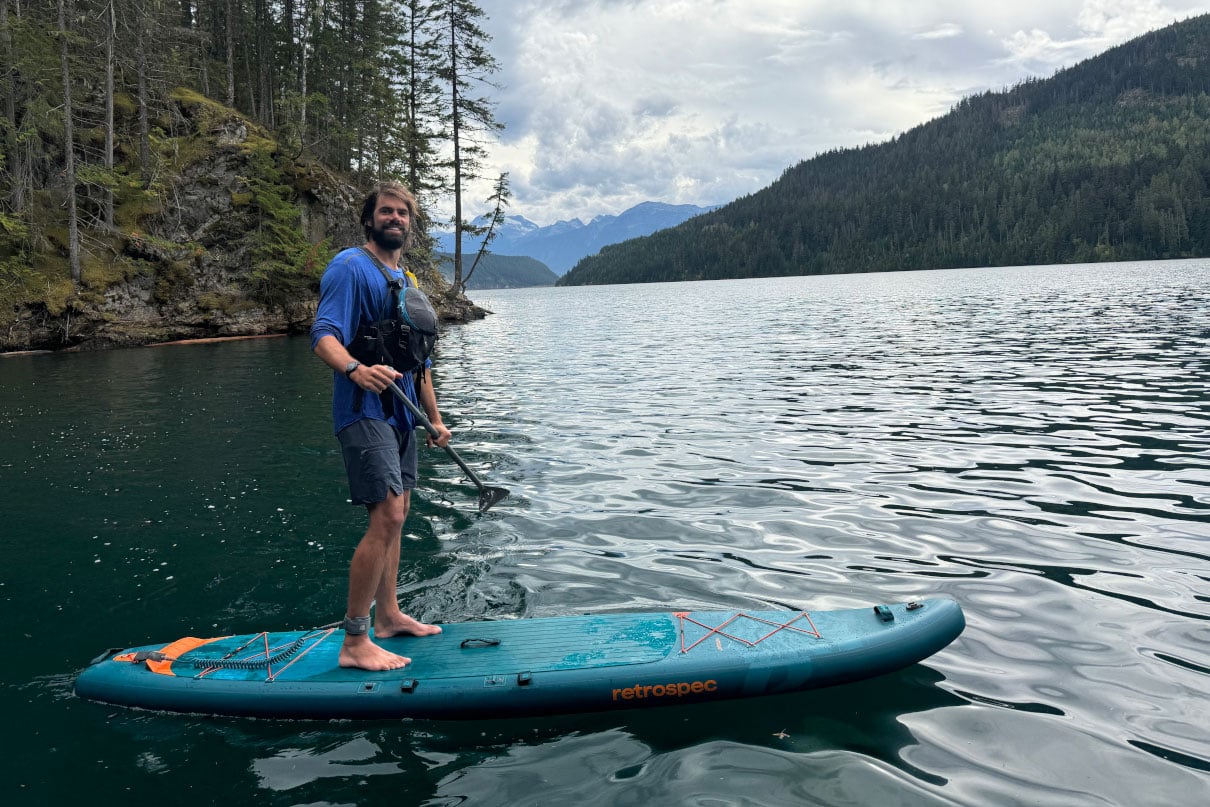
You don’t need to drop a month’s rent to buy an inflatable standup paddleboard, there is a whole list of brands making solid inflatables at a low cost. What you do want to be sure of when you’re buying a low cost board is it inflates to a solid pressure and holds up well with use. It helps to buy a budget board from a brand others have come to trust, such as Retrospec.
Retrospec is a recreation equipment company found in stores like Play It Again Sports and Scheels, or online on Amazon. Their Weekender Tour is an 11’6” board on par with other popular models. Paddling Magazine publisher Cristin Plaice took the Weekender Tour to scenic spots around Revelstoke and found it to be an enjoyable board at a low cost.
The Weekender also includes a paddle, fins, pump, repair kit, and a leash for lakes and open coastal waters. Everything you need to go paddleboarding—except for a life jacket—for under $400.
Reasons to buy
Low price
In addition to the usual accessories it includes a paddle and leash
Consider another if
You have the budget for a higher-quality construction
Seeking a board geared specifically toward touring or whitewater
Bottom line
The Weekender Tour is a budget-friendly, enjoyable, and reliable inflatable paddleboard to get off the shore and on the water.
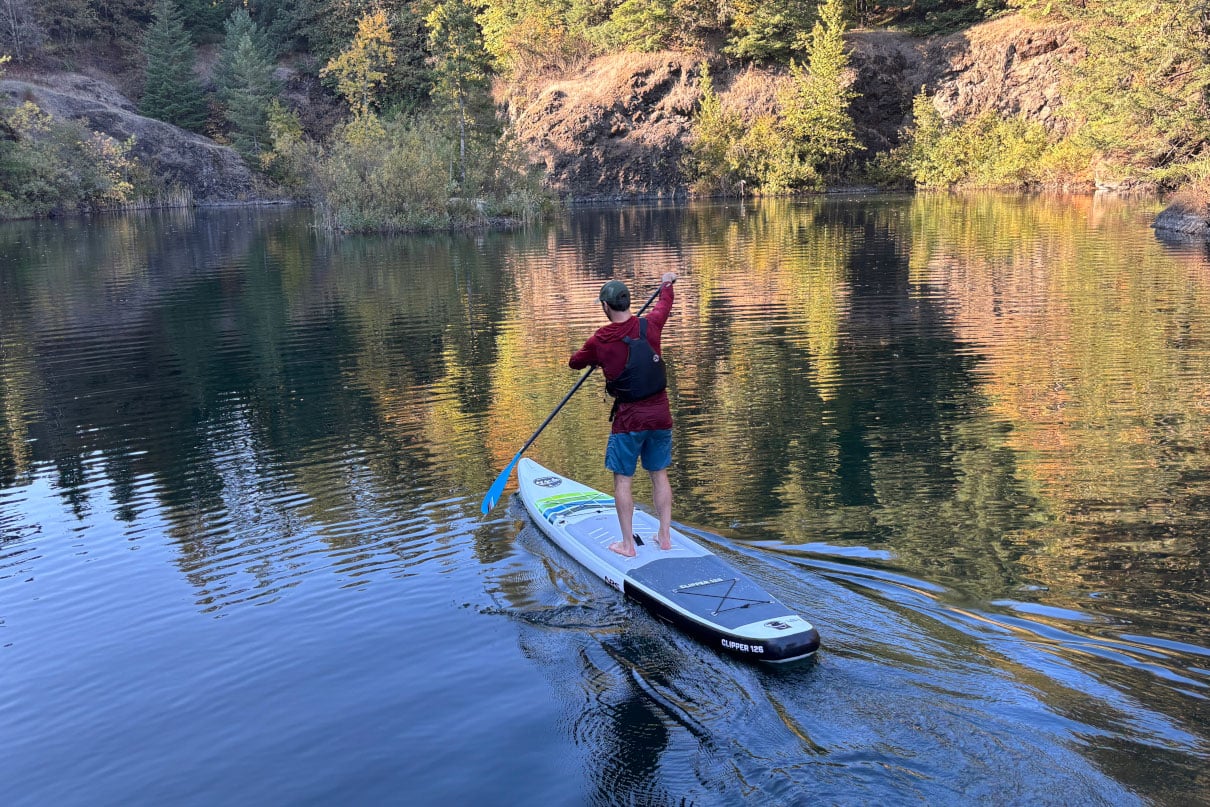
The Clipper 126 gets cruising in a way I expect from a composite touring board, not an inflatable. In the same way NRS utilizes the Integrated Shaping Technology and Z/Blend Core material to make a more detailed and rigid shape in the Jukdo mentioned earlier, they’ve done so with the Clipper. In my view, the result is more positively staggering on this touring board than on their all-around board.
With the IST details, NRS has accomplished two major design components that put the Clipper in an upper class of inflatable touring boards.
The dropped deck lowers the paddler position, something we see on composite touring and race boards. This increases stability for the paddler and allows board designers to pull in the width, creating a narrower, faster board.
The second is the V-hull at the bow. By having a wedged, peaked bow, the Clipper cuts through water and wake rather than slapping at it, making the board more efficient.
When designers are working with foam and composite rigid layups, these components are commonplace on touring boards, but on inflatables, it’s a rare few paddleboard brands with the tech capable of such features. NRS and the Clipper 126 are one of the few pulling ahead of the pack.
Reasons to buy
Integrated Shaping Technology allows for details usually found on a rigid paddleboard, including a dropped deck standing position and V-hull at the bow
Fast hull with good glide
Single-fin setup and includes both a standard touring fin and a raked-back grass fin for the shallows
Fore and aft bungee deck storage to load up for an overnight trip
Bow and stern rocker release the ends to give the board some maneuverability
Consider another if
You prefer a flat deck space in comparison to the dropped deck
You want a wider board for more initial stability—in which case the NRS also offers the 33’ wide Clipper 126W
Bottom line
The Clipper 126 pushes the boundaries of what an inflatable touring paddleboard can be, and the result rips.
Wear The Appropriate Leash When Stand Up Paddleboarding
Always wear a leash on open bodies of water like lakes, bays, and oceans. Due to the risk of snags and entrapment, leashes should only be worn on rivers if they include a quick release attached to your life jacket.
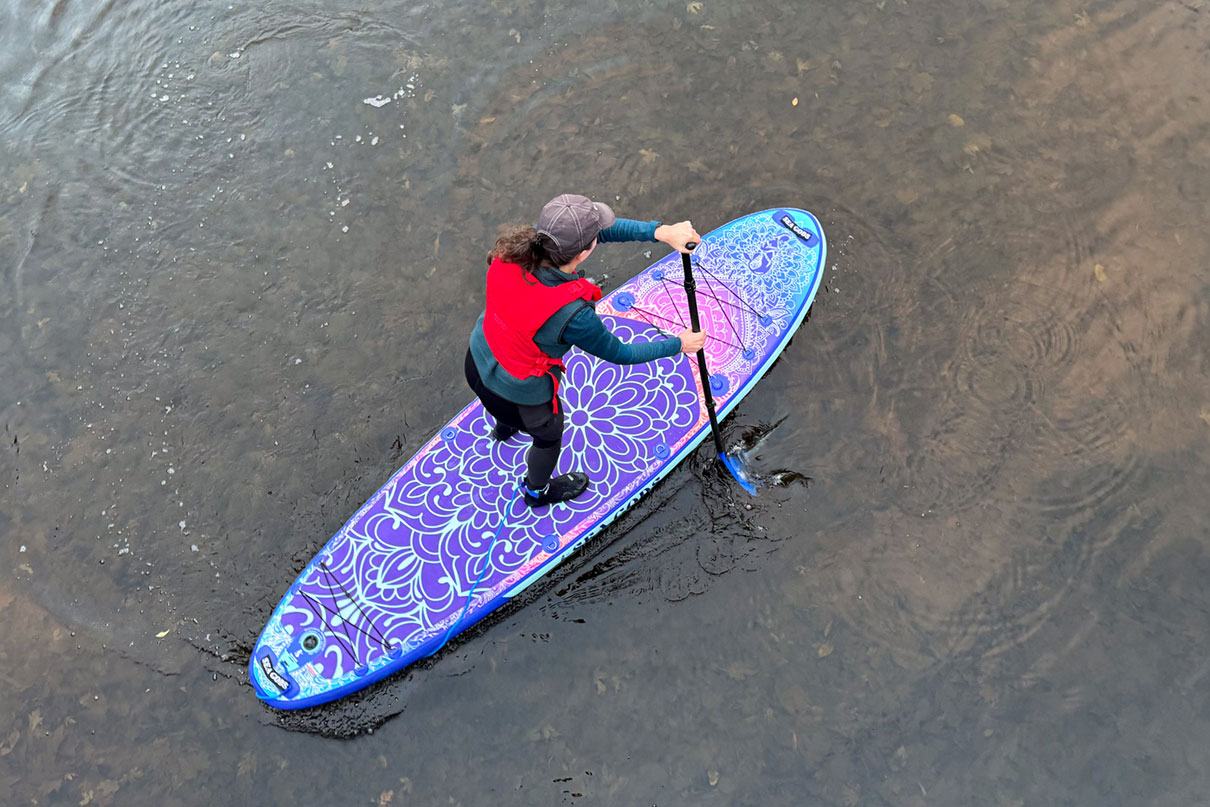
The Diatom from Sea Gods addresses a key need in paddleboarding—feeling stable and building confidence. The Diatom accomplishes this in the form of a 34-inch-wide board. But it’s not the widest point alone which increases stability. It carries this width in a more gradual taper toward the nose and tail, staying wide for longer, which also translates to higher volume at 334 liters. A big, flat surface area creates a stable paddleboard ideal for beginners, higher-weight paddlers, or even those who want a board for SUP yoga. A more stable board is usually a tradeoff for decreased speed, but the Diatom still moves along fine for those on casual outings.
Editor-in-chief Kaydi Pyette tested the Diatom on the waters surrounding Toronto. “Balancing feels effortless, and tracking is smooth, thanks to its single full-size fin. While it’s not the stiffest inflatable I’ve paddled, it’s close,” Pyette shared in approval of the Diatom.
Sea Gods’ boards are attractive inflatables for reasons beyond the thoughtful shapes. They are also decorated in the work of artist collaborations. “Sea Gods make some of the most stunning inflatable boards on the market,” Pyette also said. “Right off the bat, the Diatom wowed me with its intricate design, created by artist Jamie Locke. This eye-catching artwork is a guaranteed conversation starter—folks at the launch often stop to ogle this board.”
Reasons to buy
Wide, stable inflatable paddleboard
A solid choice for beginners, higher-weight paddlers and SUP yoga
Unique artwork collaborations
In addition to the usual accessories, it includes paddle, leash and a ground cloth to keep your board clean when rolling up
Consider another if
A faster board is needed to cover miles
Budget is a factor
Bottom line
Stable is the name of the game with the stunningly designed Sea Gods Diatom.
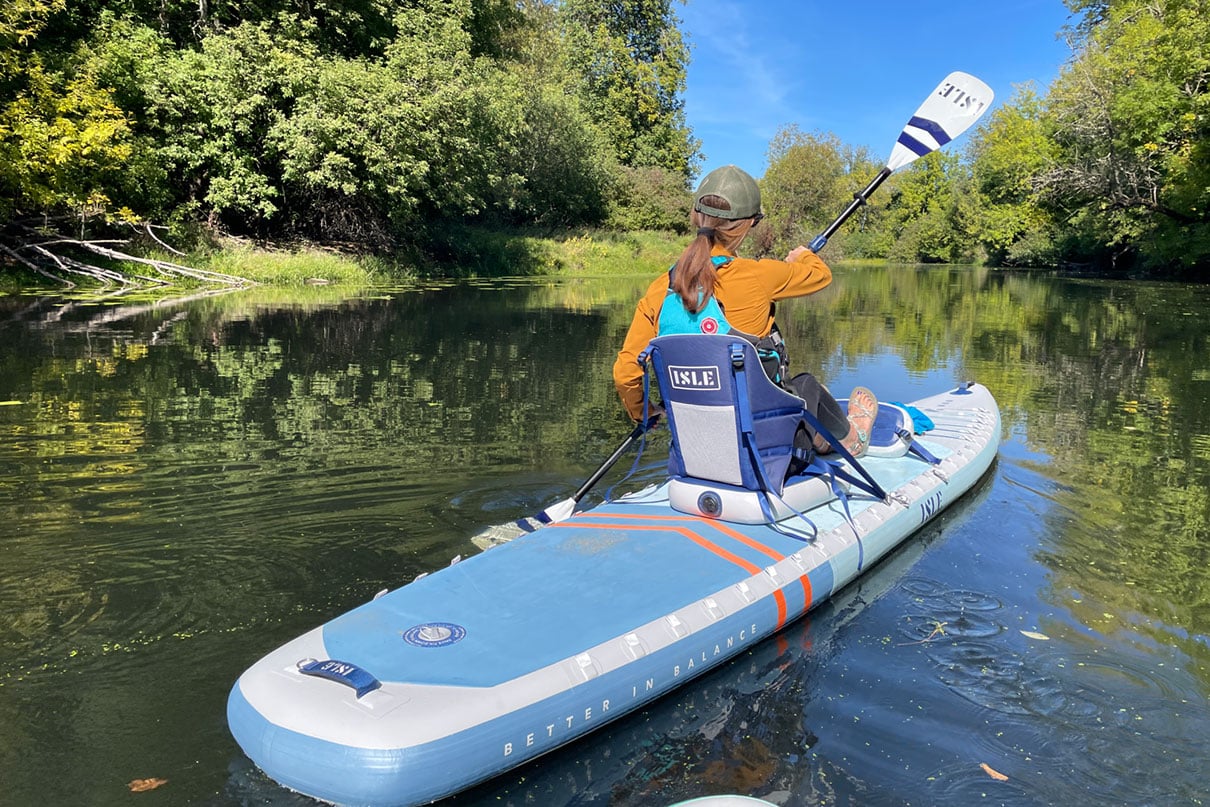
While inflating ISLE’s Explorer Pro, I’ve had multiple strangers walk up to tell me what a great craft it was. Among a sea of inflatables, this is always a good first sign, but what I found more intriguing was they didn’t just say what a capable paddle board it was. They walked up to tell me how much they loved it as a kayak. Up until then I’d always thought of the SUP-kayak hybrid as a value add. Throw in a cheap paddle and some seats and people will feel like they are getting more for their money. With the Explorer Pro you actually are getting three capable crafts, a touring iSUP, and either a solo or tandem recreational inflatable kayak.
ISLE walks the walk with their combo because the seat and footrest they include are well-designed. The lash points running down the entire length of the board allow the inflatable footpad to be placed wherever works best, and the kayak seat inflates to be solid, elevated, and comfortable. As a side note, having these lash points on the entire board is an underrated design component for other reasons. You can strap gear just about anywhere and incorporate cam straps or accessory cord instead of the standard thin bungee cord found on most boards.
Let’s not forget, the Explorer Pro is a touring board first, and one of the most rigid inflatable boards out there, thanks to the composite Infinity Fiber stringers, which work similarly to those old wrist slap bracelets. The stringer still lets the board roll up tight, but adding incredible rigidity when unfurled.
Reasons to buy
Well-designed kayak paddleboard combo
Up to three paddle crafts in one bag
Bundle includes adjustable seats, footrests, and paddles you can configure for SUP or kayak (can also buy board without kayak setup)
Capable 12-foot touring board
Infinity Fiber acts as composite stringers to increase rigidity
Consider another if
You’re looking for a traditional kayak
You’re seeking a shorter or wider board
Bottom line
The Explorer Pro is a well-engineered SUP-kayak hybrid—a common sentiment at local boat launches.
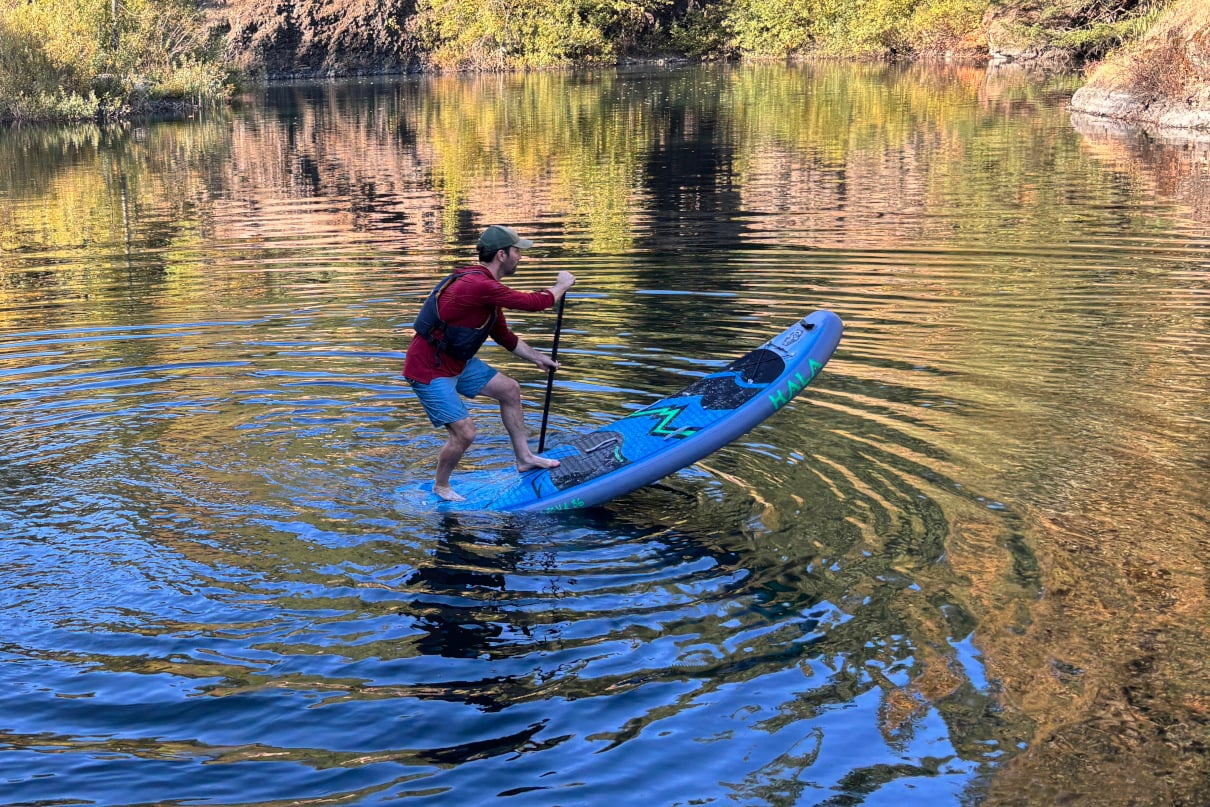
Riding the Hala Atcha 86 is like dropping into the river on a skateboard. The short 8’6” length, continuous rocker, peaked bow and swallow tail, wants to jump over features and shred across the face of a wave. And the thing is a blast to stand on end. Practicing pivots on the pond, I felt like a duck bobbing vertically.
There are also three more subtle features of the Atcha 86 I found well thought out for whitewater. The first is the indexed stomp pad in the center near tail, letting you know about how far back you are stepping to lift the nose. Next are the grab handles on the deck across from one another, which provide a good way to regain yourself when the sport turns into fall-down paddleboarding. And the third is the three-fin setup with the longer, spring-loaded, retractable center fin Hala calls their Stompbox. File retractable fin under necessity for rocky rivers.
Reasons to buy
Playful rocker blasts over features and keeps the nose up when surfing
Easy to standup for pivot turns
Multiple handles to regain composure post-wipeout
Three-fin setup with center, spring-loaded Stompbox
Consider another if
You want a board that is less party and more business on whitewater
You seek initial stability and glide
You plan to mostly paddle flatwater and dabble in class I and II rapids
Bottom line
The Hala Atcha 86 brings street-style skateboarding to the whitewater SUP scene.
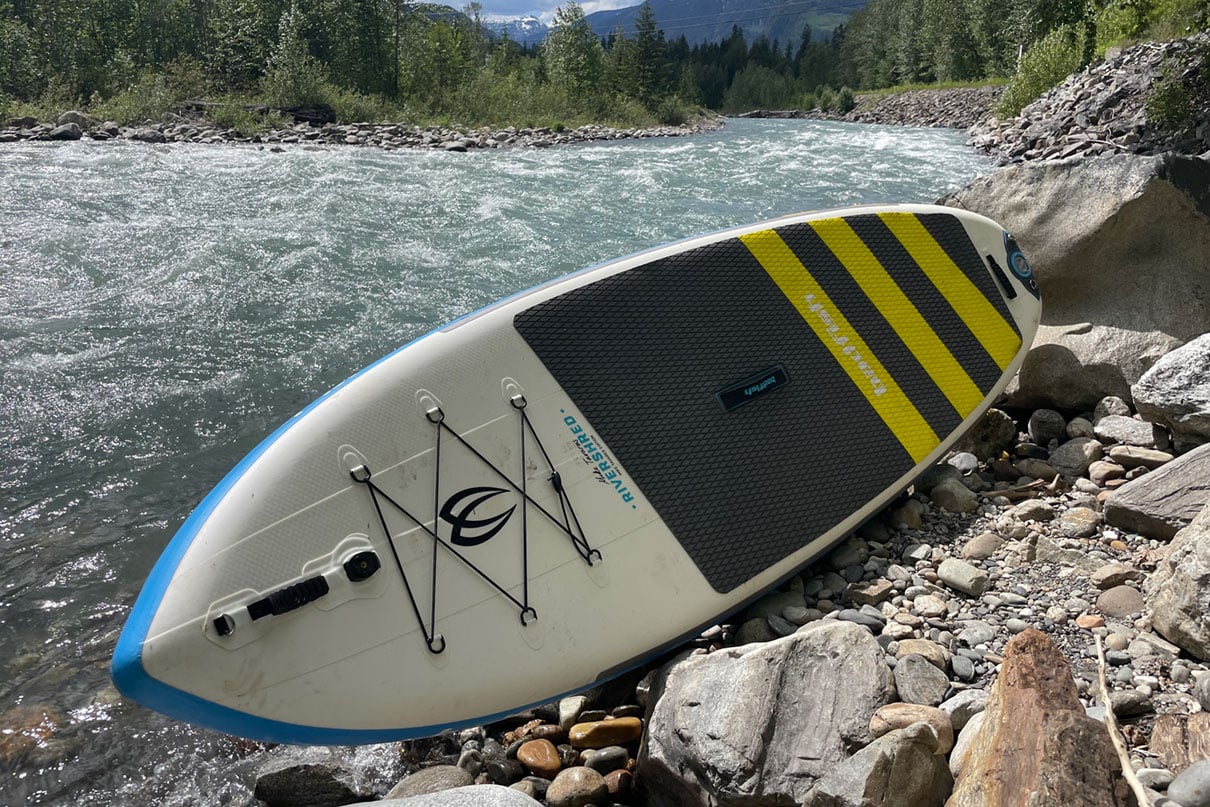
About the length of many popular river running kayak designs, the Rivershred is the inflatable paddleboard counterpart and rips its way along stretches of whitewater. Along with Hala, Badfish is one of few brands utilizing full rocker boards, which is a game changer on whitewater.
Paddling Mag media strategist and in-house whitewater SUPer Brenna Kelly had high praise for the Rivershred’s design. “The rocker makes gliding over waves and foam piles smoother because you go over instead of plowing through,” Kelly explained. “It also allows you to be more dynamic on a river wave, gaining speed into the trough without the nose diving. And you can initiate spins and grinds easier because less of your board rail is active on the face.”
Kelly also notes the reinforced layer of PVC on the rails, and centerline of the deck and base, which Badfish calls their ExoSkeleton, to increase the stiffness of the board and provide more of a rigid board responsiveness when making moves through a rapid or cutting across a wave face.
Reasons to buy
9’6” length with full rocker carries over waves and surfs well
ExoSkeleton reinforced areas increase stiffness for rigid-like responsiveness
Included flex fins keep the board tracking without breaking upon collisions with rocks
Electric pump included with board
Consider another if
You only plan to paddle whitewater occasionally
You want a shorter, super-aggressive board for surfing
You want a larger board with less rocker for more initial stability
Bottom line
The Rivershred is a solid choice for river running and surfing, with a full-rocker design that turns whitewater into a playground.
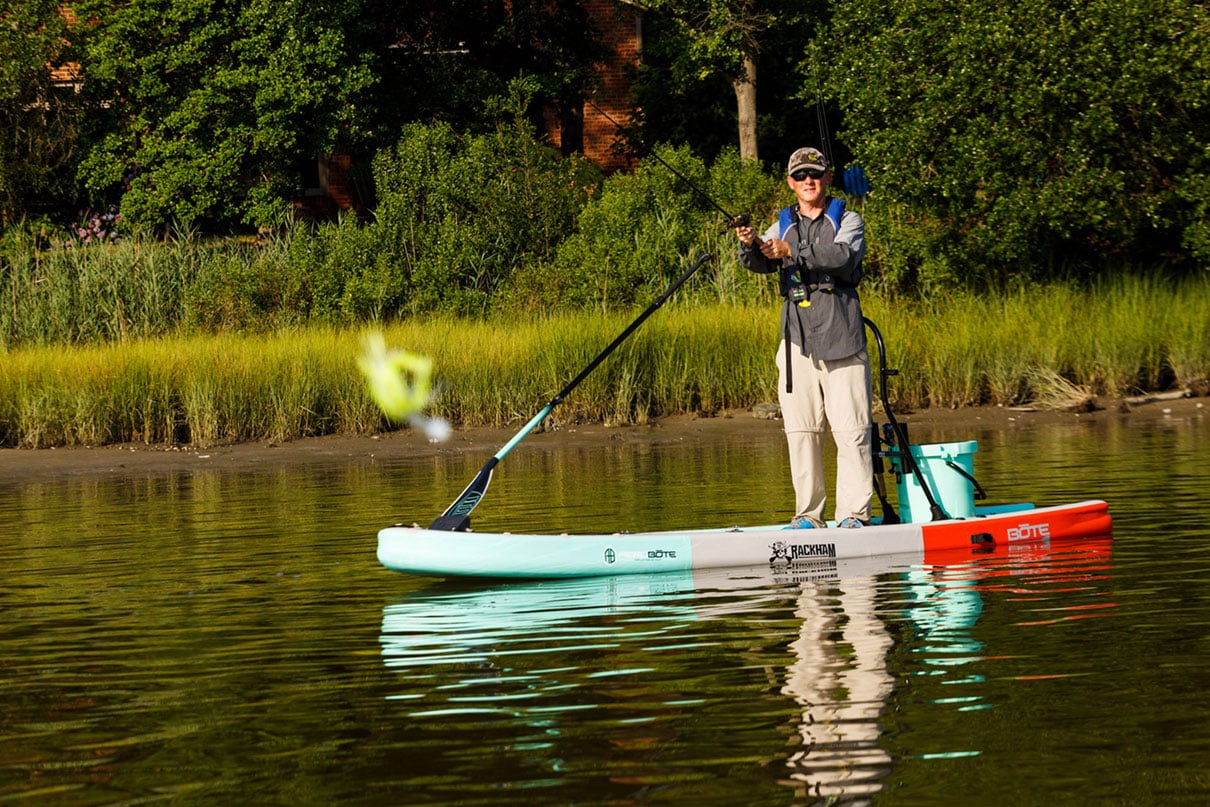
Fishing from a SUP is a sightcaster’s game—an exciting way to cruise the coastal flats in search of tails or an alpine lake with vigilance for rising trout. Not only can you spot fish, but you put yourself in a position to let fly some phenomenal casts. This is until actually hooking a fish when the excitement turns spicy trying to avoid getting pulled into the drink. By having the right board SUP fishing is like having a sporty, mini-skiff. None may be as equipped for the task at the BOTE Rackham Aero.
The Rackham is a massive, stable platform to cast and fight fish from. But it is also designed with angler-minded addons. BOTE has included outfitting components, including a slot to stand a paddle while casting, accessory tracks in front of and around the paddler, magnetic storage to hold a lure or water bottle, and, best of all, the ability to build onto the board with their accessories including rod holders and board specific coolers—which can also serve as a seat just behind the paddler.
The Rackham Aero would be a fun setup if we stopped there, but it also has the ability to install their inflatable seats and pedal-drive system, giving it the ability to go from SUP-fishing rig to pedal fishing kayak.
Reasons to buy
Built with SUP fishing in mind
Stable platform to sight cast and fight
Many add-on accessory options made specific for BOTE boards
Can be set up as either a paddleboard or kayak
Consider another if
You want a paddleboard with a smaller footprint
Fishing from your SUP is a far second from the paddleboarding itself
Bottom line
The BOTE Rackham Aero inflatable board is a SUP-fishing machine.
There is a never-ending list of paddleboards available, and they range in price drastically. Do you have to spend a fortune on a paddleboard in order to have one you’ll enjoy? For most who just want to float on the lake or drift down your local river not at all. But like any other sport, as similar as one inflatable board looks from the next, you do get what you pay for. So what should you consider when choosing an inflatable board?
The easiest place to start is with the shape. If you aren’t sure what you are searching for, an all-around shape resembling the classic surfboard look works well in a variety of general uses. They tend to have a wide, rounded nose, are around 32 inches at their widest point, and are between five to six inches thick—attributes that when combined with their flat bottom makes them relatively stable platforms. You could paddle miles on a lake or bay, cruise down the river, and even catch some small waves with one of these all-around recreational shapes.
Touring boards tend to have a pointed nose and a narrower shape. This makes them faster, but because they are narrower they feel less stable. They are great for covering miles on open water or where paddlers need to battle wind and tides.
Whitewater boards can look similar to an all-around board, but often have more aggressive rocker where the nose and tail are uplifted drastically. This helps with performance by letting paddlers lift the board over features or when surfing waves. On flat water though, this again makes the board feel less stable, and also does not glide in straight lines as well—this is by design to maneuver in rapids.
The dimensions of any board shape play a role as well. Length, width, and thickness throughout add up to the board’s volume. Higher volume provides more buoyancy. This doesn’t always equate to more stable. A touring board may have a higher volume than an all-around board, however if much of this volume occurs in its length, not width, it could be more stable compared to other touring boards, but not compared to an all-around board with a wider belly where the paddler stands. The length-to-width tradeoff provides a sense of the board’s priorities of speed and glide or stability. Without taking other details such as rocker into account, a wider board will be more stable, and a narrower board has more potential speed.
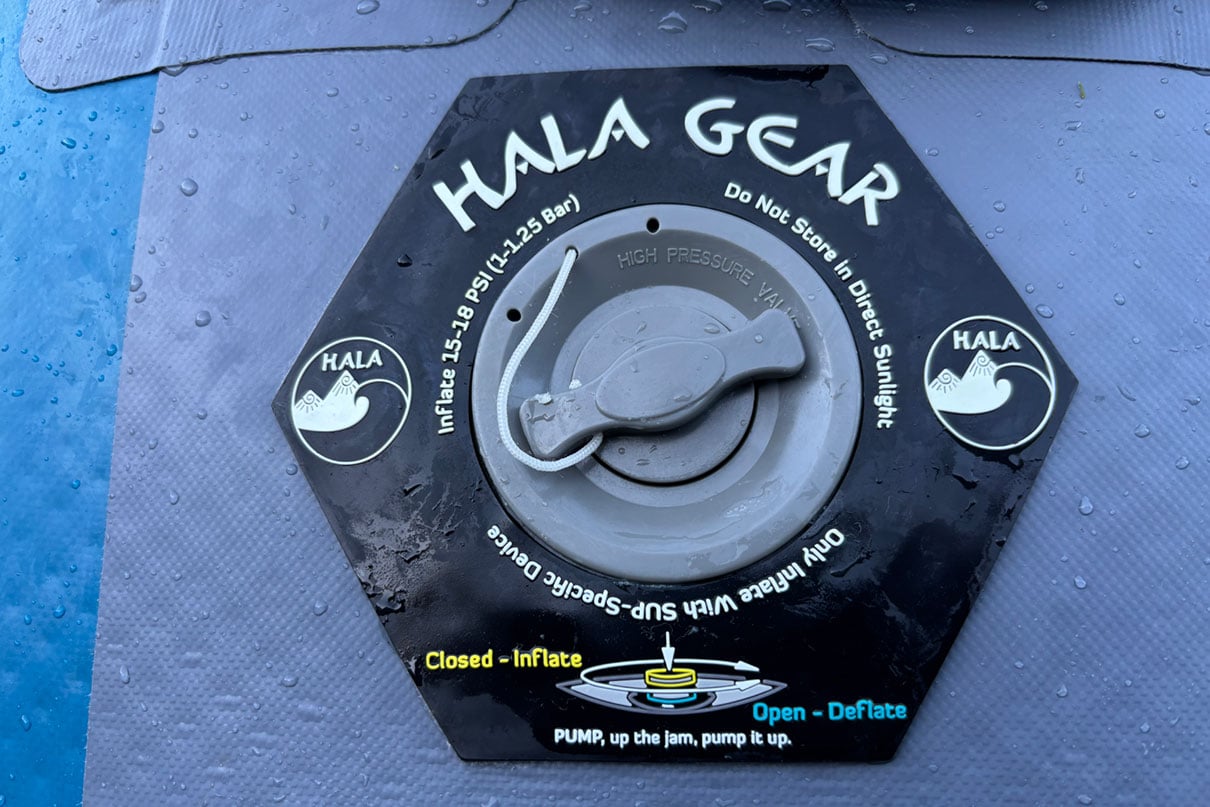
Recommended psi is often marked on the board’s valve. Photo: Joe Potoczak
Considering terms like drop stitch and psi
Drop stitching and psi are terms thrown around in every conversation surrounding inflatable SUPs as well.
Drop stitching refers to the internal threads of the board, which allows its board-shape by not letting it balloon when inflated with air. This drop stitching is integral to these types of boards being able to exist.
Maximum psi, or pounds per square inch, as we are familiar with from other aspects of life whether it be a raft, bike or car tire, is how much air pressure a board can be inflated to. As an oversimplified rule, the higher the maximum psi a board can be inflated to, the more rigid it will be. The closer you can get to the feeling of standing on a board made of a solid material like fiberglass the better. A spongy paddleboard does not glide well at all, and it’s also more difficult to stand on. You want a paddleboard to be able reach 10 psi at a minimum, and some inflatables today can reach pressures beyond 20 psi. The drop stitch manufacturing process used, material layup, and bonding of materials all play a role in the psi a board can reach. As materials and design components—like embedded composites—advance, brands are also finding ways to make inflatable boards more rigid. It only takes one outing to see manually pumping to high psi is a lot of work, and today there are some fantastic electric paddleboard pumps available.
A well-built board bag should not be overlooked. Photo: Joe Potoczak
We took a collection of well known and innovative inflatable standup paddleboards available today out on coastal wetlands, down whitewater rapids and along lakes, to put them head-to-head and see which performed the best in their respective categories. This testing spanned Oregon, British Columbia, and Ontario to sample a variety of waterways from the perspective of different paddlers. We’ve expanded our paddleboard testing since we first published our best of list in the spring of 2025, yet over the course of the past year, many of our favorites for this list remain with little major change for the 2026 season. When making our decisions, we also considered the quality of outfitting and included accessories—bonus points provided for a good air pump.
Paddling Magazine digital editor Joe Potoczak.
About the author
Joe Potoczak is a digital editor at Paddling Magazine who has been canoeing and kayaking for 25 years, and paddleboarding for about a decade. He spent years avoiding SUP, then realized what a blast it is. Now he chooses a board over his kayak most summer days.
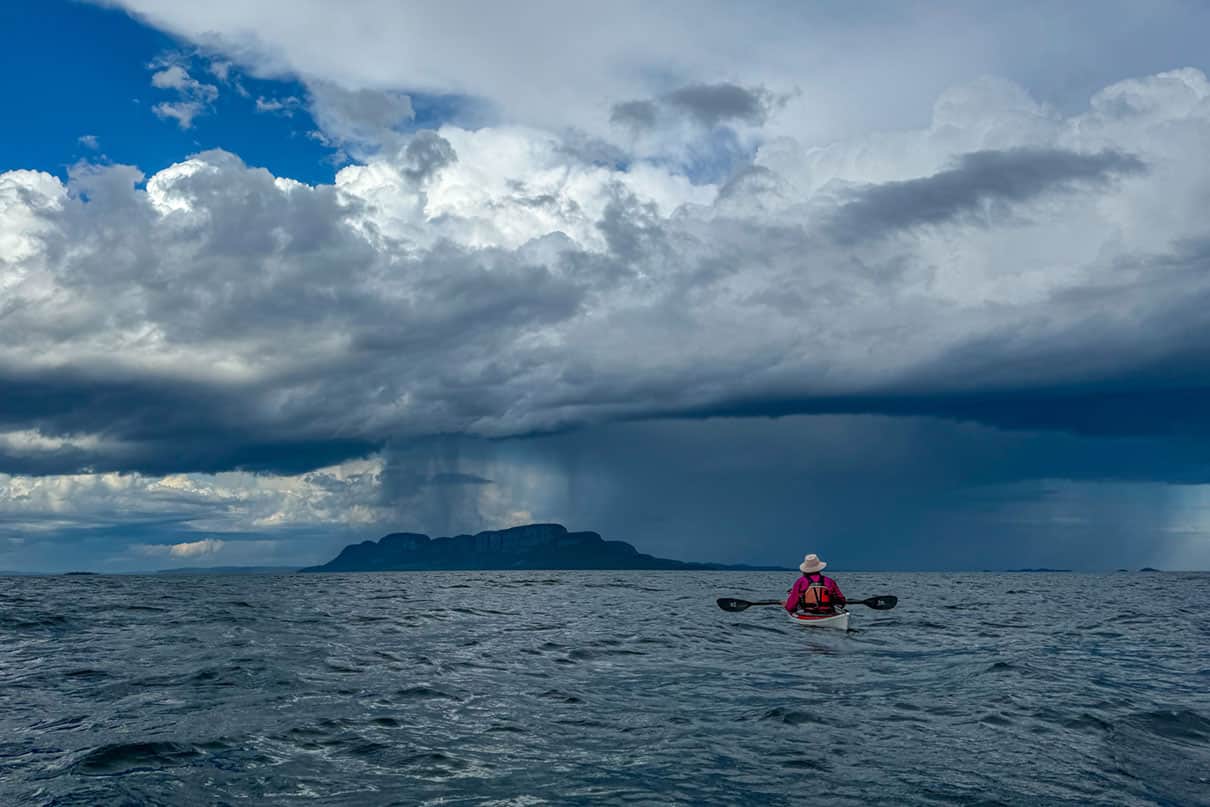
Like most old skills, there’s something deeply satisfying about getting where you want to go with the humble compass. I remember the feeling of accomplishment upon completing a 10-mile crossing in dense, pea soup fog on Lake Superior using only this deck-mounted nautical tool on my sea kayak. I second-guessed myself constantly along the way, only to fall back on the mantra, ”trust your instrument.”
Putting your confidence in analog technology delivers the type of patience-based reward that’s increasingly rare these days, when a smartphone navigation app can identify your position with the tap of a finger. I’ve taught sea kayaking to budding guides and navigation for natural resource college majors for over two decades, and my students have always been captivated by the simple magic of planning and following a route by map and compass. A magnetic compass also forces you to be more observant and cautious, which ultimately keeps you safer. And, it’s your ultimate backup for when the S.H.T.F. (i.e., your phone battery hits zero percent). All good reasons why it endures as an essential tool for navigation.
With any physical tool, be it a mechanical watch, carpenter’s level, or, in our case, the compass, the best are built with quality, deliver accuracy, and are either intuitive to use or capable of our most elaborate needs.
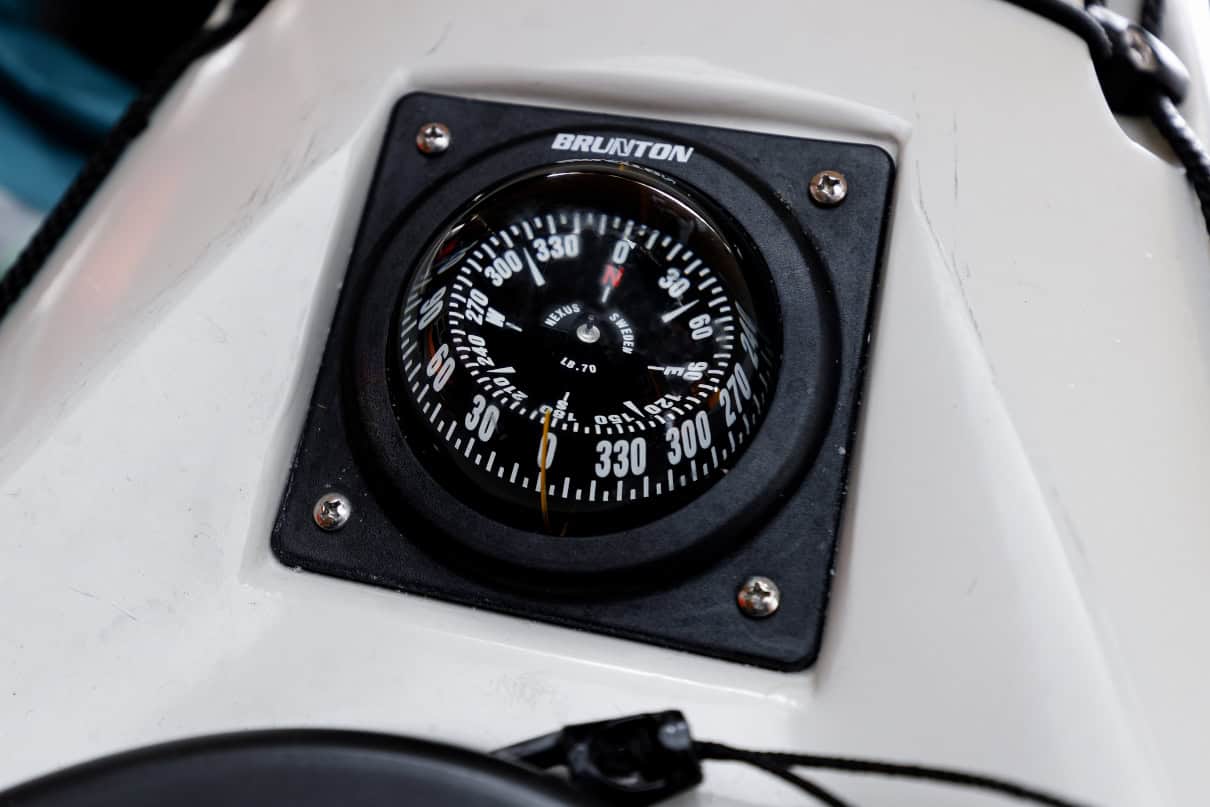
The author has seen the 70P fly under many brands, including his affixed Brunton, and yet it remains the best option for adventurous touring paddlers. | Image: Sheri Minardi
A deck-mounted 70P compass is a popular accessory on most British-built and Danish-style sea kayaks meant for expedition use. The style is designed to be installed with four screws into a recess moulded into the kayak deck, just ahead of the bow hatch, has had a variety of labels over the years, including Nexus, Comnav and Brunton. The reliable, time-tested 70P is currently produced by Silva and for sale in Canada and the United States.
A built-in marine compass like the 70P has a couple of distinct advantages over handheld orienteering compasses. It operates hands-free, so you don’t need to make any adjustments by hand. Instead, the dial reveals the direction (in degrees) that your bow is pointing. The forward placement of the compass recess mount may test your eyesight, but it also calms your stomach, allowing you to sight both the heading and the horizon to avoid seasickness.
Retrofitting your sea kayak with one of the 70P is easy once you get over the fear of drilling holes into the deck and installing the fasteners—each with a dab of marine silicone.
Reasons to buy
Permanently fixes to your kayak
Designed for marine use, meaning it’s accurate even when the boat is rocking
Consider another if
Cannot be transferred from one kayak to another
Placement toward the bow may make it difficult to see for the nearsighted
Bottom Line
A classic marine compass for serious expedition kayaking.
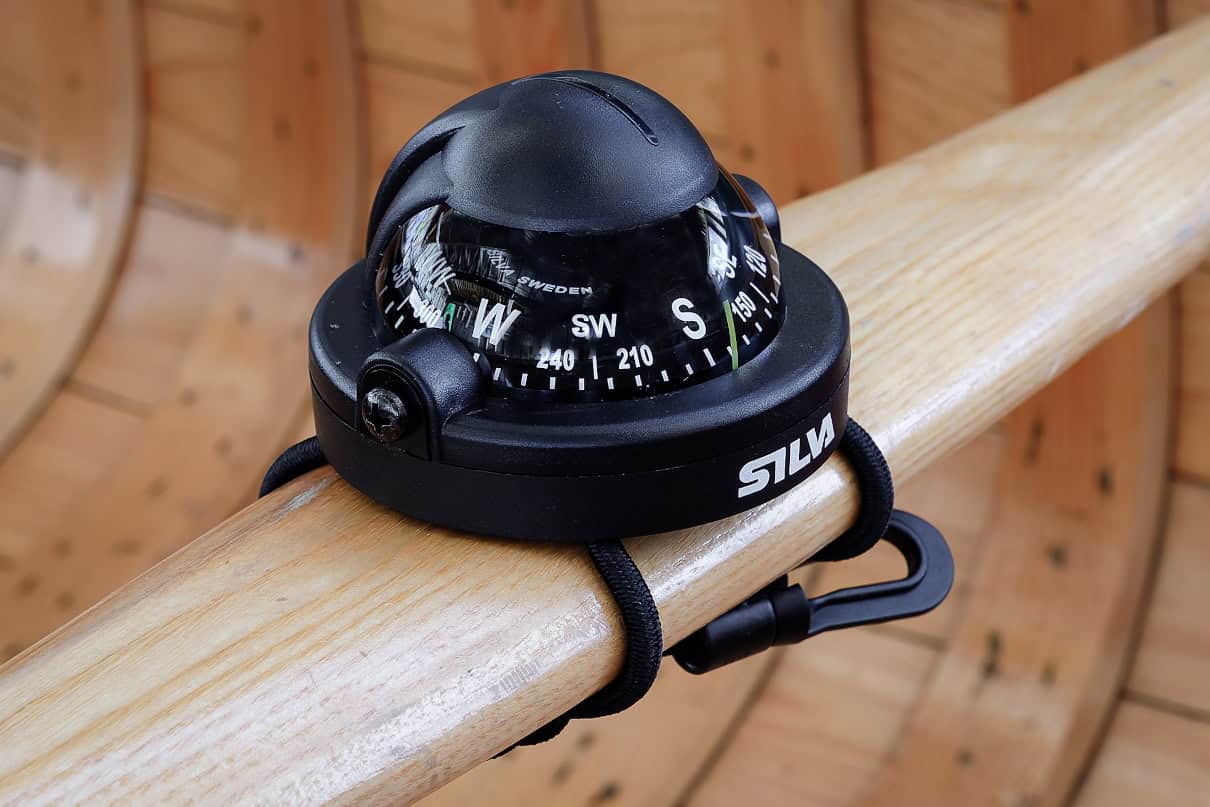
The Silva 58 is a marine compass that attaches to a kayak deck or canoe thwart with bungees, so it can be transferred from one boat to another and positioned where you like. The scratch-resistant dial has large, easy-to-read numbers, and the compass still works when it is tilted up to 30 degrees.
As someone who loves canoe expeditions as much as sea kayaking, the Silva 58 allows me to use the same navigational tool across different boats. For canoeing, I simply strap the compass to the stern thwart and instantly have a sense of which way the canoe is heading, which is helpful when navigating through island mazes on large lakes.
Reasons to buy
Ideal if you own multiple boats
A solid choice if your kayak lacks a recess for a 70P-style marine compass
Still reads accurately when boat is tilted
Consider another if
A removable compass is harder to line up on the kayak deck for accuracy
Bottom Line
A versatile marine compass that works on the entire fleet.
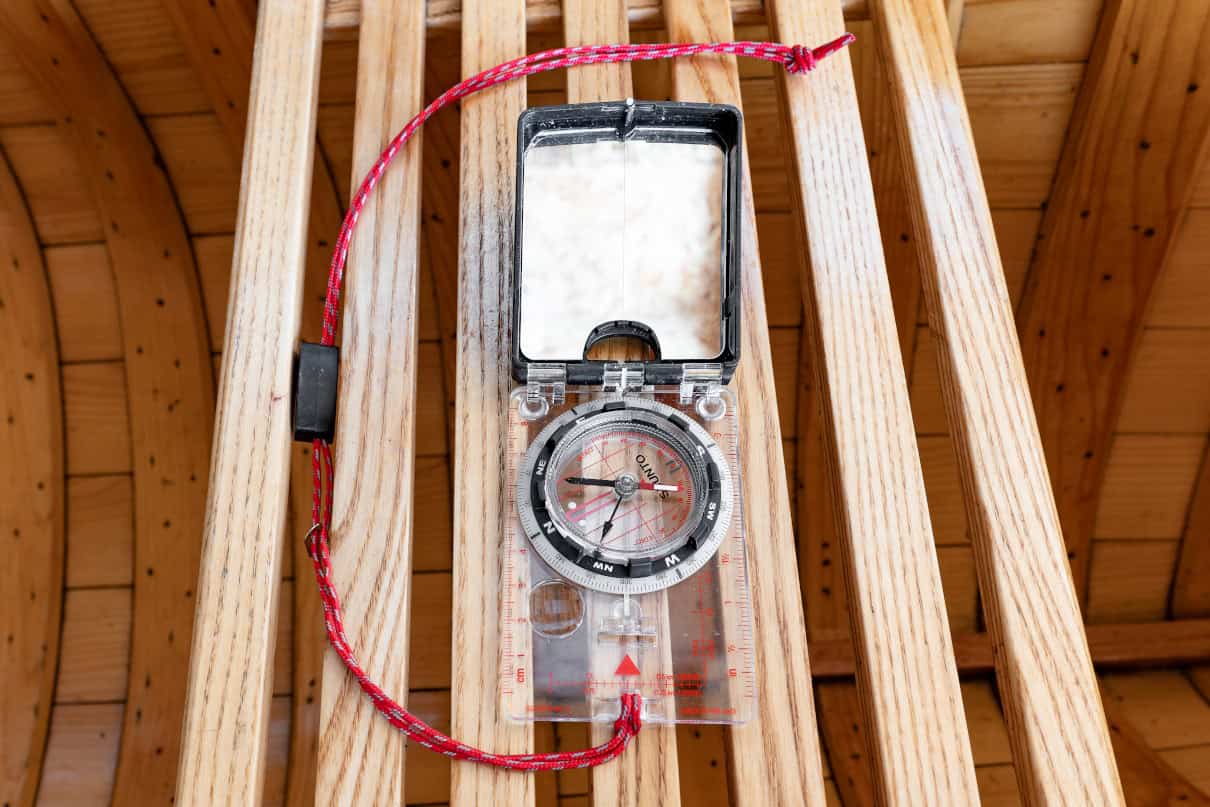
As much as I cherish my old and trusty Suunto MC-2 mirror compass for planning a route on a map and navigating through the bush, simple orienteering compasses such as the Brunton Scout ECOmpass have done the lion’s share of getting me from point A to B. For years, I’ve kept a barebones predecessor to the Scout in my PFD pocket. The updated model packs a key advanced feature: the dial can be offset to compensate for magnetic declination. This declination is the difference between true north and magnetic north, which varies from place to place on the globe and is often noted on maps. Unlike the larger Suunto MC-2, no tools are required to adjust the declination on the Scout. This allows for easy conversions between map readings and compass bearings.
What’s more, the Scout ECOmpass has a global needle that’s calibrated to work anywhere in the world. And a magnifying glass is handy for teasing out details on a map.
The Suunto MC-2 is a professional orienteering compass long trusted by outdoor enthusiasts and natural resource technicians.
The sighting mirror on the MC-2 increases your accuracy considerably in following a straight-line course through the forest or in identifying landmarks across open water. The dial can be adjusted to compensate for magnetic declination, and the needle is calibrated to work anywhere in the world. Most importantly, the made-in-Finland MC-2 is built to last with a lifetime warranty. I’ve had mine for nearly 25 years.
Teaching a college-level navigation course for natural resource students for over a decade means I’ve seen the good, the bad and the ugly when it comes to compasses. The Suunto MC-2 is the best of the best. It’s essential for anyone serious about working and playing in the outdoors. It’s an investment in a quality instrument that you won’t regret.
Reasons to buy
Durable and precise, ideal for wilderness canoe tripping
Includes an inclinometer for measuring slope, handy if your non-paddling hobbies include backcountry skiing in avalanche terrain
Consider another if
A marine compass is more practical, such as for sea kayaking
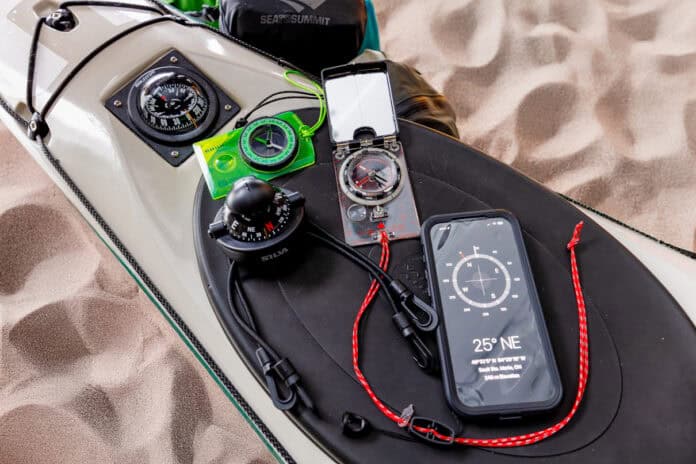
All modern iPhones come equipped with a convenient and effective compass app that’s generally more reliable and user-friendly than comparable Android apps. The free app means that if you already have an iPhone in your pocket, it is the most budget-friendly tool you’re going to find. The iPhone app is reliable and practical: it allows you to set and follow a bearing from point A to B, as well as measure the bearing to visible landmarks to compare with a map. Once you know a few tricks, you can also use it to take a bearing from a map.
The iPhone compass also differentiates between true and magnetic bearings and uses the phone’s onboard GPS to provide the latitude and longitude coordinates of your location. The only catch? It won’t work when your phone battery is drained.
Reasons to buy
A practical, free compass built into your phone
Consider another if
You want an all-around navigational tool that works with a map and without a charge
Bottom Line
If you’ve got an iPhone, you already have a reliable tool in your pocket.
Compass Buying Advice
As with any piece of outdoor gear, your aspirations and applications ultimately determine which compass is best for you. There are two main types relevant for paddlers: Orienteering compasses and marine/direct-read compasses.
Orienteering compasses
Orienteering compasses, such as the Suunto MC-2 and Brunton ECOmpass reviewed here, feature a rotating dial that allows you to measure a direction (bearing) from a map. To follow this bearing from point A to B in the real world requires you put “Red Fred in the Shed,” which means pivoting your body (or boat) so that the magnetic needle is aligned with the orienting arrow in the compass dial. This is easy when navigating on foot over land, but can be more complicated when paddling. However, if you can only afford one compass, an orienteering model will be the most versatile.
Marine/Direct-read compasses
In contrast, marine or direct-read compasses operate hands-free, showing the bearing of the direction you are facing (just like the compass in a car). This is especially convenient for paddling, but you’ll need an orienteering compass (or a navigational protractor or parallel rules) to measure a bearing from a map or chart. Marine compasses are designed to function when the dial is tilted, unlike an orienteering compass, which must remain flat. The compass app built into most smartphones operates like a marine compass.
With so many terms and numbers, navigation by compass seems complicated. But the skills are easy to develop with practice—and they will become solid and ritual with repetition, as your confidence grows. Most intermediate- to advanced-level sea kayak or canoe tripping courses include relevant navigation training. There are also many excellent books on the subject, including the classic Be Expert With Map and Compass, by Carina Kjellstrom Elgin and Bjorn Kjellstrom, which has been in print for decades.
Compared to other types of gear that see new releases annually, the compasses that are available today have been around for years with few changes. In developing my navigation skills as an expedition canoeist, sea kayak guide and instructor, I’ve had the chance to use many different products, which has allowed me to discover in the field what works best for myself and others. Over the past decade, teaching a course in outdoor navigation at a local college has further reinforced my opinions on the best compasses.
Using a compass is part of my day-to-day experience as a professional in paddlesports and the outdoors for 25 years. I prefer the challenge of using analog instruments instead of GPS units and smartphone-based navigation apps, so I usually keep my technology turned off and packed away on wilderness canoe trips and sea kayak tours.
My longest expedition was a self-supported, 55-day canoe journey across the Ungava Peninsula in Nunavik (northern Quebec), navigating a poorly documented route that included Hudson Bay, numerous rivers and hundreds of lakes—along with over 125 portages. I relied nearly exclusively on several of the compasses described in this article for planning and executing the trip.
This article was published in Issue 75 of Paddling Magazine. Subscribe to Paddling Magazine’s print and digital editions, or browse the archives.
Navigation you can count on. | Feature photo: Sheri Minardi



 This article was published in Issue 74 of Paddling Magazine.








 This article was published in Issue 75 of Paddling Magazine.



