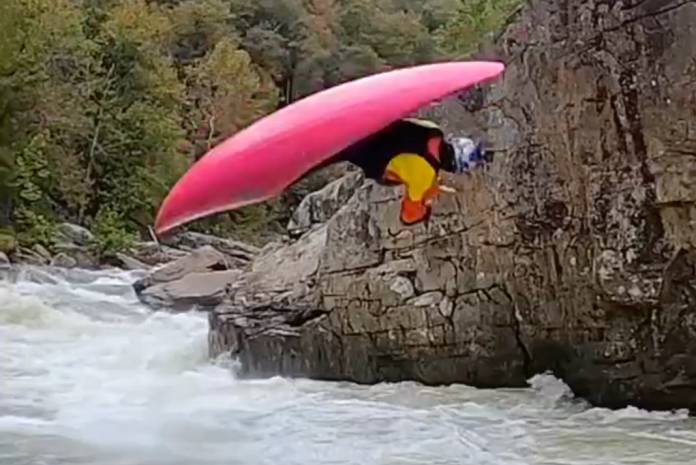
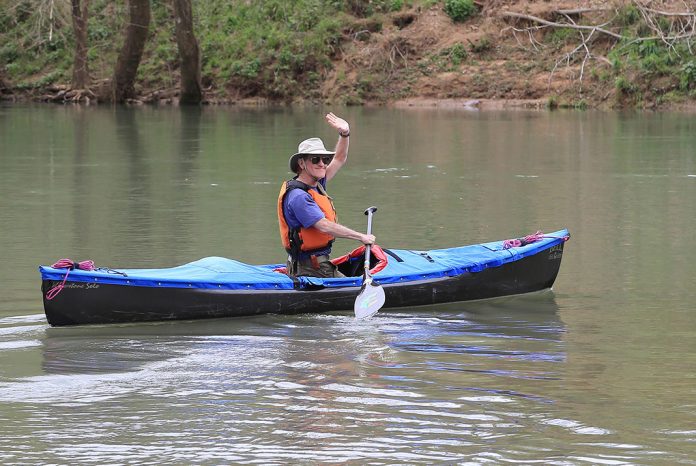
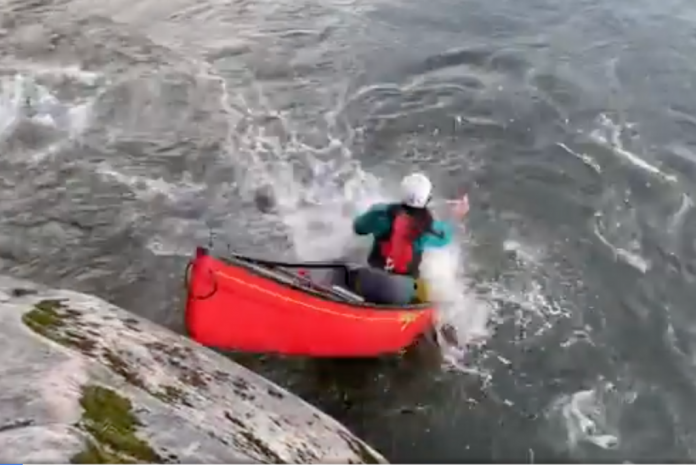
After refusing to heed the warnings of locals, two ambitious sea kayakers set out to paddle to “Monkey Island” on Lake Catemaco in Veracruz, Mexico.
Despite the clue being in the name, the kayakers were taken by surprise when an aggressive monkey swung at them from a low-hanging set of trees skirting the shoreline.
The kayakers had edged a little too close for comfort when the monkey began to lash out. One of the paddlers, Daniel Mendoza, commented that they had been warned not to get too close to the animals. ”They are wild and curious animals,” he said.
Mendoza commented that one monkey even bit his PFD and his hair, though neither the monkey nor paddlers were harmed as a result of the incident. “I didn’t see it coming, but it was very funny,” he said.
[ View all Sea Kayaks in the Paddling Buyer’s Guide ]
“This is why the habitants recommend that we shouldn’t approach the monkeys,” he concluded in his video recap of events. A good reminder, we hope, that monkeys are unpredictable and wild animals and when wildlife watching, one should remain at a safe distance and paddle with extreme caution.
Miner’s Castle Point in fine weather. When the squall hit, the kayakers were unable to round it and reach the beach beyond. | Photo: Allie Fox/Creative Commons
It was meant to be another boy’s trip, the latest in a tradition that stretched back more than two decades for old friends Jim Farrington, Sean Royston and Tolan Annis. It turned into a life-and-death struggle in the chill waters of Lake Superior.
Jim, 49, was an electrical lineman out of Alden, Michigan. Sean, 48, had worked with Jim early in their careers, later becoming and electrical grid systems manager in Cottage Grove, Wisconsin. He met Tolan, 53, through their local homebrew club, and became a silent partner in Sanctuary Spirits, the craft distillery Tolan opened in 2014 and poured his heart into. All three were married, Tolan and Sean with grown kids.
Every other year for more than two decades, the friends had done a big outdoor trip together. Early on they specialized in backpacking, but shifted to kayaking as they got older. “At the end of our last end-to-end Isle Royale hiking trip, we all looked at each other and said ‘We gotta find a better way to do this,’” Tolan explained.
Miner’s Castle Point in fine weather. When the squall hit, the kayakers were unable to round it and reach the beach beyond. | Photo: Allie Fox/Creative Commons
The trio bought sea kayaks and began exploring Lake Superior’s classic paddling destinations, including Isle Royale, Grand Island and the Apostle Islands. By 2016, the only bucket-list kayaking trip on Superior’s south shore they hadn’t done was the challenging out-and-back route at Pictured Rocks National Lakeshore. They planned a weeklong trip, starting on Sept. 13.
A front moved through that morning, bringing clouds and drizzle. The men waited for the weather to clear and launched from the beach at Sand Point, less than 100 yards from the park headquarters. They shoved off between 10:30 and 10:45 a.m.
The forecast called for winds building to 10 knots and seas rising to 1–3 feet by early afternoon, and then stronger winds overnight. The trio punched out through small waves and headed northeast. Soon the national lakeshore’s trademark cliffs began to rise on their right. Their next chance to get out of their kayaks would be some five miles ahead, beyond a tourist overlook called Miner’s Castle Point. That was their first escape option and they’d discussed it that morning during what Jim calls their “tailboard”—linemen’s jargon for a safety and planning briefing.
“It’s literally just ingrained in us through our work that you always have a tailboard whenever you’re doing something different to make sure everybody’s on the same page,” Jim said. “So we kind of bring that back into our adventures.”
On the water, the headwind grew to the forecasted 10 knots, and kept rising. The waves built from 1–2 feet to 3–4 feet. Still, none of them considered turning around. They were making good time—Jim’s GPS showed them averaging 3.6 mph despite the rising headwind—and all of them had paddled in more challenging conditions. Then, quite suddenly, the waves grew to 6 feet and steepened. The wind rose to 20 knots.
“When it went bad, it went bad fast,” said Tolan, who was in the lead about 60 feet ahead of Jim. Sean trailed another 40 or 50 feet behind Jim. He was the first to go over.
The Rocks
Sean grabbed for the release strap on his sprayskirt and kicked free of his boat. It was a bad place to swim. The water temperature was 62 degrees, a steep 6-foot swell was running and the wind was pushing him toward the sheer cliffs about 100 yards away. Miner’s Point was a quarter-mile or more dead upwind, and the closest safe landing beach was another quarter-mile beyond that.
Sean had only one good option: Get back into his boat and paddle around the point to safety. Fortunately, he was relatively well equipped to do that. Like Jim and Tolan, he carried a paddle float and pump in the deck rigging of his 16-foot Current Designs sea kayak. He was dressed in waterproof paddling pants and a dry top, and he was wearing a Type III life jacket designed for kayaking.
The colorful sandstone cliffs of Pictured Rocks National Lakeshore rise as high as 200 feet from Lake Superior and offer no place for a kayaker to land. | Photo: Allie Fox/Creative Commons
He also had help. When Jim heard Sean go over he quickly came to assist, while Tolan held station about 150 feet ahead, keeping his bow pointed into the waves. Though none of the three had taken any formal kayaking courses, they’d all practiced self-rescue and assisted rescue techniques. The drills had become a regular feature of their trips—flipping over into the chill waters of Lake Superior and then clambering back in as the others offered help, advice and plenty of mocking banter. But this was no laughing matter. This was life and death.
Jim brought his boat parallel to Sean’s and steadied it as Sean inflated his paddle float—an inflatable bladder that fits over one blade of the paddle to provide added stability—and scrambled into his cockpit, which was now full of water. He began working the small plastic hand pump, but couldn’t stay ahead of the waves. “The pumping was just no use,” he said. “I’d get close and another wave would come over and just gully-wash us.” As Sean pumped, the paddle float slipped off his paddle. He’d forgotten to clip it on.
Jim’s grip held, but the handle didn’t. The T-grip tore clean out of the kayak, and Sean slid back into the crashing surf.
Most paddling fatalities result from a combination of small mistakes and unlucky turns of fate, each building on the next. The men were already four mistakes in. They’d launched into bad weather. They hadn’t turned around when they still could. Sean had capsized. Now they’d lost a useful safety item. In the next 20 minutes, the mistakes would come faster, compounded by rotten luck.
As Sean and Jim tried to pump out Sean’s boat, the wind pushed them closer to the cliffs, into shallower water where the waves became even steeper. A wave landed in Jim’s lap and blew out the cheap nylon sprayskirt he purchased with his Old Town Adventure 16 kayak years before.
Soon after that, another big wave rolled both Sean and Jim into the water.
At that moment, Jim says, his first concern was saving himself. “It may sound cold, but it’s kind of like they tell you on an airplane when somebody needs assistance putting on a mask, you put yours on first. You can’t help if you are in the same position they are,” he said. Jim was able to self-rescue without his paddle float, which he’d given to Sean to replace the one that had drifted away. Sean managed to get back into his boat as well—his second re-entry of the day.
When they looked up they saw Tolan in the water, clinging to his boat.
Miner’s Castle Point in a November storm. | Photo: Courtesy National Park Service
Jim and Sean started toward him. With their kayaks rafted together for stability they each paddled “canoe style,” using one hand to paddle and one to grasp the other’s kayak. But with the boats full of water, facing into big swell and 20 knots of wind, they could make no progress. Tolan was on his own.
“By this time my arms are just giving out,” Sean said. “I looked at Jim and said ‘I can’t do this anymore.’ We kept getting closer and closer to the cliffs and at some point I looked him and said, ‘We gotta call. We gotta call now.’”
Jim had a handheld VHF radio clipped to his life jacket. “We were trying on Channel 16 and Channel 9, calling ‘Mayday, three kayakers stranded at Miner’s Rock,’” he said. But no one heard the distress calls. The steep cliffs blocked the radio signal from reaching the Park Service headquarters or anyone else on land, and no vessels were on the lake. A small craft advisory had been issued just after the kayakers launched, so the tour boats that normally ply the lakeshore were tied to their piers. Jim and Sean were on their own too.
A few minutes after the Mayday call, Jim capsized a second time. When he got back in his boat the radio was gone, stripped from his life jacket when he self-rescued, together with his cell phone and GPS unit, which had also been attached to his life jacket.
Throughout the ordeal, Sean and Jim had been trying to make it around Miner’s Castle Point, about a quarter-mile upwind. Now they realized that even that short upwind distance was impossible in their waterlogged kayaks, and they began looking for an alternative.
From the water, there looked to be a narrow rocky shelf at the base of the cliffs that rise about 90 feet out of the water. Jim and Sean decided to take their chances on the ledge, where they hoped they could get enough purchase to drain their kayaks before continuing around the point. Getting there was no problem—the wind and waves were pushing them in that direction. But when they arrived, they realized the ledge was an illusion. It was actually a partially submerged strip of sandstone, and it was being pummeled by head-high waves.
Jim was first to arrive, and somehow managed to get to his feet and reached for the plastic T-handle in the bow of his kayak. Jim was 6’3” and 230 pounds, a big man used to working with his hands. He closed his grip around the handle and braced himself to hold his kayak, which was lashed to Sean’s boat with Sean holding on to it. Jim’s grip held, but the handle didn’t. All that weight tore the T-grip clean out of Jim’s kayak. The two boats and Sean slid back into the crashing surf.
“This was the tough part,” Sean said, his voice strained. “I just kept getting rolled. My knees were all scraped up, my elbows all scraped up. I just kept getting knocked down.”
The overlook was close enough that he could hear the thump of car doors as families visited the scenic attraction. He hollered until he was hoarse, but no one heard him.
Jim reached out a hand, but could do nothing to help as the waves thrashed Sean, pushing him along the shoreline. The cliff was too steep for Jim to follow, and within minutes Sean was 150 feet away. Sean had lost contact with the boats, which disappeared around a small outcropping. Soon Sean, too, was out of sight.
“The last time I saw him he was separated from his boat, rolling through the waves toward the rock formation,” Jim said. “And in my mind I swore his life jacket was unzipped.”
Jim had been so focused on Sean’s ordeal that he hadn’t even looked for Tolan. Now, from his vantage point close to the water, he could see nothing but waves. Less than half an hour after Sean’s initial capsize, all three men were separated. Sean was in the water without his boat, possibly—in Jim’s estimation probably—already dead. Tolan was nowhere to be seen. No one had answered Jim’s Mayday. Now he was stranded on the rocks, his radio and cell phone somewhere on the bottom of Lake Superior.
Jim tried to follow Sean along the shoreline, walking the narrow strip of shoreline like a tightrope artist. He eventually made it around the small outcropping Sean had been pushed around, but not before the waves knocked him off the rocks three more times.
As Jim clawed his way out of the water the third time, Tolan came floating by. He was holding his waterlogged boat, with one hand on the cockpit rim and his paddle wedged under the other arm. He’d been kicking toward Miner’s Castle Point for the better part of an hour, trying to get around the point to land at Miner’s Beach, but despite that effort had lost ground in the powerful wind.
The men yelled to each other at the top of their lungs, but communication was hopeless.
“I thought he asked where’s Sean,” Jim recalled. “So I yelled back, ‘Last time I saw him, that way!’ and I pointed to the west,” away from Miner’s Castle. Tolan started moving in that direction and soon disappeared from Jim’s sight around another small outcropping.
Jim later found a broken tree trunk and used it to scramble higher, eventually climbing about halfway up the 90-foot face. The Miner’s Point overlook was just above him, close enough that he could hear the thump of car doors closing as families visited the scenic attraction. He hollered until he was hoarse, but no one heard him. Jim knew he needed to make himself seen. He found a spot on a 35-degree slope and hunkered there on his haunches, pulling his sprayskirt over his knees against the blustery wind. It was time to wait.
Sean struggled in the surf zone until the waves finally spat him back into the lake, where he lay exhausted on his back, staring at the clear blue sky. He fastened his life jacket—it had indeed come unzipped in the fray, but stayed on—and considered his options.
Miner’s Point was barely a quarter mile to the northeast, but with the wind and swell coming from that direction it may as well have been on the moon. Sean decided to turn downwind, toward Sand Point where they had launched that morning. It was three and a half miles away, along a shoreline girded with steep cliffs.
A U.S. Coast Guard patrol boat pounded through 40 miles of heavy seas to join the search for the kayakers. | Photo: Courtesy National Park Service
“I’m a swimmer and I just said, ‘Well, let’s just start kicking,’” Sean said. “And basically I kicked. I kicked for hours. I kept looking up over my right shoulder and finding a point on that cliff—like there’s a downed birch tree, or there’s a little waterfall—and then I would keep going until it was perpendicular to me and then it was ‘Okay, just pick another spot.’ Keep kicking.”
The water was unseasonably warm for Superior at that time of year, about 62 degrees Fahrenheit. Sean was dressed in waterproof paddling pants and a dry top over shorts and a quick dry T-shirt. The combination wasn’t completely waterproof, but it did slow the ingress of water. Sean didn’t feel particularly cold, but he knew it was only a matter of time until hypothermia began to set in. He needed to get out of the water, and the only way out was to keep kicking.
After about three hours of sustained kicking, Sean had made it most of the way back to Sand Point. The steep cliffs finally gave way to a thick cedar swamp.
“I got to a point where the shelf was probably four feet deep and I could actually walk up and grab some of the branches. But the underbrush was so thick, you would have to be a squirrel to get inside there,” Sean said. He kept going, now wading in chest-deep water, pulling himself from branch to branch. After about half an hour of this, he came to the mouth of a tiny creek, sheltered from the waves by a fallen tree. It gave him just enough of an opening to drag himself out of the water.
He followed the creek bed into the cedar thicket and almost immediately spotted a decked walkway. He started down the trail as fast as he could walk, blowing right by an older couple taking pictures.
“I didn’t say anything to them, I just kept on going. I pop out in this parking lot, and this is no joke—the National Park Service guy is driving by right as I pop out of there, and I wave him down,” Sean said.
“He slowed down and passed me about five yards, and I just sat my ass down in the sand. He got out and says, ‘Are you okay’ and I say ‘No.’”
It was just before 5 p.m. Sean, Jim and Tolan had gone into the water at least four and a half hours earlier. Authorities were only now learning of the accident.
The ranger, Bill Jones, immediately initiated a search and rescue operation. Within minutes, the National Park Service launched its lake patrol boat Arrowhead and began searching the shoreline between Sand Point and Miner’s Castle. The U.S. Coast Guard dispatched a 45-foot patrol boat from its Marquette station about 40 miles west of Tolan and Jim’s last known location, and scrambled an MH-65 Dolphin rescue helicopter from Air Station Traverse City, 135 air miles south.
With the cavalry on the way, Sean and the ranger went looking for Tolan at Miner’s Beach. As they drove, Jones repeatedly asked Sean where and when he’d capsized. The ranger was trying to judge Sean’s mental state and whether he’d really been in the water for more than four hours. At Miner’s Beach they found no sign of Tolan. They drove to the next campground—again, no Tolan—and then back to Miner’s, where an ambulance was waiting for Sean.
“It was tough, because I knew I was going to be pulled from the game,” he said. “That was it. I prayed. There wasn’t much else to do.”
This video was recorded by the U.S. Coast Guard air crew that hoisted Jim Farrington from the cliff near Miners Castle. Video: Courtesy USCG
Jim
Jim hadn’t moved much since becoming separated from Sean. He was wearing his bright red paddling top and life jacket, in the middle of a clear patch of sandstone about midway up the 90-foot cliff. Though he’d lost his glasses in the water, Jim spotted the Arrowhead’s flashing light bar as soon as the boat cleared Grand Island.
“The biggest relief in my life was seeing them blue flashing lights that no one ever wants to see in the rearview mirror,” Jim said. “When I saw those lights I knew one of them two guys made it to shore, and I really hoped it was Sean because I didn’t have high hopes for him.”
When the Arrowhead arrived a few minutes later, Jim started working his way toward the shoreline. Using the boat’s loudspeaker, rangers told him in no uncertain terms to stay put. A rescue was underway.
“I actually work within sight of the Coast Guard Air Station, and the first thing in my mind is, ‘Please don’t be a helicopter,’ because if it was I knew there’s going to be video of all this stuff,” Jim said, laughing. But with the wind still blowing 20 knots and 6–7 foot waves pounding the coast, there was no way for the Arrowhead to recover Jim. It was going to be the helicopter.
The chopper arrived on station at 6:29 p.m. It wasn’t going to be an easy rescue. Jim was on a steep slope backed by an almost-sheer cliff fringed with tall trees. To pluck Jim from the rocks, pilots Lt. Cmdr. Jason Blyth and Lt. John Reid would have to hover uncomfortably close to the tree-lined cliff and lower rescue swimmer Travis Nash from more than five times the preferred height, in swirling 20-knot winds.
“The helicopter crew told me they normally do a rescue with 40 feet of cable off the drum. There was 210 feet of cable off the drum out of the 260 feet they carry,” Jim said. “There were actually leaves and small twigs flying out of the trees that they were next to down to me on the rocks. So the fact they were able to do what they did amazes me.”
The aircrew hoisted Jim from an unusually high altitude in order to stay clear of the cliff and trees, and then moved over the lake to reel him to the aircraft. | Photo: Courtesy National Park Service
The aircrew reported Jim safely aboard at 7:06 p.m., and flew six miles to the Munising Memorial Hospital. The town’s streetlamps were already glowing when the chopper set down in the hospital parking lot to drop Jim. After a quick refueling stop the helicopter lifted off to join the Arrowhead and the Coast Guard patrol boat in the search for Tolan, who had gone into the water about 7 hours before.
The search centered around Miner’s Castle where Tolan had last been seen, but he was already miles to the west.
Tolan
When Tolan capsized, he was about 150 feet from the others—too far away for them to help or to communicate. Tolan tried several times to self-rescue using the paddle-float technique, without success. He tried to pump out his flooded cockpit but couldn’t keep up with the water pouring in. After a few minutes of pumping and multiple attempts to get back into his boat, he decided to get into a stable position and wait for the others to assist him. “I figured Jim would get Sean in the boat, because he’s a stud, and then he’d come to help me,” he said. But the next time he looked for Sean and Jim, they were gone.
Tolan now made a series of judgments, any one of which may have been the difference between life and death. First, he determined he couldn’t get back into his boat unaided. Second, he decided to stay with his kayak at all costs. Tolan knew Jim had a handheld VHF radio and assumed that he’d called for help. He also knew that his 14-foot orange kayak would be far easier for rescuers to spot than a lone swimmer dressed in blue and gray. The kayak offered secure flotation and was packed with the drinking water, food and dry clothes he’d need when he got to the beach. That was his plan—kick with the kayak around Miner’s Point and land at Miner’s Beach. The problem, of course, is that the 20-knot winds were whipping around the point, making progress in that direction all but impossible.
Tolan estimates he’d been kicking for about an hour when he spotted Jim on the cliff. He stopped kicking to let the wind and waves push him within shouting distance. What each of them said, and what each thought he heard, offers a lesson about the way people think in emergency situations.
Jim was fixated on what had become of Sean, whom he had just seen washed out of sight. Tolan’s primary focus was finding a safe place to get out of the water. From the edge of the breaking surf, Tolan shouted to Jim, “Hey where’s a good place to beach?”
Jim thought he was asking where Sean was. “I yelled back, ‘Last time I saw him, that way!’ and pointed to the west down the shore,” Jim recalled. With that, Tolan abandoned his plan to go around the point and began kicking west instead.
Tolan had settled into a secure position with his right hand gripping his kayak’s cockpit rim and his paddle wedged under his left arm. One end of the paddle was tucked into the boat’s deck rigging, and the paddle float clipped to the other end. It was a stable arrangement, but it also meant he had to push the kayak sideways through the water. It was slow going.
“I would kick that way, or turn the boat around and try and lay on my back and pull the boat because you just get so fatigued you’re trying to mix it up,” he says. Like the others, he was wearing a dry top and paddling pants over light synthetic pants and shirt, with neoprene paddling booties. Water had begun to seep in and collect around his ankles.
The hours flowed together. Tolan kept kicking. “Normally when you have a situation go bad on you it happens really fast, and adrenaline carries you through it. But seven hours—there is no adrenaline left,” he said. “I had no sense of time but I’d seen the sun go across the sky. I could start to feel myself becoming slightly hypothermic. I was getting real sleepy, my hands were starting to shake and I thought to myself, ‘You’ve gotta get out of this water soon or it’s not going to end well.’”
About a mile from Sand Point, he saw his chance—a low spot in the cliff with a thick tree root reaching down. Tolan thought he could use the root to pull himself out of the water.
“The boat cockpit’s full of water, the waves are still beating hard, so now all of a sudden as I’m trying to grab this root the boat is becoming a weapon against me. It’s beating me up.” After holding onto the boat for seven hours, Tolan made the difficult decision to let it go. He managed to pull himself up the root to the edge of the thicket atop the low cliff. By the time he got there the boat had drifted out of sight.
Tolan continued along the ridgeline, snapping branches with every step, hoping the boat might get caught up in the underbrush. That’s exactly what happened. When he caught up to the boat Tolan was able to climb back down the cliff and recover a few pieces of essential gear. “I needed food, I needed water and I needed to change my clothes,” he says. “And I needed a sleeping bag because I was going to be in the woods for the night.”
The colorful sandstone cliffs of Pictured Rocks National Lakeshore rise as high as 200 feet from Lake Superior and offer no place for a kayaker to land. | Photo: Allie Fox/Creative Commons
Tolan threw some dry bags up onto the cliff. He changed clothes, gulped water and shoveled handfuls of GORP into his mouth. Then he started along the cliff, knowing it eventually would lead him to the launch beach.
“Fatigue was just immense at that point. I’d take two or three steps and just collapse, then pull myself back up take two or three more,” he said. “And then all of a sudden it dawned on me that I have a dry box and a phone, and I don’t know if anybody knows about Jim and Sean.”
There’s very little cell service around Pictured Rocks, but Tolan turned on the phone and caught a little bit of signal. “The 911 operator knew who I was. She said ‘We’ve already got the other two, so you stay put because I’ve got a GPS on your location now.’”
Tolan’s 911 call came as the Coast Guard chopper was finishing its refueling stop. In the ER, Jim and Sean overheard a Park Service radio call saying they had a status on the last missing kayaker. Before they could hear it, someone turned down the volume on the scanner, perhaps to protect them from bad news. More often than not, seven hours in Lake Superior is fatal.
The helicopter flew to the position the 911 operator gave them, but even circling almost directly above Tolan they couldn’t see him in the gathering dusk. Finally they spotted a pinprick of light through the underbrush. It was Tolan signaling with his headlamp.
The helicopter held station to mark Tolan’s position as a team of NPS rangers made their way to him. “When we finally met up it was well past dark,” Tolan says. The rangers judged him well enough to hike out, and they bushwhacked back to the trail and walked about a half-mile back to Sand Point, where the three friends had launched that morning.
Reunion
When the rangers took his vitals, Tolan’s body temperature had recovered to within 2 degrees of normal. They asked if he wanted to be admitted to the hospital, and he said no way. “I said my jeep is a block away, I’d just as soon go down to the hospital and pick the other guys up.
“I went down to the emergency room and Jim and Sean are just wearing hospital scrubs—pants and tops—and socks,” Tolan said. “We get out of there, it’s pretty late at night and so we go to a grocery store and all they had were women’s flip-flops with sparkles and stuff, so they bought a couple pairs and then we asked, ‘Hey is there a restaurant open around here?’”
They wound up in nearby Christmas, Michigan, a town of 400 thoroughly committed to a year-round Santa Claus theme. As luck would have it, the town also is home to a small casino. Workers there listened to their story and re-opened the kitchen for them. “The gal comes over and says, ‘What do you want?’ and I say ‘Well, I’ll take a whiskey,” says Tolan, the distillery owner. The three friends toasted their good fortune and gorged themselves on fried-chicken strips, then retreated to a nearby hotel for hot showers and clean beds.
The next day they walked the shoreline—Jim and Sean in hospital scrubs and women’s sandals—and recovered all three boats, as well as wallets, keys and most of their gear. All three would be returning to their families.
The rescue did make the news, and Jim’s colleagues had some fun at his expense. “I came back to work and there was a life jacket, an oar and a piece of rope on my table, in case I needed to be rescued during our morning meeting,” he said.
Jim took the ribbing in stride, and later went across the street to Coast Guard Air Station Traverse City to personally thank everyone who’d helped get him off that cliff.
“The pilot met me in parking lot. He took me in into the main center, and the co-pilot, rescue swimmer and flight mechanic—who operated the winch—all came in,” Jim said. They introduced him to the commanding officer, who asked if he would thank everyone at the air station. “I’m not a guy who speaks in public, but I went in and thanked 40 or 45 people,” Jim says. To his surprise, they stood and clapped.
“They talked about the rescue—what went wrong and what went right, and what we can learn from it,” Jim said. “They told me the gear and the clothes that we had made this a rescue and not a recovery.”
Did right
Kit. The kayakers had a full complement of paddling gear and rescue equipment, including life jackets, dry tops and pants, pumps and paddle floats. Jim had a handheld marine VHF radio.
Skill. While none of the three were expert kayakers (none can perform a roll for example) they were all experienced paddlers who had practiced self-rescue techniques.
Tolan stayed with his boat. Staying with his kayak greatly improved his chance of being seen by rescuers, and gear he had aboard would have been critical if he’d had to spend the night out, as appeared likely.
Composure. None of the men lost their heads. They all kept their composure and made decisions that ultimately led to a safe outcome.
Determination. None of the three gave up. They knew their fate was in their own hands, and ultimately Sean and Tolan rescued themselves. There’s a lesson in that for all of us.
Did wrong
Not turning around when conditions first deteriorated.
Not taking into account the effect of topography on wind and wave conditions. The wind increased in intensity when it whipped around Miner’s Point, and currents and shallower water caused the waves to steepen.
Not practicing rescues in dynamic conditions. The men had practiced paddle-float and assisted rescues, but did not know two techniques that may have allowed them to get back into their kayaks and empty the water. First is a T-rescue, in which the rescuer drains the victim’s boat before he re-enters. Second is securing the sprayskirt over the flooded cockpit before attempting to pump it out, leaving just enough of an opening to use the pump. A combination of these two techniques may have allowed Sean to get into his kayak and continue around the point.
Failing to secure Sean’s paddle float. This probably wasn’t a critical factor, but illustrates how easy it is to make small mistakes in stressful situations.
Waiting to call for assistance. Jim didn’t immediately radio for assistance, even when Tolan was in the water and both he and Sean’s boats were flooded. It’s not clear whether a Mayday would have been heard if it was issued a few minutes earlier when he was farther from the cliffs, but it would have been prudent to make that call as soon as he and Sean were stable.
Miscommunication.
This article was produced under a grant from the Sport Fish Restoration and Boating Trust Fund, administered by the U.S. Coast Guard.
While most visitors to Michigan’s Upper Peninsula plan their paddling adventures during the summer months, fall is a uniquely spectacular and rewarding time to dip your paddle in the diverse waters of this beautiful region.
Enjoy picture-perfect fall colors, abundant wildlife and comfortable weather while taking advantage of fewer crowds, affordable prices, and the amazing range of canoeing and kayaking in Upper Peninsula Michigan.
When does fall start in the Upper Peninsula? The first day of fall is typically September 21, but often the weather has begun to change by the middle of the month with crisp days and cooler nights. Meanwhile, lakes Superior, Huron and Michigan retain their summer warmth well into the season, moderating temperatures across the U.P. This means you have much of September, all of October, and into November to get out and explore!
Grab a cozy sweater and a hot apple cider, and settle in to read our favorite reasons fall is the perfect time for kayaking, paddleboarding and canoeing in Upper Michigan.
[ View all paddling adventures in Michigan in the Paddling Trip Guide ]
Each September, the forests of the Upper Peninsula begin to transform from vibrant greens to a patchwork of fiery orange, crimson red and golden yellow. Kayak and canoe trips in Upper Peninsula Michigan offer an unforgettable riot of color at this special time of year.
The changing leaves are just begging you to take a scenic paddle around Mackinac Island with Great Turtle Kayak Tours, see the majestic waterfalls of Tahquamenon Falls State Park or visit iconic Lake of the Clouds in Porcupine Mountains Wilderness State Park. Because these are top fall destinations, though, they do tend to get busy. Local outfitters are also one of the best sources of information for what you can expect paddling in the region.
If you are looking for a quiet wilderness experience, explore the tranquil lakes of the Sylvania Wilderness with Sylvania Outfitters or take a journey down the Two-Hearted River with The Woods Canoe & Kayak Rental. The fall colors are just as lovely, but chances are you’ll have them all to yourself.
Tahquamenon Falls is even more beautiful when framed by fall foliage. | Photo: Jeff Wilkinson // @jeffreywilk
The fall foliage is beautiful no matter where you’re kayaking or canoeing in Michigan’s Upper Peninsula. Fall colors typically peak the last week of September and the first two weeks of October, with colors lingering later along the Great Lakes shorelines. Before you head out, check the current weather report and forecast for your paddling destination, and track leaf color change across the region using this Weekly Fall Color Report.
Choosing to paddle in the U.P. during the shoulder season puts you right in the travel sweet spot.
Prices are often lower than they are during the peak summer season and the weather is still perfect for kayaking and canoeing Upper Peninsula Michigan.
Take advantage of potential savings in your accommodations, equipment rentals, tour bookings and entrance fees.
Normally a bustling area, you’ll have the Pictured Rocks Lakeshore all to yourself in the fall. | Photo: Courtesy Upper Peninsula Travel & Recreation Association
3 Fewer crowds
After the Labor Day weekend, crowds thin and you won’t be sharing the rivers and shorelines with nearly as many other boaters.
As colder days and harsher weather start to move in, hearty, well-equipped paddlers are who you’ll find on the water. Fewer crowds mean more time and space for you to engage with your surroundings at a pace that suits you. Leave your itinerary open and embrace opportunities to explore.
When you aren’t worried about full campgrounds, sold-out experiences, or having to jockey for position when seeing the sights, you can spend more time enjoying the actual paddling experience.
Take a fall rafting trip down the Menominee River. | Photo: True North Outpost
Take advantage of the quiet by joining a guided kayak tour with Paddling Michigan, Pictured Rocks Kayaking or Northern Waters Adventures for a full or half-day of unforgettable sea cave and waterfall viewing in the incomparable Pictured Rocks National Lakeshore. Or explore fabulous sandstone cliffs, 19th-century shipwrecks and historic lighthouses with Paddling Michigan’s Grand Island Vacation Package.
For an adrenaline experience unlike anywhere else in the Midwest, descend the class III-IV rapids of the mighty Menominee River. This guided whitewater rafting trip culminates with a 10-foot waterfall in the legendary Piers Gorge. True North Outpost offers guided rafting and kayaking trips ranging from two hours to an overnight mini-expedition with island camping.
Our only advice is to call ahead to avoid disappointment. Many paddling businesses close after September.
Enjoy milder temperatures when exploring in the fall. | Photo: Courtesy Upper Peninsula Travel & Recreation Association
4 Comfortable weather
Fall weather in Michigan’s Upper Peninsula is about as close to perfect as you can get. No sweltering summer heat, but still enough warmth and sunshine to get on the water and maybe even enjoy an invigorating dip.
There’s just the right amount of crispness in the air to enjoy bundling in blankets and sweaters around your post-paddle campfire. Don’t forget to consider a few extra days in your trip planning should you be bound to camp for a stretch of windy or wild weather.
And, perhaps best of all, the cooler, more comfortable fall weather in the U.P. means no more bugs!
Take that float down the Manistique River through Seney National Wildlife Refuge and camp riverside at Northland Outfitters or Big Cedar Campground without being eaten alive. Or paddle the AuTrain River as it twists and turns for 10 miles through immersive meanders in Hiawatha National Forest, and forget about swatting pesky mosquitoes.
Stargazing at the Keweenaw Dark Sky Park rarely disappoints. | Photo: Nate Bett // Keweenaw Mountain Lodge
5 Stargazing & northern lights
Upper Peninsula Michigan offers some of the finest northern lights viewing in the Lower 48, with stunning displays of aurora borealis peaking during the months of October and November.
To witness this breathtaking spectacle for yourself, you’ll need a bit of luck, a crisp, clear night, and a calm lake or bay with an open view of the northern horizon. Watching the swirling, shimmering curtains of green, white, purple and red reflected on the still waters around your canoe, kayak or paddleboard is an experience you’ll never forget.
Head to the dark shores and even darker skies of Lake Superior or Lake Huron for the best Northern Lights displays in the Upper Peninsula. Top locations include Drummond Island, where you can join a guided kayak day trip with Woods & Waters, and Miners Beach in Pictured Rocks National Lakeshore.
On the rugged and remote Keweenaw Peninsula, Copper Harbor is home to Michigan’s newest International Dark Sky Park. The park is headquartered at the Keweenaw Mountain Lodge, which opens its grounds at night to the public and offers stargazing workshops and events. By day, Copper Harbor’s Keweenaw Adventure Company leads guided kayak trips to picturesque waterfalls, lighthouses and sea cliffs.
Find peace and quiet. | Photo: Ronan Moynihan // @radioronan
6 Amazing fishing
There’s no better place to plan your fall fishing adventure than Michigan’s Upper Peninsula. With thousands of miles of cold, clear rivers and streams, expansive wildlife refuges and abundant access to public launches, the U.P. is a world-class destination for paddle anglers.
Pursue plentiful walleye, pike, perch, smallmouth and rock bass on the Manistique River or at the mouth of the Tahquamenon River. Paddle from the scenic Lower Falls in Tahquamenon Falls State Park to the river mouth at Lake Superior—rentals and shuttles are available from The Woods Canoe & Kayak Rental.
On Lake Michigan, Little Bay de Noc is a fall hotspot for migrating walleye and massive smallmouth bass. Contact Jack’s Charter Service for info on the best fishing locations and tactics. While you’re here wetting your line, don’t miss a scenic paddle around the Stonington Peninsula, home to 500-million-year-old fossils and a historic lighthouse.
Enjoy explosive fall walleye fishing on legendary Lake Gogebic or stalk trophy brook trout on the Fox River with Northland Outfitters. Catch fall colors and chinook salmon runs on the lovely AuTrain River with AuTrain River Adventures. On the Two-Hearted River, Pine Stump Junction Rentals offers guided salmon fishing excursions.
After an inspiring day on the water, retreat to an Instagram-worthy rental cottage or cabin where you can make the most of dropping temperatures and dwindling daylight with a roaring fire, warm blanket, good book, and hot mug of mocha or cider.
Perched on the most northern point of the Keweenaw Peninsula between Copper Harbor and Eagle Harbor, Fresh Coast Cabins offers 10 unique housekeeping cabins just steps from the beach and boasting endless, unobstructed views of the watery horizon. Can you say northern lights? The individually curated cabins and lack of cell service or WiFi provide an escape from the everyday.
See two of Lake Superior’s oldest and most picturesque lighthouses on a guided sea kayak tour of this spectacular coastline with Keweenaw Adventure Company. Guided trips offer the benefit of spending the day with a knowledgeable Lake Superior paddler. Afterward, settle into your super cozy home-away-from-home.
At Hessel Bay Sunset Cabins you can enjoy charming and comfortable housekeeping cabins overlooking a private sand beach and the beautiful Les Cheneaux Islands, an archipelago of 36 islands with miles of Lake Huron shoreline and bird-filled nature preserves. Enjoy these sheltered waters on a day of guided or self-guided Upper Peninsula Michigan kayaking with Woods & Waters in Hessel. Then wander the shops, bars and restaurants nestled in this scenic harbor town.
For a Victorian twist on classic cozy, book a stay in one of Mackinac Island’s gorgeous, century-old inns or B&Bs. The island is even more charming after dark, when the day-trippers sail away and your antique claw-foot tub invites an après-paddle soak. View Mackinac’s celebrated historic landmarks on a guided kayak or paddleboard trip with Great Turtle Kayak Tours.
Be sure to look around as you’re paddling as wildlife tends to be more active in the fall. | Photo: Patrick Downes // @patdwns
8 Wildlife migrations
The rugged and lightly populated landscapes and waterways of Michigan’s Upper Peninsula are a haven for wildlife, and fall is an exceptional time to encounter forest animals, birds and other creatures busily preparing for the coming winter. Fall in the U.P. also brings thousands of songbirds, raptors and waterfowl migrating south on ancient flight paths.
Enjoy a relaxing family float trip through the Seney National Wildlife Refuge, keeping a close watch for moose, deer, river otters, beavers and bald eagles, along with a host of other inhabitants. Northland Outfitters and Big Cedar Campground both offer camping and self-guided canoe and kayak trips, including equipment rental and shuttles.
In early September, Peninsula Point Lighthouse Park at the tip of Lake Michigan’s scenic Stonington Peninsula is the staging point for thousands of migrating monarch butterflies. The monarchs rest on this finger of land before winging across the open waters of Green Bay and onward nearly 2,000 miles to their winter home in the mountains of Mexico. Take a paddle along the limestone shoreline, and then climb the 40-foot light tower for an even better view.
Check off your bird-watching bucket list while kayaking Upper Michigan at Whitefish Point Bird Observatory. Michigan’s premier migration hotspot, Whitefish Point juts out into Lake Superior, acting as a natural flyway every spring and fall. See how many of the more than 340 recorded species you can spot among the wooded dunes and beaches at this beautiful site. Learn more about birding at Whitefish Point.
While you’re here, don’t miss touring the stately grounds and buildings of the historic Whitefish Point Light Station, home to the world-class Great Lakes Shipwreck Museum. The museum’s emotionally haunting exhibits tell the story of Lake Superior’s shipwrecks and feared fall storms, including the renowned sinking of the SS Edmund Fitzgerald in November 1975.
Daylight Savings ends on the first Sunday in November, leading “Yoopers” (as residents of the U.P. are known) to set their clocks to “fall back” by one hour.
This means an extra hour of sleep—or an extra hour to spend enjoying the Upper Peninsula’s fall splendors. Take advantage of this bonus time by staying up a little later to gaze at the stars from your campsite, or use it to recover from an exciting day of fall color paddling.
Arrived too early or too late for the colored leaves? There are still fall colors to be found along the Pictured Rocks Lakeshore. | Photo Courtesy: Northern Waters Adventures
10 Great escapes
With fewer visitors and so many incredible places to paddle in Upper Peninsula Michigan during the fall months, it’s easy to find your very own great escape.
Whether you’d like to relax and unwind or embark on the ultimate wilderness adventure, a must-see for paddlers who enjoy getting off the beaten path is Isle Royale National Park.
This spectacular 50-mile-long island in Lake Superior is surrounded by 450 barrier islands and was designated an International Biosphere Reserve in 1980. This is true wilderness, accessible only by ferry or seaplane, surrounded and shaped by the largest freshwater lake in the world. Navigate past lush forest and fjord-like bays by day, and listen for the bellow of moose and the howl of wolves after dark.
Lake Superior is known for its ability to conjure major storms and swell, and a study of the marine forecast is part of any trip to Isle Royale as well.
Caribou Island in Isle Royale National Park. | Photo: Carter Doyle // @medic.carter
Keweenaw Adventure Company offers kayak rentals and outfitting, including wetsuits for Superior’s cold water, located next to the Isle Royale ferry dock in Copper Harbor. Canoe, kayak and boat rentals are also available on the island in the main visitor’s hub of Rock Harbor.
Isle Royale National Park is open from April through October 31 with the fall season bringing an especially quiet and remote feeling to this sacred refuge. Kayak and camp on Lake Superior’s rugged coastline, or canoe and portage on peaceful inland lakes. A rustic lodge and 36 backcountry campgrounds mean you can linger as long as you like.
Fall is the best time to paddle in Michigan’s Upper Peninsula
The breathtaking natural beauty and fascinating historic sites of the Upper Peninsula are at their most unique and spectacular in the fall. Start with these 10 reasons fall is the best time to enjoy canoeing and kayaking in Upper Peninsula Michigan—then see how many more you can discover for yourself.
Haley Daniels has spent half of her life training for one race. A race that, up until this year, didn’t exist.
The 30-year-old Canadian athlete has been competing in the national canoe slalom circuit for the past 13 years, fueled by a dream of someday stepping onto the Olympic podium. Seven world championships and multiple podium placements later, and with the 2021 Tokyo Olympics just around the corner, Haley’s dream is finally tangible.
With almost no funding, no access to female-specific boats and—most importantly—no category in the Olympics for women in canoe slalom, Haley’s journey has been painstakingly real. Working part-time jobs, writing sponsorship proposals and organizing fundraiser events have all been part of a roster of extracurricular activities integral to funding her journey. Balanced alongside over 40 hours of training per week, of course.
Her efforts have not gone unrewarded. At the 2021 Olympic Games this July, she and her dad, Kimberly Daniels, are set to make history: Haley as part of a pioneering cohort of female canoeists in the Olympics, and her dad as the first recorded transgender official on the Olympic judging panel.
Haley’s philosophy is: If you’re not turning heads, you’re not making a difference. “It was a catchy story when I first started advocating for women’s C1 more than half a decade ago. A few news outlets picked it up,” she said. “I had no access to funding, no athlete resources I could apply for. I was paying for it out of pocket.” It was up to the International Canoe Federation (ICF) to identify women’s canoe slalom as an Olympic sport before government funding could begin.
Men’s Canoe Slalom was first introduced into the Olympic Games back in 1972. Alongside men’s C1, there were categories for men’s C2 (tandem canoeing), and men’s and women’s K1 (kayaking). Now, almost five decades later, the women’s canoeing event will finally make its Olympic debut.
Why did it take so long? Each sport in the Olympics is awarded a quota of medals. For women’s C1 to have its own category, it needed to take the place of another. So, in a bid to reach the International Olympic Committee’s (IOC) gender equity criteria, men’s C2 was dropped from the lineup.
For Haley, the decision should have come sooner. “It wasn’t a case of not being ready. We were ready for London [2012]. We were ready for Rio [2016]. The International Canoe Federation wasn’t ready for us.” More funding for women in C1 will encourage and facilitate a larger cohort of Olympic-level female competitors, she said. But it was up to the ICF to take the first step.
“big organizations are resistant to change. Introducing a sport to the Olympics takes time, money and work. They weren’t willing to make that change or speed up the process.”
– Haley Daniels
Some of the former Olympic title holders in the C2 category have since spoken out about the ICF’s decision to remove their category. Peter Skantar, a former gold medalist from Slovakia, publicly commented that the decision from the ICF was, “like a bad joke.” For him, the exchange of C2 for women’s C1 doesn’t bring any “new spirit” to the sport.
Haley believes there’s still a long way to go when it comes to unearthing the deep-rooted stigma associated with women in canoe slalom. “People were literally laughing at us at the training courses when we first got on the water,” she recalled. Without enough female representation in the field, women are viewed as unusual and unworthy competitors by some.
Making waves in the slalom scene
Haley’s impact on the slalom scene is having a ripple effect. Her dad, Kimberly Daniels (formerly Duncan Daniels), is part of the International Olympic Committee and will blaze a trail as the first openly transgender judge on the Olympic judging panel at the Tokyo games.
After coming out to her family, Kimberly initially decided to stay as “Duncan” for the course of the Tokyo Olympics. “We didn’t want that to be the focus of my journey or put any added pressure on me,” Haley recalled. But the pandemic delayed the Tokyo Olympics and altered their timelines. Waiting another year was not in the cards.
So, last year, Duncan became Kimberly full-time. “I told my dad, ‘Dad, I want to scream this off the rooftops with you. Let’s do this together, proudly.’ During Pride Week 2020, we came out,” Haley said.
The announcement was met with little resistance from the slalom community. “It helped knowing we had 100 percent support from Canadian Olympic Committee. It was no longer a secret we had to hide. I know there’s stigma against trans people, so I wanted to be as public about this as possible.” As for her peers, she believes most are okay with it but, “they don’t want to talk about it.” It’s these uncomfortable silences that urged Haley to spark more conversation.
Going for gold: leaving a legacy
Kimberly (right) and Haley (left) are connected by water, just as they are by blood. The two spent most weekends open boating and camping while Haley was growing up. Naturally, Haley’s dad has supported her every step along the way, both on and off the water. | Photo: Dave Holland
Haley’s journey doesn’t end with competing, nor does it end at the podium. Her purpose has shifted. Her social media platforms have become a space where she advocates for trans rights and awareness—specifically in sport.
“It’s a no-brainer for me; I’m happy to advocate. There’s a lack of education on how to respect people in the trans community, even when talking about pronoun usage. We need to create tools and places where people can educate themselves,” she said.
“Sometimes, the biggest impact comes from the smallest conversations,” she added. “If you see something you know is not okay, say something. Don’t let it slide. It’s not a fight. It’s about returning to those uncomfortable situations and standing up for what you believe in.”
It’s this attitude that has made her an Olympic contender in a category that hasn’t existed until now. “We have equal opportunity, but we also have a past that needs to be rectified. There’s a legacy that’s still being written for women in sport. And for trans people in sport.”
On May 29, 2021, Haley Daniels confirmed her spot on Team Canada and will be part of the first cohort of women canoeists to compete in the games.
Haley Daniels Tokyo-bound. | Photo: Dave Holland
This article was first published in Paddling Magazine Issue 64. Subscribe to Paddling Magazine’s print and digital editions here, or download the Paddling Magazine app and browse the digital archives here.
If you’re anything like us, animal rescue videos make you feel extra warm and fuzzy inside. This koala rescue in Southeastern Australia is no different.
A group of La Trobe University students stumbled across the stranded koala on a tree while canoeing down Victoria’s Murray River. Kirra Coventry, one of the Outdoor & Environmental Studies students, was able to film the rescue on her phone.
“It almost looked as though he was sussing out if he could jump into the canoe,” she told The Age. “So, we decided to have a closer look at him and to our surprise when we took the canoe closer he jumped right in.”
The rescue wasn’t the grand endeavor they were expecting. In fact, the koala seemed to be more than happy to climb down from its awkward perch and into the safe hull of the canoe. The whole process took less than 5 minutes.
“He didn’t seem distressed at the time but he did seem very happy to see us… he just jumped into the front seat and cruised back to the bank,” Coventry commented.
[ Shop for Canoes in the Paddling Buyer’s Guide ]
The students believe that the thirsty animal may have been stuck up there for days near Ulupna Island, roughly 60 km west of Yarrawonga.
“He was drinking a lot [of water], we think he’d been up there for a couple of days,” Coventry said.
There are a number of reasons you may be looking to buy a used kayak. Perhaps you are new to the sport and don’t want to spend money on a new boat until you are sure you like kayaking. Maybe you already own a few kayaks and want to try out a new style for cheap.
Whatever your reason, make sure you are a discerning buyer when looking for a used kayak. Just because you aren’t paying money for a new kayak doesn’t mean you shouldn’t approach the search well informed and ready to analyze what is for sale. Follow our guide on what to look for in a used kayak and start your search for the right boat with confidence.
Not all kayaks are alike. Design, materials, shape and weight will vary based on the kind of kayaking the boat is intended for. In our Paddling Buyer’s Guide, we group kayaks into recreational, racing and training, and touring categories.
Recreational kayaks are wide, stable and great for beginners, children and those nervous about being on the water. While many have a sunken cockpit with outfitting, some recreational kayaks have open cockpits. These are referred to as sit-on-top kayaks. Recreational kayaks are great for flatwater paddling and short trips.
Touring kayaks are longer, narrower and have more storage than recreational kayaks. They are designed for longer trips and come equipped with storage for food and equipment, and hatches with lids that can be removed. Most likely, your touring kayak will be a sit-inside design. They are designed to track well in the water and some will have a skeg or a rudder.
VIEW ALL TOURING KAYAKS
Racing and training
Racing and training kayaks are usually even narrower than touring kayaks and many are made of ultra-light materials like carbon. They are designed for speed and performance; the tradeoff is much less stability than recreational kayaks and less storage than touring kayaks.
Jack Elliott of White Squall Paddling Centre in Southern Ontario says the first glance you take at a used kayak will tell whether the boat has been looked after. Take special note of frayed ropes, how clean the kayak looks and any indications it has been stored outside.
It’s usually a good sign if the seller handles the boat with care off the water. Neal Ross-Ross, who saw hundreds of boats come and go when he was the manager of Ontario’s Boatwerks kayak shop, says, “If [the seller is] careful with the boat around you while selling it, that’s a good indication they have treated it well.”
After the first glance at a used kayak, make sure to give the kayak a thorough physical once-over. Run your hands over the sides, hull, and decks to check for deformities, dents or weak spots. Keep an eye out for cracks and gouges. Sit in the seat and see if the cockpit outfitting works properly. If the kayak has ratchet straps, crank and loosen them.
Use a flashlight to take a look inside the kayak. Take hatches on and off and see if they seal. Flip the kayak hull-up and see if there is any warping in the hull. Make sure the bulkheads are sound. The shape of a hull affects how the kayak moves in the water. If there is any hull deformity, it means the kayak will not perform the way it was designed to.
There is a difference between a well-used boat, and an abused boat. Sometimes these differences can be hard to spot or read. “What I’m looking for is…the condition of the outfitting, or are there any cracks,” explains Ross-Ross. “Determining what is actually broken versus what is just roughed up.”
The next item of business is determining how the boat has been stored. Improper storage can affect the value and functionality of the kayak.
Ideally, the seller has stored the kayak off the ground and out of the sun. The hull of a kayak is very vulnerable to deformity, especially on plastic boats. If a kayak is stored on its hull it means the performance-dependent part of the boat takes the full weight. A kayak suspended with webbing, standing up against a wall, cockpit down and supported on a rack or leaning on its side will be less susceptible to storage-related damage.
If the kayak has been stored outside, it is possible water has gotten inside the cockpit if a cover wasn’t used. Also, be wary of a kayak sitting outside for months covered directly with a tarp; the tarp can trap moisture and cause mildew. Tarps should be hung or suspended above the kayak, but not directly touching it to allow for airflow.
Paddle forever. | Photo: Ines Hegedus-Garcia
Take the kayak for a test paddle
Perhaps the best piece of advice for buying a used kayak is to take it for a paddle. You wouldn’t want to purchase a car without driving it, and the same should be true for your kayak.
While obvious impediments to a kayak’s seaworthiness like major gouges or holes will be clear from the once-over, a test paddle can indicate other problems and give you an idea of how the kayak feels for you. If a seller refuses to let you take the kayak for a paddle, you may want to consider why.
Once on the water, ask yourself:
Is the seating comfortable? Would it continue to be comfortable if you were kayaking all day?
Are your legs falling asleep? Do your hips and knees feel comfortable with the amount of space you have?
How well does the kayak track?
Are you noticing any leaks while paddling?
Are the skeg and rudder cables working well? Do the pedals connected to each work? Does the skeg get jammed?
Is the kayak stable enough for you?
Can you maneuver the kayak to your needs? Is it fast or do you feel it’s holding you back?
Potential damage on different kinds of used kayaks
Damage on a used kayak doesn’t necessarily need to be a deal-breaker. What is important is that you are aware of it, understand it may reduce the value and factor it into discussions about price with the seller.
Many issues can be fixed at home with a little bit of time and research and can lengthen the life of a kayak. For instance, if you find a kayak that is structurally in good shape but has a broken backband, you can buy a replacement for about $100 and increase the value.
Polyethylene kayaks
Polyethylene kayaks are cheap, high impact and heavy. These kayaks are the most vulnerable to deformity and hull warping. Surface scratches are common on these kayaks and are not a big deal, but major gouges and holes can affect the function of the kayak on the water. The vulnerability of plastic kayaks to hull deformity can lead to decreased performance on the water and flex of the boat while paddling.
At Ontario’s Frontenac Outfitters, sales and marketing coordinator Cory Davis and owner Larry Showler agree that polyethylene will show more wear than other kayak materials because it has less rigidity. In terms of repair, they say you can use something heated to blend out gouges and suggest razorblades to take off fuzzy bits of plastic.
Composite kayaks are made from fiberglass, aramid and carbon. They are stiffer, lighter and more expensive than their polyethylene counterparts. In terms of weight, fiberglass composite kayaks are typically the heaviest, aramid is middle of the pack and carbon fiber kayaks are the lightest. Depending on the manufacturer of the composite kayak, however, this can be subject to variation.
They can also be easier to damage than polyethylene kayaks. Potential damage can include chipping of the gel coat, delamination and cracking. Remember that cracking and scratches are different. Cracking will be deeper while scratches are superficial and will not allow water to seep into the inside layers of the composite or even into the interior of the boat. You can sand, polish and add more gel-coat to your composite kayak to get rid of scratches.
VIEW ALL COMPOSITE KAYAKS
Thermoform kayaks
Thermoform kayaks are heavier and not as expensive as composites. They are more impact-resistant than polyethylene kayaks, but less so than composites. People who like thermoformed kayaks enjoy that they are usually more inexpensive than composite boats but are lighter than polyethylene. They also have better glide and are stiffer.
Similar to the above two construction materials, scratches are normal, and holes or gouges and other obvious signs of damage can affect seaworthiness. The ABS on these kayaks can become brittle over time, especially if left out in the sun frequently.
VIEW ALL THERMOFORM KAYAKS
Wooden kayaks
Wooden kayaks make up just a tiny portion of the used kayak market, but many who own them enjoy the process of taking care of and maintaining them. Similar to wooden canoes, wooden kayaks are susceptible to rot. This is where determining how the kayak was stored is key.
Be wary of a wooden kayak stored outside on the ground all winter. Wood rot isn’t always obvious. While it can sometimes be identified by spotting or discolored wood, it is also possible rot is inside the wood and the glossy exterior you see looks fine. Chips, cracks or gouges should also be noted.
VIEW ALL WOODEN KAYAKS
Condition of the used kayak’s accessories and parts
There are many accessories and add-ons to a kayak. When buying, a used kayak may come with or without the following. Consider that when deciding if the price is appropriate.
Rudder
A rudder is attached to the stern of a kayak and has cables the paddler can control with foot pedals from inside the cockpit. Rudders control direction. Check to see if the rudder is in good condition by getting in the kayak on the water and using foot pedals to move it side to side. If it is stiff, it takes a lot of effort to move the rudder or it doesn’t move at all, it needs some work.
VIEW ALL KAYAKS WITH RUDDERS
Skeg
A skeg is a blade that comes down from a compartment near the kayak’s stern and aids tracking and trimming in the wind. The depth is often controlled by a cable the paddler can adjust from inside the cockpit.
Make sure when you test paddle the kayak that you test the cables function properly, and inspect the skeg itself for cracks or damage.
VIEW ALL KAYAKS WITH SKEGS
Deck rigging
Deck lines and rigging refers to the ropes or cords that crisscross the kayak deck. The function of deck rigging ranges from providing grab holds to allowing a spot for paddlers to attach water bottles, map bags and paddles to enabling the use of rudders and skegs. Lines and ropes that are frayed or falling apart may indicate the kayak hasn’t been taken care of.
Hatches
Elliott from White Squall Paddling Centre explains hatches made from rubber can degrade quickly, especially if left out in the sun. Some hatches can be replaced, but some companies will not sell the right replacements for older models.
Elliott has a kayak he really likes, but the rear hatch replacement he needs is unavailable, rendering the kayak essentially useless. If you are seriously considering a used kayak and there is a problem with the hatch—or any other part—make sure the boat maker still manufactures replacements.
How much does a used kayak cost?
The feel of a kayak and how well it fits your needs should be the priority when buying a used kayak, not the price. Showler and Davis feel used kayak shoppers should avoid beginning their search with a price in mind. They say it is key to find the right boat and make enjoyment and fit the most important factor.
Kayaks tend to hold their value quite well and stand up against rapid depreciation if they are taken care of. When considering and negotiating price, find the exact model of the kayak in question (you can check our Paddling Buyer’s Guide) and find out what it costs new.
Elliot says that while the price of a used kayak is always changing, they depreciate about 50% five years after being bought new.
Factor in the age of the used kayak you are looking at and consider the damage or issues you have identified. Lastly, make sure you prioritize the comfort and suitability of the kayak to your paddling needs. $200 over your budget will feel insignificant when you are the owner of a perfectly fitted kayak that performs exactly how you want it to for years to come.
Places to buy used kayaks
There’s no one best place to find used kayaks. Local paddling shops will often sell off rental boats at the end of the season—this can be a great option for finding (and testing) a used kayak. Then of course there are garage sales, Classified ads, and talking to local paddlers.
The internet greatly widens your search radius and allows you to comb through many listings in short order. Check Facebook Marketplace, community buy and sell Facebook pages, Kijiji, Craigslist and Ebay to buy used kayaks online.
Eight canoeists were airlifted from a campsite on the edge of Lake Rendezvous in Northwestern Saskatchewan, after finding themselves dangerously close to an active forest fire.
The group had set off on the famous Meythe Portage route from Clearwater River to Lake Rendezvous and were initially unaware of wildfire potential in the area.
“We pulled our canoes on carts and climbed up quite a steep set of hills,” said Kelly Kohlert in the video. “We noticed the smoke in the background.”
The background smoke soon became a real threat as the forest fire began to grow, with no signs of slowing down. The group continued on toward the lake and were able to successfully paddle across to their campsite. Once settled, they called for rescue and began to film the incident on their phones.
In the video, Helicopters can be seen flying through the plumes of smoke and toward the group. The rescue took place approximately four hours after they had finished their portage.
“You don’t have to travel around the world to find adventure,” says explorer Mario Rigby, who encourages sustainable, human-powered forms of exploration. | Photo: Mario Rigby
Last summer, Mario Rigby set out to kayak the length of one of the Great Lakes. A member of the prestigious Explorer’s Club and a fellow at the Royal Canadian Geographic Society, Rigby is a full-time explorer. He’s previously cycled across Canada and completed a solo, two-year walk across Africa, 7,500 miles from Cape Town, South Africa, to Cairo, Egypt. But during the pandemic he set out on a new kind of journey.
5 questions for Mario Rigby on paddling Lake Ontario
Rigby had never been in a sit-inside kayak until he set out from the Hamilton harbor on Lake Ontario last June. His impromptu trip aimed to promote local travel in a year where regional restrictions were the norm, advocate for diversity in outdoor adventure, and raise money for MyStand, a charity for at-risk youth. During the 220-mile, 20-day paddle, he camped on shorelines and weathered a half-dozen capsizes and treacherous storms. Far more important than the miles paddled were the perceptions he challenged along the way.
I was supposed to go to Baffin Island in 2020 and do an expedition around how climate change is affecting local communities, and we were going to make a short film about it. But, you know—COVID. So, I decided to do a local expedition. I didn’t know how to paddle a kayak. I do large expeditions once every three years; between those I try to do mini expeditions.
[ Find an adventure close to home in the Paddling Trip Guide ]
Q2 What has the outdoor community’s response been?
Finding sponsors in 2015 for my African expedition was pretty much impossible. I reached out to hundreds of people, magazines, organizations and companies. I didn’t look like a quintessential explorer, and my message was different—I’m not trying to be the first or the best or the fastest.
I feel like this is a very Western perspective of what is successful; you have to be the ultimate at everything. I don’t think that’s true. The definition of an explorer needs some revision. The response to this trip has been intense. I have a team just for inbound requests.
Q3 Who belongs outdoors?
Everyone. The first challenge of being Black in the outdoor community is not being taken seriously. Some people take things seriously because of a certain voice or look. They’ll say, “Oh, you’re not saying these acronyms properly.” There’s elitism and it’s evident in just the way people speak.
We judge people when they don’t know the full names for certain things or when they’re not paying high prices for outdoor gear. That bothers me because I come from a background where I couldn’t afford gear like that; it was completely out of reach. When I look at the price tags of jackets, I’m like, are you kidding me? Every single human being belongs in the outdoor space, but attitudes and cost can be barriers.
If you have more inclusion and diversity in the outdoors, more people are interested in helping the environment. To me, it’s the biggest conundrum. Organizations and companies focus their marketing on a small group of individuals. But all those eco or green messages are only going to reach a small percentage of the population. Why not reach out to the masses?
The only way to do that is to understand other cultures and bring them on board. If people can’t experience what nature has to offer, of course, they’re not going to be interested in protecting it.
Q5 Where is your next expedition?
I’m planning future expeditions. One is to retrace the West African slave trade. I’ll find out where my DNA comes from by starting in Africa and retracing the route to America. It’ll be solo and human- or wind-powered.
This article was first published in Issue 63 of Paddling Magazine. Subscribe to Paddling Magazine’s print and digital editions, or browse the archives.
“You don’t have to travel around the world to find adventure,” says explorer Mario Rigby, who encourages sustainable, human-powered forms of exploration. | Feature photo: Mario Rigby
Kentucky paddler Kevin O’Brien was sitting in an eddy above a low-head dam when, up ahead, he noticed another kayaker drop over the horizon line.
A low-head hydro dam (or “weir”) is a barrier across the width of the river that alters both the flow and the characteristics of the water. These weirs—defined as being less than 5 meters in height—are used as a means of controlling the flow of water for outlets of lakes, ponds, and reservoirs.
For kayakers, they are generally bad news. At the base of these dams, there is often a strong recirculating current that is near impossible to escape. For those who find themselves at the mercy of the powerful hydraulic, it can often mean fatal or near-fatal consequences.
For the unnamed paddler up in front, things were about to get ugly.
[ See all Safety & Rescue equipment in the Paddling Buyer’s Guide ]
Kevin and another nearby paddler sprung into action upon noticing things hadn’t gone to plan. Kevin was able to jump out of his kayak and quickly throw the distressed swimmer a throw bag. Thankfully, after a bit of verbal coaching and clear instruction to “grab it”, the swimmer was able to grab the bag the first time around and was pulled out of the hydraulic.
We exhale a sigh of relief as we see the paddler return safely to the side of the river.
It doesn’t take much imagination to envision this situation playing out differently. This kayaker was saved through the quick action from nearby trained paddlers and having the appropriate safety equipment available. A PFD and a throw bag were paramount to his rescue.
Even with the correct equipment at hand, some aren’t as lucky. The best way to avoid the dangerous hydraulics of hydro-dams is to steer clear of them to begin with. If you plan on paddling a river with a low-head dam, be sure to check water levels before you set out, know your portage routes and take out, and take all the necessary precautions.
The Madawaska River is the best teacher. | Photo courtesy of: Ontario's Highlands Tourism Organization
It’s no exaggeration to say water is in the blood for whitewater paddler, instructor and paddle school manager, Stefi Van Wijk. Most days Stefi looks like she’s come straight off a paddling trip which, in all likelihood she is, complete with the calm that comes from spending the day on the water and pushing yourself to do your very best, and then doing it.
Stefi is so passionate about paddling that it’s hard to imagine a time when a life on the water wasn’t a given, particularly in light of her family background. Stefi’s grandparents founded the renowned paddling school, Madawaska Kanu Centre (MKC), nearly 50 years ago. Stefi’s grandfather, Hermann, and mother, Claudia, were the first to descend the Ottawa River, where they ultimately founded the world-renowned rafting resort, OWL Rafting.
Stefi Van Wijk, avid paddler and manager of MKC. | Photo courtesy of: Ontario’s Highlands Tourism Organization
A life spent on the water
Needless to say, paddling played a big role in Stefi’s family growing up. In fact, Stefi’s sister was known as the best female whitewater kayaker in the world for a number of years, and paddling and the water continue to be a passion for Stefi’s parents, Claudia and Dirk Van Wijk, one they have encouraged in their daughters.
“I grew up on the water in a canoe or kayak,” Stefi said. “My earliest memories are of being in the bow of my dad’s canoe, or my mom’s tandem kayak.”
Stefi’s childhood years were spent transitioning seasonally between winters in Ottawa and summers on the water in a canoe or kayak at OWL or MKC, or on family paddling trips. This lifestyle meant Stefi’s relationship to both areas wasn’t given a chance to deepen, as she was always moving from one community to another.
There were many simple things she wasn’t able to experience as a result. For example, she had “never seen all four seasons of a single tree in my whole life…so that was a really big deal for me.” Now settled in the Ottawa Valley’s community of Barry’s Bay, Stefi has finally found a place to call her own.
Stefi getting ready for a day on the water at MKC.
When water is in your blood.
Stefi and her mother, Claudia, on the river.
Paddling the Madawaska River
While she is drawn to all waterways, for Stefi, the Madawaska River has been the one constant in a life spent transitioning between the Ottawa Valley in the summer months and Ottawa, where she attended school, during the rest of the year. Every summer, she and her family would make the drive to OWL or MKC, traveling the familiar roads that returned her to her water girl roots.
“The river is where I’m my best self. It doesn’t care who I’m pretending to be.” -Stefi Van Wijk
At 230 kilometers long, the Madawaska River has plenty to offer all levels of paddlers. It’s divided into four paddling sections as it makes its journey from Source Lake in Algonquin Provincial Park to the Ottawa River—the Upper Madawaska, Middle Madawaska, Palmer Rapids and Lower Madawaska.
The Mad is known for its park and play rapids as well as longer stretches of whitewater. Those looking for flatwater will find that too, either on the river itself or the lakes it flows through.
Spend an afternoon, entire day or weekend on the Mad. | Photo courtesy of: Ontario’s Highlands Tourism Organization
Paddlers can take their pick from ample Madawaska River canoe routes, each of which provides a different experience in a beautiful setting. With opportunities for camping, it’s easy to accomplish a Madawaska River canoe trip, spending the night at the river’s edge.
Madawaska River camping can be had in both front-country and backcountry experiences—the latter within the non-operating Lower Madawaska River Provincial Park. In need of a boat? Madawaska River canoe rentals, as well as kayak rentals, are available from various establishments along the river, depending where paddlers are starting or ending their trip.
And don’t forget that getting to the put-in is itself an experience.
“It’s being on the hilly roads around the Madawaska Valley and the familiarity there…it brings me home,” Stefi said.
The Madawaska River is the best teacher. | Photo courtesy of: Ontario’s Highlands Tourism Organization
Finding her own way
When you come from a family of passionate, avid and competitive whitewater kayakers, one would think it would be easy to embrace paddling. For Stefi, finding her way to the water was a route that wasn’t always clear. The competitive nature of her family’s passion didn’t resonate with her, and for many years she struggled to carve her own path.
“I had to explore my personal reasons or values for connecting to the river. My reasons are different than my mom and dad’s,” Stefi said. “My parents presented the way they connected with the river, and my sister loved that connection. I always kind of felt like the black sheep, but I just needed to explore and create my own unique way of connecting with it. In the end, that way is almost valued more because it’s different.”
The chance to work as a young apprentice canoe guide at the age of 16 gave Stefi the opportunity she needed to strike out on her own and establish her own connection with the water in a way that wasn’t based on competition, the way paddling had been presented to her.
When she injured both shoulders guiding, Stefi was forced to take a temporary hiatus and turned her attention to the administrative side of the family’s companies. This was the beginning of her journey facilitating other people’s introduction to and experiences on the water.
Enjoy peaceful flatwater.
Or the thrill of whitewater.
Managing the Madawaska Kanu Centre
These days, Stefi’s role is to help others learn to love the river as much as she does and bring more paddlers into the paddling community. “Putting bums in boats,” as Stefi’s mom Claudia likes to say. There are still expectations that come along with being manager of MKC, but Stefi isn’t shy about embracing the challenges the role brings.
[ Paddling Trip Guide: View all courses and trips at the Madawaska Kanu Centre ]
“I run a paddling school, so there’s a bit of an expected identity that comes with that, and I can put pressure on myself to live that way,” said Stefi. “I try really hard as an instructor, as a teacher and as a leader to be authentic in my insecurities and my weaknesses so I can inspire others to hopefully show up and be who they are.”
MKC offers a range of paddling courses, from beginner to advanced instruction in the form of day- to week-long programming. In addition, the paddling school provides professional certification in first aid, river rescue and instructing. On top of that, MKC runs whitewater rafting trips.
Even after more than two decades of experience on the water, the river never stops teaching Stefi.
“Every time you’re on the water you learn what you need to learn. It teaches you, if you pay attention. Every lesson I’ve learned in life started on the water.”