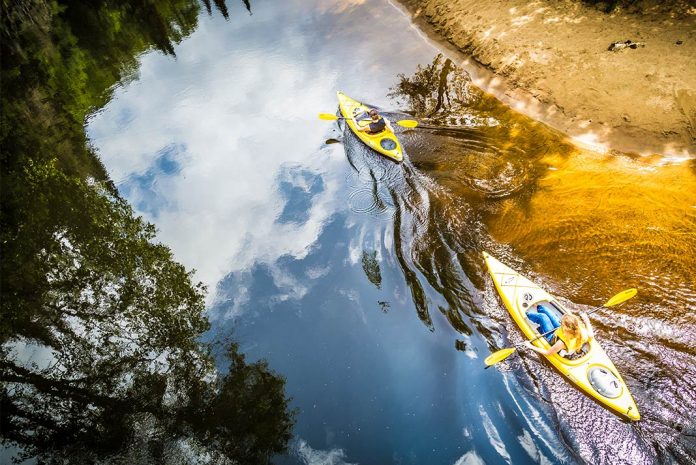
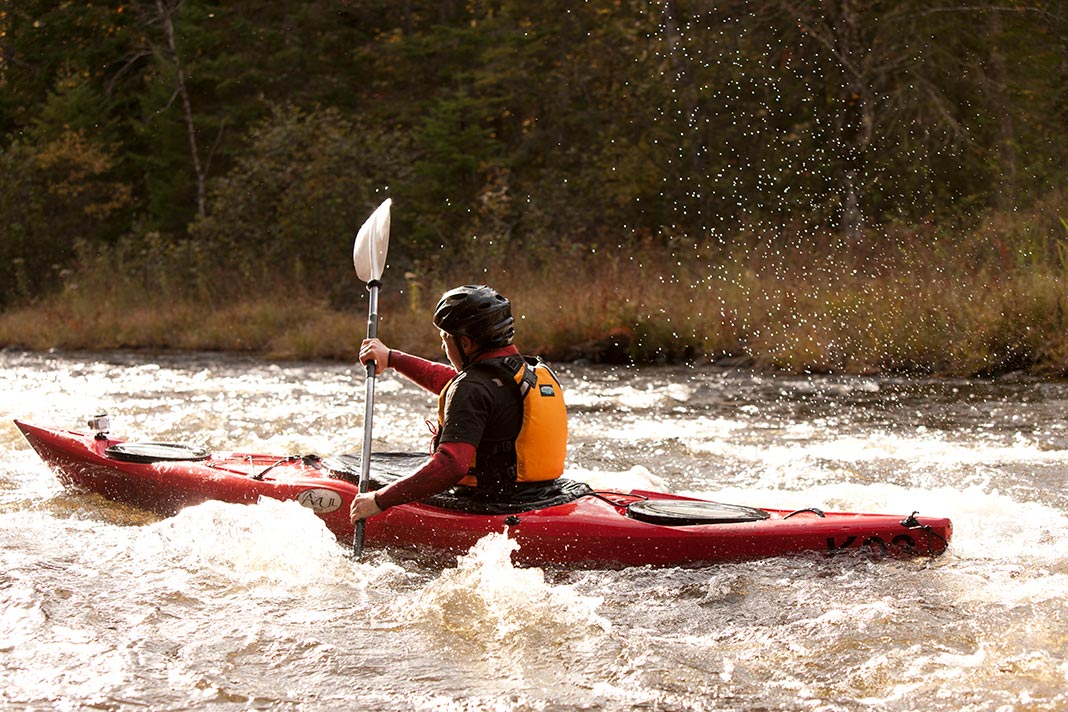
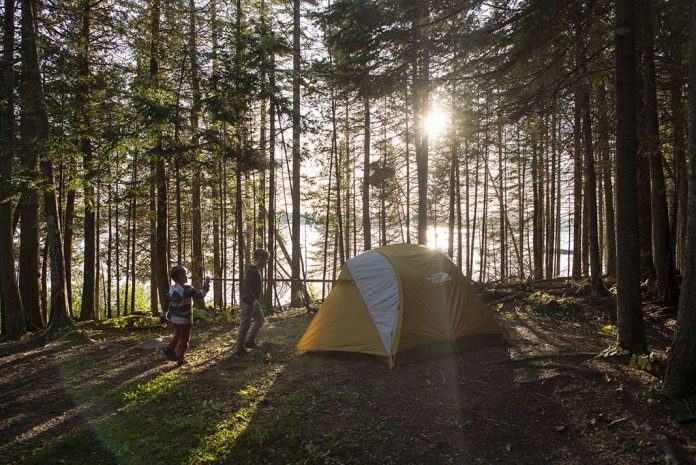
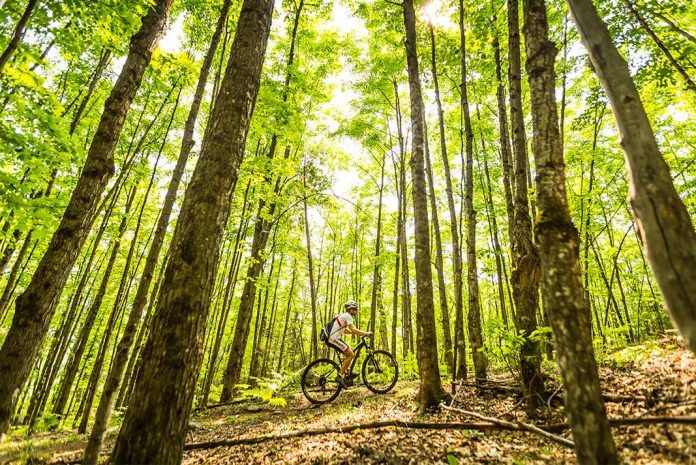
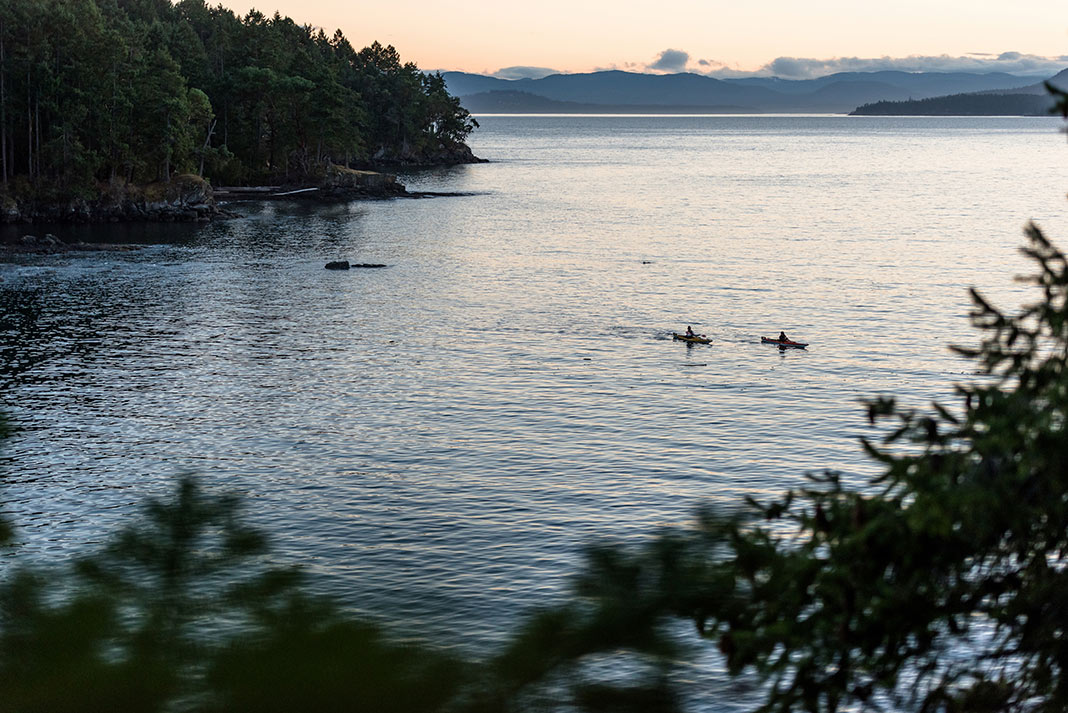
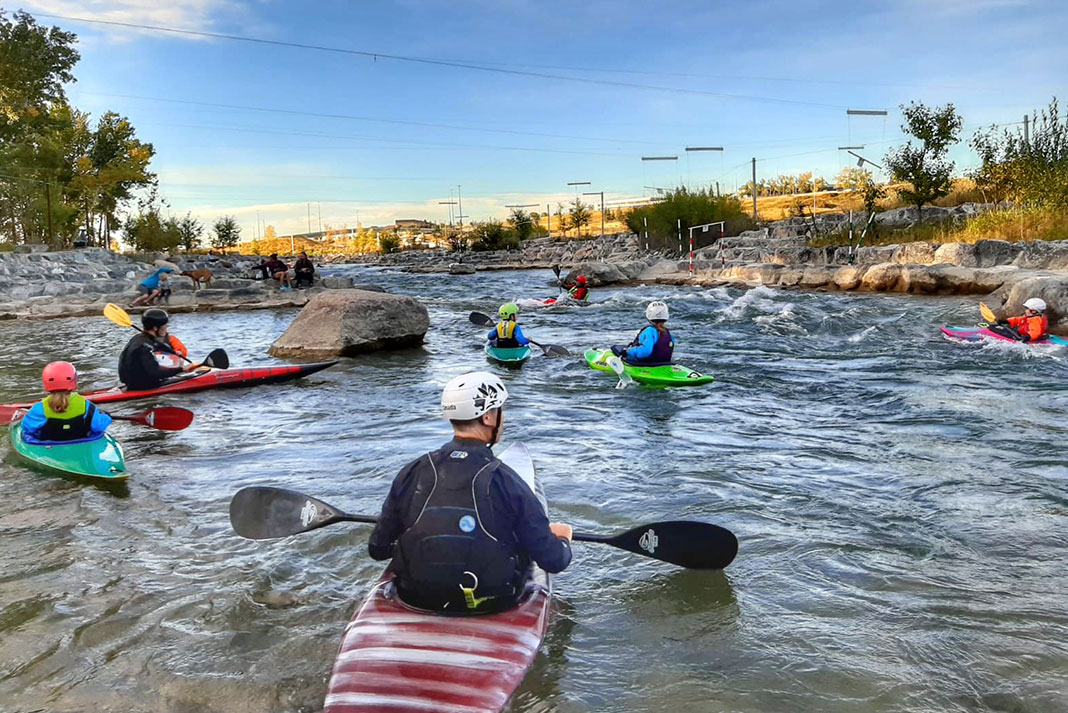
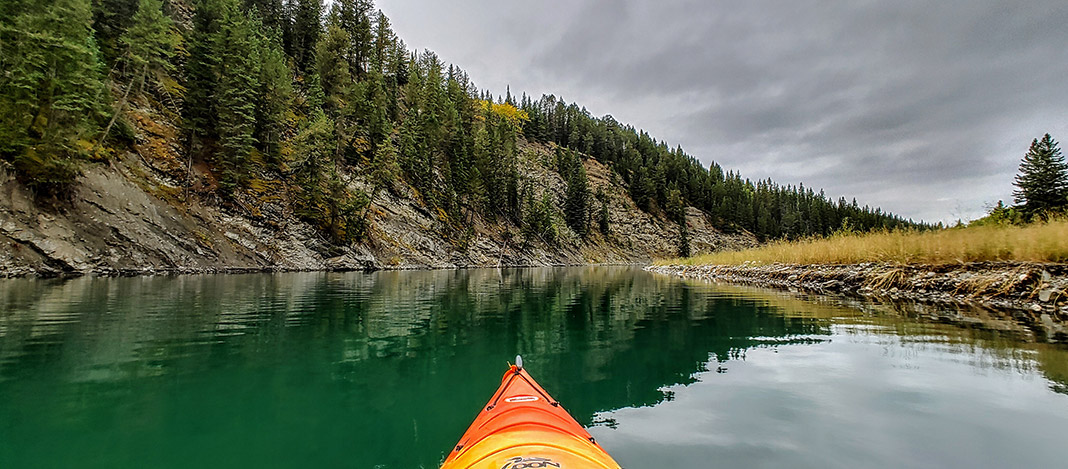
With six beautiful rivers and 400 lakes and streams, Parc National du Mont-Tremblant is a paddler’s paradise. Kayaking options near Mont Tremblant include tranquil touring and camping on backcountry lakes, or whitewater kayak descents of the region’s famed rivers, including the mighty Rouge and exciting Diable.
Get started planning your Mont Tremblant kayak adventure today—we’ve rounded up the best places to kayak Tremblant below.
[This article is part of our 21 Adventurous Mont Tremblant Activities series. Learn more about where to hike, bike, paddle and sightsee around this peerless Quebec park.]
Flowing north to south through much of the western portion of Mont Tremblant National Park, the Diable River is one of the park’s most popular routes for kayaking and canoeing. Beginning at Lac-aux-Herbes, kayakers can paddle the twists and turns of the upper Rivière du Diable along a 26-kilometer course of calm meanders, peaceful lakes and class I-II rapids. Experienced paddlers can run all 14 rapids at most water levels, or take the short portages to bypass the whitewater. This section can be run in a full day, or alternatively, more than 80 campsites scattered along the river and a park shuttle service make it easy to enjoy a one-way, overnight journey.
Novice kayakers or those wishing to extend their Diable River trip beyond the take-out at Lac Laplante can shuttle around a 7-km section of unrunnable rapids and falls and put-in below Chutes Croches. From here, the route continues an additional 21 km through Lac Monroe, Lac Chat and a selection of class I-III rapids, with an option to camp a final night before reaching the take-out at the Diable Sector park entrance. The 12-km run below Lac Chat to Mont de la Vache Noir is a popular half-day trip with only a few easy rapids.
Beyond the national park, the Rivière du Diable flows more placidly through a rural landscape near Mont Tremblant village, offering easy Tremblant kayak journeys for beginners, nature lovers and families. This gentle section is bordered by inviting sandy beaches and offers 12- or 23-km route options (3-7 hours).
Just to the north of Mont Tremblant National Park, the vast Rouge-Matawin Wildlife Reserve takes its name from the two main rivers that flow through here. Exciting day runs and multi-day routes in the spectacular upper valley of the Rouge River are a must for avid whitewater canoe trippers and kayakers. Bordering the west side of the wildlife reserve, experienced whitewater kayakers can shoot the continuous class II-IV rapids of the Rouge River’s famous 21 Milles (21 Miles) section.
Looking for a calm water kayaking adventure? Beginning at the villages of Labelle or L’Ascension, the Rouge River offers peaceful paddling, warm and shallow water, sprawling sand beaches and even a historic covered bridge, with downriver route options from 6 to 33 km. Plan a half to full day, depending on your route of choice.
The L’Assomption River kayak and canoe route begins at the north end of Lac de L’Assomption in Mont Tremblant National Park and travels 15 km through river and lake to the visitors centre at the park entrance. There are two whitewater sections with fast and fun class I rapids and swifts, then a class III-IV rapid followed by a pair of class II-III rapids just before the final campsite. Paddlers have an option to portage at each rapids. Day runs are possible, but many paddlers plan to camp one or two nights on the river—choose from 20 sites clustered at the beginning, km 5 and km 13 of the route.
This beautiful mountain lake is located just inside the national park’s Diable Sector entrance, making it easily accessible for a short kayaking journey. Quiet paddlers can enjoy up-close encounters with the regal loons that call Lac Monroe home.
Lac Tremblant
Forested mountains border the sapphire waters of Lac Tremblant, making this narrow, 12-kilometer-long lake just 5 minutes from Mont Tremblant Resort one of the busier—but no less beautiful—lakes for Tremblant kayak adventures. Cast for muskie and bass or troll for lake trout. Or simply kayak along the lakeshore while enjoying the stunning views of the ski area and surrounding peaks.
The upper section of the Diable River in Mont Tremblant National Park offers 26 km of rapids, river and lake kayaking with more than 80 campsites scattered along its course. The variety of camping and scenery makes a slower-paced descent of the river spread over 2 or 3 days a wonderful option for kayak campers.
The L’Assomption River travels 15 km from Lac de L’Assomption to the visitors center at the national park entrance. Intermediate whitewater sections are interspersed with lake paddling and 20 campsites clustered at the beginning, km 5 and km 13 of the route. Most paddlers plan to camp one or two nights on the river.
Rossi, Savane and L’Assomption Lakes, Mont Tremblant National Park
For lake-lovers seeking calm and solitude, the rustic paddle-in camping sites on the sandy shores of these three mountain lakes make great destinations for one or more nights.
Tucked away on the north side of the national park, Lac de la Savane and Lac Rossi offer 20 and 23 paddle-in campsites, respectively. Campsites are clustered in groups of four around both lakes, between 1 and 5 km paddle from the parking area and launch.
Kayak campers on the east side of Parc Mont Tremblant can choose from five wild camping areas nestled along the length of Lac de L’Assomption, between 1 and 5 km from the parking area/launch.
This immense wildlife reserve just north of Parc National du Mont-Tremblant offers an extension of the rugged mountain and lake geography that has made its sister to the south so popular. Near the main reserve entrance at La Macaza, the Lac-des-Sucreries campground offers 40 semi-serviced sites by the lake of the same name. Seven more rustic camping areas are scattered throughout the reserve, each located on a lake or river.
For wild camping enthusiasts, Rivère Matawin is a jewel worth discovering. The peacefulness and variety of rapids and swifts make it an excellent river for intermediate kayakers, and numerous access points make for trip possibilities from a few hours to a few days. Prefer lake camping? Easily accessible Lac Cinq-Doigts offers open water and many quiet bays for kayak campers.
With its headwaters high in the Laurentians at Lac Cinq-Doigts in Rouge-Matawin Wildlife Reserve, the meandering Rivère Macaza flows 27 km south to reach the Rouge River near the village of Macaza. It widens on three occasions to form Lac Sucreries, Lac Sapin and Lac Macaza. Between each lake, several class II-III rapids interspersed with the occasional class IV rapid challenge kayakers. Camping is best along the undeveloped upper reaches between Lac Cinq-Doigts and Lac Sucreries, and on these lakes themselves.
Rent single or tandem touring kayaks (plus canoes and SUPs) at one of nine locations within Mont Tremblant National Park. Rental centers are located at these popular lakes and campgrounds: Lac Monroe Visitors Centre, La Crémaillère Beach, Lac-Escalier Campground, La Pimbina Visitors Centre, Lac-Provost Rental Centre, Lac-des-Sables Campground, L’Assomption Visitors Centre, Grand-Pin Campground and La Cachée Visitors Centre. The park also offers a 4-hour, self-guided Diable River package that includes kayak rental and shuttle between Lac Chat and Mont de la Vache Noir (12 km).
Location: Mont Tremblant National Park Phone: 800-665-6527 Website: www.sepaq.com/pq/mot/
À L’Abordage!
This popular Mont Tremblant kayak outfitter offers sit-on-top, single and double recreational kayak rentals (plus canoe and SUP rentals) and shuttle service for downriver adventures on the Rivière du Diable. This gentle, 12-km section of the river boasts beautiful sand beaches and begins with a stretch of fun and splashy class I rapids suitable for beginner kayakers. Available June to September, reservations strongly recommended.
Location: 1340 Rue Saint-Jovite, Mont-Tremblant Phone: 819-322-1234 Website: www.alabordage.ca/en/
Mont-Tremblant Activity Centre
Located steps from Lac Tremblant in the Mont-Tremblant Resort village, the Activity Centre offers a huge range of outdoor adventure packages, including kayak rentals and shuttles for self-guided and guided explorations of the Diable River and Rouge River. The center rents recreational single and double kayaks, including sit-on-tops.
Tucked in a peaceful meander of the Diable River, just steps to the amenities of Mont-Tremblant village, Camping de la Diable offers 360 riverside sites for tents, trailers and RVs, as well as rentals of solo and double kayaks (plus canoes and bicycles).
Explore Lac Tremblant at your own pace. This center is right on the lake and rents recreational single and double kayaks, including sit-on-top options (canoes and SUPs also available).
Offers single or double recreational kayak, canoe and SUP rental and shuttle service for downriver adventures on the Rouge River—enjoy soft sandy beaches and calm waters on an 8 km, 12 km or 23 km route option. Kayak & Cabana also offers unique glamping cabins set in an enchanting riverside location just west of Mont Tremblant National Park.
Dedicated rental and shuttle service offering kayak offering single or double recreational kayak, canoe and SUP rental and transport for your Rouge River adventure. Select your paddle craft, and then choose from 6 km, 12 km or 24 km route options (2 hours to a full day). This outfitter is located at the take-out, so you’ll begin with a shuttle and can then take as much time as you like meandering back to your car.
Location: 2123 Place des Toulipes, La Conception Phone: 819-686-5880 Website: www.pausepleinair.com/en/
[ Plan your next Quebec paddling adventure with the Paddling Trip Guide ]
Descente de la Rouge
Offers kayak and canoe rental packages including shuttle and optional picnic lunch or post-paddle BBQ or pizza. Choose from 8 km, 12 km, 25 km or 33 km downriver route options. All routes travel a gentle section of the river known for its stunning sand cliffs, beautiful beaches and sandy islets.
Location: 2683 Chemin de la Rivière Nord, Rivière-Rouge Phone: 819-275-1439 Website: www.descentedelarouge.com/
Aventure Quatre Saisons (Adventure Four Seasons)
Whether you’re looking to enjoy a leisurely day of kayaking or 2 to 5 days of paddle camping, this outfitter can get you set up for an unforgettable Rouge River adventure. Rent sit-on-top kayaks, SUPs or canoes for a 15-km descent of the gentle Rouge River (shuttle included).
Quebec’s Mont Tremblant region offers endless possibilities for all your paddling and outdoor adventures. From pristine mountain lakes and exciting whitewater rivers to panoramic hiking and biking trails, you’ll need to spend a few days here just to scratch the surface. Happily, camping near Mont Tremblant is both plentiful and beautiful with options to suit every type of camper.
Whether you enjoy boutique luxury camping or the peaceful solitude of canoeing to a backcountry lakeside campsite, we’ve rounded up the very best camping spots in Mont Tremblant.
[This article is part of our 21 Adventurous Mont Tremblant Activities series. Learn more about where to hike, bike, paddle and sightsee around this peerless Quebec park.]
Campgrounds Mont Tremblant
Wondering which Mont Tremblant campsites enjoy easy access to paddling opportunities and other outdoor adventures? Not to worry—much of the best camping in Mont Tremblant is accessible to visitors traveling by vehicle. Plus, many drive-in campsites are located on or near the water, so they feature great paddling right out your tent door or just a short drive away.
Mont Tremblant National Park Camping, La Diable Sector
Quebec’s very first national park—and the third established in Canada—Parc National du Mont-Tremblant was established in 1895 and celebrated its 125th anniversary in 2020. With six outstanding rivers and 400 lakes and streams, it’s a paddler’s paradise. There is also a via ferrata, an intermediate activity between hiking and climbing that lets you discover the park’s mountains in a way most of us could otherwise only dream about. Camping Parc Mont Tremblant is available year-round, with over 900 campsites and an unmatched variety of cabins, huts and yurts offering a wide range of camping experiences for everyone.
Spanning more than 1,500 square kilometers, Parc National du Mont-Tremblant is the largest protected territory in southern Quebec. The huge size of Mont Tremblant National Park means you’ll first need to decide which part of the park you would like to base yourself from. The park’s western side is known as La Diable Sector and is home to the main visitors center, beautiful Lac Monroe and the impressive Rivière du Diable.
Lac Chat Campground: Located 7 km from the Diable park entrance, Lac Chat Tremblant camping area features 85 serviced campsites that can accommodate all types of equipment. Some campsites are dog-friendly and your pup is also permitted on designated trails and picnic areas. Lac Monroe and Rivière du Diable are nearby, as is the beginning of Les Méandres de Diable canoe and kayak route.
[ Plan your next Quebec paddling adventure with the Paddling Trip Guide ]
Le Castor, L’Ours, La Grenouille and Le Chevreuil Campgrounds: These popular Mont Tremblant camping areas are located 11 km from the Diable entrance. More than 200 campsites (semi-serviced and serviced) are available for tent camping and recreational vehicles. Close to the camping areas you’ll find a beach; canoe, kayak and paddleboard rentals; hiking and biking trails; and a campers’ store.
Lac-Escalier Campground: This camping area is located 25 km from the Diable entrance and offers 74 semi-serviced campsites. These Mont Tremblant camping sites are quiet and ideal for families. Canoe, kayak and paddleboard rentals and a campers’ store are available on site.
Mont Tremblant National Park Camping, La Pimbina Sector
Parc Mont Tremblant’s La Pimbina Sector encompasses the largely untracked central portion of the national park, with the park entrance and main service hub located at Lac Provost.
L’Aigle-Pêcheur, La Fauvette, Le Geai-Bleu and Le Pinson-Chanteur Campgrounds: Together, these four camping areas offer nearly 120 semi-serviced and serviced campsites located near the registration center and Lac Provost. You’ll find canoe, kayak and paddleboard rentals, as well as hiking trails close by. If you enjoy tenting or RVing with your four-legged friend, L’Aigle-Pêcheur is a dog-friendly campground.
Lac des Sables Campground: Located 20 km from the Pimbina registration center, Lac des Sables camping area offers 79 semi-serviced campsites and is ideal for families. On site you’ll find canoe and kayak rentals and a small convenience store.
Lac-Lajoie Nord, Lac-aux-Rats and Lac Herman Campgrounds: Each of these rustic camping areas is located within 5-8 km of the registration center and offers peaceful options for Mont Tremblant tent camping.
Mont Tremblant National Park Camping, L’Assomption Sector
Comprising the east side of Mont Tremblant National Park, L’Assomption Sector boasts the park’s largest lake, with rustic camping areas ideally suited to sea kayaking and open-water canoeing.
Du Grand Pin Campground: This camping area features 58 semi-serviced campsites located 15 km from the L’Assomption park entrance. You’ll find dog-friendly campsites; canoe, kayak and paddleboard rentals; and a campers’ store nearby.
Chez Bill Campground: Situated on the shore of Lac des Cyprés, 28 km from the park entrance, this rustic camping area features 8 Mont Tremblant camping sites with excellent access for sea kayakers.
This immense wildlife reserve just north of Parc National du Mont-Tremblant offers an extension of the rugged mountain and lake geography that has made its sister to the south so popular. Near the main reserve entrance at La Macaza, the Lac-des-Sucreries campground offers 40 semi-serviced sites by the lake of the same name. Seven more rustic camping areas are scattered throughout the reserve, each located on a lake or river.
Tucked in a meander of the Diable River, just steps to the amenities of Mont Tremblant village, Camping de la Diable offers 360 attractive sites, shaded or sunny along the river’s edge. Perfect for families, the campground features a heated pool with lifeguard, beach swimming area on the river, dog park, playgrounds and canoe, kayak and bicycle rentals.
Located in the town of Labelle, just 10 minutes from Mont Tremblant, this 5-star campground offers more than 70 lovely riverside sites for tents, trailers and RVs beside the peaceful Rouge River and the chattering Chutes-aux-Iroquois falls. Enjoy the wonderful sandy beach, canoe or kayak right from your campsite or take your bike for a spin on the adjacent Little Train of the North (Petit Train du Nord)—a 232-km recreational trail constructed on a former railway. Standard campsites, comfortably appointed Ready-to-Camp tents and riverside chalets available.
Canoe camping in Mont Tremblant is the ultimate way for paddlers to experience the beautiful lakes and rivers of southern Quebec’s largest park. Enjoy wild camping along Mont Tremblant’s two main rivers—the Diable and the L’Assomption—or slumber to the sound of gently lapping waves at one of the park’s three destination canoe camping lakes. Bordering the park to the north, the equally vast Rouge-Matawin Wildlife Reserve offers even more options for extended canoe trips.
Beginning at Lac-aux-Herbes, paddle the twists and turns of the upper Rivière du Diable along a 2- to 3-day, 26-kilometer course of calm meanders, peaceful lakes and class I-II rapids. Experienced paddlers can run all 14 rapids at most water levels, or take the short portages to bypass the whitewater sections. More than 80 canoe camping sites are scattered all along the river, and a shuttle service makes it easy to enjoy a one-way journey while wild camping on Mont Tremblant’s best-known river.
Paddlers wishing to extend their Diable River canoe trip beyond the take-out at Lac Laplante can shuttle around a 7-km section of unrunnable rapids and falls and put-in below Chutes Croches. From here, the route continues an additional 21 km through Lac Monroe, Lac Chat and a selection of class I-III rapids, with an option to canoe camp a final night before reaching the take-out at the Diable Sector park entrance.
The L’Assomption River canoe route begins at the north end of Lac de L’Assomption and travels 15 km through river and lake to the visitors center at the park entrance. There are two whitewater sections with fast and fun class I rapids and swifts, then a class III-IV rapid followed by a pair of class II-III rapids just before the final campsite. Paddlers have an option to portage at each rapids. Most paddlers plan to camp one or two nights on the river—choose from 20 sites clustered at the beginning, km 5 and km 13 of the route.
Rossi, Savane and L’Assomption Lakes, Mont Tremblant National Park
For lake-lovers seeking calm and solitude, the rustic canoe camping sites on the sandy shores of these three mountain lakes make great destinations for one or more nights. Discovery packages available May to September—which include canoe equipment rental, firewood and your camping permit—make it easy for first-timers to try canoe camping Mont Tremblant.
Tucked away on the north side of the national park, Lac de la Savane and Lac Rossi offer 20 and 23 canoe campsites, respectively. Campsites are clustered in groups of four around both lakes, between 1 and 5 km paddle from the parking area and launch.
Destination canoe campers on the east side of Parc Mont Tremblant can choose from five wild camping areas nestled along the length of Lac de L’Assomption, between 1 and 5 km from the parking area/launch.
The name of this huge wildlife reserve just to the north of Mont Tremblant National Park comes from the two main rivers that flow through it. Canoe camping routes on the Rouge River and Matawin River are a must for avid canoe trippers and kayakers. On the west side of the reserve, experienced whitewater canoeists can enjoy wild camping while shooting the challenging class II-III rapids of the Rouge River’s famous 21 Milles (21 Miles) section.
For canoe camping enthusiasts, Rivère Matawin is a jewel worth discovering. The peacefulness and variety of rapids and swifts make it an excellent river for intermediate-level canoeists, and numerous access points make for trip itineraries from a few hours to a few days. Prefer lake camping? Easily accessible Lac Cinq-Doigts offers open water and many quiet bays for canoe and sea kayak campers.
Luxury camping in Mont Tremblant is de rigueur, making this region perfect for treating yourself to an unforgettable glamping experience. Whether you are looking for convenience, comfort, decadence or all of the above—you’re sure to find it luxury camping Parc Mont Tremblant.
A popular option throughout the region is the Ready-to-Camp tent—a comfortably appointed canvas tent constructed on a sturdy platform and outfitted with basic furniture. Searching for something more exotic? The sky is the limit—literally! Try treehouse camping in Mont Tremblant and take luxury accommodation to new heights.
Escape to the forest canopy in one of these fairytale cabins perched high in the trees, set in a beautiful mixed hardwood and conifer forest overlooking Lac Cordon. Mont Tremblant Treehouse camping is available year-round and features 20 unique, Instagram-worthy wooden treehouses—each with a cozy, rustic living space and room to sleep 2-6 campers. All of the treehouses are built to blend into their natural environment, with southern-facing windows and decks to maximize sunlight and views. Woodstove heating, camp kitchens and outhouses put an extra bit of adventure in your stay.
Situated within the 2,000-acre Parc Eco des Laurentides, these completely off-grid accommodations are accessible by a 10- to 20-minute walk or 10-minute paddle down the lake (baggage carts/sleds and canoe rentals available). Those stellar views make it hard to pull yourself away, but when you’re ready the eco-resort also offers 36 km of hiking/snowshoeing trails and canoeing, kayaking and swimming in Lac Cordon. Pet travellers take note: trails and treehouses are dog-friendly.
Relax beside the tranquil flow of the Rouge River at this enchanting, year-round glamping retreat, nestled on 35 wooded acres just west of Mont Tremblant National Park. Paddlers will love the superb kayaking, canoeing and paddleboarding right out the door of your cozy cabana or shepherd’s wagon. Perfectly suited to a romantic glamping getaway, each of these unique accommodations sleeps two and is exquisitely crafted from pine or cedar to blend harmoniously with its natural surroundings.
Enjoy the sunny riverside clearing and charming country furnishings of the shepherd’s wagons, or the stunning floor-to-ceiling windows and forest views from the cabana. Both dwellings are off-grid, reached by a short walk from the parking area, and include a fully equipped camping kitchen and comfortable double bed. Once you’re rested, rent a canoe, kayak or SUP and use the shuttle service for a downriver adventure on the Rouge River. Enjoy sprawling sand beaches and calm waters on an 8 km, 12 km or 23 km route option.
The stunning geodesic dome rentals at Bel Air Tremblant Resort offer a truly unique lodging experience amid the perfect blend of luxury and nature. These modern domes are surrounded by crisp mountain air and leafy forests, tucked between the Rouge River and Mont Tremblant National Park. Even better, each dome is set on a spacious deck with a private hot tub, barrel sauna and beautiful views. A wall of windows keeps the domes bright and airy and brings those views inside, where you can luxuriate in a king-size bed, take a hot shower or prepare a romantic fireside dinner in the kitchenette. This has got to be the most luxurious “camping” near Mont Tremblant!
Domes sleep 2 or 4, making them perfect for couples and families. The resort is open year-round and offers a huge variety of adventure activities, including paddleboarding and kayaking, hiking trails, zip lines, horseback riding, fat biking and more.
Stay in comfort in the heart of Parc National du Mont-Tremblant with the park’s traditional Ready-to-Camp tents, available in La Diable, Pimbina and L’Assomption sectors. These spacious canvas tents feature 2 bedrooms with two double beds, plus heating, lighting, a table and chairs and everything you need to cook. All are located adjacent to lakes with access to campground amenities.
For even more spacious comfort, the park also offers Étoile Ready-to-Camp sites located at Lac Monroe, Lac Provost and Lac-des-Sables. These cube-shaped, canvas-and-wood structures feature more height, storage and three double beds (sleeps 6).
Stretching the definition of “camping,” Parc Mont Tremblant boasts five different types of cozy cabins suitable for groups of 2 to 10. Couples love the unique architecture and huge windows of the intimate EXP. Cabins. Families and friends enjoy the fully equipped comfort of the 4-person Écho Cabins, Nature Cabins and new Compact Cabins—all of which feature kitchens and bathrooms with shower. Best yet, these tiny homes-away-from-home use natural materials and designs that embrace and reflect their beautiful surroundings.
The sheer size of Mont Tremblant National Park makes a park map essential for orienting yourself to the camping areas, roads, trails, rivers, lakes and everything else the park has to offer. Refer to the general Parc National du Mont-Tremblant map for a detailed topographic representation of the entire park. A print copy of this map is available for purchase at the park.
If you’re planning to paddle one of the canoe camping routes in Mont Tremblant, refer to the La Diable canoe camping map for trips on the Diable River, Lac Rossi and Lac de la Savane. For canoe trips on the east side of the park, you’ll need to download the L’Assomption canoe camping map. A printed Canoe-Camping Map is available for purchase at the park.
Camping Gear Mont Tremblant
Sports Experts / Atmosphere
Well-stocked outdoor retail chain, Sports Experts / Atmosphere has a convenient location in Mont Tremblant village. Purchase a huge range of camping gear, paddling equipment, outdoor supplies, clothing and more.
The outstanding variety of outdoor activities in Mont Tremblant owes much to the spectacular natural environment of the Laurentian Mountains. Mont Tremblant is just a 1.5-hour drive from Montreal and less than 2 hours from Ottawa, yet the verdant summits, sparkling lakes and powerful rivers of this renowned outdoor destination feel worlds away from the bustling city.
With an exceptional trail network, beautiful campgrounds, six rivers and 400 lakes and streams, exploring Parc National du Mont-Tremblant is a must for adventurous paddlers. The park is home to serene lake paddling and exciting yet novice-friendly whitewater kayaking and canoeing. Surrounding the park, a mosaic of wildlife reserves, adventure resorts, charming villages and rural landscapes invite even more exploration. Adding to the region’s natural gifts are well-developed activity centers for Mont Tremblant tourism, making it easy to rent equipment, arrange shuttles or participate in guided tours.
Finally, a wonderful range of accommodations—including 4-season cottage rentals, family resorts and rustic campgrounds—make Mont Tremblant a perfect destination for outdoor enthusiasts.
Mont Tremblant Activities
Kayak Tremblant
Kayaking in Mont Tremblant centers around two beautiful and varied rivers: the Rivière du Diable and the Rivière Rouge. River kayaking experiences range from easy, half-day floats to exciting day trips and even overnight camping journeys. Find everything you need to know about these and other top kayaking adventures at Kayak Mont Tremblant: Where To Paddle, Rent & More.
The many small, mountain-rimmed lakes of Mont Tremblant National Park are perfectly suited to relaxing SUP adventures. Beyond the park’s borders, paddleboarders enjoy the gentle, shallow waters of Mont-Tremblant’s Rouge and Diable Rivers, known for their soft sandy beaches and easy current.
Rouge River Paddleboard
Beginning at the villages of Labelle or L’Ascension, the Rouge River offers peaceful paddling, warm and shallow water, sprawling sand beaches and even a historic covered bridge, with downriver route options from 6 to 33 km. Plan for a half- to full-day trip, depending on your route of choice. Paddleboarding Mont Tremblant’s Rouge River is easy thanks to local outfitters that provide SUP rentals and shuttle transportation for one-way journeys (see below).
Diable River Paddleboard
Whether you’re looking for an easy or exciting SUP adventure, the Diable River is a scenic waterway with different sections offering varying levels of intensity. In the Diable Sector of Mont Tremblant National Park, the 12-km stretch of the Diable River below Lac Chat to Mont de la Vache Noir is a popular half-day trip with a few small rapids and swifts to spice things up.
Beyond the national park, the Rivière du Diable flows more placidly through a rural landscape near Mont Tremblant village, offering easy SUP journeys for beginners and families. This gentle section is bordered by inviting sandy beaches and offers 12- or 23-km route options (3-7 hours).
Lac Tremblant Paddleboard
Forested mountains border the sapphire waters of Lac Tremblant, making this narrow, 12-kilometer-long lake one of the busier—but no less beautiful—locations for SUP activities. Located just 5 minutes from Mont Tremblant Resort, you can paddle along the lakeshore while enjoying the stunning views of the ski area and surrounding peaks.
This beautiful mountain lake is located just inside Mont Tremblant National Park—where you can also rent SUPs—making it easy for first-timers to get their feet wet (literally) paddleboarding Mont Tremblant. Quiet paddlers can enjoy up-close encounters with the regal loons that call Lac Monroe home.
[ Plan your next paddling adventure with the Paddling Trip Guide ]
Paddleboard Rental Mont Tremblant
Parc National du Mont-Tremblant
If you don’t have your own board, you can rent a SUP at Lac Monroe Visitors Centre within Mont Tremblant National Park (Diable sector).
Location: Mont Tremblant National Park Phone: 800-665-6527 Website: www.sepaq.com/pq/mot/
À L’Abordage!
This popular Mont Tremblant outfitter offers SUP rentals and shuttle service for downriver adventures on the Rivière du Diable. This gentle, 12-km section of the river boasts beautiful sand beaches and begins with a stretch of fun and splashy class I rapids. Available June to September, reservations strongly recommended.
Location: 1340 Rue Saint-Jovite, Mont-Tremblant Phone: 819-322-1234 Website: www.alabordage.ca/en/
Mont-Tremblant Activity Centre
Located steps from Lac Tremblant in the Mont-Tremblant Resort village, the activity center offers a wide range of outdoor adventure packages, including SUP rentals and shuttles for self-guided explorations of the Diable River and Rouge River.
This outfitter offers SUP rentals and shuttle service for downriver adventures on the Rouge River—enjoy soft sandy beaches and calm waters on an 8 km, 12 km or 23 km route option. Kayak & Cabana also offers unique glamping cabins set in an enchanting riverside location just west of Mont Tremblant National Park.
Dedicated rental and shuttle service offering SUP rental and transport for your Rouge River adventure. Choose from 6 km, 12 km or 24 km route options (2 hours to a full day). This outfitter is located at the take-out, so you’ll begin with a shuttle and can then take as much time as you like meandering back to your car.
Location: 2123 Place des Toulipes, La Conception Phone: 819-686-5880 Website: www.pausepleinair.com/en/
Canoe Mont Tremblant
Mont Tremblant canoeing can include tranquil tours and canoe camping on backcountry lakes, or whitewater canoeing descents of the region’s famed rivers, including the mighty Rouge and exciting Diable. Quieter stretches of river invite paddlers looking for a more relaxing way to canoe Tremblant.
The upper section of the Diable River in Mont Tremblant National Park offers 26 km of rapids, river and lake canoeing with more than 80 campsites scattered along its course. The variety of camping and scenery makes a slower-paced descent of the river spread over 2 or 3 days a wonderful option for canoe camping Mont Tremblant.
The L’Assomption River canoe route begins at the north end of Lac de L’Assomption in Mont Tremblant National Park and travels 15 km through river and lake to the visitors center at the park entrance. There are two whitewater sections with fast and fun class I rapids and swifts, then a class III-IV rapid followed by a pair of class II-III rapids just before the final campsite. Most canoeists plan to camp one or two nights on the river—choose from 20 sites clustered at the beginning, km 5 and km 13 of the route.
Rossi, Savane and L’Assomption Lakes, Mont Tremblant National Park
For lake lovers seeking calm and solitude, the rustic paddle-in camping sites on the sandy shores of these three mountain lakes make great destinations for one or more nights canoe camping in Mont Tremblant.
Tucked away on the north side of the national park, Lac de la Savane and Lac Rossi offer 20 and 23 paddle-in campsites, respectively. Campsites are clustered in groups of four around both lakes, between 1 and 5 km by paddle from the parking area and launch.
Canoe campers on the east side of Parc Mont Tremblant can choose from five wild camping areas nestled along the length of Lac de L’Assomption, between 1 and 5 km from the parking area/launch.
This immense wildlife reserve just north of Parc National du Mont-Tremblant offers an extension of the rugged mountain and lake geography that has made its sister to the south so popular. For wild camping enthusiasts, Rivère Matawin is a jewel worth discovering. The peacefulness and variety of rapids and swifts make it an excellent river for intermediate canoeists, and numerous access points make for trip possibilities ranging from a few hours to a few days.
Rent canoes from one of nine locations within Mont Tremblant National Park. Rental centers are located at these popular lakes and campgrounds: Lac Monroe Visitors Centre, La Crémaillère Beach, Lac-Escalier Campground, La Pimbina Visitors Centre, Lac-Provost rental centre, Lac-des-Sables Campground, L’Assomption Visitors Centre, Grand-Pin Campground and La Cachée Visitors Centre.
Location: Mont Tremblant National Park Phone: 800-665-6527 Website: www.sepaq.com/pq/mot/
This popular Mont Tremblant outfitter offers canoe rentals and shuttle service for downriver activities on the Rivière du Diable. Available June to September, reservations strongly recommended.
Location: 1340 Rue Saint-Jovite, Mont-Tremblant Phone: 819-322-1234 Website: www.alabordage.ca/en/
Located steps from Lac Tremblant in the Mont-Tremblant Resort village, the Activity Centre offers canoe rentals and shuttles for self-guided and guided explorations of the Diable River and Rouge River.
Tucked in a peaceful meander of the Diable River, just steps to the amenities of Mont Tremblant village, Camping de la Diable offers 360 riverside sites for tents, trailers and RVs, as well as Tremblant canoe rentals.
Dedicated Tremblant canoe rental and shuttle service, including transport for your Rouge River adventure. This outfitter is located at the take-out, so you’ll begin with a shuttle and can then take as much time as you like meandering back to your car.
Location: 2123 Place des Toulipes, La Conception Phone: 819-686-5880 Website: www.pausepleinair.com/en/
Descente de la Rouge
Offers canoe rental packages including shuttle and optional picnic lunch or post-paddle BBQ or pizza. Choose from 8 km, 12 km, 25 km or 33 km downriver route options. All routes travel a gentle section of the river known for its stunning sand cliffs, beautiful beaches and sandy islets.
Location: 2683 Chemin de la Rivière Nord, Rivière-Rouge Phone: 819-275-1439 Website: www.descentedelarouge.com/
Aventure Quatre Saisons (Adventure Four Seasons)
Whether you’re looking to enjoy a leisurely day of paddling or 2 to 5 days of canoe camping, this outfitter can get you set up for an unforgettable Rouge River adventure. Canoe rentals for the gentle 15-km Rouge River day trip include shuttle.
Experience the thrill of whitewater rafting just an hour’s drive away from Mont-Tremblant village on the fast and furious Riviere Rouge. Rafting Tremblant is suitable for everyone from families to adrenaline junkies, with different sections of the river offering moderate class II-III rapids and calm pools, or heart-pounding drops and continuous class III-IV whitewater. Check out our Guide to Paddling Riviere Rouge for everything you need to know.
With nearly 40 years of experience rafting the Rouge River, New World Rafting is the longest running outfitter on the river. Choose from a half-day of rafting (8 km) or a full day featuring two runs of the best rapids on the Rouge (16 km). New World also offers weekend packages, which include a full day of Mont Tremblant activities, including rafting, camping, meals and access to the spa, pool, beach and bar at their riverfront location.
The Rouge River season opens in May and runs through September. Rafting trips descend the best stretches of river based on water levels—early in the season, that means braving the high water of Harrington Canyon, while summer offers challenging trips down the rambunctious Seven Sisters. Not only will you be able to enjoy the beautiful scenery of the river, but also the many sandy beaches. Between rapids are golden sand and places for surfing the rafts, swimming and floating in the current.
Launched in 1982, Propulsion Rafting boasts decades of experience and a gorgeous base camp location nestled in the forest beside the Rouge River, just above the Seven Sisters rapids. Choose from half-day or full-day rafting in 6- to 8-person rafts, or get even closer to the wet and wild action in a 2-person cataraft or sportyak. These inflatable kayaks offer an experience in between rafting and kayaking and can accommodate one or two paddlers. Under the supervision of an experienced kayaker, you will guide your own sportyak or cataraft down the best rapids on the Rouge River. For a full Mont Tremblant weekend experience, opt for Propulsion Rafting’s riverside camping or cozy cabin stay with access to activities like an on-site spa, pool, beach volleyball and bar.
Location: 619 Chemin de la Rivière-Rouge, Grenville-sur-la-Rouge Phone: 800-461-3300 Website: www.propulsion.ca/en/
Gentle family rafting on the Rouge River is available after mid-May on the Seven Sisters section, once the water level has dropped. This is an unforgettable family trip and the perfect occasion to introduce children to whitewater activities. Children must be at least 6 years old and weigh a minimum of 22 kilograms (50 pounds). Accompanied by expert river guides, families will raft rapids up to class III, with stops for swimming, body surfing, cliff jumping and a picnic lunch on a beautiful beach. Both Propulsion Rafting and New World Rafting offer family rafting trips on the Rouge River.
Mont Tremblant Hiking
When it comes to outdoor activities in Mont Tremblant, it doesn’t get any simpler than going for a hike. Hikes in Mont Tremblant National Park run the gamut from easy nature strolls to challenging treks with breathtaking viewpoints. Truly adventurous hikers can lace up their boots and head out for a few days on the park’s backpacking circuit, staying overnight at remote mountain huts. Whatever trail you choose, hiking is a great way to escape the rush and reconnect with nature. Don’t miss these top trails:
La Roche Summit Trail
Departing from the Mont Tremblant National Park Discovery Centre at Lac Monroe, this popular 5.4-km trek (round trip) reaches a wooden lookout platform high above the lake. If the climb up here doesn’t take your breath away, the panoramic views from the top will—especially in autumn when the mountains transform into a rumpled canvas of crimson, copper and gold.
More epic views of sapphire lakes and emerald mountains await on this short and steep summit trail in Mont Tremblant National Park’s Pimbina sector. Allow two hours for the moderate 4-km round trip to the lookout platform 200 metres above Lac Provost. Find the trailhead just north of the Pimbina registration center.
La Chute-du-Diable Trail
Warm up your legs on this easy, 1.6-km (round-trip) hike to a thundering falls on the Diable River in Mont Tremblant National Park. The trailhead parking area is 7 km north of the Discovery Centre.
Via ferratas are popular across Quebec, where this unique blend of hiking and rock climbing allows participants to experience views unlike anything you’ve seen before. The Via Ferrata Du Diable is a path that winds its way along the Mont de la Vache Noire rock face, at the entrance to Mont Tremblant National Park’s La Diable sector. Whether you’re a nervous first-timer or adventurous climber, safely navigate the cliffs 200 meters above the winding Rivière du Diable at your own pace. You’ll cross beams and cable bridges, climb metal rungs and hike narrow footpaths as you make your way ever higher with astounding views unfolding beneath your feet. Small groups of 6 participants are accompanied by a professional guide.
Mont Tremblant Biking
With so many exciting activities in Mont Tremblant, the region’s world class two-wheeled adventures rank high on many visitors’ lists. Recreational and touring cyclists flock to Le P’tit Train du Nord, a more than 200-kilometer-long rail trail that can be ridden in easy sections or followed end-to-end. Families enjoy the convenient access and many scenic attractions along Mont Tremblant National Park’s dedicated cycling paths and the 30 km of interconnected paths in Mont Tremblant village.
Prefer fat tire adventures? Mont-Tremblant Resort has a wealth of fantastic downhill and cross-country trail networks, with something for every off-road rider.
The “Little Train of the North” is a 232-kilometer-long cycling path that follows a former Canadian Pacific Railway line through the scenic Rouge River and Rivière du Nord valleys. It’s also the longest linear park in Canada. The route connects Mont-Laurier in the north with St-Jérôme in the south, passing through Mont Tremblant village near its midpoint. Nearly half of the path is paved, while the remainder is fine gravel suitable for hybrid or recreational bikes. In winter, the trail is transformed for Mont Tremblant activities like cross-country skiing and fat biking.
Cyclists on Le P’tit Train du Nord are rewarded with stunning mountain panoramas, scenic rivers, lakeside pedaling and welcoming villages. Lovingly restored, century-old train stations serve as trailside cafés, bike rental kiosks and interpretive sites. Plan a one-way ride, making use of widely available local shuttle services, or pause overnight at one of the many campgrounds and inns situated along the route.
Villageoise-de-Mont-Tremblant Trail
The 15-km Villageoise-de-Mont-Tremblant is a paved bike trail that starts at Mont-Tremblant Resort and circles around the resort village, with beautiful views of Lac Tremblant and the Diable River. This path also connect cyclists with Le P’tit Train du Nord for a longer tour.
Mont Tremblant Road Cycling Circuits
Avid road cyclists can discover the lush, mountainous landscapes of the Laurentians along four popular Mont Tremblant cycling circuits. Travelling on paved roads and bike paths, cyclists can choose from an easy 28-km route, challenging 78-km tour or two intermediate circuits—a 105-km ride north to the Rouge River, or a beautiful 99-km lake tour into Mont Tremblant National Park. Be sure to download or pick up a copy of the Vélo de Route Map.
Mont Tremblant Mountain Bike Trails
Tackle the challenging topography of the Laurentian Mountains on Mont Tremblant’s outstanding mountain bike trail network. More than 50 km of trails rated beginner to expert weave through the forested slopes on both sides of the Diable River. Warm up with an easy gravel ride or test your single track skills in the 1,500-acre natural area of Domaine Saint‑Bernard.
Mont Tremblant National Park Trails
Ride on the tranquil biking trails of Mont Tremblant National Park while taking in the forest, lakes and mountain views. Eight biking circuits offer a total of 124 km of easy to moderate trails (suitable for hybrid and mountain bikes) located throughout the park.
Mont Tremblant Bike Rental
Parc National du Mont-Tremblant
If you don’t have your own ride, you can rent bikes by the hour, half-day or full day within Mont Tremblant National Park. Bike rentals for children 17 and under are available on a first come, first served basis.
Location: Mont Tremblant National Park Phone: 800-665-6527 Website: www.sepaq.com/pq/mot/
Cykel
This e-bike rental boutique enjoys a great location central to Mont Tremblant village trails, the P’Tit Train du Nord and popular road riding circuits. Rent comfortable electric hybrids, dual-suspension mountain bikes and even e-fat bikes. Hourly, 2-hour and 4-hour rental options available. Cykel also offers guided tours, from easy fat bike excursions to advanced mountain biking activities.
Location: 1944 Rue du Village suite 1, Mont-Tremblant Phone: 819-717-4001 Website: www.cykel.ca/
Mont Tremblant Resort
The resort rents fat bikes from their Le Randonneur Adventure Center in Mont Tremblant Resort village. Reservations are a must.
Location: 1000 Chemin des Voyageurs, Mont-Tremblant Phone: 866-783-5633 Website: www.tremblant.ca/
Convenient location for fat bike rentals, central to Domaine Saint-Bernard and Mont Tremblant village trails.
Location: 2396 Rue Labelle, Mont-Tremblant Phone: 819-808-9725 Website: www.experiencesk.ca/
Bicycles Quilicot
Located in Mont-Tremblant’s Factory Outlets shopping complex, just off Hwy 117, this outdoor adventure and cycling boutique also offers rentals of high-end mountain, hybrid and road bikes.
Location: 2505 Rue de L’Aulnaie, Factoreries Tremblant, Mont-Tremblant Phone: 819-425-3133 Website: www.bicyclesquilicot.com/en/
Camping de la Diable
Tucked in a peaceful meander of the Diable River, just steps to the amenities of Mont Tremblant village, Camping de la Diable offers 360 riverside sites for tents, trailers and RVs, as well as bike rentals.
Whether you prefer a deluxe mountainside retreat, off-grid escape or family cottage rental, there is no shortage of amazing options to provide you with a convenient home base for exploring Mont Tremblant’s breathtaking natural beauty. But if you want to guarantee a room in one of the best places to stay in Mont Tremblant during the busy peak summer (or winter) season, you’ll need to get organized and book well ahead.
Award-winning Hotel Quintessence is an upscale spa resort (think 5-star luxury) on the shore of Lac Tremblant. Elegant rooms are outfitted with fireplaces, wooden beams, heated marble bathrooms and luxurious Jacuzzi tubs. Enjoy the spa, infinity pool and expansive landscaped gardens overlooking the lake.
For outdoor adventurers on a more modest budget, the centrally located Lodge de la Montagne offers relaxed slopeside suites with rustic country furnishings, featuring a hot tub, sauna and seasonal outdoor pool.
Situated on the shore of lovely Lac Ouimet, just south of Mont Tremblant village, this attractive log hotel offers traditional, comfortable rooms and kitchen suites with lakefront views, dining, spa and pool. Enjoy the quiet country location, plus convenient access to Mont Tremblant’s most popular activities.
Sitting across the municipalities of Mont Tremblant and La Conception, this resort boasts an enviable location just minutes from the Old Village of Mont-Tremblant. Encompassing 119 acres, the unique lodging concept is unlike anything else in the region, with self-contained cottage chalets, mini-lofts and luxury glamping domes—many featuring stunning panoramic views. Bel Air Tremblant combines the advantages of a vacation rental with the added benefits of resort amenities, including a yoga studio, sauna, spa and swimming pool. For cyclists, the P’tit Train du Nord cycling path is just minutes away.
Parc National du Mont Tremblant offers an unmatched variety of cozy chalets and cabins, available year-round. Five different cabin styles accommodate groups of 2 to 10, ensuring there’s something for everyone. Couples love the unique architecture and huge windows of the intimate EXP. Cabins. Families and friends enjoy the fully equipped comfort of the 4-person Écho Cabins, Nature Cabins and new Compact Cabins—all of which feature kitchens and bathrooms with shower. For the finest amenities, and the beauty of a wild lake or river just out your door, choose a Vacation Cabin. The best part of these tiny homes-away-from-home is their use of natural materials and designs that embrace and reflect their beautiful environs.
Stay inside this vast wildlife reserve bordering Mont Tremblant National Park. Rouge-Matawin offers a variety of lakefront and riverfront cabins that sleep 2 to 14 people. These rustic log cabins are equipped with everything you need for making and serving meals, as well as a shower, toilet and woodstove or fireplace. During the summer, your vacation cabin also includes a kayak and rowboat for exploring the waterways.
Camping near Mont Tremblant is both plentiful and beautiful with options to suit every type of camper. Whether you enjoy boutique luxury camping or the peaceful solitude of a backcountry lake we’ve rounded up the very best camping in Mont Tremblant.
Weather in the Laurentians varies greatly depending on which season you are planning to visit. During peak summer season (late June through early September), Mont Tremblant enjoys warm days, pleasant nights and plenty of sunshine. The average daily high is 20–25°C, with July and August being the warmest months.
Spring (May–June) is cooler with highs of 18–23°C, while fall (mid-September through October) offers a mix of bright sunshine, chilly rains and crisp nights. These shoulder seasons can be a great time to visit Mont Tremblant as attractions will be less crowded and many places offer discounted rates for outdoor activities during these months. Autumn also brings spectacular fall colours to Tremblant’s maple-dominated hardwood forests.
The winter season (December–March) in Tremblant is every bit as popular as summer, with Mont Tremblant Resort offering some of the finest alpine skiing and snowboarding east of the Rockies. For those equipped for frigid weather, it’s also a magical time to enjoy outdoor activities in Mont Tremblant National Park—from cross-country skiing and backcountry ski touring to fat biking and snowshoeing.
In January, the coldest (and snowiest) month in the region, the average daily high is just -6°C and overnight temperatures can drop to -20°C. As you might expect for a world-class ski destination, Mont Tremblant enjoys abundant snowfall. Average annual snowfall is 150 to 200 inches (380 to 500 cm) with the white stuff falling 4-4.5 days of the week December through March.
Get hourly, weekend, 7-day and 14-day weather forecasts for Mont Tremblant at The Weather Network. Environment Canada offers 7-day and hourly forecasts for Mont-Tremblant.
Whether blinking on the back of a firefly or glowing from a mysterious clump of mushrooms, bioluminescence often looks like magic. This video is no exception, as a cruising kayak lights up the waves with swirls of electric blue. For superhero fans, dipping your hand in these waters might be the closest you get to seeing lightning shoot from your fingertips, but no superpowers are needed to kayak through the Florida bioluminescence.
Glowing plants and animals are an unusual sight, but in these ocean waters they are not quite as rare as you might think. The coastal estuaries of Florida are among the best places to view the phenomenon, with seasonal migrations of bioluminescent jellyfish and microscopic plankton called dinoflagellates.
Dinoflagellate plankton light up primarily from June to October each year. These harmless creatures use a chemical enzyme called luciferase to emit a blue-green glow when their marine environment is disturbed, but to our eyes the water itself seems to shine with an otherworldly light.
[ Plan your next Florida paddling adventure with the Paddling Trip Guide ]
Visit Florida and see for yourself
To experience bioluminescent kayaking, check in with a tour operator based in Cocoa Beach or Titusville, a short drive south of Orlando. Clear kayaks can be booked for a premium experience. Other bioluminescent kayaking can be found on Florida’s gulf coast near Tampa.
Craig Blacklock and Jon Smithers have spent years paddling along the Pictured Rocks National Lakeshore, but have never seen anything as extraordinary as this before—let alone captured it on camera. On this day, the pair were filming with two drones but it was Smithers’ that was perfectly positioned to record the event.
The Pictured Rocks cliffs are located on the southern shore of Lake Superior, near Munising, Michigan. They tower up to 200 feet tall in places, and stretch for 15 miles along the lake, the colorful streams of mineral stain on the sandstone giving the cliffs their name.
While the view from the top of the cliffs out to Lake Superior is mesmerizing, the view of the cliffs from the water is even more incredible. That’s why there are a few different kayak companies in the area that run tours along the base of the cliffs. Normally it’s a leisurely sightseeing paddle—but on the day Blacklock and Smithers were shooting, a kayak tour group experienced the thrill of a lifetime.
In the video you can see that Smithers’ drone is quite a distance from the cliffs, and is slowly panning right to take in a sweeping shot of them. Then the frame quickly moves right, just as a massive chunk of the cliff face lets go and collapses into the water below. Lakewater launches into the air, spraying out what seems like hundreds of feet from the base of the cliff. And there to witness it, is a group of kayakers.
Smithers and Blacklock say they weren’t sure initially whether the rocks had landed on any of the kayakers, but as the drone flew closer to where the rockslide had occurred and the nearby kayakers, they quickly realized everyone was okay.
[ Paddling Trip Guide: View all kayaking tours on the Great Lakes ]
Northern Waters Adventures kayak guide, Van Ouelette-Ballas, was leading the group of kayakers. He said he noticed a small rockfall occur just prior, prompting him to paddle away from the base of the cliff. Once he thought they were a safe distance away, the group turned toward the cliffs, only to see the bigger rockfall occur. Ouelette-Ballas said the rocks fell exactly where he’d been floating just moments before.
Watch the video to witness the power of nature that astonished the kayakers and photographers—and the world after the video went viral. For more behind-the-scenes details, you can watch the video Blacklock put together about the event here.
You’ll find great RV camping in stunning landscapes near Victoria, B.C. | Photo courtesy of: Tourism Northern BC // Andrew Strain
Camping in Victoria, BC is a great option for adventurous travellers, paddlers and nature lovers—and for locals too. Set on southern Vancouver Island, Victoria is British Columbia’s capital city, with amazing cultural attractions and a waterfront that’s perfect for kayakers and paddleboarders. With so many urban charms, you may be surprised to discover that nature is close at hand.
Paddlers have first dibs on some of the best campsites in Victoria. | Photo courtesy of: Destination BC // Reuben Krabbe
Camping in Victoria gives you access to all the wonders of the city and the outdoors. You’ll find stunning beachfront camping, family camping, sites with RV hookups and wilderness camping for kayakers and paddleboarders. Here’s our list of the best camping in and around Victoria.
[This article is part of our 7 Adventurous Things To Do In Victoria, BC series. Learn more about where to hike, bike, paddle and sightsee around BC’s beautiful capital city.]
Best Campgrounds in Victoria
French Beach Provincial Park
The French Beach campground is set on the ocean’s edge with stunning views to Washington state’s Olympic Peninsula. Direct access to the Strait of Juan de Fuca makes this a great Victoria campground for kayakers and paddleboarders. The campground is off of Highway 14 west of Sooke. A total of 69 campsites are located in a mature forest, a short walk to the beach. The campground is open year-round with online reservations available for the summer months.
This campground, only a 16-km drive from Victoria on Highway 1, features great hiking trails through mature forests. Goldstream Provincial Park has a peaceful vibe; you’ll be amazed that you’re so close to the city. Highlights include waterfalls and 600-year-old Douglas fir trees, as well as secluded swimming holes on the Goldstream River. There are 159 drive-in campsites, available year-round. Reserve your Victoria, BC campsite online.
The best RV camping in Victoria is set on the ocean’s edge, located just north of downtown (and minutes from the BC Ferries terminal at Swartz Bay). Oceanside RV Resort features 69 campsites with electrical hookups, water, sewer and WiFi hotspots. Paddlers will love the direct access to Saanichton Bay for great kayaking and standup paddleboarding. Make your booking online.
This family campground on scenic Lake Cowichan, 35 km from Duncan, features plenty of sunshine. In fact, the Victoria, BC region boasts the warmest climate of anywhere in Canada. Visit in April for great wildflowers and trout fishing; paddlers will love easy access to one of the largest (and warmest) freshwater lakes on Vancouver Island. You’ll find 126 car-accessible campsites. Reserve online.
Bamberton Provincial Park
Check out Bamberton Provincial Park for some of the best family camping in the Victoria area. Located only 30 minutes from downtown, the park’s 41 well-treed, spacious campsites will make you feel like you’re out in the wilderness. Paddling is fantastic on the sheltered Saanich Inlet, and you’ll find warm water for ocean swimming. Make a reservation now.
Looking for the best beach RV camping near Victoria? Check out Island View Regional Park, located near the airport, less than a half-hour drive from downtown. The majority of the campground’s RV sites are located next to the beach, with stunning views to the Gulf Islands. Launch your kayak and explore the shoreline. There are a total of 47 campsites, including 24 for tent camping. The campground is open from late May through Labour Day. It features fire pits and outhouses, but no shower facilities. Learn more about the campground and make reservations online.
This sandy Vancouver Island beach campground is located on the Juan de Fuca Channel, off of Highway 14, about a 90-minute drive west of Victoria. The beach is stunning with fine white sand, incredible views and a gorgeous waterfall. The hiking here is outstanding. The Juan de Fuca Provincial Park campground features 78 drive-in sites. Book your campsite online.
This walk-in campground for tent camping is well worth the ferry ride to Sidney Island, part of the Gulf Islands National Park. You’ll love the sun and white sand at this spectacular beach campground. It’s a great destination for experienced paddlers and families alike. Reserve one of 29 campsites online.
Kayak Camping Victoria
Vancouver Island is a world-class sea kayaking destination, with countless tour options for all levels of paddler, in part because of its outstanding coastal camping. We’ve compiled a few of the best kayak campsites on Vancouver Island.
Prevost Island
Set in Gulf Islands National Park, the James Bay campground on Prevost Island is a fantastic destination for Vancouver Island kayak camping. Parks Canada maintains 10 primitive sites here, making scenic Prevost Island a great overnight stop on one of the most popular BC kayak trips. Camping is first come, first served.
You’ll find seven backcountry campsites at Narvaez Bay on Saturna Island, a perfect destination for an overnight trip or a longer tour in Gulf Islands National Park, near Victoria. There’s a pit toilet and a hiking trail to stretch your legs. Be sure to pack your own drinking water. Reservations can be made online.
This island located northeast of Sidney is a great objective for kayak camping near Victoria, with three separate backcountry camping areas and 24 total sites. Portland Island features sand and shell beaches and tall cliffs rising out of the ocean. The island was home to Indigenous people; do not disturb the shell middens that reveal their ancient presence. Camping is first come, first served.
Glamping in Victoria is a great way to introduce yourself and your family to camping; check out our top-rated options for luxury camping Victoria. Or maybe you’re looking for four walls and a solid roof? If so, click on our comprehensive list of Vancouver Island’s best cabin rentals.
Woods on Pender
Experience the ultimate in luxury camping on Pender Island, a short ferry ride from the Victoria area. Woods on Pender features Airstream trailer and cabin rentals, set in a secluded forest area in the Gulf Islands. What’s more, the campground features a farm-to-table restaurant and a food truck. This is Victoria, BC luxury camping at its finest. Book now.
This national historic site of Canada features a luxurious oTENTik cabin tent available for Victoria glamping. You’ll fall asleep within earshot of the ocean, camping in the same fashion as Canadian soldiers more than 50 years ago—with many luxurious upgrades. Five canvas tents are available within the historic site; each is equipped with sleeping space (bunks) for up to six people, electricity, cooking equipment, and outdoor space including a picnic table and propane fire pit. Book your Victoria luxury campsite online.
This private campground is located 45 minutes west of Victoria on Highway 14. You’ll find several family-friendly options for camping cabin rentals, making Sooke River a great spot for luxury camping and experiencing tiny house living near Victoria. Each cabin comes equipped with kitchen supplies and access to public bathrooms and shower facilities.
Free Camping in Victoria
You’ll find some good options for free camping in Victoria. But if you choose to wild camp, be responsible and leave no trace. For a comprehensive map of over 1,000 wild camping options on Vancouver Island—including many in the Victoria area—check out Recreation Sites and Trails BC.
Musgrave Point
This free campsite in Samsun Narrows on the west side of Saltspring Island is perfect for sea kayakers. Be a considerate camper—this site is provided and maintained by BC Marine Trails. A pit toilet and picnic table is available.
These wild campsites on Labour Day Lake are reasonably close to Victoria, accessed via Highway 4 near Port Alberni. You’ll find three campsites and access to a subalpine lake with good trout fishing. Access to this B.C. Recreation Site is via private forest access roads. Drive carefully.
[ Plan your next paddling adventure with the Paddling Trip Guide ]
RV Camping and Campervans in Victoria
Victoria is your starting spot for an epic Vancouver Island road trip by campervan or RV. You’ll find great itineraries for all interests and tastes, from backroads tours to wilderness campsites or more urban adventures exploring BC’s rich culture.
Justgo Campervan Rentals
Based in Nanaimo, Justgo rents classic VW campervans and four-wheel-drive Jeeps with rooftop tents to live out your vanlife dream in one of the greatest road trip destinations on the planet. What’s more, the company’s experts will give you insider knowledge to find the best campsites and travel itineraries on the island. Book your van online.
Cool Camper (250-216-9523) rents campervans and small RVs with unlimited mileage packages ready for Vancouver Island road trips, all from its base in Sidney. Each rental comes complete with kitchen supplies, a propane stove, bedsheets and more, with packages available for couples and families.
RV Rent Vancouver Island
Based in North Saanich, RV Rent Vancouver Island (778-426-8295) maintains a fleet of 17 motorhomes ranging from 19 to 30 feet in size. They’re a great choice for RV rentals in the Victoria area, ideally situated to explore the many campgrounds of Vancouver Island.
Looking for a bigger camping rig? Vancouver Island RV Rentals (Saanichton, 250-857-6153) offers family-sized Coleman Dutchman trailers for your Victoria, BC camping adventure.
Where to Buy Camping Gear in Victoria
Need camping gear? We’ve got you covered. You’ll find well-equipped camping gear stores with knowledgeable staff in Victoria.
Robinson’s Outdoor Store
Robinson’s Outdoor Store (1307 Broad St, 250-385-3429) has an 80-year tradition of selling outdoor equipment and camping gear in Victoria. The shop specializes in adventure travel gear (including tents and sleeping bags) and apparel from top brands, as well as fly-fishing gear.
Valhalla Pure Outfitters
A BC original, Valhalla Pure is a great destination for camping equipment on Vancouver Island, with a location in Victoria (1824 Store St, 778-432-3579). Purchase high-end apparel, camping gear (including tents, sleeping bags, cooking gear and backpacks) and the best in kayaks, SUPs and paddling accessories.
MEC is a classic Canadian retailer of quality outdoor gear with a location in Victoria (1450 Government St, 250-386-2667). You’ll find a wide variety of equipment, paddling gear (including canoe, sea kayak and SUP rentals) and apparel, making MEC a great choice for quality camping gear on Vancouver Island.
You’ll find great RV camping in stunning landscapes near Victoria, B.C. | Photo courtesy of: Tourism Northern BC // Andrew Strain
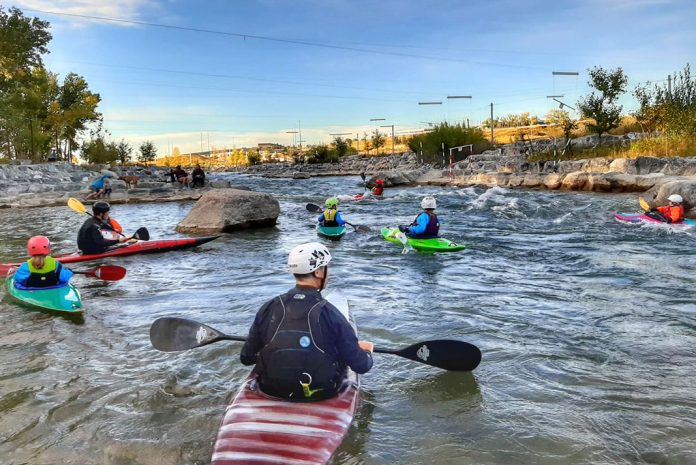
Harvie Passage is a popular spot for whitewater kayaking, right in Calgary. | Photo: Mike Holroyd // @mholroyd
With scenic mountaintops on the horizon and crystal-clear waters close at hand, kayaking in Calgary is full of enchantment. Both lakes and rivers are easily accessible within or just outside the city, offering both flatwater and whitewater experiences that will please paddlers of a range of skill levels.
Bring your own equipment or rent from one of the many local outfitters. Take guided tours and lessons to get the most out of paddling in the area and improve your skills. With a wide range of paddling options and undeniably incredibly scenery, any kayaking trip in Calgary is bound to be unforgettable.
Read on to discover everything you need to know to make it happen.
Harvie Passage is a popular spot for whitewater kayaking, right in Calgary. | Photo: Mike Holroyd // @mholroyd
Places to kayak in Calgary
Find the perfect place to launch your kayak in or near Calgary among the pristine waters of the lakes and rivers below.
Lake kayaking Calgary
Lake and reservoir kayaking options are plentiful in Calgary, but even more expansive for those who are willing to travel a few hours outside the city. Regardless of your experience level, Calgary and the surrounding area has something to offer everyone.
Barrier Lake
Located an hour west of Calgary, Barrier Lake is worth the drive for the chance to kayak on tranquil, blue waters and be surrounded by towering mountain peaks. This is actually a man-made reservoir, created by the hydroelectric dam found at the northeast end of the lake.
There are two access points. The first is at the Prairie View Trail Parking area near the dam; however, this launch is not recommended as it requires descending steep terrain to reach the water. The second is a parking lot located at the mid-point of the lake—look for signs for Barrier Lake Day Use Area on Hwy 40 to find the turn.
Because the lake is so long, windy days can result in big waves on the lake. Be aware of the weather and conditions before setting out.
Tandem and solo kayaks, hourly and daily rental rates
(403) 591-7000
Located at the Barrier Lake Day Use Area
Take it easy on the Glenmore Reservoir. | Photo: Nonie Heinrich // @nonieheinrich5775
Glenmore Reservoir kayaking
Experience nature without even leaving the city limits by kayaking at the Glenmore Reservoir, located on the Elbow River. Paddling here is a calm and enjoyable experience—a great way to get out on the water for a morning or afternoon. There are a few bylaws to be aware of, however, including the following:
Approved PFD must be worn while on the water (which you of course should be doing anyways)
Rental kayaks available at the reservoir on Wednesday evenings, 6 p.m. to 8:30 p.m.
(403) 288-9283
Chestermere Lake kayaking
You’ll find the calm waters and beach-like atmosphere of Chestermere Lake (or Lake Chestermere) 30 minutes east of Calgary. Don’t come here if you’re after quiet and seclusion—many houses back onto the lake and the beach area can get quite busy in the summertime. Instead, this a great urban paddling experience and will allow you to get some beach-time and paddling-time in during your stay in the area.
Tandem and solo beach kayaks, solo sit-inside kayaks
(403) 277-9118
109 E Chestermere Dr, Chestermere
Chestermere Lake offers leisurely paddling in an urban environment.
Sibbald Lake
Take an hour drive west of Calgary to reach Sibbald Lake, a small mountain lake that is a great spot for a half-day paddle. There’s a campground located on-site, but it’s located so far off the beaten path you should be able to experience relative seclusion paddling here.
There’s no boat launch or beach located here, so you’ll need to scout for the best place to launch your kayak along the shore yourself.
Sibbald Lake kayak rentals
There are no kayak outfitters located at Sibbald Lake. See rental section below for outfitters in Calgary.
Ghost Reservoir
Located just west of Cochrane on the Bow River, the Ghost Reservoir is a great location to go for a lazy afternoon paddle. It extends for 10 km and is approximately 1.5 km wide, allowing you to spend quite a bit of time exploring its waters and gazing at the not-too-distant Rockies.
There are two access points to the reservoir, on either side of the Bow Valley Trail on the west side of the Bow River: south launch and north launch.
Be aware that it can get quite windy here and waves may make paddling unsafe. As well, it’s worth noting that this lake has a lot of motorboat and sailboat activity.
Ghost Reservoir kayak rentals
There are no kayak outfitters located at Ghost Reservoir. See the kayak rental section below for outfitters in Calgary.
With the Bow and Elbow rivers running right through Calgary, you’ll have great flatwater and whitewater river paddling options at your doorstep. However, the surrounding area is home to many lesser-known rivers, which also provide ample river running opportunities.
Elbow River kayaking
Flatwater paddling on the Elbow River extends from the Glenmore Reservoir to the confluence with the Bow River. In the summer, this section is often congested with inner tubes and rafts enjoying this slow-moving waterway. Spring or early summer is the best time for kayakers to go for an excursion, as water levels will be higher.
There are several access points along the river, depending how long of a trip you want to take. Find them below:
Choose from flatwater sections of the Bow River within or outside Calgary city limits. Sections through the city will give you a great urban paddling experience, allowing you to glimpse a variety of neighborhoods and greenspaces. Beyond the city, the best paddling sections are located upstream. Take your pick from a variety of access points, and plan a trip that’s the right length and difficulty level for you.
Kayak right through Calgary on the Bow River. | Photo: The Paddle Station
Whitewater kayaking Calgary
Highwood River kayaking
Originating in Peter Lougheed Provincial Park in the Rockies, the Highwood River flows east until joining with the Sheep River and then entering the Bow River southeast of Calgary. Along the way, there are several exciting sections for whitewater enthusiasts to enjoy.
Find information on four class II to IV routes below:
There are no kayak outfitters along the Highwood River. See rental section below for outfitters in Calgary.
Bow River whitewater kayaking
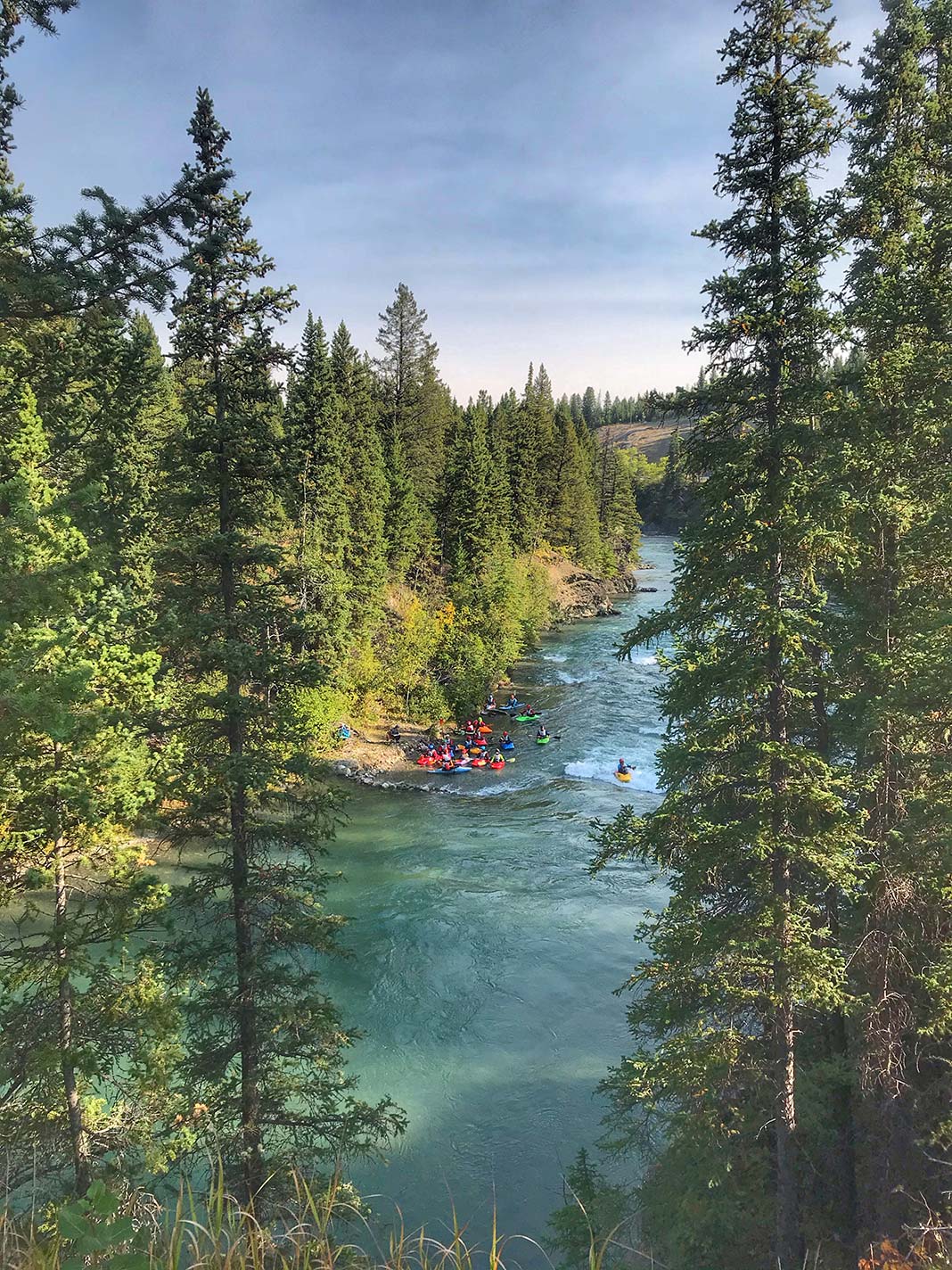
The best whitewater kayaking along the Bow River (that’s in the Calgary area—there’s more on offer in the Banff area) is at Harvie’s Passage, located in the middle of the city. There are two channels paddlers can choose to take. Beginner and early level intermediate paddlers should take to the right channel, where they’ll find class II rapids.
The left channel has class III/IV rapids and should only be paddled by experienced whitewater kayakers. Park at Pearce Estate Park and walk the trails to the put-in at the top of the channels. The take-out is just after the channels on river right, where you can walk the trails back up to the put-in and parking area.
Whitewater paddling package includes kayak, PFD, paddle, throwbag and bailer
(403) 202-8490
1975 26 Street SE, Calgary
Enjoying the slalom course on the Kananaskis River. | Photo: Nolan Hindmarsh
Sheep River kayaking
Experienced whitewater paddlers are in for a treat in both rapids and scenery along the Sheep River. Choose from a class II run through a canyon or a class IV/V run (note that the class V rapids can easily be walked and in between are fun sets of class II/III) with waterfalls and ledges.
There are no kayak outfitters located along the Sheep River. See rental section below for options in Calgary.
Kananaskis River kayaking
Enjoy class II and III sections of whitewater on the Kananaskis River. The class III route has great variety for river runners, creek boaters and playboaters. There is also a racecourse section with a national level slalom training course.
There are no kayak outfitters located along the Kananaskis River. See rental sections below for options in Calgary.
Whitewater fun on the Kananaskis River. | Photo: Natacha Labonte // @misslollipopthevan
Elbow River
While the Elbow River runs at a lazy pace through Calgary, there are many fun class II to class IV sections west of the city. You can choose to go for a short paddle or link several of the sections together for a longer run.
You can find more information about the sections below:
There are no whitewater kayak outfitters along the Elbow River. See the rental section below for options in Calgary.
The Paddle Station rents kayaks and rafts for easy paddling trips along the Bow River. | Photo: The Paddle Station
Kayak rentals in Calgary
For those looking to try kayaking for the first time or those who are unable to transport their boat to the area, there are ample kayak outfitters in and around Calgary. Find a list of all of them below.
Aquabatics
Aquabatics‘ Calgary location offers a range of kayak rental packages, including solo recreational, tandem recreational and whitewater kayaks. Their knowledgeable staff are also able to help with trip planning and provide paddling advice for the area. You’ll need to pick up and drop off rentals at the store. However, Aquabatics does provide kayak rentals on Wednesday evenings at the Glenmore Reservoir.
Sports Rent offers tandem and solo recreational sit-inside kayaks. You’ll need to visit their store to pick up and drop off equipment, located across the Trans-Canada Hwy from the Bow River.
The Paddle Station makes it easy to paddle the Bow River. They rent singe and tandem sit-on-top kayaks. Reserve your watercraft online, and simply meet them at the put-in at Shouldice Park. From there, you’ll paddle two to three hours down the Bow River, ending at St Patrick’s Island.
Rocky Mountain Paddling Centre rents whitewater and recreational kayaks. Additionally, you can rent equipment such as sprayskirts, booties, and drybags. Book your gear online and pick up from their location on the Bow River.
Address: 1975 26 Street SE, Calgary Phone: (403) 202-8490
Hyperactive Watersports rents tandem and solo beach kayaks, and solo sit-inside kayaks. They are located on Chestermere Lake, making it easy to get out on the water.
Address: 109 E Chestermere Dr, Chestermere
Phone: (403) 277-9118
Kananaskis Outfitters
Kananaskis Outfitters rents tandem and solo kayaks on Barrier Lake, making it easy to get out on the water.
Location: Barrier Lake Day Use Area Phone: (403) 591-7000
It doesn’t get much more beautiful than paddling on the Kananaskis River. | Photo: Mike Holroyd // @mholroyd
Kayak stores in Calgary
If you take to kayaking in Calgary, there are plenty of places to purchase a boat of your own. Find a variety of types of kayaks from a range of brands at the retailers below.
Aquabatics
Aquabatics sells whitewater kayaks, fishing kayaks, sea kayaks, and recreational kayaks, including inflatable and hard-shell, solo and tandem, and sit-inside and sit-on-top models. Brands include Wilderness Systems, Old Town, Perception, Delta and more.
Campers Village sells touring kayaks, recreational kayaks, and fishing kayaks, with options for inflatable and hard-shell, and sit-inside and sit-on-top models. Brands include Wilderness Systems, Old Town, Aquaglide and more.
Address: 7208 Macleod Trail SE, Calgary Phone: 1-888-231-4753
MEC
MEC sells touring, recreational, and whitewater kayaks, both inflatable and hard-shell. Brands include P&H, Riot, Pyranha and more.
Shop TRAK’s line of touring kayaks and paddling accessories at their Airdrie location, north of Calgary.
Address: 2966 Main St S #105, Airdrie Phone: (403) 723-0077
Fun for all ages on the Kananaskis. | Photo: Mike Holroyd // @mholroyd
Learn to kayak in Calgary
Learn how to kayak or improve your skills while in Calgary. Choose from among the reputable operators below.
Aquabatics
Aquabatics offers a range of kayaking lessons and courses. Choose from rec and touring kayak courses and whitewater kayaking courses, for beginner, intermediate and advanced paddlers. Their expert instructors will teach you everything you need to know and craft an enjoyable experience that suits your skill level and goals.
[ Paddling Trip Guide: View all of Aquabatics’ kayak courses and clinics in Alberta ]
University of Calgary
The University of Calgary offers recreational, river and sea kayaking courses taught by Paddle Canada-certified instructors. Introductory flatwater courses take place at Bowness Park, with whitewater instruction occurring at Harvie Passage.
Email ocprograms@ucalgary.ca for more information.
Rocky Mountain Paddling Centre
The Rocky Mountain Paddling Centre offers introductory flatwater courses through to advanced whitewater courses on the Kananaskis, Bow, Elbow, Red Deer and Highwood rivers. They also provide rescue and instructor certification courses.
Address: 1975 26 Street SE, Calgary Phone: (403) 202-8490
Taking a guided kayaking trip can greatly enhance the experience, providing you with insight into your natural surrounds, the history of the area, and tips for better paddling technique.
The Paddle Station
The Paddle Station offers the option to add an experienced guide onto their paddling trips down the Bow River.
Most rental outfitters will only be open from May to September in Calgary, the prime months for paddling. Be aware that flow rates will be higher in the spring and may not be suitable for beginner paddlers, depending on the river. Likewise, water levels will be lower in the fall, making some routes impassable for kayaks.
While lakes in the area freeze over in the winter, the Bow and Elbow rivers rarely do and some avid kayakers still paddle through the snowy months.
Planning an ice-out paddling trip? Watch this video first.
In this 30-minute video, seven hardy volunteers from a variety of different industries plunge into icy cold water to learn how to survive potentially deadly falls overboard.
Under the watchful direction of Dr. Gordon Giesbrecht, Professor of Thermophysiology at the University of Manitoba, a safety crew stands by to ensure the wellbeing of participants. This ‘safety net’ significantly reduced or even eliminated the fear and panic that a regular boater would experience in a real cold water immersion. The knowledge, fitness levels and safety net, led to an expectation that these boot campers would outperform the average boater in this difficult situation. Even so—all eventually experienced swim failure.
The key to survival in cold water immersion is wearing a lifejacket whenever you are on or near the water. The goal is to keep your head and face out of the water while you either try to rescue yourself or wait for rescue to arrive. Wearing immersion protection, like a wetsuit or drysuit, increases your chances of survival.
The video also details the 1-10-1 principle, which is a simple way to remember the first three phases of cold water immersion and the approximate time each phase takes:
LearnThe 1-10-1 principle
1 – Cold Shock.
An initial deep and sudden Gasp followed by hyperventilation that can be as much as 600-1000% greater than normal breathing. You must keep your airway clear or run the risk of drowning. Cold Shock will pass in about 1 minute. During that time concentrate on avoiding panic and getting control of your breathing. Wearing a lifejacket during this phase is critically important to keep you afloat and breathing.
Over approximately the next 10 minutes you will lose the effective use of your fingers, arms and legs for any meaningful movement. Concentrate on self rescue initially, and if that isn’t possible, prepare to have a way to keep your airway clear to wait for rescue. Swim failure will occur within these critical minutes and if you are in the water without a lifejacket, drowning will likely occur.
1 – Hypothermia.
Even in ice water it could take approximately 1 hour before becoming unconscious due to Hypothermia. If you understand the aspects of hypothermia, techniques of how to delay it, self rescue and calling for help, your chances of survival and rescue will be dramatically increased.
Learn more about the dangers of cold water immersion and how to survive at Cold Water Boot Camp.
Nature is close at hand in Victoria. | Photo courtesy of: Destination BC // Reuben Krabbe
Victoria, B.C. is perched on nature’s edge, with easy access to a paddler’s paradise in the Gulf Islands of the Salish Sea and the mountain lakes of interior Vancouver Island. Victoria is a quaint city with a small town vibe, yet with all the amenities you’d expect in a provincial capital. Aside from great sea kayaking and standup paddleboarding, local attractions include camping, hiking, beachcombing and so much more. Once you arrive in Victoria you’ll only wish you had more time to stay.
Victoria is located on the southeastern tip of Vancouver Island, adjacent to the beautiful Gulf Islands and within a short BC Ferry ride from the mainland in Vancouver (Tsawwassen). The city is serviced by several vehicle ferries per day arriving at Swartz Bay, north of downtown. You can also get here via ferry service from Seattle and Port Angeles, Washington. Make Victoria your home base for this itinerary of adventurous things to do.
Tourism in Victoria is all about great sea kayaking. The city is located on the edge of the Pacific Ocean, with many options for paddlers to explore, including Oak Bay and the Sidney waterfront, and near the ferry terminal at Swartz Bay. Regular BC Ferries routes service the Gulf Islands, allowing you to experience the unique near-Mediterranean climate and sandstone shorelines of places like Saltspring and Gabriola islands. If you’re looking for a local kayak trip you can easily spend a week or more tracing the Gulf Islands, camping along the way. Guided day trips and multi-day trips are available in Victoria and throughout the Gulf Islands. Check out our Ultimate Kayaking Guide to Victoria for more information.
Hiking is one of the most popular things to do in Victoria. You’ll find amazing hikes along the ocean’s edge and into the mountainous interior of Vancouver Island, all within close proximity to the capital city. Here are a few favorites.
Galloping Goose Trail
This 60-km path for walking, hiking and cycling connects North Saanich and Swartz Bay to Victoria and Sooke, following parts of an old railway line. Highlights of this scenic part of Canada’s Great Trail include the Selkirk Trestle, the Todd Trestle and Thetis Lake Regional Park.
Easily accessible from the Trans-Canada Highway’s Millstream/Sooke exit, this wilderness park features a challenging hike to one of the highest points in the area. In April you’ll be surrounded by spring wildflowers on the trail as you enter mature stands of Douglas fir. From the summit of Mount Wells you’ll enjoy stunning views of Victoria and the Strait of Juan de Fuca. Plan on two hours to complete the 3-km round trip.
Want to hike to a waterfall? Check out Goldstream Provincial Park, located only a half-hour drive from downtown Victoria (public transit is also available via bus route 50). The 3-km Upper Goldstream Falls trail is rated easy, following the route to a stunning waterfall. Check out Goldstream Provincial Park for great camping (and several other hiking trails).
Victoria has more than its fair share of great beaches. The city is practically surrounded by the Pacific Ocean, and you’ll find great swimming at places like Gonzales Beach, Esquimalt Lagoon and Cordova Bay. Island View Beach Regional Park, located just north of the city proper, features a great campground. Swing by to capture Victoria’s best sunset for your Instagram feed. Check out Tourism Victoria’s interactive map for more great sun and sand destinations.
Don’t forget to bring your bike! Victoria is a fantastic cycling town, with plenty of options for getting around the urban core or setting out on a longer ride. Several local companies offer bike rentals and guided tours, including The Pedaler (321 Belleville St, 778-265-7433).
Galloping Goose Trail
Cycling is a great way to explore this reclaimed railway line that connects several suburbs and passes through a scenic natural corridor of West Coast forest. You’ll love the scenic trestle crossings and appreciate the gentle grades, which make the Galloping Goose suitable for everyone.
Bear Mountain
Home to the Canadian national mountain bike team, Bear Mountain features Victoria’s best mountain biking, including beginner-friendly single-track, a flow trail for intermediate riders and challenging single-track. The area is located north of Langford and offers mountain bike rentals.
Lochside Trail
This designated recreation route connects downtown Victoria to Swartz, tracing the coastline. The 29-km path is paved and suitable for touring bicycles, with plenty of opportunities to stop for lunch at a cafe along the way.
Victoria is an outstanding destination for whale watching, with orca, gray, humpback and minke frequenting offshore waters. You will also see sea lions, seals and porpoises. Some of the best whale watching tours include Eagle Wing Tours (1 Dallas Rd, 250-384-8008); Prince of Whales Adventures (812 Wharf St, 250-383-4884); and Orca Spirit Adventures (950 Wharf St, 250-383-8411).
Looking for something unique to do? Sign up for a half-day or evening sailing adventure on a bona fide tall ship with 3-Hour Sail (780 Government St., 250-885-2311). Daily departures sail from the Victoria harbour throughout the summer.
No visit to Victoria is complete without a trip to renowned Butchart Gardens, one of Canada’s finest botanical showpieces full of tranquil arrangements and pleasant scents. This 55-acre garden is open year-round with trails, events and dining.
Looking for outdoorsy or paddler-friendly restaurants? Here’s a selection of the best restaurants in Victoria.
Boom and Batten
To taste the coast, make a reservation at Boom and Batten (2 Paul Kane Pl, 250-940-5850) and order from a menu that’s locally made. This downtown restaurant has a great view of the Inner Harbor.
The Beach House
There’s no better way to end a great day at Victoria’s fabulous Cordova Beach than to indulge in a great meal at The Beach House (5109 Cordova Bay Rd, 250-658-5224). Choose from a diverse, family-friendly menu at this beachfront restaurant and cafe and enjoy the laid back, casual atmosphere—with a great view of the water.
Marina Dockside Eatery
Oak Bay is a great place to paddle in Victoria and Marina Dockside Eatery (1327 Beach Dr, 250-598-3890) is one of the best restaurants for kayakers and paddleboarders to refuel after a session on the water. Enjoy “oceanfront casual” dining and rub shoulders with mariners and cyclists over a homemade lunch.
Victoria Accommodation
As British Columbia’s capital city, you’ll find no shortage of accommodation options in Victoria. Here are some choices tailor-made for outdoors enthusiasts and paddlers.
Victoria Camping
Camping is a perfect option for adventurous travellers, paddlers, and nature lovers. The best local camping gives you access to all the wonders of the city and the outdoors. In and around Victoria you’ll find stunning beach camping, family camping, RV camping and wild camping for kayakers and paddleboarders. Click here to Discover the Best Camping in Victoria.
A quick scan of AirBnB reveals many great waterfront cabin rental options for paddlers in the Victoria area. We’ve included three highlights below. Check out our story about the best cabin rentals on Vancouver Island for a comprehensive overview.
Studio at French Beach
This cozy Victoria cabin for couples is a real bargain, located near Sooke on a large, private property with quick access to great beaches and hiking trails. The 240-sq-ft cabin includes a full bathroom and all you need to prepare your own meals.
This cabin rental is set on the shore of Lake Cowichan, a freshwater jewel on southern Vancouver Island, a short drive from the town of Duncan. Crystal-clear water is great for paddling and the cabin sleeps five comfortably with two bathrooms. This sun-soaked region is noted to have the warmest climate in all of Canada.
This treehouse rental is located five minutes from Sooke. The stunning wooden tree cabin features a sleeping loft and plenty of deck space to enjoy the views. It’s located on the Galloping Goose Trail for hiking and biking and close to some of the area’s best beaches, with plenty of options for launching a kayak or paddleboard nearby.
Here are some of the best Victoria hotels that will appeal to the adventurous.
Spinnakers Guesthouses
Spinnakers (308 Catherine St, 250-386-2739) offers eat, drink and stay packages with accommodations available in several guesthouses. Canada’s oldest brewpub makes fantastic beers and arranges stays in Victoria garden suites and a heritage house.
One of Victoria’s finest luxury boutique resort, the Oak Bay Beach Hotel (1175 Beach Dr, 250-498-4556) is located right on the ocean, making a great upscale hotel for paddlers. You’ll find luxurious rooms, great dining and an on-site spa. Book a room online.
Located downtown and in close proximity to the waterfront, the Turtle Hostel (1608 Quadra St, 250-381-3210) claims the title of Victoria’s cheapest accommodations. It’s also one of the most whimsical places to stay if you’re looking to save money, be comfortable and have fun. A variety of room options are available, from dorm to private.
Map of Victoria
The best map of Victoria is interactive and available online from Tourism Victoria.
Victoria boasts one of the nicest climates in Canada, with early springs (making the city a great destination to catch Canada’s first blooming flowers), moderate summer temperatures with little humidity and infrequent rainfall, and temperate winters. For local weather forecasts you can rely on Environment Canada for accurate hourly forecasts; comprehensive five-day forecasts from Windy.com; and a 14-day trend from the Weather Network.
Nature is close at hand in Victoria. | Photo courtesy of: Destination BC // Reuben Krabbe
Kayak Tofino with the experts or plan a trip of your own. | Photo courtesy of: Tourism Vancouver Island // Jordan Dyck
Located in the heart of the wild Pacific Ocean coast, the town of Tofino is the launching point for some of the best kayak trips on Vancouver Island. This vibrant town is a three-hour drive on Highway 4 from the BC Ferries terminal in Nanaimo, making it a great destination for a weekend or a weeklong paddling vacation.
Beginner kayakers and families can launch from town and explore sheltered waters with professional naturalist guides, learning more about the unique marine and rainforest ecology. If you’re looking for an overnight or multi-day trip you’ll find kayaking options to explore the open waters of Clayoquot Sound—self-guided or with the expertise and all-inclusive comfort of a guided tour. Tofino is also the starting point for more advanced kayak expeditions, as well as a great place to kayak surf in some of the best waves on the West Coast. Here’s your guide to the best kayaking in Tofino.
Kayaking in Tofino is focused on amazing Clayoquot Sound, whose waters transition from island-sheltered passages where old-growth rainforests meet tidal flats to rocky headlands and surf-swept open coast. This magical seascape has something for everyone.
Meares Island Half-day Trip
This all-inclusive, beginner-friendly, four-hour Tofino kayak tour includes encounters with marine life and a visit to the towering old-growth cedar forest of Meares Island. Local guides will share their knowledge of the area and provide an immersive experience in one of Canada’s wildest destinations. Want to do it yourself? Tofino Sea Kayaking also provides rentals, route planning and accommodations for paddlers.
Venture into the Pacific Ocean waters off of Tofino with Paddle West Kayaking to explore the islands and inlets of Clayoquot Sound on a six-hour, all-inclusive day tour. Depending on conditions, you’ll visit the immense sand beaches of Vargas Island or trace the intimate, rainforest-clad waters of Lemmens Inlet, with spectacular views of the mountains. Suitable for all levels of paddlers, this is a Vancouver Island kayak tour you’ll never forget.
On this unique guided Tofino kayak tour you’ll travel aboard a mothership to the tidal beaches of Clayoquot Sound. Then you’ll launch in kayaks along with a naturalist guide to have intimate encounters with black bears feeding along the shoreline. The half-day tour will leave you mesmerized with the wild nature of Vancouver Island.
This amazing Tofino kayak tour focuses on Vargas Island, located on the edge of Clayoquot Sound. There’s some open water, tidal currents and the potential for wind and swell, so as a do-it-yourself adventure this overnight, 16-km tour is best for intermediate paddlers. Beware of boat traffic and seaplanes when crossing from Tofino to the southern shore of Vargas. From there you can circumnavigate the islands clockwise or counterclockwise, depending on the wind. You’ll find outstanding sand beach campsites at Ahous Bay.
Beaches and Rainforests: The Best of Clayoquot Sound
This three-day Vancouver Island kayak tour, organized and guided by the experts at Hello Nature, explores magical Clayoquot Sound. You’ll encounter towering Sitka spruce forests and some of the finest beaches on the West Coast, while enjoying expert leadership from trained naturalist sea kayak guides. Meals and kayak rentals are included; the tour starts and ends in the town of Tofino.
Clayoquot Sound 4-day and 6-day tours
Majestic Ocean Kayaking offers four- and six-day guided kayak tours of Clayoquot Sound, departing from Tofino. You have the potential to see humpback, grey and Orca whales, as well as bears, wolves and a variety of shorebirds. The all-inclusive tours feature professional guides and gourmet meals, as well as instruction and nature interpretation to provide a more intimate kayaking experience.
Another great Vancouver Island kayak route heads north from Tofino, through the islands of Clayoquot Sound to Hot Springs Cove. There are several variants to this trip, depending on your skill and experience in paddling the open coast. Expert paddlers will revel in testing their skills on the open coast of Flores Island, which features tidal currents and exposure to large swells; intermediates can follow the more sheltered channels on the inside of the island. Regardless, your reward is a soak in a natural hot spring. Plan on a seven-day tour.
Tofino is Canada’s surf capital and it’s a bucket list destination for rough water kayakers. You’ll find great waves for whitewater and sea kayaks at Chesterman’s Beach and Cox Bay, as well as numerous spots along the 16-km expanse of Long Beach. Parks Canada provides an overview of hazards; always paddle within your limits and be aware of other surfers and rip currents.
There are plenty of options for Tofino kayak guides. Here’s a comprehensive overview of outfitters in Tofino and nearby Ucluelet.
Tofino Sea Kayaking
This kayak guide has been leading tours in the Clayoquot Sound area since 1988. Tofino Sea Kayaking is based on the waterfront (320 Main St, 250-725-4222) and offers half-day, full-day and multi-day tours, as well as instructional courses. Accommodations are available through the Tofino Paddler’s Inn.
Paddle West Kayaking
Paddle West Kayaking has offered guided day trips and multi-day kayak tours from locations in Tofino (606 Campbell St, 250-725-3232) and Ucluelet (168 Fraser Lane, 250-726-7444) since 2001. Tours range from a 2.5-hour night kayak tour to a 3-day tour that takes in all the highlights of Clayoquot Sound.
Ucluelet kayak guide Hello Nature (200 Hemlock St, 250-726-2035) offers a wide variety of Vancouver Island kayak tours in the Broken Group Islands of Pacific Rim National Park. Suitable for paddlers of all levels, some unique options include kayak and yoga half-day tours, bioluminescence tours and overnight and multi-day glamping kayak trips.
Tofino’s Black Bear Kayak (390 Main St) provides kayak tours ranging from 2.5 to 8 hours long for all levels of paddlers, including families and beginners. You’ll encounter stunning seascapes and remarkable biodiversity. Black Bear also offers mothership-supported day trips and wildlife viewing excursions to unique locations.
Remote Passages Marine Excursions
Remote Passages offers daily sea kayak tours April through October, departing from their waterfront location in Tofino (51 Wharf St, 250-725-3330). You’ll float beyond the busy harbour and into the wilderness of Clayoquot Sound, experiencing some of the most spectacular rainforest on the West Coast and a variety of marine life.
Kayak tours are among the many nature-based programs offered by Tofino’s Ocean Outfitters (368 Main St, 250-725-2866). The company offers half-day and full-day tours, exploring secluded passageways where you may see black bears and bald eagles, among other wildlife.
Ucluelet-based Majestic Ocean Kayaking (1167 Helen Rd, 250-726-2868) offers kayak trips and guided tours to the Broken Group Islands of Pacific Rim National Park. One-day tours and multi-day expeditions are available throughout the summer, as well as unique glamping kayak trips. Broken Group boat shuttles can also be arranged for self-guided groups.
Kayak Rental Tofino
You have several options for renting sea kayaks and recreational equipment in Tofino and the nearby town of Ucluelet.
Paddle West Kayaking
Paddle West Kayaking provides high quality rental kayaks in two West Coast locations: Tofino (606 Campbell St, 250-725-3232) and Ucluelet (168 Fraser Lane, 250-726-7444). Experienced paddlers can rent a kayak and set off on their own adventure.
Tofino Sea Kayaking
Tofino Sea Kayaking (320 Main St, 250-725-4222) offers rental single and tandem kayaks for day trips, overnight and multi-day tours from its location on the town’s waterfront.
Located just south of town on MacKenzie Beach, Tofino Paddle Surf (1119 Pacific Rim Hwy, 250-244-6399) rents single and tandem inflatable kayaks with reservations available online. Standup paddleboards are also available.
This Ucluelet business (180 Main St, 250-920-9020) maintains a fleet of rental single and tandem kayaks, in conjunction with a boat shuttle service to the Broken Group Islands of Pacific Rim National Park.
Kayak Shop Tofino
Tofino Paddler’s Inn
Check out the small yet well-equipped retail shop at the Tofino Paddler’s Inn (320 Main St, 250-725-4222) if you’re looking for kayak and standup paddleboard gear and accessories. Operating in conjunction with Tofino Sea Kayaking, you’ll find all the guide-recommended gear for your Tofino kayak camping trip.
Kayaking Near Tofino
Besides Clayoquot Sound, there are plenty of other outstanding places to kayak near Tofino (and all across Vancouver Island for that matter—check out our Ultimate Guide to the Best Kayaking on Vancouver Island). Discover great spots to paddle close to Tofino, including the town of Ucluelet (located less than an hour to the south) and the Broken Group Islands.
Ucluelet Harbour Half-Day Trip
Sign up for this guided half-day tour with Majestic Ocean Kayaking to experience the quaint West Coast town of Ucluelet from its sheltered harbour. The tour includes all gear and expert guides, and it’s suitable for all levels of paddlers and families.
Experience a stunning collection of wilderness islands with rich cultural heritage and amazing marine life on this five-day guided kayak tour with the professionals at Hello Nature Adventures. The Broken Group is one of the best spots to kayak on Vancouver Island, and you’ll enjoy experienced guides and great backcountry meals on this tour, which includes a water taxi to start and finish. You may encounter a wide range of wildlife, including gray whales, sea lions and over 200 species of shorebirds.
Looking for a more luxurious kayak camping experience? Check out this four-day lodge-based guided kayak tour in the Broken Group Islands. Your Majestic Ocean guides organize all the details and supply expert leadership, with a keen eye on safety. Aside from great paddling you’ll enjoy the luxury of soft beds and hot showers on this all-inclusive wilderness trip.
Tofino Canoe Tours
Clayoquot Sound is the traditional homeland and spiritual centre of the Indigenous Nuu-chah-nulth, with the canoe being a central piece of their cultural identity. To learn more about coastal canoeing check out Tashii Paddle School (250-725-2169), which offers canoe tours of Meares Island and Clayoquot Sound. Their beautiful, 22-foot cedar dugout canoe was crafted by a master carver, and the company is owned and operated by members of a local First Nation.