Home Blog Page 30

How To Choose The Right Kayak Paddle

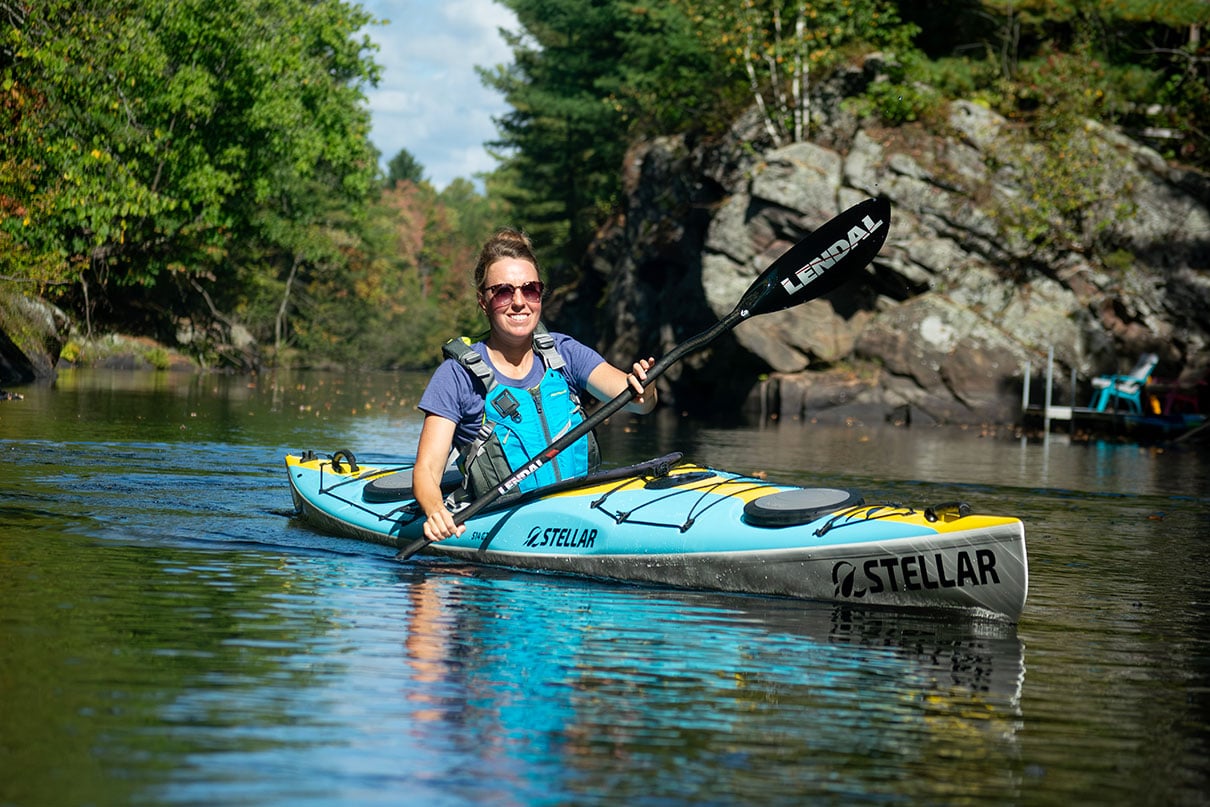
Kayaker with a low-angle paddle on Georgian Bay
Kayaker with a low-angle paddle on Georgian Bay. | Feature photo: Nicholas Spooner-Rodie

Here’s a wild fact: Kayakers take thousands of strokes every hour. So while picking a kayak paddle may seem as easy as grabbing something with two blades to propel you through the water, it’s actually one of the most important pieces of gear to consider. Having the correct information to help you choose a paddle is key because if your gear doesn’t suit you it will likely end up in the corner of the garage, collecting dust with disuse because it was so uncomfortable to use.

Above all else, you want a paddle to be the right length, and along with this, the appropriate blade shape is incredibly helpful. Once you have those factors squared away, there are a number of options for the materials the paddle is made of and the construction of the shaft. To break it down, here’s a reasonable hierarchy of what to consider:

  • Kayak paddle size: What length kayak paddle you choose depends largely on two factors: your height and the width of the boat.
  • Paddle blade shape: This selection is nearly simultaneous with focusing on the size of the kayak paddle. Different blade shapes work best with different types of kayaks and paddling styles.
  • Paddle material: Kayak paddles are made from plastics, composites, and even wood. Each has its own attributes and costs.
  • Shaft construction: Most of us get into kayaking with the idea a paddle is a straight tube with two blades attached at the end. There are more options to be described below.

From blade shapes, to kayak paddle sizing and construction materials, below you’ll finder a deeper dive into all you need to help you choose.

The anatomy of a kayak paddle
The anatomy of a kayak paddle. | Photo: Joe Potoczak

The two most important factors when deciding how to choose a kayak paddle

1 Paddle length

If you want one piece of information to walk into an outdoor store and make a pick, it is to consider what size kayak paddle to buy. This is because you want to effectively and comfortably reach the water, and this depends a great deal on the relation between the paddle length, your height, and the type of kayak you’re paddling.

For example, recreational kayaks and fishing kayaks are designed to be stable and so are often built wide, while touring kayaks are longer and narrower for more speed. A wider kayak means you’ll need a longer paddle, while for a narrower kayak, you can, and would probably prefer, a shorter paddle. Paddle length is also influenced by blade shape and vice versa, which will be covered later.

Kayak paddle size chart

The best way to figure out what size paddle you need is to follow the sizing charts of the paddle brand you are considering, such as Werner or Aqua Bound. These size recommendations, at the least, consider your height, the width of the kayak, and what style of paddle blade you’ll be using.

A paddle isn’t like a pair of shoes—there is room to use some variation when choosing a length. Once you have some experience the preference of your paddle size may change some. Overall these are the ranges you’ll be looking toward depending on kayak type and style:

  • Whitewater kayakers use high-angle blades and their paddle lengths generally fall between 190 to 200 centimeters.
  • Touring kayakers with a high-angle blade and boats under 25 inches wide should look toward paddle lengths between 200 and 215 centimeters. While kayaks over this width will use around a 220 to 230-centimeter paddle.
  • For touring kayaks under 23 inches and a low-angle blade, you’ll want to buy a paddle between 210 and 220 centimeters.
  • For touring and recreational kayaks 23 to 32-inches wide you will be looking for a paddle between 220 and 240 centimeters depending on your height.
  • For recreational kayaks and fishing kayaks over 32 inches wide, and for fishing kayaks with an elevated seat, a kayak paddle will be between 240 centimeters and as much as 260 centimeters long.
chart of correct paddle lengths for low-angle paddles by paddler height and boat width
Courtesy: Werner Paddles
chart of correct paddle lengths for high-angle paddles by paddler height and boat width
Courtesy: Werner Paddles
chart of correct paddle lengths for river running by paddler height
Courtesy: Werner Paddles
chart of correct paddle lengths for kayak fishing by paddle angle, kayak type, kayak width and paddler height
Courtesy: Werner Paddles

You may have noticed in the kayak paddle size charts that the paddle length not only depends on your height and the width of the kayak, but the factor of high- and low-angle paddle blades. This is something mentioned before. Different styles of paddling often call for different blade shapes and, with it, slightly different kayak paddle lengths.

High-angle blade, low-angle blade, wing blade, Greenland style kayak paddles
Left to Right: High-angle blade, low-angle blade, wing blade, Greenland style. | Photo: Virginia Marshall

2 Paddle shape

The shape of your paddle blade is crucially important as it determines how your paddle interacts with the water during each stroke. The kind of paddling you want to do will determine the appropriate blade shape and so you want to make this consideration in concert with choosing a paddle length.

High-angle blades

If a paddle is referred to as a high-angle blade, it means the paddle is designed to be held more vertically during a forward stroke, with one hand nearly over the other. The blades on high-angle paddles are shorter and wider. They usually have more total surface area than a low-angle blade, which translates to the potential to produce more powerful strokes as you pull the power face—the slightly concave side of the blade intended to face toward you—through the water. Just as this sounds, it also requires more physical output. The blades on high-angle paddles are shorter and wider. And, if you are using a high-angle paddle, you will also use a shorter paddle length than a low-angle blade as shown in the sizing chart.

whitewater kayaker paddling through small riffles
Whitewater kayakers choose high-angle kayak paddles because the shorter, wider blade provides both power and nimble strokes in rapids. | Photo: Scott Martin

Whitewater kayak paddles are always high-angle paddle blade shapes because of the maneuvering and aggressive strokes continually used. Touring paddles can have high-angle designs or low-angle blades, depending on paddling preference and width of your boat.

However, wider kayaks, especially what are called recreational kayaks and fishing kayaks, may be uncomfortable to take these vertical paddle strokes with. Fishing kayaks are an interesting topic though. As seat heights have increased, it means a more vertical paddle stroke can be taken. Because of this, even though a longer paddle is required to reach the water, blades for fishing kayaks can have a higher-angle shape.

Low-angle blades

Blades on low-angle paddles are more elongated and skinnier. Low-angle paddling means the paddle is held more horizontally, with your hands staying below your shoulders through your strokes. The spread-out surface area of the blade provides propulsion in a more relaxed paddling style. Referencing our charts, you’ll see you will use a longer paddle when using a low-angle blade. The reasons being, to reach the water beyond the side of a wide kayak, and, the angle of entry the blade makes into the water.

Touring kayaks and wide boats such as recreational kayaks are often paired with low-angle blades.

Picture this: you are sitting low in a seat, with the side of the kayak near your elbows. Your kayak is nice and stable, with some distance between you and the water. A slightly longer paddle, with an elongated blade provides much less effort to reach the water. The stroke of a low angle paddle uses more of a sweeping motion away from the boat, which wants to turn the kayak from side to side with each stroke, but recreational and touring kayaks have a keeled shape to their hull or a rudder which counteracts most of this to help you continue going straight as you paddle.

Less common shapes

Straight shaft, low-angle Aqua Bound paddle intended for touring
Straight shaft, low-angle Aqua Bound paddle intended for touring. | Photo: Virginia Marshall
Wing-shaped blade

The wing blade is designed with a deeply-concave, scooped power face, with the ability to increase the efficiency and power of a forward stroke. As the name wing suggests, these blades work by using the “lift” of the Bernoulli effect, similar to an airplane.

Wing blades are often used by competitive racers and may be uncomfortable for the recreational paddler who prefers more mellow, low-angle strokes. A number of experienced touring paddlers also enjoy the benefits provided by wing paddles, especially when you spend most of the day hammering away in a consistent heading.

Greenland paddles

Greenland paddles look nothing like other paddles you will find on the market. The slim wooden paddles used for centuries in Greenland are narrow and shaped like an airplane propeller. Their surface area spread across most of the paddle, instead of just at the ends. They are less common on store shelves but enjoyed for touring.

Advocates of this style of paddle like the high cadence that can be achieved, and the natural buoyancy of the paddle can make rolling a lot easier as the paddle rises to the surface of the water. If you are paddling in super choppy water however or using a lot of quick bracing or sculling strokes, you may prefer some of the wider blades described above to provide more control.


Additional factors for choosing a kayak paddle

Construction materials

Kayak paddles can have shafts made of everything from aluminum, composites, or wood, and paddle blades can be made of plastics, composites, or wood. Why all these differences? They all provide different attributes and, with it, various costs.

A collection of kayak paddle options on display at Oregon Paddle Sports
A collection of paddle options at Oregon Paddle Sports. Bottom left: Bending Branches aluminum shaft with plastic blades. Bottom right: Aqua Bound carbon shaft with fiberglass blades. Bottom row, second from right: Werner carbon shaft with carbon blades. | Photo: Joe Potoczak
Aluminum shafts

Aluminum paddle shafts fall at the lower end of the price and quality spectrum, and are often combined with plastic blades. They are cheap and can take a beating, making them a reasonable purchase if you are just getting into kayaking or need something to use once in a while. They are heavier though, and the shafts can flex and get bent. Aluminum shafts are usually attached to plastic blades.

Plastic blades

Plastic paddles are quite common due to their low cost. They can be made from various types of plastics including nylon or ABS, and are often attached to an aluminum or fiberglass paddle shaft.

Plastic paddles can vary in durability and performance, and often weigh a little more than composites. Some have more flex, which usually makes them more durable, but if they flex too much, this also equates to less effective paddle strokes. Other plastic blade have little flex, and can be more prone to break if the paddle takes a strike against rocks or becomes wedged between objects. Plastic blades are sometimes reinforced with composites, and these will provide more strength and stiffness than plastic alone.

Plastic blades are affordable and available at just about any store carrying kayaks. They are a good option for recreational paddlers, those storing a casually used boat at the cabin, short day trips or as a spare.

Fiberglass paddles

Fiberglass kayak paddles fairly light, and stiffer and more durable than plastic. Both the blades and shaft of paddles can be constructed of fiberglass. There are also mixed constructions, such as fiberglass blades with a carbon shaft. Mixed constructions provide a negotiation of cost and material characteristics. Fiberglass is a popular choice for kayakers, and there are plenty of paddlers who have the same fiberglass paddle they bought decades ago.

Fiberglass also provides a level of flex under strain that paddlers appreciate. The flex provides a bit of absorption and rebounds back to shape. Making it durable and taking some of the strain off your strokes.

Carbon fiber paddles

Carbon fiber is the most expensive and highest-quality material for a kayak paddle. Many experienced paddlers, especially in touring and whitewater, weigh the choice between carbon and fiberglass.

Carbon fiber is extremely light, and stiffer than fiberglass at a similar layup. The downside of carbon fiber, other than higher cost, is with its rigidness it is more brittle than fiberglass and sooner to reach a breaking point. This means you have to paddle with more care. The rigidity also equates to more strain on the paddler.

For high performance, the stiffness of carbon equates to the highest degree of energy transfer from paddler to water.

Wooden paddles

Those who prefer using a wooden kayak paddle love the increased flexibility, warmth and aesthetic. Compared to the above materials, wooden paddles do need a bit of upkeep, like sanding and varnishing. They can vary in weight, flex, price and other attributes depending on the kind of wood used. They are less common in stores these days, but you may find some options in your paddle shop or even a local builder.

Showing the inside of the adjustable ferrule system on a two-piece Werner Cyprus high-angle carbon paddle
Showing the inside component of the adjustable ferrule system on a two-piece Werner Cyprus high-angle carbon paddle. Notice the numbers to mark the degrees of offset, and the L to represent the visible range is for left-hand control. | Virginia Marshall

One-piece or two-/multi-piece

You’ll notice there are one-piece or multi-piece kayak paddles available. There are pros and cons to both options, especially as multi-piece paddles increase in quality.

different types of multi-piece kayak paddle are laid out on grass
Top to Bottom: Two-piece paddle with lever lock, Two-piece with button, and one-piece paddle shaft. Notice the center paddle is set at 0 degrees of feather. | Photo: Joe Potoczak

The main positive of a one-piece paddle is its solid construction, with blades and shaft securely glued together. This makes for a well-constructed paddle less prone to mechanical failure and without any wobbling or loose parts to paddle effectively without distraction. One-piece paddles however, are rarely adjustable. So whatever length and feather (explained in a moment) you buy it at, is what you have.

Multi-piece paddles often come as either two or four pieces. Multi-piece paddles used to be considered at the lower end of quality compared to a one-piece, but this has changed, especially for two-piece paddles. Today there are both the budget-friendly and the high performing versions. A breakdown paddle can be a good option for storage and transport purposes or to stow away as a spare.

The biggest positive to a multi-piece paddle is the adjustability they generally include. This can be multiple options of feather angle, or even a range of lengths you can use. The biggest negative is each joint marks a weak point, and the cheapest options will not be as sturdy as a one-piece.

Two-piece paddles join at their center by varying types of locking ferrule mechanisms ranging from buttons to levers. You can find both budget-friendly breakdown paddles as well as high-end ones—and the paddle materials and type of joints used will correspond with the cost. Some of the cheapest paddles available are two-piece aluminum shafts with metal buttons. And some of the most expensive are two-piece carbon builds with lever locks used by Olympic athletes.

Four-piece paddles tend to be used as options to pack down as small as possible. They may be chosen by paddlers using folding kayaks or packrafts—where packability is priority one, or to put in the back of any kayak as a spare.

Two-piece kayak paddle with adjustable length and blade feather
Two-piece paddle with adjustable length and blade feather. | Photo: Joe Potoczak

Paddle feather—also known as offset

So what’s the deal with this feathering we’ve been going on about? Feathering on a kayak paddle refers to the angle of the two blades in alignment with one another.

Some paddles have blades in complete alignment with one another, and others are feathered or offset. Why would the manufacturers of kayak paddles do something so deranged as put a twist in the kayak paddle? The simplest answer is to decrease resistance of wind on the paddle blade that is out of the water.

One-piece paddles are set permanently at a specific offset or feather. While many of the multi-piece paddles are adjustable to provide varying degrees of feather, and even adjust for left- or right-handed paddlers.

Beginner paddlers or those with a casual paddling style may find it easier to use a paddle with no or 0-degree feather. Similarly, many whitewater paddlers now use 0 degrees or somewhere between 10 to 45 degrees of feather, because less offset feels more natural to many during dynamic strokes and rolling. While touring kayakers, crossing open waters with high-angle paddle strokes, often use 45- all the way to 90-degree offset to cut through strong winds.

One of the reasons using a feathered paddle can be awkward is because it requires rotating your dominant wrist from one stroke to the next. This feels unnatural at first, but soon becomes an unconscious act. Some people with wrist ailments may find this painful, and may prefer a paddle without feather. But this can also be alleviated by loosening your grip—like taking your pinkies off the paddle—or by choosing the neutralizing effect of a bent shaft.

Comparing a straight shaft kayak paddle (foreground) with a bent shaft (background)
Comparing a straight shaft (foreground) with a bent shaft (background). | Photo: Joe Potoczak

Bent and straight shaft paddles

The majority of kayak paddles have straight shafts, but some have an option called a bent shaft. The intention of these bent sections is to let your wrists stay in a more neutral position while you paddle.

Although they are frequently pricier, for those who are kayaking for long distances or are prone to wrist pain and strain, a bent kayak paddle shaft can be a worthy investment. It’s a personal preference.


A few more options for kayak paddles

  • Each kayak paddle company largely has a standardized diameter shaft, however more have started offering smaller shaft options which are less fatiguing to hold and can be especially helpful if you have a smaller hand size.
  • Kayak blade designs are often offered in multiple sizes, and similar to height, these tend to be recommended for the size or strength of the paddler. Using a smaller to mid-size paddle blade while you are learning, regardless of your size or strength, helps build good technique and reduces strain and fatigue. Follow the guidelines of each brand’s blade sizes, and if in doubt, you’ll likely benefit from choosing the smaller blade option recommended.
  • If a kayak blade is described as dihedral, it means from a geometric standpoint the paddle technically has two power faces. If you hold a paddle straight out in front of you and look at the shape of the blade, a dihedral one will have a ridge at the center with two faces sloping slightly down from the middle The intention of this design is to minimize flutter or vibration during the stroke and allow your blade to better catch the water.
  • Some high-end carbon kayak paddles have a foam core blade. This means underneath the carbon layers is a foam material similar to the core of a surfboard. This allows the blade to have more volume and buoyancy without added layers of carbon, which some paddlers appreciate for performance. However, the tradeoff is the thin carbon layup can be dinged if your blade punches a rock.

Kayaker with a low-angle paddle on Georgian Bay. | Feature photo: Nicholas Spooner-Rodie

Inside Look: Spinera Kenai 130 (Video)

First founded in 2017 in Austria, Spinera is new to the United States market in 2024. The new Spinera Kenai 130 is an inflatable tandem kayak that folds up into a backpack for easy transport.

We caught up with Mike Mowrey from Spinera to hear more about the Kenai 130 at the 2024 Paddlesports Trade Coalition Colab.

A look at the Spinera Kenai 130

The Spinera Kenai 130 can be paddled either as a one-person or two-person inflatable kayak with adjustable seats that include both high and low position. Additionally the seats are able to be removed from the kayak completely, converting it from a tandem to a solo boat. According to Mowrey from Spinera, the welded-tube design of the Kenai 130 makes it durable and rigid as well as stable enough to stand up while kayak fishing and cast.

Foot pedals and foot braces can be added in, and a universal mounting plate makes the boat compatible with a variety of rod holders and other attachments. At about 38 pounds, the Kenai 13 packs into a backpack that makes it ultra-easy to transport. The fin box on the Kenai 13 is universally comparable with fins available at most retailers. Additionally, the Kenai comes with a repair kit and a dry bag.

Overall, the kayak is 13 feet long (3.8 meters) and 34.3 inches (87 centimeters) wide with a max payload of 639.3 pounds (290 kilograms).

Best Water Shoes For 2026

a perosn sits on a tailgate wearing Astral Loyak water shoes
The slick style and grippy tread of the Astral Loyak. | Photo: Astral Designs

Among the checklist of what to wear paddling, solid footwear is not to be overlooked. The best pair of water shoes will keep you on your feet carrying a kayak or paddleboard down steep trails and over slick rocks. They’re comfortable against footbraces for a full day on the water. Should you need to jump into action and rescue a fellow paddler, the right shoes provide the confidence for sure-footing without hesitation. And, as paddlers, our water shoes are often our footwear of choice on and off the water.

So, how do we find out which shoes meet the needs of paddlers? By wearing down the tread on as many as we can.

Best water shoes: Our top picks


Best water shoes overall

Astral Loyak shoes

A person sits on a tailgate wearing Astral Loyak water shoes.
The slick style and grippy tread of the Astral Loyak. | Photo: Astral Designs

$99 | astraldesigns.com

Buy from:

ASTRAL AMAZON BACKCOUNTRY REI

Why we love them

A minimalist and high-performance water shoe providing first-class grip and comfort? Yes, please. The adaptable Astral Loyak manages to do all the above while looking like a classy, casual sneaker. The Loyak is self-draining and dries quickly on the water or packs flat to slide on in camp. Its thin and super-grippy outsole promotes balance and ground feel—what the pros call proprioception.

Reasons to buy
  •  G.15 Rubber compound and Loyak tread provide confident “stickiness” on river bottoms
  •  Quick dry canvas with 3D airmesh upper
  •  Removable EVA midsole
  •  Minimal profile shoe fits well in most kayaks
  •  Stylish look fit for paddling and travel
Consider another if
  •  You need more substanial midsole support
  •  An open sandal is preferred
  •  You are looking for Astral’s stickier G.ss rubber compound

Bottom line

A sauve, low-profile design—the Loyak is a much-loved shoe.


Best sandals for all terrain

Chacos Z/1 Classic sandals

Paddling Magazine editor Joe Potoczak floats in an inflatable while wearing Chacos Z/1 Classic sandals for land and water activities.
Editor Joe Potoczak working hard in a pair of Chacos Z/1 Classics with custom Vibram outsole. | Photo: Raquel Bauer

$105 | chacos.com

Buy from:

CHACOS AMAZON BACKCOUNTRY REI

Why we love them

The Z/1 Classic from Chacos is a long-time favorite sandal for water or land in the outdoorsy crowd. First released in 1989, it’s not uncommon to hear folks boast of wearing their Classics for 20-plus years. With just a single buckle and one continuous piece of webbing, customizing fit is dead easy. But it’s the traction, durability and versatility that made this the standard for rugged hiking sandals. The stiff and heavy sole of the Z/1 Classic is boot-like in feel and takes some breaking in. No toe thong makes these sandals easy to pair with socks, if you must.

Reasons to buy
  •  Available in ChacoGrip or customized with Vibram outsole
  •  Open design lets the dogs breathe on summer days
  •  Beefy midsole for foot support
Consider another if
  •  You need the protection of closed-toe water shoes
  •  You prefer a low-profile sole
  •  You’re on the search for a paddling-specific shoe over a multi-sport sandal

Bottom line

If you own a pair of Chacos Z/1s, you already have a classic paddling sandal on your feet. The Z/1 has been a go to shoe choice for years and is just as at home on desert river trips as it is on afternoon paddleboard sessions.

Keen Newport Retro sandals

A pair of Keen Newport Retro water sandals sit on a dirt garage floor.
Protect those toes in sandal fashion with the Keen Newports. | Photo: Jennifer Quade

$130 | keenfootwear.com

Buy from:

KEEN AMAZON BACKCOUNTRY REI

Why we love them

Keen’s Newport sandals boast the support and protection of a shoe with the breathability and quick-dry nature of a sandal. The sole of these ultra-comfortable kicks offers good arch support on the topside and is ready to tackle any terrain underneath. Newports have a secure feel thanks to their lace-capture system paired with nylon webbing, and they last for years. No wonder they’re a favorite among paddlers. Keen’s signature toe cap offers little piggies protection. Expect lots of comments with this eye-catching tie-dye pattern—mostly compliments.

Reasons to buy
  •  Protective rubber cap covers toes
  •  Bungee adjustment combined with webbing upper
  •  Razor-siped lugs for added traction on wet surfaces
Consider another if
  •  You need a truly enclosed shoe
  •  You’re not a fan of bungee adjustment systems
  •  You need a low-profile sole

Bottom line

When Keen introduced the Newport, they produced a sandal solution bloody- and bruised-toed paddlers had been waiting for. The Newport holds up to this day as one of the best hybrid sandals to tackle the outdoors on land and water.


Best sandals for wet rock Spidey-grip

Astral Webber sandals

Bow shot of a packraft with person wearing Astral Webber water shoes.
Astral’s rethink of the sandal with PFD size buckle and their stickiest rubber compound. | Photo: Jeff Priest

$110 | astraldesigns.com

Buy from:

ASTRAL AMAZON BACKCOUNTRY REI

Why we love them

Astral first ventured into the sandal market in 2022 which includes the Webber water shoe. The Webber pairs the chunky webbing of Astral’s award-winning life jackets with their stickiest G Rubber sole compound for grip. Maintaining a stable shoe-like feel, the Webber sandal offers the adventure footwear triad of adjustability, durability and breathability.

Reasons to buy
  •  G.ss, Astral’s stickiest rubber compound
  •  Flat, razor-siped treads
  •  Canvas upper adjusted with PFD size buckles
Consider another if
  •  The buckle size and placement isn’t your cup of tea
  •  Your foot shape doesn’t mesh well with the footbed
  •  You’d prefer a closed-toe

Bottom line

Astral’s water shoe lineups have been praised as some of the grippest rubber compounds available. The Webber brings that confident grip to the sandal front.


Best low-profile bootie

NRS Freestyle Wetshoe

Person wearing NRS Wetshoe while standing on a sand beach beside a kayak.
The NRS Freestyle Wetshoe fits in any boat while still providing an outsole for grip. | Photo: NRS

$67.95 | nrs.com

Buy from:

NRS AMAZON OUTDOORPLAY REI

Why we love them

The lightweight NRS Freestyle Wetshoe is so crazy flexible that we can roll it up and fit it in a regular-sized coffee mug. Constructed with a three-millimeter neoprene upper for warmth and a three-mil neoprene insole for added comfort, the Freestyle offers a sock-like feel. Ideal for cramming big feet in small boats and long days kayaking; less suited for gnarly portages and rough, rocky environments.

Reasons to buy
  •  Low-profile design fits in low-volume bows
  •  Graphene-infused interior adds potential warmth to neoprene
  •  Thin rubber outsole provides better traction than barefoot or minimal neoprene sock
Consider another if
  •  You prefer a breathable upper fabric
  •  You’d like a shoe with substantial support

Bottom line

Nobody wants what used to be unaffectionately referred to as “rodeo foot” or to wipe out trying to carry your kayak over the rocks in bare feet. The Freestyle Wetshoe is the Goldilocks water shoe for those seeking barely there foot protection.


Best water shoes for anglers

Columbia Tamiami PFG Shoe

Feet shown of an angler wearing a pair of gray Columbia Tamiami water shoes, which are a great fit for fishing.
Omni-Shield Blood ‘n Guts stain resistance makes the Columbia Tamiami shoes attractive to anglers or anyone on the water. | Photo: Columbia Sportswear

$80 | columbia.com

Buy from:

COLUMBIA AMAZON BACKCOUNTRY

Why we love them

Comfortable and stylish, the Tamiami from Columbia is a worthy water companion. This budget-friendly sneaker is part of Columbia’s performance fishing line and features a water- and stain-resistant mesh upper designed to repel fish guts and grime. Its super grippy, non-marking outsole keeps you rubber side down on slick surfaces, while midsole ports aid ventilation, cooling and dry time. Equally suited to shorelines and martinis at the club.

Reasons to buy
  •  Omni-Shield Blood ‘n Guts stain resistance valued by anyone spending time outdoors
  •  Breathable mesh upper
  •  Micro-siped lugs for additional traction
  •  Style means no need to change out of them for an after-fishing meet up with your buddies
Consider another if
  •  Lace-ups aren’t the lines you want to re-tie
  •  Mesh isn’t a durable enough upper for your needs

Bottom line

The Tamiami PFG Shoe is a stylish and well-designed water shoe from a major outdoor apparel brand.

Best souped-up redesign on the classic bootie

Level Six Creek Boot 2.0

Close-up of a pair of Level Six Creek Boots 2.0 on a paddler standing in water.
Level Six soups up the classic neoprene bootie with the Creek Boot 2.0. | Photo: Level Six

$75 | levelsix.com

Buy from:

LEVEL SIX AMAZON OUTDOORPLAY

Why we love them

The redesigned Creek Boot 2.0 from Level Six is a souped-up version of the classic neoprene bootie. This second-generation, ultra-flexible bootie provides increased stability and durability thanks to a reinforced rubber sole and stiffening in the mid shank for ankle support. Vulcanized rubber extends onto the boot’s three-millimeter neoprene upper, minimizing wear in high use and vulnerable areas, like the toes and heel. Slide on and secure with Level Six’s fast lace system.

Reasons to buy
  •  Three-millimeter neoprene upper
  •  Bungee lace system and hook-and-loop cuff strap
  •  Sole reinforced with stiffening mid shank
Consider another if
  •  You prefer the design and breathability of a shoe
  •  You seek thicker underfoot support

Bottom line

The Creek Boot 2.0 manages to put a good deal of juice under the hood of the modest neoprene bootie.


Best water shoes for cooold weather

GUL Power Boot

Woman paddles an inflatable paddle board while wearing GUL Power Boots.
The Gul Power boot is toasty on the coldest days thanks to five millimeters of neoprene. | Photo: Gul

$43.50 | gul.com

Buy from:

GUL AMAZON

Why we love them

Designed with a toasty five millimeters of neoprene and Titanium 2 lining, Gul’s Power Boot is super warm for year-round paddling adventures. A reinforced heel and toe add durability to this bare-bones bootie, perfect for paddlers who want to simplify their kit.

Reasons to buy
  •  Five millimeters of neoprene
  •  Low price
Consider another if
  •  You’re looking for the features of a shoe
  •  You want something breathable

Bottom line

If you want neoprene boots nearly as thick as a winter wetsuit for the coldest days, the Power Boot has you covered.


Best for the expedition-bound

La Sportiva TX Canyon shoes

Close-up of a person wearing La Sportiva TX Canyon water shoes while standing on a rock in view of a waterfall.
Expedition approach shoe meets water shoe with the La Sportiva TX Canyon shoes. | Photo: La Sportiva/Matteo Pavana

$189 | sportiva.com

Buy from:

LA SPORTIVA BACKCOUNTRY CAMPSAVER

Why we love them

The TX Canyon from Italian brand La Sportiva is a burly water shoe for the most rugged terrain. Designed with canyoneering in mind, the TX Canyon has more support and protection than almost any water shoe. The upper boot uses Ariaprene with hundreds of tiny perforations and two drain valves on the arch to maximize water-shedding. Ideal for kayakers requiring sturdy footwear in demanding conditions.

Reasons to buy
  •  Vibram outsoles thought out for every type of terrain
  •  Perforated Ariaprene upper is like a breathable neoprene material
  •  Encompassing foot support
Consider another if
  •  Your kayak is tight on space around the footbraces
  •  Something less full-on will work just fine for your needs

Bottom line

If you are rolling out topo maps to plan how you’re going to reach the river, pack yourself a pair of the TX Canyons.


What you should know about buying water shoes

Choosing a water shoe requires give and take, so it’s best to decide what’s most important to you.

A sandal might be ideal for warm days, especially if you’re a paddleboarder planning to slide them on and off—however, you lose the enclosed protection and insulation of a shoe. Meanwhile, the classic bootie is generally cheap, keeps feet warm, but the feel, and often thinner outsole, differs from the common comfort of a lace-up style shoe. Shoes also generally allow better airflow on your feet. The bigger outsole on shoes though may be an uncomfortable, even impossible, to fit inside some kayaks.

Tread and rubber compounds also play a role in choosing footwear. Deeper lugged treads provide good traction to dig into rugged earth. While shoe treads with a flatter, larger surface area tend to provide better grip on wet rocks in rivers, on docks and boat ramps. Rubber compound matters too. A firmer rubber will be more durable, and these shoes generally have a thicker midsole for foot support. A softer rubber compound will provide more gecko like traction, similar to a climbing shoe, and tend to have thinner midsoles but less lifespan. Brands today balance these factors out to a point, but ultimately lean toward which factor the design serves best.

Finding an opportunity to test different shoes for the river or lake can be tough. Learning what shoes or sandals people like to use where you paddle can be a great conversation starter at the boat launch, and clue you into what factors are valued on your local waterways.

Best water shoe brands


Paddling Magazine editor-in-chief Kaydi Pyette

Why trust us

The team at Paddling Magazine have in the realm of a combined century’s worth of years paddling experience. We’ve worked seasons as guides and instructors, have traversed Great Lakes, and lost count of our epic portages. We’ve worn through all the shoes that have made our list, and have some funky foot tans to prove it.


Sensible shoes, it means practical and strong rather than fashionable and attractive. That’s about right. | Feature photo: Kaydi Pyette


No Cap, The New Prijon RIZZ Is The Loud Neon Kayak Whitewater Needed This Year

New Prijon RIZZ Whitewater kayak
The new Prijon RIZZ whitewater kayak. Image courtesy Prijon

I

s there anything more cringe we could do than define Gen-Z slang? Maybe not, but here we go anyway. Rizz: (verb) to charm or seduce. — Merriam-Webster Dictionary.

Prijon is a 60-year-old whitewater brand, known for producing classic designs. However, not so much for the flashy. You could say Prijon was the soft-spoken kayak that knew its abilities. In 2024, Prijon unleashed the BEAST, a high-volume creeker they called for a new generation. The neon logo and vivid colors placed on the kayak as if to speak the new direction. Now, in 2025, it appears Prijon is embracing this new identity with the Gen-Z-influenced name of the RIZZ—a medium volume creeker they say is to, “Play it loud.”

To rizz or have rizz is to seduce, to charismatically wow—with an 80s-like neon logo and slimmed-down volume, there is no doubt Prijon has set out for this boat to draw meme-worthy looks on the river.

A look at the new Prijon RIZZ

According to a press release, the Prijon RIZZ borrows design aspects from the Prijon BEAST, with the new Prijon RIZZ offering a lower-volume alternative to its predecessor. The RIZZ features a lower hull, narrowed width, and slightly modified edge shape. Additionally, the RIZZ has a new rocker line in the bow and a flatter bottom for more speed and to help it skip over holes. Overall, the goal of this redesign is a boat that is more agile on edge than the BEAST and easier to accelerate.

Compared to the Prijon BEAST, the RIZZ has more volume behind the cockpit and more buoyancy on edge in whitewater. The new PR-X seat system is also in the Prijon RIZZ, including the ultralight 200 gram foam seat along with the HTP-hull used on many Prijon boats. Handles on the RIZZ are made of aircraft aluminum and anodized magenta or blue.

The RIZZ is available in neon yellow, turquoise, and energizing pink. Prijon HTP kayaks including the RIZZ are made in Rosenheim, Germany.

Feature Image: The new Prijon RIZZ whitewater kayak. Image courtesy Prijon

The Fight For the Yampa River

In northwestern Colorado, the Yampa River runs free for almost all of its 300 miles before joining with the Green River in Dinosaur National Monument, bound for the Colorado River. Notably, the Yampa is one of the few western rivers that retains its natural hydrograph, and is the last major free-flowing river in the Colorado River Basin.

A new film by OARS, Friends of the Yampa, and American Rivers shows how conservation efforts on the Yampa can serve as a blueprint for protecting rivers both throughout the Colorado River basin and beyond.

Preventative and proactive action is key in the fight for the Yampa River

The Yampa is often touted as one of the best river floats in the west, with a scenic route through Yampa Canyon, class V-VI whitewater in Cross Mountain Gorge, and a whitewater park in Steamboat Springs. But like all rivers, the Yampa is important far beyond its utility for recreation.

“It contributes to about 17% of the Colorado River flows, and it also is the biggest contributor to the native fish population in the Colorado river system,” shared Lindsey Marlow, Executive Director at Friends of the Yampa. “The native fish come all the way up from the Lake Powell area to the Yampa River to spawn.”

Hiking through cavern.
Photo: OARS/YouTube

There aren’t any active threats to the Yampa River. There’s no proposed dam and no tangible big bad guy to point a finger at.

“By the time a big threat comes about, by the time we learn about it, it can be too late,” shared Mike Fiebig from American Rivers in the film. “The folks that are actually looking to dam, divert or degrade a river have invested a lot of time and energy and politics into it.”

In A Guide To Fighting For Wild Rivers, OARS, American Rivers, and Friends of the Yampa invite people with the ability to affect change for the Yampa on a rafting trip.

“It’s relatively easy to tell a story when there’s a special place and there’s a clear threat to its future and a success story. That makes for a nice, well-packaged story. It’s harder to tell that story when there’s not a clear threat to the river,” shared Steve Markle, Vice President, Sales & Marketing at OARS. “The film came about as a way to share to a much more broad audience what we’ve done with American rivers and Friends of the Yampa and I do feel like it’s a model that is replicable and we’d like to see happening on more rivers.”

Why river trips might be the key to protecting rivers in the long run

The story of preventative action told in Guide To Fighting For Wild Rivers aims to challenge the idea that an environmental story isn’t compelling until it’s a catastrophe and tackle the question of how to get people to care about a river before it’s too late. The Yampa is a source of freshwater, a haven for native fish, and one of the last western rivers to retain its natural, wild topography; the film proposes that the way to protect the wildness of rivers like the Yampa is to personalize it by bringing people out on to the river to experience it themselves.

“I think inherently as a human you can only worry about so much in life. It’s a natural tendency to worry about the things you know,” shared Marlow, from Friends of the Yampa. “To get people to care, to truly care enough to act, it is important to bring them to those spaces, to not just show them but to immerse them in the beauty that these spaces can bring and that is what this trip is.”

Group of rafters looking forward as they enter a rapid.
Photo: OARS/YouTube

The Yampa river trips are part of the Yampa River Awarness Project which originated in 2008 in response to a possible pump back on the Yampa River to the Front Range. The people invited on the trip include politicians, river managers, scientists, artists and journalists— potential key players in the future of river advocacy.

“One of the most important aspects of the trip is that you can bring people from different sides of the aisle, different walks of life out on a river and it’s much more civilized to disagree face to face,” Markle explained. “You know it’s easy to disagree online or on board rooms but when you’re on a river enjoying a place like the Yampa… rivers just have a way of bringing people together and having more constructive conversation.”

To stand at the edge of wilderness and look in

In A Guide To Fighting For Wild Rivers, the filmmakers have found and outlined a blueprint for protecting wild spaces based on what has worked in the past in a six-point plan.

The first point is to be proactive, as threats to a river like proposed dams and diversions are often harder to stop when the movements behind them are fully-formed. Second, the film recommends teaming up, as multiple organizations working together have more resources. The following steps include connecting decision makers to the river, building special moments and memories around the river, and sharing the stories of time on the river with the public. The sixth and final step is to simply keep it wild.

A multi-day river trip might be an effective way to create and inspire advocates for a river, but realistically that kind of trip isn’t accessible to many, even most Americans.

Women smiling as they sit around their river camp.
Photo: OARS/YouTube

“Not everybody can get out to these places, right? But that doesn’t mean that they don’t care about it,” shared Sara Porterfield from Trout Unlimited in the film. “You know, Wallace Stegner, he spoke about how wild places are really important even if we only go to the edge and look in.”

The final aim of A Guide To Fighting For Wild Rivers is to share that slice of the Yampa River, a window into the wilderness with the general public.

“We know we can only reach so many people in the form of getting them out on a river trip. The films are another way for us to share what we love about these places,” shared Markle.


Featured Image: OARS

Tariffs Come Roaring Back To The Paddling Industry. Probably. (Maybe?)

Kayaks paddling near cargo ship and port of trade.
Feature photo: iStock/BerndBrueggemann

Have you ever been pushed off your line in a big rapid and realized that no matter what you do, you’re about to end up in a terminal hole?

The new Trump administration’s tariff threats are like that. From river level, we can’t tell yet exactly what is about to happen. All we know is it could be bad. Really bad.

Then again, we’ve all been headed for a certain thrashing only to have the river push us out of harm’s way with the same uncaring ease it put us there in the first place. That could still happen too.

As this article goes to press, some 24 hours ahead of Trump’s threatened February 1 start of 25 percent tariffs on Canadian and Mexican imports and a further 10 percent levy on Chinese goods, we still don’t know whether our industry is headed for an epic beatdown, or just a good scare.

We’re in the life-flashes-before-our-eyes stage. So imagine this analysis is condensed into that weightless half-second when the river takes you in its grip and you can only guess what the next half-second will bring. Here we go.

Workers assemble boats at Jackson Kayak's Tennessee factory.
Workers assemble boats at Jackson Kayak’s Tennessee factory. | Photo: Courtesy Jackson Kayak

How tariffs have already impacted paddling manufacturers

The industry has never faced a tariff challenge exactly like President Trump is threatening, with Canada, Mexico and China tariffs stacked on top of each other. But how could we forget the tariffs enacted in his first administration (many of which remain in effect) or the pandemic supply chain upheaval we’ve just been through?

Before 2018, most paddlesports manufacturers and importers could be forgiven for thinking of tariffs as a 19th-century anachronism, if they thought about them at all. Then the first Trump administration brought them back with profound effects on paddlesports businesses, no matter where they make and sell their products. Goods imported into the United States from China suddenly faced tariffs of 10 to 25 percent in addition to whatever levies already were in place. For inflatable kayaks and SUPs from China the import duty added up to 27.5 percent. This for a class of products that isn’t even produced in the United States.

“The last time that Trump was in office all of our European business was killed with a 25 percent tariff,” says Jackson sales director Colin Kemp.

Meanwhile, U.S.-based manufacturers took fire from Canada and the European Union, which responded to Trump’s steel and aluminum tariffs with retaliatory levies on a host of products, including kayaks and canoes. While companies that make paddlecraft in the United States gained a theoretical edge on overseas competitors, in many cases it was offset by retaliatory tariffs on their exports to Canada (10 percent) and Europe (25 percent).

That’s what happened in 2018 to Jackson Kayak, which molds boats in Middle Tennessee. “The last time that Trump was in office all of our European business was killed with a 25 percent tariff,” says Jackson sales director Colin Kemp. “This time around, everything was campaigned on helping U.S. manufacturers, but if it follows suit from last time it will not be good for our business.”

On the heels of a volatile half-decade in the outdoors

While a 2019 armistice ended hostilities on the Canadian and European fronts, Trump’s trade war with China raged on. Even after he left the White House in early 2021 the Biden administration kept many tariffs in place. The trade war was still simmering in the background when a new, even bigger shock hit the industry. The COVID-19 pandemic shut down the global supply chain, just as governments flooded the zone with disposable income and limited recreational options to little more than hiking, sex, Netflix—and paddling.

The paddlesports industry soared to spectacular heights, and just as suddenly crashed back to earth. It’s as if we skirted the tariff sieve, plugged the pandemic hole and floated calmly under a double rainbow—then tried to high-five too hard, flipped, and swam.

That, to clarify the metaphor, is what happened when cash-flush paddlesports retailers ordered too much product, and manufacturers filled their warehouses to the rafters with new boats and gear. Inventory peaked just as demand waned. Meanwhile the central banks raised interest rates to 20-year highs to rein in inflation caused by the stimulus, which made the cost of holding all that product even more onerous.

It’s been quite a ride. So what now?

Kayaks paddling near cargo ship and port of trade.
Feature photo: iStock/BerndBrueggemann

Bonfire of trade policy or art of the deal?

The answer depends on whether Trump follows through on his tariff threats. Reporting from Politico suggests the president’s advisers are lining up into two camps. One faction, led by Trump’s U.S. Trade Representative nominee Jamieson Greer, his senior counselor for trade and manufacturing Peter Navarro, and deputy chief of staff Stephen Miller, supports an immediate strategy of aggressive across-the-board tariffs. The other, headed by freshly confirmed Treasury Secretary Scott Bessent and Kevin Hasset, the president’s pick to lead the National Economic Council, is counseling a more measured policy of targeted tariffs.

There’s a school of thought that Trump’s talk of new tariffs is designed to set the stage for a grand bargain with America’s biggest trading partners.

If the hardliners get their way, the announcement of a 25 percent tariff on all imports from Canada and Mexico will come as soon as February 1. If cooler heads prevail, a more nuanced tariff plan could be announced later in the spring. Either way, White House officials insist that tariffs are coming. No one close to the president will admit to reporters that he is bluffing, either on or off the record.

Wall Street has the opposite opinion. The quants at Goldman Sachs said last week there’s only a 20 percent chance that Trump would impose tariffs tomorrow. There’s a school of thought that Trump’s talk of new tariffs is just that—talk designed to set the stage for a grand bargain with America’s three biggest trading partners. Trump wants different things from each of these partners, which may give some insight into whether he’ll follow through on his tariff threats, and if so, how long those tariffs are likely to stay in place.

The argument for tariffs on Chinese imports is to reduce the persistent U.S. trade deficit with that country. Neither that trade imbalance nor Trump’s policy toward it seems likely to change. Mexico, and to a lesser extent Canada, is a different kettle of fish. Trump’s stated reason for those tariffs, at least initially, is to compel Mexico and Canada to curb the flow of immigrants and fentanyl into the United States.

“This is a separate tariff to create action from Mexico and action from Canada,” incoming Commerce Secretary Howard Lutnick said during his confirmation hearing January 29. “As far as I know, they are acting swiftly, and if they execute it, there will be no tariff.”

Canada, at least, is acting both quickly and strategically. According to a CBC report, Canadian officials on Wednesday sent video to Trump administration officials depicting a crackdown on the northern border, the hope being that video—including footage of helicopters flying border enforcement missions in “typically Canadian” snowy terrain—would be easier for the president to digest than weighty written reports.

Lutnick said the Commerce Department under his leadership would scour the globe looking for unfair trade practices and demand they be changed, with the threat of targeted tariffs used to address those perceived imbalances. The department’s study is due in April.

This suggests tariffs could hit Mexico and Canada with a one-two punch. First would be broad tariffs tied to border security, and second would be a more targeted and potentially long-lived tariff policy designed to improve the U.S. position relative to its two biggest trading partners.

Reading rough waters ahead

Trump is reportedly pushing changes to the United States-Mexico-Canada Agreement (USMCA) to encourage more U.S. manufacturing. When the USMCA superseded NAFTA during Trump’s first administration, he hailed it as a great victory brought about, in part, by his tariff policy. With those tariffs rolled back and a freshly inked free trade agreement, Mexico in 2020 looked like a safe place for American companies to produce paddlecraft.

Eddyline Kayaks CEO Scott Holley moved production to Mexico from Washington in 2021. Hobie made a similar move post-pandemic, opening a new factory across the border from its longtime headquarters in Southern California.

In such times, it’s good to have a sense of humor. “‘It seemed like a good idea at the time’ is probably going to be the title of my autobiography,” says Holley, who believes an extended trade war with Mexico is unlikely.

Man and woman paddling tandem inflatable kayak
Since the last round of China tariffs took effect in 2018, Sea Eagle has shifted the bulk of its drop-stitch inflatable kayak and SUP production from China to Vietnam. | Photo: Sea Eagle Boats

“I feel pretty confident at least in the case of Mexico that the goal is to bring them to the bargaining table to be supportive of the border and immigration priorities, not necessarily to start a trade war,” he says. “With China it’s different. I don’t see a grand bargain happening there. The Chinese tariffs survived Trump One into Biden and I think will continue apace and grow in Trump Two.”

Sea Eagle partner John Hoge shares that view. Since the last round of China tariffs took effect in 2018, Sea Eagle has shifted the bulk of its drop-stitch inflatable kayak and SUP production from China to Vietnam. As a result Hoge says the company is now better positioned to weather a new round of tariffs on Chinese goods than many of its competitors. He’s also built up his inventory since the election—an exercise he began almost as soon as he’d cleared the post-pandemic surplus from his warehouses.

“We’re well stocked,” he says, “but uncertainty is bad for business, no matter who is in office.”

During the last round of Trump tariffs, Hoge was able to carve out exemptions for the specific type of boats, boards and paddles he imports from China. To do so he leaned on the National Marine Manufacturing Association (NMMA), an industry group made up primarily of motorboat and engine companies. The NMMA brought lobbying muscle to the tariff question beyond anything that Sea Eagle or the paddling industry could muster. At the time, there was no active paddling industry organization. The new Paddlesports Trade Coalition (PTC) now provides a framework for industry cooperation, though it lacks the critical mass to command the attention of policymakers.

“The fact of the matter is that our industry is not large enough to have any type of impact as it relates to policy,” says Holley, who served as vice-chair of the PTC interim board in 2023. “That being said, we have had a voice at the table. [PTC board member] Brian Vincent and [PTC Executive Director] Jeff Turner are very involved with Outdoor Recreation Roundtable, which has been talking extensively on behalf of the entire outdoor recreation industry about the costs of tariffs.”

“There’s not a path forward for companies in our space to get tariffed at 25 percent,” Holley says. “But there’s also not a path towards viability for the 85 percent of light trucks purchased in the U.S. that are produced in Mexico.

The outdoor industry joins a chorus of voices warning of the dangers tariffs pose to U.S. business, none louder than the Big Three automakers. The North American automobile supply chain is firmly ingrained in Mexico, Canada and the United States, meaning the price of a new car assembled in the U.S. could increase by $2,500 if the threatened tariffs are implemented, and prices for vehicles assembled in Mexico and Canada—which account for about 23 percent of vehicles sold in the U.S.—could rise as much as $10,000, according to a Wells Fargo estimate. Naturally, calls from Detroit to Washington are burning up the lines.

“There’s not a path forward for companies in our space to get tariffed at 25 percent,” Holley says. “But there’s also not a path towards viability for the 85 percent of light trucks purchased in the U.S. that are produced in Mexico. You go down that thought exercise and you quickly realize that I don’t have to call Washington and say my business is being killed because of 25 percent tariffs. I’ll let Ford and GM make those calls.”

Tariffs, if they stay for any amount of time, are likely to accelerate consolidation in paddlesports. “It’s going to be a wild ride with the state of our industry on the heels of COVID,” Kemp says. If the post-pandemic glut has taught us anything it’s that the industry is seriously overcapacity. Coming out of a very lean year many companies lack the cash to weather another shock. Hobie, with its fresh new factory in Baja California, was already courting buyers before Trump’s talk of new tariffs grabbed headlines.


—On February 1, 2025, U.S. President Trump signed an executive order declaring 25% tariffs on imports from Canada and Mexico, and a 10% increase on imports from China. The Canadian government responded with a 25% tariff on U.S. imports. These tariff implementations have since been paused. Meanwhile, the U.S. declared a 25% tariff on steel and aluminum imported from all countries.

Feature photo: iStock/BerndBrueggemann


The Paddlesports Trade Coalition Elects Five New Board Members For 2025

PTC gavel in front of a slide show of the Paddlesports Trade Commision.

The Paddlesports Trade Coalition (PTC) announced the addition of five new board members to its board of directors in January 2025. Nominations for board members were overseen by the Board Development Committee and the Audit Committee. Voting members included PTC associate members, sales representative members, brand members, and retailer/outfitter members.

Since its start in 2023 the PTC has maintained eleven board members—welcoming the five newest members brings the total to fifteen board members.

“The PTC Board is fortunate to have the dedicated contribution of these paddlesports industry retailers and brand leaders. Entering our second year, the PTC needs the support and passionate drive from all our members, including our solid and committed fifteen-member board of directors,” shared Executive Director Jeff Turner.

New PTC Board Members for 2025

New PTC board member Lili Colby from Mustang Survival
New PTC Board Member Lili Colby from Mustang Survival

Lili Colby — Industry and Non-Profits Relations Lead at Mustang Survival

The PTC welcomed new Board Member Lili Colby, the Industry and Non-Profits Relations Lead at Mustang Survival. Colby brings 30 years of experience in paddlesports to the PTC. Deeply involved in the industry throughout both its highs and lows, Colby’s previous experience also includes work at Mad River Canoe and co-owning MTA Adventurewear before joining the Mustang Survival team in 2020.

Bryan Owen from Astral Designs headshot
New PTC Board Member Bryan Owen from Astral Designs.

Bryan Owen — Astral Designs

New PTC Board Member Bryan Owen comes to the PTC with two decades of experience in the paddlesports industry. He was formerly a retailer at 3 Rivers and CKS and has worked with Astral Designs since 2007. Owen currently works as the Sales Manager at Astral Designs. Additionally, Owen comes with experience with Grassroots Outdoor Alliance and brings both business skills and industry connections to the PTC.

Matt Gerhardt, new PTC board member, head shot
New PTC Board Member Matt Gerhardt from 4Corners Riversports.

Matt Gerhardt — 4Corners Riversports

With 20 years of experience in paddlesports retail, Matt Gehardt comes to the PTC Board as a key leader at 4Corners Riversports in Durango, CO. Gerhardt sees PTC as a tool to strengthen the paddlesports community and is excited to be involved. Gerhard’s previous experience includes sales, purchasing, marketing and web development.

Jon Kahn, new PTC Board Member, head shot
New PTC Board Member Jon Kahn from Confluence Ski and Kayak.

Jon Kahn —Confluence Kayak & Ski

The PTC also welcomed new Board Member Jon Kahn, a current leader at Confluence Kayak & Ski and CKS Online. Kahn comes to the PTC with 30 years of experience in specialty paddlesports retail and is passionate about shaping the paddlesports industry’s future. Kahn states he believes it’s time to return the industry to those who live and breathe paddlesports.

Scott Holley, new PTC board member, headshot
New PTC Board Member Scott Holley from Eddyline Kayaks.

Scott Holley — President of Eddyline Kayaks

New PTC Board Member Scott Holley has played a pivotal role in the paddlesports industry both in his role as the President of Eddyline Kayaks since 2017 and in his commitment to innovation, quality, and community in paddlesports. Holley has already been instrumental in the PTC as a co-founder. Additionally, Holley served as an interim Vice Chair on the initial Board of Directors for the PTC.

The Future of the PTC

In 2025, the goals of the PTC are to create industry initiatives that promote the strength of the paddlesports industry and to continue to engage in initiatives that promote access to paddlesports.

“The industry is looking ahead for the stability and growth that is due, and PTC is dedicated to creating collaborative, industry-building initiatives that will have a positive influence for us all,” Turner added of the organization’s next moves.

Turner also shared that initiatives on the docket for the remainder of Winter 2025 and into the paddling season include paddling participant building and engagement, paddling safety initiatives, data development around North American paddling industry sales and participation, monthly webinars, and the return of the PTC Colab event for 2025.

Inside Look At The Liquidlogic Hot Whip (Video)

The Paddling Mag team caught up with Steve Jordan from Liquidlogic to chat about the Liquidlogic Hot Whip.

A look inside the Liquidlogic Hot Whip

The Hot Whip is a half-slice whitewater boat designed as a compromise between playboating and long term comfort on the river. Relatively new to the whitewater market, versions of the Hot Whip debuted in 2023 and 2024. Recent designs include the Hot Whip 72, with more volume at 72 gallons, and most recently the Hot Whip 60 which launched in spring of 2024 to meet the needs of smaller paddlers.

On the whole, the Hot Whip is designed to be a playboat that not only is sporty and fun in rapids, but also performs down the river with an emphasis on comfort. As Liquidlogic writes on their website, the Hot Whip is meant to be more than just a “one trick pony”.

According to Jordan, hallmarks of the Hot Whip include slightly increased volume in the front of the boat, “bas ass outfitting” for a more comfortable experience in the boat, a velcro and foam kit to slide in pads, and adjustable foot braces. The stern of the Hot Whip is small and winged, and in total the boat comes in at eight feet long and 42 pounds in the Hot Whip 72, or seven feet ten inches and 39 pounds in the Hot Whip 60.

The Great Succession: The Future Of Paddlesports Retail

Keith Miller at his flagship store in Oakland
Keith Miller at his flagship store in Oakland. | Feature photo: Courtesy California Canoe & Kayak

You can look to any number of statistics to gauge the health and future of the paddlesports industry, but the biggest factor may be one nobody is tracking: The average age of specialty shop owners in North America.

The Great Succession: The future of paddlesports retail

“You meet with a lot of retailers across the country and when you start to look at their ages, you have to ask what’s next,” says Katie Vinohradsky, a veteran outdoor sales rep based in Wisconsin. Recently, she came across an article profiling the top 100 retailers in a decade-old issue of the outdoor trade magazine SNEWS. “I went through that entire list and only about 60 percent of them are still around,” she says. “The other ones fell off.”

Many of those shops opened in the late 1970s through the 1980s, the golden age of specialty retail. In those days, a young paddling enthusiast could hang a shingle in a reasonably sized city and be the only place in that area where a person could buy a kayak or canoe. “Specialty was all there was,” says Rutabaga owner Darren Bush. “There were no box stores, no REI. You could make it work basically by opening a small store and being frugal.”

Keith Miller at his flagship store in Oakland
Keith Miller at his flagship store in Oakland. | Feature photo: Courtesy California Canoe & Kayak

That scenario appealed to entrepreneurs motivated as much by their love of the sport as any hard-nosed business forecast. Take California Canoe & Kayak owner Keith Miller, who was deeply involved in the fight to save the Stanislaus River from damming when he started as a kayak guide. “The volunteer work I did to try to save the Stan shifted my life trajectory from banking to being a river runner,” says Miller, now 72. He had no illusions about his new career path. “From the get-go, I realized this can be a great lifestyle business, but you’re not going to make any money.”

Brian Henry made a similar calculation in 1981 when he opened Ocean River a few hundred miles up the coast in Victoria, B.C. “We didn’t know what the heck we were doing,” says Henry, 72. “We just got into it and it seemed so fun. It was a very exciting time, and I’m so fortunate we were one of the first ones involved in it.”

Specialty paddling shops were springing up all over North America in those years, founded by resourceful entrepreneurs with deep connections to the sport. They were the catalyst in the cosmic petri dish that gave us today’s paddlesports and the culture it lives in. But 40 years on, retail’s greatest generation is in their 60s and 70s, and that raises the question: What will become of the sport when they’re gone?

That’s something NRS marketing director Mark Deming has been giving a lot of thought to lately. “Every year when we do our SWOT analysis—strengths, weaknesses, opportunities and threats—the future of our dealer network as owners retire goes in the threat column,” says Deming.

Shop owners who shared their succession planning with Paddling Business were unanimous on one point. All would like to see their businesses pass to someone with the energy and acumen to guide them through an increasingly competitive business landscape. How they propose to get there is where it gets interesting.

“I think about a lot because you don’t just put a sign up saying ‘for sale’ and three months later it’s gone,” says Bush, 62. “It takes a year or two to prep for a transition, if you want to find a buyer who will do right by your business.” So far, Bush’s transition planning has been mostly hypothetical. He could have sold after the pandemic and funded a comfortable retirement, but chose instead to build a new store with 30 percent more retail space.

“If someone approached me with a check tomorrow, I’d say, ‘Okay, fine, but who are you, really?’ I’ve seen enough business transitions to know that while it will never be like it was, you don’t want your brand to be trashed by inept people. Because once the check clears, I don’t have any say.”

Passing the torch

One of the biggest hurdles is that few of the best candidates have the savings to buy in. According to a recent study by New York Life Insurance, neither Millennials (ages 31 to 43) nor Gen Xers (ages 44 to 59) are saving enough for retirement, let alone to acquire a retail business. Even more vexing than the amount of money retail managers and paddling guides have socked away are the other things they need it for, such as buying a home, having kids and paying down student loan debt. With interest rates holding steady at a 20-year high, the pool of qualified buyers is at a low ebb, while the number of shop owners reaching retirement continues to rise.

Even with years of prior planning, there’s no guarantee a store owner will find a suitable successor. Such was the case with Midwest Mountaineering’s Rod Johnson, who struggled to find a suitable candidate to take over the venerable Minneapolis paddling and outdoor store. In 2022, he took the search public, offering an $85,000 salary for a general manager who could eventually purchase the store. No takers. Johnson closed the doors in October 2023 after 53 years in business. “Midwest’s style of retailing is under intense pressure,” Johnson said in a release announcing the closure. “Big box and online shopping, including direct selling from manufacturers, is on a steady rise and continues to outpace traditional specialty stores like Midwest.”

Brian Henry paddling a sit-in kayak
Brian Henry pivoted away from retail to focus on tours and instruction. | Photo: Gail Takahashi

Brian Henry’s Ocean River Sports followed a similar arc. Founded in 1981, the store nurtured a tight-knit community of paddlers on the southern end of Vancouver Island, eventually growing into an iconic 7,000-square-foot store in downtown Victoria. Even when Mountain Equipment Co-op (MEC) opened a franchise a few blocks away, Ocean River held its own.

“We survived for many, many years, but my vendors, who were all my friends in the beginning—Arc’teryx and all these guys—they got sold out to big international corporations who didn’t really care as much about the little guys,” Henry says. “I might have an Arc’teryx jacket that was a medium in blue, and a customer wanted a large. I could get it in five days, but the customer knew they could order it direct and have it in two.”

Henry says his store effectively became a warehouse and showcase for the big outdoor brands, and he saw it wasn’t sustainable. He closed the retail store in 2020 and doubled down on tours and instruction. He recently opened a smaller retail shop that fits comfortably in the gap chains like MEC can’t fill.

The store is doing well, Henry says, with new energy and strong leadership from retail and operations manager Jamie Dawson, who is back at Ocean River after a pandemic hiatus spent guiding in Haida Gwaii. Dawson is now a 25 percent shareholder in the company and one piece in an evolving succession plan. Henry is also exploring employee-ownership options, and his sons, Russell and Graham, have expressed interest. After establishing their own paddling bona fides, including a 4,000-mile trans-Caribbean epic from Brazil to Florida, the brothers have been campaigning in different realms, Russell as a whitewater and adventure guide and Graham as a lawyer.

Orchestrating a succession that involves Dawson, his sons and an employee ownership component is no easy task, but Henry is committed to making it work. “My wife thinks I just should walk away, but I can’t do that,” he says.

Keepers of the flame

Down the coast in California, Miller’s succession planning was multiplied by four—the number of California Canoe & Kayak locations he had at the end of 2020, including a whitewater school, land and retail outpost on the South Fork American, a store and lake rental concession in Rancho Cordova, and two rental and retail operations on San Francisco Bay. Rather than seek a single buyer, Miller’s succession involves a series of hand-picked heirs.

He sold his whitewater school on the South Fork American to Melissa DeMarie of California Watersports Collective in 2021, transferring the oldest kayak instruction permit on the river. In 2023 Miller sold the land to a local family that just opened Troublemakers Beer Garden on the property, named for one of the South Fork’s marquee rapids. The deal fulfilled a promise Miller made years ago to sell only to a South Fork local.

California Canoe & Kayak in the early days
California Canoe & Kayak in the early days. | Photo: Courtesy CC&K

Miller passed his Redwood City location to David Wells, longtime co-owner of 101 Surf Sports in San Rafael, simply because he thinks Wells has what it takes to realize the location’s potential. Miller did everything in his power to ease the transition. “I sold David the containers, gave him some time to pay off the fixtures, and negotiated with our landlord to turn the lease over to him,” he says.

Miller orchestrated a similar transition for his store in Rancho Cordova, just outside Sacramento. An industry friend recommended Bryan Anondson, owner of Headwaters Adventure Company in Redding, as a potential successor. Miller then called another friend, Dan Arbuckle, to vet the choice.

“I said, ‘Dan, you know Bryan, is he a bright guy?’ And he said, ‘He’s the best,’” Miller recalls. “That’s all it took. I called Bryan and said, ‘Bryan, do you want my Rancho store?’ And within about a month, it was his.” Anondson assumed the lease and purchased the fixtures and some of the inventory in March 2023, Miller says. “The transition went seamlessly and leaves the local paddling community in great hands.”

In just over three years Miller divested three paddlesports operations and is actively exploring transition options for his flagship store at Jack London Square in Oakland. “We plan to exit this fall as best we can,” he says. “What that means is hard to tell.”

Miller’s experience shows that an expeditious transition is certainly possible—with the caveat, as Miller himself predicted all those years ago, that he didn’t make much money in the process. Whether that’s depressing or inspiring has a lot to do with one’s worldview and financial security. Miller has no regrets.

Bill Parks whitewater rafting
Bill Parks in his element. | Photo: Courtesy NRS

“I’ve done a lot of work over the years, but the people who’ve worked for me have done the work also,” says Miller, who credits the late NRS founder Bill Parks for sharpening his transition philosophy. A decade ago, at Outdoor Retailer, Miller asked for a few words of advice, and Parks spent an hour describing the employee stock option plan, or ESOP, he used to shift ownership of NRS to his employees in 2013.

Deming had been at NRS for about three years when Parks announced the plan. “He had been approached numerous times over the years by outside groups that wanted to invest or purchase the company, but Bill was never really about making money,” Deming recalls. “He drove a 10-year-old minivan, and if you saw him in the grocery store, he’d be wearing old blue jeans and sandals with socks.”

Though he may not have been motivated by money, Parks was good with it. He famously founded NRS as a side hustle to his tenured position as a business professor. After careful analysis, he settled on an ESOP as the best option to pass ownership to the people who helped him build NRS into a paddlesports powerhouse.

“This company was like his family, and he couldn’t bear the thought of having somebody else take it over and restructure it or run it into the ground,” Deming says. “At great personal risk, he helped finance a deal for the employees to take over all company stock.”

NRS employee Mark Deming rowing oars on a whitewater raft
Mark Deming is one of many NRS employees who took advantage of an ESOP set up by founder Bill Parks. | Photo: Sarah Deming

Every year, NRS employees with a year of service and 1,000 hours of work time in the past calendar year are eligible for a distribution of company stock. People at every level of the company take advantage of the plan, Deming says. “It’s very much changed the mentality of people coming to work every day. We’ve always been a company where employees bought in and did all they could for the business, but you think differently when you know you are the owner.”

Other large outdoor retailers have used ESOPs to transition to employee ownership, including the 500-plus employee Colorado outdoor chain JAX in 2022. Miller considered an ESOP, but the plan was too complex for a business the size of California Canoe & Kayak. His calculus has been weighted toward continuing the legacy he spent more than 45 years building.

“My whole driving force was to create new paddlers and create advocates for the environment,” Miller says. “That came directly from my Stanislaus River days, and that goal has never faded.”

cover of Paddling Business 2024This article was first published in the 2024 issue of Paddling Business. Subscribe to Paddling Magazine’s print and digital editions, or browse the archives.

Keith Miller at his flagship store in Oakland. | Feature photo: Courtesy California Canoe & Kayak


Kayaker Surrounded By School Of Jumping Bluefin Tuna (Video)

While most paddlers dream of whale sightings, dolphins, and other romantic cetaceans, Rupert Kirkwood found himself surrounded by marine wildlife of a different kind. On a sunny morning paddling in Devon, England, Rupert had a close encounter with a school of leaping bluefin tuna; a moment caught on camera by Rupert’s son wildlife filmmaker Henry Kirkwood.

The Lone Kayaker: exploring southwest England’s wildlife by paddle

Rupert goes by The Lone Kayaker on social media, and has been around animals all his life. He worked as a farm vet in West Devon before taking an early retirement due to an injury, then dove headfirst into the world of paddling in southwest England– and the world of wildlife near his home.

“I have kayaked every inch of the coast of SW England, from Poole to Minehead, all 1156 miles of it,” Rupert wrote in his blog. “Yes, it really is that far if you paddle up every creek as far as you can get at high tide, and out to every island. Also 2,000 miles in Scotland, and short jaunts in Spain, USA, Mexico, Greenland, Chile, and Antarctica.”

By kayak, Rupert has shared the water with ocean sunfish, minke whales, and Risso’s dolphins, along with seals, dolphins, and even a humpback. Rupert estimates he’s logged 35,000 paddling throughout the UK with most of the paddling in Devon and Cornwall.

Henry, Rupert’s son and wildlife filmmaker, has been following his father’s adventures, with the two working together to tell stories about UK wildlife. Henry even made a short film about his father’s adventures, and aims to produce a series of films with his father as the subject in the future.

Rupert and Henry Kirkwood had seen bluefin tuna on the shores of southwest England in the past, but always just a passing glimpse as the tuna leaped in the distance. When they arrived at the beach the presence of garfish, a favorite meal of bluefin tuna, proved promising for tuna sightings.

“If we see them it’s really going to be off-the-scale entertainment, hopefully, and if we don’t we’re going to have a nice day anyway,” said Rupert before the event.

Wildlife filmmaker and father have the wildlife experience of a lifetime in Devon, England

In search of bluefin tuna Rupert paddled out to their destination while Henry hiked in, staging camera gear near shoreline rocks. Not long after arriving, garfish skimmed across the water and the first bluefin tuna made its appearance. Just as Rupert turned his kayak to move closer to shore, two massive bluefin tuna jumped behind him and the feeding frenzy began.

“I can’t believe he’s still on his kayak,” said Henry as a bluefin tuna leaped out of the water near Rupert. “How is he still in one piece?”

Bluefin tuna and gar filled the air while Rupert laughed, the massive tuna sometimes leaping precariously close to his boat.

“What a hoot,” said Rupert in the short film. “Surely there can’t be a better experience in the entire world at this moment!”

A bluefin tuna cuts through the water toward a kayaker
A massive bluefin tuna cuts through the water toward Rupert Kirwood, The Lone Kayaker. Feature Image: Henry Kirkwood Filmmaking | YouTube

“Looking back on it, maybe it wasn’t a good idea to be sitting around in that particular location, with the risk of being hit by a 300 kg projectile flying at 30 mph.” Rupert wrote in his blog after the experience. “It would have been painful enough to be slapped in the chops by that lucky Garfish!”