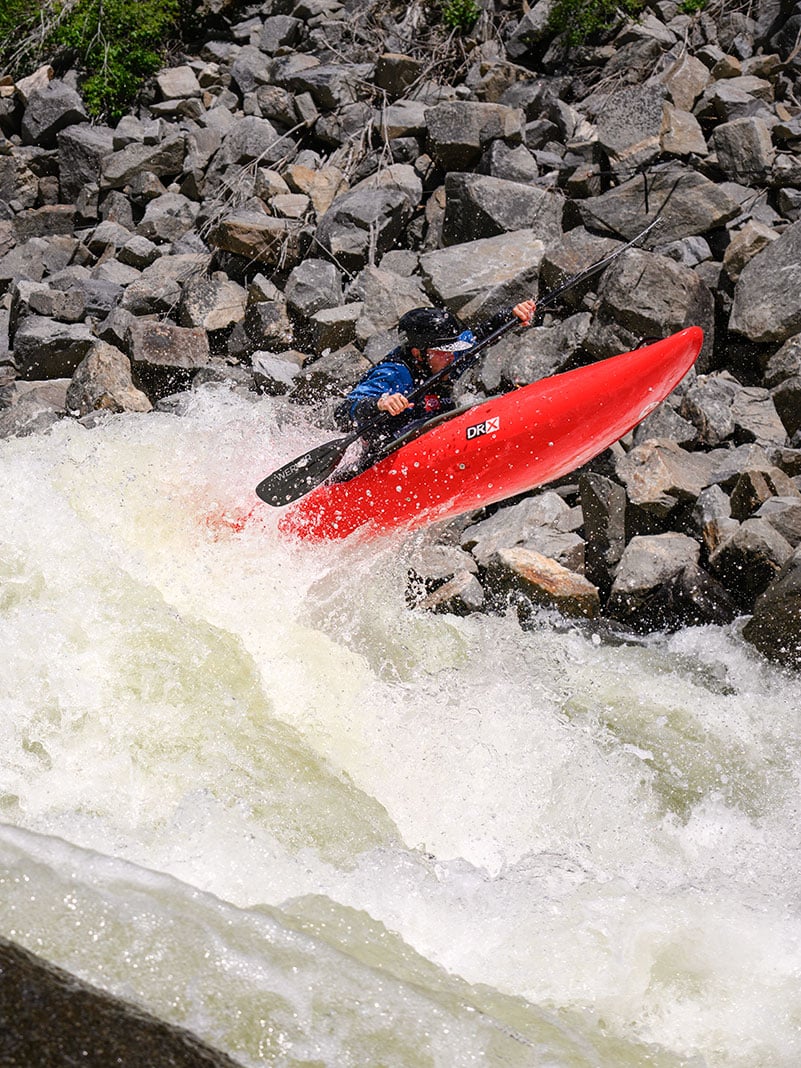
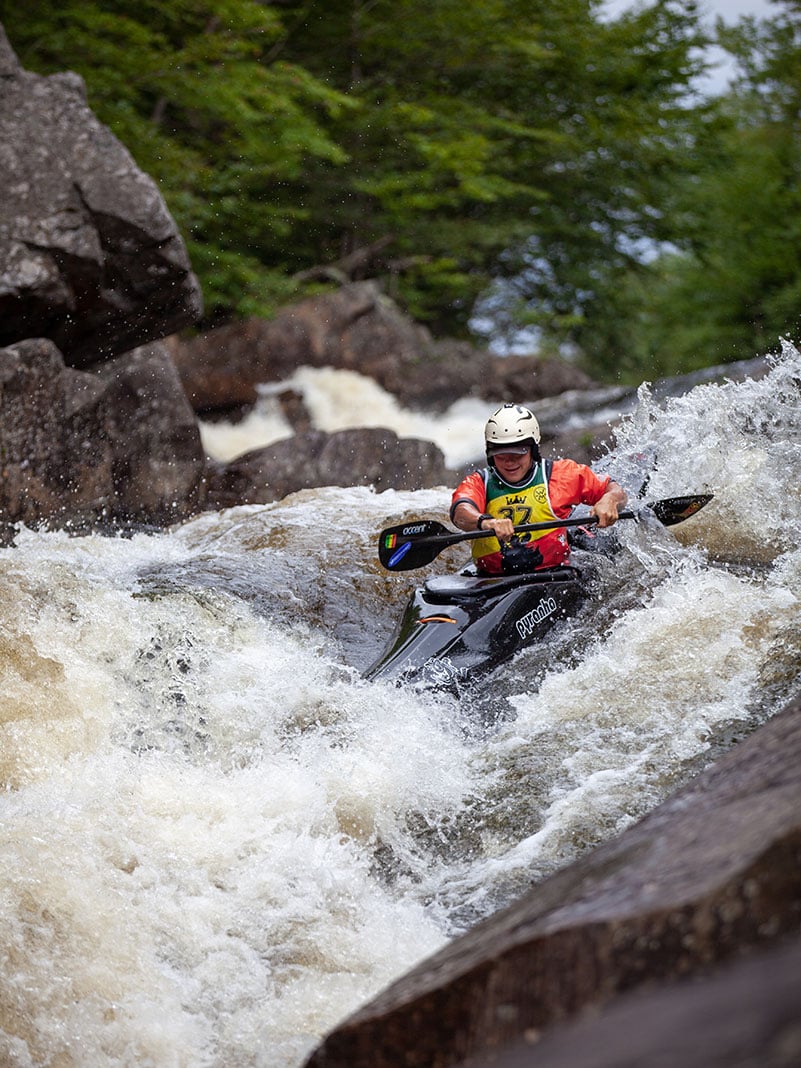
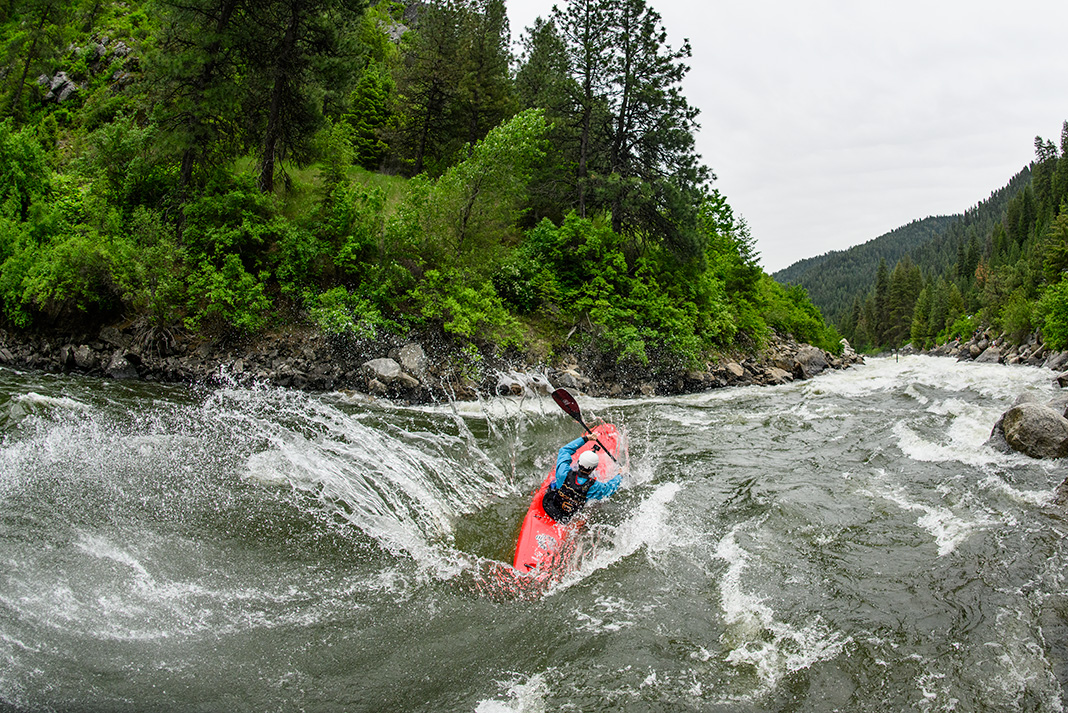
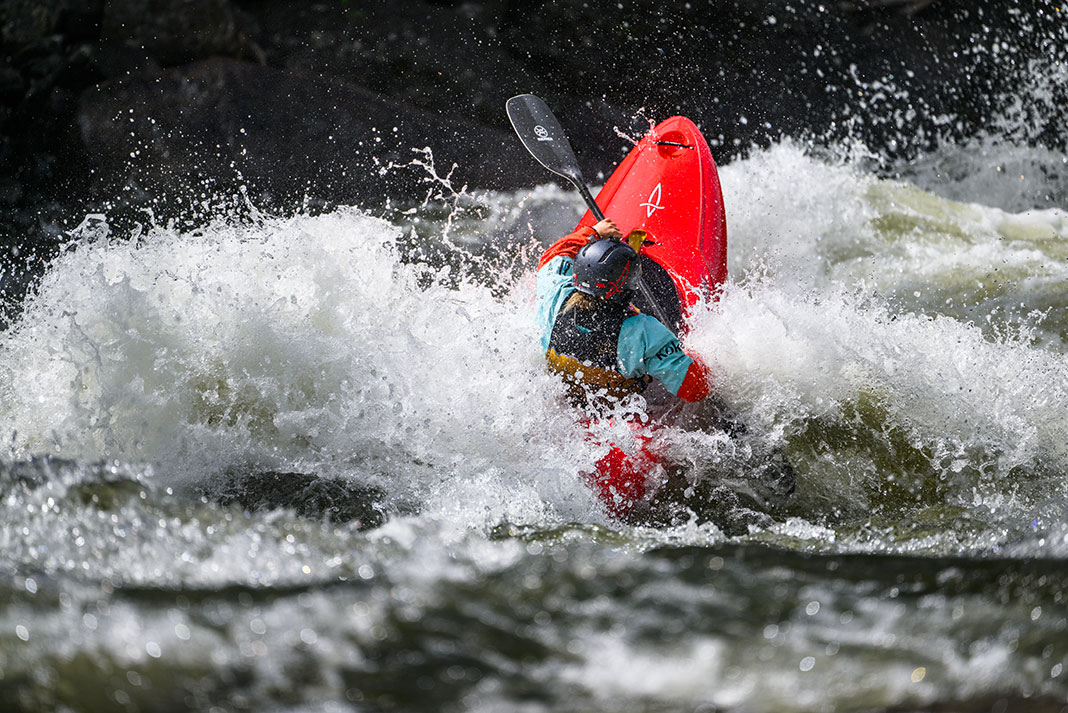
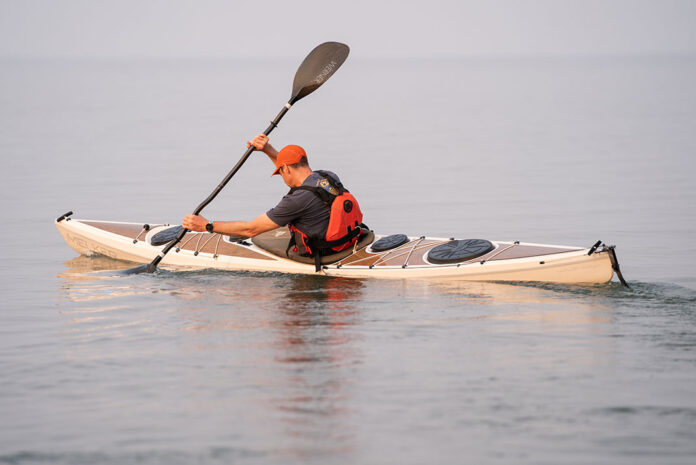
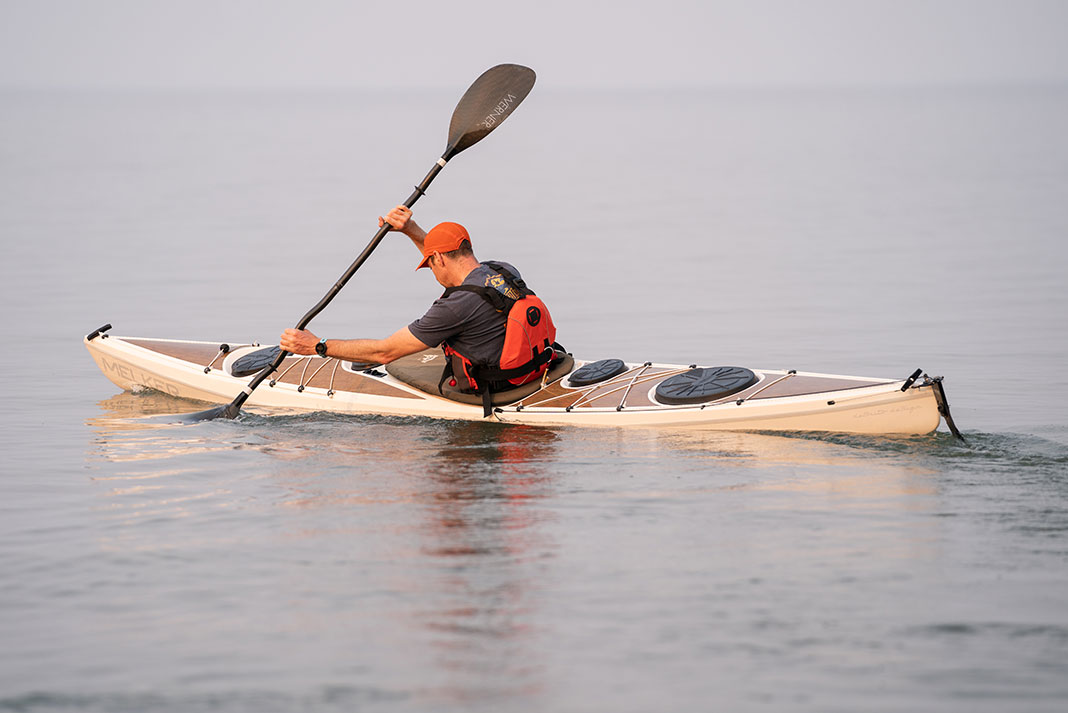
Cruise along on the flats. Then put her on edge and see how much fun you can have. | Feature photo: Colin Field
The Rödlöga,what Melker of Sweden mellifluously calls their “easy to maneuver and playful kayak,” is something of an optical illusion, a curious boat whose characteristics are not what they first appear to be.
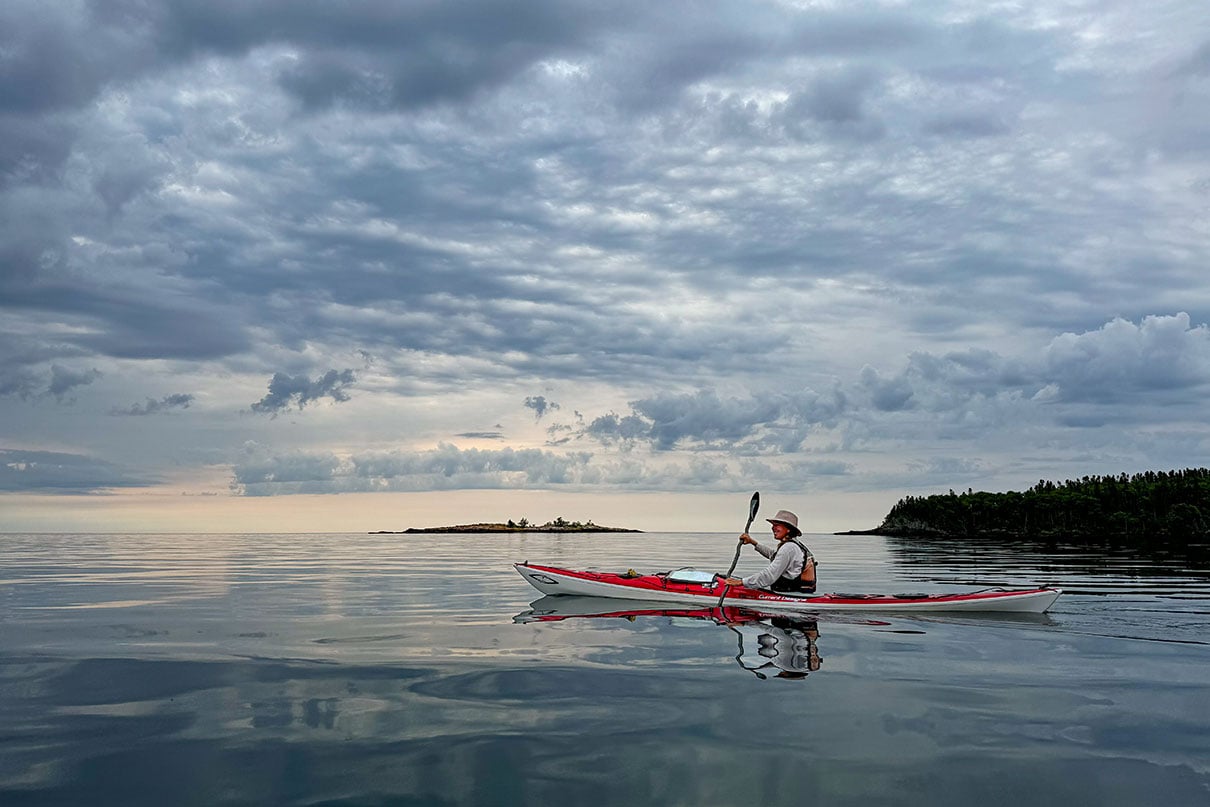
A few years ago, I reviewed the Melker Ulvön, the company’s 17-foot fast touring kayak, which, although built for speed, was remarkably versatile and playful. That’s when I learned Northern Europe has become a hotbed of kayak innovation, where the stubby recreational kayak trend never blitzed the market like it did here and 80 percent of kayaks sold for exploring those brisk boreal coastlines are still serious, full-size touring boats. Now we are seeing that adventurous Scandinavian influence creeping into our kayak shops here. After a pandemic hiatus, Melker is back with a fresh shipment of its long boats for demo and retail in North America, and a new design for us to review, the Rödlöga.
On the water performance
While Melker bills its Ulvön as “a serious expedition boat with a playful character,” the Rödlöga is somewhat the opposite—or more accurately, just a shorter, more maneuverable version of the same clever set of design compromises: a playful kayak that is nonetheless surprisingly spacious and capable for short expeditions. Both kayaks blur the lines between categories in similar ways.
After reading that the Rödlöga was “designed with rougher water, currents, tides and surf waves in mind,” I expected it to paddle like other ocean playboats, twitchy with poor initial stability, just hankering to be put on edge, and skittish like a whitewater kayak, prioritizing fun and maneuverability over speed and tracking.
Cruise along on the flats. Then put her on edge and see how much fun you can have. | Feature photo: Colin Field
Yet on the first few strokes I was amazed at the stability, both a relaxing initial solidity and bomber secondary allowing the Rödlöga to be aggressively edged onto its moderately hard chine without ever feeling like it will accidentally go over the limit. I quickly learned the Rödlöga welcomes beginners and intermediates, albeit with some expert moves up its sleeve. Melker aptly calls it “the perfect kayak to help improve your paddling skills.”
Melker advertises the Rödlöga as having lots of rocker but the waterline nonetheless extends the full length of the boat, enhancing its speed and giving it a very typical touring kayak compromise between maneuverability and easy tracking. It’s on edge that you notice its exceptional agility. The rest of the time, the Rödlöga tracked so well I hardly bothered to use the skeg or the rudder (the fact that it comes with both indicates just how much this kayak aims to please everyone). It was only in a following sea that the rudder felt like a real advantage. In a crosswind I used the skeg to keep straight, but kept the rudder up so I didn’t have to bother steering with my feet.
Tripping capacity
The Rödlöga promo video undersells its trip-worthiness, claiming capacity for an overnight or maybe a weekend. The Swedes must be more into glamping, because I packed for an overnight and had loads of room to spare. With a fulsome 190 liters of storage, you could easily check out of civilization for a week. Swedish industrial designer Magnus de Brito crafted the deck with a shallow arch that extends right to the edge, where it drops nearly vertically to the chine, and a gradual taper to the bow and stern to maximize interior space. The resulting slightly boxy appearance gives the Rödlöga the look and feel of a classic West Coast expedition kayak. So much so that I forgot I was paddling a 21-inch-wide playboat until I checked the dimensions—and my GPS track, which showed me cruising faster than 7.5 kilometers an hour all day long through every possible condition.
So it was that the Rödlöga perplexed me over and over, revealing characteristics that caused me to do a double-take at its specifications, seeming to be one thing and then turning out to perform well at another: a rockered playboat that’s true and fast on the flats, a lithe and nimble day tripper with loads of capacity for long trips. That’s some kind of shapeshifting magic, Mr. de Brito.
It’s clear by now that the playboat billing is a bit misleading, at least insofar as it suggests “for experts only.” The Rödlöga is more spacious, practical and accessible than most kayaks you’d find in rock gardens or the surf zone, although it would excel there too.
The Rödlöga is better described as an all-arounder, a well-balanced design that’s capable of anything, for enthusiastic paddlers of all levels—a prime candidate for what skiers would call the quiver-of-one. All of the design characteristics of stability, speed, playfulness and capacity are combined like the spices in a dish by a master chef, to the point that it’s hard to pick out any one ingredient.
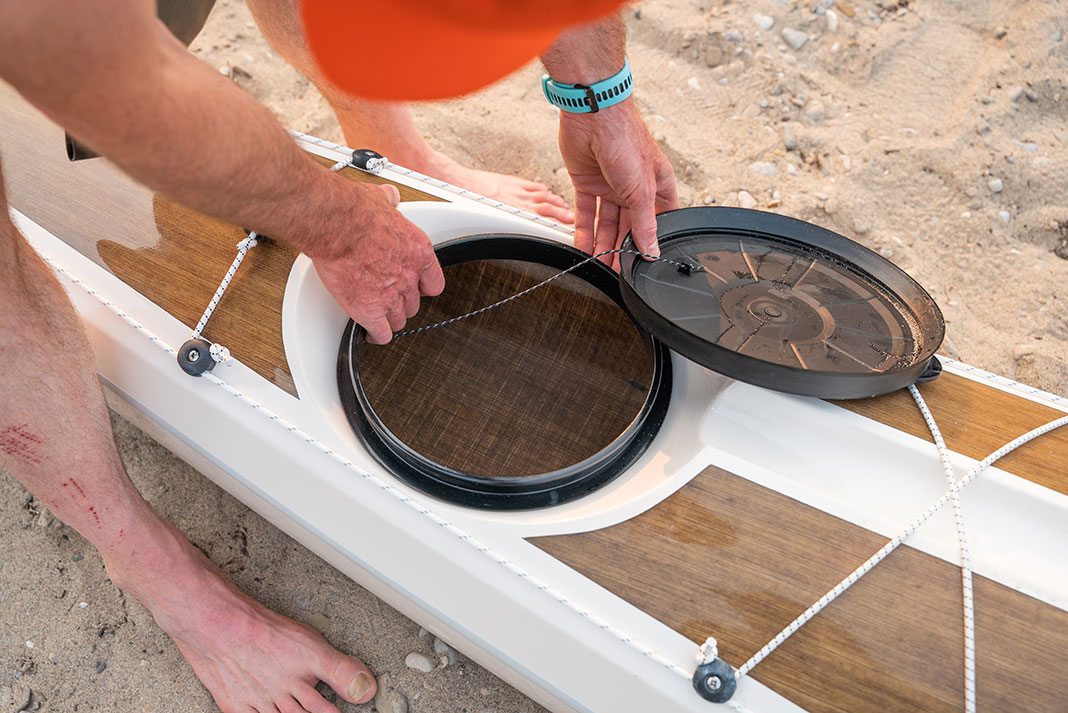
In addition to the spacious bow, stern and day hatches, a cute, softball-sized hatch perched in front of the cockpit fits a cell phone and an energy bar or two. A unique cutout on the front deck will cradle a pump or water bottle. The Kayaksport hatches proved to be a cinch to snap on and off one-handed and yet were completely waterproof, even when rolling and paddling in waves. | Photo: Colin Field
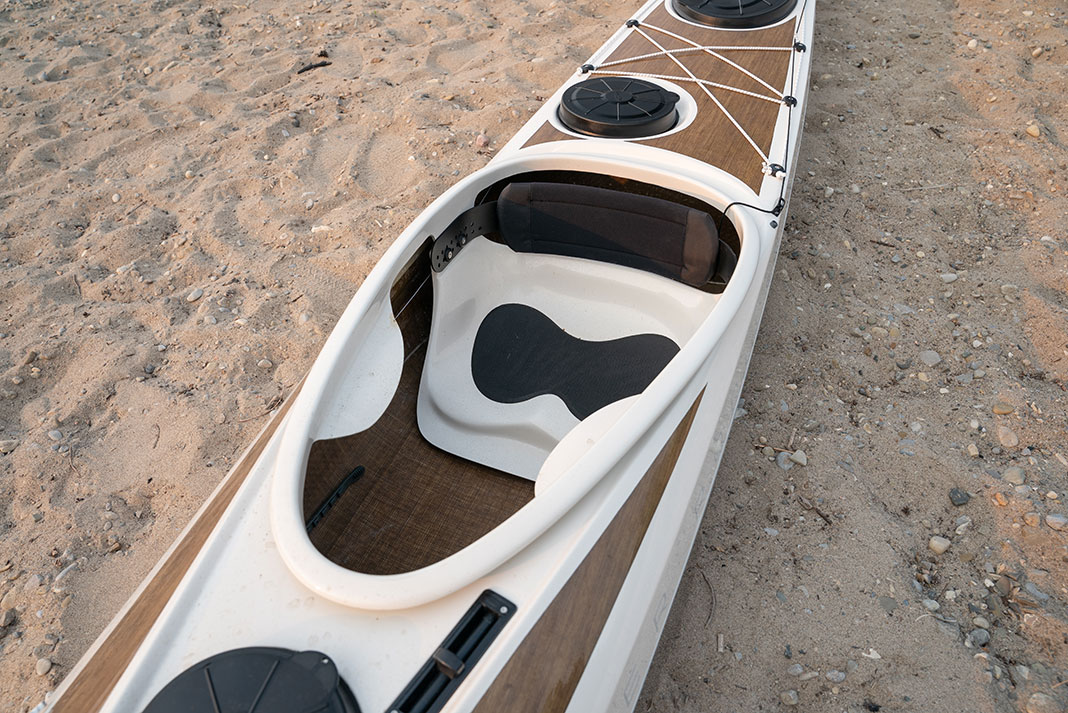
The fit is snug but comfortable, with contoured, padded braces for your thighs and a simple, firm bucket seat that’s the same width as the cockpit coaming, making the Rödlöga easy to edge and roll without any custom outfitting. Although fairly narrow, the cockpit provided plenty of room for my 34-inch inseam and size 13s. (This is the high-volume version. There’s also an LV that is 10 inches shorter and three quarters of an inch narrower, for smaller paddlers.) | Photo: Colin Field
Eco-conscious materials
In 2015, Melker Kayaks was founded in Hammarö, Sweden by entrepreneur Pelle Stafshede and co-founder Jonas Ernfors. Stafshede set out with the goal of making kayaks as sustainably as possible. Step one was moving kayak production away from the petroleum-based materials that the majority of commercially manufactured kayaks use.
“Our take on this industry is to really game change it,” Stafshede told Paddling Magazine at Canoecopia in spring of 2023. “We’ve been using plastic and fossil-based products for too long. Just look around and you’ll see.”
In search of a material that would accomplish sustainability without sacrificing performance, Stafshede and his kayak company experimented with biocomposite materials ranging from bamboo to coffee bean bags and kayaks spat out of 3D printers made from a mix of wood fiber and recycled plastic.
What has proven the winning regenerative material for Melker is a product close to what you’d find in a healthy serving of fiber in your cereal bowl—flax. In place of carbon or fiberglass, Melker’s composite layups use flax fiber currently sourced from Swiss company Bcomp. Flax is locally grown in Europe and, when used instead of carbon in Melker’s kayak construction, reduces greenhouse gas emissions by 85 percent, while maintaining a comparable stiffness and weight. With my rudder installed, my boat tipped my bathroom scale at 57 pounds, a shade heavier than the advertised 54, but similar to other kayaks in the category.
Kayaks aren’t the only performance watersport using flax in place of other composite materials. The surf industry has also seen a movement of board shapers building with the plant-based material. Looking at the hull of a Melker kayak, you’ll see the shiny gel-coat finish with little difference from the traditional composite builds of its touring brethren. On the deck however, Melker has no gel coat, showing off the weave of the dark flax fiber.
Stafshede’s bet on plant-based composites is paying out. In 2022, Melker announced the establishment of their first distribution hub in North America, just outside of Chicago. They’ve also begun distributing boats to retailers in Canada. And most recently Melker announced they were moving production from Estonia to Rindö, Sweden.
“When you conduct a life-cycle analysis of our type of products, the location of the manufacturing has a really big impact,” Stafshede explained of the need for the move to meet the goals of their green transition for the kayak industry. “The way we set up our efficient and modular production, it allows us to easily ramp up production in several locations and grow with actual demand. We expect the next location to be in North America as the reception of our kayaks has been very favorable.”
All this virtue and versatility comes at a premium—indeed Melker’s price in Canada has inflated 50 percent since I reviewed the Ulvön in 2019—but it’s still on par with comparable kayaks from other companies; that is, if you can call anything that’s not built out of plants comparable. With Melker, the eco benefits are a bonus, along with the unique “flax appeal” of the teak-colored material visible under the clear coat.
For any paddler looking for a medium-sized composite sea kayak with speedy touring chops and a playful streak under the deck, the winsome and eco-friendly Rödlöga should definitely make the shortlist.
Winners of the 2023 Great Alabama 650:
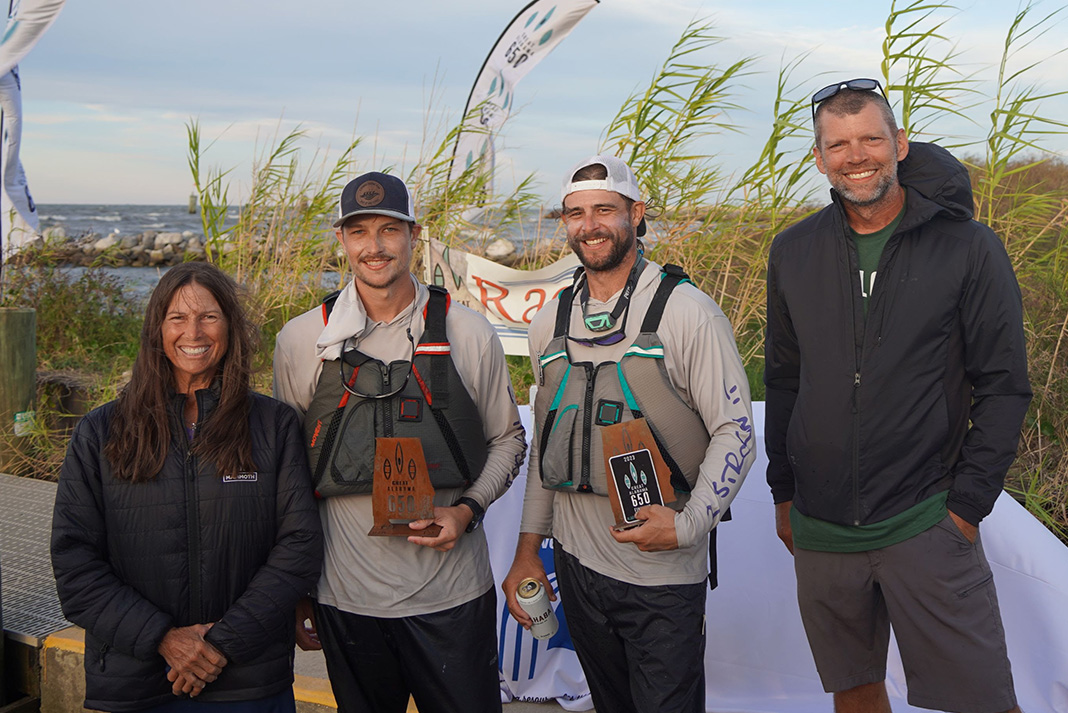
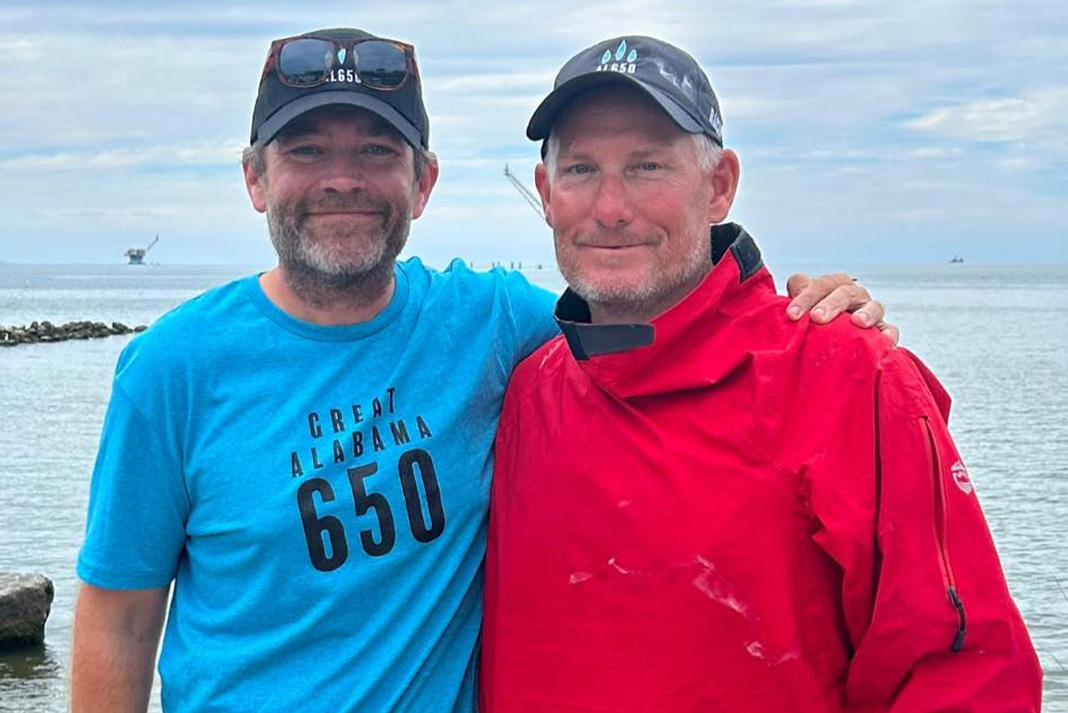
(L-R) Salli O’Donnell, Matt Taylor, Myles Sumerlin & Trey Reaves
Fort MORGAN, ALABAMA (October 13, 2023) — After an exhilarating and challenging nonstop 650-mile paddle race across the waterways of Alabama, the Great Alabama 650 reached its conclusion.
Over ten days, 11 boats from all over the world have completed the race after pushing their limits and showcasing remarkable determination. The Alabama Scenic River Trail organization sincerely congratulates all the participants for their remarkable achievements. Their incredible skill has inspired us all and shown off Alabama’s great water recreation opportunities to the world.
Overall Winner
Trey Reaves – 6 days 1 hour 31 minutes, Florence, AL, USA
Male Solo Winners
Trey Reaves – 6 days 1 hour 31 minutes, Florence, AL, USA
Bobby Johnson – 6 days 5 hours 50 minutes, Dunedin, FL, USA
Mirko Pruefer – 7 days 23 hours 12 minutes, Krauschwitz, Germany
Winners of the 2023 Great Alabama 650: (L-R) Salli O’Donnell, Matt Taylor, Myles Sumerlin & Trey Reaves
Finishers in the Male Solo Category
Chuck Scheidt – 7 days 23 hours 56 minutes, Corpus Christi, TX, USA
Brendan Forshee – 8 days, 3 hours, 11 minutes, Missouri, MO, USA
John Knippers – 8 days, 9 hours, 16 minutes, Langley, OK, USA
Brad Friesen – 9 days, 3 hours, 17 minutes, Winnipeg, MB, Canada
Christian Logan – 9 days 23 hours 40 minutes, Washington, MO, USA
Female Solo Winner
Salli O’Donnell – 6 days 6 hours 40 minutes, Fort Walton Beach, FL, USA
Tandem Category Winners
Matt Taylor, Myles Sumerlin – 7 days, 3 hours, 9 minutes, Brantley, AL, USA and Moss Point, MS, USA
Ryan Gillikin, Rod Price – 7 days 23 hours 39 minutes, Orlando, FL, USA and Bay Minette, AL, USA
3250 Club Achievement Award- Five-Time Finishers
Bobby Johnson – 6 days 5 hours 50 minutes, Dunedin, FL, USA
Salli O’Donnell – 6 days 6 hours 40 minutes, Fort Walton Beach, FL, USA
Paddleboard Finishes (Non-place finish, but 1st time ever record on the 650)
John Knippers – 8 days 8 hours 16 minutes, Langley, OK, USA
Brad Friesen – 9 days 2 hours 17 minutes, Winnipeg, MB, Canada
The Alabama Scenic River Trail, which runs the event, would like to extend heartfelt gratitude to all the volunteers and staff who worked tirelessly to ensure the seamless execution of this unforgettable race. Their dedication and hard work made the Great Alabama 650 a remarkable experience for all participants. Race Director Greg Wingo and his company ROAM Projects exceptional leadership played a pivotal role in the event’s success. Under his guidance, the Great Alabama 650 saw record performances and commanded the attention of paddlers worldwide. Sponsors of the event, stories and highlights from the course, as well as the official announcement of the 2024 Great Alabama 650 dates are listed below.
Stories of the 2023 Great Alabama 650
1st time an Alabamian Wins
Trey Reaves a native of Florence, AL finished in 6 days 1 hour 31 minutes on Friday, October 6th. Trey is the first Alabamian to win the race.
3,250 Club Achievement Award
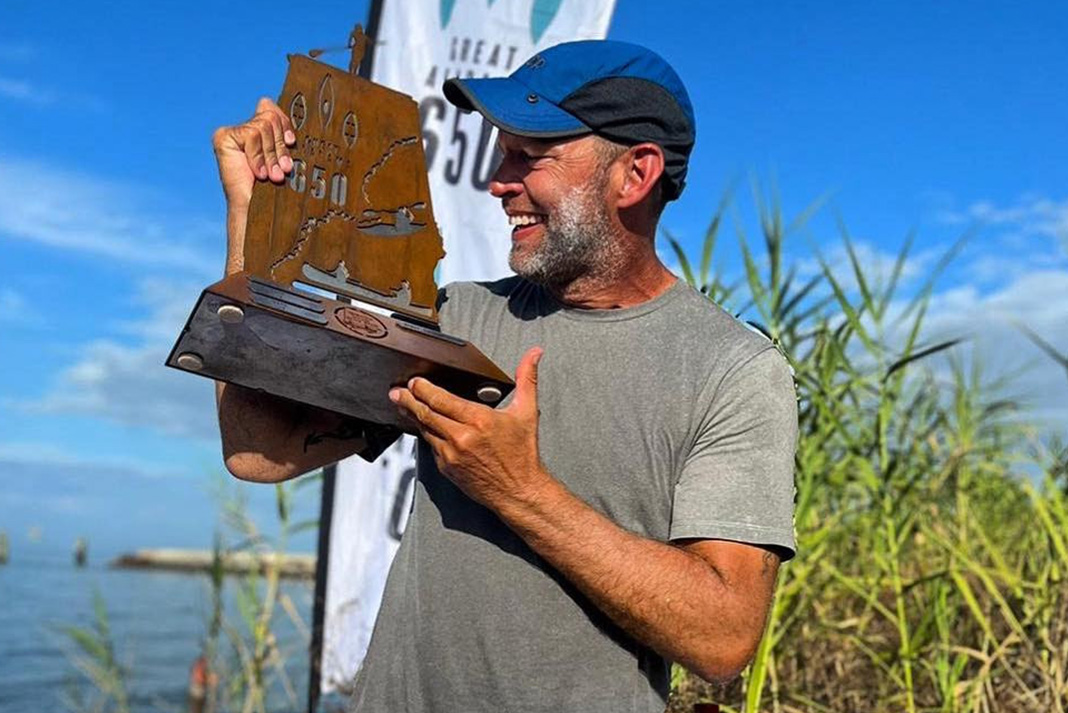
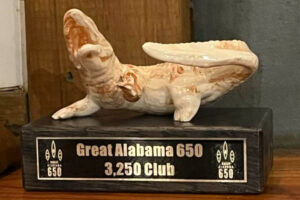
3250 is the accumulated distance of 5 completions of The Great Alabama Race. The award is made out of Coosa River Clay and was presented to Bobby Johnson and Salli O’Donnell upon their 2023 5th time finish.
Two 1st Ever Paddleboard Finishers
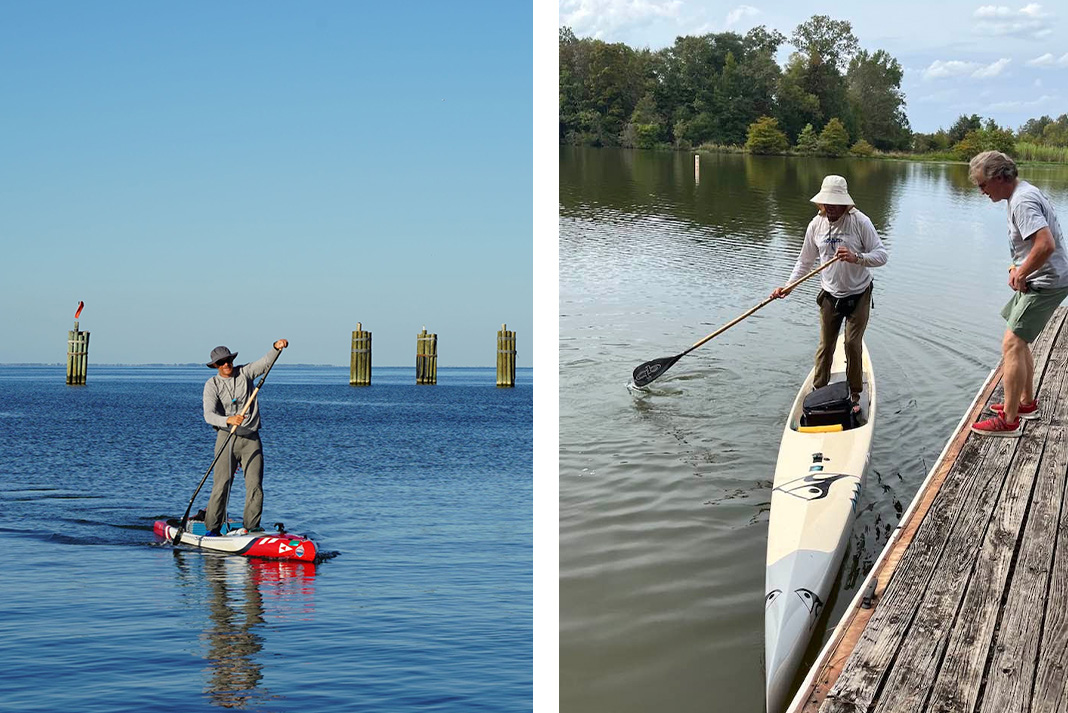
John Knippers (pictured right) from Langley, OK was the first to ever complete the 650 on a Stand-Up Paddleboard. Knippers was followed later by Brad Friesen (pictured above) from Winnipeg, MB, Canada who was the second.
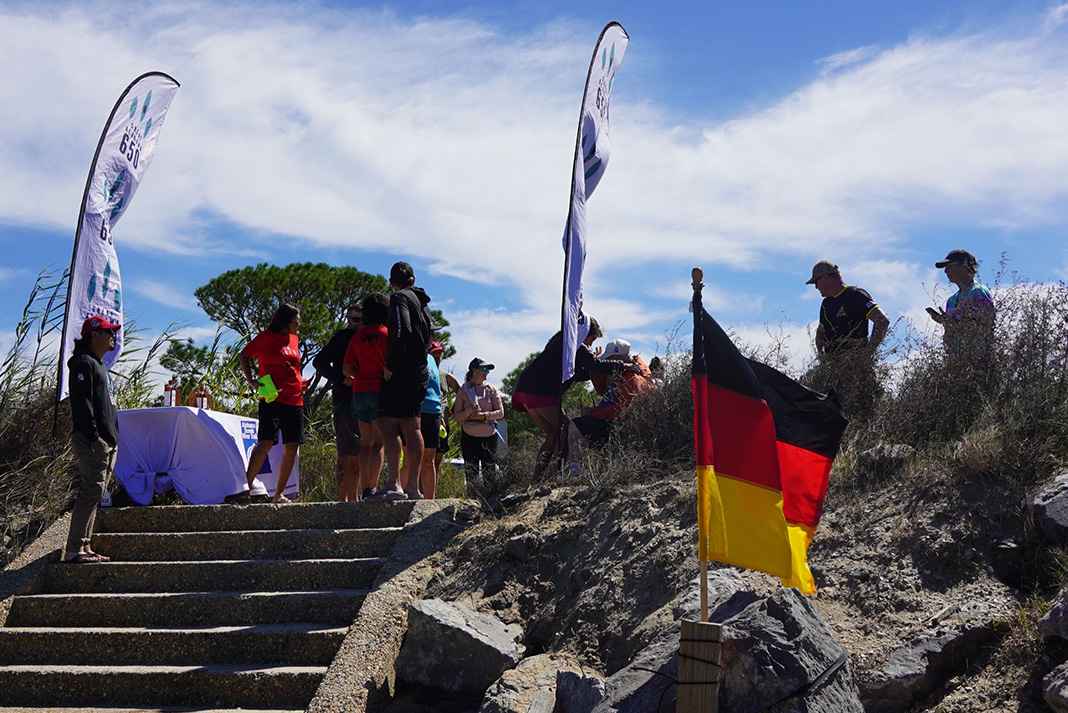
Mirko Pruefer from Krauschwitz, Germany
Brad Friesen from Winnipeg, MB, Canada
International Competitors on the AL650
Mirko Pruefer from Krauschwitz, Germany and Brad Friesen from Winnipeg, MB, Canada both finished this year bringing international attention to the annual race.
Finishing: 20 Mins to Spare
Christian Logan of Washington, MO made it to Ft. Morgan with just 20 minutes to spare and was the final finisher of the 2023 Great Alabama 650.
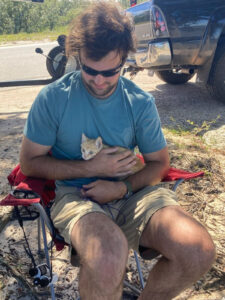
Cat ‘Logan’ Rescued by Crew
Blaine Forshee, crew member and son for racer Brendan Forshee, found the kitten under his truck and the little guy stowed away for over 100 miles before Blaine was able to coax him out! Logan is now a member of the Forshee Family.
About The Alabama Scenic River Trail (ASRT)
The Alabama Scenic River Trail (ASRT) uses a network of members and outfitters to create, improve, and promote more than 6,500 miles of river trails.
ASRT connects adventurers with opportunities to explore and appreciate Alabama’s great waterways through unique experiences. Working primarily through community partnerships, ASRT promotes safe, fun, and welcoming paddling experiences across the state for people of all skill levels. Today we continue to grow our network and share the state’s unparalleled water recreation opportunities.
To learn more about the Great Alabama 650 and all of ASRT’s programs, please visit the Alabama Scenic River Trail’s website at www.alabamascenicrivertrail.com.
The modern tripping canoe is what sci-fi dreams of yore are made of. | Feature photo: Trustin Timber
There’s an ancient green 17-foot Old Town Tripper on the rack out back that, after countless river miles and more than a half-century of service, paddles just as well as she did new. The boat is a brute to portage thanks to its high weight and windage, but back in the day the vinyl/ABS Oltonar hull had many advantages over aluminum—the latter sticking to rocks, putting black stuff on everything and being cold to paddle on Arctic rivers—and cedar canvas, which was far from forgiving when crashing into rocks.
The good fairy: Features on our tripping canoe wishlist
Even then, there were features I wished it had. The vinyl on the outside was soft and would wear through with abrasion, so the fix there was Kevlar skid plates stuck to the stems with epoxy resin. To rig a sail, I glued a little mast step to the floor, added a couple of anchors for stays and a cleat on the rear thwart for the main sheet. And, because my partner had a twitchy lower back, we reset the front seat with a little forward cant and added a backrest from one of those twirly chairs you’d see in a fishing boat.
The modern tripping canoe is what sci-fi dreams of yore are made of. | Feature photo: Trustin Timber
With those minor modifications, that green boat has taken us beyond the many coastlines of our dreams. It has carried dogs and children, dried food, neighbors, firewood, Christmas boughs from waterside hemlocks, packs, wanigans, chunks of flotation and God knows what else. But thanks to being borne by the meditative cadence of 37 strokes a minute for days, sometimes weeks, on end, the big green canoe has absorbed its share of other daydreams and musings about what tripping canoes might have, in terms of qualities, accessories and accoutrements.
Back in the low-tech 70s, those musings coalesced into a short article for Canoe magazine entitled “Beam Me Up Scotty” which was all about the then sci-fi dream of satellite navigation—imagine knowing exactly where you are without looking at the map—and some kind of communication technology that would keep us connected to the home front and allow us to call for help in the event of a calamity. Now we have SPOT two-way satellite messengers, Garmin GPSs, satellite phones and, in many formerly remote areas, five-bar mobile phone service thanks to cell towers disguised (but not very well) as pine trees mingling in the forest. All that to say, paddling daydreams aside, it’s probably good to remember to be careful what we wish for.
Your wish is their command
It seems at every turn, the industry, like the good fairy, has delivered our every wish. Want a lighter boat? Enter carbon fiber and air-bagged epoxy construction. External loads on floatplanes are problematic? Enter packrafts and pack canoes. Not crazy about yoke portaging? Enter the portage cart. Speed an issue? Enter asymmetric hulls and the application of cool naval architecture below the waterline, leaving the sheer as smooth and romantic as ever. The only thing I might wish for now is a Bluetooth speaker in the sponsons. Or maybe photovoltaic skin powering a multitude of plugs that are strategically placed along the inwales for charging up our trip tech. But those too seem to be inevitably well on their way to us in the marketplace. Technologically, we are awash in an embarrassment of design and innovation riches when it comes to canoes.
On the social/environmental side, there are still things I wish tripping canoes had, simple things that seem to be in diminishing supply. For starters, as we gobble up arable and undeveloped land near our cities, through which so many delightful southern rivers flow, log the snot out of our wilderness parks, and mine the mountains and barrenlands, my wish is that our canoes always have undisturbed places to trip and clean water to float them.
Finally, as recreational paddlers turn in increasing numbers away from open canoes toward SUPs, kayaks and intense on-water adventures that get them home before dinner and back to the office by morning meetings, my wish is that our tripping canoes might have people to paddle them. Nothing takes us closer to the wild than a long canoe trip and that quality of every canoe is important because, as Henry David Thoreau reminded us, “in wildness is the preservation of the world.”
James Raffan’s Tumblehome column first appeared in the Spring 2006 issue of Canoeroots.
This article was first published in the 2023 Paddling Trip Guide. Subscribe to Paddling Magazine’s print and digital editions, or browse the archives.
The modern tripping canoe is what sci-fi dreams of yore are made of. | Feature photo: Trustin Timber
I blew out my flip flop; Stepped on a pop top; Cut my heel, had to cruise on back home. | Feature photo: Garrett Fache
Jimmy Buffett died yesterday.
When his box set Boats, Beaches, Bars & Ballads was released, I was pushing rubber down the Ottawa River and pouring tequila over ice crushed in a SealLine drybag with a rock. I was a two-day drive from the closest palm tree, still those four CDs were the soundtrack of my life as a river guide.
“Margaritaville,” released on February 14, 1977, became a state of mind for those of us “wastin’ away” on beaches and rivers. Buffett built a career around “Margaritaville,” an excuse for a life of low-key fun and escapism for those “growing older, but not up.”
“What seems like a simple ditty about getting blotto and mending a broken heart turns out to be a profound meditation on the often painful inertia of beach dwelling,” wrote Spin magazine about “Margaritaville.” “The tourists come and go, one group indistinguishable from the other. Waves crest and break whether somebody is there to witness it or not. Everything that means anything has already happened and you’re not even sure when.”
I blew out my flip flop; Stepped on a pop top; Cut my heel, had to cruise on back home. | Feature photo: Garrett Fache
The antidote to apathy
If you haven’t heard about Tim Urban’s motivational poster, The Life Calendar, let me explain why it’s so awesome. And why it’s not.
Imagine a giant sheet of white paper with 52 columns and 90 rows, which makes 4,680 little boxes. Urban is optimistic we will all live 90 years and so each box represents a week of our lives. Are you with me so far?
When you order the poster you enter your date of birth. It arrives in the mail with the weeks you’ve lived already shaded in. The rest you color in as you go. Motivating message: Life is short, don’t waste it.
You could use The Life Calendar in conjunction with our Paddling Trip Guide. Many of the 156 adventures in this issue are a week, two or three in duration. Urban suggests shading fun things in different colors. This way we can look back on our lives to see blocks of enjoyment.
[ Plan your next paddling adventure with the Paddling Trip Guide ]
Wastin’ in my own way
If you look at my last 25 years of magazine deadlines, trade shows and raising a family, there are too few fun boxes shaded in color; some years none at all. This doesn’t mean my life has sucked.
Lost in Tim Urban’s motivational model are mini-adventures. Mini-adventures are quick blasts of enjoyment and escape, too small to track on a stupid poster.
I checked Strava: I’ve logged 77 gravel, road and mountain bike rides so far this year. My Garmin watch says I skied 69 days. And, my river log says 27. So far I’ve had 173 fun times riding, skiing and paddling. But compared to my son Doug (he was a canoe and kayak guide all summer) and his clients, my poster looks empty, like I’ve just been wastin’ away—but not in the “Margaritaville” way.
Buffett once wrote, “I think it’s really a part of the human condition to have some fun. You’ve got to get away from whatever you do to make a living or other parts of your life that stress you out. I try to make it at least 50/50 fun to work and so far it’s worked out.”
I don’t know if work-life balance needs to be split evenly for true happiness, but I do know it’s five o’clock somewhere. I’m closing my laptop now and going for a paddle. Then to find my lost shaker of salt.
Carpe diem.
Scott MacGregor is the founder and publisher of Paddling Magazine.
This article was first published in the 2023 Paddling Trip Guide. Subscribe to Paddling Magazine’s print and digital editions, or browse the archives.
I blew out my flip flop; Stepped on a pop top; Cut my heel, had to cruise on back home. | Feature photo: Garrett Fache
Somehow, creek boat designs continue to evolve. Paddling steep, difficult whitewater has never looked or felt smoother with moves like leaning boofs and skipping out of drops. We have these next-evolution creek boats to thank for styling the steeps. The question is, which of these boats is right for you? Simon Coward, owner of AQ Outdoors (AQ Outdoors is a paddling shop and school with locations in Calgary and Edmonton), is here to share his thoughts on three of the best creek boat designs on the water today. The following is a transcript of his video review.
Feature Image: AQ Outdoors
3 Top Creekboats Go Head-To-Head
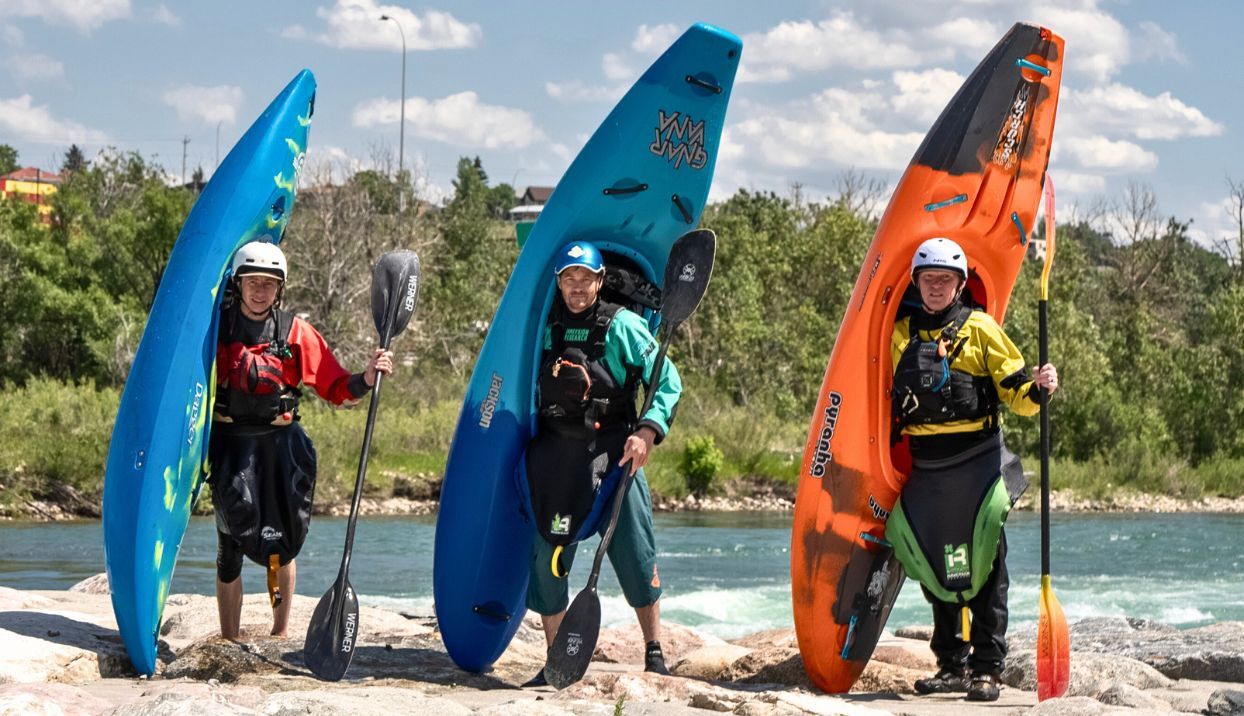
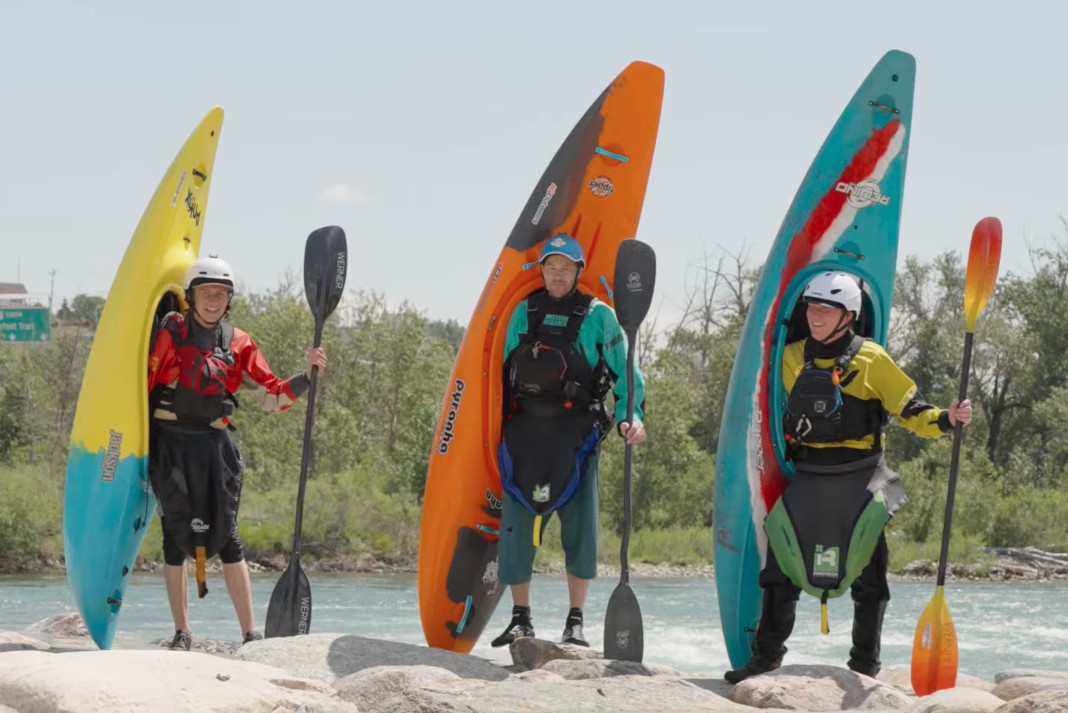
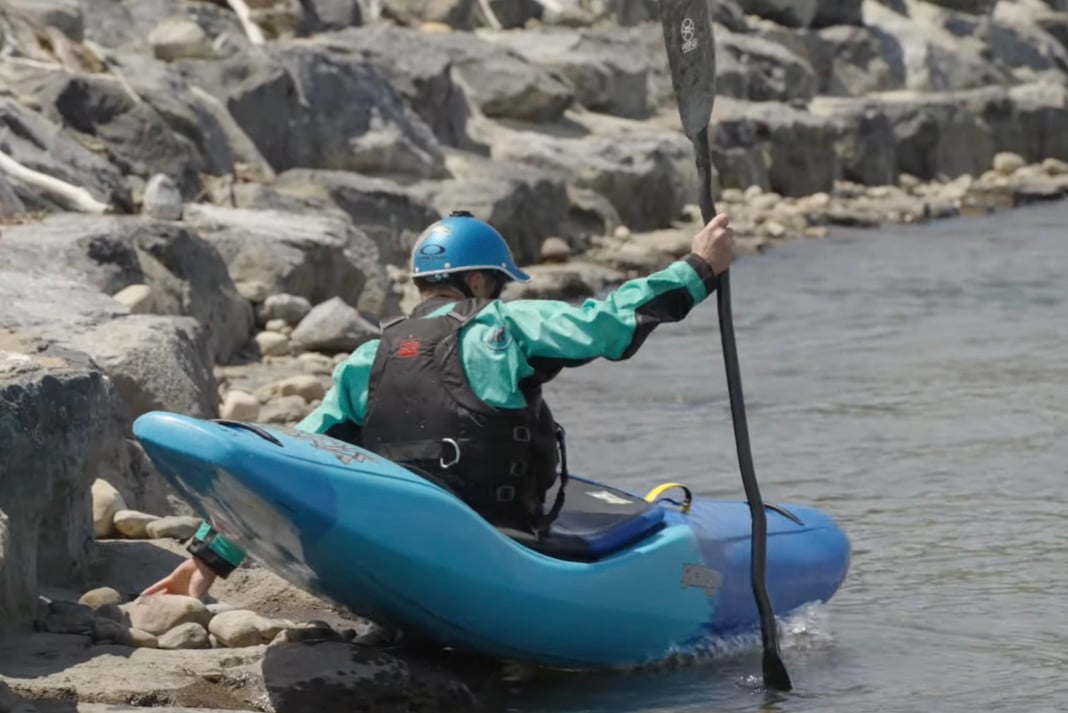
Simon from AQ Outdoors here and today we’re going to dive into a side-by-side comparison of the latest creek boat offerings from Jackson, Dagger and Pyranha.
If you’ve been looking for a new creek boat you’ve undoubtedly come across the Pyranha Scorch the Jackson Gnarvana and the Dagger Code. Before I get into our comparison of these top models I do want to note this isn’t a specs-driven analysis. I’ll be focusing primarily on personal experiences, suitability and on-water observations.
Today we’re using the medium-sized models with paddlers weighing between 135 and 175 pounds, standing at heights of 5’6” to about 5’ 10”.
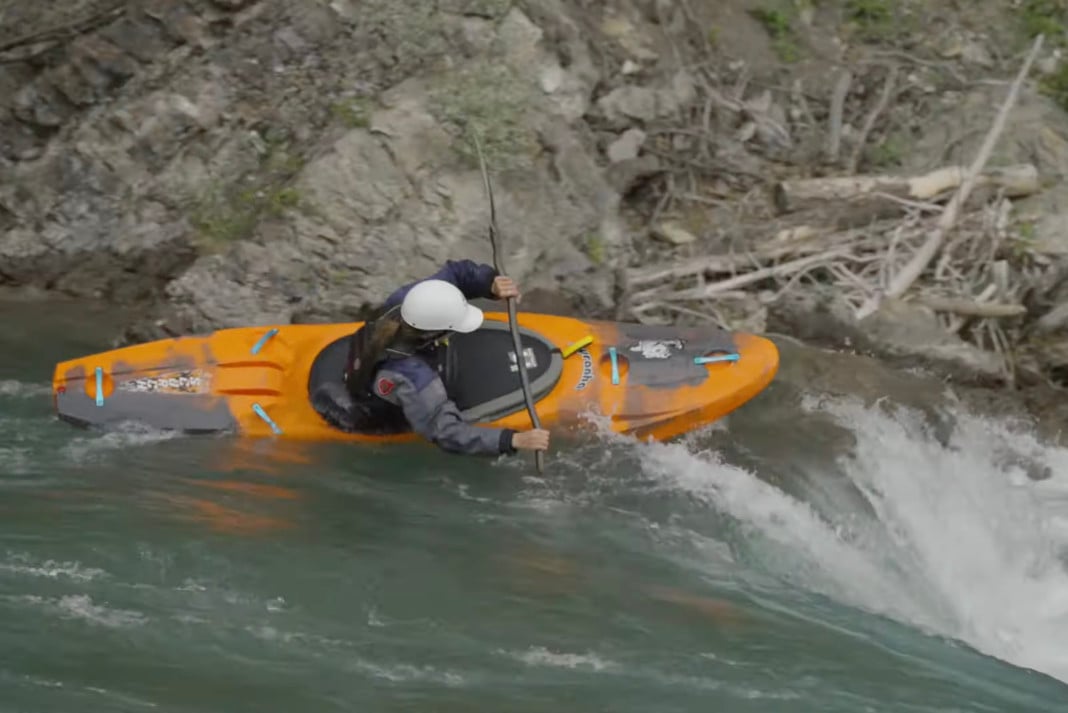
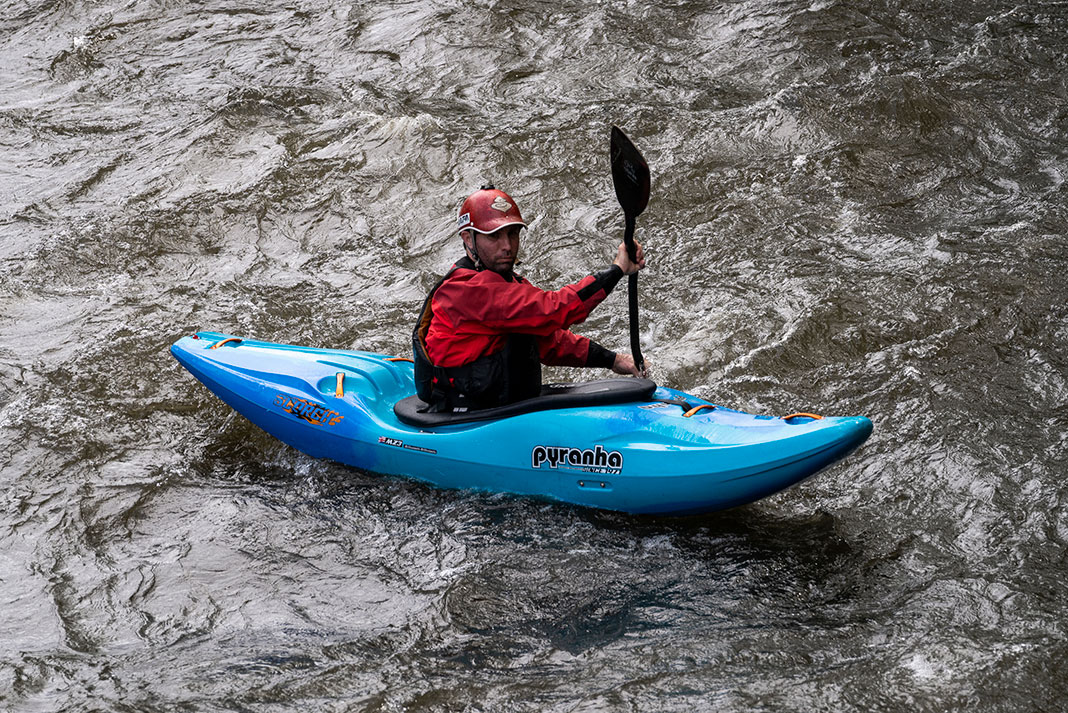
Each boat brings its own unique flair to the highly rockered short waterline river running series. Pyranha opts for sharp edges and sleek lines. Jackson leans towards a rounded aesthetic. And Dagger opts for a sleek looking design and includes its industry-leading outfitting.
First up we have the Pyranha Scorch. To me, the Scorch feels like the best option for advanced paddlers who spend a bunch of time in their creek boat.
It tracks amazingly well, skips out of drops with ease, and accelerates quickly when you need it. With its ability for tracking and its speed, especially through boils and confused water, it would also be my top choice for big water paddling. However less experienced paddlers should note that turning can be challenging without advanced techniques and edge control.
It’s worth mentioning too that the Scorch carries that distinct Pyranha feel, characterized by unique edges and side walls. In our many years in education and retail we’ve learned that some people love that feeling and others really don’t.
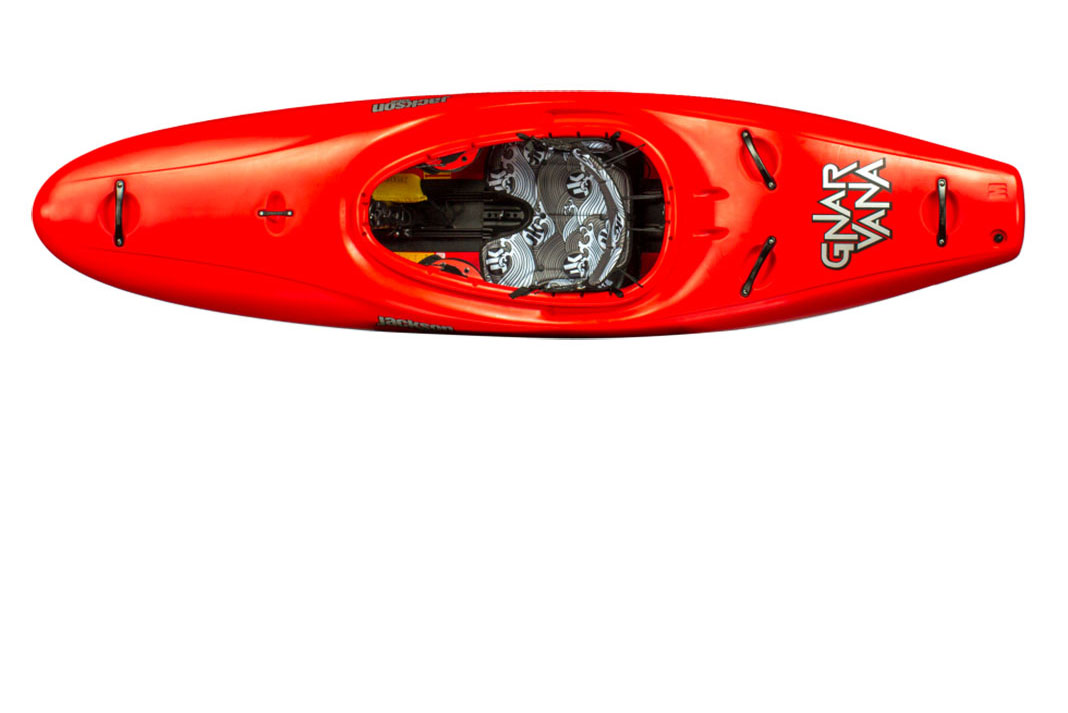
Jackson Gnarvana. Image: AQ Outdoors
Jackson Gnarvana
Next up we have the Jackson Gnarvana. As a middle-aged paddler who spends more time teaching than personal paddling, finding a creek boat that matches my skill level while providing a safety net was crucial.
The Jackson Gnarvana strikes a perfect balance for me. Despite my initial skepticism towards Jackson creek boats, the Gnarvana fully won me over. It feels like an oversized half slice—boasting excellent control and effortless edging.
The bulbous, and to be honest, kind of funny looking bow makes boofing and keeping the nose up so simple. Making it a top choice for small creeks. In fact it’s my favorite creek boat to date in these environments, in big water. However the Gnarvana may get pushed around more easily compared to the Scorch and the Code. It is also wide around the hips. Which means without proper outfitting it can feel a little challenging to have the boat move with you. Once outfitted however, this is easily resolved.
Dagger Code. Image: AQ Outdoors
Dagger Code
Last up we have the Dagger Code. As a prominent choice in our teaching program, the Code has proven itself to be an almost unflippable companion for intermediate paddlers.
I’ve witnessed the Code plow through many a hole with the paddling student looking on as if in an out-of-body experience—wondering when they’re going to flip. And somehow, against the laws of physics, they don’t.
In the paddling we’ve done in the Code, it’s hard to put a finger on why it’s such a great boat. I think it’s a combination of outfitting, ease of paddling, and its versatility that keep us putting people in this boat.
On courses and for personal paddling, in my opinion, the Code’s predictability and reliability for all levels of paddler, in all whitewater environments, make it a go-to option that does exactly what you’d expect.
AQ Outdoors offers retail and kayak instruction in Calgary and Edmonton. Learn more about their school and stores at AQOutdoors.com.
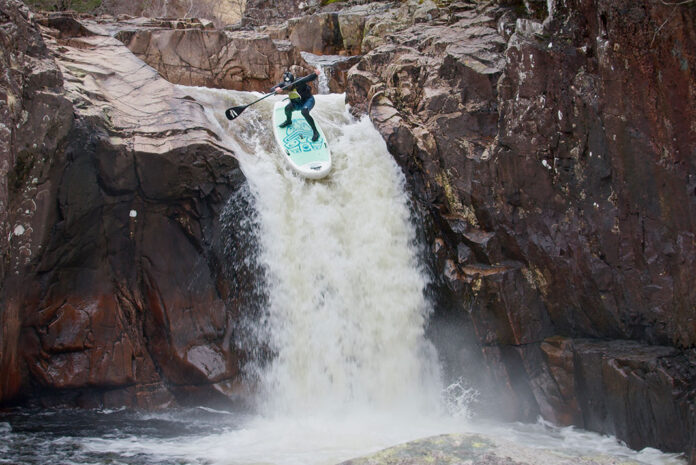
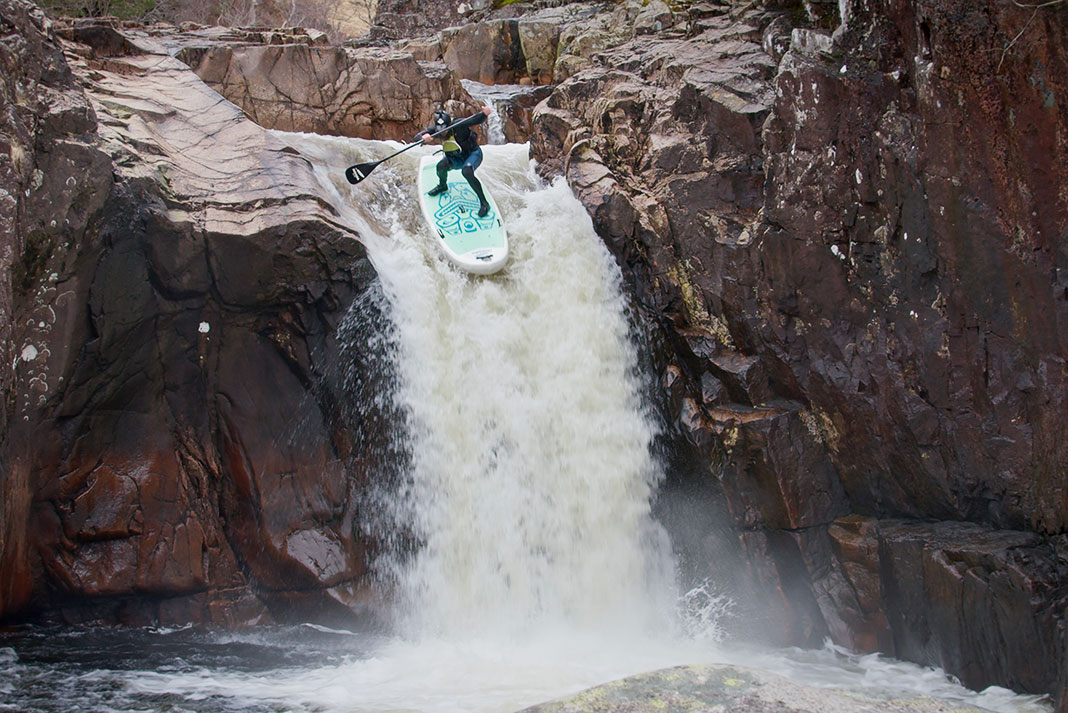
Sam Garthwaite making the drop over Right Angle Falls. To capture this shot, Sam’s brother, Jake, was positioned on rocks at the constriction point across from the pool at the bottom of the falls. | Feature photo: Jake Garthwaite
Tucked in the Scottish Highlands between some of the most impressive Munros in the country is the winding River Etive. Its rapids are well known to kayakers and have gained popularity with paddleboarders too.
Pushing the limit: Whitewater SUP in the Scottish Highlands
On March 26 this year, with snow still in the hills, Sam Garthwaite set off from Perth for the 2.5-hour drive to Glencoe with his paddling partner, Cameron Hopkin. Garthwaite packed his five-millimeter wetsuit, Indiana carbon paddle and nine-foot inflatable river paddleboard. His brother, Jake, brought his camera to document their frothy—and frosty—adventure.
On previous trips to the River Etive, Garthwaite and Hopkin had worked toward mastering Triple Step’s three drops—eight feet, eight feet and 12 feet, respectively—and the rapids in between. “We kept trying bigger features, trying to talk ourselves into running Right Angle Falls,” explains Garthwaite.
Sam Garthwaite making the drop over Right Angle Falls. To capture this shot, Sam’s brother, Jake, was positioned on rocks at the constriction point across from the pool at the bottom of the falls. | Feature photo: Jake Garthwaite
Farther downstream, a narrow gorge is buttressed by the Glencoe Mountain Resort and another Munro towering 3,000 feet high. This is where Right Angle Falls and its daunting grade 4, 20-foot drop is found. Whitewater kayakers know the drop well, but it has not been run by SUP to date. If landed, it would be one of the biggest drops, if not the biggest, successfully completed by paddleboard.
On this day in March, Garthwaite and Hopkin were headed to Right Angle Falls—they planned to ride over the lip and jump, unless water levels were too high or too low. They warmed up at Triple Step, then drove a few minutes down the road, left their boards at the top of the bank and climbed down to Right Angle Falls.
Garthwaite recalls standing at the top of the waterfall. “In my mind I had every intention of throwing myself off it, but I could have just as easily walked up to it and said no. It takes some motivating to attempt that beast.”
He and Hopkin discussed the line and all the possible scenarios for about 10 minutes: “We said, ‘As long as this doesn’t happen, it should be fine.’”
Garthwaite decided to go for it.
A glimpse behind the curtain
“It felt quite nice at the beginning,” Garthwaite says. Then the scenario he was hoping wouldn’t happen, did. “I felt the clip of the fin hitting the rock, and then my board got sucked in, and I did a big, amazing flip. My board ended up behind the curtain of the waterfall and I landed on my back in the soft, aerated water.”
Garthwaite wasn’t deterred and was now fueled by adrenaline. He set up to go again. “I’ve learned that if I have a bad time, I need to run it again immediately to take the fear out of it, otherwise I may never run it again. The plan was to paddle over the lip to try the line and then bail. But it felt good enough that I rode right down the tongue and attempted to land it. My form was off so I ended up disconnected from the board a couple feet from the flatwater. I landed too heavy to ride it out.”
Whitewater SUP is in its relative infancy, but has picked up speed in the last few years, now attracting paddlers, snowboarders and skateboarders.
“It’s quite similar to skateboarding; if you have the right momentum and speed, you can grab air, and it’s almost like you have glue on your feet,” Garthwaite explains.
Garthwaite is at the forefront of the sport, with five years under his breakaway waist leash. He enjoys pushing the limits and creating content to inspire others. He’s convinced that if he can hold his form, Right Angle Falls is possible.
When he’s not out taming whitewater on his SUP, Sam Garthwaite is a senior instructor at the Willowgate Activity Centre in Perth, a local watersports and outdoors skills centre. When the official instructor courses catch up to the sport, Garthwaite plans to teach and guide whitewater paddleboarding. Follow his pioneering whitewater SUP adventure on Instagram, @frothysup.
This article was first published in the 2023 Paddling Trip Guide. Subscribe to Paddling Magazine’s print and digital editions, or browse the archives.
Sam Garthwaite making the drop over Right Angle Falls. To capture this shot, Sam’s brother, Jake, was positioned on rocks at the constriction point across from the pool at the bottom of the falls. | Feature photo: Jake Garthwaite
People you’ve got the power over what we do; You can sit there and wait; Or you can pull us through; Come along, sing the song; You know you can’t go wrong; ‘Cause when that morning sun comes beating down; You’re going to wake up in your town; But we’ll be scheduled to appear; A thousand miles away from here. —Jackson Browne | Feature photo: Michael Hewis
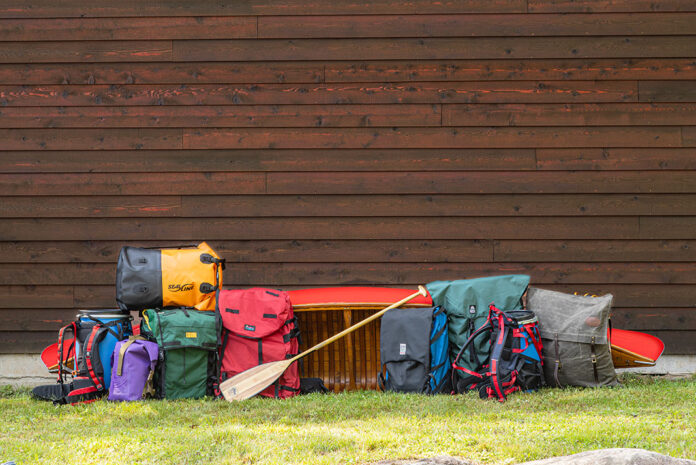
If Jackson Browne was a bourgeois for the North West Company, here are nine bags and barrel harnesses his roadies would have loved.
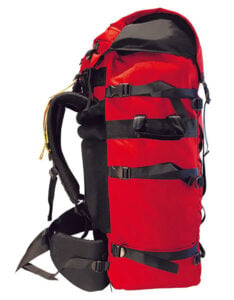
If you’re packing for a trip more than a week long—or, if you’re like me and decide you need to bring too much stuff on a spring overnighter—the beastly Ostrom Wabakimi supplies all the space you need. In fact, when fully loaded, the pack is so large it makes it impossible to portage a canoe because the floating lid extends so high above your head it touches the hull of the canoe when on your shoulders. This design isn’t without purpose, though—the lid extends straight up to keep the weight directly over top of the pack.
The Wabakimi is Ostrom’s internal frame pack, a feature that’s of great benefit on a pack this size, providing structure and shape and transferring the weight off your shoulders and onto your hips. To step up the comfort even further, when you order your pack, Ostrom custom fits the frame, shoulder straps and hip belt to your measurements. Need the pack to fit more than one person? The frame can be adjusted to three torso sizes by moving the shoulder straps up or down and Ostrom can also supply you with different sized hip belts and shoulder straps that you can switch in and out. This level of custom fitting is an offering not found with traditional one-size-sorta-fits-all canoe packs.
Rounding out the Wabakimi are all the expected features like grab handles and compression straps, as well as handy extras like shallow side pockets.
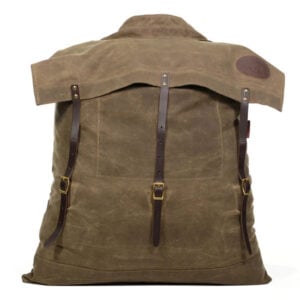
Traditional to its core, tossing Frost River’s Old No. 3 pack in your canoe—cedar canvas only, please—will make you feel like you’re headed into territories unknown in a time gone by. Whatever personal illusions you’re trying to uphold, the quality of this bag is no artifice.
Why is it called the No. 3? No idea. Frost River makes 20 canoe packs in all manner of shapes and sizes, but all are made of double layer wax canvas, making them tougher and more water-resistant than any voyageur could have ever dreamed.
The shoulder straps made of harness leather, foam padding and buckskin make for a comfortable carry and the whole pack is finished with solid brass hardware. Frost River keeps things simple with three leather strap buckle closures, a leather hip belt and an interior map pocket—because you surely still carry a map, right?
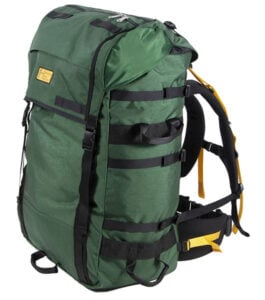
“That’s a big pack,” one of my colleagues said when I humped the Expedition Canoe Pack into the office. The largest of Recreational Barrel Works’ packs, the Expedition is also the highest volume pack on this list. The pack’s many thoughtful features make its bulk more manageable. Features like seven grab handles, side and top compression straps, and optional tumpline and internal frame.
Despite the pack’s volume, portaging a canoe is still possible because the lid extends down over the back of the pack, leaving enough room between the top of the pack and the hull of the canoe to allow the canoe to sit on your shoulders. However, this design means the weight of the items stored in the lid pocket hangs off the back of the pack, pulling the pack away from your body. Included load adjustment straps help with this, pulling the weight of the top of the pack closer to your body and allowing the hip belt to do its job of transferring weight onto your hips.
Without the option to move the hip belt up or down on the pack, the Expedition Canoe Pack fits medium to long torsos best. Useful features include daisy chains on the lid, two shallow side pockets and Easy-Snug hip belt adjustment buckles for one-handed adjustment. Recreational Barrel Works also sells a waterproof liner.
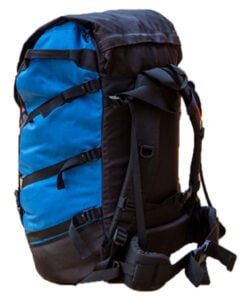
Algonquin Outfitters’ Ballistic Canoe Packs have been trialed by fire—these are the packs the outfitter rents out on hundreds of backcountry trips every year. And so, this utilitarian pack has a no-frills padded back, simple hip belt and six side compression straps.
The Medium Ballistic is unpretentious and still comfortable to carry. Somehow with only simple adjustability on the hip belt, chest strap and shoulder straps, it fits everyone in the Paddling Magazine office well enough. Also available in small and large, this medium is the perfect size for weeklong trips.
Durable, waterproof and small critter resistant, barrels are a popular choice for storage on canoe trips. Level Six’s Adjustable Barrel Pack hugs 30- and 60-liter barrels snuggly like a beer can in a koozie.
Somehow the length of the back pad and shape of the shoulder straps allow this harness to quickly fit different torso lengths. The hip belt is split, allowing it to fold and shape to your waist and sit on your hips. And we loved the double forward pull waist belt straps we’ve become accustomed to finding on contemporary hiking packs.
To reduce stress on the shoulder straps lugging the barrel in and out of canoes, Level Six sewed in extra grab handles either side of the back pad.
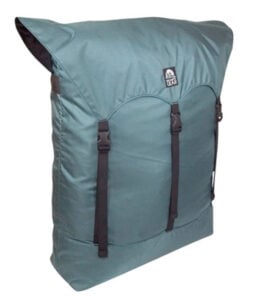
Developed for Boundary Waters tripping, Granite Gear’s portage packs are lightweight and no-frills. This pack has just one large compartment, no lid pocket or side pockets. Without an internal frame or even back padding, we had to pack smart so it kept its shape and weight was properly distributed.
The perfect size for a weekend outing, the Traditional #3.5 can easily be nestled anywhere in your canoe. Super size me to the #4 for 98 liters of storage and side compression straps.
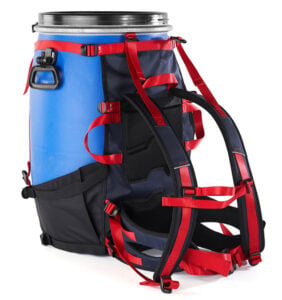
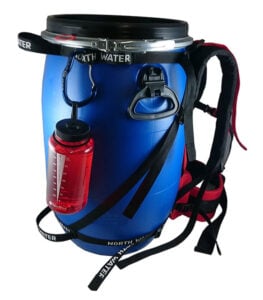
Fit your North Water Quick Haul Harness to 30- or 60-liter barrels for easy portaging—well, easier, it’s still a portage. North Water’s harness has many of the essential features you’d expect on a modern barrel harness—grab handles, a padded hip belt, an adjustable chest strap and load adjustment straps—and a couple special additions.
The daisy chain encircling the lid of the barrel provides five places to clip Nalgenes, dry boxes, map cases and PFDs to make those single carries achievable. The harness can also be used on other cases and objects, like wanigans; purchase the Quick Haul Extenders for particularly large goods.
Our favorite feature, which is either a happy accident or the brainchild of a designer in the know, is that the load adjustment straps suspend the yoke of the canoe just enough off your back to provide a more comfortable carry.
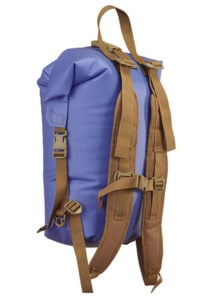
Day-trippers and ditch kit enthusiasts will be pleased with the size, waterproofness and comfort of Watershed’s Big Creek roll-top drybag. Watershed’s patented Ziploc-style seal combined with roll top closure provides worry-free tripping in rain and rapids.
New this year, the Big Creek is made with Watershed’s upgraded material, Kryptothane Plus, which is thicker and more UV-resistant. If you’re using the Big Creek on a day trip, the comfortable and adjustable harness system will make you forget the pack is even there on portages. If being used as a ditch kit on a multiday trip, we found the Big Creek stacks nicely atop a barrel for seamless single carrying. It’s just the right size to pile atop two barrels in the canoe or stuff behind the stern seat, if you’re not running with float bags. Just want a drybag? The shoulder straps can be removed.
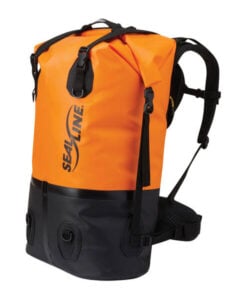
Skip the trouble of having to use waterproof liners or drybags within your pack; here’s a massive dry pack with a roll closure seal that makes it easy to keep your camping gear dryish.
SealLine’s 70-liter Pro Dry Pack is a perfect size and shape for tents, sleeping pads, chairs and tarps. It’s portage-ready thanks to its sophisticated harness system. The breathable back panel and supportive full-length framesheet in addition to a hip belt and chest strap are really quite good. The harness can also be adjusted to three different lengths to accommodate a variety of torsos—possible, but it takes a fair bit of finagling for larger hands to get behind the panel to thread a buckle through a loop and reaffix the Velcro.
This article was first published in the 2023 Paddling Trip Guide. Subscribe to Paddling Magazine’s print and digital editions, or browse the archives.
People you’ve got the power over what we do; You can sit there and wait; Or you can pull us through; Come along, sing the song; You know you can’t go wrong; ‘Cause when that morning sun comes beating down; You’re going to wake up in your town; But we’ll be scheduled to appear; A thousand miles away from here. —Jackson Browne | Feature photo: Michael Hewis
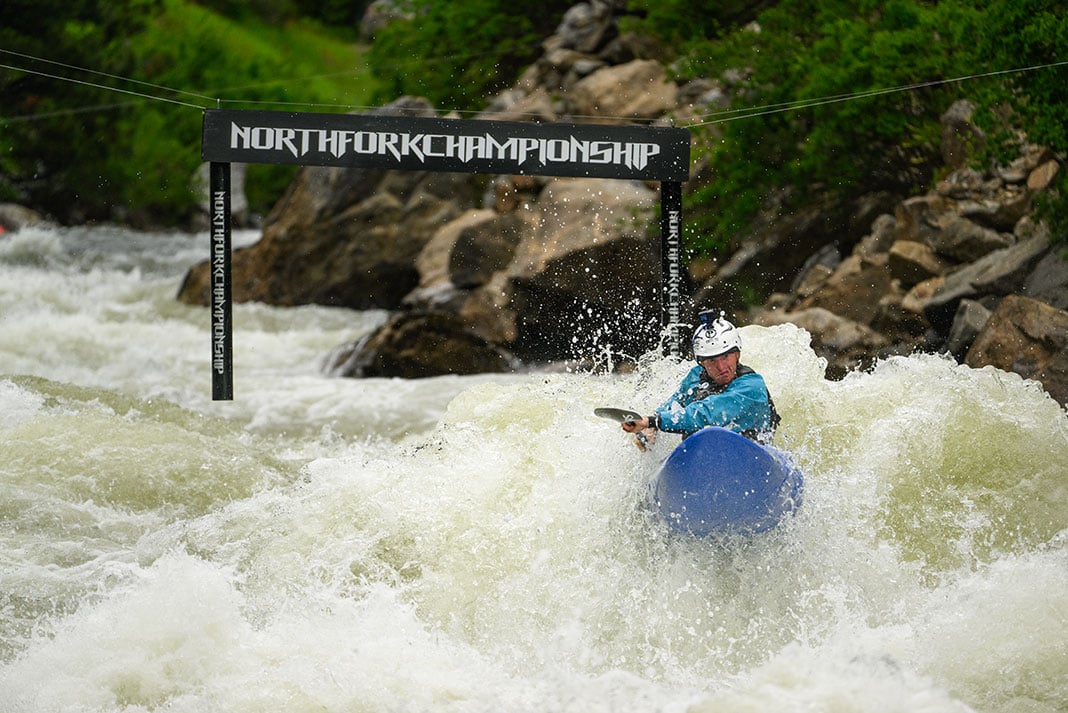
Sage Donnelly at the last North Fork Championship in 2022. | Feature photo: Dan Stewart
When this year’s North Fork Championship was canceled, the whitewater community was shocked. We dig into the main factor that brought about its downfall—insurance—and whether other class V whitewater races will face the same demise.
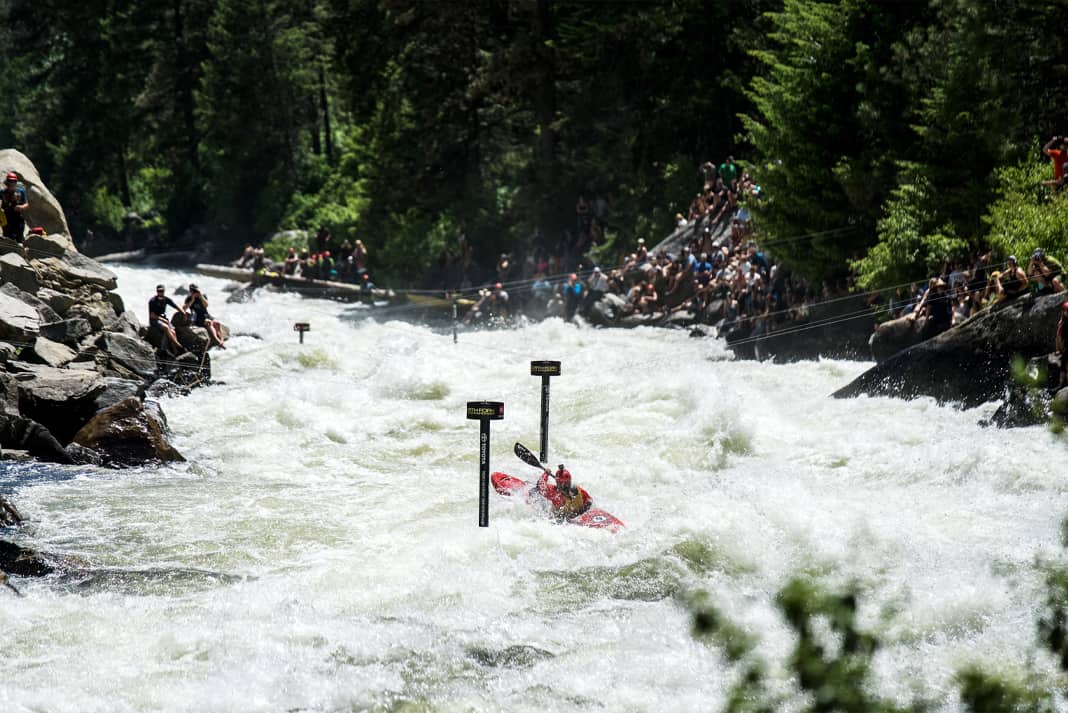
Last summer, when paddlers approached Jacob’s Ladder, a class V rapid on the iconic North Fork of the Payette River in Idaho, the roar of the crowd drowned out the thunder of the whitewater. People sat shoulder to shoulder on boulders lining the course while world-class paddlers raced in the renowned North Fork Championship (NFC), its tenth year running and arguably garnering its best turnout yet.
While those competing in the marquee class V event are a fraction of those who paddle whitewater, the festival, and others like it, has been an integral part of the kayaking community. Whitewater events more broadly celebrate amazing rivers and the outdoor spaces paddlers are privileged to enjoy. They bring attention to environmental causes such as resistance to mining and damming projects.
Nick Broedner (left) and Rhett “Rabbit” Ernst (right) running Applesauce Rapid at Gore Fest 2021. | Photo: Rapid Image Photography
According to John Grace, one of the organizers of the Green Race—an annual class V event running on the Green River near Asheville, North Carolina—whitewater festivals are important because everyone can bring a boat, post a time and celebrate the river. Class V races fit into the festival ecosystem by showing off the more elite aspect of the sport. Plus, compared to other sports like the Olympic discipline of slalom, at class V events, athletes are super accessible to spectators.
Grace has seen kids around 10 years old do the rugged hike to watch The Green. “They get to sit, talk to the champions, take pictures with them, and inevitably in five or six years, those guys are on the start line.”
In addition to being responsible for bringing new paddlers into the fold, class V events like the NFC also help push the skill of athletes to new levels.
“The North Fork Championship was the backbone to a lot of the progression we’ve seen over the years of kayaking,” says Jody Voorhees, matriarch of the Voorhees family, who took over organizing the NFC in February 2020. “When you put the gates in there and you put the moves in there, there was only a handful of paddlers who could even do it, let alone do it at the speeds they started doing it at.”
The progression of skill year to year has been remarkable. Keep in mind conditions change, but in 2012, the winning time of two minutes, 17 seconds was set by Ryan Casey. Ten years later, the winning time was sub one minute, 30 seconds, set by Hayden Voorhees. In 2014, Canadian Katrina Van Wijk became the first female to compete. The following year, French kayaker Nouria Newman finished eighth. A women’s category was added in 2019.
The North Fork goes out on top
The June 2022 edition of the NFC was anecdotally the biggest turnout the festival had ever seen—erring on the side of too big. A local pub’s new dance floor crumpled under the weight of dancers and the line of cars parked down the highway extended farther than ever.
Yet in January 2023 the Voorhees family announced the cancellation of the NFC. The news broke amid a series of other class V race cancellations that had occurred back in the fall and were yet to come in the spring.
What gives?
A lot of work goes into planning your favorite whitewater festivals. Organizers have to be on top of logistics, including everything from safety and permits to portable toilets, sleeping arrangements and sponsors. Then, there’s insurance.
Until last year, 40 percent of class V events in the U.S. were using the American Canoe Association (ACA) to obtain insurance. The ACA is a national sport organization for paddling disciplines like slalom, wildwater, canoe polo, flatwater sprint, rafting and ocean racing. They mostly run instructional programs, offer insurance to clubs and outfitters across the country and, until late 2022, they insured class V whitewater events.
In August 2022, mere days before Gore Fest, an American Whitewater festival in Colorado, organizers were notified the ACA had changed insurance providers and its new policy wouldn’t cover class V events. Gore Fest organizers were forced to cancel the class V portion of the festival.
Mercedes Furr paddling in the 2019 Green River Takeover. | Photo: Rob Giersch
Danny Siger at Whitewater King of New York. | Photo: Sonia Szczesna
The ACA’s announcement sent subsequent fall races scrambling, with various outcomes.
Another American Whitewater event, Feather River Fest in California, had to cancel its class V race, though the rest of the festival went on. Similarly, in North Carolina, the Women’s Green River Takeover had to alter its program: the non-class V portion went ahead as planned, but if people decided to paddle the class V Narrows section, it would be unsanctioned.
In January, it was the NFC’s turn. The Voorhees family announced over the race’s social media platforms that it would not be making a return.
“It was probably one of the hardest decisions we’ve ever made because we love that event. We know how important it was to the kayak industry as a whole,” says Jody. “I think we would have been okay—it was a lot of work and we were up for the task—but the three years of the world being tipped on its head [during the Pandemic], and it still isn’t right, those three years really are what took the toll of just not being able to continue it at the level that it was.”
Sponsors had pulled back and the event’s size was beginning to work against it—it was becoming clear it was outgrowing its host town of Crouch (pop: 163). The ACA’s insurance pullout was just the final nail in the coffin.
The fallout continued into April, with the cancellation of Maine’s Smalls to the Wall.
Using the ACA’s insurance “made events easy,” race organizer, Jake Riesch, wrote on Facebook. “Starting from scratch, evaluating options, and figuring out how to fund it ended up being a bigger project than I could find time for. I ran out of time.”
Another insurer steps into the breach
According to Beth Spilman, the ACA’s executive director, the ACA is “working diligently to identify other opportunities to provide liability insurance for these events.”
In the meantime, the Great Falls Foundation (GFF) has stepped up to the plate.
About 10 years ago, Chuck Thornton and his friends decided to get involved with their local event, the Great Falls Race on the Potomac River, which sees competitors paddle a class V rapid of the same name. The race had been going on for about 30 years, but had struggled largely due to being run by an ad hoc group. Thornton and his friends thought there must be a better way to run it that could be neutral in the sense that it wasn’t attached to a private outfitter. The Great Falls Foundation was created in 2015 and received charitable status in 2016.
The Foundation gave them a way to talk to bigger permitting agencies that may have been hesitant to speak with individuals. Last fall, the GFF helped secure individual insurance policies for the Whitewater King of New York and Lord of the Fork races, saving them from cancellation.
Alec Voorhees paddling hard at the North Fork Championship. | Photo: Dan Stewart
This year, the GFF is in the midst of hosting seven class V events and nine class I to IV events across the U.S.
Although the GFF has been able to secure individual insurance policies for a handful of races, it’s an expensive and temporary solution. Thornton is still searching for an annual policy and some race organizers are waiting to see what he or the ACA come up with.
Part of the struggle in finding insurance is that every race director will have different insurance requirements and comfort levels regarding policies, so what’s suitable for someone in Idaho might not work for an event in California.
The insurance policy the GFF has been able to secure, for example, offers a $2 million aggregate, but for races taking place on land that is managed by federal entities such as the Bureau of Land Management and National Park Service, a minimum of $3 million is required, says Thornton. “Everybody has to do their risk management and risk assessment,” he says.
For the races he oversees, Thornton isn’t too worried about the racers. “They know what they’re getting themselves into,” he says. If they aren’t feeling it the day of a race, some paddlers will opt to stay dry. “I worry more about spectators who damage land or a spectator who falls on a rock and twists their ankle.”
Another obstacle for events in obtaining new insurance coverage is an inability to access the loss run data from their time insuring through the ACA.
The Green Race had worked with the ACA for more than 10 years and even helped develop the safety plan for class V events. In Grace’s opinion, the ACA really “dropped the ball,” but thankfully they were able to secure their own insurance policy—which they shared with other event organizers—and run the race in November 2022 as usual.
Unfortunately, they weren’t able to access any of the loss run data from their previous policy through the ACA. This data is important if you want to secure a good rate. Grace says the Green has a clean record. But without the loss run data, they can’t prove it.
Cole Moore competing in the 2002 North Fork Championship. | Photo: Dan Stewart
Holt McWhirt, the Whitewater King of New York in 2022. | Photo: Sonia Szczesna
“That was the biggest gut punch for us,” says Grace. “We’ve done all this work to make this stuff as clean, efficient and professional as it could be and we really didn’t have anything to show for it.”
Based on conversations Thornton has had with insurance providers, the insurance industry is operating on a misconception about class V paddling: that it’s dangerous. However, Thornton says in the eight years the GFF has been running events, they’ve never had a claim—a sentiment echoed by Voorhees and Grace.
At the ACA, Spilman confirmed there hasn’t been an insurance claim for a class V event for “way longer than five years.”
Class V events get back on track
Despite having to start from scratch on insurance, the 2023 calendar of class V races has returned to business as usual—other than the hole in June left by the NFC.
Jody Voorhees is happy her family was able to give the NFC two more years and she isn’t counting it out yet. But if it does make a comeback, it wouldn’t be under the same name or with the Voorhees family organizing. Jody sees potential for what happened with Adidas Sickline in Europe. After that event folded, a new one—the Oetz Trophy—rose on the same rapid.
While the NFC is off the racing calendar, race directors across the country are optimistic about what’s to come, predicting continued growth.
The Green Race and the NFC had both embraced new technology and were livestreaming their events—the NFC’s Starlink address was the Hwy 55 pullout above Jacob’s Ladder. While in the past you had to be riverside to be part of the action, now there are watch parties all over the world.
Grace thinks the sport is ready to be taken to a larger audience, possibly a network. “It’s super exciting watching every single minute for three hours as people take on these courses.”
Sage Donnelly at the last North Fork Championship in 2022. | Feature photo: Dan Stewart
There have also been hints at greater collaboration among the different events and festivals.
After the initial sting of the ACA’s decision, just over half a dozen class V race organizers met for an online summit in mid-January.
The purpose of the summit was twofold: address the acute insurance situation by sharing information and contacts and share best practices with other race organizers around hosting in regards to permits, safety, registration, race timing, course design, spectator management, marketing, and making money through sponsorship and fundraising.
Now there are whispers about the rise of a new class V initiative: the Whitewater Racing League. It’s from the same team behind the Green Race and would feature a racing circuit connecting race organizers across the country, offering information on how to put on a solid event while also providing a common leaderboard.
While there will likely always be obstacles to these races that create uncertainty for a time, the spirit of the whitewater community has proven to be strong—and if there’s one thing we know for certain, it’s that these events aren’t going anywhere.
Marissa Tiel is an award-winning B.C.-based photojournalist and journalist. Connect with her @marissatiel.
This article was first published in the 2023 Paddling Trip Guide. Subscribe to Paddling Magazine’s print and digital editions, or browse the archives.
Sage Donnelly at the last North Fork Championship in 2022. | Feature photo: Dan Stewart
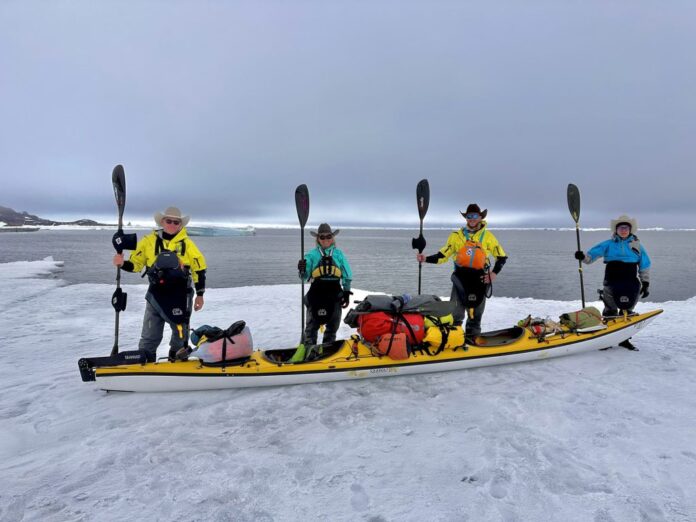
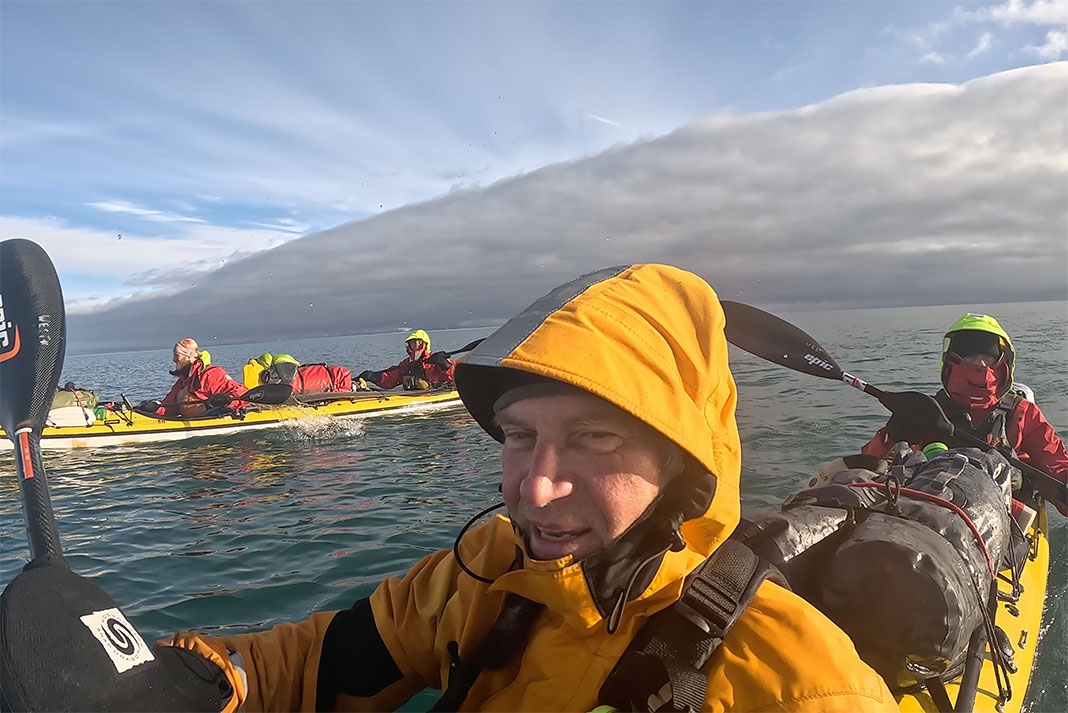
The Arctic Cowboys at the beginning of their expedition. Feature Image: Arctic Cowboys
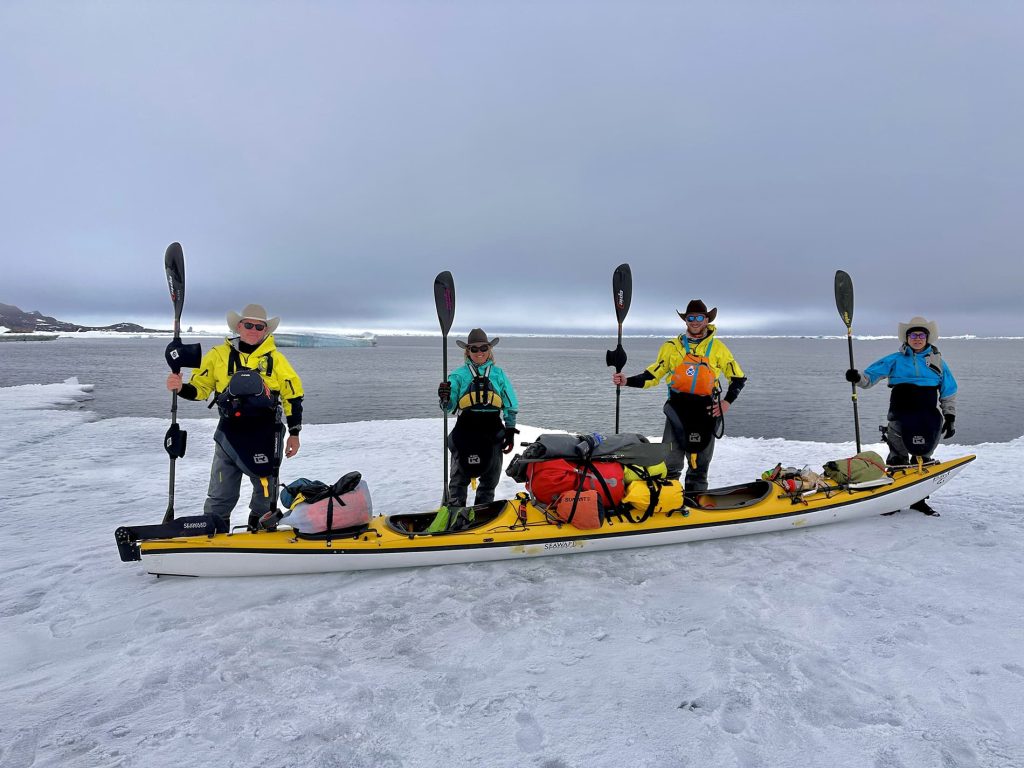
On October 8, 2023, the expedition party known as The Arctic Cowboys reached Cape Bathurst, the western terminus of the Northwest Passage. In doing so, West Hansen, Jeff Wueste, Eileen Visser and Mark Agnew became the first known people to kayak the entire Northwest Passage under human power only in a single season.
The Arctic Cowboys, West Hansen, Eileen Visser, Mark Agnew and Jeff Wueste. Feature Image: The Arctic Cowboys
The Arctic Cowboys Dramatic Finish To Complete The Northwest Passage
The Arctic Cowboys spent 100 days with their kayaks in the campaign to complete the Passage. With temperatures already subfreezing, the last leg of the journey has proved formidable with slow progress and days windbound in camp. To reach the western terminus and the Beaufort Sea within a closing season window, the team had to paddle a 16-mile day in the most harrowing seas seen on their trip.
“The team experienced the roughest waves of the entire expedition throughout the 16 miles to the official finish of the Northwest Passage,” the team reported in a blog post following the ordeal. “They seal-launched from Whale Cliffs in 15-foot waves, some going over West’s head with 20-foot breakers at the turn.”
Once they rounded Cape Bathurst, the team technically completed their record-setting expedition, yet the trip is far from over. The team has since had to make their way another 140 miles southwest to the town of Tuktoyaktuk in the adverse weather conditions. As of Tuesday, The Arctic Cowboys are still en route according to Expedition Manager Barbara Edington. They are currently expected to arrive late Wednesday or early Thursday.
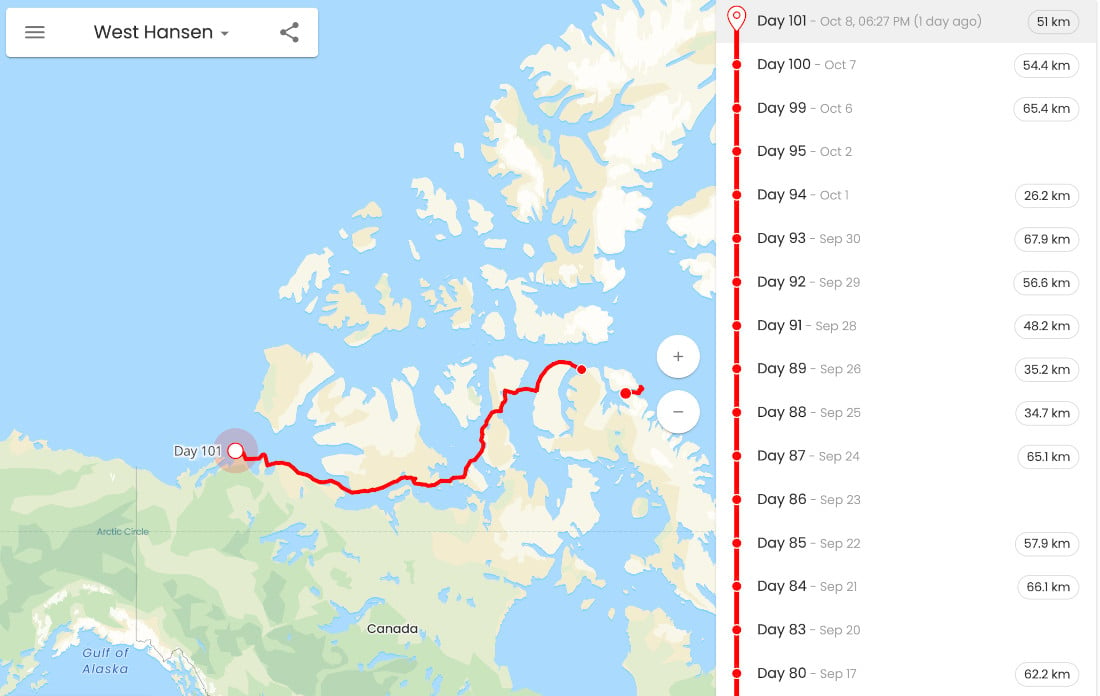
Tracking map of West Hansen. Image: The Arctic Cowboys
The Arctic Cowboys embarked on the 1500-mile journey from Button Point on the northern side of Baffin Island on July 2, with the intent to travel the Northwest Passage east to west. However, the expedition began officially on July 18 when they crossed from Baffin Bay into Lancaster Strait, the internationally recognized eastern boundary of the Northwest Passage. Multiple parties, including a team of rowers and a solo rower, also set out on attempts of a human-powered completion of the Passage this season, but all other campaigns conceded.
Over 83 days in the official Passage, The Arctic Cowboys kayaked without assistance from sails or any propulsion other than their own paddles, and now hold the first claim of completing the journey in a single season.
Stay tuned for an upcoming interview with Expedition Leader West Hansen. Learn more about The Arctic Cowboys 2023 expedition to kayak the Northwest Passage at www.thearcticcowboys.com.


 This article was first published in the 2023 Paddling Trip Guide.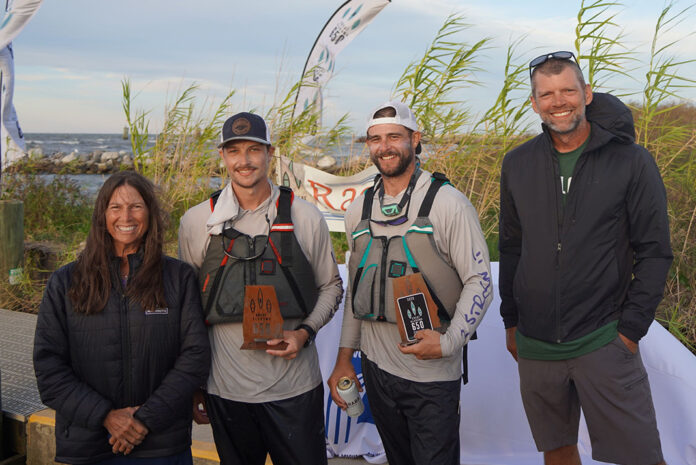
 Cat ‘Logan’ Rescued by Crew
 Ostrom
 Frost River
 Recreational Barrel Works
 Algonquin Outfitters
 North Water
 Watershed