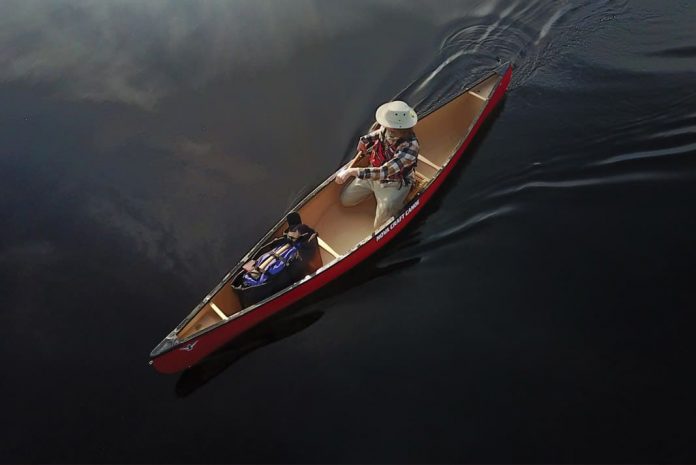
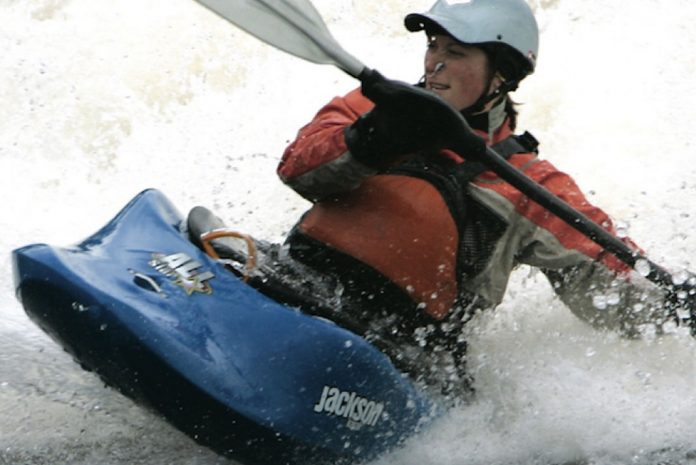
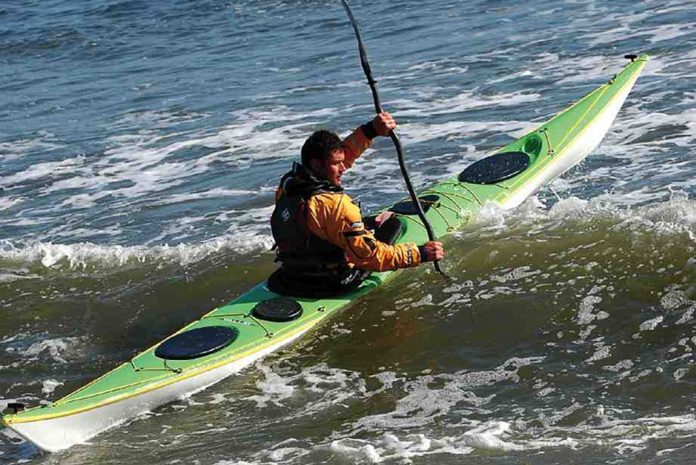
“A tiny change today brings us to a dramatically different tomorrow.” —Richard Bach | Photo: Rob Faubert
It was the Greek philosopher Heraclitus who said, “No man ever steps in the same river twice. For it’s not the same river and he’s not the same man.”
Heraclitus wrote this around 485 BC, when he was roughly my age, living in the city of Ephesus, now modern-day Turkey. His home river, Küçük Menderes or “Little Meander,” generally flows westward and eventually spills into the Aegean Sea. Heraclitus wrote, “Ever-newer waters flow on those who step into the same rivers.” But this only explains half of it, doesn’t it?
Heraclitus’ philosophy is most famous for his insistence on ever-present change as the characteristic feature of the world and man. As in, “And he’s not the same man.”
If you paddle long enough, you will eventually return to some of the same rivers, lakes or coastlines.
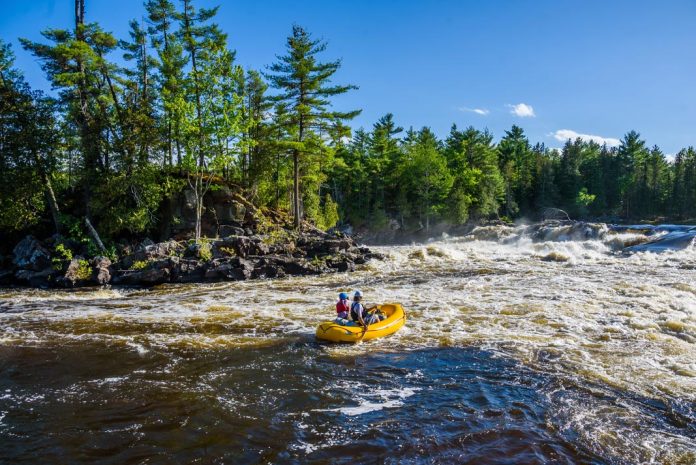
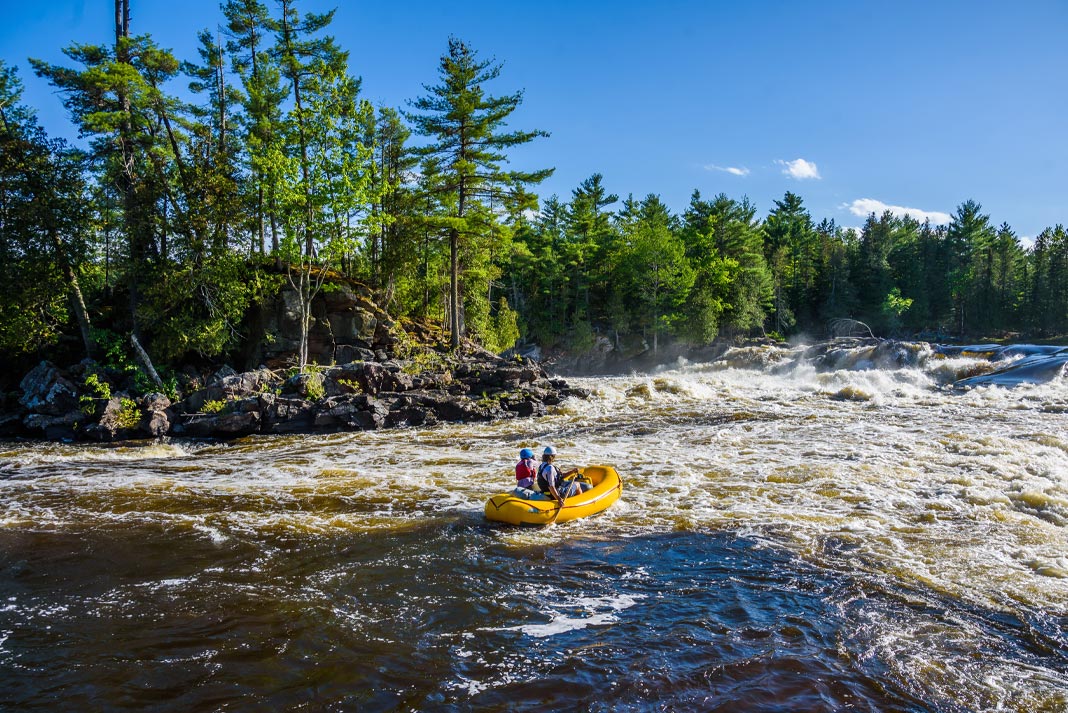
“Do you realize, Scott, it’s 25 years since we first started shuttling up and down these roads?” my friend and Paddling Magazine regular photographer Rob Faubert asked me as we pulled onto the broken blacktop bordering the Ottawa River. Except for a couple of photoshoots, I haven’t really been on the Ottawa in a dozen or so years.
Tall rows of corn still grow in the same fields. School buses of clients in the same smelly wetsuits and trailers stacked with the same rafts still hustle to the same put-ins. The rocks and waves are in the same places. I can close my eyes and remember the lines through the rapids, for they are still the same, of course. The trees are taller and the shorelines more trampled, but otherwise, it seems no time has passed. Look, Heraclitus, it feels like the same river and I feel like the same man.
Except in the backseat of my pickup truck were now three teenagers. One of Rob’s. Two of mine. We were here test paddling and getting photos of the new AIRE Cub.
Around the time I first paddled the Ottawa River, I was reading the novel One by Richard Bach, author of The New York Times bestseller, Jonathan Livingston Seagull. Bach was on the same dorm room shelves as Robert M. Pirsig’s Zen and the Art of Motorcycle Maintenance and Jack Kerouac’s On The Road. Coming of age hippy stuff.
In One, Bach and his wife come under a spell of quantum physics, and he’s able to fly his airplane into alternative worlds—worlds existing in different incarnations at the same time.
“A tiny change today brings us to a dramatically different tomorrow.” —Richard Bach | Photo: Rob Faubert
Imagine all possibilities described by quantum theory simultaneously occurring in a multiverse composed of mostly independent parallel universes. Or imagine your life as a spiderweb. Every decision, big or small, taking you down a different strand of the web. Decision after decision, left or right, your life goes one way or another. We only get to experience one. But in One, Bach’s other lives all exist. In his airplane, he can visit his current self at different times and places in the spiderweb of his many co-existing lives. Bach is able to see how life’s small choices work out in ways he’d never expected.
My friend, Dave, found paddling because he choose to smoke pot before it was legal and before he was old enough, even if it was. His parents sent him to summer camp to clean himself up. Fortunately for Dave, the camp had a whitewater kayaking program. He’s since spent every summer on rivers and most of his adult life guiding and traveling around the world… and smoking pot.
Another friend married and chose a corporate career in a glass office tower too far from the rapids where we learned to paddle. He returned to the river last summer, wondering how it’d been so long. His teenage son had never seen his dad solo a canoe. I sent him a dog-eared copy of Bach’s, One. He signed up for a father-son paddling weekend.
While Heraclitus would say the Ottawa is not the same river, and I am not the same man, most of our rivers, lakes and shorelines are still here to be stepped in. They are mostly unchanged. We have all made choices. Change happens. But unlike Heraclitus, I believe the same man exists. The same man exists, not down one of Bach’s spiderweb yes-no decision trees in a parallel quantum universe, but inside me. Inside all of us.
We will never know the outcomes of the decisions we don’t make. But the ones we choose, the ones we live, live inside us forever. The rivers, lakes and oceans we paddle do too. And we can return.
Stepping in the same rivers is not only possible; it feels as good as it ever was. It feels good in this universe or any other parallel universe we may choose to paddle.
Scott MacGregor is the founder and publisher of Paddling Magazine.
This article was first published in Paddling Magazine Issue 62. Subscribe to Paddling Magazine’s print and digital editions here, or browse the archives here.
“A tiny change today brings us to a dramatically different tomorrow.” —Richard Bach | Photo: Rob Faubert
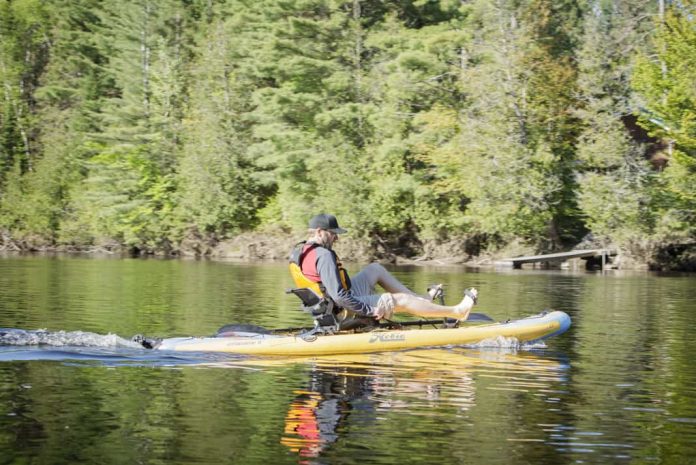
Is it a kayak or a SUP? The Hobie Mirage i11S is both. This paddleboard-kayak hybrid is ideal for grab-and-go adventures after work. Throw camping gear or a crate in the back, grab a fishing rod and enjoy a night or weekend away.
i11S has the best of both worlds
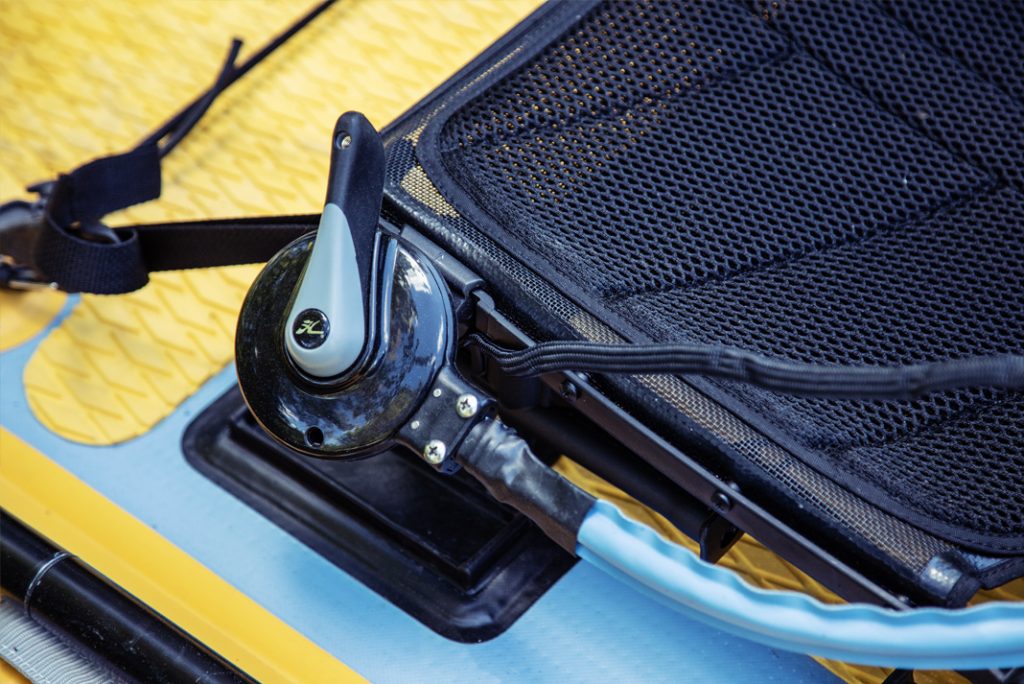
The Mirage i11S packs plenty of luxury features into its low-profile design, including a hand-operated rudder control and optional fin is to assist with tracking.
The Mirage i11S comes with a four-piece paddle with an aluminum shaft, but Hobie’s pedal drive system is the real star of this inflatable board. The MirageDrive 180 offers hands-free propulsion—its flexible fins propel from below providing forward motion with each pedal stroke.
Pull the system’s toggle and you go in reverse—that’s the 180 part. The i11S offers the power of a Hobie Mirage system, without having to load and launch a heavy kayak.
The base weight of the kayak is just 35 pounds, which swells to 64 pounds with the MirageDrive system and seat.
Outfitting fits like a glove
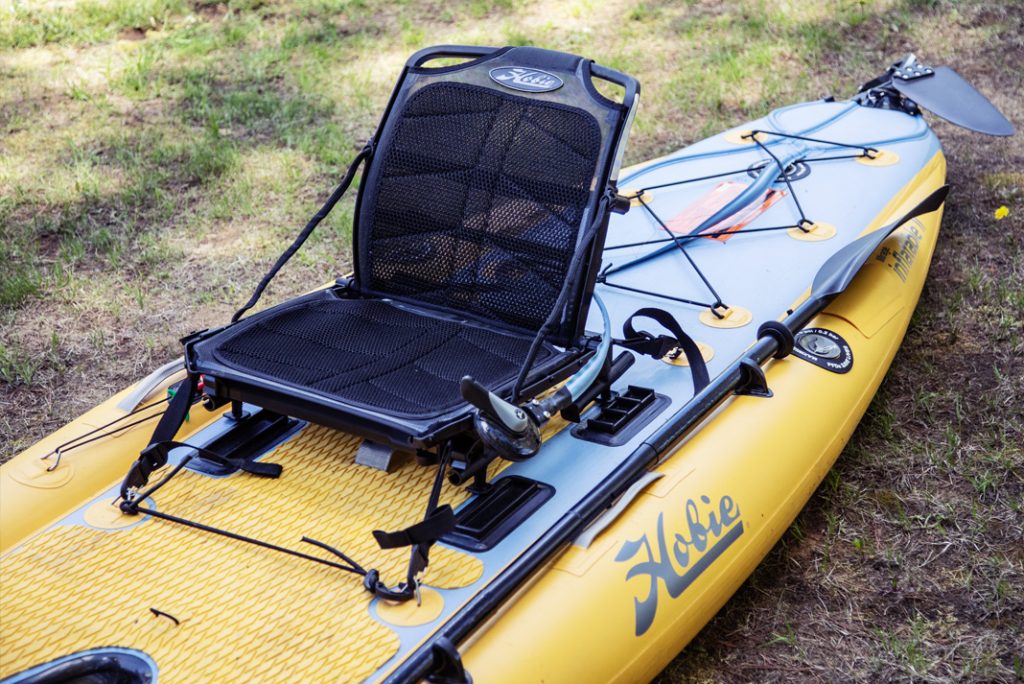
The Vantage CTi seat is something to write home about. It features a sturdy but lightweight aluminum frame. On the back is a knob controlling a cable-adjusted lumbar support, and the angle of the seat back is controlled on-water via a lever on the right.
The seat has two height levels, but it must be removed from the boat to adjust from high to low. On shore, you can even use the Vantage CTi as a beach chair.
The i11S’s flat, drop stitch reinforced floor with two outer pontoons improves stability and provides an open and stable platform which means to us, more room for camping gear and fishing tackle.
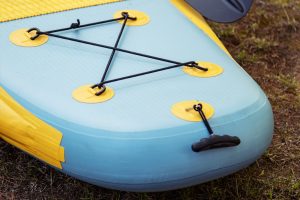
Use the bungees and D-rings to secure everything in place. Need to get something? Stand, turn around, bend down and even walk to the bow without hardly a wobble or a bobble.
More than meets the i11S
Want to transition the i11S to a paddleboard? No problem. Just take out the MirageDrive, insert the plug, and remove the chair and the i11Ss is a capable board. Rather fish than paddle?
Popular with kayak anglers is removing the MirageDrive unit and replacing it with a Torqueedo motor unit to troll or speed off to the next fishing grounds.
Paddle softly and carry a stick. | Feature Photo: Virginia Marshall
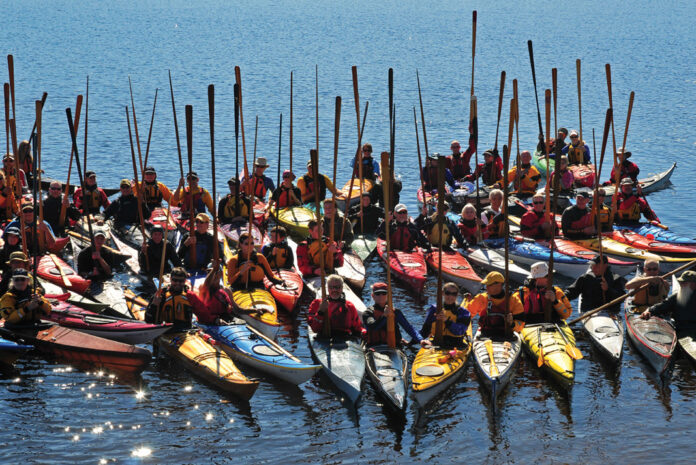
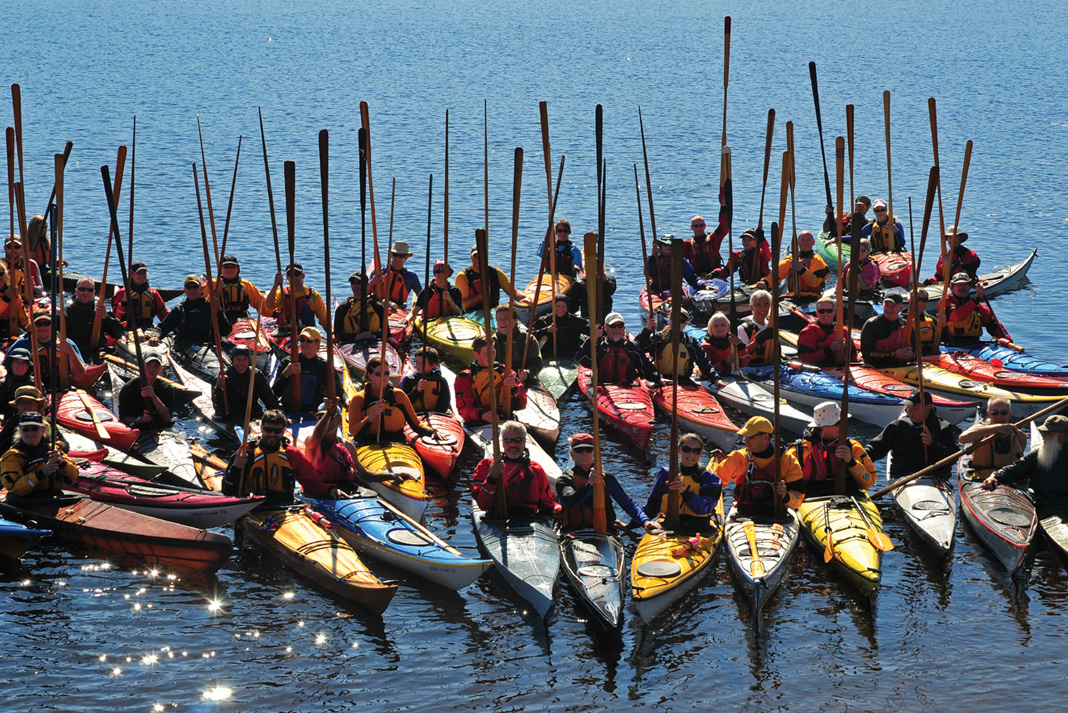
Newer is not always better. Today’s wide-bladed kayak paddles flaunt cutting-edge technology and materials our grandparents never heard of. But it may be time to look past the latest space-age paddle and peer into the pages of history at the traditional Greenland paddle. These minimally shaped chunks of lumber have been tested in some of the most inhospitable open water on the planet for as many as 5,000 years, where what works survives and what doesn’t is abandoned.
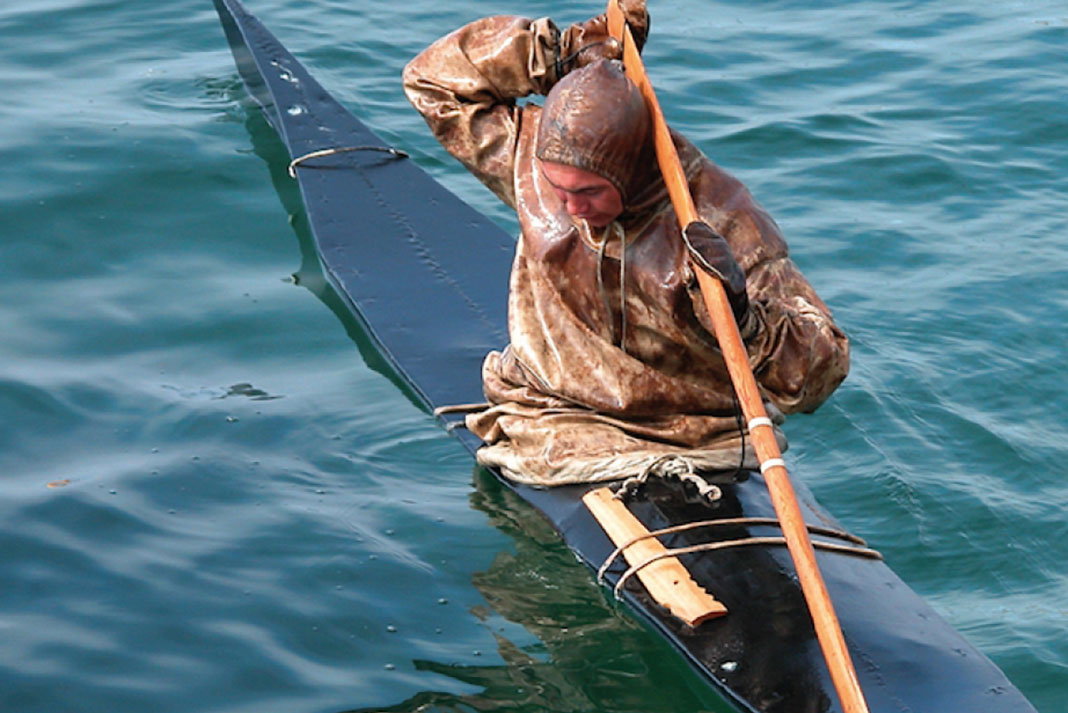
Foremost among the myths about Greenland paddles is that the skinny blade—called a pautik by Inuit peoples, and known affectionately as a stick by modern Greenland-style paddlers—is at best an unsatisfactory compromise in an environment starved for wood. For arctic hunters, walking along icy beaches looking for wood suitable to make boats and paddles was the usual way to acquire building materials in a treeless land. Saltwater-bleached driftwood was prized by the first kayakers.
There are many Inuit traditions representing a rich diversity of both single and double-bladed paddle types. Many early kayak paddles were about four inches wide and a couple of inches thick at the beefiest cross section—not unlike a two-by-four. This narrow, double-bladed paddle common to most arctic regions has come to be called the Greenland-style paddle.
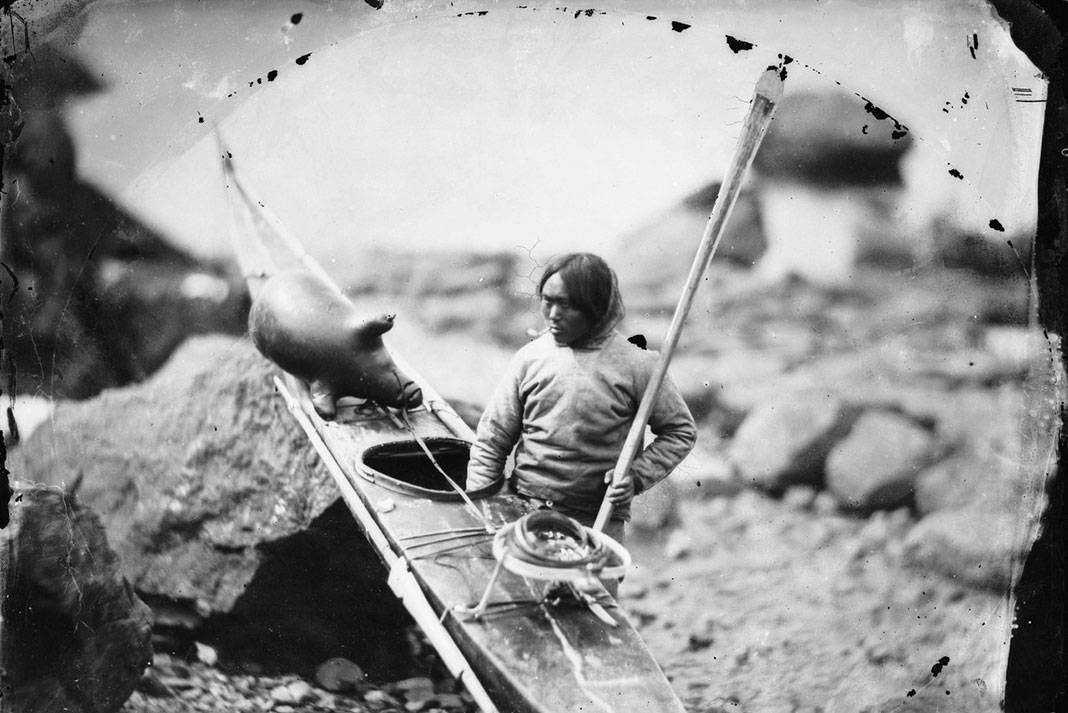
An unidentified Inuit man from the west coast of Greenland holds his paddle while standing beside a kayak equipped with seal hunting gear, circa 1854. | Photo: Captain Edward Augustus Inglefield
Greenland paddles vs. Euro paddles
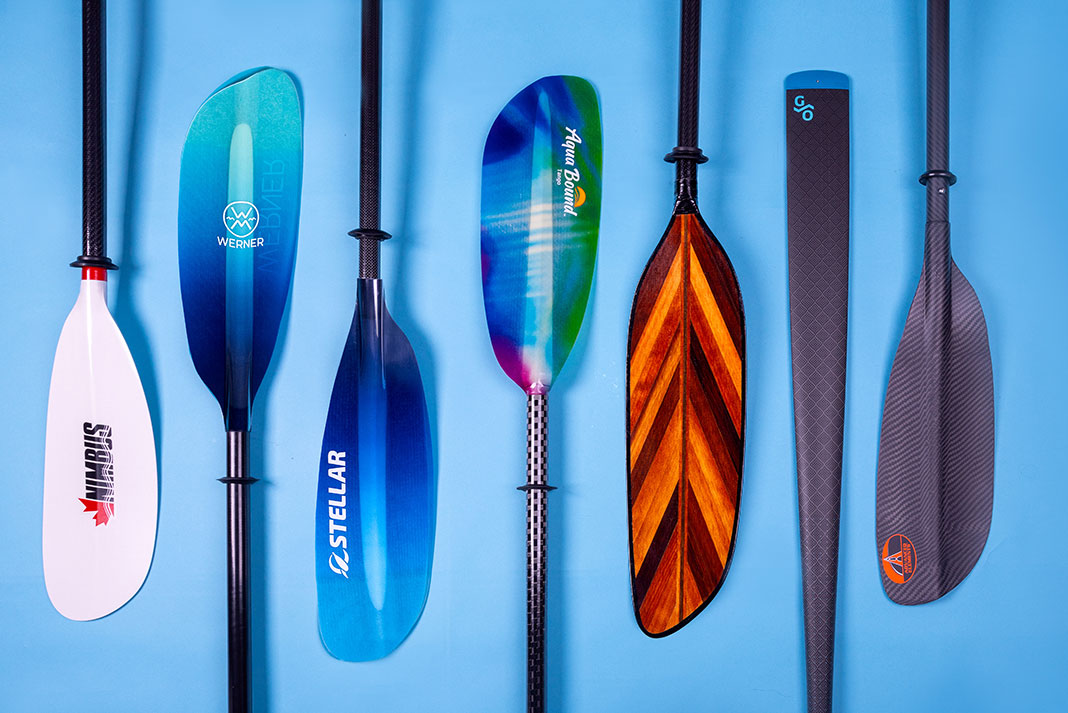
Greenland paddles are usually unfeathered, have a relatively short loom, or shaft, and have long, narrow, symmetrical blades. The first kayak paddle I chose was a 230-centimeter, one-piece Euro paddle with a 45-degree blade offset. Like the Euro paddles used by most modern sea and recreational kayakers, it was descended from the whitewater paddles that emerged out of Austria and Germany in the 1920s. So most sea kayakers today are using what amounts to a double-bladed canoe paddle!
Another common myth amongst Greenland paddle naysayers is that sticks deliver less power and speed than the wider spoon blades of Euro paddles. In fact, the blade surface area on a stick is very similar in size to a Euro paddle—it’s just laid out in a different length-to-width ratio.
The unique shape of the long Greenland paddle requires a different stroke. Without proper instruction critics experience a lack of propulsion or a huge amount of fluttering. This is simply what you get when you grab a knife and try to use it like a spoon—or use a stick like a Euro paddle. Instead, you need to use a canted stroke. This lets water vortices shed from one edge of the blade, and allows the stick to work more like a propeller, giving lift and resistance with which you can gain propulsion.
Touring advantages
Wide-bladed paddles may be preferable in the aerated water of big rivers and surf zones, and having the greatest surface area of a paddle near the ends of the loom may also be helpful in shallow water. But the Greenland-style paddle was specifically designed for the needs of the open water paddler—efficient travel over long distances, self-rescue and rolling in wind and waves. When used correctly, there is less stress at the catch, as the power is gained during the middle to end of the stroke and the release, rather than as a forceful initial load.
I asked one of my mentors, Turner Wilson, for his thoughts on touring with a stick. Wilson makes traditional qajaqs and beautiful Greenland paddles, and he is one of the rare paddlers these days whose initial kayaking experience was with a stick.
“In paddling, there are X, Y, and Z axes: forward, turning and revolving. No paddle integrates all three as effortlessly as the Greenland paddle. Grace, flow, rhythm, elegance, ease, bite, release… no other instrument extends the human body into the water for the purposes of movement in quite this same way.”
Not only are these paddles better in the wind thanks to their narrower profile, but you can also use a sliding stroke in which you walk your hands back and forth on the paddle to dig deeper and leave less material in the air. The anthropometric measurements used to custom size each paddle to its user include sizing the widest part of the blade to the paddler’s hand, allowing you to hold anywhere on the stick. This is also an advantage when making efficient, powerful extended sweep strokes to turn quickly, or to increase leverage during rolling.
Paddle softly and carry a stick. | Feature Photo: Virginia Marshall
Superior for survival skills
As a rolling instructor trainer, I believe there is no finer tool with which to learn the cold water survival skill of self-righting yourself in a kayak. Blade angle is a critical element of the roll and having one blade in your hand allows you to keep the working end at the perfect angle for sweeping and creating lift. The natural buoyancy of the wood further aids in rolling, effortlessly floating your paddle to the surface.
“In paddling, there are X, Y, and Z axes: forward, turning and revolving. No paddle integrates all three as effortlessly as the Greenland paddle.”
In 2012, James Manke became the first person to paddle a sea kayak with a Greenland paddle down the Grand Canyon. “I feel more comfortable with a Greenland paddle in my hands,” he says, although he’s the first to admit that it may seem like a strange tool for the environment. The one place that a stickupside down or non-power face—it performs the same regardless of how it’s held. “This can certainly be an advantage after a huge trashing when your paddle gets tossed around and you lose your blade angle and sometimes the entire paddle.”
Perry, who is also one of the world’s finest Greenland rollers, finds similar advantages when she capsizes in difficult coastal conditions. “If the water is rough and I end up upside down, the Greenland paddle gets tugged around less than a Euro blade,” she says.
Crafting a special connection
Speed, endurance, rolling, rough water—Greenland paddles excel in challenging situations. But Perry is quick to point out some of their subtler advantages, “They’re quiet, you can paddle completely soundlessly. I find this style very relaxing.”
She also notes, like the generations of Inuit hunters who designed her blade, that the paddle’s silent stroke is great for sneaking up on wildlife.
Perhaps the greatest benefit, however, is the Greenland paddler’s deep connection to his or her blade. Most stick paddlers are also stick makers. In part, this is out of necessity. While commercially available paddles are on the rise, the best way to get a blade that’s perfect for you is to shape it yourself.
“All of the marketing we’re exposed to urges us to try the latest and greatest gadget. It is a joy to step back from that precipice of consumption and say, ‘not so fast,’” muses Wilson.
The Greenland paddle’s 5,000-year history suggests that this early incarnation of the two-by-four can meet the needs of many. It’s a shame that most kayakers have a limited awareness of the highly advanced skills and superior equipment developed so long ago by Inuit peoples. Not only have traditional paddles withstood the waves of history, these simple, elegant tools can make today’s paddling experience more efficient, safer, easier—and ultimately, richer.
James Roberts is mad about trad. Find him paddling his handmade qajaqs and pautiks on the waterfront at Ontario Sea Kayak Centre.
This article first appeared in the Fall 2015 issue of Adventure Kayak magazine.
Subscribe to Paddling Magazine and get 25 years of digital magazine archives including our legacy titles: Rapid, Adventure Kayak and Canoeroots.
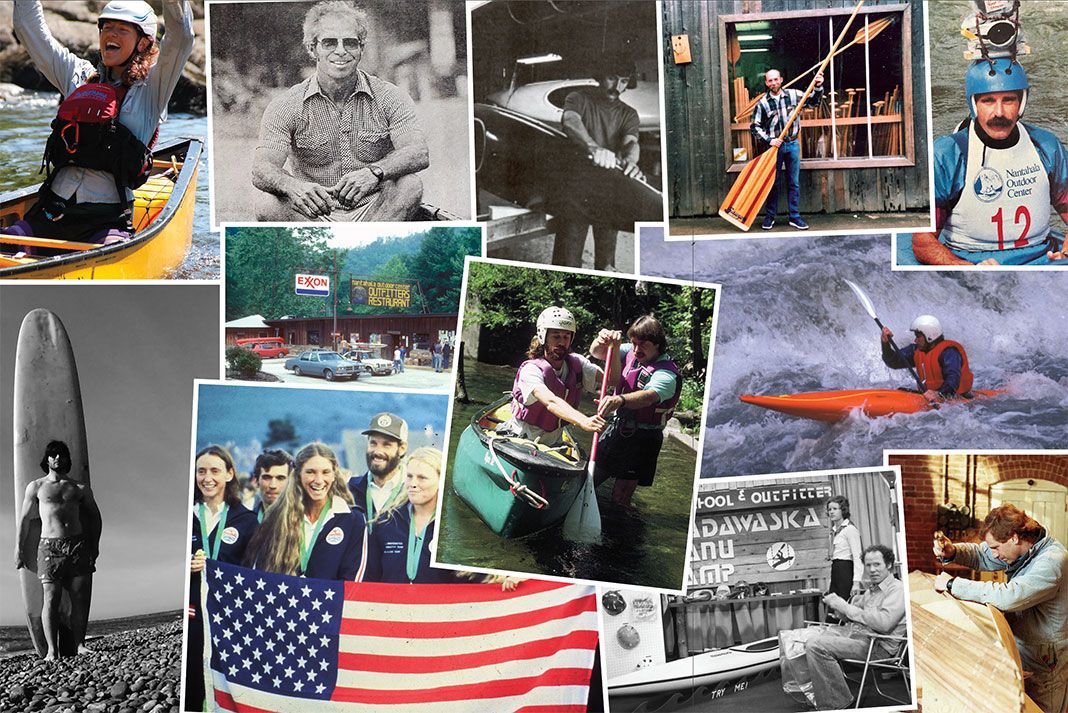
Picture this: The year is 1972. You’re a swingin’ flower child, and you want to go kayaking with your sweetheart, feel the groove and sway of the ocean and get in touch with Mama Earth. It’s not much different than today—except you have to go build your own boat. A look back through the history of sea kayaking shows how the sport transformed from a tiny niche activity in 1972 to one of wide and enduring popularity today.
The history of sea kayaking: Popularizing the sport
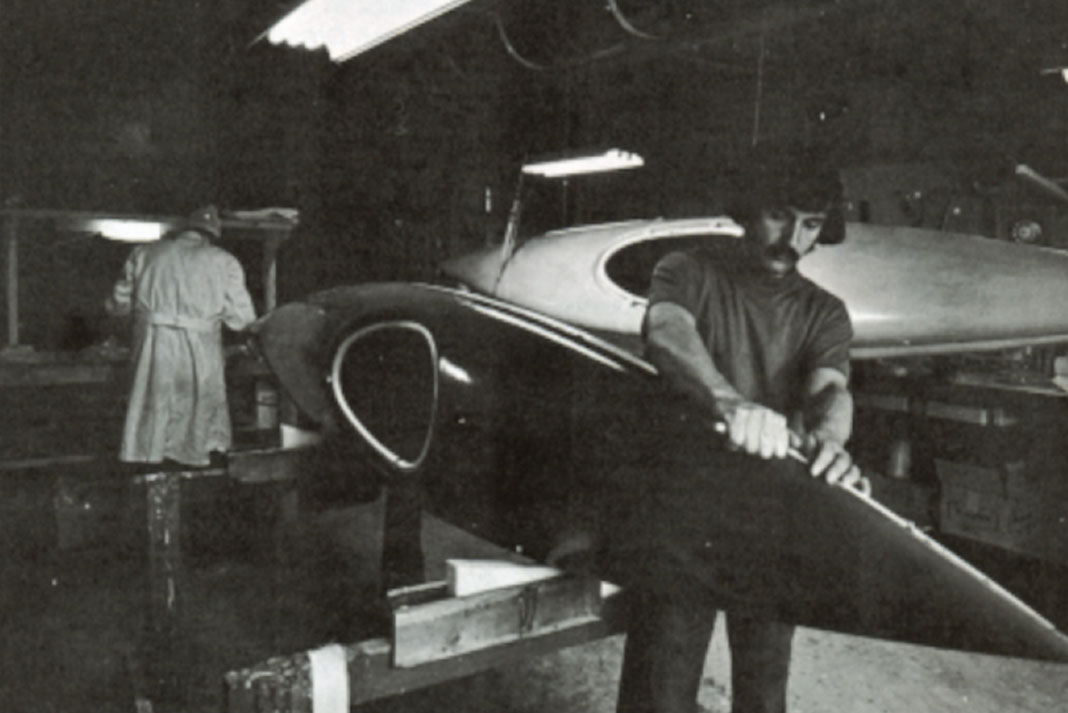
Someone in your paddling community has a fiberglass kayak mould—probably at the local paddling club. You pay 10 or 20 bucks for the rights to borrow it and go buy some fiberglassing supplies from someone who’s ordered them in bulk. You get a few pointers from the last builder, and so take on the unwritten responsibility to pass your knowledge along to the next.
Or, if you’re lucky, you can find someone with a bit of experience to build you a boat for a few hundred bucks. But more likely they’ll just give you two halves, a deck and a hull, and leave you to do the dirty work—a lot of hours with your head in the cockpit getting high off resin fumes (it is the ‘70s) and mucking around with fiberglass seam tape.
Feature Photo: Eddyline Kayaks collection
That’s pretty much how it was in the early years of sea kayaking. Boatbuilding was the hazing you went through if you wanted to be a paddler—not a good recipe for a sport’s popularity.
Then, some young kayakers turned their hobby into a business. They started the companies whose names appear on most of the boats we’re paddling today, and between 1974 and 1984, our sport took off. Here’s how it went down.
[ Paddling Buyer’s Guide: See all sea & touring kayaks ]
The history of sea kayaking in the U.S.
The Seattle scene pre-1974
Folding-kayak touring has its own illustrious history throughout the 1900s, but today’s version of sea kayaking didn’t take off until the advent of fiberglass.
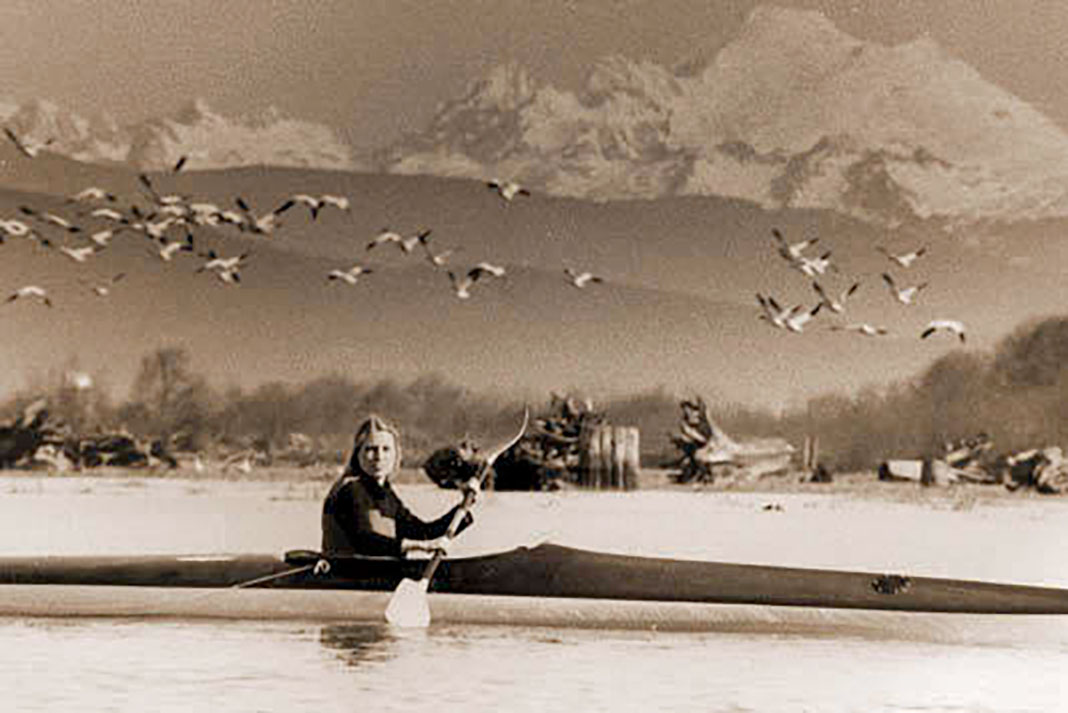
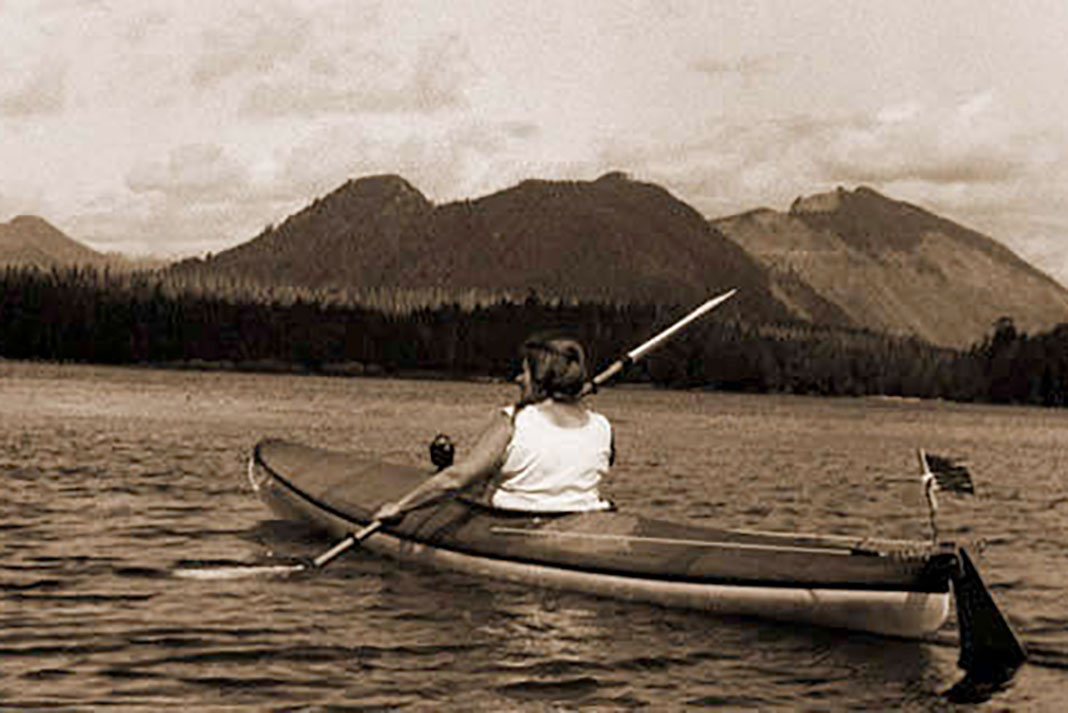
It’s only logical that the earliest fiberglass sea kayaks appeared in Seattle, where the Washington Kayak Club already had hundreds of members. Wolf Bauer started up the Washington Fold-Boat Club, the WKC’s forerunner, in the mid-‘50s. WKC members in their German Kleppers or locally built Whalecraft folding kayaks pioneered trips to many now-popular destinations on the West Coast of Vancouver Island and Alaska, often under the guidance of Bob Miller—the WKCs tireless tripping patriarch, who in his lifetime logged nearly 100 trips of a week or longer.
In 1959, WKC member Ted Houk designed the club’s first fiberglass kayak. Called the Gulf Islander, Houk’s kayak was homebuilt in small numbers by WKC members who passed around the mould. Many WKCers were also soon paddling the Tyee I and II, designed by Linc Hales in 1961 and 1964 and sold at area shops well into the ‘70s. Others had homebuilt boats whose hulls resembled European downriver racing kayaks or traditional fold-boats, so that by 1974 when commercial production was just getting going, most Seattle-area kayakers were already paddling fiberglass.
“Will the last person to leave Seattle please turn out the lights.”
The first commercial builders
Whitewater kayaking was big in the early ‘70s, first appearing in the Olympics in 1972 at Munich, and many boat builders came to sea kayaking after being drawn to the glitz of whitewater first—skipping the venerable folding kayak tradition entirely. Around this time, a trio of whitewater boat builders sprang up who would eventually make touring kayaks their core business.
Eddyline Kayaks was started by Tom and Lisa Derrer in 1971 out of a tiny shop in Boulder, Colorado. Eddyline only built whitewater boats, and had no interest in sea kayaks until the Derrers moved to Seattle in 1974.
There, they met Werner Furrer—the name that’s stamped on many of our paddles today. Furrer, a design engineer from Austria who had toured in folding kayaks since the 1940s, built his first fiberglass kayak in 1965—a slender Greenland-style boat he called the Eskimo.
In 1975, before turning his full attention to the paddle business, Furrer designed the WT-500 (Werner Touring, 500 centimetres long). Like most early hardshells, the WT-500 had a rudder, but no hatches or bulkheads; gear was stowed in canvas duffels waterproofed with garbage bags.
Lisa Derrer trying out the Eddyline Orca, 1979. | Photo: Werner Furrer collection
Eddyline’s first sea kayak, the WT-500 designed by Werner Furrer, c. 1975. | Photo: Werner Furrer collection
The WT-500 became Eddyline’s first sea kayak. Eddyline came out with its first in-house touring design, the Orca, in about 1978. It was the sort of enormous, high-volume, flat-bottomed cruiser that came to typify the West Coast boat.
[ Paddling Buyer’s Guide: See all Eddyline sea kayaks ]
A wave of layoffs at Boeing had left a lot of unemployed engineers floating around Seattle in 1972. People were joking, “Will the last person to leave Seattle please turn out the lights.” And this was a time when the environmental movement and the outdoor sports craze were taking off. Companies including Jansport and Cascade Designs (of Thermarest fame) were founded by Boeing castaways, as were two more of the first commercial kayak builders: Pacific Water Sports and Easy Rider.
Lee Moyer took his first sea kayak trip with the WKC’s Bob Morris in 1970—“going north out of Tofino”—at a time when the dirt road across Vancouver Island was so new you needed to duct tape your car doors shut to keep the dust out and pack extra spare tires. And Long Beach was home to more back-to-the-land squatters than kayakers.
Most backyard boat builders were using pirated designs, Moyer said, so he and a buddy set out to buy the rights to a legal mould. Pacific Water Sports was the name they made up so they could pass themselves off as a legitimate business when they approached the British builder of a championship whitewater slalom hull. They printed up some official-looking company letterhead and inked a deal.
On his first sea kayak trip north of Tofino, the dirt road across Vancouver was so new you had to duct tape your car doors shut to keep the dust out.
Their new boat building business soon evolved into a paddling retail store and full-time jobs for Lee and Judy Moyer.
In 1974, they designed and built their first sea kayak, the Sea Otter. “Sea kayaking was the biggest part of our business from then on,” said Lee.
The third company in the Seattle early ‘70s trio was Easy Rider, started by Peter Kaupat as a whitewater boat builder in 1970. The first Easy Rider sea kayak, circa 1975, was the Dolphin, designed by Dan Ruuska—another ex-Boeing engineer who went from moulding ultra-sleek engine intakes to hydrodynamic hulls.
“I remember seeing [Dan] in an unemployment line probably in about 1972,” recalled Matt Broze of Mariner Kayaks. “Not too many years later I bought a kayak from him.”
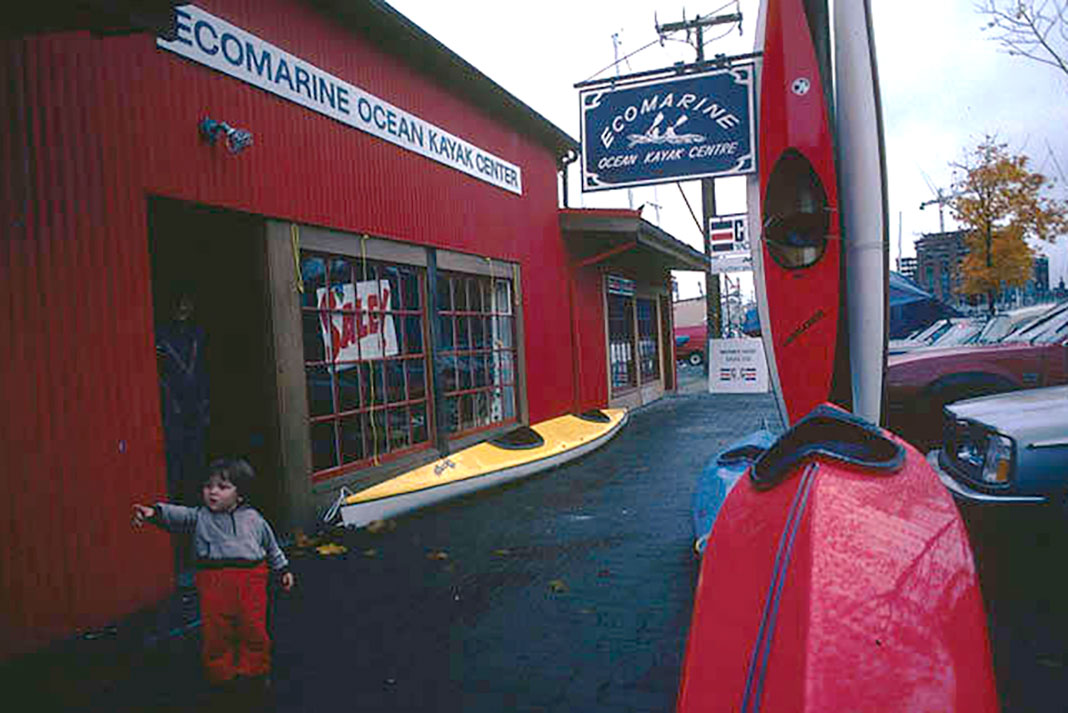
Ecomarine was opened by John Dowd on Granville Island, Vancouver, in 1980. | Photo: John Dowd collection
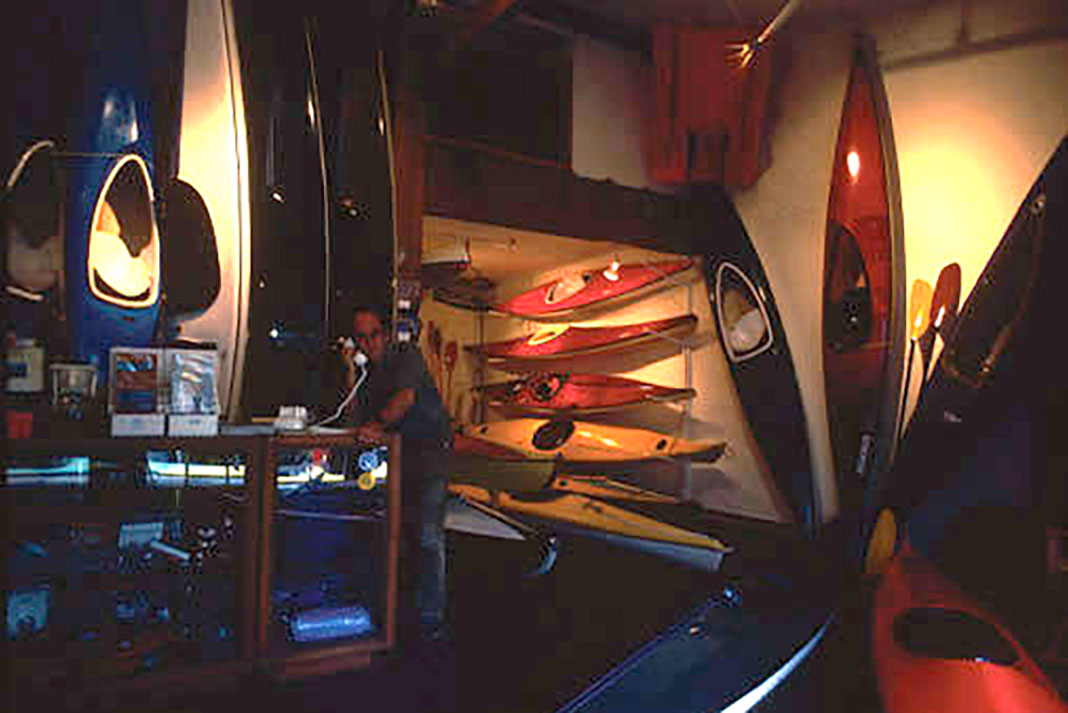
Early wares on display at North America’s first specialty kayak shop, Ecomarine. | Photo: John Dowd collection
The history of sea kayaking in Canada
In Canada there were a few early fiberglass builders, including a B.C. company that bought Ted Houk’s Gulf Islander design. There was Frontiersman Fiberglass Products of Mission, B.C., building sea kayaks in 1976. And Walter’s Ski Shack in North Vancouver, a shop run by Walter Buchmueller, which built and sold a German-imported design called the Eskie and one of his own designs called the Osprey.
“I remember seeing Dan in an unemployment line. Not too many years later I bought a kayak from him.” —Matt Broze
None of Canada’s big players were on the scene yet when Nimbus kayaks was born. Liberal arts student Steve Schleicher and microbiology instructor Joe Matuska were just a couple more semi-employed whitewater paddlers building paddles and boats for their friends in a converted chicken coop behind Schleicher’s parents’ house near Vancouver. Schleicher recalls that they built their first touring kayak around 1974 and that it actually had hatches and a rudder. The boat sat on display for a whole summer at the Mountain Equipment Coop, back when the fledgling MEC was just a single shop in Vancouver, but found no buyers. Yet Nimbus became a fulltime business by around 1976—“starving to death in the winter.”
Schleicher pegs 1978 as the year the sea kayaking industry came out of the garage. It was for Nimbus, anyway. That was the year they moved out of the chicken coop to a real production facility in Port Coquitlam. By 1982, Nimbus had come up with its flagship Seafarer design, which is still produced. Matuska later left to start up one of today’s dominant paddle companies, Aqua-Bound.
Meanwhile, in the Garibaldi Highlands just south of Whistler Village, a gruff Czech immigrant and whitewater champion named Mike Neckar was also moulding whitewater boats on an informal basis in a falling-down shop in the rainforest.
“Kayakers would tell him what he wanted and he would produce them under the cover of all the trees and secrecy,” is how Allen Slade described the mythic origins of Necky Kayaks. Slade operated Striders sport store at Fourth and Burrard in Vancouver and became Neckar’s first dealer, long before the formal existence of Necky. “This was just Mike Neckar, care of somewhere in Garibaldi Park. You put in an order when you saw him.”
Mike Neckar is one of the industry’s most legendary characters—impossible to reach for a magazine interview, but variously described by others as “kayaking’s 8,000-pound gorilla,” an engineering genius, a magician, and the last person you’d ever expect to see climb into a kayak and make it dance.
Slade had started out by importing Derek Hutchinson Baidarka Explorers from Britain: “When Neckar saw these he thought they were crap,” which seems to have been a typical North American response to the British designs. So together they strived to develop a design that was stable, roomy and comfortable, that the average paddler could take out on the ocean. Neckar came up with a design based on a high-volume whitewater boat, but longer, wider, with a large cockpit.
In what fading memories recall was spring of 1975, Neckar delivered the newly minted boats to Striders himself, showing up with eight of them tied onto the roof of his Plymouth with ropes strapped through the windows. Neckar pulled the kayaks off the car then tossed them on the sidewalk in front of the shop. Slade worried they’d get scratched, and Neckar retorted, “The first time people use them they’re going to get scratched.”
The intractable designer called his first sea kayaks Turkey Boats because he couldn’t think of a better name, or maybe it’s an indication of what he thought of the people who would be paddling them. Nonetheless, he went on to design better-known early Necky models such as the Phoenix, the Gannet and the President by the early ‘80s, and later built some of the world’s finest sea kayaks.
Spreading the gospel
Industry veterans remember the late 1970s and early ‘80s as a time when, if you had a kayak on your car, heads would turn.
“People thought I was nuts,” remembers Moyer. “‘You go out in the ocean in a kayak?’ They thought that was a big daredevil stunt.”
In 1975, Ken Fink, an oceanographer in Maine, started paddling his whitewater slalom boat on the Atlantic Ocean—a not-uncommon way for whitewater kayakers of the day to discover touring. Fink kept at it until he saw an ad for the Nordkapp by Valley Kayaks in 1978. He contacted Frank Goodman to order two boats—one for himself and one for Maine’s attorney general—and received an invitation to become the North American distributor.
Fink became a self-described evangelist for his new low-impact sport. Well into the ‘80s, if Fink saw a kayak on the highway it was probably one he’d sold. Passing a car with a kayak on top, he’d always look at the boat first to find out who was driving. “And if we saw each other on the interstate in enough time, we’d stop… run over to the median strip and talk.” If he parked, he’d invariably return to his car to find someone waiting for him or a note on his windshield from a potential buyer.
As if the Pacific Northwest didn’t already have its share of the action, a few other Seattle companies entered the business in the early ‘80s. Brothers Matt and Cam Broze started Mariner Kayaks in their basement in 1980. And Dan Ruuska of Natural Designs and John Abbenhouse of Northwest Kayaks crossed over from whitewater and began building touring kayaks.
“‘You go out in the ocean in a kayak?’ They thought that was a big daredevil stunt.” —Lee Moyer
“I can recall in 1980 or ‘81 going up to Vancouver Island… and counting 100 windsurfers on cars to one kayak,” said Matt Broze. “I thought, ‘We started building the wrong kind of boats.’” The industry was still in its infancy, but companies saw that touring had a potential mass appeal that whitewater didn’t. The companies were up and running with viable boat designs, and looking for somewhere to grow.
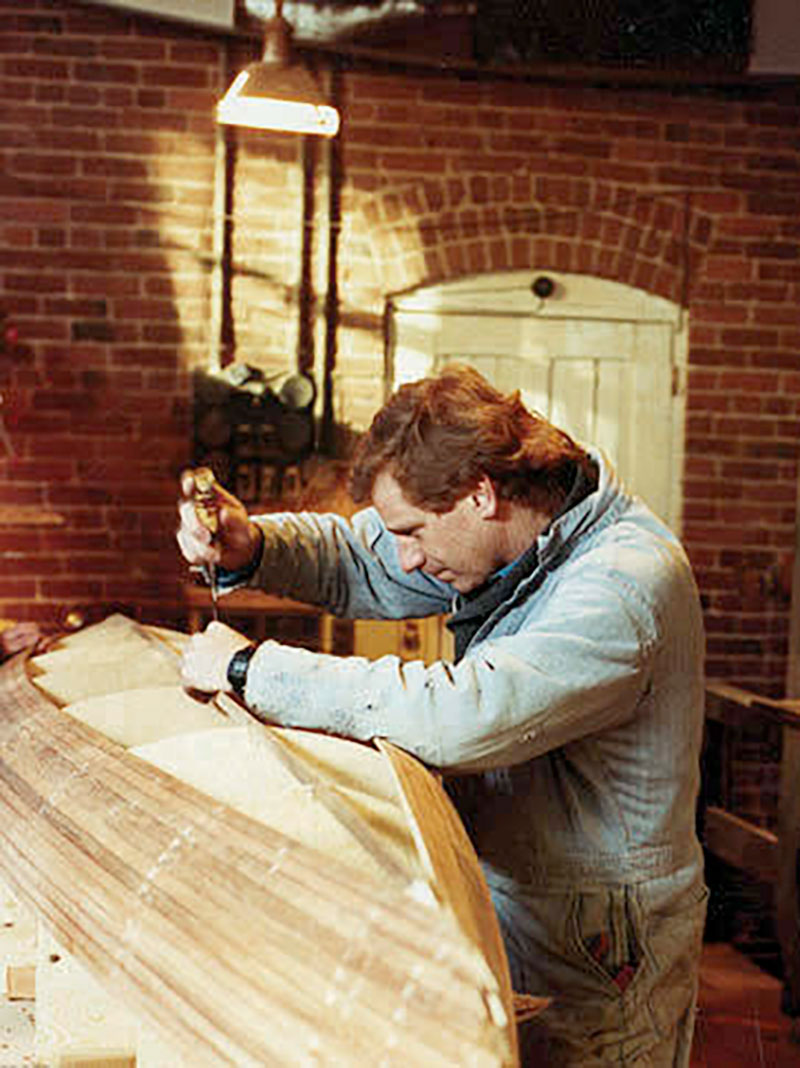
Brian Henry of Current Designs in Victoria works on a new cedar strip plug. | Photo: Brian Henry collection
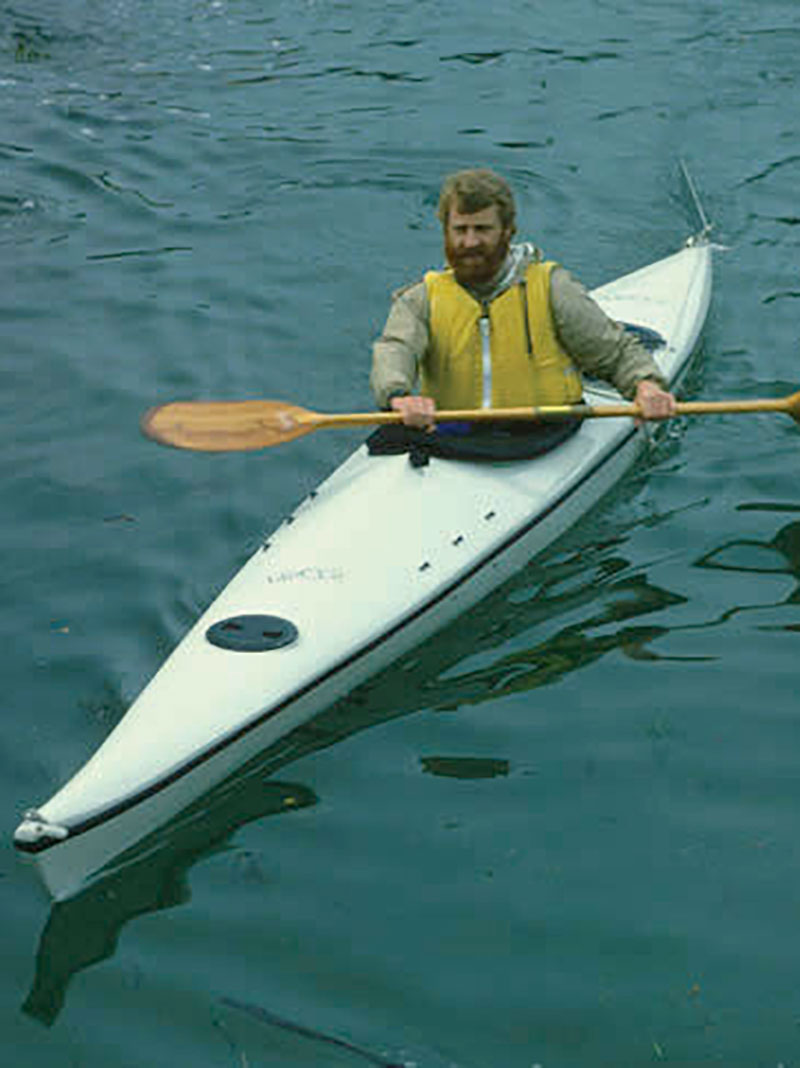
Test paddling the first Current Designs kayak, the Pisces, in 1982. | Photo: Brian Henry collection
Inventing the kayak store
In the history of sea kayaking there were no exclusive shops for the sport until John Dowd opened Ecomarine in 1980 on Vancouver’s artsy Granville Island. Dowd brought in folding kayaks from Europe and sold many of the new North American designs including Eddyline’s Orca, Pacific Water Sports’ Sea Otter, and Nimbus’ kayaks.
Dowd is also credited with coining the term “sea kayaking” with the publication of his book of that title in 1981. “It wasn’t called sea kayaking until my book came out,” he said. “It was called kayak touring or sea canoeing or canoe touring, blue-water paddling, coastal paddling, all those things.”
Over on Vancouver Island, Brian Henry was a sheet metal mechanic working long overtime during mill shutdowns so he could have maximum time off for skiing and whitewater paddling.
Around 1979, he went on a month-long paddling trip to the Queen Charlottes, a rare thing at the time. “I decided when I came back I wasn’t going to be a construction worker anymore. I was going to be in the kayak business,” he said. Henry opened Ocean River Sports in Victoria in November 1981.
“I just wanted to have a little kayak store that I could run for a few months of the year and I could paddle and I could ski. I used to put a little notice on my door—‘Gone product testing’—and we’d go to the river.”
Henry started designing boats, beginning with a large hatchless sea kayak called the Pisces, which he took to Mike Neckar to get built. After about a year he started his own production of Current Designs kayaks on Vancouver Island.
In 1982, Bob Licht followed the Ecomarine example and opened Sea Trek Ocean Kayak Center in Sausalito, California. The Southwest had its own kayak builder too: Josef Sedivec at EDA Products had been making whitewater racing kayaks and canoes since 1969 and came out with his first sea kayak, the Vagabond, in 1975.
Licht remains a key promoter of kayaking in the American Southwest. Other specialty kayak shops across the continent were not far behind Ecomarine, Ocean River Sports and Sea Trek.
[ Plan your next adventure with the Paddling Trip Guide ]
The meeting in Werner’s rumpus room
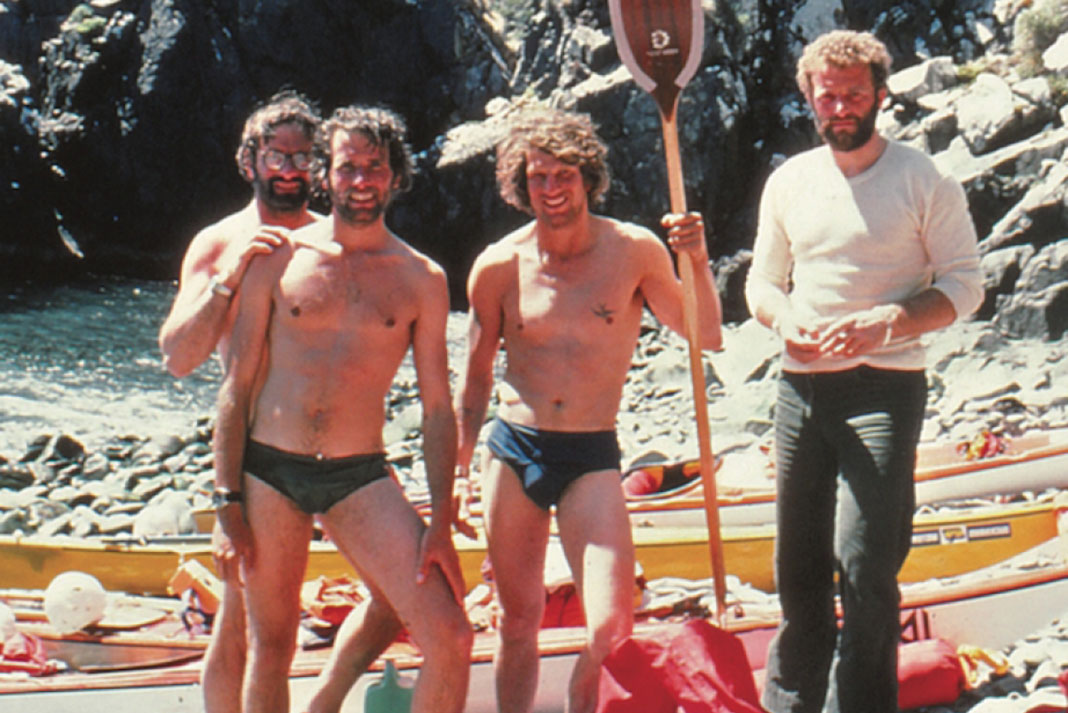
The sea kayaking industry as we know it did not happen by accident. Sometime in 1981 or 1982, a group of would-be career kayakers met in Werner Furrer’s basement in Seattle and deliberately created it. John Dowd organized the meeting. Attending were Tom Derrer of Eddyline Kayaks, John Abbenhouse of Northwest Kayaks, Lee Moyer of Pacific Water Sports, Brian Henry of Ocean River Sports and others.
They formed the Trade Association of Sea Kayaking (TASK)—now the Trade Association of Paddlesports (TAPS)—and studied the successes and failures of other outdoor industries to put together a plan for theirs.
“That was when we realized that we could be an industry rather than a bunch of guys in their backyards,” said Henry. “Everybody was in it because it was their favourite hobby,” recalled Moyer. “I think TASK did a pretty good job of helping a bunch of amateur businesspeople act a little more professional.” One of TASK’s most important discoveries was of the need for boat pricing that would include a healthy profit margin for builders, retailers and, eventually, distributors.
“The biggest single thing that happened in our industry to make it become what it is was to get the pricing right,” said Dowd. “So suddenly everybody was able to make a living at it.”
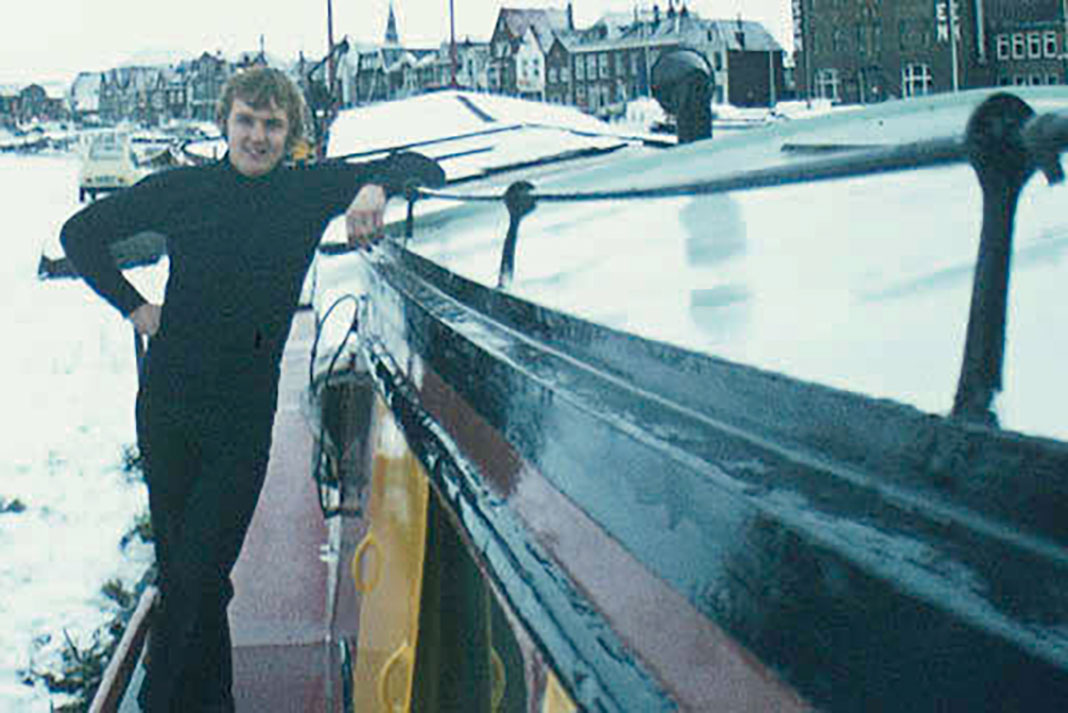
Harrie Tieken in the mid-’70s outside his first workshop in Holland, a 110-foot clipper canal ship built in 1906. | Photo: Harrie Tieken collection
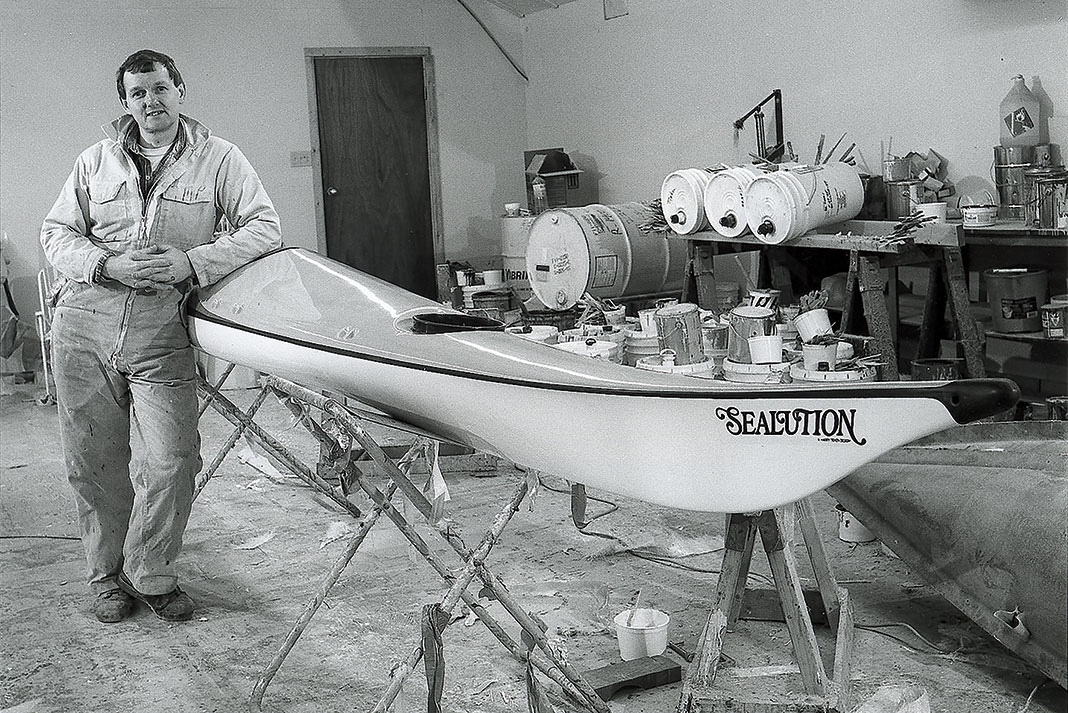
Tieken in his Chezzetcook, Nova Scotia, shop with one of the first production Sealutions, 1988. | Photo: Harrie Tieken collection
The East Coast catches up
Things got off to a slow start in the East. There were a few early builders, including Bart Hathaway who in 1975 licensed a fiberglass touring design to Old Town Canoe. Ken Fink was distributing British boats through his Poseidon Kayak Imports from 1978 on. But there were no prominent kayak builders until Tieken Kayaks.
Harrie Tieken started building flatwater racing kayaks and Derek Hutchinson sea kayaks in Holland in the early 1970s. His business trajectory paralleled that of the West Coast companies, with sales taking off in the early 1980s.
Fast forward to 1987: Tieken brings his business to North America, settling in Musquodoboit Harbour, Nova Scotia. There were “absolutely no more than 10 people” paddling open water in the East at the time, he guesses. “People said the ocean is too dangerous for a kayak. People were laughing at me basically.”
Eventually Tieken provided boats for Scott Cunningham of the Nova Scotia outfitting company Coastal Adventures, which became a key educator and promoter for sea kayaking, and Tieken’s designs, on the East Coast.
Like the other manufacturers, Tieken saw the need for a distinct North American design that was beginner-friendly, so he came up with his flagship, the Sealution, introduced at the L.L. Bean’s Maine symposium in 1988.
Andy Zimmerman of Wilderness Systems (a North Carolina whitewater boat company founded in 1986) purchased rights to produce the Sealution for the U.S. market and went on to make the boat’s plastic version one of the world’s bestselling kayaks.
If you had to pick one year in the history of sea kayaking to mark the start of the modern industry you’d begin with 1984. It was the year that two of TASK’s key promotional visions were realized: a magazine and a symposium. John Dowd founded Sea Kayaker in 1984, supported by the advertising revenue of a growing industry. And TASK hosted the first annual West Coast Sea Kayak Symposium in Port Townsend, Washington—modelled after the highly successful Maine Sea Kayak Symposium started in 1982 by Ken Fink with the support of retailer L.L. Bean and Canoe magazine.
The economy had pulled out of the early ‘80s recession and entrepreneurs who had been struggling along since the ‘70s found themselves with viable businesses. Companies like Current Designs began to reap the support of the big-box U.S. outdoor stores like L.L. Bean in the East and REI in the West. And kayaks entered mainstream media and mainstream consciousness.
1984 was also the year that plastic kayaks came out, with the introduction of the Aquaterra Chinook, made by whitewater boat giant Perception. Plastic kayaks cut boat prices in half. Where fiberglass moulding took at least a day, plastic mould could produce a kayak in about two hours. “Tupperware boats” propelled the industry into the 1990s decade of double-digit annual growth.
[ Paddling Buyer’s Guide: See all rotomolded plastic kayaks ]
Many of the original manufacturers—Necky, Current Designs, Tieken—sold to larger American companies. But others, like Steve Schleicher and Tom Derrer, are still at the helm of the businesses they started three decades ago. Now it’s a heck of a lot simpler to get a sea kayak and the road to Tofino is much smoother than it was in the days of the hippie squatters, but the down-to-earth soul of kayaking is as real as it was back in the day.
“The goal was always to have a really neat way to travel in the wilderness, self-propelled,” said Schleicher, reflecting on where his early vision has led him. “And that seems to be what most of our boats are actually geared to doing.”
Peace out.
Tim Shuff loves to think that it all began on his birthday in 1972, but he’s still trying to get his facts straight.
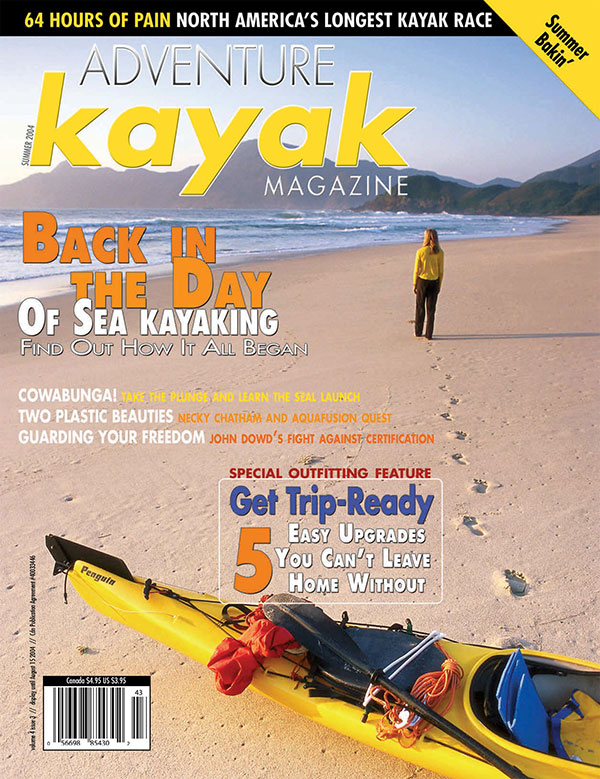
This article was first published in the Summer 2004 issue of Adventure Kayak Magazine. Subscribe to Paddling Magazine’s print and digital editions, or browse the archives.
The hammer of Toro is good
for punching through holes. | Photo: Kathy Smith
Confidence inspiring. If I had to sum up the Zet Toro kayak in two words, that would be it. When the brand new Toro was delivered to my front door there was still two feet of snow on the ground and the ice was clear on only a few of my local runs. Paddling a new boat on icy-cold rivers with rusty skills and muscles not yet awoken from winter hibernation. What could go wrong? Apparently, nothing.
[ Paddling Buyer’s Guide: See all creekboats ]
Introducing Zet Kayaks
Czech kayak producer Zelezny, whitewater extreme racer Honza Lasko and slalom champion Viktor Legat founded Zet Kayaks in 2007. Based in Prague, Zet Kayaks is well established in Europe but only expanded online distribution to North America three years ago. There are four boats in their current lineup—all creekboats that can also be used as all around river runners. Zet tells us the Toro is designed to perform as everything from an entry-level river runner to an extreme creek racer.
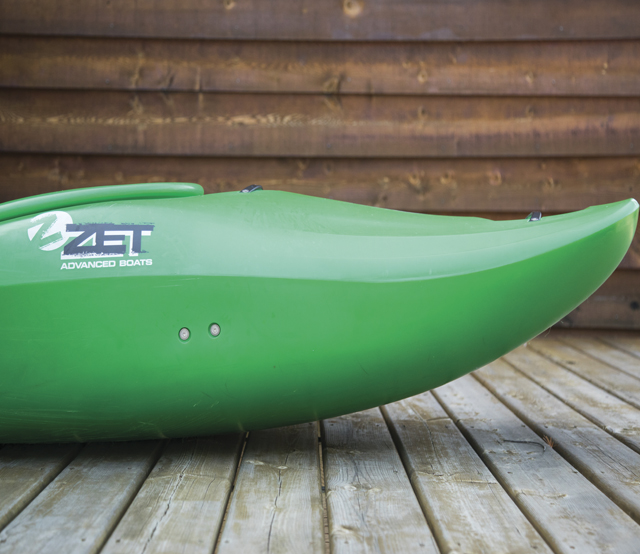
The Toro’s bow narrows noticeably along its length towards the tip; Zet designed this narrowing beginning at the hip and ending just past the knees to offer enough space for quick paddle commands.
Take a seat in the Toro
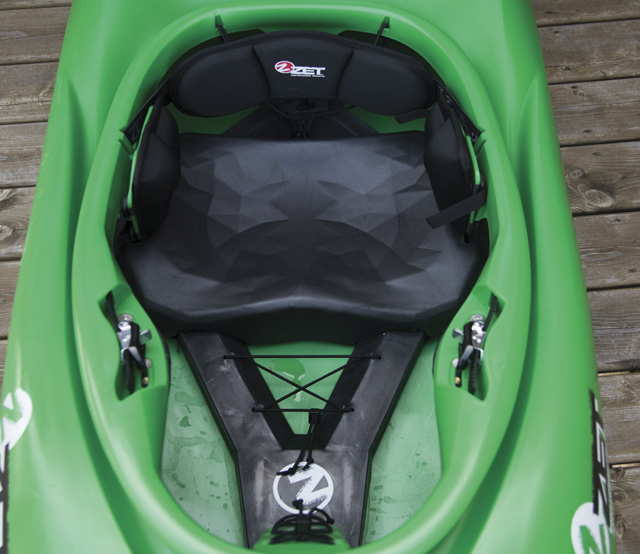
The seat in the Toro is a pre-shaped closed-cell foam affair that is fastened to a diamond-shaped plastic structure, which fits snugly under the bow and stern foam pillars. This seat structure is no doubt designed to provide support to the hull over years of abuse. The hip pads are attached to adjustable plastic plates that are attached with hex bolts through the cockpit rim and into the sides of the seat. It’s solid and less complicated than it sounds.
Zet claims there is eight centimeters of fore and aft seat adjustment but we couldn’t figure it out and left it as it came. The included hex wrench stored behind the seat is a nice touch.
The actual seat part is closed-cell foam, so it’s warm and won’t water sponge. The backband works well and adjusts with ratchets just around the well-shaped foam thigh hooks—adjustable forward and back and angled with the hex wrench. This is a set it and forget it type cockpit.
I’m five foot ten, 175 pounds and a have a 32-inch inseam. The 270-centimeter boat—the only size it comes in—fits me well. This makes sense as Zet says the Toro is ideal for a paddler between 145 to 210 pounds. I was snug in the hip pads without any shims, the foot braces were in the third last hole and the thigh hooks were all the way forward.
Go fast and push hard
Zet designed the Toro with a displacement style hull, continuous rocker from bow to stern and edges only on the rear half of the kayak. The Toro accelerates quickly and tracks like a dream. With no edges on the bow there’s nothing for the water to grab to mess with your ferry angle, or squirrel you about paddling through boils. Yet the edges on the stern were just enough to be able to carve on a wave, hold a jet ferry and maintain a line when punching through a hole.
My favorite part about the Toro is also my least favorite part. The lack of edges on the bow that make maintaining a ferry angle and holding a line through a rapid so easy also make catching eddies and carving turns a bit more work.
The seat has approximately eight centimeters of fore and aft adjustment using two hex bolts concealed behind the hip pads. Constructed of closed cell foam, the sturdy and simple seat is designed to resist water sponging.
For my paddling style I prefer planing hull style creekers—like the Dagger Mamba—with harder edges on the bow, which means dropping edge and leaning forward to let the boat pivot you into the eddy. In the Zet Toro I found I had to really lean back to engage the edges and perform more of a backwards sweep to bring the boat around. This made catching mid-river micro-eddies more challenging. Without much in the way of an edge to carve a turn on, more application of muscle power for finer course adjustments was required. Planing hull creek boats with more aggressive edges allow for the boat to be turned simply by tilting it over. With some forward speed the boat will turn and carve just like a pair of skis. Displacement hull creekers, or boats with less aggressive edges like the Toro require more of a stop, pivot and go approach.
At 8’10” the Zet Toro is approximately the same length as a large Jackson Kayak Zen or a Liquidlogic Flying Squirrel 85. It was fairly fast compared to my previous creeker, the Dagger Mamba 8.6, but not as fast as my Pyranha 9R. I suspect this is due to the ample bow and stern rocker keeping the overall waterline length shorter than some of the aforementioned aggressive racing designs, which also means greater maneuvrability. I found this to be especially true while being able to change direction mid-rapid and accelerate around features very smoothly.
Whenever the bow rocker was insufficient to climb over a feature, the tapered bow and curved deck allowed me to easily punch through and surface quickly without losing too much speed. Despite its length, the ample stern rocker made boofing easy and stomping a drop gentle on my spine. At 27 inches wide the Toro is similar in width if not slightly wider to many other creekers and river runners on the market. I found it to be very stable and I even managed to keep my hair dry almost all weekend.
[ Plan your next adventure with the Paddling Trip Guide ]
Get in the Toro ahead of the crowd
The Zet Toro was a great fit for early season, high water runs. I also felt pretty special being the only paddler in a Zet kayak on the river. As their online distribution expands in North America, I don’t expect that to last long.
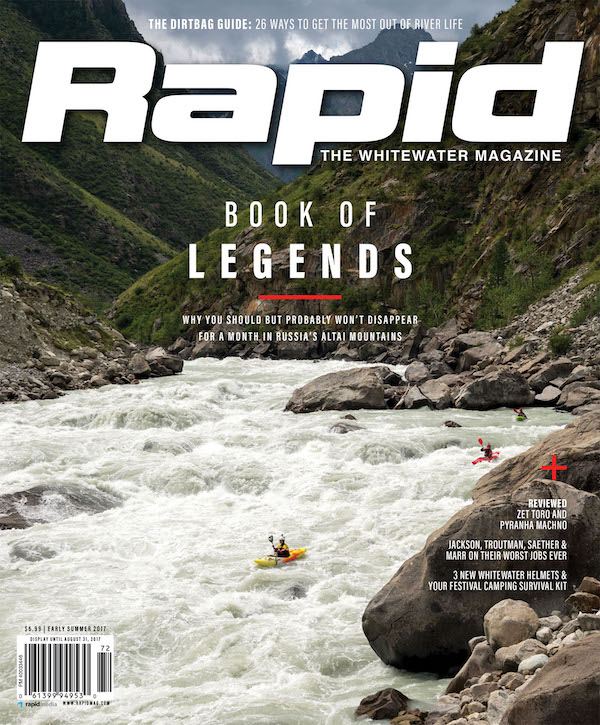
This article originally appeared in Rapid Early Summer 2017 issue.
Subscribe to Paddling Magazine and get 25 years of digital magazine archives including our legacy titles: Rapid, Adventure Kayak and Canoeroots.
Perfect solo tripping companion for making miles. | Photo: Timothy J. Baklinski
Nova Craft Fox 14 Specs
Length: 14’
Width: 32”
Depth: 13”
Rocker: Minimal
Capacity: 550 lbs
Weight: TuffStuff, 43 lbs
MSRP: $2,499 CAD
Over the years Paddling Magazine has tested and reviewed a dozen or more Nova Craft canoes. My kids learned to paddle in the 12-foot Teddy and way back in ‘99 we included the Supernova in a whitewater solo canoe shootout. Now we belatedly add the Nova Craft Fox 14 solo canoe to our list.
Where I’m from a solo tripping canoe is a 15- or 16-foot symmetrically shaped tandem canoe spun around backwards, just like in Bill Mason’s 1977 Path of the Paddle instructional series. We are products of our training and old habits die hard.
On the other hand, the Fox 14 is the style of canoe you’d single-handedly pull from the rack when venturing into the Boundary Water Canoe Area. We enjoyed it so much it’s getting a proper review here, about 47 years past due.
Set off in the Fox 14 solo
Tim Miller, Nova Craft’s founder and owner, exhibits at Rutabaga’s annual Canoecopia Show every spring. The show is held in Madison, Wisconsin drawing 20,000 avid paddlers, paddlers who escape to places like the uninterrupted 90-mile stretch of the Wisconsin River and into the Boundary Waters.
“Five or six years ago we started getting so many requests at the show for a 14-foot solo canoe that we drove home and set to work on the design,” remembers Miller. “Shortly afterward we got notice that Royalex was going out of production. Our focus shifted to creating alternative materials and reconfiguring our shop to ramp up composite canoe production.”
The Fox 14 is TuffStuff
Project Fox 14 was put away and left in hibernation until now. This new 14-foot solo canoe came to us in Nova Craft’s dependable TuffStuff—the durable composite material created while the Fox was asleep. Our tester weighs a respectable 43 pounds and so far, according to Miller, TuffStuff has been the most popular selling layup. Customers are intrigued by the durability and reasonable weight. The Fox, like most of Nova Craft’s line, is also available in fiberglass, Blue Steel, Aramid and Aramid Lite.
If it were me, I’d suck up the couple hundred bucks and go with the Aramid Lite to save seven pounds. The Fox isn’t a whitewater boat and the Aramid Lite is plenty durable for my backcountry adventures. While I have my credit card out, I’d upgrade from aluminum to ash gunwales. Not because it is any lighter; Nova Craft just does such a pretty job with their wood trim. It takes a canoe made of space-age materials and makes the touch points softer, quieter and more authentic. I blame Bill Mason for this tendency also.
So how do you come up with a new solo canoe design? If you’re Miller, you look around at what’s already working.
The Nova Craft Cronje 17′ is an old Chestnut Canoe Company design and a popular touring canoe for those looking to carry heavy loads for long distances. Its symmetrical low-profile hull design gives it a fair advantage against blustery winds. When you cut three feet out of the Cronje you get something that looks like the new Fox 14: generous 32-inch beam and an impressive 550-pound carrying capacity, fit for a fortnight or more of solo adventures.
On one of my recent fitness kicks I ordered a solo training canoe. Sixteen and a half feet long, 29.5 inches wide, complete with a tractor seat and foot pegs. This is not the Fox 14.
On Nova Craft’s website, you’ll find the Fox in their recreational lineup. I don’t think that’s right either. Yes, you are going to find a great number of these turned over on cottage docks waiting for early morning misty paddles. That’s fine, the Fox won’t spill your coffee. Some people may even paddle the Fox like a pack canoe with a kayak paddle. For me though, the Fox should be classified alongside the Cronje as a cruiser or solo lakewater tripper.
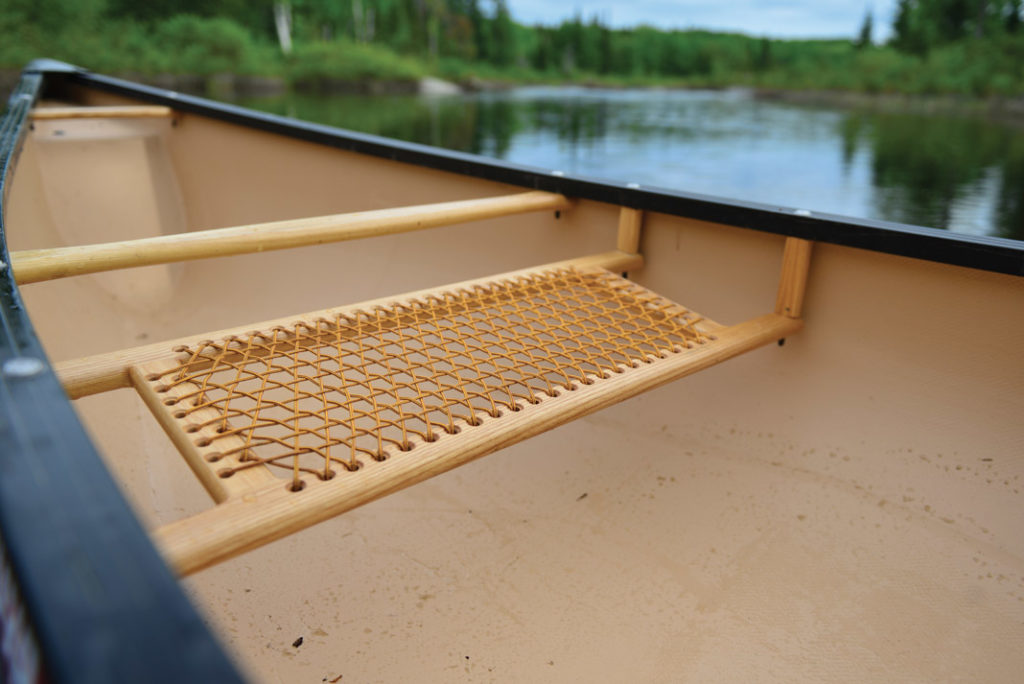
One may prefer to use a kayak paddle but kneeling on the ash and laced traditional canoe seat works just fine too. You’ll need to install a removable yoke for backcountry adventures. | Photo: Timothy J. Baklinski
On the water
With very little rocker, the Fox 14 scoots right along. Tilt it over a little and it turns beautifully. I didn’t miss the extra two feet of my tandem Prospector—two feet that for the most part wasn’t in the water anyway.
If you’re not launching from docks or floating lazy uninterrupted rivers and you want to be free to wander anywhere you’ll have to order, like I did, a yoke and hardware.
If you’re looking for a solo tripping canoe with classic lines that you can lift and launch anywhere, the Nova Craft Fox 14 could be for you. One more thing—apparently the Fox 14 is available in nine different color options but I’d go with red. You know who to blame.
This article was first published in Issue 51 of Paddling Magazine. Subscribe to Paddling Magazine’s print and digital editions, or browse the archives.
Just keep swimming. | Feature Photo: Gabriel Rivett-Carnac
We’ve all been there. Do you remember the horrible advice you got on your first day of paddling? It starts with so much hope and ambition, and it can make or break a person’s passion for paddling. With so much at stake it pays to be wary of beginner kayak tips we hear from well-meaning friends and acquaintances. Instead, first-timers should focus on getting proper instruction from qualified experts.
My first instructor was James Roddick. I was 10 and he was patient. I’m thankful James took the time to guide me through the tears. He didn’t tell me what I wanted to hear, he told me what I needed to hear. Unfortunately, too many first-time kayakers and potential enthusiasts don’t have a James.
Maybe they had a friend who told them it would all be fine and to just tag along, or an instructor who passed on information which sounded good but fell apart in action.
I’m convinced whitewater kayaking could boast twice as many paddlers if kayakers’ first experiences unfolded differently.
If you were lucky, you never had to hear any of the following beginner kayak tips. If you did and still kayak, congratulations on persevering.
The worst beginner kayak tips
1. “You have to be able to roll to have fun”
Not so. This is only valid if taken down a big, munchy river on a first outing, which is a recipe for a bad time anyways. The experience beginners gain in a kayak before perfecting the roll is valuable—think boat control, stroke technique and simply being comfortable in the water. Especially when learning on a warm and deep river, having fun and being outside comes first—a roll can easily come second.
Truly cringeworthy. At one point, we’ve all seen a solo boater paddle past, mullet gracefully tussled by the wind, and wondered, “Will I ever be confident enough to kayak alone?” The answer is no. Even for experienced boaters on their home rivers, we never know when something might go wrong and we might be in need of a helping hand. Solo boating is more risk than reward—and besides, kayaking is way more fun with friends.
Beginners shouldn’t run anything blind. Faithfully duckying along behind a more experienced paddler doesn’t teach much about reading current, identifying obstacles and creating a strategy if the newbie never gets out of their boat for a new perspective. This advice often stems from a lazy group leader not wanting to take the time to scout a rapid they have run hundreds of times so they say, “It’s good, go down the middle.” Better to scout and style, than blindly crash and burn.
4. “You don’t need your boat or gear to fit you until you get more into the sport”
No one says this about running shoes, so why say it about boats? The fact is, the right paddle, a few pieces of hip foam and a foot block can make the difference for students learning to roll and even just controlling a kayak. The added benefit of a well-fitting boat is all energy is transmitted into your desired movement—especially confidence-inspiring for beginners.
[ See all boats and gear in the Paddling Buyer’s Guide ]
5. “Do it for the ‘Gram”
Worst motivating logic ever. If ever doing anything to impress someone else, you’re doing it for the wrong reason. This is a philosophy extending far beyond kayaking too. Ask yourself: If no one was to ever find out, would I still want to do this thing? If the answer is no, you have your decision.
When instructors tell beginners to paddle hard, what they usually mean is they want the beginner to keep paddling in rapids to maintain stability and momentum. So just say so. Shouting “paddle hard” before each set creates the notion force, as opposed to finesse, is what gets someone down a river. And all the flailing is exhausting for the rest of us to watch.
Red flag. The single worst piece of advice to give or receive. Often overheard stated by a group of friends who want someone to learn, but don’t want to sacrifice a day to teach at an appropriate pace. All too often beginners are roped onto rivers too steep, fast and consequential. A bad swim can turn someone off entirely. If you take the time to introduce a friend, really take the time and make sure it’s as much fun for them as it is for you.
This article was first published in Issue 55 of Paddling Magazine. Subscribe to Paddling Magazine’s print and digital editions, or browse the archives.
Just keep swimming. | Feature Photo: Gabriel Rivett-Carnac
Getting into your kayak without a life vest is like driving your car without a seatbelt. Not only might you run into trouble and endanger yourself, but failing to take the proper precautions can also endanger others, including those who may come to your assistance. Fortunately, paddlers and rescuers can both breathe easier with the Kokatat Hustle PFD and the HustleR rescue PFD.
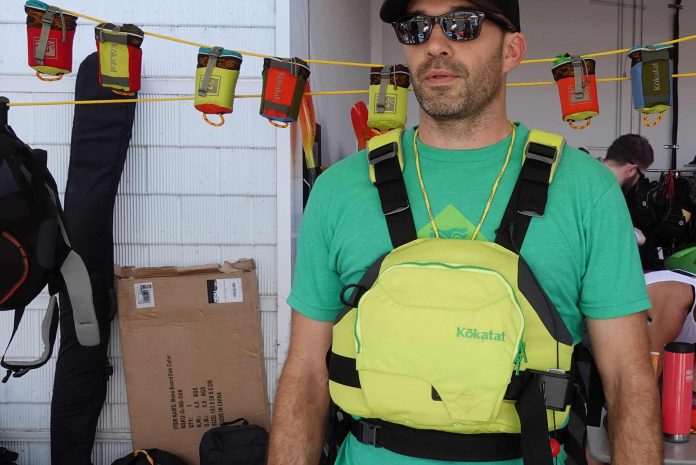
The Hustle is a full-function, Type 3 side-entry life vest with a large pocket for gear and single lash-tab for accessories.
The Hustle is constructed out of free-floating GAIA foam that is formed to fit the torso and covered with ripstop nylon. Three-sided adjustment dials in fit for comfort and safety.
HustleR Rescue PFD
Stepping up to the HustleR, guides, teachers and rescuers get a full rescue vest with the same fit and comfort as the Hustle in a pull-over vest. The HustleR adds quick release safety harness, O-ring, protected rescue lash tab and is a Type 5 vest.
The HustleR provides full back coverage with cut-away sides for full range of motion. It is covered with tough, dependable and stain-resistant 500D Cordura.
Video review of the Kokatat Hustle PFD and HustleR rescue PFD:
The Jackson Kayak All-Star, with designer Eric Jackson inside, won the 2005 freestyle world championships. Its balanced ends and light weight make for lightning-fast moves. Great freestyle boats provide amplitude in aerial moves and speed and carving on waves, and the All-Star delivers on both accounts. The hull and deck come together for the best of both wave and hole moves.
[ Paddling Buyer’s Guide: See all Jackson kayaks ]
Feel like an All-Star
When you really feel like a going for a wild ride, paddle the Jackson Kayak All-Star (or one of the other two sizes that fit you—the Star and Super-Star).
We received feedback like this:
“This boat makes me squeal.
On a big wave the All-Star is crazy.”
“It was like getting double-bounced on a trampoline… you know it’s going to happen but you don’t know when, or how high.”
“I screamed the entire ride. I accomplished nothing and just held on for dear life. I loved it.”
Get the picture?
No matter how far forward we moved the seat, the All-Star’s bow bounced all over the wave. “When I threw a move it was because I thought, ‘Hey I’m in the air, I should try hucking something.’” Perfect maybe for the air junkies, unnerving for the control freaks.
When you’re not feeling loopy (which it also does really well) the Jackson Kayak All-Star is quite happy letting intermediates float around the river on its super-wide hull. The bow rides just above water level, just like the ZG, so pearling isn’t a problem.
Inside, the Jackson outfitting is noticeably less swanky than the other, comparatively posh, setups. Once you’re out on the water and past the lacklustre showroom appeal you realize the outfitting—including the cheesy-looking backband on a rope—does work, and keeps the overall weight low.
[ Plan your next adventure with the Paddling Trip Guide ]
All-Star pros and cons
PROS: Bow bounces all over the place. Otherwise stable, predictable and forgiving.
CONS: Bow bounces all over the place. Unsophisticated outfitting.
Valley may be the most venerable sea kayak manufacturer in the world. Their signature model—the Nordkapp—has achieved truly iconic status. But that kind of success cuts both ways: lauded for their classic kayaks, what can Valley do for an encore? The answer is a carefully planned departure from classic form with the Valley Etain 17.5 sea kayak.
While Valleys have traditionally been fish-form hulls (where the widest point of the boat is forward of the mid-point), the Etain is slightly Swede-form (widest point aft of the mid-point). Moving the volume sternward generally creates better stability, more cargo capacity, improved sense of glide and allows the foredeck to be a little narrower to accommodate a more vertical paddle stroke.
Aesthetically the Etain is a handsome, if rather conventional looking, British sea kayak. The bow and stern are upswept, and the deck is clean and uncluttered. Refinements include carrying toggles neatly held in place by shock cords and a security lock bar aft of the cockpit.
The Etain is available in two sizes: the 17.5 on test here and its larger sister the 17.7. Three lay-up options exist: standard Diolene fiberglass, carbon/Kevlar and triple-layer polyethylene (17.7 only).
[ Paddling Buyer’s Guide: See all sea kayaks ]
A comfortable and well mannered expedition kayak
Weighing in at 60 pounds with optional keel strip reinforcement, our carbon/Kevlar test boat was no featherweight, but it was stiff and neatly finished throughout. Afloat, the Valley Etain has reassuring initial stability, certainly more than the Nordkapp. She’s not as fast as her famous sibling, but overall speed and glide are quite good and the boat accelerates quickly. The Etain also feels smaller than it really is thanks to the Swede-form shape. I really liked the seating position, finding it very comfortable and conducive to good control and drive.
Tracking is quite stiff on an even keel. However, when edged aggressively the volume in the back of the boat allows the stern to skid round for tighter turns. The Etain composite kayak feels great on edge when gliding through a turn or surfing a wave, but secondary stability is less reassuring when stationary.
The Valley Etain is well mannered in wind with only a minor tendency to weathercock, which is easily controlled by adjusting the skeg. In waves and current, handling is poised and predictable with no unpleasant surprises: it’s a good choice for rough water duty.
[ Plan your next adventure with the Paddling Trip Guide ]
The Valley Etain is a welcome addition
While not quite as fast or as maneuverable as the Nordkapp, the Etain’s superior carrying capacity, tracking and initial stability make her a great choice for paddlers who want a dependable and more user-friendly expedition kayak. As a touring platform, the Etain is a very credible addition to the Valley family.


 This article first appeared in the Fall 2015 issue of Adventure Kayak magazine.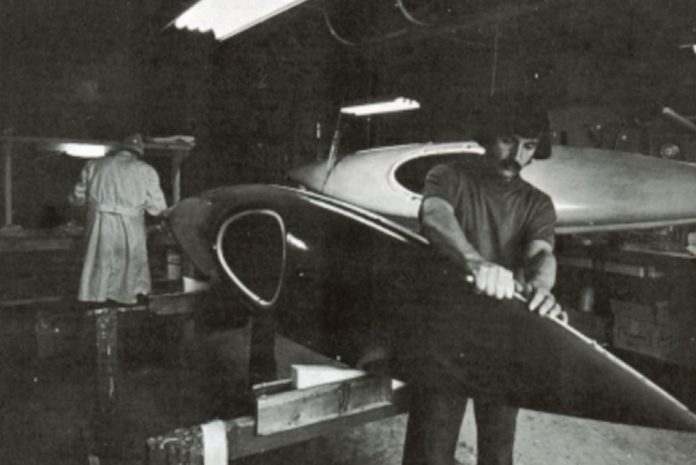

 This article was first published in the Summer 2004 issue of Adventure Kayak Magazine.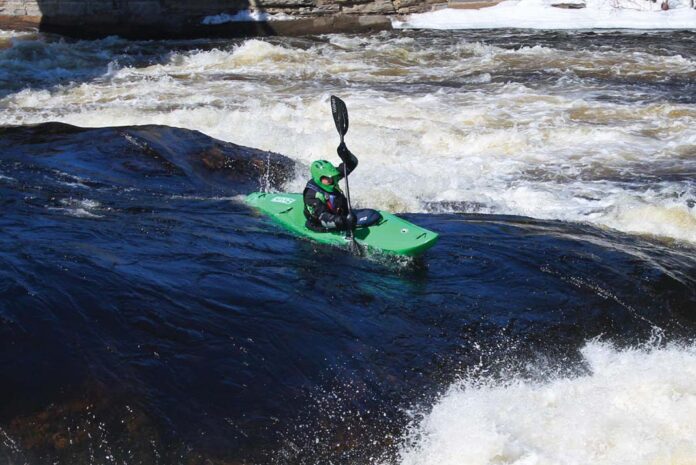
 This article originally appeared in Rapid Early Summer 2017 issue.