Home Blog Page 18

Best Jackson Kayaks For 2026

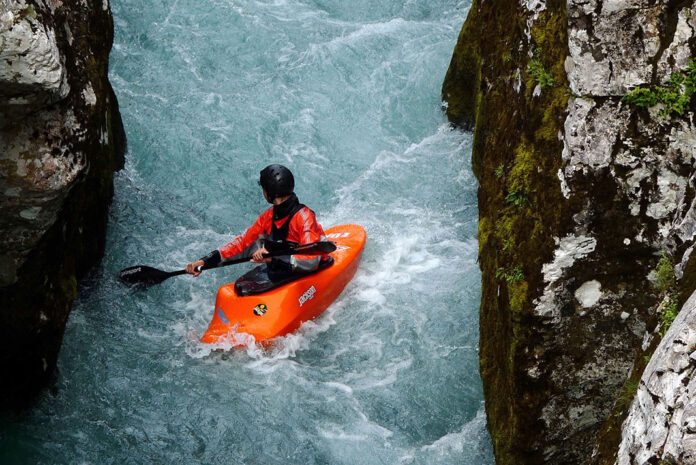
whitewater paddler in a Jackson Kayak
Feature photo: Marko Petek/Unsplash

Jackson Kayak was founded in 2004 by Olympic champion and professional whitewater paddler, Eric Jackson. At its inception, the company focused exclusively on building top-notch whitewater kayaks for the whole family. Eric Jackson gave special attention towards making a properly fitted youth whitewater kayak, so his kids could shred rivers with him.

Since then, Jackson Kayak has become well-known for building innovative river runners, creek boats and playboats used on moving water around the world. They’ve also expanded their focus to include recreational and fishing kayaks, becoming leaders in the pedal drives that dominate fishing kayaks today. Eric Jackson stepped down as head of the company in 2019, but Jackson Kayaks continues to innovate and build boats for spending quality time on the water.

Today, you’ll find a Jackson Kayak that matches any of your river paddling or calm water desires. Whether you’re doing laps at the local wave, tossing lines to lunkers or exploring a lazy river, there’s a kayak for you. Jackson Kayaks are intended for enjoying whitewater rivers, or gentle inland waterways. Jackson doesn’t presently make any dedicated touring kayaks.

Their whitewater boats are good options for beginner to experienced paddlers, with models suitable for easy Class I to advanced Class V rivers. Jackson recreational kayaks better suit beginner and casual paddlers. Consider these if you prefer flatwater and want a stable, reliable kayak for short tours. Jackson fishing kayaks are super-stable for stand-up fishing and range from simple paddle-powered boats to pedal-driven kayaks loaded with features.

This article will help you choose the right Jackson Kayak for your paddling aspirations. Here, we’ll give an overview of the types of kayaks available, as well as some tips for buying new and used Jackson Kayaks. You’ll also find links to curated lists and specific models, including detailed information and reviews for each.

Top picks: Best Jackson kayaks

Jackson Kayak Flow
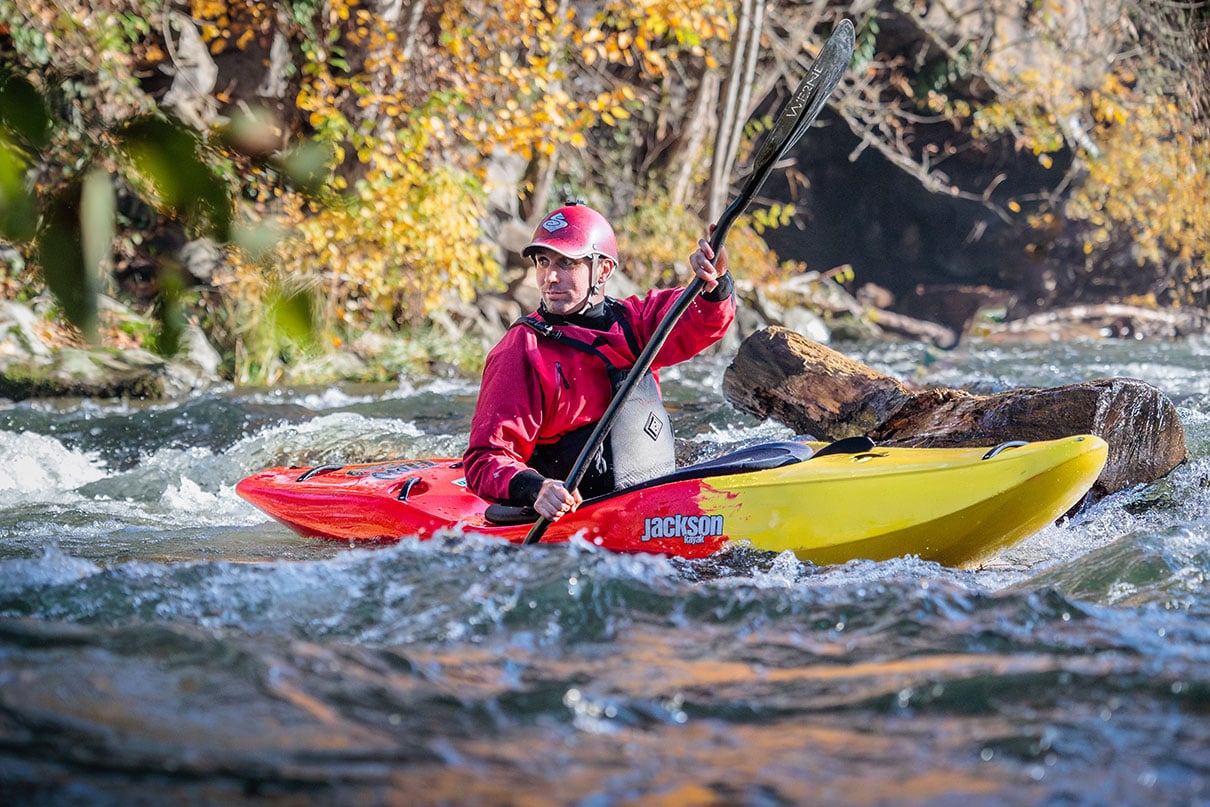
man paddles the new Jackson Kayak Flow creek boat
It’s official: sub-nine-foot kayaks are cool again. | Feature photo: Owen Roth
Jackson Kayak Flow Specs
Length: 8’5″
Width: 26.75”
Weight: 47 lbs
Capacity: 130-190 lbs
MSRP: $1,799 USD

Buy from:

JACKSON KAYAK

From our review:

“For more than a decade, Jackson’s Zen series fit the space in the brand’s lineup for local class III–V runs and building abilities. The Flow is its successor. Comparing the Zen and Flow side by side, you’ll find the Flow is not an update to the Zen series but a rethinking of the category. At its broadest, the Flow is a quarter-inch narrower than the Zen 3.0, with a sleeker tapering shape and a more intuitive feel on the water. The Flow features more rocker than the Zen, utilizing one of the design elements that made the Gnarvana popular.” [ Read full review ]


Jackson Kayak Antix 3.0
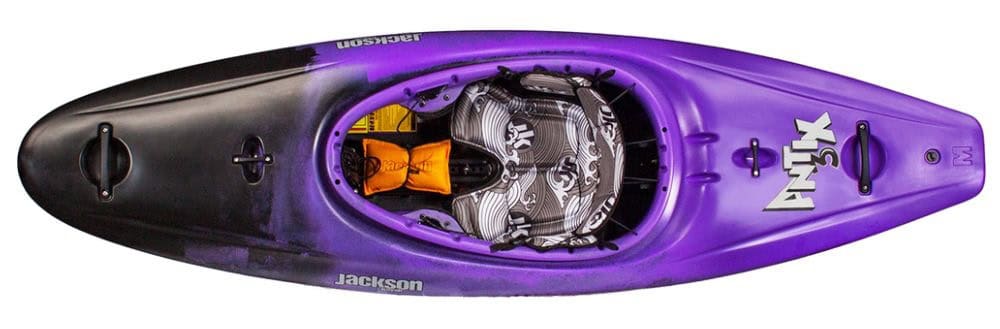
purple kayak
The Jackson Kayak Antix 3.0 launched in September 2025. | Photo: Jackson Kayak
Jackson Kayak Antix 3.0 Small Specs
Length: 7’7”
Width: 25.4″
Weight: 36 lbs
MSRP: $1,799 USD

Buy from:

JACKSON KAYAK

The Antix 3.0 features upgrades designed by a collection of the brand’s pro paddlers, including Dane Jackson, Stephen Wright, Clay Wright, Nick Troutman and Alec Voorhees with Tad Dennis leading CAD work. The Antix 3.0 includes increased bow surface area with additional volume and rocker with the goal of providing a higher and drier downriver ride. With a wider hull design, the Antix 3.0 is meant to retain speed over river features, while the smaller stern is designed for squirting and splatting… [ Read more ]


Shopping for a used Jackson kayak?

You might have some luck finding a used Jackson Kayak. These durable plastic kayaks last a long time, and Jackson’s whitewater designs have stood the test of time, making them popular for collectors. Occasionally though, a secondhand Jackson Kayak will pop up on used classifieds pages or in paddling groups.

Knowing where to look is the first step to finding a used Jackson Kayak. Once you track down a model that suits your needs, you’ll want to give the kayak a thorough inspection and pay a fair price for it.

Where to look

When you first start searching for a used Jackson Kayak, Craigslist, Kijiji or other online classifieds are good initial resources. Also, consider checking specialty sites like MEC Gear Swap for whitewater kayaks or Boat Trader for fishing kayaks. Reach out to community paddling groups; some people may be willing to sell boats they haven’t yet posted.

Symposiums, whitewater festivals and courses, and trade shows are good ways to learn more about different kayaks from experts. If the event is held outdoors, you may also be able to try the kayaks out. Dealers sometimes use these shows to clear out demo models or old stock at a discounted price.

What to look for

Check the kayak’s year if you can. Until 2009, Jackson Kayaks used cross-link polyethylene when making their kayaks. This material was stiffer and lighter than the linear polyethylene used for most kayaks now, but a significant drawback is that you can’t weld cross-link polyethylene. That means that any cracks or holes in a pre-2009 Jackson Kayak have given it a death sentence.

Stay clear of any damaged hulls on boats from that era. Remember that they are strong, though. If you find one that appears to be in good condition, it will likely last you a long time—if it’s been properly cared for.

Proper care for a kayak mainly involves storage and transportation. Damaging UV rays from direct sunlight degrade plastic kayaks quickly, so look for kayaks that have been stored indoors or at least in a shaded area. Avoid kayaks with signs of obvious fading.

If you’re looking at a Jackson Kayak that has been discontinued, there are still ways to find information about the boat. Jackson keeps “Legacy” pages for all of their discontinued whitewater kayaks, recreational/day touring kayaks and fishing kayaks with specs and descriptions of models that are no longer sold. If you need replacement parts for any of these kayaks, contact the company and they can help source them or recommend alternatives.

What to pay

It’s tricky to judge what’s a fair price these days. Traditionally, kayaks held their value exceptionally well and rarely sold for less than half their original price. With supply chain shortages and increased demand for recreation equipment, used kayaks are dealing for almost the same price as new. If you’re desperate for a boat, and a used one is the only option, you might have to pay that price.

On the other end of the spectrum, you may find whitewater kayaks selling for a fraction of their original price—likely because they’ve been used heavily. These kayaks will sell for less than $500. If there are no significant cracks through the hull, the kayak is likely still usable.

For more tips on what to look for when selecting a used kayak, read our article How To Buy A Used Kayak.

Jackson kayak buying guide

Finding the right kayak starts with understanding the type of kayaking you want to do. It’s important to get a style and model that closely suits your intended use. Jackson Kayak builds boats for whitewater, fishing and recreation. We’ll briefly run through the current models of Jackson Kayaks and what they’re best suited for here. See if any of them resemble the type of kayaking you aspire to do.

Whitewater kayaks

Jackson Kayak’s adult whitewater range offers a model for every type of river paddling. The Rockstar V is a premier playboat used by competitive whitewater paddlers as well as those just looking to play the river. The Antix and Zen are both great options for beginner whitewater paddlers. The Zen is more forgiving and stable with a higher volume, while the Antix feels more playful with its low-volume stern.

If you crave speed, the Nirvana is an accessible whitewater racing kayak that’s at home on everything from beginner whitewater to the most demanding rapids.

Fishing kayaks

Jackson Kayak’s line of angling kayaks includes boats for fishing everything from ponds to open water. Some models offer pedal- and power-drive options to increase your paddling range. Most Jackson fishing kayaks are sit-on-top style. Sit-on-tops are self-bailing and exceptionally stable, often steady enough to stand on. These are best for fishing anywhere that you would not feel comfortable swimming to shore in.

The other option, sit-inside kayaks, are great for calm waters with ready access to shore. They are also faster and lighter than sit-on-tops, making them equally good options for paddlers who don’t focus exclusively on fishing. There is currently only one sit-inside fishing kayak available, the popular Jackson Kilroy.

Jackson sit-on-top fishing kayaks range from the basic Bite Angler to the fully loaded pedal-drive Coosa FD. In between, there are different models and pedal/power options. You’ll want to consider length and stability when you are looking at different kayaks. Length is often a good indicator of the kayak’s speed. If the same design was built in two different lengths, the longer of the two would be faster.

The longest solo kayak, the Coosa HD, is suitable for open-water paddling. Shorter kayaks like the Bite Angler are more at home in sheltered waters. The Coosa, Jackson Kayak’s flagship fishing model, was designed to be stable enough to stand on but nimble enough to run whitewater.

Models with “FD” in their name have Jackson’s Flex Drive 360 pedal/power option. To use the pedals, the angler cycles their legs like riding a bike, which leaves hands free for fishing. You also have the option of swapping the pedal drive out for an electric motor.

A particularly innovative aspect of the Flex Drive is the automatic retraction. In shallow waters, the propeller will kick up to prevent damage. This is a practical feature in a fishing kayak, especially for someone who regularly fishes shallow water. Not all pedal-driven boats from other brands have equivalent technology.

When you’re buying a fishing kayak, consider its weight. With all the outfitting, these boats are heavier than standard kayaks. A great piece of buying advice is “the best kayak is the one you will use.” You’ll want to be sure you have a method of transporting it, whether it’s by trailer, roof rack or a kayak cart. If moving your kayak is a pain, you’re less likely to use it.

Recreational kayaks

Jackson’s recreational kayaks suit casual paddlers who just want to get on the water for a few hours and have fun. These kayaks are wide and stable. Like Jackson’s fishing kayaks, there are sit-on-top and sit-inside styles available. The Tupelo is stable and comfortable for casual and beginner paddlers. With relatively high volume, these kayaks are good for bringing along small dogs or kids.

The Riviera is a good sit-on-top kayaks for under $1,000. Molded in foot rests or easily adjustable foot pegs make this a good kayak to share amongst family members. Jackson’s TakeTwo is a great family boat, as it can be configured for tandem or solo paddling. It’s also available in an angler version, which comes with accessory tracks for mounting rod holders, fish finder, action cameras and more.

Use this as a start, and remember that online research will only get you so far. The best advice we can offer is to always test paddle before buying any boat. The more time you can spend on the water in a similar style of kayak, the better the purchasing decision you will make.

Here are answers to some of the most common questions about Jackson kayaks.

  • Are Jackson kayaks good?

    Jackson Kayaks build a range of quality kayaks, so there’s a strong chance one of them will be a good match for the type of paddling you want to do. Jackson Kayaks was founded by whitewater kayakers; an understanding of hydrodynamics—how water moves—is fundamental to building high-performing whitewater kayaks.

    This philosophy and knowledge carries into Jackson’s fleet of fishing and recreational kayaks. The most important thing when shopping for a kayak is to know how you want to use it. Each kayak is specialized for a specific environment, so find one that meets your needs.

  • Jackson kayak models

    Jackson Kayak models change each year, with new ones introduced and older ones phased out. Contact the company directly for support or replacement parts on kayaks they no longer offer.

  • Jackson kayak specs

    With fishing kayaks, in particular, pay attention to the weight listed in the Jackson kayak specs. On pedal-driven kayaks, the weight provided may not include the Flex Drive system.

  • Jackson kayak weight limit

    The weight limit of Jackson Kayaks varies depending on the specific model. Weight limit, or capacity, refers to the total weight that the hull can handle. This includes the user, the gear you’re bringing and any additional features added like the Flex Drive 360 system.

  • How much is a Jackson kayak?

    Jackson Kayaks range from $699 USD to $3,599 USD, depending on the model. Their cheaper recreational sit-on-tops are a fair price for a quality rotomolded kayak. Jackson Kayak prices and quality are comparable to other respected brands such as Wilderness Systems, Perception and Dagger.

  • What are Jackson kayaks made out of?

    Jackson Kayaks are made with polyethylene plastic, and the metal components use marine-grade aluminum. A telling feature of Jackson Kayaks’ quality is the commitment to building a “dry” boat—most of their kayaks do not have any components drilled through the hull, aside from the drain plug, of course. This eliminates potential points of entry for water to leak.

  • Are Jackson kayaks rotomolded?

    Jackson Kayaks are rotomolded and made with high-density polyethylene. The rotomolding process results in a strong kayak. This is a standard method of building plastic kayaks as it is relatively inexpensive, keeping the overall kayak cost low.

  • Jackson kayak dealers

    Jackson kayaks are sold through their website and independent dealers.

  • Jackson kayak financing

    Jackson Kayaks have partnered with Klarna to offer financing options on any of their products. With Klarna, buyers can spread their payments out over time.

  • Who owns Jackson kayak?

    Eric Jackson and designer David Knight founded Jackson Kayak in 2004. In 2019, Eric Jackson stepped down from the President role and Peter Hausin took over as CEO.

  • Does Dane Jackson own Jackson kayaks?

    Dane Jackson is one of the best whitewater paddlers in the world, and is a member of Jackson Kayak’s pro team. He is the son of Jackson Kayaks’ founder, Eric Jackson.

  • Does Eric Jackson own Jackson kayaks?

    Eric Jackson owned Jackson Kayaks until late 2019. He has since stepped down to spend more time on the water instead of in the boardroom.

  • Where is Jackson kayak located?

    Jackson Kayak’s headquarters is located near Rock Island, Tennessee. All of their kayaks are built in their Sparta, Tennessee, manufacturing facility.

  • Where are Jackson kayaks made?

    If you’re wondering if Jackson Kayaks made in the USA, the answer is yes, all of their kayaks are built in Sparta, Tennessee.

  • What happened to Jackson kayak?

    Founded in 2004, Jackson Kayak originally focused exclusively on making whitewater kayaks. Since then, Jackson Kayak has expanded to add fishing and recreational kayaks to their lineup. Under the new umbrella of Jackson Adventures, they also build Orion coolers and kennels and have purchased Blue Sky Boatworks, which make pontoon-style fishing platforms.

    Alongside these changes, Jackson has scaled back some of their offerings, only distributing select whitewater models. For competitions or large outfitter orders, they custom build batches of legacy models.

Compare Jackson kayaks

  • Native vs Jackson kayak

    While Jackson Kayak’s fishing kayaks prioritize performance, Native kayaks focus on stability. Their fishing line is targeted towards bass fishing. Native offers super-stable, square-sterned boats that can be equipped with pedal or motor drives. The Native Falcon is a fishing kayak loaded with features for a reasonable price. Their higher-end models like the Slayer Max or Titan are designed for bass fishing on calm, fresh or salt waters.

    Jackson fishing kayaks like the Coosa and BigRig can handle more challenging conditions like current or swell. Jackson also offers more paddle-powered fishing kayak options, and a sit-inside fishing kayak, the Kilroy. Both brands boast about the comfort of their seating systems (nearly every kayak maker does).

    Choosing between these systems is mainly personal preference, and trying the boat out is the best way to get a sense of their comfort.

  • Pelican vs Jackson kayak

    The Quebec-based kayak brand Pelican is ubiquitous with recreational boats for cottage lakes, campgrounds and waterfronts around North America. They are distributed through large retailers like Costco, Canadian Tire and Walmart. Pelican makes sit-inside and sit-on-top kayaks for casual users and fishing kayaks that, like Jackson, can be rigged with pedal and motor power. Pelican’s stubby, wide rec kayaks are as stable as barges, and many are priced under $600, cheaper than most Jackson kayaks.

    Most of their mid-range kayaks are lighter than Jackson Kayaks because of their RAM-X polyethylene construction. Jackson Kayaks focus more on performance and craftsmanship. Their kayaks are heavier than Pelican kayaks, but without any holes drilled into the hull, the robust one-piece construction is built to last.

    Jackson fishing kayaks like the BigRig and Coosa are much more suitable for challenging environments. If you’re staying on flat water and buying on a budget, a Pelican is fine. For more of a performance-oriented kayak, choose a Jackson Kayak.

  • Jackson kayak vs Wilderness Systems

    Wilderness Systems have been making kayaks for several decades. Today, their range is mostly fishing, recreational and some touring models. They are priced comparably to Jackson Kayaks. Jackson doesn’t make equivalents to Wilderness Systems’ touring and sea kayak models, and Wilderness Systems also makes more deluxe sit-inside recreational kayaks like the bestselling Pungo.

    If you’re looking for a feature-rich recreational sit-inside or a touring kayak, check out Wilderness Systems. For a whitewater boat, look at Jackson Kayaks. Both companies make high-quality fishing kayaks. Compare specific models in their lineups to find the one that best matches your needs or preferences.

  • Jackson kayak vs Bonafide

    Bonafide kayaks is a newer company with bold plans for its fishing models. They have a small line of fishing kayaks for inshore and offshore fishing. Bonafide sticks to paddle or motor-driven kayaks, but the motor needs to be purchased separately. This keeps their costs lower, but Bonafide boats still have all the basics of a premium fishing kayak. Jackson Kayak owners with the Flex Drive system can choose paddle, motor or pedal power, distinguishing them from Bonafide boats.

    Jackson’s Big Tuna fishing tandem is also unmatched by Bonafide for capacity or versatility in seating options. Models that are comparable across both brands would be Bonafide’s RS117 and Jackson’s Bite Angler. Consider the type of kayak fishing you’ll be doing, and it may help narrow down your search. If you’re keen on a pedal drive or motor power, choose a Jackson Kayak. If you aspire to offshore fishing, look at some of Bonafide’s kayaks.

  • Jackson kayak vs NuCanoe

    NuCanoe fishing kayaks offer easy swaps between paddle, pedal and motor power. The power drives for these kayaks are at the stern rather than Jackson’s drive from mid-boat. While stern placement may protect the system a bit more, Jackson Kayak’s pedal- or motor-power Flex Drive is designed to retract on impact with an underwater obstacle, making it suitable for shallow water fishing.

    NuCanoe’s products are offered with base models and a series of add-ons. If you’re looking for a bare-bones kayak for fishing and hunting in calm water, choose a NuCanoe. For more tailored designs with ready-to-fish builds, look to Jackson’s fishing kayaks. Jackson also offers sit-inside style fishing kayaks, as well as recreation and whitewater boats.

  • Jackson kayak vs Old Town

    Maine-based Old Town Canoe and Kayak builds rotomolded recreational and fishing kayaks for casual anglers and paddlers. Their recreational kayaks are mostly sit-inside style kayaks, leaving the sit-on-tops to their sister company Ocean Kayak. Old Town also offers touring kayaks like the Castine and a longer sea kayak, the Looksha 17. These are good options if you want a kayak with bulkheads (interior walls within the hull that ensure flotation if the kayak swamps) so you can travel off-shore safely.

    For whitewater or river travel, you’re better off with a Jackson Kayak. Their experience building whitewater kayaks carries over into the highly rockered hull shapes of the Coosa, making even their fishing boats handle well in moving water. Comparing the two brands’ fishing kayaks, Jackson’s Flex Drive pedal system shines in shallow water as it automatically retracts on impact with underwater obstacles.

    Old Town’s award-winning Sportsman Series kayaks with pedal- or motor-power options are high-end fishing kayaks that dominate in flatwater and are worth any serious angler’s consideration.

  • Hobie vs Jackson kayak

    Hobie makes sit-on-top recreational and fishing kayaks that exclusively use their signature Mirage pedal-drive system. This system involves a stepping motion rather than the cycling motion found on most other pedal-driven kayaks. Like Jackson’s Flex Drive, the Mirage system also retracts on impact with underwater obstacles, a useful feature for shallow water exploration.

    Hobie offers more variety for recreational sit-on-tops, and their kayaks have many different add-on options like “bimini” sun shades, sailing kits or custom carrying carts. Hobie’s iTrek line of inflatable pedal drive kayaks are great options for anyone tight on storage space.

    Choose a Jackson kayak if you are looking for performance in moving water, or you want a traditional paddle-powered or sit-inside kayak. Opt for a Hobie if you want an inflatable or you’re keen on an efficient pedal-drive kayak for fun or fishing.

  • Vibe vs Jackson kayak

    Vibe builds sleek fishing kayaks to which you can add either pedal or motor power. These options are add-ons; the basic kayak can be purchased for strictly paddling. The Vibe Cubera Hybrid is a kayak/paddleboard combo for anglers who want a stand-up perspective. Vibe’s X-Drive pedal system uses two fins rather than a propeller to move. The user pushes their feet back and forth rather than a cycling motion like Jackson’s Flex Drive pedal system.

    If you prefer this stepping motion, look at Vibe’s kayaks. If you plan on fishing in shallow areas, Jackson’s Flex Drive retracts to prevent damage from underwater obstacles. Jackson also makes recreational sit-on-top kayaks that can be used for casual paddling and angling. If you aren’t looking for a full-fledged fishing kayak, or prefer the Flex Drive, look at Jackson Kayaks.

  • Jackson kayak vs Feelfree

    North Carolina-based Feelfree makes plastic recreational, touring and fishing kayaks at very affordable prices. Their recreational designs meet the basic requirements of casual paddlers, and their 14-foot touring kayak costs under $1,000 USD, a price almost unheard of in this kayak class. Jackson makes comparable recreational kayaks but does not currently make touring kayaks.

    The flagship Feelfree Lure 13.5 has loads of stability and is a true sit/stand fishing kayak. FeelFree kayaks can be outfitted with their Overdrive system, which like Jackson’s Flex Drive, allows paddlers to alternate between pedal and motor power. FeelFree kayaks have an integrated wheel in the stern, so the owner can pull the kayak from the bow on flat, solid surfaces without lifting its entire weight. If you only plan on transporting your kayak in paved areas like a concrete boat launch, this is a good feature.

    If you are dragging it across sand or rough terrain, don’t expect to rely on the stern wheel. Jackson Kayaks are a bit pricier but are built in the USA using quality polyethylene and rigorous quality control. If you spend a bit more money upfront, you’ll get a kayak that will last. FeelFree’s recreational kayaks are suitable for short outings, but look to Jackson Kayaks for more comfort for long days in the seat.

Jackson kayak reviews

Read reviews to get an in-depth understanding of how Jackson Kayaks perform. These are the next best thing to actually paddling the boat for yourself. Pay attention to the details the reviewer describes; how the kayak fits or handles in certain conditions is telling. Also, compare the type of paddling that you’ll do to what the reviewer describes. Don’t be put off by criticisms—these just show that the review is fair and balanced. Instead, decide if they are things that would be deal-breakers for you or not.


Best Inflatable Canoes For 2026

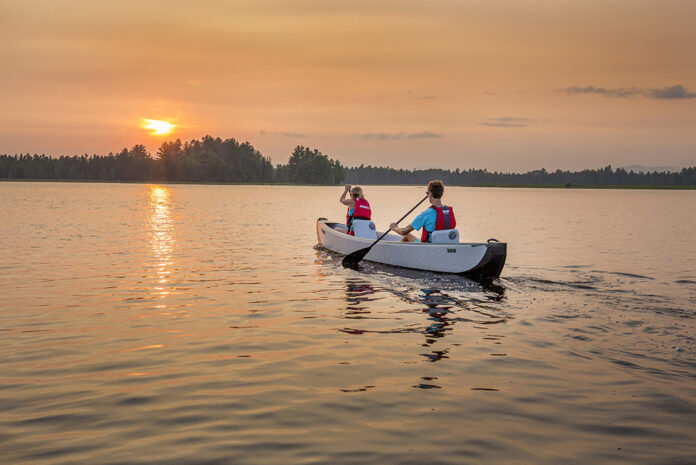
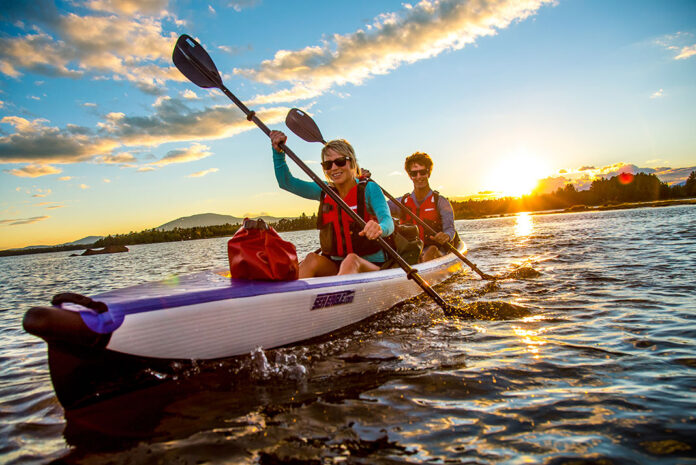
Two people paddling inflatable canoe towards the setting sun on a lake
Photo courtesy: Sea Eagle

Space is at a premium in so many aspects of modern life. Garages fill to the point that vehicles are relegated to the driveway. People living in cities may not have the luxury of a garage at all. And when it comes to traveling, roof racks quickly get to capacity with bikes and roof cargo boxes—after all, we want to do it all these days.

Inflatable canoes are a solution for paddlers tight on space. Their packability and portability are unparalleled. Inflatable canoes fit in an apartment closet and are easy to take along in the trunk of a car or even as a checked bag on a flight.

The inflatables category is rapidly expanding. Buyers are no longer restricted to heavy-duty whitewater boats or flimsy rubber crafts suited for pools. There is a range of blow-up canoe options, from recreational canoes to boats for remote expeditions. New technology such as drop stitching allows the inflatables to take more complex shapes, and they are made of materials durable enough to withstand heavy use. Used inflatable canoes may be available, but there are unique factors to consider when purchasing them. Below we explain these, and other tips for buying your first or next inflatable canoe.

Check The Weather
  • Plan for changing weather conditions. Prepare for the worst case.
  • Don’t forget to check tide, currents, or river levels.

Top picks: Best inflatable canoes

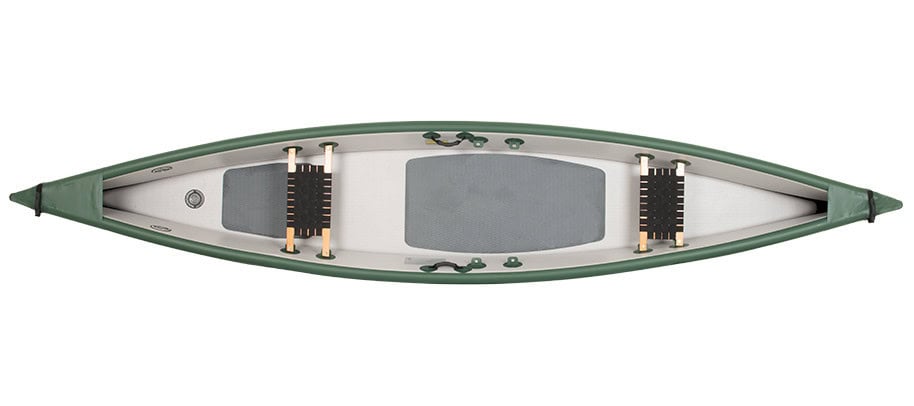
Sea Eagle Travel Canoe TC16

Sea Eagle Travel Canoe TC16

Sea Eagle TC16 Specs
Length: 16’0”
Width: 38”
Weight: 65 lbs
Capacity: 915 lbs
MSRP: $1,849 USD

Buy from:

SEA EAGLE AMAZON

From our review:

“The Travel Canoe 16—or simply TC16—is a perfect craft for paddlers who don’t have 48 square feet to spare for canoe storage, or for travellers who want to be able to check their canoe on an airplane. When deflated, the TC16 packs to the size of a burly winter sleeping bag, small enough that it might not even be considered oversized baggage. In fact, it’s the only canoe that’s ever been delivered by courier and deposited in the office kitchen.

The TC16 weighs just shy of 60 pounds and is incredibly easy to set up. Literally, just pump and go. Inflation took…” [ Read full review ]


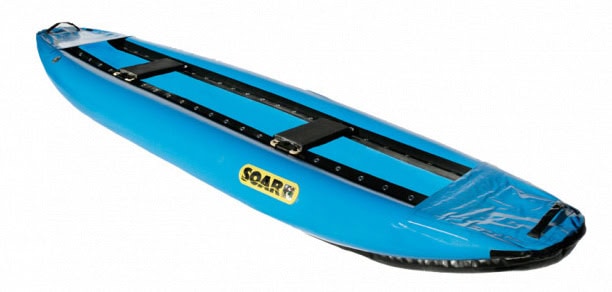
SOAR Inflatables Canyon S14

SOAR Inflatables Canyon (S14)

SOAR Canyon S14 Specs
Length: 13’11”
Width: 40”
Weight: 62 lbs
Capacity: 875 lbs
MSRP: $3,939 USD

Buy from:

SOAR INFLATABLES

There is simply nothing that can’t be done in the SOAR 14. It’s an exciting tandem whitewater playboat and nimble for a solo paddler. You can load it with gear for both solo or tandem wilderness trips. It tracks great on flatwater, and is a lot of fun in coastal waters.


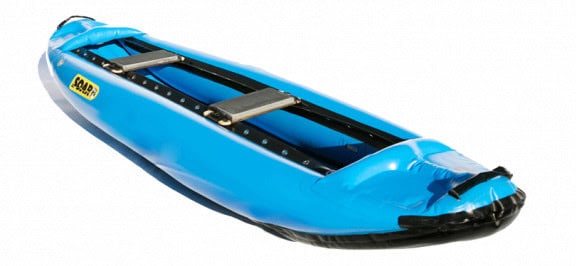
SOAR Inflatables Blaze S12

SOAR Inflatables Blaze (S12)

SOAR Blaze S12 Specs
Length: 12’0”
Width: 40”
Weight: 52 lbs
Capacity: 750 lbs
MSRP: $3,531 USD

Buy from:

SOAR INFLATABLES

The SOAR 12 is a perfect solo inflatable for day-long paddles or extended trips. It can be paddled with a canoe or kayak paddle. Two people can comfortably paddle a SOAR 12 with lightweight overnight gear. It’s also ideal for the fly fisherman who wants to access low water areas.


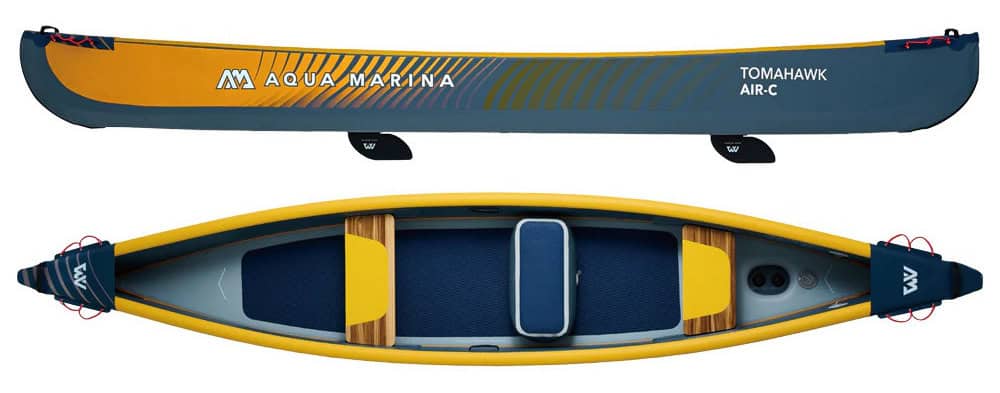
Aqua Marina Tomahawk AIR-C

Aqua Marina Tomahawk AIR-C

Aqua Marina Tomahawk AIR-C Specs
Length: 15’8”
Width: 35”
Weight: 54.5 lbs
Capacity: 573 lbs
MSRP: $1,199 USD

Buy from:

AQUA MARINA AMAZON

The new TOMAHAWK AIR-C is a revolutionary inflatable canoe utilizing Drop Stitch Technology double-wall fabric for incredible rigidity and durability. It is designed for those who want to explore remote locations with friends in almost all types of water conditions.


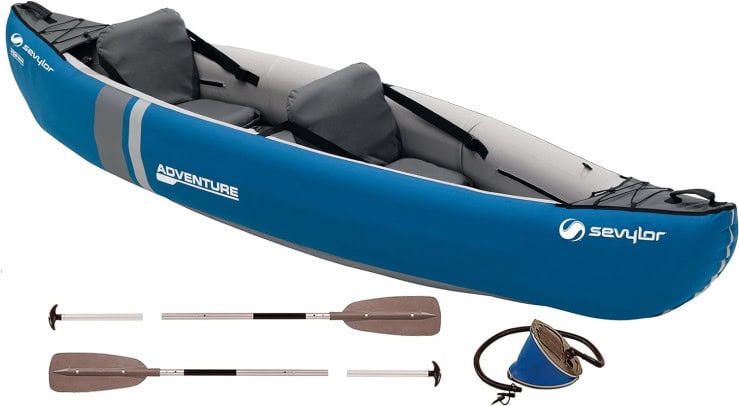
Sevylor Adventure Plus

Sevylor Adventure Plus

Sevylor Adventure Plus Specs
Length: 12’1”
Width: 33.9”
Weight: 33.5 lbs
Capacity: 440.9 lbs

A classic design that encourages fun and family adventure on the water. The high side walls provide comfort and protection while the adjustable, removable seats allow for effortless conversion from a 3-person to a 2-person canoe. Bungee cords and integrated spray decks keep essentials and gear secure while out exploring.


Shopping for a used inflatable canoe?

Used inflatable canoes are not as common as their rigid counterparts. They are still relatively new, and not sold as widely. The best places to find used inflatable canoes would be through local paddling groups or specialized outdoor classifieds such as MEC Gearswap.

Manufacturers such as Sea Eagle may also sell used inflatables on their website: these are often returns or repairs and have been professionally repaired and inspected.

When buying a used inflatable, blow up the canoe to ensure that it holds air. Also be sure to check that all the parts are there—including a pump and patch kit. Chat with the current owner to get an idea of how the canoe was stored, how often it was used, and why they want to sell it.

For more tips on what to look for when selecting a used canoe, read our article How To Buy A Used Canoe.

Inflatable canoe buying guide

The inflatable canoes you’ll find vary greatly in terms of their construction, comfort and performance. Comparing a $500 blow-up floater to a $3,000 inflatable tripper is like comparing a beach cruiser bicycle to a full-suspension mountain bike. Both have their purpose, but they are nearly altogether different items.

The lower-end inflatable canoes are great for fun days at the beach or cottage. They might be uncomfortable sitting in for extended periods and should be carried into the water rather than dragged along the shore.

Paddle Sober And Smart
  • Never mix alcohol and paddling. Coast Guard and state BUI (boating under the influence) laws apply to all vessels. This includes canoes, kayaks, SUPs and rafts.

More expensive canoes use rigid seats for added comfort. They have reinforced PVC construction, using more rugged materials. Some use drop stitching to achieve a higher air pressure and hold a stiffer shape, giving the canoe better on-water performance and more durability.

When shopping, note the intended uses of the canoe and see if they match your paddling style. Also, consider the packed size and weight of the canoe. If the goal is to hike it into remote lakes, be sure it is easy to carry.

What is drop stitching?

Drop stitching is a process that allows inflatables to have flat surfaces and corners. The two pieces of material are woven together with thousands of fine fibers. The stitching is then coated with an airtight seal, and further taped along the seam. The result is a rigid, robust inflatable boat with shapes that were previously impossible.

Drop stitching is a relatively new development, but the process is used for many shaped inflatable products, including aircraft wings, where durability is paramount.

Want to know more? Find our answers to the most common questions about inflatable canoes below:

  • Inflatable vs hard canoe

    Inflatable canoes are difficult to compare to traditional, ‘hard’ ones. Performance will vary greatly, but inflatables retain a huge advantage in portability. They will not be as durable as a plastic canoe or track as well as one with a rigid hull.

    However, some inflatables are made with robust materials like PVC or rubber, which offer impressive durability considering the pliable nature of the material. Drop stitch technology has allowed for significant improvements in rigidity as well, which translates into better tracking performance when underway.

  • Inflatable canoe vs inflatable kayak

    Trying to decide whether to choose an inflatable canoe or kayak? There are more options for inflatable kayaks rather than canoes, but they use the same inflation and construction technologies. Ultimately, the paddle and seating are what distinguishes them. Like their rigid counterparts, inflatable kayaks are paddled while sitting low in the boat with a double-bladed paddle, while canoes are paddled from an elevated seated or kneeling position with a single blade.

    The seating system on inflatable canoes varies by the brand and cost of the canoe. Entry-level canoes like Sevylor’s boats have inflatable seats which are integrated into the hull. These are comfortable for short outings, but paddlers may soon find that they are a little spongy. Higher-end models like the Sea Eagle Travel Canoe have removable wooden seats with optional backrests. These rigid seats maintain the comfort, responsiveness and feel of a traditional canoe.

  • Are inflatable canoes any good?

    Inflatable canoes have come a long way in recent years by borrowing technology from rafts and inflatable kayaks. In the hands of experienced paddlers, higher-end inflatable canoes can be taken on long trips and down whitewater rivers.

  • What are the advantages of inflatable canoes?

    The biggest advantage of inflatable canoes is the portability they provide. Inflatables come in a duffel-style bag, some with shoulder straps for easy carrying. They can be easily packed into a car’s backseat, eliminating the need for roof racks. At home, they can be stored in a basement or tucked in the garage.

  • How safe are inflatable canoes?

    Although they are rare, punctures are an obvious concern for inflatable canoes. To address this safety concern, inflatable canoes use one-way valves and multiple chambers, sometimes called ‘baffles’. This means that if for some reason a tear does happen, it will be isolated in one part of the boat and the other chambers will remain inflated.

    The likelihood of a puncture depends on the construction of the inflatable canoe. Lower-end canoes with a single layer of PVC are closer to beach toys than reliable watercraft. If all you plan to do is paddle the canoe at a waterfront in calm conditions this is totally fine—but you may need to use more caution when launching it at the water’s edge. These boats are light enough that they really don’t ever need to touch the bottom or get dragged along the shore.

    Higher-end inflatable canoes like the ones made by Aire or Sea Eagle use a much stronger reinforced PVC. These canoes are designed to withstand repeated impacts, and can even handle whitewater. They bend and flex, absorbing bumps from obstacles in the water. A good indicator of the quality is the warranty provided with the canoe. A multi-year warranty, like Aire’s substantial ten-year warranty, inspires confidence in the canoe’s longevity.

    Capsizing is another safety concern with any sort of paddlecraft. As for all forms of paddling, taking a course from a qualified instructor, using good judgment and always wearing a PFD and appropriate clothing are the best ways to safely use your inflatable canoe.

Carry A Whistle (And A Light For Night Use)
  • Every paddler should have a whistle attached to his/her life jacket.
  • Carry a light at night. Consider carrying a distress signal device.
  • How long do inflatable canoes last?

    If properly cared for, an inflatable canoe can last 5-10 years without issue. They must be totally dried before they are packed away and should be stored out of direct sunlight. Frequently inspect the seams and valves and follow the maintenance instructions provided by the manufacturer.

  • How much is an inflatable canoe?

    An inflatable canoe’s cost depends on its construction and materials. New inflatable canoes cost as little as $899 for the Innova Kayak Vagabond, or $3,000+ for the Aire Traveler.

  • How much does an inflatable canoe weigh?

    The weight of an inflatable canoe depends on its size and material. The typical range will be from 38-65 pounds. Consider the canoes’ weight as well as the other items included such as the pump and transport bag—these may add some extra carrying weight.

  • Where to buy an inflatable canoe

    Inflatable canoes can be bought directly from the manufacturer, at local shops, or online. When searching online, check general classifieds such as Kijiji or Craigslist, but also paddlesport specific sites like MEC Gearswap or PaddleMonster. Second-hand inflatable canoes may also be available from paddling clubs, online classifieds or through word-of-mouth channels.


Best Sea Eagle Kayaks For 2026

Man and woman paddling tandem inflatable kayak
Photo: Courtesy Sea Eagle

Inflatable dinghies, rafts and even kayaks have been around for decades. These durable and easy-to-transport boats appear on the back of sailboats and on whitewater rivers in remote corners of the world. Sea Eagle is one of the original inflatable boat manufacturers, and their kayaks are worth considering if you want a portable, light, well-performing kayak that can go just about anywhere.

The inflatable paddlesports market has grown significantly in the last few years, and advances in the construction and materials of these kayaks have made them better than ever. Sea Eagle’s pedigree of expedition-ready blow-up kayaks has positioned them to be at the forefront of this inflatable revolution.

Founded in 1968, Sea Eagle initially sold their inflatables through mail-order catalogs. Today, Sea Eagle offers a range of solo, tandem and three-person inflatable kayaks, which are widely available from outdoor stores, big-box stores and online retailers. Sea Eagle inflatable kayaks range from affordable recreational kayaks to expedition-ready, packraft-style boats for downriver pursuits.

Drop-stitching is one revolutionary construction method that has changed the inflatables game. This technology lets manufacturers make flat surfaces and sharp corners rather than the typical rounded shape that most imagine when they think of inflatables. Drop-stitching is even used to make airplane wings. Sea Eagle kayaks employ drop-stitch technology for the floors and sides of some of their kayaks to better hold the intended shape.

A common misconception about inflatable kayaks is that they aren’t very durable. In fact, with resilient PVC material, inflatables bounce off obstacles rather than bend and break like rigid kayaks. Because they are filled with air, they don’t sink either. Of course, like any consumer good, you get what you pay for, and premium Sea Eagle inflatable kayaks are significantly more durable and well-made than cheaper inflatables (which are often little more than glorified pool toys).

Sea Eagle inflatable kayaks are suitable for families who want a fun boat for the beach, river runners who want a forgiving kayak for easy whitewater, or any paddlers who prioritize portability. If this sounds like you, read on to learn more about Sea Eagle kayaks.

Below, you’ll find an overview of Sea Eagle’s product line as well as links to view specific models. We also feature advice for buying used boats and reviews detailing how the boats handle, so you can find the perfect match for your paddling aspirations.


Our top picks: Favorites from Sea Eagle

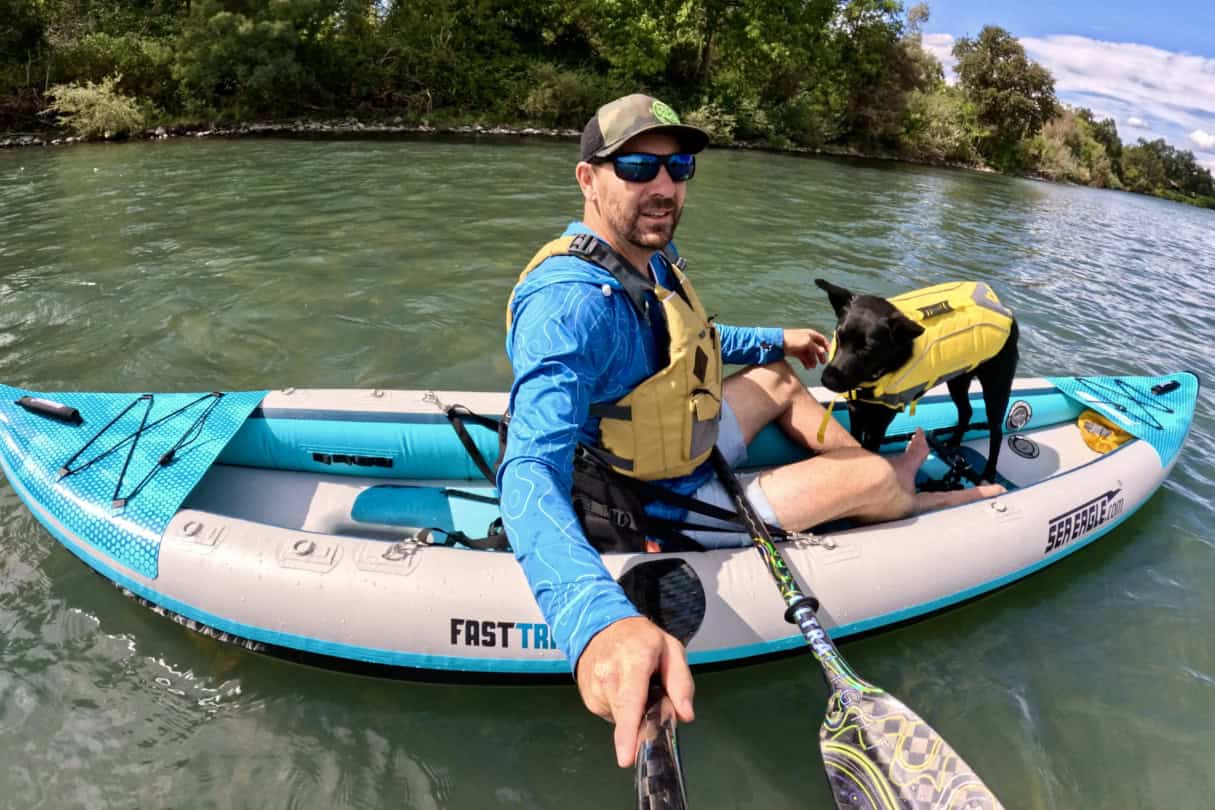
Sea Eagle 385ft FastTrack

Man and dog in kayak on river.
Dan and Lego floating the Sacramento River. | Image: Dan Arbuckle
Sea Eagle 385ft Fast Track Specs
Length: 12’8″
Width: 36”
Weight: 31 lbs
Capacity: 635 lbs
MSRP: $1,249 USD

Buy from:

SEA EAGLE

From our review:

“There are a number of things Sea Eagle has included in this kayak that are worth talking about, but we need to start with what makes it truly unique, which is underneath it. The FastTrack 385ft has something I’ve never seen on an inflatable kayak, and that is a V-hull design. It is the reason I asked SeaEagle to send me this boat. A V-shaped floor gives a kayak good tracking and glide like you would find on a traditional hard-shell kayak...” [ Read full review ]


Sea Eagle Travel Canoe 16

More fun than a bouncy castle. | Photo: Scott MacGregor
Sea Eagle Travel Canoe 16 Specs
Length: 16′
Width: 38″
Weight: 63 lbs
Capacity: 916 lbs
MSRP: $1,849 USD

Buy from:

SEA EAGLE

From our review:

“The Travel Canoe 16—or simply TC16—is a perfect craft for paddlers who don’t have 48 square feet to spare for canoe storage, or for travellers who want to be able to check their canoe on an airplane. When deflated, the TC16 packs to the size of a burly winter sleeping bag, small enough that it might not even be considered oversized baggage. In fact, it’s the only canoe that’s ever been delivered by courier and deposited in the office kitchen…” [ Read full review ]


Shopping for a used Sea Eagle kayak?

You may come across a used Sea Eagle kayak on buy-and-sell websites like Kijiji or Facebook Marketplace, or by searching “Craigslist Sea Eagle kayak”. Another great option is to buy used directly from Sea Eagle. Browse the used kayak inventory on Sea Eagle’s website; all used kayaks include a three-year warranty and 120-day money-back guarantee.

Sea Eagle inflatable kayaks are a good choice as a beginner kayak for family fun and easy whitewater. They don’t require a large space for storage and are simple to transport, even in a small car. Once you’ve found a contender, consider the following advice to make a good used purchase:

  • There are key differences when looking at used inflatables like Sea Eagle kayaks compared to traditional rigid kayaks. Inflatable kayaks come with more assembly parts—such as seats, seat backs, foot rests, skeg (a removable fin that slides into the hull) and grab lines—so you’ll want to make sure that everything is included.If you’re buying the kayak from an independent seller, it’s crucial that you fully inflate the boat to ensure that there are no leaks, holes or other damage to the tubes and inflation valves. If you’re ordering a used kayak directly from Sea Eagle, they have a guarantee that their boats are in good working condition.
  • Watch for any stains and mold, which may reveal the kayak was stored wet. Is there any fading in the Sea Eagle kayak’s deck (top) or hull (bottom)? Fading reveals UV damage, which may compromise durability.
  • Outfitting is the critical interface between the paddler and kayak, including the seat, back support and foot rests. These features are usually air-filled, so be sure to check for leaks. Examine these parts individually and consider how well they work together as a whole—the easiest way to achieve this is by sitting in the boat (and ideally paddling it) to make sure it feels comfortable.Think about how long you’ll be sitting in the kayak. If it’s uncomfortable in a quick test, how will it feel after an hour? Outfitting often comes down to personal preference; there’s no one-size-fits-all.
  • The only way to fully appreciate the comfort and performance of a kayak is to try it before committing to a purchase. Arrange a meeting place with the seller that allows you to take a few moments on the water. Bring your usual paddle and dress in what you plan to wear while paddling. Be sure to assess how easy the boat is to enter and exit.

For more tips on selecting a used kayak, read our article How To Buy A Used Kayak.

Sea Eagle inflatable kayak buying advice

Inflatable paddle craft, including kayaks, have come a long way in recent years. The rise of drop-stitch technology now allows companies like Sea Eagle to build boats that have rigid, high-performance shapes.

The main advantage of an inflatable kayak over a hard-shell one is portability—anyone who is tight on space will appreciate a boat that can pack into a duffel bag. Sea Eagle inflatable kayaks can be stored in a condo and transported in the trunk of a car. The additional benefits of blow-up kayaks are their inherent buoyancy, superb stability and cushy comfort. This makes inflatable kayaks good for kids and new paddlers to learn kayaking skills.

On the other hand, inflatable kayaks are more susceptible to getting blown around in the wind, and are less suitable for coastal touring than hard-shell kayaks. Inflatables are also generally slower compared to rigid kayaks.

Sea Eagle kayaks are available across North America at select dealers and online direct from the manufacturer. If you’re shopping online, you’ll save on shipping fees with an inflatable kayak. A common worry about ordering a kayak online is that you do not have a chance to try it out before buying. A 180-day guarantee backs Sea Eagle’s boats; if you realize the kayak isn’t a great match, you can send it back for a full refund.

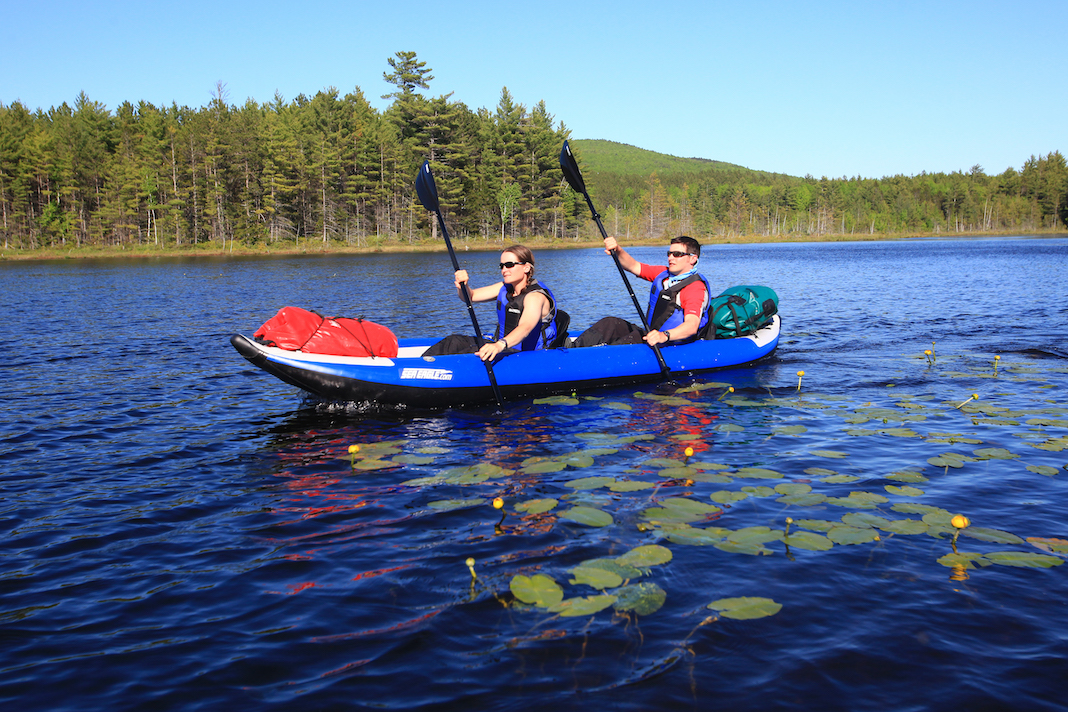
Sea Eagle kayaks are available for a range of needs, including recreational paddling, fishing and whitewater; single, tandem and triple; for paddlers of all sizes. Sea Eagle packages typically include the kayak, pump, paddle(s), repair kit and carry bag, so you just need to add a personal flotation device and Coast Guard-approved safety kit, and you’re ready to hit the water.

Here’s a rundown of Sea Eagle’s various categories and most popular models:

Woman paddling inflatable kayak
Photo: Courtesy Sea Eagle

Sport

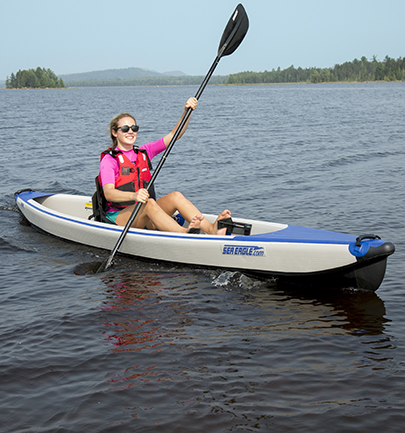
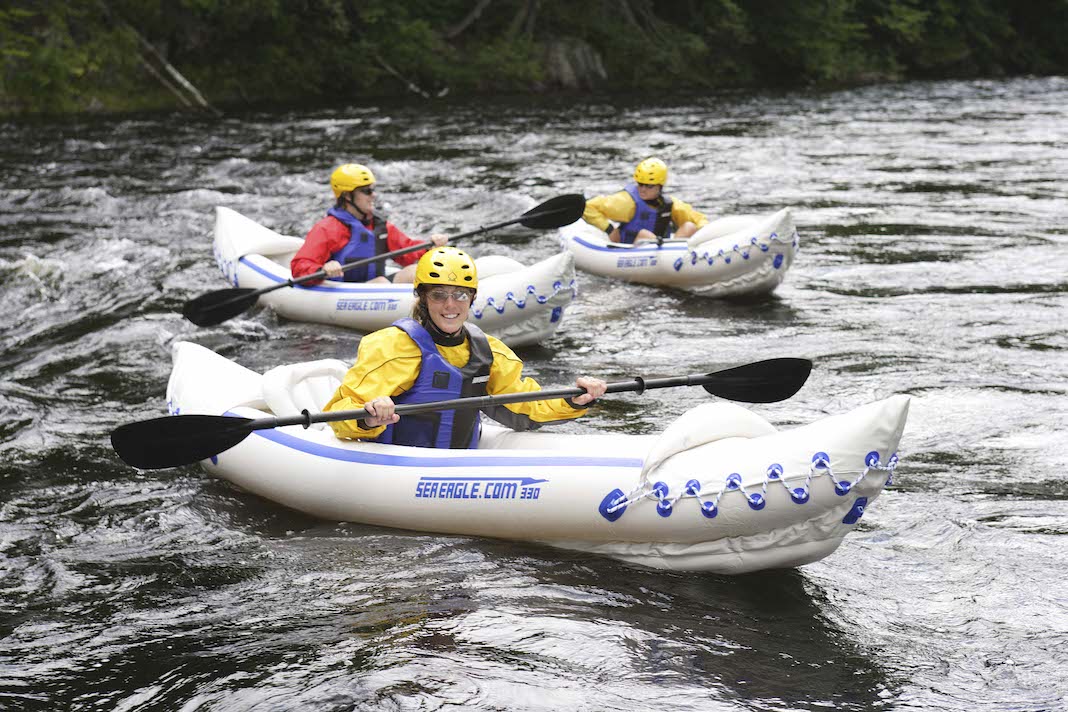
Sea Eagle’s Sport Kayak line is the entry-level category. These kayaks are inexpensive (starting at around $300 USD) and easy to set up. They lack the high-pressure drop stitching of Sea Eagle’s other boats, but the rugged K80 PVC is sturdy enough to handle Class II-III rivers. For a first kayak, it’s hard to beat the price of the Sport Kayak line.

There are two models in this class, the SE 330 and SE 370. At a compact length of 11’2” (3.4 meters), one or two people can paddle the SE 330. The slightly longer SE 370 measures 12’6” (3.8 meters) with a higher load capacity for two larger paddlers.

FastTrack

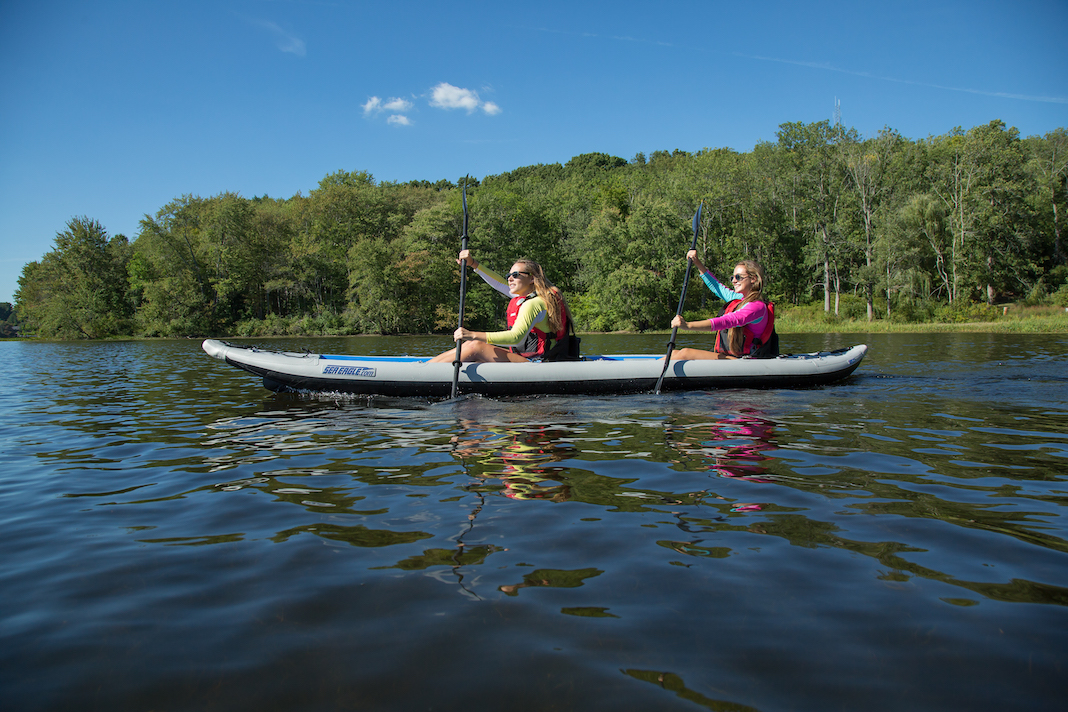
The next price point in the Sea Eagle line is their FastTrack series. The more performance-oriented FastTrack kayaks are great for light day touring. With inflatable keels and integrated skegs (fins built into the hull for directional control), these kayaks are faster and travel in a straight line better than the Sport models. They sit slightly lower in the water for added stability when paddling, wildlife viewing or fishing.

These kayaks integrate drop stitching into their designs, where the floor has high air pressure for exceptional rigidity. There are three FastTrack kayaks available: the 385ft and 385fta (angler edition) seat one or two paddlers, while the longer 485ft can fit up to three paddlers.

The FastTrack series starts at just under $1,000 USD, but the upgrade in performance from the Sport line is significant. Sleeker than the Sport models, these boats have sharper entry lines, cutting into the water more efficiently. The 385fta angler edition is tailored to anyone who wants to fish from their kayak. Its frame seat sits higher for a better vantage point, and the kayak can support a side-mounted electric trolling motor.

RazorLite

Sea Eagle RazorLite performance kayaks are a step above the FastTrack series. Sea Eagle RazorLite kayaks are the closest to a “rigid” inflatable as any company has gotten. Drop stitching is used for every component of this lightweight kayak. What exactly is a drop stitch? Imagine the two opposing PVC walls of an inflated chamber, like the kayak floor. Inside this chamber are thousands of tiny fibers connecting the two walls—this is the drop stitch.

These fibers hold the shape and give it a flat surface, whereas the air would make the chamber slightly round without them. With the additional strength from the drop stitching, these chambers can be filled to a much higher pressure, up to ten times the amount of a non-drop stitch inflatable.

The RazorLite design is quicker but less forgiving stability-wise than the wider Sport or FastTrack kayaks. Intermediate and advanced paddlers will be most comfortable in these kayaks. The Sea Eagle RazorLite 393rl solo kayak and 473rl tandem are available, starting around $1,100 USD.

Explorer

Sea Eagle’s Explorer kayaks are rugged, self-bailing packraft-style boats built for downriver whitewater or surf paddling. High-volume tubes make the Explorer kayaks more buoyant and stable for use in up to Class IV whitewater. These tough kayaks are built with ultra-durable materials to handle whatever you may throw at them, but they are also fine for simply cruising. Explorer kayaks have removable skegs to improve handling when paddling in open water; remove the fin for paddling in shallows or rapids.

There are four models in the Explorer category: the solo 300x, tandem 380x and three-person 420x, in addition to the solo angler-specific 350fx. Choose the appropriate size based on how many paddlers will be using the kayak. The 350fx is tailored for fishing, with a stable standing platform, rod holders, integrated accessory attachment points and a raised seat for a better vantage.

Use this as a start, and remember that online research will only get you so far. The best advice we can offer is to always test paddle before buying any boat. Still have questions? Here are answers to some of the most common online questions about Sea Eagle inflatable kayaks.

  • Is Sea Eagle a good brand?

    Sea Eagle is a reputable, high-quality inflatable boat brand founded in 1968. Sea Eagle sells inflatable fishing boats, catamarans, canoes, dinghies, kayaks and paddleboards. Their products are built to suit a wide range of paddlers and price points, from family-friendly budget kayaks to more robust, top-of-the-line watercraft.

  • Are Sea Eagles good kayaks?

    Sea Eagle kayaks are great options for casual paddlers who want a durable, lightweight and portable kayak for exploring sheltered waters, fishing or running class II-IV rivers.

  • Sea Eagle kayak material

    Sea Eagle kayaks are made with polyvinyl chloride (PVC). Sea Eagle uses different grades of PVC depending on the intended use of each kayak. The Sport series uses K80 PVC, which is affordable yet durable for casual use on sheltered waters and Class II-III rivers.

    The FastTrack, RazorLite and Explorer series kayaks use more rugged polyester-reinforced PVC for added strength and rigidity. This reinforced PVC is more durable and can accommodate higher air pressures, but comes with a higher price and weight.

  • Sea Eagle kayak dealers

    Sea Eagle continues to sell most of its boats directly to the customer via online or mail order. There are select dealers worldwide, and prospective buyers can find a full list here. If you find a dealer nearby, you can arrange a test-paddle. Some Sea Eagle kayaks are also available online from Amazon or Walmart.

  • Where is a Sea Eagle kayak made?

    Sea Eagle kayaks are made in China.

  • How long will a Sea Eagle kayak last?

    Sea Eagle kayaks come with a standard three-year or opt-in six-year warranty. If properly maintained and stored, the kayak should last ten years.


Compare Sea Eagle kayaks

  • Aquaglide kayaks vs Sea Eagle

    Aquaglide produces quality inflatable kayaks comparable to Sea Eagle’s line. Like Sea Eagle, they incorporate drop-stitch floors and robust PVC construction into their performance boats for added stiffness. Both Sea Eagle and Aquaglide make angler-specific fishing kayaks, whitewater kayaks and recreational touring kayaks. However, Aquaglide does not have a match for Sea Eagle’s completely drop stitch-constructed RazorLite kayaks—if the speed of the RazorLite appeals to you, choose a Sea Eagle.

  • Sea Eagle vs Advanced Elements kayaks

    California-based Advanced Elements builds “hybrid” inflatables, combining aluminum frames for structural support with inflatable chambers to add buoyancy and fill out the kayak without adding excessive weight. Because of the more refined shape and pronounced keel created by the aluminum frame, Advanced Elements kayaks track better (hold a straighter course while paddling) than most inflatables.

    However, these hybrid kayaks require a bit more time to set up than simply pumping up a Sea Eagle. Advanced Elements’ touring kayaks are quick on the water and feel pretty close to a rigid boat in terms of fit and performance. Choose a Sea Eagle if you want a purely inflatable kayak that will go from bag to boat more quickly, but still perform well.

  • Sevylor vs Sea Eagle kayak

    Sevylor inflatable kayaks are cheaply priced and widely available through Walmart or Amazon. Sevylor’s price is tough to beat, but these kayaks don’t stack up to Sea Eagle for performance or durability. As a beginner kayak for casual use on sheltered, warm water, Sevylor is a fine option.

    But for longer paddling trips or more demanding environments like rivers, the higher performance and durable construction of Sea Eagle kayaks make them the better choice.

  • Sea Eagle vs Intex kayak

    Intex products are some of the cheapest inflatable kayaks you’ll find anywhere, and are available at many big-box stores. These are entry-level kayaks, with the top of the Intex line—the “Pro” series Excursion models—comparable to Sea Eagle’s basic Sport Kayaks.

    The Sea Eagle SE330 and SE370 Sport Kayaks are only slightly more expensive than Intex kayaks, but perform magnitudes better. If you’re just looking for a cheap boat to use casually at the beach or cottage, there’s nothing wrong with choosing an Intex. For any sort of performance kayak, Sea Eagle is the better choice.

  • Oru Kayak vs Sea Eagle

    Oru Kayak is a California-based company that makes lightweight, portable origami-inspired folding kayaks. Their novel folding design doesn’t require any pumping and set-up time is comparable to an inflatable kayak at less than 10 minutes. Oru kayaks range from the 9’8” Inlet recreational kayak to the seaworthy 16’2” Coast touring boat, with a tandem option also available.

    Like inflatables, folding kayaks are ideal for paddlers who want easy portability or don’t have the storage space at home for a rigid kayak. Oru kayaks are built with double-layer 5mm polypropylene, which resembles a burly corrugated plastic. Oru kayaks are stiffer than inflatables, so they hold their shape and cut through the water better, making them faster and more nimble than an inflatable. The downside is that these kayaks are not as buoyant, and unless flotation is added, they will sink.

    Consider an Oru kayak if you don’t want to pump your kayak up before using it. Rugged Sea Eagle kayaks like the Explorer series are better suited for rougher waters or whitewater paddling.

Two people paddling tandem inflatable kayak
Photo: Courtesy Sea Eagle

Sea Eagle kayak reviews

Use these expert reviews to help you decide on the right boat for you. You’ll get an overview of how the boat performs on the water, what it’s like to set up, how to store it and what issues to be aware of.

Best Child And Youth Life Jackets For 2026

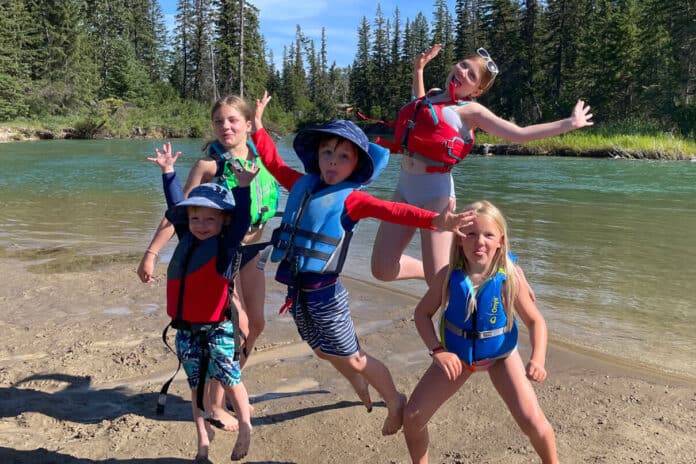
a group of children and youth jump in the air beside a river while wearing a selection of life jackets
Feature photo: Brenna Kelly

For this guide, I collected a dozen life jackets for children and youth between 30 and 90 pounds. This range can encompass kids anywhere between the ages of 3 to 12. If you’re looking for a PFD for an even smaller child, see our top picks on toddler life jackets, for 30 pounds and under. If you’re looking for buying advice for teens and adults, visit Paddling Mag’s overall guide to the best life jackets.

The U.S. Coast Guard categorizes children as being from 30 to 60 pounds, and youth from 60 to 90 pounds. So, in order test these life jackets, I divided our paddlers into the two groups. Split between energetic, snack-loving children, and determined, middle-school-aged youth, we buckled up and made our way for the water.

After extensive testing, here are my top picks for child and youth life jackets.


Best life jackets for children and youth: Our top picks

Wear A Life Jacket
  • Everyone, even strong swimmers, needs to wear a life jacket at all times when on the water. It is extremely difficult to put a life jacket on once you fall into the water. Even a light wind can blow any paddlecraft away from you, faster than you can swim.
  • Always wear a USCG-approved Level 70 or Type III life jacket designed for paddling.

Best for children (30–60 lbs)

Best children’s life jacket for flotation

Mustang Survival Child Lil’ Legends

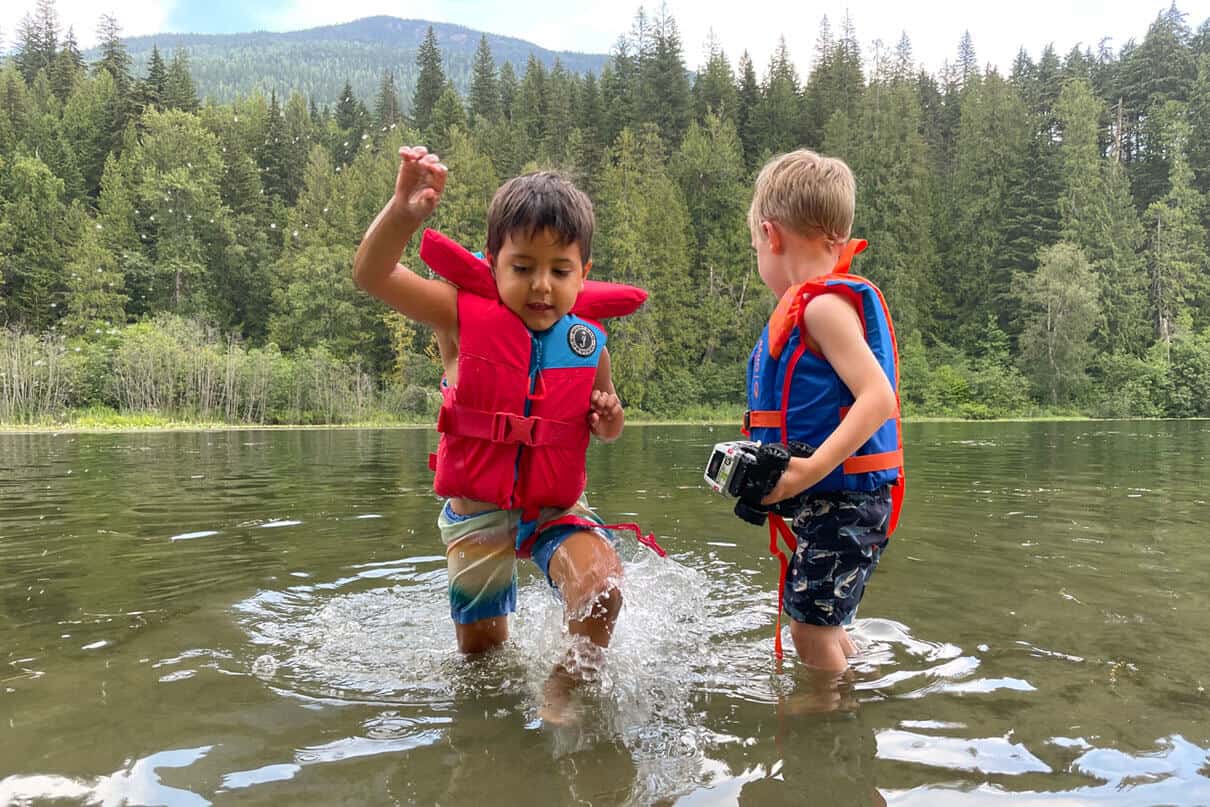
boy wears a Mustang Survival Lil Legends life jacket while playing with a friend in the river shallows
Photo: Brenna Kelly
Mustang Survival Child Lil’ Legends Specs
Price: $74.99 USD
Material: 100% Nylon, Foam: PVC-free Gaia Foam
License: U.S. Coast Guard and Transport Canada Approved
Weight Range: 33–59 lbs

Buy from:

MUSTANG SURVIVAL AMAZON BACKCOUNTRY

The Mustang Child Lil’ Legends is all about keeping your child floating high out of the water. It has lots of foam, making it a little bulky but still very comfortable. The foam collar keeps them face up if they are tossed from a raft. Available in multiple sizes and weight ranges, the infant and toddler life jackets in this model include a crotch strap for extra security, while the child version does not. A big zipper makes it easy for your little one to get the PFD on and off by themselves, and the grab loop allows for quick rescue in case a child ends up capsizing. This is not the sleekest vest, but for flotation and peace of mind, it is hard to beat.


Best PFD for child mobility

Onyx Outdoor Child All Adventure Life Jacket

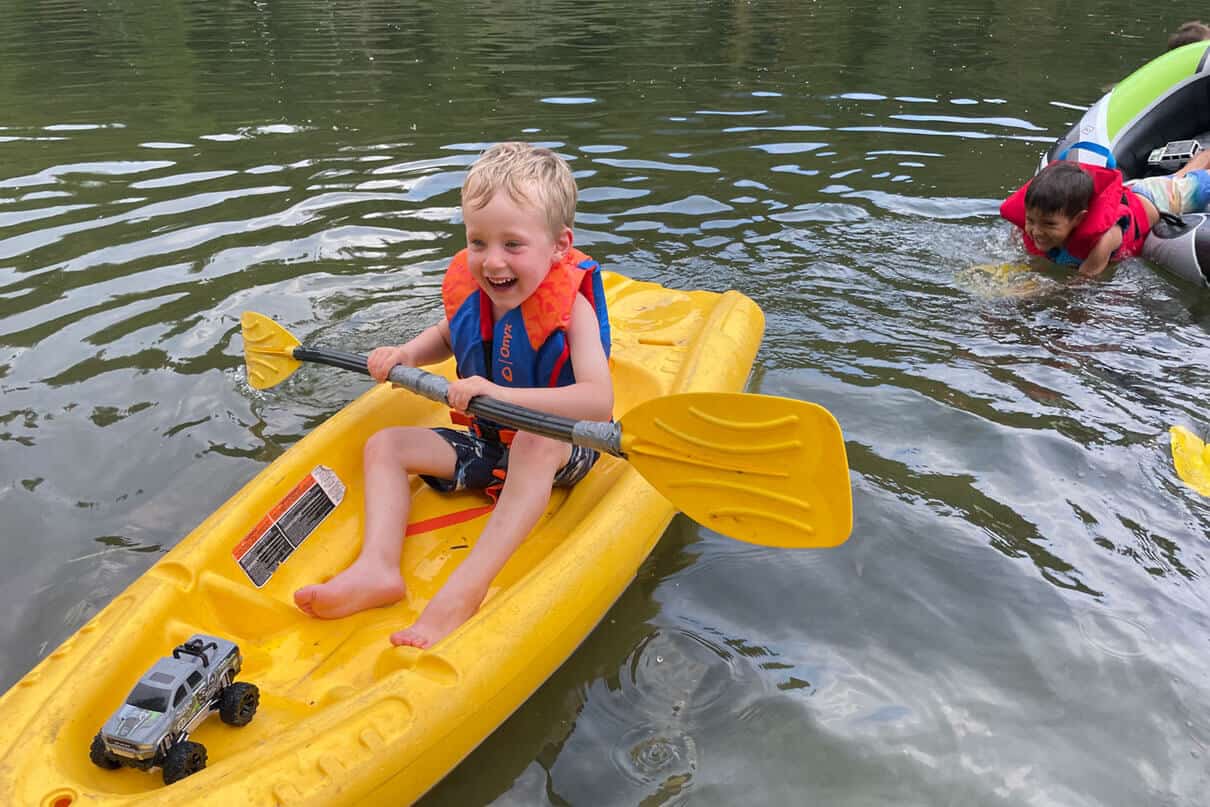
boy sits on a yellow child kayak while wearing an Onyx All Adventure life jacket
Photo: Brenna Kelly
Onyx Child All Adventure Specs
Price: $64.99 USD
Material: Nylon
License: U.S. Coast Guard and Transport Canada Approved
Weight Range: 35–55 lbs

Buy from:

ONYX AMAZON

The Onyx Outdoor All Adventure Life Jacket was my six-year-old daughter Piper’s favorite. She wore it everywhere, mostly because she didn’t even feel like she was wearing it. This PFD was easy for her to buckle and unbuckle on her own, which is always a plus for parents.

The All Adventure Life Jacket doesn’t have a float collar to turn a swimmer face-up, which Piper liked. She is a swimmer now and wants to have freedom on the water and swim with her head up. This collarless PFD is good for her growing independence and offers better comfort for her while swimming and playing in the water. The PFD still features a grab handle for easy access for parents.

At this age range and weight range, I find it’s a toss-up whether they need a foam collar and/or a crotch strap on their vest. It depends on the kid and conditions. My preference is for the crotch strap not the collar. For the type of paddling I do with my kids, it’s more likely for me to need to haul them out of the water and back into the boat, versus them being in the water unattended, which is when the collar can really come in handy.

Most affordable child life jacket

Level Six Stringray

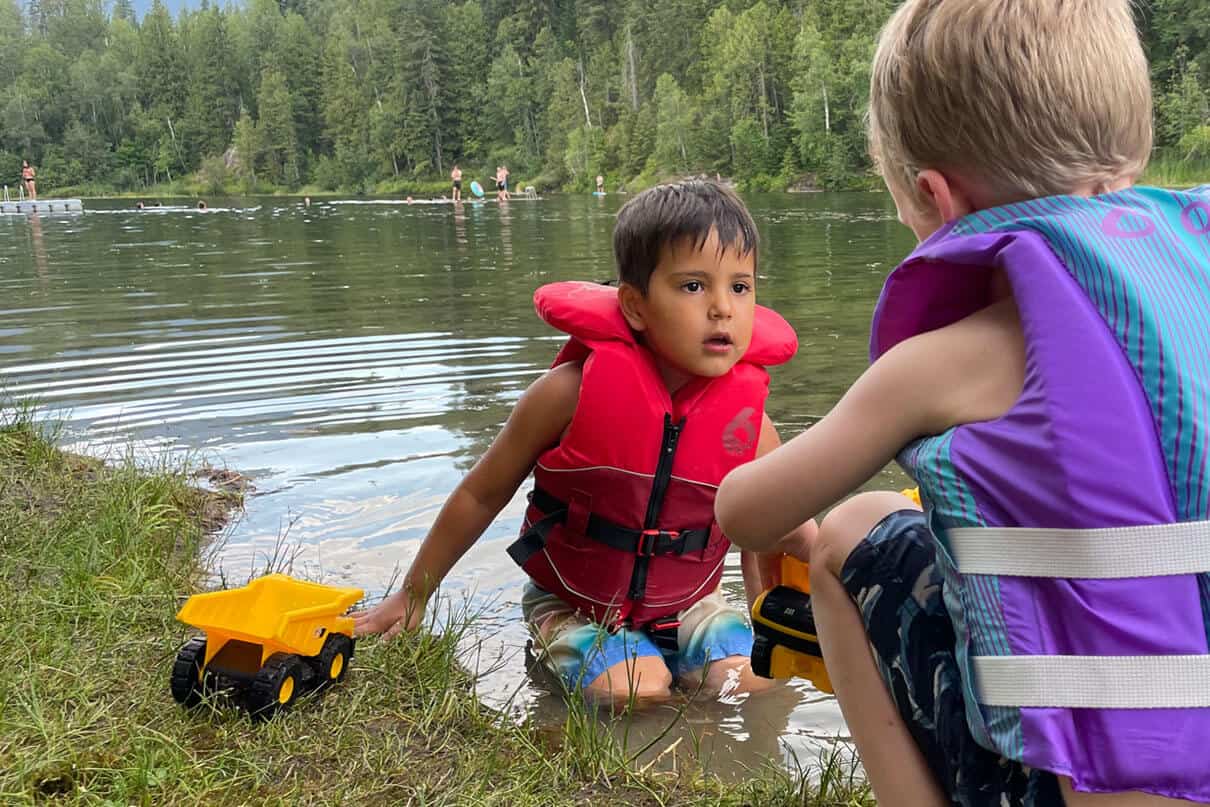
boy plays with toy truck and friend by the riverside while wearing a Level Six Stingray childrens life jacket
Photo: Brenna Kelly
Level Six Stringray Specs
Price: $54.95 USD
Material: Nylon
License: Canadian Coast Guard Approved
Weight Range: 30–60 lbs

Buy from:

LEVEL SIX AMAZON BACKCOUNTRY

The Level Six Stingray isn’t flashy, but it gets the job done and is the most budget-friendly youth life jacket we tested. It includes all the safety features parents might want to look for: a crotch strap, float collar, grab loops and an easy on-off design. The lightweight nylon dries quickly, which makes it practical for all-day use.

For a step up, the Level Six Swordtail adds partial neoprene construction, making it more comfortable to put back on when wet, especially on cooler days.

Like the other vests reviewed here, the Stingray checks all the safety boxes. Bright color options improve visibility, and the flat lower back is designed to sit comfortably against kayak seats, which is nod to paddlesports-specific performance.


Best for children’s color options

Salus Nimbus

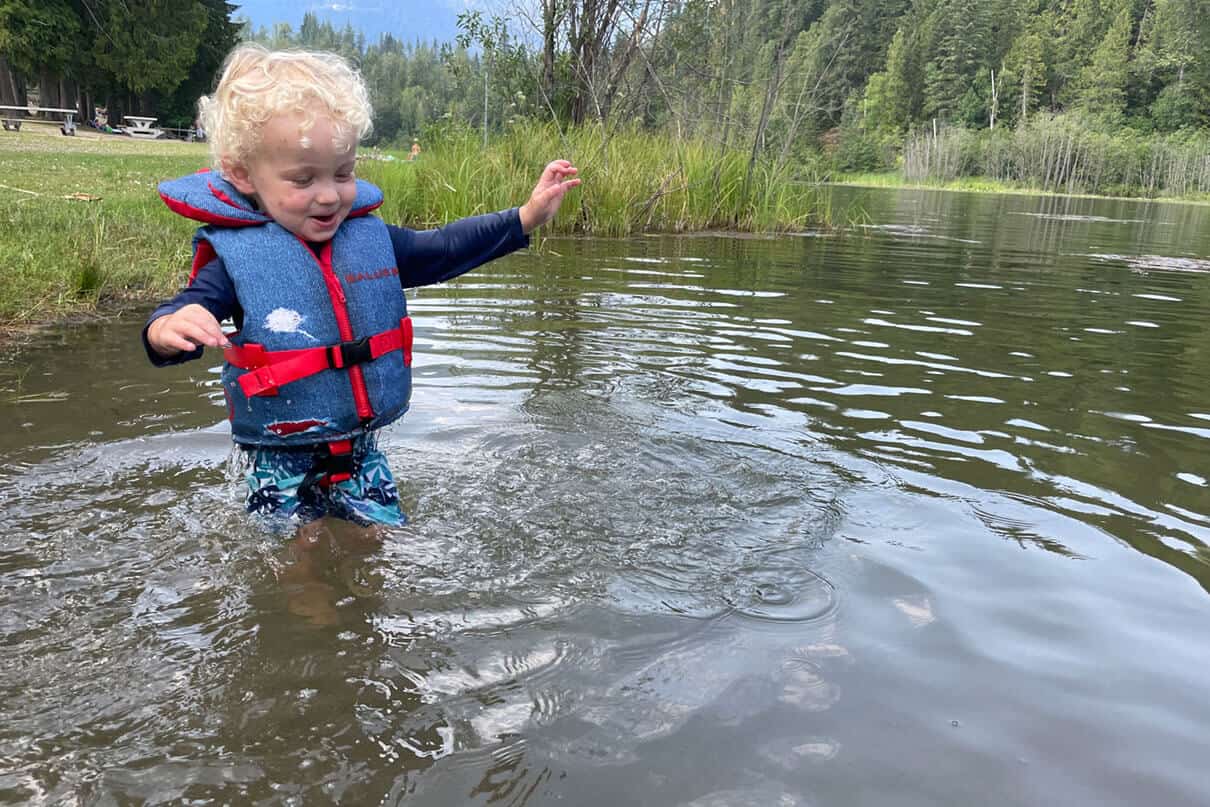
young child wears a Salus Nimbus life jacket
Photo: Brenna Kelly
Salus Nimbus Specs
Price: $120 CAD
License: Transport Canada Approved
Weight Range: 30–60 lbs

Buy from:

SALUS

The Salus Nimbus offers one of the best ranges of color styling we’ve seen. With so many cool color options, shopping with your child can be part of the fun and makes this PFD more likely to be something they are excited about wearing.

The outer fabric of the Nimbus feels more abrasion- and UV-resistant than many of the other jackets we tested. My hunch is it will last for many years, making this a PFD that can be handed down to siblings or friends as your little one outgrows it.

Standard safety features include a grab loop and crotch strap, but unique to Salus is the secondary float collar. It adds comfort and neck support, which will be ideal for infants and reassuring for nervous or weaker swimmers, although stronger swimmers may find it unnecessary.

Know The Local Hazards
  • Check navigation charts before you launch.
  • Check with those who have local knowledge of man-made and natural hazards, e.g. low-head dams; sweepers, strainers and undercuts; tides and currents; and rocks and shoals.

Best for youth (60–90 lbs)

Best youth PFD for paddling mobility

Stohlquist Drifter Youth

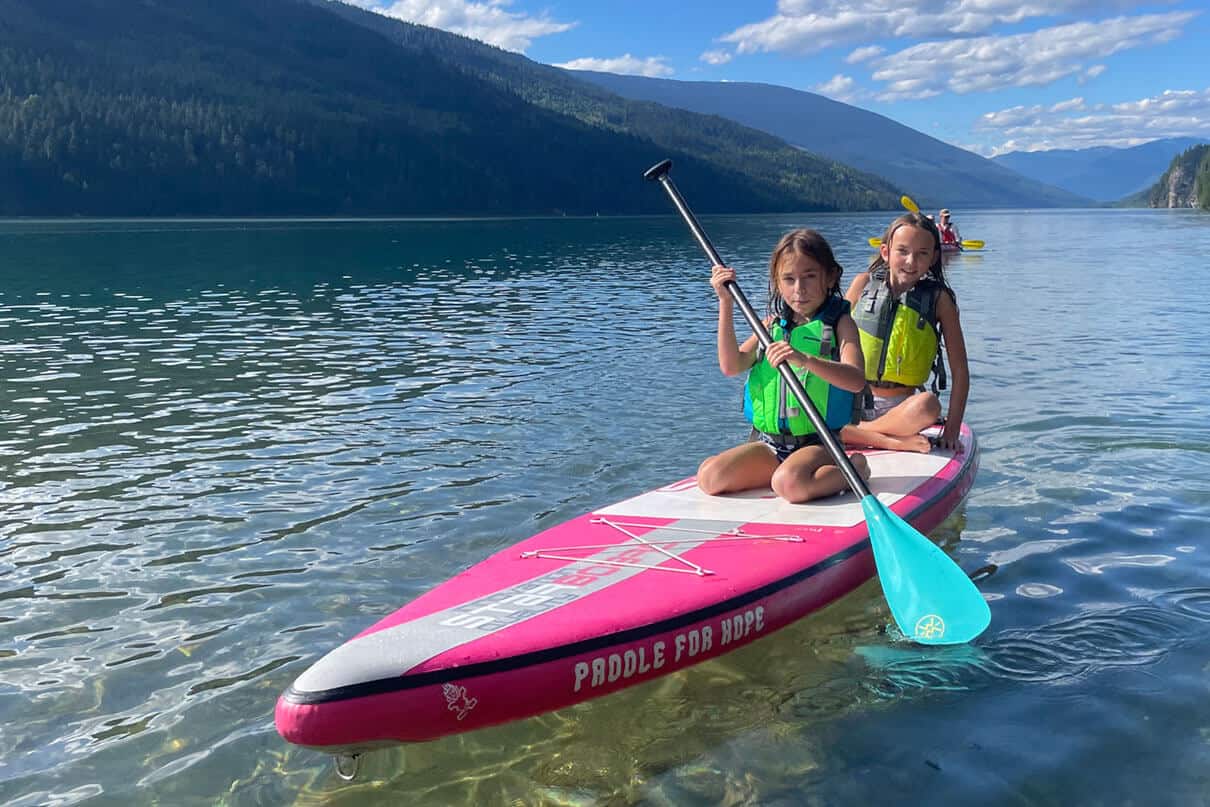
two girls kneel on an inflatable paddleboard on a western lake, the front girl is wearing a Stohlquist Drifter life jacket
Photo: Brenna Kelly
Stohlquist Drifter Youth Specs
Price: $155.99 USD
Material: Nylon & 240D ripstop
License: U.S. Coast Guard and Transport Canada Approved
Weight Range: 50–90 lbs

Buy from:

STOHLQUIST AMAZON

Our pick for the best youth PFD for mobility and paddling, the Stohlquist Drifter stands out for basically being a true small paddling PFD. While many youth vests are stripped down to just basic safety features, the Drifter mirrors adult designs with pockets for snacks, the option to attach a river knife and a clip for a whistle.

The durable Drifter has a great range of motion for arms, and I like how short the torso is. The lower cinch strap is right under the rib cage, right where it’s supposed to be. Multiple handy cinch points make this a PFD you can really fit to smaller bodies. It also includes two side cinches, one that tightens over the top of your chest, as well as shoulder strap cinches.

In terms of rescue features, there’s no grab handle, so you would be using the shoulder straps as grab points, as you would to rescue an adult paddling friend. This PFD is also available in a larger size, 75 to 125 pounds, for older teenagers and adults.


Best youth PFD for safety and fit

Astral Otter

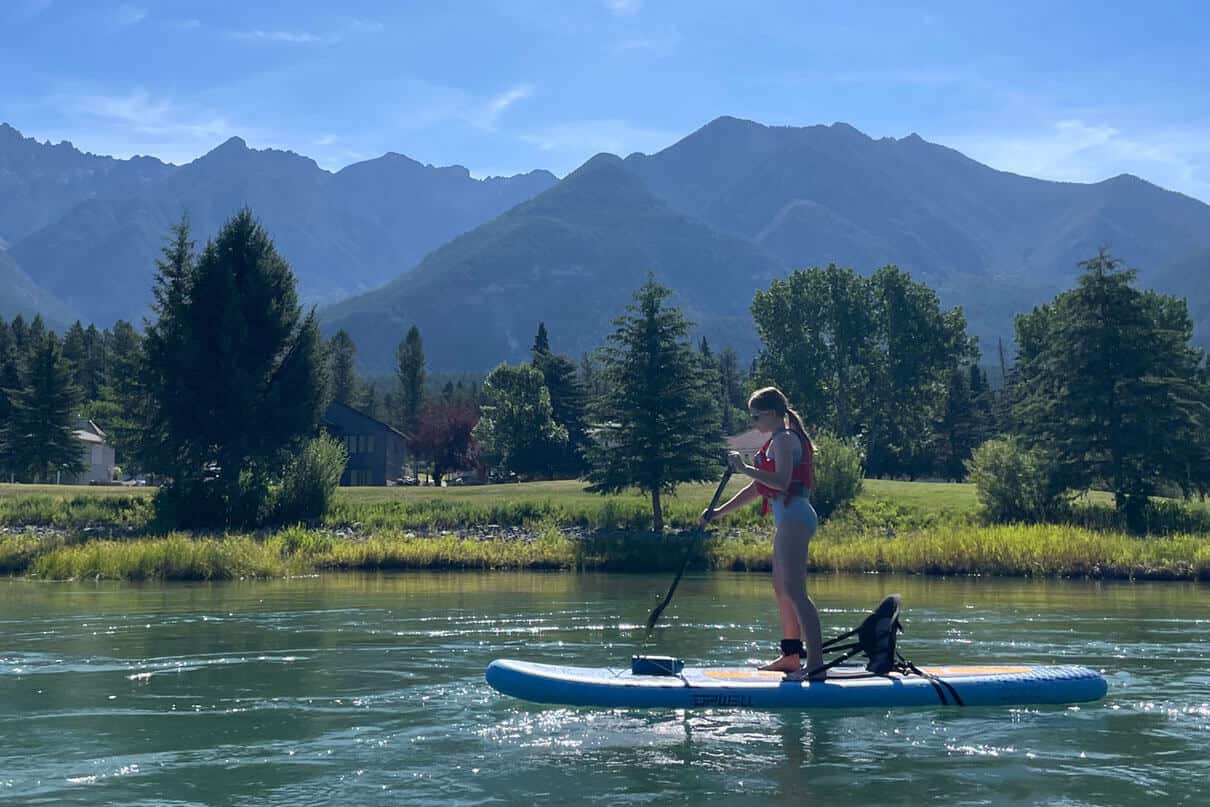
girl standup paddling a paddleboard along a scenic mountain waterway while wearing a Astral Otter life jacket
Photo: Brenna Kelly
Astral Otter Specs
Price: $170 USD
Material: 420 x 220 denier nylon ripstop
License: U.S. Coast Guard and Transport Canada Approved
Weight Range: 50–90 lbs

Buy from:

ASTRAL AMAZON BACKCOUNTRY

The Otter by Astral has a really great fit and design for a youth paddling jacket, with ample arm space for them to paddle all day long without abrasion, lots of adjustment points with the buckle right under the rib cage, shoulder straps you can make shorter or longer, and bright color options add visibility. It has pockets, though they are quite small, best suited for a small snack, like a pack of Skittles.

The optional leg straps are a standout feature, and what makes it our top pick for safety in a youth jacket. These can be added if you think you might need to pull your child back into the boat or if you’ll be out in rougher conditions. The Otter also has a very cool integrated grab handle on the back of the jacket. It’s so low profile we didn’t even notice it at first. It’s made of fabric instead of the loop of webbing common on kids’ jackets, so it doesn’t stick out, and it’s not flapping around.

Check The Weather
  • Plan for changing weather conditions. Prepare for the worst case.
  • Don’t forget to check tide, currents, or river levels.

In testing, we found that youth paddlers who are wearing the Otter were happy to wear it for long durations and liked the fit and style. There is also no zipper, just three buckles, so it’s easy for kids to do it up on their own. The Otter is also short on the torso, which is great for paddling if using a sprayskirt or if you have a high back on a kayak seat.


Most affordable youth life jacket

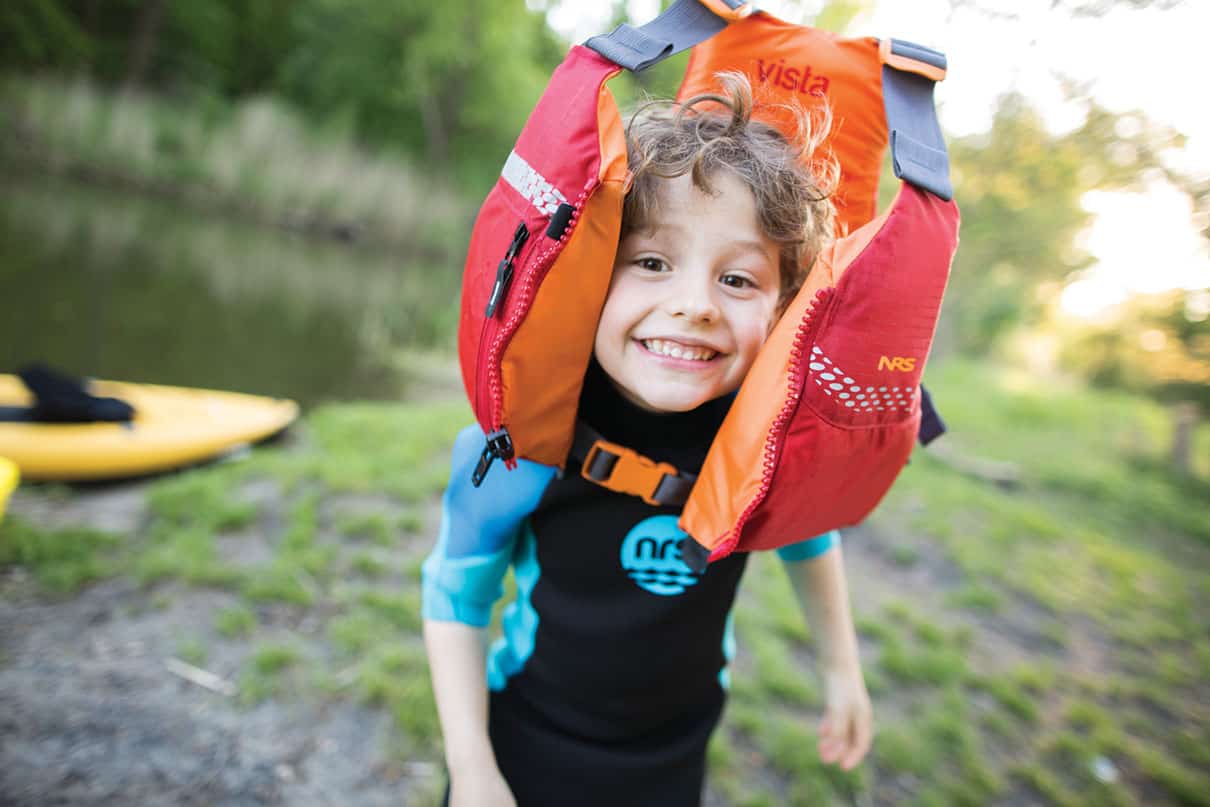
NRS Vista Youth

young person poses with an NRS Youth Vista life jacket

NRS Vista Youth Specs
Price: $94.95 USD
Material: 400-denier ripstop nylon
License: U.S. Coast Guard Approved
Weight Range: 50–90 lbs

Buy from:

NRS AMAZON BACKCOUNTRY

This was the most affordable paddling-style vest we tested for youth weighing up to 90 pounds. The NRS Vista Youth is a solid life jacket designed with paddlers in mind. It has good adjustment straps for fitting smaller bodies—including three along the side and one on each shoulder—so you can drop it down or hike it up. The bottom buckle hugs under the rib cage, just like you want. However, in testing, we did find this vest rode up a bit when the tester was in the seated position.

It has one big pocket, and you can fit a big granola bar in there, plus anything else a kid might want to carry. Our testers found the vest was comfortable, and I noted the shell felt durable, although less so than on the Astral Otter or Stohlquist Drifter. Being designed with the paddler in mind, plus the budget-friendly price point, bumped this PFD into the best value category. It’s an affordable option for kids who enjoy paddlesports.

What to consider when choosing a life jacket for youth

As a lifetime paddler, I wanted to compare some of the top paddling brands to see which ones worked best for my children and their friends. All of these life jackets listed in this review are well-made and designed, and there isn’t one in this lineup that I wouldn’t want my child to wear.

Some of the things that I look for in a quality youth life jacket are:

  • Comfort / fit
  • Number of adjustment straps for a snug fit
  • Crotch strap to ensure the doesn’t slip over the head
  • Material that will not rip easily
  • Grab handles in case you need to grab them quickly
  • Pockets for collecting things, having snacks, you name it, pockets are useful

Overall fit and function

Fit is the most crucial factor when choosing a life jacket for a child, just as it is the most important factor when choosing the best life jacket for adults. If it doesn’t fit properly, it will not do its job to float your child. And if it is not comfortable, your child or teen will refuse to wear it. The life jackets in this article cover body size from 30 pounds to 90 pounds—that’s a huge variation!

There is no substitute for trying on a life jacket before you purchase it to see what fits best. But if you don’t have that luxury, the reviews above will give you a pretty good idea of the comfort and fit of each one.

Price

This consideration speaks for itself. There are lots of life jackets out there that are even less expensive than the ones I have tested here, but they may fall short on safety, fit or function. A life jacket is a potentially life-saving device. Be cautious when prioritizing budget constraints.

Extra features

Accessible grab handles are great additions and peace of mind for parents of younger paddlers or those who lack strong swimming skills. I can’t say enough about adequate pockets—both for snacks, and so you don’t have to hold the rocks and shells they collect!


Best brands for youth life jackets


How we tested

When testing these life jackets, I divided the testers into two groups, defined by the U.S. Coast Guard’s sizing categories: children from 30 to 60 pounds, and youth from 60 to 90 pounds.

Paddlers between 30 to 60 pounds tend to be early elementary school age. They are energetic, silly, love snacking, love collecting mementos and don’t paddle often. Testing these life jackets involved swimming, playing, running, and playing on kids kayaks and kids paddleboard. I took these lightweights to a small lake with some small kayaks to put some of the top brands life jackets to the test.

Meanwhile, paddlers between 60 to 90 pounds tend to be older elementary school or middle school age. They are still energetic and silly, but they also have stamina and enjoy paddling their own vessel. These pre-teens and teenagers aren’t just in it for the snacks and swimming—they have a bit more focus and determination and enjoy setting goals and achieving them. When we were testing these life jackets, they paddled their own paddleboards and kayaks for long stretches and swam only when taking breaks.


Feature photo: Brenna Kelly


In Brief: News The Paddlesports Industry Is Talking About

A raft on the Colorado River below Havasu Creek in Grand Canyon National Park
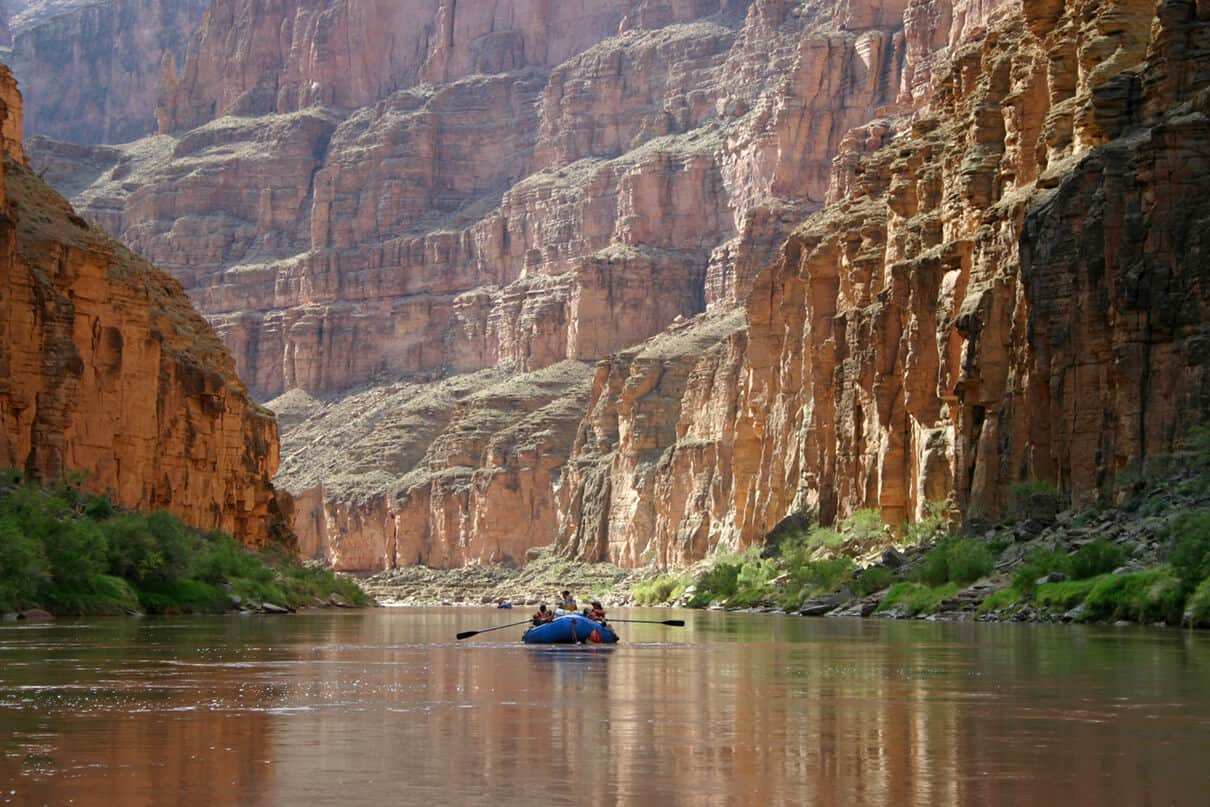
A raft on the Colorado River below Havasu Creek in Grand Canyon National Park. | Feature photo: NPS/Mark Lellouch

To date, 2025 has seen what could be called a dramatic divergence from the status quo for the paddling industry, and with it, stark dualities. This spring, the stability of the public lands American paddlers rely on came into question, just as a new survey shared outdoor participation has never been higher. Meanwhile, the U.S. Coast Guard reported boating deaths on the whole are at a 50-year low, only to also reveal SUP fatalities are on the rise. These are just the start to the conflicting current events the industry is navigating today.

News the paddlesports industry is talking about

A raft on the Colorado River below Havasu Creek in Grand Canyon National Park
A raft on the Colorado River below Havasu Creek in Grand Canyon National Park. | Feature photo: NPS/Mark Lellouch

Public lands spared for now as Congress slashes programs

In June, NRS Marketing Director Mark Deming published an opinion editorial in the Idaho Statesman, describing the economic boost that public lands provide to NRS and other outdoor-focused businesses. Deming’s voice was one of many pushing back against the proposed sale of public lands in the federal tax and spending bill, aka The Big Beautiful Bill, and the public outcry had the intended effect: a proposal to sell off up to 3.3 million acres of land managed by BLM and the U.S. Forest Service was stricken from the bill.

“Politicians listen when businesses speak,” Deming says. “I wish that individual voices held as much weight but that is the world we live in.”

Even without the public land sale, the bill proposes sweeping rollbacks to climate, conservation and public land protections. The legislation rescinds all unobligated Inflation Reduction Act (IRA) funds designated for forest restoration, wildfire mitigation and forest conservation programs. The cuts would impact forested river corridors, says American Whitewater Director of Policy and Science Thomas O’Keefe, who read the entire bill with an eye for provisions that could impact river-runners and the paddling industry. The bill also cuts funding for NOAA programs that support climate forecasting, marine sanctuaries, and—whitewater boaters take note—river flow data.

The proposed legislation also takes aim at Alaska’s wild rivers, mandating at least 20 million acres be opened to oil and gas drilling over the next 10 years in the Western Arctic, a remote landscape known for wilderness river journeys on the Colville, Utukok, Kokolik and Kukpowruk rivers. It contains provisions designed to expand coal and timber extraction from public lands. It cuts National Park Service staffing, including river rangers. Finally, a last-minute amendment proposes up to $1 billion to raise the Shasta Dam in California, which would inundate sacred sites of the Winnemem Wintu Tribe and drown a spectacular stretch of whitewater on the lower McCloud River.

Big, yes. Beautiful? You be the judge.

Diverse communities drive participation gains

Outdoor recreation participation hit a record high in 2024, with 181.1 million Americans—nearly 59 percent of the population aged six and up—taking part in activities like hiking, camping and paddling. The growth wasn’t just in numbers, but also in diversity. Youth (+5.6 percent), seniors (+7.4 percent), and underrepresented groups including Black (+12.8 percent) and Hispanic (+11.8 percent) participants all saw significant increases in the latest Participation Trends Report from the Outdoor Foundation and Outdoor Industry Association.

High-income households and high school graduates without college degrees also saw double-digit gains. The number of white and Asian/Pacific Islander participants declined slightly.

Still, the overall trend suggests a long-term demographic shift in the outdoor recreation space. Core participants—those who recreate frequently—increased by five million to 93.4 million, reversing a decade-long decline. Notably, Black core participation jumped 11.4 percent and Hispanic core participation rose 5.7 percent. The data suggest sustained growth and increasing diversity in the outdoor community—an encouraging signal for paddlesports and other activities historically lacking representation. Find more info at outdoorindustry.org.

close up on feet and board of person paddleboarding at dusk
Photo: Shutterstock.com

Boating deaths hit 50-year low but SUP fatalities spike

Boating deaths in 2024 were the lowest they’ve been since the U.S. Coast Guard began collecting statistics more than 50 years ago. Overall boating fatalities in the U.S. decreased 1.4 percent to 556, according to the U.S. Coast Guard’s Boating Statistics 2024. The positive trend was tempered by an increase in paddling fatalities, which accounted for about one in every three boating accidents in the United States last year. SUP fatalities surged 163 percent, to 40 people.

Vessels operated by people who had not received boating safety instruction accounted for roughly 70 percent of the fatalities. Lack of instruction was a through-line in all boating incidents, from motorboats to jet skis and paddlecraft.

Drowning accounted for three-quarters of deaths, and 87 percent of drowning victims were not wearing life jackets. Those key takeaways won’t surprise anyone who has worked as a paddling instructor, guide or livery hand, but they do serve as a reminder to model safe behaviors to customers.

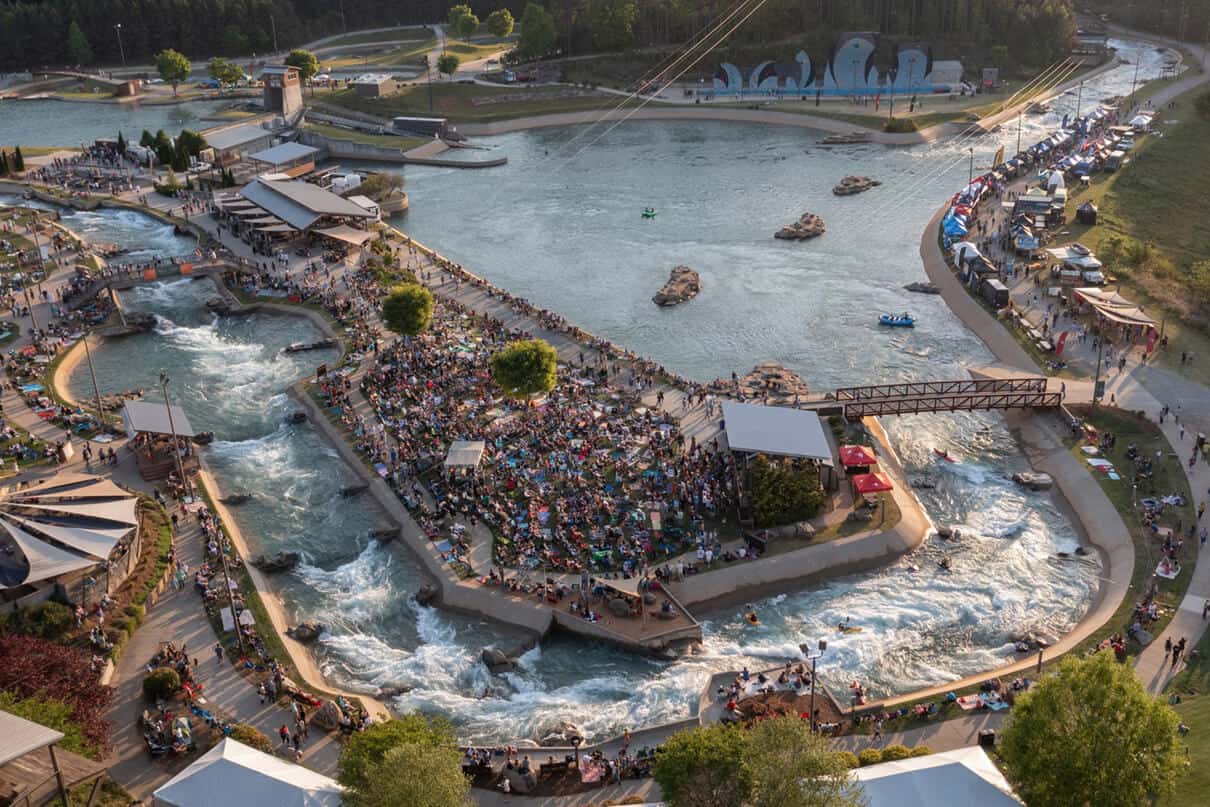
overhead view of the U.S. National Whitewater Center in Charlotte, North Carolina
Photo: courtesy U.S. National Whitewater Center

PTC Colab event moves to Charlotte

The Paddlesports Trade Coalition (PTC) will host its second annual PTC Colab event October 16 to 18 at the U.S. National Whitewater Center in Charlotte, North Carolina. The event will run in partnership with the ACA PaddleFest, celebrating 145 years of the American Canoe Association.

The PTC Colab was originally scheduled to return to Oklahoma City for a second year, but the synergy with Charlotte and the ACA was too good to pass up, says PTC Executive Director Jeff Turner.

“We love the Oklahoma City whitewater park and had great conversations with our partners there, but when the ACA invited us to collaborate during their 145th anniversary celebration in Charlotte, it made sense to bring our event there,” Turner says.

The event will coincide with ACA’s anniversary festivities, including a Swiftwater Rescue Conference and the U.S. National Slalom & Kayak Cross Championships, all while the park remains open to the public. The PTC Colab will add a full slate of industry discussions and roundtables, on-water demos and a new product showcase.

“We’re excited to integrate our programming with ACA’s,” says Turner, adding that interest from manufacturers and retailers is strong in the coalition’s second year. Find more info at ptc.connectedcommunity.org.

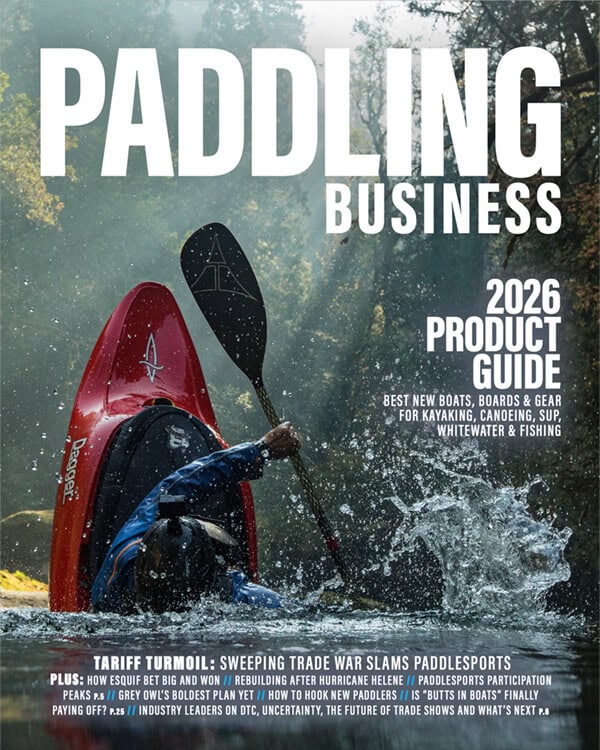
cover of Paddling Business 2025This article was first published in the 2025 issue of Paddling Business. Subscribe to Paddling Magazine’s print and digital editions, or browse the archives.
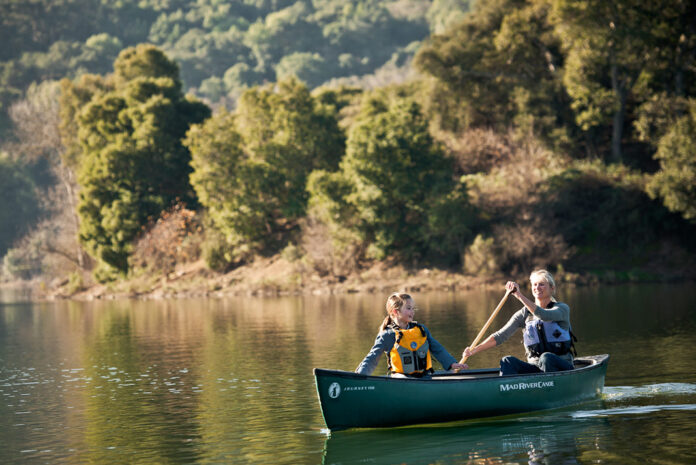
A raft on the Colorado River below Havasu Creek in Grand Canyon National Park. | Feature photo: NPS/Mark Lellouch


Read This Before Purchasing A Mad River Canoe

Two people paddling dark green canoe
Photo: Courtesy Mad River Canoes

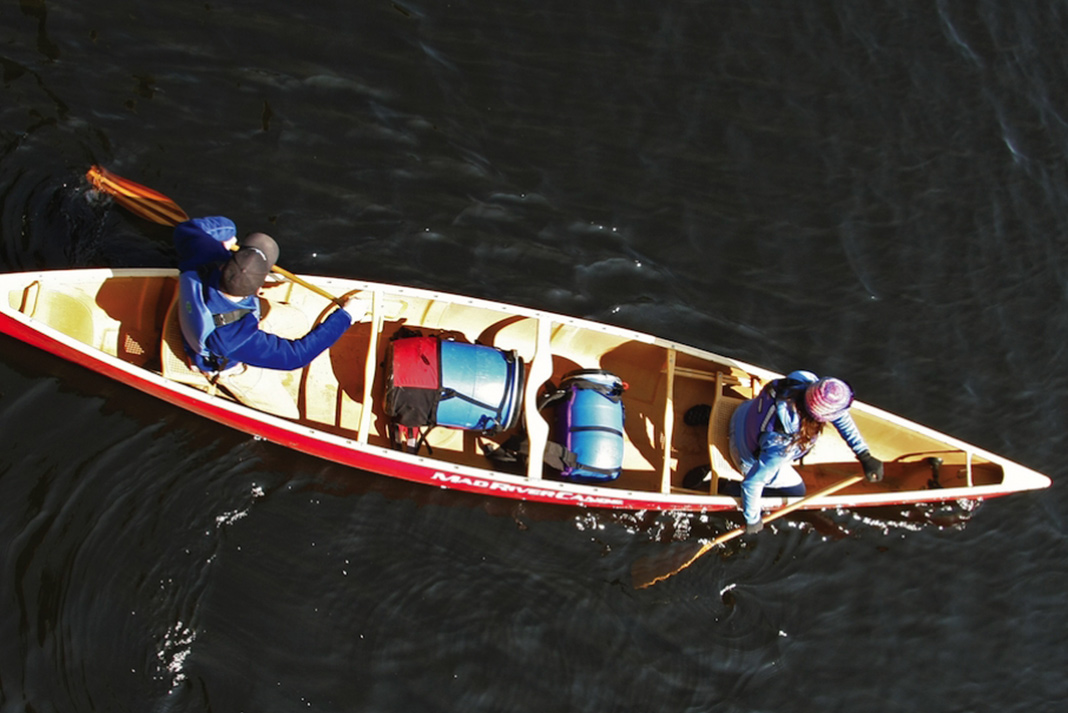
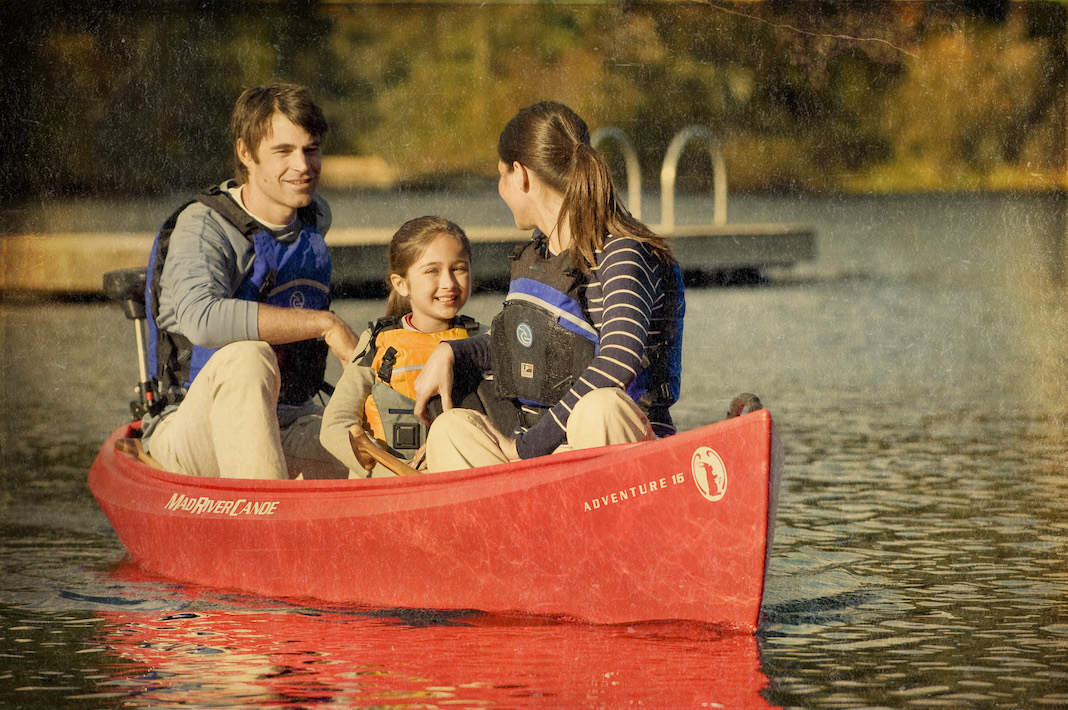
Mad River has been building canoes for almost 50 years. The company was born shortly after the founder, Jim Henry, won the 1971 U.S. National Open Canoe Championship in his hand-built canoe. Throughout Mad River’s history, they’ve experimented with canoe designs and materials. They were early adopters of Kevlar and Royalex materials, switching to T-Formex when it was developed.

Many models have been phased in and out through the years, and recently they’ve focused on three canoe models: the Adventure, Explorer and Journey. These Mad River canoes are designed for recreational paddling and touring, and different material options land at different prices.

In 2022, Confluence Outdoor announced they were pausing Mad River canoe production. You may still find decades worth of canoes on the used market. That is, if anyone is willing to give theirs up.

A Mad River is a good option if you’re looking for a no-nonsense, high-quality canoe. The different materials match various price brackets, and their designs have lasted years because they work. These are reliable canoes for beginner and intermediate paddlers.

If you’re considering a Mad River canoe, this article will help you decide which one is right for you.

Mad River canoes: Our reviews

Mad River Caption

Two people paddle through whitewater in a Mad River Caption canoe
Photo: Robert Faubert
Mad River Caption Specs
Length: 14’0”
Width: 32”
Weight: 58 lbs
Capacity: 850 lbs

From our review:

The Caption had a fine balance of stability, speed and manoeuvrability with its soft chines and aggressive rocker. And best of all, a Caption paddled by good boaters was dry, or at least a great measure drier than the old ME. It was a very competitive slalom tandem that was tough to beat, as well as a solo big-water boat for the larger and stronger paddlers, and a solo whitewater tripper that you could fill with gear…[ Read full review ]


Mad River Explorer 16

Mad River Canoe Explorer 16 reviewed by Paddling Magazine
A canoe for all occasions. Even fancy ones. | Photo: Alex Traynor
Mad River Explorer 16 Specs
Length: 16’3”
Width: 35”
Weight: 44 lbs
Capacity: 1,100 lbs

From our review:

Back at Paddling Magazine headquarters, we picked up a prototype of the Explorer last fall. Thanks to its two-tone look—a distinctive feature of many Swift canoes—the Explorer has never looked better. In a ruby-red-and-white finish, it’s a real head-turner.

Our tester Explorer paddles like the other Mad River Explorers we’ve reviewed. Its symmetrical, shallow-V hull has smooth, predictable handling and…[ Read full review ]


Mad River Legend 16

Man and woman tandem canoeing in the Mad River Legend 16 canoe
Photo: Neil Etienne
Mad River Legend 16 Specs
Length: 16’0”
Width: 35”
Weight: 76 lbs
Capacity: 1,100 lbs

From our review:

I learned to paddle in a Legend back in the day, in fact I passed my whitewater instructor exam in it, paddling both tandem and solo. Getting back in the Legend this spring I quickly realized why I had such fond memories and why it was so popular.

The Legend 16 is right at home on my home river, the Madawaska. The Madawaska is a canoe classic class II-III drop pool that you can park-and-play, day trip or stretch the different sections out into weekend adventures. The Mad River Legend’s blunt ends and moderate rocker…[ Read full review ]


Mad River Serenade

Woman paddling red solo canoe
Serenade: n. A piece of music sung or played in the open air. | Photo: Emma Drudge
Mad River Serenade Specs
Length: 13’1”
Width: 28.25”
Weight: 45 lbs
Capacity: 300 lbs

From our review:

Interested in impromptu adventures? Mad River Canoe’s Serenade could be your partner in crime. The Serenade is a unique hybrid design, melding a canoe hull with kayak comfort. At only 42 pounds, this 13-footer’s light weight and versatility make it perfect for spontaneous after-work paddling sessions or for the days when your tandem partner bails.

‘It’s a real spur-of-the-moment type boat,’ says Buff Grubb, product manager…[ Read full review ]


Mad River Expedition 176

Overhead view of two people in red canoe with blue barrels
Set out on adventure. | Photo: Dan Caldwell
Mad River Expedition 176 Specs
Length: 17’6”
Width: 34”
Weight: 63 lbs
Capacity: 1,175 lbs

From our review:

Whether it’s for the weekend or a whole month, Mad River’s Expedition 176 is a tripping canoe designed to take on the miles with you. It has the speed, capacity and seaworthiness to excel on long open-water paddles but is sized to handle smaller lakes and rivers.

The 176’s roots lie in Mad River’s famed tripping boat of the ‘70s, the TW Special.

‘Tripping boats are essential to Mad River. We hadn’t had a true composite tripping hull come out through…’[ Read full review ]


Shopping for a used Mad River canoe?

Finding a Mad River Canoe

Finding used canoes requires frequent searching. Paddlesports participation is booming, driving the demand for outdoor equipment, whether it’s new or used. Canoes from companies that have been around for decades, like Mad River, will periodically make their way onto used listings. They have a broad appeal, so you’ll find Mad River canoes on Craigslist, Facebook Marketplace, Kijiji or other local classifieds pages.

You can also target your search in specialized pages, like MEC Gearswap or a local paddling club’s used boat listings. Unless you’re prepared for a hefty shipping fee, be wary of buying large items like Mad River canoes off eBay or other international auction sites.

If you find a Mad River canoe not currently listed on its website, you can get more information about the model by looking through the company’s archived catalogs.

Two adults and child it in red canoes with dock in background.
Photo: Courtesy Mad River Canoes

What to look for

Not all canoes are built equal. There are some design aspects that you might overlook in a photo that can drastically affect your paddling experience. The best way to know if a canoe is right for you is to give it a try. This may not always be possible, especially when buying a used one.

At a minimum, pick the canoe up, and see how it feels to portage it. Try (carefully) sitting in it while the canoe is resting on grass. If you prefer kneeling when you paddle, make sure that your feet fit comfortably underneath the bench seats.

Canoes finished with wooden gunwales look great and are lighter than typical aluminum or vinyl combinations. Improper care can cause them to warp or break. When looking at a used canoe, check the wooden gunwales for any signs of cracking or rot.

Check with the owner and ask how they stored the canoe. It’s best if the canoe has been kept inside, or at the very least, away from direct sunlight. Prolonged UV exposure can cause canoes to warp or deform (that’s not a reason to not paddle them on sunny days, however).

What’s a fair price?

Canoes hold their value exceptionally well. It’s rare to find a canoe selling for less than half of its original price, but when those are listed, they often sell quickly. People upgrading or cleaning out a garage may just be trying to get rid of the boat rather than recoup much money. Spring and fall are the best times to find those deals.

If the present era of supply chain delays and booming interest in paddlesports has taught us anything, it’s that used canoes are nearly impossible to find in the summer. People recognize this and increase the price of used boats when demand is high.

If you’re eager to get on the water, then prepare to pay a bit more in the summertime. The upside is that a canoe will last a long time and lead you on adventures for years to come.

For more tips on what to look for when selecting a used canoe, read our article How To Buy A Used Canoe.

Mad River canoe buying advice

There are three models most recently produced by Mad River: The Adventure, Journey and Explorer.

Recreational canoes

Adventure

Mad River’s Adventure is their recreational canoe, and it’s available in two sizes, 14 and 16 feet. Recreational canoes are a great choice for new paddlers or those who value stability over speed. There is little worry about capsizing in calm conditions with the Adventure’s wide, flat hull.

These canoes are ideal for anglers or families who are just beginning to dip their paddles.

Touring canoes

The Journey and Explorer qualify as versatile touring canoes. These canoes are a step beyond recreational canoes. They are not as wide, meaning they won’t have the same initial stability. Their hulls have a rounder, “shallow-arch” shape, in contrast to the flatter bottom of the Adventure.

This gives the Journey and Explorer more secondary stability, which helps the canoe recover if it’s on its edge in more dynamic water.

Journey

The Journey has a minimal rocker, making it track (move straight) much better than the Explorer. The tradeoff is that it does not maneuver as readily. Like the Adventure, the Journey is made with three-layer polyethylene.

It has bench seats and a symmetrical hull so that solo or tandem paddlers can paddle the Journey. It’s available in two sizes, 16.5 and 15.5 feet.

Explorer

The 16-foot Explorer is the flagship model, and Mad River’s bestselling canoe. It’s an all-around canoe, suited for most uses. You can take it for a week-long backcountry adventure or a float down a local river with your family. Different materials match different needs, and Mad River makes the Explorer in T-Formex, Kevlar Fusion or Carbon. T-Formex is the most rugged material.

It was conceived as a replacement for Royalex, long considered the gold standard for bombproof canoes. Quebec-based canoe manufacturer Esquif produces T-Formex and builds this iteration of the Explorer.

T-Formex is a stiff, durable material. It consists of three distinct layers. In the centre is a closed-cell foam which gives the canoe buoyancy. ABS (acrylonitrile butadiene styrene) plastic layers encase both sides of the foam to protect it and add stiffness to the shape. Beyond the ABS is a proprietary abrasion-resistant outer layer. The exterior of the canoe is reinforced for resistance against impacts. A UV-resistant coating provides additional sun protection.

Kevlar Fusion and carbon are composite renditions of the Explorer. Swift Canoes made these for Mad River at their factory in South River, Ontario. These are lightweight options well suited for portaging trips, as they are easier to carry. The Kevlar Fusion weighs 44 pounds.

It’s a beautiful canoe with graceful lines, Swift’s classic two-tone color scheme and features like cherry seats and yokes. The equally attractive carbon fiber version is an airy 40 pounds.

Want to know more? View our answers to common questions below.

  • Mad River canoe models

    Throughout the company’s history, Mad River has introduced and phased out different canoe models. Most recently, three models have been built: the recreational Adventure and the touring/all-around Journey and Explorer. You can find some information about discontinued Mad River canoe models on their website.

  • Mad River canoe weight

    Mad River’s canoes range in weight depending on the materials used to build them. Using 16-foot canoes as a baseline to compare, you can see the weight differences. Their heaviest boats are made from polyethylene, like the 85-pound Adventure 16.

    The T-Formex Explorer is a bit lighter at 77 pounds. The composite editions of the Explorer offer a lightweight canoe option at 44 pounds for the Kevlar Fusion and 40 for the carbon version.

  • Mad River canoe prices

    Mad River’s prices range depending on the material used for the canoe and the model. They are comparable to other popular canoe companies, like Nova Craft or Esquif. You’ll find that Mad River canoes are more expensive than canoes found at big-box stores. There’s a significant jump in quality between $600 canoes and ones from dedicated canoe builders.

  • Mad River canoe location

    Mad River canoe’s manufacturing location depends on the material. The polyethylene canoes are built in Greenville, South Carolina, in a factory managed by Mad River’s parent company, Confluence Outdoors.

    Swift Canoe and Kayak builds the composite Explorer canoes in South River, Ontario, and the T-Formex Explorer is made at the Esquif factory in Framption, Quebec.

  • Mad River canoe dealers

    Mad River canoes are sold at independent outdoors stores and chains like REI. You can find nearby dealers by using their dealer locator tool.

Two people floating in canoe on a lake as floatplane takes off.
Photo: Courtesy Mad River Canoes

Compare Mad River canoes

  • Old Town vs Mad River canoes

    Maine-based Old Town is one of America’s original canoe manufacturers. They’ve been in business for more than 100 years, and today they tailor their canoes to recreational paddlers. Old Town makes wide, stable polyethylene canoes for solo and tandem paddling. Like Mad River, they are extremely affordable. Old Town’s solo pack boats like the NEXT or Discovery Sportsman 118 are unparalleled in Mad River’s lineup.

    If you’re keen on a solo canoe shorter than 12 feet or a canoe for less than $1,500, consider an Old Town. Conversely, if you are looking for an all-around canoe with added durability, Mad River’s T-Formex Explorer 16 is the better choice. Mad River’s Explorer in Kevlar Fusion or carbon are both good choices for paddlers who want a lightweight composite canoe.

Mad River canoe reviews

Reading reviews provides the insight you wouldn’t get otherwise. Simply looking at canoe specifications and descriptions doesn’t provide insight into the small details of how it feels on the water. While firsthand experience is the best way to fully realize a canoe’s performance, expert reviews are the next best way. Learn more about Mad River canoes by checking out the reviews below.


Adventure Is Being Planned Out Of Existence

a yellow and blue tent sits on a rocky canoe campsite beside the water
Nice site. Hope you booked it five months ago. | Feature photo: Colin Field

Last fall, I was driving home from a presentation in a northern town when it became obvious my long drive wasn’t going as planned. Construction delays, traffic jams and I was getting sleepy. Very sleepy. So, I chose to check in at a cheap roadside motel for the night. It was the safe thing to do.

I had no reservations. I just pulled into the first run-down motel I came to. It felt spontaneous, like a John Wayne western, riding all day and sleeping wherever the wilds of the Rio Grande allowed. The small, unplanned act filled me with a sense of freedom.

That is until I saw the No Vacancy sign.

Even the open road—that last bastion of freedom—now demands a reservation. Gone are the days when you could set off on a whim.

Adventure is being planned out of existence

I soldiered on by turning up the music and rolling down the car window a crack. But sometime between Tom Petty’s “Runnin’ Down a Dream” and Gordon Lightfoot’s “Carefree Highway,” a bulky moose blocked the roadway. I swerved into the ditch, narrowly missing the moose. I ended up sleeping in my car.

Groggy the next morning, my road trip disaster got me thinking about how reservation systems are creeping in everywhere, shaping how we travel and adventure. Case in point: the French River Provincial Park, a backcountry area I’ve paddled for decades. In November 2024, Ontario Parks announced the park would move to a site-specific reservation model for all backcountry paddling campsites. Instead of reserving a maximum of two weeks in advance in large “zones” and not being sure exactly where you would sleep, paddlers can now book specific campsites up to five months in advance — complete with photos.

a yellow and blue tent sits on a rocky canoe campsite beside the water
Nice site. Hope you booked it five months ago. | Feature photo: Colin Field

Nothing says wilderness adventure like previewing your tent pad on a smartphone.

Site-specific reservations aren’t new. Many busy backcountry parks use them. For northern parks with fewer visitors, like Quetico, you can still roam freely, stopping wherever you please, just like it’s always been.

The change comes because the French River is getting busy. User satisfaction was dropping as paddlers spent hours searching for (or racing to) open campsites. For many, site-specific reservations seemed necessary. The policy change might reduce campsite conflicts, give more campers peace of mind, and help park officials crack down on litter and unsafe campfires.

But while these changes aim to improve, they fundamentally shift the wilderness experience into something less wild. They erase the joy of adapting to conditions and roaming. Worse, they increase the risk of paddlers pushing themselves too far, battling wind or waves to reach a reserved site. On the French, that risk is real as its lower reaches empty into Georgian Bay’s ocean-like waters.

This isn’t just a French River problem. Across North America, parks are changing regulations and reservation policies to manage growing tourism. U.S. national parks like Arches, Glacier, Rocky Mountain and others have implemented timed entry and day-use reservation systems to better control visitation while protecting natural spaces.  While these reservations may improve user experiences when compared to the alternative, they also alter what it feels like to explore the landscape.

In retrospect, I should have planned my road trip better and booked a motel before setting out. These days, it’s foolish to travel without reservations. Maybe the same is true for wilderness tripping. The go-where-the-wind-takes-you mentality has faded, a relic of the past, like John Wayne and his horse.

Site-specific reservations cater to a world that craves convenience and certainty. But they strip away a central tenet of the backcountry: embracing the unknown. By trading unpredictability for security, we risk turning wilderness camping into another curated experience.

The days of pulling over at a motel, or pitching a tent wherever the river takes you are, slipping away. Trips are being booked months in advance, leaving spontaneity and the spirit of adventure sleeping in the ditch.

Kevin Callan is an internationally recognized authority on canoeing and the author of 20 books. His Butt End column is featured in every issue of Paddling Magazine.

Cover of Issue 73 of Paddling MagazineThis article was published in Issue 73 of Paddling Magazine. Subscribe to Paddling Magazine’s print and digital editions, or browse the archives.
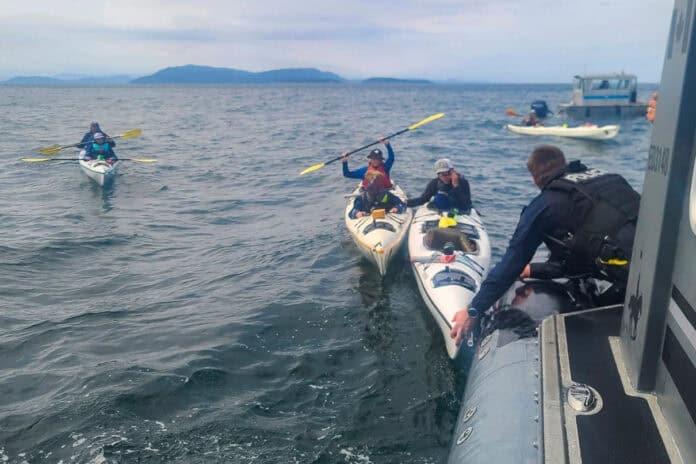
Nice site. Hope you booked it five months ago. | Feature photo: Colin Field


12 Kayakers Rescued In The San Juan Islands

Kayakers are rescued in the San Juan Islands. Feature Image: USCG Petty Officer 1st Class Steven Strohmaier

On Thursday, August 14, 2025 the US Coast Guard (USCG) issued an urgent marine broadcast after being notified via VHF channel 16 that 12 kayakers were in distress between Patos Island and Sucia Island in the northern portion of Washington’s San Juan Islands.

The group included six minors and the rescue involved three agencies.

Kayakers rescued with no injuries in the San Juan Islands

Royal Canadian Mounted Police (RCMP) patrolling nearby responded along with nearby Washington State Park authorities and the USCG to retrieve the kayakers and transport the kayaks on their vessels. According to a statement from RCMP, two families had gone out on an overnight guided kayak trip and were returning when they experienced challenging conditions.

Kayakers are rescued in the San Juan Islands. Feature Image: USCG Petty Officer 1st Class Steven Strohmaier

“Realizing that the conditions had surpassed their capabilities to safely continue the trip, they made the prudent decision to call for help before the situation worsened,” shared RCMP.

RCMP reported that all 12 of the kayakers were safely rescued and brought back to Orcas Island with no injuries reported, adding that the kayakers were understandably shaken by the ordeal.

The kayakers chose to call for help as conditions deteriorated beyond their skill level using a handheld VHF radio on channel 16, the channel for international distress and safety. Noted by RCMP, key to the successful rescue was the early decision to call for assistance as conditions surpassed the group’s skill and comfort level rather than after the situation had become more dire.

“A VHF marine radio is a mariner’s lifeline when there is no cell phone service,” shared Captain Micheal Hunt deputy commander, Coast Guard Sector Puget Sound in a statement. “It proved its worth by helping save lives in the San Juan Islands.”

How to call the Coast Guard

While cell phones can be a useful tool for calling for help, when cell service fails a marine radio can be a key factor in initiating a rescue for kayakers.

Steps to call for help in an emergency via a VHF include turning your radio to channel 16 then initiating a call. Next, repeat the word “mayday” three times, then repeat the name of/or description of your vessel three times followed by “mayday” once more. From here, give your position as specifically as you can using GPS coordinates or landmarks. Finally, state the nature of your distress, the kind of assistance needed, number of people involved, and any information that could aid in your rescue. Conclude the call with the word “over”.

Importantly, even if you can not remember the precise radio protocol in an emergency you can still call the Coast Guard for assistance on Channel 16. Beyond a radio and a cell phone, other signaling devices kayakers can consider carrying include a whistle, a signaling mirror, flares, strobe lights, or handheld GPS.

Everything You Need To Know About Old Town Canoes

Two canoes being paddled along river
Photo: Courtesy Old Town Canoe & Kayak

Old Town is one of America’s original canoe manufacturers. Their Maine factory has shipped tens of thousands of boats out of its doors. The Old Town Canoe Company’s history began in 1898, just as wood-canvas canoes emerged as a modern alternative to birchbark crafts. They exploded in popularity, in part because they could be mass-produced and required less maintenance.

Wood-canvas dominated the canoe market until other options emerged post-war, beginning with aluminum canoes. In response, Old Town adopted fiberglass and Royalex as durable canoe materials. Today, they’ve shifted to exclusively building polyethylene plastic canoes. If you’re okay with the extra weight it brings, this is a durable material that requires very little maintenance.

Alongside their polyethylene canoe production, they also build rotomolded polyethylene kayaks. Long-established and secure in their market niche, beginner-friendly Old Town canoes are found across the continent.

They design their canoes with an emphasis on primary stability, making them ideal for new paddlers, anglers or families who want the reassurance of a steady canoe. The priority here is stability and comfort over speed or rough-water performance. Old Town canoes have wide, flat hulls that feel remarkably steady in flat water, making them dog-friendly, among other things.

The seating systems of many of their canoes extend beyond traditional bench seats, offering lumbar support with the backrests. With Old Town’s line of pack boat-style solo canoes, users can use a canoe or kayak blade.

This article will help you decide on the best Old Town canoe to buy. Here, we’ll give an overview of the types of Old Town canoes available, as well as some tips for buying new and used ones. Along the way, you’ll find links to specific models and pertinent information about them. Read on to learn more.

Old Town canoe: Our reviews

Old Town Saranac 146

Old Town Saranac 146
Photo: Courtesy Old Town Canoes and Kayaks
Old Town Saranac 146 Specs
Length: 14’6”
Width: 36”
Weight: 79 lbs
Capacity: 750 lbs
MSRP: $999.99 USD

Buy from:

OLD TOWN CANOES AND KAYAKS DICK’S REI

From our review:

Designed for affordable family fun on calm waters, the Old Town Saranac 146 is a great choice if you are looking for a beginner- and budget-friendly recreational canoe that can easily seat two or three paddlers. The Saranac 146 comes equipped with two contoured seats with comfortable seat backs and a center bench seat that is perfect for smaller passengers. Its flat hull shape and slightly lowered seats make it easy to maneuver while still feeling stable on the water. A convenient hatch-accessed storage compartment, plus molded-in rod and…[ Read full review ]


Old Town Discovery 119

Man paddling solo canoe
Photo: Courtesy Old Town Canoe and Kayak
Old Town Discovery 119 Specs
Length: 11’9”
Width: 32.5”
Weight: 50 lbs
Capacity: 450 lbs
MSRP: $999.99 USD

Buy from:

OLD TOWN CANOES AND KAYAKS ECO FISHING SHOP MEC

From our review:

The Old Town Discovery 119 canoe boasts an impressive blend of speed, stability, maneuverability and tracking—with enough carrying capacity for short solo canoe camping trips, angling outings and duck hunts. The Discovery 119’s compact dimensions allow it to accelerate quickly, especially when propelled with a double-bladed kayak paddle; cruising speed is impressive given its short length.

At 32.5 inches wide, the Old Town Discovery 119 strikes a fine…[ Read full review ]


Old Town Penobscot 164

From flatwater tripping to running class III rivers, the versatile Penobscot can do it all. | Photo: Joel Clifton
Old Town Penobscot 164 Specs
Length: 16’4”
Width: 37.5”
Weight: 75 lbs
Capacity: 1,250 lbs
MSRP: $1,599.99 USD

Buy from:

OLD TOWN CANOES AND KAYAKS SAIL

From our review:

My day trip paddling Old Town’s Penobscot 164 across the city’s outer harbor to a nearby park was a typical outing for this design. Billed as Old Town’s “sleek, nimble tripping canoe for solo or tandem paddlers,” this all-around touring canoe is large enough for most overnight trips yet short enough to serve as a solo tripper for skilled paddlers. It’s also perfect for spontaneous day trips like…[ Read full review ]


Old Town Discovery 169

Family paddling is full of fun fun fun! | Photo: Hannah Griffin
Old Town Discovery 169 Specs
Length: 16’9”
Width: 37”
Weight: 91 lbs
Capacity: 1,400 lbs
MSRP: $1,499.99 USD

Buy from:

OLD TOWN CANOES AND KAYAKS MEC

From our review:

Renowned for the last three decades for its versatility and durability, the Discovery 169 is favored by Scout camps, outfitters, trippers and recreational paddlers who want to paddle far, bring lots of gear and forget about babying their precious boats.

You might already know how this boat handles because it seems like everyone has paddled the Disco at least once. If so, it’s just as you remember: agile, stable and easy to…[ Read full review ]


Shopping for a used Old Town canoe?

Old Town makes canoes for beginners. The canoes are inexpensive, making them attractive to folks who don’t yet know if paddling is for them. As they fall in love with the activity, they may sell their heavy polyethylene canoe and upgrade to a lighter composite one. Or, they may decide that canoeing isn’t for them, and again, the canoe goes up for sale.

Either way, you’ll have opportunities to buy these used canoes, as long as you know where to look for them. Once you find a used canoe, there are certain things you’ll want to look out for, and of course, you want to pay a fair price.

Here are some tips to help:

1 Know where to look

Online classifieds make it easy to search for used canoes. Find a used Old Town canoe on Craigslist, Facebook Marketplace or Kijiji by setting up notifications or experimenting with different search terms. People may not include the specific brand or model of the canoe in their posts, instead they’ll simply list it as a “16-foot canoe” or something similar.

Try casting a wide net, using general search terms, and then sifting through the results. It’s harder to search online auction sites like eBay for Old Town Canoes. There’s less selection, and the shipping costs you may incur could wipe away any savings you’ll get from buying a used canoe.

2 Know what to look for

If you’re looking at an Old Town canoe built pre-2014, check if it is Royalex or polyethylene. It’s usually indicated on the registration plate or with an “RX” in the model name. Royalex is lighter and more durable than polyethylene and resists sun damage better. In 2013, the company that made Royalex sheets ceased production, and Old Town shifted to making canoes exclusively with polyethylene.

If you find a used Royalex Old Town canoe, you will likely see some dents and dings along the hull. These are superficial and will not compromise the canoe’s performance. If any gouges are cut into the ABS layer, they may need to be repaired. You can buy repair kits from Old Town or your local paddle shop.

All Old Town canoes made from 2014 to the present are polyethylene. Polyethylene is also a rugged plastic material that can withstand repeated impacts. Damage to these canoes is more likely to happen off the water from improper storage. Leaving the canoe upright on the ground, or hanging from its thwarts can stretch the hull shape and stress the gunwales.

Try to infer how it was stored from the photos you see or ask the owner. If you see any significant discoloration or deformities, you may want to steer clear of that canoe.

3 Know how much to pay

The pandemic caused many people to stay closer to home and pick up new hobbies. Outdoor recreation, including canoeing, exploded. At the same time, delays in supply chains and production slowed the distribution of what little stock there was. As a result, the market for used canoes jumped significantly as well.

Used Old Town canoe prices will vary depending on demand as well as the boat’s condition. Canoes always hold their value well, and traditional buying advice dictates that used canoes generally don’t sell for less than half of their original price. When demand is high, expect to pay a premium for used canoes, like in the summer.

If stock is low, the alternative to overpaying for a used canoe is to have no canoe at all. Plan ahead and shop in the shoulder seasons, fall and spring, to get the best price. Fewer sellers will be looking to make a buck rather than just make space in their garage or yard.

For more tips on what to look for when selecting a used canoe, read our article How To Buy A Used Canoe.

Old Town canoe buying advice

Old Town organizes their canoes based on the activities they’re suited for. Within each of these categories, there are different models in varying lengths and widths. You also have the choice between solo or tandem canoes.

Match the category to the type of canoeing you plan to do, and from there, explore the available models. We’ll touch on each of them, as well as the materials used to make them.

Canoe types

Recreation

Wide, flat bottoms offering exceptional primary stability are the signature of recreational canoes. Old Town’s Discovery line embodies these characteristics in a range of lengths. Discovery canoes have standard bench seats. They range from the Discovery 119 solo canoe (measuring 11’9”), to the tandem Discovery 169 (16’9”). The Discovery Sport 15 has a square-stern for easily mounting a motor.

Old Town’s Guide canoes are wider than the Discovery models, with backrests on their molded seats. They’re available in 14’7” and 16’ lengths, and the extra width gives these canoes even more stability.

The Saranac is the single layer polyethylene iteration of the Guide series. They are about 25% cheaper than the three-layer set ups, but share a similar design. Single layer polyethylene is not as stiff as the triple layer, making the canoes less responsive on the water. It is also slightly lighter, and less durable than the triple layer, although still fairly resilient.

The NEXT is a solo boat which blends canoe and kayak elements, similar to the pack boats popular in the Adirondacks. It has an open deck like a canoe, but the paddler sits in a low, reclined position like they would in a kayak. Users can paddle it with either a canoe or long kayak paddle.

Overhead shot of red canoe being paddled close to rocks sticking out of the water
Photo: Courtesy Old Town Canoe & Kayak

Fishing

You can fish from any of Old Town’s canoes, but the Discovery Sportsman 118 solo canoe has additional features suited for fishing or hunting. This canoe has the same hull as the Discovery 119, but an adjustable kayak seat is added instead of a bench seat.

Flush-mounted rod holders behind the seat allow for easy rod placement while you paddle. There’s also dedicated storage space for gear and tackle. If you’re buying a canoe exclusively for fishing, this is an excellent option.

Tripping

Any canoe can be used for overnight tripping, but the design elements of the Penobscot make this the most suitable Old Town canoe for paddlers hoping to explore interior waters. This canoe comes in 16’4” and 17’4” lengths.

With its shallow-arch hull, the Penobscot can handle rougher waters. This hull shape helps the canoe stay steady even when it is on edge, providing more secondary stability than other Old Town canoes. This design feature is valuable for canoeists using their boats in chop or current.

What length should I buy?

Once you’ve decided on the model that suits your needs, you’ll need to choose an appropriate length. The easiest decision is whether you want a solo or tandem canoe. If you plan to paddle with two people, you’ll need a canoe with two seats. Old Town’s Discovery and Penobscot models have symmetrical hulls, and with their bench seats, they can be paddled solo.

To do this, the solo paddler sits backwards in the bow seat and paddles stern-first. A dedicated solo canoe is much easier to control if you’re exclusively paddling alone. These are shorter, like the Discovery 119.

Canoe length influences the boat’s performance. Generally, longer boats are faster, while shorter ones are easier to turn and maneuver. The Penobscot 164 is a good canoe for both solo and tandem paddling, with storage space for weekend trips. For longer trips, consider the storage capacity gained with extra length.

Also, for families or people paddling with medium-large dogs, a 14-foot canoe can quickly become crowded. Sixteen feet or longer is best to give everyone space in the canoe. It comes at a cost, both financially and in additional weight. If you aren’t planning to portage the canoe, prioritize the extra space.

  • Does Old Town make good canoes?

    Old Town makes inexpensive canoes that are good for fishing and recreational use.

  • Old Town canoe models

    Presently, Old Town offers five canoe models in different sizes and iterations: the Discovery,  Guide, Penobscot, NEXT and Saranac. Old Town has introduced and discontinued other models throughout its history. If you don’t see your canoe online, you can use the registration number stamped inside it to look up the specific model history of that Old Town canoe.

  • Discontinued Old Town canoe models

    A company with a long history, such as Old Town, will see models come and go. You can still find information about these discontinued canoe models, like the wood-canvas Guide 17.

  • Old Town canoe sizes

    Old Town makes solo and tandem canoes. They are a variety of shapes but tend to be wider than other companies’ canoes as they prioritize stability.

  • Old Town canoe length

    Old Town canoes range in length from the Discovery 119, which measures 11’9”, up to the Penobscot 174, at 17’4”. As you can see, the number in the name of each Old Town canoe model represents that boat’s length in feet and inches.

  • How wide is an Old Town canoe?

    The width of an Old Town canoe varies by the individual model, but as canoes go, they are some of the widest on the market. This reflects their goal to make comfortable canoes for beginners, who appreciate the stability wider canoes provide.

    Their recreational canoes are among their widest, with the canoes in the Discovery series stretching to around 40 inches at their widest points. Contrast that with the Penobscot 164, which is 37 inches at its widest.

  • Old Town canoe material

    Old Town canoes are made with single- or three-layer polyethylene. The Saranac models use single-layer polyethylene, with the layer shaped into place by thermoforming. All other current models are three-layer polyethylene. Three-layer polyethylene is much stiffer than the single layer material and makes a canoe that is more durable and responsive.

  • Why did Old Town stop using Royalex?

    Like other canoe companies, Old Town stopped using Royalex when the material was discontinued in 2013. As an alternative, they now use polyethylene in single or triple-layer iterations to build their canoes.

  • Old Town canoe weight capacity

    Weight capacities range based on the canoe’s shape and size. Solo Old Town canoes have a minimum weight capacity of 350 pounds, and tandem canoes can hold at least 670 pounds. Longer canoes like the Penobscot 174 have higher weight capacities, accepting up to 1,500 pounds.

  • Old Town canoe prices

    Old Town canoes are some of the most affordable canoes on the market, all costing less than $1,900 USD.

  • Old Town canoe dealers

    You can buy Old Town canoes through dealers, online outlets or direct from the company. Find the dealer closest to you using the dealer locator.

  • Who owns Old Town canoe?

    Johnson Outdoors owns Old Town canoe. Johnson also owns Ocean Kayak and Carlisle Paddles, which are also made in the Old Town location.

  • Are Old Town canoes made in the USA?

    Old Town canoes are made in the U.S., in their factory in Maine.

  • Where in the state of Maine are Old Town canoes made?

    Since the company’s 1898 inception, Old Town canoes have been made on the shores of the Penobscot River in Old Town, Maine.

  • Lightest Old Town canoe

    The Discovery 119 is the lightest Old Town canoe, weighing 50 pounds.

  • Most stable Old Town canoe

    Old Town’s recreational canoes are their most stable, especially the Discovery models. Choose a length according to your needs—whether you are a solo paddler or planning on bringing the whole family along, there are different boats to choose from that are all exceptionally stable.

  • Will an Old Town canoe sink?

    A three-layer Old Town canoe has foam sandwiched between layers of polyethylene, adding some degree of flotation. However, like any canoe, if it is filled with water, it will ride uselessly low in the water. Single-layer polyethylene canoes will float even lower when swamped.

Two people paddling red canoe on lake with sun setting in background.
Photo: Courtesy Old Town Canoe & Kayak

Compare Old Town canoes

  • Grumman vs Old Town canoes

    Grumman revolutionized recreational canoeing with their mass-produced aluminum canoes. If you paddled in the 1970s or 80s, chances are good it was in an aluminum canoe. They gained popularity because they are inexpensive and indestructible (so long as you don’t wrap them around a mid-current rock). The downsides are that the metal is noisy and frigid on colder days.

    Plastic emerged as a replacement for aluminum, rivaling the durability and reliability, but being much quieter on the water and softer to paddle. Plastic boats are more susceptible to UV damage and warping, but otherwise, plastic is the superior option. If you’re looking for a simple canoe that you can leave outside at a cottage or hunt camp, Grumman aluminum canoes will suit you just fine. For a more enjoyable paddling experience, choose an Old Town plastic canoe.

  • Old Town vs Mad River canoes

    Mad River’s canoes are comparable to Old Town’s in price and performance. Like Old Town, Mad River makes entry-level recreational and tripping canoes. Choosing between some of these recreational models comes down to personal preference. If you can test paddle available models, you’ll be able to better decide which one is best for you. Mad River uses T-Formex for the Explorer 16, the highly-acclaimed Royalex replacement.

    It’s as durable as three-layer polyethylene, but lighter and stiffer. T-Formex is also more UV-resistant than three-layer polyethylene. This is a good choice for dedicated canoeists who want the added performance of T-Formex or canoe trippers who intend to run rapids. It costs more but will pay off on the water.

    If you’re a solo paddler, choose from Old Town’s canoes shorter than 15 feet, or if you want a longer tripping canoe, the Penobscot 174.

  • Old Town canoe vs Coleman canoes

    Coleman no longer makes canoes, but you may find used canoes for sale. These are cheap, sturdy canoes that should be heavily discounted. If you can find one for a few hundred dollars, grab it. They make good canoes for puttering around without costing much. If you want a new canoe, Old Town’s boats are a high-quality choice for a relatively low price.

  • Pelican vs Old Town canoes

    Pelican builds canoes using their RAM-X material. They have three models, measuring from 14’6” to 15’6” in length. The twin-sheet thermoform construction and wide, flat bottoms makes these canoes comparable in design to the Old Town’s models. RAM-X is heavier than single-layer polyethylene, but slightly lighter than the burly three-layer polyethylene used for Old Town’s Discovery Series.

    Old Town has more variety among their lineup, and more aesthetically-pleasing outfitting like the wooden thwarts and seats. Pelican canoes do not have yokes, making them difficult to portage. A Pelican is sufficient if you’re looking for a cheap canoe for light recreational use. Look toward Old Town for more versatile canoes in a variety of designs.

    Canoes in Old Town’s Discovery series are extremely durable and reasonably buoyant thanks to a layer of foam between plastic layers. These canoes are a few pounds heavier than Pelican’s models, but carrying them is easier, thanks to the yoke. The Discovery Sport is a square-stern comparable to the now discontinued Pelican Bayou 160. Small motors can be mounted on these canoes, making them popular with anglers.

Overhead shot of two people paddle canoe fully loaded with gear
Photo: Courtesy Old Town Canoe & Kayak
  • Old Town vs Ascend canoes

    Ascend is Bass Pro/Cabela’s in-house brand. They offer two canoes, the C14 and DC156. These canoes might be cheaper than Old Town canoes, but they are much heavier at 84 and 104 pounds, respectively. Old Town has been building canoes for over 100 years and focuses exclusively on building boats. These American-made Old Town canoes come with a guarantee of high quality that a mass-produced big-box product can’t match.

    If you’re looking to save some cash, Ascend canoes are adequate, but if you’re looking for a high-quality boat, spend the extra money on a canoe from a brand like Old Town. Old Town has more options as well for solo canoes or trippers.

  • Sun Dolphin vs Old Town canoes

    Sun Dolphin makes two square-stern canoes, the Scout and Mackinaw 15.6 SS. If you’re going to be using a motor, these are good options comparable to the Old Town Discovery Sport 15. The main difference is in the price and construction.

    Sun Dolphin canoes are cheaper, while Old Town’s has a sturdier build, thanks to the three-layer polyethylene used. If you aren’t planning on using a motor, any of Old Town’s other canoes are lighter and better-performing canoes.


Kayak Review: Lekker Osprey

Joe Potoczak paddles the Lekker Osprey with leafy foliage in front
Like its namesake bird, the Osprey from Lekker Kayaks is built for effortless travel over water. | Feature photo: Owen Roth

Celliers Kruger isn’t in the barge building business. As the founder of Fluid Kayaks back in 2002, he was known for making innovative whitewater kayaks over the course of more than a decade. The South African boat builder launched his third kayak company in 2024, incorporating aspects he had learned from both whitewater and more recent endeavors, including designing surfskis and recreational kayaks. The result is Lekker Kayaks, an all-genre label.

Lekker’s new Osprey is quick and playful

Lekker Osprey Specs
Length: 14’1”
Width: 24.75”
Weight: 53 lbs
Capacity: 300 lbs
MSRP: $1,300 USD
lekkerkayaks.com

Among Lekker’s current lineup is the Osprey, its shortest of three touring models. Named for the versatile bird of prey that thrives across a wide variety of habitats, Kruger set out to create a one-boat quiver with the Osprey. He wanted a kayak ideal for easy touring and welcoming for beginners, but also suitable for playing around in ocean waves and taking multiday trips down rivers with easy rapids.

Coming in at 14 feet and just under 25 inches wide, the boat’s specifications fit nicely into the recreational touring, light touring and beginner sea kayak categories. However, typecasting sells the approachable yet playful Osprey short.

In Kruger’s mind, recreational kayaks are a boat category craving innovation, and this extends into the touring realm, where the designer acknowledges he saw opportunities for a plastic boat in this class.

“Other boats I’ve tried on the market of the same length, I find them very sluggish for a boat of that size,” Kruger says of his research and development of the 14-footer. “The Osprey has the best balance between speed and maneuverability.”

Joe Potoczak paddles the Lekker Osprey with leafy foliage in front
Like its namesake bird, the Osprey from Lekker Kayaks is built for effortless travel over water. | Feature photo: Owen Roth

The Osprey features a shallow-V hull sandwiched by twin channels before the hull transitions to rounded, forgiving edges. Its rocker is subtle but continuous, gradually lifting away from beneath the paddler toward the bow and stern. The result helps the kayak rise over waves and dance through dynamic tidal features with ease.

One of the details that immediately catches my eye is the Osprey’s deck as it tapers with paddle cutaways before reaching the cockpit—a clear nod to Kruger’s time developing surfskis and performance sit-on-tops with brands including Epic and Swell Watercraft in his post-Fluid era. This deck shape allows for cleaner forward strokes with added space for a paddler to catch and pull their stroke without smashing knuckles. It’s not something regularly found on a casual touring boat, and one of the first signals the Osprey is hiding more under the hood than it lets on.

As Kruger says, balancing speed and maneuverability is a matter of compromise when building a sea kayak that can handle a range of abilities and sizes, while also meeting the needs of all-around use. It’s very easy to end up with a design that, for the sake of stability, is good at neither.

On flatwater, I wasn’t expecting to be blown away by the Osprey, and yet that’s exactly what the boat did to my expectations. On my first outing, I couldn’t help but remark on how efficiently it glided along for a plastic kayak of its length. I also had the opportunity to pilot the Osprey on mild whitewater sections of the Willamette River near my home to see how it handles water that pushes back. This is where experienced paddlers will see the fun potential of the Osprey open up. I paddled up sections of the river where between 5,000 to 10,000 CFS constrict to form boils, small whirlpools, chutes and waves with the hope of finding features similar to what someone would encounter in tidal rapids, straits and along inlets.

With the Osprey, I surfed waves, made jet ferries, threaded between rocks, and put myself on top of boils pinched along river walls. The Osprey rides high with ends that release well from the water, giving it a feeling of agility in which I could make technical moves in the 14-foot boat, then stick on a line. Considering Kruger’s background in whitewater design, it shouldn’t be a surprise, and with the casualness with which the Osprey cruised around rapids, I wouldn’t hesitate to say this is a boat where more experienced paddlers will enjoy some rock gardens and surf.

Joe Potoczak paddles the Lekker Osprey touring kayak
The shallow-V hull and rounded edges help the kayak track efficiently in a straight line while still allowing for maneuverability when edged. | Photo: Owen Roth

The Osprey’s outfitting is minimalist and inspired by Kruger’s time around competitive race kayaks and surfskis, where he has come to appreciate design ergonomics go a long way in keeping a paddler engaged and comfortable. One outfitting point paddlers should be aware of is the backband, which requires a Phillips-head screwdriver to adjust forward and back. Kruger views the backband as optional because the seat is meant to put the paddler in an active position. Whether used or not, this is one aspect of the Osprey I’d love to see updated—for someone who uses the backband, needing a tool to adjust it is inconvenient.

All of Lekker’s kayaks are constructed of polyethylene. The Osprey weighs 53 pounds, which is on the lighter side of average for a plastic kayak of its length. Forgoing any skeg versus rudder debate, the Osprey is available in both options. The kayak also features a round front hatch and an oval stern hatch sealed off with 50-millimeter closed-cell foam bulkheads glued in place with 3M adhesive. In front of the cockpit is a small six-inch day hatch with a molded-in pocket, perfect for a phone, snacks and sunscreen.

In the touring lineup, the Osprey is complemented by the elongated 16’5” Skimmer as well as the fitness or fast-touring oriented 17’5” Peregrine. There is also a 14-foot surfski called the Gull. Touring is just one slice of Kruger’s new brand, which also features youth and recreational sit-on-tops, as well as upcoming whitewater designs.

Like a daily driver hiding some sports car muscle under the hood, the Osprey opens blue highways for new touring paddlers—and makes seasoned ones do a double take at just how fun it is to paddle. With Kruger’s latest venture in the kayak world, he’s announced no category is off-limits to his tinkering.

Cover of Issue 74 of Paddling MagazineThis article was published in Issue 74 of Paddling Magazine. Subscribe to Paddling Magazine’s print and digital editions, or browse the archives.
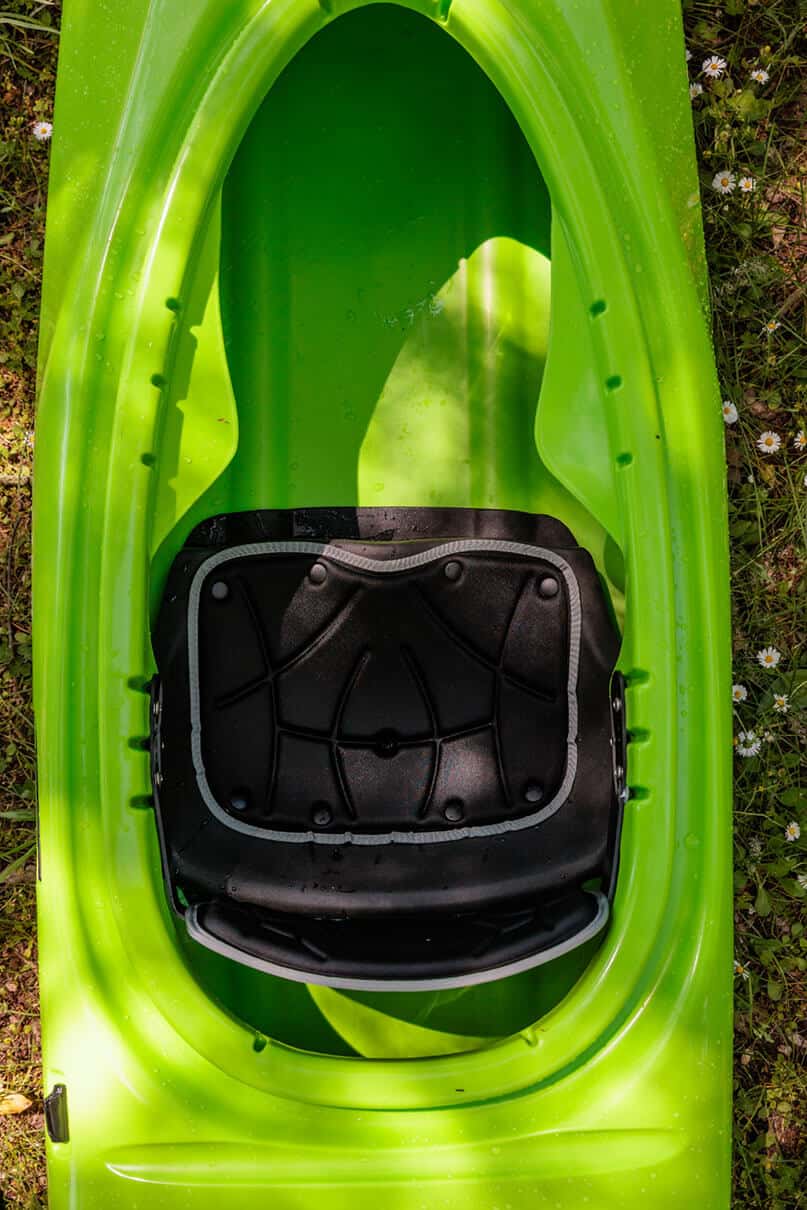
Like its namesake bird, the Osprey from Lekker Kayaks is built for effortless travel over water. | Feature photo: Owen Roth