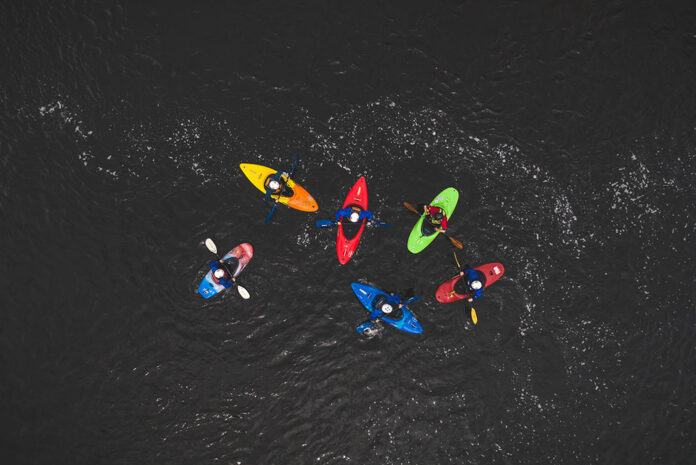
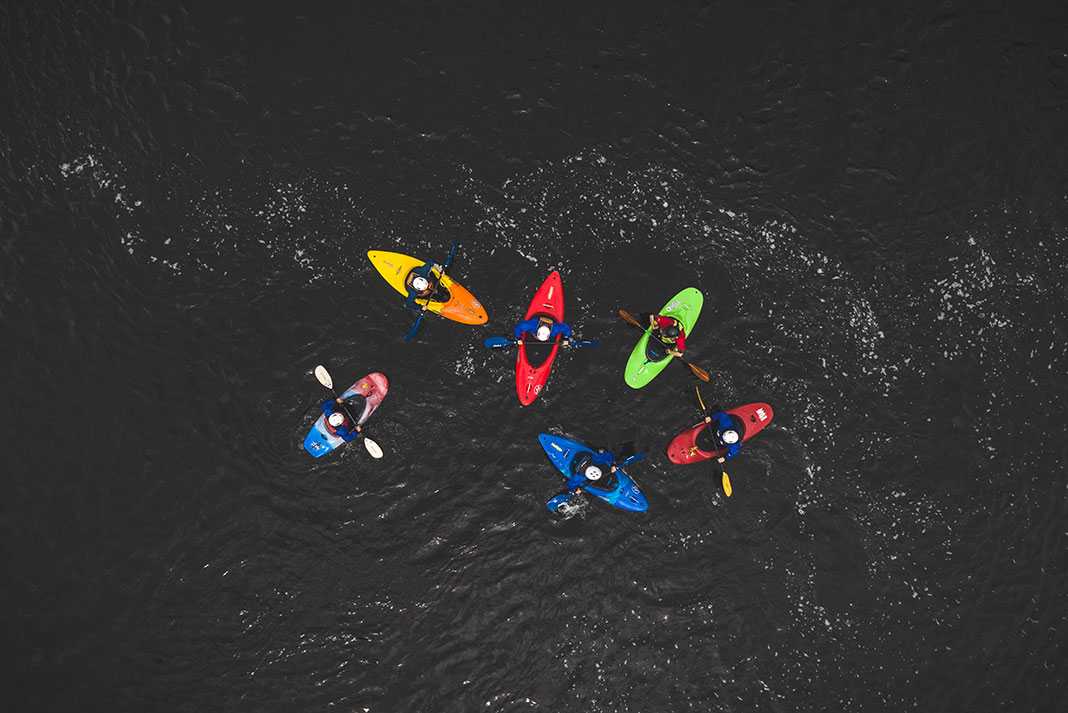
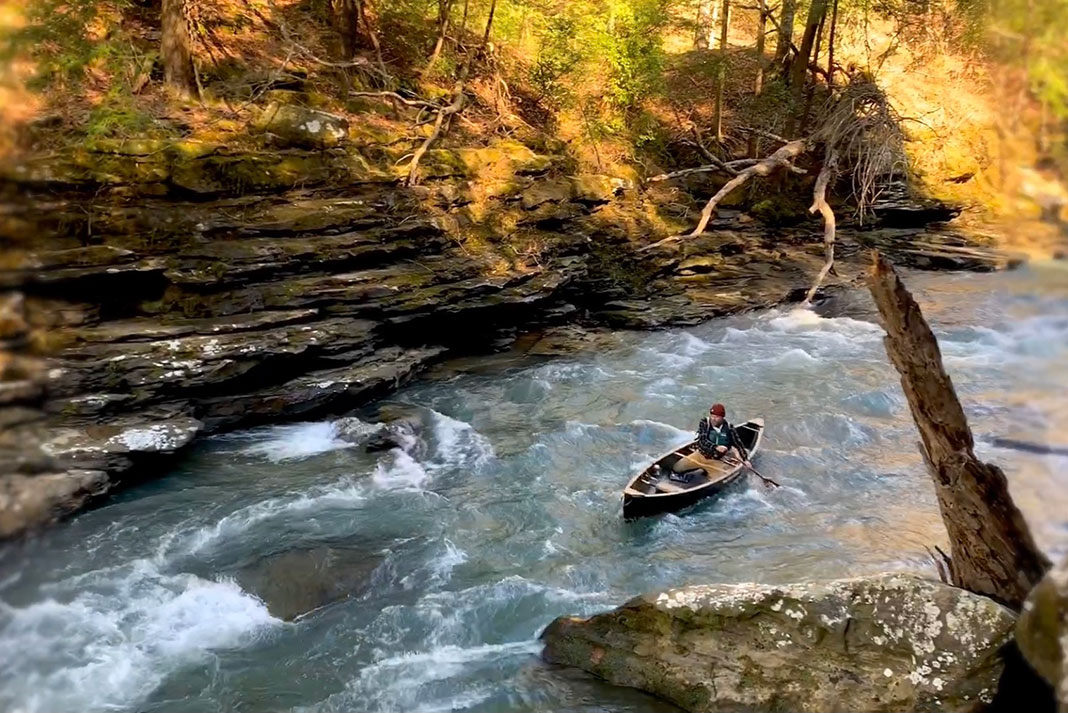
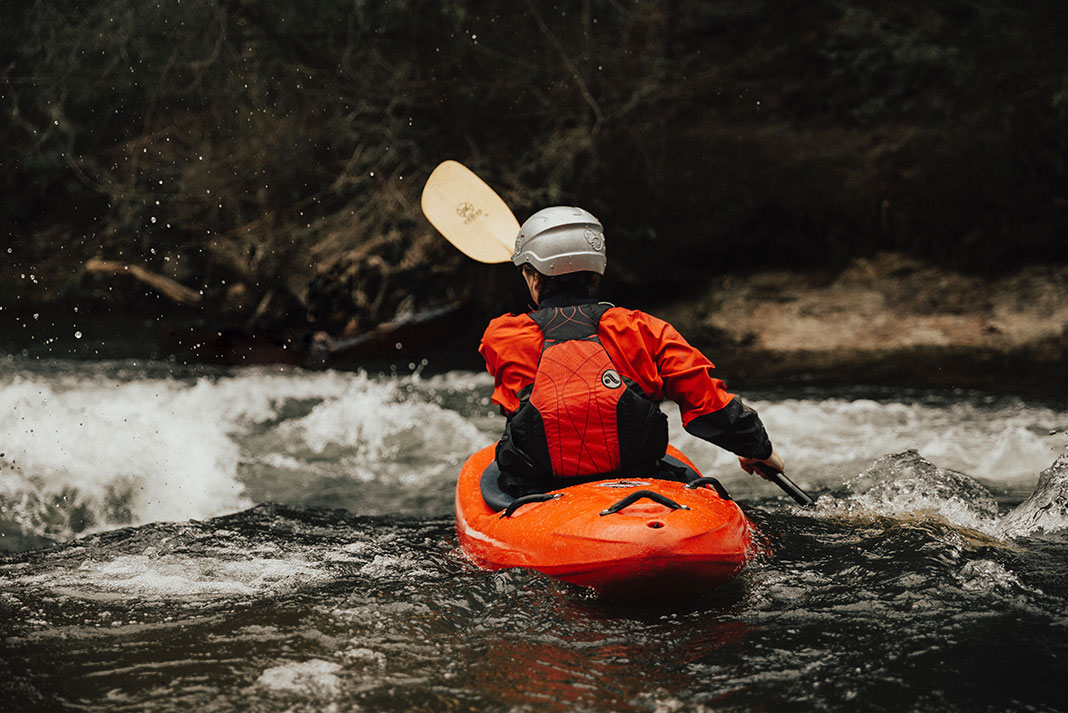
No one knew it at the time, but October 16, 2019, would be the last time for more than two years that members of the Revelstoke Paddlesport Association would officially meet for the Wednesday night paddle. No doubt it was raining. It starts raining here in October. And no doubt it was in the public parking lot at the corner of First and Orton. It’s where they’ve always met.
Every Wednesday at 5:30 p.m., cars and trucks arrive with kayaks strapped to them. There are handshakes and high fives. Water levels are discussed. Then boats are untied and stacked on fewer cars heading toward rivers best matching the skills of whoever showed up. Newer paddlers are mentored. Nobody I know remembers who started the Wednesday night paddle. All they know is that it used to be on Tuesdays, but it got moved for some reason no one remembers.
Two years is a long time. Long enough to forget fun. But it’s time to get back on the water, find new routines—and rediscover old ones. | Feature photo: Yan Kaczynski
The Corona virus surged around the globe before the snow in the mountains began to drip into our river valleys. Even after the backcountry ban was officially lifted, nobody was shuttling together. Put-ins and launches were busy with small bubble groups. No paddling organization wanted to be caught sanctioning anything social, even an event as loosey-goosey as the weekly Wednesday night paddle.
How to break out of a rut
Lisa Firestone is a clinical psychologist and author. In Psychology Today, she wrote about why it’s important to break routines. Her self-help advice is about breaking bad habits. Like, say, scrolling endlessly through social media or stopping for a bag of Doritos at the corner store. But her advice works both ways.
Firestone suggests first making a list of routines we’re willing to switch up. Only then can we start to take action. The secret, she suggests, is baby steps. Nothing monumental at first. Just mix things up a little, like trying a new restaurant or taking a different route to work. Eventually, we may explore what it would mean to break out of a fixed identity or a role we impose upon ourselves.
Okay, sure. But what if our Wednesday paddle drop-in dirtbag crew is part of our fixed identity and self-imposed role in life? What if we like it? And what if a global pandemic causes the world to lockdown, almost overnight? No baby steps. Cold turkey.
Canoeists, kayakers and paddleboaders everywhere were tossed out of their routines. Most of us struggled to find new things to fill our weekly club paddling nights.
Two years is a long time. Long enough to forget fun. Regulars left town, board members retired, and minute books were lost. I bought a television. Annual events and races were mothballed. For two years, if anyone paddled it was with family or those whose Instagram handles we already knew. Small bubbles. I hope we never use the word bubble again. On my first club night this spring, I realized I hadn’t paddled with anyone new in two summers.
Despite a 30 percent growth in paddlesport participation and sales during pandemic lockdowns, gatherings have been slow to recover. Paddling events across the country are coming back online but with lower registrations than before. Wednesday nights in Revelstoke are quieter. There are fewer boats on fewer cars. There’s now more online chatter throughout the day about what rivers. Who’s going? What levels? Who’s driving?
Who cares, I say.
We’re stuck in these new hand-wringing routines of concern, guilt and indecision developed during Covid. Firestone says it’s important to check in with ourselves and see how these new routines make us feel.
The old way was better.
Wednesday nights were a sure thing. You could plan your life around it. Rain or shine. You knew at least one other person would show up. It didn’t matter who. And that was enough. There was no need for Facebook groups. That’s what tailgates are for. “What do y’all wanna paddle tonight?”
Maybe it will take another two years to get back to where we once were. I hope someday soon we feel less anxious about everything. I hope we reconnect with each other and who we really are. I hope we will remember what we enjoy, what matters most to us, and what makes us come alive. When you’re ready, head down to the corner of First and Orton on any given Wednesday. You can figure out the rest from there.
This article was first published in the Early Summer 2022 issue of Paddling Magazine. Subscribe to Paddling Magazine’s print and digital editions, or browse the archives.
Two years is a long time. Long enough to forget fun. But it’s time to get back on the water, find new routines—and rediscover old ones. | Feature photo: Yan Kaczynski
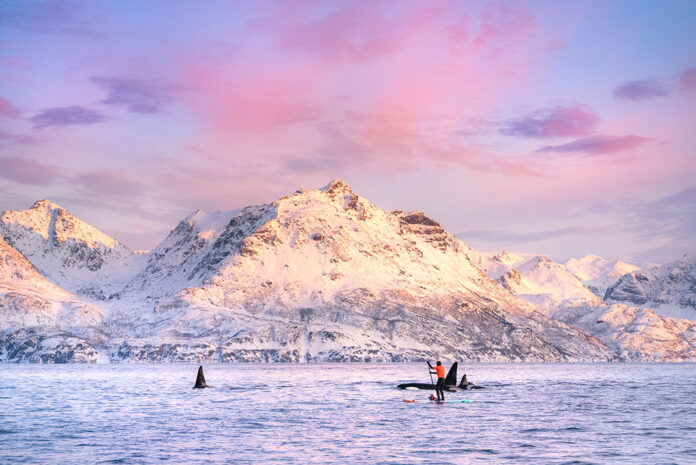
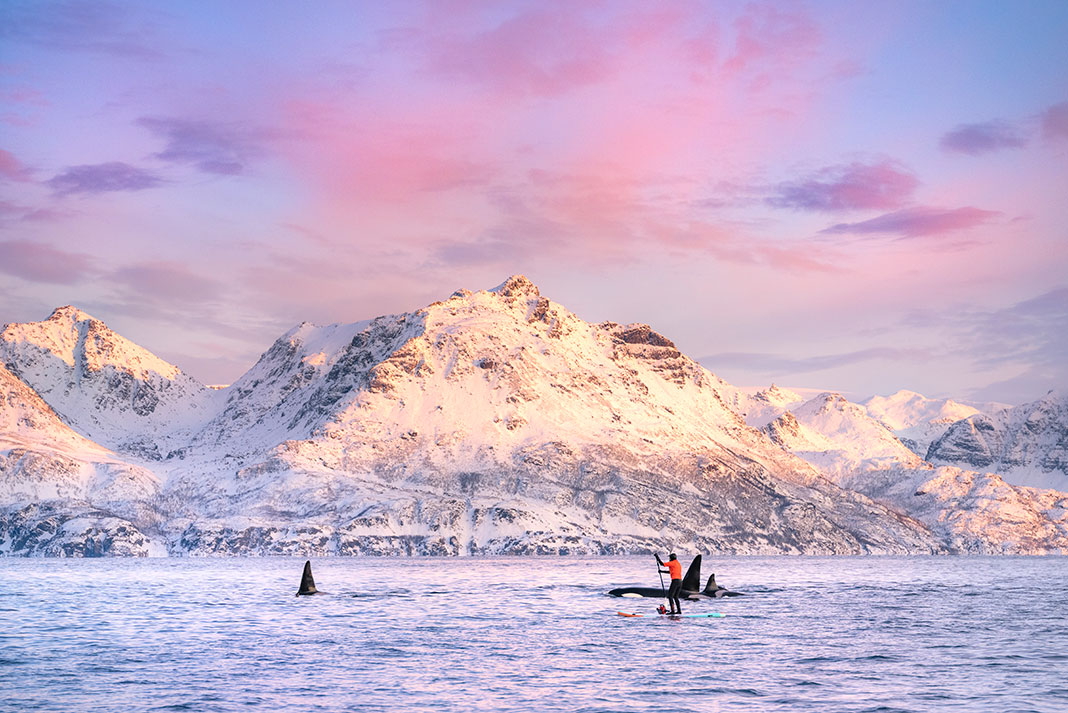
At the edge of twilight, a lone paddleboarder glides among giant orcas on the coast of Norway. Above her, snowy mountains bathed in warm light pierce a pink and violet sky.
Images like this don’t happen by chance in the fjords of Arctic Norway. Capturing elusive orcas amid spellbinding scenery and magical, fleeting light at the top of the world is Tommy Simonsen’s specialty. For the Norwegian landscape, wildlife and documentary photographer, the Arctic’s capricious weather and fickle light hold the key to its enduring appeal.
“Much of November, December and January, the sun simply doesn’t appear above the horizon,” Simonsen explains. “But for a brief time just before the sun disappears in November and after it returns in January, the Arctic light is a gift of pastel colors.” During this time of the year, sunrise and sunset linger for as long as two hours.
Images like this—of a sublime orca encounter—don’t happen by chance in the fjords of Arctic Norway. | Feature photo: Tommy Simonsen
Factor in roaming killer whale pods and marauding winter storms, however, and chasing ephemeral cotton candy skies at 70 degrees north is no simple task.
Around 3,000 orcas live in the Norwegian and Barents seas, spending most of the year in offshore waters. Then, from mid-October through January, they enter the narrow coastal fjords of Arctic Norway, following shoals of herring. The whales move around the fjords, so finding them takes experience and more than a little luck.
Simonsen describes a typical day during a January photoshoot: board a small, open boat in the island fishing village of Skjervøy; depart the harbor around 6 a.m. and speed through the Arctic winter darkness, swaddled in a survival suit and insulating layers of wool and down. Wait for the two-and-a-half-hour window around midday when diffuse, soft-hued daylight illuminates snow-covered mountains and—hopefully—the slick, black backs and towering dorsal fins of an orca pod. Watch, compose and shoot as the sky glows intense yellow and pastel pink. By early afternoon, the sun will dip back below the horizon and darkness will reclaim the fjord.
[ Plan your next Norway paddling adventure with the Paddling Trip Guide ]
Whether he’s traveling by boat, dogsled or skis, Simonsen relies on a network of talented expedition partners for support and safety. Human subjects also lend a more intimate scale to otherwise austere images of vast, frozen landscapes. Many have become close friends—like standup paddleboarder and Schibevaag Adventure founder, Kari Schibevaag, who leads paddling and snorkeling excursions to experience Norway’s orca whales.
Treating whales with caution and respect
Paddling in such close proximity to 26-foot-long, five-ton marine mammals demands respect and an understanding of their behavior.
“When we see a gathering of whale-watching boats in the fjord, we try to go somewhere else to minimize our impact,” Simonsen explains. “Most of the time, we get lucky and the pods pop up around us. They are often curious about Kari in a peaceful way.”
Making images like these, says Simonsen, is all about patience. Including plenty of extra time in any travel plans is essential. During the winter months, Arctic low pressure systems march across the North Atlantic in quick succession, bringing snow, rain and high winds making it impossible to venture out into the fjords. Simonsen’s advice for aspiring photographers and paddlers: be prepared to wait—for the weather, the whales, the sun or, simply, the right moment.
This article was first published in the Early Summer 2022 issue of Paddling Magazine. Subscribe to Paddling Magazine’s print and digital editions, or browse the archives.
Images like this—of a sublime orca encounter—don’t happen by chance in the fjords of Arctic Norway. | Feature photo: Tommy Simonsen
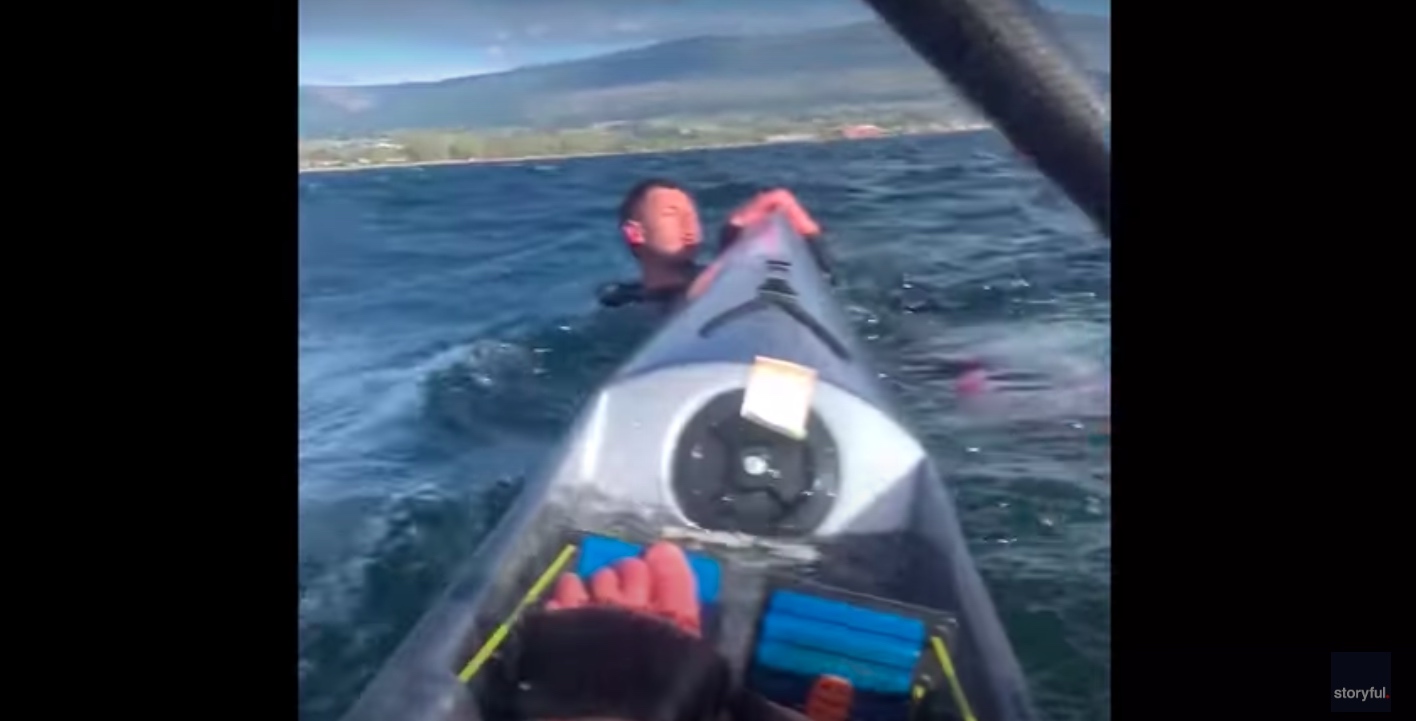
A frame grab from Sally Wallick’s video camera captures the scene as she saves the capsized kayaker from freezing. | Feature photo: Sally Wallick via Storyfull
Anyone who has helped a fellow paddler recover from a swim in deep water knows how difficult it can be, whether the craft you’re working from is a canoe, a sea kayak or whitewater boat. Now imagine handling such a rescue alone, trying to save a fellow kayaker from freezing—and you’re on a surfski.
Paddler Risks All to Save Kayaker from Freezing Lake
Surfskis are some of the tippiest paddlecraft made—carbon-fiber needles that, in skilled hands, can fly downwind and surf ocean swells. But in unskilled hands? That usually ends in a swim.
Sally Wallick falls squarely into the skilled category. She’s an experienced racer well aware of the hazards of cold water and changing weather conditions. Wallick was out for a training paddle on Okanagan Lake B.C. in late April 2021 when the balmy spring day turned blustery. On her way back to the put-in she spotted something unusual farther offshore.
Coming closer, she realized it was a man clinging to a half-sunken kayak. What happened next was captured on Wallick’s chest-mounted video camera, and has been viewed more than 13,000 times on YouTube.
[ Paddling Buyer’s Guide: See all rescue kits ]
As Wallick paddled toward the man, she could see right away that his lips were turning blue, and his eyelids appeared heavy. Both are classic signs of hypothermia. Wallick is a middle school teacher. She knows how to use her voice and demeanor to take charge of a situation.
“In a little bit of trouble?” she called out as she approached. “How long have you been out here for?”
It took the swimmer a beat to respond, and when he did his words were slurred.
“Quite a while,” he said finally. The answer wasn’t specific, but it told Sally what she needed to know. There was no time to lose.
A frame grab from Sally Wallick’s video camera captures the scene as she saves the capsized kayaker from freezing. | Feature photo: Sally Wallick via Storyful
The water was 52 degress, and the man was wearing only a rash guard and shorts. Wallick later estimated he had been in the water for about 45 minutes. Fortunately, he was wearing his life jacket, and had a phone in a waterproof case. Wallick used it to call for help on shore, then took control.
“Grab onto my boat,” she says in the video. “We’re just going to leave your kayak.”
“Will we find it?” the man asks.
“Yes we will,” she answers, now in full schoolteacher mode. “Right now we need to get you to shore.”
Her voice projected confidence, but she knew how desperate the situation had become. “I tried to keep it light, but inside I was like, ‘Oh no, this guy needs help right away,’” she said later.
Wallick was alone, trying to help a man with unmistakable signs of cold incapacitation. The go-to recovery technique for a swamped kayak in deep water is the T-rescue, in which the rescuer drags the victim’s kayak across her own, drains the water, and then helps the swimmer climb back into his kayak.
The maneuver takes knowledge and active participation from the swimmer, and it’s designed to work with kayaks that have flooded cockpits, with watertight compartments in the bow and stern protected by bulkheads. But the man’s kayak didn’t have bulkheads, meaning the entire boat was full of water. Under those circumstances, pulling off a successful T-rescue would be almost impossible, says Kenny Howell, a sea kayak instructor and surfski racer who helped write the American Canoe Association’s surfski safety protocols.
Wallick initially told the man to climb onto the back of her surfski—“This boat is really tippy,” she warned nervously—then reconsidered, telling him instead to grab hold of the her surfski’s bow. Good call, says Howell, because a back deck carry would probably be too unstable, especially with a hypothermic victim. “It’s easier just to push the swimmer in front of you,” he says. “You can’t go very fast, but you can see them.”
[ Plan your next rescue training with the Paddling Trip Guide ]
Wallick told the man to hold tight to the bow of her surfski, then paddled for shore with everything she had, talking as she went. “Good job…Keep going,” she said, “remember to breathe.” Wallick’s own breathing was labored as she struggled to keep her ski upright and pointed toward shore. “You’re doing great…Can you keep your eyes open for me?”
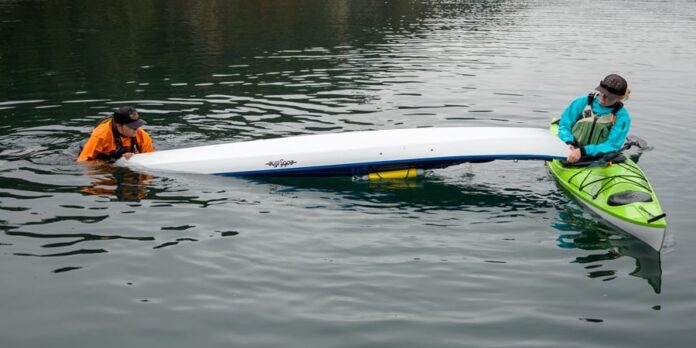
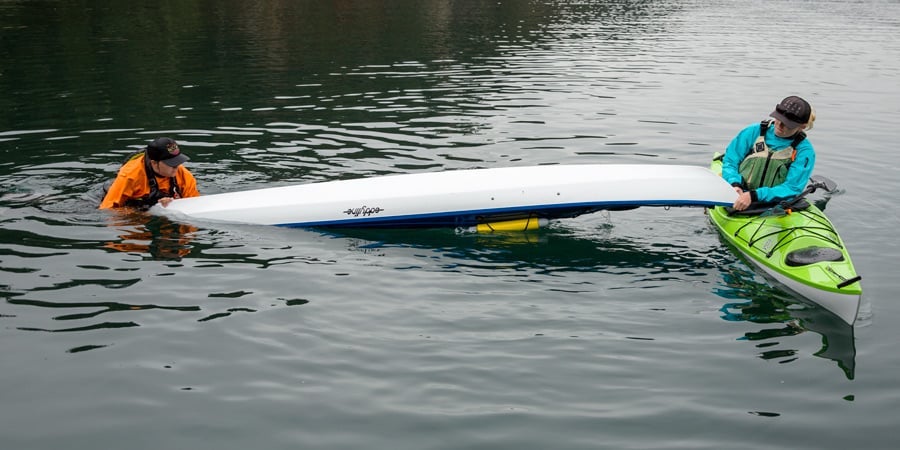
The kayak T-rescue is an effective recovery technique if both swimmer and rescuer know the drill. | Photo: Courtesy REI
Watching the man’s eyelids droop, Wallick thought he was about to let go. It was time for a change of plan.
“We’re going to try something new,” she said, slipping into the water. She told the man to drape his body over her surfski, a position that would get a portion of his torso out of the water and increase his chances of holding on—but also required her to be in the water with him.
With both of them now in the water the clock was counting down, but fortunately Wallick was able to flag down a nearby pontoon boat. Good Samaritans on the motorboat pulled the man aboard and transported him to shore.
Wallick remounted her surfski and paddled back to land, not knowing whether the man had survived. She later learned that he made a full recovery, thanks to her heroic efforts and no small share of luck. “I’m just grateful that it all worked out,” Wallick said. “I do kind of think about what would have happened maybe if the pontoon boat didn’t come.”
Many comments left on the YouTube video question her decision to leave the man’s kayak. They note that by entering the water she was playing fast and loose with the cardinal rule of rescue—not to become a victim herself.
“That’s what they train professionals not to do, and they still do it sometimes,” Howell says. “It’s not for us to say whether that was the wrong decision, but what can we do? We can talk about it and learn from it.”
5 Takeaways from Sally Wallick’s Rescue
1 Cold Kills
As the video makes clear, immersion in cold water can quickly degrade a person’s cognitive abilities and motor skills. Your body loses heat much faster when immersed in cold water than it does when dry. The water in Okanagan Lake was about 52 degrees Fahrenheit that day. According to U.S. Coast Guard research, a person immersed in 50 to 60 degree water without protective clothing can lose consciousness in as little as one hour.
2 Dress for Water Temperature, not Air Temperature
The high temperature in Kelowna B.C. touched 71 degrees the day of the rescue, April 30, 2021. Such balmy spring weather brings people outside in droves, and they’re understandably eager to soak in the sun after a long winter. But while air temperatures were enjoying a spring fling, water temps were still close to winter lows—about 52 degrees in Lake Okanagan that day. The man Wallick rescued was wearing only shorts and a rash guard. A simple neoprene wetsuit top would have increased his survival window considerably, while a full wetsuit or drysuit would likely have turned his near-death experience into a mere inconvenience.
Because the man was alone when he capsized, no one was there to assist or call for help when he first got in trouble. As a result, he waited in the frigid water for about 40 minutes before Wallick spotted him—and that was only by happenstance. And because Wallick was paddling alone, her ability to help was limited. If she had been with one or more other paddlers, the options for a successful rescue would have improved substantially and the risk she took to help would have been far less.
4 Practice, Practice, Practice
There are a variety of techniques to recover from a capsize in deep water, such as the T-Rescue and paddle float self-rescue. They’re not particularly difficult, but they require some practice (and equipment, such as the paddle float and a handheld bilge pump). If you’re familiar with these techniques, get out there and practice them. If you’re not, consider taking a paddling safety course from the American Canoe Association (ACA), your local paddling shop or outfitter, or other reputable source.
5 Carry The Means To Call For Help
In coastal waters, the surest way to summon help is a handheld VHF marine radio tuned to Channel 16. If you make a distress call on Channel 16 everyone will hear it—including the Coast Guard and other boaters. A cell phone in a waterproof pouch or case is good for backup, and may be your best bet in inland urban waterways. If you’re going offshore, it’s always a good idea to have a registered Personal Locator Beacon (PLB) with you. It’s a satellite device that will call help anywhere in the world with the push of a button. They run about $300 but you’re not going to care about that when you need it.
A frame grab from Sally Wallick’s video camera captures the scene as she saves the capsized kayaker from freezing. | Feature photo: Sally Wallick via Storyfull
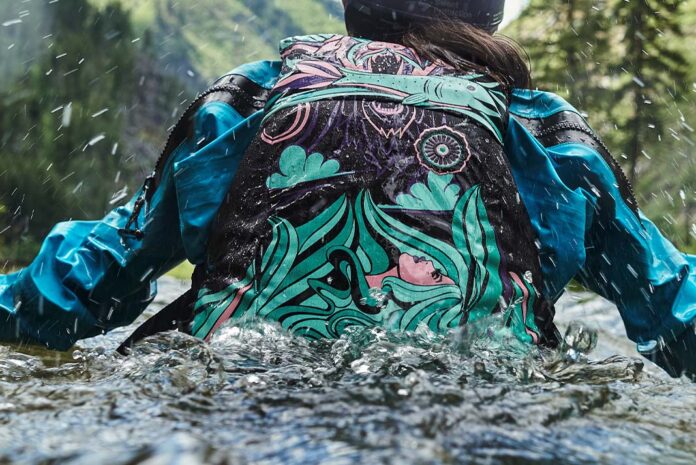
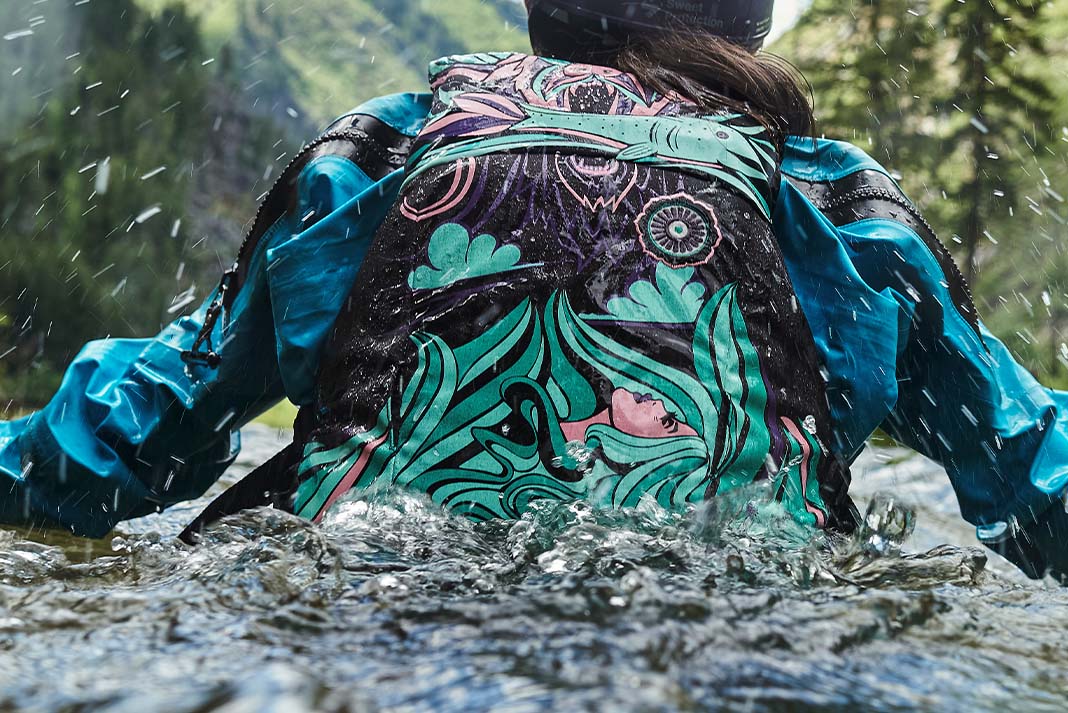
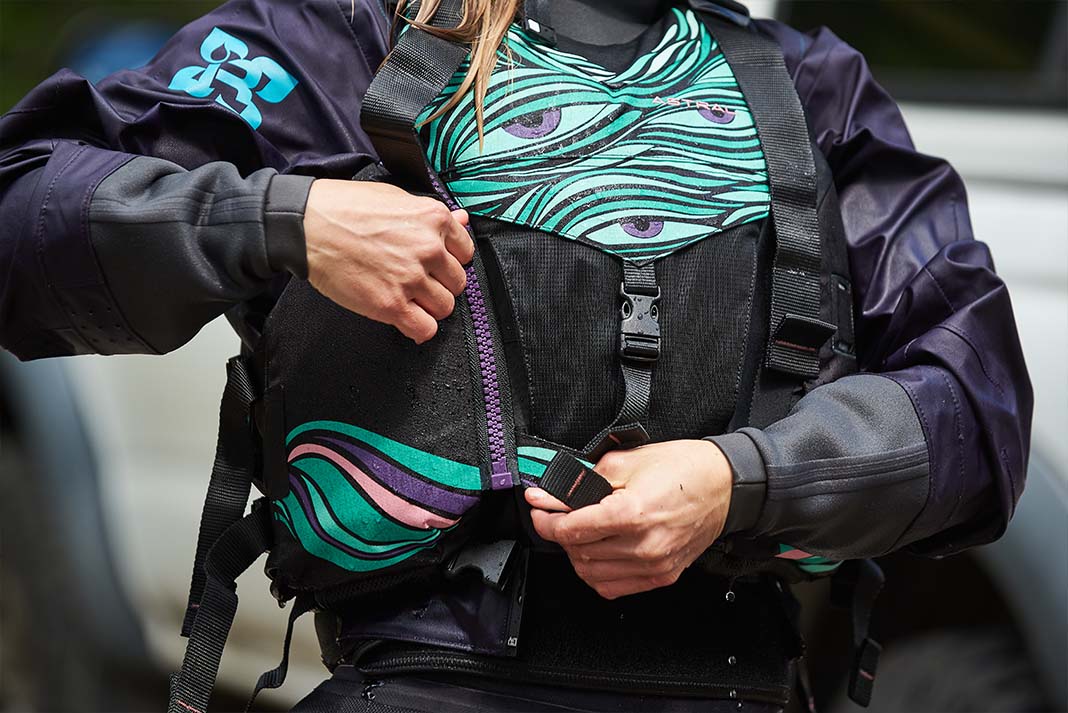
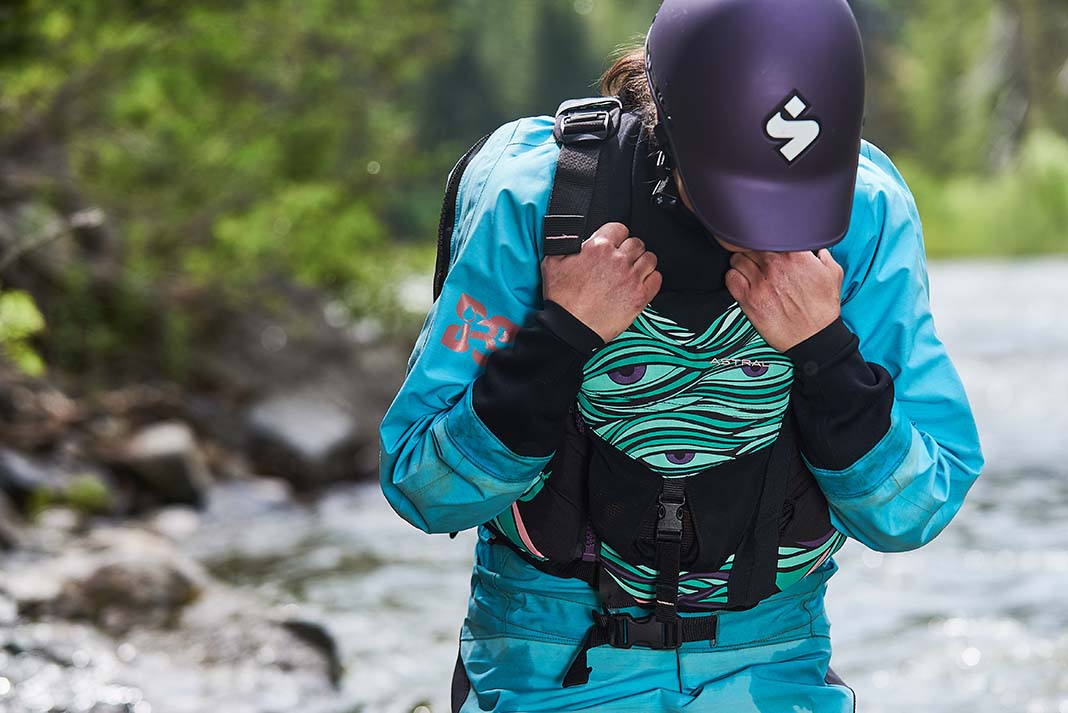
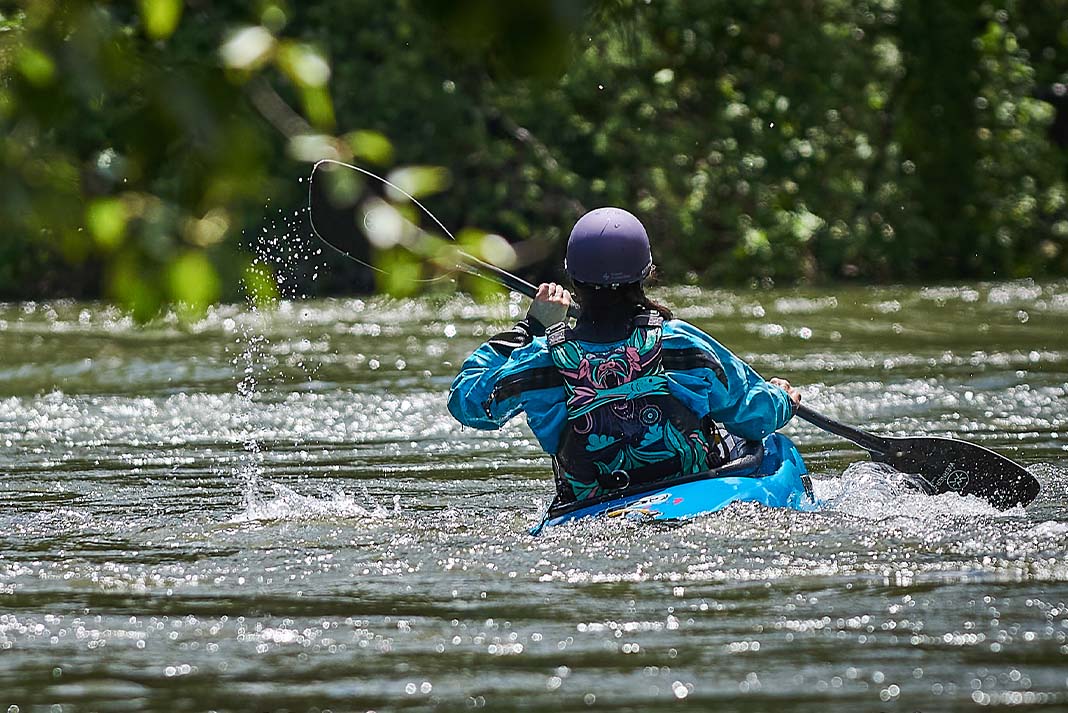
August 2, 2022 – Asheville, NC – Astral celebrates the accomplishments, craftsmanship, and dedication of its athletes and employees with the debut of a limited edition PFD. Whitewater enthusiasts, Nicole Mansfield, Kate Shea, and Ollie Smithers came together to design the limited edition version of the iconic Layla PFD (Layla LE) that depicts a unique and playful visual representation of the river showcasing the spirit and design team’s love of the water while boasting the same safety and fit features beloved by the whitewater community. The design team also hand-selected two charity beneficiaries to receive a portion of all Layla LE sales.
[ Paddling Buyer’s Guide: See all PFDs ]
Over 27 years ago, Astral CEO and founder, Philip Curry, along with the assistance of Shirley Shepherd, introduced the Lola as the first PFD designed for women sitting in kayaks. Later, he updated the Lola to safely and comfortably conform to a curvy body with its soft, organic kapok fill, renaming it the Layla. The PFD features hinged seams, sculpted chest support, a side entry zipper, and the ability to add a quick release belt. “The Layla PFD is an optimal choice for all levels of watersports enthusiasts. The craftsmanship, fit, and versatility of this PFD is phenomenal, making it the ideal canvas to work from,” shared Ollie Smithers, Astral Sourcing Manager, and kayaker.
Photo Courtesy of Regina Nicolardi
Photo Courtesy of Astral
Photo Courtesy of Astral
Mansfield and Shea teamed up with Smithers to bring to light the first limited edition run of the iconic Layla PFD, which was selected as one of the best life jackets for female paddlers by Paddling Magazine’s editors. “This two-year project celebrates athletes of all levels and interests in the water, especially as they work through challenges,” said Smithers. The team selected two organizations to commemorate the Layla LE project that empower women in paddlesports to receive 10% of Layla LE sale proceeds. Those organizations include the Lulu Love Tour and Columbia Gorge Junior Kayak Club.
Astral Athlete and whitewater kayaker, Nicole Mansfield, brought her passion for kayaking and desire for functional gear with a flair to the forefront of this project. “I enjoy seeing creativity manifest itself in so many different ways- whether it be through visual or literary mediums, a unique line through a rapid, styling a trick, or finding a new first descent, “ explained Mansfield. “When on the river or in the mountains, I want my gear to be functional, but not boring. Having the opportunity to collaborate on a project where art interfaces with function was a lot of fun.”
Photo Courtesy of Regina Nicolardi
Illustrative, graffiti-style artist and dedicated member of the whitewater community, Kate Shea, was commissioned to bring to life the essence of how water connects Astral to its community. Shea took inspiration from her own journey to create the design. “The artwork represents the peace and inspiration I get from being amongst the Ottawa River and everything and everyone that comes with it. Nature, the community, love, and the loss. I think this project is important and will be well-received by the river community because it is something for the everyday paddler and not just aimed toward the class V boater.”
The Layla LE can be found at astraldesigns.com and at select retailers beginning August 2 and will retail for $185. For more inspiration, follow the team on Instagram: Astral at @astralfootwear, Mansfield at @queenbeater, and Shea at @katesheadesign.
Established in 2002, Astral builds high performance wilderness equipment, created in the least toxic, lowest impact ways. Built on decades of experience and innovation, Astral has assembled athletes, artists, and craftspeople to build and use the cleanest, most beautiful, and highest performing products you can buy on the market. Most notably, Astral has significantly reduced toxic PVC foam from the PFD industry, invented breathable life jackets, won awards for paradigm changing footwear designs, and they’ve developed the stickiest rubber ever worn on wet rock.
Sevylor was founded in France in 1948 and emerged as a pioneer in the construction of PVC inflatables; its boats and beach toys arrived in North America in 1959. The company was a product of World War II innovation, especially advances in polymer plastics—which trickled down into recreational watercraft and other inflatable products ranging from sleeping mattresses for camping to beach balls.
Sevylor’s products were popular for their portability and durability, and remain so today. The brand merged with the Zodiac label of inflatable powerboats in 1981 and finally joined forces with American outdoor giant Coleman/Stearns in the early 2000s. The company still has a large paddling presence in Europe, with North American Sevylor inflatable canoes and kayaks limited to big box stores such as Walmart and online at Amazon.
Given its cheap price-point and distribution in big box department stores and online retailers, Sevylor kayaks primarily appeal to beginners, casual paddlers and those with both limited storage space and budget. The best Sevylor inflatable kayaks are geared for general recreation, rather than serious paddling. They’re great for family use at the beach or cottage but not meant for open water or exposed conditions.
Paddle Sober And Smart
Never mix alcohol and paddling. Coast Guard and state BUI (boating under the influence) laws apply to all vessels. This includes canoes, kayaks, SUPs and rafts.
It’s important to remember that when it comes to performance in a kayak, you get what you pay for: Sevylor kayaks offer a cheap introduction to kayaking. Sevylor kayaks won’t break the bank and they don’t require a garage or fancy roof rack for transportation, but as a rule they’re slow and sluggish on the water.
Consider buying a Sevylor inflatable kayak if you’re an occasional paddler looking for a fun, stable toy to take to the beach or cottage on sunny summer days.
You may come across a used Sevylor kayak on buy-and-sell websites like Craigslist, Kijiji and Facebook Marketplace. Sevylor inflatable kayaks are a good choice as a beginner kayak for family fun and kayak fishing. They don’t require a large space for storage and are easy to transport, even in a small car (or crowded minivan).
Several options are available to choose from. Your first step in making a good investment is to research the specific attributes of the Sevylor kayak model you are considering. Once you’ve found a contender, consider the following advice to make a good used purchase:
Sevylor kayaks are cheap, and therefore more impacted by wear and tear compared to more expensive and well-built kayaks—especially in areas like the inflation valves and hull. Start by examining the overall condition of the Sevylor kayak. Open up the package and inflate it. In the process, listen for air leaks in the valves and tubes and watch for any stains and mold, which may reveal the kayak was stored wet.Is there any fading in the Sevylor kayak’s deck (top) or hull (bottom)? Fading reveals UV damage, which may compromise durability. Make sure there are no missing parts; check for seat(s) and seat back(s), deck rigging such as grab lines, skeg (a removable fin that slides into the hull) and pump, if included.
Most Sevylor kayaks feature minimal outfitting. Take a close look at comfort features like the seat (is it supportive for your body type? Does it hold air?). Foot rests are critical to give you purchase on the kayak to paddle efficiently and are often absent in cheap Sevylor kayaks; if they’re present, make sure they’re functional and appropriate for your leg length.
Outfitting is the critical interface between the paddler and kayak, including the seat, back support, thigh rests and foot rests. Often these features lack refinement in budget-priced Sevylor kayaks. They’re also usually air-filled, so be sure to check for leaks. Examine these parts individually and consider how well they work together as a whole—the easiest way to achieve this is by sitting in the boat (and ideally paddling it) to make sure it feels comfortable. Think about how long you’ll be sitting in the kayak. If it’s uncomfortable in a quick test, how will it feel after an hour? Outfitting often comes down to personal preference; there’s no one-size-fits-all. One of the drawbacks of cheaper Sevylor kayaks is substandard outfitting. Take a close look and consider investing in a more expensive kayak if you plan on more serious paddling.
The only way to fully appreciate the comfort and performance of a kayak is to try it before committing to a purchase. Arrange a meeting place with the seller that allows you to take a few moments on the water. Bring your usual paddle and dress in what you plan to wear while paddling. Be sure to assess how easy the boat is to enter and exit.
In general (that is, before Covid-19 put a premium on outdoor equipment) the typical starting point for a used Sevylor kayak in moderate condition was about half its retail price. All that’s changed in the wake of boat shortages brought on by the pandemic, but you can use it as a starting point in haggling a fair price.
If you’re offered a PFD as part of a used kayak sale make sure it’s in good shape, fits properly and is Coast Guard approved for the location you’ll be paddling.
For more tips on what to look for when selecting a used kayak, read our article How To Buy A Used Kayak.
Sevylor kayak buying guide
Sevylor kayaks are available across North America at box stores and online outlets. A large variety of Sevylor inflatable kayaks are available, many of which are good choices if you’re low on storage space and looking for a casual kayak for recreational paddling on calm, sheltered water without breaking the bank. Sevylor kayaks are available for a range of needs, including recreational paddling and fishing, single and tandem, for paddlers of all sizes.
Education: Get Some!
Take a paddling safety course from the American Canoe Association (ACA), your local paddling shop or outfitter, or other reputable source.
Take a boating safety course from the U.S. Coast Guard Auxiliary, U.S. Power Squadrons® or your own state’s boating agency.
Take on-the-water skills training.
Sevylor kayaks are meant for recreational paddling, such as getting out on the water at the cottage, spending an afternoon at the beach or fishing on a lazy river or calm pond. Sevylor kayaks are categorized by activity and user. Activity, or type of paddling, includes recreational (short and stable kayaks meant for casual use); and fishing (“souped up” recreational kayaks with add-ons specific to anglers, such as rod holders and tackle storage areas).
Sevylor kayaks are available as single (one-person) kayaks; tandem (two-person) kayaks; and three-person kayaks meant for two adults and a child. Here’s a rundown of some of Sevylor’s most popular models:
Sevylor Colorado
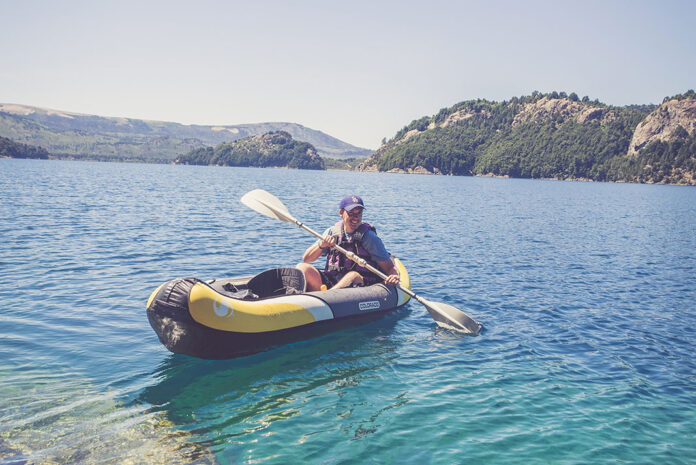
The Sevylor Colorado is a good entry-level, two-person kayak that’s the best Sevylor inflatable for those looking for a general purpose kayak at a cheap price, widely available at Walmart stores. A fishing option is also available as the Sevylor Coleman Colorado. The Sevylor Colorado and the Sevylor Sirocco are the same kayak, marketed in North America and Europe, respectively.
Sevylor Madison
The Sevylor Madison boasts similar specs to the Sevylor Colorado. The difference is in the outfitting, with the Madison featuring Sevylor’s clever Seatography system, which allows you to tweak the position of the seats in the kayak to adjust for different paddler weights—perfect if you plan to paddle with a youngster.
Sevylor Waterton
The Sevylor Waterton is very similar to the Colorado, but with Sevylor’s comfortable HighRest seats and integrated bow and stern spraydecks for enhanced seaworthiness. The maximum capacity of this two-person inflatable kayak is less than the Colorado, at 363 pounds (compared to 440 pounds).
Sevylor Yukon
The Sevylor Yukon is a larger two-person inflatable kayak that’s a bit faster and, with partial spraydecks in the bow and stern, a drier and more seaworthy ride than the Sevylor Colorado. Foot pegs and a larger cockpit area add greater paddling efficiency and space for overnight trips. The Yukon is also better suited to paddling in moderate whitewater (with experienced paddlers).
Better paddling performance comes with a somewhat heftier price tag, but it’s worth the investment if you want a boat that’s faster, more capable and easier to paddle.
Sevylor Tahiti
The Sevylor Tahiti is significantly narrower than the Colorado and features kayak-style, integrated bow and stern decks, making it the best Sevylor kayak for river paddling. The Tahiti’s carrying capacity is somewhat less than the Sevylor Colorado.
Length and paddling performance are similar, with outstanding maneuverability and limited speed. The 10’7” Tahiti tips the scales at a feather-light 25 pounds.
Sevylor Hudson
The Sevylor Hudson is a larger kayak than the Sevylor Colorado and comes standard with a third seat, providing more paddling options. It’s a good choice for two parents with a child, or three youths (the cockpit of the Hudson is a little too cramped and the 465-pound capacity too limited for three adults).
The Hudson can also be paddled solo or tandem, making it a versatile choice. Being longer, it also glides better than the more compact Colorado.
Sevylor Adventure
Take a look at the Sevylor Adventure if you want an ultralight, easy-to-assemble inflatable kayak for casual use. The Adventure is slightly shorter than the Sevylor Colorado and a full seven pounds lighter. Want something bigger? The 12-foot Sevylor Adventure Plus can be arranged as a single, double or triple kayak.
Use this as a start, and remember that online research will only get you so far. The best advice we can offer is to always test paddle before buying any boat. Of course, that’s a challenge at most of the big box and online outlets where Sevylor kayaks are sold. Try to borrow a Sevylor kayak from a friend for a test paddle in real-world conditions. The more time you can spend on the water in a similar style of kayak, the better the purchasing decision you will make.
Wear A Life Jacket
Everyone, even strong swimmers, needs to wear a life jacket at all times when on the water. It is extremely difficult to put a life jacket on once you fall into the water. Even a light wind can blow any paddlecraft away from you, faster than you can swim.
Always wear a USCG-approved Level 70 or Type III life jacket designed for paddling.
Here are answers to some of the most common online questions about Sevylor kayaks.
Are Sevylor kayaks any good?
Sevylor makes budget-friendly recreational kayaks for casual paddlers. Is Sevylor a good kayak brand? That depends on your kayaking aspirations. Sevylor is a good choice if you’re looking for a cheap inflatable boat to use at the cottage, campground, beach or other sheltered water locations.
Sevylor inflatable kayaks are also a great choice for those with limited storage space. Sevylor kayaks are stable and easy to paddle, but don’t expect high performance, safety in exposed conditions or great comfort for long days on the water.
What are Sevylor inflatables made of?
Sevylor inflatable kayaks are made of PVC plastic with welded seams. This is a durable, time-tested plastic for inflatable boats. PVC boats resist impact and abrasion. Multiple air tubes ensure that the kayak will remain floating even if one chamber is punctured. The primary point of failure is often the kayak inflation valve system, so be sure to treat these parts carefully.
Is Sevylor still in business?
Yes, Sevylor kayaks remain in business. This is a common question, however, because Sevylor kayaks have limited distribution in North America. Sales are generally restricted to Walmart locations and online retailers such as Amazon, as well as a few specialty retailers.
Where are Sevylor kayaks made?
Sevylor is a brand based in Europe, with modest distribution in North America. Its inflatable kayaks are manufactured in China.
Where to buy Sevylor kayaks
If you live in North America, you’ll find the best selection of Sevylor kayaks at Walmart and on Amazon.
Compare Sevylor kayaks
Intex vs Sevylor inflatable kayaks
Both Intex and Sevylor produce similar discount-priced inflatable kayaks for casual paddlers. The two brands cater to similar demographics: namely, beginners looking for a cheap kayak that they can store in a closet and transport in their trunk, without the need of investing in a pricey roof rack. On the whole, Sevylor has a broader range of inflatable kayaks than Intex—especially if you’re looking for a unique two- or three-person kayak.
However, Sevylor’s North American sales are limited. If you want a greater selection of inflatable kayaks, you will benefit from Intex’s broader network of North American distributors. Both brands offer similar performance characteristics and both are meant for use in sheltered, calm water and on gentle rivers with class II whitewater or less.
Sevylor kayak reviews
If you’re unable to paddle a Sevylor kayak before you make your purchase, reading a range of reviews is your next best option. The expert reviews below will give you the rundown on the boat’s performance, comfort and features, as well as where its best paddled and who it’s best paddled by.
A story spanning nearly a decade, Changing the Flow shows the world what can happen when women defy strict societal norms to find and create a life of their own. In Nepal, women are expected to do a lot of things: stay home to look after their husband, children and in-laws, work the fields, cook, clean and do the washing. What they aren’t expected to do? Raft Guide. In the late 2000s, Inka Gurung first met Sita Thapa in the lakeside village near Pokhara. Inka introduced Sita to kayaking, forming an inseparable bond between the two. Through the years, it became apparent that Sita desperately needed a path to independence and Inka knew that river guiding could be that path. But Sita wasn’t the only girl craving the freedom and independence that kayaking offered. In 2018, Sita and three other female paddlers—Anu, Radha and Kamala—started their own company: The Himalayan Adventure Girls, the first all-female rafting company in Nepal. This is their story. At least, a part of it.
Film by: Bjarne Salen
Cinematography: Stefan Erdman, Bjarne Salen, Darby McAdams
Original Music: “Dream Explore” written and performed by Skaburbian Collective
From the calm, man-made lakes of northern Alabama, to rushing whitewater routes that can be found within a short drive of Birmingham and Huntsville, Alabama is a state that’s been long defined by its 2,856-square-miles of waterways (and that’s not even counting the coastline).
It only takes a quick skim through a list of the dozens of designated river “trails”—including one that runs for over 620 miles from the mountains to the sea—to understand how much locals love getting out on the water, whether it’s in a canoe or kayak, or on a standup paddleboard or whitewater raft. There’s also something here for all skill levels; the languid rivers and calm canals will appeal to beginner canoeists, while more advanced paddlers will be drawn to the very rapids that have become a mecca for the freestyle whitewater kayaking movement.
No matter what you choose, it will only take a day of paddling here to figure out why they call it “Sweet Home Alabama.”
[ View all Alabama paddling adventures in the Paddling Trip Guide ]
Canoe in Alabama
In addition to 23 public lakes and 600 miles of coastline, Alabama boasts 17 major river systems, adding up to 1,400 miles of navigable channels. That’s the most of any state in the country. With so many rivers, lakes and creeks to choose from, there are countless places to canoe in Alabama.
Here are some of the best places to canoe in Alabama.
With so many rivers, lakes and creeks to choose from, there are countless places to canoe in Alabama. | Photo: Ben Leopard
Alabama canoe trips
If you want to go camping and canoeing in Alabama, you’re going to be spoilt for choice. Home to one of the longest river trails in the country, your only problem is going to be narrowing down your list of potential overnight canoe trips in Alabama.
Alabama Scenic River Trail
If you want to complete the state’s most significant multi-day paddle, you’re going to need to have a bit of time on your hands. Alabama is home to the Alabama Scenic River Trail (ASRT), which at 631 miles is the longest river trail in a single state. The core route of the trail runs from Cedar Bluff, Alabama down to the Gulf of Mexico, with optional side adventures down the main river’s tributaries.
You’ll need more than time and an adventurous spirit to conquer the whole thing, though—you’ll also need skills. While there are lazy days of flatwater paddling, you can also expect to encounter boulder-strewn corridors with class II and III rapids.
Many of the rivers and creeks in this article (including Bear Creek, Elk Creek, the Cahaba River, the Tallapoosa River and the Mobile-Tensaw River Delta) are part of the ASRT. So even if you don’t have time to do the full thing, you can arrange to do a multi-day trip within one of the ASRT’s 10 districts.
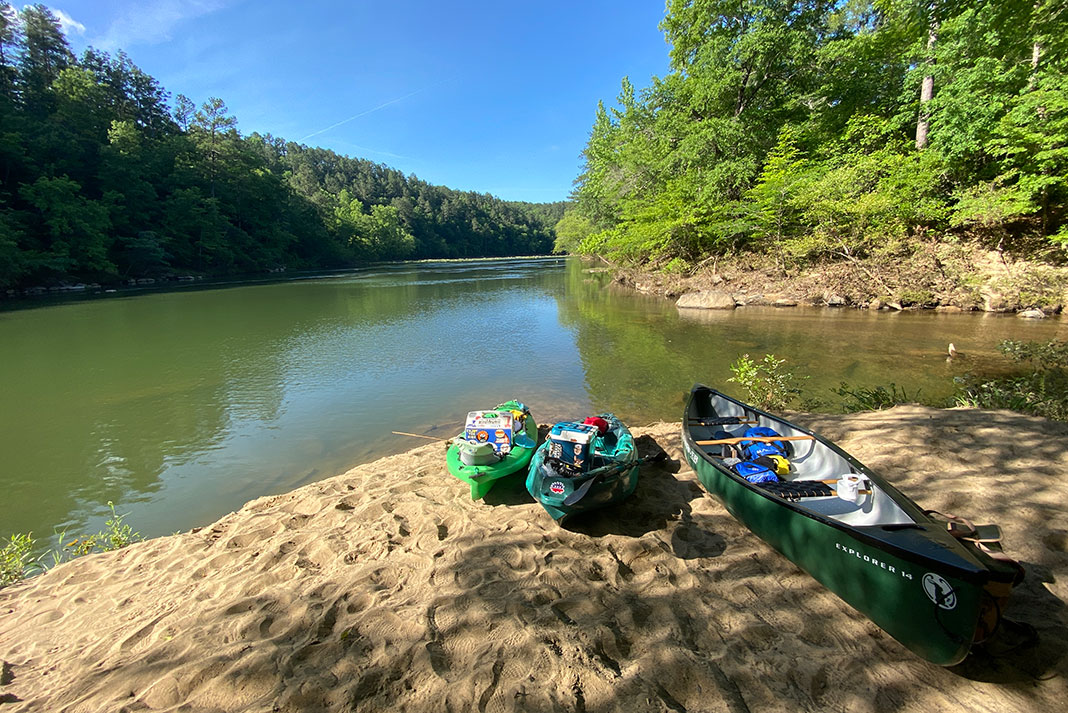
Camping out on the Cahaba River Trail. | Photo: Ben Leopard
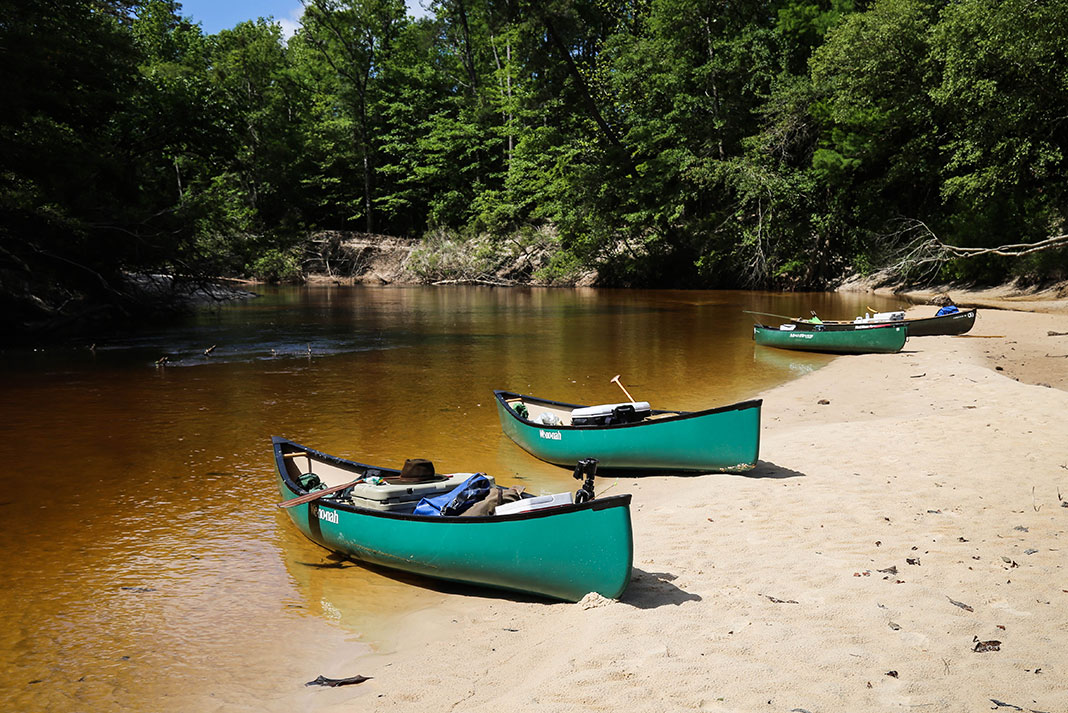
Take a break on the many riverside sandbars. | Photo: Ben Leopard
The Tallapoosa River
Winding for 258 miles from Georgia into Alabama at the southern end of the Appalachian Mountains, the Tallapoosa is a key part of the Alabama Scenic River Trail. One of the best ways to experience it is along the 25-mile Harold Banks Canoe Trail, named for the first man to solo paddle the river’s full length. The flatwater paddle goes through a fish trap and includes access to Horseshoe Bend Military Park, the site of the last battle of the Creek War on March 27, 1814. For a bit more excitement, the side chutes offer up small rapids, although the flow and volume of the river is dependent on the dams.
Alternatively, on the Upper Tallapoosa you’ll find the 40-mile Lloyd Owens Canoe Trail, which starts in Georgia and runs to the backwaters of Lake Harris. It’s known for its peaceful and clean water, good fishing and class I rapids.
Hatchet Creek Canoe Trail & Weogufka Creek Canoe Trail
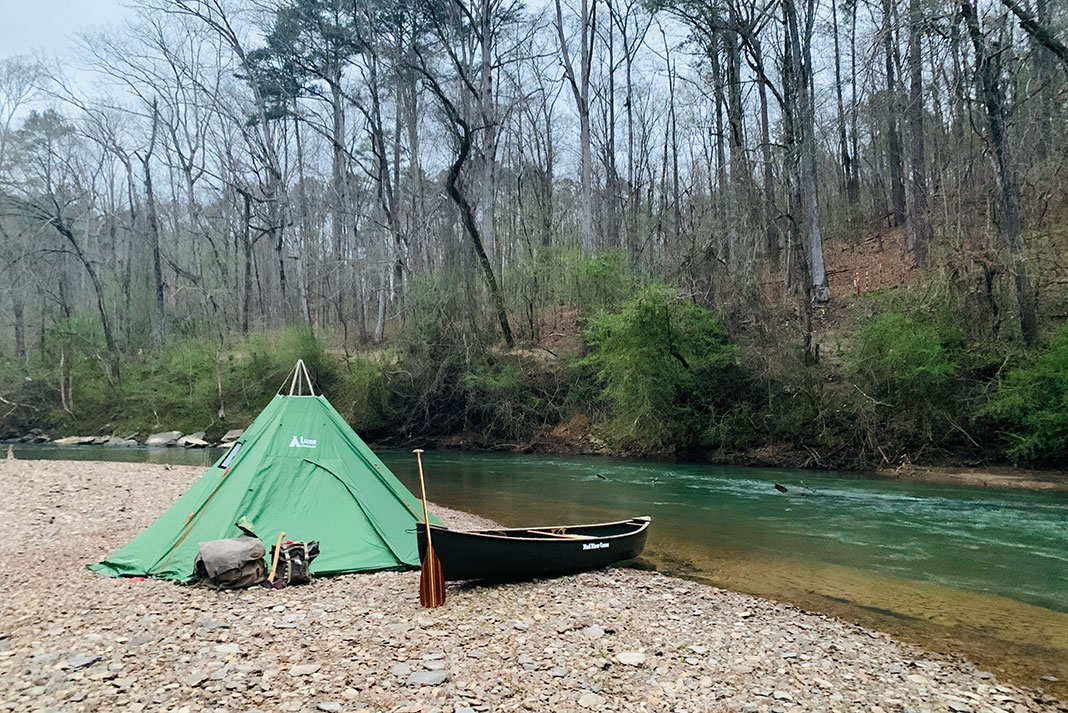
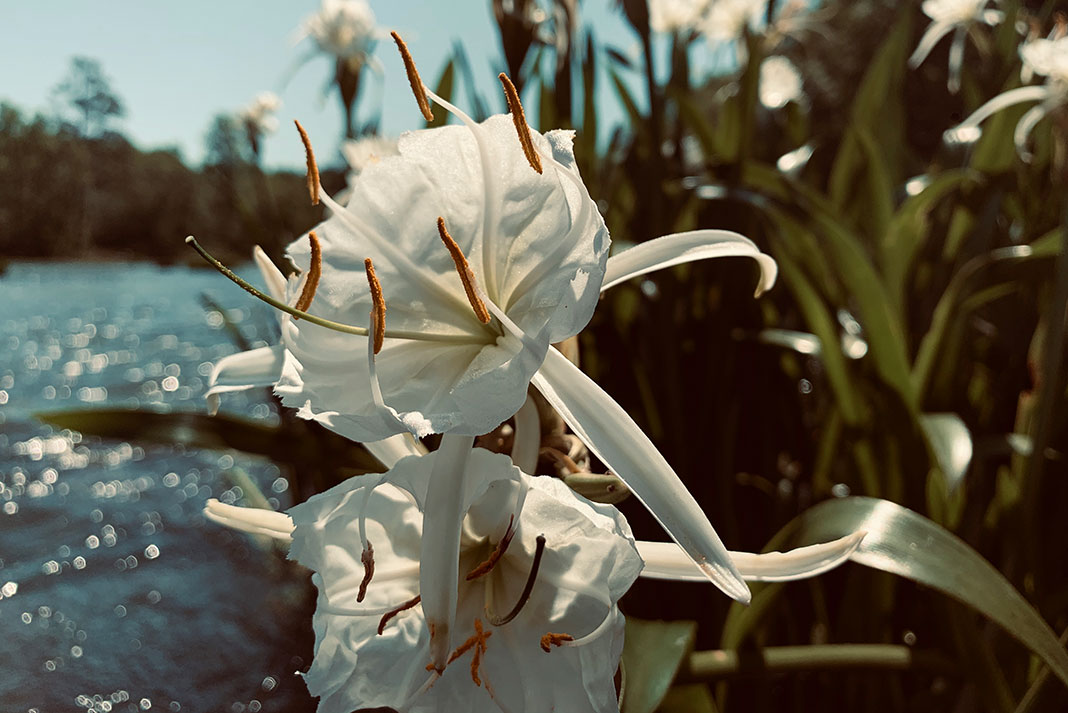
Located in Coosa County, Hatchet Creek and Weogufka Creek are both spur trails that shoot off from the Alabama Scenic River Trail. Running almost parallel to one another, the shorelines of the two creeks are covered in mountain laurel and flowering shrubs, along with rare blooming Cahaba lilies in the springtime. With rock gardens, sandbars and drops, be prepared for a few portages.
For those who want to turn their trip into an overnight, primitive campsites are available on private land—but be aware that access may be seasonal due to water levels. For guided floats and rentals, contact Off the Beaten Path Alabama.
Hatchet Creek and Weogufka Creek are home to rare Cahaba lilies blooming in the springtime. | Photo: Ben Leopard
Bartram Canoe Trail
If you hear “Alabama” and immediately think of bayous and swamps, this is the canoe trail for you. Named for naturalist William Bartram—who traveled extensively through the area in the late 18th-century—the Bartram Canoe Trail is located on the Mobile-Tensaw Delta. The country’s second-largest river delta, the swamp environment is home to 50 rare and endangered species, along with alligators. If the idea of camping close to reptiles excites you, then you’ll love the trail’s four floating camping platforms.
For a guided tour of this iconic route, contact the area’s specialists, Sunshine Canoe Rentals.
Lake Guntersville
If you’re after canoe trips in north Alabama, Alabama’s largest lake, Lake Guntersville, stretches for 75 miles from Nickajack Dam to Guntersville Dam. Its length makes it an ideal choice for overnight canoe trips in Alabama, particularly if you plan on fishing—it’s known for year-round bass fishing, while species such as bream, catfish and bluegill can also be caught.
Alabama canoe rides and float trips
When it comes to half-day or full-day canoe trips, you have plenty of options in both northern and southern Alabama, with dozens of established canoe trails to choose from. Here are just a handful of the put-in spots worth paddling out from.
Canoeing in North Alabama
The Flint River
Originating in Tennessee, the Flint River is also part of the ASRT, and is known for its fishing. You have a good chance of catching spotted bass, largemouth bass, catfish and bluegills off the back of your canoe. Don’t worry too much about paddling—the lower section is an easy float with no difficult rapids, making it perfect for solo missions.
North Alabama Canoe and Kayak offers rentals, as well as a shuttle service, with most canoeists taking about 3.5 hours to travel down the river.
When it comes to half-day or full-day canoe trips, you have plenty of options in both northern and southern Alabama. | Photo: Ben Leopard
Bear Creek & Little Bear Creek
Located in the northwest corner of the state, Bear Creek is a go-to destination for both canoeists and kayakers. The Bear Creek Floatway is a popular spot for teaching beginner paddlers how to navigate rapids and work with the flow of the rapids. Its water levels are controlled by a dam, with regular releases to control flow on weekends and holidays throughout the summer months. It begins below Upper Bear Creek and ends at Bear Creek Reservoir, and is mainly class I (approaching class II). There is also a mandatory portage at Upper and Lower Factory Falls.
It’s not the only trail on the creek, though. Canoeists, in particular, will enjoy the leisurely 34-mile Lower Bear Creek Canoe Trail, which runs from below the dam (starting at the Dixie Youth Park in Red Bay) to Bishop Bridge.
Just outside Hackleberg, you’ll also find Bear Creek Canoe Run, an outfitter that rents canoes and kayaks, alongside offering shuttle runs.
Big Canoe Creek
Located just northeast of Birmingham, Big Canoe Creek is located within a 422-acre nature preserve. It flows freely for over 50 miles and is home to more than 50 species of fish, including the trispot darter—which was thought extinct until it was rediscovered in 2008—and endemic species of mussels.
This tributary of the Coosa River can be explored with Springville outfitter Big Canoe Creek Outfitters.
The Elk River
A tributary of the Tennessee River, this class I stream is known for its towering bluffs, rolling meadows and pristine forest. Along the 21.9-mile Limestone County Canoe and Kayak Trail, you’ll find five easy put-in spots starting from Elkmont. Since the waterways are controlled by the dam’s flow, even in dry summers you’ll find plenty of water here.
Five Mile Creek
A town-owned canoe company is a bit unusual, but once you experience Five Mile Creek, you’ll understand why locals want to capitalize on the area’s greatest asset. Open for paddling from March to November—water levels permitting—the creek is 26 miles of Alabama’s best canoeing just 20 minutes north of downtown Birmingham, Alabama. In addition to rentals, the Five Mile Canoe Company also has a campground on site.
Cahaba River
If you’ve been reading this list carefully, you’ve probably already noticed that Alabama’s rivers and lakes tend to be controlled by dams. That’s not the case with the Cahaba River, which is the longest free-flowing river in the state.
Located just outside of Birmingham, it’s an easy urban float—the water is even slow enough in some areas that you can paddle upstream, eliminating the need for a shuttle vehicle. If you visit in the springtime, keep an eye out for the rare white Cahaba River lily, along with rope swings hanging from trees.
Outfitter Canoe the Cahaba offers rentals and shuttles, as well as guided trips.
Tripping on the Sipsey River. | Photo: Ben Leopard
Sipsey River & the Shark Tooth Creek
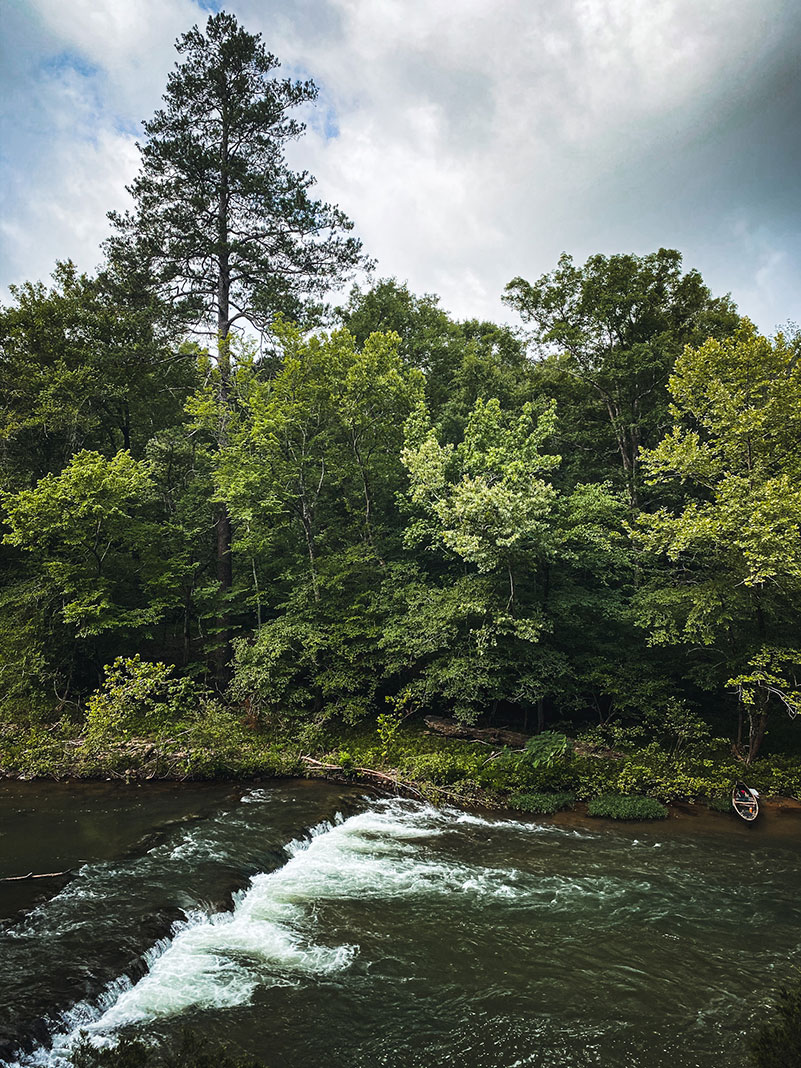
Considered one of the last wild swamp streams in Alabama, the Sipsey River had been called one of the “10 Natural Wonders in Alabama,” owing to its unique and diverse ecosystems. On a canoe trip down the Sipsey’s 92 miles, you pass through a canyon in Bankhead National Forest, where you’ll find waterfalls, sheer sandstone bluffs and class I rapids (along with one short section of class II rapids). The only official Wild and Scenic River in the state, the Sipsey has several put-in spots and primitive camping is welcome.
Book a canoe and campsite with the nearby Shark Tooth Creek Outdoor Adventures, and you may also be lucky enough to find a fossilized shark tooth or a million-year-old fossil.
Canoeing in South Alabama
Coastal Alabama Back Bay Blueway
With four trails and 21 access points to pick from, you can choose your own adventure along Alabama’s Gulf Coast with the Coastal Alabama Back Bay Blueway. You can explore historic Fort Morgan, spend the day fishing in the Little Lagoon, watch wildlife from Lake Shelby or Middle Lake, or navigate around islands in Wolf Bay.
The Perdido River Canoe Trail
Straddling the southbound Florida border, the Perdido River Canoe Trail only runs for 19 miles, but once you see the tannin-stained waters and white sandbars, you might just be tempted to stay a while. Six reservable camping shelters are available, but canoeists are also welcomed to pitch their tent directly on one of the sandbars in front of the shelter.
Escatawpa River
Similar to the Perdido River, the Escatawpa is a meandering blackwater stream, known for its white sandbars. And again, like the Perdido, this waterway follows the state lines—this time between Alabama and Mississippi. One of the most trafficked stretches is the seven miles from Lott Road to Mason Ferry Road, although the trip can be extended into a weekend affair with primitive camping on its sandbars.
For outfitting, contact Escatawpa Hollow Park and Campground. The campground was temporarily closed in 2021 for renovations, but once it reopens, it will feature improved river access points along with a new interpretive center.
Pulled over on the Conecuh River, part of the Alabama Scenic River Trail. | Photo: Ben Leopard
Extend your trip with primitive camping on riverside sandbars on the Cahaba River. | Photo: Ben Leopard
Canoe rental Alabama
Looking for canoe rentals in North Alabama or South Alabama? In addition to the tour operators and outfitters listed above, contacting one of these shops is a good place to start:
North Alabama Paddling Adventures
Based in Fort Payne, this outfitter hires out sit atop kayaks and quality canoes, as well as offers paddling classes and guided multi-day paddling trips.
Brown Bear LLC Canoe and Kayak Rentals
Located on the Flint River, this outfitter offers canoe and kayak rentals for a four-hour route from
Brown Bear to Ryland Pike and a six-hour route from Brown Bear Winchester Road to Hwy 72.
Pea River Outdoors
Located in Elba, Pea River Outdoors rents out canoes and kayaks at hourly and daily rates, and also offers a shuttle service.
Fairhope Boat Company
Across the water from Mobile, you’ll find Fairhope—which is home to the Gulf Coast’s only full-service paddlesports store. In addition to rentals, guided trips throughout the county are also available.
Coosa River Adventures
Located on the banks of the Coosa River in Wetumpka, Alabama, this outfitter rents canoes (in addition to standup paddleboards and kayaks) and provides shuttles on the Coosa and Tallapoosa rivers.
Alabama canoe laws
Kayaks and canoes are considered recreational, non-motorized vessels in the state of Alabama. However, being aboard a pleasure vessel doesn’t make you immune to the state’s laws and regulations.
All passengers on pleasure vessels need to carry a U.S. Coast Guard-approved life jacket (PFD). | Photo: Ethan Honaker
First off, all passengers need to carry a U.S. Coast Guard-approved life jacket (PFD). Those under the age of eight are required to wear a PFD at all times, while the rest of us should just do so as a matter of good practice. If you plan on paddling after dark, you’ll need to have the appropriate lighting—and it’s also advised that you carry a whistle as a sounding device. The last non-negotiable is that you’ll need to have a Visual Distress Signaling (VDS) device, such as flares, if you plan on paddling in coastal waters.
Finally, it’s illegal to operate even a recreational boat with a blood alcohol level of 0.08% or above. You can also get a BUI for being under the influence of any other substance that impairs your ability to function mentally or physically on the water.
Kayaking in Alabama
Alabama may offer miles upon miles of calm waterways and small rapids to thrill canoeists—but it has just as much big water to keep kayakers’ adrenaline pumping. From flatwater to class V whitewater, and from half-day to full-day to overnight trips, you’re bound to find the perfect kayaking adventure in this incredible state.
Kayak trips in Alabama
If you’re looking to go kayaking and camping, Alabama is positively the place to go. Considering the best canoe tripping routes take place on the state’s rivers and creeks where portages are few, these same waterways will be suited to a multiday kayak trip. See the section above for ideas.
Whitewater kayaking Alabama
From mellow class I to gnarly class IV runs, Alabama has it all when it comes to whitewater. Take your pick from the favorite rivers below based on your skill level—or sign up for some whitewater instruction to ensure you have a blast on the river.
Sipsey River
Entry-level whitewater paddlers looking for a bit of fast-water fun should head to the Sipsey in Bankhead National Forest. On this river you’ll enjoy many unnamed class I rapids, as well as one named class II: the 100 Yard Dash. This area is known as the Land of 1,000 Waterfalls, so you know you’re in for a treat when paddling this route.
Locust Fork of the Black Warrior River
Experienced paddlers will find great fun on the Locust Fork of the Black Warrior River, where class II and III rapids can be found in abundance. The recommended run extends from Highway 231 to County Road 160.
Little River Canyon
Highly experienced whitewater paddlers should without a doubt head to the Little River Canyon, located on Lookout Mountain in northeast Alabama. You’ll find class III and IV rapids between Little River Falls and through the canyon (whereas the sections of the Little River above the falls and at the south end hold class I and II rapids). Your run will take you through stunning scenery, as you paddle past sandstone cliffs and over turquoise waters.
Paddle rivers leading into the Gulf of Mexico or paddle the Gulf itself. The southern portion of Alabama provides access to all the incredible features along the coast, including beaches, islands, inlets and marine life.
Mobile Bay
Sea kayakers will love paddling Mobile Bay, located on the Gulf of Mexico. Put in at the Scott’s Landing Boat Access and paddle south along the shore. There are multiple beaches and parks you can choose to take out at, depending on your trip length of choice. Many choose to finish at Fairhope, or use this as a turnaround point.
Pelican Bay
Take the Dauphin Island Bridge and launch your kayak from the island for a paddling experience rich in marine life. Put in at Dauphin Island beach on the southeast side of the island. You can circumvent the island or make a shorter journey along the southern shore, visiting the many beaches along the way and exploring Pelican Cove.
Kayak rental Alabama
No matter what type of kayaking you plan to do, or where you plan to do it, you can find a kayak rental company in Alabama that suits. Many outfitters also provide guided tours and shuttles. Note that many of the outfitters listed in other sections of this article also rent kayaks.
WildNative Tours
Rent single and tandem sit-in kayaks from WildNative Tours to access Mobile Bay. They’ll deliver anywhere along the Battleship Causeway.
Ken’s Kayak & Paddle Board Rentals
Get out on the waters of the Gulf with Ken’s Kayak & Paddle Board Rentals. They’ll deliver to the location of your choice.
No Worries Kayak Rentals
No Worries Kayak Rentals will provide you with a single or tandem sit-on-top recreational kayak, paddles, life jackets and shuttle so you can enjoy a day of paddling on Terrapin Creek.
North Alabama Canoe & Kayak
Rent a kayak from North Alabama Canoe & Kayak and enjoy a run down the Flint River.
Alabama kayak laws
The canoe laws explained in the section above also apply to kayaks. Do you have to register a kayak in Alabama? Registration is only required if you are using a gas or electric motor.
Getting ready to go on the Cahaba River. | Photo: Chris Miller
Paddleboarding Alabama
According to SUPBoardGuide.com, some of the best SUPing spots in the United States are in Alabama. It makes sense. The Tennessee River, for example—most of which is located within Alabama state lines—is one of the best touring rivers in the country thanks to its length, average depth and places to stop along the way. But really, the sweet spot here is along the state’s coastlines, with its calm bays (including Perdido Bay, Oyster Bay, Bon Secour Bay and Mobile Bay) and beaches.
Places to paddleboard
While many of the locations we’ve listed for canoeing above also offer suitable conditions for SUPing, the most popular place to paddleboard in Alabama is along the Gulf Coast. Considered one of the best SUP spots in the state, it has conditions for different skill levels, with miles of canals and countless islands—don’t miss Robinson Island—and coves to explore.
Although the Orange Beach Canoe Trail is considered prime paddling for kayakers, the canals near the Orange Beach Marina make for ideal SUPing conditions, as they’re a no-wake zone with relatively calm water. They also offer plenty to look at, including waterfront restaurants and homes, boats of all shapes and sizes, and dolphin visitors.
Paddleboard rentals
In addition to kayaks and canoes, many marinas and lakeside campgrounds throughout the state now offer SUP rentals. However, here are a few places that are keen to get you kitted up and out on the water.
Elk River
Fort Hampton Outfitters: Although it specializes in kayak rentals for use on the Elk River, this outfitter also offers SUP rentals.
Tennessee River
Forrest Paddle Boarding: Located in Huntsville, Forrest SUPing offers rentals at $35 for two hours, along with individual guided trips and coaching.
Gulf Shores and Orange Beach
Perdido Beach Service: This outfitter offers tandem ocean kayaks and SUP boards, starting from $25 per hour.
iBeachService: Single-person kayaks and SUP boards are available for rent, starting from $225 per week.
Go Go Kayaks: Starting from $65 per day and $125 per week, this outfitter rents out single kayaks, tandem kayaks and SUPs.
Paddled By You: Expect to pay $40 for a half-day or $55 for a full-day at this family-owned kayak and SUP rental service.
Rafting in Alabama
Although whitewater kayaking is one of Alabama’s most popular paddlesports, there are very few outfitters that take tourists on guided whitewater rafting in Alabama.
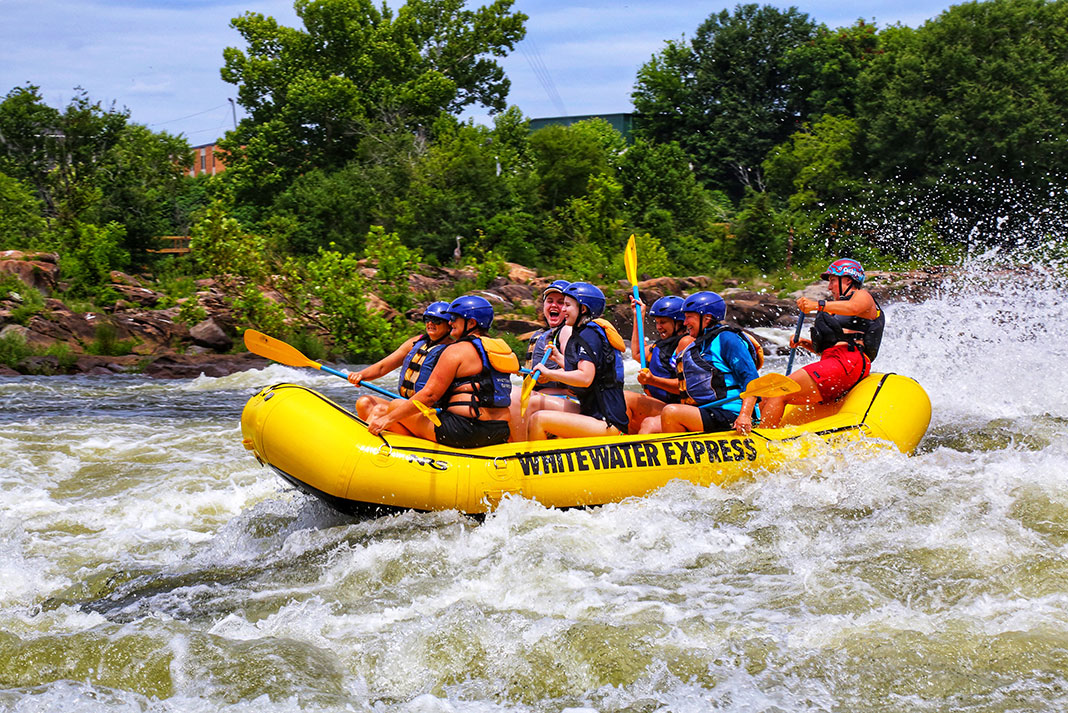
RushSouth Whitewater Park on the Chattahoochee River is the longest urban whitewater rafting course in the world. | Photo: Ethan Honaker
RushSouth Whitewater Park
Running through Columbus, Georgia and Phenix City, the RushSouth Whitewater Park on the Chattahoochee River is the longest urban whitewater rafting course in the world. Yes, the rapids may be man-made, but that doesn’t make the class III, IV and V rapids any less challenging—they’re allegedly the largest south of Canada and east of Colorado.
Whitewater Express offers guided two- to three-hour trips starting from $46.95 per person.
Ocoee River
While technically not in Alabama, the Ocoee River is just a short drive from Birmingham and Huntsville, making it the spot to go in North Alabama for whitewater rafting. This Tennessee waterway flows through Cherokee National Forest and is considered one of America’s best whitewater rivers, with over five miles of class III and IV rapids.
Ocoee Inn Rafting runs half-day and full-day trips on the river from March to September, starting from $30 per person.
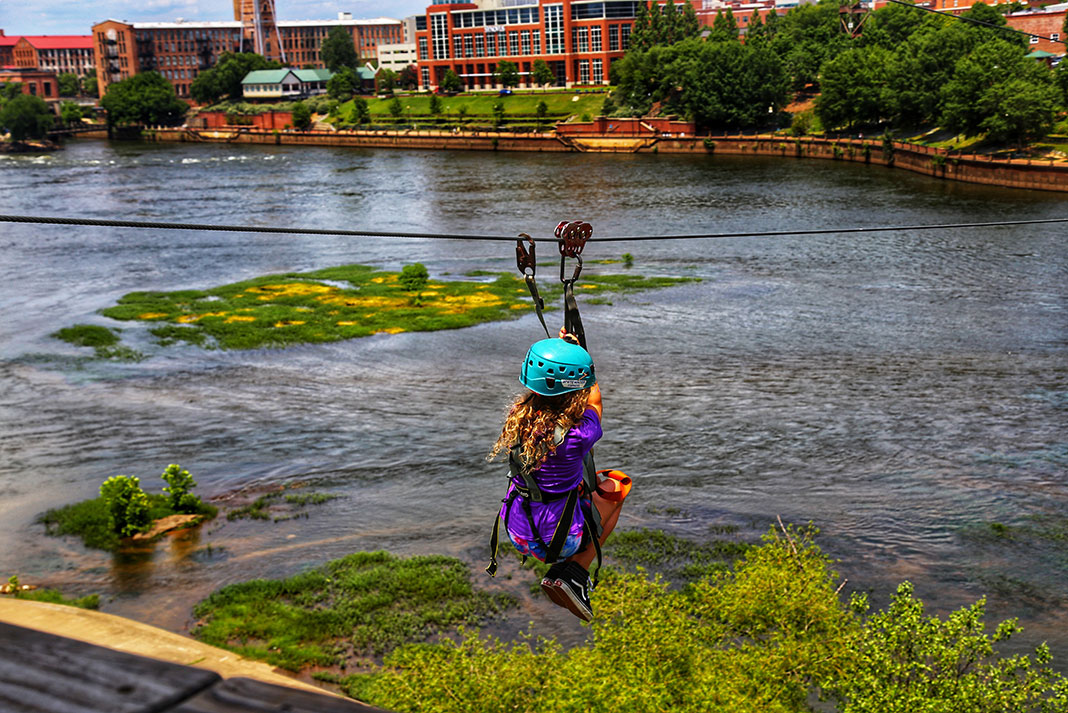
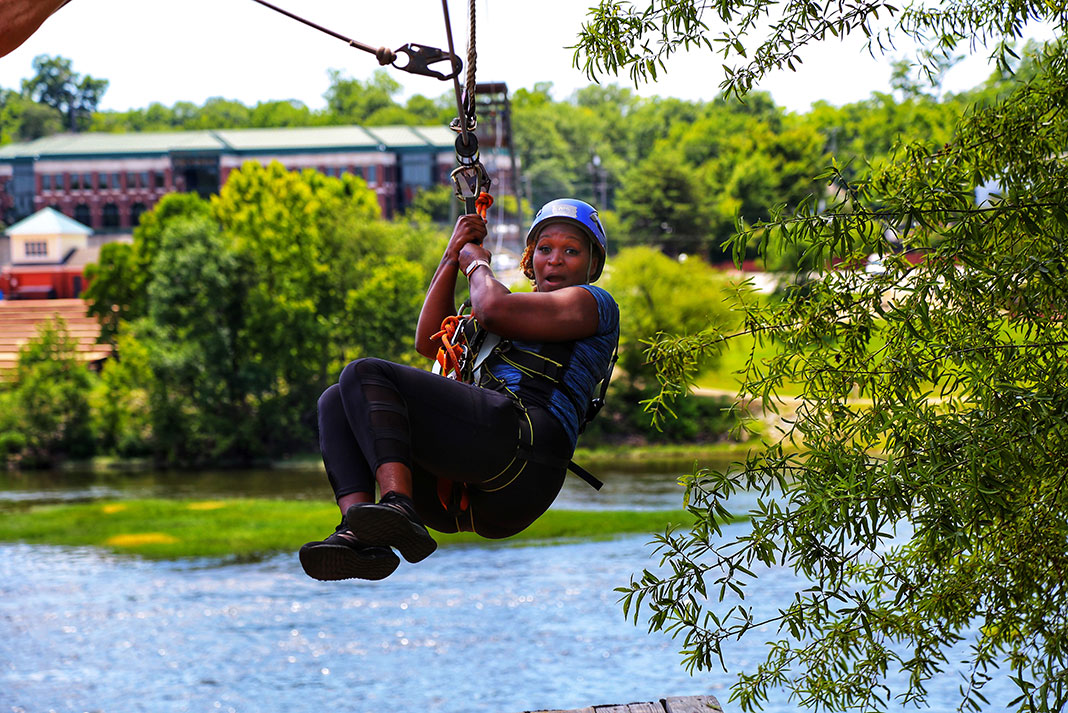
Cap off a day of rafting fun with a zipline ride over the river. | Photo: Ethan Honaker
Thrills on thrills in Alabama. | Photo: Ethan Honaker
What to know before you go
While it’s possible to paddle year-round in Alabama, it’s worth noting that many of the rivers and lakes are controlled by a system of dams. Water levels during the height of summer can be notoriously low in some regions, making shoulder season the time to plan your canoe and kayak trips.
However, be aware that many outfitters, tour operators and campgrounds only operate between Memorial Day in May and Labor Day in September.
Slow is fast. Push too far, too quick and paddlers risk a small mistake making the technique collapse like a house of cards. | Feature photo: Seth Ashworth
Most people want to learn quickly, thinking fast progress makes better skills. Unfortunately, learning doesn’t work this way—on the water and elsewhere. Push too far, too quickly and whitewater paddlers risk making mistakes they’re not equipped to handle. So, what’s the first lesson for learners about fast paddling progress? Slow down!
A young friend illustrated the pitfalls of paddling progression not long ago. A talented paddler, he quickly progressed from beginner to intermediate, jumping from one test river to the next. His success encouraged him. His friends were amazed. And it seemed his progression would continue.
Unfortunately, on the tenth or so rung up the river ladder, he lost control in a shallow rapid. Suddenly upside-down, he took a couple of rock hits and his otherwise excellent roll failed. Carping for air led to a dislocated shoulder followed by a difficult swim to shore. Afterwards he struggled with the question: He was doing so well, progressing so fast, what went wrong?
Slow is fast. Push too far, too quick and paddlers risk a small mistake making the technique collapse like a house of cards. | Feature photo: Seth Ashworth
The reflexes and smooth technique of top paddlers can’t be learned quickly. Sharp reflexes and smooth technique build slowly from extensive practice, and—unknown by the novice—these skills actually consist of two different kinds of technique: the paddle positions you see and top paddlers carefully practice; and a tight web of correction moves you probably don’t even consider.
Good technique is just half the equation. Rivers are constantly pushing and surging, shifting their currents and are only partly predictable. The game of whitewater requires your technique to be fluid, strong, and versatile enough to match the rivers’ changes. This is especially true as you progress to more powerful whitewater, because it will find any weakness you have.
All it takes is an instant and one little break in your form. An unexpected cross-current grabs the edge of your boat and jars you off balance or flips you upside-down. A surge forces your paddle out of position for a roll. Then, like my young friend, you’re suddenly carping for air. Follow with an unexpected rock hit to your head and suddenly all that fast progression is flushed down the river, out of control and out of breath.
[ Paddling Buyer’s Guide: View all whitewater paddling accessories ]
Learning to correct mistakes on the fly
No matter how good your technique, the water will always force such errors, so you must have a broad set of quick corrections.
If the boat’s edge grabs, you slap a brace and apply counter pressure with your knees. If flipped and surging water shoves your paddle out of position, you must be able to drive the blade to the right position and crank the roll.
So the first lesson about fast progression is slow down. You have a lot to learn. All parts of your technique have to be coordinated to keep you upright and moving with the right angle, edge and speed. A mistake can make the entire skill collapse like a house of cards.
The second lesson: you cannot learn without making mistakes. Much of whitewater kayaking is the art of constantly adjusting errors to create your line, and these adjustments and corrections are every bit as important as the ideal technique.
The faster you progress, the more inevitable the plunge becomes.
Few beginners or intermediates realize this is practicing an unseen technique—every time you make an error, you practice strokes and techniques to correct the mistake and regain control. It is part of the skill. More than likely though, these mistakes piss you off because they feel like failures, not useful practice.
Understand you are practicing a safety net of error-correction skills, bringing the boat back into control and bringing your movements back into the proper technique. To be an expert, every error has to funnel back to the correct motion. Without this net, the river magnifies every error and flushes you away.
Mistakes that are corrected are a part of the paddling progression and creates an essential set of skills. When you pursue harder whitewater, it is only a matter of time before the river plunges you and your technique breaks down. The faster you progress, the more inevitable the plunge becomes.
Driving is a good comparison. Aggressive teenagers learn to drive very quickly. The classic problem appears when they get cocky and start speeding, not realizing when they make a mistake, they haven’t practiced correcting errors and don’t have the right timing or touch. The forces involved are far more powerful and happen twice as fast.
Driving is a blast until, going 80 miles per hour the kid skids on gravel, overcorrects and rolls the car. That’s what happens when you progress faster than your safety net of error corrections is formed.
Mistakes that are corrected are a part of the paddling progression and creates an essential set of skills. | Photo: Roya Ann Miller/Unsplash
The river is constantly forcing errors and you must be able to counteract them from any position. With time your corrections form an ever-tighter web around the ideal technique. This is how experts funnel the chaos of a rapid into the magic of fluid smoothness.
So take it easy and don’t rush. The beauty of rivers comes from their infinite variation. Moving with them and matching their fluidity requires learning in both seen and unseen ways.
This article was first published in the Spring 2018 issue of Paddling Magazine. Subscribe to Paddling Magazine’s print and digital editions, or browse the archives.
Slow is fast. Push too far, too quick and paddlers risk a small mistake making the technique collapse like a house of cards. | Feature photo: Seth Ashworth
From the filmmaker: “Meet Frank Kuiack, the last traditional fishing guide in Algonquin Park. Kuiack carries a lifetime of stories and wisdom about the Algonquin. His magnetic personality, skills on the water and knowledge of the park’s intricate lakes and trails has inspired two novels.
When Kuiack was eight-years-old, a group of American anglers offered him $5 to show them where to catch fish — and he’s been making his living as a fishing guide ever since.
At 84-years-old and recently diagnosed with bone cancer, Frank’s health has taken a turn for the worse. While he’s attempted to train guides over the years and pass on his knowledge, the physically demanding nature of the job has turned away most potential apprentices.
Kuiack’s niece, Sharleen, has shown a unique ability to go toe-to-toe with Frank on the water but, despite her ability and love for her uncle, she remains unsure how to carry on his legacy or whether she desires to be the next ‘Last Guide.'”
BAD RIVER – The Cooks River: Australia’s sickest urban river is located in the glamorous and famously pretty city of Sydney. This makes sense, given it’s also Australia’s largest, hard-surfaced, drainified, leaky-sewered, city.
In his little red kayak, Beau Miles traces all 23 kilometers of the Cooks River, inspired to do so after paddling his boyhood river over four days in the name of backyard adventuring. Finding it not only challenging, but shocking in terms of its ill health, Miles since shifted from wanting to see the wildest and most pristine places on earth, to the most degraded and sick. This is a journey of ill-health, sadness and hope; putting a test to the local saying, ‘if you fall in, you’ll dissolve’.