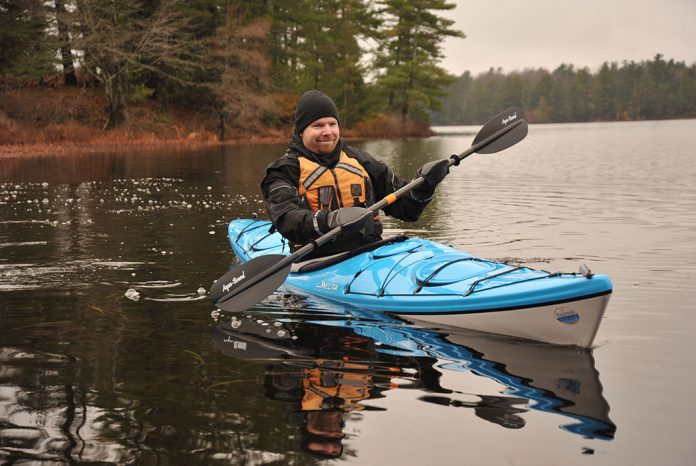
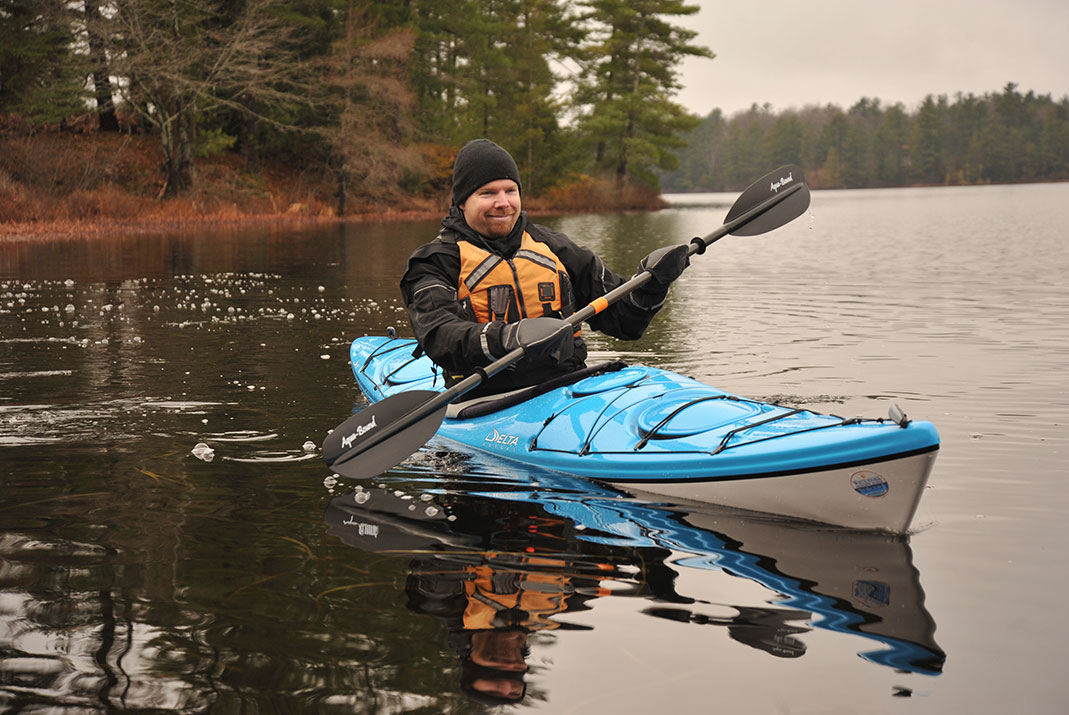
The shortest and lightest of Delta’s touring kayaks at just 45 pounds. | Photo: Virginia Marshall
Over the past 10 years, I’ve had the pleasure of paddling (and reviewing for this magazine) nearly every kayak in the Delta line-up—from their flagship performance touring models to accessible tandems and recreational kayaking chimeras. While boats like the Delta 17.5T tandem and the 12AR adventure rec kayak delighted with innovative design elements, Delta’s latest offering takes a tried-and-true touring design and downsizes it for the modern kayaker.
The shortest and lightest of Delta’s touring kayaks at just 45 pounds, the 14 is positioned as the easiest to own for weight- and space-conscious paddlers. If you are looking for a full-fledged touring kayak that can handle diverse waters or escaping to a forgotten coast for a few days—and is easy to move from garage to roof rack to put-in and back—the Delta 14 is a superb one-and-done solution.
Stable, well-behaved and available with a skeg or rudder, the 14 embraces Delta’s West Coast touring design ethos: user-friendly, efficient and more than capable of hauling all your gear. This is a compact touring kayak with crazy capacity—over 200 liters—and the large hatches make it dead easy to pack in the luxuries. Camp chair, fondue set, a box of cabernet sauvignon—bring it all!
Like all Delta Kayaks, the 14 is crafted from lightweight thermoformed plastic. At the company’s British Columbia manufacturing facility, sheets of acrylic–ABS plastic laminate are heated and vacuum-formed into hardwearing kayaks with exceptional durability and flawless finish.
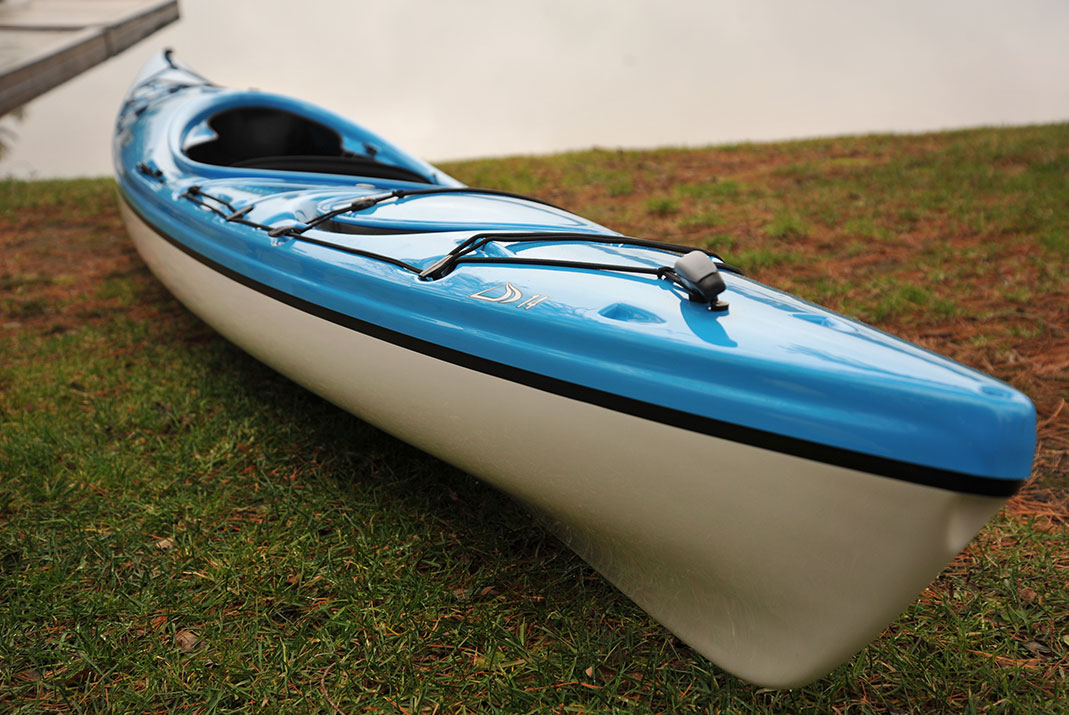
The shortest and lightest of Delta’s touring kayaks at just 45 pounds. | Photo: Virginia Marshall
The acrylic outer layer gives each Delta kayak its glossy appearance, vibrant color, excellent abrasion resistance and protection against UV fading or weathering. The secondary layer of high-impact ABS is nearly indestructible, so clumsy landings and fumbles on cobble aren’t trip-ending calamities.
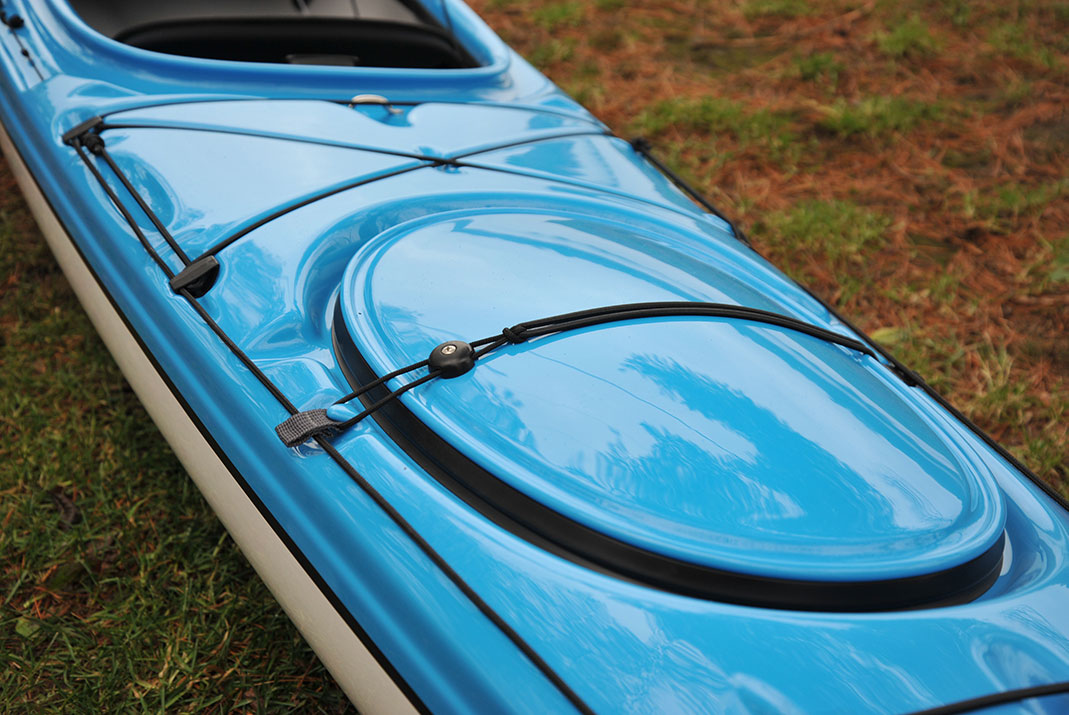
Delta has been working with the same material for 35 years—refining their designs and shaping process to optimize strength, weight and aesthetics—so it’s no surprise they’re industry leaders in thermoforming crisp lines and exquisite detail. Witness the 14’s recessed hatches and bungees, handy paddle parks and integrated cockpit coaming. And while Delta’s 14 may resemble and feel similar to a composite kayak, the substantially lower cost makes it easier for new paddlers to make the leap from renting to owning.
Delta’s outfitting focuses on personalized comfort with the adjustable and intuitive Contour II seat system. The multi-position backrest is supportive without getting in the way. It’s paired with a spacious, padded seat that can be moved four inches fore or aft to optimize fit and trim. This ability to fine-tune the seating position means the 14 will fit a wide range of people well, accommodating paddlers short and tall. Even better, everything can be adjusted on the move so you can easily tweak your trim to adapt to changing conditions or cargo in your hatches.
Choose from an optional rudder or spring-loaded skeg. | Photo: Virginia Marshall
Delta’s generously sized Press-Lock hatches access 209 liters of dry gear storage with easy on and off convenience. | Photo: Virginia Marshall
Adjust the Contour II seat system on the go to optimize contact with thigh braces or trim a loaded kayak. | Photo: Virginia Marshall
Ten years ago, Delta moved the day hatch from behind the paddler to the front deck and never looked back. The 14’s deck pod is easy to reach and can accommodate most things you’re likely to need at a moment’s notice—sunscreen, first aid kit, cellphone, snacks—without impeding paddler legroom. The gasketed, press-fit hatch covers are watertight and wonderfully easy to open and close. Delta designers spent two years developing these hatches and I love that there are no straps, clasps, stubborn rubber or obstinate neoprene to wrestle into place.
The 14 carries over similar performance characteristics from Delta’s popular 15- and 16-foot touring kayaks—including a moderate, V-shaped hull and well-defined chines for outstanding stability and predictable edging. Like its siblings, this makes the 14 comfortable for beginners with enough liveliness to keep intermediate paddlers smiling. The relatively long waterline assists with tracking and efficiency, making for satisfying—if not speedy—cruising capabilities.
Attractive, comfortable and capable on a variety of waters, the Delta 14 squeezes exceptional value into a downsized touring design that’s fun to paddle and just as easy to manage back on shore.
This article was first published in Paddling Magazine Issue 64. Subscribe to Paddling Magazine’s print and digital editions here, or download the Paddling Magazine app and browse the digital archives here.
The shortest and lightest of Delta’s touring kayaks at just 45 pounds. | Feature photo: Virginia Marshall
To celebrate its 50th anniversary in 2021, Kokatat made its Gore-Tex Pro line-up even tougher. | Photo: John Webster
Black Project
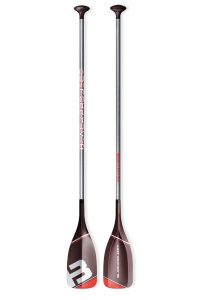
Hydro FlowX Paddle
How can wasted energy be turned into increased efficiency? That’s the question Black Project set out to answer when they developed the Hydro FlowX standup paddle — a radical looking design with a ridge running down the neck of the blade, and a deep scoop on the power face. The unique shape came to life thanks to 3D printing, which allowed rapid prototyping throughout the development process. The result is a more efficient paddle with the potential to transform standup racing, just as wing paddles changed the game for kayak and surfski racers.
“The blade is designed to securely hold the water and move through it without sideways movement, jolts of power or anything which would negatively affect the user,” says Black Project co-founder Chris Freeman, who says athletes using the Hydro FlowX have seen an average four percent increase in speed and substantially reduced fatigue over conventional paddles. While currently only available as a standup paddle, Freeman believes the concept is applicable to other single-blade disciplines, such as outrigger canoeing.
Kokatat
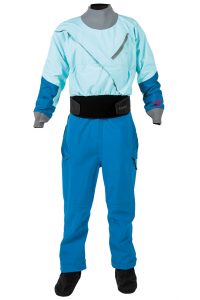
GORE-TEX PRO Drywear
In 1971, Kokatat began manufacturing what would become some of the most respected gear in paddlesports. In 1976 Gore-Tex introduced the world to waterproof and breathable fabric, and has set the benchmark ever since. Kokatat was an early adopter of the lab-produced fabric, using it to produce technical outerwear that would keep paddlers dry for decades to come. For Kokatat’s 50th anniversary the company has introduced to its drywear lineup the newest iteration of Gore-Tex Pro, which is the first major update to the iconic material since 2013. After three years of testing, Gore and Kokatat have collaborated on a rugged 200-denier version of the Pro line fabric formulated especially for paddlesports. The three-layer construction provides an increased durability that stands up to the abrasions and impacts inherent to paddling and travel through tough terrain.
Astral
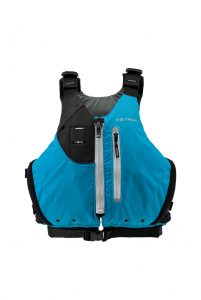
Ceiba PFD
There is no way around the fact that the gear we wear has an impact on the places we love, whether this means shedding microplastics on the water or during manufacturing itself. Astral Designs has worked to minimize the environmental impact of its products, most recently with the Ceiba PFD. For starters, it comes stuffed with natural kapok fiber in the front and PVC-free foam in the rear, as Astral’s life jackets have for years. Now the shell is constructed of 300-denier recycled polyethylene terephthalate, or RPET, a tough and earth-friendly material endorsed by Bluesign Technologies, a third-party organization devoted to overseeing sustainable practices in textiles. That’s a first in the PFD market.
“The first step in preventing damage to water and soil is understanding how chemicals affect them,” says Philip Curry, founder of Astral Designs. “Bluesign, with their deep knowledge in textile chemistry, is the partner we need to constantly evaluate our supply chain and prevent harmful chemistry getting into our products.”
Whitewater Technology
Paddles
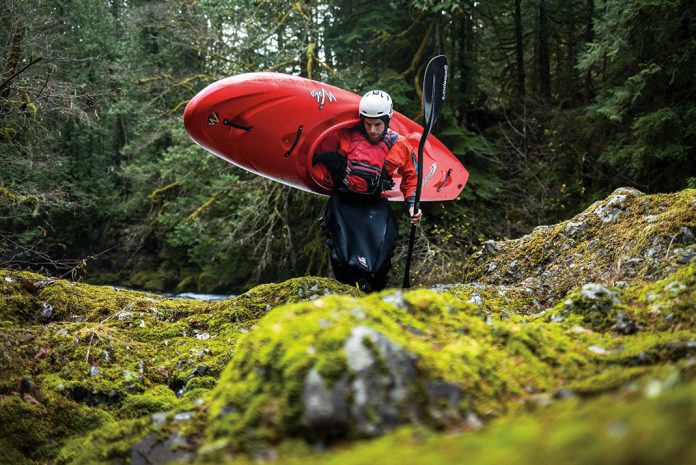
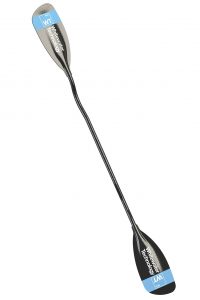
Composite materials used in paddle construction hadn’t changed much in recent years, until Whitewater Technology showed up. The new brand featuring the designs of former Confluence Outdoors engineer Oliver Wainwright aims to bring a fresh take to paddle manufacturing.
Two major components stand out immediately in the production of these carbon blades. The first is they are built from at least 40 percent recycled carbon. A close look at the paddle grain reveals the second innovation: The fabric is not woven. Instead, carbon fibers are individually stacked layer upon layer within an epoxy system with thermoplastic reinforcement added. The technique avoids the overlapping intersections found in woven composite cloth, which Wainwright and his lab-coated cohorts say are potential weak points in the structure—like knots in a rope.By removing these, Whitewater Technology says it’s able to provide paddlers with strong high-performance paddles made largely from recycled material.
Pyranha Kayaks
New Hardware
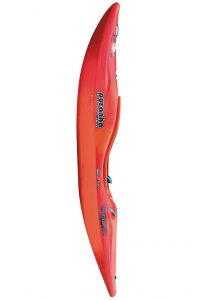
What do you do when the supply chain disruptions make a small but indispensable piece of hardware nearly impossible to obtain? Kayak manufacturer Pyranha simply found a replacement—and it turned out to be better than the original. The large plastic crush-washers used for years on the exterior bolts of their kayaks were notoriously overtightened, deforming the washer seal and leading to leaky boats. The pandemic supply disruption forced the company to switch to a more conventional bolt and washer that paddlers—who are perhaps known to skip directions—can ratchet down as tight as they please. The other positive for Pyranha, besides fewer warranty calls, is that the new washer system saves manufacturing time.
“This new system is more intuitive, gives a cleaner look, and is better for production,” says Chris Hipgrave, Pyranha Director of Sales in North America. “We can save one or two minutes per boat. All of a sudden that adds up to more boats you can assemble in a day, week, month. It’s incremental changes—what they call in bike racing marginal gains.”
Origami
Origami Paddler
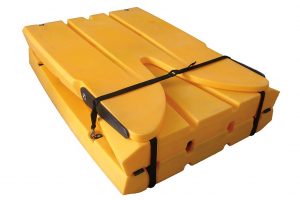
Tim Niemier is best known for designing one of the most iconic and transformative kayaks of all time, the Ocean Kayak Malibu. Sit-on-top kayaks were just what the market wanted when Niemeir scaled his operation in the 1980s. Fast-forward a few decades and the market is craving storable and ultra portable craft as a point of entry into the sport, and Niemier is ready to oblige with his take on folding paddlecraft—the Origami Paddler.
The three-section, double-hinged craft is about as quick to unfold as a futon. It is made of light, hard plastic—and it can be configured as either a sit-on-top kayak or a standup paddleboard. As of June 2021, Niemier had a backlog of 20,000 initial units to fulfill, bringing the paddlesports innovator one step closer to his personal goal of putting a billion butts in boats.
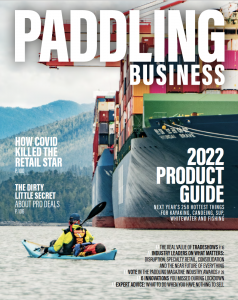
This article was first published in the 2022 issue of Paddling Business. Inside you’ll find the year’s hottest gear for canoeing, kayaking, whitewater and paddleboarding. Plus: Industry leaders on surviving COVID, the dirty little secret of pro deals, brand consolidation and more. READ IT NOW »
To celebrate its 50th anniversary in 2021, Kokatat made its Gore-Tex Pro line-up even tougher. | Photo: John Webster
Cape LaHave Adventures,
LaHave Islands, Nova Scotia.
Photo: Tourism Nova Scotia / Patrick Rojo
“When something goes wrong, you have to keep flying the airplane,” says Darren Bush, owner of Rutabaga Paddlesports in Madison, Wisconsin, and host of the annual Canoecopia show. “You either hit the ground hard or you hit the ground soft, but either way, you have to work the problem.”
In March of 2020, when Covid first hit North America in force, Bush found himself at the controls of the world’s biggest consumer paddling show as it sped into the eye of the pandemic storm. Exhibitors were already setting up when he decided to cancel the show rather than risk it becoming a super-spreader event. The last-minute cancellation was a massive financial risk, not unlike a pilot steering a doomed plane away from a residential neighborhood.
We all know the story that followed: Stay-at-home orders, shuttered businesses, a new and frightening reality as the virus spread unchecked around the world. And then, unexpectedly to most, an outdoor recreation boom fueled by cooped-up people seeking social distance. Participation surged in recreational activities like cycling, hiking and paddling. Demand for gear soared, and the pandemic-ravaged supply chain couldn’t keep up. According to market research group NPD, sales across watersports shot up 27 percent in 2020 compared to 2019.
Paddlesports sales shot up 30 percent last summer, and more people were getting on the water than ever before. | Photo: Rob Faubert
Looking back 18 months later, it bears repeating how unexpected the post-Covid boom was. In March 2020, specialty retailers like Rutabaga couldn’t have predicted the insatiable appetite for paddling that would follow the lockdown, let alone their businesses would out-perform large chain stores that were seemingly much better equipped and financed to weather the storm. Specialty retailers didn’t only survive. Most thrived through the most chaotic year in recent history, simply by what Bush describes as flying the plane.
“Being a smaller specialty retail dealer with no corporate pressures, we can react quicker than big box stores and online retailers,” says John Nemjo, founder and president of Mountainman Outdoor Supply Company, a paddling shop of 28 years in the Adirondacks. “We were able to adjust almost on a daily basis based on what we were seeing.”
Nemjo had the luxury of trusting his gut, and his gut told him demand for outdoor gear would rebound as millions of stir-crazy Americans sought fresh air and social distance.
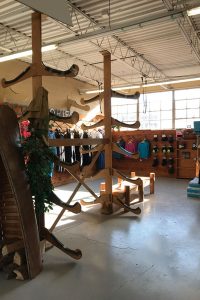
Barren racks and shelves were a common sight in paddling shops during the summer of 2020. | Photo: Courtesy The Complete Paddler
“Our sales never hit anywhere near zero, and within weeks we saw higher-than-average sales,” he says. So when his suppliers told him other retailers were canceling orders, Nemjo pounced. As other businesses back-paddled at the top of the metaphorical rapid, Mountainman went all forward, increasing product orders as others canceled theirs. “We took a chance as we have done over the years, and once again, it paid off,” Nemjo says. “We had boats no one else had. It paid huge dividends to our business that will carry on for years.” Customers came from as far away as Oklahoma to buy boats from Nemjo’s store in upstate New York.
While not every specialty store had the foresight or resources to double down on inventory at the outset of the lockdown, many were still able to navigate the uncertainty better than large retailers whose executives didn’t have their fingers on the pulse of paddlesports.
“The key to succeeding during the pandemic seems to have been understanding the needs of the customer base through difficult times and the ability to stay in step with evolving circumstances.”
Robert Stoky of Florida Bay Outfitters in the upper Florida Keys was cautious in the beginning. He reduced some boat orders, and some of the inventory he ordered was delayed. Stoky responded by shifting his retail focus to soft goods and accessories and emphasizing tours and lessons. The business thrived, even with paddlecraft sales going from approximately 80 percent of pre-pandemic sales to 50 percent since. Stoky recognized that in a destination location like the Florida Keys, people were just as eager for rentals and outings as they were for paddling gear. The key to succeeding during the pandemic seems to have been understanding the needs of the customer base through difficult times and the ability to stay in step with evolving circumstances.
Kelly McDowell can attest to this, though the situation he faced as president of The Complete Paddler in Toronto differed from what Stoky experienced in Florida. Shelter-in-place orders were generally stricter in Canada than in the U.S., and McDowell’s retail season began with a two-month total lockdown. Rentals and instruction weren’t an option for McDowell—not only were instructors hard to come by due to liability and insurance concerns, but he’d sold off its rental fleet the previous fall and couldn’t replace it.
Like Nemjo, McDowell was confident demand would rebound. So while MEC and other big retailers canceled boat orders, McDowell snapped them up. Then he got creative. Though his doors were locked by government order from March into May, he kept the phone lines open, scheduling curbside pickups for eager paddlers. He would deposit boats one at a time on the patch of grass in front of his store, spray them down with disinfectant, and then wave through the locked door as grateful customers loaded their new boat and drove away. Some were regular customers of The Complete Paddler, but others were coming straight from big box retailers that had canceled their orders when McDowell doubled down. “We should have been crushed by those stores,” he says. “But they fell down, and the small independents could react quickly and service those customers.”
When retail stores were finally allowed to reopen in Toronto—if they observed certain Covid-related restrictions—McDowell wasted no time. “I was here until 10 at night installing the new plexiglass barriers myself, and we opened the next morning,” McDowell says. “When we opened on May 19th, we saw an increase like we’ve never seen before. It was insane. We had to limit the amount of people that were in the store. They were lining up to get in.”
“Covid knocked the usually steady balance of supply and demand so far out of whack that big retail’s biggest advantages—price and volume—became less significant.”
Between his early adoption of curbside sales and getting his doors open as soon as legally allowed, he believes running a small business with the ability to deftly change policies gave him an edge over larger rivals. For all the built-in advantages large chain retailers enjoy, it’s a lot easier to dead-stick a Cessna than a jumbo jet—especially when the pilot knows the airspace.
It wasn’t all down to pilot skill though. Covid knocked the usually steady balance of supply and demand so far out of whack big retail’s biggest advantages—price and volume—became less significant.
“One of the most interesting things we’ve faced this season is that with nobody being able to get inventory, the model of selling a million items and making a dollar apiece is a losing model right now,” says Brian DeFouw, chief buyer at Confluence Ski and Paddle in Denver. “So the one good thing is that it’s evened the playing field to where prices haven’t been a huge issue.”
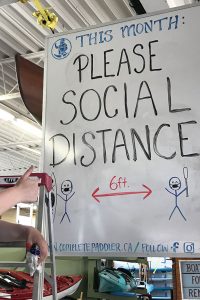
New public health protocols | Photo: Courtesy The Complete Paddler
How long this leveling will last is anyone’s guess. While specialty retailers may have outmaneuvered their larger rivals going into the pandemic storm, big box retailers still managed to come through just fine. The Outdoor Industry Association estimates recreational kayaking was the fastest-growing paddlesports segment in 2020, increasing 14 percent. The bulk of those sales are price-point boats carried by box stores, which indicates while the big boys may have faced a slow start and limited inventory, they still sold plenty of boats.
The NPD similarly reports watersports sales at athletic specialty and sporting goods stores increased 34 percent in 2020 from 2019, while sales at outdoor specialty stores increased 21 percent. Dick’s Sporting Goods reported a nearly 10 percent increase in same-store sales at the financial close of 2020. While that figure doesn’t break out paddlesports sales specifically, it’s an indicator the sporting goods warehouse is coming out the other side of the pandemic in good shape.
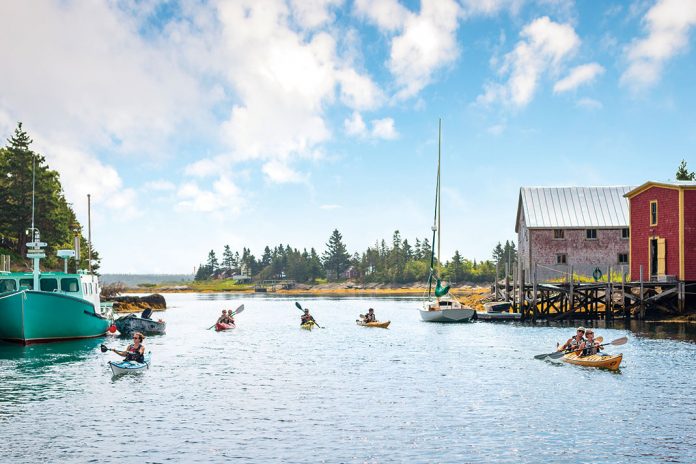
Cape LaHave Adventures, LaHave Islands, Nova Scotia.| Photo: Tourism Nova Scotia / Patrick Rojo
For big box, the pandemic was a blip. To specialty retailers, it was an affirmation of what they already knew: The value paddling shops bring to their communities is as much about the services they provide as the specific gear they carry. Bush says the pandemic sharpened his conviction that a sale should be more than a transaction. Even after 30 years working in paddling retail, the lockdown taught him new ways of connecting with customers he plans to stick with long after things return to normal, whatever that is.
“We are still scheduling people for car rack installs, boat pickups, test paddles—all things we did for social distancing and workflow. It turns out people like it,” says Bush, who after canceling Canoecopia went on to have one of his best years in business. Some of this comes down to his flexibility and knowledge of the industry, but Bush says the secret of his smooth landing is still the customer experience.
“You have your boat picked out, and when you get there, we have it unwrapped. And we are installing your car rack. And while we are doing this, we are talking about paddles and life jackets. It’s very curated. By the time we
are done, their boat is loaded on the car, they are ready to go and they are stoked. It’s changed the experience, and it’s changed it for the better.”
This article was first published in the 2022 issue of Paddling Business. Inside you’ll find the year’s hottest gear for canoeing, kayaking, whitewater and paddleboarding. Plus: Industry leaders on surviving COVID, the dirty little secret of pro deals, brand consolidation and more. READ IT NOW »
Cape LaHave Adventures, LaHave Islands, Nova Scotia. | Photo: Tourism Nova Scotia / Patrick Rojo
“Adventure is a state of mind, a spirit of trying something new and leaving your comfort zone. If this is true, then adventure can be can found everywhere, every day, and it is up to us to seek it out.” —Alastair Humphreys. Nick Troutman on Homestake Creek, Colorado. | Photo: Dane Jackson
There’s a thin blue line a dozen miles from my house on satellite photos. It is insignificant enough it doesn’t even have a name on Google Maps. In these stay-close-to-home days, even the most insignificant lines on the map take on significance. I’ve passed by this little stream countless times over the years with only idle curiosity about where it goes. It was not until it finally occurred to me to investigate the stream’s fly fishing potential did I realize it as a beautiful little spring whitewater creek.
Twenty years with this insignificant stream in my backyard, and this was the spring I was going to run it.
[ Find your next adventure in the Paddling Trip Guide ]
The only real difference between an adventure and an activity is knowledge of the outcome. An activity is predictable—enjoyable on all levels, but it usually goes by a script with little variation. A mountain bike ride on the trails down my road is a repeat of the hundreds of other times I’ve ridden the same routes. My local kayak run is an activity. I know each rapid, eddyline and the push to expect from the current at every water level. The river itself has become a script of sorts, with little variation.
Fun? Absolutely. An adventure? Not any more.
Staying close to home for so long has me hungry for something unknown. Or, at least, an unknown I can explore and overcome on my own, rather than the macro unknowns of the coming months.
Most formal definitions of the word adventure sound like this: To engage in a daring or risky activity. Every definition includes something about risk. But risk can refer to the uncertainty of the outcome, not necessarily danger to life or limb. I’ve lost interest in the latter. For me, adventure is any time I push off with the perspective, “well, we’ll see how this goes.”
“Adventure is a state of mind, a spirit of trying something new and leaving your comfort zone. If this is true, then adventure can be can found everywhere, every day, and it is up to us to seek it out.” —Alastair Humphreys. Nick Troutman on Homestake Creek, Colorado. | Photo: Dane Jackson
So it was with my solo spring creek run this year. The creek is tiny—20 feet across—a flow of perhaps 16 cubic feet per second. It drops away from the road in a beautiful 15-foot cascading waterfall and then easy pool-drop rapids, meandering deeper into nowhere. I brought a topo map and tried to follow along, but quickly gave up hope with the countless bends and new beaver ponds and dams not on the map.
I was a couple of hours in before I looked at my watch and started to wonder how much farther it was to the only other access point, where I’d left my truck. I didn’t know where I was, but at least I knew where I was going.
I passed some unexpected sights, including a stretch of swifts pinched between vertical rock walls—a mini canyon a half-kilometer long. Another section of flat oxbow bends dumped into a rock amphitheater with smooth sloping walls in a perfect bowl, where the river exited in a perfect little four-foot drop.
In the end, it was a long day of more than seven hours. Way more than I expected. But almost all runnable, easy rapids and lots of beaver dams and flatwater.
By the end, I was getting anxious to find the take-out. The last hour was tension-filled, each rapid more worrisome rather than enjoyable. I was tired and doubting whether I’d somehow missed my stop. Of course, the backroad bridge finally came into view. Micro adventure concluded.
Would I do it again? Unlikely. But that’s not the point, is it?
A little backyard creek had provided a brief foray into something unknown. Big or small, new or little-explored, opportunity for adventure is everywhere.
This article was first published in Paddling Magazine Issue 64. Subscribe to Paddling Magazine’s print and digital editions here, or download the Paddling Magazine app and browse the digital archives here.
Jeff Jackson is a professor of outdoor education at Algonquin College near the banks of the Ottawa River and some unnamed spring creek.
“Adventure is a state of mind, a spirit of trying something new and leaving your comfort zone. If this is true, then adventure can be can found everywhere, every day, and it is up to us to seek it out.” —Alastair Humphreys. Nick Troutman on Homestake Creek, Colorado. |Photo: Dane Jackson
When the world’s best whitewater kayakers come together to race down some of the planet’s burliest rapids, you know you’re in for a good show.
The IX North Fork Championship did not disappoint. This summer’s event—informally coined “The Return”—felt monumental to athletes, spectators and organizers alike. Not only did we see the transition in event organization for James and Regan Byrd to the Voorhees family, but we also saw more female athletes representing than ever before.
To add a fresh layer of excitement, a huge boulder dropped into the meat of the infamous “Jacob’s Ladder” rapid, where the final races are held. As the event organizers put it, the hardest rapid got even harder.
“I think what we watch on Jacob’s Ladder, not just this NFC but all of NFCs—but especially this year with that new energy from being gone—is the harmony of the boat, the water and athleticism,” said Ryan Bailey, NFC Emcee & Banks, Idaho local.
Pre-pandemic, the Trump administration was the topic that could quickly cause a fracture in cohesive group dynamics on trip; COVID-19 could be the new polarizing topic. | Photo: Brendan Kowtecky
In May 2020, Steve Markle, vice president of sales and marketing for American rafting and sea kayaking outfitter OARS, was faced with the task of processing thousands of trip cancellations.
“It was a very challenging time. We didn’t know what the future looked like,” he recalls. A year later, OARS is on the verge of an unprecedented season. For the first time in nearly two decades, it’s nearly sold-out of its multiday trips in the western United States.
“The enthusiasm for booking guided outdoor activities is off the charts,” says Markle. “People realize a guided paddling trip might be one of the best possible options for vacationing during a pandemic.”
During the pandemic, the interest in paddlesports grew exponentially. By June 2020, dollar sales of canoes, kayaks and paddleboards in the United States had increased by 56 percent compared to June 2019, reaching $172 million in sales, according to market research group NDP. Money people would normally earmark for a holiday was being invested into getting on the water. Now, with vaccines rolling out, this interest is translating to holidays.
Based on an analysis of Google searches before and during the pandemic, the World Travel & Tourism Council predicts adventure travel will be the first sector to make a full recovery. And according to a 2020 study conducted by the Adventure Travel Trade Association (ATTA), adventure travel is likely to recover three to four years earlier than mass travel.
It could be the allure of fresh air, the introduction of more flexible cancellation policies, or the fact adventure travelers are generally less risk-averse. However, even as multiday water trips are experiencing a surge in popularity, they’re not the same carefree days in the wilderness they once were.
Pre-pandemic, the Trump administration was the topic that could quickly cause a fracture in cohesive group dynamics on trip; COVID-19 could be the new polarizing topic. | Photo: Brendan Kowtecky
The most obvious change is to health and safety procedures. Although being well-versed in risk management has always been part of the job description for outfitters, it’s now at the forefront, with group sizes reduced and mask-wearing enforced. For its part, OARS created a comprehensive 32-page COVID-19 health and safety document, which Markle describes as “modest.”
Improved health and safety procedures are the most superficial changes. The true effects of the pandemic are likely going to be felt for years to come. Jobs in tourism—which just over a year ago was perceived as a secure and growing industry, contributing $2.9 trillion to the global economy—is now a precarious career choice. Even with outfitters experiencing a high volume of bookings for 2021, an outbreak or lockdown could mean a massive loss of income for kayaking guides, who are often employed seasonally and paid per trip.
While government wage subsidy programs have helped outfitters like British Columbia’s Spirit of the West Adventures keep staff on payroll, co-owner Rick Snowdon believes the skills gap will be felt in a few years.
“It’s not something that’s affected us yet, but it’s going to become apparent when guided trips pick back up,” he says. “We’re going to be scrambling to find qualified guides. There’ll be a training gap due to the pandemic forcing people into other professions.”
Along with the challenges have come opportunities. In the last year, the social justice movement has given rise to groups like the Black Travel Alliance, holding outfitters accountable for improving diversity outdoors through their marketing and hiring practices. There’s also increased focus on environmental sustainability, with the climate crisis remaining at the forefront of travelers’ minds. While many outfitters are banking on open air as the top-selling feature, Adventure Travel Trade Association CEO Shannon Stowell believes the sector’s rapid recovery is because of something else.
“Adventure travel is passion driven,” he says. “Kayakers, birders and cyclists are people who partly define who they are by those activities. It gives me a lot of hope for the strength of recovery.”
This article was first published in Paddling Magazine Issue 64. Subscribe to Paddling Magazine’s print and digital editions here, or download the Paddling Magazine app and browse the digital archives here.
Pre-pandemic, the Trump administration was the topic that could quickly cause a fracture in cohesive group dynamics on trip; COVID-19 could be the new polarizing topic. | Photo: Brendan Kowtecky
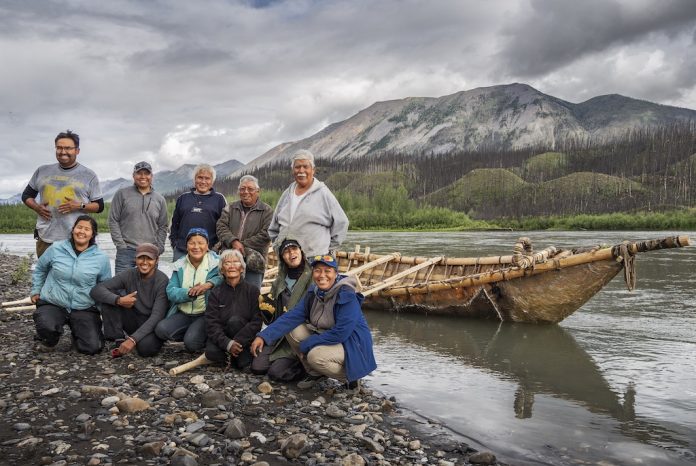
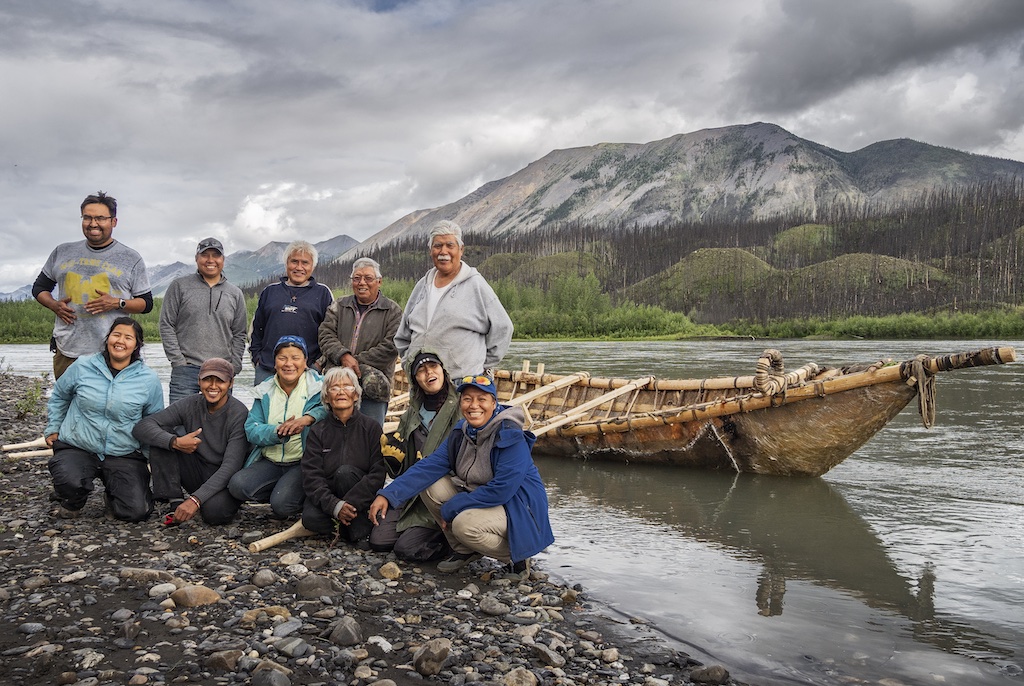
Traditional mooseskin canoe on the shore of the Nahanni River in the Northwest Territories while filming Nahanni: River of Forgiveness | Photo: John Bingham
It had been more than 100 years since a mooseskin boat had been down the Nahanni River.
To bring the tradition back to life, 12 Dene explorers gathered at Bunny Bar on Na’ha Dehé, the remote Nahanni River, in Canada’s Northwest Territories. Over several days at the campsite, the group harvested materials and sewed and sawed, creating a 36-foot traditional boat out of spruce, sinew and seven moose hides.
The 500-kilometer journey from Bunny Bar to the town of Fort Simpson was made in 2018. It was an expedition made to revive traditional skills, inspire a new generation of youth, and honor Dene ancestors, who have lived in the Mackenzie Mountain range for tens of thousands of years. This photo was taken after the mooseskin boat rolled into the water for the first time.
Accompanying the Dene was a team of documentary filmmakers and river guides. Everyone was thrilled to see the mooseskin boat launch and move gracefully through the water. Leon, on the 20-foot rudder oar, was happy with how well it handled: “We could pretty much go wherever we wanted,” he said.
Traditional mooseskin boat on the shore of the Nahanni River in the Northwest Territories during the filming of feature length documentary, Nahanni: River of Forgiveness. | Photo: John Bingham
The day after launching brought the group to Gahnihthah, one of the most sacred sites in Denendeh, the land of the Dene. Gahnihthah, also known as Rabbit Kettle Hot Springs is the largest tufa mound in Canada. A place of many legends, it is said to be the birthplace of Yamoria, a mythic Dene hero and spiritual figure who established Dene laws. Mineral rich, warm water bubbles up from deep in the earth, spills over the edge of the pool and flows down the mound leaving mineral deposits called tufa, a porous rock composed of calcium carbonate.
Five days of travel brought the mooseskin boat to Virginia Falls. At 96 meters tall, Virginia Falls is almost twice the height of Niagara Falls. The Dene call this place Nailicho or “Big Falling Water.” A century ago, portaging the boat around the falls may have taken up to a week and was accomplished by rolling the canoe along a series of logs on a slipway. The trail is now protected as part of Nahanni National Park Reserve. So, for the very first time, a helicopter descended to lift the mooseskin boat into the blue and transport it around the falls.
“If I was a mooseskin boat, I’d be happy flying through the air,” observed Herb Norwegian, Grand Chief of the Dehcho First Nations at the time. “The ancestors would think this is a very spiritual experience.”
The mooseskin boat touched down a few kilometers later at Marengo Creek, skipping the rapids of the Nahanni’s Fourth Canyon due to concerns about the durability of some of the moose hides. The crew spent three days portaging down the old-fashioned way.
When the team reached Marengo Creek, the water level had dropped dramatically, and team member Ricky found the boat high and dry on shore. As he peeled back the tarp, his worst fear came true—in drying out, a hide had given out and he was staring at some major holes. The boat could not be repaired here and starting over was impossible. That night in the tents, with a new moon in the night sky, the mood was dark.
The decision was made to get the mooseskin boat downriver to Nahanni Butte as quickly as possible for repair. The guides reported they had 16 rubber sponsons—red floaties—that could be lashed together around the boat so it could be towed to the community of Nahanni Butte where the Dene could fix it. The boat was slowly towed hundreds of kilometers through some of the most magnificent territory, including class III rapids, through incredible geological formations like the Gate, and past canyon walls towering over a 1,000 meters high.
The Dene repaired the boat in Nahanni Butte the best they could. And then they finished the journey, paddling another three days to Fort Simpson.
A hundred people were on the beach to welcome them home, curious to touch the boat of the ancestors. The Dene never gave up. They nurtured the spirit of the boat so it could convey its message of hope to the Dene and to Indigenous people across Canada and around the world.
Geoff Bowie is the director of the feature length, award-winning documentary, Nahanni: The River of Forgiveness. The film is available on CBC’s documentary Channel. Watch the trailer below. Discover the award-winning interactive story at riverofforgiveness.com.
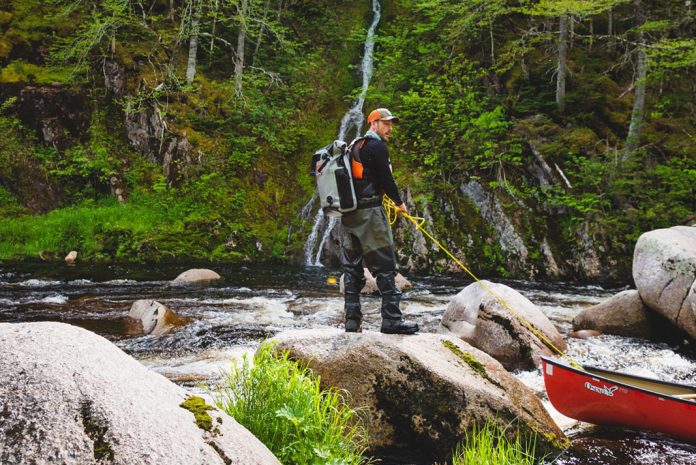
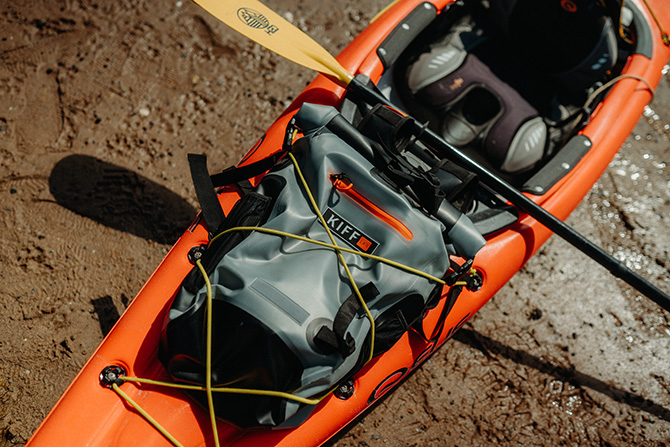
Kifflab’s TuziGazi35 may have been manufactured to have minimal environmental impact, but it was also built tough for all seasons. If you want to protect your gear from the elements, this is the pack for you.
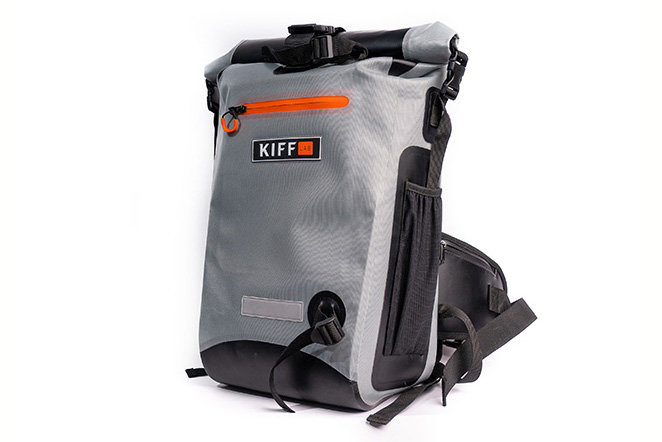
The TuziGazi35 is a quality rolltop dry backpack made of advanced material called Thermoplastic Polyurethane (TPU). TPU is one of the strongest materials in the market – yet it is lightweight, recyclable and biodegradable within 5 years. The outer bag is ripstop nylon, which is made from recycled materials such as plastic bottles, industrial plastic and waste fabric. The production process is a lot less harmful to the environment than traditional nylon production. Even the tags on the bags are made from recycled paper/cardboard materials.
Small Internal zip pocket to keep phone/keys/wallet dry
Two mesh pockets on either side suitable for 1L bottles
Quick close buckles
Top carry handle
Very easy-to-clean material
Easy access emergency whistle
Reflective strip on front side
Photo Courtesy of Kifflab
The TuziGazi range is named after two great rivers, Mhlathuze and Mzingazi, which flow into one of the largest natural harbours in the world and Kifflab was born out of experiences between friends who love the outdoors and grew up in the Richards Bay area. They have created their own outdoor brand that focuses on the technical capabilities of outdoor gear with an ethos built around social responsibility, believing that the world needs more innovative and environmentally conscious products. Their mission is to create a positive impact in every choice, every material, and every item they produce, and they looked for suppliers and manufacturers whose values were compatible with their own.
The TuziGazi35 is not only eco-friendly, it’s also extremely tough and waterproof, while being light and adventure-safe. Grant of Kifflab says, “We hope our product inspires people to go out and have the same adventures that we enjoy.”
Photo Courtesy of Kifflab
About Kifflab
Kifflab’s head office is based in Halifax, Nova Scotia, Canada and there are fulfillment centres in South Africa and United Kingdom. For more information, visit the website www.kifflab.com and Grant can be contacted via info@kifflab.com.
Kifflab – designing technical outdoor products with a social conscience.
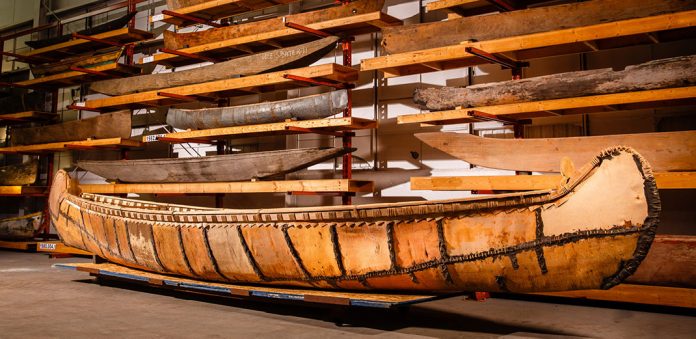
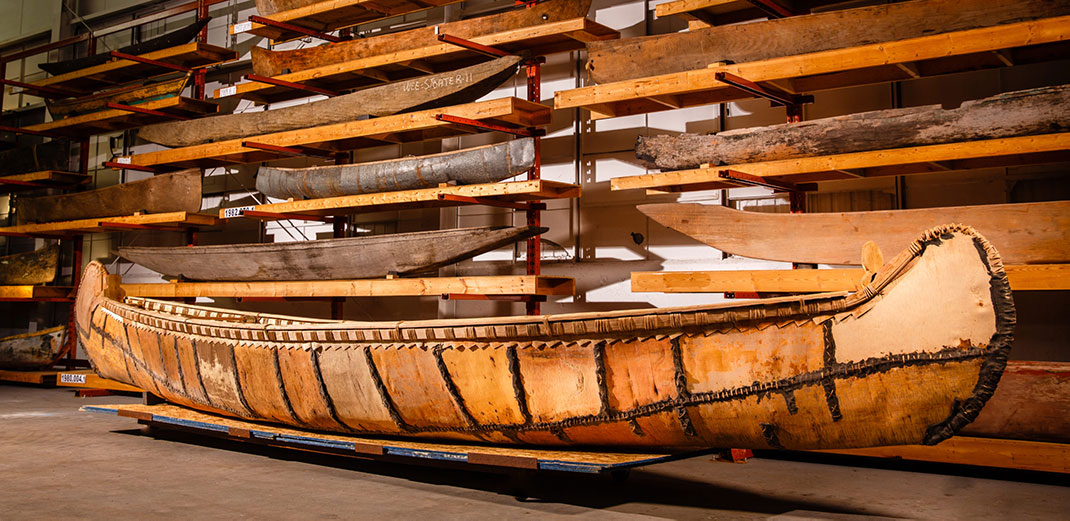
Kokomis Tchiman, a 26-foot long birchbark canoe built by Marcel Labelle, Métis elder and canoe-builder from the Mattawa Ontario region, sits on display in the Canadian Canoe Museum’s collection storage centre. Photo by Fusionriver Photography. | Courtesy of the Canadian Canoe Museum.
PETERBOROUGH, ON, August 25, 2021 – Visitors to the new Canadian Canoe Museum (CCM) will see and hear languages and voices from Indigenous communities the moment they step into the museum, thanks to funding from TD Bank Group.
The new home for the CCM, set to break ground this fall and open in 2023, will feature a 17,000 square foot exhibition gallery that will share the history and enduring relevance of the canoe and kayak.
With a significant gift of $500,000 over five years from TD, the Museum will work directly with individuals in eight Indigenous communities. The funding also enables the CCM to hire an emerging Indigenous museum professional. These actions will help ensure that knowledges, perspectives, and voices from Indigenous communities are directly represented in the exhibitions and educational programming.
“The CCM has a deep commitment to collaborative relations with the Indigenous communities of origin across Turtle Island (Canada) for the watercraft in the Museum’s collection,” explains curator Jeremy Ward.
As part of this work, the CCM is hiring people from eight different Indigenous communities to support language-related projects that will create content for the new exhibits and support collections care. Building outwards from relations with Curve Lake, Hiawatha, Alderville and Scugog – local Michi Saagig First Nations on whose territory the CCM resides – the Museum will work with Inuit communities in northern Labrador and Nunavik, Mi’kmaq in the east and the Haida Gwaii Museum in the west. In each community, the Museum’s team will gather knowledge about canoes and kayaks, their roles in resource harvesting, changes caused by settlement, and the resurgence of Indigenous watercraft-making and use as part of community healing.
Kokomis Tchiman, a 26-foot long birchbark canoe built by Marcel Labelle, Métis elder and canoe-builder from the Mattawa Ontario region, sits on display in the Canadian Canoe Museum’s collection storage centre. Photo by Fusionriver Photography. | Courtesy of the Canadian Canoe Museum.
Ward elaborates, “All work supports languages from Indigenous communities, whether by recording vocabulary about canoes in Anishnaabemowin, interviews conducted by fluent Haida speakers with language learners, or translating conversations from Michif or Inuktitut, ensuring Indigenous People can speak their truths in their own language, and voice.”
The Michi Saagig dialect of Anishnaabemowin will be used throughout the Museum and within its exhibits alongside English and French, and other languages from Indigenous communities will feature in relation to specific watercraft.
Anne Taylor, the CCM’s Language Advisor for local Williams Treaties communities, emphasizes the importance of having Michi Saagiig Anishinaabemowin incorporated throughout the exhibits: “CCM ezhinkaadeg yaamgad omaa Michi Saagiig. Wgii kendaanaawaa Michi Saagiig anishinaabe nake ge zhi aabjitoowaad aki minwaa ziibiisan ge gchi nibi ji mno bimaadziwad. Michi Saagiig anishinaabemowin mshkowziimgad miidash nake ezhi giidgoyang. Pane aabjitooyang iw zhiibiisan ge gchi nibi iw pii gooji zhaayang miigo ji mno taagwak iw anishinaabemwin ge ji miinigid giw e bi yaawaad. Mii iw anishinaabewin ge tamgak iw gaa bi zhiwebak minwaa niw aanso kejanan minwaa niw mno bmaadziwnan.”
[Translation: “The Canadian Canoe Museum sits in Michi Saagiig territory. The Michi Saagiig Anishinaabeg have been thriving on the lands and waters within their territory for countless generations. It is imperative that Michi Saagiig Anishinaabemowin occupy a place of honour and respect within the Museum, as Anishinaabemowin contains the history, stories and traditions of these lands and waters and the Michi Saagiig people, who continue to thrive and travel the same water routes as countless generations before.”]
The CCM looks forward to honouring this responsibility with the First Nations that host the Museum on their territory, and with many other Indigenous Nations across Turtle Island (Canada).
“We are extremely proud to support the Canadian Canoe Museum through the TD Ready Commitment, the Bank’s global corporate citizenship platform,” said Doris Bear, Vice President, Indigenous Banking at TD Bank Group. “By supporting programming that elevates language and voices from Indigenous communities, and working together with local community members, we are ensuring the history, knowledge, and the accomplishments of Indigenous Peoples are carried forward. Initiatives like this one that elevate the language and culture of Indigenous Peoples are an important step as we collectively work towards Truth and Reconciliation as Canadians.”
Funding for the CCM’s Indigenous Languages Program marks the largest investment made to date by TD Bank Group through TD Ready Commitment program in the Peterborough region.
For more information about the new museum or the CCM’s collaborative relations work with Indigenous communities visit canoemuseum.ca/collaborative-relations.
About The Canadian Canoe Museum (CCM)
With a world-class collection as a catalyst, The Canadian Canoe Museum inspires connection, curiosity and new understanding. In partnership with individuals, groups and communities – locally, provincially and nationally – we work to experience and explore all that our collection can inspire. This sees students opening their minds in our galleries; community members connecting through artisanry; people of all ages getting on the water and learning to paddle; and exhibitions and events that spark conversation and collaboration.
About the New Museum
The Canadian Canoe Museum is building a new home for its world-class collection along the water’s edge in Peterborough, ON. The new museum will be located on a five-acre site in Peterborough, ON that will provide stunning west-facing views of Little Lake, a connection to the Trans Canada Trail, and is surrounded by public parks. It will become a vibrant community space for outdoor activities and the Museum’s canoeing and outdoor programs and events.
The Canadian Canoe Museum has a unique opportunity to create a new cultural destination that will inspire visitors to learn about Canada’s collective history and reinforce our connections to land, water and one another – all through the unique lens of the iconic canoe. Learn more at canoemuseum.ca/new-museum.
For further information or interview requests, please contact: Rachelia Giardino Marketing & Social Media Specialist rachelia.giardino@canoemuseum.ca 705.748.9153 ext. 216
Kokomis Tchiman, a 26-foot long birchbark canoe built by Marcel Labelle, Métis elder and canoe-builder from the Mattawa Ontario region, sits on display in the Canadian Canoe Museum’s collection storage centre. Photo by Fusionriver Photography. | Photo courtesy of the Canadian Canoe Museum.
As paddlers, we always prepare for those worst-case scenarios, while simultaneously hoping for enjoyable, drama-free days on the water. The memories we make are usually the endearing kind.
But when those scary, bad days do happen, you can bet the internet will hear about it. YouTube channel “World List” is all about finding “funny, crazy, scary, sad and sometimes chilling information” and compiling it into one easily digestible list.
In a recent video, World List compiled 10 of the scariest kayaking incidents of all time into 12 action-packed minutes. From otters attacking senior boaters, to kayakers being killed by gunfire mid-expedition, this video really has a lot of shocking stories to tell.
[ Browse all Kayaking, Canoeing and SUP Trips in the Paddling Trip Guide ]
Do you believe all the stories told here? Are there any that have been missed off this list? Comment your thoughts below.




 Astral
 Whitewater Technology
 Pyranha Kayaks
 Origami
 This article was first published in the 2022 issue of Paddling Business. Inside you’ll find the year’s hottest gear for canoeing, kayaking, whitewater and paddleboarding. Plus: Industry leaders on surviving COVID, the dirty little secret of pro deals, brand consolidation and more.