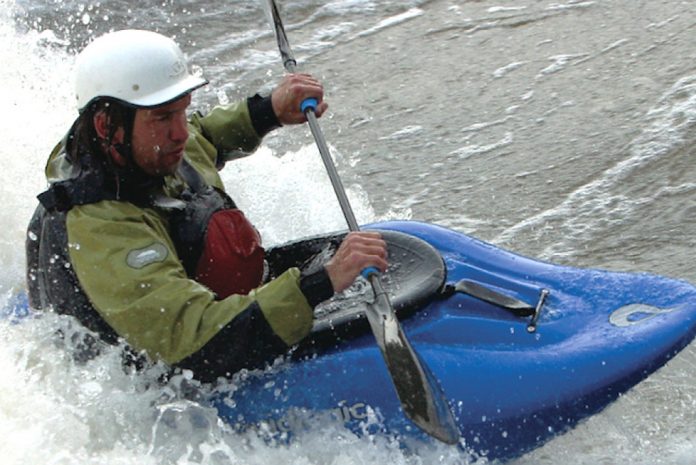
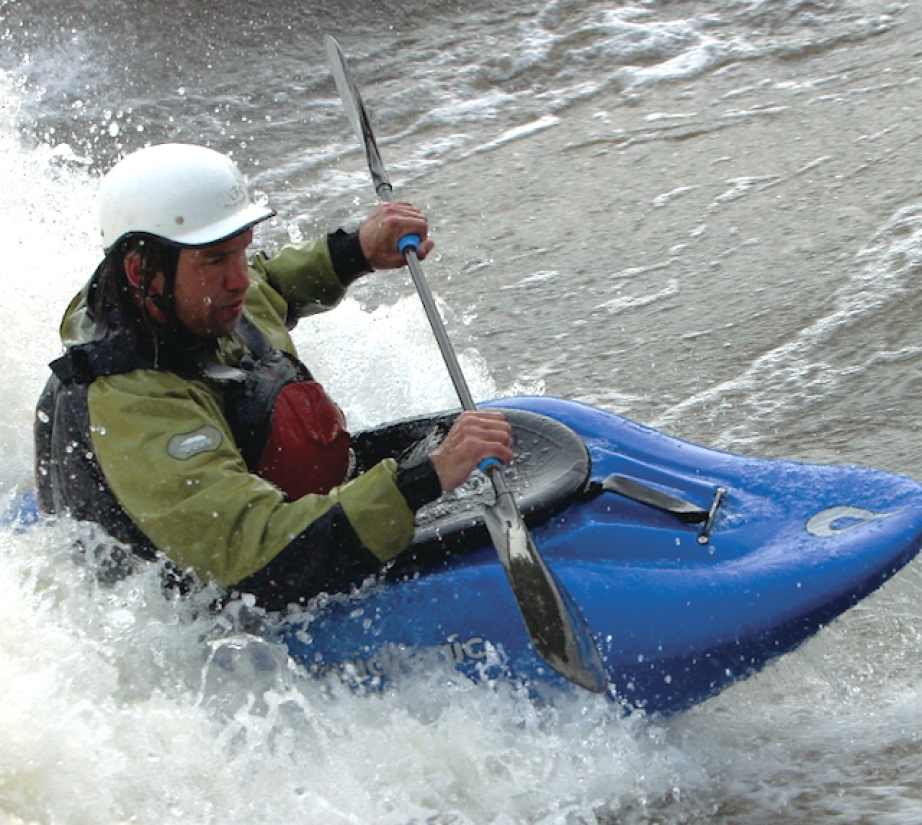
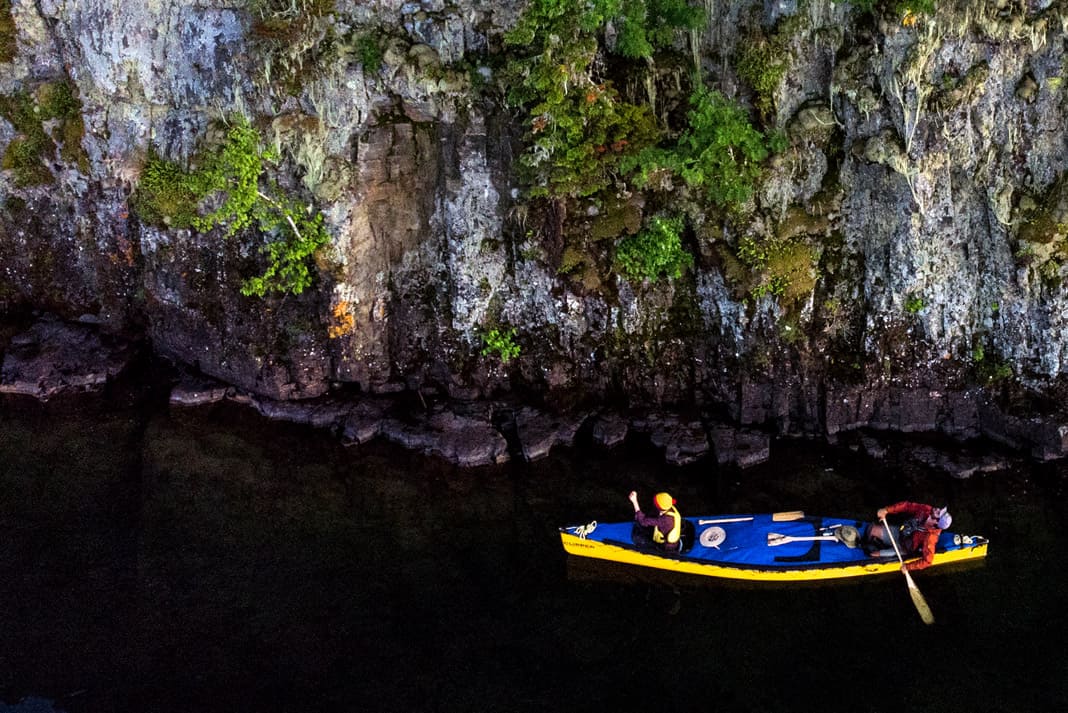
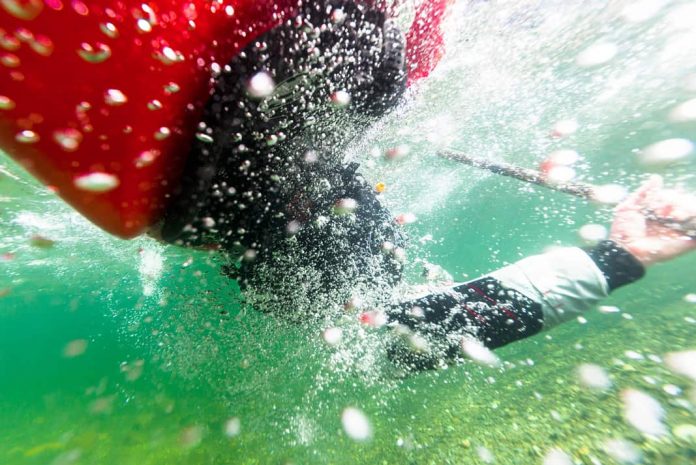
Take the air ability of Liquidlogic’s Space Series and add a little extra speed and paddleability to the mix. What do you end up with? Meet the new Liquidlogic Big Wheel and Scooter kayaks.
Liquidlogic Scooter / Big Wheel Specs
Length: 5’11” / 6’1”
Width: 24.5” / 25.5”
Cockpit: 18.75” × 33.25” / 18.75” × 33.25”
Volume: 50 / 57 U.S. gal
Weight: 29 / 31 lbs
MSRP:$1,049 USD or $1,400 CAD
[ Paddling Buyer’s Guide: See all Liquidlogic kayaks ]
Liquidlogic’s Big Wheel and Scooter get big air
A narrow waterline bow to stern gives powerful edge-to-edge transitions for huge air off waves, and a more streamlined volume distribution makes cartwheels and large loops easy.
Try this innovative idea on for size
Stuffed down at your feet is a bean-filled drybag that you mash until you have the proper fit. Most testers under 5’8” agreed this is an innovative idea; the rest had to watch the action from shore. The seat, thigh braces and backband combo is “sweet.” Elaborated, “sweet” means functional and light, and, off the rack, shaped to fit most Goldilockses.
To achieve greater speed in the Big Wheel and Scooter, Liquidlogic elongated the planing surface toward the stern. Pro boater Patrick Camblin explains: “This boat needs to be bounced differently to realize its potential. Having a lower-rocker stern means that, while faster, when butt bounced and the bow goes in the air, the stern begins to drag in the green water, not allowing it to release.”
Feature Photo: Rapid Staff
[ Plan your next whitewater kayak adventure with the Paddling Trip Guide ]
To Helix or not to Helix
The Big Wheel is all about edge-to-edge transition for aerial moves. Get backwards however and the bow rocker releases unmatched aerial backstabs. The narrow waterline, crisp edges and negligible stern allow for quick, clean Helix rotations and landings.
Can’t Helix yet? The Big Wheel is fun carving steep, fast waves but loses some luster when the bitty stern squats into a small foam pile—sort of blasting the wave face. In little pourovers and meaty holes the new slicier ends snap through at lightning speed.
Pros and cons of the Liquidlogic Big Wheel and Scooter
Pro: Light. Faster than last year’s Liquidlogic boat. Snappy edge-to-edge. Huge aerial backstabs.
Con: Sticky spinning on small features. Quirky sizing.
This article was first published in the Summer 2004 issue of Rapid Magazine. Subscribe to Paddling Magazine’s print and digital editions, or browse the archives.
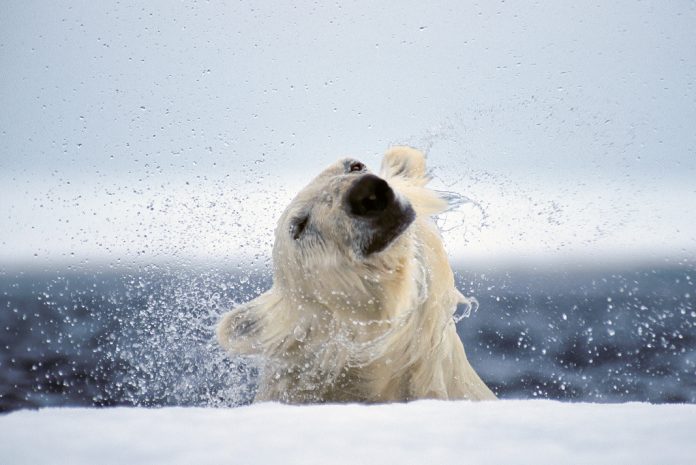
The average male polar bear weighs between 775 to 1,200 pounds (351 to 544 kilograms). See more of Paul Nicklen's limited edition fine art collection at paulnicklen.com/fine-art. | Photo: Paul Nicklen
My two main passions are paddling and the North. Over the last four years, the North has been my main focus while working on a book about polar bears. Paddling has taken a back seat—if you don’t count daily toots around the lake with the dogs at home—but there’s one story connecting bears and boats still keeping me up at night.
Five of us were on an exploratory sea kayak journey in Wager Bay, high up on the western shore of Hudson Bay. We were investigating the recreational potential of what would become Ukkusiksalik National Park in Nunavut. In addition to its sheltered waters and rich cultural, historical, geological and geographical heritage, it is captivating for its big white bears. When the ice of Hudson Bay melts, Nanook heads to the shores of Wager Bay for the summer fast. On average, scientists estimated something like 80 bears per 100 kilometers of shoreline—which is a lot of bears.
We traveled with a group of Inuit from Arviat and Repulse Bay, led by the late Louis Pilakapsi, who was there to site a naturalist’s lodge he and others were looking to start in conjunction with the creation of the national park. Louis and company traveled in open motorized canoes, camped in wall tents and were actively hunting as we made our way around the coast. As long as we camped near them, the bear threat was low.
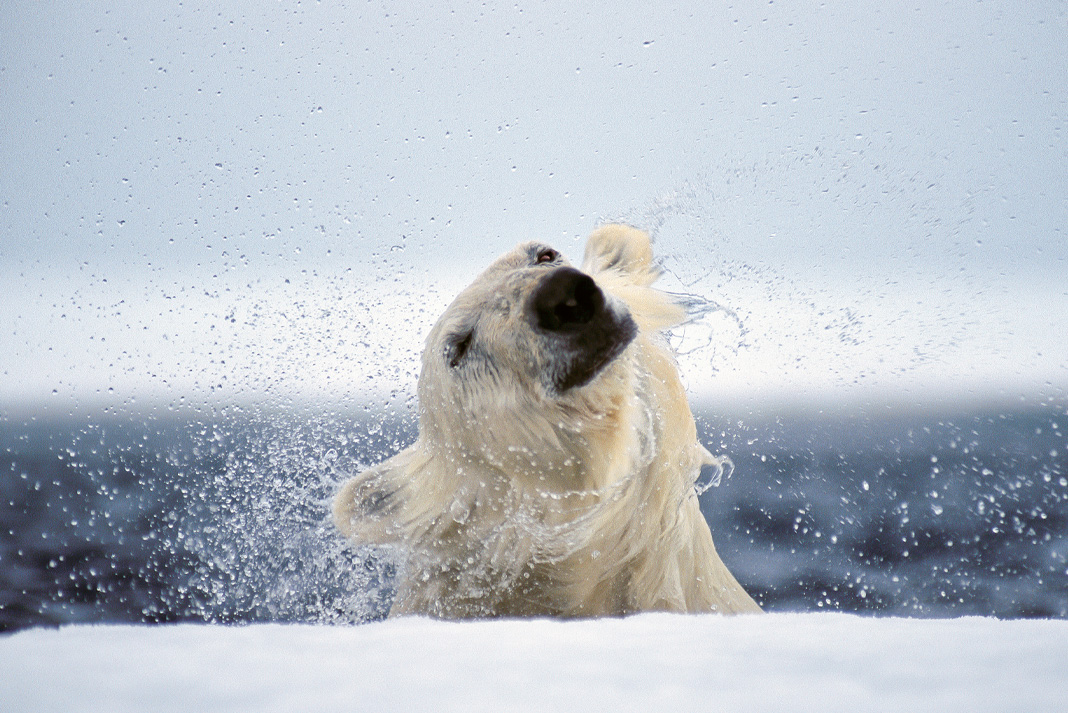
The average male polar bear weighs between 775 to 1,200 pounds (351 to 544 kilograms). See more of Paul Nicklen’s limited edition fine art collection at paulnicklen.com/fine-art. | Photo: Paul Nicklen
When we split the group and went our separate ways for days at a time, things got interesting. Heading out onto the treeless Arctic tundra to answer nature’s call required two people—one with TP, one with a gun. As long as we stayed together on and off the water, we were reasonably safe. It was when the togetherness of a small herd of kayaks and kayakers fell apart, things turned scary.
I happened to be in a solo Feathercraft kayak the day the others pulled out their parasails to take advantage of a brisk following wind. They had sail assist, I did not. Within minutes, I was alone. All was going swimmingly—I was contemplating life in general, daydreaming and admiring the colors of the other two boats under sail against the blue of the Arctic sky as they got smaller and smaller. Life, I eventually concluded, was perfect.
It was about then everything clicked into slow motion. Paddling a few hundred feet offshore, I turned left and spied a big male polar bear paralleling me along the shore, step for stroke, stroke for step.
The first shot of adrenalin perfused every muscle in my body. My first instinct was to turn away and increase the distance between us. Until I shot a furtive glance over my shoulder just in time to see the bear drop into the water and start to swim.
My next instinct was to pick up the pace, but details from papers I read at school reminded me polar bears have been sighted 50 miles from land. They can swim at six miles an hour almost indefinitely, certainly for far longer than I could paddle at top speed.
Bear in the water. Paddler on the water. Distance between them diminishing. Me flailing, inside and out.
In the next moments, which stretch to eternity in the memory of this encounter, many things flashed over and through my brain. This bear has likely not eaten anything substantial since it came ashore, maybe a month ago. This is a hungry bear. What kind of personality does this bear have? Do bears even have personalities? Has Myers Briggs even thought of that? Has this bear seen other kayakers? Certainly, this being Inuit territory. Has it eaten other kayakers?
“Polar bears can swim at six miles an hour almost indefinitely,
certainly for far longer than I could paddle at top speed.”
My kayak’s skin was soft and drum-like over its frame. Not a great armor to fend off a hungry bear. If I honked on the Fox 40 whistle on my PFD zipper, would the others even catch a sound on the wind? Would they even be interested in paddling upwind to see why I wasn’t coming along?
What a spectacular place to die. Or something like that.
It was like the totality of a feature-length movie starring me and a big male polar bear ripped through my consciousness in a few fluttering beats of my adventuring heart.
Then, just as effortlessly as it had slid into the water, the bear turned back toward shore, hauled itself out onto the rocks with practiced ease, shook in a magnificent cascade of spray, and trundled on up the bank.
Today was not the last day of my natural life.
With a fuzzy and electric post-car-crash adrenalin hangover ebbing every joule of energy from my body, I sat in the kayak. Breathing. Just breathing. And watching, as the whiteness of the moving, shrinking bear contrasted the tundra summer greens. Scanning back along the shore, where this crazy vignette had begun, I noticed a small cliff rising out of the water. And with it—ding!—crystallized a completely different scenario.
The bear is ambling along the beach. It comes upon the little cliff. Instead of wasting energy on lumbering up to higher ground and working his way over the cliff and dropping back down to the beach, he simply flopped into the water. He swam around the obstacle before continuing along the shore. In Latin, polar bears are Ursus maritimus, sea bears, bears who are as comfortable in the water as on land or ice—duh. Whether he knew or cared I was there at all, that bear had no interest in the drama going on in my head. The bear was just doing his bear thing.
We humans aren’t the center of anything except our own reflections. We don’t figure at all in the universe of the polar bear, until of course, we stroll into their home territories or alter the climate to the point the bear’s winter seal hunt gets critically shortened because the sea ice is melting. Coming ashore with less fat to sustain polar bears through the summer fast, that’s an increasing problem too.
All kinds of other changes and shifting circumstances are happening for all living beings, in the North, particularly, as a result of climate change. What’s a bear to do? Kayakers as an emergency energy source could be on the table.
James Raffan is the former executive director of the Canadian Canoe Museum. His new book, Ice Walker, from Simon and Schuster, launches September 29, 2020.
This article was first published inPaddling MagazineIssue 62. Subscribe toPaddling Magazine’s print and digital editions here , or browse the archives here.
The average male polar bear weighs between 775 to 1,200 pounds (351 to 544 kilograms). See more of Paul Nicklen’s limited edition fine art collection at paulnicklen.com/fine-art. | Photo: Paul Nicklen
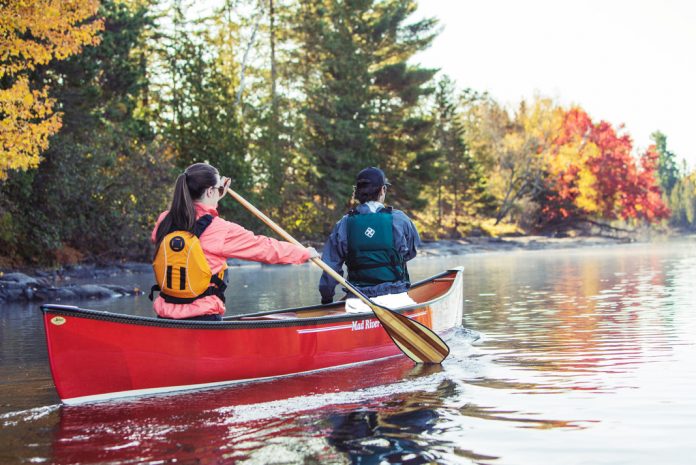
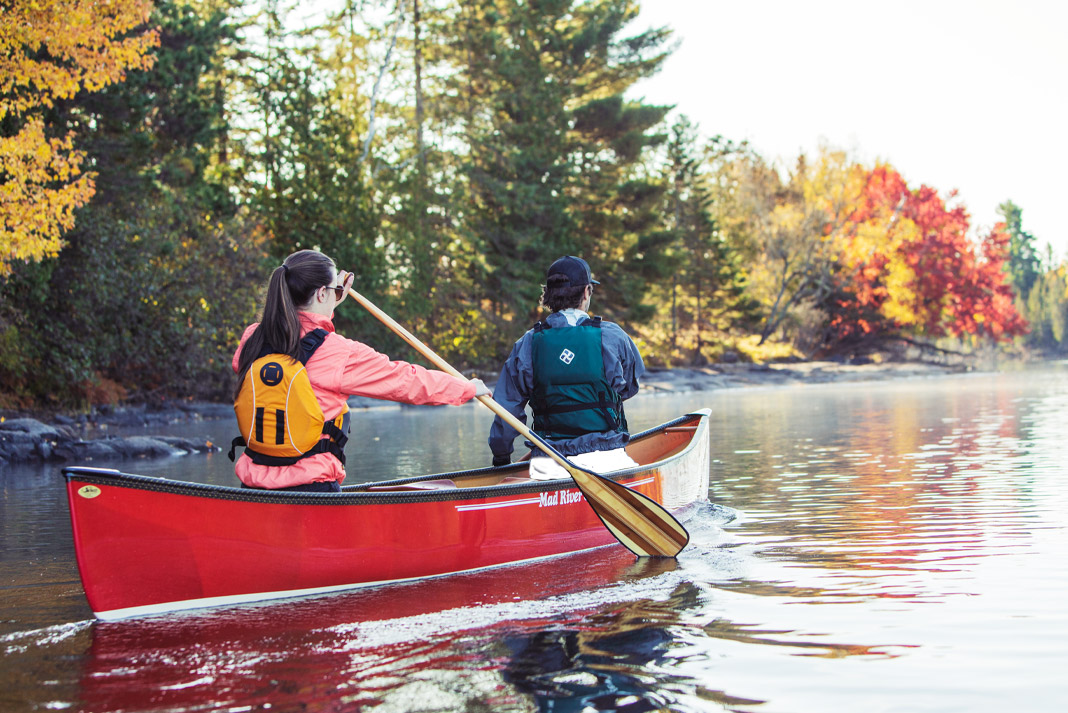
A canoe for all occasions. Even Fancy ones. | Photo: Alex Traynor
In October 2020, Canadian boatbuilder Swift Canoe and Kayaks will take over manufacturing Mad River Canoe’s bestselling design, the Explorer 16, in two composite layups.
Mad River Canoe’s Explorer 16
Length: 16 ft 3 in Width: 35 in
Depth: 15 in
Weight: 44 lbs
Capacity: 1,100 lbs
MSRP: $3,399 USD / $4,349 CAD
The announcement of the partnership was made at industry tradeshow Paddlesports Retailer last August in Oklahoma City. The Paddling Magazine crew was there to get a first-hand look at the sleek new Kevlar and carbon prototypes in the Swift Canoe and Kayak booth. The eye-catching designs were the talk of the show. The Explorer 16 in a carbon layup even won the Best New Canoe award at the 2019 Paddling Magazine Industry Awards, which recognizes new product innovation in the industry (paddlingmag.com/0071).
“We’ve been making boats in-house for a long time, and we wanted to expand capabilities in terms of construction. We’ve done ultralight layups in the past, but Swift is the best in the business at building boats right now,” says Adam Ott, project manager at Confluence Outdoors, Mad River’s parent company.
“I have always been a big fan of Mad River, and I’m very fond of the original owners, Jim and Kay Henry. When Mad River asked us to build the boats, it was an honor,” adds Bill Swift, owner of Swift Canoe and Kayak.
A canoe for all occasions. Even Fancy ones. | Photo: Alex Traynor
Starting in October, Swift will be building all of Mad River’s composite Explorer and Serenade models and delivering them across North America. Production at Swift’s South River, Ontario factory will expand to include 500 to 1,000 composite Mad River builds a year. This means the Swift operation will need more manufacturing help and warehouse space, which will be sorted out as restrictions around the pandemic lift, says Swift. The boats will be Mad River canoes in every way, except each will have a Swift serial number.
[Paddling Buyer’s Guide: View All Mad River Canoe Boats]
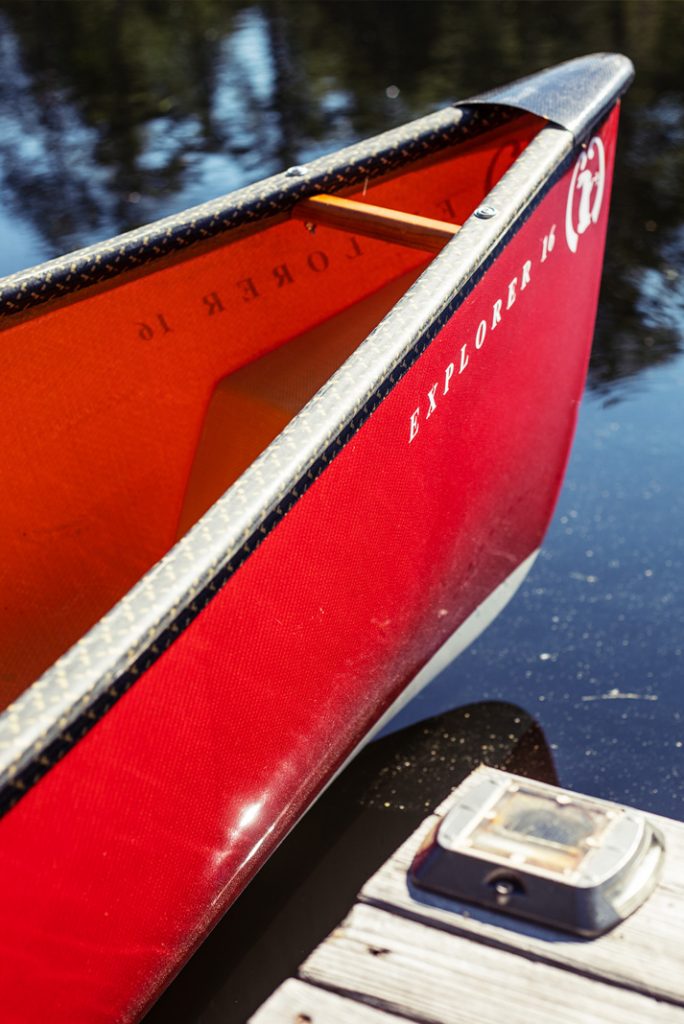
Back at Paddling Magazine headquarters, we picked up a prototype of the Explorer last fall. Thanks to its two-tone look—a distinctive feature of many Swift canoes—the Explorer has never looked better. In a ruby-red-and-white finish, it’s a real head-turner.
Our tester Explorer paddles like the other Mad River Explorers we’ve reviewed. Its symmetrical, shallow-V hull has smooth, predictable handling and excellent stability. With two inches of rocker in the bow and stern, we might not win races, but the easy-paddling Explorer makes up for it with an ideal balance between tracking and maneuverability. It’s a boat we could take almost anywhere. Mad River is right when they deem it a “canoe for all occasions.”
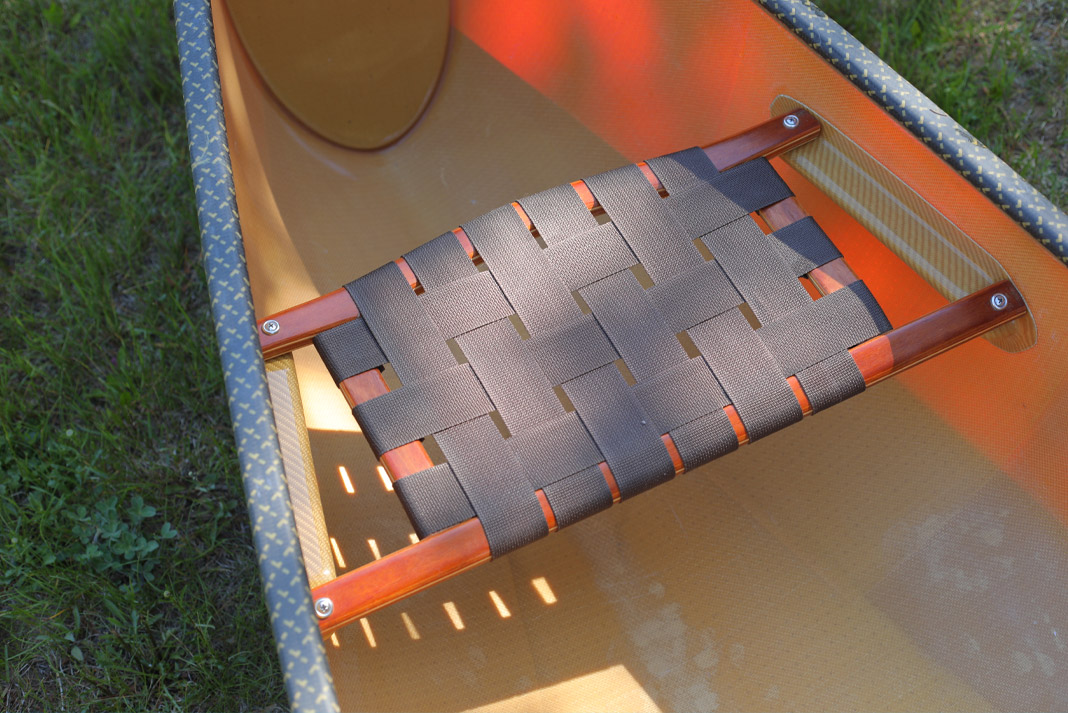
Contoured cherry webbed seats also come standard. The carbon Kevlar trim fuses canoe hull and gunwales into one. | Photo: Michael Hewis
Part of the Mad River lineup for 45 years, the Explorer is Mad River’s bestselling design by far. The key to its success is its versatility, says Ott. “People often ask about the best choice if they want to buy one boat to do everything—it’s always the Explorer,” he says.
Mad River debuted the Explorer in 1975 in fiberglass. It was the second design released by Mad River founder, Jim Henry, coming four years after the company’s very first canoe , the Malecite. Over the past four decades, Mad River has manufactured it in 17 different layups. The Explorer earned its whitewater cred in the ‘70s when it was the first open canoe to run the Colorado River through the Grand Canyon successfully. Yet, it’s equally at home loaded to the gunwales with gear and kids on flatwater family camping adventures.
In addition to the Kevlar and carbon Explorers Swift is manufacturing, the Explorer is also available in a T-Formex layup. The Esquif factory in Frampton, Quebec, is manufacturing the T-Formex model. (Mad River will continue to make the Journey and Adventure in polyethylene at their Greenville, South Carolina factory.)
Swift’s Kevlar Fusion layup is built with urethane acrylate resin that does not incorporate exterior gel coat. Swift claims this infusion process produces the highest strength to weight ratio and inter-laminate shear strength of any composite hull in the industry. | Photo: Michael Hewis
The three Explorer layups represent multiple uses, says Ott. “Because of its versatility, we looked at the three main ways to use it. The T-Formex version is the rocky river runner, which will stand up to the punishment of running rivers. With the AR, we were looking for an in-between version, a truly versatile layup that could do rivers but be lighter for lakes and portaging—one boat to do it all. And the carbon version is a heavy hauler but very lightweight.”
Our loaner is the Explorer AR, manufactured by Swift in Kevlar Fusion. This is Swift’s most popular canoe laminate, with the highest strength-to-weight ratio. Kevlar Fusion canoes are built with an outside layer of a clear marine-grade gel coat with polyester, S-glass and Kevlar cloth layers sandwiching a durable foam core and rib system. The laminate is fused with a high impact, flexible epoxy vinylester resin system.
Contoured cherry yoke comes standard. | Photo: Michael Hewis
Special to Swift’s composites are the snazzy integrated gunwales. This process fuses canoe hull and gunwales into one, creating a bond between the hull and trim. They’re lightweight, attractive and maintenance-free. Composite Explorers come standard with cherry yoke, handles and bench seats.
Our 44-pound tester retails for $3,399 USD. For $300 more, you can get the sleek and sexy carbon model and save four pounds. Regardless of your choice, don’t let all the fancy accouterments and elegant look of the new composite Explorers fool you. This discerning explorer has 45 years of adventures behind its lines. And it’s only gotten better with age.
This article was first published inPaddling MagazineIssue 62. Subscribe toPaddling Magazine’s print and digital editions here , or browse the archives here.
A canoe for all occasions. Even Fancy ones. | Photo: Alex Traynor
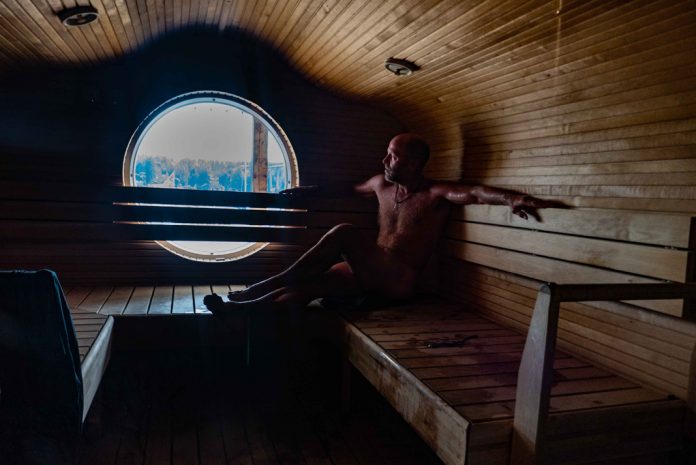
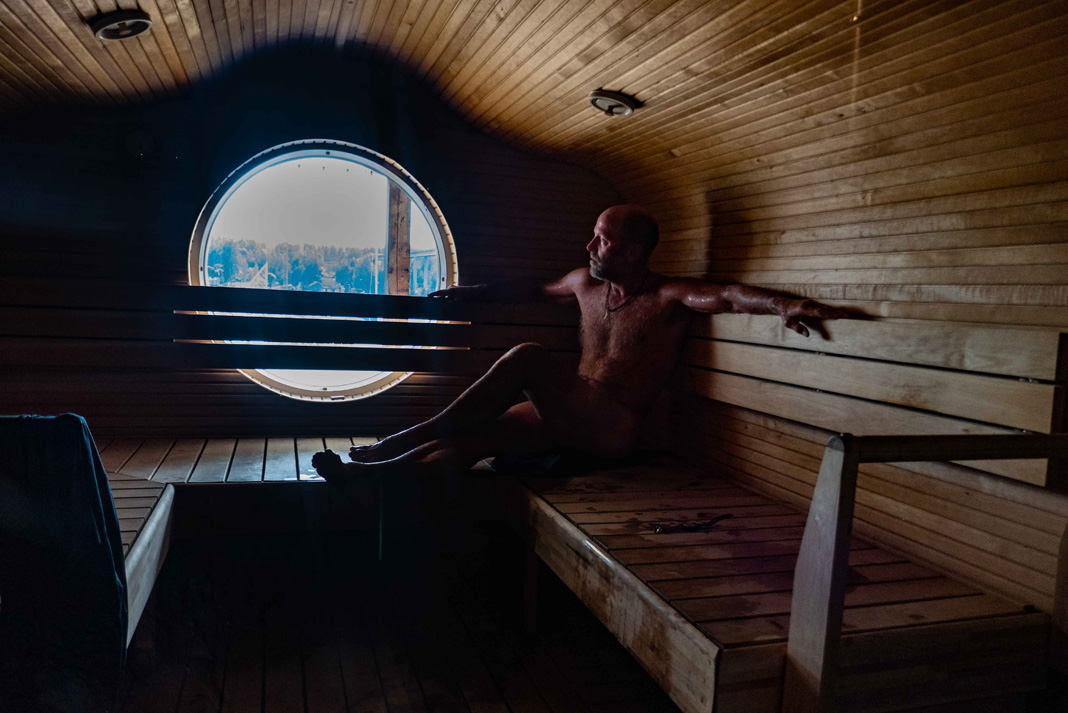
Saunas are a cornerstone in Finnish culture, says explorer Frank Wolf. Photo: Frank Wolf
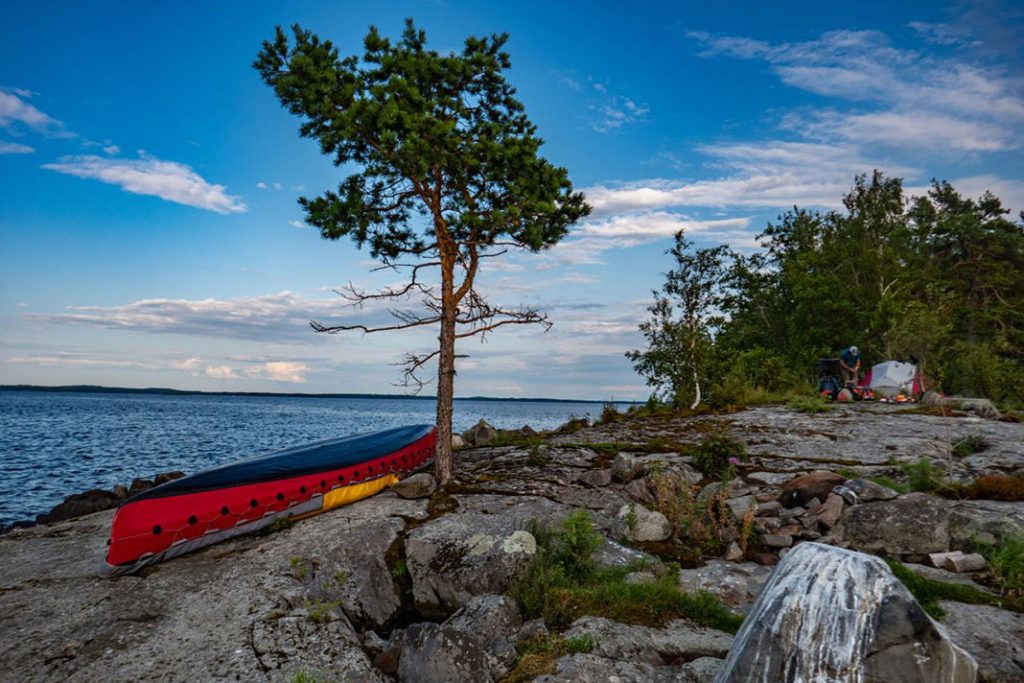
Morning mist rises from the water. Rocky, pine-clustered islands reflect perfectly in the glassy surface of the lake. A broad slab of metamorphic rock juts out from shore at our campsite, the ideal entrance for my post-breakfast swim.
It’s 7 a.m. on a late July morning, but the sun has already been up for hours. Todd McGowan and I clutch our coffees, taking sips and soaking in the start of another fabulous day on trip. Ahh, nothing like being on a canoe journey in northern Ontario.
Saunas are a cornerstone in Finnish culture, says explorer Frank Wolf. Photo: Frank Wolf
A pair of loons swim by and one of them… croaks? I look closer and see these loons are different—they have grey heads instead of black and lack the mournful cry of the common loon. This red-eyed species instead sounds like Grover from Sesame Street. I’m snapped from my trance and reminded I am not in Canada, but instead on a 500-mile route through Finland.
WHEN TO GO
June and August boast long days with decent temperatures and miss the crowds of July. The best chance for paddlers to see the aurora is in September, however days are shorter and cool.
PROTECTION
The insect season is short, but the clouds of mosquitoes, gnats, black flies and horseflies make the most of it.
DON’T MISS
August’s Siirrettavien Saunojen, a two-day festival where entrants vie for the most unusual homemade sauna. The only rules are that it must fit at least one person, and it must be mobile.
MORE INFO
Find recommendations for outfitters, accommodations, can’t-miss sights and more on visitfinland.com.
After 12 straight years of extended canoe trips in some of the remotest regions of Canada, I was looking for something different. I love boreal trips but craved a trip abroad—a wilderness experience but also a cultural odyssey. I scoured Google Earth to see if there was somewhere else on the planet with the characteristic traits of the Canadian Shield. I was looking for a place where I could create a unique route and travel a diverse, ever-changing and dynamic waterscape of river, lake and ocean.
My sleuthing led me to Finnish Lakeland. This region, which comprises the southeast quarter of Finland along the Russian border, is the largest geographical area in the country.
Claiming almost 188,000 lakes—most of which are in Lakeland—Finland is a canoe tripper’s dream. Like in Canada, you can spend weeks in your canoe traveling a labyrinth of waterways in whatever direction you please. I decided on my route based on how I could get the best bang for my buck, and mapped out a line that would showcase the greatest possible expanse of Finland’s inland paddling paradise.
Cost and logistics-wise, it’s cheaper for a North American tripper to head over to Finland than to one of Canada’s remote northern regions. The biggest expense was our $1,200 round-trip tickets to Helsinki—still far less than flying out one-way from somewhere like Baker Lake after a Thelon River trip in Nunavut.
Our craft of choice was a folding Pakboat canoe, as it can be checked as a piece of luggage. Once in Helsinki, we paid €50 to hop on a day-long train ride carrying us from the capitol to a small town called Nurmes in the northernmost reaches of Lakeland.
In Nurmes, we shopped for food at the local market and shoved off from the harbor by the train station. Depending on how much time you have, you could do anywhere from a week to a month-long trip, with train access to multiple points along our route.
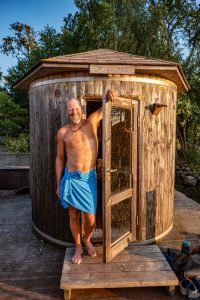
Frank Wolf about to bask in the glorious heat of Sauna Saari, on the second-last day of the journey. | Photo: Frank Wolf
As far as camping goes, Finland has Everyman’s Right, which allows anyone to temporarily camp out overnight, anywhere as long as it causes no damage or disturbance to the landowner. Despite going through populated areas on occasion, it’s exceedingly easy to set up your tent pretty much wherever you please. Just stay a reasonable distance from homes, which is never a problem in this heavily forested, sparsely inhabited and park-filled nation.
Perhaps the most significant underlying reason for this journey—and the distinct cultural aspect of it—is I’m a huge fan of saunas. Nothing feels better at the end of a long day of canoeing than getting an excruciatingly hot sauna sweat on, followed by a plunge into the cold waters of a lake. As you paddle through Lakeland, you can count on finding a public sauna in any village harbor along the way.
Saunas are Finland’s most famous export, and it’s not an exaggeration to say every single house and cabin in the country has one. This simple wooden structure forms the foundation of Finnish life. In old times they did their washing, cooking and even childbearing in the sauna, and it remains part of the daily ritual for most.
As part of our cultural investigation, Todd and I discovered a quirky trait we’d read about was a real thing. As we paddled through the country, we found the locals were more likely to turn away from a friendly canoe wave than return it.
We found the key to unlocking Finnish hearts lies within the sauna ritual. Once inside its hot and cozy confines, locals transformed from introverts into the friendliest, most open folks you could ever hope to meet.
Island camping with a PakCanoe on Lake Orivesi. | Photo: Frank Wolf
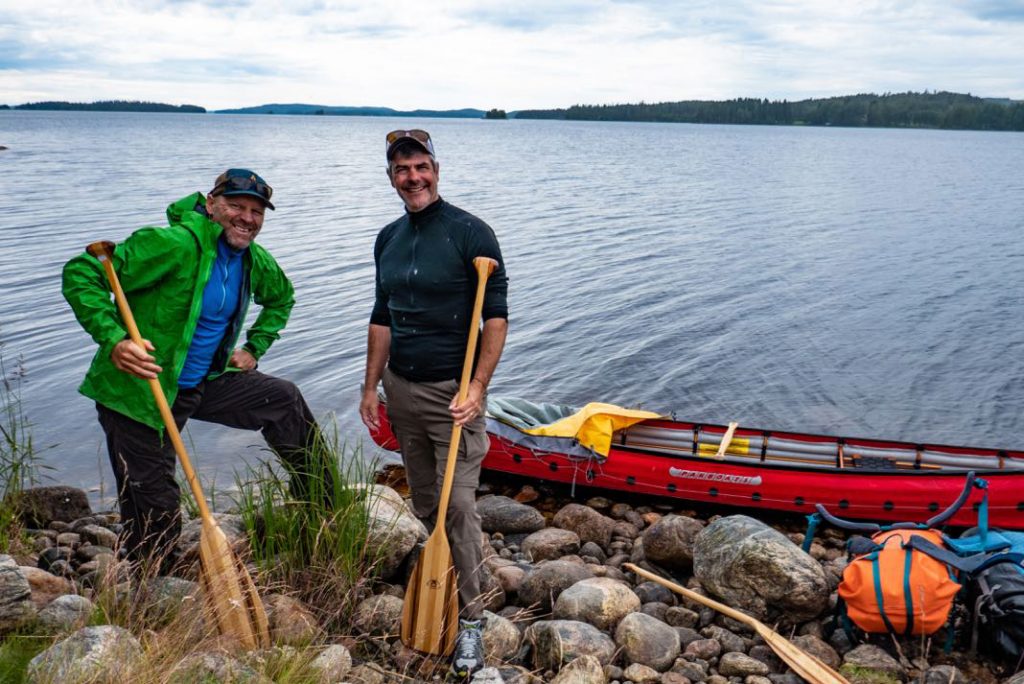
Frank Wolf (left) and Todd McGowan at the start of the journey at Lake Pielinen in Nurmes, Finland. | Photo: Frank Wolf
Sauna is an equalizer: everyone is naked, sweating and bathed in endorphins. Pretense is stripped away. Löyly is the Finnish word for the steam rising from the super-heated rocks, and also refers to the human soul. During our 20-day trip, our most meaningful interactions with the Finnish people occurred during sauna sessions across the land.
One evening, I sit glowing and glistening from repeated blasts of löyly conjured by a gregarious old fellow named Terri in the Tykkimäen public sauna. My ears and nostrils sting from the steam. I hunch down to withstand the next wave as Terri splashes ladle upon ladle of water on the rocks and coolly claims this is “the best sauna in all of Finland.” He drives 40 miles from his home four times a week to spend time here.
We pulled our canoe up on the shores of Kyrlämpi Lake just an hour earlier. Like moths to the light, we were drawn in from a grey, cool day of paddling by the towering, 50-foot sauna sign we spotted from across the water. Arto, a man I’ve been chatting with about Finnish players in the NHL, follows up on Terri’s remark by turning to me on our shared pine bench and stating, “For us Fins, the sauna is our church.”
I can relate. Like canoeing in the wilderness, a sauna is similarly meditative and cleansing. Our journey through Saunaland is the perfect amalgamation of the Canadian canoe and the Finnish sauna—cultural cornerstones from two different countries that complement each other in every way.
Frank Wolf is a Canadian filmmaker, adventurer, writer and environmentalist known for his wilderness documentaries.
This article was first published in Paddling Magazine Issue 62. Subscribe to Paddling Magazine’s print and digital editions here , or browse the archives here.
Saunas are a cornerstone in Finnish culture, says explorer Frank Wolf. | Photo: Frank Wolf
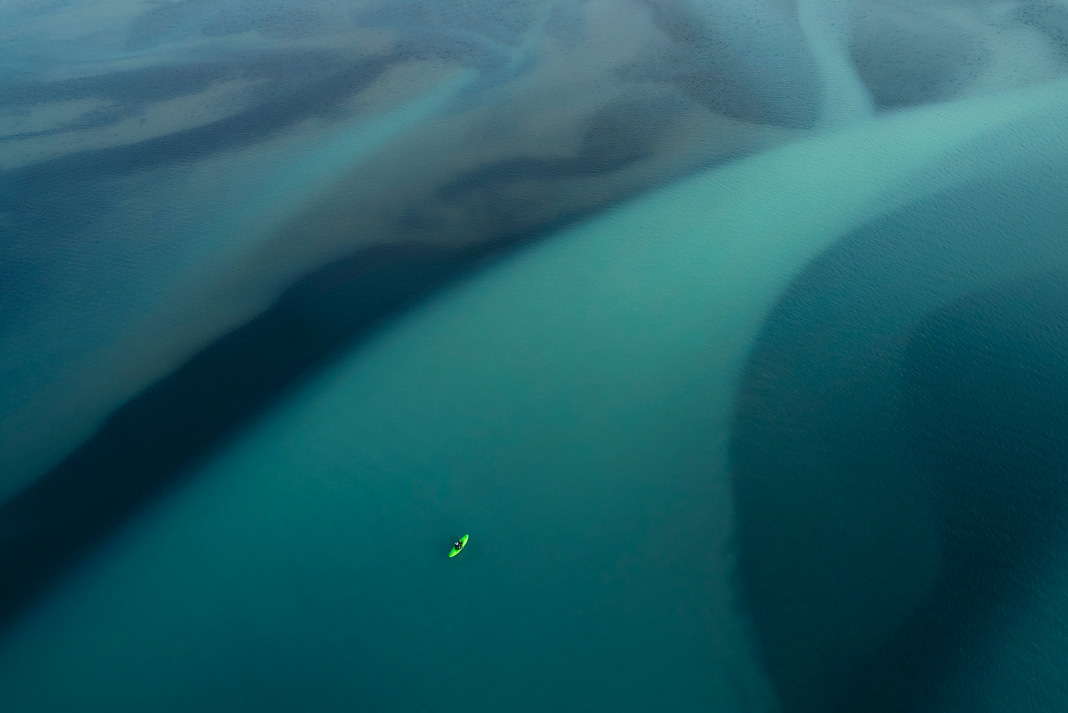
Glacial runoff creates the blue hues, which takes on an opaque appearance due to sediment suspended in the water. | Photo: Jan Kasl
Jan Kasl’s ethereal image of kayaker Vavra Hradilek floating upon the psychedelic backdrop of a glacial river flowing into the North Atlantic in Skagafjordur, Iceland, seems like an unlikely winner of a Red Bull-sponsored photo contest garnering more than 120,000 entries from around the world. The energy drink giant usually emphasizes high-adrenaline, action sports in its photographic talent pool.
Kasl’s 2019 Photo Of The Year awarded by the Red Bull Illume contest is the exact opposite: a placid, bird’s eye perspective of a tiny green kayak forcing the viewer to look deeper and appreciate humans’ ultimate frailty in nature. The 31-year-old Czech photographer says his unlikely rendition of peace and serenity is its greatest appeal.
Glacial runoff creates the blue hues, which takes on an opaque appearance due to sediment suspended in the water. | Photo: Jan Kasl
“This shot is totally different from the typical action sports footage,” he notes. “I guess that’s why it stood out.”
Kasl made the image last August, on an adventure mission with his friend Hradilek, a Czech slalom boater who won silver at the London Olympics. Kasl says he’s fascinated by the north, and has been engaged in a long-term project “searching for the roots of kayaking” since he visited Norway’s Lofoten Islands in 2014. It was his first trip to Iceland. Traveling by van with camping gear and creekboats, Kasl admits he was curious and intimidated by working in a cold-water environment with a mind-blowing array of photo opportunities.
“Capturing the [Red Bull award-winning] image itself was the easiest part of the whole process,” he says. “Iceland is such an incredible place, you can go in any direction and you will find a different piece of environmental art. There’s still a lot left to uncover when you explore the island from an overhead perspective.”
Kasl marveled at how the water’s flat surface became textured and colored by sediments when viewed from above. He loved how the currents’ curves matched his composition and emphasized a “magical spectrum of blue.” He captured his best shot on one of the first frames, from an altitude of 1600 feet.“The session continued for about an hour, where we tried some other parts of the river and different angles,” he recalls. “But I already knew I had what I came for.”
“It looks unreal,” Kasl adds. “It’s more like a surrealistic painting. I like the silence and calm mood flowing from the image, and especially the fact this picture is one of those shots you have to stare at for a while to realize what’s going on. Sometimes during busy days, I look at this shot and I wish to be Vavra and escape to this peaceful world.”
Red Bull’s judges concurred, calling the image one that “evokes a sense of adventure, exploring both unknown landscapes and mindscapes. It’s thought-provoking, and yet it’s also peaceful.”
The award signifies the importance of “idea, imagination and creativity” in action-sports photography, insists Kasl. “That’s what makes the difference these days, not equipment.” With this in mind, he encourages photographers to chase their creative dreams and seek out unlikely perspectives. “Don’t be scared to realize your craziest ideas.”
Conor Mihell is an award-winning journalist based in Sault Ste Marie in northern Ontario.
This article was first published in Paddling Magazine Issue 62. Subscribe to Paddling Magazine’s print and digital editions here , or browse the archives here.
Glacial runoff creates the blue hues, which takes on an opaque appearance due to sediment suspended in the water. | Photo: Jan Kasl
“As no man is born an artist, so no man is born an angler.” —Izaak Walton | Photo: Follow Me North Photography
Canoe tripping has become far more popular over the last few years. That’s a good thing. Except when you’re looking to escape the crowds and find your own garden of Eden.
On a mid-summer Boundary Waters trip just a couple years ago, I passed 112 paddlers on a short portage and then counted 226 canoes and kayaks crossing the adjoining lake. Yikes!
On a recent trip into Algonquin Park’s North Tea Lake, I came upon a line-up of 36 canoes cluttering the take-out of the portage. That’s crazy.
It’s not just regular canoe routes in state, provincial and national parks paddlers are crowding. Canoe routes situated off the beaten path have gone from totally unknown to fair game to now becoming the Holy Grail. There’s just so many of us trying to be alone out there.
“As no man is born an artist, so no man is born an angler.” —Izaak Walton | Photo: Follow Me North Photography
If you’re amongst the few who have discovered a secret lake or unknown stream to paddle a canoe and pitch a tent, you also know it’s the lost art of “secrecy” you’ll need to master if you’re going to keep it to yourself. And when you find a perfect trout stream, you don’t tell a soul about it.
To emphasize this sacred fishing-spot ideology, consider a debate on social media. An angler and Algonquin regular, Mike Borger and his 10-year-old son, documented on YouTube a fishing trip they took in the interior of Algonquin. They found a hot spot Borger had fished on a previous trip. The video shows him and his son catching six five-pound brook trout and countless others weighing between three and four pounds.
Father and son captured a memory that would last forever, then uploaded it to the world’s largest online video-sharing platform. In the comments section, Borger received more than 200 requests asking for the lake’s location. He politely declined to reveal it.
Out of the pumpkin patch always comes a sour lemon. One viewer wanted to know where the honey hole was so badly that he made a Freedom of Information request to the provincial government to see Borger’s camping permit, which would reveal where he had traveled and fished.
After consideration, the Ministry told Borger they would not confirm or deny the existence of his permit to the person pursuing it. The Ministry must be staffed with trout anglers themselves. But the nosey YouTube viewer appealed—twice. Ultimately, after the second appeal, the requests for information were still denied.
I never thought I’d see the day when this sort of thing would happen. My dad would roll in his grave. Trout fishing was my religion growing up. My dad introduced me to wilderness travel by taking me fishing—and it was always for trout.
He brought me up in a traditional sense—to always work hard and be honest to others. And he instilled the belief in me that the only fish worth catching is trout.
Why? Because trout are hard to catch. You need to work extra hard to find them, and you need the skill to catch one. Trout represent, at least to me, the essence of true wilderness values. The moment water becomes tainted or a road creates easy access, the trout disappear, along with the wilderness they represent.
I also watched Borger’s video, and I recognized the lake he and his son portaged into. It’s not easy to get to, which is a good thing.
I’ll take the exact location of it to my grave. That’s the way my dad would have wanted it.
Kevin Callan is the author of the bestselling The Happy Camper series and paddling guidebooks.
This article was first published inPaddling MagazineIssue 62. Subscribe toPaddling Magazine’s print and digital editions here , or browse the archives here.
“As no man is born an artist, so no man is born an angler.” —Izaak Walton | Photo: Follow Me North Photography
The deepest point in Lake Superior is 1,300 feet, and the average underwater visibility is 27 feet. | Feature Photo: David Jackson
As canoeists lust after Canada’s furthest latitudes they often bypass canoeing Lake Superior, one of the finest wilderness lakes on our planet. Lake Superior is North America’s largest freshwater lake and represents one of the greatest untainted wonders of our natural world.
[ Plan your next Great Lakes canoe adventure with the Paddling Trip Guide ]
Beauty glides by while canoeing Lake Superior
Travelling by canoe along Canada’s north shore of the big lake, traditionally known to the Ojibwe as Gichigami (Gich-ii-goo-me), offers nearly 1,000 kilometers of portage-free paddling.
From ragged cliffs to island chains where the water appears a tropical azure, this section of Lake Superior reads like a paddler’s love story.
Sea caves and steep headlands are punctuated by intermittent roadside access. From Wawa to Pic River stretches the most romanticized, roadless length of shoreline.
Bill Mason spent many nights exploring Denison Falls in Nimoosh Provincial Park, just east of the pristine, battered beauty of Pukaskwa National Park. The myriad of coves, ancient pits and crystal-clear water seem too surreal to exist naturally.
From Rossport all the way to the toes of the Sleeping Giant, one might drop a line for dinner, visit a secret sauna and forget they are on Lake Superior as the immediate shoreline becomes a maze of mossy islands and narrow channels.
The deepest point in Lake Superior is 1,300 feet, and the average underwater visibility is 27 feet. | Feature Photo: David Jackson
Exposure
From any direction, wind and waves can be deadly. Watch your shoreline and consider the forecast. Plan to be windbound one day for every three to four on the water.
Weather
While mid-summer heat might be forecasted, a wind from the ice water mansion will chill you to the bone. Dress in layers. The water averages just 4°C.
When to go
Superior’s relative mid-summer slumber of good weather typically stretches between mid-June to early August.
Essentials
A marine radio is a must to receive wind and wave forecasts. A spraydeck provides peace of mind and additional safety if you are caught out in rougher weather.
Exit strategies
Consider access roads and towns should you get windbound and have to limit travel. There may be limited options to evacuate.
What to explore when canoeing Lake Superior
Be it Group of Seven paintings or red ochre pictographs, Edmund Fitzgerald historians or fur trade dreamers, canoeing Lake Superior still brings to mind echoes of creaking bark boats and the tales of generations gone.
Head to Sinclair Cove and explore the small bay and surrounding islands. If conditions are calm, venture east around the point and visit the Agawa Pictographs. Get a sense of Lake Superior’s enormity without venturing far from safety. If conditions are poor, hike above the cove to a beautiful lookout.
If you have a weekend:
Launching at Silver Islet, paddle west towards Thunder Bay and Sleeping Giant Provincial Park. Reserve a campsite at either Tee Harbour or the scenic Lehtinen’s Bay and hike up the Giant for a spectacular view of Superior. If the weather turns foul and time is precious, hike back to your vehicle on the trails.
If you have a week:
Canoeing Lake Superior from Agawa Bay to Old Woman Bay is an unforgettable trip with varied shorelines to experience a multitude of Lake Superior’s wonder. Sprawling beaches, sea caves, and sections of intimidating cliffs offer a true feel of the lake. In poor wind conditions, Gargantua is an optional exit point.
[ Paddling Buyer’s Guide: See all lakewater & touring canoes ]
If you have a month:
For the hearty tripper, Montreal River Harbour to Silver Islet is a classic trip. It encompasses all the elements of extensive route planning, wilderness travel, weather considerations, open water crossings, and passes through all the most beautiful points of Lake Superior. The highlight of this east to west trip are the saunas in the Lake Superior Marine Conservation Area.
This article was first published in Issue 57 of Paddling Magazine. Subscribe to Paddling Magazine’s print and digital editions, or browse the archives.
Whether you are highly experienced or an occasional weekend warrior, rolling a kayak is an essential skill. We asked 9 expert kayakers to share their most important myths about rolling a kayak, and none of them could quite agree.
9 myths about rolling a kayak
Myth #1: Muscle memory will save you
“Some say it’s like riding a bike—once you’ve learned it, you can just jump back into it at any time. If you’ve been away from kayaking for some time, chances are muscle memory isn’t as strong and you can find yourself swimming.”
— Andy Hill, C1 world champion
Myth #2: Flexibility required
“I have taught classes where the women in the class learn how to roll much faster than the men. The men sometimes get a hurt ego, and play it off as the women being more flexible. Are you flexible enough to lift your arms above your head?
Then you are flexible enough to roll a kayak. You don’t have to be flexible in order to roll. I have seen a stiff 76-year-old man learn to roll, he just needed to find a different technique to do it.”
— Brooke Hess, U.S. National Freestyle Kayak Team
Myth #3: It takes great strength
“People think rolling a kayak is hard. It’s not about strength, it’s more about technique and finesse than anything else.”
— Katie Kowalski, Canoe Kayak Canada National Freestyle Team
“The myth is it’s easier and safer to roll up staying forward, or that it is easier to roll up finishing back. Even if the argument is that your face may be exposed, it is safest to be upright. How you get back upright the quickest is the safest.”
— Nick Troutman, pro kayaker
Myth #5: Your roll can disappear
“The myth of the disappearing roll. Sometimes in turbulence, beginners and intermediates find their rolls disappear. They flail and cannot get up. This is because they have practiced their rolls in a certain way, from one starting position, but turbulence forces the boat, their body, and their paddle out of position.
The roll is there, but you must practice doing it with power from any starting point. That’s what is meant by a combat roll. And the myth of the hip snap—people tell beginners to snap their hips during the roll, which is confusing and false. The only place where you exert force on the boat to turn it upright is through the knee pushing in the direction of the roll. You don’t need a hip snap—your hip will follow your knee.”
“Rolling a kayak is like riding a bike. Truth: Rolling a kayak is only like riding a bike if the bike is upside down and underwater with rocks and trees flying by. Too many times we downplay how difficult a reliable roll is to master or maintain. The secret to the roll is long-time boaters must practice, and beginner kayakers must have patience.”
— Ben Stookesberry, explorer
Myth #7: Some boats are better
“A myth about rolling a kayak is some boats are harder to roll than others. Here’s a fact about rolling—anyone with a good hip snap can roll any appropriately sized kayak. Truth.”
— Stephen Wright, pro kayaker and coach
Myth #8: Pros are perfect
“The myth about rolling is that pro kayakers don’t swim.”
This article was first published in Issue 57 of Paddling Magazine. Subscribe to Paddling Magazine’s print and digital editions, or browse the archives.
Your most favorite photo of all time. You already know why. | Photo: Jay Kolsch
Imagine this scene: It’s sunset. A striped Hudson Bay Company point blanket is spread out near the fire. A matching hand-painted wood-canvas canoe sits on shore center-left, with a mossy green canvas pack resting against its bow. A fire crackles, curls of smoke rising, and a bottle of Irish whisky rests next to an enamel mug stamped with a John Muir quote—maybe it reads, “The mountains are calling.” Sounds perfect, right? The answer is a question of Instagram vs. reality.
[ Paddling Buyer’s Guide: See all lakewater & touring canoes ]
Instagram peddles perfection
A shot like the one described above has 45,000 likes on Instagram. Bonus points if you can work in a ukulele, antique hurricane lantern and string of fairy lights. I’ve seen so many variations inspired by the original, each one trying to one-up the rest with the next best fabricated presentation of perfection.
Instagram users are pressing the like button 3.1 billion times a day.
Followers don’t see the hours of tediousness invested into capturing this one outrageously perfect moment. We don’t see the work it takes to align the gear, sunlight, smoke signals and hang those twee tinkle lights just so.
If we had only social media to inform us of what canoe tripping looks like, we’d have completely unrealistic expectations about the backcountry.
[ Plan your next canoe tripping adventure with the Paddling Trip Guide ]
In reality it’s not that easy
What Instagram so rarely shows is the side of canoe tripping not so splendidly picture perfect. There are bugs. Sometimes, long and steep portages. And when real people get sweaty it’s rarely in an attractive and dewy morning-glow sort of way. Instead, think wet, red, swollen, haggard faces.
When things are hard—someone is cold and tired or battling a ferocious headwind—it usually doesn’t feel like a cool Kodak moment. And without the crack-of-dawn lighting, oversaturated filter presets and Adobe Photoshop, our campsites, landmarks and routes look a little different. They look real. See a celebrities-without-makeup spread in People magazine, it’s kind of the same thing.
Instagram users are pressing the like button 3.1 billion times a day. From our own Paddling Magazine feed we know the most popular paddling shots are typically the ones featuring moody lighting, beautiful vistas and unidentifiable paddlers. Many theories abound why this is, but we believe it’s because viewers imagine themselves in the landscape and live vicariously through the photo. Who doesn’t want to insert themselves along a gorgeous shoreline, in a handcrafted canoe under a blue bird sky?
Yet those picture-perfect, serene moments we love to double-tap don’t match what we actually share of memorable canoe tripping moments.
Instagram is valued at upwards of $50 billion and boasts 800 million active monthly users sharing 95 million photos and videos a day.
Canoe tripping isn’t always picture perfect
Memories aren’t made of perfectly lit campsites and staged fireside whisky ads. My best memories are of gritty, hard moments—fighting exhaustion during the second sleepless night of the 715-kilometer Yukon River Quest—and the joyous ones—carving into an eddy after a whitewater run I was sure we would swim.
According to the Australian University of Queensland’s Brain Institute, I’m not alone. Strong emotions build robust memories. You probably remember your first kiss, or where you were when you found out planes flew into the Twin Towers. This happens because the amygdala, which is activated by emotional events, boosts memory encoding by enhancing attention and perception.
Social media is a big business. Instagram is valued at upwards of $50 billion and boasts 800 million active monthly users sharing 95 million photos and videos a day. In deciding the question of Instagram vs. reality, authentic emotion might be the only thing Instagram is lacking. Close to 70 percent of top performing posts feature a product. You can be sure the majority of the most popular posts are curated. It’s one big smoke show.
Reality beats Instagram every time
The beautiful moments we cherish—success through a trick stretch of rapids, belly laughing to tears with friends or racing for shelter under a threatening sky—are imperfect.
At those times, we’re caught up in the moment. Reaching for a camera doesn’t occur to us, and the question of Instagram vs. reality is decided. Despite not being photographed, the moment still happened. We liked it. And we shared it with friends. Sound familiar?
This article was first published in Issue 54 of Paddling Magazine. Subscribe to Paddling Magazine’s print and digital editions, or browse the archives.
Kaydi Pyette is the managing editor of Paddling Magazine. Most of her Instagram posts are about her new puppy. Who doesn’t like puppies?
Dave Aharonian and I are paddling into the Broken Group archipelago off of Vancouver Island’s West Coast. We’ve only travelled about 10 miles to reach our campsite and we’ve covered the distance quickly. But as Dave climbs out of his kayak and grabs his cane, I reflect on how very far he’s come to be here. After suffering a spinal cord injury it’s no stretch to say that kayaking saved his life.
[ Plan your next B.C. kayak adventure with the Paddling Trip Guide ]
A moment of misfortune
Back on June 1, 1986, Dave was 19 years old, working hard as a tree planter in the northern Ontario bush. After a day off in town, he and two others were on their way back to camp when the driver lost control and went off the road. Their crew-cab pickup rolled down a hill and all three of them were thrown from the vehicle. None were wearing seatbelts.
The driver got away with only cuts and bruises. Michelle, a young woman riding in the front seat, died at the scene. Dave, who had been in the back seat, fractured his spinal cord in his lower back at the T12 and L1 vertebrae.
In the initial “decompression” surgery doctors removed bone fragments and inserted a metal rod to stabilize Dave’s spinal column. Eleven days later, in a second operation, they fixed two more stainless steel rods on either side of his spine in a procedure called spinal fusion.
Coming to terms with a spinal cord injury
The accident left him with no feeling in his feet, the backs of his legs, or his backside, and no use of the muscles below his knees. He was in hospital for six months and spent another six months in outpatient rehab relearning how to walk.
“When I first stood up at the parallel bars during rehab, not feeling any weight on the bottom of my feet—not feeling my feet at all was just plain weird,” Dave recalls. “My occupational therapist kept trying to persuade me to buy a wheelchair. She was just doing her job. But eventually I lost it and yelled, ‘Stop talking to me about buying a fucking wheelchair’.”
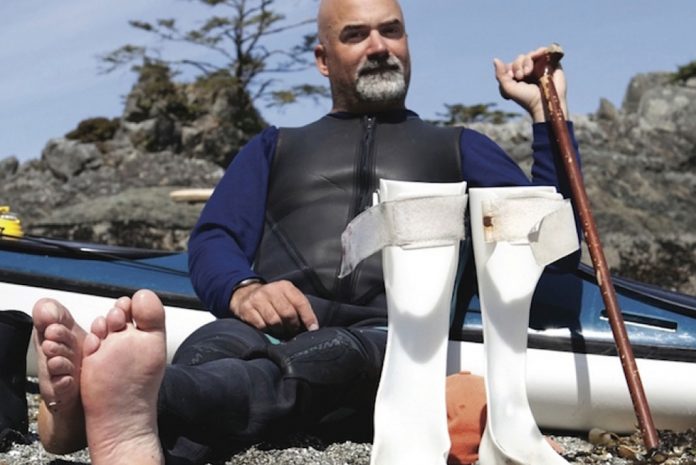
A year after the crash, Dave was able to walk with the aid of a cane and two ankle orthoses (foot braces), yet his reduced mobility left a big hole in his life. He was living in Toronto at the time. “I’d spent a ton of time in Pukaskwa National Park on the northeast shore of Lake Superior. I took four months hiking in the Rockies, the last two on my own. A few times I achieved a certain connection with that wilderness experience that was very profound for me. It was a bit of an epiphany. Six months after that, I was lying in hospital with a fractured spinal cord. Having that intense experience in the outdoors again was a huge motivation. And it was very important that I do it independently. I couldn’t hike or ride a bike again. I couldn’t carry a canoe alone. But one day a couple of friends found me an old kayak.”
Learning to kayak after the injury
Just 13 months after his accident Dave was back in Pukaskwa National Park, on his own, and in a kayak. “I had very limited experience with kayaking, and I know that I gave my mum more than a few grey hairs. But she understood how important it was to me that I be able to do that trip.”
Over the years Dave developed his paddling skills and expanded the scope of his trips. He moved to Victoria, B.C., and started doing multi-day solo trips on the ocean. Using his cane for balance, he can solo carry his 60-pound Valley Nordkapp and load it on the roof of his car alone, so he has the freedom to head out whenever he wants to. Dave is a professional photographer with a passion for wild landscapes, and his kayak is an indispensable photographic tool to access wild places.
In 2002 he and Adventure Kayak editor Tim Shuff paddled from Prince Rupert to Victoria over three months. “Roughly one week into that trip, paddling down Principe Channel, I had a bit of a moment. Tim was a little ahead. It was a beautiful day with a light wind at our backs. A bunch of ducks flew over, and I could hear their wing beats. In that moment I felt, this is what is real. I actually stopped and teared up a bit. If I hadn’t discovered kayaking, I don’t know how I would ever have achieved that sort of moment again.”
Kayaking with a spinal cord injury presents unique challenges
Long trips present additional challenges, as I learned when Dave and I paddled the north end of Vancouver Island last summer, rounding Cape Scott and the Brooks Peninsula. Because he can’t feel his backside, minor chaffing from the constant rotation of paddling can quickly develop into nasty sores. In typical fashion, upon discovering a raw hole worn at his tailbone he quipped, “Wow, that must really hurt!”
Dave also has to use catheters, which need to be sterilized every day and put him at constant risk of urinary tract infections. “Initially I didn’t know if I could boil them in saltwater. And there wasn’t anybody to ask. Turns out that saltwater works great.” Trip mates quickly learn what’s in the pot when Dave says he’s “boiling spaghetti.”
Dave is a strong paddler, but when he climbs out of his boat, pulls out his cane and limps up the beach, he sometimes draws stares. Other kayakers are curious, but don’t feel comfortable asking questions. Dave is incredibly good at putting these folks at ease, volunteering information and explaining his medical history. Only after seeing Dave perform this trick several times did I begin to appreciate the profound grace that he was exhibiting.
His view is pragmatic: “If I can inspire anyone else to enjoy the outdoors, even if they have to deal with some challenges, then that makes me really happy. The more they understand, the better.”
Back on the beach, we each grab an end of a kayak, ready to haul it up beyond the high tide line. I wince at the shock of the cold water on my feet. “It’s freezing,” I stammer. Dave gives me a cheesy grin. “Really?” he says. He’s in no hurry. One fringe benefit of kayaking after a spinal cord injury is that he can’t feel a thing.
This article was first published in the Summer/Fall 2019 issue of Adventure Kayak Magazine. Subscribe to Paddling Magazine’s print and digital editions, or browse the archives.