Home Blog Page 80

Inflatable SUP Review: BOTE Rackham Aero 12’4”

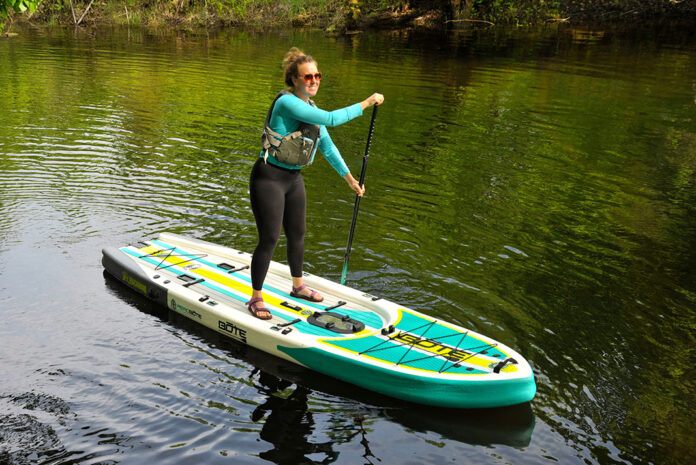
woman stands and paddles the Bote Rackham Aero 12'4" inflatable SUP
The Rackham Aero 12’4” features a puncture-resistant, military-grade PVC skin and composite drop stitch construction, plus three fins aid tracking and directional control. | Feature photo: Virginia Marshall

BOTE describes their redesigned Rackham Aero 12’4” as an even more versatile and capable evolution of their go-to inflatable board for adventurous paddlers. Great news for fans of the original Rackham Aero 12’4”, among them anglers, families, dog owners and expedition paddlers who prized its 400-pound carrying capacity and superb stability.

Stand, sit, pedal or paddle the redesigned BOTE Rackham Aero 12’4”

BOTE Rackham Aero 12’4” Specs
Length: 12’4”
Width: 38”
Height: 6”
Weight: 50 lbs
Capacity: 400 lbs
MSRP: $1,549 USD
www.boteboard.com

How did BOTE boost the capability of their highest capacity, most heavy-duty inflatable paddleboard? The longtime paddleboard manufacturer borrowed from their emerging line of inflatable kayaks and added two significant upgrades to the Rackham Aero 12’4”: the addition of APEX Pedal Drive compatibility and the inclusion of a removable Aero SUP Paddle Seat. The result is an inflatable standup paddleboard that can transform into a sit-down, paddle- or pedal-driven watercraft in just a couple of minutes.

In other words, it’s perfect for paddlers seeking the stand-or-sit versatility of a hybrid SUP-kayak, along with the portability of an inflatable and the hands-free efficiency of a pedal drive. Whew, that’s a lot of options.

Design and outfitting

Our demo Rackham Aero 12’4” arrived by courier on a sunny spring morning in what I can best describe as a formidably large and heavy box. Inside, the board came neatly stowed away in its rolling travel bag. Once I manage to heft it free of its cardboard embrace, comfortable handles and sturdy wheels make it easy to roll the bag across smooth terrain. Lifting and transporting over uneven ground is another story. At nearly 80 pounds and with no shoulder straps, the fully loaded bag is not something you’ll be slinging across your back for a jaunt to the beach.
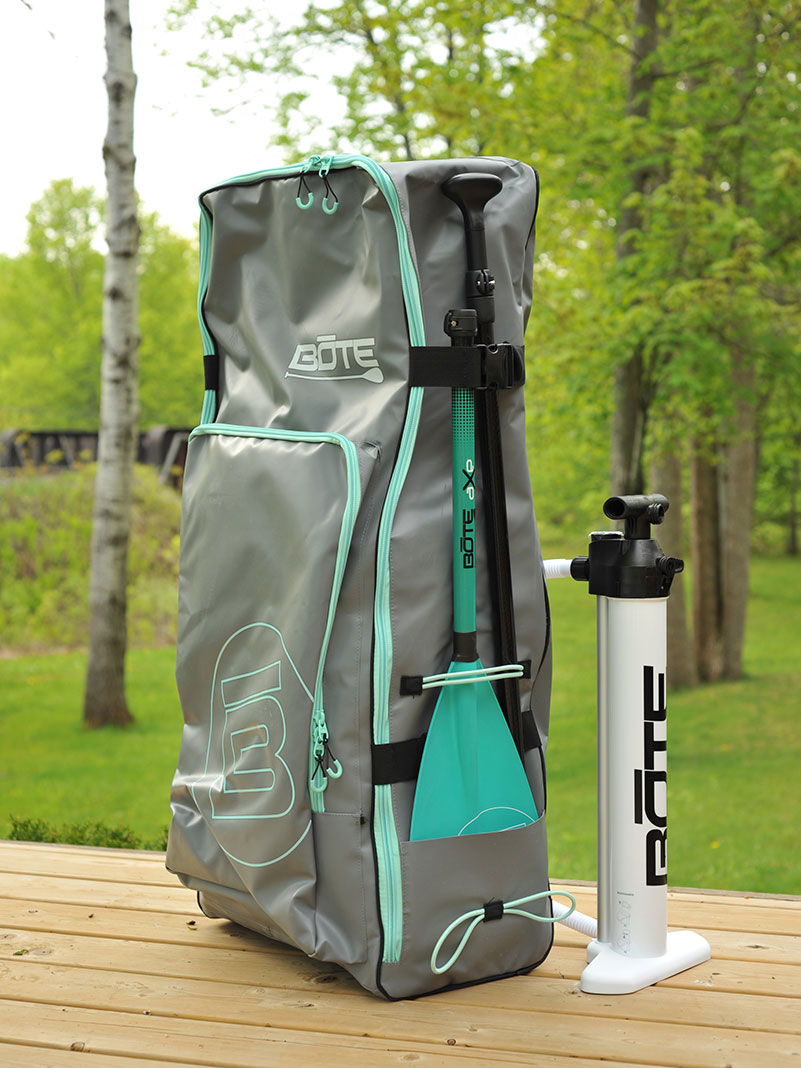
The BOTE Rackham Aero 12'4" inflatable SUP packed in its travel bag with pump
Everything packs up neat and tidy in BOTE’s sturdy rolling bag for hassle-free transport or airline travel. | Photo: Virginia Marshall

For anglers and other users accustomed to hauling around hard-shell pedal drive kayaks, transporting the Rackham Aero 12’4” is a breeze. Out of the bag and ready to paddle, our demo board tips the scales at 50 pounds. Add the seven-pound seat and 20-pound pedal drive, and the Rackham still feels nimble on the water compared to the average fishing pedal craft.

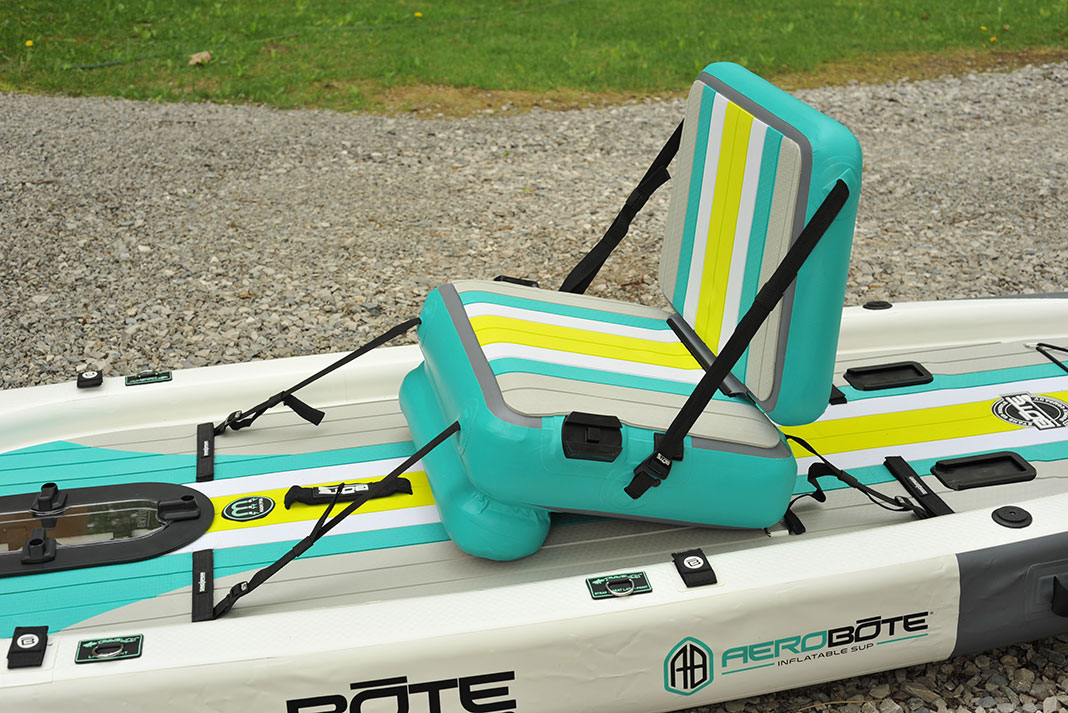
BOTE sells all of its inflatable boards in ready-to-ride packages, which is especially great for new paddlers. Inside the bag, you’ll find the Rackham Aero 12’4”, three-piece adjustable SUP paddle, Aero paddle seat, center fin, removable pedal port, repair kit and dual-action hand pump. Depending on which of the four available Rackham color schemes you choose, you’ll receive matching accessories for a snazzy, coordinating look. What else do you need? Just a matchy-matchy life jacket, of course.

BOTE has the accessories game dialed in. A quick glance at the topside of the Rackham Aero 12’4” reveals a constellation of accessory and gear mounts for easy add-ons and custom deck layouts. A paddle sheath, stakeout pole sheath and a pair of slide-in Aero Rac receivers ship with the board. Anglers can invest in one (or more) of BOTE’s nifty, easy-to-install racks—the standing height Tackle Rac or Power Rac, codeveloped with Yak-Power, or the low-profile Bucket Rac, which holds a five-gallon bucket and has four vertical rod holders.

Of course, if you buy the Bucket Rac, why not pick up one of BOTE’s matching KULA five-gallon bucket coolers? The padded lid makes a comfortable seat, and the cooler doubles as a baitwell or equipment storage, keeps ice for days, and is incredibly tough. In fact, the KULA is certified alligator-proof, which could come in handy if you paddle in BOTE’s home state of Florida.

Rackham Aero setup

Back to the Rackham Aero 12’4” paddleboard. First, the set up. Using the supplied hand pump, it took me just seven minutes to inflate the dual chambers to the recommended inflation pressure of 10 to 15 psi. One valve inflates the nose and rails, while the second valve inflates the floor. The result is a high-capacity, rigid-feeling board with a recessed deck for a lower center of gravity. This is an important design feature, given the Rackham’s generous rails and seven-inch thickness. Recessing the standing and sitting area keeps it supremely stable without compromising the board’s expedition-ready capacity.
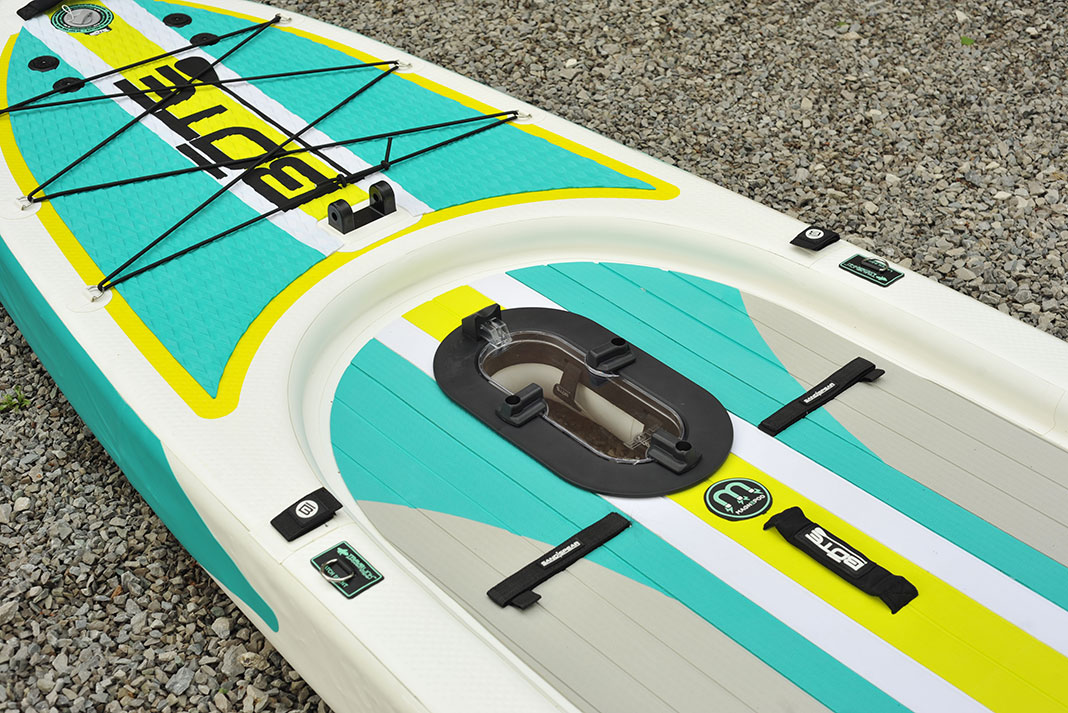
Partway through inflation, the see-through pedal port is nested in the corresponding hole just ahead of the paddler. If you’re using BOTE’s APEX Pedal Drive (sold separately for an additional $899), this porthole becomes the interface between the pedal mechanism and the propeller.

Regrettably, I didn’t have the opportunity to test-drive the Rackham Aero 12’4” with the APEX PD installed. Having seen it in action, however, I was impressed by the ease with which the user can switch between paddling and pedaling. In shallow water or approaching shore, the whole mechanism can be pivoted out of the water and tucked on the deck under the forward bungees. The propeller features a 10:1 gear ratio for smooth and efficient pedaling, and intuitive forward and reverse. Steering is accomplished via a spring-loaded, kick-up rudder installed on the board’s tail and operated by a simple hand control that can be mounted on either side of the seat.

Given the added expense and complexity, not every Rackham Aero 12’4” owner will invest in the APEX Pedal Drive. Or at least, not straight away. The obvious target market is dedicated anglers who want to keep their hands free for fishing and cover ground more quickly with less effort. But recreational and fitness users will also enjoy the versatility and full-body workout a pedal drive adds to the paddling experience.
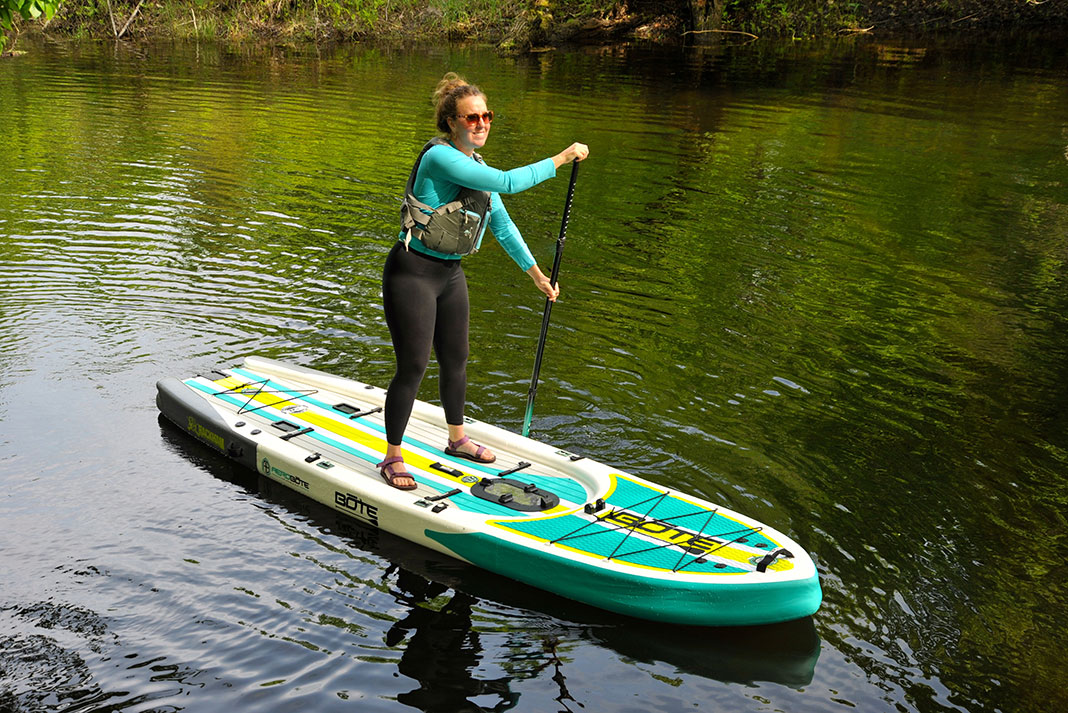
woman stands and paddles the Bote Rackham Aero 12'4" inflatable SUP
The Rackham Aero 12’4” features a puncture-resistant, military-grade PVC skin and composite drop stitch construction, plus three fins aid tracking and directional control. | Feature photo: Virginia Marshall

On-water performance

Paddling my local waters, I start first on my feet. At 38 inches wide, the Rackham Aero 12’4” is a rock-solid platform for standing, moving around and even sharing the wide-open deck with a large-breed, four-legged friend. The board also tracks well, aided by the removable center fin and two built-in side fins.

Converting to kayaking mode is a simple matter of clipping the Aero seat’s four webbing straps to the corresponding loops on the Rackham’s deck. Voila! Now I’m ensconced in the comfort of an inflatable throne, resting my dogs and dipping a double blade.

BOTE’s Rackham Aero is a do-it-all inflatable

If you are a purist paddleboarder, or you’re looking for a lightweight inflatable to haul into remote waters, the Rackham Aero 12’4” is probably not the board for you. Minimalist, this board is not. Instead, it’s an adaptable, feature-rich, fish-all-day heavy hitter with stand, sit or pedal functionality. Or, as one fan put it, “It’s a workhorse without the work.

The Rackham Aero 12’4” features a puncture-resistant, military-grade PVC skin and composite drop stitch construction, plus  Three fins aid tracking and directional control. | Feature photo: Virginia Marshall
 

3 Badass Female Paddling Crews You Need To Follow

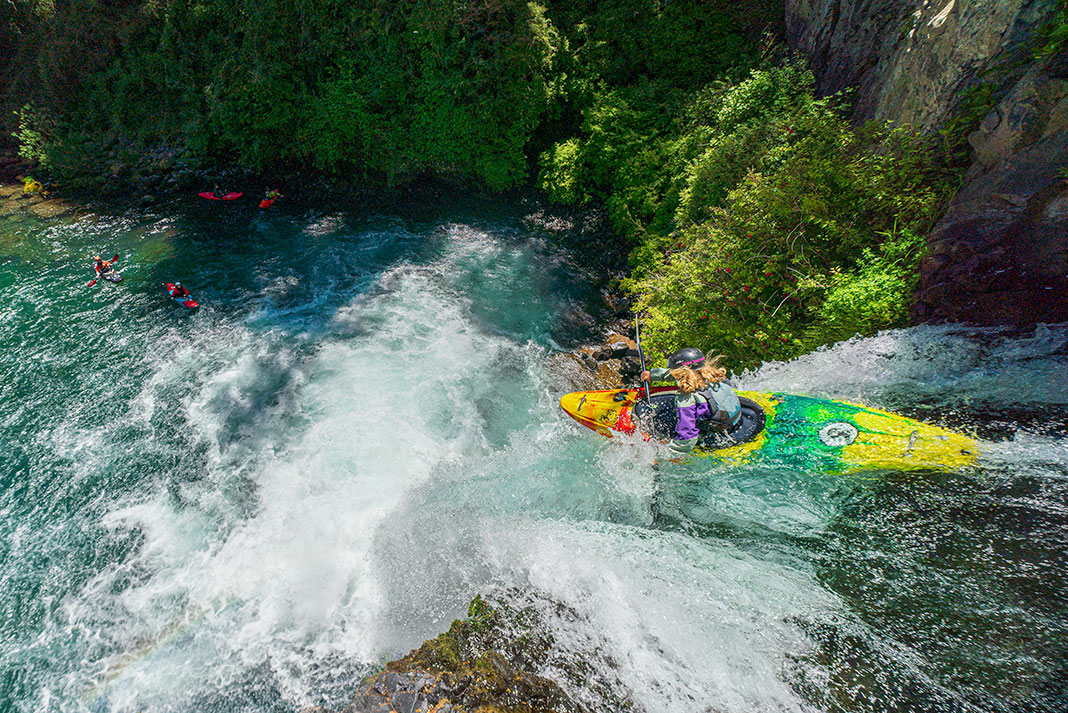
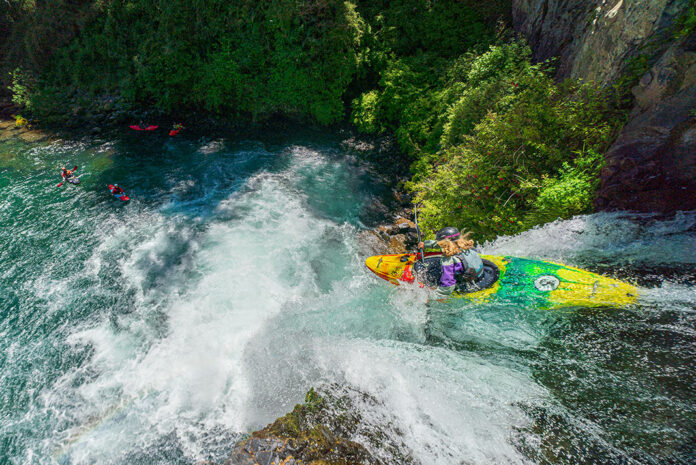
a female whitewater kayaker runs a waterfall while her paddling crew watches from below
According to the Oxford Dictionary, moxie means a force of character, determination or nerve. Nia Burtchael-Norman drops Salto Blanco Sur in Chile. | Feature photo: Kalob Grady

In 2022, it feels good to paddle like a girl. Over the past year, we’ve seen an uptick in female participation at major whitewater races, enjoyed the release of the first woman-centered whitewater feature film, Wild Waters, and witnessed the re-emergence of all-girl paddling crews.

It’s been a journey to get here. Whitewater’s male-dominated participation has always shone through in its media. Successful feature-length films like Steve Fisher’s Halo Effect (2012) and Grand Inga Project (2013), as well as River Roots’ River Runner (2021) reached huge audiences outside of paddlesports. Still, you’d be lucky to catch a glimpse of a woman running a challenging rapid.

There have been attempts to buck the trend. At the 2012 Green Race, extreme racer Katrina Van Wijk—up to her nipples in water above the infamous class V Gorilla rapid—yelled, “This is TITS DEEP!” The catchy slogan evolved into a symbol of female empowerment.

Back then, Van Wijk was told, “there’s certain whitewater girls just don’t run.” A decade later, this notion is being proven wrong, yet female participation in whitewater remains stagnant. According to the Outdoor Foundation’s 2019 Special Report on Paddlesports, women make up just 36 percent of whitewater paddlers. And that percentage is even lower at the extreme end of the sport.

A new generation of female shredders is picking up where Van Wijk left off. Here are three of our favorite crews leading the charge.


a female whitewater kayaker runs a waterfall while her paddling crew watches from below
According to the Oxford Dictionary, moxie means a force of character, determination or nerve. Nia Burtchael-Norman drops Salto Blanco Sur in Chile. | Feature photo: Kalob Grady

3 badass female paddling crews to follow

1 Team Moxie

Team Moxie is the brainchild of a sendy group of high school teens. The crew, consisting of Hanna Gazzard, Maddie Kimmel, Sophie Gilfillan, Nia Burtchaell-Norman, Victoria Levi and Anya Sachs met through World Class Academy, a traveling school for students who earn credits while paddling around the world.

The mission, says 17-year-old Kimmel, is to close whitewater kayaking’s gender gap and improve its representation of women. Kimmel has already made her mark in the whitewater community by winning the Potomac River’s Great Falls Race in 2020, being the first female to land a cobra flip, and taking the title of Female Grom Of The Year at the recent Whitewater Awards. Team Moxie aims to prove “ladies are just as steezy in a boat as anyone else.”


2 Team Tittiez

The goal for Team Tittiez is simple: have fun every day. After meeting while working at a paddlesports outfitter in Jackson Hole, Wyoming, the girls—Laura Macchiavello, Sarina Chalmers, Greta Durbin and Carli Beisel—created a space where they could crush stereotypes like they do boofs. “Growing up, we didn’t see many female kayaking videos or teams that embodied feminine strength and style, so we created Team Tittiez to change that,” they said.

At World Class Academy, Biesel coaches youth on some of the world’s most technical whitewater. Fellow teammate, Chalmers, hucks herself off waterfall giants like 55-foot Lower Mesa Falls and the stacked South Fork of Silver Creek, California.


3 Babes In Boats

Babes In Boats started as a group chat by Montana-based Madison Dapcevich to bring women paddlers together. Four others–Tenneson Lewis, Ellian Kiselica, Caitlin Sutton and Abby Volkmann–make up the core crew.

The mission, Dapcevich said, is “to empower babes worldwide to get on the water.” The group has raised money to support Crux Adventures, a kids kayak club, and covered the competition entrance fees for a Missoula-based female paddler to compete in the Gallatin Whitewater Festival. Dapcevich says the goal is to register as a nonprofit to support womxn on the water and help remove barriers to entry.

Cover of Paddling Magazine Issue 67This article was first published in the Summer 2022 issue of Paddling Magazine. Subscribe to Paddling Magazine’s print and digital editions, or browse the archives.


According to the Oxford Dictionary, moxie means a force of character, determination or nerve. Nia Burtchael-Norman drops Salto Blanco Sur in Chile. | Feature photo: Kalob Grady


All Together: A View From Inside The Canoe At The Queen Lili‘uokalani Outrigger Canoe Race

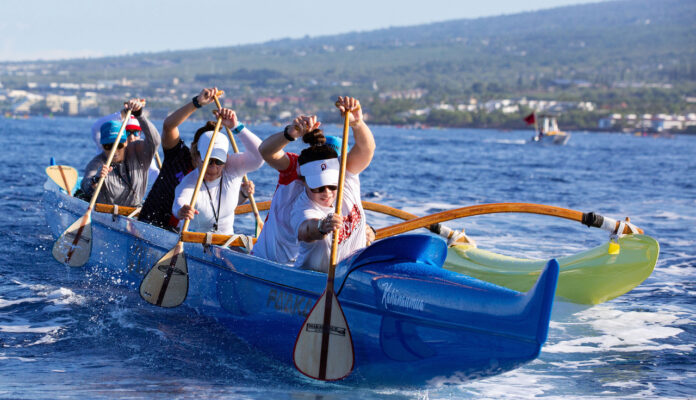
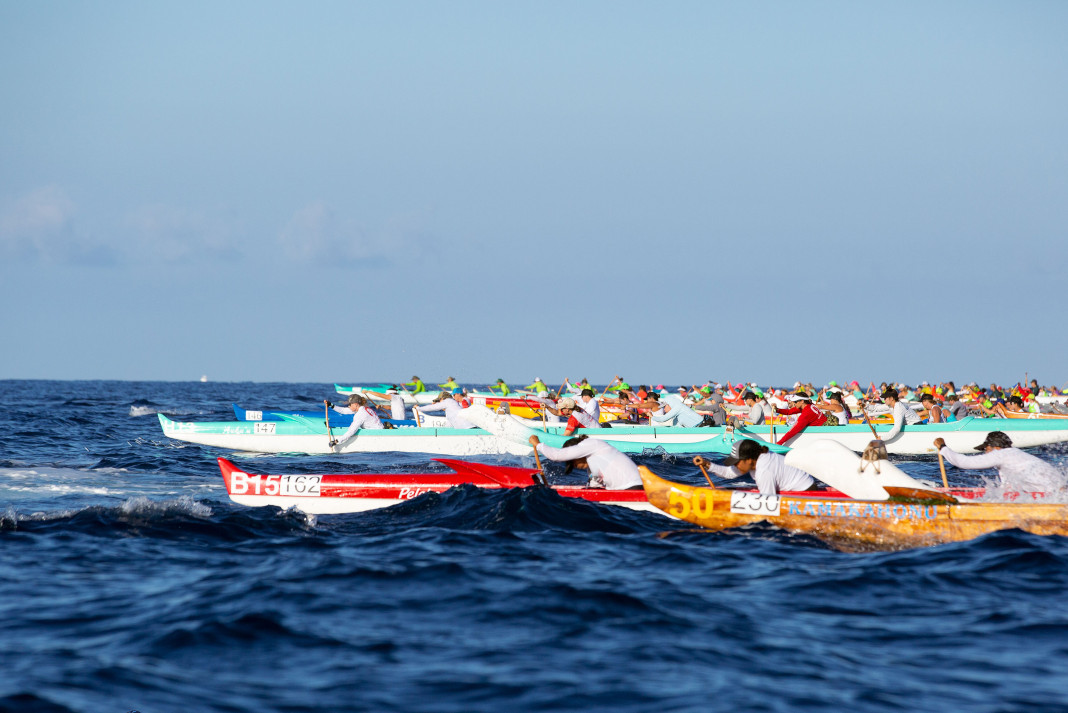
Paddlers in the 2022 Queen Lili‘uokalani Outrigger Canoe Race
Feature Image: Charla Thompson Photography

Get ready,” I tell the girls. It’s 7:29 a.m. My eyes are fixed on the official boat, where a flag will signal the race start any second, sending us on an 18-mile trek down the Kona coast. Birds fly overhead, probably curious about the 128 forty-foot-long canoes lined up like colorful matchsticks on the brilliant, aquamarine sea. The clock changes to 7:30, but the personal watercrafts in front of us continue to zip back and forth, drawing a whitewater boundary with their wake.

My crew of six has three first-timers, and I can sense their nervousness as we wait. “This is the hardest part,” I call out, only half-kidding.

Start line of outrigger canoe race
Image: Charla Thompson Photography

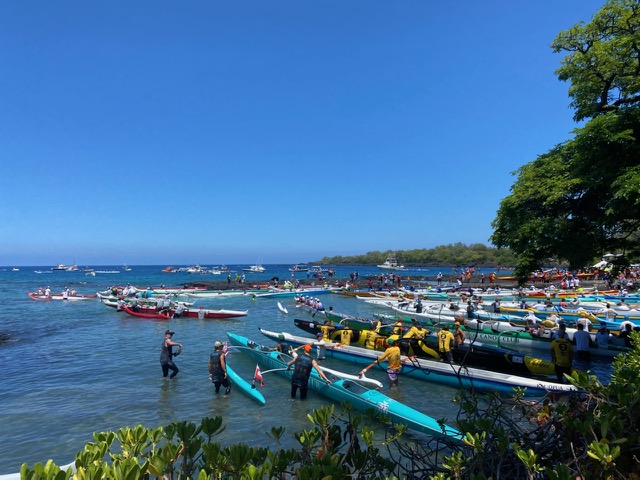
The excitement started building long ago, group texts fluttering as we booked flights and organized practice on O‘ahu’s north shore, home to our canoe club Manu O Ke Kai. We arrived the day before to 1,500 paddlers rigging their canoes on the grounds of the King Kamehameha Hotel. At sunrise, we became part of the mix of teams in matching jerseys duct-taping water systems and power gels to their canoes, tying on bailers and spare paddles, and posing for pre-race selfies.

Muscle and endurance being equal, the crew that can paddle together most efficiently in the Queen Lili‘uokalani Canoe Race—the world’s largest long-distance outrigger canoe race—will prevail.

Lining Up At The Start of the Queen Lili‘uokalani Outrigger Canoe Race

We’re floating right beside Outrigger Canoe Club’s indomitable first crew. “Good luck, ladies!” I holler, and they echo our goodwill. Their energy, our energy, and the energy from the women in all 128 canoes is about to collide with the primal energy of Hawai‘i Island, where the volcanoes Kilauea and Kama‘ehuakanaloa are actively producing new earth above ground and undersea.

The yellow flag goes up, and then the green. The air horn blasts, and the race is on. The paddles hit the water simultaneously on alternating sides. The boats sprint forward.

Individual Tasks For A Common Goal

As the steerswoman in seat six, my job is part navigator, part cheerleader. Whether you’re paddling a traditional koa canoe, a fiberglass “spec” boat, or an ultra-light (a little over 200 pounds) “unlimited” canoe, each person has a job.

Every twelve or so strokes, Michele Sales in seat two calls, “Hut!” That’s the cue to switch the paddle to the other side. After a few minutes, we hit our stride. Some boats—including Outrigger—pull ahead as we battle with a red-and-yellow canoe from Kihei, Maui.

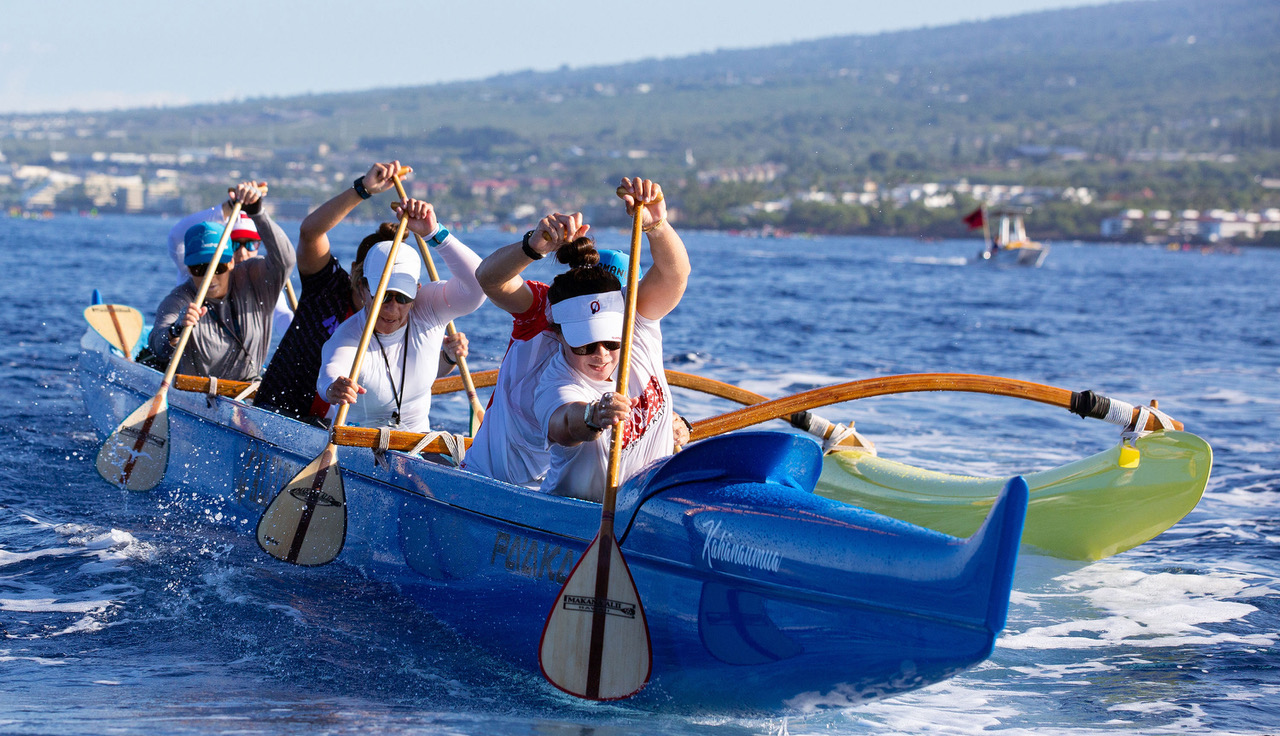
Paddlers in the 2022 Queen Lili‘uokalani Outrigger Canoe Race
The Outrigger Canoe Club. The winning women’s team of the 2022 Queen Lili‘uokalani Canoe Race. Feature Image: Charla Thompson Photography

“While we paddled, I focused on keeping a consistent cadence of stroke and feeling how the canoe reacted,” our stroker and pace-setter Jennifer Ignacio shares. “I thought about how far we’d gone and how much more was in front of us.”

“Timing. Timing. Technique.” These mantras were fused in the mind of Bree Thuston, our seat four. Seats three and four are known as the “pit,” the canoe’s engine. Jackie Reiser, a powerhouse in seat three, adds, “I thought about so much but also nothing. It was almost meditative. When my mind wandered, I’d bring it back to the present.”

“Hut!” yells Michele, a veteran whose consistency in matching the stroker is invaluable. She concentrates on taking advantage of every little swell in this typically hot, flat race, timing her “huts” after bursts of acceleration so we don’t disturb the glide. We paddle, we hydrate, we paddle. Inevitably, the going starts to get tough.

Honoring Hawai‘i And Queen Lili‘uokalani

Image: Catharine Lo Griffin

We pass many significant cultural sites on our journey to Hōnaunau. Kona was once the center of the Hawaiian kingdom, and this race honors Queen Lili‘uokalani, Hawai‘i’s last reigning monarch. The race centers around her birthday, September 2. As we approach Kuamo‘o, the battleground where the defenders of the Hawaiian religion fell, I suggest, “None of us are here without someone else’s sacrifice. Paddle for someone you love.”

“Hut!” calls Michele. I feel the canoe lift. The miles start to merge, like hours on a road trip. I marvel at the diversity of crews, hailing from the U.S. mainland, Tahiti, Australia, New Zealand, Canada, and Great Britain.

As we round Kealakekua Bay, where Captain Cook met his fateful end, I spot the volcanic outcropping where we’ll turn into the finish. “This is it,” I tell the crew.

“On cue, we dug into whatever we had left in our tanks, and our boat took off. We walked past the boat we’d been gunning for,” says Molly O’Keefe in seat five, who can help steer the canoe in rough water. “It was incredible to feel the strength we shared.”

Image: Catharine Lo Griffin

The orange triangle buoy—the finish line—comes into view and our boat soon enters the sacred refuge of Pu‘uhonua o Hōnaunau. Our 18-mile competitive voyage honoring Queen Lili’uokalani is complete with a ninth-place finish in 2 hours, 39 minutes, and 3 seconds.

We maneuver to the lava rock shoreline and carefully climb out of our canoe, another challenging task on this Hawai‘i coastline. “I managed to not step on wana (spiny sea urchins), and somehow find my family in the crowd,” said Bree. Her daughter congratulated each of us with an orchid lei.

“The coastline is still wide open and in this natural state,” race director Mike Atwood said, describing Pu‘uhonua o Hōnaunau. “From the shore looking out, and from the ocean looking in, you can visualize what canoes were doing a hundred years ago. It’s still being perpetuated. It’s being carried on.”

After two years of pandemic pause, the race committee was thrilled to bring everyone back—and is already preparing for next year, the 50th annual Queen Lili’uokalani Race in 2023. None of us say it out loud, but we already know we will be there.

Learn more about the Queen Liliuokalani Race.


Hot Commodity: It’s A Seller’s Market For Your Used Kayak

a group of kayakers paddle in the sunny weather
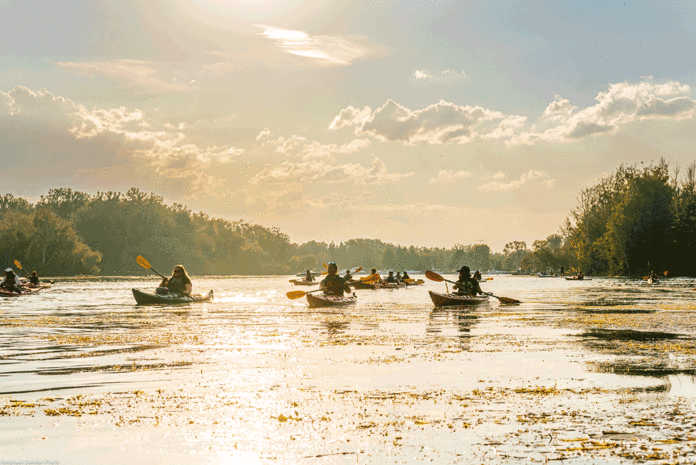
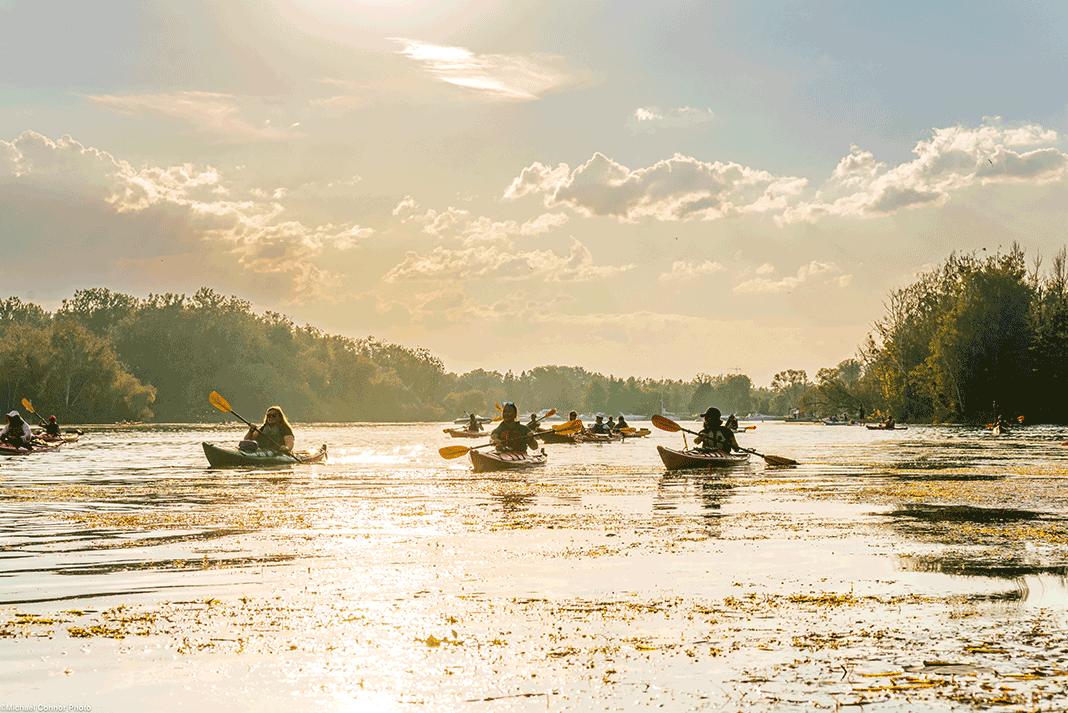
What do you call a morning paddle with friends? Priceless. | Feature photo: Michael Connor

The text from my girlfriend arrived: “Really? Another one?” I didn’t need an emoji to feel her eyes rolling. We’d been strategizing about how to store our kayak fleet—which is really my kayak fleet and her one all-purpose Romany. The “do we need six kayaks between us?” had just become seven because I’d just picked up a $100 repaired plastic touring boat we could loan out to visitors and bounce off rocks. Heck, I tell my girlfriend and myself: storing seven kayaks isn’t any different from storing six.

It’s a seller’s market for your used kayak

Of course, now would be the time to sell, not buy. Kayaks have been flying off the shelves. Boats are sold and paid for in full while they’re still in Conex boxes on the decks of post-Panamax container ships somewhere on the way to North America. The pandemic has driven folks into outdoor recreation and gear of all kinds is scarce. With new boats still trapped in the anvil between high demand and broken supply chains, used kayaks are commanding a premium, even at the end of the paddling season. Whitewater boats with bow pitons and plastic welds are going for $800. A 20-year-old outdated touring kayak is for sale for $2,000—the same as when it was purchased new in 2002.

man drags a kayak across a sandy beach to the water
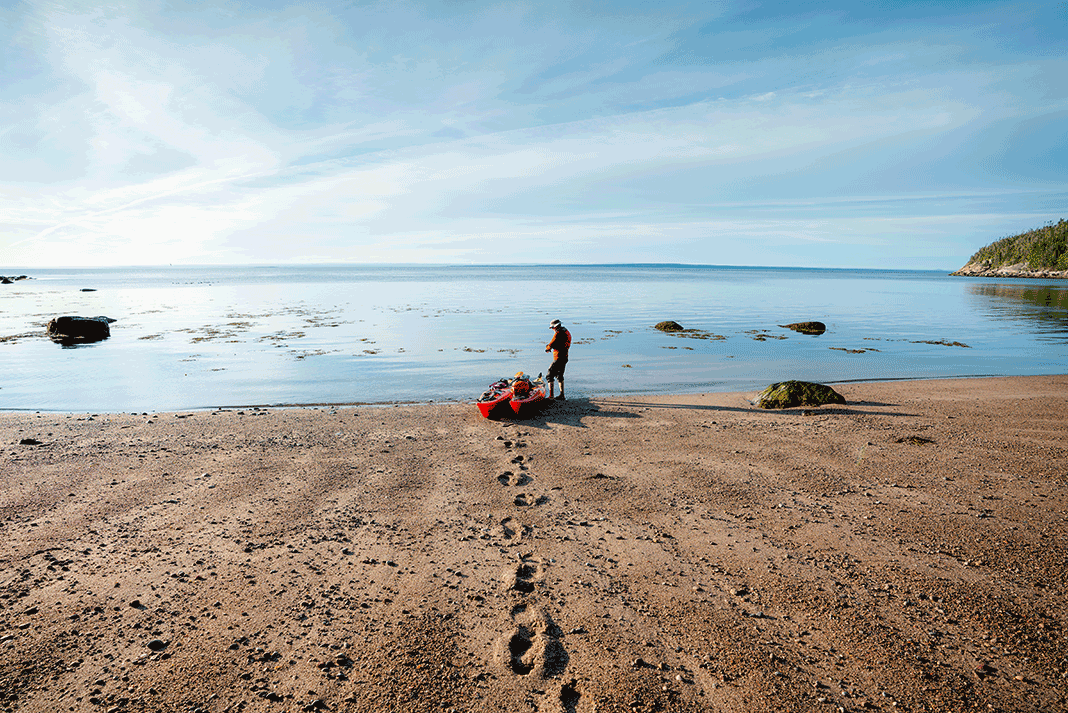
With new boats still trapped in the anvil between high demand and broken supply chains, used kayaks are commanding a premium. | Photo: Nicholas Spooner

The sensible move would be to sell a few of the less-used portions of the fleet, pocket the money for other things, and pay less for a replacement when things settle down. I could sell my heavy, battle-scarred 22-year-old NDK Explorer and, when the cost of a kayak drops, buy something a bit less worn and lighter. Or sell my play-the-sea crossover that’s great for specialized rock hopping and self-supported class II trips but grueling to paddle on the flats.

I could also sell my older-but-in-good-condition whitewater boat until the market slides a little. Then I could pick up something more cutting-edge when some of the folks who dove into the sport during Covid decide they don’t like paddling and sell cheap. Or I could free up space and money for a better bike, invest in pork bellies, cryptocurrency or NFTs, or go on an awesome trip.

But no, instead, I just picked up a welded tourer for less than it would cost to replace its hatch covers. Let’s face it, if you spend an inordinate amount of time dreaming about all the possible ways you could get on the water or editing photos from past trips, getting rid of boats is hard. It’s not like selling stocks to get into bonds because the Federal Reserve raises the interest rate. I’m a paddler and an environmentalist, not a Wall Street quant. I don’t use a Bloomberg Terminal to figure out what boats should be in the garage. Kayaks are not assets to be liquidated when the spreadsheet says so.

That crossover boat in the garage will be the perfect craft for a multiday trip down my favorite desert river next spring. That heavy, scratched-up Explorer? It’s already outfitted just how I like it.

Or was. It’s not in my garage anymore. That’s not because I sold it, though. It’s because some jerk stole it off the roof of my car. So now I’m filing an insurance claim and scanning Craigslist to see if the thief is dumb enough to try and sell it online at a marked up price. If they do, I’m a buyer. Of course, I’m also bringing along my friendly local sheriff’s deputy to help load it on my car.

a group of kayakers paddle in the sunny weather
What do you call a morning paddle with friends? Priceless. | Feature photo: Michael Connor

Kayak prices now & then

New kayaks are a hot commodity thanks to increased participation and supply chain disruptions. With many retailers’ fleets sold out for the summer season, prospective buyers turned to the used market to get on the water as soon as possible. And some sellers have cashed in on the heightened demand. 

Paddling Magazine has always contended kayaks are an excellent long-term investment, but the industry hasn’t seen used boat prices like this before. Though the used kayak market hasn’t experienced quite the same value spike as the used car market—which shot up an astonishing 38 percent in 2021, according to cargurus.com—kayaks have retained, and sometimes even increased, their value. And we’re not just talking about premium models and materials anymore.

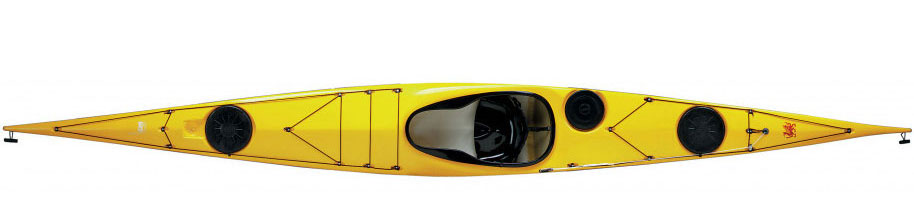
We went trolling through Craigslist, Kijiji and Facebook Marketplace. At the time of writing, most good-condition kayaks manufactured a decade ago are being advertised at roughly their original purchase price. And, because many manufacturers have only moderately increased prices during that time, a decade-old kayak might be within 15 percent of what the same model costs new today.

NDK Explorer

NDK Explorer
2012 MSRP
$3,906
2022 MSRP
$4,385
USED
$3,800

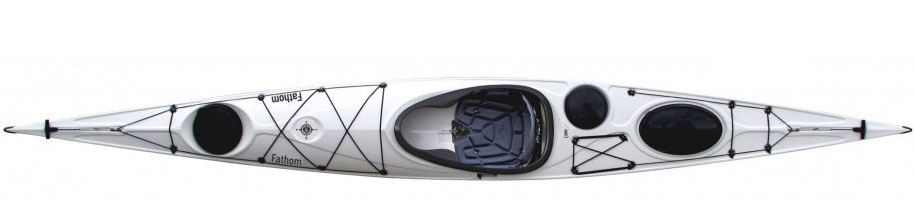
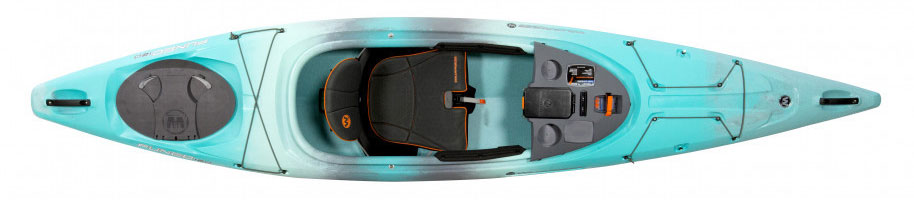
Eddyline Fathom

Eddyline Fathom
2012 MSRP
$2,699
2022 MSRP
$2,999
USED
$2,200–$2,500

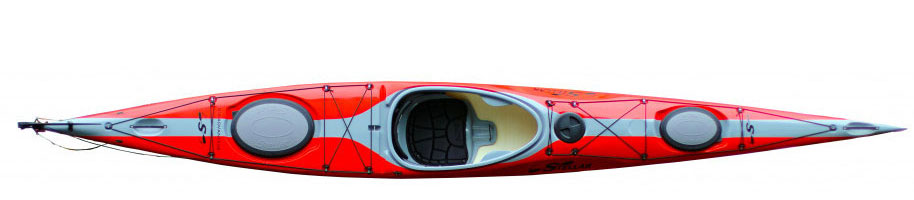
Stellar 16 Advantage

Stellar 16 Advantage
2012 MSRP
$2,330
2022 MSRP
$2,984
USED
$2,700

Wilderness Systems Pungo 120

Wilderness Systems Pungo 120
2012 MSRP
$829
2022 MSRP
$1,189
USED
$800–$1,400

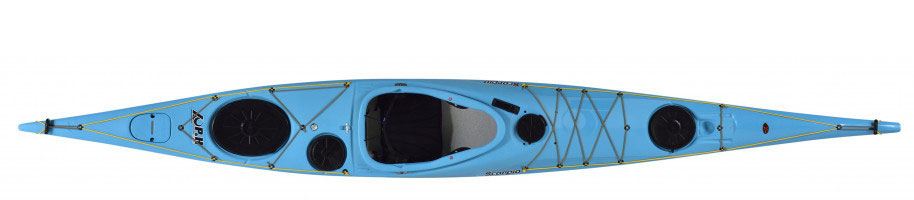
P&H Scorpio

P&H Scorpio
2012 MSRP
$2,099
2022 MSRP
$2,379
USED
$2,000

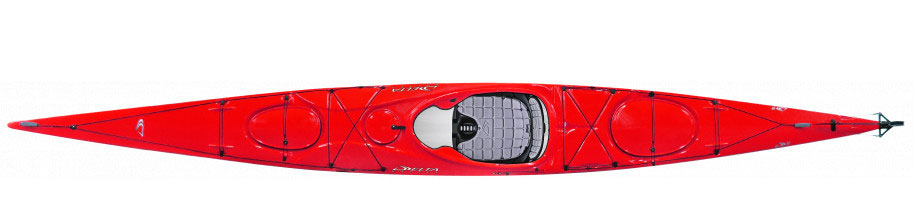
Delta 17

Delta 17
2012 MSRP
$2,495
2022 MSRP
$2,550
USED
$2,100–$2,500


Neil Schulman stores and paddles his kayaks in Portland, Oregon.

Cover of Paddling Magazine Issue 67This article was first published in the Summer 2022 issue of Paddling Magazine. Subscribe to Paddling Magazine’s print and digital editions, or browse the archives.


What do you call a morning paddle with friends? Priceless. | Feature photo: Michael Connor


The Story Behind The 360-Camera Kayaking TikTok Taking Over The Internet (Video)

Still image of kayaker from 360-camera TikTok video.
Feature Image: Remi Anri Doi / TikTok
@anriremi

馬力の巨人。第2話「水上の馬力」

♬ 紅蓮の弓矢 (from ”進撃の巨人”) – mu-ray

When Remi Anri Doi, a member of the Japanese national handball team, posted a video to TikTok earlier in October of himself kayaking while holding a 360-camera in his teeth the views soared. The lens of the Insta360 X3 produces a warped, fish-eye like perspective. The result of Doi’s inward looking video angle? An entertaining, unreal-looking character that’s hard to resist replaying.

How A TikTok Trend Influenced A 360-Camera Kayak Video

It turns out, Doi’s point of view is part of an ongoing TikTok trend, one using 360-cameras to create videos striking a resemblance to the characters of an animated TV series, Attack On Titan. Fans of the show, either by accident or inspiration, noticed a 360-camera held in your mouth while moving at a fast pace mimicked the animated characters on the show.

Thanks to Doi, the Attack On Titan trend has now found its way to paddling. Doi has a knack for making some entertaining videos. We have to say, although the intention of the kayaking video is humor, the athlete’s paddling cadence is looking quite strong.


The Love And Madness Of Long-Distance Expeditions

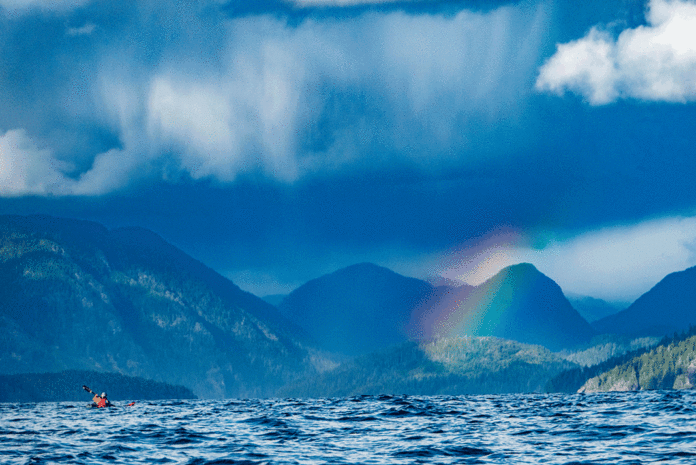
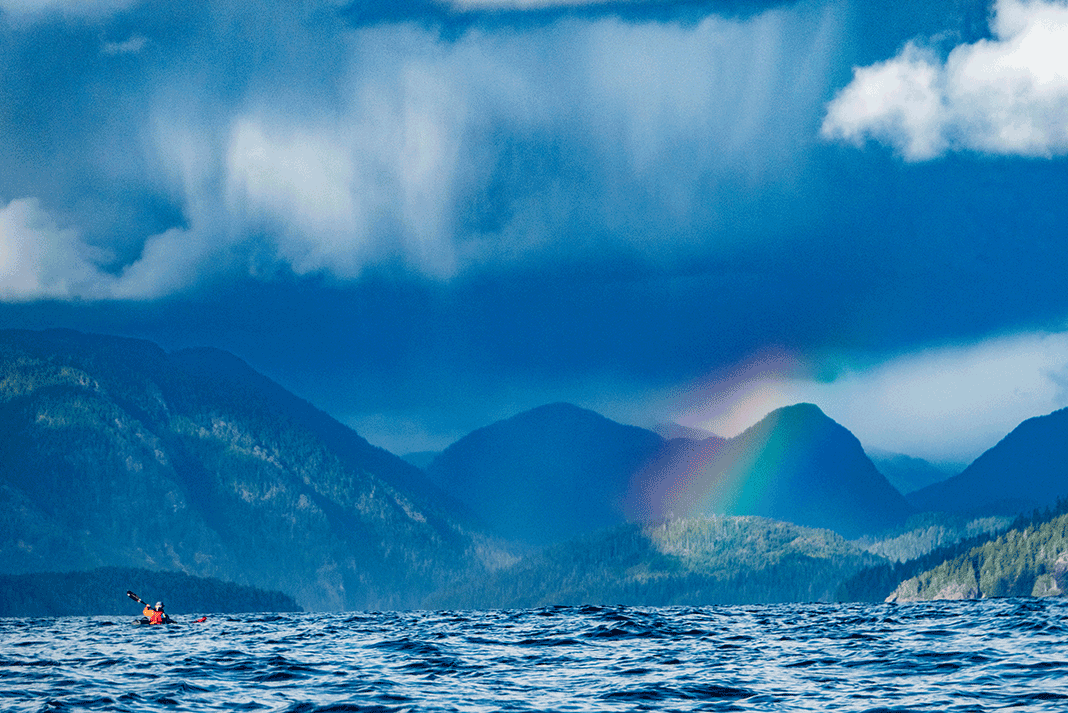
a long distance expedition kayaker paddles the cloudy Kyuquot Crossing in front of a rainbow
Meteorologists have weighed rainbows and found out…they’re pretty light. | Feature photo: Frank Wolf

In 1995, I hit the beach in Vancouver after spending 171 days in a canoe. In a moment, it dawned on me: I was ruined for life. The goal—the proverbial pot of gold at the end of the rainbow—was to be the first to paddle across Canada in a single season. Once we succeeded in our mission though, returning from our long-distance expedition was more of a letdown than a victory. The simple and singular day-to-day existence of moving forward through an ever-changing landscape had come to a screeching halt. My purpose evaporated like water particles reflecting and refracting the sun.

The love and madness of long-distance expeditions

My epiphany was the journey itself was fulfillment, and its completion was just the beginning of an emptiness that wouldn’t subside until I set off again. I was a junkie—I’d had a taste and now I would chase this feeling to my grave.

Since then, I’ve taken extensive wilderness journeys every year, traveling thousands of kilometers by kayak, canoe, bike, ski, foot and rowboat through far-flung corners of the globe. The journeys are low-key, simple and cheap—esoteric routes I’ve put together that aren’t on anyone’s tick list. Sometimes these trips revolve around a greater environmental issue, like an oil pipeline or climate change. If a focus doesn’t rise out of the ether, I just figure out a way to explore somewhere new.

a long distance expedition kayaker paddles the cloudy Kyuquot Crossing in front of a rainbow
Meteorologists have weighed rainbows and found out…they’re pretty light. | Feature photo: Frank Wolf

No matter what, I never repeat a route. For me, without that essence of personal discovery and newness to fill my senses, it would fall short of the fleeting, all-immersive state of being I crave.

[ Plan your next long-distance expedition with the Paddling Trip Guide ]

I’ve been asked by those curious about my urban malaise, “Well, why don’t you just keep on adventuring forever, 365 days per year?” The mad answer is an eternal expedition would just normalize into the everyday. These journeys need to be clearly defined with a start and finish point. Their finite nature makes every moment precious and present.

Embracing a life of adventure

I don’t regret this life, but I don’t wish it on anyone else either. There’s no nest egg, no kids, no typical career. Something must be lost for something to be gained. If you’re creative, passionate and lucky, I think you can do at least one long expedition every year you’re on this planet. Though I’ve had dozens of different trip partners join me on these excursions and share my reality throughout the years, they eventually follow a different path while I remain on mine.

I bided my time through the darkness of another winter, toiling at my job demolishing yachts salvaged from the sea. With the long days my yearning grows to a crescendo. The spring and summer beckon me into their bright embrace with a pair of fresh journeys. There is no gold waiting at the end of these quests, but I’ll certainly find some along the way.

Frank Wolf took this photo in 2021 near the village of Kyuquot during a 1,320-kilometer kayak circumnavigation of Vancouver Island. Combined with a previous 900-kilometer expedition around Haida Gwaii and 1,000 kilometers along the Inside Passage, he’s now completed British Columbia’s sea kayaking triple crown. This summer, he set out on a 300-kilometer ski-and-sled trip in the Arctic, followed by a 1,300-kilometer canoe trip through the Yukon and Northwest Territories.

Cover of Paddling Magazine Issue 67This article was first published in the Summer 2022 issue of Paddling Magazine. Subscribe to Paddling Magazine’s print and digital editions, or browse the archives.


Meteorologists have weighed rainbows and found out…they’re pretty light. | Feature photo: Frank Wolf


Ancestral Craft: The Building Of A Dugout Canoe

Dugout canoes have served humankind as a means of transportation for at least 10,000 years. In the U.S. Southeast, Indigenous Americans used canoes made of hollowed-out trees to efficiently travel through the low country wetlands sprawling across the geographic region. In an effort to pay forward an ancestral craft, Pedro Zepeda from the Seminole Tribe of Florida and John Brown of the Muscogee Nation rendezvoused in Ocmulgee Mounds National Historical Park to build a dugout canoe.

The Building Of A Dugout Canoe

In the video above published by Mvskoke Media, the press of the Muscogee Nation, the two men of the Seminole and Muscogee people present the dugout canoe to Ocmulgee Mounds National Park.

In the second video, The Telegraph, a Macon, Georgia newspaper highlights the building process of Zepeda and Brown’s dugout canoe. To build the canoe, the two were able to source a full section of cypress, one of the types of trees traditionally used in building Southeastern dugout canoes.

The historical park stands on the grounds of a cultural place of importance for a succession of Native Americans spanning 12,000 years of human habitation. Now the donated canoe joins the cultural presence of the park where Zepeda and Brown hope it may be appreciated by visitors, and inspire future generations to continue the ancestral craft of canoe building.


Climate Change Forces Date Change For The Yukon River Quest

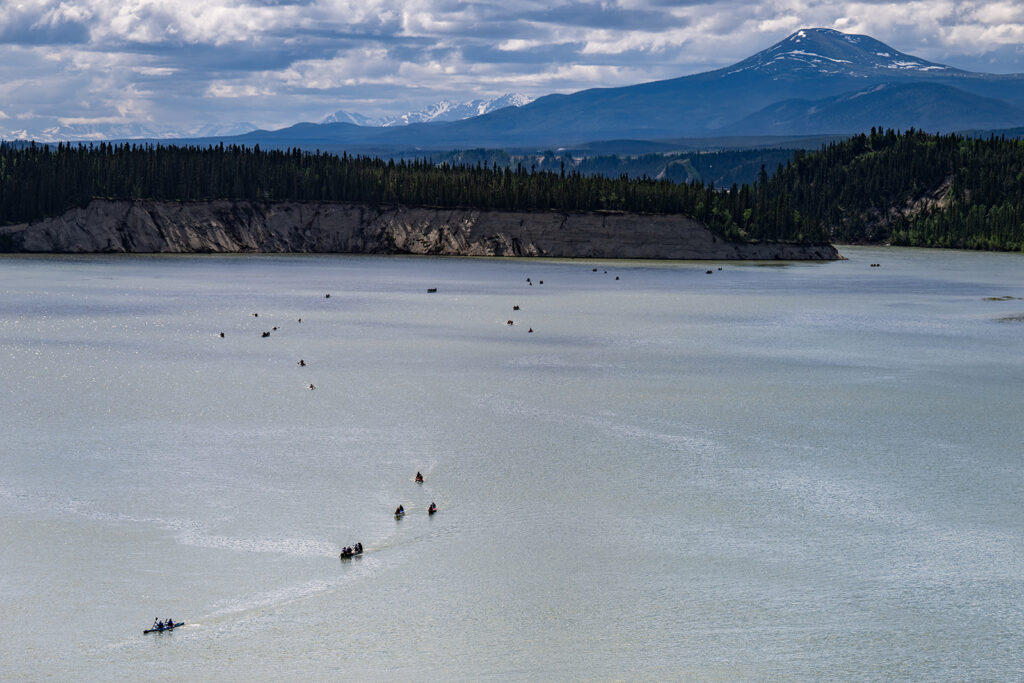
Yukon River Quest
Feature Image: Mark Kelly

Organizers of the Yukon River Quest have announced the date for the race will change going forward, moving the annual marathon race from mid-June to early July.

The decision was made after changing weather patterns resulted in mass flooding and threatened cancellation of the 715-kilometer (444-mile) wilderness paddling event two years in a row.

How The Yukon River Quest Is Shifting Course In A Changing Climate

“It was very, very challenging for us as an organizing team when it was that touch and go. It’s also tough for our racers. You have people come in from all over the world and they got here and things were so uncertain. We don’t want that to be a regular occurrence,” said Deb Bartlette, president of the Yukon River Quest board.

“I don’t think this is in any way going to make the race an easier paddle. What it will do is help us to lower the uncertainty that comes with those very volatile water levels that seems to be the norm now,” she said.

Traditionally the event takes place in mid-June. The 2023 race from Whitehorse to Dawson City will take place from July 4 to 7, accompanied by a new shorter leg to the halfway point.

Changing weather patterns are resulting in higher precipitation and snowpack in the Yukon and Alaska.

Yukon River Quest
Feature Image: Mark Kelly

Annual warming in the region is projected to rise around two degrees Celsius in the next 50 years, according to a 2015 Yukon University research paper, and precipitation is projected to increase 10 to 20 percent in the same period.

In 2020 the River Quest was canceled due to COVID-19. In 2021, the Yukon declared a state of emergency due to flooding and the event was canceled the night before race day. The flooding situation repeated in 2022 and organizers were once again forced to make difficult last-minute decisions.

Paddlers were warned in advance that there would be more debris on the river, larger waves, sweepers to avoid and faster conditions. Beaches and other pull-outs normally available for breaks and emergencies were now underwater.

“We have so many things to consider that not everyone understands. It’s not just the conditions on the river,” explained Bartlette. “We have volunteer safety to think about, we have the communities along the way affected. How can we run a race if, say, Carmacks is being evacuated because of flooding? We can’t.”

“Just because [flooding] happened for the last two or three years doesn’t mean it’s happening next year. That’s true. But these kinds of high water events are going to be more frequent,” she said.

Fast water was a double-edged sword that benefited Eric Bräul’s four-man canoe team, who set a record time of 49 hours, eight minutes and 12 seconds during the 2022 race.

He said despite the advantage it offered his team, flooding made entering the race a tough decision for many and he supports the decision to change the date.

Overview shot Yukon River Quest
Image: Mark Kelly

“People who want to set the record are going to be bummed about that decision, but it does make the race safer and more inclusive,” he said. “There are a lot of very good paddlers, who I think deserve to be included in the race and are perfectly capable of finishing the race, who pulled out because they were concerned about the flooding.”

The original race date took place during the week of the summer solstice, when the longest day of the year allows for nearly non-stop paddling. While the race will now take place two weeks later, Bartlette said the darkest hours of the race will still take place at twilight rather than nighttime.

[ Find your next Yukon adventure in the Paddling Trip Guide ]

“We don’t get actual darkness until later in July, so we’ll still have the midnight sun,” she said.


Level Six Celebrates 25 Years With New Logo Launch

Canadian water sports brand Level Six is celebrating 25 years in business with the release of a new logo as a stand-alone symbol of the company. What began from selling board shorts and simple paddling gear from the back of a van at local river events, Level Six has evolved into a river-culture movement and has become known as a key brand for experiencing life on the water.

Over the last 25 years, Level Six has demonstrated their commitment to create a respectful, inclusive, and supportive culture both internal to the company and across the watersports community. The transformation from a small, naive company to their current status as a positive model of social and environmental responsibility led to the realization that it was time for a logo that better represented what the company has become.

“We want our community to believe in us as a modern innovator of watersports products that is equally appealing to all genders and all levels of enthusiasm,” says CEO and Founder Stig Larsson. “This new logo represents the river that flows through everyone, encouraging us to do our best for our communities and our planet.”

In speaking about the company’s social and environmental actions, Chief Operating Officer Kevin Cook highlights their efforts to reduce waste and use more recycled materials throughout the product line, while also investing in diversity and inclusiveness in paddlesports through the company’s Youth Scholarship Program. “From our in-house repair facilities that keep useful items out of landfills to opening up new doors to underprivileged youth who wouldn’t normally have a chance to experience the sport of kayaking, I’m proud of the brand Level Six has become and I look forward to initiating even more change in our community going forward.”

Level Six has a 25-year history of grassroots innovation and out-of-the-box thinking that has contributed to their positioning as a leader in the watersports community. From design and development to product life cycle management and community support, Level Six has worked tirelessly to embrace river culture and create a brand paddlers can believe in and trust. Their new logo is sure to carry on and expand this narrative for years to come.

25 YEARS OF EVOLUTION

Level Six was formed during a winter training camp in Costa Rica by two Canadian World Cup paddlers who were frustrated with the lack of a unified culture around paddlesports and unsatisfied with the designs on the market at that time. The foundation of Level Six grew from bold design ideas that made sense without compromising quality, function and style from those two relatively immature paddlers. They felt the current industry leaders were not embracing the river culture that was forming, and realized paddlers needed a brand to believe in.

What began from selling board shorts and simple paddling gear from the back of a van at local river events, Level Six has grown over the last 25 years, gaining shelf space at local and then national and international retailers. Over these years the brand has evolved into a river culture movement and, as new ways to experience the water evolved, it has become known as a key brand for experiencing life on the water.

As Level Six matured and grew, so did our understanding of our impact as a global company on the community that we belong to. Commitment to our ethics and values has led Level Six to create a respectful, inclusive and supportive culture both internal to our company and across the watersports community. We operate through a positive model of social and environmental responsibility and undertake commitments to support these values.

On the environmental front, we have committed 1% of our sales toward Watershed Conservation, while also mitigating our environmental impact by increasingly using recycled materials in our products and packaging, eliminating poly bags from 95% of our products, and significantly reducing the use of materials made from petroleum sources. More recently, we have invested in a fully operational repair facility to ensure we can repair and up-cycle all of our products, including complicated latex gasket repair and seam tape replacement. We see this as a major milestone in our sustainability initiatives, as well as a commitment to our customers who support and believe in our vision.

We have also renewed our social commitment by establishing a Youth Scholarship Program allowing underprivileged youth to experience paddlesports. We then expanded our social leadership initiatives to become one of the first paddlesport brands to support programs like Project Canoe and Hudson River Riders to help bring diversity and inclusiveness into the outdoors.

Looking back at the past 25 years, our history of grassroots innovation and out-of-the-box thinking has contributed to our brand development. The transformation from a small, naive company to our current and future trajectory has led to the realization that it was time for our logo to catch up with the company we have become.

We want our community to believe in us as a modern innovator of water sports products that is equally appealing to all genders and all levels of enthusiasm. We want a logo that can stand alone and visually represent the river that flows through us to encourage us to do our best for our communities and our planet. We are extremely proud of the brand we have become and look forward to initiating even more change in our community in the years to come.

Replay: 2022 ICF Whitewater Freestyle World Cup

Alabama Rivers are having a moment. The second longest paddling race in the world on the Alabama River has been underway since last weekend; meanwhile, to the east on the Chattahoochee River, the first of two 2022 ICF Whitewater Canoe Freestyle World Cup events took place on Ambush Wave October 3-5.

The whitewater park on the Chattahoochee is often referred to as being in Columbus, Georgia. Geographically, however, the river and its savory big-water features are shared between the Georgia city and neighboring Phenix City, Alabama.

The waves on the lower Chattahoochee are about as far south as it gets for big whitewater in the U.S. The site provides a slice of the Ottawa River or White Nile type features freestyle paddlers travel the world for. The caliber of consistent waves are what earned the Chattahoochee the opportunity to host the 2022 ICF Canoe Freestyle World Cup. The World Cup provides a preview of next year’s world championship event to be hosted on the Georgia-Alabama line.

[ Find your next Southeast river in the Paddling Trip Guide ]