When we envision the worst thing that can happen on a trip, having our canoe eaten by a bear isn’t a scenario that typically springs to mind. For expedition canoeist Frank Wolf, however, this hypothetical situation became a little too real.
Wolf was on the final stretch of a 1060 km trip from Sandy Bay to Hudson Bay when three polar bears surrounded his basecamp; a remote cabin at the mouth of the Seal River in Manitoba. In the hilarious video, we witness Wolf yelling at one particular bear who is insistent on chewing up his canoe, while the other two circle the cabin perimeters–presumably in search of food.
[ View all Canoes for sale in the Paddling Buyer’s Guide ]
A canoe with holes in it could be detrimental to the completion of the trip, as well as the safety of both the paddlers. Quite understandably, Wolf is determined to not let the bears get away with it. Watch how he deals with the situation in the video above.
When paddling without other boats nearby, a capsize means self-rescue. If close to shore, it may be possible to swim in, pulling your swamped canoe, but this is even less fun than it sounds. If you are far from shore, you will need to get as much of the water out as possible and attempt to reenter. The Capistrano flip is a self-rescue technique that will get you out of deep water and back on your way.
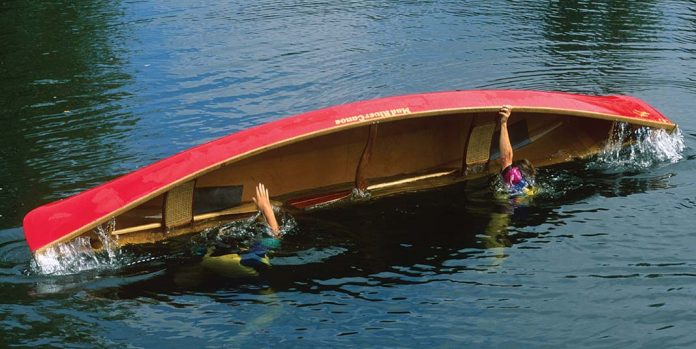
Both paddlers get to the same side of the capsized canoe and lift the nearest gunwale. | Photo: Joanie and Gary McGuffin
1 Lift the gunwale
Both paddlers get to the same side of the capsized canoe, still holding paddles. Lift the gunwale nearest you up out of the water.
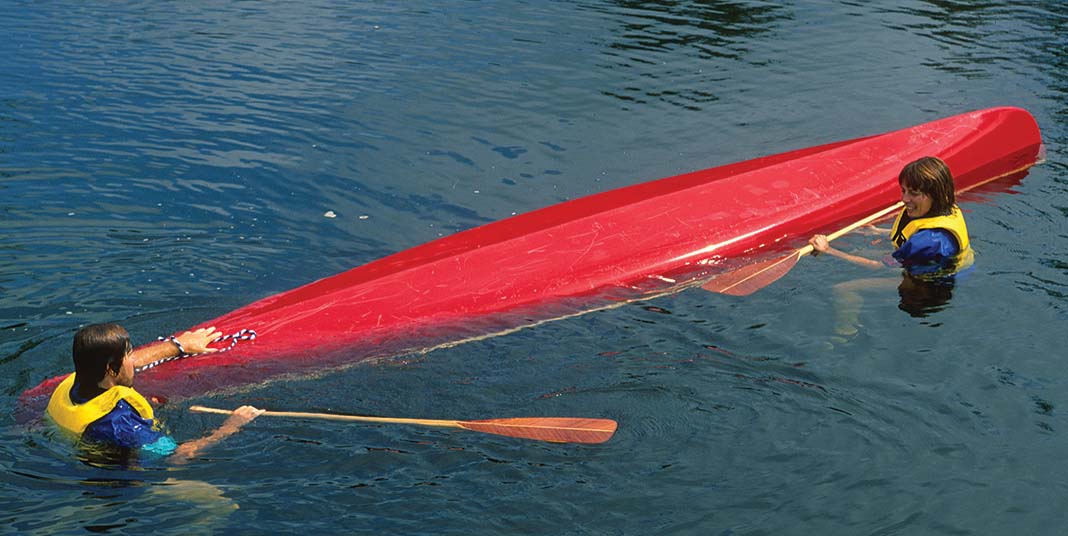
2 Tip the canoe
Face each other and tuck your paddles between the thwarts and seats so they won’t float away. On a count of three, tip the canoe back over you in unison.
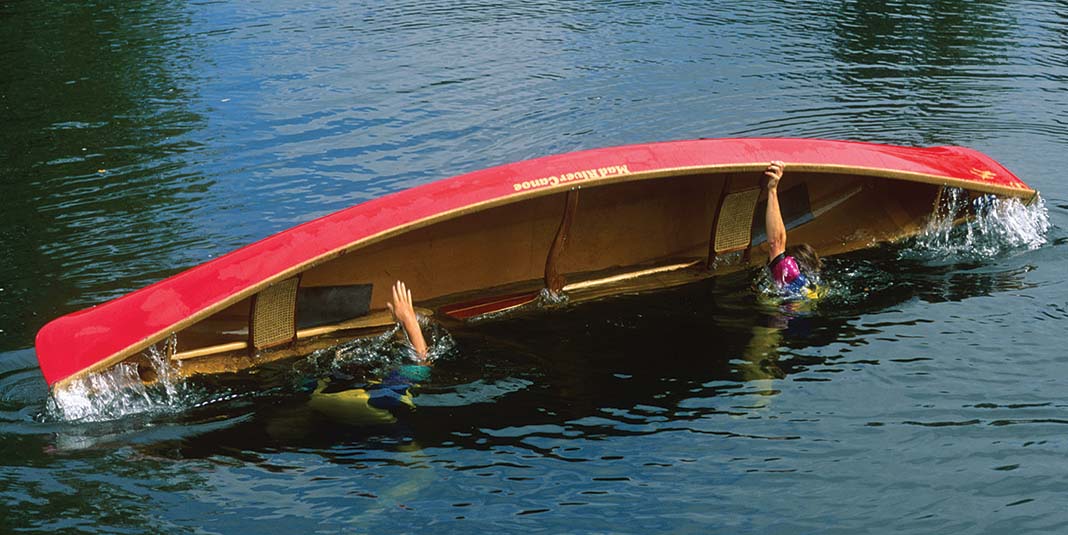
Tip the canoe back over and roll it upright with a strong scissor kick. | Feature photo: Joanie and Gary McGuffin
3 Roll it upright
Use the momentum of this action, along with a strong scissor kick while straightening your arms to push the canoe up and over to one side. The aim is to roll it upright while in the air.
[ Paddling Buyer’s Guide: View all tandem canoes ]
4 Ensure you’re not swamped
Although you may not get all the water out, there will be enough freeboard to allow you to reenter the canoe and bail it out or paddle to shore.
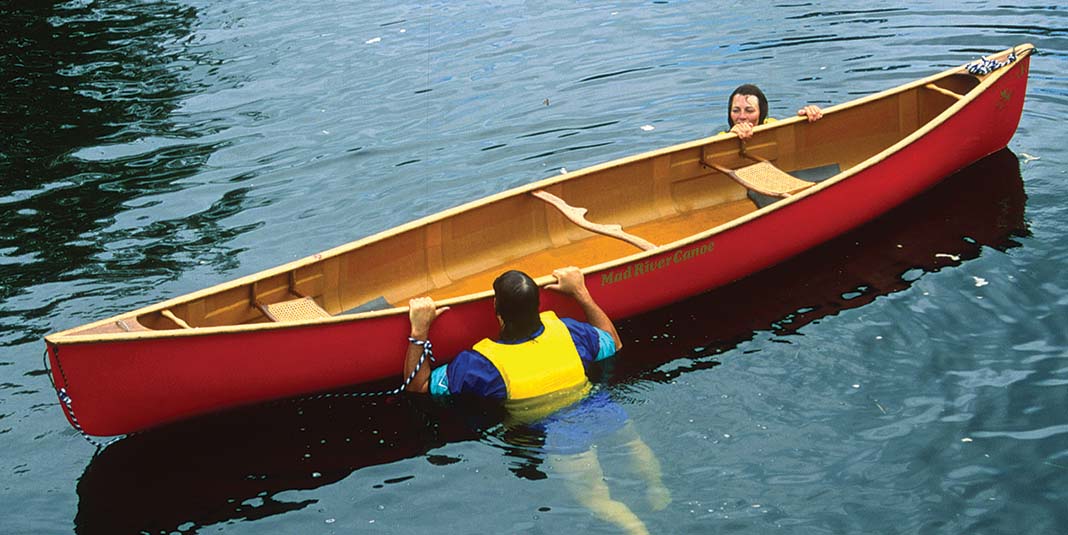
Reposition yourselves on opposite sides of the canoe and reenter with strong scissor kicks. | Photo: Joanie and Gary McGuffin
5 Reenter from opposite sides
To reenter, reposition yourselves on opposite sides. While holding the gunwale, use strong scissor kicks to get up and out of the water.
Time your actions to coincide with your partner. Lean forward, keeping your torso weight as close to the centerline as possible. Reach across to the opposite gunwale, twist and flop your butt back into the canoe.
This article originally appeared in Paddling Magazine Issue 65. Subscribe to Paddling Magazine’s print and digital editions here, or download the Paddling Magazine app and browse the digital archives here.
Tip the canoe back over and roll it upright with a strong scissor kick. | Feature photo: Joanie and Gary McGuffin
What’s the most embarrassing thing that’s ever happened to you on the water? We asked our Instagram followers to reveal their biggest paddling faux pas. It was reassuring to know we weren’t the only ones guilty of (most of) these blunders. Here are our 11 favorite responses.
1. A swim. Nothing like having to have your friends save your a**, boat and paddle.
Get used to seeing the sunset. | Photo: Andrew Strain
The director of programming at Hudson Valley Outfitters in New York has mastered one of the keys to expedition paddling: the long-distance day. Ray Fusco once paddled 61 nautical miles (113 kilometres) in one go, cruising between the New York towns of Hudson and Cold Spring in 14 hours. At the 2005 Blackburn Challenge, Ray placed second in his division, finishing the East Coast’s legendary 20-mile open-ocean race in a time of 3:26. To help extend the distance of all our expeditions, we asked Ray for his top long haul kayaking secrets.
Calories in must equal calories out. Plan your calorie consumption so you don’t run out of energy. Estimate about 100 calories per nautical mile at a speed of four and half to five knots. Read the labels on food and know how many calories you are taking with you. Balance your diet with a mix of healthy foods throughout the day to avoid the “bonk.” A lunch break for comfort food like sandwiches, chips and candy bars is a good rest stop, but supplement with high-carbohydrate, protein-rich energy bars and gel packs while paddling.
Go paddling longer with the right preparation. | Photo: Martin Lortz
For a 60-mile day, try five energy bars, five gels, two sandwiches, a candy bar and a mix of fresh or dried fruit. Duct-tape gel packs to the deck of your boat for fast, easy consumption. Place the tape across the opening tab so a simple pull will release the gel pack and open it at the same time.
[ Browse the widest selection of boats and gear in the Paddling Buyer’s Guide ]
2 Solve your drinking problems
For a 14-hour, 60-mile day, you’ll need at least six litres of liquid. For clean hydration and electrolyte balance, bring three litres of water and three litres of energy drink. Hydration and fuel intake are very closely related. Often, consuming a half or full litre of energy drink can be a perfect fix for simple fatigue, or maybe suck down a gel pack with some clean water to drive you for a few more hours.
Try using hydration bladders with a long hose, holding the bite valve in your mouth during peak exertion for quick, constant hydration. And get it off your back! The more stuff you have on, the less torso rotation you will achieve.
Push with your legs to drive your boat past your paddle and through the water. Even the best paddlers drop in and out of good leg drive. It is very easy to forget to drive your legs once you have reached your 3,000th stroke! Find the comfort zone in your cockpit for maximum leg drive. Then reach, pull hard and smooth, and drive with the legs for a really good glide.
If you’re into long distance kayaking, get used to seeing the sunset. | Feature photo: Andrew Strain
4 Here’s the catch
Remember your stroke recovery (the part where your blade exits the water) needs to be clean and quick but the catch (the part where your blade enters the water) is most important. Jam your blade in the water and wait one full second to make sure your blade is completely submerged. Then pull like fury.
Experiment with your cadence. Find your sweet spot and adjust up and down. If you are comfortable with 50 strokes a minute how fast will you fatigue at 75? Can you pull harder at 60 and not burn out too fast?
Experimentation is equally important for fuel intake. Try different fuel and hydration sources under varying work loads. Conditions will also affect your results so pay attention to your body and learn how it performs in a wide variety of conditions.
This article originally appeared in Adventure Kayak, Spring 2006 and in Paddling Magazine Issue 65. Subscribe to Paddling Magazine’s print and digital editions here, or download the Paddling Magazine app and browse the digital archives here.
If you’re long distance kayaking, get used to seeing the sunset. | Feature photo: Andrew Strain
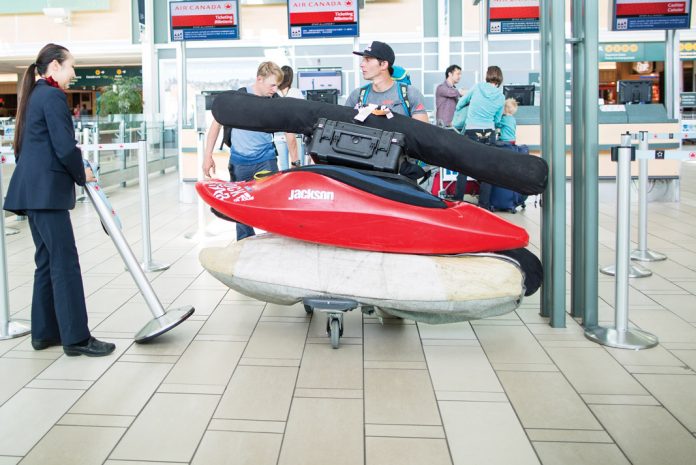
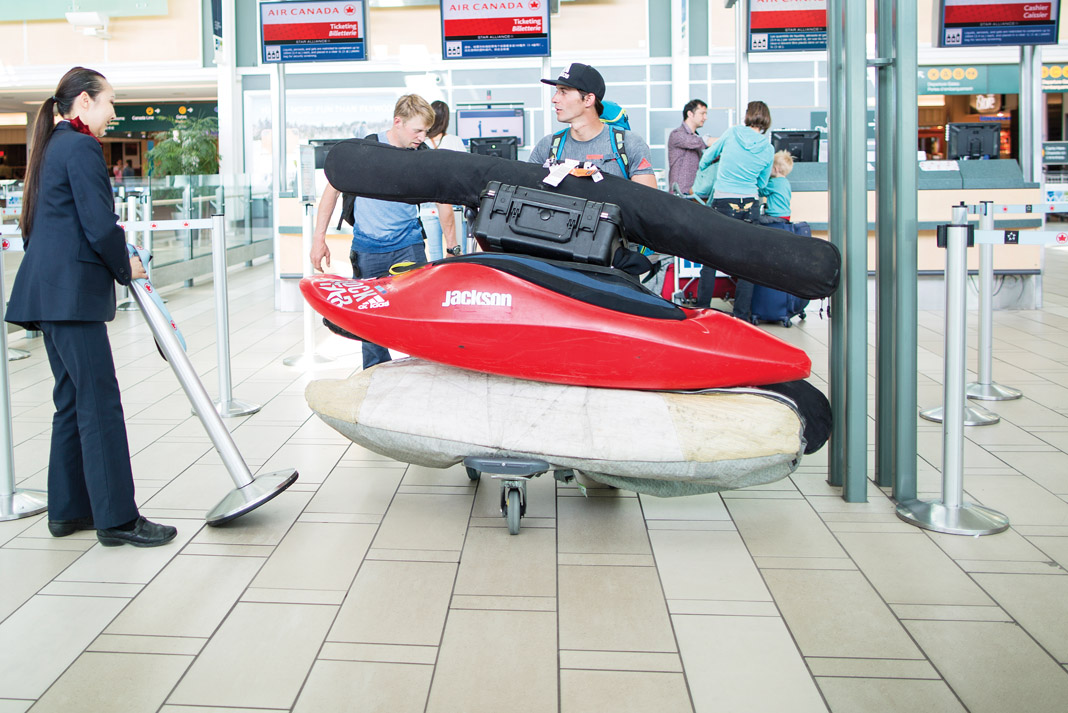
Step one: be super friendly. | Feature Photo: Jens Klatt
There’s no doubt that figuring out how to fly with a kayak can be a pain. Kayaks are big, bulky and prohibited on many airlines. Yet, kayakers willing to jump through some administrative hoops and play by the airline rules will likely be rewarded for their efforts.
Research which airlines allow you to fly with a kayak. Some airlines won’t take kayaks, while others will take them without any trouble. Still others will take them, but only if there’s enough room on the aircraft that particular day.
Check regulations on airline websites, but also search Google and ask other boaters for advice. Don’t be swayed by horror stories because there are horror stories associated with practically every airline. You’ll find general trends emerge—United and Delta have policies against accepting kayaks, while it’s a grey zone for American Airlines and KLM.
Depending on the carrier options available to you, it’s possible no airline will officially take your kayak.
“Research so you know what you are getting yourself into,” recommends Crista Wiles, an instructor with traveling paddling school, World Class Kayak Academy, and a veteran of dozens of flights with dozens of kayaks in tow.
She recommends getting to know the different carriers’ fees for extra baggage, rules for packaging the boats and the maximum baggage dimensions before settling on a carrier. “Then print the policy, highlight the appropriate parts and bring it with you to the airport for reference and to save time,” adds Wiles.
Depending on the carrier options available to you, it’s possible no airline will officially take your kayak. “When airlines hear ‘kayak’ they often assume slalom boats, which break more easily and are more expensive to replace, which is why they are more hesitant to take them,” says Wiles.
Not to fear, because you’re not flying with a kayak at all! It’s time to get creative by calling your kayak a wave ski, paddleboard, ski equipment or another conventional piece of sports equipment accepted by a carrier’s regulations.
2 Wrap your kayak up properly
Your kayak should be wrapped up for its journey. The bag your boat came in works perfectly, but blankets or a tarp can be rigged to work in a pinch. Wrapping protects the boat when you fly with a kayak. It also disguises it if you’re trying to pass it off as something else to comply with regulations.
Remember that if you’re lying about what’s inside, definitely avoid a carrying bag that says kayak on it. Most airport staff won’t dig inside to check what it actually is, advises Wiles.
Of course, there are no guarantees with this method. Be sure to wrap your boat in a way that offers a loop for the bag tag and makes it easy for baggage handlers to carry.
[ Browse the widest selection of kayaks in the Paddling Buyer’s Guide ]
3 Know the weight of your kayak
Before arriving at the airport, weigh your kayak and gear. Most airlines accept baggage up to a maximum of 71 pounds for national flights and a maximum of 100 pounds for international destinations.
A typical playboat, like the Jackson Fun, runs about 35 pounds. This leaves lots of leeways to stuff your cockpit with PFD, helmet, disassembled paddle, and other kayaking gear. If your gear won’t fit in your cockpit then pack into a duffel. Be sure to write your name and contact info on each piece of baggage.
On departure day, get to the airport early. Start smiling as soon as you walk in the door and don’t stop until your kayak has been accepted. Be the friendliest and most polite person those customer reps will deal with all day. Grease the administrative wheels.
Step one: be super friendly. | Feature Photo: Jens Klatt
Extra or oversized baggage almost always incurs fees, so be prepared with a credit card in hand. One-way fees can range from free to $50 to $200 and even higher. It could be cheaper to rent a boat at your destination.
“Try to get the boat sent through to your final destination so you don’t have to keep checking it,” advises Wiles. It’ll help avoid trouble with other check-in desks, and possibly avoid incurring more oversized baggage charges.
If your airline officially accepts kayaks as baggage, you don’t have much to worry about. When and if you’re bending the rules to fly with a kayak, it’s best to have a backup plan in case you get skunked. “If you are really worried, have someone you can call to pick up the boat if you can’t get it on the plane. Makes life way less stressful,” adds Wiles.
This article originally appeared in Paddling Magazine Issue 65. Subscribe to Paddling Magazine’s print and digital editions here, or download the Paddling Magazine app and browse the digital archives here.
Step one: be super friendly. | Feature Photo: Jens Klatt
After five years in Denver, Colorado, Outdoor Retailer has announced it is moving back to Salt Lake City in 2023. This is despite threats of a boycott from outdoor giants, including Patagonia, REI and The North Face.
After two decades hosted in Salt Lake City, Utah, the outdoor industry’s largest trade show moved to Denver in 2018. The move was prompted by numerous retailers withdrawing from Outdoor Retailer after Utah’s then-Governor Gary Herbert signed a resolution urging the Trump administration to rescind the Bear Ears National Monument that was established in the final days of the Obama administration. After the backlash from the public and retailers, Outdoor Retailer began looking for new sites to hold their trade shows.
This June’s Summer Market will be the final Outdoor Retailer in Denver before the show moves back to Salt Lake City for the Winter Market in January.
The statement released on Outdoor Retailer’s website on March 23, 2022, reads:
“As our contract nears its natural end after 2022, we’ve been exploring our options and conferring with the industry to map our next steps.
After much deliberation and input from all sides, we’ve decided the best move for Outdoor Retailer is to return to our basecamp. We’re heading back to Salt Lake City and County to the place we grew up and where our industry matured into the dynamic and powerful community it is today. Moving forward, Outdoor Retailer will bring the community together in January and June at the Calvin L. Rampton Salt Palace Convention Center. We have a strong relationship with Salt Lake City and a committed partner in Mayor Erin Mendenhall, whose values align with ours following tremendous investments in clean energy and a strong commitment to public lands. This proved to be a real turning point in our recent negotiations.
[ Discover the best gear of the year in the Paddling Buyer’s Guide ]
The statement also details OR’s commitments, including:
“Committing revenue over the next three years from Outdoor Retailer events in Utah to fund programs to support outdoor recreation and protect public lands;
Forming the Business with Purpose initiative in partnership with Visit Salt Lake to bring city, county, state and federal officials, public lands and outdoor recreation leaders, and industry stakeholders together for biannual meetings focused on addressing challenges, influencing policy, assisting advocacy efforts, and directing resources into protecting natural and cultural spaces and improving access;
Providing increased opportunities for the industry, local communities, and media to participate in panel discussions, educational activities, and volunteer projects.”
Learn more about the move back to Utah on the Outdoor Retailer website here.
Just last month, on February 14, 2022, The Conservation Alliance released a statement along with more than two dozen other outdoor industry member companies urging Outdoor Retailer’s parent company, Emerald Expositions, not to move the Outdoor Retailer trade show back to Utah, “so long as its elected officials continue attacks on national monuments and public lands protections.”
The statement goes on to read: “So long as Utah’s elected delegation continues its assault on public lands and the laws designed to protect them, Emerald faces a choice: move the show to Utah and ensure that many of the key players in the outdoor industry will not return to Utah with the trade show, or work with the industry leaders to shape a future trade show that balances the interests and values of industry members and partners.”
The companies committed to not participating in a Utah show include:
The unofficial king of stern squirts is here to reveal his secrets for getting the fun (and trending) trick dialed. You may recognize this polyonymous trick by one of its regional colloquialisms: the squirt, the taillee, the pirouette, the whoopie, or even the whirly. Regardless of its name, the fundamentals of the move remain the same.
The stern squirt is a classic move that can be practiced on high-volume runs as well as low-volume, slow-moving water. To initiate the move, a kayaker will drop their upstream edge as they cross an eddyline, while simultaneously taking a backstroke on their downstream side to initiate the stern submersion. Once the stern is fully underwater, the kayaker will throw their weight backward to keep the boat’s stern submerged. The paddler will simultaneously take some bow draw strokes on the same side, to keep the boat moving in a pirouette motion.
In this video, professional kayaker Bren Orton walks us through the move in three easy-to-follow parts–-with some additional, not-so-common advice thrown in there. To try this trick for yourself, you’ll simply need a slow current and an eddyline with some aeration.
Like so many humanitarian disasters we see on television and social media, we struggle to grasp the full scope of the suffering until it’s distilled to a scale we can understand. For me, that moment came last week, when an image of a kayak in the sky blue and sunflower yellow of the Ukrainian flag stopped my scroll.
The boat was part of a fundraiser by Pyranha kayaks, a company founded and run by lifelong paddlers. The picture led to a blog post that started this way:
“We have ceased all shipments to Russia as of the week before last and have heard from both of our Ukrainian dealers that they are preparing to defend their homeland in any way they can,” it said.
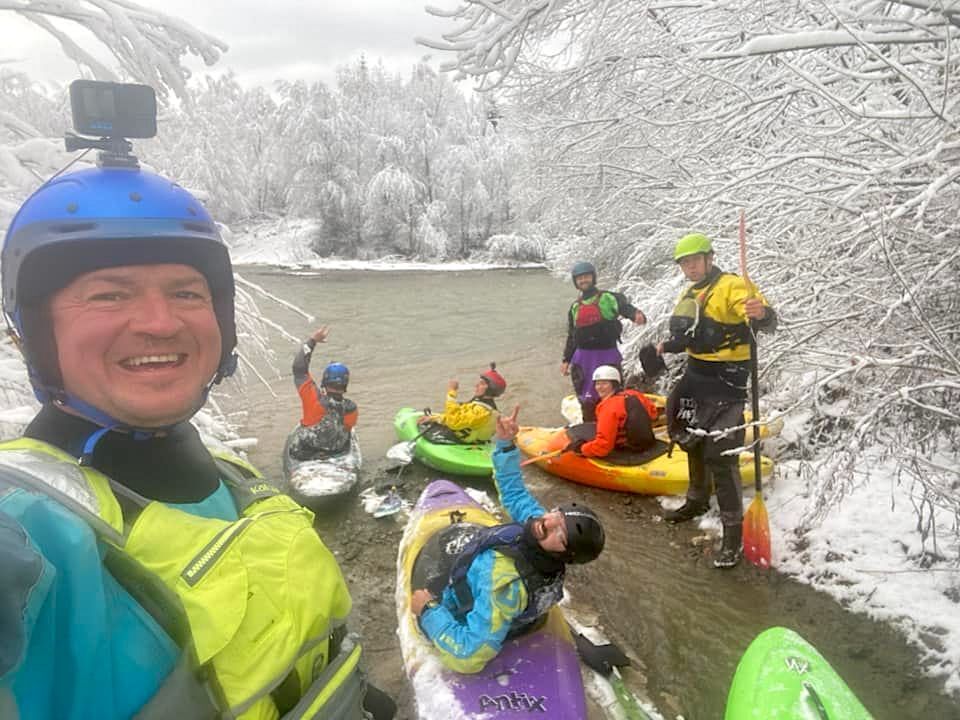
“These are our dealers in Ukraine,” it continued, between a pair of photographs. “Mike, with his family… Anton, with his paddling crew.
Pyranha dealer Mike with his family. Photo Courtesy: Pyranha
“These are wonderful people.”
That is when the human impact of Russia’s war of aggression in Ukraine finally hit me in the gut. I’d been reading for weeks about families split by war, with mothers, children and even pets fleeing west, while men stayed behind, compelled to kill or die in a conflict they could hardly have comprehended a month ago.
Anton’s photo, all smiles and shakas from a snowy riverbank in Ukraine, could just as easily have been taken on any of a dozen rivers I’ve run in West Virginia, Colorado or British Columbia. And Mike’s family portrait looks much like my own, down to the way his daughter leans into his shoulder.
Pyranha dealer Anton with his paddling crew. Photo Courtesy: Pyranha
“We are lucky to live in a stable and peaceful democracy, whilst millions live with the harsh reality of the many dreadful wars around the world,” said Pyranha’s managing director, Graham Mackereth. “This war in Europe, in an area where some of our staff come from, where our customers are being bombed, brings that reality far too close to home.”
Photo Courtesy: P&H
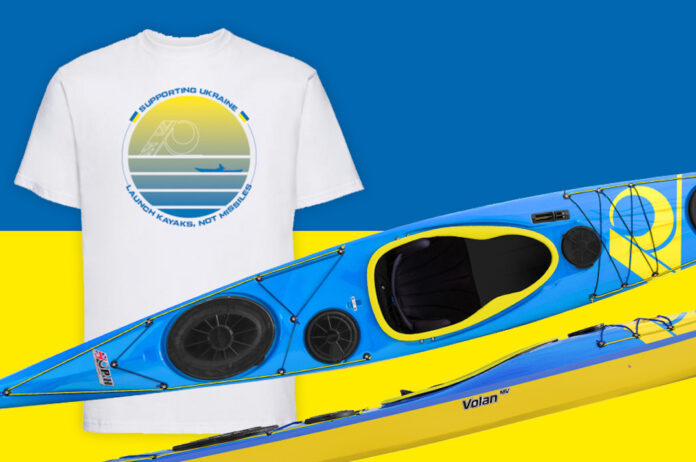
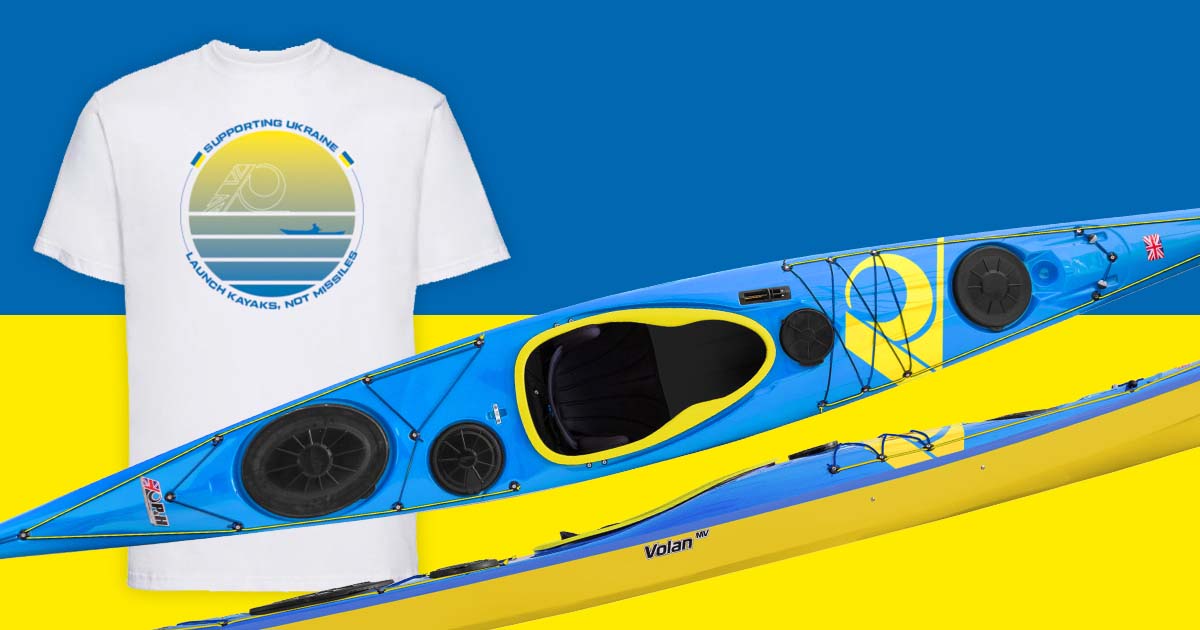
The company’s staff will donate their labor, and several suppliers have donated materials to make 20 custom Pyranha Scorch river runners and 20 P&H Virgo touring kayaks in the colors of the Ukrainian flag. One hundred percent of the proceeds will go to The Disasters Emergency Committee, a major charity doing humanitarian relief in Ukraine.
Support from Pyranha’s dealers across Europe and North America was so strong that the company committed to making an additional 20 Ukrainian flag kayaks at cost, with proceeds also going to DEC. Two of the kayaks will be raffled for the cause, one in Europe and the other in North America. Tickets can be purchased through Pyranha’s European and North American webstores.
Those not in the market for a kayak can show their support by purchasing limited edition t-shirts in the colors of the Ukrainian flag and bearing the slogans ‘Launch Kayaks, Not Missiles’ and ‘Drop Waterfalls, Not Bombs.’ Shirts and raffle tickets can be purchased through Pyranha’s European and North American webstores. Paddlers also can contribute directly to DEC or a relief charity of their choice.
Pyranha announced the program March 9 with the goal of raising £75,000 ($98,000) for Ukraine relief, and the response was so positive that the company increased the goal. “We’re on track to raise over £120,000 ($158,000), which is almost double what we were aiming for,” said marketing manager Mat Wilkinson. “It is a true showing of the far-reaching community spirit amongst paddlesports enthusiasts that Pyranha is already over halfway towards this goal.”
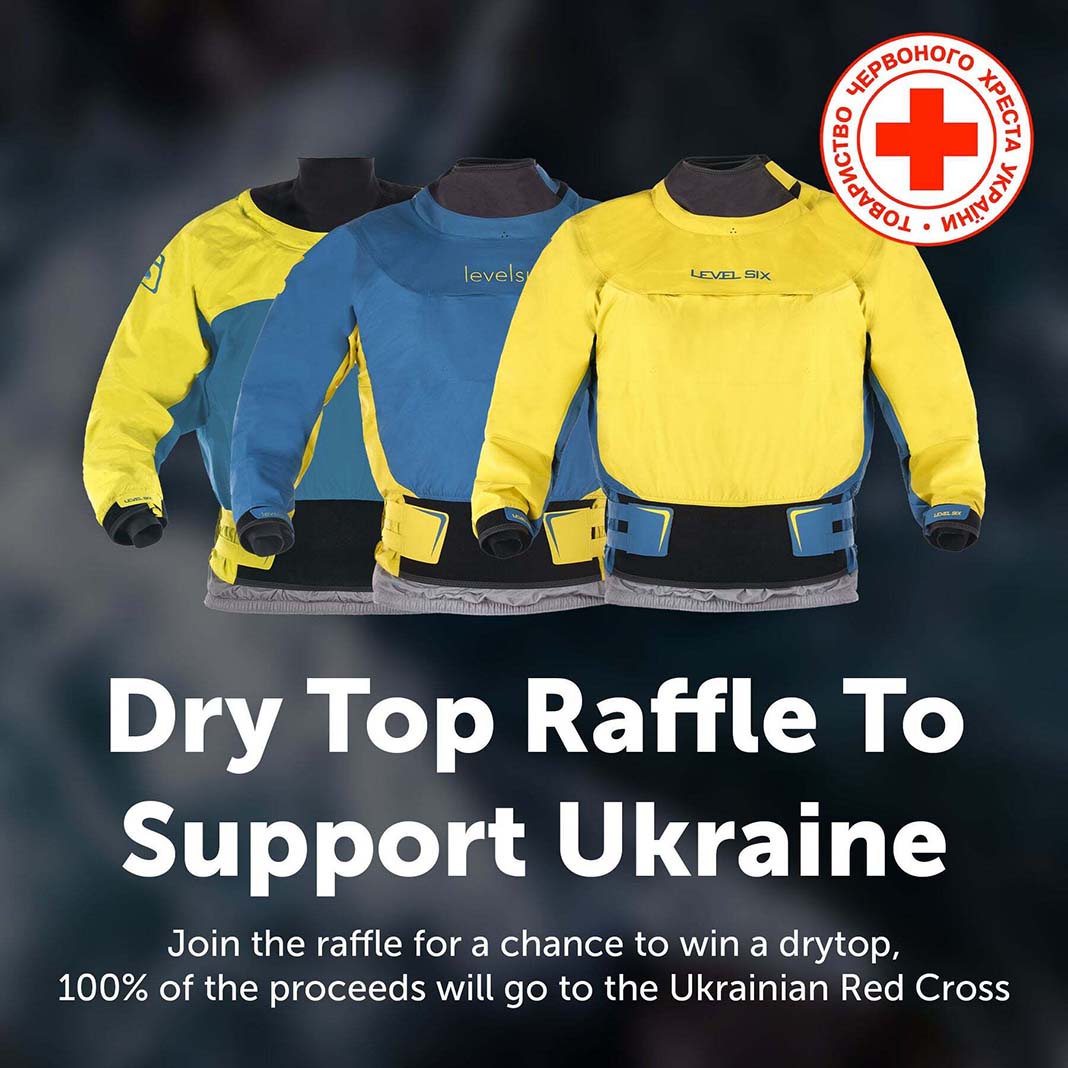
Other paddling companies and organizations are also helping. Level Six, which regularly raffles drytops to support its mandate of “life on the water for everyone,” this month is supporting Ukraine relief. A $10 virtual raffle ticket (unlimited entries per person) buys a chance to win one of three drytops (Duke, Nebula or Nova) with all proceeds going to the Ukrainian Red Cross. The raffle runs until March 27 at www.levelsix.com.
Photo Courtesy: LevelSix
The American Canoe Association (ACA) also has stepped up in the crisis. When the International Canoe Federation pulled a pair of elite paddling races from Russia in the days following the invasion, they were faced with a monumental problem—relocating on little notice two events that normally take years to plan.
Enter Oklahoma City, which in recent years has hosted paddling events of all stripes, from the Paddlesports Retailer trade show to elite international competitions like those the ICF snatched back from Russia. In fact, Oklahoma City hosted the 2021 ICF Canoe Sprint Super Cup downtown under the lights—the first such competition to be run at night.
The ACA, which doubles as the national governing body for U.S. Olympic paddling, will partner with Oklahoma City’s Riversport Foundation to host the 2022 Canoe Sprint Super Cup and the 2022 ICF Stand Up Paddling World Cup previously awarded to Moscow, Russia. The events will take place in August, with final dates to be announced in early April.
“Even before the ICF approached us, we were exploring options to help Ukrainian athletes. Reallocation of events from Russia to the USA is equally a challenge and an opportunity, and we look forward to welcoming our Ukrainian friends and other international athletes in Oklahoma City this summer,” said Rok Sribar, the ACA General Manager for High-Performance Programs.
Riversport Foundation Board Chairman Michael Ming echoed the sentiment. “When we were approached about stepping up to host the displaced events, it was a resounding yes from everyone involved,” he said.
With world-class competition under the stadium lights, they promise to be events to remember. If you go, may we suggest you wear sky blue and sunflower yellow.
Canoeists haven’t changed all that much over the years, but the guidelines for open boaters have evolved. Want the latest ways to be a happy camper on your next canoe trip? From gas guzzlers to gadgets, food to fashion it helps to learn from the hard-earned experiences of others. We present some new rules of thumb every canoeist should be acquainted with.
Things you should keep on your belt: flashlight, Leatherman multitool, compass, binoculars, survival kit. Things you shouldn’t: cellphone, batarangs.
This is the one-time zip-off pants win the function-versus-fashion trade-off, but only just.
Footwear in ascending order of versatility: flip-flops, clogs, sneakers, neoprene wellies, sport sandals, hiking boots. Closed-toe are better.
5 things your trip mate never wants to hear
“Did you tie the boat up?“
“Does this farmer John make me look sexy?”
“I thought you had the keys.”
“I thought you had the map.”
“I thought you had the whiskey.”
This article originally appeared in Canoeroots and in Paddling Magazine Issue 65. Subscribe to Paddling Magazine’s print and digital editions here, or download the Paddling Magazine app and browse the digital archives here.
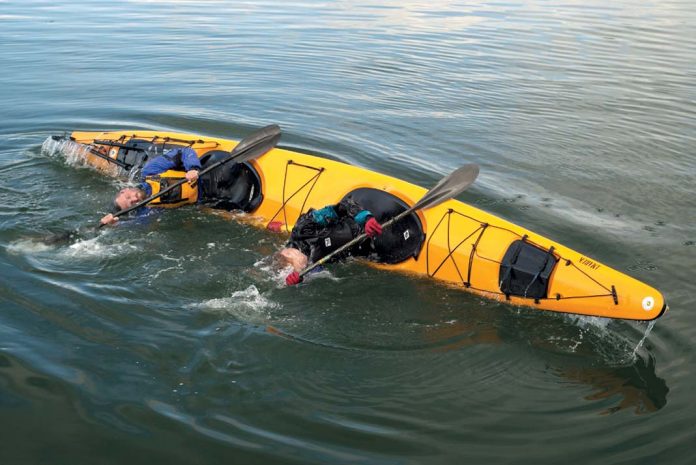
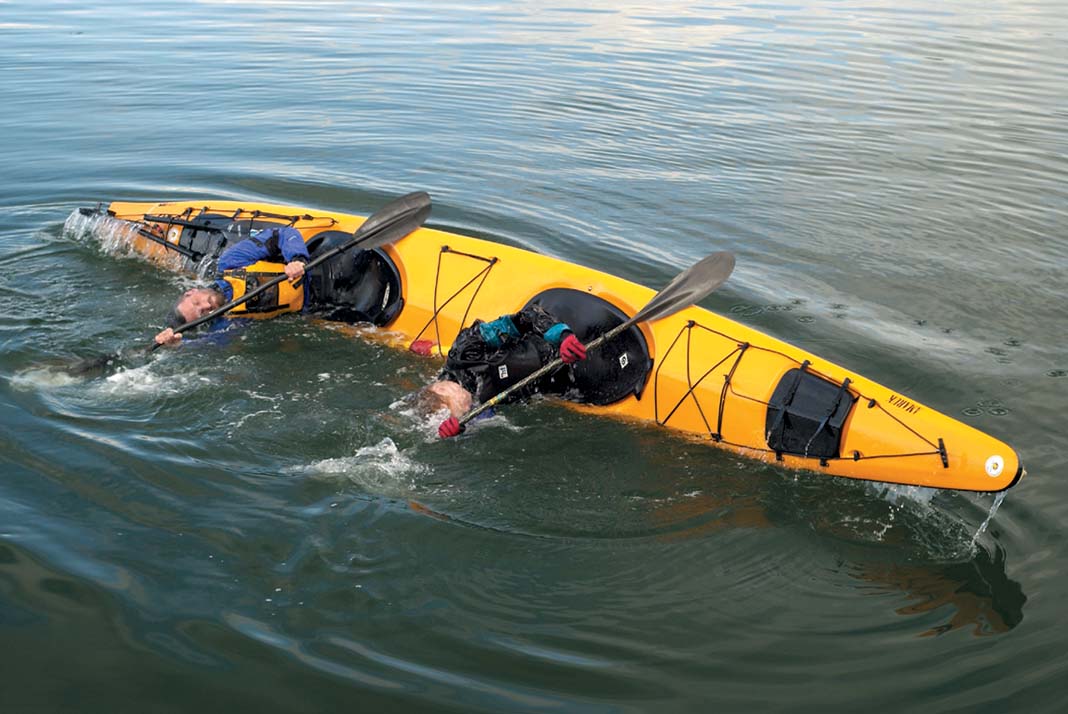
In some quarters, tandem kayaking is synonymous with dull paddling and poor technique. But where is it written that tandems must be paddled conservatively? In any kayak, we should be safely pushing our limits to improve our skills. Double kayaks are no exception. We should be out there surfing in plastic doubles, doing huge seal launches, practicing lean turns and braces, sculling…and even nailing rolls. Try out these methods for a successful–and effortless–tandem kayak roll.
2 Techniques to Roll a Tandem Kayak
1 The tandem kayak roll
Tandem rolling is surprisingly easy. The mechanics are exactly the same as rolling a single kayak, except, of course, that you have to coordinate with a partner.
How to coordinate your roll
The key to success is to have both paddlers roll in unison. Before capsizing, agree which side you’re going to set up on. This seems obvious, but I’ve seen a very experienced team of a right-handed paddler and a leftie combine to almost lift a whole double free of the water—it sure didn’t roll!
Choose the strongest paddler as the lead. It then becomes the other partner’s job to set up for the roll and wait to feel the roll initiated. Some paddlers rely entirely on “feel” from the time of capsize. Or, the lead paddler can tap on the deck as a signal for setup, which will be followed by a predetermined count (a quick “one-chimpanzee, two-chimpanzee,” for instance) and then both paddlers start their rolls. When selecting a partner, high-grade toward musicians, dancers or synchronized swimmers. (The latter are used to holding their breath underwater and already come with their own nose plugs.)
Don’t get into double trouble! Follow these techniques for an effortless tandem kayak roll. | Feature photo: Josh McCulloch
How to execute the roll
No matter how you time it, the “following” paddler must feel for the progress of the lead roller, waiting for that little lift that signals the initial loading of the lead paddler’s blade. At that point, the following paddler jumps into their roll. It doesn’t matter what style of roll each paddler chooses, C-to-C or sweep, as long as at least one of the paddlers has a really strong roll. Try different rolls and see what works for your team.
Obviously all the usual rolling rules apply—reach for the surface, keep your heads down and drive the knees for a good hip snap. Without that hip snap you are never coming up. And if one paddler is pulling their head up too early, straining to get upright and leading with the noggin, it’s gonna be wet for both boaters.
All the little “cheats” apply too, and maybe even more so. If you find yourselves almost up, but not quite, keep those heads down and a quick scull will almost always get you the rest of the way upright. With two paddlers, you have a lot of lift on tap, but only if you can work together cooperatively. If you have the timing down, have strong solo rolls, and are both starting your rolls at the same time—and on the same side!—you are almost guaranteed success.
Using the tandem roll to teach a new paddler
The tandem roll is also a fun teaching tool. With a strong roller in the boat, the newer paddler can go through the rolling motions, getting the feel of the hip snap, over and over again without the usual hassle of a wet exit after every failed attempt. If the bow person is very inexperienced, it is far easier to have them simply hug the deck while the stern paddler rolls the tandem alone. If this sounds overly macho, try it. You’ll be surprised how easy it is.
If you do blow your roll, the “reenter and roll” is an alternative self-rescue that works really well with a double. Why? Because you have an extra set of hands and a great big talking paddle float! After a capsize and wet exit, have the stern paddler reenter and roll the boat as the bow paddler, still in the water, helps out by simply grabbing the bow cockpit rim and flipping the boat in sync with the roll, or by acting as a great big paddle float.
With the stern paddler ready in the overturned tandem, the bow paddler moves in behind their partner, guides the sweeping paddle onto their shoulder and holds it at the surface. The bow paddler wearing a PFD represents a lot of flotation—the stern paddler now has an almost guaranteed roll.
The stern paddler, now happily upright in the boat, stabilizes as the bow partner scrambles aboard. As inelegant as this tandem self-rescue may seem, it is fast and effective with a well-practiced team, and eliminates fumbling around with a standard paddle float.
Need some motivation to learn the roll?
At least once (if not always), practice pumping out the fully swamped double. In many rescue practices, people fail to actually fully empty their kayak with a pump. It is a daunting task, and enough to inspire you to start working on a tandem roll.
Once you get comfortable doing rescues and rolls in a tandem, you’ll also be putting the boat on edge for lean turns, sprinting to catch wind waves, seeking out currents to play in and generally having more fun than you ever thought possible in a double sea kayak. You’ll be paddling just as playfully as you would paddle solo and enjoying the double’s extra power and speed.
You may even be more daring, what with a partner in crime right there in the same boat to egg you on. Even if you do happen to wet exit, you have two people working together to get yourselves back in the boat and ready for more. After all, two heads are better than one!
This article originally appeared in Paddling Magazine Issue 65. Subscribe to Paddling Magazine’s print and digital editions here, or download the Paddling Magazine app and browse the digital archives here.
Don’t get into double trouble! Follow these techniques for an effortless tandem kayak roll. | Feature photo: Josh McCulloch