Home Blog Page 102

Fishing Kayak Review: Sun Dolphin Journey 10

The Sun Dolphin Journey 10 SS is a recreational sit-on-top kayak designed for kayak fishing. A low price, widespread availability, and ease of boarding have made the Sun Dolphin Journey 10-ft fishing kayak popular for use as a fishing kayak on slow-moving rivers, lakes and bays.

Recreational kayaks are a class of kayaks loosely defined as being geared toward the novice paddler and those seeking stability as a priority. The less-prioritized values of recreational kayaks are often speed or high performance maneuverability. For these reasons, recreational kayaks like the Journey 10 SS are often best suited to more protected bodies of water.

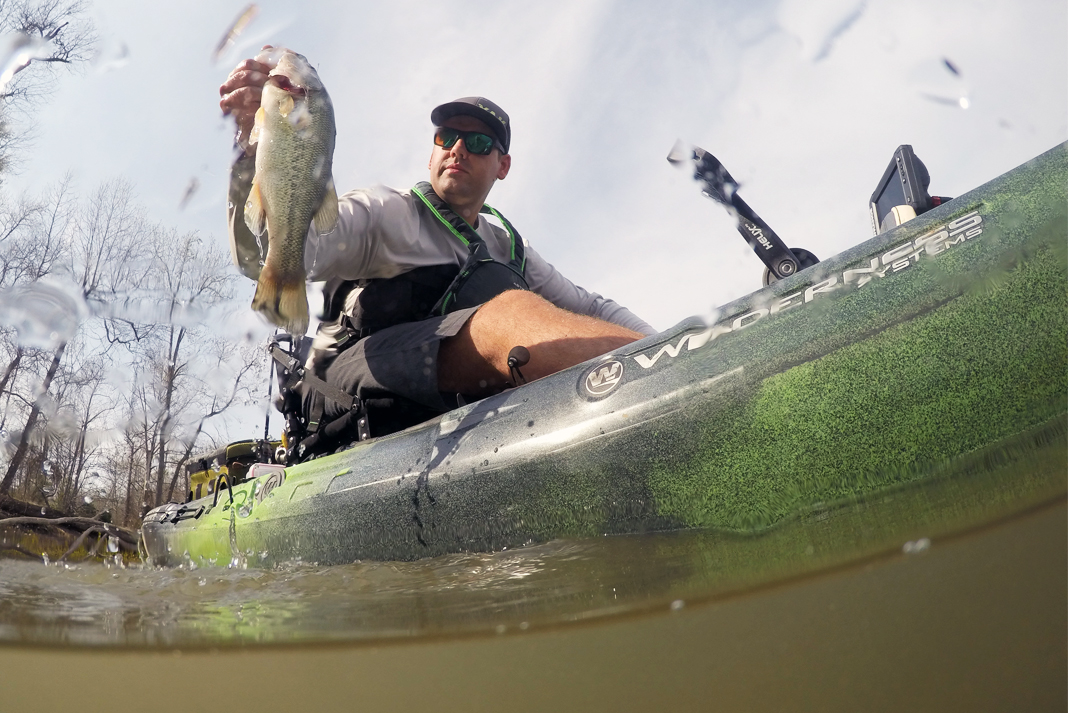
Sit-on-top kayaks such as the Sun Dolphin Journey 10, are a popular choice among kayak anglers. The open design concept makes it easy to store gear and tackle in accessible spots, including tankwells in both the bow and stern. The Journey 10 also offers active anglers three rod holders; two located directly behind the cockpit and one swiveling rod holder installed near the bow.

Sun Dolphin is a Michigan-based kayak brand manufactured in the United States. It is the largest kayak manufacturer in the world by production volume. Not surprisingly, Sun Dolphin kayaks are found at many popular retail chains in North America, including Walmart and Tractor Supply. The production volume and distribution of Sun Dolphin has made them one of the most common kayaks on the water in North America.
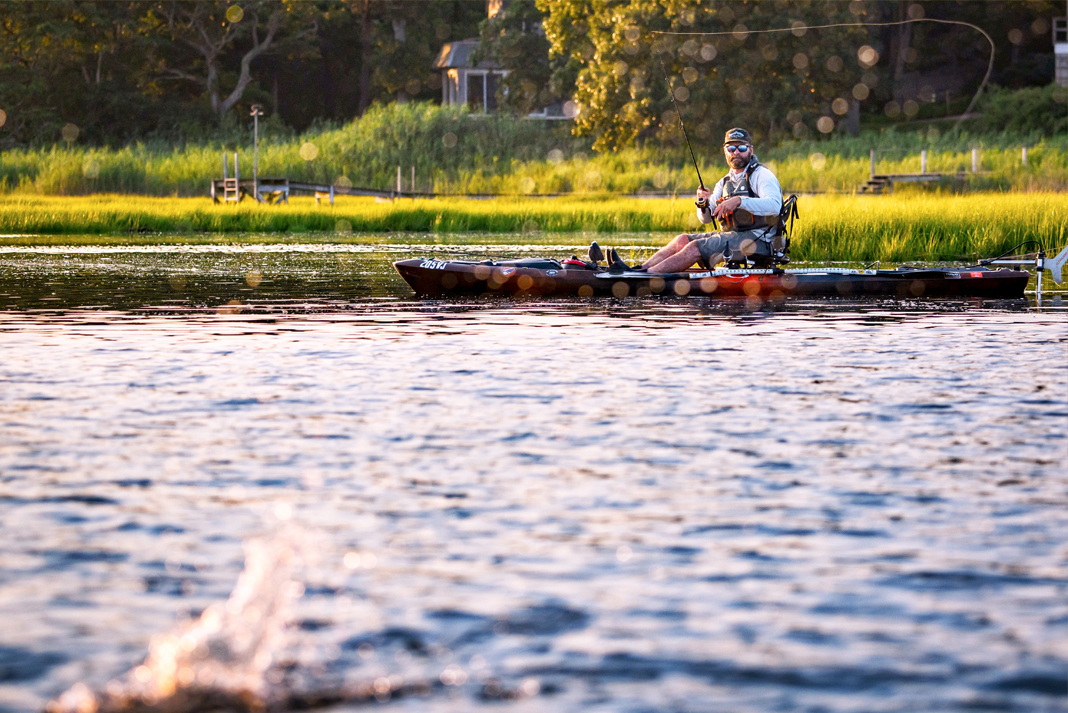
On the water with Sun Dolphin’s Journey 10

Sun Dolphin Journey 10 SS Specs
Length: 9’6” / 2.91 m
Width: 29.5” / 75 cm
Weight: 44 lbs / 20 kg
Capacity: 250 lbs / 113 kg
MSRP: $349 USD / $600 CAD

Performance

Stability is usually a priority for paddlers considering a recreational fishing kayak like the Sun Dolphin Journey 10 SS. Users often state the Journey 10 SS stability feels lacking until they have gotten used to paddling it. This feeling of instability is tied to the shape of the hull.

Kayaks are often described as having two forms of stability. These are initial stability and secondary stability. When it comes to the Sun Dolphin Journey 10’s stability, there is a slight deficit in initial stability, the reassuring feeling often provided by a wide, flat hull. This provides the sense you are sitting on a large platform on calm water. If a kayak lacks initial stability it creates the immediate sensation you are going to capsize easily, but this is not necessarily the case.

The rounding of the hull to the large sidewalls of the Sun Dolphin Journey 10 provides its secondary stability. Secondary stability allows the boat to rock from side to side and recover without capsizing. This comes into play as waves pass under the boat in choppy water.

The ability of the Journey 10 SS to travel on a straight path (known as tracking) is limited. Tracking performance is achieved through different elements of kayak design. On a recreational kayak without a rudder, the shape of the hull plays a large factor. A skeg protrudes at the stern of Journey 10 SS to improve tracking somewhat. One of the trade-offs with tracking is maneuverability. If a kayak does not track well then the flipside is it is generally more maneuverable. This maneuverability is helpful in tight winding streams, or turning around at a dead-end canal.

Market and demographics

The Sun Dolphin Journey 10 SS is a recreational fishing kayak, meaning the design prioritizes stability and comfort over speed and high performance. A recreational kayak like the Journey 10 SS was designed with calmer waterways in mind. These can be sheltered lakes, estuaries, or slow-moving streams. Being a generally wide and short kayak, it offers more in the way of stability and maneuverability than speed and efficient travel.

Recreational kayaks often use less expensive materials in production and come in with a lower sticker price. This, combined with the above-mentioned beginner-friendly characteristics, make the Journey 10, and recreational kayaks in general, good options for newer paddlers.

Wear A Life Jacket
  • Everyone, even strong swimmers, needs to wear a life jacket at all times when on the water. It is extremely difficult to put a life jacket on once you fall into the water. Even a light wind can blow any paddlecraft away from you, faster than you can swim.
  • Always wear a USCG-approved Level 70 or Type III life jacket designed for paddling.

For those interested in the Sun Dolphin Journey 10 SS, duck hunting has proven to be a popular pastime. Again, the open floor plan of the sit-on-top design provides room for accessible storage and gun holders can be mounted to the deck. It also helps that the Journey 10 SS is produced in dark colors like olive green. This makes it a straightforward process to deck out your Journey 10 in a camouflage pattern to stay off the radar of nearby waterfowl.

About the Sun Dolphin Journey 10 SS

Design

Design features and details

The Sun Dolphin Journey 10 SS is a sit-on-top kayak. This means the majority of design elements including the seating area known as the cockpit, are molded into the deck of the kayak. So, you sit on top of the Journey 10 SS. This is in contrast to a sit-inside kayak where you slide your legs into the hollow hull of the kayak through the cockpit opening and may use a spray skirt.

One design feature of the Sun Dolphin Journey 10 SS to note are the scuppers. These are the drain holes commonly found around the seat and tankwells in a sit-on-top kayak that drain any water that may have entered the cockpit from splashing waves or rain.

Take note of the scuppers, because users often report the Sun Dolphin Journey 10 SS leaking, with scupper holes being a likely ingress point. Just how does a sit-on-top kayak leak? There are seams and screw holes on a kayak which, if not sealed properly, can allow water into the hollow center of the sit-on-top hull. Over time the hollow inside of the kayak collects some water.

If you encounter the Journey 10 leaking at the scuppers, especially when the kayak is new, you should contact the manufacturer for warranty. If buying used, inspect the scuppers as carefully as possible to assess integrity.

A slight amount of water entering inside the kayak at a screw hole is more common. This can usually be fixed with a flexible, waterproof sealant or rubber gasket. If leaking does occur, it can be dealt with. Water inside the kayak can be emptied using the drain plug mentioned in the outfitting segment.

Material and construction

In the case of the Journey 10, Sun Dolphin uses UV-stabilized Fortiflex, a high density polyethylene. High-density polyethylene, regularly referred to as HDPE, is a common material used in kayak hull manufacturing, and you may know it from goods like plastic milk jugs. The UV-stabilized aspect is an additive impregnated in the plastic to protect it from some of the ill effects of sun exposure. HDPE is generally an inexpensive yet durable plastic.

Sun Dolphin Journey 10 SS accessories and outfitting

The Sun Dolphin Journey 10 SS features a number of outfitting components and accessories commonly found on sit-on-top fishing kayaks.

Starting at the bow, the Sun Dolphin Journey 10 has a carry handle, and just behind the carry handle is a drain plug. The drain plug is there to empty any water that enters the hull of the Journey 10. Be sure this drain plug is closed before launching.

Alongside the length of the Journey 10 is a recessed ledge with a bungee cord which combine to serve as a paddle holder. Paddle holders may be one of the most important yet easily overlooked outfitting components of a fishing kayak. The fact that your paddle is floating away should be the last thing on your mind when you have a fish on the line.

Within the forward end of the cockpit are adjustable foot braces. These sliding foot braces provide multiple positions for comfortable and powerful leg positions while paddling or landing a (big) fish.

The Sun Dolphin Journey 10 has a molded seat shape. There is however no padding, and unless you purchase a seat pad of your own, you will be sitting directly on plastic.

Under the seat you will also notice the scupper holes. Scuppers are the drain holes commonly found under your legs and seat within the cockpit and tankwells in sit-on-top kayaks. Any water splashing into the kayak drains out through these holes. This also means water can splash up through the holes, so expect to have a wet seat during a day in the Journey 10.

Behind  the seat there is also an adjustable, padded backband to provide some support for an upright seating position.

The Sun Dolphin Journey 10-ft fishing kayak has two molded-in tankwells for storage. One at the bow, and another toward the stern. These tankwells are triangular in shape. While they can easily accommodate smaller bags and boxes, they do not fit the milk crates kayak anglers commonly use to organize tackle.

Sun Dolphin makes a removable storage hatch to fit inside the tankwell on the stern of the Sun Dolphin Journey 10. The hatch, which Sun Dolphin refers to as the PAC (Portable Accessory Compartment), has a screw-on deck plate and easily pops in or out of the tankwell, under the bungees. The PAC provides a choice as to which storage style you use, closed or open. When installed, it provides a dry storage area. Removed, you have an open stern tankwell. In addition to the PAC there is a small hatch between your legs in the cockpit to keep small items and personal belongings stowed away.

The Journey 10 includes three rod holders. Two rod holders are flush-mounted into the kayak deck directly behind the cockpit. The other is an installed, swiveling rod holder toward the front of the cockpit. The advantage of the swiveling rod holder is that you can have a rig ready to go at the first sign of action.

Paddle Sober And Smart
  • Never mix alcohol and paddling. Coast Guard and state BUI (boating under the influence) laws apply to all vessels. This includes canoes, kayaks, SUPs and rafts.

Sun Dolphin Journey 10 SS kayak mods

Kayak anglers are known for making modifications to their kayaks. This could mean adding a fish finder, upgrading a seat, and installing accessory mounts among others. A number of compatible Sun Dolphin Journey 10 SS parts are available to modify your kayak.

On chilly days or when paddling calm water you may want to keep water from splashing up the holes in the bottom of the Sun Dolphin Journey 10 SS. Sun Dolphin Journey 10 SS scupper plugs are available directly from the manufacturer and are easily removable.

Accessory tracks are available from brands like Scotty. These accessory tracks are especially helpful for electronic components, or if you want to set up a GoPro to bear witness to your fight with a trophy largemouth or snook.

If the built-in paddle bungee isn’t working out for you, consider a paddle clip. These can be purchased from brands like RAM. Like Scotty, Ram makes just about every fishing kayak accessory you can think of.

Considering you are sitting on a plastic floor, a Sun Dolphin Journey 10 SS seat upgrade may be at the top of your list. The Journey 10 SS has a molded plastic seat, but no seat padding included. An easy fix is to purchase a block of mini-cell outfitting foam and shape the seat you would like. You could also purchase a seat pad such as the Yak Gear Sand Dollar cushion. Kayak anglers are also known to install more elaborate folding seats with a bit of DIY knowhow.

Adding a trolling motor is one of the most popular upgrades anglers make to their fishing kayaks.  There is no Sun Dolphin Journey 10 SS trolling motor available directly from the manufacturer.

If you would like to add a trolling motor to your Journey 10 it will require after-market mounts and some DIY knowhow. Users have mounted trolling motors to the stern of the Journey 10 or placed trolling motors alongside the Journey 10 by inserting a self-made frame in the rear rod holders to run the motor to the side and just behind the paddler.

However you decide to upgrade your seat in the Journey 10 it is probably wise not to permanently obstruct the scupper holes.

How the Journey 10 SS compares

As a popular, sit-on-top fishing kayak available at major retailers there are a number of kayaks the Sun Dolphin Journey 10 can be compared against.

  • Sun Dolphin Journey 10 vs 12

    The Journey 12 is another sit-on-top fishing kayak model produced by Sun Dolphin along with the Journey 10. The Journey 12 is 12 feet long in comparison to the Sun Dolphin Journey 10 SS at 9.5 feet. This makes the Journey 12 slightly faster than the 10, but also adds a small amount of weight.

    Both kayaks feature the same tankwell system for storage, and have the same outfitting components.

    A major difference in the design of the Journey 10 and Journey 12 is found in the scuppers. The Journey 12 completely lacks scupper holes, meaning the water is unable to drain out of the kayak once it enters the cockpit. The Journey 10 has two scupper holes located under the seat of the paddler.

    The scupper holes in the Journey 10 allow water to drain out from under your seat. The downside is water can also splash up through these holes. Especially with the Journey 10, users have regularly reported leaks developing in the plastic at the scuppers leading to water within the kayak.

    Scuppers are a common feature of sit-on-top kayaks, and may factor heavily in the decision for paddlers when choosing between the Journey 10 vs 12.

  • Sun Dolphin Journey 10 SS vs Lifetime Tamarack 100

    The Lifetime Tamarack 100 is a sit-on-top fishing kayak intended for a similar use as the Journey 10 SS. The Lifetime Tamarack 100 is just slightly longer than the Journey 10 SS, at a true 10 feet compared to the 9.5 feet of the Journey. The Tamarack is also an inch wider than the Journey at 31 inches, providing the Tamarack with an edge in stability.

    Two design features which stand out when deciding between the Tamarack 100 and the Journey 10 SS are the scupper holes and skeg.

    The Tamarack features six scupper holes throughout the cockpit of the kayak compared to two under the seat of the Journey. This means water will exit the Tamarack faster, but also provide more places for it to splash into the cockpit if the kayak is riding low.

    The skeg protruding at the stern of the Tamarack 100 also appears more pronounced than the Journey 10. This can provide the Tamarack with better tracking to travel in a straight line, but results in less maneuverability. Both are factors to take into account when deciding between the two.

  • Sun Dolphin Journey 10 SS vs Bali 10

    If fishing from your kayak is not your main concern, the Bali 10 may be another model from Sun Dolphin that compares to the Journey 10 SS. The Bali 10 is the same length as the Journey 10 at 9.5 feet. It also features similar tankwells on the bow and stern. Both have a very comparable hull design.

    The major difference between the Journey 10 and Bali 10 is the built-in rod holders. The Bali 10 does not have pre-installed rod holders. The Bali 10 is also produced in a brighter color scheme.

    For those not focused on fishing or hunting, the Bali 10 would make a suitable option for recreational paddling.

Carry A Waterproof VHF Radio, Use Your Phone Only As A Backup
  • A handheld VHF marine band radio allows you to communicate with the Coast Guard and other boat traffic. Use Channel 16 only for hailing and emergencies. The radio should be waterproof, because it is virtually certain to get wet.
  • A cell phone, even if in a waterproof case or sealable bag, might not work, so don’t rely on it as the primary means of emergency communication.

Where to buy the Journey 10

The easy availability of the Journey 10 SS is a contributor to its popularity. A number of large retailers carry the Sun Dolphin Journey 10 SS, including Walmart, Academy, Tractor Supply and Canadian Tire.

Pros and cons

Pros

  • Low cost
  • Widespread availability
  • Sit-on-top design
  • Accessible tankwells
  • Built-in rod holders

Cons

  • Lack of initial stability
  • Users report leaks
  • Lack of seat cushion

Related articles

Sun Dolphin kayak reviews

Budget kayak reviews

Sit-on-top recreational kayak reviews

SEE ALL KAYAK REVIEWS


Folding Kayak Review: Oru Bay ST

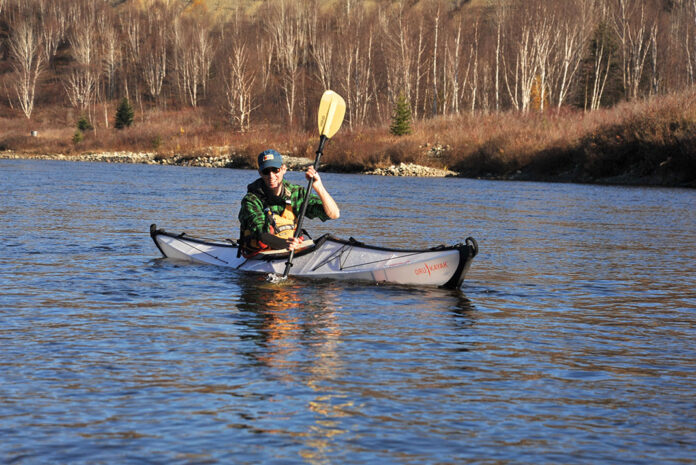
Man paddling folding kayak on a lake
Photo: Virginia Marshall

Oru Kayak came to the world on Kickstarter about a decade ago with the primary objective of disrupting the usual definition of a kayak. Moonlighting on their day jobs in the Silicon Valley, the brand’s cofounders Anton Mills and Ardy Sobhani conceived a recreational kayak that could be assembled and disassembled quickly like origami and stored flat, about the size of a sofa cushion—perfect for apartment and condo dwellers on the West Coast.

They launched the brand on Kickstarter in 2013 with a modest request—and ended up receiving nearly $500,000 from backers. With that, Oru, the origami folding kayak, was born.

The Oru Kayak Bay ST represents far more refinement in comfort and paddling performance than the brand’s original offering. Described as “versatile, fast and sporty,” the 12’3” Oru Kayak Bay ST folding kayak bridges the gap between the recreational and day touring categories, offering the stability expected of a beginner boat yet also more nimbleness on the water, with enough space to pack supplies for a picnic. It is capable of handling wind and waves and moderate sea conditions in the hands of intermediate to advanced paddlers.

If you’re shopping the used market you may encounter a previous version of the Oru Bay kayak, known as the Oru Kayak Bay Plus. The specs of this discontinued model are identical to the current Oru Kayak Bay ST, with the main difference being the outfitting and ease of assembly.

For the purpose of this review we will focus on the current Oru Kayak Bay ST. If you’re looking for an Oru Kayak Bay Plus review, this article will provide a general overview of the boat’s performance and handling on the water.

On the water with the Oru Bay ST

Oru Bay ST Specs
Length: 12’3” / 3.73 m
Cockpit: 16” × 30” / 41 × 76 cm
Width: 26” / 11.8 cm
Weight: 50 lbs / 22.7 kg
Capacity: 300 lbs / 136 kg
Folded size: 33” x 14” x 29” /
84 × 36 × 74 cm
MSRP: $1,499 USD

Performance

A 12-foot kayak will never be described as fast, but the Oru Kayak Bay ST certainly feels nimble on the water. Credit the kayak’s remarkably lightweight, buoyant hull. At just 26 pounds the Bay ST floats like a leaf, accelerating quickly and responding instantly to paddle strokes. Such responsiveness is a revelation—especially for paddlers used to paddling heavier plastic recreational boats.

Perhaps the Oru Kayak Bay ST’s greatest strength on the water is outstanding maneuverability—the Bay ST can be turned instantly and becomes even more responsive as you develop more efficient paddling skills. At the same time, quick acceleration makes the Bay ST feel speedy.

Tracking—that is, the kayak’s tendency to move in a straight line, which generally improves in longer boats—is good for a 12-footer, but you need to pay attention to making your paddle strokes symmetrical on either side of the boat to keep it moving forward efficiently.

Such lightweight construction means the Oru Bay ST can feel skittish for beginners. Its corrugated plastic hull floats higher on the water than other recreational kayaks, creating a sense of tippiness for some paddlers (especially those near the kayak’s upper weight limit of 300 pounds).

However, that tippiness is largely a false sensation; the Oru Kayak Bay ST stability is enhanced by a 25-inch width and a flat bottom hull shape, both of which contribute to comfort on the water for beginners and larger paddlers. Just don’t expect the barge-like feel of a cheap (and heavy) recreational kayak.

Market and demographics

Oru Kayak markets its folding boats to outdoorsy people who live in cramped, urban spaces, as well as travelers who want a kayak that is easy to bring along on multi-sport adventures. The Bay ST model is a crossover model, with the good stability and compact specs of a recreational kayak and the increased performance (due to a longer length and slightly narrower width) of a day touring kayak.

It’s perfect for more athletic outdoor enthusiasts who want a kayak that performs better than a cheap rec boat and yet conforms (literally, by folding flat) to their urban lifestyle.

Comfort

Oru Kayak has come a long way in terms of paddler comfort since its inception nearly a decade ago. The Oru Kayak Bay ST lives up to its description as a kayak meant for intermediate to advanced paddlers, with comfort features this level of paddler comes to expect in day touring and sea kayaks. The Bay ST features a comfortable seat pad and an ergonomic and adjustable back rest that can be lowered so it doesn’t interfere with a sprayskirt.

About the Bay ST folding kayak

Design

Design features and details

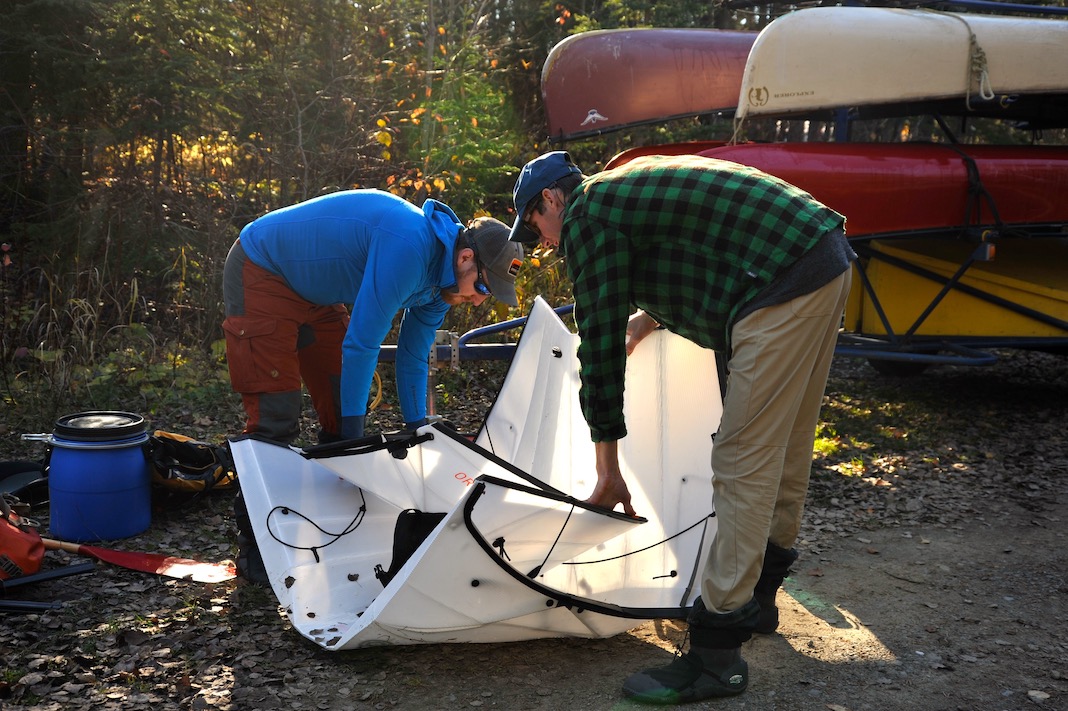
The brilliance of the Oru folding kayak is the simple and intuitive way in which the kayak folds up to become its own storage box. Most folding kayaks emerge from their travel duffle like a bag of puzzle pieces. Where other folding kayaks employ a rigid frame that must be assembled in a similar fashion to tent poles and then slid into a flexible “skin”, the Oru Kayak offers a one-and-done solution. This means fewer parts to keep track of, and much simplified assembly.

A kayak that folds like origami has certain design limitations: namely, it must have some hard edges. But this was hardly a limitation for the designers at Oru Kayak. The Oru Kayak Bay ST folding kayak resembles a traditional Greenland kayak, with hard “chines” (that is, a distinct edge—or in this case, fold—where the bottom of the kayak meets the side). A similar fold establishes a slight V running down the center of the hull at the bow and stern—this is known as the “keel line”. Meanwhile, the middle of the boat is flatter in profile.

Hard chines and a pronounced keel line dictate the performance of the Oru Kayak Bay ST: when the paddler shifts their weight to tilt the kayak on edge, the chines create turning surfaces that increase maneuverability. But when sitting level on the water, the slight V in the keel line assists in holding a straight course.

Additionally, the flat panels contribute to reassuring stability, both when the kayak is sitting level (known as primary stability) and when it’s tilted on edge. This type of versatile performance is the hallmark of a more advanced, refined kayak design—which speaks volumes to the quality of the Oru Bay ST folding kayak.

Oru Kayak included several other design features that make the Bay ST perform like a hardshell kayak. Namely, the sturdy plastic coaming (cockpit rim), which is designed to accept a sprayskirt, and other features common on touring kayaks, such as an adjustable foot rest, deck bungees (which provide attachment points for maps and other deck gear) and perimeter decklines (which serve as “lifelines” for a swimmer in case of a capsize).

Furthermore, the Oru Bay ST features removable bulkheads, or walls in the kayak that create separate storage areas and impart stiffness to the hull, which makes it paddle more efficiently.

Material and construction

The heart of the Oru Kayak Bay ST is its unique construction. The hull and deck are made of 5 mm, double-layered corrugated plastic, with a built in UV treatment rated for 10 years. Like any plastic, this polypropylene material is strong and resistant to impacts, punctures and abrasions. The manufacturer has always insisted that it will also withstand up to 20,000 assemblies.

Design trends

Whereas many other folding kayak brands have disappeared in recent years, Oru Kayak remains a phenomenon—largely because of its creative branding and attractive price, but also because its kayaks are extremely lightweight, portable and remarkably easy to set up and take down. For these reasons, Oru Kayak has pioneered its own design trend.

Oru Bay ST outfitting and accessories

A wide range of accessories are available for the Oru folding kayaks, many of which are sold in packages with the kayak itself. For example, the Oru Bay ST Essentials package bundles the kayak with a paddle and backpack, while the Overnighter package adds dry bags and flotation bags.

One of the most popular accessories is an Oru Bay ST sprayskirt; a neoprene skirt is available (which is warm, dry and best for advanced users) as well as a lighter weight nylon skirt. Off-brand skirts will also fit the Oru Kayak Bay ST; for example, the boat accepts a widely available Seals sprayskirt in size 1.2.

Since the Oru Kayak Bay ST lacks watertight compartments, perhaps the best accessory you can add are flotation bags. These ensure that the kayak will float even when swamped, a critical feature if you plan to set off on more exposed shorelines or paddle in rougher water.

Warranty

Oru Kayak offers a one-year warranty on defects in material or workmanship. Additionally, Oru Kayak provides a 30-day “love your boat” guarantee, with simple returns during this time period.

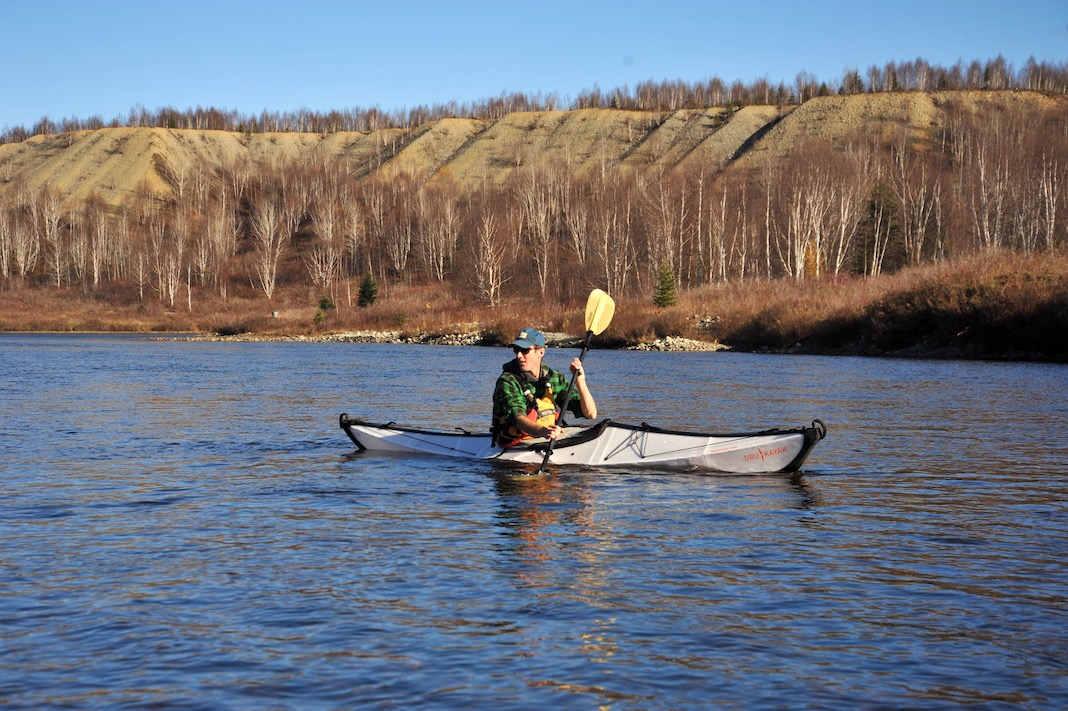
Man paddling folding kayak on a lake
Photo: Virginia Marshall

Oru Bay assembly and setup

If you own an Oru Bay ST kayak, the first thing you’ll likely do when confronted with the sofa-cushion sized box is load up your web browser and type, “How do you assemble an Oru Bay ST kayak?” The process is remarkably easy and takes under 20 minutes on the first try (you can easily pare assembly time down to 10 minutes with practice).

The company provides a handy set-up video that makes the process a breeze. The brilliance and simplicity of the Oru folding kayak is that the box becomes the boat; this means fewer bits and pieces to keep track of, and no duffle or pack left over after assembly.

To summarize: open the box and remove all the parts; extend the box into a long sheet and insert the floor board, which stiffens the seating area of the hull and snaps into place at the cockpit coaming; tighten the end straps on each end of the kayak; insert bow and stern bulkheads into channels; buckle the tension strap in the cockpit; attach the bow deck zippers and close the front coaming latch; install backrest and seat; attach stern zipper and close the stern coaming latch; and finally adjust the seat, back rest and foot rests for comfort.

Oru Bay ST disassembly follows the reverse procedure.

Portability

Few kayaks offer the easy portability of the Oru Bay ST; the boat folds into a sturdy, sofa cushion-sized box for transport or storage. At 26 pounds, the Bay ST is comfortable to carry over your shoulder with the included strap for short distances. The weight is manageable for just about anyone, but the box’s 33” x 29” x 14” dimensions can make it a bit cumbersome.

Invest in Oru Kayak’s accessory backpack for longer carries, such as hike-in lakes, urban commutes or airport travel.

Storage

The Oru Kayak Bay ST folds into its own box for compact storage. To avoid mildew or other moisture damage, ensure the kayak is dry and clean before storing for extended periods. It’s a good idea to rinse the kayak with freshwater before folding for storage, especially after use in saltwater environments.

How it compares

The 2021 version of the Oru Kayak Bay ST is the third generation of this model. The original launched in 2014. Early editions used the same hull and folding pattern but had less refined comfort features. This section will compare how the Bay ST compares to other Oru Kayaks.

  • Oru Kayak Beach vs Bay

    Beginner paddlers and those looking for a more laid-back paddling experience may prefer the greater stability of the Oru Kayak Beach. This model is wider and therefore more stable. It also assembles faster with fewer additional parts (that, in turn, means fewer features which contribute to the greater comfort and paddling performance of the Oru Kayak Bay ST). The Oru Kayak Beach is a closed deck, sit-inside kayak with a larger cockpit than the Bay model, which makes it more appealing to larger paddlers and those who are nervous about sitting inside a closed-deck cockpit.

    Choose the Oru Kayak Bay ST folding kayak if you’re looking for an extremely portable kayak that’s speedy, efficient and and more closely resembles the handling of a high-performance touring kayak—it will offer you a better kayak to develop your paddling skills.

  • Oru Kayak Bay vs Bay+

    Each successive Oru Kayak Bay model added comfort, convenience and style features to the original. With the sporty Bay hull as the starting point, the now-discontinued Oru Kayak Bay+ model added an adjustable seat and a rear deck hatch (which has been removed from the current Bay ST model). The model was assembled with ratchet buckles to strengthen and speed up the building process.

    The most obvious difference of the Oru Kayak Bay+ was its flashy custom deck graphics, which do not appear on previous or current models of this kayak. When investing in a high-tech folding kayak, it’s important to recognize that just like a computer or smartphone, each successive iteration of the model will have definite improvements from the previous.

    The same is the case with the Oru Kayak Bay model. Buying the latest version of the kayak, that is the Bay ST, will provide access to the brand’s latest innovations. Of course, with its ingenious design team there are certain to be more improvements in the future.

  • Oru Bay vs Coast XT

    The Coast XT is significantly different from the Oru Kayak Bay. For the Bay, Oru designers stuck to the brand’s original 12-foot dimensions. The Oru Kayak Coast XT stretches out the length to 16 feet—a major addition to the waterline that makes this model paddle faster and glide better, as well as adding far more space inside the kayak for storage.

    Choose the Coast XT if kayak touring is your main objective. Packed carefully, this kayak can hold gear and supplies for a weeklong adventure. It also fits taller paddlers (up to 6’7”) and moves more efficiently on the water, so it’s great for fitness paddling.

    On the other hand, the Oru Kayak Bay ST is better for day touring, especially for paddlers who value ease of handling and maneuverability over speed. It’s far more compact on the water and somewhat easier to transport. For those who primarily take day trips, with perhaps the odd overnight, the Oru Kayak Bay ST is all the kayak you need.

Where to buy the Oru Bay ST

The majority of Oru Kayak owners buy their boats directly from the manufacturer. However, the kayaks have a limited number of dealers across North America at kayak specialty retailers, including Mountain Equipment Co-op stores in Canada.

Bay ST pros and cons

There’s a lot to like about the Oru Kayak Bay ST folding kayak, and some may argue this style of boat represents the future of kayaking—especially as the human population becomes more urban and moves away from personal vehicles to combat climate change.

Pros

  • Compact, folding kayak matches the lifestyle of the majority of North Americans
  • Sporty, comfortable and can be carried on the subway, while storing in a closet when not in use
  • Assembles fast and paddles like a “real” kayak (unlike other portable kayaks, such as inflatables)
  • More than a recreational kayak, but not quite a touring kayak—for a great many paddlers who might be looking for something in the middle, it’s a perfect fit

Cons

  • Lacks the extreme stability that beginners find reassuring
  • Doesn’t quite match the glide and performance of a longer boat

14 Best Places To Kayak In North Alabama

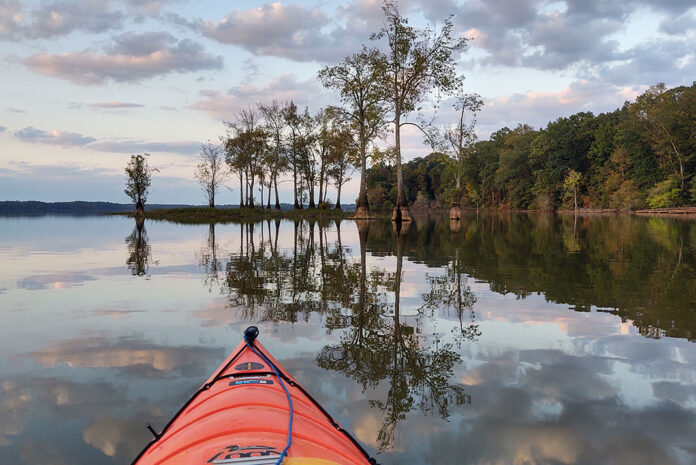
Bow of a kayak on mirror-like lake with trees in background
Pure bliss on Limestone Bay. | Photo: Dan Truitt // @southern.paddler

There’s a reason Alabama is prominently featured in kayaking videos. With its rugged scenery and some of the cleanest water in the country, the river veins crisscrossing the landscape have shaped the culture and history of the state. Looking at a map, it’s no wonder it’s also home to the longest river trail in America: the Alabama Scenic River Trail (ASRT).

Regardless of whether you’re looking for a challenging multiday adventure or a flatwater day paddle suitable for the family, you’re likely to find it in North Alabama.

Here are 14 of our favorite places to get your paddle wet.

[This article is part of our Ultimate Guide To Paddling In Alabama. Find all the resources you need to plan a paddling adventure in Alabama.]

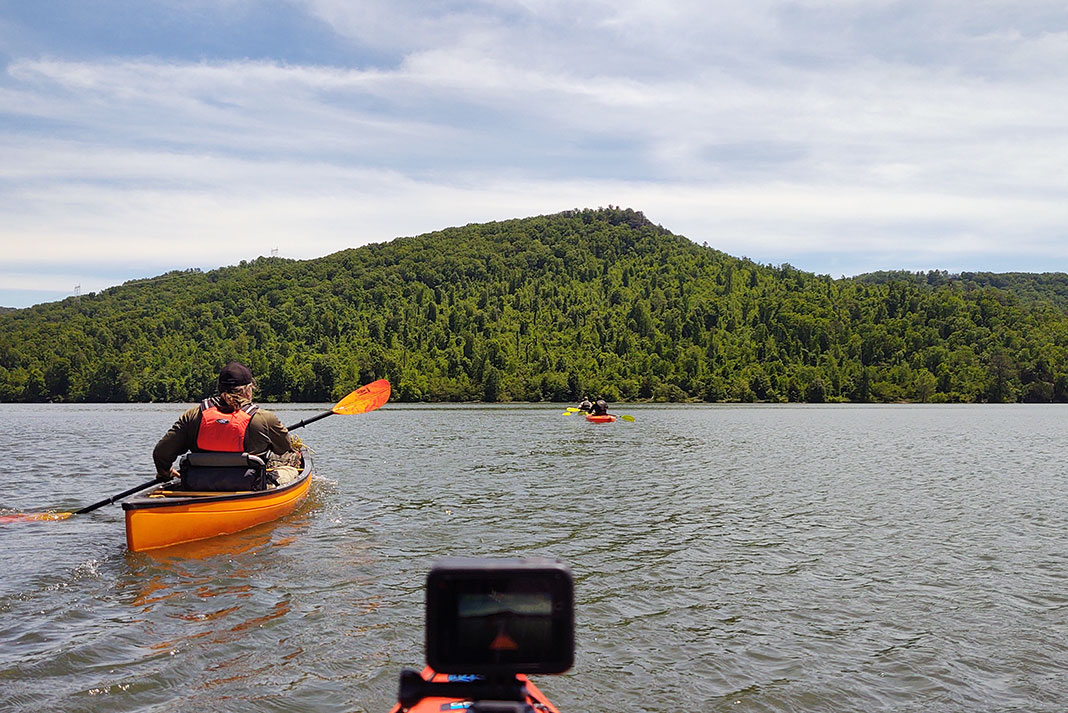
Three people paddling kayaks and canoes on a lake with a tree-covered hill in the background.
Surround yourself with beauty when paddling Guntersville Lake. | Photo: Dan Truitt // @southern.paddler

1 Guntersville Lake

Locals call it “Lake Guntersville” but a lake by any other name would be just as noteworthy: this body of water is Alabama’s largest lake. Surrounded by the Appalachian foothills, this section of the Tennessee River offers some of the state’s best flatwater paddling and kayak fishing.

Its highlight may be the Hambrick Bat Cave. Located about a mile upriver from the Guntersville Dam, it’s home to more than 60,000 gray bats, which emerge en masse at dusk and fly out over the water, making for a one-of-a-kind evening paddle.

[ View all kayaking adventures in Alabama in the Paddling Trip Guide ]

2 Flint River

Lauded as a beginner-friendly float, the 65-mile Flint River seems almost designed for day-trippers. A shallow and calm stretch of water, it’s fed year-round by cold springs, with multiple bridges making finding a put-in spot easy.

The three-hour paddle from Highway 72 to Little Cove Creek, for example, offers four islands, caves and scenic bluffs to explore. But if you have more time to spare, there is plenty of camping nearby, as well as excellent bass fishing.

A lake at dusk.
Paddle the calm waters of Weiss Lake. | Photo: Leann Hill Photography

3 Weiss Lake

Much like the other lakes on this list, Weiss is a dammed reservoir on the Coosa River. Another thing it has in common? Excellent fishing.

Known as the “Crappie Capital of the World,” Weiss Lake is surrounded by plenty of accommodations, campgrounds and—you guessed it—boat rentals. Unfortunately, most are of the fuel-powered variety, so if you’re looking for a paddle-powered adventure, you’ll likely have to bring your own watercraft.

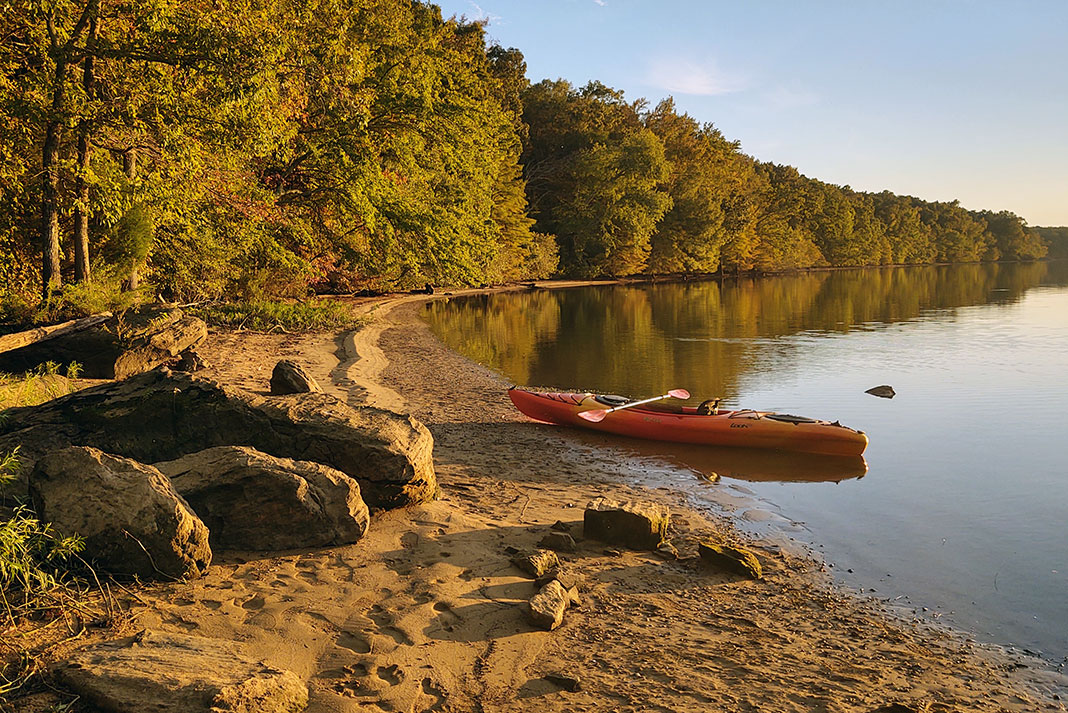
Kayak pulled up on sandy shore with trees in background.
Pull up on peaceful shores at Wheeler National Wildlife Refuge. | Photo: Dan Truitt // @souther.paddler

4 Wheeler Reservoir

Also known as Wheeler Lake, this dammed reservoir is the second-largest lake in the state. Located just downstream of Guntersville Lake, it’s a popular bass fishing destination, and plays host to kayak fishing tournaments. Also keep an eye out for what’s above, as it’s not unusual to spot bald eagles soaring overhead.

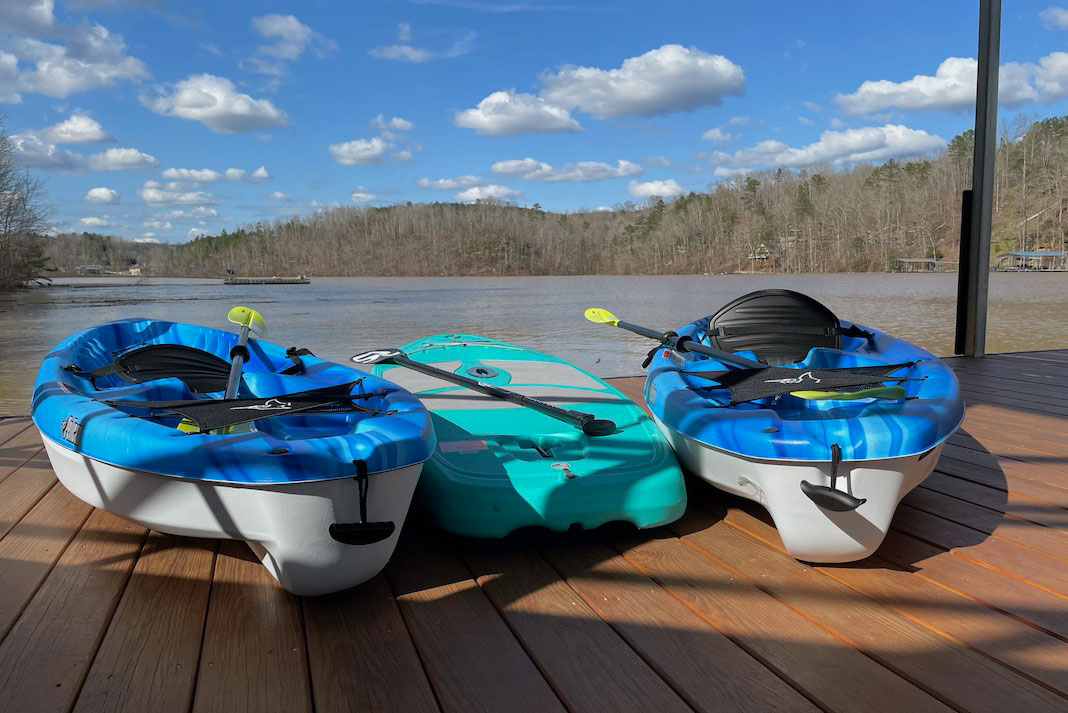
Two kayaks and a paddleboard sitting on a dock
The best way to get out onto Lewis Smith Lake. | Photo: Helicon Hideaway at Swayback // @helicon_hideaway_at_swayback

5 Lewis Smith Lake

This three-fingered reservoir, which is also called Smith Lake, is notable for being the deepest lake in Alabama and one of the cleanest in the entire country.

Located on the Sipsey Fork of the Black Warrior River just outside Birmingham, it’s easy to access, with Smith Lake Park offering rentals, around 10 public marinas and countless public launch facilities. Want to make it an overnighter? Launch from Speegle’s Marina and kayak across to Goat Island, where you can camp.

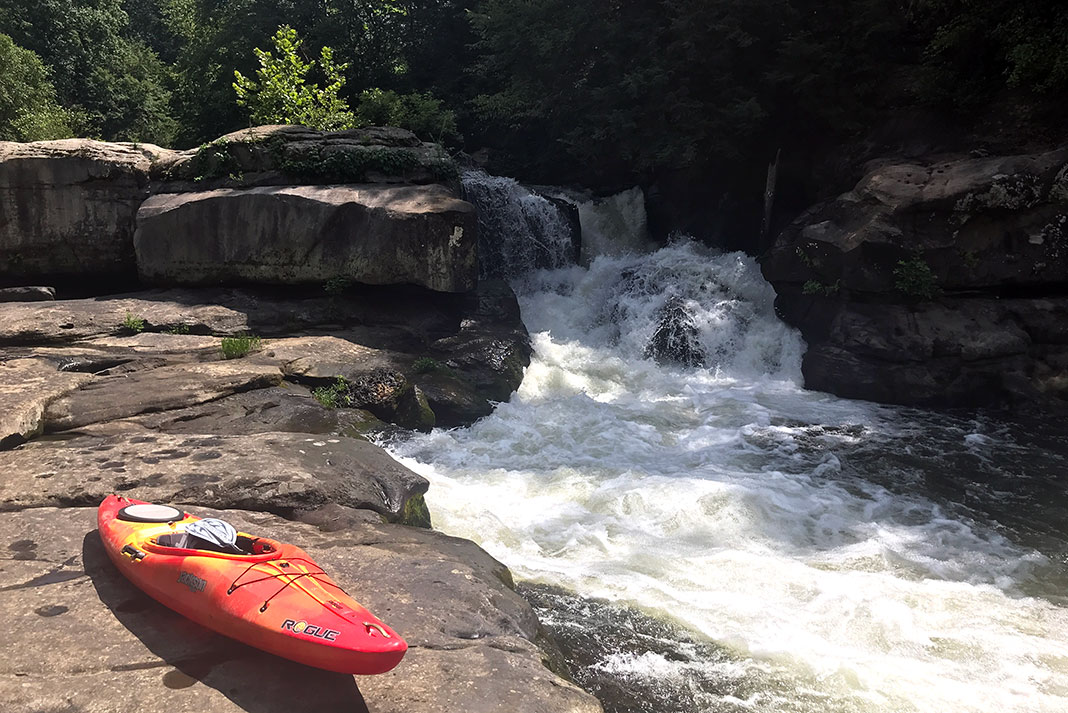
Whitewater kayak on rocks beside small set of falls on a river.
The flow never ceases on Bear Creek. | Photo: Michael Suttle // @michael_suttle

6 Bear Creek

With so many dammed waterways on offer in North Alabama, what makes Franklin County’s Bear Creek so popular? Its dam provides the only recreational release of water every weekend, from Memorial Day until Labor Day, ensuring water levels remain high enough to paddle through the summer months.

7 Lower Bear Creek Canoe Trail

The four Bear Creek lakes are known for having some of the cleanest recreational waters in the state, but that’s just part of their appeal. They also offer trophy fishing, sandy beaches and plenty of campgrounds.

Part of this system of lakes, the Lower Bear Creek Canoe Trail provides a leisurely float for families and beginner kayakers, starting from Red Back and ending roughly 34 miles later at the Pickwick Landing Dam on the Tennessee River.

8 Cherokee Kayak Trail

When the Cherokee Kayak Trail opened on Bear Creek in 2018, it was cause for celebration in the tiny town of Cherokee. Now, the town’s Parks and Recreation Department offers a fleet of canoe and kayak rentals, alongside a shuttle service.

The trail itself is about eight miles in length, taking between four and six hours to complete, with sandbars along the route offering ideal places to picnic and swim.

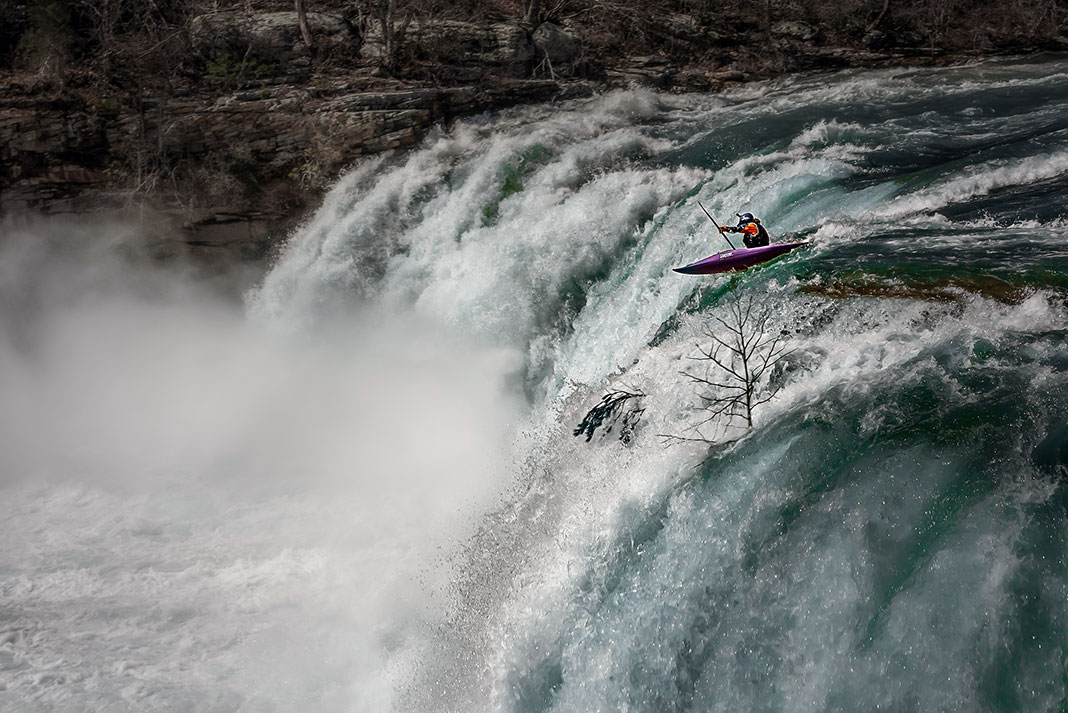
Whitewater kayaker goes over waterfall.
Adrenaline is on offer at Little River Canyon. | Photo: Leann Hill Photography

9 Little River Canyon National Preserve

A landscape of sandstone cliffs, turquoise water, rare flora, and exciting class II, III and IV rapids, Little River Canyon National Preserve is considered the heart of whitewater kayaking in Alabama.

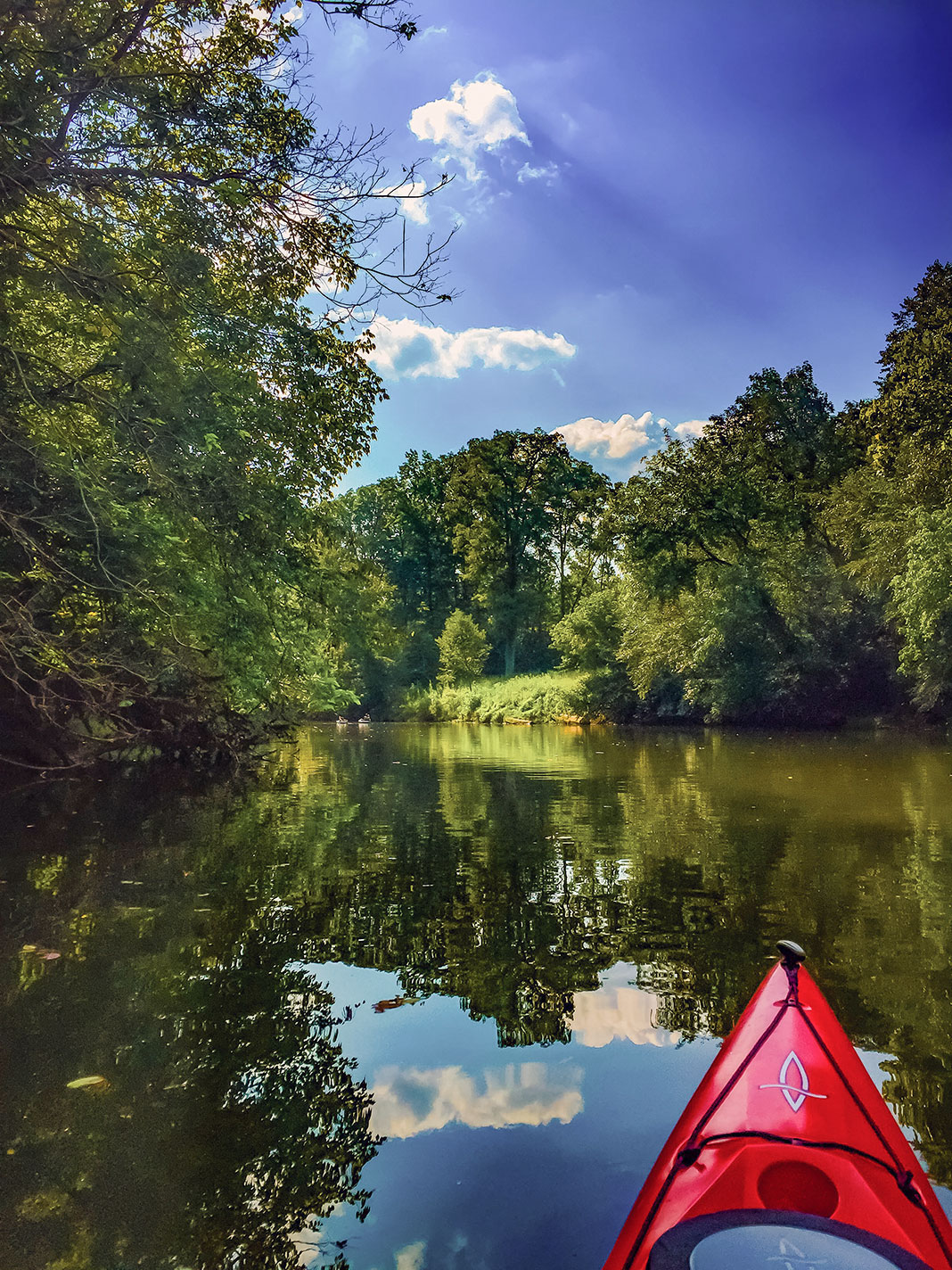
Bow of red kayak on calm creek with trees overhanging.
Terrapin Creek is the perfect place for a quiet afternoon paddle. | Photo: Leann Hill Photography

Located in northeast Alabama on Lookout Mountain, it’s been used by Olympic athletes to train—but it also offers calmer waters for whitewater beginners and experienced recreational paddlers. The portion of the river above 45-foot-tall Little River Falls (one of North Alabama’s many waterfalls) is class I and II. Downstream of the falls is where things get a little wilder, with sections like “the Suicide” living up to its name.

10 Terrapin Creek

An ideal paddle (or float) for beginners, families and kayakers who only have a day to spare, the roughly eight-mile Terrapin Creek is only made more accessible by Piedmont’s outfitters, including No Worries Kayak Rental, Terrapin Outdoor Center and Redneck Yacht Club Canoe & Kayak Rentals (the latter of which also has a campground).

Expect calm, clean (it’s said to be the cleanest water in the state) and mostly class I water, with plenty of opportunities to go for a swim or cast your line.

11 Limestone County Canoe and Kayak Trail (Elk River)

It doesn’t matter what time of year you choose to paddle the Elk River—the scenery along the Limestone County Canoe and Kayak Trail is bound to leave you breathless, with dogwoods blooming in the summer months and the leaves of the hardwood trees turning brilliant hues in the autumn months.

This 21-mile trail is relatively cruisey, with class I rapids and five launches that allow you to choose how far and hard you paddle.

Small island on lake at sunset.
Spend a half-day exploring the waters of Neely Henry Lake. | Photo: Leann Hill Photography

12 Neely Henry Lake

Part of the Alabama Bass Trail, the 78-mile Neely Henry Reservoir can be found in northeast Alabama, near the towns of Gadsden and Ohatchee. The lake itself is known for its fishing, but one of its tributaries—Big Canoe Creek—is renowned as a paddling destination.

Kayakers can rent a boat from Big Canoe Creek Outfitters or Yak tha Creek. Most paddlers spend about half a day exploring the lake’s waters, although for those with more time, there are primitive campsites available nearby.

View of a lake with tree-covered hills in the background.
Pickwick Lake is the perfect place to spend a fun day on the water. | Photo: Adam Riser // @adamriserfishing

13 Pickwick Lake

Stretching for 50 miles from Tennessee’s Pickwick Landing Dam to Florence’s Wilson Dam in northwest Alabama, this reservoir may technically be man-made, but that doesn’t make it any less majestic. Part of the ASRT, it offers 490 miles of curving shoreline and around 47,500 acres of water to paddle across when it’s full.

Known for its bass fishing tournaments, Pickwick Lake is a popular destination for kayak fishing. It’s also easily accessible; kayak rentals are available from Pickwick Landing State Park, while wild camping and launch spots can be found along both sides of the lake.

14 Wilson Lake

Formed by the Wilson Dam, the 15,500-acre Wilson Lake picks up where Pickwick Lake leaves off in the city of Florence. Like Pickwick, it’s known for its smallmouth bass, catfish and crappie fishing, which can easily be caught from a kayak.

Also part of the ASRT, wild camping is available on both sides of the lake, along with plenty of designated put-in spots.

Want to learn more about visiting North Alabama?

Stay inspired: It’s not just about getting out on the water in North Alabama. The Unexpected Adventures in North Alabama podcast takes a deeper dive into the state’s most unique destinations, including waterfall trails, hikes and communities you might otherwise miss on your road trip. It’s available on Spotify, Amazon Music and anywhere you listen to podcasts.

Find a place to stay: After primitive camping riverside, treat yourself to a stay at one of North Alabama’s quaint cabins or cottages, affordable waterside hotels, luxurious glamping spots or tranquil state parks.

Travel responsibly: North Alabama has a reputation for its pristine waterways and untouched wilderness. We ask you to follow the Leave No Trace Center for Outdoor Ethics principles.


Best Ocean Kayaks For 2026

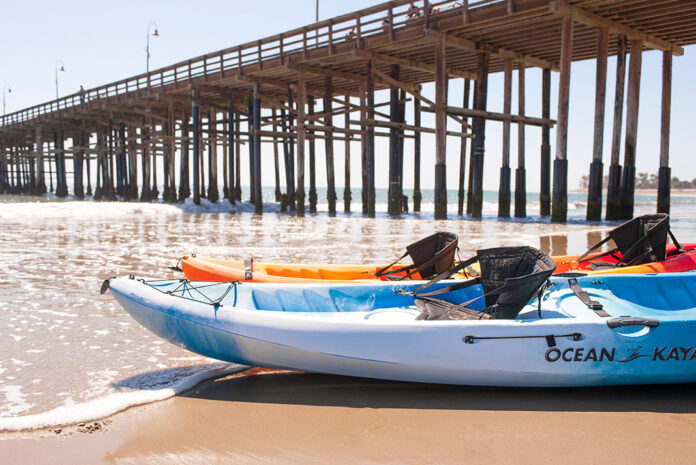
Two Ocean kayaks pulled up on the beach with pier in background.
Photo: Courtesy Ocean Kayaks

Pioneering sit-on-top kayak brand, Ocean Kayak, was founded in the 1970s from a desire for a human-powered watercraft that divers could use to transport scuba gear to a dive site. The first Ocean Kayak was essentially a surfboard with a seat and storage carved out. It was possible to paddle out, gear up, slide into the water and dive from this watercraft.

The boats were named “Ocean Kayak” to distinguish them from slender, sit-inside sea kayaks that were modeled on traditional Inuit hunting boats. The first Ocean brand kayaks were built in California and later Washington State. Today, the rotomolded plastic kayaks are made in Old Town, Maine, and distributed across the continent.

Modern Ocean Kayaks are more advanced than their early predecessors, but the fun and versatile West Coast essence of the brand remains. Ocean Kayak sit-on-tops are intuitive and beginner-friendly kayaks. Just like those first kayak-assisted scuba adventures, Ocean Kayak was an early player in another crossover activity: kayak fishing.

Paddle anglers use Ocean Kayaks to access hard-to-reach areas without the need for a motor. Ocean Kayak fishing kayaks are decked out with accessories that make it easy to stalk, hook and land fish.

All Ocean Kayaks are recreational sit-on-tops. These boats are ideal for casual users and kayak anglers who mostly paddle in warm waters. The open deck, sit-on-top design makes it easy to jump on the kayak or even re-enter from the water without the specific techniques required for a sit-inside kayak.

Stability is another hallmark of the Ocean Kayak brand. With solo and tandem models available, Ocean Kayaks are a great choice for paddlers who want to bring along lots of gear, a partner or a dog.

This guide will help you decide on the best kayak for your needs. Here, we’ll give an overview of the types of Ocean Kayaks available, as well as some tips for buying new and used. Read on to learn more.

Shopping for a used Ocean kayak?

Buying a used Ocean Kayak is an excellent way to save money on your purchase. Opting for a used boat means you’ll have more purchasing power and can pick up a higher-performing kayak. It also may give you a chance to try the kayak out before you buy it—the best way to ensure the kayak is a good fit in terms of comfort and performance, and something you can’t do when purchasing online or from a box store.

There are a few things to consider if you decide to buy a used Ocean Kayak: knowing where to look, what to look for, and how much to pay when you find the perfect boat.

Where to look

If you’re looking for a used Ocean Kayak, Craigslist, Kijiji or Facebook Marketplace are all great places to start. You can also check specialty sites like MEC Gear Swap or Paddlemonster.com, or try searching Ebay Ocean Kayak for used boats and accessories. Setting up an email alert with the search term “Ocean Kayak” will give you the first chance to view any newly posted boats.

Basic Ocean Kayak models like the Malibu are very popular with outfitters. You can always try contacting outfitters to ask whether they will be selling off any rental fleet at the end of the season. Even better, rent the kayak for a day tour so you can try it out before you decide to buy it.

Searching for used kayaks online allows you to cast a wide net, but ideally you’ll want to try the kayak out before you buy it. Before you travel to see a privately listed kayak, ask the seller if you can meet at a location where you can test paddle the kayak before committing to a purchase.

What to look for

Check how the kayak was stored. The photos posted in the ad will often be of the boat on its rack, where the kayak spends most of its time. Some of the most common damage to sit-on-top kayaks is not actually from paddling them, but rather from how they were stored. Over time, the plastic can soften and deform if stored improperly.

Beware of kayaks stored outside in direct sunlight, sitting upright on the ground, or hung from their handles. All of this can severely distort or damage the kayak.

Ocean Kayak sit-on-tops are ideal used kayaks to purchase because they are extremely durable, and there are very few moving parts that may break. The ones that you need to check are the seat, padding, bungee cords and buckles. Replacement parts can be ordered through the company or improvised from your local hardware store with some creativity.

How much is it worth?

Ocean brand kayaks are relatively inexpensive, but they will hold their value because they are so durable. It’s reasonable to see a used kayak selling for more than 50 percent of the original price, although with delays in supply chains and increased demand, some used kayaks may be selling for nearly as much as they would new.

When searching for a used kayak, keep this in mind: you may have to pay a bit more for a kayak rather than being stuck on shore all summer.

For more tips on selecting a used kayak, read our article How To Buy A Used Kayak.

Ocean Kayak buying guide

Ocean Kayak’s sit-on-tops suit a range of paddling styles. If you’re thinking about buying an Ocean Kayak, first decide if a sit-on-top matches the type of paddling you want to do. Overall, sit-on-top kayaks best suit casual paddlers and warmer environments. They are easy to get on and off and very stable. These qualities also make sit-on-top Ocean Kayaks well suited to kayak fishing.

If you’re looking for a casual kayak for recreational paddling or kayak fishing on calm, sheltered water—and you want to get one without breaking the bank—there’s an Ocean Kayak for you. Ocean Kayaks are available for paddlers of all sizes, with both solo and two-person options.

Ocean Kayak builds all its boats by rotomolding high-density polyethylene (HDPE). This is a common method for manufacturing recreational kayaks and results in a durable, inexpensive kayak. If light weight is an important factor for you, consider looking at a more costly thermoform plastic kayak. Sit-on-top kayaks vary in design but generally are very stable.

As a rule of thumb, the longer the kayak is, the faster it will be. Shorter kayaks, like the Ocean Kayak Malibu 9.5, are easy to maneuver but not as fast. Width also affects a kayak’s performance. If the lengths of two kayaks are equal, generally the narrower kayak will be faster than the wider one. The tradeoff is stability, with wider kayaks creating a larger and more stable platform.

Ocean Kayak’s line of recreational sit-on-top kayaks includes the Malibu, Tetra, Venus, Caper and Banzai models. They appear similar, but some key differences change how the boats feel in the water.

Woman riding a wave on a green kayak
Photo: Courtesy Ocean Kayaks

Malibu

The Malibu is Ocean Kayak’s flagship model. It’s offered in three different solo sizes from 9.5 feet to 11.5 feet long, including a pedal-drive option, as well as tandem and fishing versions. The Malibu is a classic recreational kayak: highly stable and easy to use, with a simple design and comfortable basic outfitting that keeps the cost down.

The Malibu Pedal is propelled like a bicycle, with the user’s legs turning a prop to move the kayak forward and a rudder for steering. The pedal-drive option suits anyone who wants a unique, hands-free experience. The Malibu Pedal is also ideal for kayak fishing, with angler-specific accessories and a frame seat offering a higher vantage point for spotting fish.

Tetra

The more sporty Ocean Kayak Tetra models are narrower than the Malibu kayaks, making them faster (but less stable) and well suited to fitness paddlers. Available in 10- or 12-foot versions for paddlers of all sizes, the Tetra kayaks also boast adjustable foot pegs and a front hatch for storage. These premium features put the price of the Tetra kayak higher than Ocean Kayak’s other paddle kayaks.

Venus

Available in 10- or 11-foot versions, the Ocean Kayak Venus resembles the Tetra, with a fit tailored to suit smaller female paddlers better. At just 40 pounds, the Venus 10 is also the lightest full-size Ocean Kayak, making it easy to manage on and off the water. Like the Tetra kayaks, Venus kayaks are not as stable as the wider Malibu and Caper, but they are quick and agile.

Caper

Like the Malibu kayaks, the 11-foot Caper is a good choice when more stability and higher weight capacity are desirable. A front bow hatch on the Caper distinguishes it from the Malibu.

Banzai

The Ocean Kayak Banzai is a youth sit-on-top kayak for under $500, great for kids of all ages (up to 194 lbs) who want to paddle their kayak. The Banzai also features a built-in tow system that lets you tow the kayak when your child is too tired to paddle.

Tandem kayaks

Ocean Kayak also makes tandem sit-on-top kayaks. These two-person kayaks make it even more fun to get on the water. With a higher weight capacity, you can also load these boats up with more gear. Ocean Kayak tandems are ideal for a child and adult to paddle together, or two adult paddlers. There are four tandems from Ocean Kayak.

The Malibu Two and Malibu Two XL are versatile kayaks that can easily be paddled solo or tandem because of their short length. As only one person is needed to control the kayak, tandems are also suitable for bringing along a new or nervous paddler. Pair them with someone experienced, and they can enjoy the water while knowing they have someone with them to assist.

The Malibu Two XL Angler is a fishing version with fish-specific features like rod holders, gear mounts and tackle storage.

At 16 feet, the Zest Two EXP is the longest and fastest Ocean Kayak tandem. Solo paddlers will have a more challenging time controlling this kayak, but if you’ll always paddle with a partner, this is a good choice for a bit more speed.

Fishing kayaks

The accessories and outfitting of fishing kayaks separate them from other Ocean Kayaks. Fishing kayaks are made to be extremely stable and they have extra storage space for fishing gear and tackle. Because of these additions, fishing kayaks are heavier than regular kayaks, and owners usually carry them with a friend or wheeled cart.

Ocean Kayak has two different models of dedicated fishing kayaks: the Trident and the Prowler. The agile Trident comes in 11-, 13- and 15-foot lengths. These different lengths suit diverse fishing styles: the shorter, maneuverable, 11-foot Trident works best on inland lakes and waterways. The 15-foot Trident kayak is fast and tracks (moves in a straight line) well, letting it excel in swell and cover distance on open waters.

The Prowler series focuses on stability, with the steadiest boats Ocean Kayak offers. Additionally, the Malibu Pedal and Malibu Two XL Angler (see above) are well suited to casual kayak fishing.

Use this as a start, and remember that online research will only get you so far. The best advice we can offer is to always test paddle before buying any boat. The more time you can spend on the water, the better the purchasing decision you will make.

Here are answers to some of the most common online questions about Ocean Kayaks.

  • Ocean Kayak types

    All Ocean Kayaks are sit-on-top kayaks, with two primary types: recreational and fishing kayaks. Recreational kayaks are designed to be stable and easy to use. Fishing kayaks have similar hull designs as recreational sit-on-top kayaks, with open decks and excellent stability.

    They differ in their outfitting and accessories; fishing kayaks are geared up with storage for tackle, rod holders, gear mounts, tank wells, adjustable foot pegs and more. Ocean Kayak’s fishing models are also longer and faster than their recreational line.

  • How much does an Ocean Kayak weigh?

    Ocean Kayaks are average weight when compared to similar sit-on-top kayaks. They are made of high-density polyethylene (HDPE), a strong plastic. Kayaks of the same size made with thermoformed plastic or composites weigh less than HDPE kayaks. Recreational kayaks are also lighter than fishing kayaks, as the outfitting adds weight.

    Expect an Ocean Kayak to weigh anywhere from 40-90 pounds, depending on its size and outfitting.

  • How much does an Ocean Kayak cost?

    Ocean Kayaks start at $649 for the Malibu 9.5 (or $479 for the youth Banzai kayak) and cost up to $2,099 for the Malibu Pedal kayak. These are slightly higher than entry-level prices in the sit-on-top market, but you get what you pay for with better designs and performance backed by decades of experience.

  • Most stable Ocean Kayak

    Ocean Kayak’s sit-on-top recreational and fishing kayaks are some of the most stable on the market. The Malibu models are the most stable recreational Ocean Kayaks. For anglers, the 34-inch-wide Prowler Big Game II gives all the support you will need, with ample stability for stand-up fishing.

    In flat waters, a paddler must be significantly off-balance to capsize; the sit-on-top design ensures re-entry is easy if you do manage to end up in the water.

  • Ocean Kayak dealers

    Online, you can buy Ocean Kayaks through their website or at recreation outlets like Backcountry.com. In-person, they are carried at REI and a network of independent paddle shops. View the complete list of Ocean Kayak dealers in their dealer locator.

  • Ocean Kayak warranty

    All new Ocean Kayak hulls and decks have a limited lifetime warranty. Kayaks sold as rentals or blemished models have a five-year limited warranty. The pedal (PDL) drive systems also have a five-year limited warranty. Save the original proof of purchase when you buy your Ocean Kayak to qualify.

Comparing Ocean kayaks

  • Ocean Kayak vs Perception

    Perception makes both recreational sit-on-top and sit-inside kayaks. They are another popular USA-made brand, building their kayaks in Greenville, South Carolina. Like Ocean Kayak, Perception’s boats are priced at the low-mid range, with some models available for less than $600 USD. Perception also has an extensive kayak pedigree, as the brand pioneered modern whitewater kayaking. Even at a lower price, you’ll be getting a quality kayak.

    Perception does not have an equivalent to Ocean Kayak’s Trident 15, so if you’re looking for a sit-on-top fishing kayak that’s ready to take on big water, look to Ocean Kayak. If you prefer a sit-inside recreational kayak, consider Perception’s lineup (Ocean Kayak only makes sit-on-tops).

    Both companies make beginner-friendly recreational sit-on-tops like the Ocean Kayak Malibu or Perception Tribe. They are similar in terms of price and performance, so compare lengths, accessories or availability to decide between the two.

  • Ocean Kayak vs Pelican

    Recreational kayak behemoth Pelican makes over 50 different sit-on-top models. Unlike Ocean Kayak, however, most of these are 10 feet or shorter. They are cheap and available widely at Costco, Walmart and other big-box retailers. Pelican’s line includes kayaks that use paddle, pedal and motor propulsion.

    The RAM-X material used in Pelican kayaks is slightly lighter than Ocean Kayak’s rotomolded polyethylene, so if you’re looking to shave a few pounds, look to Pelican. For longer sit-on-top kayaks—including those designed for dedicated kayak fishing—Ocean Kayak offers more models. These longer kayaks are faster and better suited to more open coastlines.

  • Ocean Kayak vs Hobie

    Hobie boats are a mainstay at beach resorts, where they’re better known for their catamarans. Hobie pedal-drive kayaks are some of the most advanced in the industry. Their proprietary Mirage pedal system mimics a stepping motion rather than the standard cycling style seen in most other pedal-drive kayaks.

    If you’re looking for a unique, hands-free kayaking experience (and willing to spend a fair bit more money), these pedal-driven kayaks are definitely worth the price. Hobie also makes dedicated pedal-drive fishing, sailing and inflatable kayaks. If you prefer a classic paddle-propelled kayak, or have a limited budget, stick with Ocean Kayak.

  • Ocean Kayak vs Viking

    Viking kayaks made their way to North America after establishing themselves in New Zealand as the premier offshore fishing kayak. These high-end, high-performance sit-on-tops are for serious anglers and fitness paddlers. They currently make four models available in the United States. The popular Viking Profish series are all-around fishing kayaks that are stable enough for stand-up fishing.

    Choose a Viking kayak if you’re looking for a surf ski or longer expedition-style sit-on-top kayak for offshore fishing adventures. Ocean Kayak is the better choice if you just want a basic sit-on-top for recreational paddling, or a versatile fishing kayak at a lower price.

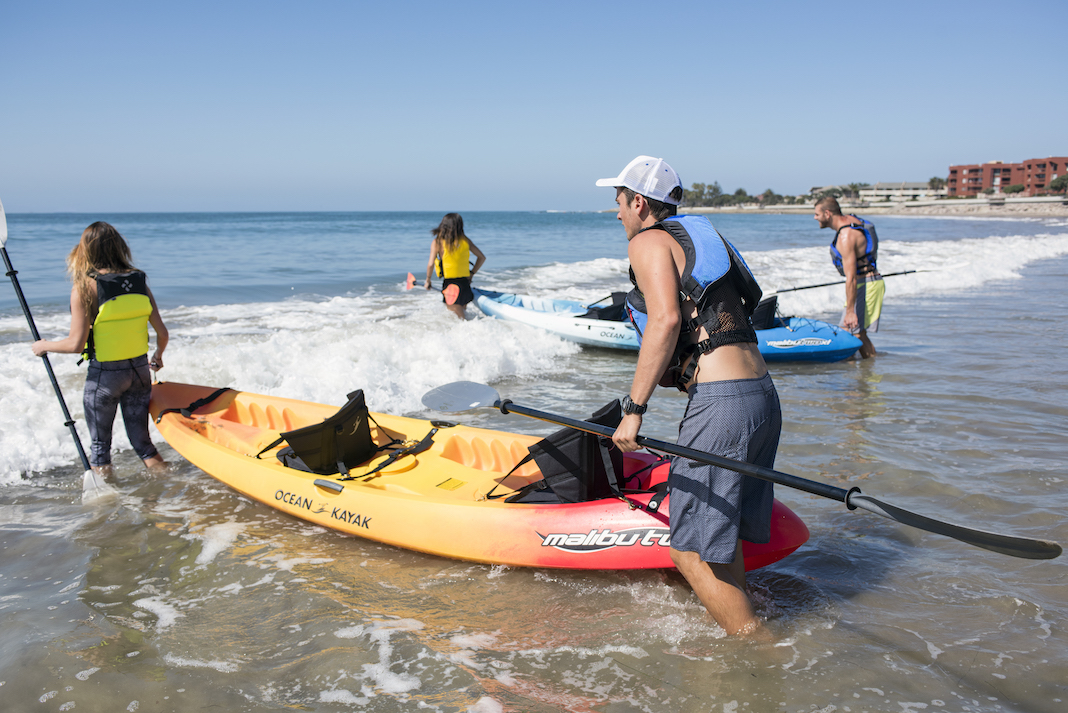
Overhead shot of two kayaks on the beach
Photo: Courtesy Ocean Kayaks

Ocean kayak reviews

Reviews are a valuable tool for learning how a kayak feels on the water; see if the environment where the reviewer uses the kayak matches where you plan to paddle. Use their expert opinion on the boat’s comfort, performance and features to decide whether this is a model worth trying in-person.


13 Best Places To Kayak In Nova Scotia

Kayak Nova Scotia
Photo: Tourism Nova Scotia // James Ingram

It takes just one visit to Nova Scotia to understand why it’s home to a thriving community of kayaking enthusiasts. First the obvious: It’s where you’ll find 13,000 kilometers (8,000 miles) of rugged coastline, hundreds of islands and coves, and dozens of white-sand beaches. But it’s just as well known for its flatwater and whitewater paddling on inland rivers and lakes. Nova Scotia’s waterways don’t just give you access to untouched wilderness—they also give insight into the lives of the Mi’kmaq and early explorers who once traversed them.

If you’re wondering where to kayak in Nova Scotia, here are 13 of our favorite places.

[ View all paddling adventures in Nova Scotia in the Paddling Trip Guide ]
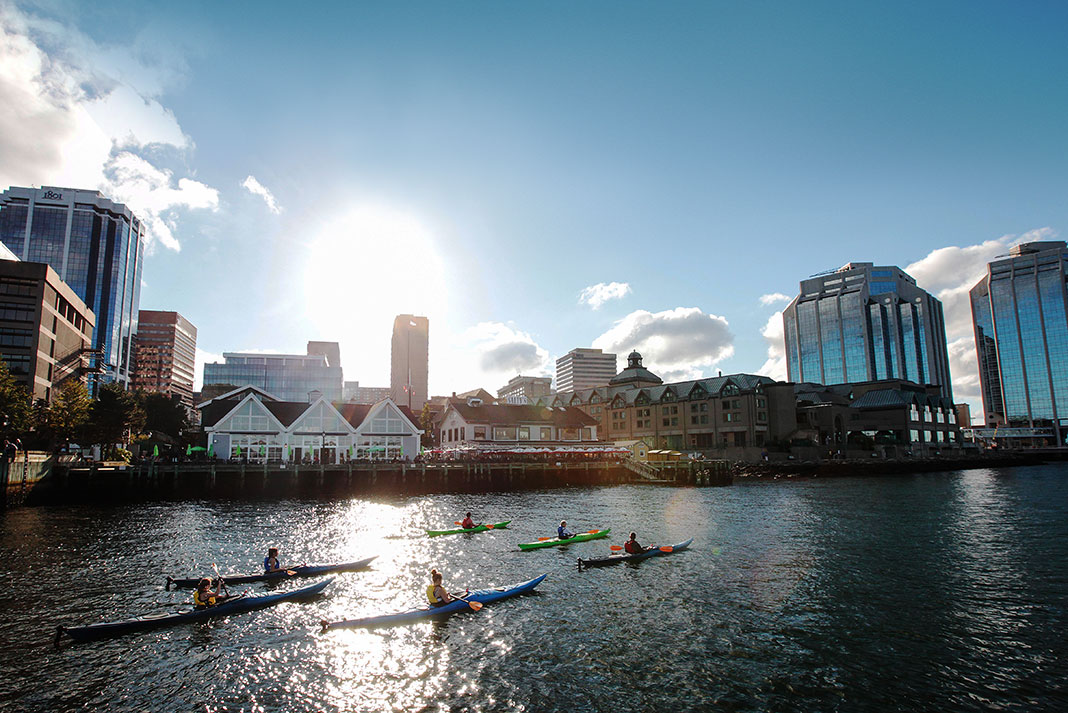
a group of kayakers paddle past the waterfront in Halifax, Nova Scotia
Get a new perspective on the city when you paddle Halifax Harbour. | Photo: Len Wagg

Kayaking Halifax, Nova Scotia

While you might immediately associate kayaking in Nova Scotia with saltwater, consider this: the Halifax region alone is home to over 1,000 lakes, 20 rivers and 23 major coastal areas.

You’re spoilt for choice in the city (read our Guide To Sea Kayaking In Halifax to learn more), but one of the most popular day trips is to start from St. Mary’s Boat Club, where you can paddle along the sheltered Northwest Arm. Run by the city, the boat club offers free canoe rentals, low-cost kayak rentals and guided kayaking paddle nights.

Tandem sea kayak being paddled with city buildings on one side and lighthouse on another.
A trip to Halifax isn’t complete without paddling the waterfront. | Photo courtesy of: Tourism Nova Scotia // Acorn Art & Photography

Kayaking Halifax Harbour

There’s a lot to explore in the Halifax Harbour, but it’s a busy body of water, with motorboats, Seadoos, ferries, sailboats and container ships all sharing the same space.

Unless you’re a skilled kayaker, it’s best to take a tour with Kayak Halifax, which offers guided excursions to McNabs Island (home to the historic Fort Ives). Harbour Watercraft Tours & Adventures offers a similar tour, which goes to Georges Island National Historic Site.

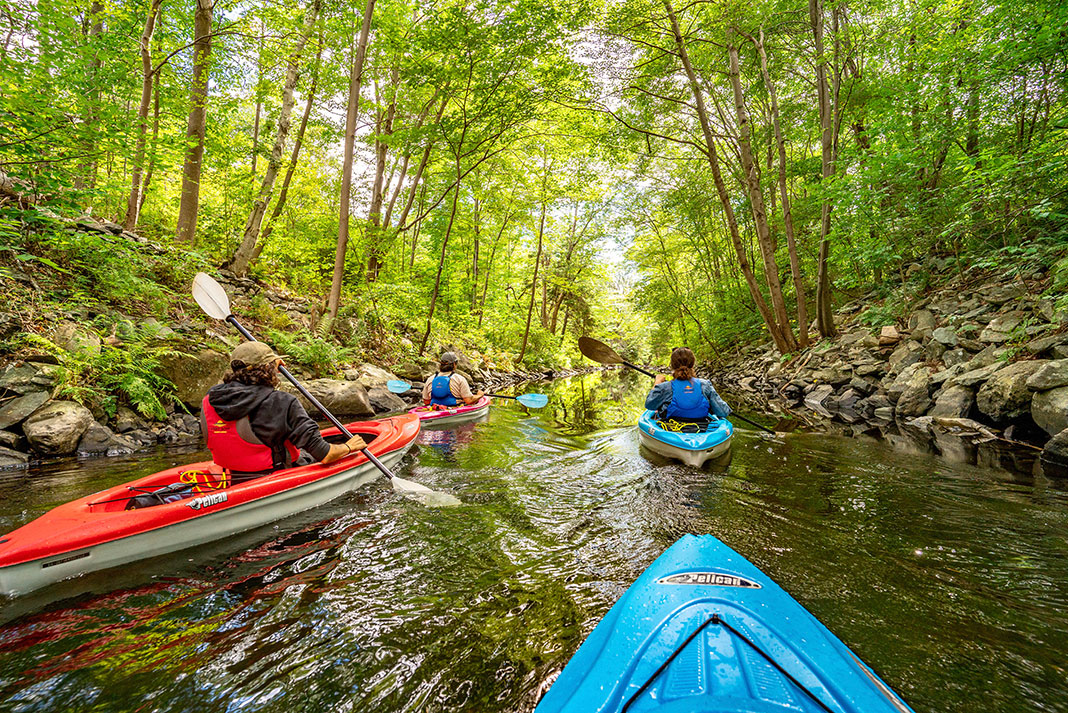
People paddle recreational kayaks on narrow waterway hemmed in by trees.
Paddle the Shubenacadie Canal from the Halifax Harbour to the Bay of Fundy. | Photo: @daveyandsky

Kayak Dartmouth, Nova Scotia

Located on the eastern shore of the Halifax Harbour, Dartmouth is sometimes called the “city of lakes” for a chain of 23 lakes located within its boundaries, including those that make up the Shubenacadie Canal. Linking the Bay of Fundy with the Halifax Harbour, this canal is partially responsible for the large number of kayaking outfitters and stores in the area, including Wildwood Water Sports at Shubie Park, Old Creel Canoe on Lake Thomas and Freedom Canoe and Kayak.

The canal is relatively calm from Lake Banook until Lake Fletcher, with a few portages required to travel the entire chain of lakes. Grand Lake is difficult to paddle due to high winds, but it’s not until you reach the village of Shubenacadie that the tidal portion of the route begins. This is where you’ll find waves large enough for whitewater kayaking.

The entire route from Dartmouth to the Bay of Fundy is 72 kilometers (44 miles), making this one of the best places to kayak in Nova Scotia.

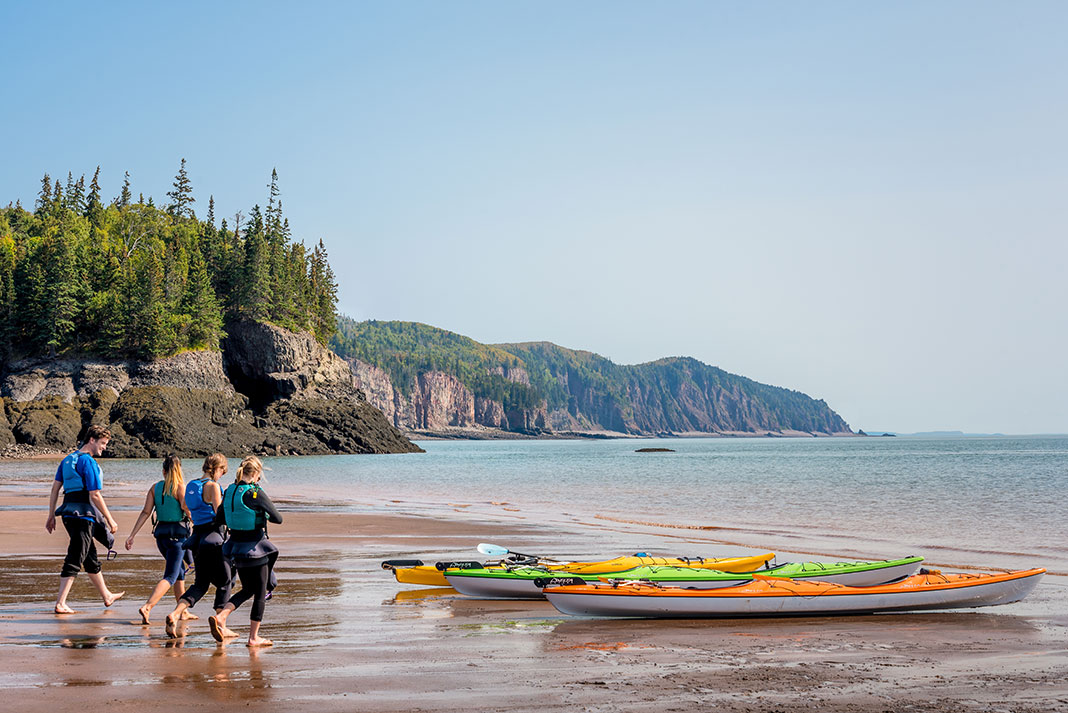
Group of people walk on beach towards sea kayaks with dramatic cliffs along shoreline.
Cape d’Or is one of many magical places to paddle along the Bay of Fundy coastline. | Photo: Tourism Nova Scotia // Patrick Rojo

Bay of Fundy kayaking, Nova Scotia

Considered one of the “seven wonders” of North America, the Bay of Fundy is renowned for having the highest tides on Earth. So, it pays to plan ahead: The time of day that you choose to go kayaking in Nova Scotia’s Bay of Fundy will dramatically change what you experience. Depart at high tide and you’ll be able to paddle through  rock formations and alongside dramatic sea cliffs. Or depart at low tide and you’ll be able to see just how extreme the tides really are, with the high-water mark clearly visible on rock pillars that suddenly double in height.

Another option is to experience the best of both worlds by taking a multiday kayak in the Bay of Fundy, Nova Scotia, with an operator such as NovaShores Adventures. Over two or three days, you’ll see old lava flows embedded in ancient rock, explore sea caves and see evidence of the area’s shipbuilding history at Eatonville Harbour.

A sea kayaker paddling in front of three towering rock pillars
Paddle among the Three Sisters on the Bay of Fundy. | Photo: Tourism Nova Scotia // Scott Munn

Three Sisters kayaking, Nova Scotia

Located within the waters of Cape Chignecto Provincial Park, the Three Sisters sea stacks are one of the Bay of Fundy’s main kayaking attractions. The remnants of lava flows and magma intrusions from deep within the Earth, local Mi’kmaw legends say they’re three sisters turned to stone.

Although they’re visible from shore, the best way to see them is from a kayak. Head out at high tide, when you can kayak in between them. Contact NovaShores for a day tour.

men kayak past a wooden building in LaHave Islands Area, South Shore, Nova Scotia
Paddle the picturesque LaHave Islands Area on Nova Scotia’s South Shore. | Photo: Tourism Nova Scotia // Acorn Art & Photography

Kayaking Nova Scotia’s South Shore

A region stretching from Halifax to Clark’s Harbour in Nova Scotia’s southwest corner, Nova Scotia’s South Shore is beloved for its picturesque fishing villages, historic lighthouses, fresh seafood, white beaches and the UNESCO World Heritage Site of Lunenburg (home of the Bluenose II racing schooner, found on the Canadian dime).

With countless inlets, coves, islands and bays to explore (including Mahone Bay, where you might just find buried treasure on Oak Island—contact Cape LaHave Adventures for tips) paddling here can be as serene or wild as you want it to be. Contact East Coast Outfitters for tours and sea kayak rentals near Lower Prospect.

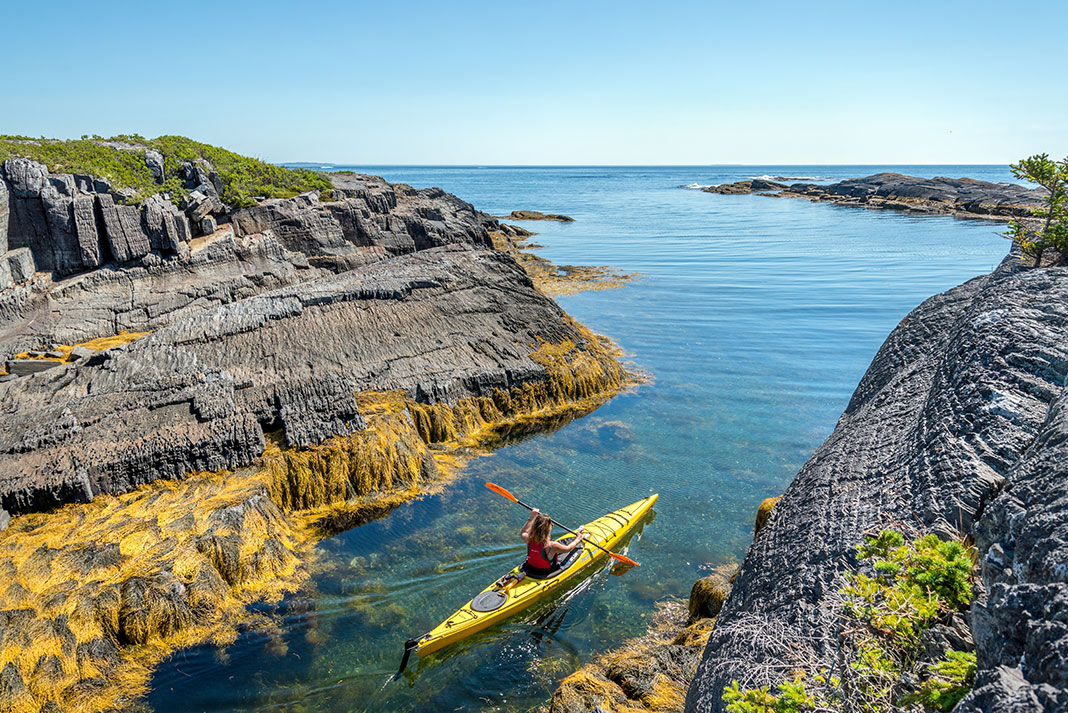
Woman paddling sea kayak on narrow passage between rocky shores
The Blue Rocks area offers calm waters for new paddlers. | Photo: Tourism Nova Scotia // Patrick Rojo

Blue Rocks, Nova Scotia kayaking

Owing to its proximity to Halifax, Peggy’s Cove may get all the glory, but the fishing village of Blue Rocks is just as stunning. A short drive from Lunenburg, it’s known for its blue slate rocks and fishing shacks, including one that’s reportedly the most photographed in the country. The waters are calm and protected, making this an ideal place for beginners to get their paddles wet.

Outfitter Pleasant Paddling offers morning tours to a seal colony, along with afternoon and sunset excursions.

Colorful buildings line the waterfront with sun setting in background.
View Lunenburg in all its beauty from the water. | Photo: Tourism Nova Scotia // Acorn Art & Photography

Lunenburg

It doesn’t matter whether you only have a few hours or a full day to spare—kayaking off the coast of Lunenburg provides a unique vantage from which to view the colorful and historic seaside town.

You’ll have the opportunity to float past the boatyards where the Bluenose I and Bluenose II were built, and if time allows, onward to nearby Blue Rocks, where you may spot seals and harbor porpoises along the way. Local Mike Taylor of Lunenburg Paddling offers SUP, single kayak and tandem kayak rentals, along with tours.

Read our Guide To Exploring Lunenburg, Nova Scotia By Kayak for more information.

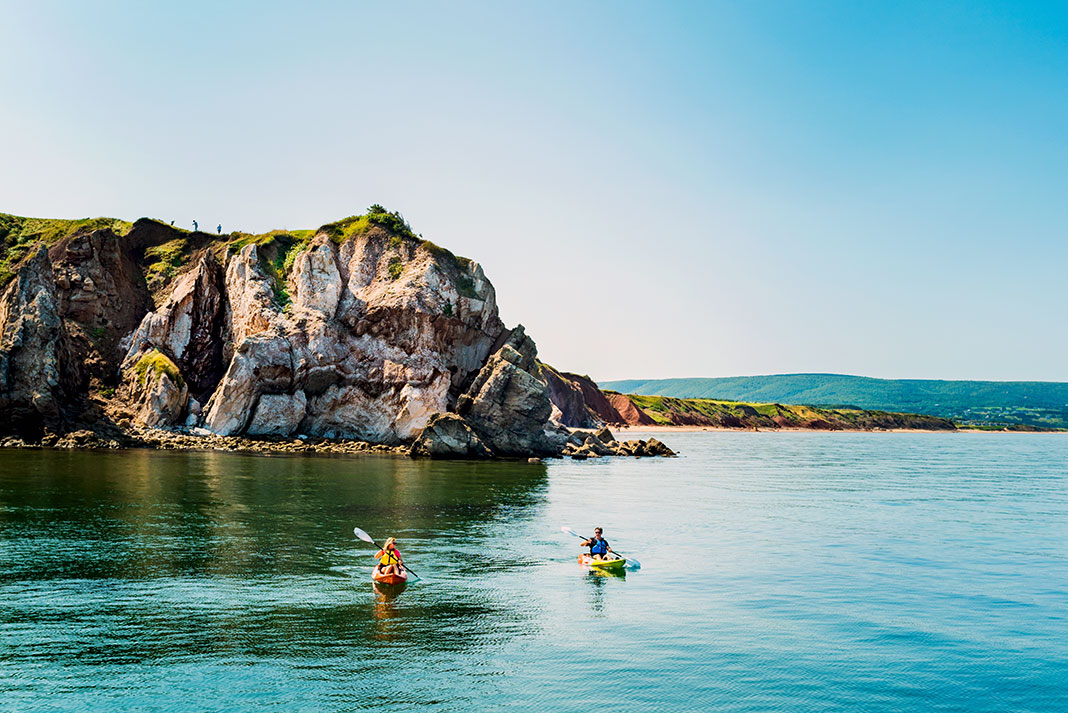
Two kayakers paddle in front of a rocky cliff.
Experience the overwhelming beauty and wildness of Cape Breton. | Photo: Tourism Nova Scotia

Kayak Cape Breton

There’s a reason so many paddling outfitters have chosen to set up shop in Cape Breton. Arguably the epicenter of paddling in Nova Scotia, it doesn’t get much better than sea kayaking in Cape Breton. Some of the best kayaking in Cape Breton is along its untouched coastlines, but that’s not your only option. There are also the brackish waters of Urquhart’s Pond, and the salt water of Bras d’Or Lake and the Margaree River, a relatively flat stretch of water. Translation? This is also where you’ll experience some of the best river kayaking in Nova Scotia.

Contact Kayak Cape Breton in St. Peter’s for rentals and tours.

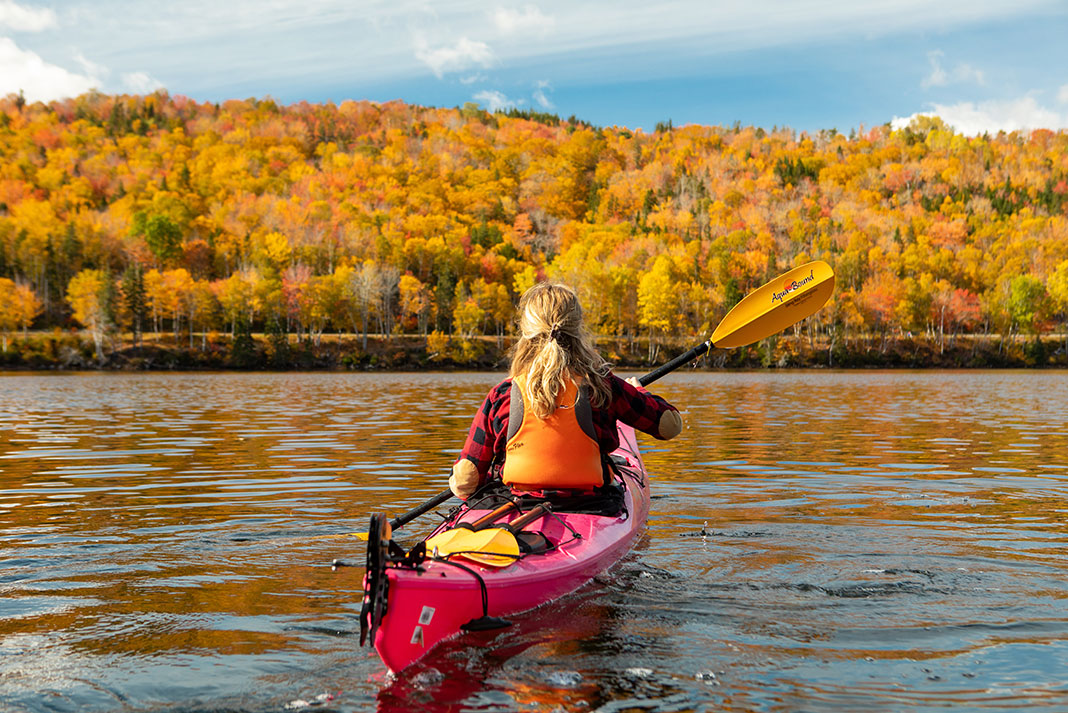
Woman paddling sea kayak with golden leaves in the background.
Fall is one of the best times to paddle the North River area of Cape Breton. | Photo: Destination Cape Breton Association

North River kayaking, Cape Breton

The sheltered and calm waters of the Cape Breton sea coast near North River is the ideal place to practice your strokes. Stop for breaks on secluded and untouched granite stone beaches, and look at the shoreline for eagles’ nests, sea caves and harbor minks.

Located 35 minutes from Baddeck on the Cabot Trail, North River Kayak Tours offers half-day and full-day guided tours, as well as on-site accommodation.

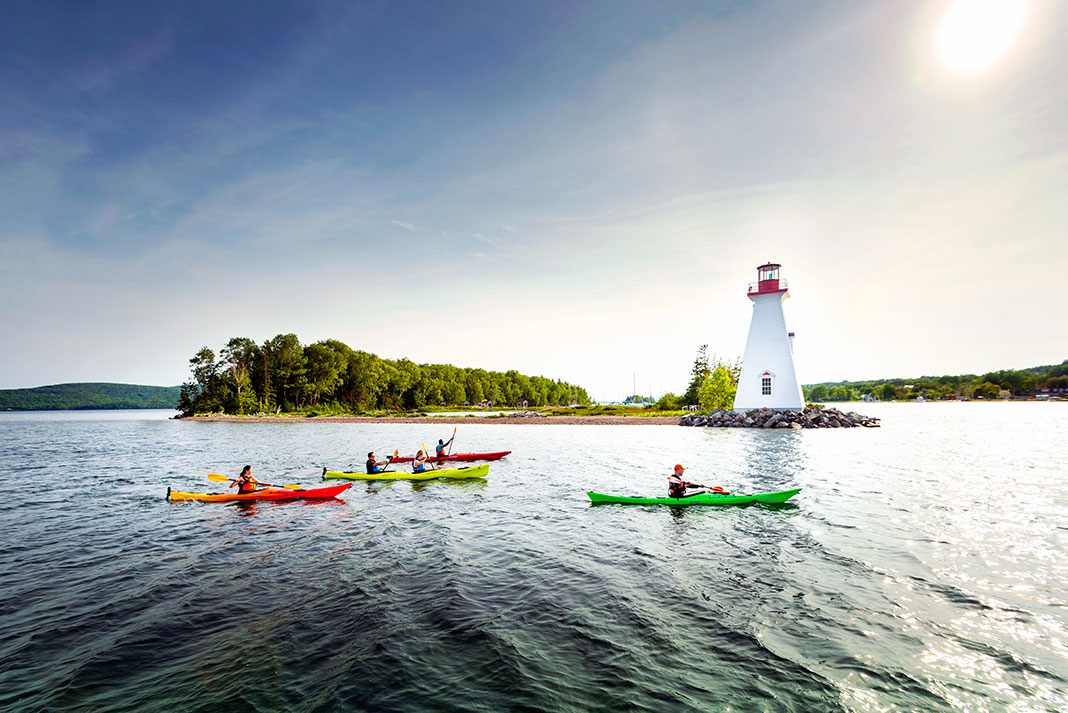
people kayak past a lighthouse at Baddeck, Cape Breton Island
Exploring the sights of lakeside Baddeck. | Photo: Tourism Nova Scotia // Dean Casavechia

Kayaking Baddeck, Nova Scotia

Considered to be both the beginning and the end of the world-famous Cabot Trail (a highway that encircles Cape Breton) this pretty waterside town is where inventor Alexander Graham Bell elected to spend his summers.

Nearby Baddeck Cabot Trail Campground offers canoe and kayak rentals, which you can use to explore the Baddeck River, an important watershed for brook trout and Atlantic Salmon that empties into Bras d’Or Lake.

View from above of peninsula jutting out into ocean, with island just offshore.
Taylor Head Provincial Park is located within the 100 Wild Islands and exemplifies the rugged beauty of the area. | Photo: Tourism Nova Scotia // @daveyandsky

Kayaking 100 Wild Islands, Nova Scotia

As the name implies, if you’re looking for pure wilderness and isolation, you’ll find it about an hour east of Halifax in the 100 Wild Islands. This archipelago of hundreds of islands and islets—which supports pristine forests and coastal habitats, along with globally significant biodiversity—stretches for 30 kilometers (18 miles) from Clam Harbour to Mushaboom. If you’re looking to go kayak camping in Nova Scotia, this is the place.

Murphy’s Camping on the Ocean at Murphy Cove offers rentals, while Coastal Adventures offers rentals alongside day tours and three- or five-day trips. Expect to see seabird colonies, seal haul-outs, sandy beaches and hidden coves that can only be accessed by kayak.

Learn more by reading our Guide To Paddling Nova Scotia’s 100 Wild Islands.

Group of sea kayakers paddling with shoreline far in the background.
Plan a multiday trip in Keji. | Photo: Tourism Nova Scotia // Patrick Rojo

Kayaking Kejimkujik

Located in southwest Nova Scotia, Kejimkujik National Park and National Historic Site (often just called “Keji”) protects 404 square kilometers (251 square miles) of old-growth forest, rare wildlife, Mi’kmaw petroglyphs and the lake that it’s named for. There’s also a secondary area: The Kejimkujik Seaside Adjunct, which is along the coast near Port Jolie.

The best way to explore the park’s historic waterways—which have been used for centuries by Indigenous people—is by kayak. There are dozens of interconnected lakes and rivers, with backcountry camping available, making a multiday trip possible. The Mersey River is calm and popular with families.

Kejimkujik Lake, on the other hand, is large enough for whitecaps to form, but also has some of the best camping, with spots on its islands booking out in advance. Parks Canada recommends tackling the lake in the early morning or late afternoon to avoid the wind.  Whynot Adventure Outfitters offers rentals, shuttles and guided tours.


Curious Killer Whale Swims Beside Kayaker (Video)

Sometimes the difference between a “close encounter” and an uncomfortable one can be measured in mere inches. While out paddling the arctic waters of Northern Norway, this sea kayaker was intimately greeted by a large male killer whale (orca).

The footage shows the orca swimming within touching distance of the kayak, yet the paddler remains calm and seemingly unaffected.

His relaxed demeanor wasn’t totally out of place. Despite the threat implied by the “killer” prefix, killer whales are known for their friendly nature; in fact, there is no record of an orca ever killing a human in the wild. They show little interest in humans, as we are not part of their natural diet.

Whale watching regulations require boaters/kayakers to keep minimum 200 meters away from killer whales and 100 meters away from all other whales at all times. Responsible paddlers endeavor to follow these rules, and rare exceptional encounters do not represent a typical paddling experience.

How To Size A Paddleboard

a group of people on the water on standup paddleboards of various sizes
Feature photo: Darren McChristie/Ontario Tourism

Choosing a paddleboard size isn’t just about the board; it’s about what you want to get out of it. A perfectly sized paddleboard should carry your weight efficiently, perform well for the type of paddling you’re doing and provide enough stability for your skill level so you have an enjoyable session.

This paddleboard size guide will look at paddleboard dimensions and paddleboard size recommendations to help you answer the question, what size paddleboard should I get?

What sizes do paddleboards come in?

Paddleboards come in many shapes and sizes. The most popular recreational paddleboards for general use are typically 10 to 11 feet in length and between 32 and 34 inches wide. However, paddleboards for solo use can range from under nine feet to more than 14 feet long, and from less than 25 inches to more than 36 inches wide. This range encompasses different skill levels, types of paddling and body types.

Within any given board category, there is a range of board sizes with different sizes that correspond to different rider weights. This is because taller and heavier paddlers will need a higher volume board for float and stability, which may mean longer, broader or thicker dimensions. If you’re buying a board that will be shared, get the size appropriate for the largest and least experienced person who will use it. Ultimately, the way a board performs is a combination of all its design features, plus the paddler’s weight, ability and water conditions. Read on to meet your perfect match.

Paddleboard length

paddleboard length diagram

Length refers to the measurement from nose to tail of a board, and it plays a vital role in how a board handles. In general, longer boards are faster, while shorter boards are slower but more maneuverable. Because shorter boards are more responsive, they’re favored by some for surf conditions. For groms just starting out, consider a specific kids paddleboard.

Under 10 feet

  • Best for smaller paddlers (under 150 lbs), including youth
  • Better maneuverability
  • More responsive for SUP surf

Around 11 feet

  • Average length for most recreational SUP styles
  • Suited to all-around use
  • Suitable for beginner to advanced skill level

Over 12 feet

  • Longer designs are more efficient for touring and racing
  • Better suited to paddlers with more experience—there’s more board to handle—and larger paddlers

Paddleboard width

paddleboard width diagram

Width is the measurement from rail to rail at the broadest part of the board. A wider board is more stable but it will be slower. A narrower board offers less resistance and better glide but less stability. In general, a smaller person will enjoy paddling a narrower board, which will help avoid reaching over a wide board to get the paddle in the water. A larger person will feel more stable on a wider board.

Under 30 inches

  • The narrower the board, the less stable and more paddling experience needed
  • Elite athletes race boards as narrow as 19 inches wide

30–32 inches

  • Average paddleboard width
  • Touring boards are usually in this range
  • Good middle ground between speed and stability

32–34 inches and up

  • Increased width creates more stability, better for bigger paddlers
  • Offers more space to carry gear or your pup
  • Around 32 to 34 inches is a stable width for whitewater, fishing and SUP yoga

Paddleboard thickness

paddleboard thickness diagram

Thickness is the measurement of depth at the widest part of the board. Thickness affects the volume therefore weight capacity of a board. Inflatable designs are often an inch thicker than hard boards of the same category, and thickness may be a factor in increasing the rigidity of some inflatable paddleboards.

Under 5 inches

  • Average thickness for hard SUPs
  • While there are some iSUPs in this category, for SUP surf or youth, make sure they are produced by a reputable brand making high-quality boards

5–6 inches

  • Thicker may be better for bigger paddlers because it adds weight capacity
  • Average thickness for an inflatable SUP

6 inches and up

  • Longer touring and racing boards benefit from extra thickness to prevent bowing in the middle of the board
  • Extra thickness creates more volume—helpful for paddlers 200+ lbs
  • Raises center of gravity
  • Takes longer to inflate

Paddleboard volume

paddleboard volume diagram

The volume of a board is determined by its length, width, thickness and shape. Volume, measured in liters, determines a board’s buoyancy and how much weight it can float. A lower volume board means a lower weight capacity. A higher volume board means a higher weight capacity. A similarly shaped board with higher volume feels more stable, making it ideal for new and/or larger paddlers.

Rather than having to guess what a board’s volume means for you, manufacturers post a recommended weight range specific for each model. Don’t forget to factor in your gear and any pets or kids who may be paddling with you. It’s better to err on the side of a board that’s a little too big than a board that’s too small.

Below 170 Liters

  • Getting into SUP surf board territory
  • For smaller paddlers
  • For more experienced paddlers

170–190 Liters

  • Average hard SUP volume range for beginner paddlers

220–280 Liters

  • Average inflatable SUP volume range for beginner paddlers

Above 280 Liters

  • Offers increased weight capacity for heavier paddlers or more cargo
  • Usually a bigger board for yoga, racing, touring or whitewater

Paddleboards for plus-size paddlers

Is there a weight limit for paddleboards? You can have fun on a paddleboard no matter your size or weight. There’s a board out there for every weight range. If you’re wondering, “What size paddleboard do I need?”, the important thing is ensuring whatever board you choose has a weight capacity that exceeds your weight and the weight of the gear, pets or kids you bring. You can’t be too light for a paddleboard, but you can be too heavy for a specific model. Exceeding the weight capacity of your board results in reduced stability, speed and glide and can make for a poor paddling experience.

Paddleboard size charts and calculators

If you are curious about how to determine standup paddleboard size, many SUP calculators are available online to factor in a paddler’s weight and spit back paddleboard size recommendations. However, these paddleboard size guides are generalizations at best. There’s no secret formula to finding the perfect board. The best place to begin is to identify which category of board suits the paddling you’ll do most often, and then identify the boards that suit your weight, rather than prematurely getting stuck on dimensions.

Best size paddleboard for beginners

That said, Red Bull SUP athlete Casper Steinfath offers this advice: “If you are a beginner paddling on mixed water without much experience, I would suggest looking for a board at least 32 inches wide that carries volume equivalent to at least 2.5 liters times your weight in kilos.”

In other words, a 70-kilogram rider, for example, should seek out a 32-inch or wider board with a minimum volume of 175 liters.

When sizing a paddleboard, a paddler’s height is a far less important consideration than the paddler’s weight and the combined weight of the paddler and gear they expect to carry. However, height may be a consideration for very tall paddlers, who have a higher center of gravity and therefore may be more comfortable on a slightly wider and more stable board.

Choosing a size is just the beginning of finding a good beginner paddleboard. Don’t buy a board without understanding hull types, fin systems, differences between hard boards and inflatable SUPs, SUP construction, and other unique details.


Fishing Kayak Review: Ascend 12t

The Ascend 12t is a sit-on-top fishing kayak with major features geared toward anglers. The elevated seat, standing platform cockpit and large tankwells leave no question this boat was built to chase fish.

Ascend kayaks are a brand under the banner of the White River Marine Group. By volume, the White River Marine Group is the world’s largest manufacturer of motorized boats. The White River Marine Group is owned by Bass Pro Shops. As such, Ascend kayaks are most commonly available at Bass Pro Shops, Cabela’s and also boating retailers who carry White River Marine Group brands.

What makes the Ascend 12t stand out among a sea of fishing kayaks? The 12t is a platform-style fishing kayak with an elevated seat position and an open, flat cockpit intended for standing casts. A standing platform provides the ability to sight fish, enhance casting ability and increase mobility when fighting fish. These design features are commonly found on kayaks much more expensive than the 12t fishing kayak.

Fishing-centric kayaks of this size and style are regularly priced two or three times higher than the Ascend 12t. That being said, the 12t does have a higher price tag than some other fishing kayaks available at large retailers. So is the Ascend 12t worth it? We’ll try to help you answer that in this Ascend 12t review.

On the water with the Ascend 12t

Ascend 12t Specs
Length: 12’0” / 3.6 m
Width: 31” / 79 cm
Weight: 77 lbs / 35 kg
Capacity: 350 lbs / 159 kg
MSRP: $779 USD / $1,119 CAD

Performance

What are anglers looking for in a kayak? Often it’s the ability to get where conventional motorized boats can not, without sacrificing storage space or stability for casting and catching fish. There’s also the appeal of skipping out on the hassle of owning a motor boat, and the chance to turn everyday fishing into a bit of an adventure. With this said, let’s talk performance and Ascend 12t stability.

The Ascend 12t sit-on-top kayak is built on a tunnel hull. Tunnel-hulled kayaks are generally wider than other kayak hulls. Think of a tunnel hull as a pontoon boat or catamaran. There are essentially two rounded surface areas bridged by the center of the kayak. The dual, rounded surface areas provide reliable initial and secondary stability. These tunnel hulls are especially popular with fishing kayakers for the stable platform they provide.

The reason for the tunnel hull is to provide the Ascend 12t’s standing platform area. What do I mean by standing platform in a kayak? It’s when the floor of the cockpit is an open, flat area, rather than being scooped out for a footwell, and the kayak is stable enough to allow the paddler to stand. Standing platforms are a game changer for fishing kayaks, giving a kayak angler the opportunity to sight fish and increase casting ability. It’s a next step up in the fishing capability of a kayak.

The Ascend 12t provides this open standing area. But the 12t dimensions are worth looking at when assessing the stability of the kayak. The Ascend 12t is 12 feet long and 31 inches wide. In comparison to other fishing kayaks with a standing platform, the 12t is on the small side. For this reason, inexperienced paddlers may find the 12t to feel unstable when it comes to standing.

Market and demographics

The Ascend 12t is a sit-on-top fishing kayak. Sit-on-top kayaks are kayaks where the paddler is not enclosed at all. They sit on the deck of the boat, which has been molded for an exterior seating position. This is in comparison to a sit-inside kayak. A sit-inside kayak is one where the paddler slides into the cockpit of the kayak. They may also wear a sprayskirt to cover the cavity of the cockpit. Sit-on-top kayaks have become popular for fishing kayaks because of their ease of entry, open storage and easier rescue scenarios in the event of a capsize.

The Ascend 12t kayak was designed specifically with the kayak angler in mind. The elevated seat position and tunnel hull make the 12t less about covering water as a paddler, and more about comfort and stability.

This kayak is best suited for slow-moving rivers, lakes and sheltered coastal waterways.

Know The Local Hazards
  • Check navigation charts before you launch.
  • Check with those who have local knowledge of man-made and natural hazards, e.g. low-head dams; sweepers, strainers and undercuts; tides and currents; and rocks and shoals.

Beyond rod and reel action, kayaks like the Ascend 12t can also be used for hunting. Duck hunting is well within its scope, since its open cockpit design, elevated seat and large tankwells are also benefits to carrying decoys, setting up a shotgun rack or even bringing along your bird dog. The spacious decks make it manageable to ride along in the 12t with dog for duck hunting.

About the Ascend 12t

Design

Material and construction

The Ascend 12t is constructed of high-density polyethylene. Polyethylene is a plastic commonly used in kayak manufacturing. This polymer compound is also regularly used to make other durable plastic goods like milk jugs and shampoo bottles.

Ascend produces the 12t through a rotomolding process. Small plastic pellets are loaded into a mold. The mold is then placed in a large oven at high temperatures and rotated at speed, pushing the liquified nurdles outward so they spread and take the shape of the mold. While the mold is pulled from the oven it continues to rotate as it cools. When the mold is opened, presto we have a kayak. Rotomolded kayaks are one of the standard production processes in the industry to produce durable and afforable kayaks.

Ascend 12t accessories and outfitting

One of the most obvious elements of the Ascent 12t is the amount of open storage.

This starts at the bow, where the Ascend 12t has a roomy forward tankwell. Tankwells are storage areas molded into sit-on-top kayaks. The tankwells of the 12t have plenty of space for storing tackle, fishing crate, coolers and dry bags for a day on the water.

Nearly two feet at its widest and two feet in length, the forward tankwell has a built-in bungee system for securing your gear. One downside to this system is that it is attached to the floor of the tankwell, rather than mounted on the deck. This means the bungees are not able to stretch over the entire tankwell for securing gear, but rather just for items stored close to the floor. It may be thoughtful in some instances, but removes some versatility in securing gear.

Another thoughtful design to the Ascend 12t’s front tankwell is the cut-out where it meets the cockpit, allowing waves splashing over the bow to drain out into the floor of the cockpit, where it will exit via the scupper holes.

The cockpit of the 12t Ascend kayak is an open concept, with an overall flat surface, covered with traction padding. This allows kayak anglers to use the floor of the cockpit as a standing platform, which increases your ability to cast, sight fish and move around the deck.

Also within the cockpit of the Ascend 12t are sliding foot braces. Sliding-style foot braces provide more positions than molded-in footwells. They do however require you to reach down by hand if they need adjustment on the water. Foot braces are an important part of a kayak’s outfitting because they provide a point of contact with your kayak. This gives you more leverage for paddling strokes, and more control over the kayak.

At the center of the cockpit between the foot braces there is a hatch for storage. This deck hatch is large and rectangular, providing access to the interior of the hull. The hatch operates on a hinge and has a gasket to provide a seal. Items can be stored within this hatch, but be mindful this section is not divided from the cavernous interior of the kayak. The upside to this is it also provides a way to access the interior of the kayak to make repairs or install new gadgetry.

Directly behind this large hatch is a smaller hatch, sealed with a threaded deck plate. It is located closer to the seat, and makes for accessible dry storage of smaller items you want stowed away.

On the floor of the cockpit you will see four scupper plugs. Why exactly are there holes in the bottom of the kayak? These scupper holes are built in to let water entering the boat drain out through the floor. This keeps the cockpit of the kayak from filling with water. The Ascend 12t has six scuppers in total. Four are in the cockpit, and two in the rear tankwell.

Water can also come up through the scuppers. If you are paddling in calm conditions, and don’t want water to splash up through the floor, you may want to close the scupper holes. You can do this with a set of scupper plugs, which are included with the 12t.

The seat of the Ascend 12t fishing kayak is an elevated, stadium-style seat. It has a mesh construction, with some padding under the butt and on the back. The raised seat provides a more natural posture and sitting height than the low position of traditional kayaks.  An elevated seat also increases visibility, and keeps you off the wet floor of the kayak.

The Ascend 12t seat has a unique track system. Near the hinge on each side of the seat are small plastic blocks. These blocks slide into an enclosed track, rather than resting on top of a track. This keeps the seat from bouncing up off its position, but also means if you want to move it out of the way you must slide it forward, rather than just folding upward. This is not necessarily an advantage or disadvantage. It does make for a specialized system, creating difficulty for any seat upgrade.

One area of concern cited by users of the Ascend 12t is the seat’s vulnerability to rusting. A rusted out seat on a fishing kayak with an elevated seat would render the kayak relatively useless until you have a replacement seat.

The area around the cockpit of the Ascend 12t features pre-installed accessory tracks; on either gunwale near the knees. This provides a place to easily mount electronics on your 12t such as a fish finder or action camera. It’s a simple pre-installed add-on, but saves time and money for a kayak angler who wants to have their boat ready to launch the day of purchase.

Another handy accessory beside the cockpit area is a two-piece paddle clip. Paddle holders are an easily overlooked but useful accessory for a fishing kayak. Without a paddle holder or some sort of leash, your paddle can easily drift away without notice while you are rigging up a line or landing your catch.

Behind the kayak seat are two flush-mounted Ascend 12t rod holders. Flush-mounted rod holders are a common standard found on fishing kayaks, and give you the space to carry two rigged setups.

Near the stern of the Ascend 12t is another large, recessed tankwell. This tankwell is segmented into two areas. The first, closest to the seat, is rectangular and makes for a great place to keep a small cooler, or battery if you decide to modify your kayak with a trolling motor or power hungry electronics. There are also two scupper holes underneath this section of the tankwell to drain any water which makes its way into the storage area. The second section of the rear tankwell closely resembles the bow tankwell with an elongated, triangular shape and similar bungees running along the floor.

Finally, the stern is where you will find the drain plug. The drain plug allows you to empty any water which has entered the interior of the hollow hull of the Ascend 12t. How can water get inside a sit-on-top kayak? Water ingress can occur at seams, screw holes or places where the hull has been cut for exterior components. It’s not uncommon to get a small amount of water inside your kayak, and you should drain it at the end of your trip.

Dress For Immersion, Not Air Temperature
  • Your body loses heat much faster when immersed in cold water than it does when dry.
  • Avoid cotton clothing like t-shirts and jeans; they retain water and accelerate cooling when wet. Synthetic fabrics, or wool, are generally a better choice. If the water is very cold (60° fahrenheit or less), you should wear a wetsuit or drysuit.

Ascend 12t kayak mods

Even with all the components included with the Ascend 12t, kayak anglers may want to make some additions to the kayak.

The Ascend 12t only has the two built-in flush mounted rod holders behind the seat. You may want a rod holder in front of you for when you are actively fishing. Thanks to the pre-installed accessory mounts, adding a forward, swiveling rod holder is as simple as sliding it onto the gear track. Ram and Scotty are two brands of popular aftermarket rod holders.

To take full advantage of fishing from the Ascend 12t, anglers may also want to install a fish finder. The pre-installed accessory tracks mean you won’t have to drill any holes on the deck to install a kayak fish finder. Simply mount your transducer and decide on your power system. Depending on the fish finder you choose, YakAttack has some great options for mounting your device on the accessory track.

Warranty

Ascend provides a one-year, limited warranty covering parts and labor to correct defects in materials and workmanship.

How it compares

The Ascend 12t finds itself in a crowded class of fishing kayaks. Here are a few regularly compared with the 12t.

  • Ascend FS12t vs 12t

    For all intents and purposes, the Ascend FS12t is the same kayak as the 12t. As the kayak has gone through different iterations the name has changed back and forth in recent years. If you find a kayak listed as the Ascend FS12t, you are looking at the same boat as this review of the 12t.

    Ascend also made a now-discontinued sit-inside fishing kayak called the FS12. If you’re looking for a similar sit-inside fishing kayak, its smaller sibling, the Ascend FS10 sit-in, is still available.

  • Ascend 12t vs 10t

    The most comparable kayak you will find to the 12t in the Ascend line is the 10t. The Ascend 10t is a shorter version of the 12t discussed in this review.

    The major difference between these two kayaks comes down to dimensions, and how those dimensions affect the layout of the kayak.

    The 10t is so-named because it is 10 feet long. This is two feet shorter than the 12t which, you guessed it, is 12 feet. The 30-inch 10t is also an inch narrower compared to the 31-inch 12t.

    The 10t offers similarly spacious bow and stern tankwells to the 12t, with the caveat that the longer kayak’s tankwells are even roomier. However, both kayaks have enough on-deck storage to carry all of your gear and tackle for the day.

    Another storage difference is the 12t has an additional dry hatch compartment within the cockpit. It is accessible through a large, hinged hatch cover.

    The difference in size is also going to equate to a difference in weight. The 10t being smaller weighs less at 67 pounds compared to the 12t at 77 pounds. It also has a somewhat lighter capacity at 325 pounds compared to the 12t’s 350 pounds.

    The two kayaks are close to par with one another. The increased dimensions of the 12t may give it an edge in storage, stability and perhaps a bit of speed. If weight and ease of transportation are more of a factor, the 10t offers similar performance in a more compact package.

  • Ascend 12t vs 128t

    The Ascend 128t is another platform-style, sit-on-top fishing kayak design, though this specific model has been replaced by the updated Ascend 128X. The 128t is a definite upgrade from the 12t in regards to design and features.

    Most obvious is the 128t’s inclusion of Ascend’s Yak-Power system. The Yak-Power system includes wiring harness and plugs, meaning with a 12-volt battery your fishing gadgetry is ready to plug and play on the 128t.

    The 128t also has substantial differences in design to the 12t. The 128t is eight inches longer at 12 feet 8 inches, and wider at 33 inches. The 128t also extends the tunnel hull further through the bow and stern. These factors provide a larger, more stable standing platform than the 12t. The downside to all this is the 128t is substantially heavier at 96 pounds, compared to 77 pounds for the 12t.

    Power-hungry anglers and those who want a kayak with the rock-solid stability of a barge should take a look at the 128t (or the new 128X). If you want a fishing kayak that still retains some of the agility and handling of a traditional kayak, stick with the 12t.

  • Ascend 12t vs H12

    The Ascend H12 is what Ascend has dubbed a hybrid kayak. It is not quite a sit-inside or sit-on-top kayak but somewhere in between. It has a recessed cockpit surrounded by a deck, similar to what you would find for a sit-inside, but the cockpit is open and squared off.

    The H12 features supersized storage hatches in both the bow and stern, covered with a hard plastic deck plate in the bow, and plastic fabric cover in the stern. Again, following this hybrid mentality, these storage areas fall somewhere in between an open tankwell and an enclosed hatch. The intention is to provide storage for long outings and even overnighters. There are, however, no bulkheads built in to isolate sections of the kayak. Any water entering the H12 will not drain through a scupper and should the boat capsize, it will take on water. This makes the H12 only suitable to paddle on calm or sheltered waterways.

    The Ascend 12t will drain water. And should the 12t capsize all you have to do is climb back in. There is no open cavity where water will collect. While it is open air, the Ascend 12t kayak has plenty of storage space in the open tankwells, where gear can be stowed within dry bags. For this reason, the 12t feels like a much more versatile craft.

Stay Clear Of All Other Vessels
  • Know the “Rules of the Road” Navigation Rules that govern all boat traffic and stay out of the way of all other vessels.
  • Never assume that power boaters can see you. Avoid high-traffic areas whenever possible. Proceed with caution when you can’t avoid paddling near boats. Dress for visibility.
  • Ascend 12t vs Pelican Catch 120

    The Pelican Catch 120 is a sit-on-top fishing kayak with a similar design to the Ascend 12t.

    The Pelican Catch 120 is also a 12-foot sit-on-top kayak with a tunnel-shape hull. It also features an elevated seat, sliding foot braces and a flat standing platform within the cockpit.

    One noticeable difference is the seat for the Pelican 120 sits on a ledge molded onto the deck of the kayak. This makes it easier to mount and remove, but some users may feel less secure than sitting in the slightly recessed Ascend 12t seat.

    The major difference between the two, when it comes to performance, may be the width. The Pelican 120 is a full three inches wider than Ascend 12t. Generally speaking, with similar hulls this is going to translate to lower speeds but more stability for the standing platform.

  • Ascend 12t vs Perception Pescador

    Perception is one of the oldest names in kayaks, with a reputation for building quality boats. The Pescador is a sit-on-top fishing kayak within the same price range as the Ascend 12t. While these are both sit-on-top fishing kayaks, they are geared toward a slightly different type of use.

    The Pescador has a traditional, molded seat so users are sitting lower to the floor of the kayak than the 12t’s elevated stadium-style frame seat. The hull is also more streamlined than the Ascend 12t’s, providing less stability for standup fishing but a considerable weight savings of 13 pounds. In fact, the Pescador 12 is one of the lightest fishing kayaks in its class, making it a good option for those who want a kayak that is easy to transport and carry.

    The Pescador also has a different storage layout than the Ascend 12t. The Pescador has an open stern tankwell and a dry storage hatch on the bow. The Ascend storage is distributed between two large, open tankwells in the bow and stern.

    If you want the higher vantage of an elevated seat, and plan to do a lot of standup fishing, choose the stable platform of the Ascend 12t. If you’d rather an agile fishing kayak that is just as fun to paddle recreationally, then take a close look at the Pescador 12.

  • Ascend 12t vs Perception Outlaw 11.5

    Another sit-on-top offering from Perception comparable to the Ascend 12t is the Outlaw 11.5. Like the 12t, the Outlaw has an elevated frame seat and an open, platform-style cockpit set atop a super stable tunnel hull for standup fishing. The Outlaw also offers large open tankwells in the bow and stern.

    To cut to the chase, the Outlaw is a full four inches wider than the Ascend 12t. While measurements are only part of what gives a kayak design its stability, it is fair to say this additional width gives the Outlaw superior stability while standing. Add to this Perception’s throne-like seat allows for one of the highest fishing and paddling positions ever in a kayak, and the choice for those who like to fish on their feet is clear.

  • Ascend 12t vs Lifetime Teton

    The Lifetime Teton Angler 100 sit-on-top fishing kayak is in the same price range as the Ascend 12t. Right off the bat, it is important to note availability of these kayaks may be a deciding factor. The Teton 100 is sold exclusively at Dick’s Sporting Goods, while the Ascend 12t is sold through Bass Pro Shops and Cabela’s.

    While the Teton has an elevated seat, it does not have a flat standing area, and is intended for seated fishing. Without a tunnel hull, and at just 30.5 inches wide, the elevated seated position of the Teton can make it feel less stable than the Ascend 12t. This is likely a major factor when deciding between the two kayaks. If you want both an elevated seat and a standing platform, the Ascend 12t is the obvious choice.

Where to buy the Ascend 12t

Where can you find the Ascend 12t available for purchase? Bass Pro and Cabela’s carry the Ascend 12t. Ascend Kayaks are a part of the White River Marine Group, which is owned by Bass Pro Shops. This is why these are the retailers carrying Ascend kayaks. You will also find the Ascend kayaks available at a limited number of smaller local boating stores that carry White River brands.

Ascend 12t Pros and cons

Pros

  • Large tankwells and hatches for storage
  • Standing platform for sighting fish and active fishing
  • Elevated seat provides comfortable seating and better casting
  • Affordable price point

Cons

  • Narrow width makes standing stability suspect
  • Tunnel hull is heavier than other kayaks
  • Seat is known to rust
  • Limited availability with select retailers

Related articles

Ascend kayak reviews

Sit-on-top fishing kayak reviews

12-foot fishing kayak reviews

SEE ALL KAYAK REVIEWS


Recreational Kayak Review: Pelican Trailblazer 100 NXT

man paddles Pelican Trailblazer NXT kayak in light surf
Feature photo: Courtesy Pelican

The Pelican Trailblazer 100 NXT is a popular recreational kayak that updates the construction and outfitting of Pelican International’s best-selling Trailblazer model. This 10-foot sit-inside kayak offers great value and ease-of-use for beginner paddlers, and its light weight and outstanding stability make it a favorite for family kayaking, touring on calm waters and casual kayak fishing.

On the water with Pelican’s Trailblazer 100 NXT

Pelican Trailblazer 100 NXT Specs
Length: 10’0” / 3.0 m
Width: 28” / 71 cm
Weight: 36 lbs / 16.3 kg
Capacity: 275 lbs / 125 kg
MSRP: $280 USD

Performance

When it comes to kayak design, there are a few fundamental trade-offs to consider. First trade-off: how well does a kayak turn to navigate obstacles (maneuverability) compared to its ability to glide in a straight line (tracking)? Too much maneuverability and you’ll find yourself zig-zagging rather than traveling in an efficient line. Not enough maneuverability and the kayak will feel sluggish and unresponsive when you try to turn it.

Second trade off: how stable does the kayak feel versus how fast is it? Wider kayaks tend to be slower but more stable, but the ideal width must complement the hull length and shape.

The Pelican Trailblazer 100 NXT manages to strike a good balance both between maneuverability and tracking, as well as speed and stability. It has a twin-arched, multi-chine hull that distributes weight evenly across its 28-inch width, so new paddlers will find it very stable. That outstanding stability means the Trailblazer NXT isn’t the fastest 10-foot recreational kayak, but its narrow bow and light weight help it to accelerate quickly and maintain speed with minimal effort.

Market and demographics

With its attractive price, user-friendly handling and durable construction, the Pelican Trailblazer 100 NXT is a great starter kayak for beginners looking to buy a first kayak. With a carry weight of just 36 pounds, it’s an especially attractive option for casual paddlers who want a sit-inside kayak that is as easy to transport as it is to paddle. In fact, many Trailblazer NXT fans are smaller-framed adults and teens who want a kayak they can carry unassisted to and from the water.

Those who are looking to use the Pelican Trailblazer NXT kayak for fishing will appreciate the roomy cockpit and excellent stability. While there are no dedicated fishing features, this compact kayak offers a generous amount of space, including a rear tank well with a mesh cover that can be used to hold a fishing crate or cooler. The front cockpit tray and below-deck storage hammock are handy for keeping smaller accessories within easy reach.

The Pelican Trailblazer 100 NXT is best suited to exploring calm rivers, lakes and waterways. The sit-inside design also makes it a better choice for all-weather paddling than a comparable sit-on-top kayak. However, the Trailblazer NXT kayak is not intended for use in rough waters, or anywhere you may be exposed to strong currents or winds.

If you are looking to head further offshore or play in larger waves, choose a kayak that has built-in safety bulkheads to assist with flotation and emptying water from the kayak should it capsize.

Comfort

The Pelican Trailblazer 100 NXT kayak features an oversized cockpit that is 42 inches long by 20 inches wide for an unrestricted fit and easy entry and exit, even for larger paddlers. The spacious seat has a cushioned bottom and is paired with an adjustable, padded back rest that most kayakers will find comfortable and supportive for shorter day trips.

About the Pelican Trailblazer 100 NXT

Design

Design features and details

The Trailblazer 100 NXT’s user-friendly design begins with its twin-arched, multi-chine hull: Pelican combined the straight tracking attributes of a deep-V keel at the bow and stern with the outstanding stability of a flatter, twin-arched mid-section. The latter adds volume to the sides of the hull, creating a more stable kayak that won’t feel tippy should you shift your weight off-center. This kayak has a maximum capacity of 275 pounds, which is fairly typical for a recreational sit-inside kayak of this length.

Material and construction

Pelican International is known for the exceptional durability and stiffness of their plastic kayak construction. The Trailblazer 100 NXT is built from Pelican’s proprietary RAM-X material, an ultra-durable, multi-layer, high-density polyethylene. Along with superb resistance to impacts, UV radiation and abrasion, this material is valued for its stiffness and longevity.

Wear A Life Jacket
  • Everyone, even strong swimmers, needs to wear a life jacket at all times when on the water. It is extremely difficult to put a life jacket on once you fall into the water. Even a light wind can blow any paddlecraft away from you, faster than you can swim.
  • Always wear a USCG-approved Level 70 or Type III life jacket designed for paddling.

The Pelican Trailblazer NXT kayak is constructed using twin sheet thermoforming (TST)—meaning two plastic sheets are heated and vacuum-formed over the kayak mold. This allows for more refined design features and lighter weight than traditional rotomolded kayaks, since the TST technology uses less material per boat.

Another advantage of RAM-X polyethylene is that this robust material requires minimal care and maintenance, and all TST kayaks include a lifetime limited warranty on the hull. Good to know, Pelican makes their kayaks from recycled post-industrial plastic and recycles 99 percent of plastic waste generated during their production.

Pelican Trailblazer 100 NXT outfitting and accessories

The Pelican Trailblazer 100 NXT kayak boasts an assortment of molded-in features throughout the deck and cockpit. You’ll find a cockpit table with an accessory tray and bottle holder, a mesh storage hammock under the front deck and a tank well in the stern deck (which makes the Trailblazer 100 NXT an appealing option for first-time kayak anglers who need an accessible place to store gear).

The cushioned seat features a cup holder, padded back rest and a range of molded-in foot rests to help you optimize your paddling posture. Another handy feature is the drain plug, which allows you to empty any accumulated splashes or rain when the kayak is out of the water. Popular accessories, such as a Pelican Trailblazer 100 NXT kayak cockpit cover, are available from the manufacturer.

Opportunity for modifications

The spacious decks of the Pelican Trailblazer NXT make it a favorite kayak for custom do-it-yourself modifications and accessorizing. Popular Pelican Trailblazer 100 NXT kayak mods include adding flush-mounted rod holders and a paddle holder alongside the cockpit, and adding decklines and different bungee configurations for increased safety and storage. Some DIY-ers even cut a hole in the rear tank well for a 6-inch round hatch, giving access to additional (wet) storage under the deck behind the seat.

Since there is no bulkhead under the front deck, you can also easily slide a large (20-liter or more) dry bag between and beyond the foot rests for even more storage. This also has the advantage of increasing the flotation (and therefore the safety) of the kayak, by displacing the amount of water that can enter the hull should you find yourself in rough conditions.

Carry A Waterproof VHF Radio, Use Your Phone Only As A Backup
  • A handheld VHF marine band radio allows you to communicate with the Coast Guard and other boat traffic. Use Channel 16 only for hailing and emergencies. The radio should be waterproof, because it is virtually certain to get wet.
  • A cell phone, even if in a waterproof case or sealable bag, might not work, so don’t rely on it as the primary means of emergency communication.

Warranty

Pelican offers a limited lifetime warranty on its RAM-X, RAM-X Premium and POLY-XR boats (hull and deck) and a 1-year warranty on product parts and accessories. Just be aware that any warranty coverage is nullified if you modify the hull by drilling or cutting holes for accessories.

How it compares

The Pelican Trailblazer 100 NXT replaces its predecessor, the Trailblazer 100, a boat with similar specs that featured a stern hatch rather than a tank well. But how does the Trailblazer compare with other companies’ popular recreational kayak designs? Overall, is the Pelican Trailblazer a good kayak?

  • Pelican Trailblazer 100 NXT vs Pelican Mustang 100X

    Like the Trailblazer 100 NXT, the Pelican Mustang 100X is another best-selling 10-foot kayak in the sit-inside class. The Mustang is slightly wider and heavier, with a modestly higher capacity than the Trailblazer 100 NXT, and is equally suitable for recreational paddling and fishing. Both kayaks share Pelican’s twin-arched, multi-chine hull.

    The main difference between the two kayaks is that the Mustang 100X has a front storage hatch in the bow and is fishing-ready with two flush-mounted rod holders.

  • Pelican Trailblazer 100 NXT kayak vs Sun Dolphin Aruba 10

    The Sun Dolphin Aruba 10 is a 10-foot, sit-inside beginner kayak with a similarly attractive price as the Trailblazer 100 NXT. Both kayaks offer spacious cockpits and a user-friendly blend of moderate stability and tracking. While the Aruba 10 is slightly heavier (40 pounds versus 36 pounds), it offers a covered rear storage hatch and adjustable foot braces—so it’s a good choice if paddlers of different heights will be sharing the same kayak.

  • Pelican Trailblazer 100 NXT vs Argo 100X

    The Pelican Argo 100X is the same kayak hull as the Trailblazer 100 NXT, with slight outfitting differences on the deck. While the Trailblazer sports a clean front deck, the Argo 100X is equipped with a front deck storage hatch. There are also subtle differences in the molding of the rear tank well. Otherwise, the two kayaks share the same spec sheet, including identical width, weight and capacity.

  • Pelican Trailblazer 100 NXT kayak vs Lifetime Zenith 10 kayak

    The Lifetime Zenith 10 kayak (also known as the Zenith 100) is an entry-level sit-inside kayak with similar performance attributes to the Trailblazer 100 NXT. Like the Trailblazer, the Lifetime Zenith is 10 feet long and manufactured from durable, high-density polyethylene. However, weighing in at 46 pounds, the Zenith 10 kayak is more than 25 percent heavier than the Trailblazer 100 NXT—so it’s not the best choice for smaller paddlers who enjoy being self-sufficient to and from the water.

Education: Get Some!
  • Take a paddling safety course from the American Canoe Association (ACA), your local paddling shop or outfitter, or other reputable source.
  • Take a boating safety course from the U.S. Coast Guard Auxiliary, U.S. Power Squadrons® or your own state’s boating agency.
  • Take on-the-water skills training.
  • Pelican Trailblazer 100 NXT kayak vs Pelican Bandit NXT 100
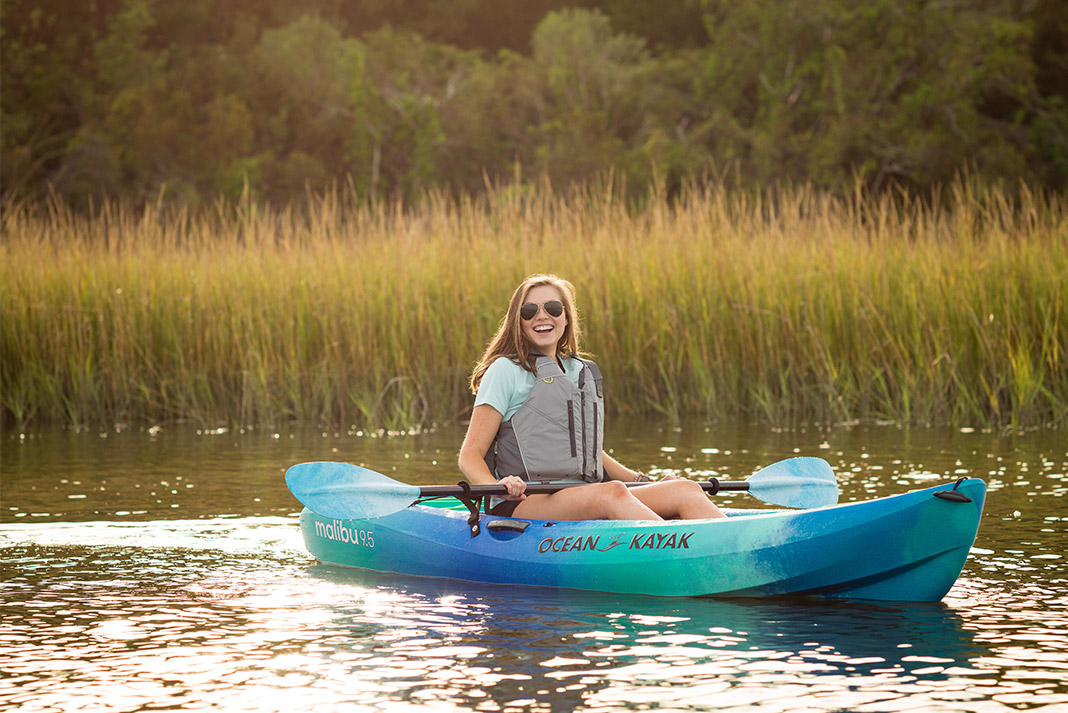
    The Pelican Bandit NXT 100 offers a sit-on-top profile that shares the super-stable 10-foot, twin-arched hull of the Trailblazer 100 NXT. The open deck of the Bandit NXT 100 means it’s even easier to get in and out, and there’s more on-deck space for longer legs or even a furry companion. For those who want the peace of mind of a sit-on-top design, the Bandit NXT 100 features integrated flotation inside the hull and weighs just four pounds more than the Trailblazer.
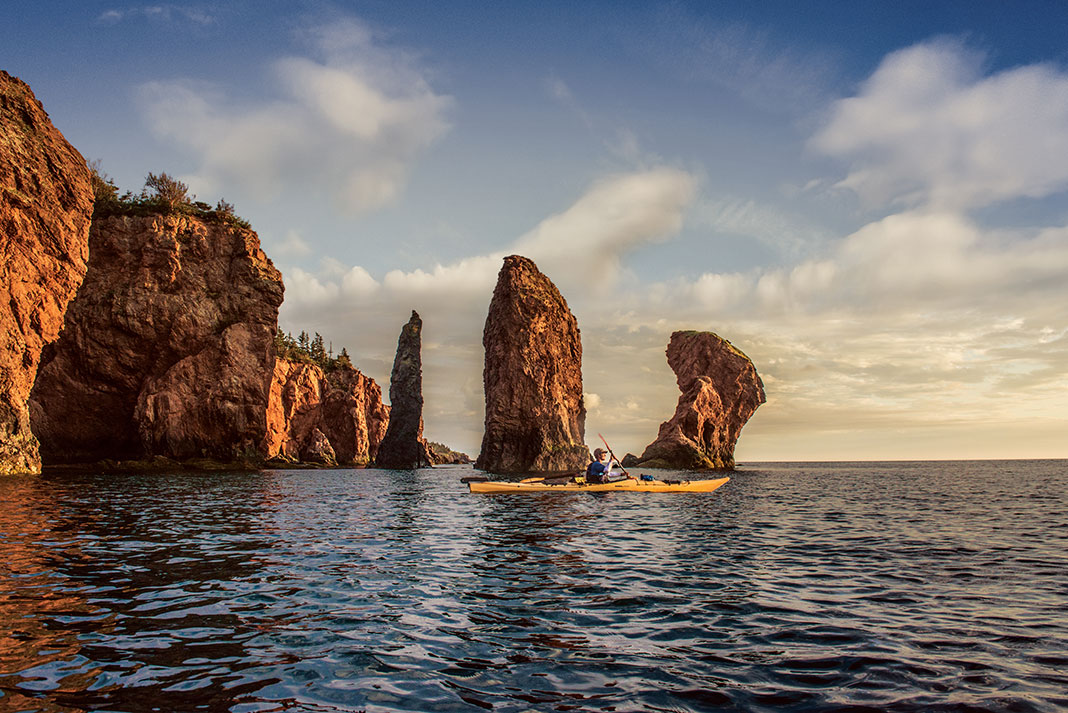
Where to buy the Trailblazer 100 NXT
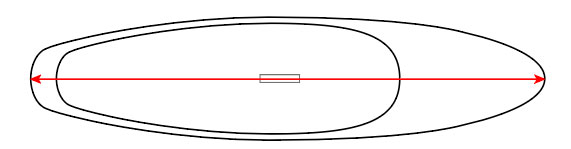
Dick’s Sporting Goods is the primary retailer for the Pelican Trailblazer 100 NXT, so check here first for the best range of in-stock color choices. You can also search for “Pelican Trailblazer NXT Walmart” and “Pelican Trailblazer NXT Amazon” to see if these companies have any kayaks in-store or available to ship.
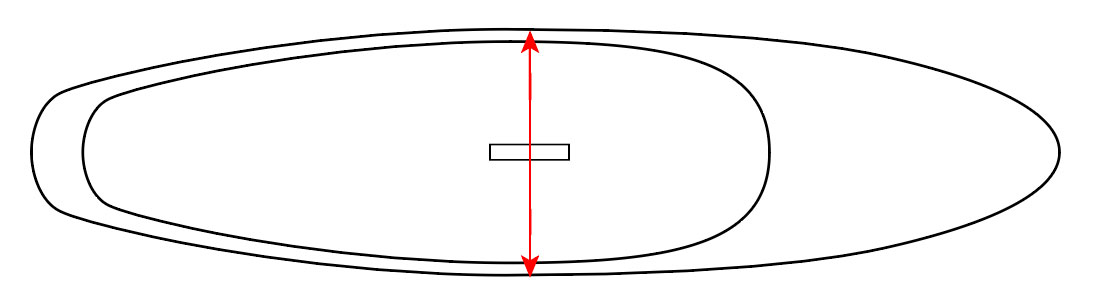
Pelican Trailblazer 100 NXT pros and cons
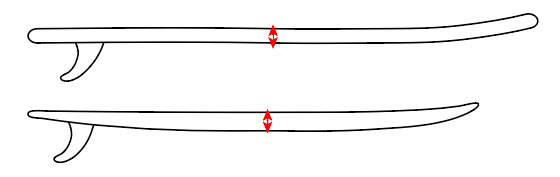
If you’re looking for an entry-level, sit-inside recreational kayak that offers superb value and ease of use on sheltered waterways, the Pelican Trailblazer 100 NXT could be the perfect fit. The main advantages of this kayak for both beginner and casual paddlers are its confidence-inspiring stability and a light carry weight that’s easy to manage off the water. Pelican is also a favorite for DIY fishing kayak mods, since the spacious, rigid deck allows for the simple installation of accessories.
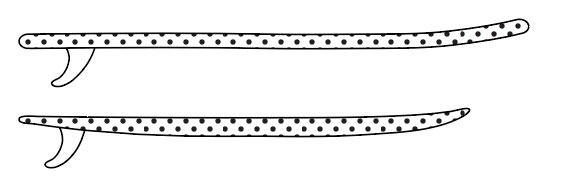
Pros

  • Lightweight
  • Stable
  • Spacious cockpit
  • Decent amount of storage space
  • Durable, long-lasting Pelican RAM-X material
  • Limited lifetime warranty
  • Budget friendly

Cons

  • No dry storage
  • No bulkheads or flotation for safety in open water
  • Fixed foot braces offer a limited range of foot positions
  • Max capacity of 275 pounds may not be ideal for larger paddlers

Related articles

Pelican kayak reviews

Beginner recreational kayak reviews

Sit-inside recreational kayak reviews

SEE ALL KAYAK REVIEWS


What’s The Difference Between A Kayak And A Paddleboard?

kayaker and paddleboarder paddle together in cold weather
Feature photo: Adobe Stock

Paddleboard versus kayak is a foundational debate for paddling enthusiasts, whether they’re beginners looking for the best way to get into paddlesports or experts arguing over their favorite ways to paddle.

Paddleboards originated in Hawaii, seeing sporadic use over decades before their popularity took off in the early 20th century. Kayaks, on the other hand, were invented centuries ago in the Arctic and used as hunting vessels. Whereas most paddleboards closely resemble their Hawaiian ancestors, kayaks have morphed into a huge array of shapes and styles with only a few (seriously hard-core) models remaining true to their Inuit roots.

The main difference between a kayak and standup paddleboard is how you paddle. A kayak employs a double-bladed paddle, with the user sitting down either in an enclosed cockpit (sit-inside kayak) or on the open deck (sit-on-top kayak). With a SUP paddle, the paddler stands and uses a single blade for propulsion. Some common ground in the SUP vs kayak comparison is that many design types are available in each style of watercraft, ranging from racing models to touring, recreation, fishing and surf.

A good way to decide on a paddleboard vs kayak is to consider your level of fitness, aspirations and where you plan to paddle. Once you figure out the basics of paddleboarding, it’s a great full-body workout, requiring balance and core strength. Kayaking is also good exercise, but it’s a bit easier to balance and move efficiently through the water because you’re in a sitting position and have two paddle blades to work with.

Paddleboarding in a headwind is tedious whereas a kayak is more aerodynamic—a good consideration if your typical paddling environment is windy. Furthermore, a sit-in kayak offers far more shelter from precipitation and cold water compared to a standup paddleboard.

This article provides an overview of the differences and similarities in paddleboards vs kayaks, helping you consider the topics of design, performance, gear and use, based on your needs. Once you’ve narrowed down your selection to SUP or kayak we recommend you peruse the Paddling Buyer’s Guide for an overview of the various styles and models available to meet your paddling needs.

Differences and similarities

Design

Assessing paddleboard vs kayak designs exposes some major differences between the two types of craft. First off, most paddleboards feature a planing hull, meaning that the bottom of the board is flat and designed to skim across the water (a design feature harkening back to standup paddleboarding’s surfing roots). This makes for good stability in some wider models and provides a great platform for standing (obviously) and, in some models, sitting or even doing yoga.

Kayaks, on the other hand, nearly always feature displacement hulls which provide better tracking (ability to move straight), greater efficiency for traveling longer distances and more volume inside the boat. Some specialized racing SUPs feature displacement hulls for greater speed.

In general, recreational and fishing SUPs and kayaks are about the same length when it comes to beginner friendly, all-around models. These types of kayaks and SUPs are typically eight to 11 feet in length. Construction varies between kayaks vs standup paddleboards, with most recreational and fishing kayaks made of rotomolded polyethylene while SUPs are generally constructed of expanded polystyrene foam sandwiched between a plastic bottom and a fabric-covered soft-top.

However, more advanced kayaks and SUPs share similar high-tech composite construction using materials like fiberglass and epoxy. Both SUPs and kayaks are available as super-portable inflatables, which are easy to transport and store but lack the paddling performance of hard-shell (non-inflatable) models.

General purpose, beginner-friendly paddleboards and kayaks have similar comfort features, albeit in different iterations. Paddleboards have soft and grippy decks for comfort while standing; kayaks have ergonomic seats with adjustable back supports and (usually) foot pegs. Some hybrid paddleboards (see below) offer features for both kayaking and paddleboarding, providing you with the option of doing both activities with the same watercraft.

Most paddleboards and kayaks come equipped with grab handles for carrying, bungees for securing gear and accessories like cup holders and fishing rod holders in some models.

One important difference between paddleboards vs kayaks is that paddleboards won’t sink when they capsize. More advanced touring kayaks have built-in floatation to avoid this serious problem, but basic (and cheap) recreational kayaks can be dangerous to use in open water conditions if they do not have a means of staying buoyant and afloat in the event of a capsize. This is an important consideration if you plan to paddle on open water.

Outfitting

Most paddleboards and kayaks come ready to paddle. However, kayakers are more likely to wish to custom fit their boat by making adjustments to the outfitting. For starters, most kayak seats offer adjustable back support and (in some cases) adjustable seat heights and angles. For kayaks equipped with footrests it’s important to adjust the length to assure a good fit in the boat for greater paddling efficiency, comfort and ease of entry and exit. With paddleboards, the main outfitting item is a leash, which allows you to retrieve your board should you fall off.

Anglers may wish to make bigger adjustments to outfitting. For example, rod holders and tackle storage devices can be added to both fishing kayaks and SUPs for greater convenience for anglers.

Gear

Many new buyers wonder, can you use a kayak paddle for a paddleboard? That depends on the style of paddleboard you’ve purchased. A single-blade is advised for most paddleboards, with the exception of hybrid models that include seats and foot braces for sit-down paddling with a kayak paddle. A PFD (personal floatation device) is another essential piece of gear.

For kayakers this usually means a paddling-specific life vest; for recreational kayaks you may prefer a “high-back” PFD with more clearance to accommodate the larger seat backrest in most beginner boats. Many paddleboarders prefer inflatable PFDs, which attach discreetly to your torso and can be inflated if necessary.

In general, SUPs are less gear-intensive than kayaks. All you need is a paddle, a PFD and a leash and you’re good to go. Kayaks, on the other hand, require a paddle, PFD, bilge pump (or a bailing device), a tow- or throw-rope, and in some cases, floatation and a sprayskirt (the latter creates a seal between the paddler and the boat and allows for rough water paddling as well as advanced techniques like rolling).

Whether you’re paddling a paddleboard or a kayak, you may wish to add accessories like dry bags for carrying gear and paddling-specific footwear for greater comfort while launching or while on the board or in the boat.

Price

“Why are paddleboards more expensive than kayaks?” is a common question when it comes to paddleboard vs kayak prices. It’s true, big-box retailers often sell kayaks cheaper than SUPs—and, for better or worse, these massive department stores do the lion’s share of paddlesports business. However, it’s important to note that the cheap recreational and fishing kayaks sold at places like Walmart and Costco are absolute entry-level models.

The price relationship is inverted if you shop at paddlesports specialty retailers, where the cost of a high-quality kayak is invariably more than a similar quality SUP. That’s because advanced kayaks have features that require precision construction, including internal bulkheads (critical safety items absent in most barebones beginner kayaks) to offer floatation and intricate seams between the deck (top) and hull (bottom) of the kayak, particularly in composite (fiberglass) boats.

A good paddleboard costs $1,000 to $1,500, depending on the construction (inflatables tend to be cheaper than hand-made composite and epoxy boards), compared to a high-quality touring kayak which retails for $2,000 and up. However, you’ll find plenty of cheaper options if you’re only looking to kayak casually, with decent recreational models retailing between $500 and $1,000 (entry-level SUPs come with similar price tags). However, the market is flooded with cheap kayaks available for $300 or less at big box department and hardware stores. Beware that you get what you pay for, and these cheap kayaks are only suitable for casual use in calm, sheltered water.

Performance

In general, kayaking is faster, the boats are more stable and the skills are easier to learn than paddleboarding. Kayaks also have the added benefit of having more capacity to stow gear, whether it’s for a day trip, an overnight or a multi-day adventure. Paddleboard speed vs kayak is subjective, however, and depends entirely on the board and boat designs in question.

A displacement hull racing SUP is faster than most kayaks (even sleek touring models). However, a general-purpose SUP is slower than a typical day-touring kayak. General-purpose SUPs and recreational kayaks have similar speeds, if you’re wondering can a SUP keep up with a kayak.

Another common question regarding paddleboard vs kayak performance relates to stability: “Is a kayak more stable than a paddleboard?” Invariably, kayaks are more stable than SUPs simply because of the seated position one assumes while kayaking, which contributes to a much lower center of gravity.

It’s easy to see why paddleboarding is popular among fitness enthusiasts: the sport delivers a full-body workout, engaging your lower body (for balance), as well as your upper body and core for propulsion. In terms of calories burned when kayaking vs paddleboarding, you’ll get a far better workout on a SUP.

Kayaking is typically easier to learn than paddleboarding. The double-bladed kayak paddle creates symmetry and allows you to move forward with less effort than a single-bladed SUP paddle. Steering strokes on a SUP are more complicated, unless you have a background in canoeing (the strokes are relatively similar).

Furthermore, SUP has the added challenge of requiring adept balance. You may prefer a SUP if you’re worried about being confined within the cockpit of a sit-inside kayak, however this fear is assuaged for most new paddlers when they take a basic lesson. Sit-on-top kayaks have the easy paddling benefits of a kayak without the confined feeling of sitting inside a cockpit.

Purpose

Performance has a lot to do with water conditions and how a paddleboard vs kayak is used. General-purpose SUPs are slow and cumbersome in a headwind, while kayaks are sleeker and easier to paddle in challenging conditions. However, some advanced paddleboards are a thrill to use in downwind conditions and surf.

Wondering what’s the difference between kayaking and paddleboarding? For most beginners, the main difference is one of posture: do you want to paddle sitting down (kayak) or standing up (SUP)? Are you looking for fitness (SUP) or an easy, relaxing paddling experience (kayak)? Do you wish to surf (SUP) or travel long distances on a camping trip (kayak, though some touring SUPs are capable of multi-day trips)?

Paddleboards are simple with less required gear and accessories, as well as easier to transport and require less storage space. Furthermore, inflatable paddleboards perform far better than inflatable kayaks. Kayaks, on the other hand, are easier to learn, more comfortable in cold air and cold water conditions, and offer better overall performance in the paddling conditions most beginners and intermediates are likely to encounter.

Quick differences

Got a specific question regarding paddleboards vs kayaks? Here are quick answers to some common internet search queries.

  • Fishing paddleboard vs kayak

    Most people prefer a kayak for fishing. A kayak gives you more options to sit and stand with greater stability and comfort, as well as more space to store your tackle and gear. Kayaks are easier to paddle than paddleboards and work better in the wind. However, you can’t beat the extremely shallow draft of a fishing paddleboard for targeting fish in skinny water, and the standing perspective offers advantages in sight-casting in shallows.

  • Inflatable paddleboards vs inflatable kayaks

    SUPs win the battle between inflatable paddleboards vs inflatable kayaks. An inflatable paddleboard is more rigid and performs better than an inflatable kayak. The simpler hull shape of a paddleboard, coupled with technology like dropstitching which allows for higher inflation pressure, allows it to cut more efficiently through the water. Inflatable paddleboards also pack up smaller and assemble faster than most inflatable kayaks.

  • Sit-on-top kayak vs paddleboard

    The difference between sit-on-top kayaks vs paddleboards is largely one of paddling style. Do you want to use a single blade or a double blade? Are you looking for a better workout (SUP) or comfortable, stable experience on the water (kayak)? Both sit-on-top kayaks and paddleboards leave the user exposed to the elements; this is a nice perk in hot weather, but less comfortable in colder climes. The typical recreational sit-on-top kayak and all-around paddleboard move at roughly the same speed on the water.

Kayak-paddleboard hybrids

Still can’t decide between a paddleboard or a kayak? A paddleboard kayak hybrid could be just the ticket for you. A kayak-paddleboard hybrid is essentially a paddleboard with a kayak seat and foot support to allow for sit-down paddling with a kayak paddle. These features are removable or adjustable to allow for standup paddling with a single-blade SUP paddle as well.

As with most hybrids, a paddleboard kayak combo strikes a compromise between both styles of watercraft, and should only be considered if you’re certain you wish to dabble in both standup and sit-down paddling. If you’re simply looking for a way to take a break while standup paddling, be aware that you can sit on a SUP board for a rest or increased stability when desired.

Where to rent

Pretty much every waterfront city in North America has a place to rent kayaks and SUPs. Often, you’ll find SUP rentals centered in communities on the coasts, resort destinations and along the Great Lakes.  Kayaks are more common in inland places, as well as the Great Lakes and coastal areas with access to sheltered water. Renting is a great way to settle the paddleboard vs kayak debate with practical on-the-water experience to find out what’s truly best for you.

Where to buy

Both kayaks and SUPs are available in a wide variety of retail outlets, each with its advantages and disadvantages. Here’s a list of options if you’re thinking of buying.

  • Box department stores (like Walmart) and large online retailers (such as Amazon) offer excellent selections of cheap, entry-level SUPs and kayaks. Box stores and Amazon are great if you’re looking for a cheap paddleboard or kayak for casual use. However, you’ll miss out on the higher-quality models sold at specialty retailers as well as their expert advice. Another big drawback of buying a paddleboard or kayak online or at a box store is that you won’t be able to try out the product before committing to a purchase.
  • General outdoors and sporting goods stores (like Dick’s, Atmosphere, MEC and Bass Pro Shop) offer a step up in quality from box stores and Amazon. Again, don’t expect to receive expert paddling advice from sales associates, but you get a better selection of higher-quality paddleboards and kayaks at somewhat higher prices. These stores are a good option for general outdoors and fitness enthusiasts who want a more refined paddling experience for semi-serious use.
  • Paddlesports specialty stores are your best choice if you wish to invest in a high-quality paddleboard or kayak. Retailers like Rutabaga and The Complete Paddler (there are many others across North America) offer great selections of performance boards and boats, including models for racing, touring and expeditions. You’ll benefit from the expertise of paddlesports professionals and usually have the option of test paddling multiple boards and boats before you make a purchase. What’s more, many paddlesports specialty stores offer rentals, season’s end sales and demo models for those shopping for a serious SUP or kayak on a budget.

The verdict

The question of paddleboard vs kayak ultimately comes down to your paddling preferences. Do you wish to stand tall and paddle with a single blade, or sit down and use a double-bladed paddle? Are you looking to paddle in hot conditions or would you rather tackle cold water destinations or paddle year-round? SUPs offer distinct advantages for fitness enthusiasts looking for a full-body workout and those wishing to experience surfing and downwind paddling in ocean environments.

In general, SUPs are best for those looking for single-day adventures (though larger, expedition SUPs are also available), while kayaks are more versatile if you wish to day-trip and go camping. Kayaks offer a wide range of applications, from casual paddling in comfortable recreational boats to long-distance touring in exposed environments.

As with any big outdoor equipment purchase, our best advice is to try as many paddleboard and kayak options before you commit to a purchase to make the best choice for you. Check out the Paddling Buyer’s Guide for a comprehensive overview of all the options available on the market, including specs, performance guidelines, where to buy and user reviews.