The latest trend in sea kayak design has nothing to do with performance. Instead, it takes its roots from platinum rims, subwoofers, lowrider suspension and MTV, and follows a trend set by surfers, mountain bikers and skiers. It won’t come cheap, but now you too can pimp your ride with the latest in kayak customization.
[ Paddling Buyer’s Guide: See all sea kayaks ]
Breaking new ground in kayak customization
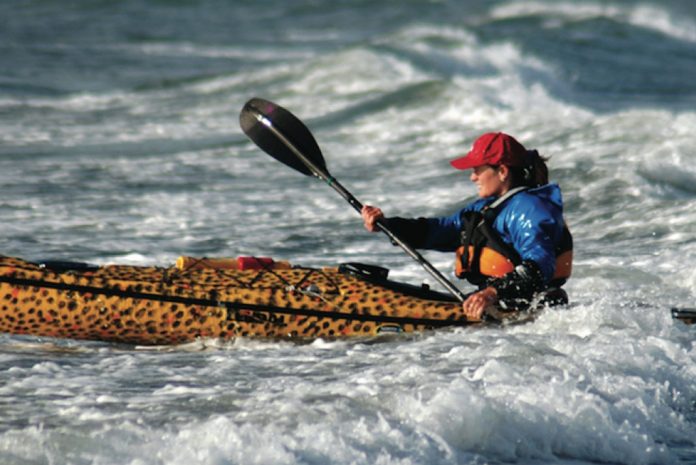
British filmmaker and paddler Justine Curgenven was among the first to paddle a sea kayak with custom artwork, and it was a hit. Curgenven’s leopard-print kayak has become nearly as well known as herseries of sea kayaking films, This is the Sea.
“I thought about different colour schemes, but couldn’t think of a combination that no one else had,” says Curgenven. “The leopard-skin idea just popped into my head and wouldn’t go away.”
A leopard never changes its spots
Curgenven gave her design ideas to Scott Divine, the production manager at Nigel Dennis Kayaks (now Sea Kayaking UK), who eventually mixed the gel coat for the leopard-skin kayak.
Nigel Dennis was a tougher sell on the kayak customization trend. “At first he threatened to draw an arsehole along with the leopard spots,” says Curgenven.
[ Paddling Buyer’s Guide: See all Nigel Dennis kayaks ]
But the tide has changed. This year Dennis has teamed up with artist Richard Perkins and has made all Sea Kayaking UK boats available with custom paint. Dennis says the option can increase the boat’s price tag by as much as 50 per cent.
“At first he threatened to draw an arsehole along with the leopard spots.”
Other manufacturers get in on the fun
Sea Kayaking USA isn’t the only British manufacturer offering custom graphics. Both P&H and Rockpool Kayaks list deck art options. But Nigel Dennis is the only manufacturer with an in-house artist. The kayak customization trend hasn’t taken off on this side of the pond, although Canada-based Seaward Kayaks boasts over 600,000 colour combinations, as well as splatter and fade finishes and optional airbrush graphics.
Curgenven says the only drawback of custom artwork is a few extra pounds due to extra gelcoat. She thinks the trend is here to stay. Watch for a new tiger stripe Romany in her upcoming films.
It took five years, but last fall the International Whitewater Hall of Fame made good on its claims of being truly international by inducting six influential whitewater paddlers and advocates from around the globe. Among them was Canada’s first inductee, Song of the Paddle author Bill Mason.
Mason is most easily imagined clad in his trademark plaid shirt and denim cut-offs, crouching beside a campfire above a rapid—the kind of rapid canoeists who came before Mason would be fearful of, and the same kind that canoeists began to search out for fun shortly after Mason produced his two classic books and many films.
But was this just an accident of timing? Is the man really Hall of Fame material?
Singing the song of the paddle
Mason himself was humble about his whitewater skills. It’s hard to imagine any of today’s pro paddlers asking searching questions on their blogs, as Mason did in his guide to canoe tripping, Song of the Paddle: “When you swim as much as I do, you have to ask, ‘Why?’”
The reason had nothing to do with being overly aggressive. In a section titled Descending a River with a Current, Mason sums up a lesson on “Rounding a Bend with a Back Ferry” with this reminder: “Take note that I haven’t said anything about paddling downstream; we’ve been drifting. Only a few strokes forward or back are necessary to correct our position in the current and maintain complete control.”
“When you swim as much as I do,
you have to ask, ‘Why?’”
Get the throw rope ready
That’s not to say that Mason thought whitewater had to be a joyless experience. “Extreme back ferries and reverse entries into eddies can be a lot of fun,” he affirms later.
He also devotes a whole section in Song of the Paddle to the “aggressive, faster-than-the-current technique” employed by “hot doggers” and explains manoeuvres like powering through haystacks, crashing through rollers, doing enders and something he calls “trashing in the surf.”
[ Paddling Buyer’s Guide: See all whitewater canoes ]
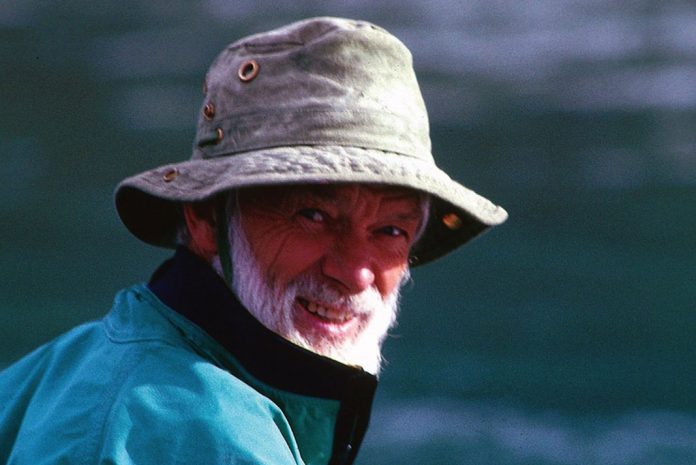
There are paddlers now pushing middle age who took to the water after Mason published Song and his seminal first book, Path of the Paddle. They are of a generation that has become used to seeing videos in which talented filmmakers make daring paddlers look superhuman. By comparison, the cover photo of Mason with his white beard, collared lifejacket, floppy wide brimmed hat and cedar canoe might seem a little—what’s the word—lame.
Finding the line between Mason’s cautious approach and Bradt’s freefall would take a lot of scouting, a lot of time looking at whitewater. It’s not an obvious line—but rather one that might involve a few slow-motion back ferries and maybe some unnecessary eddying out.
Bradt spent almost no time “trashing in the surf” at the bottom of his drop. That may be because he thinks that trick is lame. He might be right. But the difference between Bradt and Mason’s paddling styles is that Mason learned about rapids from reading books about the voyageurs. Paddlers of Bradt’s generation grew up reading books by Bill Mason.
Mason wasn’t flashy, but he was good at getting to where he wanted to be—where he belonged. That goes for tight eddies halfway down Rollaway Rapid, and Song of the Paddle‘s spot on library shelves. It equally goes for his rightful place in the Whitewater Hall of Fame.
This article was first published in the Spring 2010 issue of Rapid Magazine. Subscribe to Paddling Magazine’s print and digital editions, or browse the archives.
Turquoise water, tropical canyons, an international trip lined with world-renowned rivers—it’s what whitewater dreams are made of, especially in the cold depths of winter. If you’re like most raft guides, however, a vacation on the other side of the world probably isn’t in the budget. So, try getting paid for it instead with these river guide jobs in warmer locales.
For most raft guides, the end of summer means hanging up the guide stick, heading back to school, sliding into a desk job or hitting the ski resorts to coax runny-nosed toddlers down the bunny hill. It doesn’t have to be that way. Operations on some rivers continue throughout the winter months, and while building a year-round career out of river guide jobs can be intimidating, you too can make it more than just a summer fling.
Top 5 countries for winter river guide jobs
1) New Zealand
As soon as you reach this Southern Hemisphere gem, you won’t be far from the pristine whitewater that lines both the North and South islands of New Zealand. From remote wilderness multi-day trips that begin with a helicopter ride to the put-in to half-day trips just outside of town, the small country has more whitewater than many countries larger in size. For international guides seeking work, locating a job close to a tourism hub such as Queenstown is the best bet for consistent work. While guiding in New Zealand is worthy of the fantasies of whitewater guides around the world, it’s not an easy country to get work. It is recommended that guides secure a job and visa in advance, and upon arrival at a company they will be required to test for a NZ specific guide certificate.
Commercially rafted rivers (level of whitewater): Kaituna (Class V), Shotover (II-V) Dart (II), Kawarau (III-IV), Karamea (IV-V), Tongariro River (Taupo), Clarence (II-III), Mohaka (II-V), Rangitata (V) Rangitaiki (III-IV), Buller River (II-IV), Ngarururo (II-IV), Whanganui (III-IV) and others
Visa requirements: Work visa (obtained with the help of employer) or working holiday visa needed
Cost of living: Approximately $200 per week. Guide housing/camping available in some cases.
Language needed: English, other languages a plus
2) Chile
The high-volume, warm turquoise waters of Chile draw in whitewater chasers from around the world both for the unique scenery and top-level rapids. Found in the depths of steep boulder-clustered canyons surrounded by snow-covered peaks, the Futaleufu is known as the Grand Canyon of South America but is steeper and more challenging than the infamous whitewater section of the same name in the U.S. Seeking work as a whitewater raft guide in Chile should be reserved for guides with extensive guiding experience on both technical and high-volume rivers.
Rivers: Futaleufu (III-V), Espolon (III), Maipo (III-V) and others
Visa requirements: Work visa required. Recommended to obtain in advance with sponsorship of employer.
Guiding requirements: High level of expertise, certified to guide class IV-V whitewater
Potential pay: Approximately $50 to $80 per day
Cost of living: Approximately $150 per week. Guide housing/camping available in some cases.
Language needed: English, basic Spanish
3) Costa Rica
For the tropical whitewater experience, Costa Rica is your spot. Not only does Costa Rica have the whitewater—from steep, technical canyons to float trips through the rainforest—it has the tourists needed to create business. While rivers can be found throughout the country, the Rio Pacuare is known by many as the best for commercial guiding and companies operating on the river offer everything from one day trips to a variety of multi-day adventures. Be advised that while potential pay for a river guide job in Costa Rica is relatively low, living expenses are comparable to the U.S. and much higher than in other countries in Central America, especially in touristy areas.
Rivers: Rio Pacuare (IV), Sarapiqui (III-IV), Naranjo (II-IV), Tenorio (III-IV), Savegre (III-IV), Corobici (II), Balsa (II-III) and others.
Visa: Work visas needed in some cases, some guides work on tourism visas
Cost of living: Approximately $100 per week. Guide housing/camping available in some cases.
Language needed: English, Spanish beneficial
4) South Africa
The rivers of South Africa are as diverse as the country itself. With deserts, mountains, two oceans and 12 national languages across the country, a day on the job could take you into the depths of a desert canyon or send you cascading through lush green mountains. SA has relatively few regulations for international guides, making it easier to get river guide jobs here than in some other countries. Due to the current state of the economy, both pay and living expenses tend to be quite low, so while you can support yourself while in the country, don’t expect to take money home.
Guiding requirements: Experience on class IV whitewater
Pay: Approximately $25-$50 per day
Cost of living: Approximately $70 per week. Guide housing/camping available in some cases.
Languages needed: English needed, other languages beneficial
5) Texas, U.S.A.
For raft guides who want to continue to guide throughout the winter but aren’t interested in traveling all the way to the Southern Hemisphere, river guide jobs can also be found on the border between the U.S. and Mexico on the Rio Grande. While the section of the Rio Grande that is operating during the winter months is not known for its whitewater, scenic floats and multi-day trips offer expedition experiences through the stunning desert canyons. In addition, pay is higher than most other winter raft guiding options.
Rivers: Rio Grande (I-II)
Visa: Permission to work in the U.S.
Guiding requirements: CPR and Wilderness Advance First Aid or above
Pay: Approximately $100 to $130 per day
Cost of living: Approximately $150 per week. Guide housing/camping available in some cases.
Languages needed: English, Spanish beneficial
Things to remember
Please note: If you choose to seek work in any of these countries keep in mind that most countries are required to seek residents to work as river guides before hiring an international candidate. It is recommended that you approach your first international guiding experience as a chance to travel, and not depend on making a profit.
[ Plan your next whitewater adventure with the Paddling Trip Guide ]
All costs and pay ranges are averages and estimates provided by individual companies in each country. All dollar amounts are listed in USD.
My favorite weekend getaway is a gorgeous island, just a 90-minute drive and a short paddle from my front door. There are sweet grassy fields, basalt cliffs, sand dunes, wildflowers, and pictographs. I play in the rock islands for hours and hike to the top of the cliffs for a stunning view of a sunset or sunrise. Over the years I have happily availed myself of the free camping sites scattered around the island.
I can’t camp there anymore. Four years ago the U.S. Forest Service closed the island to camping. When I asked them why, their answer made sense to me: the grassy island is vulnerable to fire, home to Native American pictographic sites, and a difficult place for the Forest Service to patrol and clean up.
For the past several years, there’s been an ebb tide where paddlers are allowed to camp without reservations, permits or prescribed tent spots. But that tide may be turning.
At a recent gathering at a Denver REI store, Tinelle Bustam, the U.S. Forest Service’s Assistant Director of Recreation, said, “We have a strange tendency of gearing toward no than gearing toward yes. We want to pivot from no and toward yes.” The crowd of climbers, paddling guides, outdoors groups, anglers, and mountain bikers cheered.
I’m a longtime wilderness traveller. Probably like you, I love free-range camping. Get tired, find a protected cove or a beach with a good view and pull over. It’s the perfect expression of love for wilderness, discovery, freedom and self-contained nomadic movement through nature. It’s our gift from humanity’s earliest ancestors.
Having to paddle to a designated campsite to comply with permits or rules is as much fun as headwinds on mile 17.
Feature photo: Quentin Groome/Pexels
It’s not that easy to provide free camping
Let’s face it: unregulated camping only works when we have three things:
Lots of land and small numbers of people that can spread out across it.
Users who are good stewards and manage their impact.
Enough resources so that whoever’s in charge knows if the place is being damaged so they can step in and restore it.
Right now, we don’t have enough of the first and third requirements to meet demand.
As of 2010, 81 percent of the North American population live in urban areas. People pour out of cities on weekends and overwhelm the wild places closest to them. Put-ins and trailheads in proximity to urban centers are mobbed, while others just slightly further go unused. We’ve become creatures of habit, using the same places over and over again and largely ignoring the rest.
On a recent weekend, I crawled past a trailhead traffic jam that reminded me of the approach to Manhattan’s Holland Tunnel. Two miles further down the highway, a similar trailhead parking lot was totally empty. Logs had fallen across the trail. The Forest Service hadn’t cleared them: the rangers probably figured it wasn’t used enough to justify sending someone out to saw trees apart for two or three days. The solitude was great, but it also made me sad.
As adventurers, we love poring over maps and charts to find cool new places to paddle or hike. Google Earth makes this kind of exploration more accessible than ever, but most people seem content just following the herd. It may seem like a good idea to open more wilderness areas to free-range camping. But I’m not convinced.
Permits work to protect wildlife
When people can’t—or won’t—spread over a wide area, the concentration strategy makes sense. Permits and limited access to a few areas create a few small areas of intense impact—and let nature reign everywhere else.
Think of the few accessible campsites on Barkley Sound’s Broken Group Islands or the way campsites on Idaho’s Middle Fork of the Salmon are pre-negotiated between groups. Annoying if you’re a human, but Barkley Sound is great if you’re a wolf or a bear.
[ Plan your next adventure with the Paddling Trip Guide ]
Cashed-strapped agencies, charged with keeping vast acreages of wild places wild, have often used this strategy. The other choice is to try to patrol vast areas and fail.
Nature untrammeled
Even intensely popular places like the Grand Canyon or Glacier Bay, for the lucky permit-getters, feel just like the U.S. Wilderness Act states, “Where the earth and its community of life are untrammeled by man, where man himself is a visitor who does not remain.”
Given the job of managing priceless places that are easy to destroy and hard or impossible to restore, saying “no” follows the most basic rule of dealing with nature: do no harm. We just don’t like it when we’re the one who was too slow to snag a campsite.
Free camping requires time and money
Opening up more places to free camping will only work if we give agencies enough people and money to monitor their—I mean our—vast holdings and keep tabs on sites that are getting damaged. And we haven’t done that. In an era of budget cuts, the likely outcome of saying yes more often is likely to be lose-lose. Most of us will still have to deal with crowds at popular spots. And when we venture into the unregulated wilderness, we’re likely to find impacted camping areas, trash, and poorly buried wads of toilet paper.
Between infrequent patrols and cleanups, the Tragedy of the Commons will creep in, unnoticed, like a rising tide. When there are enough rangers and ecologists to keep things shipshape, more unfettered access sounds great. Until then, better safe than sorry when it comes to free camping for paddlers.
This article was first published in Issue 51 of Paddling Magazine. Subscribe to Paddling Magazine’s print and digital editions, or browse the archives.
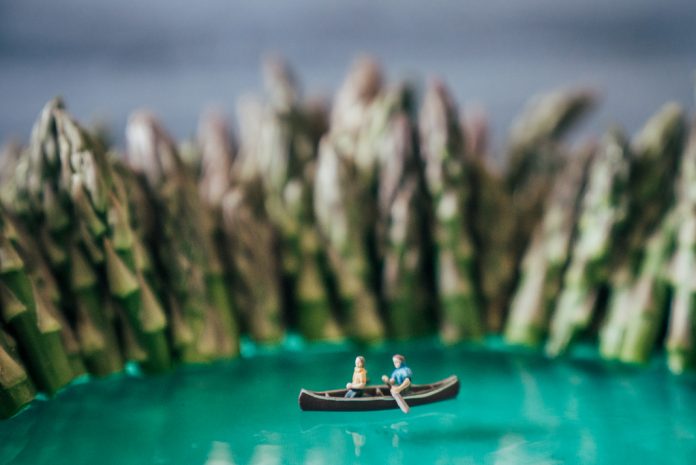
“And on your RIGHT, you’ll see the rare shoots of the asparagus forest.” | Photo: Erin Sullivan
Well before California’s stay-at-home order came into effect on March 19, 2020, Los Angeles photographer Erin Sullivan had a plan in place. She had been following the spread of COVID-19 in Italy and wasn’t under any illusions; it was only a matter of time until life as she knew it ground to a halt.
“I asked myself, ‘If and when we go into a quarantine situation, how can I stay creative and connected to the outdoors?’” she recalls.
Sullivan, who is best known for her travel photography (@ErinOutdoors), knew her world was about to get smaller—literally.
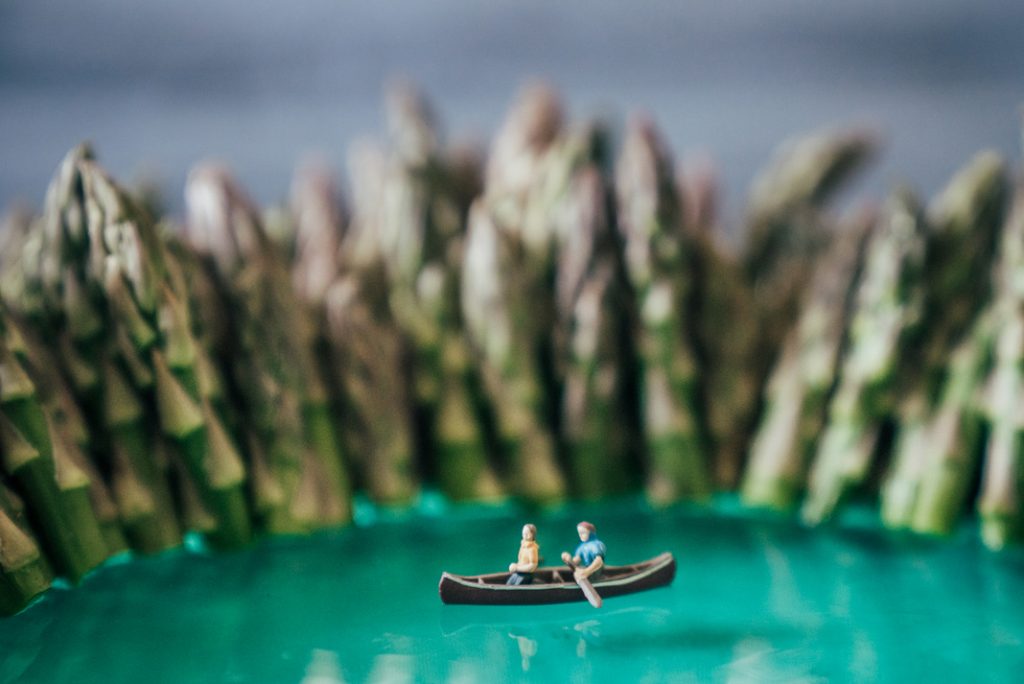
Launched during the first days of the COVID-19 quarantine, #OurGreatIndoors is a macro photography series, where Sullivan uses train figurines and household objects to replicate the natural world. Accompanying behind-the-scenes images reveal the magic is actually in the mundane: A crumpled paper bag forms the walls of a slot canyon. Hikers wander through snowy forests of rosemary trees. A couple embraces in front of a paper cut-out sunset. And, in the most polarizing image, bathers recline in onion hot springs; just like the real thing, the smell takes some getting used to.
“And on your RIGHT, you’ll see the rare shoots of the asparagus forest.” | Photo: Erin Sullivan
Sullivan’s goal is to create believable outdoor scenes—the type that would make you do a double-take when you scroll past them (as I did when mid-lockdown I saw her image of two tourists inside a glow worm cave; it turned out to be tinfoil, rain jackets and a hunk of rose quartz).
“It’s not that I’m trying to imitate a real place. It’s more of a feeling that I’m trying to emulate,” she explains.
In the case of the canoeists on the gelatin lake, she wanted to capture the feeling of paddling on a mountain lake in the summertime, complete with an aerial “drone” shot. But unlike natural environments, Sullivan’s at-home set-ups are entirely within her control, meaning there are more details to consider. Each idea is sketched out first before props are sourced and painstakingly arranged. Then, she spends about an hour shooting each scene. And yes, she eats the edible accessories when done.
“Being intentional is something I’m always thinking about when I’m shooting, but this project has made me even more deliberate and interested in details, like the shadows and textures of a scene,” she says.
Within six weeks of its launch, the series had nearly doubled her Instagram following and landed her sponsored posts with Honda and protein bar brand Gomacro at a time when her other work was on hold.
But even for someone who was managing to make lemonade, the rollercoaster of COVID-19 was taking its toll. When I speak with Sullivan in early May, she admits she’s having a “blah” day, the weight of lockdown fatigue heavy in her voice.
“A lot of us are going through job uncertainty or can’t travel, or can’t get outside and do the things we love that make us feel alive,” she says. “I think that’s why this series resonated with people—it gives some joy, lightness, and a moment of being transported.”
It’s also why she encouraged her followers to take up the project’s mantle, writing on her page: “We cannot hold onto our ideas so tightly that we suffocate them…like love, celebration and laughter, creativity can shine when it is shared.”
At the time of writing, more than 1,500 images had been uploaded to Instagram with the #OurGreatIndoors hashtag; a feed of LEGO figurines and plastic animals climbing grapefruit mountains and chopping down pretzel stick trees. Sullivan’s latest project may be miniature in its scale, but its reach is anything but.
“This series has made a home for itself in my body of work,” she says. “I feel thankful; I would never have created this had I not been forced to stay inside.”
This article was first published in Paddling Magazine Issue 62. Subscribe to Paddling Magazine’s print and digital editions here , or browse the archives here.
“And on your RIGHT, you’ll see the rare shoots of the asparagus forest.” | Photo: Erin Sullivan
After decades of work, American Whitewater has succeeded in opening limited access for paddlers in Yosemite National Park. Yosemite hosts a number of rivers, ranging from class I floats to multi-day class V+ epics, including the Merced River. Despite millions of visitors a year, paddling the Merced had been off-limits—until now.
[ Plan your next whitewater adventure with the Paddling Trip Guide ]
Setting out for the Merced River
On June 1st, I set out on an expedition with South African professional paddler Steve Fisher to document the first descent of this long-forbidden route. Fisher hopes that this legal first descent will encourage authorities to open up other rivers in the national parks where paddling is not permitted. His kayaking partner was Pat Keller, a southeastern expedition paddler and waterfall guru. My role was to photograph the expedition.
Over hill, over dale
We approached the Merced River from Tuolomne Pass, hiking our gear 17 miles through alpine meadows, past icy cold lakes, and into the headwaters of the river. At the end of the first day, after hiking with a 90-pound loaded kayak over a 10,000-foot pass, Keller was still keen to explore.
[ Paddling Buyer’s Guide: See all kayaks ]
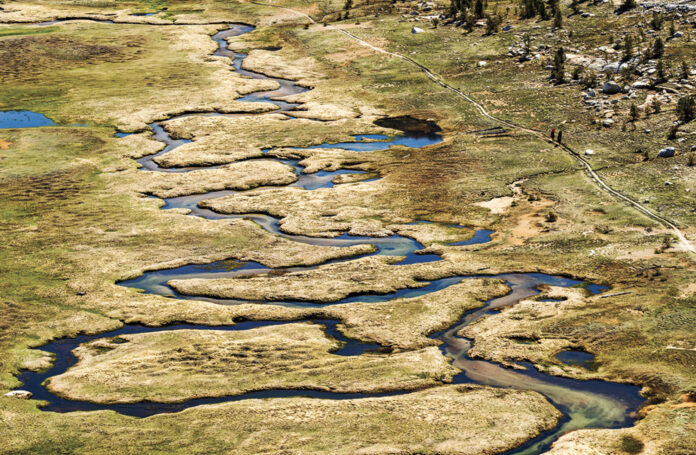
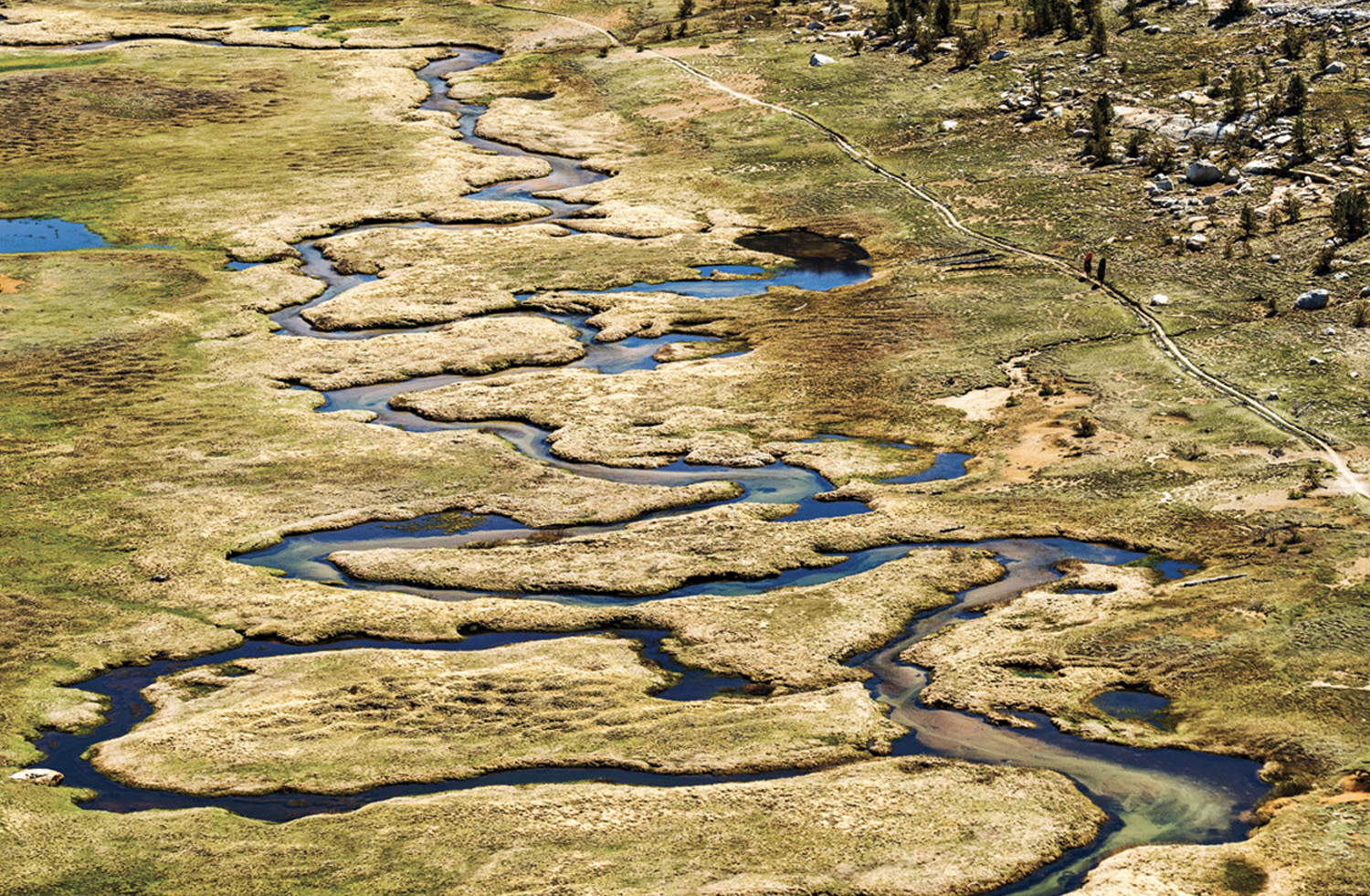
We scrambled up to a rocky point overlooking the Merced Valley, staring in awe at the massive snow-covered peaks surrounding us. In the distance, I could just make out the trail the crew would be hiking the following day to access the river. I knew I needed a shot of that from this vantage point. The next day I was up early and waiting in the same spot to snap this photo of Fisher and Keller with my Nikon D610 and 70-200mm F2.8 lens.
FORBIDDEN FRUIT | PHOTO BY SCOTT MARTIN
Fisher’s first descent begins
The following morning, Fisher and Keller began their descent, beginning 15 miles of whitewater from the Lyell Fork to just above Nevada Falls. The Merced River would reveal itself to be a gem, with crystal clear water, massive slides, a handful of stout boulder gardens and astonishing scenery. “It’s one of the most amazing trips I’ve ever had the pleasure to go on,” Keller later said.
Fisher and Keller completed the epic first descent over five days. Because of the efforts of American Whitewater, kayaking sections of the Merced River is now legal in Yosemite National Park.
Check out Episodes 1 to 6 of “Beyond Adventure: The Lost Valley of the Merced” on Outside Television’s Youtube channel.
This article originally appeared in the 2016 Paddling Buyer’s Guide issue.
Subscribe to Paddling Magazine and get 25 years of digital magazine archives including our legacy titles: Rapid, Adventure Kayak and Canoeroots.
The Bliss-Stick RAD (Radically Aerial Device) is a revolutionary freestyle weapon offering performance and comfort. Designed for huge air, the RAD is also a fantastic conventional cartwheeler and an extremely capable river runner.
[ Paddling Buyer’s Guide: See all freestyle kayaks ]
First run with the Bliss-Stick RAD
Get in the lotus position
The Bliss-Stick RAD 185 is without question the fattest boats we’ve ever tested (fat like Albert, not phat like the spoiler on your Honda Civic). The knee box area is super deep and wide, providing massive amounts of lotus position space.
The seat raises your knees into an aggressively strong position in the thigh braces. Advanced paddlers suggest lifting the seat to help overcome the depth of the cockpit. The RAD is virtually unflippable paddling downriver.
[ Plan your next adventure with the Paddling Trip Guide ]
Pro perspective
“Dude, this thing rocks a wave.” In addition to startling speed, the Bliss-Stick RAD has about 1,020 square inches of planing surface, 20 percent more than the next largest, the Pyranha S6F and the Liquidlogic Big Wheel.
Speaking of aerial moves, we should mention that at the recent Pre-Worlds in Australia, the RAD paddlers were exploding from the hole with the biggest loops. Packed with loop volume in the bow opposite a slicier stern (relatively speaking), the RAD is super unbalanced, knocking some ends.
If you seek to get more than variety points for cartwheels, getting forward seemed to help, as would a little down-home bow crushing. Half the battle to winning competitions is staying in the hole—with the RAD’s volume you’ll be happily tumbling upstream.
Pros: Loops you silly. Spacious cockpit. Mammoth planing surface.
Cons: Rapping knuckles and elbows on the cockpit. Unbalanced cartwheels.
This article was first published in the Summer 2004 issue of Rapid Magazine. Subscribe to Paddling Magazine’s print and digital editions, or browse the archives.
Standup paddleboards may not be the obvious backcountry craft for paddlers who typically use them for lake paddling, sup yoga or surfing ocean swell. Taking your paddleboard on a SUP camping trip can be a great way to travel lakes and scenic stretches of river you might never consider running in a raft or kayak.
Planning your SUP camping trip
Somewhere between bringing the kitchen sink on a traditional raft trip, and sawing off the handle of your toothbrush for a minimalist kayak expedition, lies the art of self-SUPport. Here’s how to plan and pack for your first backcountry board trip.
Location, location, location
A 20- to 30-mile stretch of easy flowing river with class I to II swifts, is ideal for an overnight or weekend trip. A SUP travels faster than a raft, but slower than a kayak, so plan your mileage accordingly.
Assess your speed by loading up your board with overnight equipment and taking it for a test spin at a lake or local river before committing to a multi-day SUP camping trip.
The perfect paddleboard
Choose a large board so you have room to store your gear. Paddleboards built for fishing are great overnight options since they tend to be spacious and stable in moving water.
A board with multiple tie-down points is critical for strapping all your gear down tight. I use extra cam straps to fit around bulky dry bags, instead of just relying on the short straps that came with my board.
The essentials, and then some
If you have basic backpacking gear, you’re almost ready to go. Depending on the season, you should take a light sleeping bag, a small sleeping pad, and a lightweight three-season tent. I stow all of this on the bow of the SUP along with my clothes and hiking shoes in a secured dry bag.
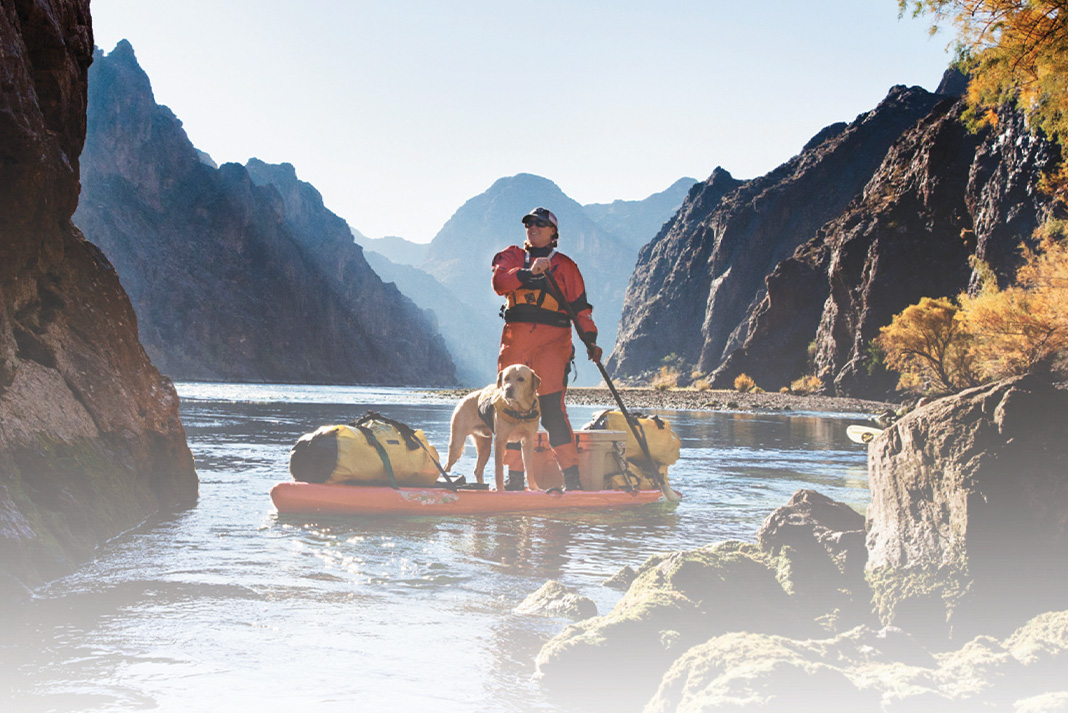
I strap a smaller dry bag to the stern with a small backpacking stove, a pot and other cooking accessories, along with the majority of my food. A lightweight grill and collapsible fire pan gets tied underneath this stern bag. My favorite luxury item for a SUP camping trip is a small, portable cooler filled with steaks, beer and more. Find one that fits your board and has the capacity to carry enough provisions for your trip. A strapped-down cooler also doubles as a seat when you need a break from standing.
Comfy shoes are essential for long periods of standing, and PFDs with generous pockets will allow you to keep snacks and a GPS handy. I always wear a helmet in rapids but bring a big straw sun hat for the flat stretches in between.
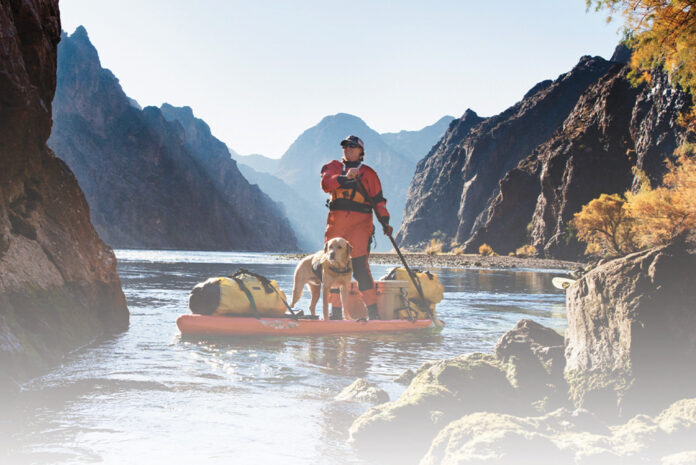
NEW HORIZONS. | PHOTO: PETER HOLCOMBE
Strike a balance
Before launching, take time to strap everything down and balance out the board. Strive for equal weigh distribution from front to back and side to side. As days go by, you’ll need to adjust where you pack things as the weight of food bags decreases.
Once I ironed out a packing system, it only took me 10 minutes to load and unload each time.
Writer and photographer Peter Holcombe is a contributor to Rapid magazine.
MUSTANG SURVIVAL CHOOSES DOWN RIVER EQUIPMENT AS OFFICIAL DISTRIBUTOR OF MTI PROFESSIONAL RAFTING PFDS
Mustang Survival, the North American water-life brand that provides trust and confidence for the most demanding marine environments, is pleased to announce that it has signed Down River Equipment (DRE) as the official distributor of MTI Rafting to Commercial Outfitters in the United States.
Down River Equipment, based in Wheat Ridge, CO, have been manufacturing and supplying river equipment since 1985. They specialize in the custom fabrication, distribution, and retail of equipment for all types of river adventures. MTI raft vests and commercial jackets will now join the group of brands under the DRE distribution umbrella.
“I’m really excited to be able to offer MTI rafting vests to the outfitters we work with. I think that the future looks very good for MTI now that they are part of the Wing and Mustang Survival family.” – Phil Walczynski, President/GM/Co-Owner
“With universal, sized and youth option, along with great colors, fit and durability, we are looking forward to introducing the MTI commercial jackets to our outfitters. “ – Zack Svoboda, Co-Owner
Considered the best in the industry, Down River Equipment is known for their quality crafted frames that are all made in Colorado. They also manufacture dry boxes, tables, pumps and a other cargo gear at their CO facility. In addition, they are the distributor of choice for Hyside, AIRE, Rocky Mountain Rafts, Sawyer, Carlisle, Advanced Composite, and Engel.
MTI is proud to join the team.
About Mustang Survival
Founded in 1967 in Vancouver’s Gastown by Irv Davies, the inventor of the world’s first Floater™ Coat, Mustang Survival has over 50 years’ experience providing confidence to work, play and protect on the water.
Purposefully designed and obsessively engineered by a team of highly skilled and innovative problem solvers, Mustang Survival PFDs, dry suits, flotation coats and water-life apparel support real-world superheroes live life beyond land.
From professional mariners, Special Operations Forces, Air forces, Navy Seals and NASA astronauts to recreational offshore and inland marine adventurers, Mustang Survival gear is the trusted sidekick to chase the feeling of freedom that comes from being on the water.
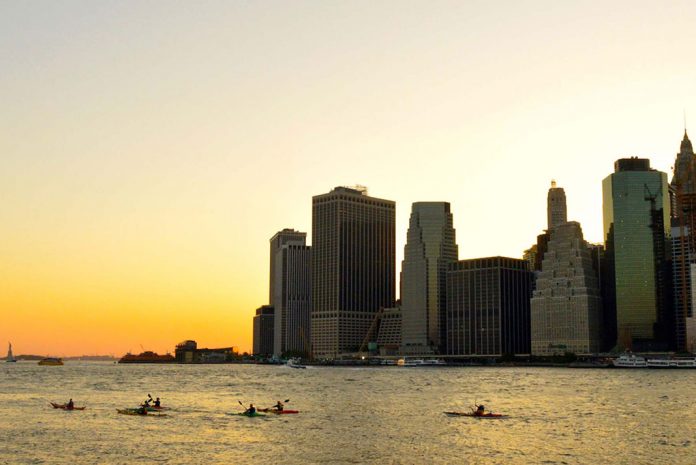
Kayakers at sunset in New York Harbor. | Feature Photo: Vor/Shutterstock
New York City is an extraordinary place to paddle. The Hudson waterfront on the west side of Manhattan boasts unparalleled views of the Statue of Liberty and the world’s most famous skyline. Like any busy urban waterway, paddling the Hudson is not without its challenges, as illustrated by a scary kayak accident in 2016 involving a ferry.
Ferries crisscross New York’s Hudson River day and night, and all manner of craft ply the waterfront, from barges and cruise liners to pleasure boats under power and sail. Add rebounding boat wakes and powerful tidal currents to that mix, and it’s remarkable that kayakers in New York have been involved in only one serious collision with a commercial vessel in recent years. But it was a memorable one.
During an August rush hour in 2016, the NY Waterway ferry Jersey City collided with a group of 10 paddlers, knocking several from their kayaks and injuring three people, including veteran Manhattan Kayak Company (MKC) guide Jay Cartagena and an 18-year-old man who suffered deep lacerations to his left arm.
The kayak accident occurred just before 6 p.m. near the West Midtown Ferry Terminal at Pier 79, and video of the ensuing rescue aired on local news channels. In a news conference that evening, the commander of the New York Police Department’s Harbor Unit announced that the young man’s arm had been “partially severed.” That detail led all the news coverage, and though the injuries were not as severe as initially described, the accident illustrated the hazards of paddling in busy commercial waterways.
What led to the kayak accident?
A Coast Guard investigation focused on two primary causes: a lack of communication between the kayak and ferry companies, and sun glare that prevented the ferry captain from seeing the group of eight kayaks in his path. Due to the intense glare, the ferry captain relied on his radar to make sure there was no traffic in his path. Kayaks, of course, do not appear on radar.
Big, Beautiful and Busy: Ferries and other vessels coming to and from Lower Manhattan crisscross New York Harbor. | Photo: Keith Sherwood/Shutterstock
Rather than slowing or posting a lookout, however, the captain accelerated into the glare. Within a minute of leaving the dock he was making 22 knots and heading straight for the kayakers. The guide, Cartagena, shouted and waved his paddle. It was no use. At that time of day, in those conditions, he and the other kayakers were all but invisible to the ferry operator.
[ Paddling Buyer’s Guide: See all rescue kits ]
Cartagena watched in disbelief as the ferry collided with a double kayak carrying two experienced paddlers, including the man whose left arm was badly lacerated. Then the ferry struck him as well. “I think part of the reason why I got hit was because I couldn’t get myself out of the way because I was just so much in shock about what just had happened,” Cartagena later told investigators with the Coast Guard and National Transportation Safety Board. He suffered a dislocated shoulder, broken rib and punctured lung, as well as lacerations on his hand and neck. His first thought was getting back into his boat to assist the others. Cartagena and MKC owner Eric Stiller did not reply to requests for comment, and NYC ferries declined to comment on the incident, which was the subject of a lawsuit.
A well-coordinated rescue unfolds
The clients were using sit-on-top kayaks—five singles and two doubles—but Cartagena was paddling a 14-foot sit-inside. The impact blew off the rear hatch cover and left the boat completely swamped. Then, as he tried to pull himself aboard, Cartagena realized his shoulder was dislocated. Floating in the Hudson, the ACA-certified guide did his best to make a head count and organize the paddlers as the ferry rendered assistance.
Deckhands lowered a rope ladder over the side, while the ferry captain contacted the Coast Guard and 911. Another employee simultaneously contacted the NYPD Harbor Patrol by cell phone. The emergency response was swift and well coordinated. A news helicopter filmed the scene of the kayak accident.
The most seriously injured kayaker, the young man with the lacerated arm, was reportedly slipping in and out of consciousness. Another kayaker used his shirt to fashion a makeshift tourniquet. The boaters helped the young man onto a kayak, and he was transferred to the NYPD patrol boat and rushed to the hospital.
Visibility is everything when paddling busy urban waterways. Here a NY Waterways ferry moves through fog. | Photo: Songquan Deng/Shutterstock
Cartagena told investigators he never thought such an accident would happen, especially since he felt the kayak company and ferry operators had established a good working relationship. At the time of the accident, MKC had been based for three years at Pier 84, just five blocks north of the ferry terminal. Cartagena estimated that he had led at least 200 kayak and standup paddleboarding tours from the location, at least half of which crossed in front of the Midtown Ferry Terminal.
How to do better in the future?
Yet in all that time working in close proximity, the two companies had never organized a formal line of communication. (MKC and NY Waterways did work together to produce a safety video in 2011.) Moreover, while every ferry captain knows that kayaks are common in the area, MKC’s kayak tours don’t operate on a regular route or schedule. Due to the Hudson’s powerful tidal currents, every outing has to be timed with the tides, and even the choice of whether to go north or south from the boathouse at Pier 84 can be a game-time decision.
As a result, there was no formal mechanism in place to alert ferry operators that kayaks were in the area. Cartagena didn’t announce on VHF Channel 13 that his group of kayaks was crossing in front of the ferry terminal. In fact, he didn’t have a VHF radio or air horn with him at the time of the accident. That, combined with the blinding glare and the ferry captain’s failure to post a lookout and proceed at a prudent speed for the conditions, was a recipe for disaster.
The aftermath of the 2016 kayak accident brought plenty of finger-pointing and a lawsuit that was settled out of court. It also prompted some soul-searching within the vibrant New York City kayaking community. The paddling scene in New York is centered around a dozen nonprofit clubs like the Downtown Boathouse on the Lower West Side and the Brooklyn Bridge Park Boathouse in Brooklyn. After the accident, all the clubs and commercial outfitters including MKC came together to review best practices for paddling New York’s wild and wonderful waterways.
About 100,000 New Yorkers paddle the city’s waterways each year, many through free community programs like the Downtown Boathouse at West 26th Street. Most stay in protected waters well clear of commercial traffic. | Photo: Shutterstock
Preventing Kayak Accidents: Lessons learned
1) Avoid the chokepoints
The key to accident avoidance, says Downtown Boathouse President Graeme Birchall, is just that—avoidance. While the waters around New York are some of the busiest in America, Birchall contends that kayaking in the city is still safer than riding a bicycle on Sixth Avenue. “The harbor is bigger than Manhattan, and it’s much more open, with much better visibility,” says Birchall, whose nonprofit has organized nearly half a million free kayak outings in the last two decades without a major incident. The problem is chokepoints such as ferry terminals, where paddlers come into contact with heavy marine traffic.
The first lesson if you’re paddling in New York City or any other crowded waterway, is to avoid those chokepoints. Paddlers at the Downtown Boathouse rarely leave the embayment at West 26th street, an area about half a mile square with no regular commercial traffic, Birchall says. To use the cycling analogy, these quiet corners of the Hudson are like side streets, and the shipping channels are like highways.
[ Plan your next rescue training with the Paddling Trip Guide ]
Nobody wants to cross the interstate on a bicycle. So stay well clear of the shipping channels. If you must cross them, do so at a 90-degree angle when there’s a clear break in traffic, and—this is important—when you can be confident that other vessels can see you clearly and from sufficient distance.
The Midtown Ferry Terminal at West 39th Street. As many as 36 ferries come and go from this terminal during a typical weekday rush hour. | Photo: Jim Henderson/Wikimedia Commons
2) Make yourself visible—and then assume you’re not
The ferry operator didn’t see the kayakers until seconds before the collision, even though they were in brightly-colored kayaks on a clear sunny day. From the perspective of the ferry captain looking west toward the late-afternoon sun, the kayaks appeared as tiny silhouettes against the bright glare. This is one of the most important lessons from the kayak accident: Just because you can see other boats doesn’t mean they can see you.
Just as motorcyclists need to be hyper-aware of other motorists’ blind spots, kayakers, canoeists and standup paddleboarders should pay special attention to how they appear to other boaters. Factors like sun, fog, and even wave action can make kayaks harder to see. The best strategy is to wear bright colors and do everything you can to make yourself visible, and then paddle as if you’re not.
3) Make your intentions clear
In the safety video that MKC and the ferry company worked together on, NY Waterways ferry captain Richard Thornton makes a point of saying how helpful a simple wave from a kayaker can be. “If they can make some sort of visual signal like a hand-wave, it’s greatly appreciated on our part,” he says. Eye contact, or a paddle held aloft to indicate you’re waiting for the other vessel to pass, can help avoid confusion on the water.
4) Go with a pro
In New York City, even experienced kayakers should consider paddling with local clubs or outfitters. The city sees about 100,000 kayak outings a year, the vast majority of which are organized through a dozen community boathouses and licensed outfitters. Paddling in a group led by experienced paddlers who know the chokepoints and traffic patterns is the best way to safely enjoy urban waterways such as Chicago, San Diego and of course the Big Apple. And unlike so many things in New York, club paddling is neither exclusive nor expensive. Many local clubs welcome visiting paddlers for free.
5) Avoid rush hour traffic
Paddlers also should pay close attention to the time of day, Birchall says. In New York, ferry traffic is much heavier during the morning and evening rush hours, which frequently coincide with low-angle sun that compromises visibility. All of these factors came into play in the August 2016 ferry collision.
6) Carry a VHF radio
Commercial vessels regularly announce their movements on VHF Channel 13, and monitor this “traffic channel” at all times. In New York City, many kayak tour guides and recreational paddlers carry handheld VHF radios and announce themselves when crossing in front of ferry terminals and other high-traffic areas. Think of it as a more polite version of the Big Apple crosswalk mantra, “Hey, I’m walkin’ here!” made famous by Dustin Hoffman’s character in Midnight Cowboy.
This last lesson was a key finding of the Coast Guard’s investigation of the 2016 kayak accident. The report concluded that the ferry captain was travelling at an unsafe speed for the conditions and failed to post a proper lookout. But investigators also noted that a radio call from the kayak guide before the group passed the ferry terminal might have caused the captain to proceed more cautiously.
Immediately after the accident, MKC owner Eric Stiller told investigators the company bought three more handheld VHF radios and guides began using them on all outings. The first time he led a group out of the embayment after the incident, Stiller made a call on Channel 13 to alert commercial traffic. “I immediately got two responses from two ferries,” he said. “They copied us right away.”
Kayakers at sunset in New York Harbor. | Feature Photo: Vor/Shutterstock


 This article originally appeared in the 2016 Paddling Buyer’s Guide issue.