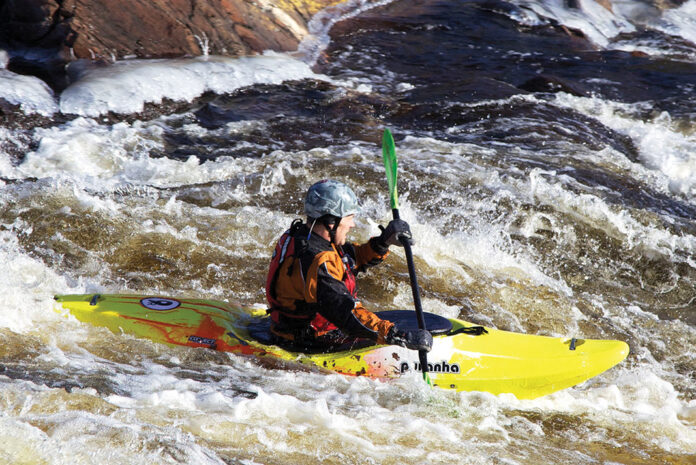
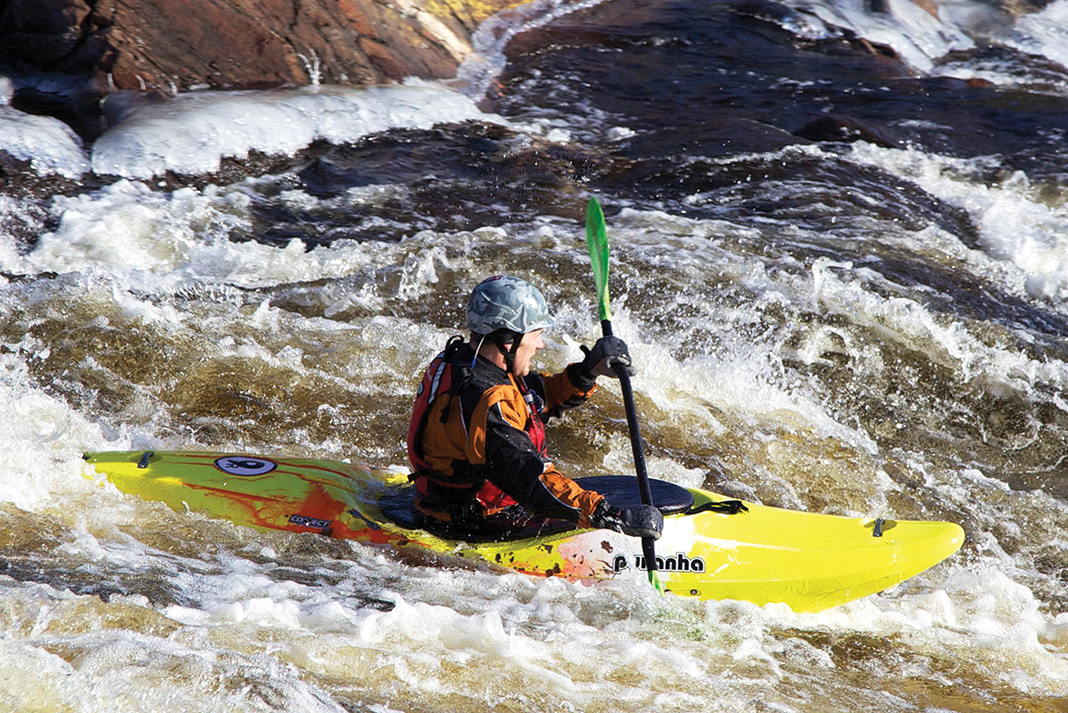
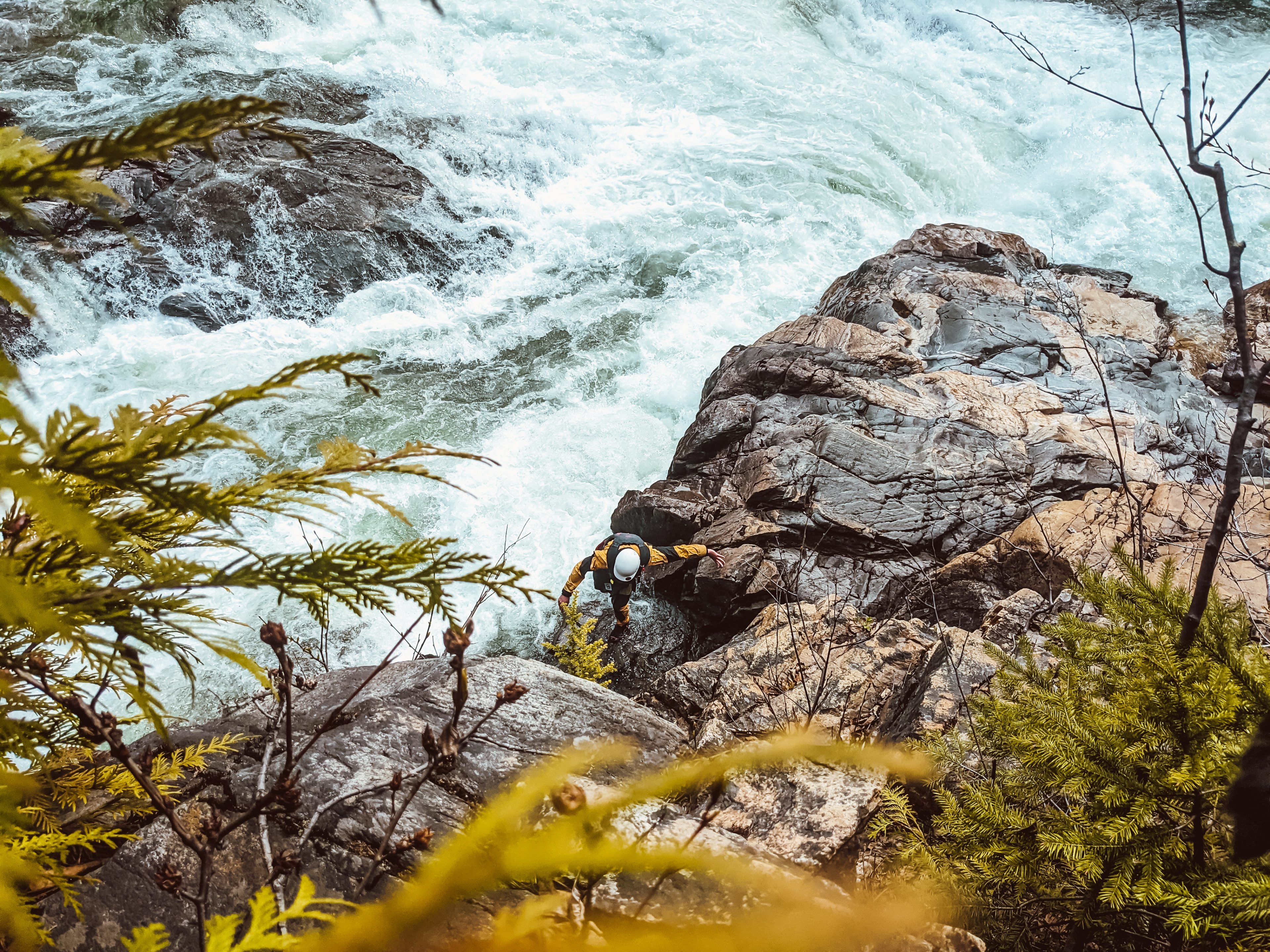
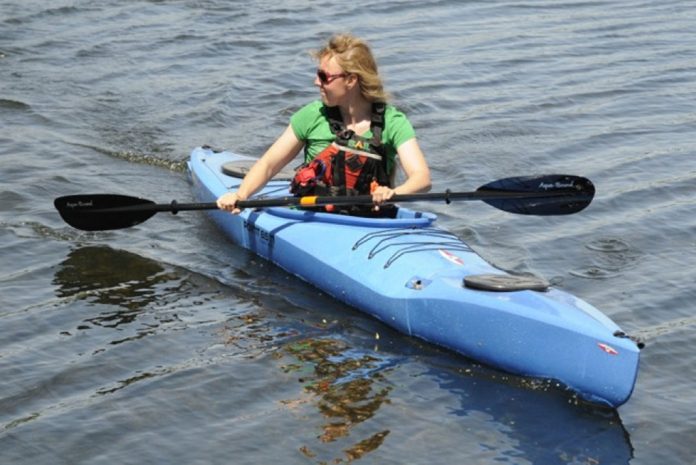
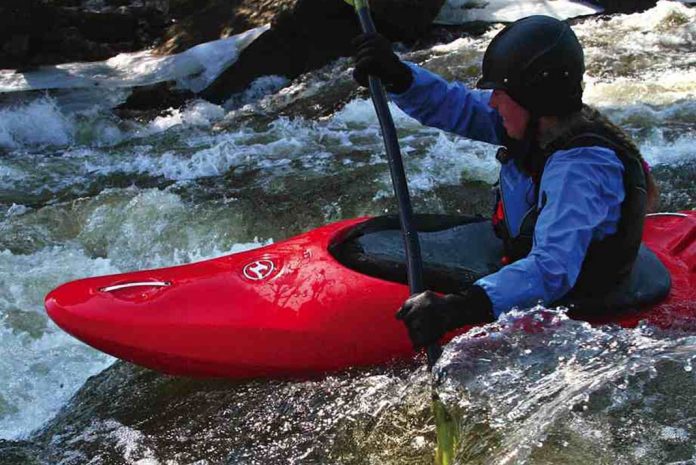
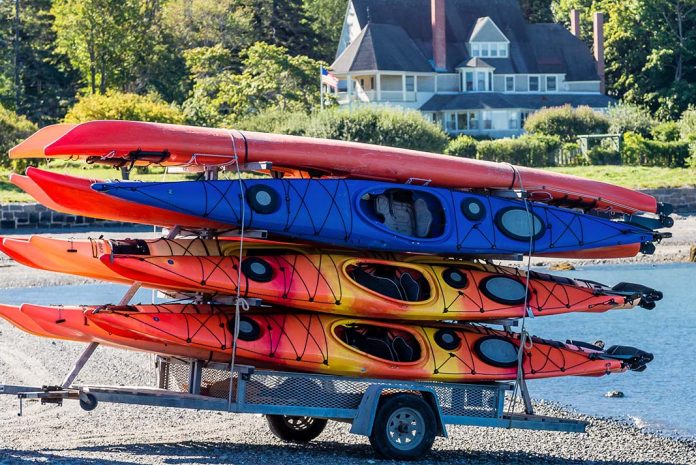
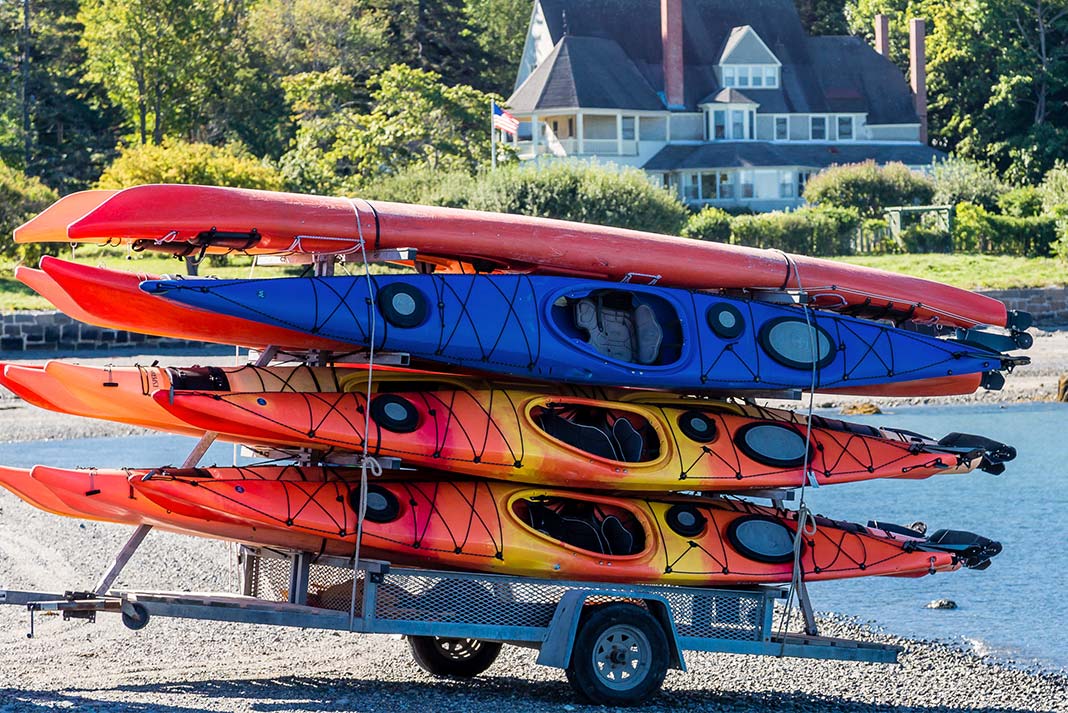
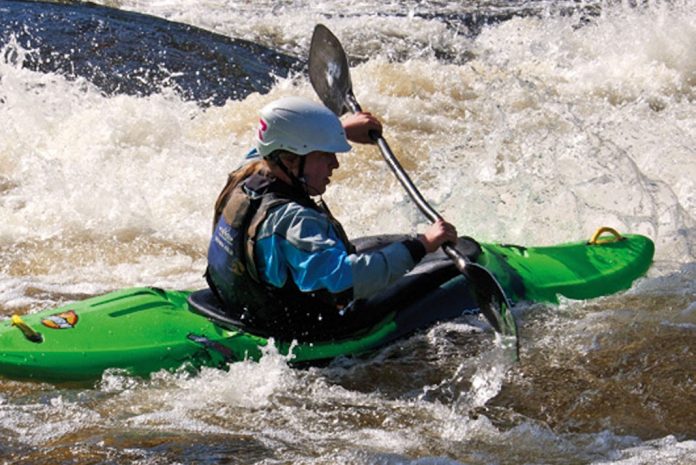
Whitewater races are won and lost between the big rapids. Unless you have an accidental freestyle session in a hole, it’s the class II and III sections that determine your time. Expert handling of choppy waves is what shaves seconds from your run, which is why the next time you’re sprinting to the take-out, there’s a good chance you’ll see the new Pyranha 9R nearby.
[ Paddling Buyer’s Guide: See the 2020 Pyranha 9R M ]
Lining up for the race
With the surge in popularity of whitewater races, manufacturers have started building more race-specific boats. While many have designed them at 11 feet or longer for the long boat category, the all-new 9R aims to dominate the short boat class. It comes in one size: eight feet, 11 inches, to measure just under the nine-foot cutoff of most short boat race divisions.
At six feet tall with a 32-inch inseam and 185 pounds, I felt like I was right in the sweet spot, though Pyranha’s Connect 30 outfitting means it can be easily adjusted to fit larger or smaller paddlers.
The 9R’s high bow and continuous rocker ensure I ride up and over waves, through holes and stay on the surface of the water where I’m fastest and most efficient. It allows me to sit in an aggressive forward position so I can use my whole body for strokes, saving energy and maintaining speed.
An asymmetric hull design—the widest part of the boat is just behind the cockpit—allows for more downriver speed by displacing water efficiently and minimizing drag. A narrow cockpit area makes it easy to get my paddle vertical in the water without reaching over the sides, a bonus for smaller-sized paddlers and racers.
The slim hull means less primary stability than wider, flat-hulled boats like Pyranha’s Burn, but it also means it’s easy to get on edge. Since those edges run from the midpoint of the boat to the stern, I can get them to bite by leaning slightly back. When I want to spin quickly, leaning forward keeps them clear of the waterline allowing a quick change of direction—a good balance between holding a line and maneuverability.
[ Paddling Buyer’s Guide: See all Pyranha boats ]
A racer with broad appeal
While the Pyranha 9R is undoubtedly a race machine, it will also appeal to everyday paddlers who aren’t trying to break speed records.
“It’s not just a race specific boat,” said designer Robert Peerson when we talked to him at the unveiling of the 9R in August. “It’s not as long so it’s not as intimidating for a lot of paddlers to get in and still have a boat that’s friendly and speedy.”
The Pyranha 9R is likely to find its way onto podiums in the blossoming whitewater race scene, but could just as easily become your go-to kayak for a local run, because a race to the take-out beer is just as important.
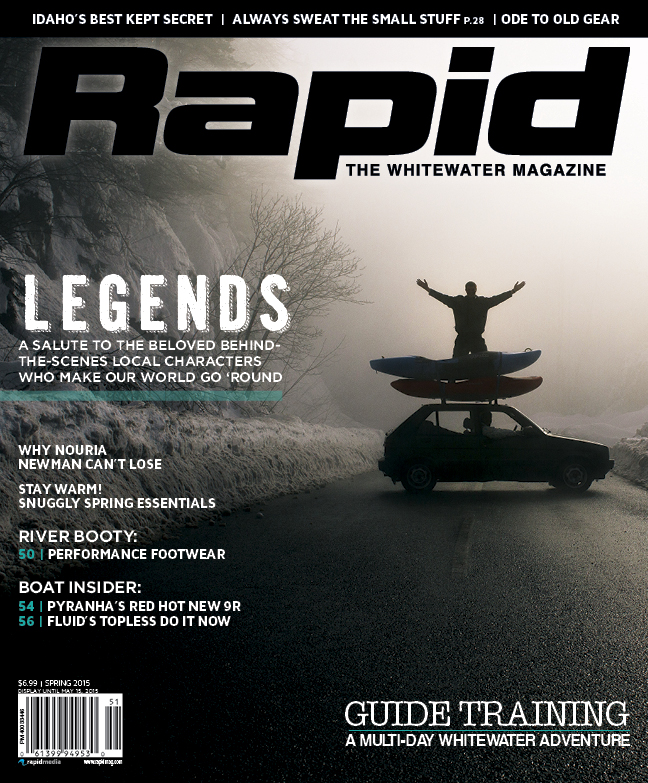
This article first appeared in the Spring 2015 issue of Rapid magazine.
Subscribe to Paddling Magazine and get 25 years of digital magazine archives including our legacy titles: Rapid, Adventure Kayak and Canoeroots.
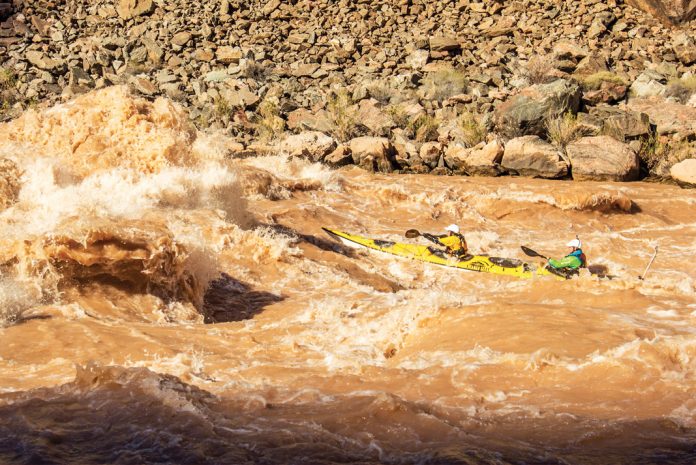
The only way to get the double through the biggest falls in Hermit Rapid is straight down the middle. | Photo: Heather Nichols
The following is an account by Jamie Sharp of an eleven-day trip down the Colorado River he undertook with Jillian Brown, kayaking the Grand Canyon together in a tandem sea kayak.
We were standing next to our kayak on the bank of the Colorado River in the depths of the Grand Canyon, its rusty red rocks towering above us. Downstream lays a tricky and impressive rapid called Hance. We have just returned from scouting the line and we’re rethinking our moves.
“Are you nervous?”
Jill looked up at me with a wry smile. “No, ” she stated flatly. “We’ve got this. We’ve made it this far and hey… I trust you.”
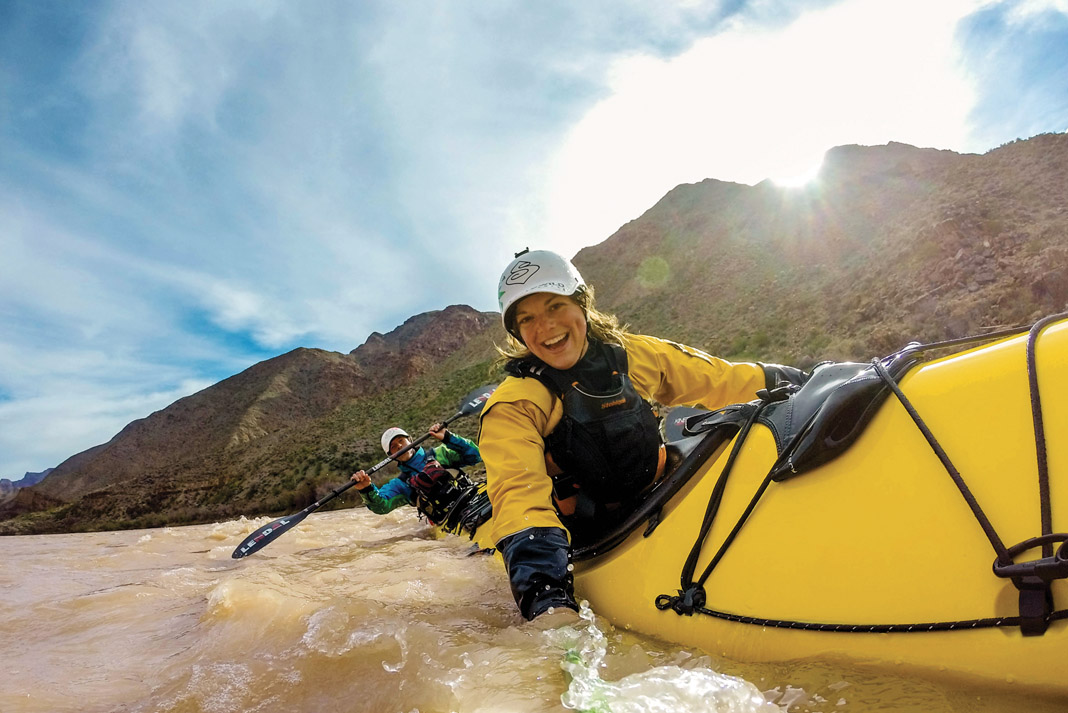
I smile as Jill climbs into the bow seat of our yellow 22-foot double sea kayak. Once her gaze is off me, my smile contorts into a bemused grimace and I push the bow away from the shore into the deceivingly tranquil muddy waters above the chaos downstream. I climb into the rear seat and find myself chuckling under my breath. I am bemused at her statement, what does trust have to do with not feeling fear?
Forward we go!
I call “forward paddle” and in unison we paddle our large oceangoing craft out of the eddy into the downstream flow to face the coming rapid. As we drop over the lip into the cauldron of standing waves and foaming recirculating holes stretching out ahead for 200 meters or so, I find myself thinking “Hell! It doesn’t matter how much she trusts me. This is crazy.”
Perhaps it was because Jill doesn’t know any better. Maybe she doesn’t fear these rapids because she isn’t making the calls, or perhaps she is just being brave. Either way, what makes me scared is what I know and she doesn’t. I know these rapids hold the power to crush our fiberglass sea kayak if we make a wrong decision.
I know steering a double sea kayak fully loaded with 11 days food and gear through some of the largest rapids in North America is actually quite tricky.
Then to top it off, I am doing the trip with someone who doesn’t know how to roll and has never paddled a large river like this before. The responsibility of not screwing up makes me plenty nervous. But hey, it was my big idea in the first place.
Back to old stomping grounds
This trip is my third journey down the Grand Canyon. This time I wanted to bring my girlfriend with me. The tricky part is to do the whole trip without raft support, and my girlfriend at the time was not a kayaker. And so began the planning of how to get her down the canyon without a raft.
I have paddled a single sea kayak down the 20-day run as well as oared a raft through the Canyon. I knew what to expect and decided a double sea kayak could be a feasible idea.
In the spring I came across a great deal on what I had decided was the perfect craft. I picked up a used Seaward Passat G3 double. This particular design is agile, with an up-swept bow for punching through surf, or in this case, driving through whitewater. It could carry a lot of gear and had very good hull speed. Now all that was left was some pre-trip training.
A big problem with double sea kayaks is the almost inevitable power struggle that occurs, especially between couples. For this reason doubles are commonly nicknamed, divorce boats. I personally have always enjoyed journeying in double sea kayaks.
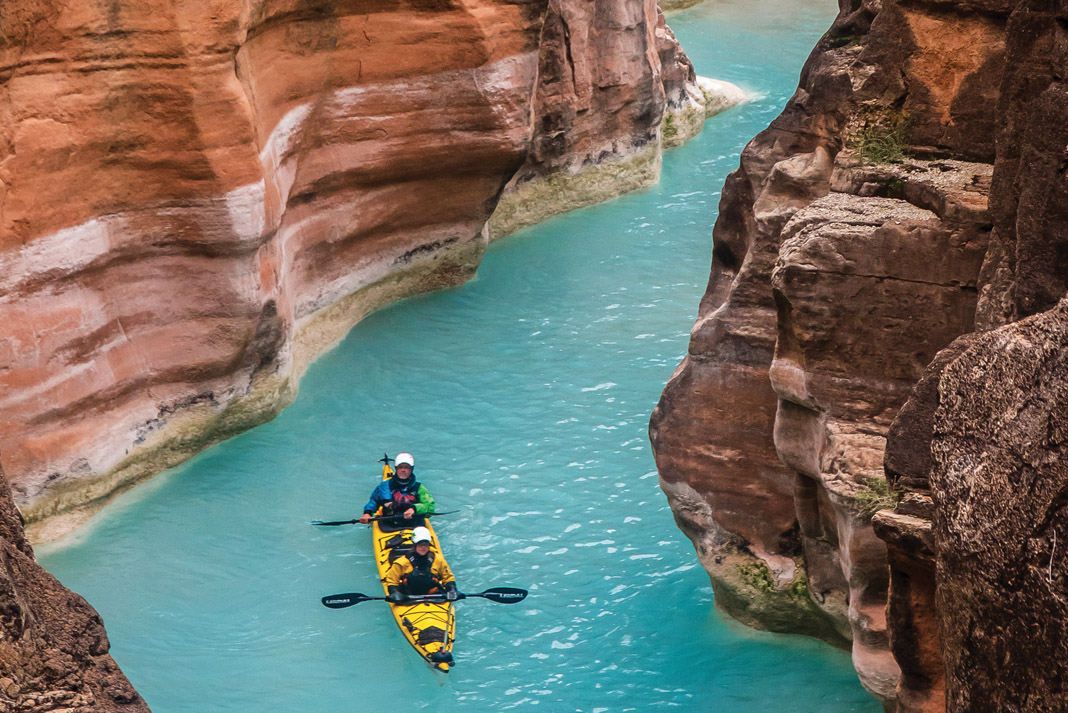
Havasu Creek is one of the most photographed spots on the Grand Canyon. We couldn’t resist. | Photo: Ryan Fair
The extra efficiency and safety makes them a great long distance touring vessel, especially with an inexperienced team member. Which is why the Passat G3 is so popular with sea kayaking outfitters and tour companies.
During the training lead up, I used the double in a surf competition in Washington State where it managed to help seal a second place podium position in the open category. The surf competition confirmed the agility and good design of the kayak, though ironically perhaps, the double lived up to its nickname. I had gone through two relationships on my way to kayaking the Grand Canyon.
Two weeks out from our launch date, I found myself in desperate need of a paddling partner to tackle this crazy journey.
My friend and outdoor photographer Jillian Brown jumped on the chance despite not being a whitewater kayaker, not having a roll and not having time to practice before hitting the river. I think the adventurer in both of us kind of liked these odds.
Exploring the Colorado River
With 30,000 people going down the Grand Canyon each year, paddling a tandem sea kayak added a touch of unknown to the trip, something like Powell’s first descent down the Colorado back in 1869.
John Wesley Powell led, what is believed to be, the first voyage of white men through the entirety of the Grand Canyon. The voyage, conducted in shallow draft wooden dories, started on the Green River and ended at the end of the Grand Canyon at the confluence of the Virgin and Colorado rivers. This expedition produced the first detailed descriptions of the previously unexplored canyon country, though had been fraught with danger and anxiety.
Powell wrote in his diary, “We have but a month’s rations remaining. The flour has been resifted through the mosquito-net sieve; the spoiled bacon has been dried and the worst of it boiled… We have an unknown distance yet to run, an unknown river to explore. What falls there are, we know not; what rocks beset the channel, we know not; what walls rise over the river, we known not. Ah, well! We may conjecture many things.”
Damaged and sunken boats, near drownings and a gruelling river of immense rapids had left the team desperate and brittle. Three men abandoned the trip, preferring to hike out rather than continue to face the wrath of the Colorado for who knew how much longer. Those men were never seen again. Ironically, the expedition reached its end only two days later. I’d told Jill this story before we launched as a deterrent to possible mutiny.
The Colorado River has since been dammed in two locations reducing the length of runnable whitewater river, yet the allure and beauty remains. What was once a truly epic life-threatening journey has become one of the greatest recreational adventures in North America.
It takes a village to make the descent
Like the Powell Expedition, we team up with others for this trip.
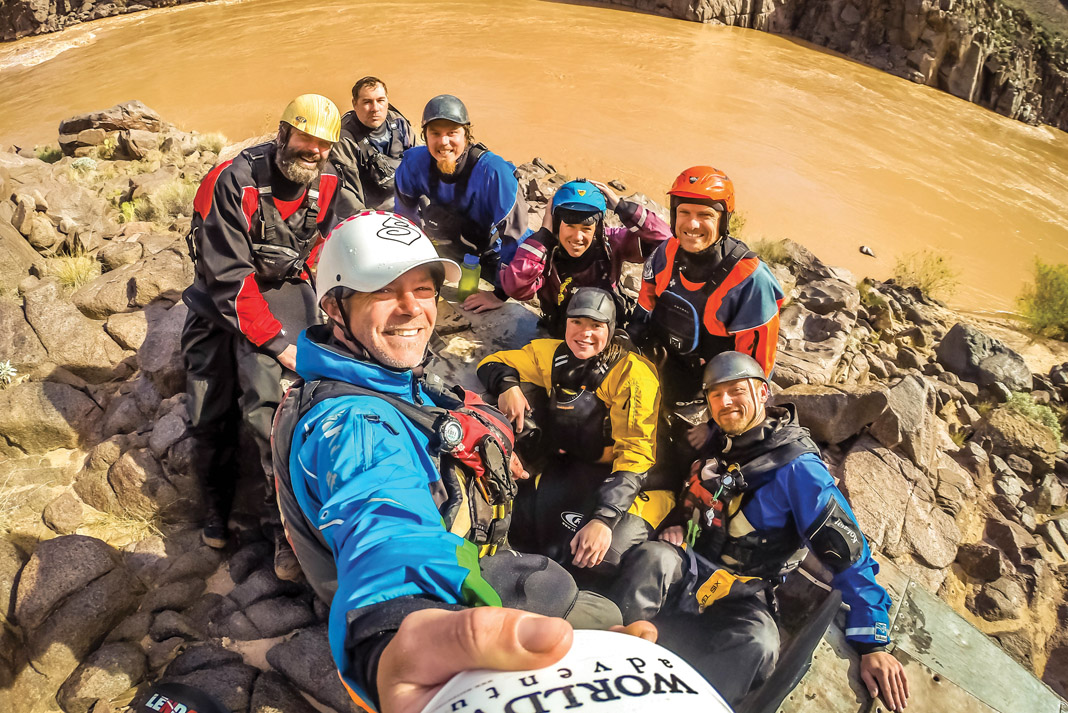
Neil Gibby, Ryan Fair, Judd Spencer, Heather Nichols, Jill Brown, Kevin Murur, Mike Gill, Jamie Sharp (Absent Danielle Cullen). | Photo: Jamie Sharp
Ryan Fair, Kevin Maurer, Judd Spencer and our permit holder Heather Nichols are all paddling crossover river kayaks. Mike Gill and Danielle Cullen are in single sea kayaks, and last but not least is Neil Gibby, who crams 11 days of gear and food into a whitewater creek boat. We are a motley crew to say the least and an odd site to see on a rafting river. Every group we pass asks, “Are those sea kayaks?”
Our skill sets are also a mixed bag. Jillian has very little river experience. Neil has paddled the Milner Mile, a notorious class V considered the training ground for the Stikine River. Mike had a solid skill set though had never paddled a proper whitewater river before this. Danielle, who prefers Dan, had a solid roll and good skills, though limited experience in any rough water and nothing like kayaking the Grand Canyon in a composite sea kayak.
Energies are high at the put in as we shove our kayaks in the the current of the Colorado River marking the beginning of our 11-day, 364-kilometer endeavor.
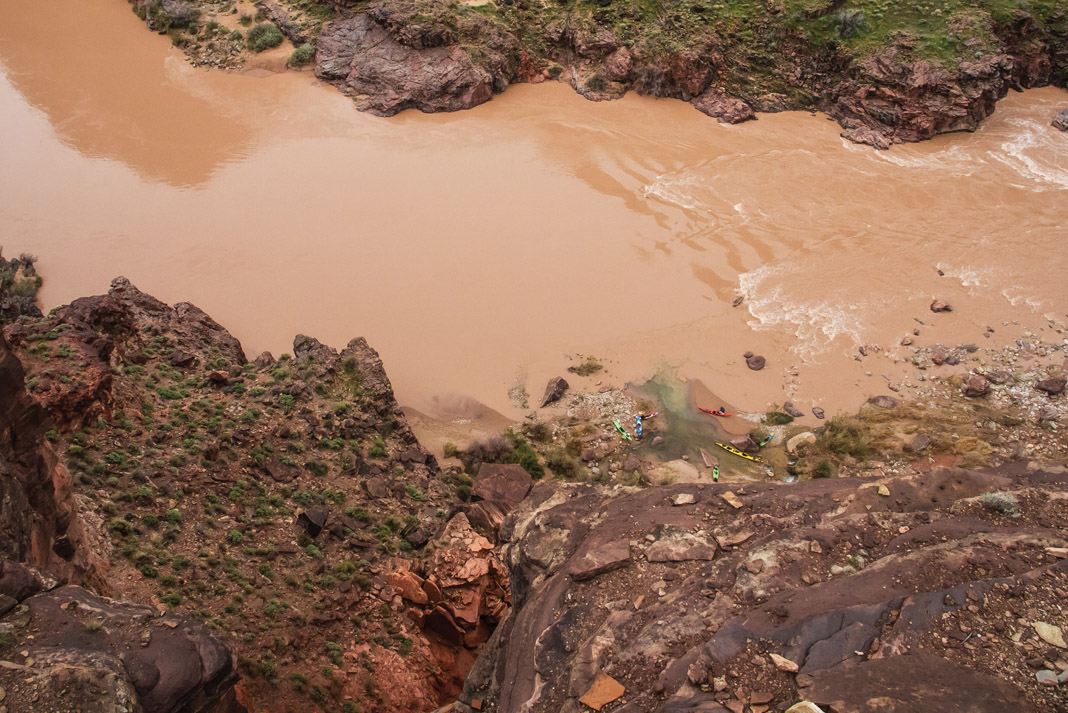
From atop deer creek our fleet seem like toys in a swimming pool of chocolate milk. | Photo: Jillian Brown
Once we round the first corner in the river, we are isolated, with only three ways out: hike up and walk out, float out, or fly out by helicopter rescue. The only reasonable hike is at a trailhead almost halfway down our intended journey.
As wonderfully remote as it is beautiful, the Grand Canyon appears a most suitable name for such a majestic geographic landmark. Seasonal rain congregates in side gulleys and canyons, rushing into the main river with silt, staining the river orange red, a trait that led to the river’s name. Colorado means the color red in Spanish. With red walls climbing to the sky and a red river running through it, almost always everything had an orange-red hue, emblazoned further by the setting or rising sun.
“The glories and the beauties of form, color and sound unite in the Grand Canyon–forms unrivalled even by the mountains, colors that vie with sunsets, and sounds that span the diapason from tempest to tinkling raindrop; from cataract to bubbling fountain,” wrote Powell.
Some calls are closer than others
The first couple of days through this majestic desert-scape are good training.
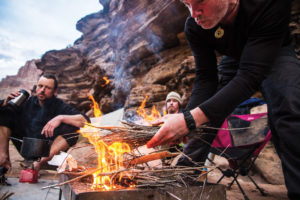
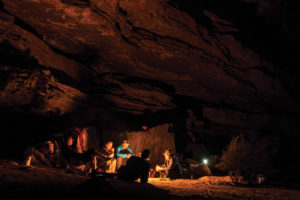
Campfires are key for warmth on winter trips, the group would cook BBQ style then Jamie would bake dessert in his dutch oven with the coals. | Photo: Jill Brown
Laughter floats in the air, dancing with the smell of food, smoke and the crackle of the glowing campfire. | Photo: Jamie Sharp
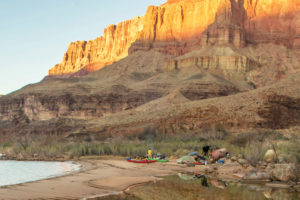
Each campsite, like this one on Palisades Creek, has its own personality and stunning vista of glowing canyon walls. | Photo: Jamie Sharp
There are a couple swims and rescues, including our double. By the third day we find ourselves mere specks at the bottom of clay red cliffs looming thousands of feet above, threatening to choke out the sky.
February trips like ours are considered winter trips. We are allowed campfires. The days are not blisteringly hot. It is easier to get a permit in the winter.
Most trips down the canyon take about 18 to 21 days. Except with our chosen fleet of mostly smaller whitewater kayaks, we couldn’t carry that much food. Despite our shorter timeframe and more daily miles, we manage to end each day with plenty of light. In this “land that time forgot” we jump from waterfalls and sit amongst ancient ruins of people who once lived in the canyon and stored their foods high up in the cliffs above the seasonal flood levels of a once undammed river below.
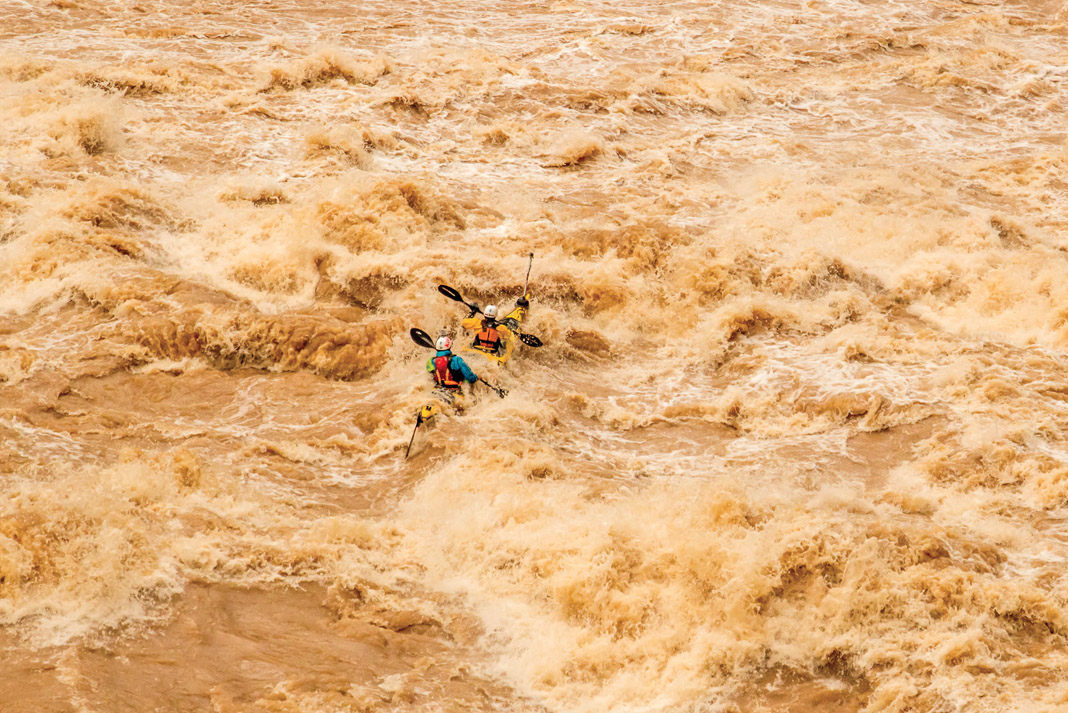
Chocolate colored whitewater thunders around us as we drop into Unkar Rapid.
Main pushing the double through Lava Falls. | Photo: Ryan Fair
A large wave erupts to our right as I yell to Jill to paddle on the left, “Hard!” As our double kayak straightens up, Jill is plunged out of sight into a foaming pit of water, and then I disappear with her, into the silty darkness of an all-consuming valley and curtain of water. This is how it goes for us on the Colorado.
Through the rapid, we slip into the eddy to wait and watch for the rest of the team to come down. What we see is not good. Dan is swimming. But that isn’t the real the problem.
The real problem is her fiberglass kayak is running the rapid driven by unrelenting surging whitewater over and against the rocks, a place even a plastic boater doesn’t want her boat to be. I can hear in my mind the hollow thuds and brittle crunches of her kayak smashing on rocks.
We scramble to put Danny and the kayak back together at the bottom of the rapid.
The state of the kayak isn’t good. It had taken a couple of hits yesterday already, but this incident has it beaten raw. We look at frayed exposed fiberglass and large fractures in the gel coat. The dangers of kayaking the Grand Canyon in a composite kayak have literally hit home.
With the kayak patched with duct tape, we push on to camp.
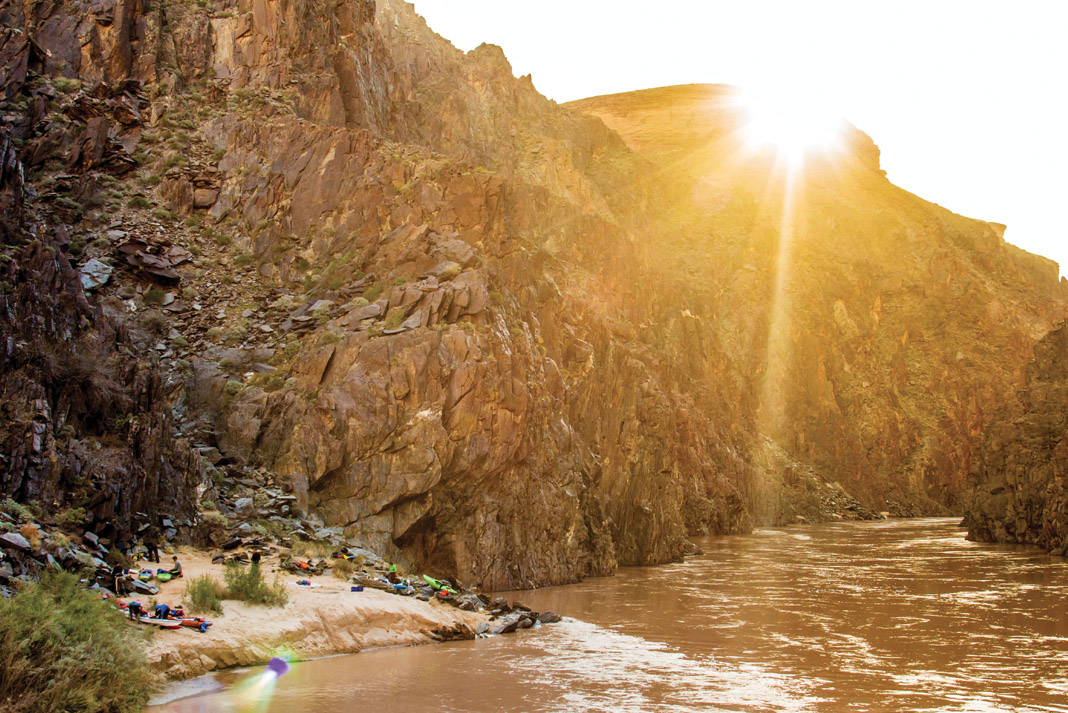
With shorter days and our shortened itinerary we ended each day chasing the disappearing sunshine for drying gear. Sunset at Clear Creek Campsite. | Photo: Jamie Sharp
A parting of ways?
“I need to get out,” Dan states frankly at dinner. “I am in over my head and I am just destroying this kayak”.
“Let’s just sleep on it,” I tell her.
Around the fire we talk about ways to get Danny and what is left of her kayak out of the Canyon. We all agree knowing your limits and making smart decisions, even if it means backing down or adjusting your goals, is just a part of adventuring.
The next day we reached Phantom Ranch. This rustic lodge was set up in 1907 by David Rust to cater to prospectors, hunters and adventurous tourists who wanted to experience being in the Grand Canyon with some comfort.
As the only site in the Canyon developed for tourism, it provides relatively easy access for hikers and mule packers from rim to river. The only catch is that it is a six to nine hour hike straight up the canyon, and Dan has a kayak and gear. Even if she does get up there, how is she to get back to Flagstaff where our cars are parked?
There is no way a mule can carry a 16-foot kayak. We consider cutting her kayak completely in half. Or maybe three pieces will be better. And so goes the conversation.
Then we met Zach. Zach is a young scraggly hiker, a true-life character stepping out of a REI catalogue. He arrives sporting the quintessential mid-west stubbled face, trucker’s cap, shorts, flannel shirt, light hikers and a small backpack.
He has been hiking for three days off trail in the Grand Canyon and is just about to walk out to his car at the top of the trail and then drive home to Flagstaff. Perfect. A friendly, curious and adventurous guy, we all strike up an easy conversation. Jokingly, but not really, we throw out the idea of hiking out a sea kayak with Dan and driving her to Flagstaff.
“Sure, sounds like a good adventure,” replied Zach. “Though we need to leave soon.” Now two groups on separate adventures, we part ways below the bridge at Phantom Ranch.
Dan and her basic supplies along with Zach start hiking into the harsh, stark and steep canyon desert. She leaves three satchels of gear for mules to bring out the next day. If all goes well they’ll make it out before 10 p.m., climbing 5000 vertical feet over seven hours to the Grand Canyon’s south rim, three hours of that in the dark, all while carrying a touring kayak.
We wish Zach and Dan luck, certain that Dan’s fate will be better than the men who abandoned Powell. The rest of us have four of the biggest rapids on the canyon before camp. We float down the canyon as Dan’s tattered kayak floats up the canyon atop their shoulders.
Back to the task at hand
A few days later Jill and I have not flipped the double again and we’ve now run most of the bigger rapids.
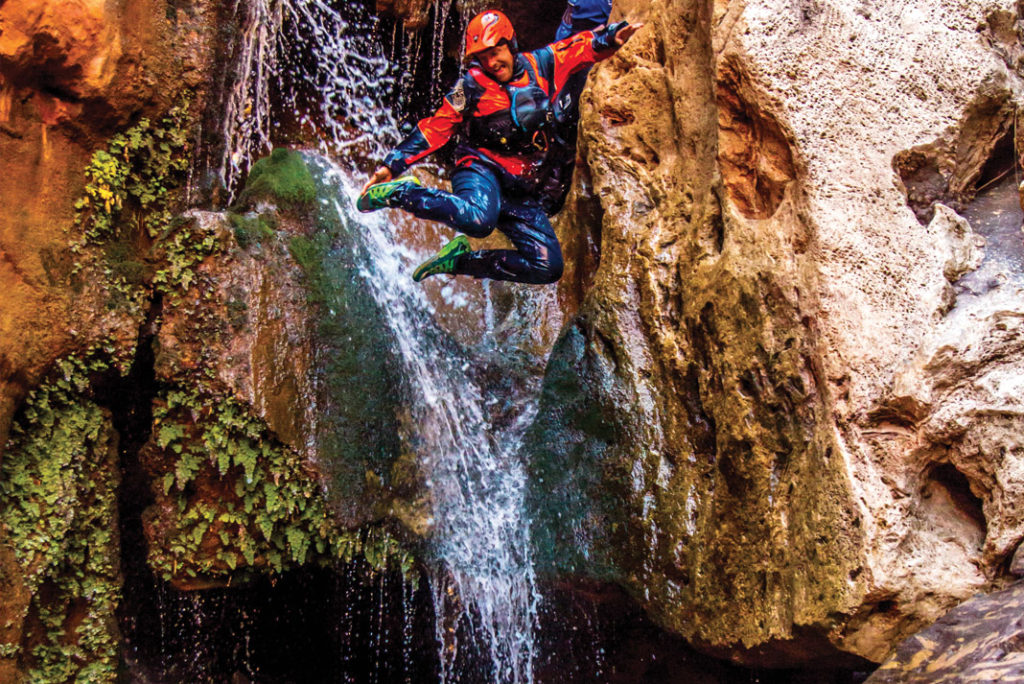
Kevin Murar leaps freestyle off the waterfall at Elves Chasm. | Photo: Jamie Sharp
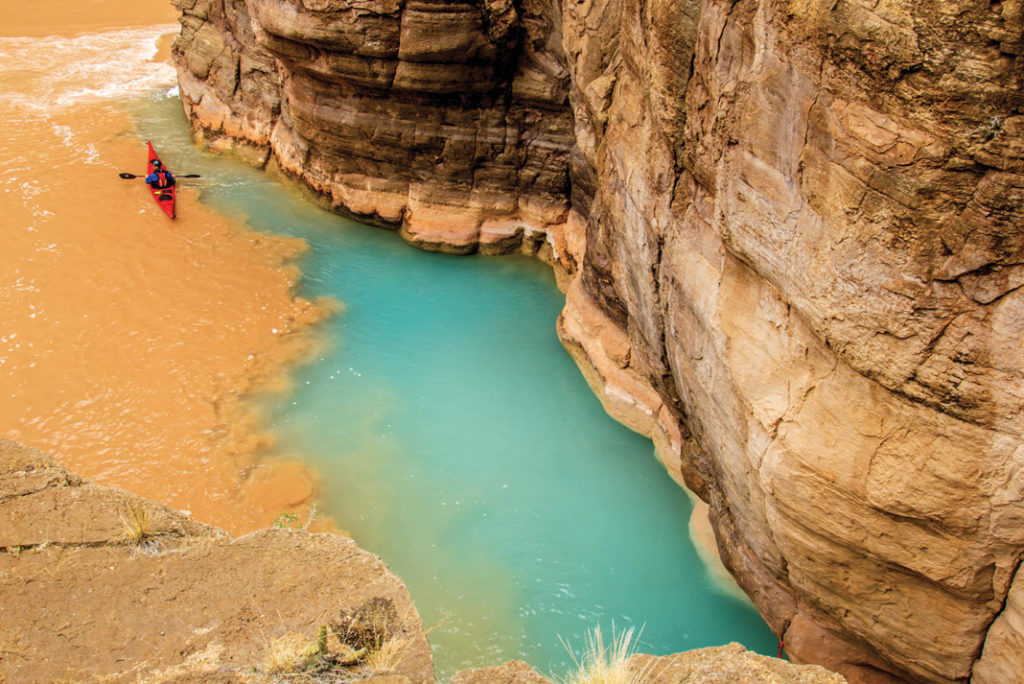
The confluence of the turquoise Havasu Creek and the silty orange Colorado River. | Photo: Jamie Sharp
Granite slammed us hard onto our side but I managed to roll back up with the help of the next wave. Jill is feeling pretty battered after days of being the first one to greet the waves of the Colorado. We still have the most notorious rapid on the trip, Lava Falls, and Neil’s been telling everyone, “It’s easy as long as you keep your line.”
There are apparently multiple options of travel through Lava, though for us there seems only one—moving from right to left right through the meat of the largest rapid on the Grand Canyon.
[ Plan your next great adventure with the Paddling Trip Guide ]
Despite what feels like hours scouting from above, getting to know our line, once on the water it all looks different. Bigger.
A huge foaming pit the size of a Silver Eagle tour bus is parked at the beginning of the rapid. This river feature flips fully-loaded whitewater rafts, breaks wooden oars like toothpicks and folds aluminum raft frames like tacos. Yet from the water we cannot see it until we are right above it and then we need to enter the rapid right next to it… and not into it.
With Neil’s simple speech ringing in my ears, I realize our line is slightly off. We need to be further right.
“Paddle,” I shout at Jill’s back. “PADDLE!”
Furious forward strokes from both of us and we slip past the thunderous hole, our blades grabbing the edge of the monster in unison while the rudder on the stern deck dips beneath the crashing water. We are sucked into the main flow and into waves coming together like the rotating blades inside a pencil sharpener. I struggle to find breaths amongst the exploding water, exertion of paddle strokes and shouting encouragement to “FORWARD PADDLE”.
I feel on the edge of control. I watch Jill disappear just as darkness engulfs us both like a heavy wet blanket. The water is so full of silt it is impenetrable by light.
Our entire kayak disappears underwater then erupts like a torpedo from a submarine.
We keep driving forward and toward the left side of the river. Eventually our slender double crosses the surging eddyline and turns back upstream.
“I think I was underwater for that whole thing,” Jill says grinning back over her shoulder. “Turns out it’s hard to be scared when you can’t see anything.”
A feeling of accomplishment
We travel a few more day of rapids, though now with Lava behind us the energy of the group has shifted. Our spirits are high, relaxed. We spread out more and enjoy time alone floating toward our agreed upon camping areas.
Mission accomplished…still talking after 11 days together in a double. | Photo: Jillian Brown
On the last day we float to the take out to find Dan sitting with our shuttle driver, vehicle and trailer. We have tasted a little of what John Wesley Powell experienced in his wooden dories some 150 years earlier. Dan is holding a box of donuts with a big grin on her face and her own great story to tell. After all, she played a key role in the first expedition to hike out of the Grand Canyon with a sea kayak.
[ View all sea kayaks in the Paddling Buyer’s Guide ]
This article was first published in Issue 51 of Paddling Magazine. Subscribe to Paddling Magazine’s print and digital editions, or browse the archives.
The only way to get the double through the biggest falls in Hermit Rapid is straight down the middle. | Feature Photo: Heather Nichols
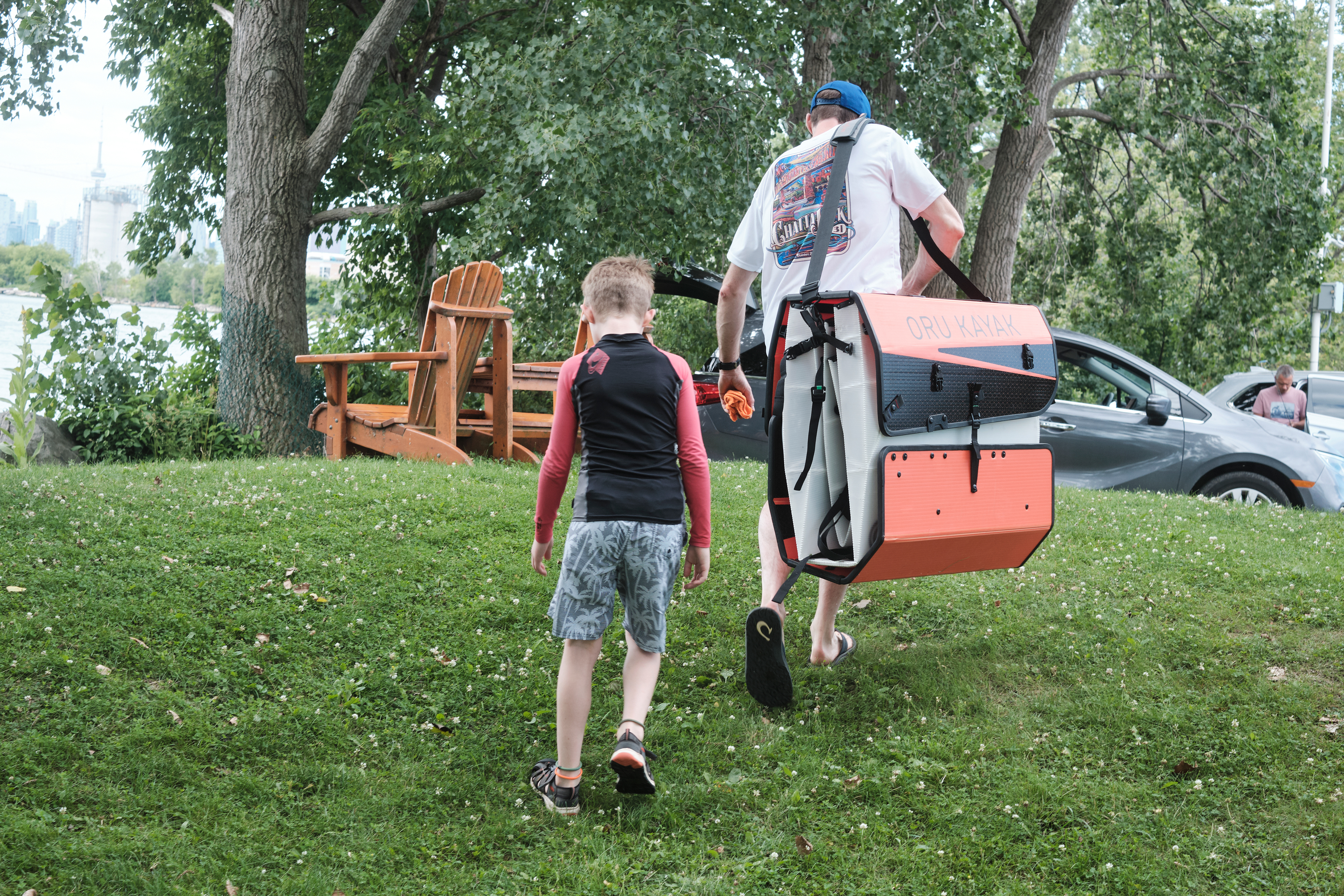
Build-a-boat. From suitcase to shore in just 10 minutes, the tandem Oru Haven offers excellent portability in a recreational design. | Photo: Wyatt Michalek
Once upon a time, people who wanted to sell kayaks just went and built them first. High-tech companies like San Francisco-based Oru upended the tradition by coming up with a kayak concept and crowdfunding it first. The latest in the lineup of “origami-inspired” folding plastic kayaks is the Oru Haven, a tandem kayak design for friendly waters.
Straight from the minds of entrepreneurial designers and the voodoo economics of cyberspace, some truly disruptive creations have emerged since Oru launched its first single kayak and top seller, the Bay, in 2012.
Oru’s base material is white, double-walled corrugated polypropylene, custom-made in Canada and assembled in Mexico. Think plastic signboard material or, as Oru’s spokesperson put it, “the mailboxes you see at the post office, although much more durable and custom created.”
Assembling the Oru Kayak Haven
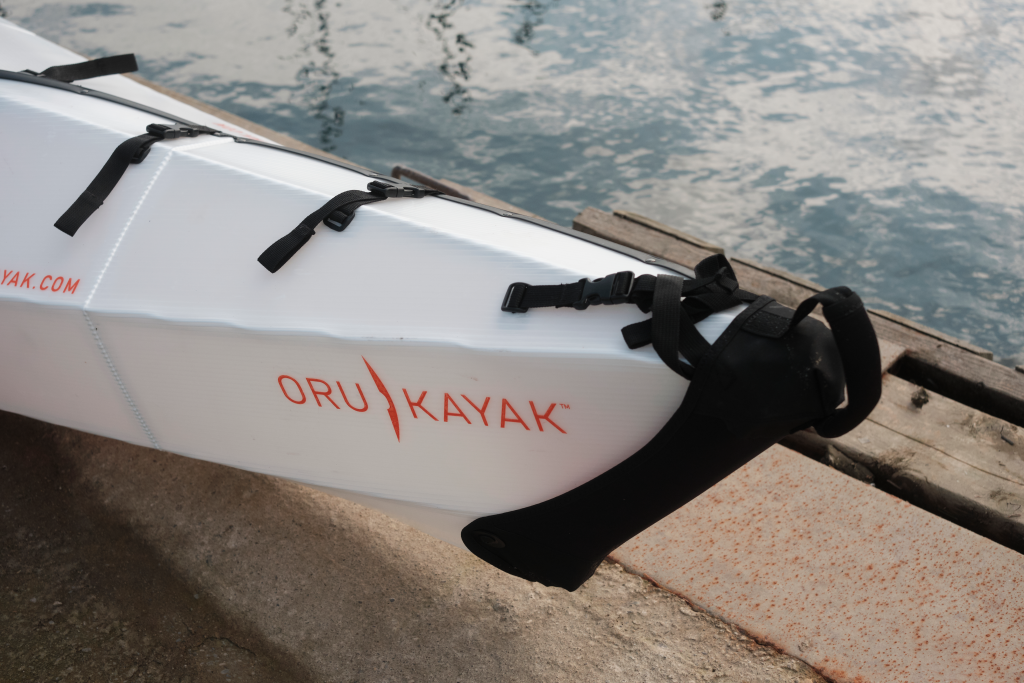
The single-piece hull is pre-creased with lines that quickly folding into kayak shape, then neatly clipping together with neoprene end caps, nylon straps and plastic buckles. It’s thoroughly postmodern, yet bears a remarkable resemblance to its sealskin predecessors in all its translucent glory.
Birthed through an Indiegogo fundraising campaign last fall, the Haven started shipping in early 2019. The Haven fits into Oru’s lineup of four folding kayaks as the only tandem—a wide, open-cockpit recreational design similar to the smaller Oru Beach LT, with the bonus of converting from a single to a tandem and including a new metal rail system for attaching accessories.
Setup is straightforward compared to other folding kayaks. I threw the boxed Haven into my van for a vacation with my kids and hauled it out on a campground beach. Without previewing the instructions or setup video and battling a stiff onshore breeze, I cobbled it together in under an hour, including a trip back to the campsite for snacks. With a little practice, the advertised 10-minute setup is definitely achievable.
How does the Haven hold up to rough handling?
Oru responds to durability concerns with videos of their kayaks being dragged across rocks and paddled in surf. If needed, field repairs are easy with duct tape or epoxy. The hull has a 10-year UV treatment and is rated for 20,000 folds—theoretically, more than 50 years of daily paddling and folding. And, since it’s 100-percent recyclable, in the end you could throw it in the blue bin to be turned into plastic lumber or an outdoor rug.
I was impressed by the single-piece hull but questioned the durability of the floorboards and fittings.
The folded Oru fits into a suitcase-sized box formed by its two floorboards, easily carried with a shoulder strap and stowed in the trunk of a car. | Photo: Wyatt Michalek
The rigid orange floorboards, which form the top and bottom of the carrying box when the Haven is folded, invert into the hull during assembly. Ours showed some deep cracks along the seams—an observation shared by some online reviews, which also noted bending and slipping of the metal G-hooks attaching the seatbacks to the hull.
Our G-hooks held up well but required a back-up knot to prevent slippage. On the pro side is the ease with which you could replace any of these parts. Oru stocks replacement parts on its website and stands behind its one-year warranty.
On the water, the Haven performs as you’d expect for an open-cockpit rec kayak with a 31-inch beam. Stability is rock solid, its lightweight hull responds quickly to every paddle stroke, and it tracked straight and stayed dry even in a stiff breeze with small whitecaps.
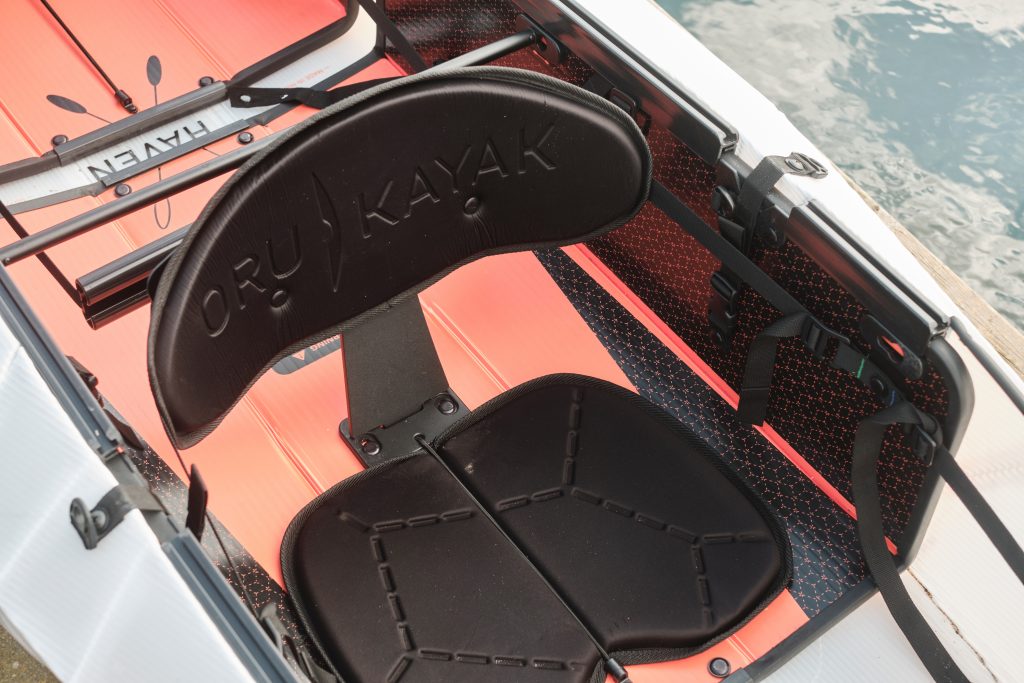
Color-coded stitching shows where to clip the seats and footrest straps for tandem and single setup. A universal rail fits accessories like rod holders and electronics. | Photos: Wyatt Michalek
Nylon buckles and neoprene end caps hold the folding plastic hull in kayak form. | Photos: Wyatt Michalek
The Oru Haven can accompany you practically anywhere
Versatility is the Haven’s key advantage, converting quickly from a tandem to a single by merely clipping the seat and footrest to different attachment points. For a single paddler, there’s loads of room for gear in the cockpit, but no dry storage. You could also squeeze some gear bags into the bow and stern behind the bulkheads by partially unfolding the ends.
Folding up the Oru Haven looks daunting when you see the mass of its hull spread out before you like a skinned whale and the size of the box you’re supposed to end up with. But once you figure out the subtle twisting motion that nests the two ends together, it practically folds itself, and all the parts stow into the folds. Then you’re on the road with nothing but an empty roof rack and a nagging feeling that you’ve left something behind.
Is this folding kayak a Haven for you?
You likely already know if the Haven is for you. Most people who encountered mine either loved it or hated it. Random guy on the beach giving me the thumbs up was definitely a fan. My wife (“What is that thing?”), definitely not. This sort of gut response should make the decision easy. Besides, if you require an ultralight kayak that folds up into the size of a suitcase and converts from tandem to single, the Oru Haven is one of few options.
However, there’s a swath of potential buyers who should give the Haven a serious second look, and that’s anyone considering a regular open-cockpit tandem recreational kayak. For not much more money than one of those 70-plus pounders for which you practically need a boat trailer, the Haven is half the weight, giving it the potential to be much more user-friendly, with the bonus of unprecedented packability and storage.
This article was first published in Issue 59 of Paddling Magazine. Subscribe to Paddling Magazine’s print and digital editions, or browse the archives.
Build-a-boat. From suitcase to shore in just 10 minutes, the tandem Oru Haven offers excellent portability in a recreational design. | Feature Photo: Wyatt Michalek
The put-in is quiet as I unload my boat from the back of my truck. It’s 11 a.m. on a Tuesday, and I couldn’t find any boating partners today, which means I am kayaking alone.
The Experience of Kayaking Alone
Paddling solo is a much different experience than paddling with a group. Not because I need to be more focused on safety—I have been paddling this stretch of river since I was 13 years old and I know I am not going to swim.
I also know if something happened and I did end up swimming, I would still be fine. The rapids are deep, short and without consequential hazards.
Instead, my experience changes because my mindset changes. When I am with a group, I feel the need to show off. I feel the need to paddle my best. To throw my biggest downriver freestyle moves. To catch the most eddies. I think it stems from my competitive personality. My desire for perfection. It is one of my worst personality traits.
But when I am paddling solo, all of that goes away. I don’t need to be the best. I don’t need to show off. I don’t need to be perfect. I can just be. I can just paddle.
Reasons For Going Alone
Everyone has a different reason for kayaking alone. In 1992, Doug Ammons became the first to solo the Grand Canyon of the Stikine. To this day, his descent remains one of the most notable accomplishments in whitewater history.
“I get immense pleasure and inspiration from the experience,” Ammons says. “Words and social concerns disappear, and you are left with a single important reality, which is the flow of the river.” He describes soloing as one of the easier ways of entering flow state.
Psychologist Mihály Csíkszentmihályi defines flow state as “being completely involved in an activity for its own sake. The ego falls away. Time flies. Every action, movement and thought follows inevitably from the previous one, like playing jazz. Your whole being is involved, and you’re using your skills to the utmost.”
With a Ph.D. in psychology, Ammons knows flow state well. For him, “The key to entering a flow state is focusing on what you wish to accomplish physically, and completely giving yourself up to it. Setting all fear or threat aside, all judgment and criticism, all comparisons and all social concerns—having all the barriers down.”
This notion of experiencing flow state while solo is not limited to kayaking. Free solo climber and BASE jumper Steph Davis experiences flow state most easily when she is climbing without a partner.
“For me, a big factor for reaching focus, or flow, is getting away from outside energy—so free soloing inherently works really well because you are alone,” says Davis.
Alex Honnold, famous for his free solo climb up El Capitan in Yosemite, says flow doesn’t come as easily when climbing with ropes and a partner.
“I think a big part of the pleasure in free soloing is that it forces you into that state more than other kinds of climbing,” he says.
In every beginner whitewater course, students are told never to paddle alone. I teach this rule, and yet I don’t follow it. I paddle alone often. Whether it be a flatwater sprint workout, a freestyle session in the whitewater park or a river run, I break this rule all the time. So why do I teach this to beginners?
“It is an important rule to impregnate into new kayakers and the up-and-coming kids who watch YouTube videos,” says 10-time Green Race champion Adriene Levknecht.
“The people who are solo paddling have been in it for a very long time, and they understand the underlying danger.” In her view, the danger of kayaking alone isn’t less for experienced kayakers, but the risks are better understood and accepted by the paddler.
Ammons has a different view. “Bullshit,” he says when asked whether he agrees with the never-paddle-alone rule. “The bottom line is even when you’re in a group, you take every paddle stroke alone.
You are the captain of your own ship; you are always soloing even in a group. I’d say 90 percent of having partners is purely social, and less than 10 percent is safety.”
In Ammons’ view, even paddlers in a group are soloing. “Beginners are fine paddling solo as long as they stay within simple situations, like near the bank in slow-moving flatwater, or on a pond,” Ammons believes.
Considering Ammons’ opinion, I began to ponder my thoughts on running hard whitewater. My personal view of running consequential rapids is I need to be 100 percent confident on my line before running the rapid. If I am not 100 percent, I portage.
With this mentality, there is no need for me to depend on paddling partners for safety purposes. If I am 100 percent confident on my line, I should be able to run those difficult and consequential rapids solo just as easily as with a group.
And yet, this is not what happens. I usually cut myself off of kayaking alone at class IV-, where I feel extremely comfortable.
“Most of the negative attitude toward soloing is merely the sense of security people have when other people are close, so in this way, it can easily blind you to the reality of their situation,” adds Ammons. “The real question is, do people want to believe things because they comfort us? Even if they only give a false sense of security?”
[ Plan your next adventure with the Paddling Trip Guide ]
Go Alone, Be Safe
Of course, the sense of security a group provides isn’t always false, which Ammons admits.
I have both witnessed and experienced instances where paddling partners have pulled each other out of risky situations, relied on one another for a throw rope or live bait, and saved each other’s lives.
Mistakes on the river happen. We swim. We get beat down. We get pinned. And in those instances, a paddling partner who helps you clean up your mess is a lifesaver—even if only 10 percent of the time.
Nouria Newman, one of the best whitewater kayakers in the world, recently completed a seven-day solo expedition of the remote Zanskar and Indus rivers in northern India.
On day two of her expedition, she got stuck in a siphon. Luckily, she made it out unscathed. Her response after the expedition?
“Why go solo when you can go with friends.”
This article was first published in Issue 57 of Paddling Magazine. Subscribe to Paddling Magazine’s print and digital editions, or browse the archives.
Sneak in a paddle anytime you please with this modular plastic kayak from Point 65 | Photo: Vince Paquot
If you’ve ever shopped at Ikea, you have probably marveled at the Swedish engineering that packs wardrobes and desks into flat boxes that fit in a Prius. Similarly, Point 65 Kayaks, based in Sweden, builds innovative, modular plastic kayaks like the Mercury GTX that stash in a closet or compact car.
[ Paddling Buyer’s Guide: See all kayaks from Point 65 ]
Sizing up the Point 65 Mercury GTX
The Mercury offers multiple configurations
The Mercury GTX solo breaks apart into three manageably sized sections, with the bow section fitting into the midsection’s cockpit for storage. The pieces assemble in seconds using Point 65’s patented Snap-Tap technology: interlocking bulkheads paired with deck-mounted ratchet straps.
Each section is entirely self-contained, the spacious bow and stern hatches on our demo boat were bone dry even with waves washing over the deck. The modular design is also versatile—you can snap in a second cockpit section to transform the Mercury into a tandem kayak.
While a slight hull flex at the section joints is detectable when carrying the Mercury on land, it isn’t noticeable on the water. Hull speed matches that of comparable light touring kayaks. Generous initial stability and a large cockpit cater to novice and recreational paddlers, but the Mercury is no slouch in rough water. Edge turns feel sporty and responsive, although the cockpit opening is too wide to really lock in your legs.
The Mercury’s AIR seat has inflatable lumbar and bottom support for all-day comfort. Gas pedal-style foot braces control Point 65’s pivoting stern keel, which has a cleaner deck profile and less windage than an external rudder. An integrated skeg works more as a steering enhancement than a set-it-and-forget-it tracking aid—since there’s no way to lock out the stern pivot, you’ll always have to be mindful of steering with your feet.
While it’s true that a sectional kayak like the Mercury GTX doesn’t fit into a backpack, it is by far the fastest option for those who want the ease of launching a hard-shell and the storage smarts of a portable kayak.
Ideal for: Sneaking in a paddle at lunch, weekend tours on all types of water.
Assembly Time: 2 minutes
This article was first published in the Summer 2014 issue of Adventure Kayak Magazine. Subscribe to Paddling Magazine’s print and digital editions, or browse the archives.
Video review of the Point 65 Mercury GTX Modular Kayak:
Lately it seems like whitewater kayak companies take their marketing cues from the auto industry. The copycat trend had already begun in 2004 when WaveSport hailed its new Diesel 70 river runner as the “SUV of kayaks.” Fortunately, WaveSport left out the stumbling blocks of most SUVs—poor mileage and an unrefined ride—and incorporated only desirable qualities like rugged versatility and voluminous cargo space.
[ Paddling Buyer’s Guide: See all river running kayaks ]
Debuting the WaveSport Diesel 70 (and siblings)
Seeking the perfect fit
The Diesels were a huge success and continued to be a top-selling boat for WaveSport into last year. So when WaveSport announced it was overhauling the design for 2009, many fans of the original were apprehensive. Given the popularity and superb handling, outfitting and versatility of the original, “What the hell are they thinking?” seemed a fair question.
What lead designer Robert Peerson was thinking was that by offering more sizing options, he could make the Diesel series the river runners of choice for even more paddlers. By replacing the old 65 and 75 gallon sizes with a 60, 70 and 80 gallon series and coupling these with updated, fully adjustable thigh braces, Peerson has enabled a wider range of paddlers to dial in the perfect fit.
The two original Diesels had huge weight ranges that seemed to work fine for smaller and larger paddlers but left those 160- to 175-pounds in something of a sizing no-man’s-land. These paddlers were well within the weight ranges of both boats, but the 75 had better buoyancy, agility and stability, while the 65 felt more proportionate. The new Diesel 70 is—as Goldilocks would say—just right.
The design team didn’t stop at sizing, however. “After paddling the Diesel and compiling feedback for four years we came up with a few tweaks to improve the design,” Peerson explains. These tweaks included adding a few inches of overall length and increasing the flare on the sidewalls.
Peerson also revamped the rocker profile, softening the transition between the hull and the ends to improve speed and turning. WaveSport team paddler Bryan Kirk tested the Diesel on some West Virginia 20-footers and says the new gradual rocker break also makes for softer landings and easier boofs than the old boat.
If you park the new Diesel next to its predecessor, the 2009 model’s peaked bow and stern deck are among the most striking changes. The original design struggled with resurfacing and water shedding issues in meaty holes and wave trains. This new deck profile allows the Diesel to resurface more predictably and smoothly as well as shed water better when punching holes.
When we reviewed the original Diesel in 2004, we raved about its wicked stability, ease of rolling, impressive cruising speed and uncanny ability to rip long waves. Tearing up swollen creeks this spring, we found the new Diesel is still a pleasure to paddle and a blast to surf. Like a Porsche Cayenne, the Diesel is a chimera with comfortable accessibility that hides a tune-it-out core and makes advancing boaters paddle a class better.
[ Plan your next adventure with the Paddling Trip Guide ]
The WaveSport Diesel 70 runs with economy
WaveSport’s claim that the Diesel 70 is the ideal go anywhere, do anything kayak is backed by this river runner’s proven performance on large-volume rivers, creeks and waves. Cash-strapped kayakers (is there any other kind?) will appreciate the Diesel’s versatility and quiver-of-one economy.
A trailer can be a more convenient option for transporting your kayak in many scenarios.
You don’t need a trailer to transport your kayak, but sometimes kayak trailers are the right tool for the job. Heavy fishing kayaks can be next to impossible to lift onto a roof rack solo. Smaller paddlers might be challenged to get their kayak onto a tall SUV. Friends heading to the river together might prefer to carpool and load all their boats onto a trailer for simplicity.
Whatever the reason, there are times when a trailer is the best solution to kayak transport. Here are some details to keep in mind if you’re thinking of adding a trailer to your fleet.
[ Paddling Buyer’s Guide: View all kayak transportation products ]
Types of kayak trailers
We’re used to choices when we go looking for outdoor gear, and kayak trailers don’t disappoint. There are dozens of different designs and configurations of trailers to choose from, from DIY specials to sophisticated ultralight folding trailers. You’ll find kayak trailers made of aluminum and galvanized steel, kayak and bike trailers, hybrid kayak trailers with storage, and massive trailers for commercial deliveries. The choices can be bewildering, but if you keep your eye on what you really need it’s easy to cut through the confusion.
A note on tongue length
One thing that almost all kayak trailers have in common is a long tongue. Tongue refers to the part of the trailer that sticks out the front and connects to your vehicle. Kayak trailers need to have longer tongues than conventional utility trailers so your kayaks won’t hit the rear of your vehicle when you turn. The shortest kayaks can be transported on a trailer with a conventional length tongue. Anything longer than about 10 feet requires the extended tongue that comes on a dedicated kayak or canoe trailer.
Traditional kayak trailers
Traditional kayak trailers are the ones we’re used to seeing at canoe rental shops. They typically have two upright posts with horizontal crossbars. Depending on the number of crossbars, trailers like this can carry from two to eight canoes. The largest of these trailers can transport as many as 16 canoes! Since kayaks are shallower than canoes, it’s possible to stack kayaks together on their edge and double the capacity of the trailer.
Traditional kayak trailers may be made from galvanized steel or aluminum. Aluminum trailers are lighter but are more expensive. Crossbars are often rudimentary and should be padded to protect your kayaks.
Traditional kayak trailers are favored by livery operations, kayak manufacturers and clubs that need to transport a lot of kayaks at a time.
Ultralight kayak trailers
Ultralight kayak trailers are smaller and lighter than traditional kayak trailers. Their light weight makes them appropriate to tow behind lighter vehicles and passenger cars.
Like traditional trailers, ultralight trailers can be made from both aluminum or galvanized steel. Ultralight trailers typically feature lighter springs and smaller tires. Some are equipped with lightweight wheels that are similar to bicycle tires. Some ultralight trailers feature the ability to fold for compact storage.
Many ultralight trailers feature conventional roof rack crossbars. These crossbars make it possible to mount a wide range of kayak saddles and cradles for secure kayak transport. They also make it possible to create a hybrid trailer that will transport kayaks, luggage boxes and bicycles at the same time.
Ultralight kayak trailers are the most popular option for most kayakers.
Hybrid kayak trailers
Hybrid kayak trailers carry boats and gear. The simplest type of hybrid trailer might be a traditional kayak trailer with a mesh basket welded underneath the boat racks. This configuration makes it possible to stash wet gear and bags under the boats.
More sophisticated hybrid trailers use roof rack crossbars to create a platform that can be customized to transport kayaks, canoes, luggage boxes and bicycles. Some hybrid trailers offer the option to fit a fold-out tent or camper to the top of the trailer.
Most hybrid trailers are of the ultralight design. The versatility of this type of trailer makes it a top choice for paddling enthusiasts.
[ Paddling Buyer’s Guide: View all kayak trailers ]
How do you transport a kayak on a trailer?
If you’ve never towed a trailer behind your vehicle, the whole process might seem a little intimidating. Once you have the hang of things, it’s a snap.
Vehicle requirements
Before you select your trailer, you should make sure your vehicle is set up for towing. For many vehicles, this means adding a receiver hitch and a trailer wiring harness.
Receiver hitches bolt to the vehicle frame and take a hitch ball insert. Different vehicles are rated for different sizes of receivers. Smaller vehicles can be fitted with a 1.25-inch receiver. Trucks and SUVs typically take a 2-inch receiver. Bigger means stronger, but either receiver size is appropriate to tow a lightweight kayak trailer.
Kayak trailers use a four-pin trailer wiring harness. This harness connects your vehicle’s electrical system to the trailer and synchronizes the trailer lights with your vehicle lights.
Depending on your vehicle and your skills, installing a receiver hitch and wiring harness could be a DIY project. If not, you’ll have no problem finding a local business that can complete the install for you.
Once you have the appropriate receiver and wiring harness mounted to your vehicle, you’ll want to purchase a ball that is matched to your trailer. Most conventional trailers use a 2-inch ball. Many ultralight trailers use a smaller, 1-⅞ size. Make sure to purchase the right size ball for your trailer.
Hooking up
Hooking up a trailer is simple. Here are the basic steps:
1. Attach the tongue coupler to the ball
The tongue coupler is at the front of the tongue. This coupler fits over the ball on your trailer hitch. There is a lever on top of the coupler that locks and releases the coupler clamp.
To attach the coupler to the hitch, first squeeze the release on the coupler latch lever and lift the lever. Next, drop the coupler over the top of the ball. Finally, press the coupler latch lever downward to clamp the coupler to the hitch ball. There is a hole through the coupler latch lever that should be fitted with a pin or lock to prevent the latch from accidentally opening.
2. Attach the safety chains
Your trailer will have one or more safety chains. These are a backup in the event your hitch coupler should disconnect from your hitch. Attach the chains to the chain loops on your hitch receiver. If you have two chains they should be crossed under the tongue. This way the chains will catch the tongue and prevent it from dragging on the ground if the coupler disconnects. If the chains drag on the ground, twist them once or twice to shorten them.
3. Connect the wiring harness
Connect the four-pin connector on the trailer to the wiring harness on your vehicle.
4. Check your lights
Once you are all hooked up, it’s a good idea to make sure all your trailer lights are working correctly. Check the function of your running lights, turn signals and brake lights by turning on your vehicle headlights, placing your foot on the brake and switching on your turn signals. You can check running lights and turn signals by yourself, but it’s nice to have a helper to check your brake lights. If you’re on your own, you can check your trailer brake lights by placing something close behind the trailer light and looking in your mirrors.
5. Check the load
Make a final walk-around of the trailer to ensure your kayaks are secure and there are no loose straps that could catch on the axel or tires. If your trailer has a jack or kickstand, make sure it is fully retracted before driving off.
On the road
Now that you’re hooked up, it’s time to roll. Be careful at first when learning to drive a trailer. Take turns wider than you normally would. Check your side mirrors frequently. Watch what the trailer does as you change lanes. Make sure to leave LOTS of extra room if you pass. Drive a little slower and leave extra room for braking. When you’re towing a trailer, it’s best to be a cautious, defensive driver.
Backing up
Most folks get the hang of driving a trailer after a few trips. One thing that can be tricky is skillfully backing a trailer into a parking place or down a boat ramp. Here are a few tips that will help you step up your backing game.
1. Put your hand on the bottom of the steering wheel
This is an old trick that makes backing a trailer more intuitive. Put your hand on the bottom center of the steering wheel before you begin to back the trailer. The direction your hand moves is the direction the trailer will move. Move your hand right and the trailer moves right. Move your hand left and the trailer moves left.
2. Use your side mirrors
Sometimes it’s hard to keep a trailer moving straight while you’re backing up. If you use your side mirrors you’ll be able to make small adjustments without veering the trailer from left to right. Here’s how the trick works. As soon as the trailer appears in one side mirror, make a slight correction in the other direction. If the trailer appears in the other mirror, adjust accordingly. Using your mirrors will help you make small corrections to keep your trailer on the straight and narrow.
3. Back to the sight side
It’s much easier to control a trailer when you turn it toward the driver’s side of the vehicle. In fact, it can be so hard to tell what’s happening on the passenger side that truckers call it the “blind side.” Experienced trailer drivers avoid the blind side and back toward the sight side whenever possible.
If you need to maneuver your trailer into a tight spot, set yourself up for success before you back up. Approach the turn so you can look over your shoulder out the driver’s side window and see exactly how far the trailer is turning. This will allow you to make small corrections to the trailer’s path and help you to avoid the dreaded jackknife—which happens when you turn too far and the tongue of your trailer hits the rear of your vehicle. Ouch.
A trailer can be a more convenient option for transporting your kayak in many scenarios.
How to choose a kayak trailer
When choosing a kayak trailer, first decide how many kayaks you’ll need to carry at one time. Next, consider whether you’ll want to carry bikes or a luggage box as well as boats. Do you need a trailer that folds for compact storage against the wall of your garage? Are you towing with a small vehicle that requires an ultralight trailer? These are some of the questions you should have in mind when you talk through trailer options at your local shop or explore things on the web.
If you’re looking for the most economical option, a traditional kayak trailer made from galvanized steel is likely the best bet. If you place a premium on light weight and versatility, lean toward toward ultralight hybrid options.
Most kayak trailers start at about $1,000. Aluminum trailers aimed at livery use can top $3,000. Commercial grade trailers for heavy loads are more expensive still.
Most hybrid and ultralight trailers start at $2,000 for the basic trailer, plus the cost of any accessories you might choose to mount.
DIY kayak trailers
Quality kayak trailers can be pricey, so it might seem like a good idea to build your own using an affordable utility trailer as the foundation. Advanced DIY enthusiasts will certainly be able to put a workable solution together, but most folks will be better served with a specialized trailer designed specifically for hauling kayaks. The two main reasons are tongue length and suspension.
As we mentioned at the beginning of this article, kayak trailers require a longer tongue than conventional utility trailers. The longer tongue prevents the kayaks from hitting the back of your vehicle during turns. Some DIY projects get around the problem of a longer tongue by using a small boat trailer as a foundation. Others might extend the tongue on a utility trailer. Either way, such a modification likely requires welding and fabrication skills. Not a simple fix.
Suspension is another concern when adapting a boat or utility trailer for hauling kayaks. Kayak trailers are designed for lighter loads. Stouter trailers with heavier springs won’t ride as smoothly down the road as kayak trailers. In the worst situations they may bounce down the road with enough force to damage lightweight kayaks. If you’re working on a DIY trailer project, make sure you consider how your trailer’s suspension will impact your kayaks.
Is a trailer right for you?
Trailers aren’t right for everyone, but they are the perfect solution to some difficult kayak transport challenges. Maybe your kayak is too heavy to be lifted on top of the vehicle by yourself. Maybe your car doesn’t have a good roof rack fit. You could be taking the whole family out for a paddle and have more boats than you could fit on your car.
In any of these situations, a kayak trailer is the right tool for the job. Trailers make it easier to paddle alone or with friends, eliminate the need to lift a kayak over your head and offer a good option for additional cargo storage on long road trips. If you’re looking for a better way to move your kayaks, be sure to give kayak trailers a look.
A debate as old as whether pineapple belongs on pizza. Stick with a skeg and avoid the real problem with rudders, according to author Brian Day. | Photo: Matt Baldelli
Okay, I’ll be honest. I came up in the world of sea kayaking in the Great Lakes, indoctrinated in the cult of British sea kayaking. Every single one of the paddlers I wanted to be when I grew up were firmly set against kayak rudders. As a younger man, I was steeped in the ways of rudder hatred, but what is really the problem with using a kayak rudder?
I’ve heard all the arguments, including: rudders are dangerous in rescues, they break when you need them most, moving foot pedals makes it impossible to brace, rudders inhibit proper skills development, rudders contribute to loose moral virtue and the increase of gout. Rudders are bad. They will give you smelly feet.
In the intervening years, I’ve paddled some fine ruddered kayaks and most of those criticisms have fallen by the wayside. I no longer fear capsize from an abruptly shifting foot brace, I’ve learned to inspect rudder cables to make sure they won’t part at an inopportune moment, and I no longer see ruddered kayaks as a source of moral decay. In fact, I’ve warmed to rudders considerably. I’m happy to admit ruddered kayaks are faster when racing, more efficient on long expeditions and helpful to beginners who are just getting the hang of paddling.
Despite this change of heart, I still think rudders are a poor choice in a versatile sea kayak paddled in a full range of ocean conditions, from surf to tide races. You see, rudders have one big problem you just can’t get around. The real problem with rudders is trim.
Let me explain.
Imagine yourself kayaking off the shore of a beautiful tropical island. Palm trees sway in the breeze and a steady wind pushes your boat toward the beach. You start paddling forward, steering a course toward a headland of volcanic rock. And your kayak begins turning into the wind.
What the heck is going on? It’s simple. If the wind blows you sideways, you’re going to drift sideways. If you start paddling forward, the bow of your kayak gets stuck in the water and the stern keeps on drifting sideways. Presto! Weathercocking.
Now, if you are in a kayak with a skeg, you’ll want to slide that skeg down a little bit at a time until you can point at the headland again. That skeg mechanically changes the bow-to-stern trim of your kayak. In essence, it makes the stern sit deeper in the water and locks it in place, so it can’t skid out. You could do the same thing by strapping a cinder block to the back deck of your kayak, the skeg just makes it a little easier.
Here you are now, happily paddling along, pointed just where you want to go, skeg in perfect position. Great. What happens if you decide to push the skeg all the way down? Trouble. Why? Because if you put that skeg all the way down, your kayak will start to turn away from the wind. The trim will be too far toward the stern. You’ll start heading for certain destruction on the black rocks of the headland, complete with wailing and gnashing of teeth.
With the skeg fully down you thrash away on the downwind side of the boat, desperately trying to claw off the fatal lee shore. To no avail. Slowly, inexorably, your bow points toward the pointy rocks. Your mind is filled with visions of smashed fiberglass and sodden sleeping bags. Yikes. Better pull up the skeg a little bit.
[ Paddling Buyer’s Guide: View all kayaks with skegs ]
The real problem with rudders on kayaks
Here’s where we get to the real problem with rudders. A rudder, on the stern of the boat, fully deployed into the water, acts like a skeg all the way down.
Think about it. If a fully deployed skeg makes your boat turn uncontrollably downwind in breezy conditions, won’t a rudder do the same? Of course, it will. If the wind is mild you can counteract this by kicking a little upwind rudder. But if the wind is really howling this won’t work. You’ll find yourself blowing downwind no matter how hard you fight it.
Surely there is a way to fix this problem. Of course, there is. If you want your ruddered kayak to paddle properly in all wind conditions, you need to adjust the trim of the boat so that it is balanced in the wind when the rudder is down.
Finding the sweet spot
To do this, you’ll have to move the seat forward until you find the sweet spot allowing the rudder to turn the boat upwind or downwind regardless of the conditions. You’ll probably need to play around with it for a little while. Maybe move the seat forward an inch and then take the boat out in a real howler to see what happens. Then maybe move it forward another inch. Eventually, you’ll get to the point where you can turn upwind or downwind with the rudder regardless of the wind speed.
When you get to this point, you’ll have achieved perfect balance—and a kayak that is completely uncontrollable in the wind if the rudder isn’t in the water.
Now you’ve done it. You’ve shifted the trim of the boat so far forward the rudder must be in the water at all times. If it isn’t, your boat will weathercock so fast it’ll give you whiplash. If you are out in any kind of wind at all you had better have the rudder down, because if you don’t you’re in a pickle, clawing away as hard to fight weathercocking as you were before trying to keep off the rocks.
To be sure, aiming uncontrollably away from the pointy rocks is way better than aiming uncontrollably toward them, but neither option is quite as nice as a boat going where you want it, when you want it to. A kayak with a skeg can be trimmed to be neutral in the wind. A kayak with a rudder must be trimmed to paddle either horrendously in the worst conditions, or horrendously when the rudder is up. Not much middle ground.
[ Paddling Buyer’s Guide: View all kayaks with rudders ]
When does a kayak rudder work? When does it not?
Rudders work great on specialized kayaks intended to be paddled with the rudder in the water at all times, like surfskis and racing kayaks. They don’t do a good job at balancing a versatile kayak in the wind in a broad range of conditions. If you want to race, by all means, paddle a kayak with a rudder. If you want to explore the sea in all its manifold dimensions, stick with a skeg, and avoid the real problem with rudders.
This article was first published in Issue 57 of Paddling Magazine. Subscribe to Paddling Magazine’s print and digital editions, or browse the archives.
A debate as old as whether pineapple belongs on pizza. Stick with a skeg and avoid the real problem with rudders, according to author Brian Day. | Feature Photo:Matt Baldelli
Pyranha first introduced the Burn in 2006, quickly capturing the hearts of river runners and creekers alike. After wooing paddlers for several years, Pyranha sought to make the relationship even stronger with the Burn II, featuring softer raised edges, a tweak in the rocker profile and peaked decks.
Team Pyranha UK paddler Chris Easterbrook says, “It’s the Burn we’ve known and loved made better.” Are these changes enough to keep the flames of passion burning bright?
[ Paddling Buyer’s Guide: See All Creeking And River Running Kayaks ]
Pyranha Burn II Specs
(S / M / L)
Length: 7’9” / 8’ / 8’3”
Width: 25” / 25.6” / 27”
Volume: 63 / 74 / 80.3 U.S. gal
Weight: 37.4 / 41.8 / 44.1 lbs
Paddler: 77-209 / 121-232 / 165‑275 lbs
MSRP: $1,199 USD
Shedding some light on the Pyranha Burn II
Getting the right fit
The first things of note when hopping into the Burn II are the quality ratchets on a backband that seems to move perfectly with your body. A bit daunting is the number of pieces of outfitting. While we eventually got a great fit, expect to spend more time getting there.
Speed and handling
Our testers found the Burn II to be in the middle of the pack in terms of speed but liked that it only took three strokes to get there—a great feature for tight technical runs where you don’t have much space to build momentum.
[ Plan your next adventure with the Paddling Trip Guide ]
The Burn II likes to be dominated, and our aggressive testers were rewarded with a very responsive and quick-turning boat. The key to get it to perform is in understanding those redesigned rails.
Finding the sweet spot
Slightly raised and shorter than the original Burn, the updated edges are less prone to accidentally catching the water or hanging up on rocks. The tradeoff to these higher edges is that you need to lean farther over when you want to use them. Advanced boaters won’t have any issues with this because the Burn II has terrific secondary stability. Beginners, however, may find this “sweet spot” far beyond their comfort zones. The advantage of these no-trip rails on a technical run is a disadvantage on a wave, where it’s a long way from edge to edge.
The Burn II easily skips up and over holes. The rocker profile and the peaked, water-shedding bow deck help keep the boat on the surface and moving quickly downstream, while the extra volume in the stern prevents unintentional back enders.
Will the Pyranha Burn II light your fire?
The Burn II is a boat that beginners could grow old with but is probably better suited for the class IV and up crowd. Take charge and be on your game and it will handle small volume technical rivers that require quick maneuvering, and still feel at home among the holes and confusing crosscurrents of larger volume runs.
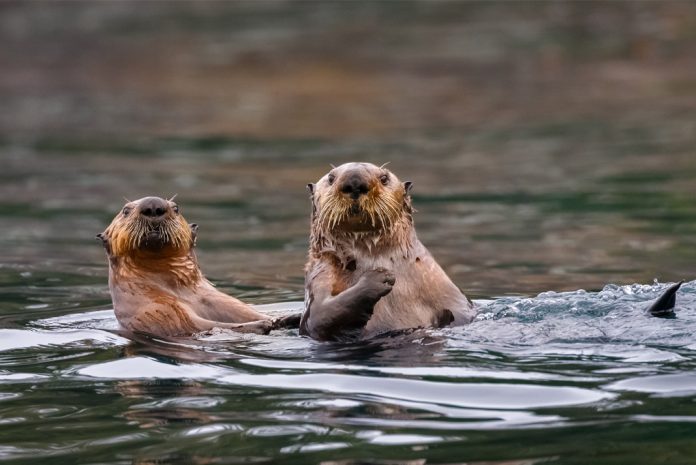
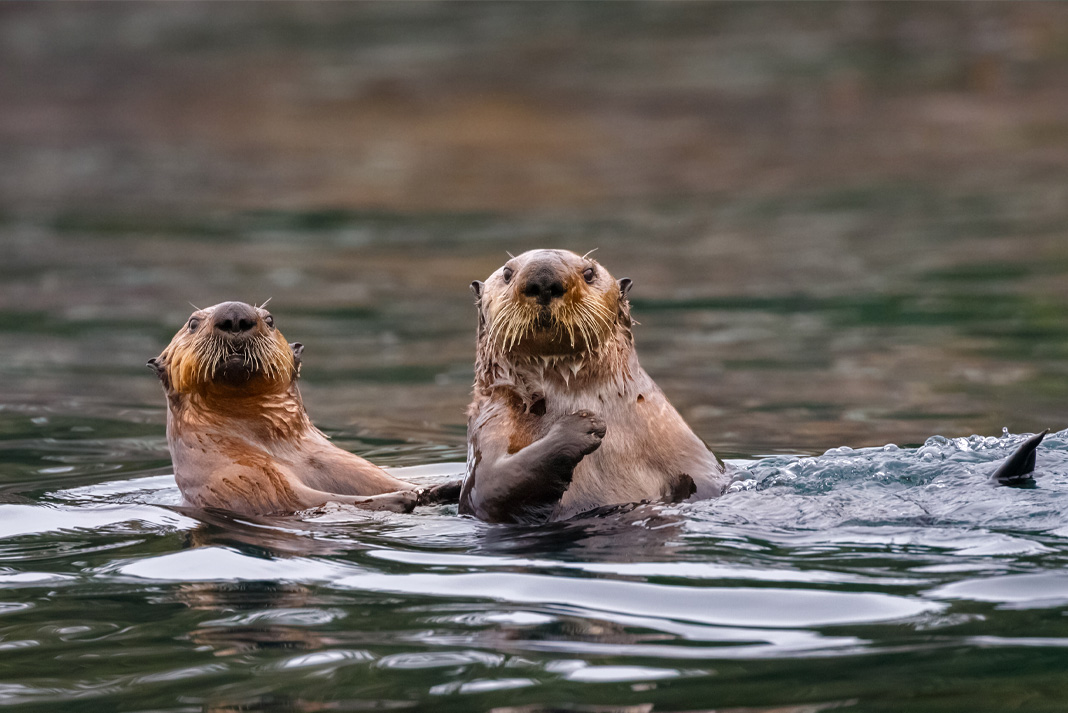
Otters are part of the Mustelidae family, which includes skunks, weasels, wolverines and badgers. The sea otter is the largest member of the weasel family, but the smallest marine mammal in North America. | Photo: istockphoto.com
I’m drinking coffee on a seaside rock on Knight Island, Prince William Sound, Alaska. From the velvety fog comes a surprisingly loud crunch. It continues for twenty seconds. Then it stops. Ten seconds later the crunching noise resumes for another half-minute. The pattern continues.
I know the sound, although it’s been missing from my home state of Oregon for more than a century. It’s a fuzzy, adorable and hungry sea otter. The crunching noise is it cracking urchin, crab, clam or mussel shells, and munching on shellfish. The brief silences are when it dives for more grub. Sea otters eat a lot. Their appetite makes them an ecological keystone. And a movement is gathering steam to return them to the Oregon coast.
Otters’ undeniable cuteness, appetite, ecological importance and near-extinction are all linked together. They once ranged from Baja to Japan. Their thick, plush fur led them to be hunted relentlessly, disappearing from much of their range by the early 1900s. Their fur is so thick because they lack the blubber other marine mammals use to keep warm. It also means they need to eat a lot to keep pumping out the BTUs.
“Otters eat about 25 percent of their weight in shellfish every day,” says Bob Bailey of the Elakah Alliance, the organization spearheading the otters’ return to Oregon. “For an 80-pound otter, that’s three and a half tons of shellfish a year.”
Otters are part of the Mustelidae family, which includes skunks, weasels, wolverines and badgers. The sea otter is the largest member of the weasel family, but the smallest marine mammal in North America. | Photo: istockphoto.com
A relentless appetite means sea otters have an outsized influence on marine ecosystems. In the absence of hungry otters, urchins munch through kelp, seagrass and eelgrass beds, creating vast urchin barrens where there were once productive nurseries for fish. Where otters survived or were successfully reintroduced, the kelp forests have come back. Otters survived in areas of Northern California and Alaska, and were reintroduced to the west coast of Oregon, Washington and British Columbia (B.C.). The Washington and B.C. populations survived. The Oregon population did not.
[Paddling Trip Guide: View All Wildlife Viewing Trips]
There are plenty of reasons to bring back otters. They’re cute, and as any kayak guide in Monterey, California, can tell you, cute otters equal tourism business. Healthy kelp forests and seagrass and eelgrass mean more fish for commercial fishermen, Orca and local residents alike. Kelp, freed from urchin munching, grows fast and sucks up carbon dioxide. By one estimate, otter-restored kelp forests store 8.6 billion kilograms of carbon, worth $408 million on the European Carbon Exchange.
“Come for the cute, stay for the carbon,” says Jules Bailey, a former Oregon legislator.
I’ve paddled with otters on the B.C. and California coasts. They make the coast come alive, popping up in kelp beds and sleeping together in giant rafts. When I came across one snoozing group, most dove, but one pup decided to head-butt my kayak bow first. I desperately want them back on the Oregon coast.
But there’s more to do than just scooping up a few cute fuzzy Alaskan otters and letting them loose in Oregon. The Elakah Alliance is launching a two-phase process. Phase one is a feasibility study. Where are the best spots, with enough shellfish, offshore rocks for kelp to adhere to, or estuaries with seagrass beds? Since Oregon was the transition zone between northern and southern sea otter subspecies, how many animals of which type? How many otters are needed to survive and spark a new population? What gender mix? The ripple effects of new changes, like warming oceans and the stress on shellfish of ocean acidification from greenhouse gasses—are hard to predict but make otters even more critical.
“The nearshore ecosystem is already under stress, and we’ve been living on borrowed time,” says Bailey. “Returning otters and kelp forests is something we can do and will build the ocean’s resilience to coming changes.”
The second part of the plan is the human element. Bailey, a retired coastal planner, is planning an economic analysis, looking at the ripple effects otters could have on fisheries, tourism and coastal communities, many of which have been smarting from a long-running decline in timber jobs and declining fish populations.
“The approach is consensus-based,” says Avalyn Taylor, an Elakah board member. “It’s an opportunity to right a past wrong in a very tangible way,” she says. “Otters could be back within my kids’ or grandkids’ lifetime.”
Sitting on my rock in Alaska, listening to otters munching away as the Chugach Range slowly emerges from the fog, I’m hopeful it won’t take so long.
Neil Schulman writes and paddles in Portland, Oregon.
This article was first published in Paddling Magazine Issue 62. Subscribe to Paddling Magazine’s print and digital editions here, or browse the archives here.
Otters are part of the Mustelidae family, which includes skunks, weasels, wolverines and badgers. The sea otter is the largest member of the weasel family, but the smallest marine mammal in North America. | Photo: istockphoto.com