Whitewater paddlers have caught on to the stroke power benefits of blade-forward offset, and with this we are seeing more paddles incorporating the design element. For 2024, Werner has introduced a new blade-forward paddle lineup. Here with an initial reaction is Simon Coward, owner of AQ Outdoors (AQ Outdoors is a paddling shop and school with locations in Calgary and Edmonton). The following is a transcript of Coward’s review.
We’re checking in with a first-thoughts review on the Werner Stealth and Werner Covert paddles. This is the first time I’ve had them in my hands, so please take all this with a grain of salt. We’ll check back in soon once we get them on the water.
A close look at the blade offset on Werner’s new paddles. | Image: AQ Outdoors
The Stealth is the large blade model and the Covert is the smaller blade version. They’re both the same paddle but designed with different paddler types in mind. Initially, when I look at this paddle, it looks quite different from things that Werner has made in the past. Most notably the combination of materials in the blade.
Paddle construction
You have a combination of foam core in the middle and then you have laminate carbon on the outside. It’s nice and thin through the laminated carbon which is going to make feathering and slicing the blade through the water really smooth and nice. Then you have this foam core built in, which is going to add strength and durability.
You also have that typical ridge that Werner builds into their blades which helps with strength. It’s very narrow where the blade joins the shaft and I think that’s going to be great for nice vertical paddle strokes because you’re not going to have that lower volume there that’s going to bash off the side of your boat.
A blade beneficial to your forward stroke once you have the feel for it. | Image: AQ Outdoors
Blade-forward design
Conversely though, the volume of the blade, especially in the Stealth, is quite big and it carries that volume all the way to the end of the paddle. In shallower water river environments, you’re still going to get power forwards and backwards out of that blade because there’s ample volume all the way through.
It also has the offset forward blade, which gives a more powerful catch and it’s something I’ve become a big fan of over the years. The Surge, Stealth, Odachi, and Galasport paddles, they all incorporate that into the blade design and it does make for a very powerful catch.
Now it does feel quite different in my hands versus a traditional Werner paddle like a Shogun. I think that might take a little bit of getting used to for some people.
What I would like to see as the paddle gets more use is how durable it’s going to be. It’s not going to be as durable as a composite fiberglass paddle from Werner, but I’m hopeful that it’s going to be as strong as a Shogun or a Double Diamond.
AQ Outdoors offers retail and kayak instruction in Calgary and Edmonton. Learn more about their school and stores at AQOutdoors.com.
he depiction of the gigantic, man-eating great white that dominated movie theatre screens in the 70s might have been a touch sensationalized. In 2023, the International Shark Attack File reported just 120 shark bites worldwide among the hundreds of millions of people who take to the ocean. The likelihood of a shark attack on a kayak or paddleboard is even slimmer. Of those reported incidents in 2023, just nine included boats such as kayaks.
Sharks inhabit all five of the Earth’s oceans and can even reside in freshwater lakes and rivers. A large part of what draws us to paddling across oceans or a local bay though is the opportunity to feel connected to the vastness of our planet and its astonishing beings.
So, what does this mean for you, especially if you’re a coastal kayaker? Well, you could go an entire lifetime of paddling and never have an interaction with a shark. But you should also be aware anytime you leave a coastal launch an encounter is a possibility. Some paddlers even hope for the opportunity to witness a shark on the water.
There are many misconceptions about sharks, and we aren’t seeking to perpetuate fears, but to be real with ourselves, just like a river carnage video we just can’t look away from a good shark video posted online. From encounters caught on camera we also gain a better understanding of shark behavior. Here we’ve rounded up some of the wildest encounters on video over the last decade.
Wildest shark encounters with kayaks and paddleboards
Sea kayaker chased by shark
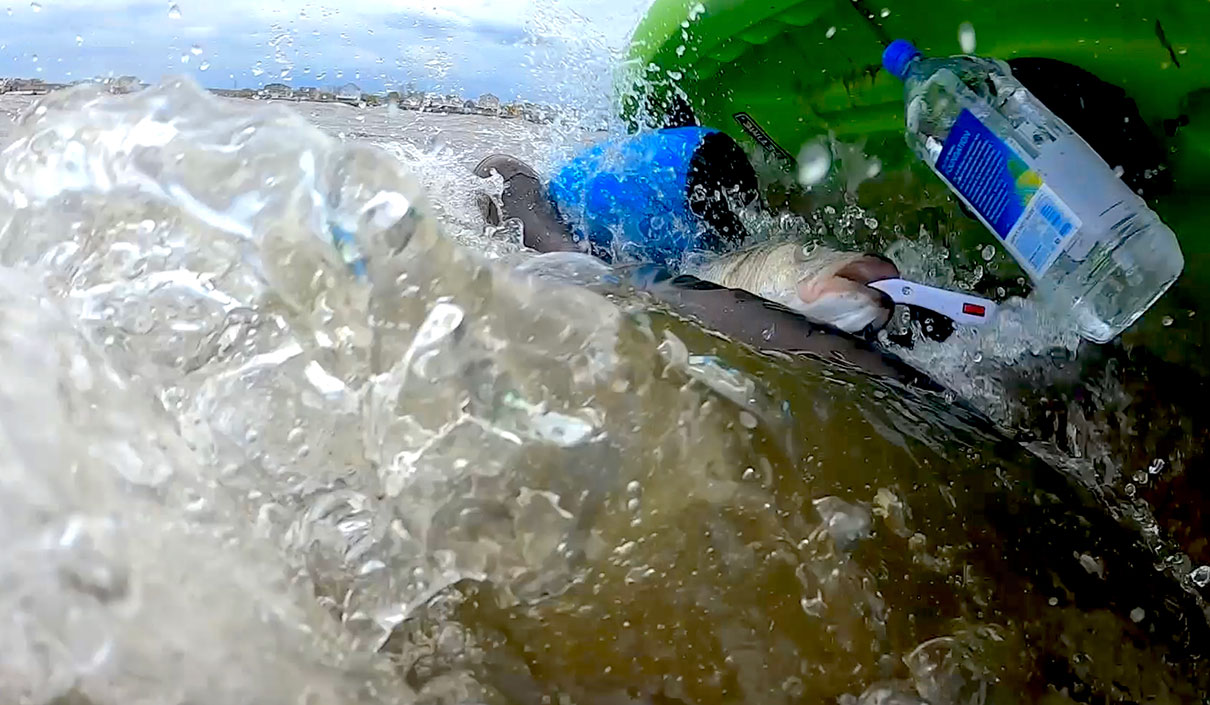
Experienced sea kayaker, Drew Trousdell, had paddled in the area at least 50 times before and had never seen a shark. This day was one for the books, as he was charged by (what he believed to be) a 5-foot blacktip shark. Watch until the end to see how his carbon Werner paddle faired in the interaction.
Spinner shark drops in on wave
Maximo Trinidad just paddled into his wave and starts to shred down the line when a spinner shark without etiquette snakes his wave with its signature twirling breach. Spinners sharks migrate up and down the Florida coast multiple times a year, providing an entertaining visual display from shore, and a slightly more concerning one if you’re out in the lineup.
Kayaker falls into sharky waters
A marine biologist and shark enthusiast accidentally fell into shark-infested waters while leaning over a little too far to retrieve the glasses he had dropped in the water. If it were us, we would have ditched those glasses.
SUP racer trailed by hammerhead
According to CBS affiliate 10 Tampa Bay, Malea Tribble and her husband, Rickey Tribble, were participating in the Crossing for Cystic Fibrosis relay race from the Bahamas to Florida when a hammerhead shark showed up behind Malea’s paddleboard. The racer’s hopped in the support vessel until the shark moved along
Surrounded by white sharks
If you’re looking for evidence sharks are near us far more often than we realize, look no further than the videos of Carlos Gauna. Gauna’s YouTube channel shares his collection of drone work filmed off the coast of Southern California, and shows just how often kayakers, paddleboarders and surfers are within close proximity to sharks without negative interaction.
Standup paddleboarder thrown into water
A woman is watching a shark maneuvering close to her paddleboard. Then the shark appears to bump the board, knocking the woman into the water. The paddler falls onto the shark with a WWE-like elbow drop. Rumor has it both the woman and the shark came away from the incident unharmed.
Kayak angler capsized by shark
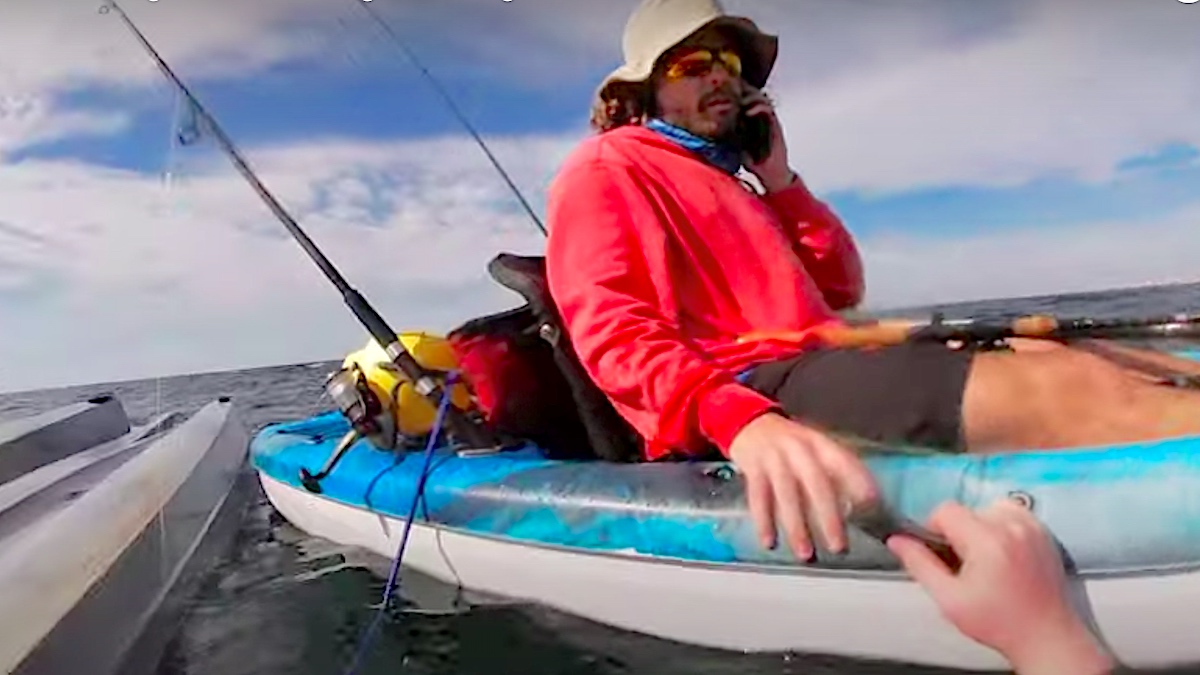
This Florida kayak angler reeled in more than he bargained for. The shark not only hijacked his rod and fishing setup—it wanted the kayak too.
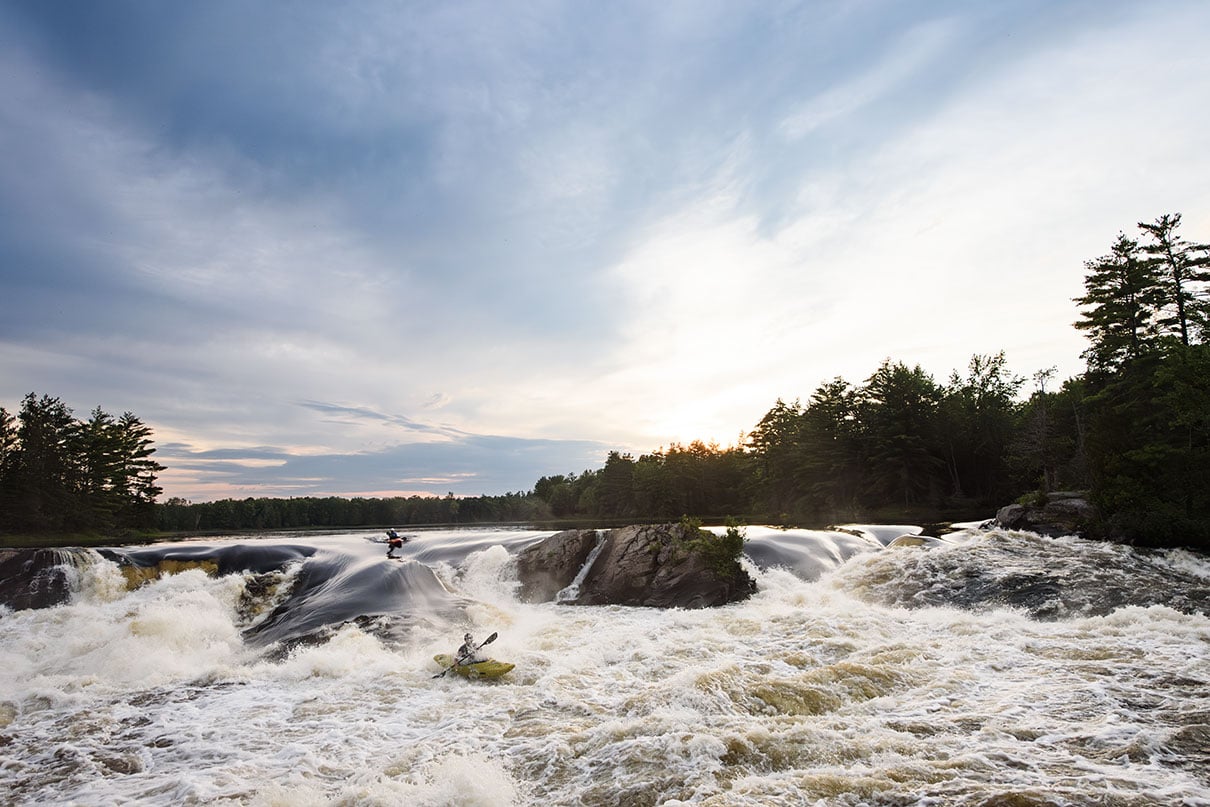
“Tracing one warm line through a land so wild and savage.” —Stan Rogers, Canadian folk singer | Feature photo: Courtesy The Arctic Cowboys
In November 2022, an unusual call found its way into Paddling Magazine’s Facebook newsfeed: “Teammates wanted for Northwest Passage kayak expedition: Must be able to sea kayak in very cold, turbulent waters for 12 to 20 hours at a stretch… Expedition will potentially take 4+ months… While venting is accommodated, whining won’t be tolerated. No pooping inside the tent, regardless of the weather.”
This ad for expedition partners was posted by endurance paddler West Hansen, and it’s an unlikely origin story for 2023’s most significant expedition. From this inauspicious beginning, the Arctic Cowboys were formed, setting the stage for a historic journey. On October 8, 2023, the foursome completed a world-first—a single-season, human-powered traverse of the Northwest Passage. This 1,600-mile route through Canada’s Arctic Archipelago, from Baffin Bay to the Beaufort Sea, was first recorded by Norwegian explorer Roald Amundsen between 1903 and 1906 and has beckoned adventurers since. Over the last four decades, roughly 20 expeditions of hardy paddlers and ocean rowers have attempted to complete the Passage, most over multiple seasons. A single-season traverse by kayak has only recently become possible due to a warming Arctic and greater sea ice melt.
“Tracing one warm line through a land so wild and savage.” —Stan Rogers, Canadian folk singer | Feature photo: Courtesy The Arctic Cowboys
When Paddling Magazine spoke with expedition leader Hansen two months after returning home to the Texas sun, he said his toes were almost back to 100 percent. “A couple of them are still numb from frostnip, but my fingers have recovered. I think everything’s going to end up working just fine.”
Hansen is a veteran of endurance races and expeditions. For this journey, he recruited his longtime paddling partner Jeff Wueste, 63, with whom he previously paddled the 4,200-mile Amazon River and Russia’s 2,100-mile Volga River. American marathon kayaker Eileen Visser and Scottish endurance athlete Mark Agnew were recruited through Hansen’s Facebook post and joined the team.
Over 83 expedition days, the team faced difficult conditions, including 20-foot breaking waves, 60-mile-per-hour winds, whiteout blizzards and near-continuous freezing temperatures. As summer gave way to autumn, conditions kept the paddlers stormbound on land for almost as many days as they were on the water.
“During the second part of the expedition, we were hemmed in on land 40 percent of the time. The waves were high, it was getting colder, and the days were getting shorter,” Hansen says. “We were concerned about the weather and the wind constantly, but I was never concerned we weren’t going to finish. I just knew it was going to be a lot rougher the later in the season we got. Some people on the team were willing to push the button for a rescue, but I never got to that point.”
Nothing came easy in the Passage. It wasn’t just Hansen’s frostnipped fingers and toes suffering. Wueste soldiered on through a torn Achilles tendon, testicular hernia and shoulder injury. He’s had two surgeries since returning home.
The expedition was five years in the making and was Hansen and Wueste’s second attempt. In 2022, the duo was beset by bad weather, unexpected delays and the departure of their third teammate. They pulled the plug 260 miles and 17 days into the journey. However, the aborted mission proved invaluable for planning the second attempt.
“Information for the Northwest Passage is sparse. I read everything I could, but nothing substitutes for being up there,” says Hansen. “We thought we could average so many miles per day. That turned out to be completely wrong. You have to account for sitting absolutely still because the conditions were much larger than we expected.”
Not only would a successful trip require more food and fuel, but the team left a month earlier to give themselves more time. The Arctic Cowboys also made critical gear adjustments, including swapping their drytop and drypant combos for full drysuits, single kayaks for tandems, and Crocs for Muck Boots.
Below, Hansen shares his insights on the gear and strategies the Arctic Cowboys used on the Northwest Passage.
What’s in West Hansen’s Northwest Passage sea kayaking kit
West Hansen after the successful expedition, back home under the Texas sun. | Photo: Erich Schlegel
1 Kindle
I’m a bibliophile. I enjoy reading novels as well as historic accounts of classic expeditions. My mother gave me this Kindle Paperwhite, and while I’ve never been a fan of e-readers, this was necessary because of space. When we were socked in our tent for six days at a time, there was nothing to do but read.
2 Muck boots
The first year, we had Crocs. They’re great for walking around in camp when you’re on a kayak expedition in warm climates. They didn’t work in the Northwest Passage. Our feet were always wet. Muck Boots are insulated, dry, light, easy to carry and rugged enough to handle sharp rocks. We’re not sponsored by Muck Boots, but I recommend them to everyone.
3 Layers
When we were moving, we were able to stay warm. The problem was the transitions—changing from our warm camp gear into drysuits was probably the hardest part of the expedition. Under the drysuits were polypro underlayers. We paddled with pogies and caps most days. Other team members could wear socks under their booties, but I couldn’t because my shoes were too tight, and my feet suffered.
I can’t tell you exactly how cold it was, though. We communicated with our support crew twice a day, and I asked them never to tell us the temperature. The last three weeks never got above freezing. We would hit the bank, and everything was frozen on the decks of our kayaks.
4 Winchester SXP Defender
We saw one to six bears every day, often with cubs. We saw them on the shore, on ice floes we navigated between and in our camps. They were smart and generally stayed away from us, but sometimes we’d have to shoot an exploding flare towards them. They took the hint and would run off. The shotgun was louder than the flares, so I used the gun maybe three or four times. The last bear we saw woke us up by rubbing against our tent. It got past our movement alarms because the batteries were dying. I couldn’t hear anything because my earplugs were in. The team poked me awake and pulled my sleep mask off. They were all sitting up, and I could see the silhouette of a bear against the tent wall. I was awake then.
5 Bear-torn shirt
I had laid this shirt across a boulder to theoretically dry out, as we had 24 hours of sunlight at the time. Then, the polar bear mentioned visited. When the bear left, I found he’d torn up my shirt. I guess he didn’t like my odor after not bathing for two months.
6 The Explorers Club flag
These flags go back to 1918 and are awarded to exceptional expeditions. This flag is number 214. It’s been on seven previous expeditions, including to Alaska, Russia and Belize.
7 North Face Bastion 4
We had winds up to 60 miles per hour and snow drifts piled up against the tent. The tent never threatened to come down. We had a giant vestibule out front to cook in. It was tight, but it kept us warm. The team didn’t come together until we met at the airport on the way to the Arctic. So, when we were up there, it was the first time we had spent with Eileen and Mark. It took some adjustment to get used to new people on an expedition. What was important in expedition partners was their sense of humor and the ability to get along with others. On shore days, we did crossword puzzles as a group, played trivia games and sang songs. By the end, we knew so much about each other that we didn’t really talk much.
A lot of people think it takes an adrenaline junkie to do this type of thing and just the opposite is true. I’m very cautious.
8 Musk ox horn
The musk ox are incredible animals. They’re like prehistoric cattle. Very ominous looking. You need special permission to take a horn out of the country, and you can see the little tag if you look closely.
9 Seaward Passat G3 XL
We switched from solo kayaks to tandems in 2023. I wanted to go faster—we knew the window of opportunity was limited, and you’re only as fast as your slowest team member. Tandem kayaks can also handle rougher conditions than a solo, on average. And, we could pile a lot more stuff on top of the tandem kayaks’ decks, and the volumes inside were greater.
At the end of the journey, we had completed the Passage but were still 150 miles from the community of Tuktoyaktuk. Winter was coming down on us like gangbusters. A Twin Otter plane picked us up, but the kayaks were too long to load. So, we cut four feet off the sterns with a hacksaw. A couple of guys on the team wanted to burn the kayaks, so I don’t think any of us were too heartbroken. They’re being repaired now.
10 Carry handles
These are gate handles from Home Depot. They’re large so you can fit a gloved hand underneath. When your hands are numb, you can’t manage little handles. It was a $5 fix. The kayaks are 90 pounds unloaded, but loaded and crusted in ice, they were closer to 400 pounds. It was a chore to drag them past the tide line.
I am just a regular guy. I’m a social worker. I’m not the fastest racer out there, and I certainly don’t have any money—I’m in debt from this expedition. A lot of people think it takes an adrenaline junkie to do this type of thing and just the opposite is true. I’m very cautious. A couple of our team members were gung ho, and they wanted to go when I considered the conditions too dangerous. We ended up sitting still for much more than they wanted, and there was a lot of tension because of that. But caution has helped me succeed on all my expeditions. Even in 2022, when we pulled the plug because the margin of error was too great.
These expeditions are more possible than people think. Yes, sacrifices are made. I hated being away from my wife and daughter; that was rough. Mark’s wife was pregnant, and they have a one-year-old at home. Jeff is self-employed and did a lot of business by satellite phone from 3,000 miles away. We’re just regular folks. We don’t have any special physical abilities. Perseverance is the key. If you really want to do something like this, you find a way to get it done.
This article was first published in the Spring 2024 issue of Paddling Magazine. Subscribe to Paddling Magazine’s print and digital editions, or browse the archives.
“Tracing one warm line through a land so wild and savage.” —Stan Rogers, Canadian folk singer | Feature photo: Courtesy The Arctic Cowboys
The Värmdö is a new offering from Melker of Sweden and the Paddling Mag team got a walkthrough of the compact touring kayak and its innovative, eco-friendly construction at Canoecopia 2024.
First look: Melker of Sweden’s Värmdö touring kayak
The Värmdö is a smaller kayak than Melker of Sweden’s previous models but packed with innovations, including a new material based on flax fiber and a cork core.
“We’ve introduced an all-new layup for the boats, so we are utilizing cork as the core material,” says Melker of Sweden founder Pelle Stafshede. He explains that the cork is made from the bark of a cork oak tree, which is harvested every nine years and can live for 250 years.
“Very good from a sustainability point of view,” Stafshede adds.
Adding to the Värmdö’s sustainability credentials, the flax fibers used in the kayak’s construction stem from a flower, creating a plant-based laminate. This is then infused with a bio-based or plant-based epoxy.
Named after the Stockholm Archipelago, where company staff live and work, the Värmdö also won the Best Sea/Touring Kayak in the fifth annual Paddling Magazine Industry Awards in November 2023. The award recognizes significant and innovative achievements in paddlesports product development.
“We’re now manufacturing all our products in Sweden; this has been the dream since I started the company back in 2015, to be able to manufacture in my own backyard,” says Stafshede.
The 13.5-foot Värmdö is 39 pounds and available in two colors; all natural and Melker’s signature turquoise.
For as long as he can remember, Robert Lester has been fascinated by water. As a child growing up in Butte, Montana, Lester would make miniature wooden boats and float them in waters feeding the mighty Columbia River. From an early age, he says he was fascinated by the “connectivity of rivers.”
At the end of each summer, Lester would concede his boat to the currents.
“I loved the idea that my little wooden boat could travel down the river to the ocean,” says Lester, 26, a professional skier, mountaineer and adventurer. “I decided then that I wanted to make the same journey. The name didn’t exist yet, but the Columbia River Canoe Project dream had been conceived.”
Lester’s dream was cultivated by hours spent studying western watersheds on Google Earth. It finally became a reality last May, when he and 19-year-old trip mate Braxton Mitchell launched their canoe on Silver Bow Creek in Butte and set off on a 1,300-mile journey to the Pacific Ocean.
“If I was going to make this expedition happen, I wanted to have the greatest positive impact I could,” Lester says. “I set the goal to use the expedition to inspire stakeholders near and far to empower measurable improvements for the Columbia River’s ecosystem and its future.”
Ultimately, Lester wanted to share the wonders he discovered as a youngster: to reveal how the Columbia forms a watery ribbon draining over 250,000 square miles of western North America, connecting people and ecosystems and tying the landscape together across seven American states and one Canadian province. But he didn’t shy away from a harsh reality: 19 hydroelectric dams on the Columbia have radically altered its flow.
“Raising awareness and making environmental improvements will not be complete until the Columbia Watershed is as wild and free-flowing as possible,” notes Lester.
Highlights of the trip included “the pure beauty we saw and the connection with nature we were able to develop after so much time outdoors in the natural world,” Lester says.
Of course, spectacular scenery was tempered by physical challenges, including a one-day, 24-mile portage. Lester and Mitchell portaged a whopping 175 miles along the entire journey. Lester says the expedition was most remarkable for the way it created a relationship between himself, Mitchell and the water, in making the first documented source-to-sea descent of the Columbia starting in its eastern headwaters.
“We lived on this river for 52 days,” he says. “For that time it was truly my entire life.”
Lester also hoped to better appreciate the connection local Indigenous communities still have with the Columbia Watershed. Immersing himself in the river was the perfect opportunity to begin to understand this relationship.
“There is an implication in some modern teaching that Native American culture is extinct or irreparably damaged,” he says. “This is not the case. While it has undoubtedly been damaged, the spiritual and cultural relationship that Indigenous people have with the land and water persists. This relationship needs to be encouraged and promoted. In addition, the value all people can derive by learning from the connection between Indigenous people and land and water cannot be understated.”
“Salish-speaking tribes lived off most of the land we traveled through sustainably for over 30,000 years,” he adds. “Modern society can learn a great deal about future sustainability from past practices. This level of sustainability is what society should strive toward.”
Playing in streams and rivers as a kid reinforced the messages Lester heard in school: water is the basis of life on Earth. But in the end, paddling 1,300 miles to the Pacific Ocean taught him an equally important fact, which will be central to a documentary film about the journey set to launch this fall.
“Human life centers around water bodies and waterways,” Lester says. “Indigenous people relied on waterways for hydration, food and transportation. Modern society still relies on waterways in the same ways—yet most people do not realize this importance.”
Tumplines are worn on the head, usually perched just behind the hairline—not over the forehead. Leaning forward aligns the load with the spine, utilizing the back for support. | Feature photo: David Jackson
Of all the epic portaging fails that have happened in a lifetime of canoe tripping, none was more memorable than a tumble on the bouldery high ground in the headwaters of the Lockhart River system northeast of Yellowknife in the Northwest Territories a few years back. We were in the early days of a seven-week canoe trip north toward Bathurst Inlet with no resupply, so there was a welter of stuff to carry when we ran out of paddleable water.
I’d carried the canoe and a blanket pack first, followed by another epic load of food. Then, saving the best to last, I hefted up our kitchen wanigan—aka “that f@#$%^& box.” I got the tump settled on my brains, heaved a Pelican case containing 33 pounds of camera gear on top of the wanigan, and staggered off to what could have been a life-altering crash.
It happened at the end of the portage, as many faux pas do. On my first trip, I tiptoed across a field scatter of boulders with the canoe and flipped it down where it sat nicely and could be reloaded with gear. On this trip with the wanigan, thinking the carry was all but over, I momentarily lost concentration on those last few steps. In a heartbeat, a slip on the rock pitched everything forward. The Pelican case arced ahead and splashed into the water, as did the wanigan, leaving me to continue the fall and do a very inelegant faceplant into the rocks.
Tumplines are worn on the head, usually perched just behind the hairline—not over the forehead. Leaning forward aligns the load with the spine, utilizing the back for support. | Feature photo: David Jackson
But here’s the lucky thing: pack straps would have kept the load more or less on my back and propelled me face-first into the rocks with even more force. Because the load was attached to me with just a wide leather tump strap, the load and I parted company for the betterment of all concerned. There was damage to me and the wanigan, but it could have been much worse. Saved by the tump, as it were. In honor of being delivered from death by that unassuming bit of kit, I’d like to send a little love in its general direction.
When it comes to load carriage, we’re awash in dubious improvements to what was very likely the first and simplest way to move stuff from one place to another: the tumpline. Back straps, external frames, internal frames, Trapper Nelsons, widgets, zippers, waist belts and chest straps—all came along after the tumpline and eclipsed the single head strap for reasons that might include the invention of cameras and other reasons to use your hands while carrying a load.
But, if you follow back load carriage to its first principles, the tump strap was the first and possibly the best innovation for getting loads from one place to another with the least possible effort.
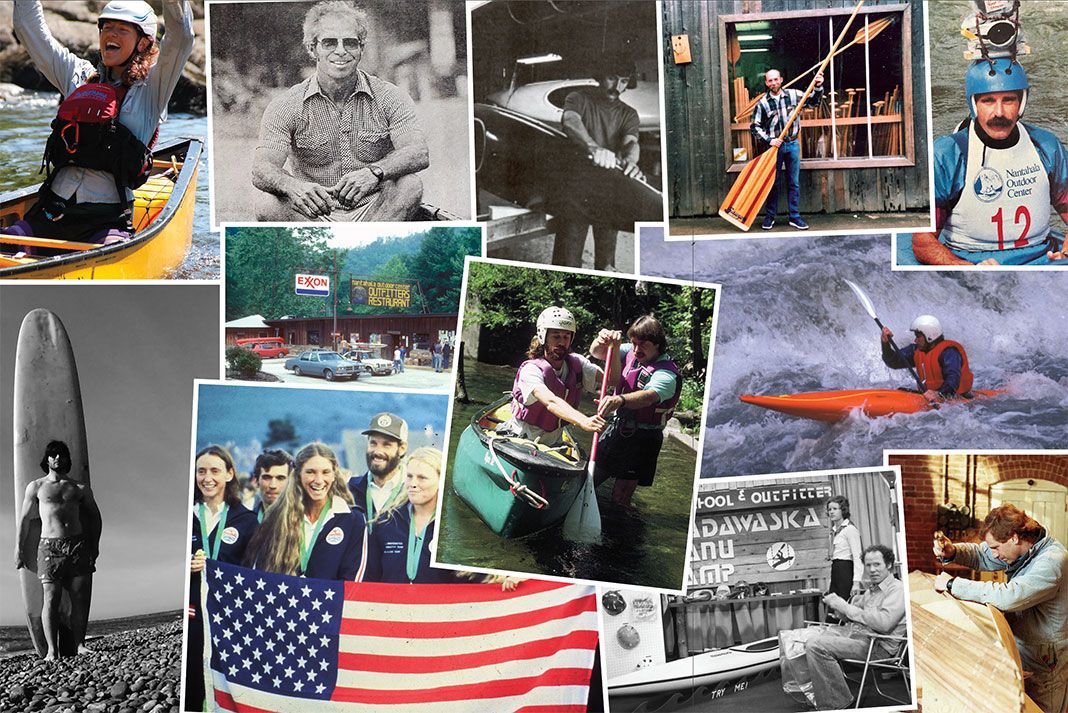
My affection for tumps is in some measure due to the innovative genius of French-Canadian shoemaker Camille Poirier, who transmuted the voyageur tradition of carrying heavy loads with one strap around your head to the green canvas, leather backstrap Duluth Packs created in the 19th century. The Woods Outdoor Company knocked these packs off in Canada, creating a family of packs purchased widely by Canadian summer camps, where I first began my canoe-tripping career.
We took these packs on canoe and hiking trips. On these journeys, I came to appreciate carrying at least some of the load on your head made a world of difference in the distances you could cover without collapsing into a weepy heap of protoplasm with no place to turn for respite.
It wasn’t until I began canoe tripping with friends that the idea of carrying a load with only a tump strap dawned. Tripping camps had been using wanigans with tumps for years. Once we got the kitchen wanigan going, it seemed the best way. For starters, it kept the spine straight and, once you got used to it, appeared to be a way to carry a heavier load for a longer distance than anyone ever could with just shoulder straps. The tump also allowed you to breathe because no straps constricted your chest. Maybe the Nepalese porters, African water carriers, beleaguered voyageurs and all those early hominids who needed to carry a load from place to place had something going on.
The 11th Canadian Infantry Brigade men using tumplines in 1917. | Photo: Dept. of National Defence/Library and Archives Canada
The incontrovertible proof that anyone serious about carrying a load should ditch the shoulder straps and fancy accoutrements of frames and instead adopt the tump strap comes from the 11th Canadian Brigade Tumpline Company during World War I. The problem was getting supplies from roads to the trenches in France, which often involved travel over muddy, conflicted ground not navigable by horse and cart. The only solution was to hand-bomb everything, which took an inordinate amount of manpower. Thanks to the wisdom of Staff Captain F.R. Phelan, a member of the Canadian Expeditionary Force who had done “considerable hunting and fishing in the back woods of Quebec,” the tumpline was introduced to the Allied war effort.
Phelan showed switching from backpacks and conventional hand-carrying of ammunition and supplies to tumplines reduced the manpower needed to supply the trenches by at least 50 percent. For example, a 93-pound Vickers machine gun could be carried by just one man with a tump. It would have otherwise required two men to carry it into the field. So chronicles an article by F.R. Phelan published in the Canadian Defence Quarterly in October 1928.
Twelve picks for digging trenches would require three men with ordinary carriage, but with a tump and a few carefully tied knots with the tump ties, the 78-pound load could be easily carried by just one soldier. The same is true with a load of six sheets of corrugated iron. Both cases would result in a 66.6 percent saving in labor and personnel.
Who knows if the tumps saved lives by moving the loads forward when members of the Tumpline Company slipped and pitched into the muck, but I’m guessing they did.
James Raffan is the former executive director of the Canadian Canoe Museum. He’s also an author, explorer and occasional Zodiac driver. Tumblehome celebrates the rich heritage of canoe culture.
This article was first published in the Spring 2024 issue of Paddling Magazine. Subscribe to Paddling Magazine’s print and digital editions, or browse the archives.
Tumplines are worn on the head, usually perched just behind the hairline—not over the forehead. Leaning forward aligns the load with the spine, utilizing the back for support. | Feature photo: David Jackson
ORLANDO, FLORIDA – To provide support for the newly formed Paddlesports Trade Coalition (PTC), the Water Sports Foundation (WSF) has agreed to become a sponsor of the group’s first-ever PTC Colab event in Oklahoma City Sept. 3-6.
As its name suggests, the PTC Colab was created to bring like-minded individuals together to build and renew relationships, improve business practices, and meet industry challenges. Colab also will include three days of whitewater and flatwater demos at the OKC Riversport adventure park in downtown Oklahoma City.
The Water Sports Foundation’s executive director, Jim Emmons said, “Every industry should be supported by a trade association dedicated to improving commerce, increasing popularity, limiting liability, and promoting safer participation. We’re excited that the PTC was formed to support the paddlesports industry and the Water Sports Foundation is proud to be a presenting sponsor of the PTC’s inaugural event.”
The Water Sports Foundation is a non-profit outreach organization, focused on boating and paddling safety. One of the WSF’s primary campaigns aims to reduce paddling accidents, which in 2023 accounted for one-third of all boating fatalities in the United States.
The PTC was formed by paddlesports industry leaders as a member supported organization and is led by an 11-member board of directors. Members include manufacturers, retailers, outfitters, sales reps and individuals with a common goal of growing participation and promoting safer paddling. The organization was created to represent the paddlesports industry as one unified voice.
The Water Sports Foundation was created in 2004 as the educational division of the Water Sports Industry Association (WSIA). Since 2011, the WSF has managed 54 U.S. Coast Guard administered federal boating safety grants promoting boating and paddling safety. The WSF’s projects encourage boaters and paddlers to practice safer behaviors.
The new relationship with the Paddlesports Trade Coalition promises to deliver increased paddlesports safety awareness through the industry’s manufacturer and retailer connections with consumer paddlers.
Paddlers know a thing or two about what the ancient Greek philosopher Heraclitus was thinking when he famously said, “No man ever steps in the same river twice, for it’s not the same river and he’s not the same man.” There is no shortage of outstanding waterways around the world for canoeists, kayakers and rafters to explore—and each one is as different as the people who paddle them. Whether you’re looking for thrilling whitewater, vast wilderness, rich culture or incredible scenery, the world’s bucket list of amazing rivers is mighty deep.
With the words of Heraclitus in mind, some die-hard paddlers will scoff at this article’s premise of picking out a discrete number of the most beautiful rivers in the world for canoeing, kayaking and rafting adventures. But here’s our best shot at a (relatively) short list of the world’s greatest rivers for paddling.
VIEW ALL TRIPS
1 South Nahanni River, Northwest Territories
There’s something for just about every type of paddler on Canada’s iconic South Nahanni River. The river is the centerpiece of Nahanni National Park, set deep in the Mackenzie Mountains of the Northwest Territories. Guided rafting expeditions allow mere mortals (including adventurous families) to experience the depths of the South Nahanni’s incredible canyons; portaging is limited to the hike around Virginia Falls, a mesmerizing 100-meter torrent. Meanwhile, skilled whitewater canoe trippers can paddle the entire waterway from the Moose Ponds to the Liard River, a three-week life-list wilderness expedition.
Photo: Joris Beugels/Unsplash
2 Alsek River, Yukon and Alaska
The Alsek River originates in the meltwater of the world’s largest non-polar ice cap in Kluane National Park, traverses deep wilderness surrounded by some of North America’s highest peaks, and provides great opportunities to view grizzly bears as it drains into the Gulf of Alaska. Guided rafting expeditions make the Alsek accessible to all levels of paddlers. Trips include great meals, side hikes off the river and a unique helicopter portage around the Turnback Canyon. Set aside 10 to 14 days to paddle the entire 255-kilometer waterway.
3 Thelon River, Northwest Territories and Nunavut
The late canoe guide and outfitting pioneer Alex Hall called the Thelon River a subarctic Eden. This lengthy waterway flows smoothly and steadily across Canada’s Barrenlands, from the Northwest Territories to Hudson Bay’s western shore. In comparison to other northern waterways, the Thelon is rather bucolic, making it suitable for wilderness-savvy canoeists with limited whitewater skills. It serves as an oasis for iconic northern wildlife; caribou, wolves, grizzly bears and more can be seen in the Thelon’s sparsely forested valley.
4 Bloodvein River, Ontario and Manitoba
The Bloodvein River is a Canadian Heritage Waterway originating in Ontario’s Woodland Caribou Provincial Park and ultimately draining into Manitoba’s Lake Winnipeg. The Bloodvein is a popular river for wilderness canoe trippers looking to take the next step in experiencing a new level of remoteness. It flows in a pool-and-drop fashion through a corridor of polished granite and boreal forest, where it’s possible to view elusive woodland caribou and contemplate ancient Indigenous pictographs on rock faces. Tracing the entire Bloodvein takes about three weeks. You can also charter a floatplane for a shorter outing or sign up for a guided Bloodvein River canoe trip.
Photo: Kyle Mesdag/Unsplash
5 Ottawa River, Ontario
Flowing through the heart of Canada’s National Capital Region, the Ottawa River is a world-renowned destination for whitewater paddlers. There’s something for everyone here, including exciting rafting excursions for thrill-seeking beginners, great instructional courses for whitewater canoeists and kayakers looking to develop their skills, and world-class natural features for freestyle boating. Best of all, the Ottawa is surrounded by amazing scenery and is paddleable spring through fall.
6 Bonaventure River, Quebec
Located in Eastern Quebec, the scenic Bonaventure River flows from the Chic-Choc Mountains on the Gaspé Peninsula to the Atlantic Ocean. The Bonaventure is noted for its amazing turquoise waters and a mix of class I and II rapids, making it a fantastic destination for intermediate canoeists seeking a bucket-list-worthy river trip. Guided one-day and multiday packages are also available from local outfitters for canoeists and paddleboarders alike.
Photo: Hobby Photographer/Pixabay
7 Missouri River, Montana
The Wild and Scenic-designated Missouri River cuts through the stony heart of Lewis and Clark Country in Montana. Known as the White Cliffs section, the Upper Missouri brings history alive, with austere scenery blending a unique mix of badlands and Great Plains. The river’s meanders and gentle current are suitable for experienced flatwater canoeists.
8 Suwannee River, Florida
The Suwannee is not only one of the longest undammed rivers in the Southeast, its 246-mile course from Georgia’s Okefenokee Swamp to the Gulf of Mexico ranks it among the greatest free-flowing waterways in the entire Lower 48. The Suwannee provides paddlers with a glimpse of the Old South, where majestic live oak trees, crystal clear springs, and quaint towns replace the usual Florida scenes of theme parks and condos. The Suwannee can be paddled by kayakers and canoeists alike, all part of a wilderness water trail that makes it easy to plan campsites along the way.
Photo: Jim Black/Pixabay
9 Salmon River, Idaho
You cannot call yourself a whitewater boater if you don’t get excited about a waterway known as The River of No Return. The Middle Fork of the Salmon River flows through some of the wildest country in the Lower 48, including over two million acres of federally designated wilderness. Guided rafting trips make it possible to experience the otherworldly rock formations, canyons and crystalline water of the 105-mile-long Middle Fork of the Salmon.
10 Green River, Utah
There’s a good reason why so many paddlers spend years waiting on a lottery spot to paddle the Colorado River’s Grand Canyon. Yet in many ways the Green River is just as spectacular—and far more accessible in terms of ease of scoring a permit and the paddling skills required to navigate it—as the “big ditch.” The Green’s lengthy flatwater sections are suitable for canoeists and sea kayakers. Paddling trips are paired with wilderness camping and exceptional hikes through arid landscapes with incredible Indigenous and settler histories.
Photo: Rob Wicks/Unsplash
11 River Wye, United Kingdom
The River Wye is one of Britain’s longest waterways, flowing over 250 kilometers along the border of England and Wales. The Wye is a gem for history buffs and nature lovers alike, revealing the human history of the United Kingdom with ancient cave dwellings and Roman settlements, and providing some of the country’s greatest biodiversity, including otters and a variety of birds. The Wye is suitable for canoeists following a water trail of attractions along the way.
Photo: Blaz Erzetic/Unsplash
12 Soča River, Slovenia
Flowing out of the Julian Alps near the Italian border, Slovenia’s Soča River is one of Europe’s finest waterways for whitewater boating. The best section for whitewater kayaking stretches from Lepena to Čezsoča, with multiple options ranging from class I to IV rapids for beginners to advanced paddlers, along with stunning emerald-colored waters and views of the Alps. Guided trips and instructional packages are also available.
Photo: Fietzfotos/Pixabay
13 Danube River, Germany and Hungary
The Danube is the second-longest river in Europe and it crosses a vast geography, with each country offering a myriad of options for paddlers. The river’s headwaters in Southern Germany provide easy rapids and watery perspectives of the famous Black Forest. Meanwhile, riverside castles in the Hungarian capital of Budapest speak to the 2,850-kilometer-long waterway’s history as a trade route across from the Alps to the Black Sea.
Feature photo: Eduardo Lages/Unsplash
14 Douro River, Portugal
The idyllic Douro River reflects quintessential Mediterranean scenery, with verdant pastoral hills, ancient homesteads and some of the planet’s best vineyards. It’s possible to paddle inn to inn by canoe or kayak, with guided trips available to provide a more immersive journey. Several tributaries of the Douro offer unique experiences on smaller watercourses with the same Old World feel.
15 Whanganui River, New Zealand
The Whanganui River is a cultural treasure amongst New Zealanders, evidenced by it becoming the planet’s first waterway to garner the status of legal personhood in 2017. Canoeists can experience the Whanganui along a government-designated water trail, which simplifies planning for three- and five-day trips, starting in the community of Taumarunui and finishing in Pipiriki. The river features amazing birdlife, fantastic backcountry camping and rich Indigenous heritage, with local Māori people remaining key river stewards today.
Photo: Ignacio Plaza/Unsplash
16 Futaleufú River, Chile
The Futaleufú is a rite of passage for big water kayakers, featuring aquamarine waters and some of the most powerful rapids on the planet in the wilds of Patagonia. Pro boaters have their own hard-earned secrets about the Futa. For ordinary paddlers, the so-called Bridge to Bridge section of the river serves up (somewhat) less scary class IV water with great play features. Guided rafting trips are also available.
17 Alseseca River, Mexico
The wild rivers and steep creeks of Mexico’s Veracruz region, east of Mexico City, have legendary status amongst whitewater paddlers. In particular, the Big Banana section of the Alseseca River features an incredible series of world-class waterfalls, stacked one after another and surrounded by lush rainforest. Along with this epic section, a handful of other parts of the Alseseca and neighboring waterways make this a dream winter destination for expert boaters.
Westbrook Supply Company owner Fletcher Griffin working his kayak rigging magic. | Feature photo: Westbrook Supply Co.
Tucked up a river mouth on Long Island Sound is a workshop where Joe Harasyko is turning wrenches to modify some seriously tricked-out rides. The creations he is dialing in with lights, electronics and gear aren’t of the four-wheeled variety you’d see rolling out the garage doors in a scene from Vice Grip Garage though. Harasyko is the rigging manager for Black Hall Outfitters, a paddling shop in Old Lyme, Connecticut that does a booming business in customized fishing kayaks. One of two full-time riggers at the shop, Harasyko is in charge of transforming stock kayaks into some of the most elaborate bass sleds you’ve ever set eyes on.
Rig my ride: How kayak customization boosts the bottom line
Black Hall owner Gene Chmiel says the shop has been customizing kayaks for around five years, and as participation in outdoor sports soared the desire for tricked-out fishing kayaks has followed suit. Now it’s a mainstay of his business, with no end in sight.
During that time kayak fishing has continued to grow, both in overall participation and as a share of the recreational fishing market. The Outdoor Industry Foundation reports that 47 million people went fishing in the United States in 2017, of whom five percent fished from kayaks or other non-motorized craft. Five years later in 2022, those figures had grown to 52 million anglers and six percent using kayaks. That’s more than three million kayak anglers in the United States alone.
Westbrook Supply Company owner Fletcher Griffin working his kayak rigging magic. | Feature photo: Westbrook Supply Co.
Customization Goes from Joes to Pros
While some kayak anglers are drawn to the quiet simplicity of a paddle and an old spinning rod, many more get into kayak fishing to catch fish with every bit of high-tech firepower a 14-foot hunk of floating plastic will carry. One look at the multitude of DIY rigging projects on YouTube will prove just how resourceful and obsessive kayak anglers can be. They want kayaks that can go toe-to-toe with full-size fishing boats, and they’re ready to pay expert riggers like the team at Black Hall for them.
“It’s where the sport is going,” Chmiel says, adding that not everyone has the confidence to start drilling holes in perfectly good kayaks. “There’s a small percentage of people willing to do it themselves, but a lot of people are intimidated by it,” he says.
Even with boats that already cost a few thousand dollars off the shelf, Chmiel says custom rigging is a service customers are willing to invest in. He estimates half the kayaks Black Hall sells have some degree of customization. This translates to about 15 rigging jobs per week, with the more elaborate setups pushing the total sale and service toward the $10,000 mark.
Black Hall is one of a growing list of shops around the country building custom fishing kayaks. Another is Westbrook Supply Co. in Atlanta, Georgia. Owner Fletcher Griffin says customizing fishing kayaks has been a part of the business since he opened the shop in 2017, but rigging has really taken off in the last two years. He’s also noticed something interesting in the demographic of anglers who’ve been seeking out builds.
Black Hall Outfitters owner Gene Chmiel (left) and rigging manager Joe Harasyko, (center) turn customer dreams into fish-slaying machines. | Photo: Black Hall Outfitters
NFL Hall of Famer Tedy Bruschi is a happy Black Hall customer, and this is why. | Photo: Black Hall Outfitters
“These elaborate fishing kayaks are pulling people from johnboats and bass boats, not necessarily from a paddling background,” Griffin says. “Guys are coming down from the bass boat world and embracing the kayak scene. A paddler sees the price of these custom kayaks and they may think that sounds like a lot, but it’s all perspective. When you’re coming from a $50,000 bass boat, a fishing kayak is just more economical and there is less to deal with.”
Rigging to the Stars
Shops like Westbrook Supply and Black Hall Outfitters are garnering wide notoriety for their work. Black Hall is shipping boats from Connecticut to buyers as far afield as Texas and Montana. They’ve even done some work for celebrity figures.
In spring 2023, Harasyko built out an Old Town AutoPilot 136 for New England Patriots Hall of Famer Tedy Bruschi. The kayak featured Boonedox Landing Gear, Lowrance radar, a Power-Pole, interior lights, and a spotlight just to get started. The fact Bruschi, who is a boat fisherman as well, is investing this much in a kayak says as much about the work of Black Hall as it does about the rising tide of elaborate kayak builds.
“He found out about us and brought his boat in,” says Chmiel. “Now he’s a friend of the shop and totally into kayak fishing. He’s even recommended us to other NFL players.”
Chmiel, who spent 20 years in marketing prior to starting a kayak shop, sees this as just the beginning to future growth of customizing fishing kayaks.
Black Hall is already fabricating and 3D printing their own parts to fill gaps in what’s available on the market in terms of bars and mounts. For Chmiel, going the route of the car world and rigging these rides was an obvious move for his shop, and one he suggests to other retailers who can support it.
“We saw the opportunity and we’ve been active in pushing it out. Any time in retail you can add those additional sales and have those incremental rings it’s all upsell. The need is there, and it creates a point of difference for the shop.”
This article was first published in the 2024 issue of Paddling Business. Inside you’ll find the year’s hottest gear for canoeing, kayaking, whitewater and paddleboarding. Plus: forty years in the Four Corners, robotic kayak rentals, building the Paddlesports Trade Coalition and more. READ IT NOW »
Westbrook Supply Company owner Fletcher Griffin working his kayak rigging magic. | Feature photo: Westbrook Supply Co.
When faced with a big rapid, kayaker Charles Cailyer first slows his breathing to slow his heart rate. “Then, I think of my mother, who died a couple years ago. I thank her for giving me life and imagine her with me. Then, I focus and I send it.” | Feature photo: Caleb Gingras
Are you superstitious about running big rapids? Or is a ritual you always perform to calm your nerves and conjure up some good river karma prior to a big run? In case you need some luck, we asked nine pro whitewater kayakers share their go-tos.
9 curious superstitions and reliable rituals of pro whitewater kayakers
“Every time I run Spirit Falls, I look up in the sky, throw a handful of water up in the air, and watch each droplet fall back down. I’m asking my paddling buddies who are no longer with us for a soft landing each time.”
—Dave Fusilli
“Treat the river with respect, or it will remind you who’s in control. This means even talking nicely to it. They have found water crystallizes differently depending on the tone and what you’re saying to it. Mean and angry = non-symmetrical crystals. Kind and nice = beautiful symmetrical crystals. Every time I paddle, I focus on gratitude and sometimes even talk to my surroundings.”
—Emily Jackson
“I have this weird little eddyline thing on my home run, which is an unnamed rock 200 yards above Upper Zigzag on the Truss on the White Salmon River, and I tell myself my line through that little weird eddyline will be an indicator of how good my line on the next main rapid (Zigzag) will be. It’s probably pretty accurate since it’s a test of how well I’m paddling that day.”
—Leif Anderson
“I splash my face three times before any big rapid.”
—Mariann Saether
“Always put your kayak on the car going the correct way—facing forward, the way you want to go kayaking.”
—Adriene Levknecht
“Don’t spit in the water. I never spit in the water. I always think the river might throw some river karma at me if I do.”
—Mike Dawson
“River karma. We all have positive and negative behaviors on the river. When too many people are loose and unsafe, accidents happen within the community. Most of the time, it doesn’t make any sense; it’s unfair, random and tragic. I believe that, in some ways, we all have our own responsibilities. Every time someone gets lucky, someone else might not get away with a bad line or hidden hazard. I call it river karma, but I guess it’s more a probabilistic approach to whitewater accidents.”
—Nouria Newman
“Anointing your kayak with burning sage.”
—Natalie Anderson
“I always check my sprayskirt before leaving the eddy after I’ve scouted or left the boat. It’s not like I didn’t check it immediately after pulling it over the cockpit rim, but I check it again. Maybe that’s idiosyncratic more than superstitious, but I feel slightly off if I don’t. Also, when in doubt, I portage that stout with my boat always on the riverside shoulder, which I think is a strategy as much as superstition.”
When faced with a big rapid, kayaker Charles Cailyer first slows his breathing to slow his heart rate. “Then, I think of my mother, who died a couple years ago. I thank her for giving me life and imagine her with me. Then, I focus and I send it.” | Feature photo: Caleb Gingras
This article was first published in the Spring 2024 issue of Paddling Magazine. Subscribe to Paddling Magazine’s print and digital editions, or browse the archives.
When faced with a big rapid, kayaker Charles Cailyer first slows his breathing to slow his heart rate. “Then, I think of my mother, who died a couple years ago. I thank her for giving me life and imagine her with me. Then, I focus and I send it.” | Feature photo: Caleb Gingras