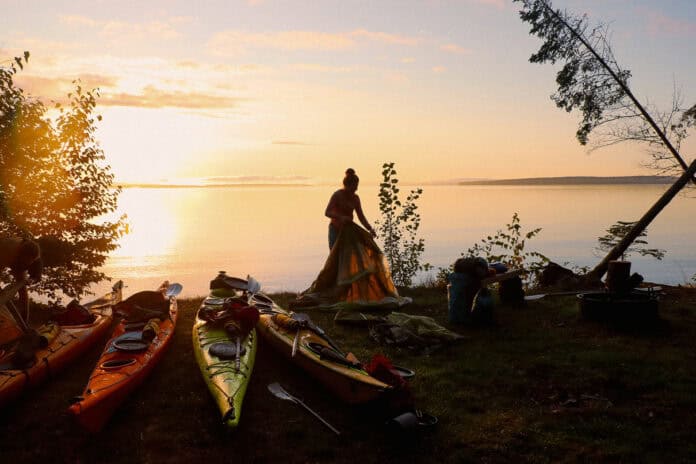
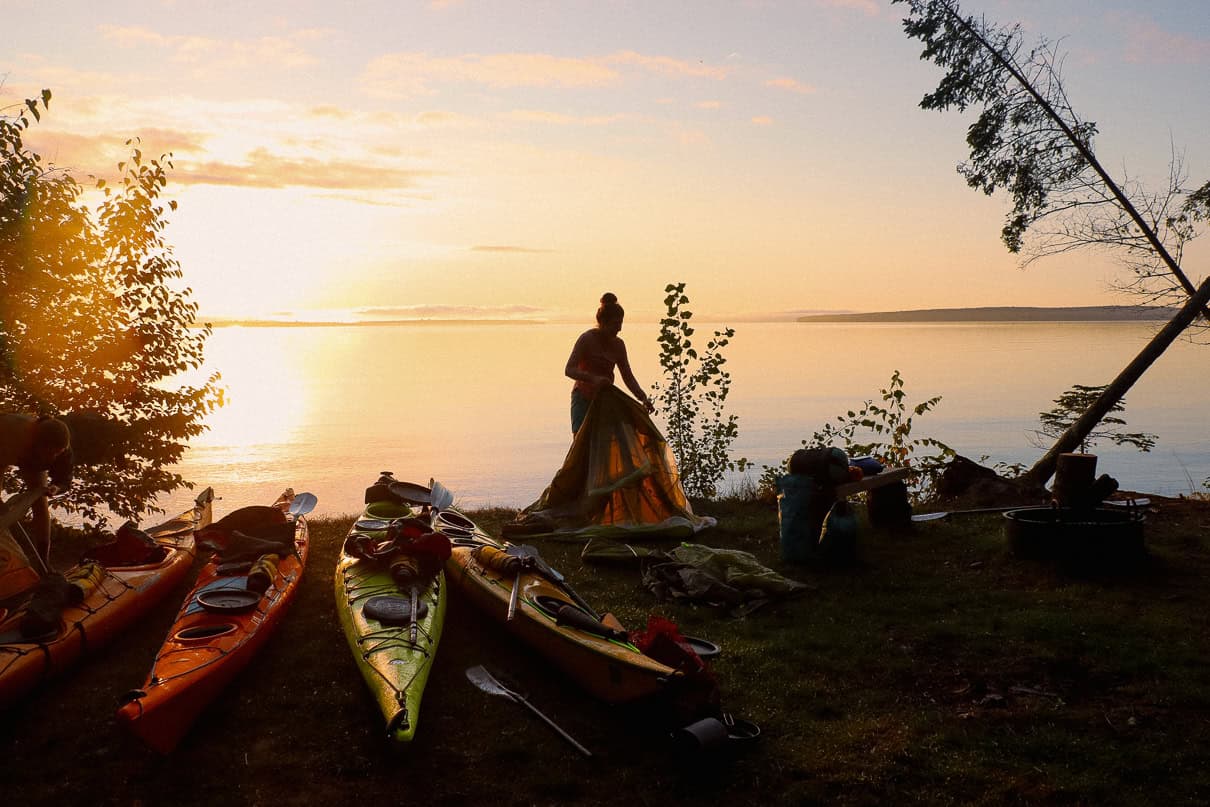
A kayaker breaks camp at sunrise. Feature Image: Maddy Marquardt
Wind sent waves shivering down the surface of Lake Superior on the last day of my overnight sea kayaking trip as I coached friends through their first surf launch. We paddled, half-surfed, around a point and rounded the island as a squall hit. Rain and waves hit our face, and our pace slowed to a crawl. It didn’t matter; when we landed for lunch we were all still smiling.
“At least it isn’t backpacking,” we joked. “Imagine all this, plus carrying the gear on your back.”
Paddlers have long known that a few days with your life pared down to your boat and a few nights sleeping in the sand is the secret to a happy life, but it may be the secret to a healthy one too. Between the steady state cardio of paddling, the engagement of muscle groups throughout the body, and the added workout of hauling gear and packing boats, kayak camping just might be the best way to get exercise outside.
The science behind kayaking’s exercise benefits
It turns out, all of the hours of paddle strokes that amount to rounding an island or crossing a channel are a thing exercise science calls steady state cardio. According to a 2014 study in the Journal of Obesity, steady state cardio, or a low intensity exercise sustained over a period of time generally greater than thirty minutes, has been shown to be more effective than high intensity interval training at improving fat distribution. Additionally, steady state cardio allows for an easier recovery than a high-intensity workout and can be an excellent way to increase overall endurance. The long, meandering miles paddling the coasts when kayak camping generally fall under this umbrella, where paddlers enter their flow state, enjoying the space where recreation meets a workout.
Generally, steady state cardio’s major drawback is often that it can be boring and monotonous. While an hour on a treadmill might be just that, time in a kayak chatting with your companions or watching the coastline change beside you is anything but.
A kayaker breaks camp at sunrise. Feature Image: Maddy Marquardt
Dr. François Billaut, former head physiologist for the Canadian national kayaking team and exercise physiology professor at Laval University in Quebec, told the New York Times that the fitness benefits of kayaking are twofold. First, kayaking is a good low-impact anaerobic exercise by avoiding engaging the body’s biggest muscles—unlike running, which engages the thighs and buttocks and uses more oxygen. Second, kayaking works the upper body, chest, back, core and abs initially, but is also a full body workout and builds strength.
As many kayakers know, while the upper body is certainly at play in kayaking, proper form distributes the impact of each stroke throughout the body, engaging not only the core but through the body down all the way to the toes. Personally, the fitness benefits of kayaking for me have gone beyond the activity itself. Even when I’m not out kayaking, I’m thinking of how to train for kayaking to support my next trip.
For me, the goal of kayak camping was never explicitly fitness. When I first started working as an overnight kayak guide it was simply the place my body, and mind, felt best. Beyond fitness of the body, a few days immersed in nature with a paddle in hand is good for the mind, and a 2012 study in PLOS found that immersion in nature and the corresponding disconnection from technology and digital media increased performance on a creativity, problem-solving task. Paddlers gain a cognitive advantage from time spent outside and on the water.
Kayak camping vs backpacking
Compared to overnight backpacking, which not only involves carrying your camping gear on your back instead of paddling it in a boat, but engages higher-impact muscles like the thighs and buttocks, kayak camping has been shown to lead to fewer overuse injuries.
A 2009 study in Wilderness and Environmental Medicine found that the most common injuries and medical conditions reported as a result of kayaking at sea were “sprains and pulled muscles’ and ‘cuts and abrasions’, and most respondents in the study reported injuries and medical conditions as a result of kayaking at sea as uncommon and not serious, and reported positive health effects from kayaking. Meanwhile, a 2002 study in Wilderness and Environmental Medicine found that nearly 70% of long-distance hikers experienced illness or injury while on trail, with most commonly reported injuries including musculoskeletal complaints and overuse injuries, diarrhea, fractures, lacerations, and abrasions.
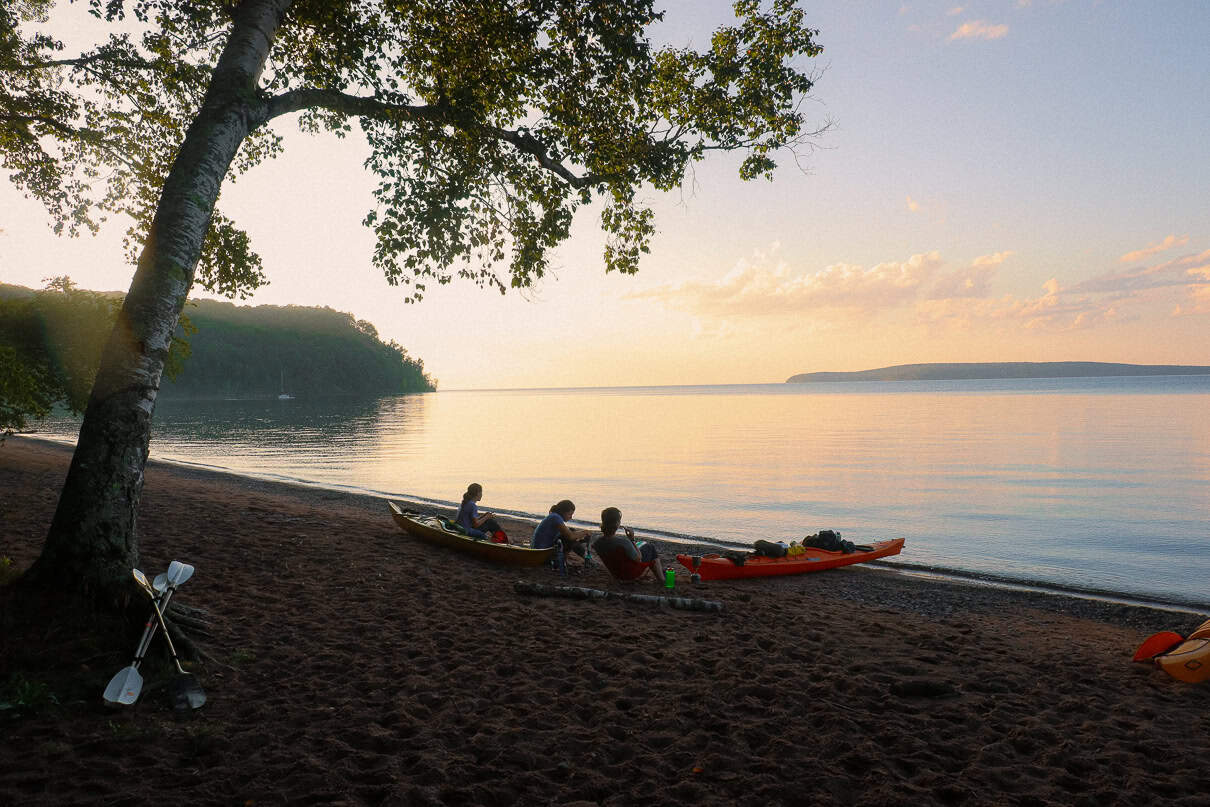
Kayak campers enjoy a hot, robust, and definitely not freeze-dried dinner on a beach. Image: Maddy Marquardt
Long-distance hiking and backpacking undoubtedly touts a larger sample size than the long-distance kayak campers, but nonetheless the two studies highlight the contrast between the differing impacts of the sports.
If nothing else, the average kayak camper isn’t constrained by needing to pack only what can be carried on their back; with the ability to pack a larger first aid kit and more robust meals, the kayak camper is better equipped for resilience in the event of injury. Plus, you’ll be hard pressed to find a kayak camper cold soaking their meals.
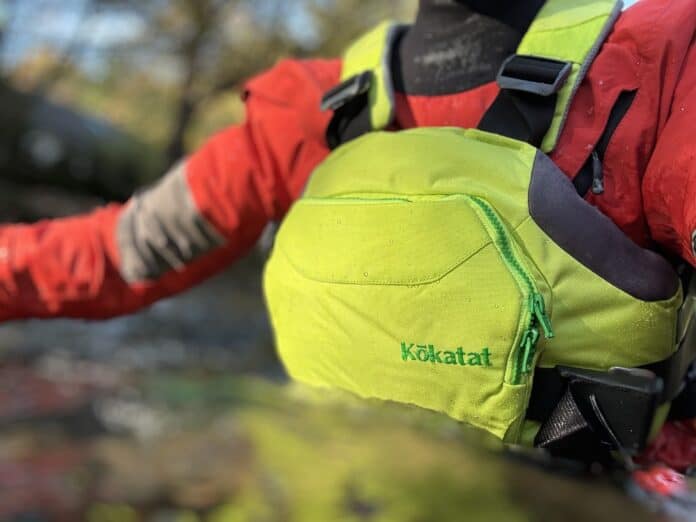
Iconic paddesports brand Kokatat acquired by the Wing Group. | Photo: Kaydi Pyette
The Wing Group has acquired Kokatat, the Arcata, California–based manufacturer of paddlesports apparel. Kokatat joins the Wing Group’s portfolio of marine and outdoor brands, including Mustang Survival, Wing Inflatables, FabTek, Henshaw and Patten.
“Kokatat’s deep history in the recreational and professional paddlesports industry, along with the trust it has earned with end users through a legacy of quality, value, innovation and excellence, makes it a natural fit within the Wing Group portfolio,” reads the statement, citing a long-standing relationship and shared values as the foundation for the deal.
“This acquisition further strengthens the Group’s whitewater and paddling presence,” said Wing Group CEO Andrew Branagh. “Kokatat has been firmly embedded in that vertical since its founding. We value the talent, technical knowledge, and the company’s unique bond with the river. Kokatat brings capabilities that few organizations possess—and Arcata remains a critical part of that expertise and legacy.”
On January 14, 2026, it was announced that Kokatat was acquired by the Wing Group. Photo: Courtesy The Wing Group
In an email to Paddling Mag, Branagh added that the Wing Group’s mission is to provide safety solutions for water environments, and that Kokatat complements Mustang Survival and the broader portfolio by expanding the Group’s ability to keep users safe while enjoying their time in and on the water.
“Kokatat is a brand and product leader in an important market segment,” he said. “Likewise, Mustang Survival is a leader in a similar, but distinct, segment. Bringing the companies together allows a collective approach with market-leading capabilities in both, and cross-pollinating that knowledge and experience strengthens the entire portfolio.”
What this means for customers and dealers
Founded by Steve O’Meara, Kokatat has been manufacturing in Arcata, California for more than 50 years. In 2021, longtime employee Mark Loughmiller, then the company’s director of operations, purchased Kokatat from O’Meara and became CEO.
According to the Wing Group statement, Kokatat will continue to operate as an independent brand under the Wing Group with global support from Mustang Survival. Loughmiller will remain in a leadership position, working in partnership with Mark Branagh, current Director of U.S. Commercial Sales at Mustang Survival.
“Kokatat customers and dealers will see renewed energy, capital, support and strength behind their beloved brand,” Mark and Andrew Branagh said in a joint email statement to Paddling Mag.
The transaction has been in the works for nearly six months and financial terms will not be disclosed.
Kokatat’s acquisition is the first industry shakeup of the year, following a wave of high-profile deals, including Jackson Kayak’s acquisition of Eddyline and Bass Pro’s acquisition of Hobie.
The Florida Fish and Wildlife Conservation Commission (FWC) has humanely killed the alligator responsible for the death of a canoeist, 61-year-old Cynthia Kay Diekema, on May 6, 2025. Diekema was paddling with her husband on Tiger Creek near Lake Kissimmee State Park when the couple first encountered the 11-foot, four-inch alligator.
The May 2025 alligator attack near Lake Kissimmee State Park
Paddling in about two and a half feet of water, the couple’s canoe passed over the alligator. The alligator thrashed, sending the pair into the water. Diekema landed on top of the alligator and her husband unsuccessfully worked to fight it off.
According to the FWC official report, “The victim was immediately bitten on the torso and efforts by her husband to assist her were unsuccessful. The alligator performed a death roll and swam away with the victim.”
The alligator responsible was identified, shot and killed. Now, Florida Wildlife officials have released new details about the attack.
New details emerge about the fatal alligator encounter
The canoeists had launched their 11-foot canoe around 10 in the morning and observed several alligators around their route according to WESH 2 News. Shortly before passing over the alligator, Diekema warned her husband that they were approaching an alligator. The couple floated over the alligator and it thrashed, sending both Diekema and her husband into the water.
The alligator then clamped on to Diekema’s torso, and investigators shared that Diekema’s husband tried desperately to pry the alligator off her and the alligator let go briefly, then whipped its tail, knocking him off his feet. Then, the alligator grabbed Diekema, death rolled and swam away with Diekema in its mouth.
The death roll of an alligator is a spinning maneuver in which the alligator rotates rapidly along its longitudinal axis, using shear forces to dismember large prey according to an article in the National Library of Medicine.
Diekema was later found dead, and the alligator was captured and humanely killed. Having dropped his phone in the water, Diekema’s husband was unable to call for help and waited until he was able to hail an airboat operator for assistance.
Alligator attacks in Florida
“There’s only been 31 fatalities since 1948,” Gatorland spokesperson Brandon Fisher told Fox 35 Orlando regarding alligator attack fatalities. “They’re opportunistic feeders. So if it’s easier for them to get their food, ie, a dog on a leash or a cat, they’re gonna go after that.”
Alligator attacks on paddlers are, generally speaking, extremely uncommon in all seasons in Florida. Nonetheless, according to Florida Today mating season for alligators runs through June, and alligators are typically more aggressive April through September.
The FWC recommends the following to minimize chances of incidents with alligators:
People with concerns about an alligator should call FWCs toll-free
nuisance alligator hotline at 866-392-4286.
Keep a safe distance if you seen an alligator
Keep pets on a leash and away from the water’s edge
Swim only in designated swimming areas
Never feed an alligator
Feature Image: The canoe involved in a deadly alligator attack. Fox 35 Orlando | YouTube
The Salus Bijoux life jacket is designed for kids between 9 and 25 pounds. | Photo: Brenna Kelly
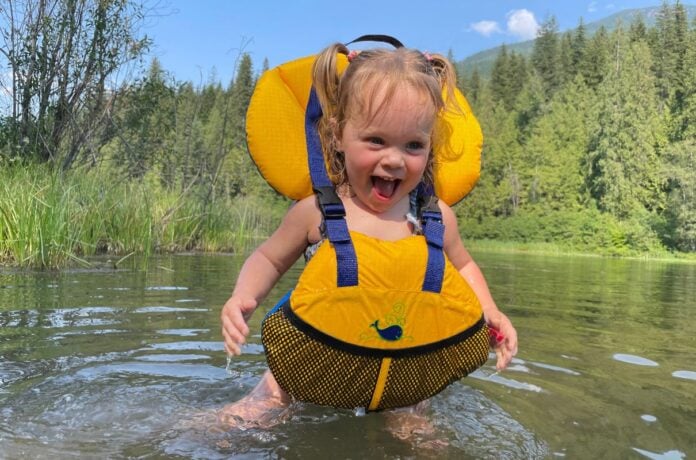
For this guide, I collected a dozen toddler life jackets for testing. Then I asked myself, how many children under 30 pounds are actually going to be paddling while wearing these? The answer: almost zero. Testing mostly involved swimming, playing and running, with a little bit of playing on kids kayaks and kids paddleboards. What I wanted to know was, which of these life jackets would toddlers find so comfortable they forgot they were even wearing them? Because the safest life jacket is the one that is worn.
As a parent, I really like to find things that will last my children as long as possible, and, when considering the under 30-pound weight range will be for children approximately between 0 to 3 years old, I see the temptation in going up a size when you buy. However, you don’t want to sacrifice fit to buy something that they will “grow into” when it comes to safety gear.
A snug-fitting PFD is essential in order for it to function effectively—we don’t want our children slipping out on the water. So, since I know life jackets for fast-growing toddlers and infants will only last a season or two, I like to choose something I could pass on to a sibling, a cousin or a friend. There’s nothing better than gifting something that will result in endless amounts of fun on the water. If you’re at the point you’re looking for buying advice for bigger kids and adults, visit Paddling Mag’s overall guide to the best life jackets.
After extensive swimming, splashing and beach time, here are my top picks for little ones.
Dress For Immersion, Not Air Temperature
Your body loses heat much faster when immersed in cold water than it does when dry.
Avoid cotton clothing like t-shirts and jeans; they retain water and accelerate cooling when wet. Synthetic fabrics, or wool, are generally a better choice. If the water is very cold (60° fahrenheit or less), you should wear a wetsuit or drysuit.
The Level Six Puffer is one of my favorite life jackets for a true infant. As a paddler I wanted to get my children on the water as soon as possible but it is hard to find something that fits well on children under 20 pounds since they are all head and no neck. With the float on the chest and back of the head it does a great job of floating infants face up. The back of the life jacket is a few straps that keep the floats in place and help adjust sizing. One of the features on this jacket that I am most excited about is the extra buckle at the crotch that allows you to change a diaper without taking off the whole life jacket. This PFD is not Transport Canada approved since there is currently no testing standard to certify PFD’s for children under nine kilograms.
Reasons to buy
Diaper access clip
Great design for mobility
Floats face up
Cons
Typically only one season of use because kids grow quickly
Best for comfort and longevity
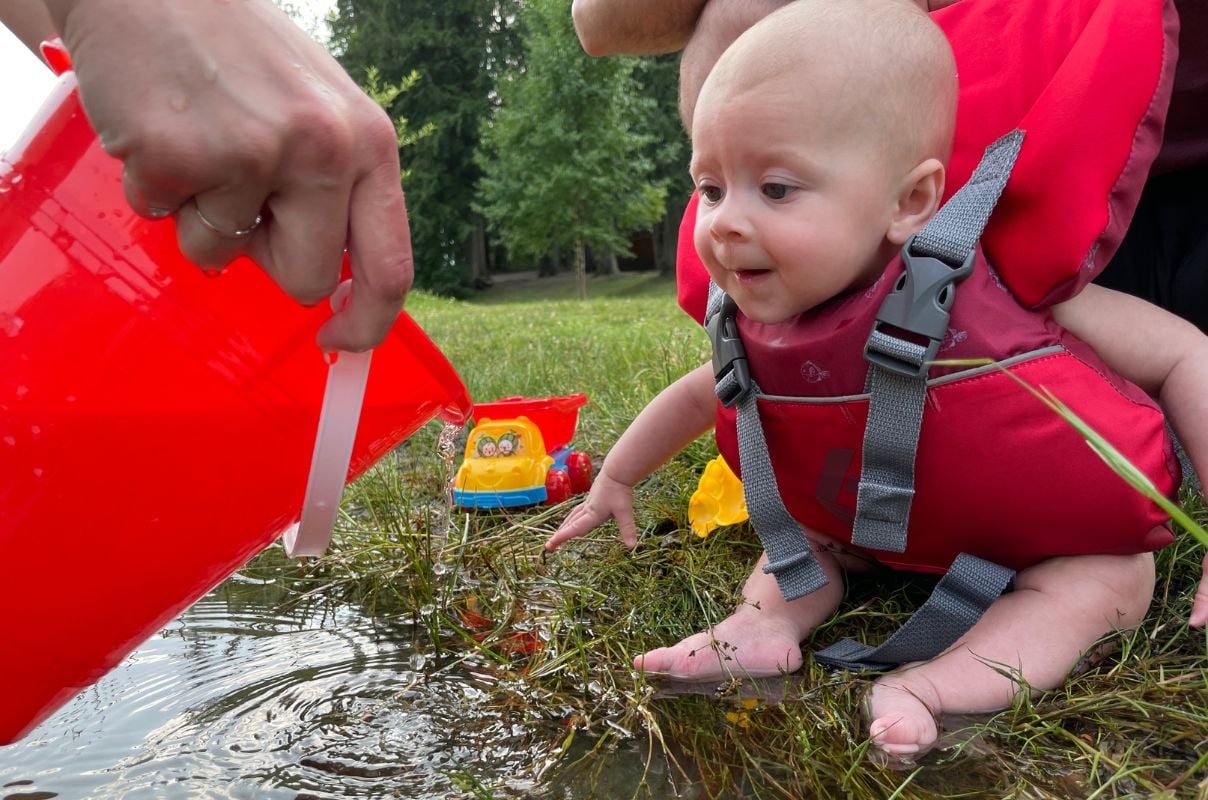
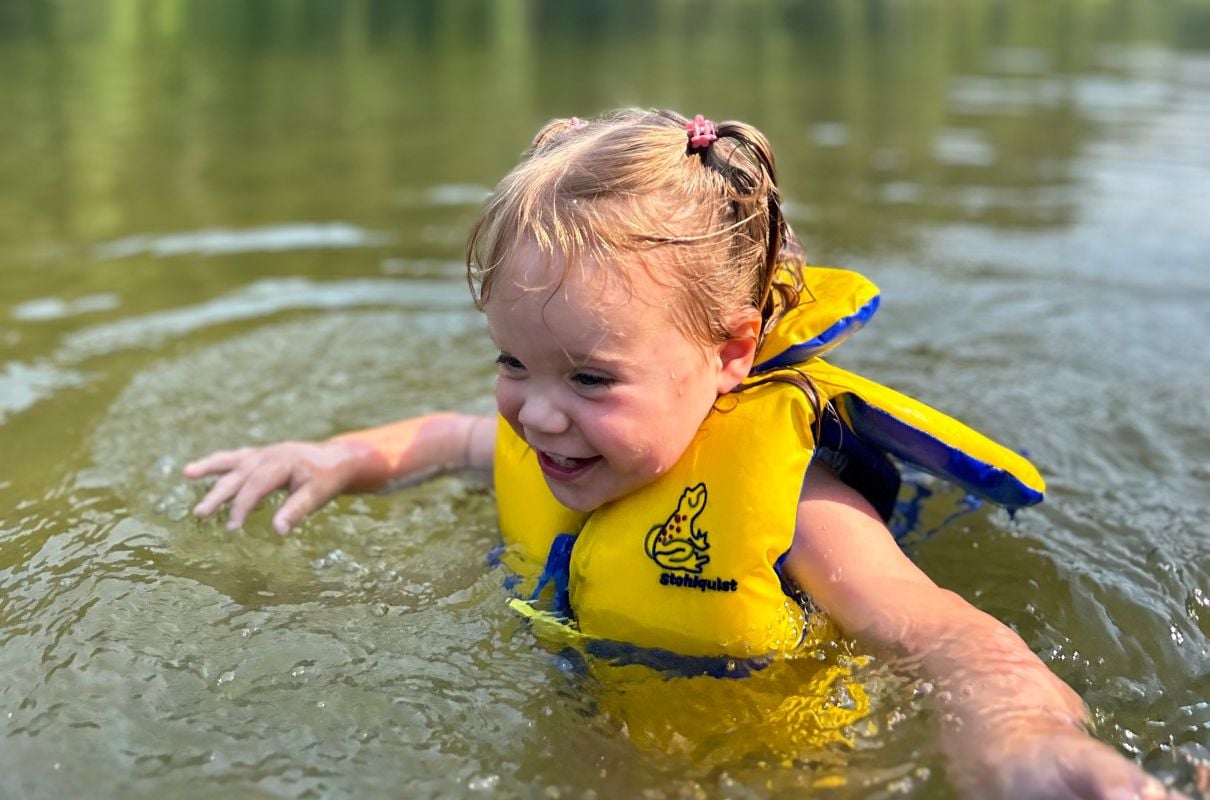
Stolhquist Infant
Enjoying the Stohlquist Infant life jacket for kids under 30 pounds. | Photo: Brenna Kelly
The Stohlquist Infant life jacket is one that pleasantly surprised me. I have not had much experience with the brand in the past other than knowing it is a top-quality one. All I knew is that I wanted to make sure one of their toddler life jackets was in the mix. It has a different design than the Bijoux and the Puffer but still equally as well thought out for infants especially in the under 20 pounds category. There is minimal flotation on the back with simple straps to adjust to the infant’s size. The front is a zip up making it easy to get on and off, which is a plus since the others previously mentioned you need the infant to step into with a fixed waist belt. It also covers a wider range of weights and sizes which is nice for longevity.
Although the design in my opinion is a bit superior for fit and ease of use, I would also say that this life vest is better suited for confident water babies because it does not re-right quickly and floats infants a bit lower in the water. So if your child is nervous or cautious around water, I would lean towards the other two for children under 20 pounds.
Reasons to buy
Accommodates a huge range of sizes
Easy to don and doff
Very comfortable
Easy to grab handle
Diaper access (if needed)
Face up floating design
Cons
Not as buoyant as the rest and slow to right some children. Recommended for water lovers, not cautious beginners.
Best for most float
Mustang Lil’Legends Infant
Playtime in the Mustang Lil’Legends life jacket. | Photo: Brenna Kelly
The Lil’Legends infant jacket was by far the floatiest of all the toddler life jackets tested in this guide. When the children were in this life jacket they were one step below hovering above the water. I would recommend this life jacket to any parent that has a nervous swimmer because it has lots of safety features like reflective accents and a good grab loop as well as its high float ability.
Reasons to buy
Re-rights children quickly
Very buoyant
Bright color options
Cons
A bit bulky for kids to enjoy for longer durations
Best color options
Salus Nimbus Infant
The Salus Nimbus boasts the widest array of color and style options for kids. | Photo: Brenna Kelly
The Salus Nimbus Infant life jacket offers a great design and amazing color and print options for personalization. There is a double pillow behind the child’s head for added comfort while floating on their backs and it doesn’t seem to get in the way comfort wise while the infant is playing. The foam is contoured to the shape of the child’s core making for added comfort as well.
Reasons to buy
Fits a wide range of body types
Easy to grab handle for safety
Amazing color options
Cons
Not yet recognized by the USCG
Check The Weather
Plan for changing weather conditions. Prepare for the worst case.
Don’t forget to check tide, currents, or river levels.
Most affordable
Level Six Stingray
Level Six Stingray life jacket (left) offers excellent value. | Photo: Brenna Kelly
The Stingray Infant life jacket is a great life jacket especially when it comes to its value. All of the children found it comfortable to wear and from a parents perspective, it fit well for every child. The elastic cinch piece at the back makes the fit a bit more snug on smaller children as well. The main differences with this life jacket compared to the Swordtail is the bright colors for visibility and the nylon outer fabric. The nylon is nice in that it does dry faster but if your child is donning and doffing their jackets often, it’s a bit cool to the touch when putting it back on wet.
Reasons to buy
Great value
Bright colors
Cons
Not yet recognized by the USCG
Runner up
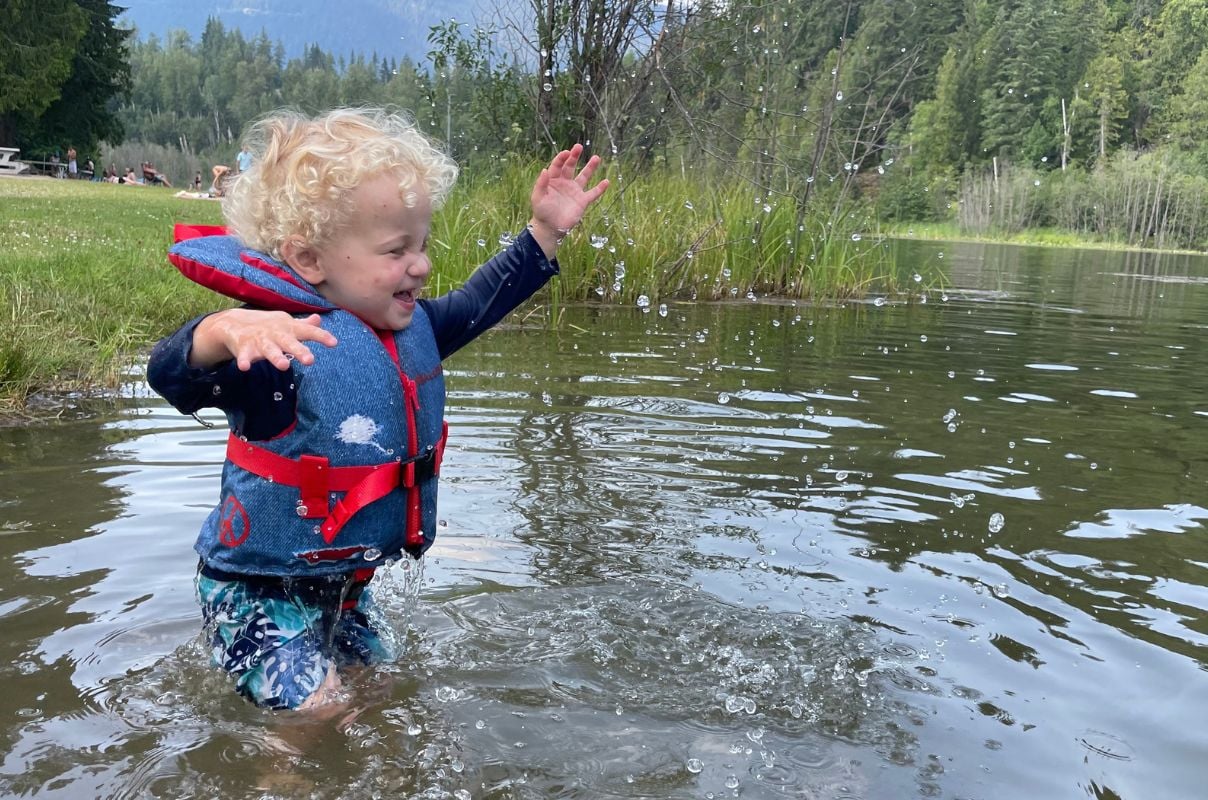
Level Six Swordtail Infant
Splashing around in the Level Six SwordTail Infant life jacket. | Photo: Brenna Kelly
The Swordtail Infant from Level Six is a life jacket that is easy for kids to put on with little help from their guardian. It is also seemingly one of the most comfortable judging by the kids who were using it. The neoprene fabric is warm to touch so when it’s wet, children are still happy to put it on. The fabric also has stretch, making for a better all around fit even on the chunkier babies.
The zipper, waist buckle and crotch strap create a snug fit on many body types. One thing I really enjoyed on this life jacket is the grab handle that always sticks out for an easy rescue point. It doesn’t take much for kids to venture too far at this age and it’s nice to have a handle where you can quickly reel them back in! This life jacket is well thought out with infants and their safety in mind.
Reasons to buy
Very comfortable
Fits a wide range of body types
Easy access grab handle
Cons
Not yet recognized by the USCG
Runner up
Salus Bijoux
The Salus Bijoux life jacket is designed for kids between 9 and 25 pounds. | Photo: Brenna Kelly
Salus understood babies and that they would mostly be sitting or laying down. The low profile mesh back allows for just that with all of the flotation in the front and behind the head. This life jacket was tested by a two-month-old who was happy wearing it for short periods of time and other children who were over a year old who were happy to never take it off. One of our testers was very happy about the mesh pocket at the front to collect her treasures. These life jackets have lots of great color options and an easy to grab handle for minding your child’s safety. This PFD is not Transport Canada approved since there is currently no testing standard to certify PFD’s for children under nine kilograms.
Reasons to buy
Face up flotation
Very comfortable
Easy grab handles
Mesh pockets for toddler treasures
Cons
No easy access buckle to quickly change a diaper without taking the whole life jacket off
What to consider when buying a life jacket for a toddler under 30 pounds
As a lifelong paddler, I wanted to compare toddler life jackets made by the top paddling brands to see which ones worked best for my children and their friends. Some of the things I look for in a quality life jacket for toddlers are:
Comfort and Fit
Number of adjustment straps to create a snug fit
Head pillow to keep the face out of the water
Crotch strap to ensure PFD doesn’t slip over the head
Material—I prefer neoprene exterior for comfort and warmth but it doesn’t dry as fast
Grab handles in case you need to grab them quickly
Overall fit and function
Fit is the most crucial factor when choosing a life jacket for a kid, just as it is the most important factor when choosing the best life jacket for adults. If it doesn’t fit properly, it will not do its job to float your child. And if it is not comfortable, your toddler will refuse to wear it.
Investing energy in making sure your kids paddle and play in comfort when they are toddlers means make it far more likely that they will carrying their own canoe packs, paddling with efficiency and be full partners in your outdoor pursuits in just a few years time. Get more advice on how to trip with kids.
It is a great idea to try on life jackets before you purchase them but if you don’t have that luxury, the reviews above will give you a pretty good idea of the comfort and fit of each one.
Caution for buying used
If you are buying used, make sure there are no holes or worn out fabric where the flotation can fall out. A life jacket should be retired after five years or if it has faded and deteriorated from sun damage.
Life jackets and PFDs vs swim vests
Life jackets and PFDs (personal flotation devices) are essential safety gear for kids and adults when on the water. Certified by the U.S. Coast Guard and Transport Canada, these safety items are designed to keep paddlers of all ages afloat. Swim vests are totally different. Often sold as learn-to-swim aids, they lack the buoyancy and safety certifications of PFDs. The danger with swim vests is they give a false sense of security to unsuspecting parents. Swim vests may not keep a child’s head above water, can ride up or slip off, and are not a substitute for a proper, well-fitting life jacket.
Color
One reason to consider the color of your child’s life jacket is because when you are in a sea of little people running wild at the beach, you want to be able to quickly identify your little person! They are small but I still can’t believe how quickly they disappear when your back has been turned for only seconds. A quick heart palpitation is all that will happen before you notice a bright yellow or a uniquely colored life jacket.
The other reason color matters is that you may have a stubborn toddler who demands to have “the froggy patterned” life jacked “or else!” they won’t wear it. If that’s your child… well, it may not be an argument that you’re going to win and remember, we need them to wear it.
Price
This consideration speaks for itself. Just remember that there is likely a reason that the more affordable life jacket is priced that way. Anything under $40 is likely not as durable and you may only get one season out of it, which means no hand-me-downs.
Extra features
Accessible grab handles are great additions and peace of mind for parents. And pockets on your kids life jacket are great—so you don’t have to hold the rocks and shells your kids collect!
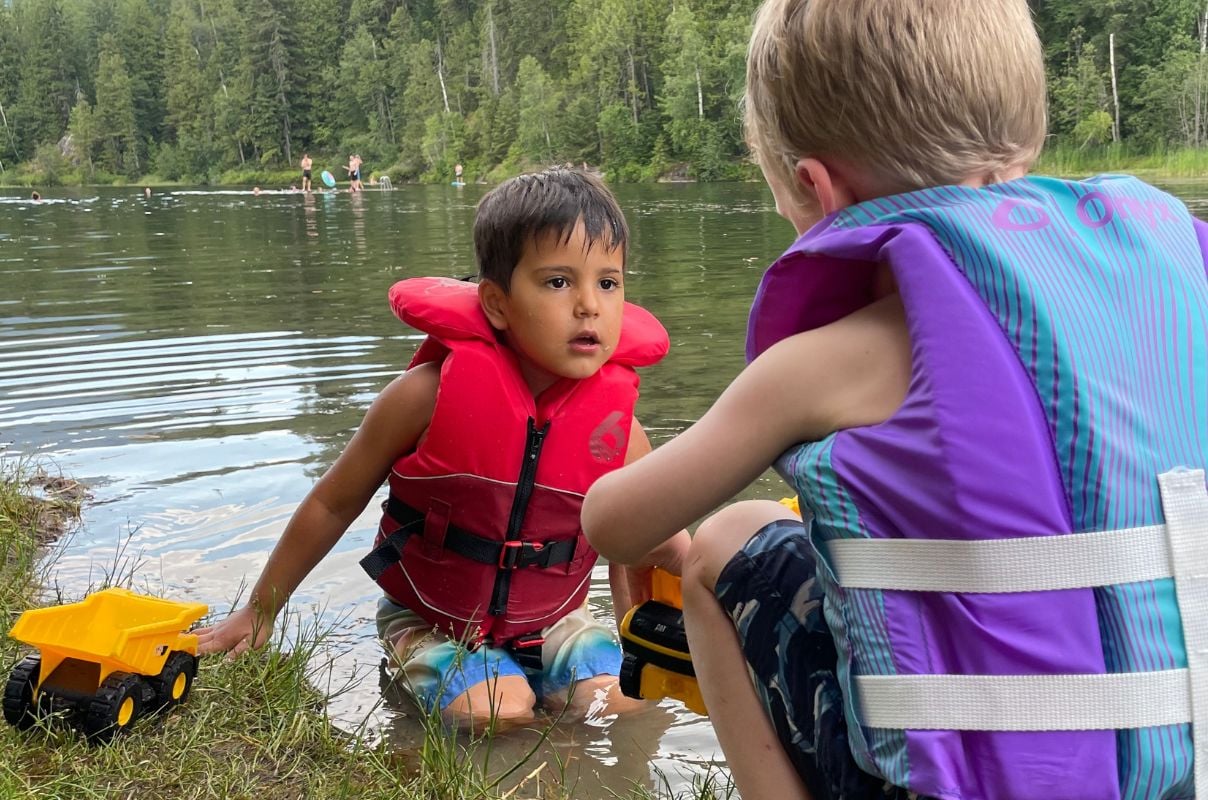
Recognizing toddlers do little more than lily dip when in kayaks and on paddle boards, we took to the shoreline to test these life jackets by swimming, splashing and playing in the water. I’m sure my choices for the best toddler life jackets will cause arguments—that’s because there are so many great options, and each paddler has his or her favorite. Each life jacket was selected for its fit, comfort, features and function. These picks reflect hands-on testing in the summer and fall of 2024 and spring of 2025. For 2026, we looked at what new life jackets may be worth consideration and concluded that the life jackets we have in this review remain the best options available today.
Paddlers with enough miles under their yokes appreciate any means to shave a few pounds off their canoe. Lower weight isn’t just a nicety; it means less fatigue on long carries, easier car-topping, and a more accessible paddling experience for many. The good news is that, driven by a demographic shift as Baby Boomers get older and seek solutions to keep paddling, there have never been more lightweight canoes on the market. With tandem 16-foot tripping canoes weighing as little as 30 pounds, we are living in a golden age.
How much does a lightweight canoe weigh? For the purposes of compiling this guide, I’ve considered canoes less than 50 pounds. Generally, light hulls tend to be most appropriate for lakewater conditions and prioritize weight savings over impact resistance, but there are exceptions. Another tradeoff of ultra-lightweight lay-ups is price. Generally, the lighter the canoe, the more you can expect to pay. Aramid canoes with aluminum gunwales and no upgrades start around $2,500 USD ($3,500 CAD). Expect costs to go up as the pounds come down. You’ll feel the pain once at checkout instead of on every portage like your buddies.
Lightweight canoe options now come in a wide range of shapes, sizes and prices. If a truly lightweight boat is what you’re looking for, read on.
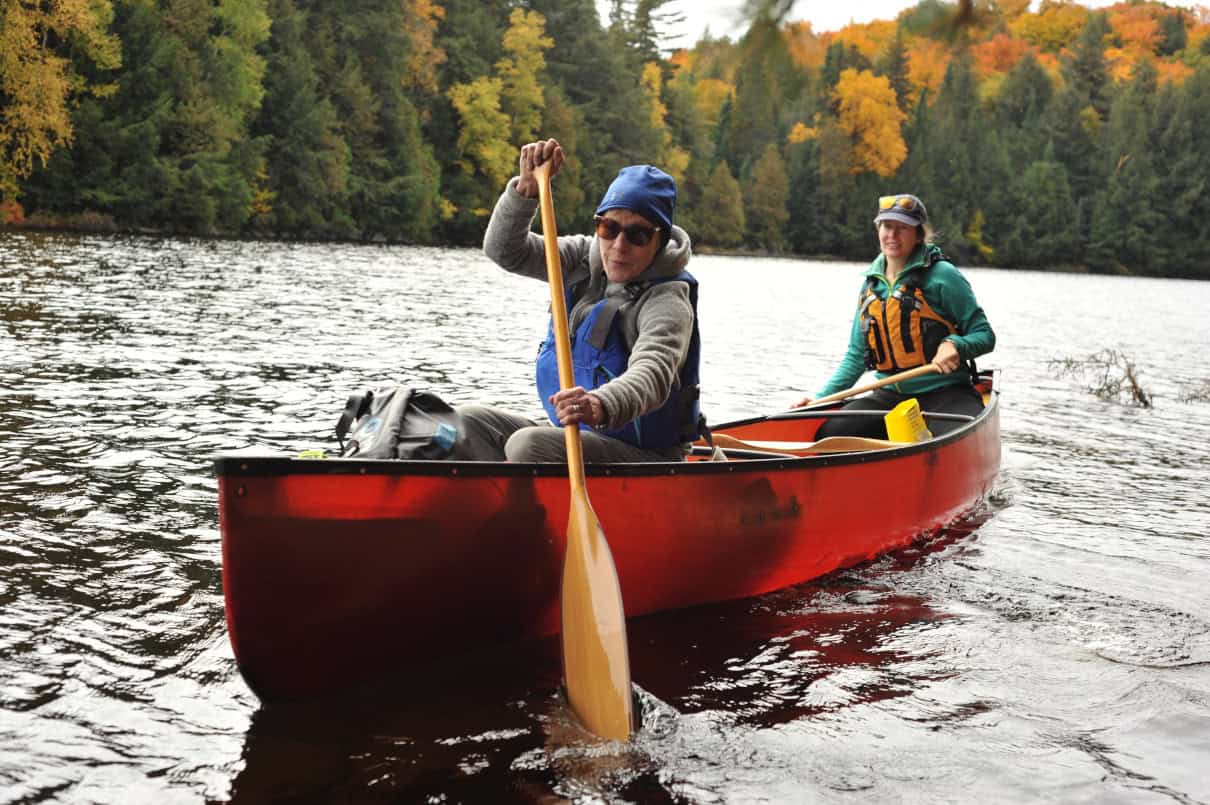
The voluminous Souris River Quetico 17 has been my go-to tripping canoe for the last decade, and for good reason. Its long waterline tracks beautifully and carries speed, yet two inches of rocker lift the bow and stern to give it decent agility in tight, meandering creeks. At 44 pounds, only truly long or steep portages feel arduous. Designer and co-owner of Souris River, Keith Robinson modeled the 16-, 17- and 18.5-foot Quetico series on the classic Prospector, borrowing its clean entry lines but adding more tumblehome to bring the gunwales in closer to the paddler for easier efficiency and feel.
Made out of Atikokan, Ontario, outfitters account for a large portion of Souris River’s sales, and their used Queticos are legendary for looking reasonably good after a season of hard rental miles, which can be equivalent to a lifetime of normal wear and tear for most canoeists. Mine is no exception. Built with aircraft-grade epoxy resin, aluminum gunwales and four layers of Kevlar across the hull, it has withstood hard use, and I expect to enjoy many, many more years together. Expedition paddler Mike Ranta chose a Souris Wilderness 18 in Kevlar layup for his three cross-Canada journeys. If that doesn’t speak to the layup’s durability, I don’t know what does.
The price tag on the Souris River Quetico 17 is on the low end of what a high-quality, lightweight Kevlar canoe will cost, making this an easy recommendation for excellent value. Woven-Color Kevlar models, like my red canoe above or the popular Le Tigre look, go for a few hundred dollars more.
Reasons to buy
Proven layup trusted by outfitters and expedition paddlers
Competitive pricing for a lightweight Kevlar canoe
Consider another if
You value ultralight weight above all else; there are lighter tandem tripping canoes on the market
Bottomline
Lightweight and tough at a budget price, the Souris River Quetico 17 is my go-to tripping canoe.
With gleaming two-tone gelcoats, crisp color pairings and ever-expanding trim options, there’s no denying it, Swift’s canoes are something to behold. Even better, they look just as good as they paddle.
The Keewaydin 16 is a sleek, performance-oriented tandem touring canoe that glides effortlessly, tracks straight and still feels responsive when loaded. This asymmetrical hull is also available in an array of lightweight composites, such as the Kevlar Fusion, which brings the weight down to 35 pounds, or the Carbon Fusion tipping the scale as low as 33 pounds. Unless you’re upgrading to the carbon tech package, gorgeous cherry contoured seats and yoke come standard. The Keeywaydin is also available in a “Combi” configuration, with a center seat and removable yoke for the option to paddle solo or tandem.
Take the Keewaydin deep into the backcountry or just show it off by paddling local bays around the cottage. It’s equally suited to both. When we first reviewed it back in 2014, we called it a joy to paddle and have stood by that on every paddle since.
Reasons to buy
Sleek and efficient, with gorgeous finish and trim options
Despite our inclination to baby this canoe, it’s stocked by outfitters and the layup does withstand abuse
Equally at home wilderness tripping or on casual day paddles
Consider another if
For more gear hauling capacity, see the Keewaydin 17
Bottom line
For gorgeous aesthetics and solid performance in a lightweight canoe, you can’t go wrong with the Swift Keewaydin.
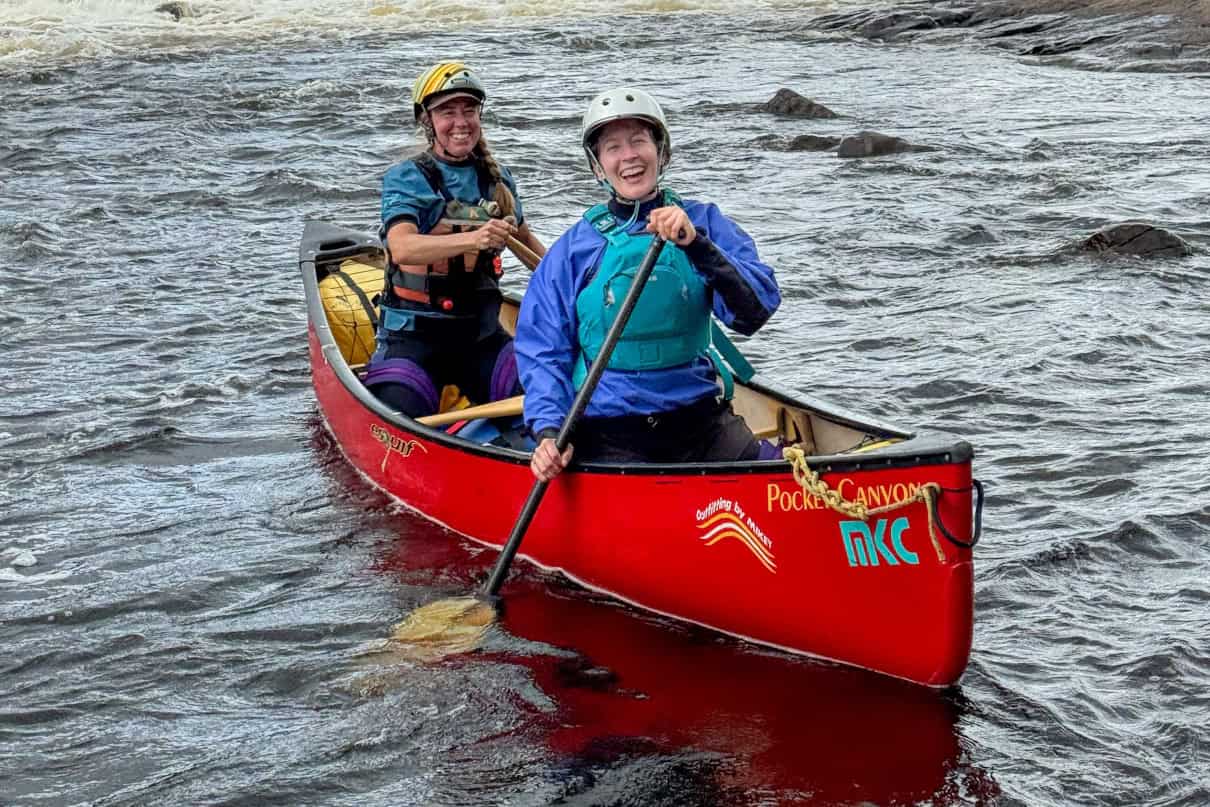
Sneaking in just under the weight cutoff at 49 pounds, I’m stoked to include the Esquif Pocket Canyon in T-Formex Lite on this list as one of the most capable lightweight canoes for river running.
We’ve spent plenty of time paddling the Pocket Canyon in T-Formex, but the new Lite version sheds 10 pounds by selectively thinning material in lower-impact areas while keeping full strength where it matters. The result? Easier loading and easier portaging when you need to, with almost all of the same reassuring impact resistance of T-Formex if you miss your line.
The compact Pocket Canyon is 14.5 feet long and best suited for short whitewater trips, in the realm of two to four days, that don’t require the mega capacity of a full-sized tripper. Think of the Pocket Canyon as the expedition-ready Canyon’s smaller, cooler, more playful sister. It excels at river play thanks to a flared hull that stays dry in big waves, rockered bow and stern, and a progressive chine that offers a stable carving edge for catching eddies. Ye-ow! (Read our in-depth beatdown of the new T-Formex Lite material in the Spring 2026 issue of Paddling Magazine.)
Reasons to buy
Lots of fun for river play and river tripping
Ideal for two- to four-day downriver trips for tandem pairs, or could be outfitted as a roomier solo river tripper
Consider another if
You need more volume for expedition paddling, in which case check out the Esquif Canyon
You’re looking for a do-it-all design; the Pocket Canyon isn’t at its best on flatwater
Bottom line
Sporty and confidence-inspiring, whitewater trippers are going to love the Pocket Canyon.
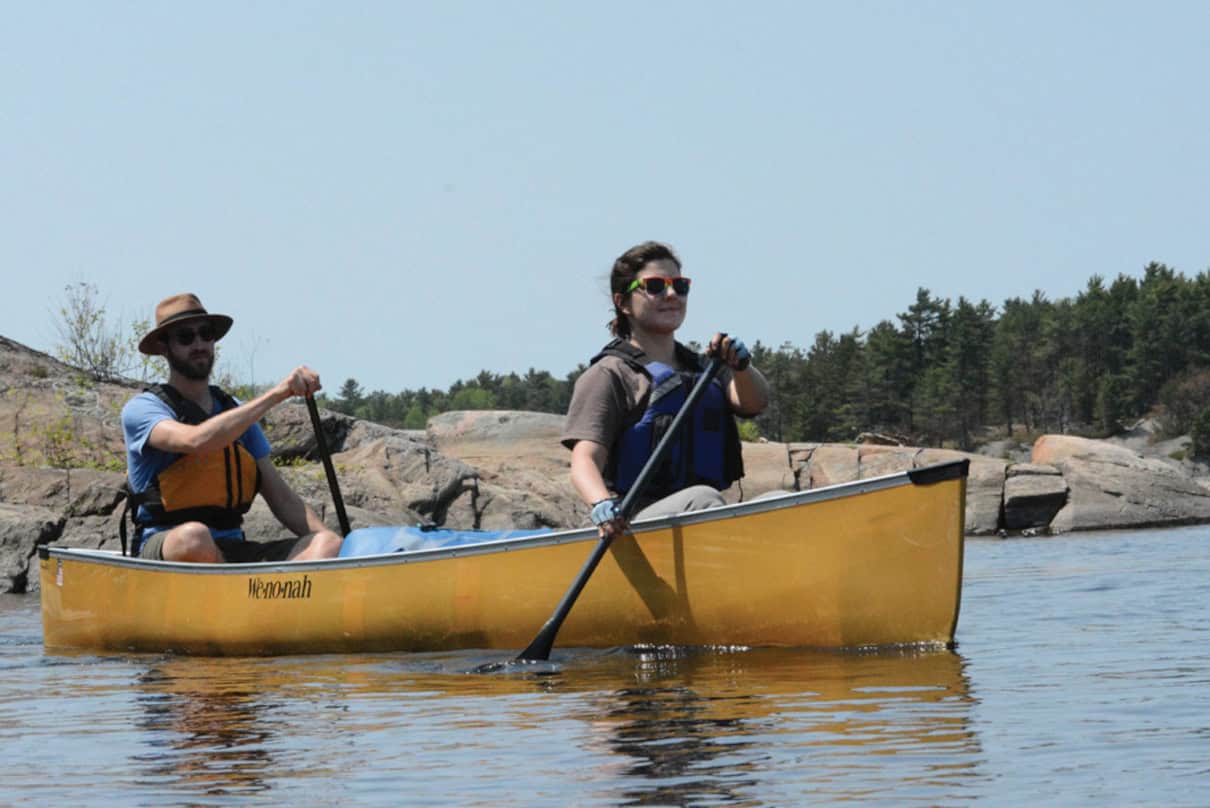
The Wenonah Minnesota II is easily one of the fastest canoes I’ve paddled, and has to be one of the most efficient tandem tripping canoes Paddling Magazine has ever had the pleasure of reviewing. Long, low and built to track straight and glide forever, its near-effortless efficiency on open water makes the Minnesota II easy to fall in love with. Designed for sit-and-switch style paddling, it has very minimal rocker and a low profile, and slices cleanly even through moderate chop and shrugs off wind.
At 18.5 feet long, the Minnesota II is a big canoe, but in Ultralight layup it weighs just 42 pounds. Impressive for its size. Its cavernous hull packs room for loads of tripping gear, kids, dogs, or maybe all three. A staple in the Boundary Waters and beloved by outfitters for decades, it was also a fixture in the Paddling Mag gear garage and taken on many staff trips over a decade, before being permanently adopted by our publisher.
If the 42-pound aramid model is not light enough for you, Wenonah now offers the Minnesota II in a new SuperLite layup, which on average drops a canoe’s Ultralight weight by 15 percent, in this case, down to an incredible 34 pounds. Watch for Paddling Mag’s indepth field testing of the new Superlite layup in 2026.
Reasons to buy
Exceptionally fast and efficient makes it perfect for cover lakewater miles
Excellent weight for its size at 42 pounds, with even lighter options available
Massive capacity for gear, kids or dogs
Consider another if
You want more versatility across water conditions, like tight, meandering creeks, or don’t need quite so much cargo capacity
Weight isn’t a primary concern, the Clipper Canoes’ Jensen 18 (51 pounds) is another well-loved, miles-for-breakfast tripper
Bottomline
Whether tripping for a week or cruising with the family, this lightweight, high-volume, high-speed tripper makes for easy paddling.
Favorite solo wilderness tripper
Nova Craft Prospector 14
The only tripping companion you really need. | Image: Geoff Whitlock
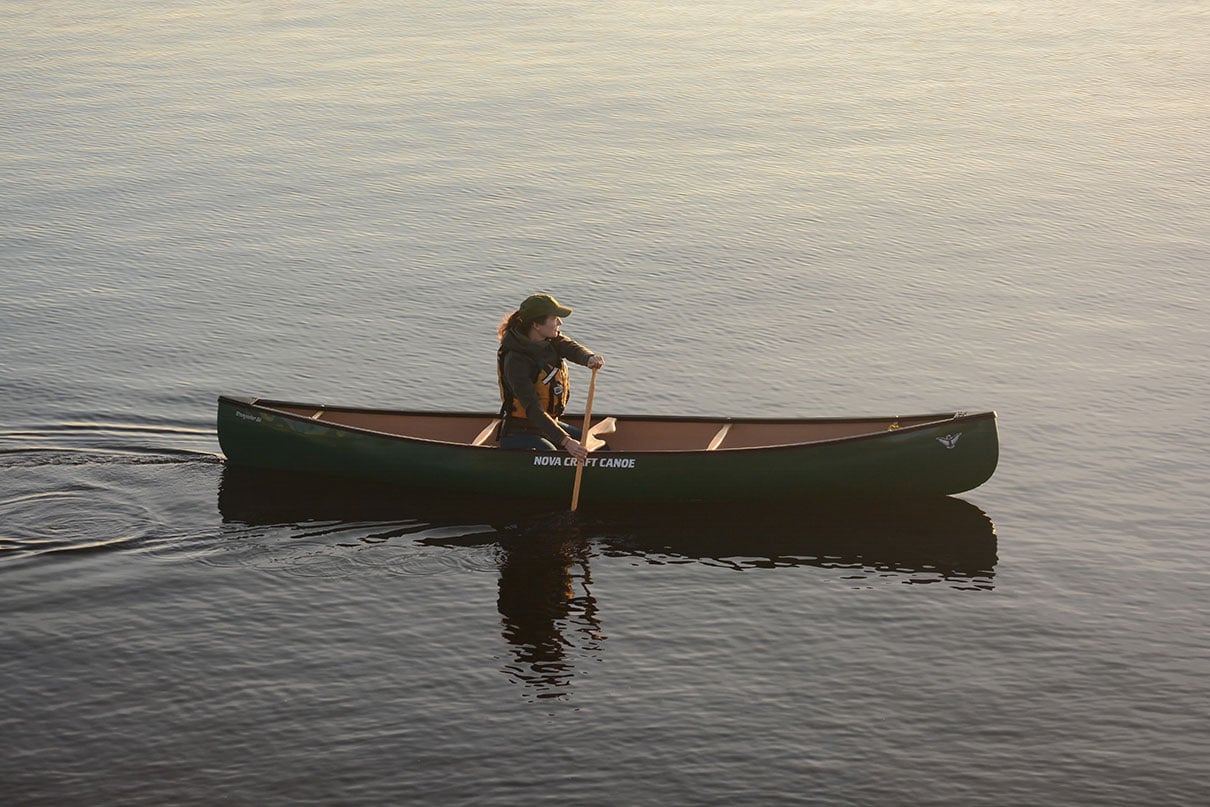
When we reviewed the Prospector 14 from Nova Craft Canoe, we declared this scrappy little boat a stalwart companion for solo trippers and one of our favorites for overall best canoes for solo paddlers. This 14-footer is a scaled-down Prospector, inheriting the series’ legendary do-it-all design with a shallow-arch hull and moderate rocker for responsive handling and gear hauling. It packs much of the same reassuring seaworthy feel, just in a smaller package.
Nova Craft designed the Prospector 14 to fill a gap in their lineup; they had solos, but none built specifically for tripping bigger lakes and mild rapids. Our first test boat came in Nova Craft’s TuffStuff Expedition layup, a tough composite layup made of basalt and Innegra fibers. This heavier-duty layup brings the weight to 48 pounds, but gives canoeists the confidence to paddle the P14 into rocky shallows and swifts without needing to worry about babying the boat.
If you are looking for a solo lightweight canoe strictly for flatwater touring, you’ll want to consider the P14 in Aramid Lite. This is Nova Craft’s lightest layup, incorporating Twaron fabrics to bring the weight down to about 35 pounds.
Reasons to buy
You’re a solo backcountry paddler tackling a wide range of water conditions
Five lightweight layup options (from 35 to 50 pounds), suit almost any style of tripping
Consider another if
You paddle only flatwater and on smaller lakes
Your solo tripping is focused on making miles
Bottomline
A versatile, do-it-all design for solo trippers.
The most lightweight tandem canoe
At the time of writing, the Northstar Canoe Pearl in Stealth construction was the lightest tandem canoe on the market that we know of. (Know of a lighter tandem tripping canoe? Email us.) Weighing in at an impressively light 29 pounds, it’s roughly equivalent to your average doe-eyed beagle. The Pearl is Northstar’s modern take on the beloved Chestnut Canoe Company Pal. Three inches shy of 16 feet, the Pearl is best suited for day tripping and flatwater weekend escapes.
The ultralight Stealth lamination blends carbon and Innegra in a weave backed with aramid, striking a careful balance of weight savings, impact resistance and stiffness.
“There’s not a lot of material in a Stealth lamination, but what’s there is the most sophisticated lamination we build,” notes Northstar. We’re sorry to report our editors haven’t laid their grubby hands on this svelte featherweight yet, but stay tuned for an in-depth, field-tested review in Paddling Magazine in 2026.
What to consider when buying a lightweight canoe
All other things being equal, the material and construction of a canoe have the biggest impact on its weight. In this list, I’ve included a lot of aramid- and carbon-infused models. Generally, lightweight hulls tend to be most appropriate for lakewater conditions, as lightweight layups prioritize weight savings over impact resistance.
There are other tradeoffs for space-age lightness, and cost is one of them. Generally, the lighter the canoe, the more you can expect to pay. The cost of a new aramid canoe with aluminum gunwales and no upgrades starts around $2,500 USD/$3,500 CAD. Expect costs to go up as the pounds come down. You’ll find this price tag worth it when you breeze past the other trippers on the next portage. If that’s out of your budget, consider the many high-quality canoe options out there—a midweight fiberglass canoe can easily save $1,000 or more off the purchase, though it will add 10 to 15 pounds.
The trick for buyers is to find the right combination where budget meets construction. Zero in on a material that fits your budget, feels comfortable to lift and portage, and can handle the kind of bumps and scrapes your paddling style might throw at it. In the end, you’re really just looking for the perfect compromise. You can read more about canoe hull materials and construction to find the best match for the type of paddling you like to do.
If you’re looking for a used lightweight canoe, you’ll find many outfitters sell off some of their fleet each fall. You may also find a good deal on Facebook Marketplace. Use our guide on buying a used canoe to watch out for signs of damage and avoid buying a lemon.
If you can, always take a canoe for a test paddle before purchasing. Try it empty and again with some gear loaded up, if you expect to take it on a trip, to get a sense of how it performs under load.
While lightweight canoes are most often built for flatwater tripping or day touring, there are many exceptions, including carbon river runners and expedition-ready composites.
The canoes in this article were chosen through years of accumulated experience with numerous tripping and recreational designs, as well as the input of our contributors and longtime editors through our extensive boat reviews.
I’ve paddled every canoe in this guide, and I’m sure some of these picks may spark debate. There are many excellent lightweight canoes on the market, and every canoeist brings different priorities to the water, from how and where they paddle to the gear and people they carry.
To choose the best lightweight canoes, I looked beyond specs to how each boat behaves on real trips. Every canoe on this list had to be paddled and field-tested before being considered. That means evaluating how it carries speed, how it handles under load, how it feels on portages, and how it behaves in wind and waves. Weight matters, but so does having a canoe that feels like a good tripmate. Build quality was also a factor. Many of these canoes are loved not just by the Paddling Magazine team, but by outfitters who see what a full season of hard use (or abuse) looks like.
Some canoeists will argue there are lighter, cheaper or better options, and they may be right for the paddling they do. These lightweight canoes earned their place on this list because they performed consistently across a wide range of conditions and trips.
Why trust us
At Paddling Magazine, we take gear testing seriously. Editor-in-Chief Kaydi Pyette has spent more than a decade leading the magazine’s product reviews, drawing on over 25 years of paddling experience and hands-on field testing. Her time on the water spans ultramarathon races and self-supported expeditions, including paddling across her home province of Ontario over 52 days and competing in the Yukon River Quest.
Dagger is a well-respected American kayak brand that’s been making boats for decades. The history of Dagger kayaks begins with whitewater. The company got its start making kayaks and canoes in the U.S. Southeast, just as whitewater boating was becoming popular in the 1990s. Dagger sponsored professional paddlers (Team Dagger) test its designs on the world’s toughest rivers.
The result was a lineup of Dagger kayaks that performed well and were comfortable to paddle, meant for kayaking enthusiasts who took the sport seriously and were willing to invest in quality boats and gear.
The tradition continues when you buy a Dagger kayak today. The brand shifted its focus somewhat in the 2000s. While Dagger kept up making whitewater kayaks, it dropped its canoe lineup and made serious investments in touring kayaks and high-end recreational kayaks. Dagger has always remained true to its core mission of producing paddler-tested designs for serious kayakers.
“What do General Electric engineer James Wright, 3M Laboratories researcher Spencer Silver, and Dagger Kayaks designer Mark “Snowy” Robertson all have in common? Need a hint? Three of these guys created something awesome by mistake. They didn’t set out to create Silly Putty, Post-it sticky notes and a quiver-killing whitewater kayak. But the world is a better place nonetheless.
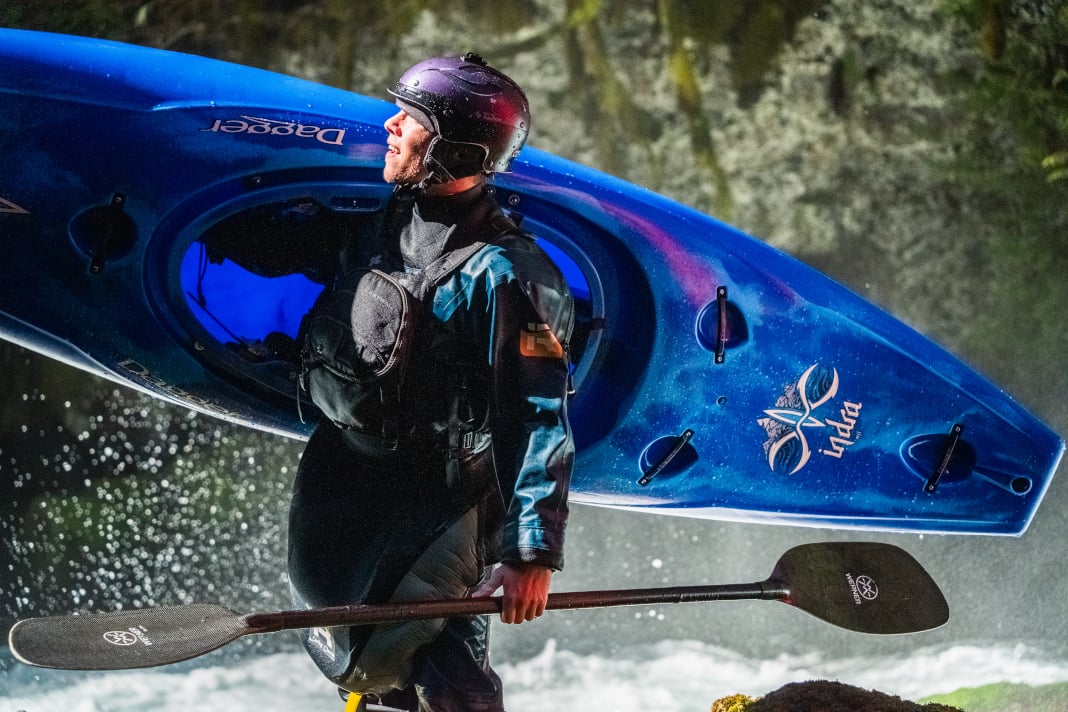
The Dagger Indra was intended to be a sport creeker. “Our team of Dagger athletes were asking for a boat capable of running creeks, but with more playability,” says Robertson. “Something between the Rewind and the Code, with some speed of the Phantom.”
Before I tell you how awesome this boat is, let’s look at all the little bits that make it so…”[ Read full review ]
Dagger Phantom
Who wouldn’t run a boat named Phantom down a line called Dragon’s Tongue. Graham Kent big water testing on the Middle Channel of the Ottawa River. | Photo: Kaden McLaughlin
“Initially paddling on flatwater and trying a few ferries and easy eddy moves, the Phantom didn’t feel as fast as what I was expecting. Being a planing-hull style kayak, the Phantom has defined edges like a modern river runner. Just enough edge to be able to carve a turn, and control a surf, and yet these edges are very forgiving. While I could get the boat to carve a turn, it generally wasn’t a crisp, sharp turn; and when peeling into an eddy, dropping an edge alone often wasn’t enough to fully bring me around to facing upstream…”[ Read full review ]
Ample bow volume and rocker helps the Rewind resurface and maintain speed after drops, while its slicey, low-volume stern turns every eddyline into a play opportunity. | Photo: Scott MacGregor
“On the water, the Rewind actually feels a lot like a scaled-down Phantom, Dagger’s nine-foot-long race-boat-style creeker. That’s not surprising since the two share a rocker and bow profile. With aggressive creek boat rocker up front, this bow boofs with ease, effortlessly rides up and over hydraulics and can carry you through almost everything, so long as your weight is forward. The bow of the Rewind releases more easily, making it easier to make mid-current pivots and changes in direction than the Axiom….”[ Read full review ]
“It’s clear before I catch my first wave that the Dagger Stratos 14.5 is at home in dynamic water. The upswept, flared bow launches over incoming waves and deflects spray out of my eyes. Just the right amount of rocker means I can spot a promising set and crank the boat around with two well-timed sweep strokes…”[ Read full review ]
Dagger Mamba
Tackle whitewater with confidence in the Dagger Mamba kayak. | Photo: Mike Kobzik
Dagger Mamba Specs
Length: 8’1″
Width: 26.75”
Weight: 44 lbs
Capacity: 150-220 lbs
MSRP: $1,200 USD
From our review:
“Though no longer available new, the Mamba is a perennial favorite on the used kayak market. Dagger first launched the Mamba in 2005 as a river runner that was designed to inspire confidence in paddlers whether they were learning the basics, figuring out how to spin, or already drifting over horizon lines. Responsive handling made the Mamba a go-to ride for the big water crowd for a decade, while improved stability and predictability make it a solid choice for developing paddlers…” [ Read full review ]
Shopping for a used Dagger kayak?
You may discover the Dagger kayak of your dreams listed for sale on a buy-and-sell website like Facebook Marketplace. Searching Craigslist Dagger kayak or Ebay Dagger kayak might uncover just the gem you’re looking for. Dagger has always made quality boats, whether for whitewater kayaking or touring. Many options are available in contemporary and discontinued designs. Your first step in making a good investment is to research the specific attributes of the Dagger kayak model you are considering. Once you’ve found a contender, consider the following advice to make a good used purchase:
Examine the overall condition of the Dagger kayak. Dagger kayaks were built to last with tough rotomolded polyethylene plastic and durable outfitting. However, even the toughest material is subject to sun damage if stored outside. For this reason, inspect the Dagger kayak hull and deck for fading or soft spots. Apply firm pressure to all parts of the kayak to test for stiffness—it shouldn’t feel spongy. UV damage is a good general test to determine a kayak’s overall condition.
Whitewater kayaks are subject to lots of wear and tear. Check the deck (top) and hull (bottom) for damage including deep gouges (more than 3 mm or 1/8th of an inch deep); obvious abrasion (especially if the worn areas are a different color from the rest of the kayak); and deformities (which will make the kayak paddle less efficiently). Dagger kayaks are meant to withstand plenty of abuse; some damage is fine, so long as the shape of the kayak remains intact. Over time (and with extremely heavy use), the hull of Dagger kayaks may become wavy; this is a telltale sign of a used kayak to avoid.
Comfortable and practical outfitting is a hallmark of Dagger kayak designs. Take a close look at comfort features like the seat (is it padded and supportive for your body type?). Make sure all of the adjustability features, such as straps, clips and bungees, are functioning. Many of these parts can be replaced, so you may consider worn-out outfitting as a good haggling point if you’re handy and don’t mind making repairs.
Dagger touring kayaks are equipped with bulkheads separating the cockpit from the hull’s storage compartments. These foam walls are critical for safety and seaworthiness (they serve to keep a swamped kayak afloat): make sure they are solid and intact.
The only way to fully appreciate the comfort and performance of a kayak is to try it before committing to a purchase. Arrange a meeting place with the seller that allows you to take a few moments on the water. Bring your usual paddle and dress in what you plan to wear while paddling. With a sit-inside kayak, be sure to assess how easy the boat is to enter and exit.
In general (that is, before Covid-19 put a premium on outdoor equipment) the typical starting point for a used Dagger kayak in moderate condition was about half its retail price. All that’s changed in the wake of boat shortages brought on by the pandemic, but you can use it as a starting point in haggling a fair price.
If you’re offered a PFD as part of a used kayak sale make sure it’s in good shape, fits properly and is Coast Guard approved for the location you’ll be paddling.
For more tips on what to look for when selecting a used kayak, read our article How To Buy A Used Kayak.
Dagger kayak buying guide
Dagger kayaks are sold at paddlesports retailers across North America. The brand produces a reasonable number of models in various categories, making it easy to figure out the right Dagger kayak for your needs.
Most Dagger kayak models are available in several sizes to fit various body types. Dagger kayaks are available in four categories: Whitewater, Adventure Recreation, Multi-water and Performance Touring. Here’s an overview of each:
Whitewater
The history of Dagger kayaks is firmly entrenched in whitewater. Dagger’s lineup of whitewater kayaks include freestyle kayaks, creek boats, river runners, downriver racers and classic models (with modern outfitting) that harken back to the 1990s. These boats are meant for serious whitewater paddling on wild rivers, and are less suitable for those looking for a recreational kayak for occasional use.
Beginners may wish to look at Dagger’s multi-water Katana or Axis models as crossover kayaks for use in whitewater and flatwater. Most Dagger whitewater kayak models are available in three sizes (small, medium and large) to dial in a perfect fit for different sized paddlers.
Adventure recreation
Dagger’s Adventure Recreation kayaks include the sit-on-top Kaos kayak, which excels in warm-water surf. Dagger recreational kayaks are a step up from box store kayaks, with superior outfitting and designs.
Multi-water
Dagger’s Multi-water line is best defined as crossover kayaks that can be used in both whitewater and flatwater. These versatile kayaks combine whitewater-inspired hull shapes with touring features like a drop-down skeg, bulkhead and dry storage hatch.
Multi-water designs include the Dagger Axis and Katana sit-inside kayaks. These kayaks are ideal for adventurous paddlers who want a do-it-all boat for light touring on calm waters, playing in up to class III rapids, or even taking an overnight river trip.
Performance touring
The popular Stratos is Dagger’s Performance Touring kayak. This compact day touring kayak comes in 12.5- and 14.5-foot lengths, both of which are available in two sizes to fit various body types. The Stratos excels in a variety of conditions, including day touring and short camping trips, for both novices and experienced paddlers.
It’s nimble and easy to handle for enthusiastic beginners, with the necessary safety features (such as bow and stern bulkheads and full perimeter lines) to be used in ocean conditions. The Stratos has a comfortable, fully adjustable seat that’s inspired by Dagger’s whitewater kayaks.
These broad categories of Dagger kayaks should serve as a good start in narrowing down the boat of your dreams. Remember, online research will only get you so far. The best advice we can offer is to always test paddle before buying any boat. The more time you can spend on the water in a similar style of kayak, the better the purchasing decision you will make.
Still have questions? Here are answers to some of the most common online questions about Dagger kayaks.
Are Dagger kayaks any good?
Dagger is one of North America’s first kayak manufacturers and this experience is showcased by its designs. Dagger makes good, reliable kayaks for whitewater, recreational and touring uses. Each of its designs serves a unique purpose and comes in various sizes to fit different body types.
Are Dagger kayaks stable?
Dagger kayak stability depends on the model. If stability is your primary concern, take a look at the sit-on-top Dagger Kaos or sit-inside Zydeco models. For an aspiring novice paddler the Dagger Stratos touring kayak offers reasonable stability in a nimble package that’s perfect for developing your paddling skills.
Types of Dagger kayaks
Dagger offers three general types of kayaks: whitewater kayaks (including crossover or “multi-water” kayaks meant for moderate whitewater and flatwater); adventure recreation kayaks that are perfect for beginners looking for a comfortable ride; and performance touring kayaks, which are great for novice to expert sea kayakers looking for well-designed, comfortable kayaks for day and overnight trips.
Discontinued Dagger kayaks
Dagger kayaks have been around for nearly four decades; you may discover discontinued models for sale on the used market. In general, all Dagger kayaks were well designed and included state of the art safety features.
The main difference between current and discontinued models is in the outfitting, which has evolved over the years to offer more adjustability and comfort. The company has also prioritized making each of its current models in various sizes to fit different body types.
Dagger kayak size guide
Just about all Dagger kayaks are available in multiple sizes to accommodate different body types. The best way to size a kayak is to try out different models in real-world conditions. For example, if you plan to carry overnight gear in your kayak, then test various models with a load. The goal is to select a kayak that fits snugly and has enough volume for your desired applications.
What are Dagger kayaks made of?
Dagger kayaks are made from rotomolded polyethylene, which is a durable plastic material designed to withstand years of hard use. Rotomolded polyethylene withstands impacts and abrasion but it can be subject to UV degradation, so it’s important to store your kayak out of direct sunlight.
Dagger kayak weight limit
The weight limit of a Dagger kayak depends on the model. Of the current models, look for a size large for the greatest weight capacity. For example, the Stratos 14.5L model has an upper weight limit of 300 pounds. Dagger whitewater kayaks and adventure recreation kayaks have similar upper limits.
Dagger kayak dealers
You’ll find Dagger kayaks distributed in specialty paddlesports shops across North America. Use their dealer locator to find one near you.
Are Dagger and Perception kayaks the same?
Dagger and Perception are both paddlesports brands in the Confluence Outdoor group. There’s limited crossover between the brands. Dagger produces better whitewater kayaks and its performance touring kayaks are higher-end than Perception. On the other hand, Perception offers a wider range of recreational kayaks, along with fishing kayaks, at somewhat cheaper prices.
Compare Dagger kayaks
Dagger kayaks vs Perception
Dagger and Perception were arch rivals in the 1990s, during the early days of whitewater kayaking. However, both were acquired by Confluence Outdoors in the 2000s and since then, each brand has its own specialty. If you want a kayak for whitewater, get a Dagger; if you want a recreational kayak for casual use or kayak fishing, get a Perception.
Simply put, Dagger makes more advanced kayaks than Perception and targets more serious paddlers with its designs. For example, Dagger’s Stratos lineup of performance touring kayaks offer great versatility for aspiring sea kayakers. Perception, on the other hand, offers more general purpose kayaks that are great for less serious paddlers—yet still boast advanced outfitting and comfort features like adjustable seats and back rests.
Dagger kayak reviews
Your next step in narrowing your search for the perfect Dagger kayak is to read our expert reviews. These will give you a sense for each boat’s strengths and weaknesses, as well as what kind of paddling and paddler they are best suited for.
At the bottom of Butcher’s Knife Rapids on the Ottawa River, a group of whitewater paddlers made an intriguing discovery.
“Some paddling friends sent me a message saying that they found something,” shared Joel Kowalski, Wilderness Tours River Manager. The group of paddlers reported that they had stumbled upon some sort of submerged structure beneath the surface of the water.
Mystery on the Ottawa River
“I got the chance to kayak down the river maybe a few days after that,” added Kowalski. “I could tell it was something big, something unnatural for the river.”
Later, more paddlers headed out to the site to determine what exactly was submerged in the Ottawa. Using an underwater camera, the paddlers confirmed they had found a vehicle beneath the surface of the river.
“The big mystery, of course, is how on earth does this thing get to where it settled in the bottom of Butcher’s Knife Rapid,” wondered Kowalski.
The mystery was later partially solved when authorities confirmed that the vehicle had been reported stolen in May 2024.
Kayakers and Local Businesses work together to remove stolen vehicle from the Ottawa River
On October 24-25 2025, Wilderness Tours along with Xtreme Towing and Gervais Towing set out on a mission to remove the stolen vehicle from the Ottawa River in a multi-day effort.
“We started early on the 24th,” explained Casey Bryant Jones, the lead on the project to remove the car from the river and Ottawa Kayak School Director.
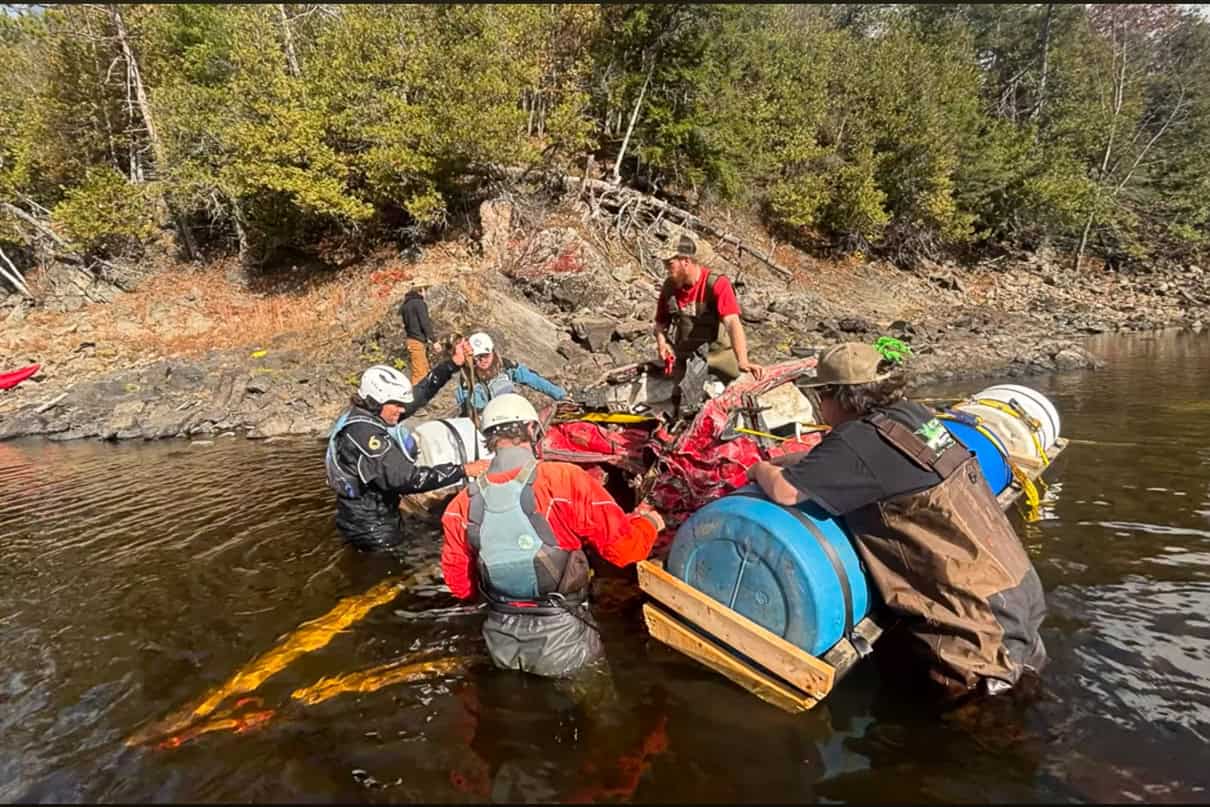
Kayakers work to help recover a stolen car from the Ottawa River. Feature Image: Wilderness Tours | YouTube
“The Wilderness Tours Team worked with the things that we had on site here, using infinity loops that had a 35,000 pound capacity,” said Bryant Jones, adding that these infinity cables were much lighter and easier to work with than actual cable. “We moved those across the river and created a line from river left to river right.”
Using an array of the infinity loops, the team worked to move the vehicle upstream. Boulders and rocky terrain hindered progress. At one particularly large boulder, the team planned to flip the car upside down on top of the boulder, then guide it over.
Stolen car recovery faces complications
“The front end of the vehicle actually became lodged on the boulder, and an extreme amount of force was being put against the towing straps and they actually snapped,” explained Bryant Jones.
The team then had to reestablish a floating line across the river and, using paddler in a whitewater kayak, the crew moved a heavier gauge cable across the river. In a time consuming process using Xtreme Towing’s portable winch, the team was able to attach the vehicle to a new cable, and moved the vehicle over the top of the boulder.
As the night wore on and the team tired, they made the call to finish the mission in the morning. The morning of October 25, the team successfully moved the vehicle to a small inlet, then affixed buoys and pontoons to the vehicle. The Wilderness Tours team then hopped into the water.
“We gave them a hand getting this thing connected, and we over-engineered our strapping to make sure that the pontoons would not become new fixtures in the river,” said Bryant Jones. “For those of you who are paddlers and understand how the current works, if you have a neutrally buoyant item that is in the water and you’re pulling it upstream against the current, it will sink.”
The team worked to keep the vehicle close to shore to avoid losing it in the rapid or the vehicle pulling the team into the river, and eventually finished the job safely and removed the vehicle from the Ottawa River.
After the floodwaters receded on the Nolichucky, Blue Ridge Paddling's riverside headquarters were a shambles. | Feature photo: Courtesy Blue Ridge Paddling
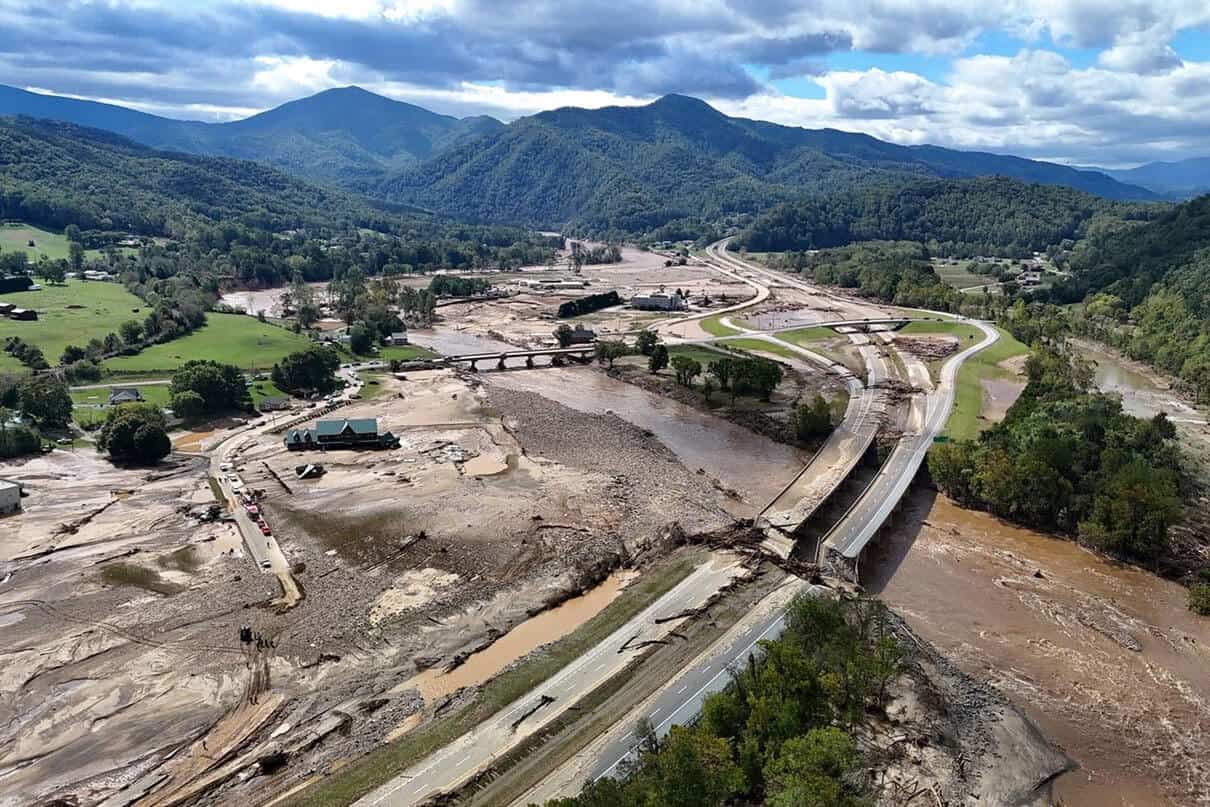
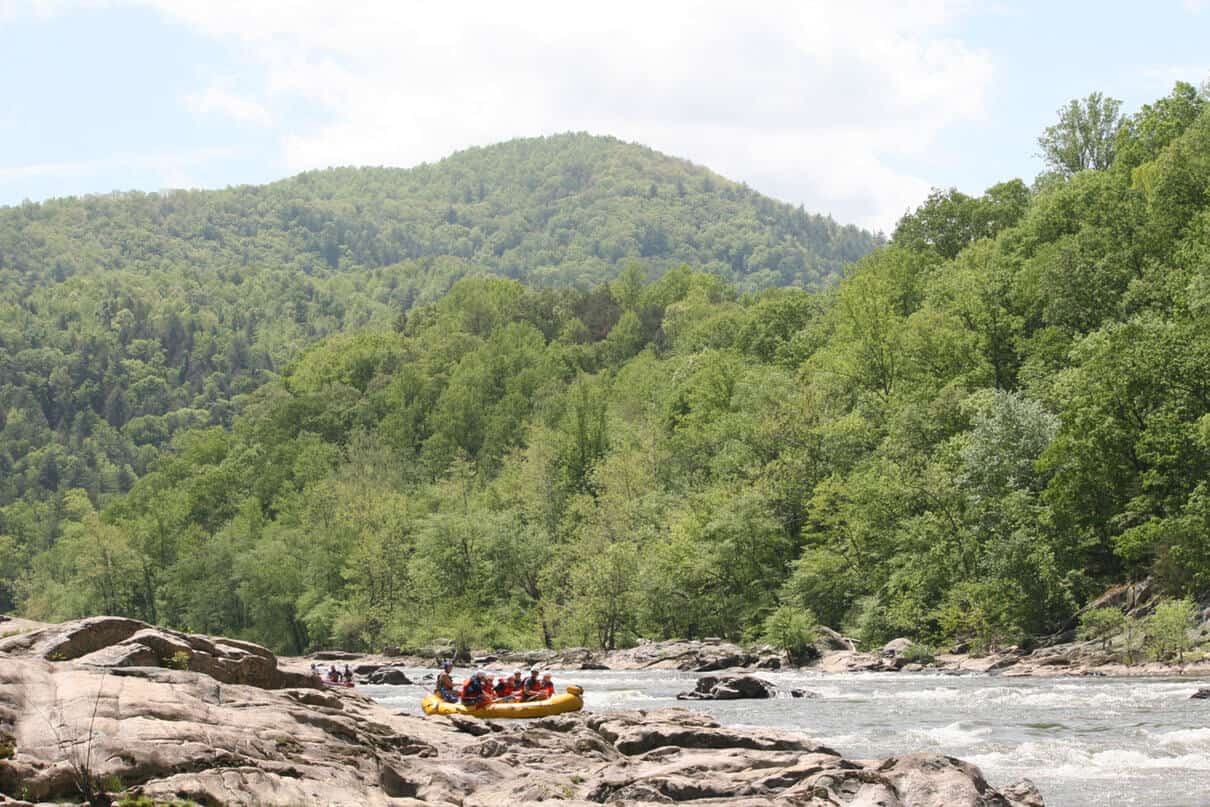
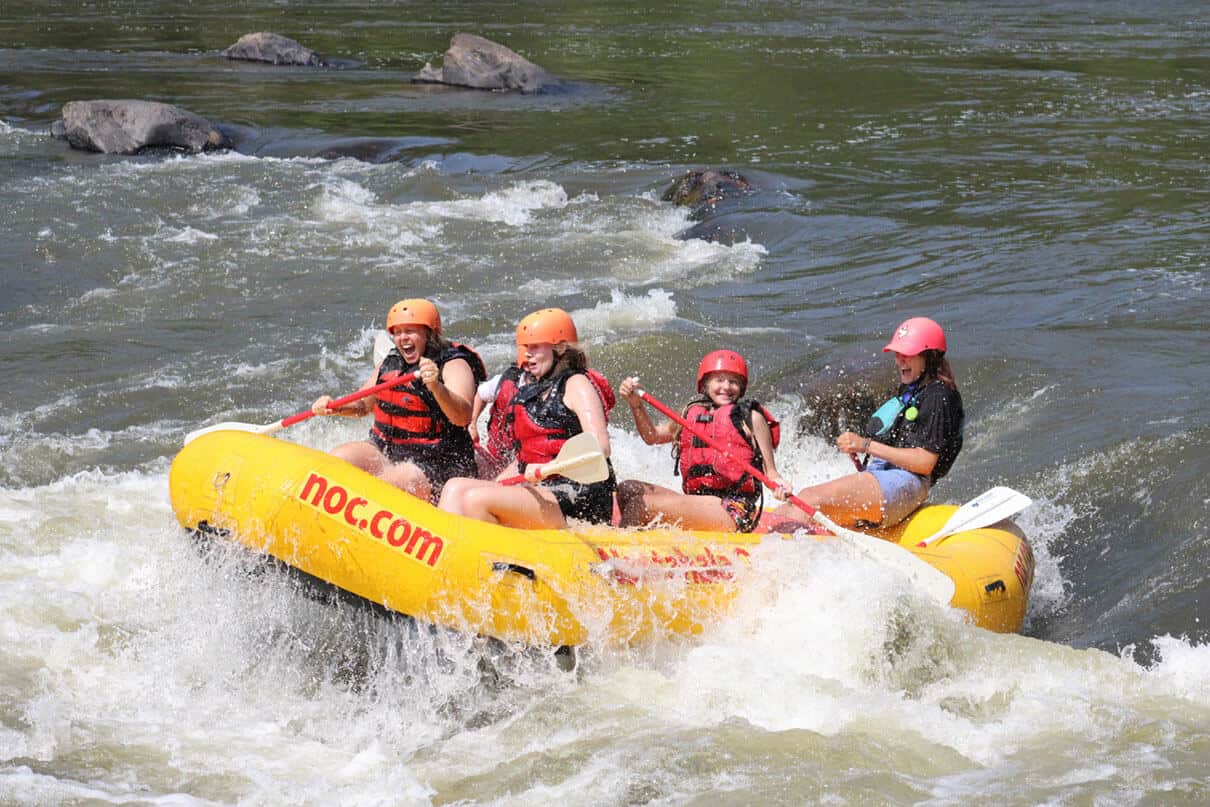
When Hurricane Helene struck the Southeastern United States last October, it left a trail of death and destruction in its wake. It also hit the region’s rafting outfitters in the gut, with area rivers swelling to record levels and outposts left in shambles. The commercially run rivers affected include the Pigeon, French Broad and Nolichucky, where outfitters, as river runners everywhere are prone to do, are putting their heads down and charging into the tumultuous aftermath of Hurricane Helene.
Rafting outfitters still rebuilding and reopening after Hurricane Helene
Three of the five most popular rafting rivers in the U.S.—the Ocoee, the Pigeon and the Nantahala—lie in the path of destruction Helene carved through Western North Carolina and East Tennessee. The Pigeon and Ocoee each see about 170,000 commercial rafting guests per year, and the French Broad consistently tallies more than 100,000, according to the America Outdoors’ 2022 River Use Report (the most recent data available). Southeast outfitters say those numbers are down precipitously this season.
“It’s slower than usual,” says Steven Foy of the Nantahala Outdoor Center, which runs regular trips on both the French Broad and Pigeon. “The impact of the hurricane is definitely influencing tourism.” Foy adds that NOC usually has a combined volume of about 110,000 guest days across the Nantahala, Ocoee, Chattooga, French Broad, Pigeon and Chattahoochee, and that the Pisgah National Forest in which they operate is the most heavily permitted USFS district for outdoor recreation in the country.
After the floodwaters receded on the Nolichucky, Blue Ridge Paddling’s riverside headquarters were a shambles. | Feature photo: Courtesy Blue Ridge Paddling
On the Pigeon, the storm wiped out road and bridge access to the customary put-in. The North Carolina Department of Tourism, Duke Energy and the county worked with outfitters to establish a temporary launch site about a mile downstream. While three outfitters have suspended operations on the Pigeon this year, NOC and some other companies are running trips from the new put-in. Although the abbreviated run skips three crowd-pleasing rapids, Foy says the river is currently great for rafting.
“I went the other day and it’s awesome,” he says, adding that while you can see damage from the hurricane, the river itself is largely unchanged. “We continue to work hard for the area rafting businesses and the long-term recovery of the river,” he says. Outfitters are also working with the state legislature to secure funding for a feasibility study to redevelop the river’s first mile.
The Nolichucky didn’t fare as well. No commercial outfitters are running trips on the East Tennessee classic this season. “We haven’t been allowed to operate yet,” says Mason Schmidt, who owns Blue Ridge Paddling with his brother, Brannon. “We all rely on federal permits from the Forest Service, which hasn’t given their authorization yet.” Blue Ridge and the other outfitter headquartered on the Nolichucky, USA Raft, bore the most physical damage from the hurricane.
“We were pretty much completely obliterated by the hurricane,” Schmidt says, adding it will take another six months to rebuild. Schmidt and his brother hope to reopen their Blue Ridge taphouse brewery by the new year, and resume river operations by spring 2026.
While some of the Nolichucky’s six outfitters have tried to cobble together trips on other, more distant rivers such as the French Broad, that’s not an option for Blue Ridge. “As well as not having an outpost to work out of, we also lost a lot of gear,” Schmidt says. “And insurance completely denied us since we weren’t in the floodplain.” The brothers are staying busy writing grants and working with engineers and architects to rebuild their operation.
The close-knit Southeast outfitter community has rallied around the hardest-hit operators. “We’re helping out as best we can by running shuttles for some of them and letting them use our private take-out on the French Broad,” says NOC’s Foy. “We’re all in this together.”
While most outfitters keep their guest cards close to their chests, Foy estimates that rafting outfitters on the Pigeon and French Broad are collectively down about 20 percent year-to-year. “The data hasn’t been released yet, but that’s about where we all are,” he says. “We’re all down.” While earlier group-focused trips weren’t bad, he says, they hit a soft spot in June’s shorter-term bookings. That isn’t out of the ordinary, but it’s more pronounced in this first post-storm season.
The slowdown is largely owing to people’s perception of the area after Helene. “There’s definitely a perspective that Western North Carolina got flooded off the map,” Foy says. “So, we have to instill the message that we’re open for business.”
Happier Times: Nantahala Outdoor Center commercial trips on the French Broad. | Photo: Courtesy Nantahala Outdoor Center
NOC on the Pigeon River before the storm. | Photo: Courtesy Nantahala Outdoor Center
Nowhere is that more true than on the French Broad, which was hit hard but all of whose outfitters are operating again. Constituents have banded together to rebuild the county-owned put-in at Barnard, N.C., with the Forest Service doing the same at the Stackhouse take-out. Both were operable by mid-March. Those efforts also reopened the five-mile Section 9 commercial stretch, with many outfitters running another three miles down to private take-outs in Hot Springs, N.C. The rapids are the same as they were before the storm, says Foy, and hurricane debris is being removed every day. Many French Broad outfitters are seeing an influx of guides from the Nolichucky.
One outfitter notable for its relief efforts is Outdoor Adventure Rafting/Ocoee Outdoors on the Ocoee River in East Tennessee. “The storm diverted at the last second, so it didn’t impact the Ocoee too much,” says owner Sarah Beth Neal. “But our resources were stretched pretty thin with all our recovery efforts, including building and operating a shelter to house people displaced from their homes.
“Rafting has a pretty thin profit margin to begin with, so those efforts definitely tapped us,” she adds, saying her companies donated more than $30,000 to operate the shelter, which has housed over 80 people since the hurricane. “We’re still trying to find places for some of these people to live.”
While her companies lost the month of October last year, they stayed busy helping others. “We have an amazing staff and the whitewater industry is uniquely qualified to help with disaster relief,” she says. “We’re all certified medically and are rough-and-tumble dirtbag folks.”
She says that this year her numbers are actually up on the Ocoee so far, while most others in the region are down. However, group bookings, such as church outings, have fallen off, as has business from storm-affected areas nearby. The Ocoee region’s destination marketing organization has helped fill the gap with a top-of-the-funnel marketing campaign promoting tourism in the region.
The post-storm dip has caused ripple effects in the guide community. “A lot of guides are showing up looking for work so we often have too many vying for our trips,” Neal says. “It’s kind of brutal. Some outfitters lost their entire outposts.” As the Schmidts learned on the Nolichucky, navigating insurance waters has also been tough. “They don’t replace what you lost, just the value,” she says. That means an outfitter that lost 30 serviceable old boats might receive a payout that is only enough to buy six new rafts. That makes it hard to run an operation.
She adds that most of this year’s customers are caring and truly interested in the aftermath. “It’s a pretty common question we get—people asking how the storm impacted us,” Neal says. “And some people recognize us from all the press we got from helping out.”
The take-home? River running is very much alive and well in the Southeast, with the region’s outfitters helping each other to put guests on their waterways. “We’re open and running strong,” says NOC’s Foy. “Come see us.”
This article was first published in the 2025 issue of Paddling Business. Subscribe to Paddling Magazine’s print and digital editions, or browse the archives.
After the floodwaters receded on the Nolichucky, Blue Ridge Paddling’s riverside headquarters were a shambles. | Feature photo: Courtesy Blue Ridge Paddling
Be prepared, Girl Scouts style. | Feature photo: Sophia Hoffman
An expedition team calling themselves the Hudson Bay Girls is canoeing from Lake Superior to Hudson Bay this summer. The 1,200-mile route will take them from Minnesota canoe country deep into the Canadian wilderness and polar bear territory. The all-female team met while working with the Girl Scouts and Scouting America in the Boundary Waters Canoe Area Wilderness and spent the winter preparing—between college classes—for the three-month trip.
What’s inside the Hudson Bay Girls’ expedition kit
The historic route from Minnesota to Hudson Bay first entered paddling lore with Eric Sevareid’s 1935 book Canoeing With The Cree, but the Hudson Bay Girls’ trip was inspired by Natalie Warren and Ann Raiho’s 2011 expedition, documented in the book Hudson Bay Bound.
“Just hearing about Natalie and Ann’s story as the first two women to publicly paddle that route was so inspiring,” says team member Olivia Bledsoe. “I don’t think it had ever occurred to me I could be on an all-female expedition.”
Just as they were inspired by Warren and Raiho, the Hudson Bay Girls hope to encourage other young women to get on the water. “Is that a girl under there?” is a typical comment they hear on the portage trail as female canoe guides and trippers.
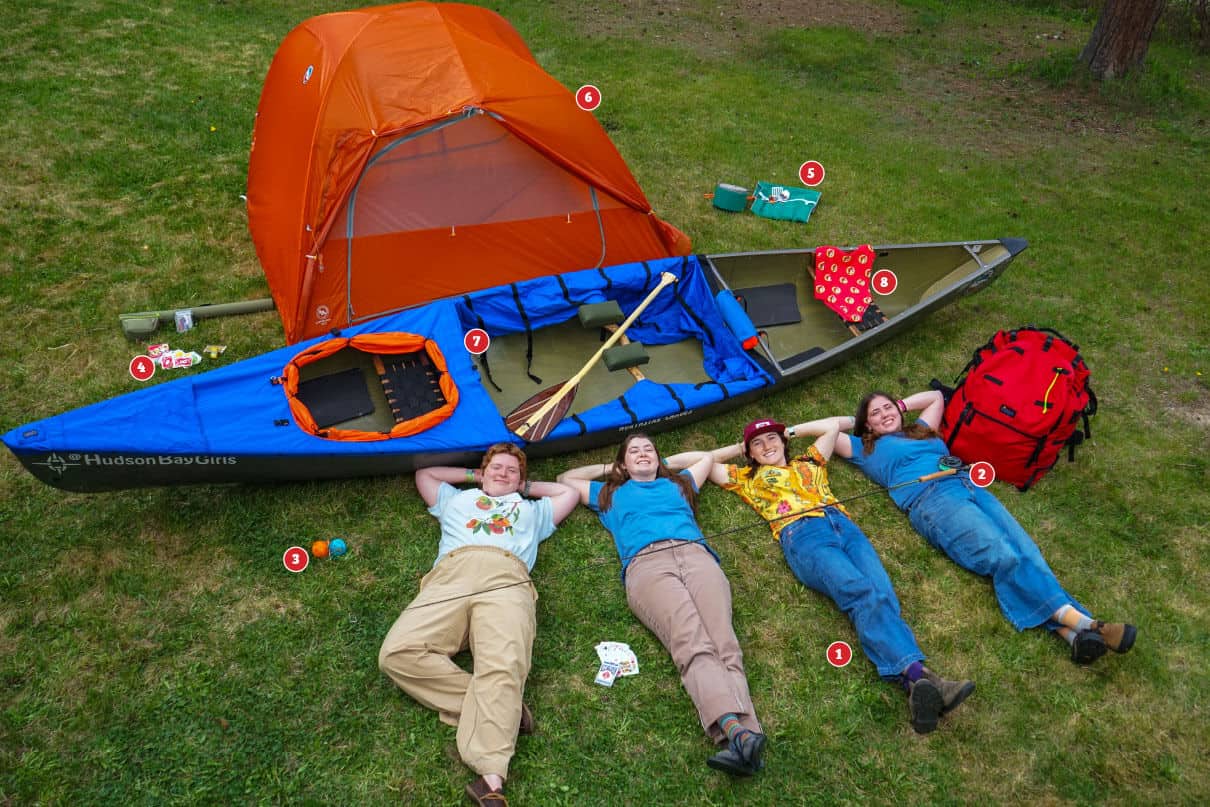
Here are some of their essentials for heading north.
Be prepared, Girl Scouts style. | Feature photo: Sophia Hoffman
1 Girl Scouts
The Hudson Bay Girls—Emma Brackett, Abby Cichocki, Olivia Bledsoe and Helena Karlstrom (left to right)—tackled their first portage trails as Girl Scouts, carrying 70-pound Alumacraft canoes in the Boundary Waters. “When a lot of people think of the Girl Scouts, they think of philanthropy, crafts, cookies and softer skills,” says Karlstrom. “The Girl Scouts is more than that. We are truly empowering people to do really hard things and get out in the wilderness.”
“Whenever I do something hard, I say to myself, ‘It’s not as hard as carrying an Alumacraft canoe over a two-mile portage,’” Cichocki agrees.
2 Orvis Clearwater fly rod
Karlstrom loves to fly fish. In preparation for the expedition, she received handmade gifts and lucky flies from her fly fishing community to take north.
3 Crochet project
Studio art major Brackett plans to tapestry crochet a pattern inspired by the trip during downtime in camp.
4 UNO
Anticipating windbound days on Lake Winnipeg, the Hudson Bay Girls packed playing cards, UNO and corn-themed Farkle dice from South Dakota. Cichocki vows to play games every night, even if it means playing solitaire.
5 Thrifted pots
“You guys have the nicest canoes, packs and tents, and these are the pots you brought?” a friend remarked to the team during their final gear shakedown. The girls are bringing a $1 thrifted liner pan with a hole in it for most of their cooking, and salvaged another pan from the trash after the Scouts rejected it. “[You] don’t need brand new gear to get outdoors,” says Karlstrom. “Get some pans out of the garbage and take them with you on trail.”
6 Sleep system
As winners of the Bob Swanson Memorial Grant, which supports unique expeditions in the spirit of adventure, Big Agnes donated sleep systems, including tents. While nice gear makes a long trip more comfortable, it isn’t make or break, the group agrees.
The two canoes are outfitted with spraydecks from Cooke Custom Sewing for safer travel in rapids and on the big water of Lake Winnipeg. While the spraydeck won’t necessarily keep them on the water for longer on Lake Winnipeg, it will help them get safely back to shore if the weather turns.
8 Buc-ee’s swimsuit
Karlstrom grew up in Texas. Her swimsuit, affixed with the iconic toothy beaver mascot of Buc-ee’s, a Texas-based convenience store and gas station, has been the subject of much conversation. “All my friends make fun of me for it, so I thought it would be only fitting to bring it,” she says.
This article was published in Issue 74 of Paddling Magazine. Subscribe to Paddling Magazine’s print and digital editions, or browse the archives.
Be prepared, Girl Scouts style. | Feature photo: Sophia Hoffman
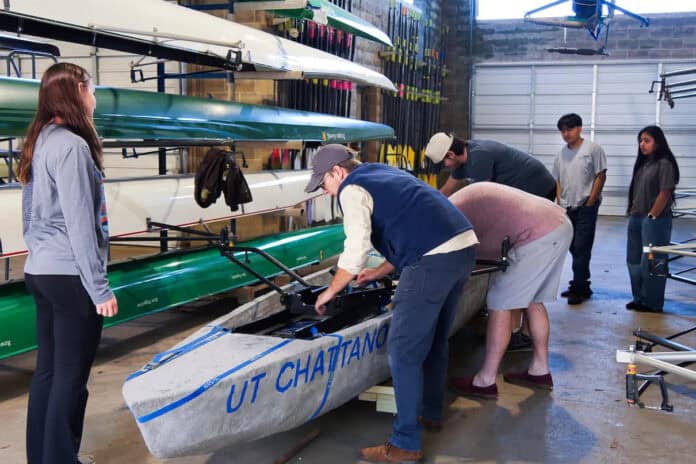
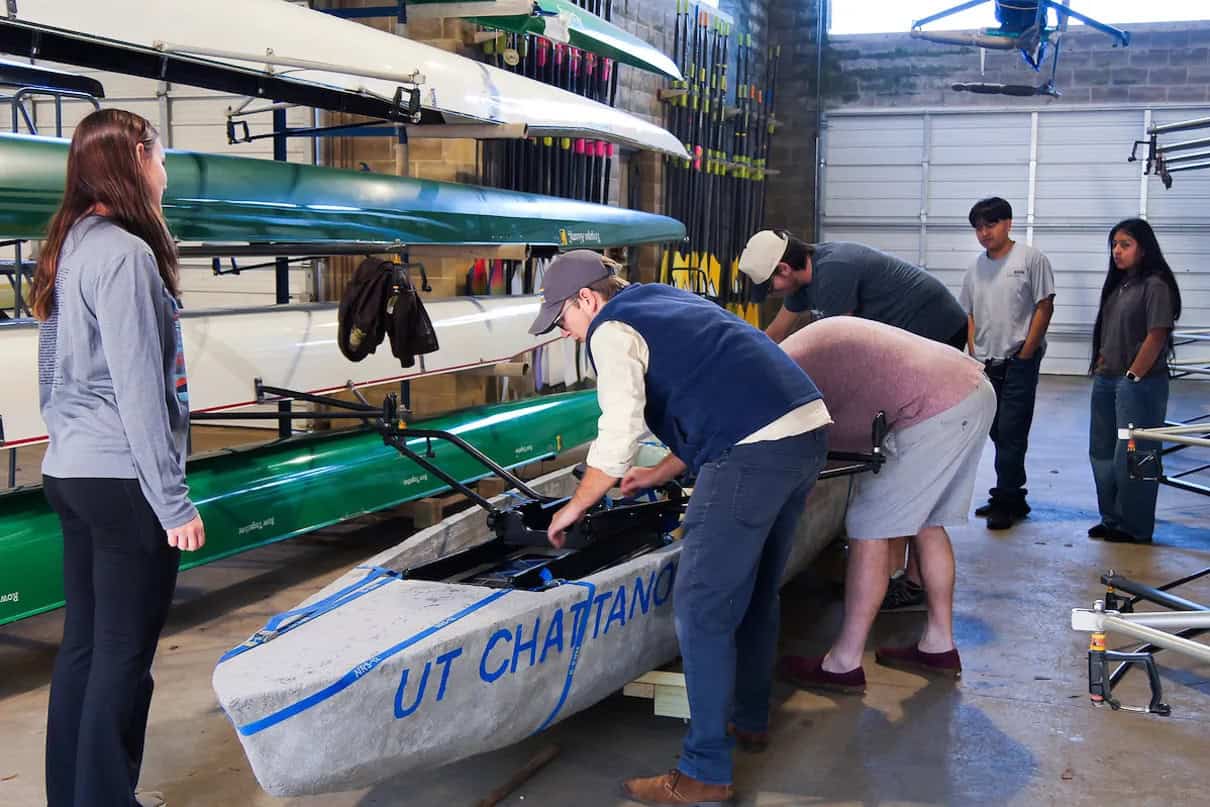
University of Tennessee Chattanooga students prepare their project, a 1000-pound concrete canoe, for the water. Feature image courtesy Dixie Edmondson.
Engineering students at University of Tennessee Chattanooga face an unusual challenge as part of their curriculum: make a maneuverable and stable canoe out of concrete. Then, the students pass that concrete canoe to the rowing team and hop into a traditional rowing shell and race the rowers.
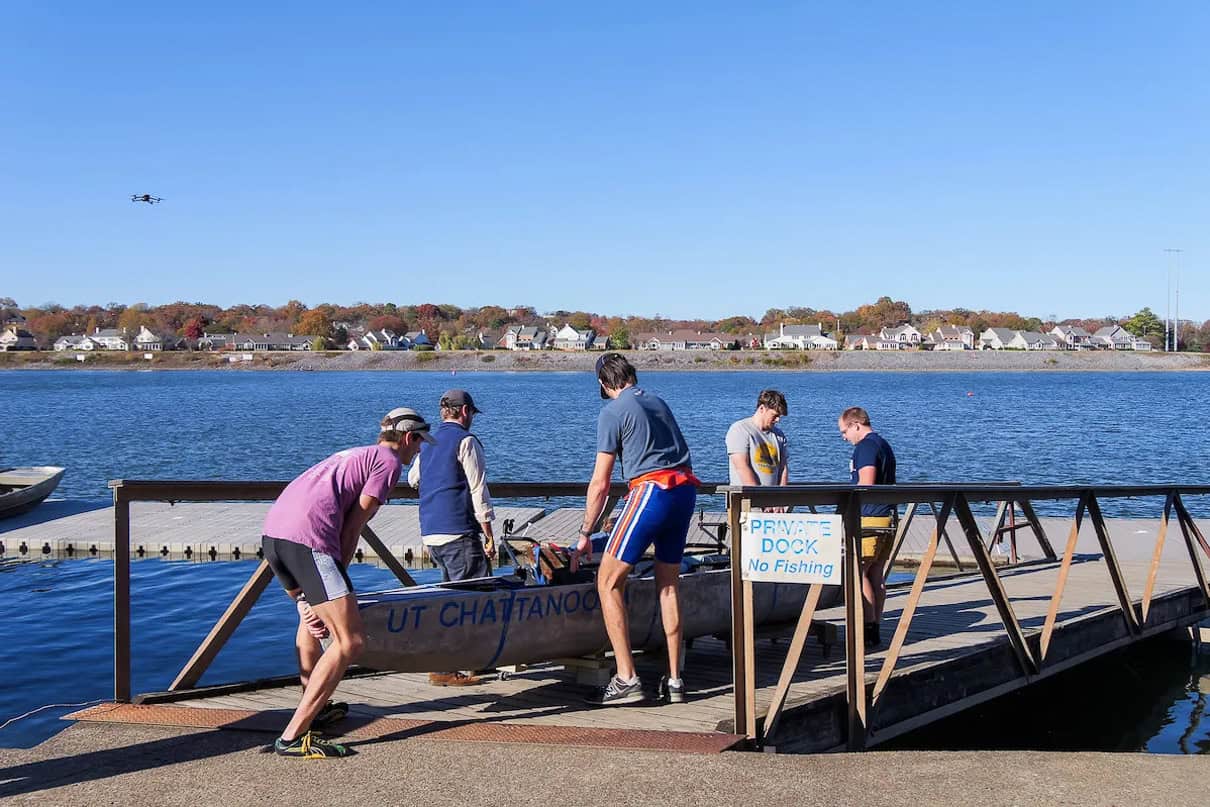
On November 16, 2025, the University of Tennessee Chattanooga (UTC) Rowing Team took to the student-built concrete canoe to race it against engineering students, who used a traditional rowing shell, through 500 meters of chop on the Tennessee River in the inaugural “Athletes vs. Engineers” race. The engineering students in the rowing shell won by a significant margin, but the concrete canoe was a success in durability and buoyancy.
University of Tennessee Chattanooga students tackle the unusual task of designing, constructing and racing concrete canoes
In a world where manufacturers are consistently pushing for the next lightweight canoe, the students at UTC are building canoes out of concrete, and for them a 1000-pound canoe is considered a winner.
Abraham Mako from the University of Chattanooga Rowing Team explained that while the concrete canoe was extremely heavy, the weight wasn’t the most challenging part of maneuvering the craft.
“The canoe sat very high in the water, leading to an unusual stroke to keep the blade in the water,” explained Mako.
Students prepare a concrete canoe for voyage on the Tenneessee River. The canoe weighed around 1000 pounds. Image courtesy Dixie Edmondson
Mako added that the length of the canoe combined with the lack of a skeg and hull shape made the canoe a challenge to paddle in a straight line.
The Athletes vs. Engineers Race on the Tennessee River isn’t the only event these concrete canoes are up to compete in; the American Society of Civil Engineers (ASCE) holds an annual concrete canoe competition that draws students from throughout the United States to race and compete. The first ASCE concrete canoe competition was held in 1988, but intramural concrete canoe races began as early as the 1960s.
“The canoe doesn’t just have to float,” explained Christopher Moreland from UTC’s College of Engineering & Computer Science. “It has to be able to capsize and not fully submerge, not sink to the bottom. They have to go through a maneuverability course.”
Moreland added that this year’s concrete canoe weighed around 1000 pounds.
“If you didn’t know that it was concrete from a distance, you would just be like, that’s a really bulky canoe,” shared Moreland.
From a Chattanooga classroom to the Tennessee River
The lead up to the race begins in a UTC engineering classroom, where students are tasked with designing a canoe, presenting and defending their design and then as a class choosing which of the proposed designs to actually create.
The roles in constructing the canoe are then divided amongst the class and construction begins.
“It’s really about creating an opportunity for them to use the skillset that they’ve developed as part of the civil engineering program, and then apply that in an actual environment where you have to make something real as a team,” said Moreland.
University of Tennessee Chattanooga students prepare their project, a 1000-pound concrete canoe, for the water. Feature image courtesy Dixie Edmondson.
Moreland also shared that the Fall 2025 canoe has been a standout canoe – a number of canoes from previous years have broken apart the first time they were placed in the water.
“Now it’s been in the water four times, and it hasn’t broken,” shared Moreland. “So it’s really impressive. We took it out on the Tennessee River on a little bit of a choppy day and it managed to go, I think a thousand meters undeterred.”
How do you make a canoe made of concrete float?
Whether or not a boat floats comes down to the principles of buoyancy and displacement: a boat, even a boat made of concrete, will float when it displaces enough water that the buoyant force (force of a fluid opposing the weight of an object in the fluid) equals its weight.
Christopher Frishcosy, civil engineering lab director for the UTC College of Engineering and Computer Science and the advisor for the concrete canoe project, shared that the key to making a concrete canoe float is ensuring that the water weighs more than the concrete canoe. A key aspect of creating that lighterweight concrete is replacing the coarse, heavier aggregates like limestone or quartz with lighter volcanic rock.
“We don’t need the strength that you need in a traditional concrete. So we can… be creative on this cementitious portion and cementitious materials portion to make a lighter product that provides the strength we need for that function,” shared Frishcosy.
According to Frishcosy, mix design is the first engineering challenge that the students find themselves in with this competition, but another aspect of engineering the project teaches is code compliance.
Concrete canoes perform well in stability; maneuverability remains a challenge
“ASCE, American Society Civil Engineers, releases the rules and regulations, design proposals for this competition, and they have requirements they have to meet on certain designs,” explained Frishcosy. “Even before you get to the calculations, understanding what your limitations are and what your requirements are for the design is a part of the design process.”
Frishcosy also explained that in some years the ASCE provides requirements for length, width, hull depth, and more but in 2025 there were no specifications and design details of the canoe were completely in the hands of the students.
Generally, the concrete canoes perform well in stability, but maneuverability has often proven a challenge. Frischosy noted that general maneuverability aside, paddler’s time practicing in the boat and learning its mechanics has likely also been a limiting factor in maneuverability tests.
Overall, the concrete canoe project acts both as a fun race and a hands-on learning experience for students.
“Undoubtedly they get more out of this project than, let’s say a homework assignment or just a class project per se,” shared Friscosy. “In the 2023, 2024 [ASCE] competition we were able to get second place. Last year we did not get to race; because of inclement weather in Arkansas, the races were cancelled.”
Nonetheless, the next cohort of UTC Engineering students have the 2026 ASCE concrete canoe competition to look forward to, with the finals to see the return of the three person 600-meter endurance slalom race.






 This article was first published in the 2025 issue of Paddling Business.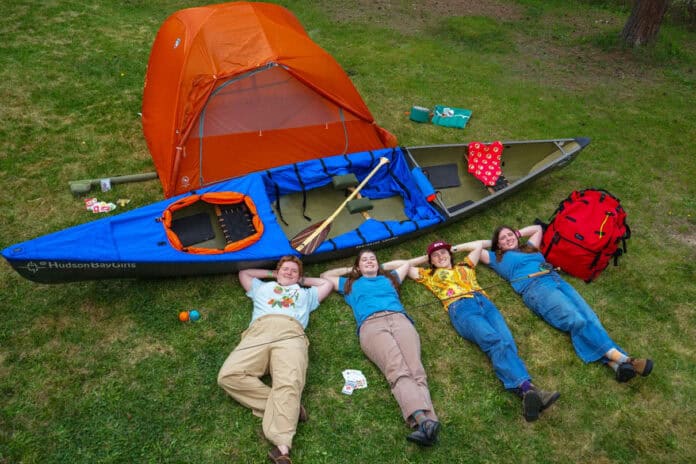

 This article was published in Issue 74 of Paddling Magazine.